1. Introduction
Limited by the energy structure, China’s power generation industry has long relied on coal as the primary energy source [
1]. During power generation, coal-fired power plants produce various types of wastewater, including desulfurization wastewater, circulating cooling blowdown water, and chemical water treatment wastewater [
2]. These types of wastewater feature high salinity, a complex composition, and high hardness, with high salinity being the most prominent characteristic. Wastewater not only has persistently high total dissolved solids (TDS) content but also contains a large number of anions, such as Cl
− and SO
42−, and cations, such as Na
+, Mg
2+, and Ca
2+ [
3]. Appropriate measures are required to prevent serious environmental problems, such as soil salinization and water body osmotic pressure imbalance. China’s 14th Five-Year Plan clearly sets the strategic goal of “near-zero discharge of industrial wastewater”. Enterprises face new technical demands for zero wastewater discharge, shifting from discharging wastewater after treatment standards are met to wastewater reuse and resource utilization.
Currently, most enterprises use traditional concentration and crystallization methods to treat high-salinity wastewater from coal-fired power plants. The obtained mixed salts are regarded as hazardous waste, with extremely high disposal costs and a high risk of secondary pollution. Moreover, this method consumes large amounts of energy and entails very high investment and operating costs [
4]. In fact, coal-fired power plants emit large amounts of carbon dioxide (CO
2) during coal combustion and are a key source of carbon emissions. Integrating CO
2 resource utilization with the treatment of coal-fired wastewater has become an important direction for the green development of coal-fired power plants.
Considering that wastewater salts can be recovered to absorb carbon dioxide emitted by power plants and generate sodium carbonate or bicarbonate, this approach can achieve both carbon capture and utilization (CCU) and wastewater resource utilization, thereby realizing resource integration. The products produced, such as sodium carbonate or bicarbonate, can also be reused in power plants to adjust the alkalinity [
5]. This process requires a relatively high concentration of sodium chloride in solution, so the salinity of high-salinity wastewater has become a key factor in achieving resource utilization [
6].
The concentration and volume reduction technologies for high-salinity concentrated water mainly include membrane concentration separation and thermal concentration. Membrane concentration separation technology is superior to thermal concentration technology in terms of energy consumption, separation efficiency, product quality, operational simplicity, environmental protection, and energy saving and is particularly suitable for treating solutions with complex components [
7]. Among them, the reverse osmosis (RO) method has no phase change, covers a small area, and has a low cost, and it is widely used in the concentration and volume reduction of high-salinity water; however, concentration is limited by the osmotic pressure of the solution, which imposes strict requirements on the pressure and inlet water quality. The inlet of RO should exhibit a suspended solid concentration < 3 mg/L, turbidity < 1 NTU, hardness (calculated by Ca
2+) < 17 mg/L, and COD < 40 mg/L. Therefore, pre-treatment is required before water intake to the RO process. Given the complex components of high-salinity concentrated water from coal-fired power plants, the pre-treatment process should primarily focus on reducing the hardness and organic matter, as they could easily cause fouling [
8,
9].
Various methods, including coagulation–sedimentation, filtration, and softening, have been employed for hardness removal [
10,
11]. Coagulation–sedimentation aims to remove particles, colloidal matter, and hardness, thereby preventing RO membrane fouling [
12]. Mahasti et al. (2024) employed chemical oxo-precipitation to treat desulfurization wastewater and achieved the targeted chemical concentration [
13]. However, the process was negatively influenced by the presence of sulfate and magnesium. This suggests that other chemicals should be taken into account, and the preparation of their removal is required. Filtration is also an efficient means of particle removal that can be directly applied to wastewater or applied after sedimentation to further separate the particles from the wastewater. Microfiltration as a pre-treatment for RO has improved membrane fouling [
14]. Softening is typically used to reduce the concentrations of divalent cations such as Ca
2+ and Mg
2+, while coagulation–sedimentation can also be used [
10,
15].
Organic matter is another important pollutant that requires special attention when RO is used to concentrate Na
+ from coal-fired wastewater. It can cause membrane scaling. Normally, biological degradation is involved in the removal of organic matter. To avoid the impact of ions such as Cl
−, SO
42−, Mg
2+, Ca
2+, and Na
+, these ions must be removed before the biological process [
16]. If the Na
+ concentration is high and the ion needs to be retained in the system, adsorption and oxidation are considered more suitable for organic matter removal, as they will not be affected by Na
+ [
17]. Oxidation is considered a good option for removing organic matter to create suitable conditions for the RO process. Researchers have compared different oxidation processes, including UV/H
2O
2, UV/persulfate, Fenton, and fluidized bed reactor (FBR)–Fenton and found that FBR–Fenton exhibited the best performance for COD removal [
18]. The combination of Fenton with powdered activated carbon (PAC) has shown around 88% COD removal [
19]. O
3 has also been applied and achieved around 51% COD removal [
20]. Overall, it can be seen that Fenton combined with other processes seems more efficient. However, the major problem of Fenton is the high sludge production. Electrochemical oxidation has been found to be an efficient method for organic matter removal. It even shows strong performance in hard-to-degrade organic matter removal [
21]. The organic matter in the desulfurization wastewater of a coal-fired power plant is complex. Electrochemical oxidation could be one of the choices for organic matter removal from these types of wastewater. In addition, the desulfurization wastewater contains high amounts of metal ions, which can play the role of electrolytes and thus enhance the treatment efficiency. Moreover, proper electrode selection can achieve electrocoagulation. It is possible to achieve oxidation and coagulation in a single step, thereby facilitating pre-treatment in the RO process for the salt concentrate from wastewater from coal-fired power plants.
This study investigates the feasibility of electrochemical treatment as a pre-treatment for the RO process on the salt concentrate from the wastewater of coal-fired power plants. The electrochemical system was constructed using various electrodes. The process has been compared with Fenton oxidation and the microelectrolysis method. The treated solution was then passed through the RO process to obtain a salt concentrate after precipitation. The study provides a foundation for pre-treatment selection for the RO process used to concentrate salts from coal-fired wastewater.
3. Results and Discussion
It could be seen that both wastewaters were complex and could not be concentrated by RO without pre-treatment. The wastewater from the two coal-fired power plants differed in its characteristics. The one from Chongqing showed high concentrations of NH4+-N, Ca2+, Mg2+, Na+, SO42−, and Cl− and a high COD, while the one from Guangdong had high concentrations of SS, Ca2+, Mg2+, Na+, SO42−, and Cl−. This suggested that the target of the pre-treatment for both wastewaters was the removal of SS, COD, and ions. Concentrating the wastewater from Chongqing using RO was more challenging than the other method. Hence, the pre-treatment investigation was performed using wastewater from Chongqing (WWCq).
3.1. Electrochemical Oxidation for COD Removal
3.1.1. Effect of Plate Spacing on COD Removal
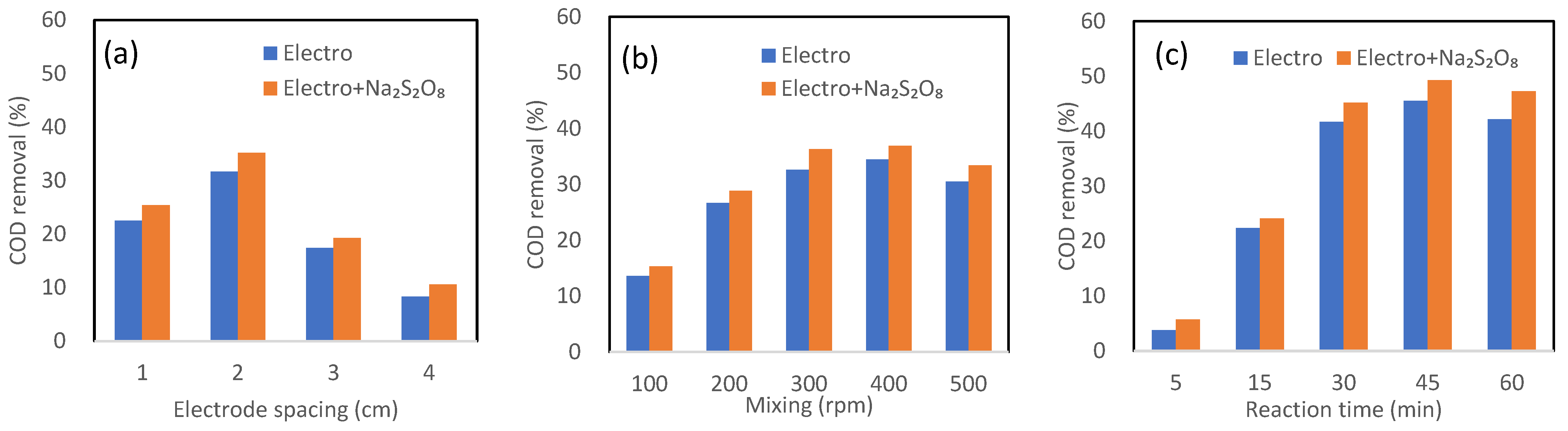
The two-plate (anode and cathode) spacing was varied during electrochemical oxidation, with and without the addition of Na
2S
2O
8. During the experiment, the mixing was kept at 300 rpm, and the reaction time was 30 min. Its impact on COD removal is shown in
Figure 1a.
The electrode spacing significantly influenced COD removal in both electrochemical treatments, with and without Na2S2O8 addition. COD removal increased with increasing electrode spacing and then decreased. The best removal occurred at spacing of 2 cm, and the COD removal rates were 31.7% and 35.2% with and without Na2S2O8 addition, respectively. The electrode spacing impacts the electric field strength, mass transfer rate, ohmic voltage drop, and bubble behavior. When the spacing is too small, it can cause a short circuit and localized failure, thereby reducing the oxidation effect. However, when the spacing is too large, it can cause a drop in the electric field strength and mass transfer rate, limiting the generation of radicals and thus leading to limited COD removal.
3.1.2. Effect of Mixing on COD Removal
Mixing can affect the contact opportunities between the COD and the radicals. To achieve suitable mixing, the electrochemical treatment was performed at 100, 200, 300, 400, and 500 rpm. The electrode spacing was 2 cm, and the reaction time was 30 min. The results are shown in
Figure 1b.
For both electrochemical treatments with and without Na2S2O8 addition, the trend is similar. At 100 rpm mixing, COD removal is only half that at 200 rpm. With a mixing speed increase, COD removal increased as well. However, the removal performance was similar across mixing speeds from 300 rpm to 400 rpm, and further increasing the mixing speed reduced COD removal. The mixing speed plays a critical role in mass transfer. Low-speed mixing would lead to insufficient contact between the organic matter and the radicals, and the localized oversaturation or depletion of reactants can occur, thereby reducing the reaction rate. High-speed mixing could sweep away radicals or intermediates before they react, thereby reducing the efficiency. It can also lead to a short contact time, resulting in low COD removal. This suggests that a mixing speed of 300 rpm for electrochemical treatment is suitable, given the energy consumption and mixing efficiency.
3.1.3. Effect of Reaction Time on COD Removal
The reaction time of the electrochemical treatment was varied to investigate its impact on COD removal. The reaction time was set at 5, 15, 30, 45, and 60 min, respectively. The electrode spacing was 2 cm, and the mixing speed was 300 rpm. The results are provided in
Figure 1c.
With the reaction time increased from 5 min to 60 min, the COD removal initially increased, then remained stable, and even dropped slightly. Compared to a 30 min reaction time, 45 min is better, achieving COD removal efficiencies of 49.3% and 45.5% in the treatment process with and without Na
2S
2O
8 addition, respectively. For a 60 min reaction time, it is slightly lower than for 45 min. The flocculation effect is the cause, as iron is transferred from the electrode into the solution. The iron flocs encapsulate pollutants and the electrode surface, hindering contact between the reactive free radicals and organic matter [
27].
Overall, the optimal treatment conditions are electrode spacing of 2 cm, a mixing speed of 300 rpm, and a reaction time of 45 min for both cases with and without Na2S2O8 addition. COD removal by electrochemical oxidation is not solely due to oxidation but also to flocculation, as iron was transferred from the electrode into the solution. It could thus remove some suspended COD.
The addition of Na
2S
2O
8 improved COD removal (
Figure 1). This is due to the production of sulfate radicals (SO
4−·). However, the enhancement was not significant for all cases. Na
2S
2O
8 addition can only improve COD removal by around 6%. However, it brings SO
4 2− into the solution, which increases the load on separating SO
42− from the system. Hence, electrochemical treatment without Na
2S
2O
8 addition is more favorable.
3.2. Fenton Oxidation for COD Removal
The Fenton process generates highly oxidizing hydroxyl radicals (·OH) through the reaction of Fe
2+ with H
2O
2, which has a good oxidation effect on refractory organic matter [
19].
3.2.1. H2O2 Impact on COD Removal
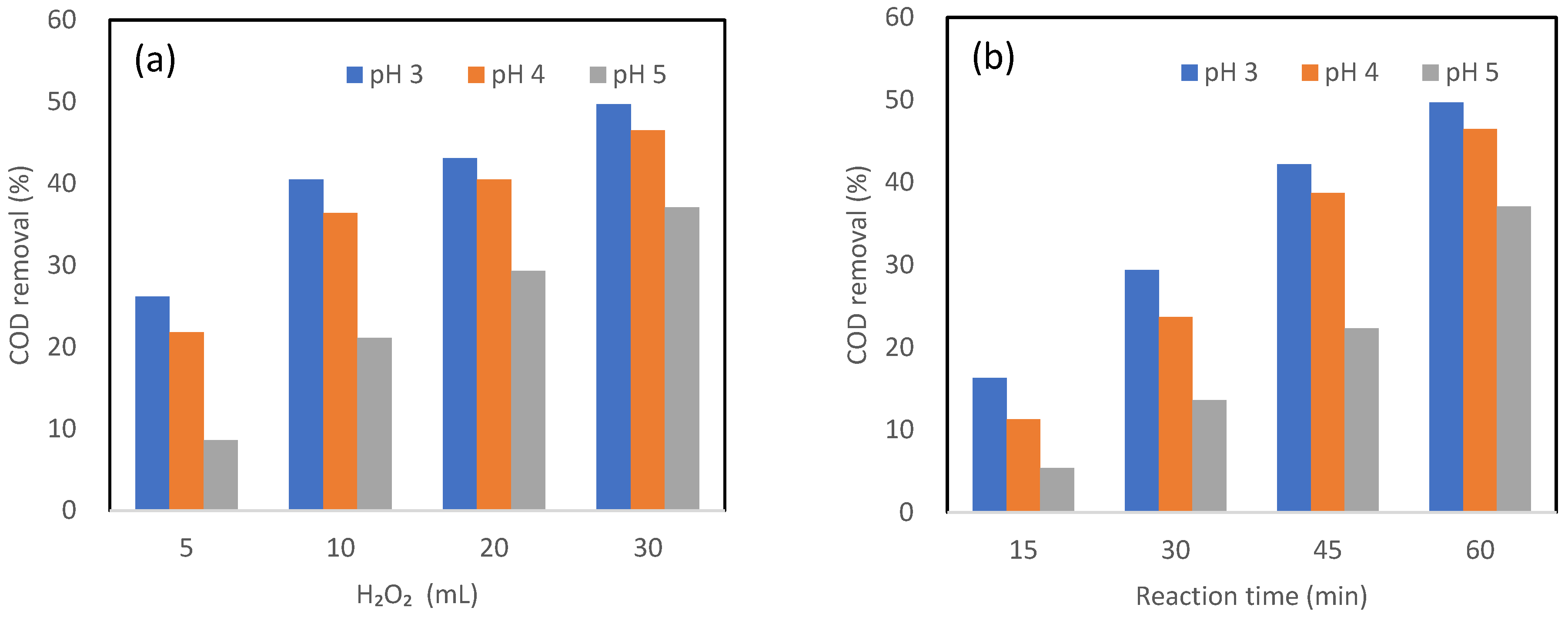
The Fenton reaction was performed at different pH levels (initially 3, 4, and 5, after which it was dropped to 2.6, 3.7, and 4.6, respectively), and the H
2O
2 dosage ranged from 5 to 30 mL. FeSO
4·7H
2O was fixed at 2 g. Samples were taken after a 60 min reaction. Under different pH conditions, the impact of the H
2O
2 dosage on COD removal was as shown in
Figure 2a.
At the same pH, as H2O2 was added, COD removal increased. The highest COD removal was observed at a dosage of 30 mL, with 49.7%, 46.5%, and 37.1% removal at pH 3, 4. For the 20 mL H2O2 dosage, COD removal was only slightly lower than for the 30 mL dosage. This suggests that a 20 mL dosage of H2O2 is suitable for COD removal in Fenton oxidation.
Both the H2O2 dosage and initial pH significantly influence the COD removal efficiency in the Fenton process. In the Fenton process, H2O2 reacts with Fe2+ to produce highly oxidizing hydroxyl radicals such as ·OH, which attack organic pollutants. A higher H2O2 concentration provides more precursor molecules for ·OH generation, thereby enhancing the oxidation capacity and increasing COD removal. However, excessive H2O2 can act as a scavenger of ·OH, thereby lowering COD removal.
3.2.2. Reaction Time Impact on COD Removal
At pH 2, 3, and 4 with a 20 mL H
2O
2 dosage and 2 g FeSO
4·7H
2O addition, the reaction time was varied from 15 min to 60 min. The COD removal efficiency is illustrated in
Figure 2b.
With increasing reaction times, COD removal increased markedly during the first 45 min across different pH conditions; thereafter, it stabilized (
Figure 2b). For a 60 min reaction, the COD removal efficiency was only 3.7% higher than that for a 45 min reaction. Considering energy efficiency, a 45 min reaction time was sufficient for COD removal from WW
cq via Fenton oxidation.
The above findings show that the pH significantly affects Fenton oxidation. Compared to pH 3 and 5, pH 3 achieved the highest COD removal in all cases. In Fenton oxidation, the highest COD removal of 49.7% was observed at pH 3, a H2O2 dosage of 20 mL, and a reaction time of 60 min. This is because, at around pH 3, most of the iron exists as free Fe2+ and Fe3+ species. The catalytic cycle is the most efficient, generating the maximum amount of ·OH in the shortest time and achieving the best COD removal rate. When the reaction time is reduced to 45 min, the removal can still reach 46.1%, similarly to the 60 min case. This suggests that 45 min can be adopted for COD removal.
3.3. Microelectrolysis Treatment for COD Removal
Microelectrolysis has been considered an effective method for removing organic matter from wastewater [
28,
29]. Microelectrolysis for wastewater treatment relies on the generation of radicals and oxidants within the system. Fe
2+ and [H] can also be generated in the system under certain conditions, degrading organic matter via redox reactions. Moreover, adsorption and precipitation may also occur in the system [
30]. This can appear as a reduction in the COD concentration. In this study, microelectrolysis was employed for COD removal. The effects of the pH and mixing speed on COD removal were investigated.
3.3.1. pH Impact on COD Removal
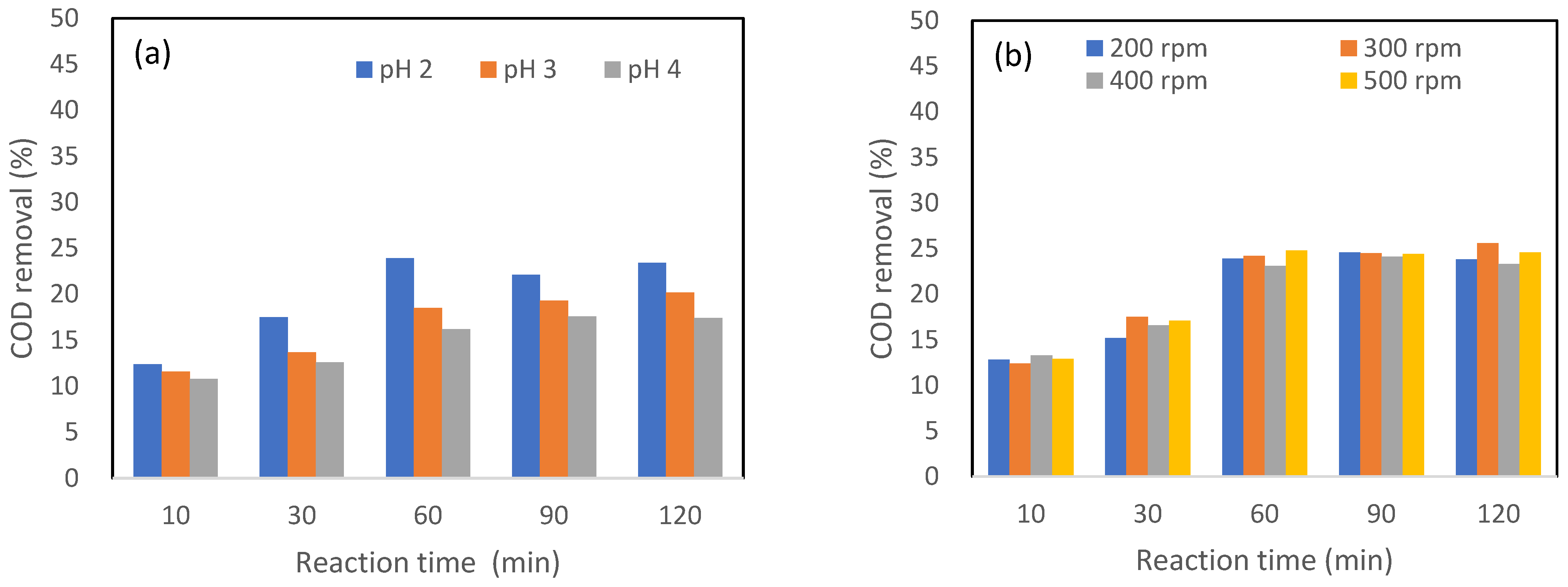
To investigate the pH impact, the wastewater was adjusted to pH 4, 7, and 9 and then reacted in a shake flask with 10 g of iron filings and 10 g of activated carbon at 300 rpm. Samples were taken at 10, 30, 60, 90, and 120 min. The results are given in
Figure 3a.
Among all cases, pH 4 performed best. Its COD removal was 23.9% after 60 min of reaction. At pH 7 and 9, COD removal was 22% and 32%, respectively, lower than at pH 4. More radicals, i.e., Fe
2+ and [H], are formed in more acidic conditions [
31]. This pH thus enhanced COD removal. In acidic conditions, the corrosion of iron is accelerated. The anodic reaction and the cathodic reaction are both promoted by a higher concentration of H
+ ions. This leads to the formation of more Fe
2+, [H] (atomic hydrogen), and other reducing/oxidizing radicals, which are responsible for the degradation of organic pollutants via redox reactions.
With the reaction time increasing from 10 to 60 min, the COD removal efficiency showed an increasing trend (
Figure 3a). However, further increasing the reaction time to 120 min did not cause any difference. At this dosage of iron filings and activated carbon, they provide a finite capacity for generating Fe
2+/radicals and adsorption. When easily reducible/adsorbable organic compounds are removed, and the material’s surface becomes saturated or passivated, additional reaction time yields negligible additional removal. This indicates that the removal reaches the maximum with the addition of 10 g of iron filings and 10 g of activated carbon. To improve COD removal, further increasing the amount of iron filings and/or activated carbon is required [
32]. This would thus increase the costs and be non-competitive with other oxidation treatments.
3.3.2. Mixing Impact on COD Removal
To understand the impact of mixing on the microelectrolysis process, the reaction was carried out at 200, 300, 400, and 500 rpm. During the reactions, the pH was fixed at 4. The COD removal during the reactions is shown in
Figure 3b.
The mixing speed seems to have little impact on COD removal in the microelectrolysis process. For instance, COD removal ranged from 23% to 25% across mixing speeds from 200 rpm to 400 rpm with a 60 min reaction time. In addition, it did not show any trend from 200 rpm to 400 rpm, as 300 rpm and 500 rpm provided slightly better COD removal than 200 rpm and 400 rpm. A similar observation was made for other reaction times. Appropriate mixing keeps the iron filings and activated carbon suspended, preventing aggregation or settling. As a result, the entire surface area of the material remains accessible, and further increasing the rpm does not expose new reactive sites.
With the reaction time increasing from 10 min to 60 min, COD removal significantly increased; thereafter, it remained stable (
Figure 3b). A similar result was found in the pH impact study, where COD removal became stable after 60 min of reaction (
Figure 3a). This suggests that COD removal is completed within 60 min. The accessible organic compounds that can be reduced or adsorbed are removed within the first hour. As Fe
2+ is released, it may form a layer of iron (oxy)hydroxides that slows down further corrosion, even though the bulk pH is maintained at 4. The local pH at the iron surface can become higher due to H
+ consumption. Activated carbon can adsorb organic molecules, but, after 60 min, its surface may be near saturation, and no further adsorption occurs.
In this study, the highest COD removal rate was 25.3% with microelectrolysis. This is not comparable with those in other studies, which achieved around 40% COD removal from wastewater generated during desulfurization at a coal-fired power plant [
33]. The COD removal efficiency depends on the nature of the organic matter. The COD in this study may have contained more recalcitrant organics, leading to lower COD removal. Moreover, competing ions could have consumed the reactive species, thereby suppressing the subsequent oxidation efficiency.
Comparing the three employed methods for COD removal, microelectrolysis yields much lower COD removal than Fenton oxidation and electrochemical oxidation, achieving only half the removal. This suggests that Fenton oxidation and electrochemical oxidation were more suitable for COD removal from WWcq. However, around half of the COD (913.4 ± 11.9 mg/L) remained in WWcq, which may impact the salt concentrate. Further investigation is required.
3.4. Other Treatments for Protecting the RO Process
3.4.1. Precipitation
WWcq contained 3230 ± 52 mg/L Ca2+ and 8280 ± 46 mg/L Mg2+. This can cause severe scaling on the RO membrane. Chemical precipitation can efficiently remove Ca2+ and Mg2+. After the precipitation step, the removal of Mg2+ and Ca2+ reached 99.9% and 99.8%, respectively. The final concentrations of Mg2+ and Ca2+ were 8.29 mg/L and 6.46 mg/L. The water was considered softened and did not impact the RO process. The precipitation also achieved around 8.6% COD removal.
3.4.2. Stripping
The target contaminant of this step is ammonia. Wastewater contains a high concentration of ammonia. Compared to other methods, stripping is typically efficient for ammonia removal when the ammonia concentrations are high or when it is constantly generated in the system [
34,
35]. The ammonia concentration in the original WW
cq was 1896.9 ± 22.1 mg/L. The ammonia concentration decreased to 193.2 ± 10.2 mg/L after stripping, corresponding to 89.8% ammonia removal. While the stripping applied to the wastewater obtained after Fenton oxidation decreased the ammonia concentration from 393.7 ± 6.9 mg/L to 62.9 ± 4.5 mg/L, that of the wastewater obtained after Fenton oxidation was 393.7 ± 6.9 mg/L. The removal efficiency was around 84%. This suggests that stripping is an efficient method for ammonia removal.
3.4.3. Adsorption and Filtration
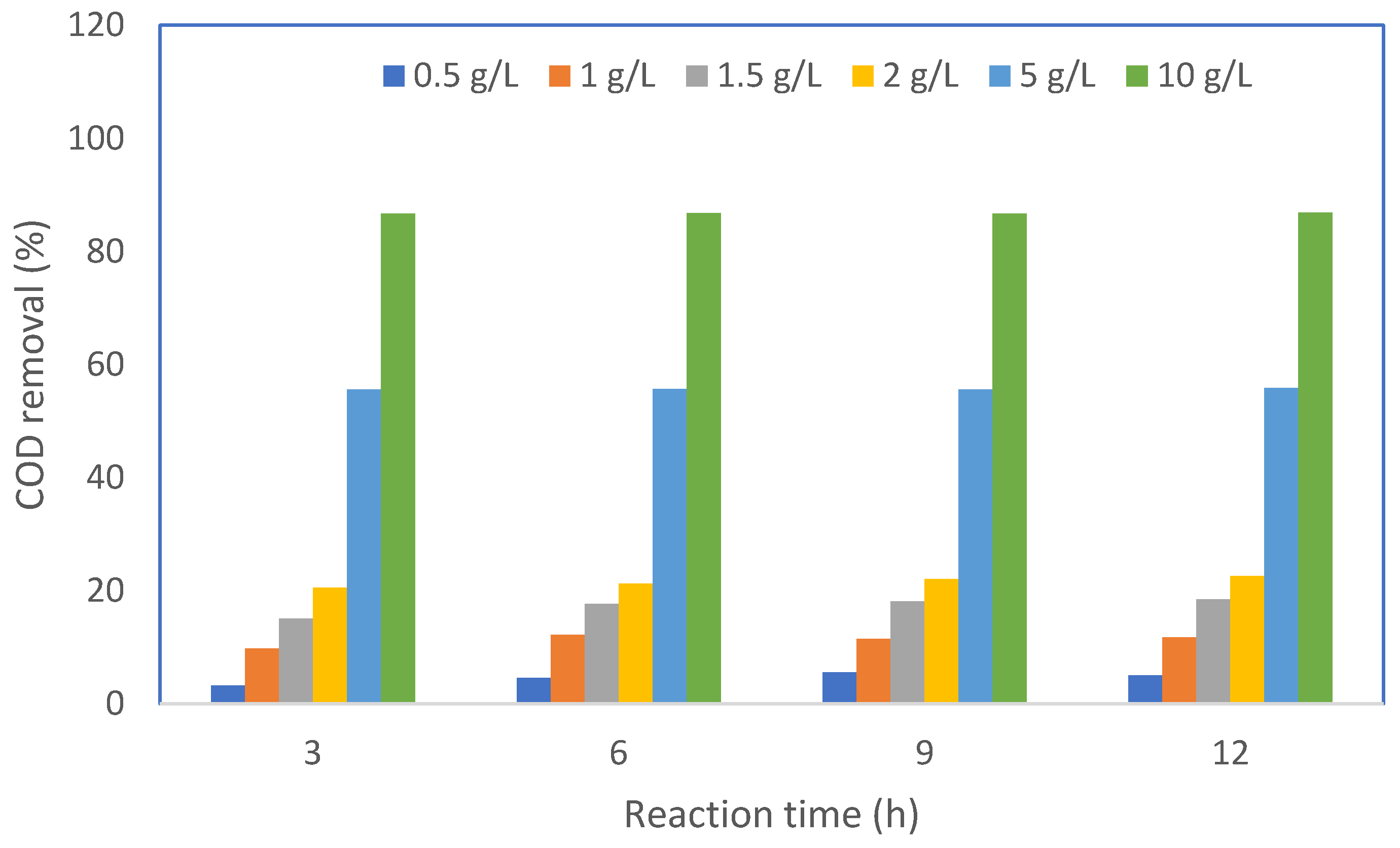
To further reduce the pollutants, activated carbon was used. The results are shown in
Figure 4. As the activated carbon dosage increased, COD removal increased. With 10 g/L activated carbon addition, COD removal reached 86.7% at all reaction times (3, 6, 9, 12 h). This suggests that activated carbon provides sufficient adsorption sites and that pollutants in COD form are rapidly captured and removed from the wastewater. For other dosages, as the reaction time increased, removal slightly increased. This suggests that prolonging the adsorption time can slightly improve COD removal. From a practical engineering perspective, a longer reaction time directly increases the required reactor volume and consequently raises the capital and operational costs. Therefore, selecting a 3 h reaction time is economically reasonable, especially when combined with a dosage of 10 g/L, where 3 h already achieves the maximum removal efficiency.
3.5. Salt Concentration by the RO Process
To concentrate the sodium salt, the obtained water was first treated with NF and then with RO. The results are provided in
Figure 5. After three-cycle NF treatment, the NaCl concentration increased from 10.48 g/L to 20.3 g/L. RO then concentrated it. The RO operation was conducted at an initial flow rate of 6 L/min, and the concentration process was considered complete when no water was produced on the permeate side. The final concentration of the sodium salt was 40.4 g/L on the concentrate side.
To evaluate the impact of impurities left after pre-treatment, including COD, ammonia, etc., NaCl solutions at 20 g/L were prepared to simulate pre-treated water. The operating conditions were kept the same to concentrate the pre-treated WW
cq. The results showed that the final concentration of the sodium salt was 46.7 g/L on the concentrate side. The final salt concentration was higher when using simulated water for concentration than when using the real wastewater. The concentration reduction was around 13.49%. In addition, the water flow rate in the real wastewater case decreased more rapidly than in the simulated case. This suggests that the impurities left in the wastewater after pre-treatment negatively impacted the concentration process. The remaining COD mainly includes hydrocarbons, esters, siloxanes, and halogenated hydrocarbons, which are significantly difficult to remove [
36,
37]. They would lead to pore blockage in the membrane. In addition, Ca
2+ (5.23 mg/L) and Mg
2+ (6.40 mg/L) were also present in the water obtained from NF treatment. For these reasons, the concentration process should be halted before the salt concentration reaches the value obtained in the simulated water case.
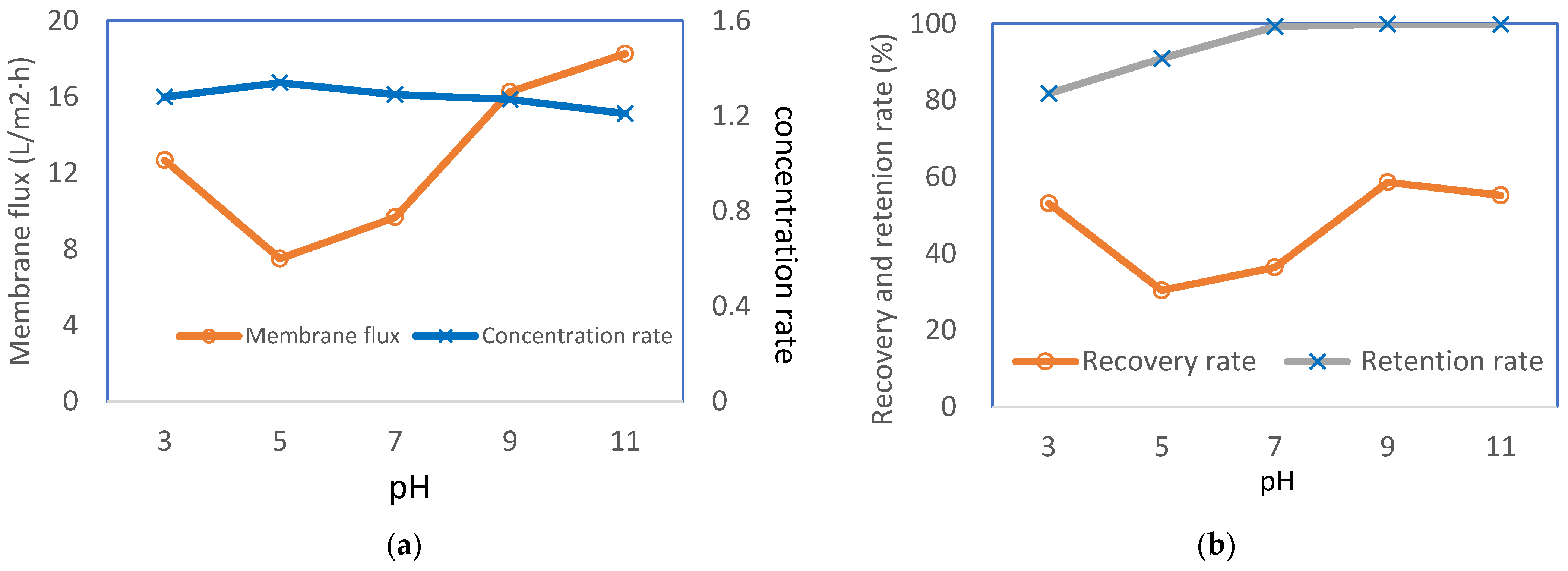
To investigate the pH impact on the concentration performance of the SG-RO5-1812 membrane, and to investigate the optimal operating pH range, the pH was adjusted to 3, 5, 7, 9, and 11. The results show that, under weakly acidic conditions, RO has better concentration performance and a higher recovery rate. Still, the membrane flux is relatively low (
Figure 5a). Under strong acidic and alkaline conditions, the membrane flux increases, but the concentration performance decreases. At pH 3 and 5, the membrane exhibits poor rejection performance, ranging from 82% to 92%, while, at neutral and alkaline conditions, the rejection rate reaches up to 98% (
Figure 5b). This may be related to membrane surface charge characteristics and ion forms: under acidic conditions, the membrane surface is positively charged, reducing the repulsion of Cl
−; under alkaline conditions, the membrane surface is more negatively charged, which facilitates ion retention but can easily lead to membrane fouling. The study reveals that maintaining neutral and alkaline conditions is favorable for salt concentration with the RO membrane.
4. Conclusions
This study demonstrates that pre-treating desulfurization wastewater is essential for achieving effective salt concentration via reverse osmosis (RO). Three different oxidation methods, namely electrochemical oxidation, Fenton oxidation, and microelectrolysis, were investigated for COD removal. Electrochemical oxidation and Fenton oxidation achieved similar COD removal performance, with removal efficiencies almost double those of microelectrolysis. Precipitation proved highly effective for hardness removal, eliminating 99.9% of Mg2+ and 99.8% of Ca2+. Ammonia stripping reduced the ammonia content by 89.8%, and activated carbon adsorption further lowered residual pollutants. After nanofiltration and RO concentration, the pre-treated wastewater reached a NaCl concentration of 40.4 g/L. Although the salt concentration may be insufficient for single-step carbon capture, the pre-treatment sequence significantly improves the wastewater quality and enables partial salt enrichment. Further optimization of impurity removal or integration with additional concentration techniques, such as thermal concentration, is needed to achieve the NaCl levels required for efficient sodium carbonate production. In addition, considering the desired application, exploring functionally integrated short-flow technologies is required. Membrane fouling is a significant problem in long-term conduction processes; hence, membrane fouling control should be studied. Overall, the proposed approach highlights a promising pathway to couple wastewater resource utilization with carbon capture, but successful implementation depends on more rigorous pollutant removal to improve the RO concentration efficiency.