Article

Comparative DFT Study of Hydration Interactions of Representative Flotation Collector Head Groups

1
Xizang Jinlong Mining Co., Ltd., Lhasa 859200, China
2
School of Resources, Environment and Materials, Guangxi University, Nanning 530004, China
3
Kunming Metallurgical Research Institute Co., Ltd., Kunming 650031, China
4
Faculty of Land Resource Engineering, Kunming University of Science and Technology, Kunming 650093, China
5
School of Chemistry and Chemical Engineering, Guangxi University, Nanning 530004, China
*
Author to whom correspondence should be addressed.
Separations 2026, 13(6), 156; https://doi.org/10.3390/separations13060156
Submission received: 13 April 2026 / Revised: 9 May 2026 / Accepted: 18 May 2026 / Published: 22 May 2026

Abstract

During flotation, the hydration behavior of collector head groups plays an important role in determining collector hydrophilicity and interfacial adsorption behavior. However, although computation-assisted flotation studies have extensively investigated collector–mineral interactions, systematic comparisons of the intrinsic hydration characteristics of different collector head groups under unified computational conditions remain limited. In this work, density functional theory (DFT) calculations using the B3LYP functional with Grimme dispersion correction were conducted to investigate the hydration interactions between water molecules and representative head groups of five sulfide mineral collectors, including xanthate (X), dithiocarbamate (DTC), dithiophosphate (DTP), dithiophosphinate (3418A), and thiocarbamate (Z-200), and five oxide mineral collectors, including oleate (OA), oxidized paraffin soap (OPS–C12), dodecyl sulfonate (DS), styrene phosphonic acid (SPA), and salicylhydroxamic acid (BHA). The results show that oxide mineral collectors exhibit significantly stronger hydration interactions than sulfide mineral collectors. Sulfide collectors mainly form weak S···H–O hydrogen bonds with relatively long H-bond distances (2.27–2.61 Å), whereas oxide collectors predominantly form stronger O···H–O hydrogen bonds with shorter distances (1.66–2.24 Å). The total hydration binding energies of sulfide collectors range from −150 to −290 kJ/mol, while those of oxide collectors range from −244 to −491 kJ/mol. Among the studied collectors, SPA exhibits the strongest hydration tendency due to its highly charged phosphonate group, whereas Z-200 shows the weakest hydration interaction. The results indicate that hydration behavior is strongly influenced by head group type, charge state, and hydrogen-bond characteristics.

1. Introduction

Flotation is a key mineral processing technique that separates valuable minerals from gangue using air bubbles, based on differences in the physicochemical properties of mineral surfaces [1,2]. The core of flotation lies in regulating the wettability of mineral surfaces, i.e., balancing their hydrophilicity and hydrophobicity [3]. Most minerals, such as metal oxides, possess polar surfaces, and their strong interactions with water molecules render them naturally hydrophilic; therefore, effective separation can only be achieved with the aid of flotation reagents [4].
The flotation system is a complex solid–liquid–gas three-phase system, in which the solid–liquid interface serves as the primary site for reagent adsorption and chemical reactions [5]. After crushing and cleavage, minerals expose unsaturated bonds (dangling bonds) on their surfaces. When in contact with water, water molecules preferentially adsorb onto these sites, forming a “hydration film” whose structure differs from that of bulk water [6]. In practical flotation, collector molecules must penetrate this hydration film before adsorbing onto mineral surfaces. Consequently, flotation involves a complex competitive system consisting of interactions among “collector–mineral,” “water–mineral,” “collector–water,” and “water–water” [7].
Collectors are the most critical class of flotation reagents. Their molecular structures typically consist of a polar anchoring group (the head group responsible for mineral collection) and a nonpolar hydrophobic group. The anchoring group selectively adsorbs onto mineral surfaces through physical and/or chemical interactions, while the hydrophobic group extends toward the aqueous phase, enhancing the hydrophobicity of mineral surfaces and facilitating attachment to air bubbles and flotation [8,9]. Traditional studies have mainly focused on direct interactions between collectors and mineral surfaces, whereas interactions between collectors themselves—especially their anchoring groups—and water molecules have often been overlooked. In fact, the hydration strength of anchoring groups strongly influences collector behavior in flotation systems. Hancer et al. [10] reported that hydration films can form hydrogen bonds with ions in solution, thereby interfering with collector adsorption. Chen and co-workers [11] theoretically pointed out that excessively strong interactions between anchoring groups and water require a high energy barrier to be overcome for the collector to transfer from a hydrated state to the mineral surface, which is unfavorable for adsorption; conversely, overly weak interactions may impair reagent dispersion and transport in solution. Liu et al. [12] demonstrated through simulations that xanthate and water exhibit competitive adsorption on galena surfaces. Therefore, systematic investigation of the hydration behavior of collector head groups is of great theoretical and practical significance for understanding flotation mechanisms and guiding the molecular design of high-performance collectors.
According to the nature of the processed ores, collectors can be classified into sulfide mineral collectors and oxide mineral collectors. Sulfide minerals (e.g., chalcopyrite and galena) exhibit certain natural hydrophobicity and are commonly collected using thiol-type collectors such as xanthates, dithiocarbamates, and dithiophosphates, whose anchoring groups are centered on sulfur atoms [13]. In contrast, oxide minerals (e.g., hematite and cassiterite) are highly hydrophilic and are typically collected using hydrocarbon acid–type collectors containing oxygen and/or nitrogen atoms, such as oleic acid, hydroxamic acids, phosphonic acids, and their ionic forms; these collectors usually possess longer hydrocarbon chains to provide sufficient hydrophobicity [13,14]. Direct experimental observation and quantitative characterization of microscopic interactions between collectors and water molecules at the molecular scale remain highly challenging. Density functional theory (DFT), as a powerful quantum-mechanical method, can accurately simulate molecular and ionic geometries, electronic properties, and interactions at the electronic level [15], and has been widely applied in studies of reagent molecular structures and adsorption on mineral surfaces [16,17]. Existing computation-assisted flotation studies have provided important theoretical foundations for understanding collector–mineral interfacial interactions. However, most previous studies have mainly focused on the adsorption behavior, electronic structure characteristics, and interfacial reaction mechanisms of individual collectors on specific mineral surfaces. In contrast, systematic comparisons of the intrinsic hydration behavior among different collector head groups remain relatively limited, particularly under unified computational conditions for both oxide-mineral and sulfide-mineral collectors. Since hydration interactions directly influence dehydration, orientation, and adsorption processes at mineral–water interfaces, establishing a comparative framework for the hydration capability of different collector head groups is of considerable importance for understanding flotation interfacial behavior.
Most computation-assisted flotation studies have paid greater attention to collector–mineral interactions, while comparatively less emphasis has been placed on the intrinsic interfacial hydration characteristics of collectors themselves. In particular, the roles of polar sites such as O, S, and N atoms in hydrogen-bond formation, hydration-layer stability, and relative hydration strength have not been systematically summarized. Therefore, in this work, five representative sulfide-mineral collectors (xanthate, dithiocarbamate, dithiophosphate, dithiophosphinate, and thionocarbamate) and five representative oxide-mineral collectors (oleate, oxidized paraffin soap, dodecyl sulfonate, styrene phosphonic acid, and salicylhydroxamic acid) were selected under a unified DFT computational framework to systematically compare the hydration behavior of their functional head groups. The relationships among hydrogen-bond type, hydration binding energy, and structural characteristics were analyzed to establish a comparative hydration framework for collector head groups, which may provide theoretical references for future collector–mineral interfacial studies and flotation reagent design.

2. Computational Methods and Models

All calculations were performed using the DMol3 module in the Materials Studio package within the density functional theory framework. Geometry optimization of a water molecule was first conducted to determine optimal computational parameters. All calculations were carried out in an aqueous environment using the DNP + basis set. The convergence criteria were set as follows: energy convergence threshold of 2.0 × 10⁻⁵ Ha, maximum force of 0.004 Ha/Å, maximum displacement of 0.005 Å, self-consistent field (SCF) accuracy of 1 × 10⁻⁵, and smearing value of 0.005 Ha. Core electrons were treated using DFT semi-core pseudopotentials.
The effects of exchange–correlation functionals and DFT-D dispersion corrections on the geometry of the water molecule were examined, as shown in Table 1. Comparison with experimental values indicated that dispersion corrections (Grimme(D2) and Ortmann–Bechstedt–Schmidt (OBS)) yield H–O–H bond angles closer to experimental data. Among them, the B3LYP-Grimme (D2) method produced bond lengths and angles in best agreement with experimental values; therefore, this method was adopted for all subsequent calculations.
BSSE (Basis Set Superposition Error) and solvation-model settings are critically important for computational accuracy. To further evaluate their effects, we additionally calculated the hydrogen-bond interaction energy of the H2O–H2O system using different computational treatments. Since the solvation model cannot be applied simultaneously with BSSE correction in the DMol3 module of Materials Studio, only three calculation schemes were compared: (i) solvation model without BSSE correction (water as solvent), (ii) BSSE correction without solvation model, and (iii) without BSSE correction and without solvation model, in order to obtain the H2O–H2O hydrogen-bond interaction energies, as shown in Table 2.
The energy obtained using the solvation model without BSSE correction gives the most negative value and is also the closest to the value of 5.08 kcal/mol reported in the literature [19]. When the solvation model is not applied, the hydrogen-bond energies deviate more from the literature values regardless of whether BSSE correction is used. When BSSE correction is applied, the H2O–H2O hydrogen bond energy becomes more negative and deviates further from the literature values. This indicates that incorporating the solvation model is more important and provides more accurate results. Therefore, all subsequent calculations in this work were performed using the solvation model without BSSE correction.
The interaction energy (ΔE), i.e., the binding energy between collector head groups and water molecules, was calculated as:
ΔE = Ecollector-H2O − Ecollector − EnH2O
where Ecollector-H2O, Ecollector and EnH2O represent the energies of the hydrated collector complex, the isolated collector, and n water molecules, respectively. Since this model represents first-shell hydration, the total binding energy under saturated hydration conditions is also referred to as the total hydration energy. A more negative ΔE indicates stronger interactions between water molecules and collector head groups.

3. Results and Discussion

3.1. Interactions Between Typical Sulfide Mineral Collectors and Water Molecules

Five representative molecular models of sulfide mineral collectors, including xanthate (X), dithiocarbamate (DTC), dithiophosphate (DTP), dithiophosphinate (3418A), and thionocarbamate (Z-200), were selected for hydration analysis. The interaction configurations and binding energies between different active sites of their head groups and water molecules, as well as total binding energies (total hydration energies) and average hydrogen-bond energies under saturated hydration conditions, were analyzed. In this study, only tightly bound (first-shell) hydration was considered, while outer-shell hydration was not included. When an additional water molecule could no longer directly interact with or adsorb onto the head groups, the hydration structure was considered “saturated”.
Xanthate (X). Xanthate is the most commonly used sulfide mineral collector and exhibits strong collecting ability toward sulfide minerals. In this study, the ethyl xanthate anion was employed as a model to investigate the interactions between its head group (–OCSS) and water molecules. The optimized interaction configurations are shown in Figure 1, and the corresponding hydrogen bond distances and hydration binding energies are listed in Table 3. By placing water molecules at different sites of the xanthate head group and optimizing the structures, it was found that water molecules weakly interact with the S1, S2, and O atoms through their hydrogen atoms, forming hydrogen bonds (Figure 1a–c). The binding energy for the interaction between a water molecule and the single-bonded sulfur atom (S1) is −35.07 kJ/mol, whereas that between H and the double-bonded sulfur atom is −29.13 kJ/mol, indicating that although conjugation exists within the -CSS group, the single- and double-bonded sulfur atoms exhibit distinguishable interaction strengths. The O∙∙∙H binding energy is −34.60 kJ/mol, comparable to that of the single-bonded sulfur atom, suggesting that although the oxygen atom is constrained within the –C–O–C– framework, it still contributes to the hydration of the head group.
For the saturated hydration configuration (Figure 1d), the –OCSS head group can interact with up to seven water molecules, yielding a total binding energy of −232.63 kJ/mol. Each sulfur atom can interact with three hydrogen atoms from water molecules, forming six S∙∙∙H hydrogen bonds with distances ranging from 2.311 to 2.476 Å, while the oxygen atom can interact with one hydrogen atom to form a single O∙∙∙H hydrogen bond with a hydrogen bond distance of 2.029 Å.
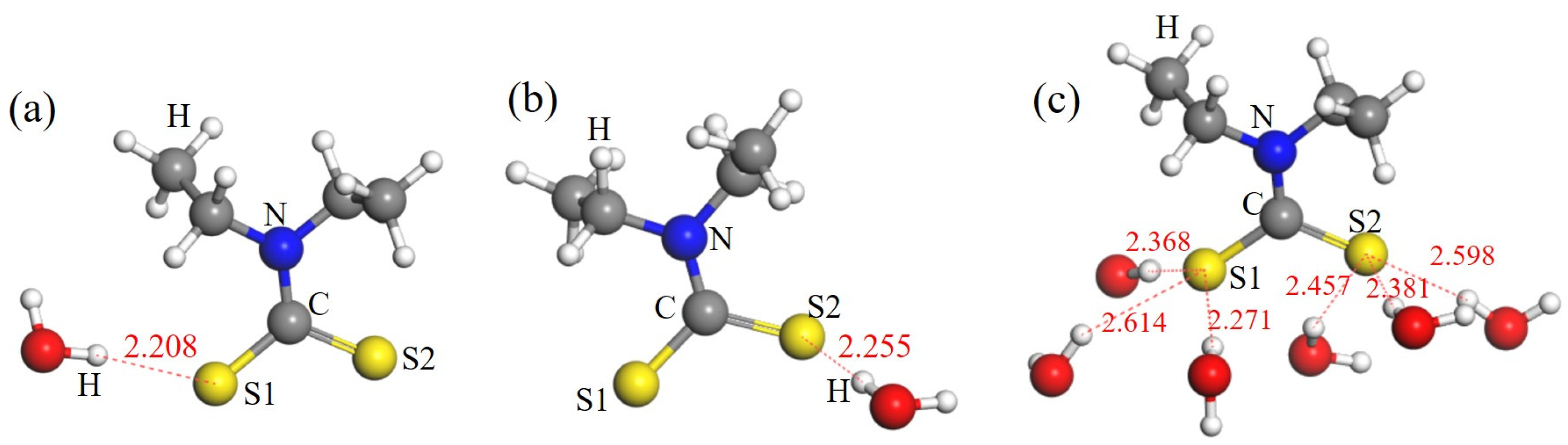
Dithiocarbamate (DTC). Dithiocarbamate (DTC, also referred to as “thiuram-type” collector) is another commonly used sulfide mineral collector. Its anchoring head group is –NCSS. The interaction configurations between this head group and water molecules are shown in Figure 2, and the corresponding hydrogen bond distances and binding energies are summarized in Table 4. DTC interacts with water molecules exclusively through its two sulfur atoms, forming S∙∙∙H hydrogen bonds. The binding energies between water molecules and the two sulfur atoms are both approximately −37 kJ/mol and are very similar in magnitude. Unlike xanthate, no obvious water adsorption was observed around the nitrogen atom in DTC, which may be related to the local molecular configuration and atomic distribution of the DTC head group.
Under saturated hydration conditions (Figure 2c), the DTC head group can interact with up to six water molecules, forming six S∙∙∙H hydrogen bonds with hydrogen bond distances ranging from 2.271 to 2.614 Å. The total binding energy under saturated hydration is −210.43 kJ/mol, which is less negative than that of xanthate, indicating a weaker hydration interaction.
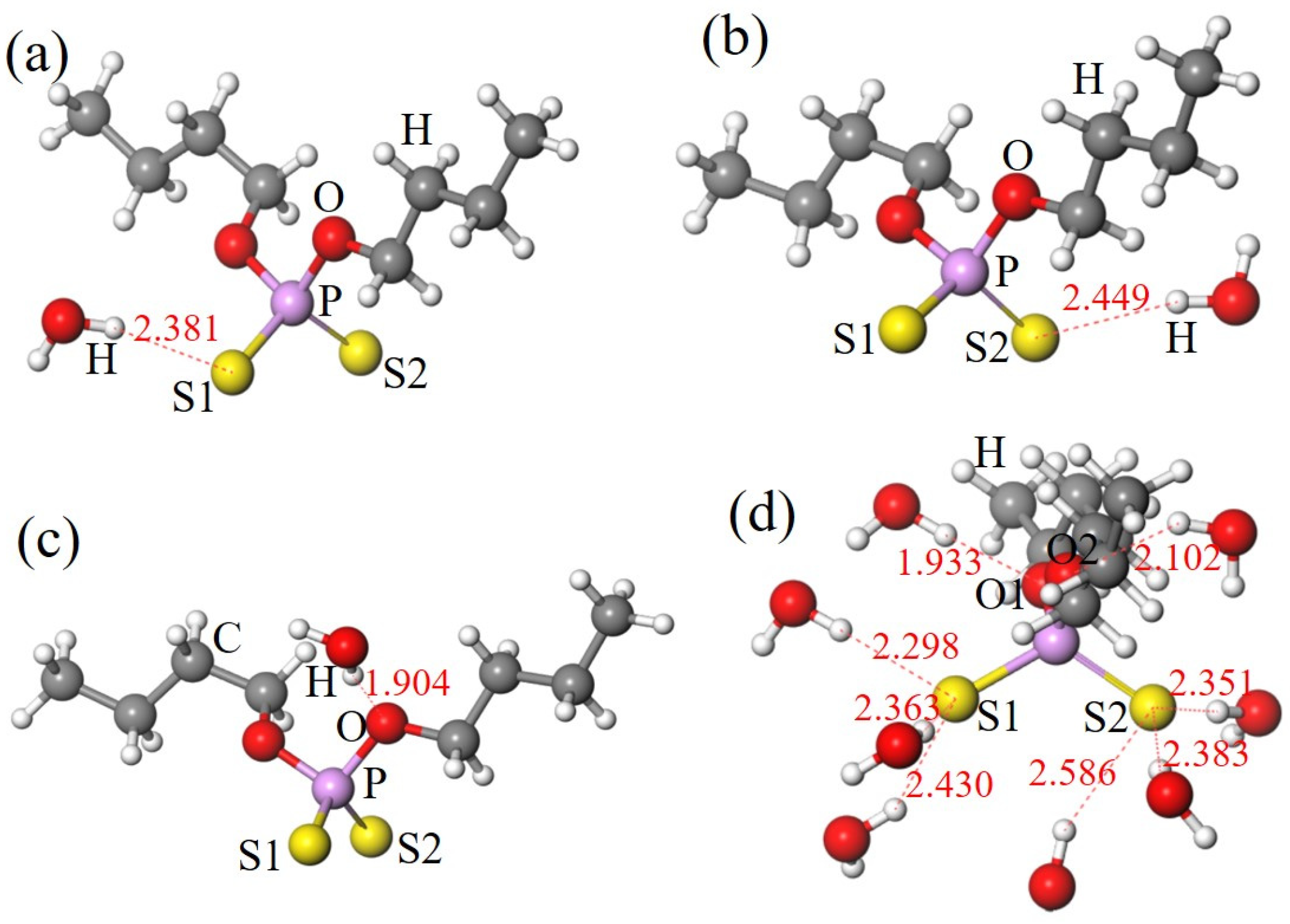
Dithiophosphate (DTP). Dithiophosphate (commonly referred to as black collector, DTP) has a more complex molecular structure and exhibits good selectivity toward copper and lead sulfide minerals. Its anchoring head group is –OPSS. Figure 3 presents the interaction configurations of water molecules at different active sites of butyl dithiophosphate as well as the saturated hydration configuration, and the corresponding hydrogen bond distances and hydration binding energies are summarized in Table 5. Hydrogen atoms from water molecules can form hydrogen bonds with both sulfur and oxygen atoms in the –OPSS group. The O∙∙∙H hydrogen bonds are stronger than the S∙∙∙H hydrogen bonds, with binding energies of approximately −37 kJ/mol and −33 kJ/mol, respectively. In addition, the S–H hydrogen bonds formed with single-bonded and double-bonded sulfur atoms exhibit similar binding energies.
Under saturated hydration conditions, the –O2PSS head group can interact with up to eight water molecules, among which two water molecules interact with the two oxygen atoms and six water molecules interact with the two sulfur atoms. The resulting O∙∙∙H hydrogen bond lengths range from 1.933 to 2.102 Å, while the S∙∙∙H hydrogen bond lengths ranging from 2.298 to 2.586 Å. The total binding energy is −286.18 kJ/mol, indicating a strong hydration interaction.
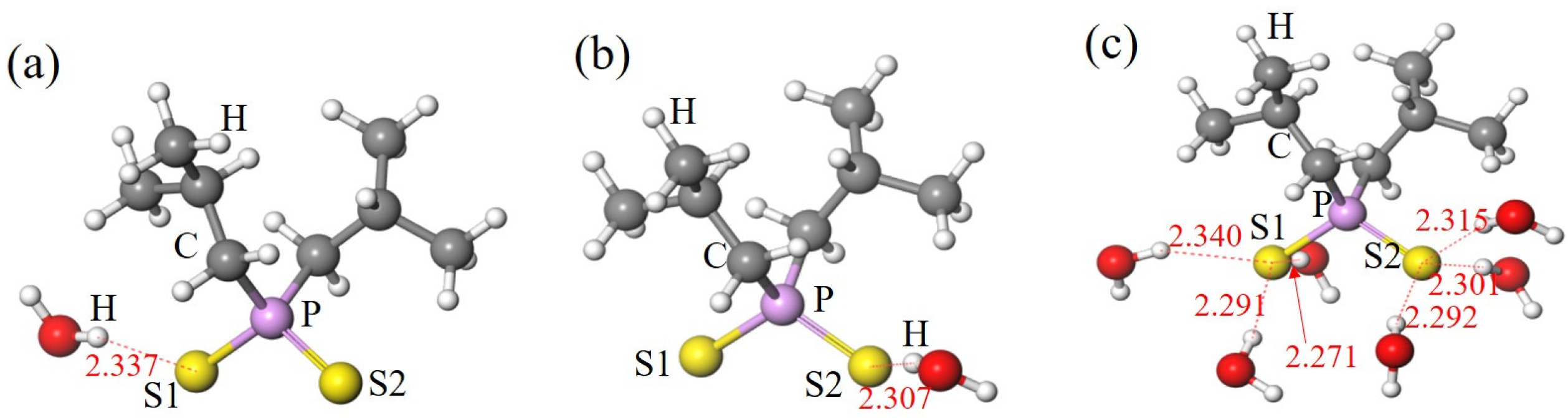
Dithiophosphinate (3418A). 3418A, formally known as sodium diisobutyl dithiophosphinate (DTPI), is an effective collector for copper and lead sulfide minerals. Its anchoring head group is –PSS. The interaction configurations between this head group and water molecules are illustrated in Figure 4, and the corresponding hydrogen bond distances and hydration binding energies are summarized in Table 6. The interaction pattern between the 3418A head group and water molecules is similar to that of dithiocarbamate (DTC), with the two sulfur atoms bonded to the phosphorus atom serving as the active sites. The binding energy between a water molecule and the single-bonded sulfur atom (S1) is −37.54 kJ/mol, while that with the double-bonded sulfur atom (S2) is −34.97 kJ/mol. The interaction strength between 3418A and water is weaker than that of dithiophosphate (DTP) and comparable to that of DTC.
Under saturated hydration conditions, the 3418A head group can interact with up to six water molecules, forming six S∙∙∙H hydrogen bonds with hydrogen bond distances in the range of 2.271–2.340 Å. The total hydration binding energy is −220.29 kJ/mol.
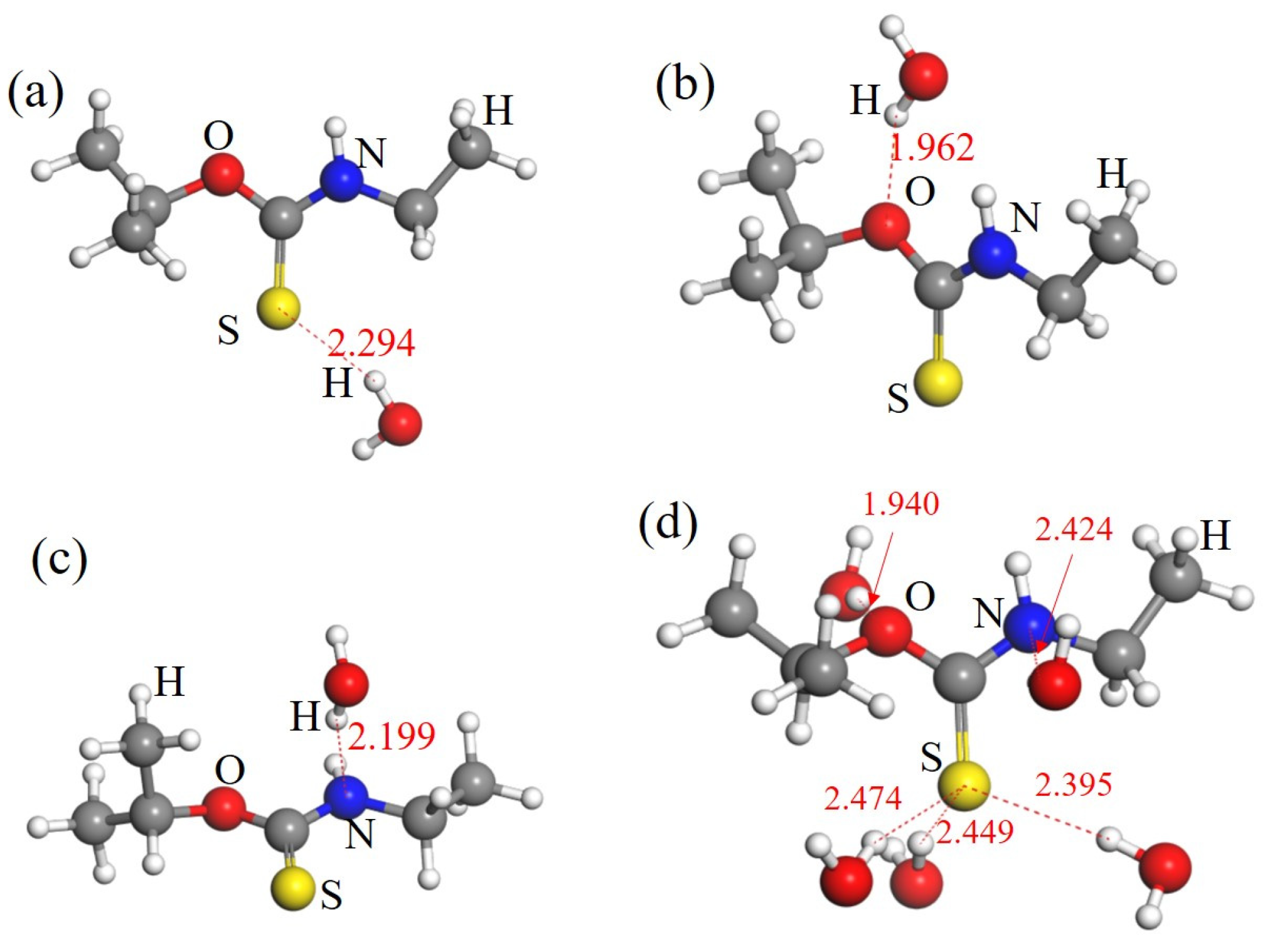
Thiocarbamate (Z-200). Thiocarbamates represent the least polar class of sulfide mineral collectors and exhibit good selectivity toward copper in copper–sulfur flotation separation. Their polar head group is –ONC=S, and the most commonly used compound is O-isopropyl-N-ethyl thiocarbamate (Z-200). The interaction configurations between this head group and water molecules are shown in Figure 5, and the corresponding hydrogen bond distances and hydration binding energies are listed in Table 7. Sulfur, nitrogen, and oxygen atoms can all act as interaction sites for water molecules. The resulting hydrogen-bond distances are 2.294 Å for S∙∙∙H, 2.199 Å for N∙∙∙H, and 1.962 Å for O∙∙∙H. The binding energies between water molecules and the sulfur and nitrogen atoms are very similar, at approximately −30 kJ/mol, whereas the binding energy for the interaction between the water molecules and oxygen atom is slightly more negative (−32.30 kJ/mol), indicating that the O···H hydrogen bond is slightly stronger than the S···H and N···H interactions.
Under saturated hydration conditions, the polar head group of Z-200 can interact with up to five water molecules, yielding a total binding energy of −155.83 kJ/mol, which is the least negative among the five sulfide mineral collectors studied. This indicates that Z-200 exhibits the weakest hydration interaction.

3.2. Interactions Between Oxide Mineral Collectors and Water Molecules

The head groups of oxide mineral collectors typically interact with water molecules via oxygen atoms. Five representative molecular models of oxide mineral collectors, including oleate (OA), oxidized paraffin soap (OPS–C12), dodecyl sulfonate (DS), styrene phosphonic acid (SPA), and salicylhydroxamic acid (BHA), were selected for hydration analysis. Their interaction configurations, hydrogen-bond characteristics, and hydration energies under single-water and saturated hydration conditions were systematically analyzed.
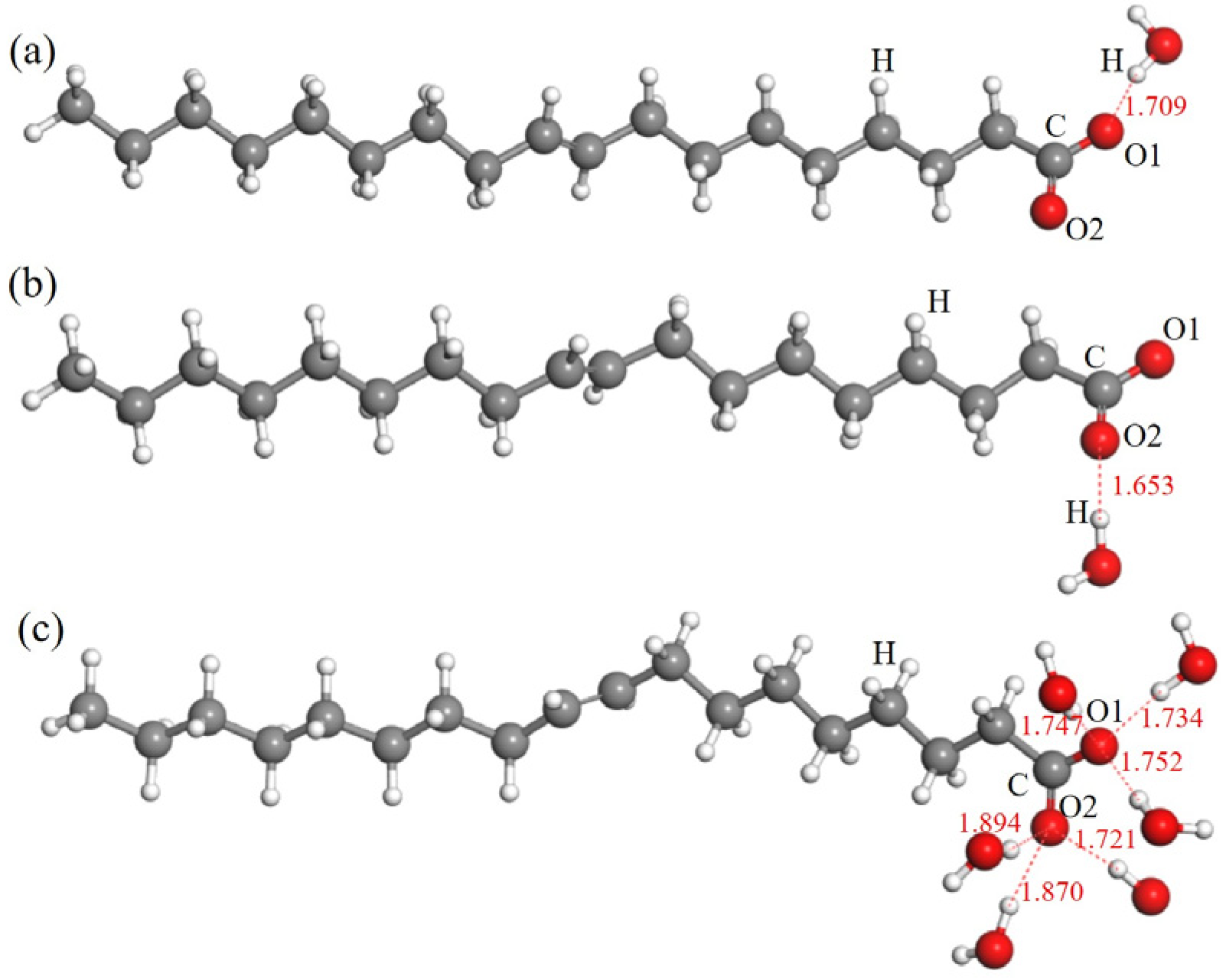
Oleate (OA). The head group of oleate is –COO. Figure 6 shows the different interaction sites of water molecules on the oleate head group, as well as the interaction configurations of saturated water molecules on oleate. The corresponding hydrogen-bond distances and binding energy data are listed in Table 8. Water molecules can interact with both the single-bond oxygen atom (O1) and the double-bond oxygen atom (O2) of the carboxyl group. However, the hydrogen bond energy formed with the single-bond O1 (−42.30 kJ/mol) is lower than that formed with the double-bond O2 (−38.00 kJ/mol), indicating that the hydrogen bond involving the single-bond oxygen is stronger. In addition, these hydrogen bond energies suggest that the hydration of the oleate ion is relatively significant, and the head group of the oleate ion is hydration tendency.
In the saturated hydration configuration (Figure 6c), the COO group interacts with six water molecules, forming six O∙∙∙H hydrogen bonds with hydrogen bond distances ranging from 1.721 to 1.894 Å. The total hydration binding energy is −250.85 kJ/mol.
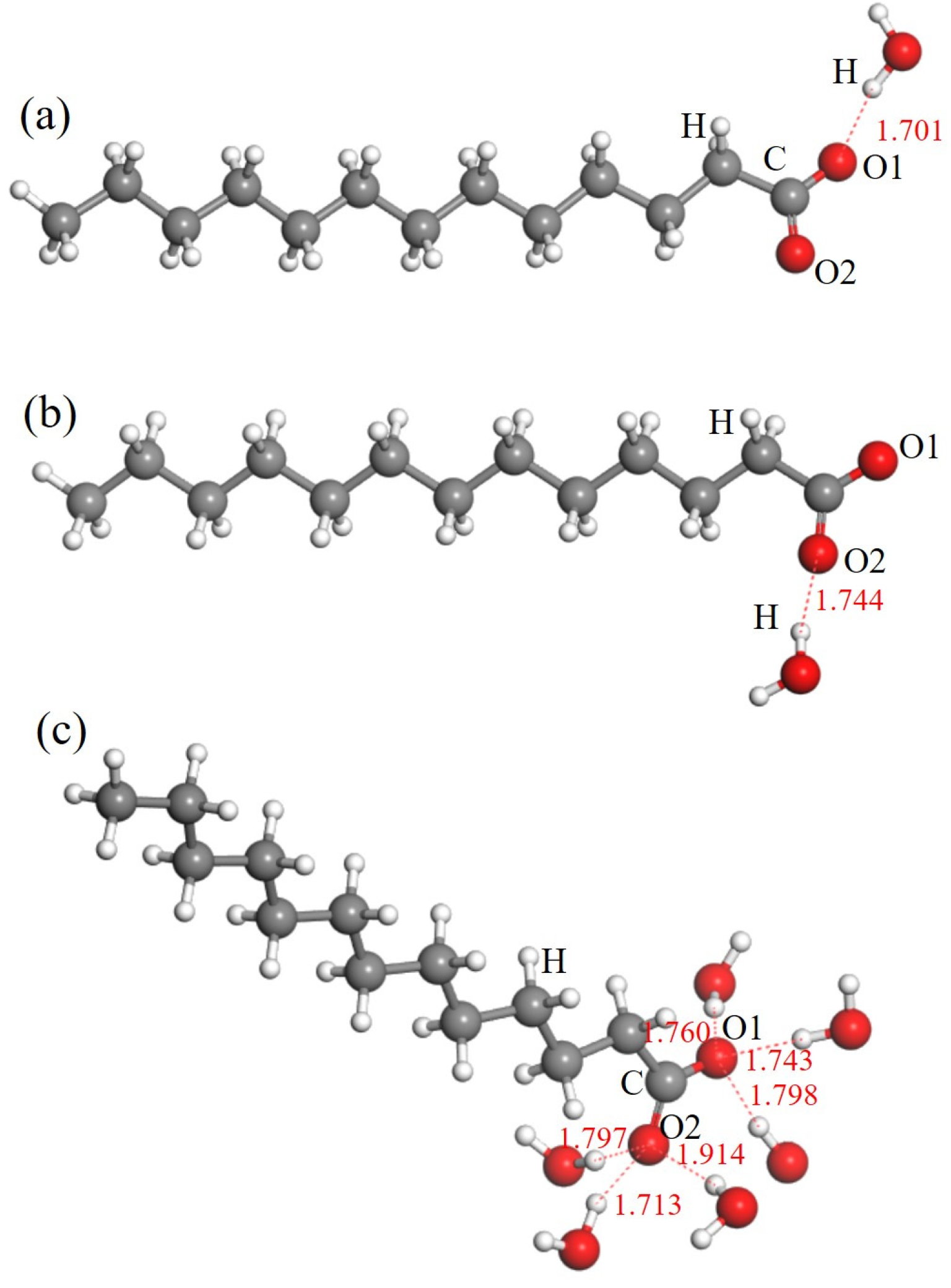
Oxidized Paraffin Soap (OPSC12). Oxidized paraffin soap (OPS) is a complex mixture rather than a single well-defined molecular species. In the present work, a representative molecular structure (containing 12 carbon atoms) commonly reported in the flotation literature was selected to model the hydration behavior of OPS-type collectors. The head group of oxidized paraffin soap is the same as that of oleate (–COO), differing only in the length of the carbon chain, and with no C=C double bonds present in the hydrocarbon chain. The interaction configurations, bond lengths, and binding energies after interaction with water are shown in Figure 7 and Table 9. The interaction mode is similar to that of oleate; however, for the interaction with a single water molecule, the O∙∙∙H hydrogen bond energy is slightly less negative, indicating a slightly weaker hydrogen bond. Notably, the total binding energy (−257.80 kJ/mol) of OPS–C12 is more negative than that of OA, suggesting a stronger overall hydration interaction.
Although both OA and OPS–C12 contain oxygen-containing functional groups, differences in their local chemical structures and electronic environments may influence hydrogen-bond interactions with water molecules. Compared with OA, the local electron distribution around the polar functional group in OPS–C12 may be more favorable for stable hydrogen-bond formation, resulting in relatively stronger hydration interactions.
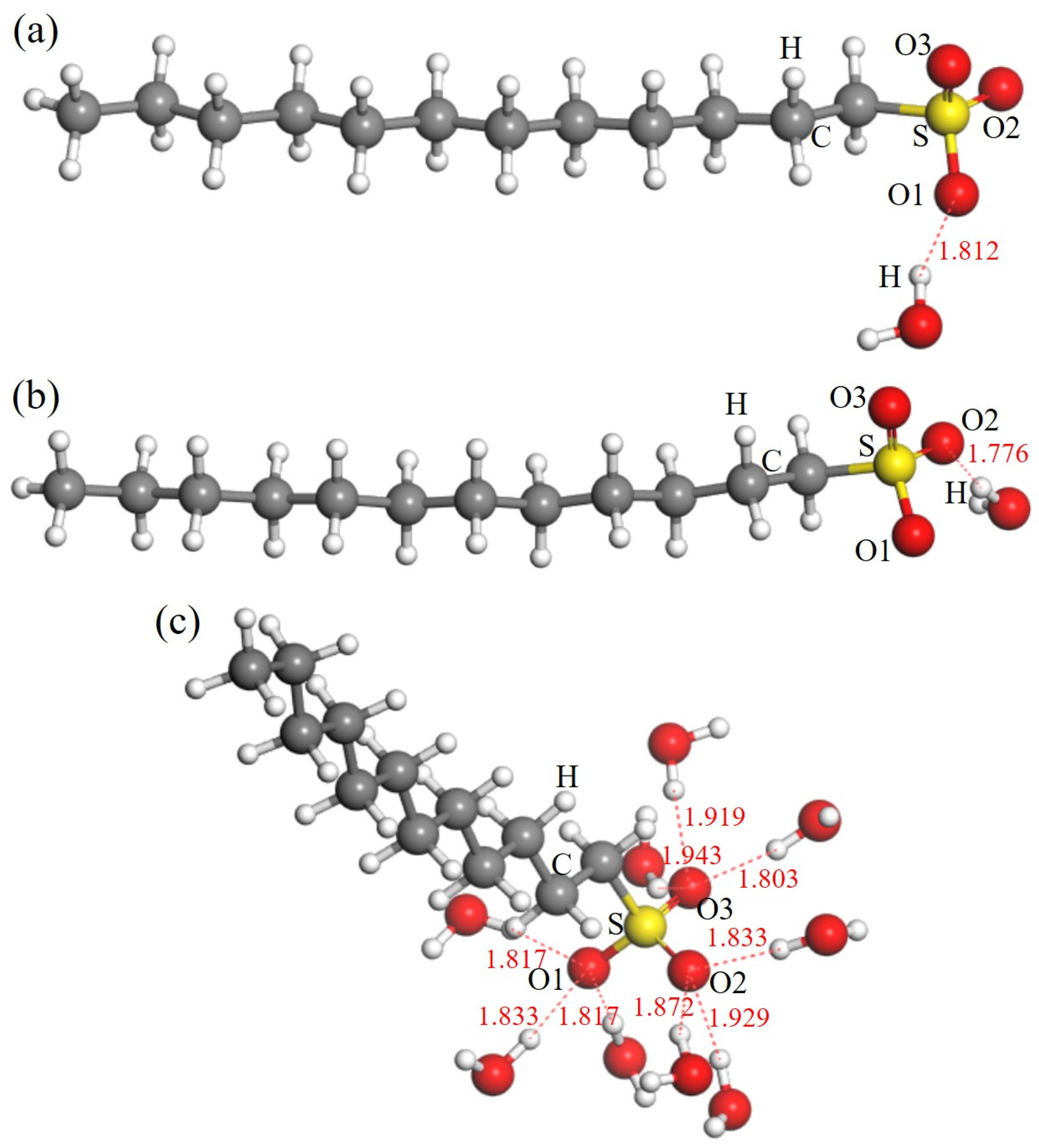
Dodecyl sulfonate (DS). The head group of dodecyl sulfonate (DS) is –SO3. Figure 8 shows the interaction configurations with water molecules, and the corresponding hydrogen bond distances and hydration energies are listed in Table 10. The DS head group contains two S=O bonds (O2 and O3) and one S–O bond (O1). All three oxygen atoms can interact with water molecules to form O···H hydrogen bonds. The calculated binding energies indicate that the hydrogen bonds formed between H and the single-bonded O and double-bonded O atoms have similar strengths, approximately −32 kJ/mol, suggesting that the three oxygen atoms in –SO3 possess similar properties.
In the saturated interaction configuration (Figure 8c), the sulfonate oxygen atoms collectively interact with nine water molecules. The hydration binding energy for nine water molecules is −323.89 kJ/mol, and the resulting O···H hydrogen bond distance range from 1.803 to 1.943 Å.
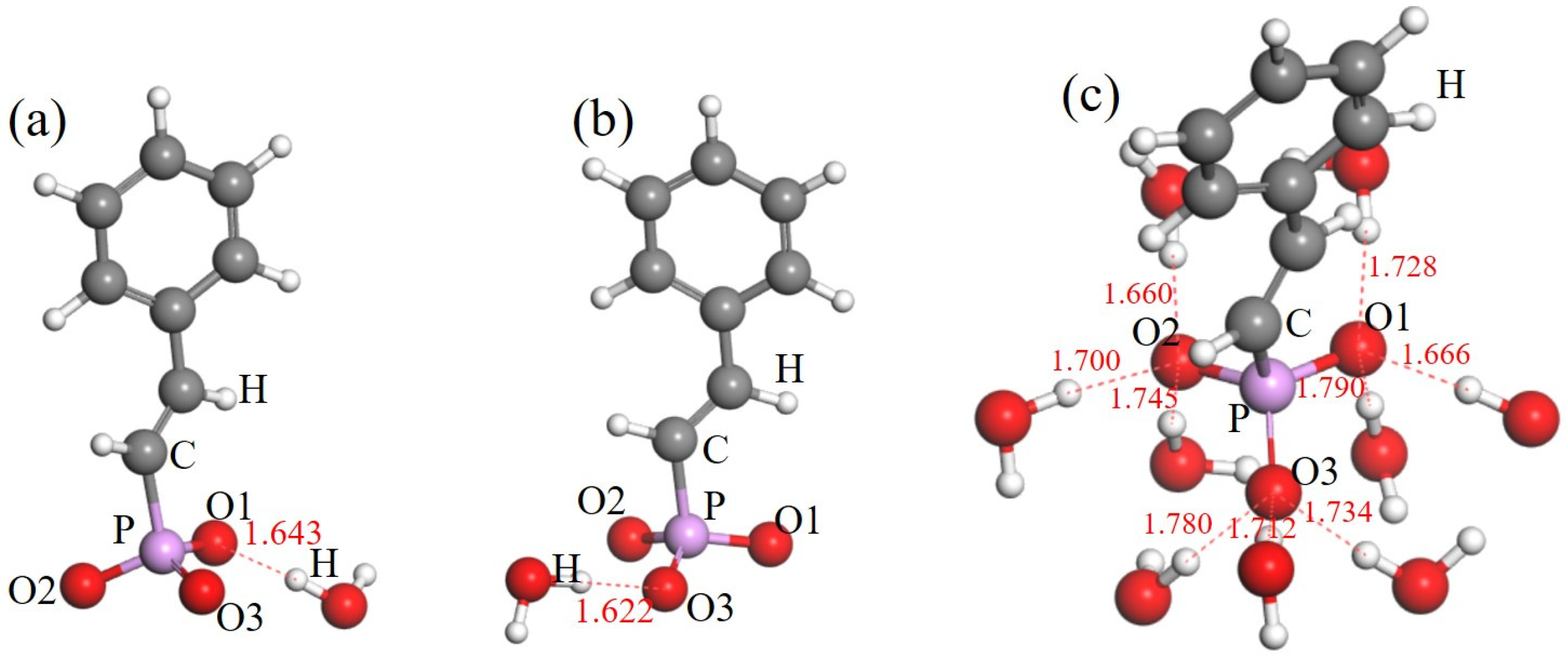
Styrene phosphonic acid (SPA). The head group of styrene phosphonic acid is –PO(OH)2, which exhibits very strong coordination ability. It is an effective collector for cassiterite, wolframite, and ilmenite. SPA is a strong acid with strong dissociation tendencies. In practical flotation systems, SPA is commonly applied under weakly acidic to weakly alkaline conditions, where different partially deprotonated phosphonate species may coexist in aqueous solution. In the present work, the PO32− form was selected as a representative model mainly for the systematic comparison of relative hydration tendencies among different collector head groups under unified DFT computational conditions. In Figure 9, O1 and O2 correspond to P–O single bonds, while O3 corresponds to a P=O double bond. The Hydrogen bond distances and binding energy data are listed in Table 11.
The double-bonded O3 atom on PO32− exhibits the strongest interaction with water molecules. The formed O···H–O hydrogen bond is the shortest (1.622 Å), and the corresponding binding energy is the most negative (−49.54 kJ/mol), slightly stronger than that of the O1 interaction site (−44.49 kJ/mol). This behavior is opposite to that observed for the –COO head group. The saturated hydration binding energy reaches −491.02 kJ/mol, with O···H distances ranging from 1.660 to 1.790 Å, indicating very strong hydration interaction.
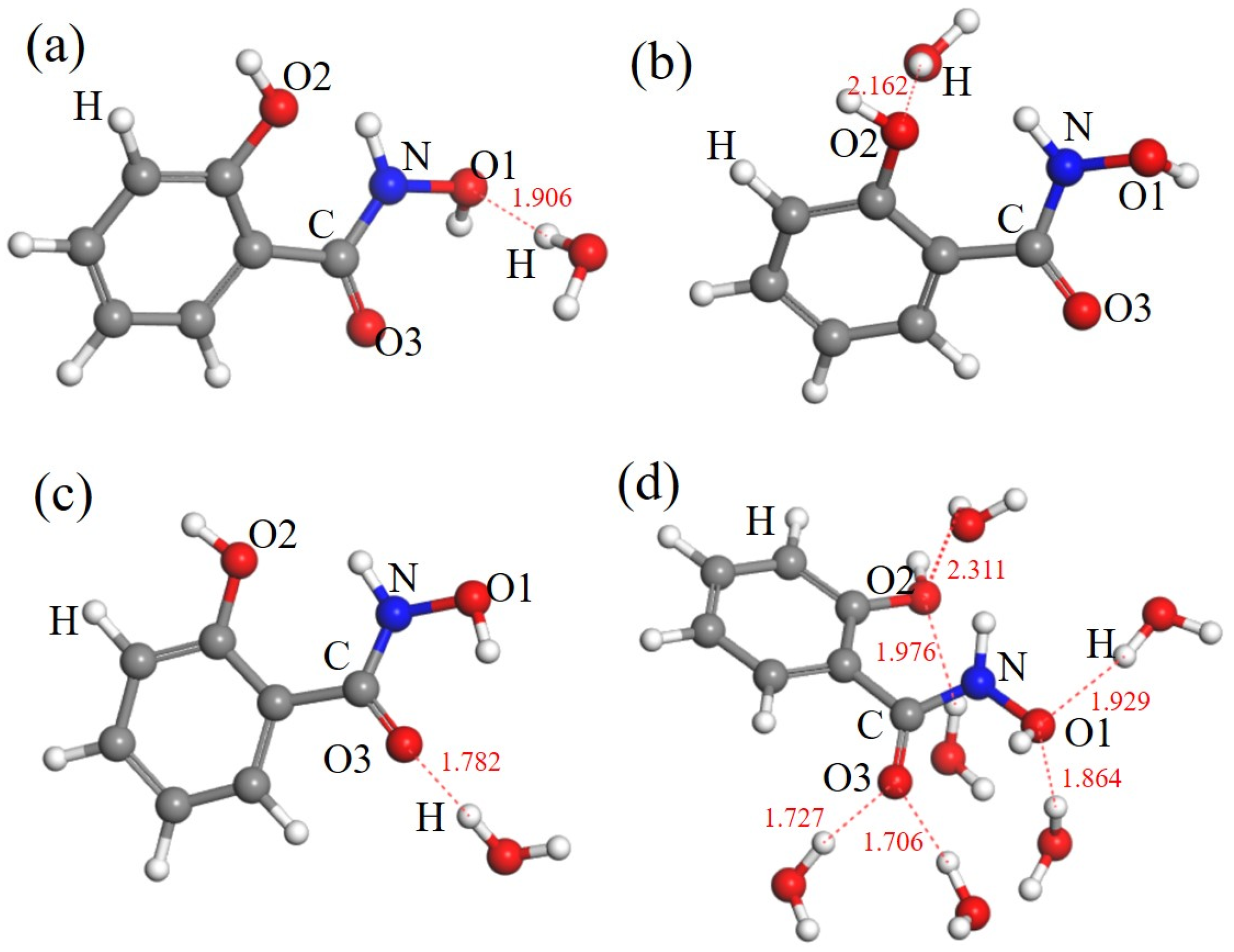
Salicylhydroxamic acid (BHA). Salicylhydroxamic acid exhibits strong collecting ability and good selectivity toward cassiterite. Its benzene ring contains two head groups, –CONH(OH) and –OH. Unlike styrene phosphonic acid, BHA is a weak acid and therefore exists in the molecular state during flotation; accordingly, hydrogen atoms are retained in the calculated model (Figure 10). The interactions between water molecules and different active sites of salicylhydroxamic acid, as well as the interaction configurations under saturated hydration conditions, were investigated. The corresponding hydrogen bond distances and hydration energies are listed in Table 12.
Although this head group contains multiple oxygen atoms, the hydration activities of different sites vary significantly. Among them, the O2 atom of the C–OH group shows the weakest interaction with water molecules, with a binding energy of only −25.31 kJ/mol. In contrast, the strongest interaction with water molecules occurs at the C=O (O3) group, with a binding energy of −34.85 kJ/mol, indicating that carbonyl oxygen is the primary hydrophilic site. The interaction between water molecules and the N–OH group is slightly stronger than that of the C–OH group. Under saturated hydration conditions, the head group can form six O···H–O bonds with six water molecules, with a total hydration energy of −244.79 kJ/mol.

3.3. Discussion

Table 13 summarizes the hydrogen-bond characteristics and hydration binding energies of different collector head groups. Significant differences in hydration behavior can be observed among the studied collectors. Overall, oxide-mineral collectors exhibit stronger hydration interactions than sulfide-mineral collectors, as evidenced by their larger negative hydration energies and shorter hydrogen-bond distances. In particular, oxygen-containing collectors such as SPA, DS, OPS–C12, OA, and BHA mainly interact with water molecules through O···H hydrogen bonds, with hydrogen-bond distances primarily distributed within 1.660–2.235 Å. In contrast, sulfide-mineral collectors mainly exhibit weaker S···H interactions, with longer hydrogen-bond distances ranging from 2.271 to 2.614 Å. This trend is generally consistent with previous experimental observations that oxide-mineral collectors usually exhibit stronger hydrophilicity and more pronounced interfacial hydration layers.
Among all collectors, SPA exhibits the strongest hydration tendency, with a total hydration binding energy of −491.02 kJ/mol and an average single-water binding energy of −54.56 kJ/mol. This behavior can be attributed to the doubly deprotonated phosphonate group (PO32−), which possesses high charge density and multiple oxygen coordination sites capable of forming strong hydrogen bonds with surrounding water molecules. Similarly, DS also shows relatively strong hydration interactions due to the presence of multiple oxygen atoms in the sulfonate group and can form nine hydrogen bonds with water molecules. However, although DS forms the same number of hydrogen bonds as SPA, its average binding energy remains lower than that of SPA, indicating that hydration strength is not solely determined by hydrogen-bond quantity, but is also strongly influenced by local charge distribution and hydrogen-bond strength.
In contrast, sulfide-mineral collectors generally exhibit weaker hydration interactions. Xanthate, DTC, DTP, and 3418A mainly interact with water molecules through S···H hydrogen bonds. Due to the lower electronegativity of sulfur atoms, these hydrogen bonds are generally longer and weaker than O···H hydrogen bonds. Among them, Z-200 exhibits the weakest overall hydration interaction, with a total hydration energy of only −155.83 kJ/mol. The relatively weak hydration tendency may imply lower interfacial dehydration barriers, which is qualitatively consistent with the experimentally observed adsorption tendency of some sulfur-containing collectors in sulfide mineral flotation. However, it should be emphasized that actual flotation behavior is additionally influenced by mineral surface structure, pulp environment, electrochemical conditions, and collector aggregation behavior. Therefore, the present results mainly reflect the relative hydration tendencies of different collector head groups rather than directly predicting flotation performance.
In addition, the average single-water binding energy (AΔE) introduced in this study helps minimize the influence of coordinated water number differences and provides a more direct comparison of the intrinsic hydration capability of different functional groups. The results indicate that the hydration behavior of collector head groups is jointly influenced by functional-group type, charge state, electronegative atom distribution, and hydrogen-bond geometry. These findings provide a unified comparative framework for understanding the interfacial hydration characteristics of flotation collectors and may serve as a useful reference for future collector–mineral interfacial.

4. Conclusions

Based on density functional theory (DFT), this study systematically investigated the interactions between water molecules and the head groups of five typical sulfide mineral collectors and five typical oxide mineral collectors.
For sulfide mineral collectors (xanthate, dithiophosphate, dithiocarbamate, dithiophosphinate, and thiocarbamate, the primary active sites for interaction with water molecules are sulfur (S) atoms, which interact with water molecules through S···H–O hydrogen bonds. In contrast, oxide mineral collectors (oleate, oxidized paraffin soap, dodecyl sulfonate, styrene phosphonic acid, and salicylhydroxamic acid) mainly interact with water molecules via oxygen (O) atoms, forming O···H–O hydrogen bonds.
Within the same class of collectors, the strength of hydration depends on the electronic structure and geometric characteristics of the head groups. Key factors influencing hydration strength include the electronegativity of the central atom (e.g., P versus C), the introduction of strong interaction sites (such as the P=O group in dithiophosphate), the number and distribution of interaction sites (e.g., three equivalent O atoms in dodecyl sulfonate), and the charge state of the molecule, with ionic collectors exhibiting stronger hydration than neutral molecules.
Notably, because explicit mineral surfaces are not included in this study, our conclusions should be interpreted primarily in terms of the relative hydration trends and microscopic mechanisms of water interacting with different collector head groups, rather than using the resulting absolute hydration energies to directly correlate quantitative adsorption strengths or macroscopic flotation performance at real flotation interfaces. Incorporating higher-level explicit/implicit solvation models and constructing representative sulfide/oxide mineral surface models to systematically investigate collector–surface adsorption and interfacial water-structure evolution will be pursued as part of our future work.

Author Contributions

Conceptualization, S.L. and Y.L.; Methodology, X.Y.; Formal analysis, W.Z.; Investigation, S.L., W.Z., C.Q. and X.Y.; Writing—original draft, S.L. and Y.L.; Writing—review & editing, Y.L., H.L. and X.Y.; Visualization, H.L., C.Q. and M.J.; Supervision, H.L., C.Q. and M.J.; Project administration, M.J. All authors have read and agreed to the published version of the manuscript.

Funding

The authors are grateful for the financial support provided by the National Natural Science Foundation of China (Grant number 52364023) and Guangxi Natural Science Foundation (2025GXNSFAA069648).

Data Availability Statement

All data generated or analyzed during this study are included in this published article. For any further questions, please contact the corresponding author.

Conflicts of Interest

Authors Shuxun Li, Haibin Li, and Ci Qu were employed by Xizang Jinlong Mining Co., Ltd. Authors Wenjie Zhang and Meiguang Jiang were employed by Kunming Metallurgical Research Institute Co., Ltd. The remaining authors declare that the research was conducted in the absence of any commercial or financial relationships that could be construed as a potential conflict of interest.

References

  1. Huang, L.H. Flotation; Metallurgical Industry Press: Beijing, China, 2018; pp. 30–65. [Google Scholar]
  2. Zhu, J.G. Flotation Reagents; Metallurgical Industry Press: Beijing, China, 1993; pp. 1–3. [Google Scholar]
  3. Wang, X.C. Study on the Regulation of Mineral Surface Wettability in Calcareous–Magnesian Phosphate Ores. Ph.D. Thesis, Guizhou University, Guiyang, China, 2020. [Google Scholar]
  4. Wills, B.A.; Napier-Munn, T. Mineral Processing Technology: An Introduction to the Practical Aspects of Ore Treatment and Mineral Recovery, 7th ed.; Butterworth-Heinemann: Oxford, UK; Elsevier: Amsterdam, The Netherlands, 2006; pp. 1–5. [Google Scholar]
  5. Chen, J.H.; Zhu, Y.G. Research on the solid–liquid interfacial structure and properties of sulfide minerals and its effect on the flotation reagent Adsorption. Conserv. Util. Miner. Resour. 2018, 3, 1–8. [Google Scholar]
  6. Long, X.H. Density Functional Theory Study on the Effects of Water Molecules on Surface Properties, Oxidation, and Collector Molecular Adsorption of Sulfide Minerals. Ph.D. Thesis, Guangxi University, Nanning, China, 2016. [Google Scholar]
  7. Chen, J.H.; Feng, Q.M.; Lu, Y.P. Design of functional groups of flotation reagent. Nonferrous Met. 1999, 51, 19–23. [Google Scholar]
  8. Wang, D.Z. Molecular Design of Mineral Processing and Metallurgical Reagents; Central South University of Technology Press: Changsha, China, 1996; pp. 8–11. [Google Scholar]
  9. Pearse, M.J. An overview of the use of chemical reagents in mineral processing. Miner. Eng. 2005, 18, 139–149. [Google Scholar] [CrossRef]
  10. Hancer, M.; Celik, M.S.; Miller, J.D. The significance of interfacial water structure in soluble salt flotation systems. J. Colloid Interface Sci. 2001, 235, 150–161. [Google Scholar] [CrossRef] [PubMed]
  11. Chen, J.H.; Feng, Q.M.; Lu, Y.P. Calculation for energy of interaction of flotation reagent with mineral surface. Chin. J. Nonferrous Met. 1999, 9, 351–357. [Google Scholar]
  12. Liu, Y.C.; Li, Y.Q.; Chen, J.H. Competitive adsorption of water and collector molecules on sulfide mineral surfaces. Chem. Phys. 2022, 563, 256–262. [Google Scholar] [CrossRef]
  13. Sun, C.Y. Handbook of Mineral Processing Engineers; Metallurgical Industry Press: Beijing, China, 2015; Volume 1, p. 517. [Google Scholar]
  14. Zhang, H.L.; Sun, W.; Zhang, C.Y.; He, J.Y.; Chen, D.X.; Zhu, Y.G. Adsorption performance and mechanism of commonly used collectors with oxygen-containing functional groups on the ilmenite surface: A DFT study. J. Mol. Liq. 2022, 346, 285–293. [Google Scholar] [CrossRef]
  15. Hohenberg, P.; Kohn, W. Inhomogeneous electron gas. Phys. Rev. 1964, 136, B864. [Google Scholar] [CrossRef]
  16. Lu, L.R.; Chen, J.H.; Li, Y.Q. Electronic density of states study on the molecular structure and performance of sulfide mineral flotation collectors. Chin. J. Nonferrous Met. 2018, 28, 1482–1490. [Google Scholar]
  17. Kovačević, N.; Kokalj, A. DFT study of interaction of azoles with Cu(111) and Al(111) surfaces: Role of azole nitrogen atoms and dipole–dipole interactions. J. Phys. Chem. C 2011, 115, 24189–24197. [Google Scholar] [CrossRef]
  18. Hoy, A.R.; Bunker, P.R. A precise solution of the rotation bending Schrödinger equation for a triatomic molecule with application to the water molecule. J. Mol. Spectrosc. 1979, 74, 1–8. [Google Scholar] [CrossRef]
  19. Milovanović, M.R.; Živković, J.M.; Ninković, D.B.; Zarić, S.D. Potential energy surfaces of antiparallel water-water interactions. J. Mol. Liq. 2023, 389, 122758. [Google Scholar] [CrossRef]
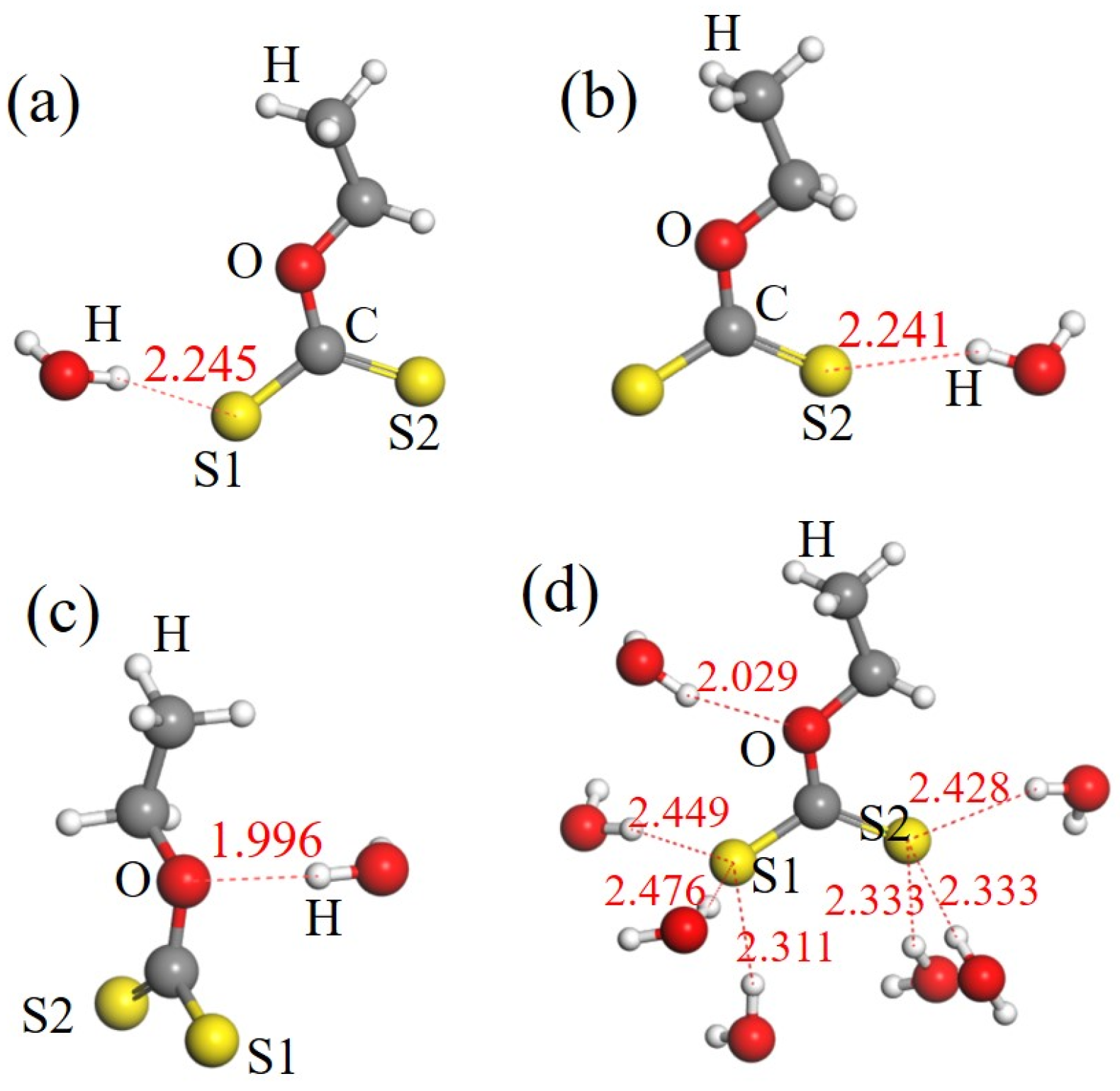
Figure 1. Interaction configurations between atoms of the xanthate (X) head group and water molecules. (a) at S1 site; (b) at S2 site; (c) at O site; and (d) saturated hydration configuration.
Separations 13 00156 g001
Figure 2. Interaction configurations between the ethyl DTC head group and water molecules. (a) at S1 site; (b) at S2 site; and (c) saturated hydration configuration.
Separations 13 00156 g002
Figure 3. Interaction configurations between the DTP head group and water molecules. (a) at S1 site; (b) at S2 site; (c) at O site; and (d) saturated hydration configuration.
Separations 13 00156 g003
Figure 4. Interaction configurations between the 3418A head group and water molecules. (a) at S1 site; (b) at S2 site; and (c) saturated hydration configuration.
Separations 13 00156 g004
Figure 5. Interaction configurations between the Z-200 head group and water molecules. (a) at S site; (b) at O site; (c) at N site; and (d) saturated hydration configuration.
Separations 13 00156 g005
Figure 6. Interaction configurations between the OA head group and water molecules. (a) at O1 site; (b) at O2 site; and (c) saturated hydration configuration.
Separations 13 00156 g006
Figure 7. Interaction configurations between the oxidized paraffin soap head group and water molecules. (a) at O1 site; (b) at O2 site; and (c) saturated hydration configuration.
Separations 13 00156 g007
Figure 8. Interaction configurations between the head groups of DS and water molecules. (a) at O1 site; (b) at O2 site; and (c) saturated hydration configuration.
Separations 13 00156 g008
Figure 9. Interaction configurations between the SPA head group and water molecules. (a) at O1 site; (b) at O3 site; and (c) saturated hydration configuration.
Separations 13 00156 g009
Figure 10. Interaction configurations between the BHA head group and water molecules. (a) at O1 site; (b) at O2 site; (c) at O3 site; and (d) saturated hydration configuration.
Separations 13 00156 g010
Table 1. Structural parameters of water molecules optimized under different functionals.
FunctionalH-O-H Bond Angle (°)Bond Length (Å)
GGA-PBE103.100.97
GGA-PBE-Grimme103.140.97
GGA-PW91103.350.97
GGA-PW91-OBS103.550.97
GGA-BLPY103.400.97
GGA-BLPY-Grimme103.430.97
B3LYP103.950.97
B3LYP-Grimme104.000.96
Experimental [18]104.480.96
Table 2. Effect of BSSE correction and solvation model on the H2O-H2O hydrogen-bond energies.
Solvation Model (Without BSSE Correction, Water as Solvent)BSSE Correction (Without Solvation Model)Without BSSE Correction (Without Solvation Model)
H2O-H2O hydrogen bond energy−7.44 kcal/mol−9.10 kcal/mol−9.76 kcal/mol
Table 3. Hydrogen bond distances and binding energies for the interactions between the xanthate (X) head group and water molecules.
ConfigurationsHydrogen BondDistances (Å)Hydration Binding Energy ΔE (kJ/mol)
Single water
configuration
bS1∙∙∙H2.245−35.07
aS2∙∙∙H2.241−29.13
cO∙∙∙H1.996−34.60
Saturated
hydration
configuration
dS1∙∙∙H2.311–2.476−232.63
S2∙∙∙H2.333–2.428
O∙∙∙H2.029
Table 4. Hydrogen bond distances and binding energies for the interactions between the DTC head group and water molecules.
ConfigurationsHydrogen BondDistances (Å)Hydration Binding Energy ΔE (kJ/mol)
Single water configurationaS1∙∙∙H2.208−37.56
bS2∙∙∙H2.255−37.48
Saturated hydration configurationcS1∙∙∙H2.271–2.614−210.43
S2∙∙∙H2.381–2.598
Table 5. Hydrogen bond distances and binding energies for the interactions between the DTP head group and water molecules.
ConfigurationsHydrogen BondDistances (Å)Hydration Binding
Energy ΔE (kJ/mol)
Single-water interactionaS1∙∙∙H2.381−33.69
bS2∙∙∙H2.449−32.68
cO∙∙∙H1.904−37.05
Saturated hydration configurationdS1∙∙∙H2.298–2.430−286.18
S2∙∙∙H2.351–2.586
O1∙∙∙H
O2∙∙∙H
1.933
2.102
Table 6. Hydrogen bond distances and binding energies for the interactions between the 3418A head group and water molecules.
ConfigurationsHydrogen BondDistances (Å)Hydration Binding Energy ΔE (kJ/mol)
Single-water interactionaS1∙∙∙H2.337−37.54
bS2∙∙∙H2.307−34.97
Saturated hydration configurationcS1∙∙∙H2.271–2.340−220.29
S2∙∙∙H2.292–2.315
Table 7. Hydrogen bond distances and binding energies for the interactions between the Z-200 head group and water molecules.
ConfigurationsHydrogen BondDistances (Å)Hydration Binding Energy ΔE (kJ/mol)
Single-water interactionaS∙∙∙H2.294−29.43
bO∙∙∙H1.962−32.30
cN∙∙∙H2.199−30.19
Saturated hydration configurationdS∙∙∙H2.395–2.474−155.83
O∙∙∙H1.940
N∙∙∙H2.424
Table 8. Hydrogen bond distances and binding energies for the interactions between the OA head group and water molecules.
ConfigurationsHydrogen BondDistances (Å)Hydration Binding Energy ΔE (kJ/mol)
Single-water interactionaO1∙∙∙H1.709−42.30
bO2∙∙∙H1.653−38.00
Saturated hydration configurationcO1∙∙∙H1.734–1.752−250.85
O2∙∙∙H1.721–1.894
Table 9. Hydrogen bond distances and binding energies for the interactions between the oxidized paraffin soap head group and water molecules.
ConfigurationsHydrogen BondDistances (Å)Hydration Binding
Energy ΔE (kJ/mol)
Single-water interactionaO1···H1.701−40.90
bO2···H1.744−37.15
Saturated hydration configurationcO1···H1.743–1.798−257.80
O2···H1.713–1.914
Table 10. Hydrogen bond distances and binding energies for the interactions between the head groups of DS and water molecules.
ConfigurationsHydrogen BondDistance (Å)Hydration Binding Energy ΔE (kJ/mol)
Single-water interactionaO1···H1.812−32.45
bO2···H1.776−32.24
Saturated hydration configurationcO1···H1.817–1.833Total ΔE: −323.89
O2···H1.833–1.929
O3···H1.803–1.943
Table 11. Hydrogen bond distances and binding energies for the interactions between the SPA head group and water molecules.
ConfigurationsHydrogen BondDistances (Å)Hydration Binding
Energy ΔE (kJ/mol)
Single-water interactionaO1···H1.643−44.49
bO3···H1.622−49.54
Saturated hydration configurationcO1···H1.666–1.790Total ΔE: −491.02
O2···H1.660–1.745
O3···H1.712–1.780
Table 12. Hydrogen bond distances and binding energies for the interactions between the BHA head group and water molecules.
ConfigurationsHydrogen BondDistances (Å)Hydration Binding Energy ΔE (kJ/mol)
Single-water interactiona (N–OH)O1···H1.906−27.07
b (C–OH)O2···H2.162−25.31
c (C=O)O3···H1.782−34.85
Saturated hydration configurationdO1···H1.864–1.929Total ΔE: −244.79
O2···H1.976–2.311
O3···H1.706–1.727
Table 13. Summary table of the number of hydrogen bonds, hydrogen-bond distance ranges, single-water binding energies, and total saturated binding energies.
CollectorsHydrogen BondNumbersDistances (Å)Binding Energy ΔE (kJ/mol)
Sulfide mineral collectorsC2H5-OCSS
(X)
S···H
O···H
6
1
2.311–2.476
2.029
TΔE: −232.63
AΔE: −33.23
(C2H5)2-NCSS
(DTC)
S···H62.271–2.614TΔE: −210.43
AΔE: −35.07
(C4H10O)2-PSS
(DTP)
S···H
O···H
6
2
2.298–2.586
1.933–2.102
TΔE: −286.18
AΔE: −35.77
(C4H9)2-PSS
(3418A)
S···H62.271–2.340TΔE: −220.29
AΔE: −36.71
C3H7-OC(S)N-C2H5
(Z-200)
S···H
O···H
N···H
3
1
1
2.395–2.474
1.940
2.424
TΔE: −155.83
AΔE: −31.17
Oxide Mineral CollectorsC17H34-COO
(OA)
O···H61.721–1.894TΔE: −250.85
AΔE: −41.80
C12H25-COO
(OPS-C12)
O···H61.713–1.914TΔE: −257.80
AΔE: −42.97
C12H25-SO3
(DS)
O···H91.817–1.943TΔE: −323.89
AΔE: −35.99
C6H5-C2H2-PO32−
(SPA)
O···H91.660–1.790TΔE: −491.02
AΔE: −54.56
C6H4(OH)-C(O)-N(H)-OH (BHA)O···H61.675–1.762
2.036–2.235
1.715–2.119
TΔE: −244.79
AΔE: −40.80
Noted: TΔE is the total binding energy of saturated water, and AΔE is the average binding energy of each water molecule.
Disclaimer/Publisher’s Note: The statements, opinions and data contained in all publications are solely those of the individual author(s) and contributor(s) and not of MDPI and/or the editor(s). MDPI and/or the editor(s) disclaim responsibility for any injury to people or property resulting from any ideas, methods, instructions or products referred to in the content.