
Article

Extractive Purification of Sulfur and Nitrogen Fuel Contaminants Using p-Toluenesulfonic Acid-Based Deep Eutectic Solvents

Chemical Engineering Department, College of Engineering, King Saud University, P.O. Box 800, Riyadh 11421, Saudi Arabia
*
Authors to whom correspondence should be addressed.
Separations 2026, 13(4), 122; https://doi.org/10.3390/separations13040122
Submission received: 24 March 2026 / Revised: 14 April 2026 / Accepted: 14 April 2026 / Published: 18 April 2026

Abstract

This study demonstrates the high efficiency and selectivity of p-toluenesulfonic acid-based deep eutectic solvents (DESs) for simultaneous extractive denitrogenation (EDN) and desulfurization (EDS) of model fuel. Three DESs—TBPB:PTSA, TBAB:PTSA, and ChCl:PTSA (1:1 molar ratio)—were synthesized and evaluated for their effectiveness against representative heteroaromatic pollutants: thiophene, dibenzothiophene, pyridine, and carbazole. The phosphonium-based TBPB:PTSA exhibited the highest extraction performance, achieving over 96% removal of nitrogen species and up to 85% removal of sulfur species at 40 °C. Increasing the temperature enhanced desulfurization by reducing viscosity, thereby improving mass transfer kinetics. Additionally, a 3:1 ratio of DES to fuel provided an optimal balance between solvent economy and operational efficiency. Denitrogenation was driven by strong acid–base protonation facilitated by PTSA, while desulfurization was governed by π–π and dispersion interactions, modulated by the hydrophobicity of the cations. The DES achieved nearly quantitative nitrogen removal and satisfactory sulfur extraction after three reuse cycles, while multistage operation enabled complete purification within four extraction steps. 1H NMR analysis confirmed that no DES components were found in the raffinate phase, verifying the immiscibility and stability of the solvent. These results indicate that TBPB:PTSA is a robust, regenerable, and environmentally benign solvent, effectively enabling simultaneous EDN–EDS of hydrocarbon fuels and positioning it as a promising green alternative to traditional hydrogen-based refining methods.

1. Introduction

Fossil fuels, including oil, coal, and natural gas, have been the primary sources of global energy supply for several decades [1,2]. However, burning these fuels emits sulfur- and nitrogen-containing compounds, which contribute to acid rain, smog, and other significant environmental problems [3]. Current emissions regulations require fuels to contain ultra-low levels of sulfur and nitrogen. For example, the U.S. Ultra-Low Sulfur Diesel standard limits sulfur content to 15 ppm [4]. Despite the growth of renewable energy, fossil fuels still dominate the energy mix, presenting society with a critical choice: transition rapidly to clean energy or continue using fossil fuels with stricter regulations. In practice, both approaches are expected to be implemented, requiring a significant reduction in fuel pollutants while still using conventional fuels. increasing stringency of these regulations highlights the essential need for effective methods to reduce sulfur and nitrogen compounds in fuels.
Traditional cleanup processes use catalytic hydrodesulfurization (HDS) and hydrodenitrogenation (HDN) to break C–S and C–N bonds, producing H2S and NH3 [5]. These processes, which operate at high pressure and temperature, are efficient but energy-intensive and require large amounts of hydrogen [3]. The presence of nitrogen compounds causes catalyst poisoning, making sequential hydrodenitrogenation (HDN) before hydrodesulfurization (HDS) necessary to maintain process efficiency [6]. In response, various alternative methods—including adsorptive, oxidative, and biological approaches, as well as novel solvents—have been explored [7]. Due to their user-friendly nature, cost-effectiveness, minimal impact on final fuel quality, and compatibility with other technologies, extractive desulfurization (EDS) and extractive denitrogenation (EDN) have attracted significant attention among these techniques [8,9,10]. Deep eutectic solvents (DESs), which have low volatility and toxicity and can be prepared by combining a salt with a hydrogen-bond donor [11,12], have shown potential for extracting sulfur or nitrogen compounds.
Recent studies have increasingly focused on deep eutectic solvents (DESs) for fuel purification. In earlier work, Gao et al. [13] used an ionic liquid in an oxidative process to reduce diesel sulfur from 150 ppm to 8.1 ppm. Laredo et al. [14] showed that a customized ionic liquid could effectively extract carbazole-type nitrogen compounds from fuel without being affected by coexisting sulfur. These results highlight the effectiveness of designer solvents. Deep eutectic solvents (DESs) made from choline chloride and ethylene glycol, or other hydrogen bond donors (HBDs), have achieved extraction efficiencies exceeding 98% for both pyridine and carbazole from model fuel. Functionalized ammonium- and phosphonium-based deep eutectic solvents (e.g., with ethylene glycol) have shown improved partition coefficients and selectivity. Simultaneous removal of sulfur and nitrogen has also been studied: Li et al. [15] demonstrated the extraction of sulfur and nitrogen using a deep eutectic solvent with an oxidative pretreatment step. Alli and Kroon [16] examined benzothiazole, which contains both sulfur and nitrogen, using tetrahexylammonium-based deep eutectic solvents (DESs). Suhaimi et al. [5] reported a biodegradable p-toluenesulfonic-acid deep eutectic solvent (DES) that enables simultaneous extraction of sulfur (S) and nitrogen (N). Lima et al. [17] evaluated four different DESs on synthetic fuel mixtures, finding that matrix composition had a greater effect on sulfur removal than on nitrogen. These pioneering efforts show that customized DES formulations can achieve simultaneous desulfurization and denitrogenation; however, practical one-step systems are still under development. Table 1 presents a conceptual comparison for simultaneous versus sequential treatment. In contrast to traditional stepwise HDN–HDS processes, simultaneous extraction offers an opportunity to simplify the process, reduce hydrogen usage, and operate under milder conditions, ultimately enhancing overall process efficiency.
In contrast to traditional stepwise hydrotreating, the simultaneous EDN/EDS method offers a more straightforward approach by enabling the removal of both sulfur- and nitrogen-containing compounds in a single extraction step. This method reduces the number of unit operations, eliminates the need for external hydrogen, and allows operation under mild conditions, unlike hydrotreating, which typically requires hydrogen, elevated temperatures, high pressures, and catalyst beds. Additionally, a concurrent solvent-based approach can avoid catalyst deactivation problems associated with nitrogen and sulfur compounds. Therefore, the simultaneous removal approach is attractive when a solvent provides complementary selectivity for both types of contaminants.
Although deep eutectic solvents show promise in extractive desulfurization and denitrogenation, significant challenges remain in formulating a single solvent that can effectively remove both sulfur- and nitrogen-containing compounds under mild conditions. Several reported systems rely on oxidative pretreatment, exhibit reduced sulfur extraction in complex fuel matrices, or exhibited limited recyclability. Additionally, systematic studies comparing the influence of DES cation structure on simultaneous extraction performance are scarce, and the practical advantages of integrated EDN/EDS over traditional stepwise hydrotreating have not been clearly demonstrated. This study aims to develop and evaluate three p-toluenesulfonic acid (PTSA)-based deep eutectic solvents (DESs)—TBPB:PTSA, TBAB:PTSA, and ChCl:PTSA—for the direct, simultaneous removal of sulfur and nitrogen compounds from model and simulated fuels under mild conditions. The investigation systematically examines the effects of operating parameters, solvent structure, and reusability to identify an extraction system that is efficient and stable.

2. Materials and Methods

The list of chemicals used in this study is summarized in Table 2. All chemicals were employed without further purification due to their high purity. Three distinct DESs, TBAB:PTSA (1:1), ChCl:PTSA (1:1), and TBPB:PTSA (1:1) were prepared according to the procedure described by Abbott et al. [20]. The hydrogen bond acceptors (TBAB, TBPB, or ChCl) were combined with PTSA at an equimolar ratio inside sealed bottles. The resulting mixtures were introduced into a temperature-controlled shaking incubator and agitated at 200 rpm, with the temperature maintained at 80 °C (±0.1 °C), until homogeneous and clear liquids were obtained.

2.1. Model Fuels Preparation

n-Heptane was selected as the base model fuel. Thiophene and dibenzothiophene (DBT) were chosen as model sulfur contaminants, while carbazole (non-basic) and pyridine (basic) served as model nitrogen contaminants. Table 3 and Table 4 present the temperature-dependent density and viscosity for each DES, respectively. The experimental measurements were performed using an DMA 4100 M densitometer (Anton Paar GmbH, Richmond, VA, USA) (repeatability: 0.05 kg/m3; precision: 0.1 kg/m3) and a Lovis 2000 M/ME viscometer (Anton Paar GmbH, Richmond, VA, USA). To identify the most effective DES, each model contaminant was first dissolved individually in n-heptane. Various conditions were then investigated to optimize the performance of the DES. Subsequently, the simultaneous extraction of the different contaminants was studied by dissolving all model compounds into n-heptane. Following this, diesel and gasoline models were developed as specified in Table S1. To mimic concentrations found in real-world fuels, higher concentrations of sulfur contaminants relative to nitrogen contaminants were prepared. Thus, the initial concentrations were set at 1500 ppmw for thiophene, 3000 ppmw for DBT, 1500 ppmw for pyridine, and 300 ppmw for carbazole.
Feed solutions were prepared by gravimetrically measuring the required quantities of each component using an analytical balance with a precision of ±0.0001 g. The feed was then mixed with the DESs at a 1:1 mass ratio. The bottles were placed in an incubating shaker, and initial screening experiments were conducted at 25 °C. Shaking was performed for 2 h, followed by a settling period of approximately 6 h to ensure thermodynamic equilibrium was reached. Samples were then collected from both the top and bottom layers and analyzed by gas chromatography (GC).

2.2. Analysis

Aliquots from each phase were withdrawn using a microliter pipette and subsequently diluted with diethyl ether prior to compositional analysis. The DES and raffinate phase compositions were determined using a TRACE GC Ultra (Thermo Scientific, Logan, UT, USA) equipped with an Rtx-1 column (30 m × 0.25 mm × 0.25 μm, Restek, Bellefonte, PA, USA) and a flame ionization detector (FID). The column oven temperature was set to 308.2 K for 2 min. The additional operating conditions were as follows: FID temperature set at 584 K, with a temperature ramp starting at 358.2 K and increasing at 10 K/min. The injector temperature was also maintained at 584 K, and the carrier gas, helium, flowed at 30 mL/min. An injection volume of 0.3 µL was used, with a split ratio of 16. Hexane was used as the dilution solvent. To measure the composition, calibration curves were constructed. Naphthalene was selected as the internal standard and GC calibration curves for heterocyclic aromatic compounds and naphthalene were performed (Figure S1). Samples were injected three times and the average uncertainty in the reported molar compositions was calculated to be ±0.005. To confirm the purity of synthesized DESs and their absence in the top layer after extraction, pure DESs and samples from this layer were analyzed by 1H NMR spectroscopy using the JEOL RESONANCE spectrometer (ECX-500 II, Jeol, Tokyo, Japan). Chloroform-d (Deuterochloroform, CDCl3) was employed as the solvent and the 1H NMR spectra were recorded at 297.15 K (Figures S2–S5).
The extraction efficiency (E%) of aromatic compounds was evaluated using Equation (1):
E % =   c a r o m a t i c i n i t i a l c a r o m a t i c f i n a l c a r o m a t i c i n i t i a l ×   100 %
where c a r o m a t i c i n i t i a l , and c a r o m a t i c f i n a l are the initial, and final concentrations of aromatic compounds in the raffinate phase, respectively.

3. Results

The performance of the DES was first tested with n-heptane as a model containing thiophene, DBT, pyridine, and carbazole, each separately. The results for extraction efficiency are shown in Figure 1. All DESs demonstrated high efficiency for the removal of pyridine and carbazole, with an average efficiency of 97%. This trend was also observed in our previous work when quinoline, pyridine, and indoline were used as nitrogen compounds with TBPB:PTSA and TBAB:PTSA [5,21]. This high extraction efficiency can be attributed to the interaction between the acid functional group of PTSA and the nitrogen atoms of pyridine and carbazole. When TBAB and TBPB were used with other HBDs, efficiencies slightly decreased. However, for sulfur compounds, only moderate performance was obtained, especially for ChCl-based DES. In general, sulfur compounds are more difficult to extract from different fuel models. This poor performance was also observed in several previous studies when ILs or DESs were used for the extraction of both sulfur and nitrogen compounds. The weak interaction between low-polarity sulfur products and the charges present in ILs and DESs is suggested as an explanation for this phenomenon, since all the DESs used in this study are composed of salt compounds.
Regarding the nature of the HBA in each DES, the removal of thiophene and DBT is enhanced when the HBA contains a long chain, which favors hydrophobic interactions between the DES and sulfur compounds. Concerning the effect of the cation, the phosphonium cation significantly increases the extraction efficiencies for sulfur compounds compared to the ammonium cation, especially for DBT, raising its removal from around 40% to 56%.
In order to improve the extraction performance of the systems used in this work, especially for sulfur compounds, several parameters were studied including time, temperature, and weight ratio. For this purpose, n-heptane was selected as model fuel, while thiophene and DBT were investigated separately as sulphur-containing contaminants.
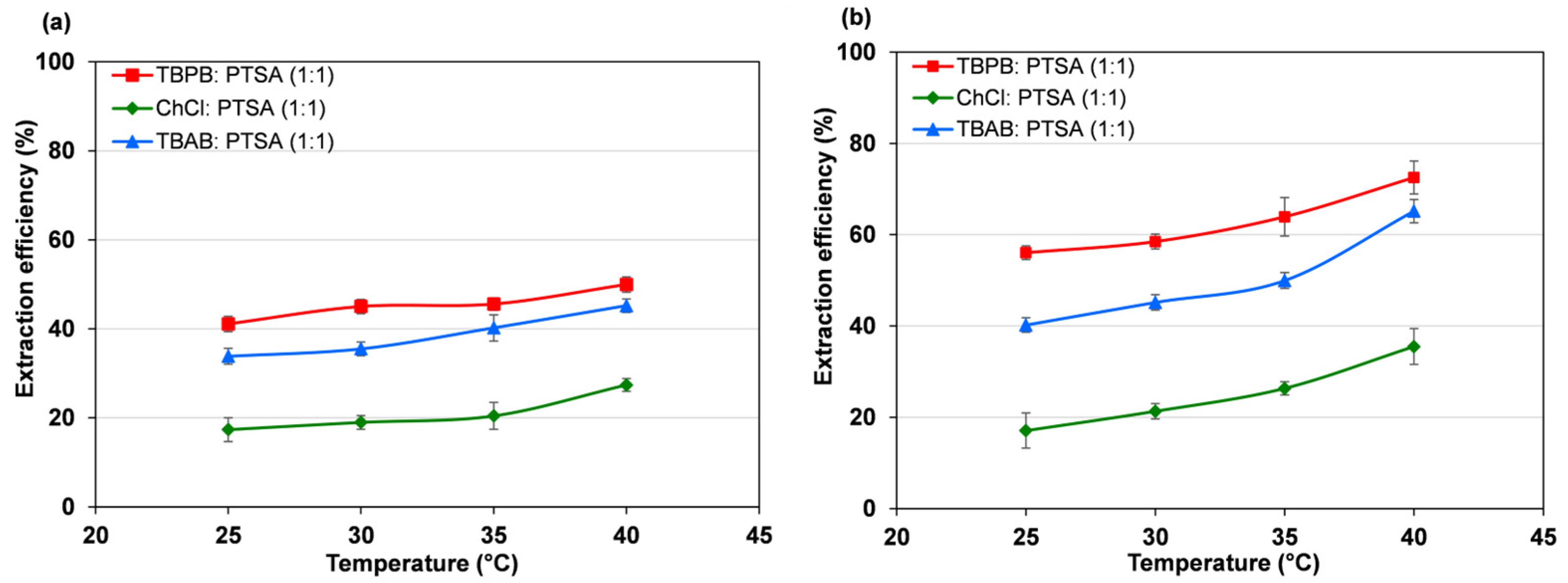
Like other solvents, the viscosity of DESs decreases as temperature increases, promoting efficient mass transfer and reducing settling time between the extracted phase and the DES phase. The effect of temperature, within the range of 25 to 40 °C, on extraction efficiency for the three DESs is presented in Figure 2. For all DESs and for both thiophene and DBT, extraction efficiency increased with temperature, suggesting that reduced DES viscosity improves extraction performance. The temperature was limited to 40 °C to avoid the loss of thiophene due to its high volatility; therefore, this temperature was selected for the remainder of this work. The best results were obtained with TBPB:PTSA DES, with approximately 50% extraction efficiency for thiophene and 73% for DBT.
Figure 2a,b demonstrates that increasing the temperature from 25 °C to 40 °C enhances the extractive desulfurization of both thiophene and DBT using the three PTSA-DESs. For thiophene, extraction efficiency increased from 41.1% to 50.0% with (TBPB:PTSA), from 33.8% to 45.2% with (TBAB:PTSA), and from 17.4% to 27.4% with (ChCl:PTSA). Similarly, for DBT, the removal efficiency improved from 56.1% to 73.2%, from 40.2% to 63.0%, and from 26.3% to 36.9%, respectively. This enhancement is primarily due to decreased viscosity and improved solute diffusion at higher temperatures, which facilitate mass transfer and strengthen solute–solvent interactions. The phosphonium-based DES (TBPB:PTSA) consistently exhibited superior performance compared to the other alternatives, likely due to its higher hydrophobicity and lower viscosity, which improve its affinity for aromatic sulfur compounds. Additionally, DBT exhibited higher extraction efficiencies than thiophene at all temperatures, owing to its larger π-conjugated structure and greater polarizability, which enable stronger π–π and dispersion interactions with the DES components. These results are consistent with previous studies on thermally enhanced extraction using hydrophobic DESs and ionic liquids [23,24,25].
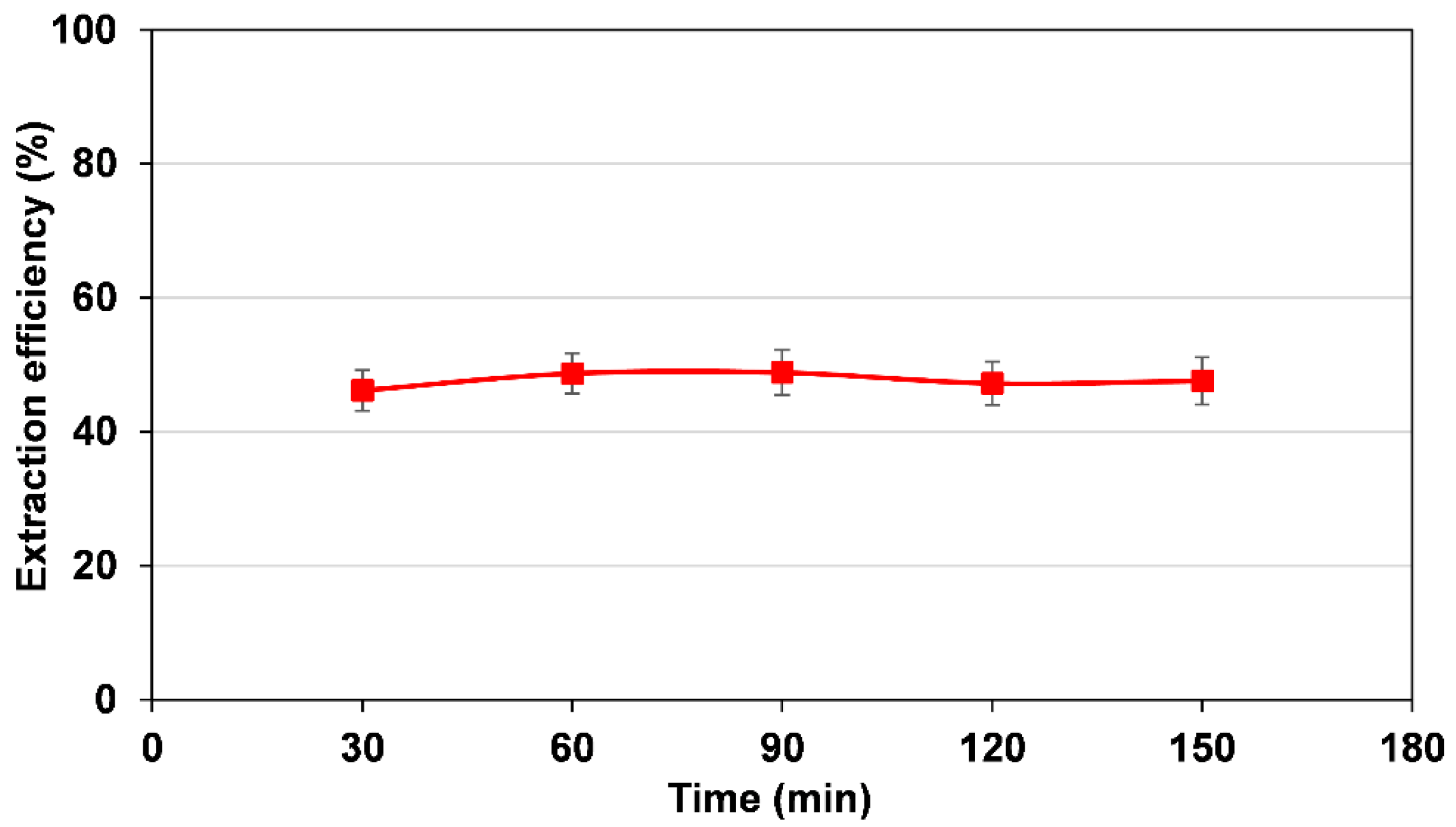
Figure 3 shows the effect of contact time on the extraction of thiophene using TBPB:PTSA (1:1) at 40 °C. The extraction efficiency increased slightly from 46.2% at 30 min to a maximum of 48.8% at 90 min, after which it stabilized, indicating that phase equilibrium was reached within the first hour. The minimal change observed beyond 60–90 min suggests that mass transfer between the hydrocarbon and DES phases occurs rapidly, aided by the relatively low viscosity of the phosphonium-based DES at this temperature. This behavior is typical of diffusion-controlled extraction systems, where solute transfer is initially governed by interfacial diffusion until equilibrium partitioning is achieved [26,27]. The rapid attainment of steady-state efficiency indicates effective phase miscibility and stable interactions between solvent and solute, confirming that extending the extraction duration does not improve removal efficiency and may increase the risk of back-extraction or degradation of the DESs [28,29]. Therefore, a contact time of 60 min is considered optimal for the effective extraction of thiophene under these conditions.
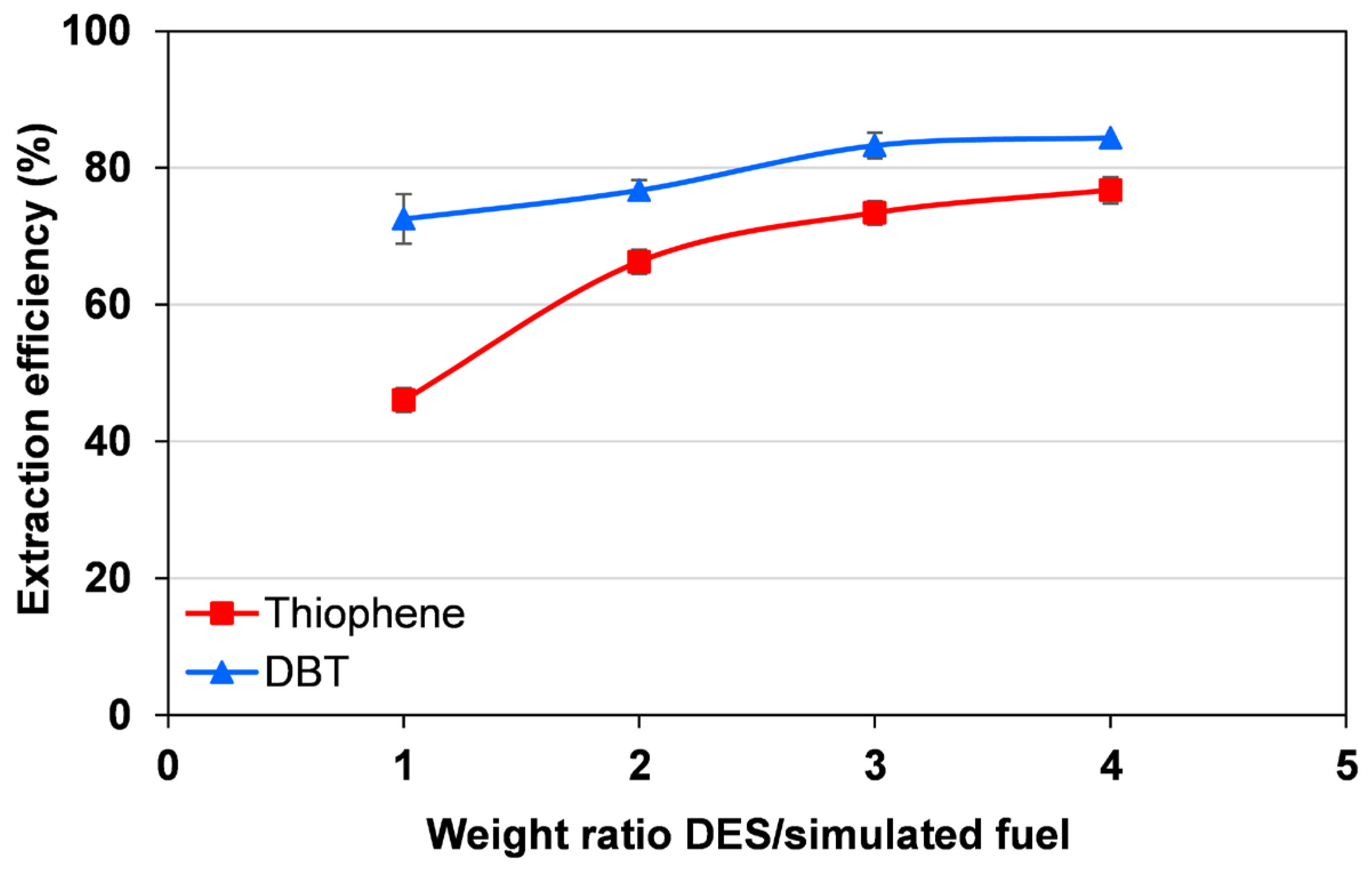
Figure 4 presents the effect of the TBPB:PTSA (1:1) DES-to-fuel weight ratio on the extraction efficiency of thiophene and DBT at 40 °C. Increasing the ratio from 1:1 to 4:1 significantly enhanced the extraction performance, with thiophene efficiency rising from 46.1% to 76.7% and DBT from 72.5% to 84.4%. This improvement results from the greater availability of active extraction sites and an expanded interfacial area between the phases, which facilitates solute transfer [30]. However, the increase in efficiency becomes less pronounced beyond a 3:1 ratio, indication that the system approaches equilibrium and that further solvent addition results in diminishing returns [23]. Therefore, a 3:1 ratio was selected as the optimal compromise, since the efficiency gain by increasing the ratio from 3:1 to 1:4 was not significant, rising only from 74% to 76.7% for thiophene and from 83% to 84.4% for DBT. The higher extraction of DBT compared to thiophene across all ratios again reflects its stronger π–π and dispersion interactions with the aromatic PTSA moiety [31]. Hence, a 3:1 weight ratio offers an optimal balance between high extraction efficiency and minimal solvent usage.
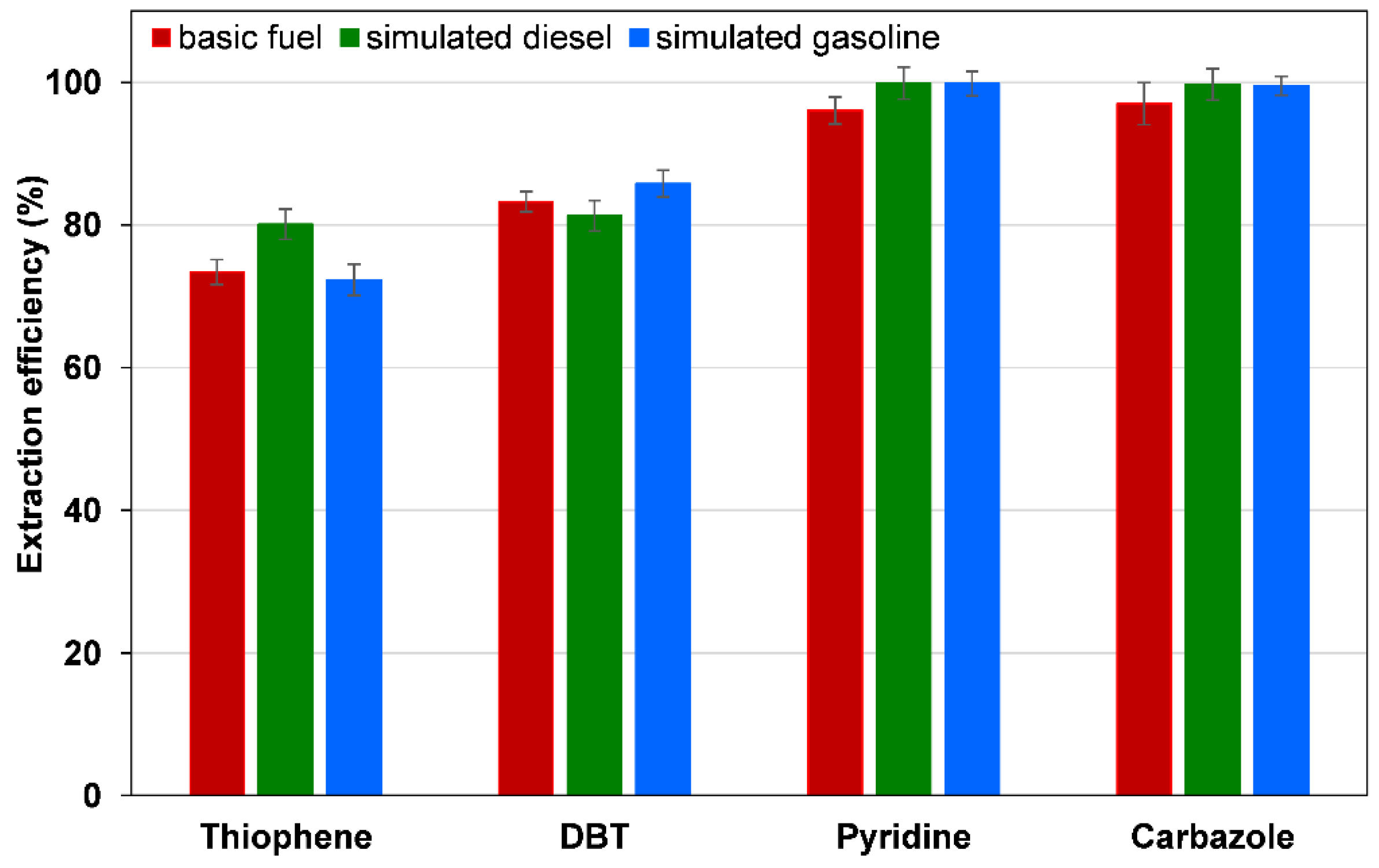
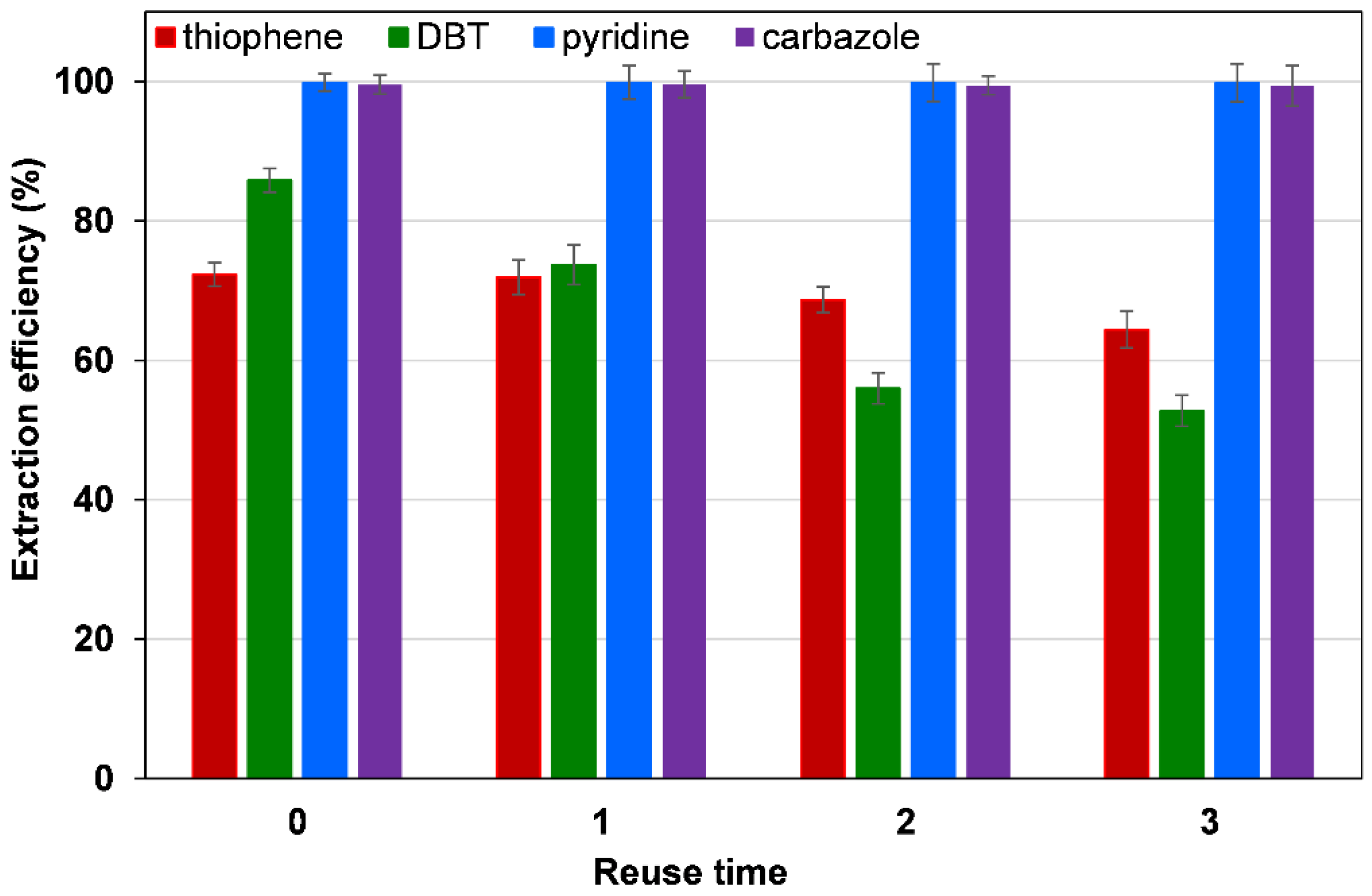
Figure 5 presents a comparative analysis of the extraction performance of TBPB:PTSA (1:1) across three distinct fuel matrices: basic fuel, simulated diesel, and simulated gasoline. This evaluation was conducted under optimized conditions, specifically a 3:1 DES/fuel ratio, a temperature of 40 °C, and a duration of 60 min. The DES exhibited high extraction efficiencies for all compounds, indicating its robustness and tolerance to matrix variations. The removal efficiency for sulfur species showed that thiophene extraction ranged from 72.3% to 80.1%, while dibenzothiophene (DBT) extraction ranged from 81.3% to 85.8%. In contrast, nitrogen compounds exhibited near-total extraction, with pyridine exceeding 96% and carbazole surpassing 99% across all matrices.
The effect of the matrix on desulfurization is complex; for instance, the simulated diesel phase resulted in the highest extraction for thiophene (around 80.1%) but the lowest for DBT (around 81.3%). This suggests that the interactions between the sulfur aromatics and the different fuel components (e.g., aliphatics vs. aromatics) are nuanced and compound-specific [32]. The consistently high denitrogenation performance, however, underscores the significant influence of acid–base protonation facilitated by PTSA, which remains largely unaffected by matrix composition [33]. The generally high efficiency observed in hydrocarbon-rich gasoline indicates that lighter aliphatic components exert limited interference on the primary extraction mechanisms, affirming that TBPB:PTSA demonstrates exceptional selectivity and extraction capacity across diverse fuel types. The results show that PTSA-based hydrophobic DESs can effectively achieve simultaneous denitrogenation and desulfurization (EDN–EDS) under mild conditions [33]. These DESs exhibit superior performance compared to many conventional ionic liquids and have significant potential for applications in real fuels.
Figure 6 shows the reusability performance of TBPB:PTSA (1:1) in extracting thiophene, DBT, pyridine, and carbazole at 40 °C and a DES/fuel ratio of 3:13:13:1. The DES consistently achieved high and stable extraction efficiencies for nitrogen compounds over four consecutive cycles, with pyridine and carbazole removal rates exceeding 99%. This result confirms the robust and reversible acid–base interaction mechanism between PTSA and the nitrogen sites [17]. A gradual decline in sulfur compound extraction was observed: thiophene efficiency decreased from 72.3% to 64.4%, and DBT efficiency decreased from 85.8% to 52.8% after three reuse cycles. This decline can be attributed to partial saturation of the DES by retained sulfur species, minor solvent losses during phase separation, and a potential reduction in the integrity of the hydrogen-bond network within the reused DES [23]. Nonetheless, the DES maintained a significant extraction capacity, demonstrating commendable operational stability and recyclability without any purification process. Similar trends have been observed for hydrophobic DESs and ionic liquids, where denitrogenation remains largely unchanged while desulfurization experiences a slight reduction due to solute accumulation. In summary, TBPB:PTSA demonstrates superior reusability for EDN and satisfactory durability for EDS, indicating its viability for sustainable and cost-efficient fuel purification.
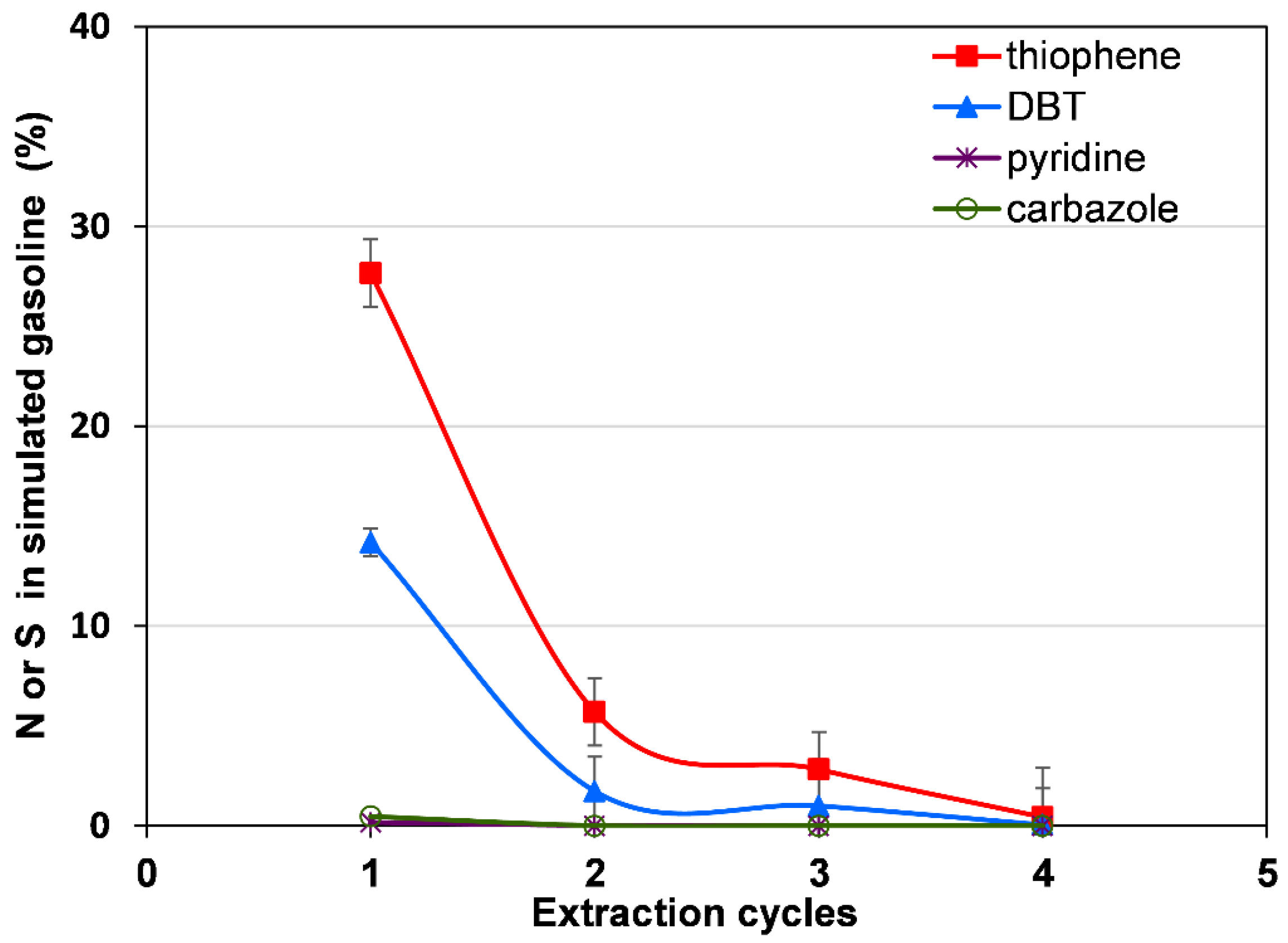
Figure 7 shows the multi-stage extraction performance of TBPB:PTSA (1:1) at 40 °C and a 3:13:1 DES/fuel ratio for removing thiophene, DBT, pyridine, and carbazole from a simulated gasoline matrix. The concentration of heteroatoms (N or S) in the fuel phase decreases significantly with each extraction cycle, confirming the high efficiency and regenerability of the DES. After the first stage, the residual sulfur concentration in the raffinate dropped to 27.7% for thiophene and 14.2% for dibenzothiophene (DBT), while nitrogen compounds were almost completely removed, registering below 0.5%. Two consecutive cycles reduced sulfur residues to less than 2%, resulting in an overall removal efficiency above 98%. This rapid decline demonstrates that multiple short extraction stages are more effective than a single prolonged contact period, as introducing fresh DES in each cycle maintains extraction capacity and limits solute saturation. The near-complete removal of pyridine and carbazole after the first extraction further supports the predominant acid–base protonation mechanism of PTSA with nitrogen heterocycles, which is stronger and more selective than the noncovalent interactions governing sulfur extraction [34]. The slight plateau observed for thiophene and DBT after the third cycle suggests an equilibrium limitation due to trace hydrophobic residues, consistent with previous findings on phosphonium-based DESs in sequential extraction and desorption processes [35]. These results indicate that TBPB:PTSA achieves complete denitrogenation and over 99% desulfurization after four straightforward extraction cycles, confirming its potential for efficient, recyclable, and environmentally friendly fuel purification. Finally, the possible contamination of the fuel phases by DES after pollutant extraction was examined by 1H NMR. These analyses showed the absence of DES in the fuel after contact, confirming the effectiveness and cleanliness of the extraction procedure.

4. Conclusions

This study demonstrates that p-toluenesulfonic acid-based deep eutectic solvents, specifically the phosphonium system TBPB:PTSA, are highly efficient and reusable solvents for extracting both nitrogen-containing and sulfur-containing compounds from model and simulated fuels. Specifically, TBPB:PTSA achieved a removal efficiency exceeding 96% for nitrogen compounds and up to 85% for sulfur compounds at 40 °C. Additionally, a 3:13:1 ratio of DES to fuel provided the optimal balance between solvent economy and extraction efficiency. The pronounced Brønsted acidity of PTSA enables near-complete denitrogenation by protonating basic heterocycles, while the hydrophobic cations promote sulfur removal through synergistic π–π interactions and dispersion forces. Optimizing temperature and solvent-to-fuel ratio resulted in decreased viscosity, enhanced mass transfer, and improved solvent efficiency, achieving over 95% overall heteroatom removal under mild conditions. The TBPB:PTSA DES achieved nearly quantitative nitrogen removal and satisfactory sulfur extraction after three reuse cycles, while multistage operation enabled complete purification within four extraction steps. The TBPB:PTSA DES exhibited significant selectivity and phase stability across various fuel matrices, and its regeneration performance demonstrated exceptional operational durability. Analysis by 1H NMR confirmed the absence of DES components in the raffinate phase, validating the immiscibility and phase integrity of the solvent after extraction. These findings highlight the effectiveness of TBPB:PTSA as a solvent for sustainable, low-energy fuel purification, combining principles of molecular design, green chemistry, and process intensification for post-hydrotreating applications.

Supplementary Materials

The following supporting information can be downloaded at: https://www.mdpi.com/article/10.3390/separations13040122/s1, Figure S1: GC calibration curve for heterocyclic aromatic compounds and naphthalene. Figure S2: 1H NMR spectrum of pure TBPB:PTSA (1:1). Figure S3: 1H NMR spectrum of TBAB:PTSA (1:1). Figure S4: 1H NMR spectrum of TBPB:PTSA (1:1), TL of Diesel model and TL of Gasoline after extraction. Figure S5: 1H NMR spectrum of TBAB:PTSA (1:1), TL of Diesel model and TL of Gasoline after extraction. Table S1: Composition of the Different Multicomponent Simulated Fuel Matrices Studied in This Work.

Author Contributions

Conceptualization, S.M., L.E.B. and M.K.H.-K.; methodology, L.E.B., I.W. and A.A.A.-Z.; software, I.W., M.K.H.-K. and A.A.A.-Z.; validation, L.E.B., I.W. and A.A.A.-Z.; formal analysis, S.M., I.W., M.K.H.-K. and A.A.A.-Z.; investigation, S.M., L.E.B. and M.K.H.-K.; resources, S.M., L.E.B. and M.K.H.-K.; data curation, L.E.B., I.W. and A.A.A.-Z.; writing—original draft preparation, L.E.B., I.W. and A.A.A.-Z.; writing—review and editing, S.M., L.E.B. and M.K.H.-K.; visualization, S.M., L.E.B. and I.W.; supervision, S.M., L.E.B. and M.K.H.-K.; project administration, S.M., L.E.B. and M.K.H.-K.; funding acquisition, S.M., L.E.B. and M.K.H.-K. All authors have read and agreed to the published version of the manuscript.

Funding

This research was funded by the National Plan for Science, Technology and Innovation (MAARIFAH), King Abdulaziz City for Science and Technology, Kingdom of Saudi Arabia, award no. 12-ENE2935.

Data Availability Statement

The original contributions presented in this study are included in the article/Supplementary Materials. Further inquiries can be directed to the corresponding authors.

Acknowledgments

The authors thank the National Plan for Science, Technology and Innovation, KACST, Kingdom of Saudi Arabia, for supporting this work through the Project number 12-ENE2935.

Conflicts of Interest

The authors declare no conflicts of interest.

References

  1. Ong, H.; Mahlia, T.; Masjuki, H. A review on energy scenario and sustainable energy in Malaysia. Renew. Sustain. Energy Rev. 2011, 15, 639–647. [Google Scholar] [CrossRef]
  2. Anwar, J.; Khan, H.U. The nexus between energy security and primary energy supply: An empirical study focusing on an energy striped country. Renew. Sustain. Energy Rev. 2025, 214, 115462. [Google Scholar] [CrossRef]
  3. Wang, J.; Wang, R. Recent Advances in Simultaneous Desulfurization and Denitrogenation of Fuel Oil. Molecules 2026, 31, 279. [Google Scholar] [CrossRef] [PubMed]
  4. Stanislaus, A.; Marafi, A.; Rana, M.S. Recent advances in the science and technology of ultra low sulfur diesel (ULSD) production. Catal. Today 2010, 153, 1–68. [Google Scholar] [CrossRef]
  5. Suhaimi, H.E.; Hizaddin, H.F.; Wazeer, I.; El Blidi, L.; Hashim, M.A.; Hadj-Kali, M.K. Simultaneous extraction of sulfur and nitrogen compounds from model diesel fuel using neoteric green solvents. ACS Omega 2021, 6, 22317–22332. [Google Scholar] [CrossRef]
  6. Behnejad, B.; Abdouss, M.; Tavasoli, A. Comparison of performance of Ni–Mo/γ-alumina catalyst in HDS and HDN reactions of main distillate fractions. Pet. Sci. 2019, 16, 645–656. [Google Scholar] [CrossRef]
  7. Wu, P.; Ma, S.; Zhu, W. Green pathways to low-sulfur diesel: Advances and challenges in desulfurization technologies. Green Chem. 2026, 28, 37–95. [Google Scholar] [CrossRef]
  8. Lima, F.; Branco, L.C.; Silvestre, A.J.; Marrucho, I.M. Deep desulfurization of fuels: Are deep eutectic solvents the alternative for ionic liquids? Fuel 2021, 293, 120297. [Google Scholar] [CrossRef]
  9. Sikarwar, P.; Gosu, V.; Subbaramaiah, V. An overview of conventional and alternative technologies for the production of ultra-low-sulfur fuels. Rev. Chem. Eng. 2019, 35, 669–705. [Google Scholar] [CrossRef]
  10. Abro, R.; Abro, M.; Gao, S.; Bhutto, A.W.; Ali, Z.M.; Shah, A.; Chen, X.; Yu, G. Extractive denitrogenation of fuel oils using ionic liquids: A review. RSC Adv. 2016, 6, 93932–93946. [Google Scholar] [CrossRef]
  11. Jing, X.; Xue, H.; Sang, X.; Wang, X.; Jia, L. Magnetic deep eutectic solvent-based dispersive liquid–liquid microextraction for enantioselectively determining chiral mefentrifluconazole in cereal samples via ultra-high-performance liquid chromatography. Food Chem. 2022, 391, 133220. [Google Scholar] [CrossRef]
  12. Jia, L.; Huang, X.; Zhao, W.; Wang, H.; Jing, X. An effervescence tablet-assisted microextraction based on the solidification of deep eutectic solvents for the determination of strobilurin fungicides in water, juice, wine, and vinegar samples by HPLC. Food Chem. 2020, 317, 126424. [Google Scholar] [CrossRef] [PubMed]
  13. Gao, S.; Li, J.; Chen, X.; Abdeltawab, A.A.; Yakout, S.M.; Yu, G. A combination desulfurization method for diesel fuel: Oxidation by ionic liquid with extraction by solvent. Fuel 2018, 224, 545–551. [Google Scholar] [CrossRef]
  14. Laredo, G.C.; Likhanova, N.V.; Lijanova, I.V.; Rodriguez-Heredia, B.; Castillo, J.J.; Perez-Romo, P. Synthesis of ionic liquids and their use for extracting nitrogen compounds from gas oil feeds towards diesel fuel production. Fuel Process. Technol. 2015, 130, 38–45. [Google Scholar] [CrossRef]
  15. Li, Z.; Liu, D.; Men, Z.; Song, L.; Lv, Y.; Wu, P.; Lou, B.; Zhang, Y.; Shi, N.; Chen, Q. Insight into effective denitrification and desulfurization of liquid fuel with deep eutectic solvents: An innovative evaluation criterion to filtrate extractants using the compatibility index. Green Chem. 2018, 20, 3112–3120. [Google Scholar] [CrossRef]
  16. Alli, R.D.; Kroon, M.C. Extraction of benzothiazole and thiophene from their mixtures with n-heptane using tetrahexylammonium bromide-based deep eutectic solvents as extractive denitrogenation and desulfurization agents. Fluid Phase Equilib. 2018, 477, 1–11. [Google Scholar] [CrossRef]
  17. Lima, F.; Dave, M.; Silvestre, A.J.; Branco, L.C.; Marrucho, I.M. Concurrent desulfurization and denitrogenation of fuels using deep eutectic solvents. ACS Sustain. Chem. Eng. 2019, 7, 11341–11349. [Google Scholar] [CrossRef]
  18. Gooneh-Farahani, S.; Anbia, M. A review of advanced methods for ultra-deep desulfurization under mild conditions and the absence of hydrogen. J. Environ. Chem. Eng. 2023, 11, 108997. [Google Scholar] [CrossRef]
  19. Abro, R.; Kiran, N.; Ahmed, S.; Muhammad, A.; Jatoi, A.S.; Mazari, S.A.; Salma, U.; Plechkova, N.V. Extractive desulfurization of fuel oils using deep eutectic solvents–A comprehensive review. J. Environ. Chem. Eng. 2022, 10, 107369. [Google Scholar] [CrossRef]
  20. Abbott, A.P.; Boothby, D.; Capper, G.; Davies, D.L.; Rasheed, R.K. Deep eutectic solvents formed between choline chloride and carboxylic acids: Versatile alternatives to ionic liquids. J. Am. Chem. Soc. 2004, 126, 9142–9147. [Google Scholar] [CrossRef]
  21. Kamarudin, A.F.; Hizaddin, H.F.; El-Blidi, L.; Ali, E.; Hashim, M.A.; Hadj-Kali, M.K. Performance of p-toluenesulfonic acid–based deep eutectic solvent in denitrogenation: Computational screening and experimental validation. Molecules 2020, 25, 5093. [Google Scholar] [CrossRef] [PubMed]
  22. Rodriguez Rodriguez, N.; Machiels, L.; Binnemans, K. p-Toluenesulfonic acid-based deep-eutectic solvents for solubilizing metal oxides. ACS Sustain. Chem. Eng. 2019, 7, 3940–3948. [Google Scholar] [CrossRef]
  23. Li, J.-J.; Xiao, H.; Tang, X.-D.; Zhou, M. Green carboxylic acid-based deep eutectic solvents as solvents for extractive desulfurization. Energy Fuels 2016, 30, 5411–5418. [Google Scholar] [CrossRef]
  24. Jha, D.; Haider, M.B.; Kumar, R.; Balathanigaimani, M.S. Extractive desulfurization of fuels using diglycol based deep eutectic solvents. J. Environ. Chem. Eng. 2020, 8, 104182. [Google Scholar] [CrossRef]
  25. Chen, X.; Yuan, S.; Abdeltawab, A.A.; Al-Deyab, S.S.; Zhang, J.; Yu, L.; Yu, G. Extractive desulfurization and denitrogenation of fuels using functional acidic ionic liquids. Sep. Purif. Technol. 2014, 133, 187–193. [Google Scholar] [CrossRef]
  26. Van Osch, D.J.; Zubeir, L.F.; Van Den Bruinhorst, A.; Rocha, M.A.; Kroon, M.C. Hydrophobic deep eutectic solvents as water-immiscible extractants. Green Chem. 2015, 17, 4518–4521. [Google Scholar] [CrossRef]
  27. Hayyan, A.; Hashim, M.A.; Mjalli, F.S.; Hayyan, M.; AlNashef, I.M. A novel phosphonium-based deep eutectic catalyst for biodiesel production from industrial low grade crude palm oil. Chem. Eng. Sci. 2013, 92, 81–88. [Google Scholar] [CrossRef]
  28. Makoś, P.; Boczkaj, G. Deep eutectic solvents based highly efficient extractive desulfurization of fuels–Eco-friendly approach. J. Mol. Liq. 2019, 296, 111916. [Google Scholar] [CrossRef]
  29. Jablonský, M.; Škulcová, A.; Ház, A.; Šima, J.; Majová, V. Long-term isothermal stability of deep eutectic solvents. BioResources 2018, 13, 7545–7559. [Google Scholar] [CrossRef]
  30. Almashjary, K.H.; Khalid, M.; Dharaskar, S.; Jagadish, P.; Walvekar, R.; Gupta, T.C.S.M. Optimisation of extractive desulfurization using Choline Chloride-based deep eutectic solvents. Fuel 2018, 234, 1388–1400. [Google Scholar] [CrossRef]
  31. Wang, X.; Wan, H.; Han, M.; Gao, L.; Guan, G. Removal of thiophene and its derivatives from model gasoline using polymer-supported metal chlorides ionic liquid moieties. Ind. Eng. Chem. Res. 2012, 51, 3418–3424. [Google Scholar] [CrossRef]
  32. Nejad, N.F.; Shams, E.; Adibi, M.; Miran Beigi, A.; Torkestani, S. Desulfurization from model of gasoline by extraction with synthesized [BF4]−-and [PF6]−-based ionic liquids. Pet. Sci. Technol. 2012, 30, 1619–1628. [Google Scholar] [CrossRef]
  33. Zarin, L.; Saien, J.; Jafari, F.; Dastan, D. Acidic phosphonium-based deep eutectic solvent for deep desulfurization and denitrogenation of synthetic and real gasolines. J. Ind. Eng. Chem. 2025, 155, 852–864. [Google Scholar] [CrossRef]
  34. Zhang, X.; Zhang, J.; Yin, J.; Zhu, T.; Dai, C.; Jiang, W.; Li, H.; Li, H. Unraveling the mechanism of extractive desulfurization to rationally design functional ionic liquids and deep eutectic solvents: A comprehensive review. Energy Fuels 2025, 39, 4095–4118. [Google Scholar] [CrossRef]
  35. Li, C.; Li, D.; Zou, S.; Li, Z.; Yin, J.; Wang, A.; Cui, Y.; Yao, Z.; Zhao, Q. Extraction desulfurization process of fuels with ammonium-based deep eutectic solvents. Green Chem. 2013, 15, 2793–2799. [Google Scholar] [CrossRef]
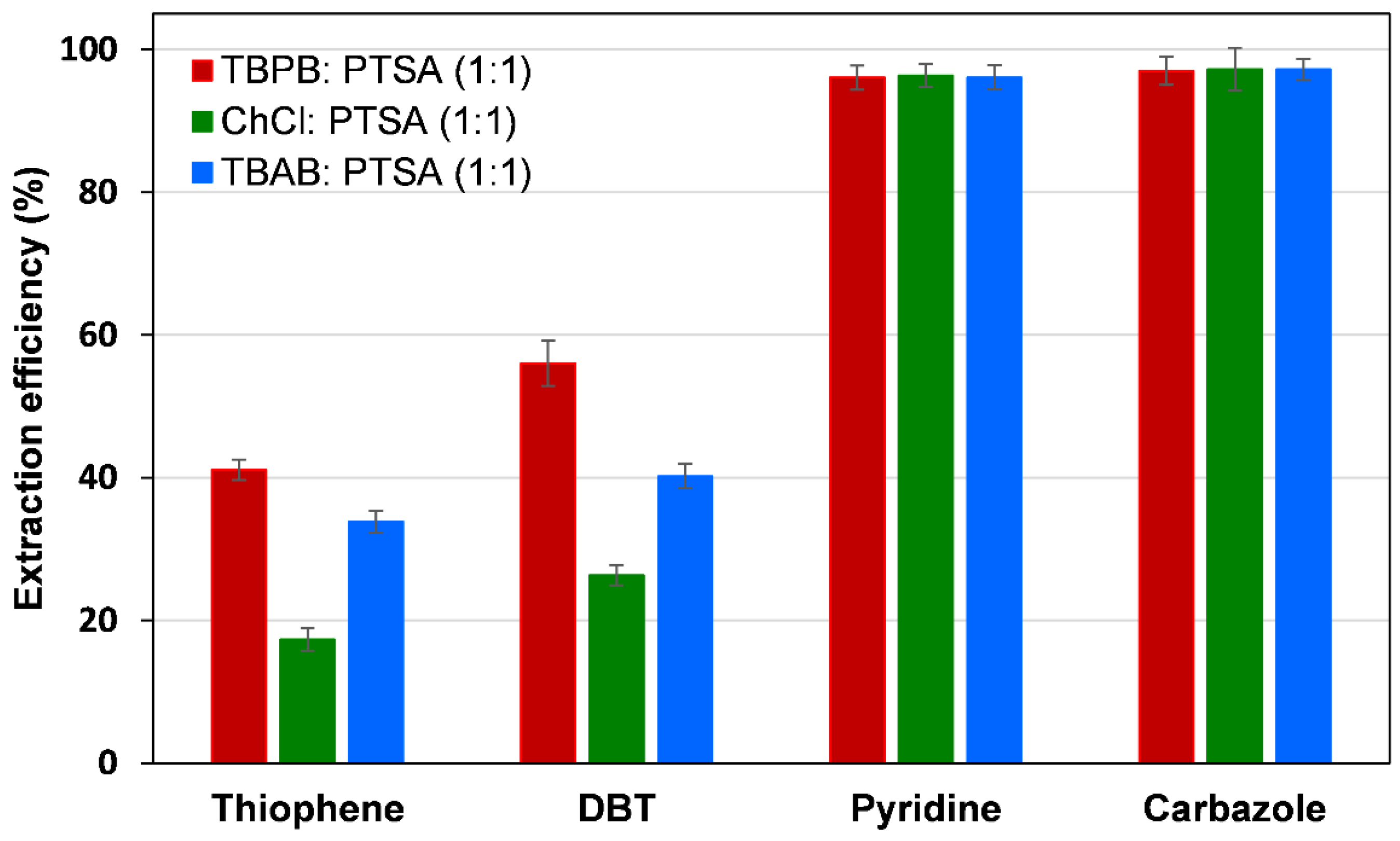
Figure 1. Comparison of extraction efficiencies for TBPB:PTSA, ChCl:PTSA, and TBAB:PTSA in removing sulfur and nitrogen compounds.
Separations 13 00122 g001
Figure 2. Effect of temperature on the extraction efficiency of (a) thiophene and (b) DBT using three PTSA-based DESs. Vertical bars show uncertainty of triplicate means; the temperatures were read with a thermometer with an error of ±1 °C.
Separations 13 00122 g002
Figure 3. Effect of contact time on the extraction efficiency of thiophene using TBPB:PTSA.
Separations 13 00122 g003
Figure 4. Effect of the DES:simulated fuel mass ratio on the extraction efficiency of thiophene and DBT using TBPB:PTSA. Vertical bars show uncertainty of triplicate means; the quantities of DESs and the fuel models were weighed using a balance with an error of ±0.1 mg.
Separations 13 00122 g004
Figure 5. Effect of different fuel matrices on the simultaneous extraction efficiency of sulfur and nitrogen compounds using TBPB:PTSA.
Separations 13 00122 g005
Figure 6. Reusability of the TBPB:PTSA (1:1) DES for the concurrent extraction of nitrogen and sulfur compounds.
Separations 13 00122 g006
Figure 7. Effect of multi-stage extraction on the extraction of sulfur and nitrogen compounds from simulated gasoline using TBPB:PTSA (1:1).
Separations 13 00122 g007
Table 1. Conceptual comparison of simultaneous EDN/EDS in this work and conventional stepwise hydrotreating [18,19].
MetricSimultaneous RemovalConventional Stepwise
Unit OperationsSingle combined extraction stepSequential catalytic stages
Equipment/CAPEXPotentially lower due to simpler separation trainTypically higher due to reactors, catalyst beds, and hydrogen handling
H2 requirementNone (Non-catalytic)Requires hydrogen for HDN/HDS
Energy IntensityMild operating conditionsHigh temperature and pressure
Catalyst IntegrityNot applicable (non-catalytic process)Catalyst poisoning/deactivation may occur
Environmental ImpactLower indirect emissions due to elimination of hydrogen productionHigher indirect emissions associated with hydrogen supply
Table 2. List of chemicals and materials used in this study.
NameLinear FormulaPurity (%)SupplierCityCountry
Tetrabutyl ammonium Bromide (TBAB)(CH3CH2CH2CH2)4N(Br)99Loba ChemieMumbaiIndia
Choline chloride (ChCl)HOCH2CH2N(CH3)3Cl99Fisher scientificSchwerteGermany
Tetrabutylphosphonium bromide (TBPB)(CH3CH2CH2CH2)4P(Br)98Sigma-AldrichTaufkirchenGermany
p-Toluenesulfonic acid monohydrate (PTSA)CH3C6H4SO3H.H2O98.5Sigma-AldrichTaufkirchenGermany
NaphthaleneC10H899Sigma-AldrichTaufkirchenGermany
Thiophene C4H4S≥99Sigma-AldrichTaufkirchenGermany
Dibenzothiophene (DBT)C12H8S98Sigma-AldrichTaufkirchenGermany
PyridineC5H5N99.5Loba ChemieMumbaiIndia
CarbazoleC12H9N≥99Sigma-AldrichTaufkirchenGermany
TolueneC6H5CH3≥99ScharlauBarcelonaSpain
n-HexaneCH3(CH2)4CH399ScharlauBarcelonaSpain
n-HeptaneCH3(CH2)5CH399ScharlauBarcelonaSpain
Isooctane(CH3)2CHCH2C(CH3)399PanReac AppliChemMonzaItaly
n-DodecaneCH3(CH2)10CH3≥99Sigma-AldrichTaufkirchenGermany
n-HexadecaneCH3(CH2)14CH399Sigma-AldrichTaufkirchenGermany
Diethyl ether(CH3CH2)2O≥99Sigma-AldrichTaufkirchenGermany
Table 3. Density (g/cm3) of three DESs as a function of temperature (K).
TBPB:PTSA (1:1) [21]ChCl:PTSA (1:1) [22] TBAB:PTSA (1:1)
TemperatureDensity TemperatureDensityTemperatureDensity
303.151.1312313.151.2012333.151.1174
313.151.1245318.151.1982338.151.1122
323.151.1178323.151.1951343.151.1108
333.151.1111328.151.192348.151.1056
333.151.1890353.151.1033
Table 4. Viscosity (mPa·s) of three DESs as a function of temperature (K).
TBPB:PTSA (1:1) [21]ChCl:PTSA (1:1) [22]TBAB:PTSA (1:1)
TemperatureViscosityTemperatureViscosity TemperatureViscosity
303.151425313.15229333.15423.1
313.15690318.15170338.15295.7
323.15350323.15129343.15207.1
333.15185328.1599348.15154.5
333.1577353.15109.3
Disclaimer/Publisher’s Note: The statements, opinions and data contained in all publications are solely those of the individual author(s) and contributor(s) and not of MDPI and/or the editor(s). MDPI and/or the editor(s) disclaim responsibility for any injury to people or property resulting from any ideas, methods, instructions or products referred to in the content.