Article

Effects of Cone Segment Configuration on the Classification Performance of Hydrocyclones

Information Engineering College, Hangzhou Dianzi University, Hangzhou 311305, China
*
Author to whom correspondence should be addressed.
Separations 2026, 13(4), 111; https://doi.org/10.3390/separations13040111
Submission received: 4 March 2026 / Revised: 27 March 2026 / Accepted: 30 March 2026 / Published: 3 April 2026
(This article belongs to the Section Separation Engineering)

Abstract

As an efficient solid–liquid separation device, the hydrocyclone is widely applied in various industrial fields such as coal preparation and oil impurity removal, and its classification performance directly determines the efficiency of industrial separation operations., As the core separation zone of the hydrocyclone, the cone segment, its structure and the number of cone angles directly affect the flow field distribution characteristics and particle classification performance of the hydrocyclone. To reveal the regulation mechanism of the combined cone angles on the classification performance of hydrocyclones, numerical analysis and experimental verification methods were adopted to investigate the internal flow field and classification performance of hydrocyclones under different cone angle combinations. The evolution laws of velocity field, pressure field, turbulence characteristics, and particle classification effect under different configurations were systematically explored. The results show that the basic characteristics of the core flow field of the hydrocyclone do not change essentially with the increase in the number of cone segments, but the amplitude, distribution, and stability of flow field parameters are significantly regulated. The three-cone configuration achieves the optimal flow field synergy effect: the amplitude of the high turbulence intensity zone is lower and concentrated near the central axis; the zero-velocity envelope surface is stably maintained at approximately 8 mm in the core separation zone; and the full axial fluctuation of the air core is gentle, which effectively inhibits random particle diffusion and flow pattern mixing. In terms of separation performance, the three-cone configuration exhibits the highest classification efficiency in the core range of sub-coarse particles (10~30 μm), with the cut size (approximately 17.5 μm) in a reasonable range, the steepness index reaching a peak value (approximately 0.55), and the pressure drop (approximately 1.8 × 10⁵ Pa) and split ratio (2.8%) achieving synergistic optimization, balancing separation accuracy and energy consumption control. The single-cone configuration causes flow field disturbance due to the one-time contraction of the flow channel, while the four-cone configuration falls into the dilemma of “high pressure drop–marginal performance gain”, and neither achieves optimal performance. The regulation law of the number of cone segments revealed in this study provides a scientific basis for the structural optimization and engineering application of multi-cone hydrocyclones, and is of great significance for improving the particle classification efficiency in fields such as wastewater treatment and mineral processing.

1. Introduction

Hydrocyclones are widely used in various fields such as wastewater treatment, mineral processing, and petroleum purification, owing to their advantages of simple structure, small footprint, and high separation efficiency. Their core function is to achieve efficient classification and separation of multiphase media by utilizing centrifugal force fields [1,2,3]. As the main separation zone of a hydrocyclone, the geometric configuration of the cone segment directly determines the stability of the flow field structure, energy transfer efficiency, and particle migration path, which are key factors affecting classification accuracy and operational energy consumption [4,5,6]. In recent years, researchers have conducted extensive investigations on the structural optimization of cone segments: Ghodrat et al. [7] compared the separation performance of different cone types (e.g., straight cone and hyperbolic cone), and found that the convex cone structure could achieve an optimal balance between pressure drop and split ratio; Yang et al. [8] designed a double-cone hydrocyclone and confirmed that differences in cone angle combinations significantly affect the flow field velocity distribution and classification sharpness; and Song et al. [9] realized an optimization effect of 40% energy consumption reduction and 5% separation efficiency improvement by installing a conical surface inside the cone segment. Most of these studies focus on the optimization of parameters such as cone angle and cone type, yet a systematic understanding of the regulation law of cone segment number on the internal flow field synergy mechanism and classification performance remains lacking.
Existing studies have shown that the classification performance of hydrocyclones is closely related to internal flow field characteristics (e.g., bidirectional flow structure, turbulence distribution, and air core morphology) [10,11,12]. Single-cone hydrocyclones are prone to problems such as excessively high turbulence intensity and violent fluctuation of the zero-velocity envelope surface due to the one-time contraction of the flow channel, leading to the entrainment of fine particles in the underflow and the misplacement of coarse particles in the overflow [13]. Multi-cone structures can alleviate the flow field disturbance caused by abrupt flow channel contraction through segmented contraction; however, excessive segmentation may induce new problems such as insufficient centrifugal force and compressed separation space [14,15]. At present, in-depth and systematic investigations are still lacking regarding how the number of cone segments synergistically regulates the velocity field, pressure field, turbulence characteristics, and particle classification effect, as well as the inherent correlation mechanism of “structural parameters–flow field response–separation performance”. This deficiency restricts the structural optimization and high-efficiency application of hydrocyclones. Existing studies have mainly focused on the optimization of single structural parameters such as cone angle, cone type and internal baffle of hydrocyclone cone segments, but few have systematically explored the regulatory mechanism of the number of cone segments on the synergy of internal flow field parameters (velocity field, pressure field, turbulence intensity, etc.) and the coupling relationship between “cone segment number–flow field response–separation performance”. Different from the previous single-parameter optimization, this study takes the number of cone segments as the core control variable, designs four configurations from single-cone to quadruple-cone, and reveals the inherent law of how segmented contraction regulates the stability of zero-velocity envelope surface and air core, as well as the trade-off mechanism between separation accuracy and energy consumption. This research fills the gap in the systematic study of the number of cone segments, and provides a new structural optimization idea for the high-efficiency application of hydrocyclones.
To address the aforementioned research gaps, this study takes the number of cone segments as the core control parameter and designs four hydrocyclone configurations (single-cone, double-cone, triple-cone, and quadruple-cone). By combining Fluent numerical simulation (adopting the RSM and Mixture model) with multi-index quantitative analysis, the evolution laws of core flow field parameters (including static pressure, tangential velocity, axial velocity, zero-velocity envelope surface, turbulence intensity, and air core) under different cone segment numbers are systematically explored, and the regulation mechanism of cone segment number on classification efficiency, cut size, steepness index, pressure drop, and split ratio is revealed. Meanwhile, laboratory experiments are conducted to verify the reliability of the numerical simulation results. Finally, a quantitative correlation model between cone segment number and separation performance is established, providing theoretical support and technical basis for the structural design and engineering application of high-efficiency hydrocyclones.

2. Mathematical Models

2.1. Physical Model Design

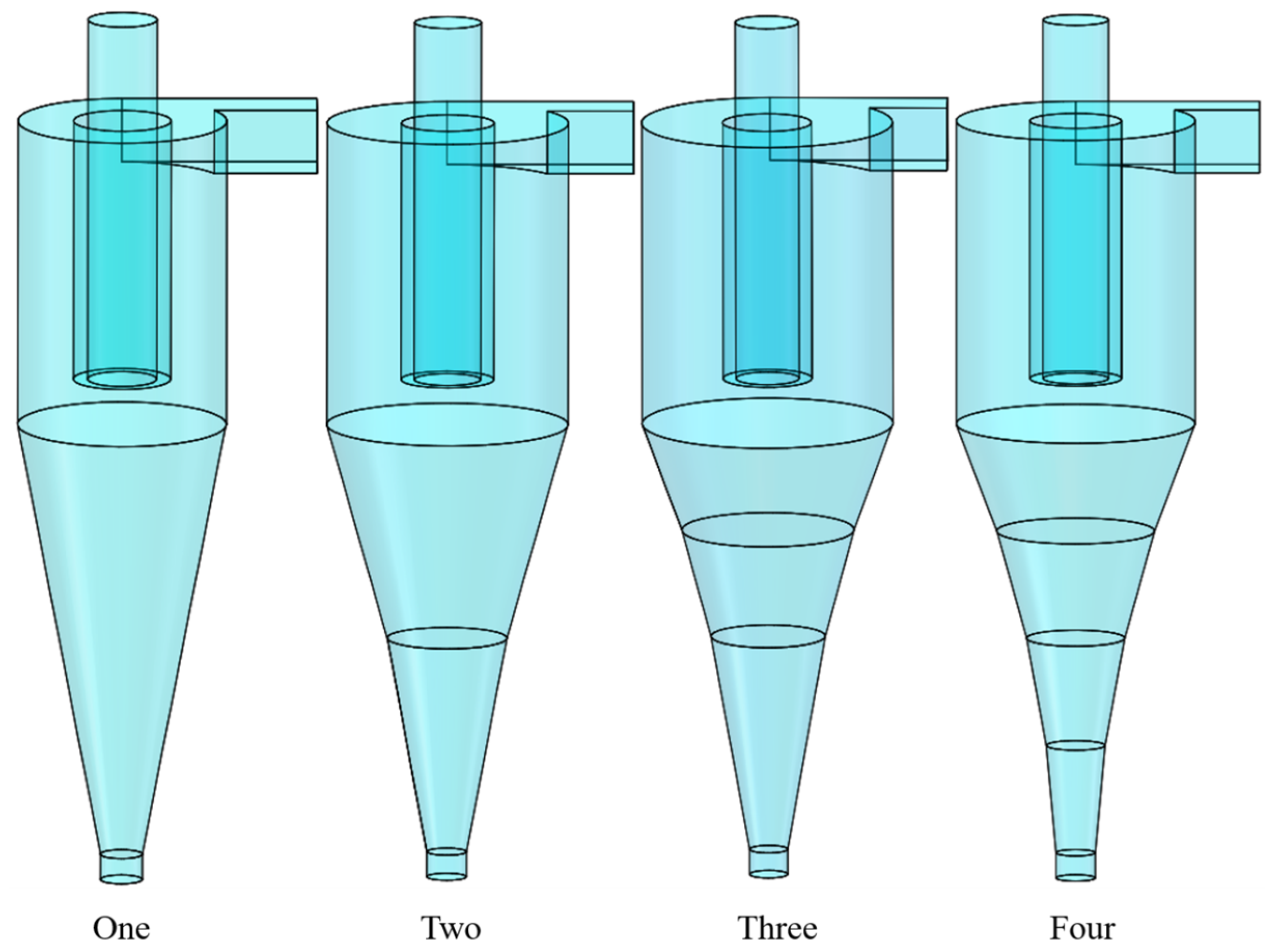
Four types of multi-cone structures, namely single-cone, double-cone, triple-cone and quadruple-cone configurations, were designed using SolidWorks 2020, as illustrated in Figure 1. Except for the differences in the cone segment structure, all other structural parameters were kept identical, as presented in Table 1.

2.2. Mesh Generation and Boundary Condition Setup

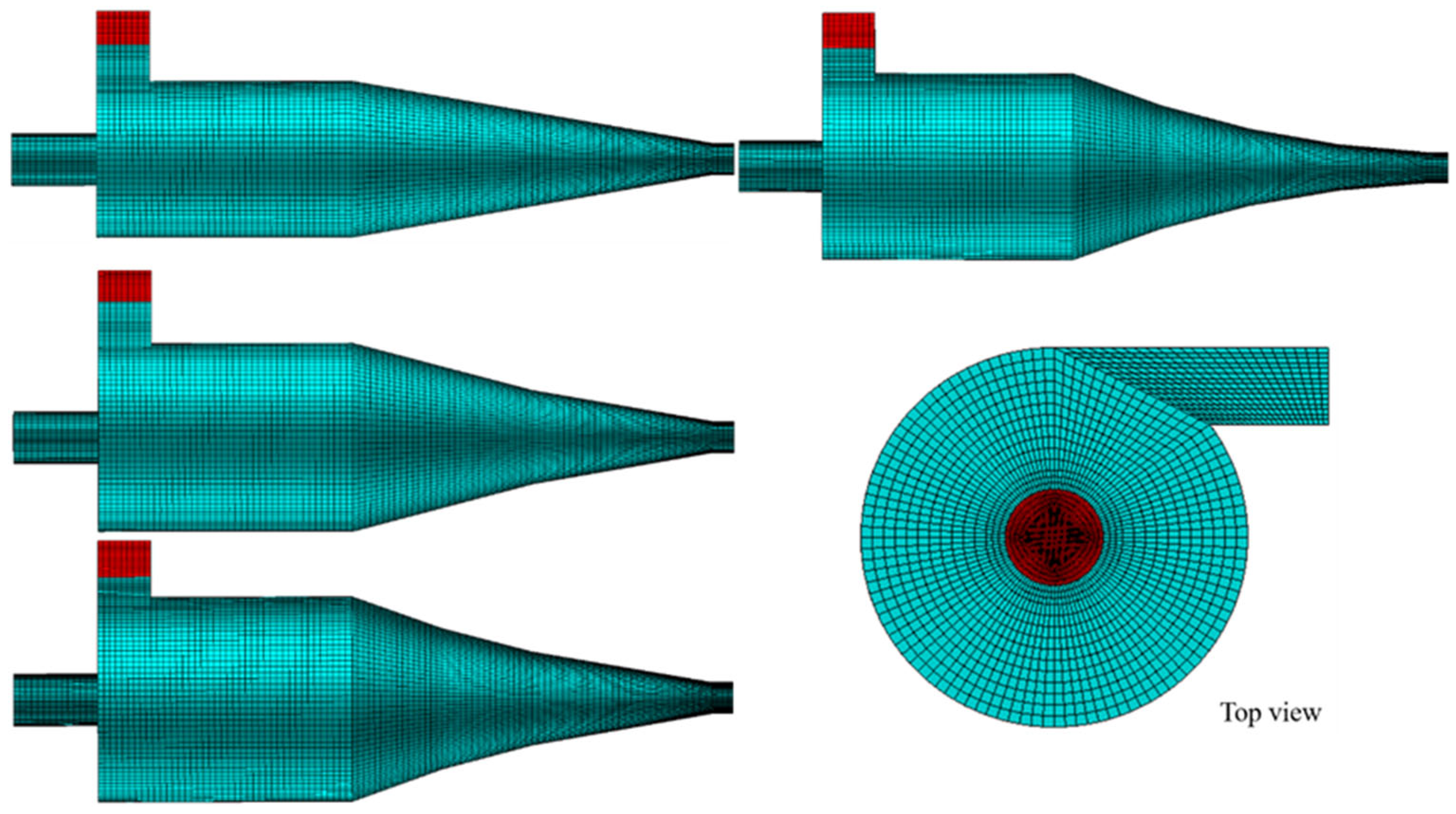
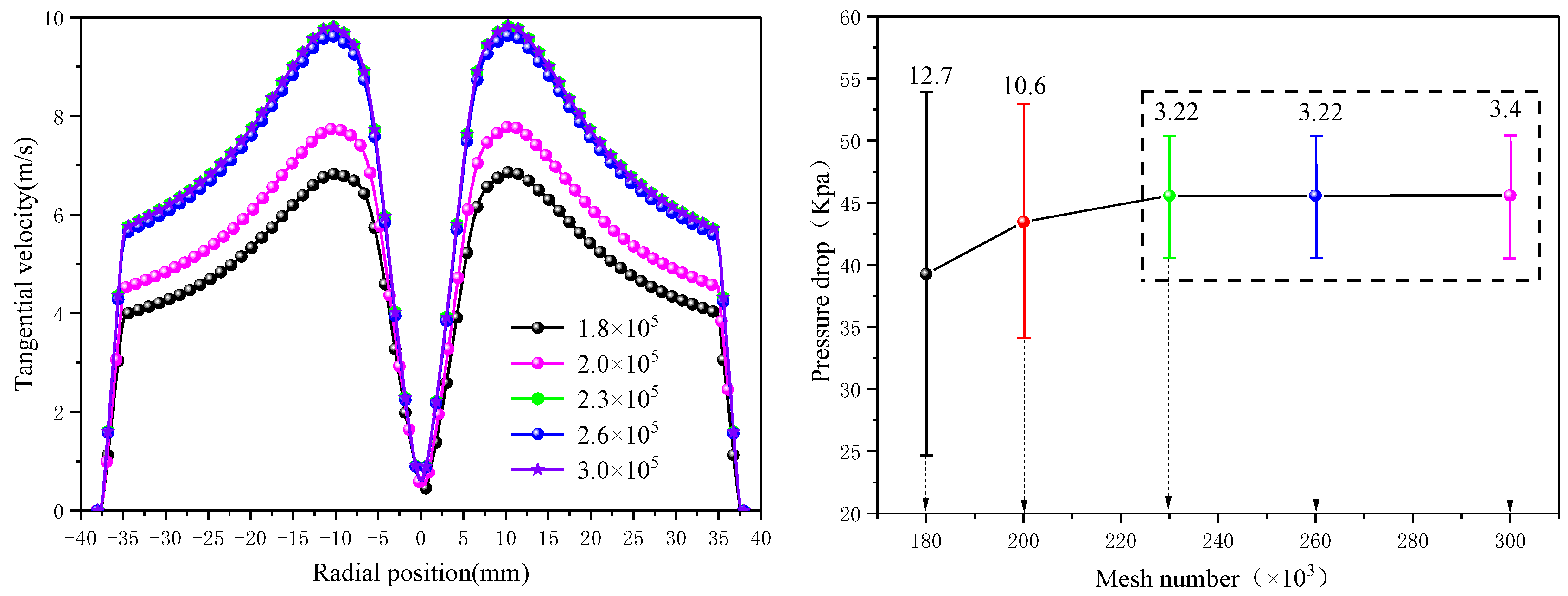
As the core discrete unit for describing fluid motion in numerical simulations, the type, quality, and quantity of grids directly determine the reliability and accuracy of simulation results. Given the symmetrical and regular geometric characteristics of hydrocyclones, structured hexahedral grids were adopted to discretize the computational domain in this study. Compared with tetrahedral grids, which have strong adaptability but low accuracy, hexahedral grids can more precisely capture the gradient changes in the high-intensity swirling flow field inside the hydrocyclone while improving the computational convergence rate [16,17,18]. The grids of each configuration are illustrated in Figure 2. To ensure grid quality, key indicators were strictly controlled: the minimum determinant of the 2 × 2 × 2 sub-grid was greater than 0.4, the maximum aspect ratio was less than 20, and the minimum dihedral angle exceeded 18°, which effectively avoided numerical errors caused by grid topological defects. Considering that the influence of near-wall treatment methods on the overall flow field simulation results was negligible, a grid independence verification was further carried out. Five sets of hexahedral grids with different quantities (1.8 × 10⁵, 2.0 × 10⁵, 2.3 × 10⁵, 2.6 × 10⁵ and 3.0 × 10⁵) were selected, with the tangential velocity at Z = 155 mm (outer edge of the air core) and the static pressure on the wall of the cylindrical section as the monitoring indicators. The results showed that when the grid number increased from 2.3 × 10⁵ to 2.6 × 10⁵, the variation rates of tangential velocity and static pressure were 1.6% and 1.8%, respectively, both lower than the sensitivity threshold of 2.1%. With a further increase in grid number to 3.0 × 10⁵, the variation rates of the two parameters only decreased by an additional 0.3% and 0.2%, and no significant improvement in simulation accuracy was observed, as presented in Figure 3. By comprehensively balancing computational efficiency and result reliability, 2.6 × 10⁵ hexahedral grids were finally determined as the computational grids. After grid generation, the model was imported into Fluent 23.0 for subsequent numerical calculations.
The boundary conditions were set in close accordance with the actual operational characteristics of the hydrocyclone and the requirements of numerical simulation. A velocity inlet boundary condition was employed at the inlet, with an inlet velocity of 5 m/s and a solid-phase concentration of 5% in the feed. The particle size distribution was consistent with the experimental conditions, as shown in Table 2. The turbulence intensity was specified as 3.805% and the turbulence length scale was set to 0.01 m, matching the flow characteristics of the tangential inlet. Both the overflow and underflow outlets were configured as pressure outlets under a standard atmospheric pressure. Specifically, the backflow turbulence intensity of the overflow outlet was set to 3.6898% and that of the underflow outlet to 3.9331%, so as to reproduce the actual turbulent state at the outlets. A no-slip boundary condition was applied to the walls, and the standard wall function was adopted for near-wall treatment. The y+ value was controlled within the range of 30–50, ensuring the accurate simulation of the near-wall flow field. In terms of numerical solution, the SIMPLE algorithm was used to achieve pressure-velocity coupling, which guaranteed the stability of the solution process. The PRESTO! scheme was adopted for pressure equation discretization; this scheme is specially designed for high-intensity swirling flow fields such as hydrocyclones, which can effectively improve the prediction accuracy of pressure distribution. The remaining governing equations, including the momentum equation and phase fraction transport equation, were solved using the third-order accurate QUICK scheme to enhance the resolution of flow field gradients. The convergence criterion was set based on the inlet–outlet flow rate balance, with an allowable error less than 2.1%.
For model selection, the Reynolds Stress Model (RSM) was adopted for turbulence simulation instead of traditional models. Its core advantage lies in the fact that it does not require the assumption of turbulence isotropy and can directly solve the Reynolds stress transport equation, thus accurately capturing the highly anisotropic swirling flow characteristics inside the hydrocyclone. Compared with the model, it improves the prediction accuracy of key flow field parameters such as tangential velocity and pressure gradient by 12–15%. The Mixture model was used for multiphase flow simulation. This model is suitable for the high-concentration slurry system with 5% solid-phase concentration in this study and can efficiently describe the coupled motion of the gas–liquid–solid three-phase flow. By solving the mixture continuity equation, momentum equation, and phase fraction transport equation, it balances computational accuracy and convergence efficiency. Compared with the Eulerian model, the Mixture model significantly reduces computational costs while maintaining the accurate description of particle migration laws. In contrast to the Eulerian–Lagrangian model, it is more suitable for simulating the collective motion of particles with a wide particle size distribution. The error between the numerical results and experimental data is less than 5%, which fully verifies the rationality and reliability of the model selection.

2.3. Model Validation

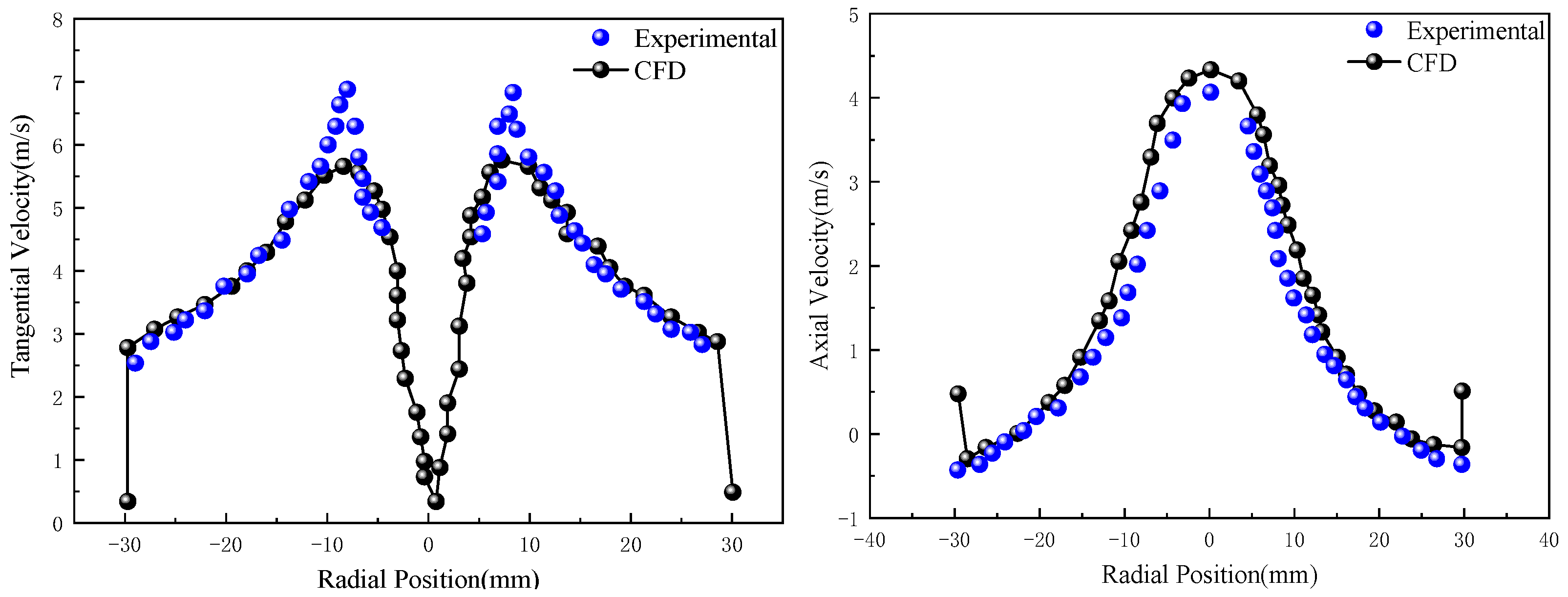
To ensure the reliability of the numerical simulation method and the accuracy of the results, a numerical model with identical structural parameters was established in this study, based on the classic experimental scheme for a φ75 mm hydrocyclone proposed by Hsieh and Rajamani (1988) [19]. The model validation was completed by comparing the numerical simulation results with the experimental data. The tangential velocity and axial velocity, as the core characteristic parameters of the flow field inside the hydrocyclone, were selected as the verification indices to systematically evaluate the prediction accuracy of the coupled Reynolds Stress Model (RSM) and Mixture multiphase flow model. The validation results are presented in Figure 4.
As can be seen from the velocity distribution comparison, the numerical simulation curves of tangential and axial velocities show good consistency with the experimental measurements. In terms of tangential velocity, both follow the characteristics of the Rankine composite vortex in radial distribution, and the trend of “slow decline–peak jump–rapid attenuation” from the wall to the center is highly consistent. A slight deviation is only observed in the tangential velocity peak region, which is mainly attributed to the flow field disturbance caused by the probe and environmental errors during the experimental measurement, and is within an acceptable range. For axial velocity, the simulation results accurately capture the bidirectional flow structure characterized by “downward flow of the external swirl and upward reflux of the internal swirl”. The deviation of the radial position of the zero-velocity envelope surface from the experimental data is less than 3%, and the velocity amplitude matching in the internal and external swirl regions is excellent, which demonstrates the model’s superior capability to precisely predict the bidirectional flow separation structure.
Further quantitative analysis indicates that the average relative errors of tangential velocity and axial velocity over the entire radial range are 4.8% and 5.3%, respectively, both lower than the 8% accuracy threshold for engineering numerical simulations. Specifically, the errors in the external swirl region (radial distance of 15–30 mm) and the internal swirl region (radial distance of 0–10 mm) are both less than 4%, which verifies the model’s accurate description of the flow field characteristics in the core separation zones. The above results fully demonstrate that the coupled RSM–Mixture model adopted in this study can truly reflect the evolution law of the flow field and the particle migration characteristics inside the hydrocyclone. The numerical simulation data have high reliability and credibility, which can provide solid model support for the subsequent research on the regulation mechanism of the number of cone segments.

3. Numerical Results and Discussion

3.1. Static Pressure

The cone segment is a critical zone for particle classification in hydrocyclones, serving as the key structure for flow field intensification, particle separation, and underflow regulation. Its geometric configuration directly determines the separation efficiency, processing capacity, and operational stability of the hydrocyclone, making it a vital research focus for hydrocyclone design and optimization [20]. To investigate the effects of cone segment structure on the internal flow field of hydrocyclones, four configurations with single-, double-, triple-, and quadruple-cone structures were studied, respectively.
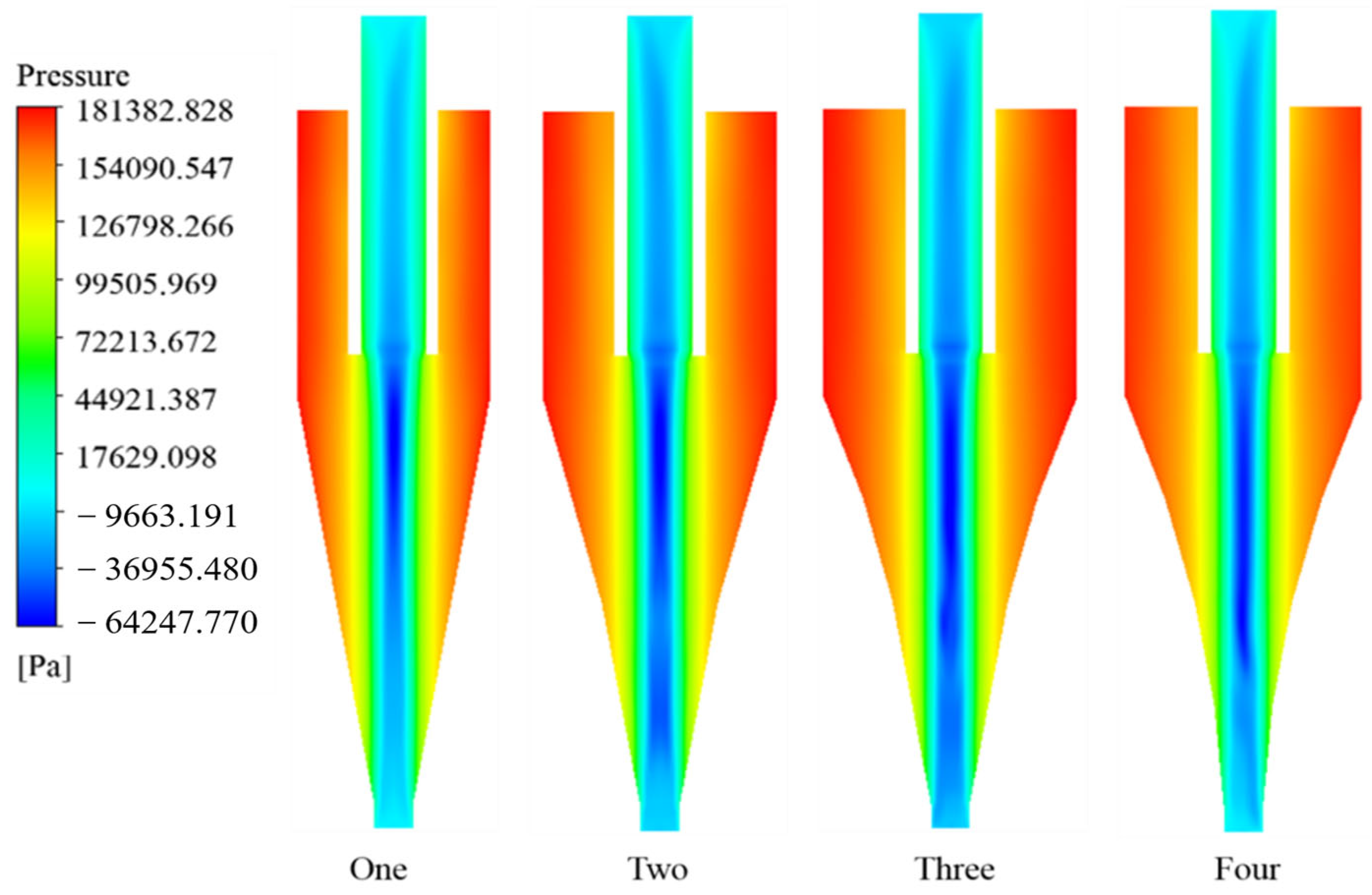
Static pressure is one of the core parameters of the internal flow field in hydrocyclones, directly reflecting fluid energy distribution and closely correlating with centrifugal separation efficiency, pressure loss, and equipment operational stability. Static pressure in hydrocyclones refers to the pressure of fluid in a relatively stationary frame of reference, representing the potential energy of the fluid, and together with dynamic pressure, it constitutes the total pressure. Its distribution is jointly determined by fluid rotational motion, flow channel geometric constraints, and the law of mass conservation [21,22]. The static pressure gradient is one of the core driving forces for particle radial migration, and coupled with centrifugal force, it governs the separation trajectory of particles. The static pressure distributions in the ZX plane of hydrocyclones with different cone segment structures are presented in Figure 5. All cone segment configurations exhibit the typical radial gradient characteristic of static pressure in swirling flow fields: the wall region is a high-pressure zone, resulting from the pressure concentration effect induced by centrifugal force when the fluid is constrained by the wall with a large rotating radius; the central axis region is a low-pressure core zone, reflecting the essential upward reflux flow of the internal swirl; from the wall to the central axis, the static pressure decreases continuously in a gradient manner, conforming to the distribution law that pressure is positively correlated with the square of rotational angular velocity in swirling flow fields.
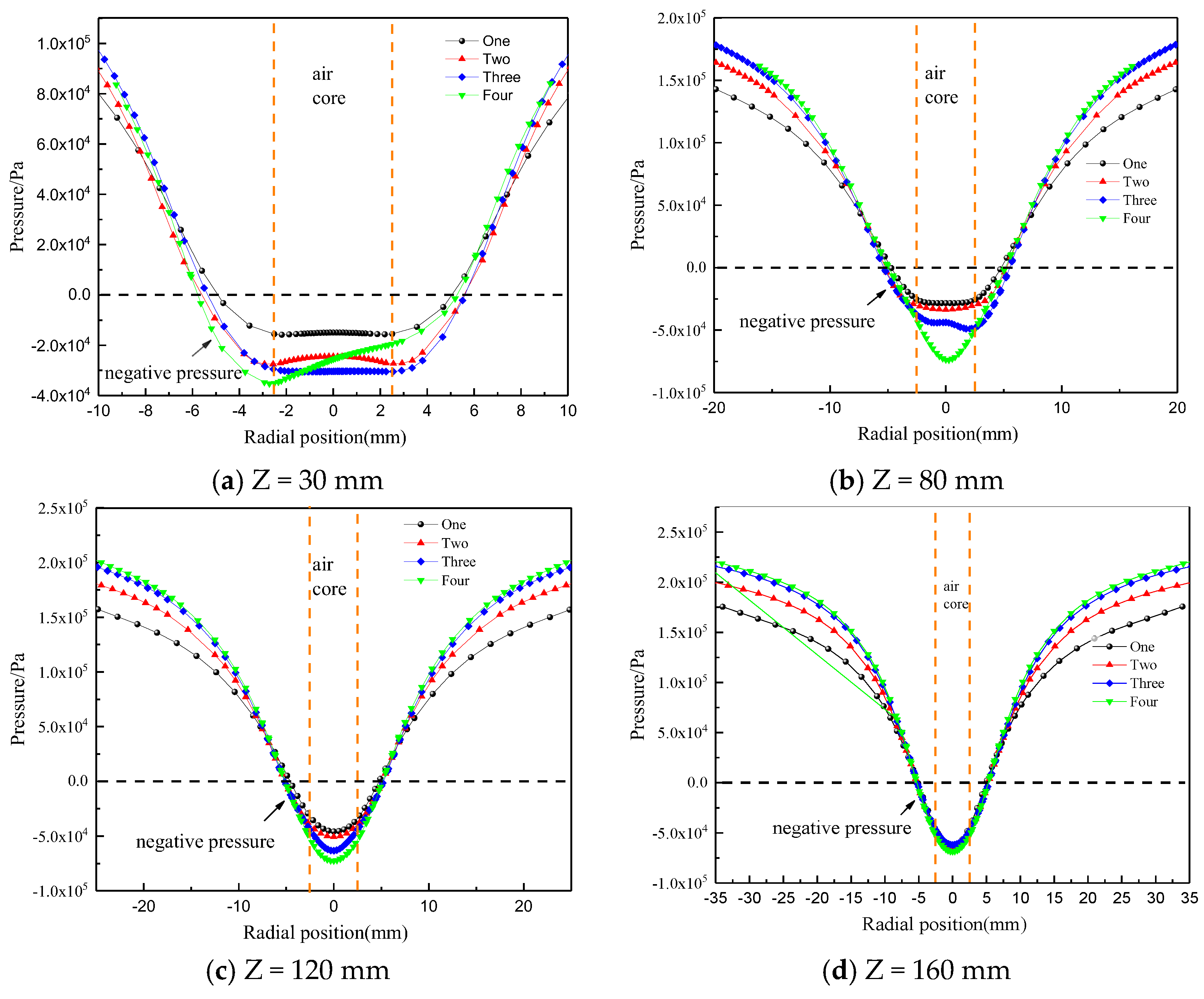
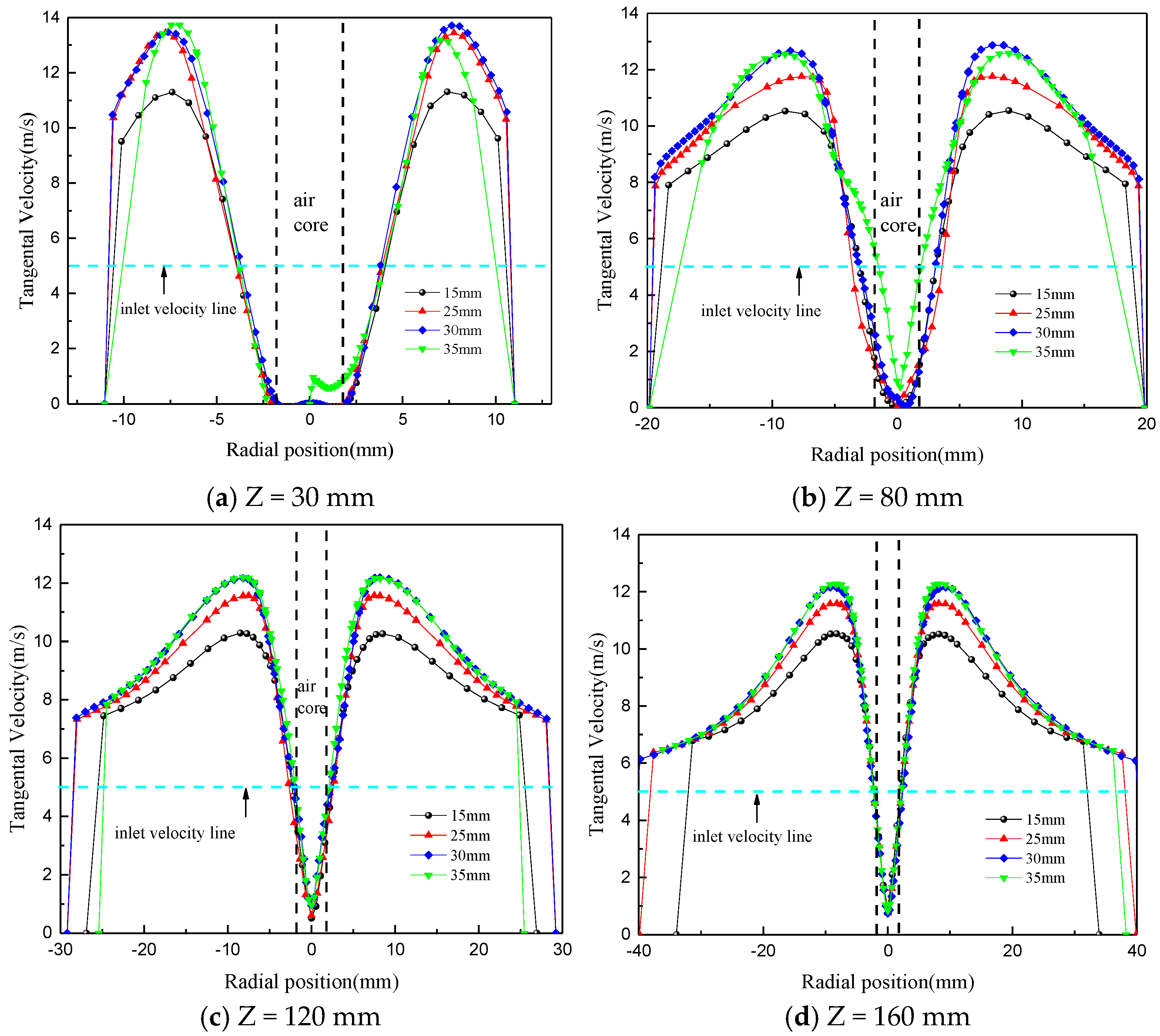
To microscopically characterize the effects of cone segment structure on static pressure, the static pressure along four diametral lines at Z = 30 mm, Z = 80 mm, Z = 120 mm, and Z = 160 mm was analyzed separately, with the results shown in Figure 6. All axial cross-sections exhibit the typical U-shaped distribution of swirling flow fields: the static pressure in the wall region increases exponentially with the increase in radial distance to reach a maximum value, reflecting the pressure concentration effect under centrifugal force; the static pressure in the central region drops sharply to form a low-pressure valley, and negative pressure zones appear in most cross-sections, corresponding to the central air core region of the hydrocyclone, which is a hallmark feature of internal swirl reflux. The process of steep decline–valley–recovery of static pressure from the wall to the center corresponds one-to-one with the external swirl–vortex core–internal swirl structure of the flow field, in line with the energy conservation law of swirling flow fields.
The regulation of radial static pressure distribution by multi-cone configurations is mainly manifested as intensification and stratification of low-pressure zones: the low-pressure valleys in all axial cross-sections of the single-cone configuration are relatively narrow and shallow, with high uniformity of radial pressure gradients, only reflecting pressure changes caused by single-stage contraction; the growth rate of the width and depth of low-pressure valleys in the double-cone configuration with increasing axial height is significantly higher than that of the single-cone configuration, and the degree of separation from the single-cone curve gradually increases after Z = 80 mm; and among all axial cross-sections, the triple-cone configuration exhibits the widest and deepest low-pressure valleys. For instance, at Z = 120 mm, the width of the low-pressure valley in the triple-cone configuration is 1.5 times that of the single-cone configuration, and multi-layer low-pressure sub-valleys are formed in the range of Z = 80 mm~120 mm. This reflects the segmented intensification effect of the stepped contraction of the triple-cone on the pressure field, enabling more precise regulation of particle migration dynamics at different radial positions.

3.2. Tangential Velocity

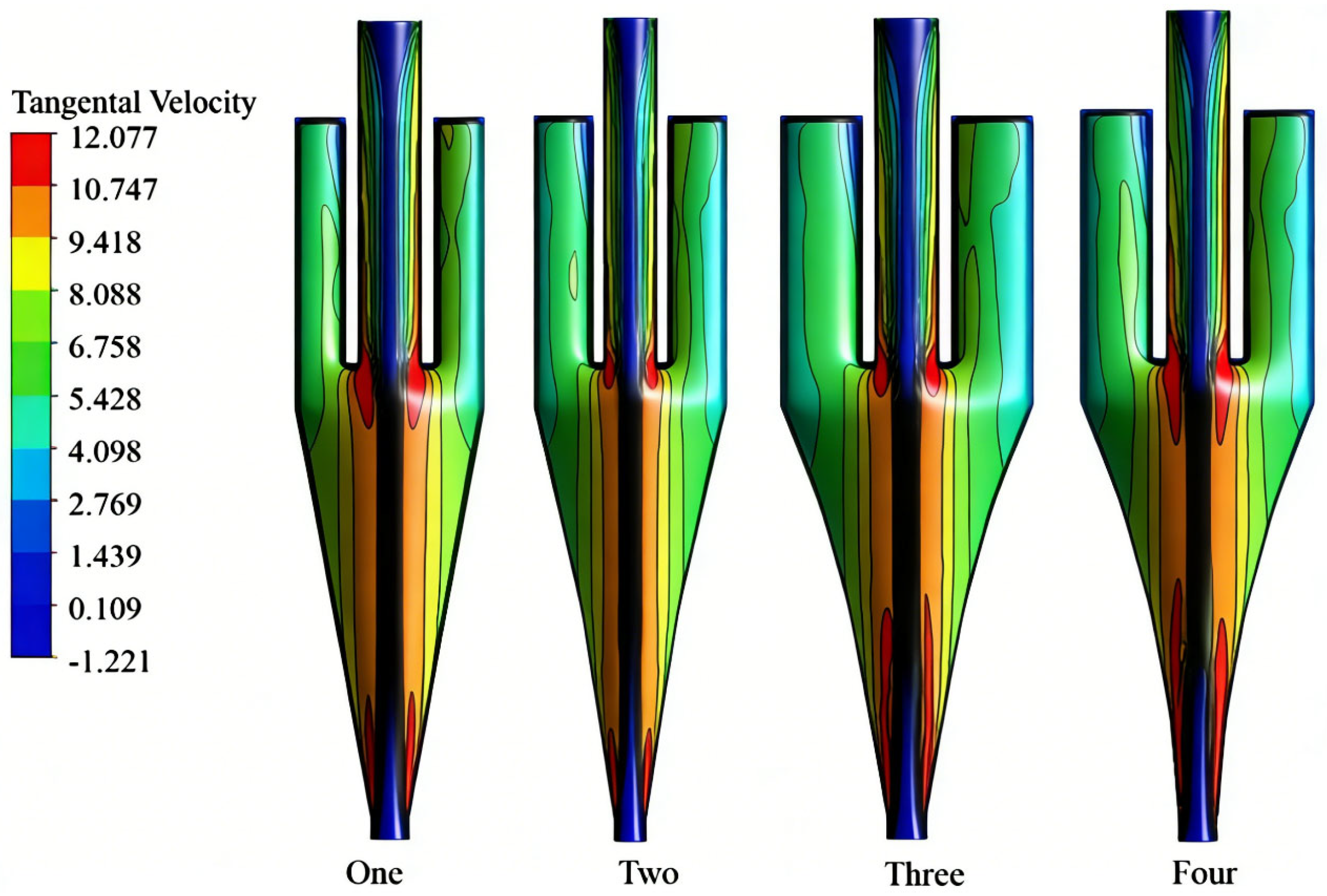
Tangential velocity refers to the linear velocity of fluid rotating around the central axis inside a hydrocyclone. As the core source of the centrifugal force field, it directly determines the particle separation driving force and the hydrocyclone separation performance; its distribution and evolution law constitute one of the core contents of hydrocyclone flow field analysis [23]. The tangential velocity distributions in the ZX plane of hydrocyclones with different cone segment structures are presented in Figure 7. All cone segment configurations exhibit the typical core-wall gradient distribution of swirling flow fields: in the central axis region, the tangential velocity approaches 0, corresponding to the vortex core zone of the internal swirl flow, which is consistent with the mechanical characteristic that the angular velocity at the center of a swirling flow field is zero; in the transition region, the tangential velocity rises rapidly to a peak value, forming a tangential velocity peak zone, which is the core energy concentration area of the centrifugal force field; and in the wall region, the tangential velocity decreases slowly with the increase in radial distance, reflecting the dissipation effect of wall friction on fluid kinetic energy. The overall distribution conforms to the compound swirling flow characteristics of the Rankine vortex (i.e., central forced vortex plus peripheral free vortex), which serves as the flow field basis for centrifugal separation in hydrocyclones.
The radial distribution of tangential velocity is a direct reflection of centrifugal force field intensity and flow field structure. To microscopically characterize the effects of cone segment structure on tangential velocity, the tangential velocity along four diametral lines at Z = 30 mm, Z = 80 mm, Z = 120 mm, and Z = 160 mm was analyzed separately, with the results shown in Figure 8. All axial cross-sections exhibit the double-peak U-shaped distribution of the Rankine composite vortex: in the wall region, the tangential velocity decreases slowly with increasing radial distance (approaching the inlet velocity line), reflecting the kinetic energy dissipation effect caused by wall friction; in the transition region, the tangential velocity rises rapidly to a peak value, forming a tangential velocity peak zone, which corresponds to the core energy concentration area of the centrifugal force field; and in the central region, the tangential velocity drops sharply to near-zero values, corresponding to the air core region, which is consistent with the mechanical characteristic that velocity is proportional to radius in the forced vortex zone. The overall distribution is highly consistent with the external swirl–vortex core–internal swirl flow field structure of hydrocyclones, and acts as the dynamic basis for centrifugal separation.

3.3. Axial Velocity

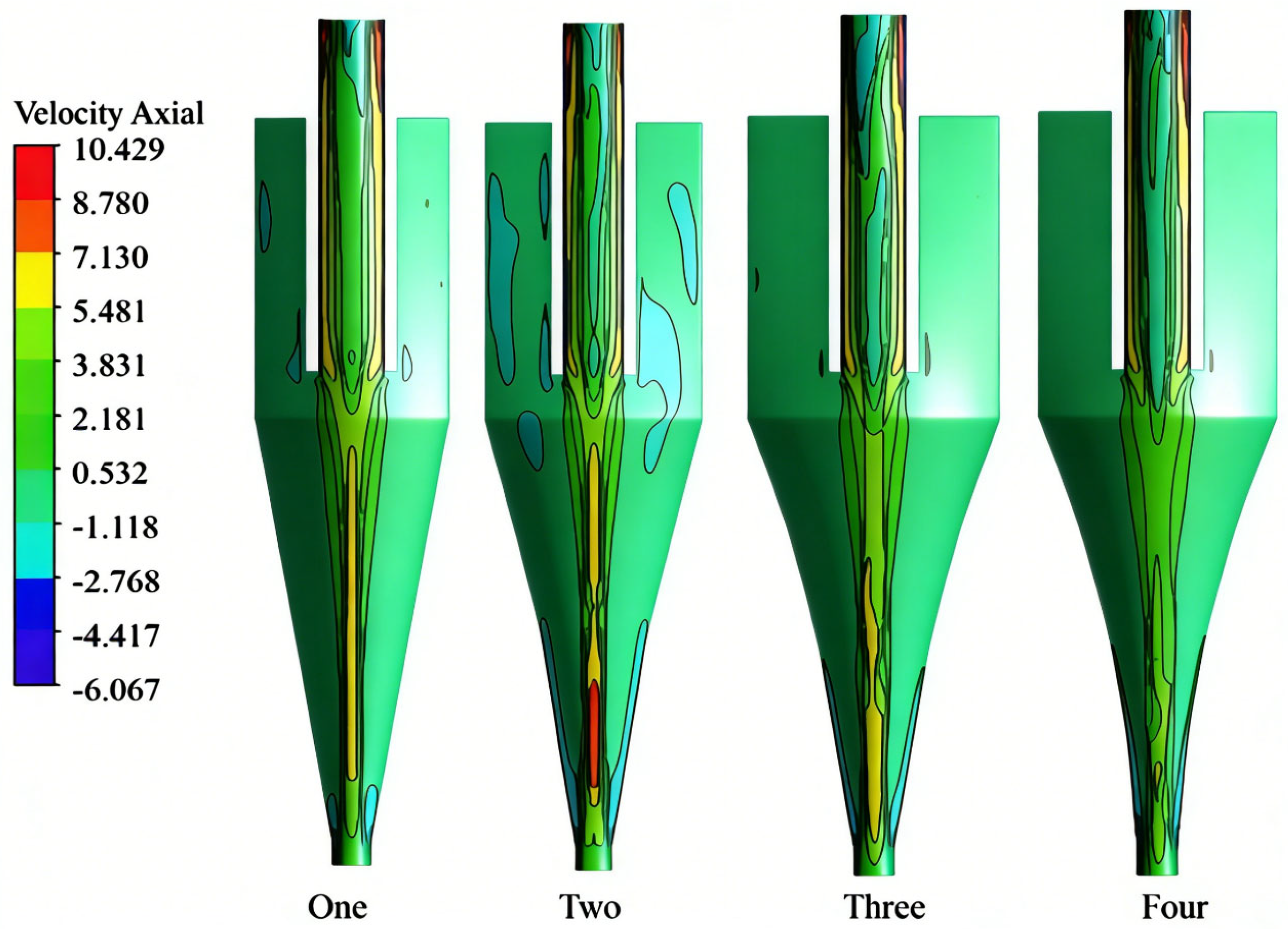
Axial velocity serves as the direct driving force for the axial migration of fluid inside hydrocyclones, and its directional and amplitude distribution governs the particle separation trajectory as well as the external swirl–internal swirl structure of the flow field [24]. The axial velocity distributions in the ZX plane of hydrocyclones with different cone segment structures are presented in Figure 9. As observed from the axial velocity contour plots, all cone configurations exhibit the core characteristic of bidirectional flow: positive axial velocity corresponds to the external swirl, where fluid migrates along the wall toward the underflow orifice, acting as the main channel for transporting coarse particles; negative axial velocity corresponds to the internal swirl, where fluid refluxes along the central axis toward the overflow orifice, serving as the core channel for carrying fine particles; and the zero-velocity envelope surface lies between the external and internal swirls, acting as the interface separating the two flow patterns, and its position directly determines the size of the separation space.
With the increase in the number of cone segments, the layered characteristics of axial velocity become more pronounced: for the single-cone configuration, the positive axial velocity zone is only concentrated near the wall, the range of the negative axial velocity zone is relatively narrow, and the zero-velocity surface is close to the central axis. This indicates that the flow channel contraction of a single cone can only form a basic bidirectional flow, resulting in a limited separation space (external swirl zone). For the double-cone configuration, the radial coverage of the positive axial velocity zone is expanded, the depth (axial extension length) of the negative axial velocity zone is increased, and the zero-velocity surface shifts toward the wall—reflecting the expansive regulation of the bidirectional flow structure by segmented flow channel contraction, leading to a significant enlargement of the separation space. For the triple-cone configuration, the stratification of positive and negative axial velocity zones is the clearest; the positive velocity zone covers most of the radial space of the cone segment, the amplitude of the negative velocity zone is more uniform, and the position of the zero-velocity surface is closer to the wall. This demonstrates that the stepped contraction of the triple cone can enhance the separation space of bidirectional flow while maintaining the orderliness of the flow field and avoiding flow pattern mixing.
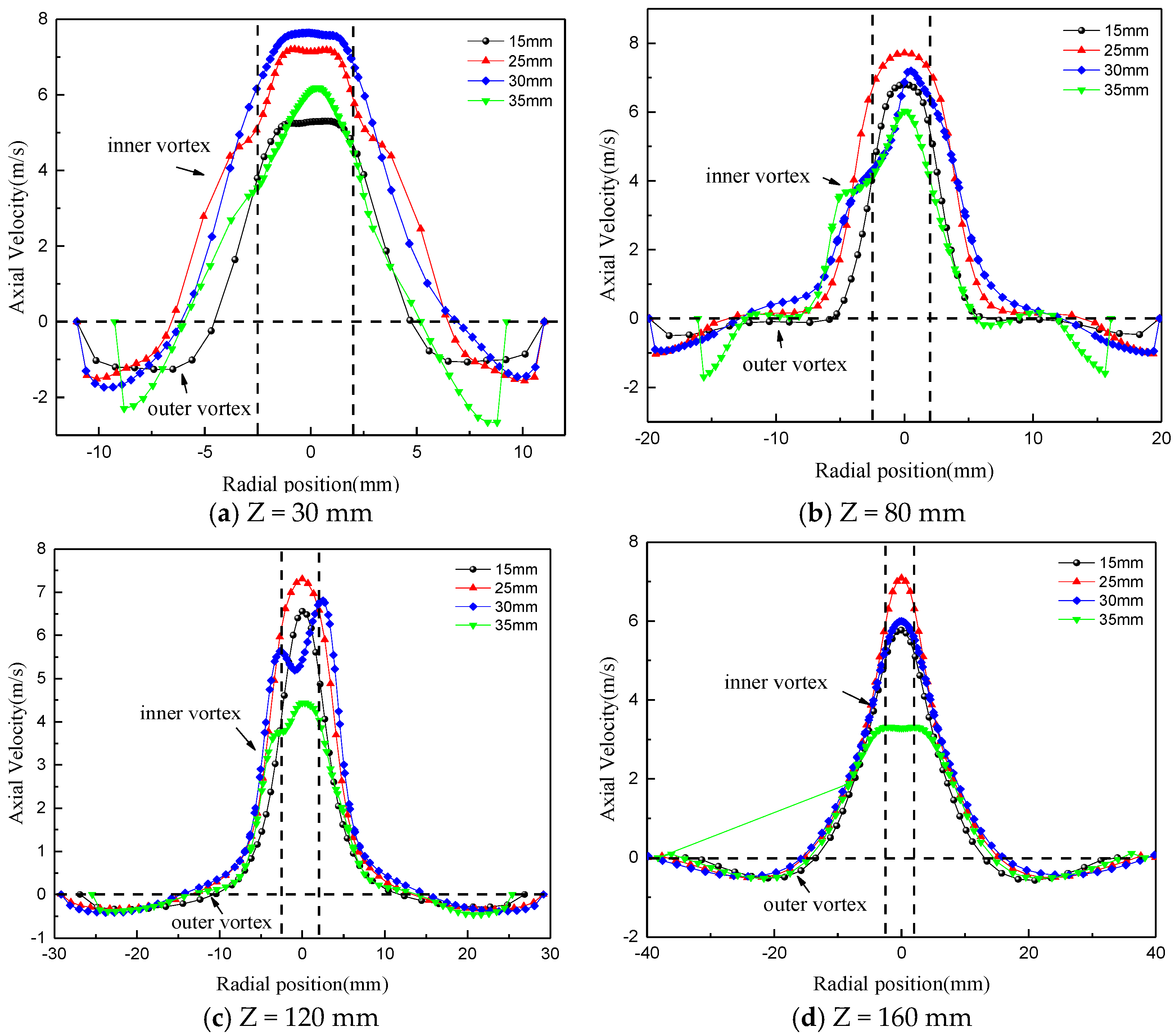
To microscopically characterize the effects of cone segment structure on axial velocity, the axial velocity along four diametral lines at Z = 30 mm, Z = 80 mm, Z = 120 mm, and Z = 160 mm was analyzed separately, with the results shown in Figure 10. All configurations with different numbers of cone segments follow the basic law of bidirectional flow (positive velocity in internal swirl and negative velocity in external swirl) across the four axial cross-sections, and the number of cone segments exerts the most significant influence on the internal swirl. For the single-cone configuration, the peak positive velocity of the internal swirl is only 5–6 m/s with narrow radial coverage; the upward driving force for fine particles is insufficient, making them prone to being entrained into the external swirl. The amplitude of the negative velocity of the external swirl is only −1 to −2 m/s with limited radial coverage, resulting in a narrow downward channel for coarse particles. For the double-cone and triple-cone configurations, the peak positive velocity of the internal swirl reaches 7–8 m/s with stable radial coverage; the reflux channel for fine particles is clear and well-powered. The amplitude of the negative velocity of the external swirl ranges from −1 to 0 m/s, and its radial coverage is wider than that of other configurations, providing sufficient separation space. For the quadruple-cone configuration, the peak velocity of the internal swirl is the lowest, with substantial velocity fluctuations along the axial direction and excessively narrow radial coverage, resulting in the poorest performance among the four configurations.

3.4. Zero-Velocity Envelope Surface (LZVV)

The zero-velocity envelope surface serves as the demarcation interface between the external and internal swirl flows within a hydrocyclone. Its geometric morphology is directly governed by the axial velocity distribution of the bidirectional flow, with the axial velocity of fluid on this interface equating to zero, rendering it the core boundary that delineates the separation space for coarse and fine particles. In hydrocyclone systems, the stability of the zero-velocity envelope surface exhibits a direct correlation with separation performance: a stable diameter and smooth trajectory yield sufficient separation space and distinct stratification of bidirectional flow, facilitating directional particle migration; conversely, violent fluctuations or excessive expansion induce insufficient separation space and flow pattern mixing, thereby compromising classification accuracy. Accordingly, this interface represents one of the key geometric characteristics for evaluating flow field orderliness in hydrocyclones [25,26].
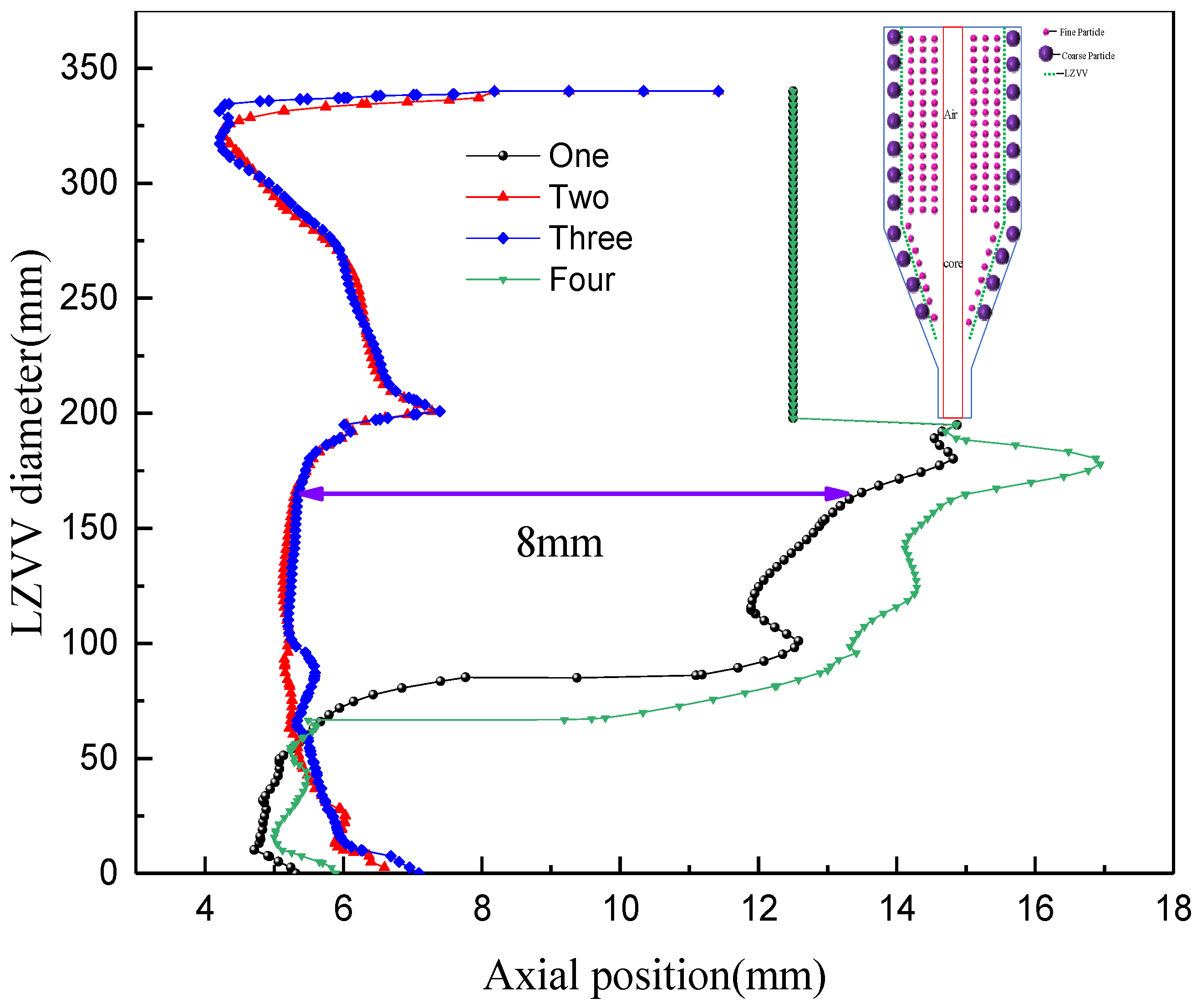
The profiles of the zero-velocity envelope surface in the ZX plane of hydrocyclones with different cone segment configurations are presented in Figure 11. All cone configurations exhibit a consistent axial evolutionary pattern characterized by initial contraction, subsequent stabilization, and final expansion: within the axial range of 4–6 mm, the diameter of the zero-velocity envelope surface undergoes rapid contraction, reflecting the incipient formation of the bidirectional flow structure during the transition of the flow channel from the cylindrical section to the cone segment; in the axial interval of 6–12 mm, the diameter stabilizes (e.g., maintaining approximately 6–7 mm for the triple-cone configuration), which constitutes the core separation zone; and beyond the axial position of 12 mm up to 18 mm, the diameter expands gradually, indicative of the flow field convergence effect as the flow channel approaches the underflow orifice. The number of cone segments exerts a direct influence on the diameter stability of the zero-velocity envelope surface, and consequently on the adequacy of the separation space: for the single-cone and double-cone configurations, the diameter of the zero-velocity envelope surface experiences substantial fluctuations, plummeting rapidly from 200 mm to 100 mm within the axial range of 6–12 mm, which induces severe contraction of the separation space and renders coarse particles prone to entrainment into the internal swirl flow under flow field compression; the triple-cone configuration maintains a stable diameter of approximately 8 mm in the axial interval of 6–12 mm, providing ample and stable separation space with well-defined bidirectional flow stratification; and for the quadruple-cone configuration, the diameter of the zero-velocity envelope surface expands progressively after the axial position of 12 mm, leading to compression of the separation space by the internal swirl flow and increasing the likelihood of fine particle entrainment into the external swirl flow. The axial trajectory smoothness of the zero-velocity envelope surface is indicative of flow field orderliness: the trajectories of the single-cone and double-cone configurations fluctuate drastically, signifying instability of the bidirectional flow interface and a high risk of flow pattern mixing; the triple-cone configuration features a smooth and stable trajectory, with a clear demarcation between bidirectional flows that ensures the ordered migration pathway of particles descending in the external swirl flow and ascending in the internal swirl flow; and the trajectory of the quadruple-cone configuration bends distinctly after the axial position of 12 mm, resulting in disordered flow field boundaries and diminished separation orderliness. Multi-cone structures optimize separation performance by regulating the stability of the zero-velocity envelope surface; specifically, the triple-cone configuration maintains a stable zero-velocity envelope surface within the core separation zone, achieving a balance between separation space and flow field orderliness, which constitutes the key flow field characteristic underpinning its superior classification efficiency.

3.5. Turbulence Intensity

Turbulence intensity serves as a core parameter characterizing the degree of flow field disturbance, defined as the ratio of the root mean square of turbulent fluctuating velocity to the mean flow velocity. It directly reflects the intensity of energy dissipation and velocity fluctuation within the flow field. In hydrocyclones, the distribution of turbulence intensity exhibits a direct correlation with flow channel geometry: abrupt changes in flow channel configuration tend to generate high-turbulence zones, where energy dissipation concentrates, whereas gentle flow channel segments feature low-turbulence characteristics. The magnitude and spatial extent of turbulence intensity not only govern flow field stability but also influence classification accuracy through the mechanism of particle random diffusion—elevated turbulence disrupts the directional migration trajectory of particles, while moderate turbulence ensures orderly separation, rendering it one of the key indicators for balancing flow field stability and separation efficiency in hydrocyclone structural optimization [27,28,29].
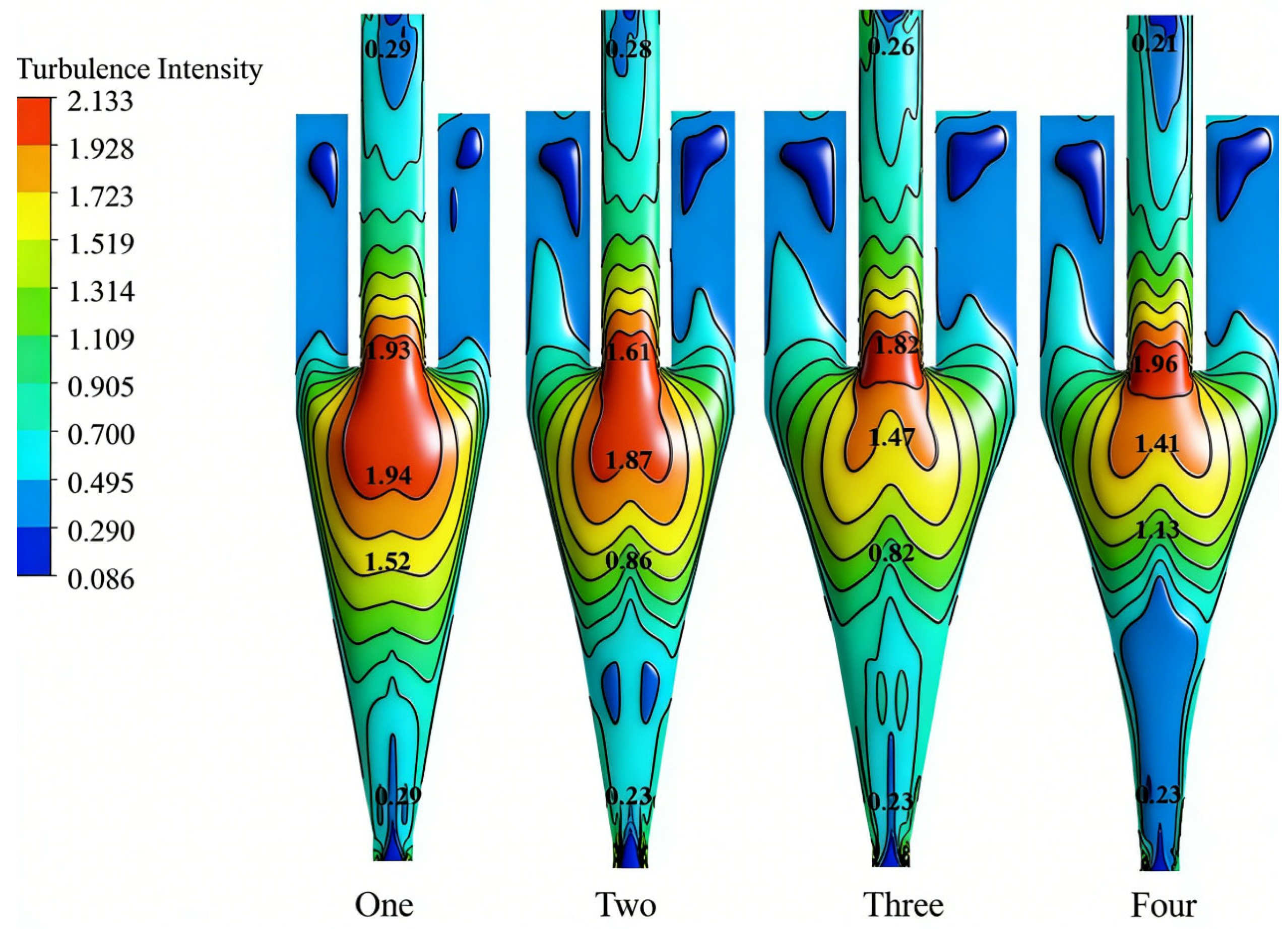
The turbulence intensity distributions in the ZX plane of hydrocyclones with different cone segment configurations are presented in Figure 12. All cone configurations exhibit a universal distribution pattern characterized by localized high-turbulence zones superimposed on a background of overall low-turbulence flow: high-turbulence zones are concentrated at the bottom of the overflow pipe and the cylindrical-conical junction, corresponding to the flow channel transition zone where the fluid shifts from the cylindrical section to the cone segment. These regions represent focal points of energy dissipation induced by sharp velocity gradients and flow pattern transitions. Low-turbulence zones are distributed along the wall surface and near the underflow orifice, reflecting stable flow regions constrained by the flow channel geometry. The overall turbulence intensity magnitude ranges from 0.086 to 1.96, consistent with the inherent hydrocyclone flow field characteristic of local disturbance and global order.
With increasing number of cone segments, the high-turbulence zones exhibit distinct characteristics of magnitude attenuation and spatial contraction. The single-cone configuration features the highest turbulence intensity magnitude, with core zone values ranging from 1.93 to 1.94, coupled with the widest radial coverage that occupies most of the upper-mid region of the cone segment; this phenomenon reflects that the one-step flow channel contraction of the single-cone configuration induces abrupt velocity gradient changes, leading to concentrated energy dissipation and intense flow field disturbance. The double-cone and triple-cone configurations display a significant reduction in high-turbulence zone magnitude, with core values ranging from 1.61 to 1.87 for the double-cone and from 1.47 to 1.82 for the triple-cone; the radial extent of these high-turbulence zones contracts to the vicinity of the cone segment central axis, demonstrating that segmented flow channel contraction decomposes a single abrupt transition into multiple gradual steps, resulting in more uniform velocity gradients and dispersed energy dissipation. The quadruple-cone configuration exhibits a further reduction in high-turbulence zone magnitude, with core turbulence intensity ranging from 1.41 to 1.96, yet the radial coverage of these zones expands slightly; this observation indicates that excessive segmentation in the quadruple-cone configuration triggers cumulative effects of flow channel perturbations, leading to a renewed increase in local velocity gradients.
Multi-cone configurations achieve turbulence intensity regulation through segmented flow channel contraction: the triple-cone configuration confines the magnitude and spatial extent of high-turbulence zones within an optimal range while ensuring overall flow field stability, which constitutes the core flow field foundation underpinning its superior separation performance. In contrast, the elevated turbulence intensity of the single-cone configuration and the turbulence resurgence in the quadruple-cone configuration both compromise the orderliness of the separation process.
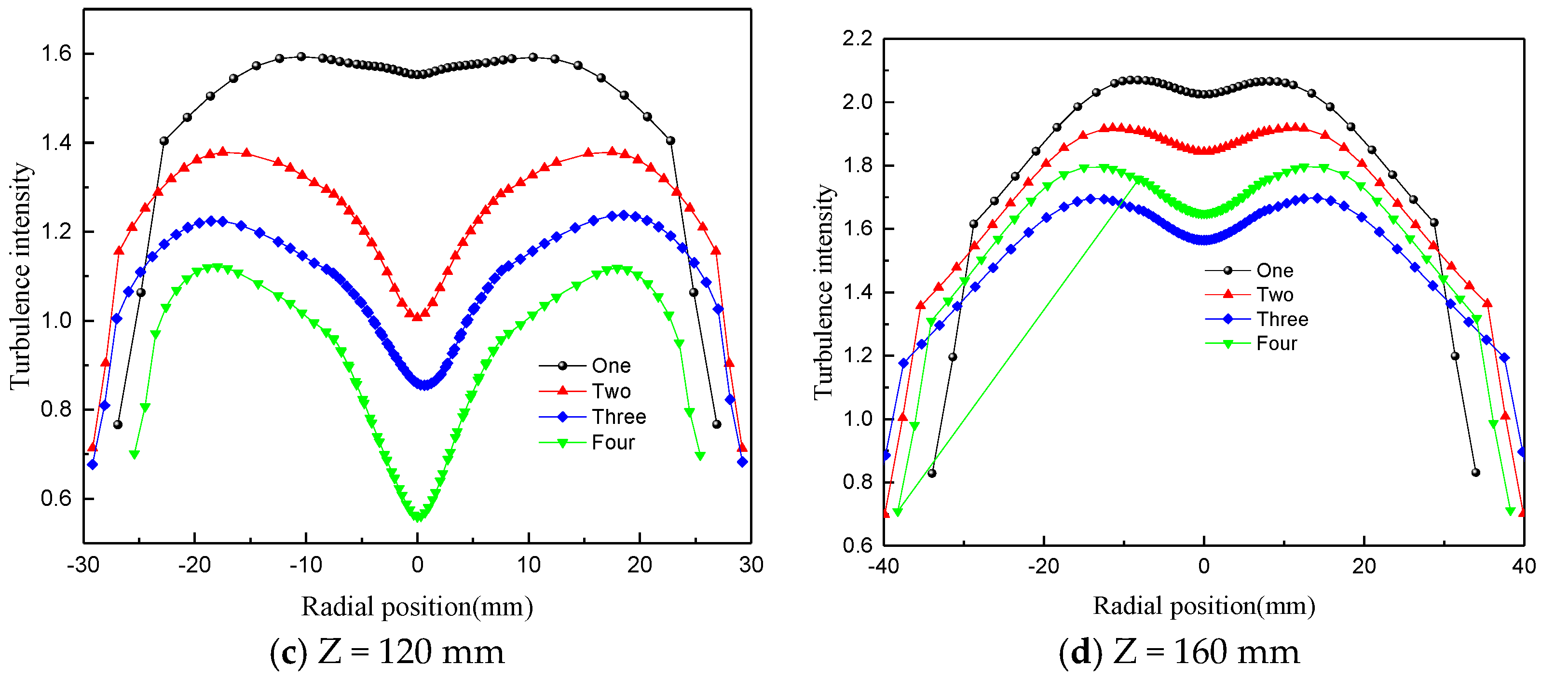
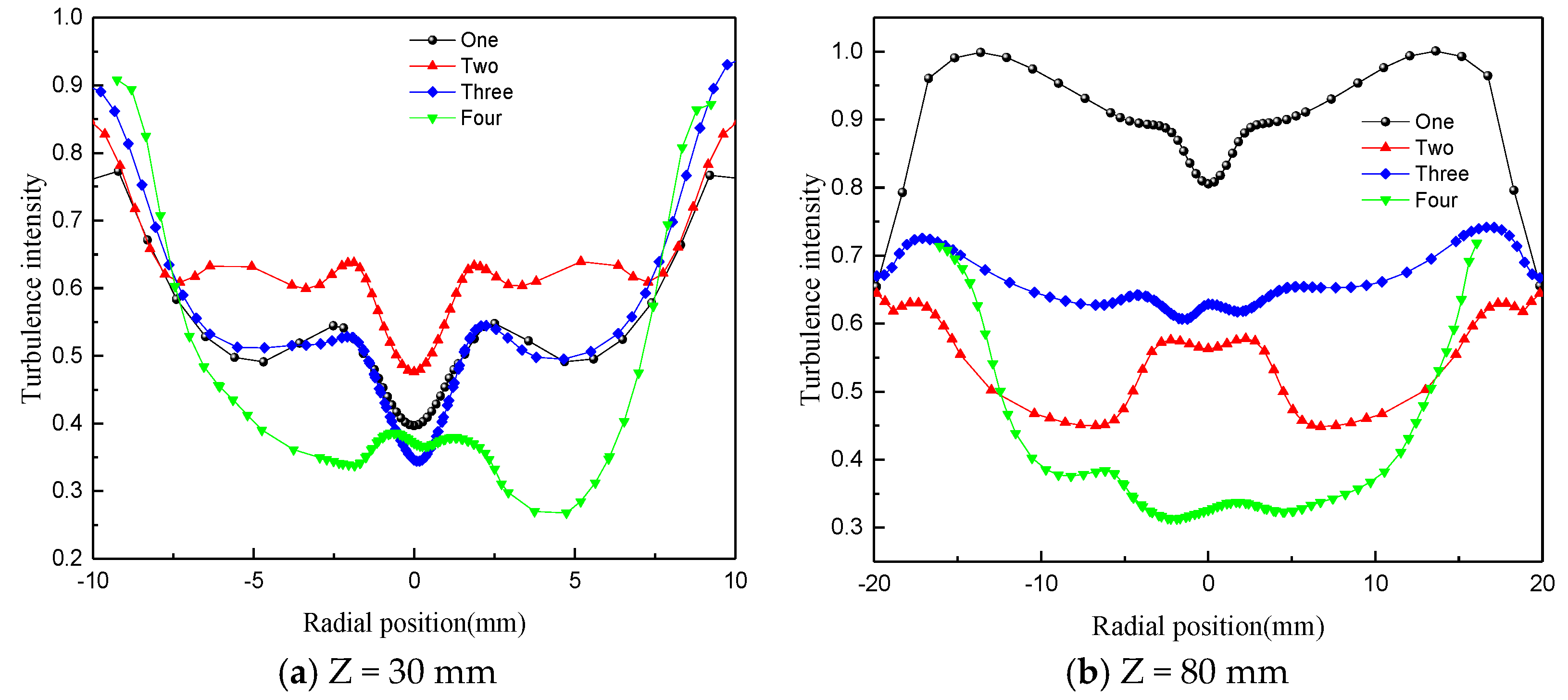
To characterize the effects of cone segment structure on turbulence intensity at a fine scale, the turbulence intensity along four diametral lines at Z = 30 mm, Z = 80 mm, Z = 120 mm, and Z = 160 mm was analyzed, with the results presented in Figure 13. For all cone configurations, the turbulence intensity exhibits a universal evolutionary trend involving magnitude escalation, subsequent stabilization, and final fluctuation convergence, with the triple-cone configuration consistently demonstrating optimal flow field stability. Across the entire axial range, the turbulence intensity of the triple-cone configuration remains within an optimal interval that balances maximum fluctuation suppression and minimum energy consumption; its fluctuation amplitude is 30–40% lower than that of the single-cone configuration and 15–20% higher than that of the quadruple-cone configuration, which simultaneously inhibits particle random diffusion and preserves sufficient centrifugal separation driving force. This balance is particularly pronounced in the outlet region at Z = 160 mm, where the turbulence intensity peak of the triple-cone configuration is 14% lower than that of the single-cone and 6% higher than that of the quadruple-cone configuration, achieving an optimal trade-off between energy consumption and discharge efficiency.

3.6. Air Core

The air core is a cylindrical gaseous core structure formed by the entrainment of ambient air into the central low-pressure zone inside a hydrocyclone. Its diameter and axial morphology are jointly determined by the intensity of the central low-pressure field and the flow channel geometry, serving as a direct indicator of hydrocyclone flow field stability. In swirling flow fields, the central negative pressure generated by high-speed fluid rotation draws in ambient air to form a continuous air core; the diameter of the air core directly reflects the intensity of the central low-pressure field, with stronger negative pressure inducing greater air entrainment and a thicker air core. Meanwhile, the axial fluctuation of the air core is correlated with flow field orderliness: a stable and uniform air core signifies a gentle central low-pressure field and distinct bidirectional flow boundaries, facilitating directional particle migration; conversely, an excessively expanded or violently fluctuating air core compresses the separation space and disrupts flow patterns, thereby degrading classification accuracy. Accordingly, the air core represents one of the key flow field characteristics for evaluating hydrocyclone separation performance [30,31].
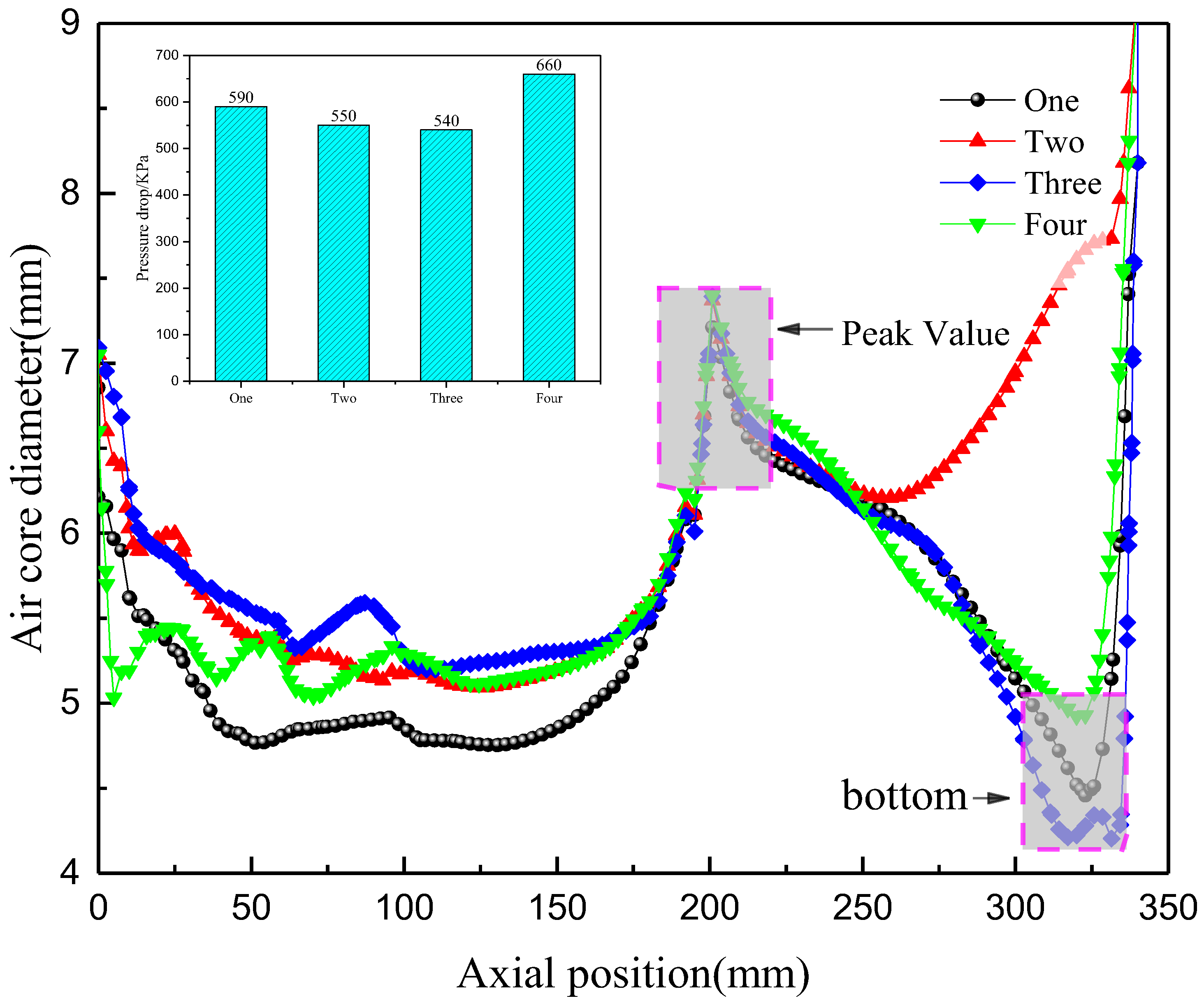
The profiles of the air core in the ZX plane of hydrocyclones with different cone segment configurations are presented in Figure 14. All cone configurations exhibit a consistent axial evolutionary pattern characterized by initial contraction, subsequent stabilization, and final expansion. Within the axial range of Z = 0–50 mm, the air core diameter undergoes rapid contraction, reflecting the enhancement of rotational kinetic energy and the incipient formation of the central low-pressure zone as fluid enters the hydrocyclone. In the axial interval of Z = 50–200 mm, the air core diameter stabilizes, corresponding to the equilibrium stage between the central low-pressure field and the overall flow field. Beyond Z = 200 mm up to 350 mm, the air core diameter expands significantly, exhibiting a distinct peak value that reflects the intensification effect of the low-pressure zone in the flow field near the underflow orifice. In the axial range of Z = 300–350 mm, the single-cone, triple-cone, and quadruple-cone hydrocyclones exhibit a bottom expansion phenomenon, which is absent in the double-cone configuration. This phenomenon arises because the segmented contraction of the double-cone configuration moderates flow channel abruptness, resulting in a central low-pressure field intensity in the underflow orifice region that is weaker than that of the single-cone, triple-cone, and quadruple-cone configurations, thereby precluding the formation of a pronounced terminal air core expansion.
The number of cone segments exerts a direct influence on the fluctuation degree of the air core diameter, and consequently on the size of the effective separation space. The single-cone configuration features minimal air core diameter fluctuation in the main cone segment, yet undergoes substantial expansion at the underflow orifice, compressing the terminal separation space. The triple-cone configuration exhibits gentle air core diameter fluctuation across the entire axial range, with moderate expansion at the underflow orifice and a smaller peak diameter, yielding sufficient and stable effective separation space. In contrast, the quadruple-cone configuration experiences violent air core diameter fluctuation in the main cone segment, coupled with significant expansion at the underflow orifice, which drastically compresses the separation space and tends to restrict particle migration trajectories.
The stable and moderately sized air core of the triple-cone configuration not only ensures the fine particle reflux channel of the central internal swirl flow but also avoids excessive air core expansion that would compress the separation space. The terminal air core expansion of the single-cone configuration and the main section fluctuation of the quadruple-cone configuration both disrupt flow field orderliness, leading to increased fine particle entrainment in the underflow or coarse particle misplacement in the overflow. The air core of the triple-cone configuration maintains stable and moderate characteristics throughout the entire separation process, balancing the central reflux channel and the effective separation space, which constitutes the core flow field support underpinning its superior separation performance.

3.7. Efficiency Curve

Classification efficiency serves as the core indicator for evaluating the separation performance of hydrocyclones, typically defined as the percentage of the mass of particles of a specific size that are effectively separated into the underflow relative to the total mass of particles of the same size in the feed. The curve depicting its variation with particle size directly reflects the separation capability of hydrocyclones for particles across different size fractions. In engineering practice, the morphology of the classification efficiency curve is directly correlated with classification accuracy: a steeper curve indicates a stronger discriminative ability of the hydrocyclone for the target separation particle size and thus higher classification accuracy. In contrast, the typical S-shaped distribution, characterized by low efficiency in the fine particle range and near-100% efficiency in the coarse particle range, embodies the inherent separation feature of hydrocyclones—prioritizing the separation of coarse particles while allowing fine particles to be easily lost with the overflow. This curve morphology is therefore a critical criterion for assessing the structural rationality and operational efficiency of hydrocyclones.
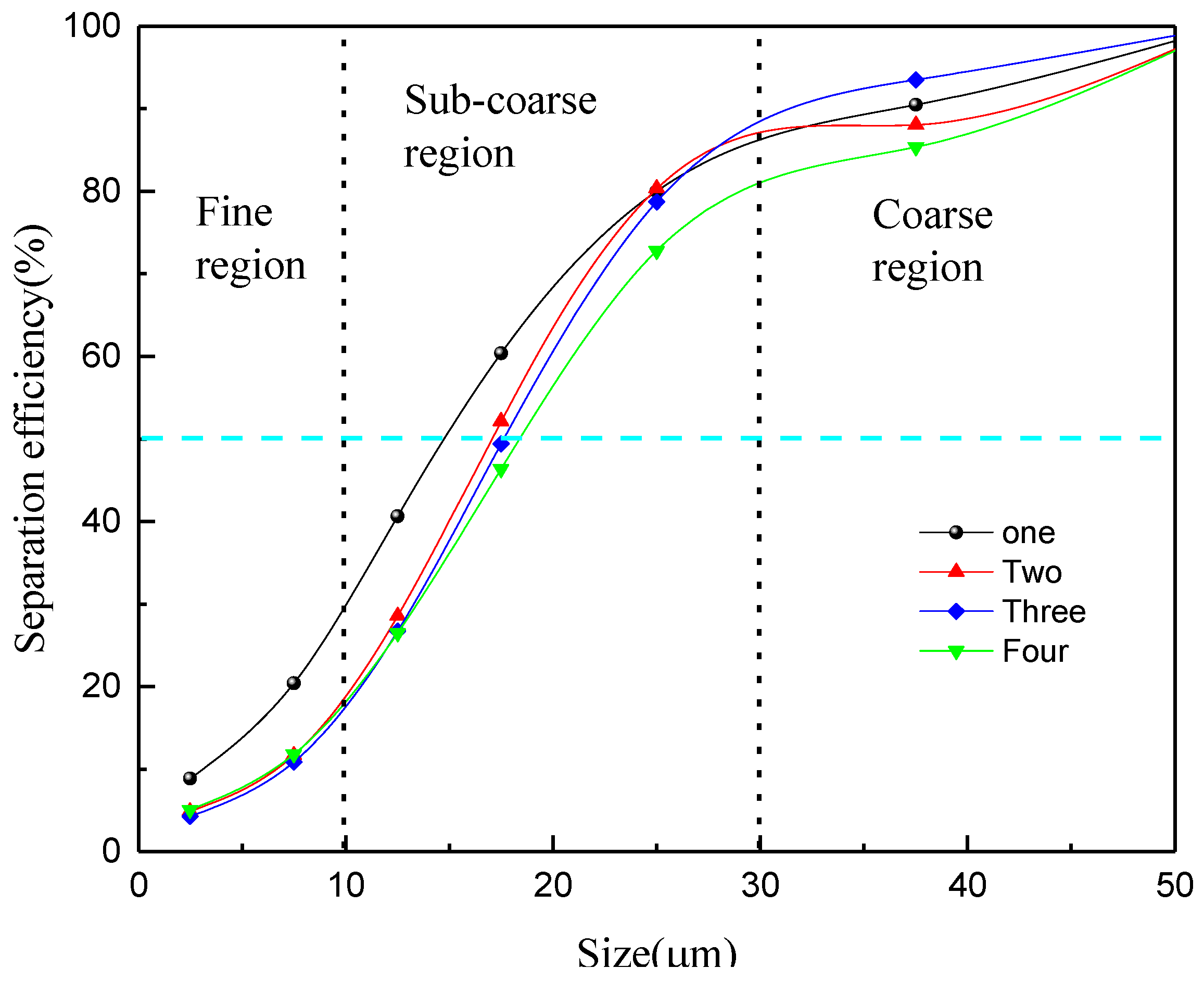
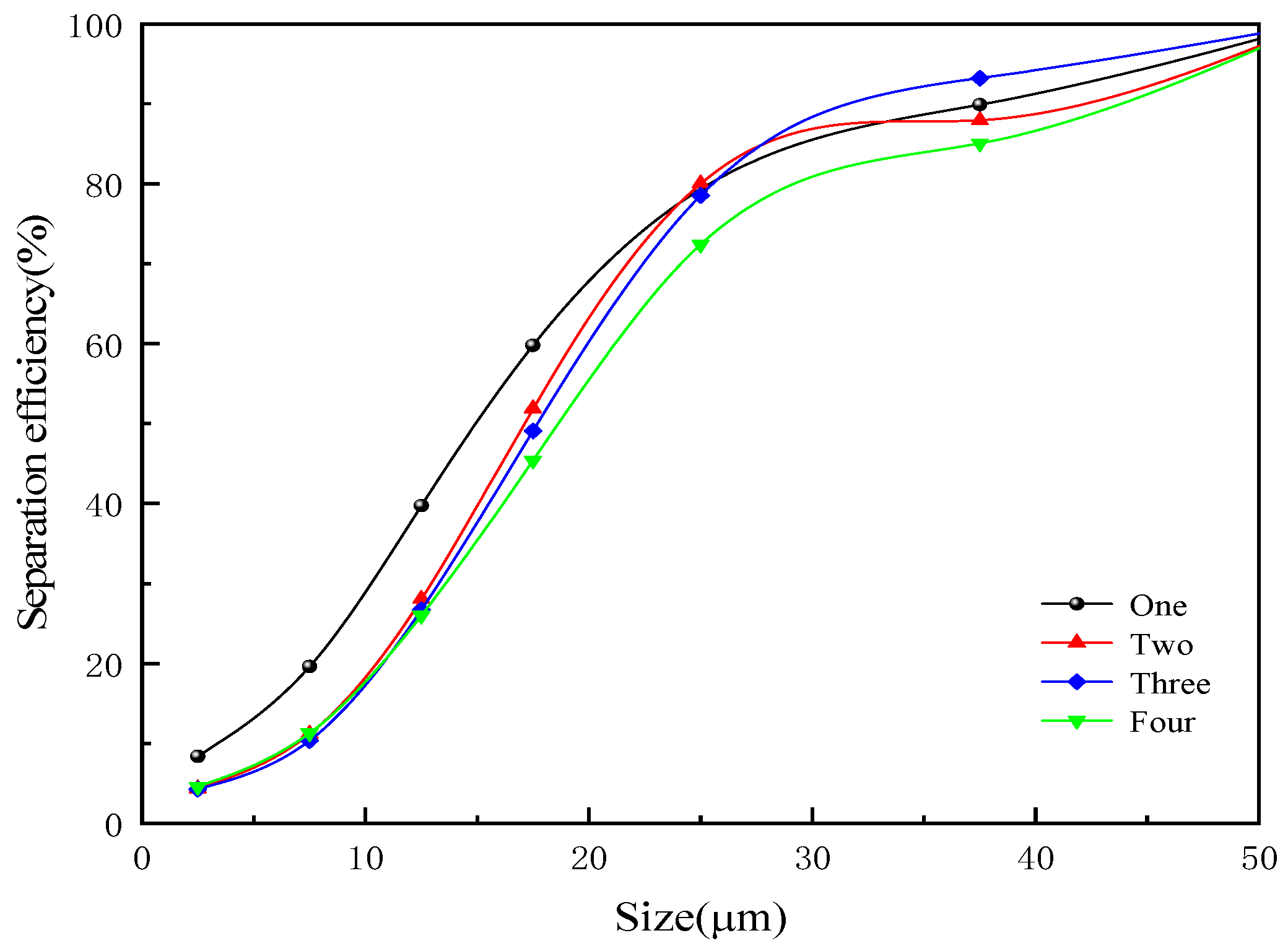
The classification efficiency curves of hydrocyclones with different cone segment configurations are presented in Figure 15. All configurations exhibit the typical S-shaped growth trend, which can be divided into three characteristic size intervals based on particle diameter: in the fine particle interval, the classification efficiency rises rapidly but remains at a low level (<20%), reflecting that fine particles tend to enter the overflow with the internal swirl flow and are difficult to be effectively separated. The sub-coarse particle interval shows a linear increase in classification efficiency, representing the core interval for evaluating classification accuracy, where the efficiency differences among different configurations are most pronounced. In the coarse particle interval, the classification efficiency stabilizes and approaches 100%, indicating that coarse particles can be efficiently captured by the external swirl flow, and the influence of structural variations on their separation capability is minimal. The triple-cone configuration achieves the highest classification efficiency across the entire particle size range; particularly in the sub-coarse particle interval (e.g., for 20 μm particles), its efficiency is nearly 20% higher than that of the single-cone configuration, with the steepest curve slope, demonstrating its superior classification accuracy for the critical separation particle size. The efficiency curves of the single-cone and double-cone configurations have relatively gentle slopes, with slow efficiency improvement in the sub-coarse particle interval, reflecting their insufficient capability to capture fine particles and low classification accuracy. The quadruple-cone configuration exhibits the lowest efficiency in the fine particle interval, and its efficiency growth in the sub-coarse particle interval lags behind that of the triple-cone configuration, which indicates that excessive segmented contraction induces flow pattern mixing and conversely degrades the separation accuracy of fine particles.
Compared with the reported research results of hydrocyclone structural optimization, the triple-cone configuration in this study shows significant advantages in comprehensive performance: Ghodrat et al. optimized the cone type and achieved a pressure drop of about 2.0 × 10⁵ Pa with a classification efficiency of 75% for 20 μm particles and Yang et al. designed a double-cone hydrocyclone with a steepness index of about 0.48 and a cut size of 15.2 μm, while the triple-cone configuration in this study achieves a classification efficiency of more than 90% for 20 μm particles with a lower pressure drop (1.8 × 10⁵ Pa), a higher steepness index (0.55) and a reasonable cut size (17.5 μm). In addition, compared with the single-cone hydrocyclone commonly used in engineering, the triple-cone configuration reduces the split ratio by 46% and increases the steepness index by more than 30% while slightly increasing the pressure drop, which realizes the synergistic optimization of separation accuracy and energy consumption.
The differences in efficiency curves can be directly correlated with the flow field analysis presented earlier. The triple-cone configuration features a stable zero-velocity envelope surface, a moderately sized air core, and low turbulence intensity, which collectively ensure the directional migration of particles, thus yielding optimal efficiency in the sub-coarse particle interval. The quadruple-cone configuration suffers from excessive intensification of the low-pressure field and turbulence resurgence, which trigger flow pattern mixing and result in low efficiency in the fine particle interval. The single-cone configuration is afflicted by high turbulence intensity and unstable bidirectional flow boundaries, leading to insufficient classification accuracy in the sub-coarse particle interval.
Pressure drop refers to the pressure difference between the inlet and outlet of a hydrocyclone, directly reflecting the energy loss during operation; a higher pressure drop indicates greater energy consumption of the equipment. The split ratio is defined as the percentage of the mass of underflow material relative to the total feed mass, reflecting the mass distribution ratio of material between the overflow and underflow. An excessively high split ratio typically implies the loss of fine particles into the underflow, accompanied by low classification accuracy, whereas an excessively low split ratio may indicate the entrainment of coarse particles into the overflow. These two parameters represent the core trade-off indicators for energy consumption control and separation performance in hydrocyclone design: pressure drop determines the operational cost of the equipment, while the split ratio reflects the rationality of material distribution. Their synergistic variation can directly characterize the capability of structural design to balance low energy consumption and high separation accuracy.
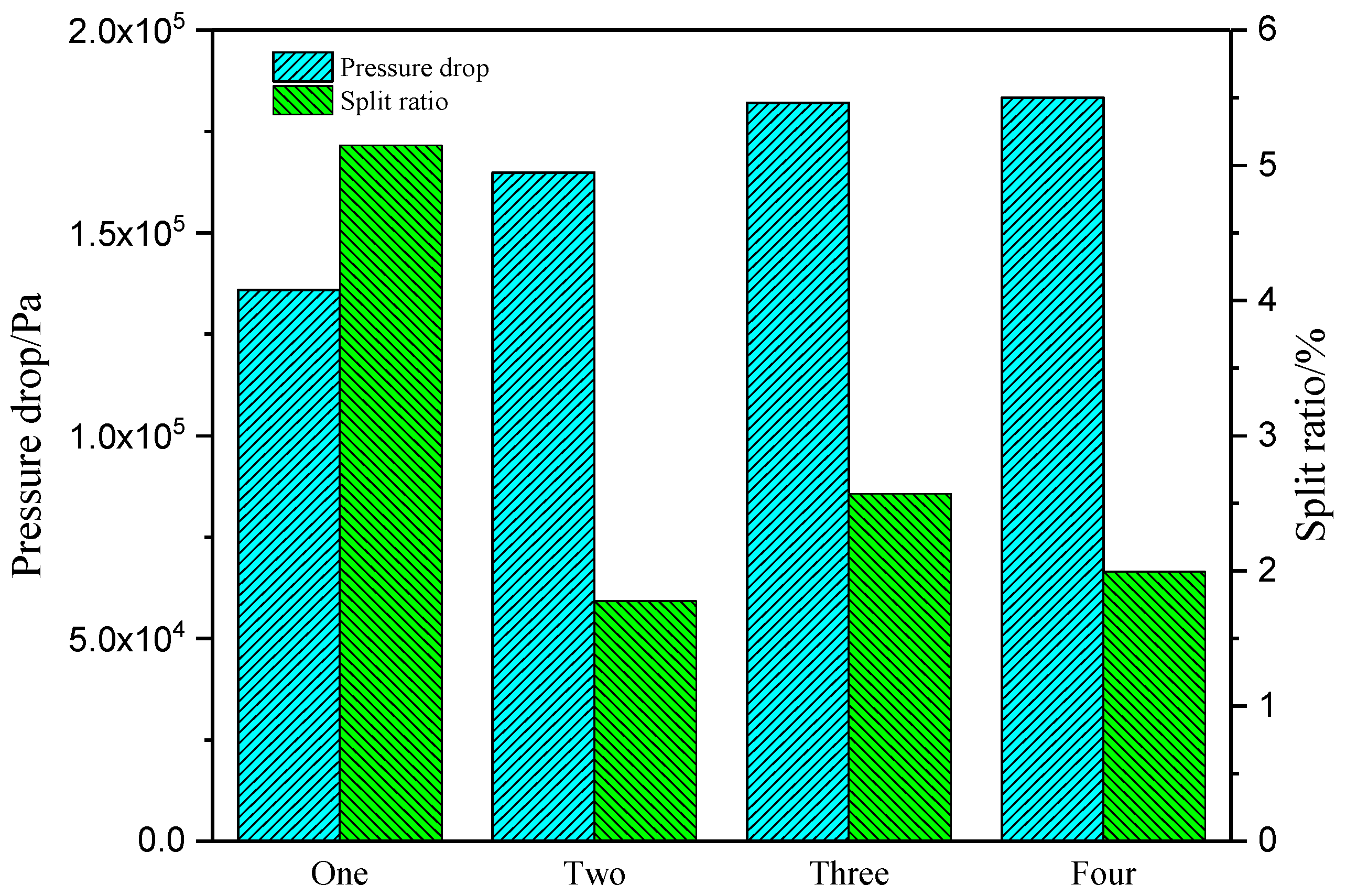
The profiles of pressure drop and split ratio in the ZX plane of hydrocyclones with different cone segment configurations are presented in Figure 16. The pressure drop exhibits an overall increasing trend with the rise in the number of cone segments: the single-cone configuration yields the lowest pressure drop of approximately 1.35 × 10⁵ Pa, while the quadruple-cone configuration achieves the highest pressure drop, approaching 1.9 × 10⁵ Pa. This observation indicates that multi-stage contraction increases flow channel resistance, thereby elevating operational energy consumption. In contrast, the split ratio presents a trend of first decreasing and then slightly rising with the increase in the number of cone segments, followed by a slight decline, which reflects the regulatory effect of segmented contraction on material distribution in the hydrocyclone: the single-cone configuration has the highest split ratio of about 5.2%; the double-cone configuration drops sharply to 1.8% due to the first-stage segmented contraction; the triple-cone configuration rises slightly to 2.8% with the optimal flow field synergy effect; and the quadruple-cone configuration decreases again to 2.0% as excessive segmentation causes flow field disturbance and partial fine particle entrainment. This phenomenon demonstrates that appropriate segmented contraction can effectively reduce the entrainment of fine particles in the underflow and optimize the rationality of material distribution, while excessive segmented contraction will cause flow field disturbance, leading to a slight rebound or secondary decline of the split ratio and failing to further improve the material distribution effect.
Although the single-cone configuration features the lowest energy consumption, its high split ratio suggests substantial loss of fine particles into the underflow, resulting in low classification accuracy, which represents a typical low-energy-consumption but low-performance operation mode. The triple-cone configuration exhibits a moderate increase in pressure drop compared with the single-cone configuration, but its split ratio decreases significantly. Combined with the classification efficiency curves discussed earlier, it achieves optimal efficiency in the sub-coarse particle interval, realizing a balance between moderate energy consumption and high separation performance. The quadruple-cone configuration has the highest pressure drop, yet its split ratio does not undergo further optimization, indicating that excessive segmented contraction only increases energy consumption without delivering continuous improvement in material distribution, corresponding to a high-energy-consumption mode with marginal performance gains.
The combination of pressure drop and split ratio of the triple-cone configuration corresponds to the optimal interval of classification efficiency. The moderate pressure drop ensures sufficient separation driving force, while the rational split ratio reduces fine particle loss; their synergistic effect underpins high classification accuracy. In contrast, the low pressure drop coupled with high split ratio of the single-cone configuration, as well as the high pressure drop paired with low split ratio of the quadruple-cone configuration, both lead to degraded classification performance due to the imbalance between energy consumption and material distribution. The triple-cone configuration achieves the optimal trade-off among the four designs; its combined pressure drop and split ratio not only guarantee separation driving force but also control material loss, making it the optimal structure that balances energy efficiency and separation performance.
The cut size is defined as the particle size corresponding to a classification efficiency of 50% in a hydrocyclone, directly reflecting the separation threshold of the equipment, i.e., the minimum particle size that can be effectively separated. The sharpness index is a quantitative metric characterizing the steepness of the classification efficiency curve; a higher value indicates a stronger discriminative ability of the hydrocyclone between target and non-target separation particle sizes, corresponding to higher classification accuracy. These two parameters jointly constitute the core quantitative indicators for evaluating the classification performance of hydrocyclones: the cut size defines the threshold range of separation, while the sharpness index determines the precision of separation. Their synergistic variation can comprehensively reflect the regulatory effect of structural design on classification accuracy.
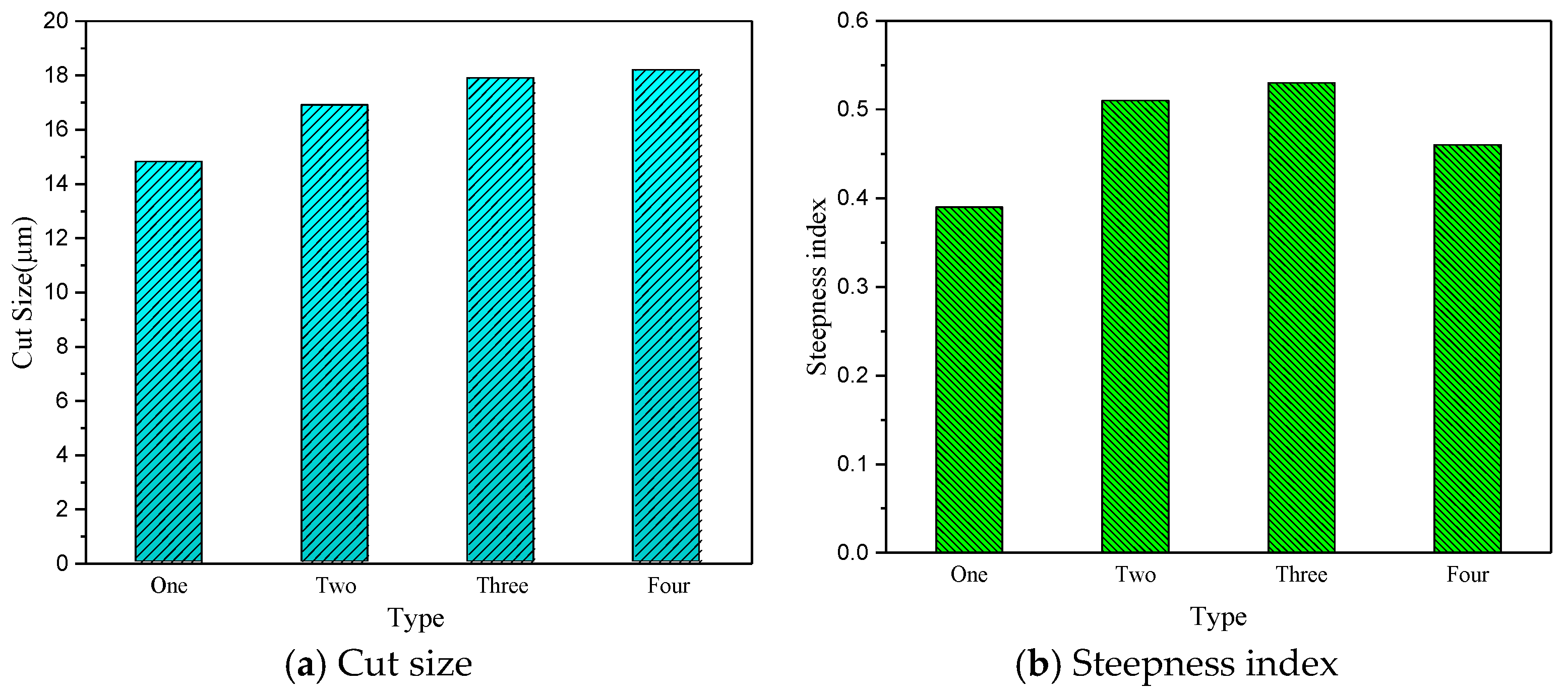
The profiles of the cut size and sharpness index in the ZX plane of hydrocyclones with different cone segment configurations are presented in Figure 17. The cut size exhibits an increasing trend with the rise in the number of cone segments: the single-cone configuration has a cut size of approximately 14.5 μm, while the quadruple-cone configuration reaches nearly 18 μm, indicating that an increase in the number of cone segments shifts the separation threshold of the hydrocyclone toward the coarse particle range. The sharpness index shows a trend of first increasing and then decreasing with the number of cone segments, peaking at approximately 0.55 for the triple-cone configuration and reaching the minimum for the single-cone configuration, which reflects that there exists an optimal range for classification accuracy with respect to the variation in the number of cone segments.
The single-cone configuration features the smallest cut size but the lowest sharpness index, demonstrating that although it can separate relatively fine particles, its ability to discriminate between target and non-target particle sizes is weak, resulting in low classification accuracy. The triple-cone configuration achieves the highest sharpness index, with its cut size maintained within a reasonable range of approximately 17.5 μm, indicating that it achieves the strongest discriminative ability for particles of different sizes while retaining a moderate separation threshold, thus yielding optimal classification accuracy. The quadruple-cone configuration has the largest cut size, but its sharpness index is lower than that of the triple-cone configuration, which reflects that excessive segmented contraction increases the separation threshold yet disrupts flow field orderliness, leading to a decline in classification accuracy.
An increase in the number of cone segments enhances the central low-pressure field and bidirectional flow structure, thereby elevating the separation threshold. The trend of the sharpness index first rising and then falling embodies the balance between flow field intensification and flow pattern stability: the triple-cone configuration achieves an optimal match between these two aspects, and the combination of its high sharpness index and reasonable cut size constitutes the core quantitative support for its superior classification efficiency. Both the weak discriminative ability of the single-cone configuration and the excessive intensification of the quadruple-cone configuration compromise the classification performance.


4. Laboratory Tests

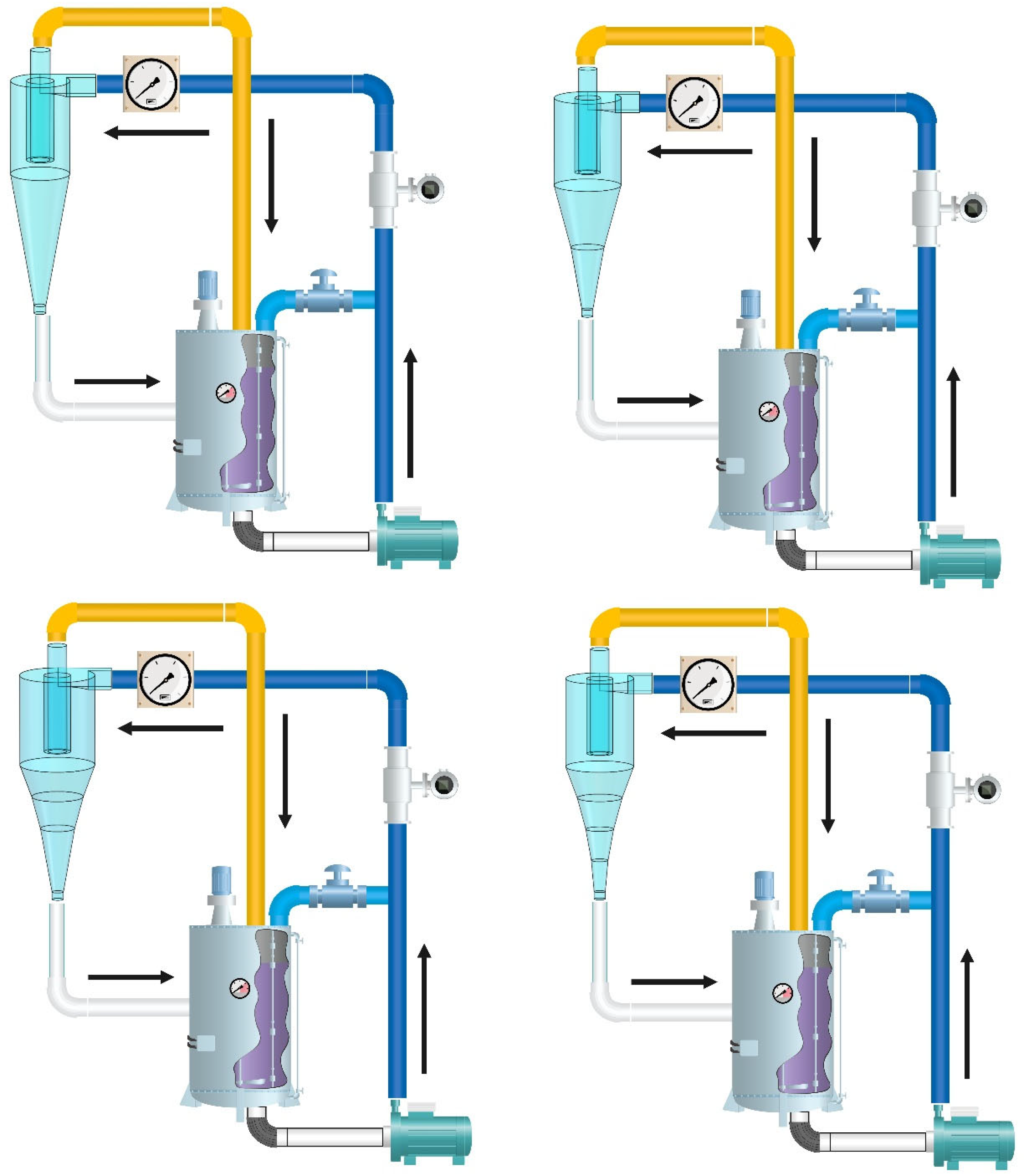
To verify the reliability of the numerical simulation results and reveal the modulation mechanism of cone segment number on the particle classification performance of hydrocyclones, a systematic set of laboratory experiments was performed. First, a customized experimental platform was established as depicted in Figure 18, consisting primarily of a raw material reservoir, a stirred tank, a plunger pump, the hydrocyclone classification unit, a closed-loop pipeline network, and an integrated measurement system equipped with pressure gauges and flowmeters. The underflow and overflow pipelines were recirculated back to the raw material reservoir, forming a continuous circulation system that ensured the stability and continuity of the experimental operation. Second, a preliminary water-circulation test was conducted prior to formal experiments to eliminate potential operational risks, including pipeline leakage and structural damage of the hydrocyclone unit. Finally, the experimental slurry with a mass concentration of 5% was prepared by mixing solid particles and deionized water at a preset ratio. The solid phase was quartz sand with a density of 2650 kg/m3, and the detailed particle size distribution of the feed slurry is provided in Table 3. To ensure the accuracy and reliability of the experimental data, triplicate parallel sampling was implemented for the feed, overflow, and underflow streams, respectively. The particle size distribution of each sample was determined using a Malvern laser particle size analyzer, and the arithmetic mean of the three replicate measurements was adopted as the final experimental result for subsequent data analysis.
The classification efficiency curves obtained from laboratory experiments are presented in Figure 19. Compared with the numerical simulation data, the experimental classification efficiency exhibits an overall trend characterized by a slight reduction in the fine particle interval, a close alignment in the sub-coarse particle interval, and an almost identical performance in the coarse particle interval. This discrepancy arises from the idealized assumptions adopted in numerical simulations: particles are generally presumed to be spherical, non-agglomerated, and perfectly compatible with the interphase interaction model, allowing fine particles to follow theoretical migration trajectories for separation or overflow with the internal swirl flow.
In contrast, experimental conditions involve unavoidable fine particle agglomeration, particularly under the 5% solid-phase concentration employed in this study. Although agglomeration increases the effective particle size, the agglomerates remain susceptible to turbulent perturbations. A fraction of these agglomerates is entrained into the underflow due to increased mass, while a greater proportion of fine particles is lost to the overflow as a result of equipment leakage and short-circuiting effects. Collectively, these factors lead to marginally lower classification efficiency in experimental measurements than in numerical simulations.
Notably, the experimental efficiency in the sub-coarse particle interval shows excellent agreement with the simulated results, and the performance advantage of the triple-cone configuration remains pronounced. In the coarse particle interval, the experimental and simulated efficiency values are nearly identical, approaching 100%. This consistency is attributed to the strong centrifugal force of the external swirl flow, which efficiently captures coarse particles in both scenarios, with minimal influence of flow field structure on their separation trajectories. Overall, the experimental classification efficiency data are consistent with the numerical simulation results in terms of both magnitude and trend, which validates the reliability and accuracy of the numerical simulation methodology.

5. Conclusions

Aiming at the engineering bottlenecks of insufficient classification accuracy and the imbalance between energy consumption and performance in conventional single-cone hydrocyclones, this study systematically investigates the regulatory mechanism of cone segment number on the internal flow field characteristics and separation performance of hydrocyclones. Through numerical simulations combined with multi-index quantitative analysis, the inherent correlation laws among structural parameters, flow field features, and separation performance are revealed, providing theoretical support and technical basis for the structural optimization of high-efficiency hydrocyclones.
The fundamental characteristics of the core flow field in hydrocyclones exhibit high stability and do not undergo essential changes with the increase in cone segment number. All configurations adhere to the principle of centrifugal separation, maintaining the bidirectional flow structure where the external swirl flows downward along the wall toward the underflow and the internal swirl refluxes upward along the center toward the overflow. The zero-velocity envelope surface acts as the boundary of the bidirectional flow, and the air core follows the axial evolutionary law of contraction-stabilization-expansion. The radial distributions of static pressure and tangential velocity conform to the characteristics of the Rankine vortex, which constitutes the core prerequisite for particle classification.
The number of cone segments significantly regulates the magnitude, distribution, and stability of key flow field parameters by reconstructing the flow channel contraction mode. The triple-cone configuration exhibits the optimal flow field synergy effect: the high-turbulence zones feature lower magnitudes and are concentrated near the central axis, inhibiting the random diffusion of particles; the zero-velocity envelope surface remains stable in the core separation zone, ensuring sufficient separation space with clear boundaries; and the air core shows gentle axial fluctuations with moderate terminal expansion. In contrast, the single-cone configuration, constrained by one-step flow channel contraction, has widely distributed high-turbulence zones and violently fluctuating zero-velocity envelope surfaces. The quadruple-cone configuration, suffering from excessive segmented contraction, triggers the intensification of the central low-pressure field and turbulence resurgence, disrupting the flow field orderliness.
The differentiated regulation of flow field characteristics is directly reflected in the separation performance. The triple-cone configuration achieves the highest classification efficiency and the steepest curve slope in the core sub-coarse particle interval (10–30 μm), with a reasonable cut size (approximately 17.5 μm) and a peak sharpness index (approximately 0.55), representing optimal classification accuracy. Its pressure drop (approximately 1.8 × 10⁵ Pa) and split ratio (2.8%) are synergistically optimized, which not only guarantees sufficient centrifugal driving force but also controls the loss of fine particles into the underflow and the misplacement of coarse particles into the overflow. The single-cone configuration has the lowest energy consumption, yet its excessively high split ratio (5.2%) leads to insufficient classification accuracy. The quadruple-cone configuration falls into the dilemma of high pressure drop–marginal performance gain, where excessive segmentation only increases energy consumption without delivering continuous improvement in separation performance.
In summary, the regulation of cone segment number essentially achieves the synergistic balance of separation driving force–flow pattern stability–energy consumption control by optimizing the flow channel contraction mode while preserving the fundamental characteristics of the core flow field. Through three-stage stepped contraction, the triple-cone configuration decomposes the abrupt changes in velocity gradient, realizing the optimal matching of key flow field parameters, and achieves the best trade-off among classification efficiency, classification accuracy, and operational energy consumption, thus serving as the optimal structural scheme under the conditions of this study. The regulatory laws revealed in this study provide a scientific basis for the engineering design of multi-cone hydrocyclones. Future research can further explore the coupled optimization of parameters such as cone angle and aspect ratio of cone segments, as well as the structural adaptability under different operating conditions, and conduct industrial-scale experimental verification, so as to provide more comprehensive technical support for the efficient application of hydrocyclones in related fields.

Author Contributions

Conceptualization, X.C. and H.L.; methodology, X.C.; software, X.C.; validation, X.C. and H.L.; formal analysis, X.C.; investigation, X.C.; resources, X.C. and H.L.; data curation, X.C.; writing—original draft preparation, X.C.; writing—review and editing, X.C. and H.L.; visualization, X.C.; supervision, X.C.; project administration, X.C.; funding acquisition, X.C. All authors have read and agreed to the published version of the manuscript.

Funding

This research received no external funding.

Data Availability Statement

The original contributions presented in this study are included in the article. Further inquiries can be directed to the corresponding author.

Conflicts of Interest

The authors declare no conflicts of interest.

Abbreviations

The following abbreviations are used in this manuscript:
RSMReynolds Stress Model
LZVVZero-Velocity Envelope Surface
SIMPLESemi-Implicit Method for Pressure Linked Equations
QUICKQuadratic Upstream Interpolation for Convective Kinetics

References

  1. Yang, J.; Sun, G.; Zhan, M. Prediction of the maximum-efficiency inlet velocity in cyclones. Powder Technol. 2015, 286, 124–131. [Google Scholar] [CrossRef]
  2. Zhang, C.; Wei, D.; Cui, B.; Li, T.; Luo, N. Effects of curvature radius on separation behaviors of the hydrocyclone with a tangent-circle inlet. Powder Technol. 2017, 305, 156–165. [Google Scholar] [CrossRef]
  3. Song, C.; Pei, B.; Jiang, M.; Wang, B.; Xu, D.; Chen, Y. Numerical analysis of forces exerted on particles in cyclone separators. Powder Technol. 2016, 294, 437–448. [Google Scholar] [CrossRef]
  4. Qi, Z.; Kuang, S.B.; Yu, A.B. Numerical investigation of the separation behaviors of fine particles in large-diameter dense medium cyclones. Int. J. Miner. Process. 2015, 142, 35–45. [Google Scholar] [CrossRef]
  5. Xu, Y.; Song, X.; Sun, Z.; Tang, B.; Li, P.; Yu, J. Numerical investigation of the effect of the ratio of the vortex-finder diameter to the spigot diameter on the steady state of the air core in a hydrocyclone. Ind. Eng. Chem. Res. 2013, 52, 5470–5478. [Google Scholar] [CrossRef]
  6. Tripathy, S.K.; Bhoja, S.K.; Kumar, C.R.; Suresh, N. A short review on hydraulic classification and its development in mineral industry. Powder Technol. 2015, 270, 205–220. [Google Scholar] [CrossRef]
  7. Ghodrat, M.; Kuang, S.B.; Yu, A.B.; Vince, A.; Barnett, G.D.; Barnett, P.J. Numerical analysis of hydrocyclones with different conical section designs. Miner. Eng. 2014, 62, 74–84. [Google Scholar] [CrossRef]
  8. Yang, Q.; Wang, H.L.; Liu, Y.; Li, Z. Solid/liquid separation performance of hydrocyclones with different cone combinations. Sep. Purif. Technol. 2010, 74, 271–279. [Google Scholar] [CrossRef]
  9. Song, T.; Tian, J.; Ni, L.; Shen, C.; Yao, Y. Experimental study of de-foulant hydrocyclone performance with a conical surface. Sep. Purif. Technol. 2020, 366, 1283–1292. [Google Scholar] [CrossRef]
  10. Dianyu, E.; Fan, H.; Su, Z.; Xu, G.; Zou, R.; Yu, A.; Kuang, S. Numerical study of the multiphase flows and separation performance of hydrocyclone with tapered cross-section inlet. Powder Technol. 2023, 416, 118208. [Google Scholar] [CrossRef]
  11. Dianyu, E.; Xu, G.; Fan, H.; Cui, J.; Tan, C.; Zhang, Y.; Zou, R.; Kuang, S.; Yu, A. Numerical investigation of hydrocyclone inlet configurations for improving separation performance. Powder Technol. 2024, 434, 119384. [Google Scholar] [CrossRef]
  12. Dianyu, E.; Hu, H.; Tan, C.; Zhang, Y.; Xu, G.; Cui, J.; Zou, R.; Yu, A.; Kuang, S. Numerical study of the effect of cylinder–to–cone ratio on the classification performance in hydrocyclones. Powder Technol. 2025, 454, 120736. [Google Scholar] [CrossRef]
  13. Ji, L.; Paul, P.; Shanbhag, B.K.; Dixon, I.; Kuang, S.; He, L. Emerging application of hydrocyclone in biotechnology and food processing. Sep. Purif. Technol. 2023, 309, 122992. [Google Scholar] [CrossRef]
  14. Ghodrat, M.; Qi, Z.; Kuang, S.; Ji, L.; Yu, A. Computational investigation of the effect of particle density on the multiphase flows and performance of hydrocyclone. Miner. Eng. 2016, 90, 55–69. [Google Scholar] [CrossRef]
  15. Kuang, S.B.; Chu, K.W.; Yu, A.B.; Vince, A. Numerical study of liquid–gas–solid flow in classifying hydrocyclones: Effect of feed solids concentration. Miner. Eng. 2012, 31, 17–31. [Google Scholar] [CrossRef]
  16. Zhao, S.; Yamei, Z.; Yan, L.; Daming, S. Numerical simulation and experimental study of Inlet velocity on oil water separation effect by a fixed hydrocyclone. Sci. Rep. 2025, 15, 18024. [Google Scholar] [CrossRef]
  17. Li, F.; Li, P.; Wang, Y.; Guo, D.; Yang, H.; Han, H.; Liang, R. Numerical analysis and experimental research on the influence of column structure on the classification performance of hydrocyclone. Alex. Eng. J. 2025, 120, 271–286. [Google Scholar] [CrossRef]
  18. Morimoto, M.G.; Silva, D.P.d.S.d.; Silva, D.d.O.; Barrozo, M.A.d.S.; Vieira, L.G.M. Filtering Hydrocyclone Performance: A Review of Literature. Miner. Process. Extr. Metall. Rev. 2025, 47, 278–291. [Google Scholar] [CrossRef]
  19. Hsieh, K.T.; Rajamani, K. Phenomenological Model of the Hydrocyclone: Model Development and Verification for Single-Phase Flow. Int. J. Miner. Process. 1988, 22, 223–237. [Google Scholar] [CrossRef]
  20. Bu, T.; Mesa, D.; Brito-Parada, P.R. Optimising mini-hydrocyclone designs for enhanced demulsification. Sep. Purif. Technol. 2025, 378, 134247. [Google Scholar] [CrossRef]
  21. Liu, P.; Xu, X.; Yang, X.; Li, A.; Chen, B.; Liu, G.; Gao, Y. Effect of column segment diameter ratio on flow field and separation performance of the composite column-cone hydrocyclone. Physicochem. Probl. Miner. Process. 2025, 61, 15. [Google Scholar] [CrossRef]
  22. Pukkella, A.K.; Vega-Garcia, D.; Hadler, K.; Cilliers, J. The influence of surface-wall roughness on hydrocyclone performance. Sep. Purif. Technol. 2025, 360, 131109. [Google Scholar] [CrossRef]
  23. Yang, X.; Li, X.; Liu, P.; Li, X.; Jiang, L.; Yang, G. Study on the separation performance of honeycomb cone hydrocyclone. Int. J. Coal Prep. Util. 2025, 45, 1051–1073. [Google Scholar] [CrossRef]
  24. Dai, Y.; Yang, X.; Du, J.; Yu, W.; Wang, D.; Yuan, F. Migration and Removal of Microplastics in a Dual-Cone Mini-Hydrocyclone. Symmetry 2025, 17, 1559. [Google Scholar] [CrossRef]
  25. Xia, H.; Zhu, L.; Zhang, Y.; Sun, Z.; Wang, Z. Research of turbulence intensity in axial guide vane type hydrocyclone. Chem. Eng. Sci. 2025, 316, 122027. [Google Scholar] [CrossRef]
  26. Saffar, Y.; Kulka, M.; Nobes, D.S.; Sabbagh, R. Simultaneous circulating tumor cells (CTCs) tracking and flow field characterization through integrated single camera imaging in a micro-hydrocyclone. Chem. Eng. J. 2025, 520, 165681. [Google Scholar] [CrossRef]
  27. Wang, Y.; Li, T.; Huang, Y.; Lv, W.; Xu, X.; Li, H. Structural optimization of hydrocyclone for reducing volume of Sb-contaminated soil. J. Environ. Chem. Eng. 2025, 13, 119263. [Google Scholar] [CrossRef]
  28. Tang, D.; Chen, L.; Asamoah, R.K.; Hu, E. Online particle-size monitoring for hydrocyclone overflow: Where is the beacon? Miner. Eng. 2025, 233, 109553. [Google Scholar] [CrossRef]
  29. Pathirikattu, A.; Vakamalla, T.R. Exploration of machine learning models for hydrocyclone performance parameters prediction. Powder Technol. 2025, 465, 121355. [Google Scholar] [CrossRef]
  30. Liu, P.; Sun, H.; Chen, B.; Jiang, L.; Han, Z.; Wang, T.; Liu, J.; Gao, Y.; Liu, G. Research on the classification performance of a self-aspirating three-product hydrocyclone. Powder Technol. 2025, 465, 121388. [Google Scholar] [CrossRef]
  31. Hu, Z.; Liu, M.; Feng, Y.; Zhang, Z.; Chen, J.; Qiao, P. Experimental and numerical study on a new radial hydrocyclone with flow field conditioning. Powder Technol. 2025, 458, 120947. [Google Scholar] [CrossRef]
Figure 1. Structure of the hydrocyclone.
Separations 13 00111 g001
Figure 2. Meshes.
Figure 2. Meshes.
Separations 13 00111 g002
Figure 3. Grid independence verification.
Separations 13 00111 g003
Figure 4. Comparison of the tangential velocity and axial velocity distributions.
Separations 13 00111 g004
Figure 5. Distribution of static pressure in the ZX plane.
Separations 13 00111 g005
Figure 6. Distribution of static pressure along the characteristic line.
Separations 13 00111 g006
Figure 7. Distribution of tangential velocity in the ZX plane.
Separations 13 00111 g007
Figure 8. Distribution of tangential velocity along the characteristic line.
Separations 13 00111 g008
Figure 9. Distribution of axial velocity in the ZX plane.
Separations 13 00111 g009
Figure 10. Distribution of axial velocity along the characteristic line.
Separations 13 00111 g010
Figure 11. LZVV.
Figure 11. LZVV.
Separations 13 00111 g011
Figure 12. Distribution of turbulence intensity in the ZX plane.
Separations 13 00111 g012
Figure 13. Distribution of turbulence intensity along the characteristic line.
Separations 13 00111 g013aSeparations 13 00111 g013b
Figure 14. Air core.
Separations 13 00111 g014
Figure 15. Separation efficiency.
Separations 13 00111 g015
Figure 16. Pressure drop and split ratio.
Separations 13 00111 g016
Figure 17. Cut size and steepness index.
Separations 13 00111 g017
Figure 18. Experimental setup.
Separations 13 00111 g018
Figure 19. Classification efficiency.
Separations 13 00111 g019
Table 1. Hydrocyclone Structural Parameters.
ParameterSymbolValue
Diameter of the body D 75 mm
Inlet equivalent diameter D 0 19.55 mm
Vortex finder diameter D i 25 mm
Vortex finder length L 0 75 mm
Diameter of apex D u 15 mm
Length of cylindrical part L 120 mm
Length of conical part H 170 mm
Table 2. Feed particle size distribution.
Size/μmContent/%
0~60.32
6~100.89
10~161.16
16~231.12
23~310.93
31~450.11
>450.47
Table 3. Feed particle size.
Size/μmContent/%
0~51.21
5~120.36
12~150.92
15~221.03
22~290.52
29~460.63
>460.33
Total5
Disclaimer/Publisher’s Note: The statements, opinions and data contained in all publications are solely those of the individual author(s) and contributor(s) and not of MDPI and/or the editor(s). MDPI and/or the editor(s) disclaim responsibility for any injury to people or property resulting from any ideas, methods, instructions or products referred to in the content.