Article

Differential Behavior of Salt and Organic Matter Passage in 2-Pass RO Systems for Ultrapure Water Production

Department of Civil Engineering, Pukyong National University, 45 Yongso-ro, Nam-gu, Busan 608-737, Republic of Korea
*
Author to whom correspondence should be addressed.
Separations 2026, 13(3), 93; https://doi.org/10.3390/separations13030093
Submission received: 15 February 2026 / Revised: 8 March 2026 / Accepted: 11 March 2026 / Published: 13 March 2026

Abstract

This study investigates how membrane transport characteristics affect permeate quality in a 2-pass reverse osmosis (RO) system for ultrapure water (UPW) production. Unlike conventional RO, UPW-RO operates in an ultra-low concentration range. Seven commercial 4-inch RO membrane modules spanning a wide range of water (A) and salt (B) permeability coefficients were evaluated under various second-pass RO feed concentrations (specifically, total dissolved solids (TDS) and total organic carbon (TOC)). Second-pass RO permeate TDS remained almost constant regardless of membrane specifications, whereas the permeate TOC was strongly membrane-dependent. RO permeates from high-permeability membranes showed significantly higher TOC than those from high-selectivity membranes. The experiments also revealed that a high-permeability membrane configuration for both RO passes resulted in excessive TOC leakage, while a high-selectivity membrane configuration mitigated TOC passage at the cost of a high operating pressure requirement. A combination of a high-permeability membrane (the first pass) and a high-selectivity membrane (the second pass) could achieve an acceptable TOC passage with a moderate operating pressure requirement in UPW-RO systems.

1. Introduction

Ultrapure water (UPW) is purified to meet very strict water-quality requirements for semiconductor manufacturing [1,2,3]. It contains extremely low levels of ionic and organic contaminants, which require careful control of dissolved gases, particles, and microorganisms. Since even small amounts of these impurities can influence device yield and process stability, UPW systems are designed to reliably supply high-purity water [4].
This level of quality cannot be achieved by a single unit process. Instead, consistent product water is obtained by connecting multiple treatment steps so the system can respond to changes in feed water quality [5,6,7,8]. A typical UPW production process includes pretreatment, 2-pass reverse osmosis (2-pass RO), continuous electrodeionization (CEDI), UV oxidation, degassing, and final polishing units (e.g., mixed-bed ion exchange and final ultrafiltration). Each step has a specific role, and overall performance depends on how well these steps operate as a sequence [9].
UPW quality is assessed using several indicators, including water resistivity (the reciprocal of electrical conductivity) and total organic carbon (TOC). Resistivity reflects the level of dissolved ions, while TOC represents the overall organic matter load. Both can undermine the overall stability of the UPW production process, even when present at extremely low levels (<1 ppb in water) [10]. Among the unit processes, RO serves as the main barrier that removes most dissolved impurities—including ions and organic matters—and reduces the burden on downstream polishing units that treat the remaining residuals [11]. Because RO also accounts for a large fraction of the total energy consumption in UPW production, optimizing RO operation is important not only for achieving target water quality but also for improving overall energy efficiency [12,13,14,15].
In a 2-pass RO design, the first-pass RO removes the bulk of ions and organic matter from the feed water source. The second-pass RO then treats the first-pass RO permeate to further reduce residuals and improve permeate consistency [16,17,18]. Since salt passage and transport behavior depend strongly on feed salinity according to solution-diffusion theory, the salt concentration of the first-pass RO permeate should be low enough to satisfy the water quality requirement for the second-pass RO for UPW production.
However, our previous study [9] found that salt (ions) passage through the second-pass RO membrane under low feed TDS conditions (<35 mg/L as TDS) showed a different behavior from that under typical brackish-water conditions (>500 mg/L as TDS).
In the first-pass RO, permeate total dissolved solids (TDS) generally increased with feed salinity, mainly due to feed concentrating during RO filtration. In the second-pass RO, however, permeate TDS remained almost constant at 0.5–0.6 mg/L (~1 μS/cm in electrical conductivity), even when operating conditions changed. This apparent convergence in permeate TDS provides an important implication for process design: if the second-pass RO permeate quality is largely insensitive to membrane type, it may not be necessary to rely exclusively on high rejection membranes. Instead, using high-permeability membranes with slightly lower salt rejection could still satisfy the permeate TDS target of a 2-pass RO system in the UPW production process (UPW-RO system) while enabling lower operating pressure and substantial energy savings.
However, such a design approach is only feasible if organic matter removal performance is also assured with low-rejection membranes. In our previous study [9], unlike the convergence observed in salt concentration, TOC passage performance showed no such trend. This lack of a clear trend was likely because the four membrane modules used had very high salt rejection (99.6–99.8%), which might have masked visible differences among membranes, and the tested sets covered a relatively narrow performance range. As a result, it remains unclear to what extent TOC passage varies across membranes covering a broader permeability–selectivity range, and whether high-permeability membranes can consistently achieve the target permeate TOC level in UPW-RO systems.
Ultimately, this work evaluates whether the stable salt passage behavior observed in the second-pass RO is maintained across membrane modules covering a broader range of permeability and selectivity indicators, and further examines (i) differences in permeate TOC between high- and low-permeability membranes, (ii) whether high-permeability membranes achieve permeate TOC comparable to more selective membranes under the second-pass RO operations, and (iii) whether combining high-permeability and high-selectivity membranes can achieve an acceptable TOC passage with a moderate operating pressure requirement in UPW-RO systems.

2. Methods

2.1. 4-Inch RO Membrane Module Test

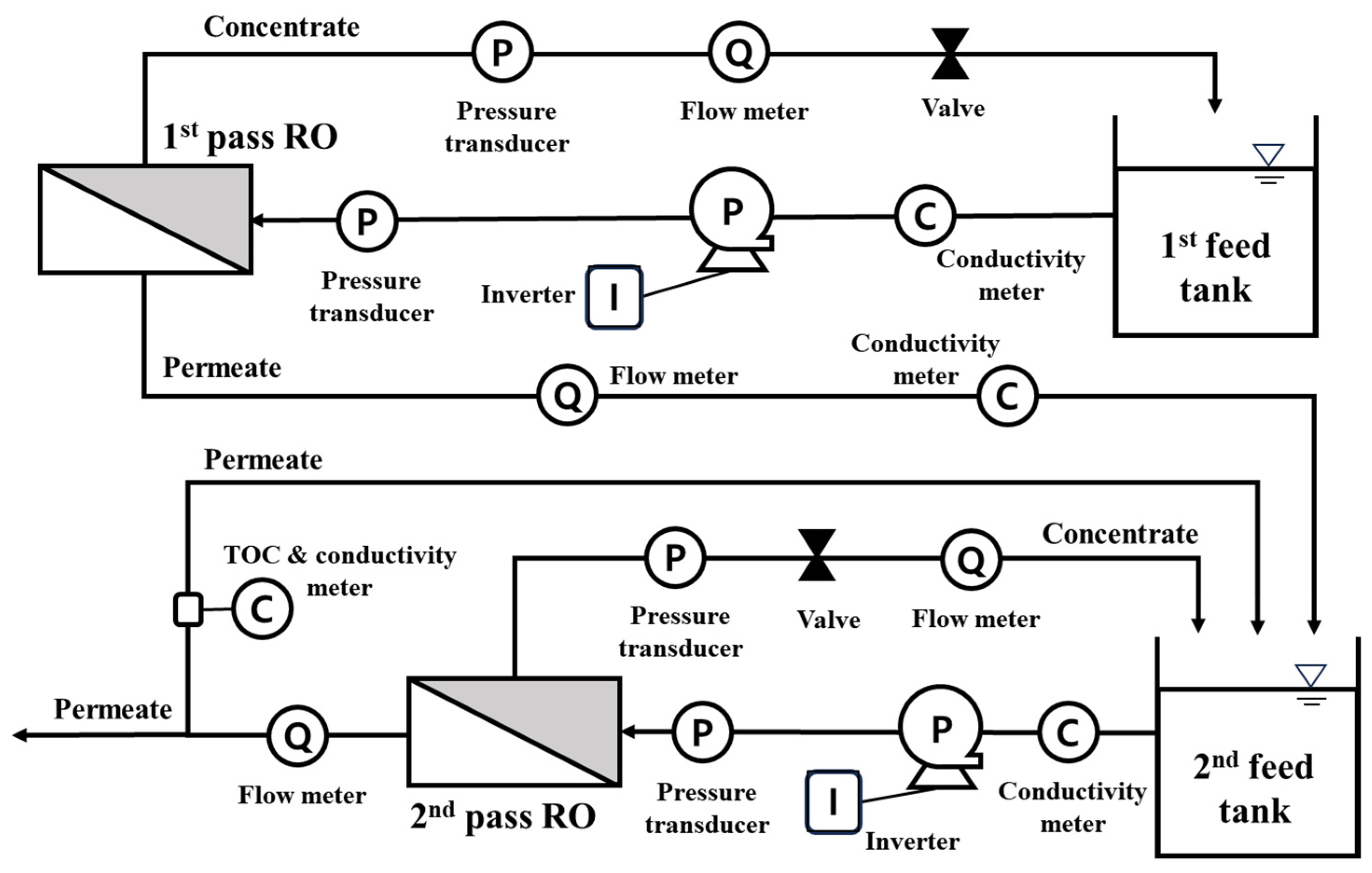
A pilot-scale 2-pass reverse osmosis (2-pass RO) system equipped with commercial 4-inch spiral-wound modules was used in this study (Figure 1).
The system consisted of a 500 L feed tank and a high-pressure vertical multistage centrifugal pump (CR3-17 A-FGJ-A-E-HQQE, Grundfos, Bjerringbro, Denmark), a 4-inch pressure vessel, and online instrumentation for monitoring operating conditions and water quality. Sodium bisulfite (Daejung Chemical, Siheung-si, Gyeonggi-do, Republic of Korea) was dosed as a de-chlorination agent to remove residual chlorine in the feed water. Municipal tap water was used as the feed water for the first-pass RO. The tap water was produced from a river water source via an advanced drinking-water treatment process that includes pre-ozonation prior to rapid sand filtration, followed by post-ozonation and granular activated carbon (GAC) filtration after sand filtration. This water treatment process is commonly used as a pretreatment step in UPW production processes [9]. Baseline water-quality information for the tap water was obtained from the Busan Water Authority, and the initial feed-water TDS and TOC during the experiments were approximately 172 ± 52 mg/L and 1300 ± 250 μg/L, respectively [19]. The tap-water ion composition is summarized in Table 1.
The high-pressure pump was controlled using a variable frequency drive (VFD) to maintain target operating conditions (e.g., recovery, crossflow rate, and permeate flux). Feed pressure for both the first-pass RO and second-pass RO was monitored using pressure transmitters (A-10, WIKA Alexander Wiegand SE & Co. KG, Klingenberg, Germany). In the first-pass RO, concentrate and permeate flow rates were measured using inline flow sensors/meters (P525-1S and 3-2536-P0, GF Signet, Irwindale, CA, USA), respectively. In the second-pass RO, concentrate and permeate flow rates were monitored using inline flow meters (FS300A G3/4, Shenzhen Crown Haosheng Technology, Shenzhen, Guangdong, China). Feed temperature was maintained at 25 ± 1 °C during all experiments and monitored using conductivity–temperature sensors installed on the feed lines.
To minimize potential organic leaching from wetted materials, chlorinated polyvinyl chloride (C-PVC) was used for the second-pass RO permeate line. C-PVC is designed to reduce extractables and organic leaching compared with conventional plastics, thereby minimizing background TOC contamination during second-pass RO permeate collection and online monitoring.
The feed flow rate was calculated from the measured permeate and concentrate flow rates using a flow balance (Equation (1)), and the bulk feed concentration was estimated using the corresponding mass balance (Equation (2)) [9]:
Q f = Q p + Q c ,
C f Q f = C p Q p + C c Q c ,
where Q f , Q p , and Q c are the feed, permeate, and concentrate flow rates, respectively, and C f , C p , and C c are the corresponding solute concentrations.
For the first-pass RO, the system was operated by transferring permeate to the second-pass RO feed tank while recirculating concentrate back to the first-pass RO feed tank to increase the feed concentration. For the second-pass RO, two distinct modes were employed: (1) a stabilization mode, where both permeate and concentrate were returned to the second-pass RO feed tank to ensure steady-state water quality measurements, followed by (2) a feed-concentrating mode, where the permeate was discharged while only the concentrate was returned to the feed tank to incrementally raise the feed concentration.
For the first-pass RO, the system was operated until the initial 500 L feed volume was reduced to 100 L by transferring 400 L of permeate to the second-pass feed tank, resulting in a five-fold increase in the feed concentration (ideal concentration factor (CF) = 5). Subsequently, in the second-pass RO, 300 L of the received 400 L permeate was discharged to leave a final volume of 100 L. This corresponds to a fourfold concentration of the second-pass feed, which represents an ideal CF of 4, assuming complete retention of solutes within the concentrate stream. The operation conditions for the first- and second-pass RO system are listed in Table 2.

2.2. Characterization of 4-Inch Membrane Module Performance

A total of seven commercial 4-inch brackish-water reverse osmosis (BWRO) membrane modules with thin-film composite polyamide (PA) active layers were evaluated in this study. Manufacturer-provided specifications for each module, including effective membrane area, nominal salt rejection, and nominal permeate flow rate, are summarized in Table 3.
Because these specifications were determined under different test conditions (e.g., feed salinity, applied pressure, recovery, temperature, and pH), direct comparison of nominal values can be misleading. Therefore, membrane performances were characterized by calculating the water permeability coefficient (A) and solute permeability coefficient (B) using a standardized procedure.
The permeate water flux ( J w , m/s) was calculated from the manufacturer-reported permeate flow rate ( Q p , m3/s) and effective membrane area (S, m2) as [9]:
J w = Q p S .
Salt rejection ( R s ) was defined as R s = 1 C p / C f , where C f and C p are the feed and permeate solute concentrations (mol/m3) under the manufacturer specification condition. The permeate concentration was back-calculated from the reported C f and R s as [20]:
C p = C f ( 1 R s 100 ) .
To estimate the osmotic pressure difference required for the calculation of A, the log-mean average bulk concentration ( C f b , mol/m3) was computed using the feed concentration ( C f ) and recovery ( Y ) specified in the manufacturer’s test conditions, in accordance with ASTM D4516 [21], as:
C f b = C f ln ( 1 1 Y ) Y .
Assuming NaCl as the reference electrolyte (i = 2), the osmotic pressure difference (Δπ, Pa) was estimated by a van’t Hoff-type relationship:
Δ π = i R T ( C f b C p ) ,
where R = 8.314 J/mol·K and T is the absolute temperature (K). When concentrations were provided in mg/L, they were converted to mol/m3 (as NaCl equivalent) prior to Equations (5) and (6). The water permeability coefficient (A, m/s/Pa) was then calculated as [22]:
A = J w ( Δ P Δ π ) ,
where ΔP is the applied pressure difference (Pa) specified by the manufacturer.
For the B calculation, the solute flux was expressed as J s =   J w C p (mol/m2/s) and also as J s =  B ( C m C p ) . By equating these expressions, the solute permeability coefficient (B, m/s) was obtained as:
B = J w · C p C m C p .
Because the membrane-surface concentration ( C m , mol/m3) cannot be directly measured in a spiral-wound module, it should be estimated using the concentration polarization (CP) factor ( β ).
C m = β C f b         ( β = 1.1 )
In this study, β was set to 1.1, a value obtained from a membrane manufacturer’s RO system simulator (CSMPRO ver. 6.2.1, Toray Advanced Materials Korea, Seoul, Republic of Korea) under the same simulation conditions as the test conditions mentioned in Table 3.
Table 4 shows the calculated water and salt (solute) permeability (A and B) values of the tested membranes. The A and B values were used as key parameters to compare the intrinsic transport characteristics of the membranes while minimizing bias arising from differing manufacturer test conditions.

2.3. Water Quality Analysis

Electrical conductivity and temperature were continuously recorded at the feed and permeate streams of each pass using online sensors (Section 2.1). The measured conductivity was used to track salt passage and confirm stable operation; for subsequent analysis, conductivity values were converted to total dissolved solids (TDS) based on a pre-established calibration curve. Because the permeate salt concentration under the second-pass UPW conditions was extremely low, ion-by-ion speciation was not performed.
In this study, organic matter passage was a primary focus. Organic matter concentration was evaluated using TOC. Although RO organic matter passage can vary with the molecular-weight distribution and composition of dissolved organic matter, the experiments were conducted using the same tap water source over a relatively short and consistent period. Therefore, temporal variations in organic matter composition were assumed to be minor, allowing TOC-based comparisons to primarily reflect differences among membrane modules rather than variations in feed water composition.

2.3.1. Offline TOC

TOC concentrations in the first-pass RO feed, first-pass RO permeate, and second-pass RO feed were measured using two offline laboratory TOC analyzers: the Torch (Teledyne Tekmar, Mason, OH, USA) and the TOC-L (Shimadzu, Kyoto, Japan). Both instruments quantify TOC by oxidizing organic carbon to CO2 and detecting it via a non-dispersive infrared (NDIR) detector. The Torch utilizes high-temperature combustion, while the TOC-L employs 680 °C combustion catalytic oxidation. For each experimental condition, two independent samples were collected once the system reached steady state, and each sample was analyzed in triplicate to ensure data reproducibility.

2.3.2. Online TOC

For the second-pass RO permeate, where TOC levels were significantly lower, an online TOC analyzer (TOC-1000e, Shimadzu, Japan) was employed. This instrument utilizes the UV oxidation–conductivity method, which is specifically designed for high-sensitivity continuous measurement in ultrapure water applications. The analyzer recorded TOC data at 2.5 min intervals, along with conductivity (0.023–206 μS/cm) and temperature.
A critical observation during the second-pass operation was a continuous decline in permeate TOC during the initial start-up phase. For instance, the measured TOC often started at approximately 100 μg/L and gradually decreased to a stabilized value of around 40 μg/L. Therefore, each experiment was conducted for at least 8 h to ensure system stabilization, and only the TOC values obtained after this period were recorded as steady-state measurements.

3. Results

3.1. Salt Passage Through the Second-Pass RO Membranes in a Wide Range of Salt Permeabilities

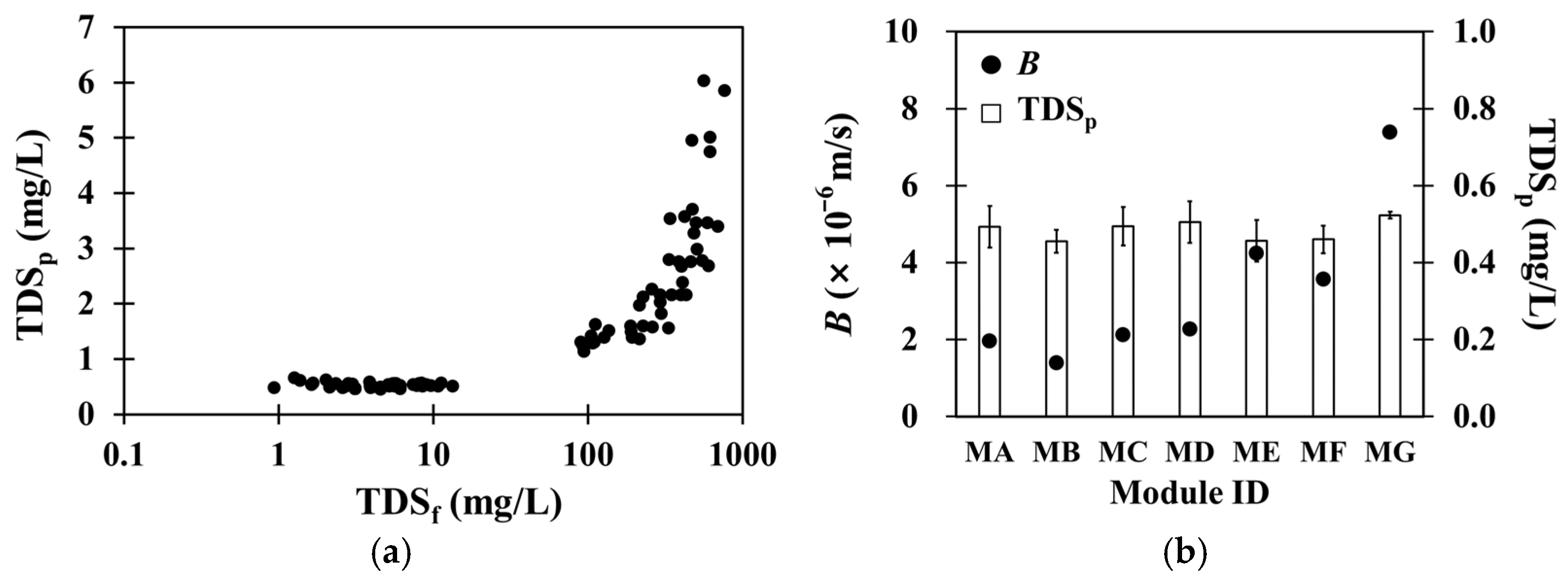
Figure 2 summarizes the salt passage performance of the tested reverse osmosis (RO) modules using total dissolved solids (TDS) as the main indicator. Figure 2a presents TDS results obtained using the membrane modules listed in Table 3 across a wide range of feed water conditions. The x-axis represents feed TDS (TDSf) and the y-axis represents permeate TDS (TDSp), incorporating data from both the first-pass RO and second-pass RO experiments. The first-pass RO tests were conducted at 25 ± 2 °C with TDSf ranging from 93 to 700 mg/L, at 25% recovery and a permeate flux of approximately 19 LMH. The second-pass tests were conducted at approximately 25 ± 1 °C with TDSf ranging from 0.9 to 13.4 mg/L, at 15% recovery and a permeate flux of approximately 23 LMH.
In the first-pass RO region (relatively high salinity), TDSp generally increased with TDSf, which is consistent with the typical ion passage trend explained by solution diffusion theory. At comparable TDSf levels, TDSp exhibited noticeable scatter, which can be reasonably attributed to the varying specifications of the membrane modules. In contrast, in the low-salinity range (TDSf ≲ 10 mg/L), TDSp converged to a narrow range of approximately 0.5–0.6 mg/L, regardless of the RO membranes tested. This low-salinity convergence was also observed in our previous module-scale study under comparable second-pass RO conditions [9].
To provide a mechanistic context for this repeatable observation, the recent literature has proposed a solution-friction framework for RO transport, in which salt transport is described by an extended Nernst–Planck equation and frictional interactions among ions, water, and the membrane matrix are explicitly considered [23]. In this regard, the convergence of TDSp to a narrow range in the low-salinity regime observed in this study can be interpreted within the solution-friction framework as a quasi-limiting behavior of the apparent solute permeability at sufficiently low feed concentrations. Within this framework, it has been suggested that, below a certain feed concentration, the apparent solute permeability may approach a quasi-limiting behavior because reduced diffusive transport and reduced ion–matrix frictions can counterbalance each other, resulting in a practical lower bound in permeate salt concentration [23].
Different from our previous study [9], the salt permeabilities of the tested RO membranes in this work are in a wider range. Figure 2b compares the solute permeability coefficient (B)—calculated from manufacturer specifications—with the measured TDSp for each module to examine whether membrane-specific salt transport properties influence TDSp under low-salinity conditions. Despite substantial variation in the calculated B-values (from 1.4 × 10⁻⁶ to 7.4 × 10⁻⁶ m/s), the measured TDSp remained within a narrow range (0.46–0.52 mg/L). This result reconfirms that once TDSf is sufficiently low, differences between individual membranes do not translate into measurable differences in TDSp in the second-pass RO. While TDS showed little sensitivity to membrane properties under these conditions, TOC may behave differently; therefore, the next section analyzes second-pass RO permeate TOC as a function of A and B value.

3.2. Organic Matter Passage Through the Second-Pass RO Membranes in a Wide Range of Water and Salt Permeabilities

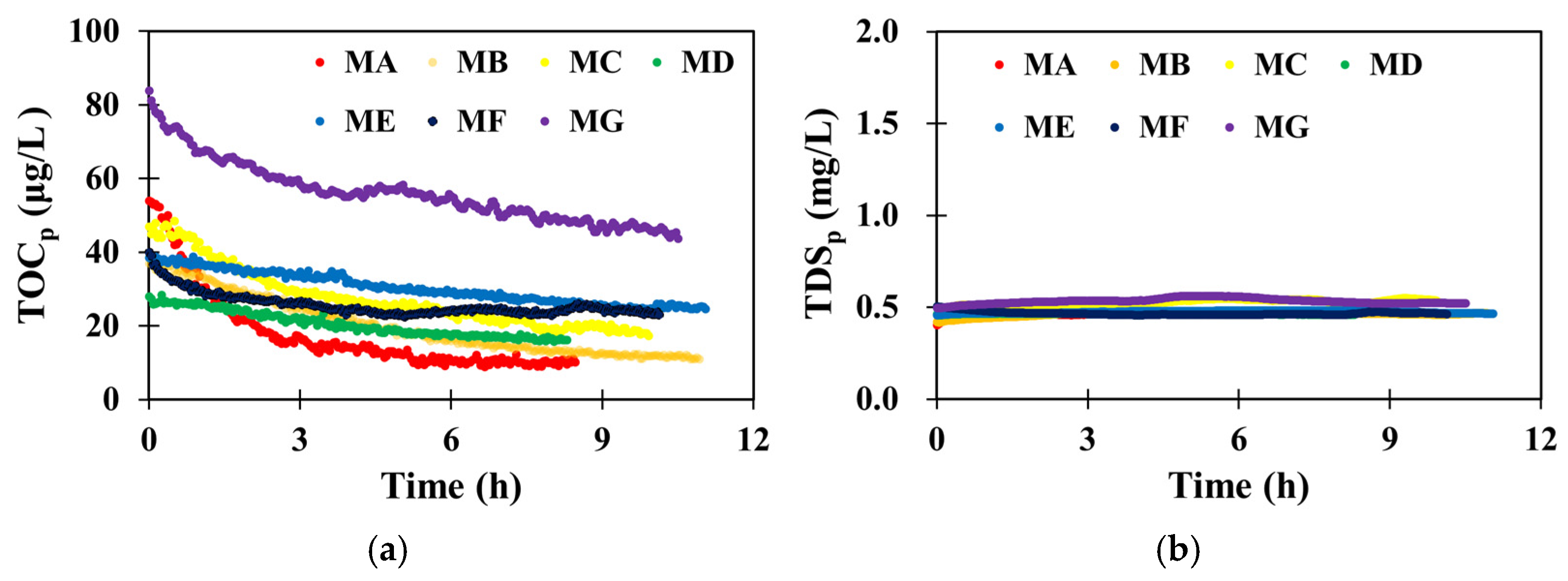
Before presenting the second-pass RO TOC results in detail, we first evaluated the time-dependent stabilization of permeate TOC to verify the measurement reliability at the low TOC levels typical of second-pass RO permeate. Figure 3 presents the online monitoring results obtained during the second-pass reverse osmosis (second-pass RO) tests conducted under low-salinity conditions. The second-pass RO feed water had feed TDS (TDSf) = 3.4–8.3 mg/L and feed TOC (TOCf) = 142–295.3 µg/L. The system was operated at 25 °C with a permeate flux of approximately 23 LMH and 15% recovery. During these measurements, the second-pass RO system was run in a total-recirculation mode, where both permeate and concentrate were returned to the second-pass feed tank so that water quality could be tracked continuously without withdrawing permeate water.
Figure 3a shows the variation in TOCp over time for the tested modules. For all membrane modules, TOCp decreased continuously until a steady-state value was reached, suggesting that the measured TOC levels were influenced by the conditioning of the system’s internal loop. This phenomenon can be attributed to the leaching of residual organics from tubing and fittings, which initially elevates permeate TOC, as well as the gradual equilibration of organic adsorption on the membrane surface. Although the second-pass RO system was constructed using chlorinated polyvinyl chloride (C-PVC) to minimize organic leaching, the results indicate that TOC stabilization still required a significant duration (at least 8 h, as described in Section 2.3.2).
The stabilized TOCp levels exhibited clear differences among the individual membranes. In general, the final TOCp increased from module MA (lowest B) to module MG (highest B). For instance, TOCp decreased to approximately 10.2 µg/L for module MA, whereas module MG, which possesses the highest B value, showed a higher stabilized TOCp of approximately 46.3 µg/L. These results indicate that under low-salinity second-pass RO conditions, permeate TOC remains sensitive to membrane-specific transport mechanisms, in contrast to the TDS results, where permeate TDS converged within a narrow range.
Figure 3b shows the corresponding TDSp measured during the same period. In contrast to TOC, TDSp remained nearly constant from the onset of the measurements.
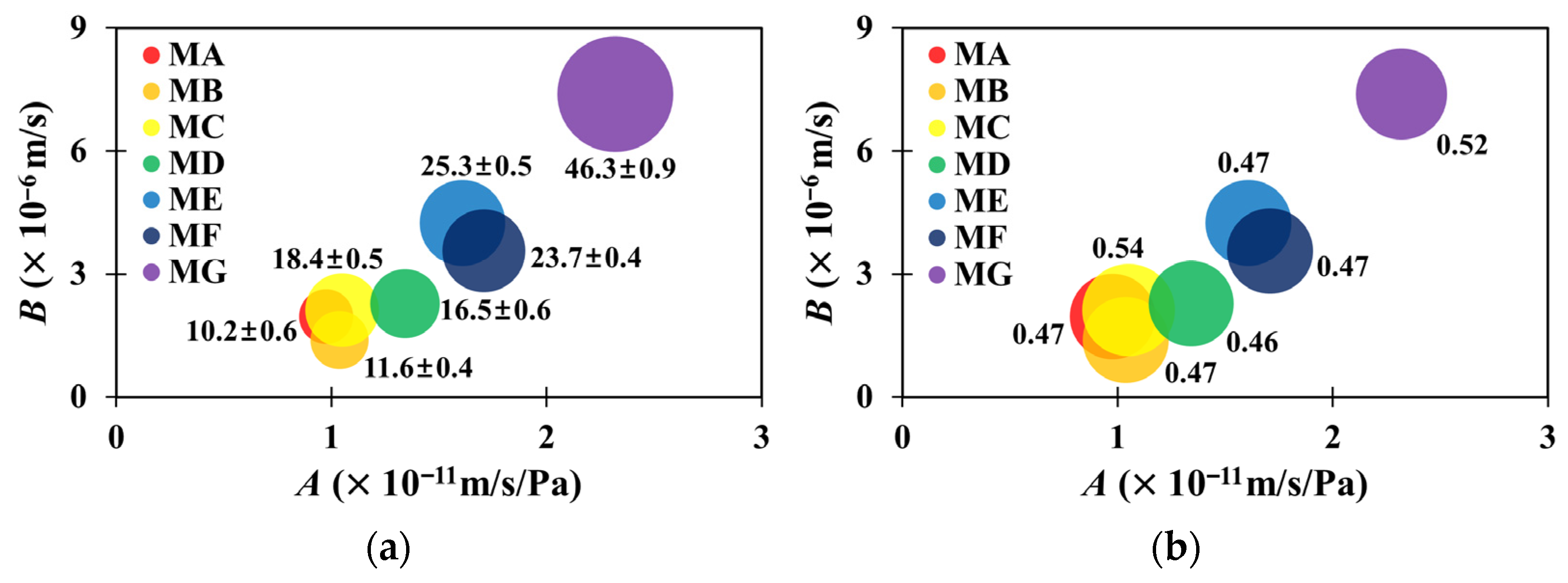
Figure 4 depicts the stabilized TOCp and TDSp concentrations obtained from the online monitoring. The permeate quality of each membrane is plotted in the AB characteristic spectrum, where the x-axis and y-axis represent the water permeability coefficient (A) and solute permeability coefficient (B), respectively. The bubble size is proportional to the magnitude of the stabilized concentration. In general, a higher A value is associated with enhanced water permeability but is often accompanied by increased salt passage (i.e., a higher B value); hence, membranes with higher A values tend to be distributed toward the upper-right region of the AB plane.
Figure 4a shows the stabilized permeate organic level, where the bubble size is proportional to TOCp. Under the second-pass RO conditions using the first-pass RO permeate as feed (i.e., with reduced TOC), TOCp showed clear differences among the individual membranes across the AB characteristic spectrum. Module MA, located in the lower-left region (low A and low B), yielded the lowest TOCp (10.2 ± 0.6 µg/L). In contrast, module MG, located in the upper-right region (high A and high B), exhibited a significantly higher TOCp (46.3 ± 0.9 µg/L), representing a four-fold increase compared to module MA. These results indicate that organic permeation is clearly differentiated by intrinsic membrane transport properties, even under low feed TOC concentrations.
Figure 4b shows the stabilized TDSp, where the bubble size is proportional to TDSp under the same conditions. In contrast to TOCp, TDSp remained within a narrow range across all tested modules. The difference between the maximum and minimum TDSp values was approximately 0.08 mg/L (0.46–0.54 mg/L), indicating that at low feed TDS, variations in A and B did not lead to a significant deviation in permeate TDS.
While previous tests were conducted at a fixed feed water quality, practical RO systems typically operate at a high recovery rate, leading to increased feed concentrations. To investigate the effect of elevated feed concentrations on both first-pass and second-pass RO performance, additional experiments were performed in concentration mode. During these tests, the permeate was continuously withdrawn while the concentrate was recirculated to the feed tank. This setup allowed for a progressive increase in feed TOC, enabling the assessment of permeate TOC variation under highly concentrated conditions.

3.3. Evaluating 2-Pass Membrane Configurations for Balancing RO Feed Pressure and TOC Control Under High-Recovery Rate Conditions

Figure 5 shows the results of the first-pass RO concentration experiments, where the impact of progressive feed concentration on permeate quality was investigated. Based on the intrinsic transport characteristics previously discussed, two representative modules were selected: module MA (characterized by low A and low B; high-selectivity type) and module MG (high A and high B; high-permeability type). The experiments were conducted under the conditions specified in Table 2. The system was operated at an instantaneous recovery of 25% while the feed volume was reduced from 500 L to 100 L, achieving a cumulative recovery of 80%.
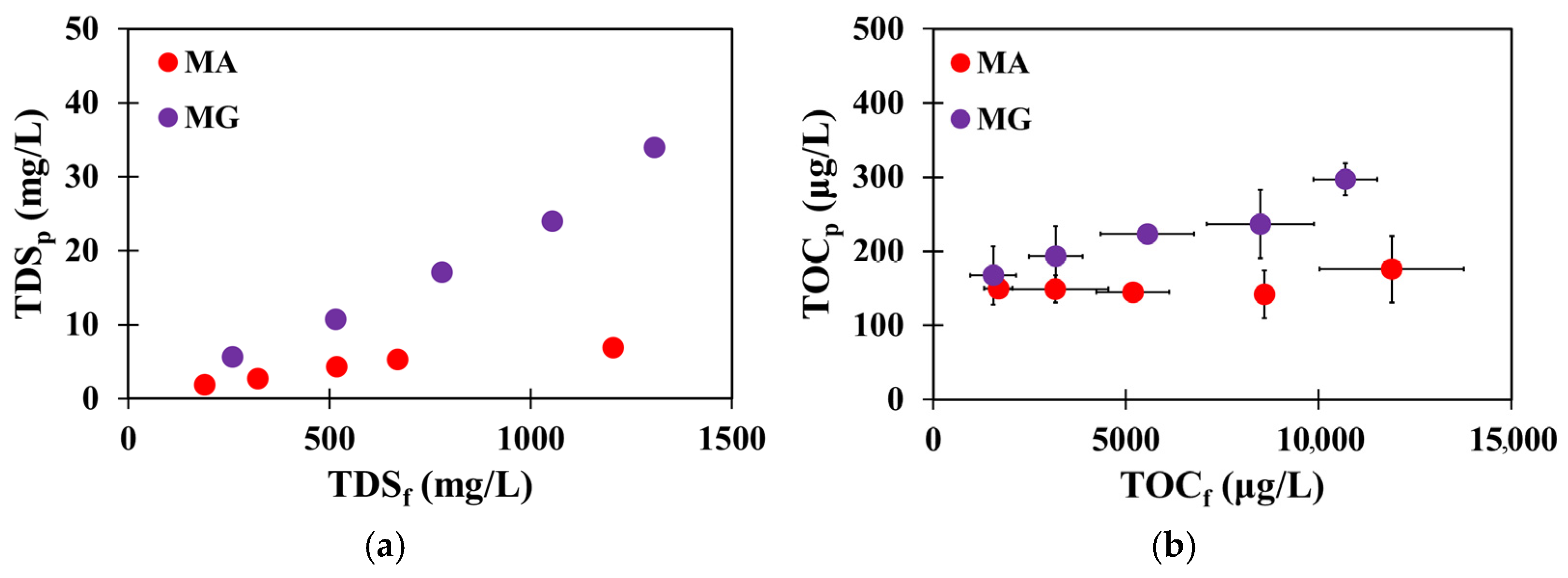
Figure 5a shows the variation in TDSp as a function of TDSf during the first-pass RO concentration process. Error bars are not shown in Figure 5a because the standard deviation of TDS across replicates was small (within 5%), making the error bars smaller than the symbol size. The TDSf increased from 190 mg/L to 1300 mg/L as concentration progressed. Consistent with standard RO behavior, TDSp exhibited an upward trend with increasing TDSf for both modules; however, a distinct performance gap was observed. Module MA maintained a low TDSp, reaching 7 mg/L even at a five-fold concentration factor (CF). In contrast, for module MG, TDSp exceeded 10 mg/L when TDSf reached 500 mg/L. At the final TDSf of 1300 mg/L, the TDSp of module MG was four times higher than that of module MA, indicating that membrane selection significantly influences permeate TDS concentration under concentrated first-pass RO conditions.
Figure 5b presents the corresponding TOC results (TOCp vs. TOCf) recorded during the same period. TOCf increased from 1630 µg/L to 12,000 µg/L for module MA and 10,700 µg/L for module MG. Given that TOC was measured via the high-temperature combustion method (Section 2.3), which may involve measurement uncertainty, error bars are provided for both TOCf and TOCp.
Overall, TOCp exhibited a weaker dependence on TOCf compared to the TDS results, with the magnitude of the TOCp increase being significantly smaller than the feed CF. Notably, for both modules, the permeate TOC increased only modestly relative to the elevation in feed TOC. Furthermore, although module MG yielded higher TOCp than module MA, the difference remained relatively limited; TOCp for module MG was approximately two-fold higher than that of module MA, despite the substantial increase in TOCf. For module MA, TOCp increased from 150 to 180 µg/L, while for module MG, it increased from 170 to 300 µg/L.
If energy consumption were not a constraint, selecting modules with the lowest A and B values (high-selectivity type) would be the most straightforward approach to ensuring superior water quality. However, as RO is one of the most energy-intensive stages in UPW production, membrane selection must account for the well-known trade-off between permeability and selectivity. Consequently, we investigated a combination of high-permeability (MG) and high-selectivity (MA) modules within the two-pass RO system.
The feasibility of this approach is supported by the module-level results. Under the second-pass RO conditions shown in Figure 4a (feed TOC ≈ 190 ± 74 µg/L), module MG yielded a TOCp of 46.3 µg/L. Although module MG exhibited higher TOCp than module MA, the first-pass RO concentration results in Figure 5b indicate that the TOCp of module MG increased only moderately relative to the elevation in feed TOC. These observations suggest that employing module MG in the first-pass RO may offer significant feed pressure reduction without disproportionate deterioration in TOC removal performance.
To evaluate whether this module combination can balance operating pressure and organic removal, three different arrangements were investigated in the two-pass RO system: (i) MA–MA (high-selectivity in both passes), (ii) MG–MG (high-permeability in both passes), and (iii) MG–MA (MG in the first pass and MA in the second pass). The MG module was placed in the first-pass RO for the following two reasons: first, utilizing a high-selectivity module in the second pass is expected to sufficiently control organic species that bypass the first-pass RO; and second, the feed pressure can be minimized by exploiting the higher permeability of MG in the initial stage.
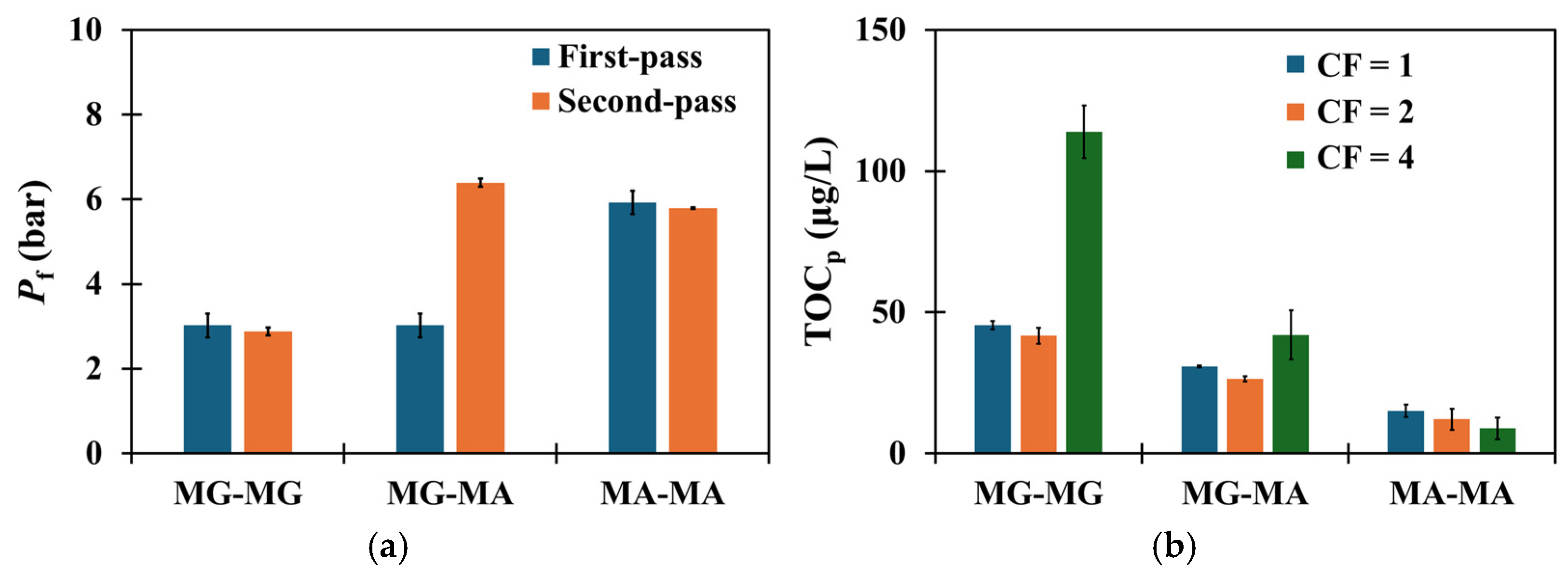
Figure 6a compares the feed pressure required for each configuration under the conditions specified in Table 2. As summarized in Table 4, the A value of module MG (2.32 × 10⁻¹¹ m/s/Pa) is more than two-fold higher than that of module MA (0.98 × 10⁻¹¹ m/s/Pa). Consistent with this intrinsic permeability difference, the required feed pressure in Figure 6a exhibited an approximately two-fold difference between the MG-based (3.02 ± 0.28 bar) and MA-based (5.93 ± 0.27 bar) configurations, demonstrating that module selection can substantially influence pressure demand even under the same operating targets. This pressure advantage, however, should be interpreted together with organic performance during high-recovery operation, because TOCp may increase as feed TOC rises. In addition, system-level energy consumption depends on the overall staged configuration (e.g., module arrangement, staging, and the number of elements), and thus additional study is required for a rigorous energy assessment.
Figure 6b presents the second-pass RO concentration results focusing on TOC for the different membrane arrangements (MG–MG, MG–MA, and MA–MA). In this study, 400 L of first-pass RO permeate produced by each arrangement was used as the second-pass RO feed and concentrated to 200 L and 100 L, corresponding to concentration factors (CF) of 2 and 4, respectively. As summarized in Table 2, all concentration tests were conducted at approximately 25 °C with a permeate flux of 23 LMH and an instantaneous recovery of 15%.
The initial second-pass RO feed TOC varied depending on the arrangement, as different membranes were employed in the first-pass RO. Specifically, the first-pass RO permeate TOC produced by module MG was approximately 250 ± 60 µg/L, whereas that of module MA was approximately 150 ± 30 µg/L. Consistent with the high selectivity of module MA, the MA–MA arrangement maintained excellent permeate quality even at CF = 4, yielding a TOCp of approximately 9 µg/L. At the initial stage, arrangements utilizing module MG in the first-pass RO (MG–MG and MG–MA) exhibited higher TOCp than the MA-based case, indicating that the selection of the first-pass RO membrane directly impacts the TOC load to the downstream stage.
As the second-pass RO concentrated, the TOC increased substantially, reaching approximately 580 ± 70 µg/L at CF = 4. Under this concentrated condition, the MG–MG arrangement produced a TOCp of approximately 114 µg/L. This suggests that operating a system composed entirely of high-permeability membranes at high cumulative recovery may increase organic matter passage and potentially compromise process stability. In contrast, the MG–MA combination reduced TOCp to approximately 42 µg/L at a comparable concentration level. This demonstrates that a high-selectivity membrane in the second-pass RO can significantly mitigate TOC passage while maintaining the hydraulic pressure advantage of the upstream high-permeability membrane.
Overall, these results indicate that the two-pass RO design must explicitly consider the trade-off between hydraulic pressure demand and stable permeate TOC control. Specifically, combining a high-permeability module in the first-pass RO with a high-selectivity module in the second-pass RO provides a practical balance between pressure reduction and organic risk management under concentrated operation.
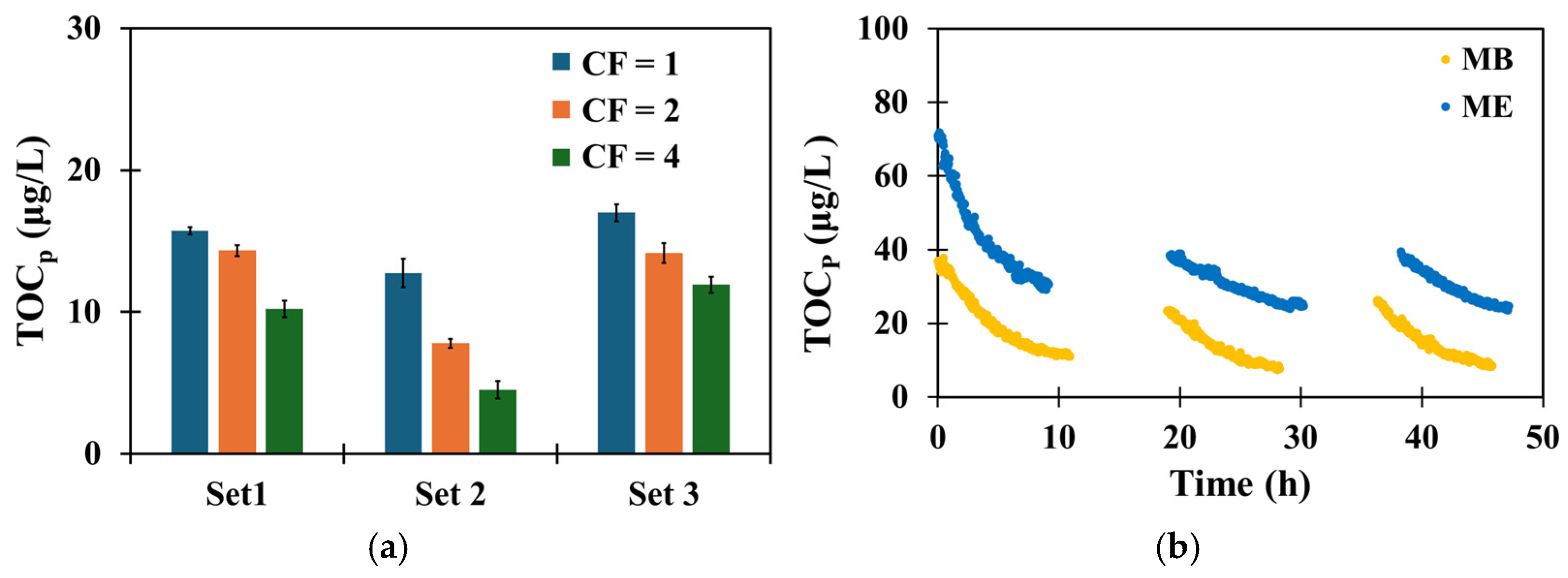
Notably, in some cases (especially MA–MA), TOCp decreased as the CF increased, which is counterintuitive if concentration alone governs organic matter passage (Figure 6b). This behavior was not an isolated observation; the same qualitative trend was consistently observed when the MA–MA arrangement was tested in triplicate (Figure 7a).
To determine whether the apparent TOCp decrease observed during the volume reduction sequence was influenced by the initial stabilization rather than by improved organic rejection at higher feed TOC levels, an additional test was conducted (Figure 7b). The system was operated in total recirculation mode without applying a concentration step, while keeping the operating conditions unchanged. Total recirculation was repeated three times; each run was operated for approximately 10 h, followed by an 8 h shutdown, and then restarted under the same conditions.
As shown in Figure 7b, although the first run reached the stabilization criterion, its end-of-run TOCp remained higher than those of the second and third runs, whereas the latter two runs converged to consistent end values. For example, for module ME, the end-of-run TOCp decreased from 31 µg/L in the first operation to 25 and 24 µg/L in the second and third operations. For module MB, it decreased from 11 µg/L to 8 and 9 µg/L, respectively. These results indicate that organic stabilization can extend beyond a single run and that shutdown/restart events partially reset the stabilized state.
Interestingly, the decrease in TOCp with increasing CF was not an isolated observation; the same consistent behavior was reproduced in the replicate tests (Figure 7a), indicating that the trend is repeatable under the present setup. The response varied by arrangement in Figure 6b. For the MG–MG and MG–MA arrangements, TOCp decreased from the initial condition to a two-fold CF, showing a trend similar to that of the MA–MA arrangement. However, at a four-fold CF, TOCp increased significantly (e.g., 500 µg/L), particularly for MG–MG.
This change in the TOCp trend suggests the existence of a breakthrough TOC level. Once the second-pass RO feed reaches this critical threshold, the organic load exceeds the rejection capacity of the membrane, causing organic matter passage to increase sharply—especially for high-permeability arrangements. In contrast, under lower concentration (e.g., up to CF = 2), the feed TOC remains below this breakthrough point, and the observed decrease may still be influenced by the initial stabilization.
Accordingly, a plausible interpretation is that using a membrane with lower A and B values in the second-pass RO can extend the breakthrough threshold to a higher concentration range. Nevertheless, even high-selectivity membranes may face limitations beyond a point where TOC leakage becomes excessive. Therefore, identifying an operating range and membrane combination that achieves pressure reduction while staying below the breakthrough TOC level is critical for stable UPW-RO operation.

4. Conclusions

This study investigated how membrane transport characteristics and the stabilization period influence permeate quality in a two-pass RO system for UPW production. The findings demonstrate a fundamental difference between salt and organic matter passage behaviors in the second-pass RO stage.
First, in the first-pass RO, permeate TDS increased with higher feed salinity and showed clear differences depending on membrane type. In contrast, in the low-salinity range relevant to second-pass RO operation (TDSf ≤ 10 mg/L), TDSp converged to a narrow range regardless of the RO membranes tested, even though the evaluated modules spanned a wide range of B values. This result confirms that membrane-to-membrane differences did not translate into measurable differences in TDSp under second-pass low-salinity conditions.
Second, unlike TDS, TOC behavior showed two distinct features. First, TOC stabilization required a substantially longer period than the TDS stabilization, which is consistent with the time-dependent conditioning effects discussed in Section 3.2 (e.g., depletion of leachables and/or adsorption–desorption interactions on wetted surfaces and the membrane). This indicates that prolonged stabilization is necessary to obtain representative TOC performance and also implies that process interruptions can trigger transient permeate organic-quality deterioration; therefore, avoiding frequent shutdown/restart events is important for stable UPW-RO operation. Second, even after extended stabilization (≥8 h) using the same feedwater source, permeate TOC (TOCp) still exhibited clear differences among membrane modules governed by membrane intrinsic properties (A and B values), confirming that organic matter passage remains membrane-dependent under second-pass low-salinity conditions.
Third, tests conducted under concentrated conditions revealed that the membrane staged configuration is critical for balancing energy efficiency and TOC control. While selecting membranes with low A and B values is essential if the sole objective is achieving the highest water quality, such a choice may increase feed pressure. Our results showed that the arrangement using only high-permeability modules (MG–MG) suffered from a sharp increase in TOCp at higher concentration levels, suggesting a breakthrough TOC level. This indicates that, beyond a certain feed TOC (or concentration) range, organic matter passage can increase disproportionately, and the breakthrough TOC level should be considered as a practical design constraint for membrane selection and configuration. Accordingly, staged module configurations should be evaluated not only by average TOC performance but also by whether they remain below the breakthrough TOC level under high-recovery operation. The MG–MA staged configuration, placing a high-permeability module in the first pass and a high-selectivity module in the second pass, demonstrated a clear reduction in required feed pressure while limiting TOC leakage compared with the MG–MG configuration. Nevertheless, a rigorous evaluation of overall energy consumption requires a full RO configuration design (e.g., module arrangement, staging, and the number of elements), and thus additional study is needed.
Overall, these results synthesize into a practical design implication for UPW-RO: under second-pass low-salinity conditions, TOCp tends to converge across modules, confirming that membrane-to-membrane differences do not translate into measurable differences in TOCp in this regime. In contrast, TOC passage remains membrane-dependent and can exhibit threshold-like breakthrough behavior. This distinction highlights that UPW-RO design and operation should treat salt and organic matter control differently, prioritizing membrane selection and configuration based on TOC robustness under varying operating conditions. In addition, because TOC stabilization requires a longer and more sensitive conditioning period than TDS stabilization, stable UPW-RO operation should avoid unnecessary shutdown/restart events to prevent transient deterioration in organic quality. By clarifying the contrasting passage regimes and the roles of stabilization and breakthrough, this study provides an experimental basis for more reliable membrane selection and configuration strategies in semiconductor UPW-RO applications.

Author Contributions

Conceptualization, C.O. and S.K.; methodology, C.O. and D.K.; validation, C.O. and D.K.; formal analysis, C.O. and D.K.; investigation, C.O. and D.K.; data curation, C.O.; writing—original draft preparation, C.O.; writing—review and editing, C.O. and S.K.; visualization, C.O. and D.K.; supervision, S.K. All authors have read and agreed to the published version of the manuscript.

Funding

This research was supported by Basic Science Research Program through the National Research Foundation of Korea (NRF) funded by the Ministry of Education (RS-2025-25397043), and this work was also supported by Korea Environment Industry & Technology Institute (KEITI) through Development of Ultra Pure Water Production Process Technology for Localization Program (or Project), funded by Korea Ministry of Environment (MOE) (2021003210007).

Data Availability Statement

The original contributions presented in this study are included in the article. Further inquiries can be directed to the corresponding author.

Conflicts of Interest

The authors declare no conflicts of interest.

Abbreviations

The following abbreviations are used in this manuscript:
UPWUltrapure water
ROReverse osmosis
CEDIContinuous electrodeionization
TOCTotal organic carbon
TDSTotal dissolved solids
GACGranular activated carbon
VFDVariable frequency drive
C-PVCChlorinated polyvinyl chloride
BWROBrackish water reverse osmosis
CFConcentration factor
NDIRNon-Dispersive Infrared
ASTMAmerican society for testing and materials International
A valueWater permeability coefficient
B valueSalt permeability coefficient
CPConcentration polarization
QfFeed flow rate
QpPermeate flow rate
QcConcentration flow rate
CfSolute concentration of feed
CpSolute concentration of permeate
CcSolute concentration of concentration
SMembrane area
JwPermeate flux
RsSalt rejection
CfbAverage bulk concentration
YRecovery
IReference electrolyte
ΔπOsmosis pressure
KAbsolute temperature
ΔPmembrane pressure
JsSolute flux
Cmmembrane surface concentration
βCP factor
TDSfFeed total dissolved solids
TDSpPermeate total dissolved solids
TOCfFeed total organic carbon
TOCpPermeate total organic carbon

References

  1. Shim, J.; Lee, S.; Park, S.; Moon, J.; Lee, C.; Cho, K.H. Optimizing membrane cleaning strategy of industrial reverse osmosis process using long sequence time-series forecasting. Desalination 2025, 614, 119193. [Google Scholar] [CrossRef]
  2. Wang, Q.; Luo, L.; Huang, N.; Wang, W.; Rong, Y.; Wang, Z.; Yuan, Y.; Xu, A.; Xiong, J.; Wu, Q.; et al. Evolution of low molecular weight organic compounds during ultrapure water production process: A pilot-scale study. Sci. Total Environ. 2022, 830, 154713. [Google Scholar] [CrossRef] [PubMed]
  3. Zhang, X.; Yang, Y.; Ngo, H.H.; Guo, W.; Wen, H.; Wang, X.; Zhang, J.; Long, T. A critical review on challenges and trend of ultrapure water production process. Sci. Total Environ. 2021, 785, 147254. [Google Scholar] [CrossRef] [PubMed]
  4. Lee, J.; Kim, D.; Kim, S.; Im, S.; Lee, C.-K.; Park, K.-D.; Kim, M.; Chon, K.; Woo, Y.C.; Rho, H. Comprehensive evaluation of a pilot-scale semiconductor wastewater reuse process using ultrafiltration and two-stage reverse osmosis for securing intake water resource in ultrapure water production. Desalination 2025, 613, 119115. [Google Scholar] [CrossRef]
  5. Lee, H.; Jin, Y.; Hong, S. Recent transitions in ultrapure water (UPW) technology: Rising role of reverse osmosis (RO). Desalination 2016, 399, 185–197. [Google Scholar] [CrossRef]
  6. Jin, Y.; Lee, H.; Zhan, M.; Hong, S. UV radiation pretreatment for reverse osmosis (RO) process in ultrapure water (UPW) production. Desalination 2018, 439, 138–146. [Google Scholar] [CrossRef]
  7. Rho, H.; Chon, K.; Cho, J. An autopsy study of a fouled reverse osmosis membrane used for ultrapure water production. Water 2019, 11, 1116. [Google Scholar] [CrossRef]
  8. Wu, Y.-P.; Wu, Q.-Y.; Zhou, M.-Q.; Chen, Y.-L.; Lee, M.-Y.; Wang, W.-L. Insight into the transport mechanism of low-molecular-weight charge-neutral organics in reverse osmosis: The critical role of molecular polarity. Environ. Sci. Technol. 2026, 60, 1517–1526. [Google Scholar] [CrossRef]
  9. Kim, D.; Lee, H.; Jeon, J.; Kim, S. High recovery design of reverse osmosis process with high permeate water quality and low wastewater discharge for ultra-pure water production. Desalination 2024, 592, 118149. [Google Scholar] [CrossRef]
  10. Zhao, P.; Bai, Y.; Liu, B.; Chang, H.; Cao, Y.; Fang, J. Process optimization for producing ultrapure water with high resistivity and low total organic carbon. Process Saf. Environ. Prot. 2019, 126, 232–241. [Google Scholar] [CrossRef]
  11. Park, D.; Yeo, I.-H.; Lee, J.; Kim, H.; Choi, S.; Kang, S. Combined impacts of aluminum and silica ions on RO membrane fouling in full-scale ultrapure water production facilities. Desalination 2024, 577, 117380. [Google Scholar] [CrossRef]
  12. Muhyuddin, M.; Santoro, C.; Osmieri, L.; Ficca, V.C.A.; Friedman, A.; Yassin, K.; Pagot, G.; Negro, E.; Konovalova, A.; Lindquist, G.; et al. Anion-exchange-membrane electrolysis with alkali-free water feed. Chem. Rev. 2025, 125, 6906–6976. [Google Scholar] [CrossRef] [PubMed]
  13. Chekli, L.; Phuntsho, S.; Kim, J.E.; Kim, J.; Choi, J.Y.; Choi, J.-S.; Kim, S.; Kim, J.H.; Hong, S.; Sohn, J.; et al. A comprehensive review of hybrid forward osmosis systems: Performance, applications and future prospects. J. Membr. Sci. 2016, 497, 430–449. [Google Scholar] [CrossRef]
  14. Phuntsho, S.; Shon, H.K.; Hong, S.; Lee, S.; Vigneswaran, S. A novel low energy fertilizer driven forward osmosis desalination for direct fertigation: Evaluating the performance of fertilizer draw solutions. J. Membr. Sci. 2011, 375, 172–181. [Google Scholar] [CrossRef]
  15. Zhao, S.; Liao, Z.; Fane, A.; Li, J.; Tang, C.; Zheng, C.; Lin, J.; Kong, L. Engineering antifouling reverse osmosis membranes: A review. Desalination 2021, 499, 114857. [Google Scholar] [CrossRef]
  16. Kang, Y.; Kwon, J.; Kim, J.; Hong, S. Fate of low molecular weight organic matters in reverse osmosis and vacuum ultraviolet process for high-quality ultrapure water production in the semiconductor industry. J. Clean. Prod. 2023, 423, 138714. [Google Scholar] [CrossRef]
  17. Shrestha, J.; Li, J. Influence of permeate from domestic reverse osmosis filters on lead pipes corrosion and plastic pipes leaching. J. Water Process Eng. 2017, 18, 126–133. [Google Scholar] [CrossRef]
  18. Kim, J.; Hong, S. A novel single-pass reverse osmosis configuration for high-purity water production and low energy consumption in seawater desalination. Desalination 2018, 429, 142–154. [Google Scholar] [CrossRef]
  19. Busan Metropolitan City Waterworks. Water Quality Report Archive. Available online: https://www.busan.go.kr/water/qreport (accessed on 14 February 2026).
  20. Armendáriz-Ontiveros, M.M.; Dévora-Isiordia, G.E.; Rodríguez-López, J.; Sánchez-Duarte, R.G.; Álvarez-Sánchez, J.; Villegas-Peralta, Y.; Martínez-Macias, M.d.R. Effect of Temperature on Energy Consumption and Polarization in Reverse Osmosis Desalination Using a Spray-Cooled Photovoltaic System. Energies 2022, 15, 7787. [Google Scholar] [CrossRef]
  21. ASTM D4516-00(2010); Standard Practice for Standardizing Reverse Osmosis Performance Data. ASTM International: West Conshohocken, PA, USA, 2010. [CrossRef]
  22. Jeon, J.; Kim, D.; Kim, N.; Kim, S. Applicability and limitation of the industrial reverse osmosis system simulators. Desalination 2023, 549, 116358. [Google Scholar] [CrossRef]
  23. Wang, L.; Cao, T.; Dykstra, J.E.; Porada, S.; Biesheuvel, P.M.; Elimelech, M. Salt and Water Transport in Reverse Osmosis Membranes: Beyond the Solution-Diffusion Model. Environ. Sci. Technol. 2021, 55, 16665–16675. [Google Scholar] [CrossRef] [PubMed]
Figure 1. Schematic diagram of the 4-inch module scale 2-pass RO system used for the first-pass RO and second-pass RO experiments.
Separations 13 00093 g001
Figure 2. Permeate TDS concentrations of the tested RO membranes: (a) permeate TDS as a function of feed TDS under first-pass RO and second-pass RO operation conditions; (b) the second-pass RO permeate TDS as a function of B value under low-salinity conditions (<15 mg/L as TDS).
Separations 13 00093 g002
Figure 3. Online time-series monitoring of permeate water quality ((a) TOCp and (b) TDSp) during second-pass RO operation with concentrate and permeate recirculation.
Separations 13 00093 g003
Figure 4. The second-pass RO permeate water quality ((a) TOCp and (b) TDSp) of tested RO membranes as a function of A and B values.
Separations 13 00093 g004
Figure 5. Comparison of the first-pass RO permeate quality between a high-rejection membrane (MA) and a high-permeability membrane (MG) as a function of feed concentration: (a) permeate TDS and (b) permeate TOC.
Separations 13 00093 g005
Figure 6. Comparison of operating pressure and TOC removal performance: (a) required feed pressure for a 2-pass configuration; (b) the second-pass RO permeate TOC as a function of the concentration factor (CF).
Separations 13 00093 g006
Figure 7. TOC behavior in the second-pass RO system: (a) permeate TOC during the second-pass concentration mode for different module combinations; (b) TOC stabilization behavior during the start-up period based on repeated experiments.
Separations 13 00093 g007
Table 1. Water quality of the first RO feed.
ParameterConcentration (mg/L)
Na+18.0 ± 9.3
Ca2+23.1 ± 6.0
Mg2+4.6 ± 1.2
K+4.3 ± 1.0
Cl28.8 ± 8.0
SO42−35.0 ± 7.1
TDS172.0 ± 52.0
TOC1.293 ± 0.246
Table 2. Operating conditions of the 2-pass RO system.
Permeate Flux
(Lm−2h−1 (LMH))
Temperature
(°C)
Module Recovery
(%)
First-pass RO1925 ± 225
Second-pass RO2325 ± 115
Table 3. Specification of brackish water reverse osmosis (BWRO) membrane modules.
ManufacturerModuleArea
(m2)
Salt Rejection
(%)
Permeate Flow
Rate (m3d−1)
Module
ID
Toray Advanced
Materials Korea Inc.
(Seoul, Republic of Korea)
RE4040-BE7.999.7 a9.1 aMA
Toray Membrane
(Poway, CA, USA)
TM710D8.099.8 b9.8 bMB
DuPontTM
(Wilmington, DE, USA)
BW30 PRO40407.999.7 c9.8 cMC
Toray Advanced
Materials Korea Inc.
(Seoul, Republic of Korea)
RE4040-BLR7.999.6 d7.9 dMD
Toray Advanced
Materials Korea Inc.
(Seoul, Republic of Korea)
RE4040-BLN7.999.4 e7.9 eME
Toray Membrane
(Poway, CA, USA)
TMG10D8.099.7 f10.0 fMF
LG Chem
(Seoul, Republic of Korea)
BW4040-UES7.999.0 g10.2 gMG
a 2000 mg/L NaCl solution at 15.5 bar applied pressure; 15% recovery; 25 °C; pH 6.5–7.0. b 2000 mg/L NaCl solution at 15.5 bar applied pressure; 15% recovery; 25 °C; pH 7. c 2000 mg/L NaCl solution at 15.5 bar applied pressure; 15% recovery; 25 °C; pH 8. d 1500 mg/L NaCl solution at 10.3 bar applied pressure; 15% recovery; 25 °C; pH 6.5–7.0. e 1500 mg/L NaCl solution at 10.3 bar applied pressure; 15% recovery; 25 °C; pH 6.5–7.0. f 2000 mg/L NaCl solution at 10.3 bar applied pressure; 15% recovery; 25 °C; pH 7. g 500 mg/L NaCl solution at 6.9 bar applied pressure; 15% recovery; 25 °C; pH 7.
Table 4. RO membrane water and solute permeability coefficients (A, B value).
Module IDA (×10−11 m/s/Pa)B (×10−6 m/s)
MA0.981.97
MB1.041.39
MC1.052.12
MD1.342.28
ME1.614.25
MF1.713.56
MG2.327.39
Disclaimer/Publisher’s Note: The statements, opinions and data contained in all publications are solely those of the individual author(s) and contributor(s) and not of MDPI and/or the editor(s). MDPI and/or the editor(s) disclaim responsibility for any injury to people or property resulting from any ideas, methods, instructions or products referred to in the content.