
Article

Effects of Metal Ions on the Flotation of Fluorite and Barite: An Experimental and Mechanistic Investigation

1
Guangxi Key Laboratory of Processing for Non-Ferrous Metals and Featured Materials, School of Resources, Environment and Materials, Guangxi University, Nanning 530004, China
2
Guangxi Higher School Key Laboratory of Minerals Engineering, Guangxi University, Nanning 530004, China
*
Authors to whom correspondence should be addressed.
Separations 2026, 13(3), 85; https://doi.org/10.3390/separations13030085
Submission received: 29 January 2026 / Revised: 22 February 2026 / Accepted: 27 February 2026 / Published: 3 March 2026

Abstract

Fluorite (CaF2) and barite (BaSO4) commonly occur together in the same deposits. Due to their similar surface chemical properties, their flotation separation is often challenging. In flotation pulps, dissolved metal ions can further interfere with separation and exert a pronounced influence on the flotation behavior of these minerals. This study investigated the effects of metal ions frequently encountered in industrial pulps (Fe3+, Al3+, Mg2+, Ca2+, and Zn2+) on the floatability of fluorite and barite in a sodium oleate (NaOL) collector system. The aims were to clarify how metal ions affect flotation behavior and to evaluate the feasibility of enhancing fluorite–barite separation via metal-ion regulation. Flotation results showed that, in the NaOL system, the largest floatability difference between fluorite and barite occurred at pH 10. Al3+ exhibited the strongest depression on barite while only weakly affecting fluorite flotation. Fe3+ and Mg2+ caused slight depression of barite, whereas Ca2+ and high concentrations of Zn2+ (>20 mg/L) promoted barite flotation. Overall, these metal ions had little influence on fluorite flotation. Adsorption measurements indicated that Al3+ reduced NaOL adsorption by more than 40% and decreased the contact angle from 35.6° to 23.1°, resulting in a sharp loss of surface hydrophobicity. ICP adsorption tests revealed that Al3+ showed the highest uptake on barite surfaces. Density functional theory (DFT) calculations further confirmed that surface SO42− groups on barite form strong chemisorption with hydrolyzed Al species (adsorption energy: −436.19 kJ/mol), whereas only weak physisorption occurs on hydroxylated fluorite surfaces (adsorption energy: −43.73 kJ/mol). This study provides insights into the flotation separation of non-metallic minerals dominated by polar ionic bonding and offers practical guidance for efficient fluorite–barite separation under complex ionic environments.

1. Introduction

Fluorite (CaF2) and barite (BaSO4) are typical calcium- and barium-bearing polar non-metallic minerals of major industrial significance and are widely used in metallurgy, the chemical industry, and construction materials [1,2,3]. Fluorite is an important source of fluorine for modern fluorochemical production, whereas barite, owing to its high density and chemical inertness, is extensively employed as a weighting agent in drilling fluids and as a feedstock for the manufacture of barium salts [4,5]. Fluorite and barite often occur as associated minerals in the same deposit and exhibit similar crystal structures and surface chemical properties. Consequently, their flotation separation remains a major challenge in the field of non-metallic mineral processing [6,7,8].
Flotation is one of the main techniques for achieving effective separation of fluorite and barite [9,10,11]. Among the available collectors, sodium oleate (NaOL), a classic fatty-acid collector, has been widely used in the flotation of non-metallic minerals owing to its low cost, broad availability, strong collecting ability, and favorable low-temperature performance [12,13,14]. However, industrial flotation pulps commonly contain various dissolved metal ions (e.g., Ca2+, Mg2+, Fe3+, and Al3+). In flotation systems, the property of mineral surfaces and solution chemistry can be modified by these ions via physical adsorption, chemical adsorption, formation of hydroxo-complexes, or precipitation [15,16]. This phenomenon significantly interferes with the collection performance of NaOL and the differences in mineral floatability, thereby affecting the sorting efficiency [17,18]. In fact, differences in ion type, valence, and concentration can alter the electrical double layer at the mineral–collector interface through competitive adsorption, or modify surface active sites via coordination interactions, leading to pronounced divergence in mineral floatability [19,20]. For example, high-valence metal ions (e.g., Fe3+ and Al3+) may preferentially form stable complexes with oleate, weakening its adsorption onto target mineral surfaces [21,22]. In contrast, alkaline-earth metal ions (e.g., Ca2+, Mg2+, and Zn2+) may participate in electrostatic interactions or specific adsorption, driving surface reconstruction and shifting the hydrophobicity threshold of minerals [23].
Previous studies have reported the effects of individual metal ions on the flotation of either fluorite or barite. By employing sodium silicate modified with Al3+, Zhu et al. [24] studied its effect on the flotation separation of fluorite from dolomite, and demonstrated that the selective action of the resulting metal-ligand complexes effectively enhanced the separation performance. Mohanty et al. [25] provided an in-depth analysis of how trivalent and divalent metal ions influence the flotation behavior of bastnaesite and monazite. Zhang et al. [26] investigated the effect of Fe3+ on barite flotation and found that Fe3+ significantly depresses barite floatability. Nevertheless, a systematic comparison of the effects of representative metal ions (e.g., alkaline-earth and transition-metal ions) on the floatability difference between fluorite and barite is still lacking, and mechanistic understanding remains insufficient.
In this study, NaOL was employed as the collector to systematically investigate the effects of five representative metal ions (Fe3+, Al3+, Mg2+, Ca2+, and Zn2+) at different concentrations on the single-mineral floatability of fluorite and barite. Contact-angle measurements, UV–Vis spectrophotometry, inductively coupled plasma optical emission spectrometry (ICP-OES), and density functional theory (DFT) calculations were combined to elucidate the intrinsic mechanisms by which metal ions regulate the floatability contrast between the two minerals, from the perspectives of collector adsorption behavior and interfacial molecular interactions. The findings not only deepen the understanding of mineral flotation behavior in fatty-acid systems under ionic environments, but also provide a theoretical basis and technical guidance for efficient fluorite–barite separation, offering valuable insights for the flotation separation of other polar non-metallic minerals.

2. Materials and Methods

2.1. Materials and Reagents

Pure fluorite and barite model minerals were collected from Erenhot, Inner Mongolia (fluorite), and Yunnan Province (barite), China. The fluorite sample is of low-temperature hydrothermal origin, whereas the barite sample is of hydrothermal origin. The run-of-mine ores were first crushed using a jaw crusher and then ground with a disc mill, followed by screening to obtain a −0.074 mm fraction. The prepared samples were sealed in zip-lock bags and stored for subsequent single-mineral flotation tests.
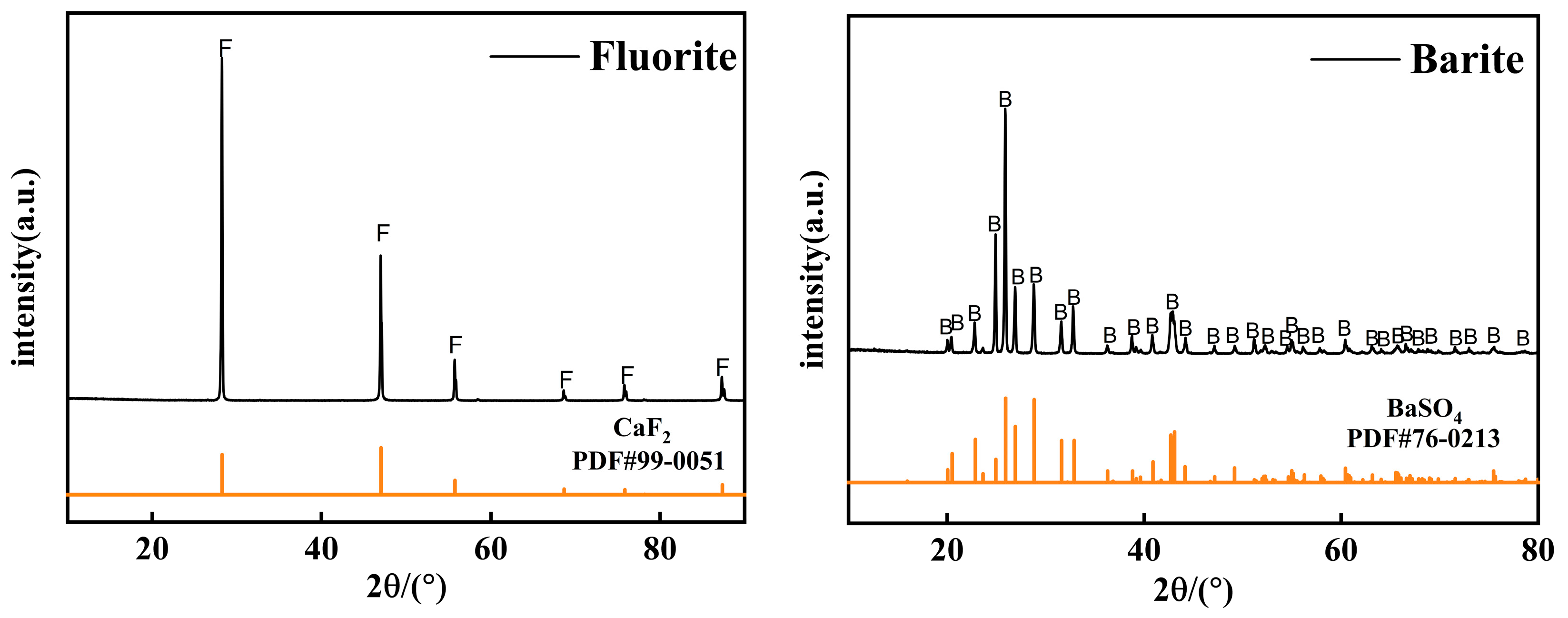
The mineral phases were characterized by X-ray diffraction (XRD). XRD measurements were performed using a D8 Discover diffractometer (Model A24210, BRUKER AXS GMBH, Karlsruhe, Germany). The instrument is equipped with Cu/Co/Cr targets, and Cu Kα radiation (λ = 1.5406 Å) was employed in this study. The operating conditions were set at 40 kV and 40 mA. Diffraction patterns were collected over a 2θ range of 10–80° with a step size of 0.02° and a scanning speed of 2°·min−1. Powder specimens were prepared using the back-loading method and levelled to minimize preferred orientation. XRD data were processed using MDI Jade 6 (peak fitting, background subtraction, and phase search/match), and phase identification was conducted using the ICDD PDF database (PDF-4+, Release 2025). As shown in Figure 1, the diffraction peaks of the two samples match well with the standard patterns of fluorite (CaF2) and barite (BaSO4), respectively, and no obvious impurity peaks were observed.
The chemical composition of the samples was determined by X-ray fluorescence spectroscopy (XRF). A wavelength-dispersive XRF spectrometer (S8 TIGER, BRUKER, Karlsruhe, Germany) equipped with a 4 kW Rh anode, P10 counting gas (Ar/CH4), a flow proportional counter, and a scintillation counter was used. Prior to analysis, the samples were dried at 105 °C to constant mass and then further ground to <75 μm. Powder pellets were prepared by mixing 4.0 g of sample with 0.9 g of an organic binder, followed by pressing into 32 mm diameter pellets at 25 t for 30 s. Spectral processing and matrix correction were conducted using the manufacturer’s software (SPECTRAplus, v1.0.0.16). Quantification was performed using the fundamental parameter (FP) method combined with calibration using reference standards. Each sample was analyzed in triplicate and the average values are reported. The XRF results are summarized in Table 1, indicating that the fluorite sample has a CaF2-based purity close to 100%, whereas the barite sample has a BaSO4-based purity of approximately 99%. These results are consistent with the XRD analysis, confirming that both minerals are of sufficiently high purity for single-mineral flotation experiments.
NaOL was used as the collector, and NaOH was used as the pH regulator. FeCl3, AlCl3, MgCl2, CaCl2, and ZnCl2 were used as sources of Fe3+, Al3+, Mg2+, Ca2+, and Zn2+, respectively. All reagents were of analytical grade and purchased from Macklin (Shanghai Macklin Biochemical Co., Ltd., Shanghai, China). Ultrapure water used throughout the experiments was produced by a water purification system (Shanghai Xiniu, model XUC-40L, Shanghai, China), with a resistivity of 18.2 MΩ·cm at 25 °C.

2.2. Experimental and Simulation Methods

2.2.1. Micro-Flotation Test

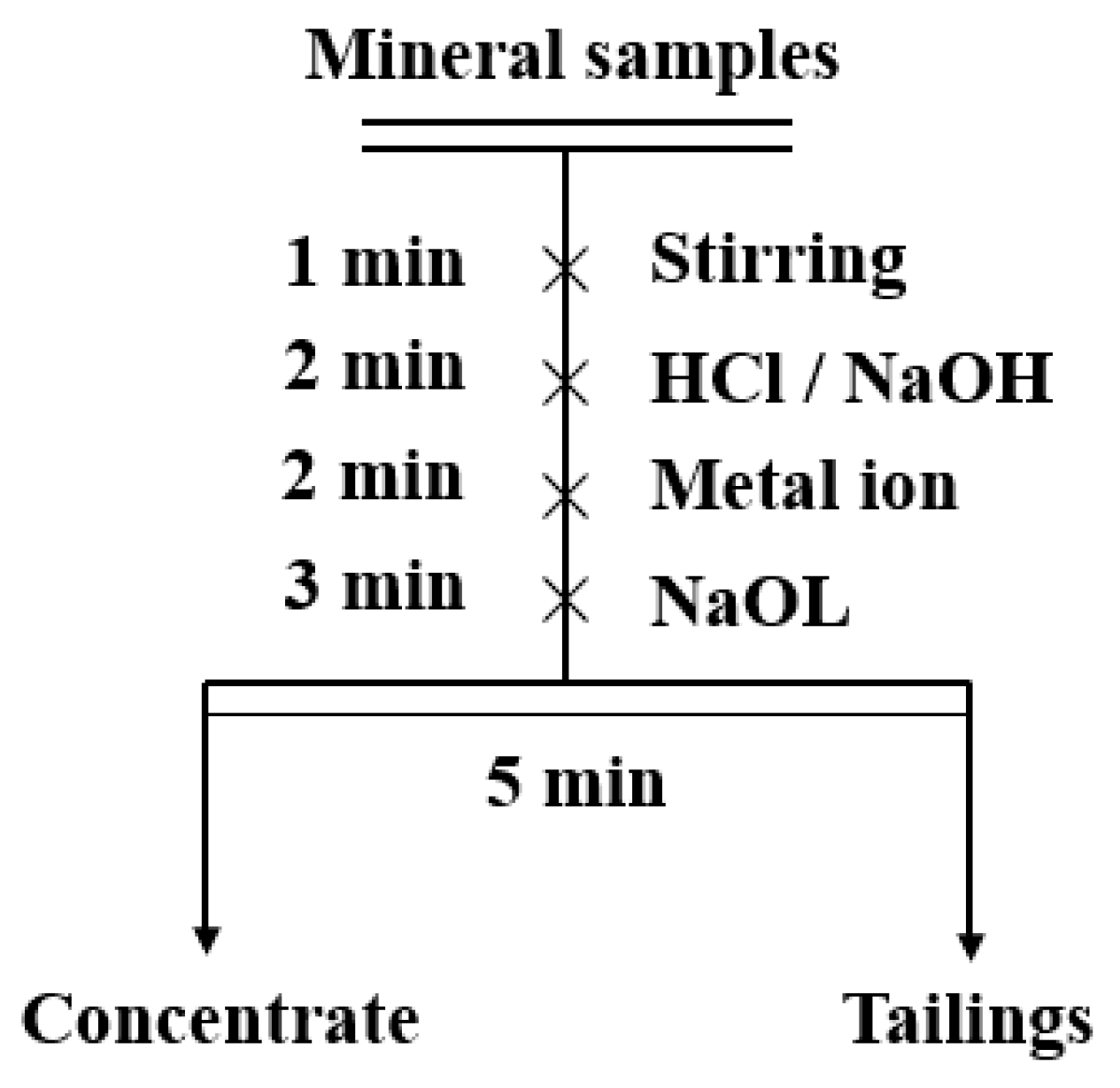
Flotation experiments were conducted using an XFG-type self-aerated flotation machine at an impeller speed of 1750 r/min. The procedure was as follows. First, 2 g of the pure mineral sample was mixed with 40 mL of deionized water in the flotation cell for 1 min. The pH regulator was then added and conditioned for 2 min. Subsequently, one metal-ion reagent (FeCl3, AlCl3, MgCl2, CaCl2, or ZnCl2,) was added to adjust the concentration of Fe3+, Al3+, Mg2+, Ca2+, or Zn2+, respectively, and the pulp was conditioned for 2 min (only one type of metal ion was investigated in each test). We note that fluorite (CaF2) may contribute a small background level of Ca2+ in the pulp due to slight surface dissolution. Nevertheless, given the controlled pH and short conditioning time employed herein, this contribution is expected to be minor and should not affect the comparative trends discussed in this work. Thereafter, NaOL was added as the collector and conditioned for 3 min. Flotation was performed for 5 min. The froth products were collected, filtered, dried, and weighed, and the recovery was calculated. The flotation flowsheet is shown in Figure 2.

2.2.2. Contact Angle Measurement

Block specimens of pure fluorite and barite were prepared, and the surfaces were polished using 1200-grit sandpaper, rinsed with deionized water, and dried in an oven at 40 °C. The treated mineral surfaces were then placed in 100 mL beakers and contacted with the reagents using the same addition sequence as in the flotation conditioning. Specifically, the pH of the solution was adjusted to 10, and for tests involving metal ions, the metal-ion concentration was fixed at 50 mg/L. The specimen was immersed in the solution containing only one metal ion for 15 min Subsequently, NaOL was added at a concentration of 1.5 × 10⁻⁴ mol/L and conditioned for 5 min. After interaction, the specimens were rinsed with deionized water, dried again at 40 °C, sealed, and stored prior to measurement. Static contact angles were measured using a DSA100E goniometer (KYUSS, Hamburg, Germany) by the sessile-drop method. Each condition was measured three times, and the average value is reported.

2.2.3. NaOL Adsorption Measurements

A series of NaOL standard solutions with different concentrations was prepared. To account for the possible influence of pH on the absorbance response, calibration curves were constructed at the same pH as that used in the corresponding adsorption tests. Absorbance measurements were performed using a Shimadzu UV-2700 UV–Vis spectrophotometer (UV-2700, Shimadzu Corporation, Kyoto, Japan). A full-spectrum scan from 200 to 800 nm was first conducted to identify the characteristic absorption of NaOL, and the maximum absorption wavelength was determined to be 278 nm. Accordingly, both the calibration curve and the subsequent supernatant measurements were carried out by recording the absorbance at 278 nm. For each test, 2 g of mineral sample was added to a metal-ion solution of the desired concentration, and the pH was adjusted. A specified amount of NaOL solution was then added, and the suspension was shaken until adsorption equilibrium was reached. The slurry was subsequently centrifuged, and the supernatant was collected for absorbance measurement. The residual NaOL concentration in the supernatant was calculated using the calibration curve, and the adsorption amount (Γ) was determined as:
Γ = ( C 0 C e ) × V m
where C 0 and C e are the initial and equilibrium concentrations of NaOL in the solution (mg/L), V is the solution volume (L), and m is the mineral mass (g). Accordingly, the adsorption amount Γ is expressed in mg/g. NaOL concentrations were quantified by measuring the absorbance at 278 nm. The spectral bandwidth (slit width) was set to 2.0 nm, and the scan sampling interval was 0.1 nm with a medium scan speed. The response was kept at the instrument default (Auto) setting. All measurements and calibration curves were conducted at pH 10. Each condition was measured in triplicate, and the average value is reported.

2.2.4. ICP-OES Measurements of Metal-Ion Adsorption

An inductively coupled plasma optical emission spectrometer (ICP-OES; ICP-5000, Beijing Juguang Technology Co., Ltd., Beijing, China) was used to quantify the residual concentrations of metal ions in the post-flotation solutions. Each sample was measured three times, and the average value was used to evaluate metal-ion adsorption and/or dissolution behavior.

2.2.5. DFT Simulations

DFT calculations were performed using the CASTEP module. Based on a series of convergence tests, the generalized gradient approximation (GGA) with the PW91 exchange–correlation functional was adopted [27], with a plane-wave cutoff energy of 500 eV. Spin polarization was treated using an unrestricted scheme, and symmetry was enabled for the molecular orbitals. The self-consistent field (SCF) tolerance was set to 2.0 × 10 6 eV/atom. All convergence criteria were set to “fine”; a 2 × 2 × 1 k-point mesh was used.
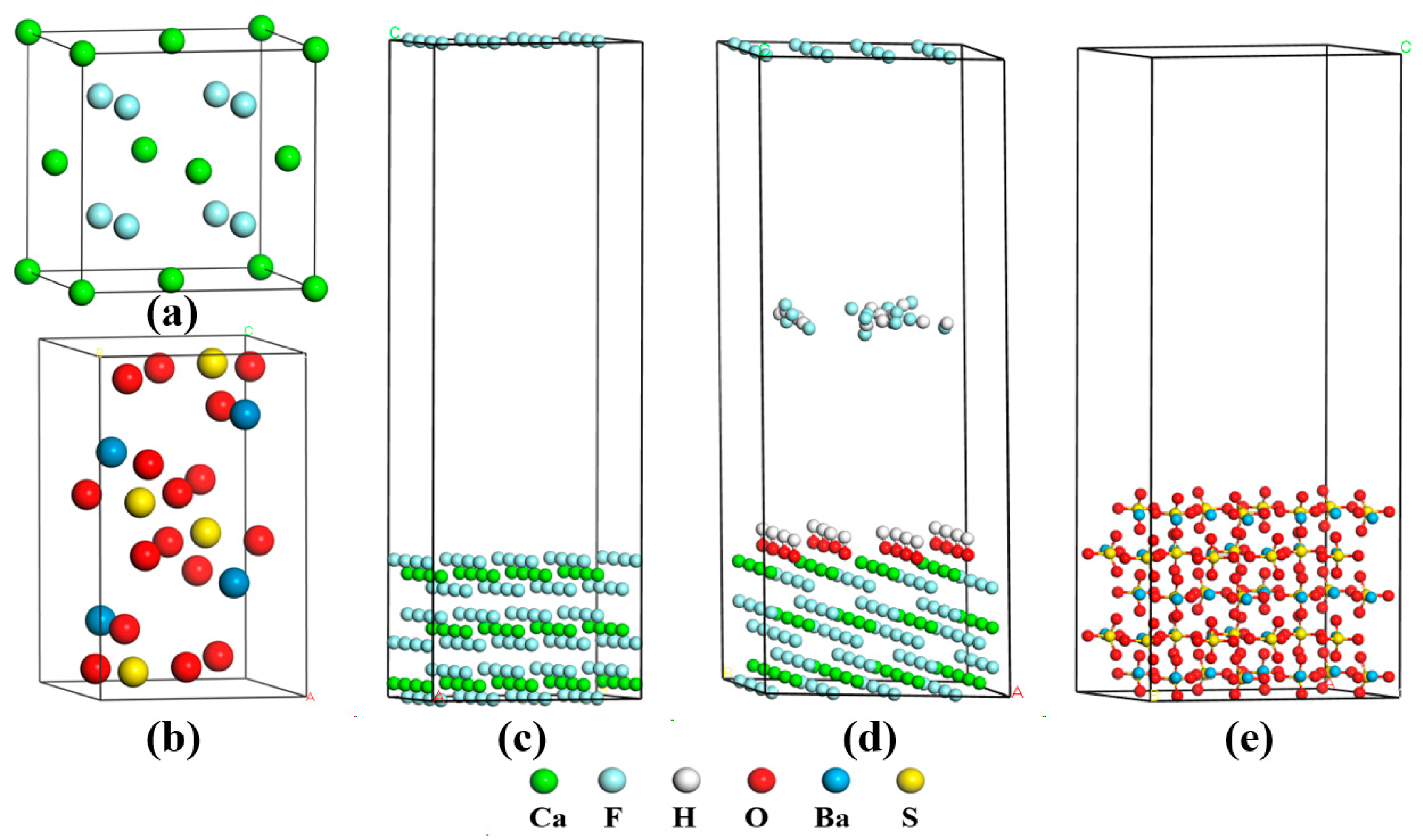
After optimization, the lattice parameters of fluorite were a = b = c = 5.439 Å, α = β = γ = 90°, while those of barite were a = 8.881 Å, b = 5.454 Å, c = 7.156 Å, α = β = γ = 90°. The deviation between the optimized and experimental lattice parameters was less than 1% [28], satisfying the accuracy requirement. According to previous studies, the most stable cleavage planes, fluorite (111) and barite (001), were selected for investigation [29,30]. As shown in Figure 3, three representative surface models were constructed. The vacuum layer thickness was 20 Å. Surface optimizations and the interactions of water molecules as well as hydrated and hydroxylated metal-ion species with the mineral surfaces were carried out [31].

3. Results

3.1. Effect of Metal Ions on the Flotation of Fluorite and Barite

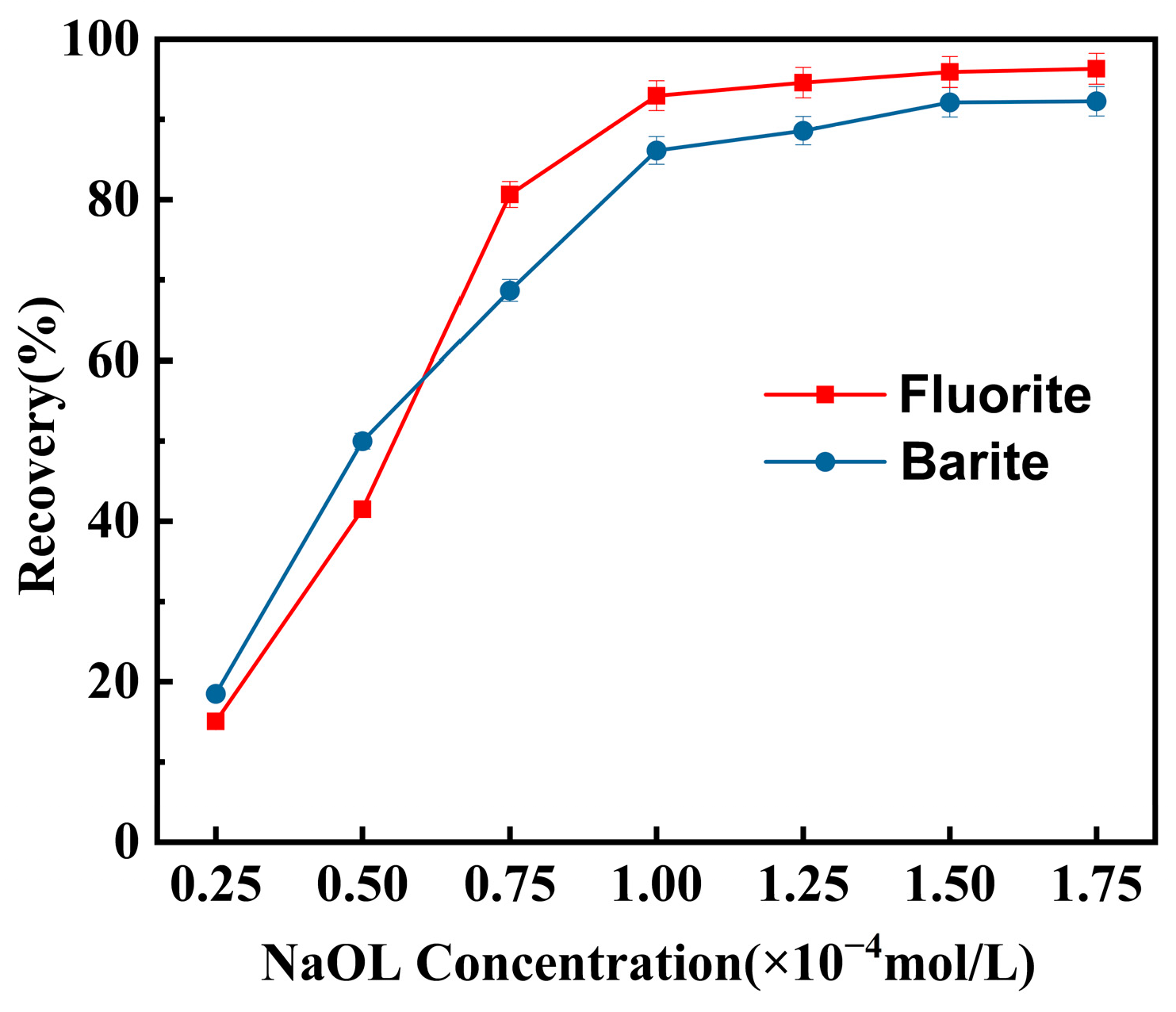
The effect of NaOL dosage on the flotation of fluorite and barite at pH 9 is shown in Figure 4. As the NaOL dosage increased, the recoveries of both fluorite and barite increased progressively. When the dosage reached 1.0 × 10 4 mol/L, the increase in recovery began to level off. Further increasing the collector dosage to 1.5 × 10⁻⁴ mol/L resulted in little to no additional change in recovery. Therefore, the optimum NaOL dosage was determined to be 1.5 × 10 4 mol/L, which was adopted as the optimal collector dosage for the pure-mineral flotation tests in subsequent experiments.
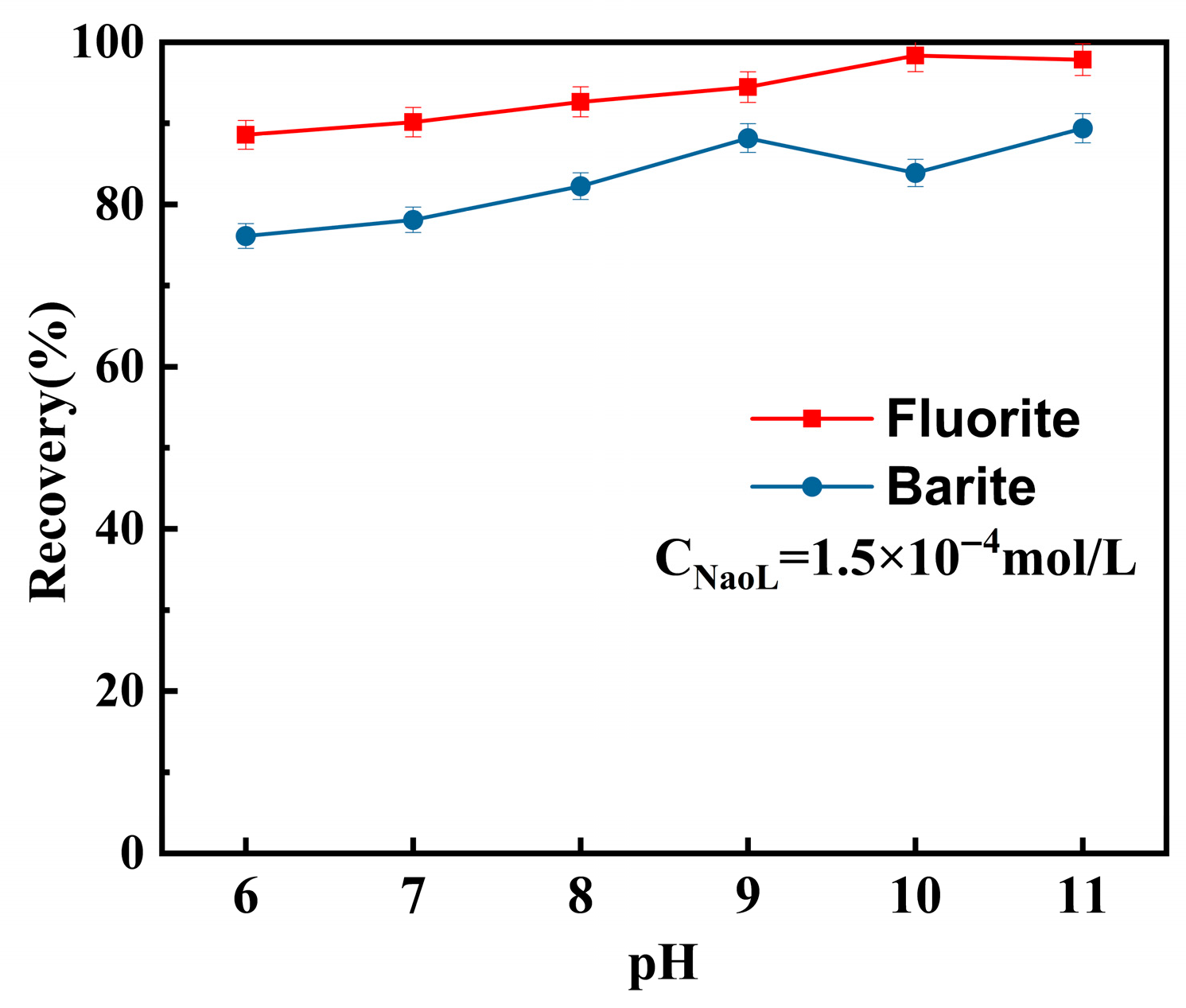
With the NaOL concentration fixed at 1.5 × 10 4 mol/L, the single-mineral flotation results at different pH values in the NaOL system are shown in Figure 5. As illustrated in Figure 5, within the investigated pH range, the recoveries of both barite and fluorite increased with increasing pH, and the fluorite recovery was consistently higher than that of barite. At pH 9, the recoveries of fluorite and barite were the closest. At pH 10, fluorite recovery reached its maximum, whereas barite recovery decreased slightly, resulting in the largest recovery difference between the two minerals. Notably, the recovery difference between fluorite and barite at pH 6 was comparable to that observed at pH 10. At pH 11, the fluorite recovery remained essentially constant at approximately 98%, whereas the barite recovery increased from about 84% to 89%. Overall, the largest recovery differences between fluorite and barite were observed at pH 6 and 10. Considering that NaOL undergoes acid–base equilibria in aqueous solution, under acidic conditions it tends to convert to oleic acid (RCOOH), which has poor solubility and may form oily/flocculent phases, thereby reducing collector availability and destabilize the system. Therefore, pH 10 was selected for subsequent flotation tests to evaluate the effects of metal ions in the NaOL system.
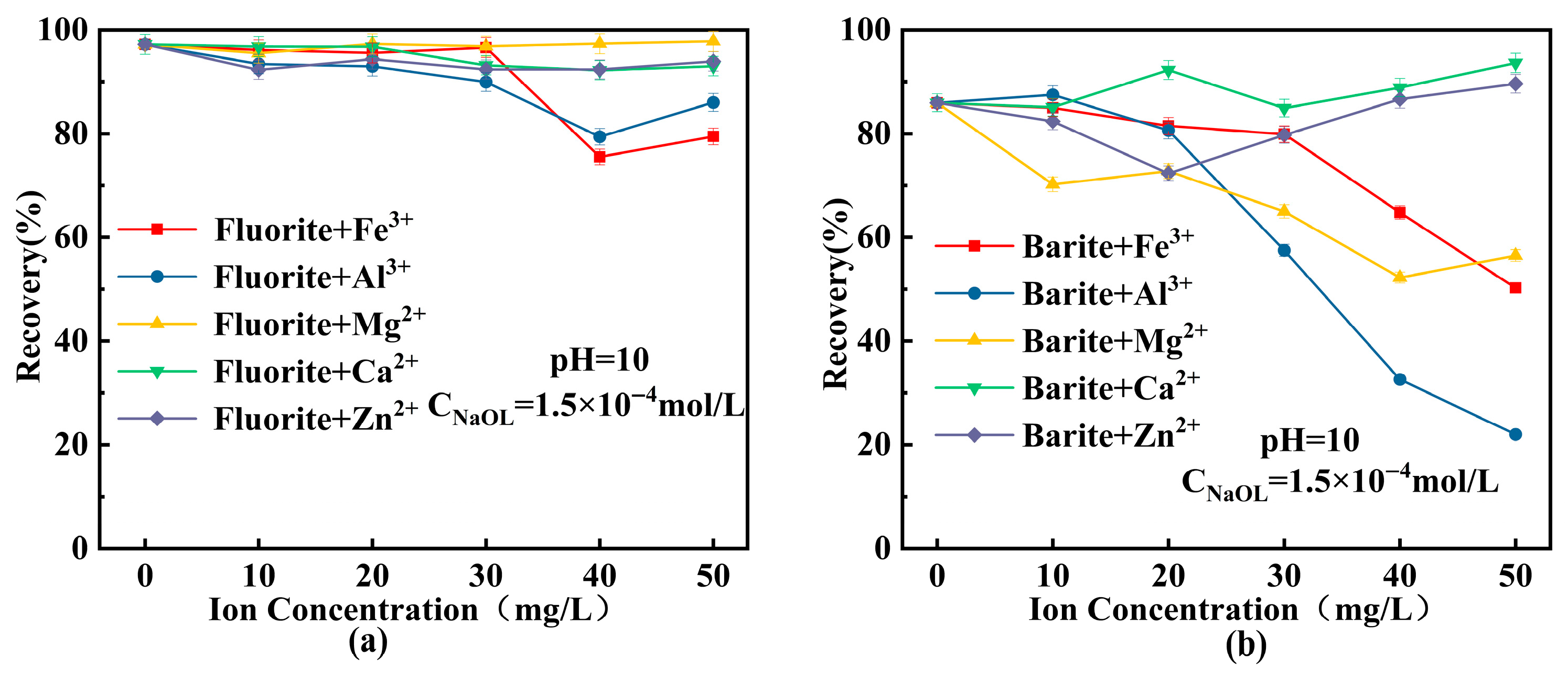
Under the conditions of pH 10 and a NaOL concentration of 1.5 × 10 4 mol/L, the effects of five metal ions (Fe3+, Al3+, Mg2+, Ca2+, and Zn2+) on the flotation of fluorite and barite are shown in Figure 6. As shown in Figure 6a, within the concentration range of 10–50 mg/L, Mg2+, Ca2+, and Zn2+ had almost no effect on fluorite flotation. When the concentration was below 30 mg/L, Al3+ and Fe3+ exerted only a minor influence on fluorite recovery; however, at 40 mg/L, the fluorite recovery decreased markedly from 92% to 80% in the presence of Al3+ and from 95% to 75% in the presence of Fe3+, indicating a pronounced inhibitory effect. Notably, Fe3+ exhibited a stronger inhibitory effect on fluorite flotation than Al3+. When the concentration was further increased to 50 mg/L, the depression effect of Al3+ and Fe3+ began to weaken.
As shown in Figure 6b, with increasing Ca2+ concentration, the barite recovery increased from 85% to 92%, then decreased to 87%, and finally increased to 93%, showing a trend of initial enhancement, subsequent weakening, and further enhancement. Overall, Ca2+ exhibited a promoting effect on barite flotation. Zn2+ caused a slight depression of barite at low concentrations, but promoted barite flotation as its concentration increased, although its activating effect was weaker than that of Ca2+. In contrast, the addition of Fe3+, Al3+, and Mg2+ all depressed barite flotation. The depressive effect became more pronounced with increasing concentration. The depression induced by Mg2+ was slightly stronger than that by Fe3+, whereas Al3+ exhibited an extremely strong depressive effect. When the Al3+ concentration reached 50 mg/L, the barite recovery decreased to only ~20%.
Overall, Ca2+, Mg2+, and Zn2+ had little influence on fluorite flotation, whereas Fe3+ and Al3+ caused noticeable depression only at relatively high concentrations. For barite, Ca2+ and Zn2+ showed activating effects, and Fe3+ and Mg2+ produced comparable depression, resulting in an approximately 20% recovery difference relative to fluorite. Notably, Al3+ strongly depressed barite, yielding the largest recovery difference relative to fluorite (up to ~60%). Therefore, the introduction of Al3+ is particularly beneficial for improving the flotation separation of fluorite from barite.

3.2. Effect of Metal Ions on the Surface Contact Angle of Fluorite and Barite

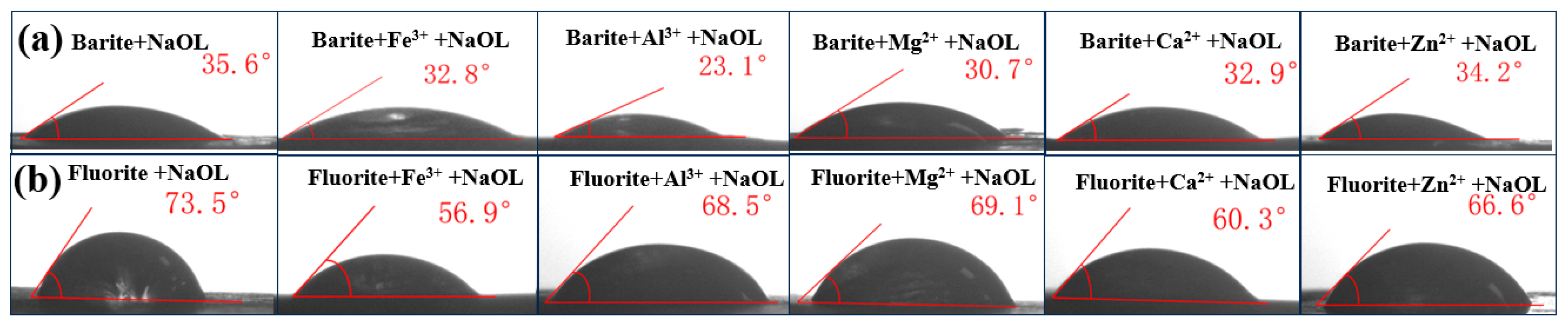
A larger contact angle indicates higher surface hydrophobicity, whereas a smaller contact angle corresponds to stronger hydrophilicity. To determine whether different metal ions altered the surface wettability of fluorite and barite, the changes in contact angle before and after metal-ion treatment were analyzed. The results are shown in Figure 7, and the corresponding contact-angle variations with and without metal ions are summarized in Table 2.
In the absence of added metal ions, the contact angle of barite was 35.6°. After the addition of Fe3+, Al3+, Mg2+, Ca2+, and Zn2+, the contact angle decreased to 32.8°, 23.1°, 30.7°, 32.9°, and 34.2°, respectively. We can note that the changes in contact angle induced by Fe3+ and Mg2+ were relatively small; however, their effects on barite recovery were much more pronounced in Figure 6b. A relatively small change in the static contact angle does not necessarily imply a negligible flotation response. Microflotation is more sensitive to changes in interfacial chemistry and flotation kinetics (e.g., surface charge, hydration, and dispersion/aggregation), and hydrolysis of Fe3+ and Mg2+ at pH 10 may lead to hydroxo species that increase surface hydration and weaken the effective NaOL adsorption, thereby reducing barite recovery. These results indicate that Fe3+, Mg2+, Ca2+, and Zn2+ exerted only minor effects on the barite contact angle, i.e., they had a limited influence on barite surface hydrophobicity. In contrast, Al3+ markedly reduced the barite contact angle by more than 35%, significantly increasing surface hydrophilicity.
Without metal-ion treatment, the contact angle of fluorite was 73.5°. After the addition of Fe3+, Al3+, Mg2+, Ca2+, and Zn2+, the contact angle decreased to 56.9°, 68.5°, 69.1°, 60.3°, and 66.6°, respectively. It can be seen that Fe3+ had the greatest effect on the contact angle of fluorite, leading to a decrease of about 22%, whereas Al3+ caused only an approximately 5% change. However, at a concentration of 40 mg/L, both Fe3+ and Al3+ markedly reduced the fluorite recovery (Figure 6a). The static contact-angle change does not necessarily correlate quantitatively with the microflotation response. Although Ca2+ reduced the fluorite contact angle by 13.2°, its microflotation behavior differed from that of Fe3+ (Figure 6a), suggesting that Ca2+ may influence the NaOL system through additional interfacial processes beyond equilibrium wettability. Conversely, Al3+ showed a similar depression to Fe3+ in microflotation (Figure 6a) but caused only a modest contact-angle decrease (−5°), which may be related to hydrolysis-derived surface species that likely increase surface hydration and hinder effective NaOL adsorption/attachment on fine particles.
Overall, the introduction of metal ions reduced the contact angles of both barite and fluorite, indicating weakened hydrophobicity and enhanced hydrophilicity. For most ions investigated, the decrease in contact angle was more pronounced for fluorite than for barite. Notably, Al3+ showed the opposite trend and substantially decreased the contact angle of barite while exerting only a limited influence on fluorite, suggesting that Al3+ markedly enhances the hydrophilicity of barite surfaces and thereby strengthens barite depression, whereas its effect on fluorite wettability is not significant, leading to a limited influence on fluorite flotation.

3.3. Effect of Metal Ions on Collector Adsorption Capacity

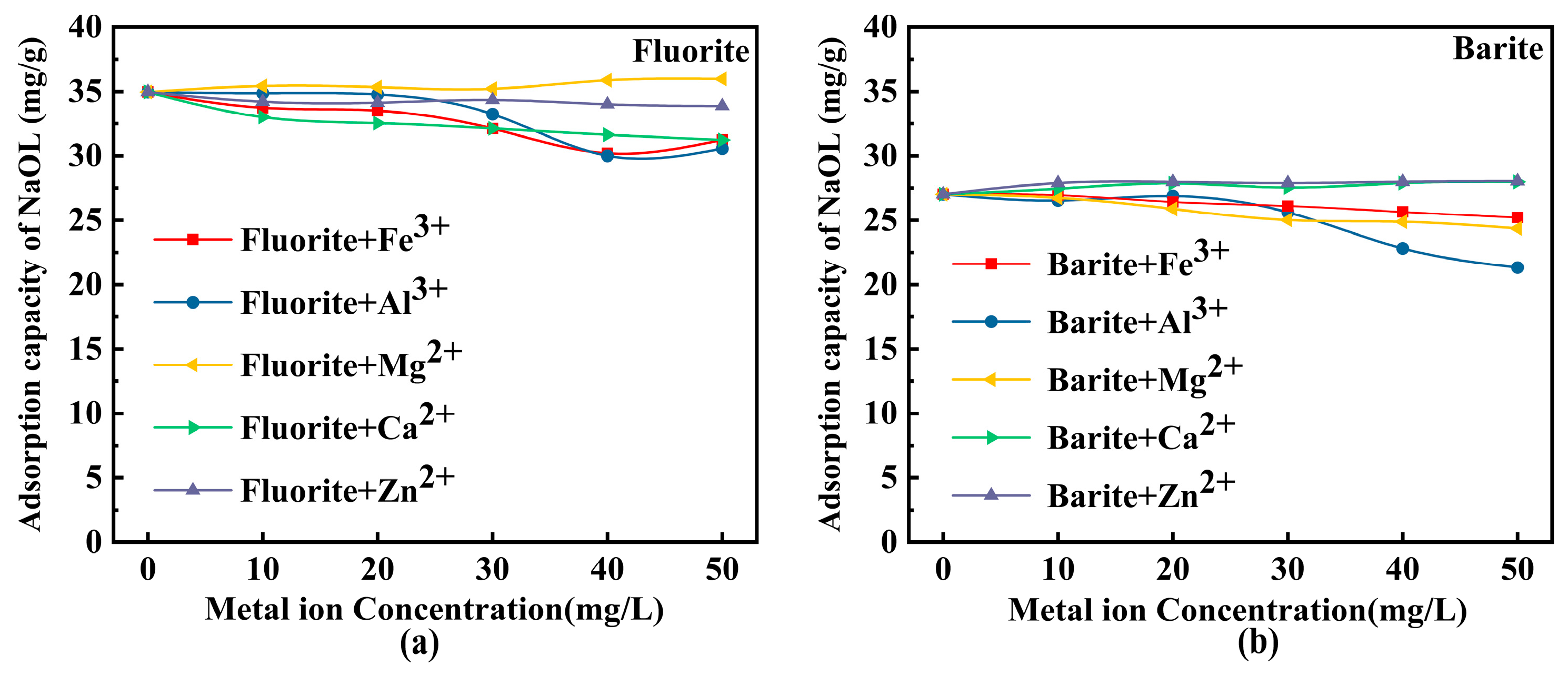
To evaluate the influence of metal ions on the adsorption of the collector NaOL on mineral surfaces, UV–Vis spectroscopy was performed on the supernatants obtained from fluorite and barite pulps conditioned and floated under different metal-ion concentrations. The actual adsorption amount of NaOL on the mineral surfaces was calculated from the change in NaOL concentration in solution before and after adsorption. The adsorption results are shown in Figure 8.
When the concentrations of Fe3+ and Al3+ reached 40 mg/L, the adsorption amount of NaOL on the fluorite surface decreased from 33 mg/g and 34 mg/g to 30 mg/g, showing a clear downward trend. This indicates that high concentrations of Fe3+ and Al3+ can reduce the adsorption of NaOL on the fluorite surface. This behavior is likely attributable to the hydrolysis of Fe3+ and Al3+ in solution, producing hydroxide colloids (e.g., Fe(OH)3 and Al(OH)3) and various hydroxo-complexes that adsorb on mineral surfaces and hinder NaOL adsorption. In the presence of Mg2+, the adsorption amount of NaOL on the fluorite surface increased from 35 mg/g to 36 mg/g and showed a mild upward trend with increasing Mg2+ concentration, suggesting that Mg2+ can marginally promote NaOL adsorption on fluorite. By contrast, as the Ca2+ concentration increased, the adsorption amount of NaOL on the fluorite surface decreased gradually from 35 mg/g to 32 mg/g, implying that Ca2+ inhibits NaOL adsorption on fluorite. The effect of Zn2+ on NaOL adsorption on fluorite was negligible, with the adsorption amount fluctuating only within a very narrow range and thus can be considered essentially unchanged.
After treatment with Fe3+ at concentrations of 10–50 mg/L, the adsorption amount of NaOL on the barite surface decreased from 27 mg/g to 25 mg/g, showed a decreasing trend, but the decline was relatively small, indicating that Fe3+ inhibits NaOL adsorption on barite to a limited extent. In contrast, after treatment with Al3+ at concentrations of 10–50 mg/L, NaOL adsorption on barite decreased significantly from 27 mg/g to 21 mg/g, demonstrating that Al3+ strongly hinders NaOL adsorption. The depressive effect of Al3+ on barite was much more pronounced than that on fluorite, which is consistent with the flotation results. Mg2+ also exhibited a slightly stronger inhibitory effect than Fe3+. By comparison, Ca2+ and Zn2+ showed similar behavior and promoted NaOL adsorption on barite to some extent, corresponding to an activation effect in barite flotation.

3.4. ICP Analysis

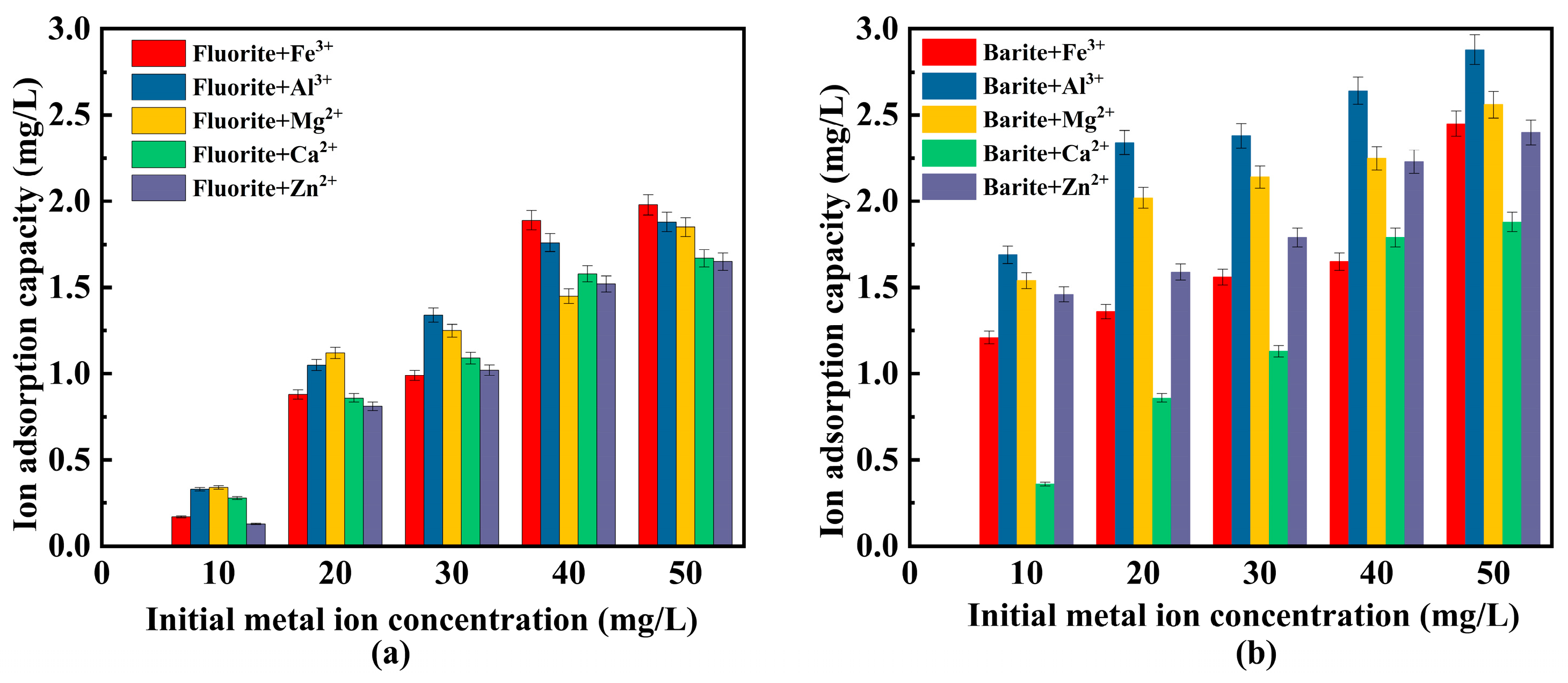
The residual concentrations of metal ions in solution after adsorption equilibrium were measured by ICP analysis. By comparing the residual concentrations with the initial metal-ion concentrations, the amount of metal ions adsorbed on the mineral surfaces can be determined. The ICP results are shown in Figure 9.
As shown in Figure 9, the adsorption amounts of all tested metal ions on fluorite were relatively low. At an initial concentration of 10 mg/L, the adsorbed amounts of Fe3+, Al3+, Mg2+, Ca2+, and Zn2+ were all below 0.5 mg/L. As the initial concentration increased to 50 mg/L, the adsorption on fluorite increased only slightly and remained below 2 mg/L for all ions. These results indicate that fluorite exhibits a limited capacity and weak interfacial affinity for adsorption of these metal ions. Notably, Ca2+—the lattice cation in fluorite (CaF2)—did not show a distinct adsorption advantage, which further supports that fluorite surfaces undergo hydroxylation in aqueous environments and form a “passivated” interfacial layer. This passivating layer suppresses the specific adsorption of various metal ions, including isomorphic ions.
Compared with fluorite, barite exhibited a markedly higher adsorption capacity for metal ions. This phenomenon may be attributed to the fact that, under alkaline conditions, fluorite surfaces are prone to hydroxylation, forming a hydroxylated layer that mitigates the interference of metal ions during flotation. In contrast, barite is less susceptible to hydroxylation. In addition, because surface SO42− groups are negatively charged while metal ions are positively charged, electrostatic attraction enhances metal-ion adsorption on barite and thus strengthens their impact on barite flotation.
Among the tested ions, Al3+ showed the strongest adsorption tendency. Its adsorbed amount exceeded 1.5 mg/L at an initial concentration of 10 mg/L and increased to nearly 3 mg/L at 50 mg/L, indicating the presence of high-affinity active sites on barite surfaces. Fe3+ also exhibited strong adsorption, increasing from 1.2 to 2.4 mg/L, although it was weaker than Al3+. For divalent ions, Mg2+ and Zn2+ displayed similar adsorption amounts and were both clearly higher than that of Ca2+. At 50 mg/L, the adsorbed amounts of Mg2+ and Zn2+ were 2.56 and 2.40 mg/L, respectively, whereas Ca2+ was only 1.88 mg/L. The adsorption sequence (Al3+ > Fe3+ > Mg2+ ≈ Zn2+ > Ca2+) reflects the differentiated electrostatic affinity of barite surface SO42− groups toward different metal ions. In addition, this trend is unlikely to be governed solely by the solubility of the corresponding metal–sulfate salts (e.g., CaSO4 is relatively sparingly soluble while Al2(SO4)3 is highly soluble) [32]. Instead, it more likely reflects differences in cation charge density and pH-dependent hydrolysis, which can strengthen interaction with sulfate-bearing surface sites.

3.5. DFT Calculations

Based on the flotation tests, contact-angle measurements, collector adsorption results, and metal-ion adsorption data, Al3+ was found to exert a strong depressive effect on barite while having only a minor influence on fluorite flotation, indicating that Al3+ is the most effective ion for improving the flotation separation of these two minerals. Therefore, this section employs density functional theory (DFT) to investigate the adsorption of Al3+-related species on mineral surfaces. The adsorption strength of an adsorbate on a surface model can be evaluated by the adsorption energy; a more negative (lower) adsorption energy corresponds to stronger adsorption [33]. The adsorption energy was calculated as follows [34]:
E a d s = E t o t a l ( E s l a b + E a d s o r b a t e )
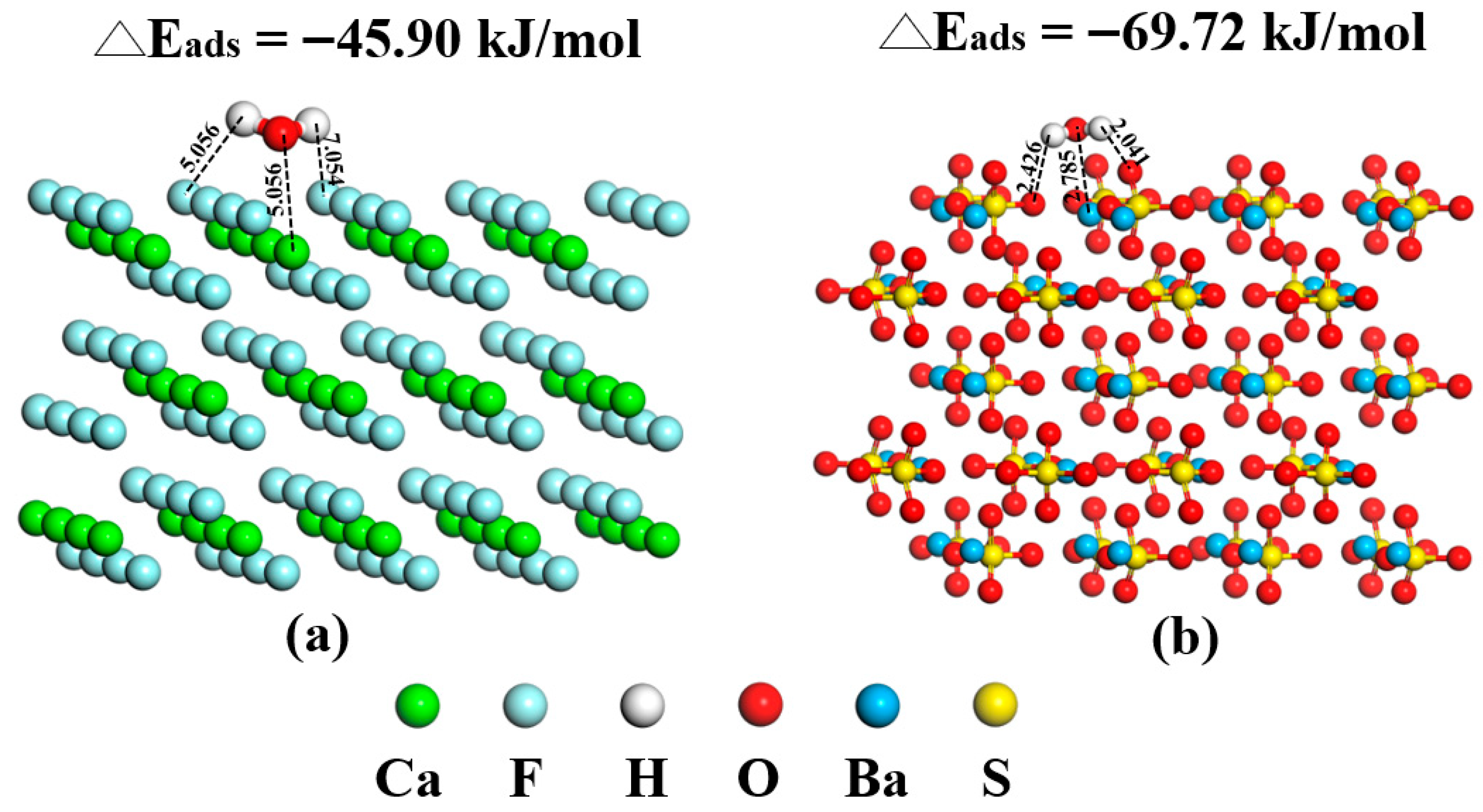
where E a d s is the adsorption energy, E t o t a l is the total energy of the adsorption system, E s l a b is the energy of the optimized fluorite or barite surface slab, and E a d s o r b a t e is the energy of the isolated adsorbate molecule. The adsorption energies of a single water molecule on barite and fluorite surfaces are shown in Figure 10 A hydration layer is expected to exist on mineral surfaces in aqueous systems and may influence collector adsorption. Here, we evaluated surface hydration tendency by calculating single-water adsorption (Figure 10), while explicit multilayer water-film modeling was not included and will be considered in future work.
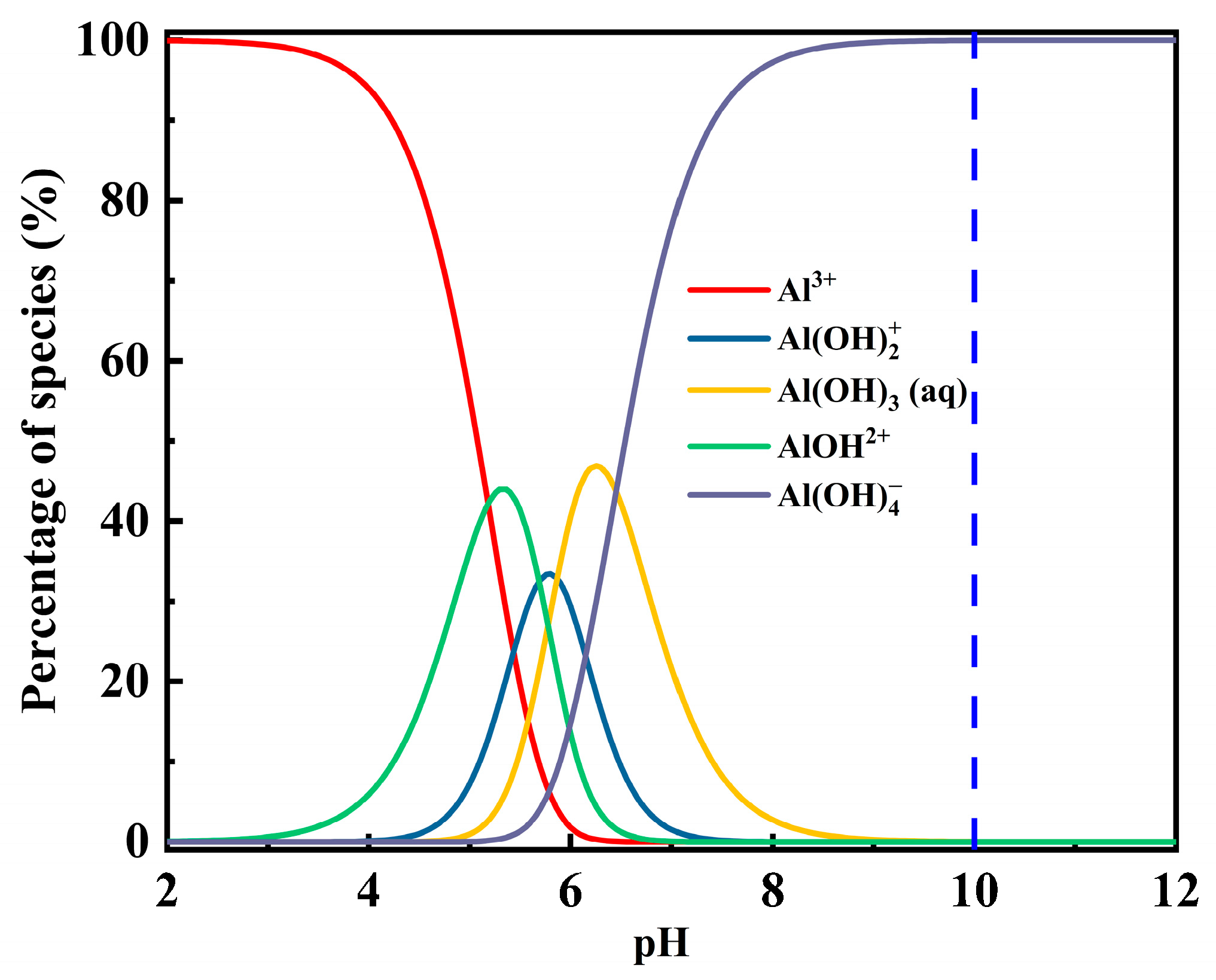
Under alkaline conditions, fluorite (CaF2) surfaces are readily hydroxylated because surface fluoride ions (F) can undergo hydrolysis with water molecules and be replaced by hydroxyl groups (-OH), forming a hydroxylated surface layer, whereas the hydroxylation degree of barite surfaces is much weaker. Accordingly, in our calculations, a pristine fluorite (111) surface model was used to examine the adsorption of water molecules and hydrated aluminum ions, while a hydroxylated fluorite (111) surface model was employed to investigate the adsorption of hydroxylated Al3+ species. For adsorption on the barite (001) surface, a pristine (non-hydroxylated) surface model was adopted. With respect to Al(III), the hydrated species was represented as [Al(H2O)6]3+. Considering that Al(III) undergoes extensive hydrolysis under alkaline conditions and that hydrolyzed/aluminate species are predominant at pH 10 (see Figure 11), the hydroxylated form was represented by [Al(H2O)5OH]2+ as a simplified hydrolyzed Al(III) species for comparison in the modeling [35,36].
The adsorption of a water molecule on the mineral surfaces was first investigated. Based on the adsorption energies, a single water molecule adsorbed more strongly on barite (−69.72 kJ/mol) than on fluorite (−45.90 kJ/mol), indicating that pristine barite surfaces are significantly more hydrophilic than fluorite surfaces. Barite surfaces are composed of ordered SO42− and Ba2+ sites. The SO42 groups serve as effective hydrogen-bond acceptors, while Ba2+ can act as a Lewis-acid site that interacts strongly with water molecules via ion–dipole interactions. These interactions enable water molecules to form strong hydrogen bonds and electrostatic attractions with the surface, resulting in a more negative adsorption energy (−69.72 kJ/mol) and thus reflecting the strong hydrophilicity of barite.
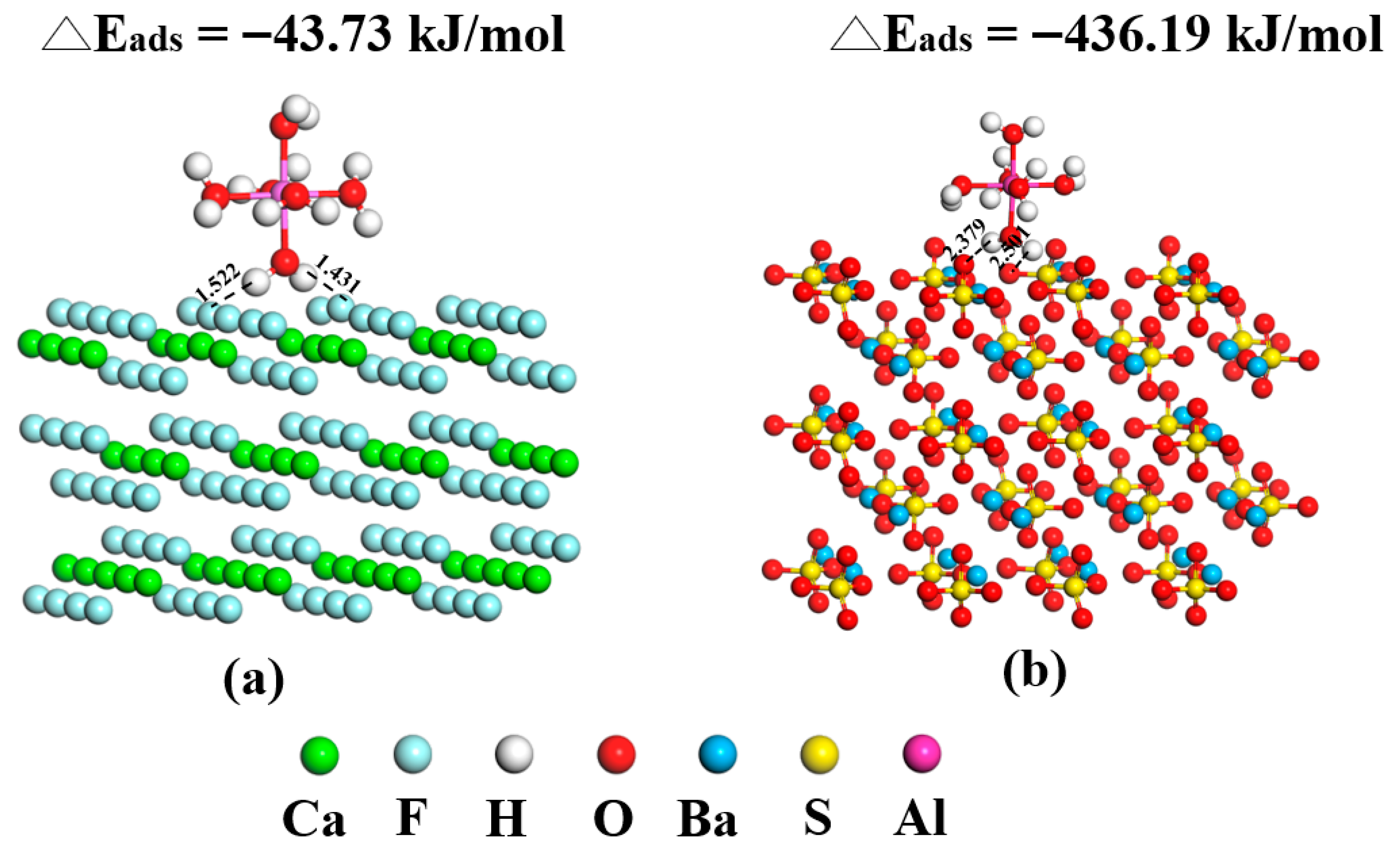
The adsorption configurations of [Al(H2O)6]3+ on the barite and fluorite surfaces are shown in Figure 12.
The results show that the adsorption energy of [Al(H2O)6]3+ on the barite surface is as low as −436.19 kJ/mol, indicative of very strong chemisorption, whereas on the fluorite surface it is only −43.73 kJ/mol, characteristic of physisorption. This striking difference (approximately one order of magnitude) clearly reveals the substantially different interaction strengths on the two minerals. On barite, [Al(H2O)6]3+ adsorbs via a chemisorption mechanism dominated by strong electrostatic attraction coupled with a cooperative hydrogen-bond network, whereas on fluorite the interaction is primarily weak physisorption governed by attenuated electrostatic and dispersion forces.
On barite, terminal sulfate groups (SO42−) carry a pronounced negative charge, while the [Al(H2O)6]3+ complex presents a highly concentrated positive charge center as a whole. This strong charge complementarity induces significant interfacial charge redistribution and local polarization. Notably, the coordinated water molecules in [Al(H2O)6]3+ do not retain perfect octahedral symmetry upon adsorption. Some ligated water molecules undergo orientational reconfiguration, with their hydrogen atoms pointing toward undercoordinated oxygen atoms of surface SO42− groups, forming characteristic O w a t e r H O s u r f a c e hydrogen bonds. Other coordinated water molecules act as hydrogen-bond acceptors and interact with adjacent water molecules or surface functional groups, generating a complex two-dimensional hydrogen-bond network. This cooperative hydrogen-bond framework, jointly constructed by the adsorbed complex and the surface, directly stabilizes the adsorption configuration. Through proton rearrangement and redistribution of charge density, it further strengthens and stabilizes the interfacial electrostatic interactions, resulting in a positive synergistic feedback: strong electrostatic attraction brings the complex into close proximity to the surface, enabling favorable geometries for hydrogen-bond formation, while the ensuing hydrogen-bond network further localizes charge and enhances electrostatic attraction.
In contrast, the interaction of [Al(H2O)6]3+ with the fluorite surface is fundamentally different and involves only weak electrostatic contributions. Although the complex remains positively charged, the fluorite surface is terminated by fluoride ions (F) whose electron density is highly localized and symmetrically distributed; consequently, the net negative charge density at the surface is relatively low and spatially uniform. Adsorption is therefore dominated by weak dipole–induced-dipole interactions between the overall dipole moment of the [Al(H2O)6]3+ complex and surface F ions, lacking strong, directional electrostatic bonding. The associated energetic contribution is comparable to typical van der Waals interactions. Moreover, although surface F could in principle act as a hydrogen-bond acceptor, its high electronegativity and small ionic radius make it difficult to polarize, and the coordinated water molecules in [Al(H2O)6]3+ are unlikely to form short, strong hydrogen bonds with F. In addition, the chemical inertness of fluorite prevents the formation of an extended hydrogen-bond network analogous to that on barite. As a result, hydrogen bonding contributes negligibly to the overall adsorption energy of [Al(H2O)6]3+ on fluorite.
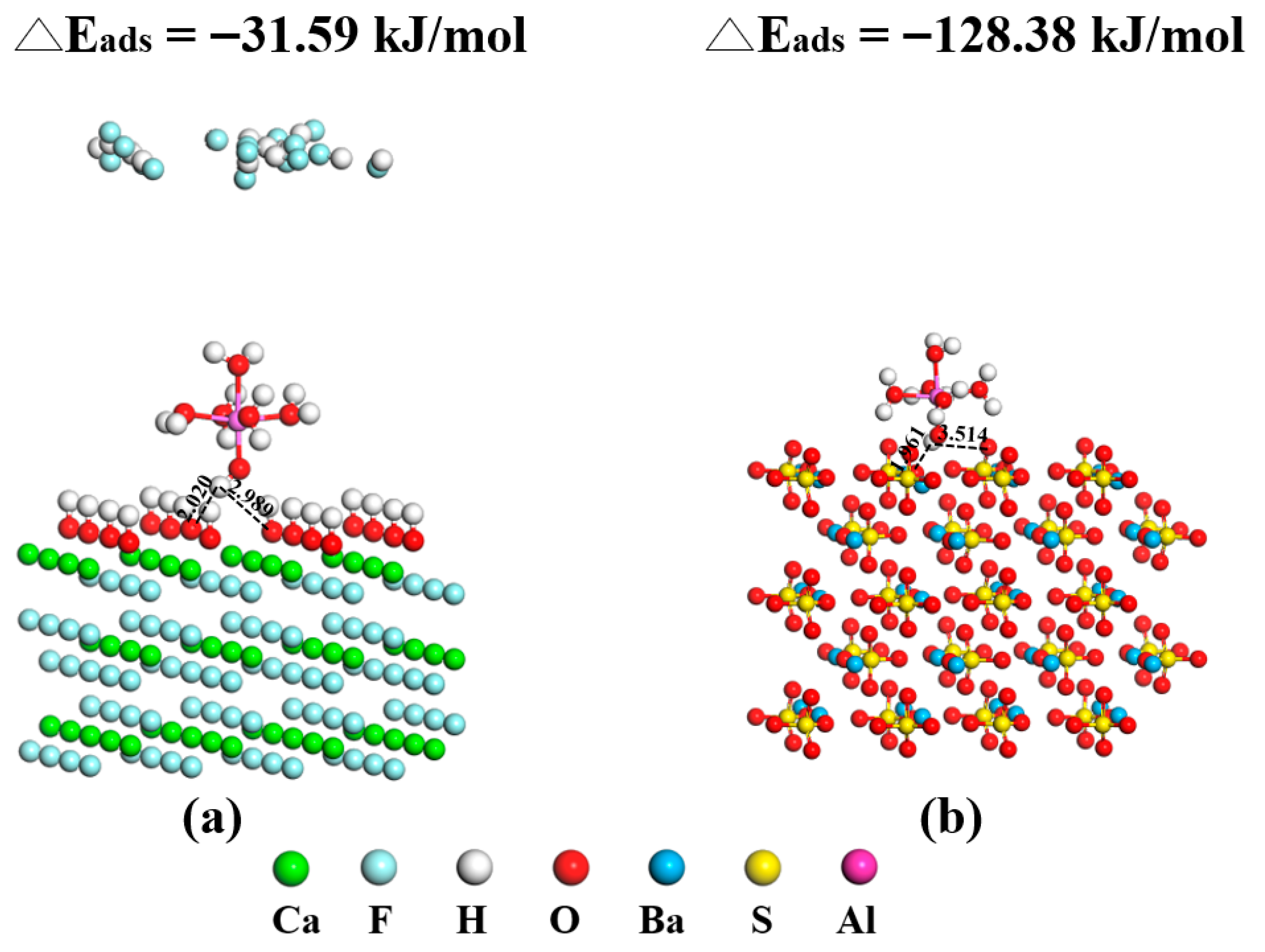
The adsorption configurations of [Al(H2O)5OH]2+ on the hydroxylated fluorite surface and the barite surface are shown in Figure 13.
The results indicate that the adsorption energy of [Al(H2O)5OH]2+ on the hydroxylated fluorite surface is only −31.59 kJ/mol, suggesting weak physisorption, whereas on the barite surface it reaches −128.38 kJ/mol, indicative of strong chemisorption. This demonstrates that, under alkaline conditions, aluminum species adsorb much more strongly on barite than on fluorite, thereby causing pronounced depression of barite flotation but only a negligible inhibitory effect on fluorite.
In alkaline media, although the Al3+ charge density in [Al(H2O)5OH]2+ is lower than that in [Al(H2O)6]3+, the complex remains strongly positively charged and can still interact strongly with the negatively charged SO42− groups on the barite surface. As a result, [Al (H2O)5OH]2+ can adsorb and/or precipitate on barite surfaces, blocking active sites and hindering collector adsorption, which leads to depression of barite flotation. In contrast, adsorption of hydroxylated aluminum species on the hydroxylated fluorite surface remains weak and is mainly governed by hydrogen bonding and van der Waals interactions with limited strength. Therefore, [Al(H2O)5OH]2+ cannot effectively adsorb or precipitate on fluorite surfaces, resulting in little to no impact on fluorite flotation.
To quantitatively connect the DFT results with collector efficiency, an adsorption-affinity descriptor (3) was used.
A = E a d s
The calculated adsorption energies indicate that Al species adsorb much more strongly on barite than on fluorite ([Al(H2O)6]3+: −436.19 vs. −43.73 kJ/mol; [Al(H2O)5OH]2+: −128.38 vs. −31.59 kJ/mol). Consistent with this prediction, Al3+ causes a larger decrease in barite contact angle (from 35.6 ± 0.8° to 23.1 ± 1.5°) than in fluorite contact angle (from 73.5 ± 1.7° to 68.5 ± 2.3°), and the barite recovery decreases much more markedly than fluorite in microflotation over 10–50 mg/L Al3+. These results suggest that stronger computed adsorption is associated with a stronger reduction in collector effectiveness and floatability, especially for barite.
DFT calculations elucidate, at the molecular scale, the fundamental mechanism underlying the selective action of aluminum-salt depressants in the barite–fluorite flotation system. In aqueous solution, Al3+ undergoes hydrolysis to form a series of hydroxo-aluminum species. These reactive species can selectively and strongly chemisorb onto the active SO42− sites on freshly cleaved barite surfaces, forming a hydrophilic and inhibitory surface layer that effectively blocks collector adsorption. In contrast, owing to the presence of a hydroxylated “passivation layer” on fluorite, these hydrolyzed aluminum species cannot adsorb effectively on fluorite surfaces. Even if weak physisorption occurs, it can be readily disrupted and desorbed under pulp shear. Moreover, solution pH governs both the degree of mineral-surface hydroxylation and the hydrolysis speciation of aluminum in solution. Precise pH regulation can therefore optimize the adsorption amount and strength of aluminum depressants on barite while minimizing non-specific adsorption on fluorite, thereby enabling efficient flotation separation.

4. Discussion

This work systematically clarifies how typical dissolved metal ions regulate the floatability contrast between fluorite and barite in a NaOL collector system by integrating flotation, contact-angle, adsorption, ICP-OES, and DFT evidence. The central finding is that Al3+ produces the largest fluorite–barite selectivity window by strongly depressing barite while only weakly affecting fluorite, and the consistency among macroscopic responses and interfacial/molecular indicators supports the proposed mechanism.
The NaOL flotation results show that the maximum recovery difference occurs at pH 10, which can be interpreted as an optimized coupling between collector speciation and interfacial chemistry. Under alkaline conditions, NaOL is predominantly present as oleate, favoring adsorption, while mineral surfaces exhibit different hydration/hydroxylation behaviors. At the same time, hydrolysis of dissolved metal ions becomes more significant, generating hydroxo species or hydroxide colloids that can compete with oleate adsorption. The observed pH 10 “window” therefore reflects a regime where fluorite maintains a strong collecting response, whereas barite is more susceptible to hydrophilic modification and competitive adsorption.
Ion-specific trends further highlight a clear mineral-dependent sensitivity. Fluorite is relatively insensitive to Mg2+, Ca2+, and Zn2+ over 10–50 mg/L, and shows noticeable depression only at higher Fe3+/Al3+ concentrations, consistent with limited specific ion adsorption on a hydroxylated/passivated fluorite surface. In contrast, barite is highly responsive to dissolved ions, exhibiting severe depression by Al3+ (to ~20% recovery at 50 mg/L), weaker depression by Fe3+ and Mg2+, and activation by Ca2+ and high Zn2+ concentrations. These behaviors are consistent with barite’s greater propensity for ion-induced surface modification.
Interfacial measurements explain these flotation outcomes. Al3+ causes the largest reduction in barite contact angle (35.6° to 23.1°) and decreases NaOL adsorption by >40%, indicating strong hydrophilization and collector-site blocking, while ICP-OES confirms the highest Al uptake on barite relative to other ions. DFT calculations provide a molecular basis for this selectivity, showing extremely strong adsorption of hydrolyzed Al species on barite sulfate sites (e.g., −436.19 kJ/mol for [Al(H2O)6]3+) but only weak interaction on (hydroxylated) fluorite (e.g., −43.73 kJ/mol), rationalizing the preferential accumulation of Al species on barite and the resulting suppression of oleate adsorption. Although the speciation calculation (Figure 10) suggests that Al(OH)4− is likely the dominant dissolved Al(III) species at pH 10, our DFT simulations employed [Al(H2O)6]3+ and [Al(H2O)5OH]2+ as hydrated and hydrolyzed Al(III) representatives to probe adsorption trends and surface affinity. Therefore, the computed adsorption energies should be interpreted as comparative descriptors rather than a complete description of all Al(III) species present at pH 10. Explicit adsorption modeling of Al(OH)4− on hydrated mineral surfaces will be considered in future work to further refine the mechanism.
The results support a selectivity mechanism dominated by preferential adsorption/chemisorption of hydrolyzed Al species on barite SO42− sites that forms a hydrophilic blocking layer, whereas fluorite remains comparatively resistant due to weaker ion affinity under alkaline conditions. Practically, maintaining pH near 10 and controlling Al3+ dosing offers a feasible route to enhance fluorite–barite separation in NaOL systems, while future work could strengthen the conclusions through solution-speciation measurements, surface spectroscopy (XPS/FTIR), ζ-potential analysis, and validation in mixed-mineral or real-ore pulps.

5. Conclusions

This study systematically investigated the differentiated effects and mechanisms of common metal ions (Fe3+, Al3+, Mg2+, Ca2+, and Zn2+) on the floatability of fluorite and barite in a NaOL system through flotation experiments combined with multiple interfacial characterization techniques. The results demonstrate that Al3+ can serve as an efficient selective depressant for barite, providing a feasible regulation strategy for fluorite–barite flotation separation under complex ionic environments. The findings also offer valuable insights for other flotation systems involving polar non-metallic minerals with similar surface properties. Based on the integrated experimental and theoretical analyses, the main conclusions are as follows:
1.
Single-mineral flotation tests showed that, after optimizing the separation conditions, the largest floatability contrast between fluorite and barite was achieved at pH 10 with a NaOL concentration of 1.5 × 10 4 mol/L (fluorite recovery close to 100% and barite around 80%), providing an optimal operating window for the separation process.
2.
Metal ions exhibited distinct effects on fluorite and barite flotation. For barite, Al3+ strongly depressed floatability via pronounced adsorption (recovery decreased to below 20%), Fe3+ and Mg2+ caused weak depression, whereas Ca2+ and high concentrations of Zn2+ (>20 mg/L) acted as activators. For fluorite, the recovery changes induced by all five ions were below 5%, indicating strong resistance of fluorite to metal-ion interference, likely due to the stability of Ca-related surface sites.
3.
Contact-angle measurements, ICP-OES analysis, UV–Vis adsorption tests, and DFT calculations collectively indicate that competitive adsorption and surface modification dominate the interfacial mechanism governing fluorite and barite flotation. Al3+ occupies active sites on barite, reducing NaOL adsorption by more than 40% and decreasing the contact angle from 35.6° to 23.1°, thereby significantly weakening surface hydrophobicity. ICP-OES confirmed that Al3+ adsorption on barite is far higher than that on fluorite, explaining its selective depression at the ion-adsorption level. DFT calculations further revealed at the molecular scale that barite surface SO42− groups form strong chemisorption with hydrolyzed Al species (adsorption energy: −436.19 kJ/mol), whereas only weak physisorption occurs on hydroxylated fluorite surfaces due to the presence of a “passivation layer” (adsorption energy: −43.73 kJ/mol). It should be noted that Al(III) speciation at pH 10 is dominated by Al(OH)4− according to Figure 10, whereas the DFT calculations herein used simplified hydrated/hydrolyzed Al(III) species to capture comparative adsorption trends. Future work will include explicit DFT modeling of Al(OH)4− adsorption (and hydration-layer effects) to further strengthen the computational interpretation.

Author Contributions

Conceptualization, Y.L. (Yuqiong Li); Methodology, Y.W. and Y.L. (Yingchao Liu); Investigation, Y.W. and Y.G.; Data curation, Y.W. and C.L.; Resources, Y.L. (Yuqiong Li) and Y.L. (Yingchao Liu); Validation, C.L. and W.Y.; Visualization, Y.W. and Y.G.; Writing—original draft preparation, Y.W.; Writing—review and editing, Y.L. (Yuqiong Li) and Y.L. (Yingchao Liu); Supervision, Y.G.; Project administration, Y.L. (Yuqiong Li) and Y.L. (Yingchao Liu); Funding acquisition, Y.L. (Yuqiong Li) and Y.L. (Yingchao Liu). All authors have read and agreed to the published version of the manuscript.

Funding

This project is supported by the Key Technologies Research and Development Program (No. 2024YFC2909600); the Special Fund for Science and Technology Development of Guangxi (grant number AD25069078); the Guangxi Natural Science Foundation (grant number 2025GXNSFBA069561).

Data Availability Statement

The original contributions presented in this study are included in the article. Further inquiries can be directed to the corresponding authors.

Acknowledgments

We are grateful to the National Natural Science Foundation of China and the high-performance computing platform of Guangxi University. We thank anonymous reviewers for their thoughtful and thorough suggestions/reviews and editorial efforts, which greatly assisted in the improvement of this manuscript.

Conflicts of Interest

The authors declare no conflicts of interest.

Abbreviations

The following abbreviations are used in this manuscript:
NaOLSodium oleate
DFTDensity functional theory
ICPInductively coupled plasma
ICP-OESInductively coupled plasma optical emission spectrometry
XRDX-ray diffraction
XRFX-ray fluorescence
FPfundamental parameter
CASTEPCambridge Sequential Total Energy Package (CASTEP module)
GGAGeneralized gradient approximation
PW91Perdew–Wang 1991 exchange–correlation functional
pHPotential of hydrogen
UVUltraviolet
UV-2700UV–Vis spectrophotometer model (Shimadzu UV-2700)
XFGXFG-type self-aerated flotation machine
DSADrop shape analyzer
DSA100EDrop shape analyzer model (DSA100E)
ICP-5000ICP-OES instrument model (ICP-5000)
IDSTetrasodium iminodisuccinate

References

  1. Lu, Y.; Liu, W.; Wang, X.; Cheng, H.; Cheng, F.; Miller, J.D. Lauryl Phosphate Flotation Chemistry in Barite Flotation. Minerals 2020, 10, 280. [Google Scholar] [CrossRef]
  2. Penaloza, I.; Tita, A.; McNew, E.; Chu, P. Barite resources, production and recovery using froth flotation: A review. Miner. Eng. 2023, 203, 108327. [Google Scholar] [CrossRef]
  3. Jiang, L.; Feng, B.; Wang, T.; Wang, Z. Selective flotation separation of fluorite and barite with carboxylated chitosan as depressant. Miner. Eng. 2024, 219, 109089. [Google Scholar] [CrossRef]
  4. Gao, Z.; Wang, C.; Sun, W.; Gao, Y.; Kowalczuk, P.B. Froth flotation of fluorite: A review. Adv. Colloid Interface Sci. 2021, 290, 102382. [Google Scholar] [CrossRef]
  5. Li, X.; Xie, S.; Xu, Y.; Xia, Y.; Cheng, Y.; Tang, S.; Wang, D.; Ren, W.; Zhang, M.; Meng, W. Flotation recovery of barite from high-density waste drilling fluid using β-cyclodextrin as a novel depressant and its mechanism. PLoS ONE 2024, 19, e0298626. [Google Scholar] [CrossRef]
  6. Zhang, X.F.; Jiao, F.; Qin, W.; Liu, C. Evaluation of 2-phosphatebutane-1, 2, 4-tricarboxylic acid as a depressant in the flotation separation of fluorite from barite. Colloids Surf. A Physicochem. Eng. Asp. 2023, 656, 130453. [Google Scholar] [CrossRef]
  7. Wang, L.; Lyu, W.; Huang, L.; Li, F.; Zhang, H. Utilization of gellan gum as a novel eco-friendly depressant in the flotation separation of fluorite from barite. Miner. Eng. 2022, 184, 107640. [Google Scholar] [CrossRef]
  8. Chen, Z.; Ren, Z.; Gao, H.; Zheng, R.; Jin, Y.; Niu, C. Flotation studies of fluorite and barite with sodium petroleum sulfonate and sodium hexametaphosphate. J. Mater. Res. Technol. 2019, 8, 1267–1273. [Google Scholar] [CrossRef]
  9. Liu, C.; Song, S.; Li, H. Selective flotation of fluorite from barite using trisodium phosphate as a depressant. Miner. Eng. 2019, 134, 390–393. [Google Scholar] [CrossRef]
  10. Huang, Z.; Cheng, C.; Zhong, H.; Li, L.; Guo, Z.; Yu, X.; He, G.; Han, H.; Deng, L.; Fu, W. Flotation of sylvite from potash ore by using the Gemini surfactant as a novel flotation collector. Miner. Eng. 2019, 132, 22–26. [Google Scholar] [CrossRef]
  11. Chang, T.; Lv, L.; Liu, J.; Tao, Y.; Ge, W.; Jiang, K. Influence of starch on floatability in fluorite and barite in α-BLA system. J. Mol. Liq. 2024, 402, 124526. [Google Scholar] [CrossRef]
  12. Liu, C.; Xu, L.; Deng, J.; Han, Z.; Tian, J.; Xue, K.; Wang, D. Enhanced flotation separation of fluorite and calcite using novel collector: Experimental and theoretical Insights. J. Mol. Liq. 2024, 408, 125304. [Google Scholar] [CrossRef]
  13. Liu, Q.; Han, R.; Jie, L.; Gao, P.; Wang, X.; Tang, Z. Environmentally friendly separation of monazite and fluorite using carboxymethyl cellulose and octyl hydroxamic acid: Experimental and DFT calculations. Appl. Surf. Sci. 2025, 706, 163606. [Google Scholar] [CrossRef]
  14. Xu, W.; Chen, F.; Zhang, M.; Jiang, F.; Wang, J.; Zhang, W.; Peng, G.; Li, J.; Hu, K.; Yu, H. Flotation separation of fluorite from calcite and quartz using 1-hydroxyoctane-1,1-bisphosphonic acid. J. Mol. Liq. 2025, 424, 127169. [Google Scholar] [CrossRef]
  15. Somasundaran, P.; Xiao, L.; Wang, D. Solution chemistry of flotation of sparingly soluble minerals. Min. Metall. Explor. 1991, 8, 115–121. [Google Scholar] [CrossRef]
  16. Wei, B.; Mao, Y.; Wang, L.; Shen, P.; Wang, H.; Liu, D. Sources, Performance and Mechanisms of Metal Ions in the Flotation Process of Copper, Lead, and Zinc Ores: A Review. Minerals 2024, 14, 1105. [Google Scholar] [CrossRef]
  17. Zheng, Q.; Qiao, L.; Shen, P.; Zhang, T.; Dong, L.; Liu, D. Effect of metal ions on the organic small molecule depressant in the flotation separation of scheelite from calcite. Appl. Surf. Sci. 2026, 717, 164763. [Google Scholar] [CrossRef]
  18. Tian, J.; Xu, L.; Sun, W.; Zeng, X.; Fang, S.; Han, H.; Hong, K.; Hu, Y. Use of Al2(SO4)3 and acidified water glass as mixture depressants in flotation separation of fluorite from calcite and celestite. Miner. Eng. 2019, 137, 160–170. [Google Scholar] [CrossRef]
  19. Zhang, H.-L.; Rao, X.; Zhang, C.-Y.; Chen, J.-H.; Zhu, Y.-G.; Wang, R.; Sun, W. Ion coordination affinity and its application in mineral flotation. Trans. Nonferrous Met. Soc. China 2025, 35, 3468–3479. [Google Scholar] [CrossRef]
  20. Zhu, L.; Zhang, W.; Tian, H.; Dai, H.; Sun, W.; Xie, L.; Tian, M. Study on the mechanism of the inhibition effect of Pb2+ ion activator concealed beneath its activation action in flotation. Surf. Interfaces 2025, 72, 107332. [Google Scholar] [CrossRef]
  21. Xu, R.; Shen, L.; Huang, J.; Tang, H.; Han, H.; Sun, W.; Wang, L. Enhancement mechanism of metal ions on lepidolite flotation in mixed NaOL/DDA system. Miner. Eng. 2025, 234, 109670. [Google Scholar] [CrossRef]
  22. Huang, J.; Zhang, Q.; Jiang, T.; Chen, M.; Wang, C.; Wang, S.; Li, H.; Chen, F. Enhancing the flotation separation of fluorite and calcite: Insights into the mechanism of differential surface regulation by various metallic ions. Appl. Surf. Sci. 2025, 696, 162964. [Google Scholar] [CrossRef]
  23. Zhang, B.; Sun, N.; Sun, W.; Jiang, F.; Wang, L. Enhanced spodumene flotation through Zn(II) ions activation using sodium oleate as collector. Miner. Eng. 2025, 230, 109414. [Google Scholar] [CrossRef]
  24. Zhu, L.; Zhu, Y.; Xiong, W.; Zhou, Z.; Gao, P.; Han, Y. Aluminium-Modified sodium silicate as a selective depressant in Fluorite-Dolomite Flotation: Experimental and DFT analysis. Miner. Eng. 2025, 228, 109318. [Google Scholar] [CrossRef]
  25. Douglas, I.; Mohanty, M. Role of dissolved metal ions in rare earth mineral flotation: A review. J. Rare Earths 2025, in press. [Google Scholar] [CrossRef]
  26. Zhang, X.; Luo, B.; Lu, M.; Feng, J. Effect of Fe3+ on barite flotation and investigation of its adsorption mechanism. Adv. Powder Technol. 2025, 36, 105039. [Google Scholar] [CrossRef]
  27. Perdew, J.P. Generalized Gradiant Approximation for Exchange and Correlation. A Look Forward and Back-ward. Phys. B 1991, 172, 18828–18832. [Google Scholar] [CrossRef]
  28. Ren, Z.; Yu, F.; Gao, H.; Chen, Z.; Peng, Y.; Liu, L. Selective Separation of Fluorite, Barite and Calcite with Valonea Extract and Sodium Fluosilicate as Depressants. Minerals 2017, 7, 24. [Google Scholar] [CrossRef]
  29. De Leeuw, N.H.; Parker, S.C.; Rao, K.H. Modeling the Competitive Adsorption of Water and Methanoic Acid on Calcite and Fluorite Surfaces. Langmuir 1998, 14, 5900–5906. [Google Scholar] [CrossRef]
  30. Duan, H.; Liu, W.; Zhao, L.; Wang, X. Flotation performance and selective adsorption mechanism of novel hydroxamic acid on the separation of fluorite from barite. Miner. Eng. 2021, 171, 107101. [Google Scholar] [CrossRef]
  31. Fang, F.; Min, F.; Liu, L.; Chen, J.; Ren, B.; Liu, C. Adsorption of Al(OH)3(3-n)+ (n = 2–4) on Kaolinite (001) Surfaces: A DFT study. Appl. Clay Sci. 2020, 187, 105455. [Google Scholar] [CrossRef]
  32. Blount, C.W.; Dickson, F.W. The gypsum-anhydrite equilibrium by solubility measurements. Geochim. Cosmochim. Acta 1980, 44, 1931–1936. [Google Scholar] [CrossRef]
  33. Guan, Z.; Jiao, F.; Zhang, L.; Wei, T. Enhanced flotation separation of barite and fluorite using tetrasodium iminodisuccinate (IDS) as a biodegradable fluorite depressant: Experiments and DFT calculations. Sep. Purif. Technol. 2025, 354, 128847. [Google Scholar] [CrossRef]
  34. Wang, Z.; Song, Y.; Ren, Z.; Jiang, T. Mechanistic insights into the benzene ring effects on the adsorption activity of sulfonate collector on fluorite: A combined DFT and experimental study. Colloids Surf. A Physicochem. Eng. Asp. 2026, 728, 138481. [Google Scholar] [CrossRef]
  35. Xiao, F.; Zhang, B.; Lee, C. Effects of low temperature on aluminum(III) hydrolysis: Theoretical and experimental studies. J. Environ. Sci. 2008, 20, 907–914. [Google Scholar] [CrossRef]
  36. Bi, S.; Wang, C.; Cao, Q.; Zhang, C. Studies on the Mechanism of Hydrolysis and Polymerization of Aluminum Salts in Aqueous Solution: Correlations between the ‘Core-Links’ Model and ‘Cage-Like’ Keggin-Al13 Model. Coord. Chem. Rev. 2004, 248, 441–455. [Google Scholar] [CrossRef]
Figure 1. XRD patterns of pure fluorite and barite samples. Black lines represent the experimental patterns, and orange sticks indicate the ICDD reference peak positions (PDF# 99-0051 for CaF2 and PDF# 76-0213 for BaSO4); here, ‘#’ denotes the PDF card number. Peaks labeled F and B correspond to fluorite and barite reflections, respectively.
Separations 13 00085 g001
Figure 2. Flotation test procedure. The “×” symbols indicate the time points/step intervals during sequential reagent addition and conditioning.
Separations 13 00085 g002
Figure 3. Unit cell of (a) fluorite and (b) barite; surface models of (c) clean fluorite, (d) hydroxylated fluorite, and (e) clean barite. The letters A, B, and C denote the crystallographic axes (unit-cell vectors) as displayed in Materials Studio.
Separations 13 00085 g003
Figure 4. Effect of NaOL collector dosage on the flotation of fluorite and barite.
Separations 13 00085 g004
Figure 5. Effect of pH on the flotation of fluorite and barite.
Separations 13 00085 g005
Figure 6. Effect of metal ion concentrations on the flotation of (a) fluorite and (b) barite.
Separations 13 00085 g006
Figure 7. Contact angle measurement: (a) barite; (b) fluorite.
Separations 13 00085 g007
Figure 8. Effect of metal ions on the NaOL adsorption amount on the surfaces of (a) fluorite and (b) barite.
Separations 13 00085 g008
Figure 9. Effect of metal ions on the adsorption amount on the surfaces of (a) fluorite and (b) barite.
Separations 13 00085 g009
Figure 10. Adsorption of a single water molecule on the (a) fluorite and (b) barite surfaces.
Separations 13 00085 g010
Figure 11. Visual MINTEQ-calculated Al(III) speciation as a function of pH at 25 °C; the dashed line marks pH = 10 used in this work.
Separations 13 00085 g011
Figure 12. Adsorption of [Al(H2O)6]3+ on the (a) fluorite and (b) barite surfaces.
Separations 13 00085 g012
Figure 13. Adsorption of [Al(H2O)5OH]2+ on the (a) hydroxylated fluorite surface and (b) barite surface.
Separations 13 00085 g013
Table 1. XRF chemical composition of single-mineral fluorite and barite samples (wt.%).
SamplesCaF2BaSO4SiO2Al2O3Fe2O3SrSO4Purity
Fluorite99.90-0.040.020.01-99.90
Barite-99.100.180.030.050.4599.10
Table 2. Contact angle test results.
SamplesContact Angle 1Difference 2
Barite + NaOL35.6 ± 0.8-
Barite + Fe3+ + NaOL32.8 ± 1.9−2.8
Barite + Al3+ + NaOL23.1 ± 1.5−12.5
Barite + Mg2+ + NaOL30.7 ± 1.7−4.9
Barite + Ca2+ + NaOL32.9 ± 1.3−2.7
Barite + Zn2+ + NaOL34.2 ± 1.6−1.4
Fluorite + NaOL73.5 ± 1.7-
Fluorite + Fe3+ + NaOL56.9 ± 2.1−16.6
Fluorite + Al3+ + NaOL68.5 ± 2.3−5.0
Fluorite + Mg2+ + NaOL69.1 ± 1.9−4.4
Fluorite + Ca2+ + NaOL60.3 ± 1.8−13.2
Fluorite + Zn2+ + NaOL66.6 ± 1.9−6.9
1 Values are reported as mean ± 95% confidence interval (CI), n = 3. The 95% CI was calculated as t 0.975 , n 1 × S D / n   ( f o r   n = 3 ,   t 0.975 , 2 = 4.303 ) . 2 Difference represents the change in contact angle relative to the mineral without added ions; a negative value indicates that the addition of metal ions decreases the contact angle.
Disclaimer/Publisher’s Note: The statements, opinions and data contained in all publications are solely those of the individual author(s) and contributor(s) and not of MDPI and/or the editor(s). MDPI and/or the editor(s) disclaim responsibility for any injury to people or property resulting from any ideas, methods, instructions or products referred to in the content.