Article

Response Surface Methodology-Optimized QuEChERS Combined with Liquid Chromatography–Quadrupole-Time-of-Flight Mass Spectrometry for Simultaneous Screening of Pesticides and Mycotoxins in Astragalus

1
College of Chemistry and Materials Science, Hebei University, Baoding 071002, China
2
Chinese Academy of Quality and Inspection & Testing, Beijing 100176, China
*
Authors to whom correspondence should be addressed.
Separations 2026, 13(3), 76; https://doi.org/10.3390/separations13030076
Submission received: 31 January 2026 / Revised: 16 February 2026 / Accepted: 23 February 2026 / Published: 25 February 2026

Abstract

This study used the QuEChERS method in combination with liquid chromatography–quadrupole-time-of-flight mass spectrometry (LC-Q-TOF/MS) to develop a method for simultaneous detection of 187 pesticides and 10 mycotoxins in Astragalus. The samples were extracted using an acetonitrile–water solution containing 5% formic acid, and the amount of purification materials was optimized through response surface methodology. The results show that 197 compounds exhibit good linear relationships within their respective linear ranges (R2 > 0.995). The screening detection limits (SDLs) and the limits of quantification (LOQs) ranged from 0.001 to 0.02 mg/kg and 0.002 to 0.02 mg/kg, respectively. At the spiked levels of 1, 2, and 10 times LOQ, compound recoveries ranged from 61.5% to 118.9%, 67.1% to 119.6%, and 72.0% to 119.3%, respectively, with relative standard deviations (RSDs) all less than 20.0%. The intra-day precision and inter-day precision are less than 10% and 20%, respectively. This method was applied to detect 20 batches of commercially available Astragalus samples. Six compounds (three pesticides and three mycotoxins) were detected; the residues of aflatoxin and ochratoxin A in two batches exceeded the maximum residue limits and required attention. The established method is simple, rapid, and highly sensitive. It is also reproducible and meets the requirements for the accurate quantitative analysis of multiple pesticide residues and mycotoxins in Astragalus.

1. Introduction

Astragalus is a dried root from a perennial leguminous herb and possesses a range of medicinal properties, including immunomodulatory, cardiovascular-protective, anti-inflammatory, and antioxidant activities. It is widely used in pharmaceuticals, dietary supplements, and food products [1]. In 2023, Astragalus was recognized in China as a medicinal and food-homologous substance, further broadening its applications across both the food and pharmaceutical industries. In recent years, due to its significant medicinal value, Astragalus has experienced rapid growth in the global herbal medicine market [2]. Therefore, ensuring the quality and safety of Astragalus is crucial for safeguarding public health.
Medicinal Astragalus typically requires two years from planting to harvest. During cultivation, it is highly susceptible to pests and diseases, including root rot, powdery mildew, bean pod borer, and aphids. Growers commonly apply various pesticides, including fungicides and insecticides, to prevent pest and disease damage [3]. The indiscriminate and excessive use of pesticides not only pollutes the environment but also leads to excessive pesticide residues in Astragalus, posing safety risks to Astragalus and its related products [4]. Furthermore, it may lead to pests and diseases developing resistance to pesticides [5]. The Chinese Pharmacopoeia (2025 ed.) has specified 47 prohibited pesticides for Chinese herbal medicines and decoction pieces [6], while the Chinese national standard GB 2763-2021 also establishes maximum residue limits for pesticides in medicinal plants [7]. Literature reviews reveal that pesticide residue issues in Astragalus are becoming increasingly severe [8,9,10]. These residues pose potential risks to human health, including carcinogenicity, neurotoxicity, and endocrine disruption, and may also adversely impact environmental ecosystems [11]. Therefore, to ensure the quality and safety of Astragalus, it is of significant importance to develop high-throughput pesticide detection technology for Astragalus.
Herbal materials are directly exposed to soil during cultivation, making them susceptible to mycotoxin contamination. Improper handling during subsequent processing and storage stages may also lead to mold growth and the production of mycotoxins [12]. Hu et al. tested 35 batches of Astragalus samples for 10 mycotoxins and reported 100% detection rates for aflatoxin B2, aflatoxin G1, and T-2 toxin. One sample even contained ochratoxin A (OTA) at 1151.4 μg/kg [13]. The presence of these mycotoxins not only diminishes the medicinal efficacy of Astragalus [14] but may also pose risks to human health. Furthermore, for traditional Chinese medicines (TCM) like Astragalus, which possess liver detoxification properties, contamination with mycotoxins may conflict with their inherent liver metabolic mechanisms, potentially exacerbating liver damage [15]. In summary, pesticide residues and mycotoxins have become critical factors affecting the quality and safety of Astragalus in China and its export to international markets. Therefore, developing high-throughput detection technologies for pesticide residues and mycotoxins in Astragalus is a crucial step in ensuring the healthy development of the industry.
QuEChERS is a commonly used pretreatment technique for extracting various contaminants from matrices. Characterized by its simplicity, efficiency, and eco-friendliness, it is widely applied in the analysis of pesticides and mycotoxins in fruits, vegetables, and grains [16]. Due to the complex composition of TCM, detecting pesticide residues and mycotoxins in these samples can be difficult. Consequently, some researchers have modified the QuEChERS method for use with complex matrices such as TCM [17]. Currently, the primary methods for detecting pesticide residues and mycotoxins are liquid chromatography–tandem mass spectrometry (LC-MS/MS) and gas chromatography–tandem mass spectrometry (GC-MS/MS) [18,19,20]. Tölgyesi et al. developed a simultaneous multi-residue detection method for foods such as wheat using LC-MS/MS. This method can simultaneously detect 266 pesticides, 12 mycotoxins, 14 alkaloid toxins, and 3 Alternaria toxins [21]. However, these methods often face challenges, such as high false-positive rates and insufficient throughput in trace analysis, which make traceability analysis difficult and hinder the simultaneous fulfillment of high sensitivity and high throughput requirements [22,23]. Liquid chromatography–high-resolution mass spectrometry technology offers advantages such as high selectivity and sensitivity. Among these, quadrupole time-of-flight mass spectrometry (Q-TOF/MS) can generate a large number of accurately massed ions, providing high resolution, fast scanning speeds, and full-scan mass spectra. This significantly enhances the identification and detection of compounds while enabling the high-throughput qualitative and quantitative analysis of hundreds of pesticides and mycotoxins. Currently, this technology has been applied to the high-throughput analysis of multiple residues in complex matrices, such as vegetables, fruits, and grains, in agricultural production [24,25,26]. However, no studies have been reported on the simultaneous detection of pesticide residues and mycotoxins in Astragalus using the improved QuEChERS method combined with LC-Q-TOF/MS. [8,13], and existing methods exhibit significant shortcomings in detection and quantification limits, as well as the number of target compounds detectable in Astragalus [9,12].
Therefore, this study developed a novel QuEChERS extraction method for Astragalus, combining hydration and extraction steps into a single phase to shorten sample preparation time and incorporating multi-walled carbon nanotubes (MWCNTs) as a novel purification material, effectively mitigating matrix effects. By optimizing the sample preparation method using response surface methodology and combining it with LC-Q-TOF/MS, an analytical method was established for the simultaneous, accurate, and efficient determination of 187 pesticides and 10 mycotoxins in Astragalus for the first time. To evaluate the method’s validity and applicability, its methodological parameters—including screening limits, quantification limits, accuracy, and precision—were validated. The method was then applied to analyze 20 batches of Astragalus samples. This method not only enables precise detection of quality and safety indicators in Astragalus, thereby contributing to public health protection, but also provides a scientific basis for quality control research on other TCMs.

2. Materials and Methods

2.1. Chemicals and Reagents

Standards of 187 pesticides, each at 1000 μg/mL, were purchased from Tianjin Alta Technology Co., Ltd. (Tianjin, China). All solutions had a purity greater than 98%. 10 mycotoxin standard solutions obtained from Tianjin Alta Technology Co., Ltd. had purities greater than 95% (Tianjin, China). Except for deoxynivalenol (DON), stachybotrylactam (ST), and tentoxin (TEN), with a concentration of 100 µg/mL, the remaining 7 mycotoxins (aflatoxin B1, B2, G1, G2 (AFB1, AFB2, AFG1, AFG2), ochratoxin A (OTA), T-2 toxin (T-2), zearalenone (ZEN)) were all at a concentration of 1000 µg/mL.
Formic acid and ammonium acetate (mass spectrometry grade, Agilent Technologies, Santa Clara, CA, USA); acetonitrile and methanol (chromatography grade, Thermo Fisher, Waltham, MA, USA); formic acid, sodium chloride, and anhydrous magnesium sulfate (analytical purity, Sinopharm Chemical Reagent Co., Shanghai, China); primary-secondary amine (PSA), octadecylsilane (C18), multi-walled carbon nanotubes (MWCNTs) (ANPEL Scientific Instrument Co., Ltd. Shanghai, China); and the water used in the experiments was high-purity water purified by a Milli-Q ultrapure water system (Merck, Darmstadt, Germany).

2.2. Apparatus

The analysis of target compounds was performed using an Agilent 1290–6550 liquid chromatography–quadrupole time-of-flight mass spectrometer equipped with a Dual AJS ESI source (Agilent Technologies, Santa Clara, CA, USA). An Auto EVA 80 automatic parallel concentrator (Raykol Instrument Co., Ltd., Xiamen, China) was employed for solvent evaporation. A TRIO TM-N vortex mixer (AS ONE Corporation, Osaka, Japan) and an SR-2DS horizontal shaker (Taitec Corporation, Tokyo, Japan) were employed to ensure thorough mixing and extraction during the sample preparation process. Centrifugation was performed using an Allegra X-30 R centrifuge (Beckman Coulter, Pasadena, CA, USA). High-purity water was obtained from a Milli-Q ultrapure water system (Millipore, Merck, Darmstadt, Germany). A PL602-L electronic balance (Mettler-Toledo, Zurich, Switzerland) was used for accurate weighing. An ultrasonic cleaner (Kunshan Ultrasonic Instruments Co., Ltd., Kunshan, China) was used to assist dissolution.

2.3. Preparation of Standard Solutions

A total of 187 pesticides and 10 mycotoxins were divided into two groups. Standard solutions from each group were accurately transferred into separate 10 mL volumetric flasks. The solutions were then diluted to the mark with methanol, mixed thoroughly, and a 10 mg/L mixed standard intermediate solution was prepared. These intermediate solutions were stored at 4 °C protected from light. Subsequently, 1 mL of each of the two sets of mixed standard stock solutions was accurately transferred into a 10 mL volumetric flask. A final concentration of 1 mg/L in methanol was achieved by dilution, resulting in the mixed standard working solution. This working solution was also stored at 4 °C protected from light.

2.4. Real Samples

This study collected 20 batches of Astragalus samples from Gansu Province, including 10 from Min County, 5 from Weiyuan County, and 5 from Longxi County. The sample was ground to a fine powder by a pulverizer, sieved through a 50-mesh sieve, and stored at 4 °C under refrigeration.

2.5. Sample Preparation

Accurately weigh 2.0 g of sample into a 50 mL centrifuge tube. Add 15 mL of acetonitrile/water/formic acid (80/15/5, v/v/v) solution to the centrifuge tube. Vortex horizontally for 3 min, then let stand for 20 min to ensure thorough mixing. Add 4 g anhydrous MgSO4, 1 g NaCl, and one ceramic homogenizer bead. Vortex for 3 min, then centrifuge at 5000 rpm for 5 min. Transfer 5 mL of the supernatant to a 15 mL purification tube (containing 400 mg MgSO4, 194 mg PSA, 100 mg C18, and 5 mg MWCNTs). Vortex for 3 min, then centrifuge at 5000 rpm for 5 min. Transfer 3 mL of the supernatant to a 10 mL glass test tube. Evaporate to dryness under nitrogen at 40 °C in a water bath. Redissolve in 1 mL of methanol/water (3:2, v/v) solution. Sonicate, vortex for 10 s, and filter through a 0.22 μm organic filter membrane for LC-Q-TOF/MS analysis.

2.6. Instrumentation

Chromatographic Conditions: The separation was performed on a ZORBAX SB-C18 column (100 mm × 2.1 mm, 3.5 μm particle size; Agilent, California, CA, USA). The column temperature was maintained at 40 °C to optimize peak shape and resolution. The injection volume was 5 μL. The mobile phase consisted of two components: Phase A, which was water containing 0.1% formic acid and 5 mmol/L ammonium acetate, and Phase B, which was methanol containing 0.1% formic acid. A gradient elution program was used to separate the target analytes effectively. The gradient program was as follows: 0–3 min, 1% B; 3–6 min, 1–30% B; 6–9 min, 30–40% B; 9–15 min, 40% B; 15–19 min, 40–60% B; 19–23 min, 60–90% B; 23–23.01 min, 90–1% B; 23.01–27.00 min, 1% B. The flow rate was maintained at 0.4 mL/min.
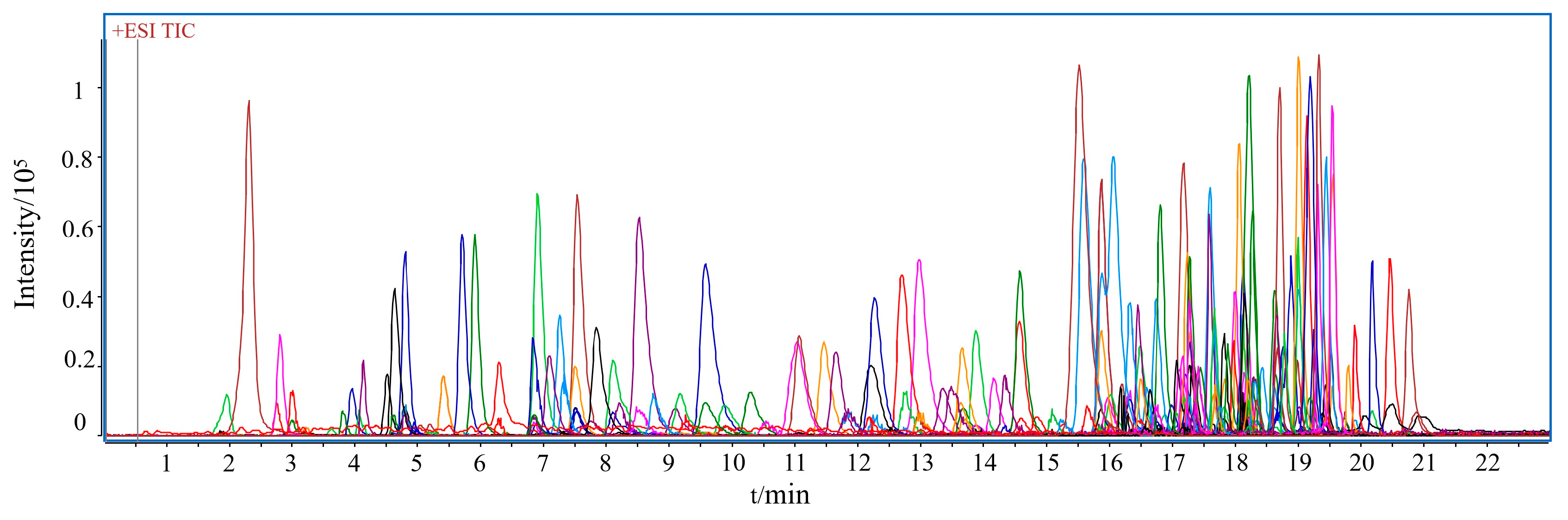
Mass Spectrometry Conditions: Mass spectrometric detection was performed using a Q-TOF/MS system with a Dual AJS ESI source operating in positive ion mode. The full scan range was set to m/z 50–1000. The capillary voltage was 4000 V. Nitrogen was used as the atomization gas at 0.14 MPa. The sheath gas temperature was 375 °C, and the sheath gas flow rate was 11.0 L/min. The drying gas flow rate was 12.0 L/min, and the drying gas temperature was 225 °C. The fragmentation voltage was 345 V. For All Ions MS/MS analysis, the collision energy was initially set to 0 V at 0 min. At 0.5 min, the collision energy was sequentially set to 0 V, 15 V, and 35 V, respectively. Mass spectrometry data for 197 compounds and the total ion current (TIC) of the standard solution are detailed in Table 1 and Figure 1.

2.7. Design and Optimization of Pretreatment

In qualitative identification, minimizing matrix interference is one of the most challenging tasks. To address this, pretreatment methods must first be optimized before quantitative validation can proceed. This study investigated factors potentially affecting the extraction efficiency of the QuEChERS method using single-factor experiments and multivariate response surface analysis. The response surface methodology is a powerful statistical technique that allows for the simultaneous optimization of multiple factors and the identification of factor interactions. Compared to single-factor experiments, response surface methodology can provide a comprehensive understanding of the relationships among factors and the response, leading to more efficient and robust optimization. The QuEChERS method was optimized by spiking at 50 µg/kg with pesticides and mycotoxins. After optimizing the extraction solvent and dosage, purification conditions were optimized, and a single-factor screening was conducted for the purification agent dosage. A three-factor, three-level response surface experiment was designed using the Box–Behnken model in Design-Expert software, with the dosages of PSA, C18, and MWCNTs as the variable factors and the compound proportion within the recovery range as the optimization target.

2.8. Methodological Validation

This study conducted methodological validation of Astragalus, including screening detection limits (SDL), limit of quantification (LOQ), linear range, matrix effects (ME), accuracy, and precision. SDL evaluation was performed in accordance with the requirements of the guidance document SANTE/11312/2021 [27]. The LOQ is the minimum detectable amount of a target analyte in a sample that can be quantitatively determined with results that meet the requirements for accuracy (recovery within 70% to 120%) and precision (relative standard deviation (RSD) ≤ 20%). A matrix-matched standard curve is constructed by adding a series of standard solutions to a blank matrix. ME is evaluated by the slope of the matrix-matched calibration curve and the solvent calibration curve. To validate the accuracy and precision of the developed method, six replicate recovery experiments were performed for 197 targets in Astragalus at three spiking levels: 1 × LOQ, 2 × LOQ, and 10 × LOQ.

3. Results and Discussion

3.1. Optimization of Pretreatment Conditions

3.1.1. Optimization of Extraction Solvent

Typical solvents used for pesticide extraction include acetonitrile, methanol, and acetone. However, given the low solubility of mycotoxins in methanol and acetone and their tendency to extract interfering substances from matrices [28,29], acetonitrile, the most widely used solvent, was selected for this study to extract both pesticides and mycotoxins simultaneously. Due to significant physicochemical differences among the compounds to be analyzed and Astragalus’s low moisture content, it is crucial to add an appropriate amount of water to the extraction solvent. Water promotes cell swelling in Astragalus, enhancing the penetration of organic solvents and thereby improving the efficiency of compound extraction [30]. Furthermore, studies indicate that adding formic acid to the extraction solvent can enhance the stability of certain acid-sensitive compounds [31].
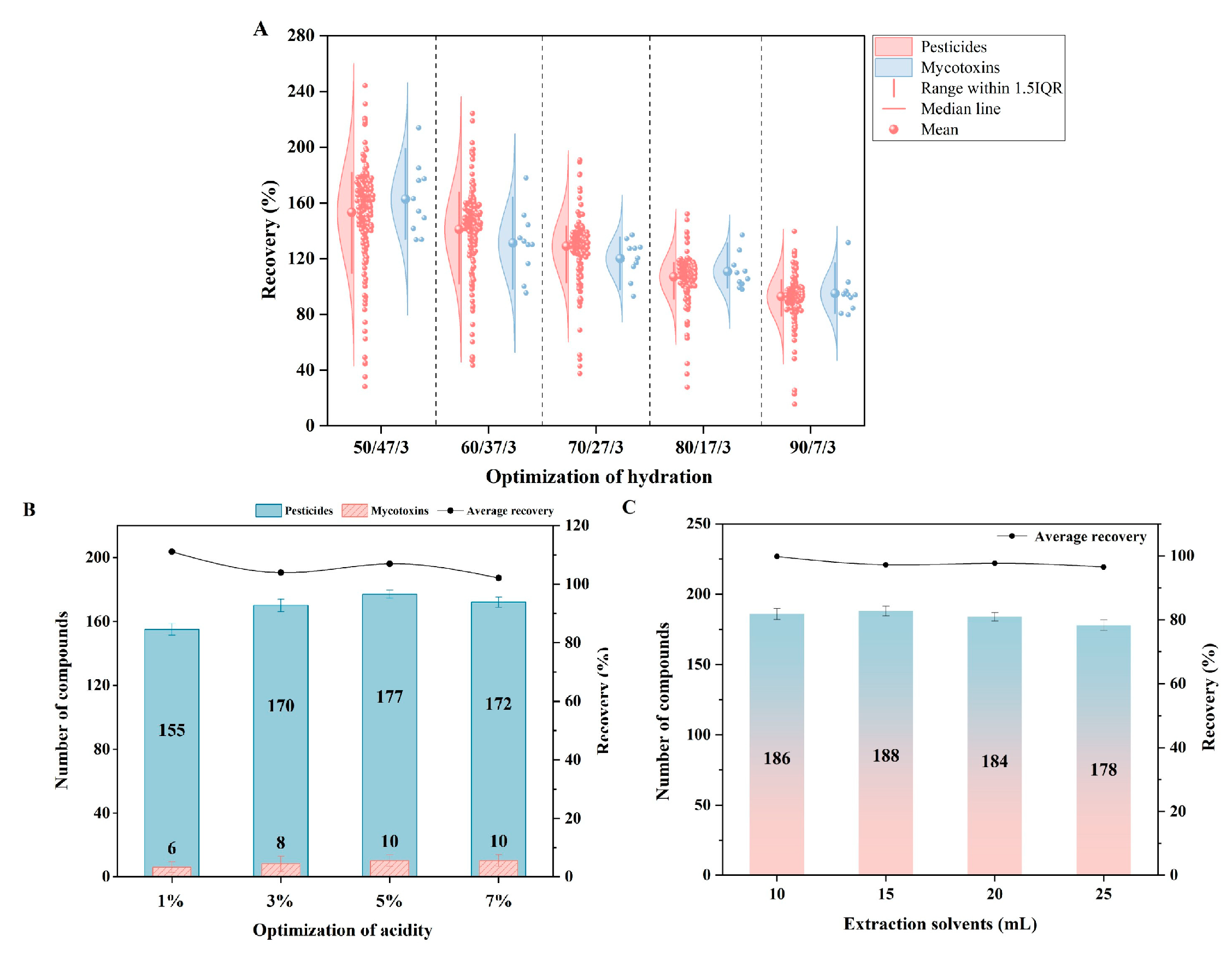
To enhance the extraction efficiency of compounds effectively, this study first compared five different solvent ratios at a spiking level of 50 µg/kg: acetonitrile/water/formic acid (50/47/3, v/v/v, I); (60/37/3, v/v/v, II); (80/17/3, v/v/v, III); (90/7/3, v/v/v, IV); and (90/7/3, v/v/v, V). Results indicated that as the proportion of water gradually decreased, the number of compounds meeting the recovery range first increased and then decreased (Figure 2A). At higher water ratios (I–III), the number of compounds meeting the recovery range was extremely low (16, 26, and 36, respectively), with most compounds exhibiting excessively high recoveries. When the water ratio decreased to 17%, the number of compounds meeting the requirements sharply increased to 178. However, when the water ratio decreased further to 7%, the excessively high acetonitrile content reduced the polarity of the extraction solvent, resulting in a lower proportion of some pesticides (cyromazine, metribuzin, spirodiclofen, and thidiazuron) being distributed to the organic phase. This may be due to the high water solubility and strong polarity of these pesticides, leading to lower recoveries when the aqueous solution volume is insufficient. Therefore, acetonitrile/water/formic acid (80/17/3, v/v/v) was selected for subsequent studies.
Compounds such as buprofezin, aflatoxin G1, and T-2 toxin are unstable under alkaline conditions and are relatively sensitive to acids [32]. Therefore, an appropriate amount of formic acid must be added to adjust the pH of the extraction solvent, thereby enhancing its stability and extraction efficiency. This study investigated the extraction efficiency of compounds from Astragalus using four different concentrations of formic acid (1%, 3%, 5%, 7%). As shown in Figure 2B, as the proportion of formic acid in acetonitrile increases, the number of compounds that meet the recovery range first increases and then decreases, reaching 161, 178, 187, and 182, respectively. When the formic acid concentration reaches 7%, the proportion becomes excessively high, altering the solvent polarity. This change in polarity may cause lipophilic compounds, such as malaoxon and pyridaben, to be more readily distributed into the aqueous phase, thereby reducing recoveries. Therefore, an acetonitrile–water solution containing 5% formic acid was selected as the extraction solvent for this study.
During extraction, the amount of extraction solvent used also affects the compound’s extraction efficiency. Therefore, this study investigated the impact of different extraction solvent volumes (10 mL, 15 mL, 20 mL, 25 mL) on the recoveries of 197 compounds, as shown in Figure 2C. When the volume increased from 10 mL to 25 mL, the number of compounds with recoveries between 70% and 120% was 186, 188, 184, and 178, respectively. Simultaneously, increased solvent usage leads to reagent waste and environmental pollution. After careful consideration, the extraction solvent volume was ultimately determined to be 15 mL.

3.1.2. Single-Factor Test of Purification Conditions

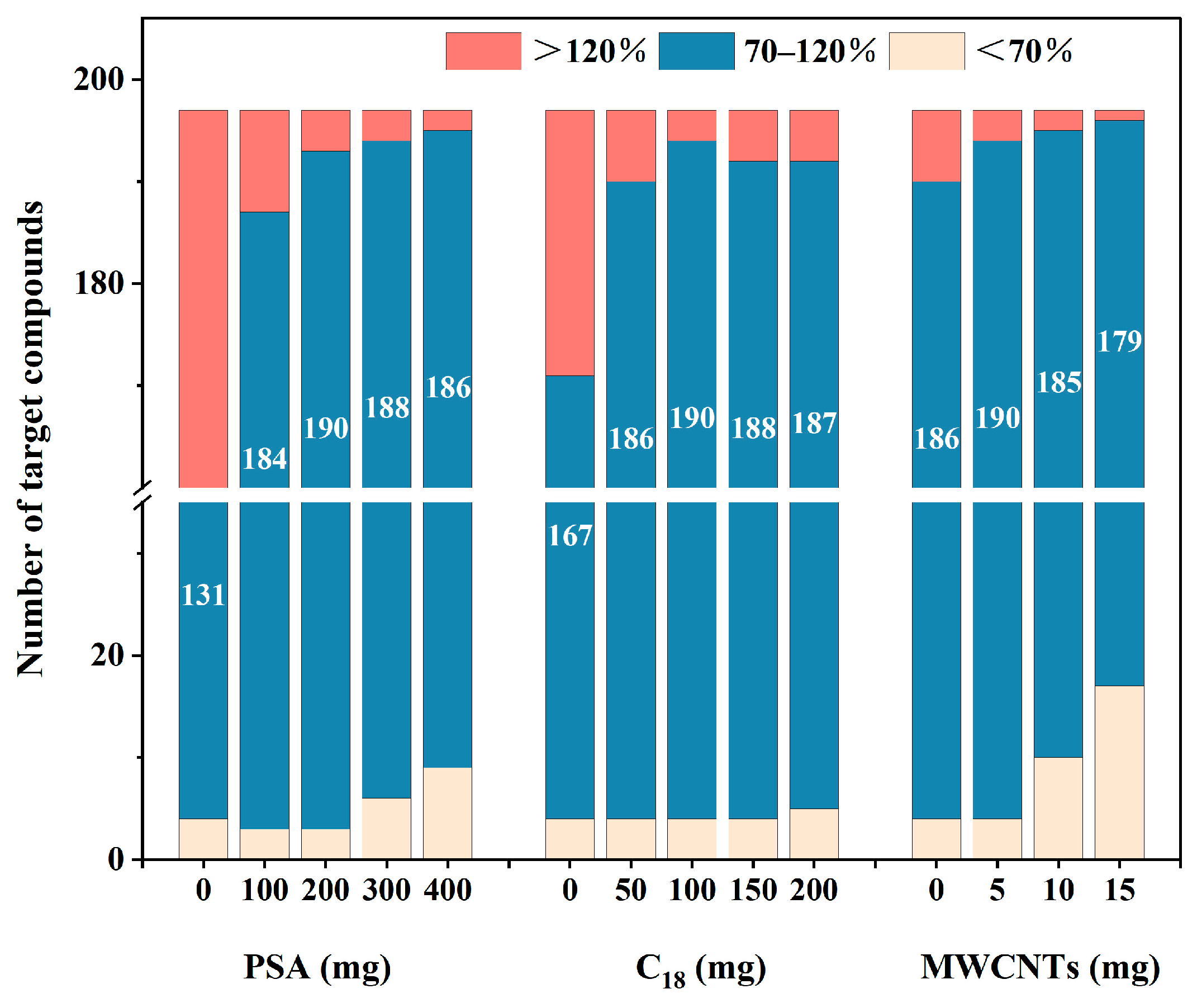
Although steps such as salt precipitation and centrifugation can remove some macromolecular interfering substances due to the presence of abundant polysaccharides, proteins, lipids, and other substances in Astragalus [1], residual interferents may still cause matrix enhancement or suppression. This interferes with compound determination and contaminates the detection system. Therefore, selecting appropriate purification materials (PSA, C18, MWCNTs) and their dosages during sample pretreatment is crucial for reducing the impact of interfering substances on target compounds and enhancing compound recoveries. PSA is a weak anion exchange resin capable of adsorbing certain polar interfering substances [33], while C18 can remove fats and nonpolar compounds [34]. The PSA and C18 combination purification materials demonstrate optimal purification performance across various solid matrices [35]. Concurrently, MWCNTs, as a novel purification material, effectively eliminate interfering substances such as fatty acids and pigments from samples, thereby enhancing purification outcomes [36]. In recent years, it has demonstrated advantages for detecting pesticide residues in high-pigment foods such as fruits, vegetables, and tea [37]. This experiment examined three purification materials (PSA, C18, MWCNTs) at different dosages. By calculating the number of compounds with recoveries between 70% and 120% in each group, the response surface factor level parameters were determined. As shown in Figure 3, the number of compounds meeting the 70–120% recovery range in all three single-factor experiments first increased and then decreased with increasing dosage.
Under fixed dosages of C18 (100 mg) and MWCNTs (5 mg), PSA was evaluated at different dosages (0 mg, 100 mg, 200 mg, 300 mg, 400 mg). Results indicate that when the PSA dosage was 0 mg, polar matrix interferences such as sugars and organic acids present in Astragalus were not sufficiently removed, resulting in suppressed recoveries for several target compounds. Notably, recoveries for polar pesticides such as dicrotophos and dioxacarb were significantly lower, indicating interference from polar matrix components. When the PSA dosage increased to 200 mg, the number of compounds meeting the recovery range was maximized. However, when the PSA dosage exceeded 200 mg, recovery of compounds such as indoxacarb and dicofol decreased significantly. This may be attributed to excessive PSA, which causes its amino groups to react with the carboxyl or phenolic hydroxyl groups of the compounds, leading to partial loss of the compounds. Therefore, 200 mg was selected as the optimal parameter for PSA dosage in the single-factor experiment for subsequent response surface optimization studies.
Under fixed dosages of PSA (200 mg) and MWCNTs (5 mg), C18 was evaluated at different dosages (0 mg, 50 mg, 100 mg, 150 mg, 200 mg). Results indicate that without C18 addition, non-polar interfering substances were not adsorbed, and recovery for certain compounds (e.g., carbofuran, dimethoate, and penconazole) exceeded 130%. When the C18 was 100 mg, the number of compounds meeting the recovery range was highest. However, as C18 increased to 150–200 mg, the number of compounds meeting the range gradually decreased. The recovery of certain heterocyclic compounds showed a downward trend, likely due to excessive adsorption by C18. Therefore, 100 mg was selected as the optimal parameter for C18 dosage in the single-factor experiment for subsequent response surface optimization studies.
Under fixed dosages of PSA (200 mg) and C18 (100 mg), MWCNTs were evaluated at different dosages (0 mg, 5 mg, 10 mg, 15 mg). The results indicate that, due to the adsorption properties of MWCNTs toward certain planar structures or compounds with high specific surface areas [38], the recoveries of planar compounds containing benzene rings (such as carbofuran and thiabendazole) decrease as the MWCNT dosage increases. At a MWCNT dosage of 5 mg, not only was the highest number of compounds within the recovery range achieved, but the sample solution also showed a significantly lighter color than at 0 mg, demonstrating remarkable purification efficacy. Therefore, 5 mg was selected as the optimal MWCNT dosage in the single-factor experiment for subsequent response surface optimization studies.

3.1.3. Response Surface Optimization of Purification Conditions

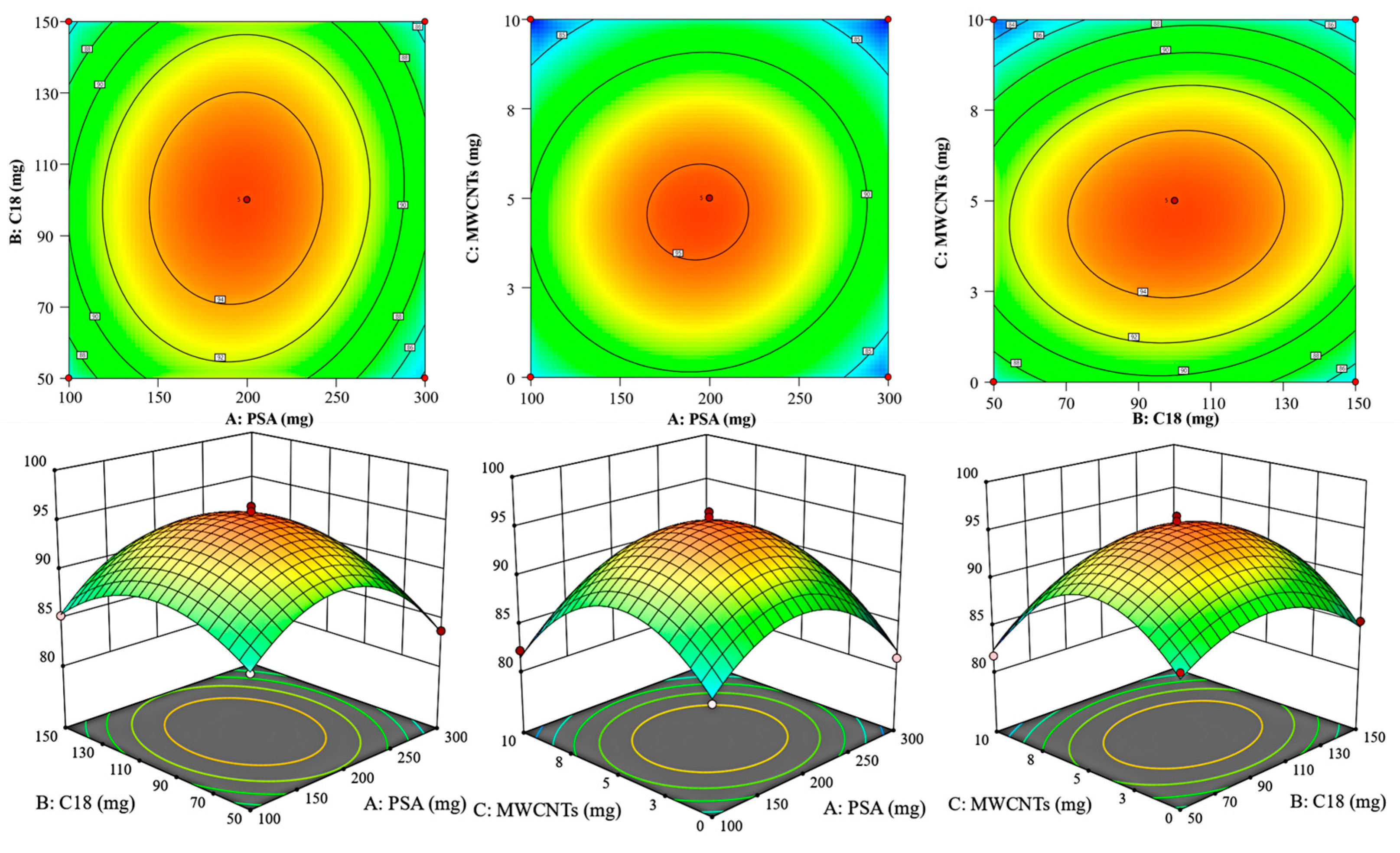
A three-factor, three-level design was employed using response surface optimization, building upon single-factor experiments, to determine the optimal dosages of PSA, C18, and MWCNTs. The proportion of compounds with recovery ranging from 70% to 120% (Y) was used as the response value. A mathematical model was developed using a Box–Behnken centered-combinatorial experimental design to optimize responses. Results were visually presented through three-dimensional plots and contour maps. The experiment comprised 17 test points, with the results summarized in Table 2. Data regression and analysis of variance were performed using Design-Expert software, with the results shown in Table 3.
The analysis results indicate that the response surface model exhibits extremely significant effects (p < 0.01). The regression equation for the compound ratio (Y) with respect to each factor is: Y = 95.43 − 0.76A + 0.1263B − 1.01C + 0.6350AB + 0.6350AC + 0.8875BC − 6.15A2 − 4.12B2 − 6.92C2. The lack of fit was not significant (p = 0.2994 > 0.05), indicating that the proportion of non-normal errors in fitting the obtained regression equation was small. The regression coefficient (R2) was 0.9883, and the adjusted coefficient (R2adj) was 0.9732. These results demonstrate a strong correlation between the selected factors and the response values, indicating that the model is highly reliable and well-suited for explaining and predicting responses. The coefficient of variation (CV%) was 1.05%, indicating good experimental stability. The magnitude of the F-value reflects the order of influence of the three factors on the response value: MWCNTs (C) > PSA (A) > C18 (B). All of the quadratic terms (A2, B2, and C2) significantly influenced the recoveries (p < 0.01).
Contour plots and 3D response surface plots illustrate the impact of factor interactions on the required compound ratio to meet the recovery range. Figure 4 shows contour plots and 3D response surface plots generated from the regression equation.
As shown in Figure 4, all three 3D plots exhibit convex shapes with downward-facing openings, and their contour lines are nearly elliptical. This indicates that the selected factors exhibit strong interactions and reach their maximum values within the examined range. Among these, C18 and MWCNTs have the contour shapes that most closely resemble ellipses, with densely packed contours. Their 3D plots also exhibit steeper gradients. This indicates that the interaction between C18 and MWCNTs has the most significant impact on recoveries, followed by other factors. Furthermore, when the dosage of MWCNTs was treated as the independent variable while the dosage of C18 remained constant, the 3D plot exhibits a pronounced trend of first increasing and then decreasing. However, when C18 dosage was the independent variable, the 3D plot exhibited relatively gentle fluctuations, with a surface steepness lower than that of the MWCNTs dosage curve. This indicates that in the interaction experiment between these two factors, MWCNTs dosage exerts a greater influence on the compound ratio than C18 dosage. This finding is consistent with the conclusions drawn from the analysis of variance in Table 3.
Based on the analysis of the experimental data, the software recommends the following optimal parameters: PSA: 193.5 mg; C18: 100.1 mg, and MWCNTs: 4.6 mg. Under these conditions, the theoretical compound ratio within the 70% to 120% range is 95.49%. Based on actual conditions, the optimal parameters selected are: PSA: 194 mg, C18: 100 mg, and MWCNTs: 5 mg. Under these conditions, the compound ratio reached 96.45%. This shows that the pretreatment process parameters obtained through response surface optimization are reliable and possess practical value. Furthermore, although the conclusions from single-factor experiments and response surface analysis are similar, the former examine only the independent effects of individual factors. In contrast, response surface analysis considers the interactions among multiple factors, thereby enhancing the statistical reliability of the conclusions.

3.2. Validation of the Approach

3.2.1. Matrix Effect

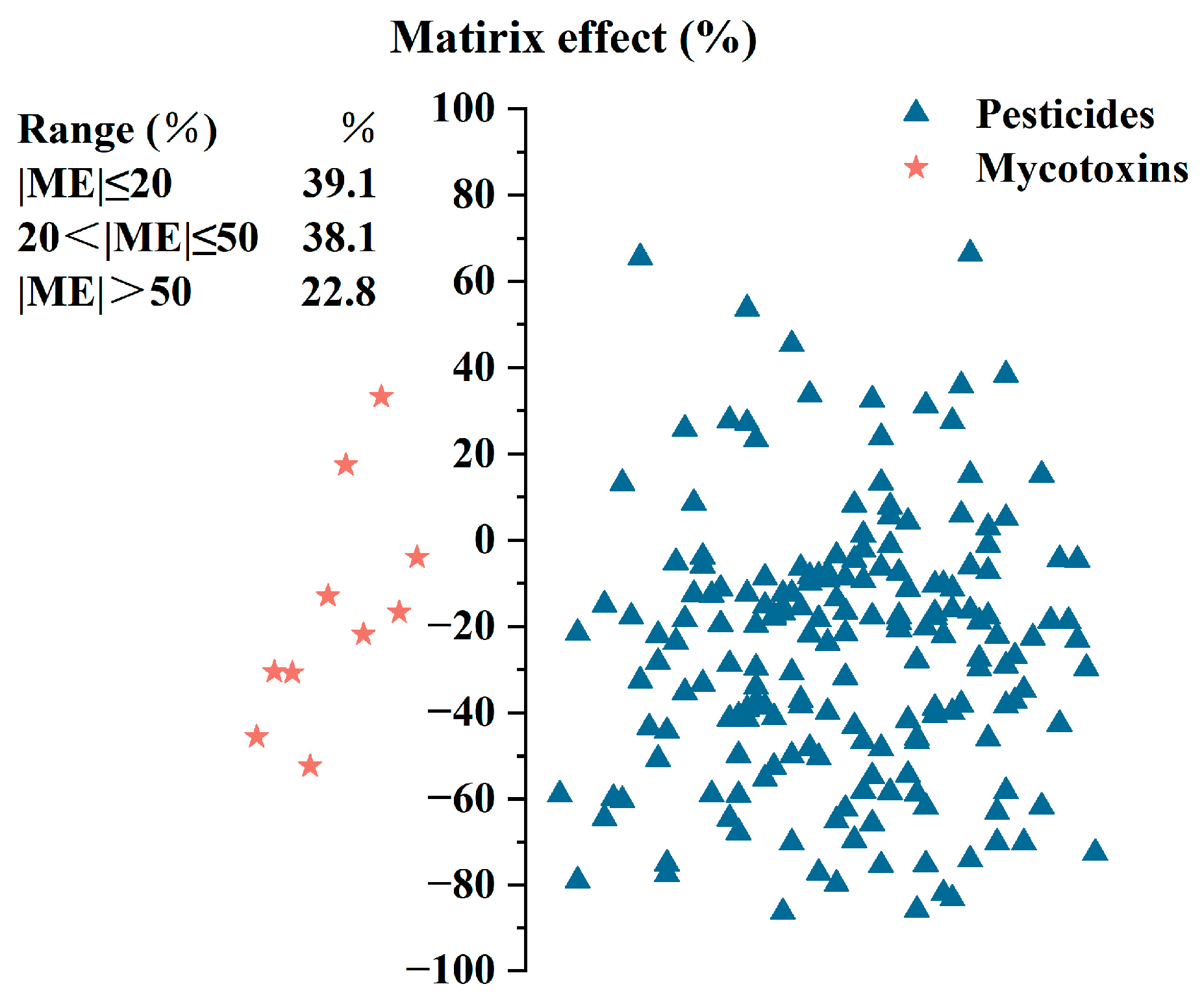
The matrix effect (ME) refers to the phenomenon where interfering components in a sample affect the accuracy of compound concentration or mass determination, leading to increased or decreased response values for the target analyte. Different types of compounds and sample matrices can cause different MEs. Therefore, when detecting multiple pesticide residues and mycotoxins, ME is a critical factor in ensuring the accuracy and reproducibility of test results. ME = (slope of matrix curve/slope of standard curve − 1) × 100% [39].
When ME > 0, it indicates the presence of a matrix enhancement effect; when ME < 0, it indicates the presence of a matrix inhibition effect. Astragalus components are complex, and the matrix constituents and co-extractables readily interfere with target ions, leading to ion enhancement or suppression. This study calculated MEs by establishing matrix curves and solvent curves. The results are shown in Figure 5; most compounds exhibit matrix inhibition effects. Specifically, among the analyzed pesticides, 85% showed matrix inhibition, while 15% showed matrix enhancement; among the mycotoxins, 80% showed matrix inhibition and 20% showed matrix enhancement.
Based on the magnitude of the impact, it can be further classified into weak matrix effects (|ME| ≤ 20%), moderate matrix effects (20% < |ME| ≤ 50%), and strong matrix effects (|ME| > 50%). As shown in Figure 5, 39.0% of the pesticides and 40.0% of the mycotoxins in Astragalus exhibited weak MEs. In comparison, 37.4% of the pesticides and 50.0% of the mycotoxins showed moderate MEs, demonstrating the method’s strong resistance to matrix interference in Astragalus.

3.2.2. Screening Detection Limits (SDLs), Limits of Quantification (LOQs), and Linearity

This study validated the screening limit (SDL) and limit of quantification (LOQ) in accordance with the SANTE/11312/2021 guideline. The SDL is defined as the lowest spiked concentration at which the detection rate reaches 95% in 20 spiking experiments conducted at multiple spiked concentrations. The LOQ is the lowest spiked concentration at which the analyte can be reliably and accurately determined, with recovery rates between 70% and 120% and a relative standard deviation (RSD) ≤ 20%.
Under optimal conditions, the method validation results are shown in Table S1. For 197 compounds in Astragalus, the SDLs and LOQs ranged from 1 to 20 and 2 to 20 μg/kg, respectively. Pesticides and mycotoxins with LOQs ≤ 10 μg/kg accounted for 82.4% and 70.0%, respectively. A series of mixed standard working solutions was added to the blank matrix of Astragalus. The calibration curve’s linear correlation coefficient (R2) was used to assess the reliability of the regression line. Experimental results showed that the R2 values for all target compounds within the linear range exceeded 0.995, indicating excellent linear relationships. Overall, this study requires less time, is easy to operate, and effectively enhances the sensitivity of compounds in the matrix.

3.2.3. Recovery and Precision

To evaluate the method’s accuracy and precision, spiked recovery experiments were conducted in blank matrices at spiking levels of 1×, 2×, and 10× the LOQ, with six replicates at each level. The mean recoveries and RSDs for each level were calculated, and the results are presented in Table S1. The recoveries for 197 compounds at three spiking levels ranged from 61.5% to 118.9%, 67.1% to 119.6%, and 72.0% to 119.3%, respectively. The RSDs ranged from 0.7% to 17.7%. The method’s precision was verified by repeating six analyses of the same sample within a single day and over three consecutive days. The intra-day RSD in Astragalus was below 10.0%, while the inter-day RSD was below 20.0%. These results show that the established method demonstrates good accuracy and precision and can simultaneously detect both pesticide residues and mycotoxins in Astragalus.

3.2.4. Comparison with Other Methods

The results of comparing this method with previously reported methods are shown in Table 4. Our method achieves a lower LOQ range compared to the methods reported by reference [8,39,40,41,42]. Additionally, our method achieves shorter analysis times compared to those reported in [8,40]. Compared to [43], our method detects more compounds. Furthermore, our method is the first to combine response surface methodology for the analysis of pesticides and mycotoxins in Astragalus, providing a novel and practical approach.

3.3. Real Sample Analysis

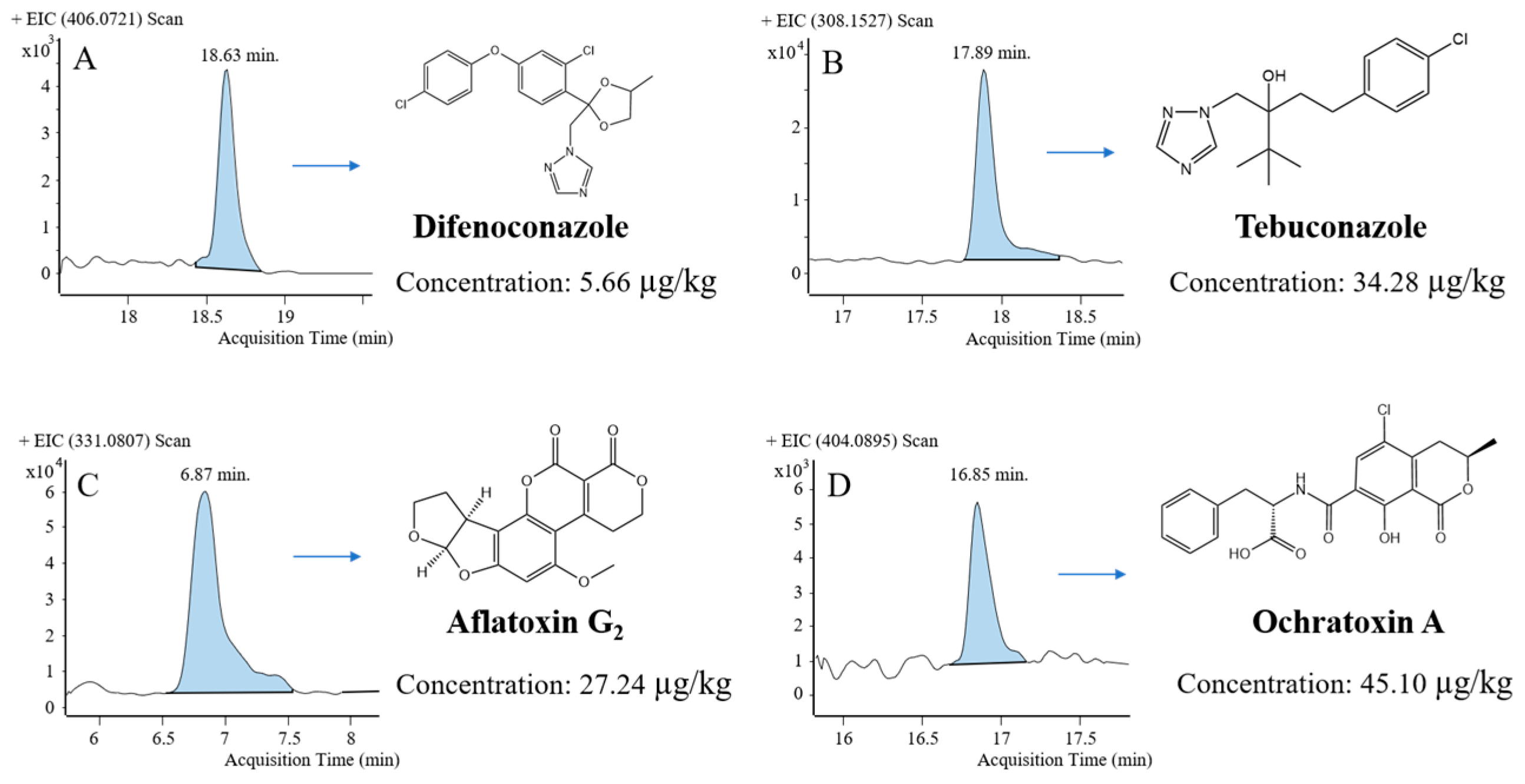
The method established in this study was applied to screen and quantify pesticide residues and mycotoxins in 20 batches of real Astragalus samples. To avoid false positives during compound identification, we performed detailed confirmation of the compounds in accordance with SANTE/11312/2021 and the research by Tóth et al. [44]. The results are presented in Table 5. Three pesticides and three mycotoxins were detected among the 20 batches of samples. The most frequently detected pesticide was tebuconazole (15%), followed by azoxystrobin (10%) and difenoconazole (5%). None of these detected pesticides have maximum residue limits (MRLs) specified in GB 2763-2021. However, all three are organic nitrogen fungicides, which may be related to fungicides applied during Astragalus cultivation to prevent infections such as root rot. The mycotoxins detected were aflatoxin B2, aflatoxin G2, and ochratoxin A, with detection rates of 10%, 10%, and 5%, respectively. Among these, two batches of real samples were found to contain both aflatoxin B2 and aflatoxin G2, with aflatoxin sums of 22.62 μg/kg and 48.67 μg/kg, respectively. China has not yet established MRLs for aflatoxins in Astragalus. However, compared with the European Pharmacopoeia limit (total aflatoxins G2, G1, B2, and B1 not exceeding 4 μg/kg), these two batches of the real samples exceeded this requirement [45]. Ochratoxin A was detected at 45.1 μg/kg in one batch of the real samples, exceeding the maximum limit of 20 μg/kg specified in the Chinese Pharmacopoeia (2025 ed.). All detection results were consistent with previous reports [14,46]; representative chromatograms are shown in Figure 6. The aforementioned results indicate that improper pesticide application may occur during Astragalus cultivation. However, overall residue levels remain low, posing minimal associated risk. In contrast, contamination by mycotoxins resulting from improper drying or storage practices is a more significant concern and requires urgent attention.

4. Conclusions

This study employed response surface methodology to optimize the QuEChERS method combined with LC-Q-TOF/MS detection technology, establishing a rapid multi-residue detection method for 187 pesticides and 10 mycotoxins in Astragalus. The results indicate that the established detection technology demonstrates high sensitivity for identifying pesticides and mycotoxins in Astragalus, meeting routine screening requirements. Both accuracy and precision were favorable. This method was applied to test 20 batches of real Astragalus samples. The results indicate that while pesticide residues were detected at low levels in the samples, mycotoxin contamination exceeding standards was a particular issue. To effectively reduce the risk of mycotoxin contamination, it is recommended that control measures be strengthened at key stages such as processing and storage. This method is rapid and straightforward to operate, providing a technical reference for high-throughput screening of pesticide residues and mycotoxins in other root and rhizome-based medicinal and food homologous substances. It contributes to enhancing the safety of such materials and safeguarding public health.

Supplementary Materials

The following supporting information can be downloaded at: https://www.mdpi.com/article/10.3390/separations13030076/s1, Table S1: SDL, LOQ, Linear range, R2, Spiked recoveries, and precision of 187 pesticides and 10 mycotoxins.

Author Contributions

Conceptualization, X.H. and H.Z.; methodology, H.Y. and Y.W.; validation, Y.C. and Z.S.; formal analysis, H.Y.; investigation, H.Y., Y.C. and H.Z.; resources, X.H. and H.Z.; data curation, H.Y. and Y.C.; writing—original draft preparation, H.Y.; writing—review and editing, Y.C. and X.H.; supervision, Z.S.; project administration, X.H.; funding acquisition, Y.W. and X.H. All authors have read and agreed to the published version of the manuscript.

Funding

This study was supported by the Fundamental Research Funds for the Public Research Institutes of the Chinese Academy of Quality and Inspection & Testing (2024JK007).

Data Availability Statement

Data is contained within the article or Supplementary Materials.

Acknowledgments

The authors acknowledge support from Agilent Technologies (China). We want to thank Mei-Ling LU for their valuable contribution to the manuscript.

Conflicts of Interest

The authors declare no conflicts of interest.

References

  1. Guo, Z.; Lou, Y.; Kong, M.; Luo, Q.; Liu, Z.; Wu, J. A Systematic Review of Phytochemistry, Pharmacology and Pharmacokinetics on Astragali Radix: Implications for Astragali Radix as a Personalized Medicine. Int. J. Mol. Sci. 2019, 20, 1463. [Google Scholar] [CrossRef]
  2. Shi, Y.; Shi, X.; Zhao, M.; Ma, S.; Zhang, Y. Pharmacological Potential of Astragali Radix for the Treatment of Kidney Diseases. Phytomedicine 2024, 123, 155196. [Google Scholar] [CrossRef] [PubMed]
  3. Qin, H.; Xie, L.; Zang, Y.; Han, J.; Yu, J.; Luo, Z.; Ma, X. Residue of Chlormequat and Regulatory Effects on the Specialized Metabolites of Astragali Radix. Molecules 2023, 28, 6754. [Google Scholar] [CrossRef]
  4. Butkovskyi, A.; Jing, Y.; Bergheim, H.; Lazar, D.; Gulyaeva, K.; Odenmarck, S.; Norli, H.; Nowak, K.; Miltner, A.; Kästner, M.; et al. Retention and Distribution of Pesticides in Planted Filter Microcosms Designed for Treatment of Agricultural Surface Runoff. Sci. Total Environ. 2021, 778, 146114. [Google Scholar] [CrossRef]
  5. Yang, Y.; Zheng, K.; Guo, L.P.; Wang, C.X.; Zhong, D.B.; Shang, L.; Hong, J.N.; Cui, X.M.; Huang, S.J. Rapid Determination and Dietary Intake Risk Assessment of 249 Pesticide Residues in Panax Notoginseng. Ecotoxicol. Environ. Saf. 2022, 233, 113348. [Google Scholar] [CrossRef]
  6. Chinese Pharmacopoeia Commission. Pharmacopoeia of the People’s Republic of China; China Press of Traditional Chinese Medicine: Beijing, China, 2025. [Google Scholar]
  7. GB 2763-2021; National Food Safety Standard-Maximum Residue Limits for Pesticides in Food. Ministry of Agriculture of the People’s Republic of China: Beijing, China, 2021.
  8. Wang, Z.; Weng, Y.; Xiao, J.; Zhang, P.; Wang, X.; Chen, L. Determination Research of Prohibited Pesticide Residues in Astragali Radix. Asia-Pac. Tradit. Med. 2024, 20, 61–68. [Google Scholar]
  9. Wang, Z.; Ren, X.; Zhang, A.; Sun, M.; Ding, Z.; Fan, J. A Fungal Hyphae-Derived Biomass Carbon for Magnetic Solid-Phase Extraction of the Organochlorine Pesticides in Water Samples, Tea Beverages, and Chinese Traditional Medicines before Gas Chromatography-Tandem Mass Spectrometry Determination. Food Chem. 2024, 457, 140123. [Google Scholar] [CrossRef]
  10. Wang, Q.; Zhu, Y.; Li, T.; Fan, L.; Li, Z.; Wang, X. Determination of 69 Kinds of Pesticide Residues in Paeonia tactilora, Astragalus membranaceus, Ranunculus ternatus and Cornus officinalis by GC-MS/MS. China Pharm. 2019, 30, 2829–2834. [Google Scholar]
  11. Yang, W.; Wang, S.; Li, Y.; Liu, Y.; Liu, S.; Huang, Y.; Ran, F.; Ren, H. A Comprehensive Review of Detection and Removal Strategy for Organic Pesticide Residues in Chinese Herbal Medicines. Talanta 2026, 299, 129098. [Google Scholar] [CrossRef]
  12. Wang, G.; Jiao, M.; Hu, J.; Yi, R.X.; Chen, L.; Qiu, J.; Ji, F.; Lee, Y.W.; Shi, J.; Xu, J. Quantitative Analysis of Fungal Contamination of Different Herbal Medicines in China. Toxins 2024, 16, 229. [Google Scholar] [CrossRef]
  13. Hu, L.; Li, M.; Sun, Y.; Zhao, H.; Chen, J.; Dai, X.; Kong, Z. Pesticide and Mycotoxin Residues in Astragalus: Transfer Patterns, Processing Factors and Risk Assessment during Astragalus Processing. Food Chem. 2025, 481, 144167. [Google Scholar] [CrossRef]
  14. Zhu, Y.; Wang, S.; Xu, X.; Wang, L.; Zhou, H.; Ying, X.; Hu, Q.; Wang, X.; Ji, S.; Cai, Q. Exposure Assessment and Risk-Based Limit Levels Evaluation of Ochratoxin a in Astragali Radix in China. Ecotoxicol. Environ. Saf. 2022, 237, 113517. [Google Scholar] [CrossRef]
  15. Hua, Z.; Liu, R.; Chen, Y.; Liu, G.; Li, C.; Song, Y.; Cao, Z.; Li, W.; Li, W.; Lu, C. Contamination of Aflatoxins Induces Severe Hepatotoxicity through Multiple Mechanisms. Front. Pharmacol. 2021, 11, 605823. [Google Scholar] [CrossRef]
  16. Perestrelo, R.; Silva, P.; Porto-Figueira, P.; Pereira, J.A.M.; Silva, C.; Medina, S.; Câmara, J.S. QuEChERS—Fundamentals, Relevant Improvements, Applications and Future Trends. Anal. Chim. Acta 2019, 1070, 1–28. [Google Scholar] [CrossRef]
  17. Cheng, R.; Xie, Y.; Chang, Q.; Bai, Y.; Tong, K.; Wu, X.; Chen, H. Simultaneous Determination of 202 Pesticide Residues and 19 Mycotoxins in Coix Seed by QuEChERS Coupled with LC-Q-TOF/MS and Subsequent Assessment of Dietary Exposure Risk. Food Control 2025, 175, 111301. [Google Scholar] [CrossRef]
  18. Selim, M.T.; Almutari, M.M.; Shehab, H.I.; EL-Saeid, M.H. Risk Assessment of Pesticide Residues by GC-MSMS and UPLC-MSMS in Edible Vegetables. Molecules 2023, 28, 1343. [Google Scholar] [CrossRef]
  19. Jedziniak, P.; Panasiuk, Ł.; Pietruszka, K.; Posyniak, A. Multiple Mycotoxins Analysis in Animal Feed with LC-MS/MS: Comparison of Extract Dilution and Immunoaffinity Clean-Up. J. Sep. Sci. 2019, 42, 1240–1247. [Google Scholar] [CrossRef]
  20. Eddahby, A.; Chahine, A.; Hssaini, L. Assessing Matrix Effects in LC-MS/MS Analysis of Pesticides in Food Using Diluted QuEChERS Extracts. Food Anal. Methods 2025, 18, 1203–1212. [Google Scholar] [CrossRef]
  21. Tölgyesi, Á.; Cseh, A.; Simon, A.; Sharma, V.K. Development of a Novel LC-MS/MS Multi-Method for the Determination of Regulated and Emerging Food Contaminants Including Tenuazonic Acid, a Chromatographically Challenging Alternaria Toxin. Molecules 2023, 28, 1468. [Google Scholar] [CrossRef]
  22. Chen, Y.; Cai, W.; Lin, Z.; Ma, Y.; Wu, Y.; Li, D.; Zhang, Z.; Wang, Y.; Chen, Y.; Wang, C. A Modified QuEChERS Method Using Single-Sorbent Combined with LC-MS/MS for Simultaneous Determination of Four Phenolic Pesticide Residues in Fruits and Vegetables. J. Food Compos. Anal. 2026, 149, 108820. [Google Scholar] [CrossRef]
  23. Lin, R.; Feng, H.; Zhang, Z.; Liu, Y.; Wen, H.; Chen, H.; Fan, Y.; Tan, Y.; Tang, Z. Novel Magnetic Nanoparticle-Assisted QuEChERS-UHPLC-MS/MS for the Determination of Multi-Mycotoxins in Complex Sample Matrices. Microchem. J. 2026, 221, 116963. [Google Scholar] [CrossRef]
  24. Huang, Q.; Guo, W.; Zhao, X.; Cao, H.; Fan, K.; Meng, J.; Nie, D.; Wu, Y.; Han, Z. Universal Screening of 200 Mycotoxins and Their Variations in Stored Cereals in Shanghai, China by UHPLC-Q-TOF MS. Food Chem. 2022, 387, 132869. [Google Scholar] [CrossRef]
  25. Pang, G.; Fan, C.; Chang, Q.; Li, J.; Kang, J.; Lv, M. Screening of 485 Pesticide Residues in Fruits and Vegetables by Liquid Chromatography-Quadrupole-Time-of-Flight Mass Spectrometry Based on TOF Accurate Mass Database and QTOF Spectrum Library. J. AOAC Int. 2018, 101, 1156–1182. [Google Scholar] [CrossRef] [PubMed]
  26. Pang, G.; Chang, Q.; Bai, R.; Fan, C.; Zhang, Z.; Yan, H.; Wu, X. Simultaneous Screening of 733 Pesticide Residues in Fruits and Vegetables by a GC/LC-Q-TOFMS Combination Technique. Engineering 2020, 6, 432–441. [Google Scholar] [CrossRef]
  27. SANTE/11312/2021; Analytical Quality Control and Method Validation Procedures for Pesticide Residues Analysis in Food and Feed. European Commission: Brussels, Belgium, 2021.
  28. Kresse, M.; Drinda, H.; Romanotto, A.; Speer, K. Simultaneous Determination of Pesticides, Mycotoxins, and Metabolites as Well as Other Contaminants in Cereals by LC-LC-MS/MS. J. Chromatogr. B 2019, 1117, 86–102. [Google Scholar] [CrossRef]
  29. Reichert, B.; Pizzutti, I.R.; Jänisch, B.D.; Zorzella Fontana, M.E. Improving Analytical Performance for Pesticides and Mycotoxins Determination in Brazilian Table Olives: One Extraction and One Analysis. Anal. Methods 2024, 16, 4124–4135. [Google Scholar] [CrossRef]
  30. Rasche, C.; Fournes, B.; Dirks, U.; Speer, K. Multi-Residue Pesticide Analysis (Gas Chromatography–Tandem Mass Spectrometry Detection)—Improvement of the Quick, Easy, Cheap, Effective, Rugged, and Safe Method for Dried Fruits and Fat-Rich Cereals—Benefit and Limit of a Standardized Apple Purée Calibration (Screening). J. Chromatogr. A 2015, 1403, 21–31. [Google Scholar]
  31. Wu, X.; Li, J.; Wei, J.; Tong, K.; Xie, Y.; Chang, Q.; Yu, X.; Li, B.; Lu, M.; Fan, C. Multi-Residue Analytical Method Development and Dietary Exposure Risk Assessment of 345 Pesticides in Mango by LC-Q-TOF/MS. Food Control 2024, 170, 111016. [Google Scholar] [CrossRef]
  32. Yan, X.; Zhang, H.; Zhu, Z.; Xie, Y.; Wu, X.; Shi, Z.; Fan, C.; Chen, H. Simultaneous Determination of 78 Pesticide Residues and 16 Mycotoxins in Tsampa by an Improved QuEChERS Method Coupled with Ultra Performance Liquid Chromatography-Tandem Mass Spectrometry. Anal. Methods 2024, 16, 5178–5190. [Google Scholar] [CrossRef]
  33. Azimeh, K.; Ansari, M.; Amirahmadi, M.; Shahidi, M.; Mohamadi, N.; Kazemipour, M. Pesticide Residues in Dates Using a Modified QuEChERS Method and GC-MS/MS. Food Addit. Contam. Part B 2022, 15, 168–176. [Google Scholar]
  34. Zhang, Z.; Dong, M.; Hao, X.; Han, L.; Song, S.; Yao, W. Evaluation of Cleanup Procedures in Pesticide Multi-Residue Analysis with QuEChERS in Cinnamon Bark. Food Chem. 2019, 276, 140–146. [Google Scholar] [CrossRef]
  35. Zheng, K.; Zheng, H.; Yu, Y.; Su, J.; Chen, L.; Zheng, M.; Liu, L.; Wu, X.; Chen, D.; Meng, X. Simultaneous Determination of Four Pesticides Residues in Rice by Modified QuEChERS Coupled with GC-MS/MS. J. Food Compos. Anal. 2024, 133, 106396. [Google Scholar] [CrossRef]
  36. Xu, R.; Xie, Q.; Li, X.; Zhao, H.; Liu, X.; Wei, Y.; Qiu, A. Modified QuEChERS Method Based on Multi-Walled Carbon Nanotubes Coupled with Gas Chromatography-Tandem Mass Spectrometry for the Detection of 10 Pyrethroid Pesticide Residues in Tea. Chin. J. Chromatogr. 2022, 40, 469–476. [Google Scholar] [CrossRef]
  37. Yu, C.; Hao, D.; Chu, Q.; Wang, T.; Liu, S.; Lan, T.; Wang, F.; Pan, C. A One Adsorbent QuEChERS Method Coupled with LC-MS/MS for Simultaneous Determination of 10 Organophosphorus Pesticide Residues in Tea. Food Chem. 2020, 321, 126657. [Google Scholar] [CrossRef]
  38. Liu, S.; Xiao, P.; Xu, J.; Yang, D.; Chen, M.; Zhou, C. Deep eutectic solvent-modified multi-walled carbon nanotubes as QuEChERS adsorbents coupled with gas chromatography-mass spectrometry for the determination of pesticide residues in Lycium barbarum. J. Food Compos. Anal. 2025, 141, 107350. [Google Scholar] [CrossRef]
  39. Lu, Q.; Ruan, H.; Sun, X.; Luo, J.; Yang, M. Contamination status and health risk assessment of 31 mycotoxins in six edible and medicinal plants using a novel green defatting and depigmenting pretreatment coupled with LC-MS/MS. J. LWT Food Sci. Technol. 2022, 161, 113401. [Google Scholar] [CrossRef]
  40. Zheng, W.; Li, X.; Wang, X.; Hua, M.Z.; Wu, Y.; Wang, Y.; Wu, Z.; He, X.; Xu, D.; Zheng, W.; et al. Simultaneous Determination of 147 Pesticide Residues in Traditional Chinese Medicines by GC-MS/MS. ACS Omega 2023, 8, 28663. [Google Scholar]
  41. Li, R.; Li, M.; Wang, T.; Wang, T.; Chen, J.; Francis, F.; Fan, B.; Kong, Z.; Dai, X. Screening of Pesticide Residues in Traditional Chinese Medicines Using Modified QuEChERS Sample Preparation Procedure and LC-MS/MS Analysis. J. Chromatogr. B 2020, 1152, 122224. [Google Scholar] [CrossRef]
  42. Xie, S.; Gu, S.; Gu, L.; Li, J. Determination of 16 Mycotoxins in Three Radix and Rhizome Chinese Herbal Medicines by mPFC-QuEChERS with UPLC-MS/MS. J. Instrum. Anal. 2024, 43, 1003–1010. [Google Scholar]
  43. Reinholds, I.; Pugajeva, I.; Bavrins, K.; Kuckovska, G.; Bartkevics, V. Mycotoxins, Pesticides and Toxic Metals in Commercial Spices and Herbs. Food Addit. Contam. Part B 2016, 10, 5–14. [Google Scholar] [CrossRef] [PubMed]
  44. Tóth, E.; Bálint, M.; Tölgyesi, Á. False Positive Identification of Pesticides in Food Using the European Standard Method and LC-MS/MS Determination: Examples and Solutions from Routine Applications. Appl. Sci. 2022, 12, 12005. [Google Scholar] [CrossRef]
  45. Council of Europe, European Directorate for the Quality of Medicines & HealthCare (EDQM). European Pharmacopoeia, 10th ed.; Council of Europe: Strasbourg, France, 2019. [Google Scholar]
  46. Li, L.; Qiu, M.; He, S.; Luo, Y.; Huang, J.; Lu, M. HPLC-MS/MS determination of 119 pesticides in Astragali Radix. Chin. J. Pharm. Anal. 2012, 32, 424–433. [Google Scholar]
Figure 1. Total ion chromatogram (TIC) of 197 compound standard solutions.
Separations 13 00076 g001
Figure 2. Effect of different extraction solvents on compound recovery rate ((A): different water ratios, (B): different formic acid ratios, (C): different extraction liquid volumes).
Separations 13 00076 g002
Figure 3. Effect of different purification agent dosages on the number of compounds meeting requirements.
Separations 13 00076 g003
Figure 4. Response surface and contour plots of factor interactions.
Separations 13 00076 g004
Figure 5. Distribution of matrix effects for 187 pesticides and 10 mycotoxins.
Separations 13 00076 g005
Figure 6. Chromatograms of difenoconazole (A), tebuconazole (B), aflatoxin G2 (C), and ochratoxin A (D).
Separations 13 00076 g006
Table 1. MS information for 187 pesticides and 10 mycotoxins.
No.CompoundRetention Time (min)Precursorion (m/z)Production 1 (m/z)Production 2 (m/z)No.CompoundRetention Time (min)Precursorion (m/z)Production 1 (m/z)Production 2 (m/z)
Pesticides (187) 96Metconazole18.2320.152470.0400125.0153
1Acetamiprid5.4223.0745126.010590.033897Methamidophos1.9142.008694.0052124.9821
2Acetochlor17.2270.1255224.0837148.112198Methidathion13.7302.9691145.006685.0396
3Alachlor17.2270.1255238.0993162.127799Methiocarb15.2226.0900169.0678121.0650
4Aldicarb-sulfone3.2223.074786.0600148.0427100Methoxyfenozide16.7369.2173149.0597313.1547
5Ametryn13.0228.1277186.080868.0243101Metribuzin8.2215.0961187.101284.0808
6Atrazine12.2216.1010174.0541104.0010102Metsulfuron-methyl9.9382.0816167.0564135.0441
7Avermectin20.5895.4818789.9903896.4840103Monocrotophos4.1224.0682127.0155193.0260
8Azaconazole12.3300.0301230.9974158.9763104Myclobutanil16.6289.1215125.015370.0400
9Azinphos-ethyl17.0346.0443132.0444232.9491105Napropamide17.2272.1645171.0804199.0754
10Azoxystrobin15.9404.1241372.0979329.0795106Nicosulfuron9.3411.1081182.0560213.0322
11Benalaxyl18.1326.1751294.1489208.1332107Omethoate2.8214.0297182.9875154.9926
12Bitertanol18.4338.1863269.1536251.1417108Oxadiazon19.2345.0767303.0298219.9563
13Boscalid16.0343.0399307.0633271.0866109Oxadixyl7.8279.1339219.1128133.0886
14Bromuconazole16.8375.9614158.9763306.9273110Paclobutrazol16.2294.136870.0400125.0153
15Buprofezin19.1306.1635201.1056106.0651111Paraoxon-ethyl12.8276.0632220.0002174.0076
16Cadusafos18.6271.0950158.9698130.9385112Paraoxon-methyl7.3248.0319202.0389109.0049
17Carbofuran9.1222.1125165.0910123.0441113Penconazole12.6284.0716158.976370.0400
18Carbofuran-3-Hydroxy5.2238.1074163.0754181.0859114Phenthoate17.7321.0379247.0011163.0754
19Carboxin9.9236.0740143.016193.0573115Phorate-Sulfone12.5293.0097247.0215171.0230
20Chlordimeform4.0197.0840117.0573152.0262116Phorate-sulfoxide12.2277.0150199.0011170.9698
21Chlorfenvinphos18.1358.9768155.0468204.9371117Phosalone18.3367.9941181.9998110.9996
22Chlorpyrifos19.4349.9336321.9023197.9268118Phosfolan6.8256.0217227.9907139.9563
23Chlorsulfuron11.3358.0371167.0564141.0771119Phosfolan-Methyl4.1227.9911167.9873109.0044
24Clothianidin4.6250.0160169.0542131.9669120Phosmet14.5318.0018160.0393133.0284
25Coumaphos18.1363.0217226.9926306.9591121Phosphamidon8.1300.0762174.0678127.0155
26Cyproconazole17.4292.1211125.015370.0400122Phoxim17.7299.0614129.0447124.9821
27Cyprodinil17.2226.133993.0573210.1026123Picoxystrobin17.7368.1104205.0859145.0648
28Cyromazine1.9167.103685.0511125.0821124Piperonyl Butoxide19.3356.2423177.0898178.0940
29Dicrotophos4.5238.0839112.0757127.0155125Pirimicarb7.8239.1503182.128872.0444
30Diethofencarb15.3268.1543226.1074152.0706126Pirimiphos-ethyl19.2334.1349198.1059170.0746
31Difenoconazole18.6406.0721408.0690251.0021127Pirimiphos-methyl18.2306.1036164.1182108.0556
32Diflubenzuron13.9311.0393158.0412141.0146128Pretilachlor18.9312.1725252.1150176.1434
33Diflufenican18.7395.0813266.0412246.0350129Prochloraz18.3376.0381307.9988309.9951
34Dimethoate5.0230.0069198.9647170.9698130Profenofos19.0372.9424302.8642344.9111
35Dimethomorph16.5388.1310301.0626165.0546131Promecarb15.9208.1332151.1117109.0648
36Diniconazole18.4326.0821328.0799327.0855132Prometryn15.6242.1434158.0495200.0964
37Dioxacarb8.2224.0917167.0703123.0441133Propachlor13.0212.0837170.036794.0651
38Edifenphos18.0311.0324283.0011172.9821134Propamocarb2.8189.1598102.0550144.1019
39Epoxiconazole15.9330.0806332.0784331.0837135Propiconazole18.1342.0771158.976369.0699
40Ethametsulfuron6.9397.0924196.0823168.0510136Pymetrozine12.2218.1036105.044778.0338
41Ethion19.3384.9949199.0011170.9698137Pyraclostrobin18.3388.1059194.0812163.0628
42Ethoprophos17.2243.0637172.9854215.0324138Pyridaben20.2365.1449309.0823147.1168
43Etofenprox20.8394.2378399.2619393.2476139Pyrimethanil13.5200.1182168.0682182.0838
44Etrimfos17.8293.0719265.0406124.9821140Pyriproxyfen19.3322.1438227.106796.0444
45Fenamiphos17.6304.1131217.0083201.9848141Quinalphos17.7299.0614271.0301242.9985
46Fenamiphos-sulfone11.5336.1029308.0716266.0247142Quinoxyfen19.4308.0040196.9789213.9821
47Fenamiphos-sulfoxide11.0320.1080233.0032292.0767143Quizalofop-ethyl19.0373.0950299.0577255.0315
48Fenarimol17.2331.0399268.0524259.0057144Simazine8.5202.0854132.0323124.0869
49Fenazaquin20.4307.1805161.132557.0699145Simeconazole17.1294.143270.0400135.0605
50Fenbuconazole17.4337.1219339.1194338.1248146Spirodiclofen19.9411.1124313.0393212.9505
51Fenhexamid17.0302.070997.101255.0542147Spirotetramat17.3374.1962330.2064302.1751
52Fenpropathrin19.7350.1751125.096197.1012148Spirotetramat-enol4.8302.1758216.1017270.1487
53Fenpropimorph15.5304.2625305.2672147.1160149Spirotetramat-enol-glucoside4.8464.2283302.1750324.1573
54Fensulfothion13.9309.0379252.9753234.9647150Spirotetramat-keto-hydroxy14.2318.1702300.1597268.1333
55Fensulfothion-oxon7.3293.0607236.9980218.9873151Spirotetramat-mono-hydroxy9.2304.1915254.1537211.1475
56Fensulfothion-Oxon-Sulfone7.5309.0565252.9932175.0150152Spiroxamine16.1298.2741144.1383100.1121
57Fensulfothion-sulfone14.1325.0328268.9687190.9914153Sulfentrazone10.5386.9891306.9944308.0038
58Fenthion17.8279.0273247.0011169.0140154Sulfotep17.8323.0300171.0239294.9987
59Fenthion-oxon14.6263.0501231.0239216.0005155Tebuconazole17.9308.1527310.1498309.1552
60Fenthion-oxon-sulfone5.9295.0403217.0624296.0430156Tebufenpyrad19.2334.1681117.0209145.0522
61Fenthion-oxon-sulfoxide5.7279.0451264.0216262.0423157Terbufos16.0289.0514103.057657.0699
62Fenthion-sulfone11.6311.0171278.9909124.9821158Terbufos-Sulfone15.1321.0412171.0240275.0536
63Fenthion-sulfoxide11.1295.0222279.9987278.0195159Terbufos-Sulfoxide15.3305.0465187.0010158.9694
64Flonicamid3.6230.0536203.0427148.0369160Tetrachlorvinphos17.7364.9065203.9293238.8982
65Fluacrypyrim18.6427.1475205.0859145.0648161Tetraconazole17.2372.0290374.0250158.9752
66Flucythrinate19.6469.1931470.3460468.3107162Thiabendazole4.6202.0433175.0324131.0604
67Flufenacet17.1364.0737194.0976152.0506163Thiacloprid6.3253.0309126.008790.0338
68Flufenoxuron19.5489.0435158.0401141.0146164Thiamethoxam3.8292.0266211.0648181.0542
69Flumioxazin14.8355.1088327.1085210.1506165Thidiazuron8.7221.0492102.012077.0386
70Flumorph14.6372.1606285.0909165.0530166Thifluzamide17.4526.8485528.8456488.8332
71Fluroxypyr7.3254.9734208.9679180.9730167Thiobencarb18.4258.0714125.0153100.0757
72Flusilazole17.6316.1076247.0749165.0697168Thiocyclam2.0182.0126136.952373.0092
73Flutriafol12.9302.1099233.0773123.0241169Tralkoxydim19.6330.2064284.1645285.1723
74Fonofos17.9247.0375137.0184108.9871170Triadimefon16.6294.1004197.0714225.0659
75Fosthiazate11.9284.0538227.9909104.0165171Triadimenol16.8296.115870.0405298.1133
76Heptenophos13.7251.0234127.0155109.0049172Triazophos16.8314.0723162.0662119.0604
77Hexaconazole18.1314.0825316.0790315.0848173Trichlorfon5.0256.9299220.9532109.0051
78Hexythiazox19.4353.1085228.0240168.0570174Tricyclazole7.1190.0433136.0215163.0324
79Imazalil12.7297.0550299.0526158.9761175Trifloxystrobin18.7409.1370186.0525145.0260
80Imidacloprid4.6256.0596209.0589175.0978176Triflumizole18.8346.0920278.0547280.0524
81Imidaclothiz4.9262.0158181.0537265.1525177Trifluralin17.8336.1170342.2657345.2389
82Indanofan17.2341.0941348.2548348.7550178Triflusulfuron-methyl16.5493.1112264.0698461.0850
83Indoxacarb18.7528.0780293.0319218.0417179Uniconazole17.4292.1213294.1191293.1246
84Ipconazole19.2334.168170.0400125.0153180Zoxamide18.0336.0319186.9712158.9763
85Isazofos16.7314.0490162.0424272.0020 Mycotoxins (10)
86Isocarbophos13.6312.0433269.9950236.00771Aflatoxin B19.6313.0700285.0741269.0432
87Isoprothiolane16.3291.0719231.0144188.96752Aflatoxin B28.5315.0862259.0583287.0891
88Linuron14.6249.0192159.9710182.02413Aflatoxin G17.5329.0638243.0629215.0682
89Malaoxon10.3315.0662127.039099.00774Aflatoxin G26.9331.0807313.0709285.0760
90Malathion16.3331.0433127.0390285.00155Deoxynivalenol3.4297.1328298.3453249.1101
91Mandipropamid16.5412.1310328.1094356.10436Ochratoxin A16.8404.0895239.0098220.9990
92Matrine2.3249.1967148.1117250.19917Stachybotrylactam18.2386.2326387.2331178.0488
93Mecarbam17.2330.0593226.9960142.93858T-2 toxin15.6484.2541215.1063185.0960
94Mepronil16.3270.1489228.1019119.04919Tentoxin14.3415.2340358.2125302.1499
95Metalaxyl13.7280.1543220.1332192.138310Zearalenone16.6319.1540283.1309301.1413
Table 2. Box–Behnken test results.
NumberA: PSA (mg)B: C18 (mg)C: MWCNTs (mg)Y (%)
130050583.76
22001501083.76
31001001082.23
410050586.30
53001001081.73
6300100081.22
7100150585.28
8200501081.73
9200100594.92
10200100595.94
11200150085.28
12300150585.28
1320050086.8
14200100594.42
15200100596.45
16100100084.26
17200100595.43
Table 3. Analysis of variance for the response surface quadratic regression equation model.
SourceSum of SquaresdfMean SquareF-Valuep-ValueSignificance
Model499.8955.5365.68<0.0001**
A-PSA4.6214.625.460.052
B-C180.127510.12750.15080.7093
C-MWCNTs8.2218.229.720.0169*
AB1.6111.611.910.2097
AC1.6111.611.910.2097
BC3.1513.153.730.0949
A2159.51159.5188.63<0.0001**
B271.55171.5584.62<0.0001**
C2201.471201.47238.27<0.0001**
Residual5.9270.8455
Lack of fit3.3431.111.720.2994
Pure error2.5840.6452
Cor total505.7216
“*” means a significant effect on the results (p < 0.05); “**” means a highly significant impact on the results (p < 0.01).
Table 4. Comparison of the proposed method with other analytical methods for determination.
MatrixNumber of AnalytesExtraction MethodInstrumentationLOQ Range (μg/kg)Total Analysis TimeReferences
Astragalus33 pesticidesQuEChERSLC-MS/MS, GC-MS/MS10–10050 min[8]
Six edible and medicinal plants31 mycotoxinsQuEChERSLC-MS/MS0.03–5015 min[39]
Two TCM147 pesticidesQuEChERSGC-MS/MS10–5030 min[40]
Three TCM108 pesticidesQuEChERSUHPLC-MS/MS0.01–5021 min[41]
Three rhizome TCM16 mycotoxinsmPFC-QuEChERSUPLC-MS/MS0.5–5017 min[42]
Spices and herbs134 pesticides and 11 mycotoxinsQuEChERSHPLC-QqQ-MS/MS2.4–1215 min[43]
Astragalus187 pesticides and 10 mycotoxinsQuEChERSLC-Q-TOF/MS2–2023 minThis work
Table 5. Detection of pesticide residues and mycotoxins in real Astragalus samples.
No.CompoundDetected QuantityDetection Rate (%)Concentration Range (µg/kg)
1Azoxystrobin210.05.08–10.88
2Difenoconazole15.05.66
3Tebuconazole315.011.15–34.28
4Ochratoxin A15.045.10
5Aflatoxin B2210.016.40–21.43
6Aflatoxin G2210.06.22–27.24
Sum of aflatoxins210.022.62–48.67
Disclaimer/Publisher’s Note: The statements, opinions and data contained in all publications are solely those of the individual author(s) and contributor(s) and not of MDPI and/or the editor(s). MDPI and/or the editor(s) disclaim responsibility for any injury to people or property resulting from any ideas, methods, instructions or products referred to in the content.