Article

Amidoxime-Functionalized Carbon Fibers for Efficient Adsorption of Uranium(VI) from Aqueous Solutions


by
Xin Lu
1,*,
Jingjing Wang
1,
Kaige Shi
1,
Shuaijun Han
1,
Qingcong Wei
2,
Bei Kang
3,
Bing Liu
1,
Yanmin Chen
1 and
Mengtao Song
1
1
Henan Engineering Technology Research Center for Green Catalytic and Atom Economic Conversion of Coal-Based Benzene, School of Chemistry and Chemical Engineering, Zhengzhou Normal University, Zhengzhou 450044, China
2
School of Chemistry and Chemical Engineering, Henan Normal University, Xinxiang 453007, China
3
School of Mathematics and Statistics, North China University of Water Resources and Electric Power, Zhengzhou 450046, China
*
Author to whom correspondence should be addressed.
Separations 2026, 13(10), 271; https://doi.org/10.3390/separations13100271
Submission received: 19 August 2026 / Revised: 16 September 2026 / Accepted: 22 September 2026 / Published: 24 September 2026

Abstract

A novel amidoxime-functionalized carbon fiber adsorbent (CFAO) was successfully fabricated via surface grafting modification for U(VI) removal. The sorption behaviors of the CFAO were systematically explored under various experimental conditions involving solution pH, contact time, initial U(VI) concentration, temperature, and complex competing ion environments. With a fixed adsorbent dosage of 10 mg in 30 mL solution, the maximum experimental equilibrium adsorption capacity was 56.25 mg/g at an initial U(VI) concentration of 60 mg/L, with sufficient contact time to attain full adsorption equilibrium. The Langmuir model yielded a theoretical saturated adsorption capacity of 63.78 mg/g. The adsorption process was well described by the pseudo-second-order kinetic and Langmuir isotherm models, while thermodynamic results confirmed the spontaneous and endothermic nature of U(VI) sorption. Benefiting from grafted amidoxime chelating groups, CFAO exhibited significantly improved uranium uptake compared with pristine carbon fibers. The material presented selectivity toward U(VI) in simulated seawater and nuclear wastewater, and retained over 90% of its original capacity after five adsorption–desorption cycles. With good recyclability and U(VI) selectivity, as reflected by the retained adsorption performance upon cycling, CFAO shows potential as a reusable adsorbent for U(VI) recovery from complex aqueous systems under laboratory batch conditions.

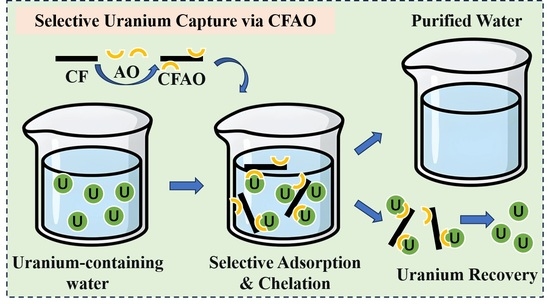
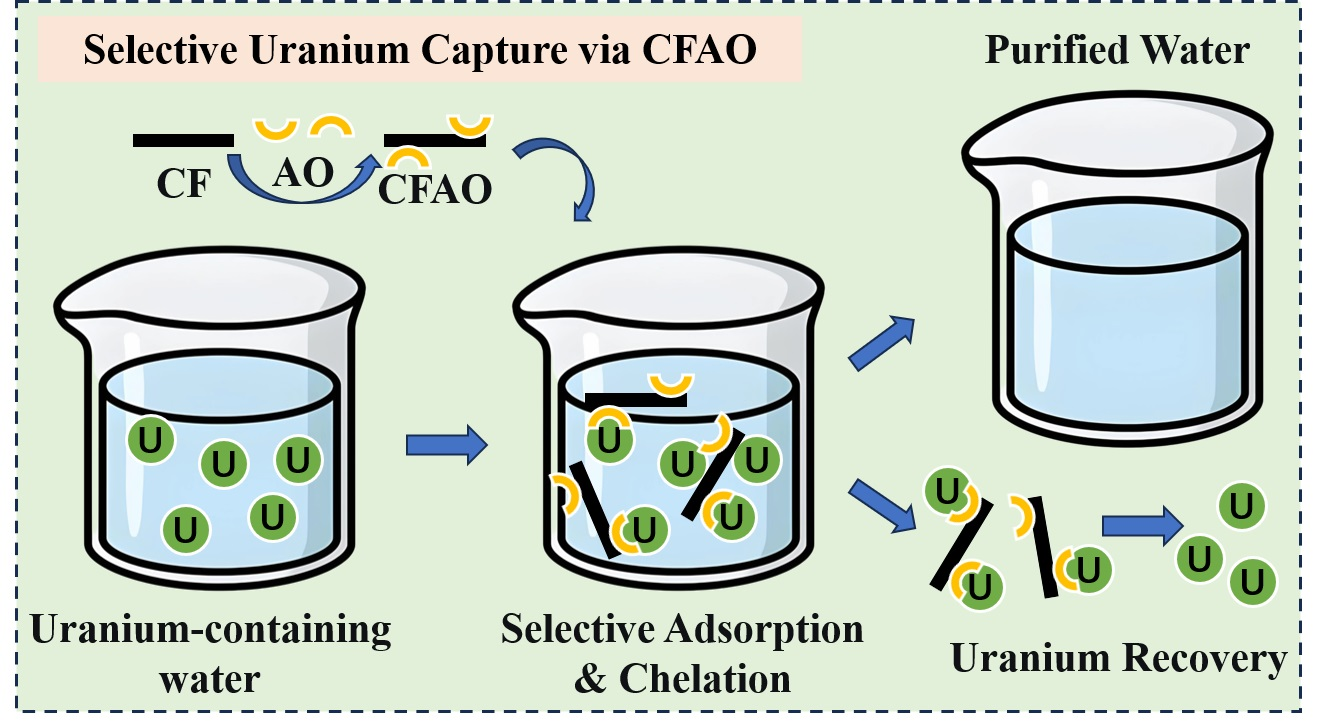
Graphical Abstract

1. Introduction

The continuous expansion of the global nuclear industry and advancements in the nuclear fuel cycle have led to a rapid increase in the volume of uranium-containing wastewater [1]. Uranium mainly exists in the form of stable uranyl ions U(VI) in aqueous solution, which possesses both chemical toxicity and radioactivity [2]. It can cause long-term pollution to the ecosystem through water migration and food chain enrichment, and pose serious health risks to human kidneys [3]. To satisfy the dual requirements of nuclear environmental protection safety standards and uranium resource recycling, the efficient separation, enrichment, and recovery of uranyl ions from uranium-containing wastewater have become key scientific and technical challenges in nuclear environmental engineering and radioactive wastewater treatment [4].
Current technologies for the separation and extraction of uranyl ions from water primarily include chemical precipitation [5,6], solvent extraction [7], ion exchange [8], and adsorption [9,10]. Among these techniques, adsorption has gained extensive application in the treatment of uranium-containing wastewater and recovery of uranium resource, benefiting from its advantages including a simple process, low energy consumption, high removal efficiency, wide adaptability, and easy engineering-scale application [11,12]. The functional groups and the structure characteristics of adsorbents are the two main factors that greatly affect the adsorption performance of adsorbents. The functional groups determine the greatest potential adsorption capacity. The structural characteristics of adsorbents determine the sufficiency of specific surface area and adsorption sites, the strength of binding, and diffusion of pollutants [13,14,15].
The materials used for uranyl ion removal mainly include inorganic minerals [16], polymers [17], metal–organic frameworks (MOFs) [18], covalent organic frameworks (COFs) [19], and composite fibrous materials [20]. Among them, carbon fibers, as a kind of carbon material, exhibit unique advantages for constructing materials with stable physicochemical properties owing to their excellent acid–alkali corrosion resistance, mechanical strength, and good chemical stability [21,22]. They are completely harmless to aquatic environments during adsorption. Moreover, their fibrous morphology facilitates easy recovery and reusability [23]. Because this physical form of fibers could help to overcome the shortcomings of other adsorbent materials in separation and recycling from aqueous solution when the adsorption process is completed, the advantages of this adsorption material with fibers may decrease the cost of industrial application [24]. In addition, fibrous material can be fabricated into many kinds of adsorbents with various shapes and lengths, such as membranes, spheres, sheets, and so on, to meet diverse process requirements due to their unique physical properties [25]. Meanwhile, compared with porous materials, the shorter mass-transfer distance between the fiber adsorbent and the adsorbate could help to improve the mass transfer rate [26]. Nevertheless, the adsorption capacity of ordinary carbon fibers is limited due to the lack of a specific surface area and functional groups with affinity and selectivity for target ions. This is currently an efficient way to use various functional groups to functionalize carbon fiber materials by impregnation or grafting technology for optimizing the sorption capability of carbon fiber materials.
Although the surface of ordinary carbon fibers contains some functional groups, such as hydroxyl, carboxyl, etc., these are not enough for an excellent adsorption material with affinity and selectivity for uranyl ions [27]. Fortunately, the surface of carbon fiber is easy to functionalize, graft and composit, providing an ideal platform for the efficient loading of functional groups. Therefore, using carbon fiber as the adsorbent matrix can not only provide efficient mass-transfer channels and sufficient adsorption sites to improve adsorption kinetics and saturated adsorption capacity, but it can also enhance the structural stability and cycle regeneration performance of the material, facilitating solid–liquid separation and continuous operation. In recent years, numerous studies have reported that cyano groups [18], amino groups [28], phosphoryl groups [29], imide dioximes [30], urazole groups [31], phosphonates [32] and amidoxime groups (AO groups) [33] serve as effective functional groups for uranium extraction materials via their outstanding chelation and affinity toward uranyl ions. Among these functional groups, the amidoxime group can form a stable five-membered chelate ring with uranyl ions, exhibiting excellent coordination selectivity and adsorption capacity, and outstanding anti-interference ability against competing ions in complex water bodies [34]. It has become one of the preferred functional groups for the functional modification of uranium adsorption. The research on amidoxime-functionalized carbon fiber-based uranium adsorption materials is expected to combine high selectivity, high adsorption capacity, and engineering practicability, providing a novel technical route for the efficient treatment of uranium-containing wastewater and green recovery of uranium resources.
To improve the adsorption capacity of carbon fibers (CFs), CFs were modified with the amidoxime groups in the preparation process for high absorbability, binding affinity and outstanding cycle regeneration performance based on the above-mentioned considerations. The amidoxime-modified carbon fiber adsorption materials (CFAOs) were characterized and applied to the treatment of uranium-containing wastewater. Batch adsorption experiments of U(VI) on CFAOs were carried out in uranium aqueous solutions under controlled conditions. Moreover, the adsorption tests were performed in simulated solutions containing several coexisting cations, including uranyl ion, for the sorption selectivity of CFAO to explore its potential applications.

2. Materials and Methods

2.1. Materials

Diaminomaleonitrile (DAMN), N-hydroxysuccinimide (NHS), hydroxylamine hydrochloride (NH2OH·HCl), and 1-(3-dimethylaminopropyl)-3-ethylcarbodiimide hydrochloride (EDCI) were obtained from J&K Scientific Co., Ltd. (Beijing, China) N,N-dimethylformamide (DMF), tetrahydrofuran (THF), methanol, ethanol, dichloromethane, NaOH, HNO3 and K2CO3 were purchased from Beijing chemical works (Beijing, China). CF were supplied by the Institute of Coal Chemistry, Chinese Academy of Sciences (TaiyuanShanxi, China). Stock solution of uranium was obtained from the Analytical Laboratory, Beijing Research Institute of Uranium Geology, China. Other metal nitrates were purchased from Aladdin Co. Ltd., Beijing, China. All chemicals were of analytical grade and were used without further purification. Deionized water used in all experiments was produced by a Millipore milli-Q plus water-purification system.

2.2. Preparation of CFAO

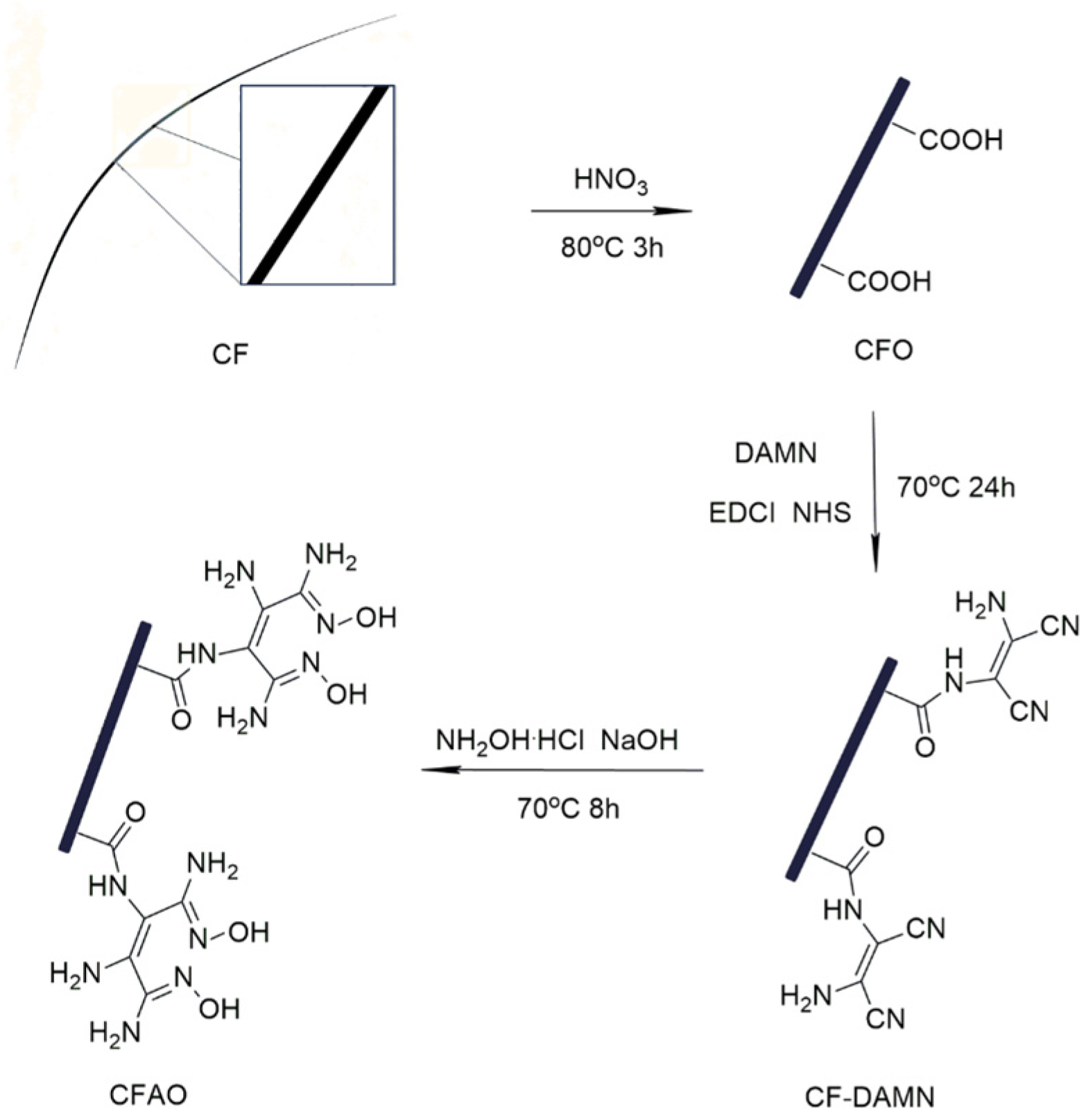
CFs were placed into a round-bottomed flask with concentrated nitric acid and maintained at 80 °C for 3 h. Afterwards, the fibers were thoroughly washed with deionized water until the filtrate reached neutrality, followed by drying in a vacuum oven at 60 °C to obtain the crude product designated as CFO. Secondly, the CFO (0.5 g) and EDCI (1.08 g) were dispersed in 60 mL THF. A solution of DAMN (1.0 g) and NHS (0.66 g) dissolved in 10 mL DMF was added to the above-mentioned mixture. Then, the resulting mixture was sonicated for 1 h and refluxed for 24 h. Following the reaction, the resultant fibers were removed from the solution, rinsed exhaustively with EtOH, CH2Cl2 and deionized water until the washings were colorless, and dried in a vacuum oven at 60 °C. The product was coded as CF-DAMN. Finally, the fiber CF-DAMN (0.5 g) was amidoximed by a 40/60 (v/v) % methanol–water solution (100 mL) with NH2OH·HCl (1.05 g) and NaOH (0.6 g) for 8 h at 70 °C in a round flask. The final CFAO product was washed with deionized water five times to remove the remaining salts and dried in a vacuum oven at 60 °C overnight. The synthetic procedure of CFAO is illustrated in Scheme 1.

2.3. Characterization Methods

Fourier transform infrared (FT-IR) spectra were recorded to determine the chemical structure using Perkin Elmer FT-IR spectrophotometer (PerkinElmer, Waltham, MA, USA) in the range of 400–4000 cm−1 with the KBr pellet technique. X-ray photoelectron spectroscopy (XPS) was performed on a PHI Quantera system using monochromatic Al Kα (1486.6 eV) X-rays, and the C1s line at 284.6 eV was used as a reference (ULVAC-PHI, Inc., Chigasaki, Japan). The morphology and elemental components of the samples were analyzed by FEI Quanta-250 field-emitting scanning electron microscopy (FE-SEM) (FEI Company, Hillsboro, OR, USA) equipped with an energy-dispersive spectrometer.

2.4. Batch Adsorption Experiments

The adsorption was conducted in polyethylene tubes for batch experiments to study the sorption behavior of different fibers towards uranium in aqueous solution. To investigate the adsorption performance of CFAO fibers, a series of batch experiments were conducted by adjusting various adsorption conditions, including pH (1–9), initial uranyl ion concentrations (500 µg/L–60 mg/L), temperature (288–318 K) and contact time (5–60 h). Milli-Q water was used to adjust the uranium solution to a certain concentration and the desired values of the pH of the uranium solutions were adjusted by adding a negligible amount of concentrated HCl or NaOH.
The concentrations of metal ions were measured by microwave plasma–atomic emission spectroscopy (MP-AES, 4100, Agilent Technologies, Inc., Santa Clara, CA, USA). All results of the tests were the average of triplicate determinations and the relative errors were less than 5%. The percentage removal of uranyl ions R(%), the uranyl ions’ equilibrium sorption on the solid phase (qe) and the distribution coefficient (Kd) were calculated as follows:
R ( % ) = C 0 − C e C 0 × 100 %
q e = ( C 0 − C e ) × V m
K d = C 0 − C e C e × V m
where C0 (mg/L) and Ce (mg/L) represent the initial and equilibrium concentrations of U(VI). V (mL) and m (g) stand for the volume of the solution used for adsorption and the weight of the adsorbent, respectively.

2.5. Desorption and Regeneration Experiments

To examine the reusability of the material, the consecutive adsorption–desorption cycles were performed using fresh uranium solution five times. To regenerate the CFAO, 1.0 mol/L HNO3 solution was selected as the eluent. Briefly, the U(VI)-loaded CFAO fiber was added to the prepared HNO3 solution under vibrating conditions at 298 K for 24 h. Then, the desorption percentage was evaluated by measuring the remaining uranium concentration of the solution. The regenerated CFAO was thoroughly washed with deionized water and dried in a vacuum oven for the next adsorption–desorption cycle.

3. Results and Discussion

3.1. Characterization

3.1.1. FT-IR

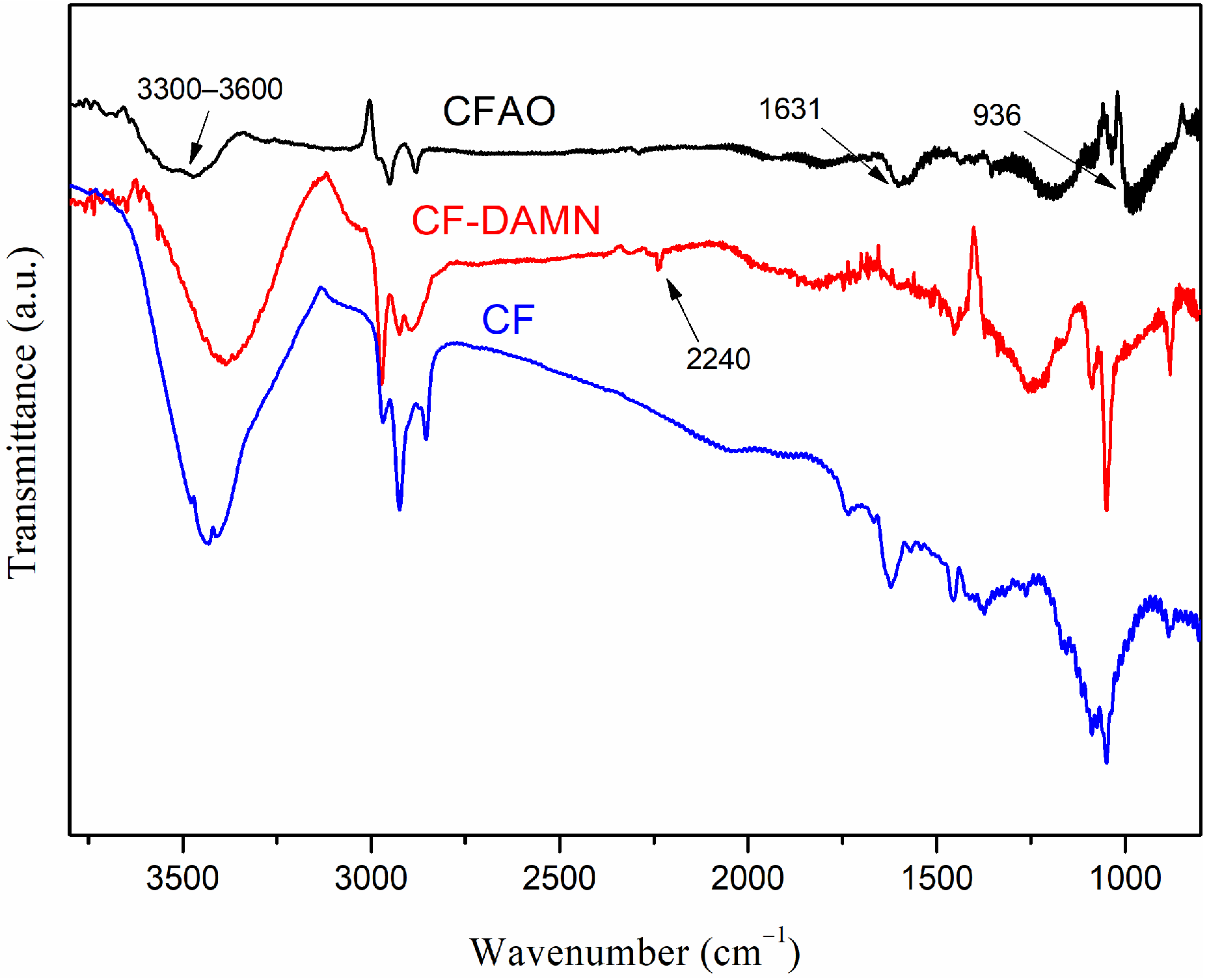
To identify the banding configurations of the main elements and the changes in functional groups during the synthesis process, the FT-IR spectroscopy of the fibers CF, CF-DAMN and CFAO at different synthesis stages were recorded (Figure 1), emphasizing significant differences. Compared with the spectrum of CF, a significant peak associated with -CN stretching vibrations was observed at 2240 cm−1, indicating the presence of nitrile groups [12,35]. This peak indicates the successful grafting of DAMN onto the CFO fibers. However, the characteristic adsorption band of the nitrile group at 2240 cm−1 disappeared from the FT-IR spectrum of CFAO after amidoxime reaction. Meanwhile, some new absorption bands at 3300–3600, 1631, and 936 cm−1, which correspond to the stretching vibrations of -OH, C=N-, and N-O- of the AO functionalities, respectively, appeared [24]. These changes confirm the subsequent conversion of the nitrile group to the AO group and the successful preparation of CFAO.

3.1.2. XPS

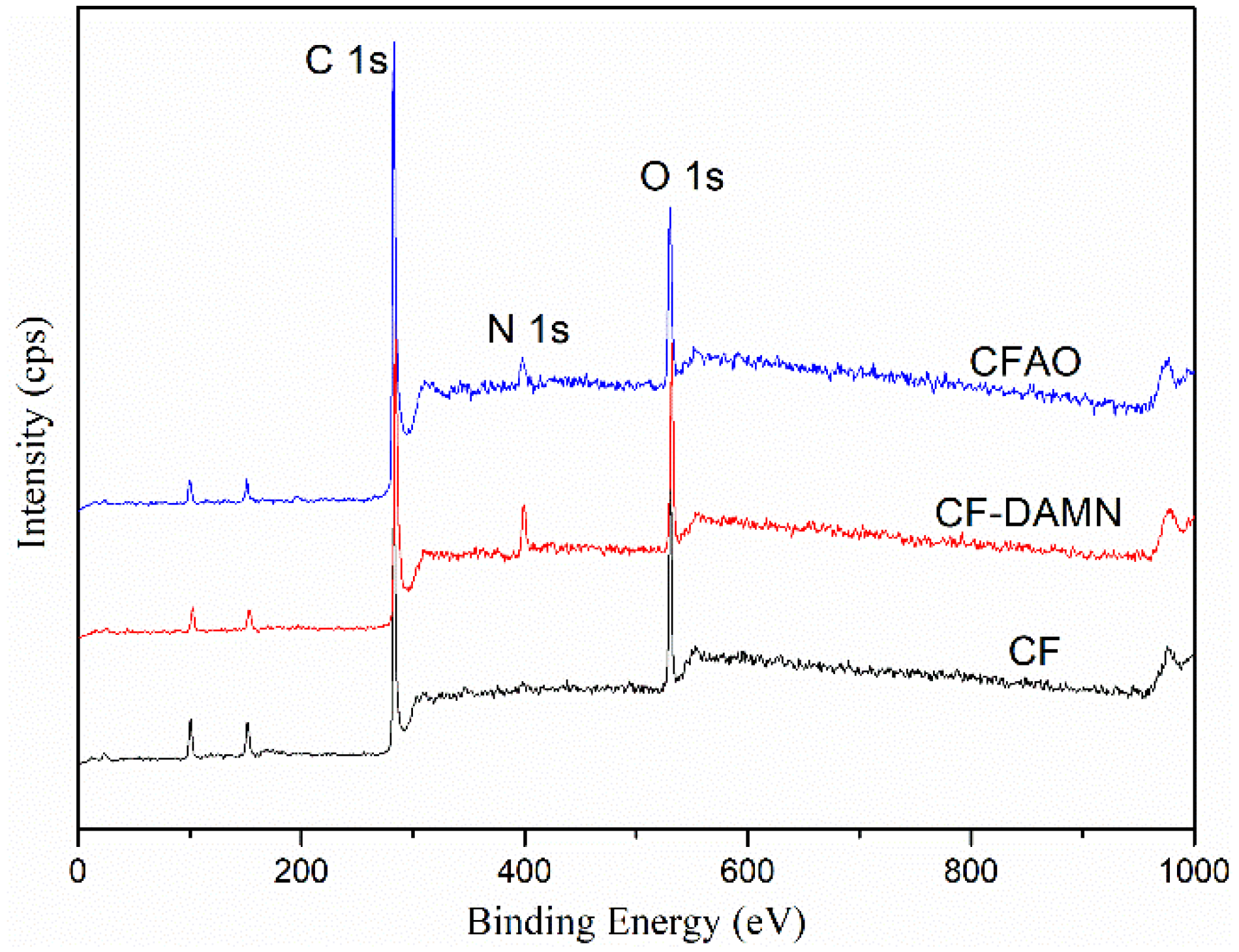
XPS analysis was applied to ascertain the surface chemical composition and bonding environment of materials to further confirm the changes in the surface chemical states of pristine CF, CF-DAMN and CFAO. The XPS survey scans acquired for the three kinds of fiber materials are presented in Figure 2. Two characteristic peaks located at binding energies of 284.9 eV and 532.5 eV are identified for all samples, which are designated as C 1s and O 1s peaks, respectively. When compared with pristine CF, an extra spectroscopic peak originating from nitrogen (N 1s, 400.5 eV) is registered for both CF-DAMN and CFAO. This observation demonstrates that diverse nitrogen-bearing functional moieties are anchored onto CF.
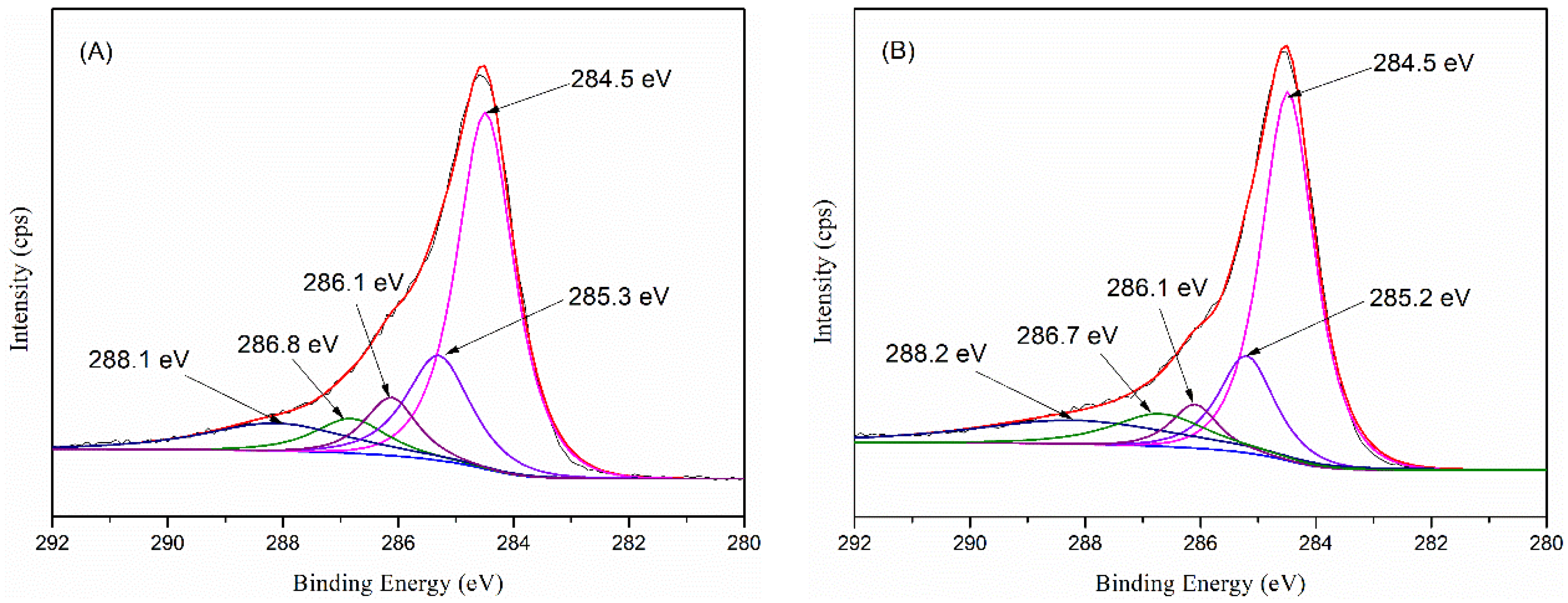
Furthermore, comprehensive data regarding the surface chemical composition and bonding configurations of the synthesized CF-DAMN and CFAO can be acquired from XPS survey and high-resolution spectra. The high-resolution C 1s spectrum of CF-DAMN is presented in Figure 3A, and this peak can be divided into five sub-peaks. The primary C 1s component is centered at 284.5 eV, which is associated with elemental carbon belonging to C-C/C=C bonds [12,27]. Two additional peaks located at 285.3 eV and 286.1 eV are designated for C≡N and C-N nitrogen-containing moieties, respectively [27,36]. The existence of these peaks verifies that DAMN molecules are successfully anchored onto CF. Two extra peaks at 286.8 eV and 288.1 eV are also detected, which are correlated with oxygen-containing C-O and C=O groups [27]. For CFAO (Figure 3B), five resolved C 1s sub-peaks located at 284.5, 285.2, 286.1, 286.7 and 288.2 eV are matched to C-C/C=C, C=N, C-N, C-O and C=O species, respectively.
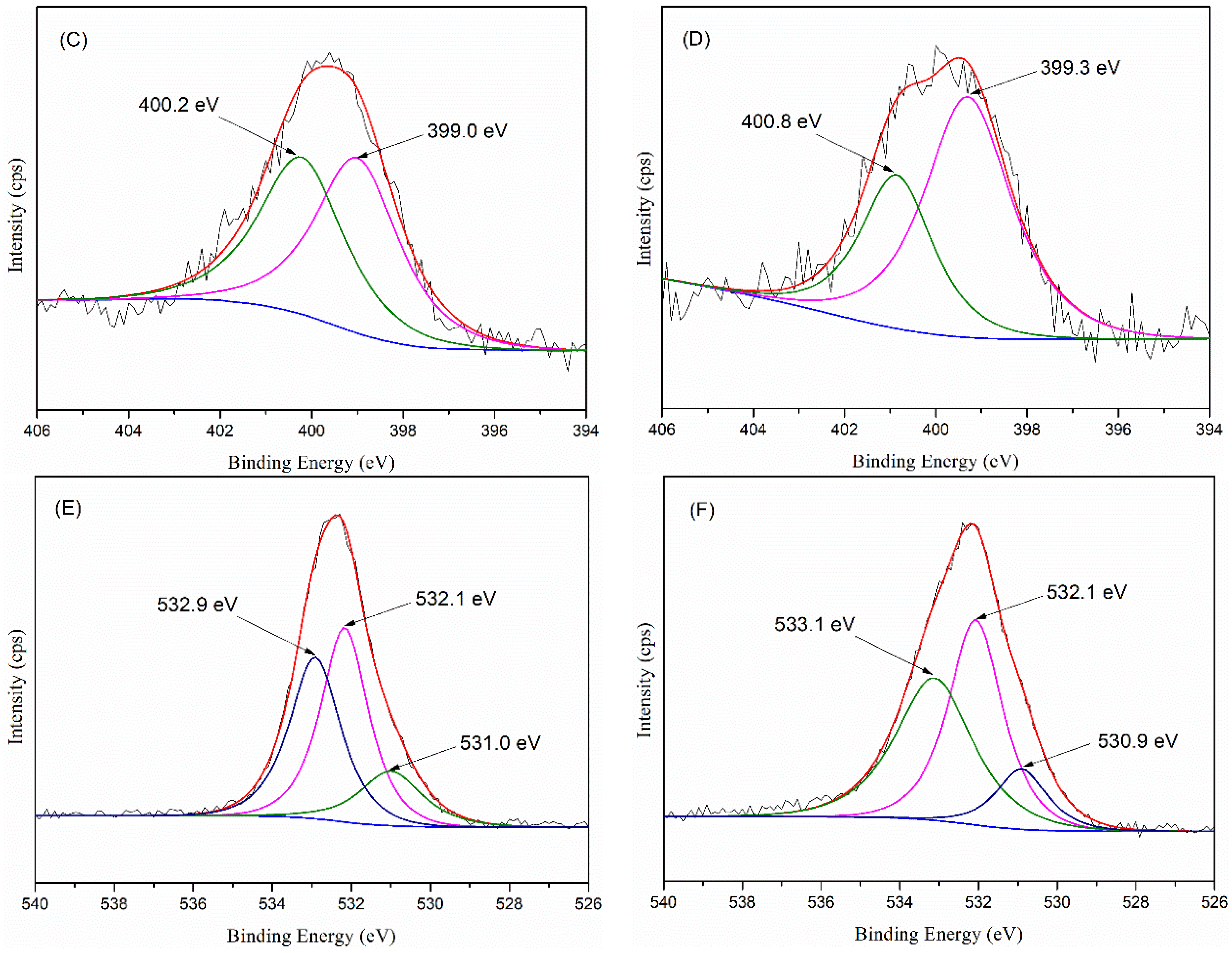
The high-resolution N 1s spectra of CF-DAMN and CFAO are exhibited in Figure 3C and 3D, respectively. As for CF-DAMN (Figure 3C), the N 1s peaks at 400.2 eV and 399.0 eV are allocated to nitrile nitrogen and amide nitrogen (-NH-CO-) [27,37]. The amide linkage is formed through the reaction between carboxyl groups on CF and amino groups of DAMN. Analogously, the N 1s peaks in CFAO (Figure 3D) at 399.3 eV and 400.8 eV are assigned to C-N species and amidoxime nitrogen converted from cyano groups [24].
The O 1s spectrum of CF-DAMN (Figure 3E) can be deconvoluted into three dominant sub-components positioned at 532.9, 532.1 and 531.0 eV, which correspond to oxygen in hydroxyl groups, C=O bonds and adsorbed O2−, respectively [27]. The O 1s spectrum of CFAO is illustrated in Figure 3F, where the binding energies of 533.1, 532.1 and 530.9 eV are attributed to hydroxyl groups, C=O and adsorbed O2−. All the above spectroscopic evidence firmly demonstrates the successful fabrication of CFAO.
Surface elemental contents of CFs, CF-DAMN and CFAO were quantified based on the integrated peak area ratios derived from Figure 2, and the corresponding results are summarized in Table 1. Compared with pristine CF, remarkable elevations in nitrogen content were recorded for the two modified materials, confirming that functional moieties were grafted onto the CF substrate. Furthermore, a decline in nitrogen content was observed when switching from CF-DAMNN to CFAO. The surface elemental composition of the samples was determined via XPS. For CF-DAMN and CFAO, all detected nitrogen atoms were assumed to originate from cyano and amidoxime groups, respectively. Excluding hydrogen (undetectable by XPS), the surface densities of cyano groups on CF-DAMN and amidoxime groups on CFAO were calculated from the nitrogen atomic fractions, yielding values of approximately 5.61 mmol g−1 and 1.92 mmol g−1, respectively. It should be noted that these values represent only the surface chemical composition instead of the bulk properties of the materials.

3.1.3. SEM

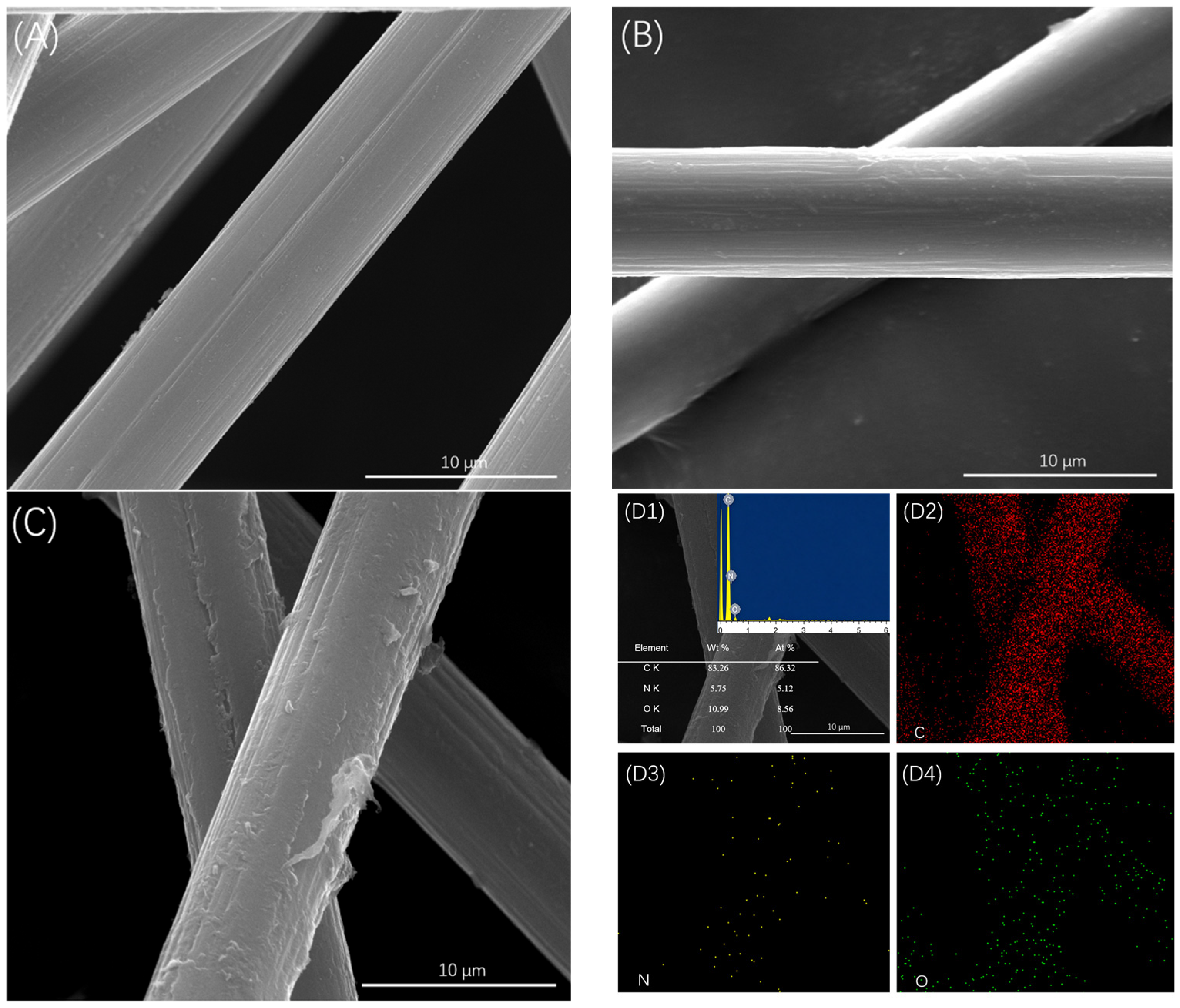
FE-SEM was adopted to investigate the surface morphologies of pristine and modified CF. As illustrated in Figure 4, no structural deterioration was generated for pristine CF after the grafting treatment. Noticeable morphological distinctions could be distinguished among CF, CF-DAMN and CFAO. Smooth and clean surfaces were displayed by individual ACF fibers (Figure 4A). In contrast, rougher and irregular surfaces were obtained for CF-DAMN (Figure 4B). Abundant tiny nodules and surface coatings were found over the fiber surfaces, which could be attributed to the DAMN-derived modification. Following the amidoximation reaction, further aggravated surface roughness and more extensive surface coatings were detected on CFAO (Figure 4C) in comparison with CF-DAMN. In addition, an EDX measurement was performed to probe the chemical composition of CFAO. As depicted in Figure 4D1, the nitrogen content acquired from EDX measurement was very close to those obtained by XPS, which verified the successful immobilization of amidoxime functional groups on CF supports. Additionally, as shown in Figure 4D2–D4, elemental mapping analysis was carried out for CFAO, through which C, N and O elements were proven to be homogeneously dispersed over the selected detection region.

3.2. Adsorption Performances Test

3.2.1. Effect of pH

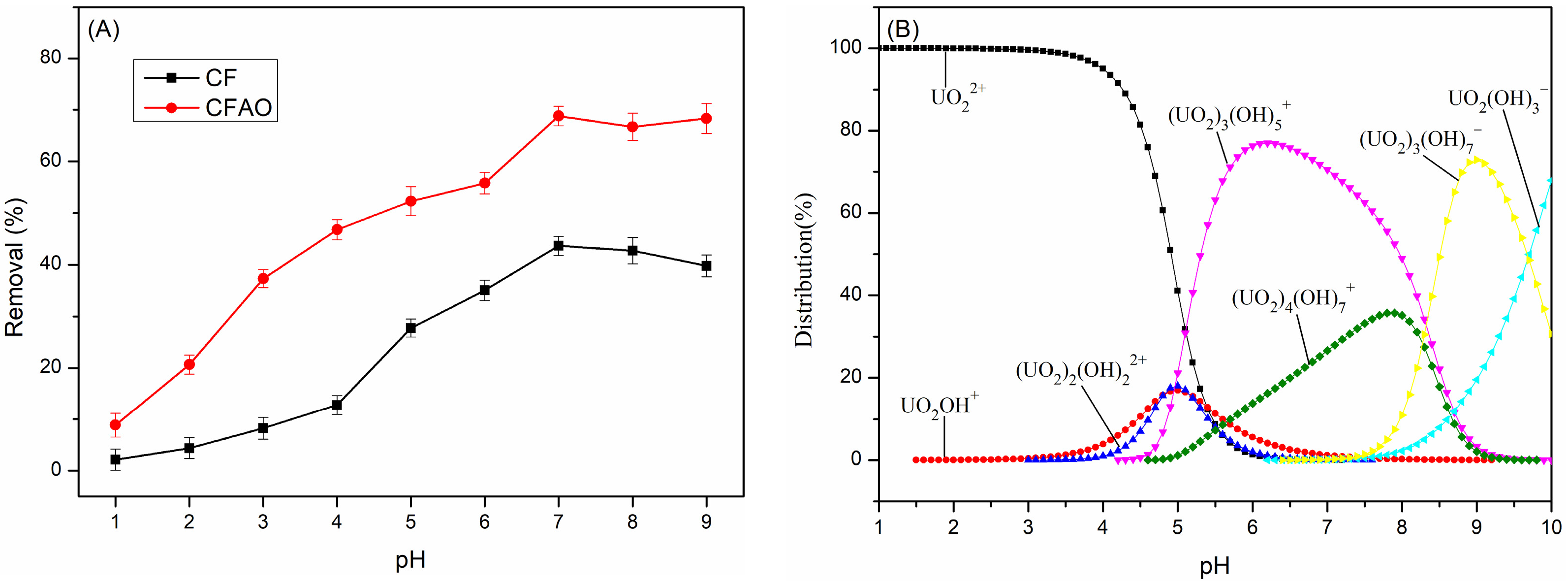
Significant effects of solution pH on the U(VI) adsorption-recovery performance of both non-functionalized and amidoxime-functionalized adsorbents were observed in aqueous solutions. The pH-dependent U(VI) adsorption behavior of both CF and CFAO are illustrated in Figure 5A. As demonstrated in Figure 5A, a gradual rise in U(VI) removal efficiencies for both adsorbents could be observed with the elevation of solution pH. Higher U(VI) removal performance was achieved over CFAO in comparison with bare CF. Therein, the U(VI) removal efficiency of CFAO was gradually elevated from approximately 10% to 70% within pH 1–9.
The aqueous speciation of U(VI) was calculated using Visual MINTEQ 3.1 with the thermo.vdb (Nagra/PSI) thermodynamic database. The results are presented in Figure 5B. The low adsorption capacity observed under acidic conditions can be attributed to two main factors. First, abundant H+ ions effectively compete with uranyl cations for the limited binding sites [38]. Second, the amidoxime groups become protonated in acidic media, imparting a positive surface charge to the adsorbent that electrostatically repels the positively charged uranyl species [26]. As the solution pH increased from 3 to 7, the concentration of H+ declined, and competitive interference from co-existing cations was largely suppressed during adsorption. Meanwhile, deprotonation was triggered for surface amidoxime moieties. Consequently, uranium species (UO2)3(OH)5+, (UO2)4(OH)7+) were readily captured by the adsorbent surface, where metal-chelation or ion-exchange interactions were established to form surface metal complexes [39]. Further pH elevation from 8 to 9 led to diminished uranium uptake, since U(VI) hydrolysis was induced and non-chelating anionic uranium species (UO2(OH)3−, (UO2)3(OH)7−) were produced [38]. Electrostatic repulsion was strengthened between these anionic uranium species and the negatively charged adsorbent surface [40]. Accordingly, subsequent adsorption tests were conducted at pH 7 to avoid the interferences originating from U(VI) hydrolysis under high-pH surroundings.

3.2.2. Effect of Contact Time and Kinetic Studies

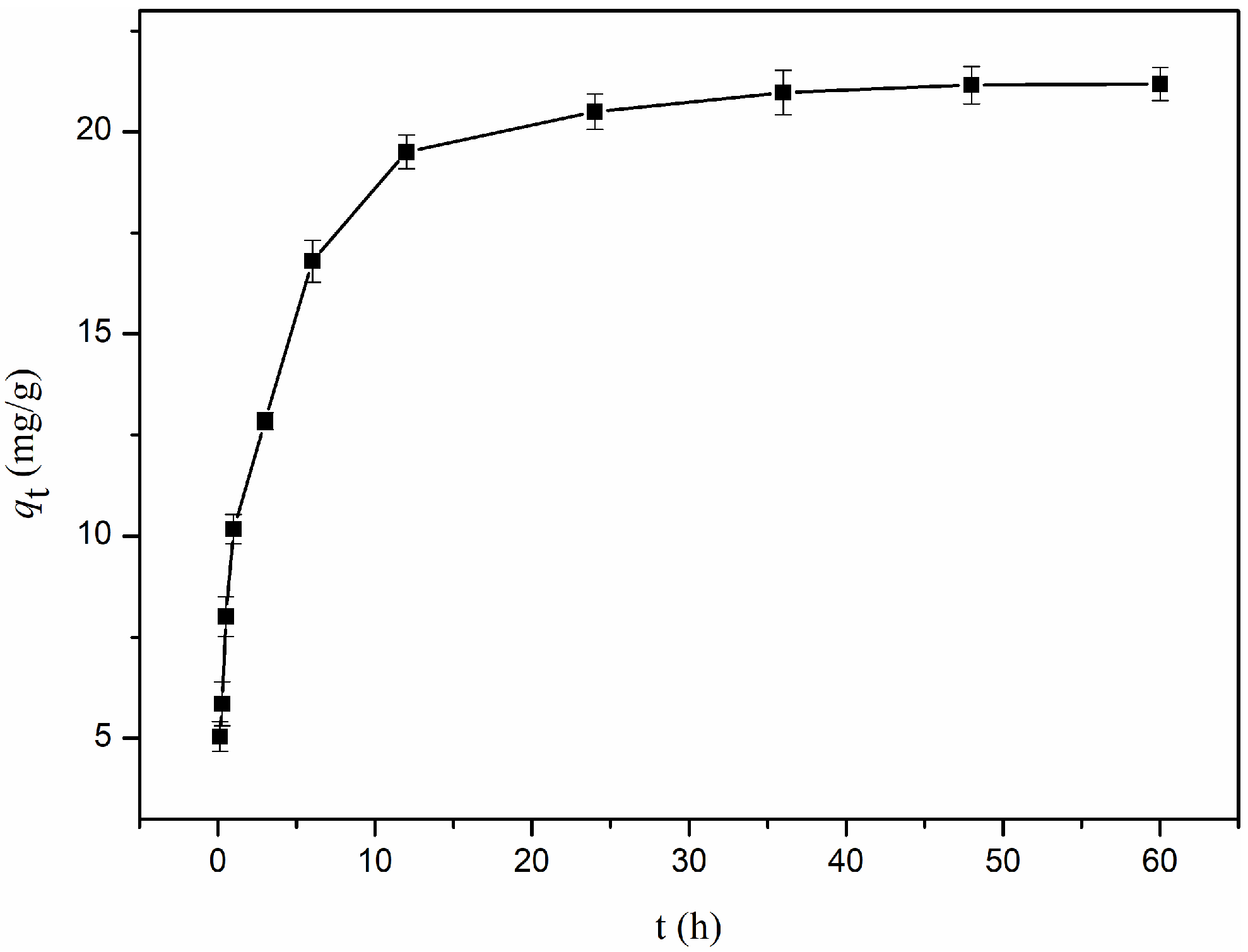
Adsorption kinetics, an essential component of adsorption-related investigations, is associated with contact duration and adsorption capacity. For kinetic evaluation, the uptake of uranyl ions onto CFAO was determined over contact durations ranging from 5 min to 60 h. As illustrated in Figure 6, adsorption capacities were rapidly elevated within 5 min–6 h, which can be ascribed to the relatively high uranyl ion concentration available at early-stage adsorption. After 6 h, the adsorption capacity increased more slowly, which can be attributed to the combined effects of (i) increased diffusion resistance within the fiber matrix, and (ii) progressive saturation of the available amidoxime binding sites as the chelation interaction proceeds. The adsorption profiles were flattened after 24 h, demonstrating that the adsorption equilibrium was achieved. According to the obtained kinetic results, a contact time of 24 h was adopted for subsequent U(VI) adsorption experiments to guarantee the attainment of adsorption equilibrium.
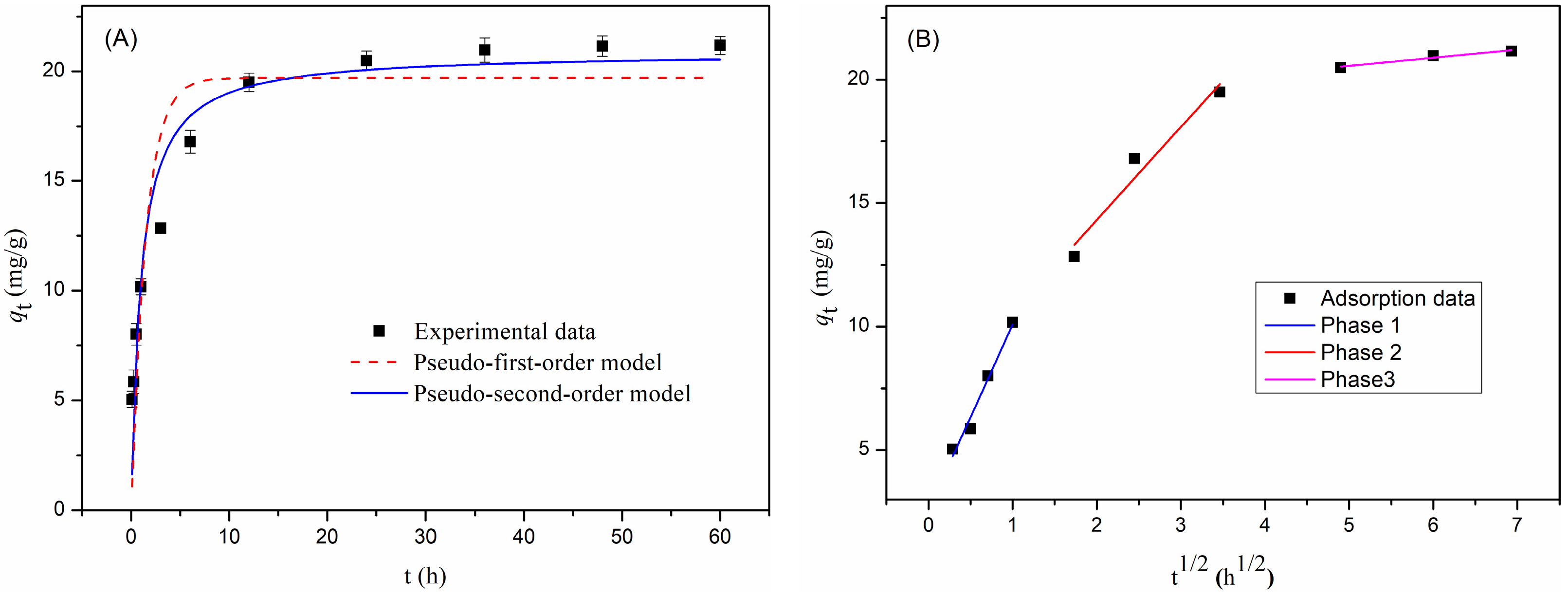
Kinetic modeling was performed to clarify the adsorption mechanism of U(VI) on CFAO. The experimental kinetic data were fitted using the pseudo-first-order model, pseudo-second-order model and intra-particle diffusion model, whose linear equations were expressed as shown below.
Pseudo-first-order model:
q t = q e ( 1 − e − k 1 t )
Pseudo-second-order model:
q t = q e 2 k 2 t 1 + q e k 2 t
Intra-particle diffusion model:
q t = k int t 1 / 2 + θ
where qe (mg/g) and qt (mg/g) correspond to the U(VI) adsorption capacities per gram of CFAO attained at adsorption equilibrium and arbitrary contact time t (h), respectively. The pseudo-first-order rate constant, pseudo-second-order rate constant, and intraparticle diffusion rate constant are denoted by k1 (1/h), k2 [g/(mg·h)] and kint [mg/(g·h1/2)].
Figure 7A shows the adsorption kinetic curves of CFAO for U(VI), as well as the nonlinear fitted curves of the pseudo-first-order and pseudo-second-order models. According to the kinetic curves in Figure 7A, adsorption rises rapidly in the initial stage and gradually reaches equilibrium. The experimental equilibrium adsorption capacity was 21.18 mg/g. Table 2 lists the kinetic parameters derived from nonlinear regression fitting of the pseudo-first-order and pseudo-second-order models. As shown in Table 2, the correlation coefficient of the pseudo-second-order model is higher than that of the pseudo-first-order model. Thus, the pseudo-second-order model is applicable to describe the adsorption of U(VI) on CFAO. It could be inferred that chemisorption serves as the main adsorption pathway for U(VI) uptake by CFAO, since the pseudo-second-order model assumes that the interaction between adsorbent and adsorbate is dominated by chemical mechanisms [37,41].
The intra-particle diffusion model was adopted to analyze the experimental kinetic datasets. For this model, intra-particle diffusion serves as the sole rate-determining step only when the qt versus t1/2 plot yields a straight line passing through the origin. The multilinear profile of the fitted curve indicates that the overall adsorption process involves multiple sequential mass-transfer and adsorption steps. As illustrated in Figure 7B and Table 2, three distinct linear segments can be divided into three linear regions from the fitting results. Non-zero intercept constants (θ) were obtained for all three fitted segments, revealing that intraparticle diffusion cannot be treated as the exclusive rate-governing mechanism for the entire adsorption process, and other rate-controlling pathways are also involved [37]. The first steep-sloped segment covering 0–1 h corresponded to external-surface mass transfer and instantaneous adsorption, wherein uranyl species were transferred from the aqueous medium onto the solid adsorbent. The second moderate-sloped segment spanning 3–12 h was associated with intra-particle diffusion, accompanied by interactions between uranyl ions and amidoxime functional groups anchored on CFAO. The third segment represented the final adsorption-equilibrium stage. As summarized in Table 2, the slope-derived rate constants for the three sequential stages were ordered as kint phase 1 > phase 2 > phase 3. This observation was consistent with the kinetic characteristics of the adsorption process, where progressively reduced adsorption rates were detected. Such behavior could be interpreted by the gradual occupation of available active sites by uranium species as the adsorption duration was extended [42]. An obvious deviation from the origin could be observed for the fitted plot, which demonstrates that intra-particle diffusion was not the exclusive rate-limiting factor for the U(VI) adsorption process.

3.2.3. Effect of Initial Uranium(VI) Concentration and Isotherm

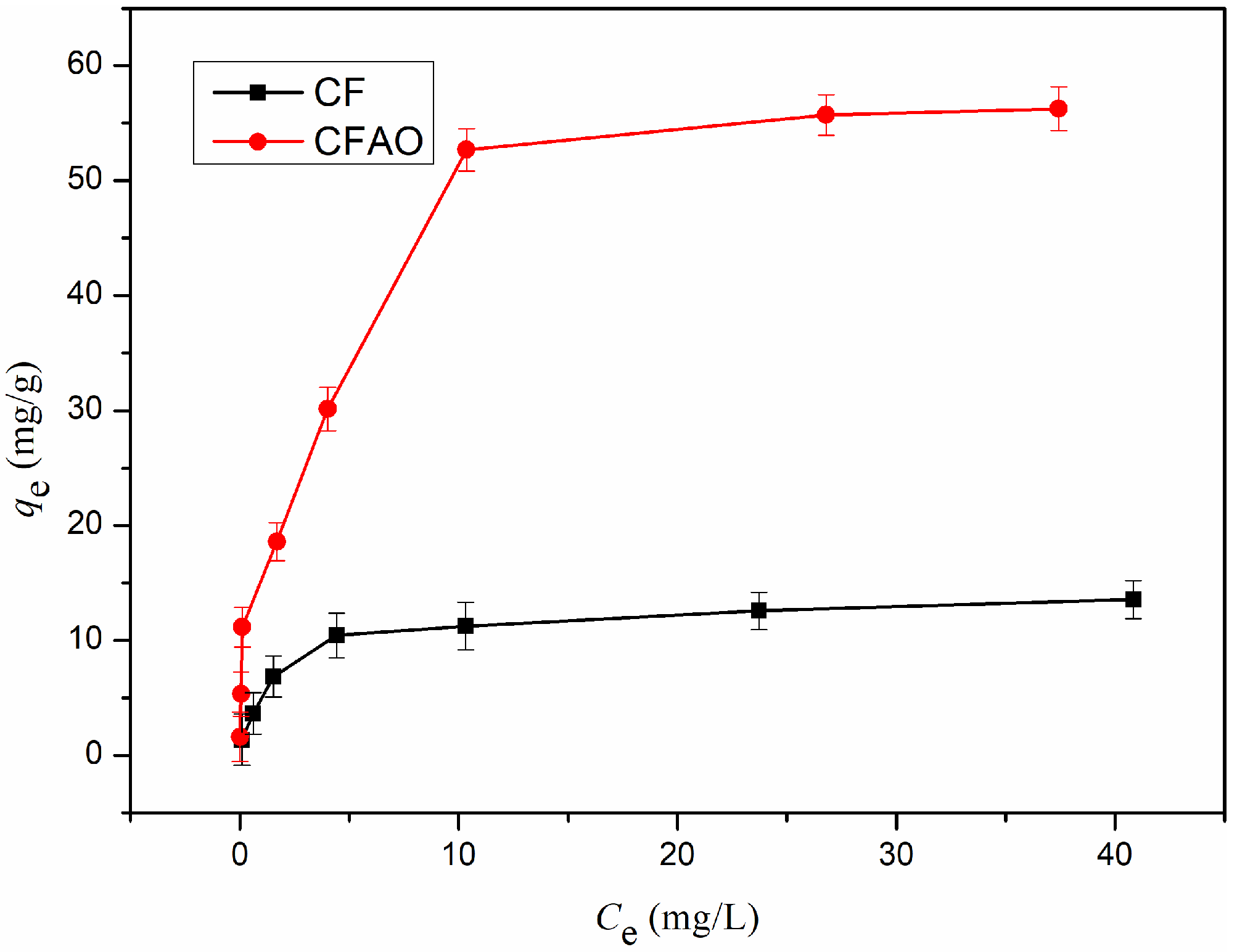
Equilibrium-adsorption experiments were carried out in aqueous media containing varied initial uranium concentrations to assess the adsorption capacities of CF and CFAO. As illustrated in Figure 8, the U(VI) uptake onto both CF and CFAO rose with the increase in initial uranium concentration until saturation was attained, where the maximum adsorption capacity of each adsorbent was reached. This phenomenon can be explained by the fact that higher uranium concentrations provide more opportunities for contact between adsorbent surfaces and uranyl species prior to the establishment of an adsorption equilibrium. Moreover, considerably higher U(VI) adsorption capacity was observed for CFAO relative to pristine CF, which could be ascribed to the grafted amidoxime functional groups.
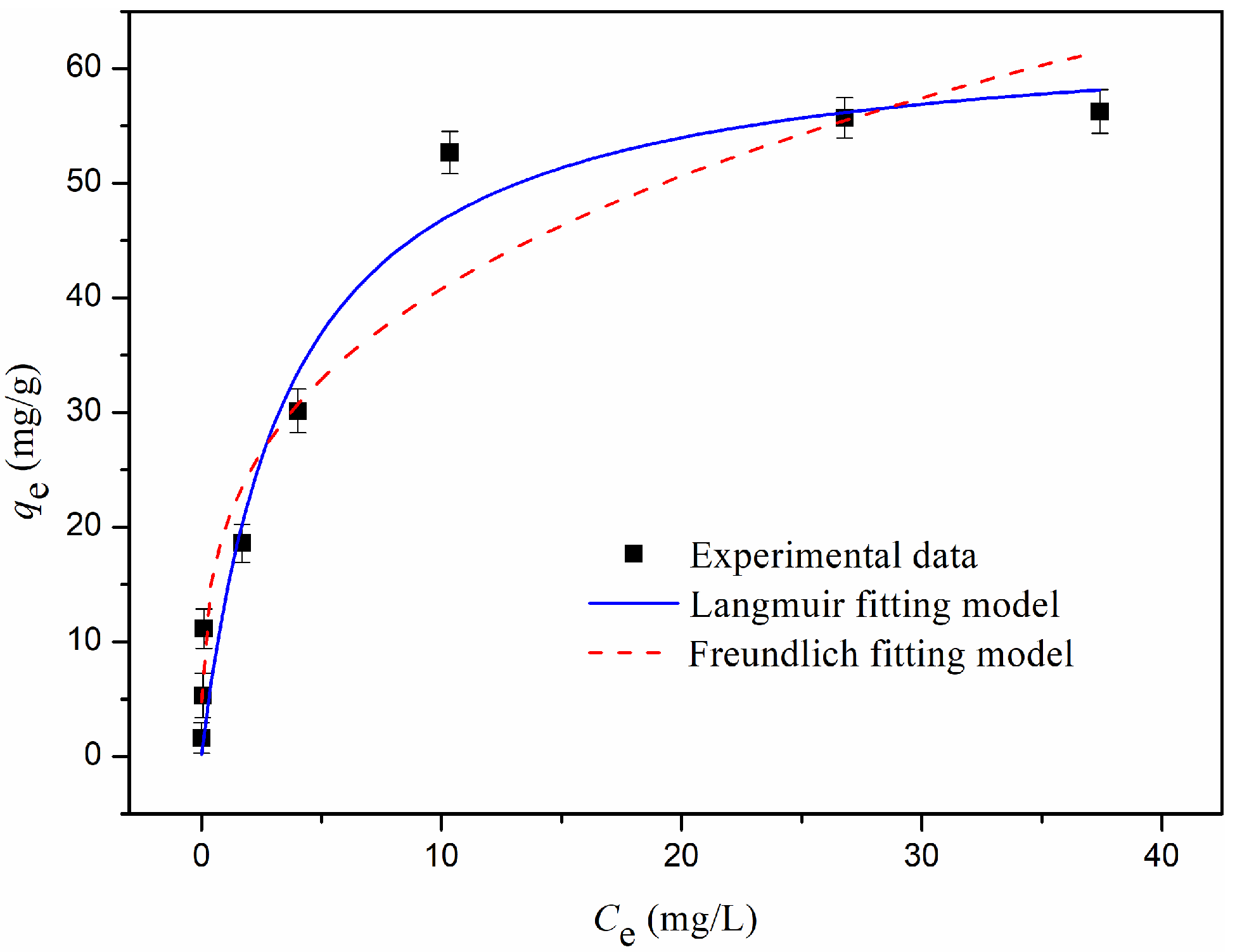
Langmuir and Freundlich isotherm models were employed to process adsorption data obtained under various initial uranium concentrations so as to quantify the uranyl ion-adsorption capacity of both the CF and CFAO adsorbents. The Langmuir isotherm is built on the premise that monolayer adsorption takes place over a homogeneous adsorbent surface with finite identical adsorption sites, and no inter-adsorbate interactions exist among molecules occupying neighboring sites [27]. By contrast, the Freundlich isotherm is developed based on the hypothesis that metal-ion uptake proceeds on heterogeneous surfaces featuring multiple kinds of adsorption-active sites [35]. The non-linear mathematical formulas for the Langmuir and Freundlich isotherm models are given as follows:
q e = b q m C e 1 + b C e
q e = K F C e 1 / n
where qm and b represent the theoretical maximum adsorption capacity (mg/g) and Langmuir equilibrium constant (L/mg), respectively. KF denotes the Freundlich constant (mg/g) (L/mg)1/n, which is associated with the adsorption capacity of the adsorbent, while n is an empirical coefficient describing adsorption strength.
Fitted isotherm plots of CF and CFAO are presented in Figure S1 and Figure 9, respectively. The correlation coefficients (R2), as well as the corresponding model-derived parameters of CF and CFAO, are separately summarized in Table S1 and Table 3. The Langmuir model yielded a significantly higher R2 value (0.9520) than the Freundlich model (0.9370), indicating that the adsorption of U(VI) onto CFAO occurs via homogeneous monolayer coverage on energetically equivalent sites. This was consistent with the chelation interaction between the amidoxime groups and uranyl ions [10,16,34]. Furthermore, the theoretical maximum monolayer adsorption capacity qm calculated by the Langmuir model reached 63.78 mg/g; this parameter was adopted for performance comparison against other reported uranium-selective adsorbents, as compiled in Table 4. As reflected by the tabulated data, the adsorption-capacity evaluation demonstrates that CFAO holds application potential for the removal and recovery of uranium from aqueous solutions by comparison with other reported adsorbents.

3.2.4. Effect of Temperature and Thermodynamic Studies

To explore the temperature-dependent U(VI) sorption behavior of CFAO, batch adsorption tests were carried out at 288, 298, 308 and 318 K. As illustrated in Figure S2, the equilibrium sorption capacities for U(VI) onto CFAO were elevated with the rise in temperature within the tested range. It can be inferred that higher sorption magnitudes were obtained at elevated temperatures over the investigated temperature interval.
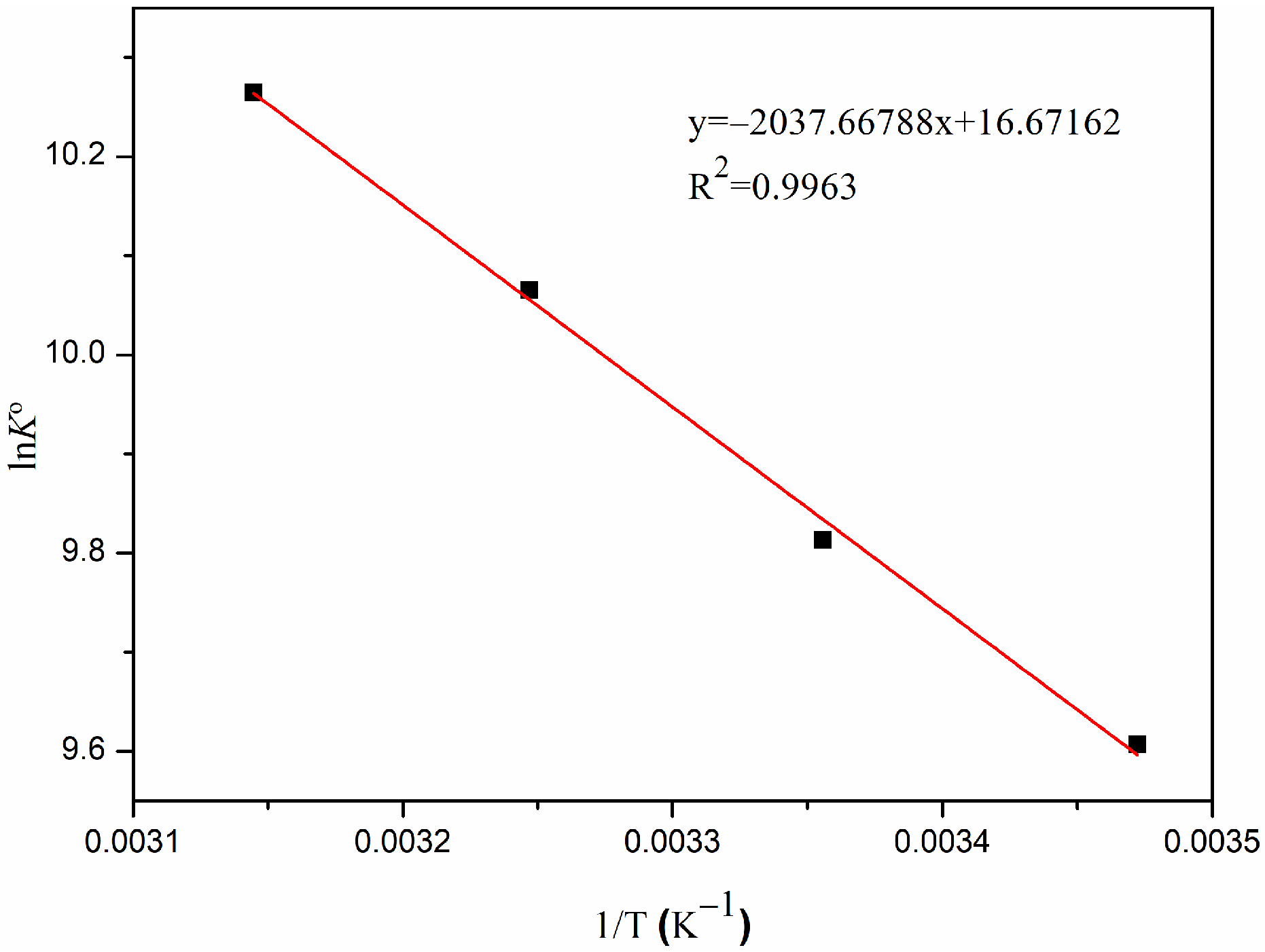
Thermodynamic parameters, including standard enthalpy change (ΔH°), standard entropy change (ΔS°) and standard Gibbs free energy change (ΔG°), can be derived from the temperature-varied sorption data. The Van’t Hoff equation (Equation (9)) was adopted to compute ΔH° and ΔS°, where the slope and intercept acquired from the plot of lnK°) versus 1/T (Figure 10) were utilized for calculation. The Gibbs–Helmholtz equation (Equation (10)) was employed for the acquisition of ΔG°.
ln K O = − Δ H O R T + Δ S O R
Δ G ο = Δ H ο − T Δ S ο
where K° represents the standard equilibrium constant, and R denotes the universal gas constant [8.314 J/(mol·K)].
The computed thermodynamic parameters, including ΔH°, ΔS° and ΔG°, are summarized in Table 5. A positive standard enthalpy change (ΔH° = 16.94 kJ/mol) was obtained, demonstrating that U(VI) sorption onto CFAO was intrinsically endothermic. This observation was consistent with the elevated sorption capacities recorded at higher temperatures. The positive standard entropy change (ΔS° = 138.61 J/K·mol) reveals that greater randomness was generated at the adsorbent–solution interface throughout the U(VI) uptake process. Furthermore, all acquired ΔG° values were negative, verifying that the sorption of U(VI) by CFAO could be spontaneously realized under all investigated experimental conditions. More negative ΔG° magnitudes were detected as the temperature was raised, which indicated that the adsorption process became thermodynamically more favorable at elevated temperatures.

3.2.5. Regeneration and Stability Studies

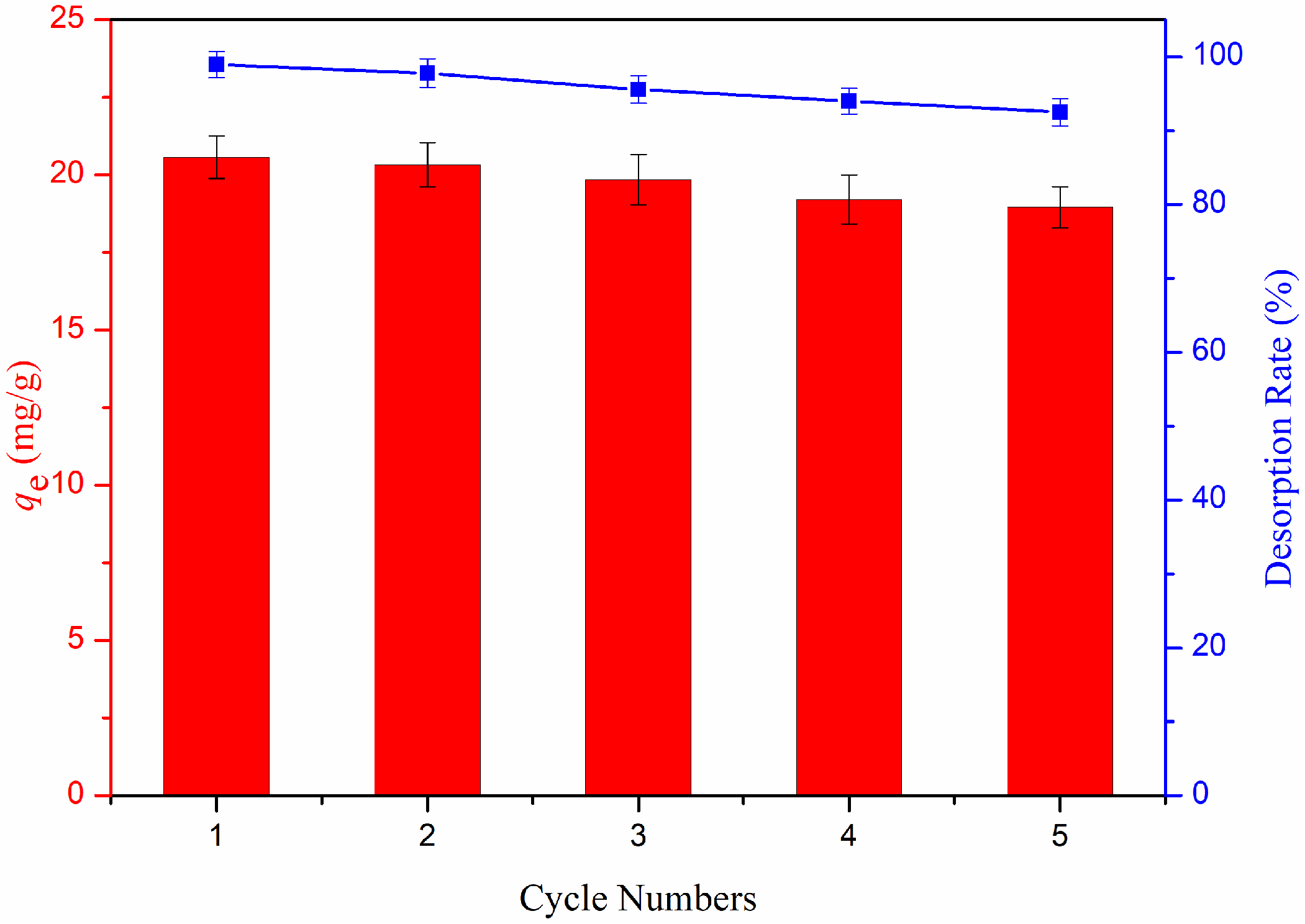
Regeneration performance and reusability are essential metrics for adsorbents intended for practical, cost-effective deployment. Benefiting from the fibrous morphology of CFAO, facile solid–liquid separation can be achieved by simple filtration, eliminating the need for complex centrifugation. Such convenient handling features are highly attractive for fibrous adsorbents in large-scale water treatment applications. To evaluate the regeneration potential of CFAO for U(VI) sorption, cyclic adsorption–desorption tests were performed. In the present study, 1.0 mol/L HNO3 was chosen as the desorption medium because elution efficiencies above 90.0% can be obtained with this reagent. Five consecutive adsorption–desorption cycles were conducted, and the cyclic results are presented in Figure 11. Only a slight decline in U(VI) sorption efficiency was observed upon completion of four cyclic tests. These findings demonstrate that CFAO can be effectively regenerated with 1.0 mol/L HNO3, and favorable short-term reusability for U(VI) removal is observed under laboratory testing conditions.

3.2.6. Selective Sorption of CFAO Towards Uranium

The selective adsorption behavior of U(VI) onto the as-prepared CFAO adsorbent was explored through batch adsorption assays using both simulated seawater and simulated nuclear wastewater. Sorption tests in simulated seawater were conducted at pH 8 under 298 ± 0.5 K, where the adsorbent dosage was set to 10 mg/30 mL and the contact time was fixed at 24 h. Unlike the simulated seawater experiment, the solution pH of simulated nuclear waste for adsorption was 5, with only minor differences in individual coexisting ions. Initial and equilibrium concentrations of the dominant metal ions present in different solutions are respectively summarized in Tables S2 and S3. The distribution coefficient (Kd) and selectivity coefficient (KU/M) were computed according to Equation (3) and Equation (11), respectively.
K U / M = K d ( U ) K d ( M )
where Kd(U) and Kd(M) denote the distribution coefficients of uranium and competing metal ions, respectively.
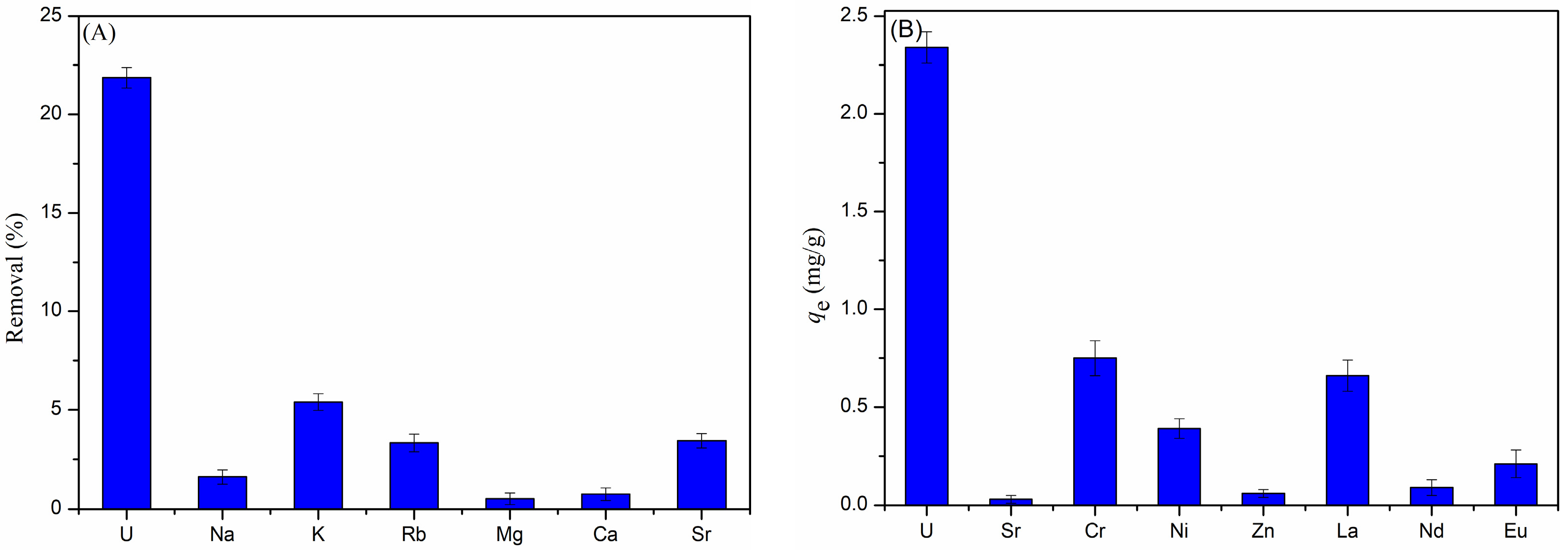
As shown in Figure 12A and Table S2, the initial concentration of uranyl ions was much lower than that of other coexisting ions in a simulated seawater system, leading to a low-equilibrium adsorption capacity of CFAO toward uranyl ions. Nevertheless, CFAO exhibited considerably higher U(VI) removal efficiency and a larger distribution coefficient for uranyl ions compared with other ions. Additionally, the selectivity coefficients of uranyl ions relative to other ions were far greater than 1. According to Figure 12B and Table S3, although the initial uranyl-ion concentration was also relatively low in a simulated nuclear waste liquid system, CFAO delivered a much larger equilibrium adsorption distribution coefficient for uranyl ions than other ions, with selectivity coefficients of uranyl ions relative to other ions all much higher than 1. These results demonstrated that CFAO possessed favorable selectivity for uranyl ions in both simulated seawater and simulated nuclear waste liquid systems. Accordingly, CFAO exhibits potential as an adsorbent for the selective capture of uranyl ions from aqueous matrices containing multiple interfering cations.
The amidoxime group is a well-recognized ligand exhibiting high affinity toward uranyl ions. As widely reported in the previous literature [24,50,51,52], the exceptional selectivity of amidoxime toward U(VI) originated from the formation of a stable five-membered chelate ring involving both the oxime oxygen and the amino nitrogen atoms. Specifically, the average U-N bond distances are shorter than those of competing cations, resulting in a thermodynamically more favorable coordination geometry for uranyl ions [51]. This structural preference, combined with the high density of grafted amidoxime groups on the CFAO surface, ensured the effective and selective capture of U(VI) even in complex ionic environments. Therefore, sufficient functional groups should be incorporated into adsorbent materials to improve their selective sorption capacity toward uranyl ions. Adequate complexation with abundant uranyl ions in seawater or nuclear wastewater can thereby be facilitated, and the sorption performance of the as-prepared materials for uranyl species is enhanced accordingly.

4. Conclusions

In this study, a fibrous uranium-adsorbing material, amidoxime-grafted carbon fiber (CFAO), was successfully prepared via a chemical grafting route. The effects of solution pH, contact time, initial U(VI) concentration, temperature, and coexisting ions on its sorption performance were systematically investigated. Compared with pristine carbon fibers, a significantly improved U(VI) sorption capability was achieved for the modified CFAO, which was primarily ascribed to the strong chelating affinity of grafted amidoxime functional groups. After amidoxime functionalization, the equilibrium sorption capacity of carbon fibers was prominently increased from 13.56 mg/g to 56.25 mg/g. Sorption kinetic and isotherm analyses confirmed that the U(VI) uptake process on CFAO was well fitted by the pseudo-second-order model and Langmuir isotherm model, while thermodynamic results verified that the U(VI) sorption process was endothermic, thermodynamically feasible, and spontaneous under experimental conditions. The as-prepared CFAO adsorbent was demonstrated to possess stable U(VI) sorption efficiency, with more than 90% of the original sorption performance retained after five repeated adsorption–desorption cycles. Moreover, superior selective sorption toward U(VI) by CFAO was validated in both simulated seawater and simulated nuclear wastewater containing complex competing ions. Overall, the as-prepared CFAO shows potential for the selective removal and recovery of uranium from complex aqueous systems under laboratory batch experimental conditions. Future work will focus on scaling up the synthesis and evaluating its performance under dynamic flow conditions.

Supplementary Materials

The following supporting information can be downloaded at: https://www.mdpi.com/article/10.3390/separations13100271/s1, Figure S1: Fitting results for the different adsorption isotherm models on CF; Table S1. Langmuir and Freundlich model fitting parameters for uranium adsorption on CF; Figure S2: Effect of temperature on the U(VI) adsorption on CFAO (C0 = 9.97 mg/L; pH = 7.0; t = 24 h; m/V = 10 mg/30 mL); Table S2: Selective adsorption of metal ions in simulated seawater by CFAO; Table S3: Selective adsorption of metal ions in simulated nuclear wastewater by CFAO.

Author Contributions

Conceptualization, X.L. and Q.W.; Methodology, X.L., J.W., S.H. and B.K.; Validation, K.S. and B.L.; Formal analysis, Y.C.; Investigation, X.L., J.W. and M.S.; Data curation, Y.C. and M.S.; Writing—original draft, X.L., J.W., K.S. and S.H.; Writing—review and editing, Q.W., B.K. and B.L.; Supervision, X.L. and Q.W.; Project administration, X.L. All authors have read and agreed to the published version of the manuscript.

Funding

This study was funded by the scientific and technological project of Henan Province (242102230183), the key research projects of higher education institutions in Henan Province (24B530006), the Natural Science Foundation of Henan Province (242300420576), the Natural Science Foundation of Henan Province (262300420620), Zhengzhou Normal University Young Key Teacher Training Project (QNGG-242902) and the Zhengzhou Normal University student innovation training program project (DCY2026058).

Data Availability Statement

The original contributions presented in this study are included in the article/Supplementary Materials. Further inquiries can be directed to the corresponding author.

Conflicts of Interest

The authors declare no conflicts of interest.

References

  1. Lin, T.; Chen, T.; Jiao, C.; Zhang, H.; Hou, K.; Jin, H.; Liu, Y.; Zhu, W.; He, R. Ion pair sites for efficient electrochemical extraction of uranium in real nuclear wastewater. Nat. Commun. 2024, 15, 4149. [Google Scholar] [CrossRef] [Scilit] [PubMed]
  2. Jin, H.; Hu, Y.; Shen, Z.; Pan, H.; Bao, H.; Yin, L.; Zhao, G.; Ji, Z.; Wang, X.; Huang, X. Electrochemical upcycling of uranyl from radioactive organic wastewater with a self-standing covalent-organic framework electrode. Nat. Commun. 2025, 16, 3574. [Google Scholar] [CrossRef] [Scilit] [PubMed]
  3. Peng, C.; Li, T.; Lv, H.; Chen, J.; Xue, Y.; Yan, Y.; Ma, F.; Tian, G. Single-step annealed Ti9O17/Ti electrode for electrochemical separation and recovery of uranium from organic-containing uranium wastewater. Chem. Eng. J. 2026, 528, 172556. [Google Scholar] [CrossRef] [Scilit]
  4. Zhao, X.; Liu, Z.; Zhang, S.; Hassan, M.; Ma, C.; Liu, Z.; Gong, W. Synthesis of Pillar[5]arene- and Phosphazene-Linked Porous Organic Polymers for Highly Efficient Adsorption of Uranium. Molecules 2023, 28, 1029. [Google Scholar] [CrossRef] [Scilit] [PubMed]
  5. Liu, F.; Hu, J.; Hu, B. Magnetic MXene-NH2 decorated with persimmon tannin for highly efficient elimination of U (VI) and Cr (VI) from aquatic environment. Int. J. Biol. Macromol. 2022, 219, 886–896. [Google Scholar] [CrossRef] [Scilit] [PubMed]
  6. Xie, Y.; Fang, Q.; Li, M.; Wang, S.; Luo, Y.; Wu, X.; Lv, J.; Tan, W.; Wang, H.; Tan, K. Low concentration of Fe(II) to enhance the precipitation of U(VI) under neutral oxygen- rich conditions. Sci. Total Environ. 2020, 711, 134827. [Google Scholar] [CrossRef] [Scilit] [PubMed]
  7. Rao, C.V.; Rout, A.; Boda, A.; Ali, S.M.; Venkatesan, K.A. Anion assisted extraction of U(VI) in alkylammonium ionic liquid: Experimental and DFT studies. Sep. Purif. Technol. 2021, 261, 118275. [Google Scholar] [CrossRef] [Scilit]
  8. Wen, S.; Wang, H.; Xin, Q.; Hu, E.; Lei, Z.; Hu, F.; Wang, Q. Selective adsorption of uranium(VI) from wastewater using a UiO-66/calcium alginate/hydrothermal carbon composite material. Carbohydr. Polym. 2023, 315, 120970. [Google Scholar] [CrossRef] [Scilit] [PubMed]
  9. Su, M.; Liu, Z.; Wu, Y.; Peng, H.; Ou, T.; Huang, S.; Song, G.; Kong, L.; Chen, N.; Chen, D. Graphene oxide functionalized with nano hydroxyapatite for the efficient removal of U(VI) from aqueous solution. Environ. Pollut. 2021, 268, 115786. [Google Scholar] [CrossRef] [Scilit] [PubMed]
  10. He, X.; Deng, H.; Wu, H.; Yu, W.; Guo, Z.; Liang, X. Amidoxime-based polymer microspheres with high selectivity for uranium from saline lake brine. ACS Appl. Polym. Mater. 2023, 5, 4380–4387. [Google Scholar] [CrossRef] [Scilit]
  11. Lin, C.; Chen, J.; Wu, Z.; Chi, R.; Lin, H.; Liu, Y.; Lv, Y.; Ye, X.; Luo, W. Phosphate-functionalized fibrous adsorbent for effectively extracting uranium from seawater. Ind. Eng. Chem. Res. 2022, 61, 2227–2236. [Google Scholar] [CrossRef] [Scilit]
  12. Deng, T.; Lv, L.; Li, X.; Wen, J.; Li, H.; Peng, H.; Chen, H.; Liu, C.; Bao, L.; Dang, C.; et al. Aminomethanesulfonic acid grafted polyamidoxime fibers with hydrophilicity, salt-tolerance and antimicrobial properties for highly efficient uranium extraction from seawater. Sep. Purif. Technol. 2025, 356, 129610. [Google Scholar] [CrossRef] [Scilit]
  13. Zhuang, S.; Wang, J. Poly amidoxime functionalized carbon nanotube as an efficient adsorbent for removal of uranium from aqueous solution. J. Mol. Liq. 2020, 319, 114288. [Google Scholar] [CrossRef] [Scilit]
  14. Wang, J.; Zhuang, S. Covalent organic frameworks (COFs) for environmental applications. Coord. Chem. Rev. 2019, 400, 213046. [Google Scholar] [CrossRef] [Scilit]
  15. Sun, Q.; Aguila, B.; Earl, L.D.; Abney, C.W.; Wojtas, L.; Thallapally, P.K.; Ma, S. Covalent organic frameworks as a decorating platform for utilization and affinity enhancement of chelating sites for radionuclide sequestration. Adv. Mater. 2018, 30, 1705479. [Google Scholar] [CrossRef] [Scilit] [PubMed]
  16. Yang, S.; Yang, Z.; Hou, Z.; Liao, J.; Wang, L.; Ding, C.; Zhang, L. Efficient uranium adsorption performance of TiO2 nanoparticles through the bridging effect of SiO2 and the high selectivity of amidoxime. J. Water Process Eng. 2026, 83, 109554. [Google Scholar] [CrossRef] [Scilit]
  17. Tolba, A.A.; Gwad, E.A.; Rashad, M.M.; Shalaby, Z.M.; Kassab, W.A.; Kawady, N.A.; Mohammady, S.E.; Orabi, A.H. Functionalized poly(glycidylmethacrylate) for selective uranium(VI) adsorption: Experimental and theoretical calculation insights. RSC Adv. 2026, 16, 6747–6767. [Google Scholar] [CrossRef] [Scilit] [PubMed]
  18. Wu, J.; Shi, N.; Li, N.; Wang, Z. Dual-ligand ZIF-8 bearing the cyano group for efficient and selective uranium capture from seawater. ACS Appl. Mater. Interfaces 2023, 15, 46952–46961. [Google Scholar] [CrossRef] [Scilit] [PubMed]
  19. Zhang, M.; Yuan, M.; Zhao, X.; Chen, J.; He, L.; Gao, Q.; Hu, J.; Wu, G.; Chai, Z.; Wang, S. Radiation-induced one-pot synthesis of grafted covalent organic frameworks. Sci. China Chem. 2023, 66, 1781–1787. [Google Scholar] [CrossRef] [Scilit]
  20. Zhang, Q.; Wang, Y.; Wen, Y.; Wang, R.; Zhang, Y.; Zeng, Q. Co/N-codoped carbon nanoplate array coated carbon fiber cathode for solar driven uranium extraction from complex radioactive wastewater. Desalination 2024, 591, 118014. [Google Scholar] [CrossRef] [Scilit]
  21. Wu, D.; Yao, Z.; Sun, X.; Liu, X.; Liu, L.; Zhang, R.; Wang, C. Mussel-tailored carbon fiber/carbon nanotubes interface for elevated interfacial properties of carbon fiber/epoxy composites. Chem. Eng. J. 2022, 429, 132449. [Google Scholar] [CrossRef] [Scilit]
  22. Zhang, Y.; Wu, Y.; Wei, W.; Chen, S.; Li, J.; Yang, Z.; Gao, G.; Wu, G. Multiscale enhancement of carbon/carbon composite performance by self-assembly of sulfonated graphene with silane-treated carbon fibers. Chem. Eng. J. 2024, 491, 152182. [Google Scholar] [CrossRef] [Scilit]
  23. Hu, H.; Wageh, S.; Al-Ghamdi, A.A.; Yang, S.; Tian, Z.; Cheng, B.; Ho, W. NiFe-LDH nanosheet/carbon fiber nanocomposite with enhanced anionic dye adsorption performance. Appl. Surf. Sci. 2020, 511, 145570. [Google Scholar] [CrossRef] [Scilit]
  24. Han, H.; Hu, J.; He, X.; Gao, Q.; Hu, L.; Zhang, F.; Zhang, K.; Cheng, X.; Liu, J.; Wu, G. Development of renewable anti-biofouling UHMWPE fiber-based adsorbents functionalized with amidoxime and polyguanidine salt for uranium extraction from seawater. Sep. Purif. Technol. 2025, 364, 132507. [Google Scholar] [CrossRef] [Scilit]
  25. Su, X.; Lin, Y.; Hu, X.; Tan, X.; Mai, Y.; Jiang, M.; Zhang, R.; Huo, F.; Liu, L.; Tian, W.; et al. Sustained free chlorine-releasing polydimethylsiloxane/Ca(ClO)2 materials with long-lasting disinfection efficacy. RSC Adv. 2024, 14, 12049–12057. [Google Scholar] [CrossRef] [Scilit] [PubMed]
  26. Ye, X.; Chi, R.; Wu, Z.; Chen, J.; Lv, Y.; Lin, C.; Liu, Y.; Luo, W. A biomass fiber adsorbent grafted with phosphate/amidoxime for efficient extraction of uranium from seawater by synergistic effect. J. Environ. Manag. 2023, 337, 117658. [Google Scholar] [CrossRef] [Scilit] [PubMed]
  27. Lu, X.; Zhang, D.; Tesfay Reda, A.; Liu, C.; Yang, Z.; Guo, S.; Xiao, S.; Ouyang, Y. Synthesis of amidoxime-grafted activated carbon fibers for efficient recovery of uranium(VI) from aqueous solution. Ind. Eng. Chem. Res. 2017, 56, 11936–11947. [Google Scholar] [CrossRef] [Scilit]
  28. Li, B.; Liu, J.; Chen, S.; Song, Y.; Liu, Q.; Yu, J.; Chen, R.; Zhu, J.; Li, R.; Wang, J. A novel anti-biofouling collagen fiber grafted with hyperbranched polyethyleneimine/amidoxime for efficient uranium extraction from seawater. Desalination 2024, 586, 117894. [Google Scholar] [CrossRef] [Scilit]
  29. Xue, G.; Feng, Y.; Li, M.; Dao, D.; Jing, J.; Yu, J.; Sun, H.; Gong, H.; Zhang, Y. Phosphoryl functionalized mesoporous silica for uranium adsorption. Appl. Surf. Sci. 2017, 402, 53–64. [Google Scholar] [CrossRef] [Scilit]
  30. Das, S.; Wang, Z.; Brown, S.; Janke, C.J.; Mayes, R.T.; Gill, G.A.; Dai, S. Strategies toward the synthesis of advanced functional sorbent performance for uranium uptake from seawater. Ind. Eng. Chem. Res. 2021, 60, 15037–15044. [Google Scholar] [CrossRef] [Scilit]
  31. Anand, A.; Tiwari, S.; Ghosh, S.; Subramanian, R.; Chattopadhyay, S. Urazole-decorated multifunctional mesoporous polymer networks for efficient capture of uranium(vi) from aqueous matrices. J. Mater. Chem. A 2026, 14, 8822–8835. [Google Scholar] [CrossRef] [Scilit]
  32. Wang, T.; Zhang, W.; Song, Y.; Chen, S.; Wang, H.; Wu, J. In-situ loading of phosphate groups functionalized nanoparticles ZnO on carbon felt for adsorption of uranium (VI) in seawater. Appl. Surf. Sci. 2026, 735, 166667. [Google Scholar] [CrossRef] [Scilit]
  33. Shao, C.; Lin, L.; Sun, Y.; Cao, S.; Li, Z.; Pu, S.; Deng, C. Construct a phosphonate-amidoxime bifunctional modified phenolic resin for uranium adsorption in seawater. Colloids Surf. A 2026, 735, 139529. [Google Scholar] [CrossRef] [Scilit]
  34. Gu, C.; Liu, Q.; Zhu, J.; Yu, J.; Zhang, H.; Wang, Y.; Wang, J.; Liu, J. Molecular engineering of donor-acceptor-acceptor conjugated microporous polymers with Amidoxime functionality for efficient uranium extraction. Sep. Purif. Technol. 2026, 395, 137691. [Google Scholar] [CrossRef] [Scilit]
  35. Liang, H.; Tian, W.; Wang, N.; Zhang, H.; Wang, R.; Guo, R.; Mo, Z.; Liu, N. Amidoxime-grafted cotton fibers with anti-microbial sludge for efficient uranium recovery. Int. J. Biol. Macromol. 2024, 272, 132776. [Google Scholar] [CrossRef] [Scilit] [PubMed]
  36. Lu, X.; He, S.; Zhang, D.; Reda, A.T.; Liu, C.; Feng, J.; Yang, Z. Synthesis and characterization of amidoxime modified calix [8]arene for adsorption of U(VI) in low concentration uranium solutions. RSC Adv. 2016, 6, 101087–101097. [Google Scholar] [CrossRef] [Scilit]
  37. Tao, X.; Fang, Y. Preparation of amidoxime modified calixarene fiber for highly efficient adsorption of uranium (VI). Sep. Purif. Technol. 2022, 303, 122257. [Google Scholar] [CrossRef] [Scilit]
  38. Huang, Y.; Liao, L.; Lei, G.; Yin, M.; Wang, K.; Wan, J.; Zhu, T.; Liu, Z.; Mi, Z. Integration of robustness and high efficiency: A 3D brush-architected membrane for efficient uranium extraction independent of amidoxime. Chem. Eng. J. 2026, 536, 175964. [Google Scholar] [CrossRef] [Scilit]
  39. Abney, C.W.; Mayes, R.T.; Saito, T.; Dai, S. Materials for the Recovery of Uranium from Seawater. Chem. Rev. 2017, 117, 13935–14013. [Google Scholar] [CrossRef] [Scilit] [PubMed]
  40. Liu, Y.; Deng, Q.; Yu, Y.; Chen, H.; Liu, C.; Li, L.; Cai, Q.; Zhen, D. Novel amidoxime-functionalized covalent organic frameworks synergistically promote UO22+ removal via photocatalytic reduction and adsorption. Sep. Purif. Technol. 2025, 361, 131461. [Google Scholar] [CrossRef] [Scilit]
  41. Lv, Z.; Zhang, J.; Zhang, Y.; Li, K.; Ye, X.; Fang, M.; Tan, X.; Kong, M.; Wang, X. Selective and efficient removal of radioactive ions from water with well-dispersed metal oxide nanoparticles@N-doped carbon. Sep. Purif. Technol. 2022, 285, 120366. [Google Scholar] [CrossRef] [Scilit]
  42. Wang, X.; Guo, L.; Peng, L.; Zhang, W.; Shi, B. High-efficiency Uranium Adsorption from Real Salt-Lake Brine Using Amine-Functionalized Lignin Microspheres. Separations 2025, 12, 300. [Google Scholar] [CrossRef] [Scilit]
  43. Zhao, H.; Liu, X.; Yu, M.; Wang, Z.; Zhang, B.; Ma, H.; Wang, M.; Li, J. A study on the degree of amidoximation of polyacrylonitrile fibers and its effect on their capacity to adsorb uranyl ions. Ind. Eng. Chem. Res. 2015, 54, 3101–3106. [Google Scholar] [CrossRef] [Scilit]
  44. Zuo, L.; Guo, H.; Xu, Z.; Luo, M. Trypsin-modified amidoxime improves the adsorption selectivity of uranium. J. Radioanal. Nucl. Chem. 2023, 332, 713–722. [Google Scholar] [CrossRef] [Scilit]
  45. Şimşek, S.; Ulusoy, U. Uranium and lead adsorption onto bentonite and zeolite modified with polyacrylamidoxime. J. Radioanal. Nucl. Chem. 2012, 292, 41–51. [Google Scholar] [CrossRef] [Scilit]
  46. Hazer, O.; Kartal, Ş. Use of amidoximated hydrogel for removal and recovery of U(VI) ion from water samples. Talanta 2010, 82, 1974–1979. [Google Scholar] [CrossRef] [Scilit] [PubMed]
  47. Yi, Z.; Yao, J.; Xu, J.; Chen, M.; Li, W.; Chen, H.; Wang, F. Removal of uranium from aqueous solution by using activated palm kernel shell carbon: Adsorption equilibrium and kinetics. J. Radioanal. Nucl. Chem. 2014, 301, 695–701. [Google Scholar] [CrossRef] [Scilit]
  48. Li, M.; Liu, H.; Chen, T.; Dong, C.; Sun, Y. Synthesis of magnetic biochar composites for enhanced uranium (VI) adsorption. Sci. Total Environ. 2018, 65, 1020–1028. [Google Scholar] [CrossRef] [Scilit] [PubMed]
  49. Cao, M.; Peng, Q.; Wang, Y.; Luo, G.; Feng, L.; Zhao, S.; Yuan, Y.; Wang, N. High-efficiency uranium extraction from seawater by low-cost natural protein hydrogel. Int. J. Biol. Macromol. 2023, 242, 124792. [Google Scholar] [CrossRef] [Scilit] [PubMed]
  50. Yu, R.; Lu, Y.; Zhang, X.; Chen, W.; Chen, X.; Li, L. Amidoxime-modified ultrathin polyethylene fibrous membrane for uranium extraction from seawater. Desalination 2022, 539, 115965. [Google Scholar] [CrossRef] [Scilit]
  51. Yuan, D.; Chen, L.; Xiong, X.; Yuan, L.; Liao, S.; Wang, Y. Removal of uranium (VI) from aqueous solution by amidoxime functionalized superparamagnetic polymer microspheres prepared by a controlled radical polymerization in the presence of DPE. Chem. Eng. J. 2016, 285, 358–367. [Google Scholar] [CrossRef] [Scilit]
  52. Tian, B.; Zhang, J.; Li, J.; Zhou, N.; Li, W.; Gao, W.; Zhang, N.; Zhao, H. Synthesis of amidoxime functionalized hydrogel for in-situ toughening and adsorption of uranium. J. Environ. Chem. Eng. 2026, 14, 120884. [Google Scholar] [CrossRef] [Scilit]
Scheme 1. Schematic illustration of the preparation of CFAO.
Separations 13 00271 sch001
Figure 1. FT-IR spectra of CF, CF-DAMN and CFAO.
Separations 13 00271 g001
Figure 2. XPS spectra of CF, CF-DAMN and CFAO.
Separations 13 00271 g002
Figure 3. High-resolution XPS spectra of C 1s for (A) CF-DAMN and (B) CFAO, N 1s for (C) CF-DAMN and (D) CFAO and O 1s for (E) CF-DAMN and (F) CFAO.
Separations 13 00271 g003aSeparations 13 00271 g003b
Figure 4. FE-SEM images: (A) CF, (B) CF-DAMN, and (C) CFAO; EDX spectra and mapping images (D1–D4): CFAO.
Separations 13 00271 g004
Figure 5. (A) Effect of pH on U(VI) adsorption by CF and CFAO. (C0 = 8.0 mg/L, t = 48 h; T = 298 ± 0.5 K; m/V = 10 mg/30 mL); (B) existence of uranium at different pH values.
Separations 13 00271 g005
Figure 6. Effect of contact time on U(VI) adsorption by CFAO. (C0 = 11.0 mg/L; pH = 7.0, T = 298 ± 0.5 K; m/V = 10 mg/30 mL).
Separations 13 00271 g006
Figure 7. Fitting results of different models: (A) the pseudo-first-order and pseudo-second-order models; (B) the intra-particle diffusion model.
Separations 13 00271 g007
Figure 8. Effect of initial uranium concentration for U(VI) adsorption on CF and CFAO. (pH = 7.0, T = 298 ± 0.5 K, t = 24 h, m/V = 10 mg/30 mL).
Separations 13 00271 g008
Figure 9. Fitting results of different adsorption isotherm models.
Separations 13 00271 g009
Figure 10. Plot of lnK° versus 1/T for U(VI) adsorption on CFAO.
Separations 13 00271 g010
Figure 11. Reusability of CFAO during five cycles. (C0 = 11.38 mg/L pH = 7.0; T = 298 ± 0.5 K; t = 24 h; m/V = 10 mg/30 mL).
Separations 13 00271 g011
Figure 12. Competitive sorption performances of coexistent ions on CFAO: (A) simulated seawater (pH = 8.0; T = 298 ± 0.5 K; t = 24 h; m/V = 10 mg/30 mL); (B) simulated nuclear wastewater (pH = 5.0; T = 298 ± 0.5 K; t = 24 h; m/V = 10 mg/30 mL).
Separations 13 00271 g012
Table 1. Ratio of elements for CF, CF-DAMN and CFAO by XPS.
SampleC At%N At%O At%
CF72.54not detected27.46
CF-DAMN71.287.0921.63
CFAO79.704.7515.55
Table 2. Adsorption kinetics fitting results for the removal of U(VI) on CFAO by pseudo-first-order, pseudo-second-order, and intra-particle diffusion models.
Pseudo-First-Order Model
qe (mg/g)k1 (1/h)R2SSERMSE
19.710.68170.873060.622.60
Pseudo-second-Order Model
qe (mg/g)k2 [g/(mg·h)]R2SSERMSE
20.880.04920.944526.491.72
Intra-particle Diffusion Model
Phaseθ (mg/g)kint [mg/(g·h1/2)]R2
12.58147.51220.9892
26.78073.76660.9785
318.9170.328650.9786
Table 3. Langmuir and Freundlich model fitting parameters for uranium adsorption on CFAO.
Isotherms ParametersLangmuir ParametersFreundlich Parameters
qm
(mg/g)
b
(L/mg)
R2SSERMSEKF
(mg1−1/n L1/n g−1)
nR2SSERMSE
Values63.780.27510.9520154.495.0719.933.210.9370202.595.81
Table 4. Comparison of sorption capacity of U(VI) on various uranium sorbents.
SorbentsExperimental Conditionsqm (mg/g)Ref.
Amidoximation of polyacrylonitrile (PAN) fiberspH = 8.0, T = 298 K2.3[43]
Trypsin poly(amidoxime) (TB@PAO)pH = 8.0, T = 298 K11.24[44]
Amidoxime modified bentonitepH = 5.0, T = 298 K33.3[45]
Amidoximated copolymer (PAMSA)pH = 3.0, Ambient temperature39.5[46]
Palm shell-activated carbonpH = 5.5, T = 298 K51.8[47]
Biochar compositespH = 4.0, T = 318 K52.63[48]
Soy protein isolate hydrogelpH = 6.0, T = 298 K53.94[49]
CFAOpH = 7.0, T = 298 K56.25This work
Table 5. Thermodynamic parameters for the U(VI) adsorption on CFAO.
ΔH° (kJ/mol)ΔS° (J/K·mol)ΔG° (kJ/mol)
288 K298 K308 K318 K
16.94138.61−22.98−24.37−25.75−27.14
Disclaimer/Publisher’s Note: The statements, opinions and data contained in all publications are solely those of the individual author(s) and contributor(s) and not of MDPI and/or the editor(s). MDPI and/or the editor(s) disclaim responsibility for any injury to people or property resulting from any ideas, methods, instructions or products referred to in the content.