
Review

Advances in Biochar-Assisted Anaerobic Digestion: Effects on Process Stability, Methanogenic Pathways, and Digestate Properties

by
Anita S. Leovac Maćerak
*,
Dragana S. Žmukić
,
Nataša S. Duduković
,
Nataša S. Slijepčević
,
Aleksandra Z. Kulić Mandić
,
Dragana D. Tomašević Pilipović
and
Đurđa V. Kerkez
Department of Chemistry, Biochemistry and Environmental Protection, Faculty of Sciences, University of Novi Sad, Trg Dositeja Obradovica 3, 21000 Novi Sad, Serbia
*
Author to whom correspondence should be addressed.
Separations 2026, 13(1), 18; https://doi.org/10.3390/separations13010018 (registering DOI)
Submission received: 14 November 2025 / Revised: 24 December 2025 / Accepted: 26 December 2025 / Published: 30 December 2025

Abstract

Sludge, a by-product of wastewater treatment, contains harmful components that negatively impact the environment. One of the most ecologically viable and cost-effective methods for sludge treatment is anaerobic digestion, which produces biogas and stabilized digestate that can be applied to agricultural land. However, anaerobic digestion has certain limitations that reduce biogas yield. To address these issues, various improvement methods have been developed, including the addition of biochar. Biochar, a carbon-rich biomass, enhances the decomposition of organic matter, reduces ammonia toxicity, and supports the growth of methanogenic archaea. Additionally, biochar improves the quality of the resulting digestate, making it more suitable for agricultural use and plant growth. This sustainable approach to sludge management not only benefits the wastewater sector, but also contributes to the energy and agricultural industries.

1. Introduction

Sludge is a residual stream produced in wastewater treatment plants [1]. Adequate sludge management at the plant is complex and represents one of the most important challenges in waste management [2]. Sludge is an organic substrate rich in nutrients (N, P, K) and other useful components that can be used in different sectors, which indicates the possibility of opening a new concept of sludge management as a potential resource. This bridges the traditional view of sludge as waste, strengthening the application of the circular economy concept. However, the presence of harmful components, such as heavy metals, bacteria, pathogens, and persistent compounds, causes concern during its application [3].
In order to stabilize the sludge and ensure its safe use, one of the technologies used is anaerobic digestion. Anaerobic digestion is a technology in which biosolids and biogas are produced by microorganisms in the absence of oxygen [4]. Anaerobic digestion represents one of the most feasible and environmentally acceptable methods of waste valorization [5]. The process of anaerobic digestion occurs in four phases: hydrolysis, acidogenesis, acetogenesis, and methanogenesis. Hydrolysis of complex organic matter is very important in the process of anaerobic biodegradation. During hydrolysis, bacteria transform the insoluble complexes (such as carbohydrates, proteins, and lipids) of the organic substrate into soluble monomers and polymers [6]. Acidogenesis is the second phase in which the components formed in the hydrolysis phase are broken down. Acidogenic bacteria mainly produce volatile fatty acids (VFAs), i.e., acetate and organic acids such as propionate, butyrate valeric acid, formic acid, lactic acid, carbon dioxide, hydrogen sulfide, ammonia, and other by-products [7,8]. In the third phase, acetogenesis, short-chain fatty acids, except for acetate formed in acidogenesis, are further converted into acetic acid, carbon dioxide, and hydrogen by acetogenic bacteria [7]. Methanogenesis is the final stage of anaerobic digestion, in which gas is produced as the final product.
Successful anaerobic digestion means total phases have been completed to the final stage. However, hydrolysis represents a limiting factor, due to the slow rate and incomplete decomposition [9]. In addition, there are other factors that influence the success of anaerobic digestion, such as pH, temperature, organic loading rate, hydraulic retention time, C/N rate, and many others. The most important factors are pH and temperature. The anaerobic digestion system can operate at three optimal temperature levels: psychrophilic (temperature lower than 20 °C), mesophilic (20–43 °C), and thermophilic (50–60 °C) [10]. By comparing the temperatures, it was determined that the rate of hydrolysis increases with temperature [11]. Maintaining optimal conditions in anaerobic digestion is particularly challenging. In order to overcome the limitations of anaerobic digestion and make the process efficient, anaerobic digestion is improved by various physical, chemical, and biological methods [12]. One of the key factors of anaerobic digestion is the microbial community; each microorganism in the anaerobic reactor has its own function, entering various interactions that must be known to improve the efficiency of anaerobic digestion [13]. For this reason, a detailed understanding of each parameter of anaerobic digestion is necessary.
In recent research, special importance is attached to carbon-based materials. The researchers also discovered their application as additives used in anaerobic digestion in order to improve the stability of the process [14,15]. Among them, conductive carbon materials, such as granular activated carbon (GAC) and biochar, have attracted special attention [16]. It has been observed that biochars can improve the efficiency of anaerobic processes by alleviating ammonia inhibition and promoting the growth of methanogenic archaea [17]. Biochar is a carbon-rich material produced through the pyrolysis of different organic wastes [18].
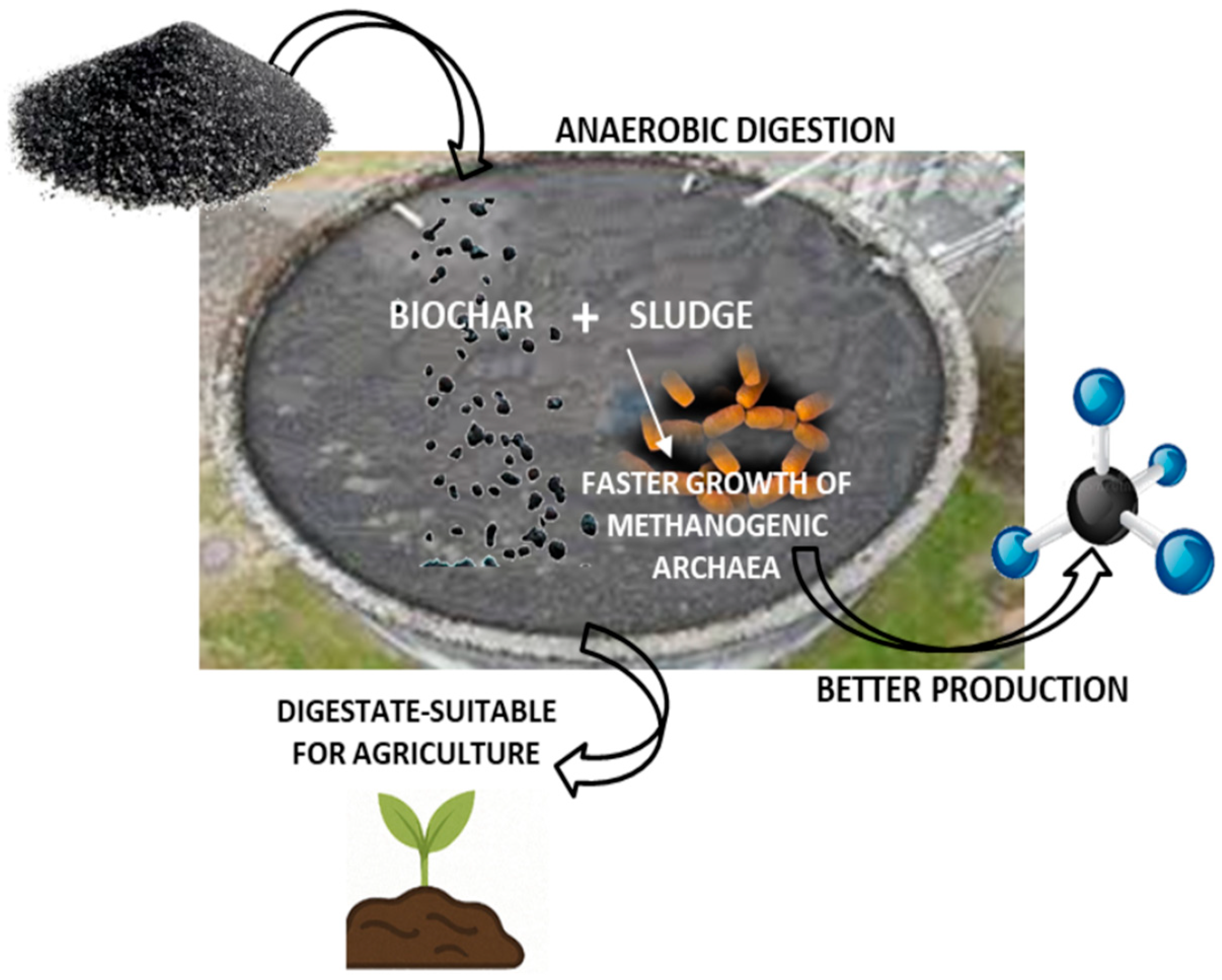
The impact of different reaction mechanisms of biochar in anaerobic digestion requires additional research. A schematic overview of these processes is presented in Figure 1. This review paper aims to understand the effect of biochar on the microbial community and different parameters of anaerobic digestion and the influence of biochar on the quality of the produced digestate.

2. Biochar

2.1. Biochar Production

Biochar is a carbon-rich material produced from biomass through pyrolysis, a process that decomposes organic matter at high temperatures (300–700 °C) in the absence of oxygen [18,19]. The yield and properties of biochar are governed by multiple parameters, such as feedstock characteristics (e.g., moisture content and particle size), operational conditions (temperature and heating rate), and the processing atmosphere (type and flow rate of the carrier gas) [20]. The pyrolysis temperature plays a crucial role in determining the physicochemical properties of the resulting biochar. Increasing the temperature generally enhances the surface area and porosity of biochar due to the destruction of aliphatic alkyl and ester groups [21,22]. At higher temperatures, the release of volatile substances decreases, while the biochar tends to have a higher pH, greater ash content, higher porosity, and lower volatile matter values—characteristics attributed to the extensive decomposition of organic matter [23,24]. In recent years, alternative technologies for carbon-rich materials have emerged, such as hydrochar production through hydrothermal carbonization (HTC). Hydrochar is produced under wet conditions at relatively lower temperatures (180–250 °C) and autogenous pressure [25,26]. Compared to conventional pyrolysis, HTC offers several advantages, including lower energy consumption, reduced emissions, and no need for feedstock drying prior to processing. It also allows for higher yields with a lower energy input [27]. The main parameters influencing HTC include temperature, reaction time, pressure, feedstock loading ratio, and the use of catalysts [28]. The resulting hydrochar can serve as a low-cost adsorbent for the removal of heavy metals, organic pollutants, phosphate, and pathogens from wastewater [29].
This review paper aims to highlight the effect of biochar on the anaerobic digestion of sludge with a focus on the impact of biochar on the microbial community.

2.2. Properties of Biochar

Biochar typically contains over 60% carbon, along with other essential elements, such as nitrogen, phosphorus, potassium, and calcium [30]. It is characterized by its high porosity and a large surface area, properties that enable the adsorption and retention of water, nutrients, and pollutants [31]. Differences in feedstock and pyrolysis temperature result in pronounced changes in the structural and chemical properties of biochar, including its surface area, pore distribution, and elemental composition [32]. Common feedstocks for biochar production include agricultural residues, owing to their wide availability and the high quality of biochar they produce [33]. An increase in pyrolysis temperature alters the elemental composition of biochar: the contents of magnesium (Mg), calcium (Ca), and phosphorus (P) generally increase, while the carbon (C) and nitrogen (N) contents decrease [34,35]. These changes directly influence the potential applications of biochar in environmental and agricultural systems.
The internal structure of biochar consists of three main pore types: micropores (<2 nm), mesopores (2–50 nm), and macropores (>50 nm). Macropores enhance substance diffusion, mesopores serve as pathways for mass transfer, and micropores provide adsorption sites for small molecules and ions [36].
The yield of biochar depends strongly on the pyrolysis mode. Fast pyrolysis (retention time in the range of 0.1–0.3 s; heating rate: 10–200 °C/s) typically yields 15–20% biochar, while slow pyrolysis (retention time: 15–30 min; heating rate: 0.1–1 °C/s) produces up to 35% [37]. Although slow pyrolysis yields more biochar, higher temperatures tend to reduce the overall yield due to water loss, the thermal degradation of organic compounds, and the formation of stable aromatic structures [37].

2.3. Application of Biochar

Biochar is widely used in agriculture due to its binding properties [38]. As a highly porous material, it reduces soil density, improves aeration, and enhances soil water retention. When incorporated into the soil, biochar boosts soil quality by promoting natural carbon sequestration [39]. Due to its large surface area and high cation exchange capacity, biochar also has the ability to adsorb both organic and inorganic compounds [40]. This makes biochar an effective and inexpensive adsorbent in water and wastewater purification processes. Moreover, biochar production supports waste valorization and resource recovery while helping to mitigate negative environmental impacts, such as greenhouse gas emissions [18]. As a soil amendment tool, biochar offers a sustainable solution to improve soil properties, especially in degraded and nutrient-poor soils [41]. Its application supports sustainable development and aligns with the principles of the circular economy [42]. The adsorption mechanisms of biochar for removing pollutants are varied and depend on its physicochemical properties, such as dosage, pyrolysis temperature, and the pH of the medium. These mechanisms can include electrostatic interactions, ion exchange, pore filling, and precipitation. The immobilization of heavy metals by biochar occurs via several pathways, such as electrostatic attraction, ion exchange processes, surface complexation, precipitation of insoluble metal compounds, and redox-mediated transformation followed by adsorption [43]. In addition to heavy metals, biochar can also adsorb organic pollutants. This is facilitated by mechanisms such as pore filling, hydrophobic interactions, partitioning, electrostatic interactions, and electron donor-acceptor (EDA) interactions [44].
This study aims to provide valuable insights into the influence of biochar on various parameters of anaerobic digestion, as well as the quality of the produced digestate.

3. Influence of Biochar on Anaerobic Digestion

Numerous studies that have been conducted in order to better understand the impact of biochar on anaerobic digestion show that biochar has a positive effect on anaerobic digestion and biogas production [15,45,46]. Due to its high porosity, large specific surface area, and good adsorption properties, studies have shown that the use of biochar in anaerobic digestion contributes to the stability of the system and the promotion of biogas production [47]. There are various studies on the impact of biochar on improving anaerobic digestion and increasing biogas production [48,49,50,51]. Biochar as a conductive carbon material exhibits properties such as a high electron exchange capacity, tunable surface functionality, as well as the possibility of microbial immobilization [52]. The good adsorption capacity of biochar reduces the inhibitory effects of polluting components and co-product anaerobic digestion [53]. Thanks to its large surface area, biochar provides space for the colonization of microorganisms, providing protection from toxic stresses caused by external influences [54]. However, it should be taken into account that biochars can also inhibit the process of anaerobic digestion. Given that biochars are produced from different biomasses under different production conditions, there are certain variations in their physical and chemical properties, which further can affect the efficiency of anaerobic digestion [55].
Several studies have confirmed that the addition of biochar facilitates the formation and degradation of VFA [56]. When biochar is used in anaerobic digestion, biofilm formation is facilitated due to the porous structure of biochar, and direct interspecies electron transfer (DIET) of functional microbes is promoted due to the redox-active property of biochar [57,58]. Given that biochar is an ecologically acceptable material, its use in improving anaerobic digestion is increasingly common. Biochar has a comparable performance in improving anaerobic digestion compared to other additives, at a relatively low cost [59].

3.1. Effects of Biochar on Methane Yield

The addition of biochar to anaerobic digestion enhances oxygen consumption efficiency and reduces the lag phase of methanogenesis, ultimately leading to an increase in the methane yield [50]. Despite some existing limitations, using biochar as a pre-treatment helps address these challenges, further boosting methane production. The advantages of adding biochar to an anaerobic digestion system are reflected in the properties of biochar, such as the large surface area for biofilm formation, the adsorption of inhibitory compounds such as ammonium, and pH buffering capacity [60].
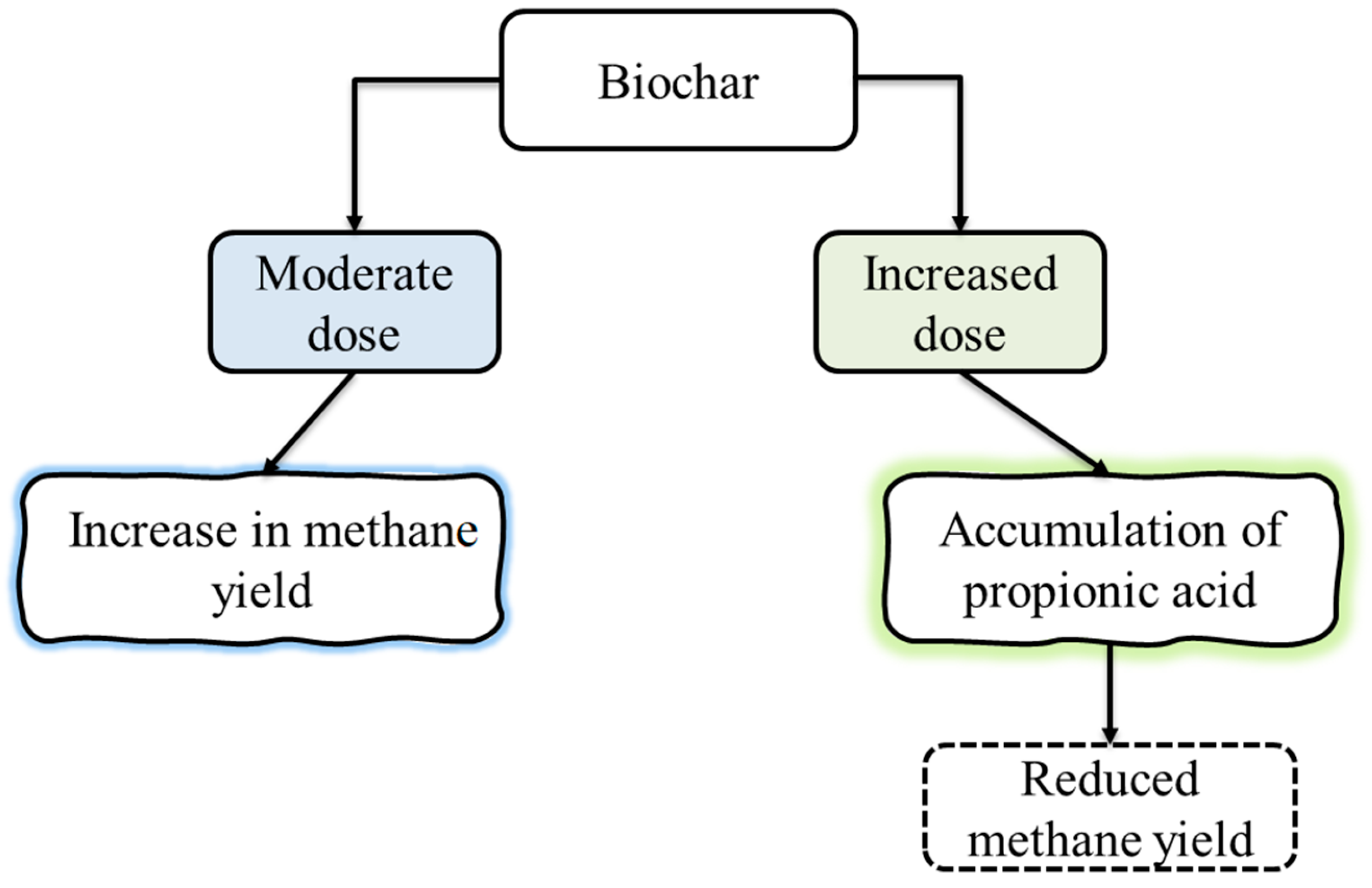
In the work of Zhou et al. [61], biochar produced from cornmeal led to an increase in methane production of 26.2%. In the study of Zhang et al. [62], the impact of nine types of biochar generated from three different raw materials on anaerobic digestion was examined. The results showed that methane production could be significantly increased (218.45 L per kg VS) with biochar from corn straws. Biochar exhibits biostability, providing a food source for methanogens during anaerobic digestion, which later produces a higher methane yield [63]. However, the increase in methane production needs to be viewed from several aspects, such as the type of biochar used, pyrolysis temperature, and dose. In addition to the type of biochar, the dose of biochar added to the anaerobic digestion system also has a significant impact [62]. Studies show that higher doses of biochar (greater than 10 g/L) can have inhibitory effects, leading to a reduction in the methane yield [62].
The reason for this may be that a moderate addition of biochar can efficiently alleviate the accumulation of VFAs, which promotes methanogenic activity, while more biochar could lead to the accumulation of propionic acid, which would disturb the stability of the system and reduce methane production (Figure 2). Namely, the accumulation of propionic acid (greater than 937.1 mg/L) leads to a slower rate of propionic acid acetogenesis, which leads to less methane production [64]. For instance, Torri et al. [65] found that the optimal dose for enhancing methane production in anaerobic digestion was 10 g/L. While moderate amounts of biochar contribute to methane production, excessive doses can have a negative effect on the system. As demonstrated by Shi et al. [66], higher doses of biochar can hinder the conversion of organic matter into butyrate, with methanogenesis efficiency decreasing by 32.5%.

Effects of Pyrolysis Temperature and Feedstock Source of Biochar on Methane Yield

Pyrolysis conditions, such as heating rate, temperature, and retention time, affect the properties of biochar, which further affect the performance of anaerobic digestion. Temperature is considered a more important condition that affects the properties of biochar [55]. The pyrolysis temperature and the feedstock biomass can significantly affect the methane yield during anaerobic digestion. Various experiments were conducted to investigate a clear correlation between pyrolysis temperature and biochar properties (Table 1).
The results show that a higher temperature leads to a higher specific surface area of biochar, a lower cation exchange capacity, higher pH, reduced yield, and higher carbon fractions [56]. Biochar produced at different pyrolysis temperatures had different degrees of carbonization, and a highly order structure formed when the pyrolysis temperature exceeded 400 °C [57]. The effect of the pyrolysis temperature on the properties of biochar can be seen through several different aspects. In biochars that are pyrolyzed at lower temperatures (300–600 °C), redox-active surface functional groups contribute to the electron exchange capacity. In biochars that are pyrolyzed at higher temperatures (400–700 °C), the main factor contributing to electron exchange is electrical conductivity [51]. For this reason, it is necessary to make a correlation between the pyrolysis temperature of biochar and the yield of methane. In the study by Wang et al. [57], biochar pyrolyzed at different temperatures (300–700 °C) was analyzed. Biochar pyrolyzed at 500 °C proved to be the most effective. Biochar pyrolyzed at 700 °C is less efficient than swept biochar, although the electrical conductivity is significantly higher. The reason can be cited as the abundance of redox-active functional groups in biochar pyrolyzed at 500 °C [57]. Pyrolysis at high temperatures can potentially lead to the release of toxic substances that inhibit anaerobic digestion, while low pyrolysis temperatures may not fully stabilize the pyrolyzed biomass, leading to the production of biochar that contributes to methane production through the content of biodegradable organic matter. This is supported by the results of a study in which wood-based biochar (BCW800) subsequently treated by gasification at high temperatures inhibited the anaerobic digestion process with 52% reduction in methane, at an addition of 15 g/L, with an 18% reduction in methanogens and microbial diversity. When biochar contains residual biodegradable organic matter due to the incomplete pyrolysis (BC400) used, an increase in biogas yield of 417.79 ± 5.38 mL/g VS, was observed [55].
By reviewing the literature, different feedstocks for biochar production can be established. However, there is some variation in the efficiency of anaerobic digestion. Biochar derived from wood proved to be more efficient for methane production compared to biochar derived from agricultural waste [51]. Biochar derived from wood exhibits properties such as a higher specific surface area (253.39 m2/g) and electron-donor capacity (0.019 ± 0.0002 µS/cm) [51]. On the other hand, biochar derived from agricultural waste contains nutrients necessary for growth microorganisms [53]. The type of raw material and the pyrolysis temperature should be considered together due to the combined effect on the physicochemical properties of the produced biochar.
In one study, the methane yield was monitored using biochar from different biomasses, such as corn straw, coconut shell, and sewage sludge, pyrolyzed at different temperatures. The results show that different sources of biomass and pyrolysis temperatures used for biochar formation stimulate methane production. The maximum methane yield was 218.45 ± 9.55 L per kg VS for CS600, followed by SS500, CS500, CS400, CCS600, SS600, SS400, CCS400, and CCS500, and the control had cumulative methane yields of 207.49 ±7.29, 195.77 ± 6.92, 184.12 ± 9.69, 174.44 ± 7.72, 165.85 ± 8.02, 155.86 ± 8.19, 143.85 ± 8.92, 125.50 ± 9.36, and 117.36 ± 8.96 L per kg VS, respectively. CS600 proved to be the most suitable, increasing the yield by 86.14%. Of all the biochars, biochar produced from sewage sludge showed the highest increase in ash content of 42.2%. Also, it was observed that the ash content increased with pyrolysis temperature. Biochar sources such as corn may have more nutrients that encourage microorganisms that improve anaerobic digestion. An increase in the pyrolysis temperature causes an increase in the specific surface area of biochar, the removal of volatile substances, and an increase in the pores of biochar [62]. And the larger specific surface area of biochar favors the growth of microorganisms [56]. In another study using corn stover as biomass pyrolyzed at 600 °C, there was an increase in the methane yield in the range of 8.6–17.8% [69]. Sewage sludge contains large amounts of inorganic matter, which are composed of biochar during the pyrolysis process [70,71]. In a paper by Feng et al. [68], biochar from oil sludge pyrolyzed at 600 °C was used; it showed the highest capacity and an accumulative methane yield of 143.96 mL (g VS−1). Therefore, both the biomass source and pyrolysis temperature significantly influence the properties of biochar, such as its specific surface area and ash content. Based on the data presented, it can be concluded that a pyrolysis temperature of 600 °C and the use of food waste biomass are the most suitable for the production of biochar intended for the enhancement of anaerobic digestion.

3.2. Effects of Biochar on Ammonia Inhibition

During anaerobic digestion, nitrogen substances are broken down, which leads to the accumulation of ammonia and long-chain fatty acids [72]. Ammonia is both a nutrient and an inhibitor; optimal concentrations (600–800 mg/L) support microbial growth, while excessive levels (up to 7000 mg/L) can severely inhibit methanogenesis [73]. Depending on the temperature and pH of the system, total inorganic ammonium–nitrogen exists in two forms: ammonium ions and free ammonia. Free ammonia is considered toxic, and its concentration increases with increasing temperature and pH due to the conversion of ammonium into free ammonia [74]. Free ammonia suppresses methanogens to the acetoclastic pathway, such as Methanosaeta, while it is considered less toxic to hydrogenotrophic methanogens [75]. High concentrations of ammonia cause the disruption of the cytoplasmic pH in the cells of acetoclastic methanogens and lead to a loss of intracellular potassium [76]. Total ammonia nitrogen (TAN) concentrations ranging from 2.500 to 11.000 mg/L have been reported to induce toxicity in methanogenic archaea [77]. In general, the doses of TAN that inhibit anaerobic digestion vary among studies, which can be attributed to differences in substrate and inoculums type, experimental parameters, and acclimation periods [78]. Biochar helps regulate community structures and encourage the accumulation of bacteria that consume acetate under ammonia inhibition [79]. Biochar is characterized by a large adsorption surface and high porosity, which is useful for ammonia adsorption [80]. Additionally, biochars and microorganisms form a biofilm that limits ammonia inhibition [81]. The role of biochar in inhibiting ammonia during anaerobic digestion can be reflected in the following: the adsorption of ammonia to reduce its content in the system, provision of microbial attachment to avoid exposure to ammonia, buffering of pH disturbances caused by the accumulation of VFAs, and regulation of electron transfer in syntrophic methanogenesis [82].
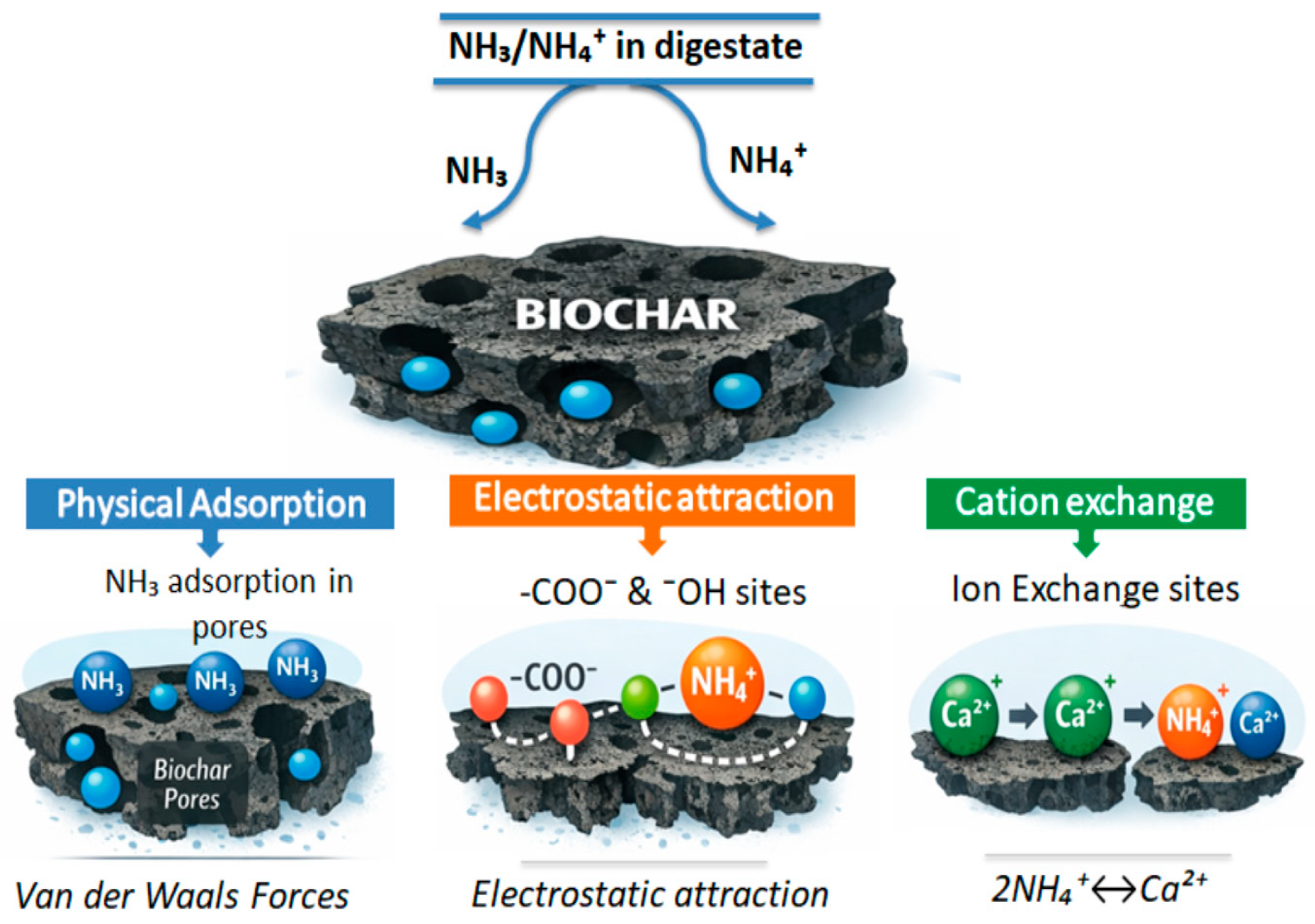
Studies have shown that the total concentration of ammonium–nitrogen is reduced at lower concentrations of biochar (10 g/L), i.e., it increases with a higher dose of biochar (>10 mg/L) [83,84]. The reason for this is that a higher dose of biochar causes greater organic decomposition, which leads to the release of more ammonium–nitrogen in the process of anaerobic digestion. It has been shown that NH4+-N exerts a minimal effect on anaerobic digestion when its concentration remains below 3500 mg/L [81]. On the other hand, reducing the dose of biochar leads to a decrease in the concentration of ammonium–nitrogen on the surface of the biochar by the mechanisms of electrostatic ion exchange due to the high affinity of the sorption of negatively charged functional groups of biochar toward positively charged ammonium ions [85]. A dose of biochar up to 30 g/L can be used without fear of inhibition due to the increased decomposition of organic matter [51]. The use of biochar to remove ammonia in anaerobic digestion involves three mechanisms: physical adsorption, electrostatic attraction, and cation exchange [86]. The adsorption of free ammonia on the surface of biochar is carried out by van der Waals forces. Negatively charged functional groups on the surface of biochar, such as (–OH and –COO), react with ammonia through electrostatic attraction and promote adsorption. The cation exchange mechanisms facilitate the adsorption of ammonia by means of cations located on the surface of the biochar [87]. The mechanisms and interactions are schematically illustrated in Figure 3.
Functional groups on the surface of biochar can interact with ammonia, potentially inhibiting the anaerobic digestion process. Specifically, oxygen-containing functional groups can react with adsorbed ammonia, converting it into amines and amides, which are non-degradable and may contribute to the inhibition of digestion [88]. Due to its large specific surface area, high porosity, abundance of functional groups, good buffering capacity, and electrical conductivity, biochar has proven to be an effective supplement for mitigating the toxic effects of ammonia [89].
This is supported by the research conducted by Wei et al. [69], which found that biochar derived from corn stover improved process stability and alleviated ammonia inhibition due to its buffering capacity, resulting in a 13.8–18.8% increase in methane content. Similarly, Zhang et al. [62] demonstrated that the addition of biochar helps stabilize the anaerobic digestion system by alleviating ammonia toxicity, thereby creating a more favorable environment for methanogen growth. Furthermore, Lü et al. [90] concluded that biochar addition enhanced system stability by preventing the harmful effects of ammonia, leading to improved methanogenesis.

3.3. The Influence Biochar on the Production of VFAs and pH

pH is a critical parameter in anaerobic digestion that directly impacts system stability. There are three main types of bacteria involved in biogas production: hydrolytic bacteria, fermentative bacteria, and methane-producing archaea. Fermentative bacteria can operate within a pH range of 4.0 to 8.5, with an optimal range of 5.0 to 6.0, while methanogenic archaea function best within a pH range of 5.5 to 8.5, with an optimal range of 6.8 to 8.0. Any disturbance in pH can pose risks to the digestion process. For example, an increase in volatile solids can lead to a high production of organic acids by acidogenic bacteria, causing a sharp decline in pH below 5.0. This is harmful to methanogenic bacteria, which have an optimal pH range of 6.5 to 8.0. Conversely, if the pH rises above 8.0, it becomes toxic to most anaerobic microorganisms, inhibiting their biological functions [7]. Given the alkaline nature of biochar, its addition increases the pH during anaerobic digestion [62]. During the hydrolysis and acidogenesis steps, VFAs are produced, which can cause a pH increase in the system [91]. This effect is counterbalanced by syntrophic acetogens and methanogens, which convert VFAs into methane and carbon dioxide. However, in the cases of a high organic load, when VFA production exceeds the rate of consumption, VFA accumulation occurs, leading to a sharp pH drop [92]. The buffering capacity in a digester is determined by its ability to neutralize VFAs through the production of carbon dioxide and bicarbonate [93].
Biochar shows a good buffering capacity due to the high production of ammonia, which neutralizes VFAs [15]. The buffering capacity of biochar depends on two key factors: functional groups and inorganic content. During anaerobic digestion, the rapid accumulation of VFAs can lead to a pH drop. Biochar’s functional groups, such as amines, can adsorb H+ ions and capture electrons, mitigating the sharp drop in the pH. Additionally, biochar contains alkaline elements such as Ca, K, Mg, and Na, which contribute to its alkalinity [94]. As mentioned earlier, biochar contributes to system stability by adsorbing volatile fatty acids and ammonia, thanks to the large surface area, pore volume and surface functional groups [86].
In a study by Zhang et al. [62], corn straw and coconut shell were used as raw materials for the preparation of biochar to improve the anaerobic digestion of sludge. Pyrolysis was conducted at temperatures in the range of 350–600 °C. The results showed that the addition of biochar led to an increase in pH, which is consistent with the alkaline nature of biochar. However, the pH value of all digesters initially decreased during the first six days due to the accumulation of VFAs resulting from the decomposition of organic matter in the sludge. After this period, the pH began to rise in all digesters, reflecting the consumption of VFAs and the ammonification of proteins. In a study by Zhou et al. [61], two types of biochar were used: one produced from the pyrolysis of raw corn stover and the other from sulfuric acid-pretreated corn stover. The addition of the first type of biochar significantly increased the alkalinity (pH = 7.38–7.52), while the second type did not result in a significant increase compared to the control (pH = 7.0). As mentioned earlier, both the raw material used to produce the biochar and the pyrolysis temperature play crucial roles in determining the biochar’s properties, which, in turn, affect the performance of anaerobic digestion. Additionally, the VFA/alkalinity ratio was found to be less than 0.4, indicating that the system was stable. In a study by Wang et al. [95], vermicompost biochar was found to help buffer acids during the anaerobic digestion of kitchen waste and chicken manure. In another study, the influence of hardwood biochar on the anaerobic digestion of sludge was investigated at doses of 5, 10, 15, 20, 25, and 35 g/L. The results showed that higher doses of biochar increased the alkalinity. The dose of 10 g/L of biochar resulted in the highest alkalinity, with a value of 3.2 g/L CaCO3 and a pH of 7.6. However, the addition of biochar beyond this dose further increased alkalinity but caused the pH to become more distributed across the system, potentially reducing its stability [96].

3.4. Impact of Biochar on Microbial Structures

The structure and abundance of the microbial community are closely related to the presence of biochar in anaerobic reactors. Biochar favors the growth of attached biomass by acting as an inert core, leading to the rapid formation of microbial aggregates [58]. Biochar can provide an available source of nutrients for microbes, which affects the increase in co-metabolism and proliferation, which increases microbial activity. At the genus level, Methanosarcina was the most abundant methanogen, followed by Methanosaeta, Methanobacterium, and Methanospirillum [97] Bacteria Methanosarcina and Methanosaeta are typical acetoclastic methanogens that use acetate for methane production. Specifically, Methanosarcina in samples with biochar had a higher proportion in the range of 65.97–75.93%, while in the control group it increased from 57.92% to 64.4% in 34 days [58]. The importance of Methanosarcina is reflected in the fact that it has several methanogenic pathways that it uses to produce methane [98]. In the work of Sugiarto et al. [99], it was proven that iron-containing biochar plays an important role during biogas production, especially by promoting the growth of Clostrida. Higer Clostridia growth rates convert more substrate to acetic acid and butyric acid, leading to an increased biogas yield. There was also an increase in the population of Methanosaeta. Methanosaeta is an acetoclastic methanogen responsible for converting acetic acid into methane. This claim is supported by a study by Qi et al. [87] in which the results showed that the addition of biochar led to a four-fold increase in the number of Methanosaeta species compared to the control group. Also, it was shown that there was more Methanobacterium in the control group than the sample with biochar, indicating that the addition of biochar promotes the growth of more acetoclastic methanogens than hydrogenotrophic methanogens. The increase is related to their binding to the biochar particles due to its high porosity, which promotes biofilm growth [100]. In a study by Wu et al. [101], the effects of pyrochar and hydrochar obtained from wastewater sludge on the mesophilic anaerobic digestion of activated sludge were compared. By adding biochar to the reactors, the archaea community showed a significant difference. The addition of hydrochar changed the structure of the bacterial community. This study showed that pyrochar compared to hydrochar has more surface functional groups and a larger surface area, which provided a more favorable environment for the growth of microbes, which in this case was shown by Proteobacteria. After 32 days of anaerobic digestion, the three most important genera in all the samples were Methanosaeta, Methanobacterium, and Methanosarcina. Zhao et al. [102] found that when some of the carbonaceous materials were removed from the reactor, the rate of syntrophic metabolisms decreased to a rate comparable to a control reactor without the addition of carbonaceous materials.

3.4.1. Syntrophy Mechanisms

In hydrolysis, which is the first step of anaerobic digestion, the action of extracellular hydrolytic enzymes leads to the breakdown of complex organic molecules, such as polysaccharides, proteins, fats, or other polymer into sampler molecules, such as sugars, amino acids, fatty acids, or some other monomers. Monomers formed in the hydrolysis phase by the action of primary fermenting bacteria are further broken down into volatile fatty acids, succinate, lactate, and ethanol. Fermentation products, such as acetate, H2/CO2, and formate, can be directly used by methanogens for methane production. However, some other fermentation products, such as VFAs, cannot be used by methanogenic bacteria, which requires further fermentation by secondary fermenting bacteria (syntrophic bacteria). Syntrophic bacteria are capable of converting the fermentation products into acetate, formate, or some other carbon compounds that can be used by the methanogenic bacteria [103,104,105]. Within the anaerobic system, syntrophic relationships have been identified between the acetogenic and methanogenic phases, in which both microorganism groups depend on each other [106,107]. This concept was first proven in 1967, when Bryant et al. [108] proposed the theory of “Interspaces electron transfer”. The observation of a culture of Methanobacillus omelianskii, an anaerobic methanogenic culture, previously thought to be pure, led to the conclusion that the two strains established a syntrophic relationship leading to methane production. This first strain, the “S organisms,” was able to oxidize ethanol, producing hydrogen, which is used by another bacterium, Methanobacterium bryantii M.o.H, to produce methane. These results were the first to suggest that the syntrophic relationship between these microorganisms is based on electron transfer: fermentative bacteria used as the final carrier of H+ electrons produce H2, which is used by methanogens to produce methane [103]. Syntrophy can be defined as a process in which two or more microorganisms combine their metabolic abilities to catabolize a substrate that cannot be catabolized by either of them individually [109]. The efficiency of the anaerobic digestion process is determined by the interspecies electron transfer (IET) between secondary fermenting bacteria that produce diffuse electron carriers such as formate and hydrogen and methanogenic archaea [110]. In the process of anaerobic digestion, bacteria break down the available substrate into acetate, H2, and/or formate, which is consumed by the syntrophic partner of methanogen [94]. However, in addition to the mentioned electron carriers, other molecules, such as humic substances, quinines, or insoluble biochemical compounds, can participate in electron transfer [111]. Compared to hydrogen and formate, these electron carriers have a lower interspecies electron transfer efficiency due to their poor diffusion, which represents a limiting factor for methanogenesis [112].
Interspecies electron transfer can be classified into two types. The first is shuttled interspecies electron transfer (SIET), which implies an exchange mechanism mediated by chemical shuttle molecules, mainly H2 and formate. The other is direct interspecies electron transfer (DIET), a mechanism that does not involve chemical shuttles but instead relies on the formation of cytochromes, electrically conductive pills, or aggregates, which supports the previous claim that interspecies electron transfer does not refer only to hydrogen and formate as electron carriers [106,113].

3.4.2. Direct Interspecies Electron Transfer

DIET is a mechanism that was first established in 2010 by Summers et al. [114] who co-cultivated two species of Geobacter: Geobacter metallireducens and Geobacter sulfurreducens. The first used ethanol as an electron donor and fumarate as an electron acceptor under anaerobic conditions. G. metallireducens were able to oxidize ethanol using fumarate as an electron acceptor, whereas G. sulfurreducens were able to reduce fumarate to succinate but could not oxidize ethanol. This established that interspecies electron transfer between two types of microorganisms is required. Summers et al. [114] showed that without hydrogen and formate as electron carriers, microorganisms aggregate together for direct electron transfer through a conductive medium. They deleted the OmcS (Cytochrome C) gene to study DIET, which led to a failure in electron transfer. This fact shows the important role of Cytochrome C as an electron carrier [107]. However, DIET has some limitations. Geobacter has the ability to degrade alcohols such as propanol and butanol, but cannot directly utilize VFAs such as propionate and butyrate. Most of the interacting bacteria that have the ability to utilize propionate and butyrate do not possess cytochrome, conductive pilus, or other features of Geobacter. For this reason, additional improvements are necessary in order to overcome these shortcomings [107]. Through these studies, it was found that a DIET reaction could be stimulated either by the supplementation of a conductive material and/or applying an external voltage [92,115]. So far, a large number of works have shown that the addition of conductive materials such as active carbon, biochar, carbon fiber, magnetite, or hematite can promote methanogenesis by improving the syntrophic interaction [116,117,118,119,120].

3.4.3. The Impact of Biochar on Methanogenic Archaea and DIET

Biochar, although less conductive than granular activated carbon (GAC), can provide a place for the enrichment of functional microbes, such as DIET partners, and subsequently improve aggregate formation and electron transfer characteristics [58]. In the anaerobic digestion system, which was not supplemented with carbonaceous materials, syntrophic microorganisms such as Geobacter metallireducens and Geobacter sulfurreducens formed aggregates for electron transfer with a rich presence of c-type Cytochrome, but it was observed that microorganisms such as Geobacter metallireducens firmly attached to conductive materials, but did not form aggregates compared to the environment without carbonaceous materials, where microorganisms form aggregates to create electron transfer trough the cellular connection [114,120]. This suggests that one of the conductive materials, such as a biochar, can be used for electron transfer [120]. Electron transfer catalysis by biochar can involve two types of redox structures: quinine–hydroquinone units and/or the conjugation of π electron systems associated with unbounded aromatics structures of biochar [58,121,122]. That is, quinine moieties, phenolic moieties, and arene rings in biochar are possible redox active moieties responsible for its electron-accepting ability. Biochar with a lower pyrolysis temperature has a higher content of redox-active parts that can participate in the electron transfer process [94]. Research has shown that biochar conductivity is not correlated with the facilitating effect on the metabolisms of Geobacter metallireducens and Geobacter sulfurreducens co-cultures, but that the transfer of electrons depends on the process of charging and discharging the surface of the biochar. Charge and discharge cycles of biochar surface functional groups reversibly accept and donate electrons [94]. It is concluded that the addition of biochar can stimulate the DIET between syntrophic acetogenic and methanogenic communities, prevent the acidification of the system, and promote methane production [100]. One of the studies confirmed that addition of hydrochar promotes the proliferation of microbes thar are suitable for direct interspecies electron transfer, such as Peptococcaceae, Methanosaeta, and Methanobacterium [101].

4. Digestate Quality

Sludge from wastewater treatment plants is an organic substrate rich in nutrients such as nitrogen (2.38–4.33%), phosphorus (2.66–4.03%), and potassium (0.10–0.20). Thanks to its properties, it is suitable for use in agriculture as a fertilizer; it improves the physical properties of the soil, such as the porosity, stability, and water retention capacity [123]. As biodegradable waste, it is used as a resource for the production of energy and materials [124]. The limiting circumstance of the application of raw sludge in agriculture is reflected in the contents of heavy metals, toxins, bacteria, and other harmful substances [125]. There are various aspects that need to be considered before using sludge, such as health, environmental, and economic. In order for the application of sludge to match the health and ecological standards, prior stabilization is necessary. The most common methods of sludge stabilization are incineration, aerobic digestion, anaerobic digestion, and composting [90,93,126]. In this paper, the focus is on anaerobic digestion, and it is necessary to emphasize all the benefits of the produced digestate.
Digested sludge has significant agronomic value due to its nutrient content [127]. However, its application in agriculture has limitations. For instance, it leads to an increase in greenhouse gas emissions, with a global warming potential 298 times greater than carbon dioxide [128]. Additionally, if organic substances in the sludge are not fully decomposed during digestion, over 45% of resistant organic matter remains in the digestate, which can be harmful to soil quality [129]. The application untreated sludge can cause an ecological risk. Greenhouse gases (GHGs) are one of the problems. Applying sewage sludge to land leads to an increase in the emissions of nitrous oxide, which is considered a powerful GHGs with a warming potential 298-times greater than carbon dioxide [127]. The anaerobic digestion of sludge and the application to land should overcome many limitations by returning energy to the system and producing a stable product, whilst reducing GHGs emissions. In the study Pippo et al. [130], the anaerobic digestion of sludge showed the lowest percentage of GHGs emissions of all stabilization technologies. The use of biogas produced from anaerobic digestion, according to one study, can offset only 24% of the total emissions of GHGs. [131]. In another study, it was found that the use of biogas instead of fossil fuels can offset the total GHGs emissions of the entire process and sludge disposal [132]. Although the application of sludge aims to reduce GHGs emissions, as a substitute for chemical fertilizers, doubts remain due to the production of nitrogen oxides and the presence of nitrogen in the soil [133]. However, the reduction in GHGs emissions through the application of sludge after anaerobic digestion is reflected in the application of biogas and the replacement of chemical fertilizers. Here, it is not enough to just list the methods of reduction; the yield of biogas should also be taken into account, and whether it would be sufficient to compensate for the energy used [134]. Also, studies have shown that the use of biochar reduces the effect of GHGs emissions. Biochar has a porous structure and an abundance of functional groups, which contributes to the reduction of GHGs emissions [135]. It would be useful to determine whether the addition of biochar to the anaerobic digestion system further reduces GHGs emissions when applied to soil.
One major concern with digestate is the presence of heavy metals, which can contaminate soil. In the analyzed sludge, the total concentrations of Fe (842.2 mg·kg−1), Pb (548.3 mg·kg−1), Cd (512.1 mg·kg−1), Cr (521.5 mg·kg−1), and Zn (775.4 mg·kg−1) exceeded the permissible limits for land application, indicating potential limitations for safe use despite its nutrient richness. Therefore, while sludge offers valuable macronutrients for agricultural purposes, the careful monitoring and management of heavy metal content are essential to prevent environmental contamination [127,136]. Thanks to its adsorption properties, biochar can absorb heavy metals from the sludge, thereby reducing their concentration [31]. Moreover, biochar influences important soil properties, such as pH, electrical conductivity, and organic matter content [128]. Its porous structure enhances water retention, nutrient availability, and microbial activity in the soil, contributing to improved plant growth [129]. Rich in nitrogen (N), phosphorus (P), and potassium (K), biochar helps maintain soil fertility. When combined with the nutrient-rich digestate, it further improves soil health. Biochar in the digestate enhances nutrient retention and mitigates the impact of heavy metals and other pollutants through adsorption. A total of 10 g/L of biochar produced after pyrolysis at 550 °C was able to remove 0.015 g/L of Cu and Pb with almost 100% removal efficiency [130]. Studies show that the presence of biochar in digestate increases the availability of micro- and macronutrients for plants [49,137]. In conclusion, biochar not only promotes the anaerobic digestion process but also improves the quality of the digestate. While digestate alone has value, the addition of biochar enriches the soil with essential nutrients and reduces the impact of harmful substances. This approach supports the sustainable development of wastewater, energy, and agriculture sectors.
Anaerobic digestion represents an efficient way of waste reconstitution, but also of energy production, which can potentially replace the costs of technology. It provides an effective solution for solving the problem of sludge as waste, strengthening the energy sector. Research by Paul et al. [138] shows that the recovery of biomethane as a fuel together with the production of electricity, heat, and fertilizer is a cost-effective solution. In another study, it was estimated that the production of biogas using anaerobic digestion depends on several factors; as a limitation, the low price of natural gas was mentioned, and technological development was necessary to increase the content of methane in biogas in order to make natural gas profitable [139]. Another study showed that co-digestion with agricultural waste increases profitability [140]. Nevertheless, it is necessary to emphasize here the profitability of the anaerobic digestion of sludge with addition of biochar in terms of the profitability of the digestate. In the research that focused on economic analysis, it was proven that, in order to achieve economic profitability, it is necessary to reduce the dose of added biochar, so that all costs are compensated [50]. In general, so that this topic can be dealt with more thoroughly, additional research is necessary.
The potential of using sludge for agricultural purposes is one of the ways of implementing a circular economy, with the strengthening of the wastewater and agriculture sectors [141].

5. Conclusions

In this review, the influence of biochar on the acceleration of anaerobic digestion is shown through its influence on the production VFAs, the reduction in ammonia inhibition, and the promotion of direct interspecies electron transfer, which contributes to the increase in methane yield. Anaerobic digestion is a very sensitive process; it can be affected by various factors within the system. The properties of biochar are greatly influenced by pyrolysis temperatures and the biomass from which the biochar is produced. The presence of biochar in the digested sludge additionally enriches it with nutrients, which makes the digested sludge suitable for use in agriculture. Although there is a lot of work and research based on the effect of biochar on the anaerobic digestion of sludge, there are gaps in the research that need to be filled.
Future research should focus on the impact of biochar addition on microorganisms, suggesting mechanisms of cooperation. Also, sludge is a heterogeneous system that abounds in a large number of bacteria; it is necessary to consider their influence on anaerobic digestion. The correlation of pyrolysis temperature and raw material is still not sufficiently defined. It is necessary to pay attention to economic aspects in order to improve the process and overcome all the limitations.

Author Contributions

A.S.L.M.: data curation, methodology, writing—review and editing, visualization, and formal analysis. D.S.Ž.: data curation, methodology, and writing—review and editing. N.S.D.: methodology and writing—review and editing. N.S.S.: writing—review and editing and methodology. A.Z.K.M.: writing—review and editing. D.D.T.P.: methodology and writing—review and editing. Đ.V.K.: funding acquisition, supervision, and writing—review and editing. All authors have read and agreed to the published version of the manuscript.

Funding

This research and APC were funded by the European Union’s Horizon Europe research and innovation program, Horizon Europe—Work Programme 2021–2022 Widening participation and strengthening the European Research Area, and HORIZON-WIDERA2021-ACCESS-02, under grant agreement no [101060110], SmartWaterTwin.

Data Availability Statement

The original contributions presented in this study are included in the article. Further inquiries can be directed to the corresponding author.

Conflicts of Interest

The authors declare no conflicts of interest.

Abbreviations

The following abbreviations are used in this manuscript:
VFAsVolatile fatty acids
GACGranular activated carbon
HTCHydrothermal carbonization
TANTotal ammonia nitrogen
SIETShuttled interspecies electron transfer
DIETDirect interspecies electron transfer
EDAElectron donor-acceptor

References

  1. Kosnar, Z.; Mercl, F.; Pierdona, L.; Chane, A.D.; Micha, P.; Tulstos, P. Cocentration of the main persistent organic pollutants in sewage sludge in relation to wastewater treatment plant and sludge stabilization. Environ. Pollut. 2023, 333, 122060. [Google Scholar] [CrossRef] [PubMed]
  2. Uggetti, E.; Ferrer, I.; Llorens, E.; García, J. Sludge treatment wetlands: A review on the state of the art. Bioresour. Technol. 2010, 101, 2905–2912. [Google Scholar] [CrossRef] [PubMed]
  3. Balkrishna, A.; Ghosh, S.; Kaushik, I.; Arya, V.; Joshi, D.; Semwal, D.; Saxena, A.; Singh, S. Sequential distribution, potential sources, and health risk assessment of persistent toxic substances in sewage sludge used as organic fertilizer in Indo Gangetic region. Environ. Sci. Pollut. Res. 2025, 32, 2324–2358. [Google Scholar] [CrossRef]
  4. Kegl, T. Anaerobic digestion BioModel upgraded by various inhibition types. Renew. Energy 2024, 226, 120427. [Google Scholar] [CrossRef]
  5. Ruiz, B.; Flotats, X. Citrus essential oils and their influence on the anaerobic digestion process: An overview. Waste Manag. 2014, 34, 2063–2079. [Google Scholar] [CrossRef]
  6. Zamorano-López, N.; Borrás, L.; Seco, A.; Aguado, D. Unveiling microbial structures during raw microalgae digestion and co-digestion with primary sludge to produce biogas using semi-continuous AnMBR systems. Sci. Total Environ. 2020, 699, 134365. [Google Scholar] [CrossRef]
  7. Lohani, S.P.; Havukainen, J. Anaerobic digestion: Factors affecting anaerobic digestion process. In Waste Bioremediation. Energy, Environment, and Sustainability; Varjani, S., Gnansounou, E., Gurunathan, B., Pant, D., Zakaria, Z., Eds.; Springer: Singapore, 2018. [Google Scholar]
  8. Yuan, Y.; Hu, X.; Chen, H.; Zhou, Y.; Zhou, Y.; Wang, D. Advances in enhanced volatile fatty acid production from anaerobic fermentation of waste activated sludge. Sci. Total Environ. 2019, 694, 133741. [Google Scholar] [CrossRef]
  9. Kucharska, K.; Rybarczyk, P.; Hołowacz, I.; Łukajtis, R.; Glinka, M.; Kaminski, M. Pretreatment of Lignocellulosic Materials as Substrates for Fermentation Processes. Molecules 2018, 23, 2937. [Google Scholar] [CrossRef]
  10. Fernandez-Rodriguez, J.; Perez, M.; Romero, L.I. Semicontinuous temperature-phased anaerobic digestion (TPAD) of organic fraction of municipal solid waste (OFMSW). Comparison with single-stage processes. Chem. Eng. J. 2016, 285, 409–416. [Google Scholar] [CrossRef]
  11. Hao, J.; Wang, H. Volatile fatty acids productions by mesophilic and thermophilic sludge fermentation: Biological responses to fermentation temperature. Bioresour. Tehnol. 2015, 175, 367–373. [Google Scholar] [CrossRef]
  12. Khanh Nguyen, V.; Kumar Chaudhary, D.; Hari Dahal, R.; Hoang Trinh, N.; Kim, J.; Woong Chang, S.; Hong, Y.; Duc La, D.; Cuong Nguyen, X.; Hao Ngo, H.; et al. Review on pretreatment techniques to improve anaerobic digestion of sewage sludge. Fuel 2021, 285, 119105. [Google Scholar] [CrossRef]
  13. Valentin, M.T.; Luo, G.; Zhang, S.; Białowiec, A. Direct interspecies electron transfer mechanisms of a biochar amended anaerobic digestion: A review. Biotechnol. Biofuels Bioprod. 2023, 16, 146. [Google Scholar] [CrossRef]
  14. Lu, J.-S.; Chang, J.-S.; Lee, D.-J. Adding carbon-based materials on anaerobic digestion performance: A mini-review. Bioresour. Technol. 2020, 300, 122696. [Google Scholar] [CrossRef] [PubMed]
  15. Chiappero, M.; Norouzi, O.; Hu, M.; Demicheils, F.; Berruti, F.; Di Maria, F.; Mašek, O.; Fiore, S. Review of biochar role as additive in anaerobic digestion processes. Renew. Sustain. Energy Rev. 2020, 131, 110037. [Google Scholar] [CrossRef]
  16. González, J.; Sánchez, M.E.; Gómez, X. Enhancing anaerobic digestion: The effect of carbon conductive materials. J. Carbon Res. 2018, 4, 59. [Google Scholar] [CrossRef]
  17. Lü, F.; Luo, C.; Shao, L.; He, P. Biochar alleviates combined stress of ammonium and acids by firstly enriching Methanosaeta and then Methanosarcina. Water Res. 2016, 90, 34–43. [Google Scholar] [CrossRef]
  18. Khater, E.S.; Bahnasawy, A.; Hamouda, R.; Sabahy, A.; Abbas, W.; Morsy, O.M. Biochar production under different pyrolysis temperatures with different types of agricultural wastes. Sci. Rep. 2024, 14, 2625. [Google Scholar] [CrossRef]
  19. Kan, T.; Strezov, V.; Evans, T.J. Lignocellulosic biomass pyrolysis: A review of product properties and effects of pyrolysis parameters. Renew. Sustain. Energy Rev. 2016, 57, 1126–1140. [Google Scholar] [CrossRef]
  20. Tripathi, M.; Sahu, J.N.; Ganesan, P. Effects of process parameters on production of biochar from biomass waste trough pyrolysis: A review. Renew. Sustain. Energy Rev. 2016, 55, 467–481. [Google Scholar]
  21. Bonelli, P.R.; Buonomo, E.L.; Cukierman, A.L. Pyrolysis of sugarcane bagasse and co-pyrolysis with an argentinean subbituminous coal. Energy. Sour. Part A 2007, 29, 731–740. [Google Scholar] [CrossRef]
  22. Chen, B.; Chen, Z. Sorption of naphthalene and 1-naphthol by biochars of orange peels with different pyrolytic temperatures. Chemosphere 2009, 76, 127–133. [Google Scholar] [CrossRef]
  23. Shaaban, A.; Se, S.-M.; Dimin, M.F.; Juoi, J.M.; Husin, M.H.; Mitan, N.M.M. Influence of heating temperature and holding time on biochars derived from rubber wood sawdust via slow pyrolysis. J. Anal. Appl. Pyrol. 2014, 107, 31–39. [Google Scholar] [CrossRef]
  24. Tomczyk, A.; Sokołowska, Z.; Boguta, P. Biochar physicochemical properties: Pyrolysis temperature and feedstock kind effects. Rev. Environ. Sci. Biotechnol. 2020, 19, 191–215. [Google Scholar] [CrossRef]
  25. Cao, Y.; He, M.; Dutta, S.; Luo, G.; Zhang, S.; Tsang, D.C.W. Hydrothermal carbonization and liquefaction for sustainable production of hydrochars and aromatics. Renew. Sustain. Energy Rev. 2021, 152, 111722. [Google Scholar] [CrossRef]
  26. Lu, X.; Jordan, B.; Berge, N.D. Thermal conversion of municipal solid waste via hydrothermal carbonization: Comparison of carbonization products to products from current waste management techniques. Waste Manag. 2012, 32, 1353–1365. [Google Scholar] [CrossRef]
  27. Kambo, H.S.; Dutta, A. A comparative review of biochar and hydrochar in terms of production, physic-chemical properties and applications. Renew. Sustain. Energy Rev. 2015, 45, 359–378. [Google Scholar] [CrossRef]
  28. Sharma, H.B.; Sharma, A.K.; Dubey, B. Hydrothermal carbonization of renewable waste biomass for solid biofuel production: A discussion on process mechanism, the influence of process parameters, environmental performance and fuel properties of hydrochar. Renew. Sustain. Energy Rev. 2020, 123, 109761. [Google Scholar] [CrossRef]
  29. Fang, J.; Zhan, L.; Ok, Y.S.; Gao, B. Minireview of potential applications of hydrochar derived from hydrothermal carbonization of biomass. J. Ind. Eng. Chem. 2018, 57, 15–21. [Google Scholar] [CrossRef]
  30. Yuan, J.H.; Xu, R.K.; Zhang, H. The forms of alkalis in the biochar produced from crop residues at different temperature. Bioresour. Technol. 2011, 102, 3488–3497. [Google Scholar] [CrossRef]
  31. Ahmad, M.; Rajapaksha, A.U.; Lim, J.E.; Zhang, M.; Bolan, N.; Mohan, D.; Vithanage, M.; Lee, S.S.; Ok, Y.S. Biochar as a sorbent for contaminant management in soil and water: A review. Chemosphere 2014, 99, 19–33. [Google Scholar] [CrossRef]
  32. Pariyar, P.; Kumari, K.; Jain, M.K.; Jadhao, P.S. Evaluation of change in biochar properties derived from different feedstock and pyrolysis temperature for environmental and agricultural application. Sci. Total Environ. 2020, 713, 136433. [Google Scholar] [CrossRef] [PubMed]
  33. Waheed, M.; Akogun, O.; Enweremadu, C. Influence of feedstock mixtures on the fuel characteristics of blended cornhusk, cassava peels, and sawdust briquettes. Biomass Convers. Biorafinery 2023, 13, 16211–16226. [Google Scholar] [CrossRef]
  34. Méndez, A.; Tarquis, A.M.; Saa-Requejo, A.; Guerrero, F.; Gascó, G. Influence of pyrolysis temperature on composted sewage sludge biochar priming effect in a loamy soil. Chemosphere 2013, 93, 668–676. [Google Scholar] [CrossRef] [PubMed]
  35. Yuan, H.; Lu, T.; Wang, Y.; Huang, H.; Chen, Y. Influence of pyrolysis temperature and holding time on properties of biochar derived from medicinal herb (radix isatidis) residue and its effect on soil CO2 emission. J. Anal. Appl. Pyrol. 2014, 110, 277–284. [Google Scholar] [CrossRef]
  36. Chen, Y.; Zhang, X.; Chen, W.; Yang, H.; Chen, H. The structure evolution of biochar from biomass pyrolysis and its correlation with gas pollutant adsorption performance. Bioresour. Technol. 2017, 246, 101–109. [Google Scholar] [CrossRef]
  37. Rangabhashiyam, S.; Lins, P.V.d.S.; Oliveira, L.M.T.d.M.; Sepulveda, P.; Ighalo, J.O.; Rajapaksha, A.U.; Meili, L. Sewage Sludge Derived Biochar for the Adsorptive Removal of Wastewater Pollutants: A Critical Review. Environ. Pollut. 2022, 293, 118581. [Google Scholar] [CrossRef]
  38. Bridgwater, A.V.; Meier, D.; Radlein, D. An overview of fast pyrolysis of biomass. Org. Geochem. 1999, 30, 1479–1493. [Google Scholar] [CrossRef]
  39. Jha, P.; Neenu, S.; Rashmi, I.; Meena, B.P.; Jatav, R.C.; Lakaria, B.L.; Patra, A.K. Ameliorating effects of leucaena biochar on soil acidity and exchangeable ions. Commun. Soil. Sci. Plant Anal. 2016, 47, 1252–1262. [Google Scholar] [CrossRef]
  40. Ali, S.; Rizwan, M.; Qayyum, M.F.; Ok, Y.S.; Ibrahim, M.; Riaz, M.; Arif, M.S.; Hafeez, F.; Al-Wabel, M.I.; Shahzad, A.N. Biochar soil amendment on alleviation of drought and salt stress in plants: A critical review. Environ. Sci. Pollut. Res. 2017, 24, 12700–12712. [Google Scholar] [CrossRef]
  41. Yan, C.; Li, J.; Sun, Z.; Wang, X.; Xia, S. Mechanistic insights into removal of pollutants in adsorption and advanced oxidation processes by livestock manure derived biochar: A review. Separ. Purif. Technol. 2024, 346, 127457. [Google Scholar] [CrossRef]
  42. Roberts, K.G.; Gloy, B.A.; Joseph, S.; Scott, N.R.; Lehmann, J. Life cycle assessment of biochar systems: Estimating the energetic, economic, and climate change potential. Environ. Sci. Technol. 2009, 44, 827–833. [Google Scholar] [CrossRef]
  43. Inyang, M.I.; Gao, B.; Yao, Y.; Xue, Y.W.; Zimmerman, A.; Mosa, A.; Pullammanappallil, P.; Ok, Y.S.; Cao, X. A review of biochar as a low-cost adsorbent for aqueous heavy metal removal. Crit. Rev. Environ. Sci. Technol. 2016, 46, 406–433. [Google Scholar] [CrossRef]
  44. Ambaye, T.G.; Vaccari, M.; van Hullebusch, E.D.; Amrane, A.; Rtimi, S. Mechanisms and adsorption capacities of biochar for the removal of organic and inorganic pollutants from industrial wastewater. Int. J. Environ. Sci. Technol. 2021, 18, 3273–3294. [Google Scholar] [CrossRef]
  45. Pan, J.; Ma, J.; Zhai, L.; Lou, T.; Mei, Z.; Liu, H. Achievements of biochar application for enhanced anaerobic digestion: A review. Bioresour. Technol. 2019, 292, 122058. [Google Scholar] [CrossRef]
  46. Jiang, Q.; Zheng, Z.; Zhang, Y.; Zhang, X.; Liu, H. Key properties identification of biochar material in anaerobic digestion of sewage sludge for enhancement of methane production. J. Environ. Chem. Eng. 2023, 11, 109850. [Google Scholar] [CrossRef]
  47. Zhang, J.; Liu, H.; Wu, J.; Chen, C.; Ding, Y.; Liu, H.; Zhou, Y. Rethinking the biochar impact on the anaerobic digestion of food waste in bench-scale digester: Spatial distribution and biogas production. Bioresour. Technol. 2025, 420, 132115. [Google Scholar] [CrossRef] [PubMed]
  48. Yan, P.; Zhao, Y.; Zhang, H.; Chen, S.; Zhu, W.; Yan, X.; Cui, Z. A comparasion and evaluation of the effect of biochar on the anaerobic digestion of excess and anaerobic sludge. Sci. Total Environ. 2020, 736, 139159. [Google Scholar] [PubMed]
  49. Sun, Z.; Feng, L.; Li, Y.; Han, Y.; Zhou, H.; Pan, J. The role of electrochemical properties of biochar to promote methane production in anaerobic digestion. J. Clean. Prod. 2022, 362, 132296. [Google Scholar] [CrossRef]
  50. Chiappero, M.; Fiore, S.; Berruti, F. Impact of biochar on anaerobic digestion: Meta-analysis and economic evaluation. J. Environ. Chem. Eng. 2022, 10, 108870. [Google Scholar] [CrossRef]
  51. Devi, P.; Eskicioglu, C. Effects of biochar on anaerobic digestion: A review. Environ. Chem. Lett. 2024, 22, 2845–2886. [Google Scholar] [CrossRef]
  52. He, Z.-W.; Li, A.-H.; Tang, C.-C.; Zhou, A.-J.; Liu, W.; Ren, X.-Y.; Li, Z.; Wang, A. Biochar reulates anaerobic digestion: Insights to the roles of pore size. Chem. Eng. J. 2024, 480, 148219. [Google Scholar]
  53. Chen, L.; Fang, W.; Liang, J.; Nabi, M.; Cai, Y.; Wang, Q.; Zhang, P.; Zhang, G. Biochar application in anaerobic digestion: Performances, mechanisms, environmental assessment and circular economy. Resour. Conserv. Recycl. 2023, 188, 106720. [Google Scholar] [CrossRef]
  54. Bu, J.; Hu, B.-B.; Wu, H.-Z.; Zhu, M.-J. Improved methane production with redoxactive/conductive biochar amendment by establishing spatial ecological niche and mediating electron transfer. Bioresour. Technol. 2022, 351, 127072. [Google Scholar] [PubMed]
  55. Vayena, G.; Ghofrani-Isfahani, P.; Ziomas, A.; Grimalt-Alemany, A.; Hong, L.M.K.T.; Ravenni, G.; Angelidaki, I. Impact of biochar on anaerobic digestion process and microbiome compostion; focusing on pyrolysis conditions for biochar formation. Renew. Energy 2024, 327, 121569. [Google Scholar]
  56. Luo, C.; Lü, F.; Shao, L.; He, P. Application of eco-compatible biochar in anaerobic digestion to relieve acid stress and promote the selective colonization of functional microbes. Water Res. 2015, 68, 710–718. [Google Scholar] [CrossRef]
  57. Mumme, J.; Srocke, F.; Heeg, K.; Werner, M. Use of Biochars in Anaerobic Digestion. Bioresour. Technol. 2014, 164, 189−197. [Google Scholar] [CrossRef]
  58. Wang, G.; Li, Q.; Gao, X.; Wang, X.C. Synergetic promotion of synotrophic methane production from anaerobic digestion of complex organic wastes by biochar: Performance and associated mechanisms. Bioresour. Technol. 2018, 250, 812–820. [Google Scholar]
  59. Cai, J.; He, P.; Wang, Y.; Shao, L.; Lü, F. Effects and optimization of the use of biochar in anaerobic digestion of food wastes. Waste Manag. Res. 2016, 34, 409–416. [Google Scholar]
  60. Fagbohungbe, M.O.; Herbert, B.M.J.; Hurst, L.; Ibeto, C.N.; Li, H.; Usmani, S.Q.; Semple, K.T. The challenges of anaerobic digestion and the role of biochar in optimizing anaerobic digestion. Waste Manag. 2017, 61, 236–249. [Google Scholar] [CrossRef]
  61. Zhou, H.; Brown, R.C.; Wen, Z. Biochar as an additive in anaerobic digestion of municipal sludge: Biochar properties and their effects on the digestion performance. ACS Sustain. Chem. Eng. 2020, 8, 6391–6401. [Google Scholar] [CrossRef]
  62. Zhang, M.; Li, J.; Wang, Y.; Yang, C. Impacts of different biochar types on the anaerobic digestion of sewage sludge. RSC Adv. 2019, 9, 42375. [Google Scholar] [CrossRef] [PubMed]
  63. Jang, H.M.; Choi, Y.-K.; Kan, E. Effects of dairy manure-derived biochar on psychrophilic, mesophilic and thermophilic anaerobic digestion of dairy manure. Bioresour. Technol. 2017, 250, 927–931. [Google Scholar] [CrossRef] [PubMed]
  64. Amani, T.; Nosrati, M.; Mousavi, S.M.; Kermanshahi, R.K. Study of syntrophic anaerobic digestion of volatile fatty acids using enriched cultures at mesophilic conditions. Int. J. Environ. Sci. Technol. 2011, 8, 83–96. [Google Scholar] [CrossRef]
  65. Torri, C.; Fabbri, D. Biochar enables anaerobic digestion of aqueous phase from intermediate pyrolysis of biomass. Bioresour. Technol. 2014, 172, 335–341. [Google Scholar] [CrossRef] [PubMed]
  66. Shi, Y.; Liu, M.; Li, J.; Yao, Y.; Tang, J.; Niu, Q. The dosage-effect of biochar on anaerobic digestion under the suppression of oily sludge: Performance variation, microbial community succession and potential detoxification mechanisms. J. Hazard. Mater. 2022, 421, 126819. [Google Scholar] [CrossRef]
  67. Wang, G.; Li, Q.; Li, Y.; Xing, Y.; Yao, G.; Liu, Y.; Chen, R.; Wang, X.C. Redox–active biochar facilitates potential electron tranfer between syntrophic partners to enhance anaerobic digestion under high organic loading rate. Bioresour. Technol. 2020, 298, 122524. [Google Scholar] [CrossRef]
  68. Feng, L.; Hu, T.; Ma, H.; Gao, Z.; Liu, Y.; He, S.; Ding, J.; Jiang, J.; Zhao, Q.; Wei, L. Impacts of biochar derived from oil sludge on anaerobic digestion of sewage sludge: Performance and associated mechanisms. J. Clean. Prod. 2023, 425, 138838. [Google Scholar] [CrossRef]
  69. Wei, W.; Guo, W.; Ngo, H.H.; Mannina, G.; Wang, D.; Chen, X.; Liu, Y.; Peng, L.; Ni, B. Enchanced high-quality biomethane production from anaerobic digestion of primary sludge by corn stver biochar. Bioresour. Technol. 2020, 306, 123159. [Google Scholar] [CrossRef]
  70. Agrafioti, E.; Bouras, G.; Kalderis, D.; Diamadopoulos, E. Biochar production by sewage sludge pyrolysis. J. Anal. Appl. Pyrolysis 2013, 101, 72–78. [Google Scholar] [CrossRef]
  71. Qambarani, N.A.; Rahman, M.M.; Won, S.; Shim, S.; Ra, C. Biochar properties and eco-friendly applications for climate change mitigation, waste management, and wastewater treatment: A review. Renew. Sustain. Energy Rev. 2017, 79, 255–273. [Google Scholar] [CrossRef]
  72. Aramrueang, N.; Zhang, R.; Liu, X. Application of biochar and alkalis for recovery of sour anaerobic digesters. J. Environ. Manag. 2022, 307, 114538. [Google Scholar] [CrossRef] [PubMed]
  73. Yuan, H.; Zhu, N. Progress in inhibition mechanisms and process control of intermediates and by-products in sewage sludge anaerobic digestion. Renew. Sustain. Energy Rev. 2016, 58, 429–438. [Google Scholar] [CrossRef]
  74. Chen, Y.; Cheng, J.J.; Creamer, K.S. Inhibition of anaerobic digestion process: A review. Bioresour. Technol. 2008, 99, 4044–4064. [Google Scholar] [CrossRef] [PubMed]
  75. Zhang, H.; Yuan, W.; Dong, Q.; Wu, D.; Yang, P.; Peng, Y.; Li, L.; Peng, X. Integrated multi-omics analyses reveal the key microbial phylotypes affecting anaerobic digestion performance under ammonia stress. Water Res. 2022, 213, 118152. [Google Scholar] [CrossRef]
  76. Liu, C.; Huang, H.; Duan, X.; Chen, Y. Integrated metagenomic and metaproteomic analyses unravel ammonia toxicity to active methanogens and syntrophs, enzyme synthesis, and key enzymes in anaerobic digestion. Environ. Sci. Tech. 2021, 55, 14817–14827. [Google Scholar] [CrossRef]
  77. Yenigun, O.; Demirel, B. Ammonia inhibition in anaerobic digestion: A review. Bioprocess Biochem. 2013, 48, 901–911. [Google Scholar] [CrossRef]
  78. Yang, Z.; Wang, W.; Liu, C.; Zhang, R.; Liu, G. Mitigation of ammonia inhibition trough bioagumentation with different microorganisms during anaerobic digestion: Selection of strains and reactor performance evaluation. Water Res. 2019, 155, 214–224. [Google Scholar]
  79. Zhao, Z.-J.; Liu, X.-L.; Wang, Y.-X.; Wang, Y.-S.; Shen, J.-Y.; Pan, Z.-C.; Mu, Y. Material and microbial perspectives on understanding the role of biochar in mitigating ammonia inhibition during anaerobic digestion. Water Res. 2024, 255, 121503. [Google Scholar] [CrossRef]
  80. Cheng, Q.; Xu, C.; Huang, W.; Jiang, M.; Yan, J.; Fan, G.; Zhang, J.; Chen, K.; Xiao, B.; Song, B. Improving anaerobic digestion of piggery wastewater by alleviating stress of ammonia using biochar derived from rice straw. Environ. Technol. Innov. 2020, 19, 100948. [Google Scholar] [CrossRef]
  81. Cirne, D.G.; Paloumet, X.; Björnsson, L.; Alves, M.M.; Mattiasson, B. Anaerobic digestion of lipid-rich waste—Effects of lipid concentration. Renew. Energy 2007, 32, 965–975. [Google Scholar] [CrossRef]
  82. Cai, Y.; Zhu, M.; Meng, X.; Zhou, J.L.; Zhang, H.; Shen, X. The role of biochar on alleviating ammonia toxicity in anaerobic digestion of nitrogen-rich wastes: A review. Bioresour. Technol. 2022, 351, 126924. [Google Scholar] [CrossRef] [PubMed]
  83. Pan, C.; Fu, X.; Lu, W.; Ye, R.; Guo, H.; Wang, H.; Chusov, A. Effects of conductive carbon materials on dry anaerobic digestion of sewage sludge: Process and mechanism. J. Hazard. Mater. 2020, 384, 121339. [Google Scholar] [CrossRef] [PubMed]
  84. Rasapoor, M.; Young, B.; Brar, R.; Sarmah, A.; Zhuang, W.Q.; Baroutian, S. Recognizing the challenges of anaerobic digestion: Critical steps toward improving biogas generation. Fuel 2020, 261, 116497. [Google Scholar] [CrossRef]
  85. Khoei, S.; Stokes, A.; Kieft, B.; Kadota, P.; Hallam, S.J.; Eskicioglu, C. Biochar amendment rapidly shifts microbial community structure with enhanced thermophilic digestion activity. Bioresour. Technol. 2021, 341, 125864. [Google Scholar] [CrossRef]
  86. Ngo, T.; Shahsavari, E.; Shah, K.; Surapaneni, A.; Ball, A. Improving bioenergy production in anaerobic digestion systems utilising chicken manure via pyrolysed biochar additives: A review. Fuel 2022, 316, 123374. [Google Scholar] [CrossRef]
  87. Qi, Q.; Sun, C.; Zhang, J.; He, Y.; Wah Tong, Y. Internal enhancement mechanism of biochar with graphene structure in anaerobic digestion: The bioavailability of trace elements and potential direct interspecies electron transfer. Chem. Eng. J. 2021, 406, 126833. [Google Scholar] [CrossRef]
  88. Seredych, M.; Bandosz, T.J. Mechanism of Ammonia Retention on Graphite Oxides:  Role of Surface Chemistry and Structure. J. Phys. Chem. C 2007, 111, 15596–15604. [Google Scholar] [CrossRef]
  89. Peng, Y.; Li, L.; Dong, Q.; Yang, P.; Liu, H.; Ye, W.; Wu, D.; Peng, X. Evaluate of digestate-derived biochar to alleviate ammonia inhibition during long-term anaerobic digestion of food waste. Chemosphere 2023, 311, 137150. [Google Scholar] [CrossRef]
  90. Lü, H.; Chen, X.-H.; Mo, C.-H.; Huang, Y.-H.; He, M.-Y.; Li, Y.-W.; Feng, N.-X.; Katsoyiannis, A.; Cai, Q.-Y. Occurrence and dissipation mechanisms of organic pollutants during the composting of sewage sludge: A critical review. Bioresour. Technol. 2021, 328, 124847. [Google Scholar] [CrossRef]
  91. Linville, J.L.; Urgun-Demirtas, M.; Schoene, R.P.; Snyder, S.W. Producing Pipeline-Quality Biomethane via Anaerobic Digestion of Sludge Amended with Corn Stover Biochar with in-Situ CO2 Removal. Appl. Energy 2015, 158, 300−309. [Google Scholar]
  92. Ren, Y.; Yu, M.; Wu, C.; Wang, Q.; Gao, M.; Huang, Q.; Liu, Y. A comprehensive review on food waste anaerobic digestion: Research updates and tendencies. Bioresour. Technol. 2018, 247, 1069–1076. [Google Scholar] [CrossRef] [PubMed]
  93. Appels, L.; Baeyens, J.; Degreve, J.; Dewil, R. Principles and potential of the anaerobic digestion of waste-activated sludge. Prog. Energy Combust. Sci. 2008, 34, 755–781. [Google Scholar] [CrossRef]
  94. Zhang, Y.; Li, J.; Liu, F.; Yan, H.; Li, J.; Zhang, X. Reduction of gibbs free energy and enhancement of methanosaeta by bicarbonate to promote anaerobic syntrophic butyrate oxidation. Bioresour. Technol. 2018, 267, 209–217. [Google Scholar] [CrossRef] [PubMed]
  95. Wang, Y.; Moe, C.L.; Null, C.; Raj, S.J.; Baker, K.K.; Robb, K.A.; Yakubu, H.; Ampofo, J.A.; Wellington, N.; Freeman, M.C.; et al. Multipathway Quantitative Assessment of Exposure to Fecal Contamination for Young Children in Low-Income Urban Environments in Accra, Ghana: The SaniPath Analytical Approach. Am. J. Trop. Med. Hyg. 2017, 97, 1009–1019. [Google Scholar] [CrossRef]
  96. Paritosh, K.; Vivekanand, V. Biochar enabled syntrophic action: Solid state anaerobic digestion of agricultural stubble for enhanced methane production. Bioresour. Technol. 2019, 289, 121712. [Google Scholar] [CrossRef]
  97. Shanmugam, S.R.; Adhikari, S.; Nam, H.; Sajib, S.K. Effect of bio-char on methane generation from glucose and aqueous phase of algae liquefaction using mixed anaerobic cultures. Biomass Bioenergy 2018, 108, 479–486. [Google Scholar] [CrossRef]
  98. Liu, F.; Rotaru, A.-E.; Shrestha, P.M.; Malvankar, N.S.; Nevin, K.P.; Lovley, D.R. Promoting direct interspecies electron transfer with activated carbon. Energy Environ. Sci. 2012, 5, 8982–8989. [Google Scholar] [CrossRef]
  99. Sugiarto, Y.; Sunyoto, N.M.S.; Zhu, M.; Jones, I.; Zhang, D. Effect of biochar addition on microbial community and methane production during anaerobic digestion of food wastes: The role of microbial in biochare. Bioresour. Technol. 2021, 323, 124585. [Google Scholar]
  100. He, Y.; Wang, S.; Shen, C.; Wang, Z.; Liu, Y.; Meng, X.; Li, X.; Zhao, X.; Chen, J.; Xu, J.; et al. Biochar accelerates methane production efficiency from baijiu wastewater: Some viewpoints considering direct interspecies electron transfer. Chem. Eng. J. 2024, 497, 154. [Google Scholar] [CrossRef]
  101. Wu, B.; Yang, Q.; Yao, F.; Chen, S.; He, L.; Hou, K.; Pi, Z.; Yin, H.; Fu, J.; Wang, D.; et al. Evaluating the effect of biochar on masophilic anaerobic digestion of waste active sludge and microbial diversity. Bioresour. Technol. 2019, 294, 122235. [Google Scholar]
  102. Zhao, Z.Q.; Zhang, Y.B.; Woodard, T.L.; Nevin, K.P.; Lovley, D.R. Enhancing syntrophic metabolism in up-flow anaerobic sludge blanket reactors with conductive carbon materials. Biresour. Technol. 2015, 191, 140–145. [Google Scholar] [CrossRef]
  103. Meegoda, J.N.; Li, B.; Patel, K.; Wang, L.B. A review of the processes, parameters, and optimization of anaerobic digestion. Int. J. Environ. Res. Public Health 2018, 15, 2224. [Google Scholar] [CrossRef] [PubMed]
  104. Anukam, A.; Mohammadi, A.; Naqvi, M.; Granström, K. A review of the chemistry of anaerobic digestion: Methods of accelerating and optimizing process efficiency. Processes 2019, 7, 504. [Google Scholar] [CrossRef]
  105. Schink, B. Energetics of syntrophic cooperation in methanogenic degradation. Microbiol. Mol. Biol. Rev. 1997, 61, 262–280. [Google Scholar] [PubMed]
  106. Gomez Camacho, C.E.; Ruggeri, B. Syntrophic microorganisms interactions in anaerobic digestion (Ad): A critical review in the light of increase energy production. Chem. Eng. Trans. 2018, 64, 391–396. [Google Scholar]
  107. Zhang, Y.; Li, C.; Yuan, Z.; Wang, R.; Angelidaki, I.; Zhu, G. Syntrophy mechanism, microbial population, and process optimization for volatile fatty acids metabolism in anaerobic digestion. Chem. Eng. J. 2023, 452, 139137. [Google Scholar] [CrossRef]
  108. Bryant, M.P.; Wolin, E.A.; Wolin, M.J.; Wolfe, R.S. Methanobacillus omelianskii, a symbiotic association of two species of bacteria. Archiv für Mikrobiologie 1967, 59, 20–31. [Google Scholar] [CrossRef]
  109. Stams, A.J.M.; Plugge, C.M. Electron transfer in syntrophic communities of anaerobic bacteria and archaea. Nat. Rev. Microbiol. 2009, 7, 568–577. [Google Scholar] [CrossRef]
  110. Lee, J.Y.; Lee, S.H.; Park, H.D. Enrichment of specific electro-active microorganisms and enchanchement of methane production by adding granular active carbon in anaerobic reactor. Bioresour. Technol. 2016, 205, 205–212. [Google Scholar] [CrossRef]
  111. Cervantes, F.J.; de Bok, F.A.M.; Tuan, D.D.; Stams, A.J.M.; Lettinga, G.; Field, J.A. Reduction of humic substances by halorespiring, sulphate-reducing and methanogenic microorganisms. Environ. Microbiol. 2002, 4, 51–57. [Google Scholar] [CrossRef]
  112. Martins, G.; Salvador, A.F.; Pereira, L.; Madalena Alves, M. Methane Production and Conductive Materials: A Critical Review. Environ. Sci. Technol. 2018, 52, 10241–10253. [Google Scholar] [CrossRef]
  113. Dubé, C.D.; Guiot, S.R. Direct Interspecies Electron Transfer in Anaerobic Digestion: A Review. Adv. Biochem. Eng./Biotechnol. 2015, 151, 101–115. [Google Scholar] [PubMed]
  114. Summers, Z.M.; Fogarty, H.E.; Leang, C.; Franks, A.E.; Malvankar, N.S.; Lovley, D.R. Direct Exchange of Electrons Within Aggregates of an Evolved Syntrophic Coculture of Anaerobic Bacteria. Science 2010, 330, 1413–1415. [Google Scholar] [CrossRef] [PubMed]
  115. Mostafa, A.; Im, S.; Song, Y.-C.; Ahn, Y.; Kim, D.H. Enchanced anaerobic digestion by stimulating DIET reaction. Processes 2020, 8, 424. [Google Scholar] [CrossRef]
  116. Kato, S.; Hashimoto, K.; Watanabe, K. Microbial interspecies electron transfer via electric currents through conductive minerals. Proc. Natl. Acad. Sci. USA 2012, 109, 10042–10046. [Google Scholar] [CrossRef]
  117. Barua, S.; Zakaria, B.S.; Dhar, D.R. Enhanced methanogenic co-degradation of propionate and butyrate by anaerobic microbiome enriched on conductive carbon fibers. Bioresour. Technol. 2018, 266, 259–266. [Google Scholar] [CrossRef]
  118. Jing, Y.; Wan, J.; Angelidaki, I.; Zhang, S.; Luo, G. iTRAQ quantitative proteomic analysis reveals the pathways for methanation of propionate facilitated by magnetite. Water Res. 2017, 108, 212–221. [Google Scholar] [CrossRef]
  119. Kato, S.; Hashimoto, K.; Watanabe, K. Methanogenesis facilitated by electric syntrophy via (semi)conductive iron-oxide minerals. Environ. Microbiol. 2012, 14, 1646–1654. [Google Scholar] [CrossRef]
  120. Baek, G.; Kim, J.; Kim, J.; Lee, C. Role and potential of direct interspecies electron transfer in anaerobic digestion. Energies 2018, 11, 107. [Google Scholar] [CrossRef]
  121. Klüpfel, L.; Keiluweit, M.; Kleber, M.; Sander, M. Redox properites of plant biomass-derived black carbon (Biochar). Environ. Sci. Technol. 2014, 48, 5601–5611. [Google Scholar] [CrossRef]
  122. Xu, W.; Pignatello, J.J.; Mitch, W.A. Role of black carbon electrical conductivity in mediating hexahydro-1,3,5-trinitro-1,3,5-treazine (RDX) transformation on carbon surfaces by sulfides. Environ. Sci. Technol. 2013, 47, 7129–7136. [Google Scholar] [CrossRef]
  123. Karapanagiotis, N.; Sterritt, R.; Lester, J.N. Heavy metals complexation in sludge amended soil: The role of organic matter in metal retention. Environ. Technol. 1991, 12, 1107–1111. [Google Scholar] [CrossRef]
  124. Thomsen, M.; Seghetta, M.; Mikkelsen, M.H.; Gyldenkaerne, S.; Becker, T.; Caro, D. Comparative life cycle assessment of biowaste to resource management systems—A Danish case study. J. Clean. Prod. 2017, 142, 4050–4058. [Google Scholar] [CrossRef]
  125. Turkdogan, M.K.; Kilcel, F.; Kara, K.; Tuncer, I.; Uygai, I. Heavy metals in soil, vegetables and fruits in the endemic upper gastrointestinal cancer region of Turkey. Environ. Toxicol. Pharm. 2003, 13, 175–179. [Google Scholar] [CrossRef] [PubMed]
  126. Liang, Y.; Xu, D.; Feng, P.; Hao, B.; Guo, Y.; Wang, S. Municipal sewage sludge incineration and its air pollutioncontrol. J. Clean. Prod. 2021, 295, 126456. [Google Scholar] [CrossRef]
  127. Brenzinger, K.; Drost, S.M.; Korthals, G.; Bodelier, P.L.E. Organic residue amendments to modulate greenhouse gas emissions from agricultural soils. Front. Microbiol. 2018, 9, 3035. [Google Scholar] [CrossRef]
  128. Li, J.; Zhang, M.; Ye, Z.; Yang, C. Effect of manganese oxide-modified biochar addition on methane production and heavy metal speciation during the anaerobic digestion of sewage sludge. J. Environ. Sci. 2019, 76, 267–277. [Google Scholar] [CrossRef]
  129. Lu, K.; Yang, X.; Gielen, G.; Bolan, N.; Ok, Y.S.; Niazi, N.K.; Xu, S.; Yuan, G.; Chen, X.; Zhang, X.; et al. Effect of bamboo and rice straw biochars on the mobility and redistribution of heavy metals (Cd, Cu, Pb and Zn) in contaminated soil. J. Environ. Manag. 2017, 186, 285–292. [Google Scholar] [CrossRef]
  130. Piippo, S.; Lauronen, M.; Postila, H. Greenhouse gas emissions from different sewage sludge treatment methods in north. J. Clean. Prod. 2018, 177, 483–492. [Google Scholar] [CrossRef]
  131. Niu, D.; Huang, H.; Dai, X.; Zhao, Y. Greenhouse gases emissions accounting for typical sewage sludge digestion with energy utilization and residue land application in China. Waste Manag. 2013, 33, 123–128. [Google Scholar] [CrossRef]
  132. Liu, Y.; Sun, W.; Liu, J. Greenhouse gas emissions from different municipal solid waste management scenarios in China: Based on carbon and energy flow analysis. Waste Manag. 2017, 68, 653–661. [Google Scholar] [CrossRef] [PubMed]
  133. Duan, P.; Song, Y.; Li, S.; Xiong, Z. Responses of N2O production pathways and related functional microbes to temperature across greenhouse vegetable field soils. Geoderma 2019, 355, 113904. [Google Scholar] [CrossRef]
  134. Yang, H.; Guo, Y.; Fang, N.; Dong, B. Life cycle assessment of sludge anaerobic digestion combined with land application treatment route: Greenhouse gas emission and reduction potential. J. Environ. Chem. Eng. 2023, 11, 111255. [Google Scholar] [CrossRef]
  135. Zhou, X.; Chen, Z.; Li, Z.; Wu, H. Impacts of aeration and biochar addition on extracellular polymeric substances and microbial communities in constructed wetlands for low C/N wastewater treatment: Implications for clogging. Chem. Eng. J. 2020, 396, 125349. [Google Scholar] [CrossRef]
  136. Eid, E.M.; El-Bebany, A.A.F.; Alrumman, S.A.; Hesham, A.E.; Taher, M.A.; Fawy, K.F. Effects of different sewage sludge applications on heavy metal accumulation, growth and yield of spinach (Spinacia oleracea L.). Int. J. Phytoremediation 2017, 19, 340–347. [Google Scholar] [CrossRef]
  137. Masebinu, S.O.; Akinlabi, E.T.; Muzenda, E.; Aboyade, A.O. A review of biochar properties and their roles in mitigating challenges with anaerobic digestion. Renew. Sustain. Energy Rev. 2019, 103, 291–307. [Google Scholar] [CrossRef]
  138. Paul, P.; Stephane, K.L.; Mayigue, C.; Sorel, C.-D.V.; Os´ee, M.; Derbetini Appolinaire, V. Potential assessment of biomethane fuel production from municipal sewage plant sludge: Kinetic modeling studies and techno-economic analysis. Results Eng. 2025, 27, 106312. [Google Scholar] [CrossRef]
  139. Bhatt, A.H.; Tao, L. Economic perspectives of biogas production via anaerobic digestion. Bioengineering 2020, 7, 74. [Google Scholar] [CrossRef]
  140. Szeląg-Sikora, A.; Sikora, J.; Oleksy-Gębczyk, A.; Wietecha, J.; Danielska, M. Energy properties of sewage sludge in biogas production-technical and economic aspects. Energies 2025, 18, 5662. [Google Scholar]
  141. Kumar, V.; Chopra, A.K.; Kumar, A. A review on sewage sludge (Biosolids) a resource for sustainable agriculture. Arch. Agric. Environ. Sci. 2017, 2, 340–347. [Google Scholar] [CrossRef]
Figure 1. Schematic overview of the anaerobic digestion of sludge with the addition of biochar.
Separations 13 00018 g001
Figure 2. Influence of biochar doses on methane yield.
Separations 13 00018 g002
Figure 3. Mechanisms of action of biochar functional groups and ammonia.
Separations 13 00018 g003
Table 1. The correlation between the methane yield, feedstock, and pyrolysis temperature.
FeedstockTemperature PyrolysisThe Highest Yield of MethaneCommentsRef.
Food waste 550 °C65. 8 L/dayBiochar increased methane production by 23.8%Zhang et al., 2025 [47]
Cedar wood, wheat straw, digestate, and municipal sludge400–950 °C417.79 ± 5.38 mL/g VSBiochar produced at a lower temperature of 400 °C increased methane production by 40%Vayena et al., 2024 [55]
Sawdust waste500–700 °C12.6–13.7 mL/dayBiochar pyrolyzed at 500 °C proved to be the most effectiveWang et al., 2020 [67]
Cornmeal leads 500 °C66 g/LBiochar enhanced methane production by up to 26.2%Zhou et al., 2020 [61]
Corn straw, coconut shell, and sewage sludge400, 500, 600 °C218.45 ± 9.55 L per kg VSBiochar derived from corn straw pyrolyzed at 600 °C proved to be the most effectiveZhang et al., 2019 [62]
Oil sludge 500, 600, 700 °C143 mL/g VSBiochar from oil sludge pyrolyzed at 600 °C was used; it showed the highest capacity and accumulative methane yieldFeng et al., 2023 [68]
Corn stover600 °C3.06 g/g TSBiochar derived from corn stover pyrolyzed at 600 °C increased the methane yield by a range of 8.6–17.8%Wei et al., 2020 [69]
Disclaimer/Publisher’s Note: The statements, opinions and data contained in all publications are solely those of the individual author(s) and contributor(s) and not of MDPI and/or the editor(s). MDPI and/or the editor(s) disclaim responsibility for any injury to people or property resulting from any ideas, methods, instructions or products referred to in the content.