Article

Uncarbonized Bovine Bone/MOF Composite as a Hybrid Green Material for CO and CO2 Selective Adsorption


by
Helen Paola Toledo-Jaldin
1,
Alien Blanco-Flores
1,*,
Marquidia Pacheco
2,
Ricardo Valdivia-Barrientos
2 and
Joel O. Pacheco
2,*
1
Mechanical Engineering Division, Technological Superior Studies of Tianguistenco, National Technological of Mexico, Santiago Tianguistenco 52650, Mexico
2
Plasma Applications Laboratory, National Institute for Nuclear Research (ININ), Ocoyoacac 52750, Mexico
*
Authors to whom correspondence should be addressed.
Separations 2026, 13(1), 11; https://doi.org/10.3390/separations13010011
Submission received: 2 December 2025 / Revised: 20 December 2025 / Accepted: 23 December 2025 / Published: 25 December 2025

Abstract

This work aims to adsorb CO and CO2 using a low-cost biogenic waste (bone) as a platform for the in situ growth of HKUST-1, employing two methodologies. The synthesized composite materials, BMOF2 and BMOF3, exhibited functional, textural, and structural characteristics that were modulated by the MOF growth pathway. SEM, RXD, FTIR, XPS, and the N2 adsorption–desorption isotherm confirmed the growth of HKUST-1. Both methodologies yield the same MOF, but differ in surface area and shape. The relative and total coverage percentages were determined, as well as the apparent selectivity at a fixed time, establishing direct correlations between the structural and textural differences in the materials and their dynamic performance in the presence of both gases. Although the adsorption capacities obtained do not exceed those of other MOFs, the results from BMOF2 and BMOF3 demonstrate that the efficiency of an adsorbent depends not only on its capacity but also on its technological feasibility, including rapid processing and high capacities. The combination of abundant availability, a simple, sustainable, and reproducible synthetic route, and competitive performance makes these compounds viable alternatives for large-scale applications. Incorporating HKUTS-1 into bone as a functional material is a promising approach to developing new compounds for gas capture in the treatment of gas streams.

1. Introduction

CO2, CH4, and NOx are known as greenhouse gases. These are emitted continuously when fossil fuels are burned by industries from different sectors such as electricity generation from coal, gas and oil (representing between 30 and 34% of these emissions), steel, cement, chemicals and petrochemicals, as well as transport, mainly road transport, which contributes 65% of emissions compared to other types of transport such as sea and air [1,2]. In 2022, Mexico ranked fourth among countries in the region in CO2 emissions to the atmosphere, with the electricity, heat, and transportation sectors accounting for the most CO2 emissions [3]. It is essential to mention that although CO is not considered a greenhouse gas directly, it does influence the atmospheric balance of most important gases, it is a toxic gas and is generated by the incomplete combustion of carbon (engines, fires, poorly ventilated kitchens), additionally it should be highlighted that in urban and closed environments, it can reach dangerous levels [4].
To date, the main technologies reported for capturing these gases include chemical absorption, physical adsorption with various adsorbent materials, and membrane-based gas separation [5]. Most studies report activated carbon as the best adsorbent material, without accounting for its commercial cost, which makes this technology unsustainable [6]. Membranes are a highly favorable option, particularly for gas separation. Still, the materials currently used for their manufacture, as well as the type of membrane, mean that problems such as membrane contamination, the complexity of processing large volumes of gas, and the use of high pressures for gas retention remain unresolved [7]. Additionally, technologies based on chemical absorption, which use substances such as amines, are also frequently implemented on an industrial scale [8]. However, this entails high economic costs and an energy penalty [9]. Plasma technology enables the conversion of greenhouse gases into H2 and traces of CO and CO2 [10]. Some common chemical absorbents used for this purpose are calcium oxide (CaO), lithium metal-based, and solid amine sorbents, most of which require significant energy to produce them [11,12]. These disadvantages hinder the long-term industrial implementation of these technologies, which is why researchers continue to seek alternatives to develop better, more economical, scalable materials that can be integrated with existing technologies, thereby mitigating these problems. There are many adsorbent materials for CO2 capture; however, few studies address the simultaneous capture of CO2 and CO using bio-inspired hybrid porous materials. Dual selectivity towards these gases in a single adsorbent system is technically relevant, and results are presented in this document.
In the current context of the search for sustainable solutions with high added value, the integration of organic waste as an active component in advanced materials is an important strategy aligned with the principles of the circular economy, which is based on sustainable development [13]. Each discarded product is now considered a resource that can perform continuous functions and be recycled for use in different applications. In this sense, beef is the third most-consumed meat in the world. Until 2023, the volume of beef and buffalo consumed was almost 350 million tons. It is estimated that by 2050, consumption of this meat will be 106 million tons higher than in 2050 [14]. Moreover, the per capita consumption of this type of meat worldwide will increase to 14% [15]. However, meat bones are considered a major contaminant in the food industry, posing a significant challenge. Coupled with the principles of the circular economy, the United Nations Organization for Food and Agriculture indicates that the prevention and control of meat waste are economic and public health priorities [16]. In many countries, bovine bones are not disposed of adequately; given their chemical composition, they are a degradable solid that can be treated and reused to address environmental issues. Bovine bone contains inorganic substances in its chemical composition, such as hydroxyapatite (HAp), which has pores that can adsorb different substances on its surface [17,18]. This mineral contains Ca2+ and PO43− ions with a non-stoichiometric chemical composition and the presence of vacancies that promote the incorporation, diffusion, or adsorption of chemical substances in these structural sites [19,20]. Therefore, bovine bone is a waste material rich in inorganic components, such as HAp and calcium carbonate, that can be used as precursors or supports for developing hybrid materials; however, most studies have carbonized bone (biochar or purified hydroxyapatite) [21,22]. For example, bovine bones have been used as a composite support material for the degradation of methylene blue [23], or the removal of caffeine from water [24]. In the gas phase, bovine bone powder was successfully used to adsorb volatile organic compounds (VOCs) [25].
It is important to emphasize that the use of bone in its natural state as a structural and functional support without aggressive heat treatment represents an original and more sustainable approach. Furthermore, by using the treated bone as the base for the hybrid material, energy costs could be reduced, the carbon footprint could be lowered, and natural functional groups could be preserved, thereby enhancing pollutant-gas adsorption. In fact, Goal 12 of the Sustainable Development Goals addresses the preservation of ecosystems, the recycling of biomass, and the promotion of a green economy [26]. In this regard, bones can serve as a matrix or support material for other materials, such as Metal–organic frameworks (MOFs). They are porous materials formed by organic ligands bound to metal ions/clusters. Their composition and properties make MOFs promising materials for catalysis, sensors, gas adsorption and separation, drug delivery, and proton conduction [27]. MOFs have several disadvantages, including low chemical stability in certain media and thermal and mechanical instability, due to weak coordination bonds between the metallic cluster and organic ligands [28]. One alternative to stabilize MOFs and achieve improved or novel properties is to grow them within matrices or substrates [29]. Using beef bone as a support material will allow us to fully exploit its surface and vacancies and load compensation for the stabilization of the matrix itself. It has a mesoporous structure and chemical and mechanical stability. Therefore, in the present work, we have decided to deposit them on different matrix surfaces to obtain a new material with superior properties.
MOFs have shown great potential for gas storage and separation. Many authors have investigated the synthesis of MOF-74 using six metal ions (Mg, Mn, Fe, Co, Ni, Zn) [30]. Authors have reported an extraordinary ability to bind CO reversibly and a high adsorption capacity, suggesting their application in syngas purification processes [31]. In addition, Toledo et al., prepared a magnetic composite based on HKUST-1 supported on sugarcane bagasse to separate CO2, CH4, and N2 at different pressures, finding a higher affinity for CO2 with respect to the other gases. The proposed capture mechanism was multilayer adsorption on a heterogeneous surface [32].
The direct synthesis of a MOF on a non-carbonized bone matrix is scarcely reported. This type of biological support can facilitate MOF anchoring and offer synergy in adsorption by organic-inorganic interactions.
We propose treating bovine bone gently to promote subsequent HKUST-1 growth on its surface, and using these compounds to capture CO and CO2 from a gas mixture simulating the residual gas produced during the plasma treatment of greenhouse gases (GHG). Specifically, in this work, two new compounds (BMOF2 and BMOF3) were developed using treated bovine bone and the HKUST-1 MOF via two distinct methodologies. In both cases, the total adsorption of CO and CO2 was studied, thereby identifying structural and textural differences among the compounds and relating them to the observed adsorption kinetics.

2. Materials and Methods

2.1. Bovine Bone Matrix Preparation

The bovine bone femur from a local meat shop was cut into pieces (from Toluca Municipal Slaughterhouse). This was treated according to Ávila-Márquez et al. [33]. The product was labeled as BP.

2.2. Preparation of the Composite

The MOF HKUST-1 composites were prepared under two different methodologies. The first synthesis of the composite followed the procedure reported by Kim et al. [34], with some modifications. 0.825 g of copper (II) nitrate 2.5 hydrate (Cu(NO3)2·2.5H2O, Sigma–Aldrich Corporation, Burlington, MA, USA, 98%) dissolved in 50 mL of water, and 0.42 g of the 1,3,5-benzene tricarboxylic acid (H3BTC, Sigma–Aldrich, 95%) dissolved in 50 mL of ethanol were mixed with 2 g of BP. The mixture was then heated under reflux for 6 h with constant mechanical stirring at 200 rpm and 60 °C. After the reaction was complete, the product was collected by filtration. The powder product was dried at 80 °C under vacuum for 10 h and labeled as BMOF2.
For the second methodology, 0.825 g of Cu(NO3)2·2.5H2O was dissolved in 50 mL of ethanol (i.e., in contrast to the first methodology where the compounds were dissolved in water), and 0.42 g of H3BTC was dissolved in 50 mL of ethanol. 2 g of BP was mixed with the copper nitrate solution for 1 h under magnetic stirring at ambient temperature. After this time, stirring was maintained while an H3BTC solution was added. The mixture was stirred for 1 h after the drop finished. The product was collected by filtration, dried under the same conditions as BMOF3.
A total of 1.5 g of MOF and composites were compressed using a manual press. The powder samples were placed in a 19 mm-diameter sample holder and held at maximum pressure for 10 min. The compressed samples were used as filters for CO and CO2 capture.

2.3. Characterization

A scanning electron microscope, JEOL 6010-LA (JEOL Ltd., Akishima, Japan), was used to characterize the morphology of the composites. The gold coating was applied to increase the samples’ conductivity.
Nitrogen adsorption/desorption isotherms were measured at a Quantachrome Instruments Autosorb iQ (Quantachrome Instruments, Boynton Beach, FL, USA). All samples were outgassed under vacuum at 150 °C for 4 h before nitrogen adsorption measurements. The apparent surface area SBET was calculated using the Brunauer–Emmett–Teller (BET) model.
XPS is a surface-sensitive technique that can provide information about changes at the material’s surface. We used an XPS (Thermo K-Alpha, Thermo Fisher Scientific Inc., Waltham, MA, USA) to characterize the chemical states of CO2 and CO on the material.
TGA experiments were conducted on a Mettler Toledo TGA/DSC 1 STAR System (Mettler Toledo International Inc., Greifensee, Switzerland) with a heating rate of 5 °C min−1 in He. FTIR spectra were performed using a Thermo Scientific Nicolet 6700 (Thermo Fisher Scientific Inc., Waltham, MA, USA) in the range of 4000–400 cm−1.
The XRD patterns of the MOF, bovine bones, and composite samples were analyzed on an XRD D5000 Siemens diffractometer (Siemens AG, Municj, Germany).

2.4. Gas Adsorption by the Composite

Figure 1 illustrates the system for CO and CO2 capture from the gas mixture simulating the residual gas obtained during GHG treatment using plasma technology. Flow gases pass through the solid matrix at 1 lpm, 1 bar, and 298 K. There are two parallel lines: one allows verification of the initial concentrations of the input gases (V1), and the second contains the filter made of the composite (V2). The outputs of both lines are connected to the MKS Cirrus mass spectrometer (MKS Inc., Andover, MA, USA) to analyze the evolution of gas concentrations and validate the capture of CO and/or CO2. V3 is the output to the detector.

3. Results and Discussion

3.1. Synthesis of Composites

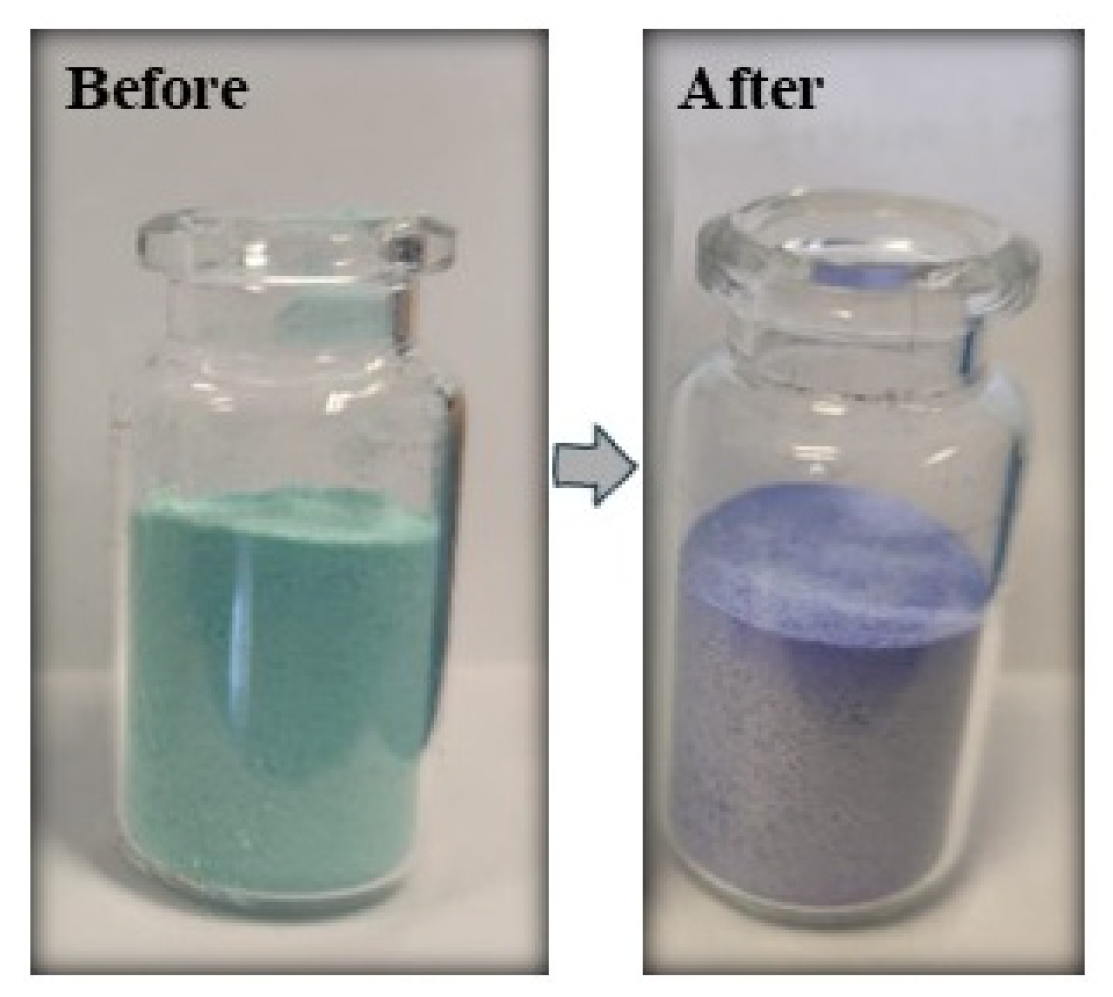
After activation of the composites, the characteristic, initial turquoise color turned to a light purple (Figure 2). According to Al-Janabi et al. [35] this peculiarity is caused by the removal of covalently bound water molecules from copper sites and the associated transition of copper ions. This process creates vacancies at metallic sites and alters the crystal lattice, which can be exploited for applications such as gas separation. The color change indicates that the coordination number of copper decreased from six (before) to four (after) [36].

3.2. Characterization of BP, BMOF2, and BMOF3 Materials

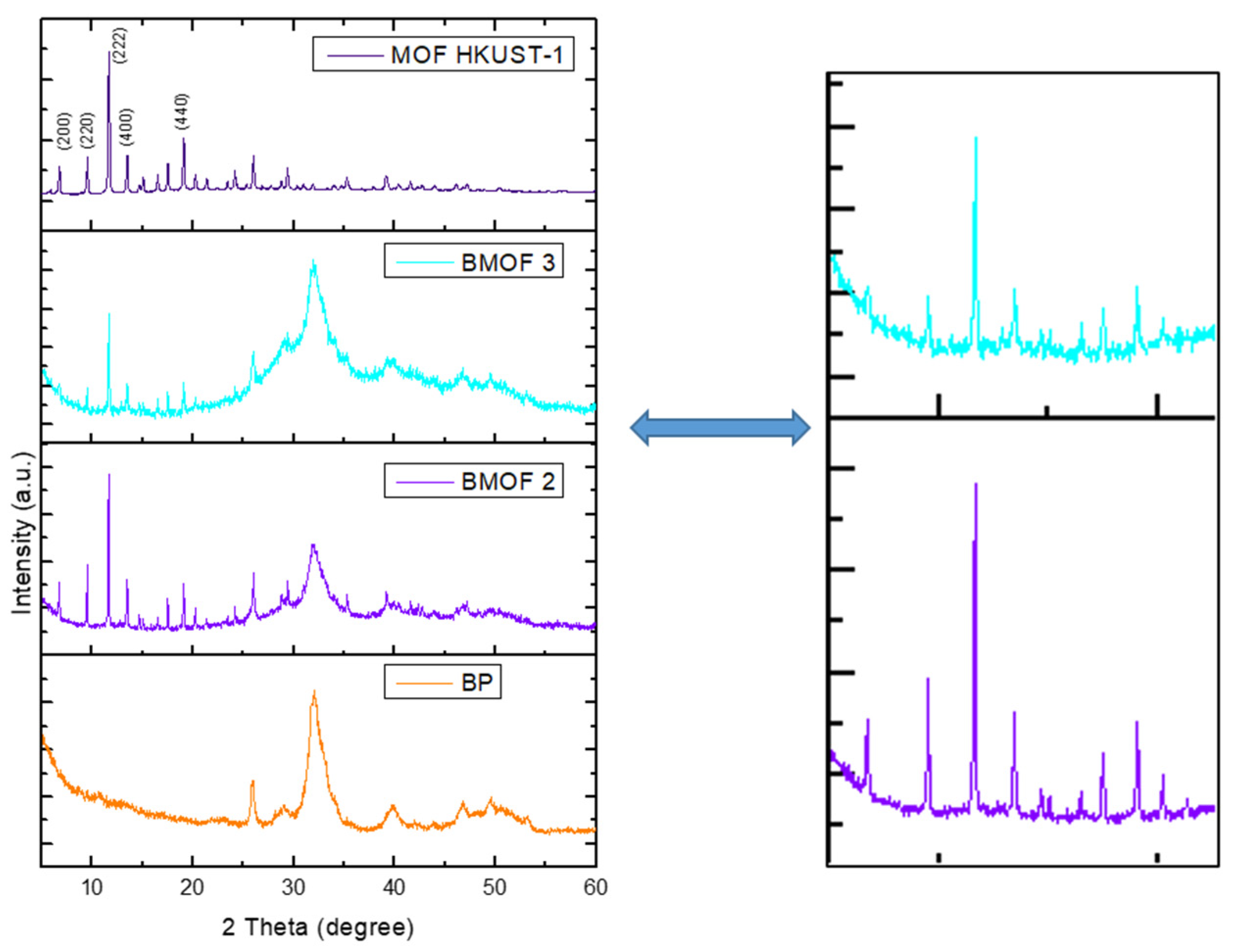
To verify the presence of HKUST-1 in the composites, an XRD is shown in Figure 3. The crystalline phases of HKUST-1 are reported with characteristic peaks at 2θ ≈ 6.6°, 9.4°, 11.5°, 13.4°, and 19.1°. The peaks in the composite BMOF2 and BMOF3 confirm the formation of the HKUST-1 crystalline phase on the bovine bone matrix. The sharp peaks at the respective positions indicate that the MOF’s crystalline integrity is preserved, thereby maintaining its structure. The synthesis conditions affect the results: peak intensities and widths differ slightly from one composite to another, and these differences are significant. Since narrow peaks are related to the material’s crystallinity, the MOF on composite BMOF3 is less crystalline than that obtained on BMOF2 [37,38,39,40].
In the BP sample, some broad peaks correspond to calcium carbonate located at 2θ ≈ 29.01°, 39.8°, and 49.5°. Peaks at 25.8°, 31.9°, and 46.8° have previously been identified in the literature and have been associated with hydroxyapatite. Since the BP has not previously been exposed to a thermal process, the hydroxyapatite structure exhibits a poorly crystallized XRD pattern [41,42]. Therefore, the bands are wider rather than thinner, as these characteristics in mammalian bones are associated with lower amounts of calcium phosphate, calcium hydrogen phosphate, and dicalcium phosphate, which produce diffraction peaks of low intensity [41,43].
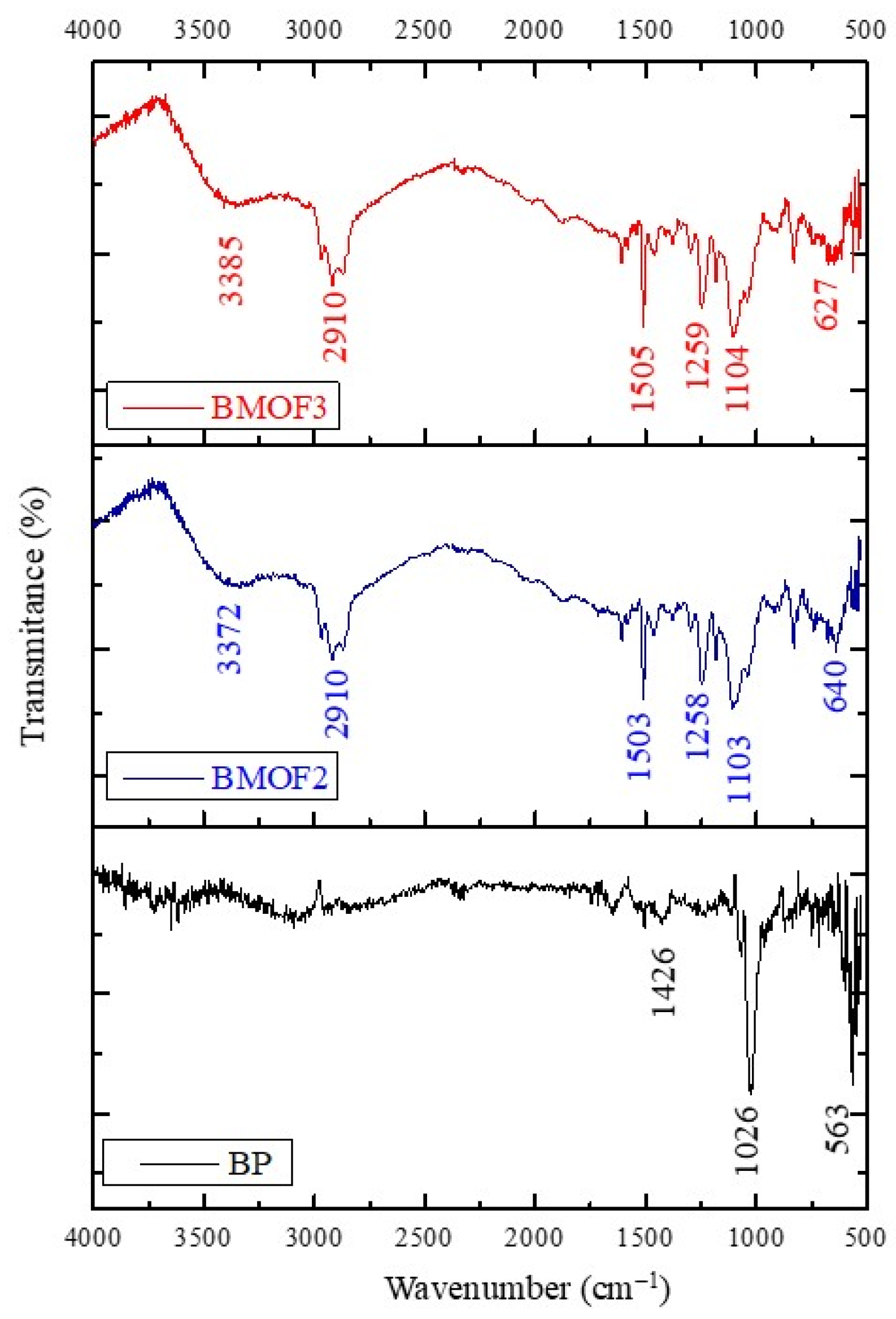
The functional group structures of HKUST-1 and BP were determined by FTIR and are shown in Figure 4. In BP, some characteristic signals can be identified as a band situated at 563 cm−1 corresponding to the mode of flexion of the phosphate groups of bone [42]. At 1026 cm−1, a characteristic band is identified in the asymmetric stretching mode of these same groups [44]. A less intense and smaller band at 1426 cm−1 is associated with the presence of carbonates that are exchanged in the bone structure. FTIR spectra at 1500 cm−1 and 1750 cm−1 are also associated with carbonate groups. These signals are also observed in the composite BMOF2 and BMOF3. In both composites, the band at 1103 or 1104 cm−1 appears as part of a broader peak, assigned to Cu-O-C. The band at 1258 cm−1 is related to stretching vibrations of C=O from trimesic acid units. At approximately 1500 cm−1, the characteristic band of the phosphate group is observed. The presence of hydroxyl groups is confirmed by the band that appears at 3372 cm−1 [45]. This final peak is weak because the composites had previously been dried; however, the material can still absorb some moisture from the air. And the band at 2970 cm−1 may be associated with residual solvent adsorbed during MOF growth on the matrix [46].
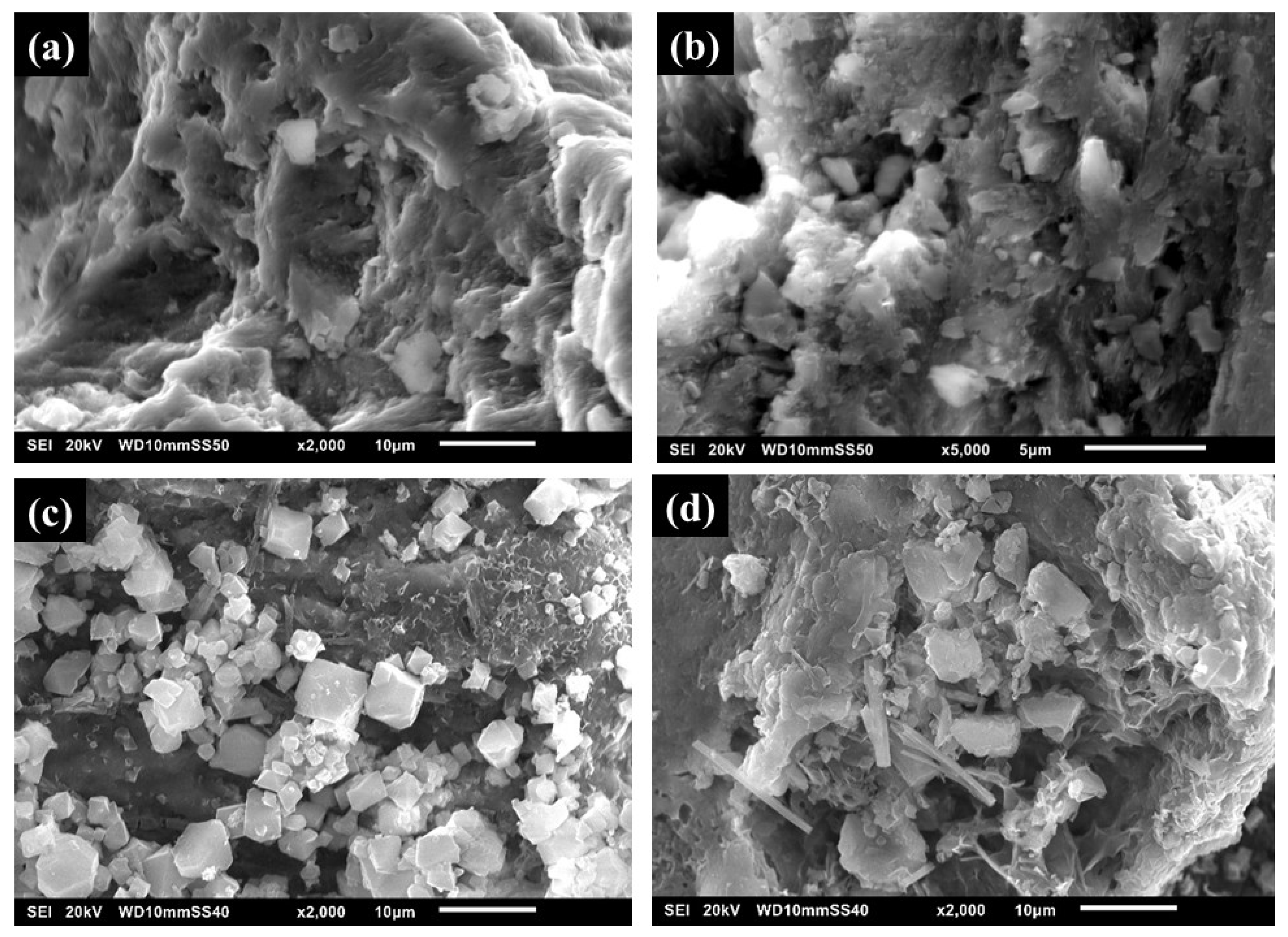
The surface morphology of BP, BMOF2, and BMOF3 can be seen in Figure 5; the surface of BP (Figure 5a,b) is like the bovine bone reported in Kang et al. [43]. This surface is heterogeneous, non-porous, and has some sheet-like scales. The morphology of the HKUST-1 observed in Figure 5c typically exhibits an octahedral structure, as described by Lis et al. [39] and Chaoping et al. [47]. This structure is readily identifiable on the surface of the BMOF2 composite. However, the MOF structure in BMOF3 is different (see Figure 5d) owing to the conditions and synthesis methodology employed. In composite BMOF3, there are two other structures: one is comparable to sticks, as reported by Ghalkhani et al. [48], and the other has an irregular morphology as described by Chaoping et al. [47], for a particular method (i.e., surface acoustic wave process) to synthesize HKUST-1. In our case, the morphological difference could be attributed to temperature, reflux, and contact time. The SEM morphology confirms the findings of the XRD analysis, which discussed the crystalline forms of the MOF. The morphology of the BP matrix remains unchanged. Under the MOF crystals, the sheets retain their shape, as evidenced by FTIR and XRD characterization.
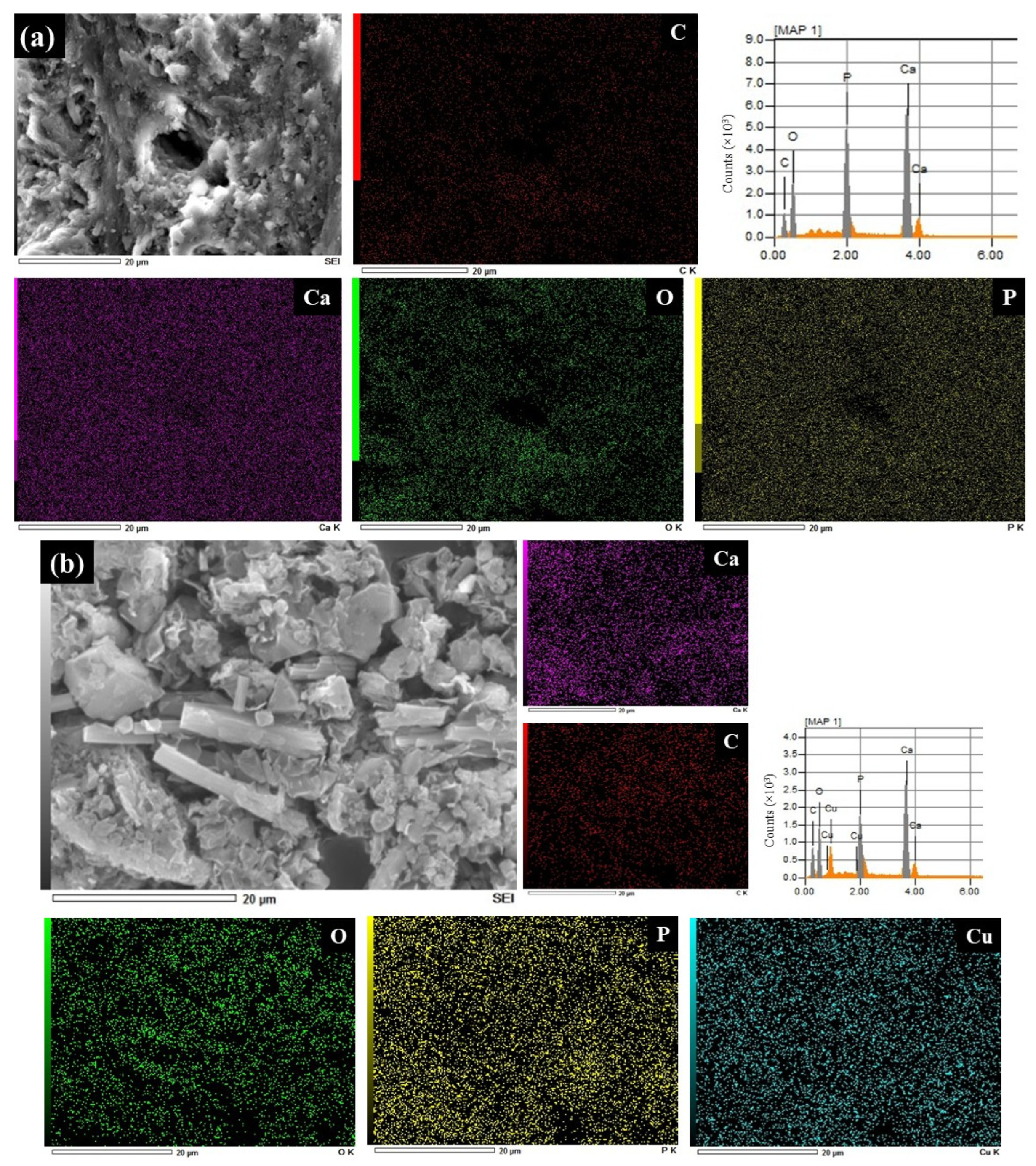
The chemical mapping of BP revealed Ca, C, O, and P, as expected (Figure 6a). In Figure 6b, the presence of copper on the composite is clear, in addition to the presence of one of its most abundant elements, Ca. Additionally, EDS analysis indicated Cu contents of 12.25% and 6.26% for BMOF2 and BMOF3, respectively. The difference may be due to 1 h of contact with BP in the copper solution before ligand addition.
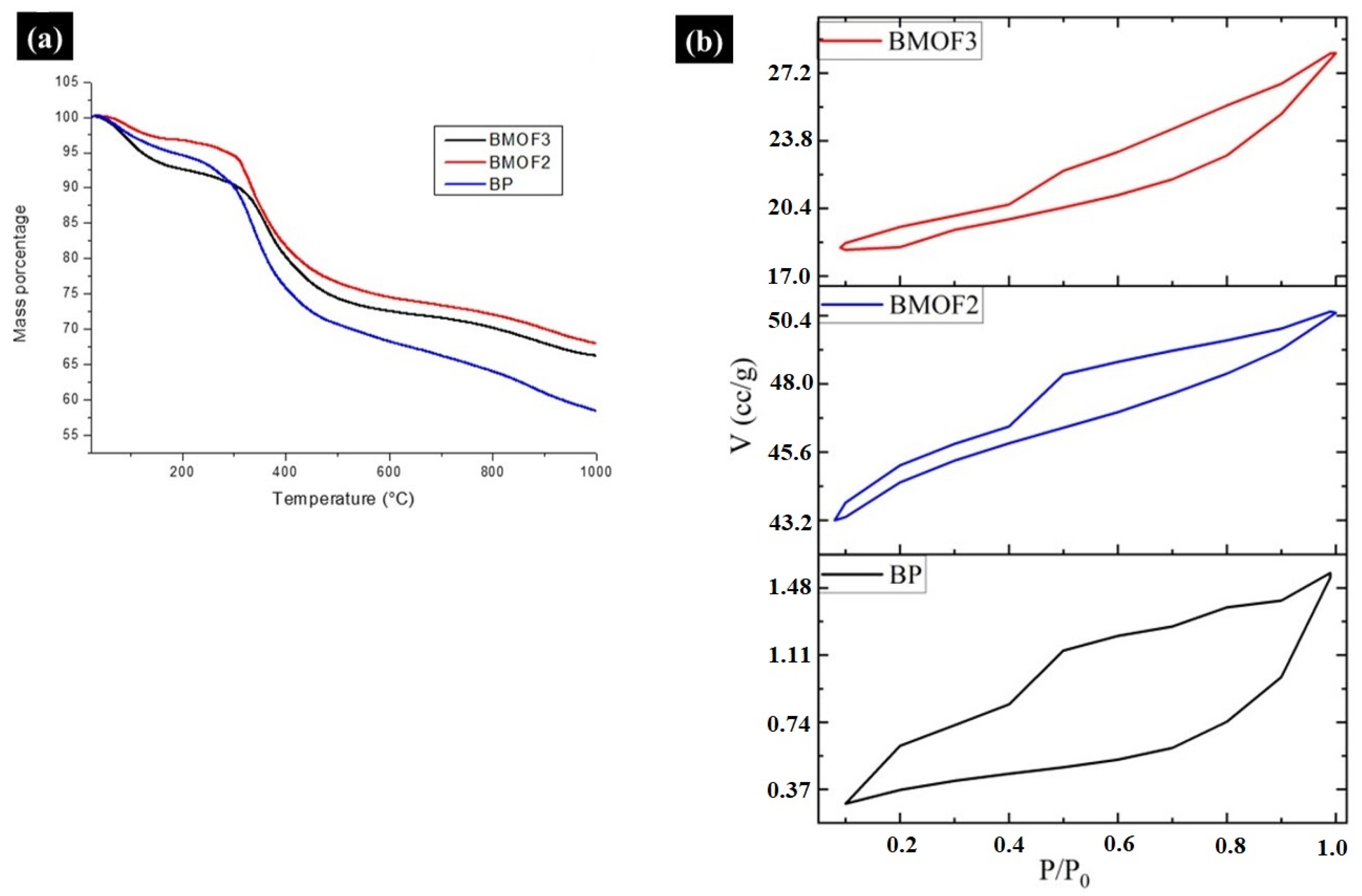
The curves plotted in Figure 7a show the weight loss of BP and the two composite samples as the temperature increases. The first drop in the weight of the three samples occurs between 100 °C and 150 °C due to water loss. According to these results, the water quantity in BMOF3 is greater than in BMOF2. It is worth noting that both samples were dried under the same temperature and time conditions. The most significant weight loss occurs in the range of 300–400 °C; BP decomposition begins at 220 °C, whereas for the composites, it begins at 310 °C because the MOF on the BP increases the composites’ thermal stability. This increase was expected since the MOF alone is stable until 320–330 °C [49].
The observed N2 isotherm (Figure 7b) shows H3-type adsorption–desorption, characteristic of mesoporous solids. According to the hysteresis, BP is more heterogeneous than BMOF2 and BMOF3. The presence and shape of hysteresis in the isotherms are associated with structural heterogeneity of pores and differences in connectivity and pore size, which are essential because they directly influence the types of sorption that can occur in materials. This link between hysteresis and heterogeneity has been discussed in classic and recent studies of adsorption in porous materials [50,51,52]. The porous are “slit type” formed by aggregates of lamellar particles or plates, particles that also appear similar in the SEM micrographs (Figure 5). The abrupt drop in the desorption loop in the relative pressure range 0.49–0.40 is associated with desorption cavitation, a phenomenon also characteristic of mesoporous materials. It is also possible to infer that, given their textural characteristics, the materials exhibit an open, accessible porous structure that facilitates the diffusion and internal transport of adsorbates, thereby promoting rapid adsorption kinetics. These textural characteristics indicate that the BP material can serve as an efficient support and that the composites possess the required textural properties for efficient use in gas adsorption processes.
Surface areas were obtained by the BET method: 3.0 m2/g for BP, 393 m2/g for BMOF2, and 120 m2/g for the BMOF3 composite. The low surface area obtained for BP could be corroborated with the morphology shown in the micrograph, where the surfaces are heterogeneous with no porosity (i.e., Figure 5a) and with the low N2 adsorption values in the relative pressure range of 0–1 (Figure 7b), providing a low surface area to the material.
The higher surface area of BMOF2 and BMOF3 composites is due to the presence of MOF on the surface. The surface area of this final composite does not reach that of BMOF2, probably because of a lower amount of MOF supported on BMOF3. Also, this difference could be attributed to the size of the MOF crystals. However, neither the quantity nor the size of the supported MOFs has been measured in this investigation. Still, both may be logical reasons for the difference in surface area.
The N2 gas uptake capacity indicated that water molecules in the pores were removed during activation, consistent with the TGA results and the observed color change after vacuum drying. These values are relatively high compared with other composites with the same MOF, ranging from 85 m2/g to 392 m2/g [53,54,55,56]. The MOFs are recognized for having large surface areas, so it is not surprising that there are also some of them with larger areas than those found in this work, as in the case of the research performed by Chen et al. [57] where they reported around 444 m2/g of the surface area using ultrasound as a synthesis method, having the advantage of augmenting the amount of MOF in the composite.
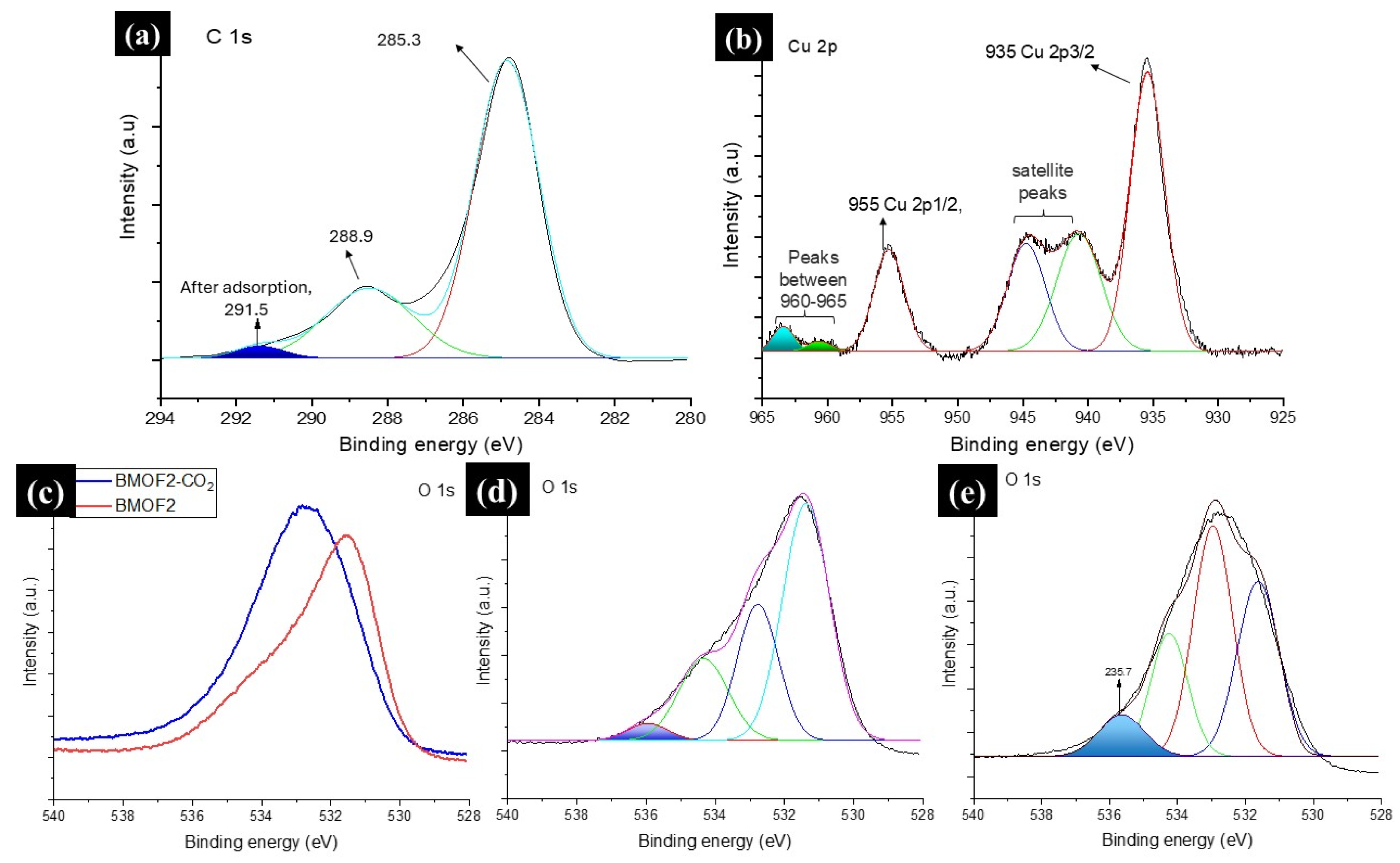
Analysis of the characterization results for the three materials showed that the BMOF2 composite is the most suitable candidate as an adsorbent for polluting gases. Therefore, it was used to analyze the XPS results obtained before and after CO2 adsorption.
The C 1s peak around 285.3 eV is assigned to C-H, and the peak around 288.9 to C=O for bovine bones [58] (Figure 8a). However, these two signals are also associated with HKUST-1 peaks, as they are common in this MOF [59,60]. Although it is impossible to distinguish which material of the composite would belong to which XPS peak, its presence is evident by other methods described above, such as SEM and XRD. On the other hand, this method shows that, upon CO2 adsorption, a new signal appears at 291.5 eV. That one is associated with CO2 retention in the composite, as reported in other works [61]. The fitted Cu 2p XPS spectra showed peaks at approximately 935 and 955 eV, corresponding to Cu 2p3/2 and Cu 2p1/2, respectively (Figure 8b). The peaks at around 944 and 940 eV are considered shake-up satellites [62]. Satellites depend on the kinetic energy that can be changed by the presence of CO2 in the material. This may be why satellite peaks between 965 and 960 eV disappear after adsorption.
O 1s XPS peaks in Figure 8c show an increase in intensity and a shift at higher binding energies, which can be associated with the presence of CO2 because of the chemical environment and intermolecular interaction between CO2 and the MOF molecules. The binding energy and peak area intensity of CO2 in O 1s XPS spectra of BMOF2 and BMOF2-CO2 are plotted in Figure 8d,e, highlighted in blue. The presence of CO2 is clear, though the intensity is low in all cases. However, considering the gas concentration compared to the material’s mass, this result is reasonable.

3.3. CO and CO2 Adsorption onto Composites

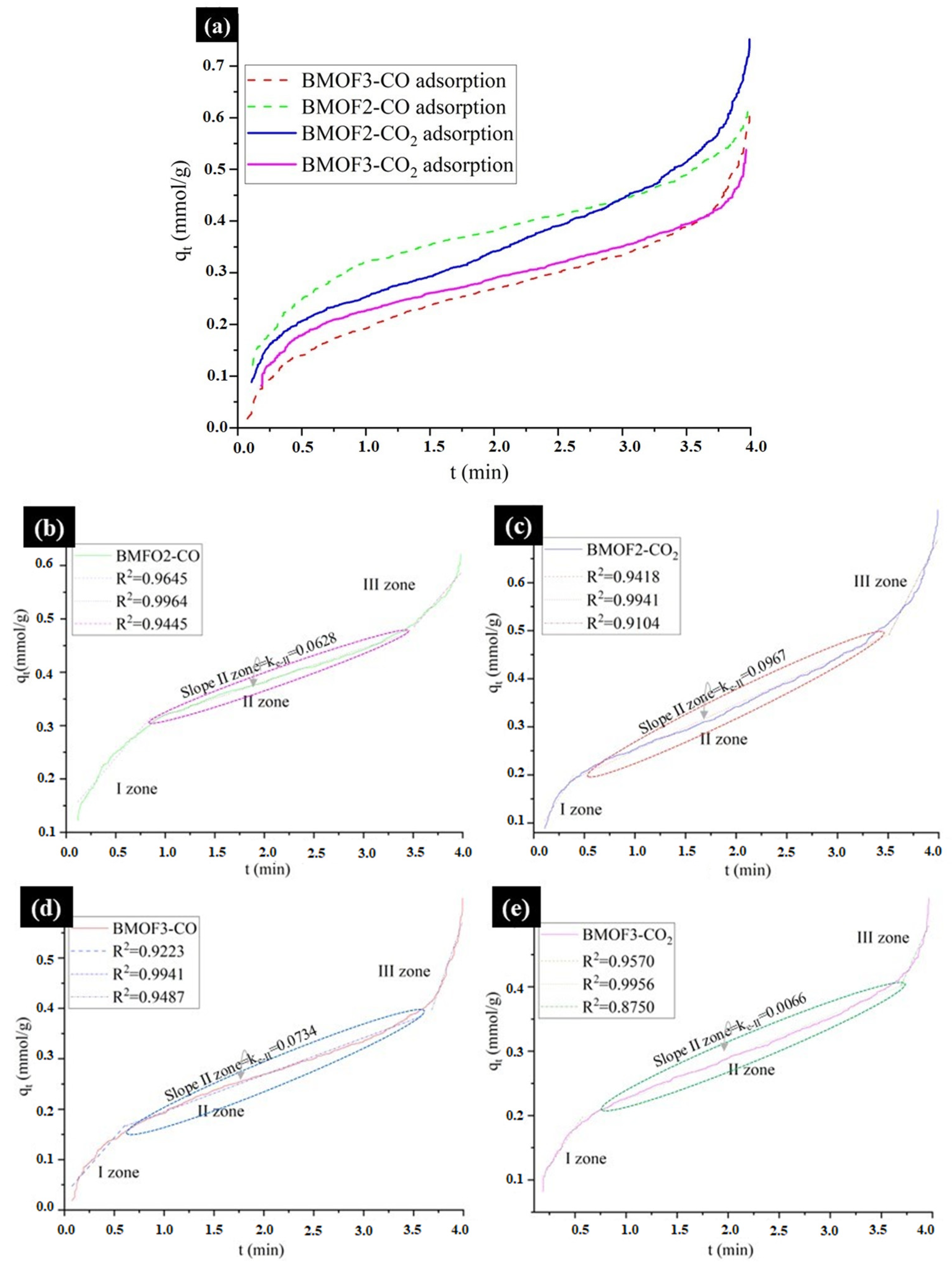
Concentrations of the CO2 and CO adsorbed for 4 min (i.e., time of the GHG plasma treatment process) are, respectively, plotted in Figure 9a–e. BMOF2 exhibits the highest adsorption capacities for CO and CO2, reaching 0.62 and 0.75 mmol/g, respectively, at 1 bar and 298 K (Figure 9a).
In Figure 9a, the kinetic behavior of both materials in the adsorption of two important polluting gases is shown. The exponential shape of the curves indicates that the material saturates its surface and that adsorption subsequently continues in a multilayered form. From these curves, we can observe three linear zones: I, II, and III (Figure 9b–e). The first one, in all cases, exhibits a steep slope (0.21–0.33)—compared to the slopes of the other two zones in each graph—meaning that both gases penetrate the material’s structure, or at least its surface, and adhere to it readily. This zone (Zone I) is reached in very short times (30–80 s), so the pores or adsorption sites are accessible in both materials. The intermediate zone is associated with internal diffusion of the gases or more controlled transport of these gases. The third zone, where a sharp increase in the adsorbed amount is observed, could be due to changes in the gas flow rate or to the gradual opening of the material’s adsorption sites, promoting greater CO and CO2 adsorption. It can be concluded that the BMFO2 composite (Figure 9a) adsorbs both gases more rapidly throughout the adsorption curve and attains a higher adsorption capacity, confirming that this composite has greater accessibility to adsorption sites.
The affinity for one gas or another varies over time. For the first three minutes, CO is the most readily adsorbed, after which CO2 adsorption increases sharply and becomes dominant. This difference can be attributed to the material’s intrinsic properties, combined with kinetic and energetic factors related to both gas molecules. If CO is adsorbed first, it is because it has a greater affinity for metallic sites (metal centers of the MOF) or for Lewis acids such as carbonates (from bone), which may have been more exposed in the material’s structure [63]. Also, the dimensions of the CO molecule are smaller than those of CO2, which can allow it to access adsorption sites more quickly.
In the case of CO2, this molecule first needs to align itself to the adsorption sites (preferably basic ones such as carbonates, -OH, etc.), and due to its geometry, it needs a specific orientation to adhere to the surface of the materials, which is why it probably diffuses more slowly towards the important or active sites [64].
Since the curves in Figure 9a do not approach equilibrium and exhibit zones defined by linear segments, some more linear than others, and the segment of the second zone is longer than the rest, an effective kinetic coefficient (ke-II) was defined as the slope of this zone in each case (Figure 9b–e). Because ke-II (BMOF2-CO2) > ke-II (BMOF2-CO), CO2 could exhibit a greater consistent kinetic affinity for basic sites. This is because the significant phase of the composite is rich in phosphate groups (PO43−), calcium ions (Ca2+), and hydronium ions (-OH), to which CO2 has affinity. Additionally, in BMOF2, HKUST-1 was synthesized in aqueous media, indicating that water molecules remain coordinated to the Cu2+ nodes. Defects are generated by partial hydrolysis (due to vacancies in the organic ligand) and surface (-OH, terminal Cu-OH, and other basic Lewis sites such as those mentioned above are found in greater “quantity” [45,65]. Thus, the material exhibits a greater affinity for a Lewis acid gas, such as CO2.
Compared with the BMOF3 composite, ke-II (BMOF3-CO) > ke-II (BMOF3-CO2). This behavior is distinct from that observed for BMOF2. It is also logical: when HKUST-1 is synthesized in an alcoholic medium, the concentration of hydrolyzed ligands is lower or absent, fewer defects appear, and the metallic nodes are more complete. Likewise, the pores are cleaner (less water present), and the Cu2+ ions are more accessible [66]. CO (Lewis’s base) has a greater affinity and diffuses faster than CO2.
Based on these results, it can be stated that composites, especially BMOF2, can be used efficiently not only for capturing gases such as CO and CO2 but also for their separation, owing to their chemical reactivity, size, and structural and functional properties.
Apparent selectivity at a fixed time (Sapp) at 3.5 min is similar to the selectivity parameter. Still, in this case, the first option was used, as the system did not reach equilibrium within the set experimental time. Sapp enables us to assess the adequate performance of the separation of both gases, accounting for the kinetic and competitive effects of the adsorption process, which cannot be obtained under equilibrium conditions [67]. For this time, the values were 1.0556 and 1.0147 for BMOF2 and BMOF3, respectively. This means that at this time, the adsorption of both gases was similar, with almost no preference for one over the other.
S app = q CO 2 ( t ) q CO ( t ) ,   where   t = 3 . 5   min
To confirm this interpretation, based on the calculated Sapp values, the engineering significance [68] (Equation (2)) was determined to be 3%, meaning that there was no relevant difference between the reported values. This confirms the interpretation made about the R values obtained.
S appCO 2 S appCO S appCO 2 20 30 %
In addition to this parameter, the relative coverage percentage per component (%Reci, where “i” are the components that are CO and CO2 gases) and total (%Rtotal) was calculated by Equations (3) and (4), for both materials (BMOF2 and BMOF3), which is shown in Table 1.
Rec i = 100 q i ( t ) q i ( t )
Rec total = 100 ( q CO 2 ( t ) + q CO ( t ) ) ( q CO 2 ( t ) + q CO ( t ) ) ,   where t   =   1 min
This is defined as the fraction of the adsorbed amount reached at a given time relative to the maximum value experimentally accessible. This approach is common in dynamic adsorption studies when equilibrium is not reached [69] and is consistent with the experimental data, as equilibrium was not reached during the experimental time.
It can be inferred that both gases adsorb BMOF2 more quickly than BMOF3, although the difference between these percentages is relatively small (57% and 54%, respectively). If we analyze each component (CO and CO2) and the composite individually, we find that in BMOF2, the best coverage was achieved with the CO molecule, whereas the opposite behavior was observed for BMOF3; moreover, the values obtained show a marked difference in each case.
The adsorption capacities of BMOF2 and BMOF3 compared to those of other materials are shown in Table 2, where it can be seen that the CO adsorption obtained with the proposed composites falls between those reported by [70,71,72]. It is worth noting that pressure and temperature are fundamental parameters that affect the adsorption process, as reported by Moreira et al. [73]. By decreasing the temperature and increasing the pressure, as reported by Agueda et al. [72] the adsorption increases significantly. However, it is necessary to maintain ambient conditions to adapt the composite filters obtained to the plasma treatment process.
An essential value of CO adsorption is reported by Li et al. [82]. Their excellent results appear to be due to a two-step strategy: the selective reduction of Cu2+ to Cu+ without forming Cu0, which minimizes Cu–species aggregation; and, for Cu+, they exhibit higher CO adsorption capacity than other copper species.
Finally, another material, such as CuMOF74 (Table 2), also has a higher CO adsorption capacity. Nevertheless, in two cases [71,82], it must be highlighted that the material is pure.
In CO2 adsorption, BMOF2 has a higher adsorption capacity than BMOF3. The differences between these two composites, as described in the characterization, account for this result. In this sense, the synthesis process and the shape of the MOF crystals affect the composite’s adsorption capacity. Comparing the CO2 adsorption capacity of BMOF2 of 0.75 mmol/g with other MOFs and materials, we observe that some of them have a lower capacity (i.e., BMOF2 > Chemical activated carbon > APS/SBA-15(III) > Ordered mesoporous carbon > Mg-MOF-74 > Zn-MOF-74). However, some materials exhibit higher capacities at lower pressures, such as pure HKUST-1 or even modified HKUST-1 (Table 2). Although these high results are reported for MOF alone, and it is one of the validated MOFs with high potential for use on a larger scale, its use as a powder generates limitations when proposing it as a material with technological alternatives due to its powder form. When used in this way, factors such as pressure drop, the generation of fine particles, and the need for binders to mitigate the latter harm the stability and performance of the material [35].
However, the alternative of using MOFs, specifically HKUST-1, on matrices enhances it as a technologically implementable adsorbent, as it provides mechanical integrity, introduces hierarchical diffusion routes that improve kinetics, and allows operation under conditions closer to real flows (including the presence of moisture), while maintaining the structural properties of the MOF [83,84].
On the other hand, while it is true that many articles on gas adsorption focus on selectivity studies, there are industrial processes that require the elimination of both gases (CO and CO2) that are generated, regardless of how selective the process is for one gas or the other. For example, applications involving the simultaneous removal of toxic gases, where total adsorption capacity and capture speed are more relevant variables than selectivity. Such is the case with specific applications involving exhaust gases in metallurgical processes [5,85], residual CO synthesis streams [74] and safety systems (CO removal in enclosed spaces) [86], to name just a few.
In this sense, Zeng et al. [87] reported absorbent materials with a high surface area and therefore high porosity for adsorbing CO2. The authors report materials that are efficient at removing unwanted gases, with total adsorption capacity and kinetics as the dominant factors, rather than selectivity. Soo et al. [88] mentioned CO2 adsorption technologies and described how high-capacity adsorbents are incorporated into pretreatment stages before subsequent processes (such as purification, conversion, or finer separation). Initial capture focused on the effective removal of the primary contaminant. Therefore, in pretreatment applications, porous materials are selected primarily for their high adsorption capacity and stability, which allows undesirable components to be removed from the stream before subsequent stages. In their recent review, Foorginezhad et al. [89] evaluate adsorbents for effective CO2 capture and emphasize rapid adsorption and high capacity as essential factors for practical performance. In other words, in addition to capture, rapid adsorption and high capacity are relevant for buffering applications or dampening concentration fluctuations in variable streams, beyond the adsorbent’s selectivity for gases.
In the case of BMOF2 and BMOF3, their high adsorption capacity and rapid adsorption kinetics make them suitable for joint removal and pretreatment of gas streams with high performance. Furthermore, an important element that guides selectivity studies is precisely the reporting of results on the comparable adsorption of CO and CO2, which can generate knowledge about the non-specific interactions that may take place in adsorption processes and that favor efficient regeneration and reversible behavior of the materials used, elements of high value when seeking real applications for the materials.

4. Conclusions

The MOF on the matrix surface is homogeneously distributed, regardless of the synthesis process. However, the morphology of the MOF crystals, the presence of defects, the amount of coordinated water in the structure, and the exposed and coordinated Cu2+ ions vary with the synthesis method.
It is noted that BMOF2 exhibits higher CO2 and CO adsorption capacities than BMOF3. The equilibrium adsorption capacities of BMOF2 and BMOF3 at 1 bar and 25 °C are about 0.75 and 0.53 mmol/g for CO2. While for CO, the capacities are 0.62 and 0.61 mmol/g, respectively. Therefore, BMOF2 is kinetically more efficient for capturing both gases, but prefers CO at shorter times and CO2 at longer times. The synthesis medium becomes a tool for modulating which gas arrives first and how quickly.
The materials synthesized in the present work are composites that offer lower production costs, owing to the use of an economical, environmentally friendly support material, in contrast to traditional materials. Solvothermal methods are used to synthesize most of the reported MOFs, while BMOF2 and BMOF3 require only agitation and contact during synthesis.
Our results show that a composite of bovine bone matrix and a MOF can be an ideal adsorbent material for CO and CO2. This makes it a competitive composite for gas adsorption/separation.

Author Contributions

Conceptualization, M.P.; methodology, H.P.T.-J.; software, R.V.-B.; formal analysis, A.B.-F.; investigation, H.P.T.-J.; writing—original draft preparation, H.P.T.-J.; writing—review and editing, A.B.-F.; visualization, R.V.-B.; supervision, M.P.; project administration, J.O.P.; funding acquisition, J.O.P. All authors have read and agreed to the published version of the manuscript.

Funding

This research was funded by the National Council for Science and Technology (CONACYT), grant number 234737.

Institutional Review Board Statement

Ethical review and approval were waived for this study, due to the bones under investigation being from bovine that had already been slaughtered within the commercial value chain.

Data Availability Statement

The data presented in this study are available from the corresponding author upon request, as the research is ongoing and is being tested in industrial applications.

Acknowledgments

Furthermore, the authors would like to thank M. Duran, F. Ramos, and M. Hidalgo for their significant technical support.

Conflicts of Interest

The authors declare no conflicts of interest.

References

  1. Pathak, M.; Slade, R.; Shukla, P.R.; Skea, J.; Pichs-Madruga, R.; Ürge-Vorsatz, D. Technical Summary. In Climate Change. 2022: Mitigation of Climate Change; Contribution of Working Group III to the Sixth Assessment Report of the Intergovernmental Panel on Climate Change; Shukla, P.R., Skea, J.R., Slade, A., Al Khourdajie, R., van Diemen, D., McCollum, M., Pathak, S., Some, P., Vyas, R., Fradera, M., et al., Eds.; Cambridge University Press: Cambridge, UK; New York, NY, USA, 2022. [Google Scholar] [CrossRef]
  2. Available online: https://climatetrace.org/news/climate-trace-begins-monthly-data-releases-with-new (accessed on 10 October 2025).
  3. Khan, T.; Jimenez, C.; Pineda, L.; Yang, Z.; Miller, J.; Sen, A. CO2 Emission Standards to Achieve Mexico’s 2030 Electrification Target for Light-Duty Vehicles; ICCT Policy Brief: Berlin, Germany, 2025; pp. 1–21. [Google Scholar]
  4. Nguyen, N.H.; Turner, A.J.; Yin, Y.; Prather, M.J.; Frankenberg, C. Effects of chemical feedbacks on decadal methane emissions estimates. Geophis. Res. Let. 2020, 47, e2019GL085706. [Google Scholar] [CrossRef]
  5. Ma, H.; Fu, H.; Tong, Y.; Umar, A.; Hung, Y.M.; Wang, X. Advances in CO2 Capture and Separation Materials: Emerging Trends, Challenges, and Prospects for Sustainable Applications. Carbon Capture Sci. Technol. 2025, 15, 100441. [Google Scholar] [CrossRef]
  6. Muttil, N.; Jagadeesan, S.; Chanda, A.; Duke, M.; Singh, S.K. Production, types, and applications of activated carbon derived from waste tyres: An Overview. Appl. Sci. 2023, 13, 257. [Google Scholar] [CrossRef]
  7. Fan, Q.; Xiao, R.; Yang, C.; Xin, M.; Zheng, X.; Zeng, G. Recent advances in advanced membrane materials for natural gas purification: A review of material design and separation mechanisms. Membranes 2025, 15, 377. [Google Scholar] [CrossRef]
  8. Grekou, T.K.; Koutsonikolas, D.E.; Karagiannakis, G.; Kikkinides, E.S. Tailor-made modification of commercial ceramic membranes for environmental and energy-oriented gas separation applications. Membranes 2022, 12, 307. [Google Scholar] [CrossRef] [PubMed]
  9. Wang, C.; Jiang, K.; Yu, H.; Li, S.; Zhao, Y.; Zheng, Z.; Liu, H.; Xia, X.; Zhao, P.; Li, Y.; et al. Review of electrochemical carbon dioxide capture towards practical application. Next Mater. 2025, 8, 100660. [Google Scholar] [CrossRef]
  10. Pacheco, J.; Valdivia, R.; Pacheco, M.; Clemente, A. H2 yielding rate comparison in a warm plasma reactor and thermal cracking furnace. Int. J. Hydrogen Energy 2020, 45, 31243–31254. [Google Scholar] [CrossRef]
  11. Liu, W.; An, H.; Qin, C.; Yin, J.; Wang, G.; Feng, B.; Xu, M. Performance enhancement of calcium oxide sorbents for cyclic CO2 capture—A review. Energy Fuels 2012, 26, 2751–2767. [Google Scholar] [CrossRef]
  12. Wahby, A.; Silvestre-Albero, J.; Sepúlveda-Escribano, A.; Rodríguez-Reinoso, F. CO2 adsorption on carbon molecular sieves. Microporous Mesoporous Mater. 2012, 164, 280–287. [Google Scholar] [CrossRef]
  13. Lizundia, E.; Luzi, F.; Puglia, D. Organic waste valorization towards circular and sustainable biocomposites. Green Chem. 2022, 24, 5429–5459. [Google Scholar] [CrossRef]
  14. Global Meat Consumption, World, 1961 to 2050. Available online: https://ourworldindata.org/grapher/global-meat-projections-to-2050 (accessed on 10 October 2025).
  15. Orús, A. 30 Ago 2023. Volumen De Carne Consumida a Nivel Mundial De 1990 a 2022, Por Tipo De Carne. Available online: https://es.statista.com/estadisticas/1330024/consumo-de-carne-a-nivel-mundial-por-tipo/#:~:text=Consumo%20de%20carne%20a%20nivel%20mundial%20por%20tipo%201990%2D2022&text=El%20consumo%20mundial%20de%20carne,333%20millones%20de%20toneladas%20m%C3%A9tricas (accessed on 10 October 2025).
  16. La economía Circular: Un Modelo Económico Que Lleva Al Crecimiento Y Al Empleo Sin Comprometer El Medio Ambiente. 26 Marzo 2021. Asuntos Económicos. Available online: https://news.un.org/es/story/2021/03/1490082 (accessed on 15 September 2025).
  17. Neolaka, Y.A.; Lawa, Y.; Naat, J.; Lalang, A.C.; Widyaningrum, B.A.; Ngasu, G.F.; Niga, K.A.; Darmokoesoemo, H.; Munawar, I.; Kusuma, H.S. Adsorption of methyl red from aqueous solution using Bali cow bones (Bos javanicus domesticus) hydrochar powder. Results Eng. 2023, 17, 100824. [Google Scholar] [CrossRef]
  18. Hajyani, Z.; Mousavi, Z.; Soleimanbeigi, M.; Wong, Y.J.; Beni, A.A. Antibiotic adsorption from real pharmaceutical factory wastewater using a hole-punched flat ceramic membrane based on clay and hydroxyapatite in a fixed bed module. Results Eng. 2025, 26, 105364. [Google Scholar] [CrossRef]
  19. Adhikara, A.G.; Maharani, A.P.; Puspitasari, A.; Nuswantoro, N.F.; Juliadmi, D.; Maras, M.A.J.; Nugroho, D.B.; Saksono, B. Bovine hydroxyapatite for bone tissue engineering: Preparation, characterization, challenges, and future perspectives. Eur. Polym, J. 2024, 214, 113171. [Google Scholar] [CrossRef]
  20. Von Euw, S.; Wang, Y.; Laurent, G.; Drouet, C.; Babonneau, F.; Nassif, N.; Azaïs, T. Bone mineral: New insights into its chemical composition. Sci. Rep. 2019, 9, 8456. [Google Scholar] [CrossRef]
  21. Gani, M.A.; Lee, G.; Ardianto, C.; Rantam, F.A.; Lestari, M.L.A.D.; Addimaysqi, R.; Khotib, J. Comparative study of bovine and synthetic hydroxyapatite in micro-and nanosized on osteoblasts action and bone growth. PLoS ONE 2025, 20, e0311652. [Google Scholar] [CrossRef] [PubMed]
  22. Zhang, J.; Xia, X.; Zeng, L.; Zeng, S.; Li, K.; Fang, Z.; Wang, Y. New insights into the co-pyrolysis synergistic effect of pig bone-derived natural hydroxyapatite and sodium-rich Spartina alterniflora on forming highly active heterostructure sites for enhanced Cu2+ removal. Sep. Purif. Technol. 2025, 364, 132512. [Google Scholar] [CrossRef]
  23. Jia, P.; Tan, H.; Liu, K.; Gao, W. Synthesis and Photocatalytic Performance of ZnO/Bone Char Composite. Materials 2018, 11, 1981. [Google Scholar] [CrossRef]
  24. dos Santos Lins, P.V.; Henrique, D.C.; Ide, A.H.; de Paiva e Silva Zanta, C.L.; Meili, L. Evaluation of caffeine adsorption by MgAl-LDH/biochar composite. Environ. Sci. Pollut. Res. 2019, 26, 31804–31811. [Google Scholar] [CrossRef]
  25. Yang, Y.; Sun, C.; Lin, B.; Huang, Q. Surface modified and activated waste bone char for rapid and efficient VOCs adsorption. Chemosphere 2020, 256, 127054. [Google Scholar] [CrossRef]
  26. Emmanuel, O.; Ezeji, T.C. Utilization of biomass-based resources for biofuel production: A mitigating approach towards zero emission. Sustain. Chem. One World 2024, 2, 100007. [Google Scholar] [CrossRef]
  27. Nie, B.; Zhou, X.; Peng, Q.; Li, H.; Zhang, Y. Advances in metal-organic frameworks composites: A mini review. J. Alloys Compd. 2025, 1010, 178318. [Google Scholar] [CrossRef]
  28. An, Y.; Lv, X.; Jiang, W.; Wang, L.; Shi, Y.; Hang, X.; Pang, H. The stability of MOFs in aqueous solutions—Research progress and prospects. Green Chem. Eng. 2024, 5, 187–204. [Google Scholar] [CrossRef]
  29. Ding, M.; Cai, X.; Jiang, H.L. Improving MOF stability: Approaches and applications. Chem. Sci. 2019, 10, 10209–10230. [Google Scholar] [CrossRef]
  30. Mourdikoudis, S.; Dutta, S.; Kamal, S.; Gómez-Graña, S.; Pastoriza-Santos, I.; Wuttke, S.; Polavarapu, L. State-of-the-art, insights, and perspectives for MOFs-nanocomposites and MOF-derived (Nano) materials. Adv. Mater. 2025, 21, e2415399. [Google Scholar] [CrossRef]
  31. Chen, S.; Li, Y.; Mi, L. Porous carbon derived from metal organic framework for gas storage and separation: The size effect. Inorg. Chem. Commun. 2020, 118, 107999. [Google Scholar] [CrossRef]
  32. Toledo-Jaldin, H.P.; Blanco Flores, A.; Pinzón-Vanegas, C.L.; Ávila-Marquez, D.M.; Reyes Domínguez, I.A.; Mahdavi, H.; Dorazco-González, A. Novel hybrid composites based on HKUST-1 and a matrix of magnetite nanoparticles with sustainable materials for efficient CO2 adsorption. Arabian J. Chem. Eng. 2025, 50, 6373–6385. [Google Scholar] [CrossRef]
  33. Ávila-Márquez, D.M.; Blanco Flores, A.; Toledo Jaldin, H.P.; Burke Irazoque, M.; González Torres, M.; Vilchis-Nestor, A.R.; Toledo, C.C.; Gutiérrez-Cortez, S.; Díaz Rodríguez, J.P.; Dorazco-González, A. MIL-53 MOF on sustainable biomaterial for antimicrobial evaluation against E. coli and S. aureus bacteria by efficient release of Penicillin G. J. Funct. Biomater. 2025, 16, 295. [Google Scholar] [CrossRef]
  34. Kim, J.; Kim, S.; Yang, S.T.; Ahn, W. Bench-scale preparation of Cu3(BTC)2 by ethanol reflux: Synthesis optimization and adsorption/catalytic applications. Microporous Mesoporous Mater. 2012, 161, 48–55. [Google Scholar] [CrossRef]
  35. Al-Janabi, N.; Hill, P.; Torrente-Murciano, L.; Garforth, A.; Gorgojo, P.; Siperstein, F.; Fan, X. Mapping the Cu-BTC metal–organic framework (HKUST-1) stability envelope in the presence of water vapour for CO2 adsorption from flue gases. Chem. Eng. J. 2015, 281, 669–677. [Google Scholar] [CrossRef]
  36. Chen, Y.; Mu, X.; Lester, E.; Wu, T. High efficiency synthesis of HKUST-1 under mild conditions with high BET surface area and CO2 uptake capacity. Prog. Nat. Sci. Mater. Inter. 2018, 28, 584–589. [Google Scholar] [CrossRef]
  37. Bhoria, N.; Basina, G.; Pokhrel, J.; Reddy, K.S.K.; Anastasiou, S.; Balasubramanian, V.V.; Karanikolos, G.N. Functionalization effects on HKUST-1 and HKUST-1/graphene oxide hybrid adsorbents for hydrogen sulfide removal. J. Hazard. Mater. 2020, 394, 122565. [Google Scholar] [CrossRef] [PubMed]
  38. Goyal, P.; Paruthi, A.; Menon, D.; Behara, R.; Jaiswal, A.; Kumar, A.; Misra, S.K. Fe doped bimetallic HKUST-1 MOF with enhanced water stability for trapping Pb(II) with high adsorption capacity. Chem. Eng. J. 2022, 430, 133088. [Google Scholar] [CrossRef]
  39. Lis, M.J.; Caruzi, B.B.; Gil, G.A.; Samulewski, R.B.; Bail, A.; Scacchetti, F.A.P.; Maestá Bezerra, F. In-situ direct synthesis of HKUST-1 in wool fabric for the improvement of antibacterial properties. Polymers 2019, 11, 713. [Google Scholar] [CrossRef]
  40. Yang, A.; Li, P.; Zhong, J. Facile preparation of low-cost HKUST-1 with lattice vacancies and high-efficiency adsorption for uranium. RSC Adv. 2019, 9, 10320–10325. [Google Scholar] [CrossRef]
  41. Londoño-Restrepo, S.M.; Jeronimo-Cruz, R.; Rubio-Rosa, E.; Rodriguez-García, M.E. The effect of cyclic heat treatment on the physicochemical properties of bio hydroxyapatite from bovine bone. J. Mater. Sci. Mater. Med. 2018, 29, 52. [Google Scholar] [CrossRef]
  42. Keltoum Kribaa, O.; Saifi, F.; Chahbaoui, N. Elaboration and chemical characterization of a composite material based on hydroxyapatite/polyethylene. Mater. Today Proc. 2022, 49, 1017–1022. [Google Scholar] [CrossRef]
  43. Kang, Y.J.; Noh, J.E.; Lee, M.J.; Chae, W.S.; Lee, S.Y.; Kim, S.G. The effect of 4-hexylresorcinol on xenograft degradation in a rat calvarial defect model. Maxillofac. Plast. Reconstr. Surg. 2016, 38, 29. [Google Scholar] [CrossRef] [PubMed]
  44. Bano, N.; Jikan, S.S.; Basri, H.; Adzila, S.; Zago, D.M. XRD and FTIR study of A&B type carbonated hydroxyapatite extracted from bovine bone. In Proceedings of the AIP Conference Proceedings, Telangana, India, 5–6 December 2018; AIP Publishing LLC: Melville, NY, USA, 2019; Volume 2068, p. 020100. [Google Scholar]
  45. Klęba, J.; Zheng, K.; Duraczy’nska, D.; Marzec, M.; Fedyna, M.; Mokrzycki, J. Insights into HKUST-1 Metal-Organic Framework’s morphology and physicochemical properties induced by changing the copper (II) salt precursors. Materials 2025, 18, 676. [Google Scholar] [CrossRef]
  46. Hadjiivanov, K.I.; Panayotov, D.A.; Mihaylov, M.Y.; Ivanova, E.Z.; Chakarova, K.K.; Andonova, S.M.; Drenchev, N.L. Power of infrared and Raman spectroscopies to characterize metal-organic frameworks and investigate their interaction with guest molecules. Chem. Rev. 2020, 121, 1286–1424. [Google Scholar] [CrossRef] [PubMed]
  47. Chaoping, X.; Wang, C.; Tengfei, Z.; Hu, Q.; Bai, C. Surface acoustic waves (SAWs)-induced synthesis of HKUST-1 crystals with different morphologies and sizes. CrystEngComm 2018, 45, 20. [Google Scholar]
  48. Ghalkhani, M.; Gharagozlou, M.; Sohouli, E.; Marzi Khosrowshahi, E. Preparation of an electrochemical sensor based on a HKUST-1/CoFe2O4/SiO2-modified carbon paste electrode for determination of azaperone. Microchem. J. 2022, 175, 107199. [Google Scholar] [CrossRef]
  49. Maia, R.A.; Louis, B.; Baudron, S.A. HKUST-1 MOF in reline deep eutectic solvent: Synthesis and phase transformation. Dalton Trans. 2021, 50, 4145–4151. [Google Scholar] [CrossRef]
  50. Donohue, M.D.; Aranovich, G.L. Adsorption hysteresis in porous solids. J. Colloid. Interface Sci. 1998, 205, 121–130. [Google Scholar] [CrossRef]
  51. Kumar, K.V.; Gadipelli, S.; Wood, B.; Ramisetty, K.A.; Stewart, A.A.; Howard, C.A.; Rodriguez-Reinoso, F. Characterization of the adsorption site energies and heterogeneous surfaces of porous materials. J. Mater. Chem. A 2019, 7, 10104–10137. [Google Scholar] [CrossRef]
  52. Kyriakopoulos, G.L.; Tsimnadis, K.; Sebos, I.; Charabi, Y. Investigating the Effect of Pore Size Distribution on the Sorption Types and the Adsorption-deformation characteristics of porous continua: The case of adsorption on carbonaceous materials. Crystals 2024, 14, 742. [Google Scholar] [CrossRef]
  53. Wang, Q.; Wang, Q.; Xu, B.; Gao, F.; Gao, F.; Zhao, C. Flower-shaped multiwalled carbon nanotubes@ nickel-trimesic acid MOF composite as a high-performance cathode material for energy storage. Electrochim. Acta 2018, 281, 69–77. [Google Scholar] [CrossRef]
  54. Ramasubbu, V.; Alwin, S.; Mothi, E.M.; Sahaya Shajan, X. TiO2 aerogel–Cu-BTC metal-organic framework composites for enhanced photon absorption. Mater. Lett. 2017, 197, 236–240. [Google Scholar] [CrossRef]
  55. Liu, Q.; Yu, H.; Zeng, F.; Li, X.; Sun, J.; Li, C.; Su, Z. HKUST-1 modified ultrastability cellulose/chitosan composite aerogel for highly efficient removal of methylene blue. Carbohydr. Polym. 2021, 255, 117402. [Google Scholar] [CrossRef] [PubMed]
  56. Pan, R.; Tang, Y.; Guo, Y.; Shang, J.; Zhou, L.; Dong, W.; He, D. HKUST-1 and its graphene oxide composites: Finding an efficient adsorbent for SO2 capture. Microporous Mesoporous Mater. 2021, 323, 111197. [Google Scholar] [CrossRef]
  57. Chen, B.; Li, Y.; Li, M.; Cui, M.; Xu, W.; Li, L.; Chen, K. Rapid adsorption of tetracycline in aqueous solution by using MOF-525/graphene oxide composite. Microporous Mesoporous Mater. 2021, 328, 111457. [Google Scholar] [CrossRef]
  58. Wu, C.; Ma, K.; Zhao, H.; Zhang, Q.; Liu, Y.; Bai, N. Bioactive effects of nonthermal argon-oxygen plasma on inorganic bovine bone surface. Sci. Rep. 2020, 10, 17973. [Google Scholar] [CrossRef]
  59. Zhou, L.; Niu, Z.; Jin, X.; Tang, L.; Zhu, L. Effect of lithium doping on the structures and CO2 adsorption properties of metal-organic frameworks HKUST-1. ChemistrySelect 2018, 3, 12865–12870. [Google Scholar] [CrossRef]
  60. Dubale, A.A.; Ahmed, I.N.; Chen, X.H.; Ding, C.; Hou, G.H.; Guan, R.F.; Xie, M.H. A highly stable metal–organic framework derived phosphorus doped carbon/Cu2O structure for efficient photocatalytic phenol degradation and hydrogen production. J. Mater. Chem. A Mater. 2019, 7, 6062–6079. [Google Scholar] [CrossRef]
  61. Takeuchi, K.; Yamamoto, S.; Hamamoto, Y.; Shiozawa, Y.; Tashima, K.; Fukidome, H.; Matsuda, I. Adsorption of CO2 on graphene: A combined TPD, XPS, and vdW-DF study. J. Phys. Chem. C 2017, 121, 2807–2814. [Google Scholar] [CrossRef]
  62. Stawowy, M.; Jagódka, P.; Matus, K.; Samojeden, B.; Silvestre-Albero, J.; Trawczyński, J.; Łamacz, A. HKUST-1-supported cerium catalysts for CO oxidation. Catalysts 2020, 10, 108. [Google Scholar] [CrossRef]
  63. Ercakir, G.; Aksu, G.O.; Keskin, S. Understanding CO adsorption in MOFs combining atomic simulations and machine learning. Sci. Rep. 2024, 14, 24931. [Google Scholar] [CrossRef] [PubMed]
  64. Åhlén, M.; Cheung, O.; Xu, C. Low-concentration CO2 capture using metal–organic frameworks–current status and future perspectives. Dalton Trans. 2023, 52, 1841. [Google Scholar] [CrossRef] [PubMed]
  65. Abou-Elyazed, A.S.; Ftooh, A.I.; Sun, Y.; Ashry, A.G.; Shaban, A.K.; El-Nahas, A.M.; Yousif, A.M. Solvent-free synthesis of HKUST-1 with abundant defect sites and its catalytic performance in the esterification reaction of oleic acid. ACS Omega 2024, 9, 37662–37671. [Google Scholar] [CrossRef] [PubMed]
  66. Krstić, M.; Fink, K.; Sharapa, D.I. The adsorption of small molecules on the copper paddle-wheel: Influence of the multi-reference ground state. Molecules 2022, 27, 912. [Google Scholar] [CrossRef] [PubMed]
  67. Li, C.; Luo, H.; Yuan, Y.; Tong, L.; Chen, B.; Yang, T.; Xiao, J. Equilibrium and dynamic adsorption characteristics of zeolite 5A, LiX, 13X and MOF UTSA-16 adsorbents for hydrogen purification. Inter. J. Hydrogen Energy 2025, 140, 889–899. [Google Scholar] [CrossRef]
  68. Fogler, H.S. Elements of Chemical Reaction Engineering, 5th ed.; Pearson Education: London, UK, 2016. [Google Scholar]
  69. Sangoremi, A.A. Adsorption kinetic models and their applications: A critical review. Int. J. Res. Sci. Innov. 2025, 12, 245–258. [Google Scholar] [CrossRef]
  70. Munusamy, K.; Sethia, G.; Patil, D.V.; Rallapalli, P.B.S.; Somani, R.S.; Bajaj, H.C. Sorption of carbon dioxide, methane, nitrogen and carbon monoxide on MIL-101 (Cr): Volumetric measurements and dynamic adsorption studies. Chem. Eng. J. 2012, 195, 359–368. [Google Scholar] [CrossRef]
  71. Evans, A.D.; Cummings, M.S.; Luebke, R.; Brown, M.S.; Favero, S.; Attfield, M.P.; Petit, C. Screening Metal–Organic frameworks for dynamic CO/N2 separation using complementary adsorption measurement techniques. Ind. Eng. Chem. Res. 2019, 58, 18336–18344. [Google Scholar] [CrossRef]
  72. Agueda, V.I.; Delgado, J.A.; Uguina, M.A.; Brea, P.; Spjelkavik, A.I.; Blom, R.; Grande, C. Adsorption and diffusion of H2, N2, CO, CH4 and CO2 in UTSA-16 metal-organic framework extrudates. Chem. Eng. Sci. 2015, 124, 159–169. [Google Scholar] [CrossRef]
  73. Moreira, M.A.; Dias, R.O.M.; Lee, U.H.; Chang, J.S.; Ribeiro, A.M.; Ferreira, A.F.P.; Rodrigues, A.E. Adsorption equilibrium of carbon dioxide, methane, nitrogen, carbon monoxide, and hydrogen on UiO-66 (Zr) _ (COOH)2. J. Chem. Eng. Data 2019, 64, 4724–4732. [Google Scholar] [CrossRef]
  74. Ma, X.; Albertsma, J.; Gabriels, D.; Horst, R.; Polat, S.; Snoeks, C.; van der Veen, M.A. Carbon monoxide separation: Past, present and future. Chem. Soc. Rev. 2023, 52, 3741–3777. [Google Scholar] [CrossRef] [PubMed]
  75. Britt, D.; Furukawa, H.; Wang, B.; Glover, T.G.; Yaghi, O.M. Highly efficient separation of carbon dioxide by a metal-organic framework replete with open metal sites. Proc. Natl. Acad. Sci. USA 2009, 106, 20637–20640. [Google Scholar] [CrossRef]
  76. Adinata, D.; Daud, W.M.A.W.; Aroua, M.K. Production of carbon molecular sieves from palm shell based activated carbon by pore sizes modification with benzene for methane selective separation. Fuel Process. Technol. 2007, 88, 599–605. [Google Scholar] [CrossRef]
  77. Zhou, L.; Liu, X.; Li, J.; Wang, N.; Wang, Z.; Zhou, Y. Synthesis of ordered mesoporous carbon molecular sieve and its adsorption capacity for H2, N2, O2, CH4 and CO2. Chem. Phys. Lett. 2005, 413, 6–9. [Google Scholar] [CrossRef]
  78. Hiyoshi, N.; Yogo, K.; Yashima, T. Adsorption characteristics of carbon dioxide on organically functionalized SBA-15. Microporous Mesoporous Mater. 2005, 84, 357–365. [Google Scholar] [CrossRef]
  79. Wang, L.; Yang, R.T. Increasing Selective CO2 adsorption on amine-grafted SBA-15 by increasing silanol density. J. Phys. Chem. C 2011, 115, 21264–21272. [Google Scholar] [CrossRef]
  80. Kuchekar, S.; Gaikwad, S.; Kang, S.G.; Han, S. Eco-friendly preparation of K+-doped HKUST-1 metal organic framework for adsorptive collection of CO2 or volatile organic vapors. Mater. Chem. Phys. 2025, 346, 131343. [Google Scholar] [CrossRef]
  81. Zhang, Y.; Wibowo, H.; Zhong, L.; Horttanainen, M.; Wang, Z.; Yu, C.; Yan, M. Cu-BTC-based composite adsorbents for selective adsorption of CO2 from syngas. Sep. Purif. Technol. 2021, 279, 119644. [Google Scholar] [CrossRef]
  82. Li, Y.X.; Li, S.S.; Xue, D.M.; Liu, X.Q.; Jin, M.M.; Sun, L.B. Incorporation of Cu (II) and its selective reduction to Cu (I) within confined spaces: Efficient active sites for CO adsorption. J. Mater. Chem. A 2018, 6, 8930–8939. [Google Scholar] [CrossRef]
  83. Wang, Z.; Liu, L.; Li, Z.; Goyal, N.; Du, T.; He, J.; Li, G.K. Shaping of metal–organic frameworks: A review. Energy Fuels 2022, 36, 2927–2944. [Google Scholar] [CrossRef]
  84. Fandzloch, M.; Bodylska, W.; Trzcinska-Wencel, J.; Golińska, P.; Roszek, K.; Wisniewska, J.; Jaromin, A. Cu-HKUST-1 and hydroxyapatite–the interface of two worlds toward the design of functional materials dedicated to bone tissue regeneration. ACS Biomater. Sci. Eng. 2023, 9, 4646–4653. [Google Scholar] [CrossRef]
  85. Li, M.; Wang, R. Integrated technology of CO2 adsorption and catalysis. Catalysts 2025, 15, 745. [Google Scholar] [CrossRef]
  86. Adewale, A.J.; Sonibare, J.A.; Adeniran, J.A.; Fakinle, B.S.; Oke, D.O.; Lawal, A.R.; Akeredolu, F.A. Removal of carbon monoxide from an ambient environment using chicken eggshell. Next Mater. 2024, 2, 100100. [Google Scholar] [CrossRef]
  87. Zeng, H.; Qu, X.; Xu, D.; Luo, Y. Porous adsorption materials for carbon dioxide capture in industrial flue gas. Front. Chem. 2022, 10, 939701. [Google Scholar] [CrossRef] [PubMed]
  88. Soo, X.Y.D.; Lee, J.J.C.; Wu, W.Y.; Tao, L.; Wang, C.; Zhu, Q.; Bu, J. Advancements in CO2 capture by absorption and adsorption: A comprehensive review. J. CO2 Util. 2024, 81, 102727. [Google Scholar] [CrossRef]
  89. Foorginezhad, S.; Weiland, F.; Chen, Y.; Hussain, S.; Ji, X. Review and analysis of porous adsorbents for effective CO2 capture. Renew. Sustain. Energy Rev. 2025, 215, 115589. [Google Scholar] [CrossRef]
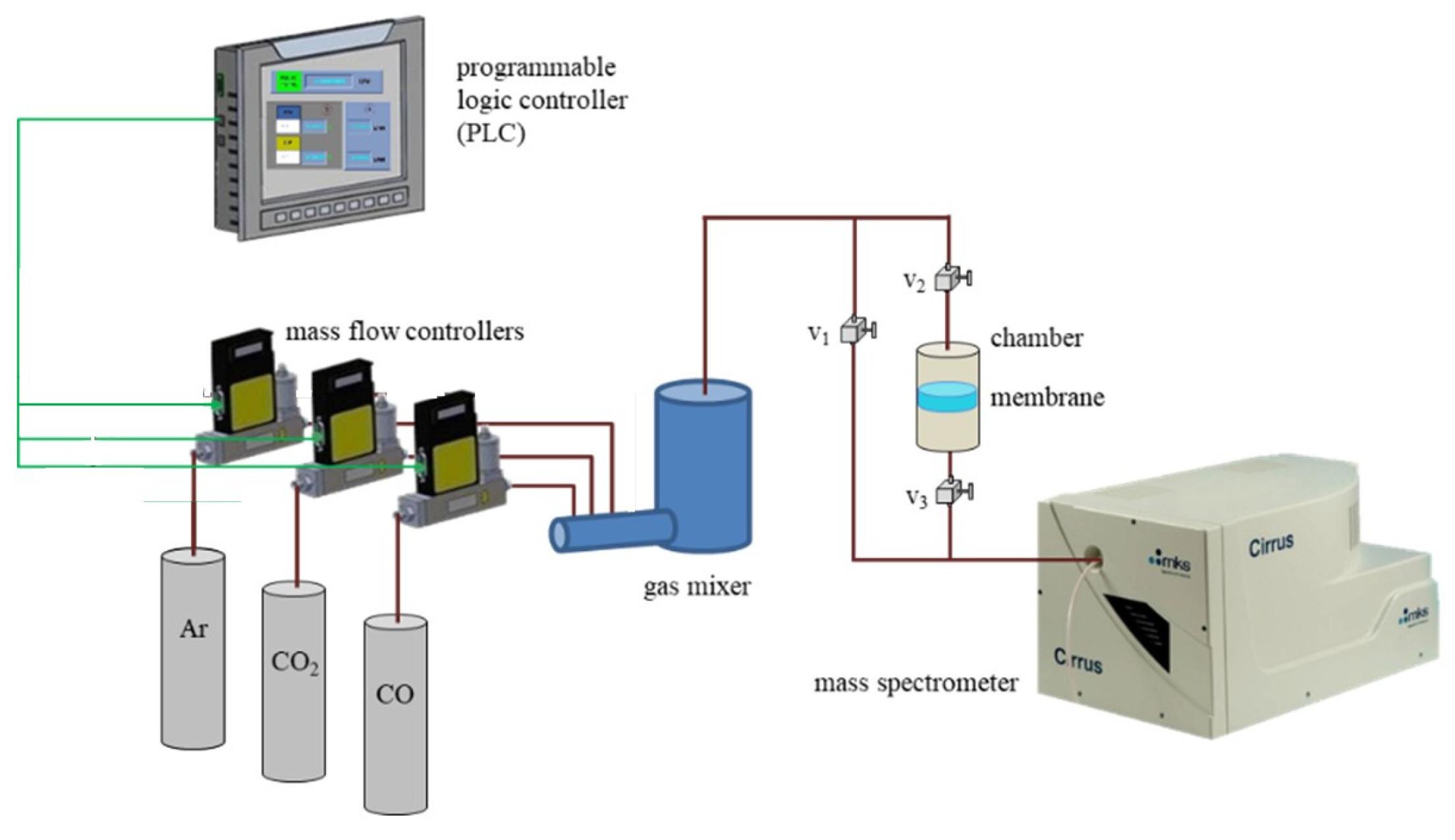
Figure 1. Experimental setup for testing the BMOF2 and BMOF3 as membrane.
Separations 13 00011 g001
Figure 2. Color change in the BMOF2 composite before and after activation.
Separations 13 00011 g002
Figure 3. XRD pattern of conventional HKUST-1 MOF, naturally treated bone powder, and the composites BMOF2 and BMOF3 (in the middle).
Separations 13 00011 g003
Figure 4. FTIR spectra of BP, BMOF2, and BMOF3.
Separations 13 00011 g004
Figure 5. SEM images of BP (a,b), BMOF2 (c), and BMOF3 (d).
Separations 13 00011 g005
Figure 6. EDS chemical mapping and spectra of BP (a) and composite BMOF3 (b).
Separations 13 00011 g006
Figure 7. TGA curves with a heating rate of 5 °C per minute in He (a) and adsorption–desorption isotherms (b) for BP, BMOF2, and BMOF3.
Separations 13 00011 g007
Figure 8. X-ray Photoelectron Spectroscopy (XPS) analysis of BMOF2 and BMOF2CO2. (a) C1s; (b) Cu2p; (c) O1s for BMOF2 and BMOF2–CO2; (d) O1s for BMOF2–CO2; (e) O1s BMOF2.
Separations 13 00011 g008
Figure 9. The adsorption capacity of both composites studied, (a) CO2 and CO adsorption, and (be) gas kinetics adsorption linearized.
Separations 13 00011 g009
Table 1. Values of total relative coverage percentage and per component for BMOF2 and BMOF3.
MaterialBMOF2BMOF3
%Rectotal57%54%
GasesCOCO2COCO2
%Reci66%49%13%57%
Table 2. Comparative table of CO and CO2 adsorption.
MaterialGasqe (mmol/g)Temperature (K)Pressure (bar)Ref.
BMOF3
BMOF2
CO0.61
0.62
2981This study
Zeolite Y (proton form, Si/Al = 5)0.213031[74]
Zeolite Y (Na+ form, Si/Al = 2.4)0.482930.6
Cu(I)/γ-Al2O3 (supported CuCl; CO adsorption by interaction with Cu(I))0.452981
HKUST-10.302981
Cu(II) porous coordination polymer (PCP) (Cu(aip)) 7.152981
BMOF3
BMOF2
CO20.53
0.75
2981This study
Mg-MOF-740.202981[75]
Chemical activated carbon0.68 2981[76]
Ordered mesoporous carbon0.412981[77]
APS/SBA-15(III)0.663331[78]
Zn-MOF-740.082131[75]
Mesoporous silica SBA-151.62980.15[79]
MIL-101(Cr) granules1.63 3131[70]
HKUST-16.192981[80]
Mg-HKUST-
1@MWCNT
3.632981[81]
Li-HKUST-14.572981[59]
Disclaimer/Publisher’s Note: The statements, opinions and data contained in all publications are solely those of the individual author(s) and contributor(s) and not of MDPI and/or the editor(s). MDPI and/or the editor(s) disclaim responsibility for any injury to people or property resulting from any ideas, methods, instructions or products referred to in the content.