

Development and Validation of AI Help-Seeking Behavior Scale Among Undergraduate University Students


Abstract
1. Introduction
2. Materials and Methods
2.1. Study Design
2.2. Settings and Procedures
2.3. Item Generation
2.4. Translation Phase
2.5. Face and Content Validity
2.6. Explanatory Factor Analysis
2.7. Confirmatory Factor Analysis
2.8. Convergent and Discriminant Validity
2.9. Reliability
2.10. Data Analysis
2.11. Ethical Approval
3. Results
3.1. Demographic Information
3.2. Item Generation
3.3. Translation Phase
3.4. Face and Content Validity
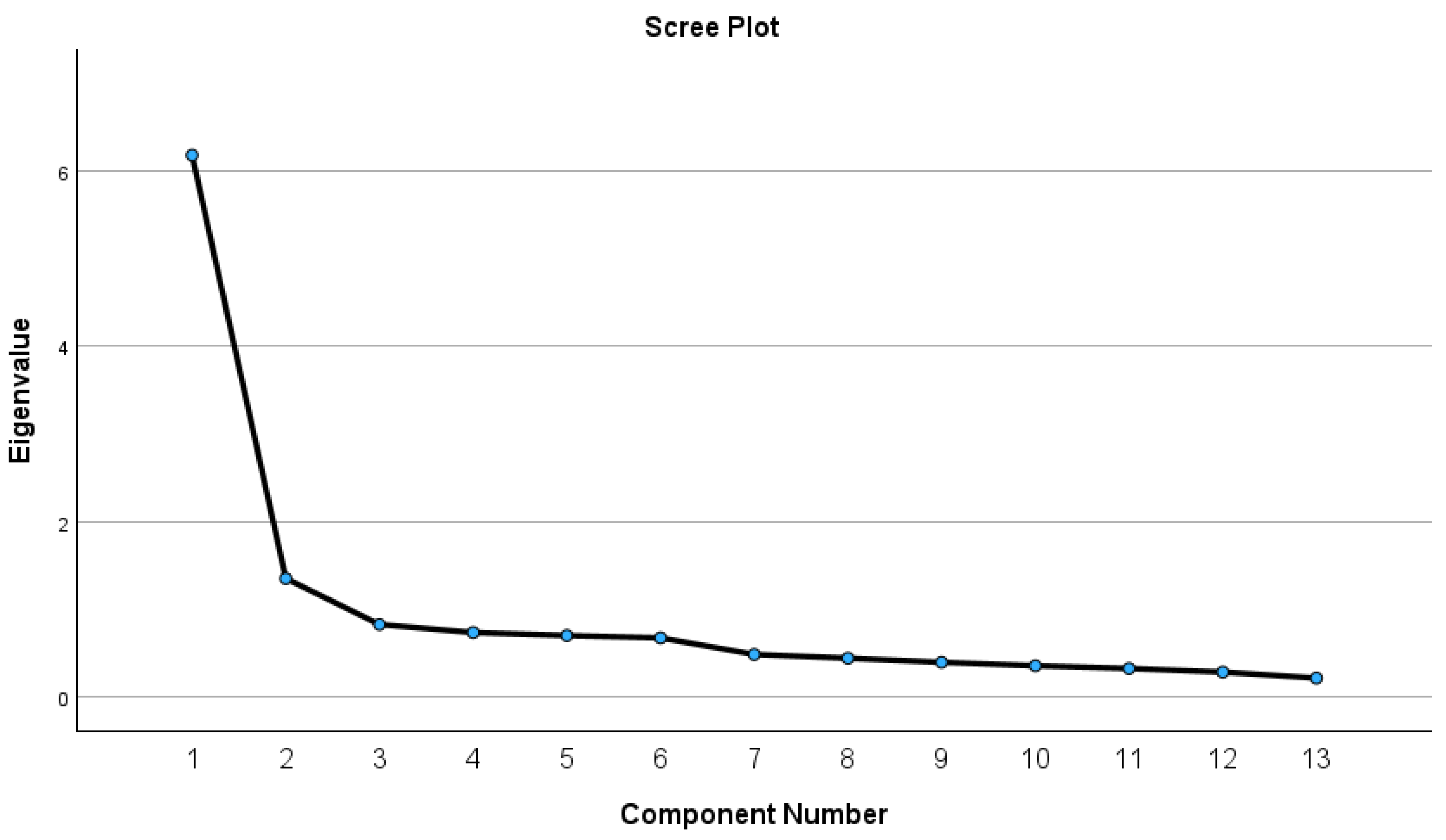
3.5. EFA
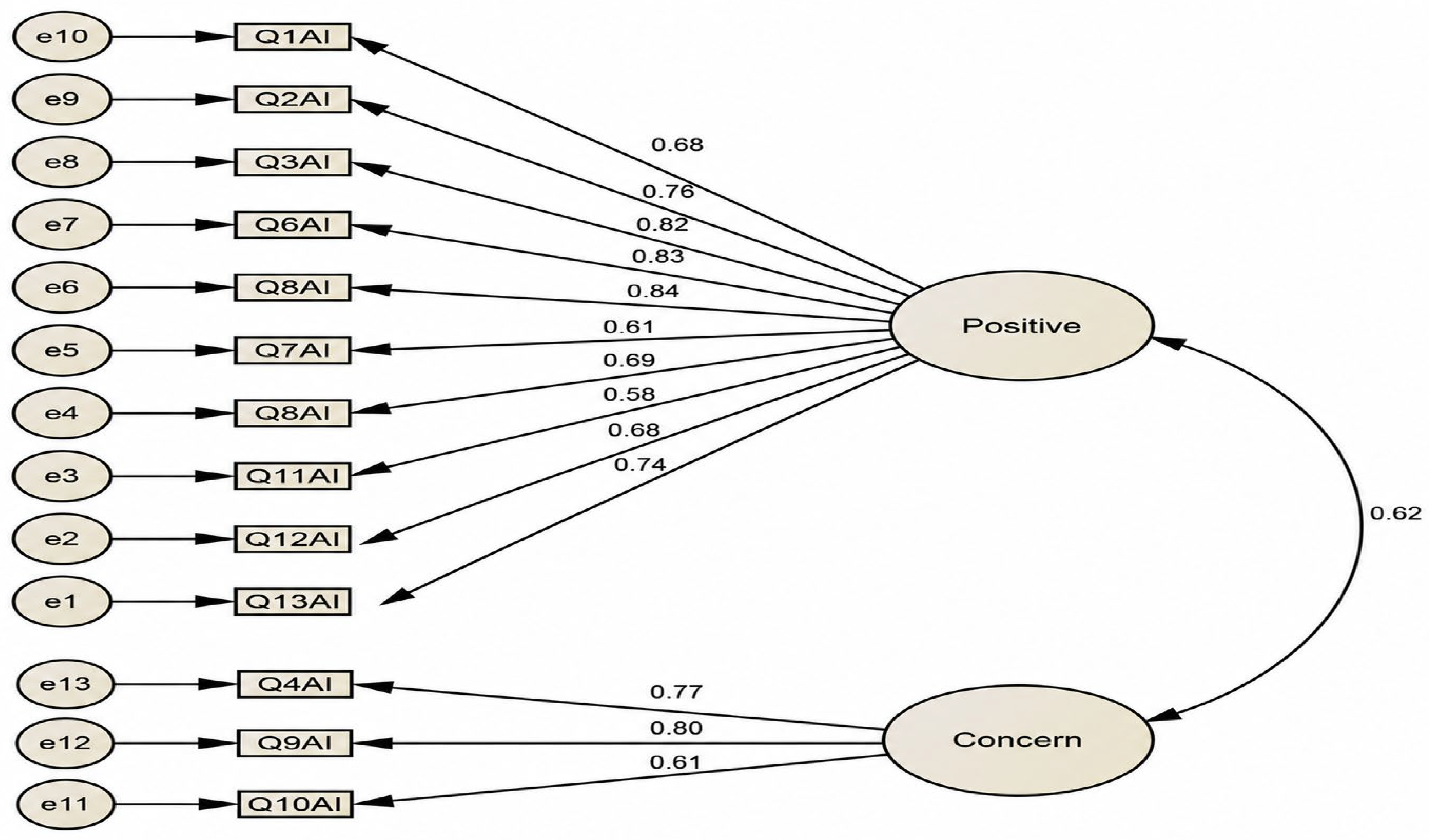
3.6. CFA
3.7. Convergent and Discriminant Validity
3.8. Reliability
4. Discussion
5. Conclusions
Supplementary Materials
Author Contributions
Funding
Institutional Review Board Statement
Informed Consent Statement
Data Availability Statement
Acknowledgments
Conflicts of Interest
Abbreviations
| AI | Artificial Intelligence |
| AI-HSB | Artificial Intelligence-help-seeking behavior |
| UAE | United Arab Emirates |
References
- Abdelwanis, M., Simsekler, M. C. E., Gabor, A. F., Sleptchenko, A., & Omar, M. (2026). Artificial intelligence adoption challenges from healthcare providers’ perspectives: A comprehensive review and future directions. Safety Science, 193, 107028. [Google Scholar] [CrossRef] [Scilit]
- Abrahim, S., Mir, B. A., Suhara, H., Mohamed, F. A., & Sato, M. (2019). Structural equation modeling and confirmatory factor analysis of social media use and education. International Journal of Educational Technology in Higher Education, 16(1), 32. [Google Scholar] [CrossRef] [Scilit]
- Alam, Z., Abdullahi, A. S., Alnuaimi, S. N. S., Al Shaka, H. A., Alderei, S. S. S., Alhemeiri, A. A. A., Khorzom, H., Almaskari, H. J. M., Almaamari, K. A., Al Seiari, K., Al Saadi, M., Al Shamsi, N., Al Zaabi, O., Altamimi, S., & Rahma, A. T. (2025). eHealth literacy and attitudes towards use of artificial intelligence among university students in the United Arab Emirates, a cross-sectional study. Frontiers in digital health, 7, 1574263. [Google Scholar] [CrossRef] [Scilit] [PubMed]
- Albikawi, Z., Abuadas, M., & Rayani, A. M. (2025). Nursing students’ perceptions of AI-driven mental health support and its relationship with anxiety, depression, and seeking professional psychological help: Transitioning from traditional counseling to digital support. Healthcare, 13(9), 1089. [Google Scholar] [CrossRef] [Scilit] [PubMed]
- Alfuqaha, O., Rabay’ah, M., & Alsalaht, M. (2022). Technology acceptance model among nurses and other healthcare providers during the 2019 Coronavirus pandemic: A comparative cross-sectional study. Central European Journal of Nursing and Midwifery, 13(4), 775. [Google Scholar] [CrossRef] [Scilit]
- Alfuqaha, O. A., Aladwan, D. A., Al Thaher, Y., & Alhalaiqa, F. N. (2022). Measuring panic buying behavior: The role of awareness, demographic factors, development, and verification. Heliyon, 8(5), e09372. [Google Scholar] [CrossRef] [Scilit] [PubMed]
- Alfuqaha, O. A., Barakat, R. O., Al-masarwah, U. M., Aladwan, D. A., & Baniamer, A. O. (2025). Predictors of psychological burnout among Jordanian university students: Multicenter cross-sectional study. Education Sciences, 15(2), 184. [Google Scholar] [CrossRef] [Scilit]
- Alfuqaha, O. A., Msall, K., & Abdelrahman, R. M. (2026). Factors associated with artificial intelligence-help-seeking behavior among university students in the UAE: A cross-sectional study. Education Sciences, 16(4), 506. [Google Scholar] [CrossRef] [Scilit]
- AlMaskari, A. M., Al-Mahrouqi, T., Al Lawati, A., Al Aufi, H., Al Riyami, Q., & Al-Sinawi, H. (2025). Students’ perceptions of AI mental health chatbots: An exploratory qualitative study at Sultan Qaboos university. BMJ Open, 15(10), e103893. [Google Scholar] [CrossRef] [Scilit] [PubMed]
- Babu, A., & Joseph, A. P. (2024). Artificial intelligence in mental healthcare: Transformative potential vs. the necessity of human interaction. Frontiers in Psychology, 15, 1378904. [Google Scholar] [CrossRef] [Scilit] [PubMed]
- Bujang, M. A., Omar, E. D., & Baharum, N. A. (2018). A review on sample size determination for Cronbach’s alpha test: A simple guide for researchers. Malaysian Journal of Medical Sciences, 25(6), 85–99. [Google Scholar] [CrossRef] [Scilit] [PubMed]
- Cheung, G. W., Cooper-Thomas, H. D., Lau, R. S., & Wang, L. C. (2024). Reporting reliability, convergent and discriminant validity with structural equation modeling: A review and best-practice recommendations. Asia Pacific Journal of Management, 41(2), 745–783. [Google Scholar] [CrossRef] [Scilit]
- Chigbu, U. E., Atiku, S. O., & Du Plessis, C. C. (2023). The science of literature reviews: Searching, identifying, selecting, and synthesising. Publications, 11(1), 2. [Google Scholar] [CrossRef] [Scilit]
- Cocchi, S., Cipolat Mis, C., Mazzocut, M., Barbieri, I., Bassi, M. C., Cavuto, S., Di Leo, S., Miraglia Raineri, A., Cafaro, V., & ETHIC Validation Group. (2023). Content and face validity of the evaluation tool of health information for consumers (ETHIC). Healthcare, 11(8), 1154. [Google Scholar] [CrossRef] [Scilit] [PubMed]
- de Rooij, M., & Weeda, W. (2020). Cross-validation: A method every psychologist should know. Advances in Methods and Practices in Psychological Science, 3(2), 248–263. [Google Scholar] [CrossRef] [Scilit]
- Fischer, E. H., & Turner, J. L. (1970). Orientations to seeking professional help: Development and research utility of an attitude scale. Journal of Consulting and Clinical Psychology, 35(1), 79–90. [Google Scholar] [CrossRef] [Scilit] [PubMed]
- Grover, S., Menon, V., Gupta, S., Vidhukumar, K., Indu, P. V., & Chacko, D. (2025). Translation and adaptation of rating scales. Indian Journal of Psychiatry, 67(6), 643–647. [Google Scholar] [CrossRef] [Scilit] [PubMed]
- Hair, J. F., Black, W. C., Babin, B. J., & Anderson, R. E. (2019). Multivariate data analysis (8th ed.). Cengage. [Google Scholar]
- Henseler, J., Ringle, C. M., & Sarstedt, M. (2015). A new criterion for assessing discriminant validity in variance-based structural equation modeling. Journal of the Academy of Marketing Science, 43(1), 115–135. [Google Scholar] [CrossRef] [Scilit]
- Katsiroumpa, A., Konstantakopoulou, O., Moisoglou, I., Gallos, P., Galani, O., Lialiou, P., Tsiachri, M., & Galanis, P. (2025). Development and validation of the artificial intelligence in mental health scale: Application for AI mental health chatbots. Healthcare, 13(24), 3269. [Google Scholar] [CrossRef] [Scilit] [PubMed]
- Limone, P., & Toto, G. A. (2022). Factors that predispose undergraduates to mental issues: A cumulative literature review for future research perspectives. Frontiers in Public Health, 10, 831349. [Google Scholar] [CrossRef] [Scilit] [PubMed]
- Morgado, F. F. R., Meireles, J. F. F., Neves, C. M., Amaral, A. C. S., & Ferreira, M. E. C. (2017). Scale development: Ten main limitations and recommendations to improve future research practices. Psicologia: Reflexão e Crítica, 30(1), 3. [Google Scholar] [CrossRef] [Scilit] [PubMed]
- Picco, L., Abdin, E., Chong, S. A., Pang, S., Shafie, S., Chua, B. Y., Vaingankar, J. A., Ong, L. P., Tay, J., & Subramaniam, M. (2016). Attitudes toward seeking professional psychological help: Factor structure and socio-demographic predictors. Frontiers in Psychology, 7, 547. [Google Scholar] [CrossRef] [Scilit] [PubMed]
- Saeidnia, H. R., Hashemi Fotami, S. G., Lund, B., & Ghiasi, N. (2024). Ethical considerations in artificial intelligence interventions for mental health and well-being. Social Sciences, 13(7), 381. [Google Scholar] [CrossRef] [Scilit]
- Sallam, M., Elsayed, W., Al-Shorbagy, M., Barakat, M., El Khatib, S., Ghach, W., Alwan, N., Hallit, S., & Malaeb, D. (2024). ChatGPT usage and attitudes are driven by perceptions of usefulness, ease of use, risks, and psycho-social impact: A study among university students in the UAE. Frontiers in Education, 9, 1414758. [Google Scholar] [CrossRef] [Scilit]
- Shi, D., Lee, T., & Maydeu-Olivares, A. (2019). Understanding the model size effect on SEM fit indices. Educational and Psychological Measurement, 79(2), 310–334. [Google Scholar] [CrossRef] [Scilit] [PubMed]
- Sigudla, J., & Maritz, J. E. (2023). Exploratory factor analysis of constructs used for investigating research uptake for public healthcare practice and policy. BMC Health Services Research, 23(1), 1423. [Google Scholar] [CrossRef] [Scilit] [PubMed]
- Smedslund, G., Arnulf, J. K., & Smedslund, J. (2022). Is psychological science progressing? Explained variance in PsycINFO articles during the period 1956–2022. Frontiers in Psychology, 13, 1089089. [Google Scholar] [CrossRef] [Scilit] [PubMed]
- Stone, B. M. (2021). The ethical use of fit indices in structural equation modeling. Frontiers in Psychology, 12, 783226. [Google Scholar] [CrossRef] [Scilit] [PubMed]
- Swidan, A., Lee, S. Y., & Romdhane, S. B. (2025). College students’ use and perceptions of AI tools in the UAE. Education Sciences, 15(4), 461. [Google Scholar] [CrossRef] [Scilit]
- Tavakol, M., & Wetzel, A. (2020). Factor analysis: A means for theory and instrument development. International Journal of Medical Education, 11, 245–247. [Google Scholar] [CrossRef] [Scilit] [PubMed]
- Velasco, A., Cruz, I. S., Billings, J., Jimenez, M., & Rowe, S. (2020). What are the barriers, facilitators and interventions targeting help-seeking behaviours for common mental health problems in adolescents? A systematic review. BMC Psychiatry, 20(1), 293. [Google Scholar] [CrossRef] [Scilit] [PubMed]
- Venkatesh, V., & Davis, F. D. (1996). A model of the antecedents of perceived ease of use: Development and test. Decision Sciences, 27(3), 451–481. [Google Scholar] [CrossRef]
- Vieriu, A. M., & Petrea, G. (2025). The impact of artificial intelligence on students’ academic development. Education Sciences, 15(3), 343. [Google Scholar] [CrossRef] [Scilit]
- Williams, L. J., Williams, A. R., & O’Boyle, E. H. (2022). Assessment of path model fit. Organizational Research Methods, 27(1), 64–87. [Google Scholar] [CrossRef] [Scilit]
- Wilson, C. J., Deane, F. P., Ciarrochi, J., & Rickwood, D. (2005a). General help seeking questionnaire (GHSQ) [Database record]. APA PsycTests. [Google Scholar] [CrossRef] [Scilit]
- Wilson, C. J., Deane, F. P., Ciarrochi, J., & Rickwood, D. (2005b). Measuring help-seeking intentions: Properties of the General Help-Seeking Questionnaire. Canadian Journal of Counselling, 39(1), 15–28. [Google Scholar] [CrossRef] [Scilit]
- Wu, J. (2024). Social and ethical impact of emotional AI advancement. Frontiers in Psychology, 15, 1410462. [Google Scholar] [CrossRef] [Scilit] [PubMed]
- Yasin, J., Qtaishat, F. A., Tamimi, M. A. A., AlKuttob, L., Hussain, M. A., Zuriekat, M., Al-Halasa, F. A., & Alfuqaha, O. A. (2026). Influence of social media addiction on eating attitudes, physical activity, and body image among university students. Jordan Medical Journal, 60(3), 401. [Google Scholar]


| Variables | Description | Frequency | Percentage % |
|---|---|---|---|
| Gender | Male | 128 | 30.8% |
| Female | 288 | 69.2% | |
| marital status | Single | 389 | 93.5% |
| Married | 21 | 5% | |
| Widowed/divorced | 6 | 1.5% | |
| Age (year) | 18–20 | 254 | 61.1% |
| 21–23 | 99 | 23.8% | |
| ≥24 | 63 | 15.1% | |
| Academic year | Freshman | 205 | 49.3% |
| Sophomore | 96 | 23.1% | |
| Junior | 72 | 17.3% | |
| Senior | 43 | 10.3% | |
| Major | Humanities and Sciences Fields | 110 | 26.4% |
| Business Fields | 90 | 21.6% | |
| Medical Fields | 94 | 22.6% | |
| Information Technology Fields | 91 | 21.9% | |
| Architecture and art Fields | 18 | 4.3% | |
| Engineering Fields | 13 | 3.1% |
| # | Items | Factor 1 | Factor 2 |
|---|---|---|---|
| 1 | If I thought I was having a mental breakdown, my first thought would be to use an AI-based help-seeking tool (such as ChatGPT or a mental health chatbot). | 0.78 | |
| 2 | Talking about my problems with an AI-based system seems to me a good way to get rid of psychological problems. | 0.85 | |
| 3 | If I were experiencing a serious psychological crisis, I would be sure that an AI-based help-seeking tool would be useful. | 0.80 | |
| 4 | I admire people who are willing to cope with their problems, such as anxiety and stress, without seeking help from AI-based systems. | 0.45 | |
| 5 | I want to get psychological support from an AI-based help-seeking tool if I am worried or depressed for a long period of time. | 0.84 | |
| 6 | I might want to use an AI-based help-seeking tool in the near future to solve my psychological problems. | 0.81 | |
| 7 | A person with a psychological problem prefers to ask for an AI help-seeking tool instead of going to a psychotherapist or psychiatrist. | 0.57 | |
| 8 | Given the amount of time and effort involved in using an AI-based help-seeking tool, I am sure that it would benefit someone like me. | 0.80 | |
| 9 | I believe that seeking psychological help from AI tools is the wrong choice because they are without feelings or emotions. | 0.63 | |
| 10 | Anxiety, stress, and depression problems, like most things in life, tend to work out by themselves without the need for an AI-based help-seeking tool or psychiatrists. | 0.74 | |
| 11 | If I had psychological problems and asked for AI seeking, it would keep it a secret. | 0.55 | |
| 12 | I believe that seeking psychological help from AI tools will reduce the stigma toward mental disorders. | 0.66 | |
| 13 | I recommend using AI tools as a quick and effective way to address my psychological problems. | 0.82 | |
| Initial eigenvalues | 6.181 | 1.354 | |
| Percentages of variance explained | 47.543 | 10.416 | |
| Cumulative variance | 47.543 | 57.959 |
| # | Variable | 1 | 2 | Alpha | CR | AVE |
|---|---|---|---|---|---|---|
| 1 | Positive attitude toward AI-HSB | 0.720 | 0.91 | 0.91 | 0.52 | |
| 2 | Concern about using AI-HSB | 0.62 | 0.730 | 0.67 | 0.77 | 0.54 |
Disclaimer/Publisher’s Note: The statements, opinions and data contained in all publications are solely those of the individual author(s) and contributor(s) and not of MDPI and/or the editor(s). MDPI and/or the editor(s) disclaim responsibility for any injury to people or property resulting from any ideas, methods, instructions or products referred to in the content. |
© 2026 by the authors. Published by MDPI on behalf of the University Association of Education and Psychology. Licensee MDPI, Basel, Switzerland. This article is an open access article distributed under the terms and conditions of the Creative Commons Attribution (CC BY) license.
Share and Cite
Alfuqaha, O.A.; Abdelrahman, R.M.; Msall, K. Development and Validation of AI Help-Seeking Behavior Scale Among Undergraduate University Students. Eur. J. Investig. Health Psychol. Educ. 2026, 16, 90. https://doi.org/10.3390/ejihpe16070090
Alfuqaha OA, Abdelrahman RM, Msall K. Development and Validation of AI Help-Seeking Behavior Scale Among Undergraduate University Students. European Journal of Investigation in Health, Psychology and Education. 2026; 16(7):90. https://doi.org/10.3390/ejihpe16070090
Chicago/Turabian StyleAlfuqaha, Othman A., Rasha M. Abdelrahman, and Kyle Msall. 2026. "Development and Validation of AI Help-Seeking Behavior Scale Among Undergraduate University Students" European Journal of Investigation in Health, Psychology and Education 16, no. 7: 90. https://doi.org/10.3390/ejihpe16070090
APA StyleAlfuqaha, O. A., Abdelrahman, R. M., & Msall, K. (2026). Development and Validation of AI Help-Seeking Behavior Scale Among Undergraduate University Students. European Journal of Investigation in Health, Psychology and Education, 16(7), 90. https://doi.org/10.3390/ejihpe16070090