


Abstract
The sustainability of a clean energy transition for electric vehicle transportation is clearly affected by increased energy consumption cost, which is associated with large-scale electric vehicles (EVs) charging on a fossil-fuel dependent electricity grid. This places a potential threat on the safe operations and stability of the grid and increases the emissions of greenhouse gases (GHGs) from the power stations that generate the electricity. Furthermore, the uncontrolled large-scale integration of EVs charging on the grid will increase exponentially in the coming years. Because of this, new peaks on the grid will be generated due to the EV charging load variance, and a significant impact on the transformer limit and substation capacity violation will occur. To mitigate the significant impact of the high cost of energy consumption by large-scale EVs charging on the grid, and to reduce the emissions of GHGs, there is a need to provide a multi-level optimization approach that is robust and dynamic to solve the uncontrolled charging problem of large-scale integration of EVs to the grid. This paper investigates the grid energy consumption by EVs and reviews recent applications of EV charging controls and optimization approaches used for the energy management of large-scale EVs charging on the grid. Energy management in this context is not trivial. It implies that the objectives such as load shifting, peak shaving, and minimizing the high cost of electricity consumption with a stable grid operation can be achieved. In the context of this study, EVs charging on the grid includes both battery electric vehicles (BEVs), which have larger battery banks with a longer charging duration and higher energy consumption capacity, and plug-in hybrid electric vehicles (PHEVs) which have smaller battery capacities.
1. Introduction
The growing occurrence of the uncontrolled charging of large-scale electric vehicles is a complex problem for which traditional optimization methods have not been able to solve. This complex and uncontrolled charging problem of large-scale EVs on the national electricity grid distribution systems is forecasted to grow at an alarming rate with the increased drive towards electric transportation [1,2]. The limited number of EV charging stations is unable to satisfy the growing number of EVs being manufactured for large-scale deployment on the electric distribution system. There is bound to be an infrastructure capacity deficit problem of charging stations, which are not growing at the same scale as the production of EVs. Some of these problems will manifest as congestion control problems, coordination control problems, sequential decision-making problems, economic load dispatch problems associated with large-scale EV charging, and the high energy consumption cost per capita. However, the integration of large-scale EVs to the electricity grid can provide valuable ancillary services relating to frequency control, reactive power compensation through voltage control, and grid balance. The same cannot be said about large-scale integration of EVs charging on the grid at the same time. In this case, a significant and negative impact can be experienced when the grid fluctuates, and when the transformer limits and substation capacities are violated. This scenario will create instability and generate new peaks on the grid, when, for example, thousands of EVs perform uncontrolled charging at the same time on the distribution network. Furthermore, because the large-scale charging problem of electric vehicles on the grid represents distributed energy systems with variable electrical loads, its performance is significantly affected by driver behaviour (i.e., driving patterns), climate conditions, EV battery size, state of charge (SOC), and the rate of charge (RoC), among many other uncertainties. Therefore, the energy demand and the economic load management of large-scale EV charging becomes a very complex problem with regards to grid integration. Optimization has proven to be the general solution to these problems [3,4], whereby some variables of interest are optimized to realize specific objective functions. For instance, with the uncontrolled charging of EVs, increased energy consumption and disruption to electricity grid operations are likely to occur during peak periods. Optimization of the grid energy supply in this regard will require that some variables of interest, such as the EVs charging periods, i.e., time of use (ToU), and the charging energy demand, are minimized to reduce the energy consumption cost. While looking at the future direction of electric vehicles, with the possibility of replacing the internal combustion engine vehicles (ICEVs). It is imperative that research efforts should be multiplied to address these imminent problems of large-scale EVs whose charging energy demand is highly stochastic, with inherent uncertainties that will adversely impact the operations of the electricity grid and possibly increase the emissions of CO2. In this paper, we review the application of techniques and optimization approaches that have been employed to manage large-scale EV charging on the electricity grid. These methods have been used for different applications, including charging control, scheduling EVs, shifting load demand, economic dispatch, unit commitment, distribution feeder reconfiguration (DFR), load demand prediction, energy modelling, and forecasting. This study investigates some of the methods that have been employed to minimize the high cost of grid energy consumption and the associated impact of large-scale EV charging on the grid. The main objective is to highlight the research gaps and to propose a multi-level optimization approach that is robust and dynamic to solve the uncontrolled charging problem of large-scale integration of EVs to the grid. The potential benefits of applying this multi-level optimization approach in the domain of large-scale EV charging problem which has not been fully investigated is discussed. Therefore, this review attempts to bridge the research gaps identified in the literature. The main contributions of this review include the following:
- This review investigates the uncontrolled charging problem of large-scale EVs and the impact on the grid electricity distribution system.
- It identifies research gaps from previously published papers in related fields where the uncontrolled charging of EVs is a major concern for optimization.
- It identifies improved control strategies that will minimize the high energy consumption cost and grid impact from the uncontrolled charging of large-scale EVs.
- The insight derived from this study provides a valuable recommendation that will guide government policy on the need to promote energy management strategies that will enhance the electricity grid operations and promote the adoption of EVs that will drive the electrification of the transport sector.
- It contributes to the United Nation Sustainable Development Goals No. 7, which advocates for affordable and clean energy; No. 11, which promotes efforts towards sustainable cities and communities; No. 12, which encourages responsible consumption and production; and No. 13, which advocates for climate change actions that will minimize global greenhouse gas (GHG) emissions.
This paper is organized as follows: Section 1 above gave a general introduction to the problem of large-scale EV charging and the need to address the problem for grid safety and environmental benefits. Section 2 investigates the uncontrolled charging problem of EVs on the grid and examines the impact. The relevant literature studies and scholarly works within the context of EV charging energy management and the methods used are presented as a review. Section 3 outlines the research gaps that have been identified and proposes a multi-level optimization approach to the problem of large-scale charging of EVs on the grid. Section 4 presents future work and concluding remarks.
2. Related Work
In this section, a review of the research work and developments that relates to the negative impact of large-scale charging of EVs on the grid is presented. Furthermore, this section identifies specific optimization and control techniques applied to solving the problem of large-scale EV charging. This section further investigates the complex charging problem of large-scale EV charging which are computationally challenging to solve using exact or traditional optimization methods.
2.1. Electric Vehicle Charging Problem
The impact of large-scale EV integration to the electricity grid network has been investigated by Kene et al. [1], Sing et al. [5], Hatziargyriou et al. [6], and Weiller et al. [7]. The findings from these studies showed a common consensus about the significant negative impact of large-scale integration of EVs charging on the electricity distribution network. The obvious impacts include increased energy consumption, increased peak load demand on the network capacity which affects the energy supply and stability of the grid, and grid fluctuations due to increased EVs charging load variance. In addition, some of the major issues associated with uncoordinated large-scale charging of EVs is that it places a significant impact on the safe performance of the electricity distribution network. The study conducted by Jabalameli et al. [8] and Roncancio et al. [9] further gives details on the issue of uncoordinated large-scale EV charging integration into the electricity distribution network. A typical scenario which depicts the integration of large-scale EV charging on the electricity grid can be seen in Figure 1. The control pilot signal in Figure 1 has numerous functions, part of which is to establish bi-directional communication between the EV and the EV charging station (EVCS) for initiating the charging process, signalling the battery SoC from the EV on-board charger to the EVCS, communicating the EV charging power and the maximum allowable current drawn by the EV, and for signalling other information like errors.
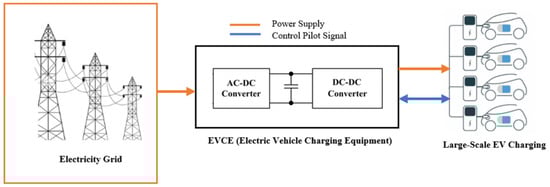
Figure 1.
Integration of Large-Scale EV Charging on the Grid.
The electric vehicle charging problem places numerous constraints on the electricity grid, one of which is the added limitations on voltage levels that are introduced by the instantaneous and uncontrolled large-scale charging of EVs. Moreover, there are constraints associated with EV chargers, the state of charge (SoC) of EV battery storage capacity, charging rates, electricity tariffs, and grid power balance, among many other constraints.
2.2. Electric Vehicle Charging Control Methods and Grid Energy Management
The uncontrolled large-scale charging of EVs and integration to the grid is a complex problem for which traditional optimization methods have been used, to a certain extent, as a solution. However, recent developments in bio-inspired techniques, swarm intelligence-based optimization, and computational intelligence methods have shown significant successes in solving complex problems in the domain of energy management vis-a-vis uncontrolled charging problems in large-scale EV integration into the grid. To emphasize the significant energy consumption associated with charging EVs on the grid, an average EV charging demand is equivalent to the energy consumption of about four to five households. Table 1 is presented to show the energy consumption of EVs based on their battery capacity and the EV charger power which determines how much power is drawn from the grid and the amount of power delivered to the EV battery. The concern here is the impact of large-scale deployment of these EVs on the electricity grid, especially in a scenario where unbalanced distribution of charging activities is highly and likely to introduce significant disturbances to grid stability. Therefore, this section investigates different optimization methods for solving the uncontrolled charging problem in large-scale EVs deployment.

Table 1.
EV Energy Consumption Based on Battery Size, Vehicle Type, and Charger Power.
2.2.1. Ant-Based Optimization for Electric Vehicle Charge Management
Inspired by the natural learning where ant colonies can easily solve complex optimization problems, Xu et al. [10] used an ant-based swarm algorithm to coordinate the complex charging of EVs at the transformer level. They went further to confirm how the uncontrolled large-scale charging of EVs would affect the stability of the electricity grid operations, considering load fluctuations and a 12.47 KV transformer capacity. The application of the Monte Carlo method was employed to sample datasets related to the use of 500 EVs, considering variables such as the charging power of the EVs, duration of charge, battery capacity, and travel time in mileage. The results showed that valley filling was achieved using an ant-based swarm algorithm with the ability to coordinate complex charging problems using the swarm architectures including centralized, distributed, and hybrid controls.
An ant colony (AC) system was employed in the research study conducted by Mavrovouniotis et al. [11]. In this case, the study investigated the scheduling problem of large-scale EV charging, considering the power constraints which is inherent in charging stations. According to the authors in [11], the ant colony optimization can be used to coordinate large-scale EV scheduling. To achieve power demand side management for EV charging on the grid, Yang et al. [12] developed a charging load model. The work in [12] tried to connect the modelling of EV charging load profile to the grid impact that may arise with large-scale charging. Using ant colony algorithms to identify parameters of the EV charging traffic flow process, the authors investigated the EV charging load profile. The parameters that were analysed in this process included the start time for EV charging, the charging power profile, and the length of time for a given EV charging process. In submission, the authors in [12] made a valid case for the future development of large-scale EV charging, where they argued that the charging traffic flow concept based on the AC algorithm was useful in the identification of the mentioned parameters, which are the main factors that impact the grid.
To curtail the potential negative impact that arises from large-scale EV charging on the grid, a dedicated energy storage system (ESS) was integrated into a flexible electric charging infrastructure called Flex-ChEV. Tangrand et al. [13] investigated the use of the Flex-ChEV to analyse EV traffic patterns, EV charging energy requirements, and the congestion that may arise at charging stations. A study [13] argued that large-scale EV congestion at charging stations will increase the base loads on the electricity grid, thereby causing a significant disruption to the grid distribution network. To address this problem, the authors in [13] employed the use of ant colony optimization (ACO) to analyse the energy demands required by plug-in EVs in relation to their traffic patterns which determines how frequently EVs need to be recharged. The results from the simulation experiment showed that ant colony optimization can be used to determine the load-carrying capacity in EV charging infrastructures and improve charging station design to this effect.
Ant colony optimization is generally based on ants’ cooperative behaviour to collectively achieve a complex optimization task by following the shortest path from their nest in search for food sources. This is made possible by chemical compounds called pheromones which are produced by individual ants and placed on the search path for other ants to follow. Most often, the ants follow the path which has the strongest pheromone scent. The foraging behaviour of an ant colony employing a communication strategy based on pheromone trails for the shortest path to food sources has been adopted into a popular search algorithm and can be described using the adapted algorithm as indicated in Table 2 [11].
Table 2.
Ant-Based Optimization Algorithm (General Pseudo Code) [11].
2.2.2. Artificial Bee Colony
Computational optimization methods based on an artificial bee colony (ABC) in the family of the swarm intelligence-based optimization has been equally useful in solving complex engineering problems in the domain of large-scale EV energy cost optimization. The study conducted by Habib et al. [14] focused on the minimization of the cost associated with charging EVs on the grid, environmental pollution costs, and minimizing the cost of carbon emissions. These three major objectives were achieved using the ABC optimization algorithm. Based on the performance of the ABC algorithm when compared with particle swarm optimization (PSO), the result indicated an improved performance in the coordination of large-scale EV charging and discharging.
The use of the ABC algorithm to mitigate voltage fluctuations in the grid distribution network was also employed in the study conducted by Ali et al. [15]. In this study, the voltage fluctuations caused by plug-in hybrid EVs and by the intermittent photovoltaic (PV) power supply to the grid was considered as two major constraints. Using the ABC algorithm in [15], the reactive power injected by the PV inverter was optimized along with the EV charging and discharging power. In the study conducted by Alvarez et al. [16], the use of an enhanced ABC algorithm to schedule large-scale EV charging on the grid was employed. One of the objectives achieved in [16] was the optimal use of the charging station. The application of the ABC algorithm in this case combined local search algorithms to ensure the economic use of the EV charging stations by minimizing the significant impact of uncontrolled charging on the distribution grid.
The work of Shivappriya et al. [17] demonstrated that, one of the ways to reduce the negative impact of uncontrolled large-scale charging of EVs is to optimize the fuel usage. Using a modified ABC algorithm combined with sequential quadratic programming (SQP), they argued that the optimization of EV (in this case, they used parallel hybrid EVs) fuel consumption was achievable in addition to reducing CO2 emissions. This result shows that this method has reduced consequences on the battery’s final state of charge. This work was based on the need to address the gap where the SQP algorithm has not been able to find a global minimum and has limited capacity to minimize fuel consumption in EVs.
To minimize the negative consequences of large-scale EV charging on the grid, the study conducted by Falabretti et al. [18] applied a hybridized ABC algorithm to schedule the power commitment to large-scale car sharing EVs. Using the proposed algorithm, the charging request of large-scale EVs is based on a centralized scheduler that identifies an appropriate schedule to allocate EVs and then regulates individual EV initial charging time based on the power limit set for each EV. Considering 3200 EVs, a numerical simulation was used to test the performance of the hybridized ABC algorithm in minimizing the potential grid imbalance arising from charging EVs.
Based on the social cooperation of a swarm of bees, the ABC algorithm is designed to optimize the search for food sources with the highest amount of nectar, which represents an optimal solution amongst numerous available food sources, is outlined as follows. A population of bees are categorized into employee bees, onlooker bees, and scout bees. Food sources which represent individual solutions are being searched for by the employee bees who update their memory with information after a successful search. Some of the information obtained by the employee bee includes location. This information is then passed onto the onlooker bees to explore the value of the food source and make selection based on some values which includes quality of food and the source. The onlooker bees evaluate its selection for fitness and update their memory for advanced and continuous search. The scout bees are responsible for identifying new food sources (solutions) and updating their memory for the best solution once they discover abandoned food sources by the onlooker bees. The steps to a general ABC algorithm are presented in Figure 2.
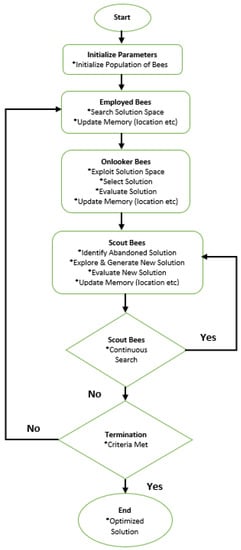
Figure 2.
Artificial Bee Colony Algorithm.
2.2.3. Genetic Algorithms
To minimize the total electricity consumption by large-scale EV integration into the grid, Liu et al. [19] investigated the routing problem of EVs in relation to the battery SoC which was used to model the electricity consumption of EVs. The use of a hybrid genetic algorithm (GA) has been developed to address the routing problem. The result of this investigation [19] was tested and compared with a simulated annealing algorithm and GA in a simulation process that showed that the hybrid GA had an improved performance and an approximate solution. The study conducted by Zeng et al. [20] employed the use of a multi-objective genetic algorithm and real EV travel data to optimize the EV charging infrastructure based on the premise that an optimized charging infrastructure will reduce the load variance and high cost of energy demand from the grid.
Efthymiou et al. [21] conducted research which focused on the need for European cities to deploy large-scale EV chargers to meet the growing EV charging demand. They further argued that the promotion and adoption of electric transportation to minimize carbon emissions will require an optimal placement of charging stations in strategic locations around European cities. For this purpose, a GA was employed to address the charging infrastructure location problem. In the research conducted by Elmehdi et al. [22], the optimal charge scheduling for large-scale EV charging was investigated. The approach employed in this case has to do with the use of a GA to establish the optimal charging and discharging schedule for large-scale EV charging. This included the allocation of EVs to charging stations during off-peaks to benefit from low electricity prices.
Korotunov et al. [23] proposed that a smart grid should be used to minimize the negative impact that may arise from large-scale integration of EV charging into the grid. A study [23] investigated the best approach to optimize the EV charging infrastructure. In this case, the use of a GA was employed to address the uncoordinated large-scale charging of EVs. Alonso et al. [24] investigated the smart coordination of large-scale EV charging in a smart grid environment. One of the objectives set by the authors in [24] was the development of a large-scale EV load profile which was used to optimally schedule EV charging. The maximum load on the transformer, thermal line limits, and the voltage limits were considered as constraints in the optimization process. The use of a GA was employed to achieve the optimization of large-scale EV charging coordination, and the results showed a reduction in peak load and EV charging load.
Inspired by natural evolution processes, genetic algorithms synthesize artificial genes and chromosomes to solve complex optimization problems based on natural selection. The main components or phases in GA development are population initialization, fitness function, selection, crossover, and mutation. In general, the GA process can be classified into three major phases, namely (1) the population initialization phase: this phase initializes a population size called generation. (2) The selection phase: this second phase involves a random selection of a sampled population called parents. After selection, this stage then evaluates the individual solution from the initial population size created, using a fitness function that checks the suitability and viability of the individuals who are selected to be matched for reproduction. (3) The generation phase: this third phase involves the use of three main GA operators to reproduce subsequent generations (i.e., children). The first operator (crossover) under the generation phase is used to perform genetic operations that produce a second generation from selected individual populations. While the mutation, still under the generation phase, is used to maintain the genes from the previous generation, which are reproduced in the subsequent generation. This iterative process continues until the best solution or an approximate solution is reached. The basic GA algorithm is presented in Figure 3.
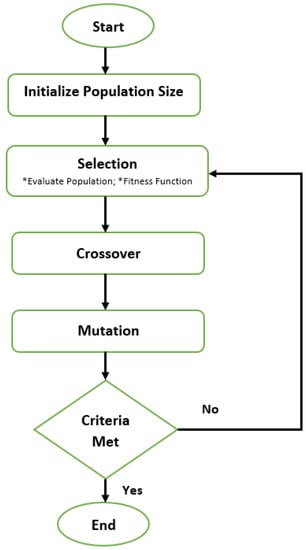
Figure 3.
Standard Genetic Algorithm Process.
2.2.4. Particle Swarm Optimization
The use of particle swam optimization as one of the metaheuristic techniques inspired by nature to manage large-scale EV charging on the grid has been adopted in numerous studies. Employing the particle swarm optimization (PSO) technique, Zhou et al. [25] investigated the demand side management (DSM) of large-scale EV charging with respect to the charging and discharging operations of the grid. The study recognized that large-scale EV integration into the grid is a potential threat to the grid safety and reliable operations due to many factors. It is for this reason that the authors in [25] proposed an improved PSO algorithm to coordinate EV charging and discharging on the grid to achieve a reduction in the cost associated with EV energy demand. The improved PSO in this case was implemented with a pricing structure that was based on the time-of-use (ToU) to achieve an effective DSM.
To find an optimal control strategy which can be employed to minimize the burden placed on the electricity grid by large-scale EV charging, Celli et al. [26] used PSO to achieve the required control for charging and discharging EVs on the electricity distribution system. With this strategy, aggregators of large-scale EV charging can control the integration of EVs and offer ancillary services to the grid.
The research conducted by Sridhar et al. [27] acknowledged that the electricity grid will potentially experience overloading, power losses, and grid fluctuations with large-scale integration of EV charging into the grid. To address these problems and achieve energy management where the huge cost of EVs energy consumption and power losses are minimized, a PSO algorithm was proposed to coordinate the large-scale charging of EVs. Using an improved PSO algorithm, a charging strategy for EV aggregation was developed by Zhang et al. [28]. This strategy is based on a parking lot model and the V2G technology. In this research, the charging strategy for EVs was investigated in relation to the real-time pricing of electricity. The simulation results according to the authors in [28] showed that the improved PSO algorithm avoided the local optima and converged very quickly. The research conducted by Vasant et al. [29] investigated the need to improve EVs’ state of charge during the charging process by optimizing the power allocation to the charging unit. The constraints considered in this case are the recharging time for each EV, current SoC, and energy tariff. A typical flow chart depicting a PSO algorithm is presented in Figure 4 [29].
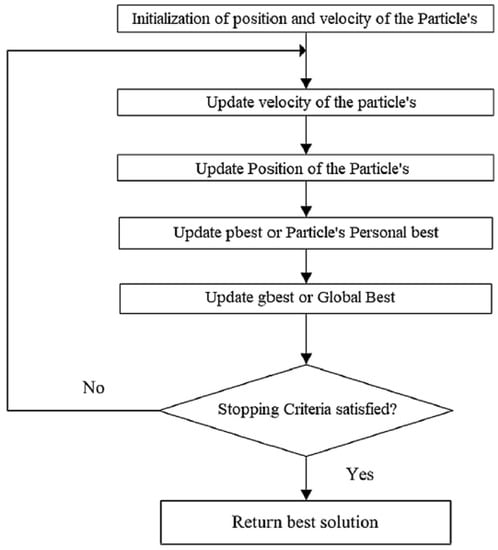
Figure 4.
Particle Swarm Optimization [29].
2.2.5. Neural Network-Based Optimization
Several studies have been conducted to address the problem of large-scale EV charging impact on the distribution networks. Jahangir et al. [30] employed artificial neural networks in an attempt to forecast the demand large-scale charging of EVs; the main objective here was to minimize energy consumption. They compared the results of their study with a Monte Carlo method which showed a reduction in energy consumption. Similarly, Topic et al. [31] developed two models for the load management of EVs integrated into the grid. In the first model, a prediction of the EV’s battery state of charge with the fuel consumption during driving cycles was made, while the second model involved the prediction of the travel range limit associated with the EVs. The overall results showed that the charging energy cost was minimized. Similarly, Nageshrao et al. [32] used neural networks to predict the state of charge and temperature of EVs, to reduce the charging cost associated with the operations of EVs. This was done by exploiting the flexibility in EV operations to arrive at an optimal charging strategy that minimizes energy consumption. The results showed energy cost minimization. The study conducted by Morsalin et al. [33] also applied the use of neural networks to schedule EV demand charging and for load management. The objective here was to forecast EV energy demand by using the battery state of charge, the trip time, and energy consumption profile as datasets.
To minimize the energy cost, voltage fluctuations, power losses, and transformer overload, the work of Shibl et al. [34] used machine learning (ML) to manage EV charging on the distribution network of the electricity grid by applying an efficient routing solution. The investigation involved the application of different types of ML algorithms to solve the problem. In particular, the long short-term memory (LSTM), which is a type of recurrent neural network (RNN), was found to outperform the other ML algorithms including k-nearest neighbour (KNN), random forest (RF), support vector machine (SVM), and deep neural networks (DNNs). The LSTM achieved the best solution as it was able to minimize the objective functions with high accuracy.
The accurate state-of-charge estimation of EV batteries is seen as a significant factor in the management of EV power, driving distance, and grid power consumption based on charging period. The work of Javid et al. [35] employed the use of an adaptive online strategy to estimate EV SoC based on a deep recurrent neural network that comprised LSTM optimization applied to each input of the RNN. The inputs to the neural network are the battery voltage, current, and temperature, while the output of the neural network is the battery SoC estimation. The performance of this method was evaluated against other methods using two battery types for the case study and the result showed that RNN significantly minimized the RMSE error.
The variations in EV charging load have obvious negative impact on the load balance and grid voltage stability. The study conducted by Guo et al. [36] was based on the need to forecast these variations as observed in EV charging load which is highly stochastic. To minimize the impact on the electricity grid, the authors in [36] investigated the charging curves at different EV charging stations. Based on this investigation, they gathered historical datasets which included EV charging load power and related parameters as well as weather data. These datasets were applied as inputs to a gate-recurrent-unit neural network (GRU-NN), while the hyperparameter selection of the GRU-NN was optimized with a genetic algorithm. The results showed that the GRU-NN was able to accurately predict the charging load of EVs on a short-term basis. The authors in [37] provided an advanced technical paper on the use of neural networks as seen in Figure 5, and how they are used for prediction.
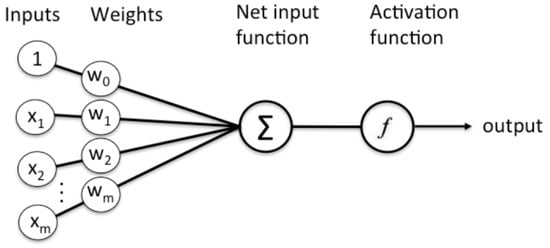
Figure 5.
Neural Network Architecture.
2.2.6. Hybrid Optimization Strategy
In the study conducted by Fahmy et al. [38], two optimization algorithms, namely PSO and GA, were employed to minimize the high energy demand from large-scale EV charging on the grid. The authors investigated the EV charging process and optimal charging cycles that will improve the opportunity for charging stations to be profitable while reducing grid energy consumption costs. Therefore, considerations were given to the optimal design of EV charging stations to improve the process of large-scale charging and discharging of EVs. The investigation revealed that the integration of renewable energy, in this case photovoltaic sources, with the charging station provided an opportunity to minimize energy consumption costs on the grid.
Gao et al. [39] employed the use of two optimization strategies to achieve an orderly large-scale charging and discharging of EVs. The study conducted by the authors in [39] acknowledged the potential threat to the stability of the electricity grid arising from uncontrolled charging of EVs. To address this problem, the Monte Carlo method was employed to estimate the energy demand of large-scale EV charging on the grid. Furthermore, multi-swarm cooperative PSO was employed to achieve an optimized dispatching strategy while considering the EV load demand and the fluctuations at peak and off-peak periods.
A solution for the problem of charging infrastructure location for large-scale EV grid integration has been proposed by Muthukannan et al. [40], considering the negative impact of power losses and voltage fluctuations that large-scale EV charging introduces to the grid. The coupling of EV charging infrastructure to the grid will also increase the cumulative energy loss and diminish the bus voltage. The strategic placement and coverage of charging stations, minimizing losses on the distribution system, and reducing the deviations on the node voltage are the critical objective functions considered in this study [40]. A hybrid optimization algorithm of PSO and direct search (DS) method was employed to develop a multi-objective charging station planning model. This technique was able to achieve a reduction in grid power losses and improvement of the voltage profile due to the optimal placement of shunt capacitors on the grid distribution system for reactive power compensation.
The study conducted by Tan et al. [41] investigated the minimization of the load variance experienced on the grid by using V2G applications for peak load shaving and grid to electric vehicle (G2V) for charging EVs (load levelling). The objective to minimize the grid load variance was achieved with the implementation of a GA algorithm for the optimal scheduling of large-scale EV charging to the grid and vice versa. The constraints which impacted the performance of the proposed algorithm were identified as (1) setting a target for grid load, which was used to determine when to charge EVs based on off-peak periods to minimize grid overload And (2) EVs’ state of charge selection, which can be used to determine when V2G ancillary services can be offered for peak load shaving, frequency control, etc.
The uncertainties created by uncontrolled large-scale EV charging on the electricity distribution system has been investigated by Sangob et al. [42]. In addressing this problem, the use of the Monte Carlo technique to develop a smart charging algorithm was introduced. Meanwhile, the PSO algorithm was implemented for the sequential planning and optimal scheduling of large-scale EV charging on the grid. The performance of the proposed hybrid technique has been tested using a real-world 122-bus, 240 Kv/400 V distribution system with large-scale EV charging on the grid. In this case, EV energy consumption, battery capacity, travel distances, and vehicle speed were considered amongst many other variables for the simulation. The result showed an improvement in the distribution system voltage profile and huge cost savings in energy consumption and reduced power losses.
A hybrid optimization technique comprised of a sequential Monte Carlo method was used to model the EV charging process, while the hybrid crow search (CS) combined with the PSO algorithm was implemented to optimize EV charging stations by Ray et al. [43]. In this case, the number of EV chargers, their electrical rating, energy sources from renewable energy, BESS, and electricity price were used as parameters to minimize the energy consumption cost and demand by large-scale EV charging.
2.2.7. Controlled Charging of Electric Vehicles Using Social Spider Algorithm
A Social Spider algorithm (SSA) is a swarm intelligence-based optimization algorithm inspired by nature. The foraging nature of the social spider in the exploration and exploitation of the search space, has been adapted to solving real-world complex optimization problems. Given the stochastic nature of the problem space where large-scale EV charging on the grid is a complex optimization problem, the application of SSA has been used as an intervention strategy to solve the uncontrolled charging problem. The study conducted by Kavousi-Fard et al. [44] employed social spider optimization (SSO) to coordinate large-scale EV charging and discharging operations on the grid. Recognizing that the electricity distribution feeders can easily be congested due to overload from EV charging leading to voltage drop on the feeder line, the authors in [44] developed a framework based on distribution feeder reconfiguration (DFR) and V2G to minimize the losses due to EV fleet operations on the grid.
The economic load dispatch (ELD) problem of large-scale EV charging on the grid has been investigated in the study conducted by Behera et al. [45]. In this case, SSA was employed for the optimal scheduling of V2G application and G2V load demand on 10-unit thermal generators. The performance of the proposed SSA algorithm when compared with two PSO techniques showed the following: (1) the huge cost associated with 10-unit thermal generators increased with G2V charging and (2) dynamic ELD of EV integration into the grid can be achieved to minimize energy costs at peak periods when V2G is scheduled with the thermal generators.
The study conducted by Kamankesh et al. [46] investigated the optimal topology reconfiguration of microgrids to minimize the electricity consumption cost and improve power quality and grid operations. The use of a social spider optimization algorithm was employed to address this problem through a framework that changes the feeder line (reconfiguration) which the microgrid uses to supply electric power to the loads. In this case, the authors in [46] used large-scale EVs as a BESS for ancillary services (V2G). Figure 6 is presented to illustrate the social spider optimization algorithm [47].
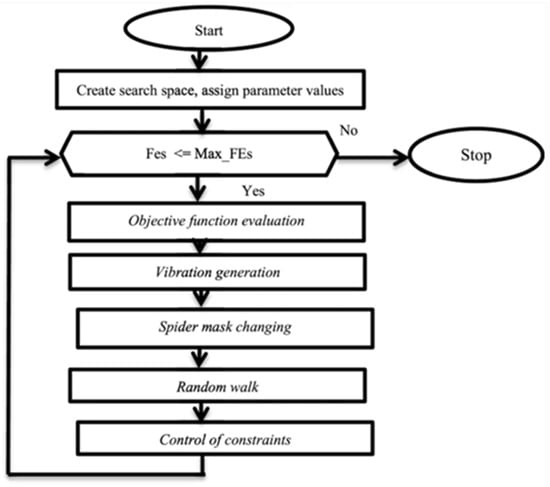
Figure 6.
Social Spider Optimization Algorithm, Bas et al. [47].
2.2.8. Reinforcement Learning
Reinforcement learning (RL) is a subset of machine learning (ML) whose application requires mapping situations to the best actions in order to maximize a reward. RL is fundamentally based on a trial-and-error search algorithm and delayed reward values. The research study conducted by Teng Liu [48] has been very prominent in describing the application of RL for the energy management of hybrid EVs. The author emphasized learning-enabled energy management systems (EMSs) based on artificial intelligence (AI) and ML algorithms. The main objective of the authors in [48] was the energy management of EVs, and focused on improving the EV fuel consumption and reducing global warming. A control-oriented framework based on RL for the EMS of HEVs was presented with an online updating algorithm which has the capacity to combine EV driving information that is both current and predicted for the future. The authors in [48] evaluated the RL-based application by comparing two controllers based on dynamic programming and stochastic dynamic programming.
The study conducted by Chis et al. [49] alluded to the general assumption that the uncontrolled large-scale charging of EVs will increase the cost of electricity consumption. It was based on this that the authors proposed the application of batch RL with a fitted Q-iteration algorithm to reduce the long-term cost involved in charging EVs. The authors employed a Bayesian neural network (BNN) to predict electricity prices from a demand response point of view, by using the real-time electricity prices with the EV load data to predict future electricity prices. The problem was modelled as a Markov decision process (MDP) with unknown probabilities. In addressing the uncontrolled charging problem, the authors proposed a state-action-reward-state-action (SARSA) in order for the algorithm to learn the electricity price patterns. According to the simulation result, cost savings between 10% to 50% was realized.
The application of RL based on a duelling neural network was employed by Gokhale et al. [50] for the optimization of EV charging. Some of the objectives the author proposed to achieve was the joint coordination of large-scale EV charging activities with less training data, cost minimization, and maximization of the consumption of renewable energy by EVs. The RL technique employed in this study is the fitted-Q iteration algorithm which uses less training datasets. The result from this study showed that the cost of charging EVs was reduced. However, the authors discovered that the quality of the RL technique applied to this problem can be improved in the future by employing model-based techniques which have the capacity to enhance the neural network.
Viziteu et al. [51] investigated the scheduling issues common with large-scale EV charging vis-a-vis congestion control and the advance scheduling of charging stations for EVs to recharge at the time of arrival without delay. The authors employed an RL algorithm and neural network application to address this problem. The authors used synthetic datasets generated by a scenario simulator to train the algorithms; the results demonstrated that the time interval for EVs to recharge can be identified using the availability of charging stations. To shave the peak charging load and minimize the high charging cost arising from large-scale EV charging, Cao et al. [52] investigated the charging scheduling problem of EVs. The authors developed a computational algorithm called the actor–critic learning charging algorithm. The aim of the study was to minimize the energy cost arising from the EVs’ stochastic charging behaviour by developing an optimal strategy for charging EVs. Lee et al. [53] developed a real-time EV charging and discharging algorithm based on an RL framework. Part of the objective of the study was to develop an algorithm that is capable of minimizing EV charging costs and shifting EV loads on the grid. An estimation method called kernel density was used to model how EVs utilize specific EV charges.
2.2.9. Load Modelling
Load modelling is very significant in the study of grid energy management in all aspects of power systems, especially with the increasing integration and adoption of various energy mixes. Likewise, in the large-scale EV charging problem, load modelling becomes a tool to be used to analyse and provide insight into the EV load pattern and energy consumption profile on the electricity grid. The study conducted by Arif et al. [54] provided a detailed review paper based on load modelling techniques.
The study conducted by Yang et al. [12] demonstrated the significance of having a charging load model for EVs. To achieve power demand side management for EV charging on the grid, the authors developed a probabilistic charging load model with the capacity to identify charging traffic flow. The work done by the authors in [12] tried to connect the modelling of EV charging load profiles to the grid impact that may arise with large-scale charging. Ant colony algorithms were employed in this case to identify the parameters of the EV charging traffic flow process and the charging load profile. The parameters that were analysed in this process included the start time for EV charging, the charging power profile, and the length of time for a given EV charging process. In summary, the authors made a valid case for the future development of large-scale EV charging, where they argued that the charging traffic flow concept based on the EV load model with the application of an AC algorithm was a useful technique to analyse EV charging load profiles. Furthermore, the identification of the mentioned parameters helps to improve the computational efficiency of the AC algorithm.
According to the authors in [55], the need for a data-driven and aggregated EV charging load model becomes very important due to the potential impact of large-scale EV charging on the grid. Using the Monte Carlo method to aggregate the EVs, the authors developed an EV charging load model which had the capacity to predict EV charging loads. Moreover, the load model provided a method to evaluate large-scale EV charging load profiles on the grid. The parameters of the EV load model considered in this study included battery capacity, initial SoC, start of EV charging time, charging power level, and the EV daily energy consumption.
In an effort to provide a guide for the energy demand management of EVs on the Greek power system, Mitrakoudis et al. [56] proposed a load modelling approach to determine the growing load demand. Some of the constraints taken into consideration included EV battery capacity and SoC, charging rates, EV energy consumption, charging schedule, charging curve, and the frequency of charging. The authors in [56] developed a multivariate probabilistic load model which was used to simulate and estimate the charging demand of 10,000 aggregated EVs’ load demand on the Greek national grid.
Weib et al. [57] developed a probabilistic load model for the public charging infrastructure. The aim of this study was to find a realistic approach to evaluate the impact of EV charging stations on the grid in order to minimize their impact. The approach involved the determination of load profiles that were later used as part of the load model development.
To determine the voltage variation arising from EV charging and discharging activities on the distribution network, Chen et al. [58] developed a probabilistic power flow model which was based on Latin super cube sampling. The authors used the IEEE33 node to simulate the power flow scenario of EV charging and discharging. The results showed that the proposed model was able to quantify and evaluate the probability distribution of the voltage amplitude with respect to the application of V2G. This investigation emphasized the importance of load modelling for the proper assessment of the impact that EV charging imposes on the grid and for making better decisions on how EV charging can be controlled based on the characteristics of the load profiles.
2.2.10. Alternating Direction Method of Multipliers
The alternating direction method of multipliers (ADMM) is an optimization technique whose algorithm makes it possible to solve complex problems by splitting them into smaller manageable subproblems. ADMM is a good substitute to stochastic gradient descent (SGD) and is suitable for solving large-scale optimization problems, machine learning applications, constrained optimization problems, and distributed optimization problems [59,60]. Some of the disadvantages associated with ADMM is that its convergence towards a solution is slow and it does not guarantee global convergence.
To minimize the load variance caused by large-scale EV charging on the grid, Khaki et al. [61] developed a coordination framework based on a hierarchical ADMM for the purpose of scheduling EV charging. The system design for the proposed framework is such that it allows the aggregators of EVs to communicate and control the load demand of EVs on the distribution feeders by scheduling EV charging. The objective here was to minimize the load demand on the distribution feeder and the EV charging cost while ensuring that the constraints on the feeder were within set parameters. East et al. [62] proposed an ADMM algorithm to solve the energy management problem of hybrid EVs. The authors focused on the comparative performance evaluation of ADMM against dynamic programming (DP) in providing a solution to the energy management problem. In contrast to ADMM, the DP algorithm was found to be computationally expensive and underperformed, while the ADMM algorithm showed a better result with two orders of magnitude improvement.
The study conducted by He et al. [63] contributed to the general research findings which revealed that the random charging of EVs creates an unbalanced distribution of charging across the grid and congestions at the charging stations. The study revealed that the cost of charging EVs, which includes the duration taken to charge the EV, and the charging fee are the two critical issues that EV owners are grappling with. The authors in [63] proposed ADMM as a distributed algorithm to solve this problem which included optimal charging station locations that enable EVs to fulfil their scheduled trip.
Bhardwaj et al. [64] proposed a communication censored ADMM strategy for the purpose of minimizing the high energy consumption cost associated with large-scale EV load demand. The aim of the proposed algorithm was to coordinate EV charging and discharging activities in unbalanced distribution grids. One of the objectives of the communication censored-strategy is to enhance the peer-to-peer communications that arises in the process of EV grid integration via the charging station.
Wu et al. [65] proposed an ADMM distributed algorithm to address the problem of large-scale EV charging, considering transactive energy management (TEM). The distributed algorithm implements a scheduling strategy that allows the charging of EVs through a negotiation process that enables the EV aggregator to provision charging services to EVs, while the distribution system operators provide the optimal power flow. The algorithm provides a distributed control that introduces voltage stability while minimizing the high energy consumption and EV load variance on the grid. The authors tested the performance of their proposed solution using 230 EV charging loads on an IEEE 33-bus distribution system.
2.2.11. Monte Carlo Method
The Monte Carlo method can be defined as a technique widely used to predict or evaluate the probability of a process outcome. Based on a computational algorithm, it can be applied to carry out an impact assessment for estimating the parameters of a stochastic problem using an iterative and randomized process. A study conducted by Betancur et al. [66] was based on the need to analyse the impact of large-scale EV charging on the grid. For this purpose, the authors developed a technique based on a Monte Carlo simulation which was used to analyse some parameters and carry out load flow analyses.
Yon et al. [67] proposed a Monte Carlo method for the load forecasting of large-scale EV charging on the grid. The purpose for this was based on the need to investigate the impact that EV charging will have on the grid. The result showed that the Monte Carlo method was able to predict a consistent load profile of EVs which showed an increased peak load on the grid.
In the study conducted by Li et al. [68], a load forecasting model with an optimal scheduling strategy for the effective large-scale charging of EVs was developed. A Monte Carlo method of simulation was employed to forecast the EV load with consideration for the EV travel history, charging rate, etc. Table 3 presents a snapshot of the methods and techniques investigated along with the objectives and the problems solved.
Table 3.
1 Selected control methods applied to EV charging on the grid.
3. Research Gaps Identified in the Literature
The various research studies presented in this review has been able to highlight several control methods to address the charging problem of large-scale EV charging through various methods which include coordination [10,14,24,27,39], scheduling [11,18,24,32,36,37,40], optimal charging and discharging of EVs [15,22,34,39], improvement in minimizing EVs fuel consumption [17], and optimization of charging infrastructure [13,16,20,21,23,33,35,38]. However, it is important to point out that, in the studies that were reviewed, there is a lack of multi-level approaches to problem solving that will determine an optimal energy management of EV charging, considering grid capacity constraints [69]. There is a need to provide a multi-level optimization approach that is robust and dynamic to solve the uncontrolled charging problem of large-scale integration of EVs into the grid.
Specifically, we highlight that the following methods when combined will form a multi-level approach which is robust and dynamic to bring about an energy-efficient direction for the energy management and optimization of large-scale EV charging on the grid.
3.1. Load Modelling Based on Grid Capacity Constraints
Unlike the internet that could trace every device and data packet on its network, the current smart electricity grids in most economies of the world are not intelligent enough to detect when EVs are plugged into a distribution network. This constraint makes it difficult to control large-scale EV charging on the grid with a single optimization approach. Therefore, load modelling of EV charging on the grid becomes a very essential tool that should be applied to provide insight about the EV load pattern and energy consumption profile on the electricity grid. Based on this insight, the load modelling approach can be used to minimize the objective function which, for instance, could be to reduce the huge energy consumption by EV charging on the grid. By extension, when this objective function is achieved, it will also have a robust optimization outcome on the penalties that have been set for grid capacity constraints, charging stations, and EV charging constraints, e.g., making sure the acceptable grid voltage limits are not exceeded during peak periods.
Considering an unbalanced low voltage (LV) distribution system, let us assume a typical objective function where the cost of grid energy consumption by large-scale EV charging is minimized. This can be illustrated using Equation (1).
3.2. Forecasting EV Charging Demand
The lack of visibility for grid operators, including transmission system operators (TSOs) and distribution systems operators (DSOs), as indicated in Section 3.1 can be addressed by forecasting the energy required by EVs to charge their batteries using the datasets based on the load modelling as proposed in Section 3.1. This approach remains very significant to the management of the grid power supply and maintaining the safe operations of the grid.
3.3. Dynamic Load Management
With the high penetration of EVs into the distribution system, there is a need to implement dynamic load management for charging EVs based on the load modelling and the EVs energy demand forecast proposed in Section 3.1 and Section 3.2. The literature reviewed did not address the opportunities that can be provided through the dynamic load management (DLM) that regulates the allocated individual EV charging power when integrated into the electricity distribution grid. Moreover, the issue of scalability and adaptability of the DLM algorithm was not addressed for large-scale EV charging on the grid. We argue that achieving a scalable DLM of EV charging on the grid in a case where there is large-scale deployment, will limit the uncontrolled charging of EVs on the grid as well as improve the current inefficiency in the grid power allocation of energy required for large-scale EV charging.
4. Conclusions and Future Research Direction
In many of the applications investigated and deployed for large-scale EV charging control, the literature reviewed shows that no industry standard exists for the control and management of EV charging on the grid. This calls for concerted efforts to be made by the research community and the industry to find a robust solution to the uncontrolled charging problem of EVs on the grid.
The various methods presented in this review have shown useful results and partial solutions to the EV charging problem. Considering the distributed nature of large-scale EV loads on the grid, greater improvements can be achieved if a multi-level optimization approach is adopted. It is for this reason that this study proposes a robust and dynamic multi-level optimization methods as highlighted in Section 1, Section 2 and Section 3.
Future research work should explore further the following areas:
- Development of an integrated multi-level energy management optimization approach to solve the uncontrolled large-scale EV charging problem on the grid electricity distribution system.
- Considering the flexibility potential that is available with large-scale EV capacity to offer ancillary services, we recommend further research in this area for an optimal vehicle-to-grid business model.
- EV battery degradation [70] due to the frequent charging is a major concern for EV owners; as it discourages them from participating in ancillary services that could be beneficial as an example, in grid voltage control. This perception is also a major drawback for EVs to participate in various V2G applications. Further research should be conducted to address this concern.
Author Contributions
R.O.K.: Conceptualization, Methodology, Software, Verification, Formal Analysis, Investigation, Data Curation, Writing—Original Draft, Visualization, Project Administration. T.O.O.: Supervision, Project Administration, Funding Acquisition, Writing—Review and Editing, All authors have read and agreed to the published version of the manuscript.
Funding
This research received no external funding.
Data Availability Statement
Not applicable.
Conflicts of Interest
The authors declare no conflict of interest.
References
- Kene, R.; Olwal, T.; van Wyk, B.J. Sustainable Electric Vehicle Transportation. Sustainability 2021, 13, 12379. [Google Scholar] [CrossRef]
- Munoz, E.; Razeghi, G.; Zhang, L.; Jabbari, F. Electric Vehicle Charging Algorithms for Coordination of the Grid and Dis-tribution Transformer Levels. Energy 2016, 113, 930–942. [Google Scholar] [CrossRef]
- Tan, K.M.; Ramachandaramurthy, V.K.; Yong, J.Y. Integration of electric vehicles in smart grid: A review on vehicle to grid technologies and optimization techniques. Renew. Sustain. Energy Rev. 2016, 53, 720–732. [Google Scholar] [CrossRef]
- Rahman, I.; Vasant, P.M.; Singh, B.S.M.; Abdullah-Al-Wadud, M.; Adnan, N. Review of Recent Trends in Optimization Tech-niques for Plug-in Hybrid, and Electric Vehicle Charging Infrastructures. Renew. Sustain. Energy Rev. 2016, 58, 1039–1047. [Google Scholar] [CrossRef]
- Singh, J.; Tiwari, R. Impact analysis of different charging models for optimal integration of plug-in electric vehicles in distribution system. J. Eng. 2019, 2019, 4728–4733. [Google Scholar] [CrossRef]
- Hatziargyriou, N.; Karfopoulos, E.; Tsatsakis, K. The impact of EV charging on the system demand. In Electric Vehicle In-Tegration into Modern Power Networks; Garcia-Valle, R., Pecas Lopes, J.A., Eds.; Springer: New York, NY, USA, 2013; pp. 57–85. [Google Scholar]
- Weiller, C. Plug-in hybrid electric vehicle impacts on hourly electricity demand in the United States. Energy Policy 2011, 39, 3766–3778. [Google Scholar] [CrossRef]
- Jabalameli, N.; Ghosh, A.; Su, X.; Banerjee, B. Stochastic Assessment of Plug-In Electric Vehicles Charging in LV Distribution Network on Voltage Unbalanc. In Proceedings of the 9th International Conference on Power and Energy Systems (ICPES), Perth, WA, Australia, 10–12 December 2019; pp. 1–6. [Google Scholar]
- Roncancio, I.; Ríos, M.A. Spectral and steady state impact assessment of PHEV on distribution systems. In Proceedings of the 2013 Workshop on Power Electronics and Power Quality Applications (PEPQA), Bogota, Colombia, 6–7 July 2013; pp. 1–6. [Google Scholar] [CrossRef]
- Xu, S.; Feng, D.; Yan, Z.; Zhang, L.; Li, N.; Jing, L.; Wang, J. Ant-Based Swarm Algorithm for Charging Coordination of Electric Vehicles. Int. J. Distrib. Sens. Netw. 2013, 9, 268942. [Google Scholar] [CrossRef]
- Mavrovouniotis, M.; Ellinas, G.; Polycarpou, M. Electric Vehicle Charging Scheduling Using Ant Colony System. In Proceedings of the 2019 IEEE Congress on Evolutionary Computation (CEC), Wellington, New Zealand, 10–13 June 2019. [Google Scholar] [CrossRef]
- Yang, S.; Wu, M.; Yao, X.; Jiang, J. Load Modeling and Identification Based on Ant Colony Algorithms for EV Charging Sta-tions. IEEE Trans. Power Syst. 2015, 30, 1997–2003. [Google Scholar] [CrossRef]
- Tangrand, K.; Bremdal, B.A. Using Ant Colony Optimization to determine influx of EVs and Charging Station capacities. In Proceedings of the 2016 IEEE International Energy Conference (ENERGYCON), Leuven, Belgium, 4–8 April 2016; pp. 1–6. [Google Scholar] [CrossRef]
- Habib, H.; Subramaniam, U.; Waqar, A.; Farhan, B.; Kotb, K.; Wang, S. Energy Cost Optimization of Hybrid Renewables Based V2G Microgrid Considering Multi Objective Funtion by Using Artificial Bee Colony Optimization. IEEE Access 2020, 8, 62076–62093. [Google Scholar] [CrossRef]
- Ali, A.; Raisz, D.; Mahmoud, K. Mitigation of voltage fluctuation in distribution system connected with PV and PHEVs using artificial bee colony algorithm. In Proceedings of the 2018 6th International Istanbul Smart Grids and Cities Congress and Fair (ICSG), Istanbul, Turkey, 25–26 April 2018; pp. 144–148. [Google Scholar] [CrossRef]
- Álvarez, J.G.; González, M.; Vela, C.R.; Varela, R. Electric Vehicle Charging Scheduling by an Enhanced Artificial Bee Colony Algorithm. Energies 2018, 11, 2752. [Google Scholar] [CrossRef]
- Shivappriya, S.; Karthikeyan, S.; Prabu, S.; De Prado, R.P.; Parameshachari, B. A Modified ABC-SQP-Based Combined Approach for the Optimization of a Parallel Hybrid Electric Vehicle. Energies 2020, 13, 4529. [Google Scholar] [CrossRef]
- Falabretti, D.; Gulotta, F. A Nature-Inspired Algorithm to Enable the E-Mobility Participation in the Ancillary Service Market. Energies 2022, 15, 3023. [Google Scholar] [CrossRef]
- Liu, Q.; Xu, P.; Wu, Y.; Shen, T. A hybrid genetic algorithm for the electric vehicle routing problem with time windows. Control. Theory Technol. 2022, 20, 279–286. [Google Scholar] [CrossRef]
- Zeng, L.; Krallmann, T.; Fiege, A.; Stess, M.; Graen, T.; Nolting, M. Optimization of future charging infrastructure for commercial electric vehicles using a multi-objective genetic algorithm and real travel data. Evol. Syst. 2019, 11, 241–254. [Google Scholar] [CrossRef]
- Efthymiou, D.; Chrysostomuo, K.; Morfoulaki, M.; Aifantopoulou, G. Electric Vehicles Charging Inrastructure location: A Genetic Algorithm Approach. Eur. Transp. Res. Rev. 2017, 9, 27. [Google Scholar] [CrossRef]
- Elmehdi, M.; Abdelilah, M. Genetic Algorithm for Optimal Charge Scheduling of Electric Vehicle Fleet. In Proceedings of the 2nd International Conference on Networking, Information Systems & Security, Rabat, Morocco, 27–29 March 2019; Association for Computing Machinery: New York, NY, USA, 2019; Volume 3, ISBN 1-4503-6645-7. [Google Scholar]
- Korotunov, S.; Tabunshchyk, G.; Okhmak, V. Genetic algorithms as an optimization approach for managing electric vehicles charging in the smart grid. Comput. Model. Intell. Syst. 2020, 2608, 184–198. [Google Scholar] [CrossRef]
- Alonso, M.; Amaris, H.; Germain, J.; Galan, J. Optimal Charging Scheduling of Electric Vehicles in Smart Grids by Heu-ristic Algorithms. Energies 2014, 7, 2449–2475. [Google Scholar] [CrossRef]
- Zhou, Y.; Xu, G.; Chang, M. Demand Side Management for EV Charging/Discharging Behaviours with Particle Swarm Op-timization. In Proceedings of the 11th World Congress on Intelligent Control and Automation, Shenyang, China, 29 June–4 July 2014; pp. 3660–3664. [Google Scholar]
- Celli, G.; Ghiani, E.; Pilo, F.; Pisano, G.; Soma, G.G. Particle Swarm Optimization for minimizing the burden of electric vehicles in active distribution networks. In Proceedings of the 2012 IEEE Power and Energy Society General Meeting, San Diego, CA, USA, 22–26 July 2012; pp. 1–7. [Google Scholar] [CrossRef]
- Sridhar, N.; Percis, E.S. Coordination in charging of electric vehicles using optimization techniques. In Proceedings of the 2016 International Conference on Control, Instrumentation, Communication and Computational Technologies (ICCICCT), Kumaracoil, India, 16–17 December 2016; pp. 648–651. [Google Scholar] [CrossRef]
- Zhang, P.-F.; Shao, W.-H.; Qu, H.-N.; Xu, W.-S.; Xu, Z.-Y. Study on charging strategy of electric vehicle parking lot based on improved PSO. In Proceedings of the 2016 Chinese Control and Decision Conference (CCDC), Yinchuan, China, 28–30 May 2016; pp. 4456–4460. [Google Scholar] [CrossRef]
- Vasant, P.; Banik, A.; Thomas, J.J.; Marmolejo-Saucedo, J.A.; Ganesan, T.; Munapo, E.; Manshahia, M.S. Swarm-based intelligent strategies for charging plug-in hybrid electric vehicles. In Advances of Artificial Intelligence in a Green Energy Environment; Academic Press: Cambridge, MA, USA, 2022; pp. 347–374. [Google Scholar] [CrossRef]
- Jahangir, H.; Tayarani, H.; Ahmadian, A.; Golkar, M.A.; Miret, J.; Tayarani, M.; Gao, H.O. Charging demand of Plug-in Electric Vehicles: Forecasting travel behavior based on a novel Rough Artificial Neural Network approach. J. Clean. Prod. 2019, 229, 1029–1044. [Google Scholar] [CrossRef]
- Topić, J.; Škugor, B.; Deur, J. Neural Network-Based Modeling of Electric Vehicle Energy Demand and All Electric Range. Energies 2019, 12, 1396. [Google Scholar] [CrossRef]
- Nageshrao, S.; Jacob, J.; Wilkins, S. Charging Cost Optimization for EV Buses Using Neural Network-Based Energy Pre-dictor. IFAC Pap. Online 2017, 50, 5947–5952. [Google Scholar] [CrossRef]
- Morsalin, S.; Mahmud, K.; Town, G. Electric vehicle charge scheduling using an artificial neural network. In Proceedings of the 2016 IEEE Innovative Smart Grid Technologies-Asia (ISGT-Asia), Melbourne, VIC, Australia, 28 November–1 December 2016; pp. 276–280. [Google Scholar] [CrossRef]
- Shibl, M.; Ismail, L.; Massoud, A. Electric Vehicles Charging Management Using Machine Learning Considering Fast Cahrging and Vehicle-to-Grid Operation. Energies 2021, 14, 6199. [Google Scholar] [CrossRef]
- Javid, G.; Abdeslam, D.O.; Basset, M. Adaptive Online State of Charge Estimation of EVs Lithium-Ion Batteries with Deep Recurrent Neural Networks. Energies 2021, 14, 758. [Google Scholar] [CrossRef]
- Guo, L.; Shi, P.; Zhang, Y.; Cao, Z.; Liu, Z.; Feng, B. Short-term EV Charging Load Forecasting Based on GA-GRU Model. In Proceedings of the 2021 3rd Asia Energy and Electrical Engineering Symposium (AEEES), Chengdu, China, 26–29 March 2021; pp. 679–683. [Google Scholar] [CrossRef]
- Kene, R.; Chowdhury, S.; Olwal, T. Application of Artificial Intelligence Technique in Predicting 7-Days Solar Pho-tovoltaic Electrical Power. In Proceedings of the 2019 Southern African Universities Power Engineering Conference/Robotics and Mechatronics/Pattern Recognition Association of South Africa (SAUPEC/RobMech/PRASA), Bloemfontein, South Africa, 28–30 January 2019; pp. 679–684. [Google Scholar]
- Fahmy, S.B.; Guirguis, S.E.; Shehata, O.M.; Morgan, E.I. Investigation of an Optimal Charging/Discharging Policy for Electric Vehicles Parking Station in a Smart Grid Environment. In Proceedings of the 2020 8th International Conference on Control, Mechatronics and Automation (ICCMA), Moscow, Russia, 6–8 November 2020; pp. 138–143. [Google Scholar] [CrossRef]
- Gao, T.; Liu, R.; Hua, K. Dispatching strategy optimization for orderly charging and discharging of electric vehicle battery charging and swapping station. In Proceedings of the 2015 5th International Conference on Electric Utility Deregulation and Restructuring and Power Technologies (DRPT), Changsha, China, 26–29 November 2015; pp. 2640–2645. [Google Scholar] [CrossRef]
- Muthukannan, S.; Karthikaikannan, D. Multiobjective Planning Strategy for the Placement of Electric-Vehicle Charging Stations Using Hybrid Optimization Algorithm. IEEE Access 2022, 10, 48088–48101. [Google Scholar] [CrossRef]
- Tan, K.M.; Ramachandaramurthy, V.K.; Yong, J.Y.; Padmanaban, S.; Mihet-Popa, L.; Blaabjerg, F. Minimization of Load Variance in Power Grids—Investigation on Optimal Vehicle-to-Grid Scheduling. Energies 2017, 10, 1880. [Google Scholar] [CrossRef]
- Sangob, S.; Sirisumrannukul, S. Optimal Sequential Distribution Planning for Low Voltage Network with Electric Vehicle Loads. Front. Energy Res. 2021, 9, 673165. [Google Scholar] [CrossRef]
- Ray, P.; Bhattacharjee, C.; Dhenuvakonda, K.R. Swarm intelligence-based energy management of electric vehicle charging station integrated with renewable energy sources. Int. J. Energy Res. 2021, 46, 21598–21618. [Google Scholar] [CrossRef]
- Kavousi-Fard, A.; Abbasi, A.; Rostami, M.-A.; Khosravi, A. Optimal distribution feeder reconfiguration for increasing the penetration of plug-in electric vehicles and minimizing network costs. Energy 2015, 93, 1693–1703. [Google Scholar] [CrossRef]
- Behera, S.; Behera, S.; Barisal, A. Dynamic Economic Load Dispatch with Plug-in Electric Vehicles using Social Spider Al-gorithm. In Proceedings of the 2019 3rd International Conference on Computing Methodologies and Communication (ICCMC), Erode, India, 27–29 March 2019; pp. 489–494. [Google Scholar]
- Kamankesh, H.; Daming, Z. Optimal Topology Reconfiguration of Microgrids Considering Electric Vehicles. J. Intell. Fuzzy Syst. 2018, 35, 2149–2159. [Google Scholar] [CrossRef]
- Baş, E.; Ülker, E. Comparison between SSA and SSO algorithm inspired in the behavior of the social spider for constrained optimization. Artif. Intell. Rev. 2021, 54, 5583–5631. [Google Scholar] [CrossRef]
- Liu, T. Reinforcement Learning-Enabled Intelligent Energy Management for Hybrid Electric Vehicles. Synth. Lect. Adv. Automot. Technol. 2019, 3, 1–99. [Google Scholar] [CrossRef]
- Chis, A.; Lunden, J.; Koivunen, V. Reinforcement Learning-Based Plug-in Electric Vehicle Charging with Forecasted Price. IEEE Trans. Veh. Technol. 2016, 66, 3674–3684. [Google Scholar] [CrossRef]
- Gokhale, G.; Claessens, B.; Develder, C. Reinforcement Learning for Electric Vehicle Charging using Dueling Neural Net-works. Preprints. 24 March 2021. Available online: https://www.preprints.org/manuscript/202103.0592/v1 (accessed on 21 January 2023).
- Viziteu, A.; Furtună, D.; Robu, A.; Senocico, S.; Cioată, P.; Baltariu, M.R.; Filote, C.; Răboacă, M.S. Smart Scheduling of Electric Vehicles Based on Reinforcement Learning. Sensors 2022, 22, 3718. [Google Scholar] [CrossRef] [PubMed]
- Cao, Y.; Wang, H.; Li, D.; Zhang, G. Smart Online Charging Algorithm for Electtric Vehicles via Customized Actor-Critic learning. IEEE Internet Things 2022, 9, 684–694. [Google Scholar] [CrossRef]
- Lee, J.; Lee, E.; Kim, J. Electric Vehicle Charging and Discharging Algorithm Based on Reinforcement Learning with Da-ta-Driven Approach in Dynamic Pricing Scheme. Energies 2020, 13, 1950. [Google Scholar] [CrossRef]
- Arif, A.; Wang, Z.; Wang, J.; Mather, B.; Bashualdo, H.; Zhao, D. Load Modeling-A Review. IEEE Trans. Smart Grid 2017, 9, 5986–5999. [Google Scholar] [CrossRef]
- El-Hendawi, M.; Wang, Z.; Paranjape, R.; Pederson, S.; Kozoriz, D.; Fick, J. Electric Vehicle Charging Model in the Urban Res-idential Sector. Energies 2022, 15, 4901. [Google Scholar] [CrossRef]
- Mitrakoudis, S.G.; Alexiadis, M.C. Modelling Electric Vehicle Charge Demand: Implementation for the Greek Power System. World Electr. Veh. J. 2022, 13, 115. [Google Scholar] [CrossRef]
- Weiß, A.; Biedenbach, F.; Müller, M. Probabilistic Load Profile Model for Public Charging Infrastructure to Evaluate the Grid Load. Energies 2022, 15, 4748. [Google Scholar] [CrossRef]
- Chen, W.; Zheng, L.; Li, H.; Pei, X. An Assessment Method for the impact of Electric Vehicle Penetration on V2G on the Voltage Quality of the Distribution Network. Energies 2022, 15, 1–14. [Google Scholar]
- Boyd, S.; Parikh, N.; Chu, E.; Peleato, B.; Eckstein, J. Distributed optimization and statistical learning via the alternating direction method of multipliers. Found. Trends® Mach. Learn. 2011, 3, 1–122. [Google Scholar]
- Wang, J.; Yu, F.; Chen, X.; Zhao, L. ADMM for Efficient Deep Learning with Global Convergence. In Proceedings of the Proceedings of the 25th ACM SIGKDD International Conference on Knowledge Discovery & Data Mining, Anchorage, AK, USA, 4–8 August 2019. [Google Scholar] [CrossRef]
- Khaki, B.; Chu, C.; Gadh, R. A Hierarchical ADMM Based Framework for EV Charging Scheduling. In Proceedings of the 2018 IEEE/PES Transmission and Distribution Conference and Exposition (T&D), Denver, CO, USA, 16–19 April 2018; pp. 1–5. [Google Scholar]
- East, S.; Cannon, M. An ADMM Algorithm for MPC-based Energy Management in Hybrid Electric Vehicles with Nonlinear Losses. In Proceedings of the 2018 IEEE Conference on Decision and Control (CDC), Miami, FL, USA, 17–19 December 2018; pp. 2641–2646. [Google Scholar] [CrossRef]
- He, G.; Chai, Z.; Lu, X.; Kong, F.; Sheng, B. ADMM-Based Decentralized Electric Vehicle Charging with Trip Duration Limits. In Proceedings of the 2019 IEEE Real-Time Systems Symposium (RTSS), Hong Kong, China, 3–6 December 2019; pp. 107–119. [Google Scholar] [CrossRef]
- Bhardwaj, A.; de Carvalho, W.; Nimalsiri, N.; Ratnam, E.; Rin, N. Communication-Censored-ADMM for Electric Vehicle Charging in Unbalanced Distribution Grids. In Proceedings of the 11th Bulk Power Systems Dynamics and Control Symposium (IREP 2022), Banff, Canada, 25–30 July 2022; pp. 1–14. [Google Scholar]
- Wu, Z.; Chen, B. Distributed Electric Vehicle Charging Scheduling with Transactive Energy Management. Energies 2021, 15, 163. [Google Scholar] [CrossRef]
- Betancur, D.; Duarte, L.; Revollo, J.; Restrepo, C.; Díez, A.; Isaac, I.; López, G.; González, J. Methodology to Evaluate the Impact of Electric Vehicles on Electrical Networks Using Monte Carlo. Energies 2021, 14, 1300. [Google Scholar] [CrossRef]
- Yong, C.; YingDa, J.; Gang, X.; JiaJia, C.; DaYu, Q.; XiMing, Z. Load forecasting of electric vehicles based on Monte Carlo method. In Proceedings of the 2020 5th International Conference on Mechanical, Control and Computer Engineering (ICMCCE), Harbin, China, 25–27 December 2020; pp. 1203–1206. [Google Scholar] [CrossRef]
- Li, F.; Dou, C.; Xu, S. Optimal Scheduling Strategy of Distribution Network Based on Electric Vehicle Forecasting. Electronics 2019, 8, 816. [Google Scholar] [CrossRef]
- Carli, R.; Dotoli, M. A Distributed Control Algorithm for Optimal Charging of Electric Vehicle Fleets with Congestion Management. IFAC-Pap. 2018, 51, 373–378. [Google Scholar] [CrossRef]
- Scarabaggio, P.; Carli, R.; Cavone, G.; Dotoli, M. Smart Control Strategies for Primary Frequency Regulation through Electric Vehicles: A Battery Degradation Perspective. Energies 2020, 13, 4586. [Google Scholar] [CrossRef]
Disclaimer/Publisher’s Note: The statements, opinions and data contained in all publications are solely those of the individual author(s) and contributor(s) and not of MDPI and/or the editor(s). MDPI and/or the editor(s) disclaim responsibility for any injury to people or property resulting from any ideas, methods, instructions or products referred to in the content. |
© 2023 by the authors. Licensee MDPI, Basel, Switzerland. This article is an open access article distributed under the terms and conditions of the Creative Commons Attribution (CC BY) license (https://creativecommons.org/licenses/by/4.0/).