Clinical Evaluation of Reduced-Thickness Monolithic Lithium-Disilicate Crowns: One-Year Follow-Up Results
Abstract
1. Introduction
2. Materials and Methods
3. Results
4. Discussion
5. Conclusions
Author Contributions
Funding
Institutional Review Board Statement
Informed Consent Statement
Data Availability Statement
Acknowledgments
Conflicts of Interest
References
- Aquilino, S.A.; Caplan, D.J. Relationship between crown placement and the survival of endodontically treated teeth. J. Prosthet. Dent. 2002, 87, 256–263. [Google Scholar] [CrossRef] [Scilit]
- Dammaschke, T.; Steven, D.; Kaup, M.; Ott, K.H.R. Long-term survival of root-canal-treated teeth: A retrospective study over 10 years. J. Endod. 2003, 29, 638–643. [Google Scholar] [CrossRef] [Scilit]
- Sorensen, J.A.; Martinoff, J.T. Intracoronal reinforcement and coronal coverage: A study of endodontically treated teeth. J. Prosthet. Dent. 1984, 5, 780–784. [Google Scholar] [CrossRef] [Scilit]
- Eckerbom, M.; Magnusson, T.; Martinsson, T. Reasons for and incidence of tooth mortality in a Swedish population. Endod. Dent. Traumatol. 1992, 8, 230–234. [Google Scholar] [CrossRef] [Scilit] [PubMed]
- Torbjörner, A.; Fransson, B. Biomechanical aspects of prosthetic treatment of structurally compromised teeth. Int. J. Prosthodont. 2004, 17, 135–141. [Google Scholar] [CrossRef] [Scilit] [PubMed]
- Fokkinga, W.A.; Kreulen, C.M.; Bronkhorst, E.; Creugers, N.H. Up to 17-year controlled clinical study on post-and-cores and covering crowns. J. Dent. 2007, 35, 778–786. [Google Scholar] [CrossRef] [Scilit] [PubMed]
- Etman, M.K.; Woolford, M.J. Three-year clinical evaluation of two ceramic crown systems: A preliminary study. J. Prosthet. Dent. 2010, 103, 80–90. [Google Scholar] [CrossRef] [Scilit]
- Tysowsky, G.W. The science behind lithium disilicate: A metal-free alternative. Dent. Today 2009, 28, 112–113. [Google Scholar] [PubMed]
- Reich, S.; Schierz, O. Chair-side generated posterior lithium disilicate crowns after 4 years. Clin. Oral Investig. 2013, 17, 1765–1772. [Google Scholar] [CrossRef] [Scilit]
- Giordano, R. Materials for chairside CAD/CAM-produced restorations. J. Am. Dent. Assoc. 2006, 137, 14–21. [Google Scholar] [CrossRef] [Scilit]
- Guess, P.C.; Zavanelli, R.A.; Silva, N.R.; Bonfante, E.A.; Coelho, P.G.; Thompson, V.P. Monolithic CAD/CAM lithium disilicate versus veneered Y-TZP crowns: Comparison of failure modes and reliability after fatigue. Int. J. Prosthodont. 2010, 23, 434–442. [Google Scholar] [PubMed]
- Zhao, K.; Pan, Y.; Guess, P.C.; Zhang, X.-P.; Swain, M.V. Influence of veneer application on fracture behavior of lithium-disilicate-based ceramic crowns. Dent. Mater. Off. Publ. Acad. Dent. Mater. 2012, 28, 653–660. [Google Scholar] [CrossRef] [Scilit] [PubMed]
- Silva, N.; Bonfante, E.; Martins, L.; Valverde, G.; Thompson, V.; Ferencz, J.; Coelho, P. Reliability of reduced-thickness and thinly veneered lithium disilicate crowns. J. Dent. Res. 2012, 91, 305–310. [Google Scholar] [CrossRef] [Scilit]
- Fasbinder, D.J.; Dennison, J.B.; Heys, D.; Neiva, G. A clinical evaluation of chairside lithium disilicate CAD/CAM crowns: A two-year report. J. Am. Dent. Assoc. Sup. 2010, 141, 10–14. [Google Scholar] [CrossRef] [Scilit]
- Reich, S.; Fischer, S.; Sobotta, B.; Klapper, H.U.; Gozdowski, S. A preliminary study on the short-term efficacy of chairside computer-aided design/computer-assisted manufacturing-generated posterior lithium disilicate crowns. Int. J. Prosthodont. 2010, 23, 214–216. [Google Scholar]
- Etemadi, S.; Smales, R.J.; Drummond, P.W.; Goodhart, J.R. Assessment of tooth preparation designs for posterior resin-bonded porcelain restorations. J. Oral Rehabil. 1999, 26, 691–697. [Google Scholar] [CrossRef] [Scilit]
- Blair, F.M.; Wassell, R.W.; Steele, J.G. Crowns and other extra-coronal restorations: Preparations for full veneer crowns. Br. Dent. J. 2002, 192, 567–571. [Google Scholar] [CrossRef]
- Shillingburg, H.T.; Hobo, S.; Whitsett, L.D.; Jacobi, R.; Brackett, S.E. Fundamentals of Fixed Prosthodontics, 3rd ed.; Carol Stream; Quintessence Publishing Co., Inc.: Carol Stream, IL, USA, 1997. [Google Scholar]
- Davis, G.R.; Tayeb, R.A.; Seymour, K.G.; Cherukara, G.P. Quantification of residual dentine thickness following crown preparation. J. Dent. 2012, 40, 571–576. [Google Scholar] [CrossRef] [Scilit] [PubMed]
- Bayne, S.; Schmalz, G. Reprinting the classic article on USPHS evaluation methods for measuring the clinical research performance of restorative materials. Clin. Oral Investig. 2005, 9, 209–214. [Google Scholar] [CrossRef] [Scilit]
- Krämer, N.; Ebert, J.; Petschelt, A.; Frankenberger, R. Ceramic inlays bonded with two adhesives after 4 years. Dent. Mater. Off. Publ. Acad. Dent. Mater. 2006, 22, 13–21. [Google Scholar] [CrossRef] [Scilit]
- Seydler, B.; Rues, S.; Müller, D.; Schmitter, M. In vitro fracture load of monolithic lithium disilicate ceramic molar crowns with different wall thicknesses. Clin. Oral Investig. 2014, 18, 1165–1171. [Google Scholar] [CrossRef] [Scilit] [PubMed]
- Nawafleh, N.A.; Hatamleh, M.M.; Öchsner, A.; Mack, F. Fracture load and survival of anatomically representative monolithic lithium disilicate crowns with reduced tooth preparation and ceramic thickness. J. Adv. Prosthodont. 2017, 9, 416–422. [Google Scholar] [CrossRef] [Scilit]
- Sasse, M.; Krummel, A.; Klosa, K.; Kern, M. Influence of restoration thickness and dental bonding surface on the fracture resistance of full-coverage occlusal veneers made from lithium disilicate ceramic. Dent. Mater. 2015, 31, 907–915. [Google Scholar] [CrossRef] [Scilit] [PubMed]
- Heintze, S.D.; Reinhardt, M.; Peschke, A. Fatigue resistance of CAD/CAM all-ceramic molar crowns of reduced thickness. Dent. Mater. 2017, 33, e38. [Google Scholar] [CrossRef] [Scilit]
- Sulaiman, T.A.; Delgado, A.J.; Donovan, T.E. Survival rate of lithium disilicate restorations at 4 years: A retrospective study. J. Prosthet. Dent. 2015, 114, 364–366. [Google Scholar] [CrossRef] [Scilit] [PubMed]
- Malament, K.A.; Natto, Z.S.; Thompson, V.; Rekow, D.; Eckert, S.; Weber, H.P. Ten-year survival of pressed, acid-etched e.max lithium disilicate monolithic and bilayered complete-coverage restorations: Performance and outcomes as a function of tooth position and age. J. Prosthet. Dent. 2019, 121, 782–790. [Google Scholar] [CrossRef] [Scilit]
- Longhini, D.; Rocha, C.; de Oliveira, L.T.; Olenscki, N.G.; Bonfante, E.A.; Adabo, G.L. Mechanical behavior of ceramic monolithic systems with different thicknesses. Oper. Dent. 2019, 44, E244–E253. [Google Scholar] [CrossRef] [Scilit]
- de Paula, V.G.; Bonfante, G.; Lorenzoni, F.C.; Coelho, P.G.; Bonjardim, L.R.; Fardin, V.P.; Bonfante, E.A. Lifetime prediction of veneered versus monolithic lithium disilicate crowns loaded on marginal ridges. Dent. Mater. 2019, 35, 511–522. [Google Scholar] [CrossRef] [Scilit]
- Gehrt, M.A.; Wolfart, S.; Rafai, N.; Reich, S.M.; Edelhoff, D. Clinical results of lithium-disilicate crowns after up to 9 years of service. Clin. Oral Investig. 2013, 17, 275–284. [Google Scholar] [CrossRef] [Scilit]


| Inclusion Criteria |
|
|
|
|
|
|
|
|
|
|
|
|
|
|
|
| Group | P | |||||
|---|---|---|---|---|---|---|
| Monolithic N = 22 | Layered N = 22 | |||||
| N | % | N | % | |||
| Ceramic fracture | A | 22 | 100.0% | 22 | 100.0% | 1.000 |
| B | 0 | 0.0% | 0 | 0.0% | ||
| C | 0 | 0.0% | 0 | 0.0% | ||
| D | 0 | 0.0% | 0 | 0.0% | ||
| Marginal adaptation | A | 21 | 95.5% | 22 | 100.0% | 1.000 |
| B | 1 | 4.5% | 0 | 0.0% | ||
| C | 0 | 0.0% | 0 | 0.0% | ||
| D | 0 | 0.0% | 0 | 0.0% | ||
| Color | A | 11 | 50.0% | 22 | 100.0% | <0.001 |
| B | 11 | 50.0% | 0 | 0.0% | ||
| C | 0 | 0.0% | 0 | 0.0% | ||
| D | 0 | 0.0% | 0 | 0.0% | ||
| Caries | A | 22 | 100.0% | 22 | 100.0% | 1.000 |
| B | 0 | 0.0% | 0 | 0.0% | ||
| C | 0 | 0.0% | 0 | 0.0% | ||
| D | 0 | 0.0% | 0 | 0.0% | ||
| Marginal discoloration | A | 22 | 100.0% | 22 | 100.0% | 1.000 |
| B | 0 | 0.0% | 0 | 0.0% | ||
| C | 0 | 0.0% | 0 | 0.0% | ||
| D | 0 | 0.0% | 0 | 0.0% | ||
| Occlusal contact | A | 22 | 100.0% | 22 | 100.0% | 1.000 |
| B | 0 | 0.0% | 0 | 0.0% | ||
| C | 0 | 0.0% | 0 | 0.0% | ||
| D | 0 | 0.0% | 0 | 0.0% | ||
| Approximal contact | A | 22 | 100.0% | 22 | 100.0% | 1.000 |
| B | 0 | 0.0% | 0 | 0.0% | ||
| C | 0 | 0.0% | 0 | 0.0% | ||
| D | 0 | 0.0% | 0 | 0.0% | ||
| Retention | A | 22 | 100.0% | 22 | 100.0% | 1.000 |
| B | 0 | 0.0% | 0 | 0.0% | ||
| C | 0 | 0.0% | 0 | 0.0% | ||
| D | 0 | 0.0% | 0 | 0.0% | ||
| Postoperative sensitivity | A | 22 | 100.0% | 22 | 100.0% | 1.000 |
| B | 0 | 0.0% | 0 | 0.0% | ||
| C | 0 | 0.0% | 0 | 0.0% | ||
| D | 0 | 0.0% | 0 | 0.0% | ||
| Ceramic fracture | A | 22 | 100.0% | 22 | 100.0% | 1.000 |
| B | 0 | 0.0% | 0 | 0.0% | ||
| C | 0 | 0.0% | 0 | 0.0% | ||
| D | 0 | 0.0% | 0 | 0.0% | ||
| Marginal adaptation | A | 21 | 95.5% | 22 | 100.0% | 1.000 |
| B | 1 | 4.5% | 0 | 0.0% | ||
| C | 0 | 0.0% | 0 | 0.0% | ||
| D | 0 | 0.0% | 0 | 0.0% | ||
| Color | A | 11 | 50.0% | 22 | 100.0% | <0.001 |
| B | 11 | 50.0% | 0 | 0.0% | ||
| C | 0 | 0.0% | 0 | 0.0% | ||
| D | 0 | 0.0% | 0 | 0.0% | ||
| Caries | A | 22 | 100.0% | 22 | 100.0% | 1.000 |
| B | 0 | 0.0% | 0 | 0.0% | ||
| C | 0 | 0.0% | 0 | 0.0% | ||
| D | 0 | 0.0% | 0 | 0.0% | ||
| Marginal discoloration | A | 22 | 100.0% | 22 | 100.0% | 1.000 |
| B | 0 | 0.0% | 0 | 0.0% | ||
| C | 0 | 0.0% | 0 | 0.0% | ||
| D | 0 | 0.0% | 0 | 0.0% | ||
| Occlusal contact | A | 22 | 100.0% | 22 | 100.0% | 1.000 |
| B | 0 | 0.0% | 0 | 0.0% | ||
| C | 0 | 0.0% | 0 | 0.0% | ||
| D | 0 | 0.0% | 0 | 0.0% | ||
| Approximal contact | A | 22 | 100.0% | 22 | 100.0% | 1.000 |
| B | 0 | 0.0% | 0 | 0.0% | ||
| C | 0 | 0.0% | 0 | 0.0% | ||
| D | 0 | 0.0% | 0 | 0.0% | ||
| Retention | A | 22 | 100.0% | 22 | 100.0% | 1.000 |
| B | 0 | 0.0% | 0 | 0.0% | ||
| C | 0 | 0.0% | 0 | 0.0% | ||
| D | 0 | 0.0% | 0 | 0.0% | ||
| Postoperative sensitivity | A | 22 | 100.0% | 22 | 100.0% | 1.000 |
| B | 0 | 0.0% | 0 | 0.0% | ||
| C | 0 | 0.0% | 0 | 0.0% | ||
| D | 0 | 0.0% | 0 | 0.0% | ||
| Group | P | |||||
|---|---|---|---|---|---|---|
| Monolithic N = 22 * | Layered N = 22 | |||||
| N | % | N | % | |||
| Ceramic fracture | A | 21 | 95.5% | 22 | 100.0% | 1.000 |
| B | 0 | 0.0% | 0 | 0.0% | ||
| C | 0 | 0.0% | 0 | 0.0% | ||
| D | 1 | 4.5% | 0 | 0.0% | ||
| Marginal adaptation | A | 18 | 81.8% | 22 | 100.0% | 0.108 |
| B | 3 | 13.6% | 0 | 0.0% | ||
| C | 0 | 0.0% | 0 | 0.0% | ||
| D | 1 | 4.5% | 0 | 0.0% | ||
| Color | A | 11 | 52.4% | 22 | 100.0% | <0.001 |
| B | 10 | 47.6% | 0 | 0.0% | ||
| C | 0 | 0.0% | 0 | 0.0% | ||
| D | 0 | 0.0% | 0 | 0.0% | ||
| Caries | A | 21 | 100.0% | 22 | 100.0% | 1.000 |
| B | 0 | 0.0% | 0 | 0.0% | ||
| C | 0 | 0.0% | 0 | 0.0% | ||
| D | 0 | 0.0% | 0 | 0.0% | ||
| Marginal discoloration | A | 16 | 76.2% | 22 | 100.0% | 0.021 |
| B | 5 | 23.8% | 0 | 0.0% | ||
| C | 0 | 0.0% | 0 | 0.0% | ||
| D | 0 | 0.0% | 0 | 0.0% | ||
| Occlusal contact | A | 21 | 100.0% | 22 | 100.0% | 1.000 |
| B | 0 | 0.0% | 0 | 0.0% | ||
| C | 0 | 0.0% | 0 | 0.0% | ||
| D | 0 | 0.0% | 0 | 0.0% | ||
| Approximal contact | A | 21 | 100.0% | 20 | 90.9% | 0.488 |
| B | 0 | 0.0% | 0 | 0.0% | ||
| C | 0 | 0.0% | 2 | 9.1% | ||
| D | 0 | 0.0% | 0 | 0.0% | ||
| Retention | A | 21 | 100.0% | 22 | 100.0% | 1.000 |
| B | 0 | 0.0% | 0 | 0.0% | ||
| C | 0 | 0.0% | 0 | 0.0% | ||
| D | 0 | 0.0% | 0 | 0.0% | ||
| Postoperative sensitivity | A | 21 | 100.0% | 22 | 100.0% | 1.000 |
| B | 0 | 0.0% | 0 | 0.0% | ||
| C | 0 | 0.0% | 0 | 0.0% | ||
| D | 0 | 0.0% | 0 | 0.0% | ||
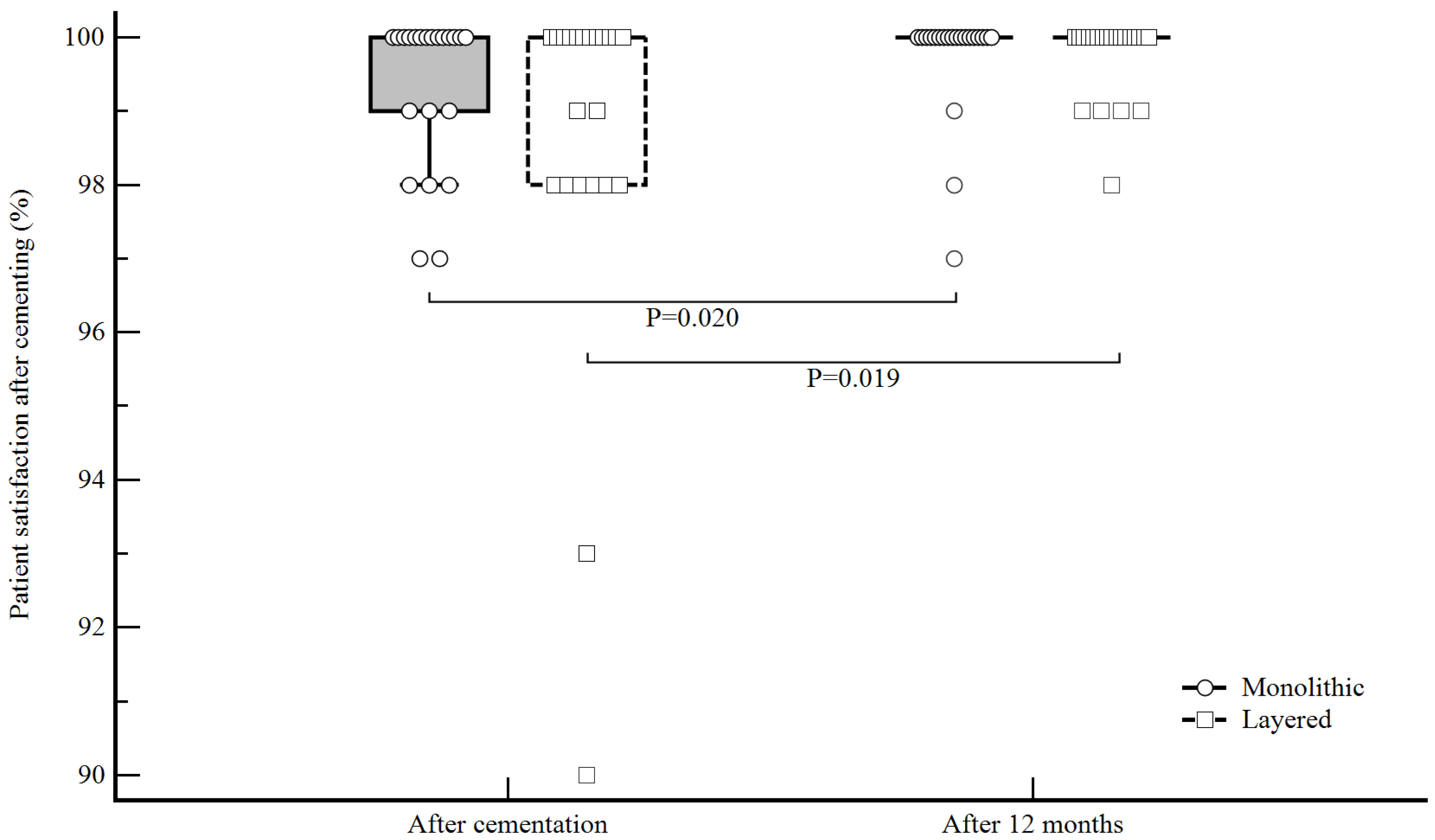
| Group | N | Minimum | Maximum | Percentiles | P | |||
|---|---|---|---|---|---|---|---|---|
| 25th | 50th (Median) | 75th | ||||||
| Patient satisfaction after cementing | Monolithic | 22 | 97.00 | 100.00 | 98.75 | 100.00 | 100.00 | 0.458 |
| Layered | 22 | 90.00 | 100.00 | 98.00 | 100.00 | 100.00 | ||
| Patient satisfaction after 12 months | Monolithic | 22 | 97.00 | 100.00 | 100.00 | 100.00 | 100.00 | 0.578 |
| Layered | 22 | 98.00 | 100.00 | 99.75 | 100.00 | 100.00 | ||
Publisher’s Note: MDPI stays neutral with regard to jurisdictional claims in published maps and institutional affiliations. |
© 2021 by the authors. Licensee MDPI, Basel, Switzerland. This article is an open access article distributed under the terms and conditions of the Creative Commons Attribution (CC BY) license (https://creativecommons.org/licenses/by/4.0/).
Share and Cite
Špehar, D.; Jakovac, M. Clinical Evaluation of Reduced-Thickness Monolithic Lithium-Disilicate Crowns: One-Year Follow-Up Results. Processes 2021, 9, 2119. https://doi.org/10.3390/pr9122119
Špehar D, Jakovac M. Clinical Evaluation of Reduced-Thickness Monolithic Lithium-Disilicate Crowns: One-Year Follow-Up Results. Processes. 2021; 9(12):2119. https://doi.org/10.3390/pr9122119
Chicago/Turabian StyleŠpehar, Davor, and Marko Jakovac. 2021. "Clinical Evaluation of Reduced-Thickness Monolithic Lithium-Disilicate Crowns: One-Year Follow-Up Results" Processes 9, no. 12: 2119. https://doi.org/10.3390/pr9122119
APA StyleŠpehar, D., & Jakovac, M. (2021). Clinical Evaluation of Reduced-Thickness Monolithic Lithium-Disilicate Crowns: One-Year Follow-Up Results. Processes, 9(12), 2119. https://doi.org/10.3390/pr9122119