Mass Spectroscopic Analysis, MNDO Quantum Chemical Studies and Antifungal Activity of Essential and Recovered Oil Constituents of Lemon-Scented Gum against Three Common Molds

 ,
,  and
and 
Abstract
1. Introduction
2. Materials and Methods
2.1. Oil Extraction
2.2. Gas Chromatography–Mass Spectrometry (GC–MS) Analysis of the Oils
2.3. Antifungal Activity of Wood Treated with Oils
2.4. Statistical Analysis
3. Results
3.1. Chemical Composition and Mass Spectrometric Investigations
3.1.1. Chemical Composition of Corymbia Citriodora Leaves and Fruits’ Essential Oils
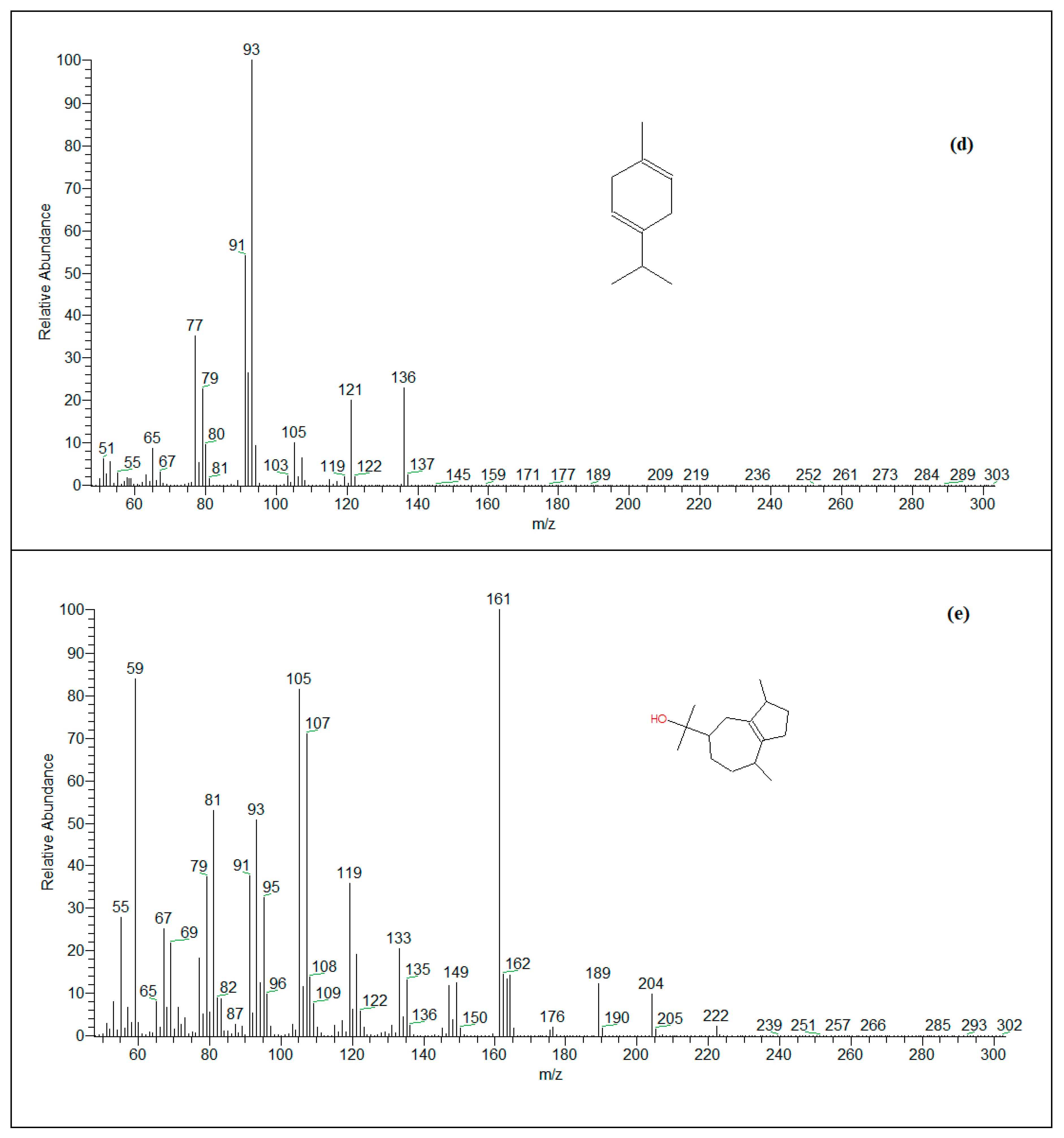
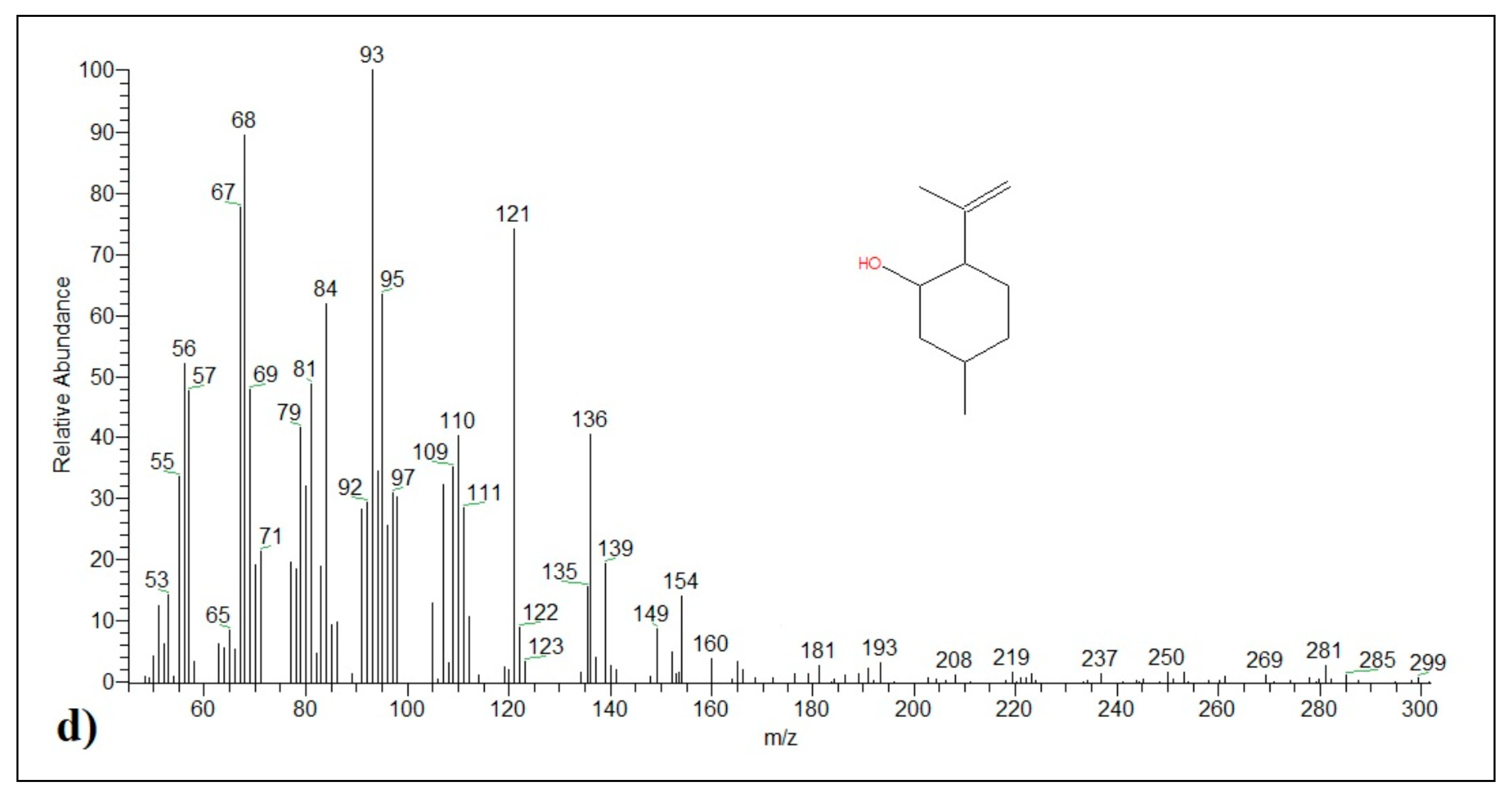
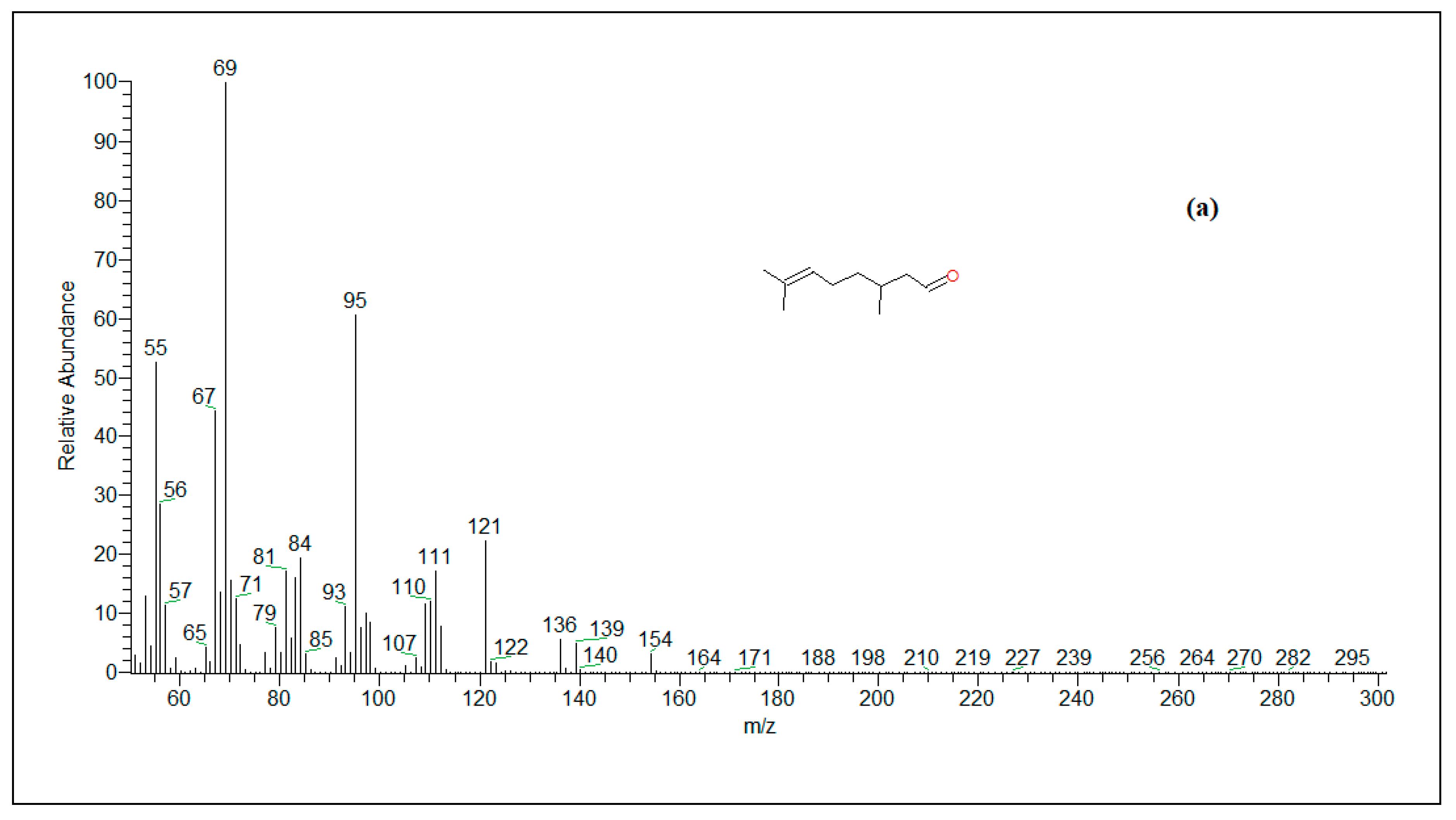
3.1.2. Mass Spectrometric Investigations of the Main Components of Corymbia Citriodora Leaves and Fruits’ Essential Iils
3.1.3. Chemical Composition of Corymbia Citriodora Leaves and Fruits’ Recovery Oils
3.2. Computation Method
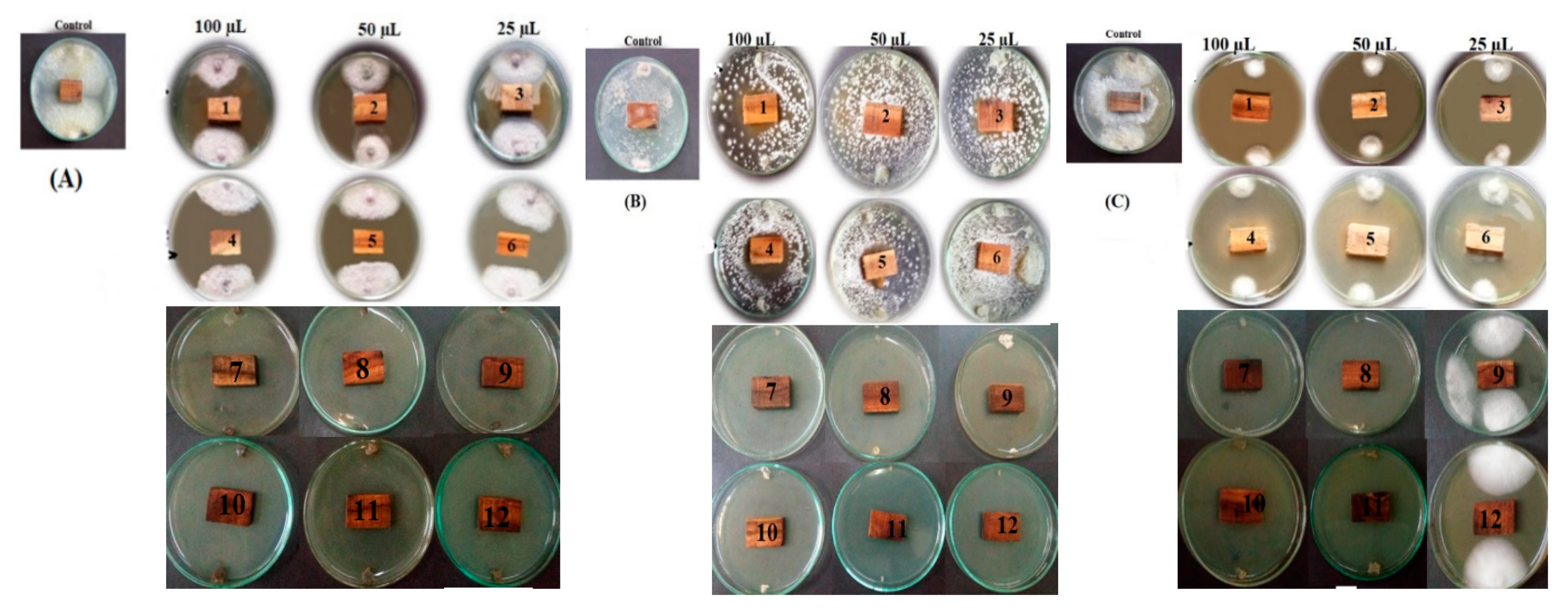
3.3. In Vitro Visual Observations of Dual Fungal Growth Against Oil-Treated Wood
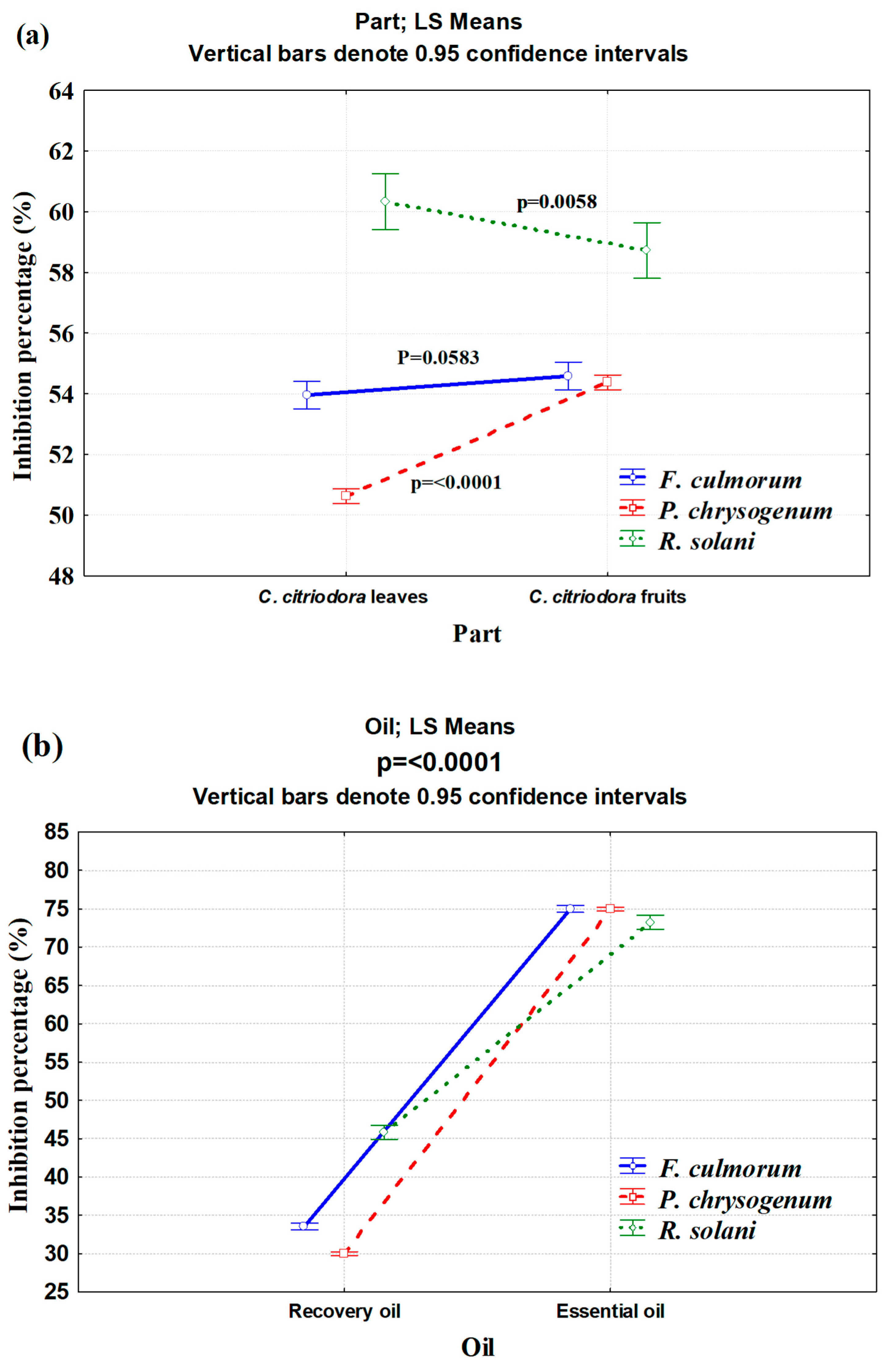
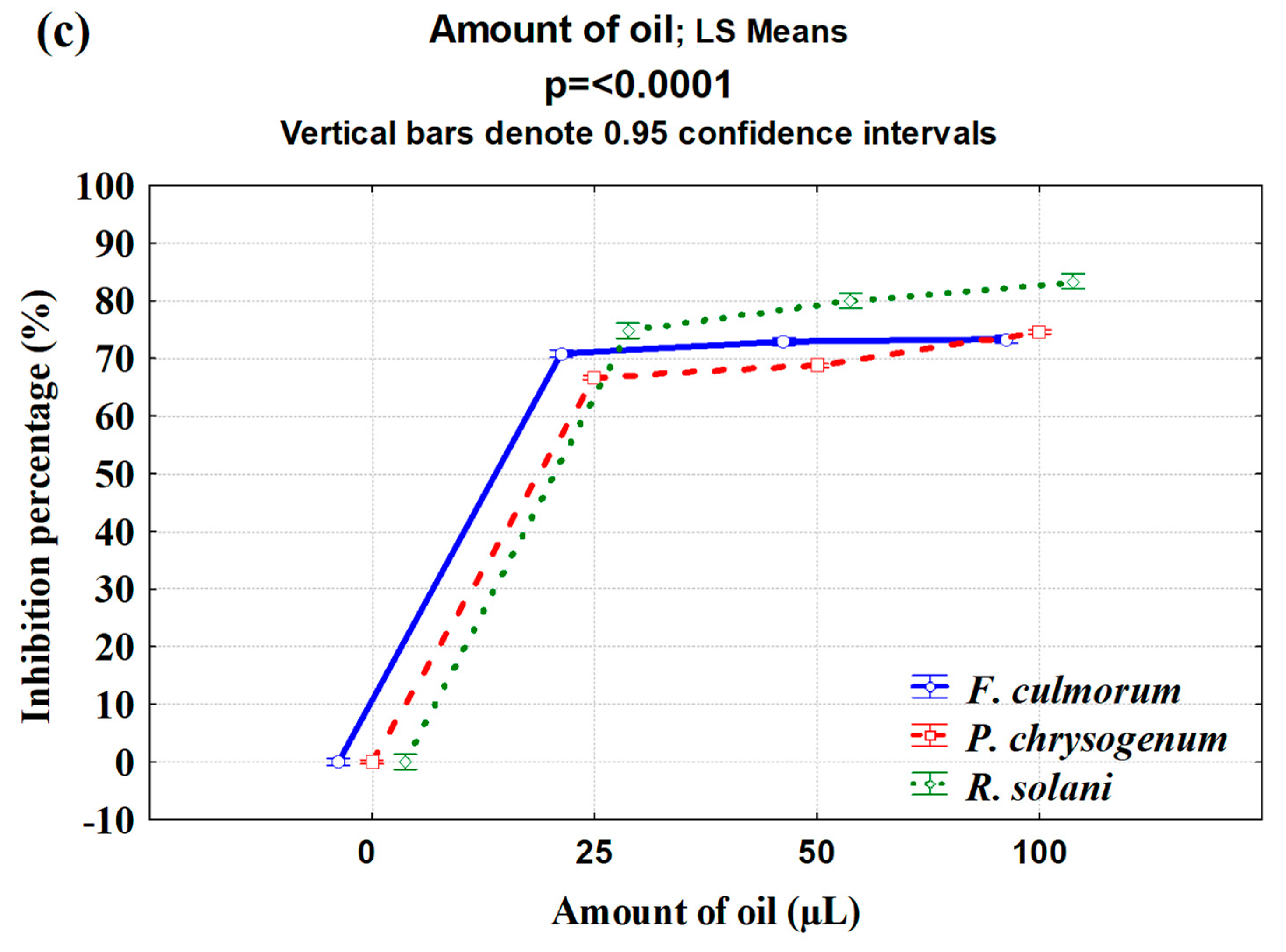
3.4. Antifungal Activity of the Oils
4. Discussion
5. Conclusions
Author Contributions
Funding
Conflicts of Interest
References
- Mansour, M.M.A.; EL-Hefny, M.; Salem, M.Z.M.; Ali, H.M. The Biofungicide activity of some plant essential oils for the cleaner production of model linen fibers similar to those used in ancient egyptian mummification. Processes 2020, 8, 79. [Google Scholar] [CrossRef]
- Salem, M.Z.M.; Hamed, S.A.M.; Mansour, M.M.A. Assessment of efficacy and effectiveness of some extracted bio-chemicals as bio-fungicides on Wood. Drvna Ind. 2019, 70, 337–350. [Google Scholar] [CrossRef]
- Salem, M.Z.M.; Behiry, S.I.; EL-Hefny, M. Inhibition of Fusarium culmorum, Penicillium chrysogenum and Rhizoctonia solani by n-hexane extracts of three plant species as a wood-treated oil fungicide. J. Appl. Microbiol. 2019, 126, 1683–1699. [Google Scholar] [CrossRef] [PubMed]
- Salem, M.Z.M.; Mansour, M.M.A.; Elansary, H.O. Evaluation of the effect of inner and outer bark extracts of Sugar Maple (Acer saccharum var. saccharum) in combination with citric acid against the growth of three common molds. J. Wood Chem. Technol. 2019, 39, 136–147. [Google Scholar] [CrossRef]
- Mohamed, W.A.; Mansour, M.M.A.; Salem, M.Z.M. Lemna gibba and Eichhornia crassipes extracts: Clean alternatives for deacidification, antioxidation and fungicidal treatment of historical paper. J. Clean. Prod. 2019, 219, 846–855. [Google Scholar] [CrossRef]
- EL-Hefny, M.; Abo Elgat, W.A.A.; Al-Huqail, A.A.; Ali, H.M. Essential and recovery oils from Matricaria chamomilla flowers as environmentally friendly fungicides against four fungi isolated from cultural heritage objects. Processes 2019, 7, 809. [Google Scholar] [CrossRef]
- Behiry, S.I.; Okla, M.K.; Alamri, S.A.; EL-Hefny, M.; Salem, M.Z.M.; Alaraidh, I.A.; Ali, H.M.; Al-Ghtani, S.M.; Monroy, J.C.; Salem, A.Z.M. Antifungal and antibacterial activities of Musa paradisiaca L. peel extract: HPLC analysis of phenolic and flavonoid contents. Processes 2019, 7, 215. [Google Scholar] [CrossRef]
- Taha, A.S.; Salem, M.Z.M.; Abo Elgat, W.A.A.; Ali, H.M.; Hatamleh, A.A.; Abdel-Salam, E.M. Assessment of the impact of different treatments on technological and antifungal properties of produced Papyrus (Cyperus papyrus L.) sheets. Materials 2019, 12, 620. [Google Scholar] [CrossRef]
- Al-Huqail, A.A.; Behiry, S.I.; Salem, M.Z.M.; Ali, H.M.; Siddiqui, M.H.; Salem, A.Z.M. Antifungal, antibacterial, and antioxidant activities of Acacia saligna (Labill.) Wendl, H.L. flower extract: HPLC analysis of phenolic and flavonoid compounds. Molecules 2019, 24, 700. [Google Scholar] [CrossRef]
- Dhaliwal, H.J.S.; Thind, T.S.; Chander, M. Relative activity of essential oils from plants against Penicillium digitatum causing post-harvest fruit rot of Kinnow mandarin. Plant Dis. Res. 2004, 19, 140–143. [Google Scholar]
- Fiori, A.C.G.; Schwan-Estrada, K.R.F.; Stangarlin, J.R.; Vida, J.B.; Scapim, C.A.; Cruz, M.E.S. Antifungal activity of leaf extracts and essential oils of some medicinal plants against Didymella bryoniae. J. Phytopathol. 2000, 148, 483–487. [Google Scholar] [CrossRef]
- Lee, O.G.; Choi, G.J.; Jang, K.S.; Lim, H.K.; Cho, K.Y.; Kim, J.C. Antifungal activity of five plant essential oils as fumigant against postharvest and soilborne plant pathogenic fungi. Plant Pathol. J. 2007, 23, 97–102. [Google Scholar] [CrossRef]
- Ramezani, H.; Singh, H.P.; Batish, D.R.; Kohli, R.K. Antifungal activity of the volatile oil of Eucalyptus Citriodora. Fitoter. 2002, 73, 261–262. [Google Scholar] [CrossRef]
- Somda, I.; Leth, V.; Sereme, P. Antifungal effect of Cymbopogon citratus, Eucalyptus camaldulensis and Azadirachta indica oil extracts on Sorghum feedborne fungi. Asian J. Plant Sci. 2007, 6, 1182–1189. [Google Scholar]
- USEPA (United States Environmental Protection Agency) 1993. R.E.D. FACTS. Flower and Vegetable Oils. Available online: http://www.epa.gov/oppsrrd1/REDS/factsheets/4097fact.pdf (accessed on 15 September 1993).
- Sebei, K.; Sakouhi, F.; Herchi, W.; Khouja, M.L.; Boukhchina, S. Chemical composition and antibacterial activities of seven Eucalyptus species essential oils leaves. Biol. Res. 2015, 48, 7. [Google Scholar] [CrossRef] [PubMed]
- Salem, M.Z.M.; Elansary, H.O.; Ali, H.M.; El-Settawy, A.A.; Elshikh, M.S.; Abdel-Salam, E.M.; Skalicka-Woźniak, K. Antibacterial, antifungal, and antioxidant activities of essential oils extracted from Cupressus macrocarpa branchlets and Corymbia citriodora leaves grown in Egypt. BMC Complem. Alter. Med. 2018, 18, 23. [Google Scholar] [CrossRef] [PubMed]
- Batish, D.R.; Singh, H.P.; Kohli, R.K.; Kaur, S. Eucalyptus essential oil as a natural pesticide. For. Ecol. Manag. 2008, 256, 2166–2174. [Google Scholar] [CrossRef]
- Habila, N.; Agbaji, A.S.; Ladan, Z.; Bello, I.A.; Haruna, E.; Dakare, M.A.; Atolagbe, T.O. Evaluation of in vitro activity of essential oils against Trypanosoma brucei brucei and Trypanosoma evansi. J. Parasitol. Res. 2010, 2010, 534601. [Google Scholar] [CrossRef]
- Hussein, H.S.; Salem, M.Z.M.; Soliman, A.M. Repellent, attractive, and insecticidal effects of essential oils from Schinus terebinthifolius fruits and Corymbia citriodora leaves on two whitefly species, Bemisia tabaci and Trialeurodes ricini. Sci. Horticul. 2017, 216, 111–119. [Google Scholar] [CrossRef]
- El-Baha, A.M.; El-Sherbiny, A.A.; Salem, M.Z.M.; Sharrawy, N.M.M.; Mohamed, N.H. Toxicity of essential oils extracted from Corymbia citriodora and Eucalyptus camaldulensis leaves against Meloidogyne incognita under laboratory conditions. Pak. J. Nemat. 2017, 35, 93–104. [Google Scholar] [CrossRef]
- Singh, H.P.; Batish, D.R.; Setia, N.; Kohli, R.K. Herbicidal activity of volatile oils from Eucalyptus citriodora against Parthenium hysterophorus. Ann. App. Biol. 2005, 146, 89–94. [Google Scholar] [CrossRef]
- Singh, H.P.; Kaur, S.; Negi, K.; Kumari, S.; Saini, V.; Batish, D.R.; Kohli, R.K. Assessment of in vitro antioxidant activity of essential oil of Eucalyptus citriodora (lemon-scented Eucalypt; Myrtaceae) and its major constituents. LWT Food Sci. Technol. 2012, 48, 237–241. [Google Scholar] [CrossRef]
- Low, D.; Rawal, B.D.; Griffin, W.J. Antibacterial action of the essential oils of some Australian Myrtaceae with special references to the activity of chromatographic fractions of oil of Eucalyptus citriodora. Planta Med. 1974, 26, 184–189. [Google Scholar] [CrossRef] [PubMed]
- AidiWannes, W.; Mhamdi, B.; Sriti, J.; Ben Jemia, M.; Ouchikh, O.; Hamdaoui, G.; Kchouk, M.E.; Marzouk, B. Antioxidant activities of the essential oils and methanol extracts from myrtle (Myrtus communis var. italica L.) leaf, stem and flower. Food Chem. Tox. 2010, 48, 1362–1370. [Google Scholar] [CrossRef] [PubMed]
- Abd EI-Mageed, A.A.; Osman, A.K.; Tawfik, A.Q.; Mohammed, H.A. Chemical composition of the essential oils of four eucalyptus species (Myrtaceae) from Egypt. Res. J. Phytochem. 2011, 5, 115–122. [Google Scholar]
- Batish, D.R.; Singh, H.P.; Setia, N.; Kaur, S.; Kohli, R.K. Chemical composition and inhibitory activity of essential oil from decaying leaves of Eucalyptus citriodora. Z Naturforsch C 2006, 61, 465–471. [Google Scholar] [CrossRef] [PubMed]
- Mittal, A.; Ali, M. Volatile composition of the leaves of Eucalyptus citriodora Hook. Int. J. Res. Ayurveda Pharm. 2011, 2, 509–511. [Google Scholar]
- Delaquis, P.J.; Stanich, K.; Girard, B.; Mazza, G. Antimicrobial activity of individual and mixed fractions of dill, cilantro, coriander and eucalyptus essential oils. Int. J. Food Microbiol. 2002, 74, 101–109. [Google Scholar] [CrossRef]
- Elaissi, A.; Salah, K.H.; Mabrouk, S.; Larbi, K.M.; Chemli, R.; Harzallah-Skhiri, F. Antibacterial activity and chemical composition of 20 Eucalyptus species’ essential oils. Food Chem. 2011, 129, 1427–1434. [Google Scholar] [CrossRef]
- Fahed, L.; Khoury, M.; Stien, D.; Ouaini, N.; Eparvier, V.; El Beyrouthy, M. Essential oils composition and antimicrobial activity of six conifers harvested in Lebanon. Chem. Biodivers. 2017, 14. [Google Scholar] [CrossRef]
- Okla, M.K.; Alamri, S.A.; Salem, M.Z.M.; Ali, H.M.; Behiry, S.I.; Nasser, R.A.; Alaraidh, I.A.; Al-Ghtani, S.M.; Soufan, W. Yield, phytochemical constituents, and antibacterial activity of essential oils from the leaves/twigs, branches, branch wood, and branch bark of Sour Orange (Citrus aurantium L.). Processes 2019, 7, 363. [Google Scholar] [CrossRef]
- NIST/EPA/NIH Mass. Spectral Library (NIST 14) and NIST Mass Spectral Search Program (Version 2.0g) May 2014. Available online: https://www.sisweb.com/software/ms/nist.htm (accessed on 5 March 2019).
- Mansour, M.M.A.; Salem, M.Z.M. Evaluation of wood treated with some natural extracts and Paraloid B-72 against the fungus Trichoderma harzianum: Wood elemental composition, In-vitro and application evidence. Inter. Biodeterior. Biodegrad. 2015, 100, 62–69. [Google Scholar] [CrossRef]
- Mansour, M.M.A.; Abdel-Meged, A.; Nasser, R.A.; Salem, M.Z.M. Comparative evaluation of some woody trees methanolic extracts and Paraloid B-72 against phytopathogenic mold fungi Alternaria tenuissima and Fusarium culmorum. BioRes 2015, 10, 2570–2584. [Google Scholar] [CrossRef]
- Salem, M.Z.M.; Zidan, Y.E.; Mansour, M.M.A.; El Hadidi, N.M.N.; Abo Elgat, W.A.A. Evaluation of usage three natural extracts applied to three commercial wood species against five common molds. Int. Biodeterior. Biodegrad. 2016, 110, 206–226. [Google Scholar] [CrossRef]
- Salem, M.Z.M.; Zidan, Y.E.; Mansour, M.M.A.; El Hadidi, N.M.N.; Abo Elgat, W.A.A. Antifungal activities of two essential oils used in the treatment of three commercial woods deteriorated by five common mold fungi. Int. Biodeterior. Biodegrad. 2016, 106, 88–96. [Google Scholar] [CrossRef]
- SAS. User Guide: Statistics (Release 8.02); SAS Institute: Cary, NC, USA, 2001. [Google Scholar]
- Abd El-Kareem, M.S.M.; Rabbih, M.A.; Elansary, H.O.; Al-Mana, F.A. Mass spectral fragmentation of Pelargonium graveolens essential oil using GC–MS semi-empirical calculations and biological potential. Processes 2020, 8, 128. [Google Scholar] [CrossRef]
- Abd El-Kareem, M.S.M.; El-desawy, M.; Hawash, M.F.; Fahmey, M.A. Structural investigation of sparfloxacin drug using mass spectrometry and MNDO semi-empirical molecular orbital calculations. Inter. J. Advan. Chem. 2018, 6, 74–78. [Google Scholar] [CrossRef]
- Abd El-Kareem, M.S.M.; Rabbih, M.A.; Selim, E.T.M. Semi-empirical and HOMO, LUMO studies of some chlorinated pesticides compounds. Commun. Comput. Chem. 2018, 6, 1–12. [Google Scholar] [CrossRef]
- Abd El-kareem, M.S.M.; Rabbih, M.A.E.-F.; Selim, E.T.M.; Elsherbiny, E.A.E.-M.; El-Khateeb, A.Y. Application of GC/EIMS in combination with semi-empirical calculations for identification and investigation of some volatile components in basil essential oil. Int. J. Anal. Mass Spectrom. Chromatogr. 2016, 4, 14–25. [Google Scholar] [CrossRef]
- Ashmawy, N.A.; Salem, M.Z.M.; EL-Hefny, M.; Abd El-Kareem, M.S.M.; El-Shanhorey, N.A.; Mohamed, A.A.; Salem, A.Z.M. Antibacterial activity of the bioactive molecules identified in three woody plants against some pathogenic bacteria. Microb. Pathog. 2018, 121, 331–340. [Google Scholar] [CrossRef]
- McLafferty, F.W.; Tureček, F. Interpretation of Mass Spectra: University Science Books; University Science Books: Mill Valley, CA, USA, 1993. [Google Scholar]
- Gemperline, E.; Keller, C.; Li, L. Mass Spectrometry in Plant-omics. Anal. Chem. 2016, 88, 3422–3434. [Google Scholar] [CrossRef] [PubMed]
- Jang, M.; Kim, J.; Yoon, K.A.; Lee, S.H.; Park, C.G. Biological activity of Myrtaceae plant essential oils and their major components against Drosophila suzukii (Diptera: Drosophilidae). Pest Manag. Sci. 2017, 73, 404–409. [Google Scholar] [CrossRef] [PubMed]
- Maciel, M.V.; Morais, S.M.; Bevilaqua, C.M.L.; Silva, R.A.; Barros, R.S.; Sousa, R.N.; Sousa, L.C.; Brito, E.S.; Souza-Neto, M.A. Chemical composition of Eucalyptus spp. essential oils and their insecticidal effects on Lutzomyia longipalpis. Vet. Parasitol. 2010, 167, 1–7. [Google Scholar] [CrossRef] [PubMed]
- Bossou, A.D.; Ahoussi, E.; Ruysbergh, E.; Adams, A.; Smagghe, G.; De Kimpe, N.; Avlessi, F.; Sohounhloue, D.C.K.; Mangelinckx, S. Characterization of volatile compounds from three Cymbopogon species and Eucalyptus citriodora from Benin and their insecticidal activities against Tribolium castaneum. Ind. Crops Prod. 2015, 76, 306–317. [Google Scholar] [CrossRef]
- Matasyoh, J.C.; Kiplimo, J.J.; Karubiu, N.M.; Hailstorks, T.P. Chemical composition and antimicrobial activity of essential oil of Tarchonanthus camphorates. Food Chem. 2007, 101, 1183–1187. [Google Scholar] [CrossRef]
- Peana, A.T.; D’Aquila, P.S.; Chessa, M.L.; Moretti, M.D.L.; Serra, G.; Pippia, P. (−)-Linalool produces antinociception in two experimental models of pain. Eur. J. Pharmacol. 2003, 460, 37–41. [Google Scholar] [CrossRef]
- Jeongmok, K.; Marshall, M.R.; Cheng, I.W. Antibacterial activity of some essential oil components against five foodborne pathogens. J. Agric. Food Chem. 1995, 43, 2839–2845. [Google Scholar]
- Magiatis, P.; Skaltsounis, A.L.; Chinou, I.; Haroutounian, S.A. Chemical composition and in vitro antimicrobial activity of the essential oils of three Greek Achillea species. Z. Naturforsch C 2002, 57, 287. [Google Scholar] [CrossRef]
- Javed, S.; Shoaib, A.; Mahmood, Z.; Mushtaq, S.; Iftikhar, S. Analysis of phyto-chemical constituents of Eucalyptus citriodora L. responsible for anti-fungal activity against post-harvest fungi. Nat. Prod. Res. 2012, 26, 1732–1736. [Google Scholar] [CrossRef]
- Shrishti, L.; Vishwanath, S.A.; Vandana, A. Plant essential oils for the management of Rhizoctonia solani causing sheath blight of paddy. Trends Biosci. 2014, 7, 1870–1873. [Google Scholar]
- Ramezani, H.; Singh, H.P.; Batish, D.R.; Kohli, R.K.; Dargan, J.S. Fungicidal effect of volatile oils from Eucalyptus citriodora and its major constituent citronellal. N. Z. Plant Prot. 2002, 327, 327–330. [Google Scholar] [CrossRef]
- Nakahara, K.; Alzoreky, N.S.; Yoshihashi, T.; Nguyen, H.T.T.; Trakoontivakorn, G. Chemical composition and antifungal activity of essential oil from Cymbopogon nardus (Citronella Grass). Jpn. Agric. Res. Q. 2003, 37, 249–252. [Google Scholar] [CrossRef]
- Mohamed, A.A.; Behiry, S.I.; Younes, H.A.; Ashmawy, N.A.; Salem, M.Z.M.; Márquez-Molina, O.; Barbabosa-Pilego, A. Antibacterial activity of three essential oils and some monoterpenes against Ralstonia solanacearum phylotype II isolated from potato. Microb. Pathog. 2019, 135, 103604. [Google Scholar] [CrossRef] [PubMed]
- Oreopoulou, A.; Papavassilopoulou, E.; Bardouki, H.; Vamvakias, M.; Bimpilas, A.; Oreopoulou, V. Antioxidant recovery from hydrodistillation residues of selected Lamiaceae species by alkaline extraction. J. Appl. Res. Med. Arom. Plants 2018, 8, 83–89. [Google Scholar] [CrossRef]
- Rajeswara Rao, B.R.; Kaul, P.N.; Bhattacharya, A.K.; Rajput, D.K.; Syamasundar, K.V.; Ramesh, S. Comparative chemical composition of steam-distilled and water-soluble essential oils of south american marigold (Tagetes minuta L.). J. Essent. Oil Res. 2006, 18, 622–626. [Google Scholar] [CrossRef]
- Sicari, V.; Poiana, M. Essential oil recovery from bergamot juice by supercritical and liquid carbon dioxide. Int. Food Res. J. 2017, 24, 2116–2121. [Google Scholar]


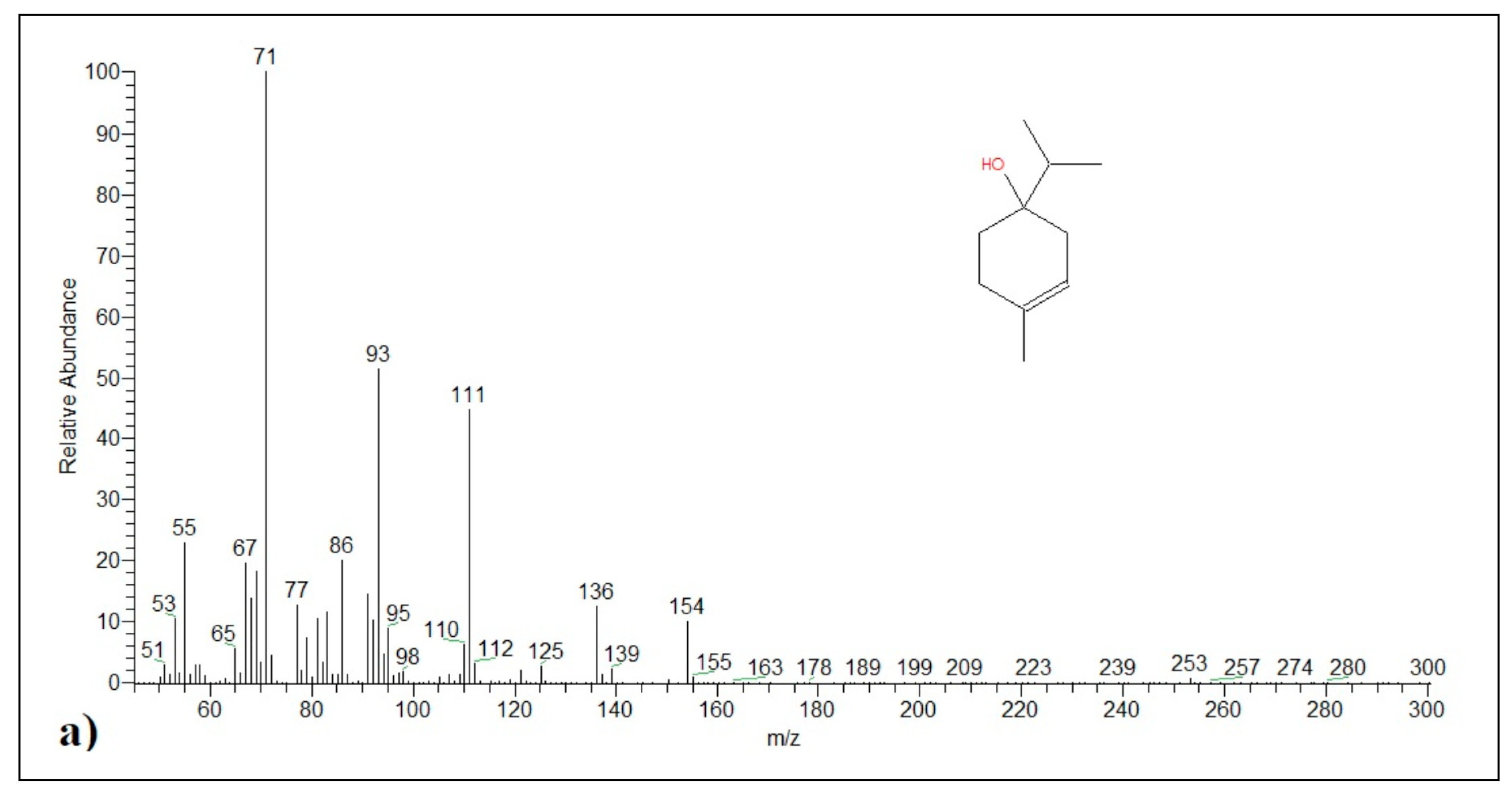
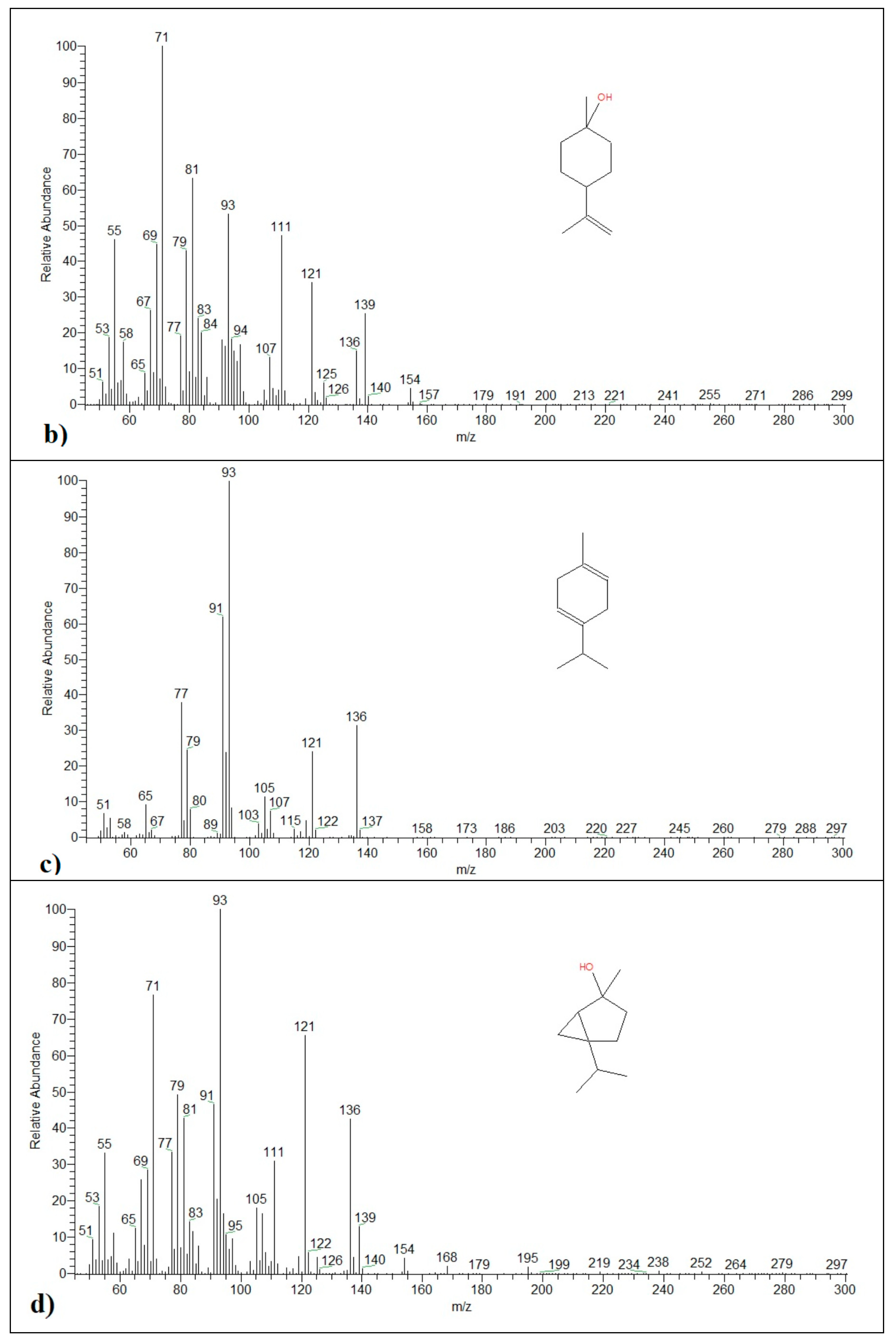


| No. | RT 1 | Compound Name | Molecular Formula | MW 2 | Peak Area % | SI 3 | RSI 4 | Most Fragment Ions with RI* (%) |
|---|---|---|---|---|---|---|---|---|
| 1 | 4.24 | 5-Octen-2-one, 6-methyl- | C9H16O | 140 | 0.58 | 702 | 705 | 140(10%), 111(50%), 82(60%), 69(65%) and 67(100%) |
| 2 | 4.65 | β-Pinene | C10H16 | 136 | 0.49 | 845 | 920 | 136(10%), 93(100%), 79(60%) and 69(100%) |
| 3 | 6.49 | D-Limonene | C10H16 | 136 | 0.63 | 843 | 963 | 136(10%), 93(60%), 79(40%) and 68(100%) |
| 4 | 6.70 | Eucalyptol | C10H18O | 154 | 1.33 | 895 | 913 | 154(30%), 139(32%), 111(36%), 108(56%), 93(76%), 81(100%), 71(80%) and 55(60%) |
| 5 | 7.57 | Sabinene | C10H16 | 136 | 0.31 | 796 | 800 | 136(25%), 121(22%), 93(100%) and 77(42%) |
| 6 | 10.27 | Melonal | C9H16O | 140 | 0.47 | 797 | 879 | 140(5%), 139(10%), 82(100%) and 67(85%) |
| 7 | 13.63 | Citronellal | C10H18O | 154 | 55.31 | 951 | 951 | 154(5%), 136(10%), 95(60%), 84(20%), 69(100%) and 55(60%) |
| 8 | 15.21 | Linalool | C10H18O | 154 | 0.71 | 879 | 920 | 154(3%), 121(20%), 93(56%), 80(32%), 71(100%) and 55(62%) |
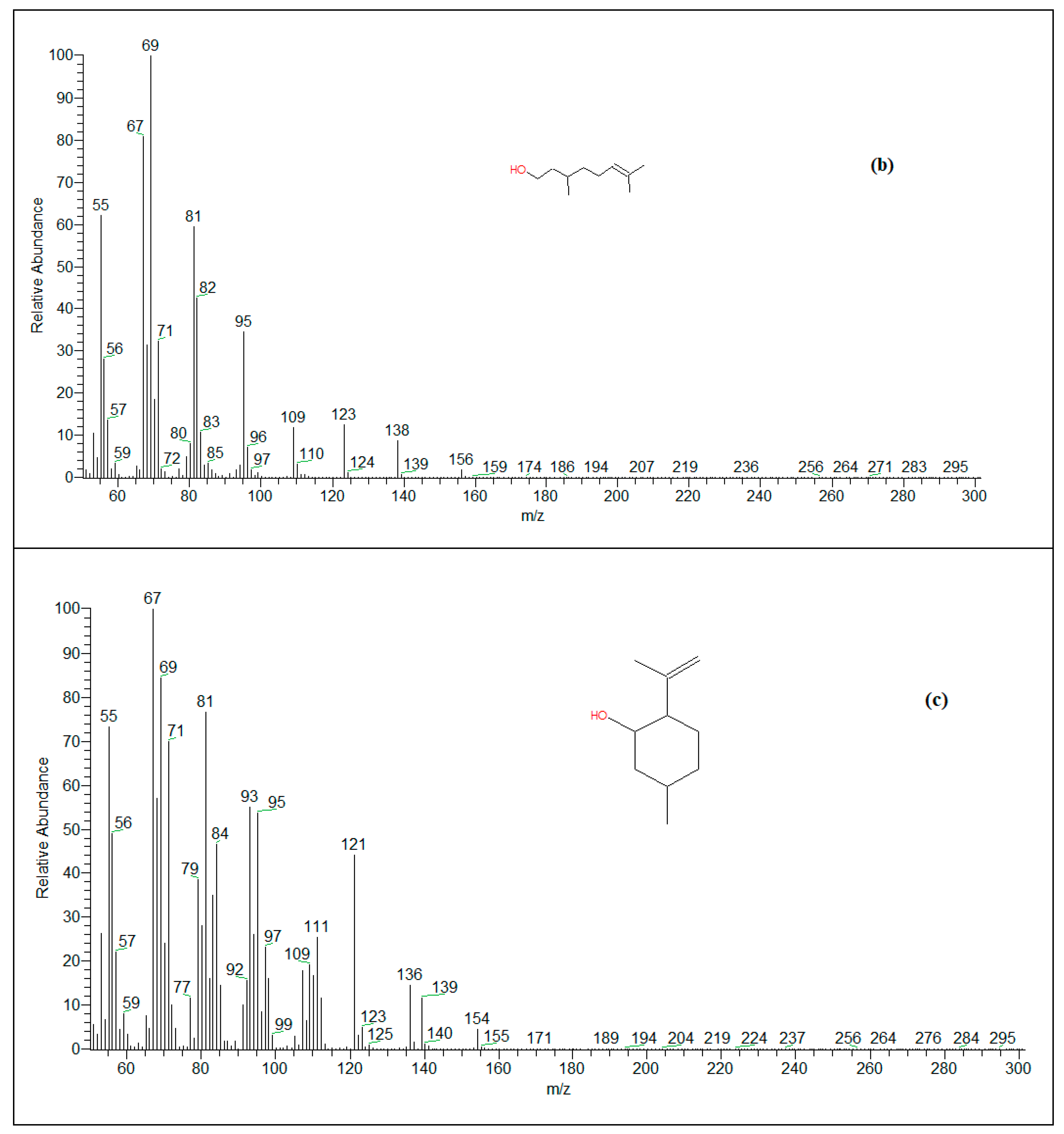
| 9 | 15.77 | Isopulegol | C10H18O | 154 | 10.79 | 920 | 949 | 154(5%), 121(56%), 95(57%), 84(60%), 67(100%) and 55(72%) |
| 10 | 16.45 | Caryophyllene | C15H24 | 204 | 1.32 | 879 | 940 | 204 (3%), 189(12%), 161(22%), 133(46%), 105(59%), 93 (86%) and 69(100%) |
| 11 | 17.99 | Citronellol acetate | C12H22O2 | 198 | 2.31 | 885 | 926 | 138(20%), 123(35%), 95(60%), 81(100%), 67(80%) and 55(42%) |
| 12 | 18.80 | α-Terpineol | C10H18O | 154 | 0.71 | 820 | 853 | 154(2%), 136(22%), 121(25%), 93(45%), 81(40%) and 59(100%) |
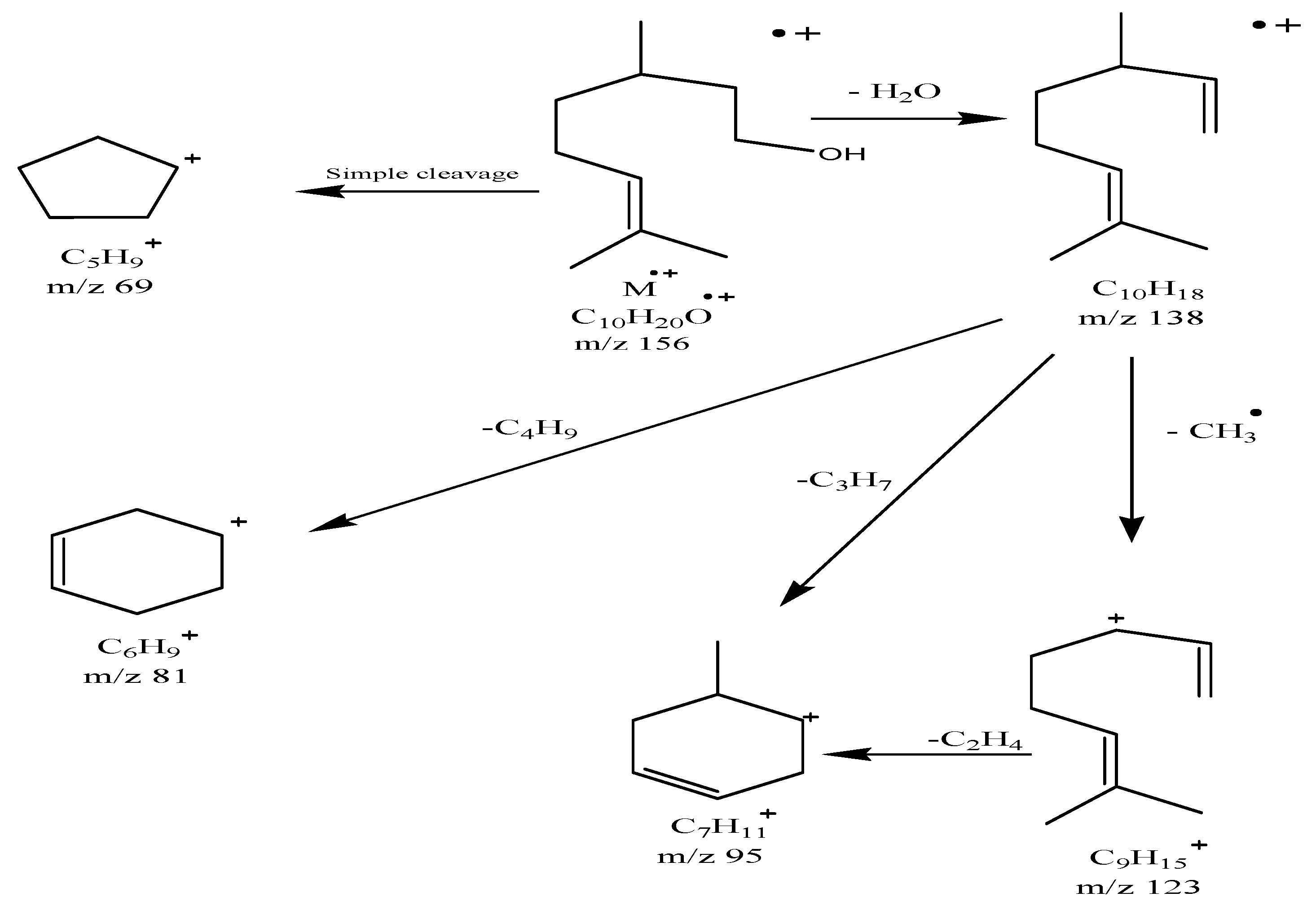
| 13 | 20.39 | Citronellol | C10H20O | 156 | 21.03 | 913 | 922 | 156(3%), 138(12%), 123(15%), 95(43%), 81(65%), 69(100%), 67(95%) and 55(62%) |
| 14 | 30.19 | Citronellic acid | C10H18O2 | 170 | 2.08 | 733 | 780 | 170(5%), 152(12%), 110(36%), 95(50%), 69(100%) and 55(52%) |
| No. | RT 1 | Compound Name | Molecular Formula | MW 2 | Peak Area % | SI 3 | RSI 4 | Most Fragment Ions with RI* (%) |
|---|---|---|---|---|---|---|---|---|
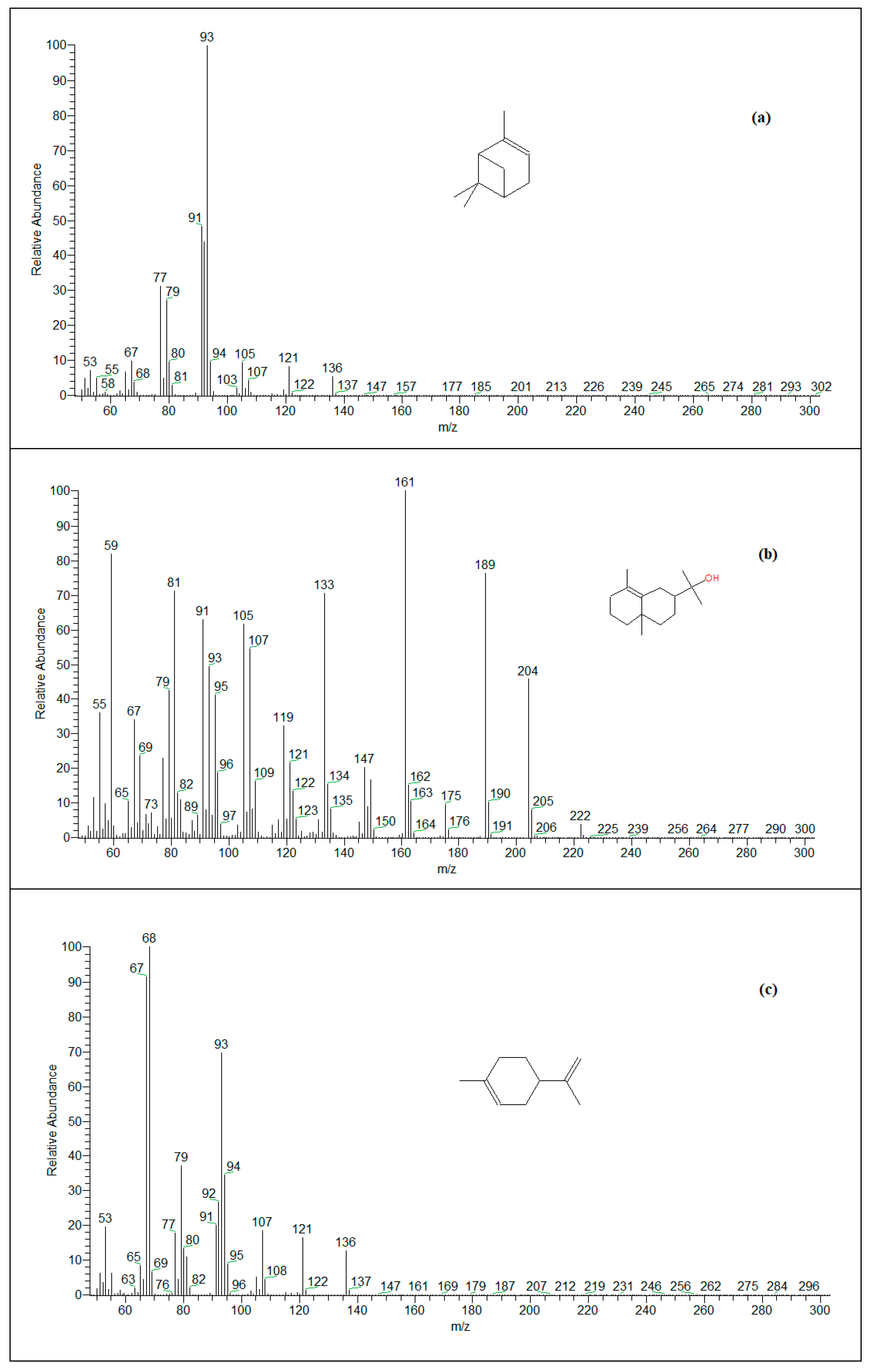
| 1 | 3.47 | α-Pinene | C10H16 | 136 | 17.86 | 965 | 966 | 136 (10%), 93(100%), and 77(40%) |
| 2 | 3.90 | Camphene | C10H16 | 136 | 0.38 | 789 | 916 | 136 (9%), 93(100%), and 79(82%) |
| 3 | 4.72 | β-Pinene | C10H16 | 136 | 9.92 | 951 | 951 | 136 (8%), 93 (100%), 79 (25%), and 69 (40%) |
| 4 | 5.79 | β-Myrcene | C10H16 | 136 | 0.55 | 892 | 923 | 136 (8%), 93(100%), and 69(80%) |
| 5 | 6.59 | Limonene | C10H16 | 136 | 9.19 | 937 | 938 | 136 (15%), 121(20%), 93(70%), and 68(100%) |
| 6 | 7.67 | γ-Terpinene | C10H16 | 136 | 8.21 | 939 | 948 | 136 (25%), 121(21%), 93 (100%) and 77 (40%) |
| 7 | 8.22 | β-Cymene | C10H14 | 134 | 5.35 | 935 | 948 | 134 (23%), 119 (100%) and 91 (40%) |
| 8 | 8.52 | α-Terpinene | C10H16 | 136 | 1.74 | 912 | 918 | 136 (35%), 121(70%), 93(100%), and 79(32%) |
| 9 | 13.52 | β-Citronellal | C10H18O | 154 | 0.84 | 896 | 923 | 154 (2%), 121 (20%), 95 (50%), 69 (100%) and 55 (50%) |
| 10 | 14.84 | α-Gurjunene | C15H24 | 204 | 0.47 | 885 | 900 | 204 (33%), 189 (30%), 161 (50%), 133(40%), 119(52%), 105(100%), 91(70%) and 81 (40%) |
| 11 | 15.21 | Linalool | C10H18O | 154 | 0.18 | 880 | 930 | 154 (2%), 121 (20%), 93 (60%), 71 (100%) and 55 (62%) |
| 12 | 15.55 | Isopulegol | C10H18O | 154 | 0.99 | 891 | 944 | 154 (10%), 121 (52%), 93 (60%), 71 (90%) and 67 (100%) |
| 13 | 16.03 | Fenchol | C10H18O | 154 | 0.35 | 898 | 923 | 154 (2%), 121 (10%), 93 (20%), 81(100%) and 69 (35%) |
| 14 | 16.47 | Caryophyllene | C15H24 | 204 | 3.72 | 934 | 940 | 204 (2%), 189(10%), 161(20%), 133(45%), 105(60%), 93 (90%) and 69(100%) |
| 15 | 16.54 | Eucalyptol | C10H18O | 154 | 2.06 | 861 | 863 | 154 (12%), 139 (11%), 93 (100%), 81 (52%) and 71 (42%) |
| 16 | 17.99 | (+)-Menthol | C10H20O | 156 | 1.08 | 867 | 928 | 156 (2%), 123 (40%), 95(62%), 81 (100%) and 67 (82%) |
| 17 | 18.82 | (-)-β-Fenchol | C10H18O | 154 | 4.29 | 919 | 929 | 154 (1%), 136 (20%), 121(42%), 93 (60%) and 59(100%) |
| 18 | 19.65 | Lepidozene | C15H24 | 204 | 0.57 | 895 | 910 | 204 (5%), 121(85%), 107(60%), 93(100%), 79(60%) and 67(40%) |
| 19 | 20.37 | Citronellol | C10H20O | 156 | 1.49 | 930 | 936 | 156(5%), 138(12%), 81(60%), 69(100%), 67(82%) and 55(65%) |
| 20 | 21.85 | Calamenen | C15H22 | 202 | 0.74 | 914 | 941 | 202(5%), 159(100%), 131(21%), and 105(15%) |
| 21 | 23.10 | Benzyl isovalerate | C12H16O2 | 192 | 0.61 | 885 | 938 | 192(15%), 108(80%), 91(100%), and 57(42%) |
| 22 | 24.22 | Caryophyllene oxide | C15H24O | 220 | 1.00 | 899 | 923 | 220(5%), 164(34%), 149(40%), 122(60%), 110(45%), 93(60%), 79(100%) and 55(60%) |
| 23 | 26.89 | Globulol | C15H26O | 222 | 1.11 | 871 | 887 | 222(5%), 161(40%), 121(42%), 109(80%), 93(62%), 81(100%), 69(95%) and 55(63%) |
| 24 | 27.01 | Hedycaryol | C15H26O | 222 | 3.23 | 940 | 951 | 222(3%), 161(40%), 121(32%), 107(43%), 93(66%) and 59(100%) |
| 25 | 27.19 | Guaiol | C15H26O | 222 | 7.88 | 908 | 910 | 222(3%), 189(20%), 161(100%), 119(40%), 105(82%), 81(60%) and 59(85%) |
| 26 | 28.71 | Eudesmol | C15H26O | 222 | 13.89 | 915 | 930 | 222(3%), 189(65%), 161(100%), 133(68%), 107(62%), 91(65%) and 59(83%) |
| 27 | 32.16 | Farnesol | C15H26O | 222 | 0.68 | 830 | 863 | 222(3%), 161(5%), 93(20%), 81(30%) and 69(100%) |
| No. | RT 1 | Compound Name | Molecular Formula | MW 2 | Peak Area % | SI 3 | RSI 4 | Most Fragment Ions with RI* (%) |
|---|---|---|---|---|---|---|---|---|
| 1 | 5.30 | Ethriol | C6H14O3 | 134 | 0.78 | 661 | 916 | 134 (5%), 86 (40%) and 57 (100%) |
| 2 | 5.58 | α-Phellandrene | C10H16 | 136 | 0.19 | 707 | 750 | 136 (20%), 93 (100%), 77 (38%) and 57 (85%) |
| 3 | 5.78 | α-Pinene | C10H16 | 136 | 2.76 | 904 | 918 | 136 (15%), 93 (100%), 77 (25%) and 57 (10%) |
| 4 | 6.83 | Ocimene | C10H16 | 136 | 0.12 | 692 | 767 | 136 (20%), 93 (92%), 77 (40%) and 57 (100%) |
| 5 | 6.98 | β-Pinene | C10H16 | 136 | 2.40 | 896 | 951 | 136 (18%), 93 (100%) 121(20%), 69(35%) and 57 (15%) |
| 6 | 7.78 | 3-Carene | C10H16 | 136 | 1.33 | 740 | 862 | 136 (22%), 93 (100%), 77 (25%) and 57 (60%) |
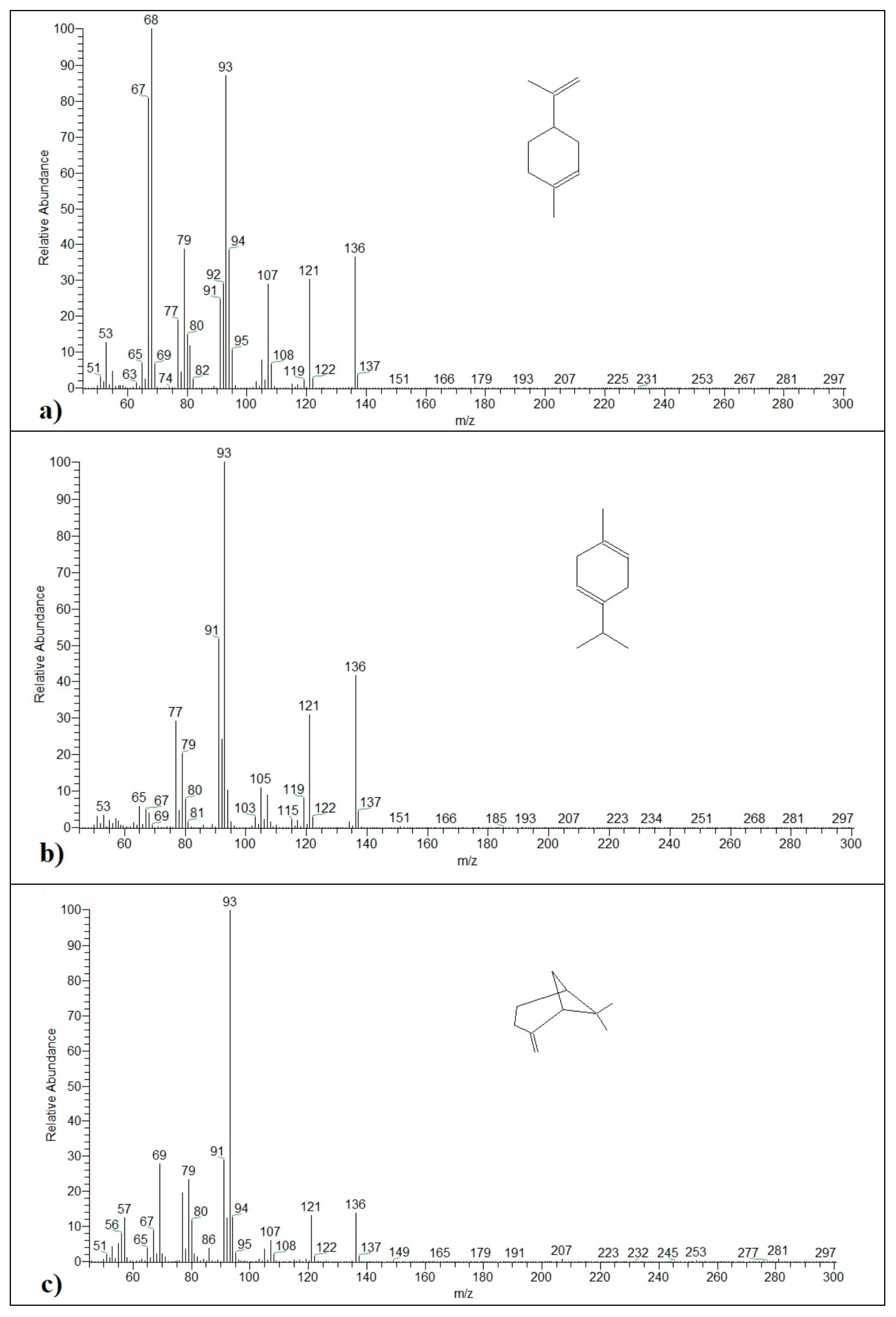
| 7 | 8.40 | D-Limonene | C10H16 | 136 | 70.23 | 922 | 923 | 136 (40%), 121 (35%), 93 (85%), 79 (42%) and 68 (100%) |
| 8 | 9.25 | γ-Terpinen | C10H16 | 136 | 13.58 | 934 | 938 | 136 (45%), 121 (40%), 93 (100%), and 77(25%) |
| 9 | 12.43 | Isopregol | C10H18O | 154 | 2.23 | 705 | 755 | 154 (20%), 121 (60%), 93 (100%), 79 (45%) and 68 (85%) |
| 10 | 13.65 | Grandlure II | C10H18O | 154 | 0.50 | 679 | 838 | 154 (5%), 121 (62%), 93 (100%), 78 (40%) and 59 (42%) |
| 11 | 15.07 | 2,6,10-Trimethyl-dodecane | C15H32 | 212 | 1.80 | 725 | 786 | 212 (2%), 133 (35%), 85 (65%), 71 (90%) and 57 (100%) |
| 12 | 19.24 | 8,8-dimethyl-2,4-di(propan-2-ylidene)bicyclo[5.1.0]octan-6-one | C16H24O | 232 | 0.12 | 708 | 775 | 232 (5%), 189 (40%), 150 (45%), 133 (100%) and 105 (70%) |
| 13 | 20.34 | 3-[2-(1,2,3,4-tetrahydronaphthalen-2-ylmethyl)phenyl]propanoic acid | C20H22O2 | 294 | 2.12 | 643 | 746 | 294 (6%), 165 (100%), 129 (97%), 105 (90%) and 75 (80%) |
| 14 | 24.25 | 2-[4-methyl-6-(2,6,6-trimethylcyclohex-1-enyl)hexa-1,3,5-trienyl]cyclohex-1-en-1-carboxaldehyde | C23H32O | 324 | 0.25 | 733 | 767 | 324(2%), 150 (55%), 126 (65%), 97 (100%) and 69 (50%) |
| 15 | 29.33 | 1-Hexacosene | C26H52 | 364 | 1.32 | 770 | 793 | 364 (3%), 125 (40%), 111 (45%), 97 (80%), 85 (80%) and 71 (100%) |
| No. | RT 1 | Compound Name | Molecular Formula | MW 2 | Peak Area % | SI 3 | RSI 4 | Most Fragment Ions with RI* (%) |
|---|---|---|---|---|---|---|---|---|
| 1 | 7.26 | α-Phellandrene | C10H16 | 136 | 0.84 | 136 (13%), 93 (100%), 77 (50%), and 65 (10%) | ||
| 2 | 7.57 | α-Pinene | C10H16 | 136 | 1.00 | 136 (10%), 93(100%), and 77(40%) | ||
| 3 | 9.03 | Sabinene | C10H16 | 136 | 4.74 | 865 | 896 | 136 (20%), 93(100%), and 77(45%) |
| 4 | 10.43 | Terpinolene | C10H16 | 136 | 3.77 | 813 | 866 | 136 (42%), 121(85%), 93(100%), and 77(45%) |
| 5 | 10.82 | D-Limonene | C10H16 | 136 | 14.75 | 896 | 914 | 136 (40%), 121 (30%), 93(90%), and 68(100%) |
| 6 | 11.09 | Ocimene | C10H16 | 136 | 0.90 | 763 | 870 | 136 (25%), 121 (15%), 93(100%), and 77(40%) |
| 7 | 11.22 | m-Cymene | C10H14 | 134 | 3.51 | 823 | 937 | 136 (22%), 119(100%), and 91(40%) |
| 8 | 11.90 | γ-Terpinene | C10H16 | 136 | 7.42 | 879 | 950 | 136 (30%), 121 (25%), 93(100%), and 77(45%) |
| 9 | 12.80 | trans-4-Thujanol | C10H18O | 154 | 6.30 | 827 | 920 | 154 (10%), 121 (65%), 93 (92%), 71 (100%) and 55(45%) |
| 10 | 13.61 | Linalool | C10H18O | 154 | 1.64 | 680 | 789 | 154 (2%), 121 (25%), 93 (78%), 71 (100%) and 55 (75%) |
| 11 | 14.01 | cis-β-Terpineol | C10H18O | 154 | 19.33 | 913 | 951 | 154 (3%), 121 (35%), 93 (55%), 81 (65%) and 71 (100%) |
| 12 | 16.61 | 4-Terpineol | C10H18O | 154 | 21.35 | 885 | 927 | 154 (15%), 111 (50%), 93 (58%), 71 (100%) and 55 (25%) |
| 13 | 17.33 | α-Terpineol (P-menth-1-en-8-ol) | C10H18O | 154 | 4.70 | 693 | 834 | 154 (2%), 121 (55%), 93 (65%), 81 (45%) and 59 (100%) |
| 14 | 17.74 | Linalyl acetate | C12H20O2 | 196 | 5.10 | 716 | 857 | 196 (10%), 121 (22%), 93 (100%), 80 (50%) and 69 (25%) |
| 15 | 18.05 | α-Terpinyl propionate | C13H22O2 | 210 | 3.09 | 664 | 751 | 210 (2%), 121 (80%), 93 (100%), 81 (35%) and 55 (15%) |
| 16 | 21.07 | 2-[4-Methyl-6-(2,6,6-trimethylcyclohex-1-enyl)hexa-1,3,5-trienyl]cyclohex-1-en-1-carboxaldehyde | C23H32O | 324 | 1.33 | 604 | 627 | 324 (5%), 315 (30%), 273 (25%), 195(100%) and 91 (25%) |
| Name of Compound | ∆F(M) (Kcal/mol) | ∆F(M)+ (Kcal/mol) | Ionization Energy (eV) ** | Total Energy (Kcal/mol) | Binding Energy (Kcal/mol) | Nuclear Energy (Kcal/mol) | Electronic Energy (Kcal/mol) | Dipole Moment (Debye) |
|---|---|---|---|---|---|---|---|---|
| Citronellol | −70 | 133 | 8.8 | −43491 | −2880 | 191052 | −234543 | 1.401 |
| Isopulegol | −57 | 146 | 8.8 | −42825 | −2763 | 202592 | −245417 | 1.374 |
| α-Pinene * | 17 | 217 | 8.7 | −34707 | −2525 | 195366 | −187656 | 0.113 |
| Eudesmol | −64 | 130 | 8.6 | −43586 | −2745 | 189563 | −225862 | 1.353 |
| Limonene * | 2 | 209 | 9 | −34722 | −2541 | 198765 | −180021 | 0.122 |
| Guaiol | −60 | 130 | 8.2 | −60190 | −4038 | 378879 | −439069 | 1.447 |
| γ-Terpinene | 2 | 198 | 8.8 | −34730 | −2548 | 156724 | −191454 | 0.028 |
| Isopregol | −56 | 146 | 8.8 | −42824 | −2763 | 202759 | −245583 | 1.227 |
| Part | Oil Type | Oil Amount (µL) | F. culmorum | P. chrysogenum | R. solani |
|---|---|---|---|---|---|
| C. citriodora leaves | RO | 0 | 0.00 | 0.00 | 0.00 |
| 25 | 38.33 ± 1.66 | 33.33 ± 0.00 | 90.00 ± 0.00 | ||
| 50 | 46.66 ± 3.33 | 33.33 ± 0.00 | 90.33 ± 0.33 | ||
| 100 | 46.66 ± 0.00 | 38.33 ± 1.66 | 96.66 ± 0.00 | ||
| EO | 0 | 0.00 | 0.00 | 0.00 | |
| 25 | 100 ± 0.00 | 100 ± 0.00 | 62.66 ± 0.00 | ||
| 50 | 100 ± 0.00 | 100 ± 0.00 | 100 ± 0.00 | ||
| 100 | 100 ±0.00 | 100 ± 0.00 | 100 ± 0.00 | ||
| C. citriodora fruits | RO | 0 | 0.00 | 0.00 | 0.00 |
| 25 | 45 ± 1.66 | 33.33 ± 0.00 | 86.66 ± 3.33 | ||
| 50 | 45 ± 1.66 | 41.66 ± 1.66 | 86.66 ± 3.33 | ||
| 100 | 46.66 ± 0.00 | 60 ± 0.00 | 93.33 ± 3.33 | ||
| EO | 0 | 0.00 | 0.00 | 0.00 | |
| 25 | 100 ± 0.00 | 100 ± 0.00 | 63.11 ± 0.38 | ||
| 50 | 100 ± 0.00 | 100 ± 0.00 | 100 ± 0.00 | ||
| 100 | 100 ± 0.00 | 100 ± 0.00 | 100 ± 0.00 | ||
| P value | 0.0003 | <.0001 | 0.00823 | ||
© 2020 by the authors. Licensee MDPI, Basel, Switzerland. This article is an open access article distributed under the terms and conditions of the Creative Commons Attribution (CC BY) license (http://creativecommons.org/licenses/by/4.0/).
Share and Cite
Behiry, S.I.; Nasser, R.A.; S.M. Abd El-Kareem, M.; Ali, H.M.; Salem, M.Z.M. Mass Spectroscopic Analysis, MNDO Quantum Chemical Studies and Antifungal Activity of Essential and Recovered Oil Constituents of Lemon-Scented Gum against Three Common Molds. Processes 2020, 8, 275. https://doi.org/10.3390/pr8030275
Behiry SI, Nasser RA, S.M. Abd El-Kareem M, Ali HM, Salem MZM. Mass Spectroscopic Analysis, MNDO Quantum Chemical Studies and Antifungal Activity of Essential and Recovered Oil Constituents of Lemon-Scented Gum against Three Common Molds. Processes. 2020; 8(3):275. https://doi.org/10.3390/pr8030275
Chicago/Turabian StyleBehiry, Said I., Ramadan A. Nasser, Mamoun S.M. Abd El-Kareem, Hayssam M. Ali, and Mohamed Z.M. Salem. 2020. "Mass Spectroscopic Analysis, MNDO Quantum Chemical Studies and Antifungal Activity of Essential and Recovered Oil Constituents of Lemon-Scented Gum against Three Common Molds" Processes 8, no. 3: 275. https://doi.org/10.3390/pr8030275
APA StyleBehiry, S. I., Nasser, R. A., S.M. Abd El-Kareem, M., Ali, H. M., & Salem, M. Z. M. (2020). Mass Spectroscopic Analysis, MNDO Quantum Chemical Studies and Antifungal Activity of Essential and Recovered Oil Constituents of Lemon-Scented Gum against Three Common Molds. Processes, 8(3), 275. https://doi.org/10.3390/pr8030275