Abstract
From the year 2021 on, heavy metals from Swiss municipal solid waste incineration (MSWI) fly ash (FA) must be recovered before landfilling. This is predominantly performed by acid leaching. As a basis for the development of defined recovery rates and for the implementation of the recovery process, the authorities and plant operators need information on the geochemical properties of FA. This study provides extended chemical and mineralogical characterization of all FA produced in 29 MSWI plants in Switzerland. Acid neutralizing capacity (ANC) and metallic aluminum (Al0) were additionally analyzed to estimate the effort for acid leaching. Results show that all FA samples are composed of similar constituents, but their content varies due to differences in waste input and incineration conditions. Based on their geochemical properties, the ashes could be divided into four types describing the leachability: very good (6 FA), good (10 FA), moderate (5 FA), and poor leaching potential (8 FA). Due to the large differences it is suggested that the required recovery rates are adjusted to the leaching potential. The quantity of heavy metals recoverable by acid leaching was estimated to be 2420 t/y Zn, 530 t/y Pb, 66 t/y Cu and 22 t/y Cd.
1. Introduction
About 4 million tons of waste are incinerated in Switzerland each year in 29 municipal solid waste incineration (MSWI) plants to reduce the mass and volume of waste, destroy organic compounds, and to recover energy. After incineration about 20 wt.% and 2 wt.% of the waste input remains as bottom ash and fly ash (FA). FA precipitates from the flue gas by passing through boiler and electrostatic precipitator. FA has been characterized by numerous studies [1,2,3,4]. The major chemical components are Ca, Na, K, Cl, and S. The elevated Cl concentration in FA (often above 10 wt.%) results mostly from the incineration of plastics (PVC). Chlorine forces the volatilization of heavy metals with high vapor pressure by the formation of Cl-complexes [5]. In addition, some heavy metals (e.g., Zn, Pb, Cu, Sb, Sn, and Cd) are chalcophile, and the high S concentration in the waste input additionally supports the transfer into the flue gas. This results in the increased weight percent of several toxic metals in FA. Thus, direct disposal in landfills in Switzerland without previous treatment is prohibited. Furthermore, disposal also means that the metals in FA reach their end of life and are lost as valuable resources. In the current trend towards a circular economy, where urban mining is prominent, FA has become an interesting source for metal recovery. Therefore, the Swiss authorities released the Ordinance of the Avoidance and Disposal of Waste (ADWO), which prescribes the recovery of heavy metals from FA prior to disposal [6]. Currently, FA is either disposed in underground storage of neighboring countries, treated with a neutral leaching, and cemented afterwards, or it is treated by the so-called FLUWA process, which is an acidic leaching process that was established in Switzerland in 1997. The FLUWA process is currently the only feasible state-of-the-art process that achieves the demands of the ADWO. Heavy metals from FA are recovered at varying rates [4,7,8] depending on the type of metal. As a basis for the development of defined recovery rates and for the implementation of the recovery process, the mass flow of metals in FA and their geochemical properties must be known. The metal content in FA depends heavily on the waste input (industrial or household waste), and elemental concentrations differ not only from plant to plant but also on a daily and seasonal basis [9]. The acid arising at the plants’ wet flue gas cleaning systems is used as leaching agent. During the FLUWA process, the acid and alkaline scrub water is mixed with FA and reacts in two- to three-stage cascade reactors. After 40–60 min of leaching, vacuum filtration separates the solid metal depleted filter cake from the filtrate (leachate) with dissolved metals. This leachate is used for direct metal recovery [7], or the metals are precipitated as hydroxide sludge by the addition of lime. The sludge is exported, and the metals are recovered by smelting plans. The depleted filter cake is disposed in a Swiss landfill of type D.
The efficiency of the process depends mainly on the pH, Eh, liquid-to-solid ratio (L/S ratio), temperature, and leaching time. The content of heavy metals as well as the mineralogical composition of the FA are important additional factors that influence the efficiency. The FLUWA process is performed at a low pH (3–4) to successfully dissolve the heavy metals from FA. The addition of acid leads to the dissolution of lime (CaO) and calcite (CaCO3) (among other minor phases), which buffer the pH. Lime reacts in a first step with water to form portlandite (Ca(OH)2) before it dissolves, and two hydroxide ions are released (Equations (1) and (2)).
Below a pH of ~7.3, calcite is dissolved by consuming protons and releasing CO2 in the process (Equation (3)).
If the acid neutralizing capacity of the FA is larger than the amount of acid scrub water, additional acid (e.g., 32% HCl) must be added to achieve low pH conditions, causing additional cost. The oxidation of metallic aluminum (Al0) in FA forces reducing conditions [10]. Aluminum is usually present in FA as aluminum foil particles, which are entrained with the flue gas. Despite their low content in FA, their presence diminishes the leaching efficiency during the FLUWA process [10]. The oxidation of Al0 is at the expense of metals such as Pb and Cu (Equation (4)), which are reductively cemented and removed from the leachate [8].
To prevent reductive precipitation, an oxidizing agent (e.g., H2O2) is added during acid leaching. It is speculated that other metals such as Fe0 and Zn0 in FA may reduce Cu2+ and Pb2+ during the FLUWA process. This seems, however, to be unlikely as both elements are less reactive than Al0 [11,12]. The addition of an oxidizing agent at low pH conditions is crucial for Cu and Pb recovery, as it enhances the yield greatly ([13], Table 1).
Table 1.
Average metal recovery achieved by acidic leaching with the FLUWA process [13].
Regarding the currently limited capacity of only 12 FLUWA facilities and the capacities to be expanded (either by new construction or by external treatment at other plants), an inventory of Swiss FA was made. Knowledge about the FA composition and its properties will help FLUWA operators and authorities in the implementation of the guidelines according to the ADWO. This study therefore presents an overview of all forms of Swiss FA and their chemical and mineralogical composition, acid neutralizing capacity, and content of metallic aluminum. The FA types were divided into exemplary groups (clusters) regarding combined FLUWA processing. In addition, the recovery potential of heavy and valuable metals in FA was calculated.
2. Materials and Methods
2.1. Sampling and Sample Processing
The sampling campaign was launched in December 2016 at all 29 MSWI plants in Switzerland. For three weeks, 100–200 g of FA was sampled daily to obtain a representative sample of several kilograms of FA. This timespan was chosen to avoid bias from daily fluctuation [9]. All but three MSWI plants were sampled as requested in January 2017. The others performed the sampling in the following months. One MSWI plant was not included in the study because it was shut down in 2020. The samples were split, stored in sealed bags and aliquots for XRD and XRF, and were dried at 35 and 105 °C, respectively. All FA samples were anonymized.
2.2. Chemical Analysis
Elemental composition was determined by energy dispersive X-ray fluorescence analysis (ED-XRF) using a Xepos spectrometer (SPECTRO, Kleve, Germany); with matrix adjusted calibration. The measurement was performed on pressed powder pellets (32 mm diameter) using 4.0 g of ground sample material and 0.9 g of Hoechst wax C from Merck as binder. Trace elements and rare metals were analyzed by Actlabs (Canada) by the Ultratrace5 program. Actlabs uses INAA and ICP-MS to determine the respective concentrations in the lower ppm and ppb range.
2.3. Mineralogical Analysis
Dried FA samples were mixed with 20 wt.% corundum (internal standard) and milled for 6 min using an XRD-McCrown Mill Retsch GmbH, Haan, Germany). The powder was then filled in a glass capillary (0.3 mm diameter, Hilgenberg Glass no. 10). The measurement was done at the Swiss-Norwegian Beamline (SNBL) (at the European Synchrotron Radiation Facility (ESRF) in Grenoble using a Pilatus 2M (Dectris, Baden, Switzerland) detector measuring from 0.0051 to 34.3751 [°2θ] with a step size of 0.01 [°2θ] and a scan step time of 1 s by radiating the capillary using a focused beam (diameter 100 µ) with a wavelength of 0.69264 Å and 17.9 keV. Phase identification and quantification was done using TOPAS Academics V6 (Coelho Software, Brisbane, Australia) and HighScorePlus 4.6 (Malvern Panalytical, Malvern, UK) using the Rietveld method.
2.4. Acid Neutralizing Capacity
FA (2 g) was added into 20 mL Mili-Q water (L/S ratio of 10). The suspension was then titrated in 40 steps using a 785 DPM Titrino device (Metrohm, Herisau, Switzerland) by adding every 10 min 1 mL 1M HCl under constant stirring. This procedure was determined in a previous study to best describe the behavior of FA for acid leaching conditions [14].
2.5. Metallic Aluminum
Metallic Aluminum was measured by oxidation of Al0 with H2O at high pH conditions (Equation (5)) by measuring the amount of produced gas and calculating Al0 using the ideal gas law.
Theoretically, all base metals can from hydrogen in contact with water. A solution of 100 mL 0.5 M NaOH(Merck & Co., Kenilworth, NJ, USA) was filled in a Schott laboratory bottle (1 L) from Smilax and flushed with Ar gas for ~5 min to create an inert atmosphere. FA (25 g) and a magnetic stirring device (300 rpm) were added to the solution, and the bottle was immediately closed and sealed. Temperature and pressure in the thermally isolated bottle were recorded every 10 s by a P/T logger (HOBO U20-001-01, Onset, Cape Cod, MA, USA) for at least 8 h until reaction equilibrium was reached.
2.6. Cluster Analyis
To analyze similarities among FA, a data set with the obtained values of Zn, Al0, ANC, and the amount of produced FA was compiled. The cluster analysis was done in MATLAB (R2018a, MathWorks, Natick, MA, USA, 2018) using the linkage function to calculate an agglomerative hierarchical cluster tree.
3. Results
3.1. Chemical Composition
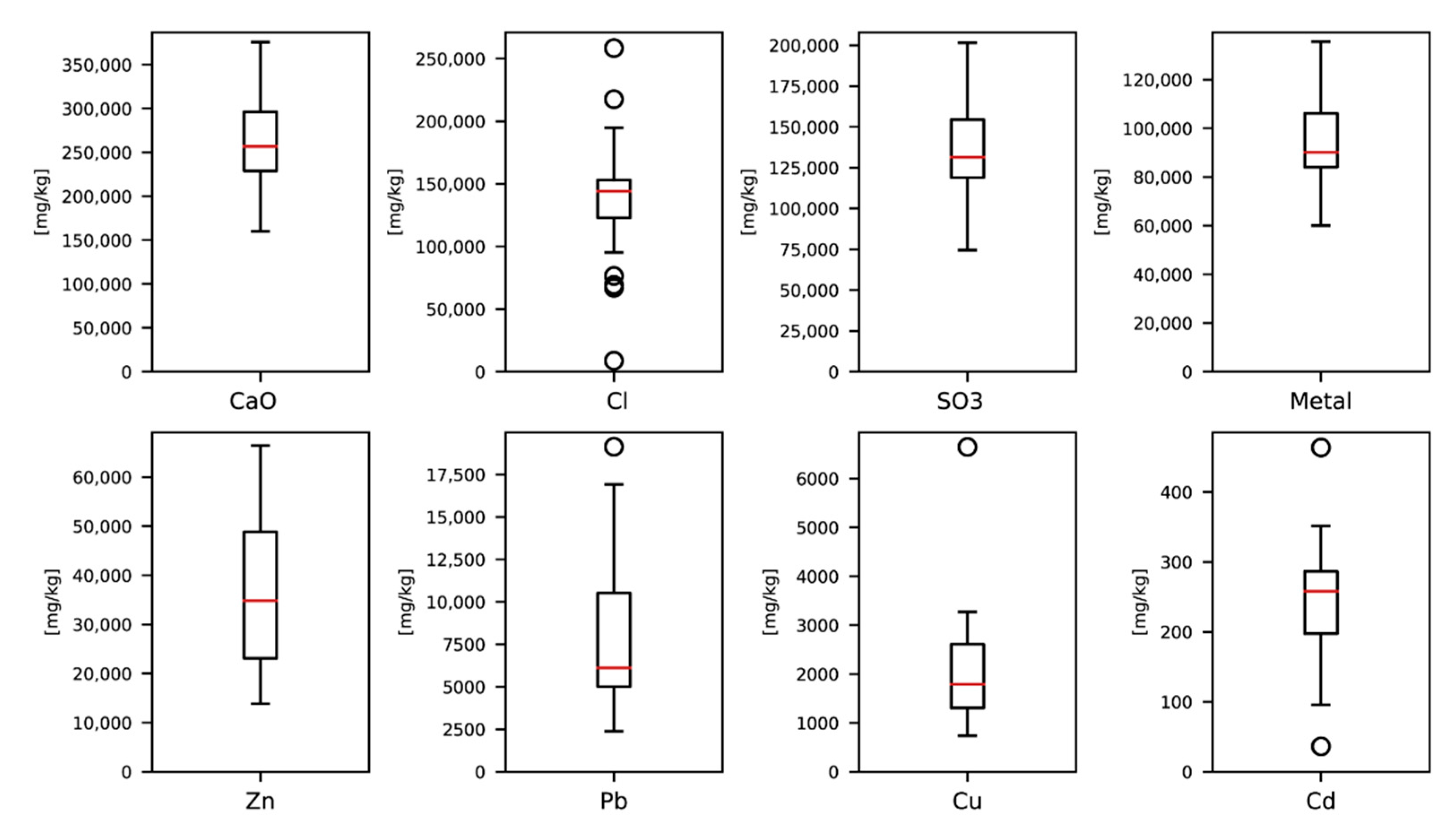
The average chemical composition of all FA samples (Table 2) is dominated by the oxides CaO (270,000 mg/kg), SO3 (13,000 mg/kg), Na2O (100,000 mg/kg), SiO2 (80,000 mg/kg), K2O (70,000 mg/kg), and Cl (130,000 mg/kg) (full details of chemical data can be found in Table A1 and Table A2 and in the Supplementary Materials). Further major constituents are Al2O3 (35,000 mg/kg), Fe2O3 (25,000 mg/kg), P2O5 (10,000 mg/kg), MgO (12,000 mg/kg), and TiO2 (17,000 mg/kg). Of the recoverable elements, Zn (average 36,000 mg/kg) is the most abundant followed by Pb (8000 mg/kg), Cu (2000 mg/kg), and Cd (~200 mg/kg). Precious metals (e.g., Au and Ag) as well as the total content of rare earth elements (REE) show low mg/kg concentration. FA samples have similar constituents, but the content varies heavily due the different waste input (Figure 1). Ca, the dominating contributor to ANC, varies from 150,000 to almost 400,000 mg/kg. S and Cl, which promote the transfer of heavy metals into the flue gas, scatter from 75,000 to 200,000 and 60,000 to 250,000 mg/kg, respectively. Of the total metal content (60,000 to 140,000 mg/kg), the recoverable metals are Zn (15,000–70,000 mg/kg), Pb (2500–16,000 mg/kg), Cu (1000 to 3000 mg/kg), and Cd (100–350 mg/kg). The large concentration range of Zn, Pb, Cu, and Cd indicates again the large differences in the waste input.
Table 2.
Main mineralogical constituents in FA from 29 municipal solid waste incineration plants.
Figure 1.
Concentration distribution of selected chemical constituents in the 29 Swiss fly ash (FA) samples.
3.2. Mineralogical Composition
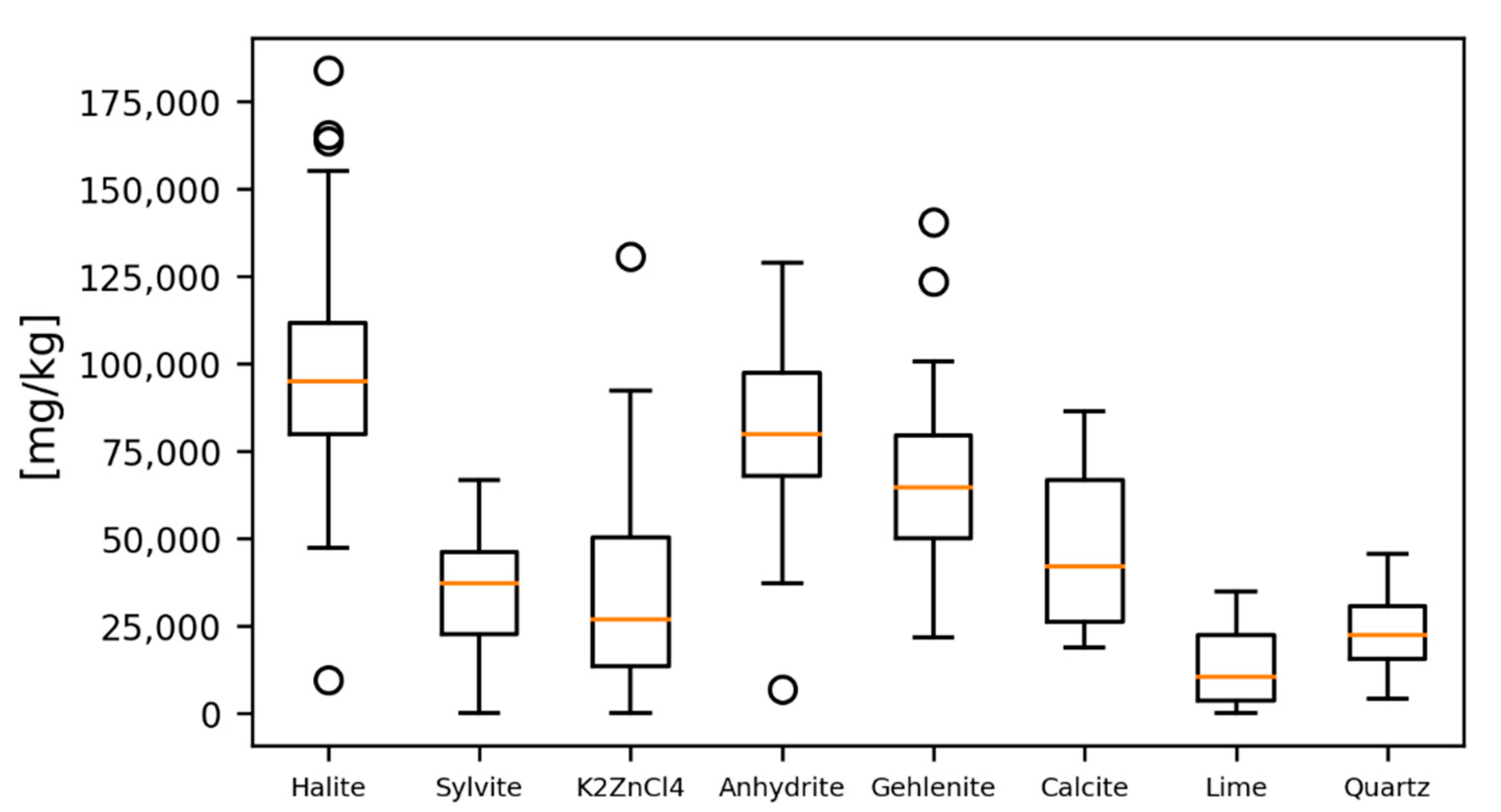
Phase analyses show that the major solid phases occur in all FA samples. On average, all samples contain an amorphous part of ~41 wt.% including the minor and unidentified phases (Table 3, a complete table can be found in the Supplementary Materials). Crystalline phases are dominated by chlorides, such as halite (NaCl) and sylvite (KCl), which are abundant in all samples (11 wt.% and 4 wt.% on average). K2ZnCl4 (5 wt.% on average) occurs in 23 samples and represents the most important phase, which contains easily recoverable Zn. Gehlenite (Ca2Al2SiO7), belite (Ca2SiO4), and quartz (SiO2) are the dominant silicate minerals (6.6, 4.0, and 2.4 wt.% on average, respectively). The concentrations of the carbonates calcite (CaCO3) and magnesite (MgCO3) are 4.9 and 2.6 wt.% on average. The dominating oxides are mayenite (Ca12Al14O33), perovskite (CaTiO3) (3.3 and 2.8 wt.% on average), and lime (CaO, 1.6 wt.% on average). Rutile (TiO2) and periclase (MgO) are minor constituents (both 0.7 wt.% on average) but occur in almost all FA samples. Among the sulfates, anhydrite (CaSO4) is the only identifiable phase (8.1 wt.% on average). The broad range of concentrations of the major solid phases in FA is indicated by the large boxes in Figure 2. Beside the main mineralogical constituents, FA samples have many minor phases (<1 wt.%), which cannot be identified or quantified properly.
Table 3.
Approximate annual flow of metals in Swiss FA.
Figure 2.
Distribution of the main mineral phases in Swiss FA in wt.%. Outliners are marked as circle.
3.3. Acid Neutralizing Capacity
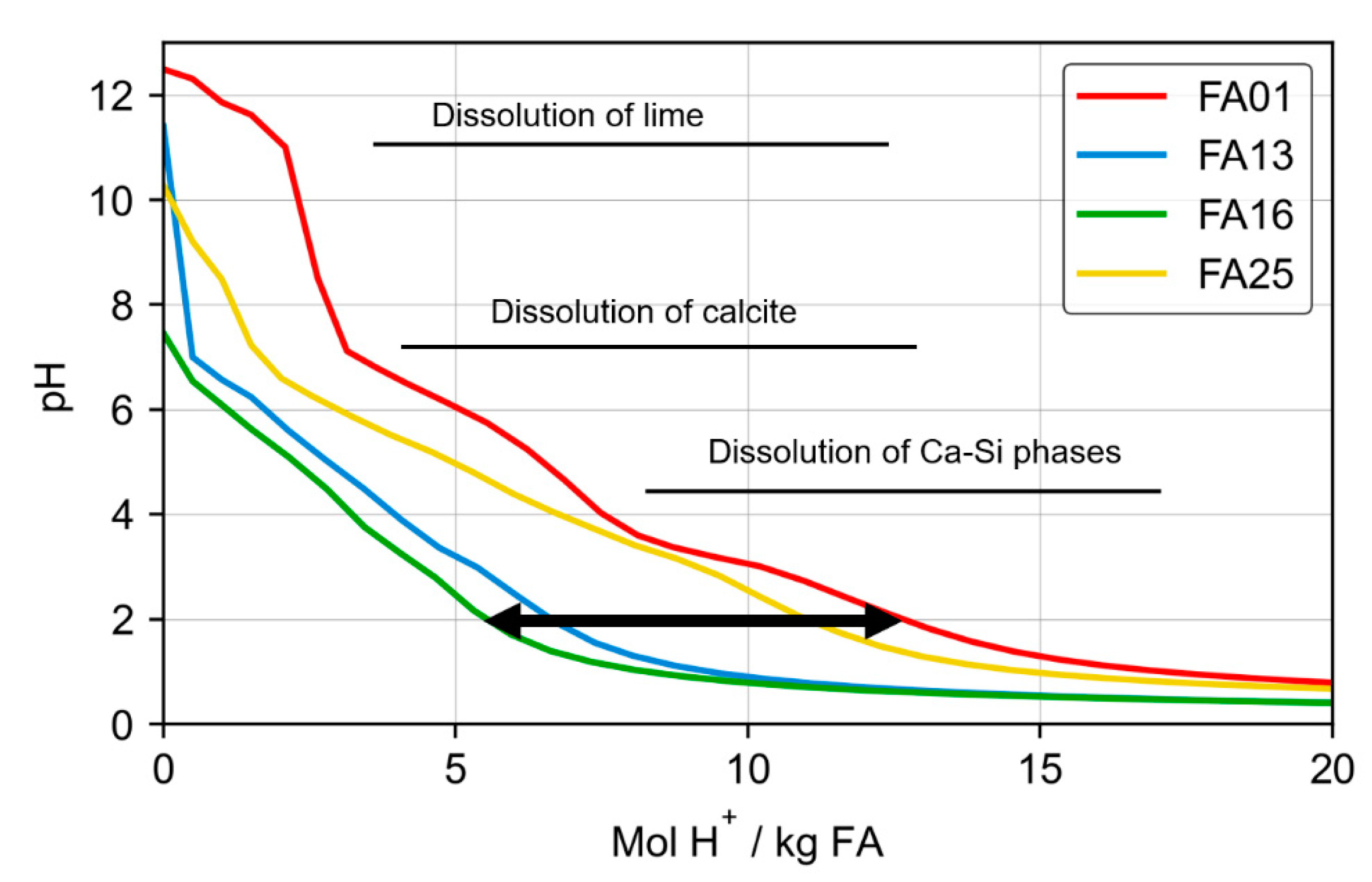
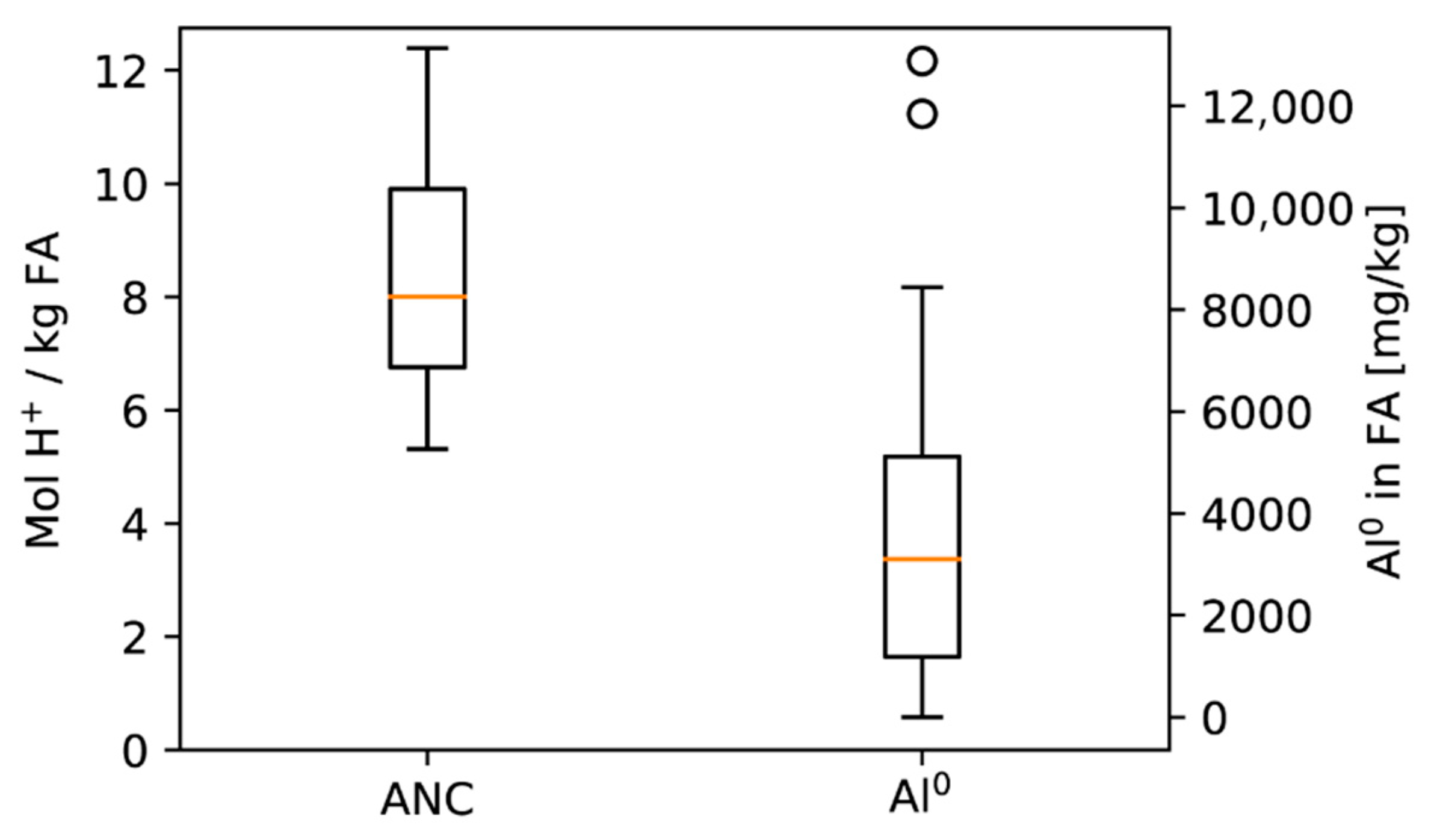
The titration curves of selected FA samples are shown in Figure 3. Seven FA samples had a starting pH below 8 and reached a pH of 2 before 8 moL H+ was added. Twelve samples started at pH 10–12 but dropped to a pH below 8 after the addition of a 1 moL H+. The remaining 10 samples started at pH 12 and required up to 3 moL H+ before dropping below pH 8, and an additional 5–10 moL H+ was needed to reach pH 2. There are three major plateaus apparent. The first one is assigned to the dissolution of portlandite (Ca(OH)2). Lime (CaO) reacts immediately with water, forms portlandite, and elevates the pH above 12 (see Equation (2)). The next major step is assigned to the dissolution of calcite (CaCO3, see Equation (4)). The final major step around pH 4 marks the start of the dissolution of Ca-Si phases like belite (Ca2SiO4) and (partly) gehlenite (Ca2Al2SiO7), and other minor phases start to dissolve. Of all phases, calcite is the dominating phase of the ANC. Ca-Si phases as well as the amorphous part only dissolve partially below pH 4. The required amount of H+ per kg FA to reach pH 2 with an LS of 10 is shown in Figure 4 as boxplot (a complete table can be found in the Supplementary Materials).
Figure 3.
Titration curve of selected FA samples (LS 10). The main plateaus are marked with a black line. The black arrow illustrates the big difference of acid that is required to achieve pH 2.
Figure 4.
Boxplot of the acid neutralizing capacity (ANC) as amount mol H+ to reach pH 2 at a L/S ratio of 10 and Al0 in Swiss FA (n = 29).
3.4. Metallic Aluminum Al0
The content of Al0 in FA is shown as a boxplot in Figure 4 (a complete table can be found in the Supplementary Materials). Two samples (FA01, FA04) show content above 1.4 wt.%, five samples (FA02, FA06, FA10, FA14, FA26) contain 0.8–1 wt.%, and most of the samples are between 0.1 and 0.6 wt.%. Two samples contain no Al0. Overall, the Al0 content is on average 30% of the total aluminum in FA.
3.5. Cluster Analysis
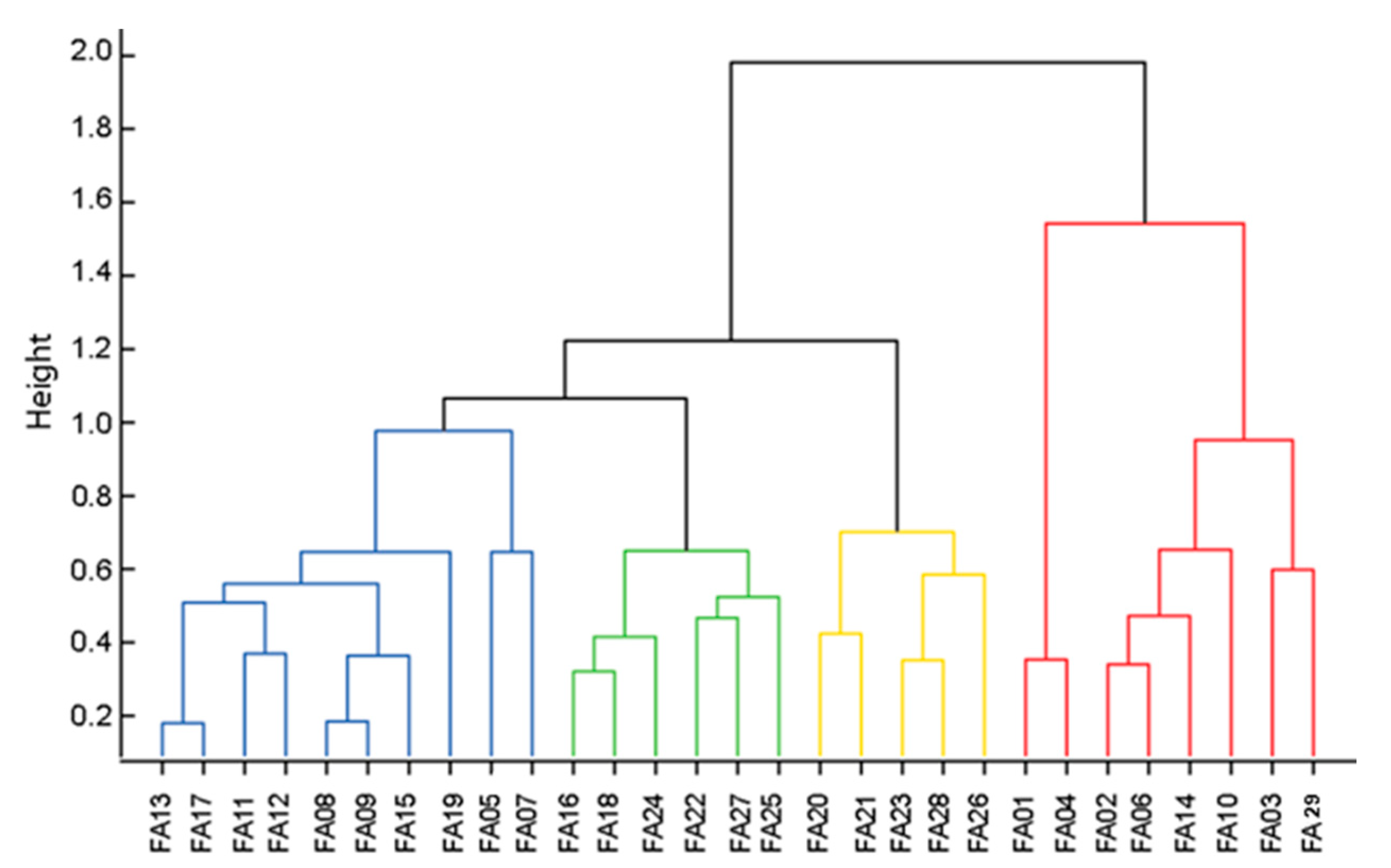
The dendrogram of the cluster analysis is shown in Figure 5. The cophenetic correlation coefficient, a measure of how faithfully a tree represents the dissimilarities among observation, is 0.71 (the maximum would be 1), which is acceptable. The red cluster on the right has eight samples (FA01, FA04, FA02, FA06, FA14, FA10, FA03, and FA29). On the left side is a branch with a yellow cluster of five samples (FA20, FA21, FA23, FA28, and FA26), a green cluster of six samples (FA16, FA18, FA24, FA22, FA27 and FA25), and finally a blue cluster representing 10 samples (FA13, FA17, FA19, FA11, FA12, FA08, FA11, FA15, FA05, and FA07).
Figure 5.
Cluster tree of the FA samples according to their content of Zn and Al0, the ANC, and the amount of FA produced in 2016. The y-axis shows the distances between the calculated values and hence is a mathematical value that expresses the dissimilarity.
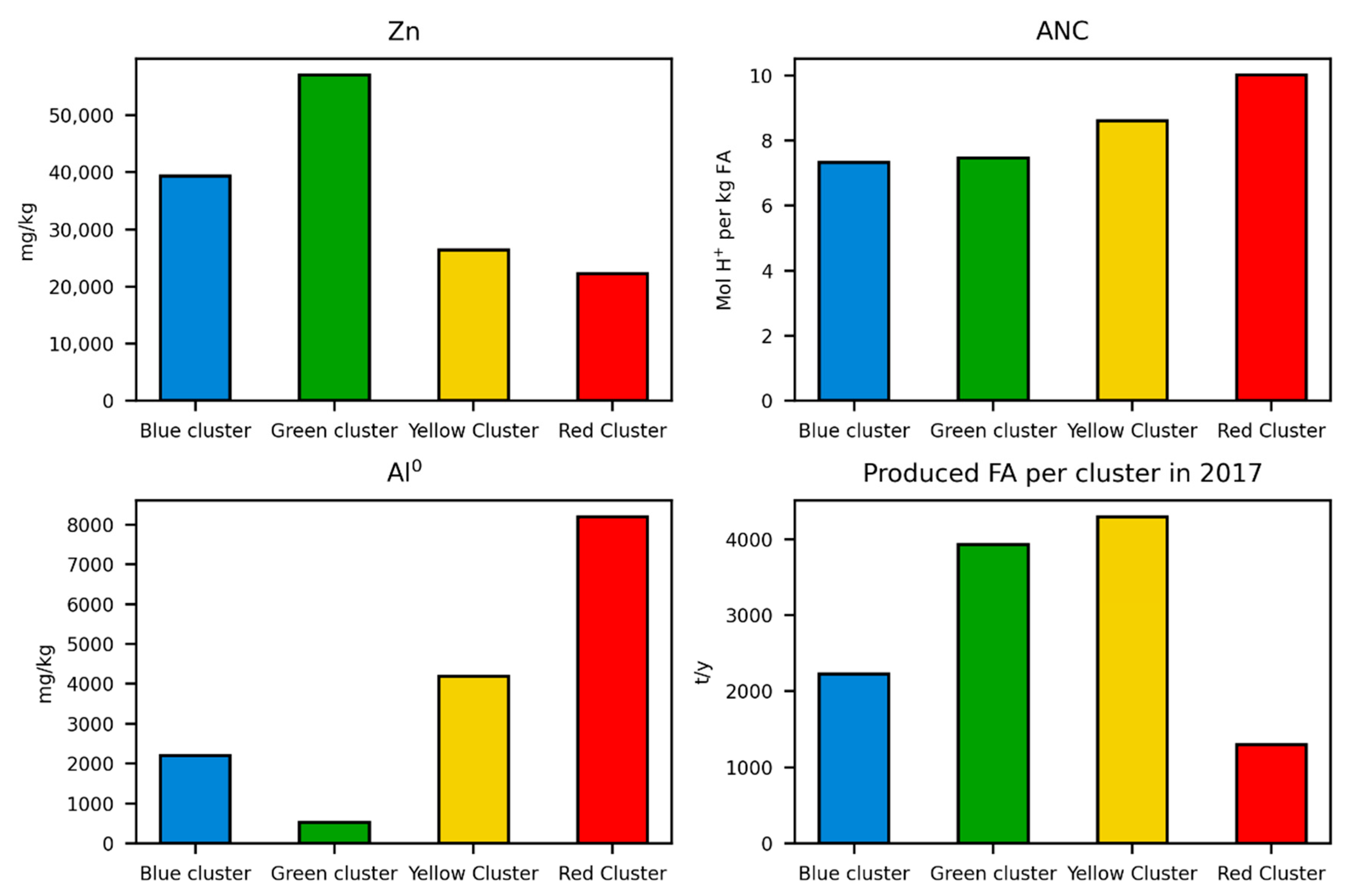
Every cluster represents FA samples with similar properties. The average value of each property and cluster is shown in Figure 6. The green cluster representing FA with very good leaching potential contains FA with the highest Zn concentration of 5.7 wt.% and the lowest content of Al0 (0.05 wt.%). Each MSWI plant produces almost 4000 tons of FA per year. This cluster is the most interesting for economic metal recovery due to the high Zn recovery with the lowest H2O2 consumption and low acid consumption (7.4 mL mol H+ per kg FA to reach pH 2). The blue cluster representing FA with good leaching potential is the largest cluster with an average Zn concentration of almost 4 wt.% and a content of Al0 of 0.2 wt.%. These plants produce on average 2200 t of FA per year. The ANC is the lowest because the FA samples required only 7.3 mol H+ per kg FA to reach a pH of 2 during the titration and a relatively low amount of hydrogen peroxide. The yellow cluster representing FA with moderate leaching potential contains only five MSWI plants. Their FA shows low averaged Zn concentration of 2.6 wt.% but a rather high Al0 concentration of 0.4 wt.%. Since some MSWI plants are among the largest in Switzerland, the amount of produced FA is 4300 t per year on average. The metal recovery of these ashes requires higher amount of acid (8.6 moL H+ per kg FA to reach pH 2) and a high amount of H2O2. The red cluster containing FA with poor leaching potential shows the lowest Zn concentration of all clusters (2.2 wt.%) but by far the highest concentration of Al0 (0.8 wt.%). On average, plants in this cluster produces only 1300 t of FA per year. However, this cluster has the highest ANC of 10 mol H+ per kg FA to reach pH 2.
Figure 6.
Average Zn and Al0 concentration as well as average produced FA per plant and the average ANC for each cluster.
4. Discussion
4.1. Mass Flow of Metals in Swiss FA
The estimated annual mass flow of metals in Swiss FA is illustrated in Table 4. The mass flow was calculated based on concentrations and amount of FA from all plants in 2016 [15]. The total quantity of recoverable metals is: 3052 t/y Zn, 667 t/y Pb, 172 t/y Cu, and 20 t/y Cd. Other base metal contributions are: 1392 t/y Al, 1340 t/y Fe, 791 t/y Ti, and the chalcophile elements Sb 194 t/y and Sn 140 t/y. The annual mass flow for REE (including Sc and Y) is 4.8 t/y, mainly represented by the light-REE Ce (1.8 t/y), La (1 t/y), Y (0.7 t/y), and Nd (0.6 t/y). Other notable metals are Ni (10 t/y), As (6 t/y), Co (4 t/y), Ag (3.1 t/y), and W (1.4 t/y). Gold is a minor constituent in FA, and thus only 12 kg is landfilled each year from FA. The low mass flow of REE and other precious metals (Ag, Au) in FA is due to their low vapor pressure, expressed with low partitioning coefficients < 0.1 [16]. Preferentially chalcophile elements such as Zn, Pb, Cu, Sb, and Sn are expected to be enriched in FA. The origin of the metals in the waste input was not investigated in this study. It can be assumed that abundant metals are mainly from alloys (e.g., Zn, Sn), color pigments (e.g., Ti), or additives in plastic (e.g., Sb). Table 4 shows the annual technically possible acid leaching potential of Zn (2420 t/y), Pb (530 t/y), Cu (66 t/y), and Cd (21.8 t/y) considering the FLUWA process is optimized by using HCl and H2O2 as additives [14]. The recovery potential of metals is very high compared to the unwrought metal imported in Switzerland in 2017 [17]. Approximately 30% Zn, 16% Pb, and 1% Cu of the annual import could be replaced by metal recovery from FA. Metal prices fluctuate frequently, and future changes in waste input, e.g., by enhanced metal separation prior to combustion, could drastically change the quantity of heavy metals recoverable by FA and the economic aspects. Ecologically it is, however, beneficial to recover other metals as well, such as Sb and Sn. Heavy metals in landfills are a constant threat to the surrounding environment, especially from a long-term perspective, and primary production (mining, excavation, and extraction) have dramatic impacts on the environment and its inhabitants [18].
Table 4.
Total amount of Zn, Pb, Cu, and Cd that is recoverable by the FLUWA process. The data of the raw import in Switzerland in 2017 only refers to the unwrought metal (no. 7901, 7801, 7403, and 8104 of the Swiss Explanatory notes of the Customs Tariff—Tares [19].
4.2. Characterization of FA Regarding the FLUWA Treatment
To estimate implementation planning and effort for FA leaching, the properties of all FA samples were grouped with similar properties into four different clusters. Of all MSWI plants, 16 out of 29 produce FA that shows very high or high leaching potential, and 13 MSWI plants produce FA that shows moderate or low leaching potential. FA with moderate or poor leaching potential require higher effort and has smaller return through the recovery of Zn. Thus, mixing of different FA types could be an expedient means of diminishing the effects of poor leaching potential. For optimized processing, FA composition is suggested to be monitored regularly by simple tests of ANC, Zn (Pb, Cu), and Al0. The cluster, however, provides preliminary information for general planning and FLUWA design.
4.3. Situation in Switzerland from 2021 on
As of 2021, there will be 29 MSWI plants in Switzerland producing ~80,000 tons of FA per year that must be treated prior to disposal. Although the type of process to recover metals from FA will not be prescribed, all FA is expected to be treated by the FLUWA process, as it represents the state-of-the art process. In 2018, only 12 plants individually conducted acid leaching. The remaining plants produce approximately 43,000 t/y of FA, which has to be treated in external or newly constructed facilities. Considering the costs of 350–450 CHF per ton of FA [4], there is a market potential of CHF 15–20 million per year.
5. Conclusions
This study shows the wide range of chemical and mineralogical differences of the FA in Switzerland and the properties influencing acid leaching. Consequently, the effort to recover heavy metals from FA varies widely is mainly dependent on metal and Al0 content and on the ANC. It is especially unfavorable for FA with low Zn content but high ANC to recover a fixed rate of heavy metals. This fact was considered in the implementation of the guidelines of the ADWO, which prescribes that the recovery rate of Zn and Pb to achieve is based on the initial concentration in FA [20]. After complete implementation, the FLUWA treatment of all Swiss FA will produce a significant quantity of recovered heavy metals. These quantities are otherwise disposed as pollutants in landfills and removed from the raw metal cycle. However, the remaining filter cake that is deposited still contains a significant load of contaminants, such as Sb and Sn. Further development is therefore needed to increase the recovery of heavy metals and to extend it to less easily recoverable elements.
Supplementary Materials
The following are available online at https://www.mdpi.com/2227-9717/8/12/1668/s1.
Author Contributions
Conceptualization, W.Z. and U.E.; methodology, W.Z., G.W. and U.E.; software, W.Z.; writing—original draft preparation, W.Z.; writing—review and editing, W.Z., U.E., M.W. and G.W.; visualization, W.Z.; supervision, G.W. and U.E.; project administration, U.E.; funding acquisition, U.E. All authors have read and agreed to the published version of the manuscript.
Funding
This research was funded by the Swiss Federal Office for the Environment (FOEN).
Acknowledgments
We thank MSWI plant operators for providing sample material, Kaarina Schenk (FOEN) and Stefan Schlumberger (ZAR) for feedback and support. Analytical support by Christine Lemp, Martin Fisch (both University of Bern) and Ivo Budde is highly acknowledged.
Conflicts of Interest
The authors declare no conflict of interest.
Appendix A
Table A1.
Measured elements in Swiss FA.
Table A1.
Measured elements in Swiss FA.
| Name | Unit | Method | Average | Median | Max | Min |
|---|---|---|---|---|---|---|
| Na2O | mg/kg | ED-XRF | 92,728 | 100,400 | 144,700 | 12,000 |
| MgO | mg/kg | ED-XRF | 12,733 | 12,400 | 27,000 | 3200 |
| SiO2 | mg/kg | ED-XRF | 84,548 | 81,500 | 148,100 | 51,200 |
| P2O5 | mg/kg | ED-XRF | 9798 | 9192 | 15,700 | 6480 |
| SO3 | mg/kg | ED-XRF | 136,179 | 131,400 | 201,500 | 74,500 |
| Cl | mg/kg | ED-XRF | 137,483 | 144,200 | 258,400 | 8800 |
| K2O | mg/kg | ED-XRF | 65,401 | 65,800 | 110,400 | 12,000 |
| CaO | mg/kg | ED-XRF | 268,231 | 256,800 | 375,900 | 160,100 |
| Zn | mg/kg | ED-XRF | 36,039 | 34,830 | 66,450 | 13,850 |
| Pb | mg/kg | ED-XRF | 7978 | 6116 | 19,130 | 2380 |
| Cu | mg/kg | ED-XRF | 2030 | 1792 | 6647 | 737 |
| Cd | mg/kg | ED-XRF | 243 | 258 | 464 | 36 |
| Mn | mg/kg | ED-XRF | 822 | 820 | 1569 | 534 |
| Fe | mg/kg | ED-XRF | 17,641 | 17,640 | 31,217 | 9421 |
| Al | mg/kg | ED-XRF | 18,673 | 17,995 | 32,390 | 9632 |
| Ti | mg/kg | ED-XRF | 10,582 | 10,660 | 16,200 | 7018 |
| Au | µg/kg | INAA | 1829 | 745 | 20,600 | 247 |
| Ag | mg/kg | MULT INAA/TD-ICP-MS | 39 | 37 | 94 | 13 |
| Ni | mg/kg | MULT INAA/TD-ICP-MS | 123 | 105 | 335 | 72 |
| As | mg/kg | INAA | 78 | 73 | 163 | 9 |
| Ba | mg/kg | MULT INAA/TD-ICP-MS | 166 | 174 | 248 | 82 |
| Be | mg/kg | TD-MS | 0.6 | 0.5 | 1.5 | 0.3 |
| Bi | mg/kg | TD-MS | 102 | 99 | 264 | 39 |
| Br | mg/kg | INAA | 2071 | 2130 | 4290 | 153 |
| Co | mg/kg | MULT INAA/TD-ICP-MS | 51 | 45 | 96 | 22 |
| Cr | mg/kg | INAA | 512 | 463 | 1460 | 265 |
| Cs | mg/kg | MULT INAA/TD-ICP-MS | 7 | 8 | 10 | 2 |
| Eu | mg/kg | TD-MS | 0.3 | 0.3 | 0.4 | 0.2 |
| Hf | mg/kg | INAA | 2.1 | 2.0 | 4.0 | <1 |
| Ge | mg/kg | TD-MS | 0.5 | 0.4 | 2.0 | 0.1 |
| In | mg/kg | TD-MS | 2.9 | 1.9 | 11.4 | 0.4 |
Table A2.
Measured elements in Swiss FA.
Table A2.
Measured elements in Swiss FA.
| Name | Unit | Method | Average | Median | Max | Min |
|---|---|---|---|---|---|---|
| Li | mg/kg | TD-MS | 50 | 47 | 151 | 28 |
| Nb | mg/kg | TD-MS | 0.5 | 0.1 | 3.6 | 0.1 |
| Mo | mg/kg | TD-MS | 12 | 8 | 71 | 3 |
| Rb | mg/kg | TD-MS | 95 | 96 | 159 | 21 |
| Re | mg/kg | TD-MS | 0 | 0 | 0 | 0 |
| Sb | mg/kg | INAA | 2381 | 2240 | 4540 | 745 |
| Sc | mg/kg | INAA | 2.4 | 2.2 | 4.9 | 1.2 |
| Se | mg/kg | MULT INAA/TD-ICP-MS | 5.6 | 4.6 | 12.5 | 2.0 |
| Sr | mg/kg | TD-MS | 366 | 363 | 523 | 289 |
| Ta | mg/kg | MULT INAA/TD-ICP-MS | <0.1 | <0.1 | <0.1 | <0.1 |
| Te | mg/kg | TD-MS | <0.1 | <0.1 | <0.1 | <0.1 |
| Th | mg/kg | MULT INAA/TD-ICP-MS | 2.4 | 2.3 | 5.2 | 1.3 |
| Tl | mg/kg | TD-MS | 1.3 | 1.2 | 2.1 | 0.6 |
| U | mg/kg | MULT INAA/TD-ICP-MS | 1.2 | 1.1 | 3.0 | 0.7 |
| V | mg/kg | TD-MS | 13 | 14 | 21 | 2 |
| W | mg/kg | INAA | 30 | 18 | 114 | <1 |
| Y | mg/kg | TD-MS | 9 | 8 | 16 | 5 |
| Zr | mg/kg | TD-MS | 90 | 85 | 220 | 39 |
| La | mg/kg | TD-MS | 12 | 12 | 24 | 8 |
| Ce | mg/kg | TD-MS | 22 | 20 | 51 | 13 |
| Pr | mg/kg | TD-MS | 1.9 | 1.9 | 2.8 | 1.2 |
| Nd | mg/kg | TD-MS | 7.1 | 7.2 | 12.3 | 4.3 |
| Sm | mg/kg | TD-MS | 1.2 | 1.1 | 2.4 | 0.7 |
| Gd | mg/kg | TD-MS | 2.0 | 1.6 | 7.4 | 0.9 |
| Dy | mg/kg | TD-MS | 0.8 | 0.8 | 1.2 | 0.5 |
| Tb | mg/kg | TD-MS | 0.2 | 0.2 | 0.9 | 0.1 |
| Ho | mg/kg | TD-MS | 0.2 | 0.1 | 1.2 | 0.1 |
| Hg | µg/kg | TD-MS | 528 | 320 | 2000 | 50 |
| Er | mg/kg | TD-MS | 0.5 | 0.5 | 1.5 | 0.3 |
| Tm | mg/kg | TD-MS | 0.1 | 0.1 | 0.1 | 0.1 |
| Yb | mg/kg | TD-MS | 0.8 | 0.5 | 8.3 | 0.3 |
| Lu | mg/kg | TD-MS | 0.1 | 0.1 | 0.4 | <1 |
References
- Le Forestier, L.; Libourel, G. Characterization of flue gas residues from municipal solid waste combustors. Environ. Sci. Technol. 1998, 32, 2250–2256. [Google Scholar] [CrossRef]
- Li, M.; Xiang, J.; Hu, S.; Sun, L.-S.; Su, S.; Li, P.-S.; Sun, X.-X. Characterization of solid residues from municipal solid waste incinerator. Fuel 2004, 83, 1397–1405. [Google Scholar] [CrossRef]
- Bayuseno, A.P. Mineral Phases in Raw and Processed Municipal Waste Incineration Residues-Towards a Chemical Stabilisation and Fixation of Heavy Metals. Ph.D. Thesis, Ruhr-Universität Bochum, Bochum, Germany, 2006. [Google Scholar]
- Weibel, G. Optimized Metal Recovery from Fly Ash from Municipal Solid Waste Incineration. Ph.D. Thesis, University of Bern, Bern, Switzerland, 2017. [Google Scholar]
- Verhulst, D.; Buekens, A.; Spencer, P.J.; Eriksson, G. Thermodynamic Behavior of Metal Chlorides and Sulfates under the Conditions of Incineration Furnaces. Environ. Sci. Technol. 1996, 30, 50–56. [Google Scholar] [CrossRef]
- Swiss Confederation. Ordinance on the Avoidance and the Disposal of Waste (Waste Ordinance, ADWO); Swiss Conferderation: Bern, Switzerland, 2015; Volume 2015, pp. 1–46. [Google Scholar]
- Schlumberger, S. Neue Technologien und Möglichkeiten der Behandlung von Rauchgasreinigungsrückständen im Sinne Eines Nachhaltigen Ressourcenmanagements. New Technologies and Opportunities for the Treatment of Residues from Flue Gas Treatments in a Sustainable Resource Man; KVA: Sursee, Switzerland, 2010. [Google Scholar]
- Bühler, A.; Schlumberger, S. Schwermetalle aus der Flugasche Zurückgewinnen «Saure Flugaschewäsche—FLUWA-Verfahren» Ein Zukunftsweisendes Verfahren in der Abfallverbrennung; BSH Umweltservice AG: Sursee, Switzerland, 2010. [Google Scholar]
- Budde, I. Charakterisierung der Elementaren Zusammensetzung von Filteraschen und Daraus Entstehender Reaktionsprodukte auf Einer Thermischen Abfallbehandlungsanlage. Aufklärung der Möglichen Blei-, Cadmium- und Kupferextraktion aus Filteraschen und Untersuchung mög. Master’s Thesis, Leopold-Franzens-Universität Innsbruck, Innsbruck, Austria, 2015. [Google Scholar]
- Weibel, G.; Eggenberger, U.; Schlumberger, S.; Mäder, U.K. Chemical associations and mobilization of heavy metals in fly ash from municipal solid waste incineration. Waste Manag. 2017, 62, 147–159. [Google Scholar] [CrossRef] [PubMed]
- Heuss-Aßbichler, S.; Magel, G.; Fehr, K.T. Abiotic hydrogen production in fresh and altered MSWI-residues: Texture and microstructure investigation. Waste Manag. 2010, 30, 1871–1880. [Google Scholar] [CrossRef] [PubMed]
- Ilyas, A.; Badshan, M.; Praagh, M.V.; Persoon, K.M. Evaluation of H2 gas Production from MSWI Bottom Ash. In Proceedings of the Proceedings Venice 2010, 3rd International Symposium Energy from Biomass Waste, Venice, Italy, 8–11 November 2010. [Google Scholar]
- AWEL. Stand der Technik für die Aufbereitung von Rauchgasreinigungsrückständen (RGRR) aus Kehrichtverbrennungsanlagen; AWEL: Zürich, Switzerland, 2013; p. 10. [Google Scholar]
- Weibel, G.; Eggenberger, U.; Kulik, D.A.; Hummel, W.; Schlumberger, S.; Klink, W.; Fisch, M.; Mäder, U.K. Extraction of heavy metals from MSWI fly ash using hydrochloric acid and sodium chloride solution. Waste Manag. 2018, 76, 457–471. [Google Scholar] [CrossRef] [PubMed]
- VBSA. In Schweizer KVA Verbrannte Abfallmenge 2016. 2017. Available online: http://vbsa.ch/fakten/abfallverwertung/ (accessed on 26 July 2018).
- Morf, L.S.; Gloor, R.; Haag, O.; Haupt, M.; Skutan, S.; Di Lorenzo, F.; Böni, D. Precious metals and rare earth elements in municipal solid waste—Sources and fate in a Swiss incineration plant. Waste Manag. 2013, 33, 634–644. [Google Scholar] [CrossRef] [PubMed]
- Eidgenössische Zollverwaltung. Datenbank Swiss Impex. 2.%09Datenbank Swiss Impex, Eidgenössische Zollverwaltung EZV. Available online: https://www.gate.ezv.admin.ch/swissimpex/ (accessed on 20 August 2018).
- Wäger, P. Scarce metals—Applications, supply risks and need for action. Not. Polit. 2011, 104, 57–66. [Google Scholar]
- Eidgenössische Zollverwaltung. Explanatory Notes of the Customs Tariff—Tares. Available online: https://www.ezv.admin.ch/ezv/de/home/dokumentation/richtlinien/d6-erlaeuterungen-zum-zolltarif.html (accessed on 20 August 2018).
- Swiss Confederation. Rückgewinnung von Metallen aus den Filteraschen von Kehrichtverbrennungsanlagen; Bundesamt für Umwelt BAFU: Bern, Switzerland, 2020; pp. 1–21. [Google Scholar]
Publisher’s Note: MDPI stays neutral with regard to jurisdictional claims in published maps and institutional affiliations. |
© 2020 by the authors. Licensee MDPI, Basel, Switzerland. This article is an open access article distributed under the terms and conditions of the Creative Commons Attribution (CC BY) license (http://creativecommons.org/licenses/by/4.0/).