An Investigation on the Effect of the Total Efficiency of Water and Air Used Together as a Working Fluid in the Photovoltaic Thermal Systems

Abstract
1. Introduction
speed + 0.3529.
2. System Description
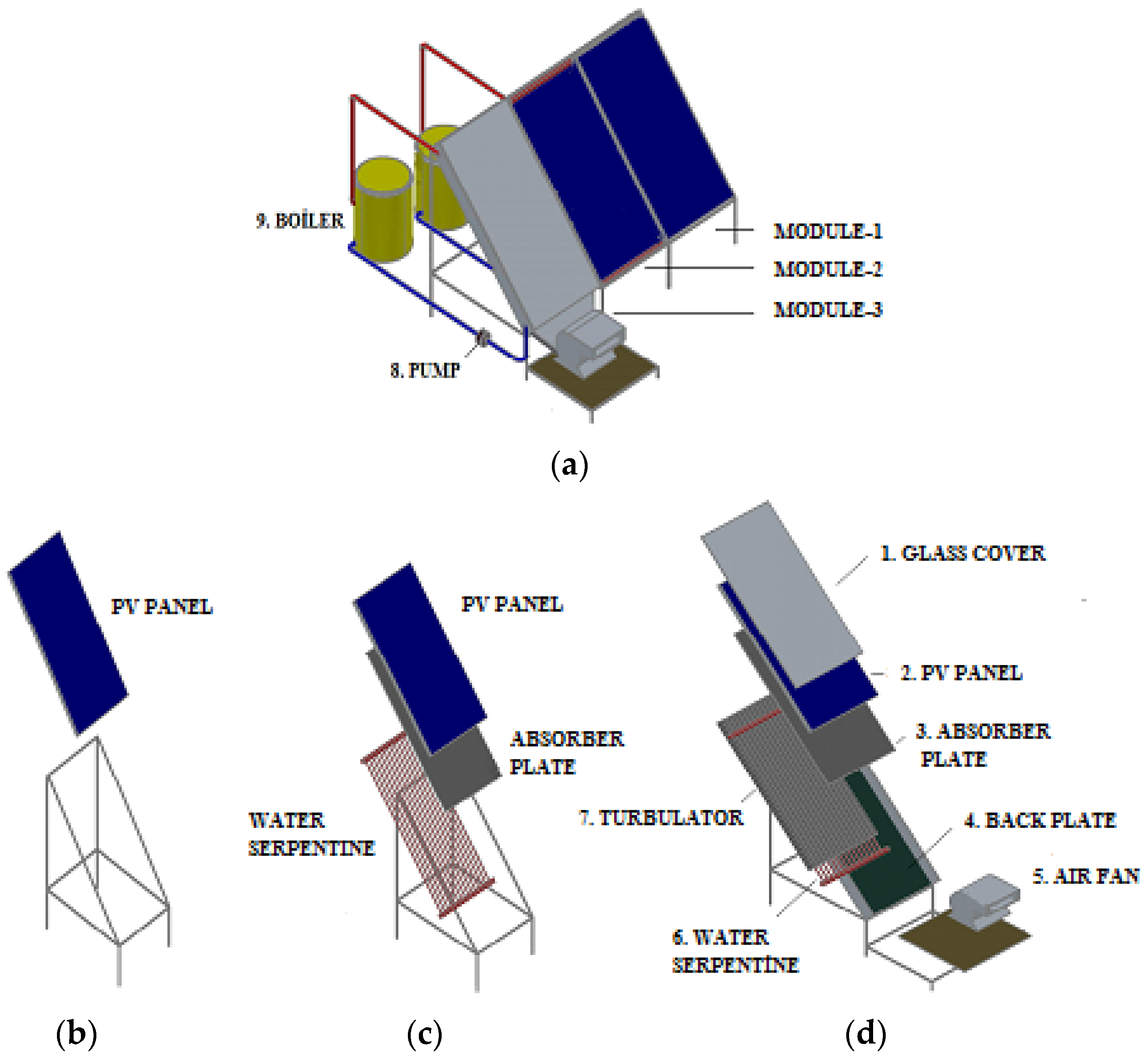
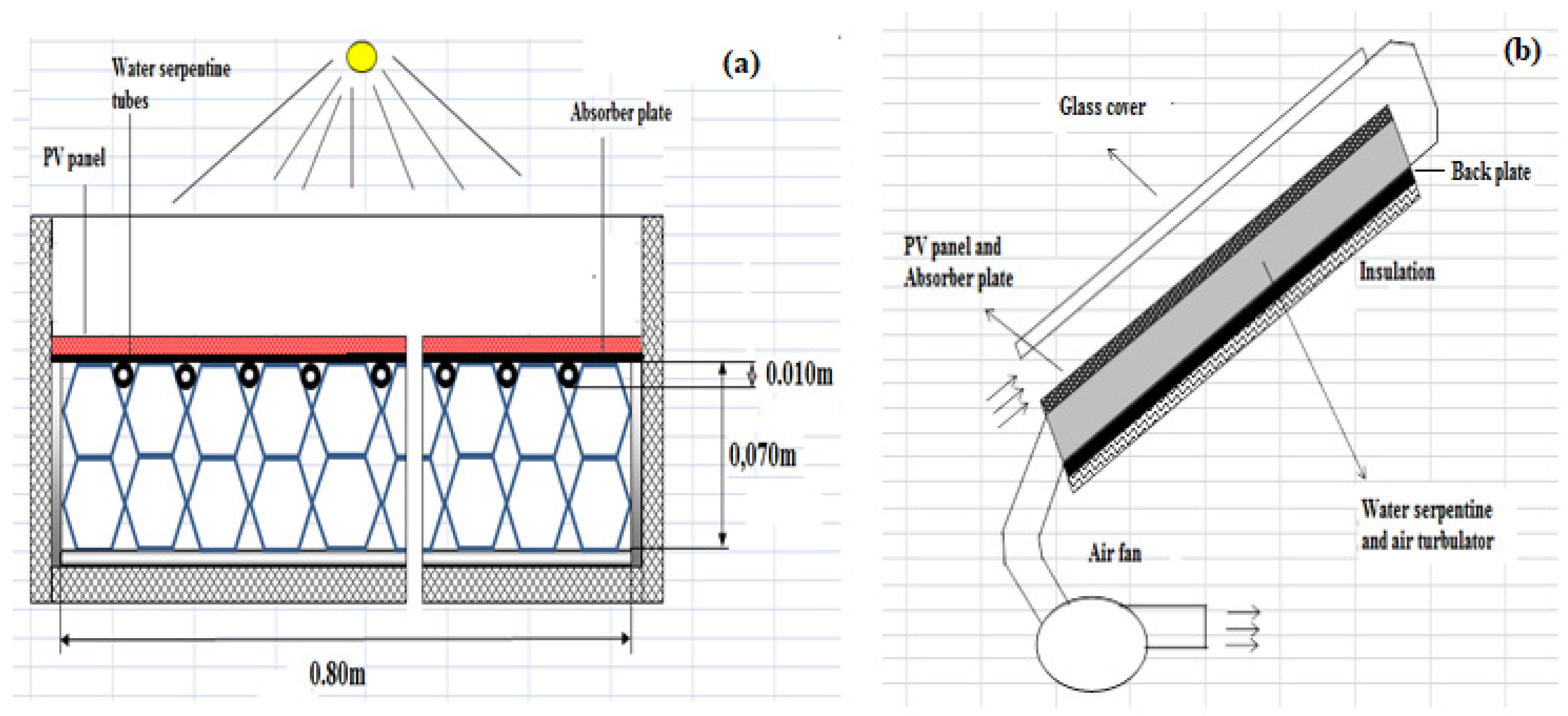
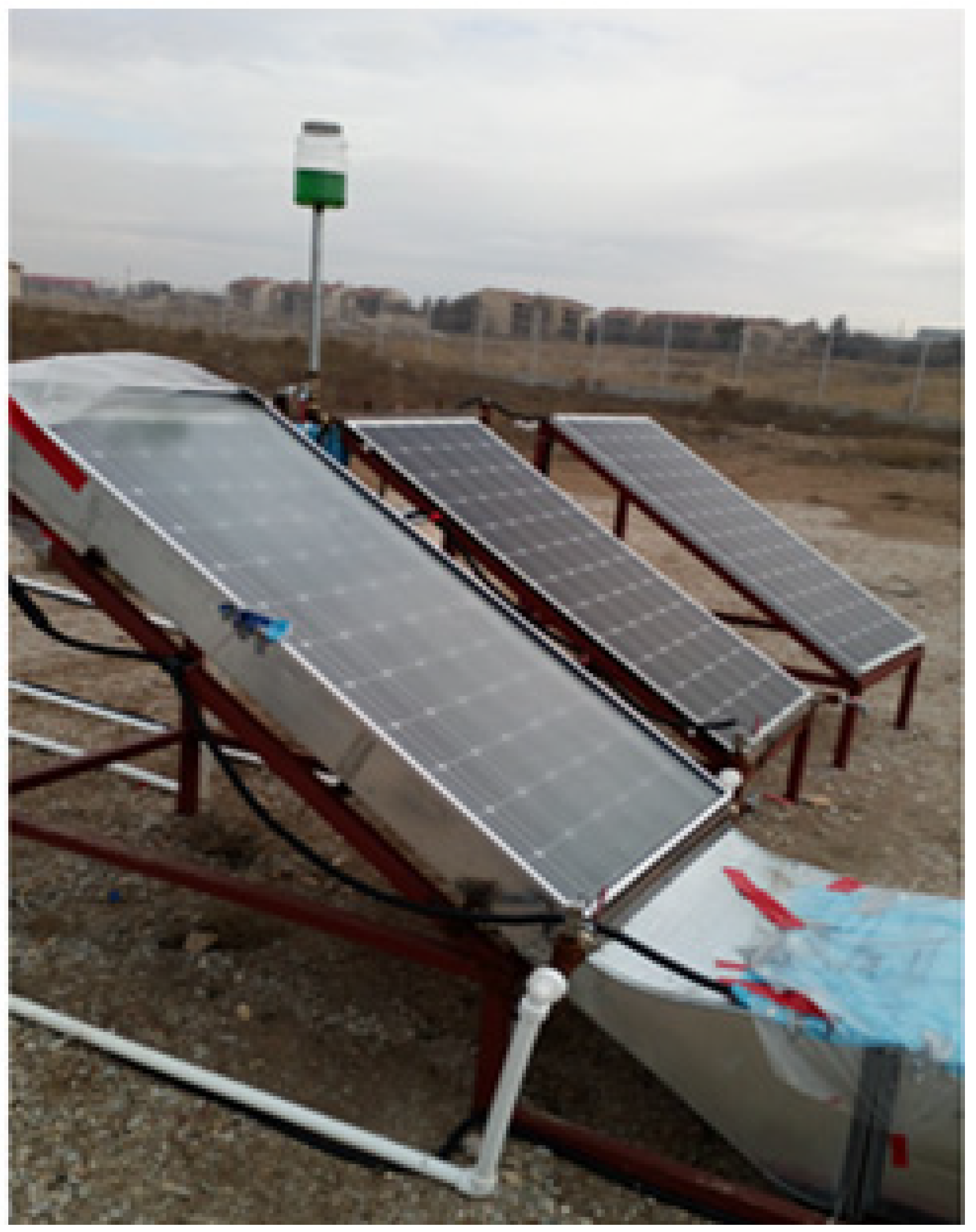
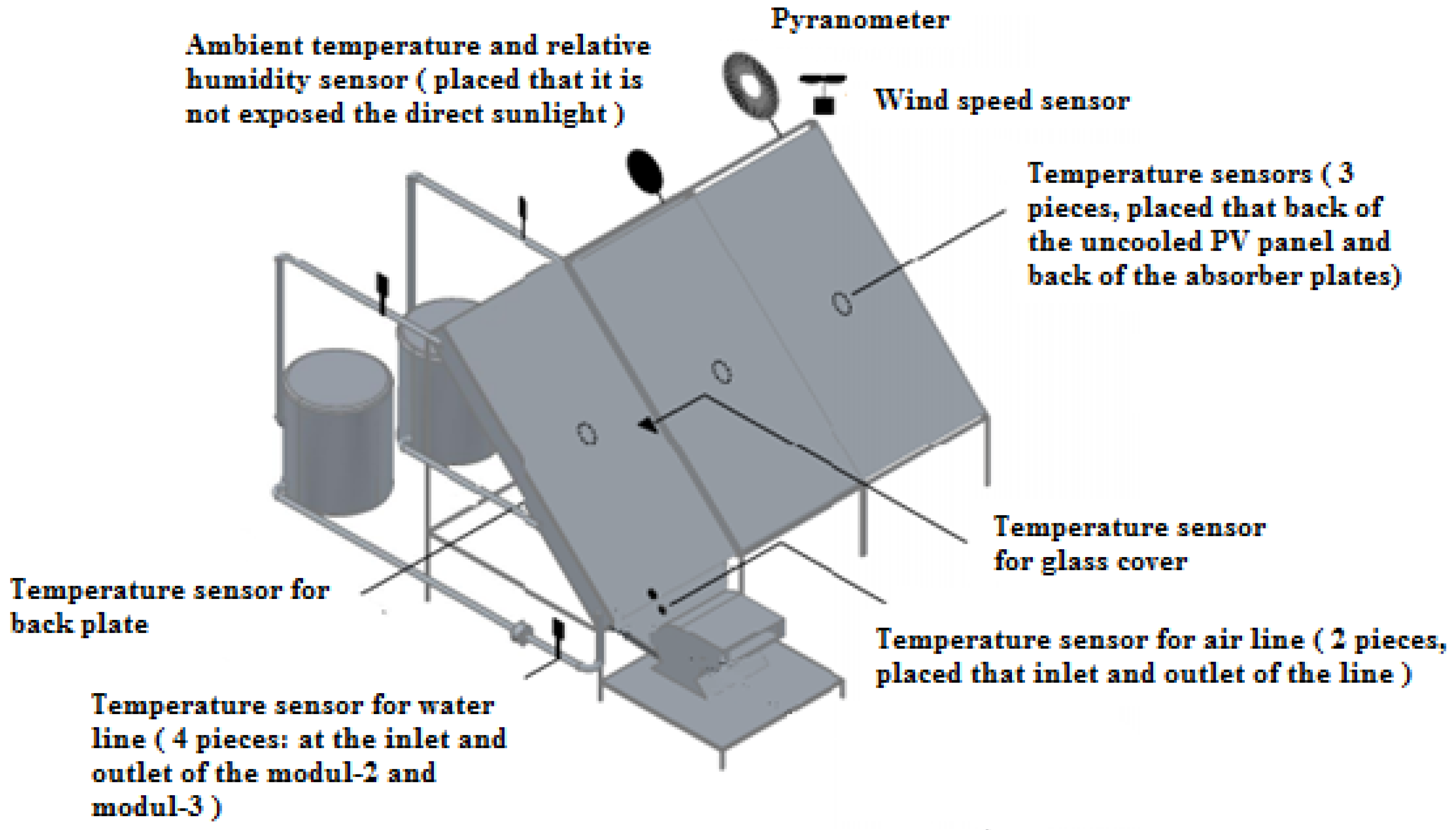
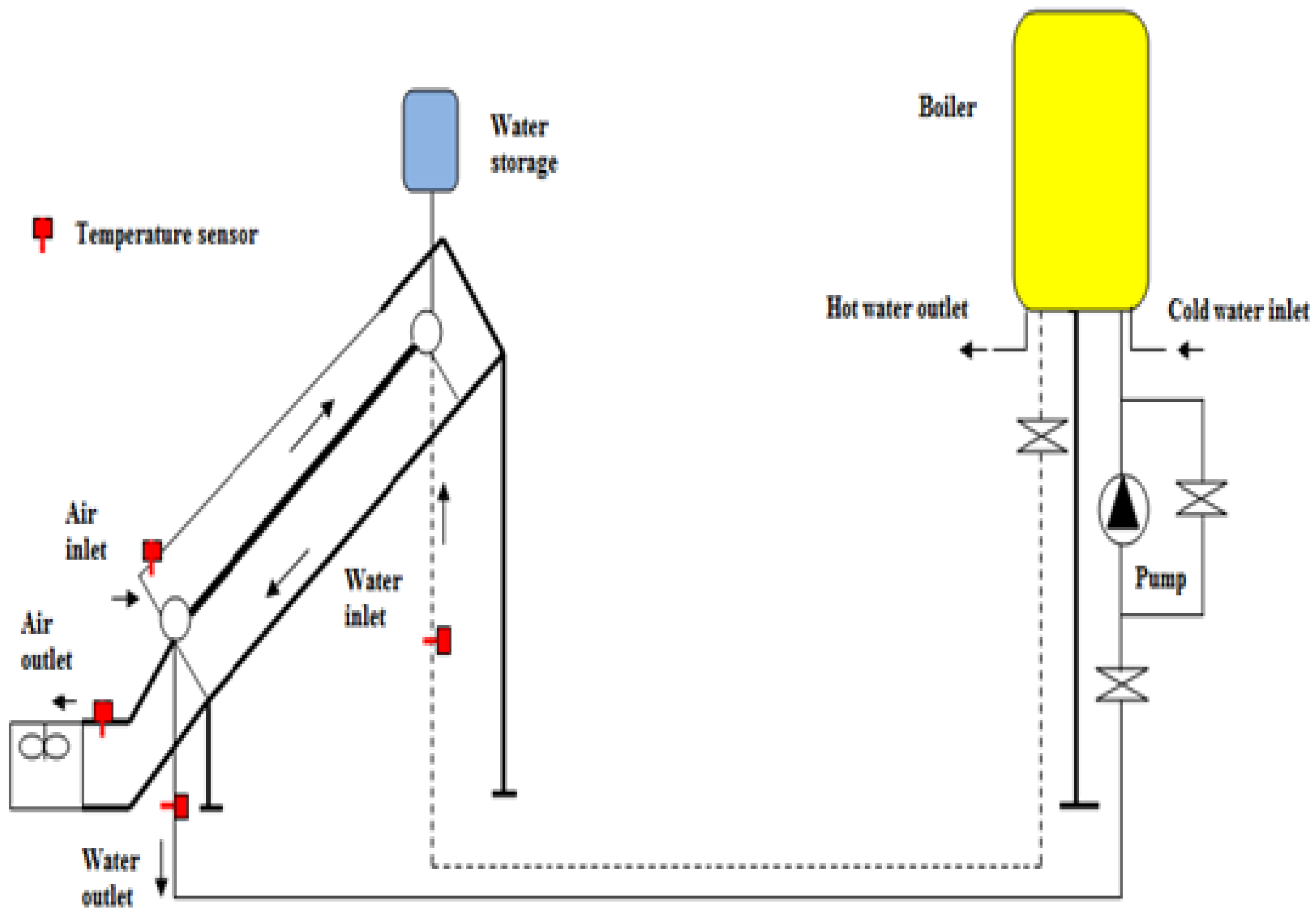
2.1. Main Parts of the Experimental Set-Up
- Glass (cover of the module-3): Distance: 4mm, transmittance: 0.92.
- PV Panel (same in all modules): TPSM6U Monocrystalline 200W, Voc:45.4 V, Isc:5.77 A.
- Absorber plate (on the module-2 and module-3): Distance: 0.400 mm, material: aluminum (λ: 200 W/mK), painted black.
- Back plate (on the module-3): Distance: 2mm, material: steel.
- Air fan (on the module-3): With electronically commutator.
- Water serpentine (on the module-2 and module-3): Collector’s ext.diameter: 32mm, tubes ext. diameter:10mm, material: copper(λ: 394 W/mK).
- Turbulator (on the back of module-3): Honeycomb, distance: 1.5mm, length: 1580mm, material: aluminum (λ: 200 W/mK).
- Pump: (on the module-2 and module-3): With frequent convertor.
- Boiler: For heat exchanging, capacity: 100 L, placed on the top level of the modules.
2.2. Specifications of Cooling, Electrical and Data Systems
3. Analysis
3.1. Equations
airspeed sensor on the outlet of the air channel)
3.2. The Evaluation Values Compared for the Days that Have Different Climatic Conditions
3.2.1. Body Temperatures with Meteorological Conditions
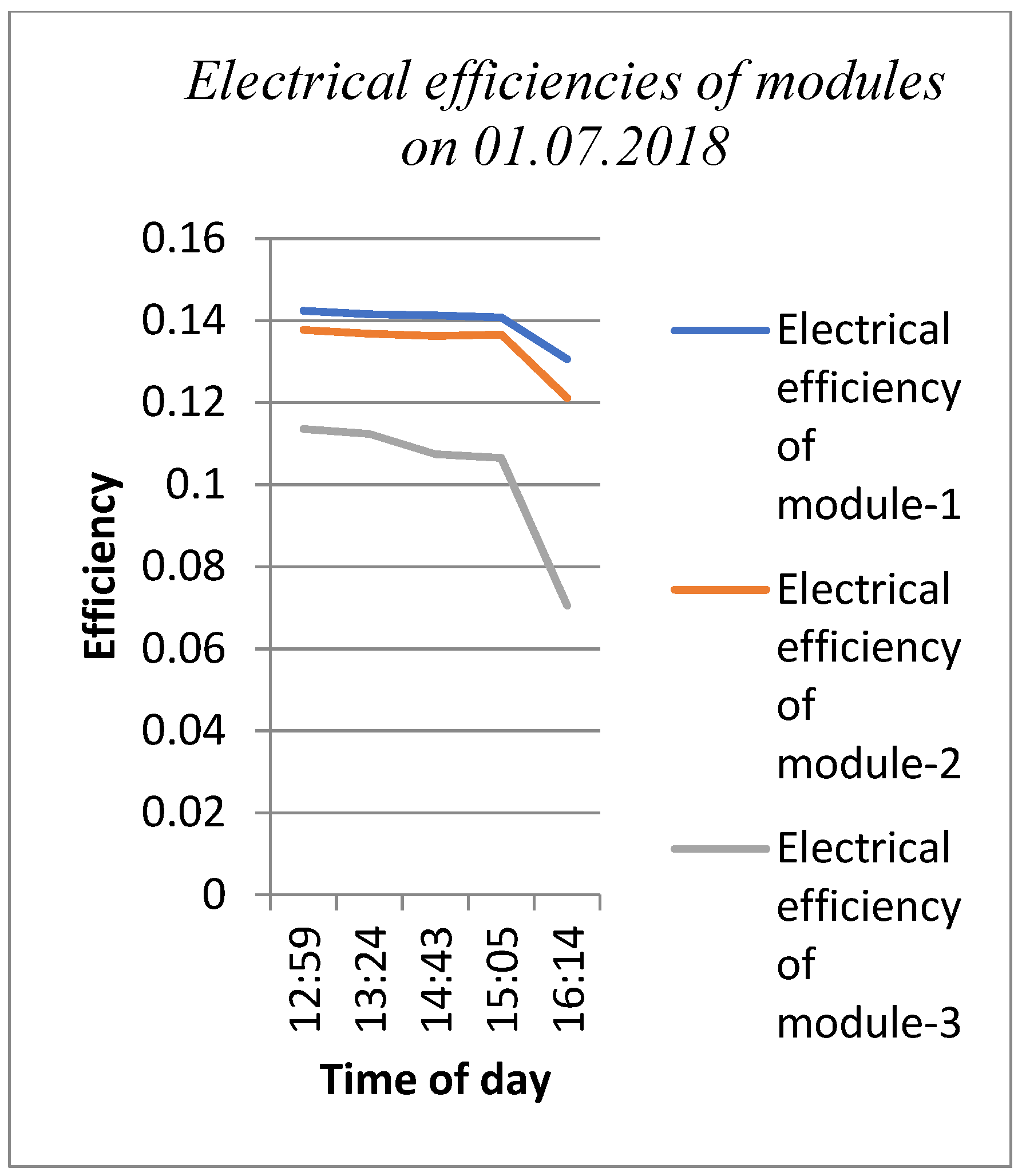
3.2.2. Powers and Efficiencies
4. Results and Discussion
5. Conclusions
Author Contributions
Funding
Conflicts of Interest
Nomenclature
| Isc | Short circuit current (A) |
| Voc | Open circuit voltage (V) |
| Pth-m2 | Thermal power of module-2 (W) |
| Pth-m3 | Thermal power of module-3 (W) |
| ṁwater | Mass flow of water (kg/s) |
| ṁair | Mass flow of air (kg/s) |
| Cp(air) | Specific heat of air (j/kg°C) |
| Cp(water) | Specific heat of water (j/kg°C) |
| Ti | Inlet temperature (°C) |
| To | Outlet temperature (°C) |
| Ptot-m2 | Total power of module-2 (W) |
| Ptot-m3 | Total power of module-3 (W) |
| µth-m2 | Thermal efficiency of module-2 |
| µth-m3 | Thermal efficiency of module-3 |
| µo-m2 | Overall efficiency of module-2 |
| µo-m3 | Overall efficiency of module-3 |
| Itot | Total irradiance (W) |
| It | Solar Irradiance (W/m2) |
| A | PV module area (m2) |
| µe | Electrical efficiency |
| λ | Heat conduction coefficient (W/mK) |
| Ti | Inlet temperature (°C) |
| To | Outlet temperature (°C) |
| TPV | PV panel temperature (°C) |
| Ta | Ambient temperature (°C) |
References
- Dubey, S.; Sarvaiya, J.N.; Seshadri, B. Temperature dependent photovoltaic (PV) efficiency and its effect on PV production in The World—A review. Energy Procedia 2013, 33, 311–321. [Google Scholar] [CrossRef] [Scilit]
- Sirinivas, M.; Jayaraj, S. Investigations on the performance of a double pass hybrid-type (PV/T) solar air heater. Int. J. Energy Environ. 2013, 4, 687–698. [Google Scholar]
- Lasnier, F.; Ang, T.G. Photovoltaic Engineering Handbook; Adam Higler: Bristol, UK, 1990; p. 258. [Google Scholar]
- Chandra, S.; Agrawal, S.; Chauhan, D.S. Soft computing based approach to evaluate the performance of solar PV module considering wind effect in laboratory condition. Energy Rep. 2018, 4, 252–259. [Google Scholar] [CrossRef] [Scilit]
- Muzathik, A.M. Photovoltaic modules operating temperature estimation using a simple correlation. Int. J. Energy Eng. 2014, 4, 151–158. [Google Scholar]
- Bardhi, M.; Grandi, G.; Tina, G.M. Comparison of cell temperature estimation by different thermal power exchange calculation methods. In Proceedings of the International Conference on Renewable Energies and Power Quality Spain, Santiago de Compostela, Spain, 28–30 March 2012; pp. 653–658. [Google Scholar]
- Kalogirou, S.A. Tripanagnostopoulos, Y. Hybrid PV/T solar systems for domestic hot water and electricity production. Energy Convers. Manag. 2006, 47, 3368–3382. [Google Scholar] [CrossRef] [Scilit]
- Alizadeh, H.; Ghasempour, R.; Shafii, M.B.; Ahmadi, M.H.; Yan, W.M.; Nazari, M.A. Numerical simulation of PV cooling by using single turn pulsating heat pipe. Int. J. Heat Mass Transf. 2018, 127, 203–208. [Google Scholar] [CrossRef] [Scilit]
- Sopian, K.; Liu, H.T.; Kakac, S.; Veziroglu, T.N. Performance of a double pass photovoltaic thermal solar collector suitable for solar drying systems. Energy Convers. Manag. 2000, 4, 353–365. [Google Scholar] [CrossRef] [Scilit]
- Ben Cheikh el hocine, H.; Touafek, K.; Kerrour, F.; Haloui, H.; Khelifa, A. Model validation of an empirical photovoltaic thermal (PV/T) collector. Energy Procedia 2015, 74, 1090–1099. [Google Scholar] [CrossRef] [Scilit]
- Jouhara, H.; Milko, J.; Danielewicz, J.; Sayegh, M.A.; Szulgowska-Zgrzywa, M.; Ramos, J.B.; Lester, S.P. The performance of a novel flat heat pipe based thermal and PV/T (photovoltaic and thermal systems) solar collector that can be used as an energy-active building envelope material. Energy 2016, 108, 148–154. [Google Scholar] [CrossRef] [Scilit]
- Mojumder, J.C.; Chong, W.T.; Ong, H.C.; Leong, K.Y.; Abdullah-Al-Mamoon. An experimental investigation on performance analysis of air type photovoltaic thermal collector system integrated with cooling fins design. Energy Build. 2016, 130, 272–285. [Google Scholar] [CrossRef] [Scilit]
- Abu Bakar, M.N.; Othman, M.; Din, M.H.; Manaf, N.A.; Jarimi, H. Development of an improved Photovoltaic/Thermal (PV/T) solar collector with bi-fluid configuration. Int. J. Chem. Environ. Eng. 2013, 4, 234–239. [Google Scholar]
- Alobaid, M.; Hughes, B.; Connor, O.; Calautit, D.; Heyes, J.A. Improving thermal and electrical efficiency in photovoltaic thermal systems for sustainable cooling system integration. J. Sustain. Dev. Energy Water Environ. Syst. 2018, 6, 305–322. [Google Scholar] [CrossRef] [Scilit]
- Kazem, H.A. Evaluation and analysis of water-based photovoltaic/thermal (PV/T) system. Case Stud. Therm. Eng. 2019, 13, 100401. [Google Scholar] [CrossRef] [Scilit]
- Jia, Y.; Alva, G.; Fang, G. Development and applications of photovoltaic–thermal systems: A review. Renew. Sustain. Energy Rev. 2019, 102, 249–265. [Google Scholar] [CrossRef] [Scilit]
- Bambrook, S.M.; Sproul, A.B. Maximising the energy output of a PVT air system. Sol. Energy 2012, 86, 1857–1871. [Google Scholar] [CrossRef] [Scilit]
- Zhao, J.; Song, Y.; Lam, W.H.; Liu, W.; Liu, Y.; Zhang, Y.; Wang, D.Y. Solar radiation transfer and performance analysis of an optimum photovoltaic/thermal system. Energy Convers. Manag. 2011, 52, 1343–1353. [Google Scholar] [CrossRef] [Scilit]
- Chow, T.T.; Ji, J.; He, W. Photovoltaic-thermal collector system for domestic application. J. Sol. Energy Eng. 2006, 129, 205–209. [Google Scholar] [CrossRef] [Scilit]
- Jarimi, H.; Abu Bakar, M.N.; Othman, M.; Din, M.H. Bi-fluid photovoltaic/thermal (PV/T) solar collector: Experimental validation of a 2-D theoretical model. Renew. Energy 2016, 85, 1052–1067. [Google Scholar] [CrossRef] [Scilit]
- Atmaca, M.; Pektemir, I.Z.; Yılmaz, E. Investigation of Possibilities Obtain Heating, Hot Water and Electricity from Same Solar Panel by Means of a New Design Called “Solenam” (Solar Energy Absorber Machine) 3; International Multidisciplinary Studies Congress: Kiev, Ukrain, 2018; pp. 156–166. [Google Scholar]
- Hussain, F.; Othman, M.Y.H.; Yatim, B.; Ruslan, H.; Sopian, K.; Ibarahim, Z.A. A study of PV/T collector with honeycomb heat exchanger. AIP Conf. Proc. 2013, 1571, 10–16. [Google Scholar]
- Duffie, J.A.; Beckman, W.A. Solar Engineering of Thermal Processes; Wiley&Sons: Hoboken, NJ, USA, 1991. [Google Scholar]
- Xu, L.; Wang, Y.; Solangi, Y.A.; Zameer, H.; Shah, S.A.A. Off-Grid Solar PV Power Generation System in Sindh, Pakistan: A Techno-Economic Feasibility Analysis. Processes 2019, 7, 308. [Google Scholar] [CrossRef] [Scilit]
- Hassouni, B.E.; Haddi, A.; Amrani, A.G. Modelling and simulation of an autonomous PV Generator dedicated to supply an agricultural pumping station. Energy Procedia 2017, 139, 153–160. [Google Scholar] [CrossRef] [Scilit]

© 2019 by the authors. Licensee MDPI, Basel, Switzerland. This article is an open access article distributed under the terms and conditions of the Creative Commons Attribution (CC BY) license (http://creativecommons.org/licenses/by/4.0/).
Share and Cite
Atmaca, M.; Pektemir, İ.Z. An Investigation on the Effect of the Total Efficiency of Water and Air Used Together as a Working Fluid in the Photovoltaic Thermal Systems. Processes 2019, 7, 516. https://doi.org/10.3390/pr7080516
Atmaca M, Pektemir İZ. An Investigation on the Effect of the Total Efficiency of Water and Air Used Together as a Working Fluid in the Photovoltaic Thermal Systems. Processes. 2019; 7(8):516. https://doi.org/10.3390/pr7080516
Chicago/Turabian StyleAtmaca, Mustafa, and İmdat Zafer Pektemir. 2019. "An Investigation on the Effect of the Total Efficiency of Water and Air Used Together as a Working Fluid in the Photovoltaic Thermal Systems" Processes 7, no. 8: 516. https://doi.org/10.3390/pr7080516
APA StyleAtmaca, M., & Pektemir, İ. Z. (2019). An Investigation on the Effect of the Total Efficiency of Water and Air Used Together as a Working Fluid in the Photovoltaic Thermal Systems. Processes, 7(8), 516. https://doi.org/10.3390/pr7080516