

A Hybrid Multi-Objective Optimization Framework for Preliminary Process Design Based on Health, Safety and Environmental Impact

 ,
,  ,
, 
Abstract
1. Introduction
2. Problem Statement
3. Framework for Preliminary Process Design
4. Case Study
5. Conclusions
Supplementary Materials
Author Contributions
Funding
Acknowledgments
Conflicts of Interest
Nomenclature
| Index/Subscript | |
| p | Index for stream of input or output |
| j | Index for unit operations |
| k | Index for alternative process |
| a | Index for chemical components |
| l | Index for environmental impact category |
| r | Index for criteria with a given range |
| Parameters | |
| ap,j,k | Matrix of input or output mass flow rate for stream p to or from unit operation j of process k |
| Lower limit of the capacity for unit operation j in process k | |
| Upper limit of the capacity for unit operation j in process k | |
| AOTk | Annual operating time for process k |
| Product price of output p (products) in process k | |
| Cost of input p (raw materials) in process k | |
| EPL | Lower limit for gross profit |
| EPU | Upper limit for gross profit |
| WARL | Lower limit for environmental impact |
| WARU | Upper limit for environmental impact |
| ISIL | Lower limit for inherent safety index |
| ISIU | Upper limit for inherent safety index |
| HQIL | Lower limit for health quotient index |
| HQIU | Upper limit for health quotient index |
| PEIa | Score of potential environmental impact for chemical component a |
| PEIa,l | Score of potential environmental impact for chemical component a at each of the category l |
| PEIElec | Score of potential environmental impact for electricity |
| αl | Weighting factor of the impact at category l |
| FEi,j,k | Estimated fugitive emission rates in stream i to or from unit operation j in process k |
| Total process floor area in process k | |
| Aj,k | The floor area of each unit operations j in process k |
| sk | Side length of the process k |
| Cross-sectional area of process k | |
| hk | Average height of the main unit operations in process k |
| Qk | Air volumetric flow rate in process k |
| V | Wind speed |
| Ca,k | Average concentration of chemical components a in the air at downwind edge of the plot area |
| Threshold limit of the chemical component a | |
| Lk,r | Lower bound for a given criteria r in process k |
| Uk,r | Upper bound for a given criteria r in process k |
| Sk,r | Score of sub-index for inventory in process k based on a given criteria r |
| Variables | |
| xj,k | Capacity or size of the unit operation j in process k |
| yp,k | Net input or output of stream p in process k |
| Net output of stream p in process k | |
| Net input of stream p in process k | |
| Power consumption of process k | |
| wa,j,k | Weight composition of chemical component a from unit j in process k |
| ma,k | Fugitive emission of each of the chemical components a in process k |
| GPk | Gross profit for process k |
| WARk | Total environmental impact generated by process k |
| Output rates of impact in the process k | |
| Input rates of impact in the process k | |
| Impact of power consumption for process k | |
| IkCI | Chemical ISI score of process k |
| IkPI | Process ISI score of process k |
| Sub-index for the factor of the heat of main reaction in process k | |
| Sub-index for the factor of the heat of side reaction in process k | |
| Sub-index for the factor of chemical interaction in process k | |
| Sub-index for the factor of flammability in process k | |
| Sub-index for the factor of explosiveness in process k | |
| Sub-index for the factor of toxic exposure in process k | |
| Sub-index for the factor of corrosiveness of the chemical components in process k | |
| Sub-index for the factor of inventory in process k | |
| Sub-index for the factor of process temperature in process k | |
| Sub-index for the factor of process pressure in process k | |
| Sub-index for the factor of equipment safety in process k | |
| Sub-index for the factor of safe process structure in process k | |
| ISIk | Total ISI score of process k |
| HQIa,k | HQI of each chemical components a in process k |
| HQIk | Total HQI score of process k |
| Degree of satisfaction for multiple objectives in each alternative process k | |
| bk | Existence of alternative process k |
References
- Westerberg, A.W. Recent Developments in Chemical Process and Plant Design; Liu, Y.A., Henry, A., McGee, J., Epperly, W.R., Eds.; John Wiley and Sons: New York, NY, USA, 1987. [Google Scholar]
- Stephanopoulos, G.; Reklaitis, G.V. Process systems engineering: From Solvay to modern bio- and nanotechnology. A history of development, successes and prospects for the future. Chem. Eng. Sci. 2011, 66, 4272–4306. [Google Scholar] [CrossRef] [Scilit]
- Nishida, N.; Stephanopoulos, G.; Westerberg, A.W. A review of process synthesis. AIChE J. 1981, 27, 321–351. [Google Scholar] [CrossRef] [Scilit]
- Linnhoff, B.; Townsend, D.W.; Boland, D.; Hewitt, G.F.; Thomas, B.E.A.; Guy, A.R.; Marsland, R.H. User Guide on Process Integration for the Efficient Use of Energy; Institution of Chemical Engineers: Rugby, UK, 1982. [Google Scholar]
- Foo, D.C.Y.; Ng, D.K.S. Process Integration for Cleaner Process Design. In Handbook of Process Integration: Minimisation of Energy and Water Use, Waste and Emissions; Series in Energy No. 61; Klemeš, J.J., Ed.; Woodhead Publishing: Sawston, UK, 2013. [Google Scholar]
- Douglas, J.M. Conceptual Design of Chemical Processes; McGraw-Hill: New York, NY, USA, 1988. [Google Scholar]
- Azapagic, A.; Millington, A.; Collett, A. A methodology for integrating sustainability considerations into process design. Chem. Eng. Res. Des. 2006, 84, 439–452. [Google Scholar] [CrossRef] [Scilit]
- Azapagic, A.; Millington, A.; Collett, A. Process design for sustainability: The case of vinyl chloride monomer. In Sustainable Development in Practice: Case Studies for Engineers and Scientists; John Wiley & Sons, Ltd.: Hoboken, NJ, USA, 2004; pp. 201–249. [Google Scholar]
- Gentile, M.; Rogers, W.; Mannan, M. Development of a fuzzy logic-based inherent safety index. Process Saf. Environ. Prot. 2003, 81, 444–456. [Google Scholar] [CrossRef] [Scilit]
- Hassim, M.; Hurme, M. Inherent occupational health assessment during preliminary design stage. J. Loss Prev. Process Ind. 2010, 23, 476–482. [Google Scholar] [CrossRef] [Scilit]
- Edwards, D.; Lawrence, D. Assessing the inherent safety of chemical process routes: Is there a relation between plant costs and inherent safety? Process Saf. Environ. Prot. 1993, 71, 252–258. [Google Scholar]
- Heikkila, A. Inherent Safety in Process Plant Design; Technical Research Centre of Finland: Espoo, Finland, 1999. [Google Scholar]
- Palaniappan, C.; Srinivasan, R.; Tan, R. Expert system for the design of inherently safer processes. 1. Route selection stage. Ind. Eng. Chem. Res. 2002, 41, 6698–6710. [Google Scholar] [CrossRef] [Scilit]
- Hassim, M.; Edwards, D. Development of a methodology for assessing inherent occupational health hazards. Process Saf. Environ. Prot. 2006, 84, 378–390. [Google Scholar] [CrossRef] [Scilit]
- Hassim, M.H.; Perez, A.L.; Hurme, M. Estimation of chemical concentration due to fugitive emissions during chemical process design. Process Saf. Environ. Prot. 2010, 88, 173–184. [Google Scholar] [CrossRef] [Scilit]
- Cave, S.; Edwards, D. Chemical process route selection based on assessment of inherent environmental hazard. Comput. Chem. Eng. 1997, 21, 965–970. [Google Scholar] [CrossRef] [Scilit]
- Gunasekera, M.; Edwards, D. Estimating the environmental impact of catastrophic chemical releases to the atmosphere: An index method for ranking alternative chemical process routes. Process Saf. Environ. Prot. 2003, 81, 463–474. [Google Scholar] [CrossRef] [Scilit]
- Gunasekera, M.; Edwards, D. Chemical process route selection based upon the potential toxic impact on the aquatic, terrestrial and atmospheric environments. J. Loss Prev. Process Ind. 2006, 19, 60–69. [Google Scholar] [CrossRef] [Scilit]
- Cabezas, H.; Bare, J.; Mallick, S. Pollution prevention with chemical process simulators: The generalized waste reduction (WAR) algorithm-full version. Comput. Chem. Eng. 1999, 23, 623–634. [Google Scholar] [CrossRef] [Scilit]
- Young, D.; Cabezas, H. Designing sustainable processes with simulation: The waste reduction (WAR) algorithm. Comput. Chem. Eng. 1999, 23, 1477–1491. [Google Scholar] [CrossRef] [Scilit]
- Andiappan, V.; Ko, A.S.Y.; Lau, V.W.S.; Ng, L.Y.; Ng, R.T.L.; Chemmangattuvalappil, N.G.; Ng, D.K.S. Synthesis of sustainable integrated biorefinery via reaction pathway synthesis: Economic, incremental enviromental burden and energy assessment with multiobjective optimization. AIChE J. 2015, 61, 132–146. [Google Scholar] [CrossRef] [Scilit]
- Seider, W.D.; Seader, J.D.; Lewin, D.R. Product and Process Design Principles: Synthesis, Analysis and Evaluation, 2nd ed.; John Wiley & Sons, Ltd.: Hoboken, NJ, USA, 2004. [Google Scholar]
- Othman, M.; Repke, J.; Wozny, G.; Huang, Y. A modular approach to sustainability assessment and decision support in chemical process design. Ind. Eng. Chem. Res. 2010, 49, 7870–7881. [Google Scholar] [CrossRef] [Scilit]
- Al-Sharrah, G.; Elkamel, A.; Almanssoor, A. Sustainability indicators for decisionmaking and optimisation in the process industry: The case of the petrochemical industry. Chem. Eng. Sci. 2010, 65, 1452–1461. [Google Scholar] [CrossRef] [Scilit]
- Liew, W.; Hashim, M.; Ng, D.; Hurme, M. Fuzzy Optimization for Screening of Sustainable Chemical Reaction Pathways. Chem. Eng. Trans. 2012, 29, 529–534. [Google Scholar]
- Ng, R.; Hassim, M.; Ng, D. Process synthesis and optimization of a sustainable integrated biorefinery via fuzzy optimisation. AIChE J. 2013, 59, 4212–4227. [Google Scholar] [CrossRef] [Scilit]
- Teng, W.C.; Fong, K.L.; Shenkar, D.; Wilson, J.A.; Foo, D.C.Y. Piper Diagram–A Novel Visualisation Tool for Process Design. Chem. Eng. Res. Des. 2016, 112, 132–145. [Google Scholar] [CrossRef] [Scilit]
- Motard, R.L.; Shacham, M.; Rosen, E.M. Steady state chemical process simulation. AIChE J. 1975, 21, 417–436. [Google Scholar] [CrossRef] [Scilit]
- Dimian, A.C.; Bildea, C.S.; Kiss, A.A. Integrated Design and Simulation of Chemical Processes, 2nd ed.; Elsevier: Amsterdam, The Netherlands, 2014. [Google Scholar]
- Foo, D.C.Y.; Chemmangattuvalappil, N.; Ng, D.K.S.; Elyas, R.; Chen, C.-L.; Elms, R.D.; Lee, H.-Y.; Chien, I.-L.; Chong, S.; Chong, C.H. Chemical Engineering Process Simulation; Elsevier: Amsterdam, The Netherlands, 2017; ISBN 978-0-12-803782-9. [Google Scholar]
- Leontief, W. Quantitative Input and Output Relations in the Economic Systems of the United States. Rev. Econ. Stat. 1936, 18, 105–125. [Google Scholar] [CrossRef] [Scilit]
- Leontief, W.W. The Structure of the AMERICAN Economy; Oxford University Press: New York, NY, USA, 1951. [Google Scholar]
- Tan, R.; Culaba, A.; Aviso, K. A fuzzy linear programming extension of the general matrix-based life cycle model. J. Clean. Prod. 2008, 16, 1358–1367. [Google Scholar] [CrossRef] [Scilit]
- Aviso, K.; Tan, R.; Culaba, A.; Cruz, J., Jr. Fuzzy input–Output model for optimizing eco-industrial supply chains under water footprint constraints. J. Clean. Prod. 2011, 19, 187–196. [Google Scholar] [CrossRef] [Scilit]
- Kasivisvanathan, H.; Barilea, I.D.U.; Ng, D.K.S.; Tan, R.R. Optimal Operational Adjustment in Multi-functional Energy Systems in Response to Process Inoperability. Appl. Energy 2013, 102, 492–500. [Google Scholar] [CrossRef] [Scilit]
- Kasivisvanathan, H.; Ubando, A.T.; Ng, D.K.S.; Tan, R.R. Robust Optimization for Process Synthesis and Design of Multifunctional Energy Systems with Uncertainties. Ind. Eng. Chem. Res. 2014, 53, 3196–3209. [Google Scholar] [CrossRef] [Scilit]
- Foong, S.Z.Y.; Goh, C.K.M.; Supramaniam, C.V.; Ng, D.K.S. Input–Output optimisation model for sustainable oil palm plantation development. Sustain. Prod. Consum. 2019, 17, 31–46. [Google Scholar] [CrossRef] [Scilit]
- Andiappan, V.; Ng, D.S.; Tan, R.R. Design operability and retrofit analysis (DORA) framework for energy systems. Energy 2017, 134, 1038–1052. [Google Scholar] [CrossRef] [Scilit]
- El-Halwagi, M.M. Process Integration; Academic Press: Cambridge, MA, USA, 2006. [Google Scholar]
- Bellman, R.E.; Zadeh, L.A. Decision making in a fuzzy environment. Manag. Sci. 1970, 17, 141–164. [Google Scholar] [CrossRef] [Scilit]
- Zimmermann, H. Fuzzy programming and liner programming with several objective functions. Fuzzy Sets Syst. 1978, 1, 45–55. [Google Scholar] [CrossRef] [Scilit]
- Haas, T.; Jaeger, B.; Weber, R.; Mitchell, S.; King, C. New diol processes: 1,3- propanediol and 1,4-butanediol. Appl. Catal. A Gen. 2005, 1, 83–88. [Google Scholar] [CrossRef] [Scilit]
- Schlander, J.; Turek, T. Gas-phase hydrogenolysis of dimethyl maleate to 1,4- butanediol and -butyrolactone over copper/zinc oxide catalysts. Ind. Eng. Chem. Res. 1999, 4, 1264–1270. [Google Scholar] [CrossRef] [Scilit]
- Bertola, A. Process for the production of Tetrahydrofuran, Gammabutyrolactone and Butanediol. U.S. Patent 6248906B1, 19 June 2001. [Google Scholar]
- Mecklenburgh, J.C. Process Plant Layout; Halstead Press: New York, NY, USA, 1985. [Google Scholar]
- Aspentech. Getting Started in Aspen HYSYS; Aspen Technology, Inc.: Bedford, MA, USA, 2014. [Google Scholar]
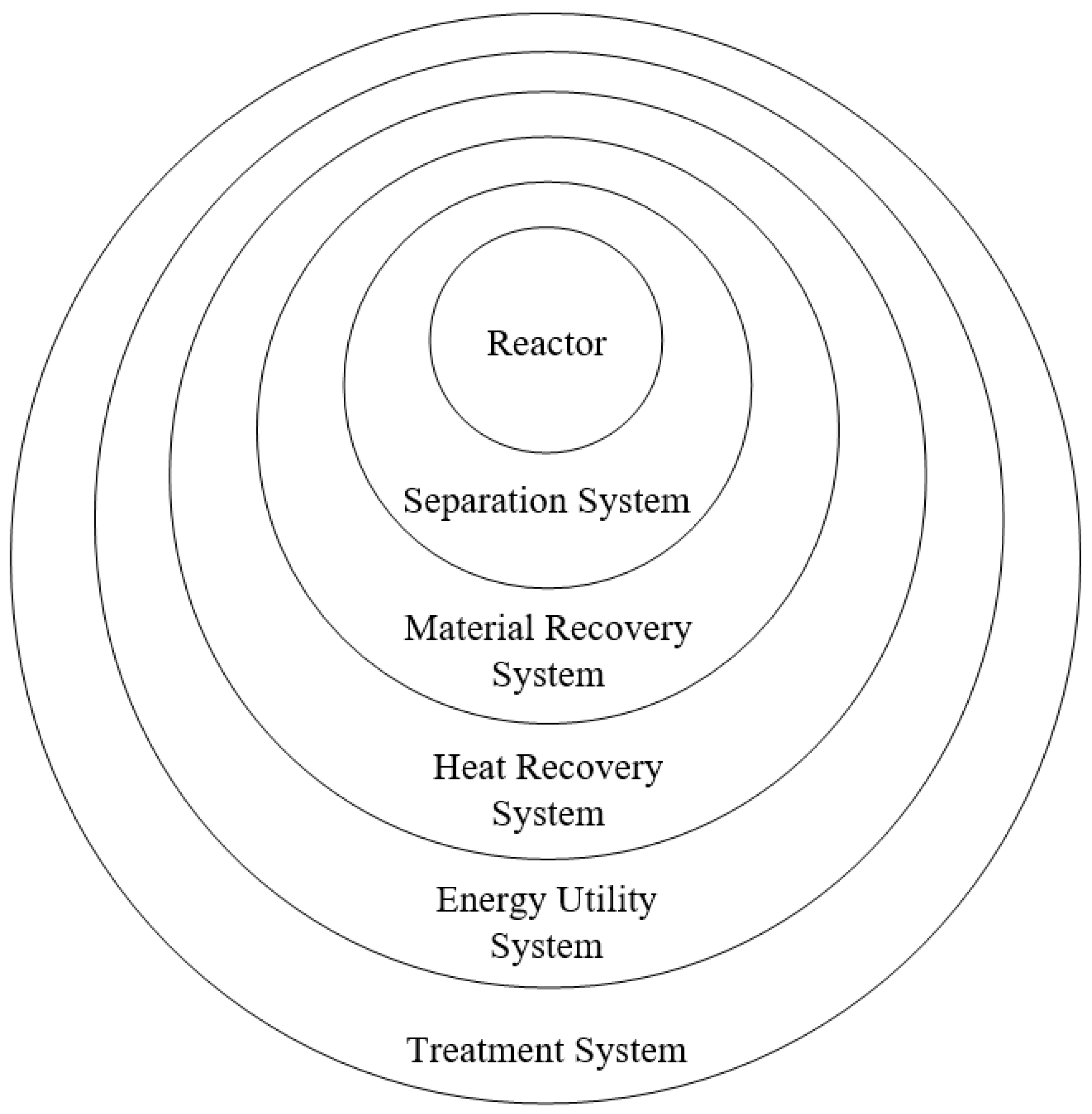
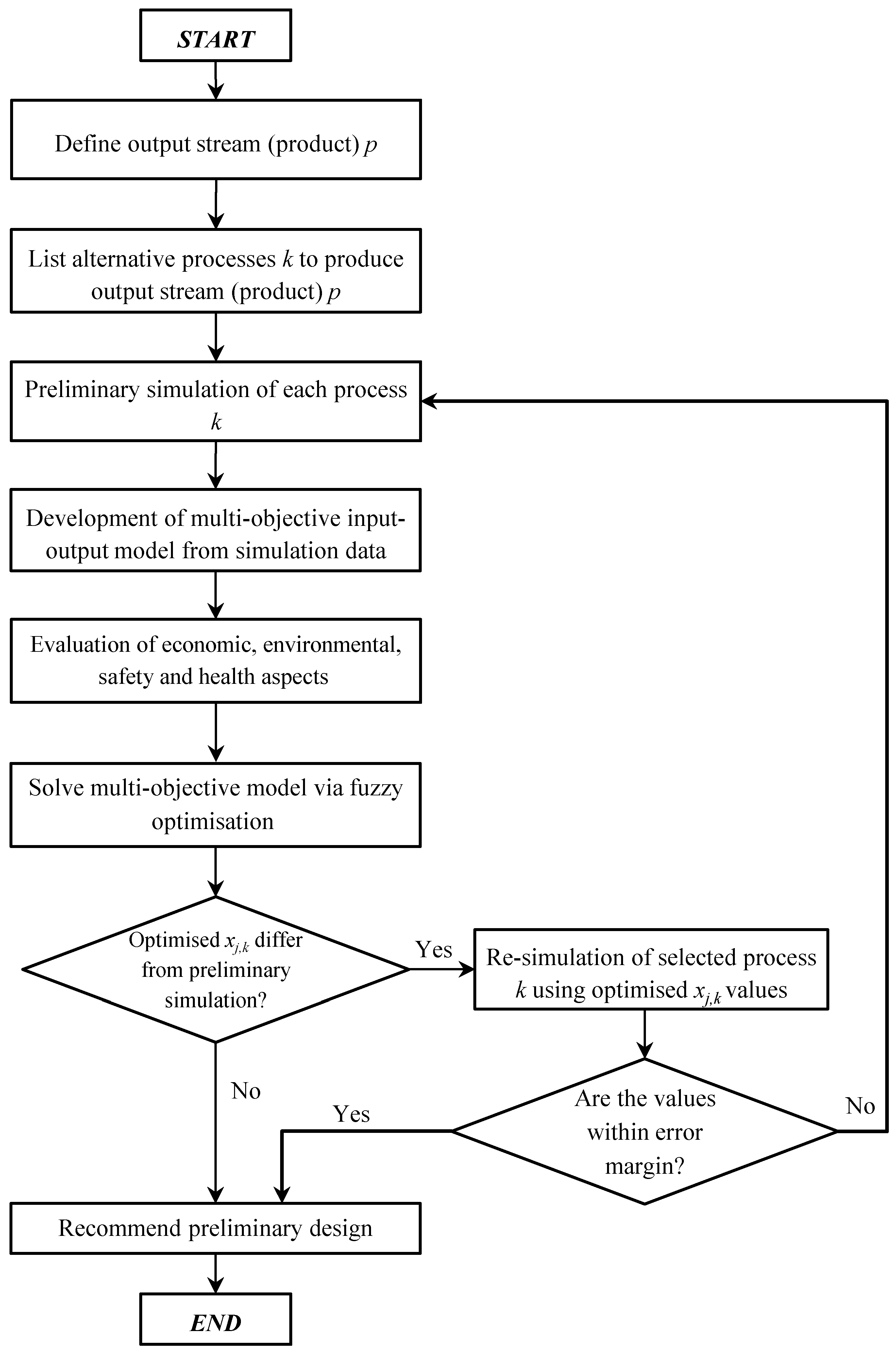
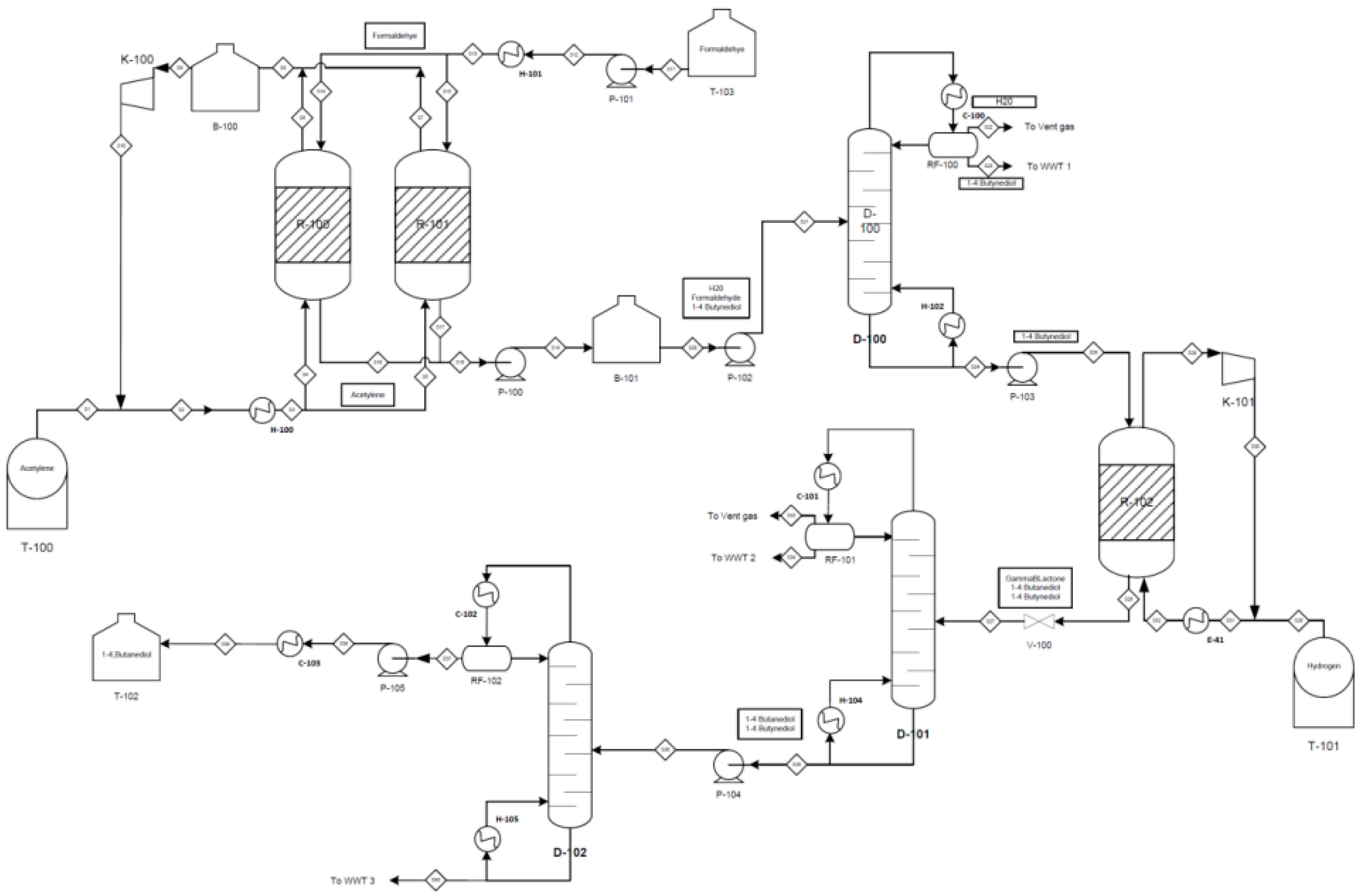
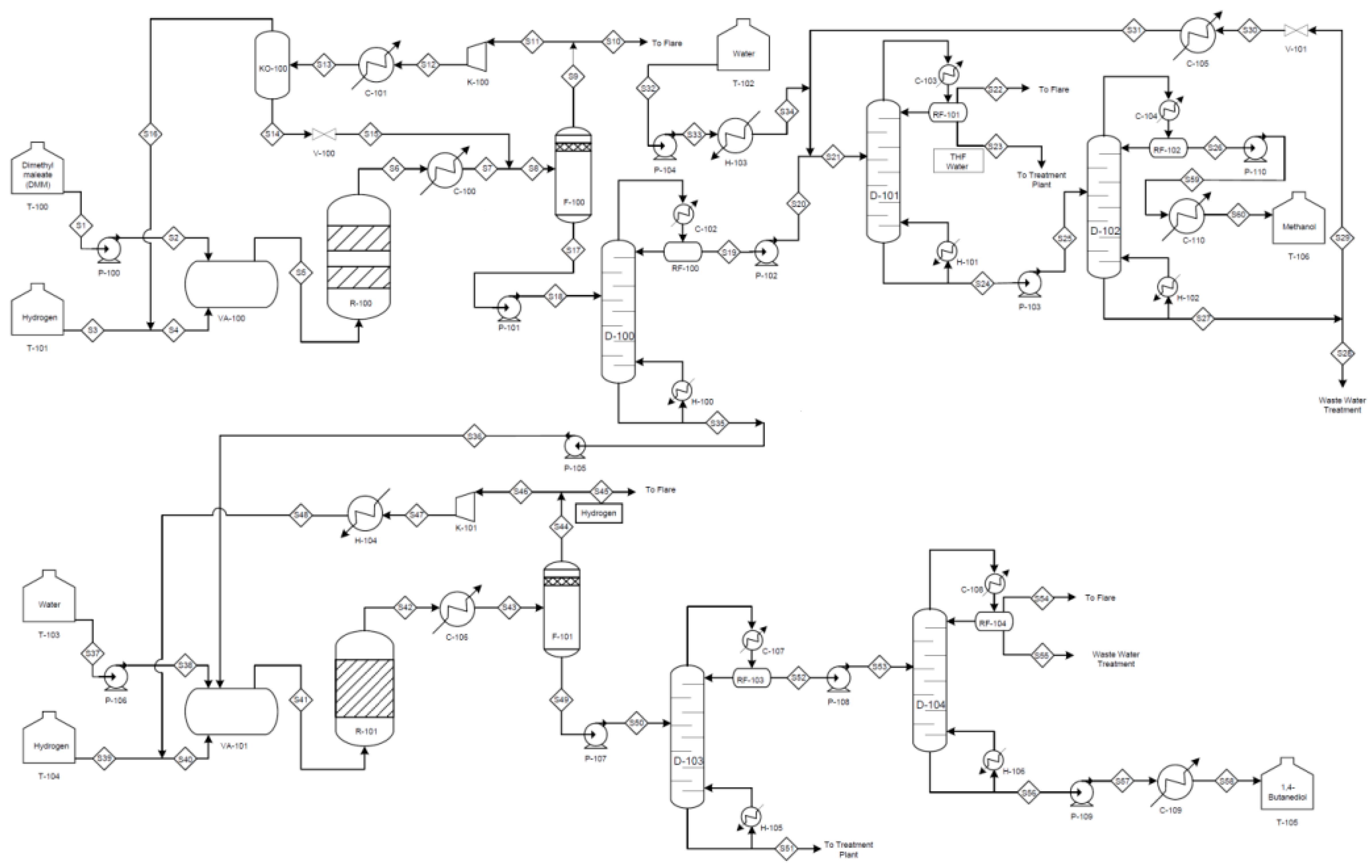

| Path | Reaction | Chemical Reaction |
|---|---|---|
| Reppe Process | Hydrogenation of Acetylene and Formaldehyde | C2H2 + 2 CH2O → C4H6O2 2 H2 + C4H6O2 → C4H10O2 |
| Davy Process | Hydrogenation of Dimethyl Maleate | C6H8O4 + 5H2 → C4H10O2 + 2 CH3OH |
| Aspects | Reppe Process | Davy Process |
|---|---|---|
| GPk (106 USD/y) | 45.633 | 123.408 |
| HQIk | 0.484 | 0.025 |
| ISIk | 36 | 28 |
| WARk | 2.091 | 33.679 |
| Aspects | Before | After |
|---|---|---|
| Capacity of process, xj,k | 1 | 0.967 |
| GPk (106 USD/y) | 123.408 | 119.293 |
| HQIk | 0.0246 | 0.0242 |
| ISIk | 28 | 28 |
| WARk | 33.679 | 32.556 |
© 2019 by the authors. Licensee MDPI, Basel, Switzerland. This article is an open access article distributed under the terms and conditions of the Creative Commons Attribution (CC BY) license (http://creativecommons.org/licenses/by/4.0/).
Share and Cite
Teh, S.Y.; Chua, K.B.; Hong, B.H.; Ling, A.J.W.; Andiappan, V.; Foo, D.C.Y.; Hassim, M.H.; Ng, D.K.S. A Hybrid Multi-Objective Optimization Framework for Preliminary Process Design Based on Health, Safety and Environmental Impact. Processes 2019, 7, 200. https://doi.org/10.3390/pr7040200
Teh SY, Chua KB, Hong BH, Ling AJW, Andiappan V, Foo DCY, Hassim MH, Ng DKS. A Hybrid Multi-Objective Optimization Framework for Preliminary Process Design Based on Health, Safety and Environmental Impact. Processes. 2019; 7(4):200. https://doi.org/10.3390/pr7040200
Chicago/Turabian StyleTeh, Shin Yee, Kian Boon Chua, Boon Hooi Hong, Alex J. W. Ling, Viknesh Andiappan, Dominic C. Y. Foo, Mimi H. Hassim, and Denny K. S. Ng. 2019. "A Hybrid Multi-Objective Optimization Framework for Preliminary Process Design Based on Health, Safety and Environmental Impact" Processes 7, no. 4: 200. https://doi.org/10.3390/pr7040200
APA StyleTeh, S. Y., Chua, K. B., Hong, B. H., Ling, A. J. W., Andiappan, V., Foo, D. C. Y., Hassim, M. H., & Ng, D. K. S. (2019). A Hybrid Multi-Objective Optimization Framework for Preliminary Process Design Based on Health, Safety and Environmental Impact. Processes, 7(4), 200. https://doi.org/10.3390/pr7040200

