1. Introduction
Basalt is classified as a volcanic igneous rock. It forms from mantle-derived melts generated by decompression melting. The basaltic melt is characterized by low viscosity. After an eruption, it spreads rapidly across the Earth’s surface, and it cools quickly. On a global scale, basalt is the dominant igneous rock type. It covers approximately 70% of the Earth’s surface [
1].
The properties that make basalt widely applicable include its hardness, homogeneous structure, low specific gravity, high resistance to pressure, excellent insulation properties, good resistance to wear and corrosion, low water absorption, resistance to the effects of bases and acids, and low price, as well as the possibility of obtaining glass and glass-ceramics from basalt by applying various thermal treatments. Basalt demonstrates strong resistance to biodegradation caused by fungi and microorganisms [
2].
The technological process of processing basalt rocks is environmentally friendly. The resulting products are non-carcinogenic. They do not pose risks to human health or safety [
3]. Basalt can be successfully processed into high-value products by melting and casting processes, both in metal and sand molds, and by pressing and sintering processes. Basalt products do not produce toxic substances when in contact with air or water, are not flammable, and are explosion-resistant. In the presence of other chemical substances, they do not undergo harmful chemical reactions that could harm the environment [
4].
The mechanical properties of andesite basalt material, including hardness, flexural strength, and compressive strength, are complemented by favorable chemical properties such as resistance to chemical agents, as well as low electrical and thermal conductivity. These combined properties enable their application as a raw material for the production of ceramic components used in the mechanical, electrical, and construction industries. Typical examples include abrasive components, ceramic sealing rings, bushings, taps, and low-voltage electrical insulating elements [
5]. The low thermal conductivity of basalt, combined with its oxidation resistance, enables its application in the manufacture of refractory materials designed for heat and fire exposure [
6].
The oldest use of basalt rocks was in Roman times for road construction and road markings [
7], and even today, basalt products and basalt aggregates are widely used in construction. The reinforcement of buildings can be achieved by using basalt rock products, as they are more readily available than other raw materials, especially as an alternative to steel bars in conditions where corrosion is a significant problem [
8]. Basalt is used in industry to produce various geometric elements for paving and cladding applications.
Basalt ceramics can be used in the fabrication of mining equipment for transporting abrasive materials and grinding, as well as in construction for facades and fire and sound insulation [
3]. Basalt-like glass-ceramic materials, which exhibit high chemical resistance, are used in the disposal of nuclear waste [
9].
The selection of a manufacturing process is closely related to the initial material, the required quality of the final product, production capacity and costs while also complying with environmental requirements. The process determines the achievable product quality, including shape, dimensions, surface finish, and tolerances, while keeping production costs minimal. Powder metallurgy represents an important branch of modern industry [
10,
11,
12]. In the manufacture of small, complex-shaped parts, powder metallurgy provides significant benefits, including material and energy savings and improved dimensional precision. Sintered materials have the benefit of achieving higher uniformity than those obtained by traditional metallurgical processes. Today, a ceramic tile factory produces up to ten thousand tiles daily. Since sintering ceramic materials in furnaces without a protective atmosphere is a highly productive process, it is possible to monitor the quality of the manufactured piece based on the product’s color, not only through quality control sensors but also by visual inspection.
It is interesting that the average person, according to some estimates, can distinguish up to 10 million colors. Although the way a person perceives a specific color is a subjective feeling of the observer, in 1931, the CIE (International Commission on Illumination/Commission Internationale d’Éclairage) [
13] created the first standards that were adopted to quantify color changes and lightness. Color is a sensation that represents the response of the human visual system to stimulation in the form of light. Light refers to the spectrum of visible electromagnetic radiation in the range 380–750 nm. In terms of frequency, it corresponds to the range 400–790 THz. The visible spectrum does not represent the full range of colors perceived by humans. Color perception results from the response of the eye and brain to different combinations of light wavelengths. Certain hues, including non-spectral colors such as pink and many purple variations, cannot be generated by a single wavelength. Instead, they are produced through the mixing of multiple spectral components. Colors associated with a single wavelength are defined as spectral or pure colors [
14,
15]. Color is a matter of perception and subjective interpretation; therefore, expressing colors using numerical values facilitates the understanding and standardization of colors. An object appears to be colored in a specific color because it reflects light of a certain wavelength and absorbs the rest of the spectrum. The reflected wavelength of light is registered as color by the human eye. An important indicator of product quality can certainly be its color.
The quantification of visual color can be performed using a colorimeter, i.e., a chromatometer. The CIE commission has defined tristimulus values that are often used to measure surface color [
13]. XYZ values are based on the theory that the human eye has three types of receptors sensitive to red, green, and blue light. All other colors are perceived as mixtures of responses from these receptors [
16]. Color purity is quantitatively defined as the distance of a given point from “white”. Purity reaches its maximum when a point lies on the spectral curve, at which point it represents a pure spectral color with 100% purity. The CIELAB color space is based on a three-dimensional color space with three coordinates (L*, a*, and b*), two chromatic axes a* and b*, and an achromatic axis L* [
17]. The L* coordinate represents lightness along the vertical axis of the CIELAB color space, ranging from black (0) to white (100). The a* coordinate indicates red (+) to green (−), while b* represents yellow (+) to blue (−) [
16]. Moreover, changes in these color coordinates act as indicators of color variations. For instance, in the CIELAB color space, the quantifiers include differences in lightness (ΔL*), as well as variations in the intensities and directions of the green–red (Δa*) and blue–yellow (Δb*) coordinates.
This research aims to examine the influence of sintering temperature on the physical properties of ceramic materials made from andesite basalt, such as relative density and shrinkage, in correlation with the color changes in the samples. These findings will support the creation of a high-density ceramic material, identified by its color and suitable for straightforward visual inspection during production.
2. Experimental Procedure
2.1. Material and Processing Route
Basalt aggregate, crushed to a 2–5 mm size fraction, from the “Donje Jarinje” site [
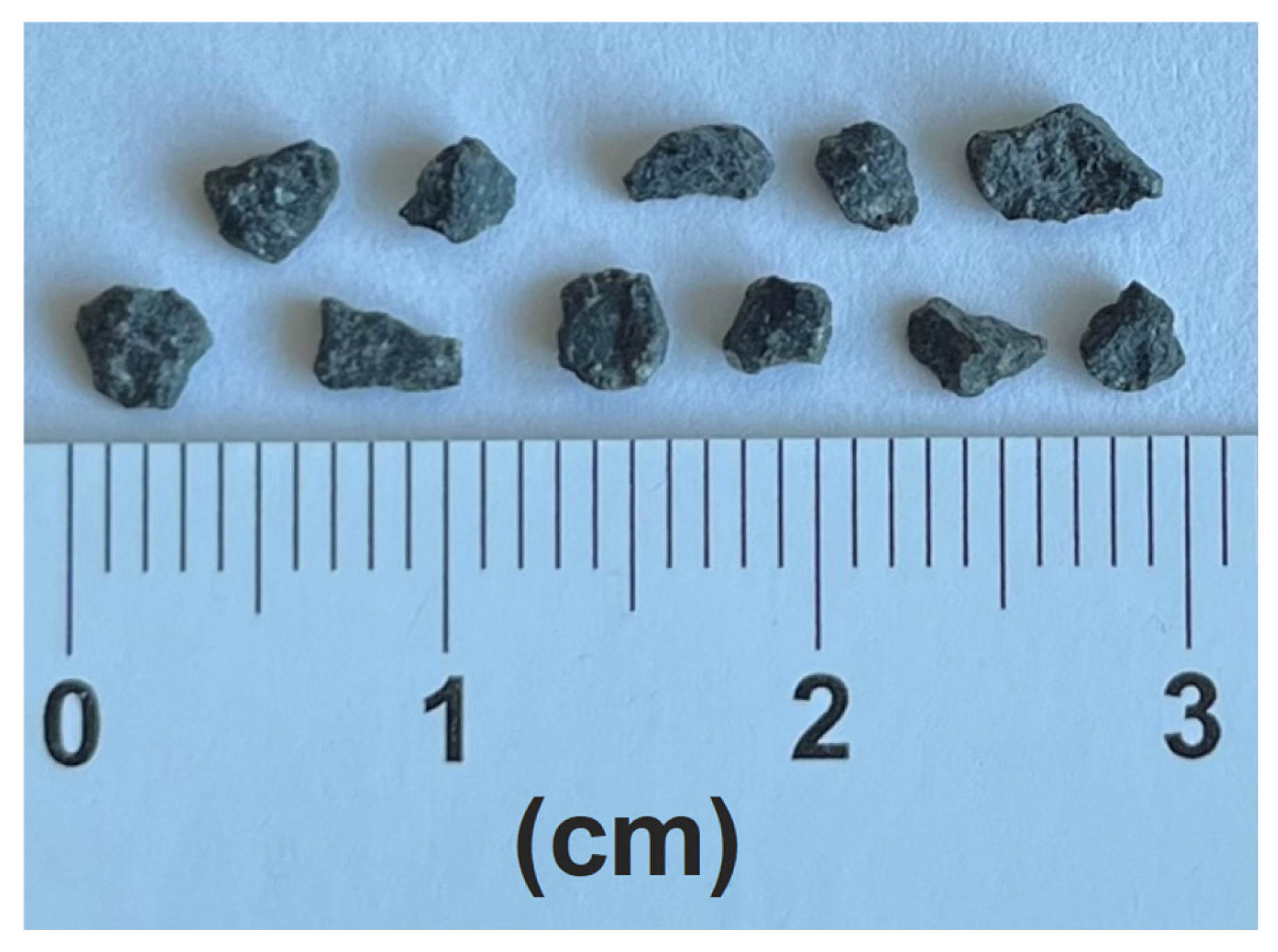
18], Serbia, was used as the starting material in this study. Basalt from this site is classified as andesite basalt, which has a visually dark gray color, as shown in
Figure 1. Due to the large amount of magnesium and calcium oxides, and small amounts of lighter-colored silicate minerals, basalt is generally dark gray to black [
8].
Rock compositions are usually presented as oxide concentrations in weight percent [
19]. In this study, semiquantitative EDS analysis was used to determine the chemical composition of the andesite basalt aggregate. Five analyses of the andesite basalt were performed, and the results are presented as mean values in
Table 1. The obtained oxide composition is characteristic of andesite basalt.
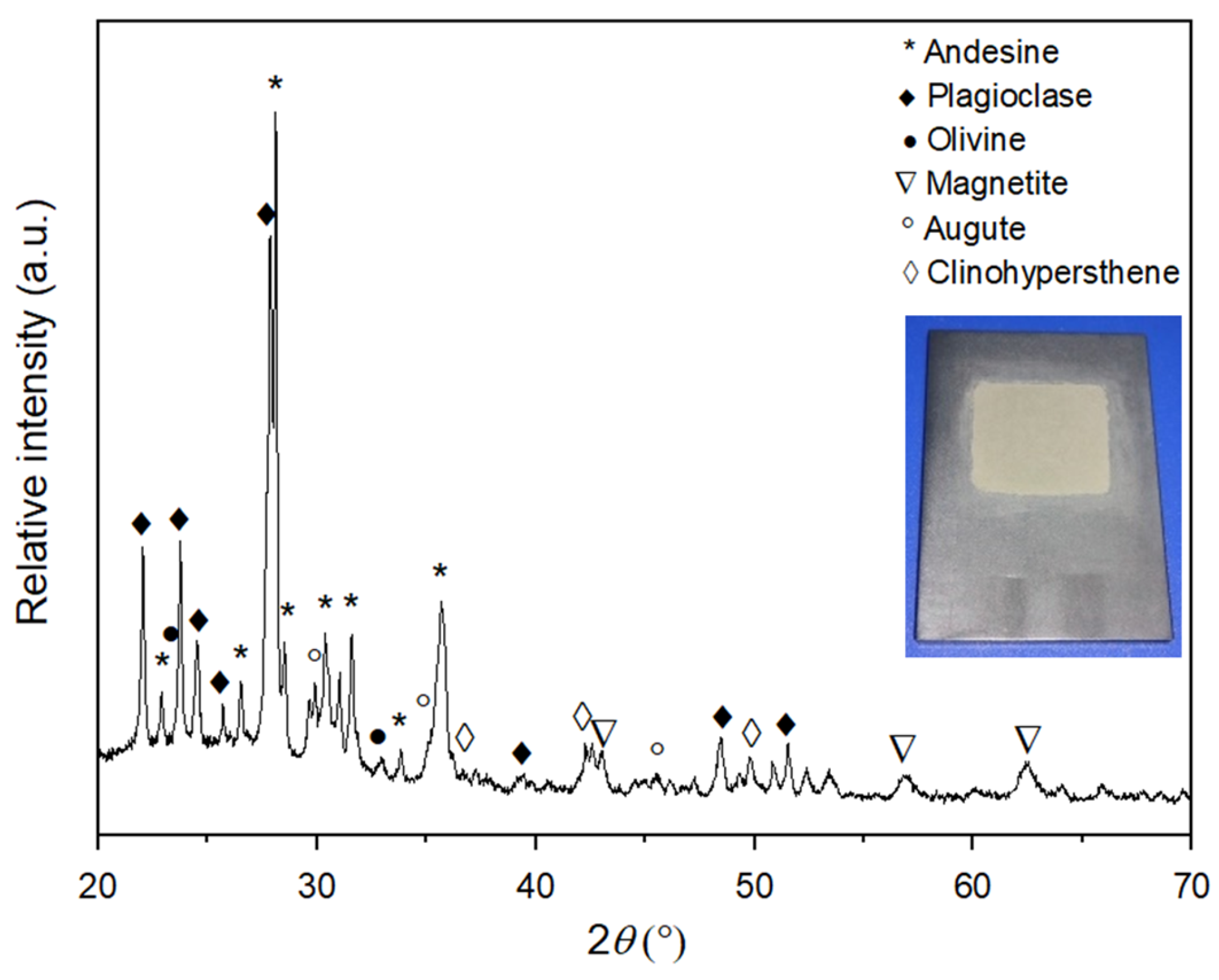
The primary mineralogical composition of the initial andesite basalt powder was determined by X-ray diffraction (XRD) analysis. The obtained results are presented in
Figure 2. According to the XRD analysis, andesine ((Na,Ca)Al(Si,Al)Si
2O
8), labradorite ((Ca,Na)Al(Al,Si)Si
2O
8), olivine ((Mg,Fe)
2SiO
4), and magnetite (Fe
3O
4) were identified, together with rock-forming minerals like augite ((Ca,Na)(Mg,Fe,Al,Ti)(Si,Al)
2O
6) and clinohypersthene ((Mg,Fe)SiO
3) [
18]. Based on the diffractogram present in
Figure 2, the baseline is elevated in the range from 21 to 33° 2
θ, indicating that the initial andesite basalt powder contains an amorphous (glassy) phase.
The application of basalt and andesite basalt depends on their chemical composition and structure, with the glass and olivine content in the bulk reducing the quality of these rocks as construction materials. In contrast, an increased augite content enhances their usability. In Serbia, andesite basalt is significantly more abundant than basalt, which is why this material was chosen for this research.
The synthesis of the material was carried out using powder metallurgy techniques consisting of grinding, homogenization, pressing, and sintering as a key phase, as shown in
Figure 3. One way to produce ceramic materials from basalt is to sinter fine powder obtained by grinding aggregate. According to literature data, sintered ceramics with high density can be obtained at sintering temperatures from 1080 to 1150 °C. Such materials have higher acid resistance than natural (untreated) and molten basalts, and they offer quite high resistance to water, acids and alkaline solutions [
21]. The production of ceramics by the sintering process is simpler than that via the basalt casting process. It is important to note that fine basalt fraction, which is usually a waste product, can be used as a raw material for the sintering process [
22].
In this study, to obtain high-density ceramics, andesite basalt aggregate was ground using a vibratory mill. After dry grinding, the andesite basalt powder had particle sizes Dv10 = 0.465 μm, Dv50 = 1.917 μm, and Dv90 = 11.803 μm [
18].
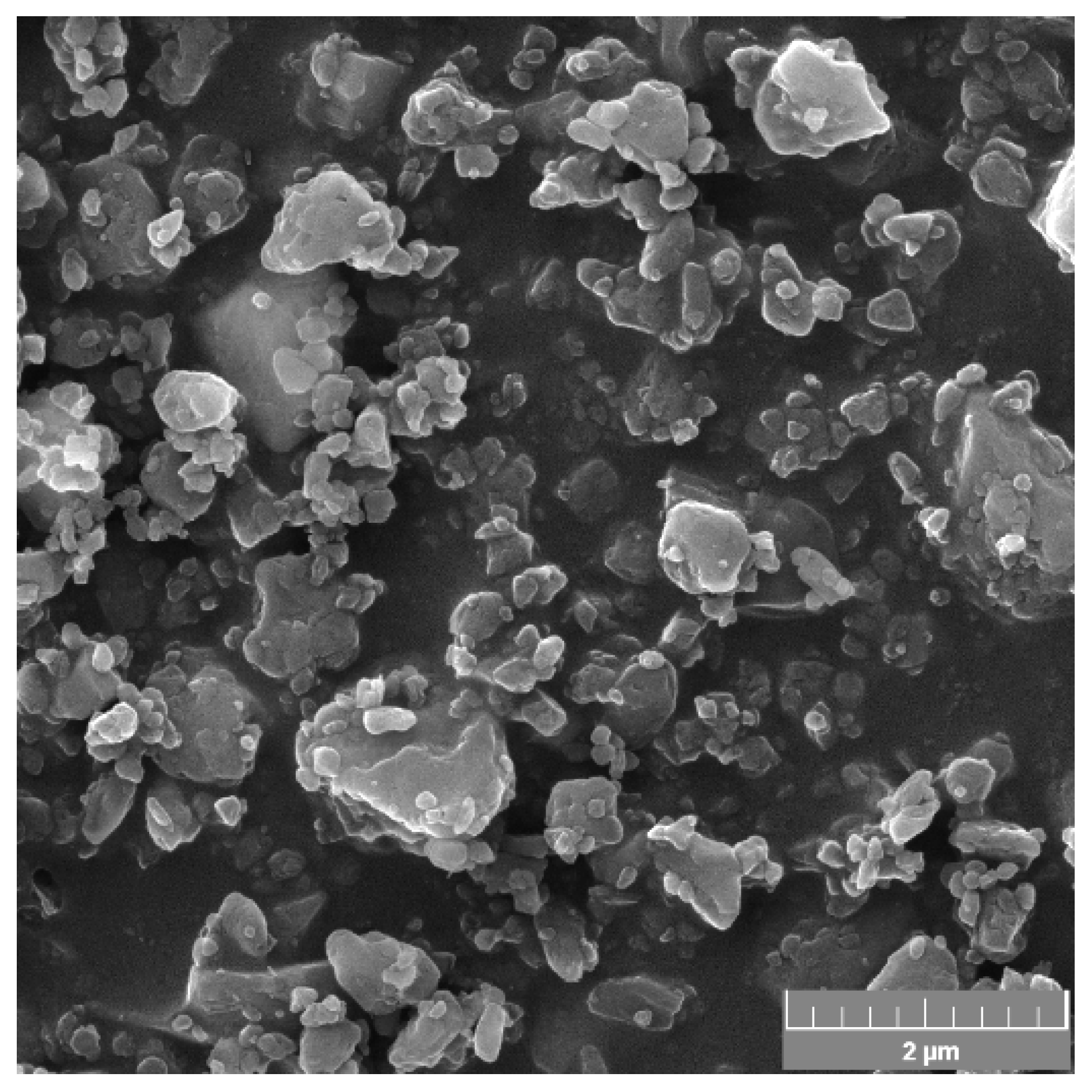
Figure 4 shows the powder morphology, where irregularly shaped particles with sharp edges, typical of crushed rock, are clearly visible.
The resulting powder after grinding was homogenized with 0.6 wt.% of the binder of the commercial mark Paraplast
TM [
23]. Powder–binder homogenization was carried out in a ceramic mortar and pestle. The powders were compacted on a hydraulic press under uniaxial, one-sided pressure. Green compacts with a cylindrical shape and 12 mm diameter were formed. To increase the density of the green compacts, they were placed in a mold with oil, after which cold isostatic pressing was performed.
To remove moisture, chemically bound water, impurities, and binder, the compacts were dried in an oven (SU-50, Elektron, Banja Koviljača, Serbia). After that, the compacts were sintered in air at different temperatures for 60 min to determine the optimal sintering temperature necessary to obtain high-density ceramic material. The sintering temperature was electronically regulated within a maximum deviation of ±2 °C. The sintering of the green compacts was carried out in a high-temperature chamber furnace (VTP-03, Elektron, Banja Koviljača, Serbia).
Table 2 shows the stages and parameters of the powder metallurgy technological process for obtaining high-density ceramic materials from andesite basalt aggregate.
2.2. Material Characterization
The morphological characterization of andesite basalt powder was analyzed by a scanning electron microscope (SEM—Tescan MIRA 3, Tescan, Brno, Czech Republic). The chemical composition of andesite basalt aggregate was determined using energy-dispersive spectrometric analysis (Oxford INCA 350, Oxford Instruments, Abingdon, UK) using a scanning electron microscope (JSM-6610LV, JEOL, Tokyo, Japan).
Phase analysis was performed using X-ray diffraction (Ultima IV, Rigaku, Tokyo, Japan) with filtered CuKα1 radiation (λ = 0.154178 nm). X-ray diffraction measurements were performed on both the ground andesite basalt powder and the sintered ceramic samples. The analyzes were conducted over a 2θ range of 20–70°, using a step size of 0.02° and a scanning rate of 5 °/min. Phase identification and data processing were carried out using PDXL2 software (v2.0.3.0), with diffraction reference data obtained from the International Centre for Diffraction Data database.
The shrinkage of samples during sintering is a result of densification and is usually expressed as linear or volumetric shrinkage. In this case, the results are presented as linear shrinkage per sample diameter expressed as a percentage. It should be noted that shrinkage is a result of the elimination of porosity and evaporation of the material. The diameter of the samples was measured before and after sintering using a digital caliper (Digital Caliper 150 mm, Kern, Balingen, Germany) with a precision of 0.01 mm.
The Archimedes method was used to measure the density of the sintered samples. Equation (1) was used to calculate density:
where
Gdry is the weight of the dry sample,
Gimm represents the sample immersed in water and
Gwire represents the wire immersed in water. A water density of 0.997 g/cm
3 at 25 °C was used in the calculations [
24]. The relative density of sintered ceramic samples is presented as a percentage with respect to the theoretical density of the starting material.
Diffuse reflectance measurements were performed using a Shimadzu UV-2600 spectrophotometer (Shimadzu Corporation, Tokyo, Japan) equipped with an ISR-2600 integrating sphere. The measurements were carried out in the 380–720 nm wavelength range with a 1 nm step size. As a reference material, barium sulfate was applied. The Commission International de l’Eclairage (CIELAB) color coordinates (L*, a*, and b*) and amount of saturation (chroma, ) were calculated from diffuse reflection measurements for the D65 standard illuminant using UVPC optional color analysis software and CIE 1931 standard colorimetric observer data.
The CIELAB color coordinates (L*, a*, and b*) were calculated from diffuse reflection measurements for the D65 standard illuminant (Standard Daylight) [
25]. Lightness (ΔL*), red–green coordinate (Δa*), and yellow–blue coordinate (Δb*) differences were determined based on the representative sample’s color:
The total changes in color (Δ
) and chroma (Δ
) were calculated using the following equations [
25,
26]:
3. Results and Discussion
Table 3 shows the influence of sintering temperature after 60 min on the relative density of the ceramic samples. A minimum relative density of 92.915% was observed for samples sintered at 1040 °C. With increasing sintering temperature, density increased, achieving a maximum of 99.501% at 1060 °C. As the temperature increased further, relative density decreased to 95.869% at 1080 °C.
Table 3 clearly demonstrates that small changes in sintering temperature, at a constant sintering time, have a pronounced effect on the relative density of the sintered samples. The reduced density of the sample sintered at 1080 °C is due to melting and the formation of a glassy phase, which is also present in the initial andesite basalt aggregate. The presence of a liquid phase promotes densification, and this mechanism is known as liquid-phase sintering [
27,
28,
29,
30,
31]. At high sintering temperatures, the effect of the liquid phase becomes detrimental. Increased gas pressure leads to pore entrapment, hindering pore elimination during sintering. Therefore, the sample sintered at 1080 °C exhibited relatively high porosity (4.131%). The decrease in relative density above 1060 °C is attributed to pore formation caused by melting and material evaporation. Based on the above, the optimal conditions for obtaining high-density ceramics are a sintering temperature of 1060 °C and a holding time of 60 min.
The shrinkage of samples during sintering is a result of densification and is usually expressed in the form of linear or volumetric shrinkage. In this case, the results are presented as linear shrinkage over the diameter of the sample. It should be noted that shrinkage is a result of the elimination of porosity and evaporation of the material.
Table 3 shows the influence of sintering temperature on the shrinkage of ceramic samples. Shrinkage increases with sintering temperature, achieving a maximum of 12.811% in samples sintered at 1060 °C for 60 min. With further increases in temperature, shrinkage decreases. The sintered sample at 1040 °C for 60 min had a minimum shrinkage of 10.834%. The shrinkage range from 1040 °C to 1060 °C is 1.977%, as shown in
Table 3. If we observe the values of the relative density and shrinkage of ceramic samples after sintering, it can be concluded that the values have the same trend of increase and decrease. This is expected, as the increase in both relative density and shrinkage is affected by the elimination of pores.
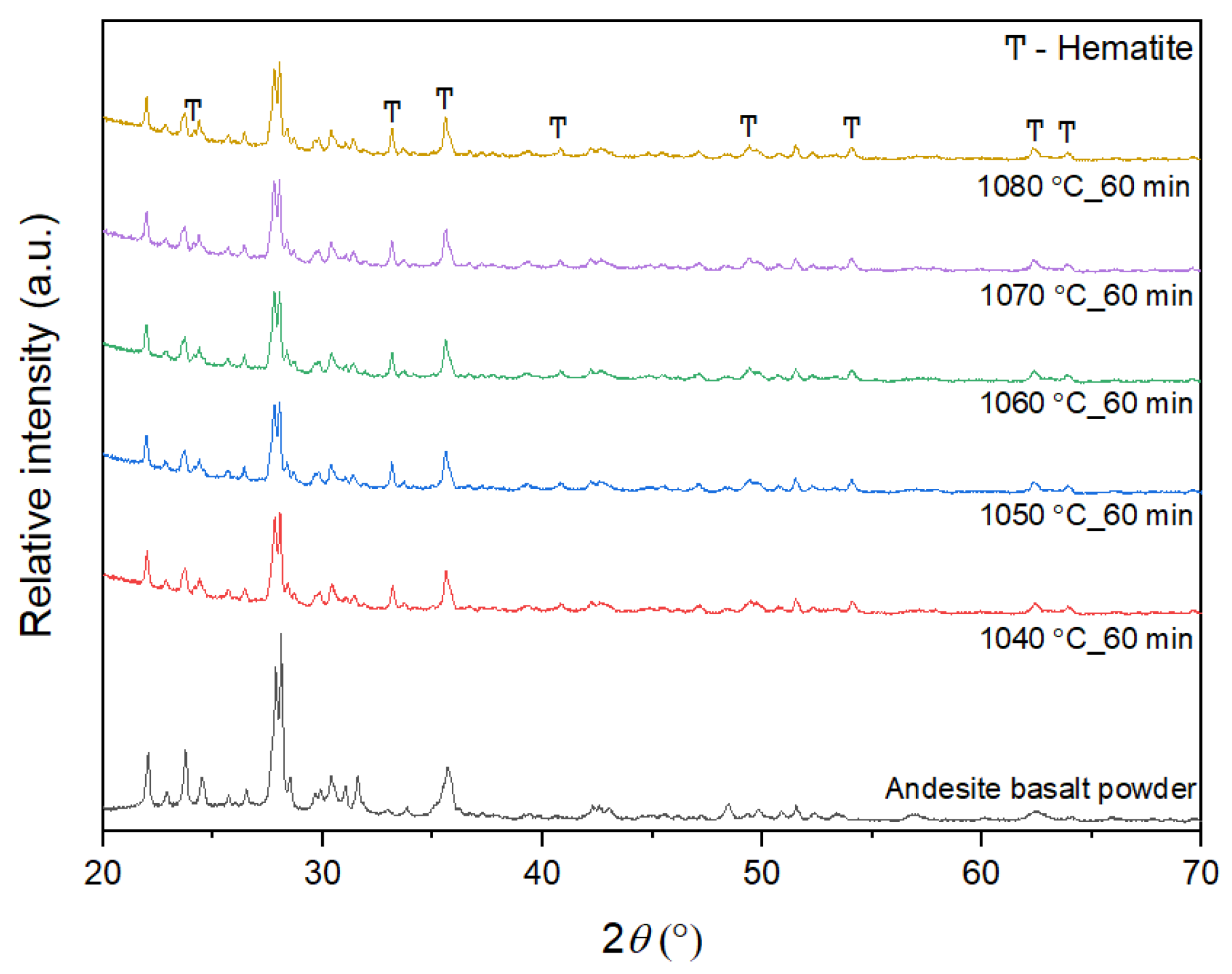
The XRD patterns of the sintered samples together with the starting andesite basalt powder, as shown in
Figure 2, are presented in
Figure 5. An analysis of the diffraction patterns shown in
Figure 5 reveals no significant differences among the samples sintered at 1040–1080 °C for 60 min. No phase transformations were detected during these thermal treatments. All samples contain andesine as the dominant mineral and labradorite, as well as small amounts of olivine, magnetite, etc. Hematite (Fe
2O
3) is present in all the sintered samples but absent in the diffractogram of the starting andesite basalt powder (
Figure 2), representing the only observed difference. The formation of hematite during air sintering is expected and is a key factor regulating the color change in ceramic samples [
18].
Iron is the only element contained in rocks whose oxidation state depends on the conditions of basalt melting and can occur in oxidation states +3 and +2. Oxides formed with different oxidation states, i.e., the ratio Fe
2O
3/FeO, affect the viscosity and crystallization behavior of the basalt melt [
32].
In general, after sintering basalt in an oxidizing atmosphere, the resulting glass, ceramic, and glass-ceramic materials have a reddish-brown color, indicating the occurrence of Fe
3+ ions and hematite (Fe
2O
3) formation [
18,
22,
33,
34,
35,
36].
As a result of sintering basalt green compacts in air, the samples became brown with different shades. This phenomenon can be explained by the partial transformation of magnetite (Fe
3O
4) during heating in air into maghemite (γ-Fe
2O
3), which is brown. It was observed that in basalt, this transformation takes place in the range from 200 to 400 °C, and upon further heating, in the range from 550 to 1000 °C, maghemite turns into hematite (α-Fe
2O
3), which is dark red [
32].
Figure 6 shows the ceramic samples sintered for 60 min at different sintering temperatures. Based on the sintered samples, it can be seen that with increasing sintering temperature, the reddish-brown color changes from a lighter to a darker shade. A significant color change is visually noticeable between 1040 and 1050 °C and less pronounced between 1050 and 1060 °C, while at higher temperatures, between 1070 and 1080 °C, a very small visual difference is observed. This can be attributed to the increase in oxidation with increasing sintering temperature. Namely, oxygen atoms interstitially enter the crystal lattice of iron-containing minerals in andesite basalt, and since the minerals are homogeneously distributed throughout the sample volume at the micro level, the entire sample changes color.
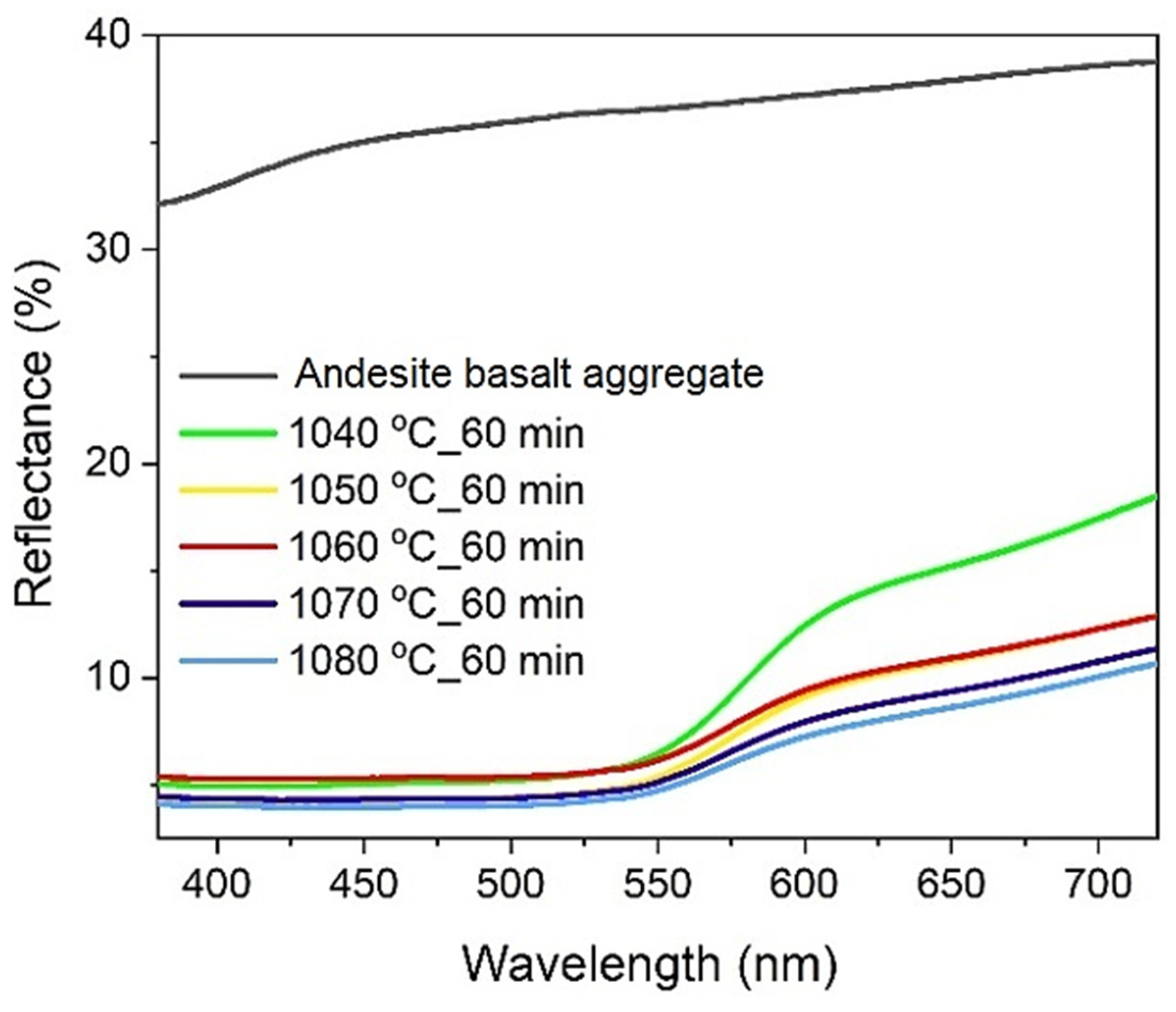
Figure 7 shows the diffuse reflectance spectra in the 380–720 nm wavelength range for andesite basalt aggregate and samples sintered at 1040, 1050, 1060, 1070, and 1080 °C for 60 min. The sintered samples showed a significant decrease in reflection compared to the non-sintered andesite basalt aggregate sample (black line). The sample sintered at 1080 °C showed the most significant reduction in reflection, while the sample sintered at 1040 °C showed the smallest but still significant decrease. It can be concluded that increasing the sintering temperature results in a decrease in the reflectance of ceramic samples made of andesite basalt aggregate.
The sample sintered at 1060 °C for 60 min was chosen as a representative sample due to its highest relative density. The color of sintered samples changes significantly when compared to the aggregate and powder of andesite basalt samples, which have a dark gray color with L*(31.78), a*(−0.15), and b*(−0.03) and gray color with L*(67.02), a*(0.14), and b*(2.13) coordinates, respectively.
Table 4 shows the CIELAB color coordinates of samples sintered at different temperatures for 60 min, as well as the overall color change (Δ
) and chroma change (Δ
). Rendered colors, obtained from colorimetric coordinates using the Nix Sensor Color converter [
37], are presented in
Table 4. The sample sintered at 1040 °C for 60 min exhibits the most significant color and chroma change in the present study. Furthermore, the samples sintered at 1060 °C or higher temperatures exhibit similar Δ
values.
The ability of the human eye to distinguish between two colors depends on the total color change: when ΔE* < 1, color differences are imperceptible; when 1 < ΔE* < 3, they are slightly perceptible; and when ΔE* > 3, they are clearly visible [
38,
39]. Based on the above, in relation to the reference sample (1060 °C for 60 min), visual differences can be observed in samples sintered at temperatures of 1040, 1050, and 1080 °C for 60 min, where Δ
> 3, as shown in
Table 4. For the sample sintered at a temperature of 1070 °C for 60 min, the value of Δ
is in the range from 1 to 3, as shown in
Table 4, which indicates that this sample could also be visible to the human eye, but it may be much more difficult to see, which is in agreement with
Figure 6. These results show that small changes in sintering temperature can lead to significant changes in the color of samples and the relative density and shrinkage of andesite basalt ceramic samples.
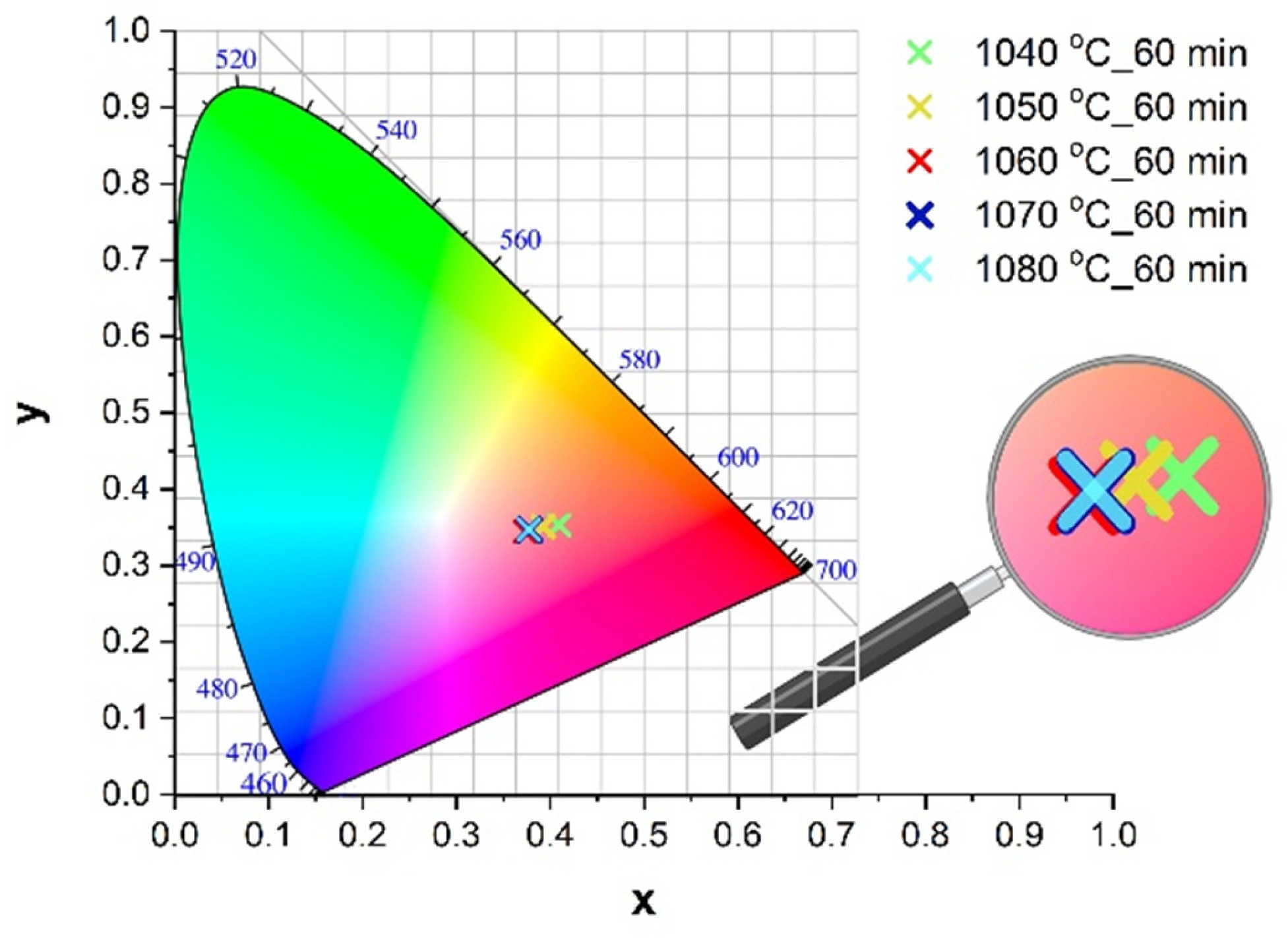
Figure 8 shows a chromatic diagram of ceramic samples that were sintered at temperatures ranging from 1040 to 1080 °C for 60 min. The CIE (
x,
y) coordinates of sintered samples differ significantly from those of aggregate and powder samples, being (0.3121; 0.3291) and (0.3180; 0.3342), respectively, as shown in
Table 5. The color of the samples varies with temperature sintering, and as temperatures increase, the color changes from reddish-brown to dark reddish-brown. However, the CIE (
x,
y) coordinates for samples sintered at 1060 °C and higher temperatures are relatively stable, with only minor fluctuations, as shown in
Table 5 in detail.
4. Conclusions
The results of the experimental research in this paper show that powder metallurgy, with strictly defined technological parameters, can successfully produce ceramic materials from andesite basalt aggregate as the starting material. A small change in a sintering temperature of 10 °C in the interval from 1040 to 1080 °C for 60 min leads to significant differences in the physical properties of ceramic samples, such as relative density, shrinkage and color. The best physical properties were obtained for the ceramic sample sintered at 1060 °C for 60 min with a relative density of 99.501%, shrinkage of 12.811% and coordinates in the CIALAB system of L*(32.03), a*(9.25), and b*(7.58). CIE x and y coordinates for the representative sample are 0.3737 and 0.3448, respectively. As the sintering temperature increases, the reflectance of ceramic samples made of andesite basalt aggregate decreases. The color of sintered ceramics in this case is an important characteristic of the material, because it is directly related to the relative density and shrinkage of the samples, and at the same time, it allows for the easy visual monitoring of the quality of the production process when it comes to large-scale serial production on a daily basis.
Sintered andesite basalt ceramics, due to their exceptional properties, large availability in nature, and low price, can be potential candidates for application in many industries, especially in construction for cladding interior and exterior floor and wall surfaces, of various geometric shapes in the base, exposed to numerous damage mechanisms such as corrosion, abrasion, and erosion. Additionally, a reddish-brown color and polished surface gloss are very popular decorative elements in construction, which are characteristic of ground and polished sintered ceramics made from andesite basalt.




 ,
,