1. Introduction
Petroleum Hydrocarbons have been a major source of energy for humans over the years. However, crude oil has also become a major source of contamination in aquatic ecosystems and terrestrial environments [
1,
2]. Spillages occur naturally or due to leaks from drilling explorations, handling, transportation, and storage. When oil spills occur, oil absorbs onto soils and sediments, preventing oxidation, which then affects marine life and interferes with ecosystem services, thereby affecting food production for marine life and humans who depend on such ecosystems for survival [
3]. Matrices affected by such contamination include
sand, mud, fibrous mangrove roots, and/or a mixture of each. According to Bachoon et al., (2001) [
4], and Story et al., (2022) [
5], remediation within this type of environment is particularly challenging due to its physicochemical and other distinctive properties.
The Bodo environment, like other environments in the Niger Delta of Nigeria, is not exempt from contamination of this nature from crude oil spills within its waterways, shorelines, and surrounding lands [
1,
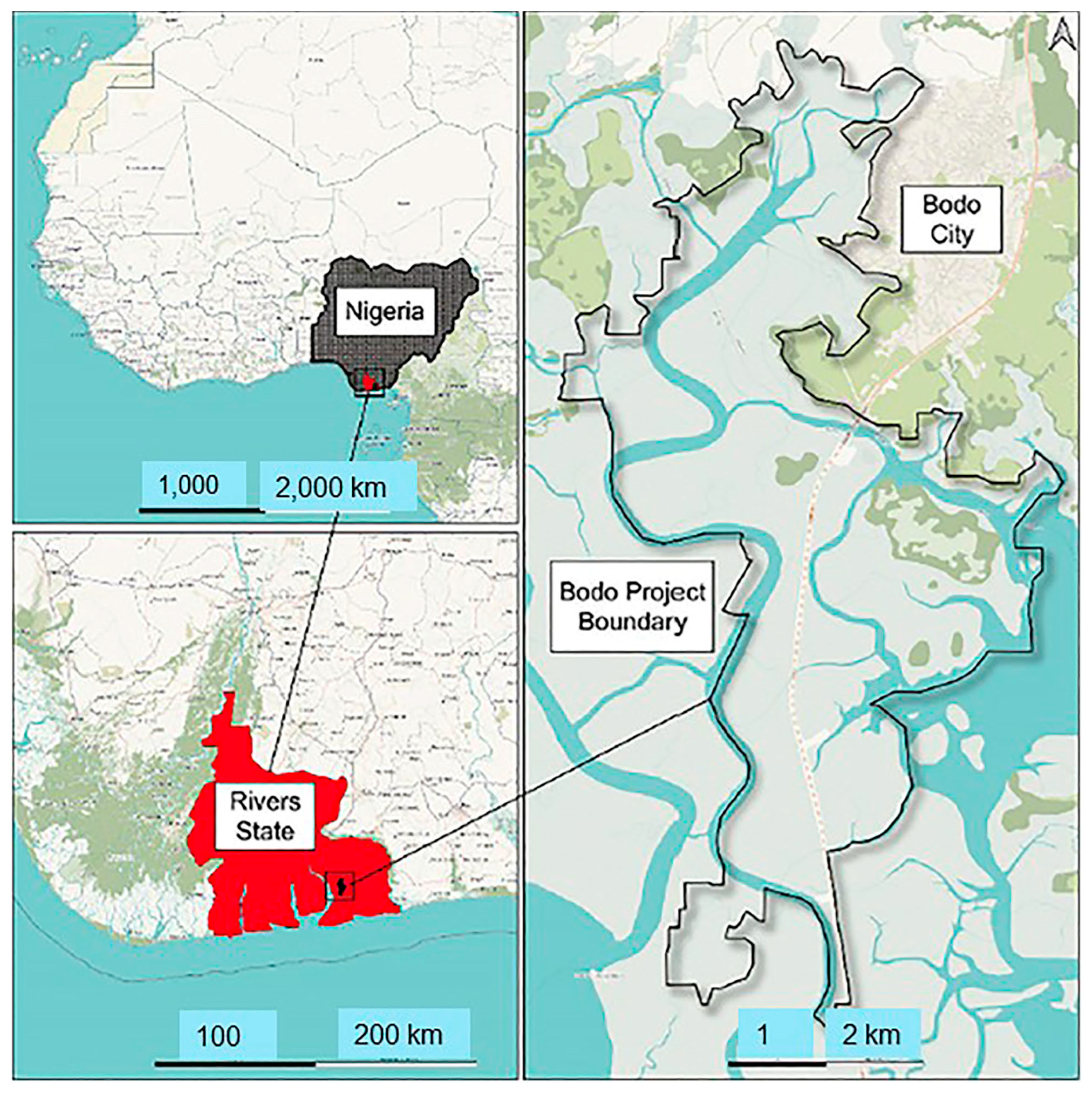
6], as shown in
Figure 1. The study area is rich in oil and gas resources, with the locals’ major occupations being fishing and farming [
3].
The area studied has suffered from several other spill incidents since those of 2008 and 2009, which occurred as a result of equipment failure. This subsequent crude oil pollution was amplified by human activities and interferences exacerbated by illegal bunkering activities, pipeline vandalism, and the transportation of illegally refined products across waterways [
5], further leading to environmental degradation and an area of massive mangrove loss within the Bodo ecosystem. Not only was the environment affected but the socio-economic stresses recorded were also enormous. And this eventually led to a decrease in the means of livelihood of the people whose major occupation was fishing and farming [
7].
Over a thousand hectares were impacted in the 2008/2009 spill, leading to a massive area requiring cleanup and revegetation, as shown in the map above. Cleanup and remediation of the area have been described as highly complex because the landmass mostly covers mud flats and mangrove platforms with Chikoko fibrous roots (dead mangrove roots). The upper shorelines are mostly covered by sandy soil with most parts saturated with contaminated crude oil. Some upper platforms have areas with burnt and caked carbonized soils due to fires. The area is seen to have a mixture of three major soil and sediment structures comprising mud, sandy soil, and Chikoko fibrous roots, which impede the use of one conventional remediation technique.
Previous remediation methods deployed for the Bodo swamp cleanup area have included both in situ and ex situ treatment methods. The use of high-pressure flushing of the contaminated sediments (muds, Chikoko mud, Chikoko roots, and sand), recovery of flushed-out oil/oily sludges, raking and mopping of released oily residues, and ex situ treatment of carbonized soils and oily debris have been deployed as cleanup and remediation strategies in the area [
8,
9]. The application of bioremediation products alongside other remedial methods has also been used on a minimal scale due to the area’s sedimentation complexity. A field trial used some bioremediation products, which were seen to cause algae blooms, and others used alongside flushing for soil washing made minimal or no significant difference to the removal of contaminants from the sediments. Booms are generally used and effective in trapping flushed-out residual oil from spreading to adjoining creeks and open rivers. Boomed-off flushed residual oil can be manually scooped into plastic containers and transferred to a temporary onsite waste storage facility, from where it is collected and sent to waste treatment facilities for ex situ treatment.
With the various limitations experienced during the remediation of the Bodo Creek after a year of active remedial activity, along with the evaluation of the ecological risk [
10], there was a need for a microcosm study to test the efficiency of biodegradable, environmentally friendly materials specifically tailored toward the remediation of ocean mud, oily soaked sands, and fibrous Chikoko mangrove roots, simulating the Bodo environment. This paper focuses on studying and testing these green surfactants and biofoams on crude oil-contaminated beach sand, mud, peat, and peat–mud sediment, which simulate the rich Chikoko muddy environment within the Bodo creeks, exploring experimental designs, mechanisms, and results for practical application.
Surfactants have been widely used and seen to be an environmentally friendly approach for the cleanup and remediation of contaminated sediments due to their hydrophilic and hydrophobic nature [
11] and have been widely used in marine environments as a countermeasure with recorded successes [
12,
13]. Studies demonstrate that green surfactants can reduce toxicity in the environment and enhance the biodegradation rate of crude oil. Because surfactants help to lower the interfacial tension (IFT) between the oil and the substrate, the oil removing efficiency is increased as the crude oil is broken down into smaller molecules that form micelles, reducing the viscosity and interfacial tension between the oil and water or oil–water–brine, making the oil more mobile, easily emulsified, and more degradable by microorganisms for biodegradation or easy to be collected for enhanced recovery and remediation [
14,
15]. Meanwhile, a bio-based material made from lignin, a waste product from wood processing, that was developed at the University of North Dakota, was also tested for an exploration of its feasibility for remediation efficiency improvement for crude oil contamination. This biofoam has previously been explored by Gupta et al. in 2019 and 2020 [
16,
17].
2. Methodology
In building the microcosm system for the study, major environmental factors like the water salinity, moisture content, crude oil viscosity, and the Bodo swamp soil temperature were taken into consideration to mimic the actual environment.
2.1. Crude Oil
In this study, Bakken crude oil (API: 42~43, sulfur content < 2%) was used to simulate Bodo spilled oil, since the API and sulfur content of Bakken oil is the closest to those of the spilled Bodo–Bonny Light Oil (API: 35~37, sulfur content: 0.16 wt%). To mimic the actual contaminated oil viscosity at Bodo’s temperature, 400 mL of Bakken crude oil was diluted with toluene at a ratio of 1:4 to achieve a viscosity reading of <1.0 cP at 35 °C, and compared to Bonny Light crude oil’s viscosity using a Brook Viscometer measurement. A brine water with salinity 4% TDS was synthesized to simulate Bodo’s environment.
2.2. Brine Water and Surfactant Samples
The brine solution was prepared using standardized artificial seawater with 4% TDS salinity. The brine compositions included 68% Sodium Chloride (NaCl), 2.11% Potassium Chloride (KCl), 3.23% Calcium chloride (CaCl2), 14.51% Magnesium chloride (MgCl2), and 11.41% Sodium sulfate (Na2SO4) by weight percentage.
The surfactant formulations used in this experimental study, shown in
Table 1, contained molecular structures of polyglycol, alkyl polyglucoside, alcohol ethoxylates, and D-Glucopyranoside, respectively. Selected surfactants used for remediation in the Bodo region—a mangrove environment contaminated by oil—were chosen for their biodegradability, low toxicity, and eco-friendly nature to ensure the protection and restoration of the fragile ecosystem.
All surfactants used in the experiment were biodegradable and diluted from an active concentration between 62 and 100% to a concentration of 10%, as required for the experiment, and then salted with brine water prepared previously and evenly mixed using a Caframo stirrer (part number A110, Caframo LabSolutions, Geogian Bluffs, Ontario, Canada).
After, 50 g of contaminated soil, mud, peat, and peat–mud was heated in an oven at 35 °C to mimic actual environmental conditions onsite. Volumes of 100 mL of the surfactant formulations after stirring were poured into heated soil/sediments, gently agitated, and allowed to stand in the oven for a time interval of 24 h, 48 h, and 72 h at 35 °C.
2.3. Soil Sample
Four types of clean soil samples including peat were collected and prepared for analysis (beach sand, mud/clay, peat, and peat–mud). Among them,
(1) Mud was made from clay, sand, and silt at a ratio of 80:10:10 with brine water solution and thoroughly mixed using a Caframo stirrer mixer at 100 rpm to achieve the right mud texture.
(2) Peat–mud was made by mixing peat moss with clay and brine solution at a ratio of 60:40 to achieve peat–mud status.
(3) Beach sand and peat moss were mixed with brine solution and left to stand alone to represent sand and fibrous Chikoko environments.
Sand, mud, peat, and peat–mud were all mixed in brine solutions to achieve the desired moisture content of the soil and sediment to represent the soil and sediment structures within the brackish water environment within the Bodo ecosystem. Samples were transferred into a 200 g beaker for batch treatments.
A mass of 50 g of each soil and sediment (sand, peat, mud, and peat–mud) was artificially contaminated with 5 g of crude oil to ensure uniformity in contamination and was then stirred continuously to achieve a proportionate mixture of crude oil and soil using a Caframo stirrer machine at room temperature of 22–25 °C. Mixed contaminated samples used for the batch experiments were each stored in a 200 mL glass beaker and placed in an oven operated at a temperature under 35 °C to represent the actual environment.
2.4. Interfacial Tension Measurement
Interfacial tension (IFT) between the oil phase and water phase refers to the force contributing to the interface between two liquids (brine water or surfactant solution and oil) that are essentially immiscible. The IFT reduction trend indicates the water phase’s (surfactant solution used here) capability to pull out oil in degrees. The interfacial tension test (IFT) was measured with four selected surfactant formulations to compare the capability of oil cleaning with only brine water at various concentration levels. The IFT behaviors were determined using the Grace M-6500 Spinning Drop Tensiometer (Grace Instrument Company, Houston, Texas, USA) at a temperature of 35 °C and are recorded in
Section 3.
2.5. Biofoam Material
Two batches of lignin-based biomass samples were developed for a preliminary attempt to observe the oil removing capability of Bodo swamp contamination. The biofoams with hydrophobic wettability and non-sensitive soil properties were produced at 300 °C. Since this biofoam was developed to have hydrophobic wetting status, we assumed that there was no water phase that could be adsorbed into the foam material during the period of being buried in the soils. In this study, one set of biofoam material was mixed with surfactant and brine solution while the other set was mixed with only brine solution. The weight of each biofoam was measured before they were introduced into the contaminated soil and sediments and after they were removed from the contaminated soil and sediments. Biofoams were weighed again after 48 h of absorption. In order to test the foam capability of oil adsorption, foams were buried under a thin layer of soil. The first set of biofoams were introduced into 50 g of contaminated samples saturated in brine, while the second set were placed in 50 g of contaminated samples agitated with 10% surfactant concentrations.
Oil or liquid (water phase) absorption rate estimation was based on Equation (1).
where
Re is the oil absorption efficiency, %;
Wf is the mass of dry foam, g;
Wf0 is the mass of foam after oil/water absorption, g.
2.6. Post-Oil Extraction
Incubated sand, mud, peat, and peat–mud were removed from the incubator and then analyzed after an allocated time period of 24, 48, or 72 h in the laboratory oven at a temperature of 35 °C. In order to estimate the oil recovery or removal efficiency, the first step was to separate oil from the soils and aqueous surfactant or brine water solutions after treatment using a
Benchmark Scientific Hermle Z206A centrifuge (HERMLE labortechnik GmbH, Wehingen, Germany) at 5000 rpm for 30 min. Then, the recovered crude oil was decanted using pipettes and placed in a graduated test tube. Each marked test tube was measured to determine recovery efficiency for each sample within its specified time frame, as shown in Equation (2).
where
Ro is the oil recovery,
V1 is oil volume separated from centrifuge, and
V0 is the original oil saturated in the sand.
3. Results and Discussion
3.1. Crude Oil Recovery/Removal Efficiency with Surfactant Formulations
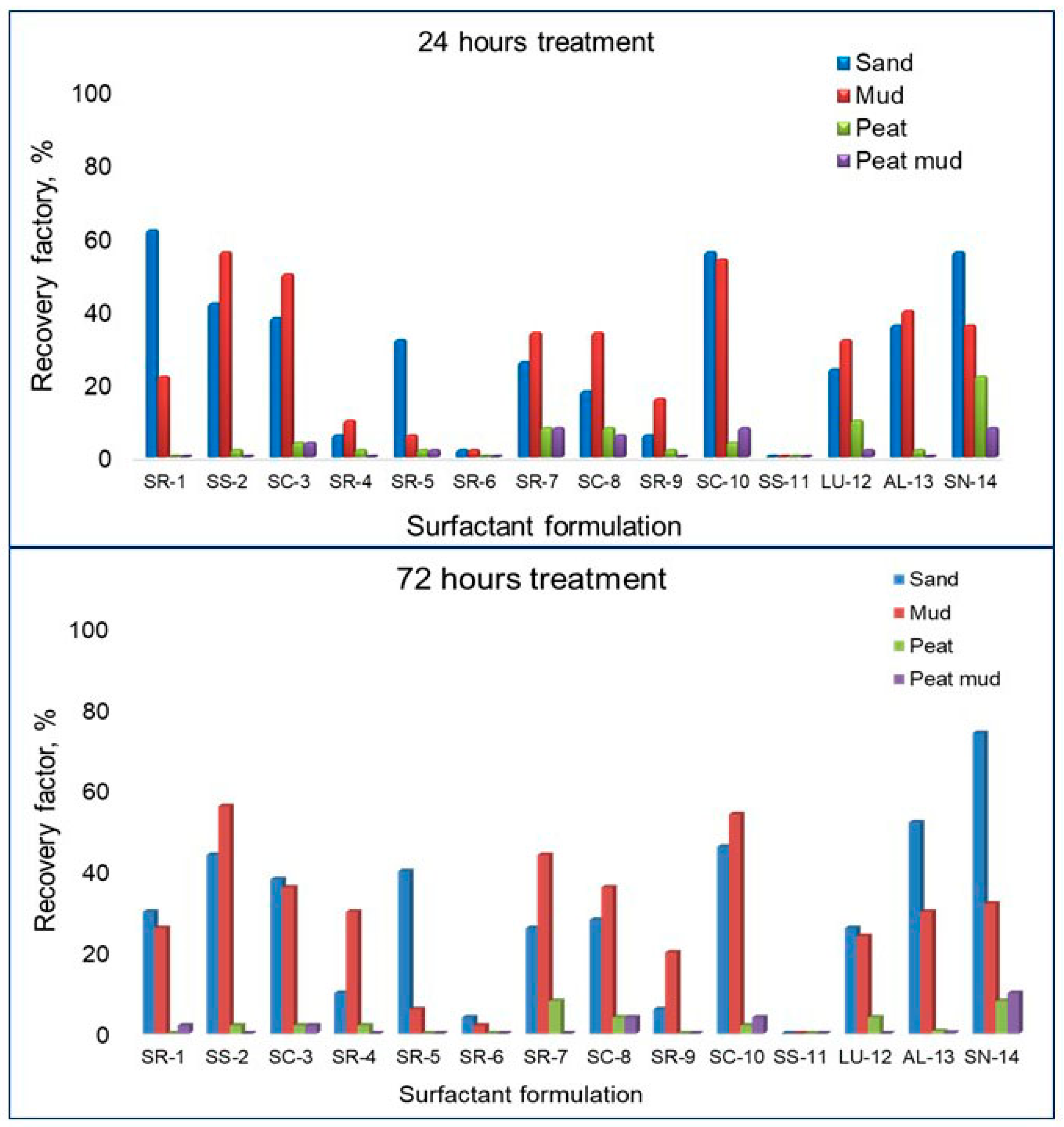
Figure 2 shows the oil recovery factors with various surfactant formulation treatments and time periods (from 24 to 72 h) using three batches of samples. Based on the results, we observed the following:
(1) Nonionic surfactant formulations with major molecular structures of lauryl/myristyl glucoside, carprylyl/myristyl glucoside, C10-oxoalcohol, or dipropylene glycol exhibited significant oil removal/recovery efficiencies with sand sediment.
(2) Relatively low oil recovery was also observed for peat and peat–mud samples, and a maximum 12% efficiency was observed for this type of sediment when using a lauryl/myristyl glucoside head surfactant formulation.
(3) Most of the oil was removed within 24 h of the surfactant treatment. Elevated treatment times also helped remove more oil, but the oil cleaning rate was not obviously changed.
(4) A few oil recovery efficiencies were decreased as treatment time increased from 24 to 72 h, for example, with surfactant formulation SR-1. There are two possible explanations for this: a. since the above experiments were conducted in separate soil samples over three time frames, experimental errors in measurements or readings may have occurred, and b. one or more components of surfactants reacted with the soil samples and were absorbed along with oil molecules as time increased. Further study is needed in future work.
On the other hand, the recovery efficiency could be explained based on the various permeability levels of the soil sediment structures. While sand has high permeability with low organic content, mud made from clay has medium permeability with moderate organic content, and peat is fibrous and high in organic content. Peat was seen to absorb the oil into its fibrous roots, making recovery difficult. The results, therefore, showed a higher recovery rate for sand and mud as compared to peat and peat–mud. As shown in
Table 2, the best performance was observed with surfactant treatment of sand soils, mud soils, and peat–mud soils.
3.2. Interfacial Tension
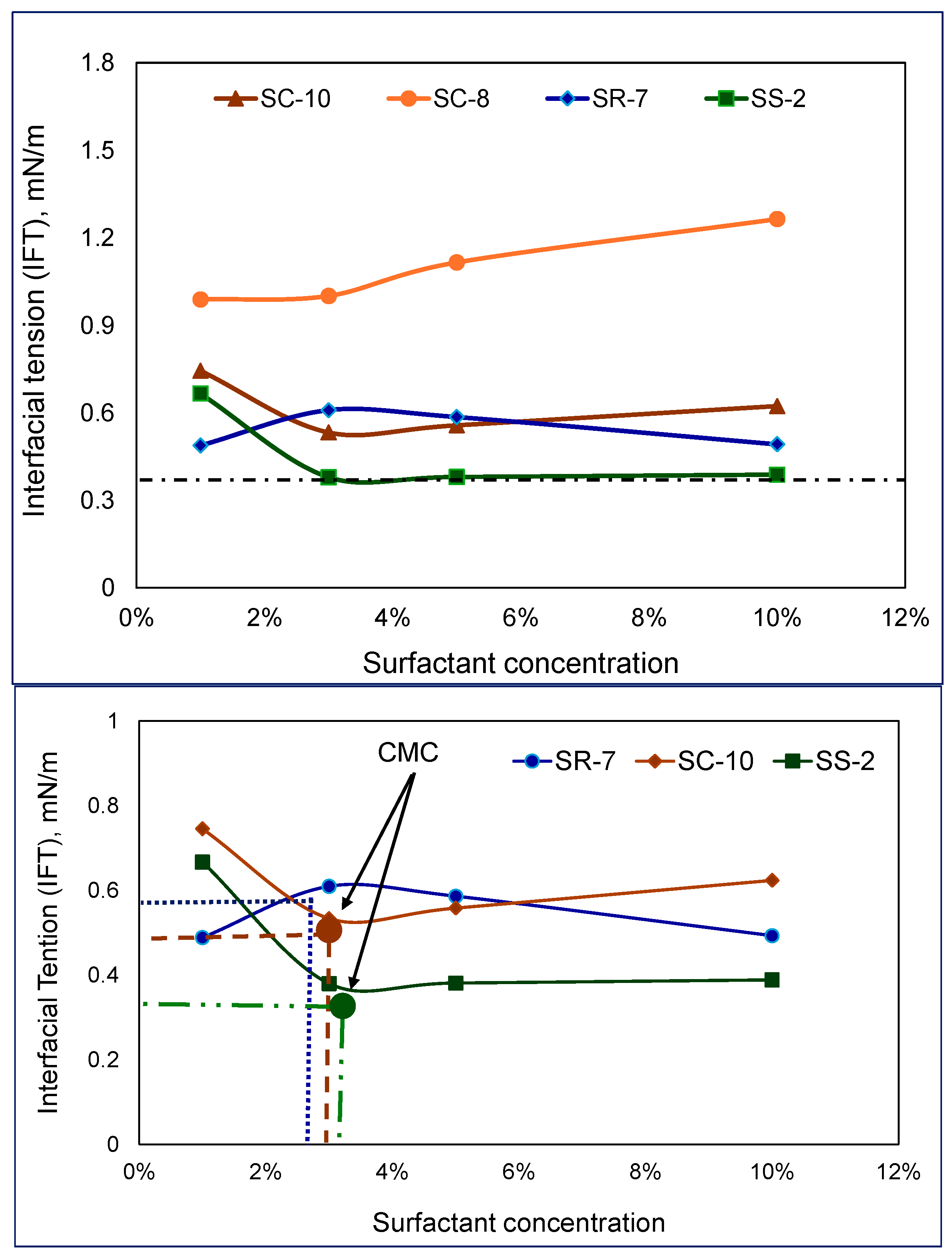
In order to verify the surfactant treatment’s effect on oil removal, IFT measurements were conducted at 10% surfactant concentrations using the best-performing formulations selected from
Table 1 (SS-2, SC-10, and SR-7) and one less efficient surfactant formulation (SC-8). The results were also compared to the IFT effect of using brine only (with 4% TDS; shown as black triangles), as illustrated in
Figure 3 (upper graph).
As illustrated in
Figure 3, the IFT values of the selected surfactant correlated with the crude oil removal efficiencies, represented by the green (SS-2), brown (SC-10), and blue (SR-7) lines. In the best oil recovery performance, the IFTs are stable below a value of 10
−1 mN/m when the surfactant concentration ranges from 1% to 10%. One more surfactant formulation was also studied in terms of the IFT change as its concentration was elevated. For the goal of verification, one surfactant (SC-8, orange line) with a caprylyl/decyl glucoside head, included in
Table 1, is also shown in
Figure 3 (lower graph). As expected, the tested values of this surfactant formulation show a higher IFT tendency as concentration rises. In the meantime, as expected, all values measured were less than the IFT between brine water and crude oil (black triangle at 4% concentration).
On the other hand, the results showed lower IFT measurements in surfactants, corresponding to enhanced emulsification and solubilization capabilities, emphasizing the importance of surfactant selection and optimization. The results from the various surfactant tests for interfacial tension could be used to compare the oil removal rate of each surfactant as well as determine which of these surfactants is the best fit and what quantity may be required for field applications when deployed as a remedial solution for ecosystem contamination. This may help to reduce costs from potential environmental impacts and facilitate the biodegradation of various geological sedimentation types, as is presented in our case study.
3.3. Crude Oil Absorption Efficiency by Biofoam Materials
Table 3 shows the biofoam supplement adsorption efficiency in two scenarios:
a. only brine water in contaminated soils, and
b. with surfactant treatment. The goal of the biofoam was to observe if it could be a supplement for surfactants that were less effective (SS-11, SR-6, and SR-5), as
Table 3 shows. The best-performing surfactant formulation, SN-14, was also tested as a comparison.
Based on the results shown in
Table 3, we observed the following:
(1) As biofoam absorption time increased, the oil removal efficiency or liquid phase absorption increased.
(2) With only brine water either co-existing or used for oil removal purposes in the contaminated soils, about 43% oil absorption efficiency was recorded after 72 h of absorption.
(3) Although the biofoam material was designed as a hydrophobic wettability material and showed good oil absorption behavior, with surfactants with structures of diethylene glycol, dipropylene glycol, or Guerbet alcohol, the wettability of the biofoam was altered to become hydrophilic; therefore, the surfactant liquid phases were absorbed into the solid material instead of the oil phase. According to the study by Gupta [
17], anhydrosugars are produced during biofoam material processing due to the rapid deterioration of glycosidic linkages, and this results in the above surfactant molecules reacting with one or two minor components of the biofoam. Further study will be continued using improved biofoam materials.
(4) The absorption rate of the best-performing surfactant formulation, SN-14, was low compared to the other formulations, indicating that the wettability trend from hydrophobic to hydrophilic was not obvious for surfactants with Lauryl/myristyl glucoside molecular structures, as shown in
Table 3.
3.4. Discussion
Laboratory study to field validation on phase separation. It is worth noting that the centrifuge method for phase separation for oil recovery efficiency analysis is a basic laboratory research approach. In real contaminated sandy soil from marine environments, sand washing techniques involving filling/stirring/draining processes can be employed to obtain a similar effect as achieved in laboratory experiments.
Biofoam material field application feasibility. The laboratory analysis of the biofoams produced from lignin-based biomass materials showed that they are environmentally friendly as a supplement, since they are low in toxicity to the environment and are also biodegradable; however, a field trial is required to substantiate performance levels within large, contaminated environments, and especially for different sedimentation scenarios to verify its workability and effectiveness in such environments. Concerns around degradability rate, reusability, and disposal of used biofoams to prevent secondary pollution when combined with other treatment options require further research.
Surfactant imbibition mechanisms. Generally, surfactant adsorption/retention is affected by surfactant structure, mineralogy (such as clay content), salinity, pH, microemulsion viscosity. The loss of surfactant from aqueous solutions during propagation into a rock reservoir is a major concern for surfactant imbibition. However, for muddy soils, surfactant adsorption may improve performance by modifying the clay structure and controlling fluid loss [
19]. Future work will be conducted on the effect of surfactant adsorption on sand, peat, and peat–mud; pore structure; surfactant interaction with organic matter; and IFT reduction. The CMC behaviors regarding oil recovery capabilities will also be investigated.
Uncertainty reporting. Some limitations and uncertainties exist in the current study, including the use if Bakken oil instead of actual Bodo spilled oil in the laboratory study. Research will be continued using actual conditions.
Toluene Dilution Effect. Toluene dilution is a common method for reducing oil viscosity in an exponential manner through breaking down asphalt aggregates. On one hand, toluene will assist oil flowing due to the decreased oil viscosity and reducing IFT as a co-solvent with surfactant. However, the functions of toluene may be degraded during the surfactant treatment period and show less effectiveness as we expected. Further research on this point needs to be completed.
4. Conclusions
For the goal of providing information through in-depth research on the development of efficient materials capable of removing crude oil from different sediment structures within a mangrove ecosystem to a greater percentage, which is ecologically beneficial for marine ecosystems, a total 168 simulated contaminated soil samples encompassing sand, mud, peat, and peat–mud were studied through surfactant remediation with at least three repetitions over various treatment time frames, and 24 samples were then selected for advanced biofoam treatment. Although some surfactants and sorbents have been used for oil cleaning in multiple fields, biodegradable glycol or glucoside-based surfactants have not been used in the studied area. The novelty of this paper is its investigation into whether the remediation efficiency could be improved through using a combination of eco-friendly aqueous formulations and solid biofoam materials, which were newly developed by the University of North Dakota, rather than only aqueous solutions, when sand, mud, or peat are exposed to crude oil contamination.
Based on the current laboratory experimental results, we can provide the following conclusions:
(1) Green surfactants with major molecular structures of lauryl glucoside or carprylyl flucoside, oxoalcohol, and dipropylene exhibit promising effects in crude oil recovery and remediation in the Bodo environment. The lauryl glucoside surfactant formulation at 4% TDS salinity exhibits the best performance for all soil sediments.
(2) A maximum surfactant concentration of 3 to 3.8 wt% was optimal for sand and mud soils, with a 60% or above oil removal efficiency expected. For peat or peat–mud contamination, at least 10% efficiency is expected using the selected surfactant formulations.
(3) Field-scale studies are essential to validate these laboratory experiments so that surfactant formulations can be optimized to solve real crude oil-contaminated environmental concerns with a focus on tackling contaminants within different sedimentation structures, like those having a network of dead mangrove fibrous root systems. The production of surfactants tailored for removing crude oil from these fibrous, oily, soaked, and dead mangrove root systems mixed with mud and sand requires further research.
(4) The laboratory analysis of biofoams produced from lignin-based biomass materials showed them to be environmentally profitable as a supplement, since they are low in environmental toxicity and are also biodegradable; however, a field trial is required to substantiate the performance levels within large, contaminated environments, especially in different sedimentation scenarios, to verify their workability and effectiveness in such environments.