Article

CO2 Interaction with Cu-Based Single-Atom Alloys as Catalysts: A Computational Study Using MOPAC-PM7

by
Aníbal M. Blanco
1,
Marta Susana Moreno
1,* and
María Luján Ferreira
1,2
1
Planta Piloto de Ingeniería Química–PLAPIQUI (UNS–CONICET), Bahía Blanca 8000, Argentina
2
Departamento de Química, Universidad Nacional del Sur (UNS), Bahía Blanca 8000, Argentina
*
Author to whom correspondence should be addressed.
Processes 2026, 14(9), 1374; https://doi.org/10.3390/pr14091374
Submission received: 11 March 2026 / Revised: 14 April 2026 / Accepted: 20 April 2026 / Published: 24 April 2026
(This article belongs to the Section Catalysis Enhanced Processes)

Abstract

This work investigates the behavior of carbon dioxide (CO2) near the surface of different single-atom alloys to evaluate their potential as catalysts for decarbonization processes. Specifically, 26 transition metals from the first three transition series, alloyed with three low Miller index copper supports, were considered. Adsorption energies and distances of linear CO2, trigonal CO2, and CO* + O* on the surfaces were calculated using the semiempirical computational method MOPAC-PM7. Additionally, activation energies were determined from previously published research. The proposed methodology is less computationally demanding than DFT studies, and results show good agreement with both experimental and simulated data. This approach provides a computationally efficient methodology for screening promising materials that convert CO2 into valuable products, such as methane and methanol.

1. Introduction

The synthesis of methanol from carbon dioxide hydrogenation is a widely studied topic in the current literature, particularly in relation to single-atom catalysis (SAC) and the synthesis of nano-alloys as new catalytic materials. Both experimental and theoretical studies have been conducted on different classic and improved Cu-based hydrogenation catalysts, and many examples of heterogeneous catalysts with controlled designs have been proposed [1,2,3].
In this context, a thorough investigation of the interaction steps of CO2 with the surface of transition metals is of paramount importance. The adsorption and reaction of carbon dioxide on bare transition-metal surfaces have been extensively studied, and many transition metals have been tested. Middle-late 3d metals, such as iron, cobalt, nickel, and copper, were found to adsorb/dissociate CO2. Computational studies have further contributed to understanding the details of CO2 interactions with metal surfaces.
In addition, transition-metal complexes have also been explored. Specifically, the reverse water–gas shift reaction (CO2 + H2 → CO + H2O) has been widely employed to understand physicochemical properties of transition-metal complexes and mechanistic pathways involving CO2 and hydrogen for the production of CH4, CH3OH, and CO [4].
Furthermore, the transition-metal support, whether as an alloy or nano-alloy, has also been considered within the field of SAC [5]. The nature of the interaction with the support and the character of the methanol synthesis reaction (sensitive or insensitive to the structure) have been debated for years. A recent study has at least partially clarified some of these issues in reactions involving methanol [6]. Notably, recent reviews have focused on copper-based catalysts and reactions with methanol [5,7].
Considering the multiple pathways available for CO2 to react with hydrogen on heterogeneous catalysts, Density Functional Theory (DFT) studies have increased our understanding of these processes. The interaction of CO2 with the catalyst surfaces in the presence of hydrogen may produce methane or methanol as final products. For instance, Nolen et al. [8] reported that CO2 conversion via CO* (* represents adsorbed species) and hydrogenation leads to C1 products. Ni, Co, Rh, and Ru tend to promote CO/CH4 formation, whereas Pt and Pd are more selective toward CO/CH3OH formation. The key factor determining the selectivity between CH3OH and CH4 is the ability of a metal to cleave C-O bonds. Differences in selectivity arise from CO either desorbing or reacting further with hydrogen on the surface. For CH4 formation, C-O bond dissociation is the step that determines the activation energy, a step absent in methanol synthesis.
Making use of DFT calculations, Liu et al. [9] studied the adsorption and dissociation of CO2 on low-index surfaces of different transition metals. They reported the order of magnitude of the energy barriers for CO2 dissociation, as well as the strength of the interaction order between the dissociative CO*, O* species with the surfaces. The authors also explored the Brønsted-Evans-Polanyi (BEP) relationship, which correlates the activation energy of a reaction ( E a ) with its reaction enthalpy ( E ) as expressed in Equation (1).
E a = γ · E + ε
Here, γ and ε are parameters, adjusted with experimental or computational data. This correlation has been verified for many reactions on the same metal surface structures and has been applied to families of reactions on the same facet of metal particles [10].
Despite the extensive research on the topic, a clear understanding of CO2 hydrogenation on transition-metal surfaces in terms of reactivity and selectivity remains elusive. Several challenges hinder the interpretation of structure-function relationships across transition-metal surfaces for CO, CH4, and CH3OH synthesis.
This manuscript presents the results of the enthalpies for CO2 adsorption/activation/dissociation onto many relevant Cu-based transition-metal single-atom alloys (SAAs) obtained using the MOPAC-PM7 method [11]. MOPAC-PM7 is a semiempirical approach that enables the calculation of structural and energetic properties, such as heats of formation and crystal geometries, offering a balance between accuracy and computational efficiency.
Specifically, three low-index Miller planes (100), (110), and (111), are investigated. The calculations consider the adsorption, coordination, and chemisorption of CO2 modeled both as a planar and a trigonal molecule located on the top of a single atom within a copper support. Considered metals include transition elements from Sc to Zn, Y to Ag, and Hf to Au. Results are presented and discussed considering the published literature. Activation energies for CO2 dissociation to produce CO* and O* are also calculated, reported, and discussed in comparison with the available theoretical and experimental published data.
This contribution is a follow-up to our research on SAA catalysts for decarbonization reactions. While our previous study [12] focused on H2 adsorption and dissociation on Cu-based SAAs, the present contribution systematically investigates CO2 adsorption, activation, and dissociation over the same set of transition metal-doped Cu surfaces. By employing an identical computational framework (MOPAC-PM7) and catalyst models, this work enables a direct comparison between H2 and CO2 surface chemistries. This complementary approach provides a consistent basis for understanding the initial steps of CO2 hydrogenation and establishes a rapid pre-screening strategy for identifying promising SAA catalysts.
Although the dominant trend in the theoretical investigation of atomic-level reaction mechanisms involves sophisticated Density Functional Theory (DFT) simulations, often integrated with machine learning modeling, our approach relies on a less resource-intensive methodology (in terms of software licensing, computational power, and processing time). This allows the estimation of trends in energies and bond lengths, aiding in the engineering of catalysts for decarbonization processes.

2. Methodology

2.1. Cu Support and Me-Cu SAAs

In nanoparticles, the most frequently exposed planes correspond to low-index Miller surfaces. The particle’s morphology determines whether these surfaces are (111) in polyhedra such as octahedra and icosahedra, (100) in cubic structures, or (110) in rhombic dodecahedra, with cuboctahedra presenting both (111) and (100) facets. Single metal atoms (Me) placed on copper structures of (100), (110), and (111) planes are considered in this study to resemble single-atom catalysts based on single-atom alloys (SAAs). Me represents atoms of the first, second, and third transition rows (Sc to Zn, Y to Ag, and Hf to Au). The description of the surfaces and the procedure to replace one top Cu atom with another transition metal Me can be found in Moreno et al. [12]. For the species adsorbed on the different metal surfaces, the enthalpy is calculated as the total energy minus the sum of the standard enthalpy of the clean surface without the adsorbate and the standard formation enthalpy of the adsorbate.

2.2. Adsorption and Dissociation of CO2

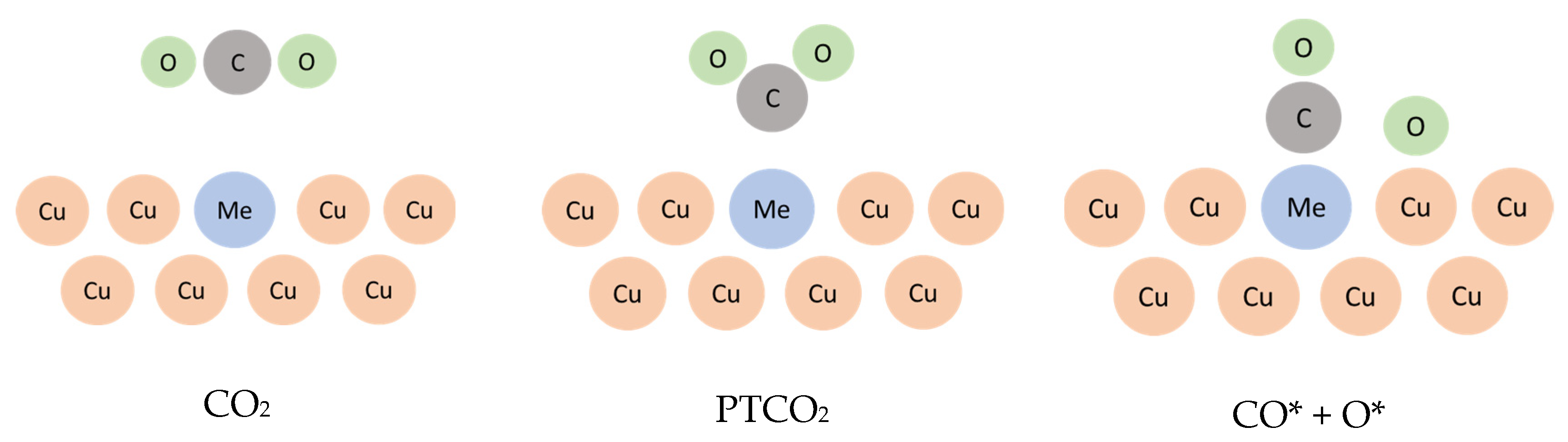
Taking into account the different approaching pathways of the CO2 molecule to the surface and its behavior near the metals, several main steps can be identified. In all cases and for the three Cu planes, the parallel linear CO2 proved to be preferred. The molecule approaches perpendicularly and reorients to a parallel configuration to interact with a surface metal atom through the carbon atom. The planar trigonal form of CO2 is particularly stable on some surfaces, whereas the final CO molecule exhibits a more favorable adsorption energy on others. The steps involved, schematized in Figure 1, are:
  • Step 1: Adsorption of linear CO2 in parallel form to the surface of the top metal (named CO2). The adsorbate is linear carbon dioxide parallel to the metal surface.
  • Step 2: Adsorption of CO2 in a planar trigonal form (120° bond angle) on top metal (named PTCO2). The adsorbate is planar trigonal carbon dioxide.
  • Step 3: Adsorption of CO* on top metal with an O* onto the nearest Cu metal. The adsorbate is CO, while the surface includes an O* bound to the nearest Cu, which varies depending on the plane.

2.3. Location of O and CO After Dissociation onto the Surface

After CO2 dissociation, CO* and O* were generated. The location of O* was onto the nearest Cu atom to the top metal selected for CO adsorption with a metal-C bond. Therefore, the O* from the CO2 dissociation was placed with an O-Cu bond length at a distance from the surface of 0.0 Å at the (100) plane, 0.3 Å at the (110) plane and 1.4 Å at the (111) plane.

3. Results

3.1. Steps of CO2 Adsorption, Chemisorption, and Dissociation-Adsorption Enthalpies for SAAs on Copper Planes

Results of ΔH° obtained with MOPAC-PM7 for the three steps of CO2 interaction with the metal surface are presented and analyzed. Table 1, Table 2 and Table 3 summarize data for the (100), (110), and (111) planes, respectively. All enthalpies were obtained as:
H ° = H ° t o t a l   e n t h a l p y   o f   t h e   m o d e l H ° s u r f a c e   w i t h o u t   a d s o r b a t e H ° a d s o r b a t e
Fe, Co, and Ru are reputed catalysts for Fischer–Tropsch synthesis. Precursors of Fe metal may be oxidized to Fe3O4 (magnetite), a common active phase for CO production. Carbonization due to the CO2/H2 reaction shifts the products to higher hydrocarbons. Catalysts based on Co promote carbon-chain growth during CO hydrogenation, leading primarily to CH4 or CO, depending on the particular structure of the metal. In contrast, Ru-based catalysts mainly yield CH4. Ni and Rh are also applied for CO2 methanation, showing high activity and methane selectivity.
Transition metals such as Cu, Ag, Au, Pd, and Pt have low activity for C–O bond cleavage. Historically, they have been used for hydrogen-assisted CO2 dissociation to produce CO and/or CH3OH from CO2 hydrogenation.
Adsorption of CO2 is generally endergonic (see Table 1, Table 2 and Table 3), except for Cr-Cu(100) (−10.73 kcal/mol), Ti-Cu(110) (−6.9 kcal/mol), Sc-Cu(111) (−40.8 kcal/mol), and Fe-Cu(111) (−43.42 kcal/mol). It has been reported that CO2 adsorption remains endergonic for Ni, Co, Rh, Ru, Pd, and Pt [13].
It is now widely accepted that the interaction CO2–linear–molecule/transition–metal–surface is often weak physisorption. The activation steps are related to a change in CO2 conformation (“bent”) and finally dissociation to CO*.
When PTCO2 is analyzed, Table 1, Table 2 and Table 3 show that the reactions are mainly exothermic for Cu(100) and Cu(110) planes, except for Ti-Cu(100), Mn-Cu(100), Ni-Cu(100), Cu(100), and Mn-Cu(110). On Cu(111), PTCO2 formation is endothermic with the exception of Sc, Mn, and Fe SAAs. For dissociated CO2, most values indicate an exothermic reaction, but for Mn-Cu(100) and Cr-Cu(110).
Analysis of the data, considering the most exothermic and endothermic adsorption energies for first-row transition metals replacing one top Cu atom onto the different planes, reveals interesting trends. These trends can be interpreted through the lens of the Sabatier principle, which states that the most effective catalyst for a reaction has moderate bonding strength with key intermediates. Correlations in reaction energetics can be visualized using volcano plots, which provide a tool to identify both the optimal adsorption energies and the maximum achievable reaction rates, governed by a balance between competing reaction steps. When adsorption energies are too weak, bond-breaking becomes rate-limiting; conversely, if they are too strong, desorption or bond-forming steps become slow. Volcano plots imply that when multiple potential rate-limiting steps are interconnected, accelerating one step necessarily slows another [14]. Related to BEP relations are Transition State Scaling (TSS) relations, which correlate the transition state energy to the adsorption energy (often the energy of the final state) [15]. Notably, alloys may overcome volcano plots and other simple correlations [16].
Jin et al. [13] performed DFT calculations of CO2 interaction with twenty-one transition metals, analyzing both flat and stepped surfaces of pure metals. They carefully studied the reaction pathways for CO2 dissociation. Their results indicated that the chemisorption of bent CO2 is supported by transition-metal surfaces, characterized by large negative adsorption energies also correlating to low dissociation barriers. The lower the electronegativity of the transition metal, the stronger the metal surface/CO2 interaction.
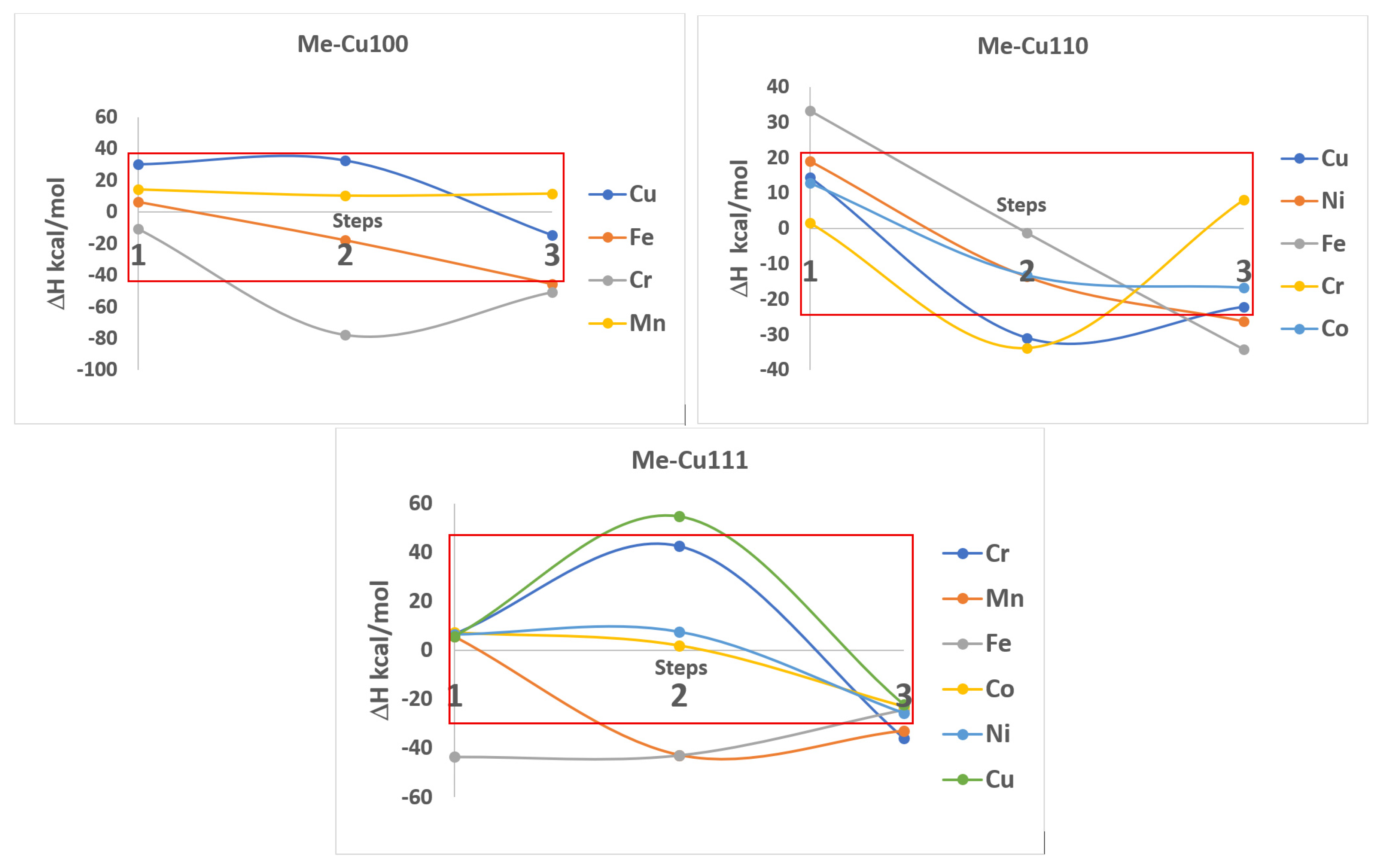
Figure 2 illustrates the ranges in which adsorption enthalpies correlate with improvements in CO2 hydrogenation to methanol. Too exothermic enthalpies are related to CO dissociation and methane formation, or even C-C coupling. The figure shows the results for steps 1, 2, and 3 of the first transition metal series on the (100), (110), and (111) Cu planes. Red boxes highlight the best enthalpies for steps 1, 2, and 3 on the transition metals that produce methanol. Outside these boxes, the enthalpies are either too endothermic or too exothermic to be productive for methanol synthesis.
The selected adsorption enthalpy ranges are guided by the well-established relationship between adsorption strength and catalytic activity, commonly represented by volcano-type plots, as discussed in [14]. According to the Sabatier principle, an effective catalyst should bind key intermediates with moderate strength: strong enough to promote activation, yet weak enough to allow subsequent desorption.

3.2. Experimental Adsorption Enthalpies: Comparison with Theoretical Calculation

Experimental adsorption energy data for CO2 onto transition metals tagged with chloride are: −163 (±66) kJ/mol for Cr, −80 (± 32) kJ/mol for Mn, −120 (±48) for Fe, −124 (±50) for Co, −137 (±55) for Ni, and −60 (±24) kJ/mol for Cu.
Single-atom catalysts have been studied as M–N–C (porphyrin)-contained structures with 3d transition metals (Me = Sc, Ti, V, Cr, Mn, Fe, Co, Ni, Cu, and Zn), in the center of porphyrin active for the CO2 reduction reaction (CO2RR) using DFT. In CO2RR, the bonding energy of the CO* intermediate plays a critical role in CO generation. The predictions follow the activity series Co > Fe > Mn > Ni > Cu, consistent with the experimental results.
The substitution of Pd with Cu/ZrO2 increases the methanol production rate from 223 μmol g−1h−1 to 512 μmol g−1h−1 under relatively mild conditions (1.5 MPa, 260 °C) [17]. A Pd–Cu bimetallic promoting effect on the formation of methanol from CO2 hydrogenation has been reported, assigned to the Pd–Cu SAAs formation [18]. Similarly, a Cu–Zn bimetallic solid (Cu–Zn/Al foam) produced 7.81 g methanol gCu−1 h−1, with 9.9% CO2 conversion and 82.7% selectivity to methanol [19]. Continuous efforts are being made to improve the Cu/ZnO-based catalysts [20]. Moreover, the catalytic performance of bimetallic CuxCoy catalysts has been found to be superior to that of monometallic catalysts [21].
Pd, Zn, and Co in bimetallic Me-Cu systems have been the most studied as SAAs. More recently, the combination of other elements of group 13 (Al, Ga, In) has added further complexity to catalyst design.
Two main challenges have hindered progress in the identification of the active site in bimetallic systems: (i) the lack of catalyst modeling frameworks, and (ii) the absence of detailed information about the geometric and electronic structures of the catalyst under realistic working conditions (so-called operando studies).
Non-copper combinations are increasingly being explored [22,23], mainly centered on indium (In) and gallium (Ga) compounds. Catalysts based on Cu-Zr and Ti supported onto zeolites have demonstrated high performance in methanol synthesis [24].
Based on Cu-ZnO-Al2O3 catalysts, Guil-López et al. [25] reviewed the state of the art in 2019 and reported that the use of metals, such as Pt, Rh, Au, or Pd enhances the performance of Cu-based catalysts for methanol synthesis also pointing out that such enhancement does not necessarily justifies the high costs associated with these metals, particularly due to problems in recycling and recovery. With respect to changes in basicity, the additional studies have focused on three so-called promoters: zirconium, zinc, and fluoride. Promoters such as ZrO2, Ga2O3, and carbonaceous materials have shown positive effects, as well as the introduction of Ag or In2O3.
Pd and Au have been explored as alternatives to Cu, while bimetallic alloys combining Rh and Pt or Co and Pt have been reported as different phases to replace Cu–ZnO in CO2 hydrogenation. Furthermore, the addition of Ni to Cu-Mn/ZrO2 has been shown to improve the catalyst performance in CO2 hydrogenation related to Cu-Mn/ZrO2 [26].
Mapping the turnover frequency of CO2 related to energetic changes in the chemisorption energies of carbon (ΔEC) and oxygen (ΔEO) reveals a volcano-shaped relationship. Cu is near the optimum, whereas Ni, Rh, Ru, Re, Fe, Pt, and Pd are on the strong-binding side, while Au and Ag fall on the weak-binding side [27].
Mn appears to act as a promoter effect in methanol synthesis with Cu/ZnO catalysts [28]. When Fe-Cu catalysts are analyzed, the catalytic activity measured at 30 bar and 200–260 °C increases for CO2 conversion with temperature compared to Cu alone. However, methanol selectivity drops, accompanied by a marked increase in CO and CH4 selectivity [29]. This experimental finding is in line with the results presented in Table 1, Table 2 and Table 3.
For Fe-Cu(100), the values of CO2 adsorption, PTCO2, and CO are 6.38727, −17.79723, and −45.49971 kcal/mol, respectively; for Fe-Cu(110), they are 33.19463, −1.25146, and −34.06857; and for Fe-Cu(111), they are −43.42453, −42.80803, and −24.36 kcal/mol, respectively. These results imply that CO adsorption on the three planes is always very strong and exothermic, thereby favoring CO dissociation into carbon and subsequently methane formation on the surface.
Vanadium has also been reported to positively impact the performance of Cu in methanol formation [30].
For Cr at low temperatures (200 °C), the highest selectivity of CH3OH was about 65% over a Cr containing catalyst in a ternary system Cu-Zn-M (M = Cr, Ce, Zr, Al). The catalytic activity followed the order Cu-Zn-Cr > Cu-Zn-Ce > Cu-Zn-Zr > Cu-Zn-Al. The effect of Cr appears to be a decrease in the activation energy for CO2 hydrogenation to methanol [31].
Sc has been proposed to weaken CO adsorption on cuprous oxide [32]. According to Table 1, Sc-Cu(100) shows an enthalpy of −7.55 kcal/mol compared with −14.83 kcal/mol for Cu(100), and Sc-Cu(110) shows an enthalpy of −3.68 kcal/mol versus −22.13 kcal/mol for Cu(110). On the Cu(111) plane, however, CO* adsorption is stronger on Sc than on Cu. These results suggest that Sc weakens the bond of CO on the Cu(100) and Cu(110) planes, but not on the Cu(111) plane.
Cr exhibits a strong CO* enthalpy, and therefore a decrease in methanol selectivity is expected (Table 1, Table 2 and Table 3). The adsorption enthalpy of PTCO2 is highly exothermic on Cr-Cu(100) and Cr-Cu(110), as is the CO adsorption enthalpy mainly in Cr-Cu(100) and Cr-Cu(111) planes, whereas adsorption on Cr-Cu(110) is endothermic.
Doped clusters of Sc, Ti and V show strong CO2 adsorption energies and low activation barriers for CO2 dissociation [33].
In relation to the BEP correlation, Jin et al. [13] reported that reactions with lower activation barriers are also more thermodynamically favored. In bulk structures, CO2 is physisorbed on the transition metals Cu, Ag, and Au on Pt(100) and Pd(100) planes. Conversely, on most other low-index transition-metal surfaces, CO2 binds in a bent chemisorbed conformation. Among these, Fe(110), Ru(0001), and Os(0001) exhibit the highest CO2 activation ability, outperforming Co(0001), Rh(111), Ir(111), Pd(111) and Pt(111), as well as Fe(100), Ni(100), Ni(110), Rh(100) and Ir(100). These bulk structures, however, are not directly comparable to the ones presented here because they are not single-atom structures.
In Table 4 and Table 5, the data for SAAs with metals of the second and third transition rows are summarized. Relatively low activation energy values (~0.75 eV) were found for Fe, Ru, Co, Ni, Rh, and Ir metals, as well as their corresponding based SAAs. Pure Pd, Pt, and Cu metals, and Ru, Co, Ni, Rh, Ir, and Cu-based SAAs, exhibit activation energies ranging from 0.76 to 1.50 eV. In contrast, high values of activation energy (~1.51 eV) were obtained for pure Au and Ag metals, and for Pd, Pt, and Cu-based alloys.
Ko et al. [34] reported a BEP correlation for the sequential CO2 transformations: first from linear to bent or planar trigonal, followed by a transition from planar trigonal to dissociated. Some studies omit the calculation of the activation energy from linear to bent conformation, only reporting the activation energy for dissociation. Bent CO2 has been reported to be approximately 10 kcal/mol less stable than the linear molecule, depending on the particular metal [35].
The linear geometry of CO2 gas molecules turns into a chemically active bent conformation with an activation energy of 4.6 kcal/mol for Rh. Generally, this step is considered non-activated onto metal surfaces [25,36].
Hu et al. [37] reported a comprehensive selectivity analysis of CO2 hydrogenation. Mo and W exhibit both thermodynamic and kinetic instability under CO2-containing atmospheres at high temperatures, which precludes their direct application. As shown in Table 5, the adsorption enthalpies of CO2 and CO for W-Cu(100) and W-Cu(110) are the most exothermic of all the transition metals considered in this study.
Au/ZrO2 is a highly active catalyst for the reverse water–gas shift reaction (production of CO and H2O), but not for methanol synthesis. According to MOPAC-PM7 results, all steps are endothermic, leading tothe lowest selectivity to methanol. Cu/ZrO2 and Ag/ZrO2 present similar selectivities to methanol [38].
Table 6 shows the results of applying the BEP relation to obtain the activation energies for CO2 dissociation calculated using Equation (3), obtained from [34]:
E a = 0.52 · H C O * + O * / 26.03 + 1.03 · 26.03
The CO2 dissociation seems to be non-activated on several transition-metal planes, particularly from the second and third rows (Mo, Tc, Ru, W, and Os). The data may be classified into three groups:
  • Group A—Activation energy lower than 10 kcal/mol: Cr-Cu(111), Mn-Cu(111), Fe-Cu(100), Fe-Cu(110), Nb-Cu(100), Nb-Cu(110), Mo-Cu (all planes), Tc-Cu (all planes), Cu-Ru(100), Pd-Cu(100), W-Cu (all planes), Re-Cu (all planes), and Os-Cu (all planes).
  • Group B—Activation energy higher than 25 kcal/mol: Cu-Ag(110), Cu-Pd(110), Cu-Hf(111), Ta-Cu(110), Ta-Cu(111), Ir-Cu (all planes), Au-Cu(110), and Au-Cu(100).
  • Group C—Activation energy between 10 and 25 kcal/mol: all other cases not included in Groups A and B.
For a total of 78 activation energy data, 33 correspond to Groups A and B, while the remaining 45 fall within Group C.
Several factors correlate with the catalyst selectivity. In this manuscript, the reduced transition metal is analyzed, but the final activity depends on the active phase and its chemical nature, the active metal and metal particle size, the nature and properties of the support, and the presence of promoters (e.g., alkali metals).
If only the CO2-SAA interaction is analyzed, the main differences among the transition metals with activity to methane and to methanol can be presented by plane and by species on the surface. In general, both experimental and theoretical results indicate that CO2 adsorption is endothermic, as expected, except for Fe-Cu(111). The adsorption enthalpy falls within +5 to +35 kcal/mol. When the PTCO2 is considered, Fe-Cu(111) again exhibits a strong exothermic adsorption for the species, while other planes range from near +55 to −7 kcal/mol for Cu(111), from −31 to near +5 kcal/mol for Cu(110), and from near +33 to −14 kcal/mol for Cu(100).
The largest differences are found in the adsorption enthalpy of CO* + O*. Fe-Cu presents the most exothermic adsorption enthalpy for case of CO* for all planes, except on (100,) where Ru shows the most exothermic adsorption enthalpy for CO.
The set of transition metals reported to promote methane formation follows a decreasing order of exothermicity in adsorption enthalpy in the frame of MOPAC-PM7 for SAAs:
  • For Cu(100): Ru > Fe > Ni > Co > Rh
  • For Cu(110): Fe > Ni > Rh > Ru > Co
  • For Cu(111): Rh > Ni > Fe > Co > Ru
The group of transition metals reported to produce methanol has the following decreasing order of exothermicity in adsorption enthalpy in the frame of MOPAC-PM7 for SAAs:
  • For Cu(100): Pd > Cu > Pt > Ag > Au
  • For Cu(110): Pt > Cu > Pd > Au > Ag
  • For Cu(111): Cu > Pd > Pt > Ag > Au
Table 7 summarizes the differences between the group of transition metals that favor methane (italics) and methanol (bold), related to CO2 adsorption and dissociation.
From the trends obtained with the theoretical calculations, it is evident that SAAs related to methanol synthesis exhibit more endothermic enthalpies for planar CO2 than those linked to methane and CO production, especially at the (110) and (111) planes. The most endothermic adsorption for PTCO2 is observed for bare Cu(100) and Cu(111). The literature reports that the most exothermic the adsorption of CO*, the most likely the formation of methane through CO dissociation. The calculated activation energies for CO2 dissociation (Table 7) range from 12 to 22 kcal/mol for bare Cu planes. Values of activation energy for Pt alloys fall within this range, while for Pd alloys they vary from non-activated to nearly 28 kcal/mol. For Ag and Au alloys, the activation energies lie between 22 and 40 kcal/mol. In contrast, alloys involving transition metals correlated with CH4/CO production show lower activation energies: from 0 to near +24 kcal/mol in the case of Rh, but generally between +6 and +16 kcal/mol.


3.3. Distances

Although only the adsorption enthalpies of the species involved with the considered SAAs have been analyzed so far, the equilibrium distances between the species and the surfaces provide additional insights. The corresponding data are provided as Supplementary Material (see Tables S1–S3).
By comparing the SAA including transition metals of the first, second, and third series on low Miller index planes of Cu, several observations can be drawn:
  • A general trend in Me-C bond lengths is observed for the three Cu planes: the length of Me-CO* bond is shorter than the length of the Me-PTCO2 bond. Additionally, the length of the Me- PTCO2 bond is shorter than that of the Me-CO2 bond, as expected.
  • For the first transition metal series, the shortest bond is the Cu-Cu(111)-CO* (2.1 Å). For the second transition metal series, the shortest bond is the Ru-Cu(100)-CO* bond (1.2 Å). For the third transition metal series, the shorter bond is Os-Cu(100)-CO* (1.8 Å). It is interesting that Ru and Os both are both from group 8 (6 and 7 d electrons respectively).
  • The energetic minimum and the resulting size is dependent of several factors: the Z of the transition metal, the energetics of the metal HOMO and LUMO, the size and orientation of the d orbitals involved considering the geometry of the interaction, the number of d electrons and the repulsive–attractive balance for the COx-metal interaction. There is no easy pathway to find a trend, because the size of the transition metal in the SAAs, orbital orientations, and energetic and geometric disposition of the plane surface, change the nature of the interaction. Sometimes, larger bond Me-C length does not imply less energy, and a shorter Me-C bond is not necessarily related to a more exothermic enthalpy.
  • Very few metal atoms adsorb linear CO2 at bond lengths shorter than 3.0 Å. Looking at the second transition metal row, only Tc-C in Tc-Cu(100) is 2.6 Å, whereas considering the third row, only Ta-W onto Cu(100) achieves 2.8 Å. Considering the PTCO2, Ta, W, Re, Os, and Pt present shorter bond lengths than 3.0 Å in SAAs onto Cu(100), whereas only Pt shows this kind of feature for the metal-carbon bond at the Cu(110). The trend is inverted with CO*. Many SAAs adsorb CO at a Me-C bond length shorter than 3.0 Å, mainly for SAAs onto Cu(100) and Cu(110). Pd presents a bond length Pd-CO* shorter than 2.5 Å onto the three planes whereas the Ru-C bond length is shorter than 1.5 Å for Ru-Cu(100) and Ru-Cu(111).

3.4. A Discussion of H2 and CO2 Adsorption in Different Geometries-CO2 Dissociation

In a previous work [12], we showed that MOPAC-PM7 is a valuable tool for studying H2 adsorption on Cu-based SAAs. The best transition metals for methanol synthesis, based on H2 adsorption, were found to be Ti, V, Cr, Nb, Tc, Ag, Os, Ir, Pt, and Cu for the three planes, and Au and Ta for the (100) and (110) planes. H2 adsorption on Pd-Cu was found to be highly exothermic and stable on the top metal for the three planes (ranging from −11.9 kcal/mol to nearly −28 kcal/mol). For CO2, the best transition metals found in this work were Cu, Pd, Pt, Ag, and Au. These computational findings using MOPAC-PM7 are consistent with the experimental observations.

4. Conclusions and Future Work

Using semiempirical software, the obtained results support and correlate with the experimentally reported trends the CO2 hydrogenation to produce methanol and, additionally, methane, in terms of adsorption enthalpies of different conformations of CO2, the adsorption enthalpy of CO* and the activation energies for the CO2 dissociation at different Cu-based SAAs.
The best transition-metals for Cu-based SACs in methanol synthesis were found to be Cu, Pd, Pt, Ag, and Au, with adsorption enthalpies ranging from +20 to −20 kcal/mol. In contrast, the transition metals most favorable for methane production (Fe, Co, Ni, Ru, Rh) presented adsorption enthalpies from +33 to nearly −50 kcal/mol. Activation energies for CO2 dissociation were calculated using BEP correlations and discussed taking into account reports of experimental results. Overall, MOPAC-PM7 proves to be a useful tool to understand the adsorption and dissociation of CO2 on Cu-based transition metal alloys, and the proposed methodology is considered practical for providing meaningful insights for the preliminary screening of promising catalysts for decarbonization processes in an inexpensive manner.
Further investigation of the most promising SAA systems identified in this study could be pursued through higher-level computational approaches, such as DFT calculations, including adsorption energy refinement, transition-state analysis, and reaction pathway exploration. In parallel, experimental validation could be conducted via the synthesis of the selected alloys, followed by catalytic testing under relevant reaction conditions to assess their performance in CO2 hydrogenation.
Future work will focus on elucidating the mechanism of such decarbonization reactions based on previous studies. Specifically, it has been proposed that CO2 hydrogenation to methanol proceeds via three main reaction steps: (i) direct CO2-to-methanol conversion, (ii) reverse water–gas shift (RWGS), and (iii) CO hydrogenation to methanol. The prevailing view suggests that methanol is primarily generated from CO2, while CO is converted to CO2 via the water–gas shift (WGS) reaction [39]. In contrast, methane formation has been reported to occur via two pathways: (i) CO2 reduction to CO and subsequent hydrogenation to CH4, and (ii) routes involving carbonate and formate as intermediates [40,41]. Additionally, future work will address the co-adsorption of H2 and CO2 on the most promising SAA surfaces identified in this study, including the calculation of co-adsorption energies and H2 dissociation barriers, which are critical for understanding the complete hydrogenation pathway [42,43].

Supplementary Materials

The following supporting information can be downloaded at: https://www.mdpi.com/article/10.3390/pr14091374/s1, Table S1. Classification of SAAs considering the bond length Metal-Carbon. Table S2. Enthalpy (kcal/mol)-Second transition metal series with minimum distances Metal-C from CO2 or CO. Table S3. Enthalpy (kcal/mol)-Third transition metal series.

Author Contributions

A.M.B.: Conceptualization, formal analysis, methodology, investigation, project administration, software, visualization, writing—review and editing. M.S.M.: Data curation, formal analysis, investigation, software, validation, writing—review and editing. M.L.F.: Writing—original draft, formal analysis, visualization conceptualization, investigation, Project administration, supervision. All authors have read and agreed to the published version of the manuscript.

Funding

This work was supported by the National Scientific and Technical Research Council (CONICET) [PIP 2022-2024 0951, PIP 2022-2024 0308]; the Agencia Nacional de Promoción Científica y Tecnológica (ANPCyT) [PICT Aplicados 2021 Categoría II- PICT-2021-00080]; and Universidad Nacional del Sur (UNS) [PGI 24/M184, PGI 24/M185], Argentina.

Data Availability Statement

The data presented in this study are available on request from the corresponding author.

Conflicts of Interest

The authors declare that they have no known competing financial interests or personal relationships that could have appeared to influence the work reported in this paper.

References

  1. Shi, Y.; Ma, S.; Liu, Z.P. Copper-based catalysts for CO2 hydrogenation: A perspective on active sites. EES Catal. 2023, 1, 921–933. [Google Scholar] [CrossRef] [Scilit]
  2. Zhang, Y.; Lian, F.; Sun, S.; Qiu, H. Nano-alloy catalysts for methanol synthesis from CO2 hydrogenation. Chem. Asian J. 2025, 20, e202401387. [Google Scholar] [CrossRef] [Scilit]
  3. Zhong, J.; Yang, X.; Wu, Z.; Liang, B.; Huang, Y.; Zhang, T. State of the art and perspectives in heterogeneous catalysis of CO2 hydrogenation to methanol. Chem. Soc. Rev. 2020, 49, 1385–1413. [Google Scholar] [CrossRef] [Scilit]
  4. Liu, C.; Cundari, T.R.; Wilson, A.K. CO2 reduction on transition metal (Fe, Co, Ni, and Cu) surfaces: In comparison with homogeneous catalysis. J. Phys. Chem. C 2012, 116, 5681–5688. [Google Scholar] [CrossRef] [Scilit]
  5. Tang, X.; Wu, Y.; Fang, Z.; Dong, X.; Du, Z.; Deng, B.; Sun, C.; Zhou, F.; Qiao, X.; Li, X. Syntheses, catalytic performances and DFT investigations: A recent review of copper-based catalysts of methanol steam reforming for hydrogen production. Energy 2024, 295, 131091. [Google Scholar] [CrossRef] [Scilit]
  6. van den Berg, R.; Prieto, G.; Korpershoek, G.; van der Wal, L.I.; van Bunningen, A.J.; Lægsgaard-Jørgensen, S.; de Jongh, P.E.; de Jong, K.P. Structure sensitivity of Cu and CuZn catalysts relevant to industrial methanol synthesis. Nat. Commun. 2016, 7, 13057. [Google Scholar] [CrossRef] [Scilit] [PubMed]
  7. Butera, V.; Barone, G. Advances in CO2 capture and utilization: The role of DFT in understanding CO2 activation and its conversion mechanisms for methanol and cyclic carbonates production. Catal. Sci. Technol. 2025, 15, 5574–5601. [Google Scholar] [CrossRef] [Scilit]
  8. Nolen, M.A.; Tacey, S.A.; Kwon, S.; Farberow, C.A. Theoretical assessments of CO2 activation and hydrogenation pathways on transition-metal surfaces. Appl. Surf. Sci. 2023, 637, 157873. [Google Scholar] [CrossRef] [Scilit]
  9. Liu, X.; Sun, L.; Deng, W.Q. Theoretical investigation of CO2 adsorption and dissociation on low-index surfaces of transition metals. J. Phys. Chem. C 2018, 122, 8306–8314. [Google Scholar] [CrossRef] [Scilit]
  10. Ding, Z.B.; Maestri, M. Development and assessment of a criterion for the application of Brønsted–Evans–Polanyi relations for dissociation catalytic reactions at surfaces. Ind. Eng. Chem. Res. 2019, 58, 9864–9874. [Google Scholar] [CrossRef] [Scilit]
  11. Moussa, J.E.; Stewart, J.J.P. MOPAC: An open-source semiempirical molecular orbital program. J. Open Source Softw. 2026, 11, 8025. [Google Scholar] [CrossRef] [Scilit]
  12. Moreno, M.S.; Blanco, A.M.; Ferreira, M.L. Identification of the most promising copper-based SAAs for hydrogen adsorption applications using semiempirical quantum calculation MOPAC-PM7. Int. J. Hydrogen Energy 2025, 126, 496–507. [Google Scholar] [CrossRef] [Scilit]
  13. Jin, W.; Wang, Y.; Liu, T.; Ding, C.; Guo, H. CO2 chemisorption and dissociation on flat and stepped transition metal surfaces. Appl. Surf. Sci. 2022, 599, 154024. [Google Scholar] [CrossRef] [Scilit]
  14. Stratton, S.M.; Zhang, S.; Montemore, M.M. Addressing complexity in catalyst design: From volcanos and scaling to more sophisticated design strategies. Surf. Sci. Rep. 2023, 78, 100597. [Google Scholar] [CrossRef] [Scilit]
  15. Blaziak, K.; Tzeli, D.; Xantheas, S.C.; Uggerud, E. The activation of carbon dioxide by first-row transition metals (Sc–Zn). Phys. Chem. Chem. Phys. 2018, 20, 25495–25505. [Google Scholar] [CrossRef] [Scilit]
  16. Nwaokorie, C.F.; Montemore, M.M. Alloy catalyst design beyond the volcano plot by breaking scaling relations. J. Phys. Chem. C 2022, 126, 17412–17421. [Google Scholar] [CrossRef] [Scilit]
  17. Han, A.; Ding, J.; Zhong, Q. Role of single-atom Pd in Cu/ZrO2 catalysts for CO2 hydrogenation to methanol. Colloids Surf. A 2022, 641, 128535. [Google Scholar] [CrossRef] [Scilit]
  18. Jiang, X.; Koizumi, N.; Guo, X.; Song, C. Bimetallic Pd–Cu catalysts for selective CO2 hydrogenation to methanol. Appl. Catal. B 2015, 170–171, 173–185. [Google Scholar] [CrossRef] [Scilit]
  19. Liang, Z.; Gao, P.; Tang, Z.; Lv, M.; Sun, Y. Three-dimensional porous Cu–Zn/Al foam monolithic catalyst for CO2 hydrogenation to methanol in microreactor. J. CO2 Util. 2017, 21, 191–199. [Google Scholar] [CrossRef] [Scilit]
  20. Ubong, J.E.; Song, Y.; Zhong, Z. Improving Cu/ZnO-based catalysts for carbon dioxide hydrogenation to methanol and the use of methanol as a renewable energy storage medium. Front. Energy Res. 2020, 8, 545431. [Google Scholar] [CrossRef] [Scilit]
  21. Wei, Y.; Li, S.; Jing, J.; Yang, M.; Jiang, C.; Chu, W. Synthesis of Cu–Co catalysts for methanol decomposition to hydrogen production via deposition–precipitation with urea method. Catal. Lett. 2019, 149, 2671–2682. [Google Scholar] [CrossRef] [Scilit]
  22. Gao, B.; Wen, Z.; Wang, Y.; Chen, D.; Yang, B.; Ishihara, T.; Guo, L. Recent advances in alloy catalysts for CO2 hydrogenation to methanol. ChemCatChem 2024, 16, e202400814. [Google Scholar] [CrossRef] [Scilit]
  23. Ye, R.; Ding, J.; Reina, T.R.; Duyar, M.S.; Li, H.; Luo, W.; Zhang, R.; Fan, M.; Feng, G.; Sun, J.; et al. Design of catalysts for selective CO2 hydrogenation. Nat. Synth. 2025, 4, 288–302. [Google Scholar] [CrossRef] [Scilit]
  24. Figueroa-Quintero, L.; Cordero-Lanzac, T.; Ramos-Fernandez, E.V.; Olsbye, U.; Narciso, J. Tailoring catalysts for CO2 hydrogenation: Synthesis and characterization of NH2–MIL–125 frameworks. Molecules 2025, 30, 1458. [Google Scholar] [CrossRef] [Scilit]
  25. Guil-López, R.; Mota, N.; Llorente, J.; Millán, E.; Pawelec, B.; Fierro, J.L.G.; Navarro, R.M. Methanol synthesis from CO2: A review of the latest developments in heterogeneous catalysis. Materials 2019, 12, 3902. [Google Scholar] [CrossRef] [Scilit] [PubMed]
  26. Zhang, H.; Yang, J.; Wang, S.; Zhao, N.; Xiao, F.; Wang, Y. Effect of Ni content on Cu–Mn/ZrO2 catalysts for methanol synthesis from CO2 hydrogenation. Catal. Sci. Technol. 2024, 14, 2153–2165. [Google Scholar] [CrossRef] [Scilit]
  27. Studt, F.; Abild-Pedersen, F.; Wu, G.; Jensen, A.D.; Temel, B.; Grunwaldt, J.D.; Nørskov, J.K. CO hydrogenation to methanol on Cu–Ni catalysts: Theory and experiment. J. Catal. 2012, 293, 51–60. [Google Scholar] [CrossRef] [Scilit]
  28. Chen, H.Y.; Lin, J.; Tan, K.L.; Li, J. Comparative studies of manganese-doped copper-based catalysts: The promoter effect of Mn on methanol synthesis. Appl. Surf. Sci. 1998, 126, 323–331. [Google Scholar] [CrossRef] [Scilit]
  29. Todaro, S.; Frusteri, F.; Wawrzyńczak, D.; Majchrzak-Kucęba, I.; Pérez-Robles, J.F.; Cannilla, C.; Bonura, G. Copper and iron cooperation on micro-spherical silica during methanol synthesis via CO2 hydrogenation. Catalysts 2022, 12, 603. [Google Scholar] [CrossRef] [Scilit]
  30. Zhang, Y.; Fei, J.; Yu, Y.; Zheng, X. Study of CO2 hydrogenation to methanol over Cu–V/γ-Al2O3. J. Nat. Gas Chem. 2007, 16, 12–15. [Google Scholar] [CrossRef] [Scilit]
  31. Wang, J.; Shi, P.; Han, J.; Tian, Y.; Yan, Z.; Luo, P.; Ban, H.; Li, Y.; Cai, W.; Lin, G.; et al. Investigation of ternary CuZnM (M = Cr, Ce, Zr, Al) catalysts in CO2 hydrogenation for methanol synthesis. Catalysts 2025, 15, 250. [Google Scholar] [CrossRef] [Scilit]
  32. Chen, R.; Jiang, Y.; Zhu, Y.; Zhang, L.; Li, Y.; Li, C. Atomically dispersed scandium in cuprous oxide weakens *CO adsorption to boost carbon dioxide electroreduction toward C2 products. Adv. Funct. Mater. 2024, 35, e202415940. [Google Scholar] [CrossRef] [Scilit]
  33. Szalay, M.; Buzsáki, D.; Barabás, J.; Faragó, E.; Janssens, E.; Nyulászi, J.; Höltz, T. Screening of transition metal doped copper clusters for CO2 activation. Phys. Chem. Chem. Phys. 2021, 23, 21738–21747. [Google Scholar] [CrossRef] [Scilit]
  34. Ko, J.; Kim, B.; Han, J.W. Density functional theory study for catalytic activation and dissociation of CO2 on bimetallic alloy surfaces. J. Phys. Chem. C 2016, 120, 3438–3447. [Google Scholar] [CrossRef] [Scilit]
  35. Freund, H.K.; Roberts, M.W. Surface chemistry of carbon dioxide. Surf. Sci. Rep. 1996, 25, 225–273. [Google Scholar] [CrossRef] [Scilit]
  36. Zhou, L.; Kandratsenka, A.; Campbell, C.T.; Wodtke, A.M.; Guo, H. Origin of thermal and hyperthermal CO2 from CO oxidation on Pt surfaces: The role of post-transition-state dynamics, active sites, and chemisorbed CO2. Angew. Chem. Int. Ed. 2019, 58, 6916–6920. [Google Scholar] [CrossRef] [Scilit] [PubMed]
  37. Hu, J.; Cai, Y.; Xie, J.; Hou, D.; Yu, L.; Deng, D. Selectivity control in CO2 hydrogenation to one-carbon products. Chem 2024, 10, 1084–1117. [Google Scholar] [CrossRef] [Scilit]
  38. Baiker, A.; Kilo, M.; Maciejewski, M.; Menzi, S.; Wokaun, A. Hydrogenation of CO2 over copper, silver and gold/zirconia catalysts: Comparative study of catalyst properties and reaction pathways. Stud. Surf. Sci. Catal. 1993, 75, 1257–1272. [Google Scholar] [CrossRef] [Scilit]
  39. Saeidi, S.; Najari, S.; Hessel, V.; Wilson, K.; Keil, F.J.; Concepción, P.; Suib, S.L.; Rodrigues, A.E. Recent advances in CO2 hydrogenation to value-added products: Current challenges and future directions. Prog. Energy Combust. Sci. 2021, 85, 100905. [Google Scholar] [CrossRef] [Scilit]
  40. Pieta, I.S.; Lewalska-Graczyk, A.; Kowalik, P.; Antoniak-Jurak, K.; Krysa, M.; Sroka-Bartnicka, A.; Gajek, A.; Lisowski, W.; Mrdenovic, D.; Pieta, P.; et al. CO2 hydrogenation to methane over Ni catalysts: The effect of support and vanadia promoting. Catalysts 2021, 11, 433. [Google Scholar] [CrossRef] [Scilit]
  41. Podrojková, N.; Sans, V.; Oriňak, A.; Oriňaková, R. Recent developments in the modelling of heterogeneous catalysts for CO2 conversion to chemicals. ChemCatChem 2020, 12, 1802–1815. [Google Scholar] [CrossRef] [Scilit]
  42. Okude, S.; Kuze, H. Adsorption of CO2 and H2 on Cu and Zn micro-cluster surfaces studied by quantum chemistry and theory of absolute reaction rates. Open J. Phys. Chem. 2011, 1, 109–117. [Google Scholar] [CrossRef]
  43. Kim, Y.; Trung, T.S.B.; Yang, S.; Kim, S.; Lee, H. Mechanism of the Surface Hydrogen Induced Conversion of CO2 to Methanol at Cu(111) Step Sites. ACS Catal. 2016, 6, 1037–1044. [Google Scholar] [CrossRef] [Scilit]
Figure 1. Steps of CO2 interaction.
Processes 14 01374 g001
Figure 2. Results for steps 1, 2, and 3 for SACs of the first transition metal series on (100), (110), and (111) Cu planes. Step 1: linear parallel CO2 adsorption; Step 2: PTCO2 adsorption; Step 3: CO* + O* dissociation.
Processes 14 01374 g002
Table 1. Cu(100) plane: Adsorption enthalpy (kcal/mol) and distance (Å) for transition metals reported to produce methane (italics) and methanol (bold).
MeCO2PTCO2CO* + O*
ΔH°dΔH°dΔH°d
Sc4.897845.0−8.103164.0−7.554284.0
Ti9.569584.04.728633.2−13.425782.8
V0.963302.8−35.382882.2−19.292122.2
Cr−10.73402.6−77.717592.2−50.708952.2
Mn14.166104.610.310004.611.563963.4
Fe6.387275.0−17.797233.2−45.499713.0
Co21.986724.6−0.859294.6−6.999114.0
Ni16.72563.47.913223.4−14.909723.2
Cu30.07002.232.555192.4−14.830002.2
Table 2. Cu(110) plane: Adsorption enthalpy (kcal/mol) and distance (Å) for transition metals reported to produce methane (italics) and methanol (bold).
MeCO2PTCO2CO* + O*
ΔH°dΔH°dΔH°d
Sc13.688014.0−25.840554.4−3.688564.8
Ti−6.900955.0−11.532245.0−13.801643.2
V3.724363.2−2.746963.0−4.794402.8
Cr1.553213.2−33.808003.28.123293.4
Mn9.897765.0−0.491265.0−3.727933.6
Fe33.194634.8−1.251463.8−34.068573.6
Co12.826235.0−13.259674.4−16.752423.8
Ni18.936984.0−13.608043.8−26.139043.8
Cu14.451705.0−30.945564.5−4.160002.4
Table 3. Cu(111) plane: Adsorption enthalpy (kcal/mol) and distance (Å) for transition metals reported to produce methane (italics) and methanol (bold).
MeCO2PTCO2CO* + O*
ΔH°dΔH°dΔH°d
Sc−40.869355.0−41.576074.0−17.260004.2
Ti3.163465.00.583614.4−20.963253.8
V3.490215.05.550485.0−8.942203.0
Cr6.740334.242.57683.8−35.930003.4
Mn5.774793.85.220005.0−32.840003.6
Fe−43.424535.0−42.808035.0−24.360003.4
Co7.292435.02.014424.0−22.850003.6
Ni6.586553.67.681063.8−25.720003.6
Cu5.811265.054.734005.0−22.130002.1
Table 4. Enthalpy in kcal/mol for the second transition metal series (metals reported to produce methane and methanol are shown in italics and bold, respectively).
PlaneMeCO2PTCO2CO* + O*
Cu(100)Y6.00067−4.405833.66590
Zr21.32832−10.070160.87439
Nb−5.28348−44.08292−27.19978
Mo13.08228−26.94095−68.72859
Tc11.37201−45.48374−58.57822
Ru5.32557−1.15209−49.62116
Rh9.54267−24.6929−0.59087
Pd9.61048−13.01723−47.00411
Ag20.463613.913537.82874
Cu(110)Y1.802294.01576−1.18328
Zr9.44701−19.47125−6.05139
Nb2.59794−21.60109−43.50735
Mo14.71084−22.18712−38.62922
Tc18.55889−8.0892−65.97756
Ru34.400004.1549−20.26374
Rh10.2416−26.93517−25.48125
Pd9.94144−9.93488.24446
Ag21.490960.0998327.98198
Cu(111)Y7.124959.28449−10.93000
Zr−6.32489−37.16269−7.31900
Nb−2.50540−6.42815−23.85000
Mo33.03000−4.99593−45.31800
Tc3.503585.75857−30.49000
Ru6.718721.21696−8.52000
Rh9.54267−4.26266−24.63000
Pd12.93000−1.59572−11.19000
Ag18.6556414.89826−3.14000
Table 5. Enthalpy in kcal/mol for the third transition metal series (metals reported to produce methanol are shown in bold).
PlaneMeCO2PTCO2CO* + O*
Cu(100)Hf2.97040−7.96494−21.54552
Ta16.84030−14.2620318.69278
W−48.19035−124.81293−91.90000
Re26.11895−2.37555−37.42898
Os6.14981−87.63182−85.11845
Ir8.903384.713845.33263
Pt6.12972−13.39889−12.85069
Au11.734038.6190912.43616
Cu(110)Hf6.27203−16.23070−11.64951
Ta8.268436.176664.17751
W−65.94314−136.67727−98.54812
Re6.49586−16.20013−38.58503
Os−14.12122−104.50903−104.37843
IR7.52142−0.587969.41234
Pt7.51840−12.03282−10.89288
Au11.95869−1.8564417.97276
Cu(111)Hf36.5264914.8899528.08000
Ta−7.966230.97302−11.10000
W36.287682.18887−63.64000
Re3.170002.24077−55.56000
Os3.70766−45.91067−38.28000
IR9.582155.0685111.63000
Pt1.82632−6.93147−4.01100
Au6.989995.807743.00000
Table 6. Activation energy in kcal/mol for CO2 dissociation to CO* + O* on transition metals (metals reported to produce methane and methanol are shown in italics and bold, respectively).
MeCu(100)Cu(110)Cu(111)
Sc19.8235721.8337414.77660
Ti16.7703916.5749423.75180
V13.7198921.2587219.10185
Cr−2.6168527.975915.068200
Mn29.7650521.813276.67500
Fe0.091956.0361411.08460
Co20.1122615.0405411.86980
Ni15.9987410.1594910.37740
Cu16.0402021.5880012.24000
Y25.6580623.1364918.06820
Zr24.2064820.6050719.94592
Nb9.607911.1279711.34980
Mo−11.987063.664600.18644
Tc−6.70887−10.556537.89700
Ru−2.0512013.2146519.32140
Rh23.4445410.5015510.94420
Pd−0.6903328.0389117.93300
Ag27.8227438.3024222.11900
Hf12.5481217.6940538.35340
Ta33.4720425.9241017.97980
W−24.03620−27.49322−9.34100
Re4.288733.68758−5.13940
Os−20.50979−30.524983.84620
Ir26.5247628.6462129.79940
Pt17.0694418.0875021.66608
Au30.2186033.0976325.31180
Table 7. Comparison of adsorption enthalpies for different geometries of CO2 and CO for transition metals reported to produce methane (italics) and methanol (bold).
PlaneMeCO2PTCO2CO* + O*
Cu(100)Fe6.38727−17.79723−45.49971
Co21.98672−0.85929−6.99911
Ni16.72567.91322−14.90972
Ru5.32557−1.15209−49.62116
Rh9.54267−24.6929−0.59087
Pd9.61048−13.01723−47.00411
Ag20.4636013.913537.82874
Pt6.12972−13.39889−12.85069
Au11.734038.6190912.43616
Cu30.0700032.55519−14.83000
Cu(110)Fe33.19463−1.25146−34.06857
Co12.82623−13.25967−16.75242
Ni18.93698−13.60804−26.13904
Ru34.400004.15490−20.26374
Rh10.24160−26.93517−25.48125
Pd9.94144−9.934808.24446
Ag21.490960.0998327.98198
Pt7.51840−12.03282−10.89288
Au11.95869−1.8564417.97276
Cu14.45170−30.94556−4.16000
Cu(111)Fe−43.42453−42.80803−24.36000
Co7.292432.01442−22.85000
Ni6.586557.68106−25.72000
Ru6.718721.21696−8.52000
Rh9.54267−4.26266−24.63000
Pd12.93000−1.59572−11.19000
Ag18.6556414.89826−3.14000
Pt1.82632−6.93147−4.01100
Au6.989995.807743.00000
Cu5.8112654.73400−22.13000
Disclaimer/Publisher’s Note: The statements, opinions and data contained in all publications are solely those of the individual author(s) and contributor(s) and not of MDPI and/or the editor(s). MDPI and/or the editor(s) disclaim responsibility for any injury to people or property resulting from any ideas, methods, instructions or products referred to in the content.