Article

High-Performance Iontronic Pressure Sensor with a Multi-Level Conoid-like Structure Fabricated via Direct Laser Writing


College of Electronics and Information Engineering, Sichuan University, Chengdu 610064, China
*
Author to whom correspondence should be addressed.
Processes 2026, 14(8), 1234; https://doi.org/10.3390/pr14081234
Submission received: 5 March 2026 / Revised: 8 April 2026 / Accepted: 9 April 2026 / Published: 12 April 2026

Abstract

Sensitivity and effective sensing range are core performance metrics of flexible pressure sensors, directly dictating their practical applicability. A key challenge in sensor design is sensitivity degradation with elevated pressure, hindering synergistic optimization of high sensitivity and broad sensing range, while cumbersome electrode fabrication further impedes facile preparation and large-scale deployment of high-performance devices. Herein, this work proposes a novel fabrication strategy for flexible iontronic pressure sensors via direct laser writing (DLW) technology. A controllable ultraviolet laser patterns polyimide substrates to fabricate hierarchical stepped conoid-like microstructural templates, which are transferred to ion gels through reverse molding. The DLW-enabled precise geometric control and hierarchical conical architectures efficiently amplify interfacial contact area variation under pressure, significantly boosting sensitivity. The resultant sensor achieves a high sensitivity of 118.4 kPa−1 and a broad detection range up to 2000 kPa, with fast response/recovery times of 38.4 ms and 47 ms and excellent mechanical stability enduring 2000 loading–unloading cycles at 850 kPa. Multi-scenario physiological signal monitoring validates its accurate capture of laryngeal vibrations and joint movements. This work establishes a straightforward, efficient microfabrication route for high-performance flexible iontronic sensors, accelerating their practical application in wearable health monitoring and related fields.

1. Introduction

The rapid advancement of wearable medical devices, human–machine interfaces, and flexible electronics has driven an ever-increasing demand for flexible sensors [1,2,3,4]. As core components, these sensors play an indispensable role in physiological signal monitoring, motion state recognition, and tactile feedback implementation for bionic robotics [5,6]. For practical deployment, flexible sensors are required to simultaneously achieve high sensitivity, a broad detection range, and excellent long-term stability [7,8,9]. Nevertheless, most sensors face a fundamental trade-off between high sensitivity and a wide pressure detection range—particularly in applications requiring simultaneous monitoring of subtle physiological signals and high-pressure dynamic events. This challenge is widely recognized as a key barrier to the broad practical deployment of such sensors [10,11]. To address it, existing studies have leveraged the distinct characteristics of various sensor types to achieve diverse breakthroughs. Most of these approaches rely on material optimization [12], structural engineering [13], and novel sensing mechanisms [14], making significant contributions to the advancement of sensor technology.
Flexible iontronic pressure sensors [15] have attracted tremendous research interest owing to their simple structure, stable signal output, and low power consumption, making them ideal candidates for wearable health monitoring applications [16,17,18]. To overcome the challenge of simultaneously achieving high sensitivity and a wide pressure detection range, various microstructured surfaces like pyramids [19], coral-like shapes [20], or hemispheres [21,22,23,24,25] have been developed. Such microstructural designs enhance sensitivity by amplifying the variation in interfacial contact area or charge transfer efficiency under external pressure [26]. However, uniform microstructures, such as conventional pyramids or pillars, suffer from excessive deformation and localized stress concentration under high pressure, leading to rapid signal saturation and a narrow detectable pressure range. Thus, achieving synergistic optimization of high sensitivity and broad sensing range remains a formidable challenge. To address this limitation, strategies like modifying materials with nanofillers [27,28,29,30] or designing multilayer microstructures [31,32,33,34] have been explored. Typical approaches involve incorporating graphene, carbon nanotubes [35], and other nanomaterials into polydimethylsiloxane (PDMS) [36,37,38] or thermoplastic polyurethane (TPU) [39], as well as constructing interlocked multilayer microstructures [40,41,42,43]. While these strategies can help widen the detection range, they often come with trade-offs such as compromised sensitivity or cumbersome fabrication procedures. Furthermore, the fabrication of such microstructures still relies heavily on traditional methods like photolithography, etching, and molding [44,45,46]. which are plagued by complex operation, high cost, limited morphological controllability, and poor scalability [47]—especially for producing precise, multi-level microstructures [48]. These technical bottlenecks persistently impede the practical translation and large-scale application of high-performance iontronic pressure sensors.
Therefore, developing a simple, precise, and scalable method for fabricating tailored microstructures is imperative to achieve both high sensitivity and a wide detection range in flexible iontronic pressure sensors. In this work, we propose a direct laser writing (DLW)-based approach to fabricate such sensors, which builds on the aforementioned hierarchical conoid-like microstructure design and the subsequent ionogel film fabrication process. Specifically, by controlling ultraviolet laser processing parameters on a polyimide substrate, we successfully construct multi-level conoid-like sensing structures. Compared with pyramidal or hemispherical structures, our design features a deliberate height gradient—conoid-like units of different heights are orderly distributed on the same substrate. This design enables a progressive change in contact area over a wide pressure range, which effectively mitigates stress concentration and delays signal saturation. Consequently, high sensitivity and a wide detection range are achieved simultaneously. Conventional methods rely on masks or molds, resulting in fixed morphologies and high costs for design modifications. In contrast, DLW is maskless and programmable, enabling flexible customization of complex structures [49]. It is well suited for small-batch production and rapid prototyping iterations. The as-fabricated sensors exhibit superior comprehensive performance, as further validated by practical human physiological signal monitoring experiments. This study provides a novel and viable strategy for manufacturing high-performance microstructured iontronic sensors, holding substantial potential for advancing flexible sensing technologies in wearable medical and related fields.

2. Materials and Methods

Detection range and sensitivity are two core performance metrics for flexible pressure sensors, both of which are closely related to the compressibility of the sensor’s internal microstructures. Generally, improving one of these metrics tends to reduce the other. To address this inherent limitation, this study designs and fabricates a multi-level conoid-like structure. This architectural design enables a progressive variation in the contact area under applied pressure. The structure is fabricated by precisely regulating laser processing parameters—including scan number, scan diameter, and final cone height—as detailed in the overall fabrication process shown in Figure 1a.

2.1. Fabrication of the PI Templates

Specifically, the fabrication procedure is as follows: the polyimide (PI) substrate was first ultrasonically cleaned in anhydrous ethanol to remove organic residues. Next, a multi-level conoid-like microstructure array was then directly patterned onto its surface using an ultraviolet nanosecond laser system (wavelength: 355 nm, average power: 2 W, frequency: 30 kHz, pulse width: 10 ns, energy density: 3.4 J/cm2). By precisely controlling the laser scanning path and speed (10 mm/s) and gradually increasing the number of scans over specific areas, the etching depth was accurately modulated. The process begins with 5 initial scans at a larger diameter to create a shallow ring. Subsequently, the scan diameter is progressively reduced, with 10, 15, and 20 additional scans performed at each successively smaller diameter. This hierarchical scanning approach generates a height gradient across concentric rings, ultimately yielding a conoid-like profile with precisely tailored geometric parameters. After laser processing, the substrate was gently brushed under flowing deionized water to remove carbonized debris, followed by ultrasonic cleaning for 10 min. This yielded the final template with a multi-level conoid-like profile.

2.2. Preparation of the Ionic Gel Film

Subsequent to template preparation, the ionogel film was fabricated via a solution casting method, with the detailed procedure described as follows: a precursor solution was prepared by dissolving 1 g of polyvinyl alcohol (PVA, Mw ≈ 145,000) in 9 g of deionized water under magnetic stirring at 95 °C for 3 h. After the solution cooled to room temperature, 0.25 mL of phosphoric acid (H3PO4, AR grade, ≥85 wt%) was added and thoroughly mixed to obtain a homogeneous PVA/H3PO4 ionogel solution. To facilitate subsequent separation of the PI template from the ionogel, a hydrophobic anti-stick layer was formed on the template surface by treating it with trichloro(1H,1H,2H,2H-tridecafluoro-n-octyl) silane. Excess silane was rinsed off with anhydrous ethanol. The ionogel solution was then cast onto the treated template and left to solidify at room temperature for 48 h. Afterwards, a free-standing and flexible ionogel film was carefully peeled off the template [26].

2.3. Characterization and Device Assembly

Subsequently, the morphologies of the PI template and the ionogel film were characterized with an optical microscope (Keyence VHX-600, Keyence corporation, Osaka, Japan) and a scanning electron microscope (SEM, Hitachi SU8220, Hitachi High-Tech Corporation, Tokyo, Japan). Following morphological characterization, the ionogel film was then diced into 10 mm × 10 mm squares for sensor assembly. The sensor was constructed as a parallel-plate capacitor configuration: the ionogel film was placed on a bottom copper electrode, and a top copper electrode was aligned and attached using 3M™ nano-adhesive double-sided tape. This assembly process yielded the complete sensing unit, whose configuration is illustrated in the schematic of Figure 1a. Finally, to evaluate the sensing performance, a two-axis translation stage combined with a digital force gauge (WDF 300, Wenzhou Weidu Electronics Co., Ltd., Wenzhou, China) was employed to apply controlled pressure to the sensor. Real-time changes in capacitance were recorded using a digital multimeter (Keithley DMM6500, Keithley Instruments, Inc., Cleveland, OH, USA). which enabled the acquisition of dynamic capacitance–pressure curves and the extraction of key performance parameters, including sensitivity, detection range, response time, and recovery time.

3. Results and Discussion

3.1. Sensing Mechanism and Fabrication of the Iontronic Sensor

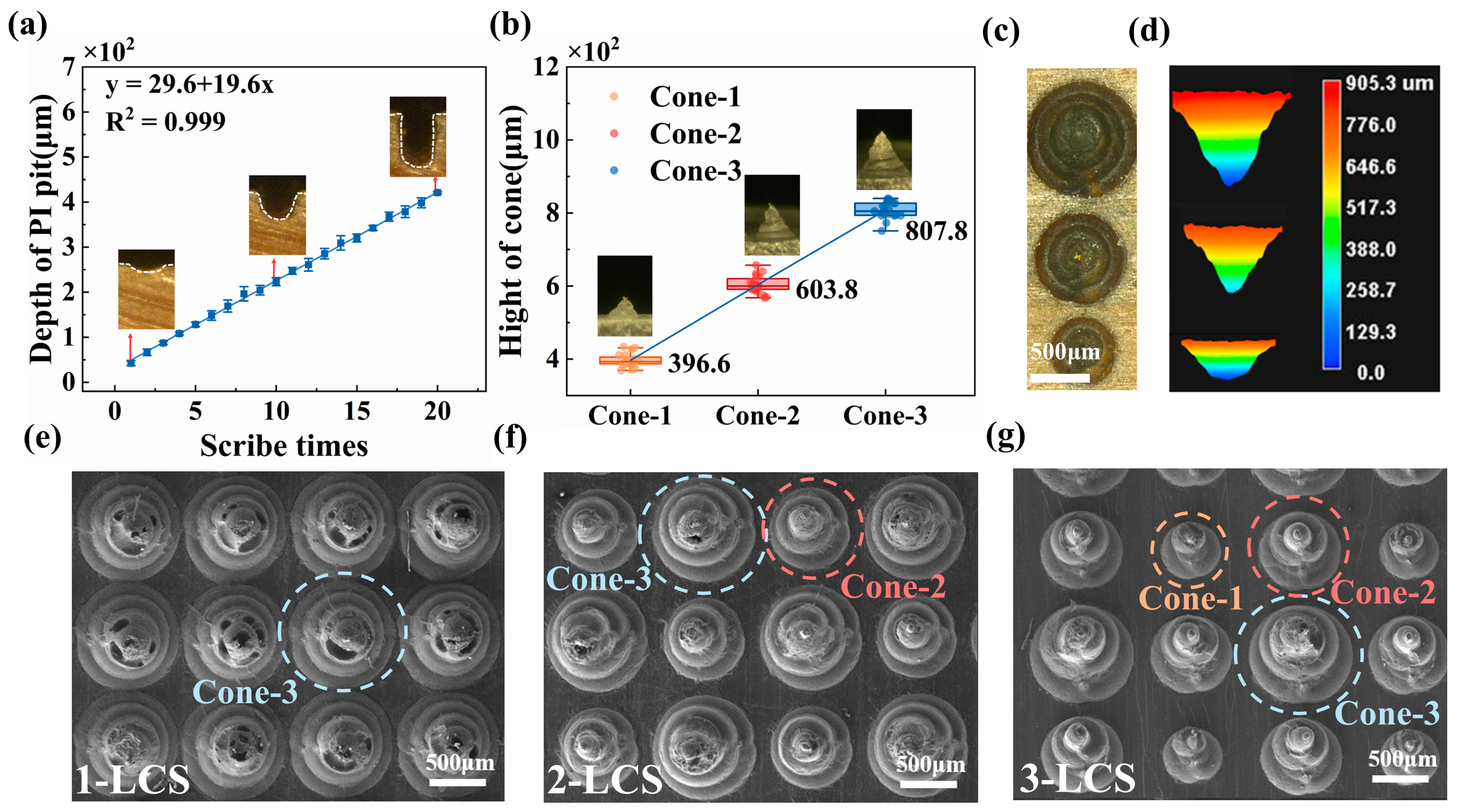
The formation of conoid-like structures stems from the cumulative effect of laser scan number and the ablation depth of polyimide (PI). Under fixed laser parameters, a single scan only induces shallow ablation, resulting in a flat-bottomed pit morphology. As the number of scans increases, the ablation depth gradually increases. However, due to the Gaussian distribution of laser spot energy, the central region of the spot exhibits the highest energy density and fastest ablation rate, while the edge regions have lower energy density and relatively slower ablation rates. This difference in radial ablation rates causes the center of the pit to further sink downward after multiple scans, with the edges retaining a certain height. Simultaneously, through our structural design, we combine different scan diameters to ultimately form a conoid-like profile with a distinct height gradient, thereby enabling the customization of the geometric parameters for the multi-level structures. Prior to fabricating the multi-level conoid-like microstructures, a parametric study was conducted to investigate the effect of laser scan number on ablation depth in PI substrates with fixed laser parameters (wavelength: 355 nm, power: 2 W, frequency: 30 kHz, pulse width: 10 ns, scanning speed: 10 mm/s), where the laser scan number was varied from 1 to 20. The depth of the ablated pits was measured via an optical microscope, with the corresponding measurement results presented in Figure 2a. After 1, 10, and 20 scans, the average ablation depths were approximately 42.6 μm, 223.3 μm, and 421.2 μm, respectively. The experimental data reveal a strong linear relationship between the scan number and the ablation depth, with a linear fit coefficient (R2) of 0.999. This confirms that within the tested scan number range, the ablation depth can be accurately predicted and precisely regulated by adjusting the scan number. Notably, the fitted curve of ablation depth versus number of laser scans does not pass through the origin. During the first scan, the pristine PI surface is clean and fully absorbs the laser energy. In subsequent scans, residual graphene carbonized debris from prior ablation partially absorbs the incident laser energy, reducing the energy available for PI ablation and thus lowering both ablation efficiency and incremental depth.
To fabricate the target conical microstructures, a stepwise laser processing method was adopted, as shown in Figure 1a. This method involves progressively reducing the laser beam diameter during multiple circular scans under software control, thereby enabling the formation of conoid-like structures. Specifically, for fabricating a single conoid-like structure, five initial scans with a larger diameter are first performed to create shallow ring-shaped pits. Then, the laser diameter is reduced stepwise. and an additional 10, 15, and 20 scans are applied at each reduced diameter, leading to a gradual increase in pit depth. The integration of these ring-shaped regions with varying diameters and depths yields a complete conoid-like hole. Following the same fabrication protocol, two additional conoid-like structures with smaller overall depths were fabricated. Figure 2c (top view) clearly shows the diameter variation in the laser-processed regions, while the 3D shape in Figure 2d displays the detailed structure of the conoid-like holes.
Subsequently, three conoid-like structures with distinct design parameters were integrated to fabricate a PI template featuring three gradient conoid-like architectures, as presented in Figure S1. The corresponding sensor incorporating these three distinct height levels is illustrated in Figure 2b. To ensure measurement reliability, 20 identical structures were selected for height characterization, yielding average heights of 396.6 μm, 603.8 μm, and 807.8 μm, respectively. Top-view and side-view images (Figure S2 and Figure 2e–g) clearly show the conoid-like structures with varying heights are uniformly distributed across the substrate. The 1-level conoid-like structure (1-LCS), composed of Cone-3, is shown in Figure 2e and Figure S2a. The 2-level conoid-like structure (2-LCS), composed of Cone-2 and Cone-3, is shown in Figure 2f and Figure S2b. The 3-level conoid-like structure (3-LCS), composed of Cone-1, Cone-2, and Cone-3, is shown in Figure 2g and Figure S2c. It should be noted that due to limitations in the viewing angle, only two of the three height levels are clearly visible in the side-view image of the 3-LCS. These characterization results are consistent with the designed configurations, thus validating the feasibility and high precision of the proposed laser processing strategy.
To clarify the sensing mechanism of the fabricated iontronic sensor, the interfacial electrical behavior and working principle were first analyzed. In the iontronic sensor, an electrical double layer (EDL) is formed at the electrode–ionogel interface. According to the Gouy–Chapman–Stern (GCS) model, the electric double layer (EDL) can be represented as two interfacial capacitors in series: the Helmholtz layer capacitance (CH) and the diffuse layer capacitance (CD). The total EDL capacitance is given by C E D L = 1 C H + 1 C D 1 = U A C A , where UAC denotes the unit-area capacitance of the EDL. Both CH and CD are proportional to the contact area (A) [15]. Thus, variations in the total interfacial capacitance directly reflect changes in the effective contact area between the electrode and ionogel. The sensor is configured as a parallel-plate capacitor. Initially, a small gap exists between the top electrode and the ionogel layer. When pressure is applied, the top electrode undergoes deformation, resulting in an increased contact area with the ionogel. Based on the parallel-plate capacitance formula (C = εA/d, where ε is the dielectric constant and d is the distance between electrodes), the capacitance increases as the expansion of the contact area grows, enabling the quantitative detection of pressure via capacitance variation.
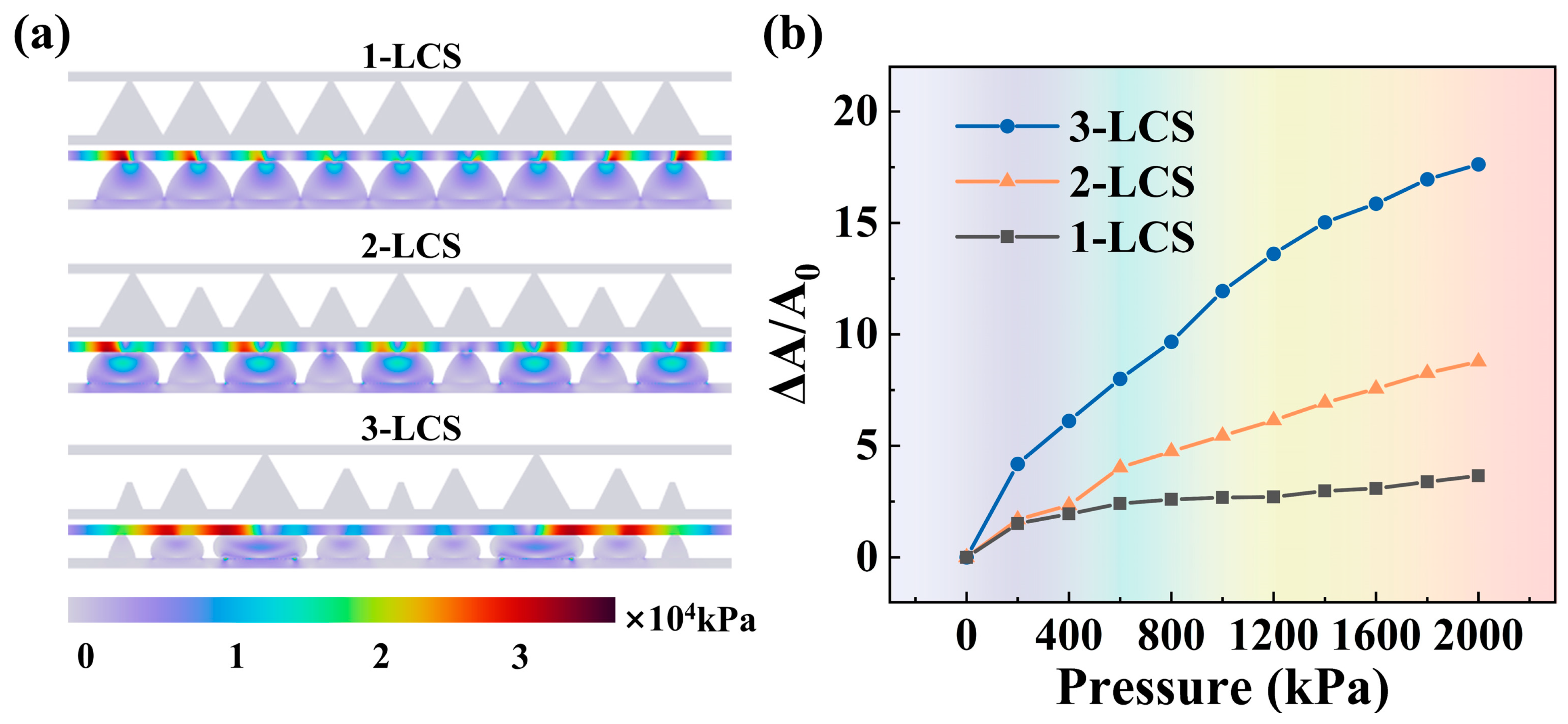
To elucidate the effects of the microstructure design on the pressure-contact area relationship, finite element analysis (FEA) was conducted on the 1-LCS, 2-LCS, and 3-LCS structures. Figure 3a presents the stress distribution at the electrode contact interface for all three structures under no load and under 2000 kPa pressure, where a color gradient from blue to red is used to indicate stress magnitude. The 1-LCS exhibits clear stress concentration, the 2-LCS displays a broader and more uniform stress pattern, and the 3-LCS achieves the widest stress dispersion. The strain in the elastic material was calculated using Gaussian integration. With the assumption of no friction or permeation at the interface, an iterative method was used to simulate the contact area between the electrode and the dielectric layer. The initial contact area (A0) was defined at a pressure of 1 kPa. As shown in Figure 3b, the contact area increases with pressure for all three structures, with the growth rate peaking at approximately 200 kPa for all designs. In the pressure range of 200 kPa and 600 kPa, the growth rate slows down, but clear differences remain: the 1-LCS exhibits the smallest contact area growth, the 2-LCS shows a moderate increase, and the 3-LCS achieves the largest expansion. For 600 kPa to 1200 kPa, the growth rate of the 1-LCS continued to decline, while the 2-LCS maintained steady growth and the 3-LCS still expanded rapidly. Between 1200 kPa and 2000 kPa, the 1-LCS approached contact area saturation, the 2-LCS showed nearly linear growth, and the 3-LCS still exhibited a higher growth rate than the other two structures. Ultimately, the contact areas of the 1-LCS, 2-LCS, and 3-LCS increased to about 3, 8, and 17 times their initial values, respectively. This distinct performance discrepancy originates from the structural design differences for the 1-LCS; all cones have the same height and undergo deformation almost simultaneously, which limits the maximum achievable contact area growth. In contrast, in the multi-level conoid-like structures (2-LCS and 3-LCS), the taller conical units first come into contact with the electrode and initiate deformation. As pressure increases, the shorter conical units gradually make contact with the electrode (as illustrated in Figure 1b). This stepwise activation mechanism enables a continuous and substantial expansion of the total contact area over a wide pressure range, thereby contributing to enhanced sensor sensitivity.

3.2. Characterization and Application of Iontronic Pressure Sensor

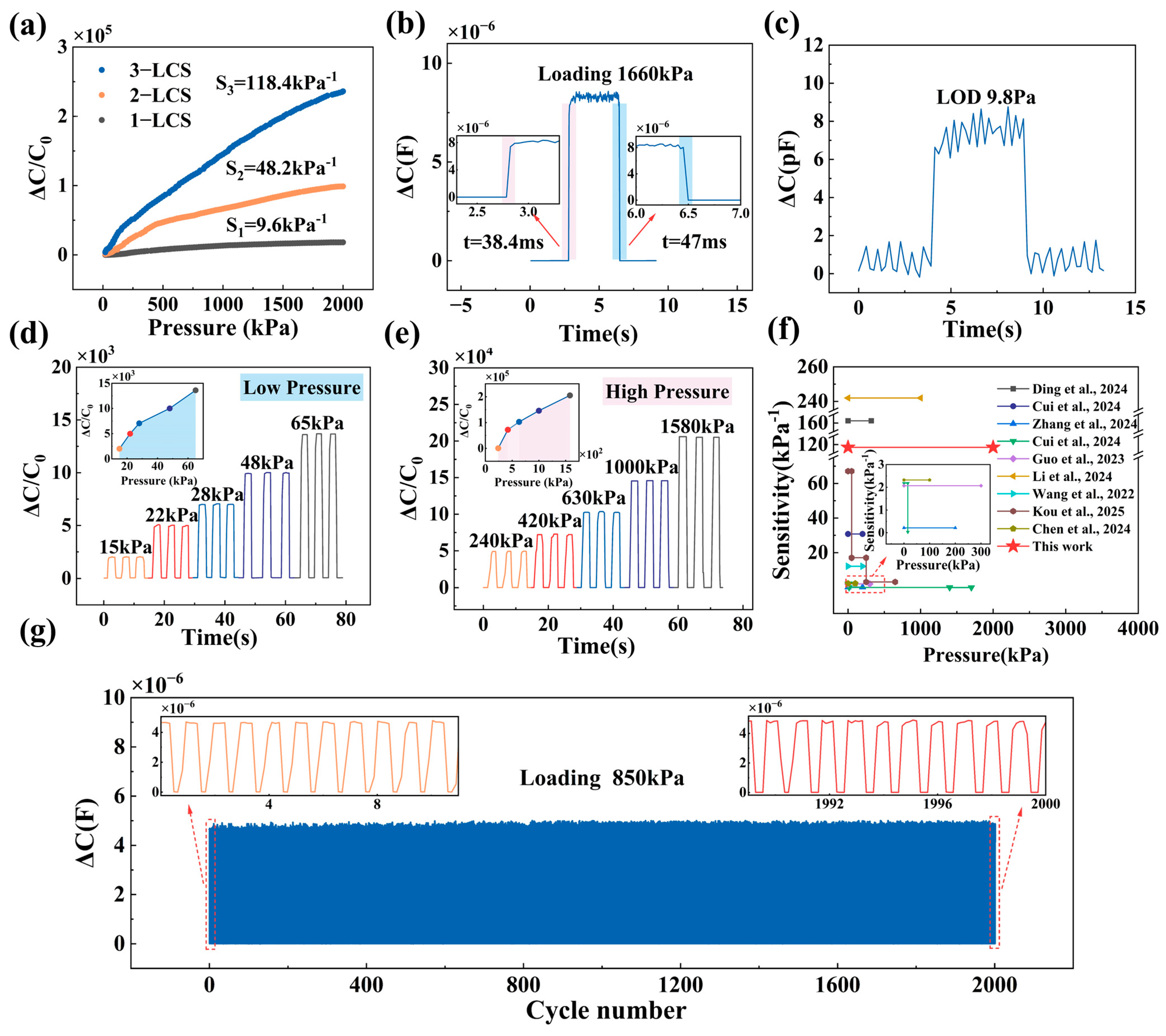
To systematically investigate the effects of structural height and gradient distribution on sensing performance, comprehensive performance tests were conducted on the 1-LCS, 2-LCS, and 3-LCS sensors. The experimental setup is shown in Figure S4. A two-axis translation stage combined with a digital force gauge was employed to apply controlled pressure to the sensor. The top and bottom electrodes of the sensor are connected to a multimeter via test leads to record capacitance values under different applied pressures. As shown in Figure 4a, all three sensors showed excellent linear response over a wide pressure range (0–2000 kPa). Sensitivity (S) was calculated using the following equation: S = δ ( Δ C / C 0 ) δ P , where ∆C is the capacitance change, C0 is the initial capacitance, and ∆P is the applied pressure. The 3-LCS sensor achieved the highest sensitivity of 118.4 kPa−1, which is significantly higher than that of the 2-LCS (48.2 kPa−1) and 1-LCS (9.6 kPa−1). This result confirms that the multi-level gradient design effectively improves sensitivity. Owing to its superior performance, the 3-LCS was selected for all subsequent experiments.
Response time is a critical parameter for real-time sensing applications. Under an applied pressure of 1660 kPa, the 3-LCS sensor had a response time of 38.4 ms and a recovery time of 47.0 ms (Figure 4b). This response time is shorter than the average human reaction time [50], enabling the sensor to accurately capture fast-changing physiological and dynamic impact signals. The limit of detection (LOD) of the 3-LCS sensor was determined to be 9.8 Pa (Figure 4c). In low-pressure tests, the signal-to-noise ratio (SNR) clearly improved when pressure was applied. In the unloaded state, the out signal is small and mostly noise. Whereas under pressure, the expansion of the contact area enhances the capacitance signal, thereby improving the SNR. The linearity and repeatability of the 3-LCS sensor were evaluated via stepwise pressure loading. Measurements were performed at low pressures (15, 22, 28, 48, and 65 kPa) and high pressures (240, 420, 630, 1000, and 1580 kPa), with three repeated measurements at each pressure point. The results (Figure 4d,e) show nearly linear responses and highly consistent measurement values, confirming the sensor’s superior repeatability and reliable linear performance. To assess the reliability under demanding conditions, the 3-LCS sensor was subjected to 2000 consecutive loading–unloading cycles at a high pressure of 850 kPa (Figure 4g) and at a low pressure of 500 Pa (Figure S3). No noticeable signal drift or weakening was observed after the cyclic tests, showing excellent mechanical stability and long-term reliability. Therefore, such sensors are suitable for scenarios such as one-time high-precision diagnostics, smart packaging, and low-frequency interaction—where a cycle life of 2000 is sufficient to meet the operational requirements throughout their entire life cycle. A performance comparison with previously reported iontronic pressure sensors (Figure 4f) indicates that the 3-LCS sensor achieves an ultra-wide linear detection range (0–2000 kPa) while maintaining high sensitivity (118.4 kPa−1), outperforming most state-of-the-art analogous devices. In summary, the 3-LCS sensor demonstrates superior comprehensive performance, including high sensitivity, fast response speed, excellent stability, and reliable repeatability, thus holding great potential for practical applications.

3.3. Application in Human Physiological Monitoring

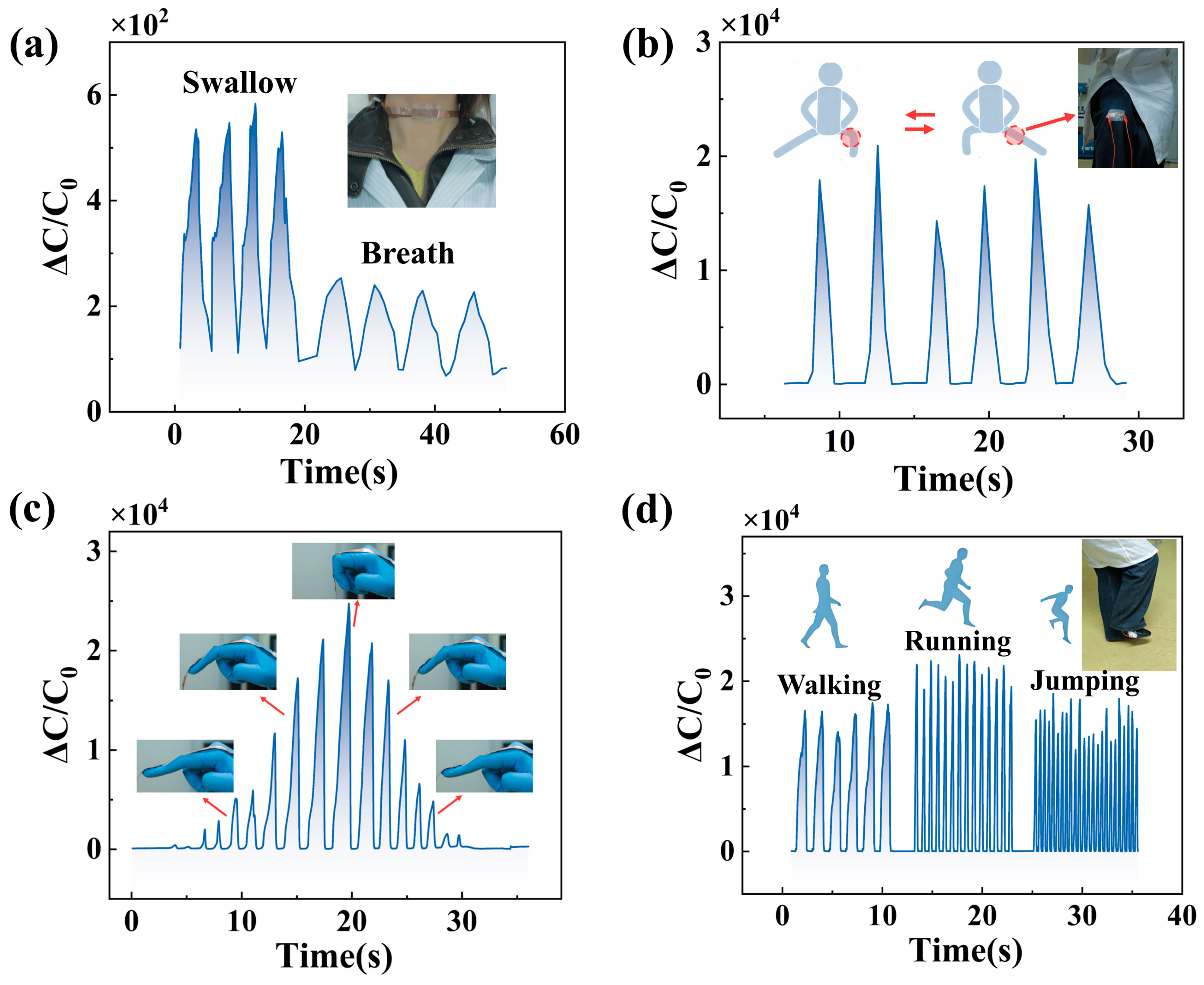
Human physiological signals directly reflect the health status of the human body and provide valuable information for clinical diagnosis and medical monitoring. To validate the practical applicability of the 3-LCS ionogel sensor in physiological monitoring scenarios, comprehensive in vivo tests were conducted on the PVA/H3PO4-based 3-LCS ionogel sensor across multiple human physiological signal monitoring applications. Specifically, we collected the raw data using a DM6500 multimeter at a sampling rate of 10 kHz and applied the moving average filtering method to average eight consecutive data points. The processed data were then used to calculate ΔC/C0 for the application results shown in Figure 5.
First, laryngeal biosignal detection. As illustrated in Figure 5a, the sensor was attached to the throat surface using transparent medical tape. It accurately captured two types of characteristic signals: small-amplitude periodic strain signals corresponding to respiratory movements and large-amplitude transient strain signals induced by swallowing actions. This demonstrates the sensor’s ability to recognize high-strain signals from throat muscles during choking, enabling real-time warning of potential danger. This function can be further extended to the identification of complications associated with swallowing disorders, rendering the sensor suitable for rehabilitation monitoring in patients with stroke, Parkinson’s disease, Alzheimer’s disease, or those recovering from throat tumor surgery [51]. Second, joint motion monitoring. Figure 5b,c illustrate the precise response of the sensor to varying degrees of knee and finger joint flexion. For individuals engaged in repetitive joint movements, the sensor can continuously monitor joint motion frequency, flexion angle, and duration. Quantitative analysis of these motion parameters allows scientific assessment of work intensity and provides data support for the early detection and prevention of overuse injuries, such as knee osteoarthritis and carpal tunnel syndrome. Third, foot motion state recognition. Benefiting from its fast response time, the sensor clearly distinguishes between foot-off and foot-strike states. As shown in Figure 5d, by analyzing the sensor’s dynamic response signals under different motion modes (such as walking, running, and jumping), characteristic patterns of various foot behaviors can be effectively extracted and distinguished. This indicates its application potential in motion analysis, rehabilitation assessment, and smart insole development. In summary, owing to its accurate detection capability, rapid response, and excellent stability, the 3-LCS sensor demonstrates broad prospects for application in human physiological monitoring.

4. Conclusions

In summary, this study presents a flexible iontronic pressure sensor featuring a three-level gradient conoid-like microstructure, fabricated through a simple and controllable direct laser writing process. The multi-level structural design significantly improves sensor sensitivity, achieving a high sensitivity of 118.4 kPa−1 over a broad linear detection range of 0–2000 kPa. Additionally, the sensor also exhibits a low detection limit of 9.8 Pa, with fast response and recovery times of 38.4 ms and 47 ms, respectively. After undergoing 2000 loading–unloading cycles, the device maintains stable performance, demonstrating excellent mechanical durability.
In the future, we aim to further investigate the long-term stability of the sensor under higher cyclic loads, specifically targeting stability beyond 10,000 loading–unloading cycles, to fully validate its applicability for continuous real-time monitoring in wearable health devices.
These superior performance characteristics endow the sensor with the capability to accurately detect both subtle and large-amplitude pressure signals. Notably, the sensor has been successfully used for monitoring various physiological signals, including throat movements during swallowing and breathing, joint motions from finger and knee activities, as well as gait patterns during walking and running. This work provides a practical strategy for developing high-performance electronic skins, holding significant great potential for wearable health monitoring and artificial tactile systems, and offering substantial value for advancing tactile sensing technology.

Supplementary Materials

The following supporting information can be downloaded at https://www.mdpi.com/article/10.3390/pr14081234/s1. Figure S1. Top-view of the PI templates for (a) 1-LCS, (b) 2-LCS, and (c) 3-LCS; Figure S2: Side-view of the (a) 1-LCS, (b) 2-LCS, and (c) 3-LCS; Figure S3: Cyclic response test of the 3-LCS over 2000 cycles at 500 Pa; Figure S4: Experimental setup for sensor performance test and characterization.

Author Contributions

Conceptualization, X.W. and S.W.; methodology, X.W.; software, S.Z. and L.Q.; investigation, X.W., S.Z. and L.Q.; resources, X.W., Q.C. and C.G.; data curation, X.W., L.Q., Q.C., C.G. and S.Z.; writing—original draft preparation, X.W. and S.W.; writing—review and editing, X.W. and S.W.; visualization, G.D.; supervision, S.W.; project administration, G.D.; funding acquisition, S.W. and G.D. All authors have read and agreed to the published version of the manuscript.

Funding

This research was funded by the National Key R&D Program of China (2023YFB3610800), the National Natural Science Foundation of China (No. 61905168), and the Sichuan Science and Technology Program (No. 2022YFG0361).

Data Availability Statement

The data that support the findings of this study are available from the corresponding author upon reasonable request.

Conflicts of Interest

The authors declare no conflicts of interest.

References

  1. Cui, X.; Chen, J.; Wu, W.; Liu, Y.; Li, H.; Xu, Z.; Zhu, Y. Flexible and breathable all-nanofiber iontronic pressure sensors with ultraviolet shielding and antibacterial performances for wearable electronics. Nano Energy 2022, 95, 107022. [Google Scholar] [CrossRef]
  2. Liang, T.; Liu, Z.; Zhang, H.; Zhou, X.; Liang, Y. The structure, material and performance of multi-functional tactile sensor and its application in robot field: A review. Mater. Today 2025, 86, 452–481. [Google Scholar] [CrossRef]
  3. Deng, W.-J.; Wang, L.-F.; Dong, L.; Huang, Q.-A. LC Wireless Sensitive Pressure Sensors with Microstructured PDMS Dielectric Layers for Wound Monitoring. IEEE Sens. J. 2018, 18, 4886–4892. [Google Scholar] [CrossRef]
  4. Huang, Y.-C.; Liu, Y.; Ma, C.; Cheng, H.-C.; He, Q.; Wu, H.; Wang, C.; Lin, C.-Y.; Huang, Y.; Duan, X. Sensitive pressure sensors based on conductive microstructured air-gap gates and two-dimensional semiconductor transistors. Nat. Electron. 2020, 3, 59–69. [Google Scholar] [CrossRef]
  5. Long, H.; Li, Q.; Peng, S.; Chen, S.; Zhang, T.; Zhang, M.; Li, M.; Chen, L. Flexible, Strong and Multifunctional Anf@Ag Nanocomposite Film for Human Physiology and Motion Monitoring. Processes 2022, 10, 961. [Google Scholar] [CrossRef]
  6. Kim, J.; Kim, J. Deep Learning Integration for Normal Breathing Classification Using a Flexible Fiber Sensor. Processes 2024, 12, 2644. [Google Scholar] [CrossRef]
  7. Liu, Q.; Liu, Y.; Shi, J.; Liu, Z.; Wang, Q.; Guo, C.F. High-Porosity Foam-Based Iontronic Pressure Sensor with Superhigh Sensitivity of 9280 kPa−1. Nano-Micro Lett. 2021, 14, 21. [Google Scholar] [CrossRef] [PubMed]
  8. Ha, K.H.; Zhang, W.; Jang, H.; Kang, S.; Wang, L.; Tan, P.; Hwang, H.; Lu, N. Highly Sensitive Capacitive Pressure Sensors over a Wide Pressure Range Enabled by the Hybrid Responses of a Highly Porous Nanocomposite. Adv. Mater. 2021, 33, 2103320. [Google Scholar] [CrossRef]
  9. Wang, W. Flexible Pressure Sensors: Classification, Cutting-Edge Advances and Applications. In Proceedings of the 2025 2nd International Conference on Electrical Engineering and Intelligent Control (EEIC 2025), Auckland, New Zealand, 3–4 July 2025; Advances in Engineering Research; Atlantis Press: Dordrecht, The Netherlands, 2025; pp. 639–654. [Google Scholar] [CrossRef]
  10. Li, Z.; Zhao, K.; Wang, J.; Wang, B.; Lu, J.; Jia, B.; Ji, T.; Han, X.; Luo, G.; Yu, Y.; et al. Sensitive, Robust, Wide-Range, and High-Consistency Capacitive Tactile Sensors with Ordered Porous Dielectric Microstructures. ACS Appl. Mater. Interfaces 2024, 16, 7384–7398. [Google Scholar] [CrossRef]
  11. Bijender; Kumar, A. Flexible and wearable capacitive pressure sensor for blood pressure monitoring. Sens. Bio-Sens. Res. 2021, 33, 100434. [Google Scholar] [CrossRef]
  12. Ray, T.R.; Choi, J.; Bandodkar, A.J.; Krishnan, S.; Gutruf, P.; Tian, L.; Ghaffari, R.; Rogers, J.A. Bio-Integrated Wearable Systems: A Comprehensive Review. Chem. Rev. 2019, 119, 5461–5533. [Google Scholar] [CrossRef]
  13. Luo, Z.; Huang, J.; Song, Q.; Xia, B.; Li, H.; Zeng, G. High-sensitivity and wide-dynamic-range parameter estimation via weak-value amplification. Phys. Rev. Appl. 2024, 22, 064070. [Google Scholar] [CrossRef]
  14. Mathew, R.; Ravi Sankar, A. A Review on Surface Stress-Based Miniaturized Piezoresistive SU-8 Polymeric Cantilever Sensors. Nano-Micro Lett. 2018, 10, 35. [Google Scholar] [CrossRef]
  15. Chang, Y.; Wang, L.; Li, R.; Zhang, Z.; Wang, Q.; Yang, J.; Guo, C.F.; Pan, T. First Decade of Interfacial Iontronic Sensing: From Droplet Sensors to Artificial Skins. Adv. Mater. 2020, 33, 2003464. [Google Scholar] [CrossRef] [PubMed]
  16. Zhao, G.; Lv, B.; Wang, H.; Yang, B.; Li, Z.; Junfang, R.; Gui, G.; Liu, W.; Yang, S.; Li, L. Ionogel-based flexible stress and strain sensors. Int. J. Smart Nano Mater. 2021, 12, 307–336. [Google Scholar] [CrossRef]
  17. Cui, X.; Xi, Y.; Tu, S.; Zhu, Y. An overview of flexible sensors from ionic liquid-based gels. TrAC Trends Anal. Chem. 2024, 174, 117662. [Google Scholar] [CrossRef]
  18. Song, J.; Yang, R.; Shi, J.; Chen, X.; Xie, S.; Liao, Z.; Zou, R.; Feng, Y.; Ye, T.T.; Guo, C.F. Polyelectrolyte-based wireless and drift-free iontronic sensors for orthodontic sensing. Sci. Adv. 2025, 11, eadu6086. [Google Scholar] [CrossRef] [PubMed]
  19. Chen, Z.; Qu, C.; Yao, J.; Zhang, Y.; Xu, Y. Two-Stage Micropyramids Enhanced Flexible Piezoresistive Sensor for Health Monitoring and Human–Computer Interaction. ACS Appl. Mater. Interfaces 2024, 16, 7640–7649. [Google Scholar] [CrossRef]
  20. Wang, Y.; Jing, R.; Jiang, J.; Wang, H.; Qian, L.; Yu, B.; Zhao, Z.-J. Coral-Inspired Capacitive Pressure Sensor with High Sensitivity and Wide Range for Human–Computer Interaction. ACS Appl. Electron. Mater. 2024, 6, 6726–6737. [Google Scholar] [CrossRef]
  21. Zhang, H.; Chen, X.; Liu, Y.; Yang, C.; Liu, W.; Qi, M.; Zhang, D. PDMS Film-Based Flexible Pressure Sensor Array with Surface Protruding Structure for Human Motion Detection and Wrist Posture Recognition. ACS Appl. Mater. Interfaces 2024, 16, 2554–2563. [Google Scholar] [CrossRef]
  22. Ding, Z.; Li, W.; Wang, W.; Zhao, Z.; Zhu, Y.; Hou, B.; Zhu, L.; Chen, M.; Che, L. Highly Sensitive Iontronic Pressure Sensor with Side-by-Side Package Based on Alveoli and Arch Structure. Adv. Sci. 2024, 11, e2309407. [Google Scholar] [CrossRef]
  23. Zhong, Y.; Liu, K.; Wu, L.; Ji, W.; Cheng, G.; Ding, J. Flexible Tactile Sensors with Gradient Conformal Dome Structures. ACS Appl. Mater. Interfaces 2024, 16, 52966–52976. [Google Scholar] [CrossRef]
  24. Wang, D.; Li, B.; Niu, S.; Han, Z.; Ren, L. Novel Iontronic Pressure Sensor Coupling High Sensitivity and Wide-Range for Stiffness Identification and Long-Distance Precise Motion Control. Adv. Funct. Mater. 2024, 35, 2413551. [Google Scholar] [CrossRef]
  25. Bai, N.; Wang, L.; Xue, Y.; Wang, Y.; Hou, X.; Li, G.; Zhang, Y.; Cai, M.; Zhao, L.; Guan, F.; et al. Graded Interlocks for Iontronic Pressure Sensors with High Sensitivity and High Linearity over a Broad Range. ACS Nano 2022, 16, 4338–4347. [Google Scholar] [CrossRef]
  26. Yan, Z.; Wang, S.; Huang, F.; Deng, G.; Sui, X.; Wu, Z.; Wang, J. High sensitivity iontronic pressure sensors with wavy structure electrode and two-level raised structures ionic gel film prepared by direct laser writing. Sens. Actuators A Phys. 2023, 363, 114735. [Google Scholar] [CrossRef]
  27. Mao, L.; Pan, T.; Lin, L.; Ke, Y.; Su, H.; Li, Y.; Huang, W.; Li, T.; Lin, Y. Simultaneously enhancing sensitivity and operation range of flexible pressure sensor by constructing a magnetic-guided microstructure in laser-induced graphene composite. Chem. Eng. J. 2024, 481, 148639. [Google Scholar] [CrossRef]
  28. Wang, H.; Li, Z.; Liu, Z.; Fu, J.; Shan, T.; Yang, X.; Lei, Q.; Yang, Y.; Li, D. Flexible capacitive pressure sensors for wearable electronics. J. Mater. Chem. C 2022, 10, 1594–1605. [Google Scholar] [CrossRef]
  29. Zhang, Q.; Zhang, H.; Liang, J.; Zhao, X.; Li, B.; Zang, J.; Gao, L.; Zhang, Z.; Xue, C. Ti3C2Tx-MXene/PET textile-based flexible pressure sensor for wearable pulse monitoring. J. Mater. Chem. C 2023, 11, 15638–15648. [Google Scholar] [CrossRef]
  30. Bai, N.; Wang, L.; Wang, Q.; Deng, J.; Wang, Y.; Lu, P.; Huang, J.; Li, G.; Zhang, Y.; Yang, J.; et al. Graded intrafillable architecture-based iontronic pressure sensor with ultra-broad-range high sensitivity. Nat. Commun. 2020, 11, 209. [Google Scholar] [CrossRef] [PubMed]
  31. Meng, X.; Wang, F.; Wang, J.; Yang, S. Highly Sensitive and Wide Linear Range Flexible Pressure Sensors with Hierarchical Microstructure and Its Application in Human Signal Detection. In Proceedings of the 2024 8th International Conference on Electrical, Mechanical and Computer Engineering (ICEMCE), Xi’an, China, 25–27 October 2024; IEEE: New York, NY, USA, 2024; pp. 379–382. [Google Scholar] [CrossRef]
  32. Cui, C.; Qin, Y.; Zeng, Y.; Lu, X.; Wei, E.; Xie, J. A flexible capacitive pressure sensor with dual-layer microstructure for health monitoring. Sens. Actuators A Phys. 2024, 377, 115709. [Google Scholar] [CrossRef]
  33. Wang, S.; Zong, Q.; Yang, H.; Tan, C.; Huang, Q.; Liu, X.; Zhang, G.; French, P.; Ye, H. Rapid Fabrication of High-Performance Flexible Pressure Sensors Using Laser Pyrolysis Direct Writing. ACS Appl. Mater. Interfaces 2023, 15, 41055–41066. [Google Scholar] [CrossRef]
  34. Wang, S.; Chang, S.; Song, Y.; Qiao, X.; Li, L.; Zhao, L.; Yang, P.; Yu, S. High sensitivity capacitive flexible pressure sensor based on PDMS double wrinkled microstructure. J. Mater. Sci. Mater. Electron. 2024, 35, 78. [Google Scholar] [CrossRef]
  35. Mubasshira; Rahman, M.M.; Uddin, M.N.; Rhaman, M.; Roy, S.; Sarker, M.S. Next-Generation Smart Carbon–Polymer Nanocomposites: Advances in Sensing and Actuation Technologies. Processes 2025, 13, 2991. [Google Scholar] [CrossRef]
  36. Guo, X.; Hong, W.; Hu, B.; Zhang, T.; Jin, C.; Yao, X.; Li, H.; Yan, Z.; Jiao, Z.; Wang, M.; et al. Human touch sensation-inspired, ultrawide-sensing-range, and high-robustness flexible piezoresistive sensor based on CB/MXene/SR/fiber nanocomposites for wearable electronics. Compos. Struct. 2023, 321, 117329. [Google Scholar] [CrossRef]
  37. Liu, L.; Cai, Y.; Jiang, X.; Wang, J.; Wang, C.; Duan, J.-A. A versatile surface micro structure design strategy for porous-based pressure sensors to enhance electromechanical performance. Chem. Eng. J. 2024, 490, 151529. [Google Scholar] [CrossRef]
  38. Li, X.; Liang, Q.; Liu, H.; Zhao, L.; Sun, C.; Hou, C. High-Sensitivity MXene/MWCNTs/PDMS Flexible Capacitive Sensor for Wearable Health Monitoring. Adv. Mater. Technol. 2025, 10, e00677. [Google Scholar] [CrossRef]
  39. Kou, H.; Zhang, Y.; Ye, Y.; Pang, Y.; Zhang, L.; Zhang, X.; Yang, L.; Shang, Z.; Gui, Z.; Chen, Y. Ultrasensitive iontronic pressure sensor based on microstructural electrodes and porous dielectric layer for wearable electronics. Sens. Actuators A Phys. 2025, 394, 116977. [Google Scholar] [CrossRef]
  40. Li, G.; Chen, D.; Li, C.; Liu, W.; Liu, H. Engineered Microstructure Derived Hierarchical Deformation of Flexible Pressure Sensor Induces a Supersensitive Piezoresistive Property in Broad Pressure Range. Adv. Sci. 2020, 7, 2000154. [Google Scholar] [CrossRef] [PubMed]
  41. Lu, L.; Zhao, Y.; Lin, N.; Xie, Y. Skin-inspired flexible pressure sensor with hierarchical interlocked spinosum microstructure by laser direct writing for high sensitivity and large linearity. Sens. Actuators A Phys. 2024, 366, 114988. [Google Scholar] [CrossRef]
  42. Tu, S.; Xi, Y.; Cui, X.; Xu, Z.; Liu, Z.; Zhu, Y. Skin-inspired interlocked microstructures with soft-hard synergistic effect for high-sensitivity and wide-linear-range pressure sensing. Chem. Eng. J. 2024, 496, 154083. [Google Scholar] [CrossRef]
  43. Li, G.; Zhang, Y.; Zhang, X.; Zhu, B.; Lei, Y.; Chen, D.; Shui, L.; Wu, G.; Xue, L. Filiform Papillae-Inspired Wearable Pressure Sensor with High Sensitivity and Wide Detection Range. Adv. Funct. Mater. 2024, 35, 2414465. [Google Scholar] [CrossRef]
  44. Peng, S.; Blanloeuil, P.; Wu, S.; Wang, C.H. Rational Design of Ultrasensitive Pressure Sensors by Tailoring Microscopic Features. Adv. Mater. Interfaces 2018, 5, 1800403. [Google Scholar] [CrossRef]
  45. An, T.; Zhang, Y.; Wen, J.; Dong, Z.; Du, Q.; Liu, L.; Wang, Y.; Xing, G.; Zhao, X. Multi-Level Pyramidal Microstructure-Based Pressure Sensors with High Sensitivity and Wide Linear Range for Healthcare Monitoring. ACS Sens. 2024, 9, 726–735. [Google Scholar] [CrossRef]
  46. Li, P.; Lang, S.; Xie, L.; Zhang, Y.; Gou, X.; Zhang, C.; Dong, C.; Li, C.; Yang, J. Skin-Inspired Ultra-Linear Flexible Iontronic Pressure Sensors for Wearable Musculoskeletal Monitoring. Nano-Micro Lett. 2025, 18, 55. [Google Scholar] [CrossRef]
  47. Zhao, C.; Wang, Y.; Tang, G.; Ru, J.; Zhu, Z.; Li, B.; Guo, C.F.; Li, L.; Zhu, D. Ionic Flexible Sensors: Mechanisms, Materials, Structures, and Applications. Adv. Funct. Mater. 2022, 32, 2110417. [Google Scholar] [CrossRef]
  48. Kim, Y.; Yang, H.; Oh, J.H. Simple fabrication of highly sensitive capacitive pressure sensors using a porous dielectric layer with cone-shaped patterns. Mater. Des. 2021, 197, 109203. [Google Scholar] [CrossRef]
  49. Lin, X.; Zhou, Y.; Lei, Z.; Chen, R.; Chen, W.; Meng, X.; Li, Y. Facile Electrochemical Biosensing Platform Based on Laser Induced Graphene/Laccase Electrode for the Effective Determination of Gallic Acid. Processes 2023, 11, 2048. [Google Scholar] [CrossRef]
  50. Chortos, A.; Bao, Z. Skin-inspired electronic devices. Mater. Today 2014, 17, 321–331. [Google Scholar] [CrossRef]
  51. Takizawa, C.; Gemmell, E.; Kenworthy, J.; Speyer, R. A Systematic Review of the Prevalence of Oropharyngeal Dysphagia in Stroke, Parkinson’s Disease, Alzheimer’s Disease, Head Injury, and Pneumonia. Dysphagia 2016, 31, 434–441. [Google Scholar] [CrossRef]
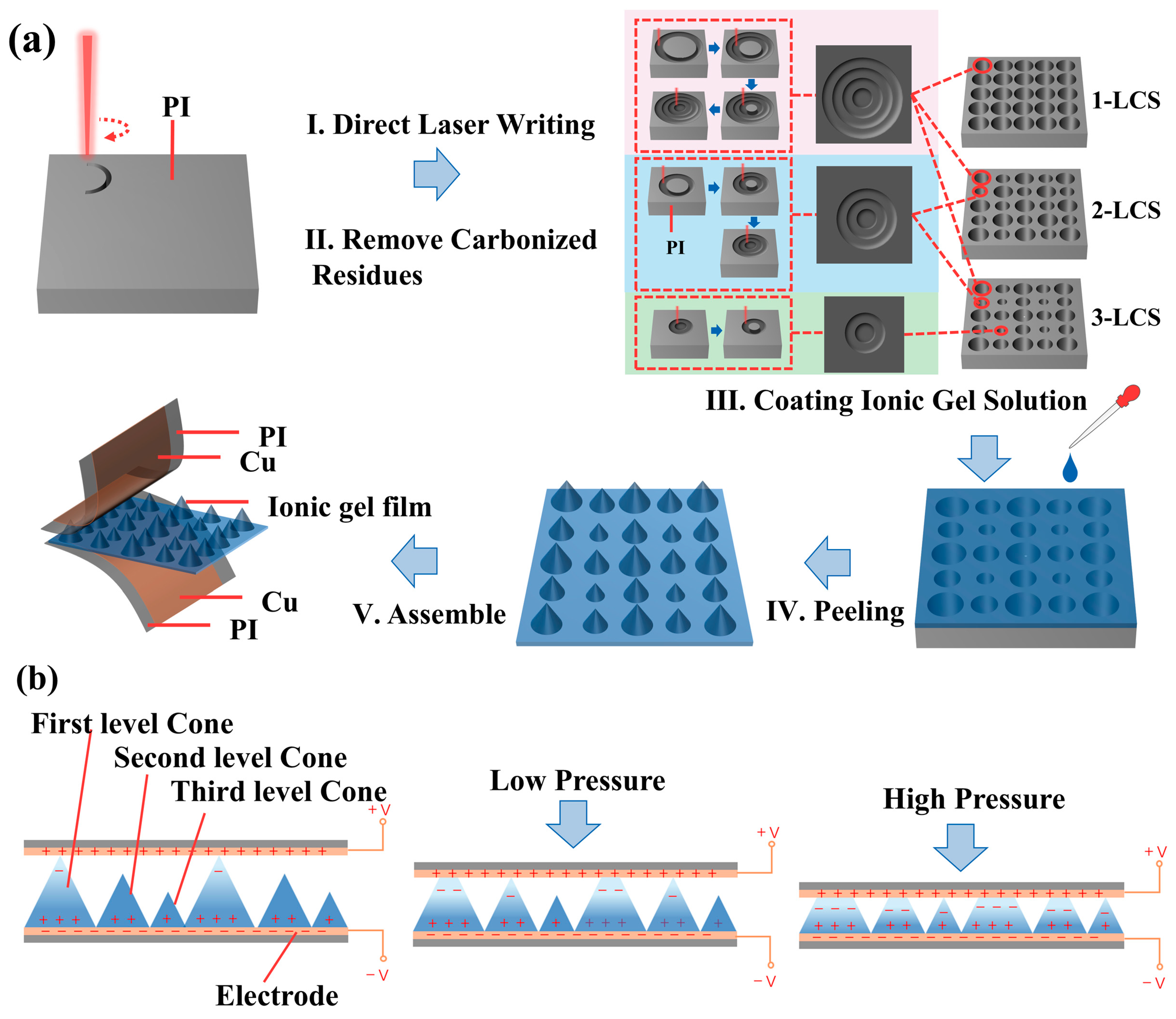
Figure 1. Fabrication process (a) and sensing mechanism (b) of the multi-level conoid-like structure sensor.
Processes 14 01234 g001
Figure 2. (a) Effect of the number of scans on the ablation depth of polyimide (PI) substrates; (b) Height distribution and side views of small, medium, and large conoid-like structures; (c) Top view of the small, medium, and large conoidal structure templates; (d) Three-dimensional depth profile of the PI template holes; (eg) Top-view SEM images of the 1-LCS, 2-LCS, and 3-LCS, respectively.
Processes 14 01234 g002
Figure 3. Finite element analysis of the contact area variation in the three structures: schematic diagram (a) and results (b).
Processes 14 01234 g003
Figure 4. Pressure sensing performance of the flexible ionogel sensor: (a) Performance comparison of the three sensor structures. (b) Response/recovery time of the 3-LCS. (c) Limit of detection (LOD) of the 3-LCS. (d) Response of the 3-LCS under different low pressures. (e) Response of the 3-LCS under different high pressures. (f) Performance comparison with other sensors. Data from Ding et al., 2024 [22], Cui et al., 2024 [17], Zhang et al., 2024 [21], Cui et al., 2024 [32], Guo et al., 2023 [36], Li et al., 2024 [43], Wang et al., 2022 [28], Kou et al., 2025 [39], Chen et al., 2024 [19]. (g) Cyclic response test of the 3-LCS over 2000 cycles at 850 kPa.
Processes 14 01234 g004
Figure 5. Real-time capacitive response (ΔC/C0) of the 3-LCS ionogel sensor for monitoring various human physiological and motion activities: (a) Swallowing and breathing motions at the throat; (b) Knee joint bending movements; (c) Different finger bending gestures; (d) Walking, running, and jumping motions at the ankle.
Processes 14 01234 g005
Disclaimer/Publisher’s Note: The statements, opinions and data contained in all publications are solely those of the individual author(s) and contributor(s) and not of MDPI and/or the editor(s). MDPI and/or the editor(s) disclaim responsibility for any injury to people or property resulting from any ideas, methods, instructions or products referred to in the content.