1. Introduction
Lavender (
Lavandula sp.) is a globally significant medicinal and aromatic genus, extensively cultivated for its essential oils, which are widely used in cosmetics, pharmaceuticals, food, and aromatherapy products [
1,
2]. Its cultivation has expanded due to the high economic value of its essential oils, which are primarily obtained from true lavender (
Lavandula angustifolia Mill.) and its hybrid lavandin (
L. ×
intermedia), with global production reaching approximately 1500 tons annually [
3]. Industrial essential oil yields can vary, but for the calculation of fresh biomass entering the distillation chain, we consider a typical yield of 0.3–0.7%, while the essential oil content in dry biomass typically ranges between 1% and 3% [
4]. Based on reported production volumes and typical yields, approximately 300,000 tons of fresh lavender biomass enter the distillation chain each year. In addition to solid residues rich in bioactive compounds and polysaccharides, essential oil production also generates wastewater and hydrolates, posing environmental and economic challenges [
5]. The valorization of these by-products through recycling and the development of value-added products therefore represents a key strategy for reducing waste and supporting circular bioeconomy approaches aligned with green innovation principles [
6,
7,
8,
9,
10].
A mini-review from 2015 points to the great potential of
Lavandula species post-distillation solid residues in the circular bioeconomy; however, the largest number of papers dealing with this topic were published after this work [
11]. Specifically, in the case of lavender post-distillation solid residues, their application as fertilizers [
12], compost [
13,
14], growing substrates for mushroom cultivation [
15,
16,
17], and biosorbents for copper removal has been demonstrated [
18], along with their use as a raw material for the extraction of bioactive compounds with biological activity [
19,
20,
21,
22], such as antioxidant [
19,
22] and antimicrobial activity [
23,
24], and as bioherbicides [
25] applicable in food, the pharmaceutical industry, and agriculture. Moreover, lavender post-distillation solid residues can serve as an environmentally friendly feedstock rich in polysaccharides [
26,
27] suitable for energy production, as with the production of syngas via pyrolysis [
28,
29], biomethane via anaerobic digestion [
30,
31], or solid fuel via hydrothermal carbonization [
32]. Additionally, lavender post-distillation solid residues have been reported as valuable bio-additives for cement mortars, enhancing the properties of traditional mortars while simultaneously contributing to waste management [
33,
34]. In addition, lavender post-distillation solid residues have been successfully valorized as a low-cost fermentation substrate for the production of high-value-added biomaterials, such as bacterial cellulose/gum Arabic composites obtained via in situ modification [
35]. Moreover, the successful pelletization of lavender post-distillation solid waste has been noted [
36,
37,
38], making this material convenient for storage, reducing storage space and reducing the dust fraction, and enabling its use for energy purposes.
The aim of this work was to produce pellets from lavender post-distillation solid residues after drying and milling that are suitable as a final product on farms cultivating medicinal and aromatic plants. By integrating complementary analytical approaches, this study advances current knowledge, establishes a foundation for sustainable valorization pathways, and supports circular bioeconomy strategies, highlighting practical applications in the energy, agriculture, feed, and pharmaceutical sectors. The study examined the chemical composition of the pellets, including the moisture, ash content, and energy-related properties; characteristics relevant for soil amendment, such as total nitrogen and carbon, macronutrients (P, K, Ca, Mg), micronutrients (Al, B, Cu, Fe, Na, Mn, Zn), and heavy metals (Cd, Cr, Ni, Pb); the recovery of bioactive compounds, including phenolic acids and flavonoids; microbiological safety; and nutritive value, including cellulose, fat and fatty acid composition, proteins, and amino acid composition. This comprehensive analysis aimed to assess the potential use of pellets from lavender post-distillation residues as a source of energy, organic fertilizer, raw material for the pharmaceutical industry, or as a feed or food product, highlighting circular bioeconomy potential and significance. Although individual valorization pathways of lavender post-distillation residues have been explored, their comprehensive assessment as a multipurpose resource remains limited. This study addresses this gap through a systematic characterization of pellet properties, providing a foundation for future cascading uses and advancing circular economy strategies.
2. Materials and Methods
2.1. Chemicals and Solvents
Formic acid, methanol and ethanol were purchased from POCH (Gliwice, Poland). Gallic acid, caffeic acid, chlorogenic acid, ferulic acid, rutin, rosmarinic acid, p-coumaric acid, trans-cinnamic acid, quercetin-dihydrate and quercitrin were purchased from Sigma-Aldrich GmbH (Sternheim, Germany).
2.2. Experimental Workflow
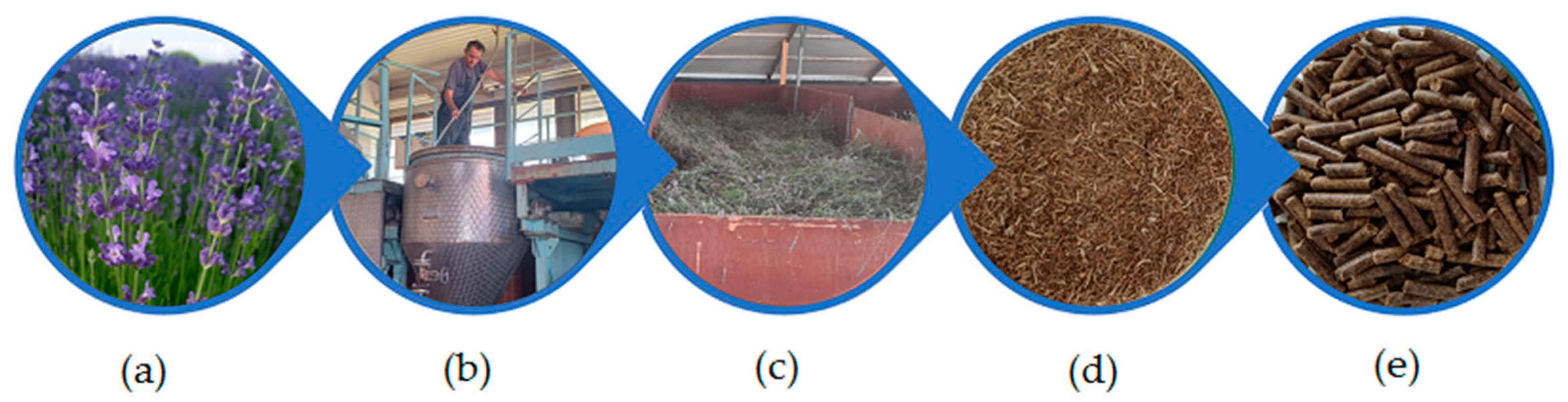
Lavender (L. angustifolia cv. Primorska) was grown in Bački Petrovac at the experimental fields of the Department of Alternative Crops, Institute of Field and Vegetable Crops Novi Sad (IFVCNS). Aerial parts (flowers, leaves, and stems) from a three-year-old plantation were manually harvested at full bloom at the end of June 2025 and distilled using a semi-industrial distillation unit at the same department. Briefly, approximately 100 kg of fresh plant material was placed in a stainless-steel vessel, supplied with steam, and distilled for 3 h.
After the distillation process was completed, the lavender solid waste was transferred from the stainless-steel vessel to a solar dryer, where it was dried for 2 days (final moisture content: 7.96%), and then ground using an industrial electric hammer mill with a 1.5 mm sieve. The ground plant material was subsequently pelletized using water (approximately 1.5 L per 10 kg of plant material) without any additional binders, with a pellet press machine (model KL200B; Henan Yishen Machinery Co., Ltd., Zhengzhou, China) operating at temperatures between 80 °C and 100 °C with a die diameter of 6 mm.
The overall methodology is schematically presented in
Figure 1, providing a visual overview of the process from lavender plant material in the field to steam distillation, the drying of post-distillation residues, milling, and pellet production as the final product.
2.3. Moisture and Ash Analysis
Moisture content was determined in accordance with EN 14774-2 [
39] (biofuels), EN 12048 [
40] (solid fertilizers), and ISO 6496 [
41] (animal feeding stuffs) standards. The procedure was based on a gravimetric method involving measurement of the sample mass before and after drying. Ash content was determined in accordance with EN 14775 [
42], EN 13040 [
43], and ISO 5984 [
44] standards for biofuels, solid fertilizers, and animal feeding stuffs, respectively. Samples previously dried for moisture analysis were placed in a furnace at 550 °C for 6 h.
2.4. Energy Characterization of Lavender Pellets
The higher heating value (HHV) of the samples was determined using an IKA C2000 calorimeter, in accordance with the standard procedure defined by the EN 14918 standard [
45]. Before measurement, the samples were oven-dried to ensure consistent and comparable results. Approximately 1 g of the sample of lavender pellets was weighed with an analytical balance (accuracy ±0.0001 g) and placed into the combustion crucible. The crucible was inserted into the decomposition vessel (bomb), which was then filled with oxygen at a pressure of 30 bar. The bomb was placed into the calorimeter’s inner vessel, which was filled with a known quantity of water. The system was sealed, and the measurement was initiated. During the process, the sample underwent complete combustion in the oxygen-rich environment, and the released heat was transferred to the surrounding water. A high-precision sensor continuously recorded the temperature increase in the water. Based on the temperature rise and the known heat capacity of the system (previously calibrated), the calorimeter calculated the HHV of the sample. All measurements were performed in triplicate to ensure accuracy and repeatability. Results were expressed in kJ/kg on a dry basis.
Then, the lower heating value (LHV) was calculated on a dry basis (1), ash-free dry basis (2), and wet basis (3) for lavender pellets using the following formulas:
where
HHVdb—higher heating value on a dry basis (kJ/kg),
LHVdb—lower heating value on a dry basis (kJ/kg),
LHVaf—lower heating value on an ash-free dry basis (kJ/kg),
LHVwb—lower heating value on a wet basis (kJ/kg),
H2—hydrogen content of the sample (db-%),
Ad—ash content on a dry basis (db-%),
M—moisture content of the sample (wb-%).
The energy of vaporization of water at 25 °C is 41.53 kJ/mol, corresponding to 206 kJ/kg per 1% (m/m) of hydrogen in the fuel sample, or 23 kJ/kg per 1% (m/m) of moisture, as defined by the EN 14918 [
45] standard. For the purposes of this study, the hydrogen content (H
2) was not determined experimentally; instead, a literature value of 5.8% was adopted for lavender biomass [
28].
2.5. Chemical Characterization of Lavender Pellets for Soil Amendments
To assess the potential of lavender post-distillation residues in pellet form as a soil amendment, a comprehensive chemical characterization was conducted. The analysis targeted key parameters related to soil fertility and environmental safety, including pH, moisture, ash content, organic matter, total and organic carbon, macro- and micronutrients, and potentially toxic heavy metals, which were found to be well within safety limits for agricultural application in accordance with Regulation (EU) 2019/1009.
Organic matter was calculated as the loss on ignition (LOI) at 550 °C, according to the EN 13039 standard [
46]. Total nitrogen (N) and carbon (C) contents were determined through the total combustion method using a CNS elemental analyzer (DM 8/1-3-091), which simultaneously quantifies carbon, nitrogen, and sulfur in solid samples. Total organic carbon (TOC) was determined in accordance with ISO 10694. Macro- (P, K, Ca, Mg) and micronutrients (Al, B, Cu, Fe, Na, Mn, Zn) were analyzed after microwave-assisted acid digestion of the samples, following US EPA Method 3051A. Elemental concentrations were quantified using inductively coupled plasma optical emission spectroscopy (ICP-OES). Heavy metals (Cd, Cr, Ni, Pb) were also determined using ICP-OES after acid digestion, in accordance with the EN 16963 standard for fertilizers and soil improvers. Total mercury (Hg) was quantified using a direct mercury analyzer (DMA-80, Milestone) based on thermal decomposition, gold amalgamation, and atomic absorption spectrometry, following US EPA Method 7473. Values below the limit of detection (LOD) are reported as <LOD and were determined based on the analytical performance of the applied methods and instrument-specific detection limits.
To ensure analytical accuracy, a reference sample of commercial mineral fertilizer (Yara Mila Cropcare 11:11:21) was used as a control for the determination of N, P, and K. For the validation of results related to secondary and trace elements, a certified reference material provided by BIPEA (Sample No. 8-3424-0079, PT: 24—mineral fertilizer) was included as part of the quality control protocol.
2.6. Chemical Characterization of Lavender Pellets for Recovery of Bioactive Compounds
2.6.1. Extract Preparations
Aqueous extracts (infusions and decoction) and ethanol extract (via maceration with 70% ethanol during 72 h) were prepared using a 1:10 (w/w) biomass:solvent ratio. Infusion preparation included the pouring of boiling water over the pellets and extraction for 15 min, while the decoction was prepared by boiling pellets with water for 30 min. After filtration and evaporation to dryness, the extraction yield (dry extract content—d.e.) was determined for each.
2.6.2. Chemical Characterization
The levels of ten polyphenolic compounds in lavender pellet extracts were determined using high-performance liquid chromatography (HPLC-DAD; Agilent Technologies 1100, Santa Clara, CA, USA) according to the previously developed and validated analytical method by our research group [
47,
48]. Samples were prepared in a mobile phase mixture and analyzed using a Nucleosil C18 column using a gradient elution with 1% formic acid and methanol. Flow rates and detection wavelengths were optimized for efficient separation and accurate quantification. Calibration curves were established using standard compounds, with detection carried out at 280, 330, and 350 nm depending on the analyte.
2.7. Evaluation of Microbiological and Nutritional Properties of Lavender Pellets
To evaluate the potential use of lavender pellets in animal nutrition, their microbiological and nutritive value were analyzed, along with their amino acid and fatty acid profiles.
2.7.1. Microbiological Safety Analysis
Microbiological safety analysis included the enumeration of total aerobic bacteria (ISO 4833-1), yeasts and molds (ISO 21527-2), Enterobacteriaceae (ISO 21528-2), and specific pathogenic indicators such as
Salmonella spp. (ISO 6579-1), beta-glucuronidase-positive
Escherichia coli (ISO 16649-2), coagulase-positive staphylococci (ISO 6888-1), and
Clostridium perfringens (ISO 7937) [
49,
50,
51,
52,
53,
54,
55]. Water activity (aw) in the samples was determined using a multifunction device, Lab Swift-aw (Novasiana AG, Lachen, Switzerland), to measure aw values. The determination procedure included filling the measuring vessel to 2/3 of its height, which is placed in the measuring chamber of the device, and the measuring process is performed at a constant room temperature (≈23 °C) until the measurement stability is established on the display. Water activity value tests were performed in triplicate.
2.7.2. Nutritional Composition
Cellulose content was determined according to the ISO 6865 method [
56]. Fat content was determined through Soxhlet extraction with prior acid hydrolysis, following ISO 6492. Protein content was assessed through the Kjeldahl method according to ISO 5983-1 [
57], using a nitrogen-to-protein conversion factor of 6.25.
2.7.3. Determination of Amino Acid Composition
Amino acid analyses of the lavender pellets were performed through ion exchange chromatography using an Automatic Amino Acid Analyzer Biochrom 30+ (Biochrom, Cambridge, UK) [
58]. The technique was based on amino acid separation using strong cation exchange chromatography, followed by the ninhydrin color reaction and photometric detection at 570 nm, except for proline, which was detected at 440 nm. Samples were previously hydrolyzed in 6 M HCl (Merck, Germany) at 110 °C for 24 h. After hydrolysis, samples were cooled to room temperature and dissolved in 25 mL of Loading buffer (pH 2.2) (Biochrom, Cambridge, UK). Subsequently, the prepared samples were filtered through a 0.22 µm pore size PTFE filter (Plano, TX, USA), and the filtrate was transferred into a vial (Agilent Technologies, Santa Clara, CA, USA) and stored in a refrigerator prior to analysis. The amino acid peaks were identified through a comparison of retention times with the retention times of an amino acid standard purchased from Sigma Aldrich (Amino Acid Standard Solution (Sigma-Aldrich, St. Louis, MO, USA)). The results were expressed as mass of amino acid (g) in 100 g of sample.
2.7.4. Determination of Fatty Acid Composition
Lipids were extracted from the sample using a cold extraction method with a chloroform:methanol mixture (2:1, v/v) by shaking for 2.5 h. The extracted lipids were then transesterified into fatty acid methyl esters (FAMEs) following the ISO 12966-2 standard method. The resulting FAMEs were analyzed using an Agilent 7890A gas chromatograph equipped with a flame ionization detector (Agilent Technologies, Santa Clara, CA, USA). Separation was performed on an SP-2560 fused silica capillary column (100 m × 0.25 mm i.d., film thickness 0.20 µm; Supelco, Bellefonte, PA, USA). The injector and detector temperatures were set to 250 °C. The column oven temperature was initially held at 140 °C for 3 min, then increased to 220 °C at a rate of 3 °C/min and held for 5 min. Subsequently, the temperature was raised to 240 °C at a rate of 2 °C/min and maintained for 10 min. FAME identification was performed by comparing retention times with those of a standard reference mixture (Supelco 37 Component FAME Mix, Sigma-Aldrich, St. Louis, MI, USA). The results were expressed as grams of each identified fatty acid per 100 g of total FAMEs.
2.8. Statistical Analysis
All measurements of the investigated parameters were performed in triplicate, and the results are presented as mean ± SD.
3. Results
3.1. Moisture and Ash Content
Moisture and ash content analyses are crucial parameters for assessing the water and inorganic mineral fractions in a sample and are widely used to evaluate fuel, material, and food quality, safety, and nutritional value. In this study, the use of different standards reflects the multifunctional potential of lavender solid residues, enabling their evaluation across bioenergy, soil-related, and animal feed applications within a circular economy framework. The results for moisture and ash content are presented in
Table 1. The moisture content of lavender pellets varied slightly depending on the standard applied and the intended application (4.53–5.78%). These results indicate that lavender pellets have a low moisture content across all applications, which is favorable for storage stability and suitability as a biofuel, as a high moisture content can reduce combustion efficiency and promote microbial degradation. Ash content, expressed on a dry matter basis, varied between 10.23% and 12.60%. Overall, these analyses confirm that lavender solid residues possess properties suitable for multiple valorization routes. The small variations observed among different standards reflect the multifunctional potential of these residues, supporting their integration into a circular economy framework, where the same biomass can serve as a fuel, soil amendment, or feed resource.
3.2. Properties of Lavender Pellets as Solid Fuel
Table 2 presents the results of the energy characterization of lavender pellets. The HHV of the pellets was measured at 18,900 kJ/kg, while the LHV on a wet basis, representing the usable energy content of the fuel, was calculated to be 16,603 kJ/kg, equivalent to approximately 4.6 kWh/kg. For context, the LHV of 16.6 MJ/kg (wet basis) is comparable to that of conventional wood pellets, which typically exhibit around 17 MJ/kg at an 8% moisture content, and exceeds that of corn cob pellets, which have about 15 MJ/kg at 9% moisture [
59,
60]. These results indicate that lavender pellets can be considered a high-quality solid biofuel rather than a lower-grade alternative.
3.3. Soil Amendments Potential of Pelleted Lavender Residue
The chemical composition of the lavender pellets indicates their potential as a soil amendment (
Table 3). The material appeared olive-brown in color, with a slightly acidic pH (5.69). The organic matter content in the examined fertilizer was very high (87%), which is particularly beneficial for soils with a low water-holding capacity. Organic matter enhances the soil’s ability to retain moisture, making this characteristic especially valuable. Additionally, the lavender post-distillation solid residue pellets demonstrated a favorable macronutrient profile, with a total nitrogen (N) content of 1.30%, phosphorus as P
2O
5 at 0.39%, and potassium as K
2O at 1.13%. These values are consistent with the ranges reported for organic fertilizers, such as composts and manures. In addition to macronutrients, the lavender pellets also contain significant levels of secondary nutrients and micronutrients essential for plant growth.
Micronutrient concentrations in the lavender pellets were also favorable. Iron (Fe: 2136 mg/kg) and zinc (Zn: 32.43 mg/kg) were within agronomically beneficial ranges, while copper (Cu: 9.42 mg/kg) and manganese (Mn: 43.33 mg/kg) contribute to an adequate micronutrient supply for most crops. Boron (B: 29.36 mg/kg) was present in relatively high concentrations compared to typical composts. This is particularly advantageous in calcareous soils, where a high pH and carbonate content often limit B availability through precipitation and adsorption processes. However, excessive boron levels may cause phytotoxic effects in sensitive crops; therefore, application rates should be carefully adjusted according to soil properties and crop requirements.
Importantly, concentrations of heavy metals in the pellets were well below national and EU regulatory limits for organic fertilizers. Cadmium (Cd), nickel (Ni), and lead (Pb) were below detection limits (<1.5, <2.0, and <2.0 mg/kg, respectively), while mercury (Hg) was detected at only 0.0081 mg/kg. Only chromium (Cr) was quantified at 12.01 mg/kg, still far below the commonly accepted threshold of 100 mg/kg.
3.4. Lavender Pellets for Recovery of Bioactive Compounds
The application of ethanol (70%,
v/
v) for extraction resulted in an extract yield of 13.04%, whereas for water-based extractions the yield was slightly higher, with 15.60% for decoction and 21.66% for infusion (
Table 4). It can be assumed that the higher yields of aqueous extracts are the result of a higher water affinity toward compounds such as polysaccharides, especially pectin-type. As can be seen from the table, infusion and decoction generally produced lower gallic acid but higher levels of chlorogenic acid and rosmarinic acid compared to ethanol extraction. Decoction, in particular, showed the highest levels of chlorogenic acid (8.53 mg/g d.e.) and rosmarinic acid (8.21 mg/g d.e.). Other flavonoids, such as quercetin, rutin, and quercitrin, were mainly detected in water extracts, with quercetin being the highest in decoction (1.42 mg/g d.e.). Overall, water-based extraction (infusion or decoction) was more effective in extracting bioactive polyphenols such as rosmarinic and chlorogenic acids, whereas ethanol favored gallic acid extraction. These results suggest that the choice of extraction method strongly influences the profile of bioactive compounds obtained from lavender pellets. The residual compounds in the plant material, including phenolics and flavonoids, remain stable during pelletization, as they have already been exposed to high temperatures during the distillation process, preserving their extractability for subsequent applications.
3.5. Characterization of Lavender Pellets for Nutritional Properties and Feed Application
The utilization of lavender solid post-distillation residues processed into pellets represents a promising strategy within the framework of the circular economy, particularly regarding their potential application in animal nutrition. However, their suitability as a functional feed ingredient or dietary supplement requires comprehensive characterization in terms of safety and nutritional quality. From a safety perspective, feed materials must comply with established microbiological criteria, as microbial contamination can adversely affect animal health and feed stability. In this context, water activity (aw) is a critical parameter, as it directly reflects the inherent resistance of the material to microbial spoilage. The measured aw of 0.437 is well below the thresholds for mold growth (>0.60) and bacterial growth (>0.85), confirming that the pellets are intrinsically stable. Therefore, the assessment of microbial load, expressed as colony-forming units per gram (CFU/g), is a fundamental parameter for evaluating the hygienic quality of lavender pellets. The determination of total aerobic mesophilic bacteria, yeasts and molds, as well as the absence or acceptable limits of pathogenic microorganisms, is essential to ensure the safe inclusion of lavender pellets in animal diets.
The results are presented in
Table 5. As shown in this table, the microbiological quality of lavender pellets was assessed by enumerating total aerobic bacteria, yeasts and molds, Enterobacteriaceae,
Salmonella spp., β-glucuronidase-positive
Escherichia coli, coagulase-positive staphylococci, and
Clostridium perfringens. All tested parameters were within safe limits, and no pathogenic microorganisms were detected, further confirming the high inherent storage stability of the pellets.
The nutritive value of lavender pellets, including crude proteins, cellulose, and fats, is crucial for their feed potential, influencing digestibility and energy contribution. These values are presented in
Table 6. The protein content, averaging 9.38%, suggests that lavender pellets are not suitable as a primary protein source; however, they can serve as a complementary protein contributor when included in balanced feed formulations. The cellulose content was high (33.38%), reflecting the fibrous nature of lavender biomass. Such a level of structural carbohydrates may limit energy availability, particularly in monogastric species, but can be beneficial in ruminant nutrition. In ruminants, higher fiber fractions stimulate rumen fermentation, enhance chewing activity, and support gut health. Therefore, lavender pellets are best positioned as a fiber supplement rather than as an energy- or protein-rich feed component. Crude fat content was low (2.18%), which is consistent with the expectations for plant residues. Although fat improves energy density and palatability, the observed values indicate that lavender pellets cannot be regarded as energy-dense feedstuff. Nonetheless, the quality and profile of fatty acids, rather than their quantity alone, may be of particular interest and warrant further investigation.
Protein content is of particular importance; however, protein quality, i.e., the amino acid composition, is a critical determinant of nutritional value, as it defines the availability of essential amino acids required for growth, maintenance, and metabolic functions in animals. The amino acid composition of lavender pellets is presented in
Table 7. The results showed that the total amino acid content reached 8.91 g/100 g and exhibited a favorable profile, particularly with regard to lysine, which is the limiting amino acid in many plant-based proteins. The sum of essential amino acids (TEAAs), including threonine, valine, methionine, isoleucine, leucine, phenylalanine, histidine, and lysine, was 3.27 g/100 g, accounting for 36.70% of the total amino acids (TAAs). Leucine was the most abundant essential amino acid, while methionine, typically low in plant proteins, was present at the lowest level. Among the non-essential amino acids, aspartic and glutamic acids together accounted for the largest portion, representing 48.76% of non-essential amino acids (TNAAs) and 30.86% of total amino acids (TAAs).
Although the total fat content of the lavender pellet is relatively low, its fatty acid profile is highly favorable (
Table 8). In the pellet, saturated fatty acids (SFAs) accounted for 35.20% of the total fatty acids, with palmitic acid being the most predominant, comprising 23.91%. Other SFAs, including myristic, stearic, arachidic, and behenic acid, were present in smaller proportions. Monounsaturated fatty acids (MUFAs) made up 28.58% of the total, with oleic acid being the dominant MUFA at 27.39%. Polyunsaturated fatty acids (PUFAs) represented the largest group, contributing 36.22% to the overall fatty acid content. Among the PUFAs, linoleic acid and α-linolenic acid were the most abundant, comprising 16.24% and 17.87%, respectively. The resulting ω-6/ω-3 ratio of 1.03 (corresponding to an ω-3/ω-6 ratio of 0.97) highlights the nutritional value of the pellets for functional livestock diets.
5. Conclusions
Lavender post-distillation solid residue is rich in organic matter (87%), including cellulose (33.38%), protein (9.38%), essential macronutrients (N 1.30%, P2O5 0.39%, K2O 1.13%), and micronutrients (Fe 2136 mg/kg, Zn 32.43 mg/kg, Cu 9.42 mg/kg, Mn 43.33 mg/kg, B 29.36 mg/kg), as well as amino acids (8.91 g/100 g), fatty acids (2.18%), phenolic acids (chlorogenic and rosmarinic), and flavonoids (quercetin, rutin, and quercitrin), while also exhibiting a high calorific value (HHV 18,900 kJ/kg). These characteristics indicate that pellets derived from lavender post-distillation residues can serve as a solid fuel, a soil amendment supporting fertility and moisture retention, a raw material for bioactive compound recovery, and a feed additive with a favorable fatty acid profile rich in polyunsaturated fractions. Microbiological and heavy metal analyses confirm their safety, highlighting the multifunctional valorization potential of lavender residues and their contribution to circular economy strategies.




 ,
,