Article

Protocol Proposal and Molecular Docking Mechanistic Elucidation of an Ecological Tanning Process for Fish Skin


by
Marilia Inês Soares Ferrante
1,
Juan Philippe-Teixeira
1,
Kátia Kalko Schwarz
2,
Daniel Pedro Willemann
1,
Paulo Cezar Bastianello Campagnol
3 and
Márcio Vargas-Ramella
1,*
1
Departamento de Ciências Biológicas, Centro de Educação Superior da Região Sul—CERES, Universidade do Estado de Santa Catarina—UDESC, Laguna 88790-000, SC, Brazil
2
Departamento de Ciências Biológicas, Faculdade Estadual de Filosofia, Ciências e Letras de Paranaguá—FAFIPAR, Universidade Estadual do Paraná—UNESPAR, Paranaguá 83203-560, PR, Brazil
3
Departamento de Tecnologia e Ciência dos Alimentos, Centro de Ciências Rurais—CCR, Universidade Federal de Santa Maria—UFSM, Santa Maria 97105-900, RS, Brazil
*
Author to whom correspondence should be addressed.
Processes 2026, 14(7), 1173; https://doi.org/10.3390/pr14071173
Submission received: 13 March 2026 / Revised: 31 March 2026 / Accepted: 3 April 2026 / Published: 5 April 2026
(This article belongs to the Special Issue Chemical Insights into Food Antioxidants)

Abstract

Chrome tanning of fish skins generates hazardous effluents and carcinogenic Cr(VI) residues; chromium-free routes to valorize collagen-rich by-products from aquaculture and coastal fisheries are therefore needed. We report a 12-stage ecological protocol employing acetic acid/NaCl pickling, Acacia mearnsii tannin, A. podalyriifolia retanning, mashed-papaya enzymatic bating, and cinnamon as antimicrobial/odor adjunct, scaled from bench to pilot using exclusively locally sourced inputs, for Nile tilapia (Oreochromis niloticus) and Patagonian flounder (Paralichthys patagonicus). Three trained operators evaluated macroscopic quality against five predefined criteria adapted from SATRA and ISO 3376 grading conventions, providing a structured feasibility baseline that does not substitute for the standardized instrumental testing designated as priority future work. Both species achieved satisfactory grain stability, complete tannin penetration, pliable handle, and cinnamon-dominant odor without residual amines; dark-brown coloration is a recognized practical limitation for fashion applications. In silico molecular docking (GNINA v1.0) was used to explore the mechanistic plausibility of each ecological substitution, generating testable hypotheses rather than definitive mechanistic conclusions: the multidentate polyphenol proxy (PGG) exhibited consistently superior collagen engagement over the flavanol monomer across both collagen constructs and all three scoring metrics (1CAG: Vina affinity −5.51 ± 0.13 vs. −3.54 ± 0.35 kcal/mol; CNNscore 0.874 ± 0.009 vs. 0.771 ± 0.010; 7CWK: Vina affinity −6.98 ± 1.43 vs. −4.37 ± 0.16 kcal/mol; CNNscore 0.858 ± 0.024 vs. 0.635 ± 0.094). Dipeptide probes were reproducibly accommodated in the papain catalytic cleft, with the closest configuration reaching 3.997 Å from the catalytic nucleophile (OCS25-SG). Trans-cinnamaldehyde occupied the quorum-sensing pocket with reproducible placement (CNNscore 0.718 ± 0.034) but without score-based selectivity over structural decoys, a result interpreted as hypothesis-generating for future microbiological validation. The protocol is reproducible from bench to pilot and generalizable across two species with distinct dermal architectures. Quantitative physical-mechanical testing (shrinkage temperature, tensile strength, elongation, tear load), CIELab colorimetric analysis, and effluent characterization (COD, BOD5, total phenolics) are designated as priorities for future validation.

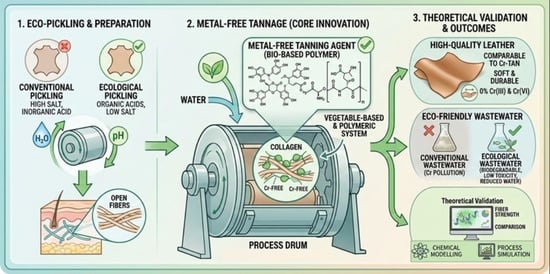
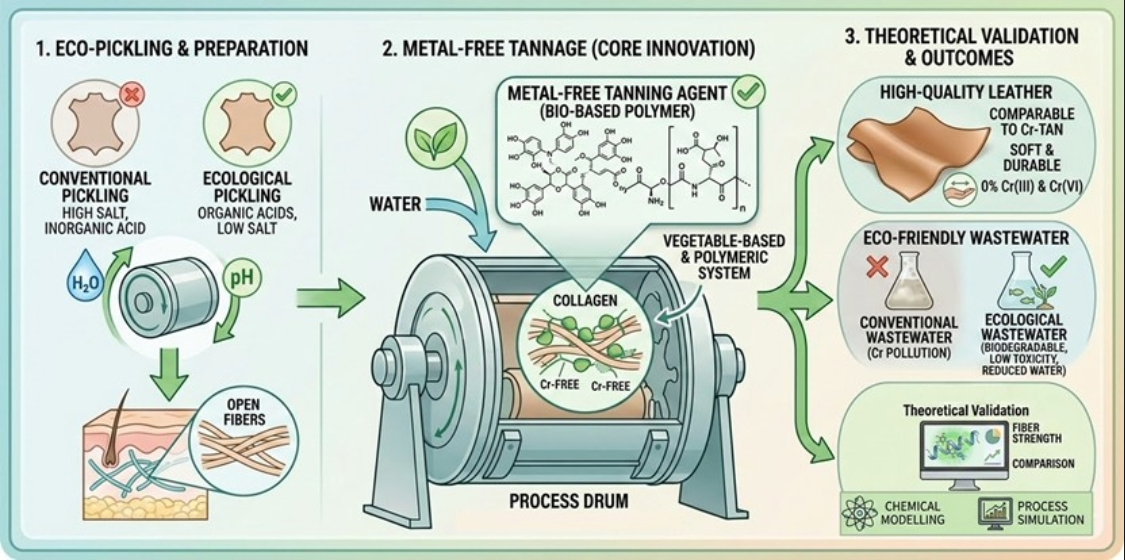
Graphical Abstract

1. Introduction

Globally, fishery capture outputs have remained comparatively stable (92.3 million tonnes in 2022), while aquaculture production of aquatic animals expanded to 94.4 million tonnes, surpassing capture fisheries for the first time [1,2], shifting by-product burdens toward post-harvest/processing; accordingly, chrome-free/metal-free tanning routes to valorize collagen-rich skins are supported by life-cycle assessments (LCAs) evidence showing lower resource/climate impacts than chrome tanning [2,3]. Within the leather sector, chrome tanning remains a pivotal environmental hotspot: effluents typically present high Chemical Oxygen Demand (COD)/Biochemical Oxygen Demand (BOD)/Total Dissolved Solids (TDSs) and chromium residues; moreover, Cr(III) in liquors and solids can oxidize to Cr(VI), which is a human carcinogen with well-elucidated mechanisms (DNA double-strand breaks, chromosome instability), underscoring the rationale for chrome-free alternatives [4,5,6,7,8].
Fish-processing side-streams constitute abundant, collagen-rich matrices. In Nile tilapia (Oreochromis niloticus), industrial processing generates substantial skin-bearing by-products suited to circular valorization (leather, collagen/gelatine, films) [9]. Complementing tilapia, flatfishes (soles/flounders) of the genus Paralichthys—notably the Patagonian flounder (P. patagonicus) from the Southwestern Atlantic—represent a relevant demersal resource whose filleting likewise yields sizeable skin by-products [10,11,12]. Flounder/sole skins are also recognized as practical sources of type-I collagen for biomedical and materials uses, reinforcing their suitability as tanning substrates [13,14]. Importantly, P. patagonicus is assessed as Vulnerable on the IUCN Red List [11], primarily due to historical overexploitation across its Southwestern Atlantic range, including Brazilian coastal waters, strengthening the sustainability rationale for value-addition to existing processing residues rather than further raw extraction. Therefore, together, tilapia (aquaculture-driven) and flounder (Paralichthys demersal fishery by-products) provide two complementary, high-volume feedstocks for a circular leather pathway.
Species choice also influences process design because dermal microstructure controls mass transfer and fixation. Comparative studies of bony-fish dermis indicate that scale-pocket geometry, skin thickness, and collagen architecture modulate diffusion paths and mechanical response during wet operations, features directly relevant to industrially used hides (including tilapia). At the same time, flatfishes exhibit region-dependent layered collagen structures and notable damage-tolerant mechanics that affect penetration and fixation profiles [15,16,17]. These contrasts justify including a farmed model (tilapia) and a demersal model (flounder) to develop a species-aware, generalizable blueprint for fish-skin tanning. Accordingly, these species-dependent structural features informed the selection of process parameters reported in Table 1—specifically, the liquor ratios, contact times, and the diffusion-first/fixation-second strategy applied during pickling and tanning (Section 2.3)—to ensure that the protocol accommodates both dermal architectures.
Among chrome-free options, biomass-derived organics (e.g., proanthocyanidins) enable multipoint collagen interactions and can deliver competitive hydrothermal/mechanical performance in optimized recipes; recent eco-tanning reviews and life cycle assessment (LCA)-guided studies outline these pathways and their process levers [3,7]. In the beamhouse, enzymatic strategies (e.g., proteases for selective bating) are increasingly documented as cleaner technologies and can enhance fiber openness and uptake with reduced pollutant loads [7]. For bioburden control, trans-cinnamaldehyde shows broad-spectrum antimicrobial activity via membrane disruption, lipid-biosynthesis perturbation, and biofilm inhibition, supporting a metal-free preservation adjunct in wet operations [18,19,20]. Recent studies also demonstrate that chrome-free systems (e.g., nanosilicate–tannin combinations) exhibit competitive shrinkage temperatures and favorable life-cycle metrics [3,7].
To align our chrome-free strategy, we compare each operation against its conventional counterpart. In pickling, tanneries typically employ formic or sulfuric acid plus NaCl to protonate collagen, moderate Donnan-type swelling, and promote uniform penetration [21]. Guided by the same electrochemical principles and surface-charge evidence, previous studies suggest adopting acetic acid (vinegar) + NaCl to maintain a strongly positive collagen surface at low pH and thereby favor deep, even uptake [21,22,23,24]. In bating, conventional practice relies on pancreatic or microbial proteases; consistent with the enzyme-assisted beamhouse literature, papaya-derived papain is a viable alternative that removes non-collagenous proteins and opens the fiber network without damaging type-I collagen under appropriate conditions [25,26]. For wet-process preservation, industry has long used synthetic biocides (e.g., isothiazolinones); as a natural adjunct, cinnamon/cinnamaldehyde offers broad-spectrum antibacterial and anti-biofilm activity (including against MRSA via membrane disruption and related metabolic interference), supporting its use as a preservative aid in wet operations [18,19,20]. On the other hand, from a transport-phenomena standpoint, reproducible outcomes in thin, hydrated fish skins are governed by boundary-layer renewal and diffusion–reaction coupling [27,28]. In rotating drums, rolling motion increases near-surface velocities and concentration gradients, enhancing tannin uptake; thus, parameters such as rpm, time, temperature, and liquor ratio must be adequately defined and tested before starting the tanning process [29,30].
Lastly, to mechanistically ground agent selection, in silico docking (e.g., GNINA v1.0 with CNN scoring) can generate pose ensembles and relative binding propensities for polyphenol–collagen interactions and map the enzyme; these testable predictions relate to macroscopic readouts (e.g., Ts, FTIR shifts, SEM) [31,32].
Therefore, in the present study, we aimed to report a tanning workflow for tilapia (O. niloticus) and flounder (P. patagonicus) skins that: (i) implement an alternative, chromium-free fish-skin tanning process using locally available reagents and verify its operational adequacy from bench to pilot scale; (ii) suggest a protocol proposal with explicit operating levers (liquor ratio, pH, [NaCl], rpm/time); and (iii) provide, via in silico molecular docking, an exploratory mechanistic rationale for each ecological substitution by evaluating the plausibility of proposed interaction modes under controlled computational conditions. We hypothesize that this mechanistic context, interpreted as hypothesis-generating support rather than definitive pathway elucidation, contributes to a theoretically grounded and reproducible roadmap for chromium-free tanning methodologies.
Table 1. Operational parameters of the pilot-scale drum, formulation, pH targets, temperatures, and observable advancement criteria for the 12-stage ecological chromium-free tanning protocol proposal for fish skins (O. niloticus and P. patagonicus).
Process StageAgentsConcentration ConditionsKey Observable/Objective
12 rpm or Manual, Time (min or h), pH and T (°C)
1. Fleshing, Descaling, and WashingWater and physical removing1.0 (L/kg)Manual, ambient TComplete removal of subcutaneous tissue; no visible dermal tearing; uniform skin surface
2. SoakingWater
Dish detergent
Cinnamon
2.0 (L/kg)
2%
8%
30 min, ambient TDegreasing (detergent), antibacterial and antifungal activity,
ichthyic odor neutralization (cinnamon)
3. LimingWater
Dish detergent
CaO
Na2CO3
2.0 (L/kg)
2.5%
8%
2%
120 min, ≈11.5, ambient TBreak the disulfide bonds of fibrous keratins to remove them, collagen fiber opening/swelling (intumescence), saponification, and epidermis loosening
4. DelimingWater
Dish detergent
Vinegar
1.0 (L/kg)
2%
5%
30 min, ≈8.5, ambient TResidual lime removal reduces tanning costs and enhances reagent accessibility
5. BatingWater
Dish detergent
Mashed papaya (papain source)
2.0 (L/kg)
2%
40%
60 min, ≈8.5, ≈35 °CLoss of turgidity, becoming soft, flaccid, and ready for the tanning agents to bind. Proteolysis removes non-fibrous proteins and interfibrillar materials, preventing structural stiffening and cardboard-like appearance of the leather. Intumescence is reversed. Positive thumb-pressure test
6. DegreasingWater
Dish detergent
Vinegar
1.0 (L/kg)
1%
2%
30 min, ≈7.5 ambient TAbsence of visible grease beads; uniform wettability across the dermal surface
7. PicklingWater
NaCl
Vinegar
1.0 (L/kg)
1%
2%
30 min, ≈4.0, ≈30 °CUniform surface charge with stable grain. Acidification of the collagen fibers (saline-acidic liquor) and swelling degree regulation (salt) prevent acid intumescence
8. TanningPickling water
Black wattle (Acacia mearnsii)
1.0 (L/kg)
10%
60 min + 12 h * (rest in tanning liquor), ≈4.0, ambient TUniform tan coloration, stable grain pattern; pH ≈ 4.0 favors tanning agent penetration to dermal matrix: moderates the fixation rate between tannins and collagen
9. NeutralizationWater
NaHCO3
1.0 (L/kg)
0.8%
60 min, ≈5.3, ambient TSkin surface receptive to retanning agents: prepare collagen fiber network for subsequent retanning and fatliquoring
10. RetanningWater
Pearl acacia (Acacia podalyriifolia)
Vinegar
1.0 (L/kg)
4%
1.5%
30 min, ≈5.0, ambient TEnhance final softness of leather (vegetable source/milder tanning agent)
Process efficiency optimization by acidification (vinegar)
11. FatliquoringWater at 50 °C
Almond oil
Vinegar
Cinnamon
0.6 (L/kg)
10%
0.7%
15%
60 min, ≈5.0, 50 °CLubrication effect to reduce friction between fibers and fibrils, impart flexibility and handle, increase resistance to tearing, traction, softness, and elasticity (Oil), aromatic effect (Cinnamon)
12. FinishingStaking/softening; trimming-Manual, ambient TMeticulous surface cleaning and structural trimming of irregular edges to ensure uniformity
Notes: All chemical doses are expressed as % (w/w) on initial wet pelt weight (owp), consistent with standard leather industry convention [21,22,24]. Where functional activity is concentration-dependent—particularly for the papain source, vegetable tannin extract, and acetic acid—target pH values and qualitative activity indicators are reported in parallel to complement gravimetric dosing, given that proteolytic efficacy, polyphenol crosslinking capacity, and collagen surface charge response are governed by activity and pH rather than mass alone. “Alcohol vinegar” ≈ 5% (w/v) acetic acid. Stages follow standard leather terminology; * Rest period expressed in hours realized in tanning solution (Tanning step).

2. Materials and Methods

2.1. Artisanal-Grade Inputs: Reagents, Acceptance Checks, Roles in the Process, and Controls

2.1.1. Reagent Identity and Sourcing

All inputs were domestic-grade reagents purchased from local retail markets (Brazil): neutral dish detergent (household surfactant blend), cinnamon powder (C. verum, culinary spice), alcohol vinegar (~5% w/v acetic acid), lime (CaO), sodium carbonate (Na2CO3), sodium bicarbonate (NaHCO3), mashed Formosa papaya (Carica papaya), NaCl (table salt), black wattle (A. mearnsii) and pearl acacia (A. podalyriifolia) commercial tannin extracts, and almond oil (culinary grade). Skins of Nile tilapia (O. niloticus) and flounder (P. patagonicus) were obtained as post-harvest processing residues from local facilities; no live animals were handled. Skins were refrigerated immediately and processed. Wet mass and thickness were recorded before dosing (chemical doses as % owp- on wet pelt weight; water as LR—liquor ratio, L/kg).

2.1.2. Acceptance Criteria

Each reagent was verified with a basic acceptance check before use: dish detergent—pH within label-declared range and foam stable under agitation; cinnamon powder—no off-odors, visually uniform color and particle size; vinegar—label claim confirmed at ~5% (w/v) acetic acid, pH verified at 2.4–2.8 with calibrated bench meter; NaCl—complete dissolution without visible sediment or discoloration (10 g in 100 mL distilled water at 25 °C); A. mearnsii/A. podalyriifolia tannins—supplier certificate of analysis reviewed, pH of 10% (w/v) aqueous solution within 4.0–5.5; almond oil—clear, particulate-free, no rancid odor. pH was measured throughout the process with a calibrated bench meter (three-point calibration, 25 °C); stage-wise pH targets (Table 1) served as the primary quantitative process-control thresholds at each operational step. Spent liquors were collected and disposed of per CONAMA Resolution No. 430/2011 [33].
It is important to note that the use of domestic-grade, locally sourced reagents constitutes a deliberate design constraint rather than an analytical limitation. The protocol targets artisanal tanneries in coastal communities of southern Brazil (exemplified by the PROVOPAR facility, Section 2.2), where analytical-grade reagents are neither available nor economically viable. Accordingly, the process-control strategy relies on stage-wise pH monitoring and observable advancement criteria (Table 1) as the primary standardization layer, ensuring functional reproducibility even when reagent batch composition varies. This approach is consistent with established leather-processing practice, in which pH trajectories and tactile/visual endpoints have historically governed artisanal production before instrumental methods became available [21].
For inter-laboratory reproducibility, analytical characterization of active-ingredient content is recommended: titratable acidity of vinegar (mmol acetic acid/mL), papain proteolytic activity (U/g, casein substrate assay), total phenolic content of tannin extracts (gallic acid equivalents, GAE mg/g, Folin–Ciocalteu method), and cinnamaldehyde content of cinnamon powder (mg/g, by GC-MS or HPLC). These characterizations would enable formulation-based dosing in addition to the mass-based dosing (% owp) reported here, and are identified as priorities for subsequent protocol transfer studies. Precise purity ranges and batch-to-batch variability data are not available for retail-grade inputs, as these products are not supplied with analytical certificates. This limitation is inherent to the artisanal production context and is managed through the stage-wise process-control checkpoints (Tier 1, Section 3.2.3) and the observable advancement criteria in Table 1, which ensure that functional outcomes are achieved regardless of input variability.

2.1.3. Roles in the Process

Dish detergent acted as a wetting/surfactant agent in soaking, liming, deliming, bating, and degreasing. Vinegar adjusted pH during deliming, degreasing, pickling, retanning, and fatliquoring. NaCl controlled ionic strength during pickling to suppress acid swelling (Donnan effect) and ensure deep, uniform tannin penetration. CaO and Na2CO3 provided alkalinity in liming (pH ≈ 11.5); NaHCO3 also raised pH to ≈5.0–5.5 in neutralization. Mashed papaya (40%) supplied papain for enzymatic bating (pH ≈ 8.5, ≈35 °C). Black wattle (A. mearnsii, 10%) was the primary tanning agent at pH ≈ 4.0; pearl acacia (A. podalyriifolia, 4%) served as a milder retanning agent. Almond oil (10%) was the fatliquor. Cinnamon powder functioned as an antimicrobial/odor-masking adjunct in soaking and fatliquoring; color darkening is expected.

2.1.4. Quality Assessment

Leather quality was evaluated macroscopically by a panel of three trained operators using a structured framework adapted from the SATRA [34] and ISO 3376 [35] five-point grading system against five predefined criteria: (i) grain stability—no cracking or disruption upon 90° bending; (ii) penetration uniformity—homogeneous coloration depth, no untanned core; (iii) handle and flexibility—uniform pliability without creasing; (iv) odor—cinnamon-dominant, no residual amine or fish odor; and (v) surface defects—no pinholes, fixation zones, or grain tears. Consensus across all operators was required for a ‘satisfactory’ classification. This approach provides a reproducible feasibility baseline for future quantitative benchmarking (Supplementary Materials).
The operational levers established across these stages—pH, NaCl concentration, temperature, liquor ratio, and drum hydrodynamics—were applied at bench and pilot scales (Section 2.2) and define the receptor/ligand microstates for the in silico framework (Section 2.4) [31].

2.2. Equipment Used in the Tanning Process

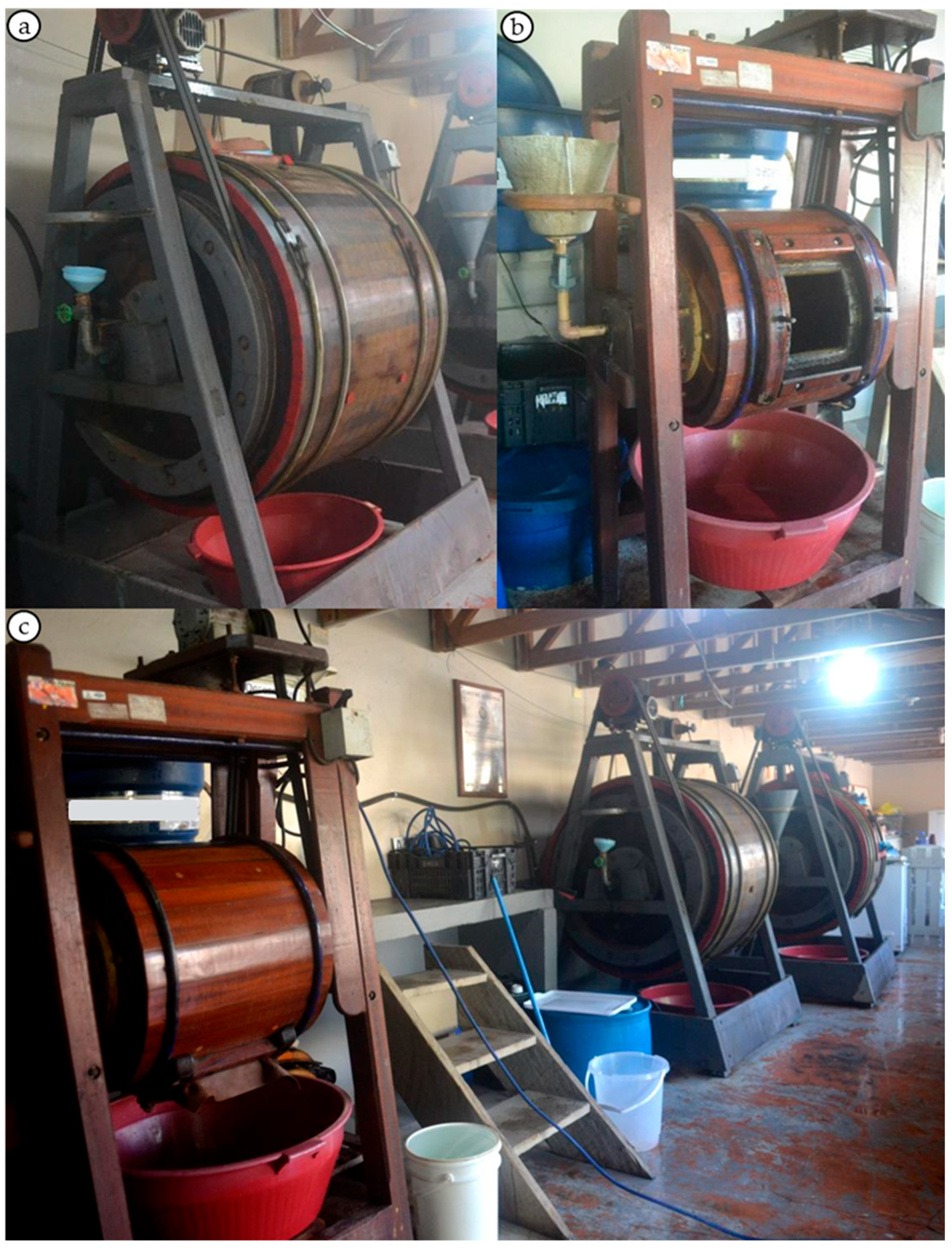
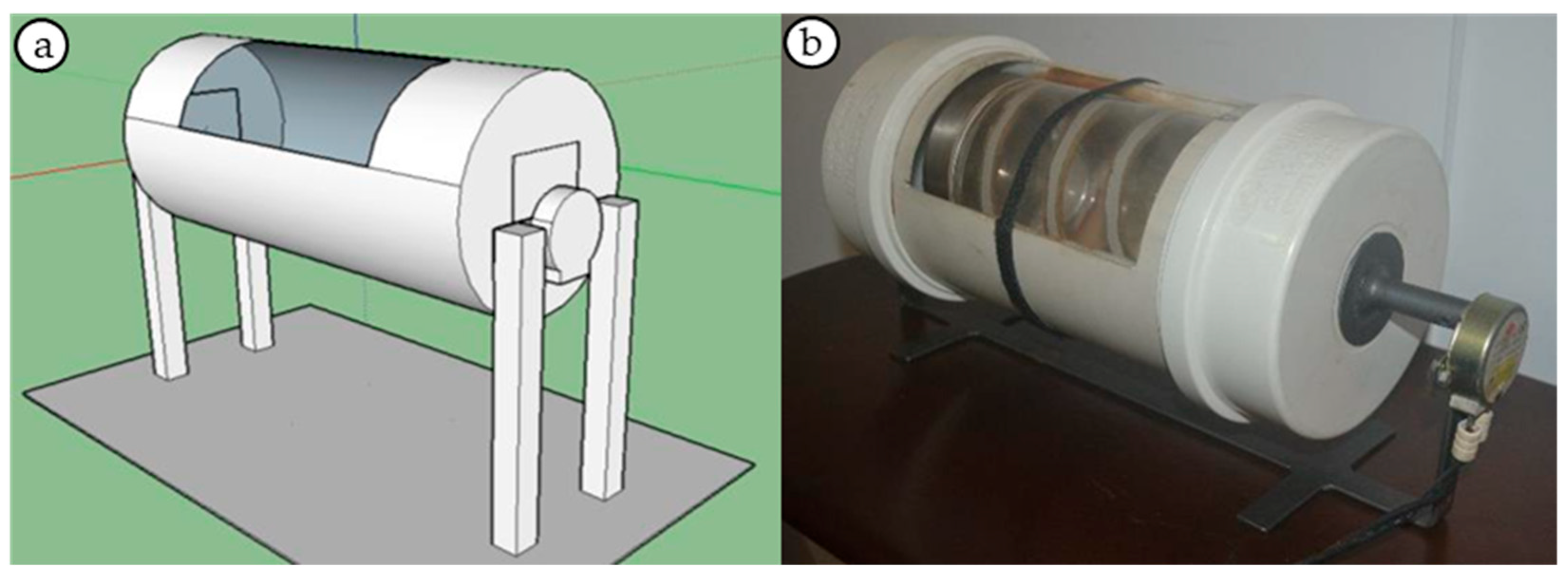
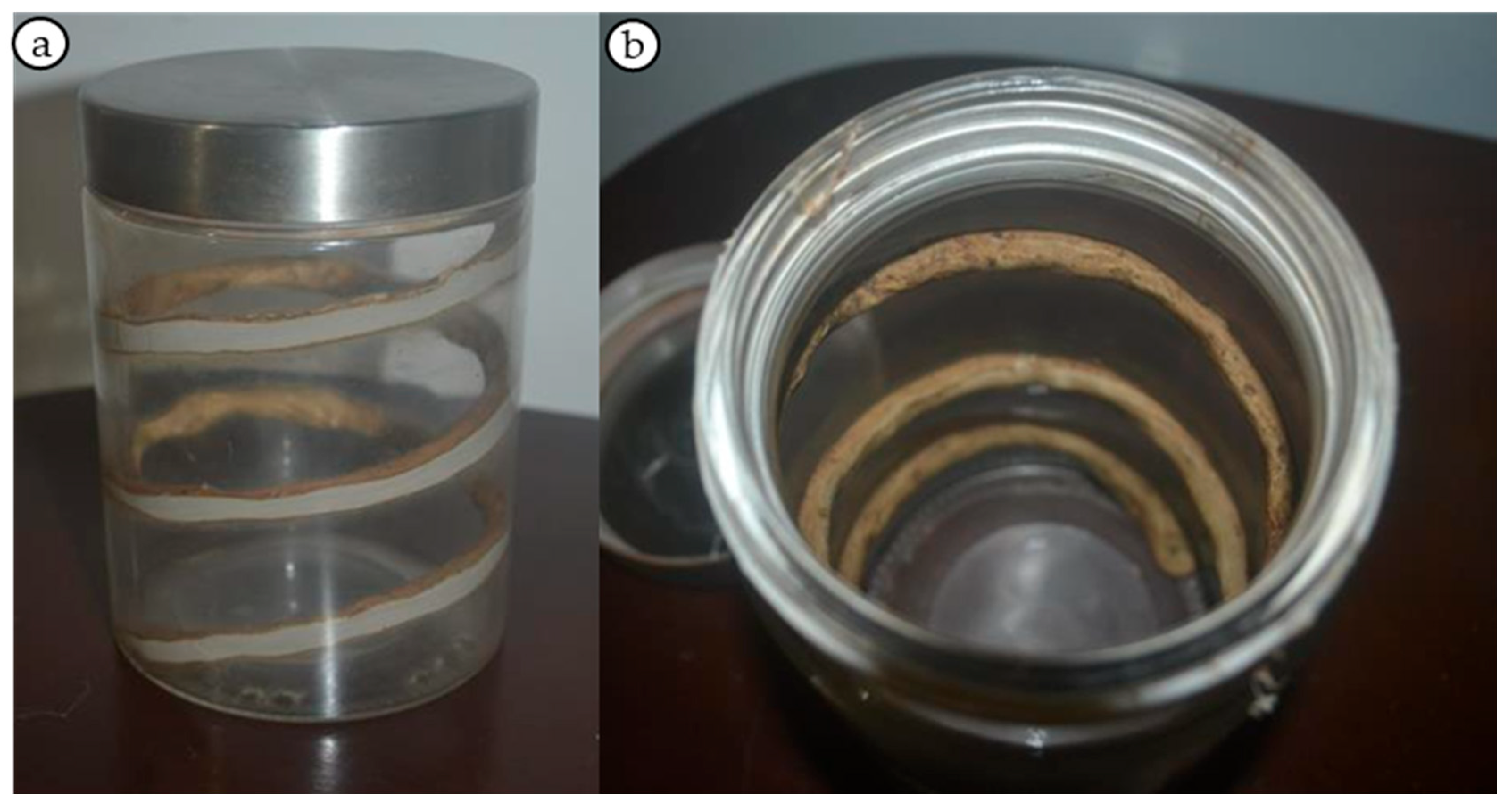
Tanning drums are the primary and most widely used equipment in leather processing, consisting of horizontal rotary drums that rotate around their own axis. In a more artisanal process, the skins and solutions for each stage are placed in drums. The essential physicochemical processes for the transformation of the skins occur while the drum rotates, homogenizing the mixture. To carry out the experiments, it was necessary to develop a small-capacity experimental drum at the Laboratory of Mechanics, Machines, and Motors at UDESC–CERES (Centro de Educação Superior da Região Sul, Laguna–SC) (Figure 1a,b). This bench-scale experimental phase was designed to establish and optimize the operational parameters of the ecological tanning protocol before its subsequent transfer to pilot-scale implementation.
The design of this laboratory-scale unit was directly modeled after the medium- and large-scale industrial drums (Figure 2a,b) already operational at a partner facility: the Artisanal Tannery (Figure 2c) of the Paraná Volunteer Program (PROVOPAR), located in the municipality of Pontal do Paraná, PR, Brazil.
It is important to clarify the distinct, sequential roles of the two experimental scales used in this study. The bench-scale drum was not designed to be compared against the pilot-scale installation in a scale-equivalence study; rather, it served as a protocol development and feasibility tool. Operating at low volume (0.9 L) and low mass load, the bench-scale allowed iterative adjustment of process parameters—liquor ratio, pH, contact time, temperature, reagent dosing, and rpm—at minimal material cost, without committing to larger batches. This phase enabled the identification of critical control points and the establishment of the stage-wise operating windows that constitute the ecological protocol reported in Table 1. For the bench scale, we utilized a rotary unit built from a 150 mm ID PVC cylinder (L = 300 mm) housing a borosilicate glass jar (ID 95 mm; working volume ~0.9 L). Two helical epoxy baffles (pitch ~50 mm; height ~6 mm) were affixed to the interior of the jar to improve mixing (Figure 3). A 4 W, 220 V synchronous motor delivered 7 ± 1 rpm at a fill fraction of ~40–50% (v/v). The objective was to thoroughly mix the products with the skin during rotation without creating a dead zone at the bottom from a transport phenomena standpoint.
Once the protocol was sufficiently defined at bench scale, evidenced by reproducible macroscopic outcomes across trials, it was implemented at the PROVOPAR (Figure 2) in wooden drums (Ø ≈ 1.2 m; L ≈ 1.0 m) with radial baffles operating at 10–12 rpm. Typical batch load was as follows: 3.0 ± 0.2 kg wet skins. This pilot-scale application was carried out to demonstrate that the protocol, as written, could be executed under real artisanal tannery conditions without requiring specialized laboratory infrastructure. Liquor ratios (LR, L/kg) and operating parameters per stage are presented in the following sections. However, no formal numerical comparison of scale-specific quality metrics was performed between the two systems, which lies outside the scope of this protocol-design study and is proposed as a future investigation.

2.3. Ecological Tanning Process

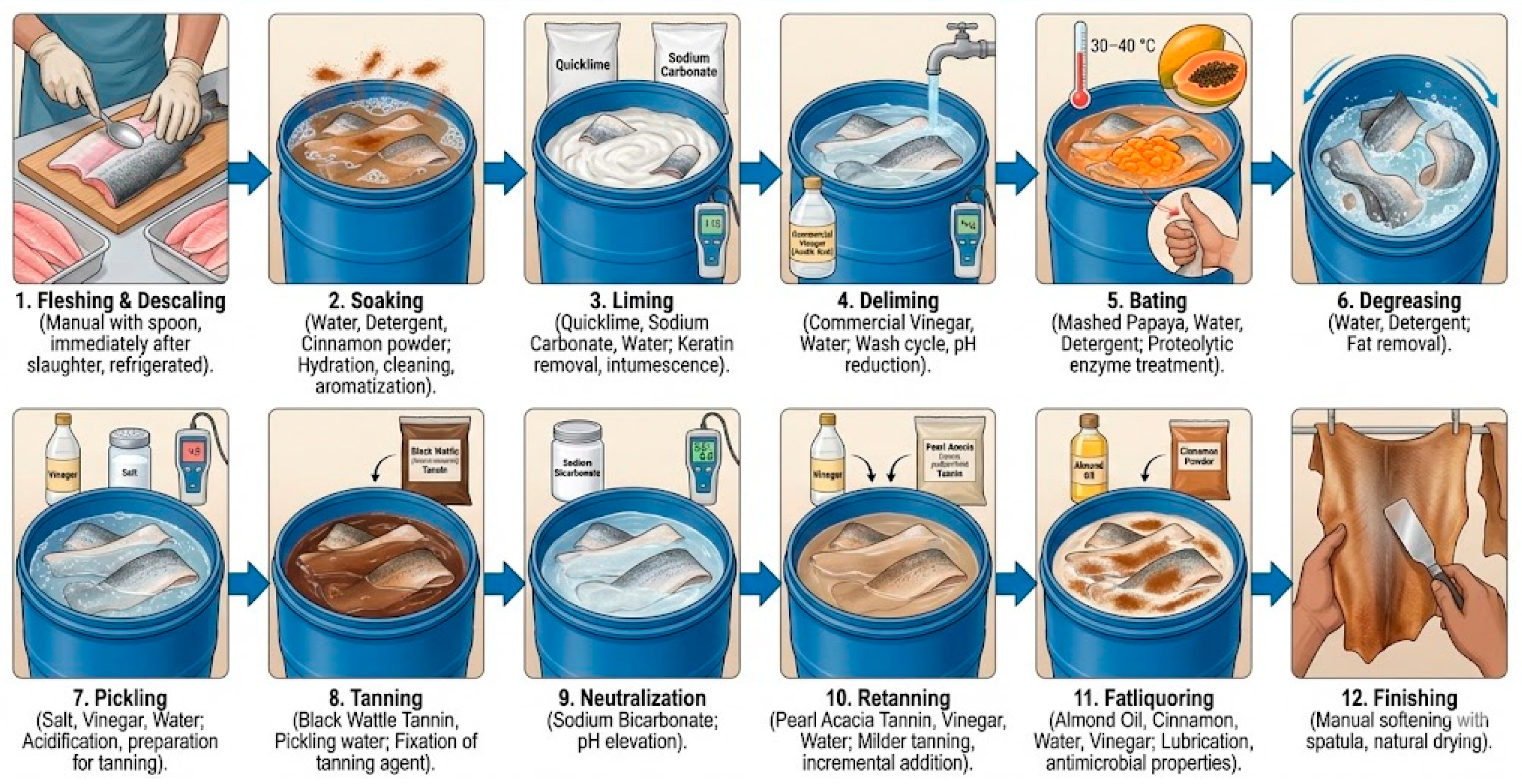
The methodology used in this work was adapted from different authors, prioritizing environmental sustainability. In this sense, an ecological fish-skin tanning technique was developed to meet the requirements of each tanning stage, systematically evaluating product substitutions (Figure 4) [7,18,21,22,25,29,36,37].
In relation to the alternative agents utilized for the tanning protocol, for the Nile tilapia (O. niloticus) and flounder (P. patagonicus) skins, black wattle (A. mearnsii) vegetable tannin was adapted as a tanning agent in substitution to chromium, Formosa papaya cultivar (C. papaya) as a proteolytic enzyme, and cinnamon (Cinnamomum verum) as an antibacterial, antifungal, and odorant agent. Additionally, as an alternative to the conventional use of formic or sulfuric acids to lower the pH, this work employed common vinegar (5% acetic acid) with the same intent. It is important to note that, as previously outlined, the operational parameters of the ecological tanning protocol were initially established and optimized through bench-scale trials using the experimental drum. This preliminary phase served as the empirical foundation for subsequent pilot-scale implementation. Consequently, the sequential procedures and associated figures detailed below reflect the pilot-scale validation executed at the PROVOPAR Artisanal Tannery, demonstrating the industrial reproducibility of the optimized bench-scale method.
To systematically present this pilot-scale validation, the transformation of raw fish skin into leather involves a sequence of physicochemical treatments designed to stabilize the collagen matrix. The ecological protocol developed herein can be broadly categorized into three fundamental operational phases: (1) pre-tanning or beamhouse operations, which focus on cleaning, hydrating, and structurally opening the collagenous fibrous network (encompassing fleshing and descaling, soaking, liming, deliming, bating, and degreasing); (2) the core tanning phase, where the actual physicochemical stabilization and crosslinking of the dermal matrix occur through the application of vinegar, salt, water (pickling step), and the A. mearnsii tannin; and (3) post-tanning and finishing operations, designed to modify the final mechanical properties of the leather, imparting softness, flexibility, and aromatic preservation (involving neutralization, retanning, fatliquoring, and finishing).
For a comprehensive overview of the mass transfer dynamics and biochemical modifications achieved at each step, the complete chronological sequence of the protocol (Figure 4) is detailed as follows:
i.
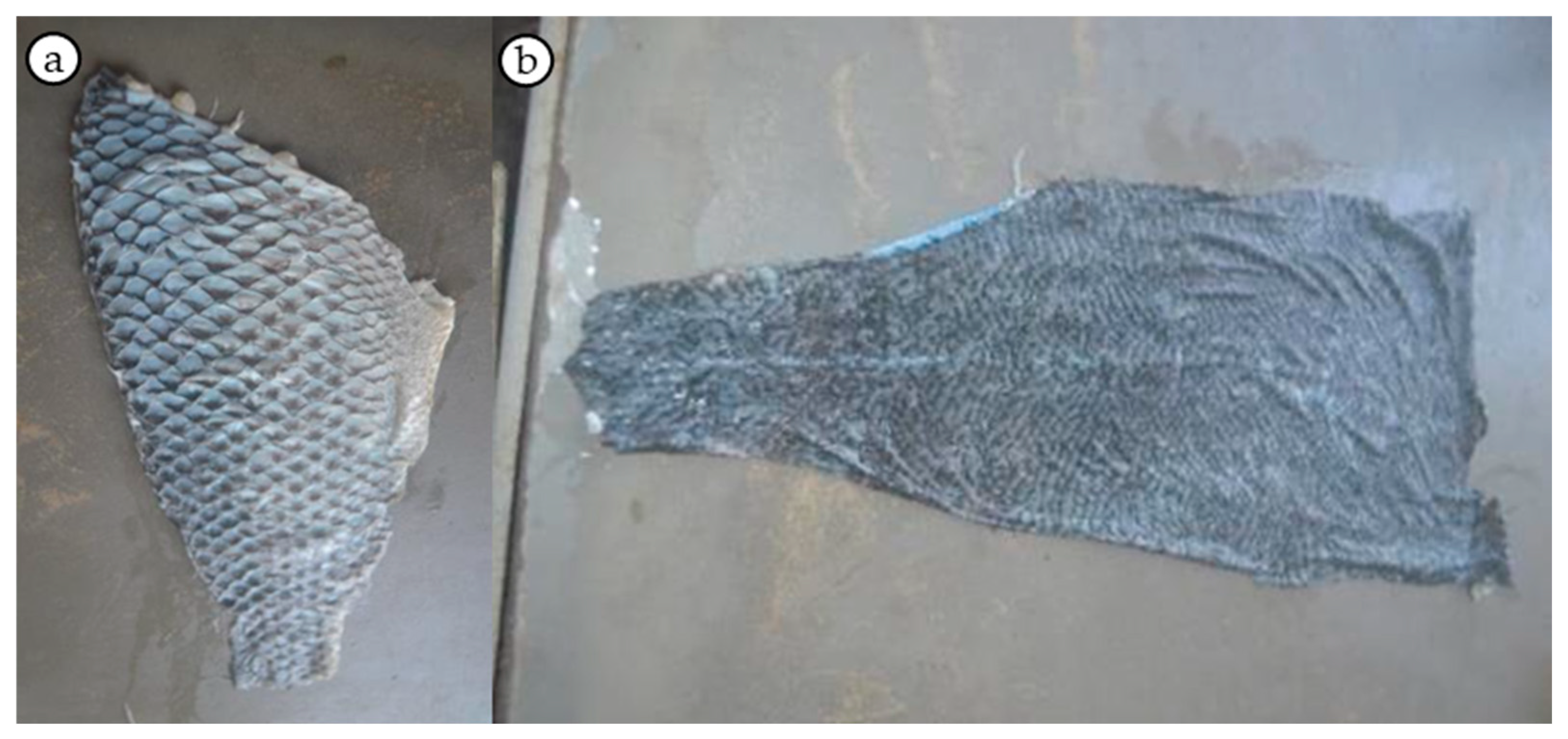
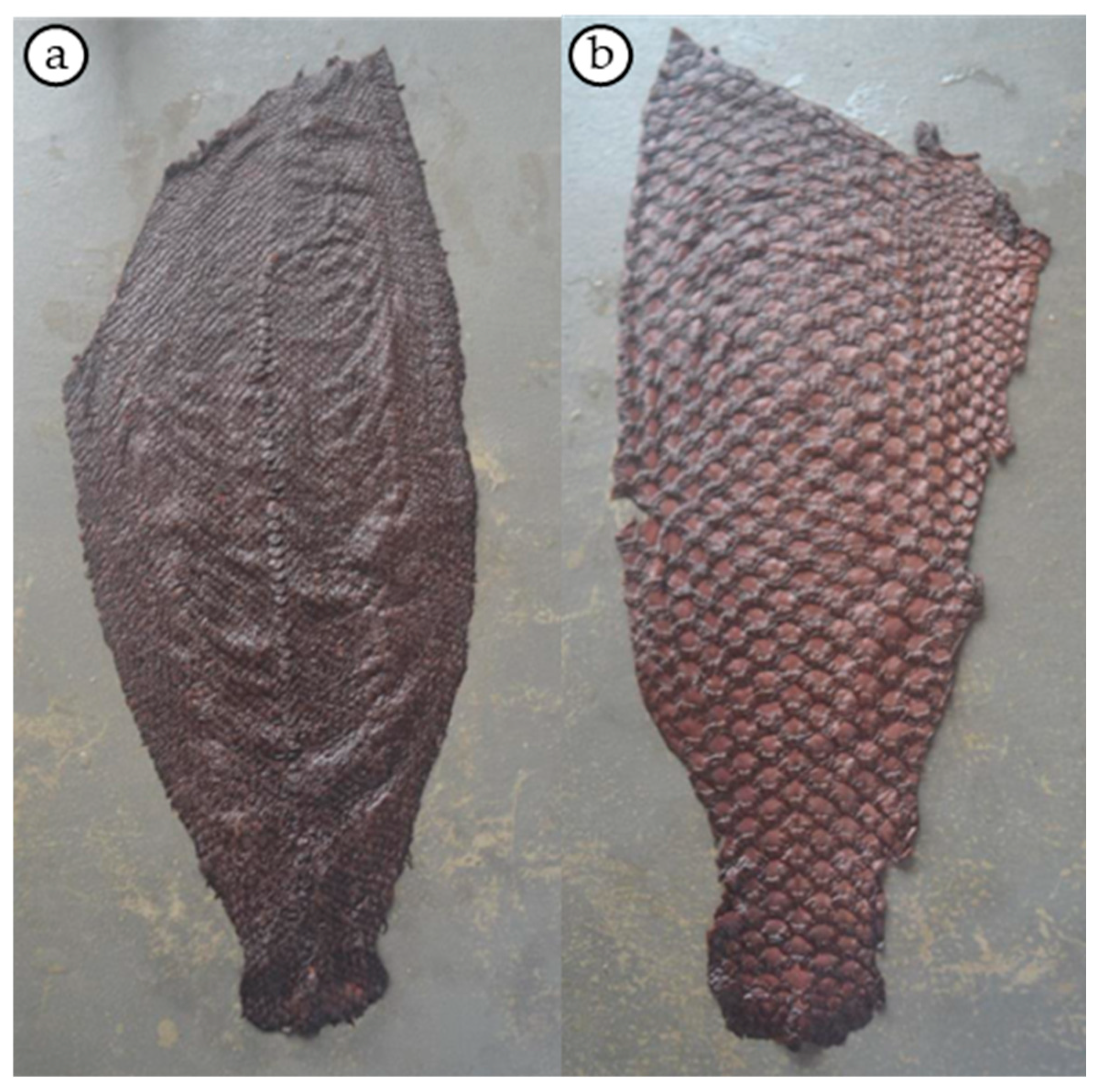
Fleshing and Descaling: The removal of the skin must occur immediately after slaughter, before the decomposition process begins. Leather quality depends heavily on the time elapsed between skin removal, fleshing, and preservation. In the present work, refrigeration was used as a preservation method to minimize decomposition [38]. Mechanical removal of adhering subcutaneous tissue and scales was performed manually to prevent structural dermal tearing (Figure 5a,b).
After this stage, the skins were washed to eliminate impurities, excess blood, and loose scales, followed by size selection and weighing. This initial practice is critical: the raw skins are categorized by dimensional parameters and subjected to precise measurement to establish the initial mass, and the dosing of all subsequent chemical agents and liquor ratios at each stage is calculated strictly as a percentage of this initial baseline mass.
ii.
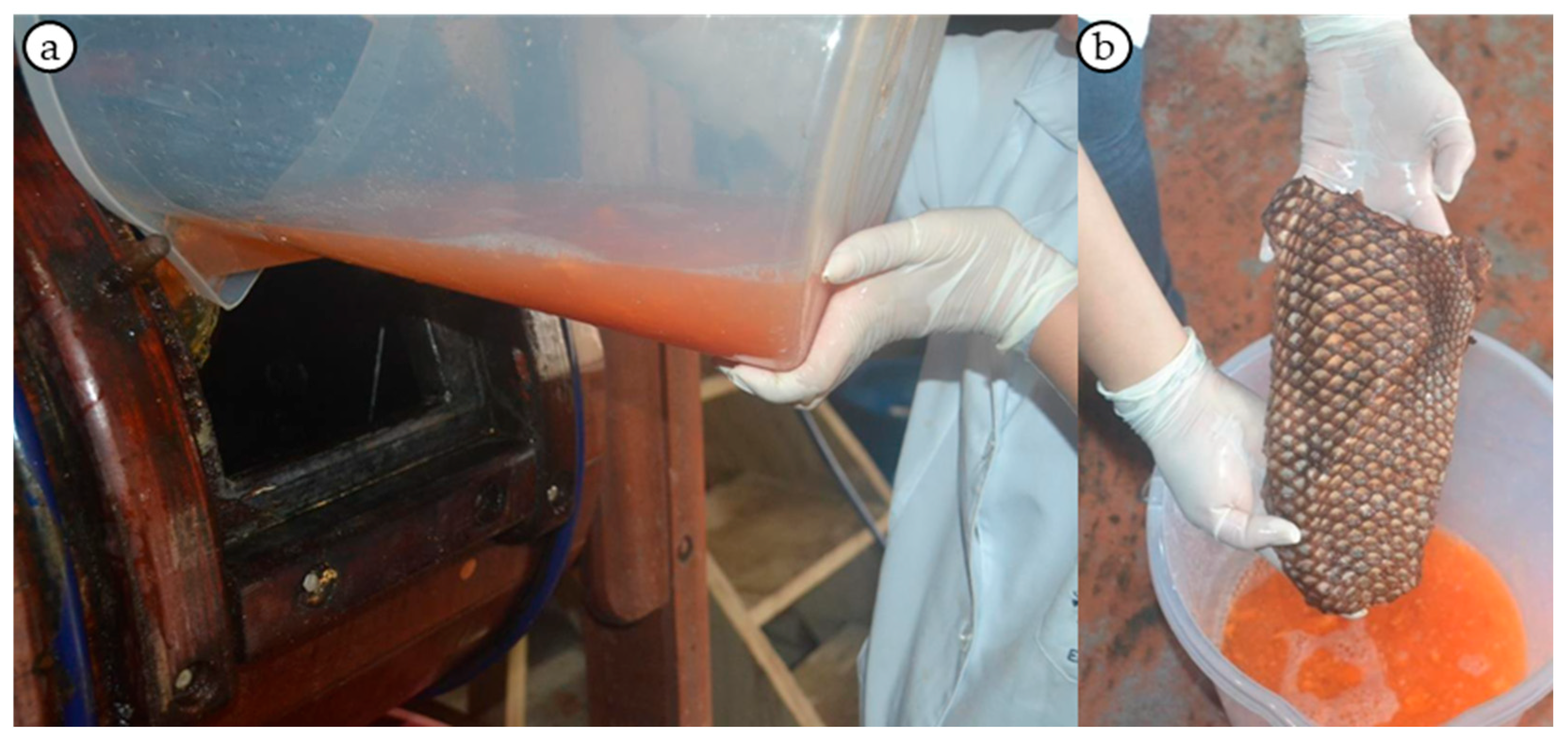
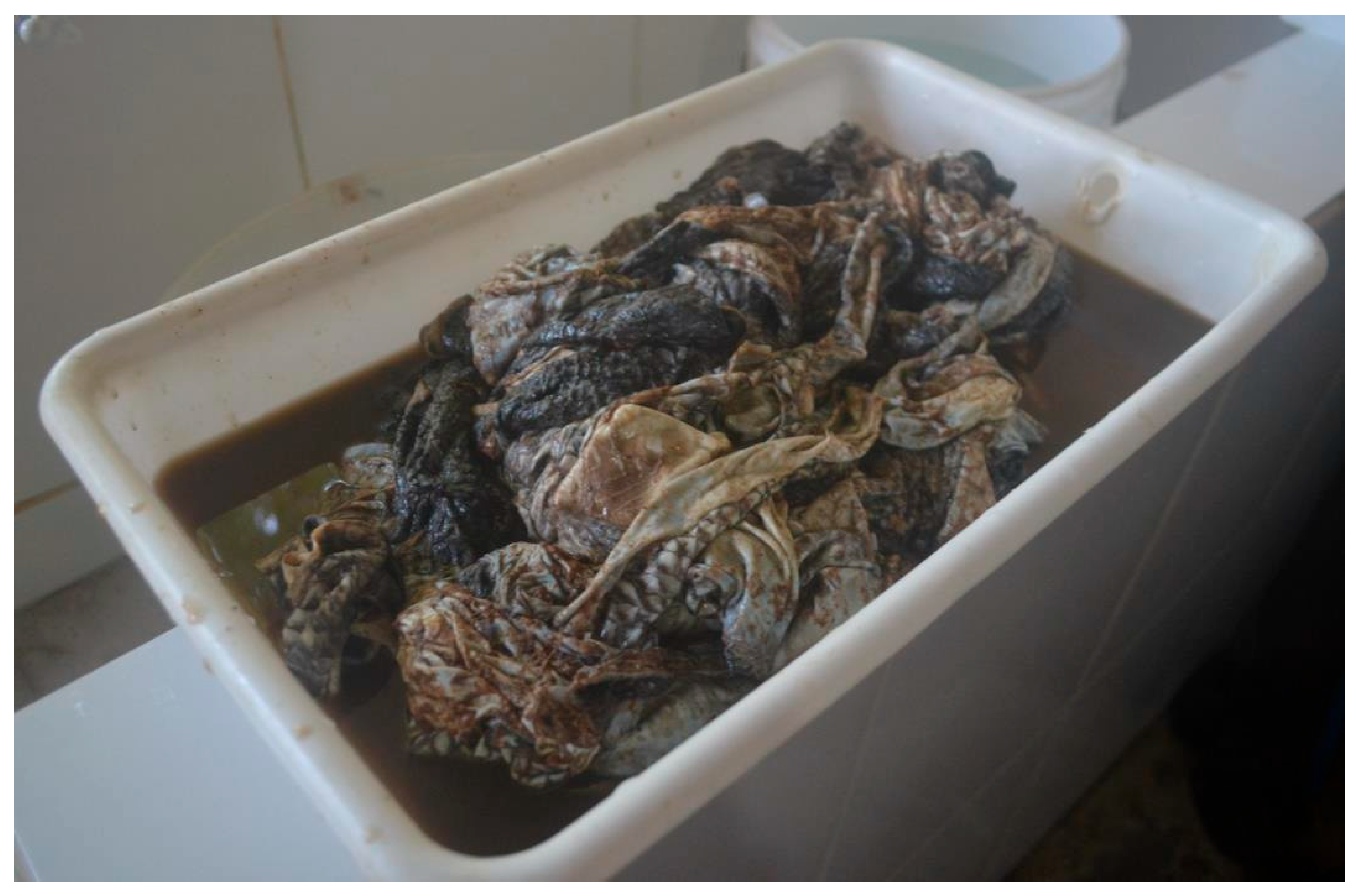
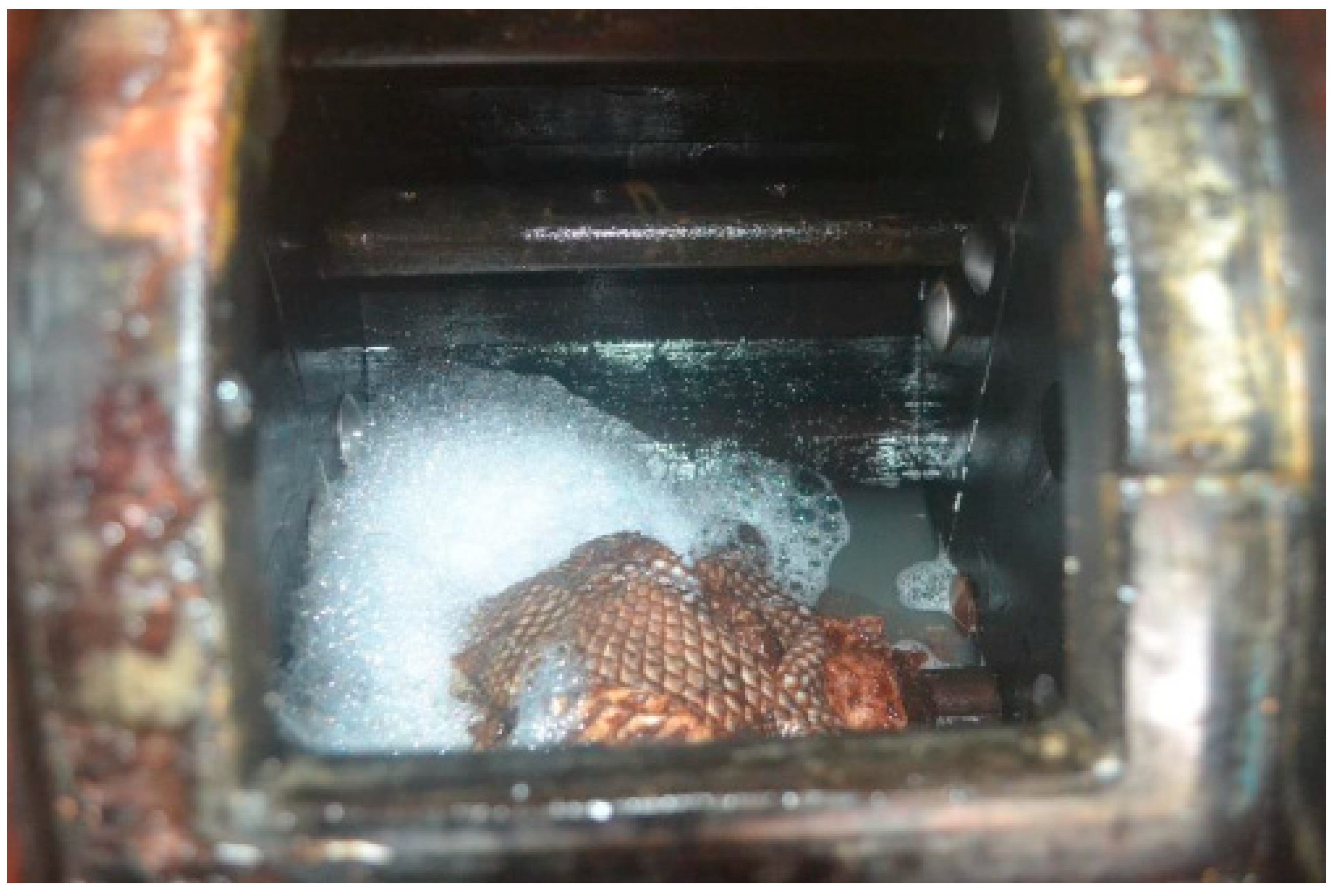
Soaking: This stage aims to hydrate the skin with water (2.0 L/kg), remove excess fat with detergent (2%), and clean the skin. Cinnamon powder was added at 8% during this stage exclusively to preserve and aromatize the skin [39,40], leaving the solution and the leather with a brownish tint (Figure 6).
During this phase, the tanning drum was operated for 30 min at 12 rpm. Differently, if the raw material is subjected to freezing or salting (conservation methods frequently adopted as alternatives to standard short-term refrigeration), the soaking stage is critical to restore the lost moisture content and rehydrate the dermal matrix. Mass balance data (e.g., weight gain during hydration, lipid removal efficiency) were not measured in this feasibility study; these quantitative process metrics are identified for inclusion in the next protocol development phase alongside the physical-mechanical characterization outlined in Section 3.2.2.
iii.
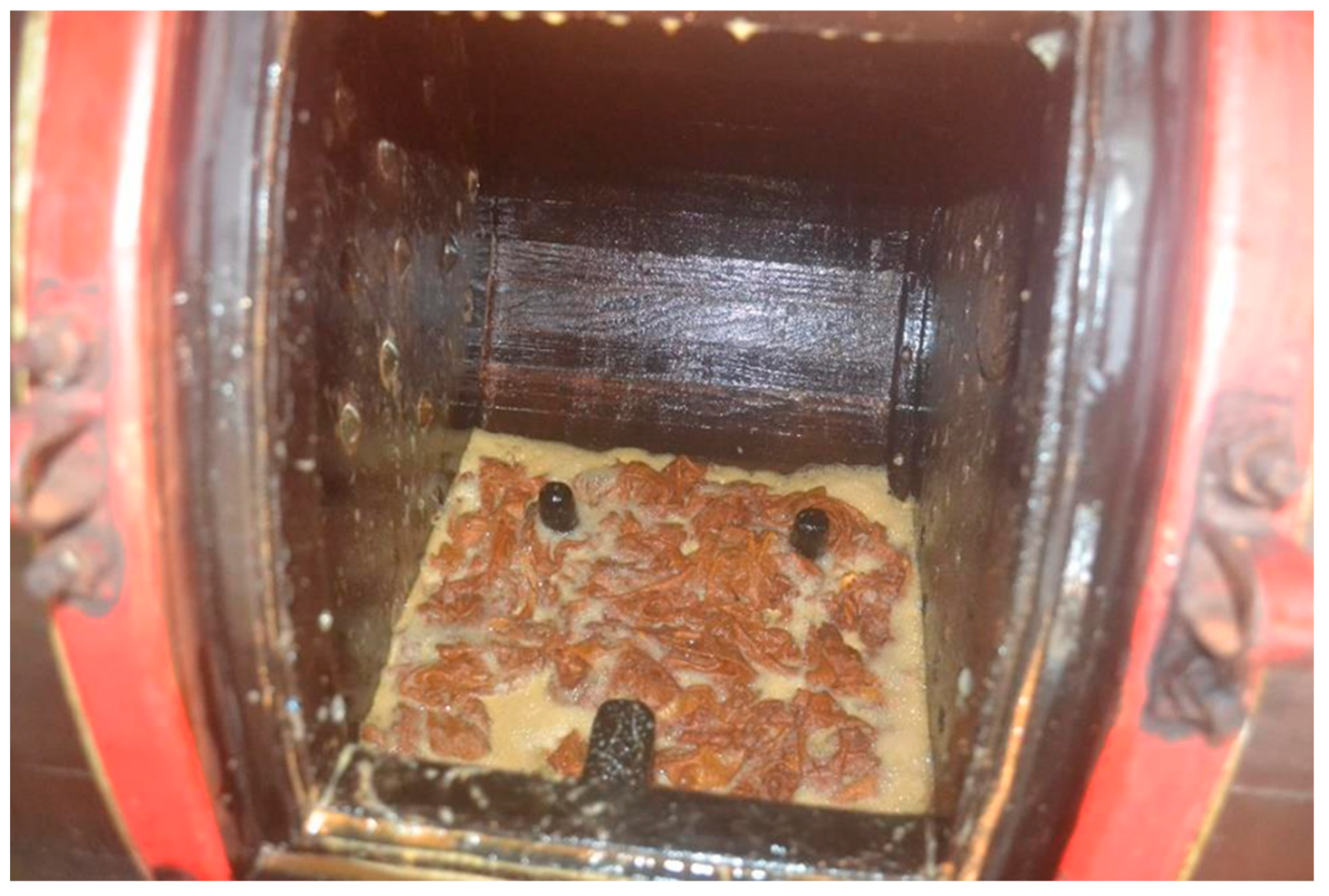
Liming: Considered one of the most critical stages in the beamhouse sequence [21]. Its objective is to remove keratinous structures (epidermis and scales) to facilitate the opening and swelling (intumescence) of the fibrous structure. It also promotes epidermal removal [21]. The pH remained ≈11.5. Water (2.0 L/kg), dish detergent (2.5%), quicklime (CaO 8%), and Na2CO3. (2%) were used. The drum operated for 2 h at 12 rpm (Figure 7).
iv.
Deliming: The skins underwent a washing cycle to remove the residual lime (Ca(OH)2) that had not chemically bonded to the fibrous structure. This stage marks the beginning of the pH reduction process (to ≈8.5). To this end, conventional industrial acids (e.g., formic or sulfuric acids) were replaced with commercial vinegar (5%) [22,24,41]. During this stage, the tanning drum was operated with detergent (2%) for 30 min at a rotational speed of 12 rpm (Figure 8).
v.
Bating: Skins are treated with proteolytic enzymes to digest keratinous materials. As a replacement for common bovine pancreatic enzymes, mashed papaya (C. papaya) (Figure 9a) was used at a 40% proportion [25,26,41,42]. Water (2.0 L/kg) was heated to ≈35 °C with dish detergent (2%). The pH was maintained at ≈8.5. The drum rotated for 60 min at 12 rpm. A manual thumb-pressure test on a smooth surface confirmed structural opening to proceed (Figure 9b). Enzymatic activity of the mashed papaya preparation (U/g) was not measured in this feasibility study, and no direct comparison with conventional bovine pancreatic bates was performed; quantitative characterization of proteolytic efficiency is designated as a priority for future work (Section 3.2.3 and Section 3.3.5).
vi.
Degreasing: Aims to remove any remaining fat from the leather, epidermis, hypodermis, and interfibrillar matrix, preparing the dermis to receive the tanning agent bridges [22,24,41,43,44]. The degreasing process utilized a solution of water (1.0 L/kg), vinegar (2%) to a pH reduction (≈7.5), and neutral detergent (1%). During this stage, the tanning drum was operated for 30 min at 12 rpm.
vii.
Pickling: The pickling stage marks the effective onset of the tanning process, during which the raw skin is chemically transformed into leather. In this phase, vinegar was again utilized to adjust the pH to ≈4.0 in a solution containing NaCl (1%) and water (1.0 L/kg) at 30 °C [22,24,41,43,44]. During this stage, the tanning drum was operated for 30 min at 12 rpm.
viii.
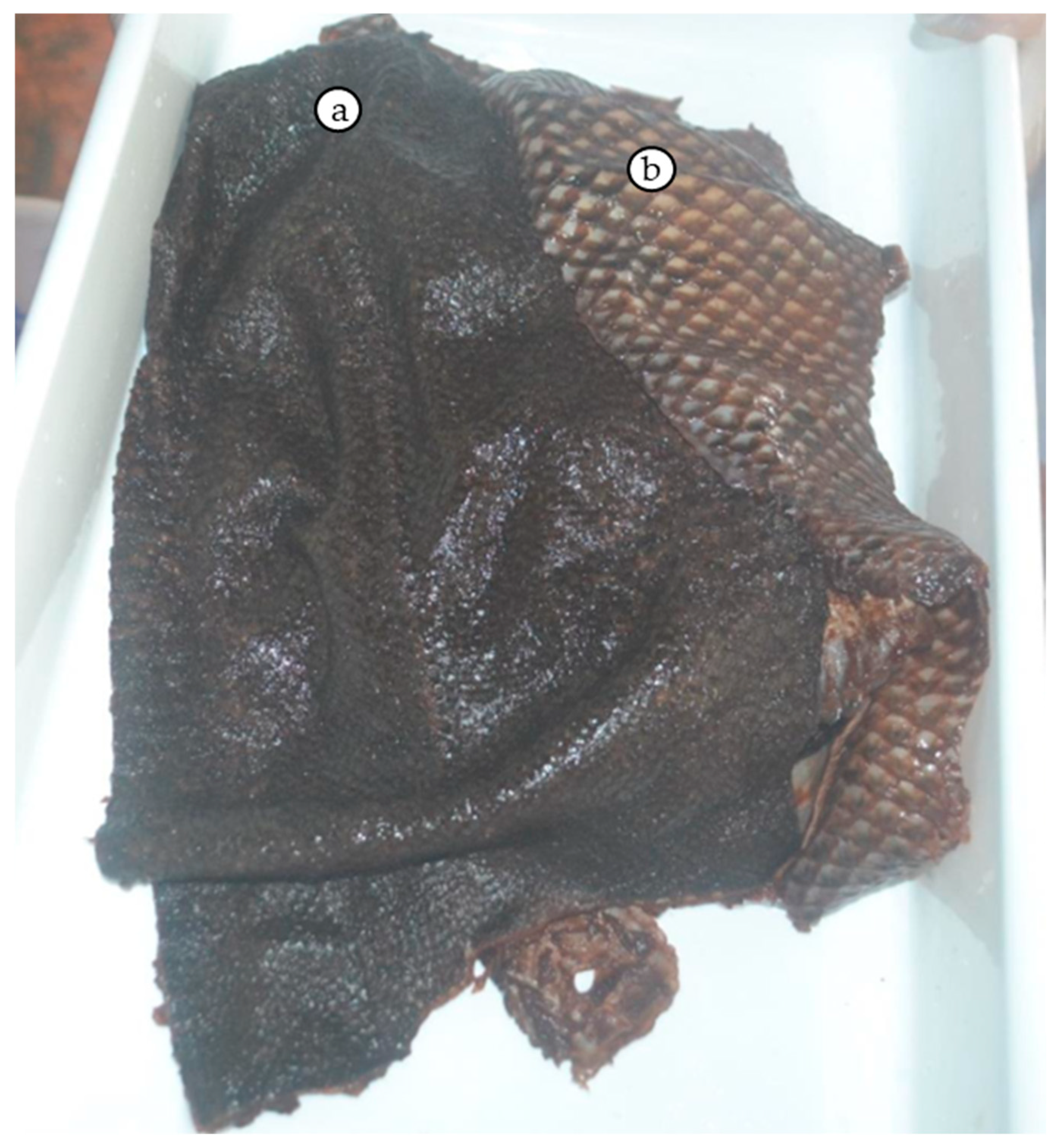
Tanning: Effectively transforms the skin into an imputrescible material through the absorption, penetration, and fixation of the tanning agent. At a pH of ≈4.0, black wattle (A. mearnsii) tannin (10%) diluted in the pickling water was added as an alternative to chromium [3,36]. The drum rotated for 1 h at 12 rpm, followed by a 12 h resting period in the same solution (Figure 10a,b).
ix.
Neutralization (or deacidification): The objective is to elevate the pH to between 5.0 and 5.5 [21,45]. For this purpose, the NaHCO3. (0.8%) was used, and the drum rotated for 1 h at 12 rpm.
x.
Retanning: In this stage, water (1.0 L/kg) and 4% pearl acacia (A. podalyriifolia) were used. This vegetable tannin source was used because it is characterized as a milder tanning agent with pH requirements for optimal effectiveness [46,47,48,49]. To optimize process efficiency, an acidifying agent (vinegar) was added incrementally at 10 min intervals, with pH monitored. The tanning drum was operated for 30 min at 12 rpm.
xi.
Fatliquoring: Oils are used to modify the physico-mechanical characteristics of the leather. Natural almond oil (10%) was mixed with water (0.6 L/kg) at 50 °C, and a small amount of vinegar (0.7%) was added. The drum rotated for 60 min at 12 rpm. Subsequently, cinnamon powder (15%) was added again due to its natural antibacterial and antifungal properties (Figure 11a,b). Agents were added as aromatic/antimicrobial adjuncts.
Upon completion of the fatliquoring, the leather is typically prepared for dyeing. In the present study, this stage of the process lasted a week under natural conditions.
xii.
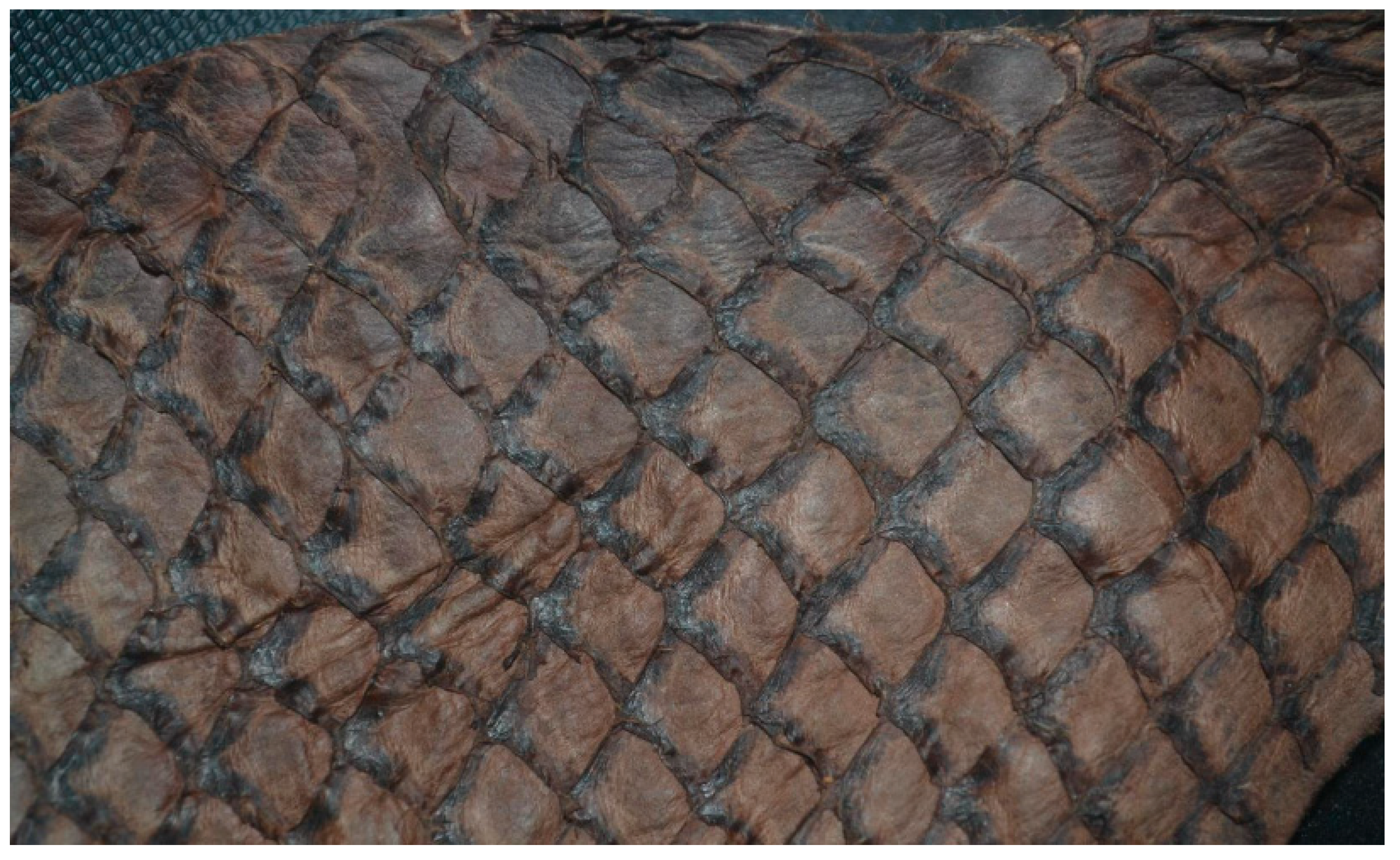
Finishing: Performed after natural drying (Figure 12). While during this phase a mechanical softening is typically performed using specialized machinery, the softening process in this study was executed manually, utilizing a stainless-steel spatula to achieve the required handle.
This study prioritizes operational feasibility and mechanistic understanding; full mechanical benchmarking (e.g., tensile strength, tear, and elongation) lies outside the present scope and is outlined as future work. To mechanistically underwrite the ecological substitutions introduced above without decoupling them from the actual wet-end chemistry, the next section (2.4) details a process-faithful computational modeling pipeline.
Specifically, the empirically defined operating windows in Section 2.3—liquor ratio (LR), pH trajectories, NaCl concentration, temperature, and drum hydrodynamics (rpm/fill/baffles)—are carried forward to define receptor/ligand microstates. This alignment ensures that the in silico docking functions not as an abstract exercise but as a mechanistic companion to the protocol, clarifying what each agent does and why it acts as observed under the same microenvironments used in practice.

2.4. Computational Modeling and In Silico Molecular Docking Framework

2.4.1. Rationale and Scope

To mechanistically support the ecological substitutions introduced in the chromium-free tanning workflow, we implemented a structure-based docking pipeline emphasizing reproducibility (multiple random seeds) and process relevance (targets chosen to mirror each substitution step). Docking was used to evaluate three mechanistically distinct questions: (i) the plausibility of multidentate polyphenol engagement with collagen triple helices during vegetable tanning; (ii) the plausibility of probe accommodation in the catalytic cleft of papain as a computational surrogate for enzymatic bating; and (iii) the plausibility of pocket accommodation of trans-cinnamaldehyde (CAD) in a LuxR-family quorum-sensing (QS) regulator as a mechanistic surrogate for antimicrobial adjunct action. Docking and rescoring were performed with GNINA v1.0 (Department of Computational and Systems Biology, University of Pittsburgh, Pittsburgh, PA, USA), a Vina/Smina-based engine with convolutional neural network (CNN) rescoring, enabling both classical Vina affinity estimates and CNN-based pose evaluation under standardized settings [32,50,51].

2.4.2. Receptor Systems and Preparation

Experimentally determined structures were obtained from the RCSB Protein Data Bank and used as receptors: collagen triple-helix constructs 1CAG and 7CWK [52], papain 9PAP [53,54], and the QS transcription factor TraR (1L3L) as the LuxR-family surrogate for CAD [55,56]. Collagen entries represent short triple-helix segments and do not recapitulate native fibrillar packing; accordingly, docking outputs against collagen are interpreted as interaction-mode plausibility rather than absolute affinity ranking. Receptors were processed with a minimal, reproducible cleaning procedure compatible with Vina-family docking: water molecules were removed, protein atoms were retained, and selenomethionine residues (MSEs) were converted to methionine (MET) when present. Receptors were then converted to PDBQT using Open Babel v3.1.1, which assigns atom types and partial charges required by Vina-family engines. A second structure (2BS3) was downloaded during initial setup but was excluded from the final analysis because it does not represent a LuxR-family quorum-sensing regulator and is therefore not mechanistically aligned with the CAD/QS surrogate module.

2.4.3. Ligand Sets and 3D Structure Generation

Receptor and ligand preparation were performed using a minimal, reproducible conversion workflow (water removal, residue standardization, Open Babel PDBQT conversion). No explicit pH-dependent protonation-state assignment (e.g., PropKa-guided microstate ensembles) was applied in the present computational runs; therefore, docking results are interpreted as interaction-mode plausibility under a standardized preparation protocol rather than as pH-resolved affinity predictions. Implementing process-faithful protonation microstates (pH 4.0 for collagen tanning; pH ~8.5 for papain bating; near-neutral for QS) is prioritized as future computational work.
Ligands were defined to match each mechanistic module and to include internal comparators where appropriate. For the QS module (TraR, 1L3L), the ligand set comprised trans-cinnamaldehyde (CAD) as the base case, hydrocinnamaldehyde as a close analogue lacking α,β-unsaturation, and benzaldehyde as a smaller aromatic aldehyde decoy, enabling internal comparisons consistent with QS-inhibition structure–activity literature [55,56]. For the papain module (9PAP), three short dipeptide probes (Gly–Gly, Ala–Gly, Gly–Ala) were used as minimal cleft-occupancy surrogates to test reproducible accommodation in the catalytic region, consistent with the use of short probes in cysteine-protease substrate mapping and mechanistic analyses [53,54].
For the collagen module (1CAG and 7CWK), two polyphenol proxies were used: a flavanol-like monomer as a minimal H-bond/π-interaction scaffold and pentagalloylglucose (PGG) as a multidentate gallotannin proxy representing high-contact polyphenols, consistent with the collagen–polyphenol crosslinking literature [57].
The PGG was selected as a multidentate polyphenol proxy rather than as a direct structural representative of A. mearnsii tannins (predominantly composed of condensed proanthocyanidins), which are structurally distinct from PGG—a hydrolyzable gallotannin. PGG was included because its multiple galloyl arms provide a well-characterized, geometrically complex scaffold for exploring upper-bound H-bonding density with collagen, consistent with published collagen-polyphenol crosslinking. A catechin dimer (procyanidin B2) would more accurately represent A. mearnsii condensed tannins and is recommended as the primary ligand in future computational studies. In the present analysis, PGG scores are therefore interpreted as indicative of the multipoint engagement capacity of the polyphenol class, with the structural caveat that actual condensed proanthocyanidin binding geometries will differ [21]. Ligands were specified as SMILES and converted to SDF with 3D coordinates using Open Babel v3.1.1 with --gen3d, and all docking inputs used SDF ligands and PDBQT receptors.

2.4.4. Search Space Definition and “In-Box” Initialization

To prevent GNINA v1.0 failures associated with ligand starting coordinates outside the search box (“initial pose not within box”), we enforced a deterministic in-box initialization. For TraR (1L3L), the pocket center was derived from the centroid of the co-crystallized ligand (LAE) present in the PDB. For papain (9PAP), the docking box was centered on the catalytic cleft region using a center computed in the His159/Asn175 neighborhood (triad-adjacent region) to ensure active-site coverage. For collagen (1CAG and 7CWK), docking centers were defined by the centroid of all receptor atoms to enable groove sampling along the helix axis. Each ligand was then translated so that its centroid coincided with the selected receptor box center prior to docking, ensuring the initial pose began within the search space while preserving the ligand’s internal geometry. Box sizes were chosen to balance pocket coverage and CPU tractability: ~30 Å cubes for TraR, ~26 Å for papain, and ~34 Å for collagen.

2.4.5. Docking Engine Configuration and Reproducibility Strategy

Docking was performed with GNINA v1.0 using CNN rescoring (cnn_scoring=rescore) and a single CNN model (--cnn crossdock_default2018) to reduce runtime under CPU-only execution while retaining deep learning-based pose evaluation consistent with GNINA’s published CNN-rescoring framework [32,50,51]. For each receptor–ligand pair, we executed five independent runs with random seeds 11, 22, 33, 44, and 55. For each seed, the top-ranked pose was retained, and summary statistics were reported as mean ± SD across seeds (n = 5). A small number of additional high-exhaustiveness “refinement” runs were performed during troubleshooting; these were excluded from the consolidated table and treated as sensitivity checks rather than as part of the standardized run set. The five-seed protocol provides a practical balance between reproducibility assessment and computational tractability under CPU-only execution. Future studies requiring narrower confidence intervals, particularly for large flexible ligands (e.g., PGG) where pose variability is inherently higher, should expand the seed set (e.g., n = 10–20 seeds) to improve the precision of score estimates.

2.4.6. Output Extraction and Score Aggregation

GNINA logs were parsed to extract the top-pose metrics from each run: Vina affinity (kcal/mol), CNNscore, and CNNaffinity. Results were aggregated across the five seeds for each receptor–ligand pair and summarized as mean ± SD. Because CNN-derived values are not calibrated binding free energies and collagen receptors are simplified helix fragments, these metrics were used as relative internal ranking signals and as indicators of geometric plausibility rather than as absolute affinity estimates.

2.4.7. Papain Catalytic Nucleophile Annotation and Proximity Analysis

In the 9PAP structure, the catalytic cysteine is annotated as a modified residue OCS A 25 (cysteinesulfonic acid) represented as HETATM records rather than a standard CYS residue. Consequently, catalytic-site proximity checks were computed relative to the SG atom of OCS25. For each top pose, the minimum Euclidean distance between OCS25-SG and any ligand atom was computed as a geometric plausibility check of active-site engagement; this distance analysis was used to support a mechanistic interpretation of bating plausibility and was not treated as a kinetic predictor.

2.4.8. Interpretive Posture and Limitations

Docking against short collagen triple helices does not capture fibrillar packing, hydration structure, or diffusion–penetration constraints that govern bulk tanning outcomes, and QS-related docking does not represent membrane-level antimicrobial actions of cinnamaldehyde. Therefore, docking outputs were interpreted as mechanistic support for plausible interaction modes under controlled conditions, intended to complement (not replace) future validation by physical–chemical assays (e.g., shrinkage temperature, FTIR) and, where applicable, microbiological assays.

2.4.9. Reproducibility Statement

All docking runs were executed with fixed, fully reported command-line parameters, receptor PDB IDs, ligand SMILES/SDF files, search-space definitions (centers and box sizes), and five independent random seeds. Cleaned receptor structures (PDBQT), ligand files (SDF), GNINA command-line parameters, seeds, and run logs are provided in Table S1 (Supplementary Materials) to enable full computational reproducibility.

3. Results and Discussion

This section reports (i) a reproducible, stage-wise protocol proposal with corrected operating windows; (ii) macroscopic outcomes from bench-to-pilot implementation; and (iii) theoretical mechanisms supported by docking; these reports resulted in a minimal data framework to anchor future quantitative validation.

3.1. Ecological Tanning Process: Protocol Proposal

Table 1 summarizes the optimized parameters of the pilot-scale drum using consistent units (chemical dose as % owp and water as LR, L/kg). Where applicable, pH and NaCl targets are stated explicitly to align with Donnan-controlled pickling and controlled fixation during vegetable tanning.
In relation to the experimental drum fabricated to obtain the proposed protocol, and the subsequent larger-scale utilization to validate laboratory results, from a transport-phenomena standpoint, rolling motion renewed the boundary layer at the skin surface and achieved near-surface gradients; settings allowed penetration (diffusion-limited) before fixation (reaction-limited), translating results from laboratory to practice, aligned with protease-mass-transfer studies in bating and with rotating-drum mixing/transfer literature [42]. Operationally, we controlled rpm (12 rpm) and fill fraction at pilot scale to keep the process diffusion-limited during the first 30–60 min (pickling + tanning), thereby delaying fixation and allowing tannins to penetrate before crosslinking.
All reagents performed their intended roles within the stated pH, temperature, and time windows. Each agent’s functional chemistry was introduced in Section 2.1.3; therefore, this section reports the process outcomes observed against those targets, confirming operational adequacy at both bench and pilot scales.
Dish detergent (anionic/non-ionic blend) effectively lowered interfacial tension in every beamhouse stage (Soaking, Liming, Deliming, Bating, and Degreasing), producing uniform wetting and facilitating emulsification of fatty soils consistent with detergency theory and standard leather beamhouse practice [58,59]. Cinnamon powder achieved both targeted functions: antimicrobial/antifungal protection during the Soaking stage and odor masking in the Fatliquoring stage. Dual application suppressed residual fish-derived amine generation and imparted the characteristic cinnamon aromatic profile to the finished leather, consistent with the broad-spectrum antibacterial and anti-biofilm activity of cinnamaldehyde—including quorum-sensing interference—documented in the literature [18,19,20,39,40]. Colorimetric consequences are discussed in Section 3.2.
Quicklime (CaO → Ca(OH)2) and Na2CO3 jointly achieved the target pH of ≈11.5 during Liming, producing the expected collagen intumescence, epidermis loosening, and keratin hydrolysis. NaHCO3 fulfilled its secondary role in Neutralization, raising pH from ≈4.0 (post-tanning) to the target range of 5.0–5.5 (≈5.3) and thereby preparing the collagen surface for anionic retanning and fatliquoring agents while limiting acid hydrolysis [21,45,60]. In the Pickling stage, NaCl was quantified and applied before acidification with vinegar, and the pH was then adjusted to the stated target of ≈4.0. This two-step sequence confirmed adequate ionic-strength control: the positive collagen surface charge was maintained, Donnan-type acid swelling was suppressed, and cross-section inspection subsequently confirmed uniform tannin penetration with no pale untanned core [22,41,44].
Enzymatic bating with mashed papaya (40% owp) achieved the targeted structural opening of the dermal matrix. The working pH of ≈8.5 was reached from the residual alkalinity of the preceding deliming stage with vinegar addition (pH was reduced from ≈11.5 to ≈8.5), consistent with the near-neutral buffering capacity of the papaya matrix; a positive thumb-pressure test confirmed adequate pelt relaxation before proceeding to degreasing. No visual grain damage was observed, consistent with the selectivity of papain-class cysteine proteases for non-fibrous interfibrillar proteins over intact type-I collagen reported in the literature [25,61,62,63,64], although this selectivity was not experimentally verified in the present study (e.g., by SEM imaging or collagen integrity assays) and requires confirmation in future work. Acid-tolerant protease bating has similarly been shown to simplify operations while preserving leather performance [42,65,66,67].
Black wattle (A. mearnsii) vegetable tannin (10% owp, pH ≈ 4.0) produced a stable, uniform tanned coloration across both species, with cross-section inspection confirming complete penetration to the dermal core. This outcome is consistent with the multidentate H-bonding/π-interaction mechanism of proanthocyanidin-rich extracts with collagen described in the literature [36,68,69], which is expected to increase hydrothermal and mechanical stability; however, direct confirmation of the crosslinking mechanism in the present leathers (e.g., by ATR-FTIR or differential scanning calorimetry) was not performed and is identified as a priority for future validation (Table S2, Supplementary Materials). Pearl acacia (A. podalyriifolia) (4% owp) at the Retanning stage produced the expected improvement in fullness and pliability of the finished leather, consistent with the proanthocyanidin-based retanning mechanism. To the best of the authors’ knowledge, this constitutes the first documented application of A. podalyriifolia extract in a leather retanning context; its macroscopic performance in this protocol provides an empirical baseline for future phenolic characterization studies [46,47,48,49,68]. Almond oil (10% owp, 50 °C) achieved uniform lubrication of the fiber network, imparting the pliability and handle confirmed by manual flexion assessment [21]. Vinegar (≈ 5% w/v acetic acid) met its acidification targets across all stages in which it was specified: Deliming (→ pH ≈ 8.5), Degreasing (→ pH ≈ 7.5), Pickling (→ pH ≈ 4.0), Retanning (incremental acidification to pH ≈ 5.0), and Fatliquoring emulsification (0.7% owp).
For broader inter-laboratory comparability, future implementations should adopt assayed papain activity (U/g), standardized cinnamaldehyde content (mg/L or mg/g), and tannin phenolic content (GAE g/100 g) in addition to gravimetric dosing, since proteolytic efficacy, polyphenol crosslinking capacity, and collagen surface-charge response are governed by activity and solution chemistry rather than mass alone [22,24,41,42,43,44].
It is important to explicitly delineate the scope of the ecological designation employed in this study. The term “ecological” refers primarily to the complete elimination of chromium, the dominant ecotoxicological hazard in conventional tannin, and to the exclusive use of biodegradable, plant-derived, and food-grade inputs (acetic acid, Carica papaya, Cinnamomum verum, Acacia spp. tannins, almond oil, and household-grade surfactant) in place of synthetic biocides, mineral acids, and heavy-metal tanning agents. The elimination of the Cr(III)/Cr(VI) pathway removes the most consequential environmental and human-health risk associated with leather manufacturing, including carcinogenic Cr(VI) formation, chromium-contaminated sludge, and the associated long-term soil and groundwater persistence documented in the literature [4,5,6,7,8].
However, this input-substitution rationale does not, by itself, constitute a complete environmental assessment. The residual environmental burden of the ecological protocol, specifically the contributions of residual phenolics from tannin extracts, surfactant residues from dish detergent, emulsified almond oil, and dissolved organic matter from papaya and cinnamon to effluent COD, BOD5, and total phenolic load, remains unquantified in the present study. Although these inputs are individually biodegradable and of low acute toxicity relative to chromium, their aggregate impact on effluent quality must be measured before formal environmental superiority can be claimed over chrome-tanning benchmarks. Effluent characterization (COD, BOD5, total phenolics by Folin–Ciocalteu, and total Cr as a confirmatory zero-chromium check) is therefore identified as a priority measurement in the experimental validation agenda (Table S2, Supplementary Materials), and a comparative life-cycle assessment (LCA) of the ecological protocol versus conventional chrome tanning for the same species and production volume is planned as a dedicated follow-up study. Quantitative physical-mechanical characterization (Ts, tensile strength, elongation, tear load, CIELab colorimetry, effluent profiles) is identified as the priority experimental agenda for subsequent protocol development phases (Table S2, Supplementary Materials).

3.2. Macroscopic Results and Potentialities of Fish Leather for Artifact Manufacturing

The macroscopic and sensory assessment of the finished leathers was carried out as described in Section 2.1.4. All evaluated batches of both species achieved consensus ‘satisfactory’ classification under each of the five predefined criteria, providing a macroscopic feasibility baseline that confirms operational adequacy but does not substitute for the quantitative physical-mechanical testing required for industrial benchmarking (Section 3.2.2).
Regarding grain stability, visual inspection and gentle surface flexion (90° bending) revealed no cracking, peeling, or grain disruption in the leathers of either species. In tilapia, the regular mosaic grain pattern—defined by the organized arrangement of scale pockets characteristic of O. niloticus—was preserved intact throughout the process, confirming that the pH trajectory, liming conditions, and enzymatic bating did not compromise the grain layer; the distinctive scale-pocket geometry was consistently maintained through tanning and fatliquoring [15,17]. In flounder (P. patagonicus), grain stability was equally satisfactory, although the absence of published reference data on the dermal microstructure of this species—specifically skin thickness distribution, collagen fibril diameter, crimp angle, and fiber bundle orientation—prevented a priori species-specific microstructural comparison. The present study, therefore, characterizes flounder leather macroscopically as empirically encountered during processing and identifies quantification of these structural parameters as a priority gap to be addressed in future work [12].
In terms of penetration uniformity, cross-section visual inspection confirmed homogeneous coloration depth, with no pale, untanned core identified in leathers of either species. Uniform penetration is attributed to the two-phase pickling–tanning design, which maintained a strongly positive collagen surface charge while suppressing Donnan-type acid swelling through ionic-strength control, enabling tannin diffusion throughout the dermal cross-section prior to fixation [22,41,44]. The diffusion-first, fixation-second sequence was equally effective for tilapia and flounder skins, supporting the generalizability of the ionic-strength management strategy across species with differing scale architecture.
For handle and flexibility, manual pliability assessment confirmed that finished leathers of both species yielded uniformly to manual bending without resistance or rigid creasing, consistent with adequate fatliquoring. Almond oil deposited lubricant molecules that reduce inter-fiber friction and impart pliability [21]; manual staking with a stainless-steel spatula further contributed to final softness by mechanically disrupting residual inter-fiber adhesion formed during drying. A quantitative handle assessment per ISO 17235 (IUP 36) [70] was not performed in the present feasibility phase and is designated for future physical-mechanical characterization.
In relation to the odor, blind proximity evaluation by all three operators confirmed that the predominant aromatic profile of the finished leathers was characteristic of cinnamon (C. verum), with no residual amine or putrid fish odor detected. The effective odor masking is consistent with the broad-spectrum antibacterial and anti-biofilm activity of cinnamaldehyde—including quorum-sensing interference—which suppresses the microbial metabolism responsible for amine generation during wet processing [18,19,20,39,40,61,62,63,64]. The dual application (soaking and fatliquoring) was critical to this outcome: the first application provided antimicrobial protection during beamhouse operations, while the second reinforced odor control and imparted the characteristic aromatic signature to the finished leather.
For surface integrity, the raking-light visual inspection revealed no pinholes, surface fixation zones, or grain tears attributable to processing in any evaluated batch of either species. The absence of surface fixation artefacts—which would indicate tannin precipitation at the hide surface before deep penetration—corroborates the effectiveness of the diffusion-first strategy. The absence of grain tears confirms that enzymatic bating with papaya (C. papaya) extract was sufficiently selective, consistent with the substrate specificity and pH–temperature activity profile of plant cysteine proteases from papaya [61,62,63,64].
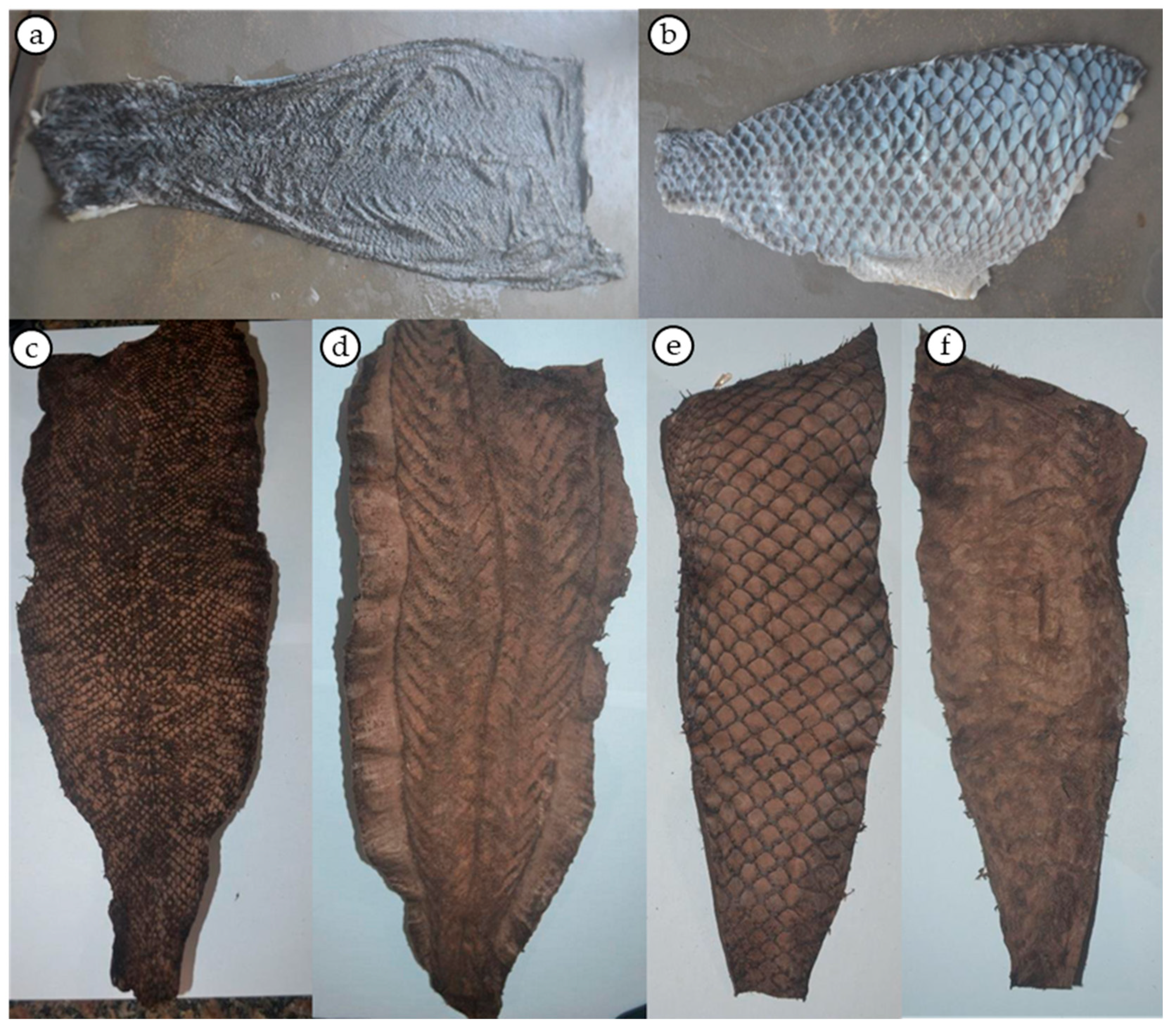
Lastly, for the coloration—outcome and limitation (primary discussion), the application of A. mearnsii proanthocyanidin tannin and C. verum powder produced a stable, uniform dark-brown coloration in finished leathers of both species (Figure 13a–f). This coloration is consistent with the known chromogenic properties of proanthocyanidin-rich extracts and cinnamaldehyde on protein substrates, and was classified as ‘satisfactory’ under the macroscopic protocol [36]. However, it constitutes a recognized practical limitation for potential textile and fashion applications, where a broader chromatic range is typically required.
The contribution of cinnamon powder to coloration—while functionally desirable as an antimicrobial and aromatic adjunct—reduces the base leather’s versatility for overdyeing. Quantitative characterization of the chromatic outcome via CIELab colorimetric analysis (L*, a*, b* values per batch and per species) was not performed in the present feasibility phase; it is identified as a priority measurement for future work (Table S2, Supplementary Materials). Future protocol iterations should evaluate whether a reduction in the cinnamon dose, potentially compensated for by encapsulated or standardized cinnamaldehyde formulations, could mitigate the colorimetric impact without compromising antimicrobial efficacy and odor control.

3.2.1. Species-Specific Grain Attributes and Commercial Applications

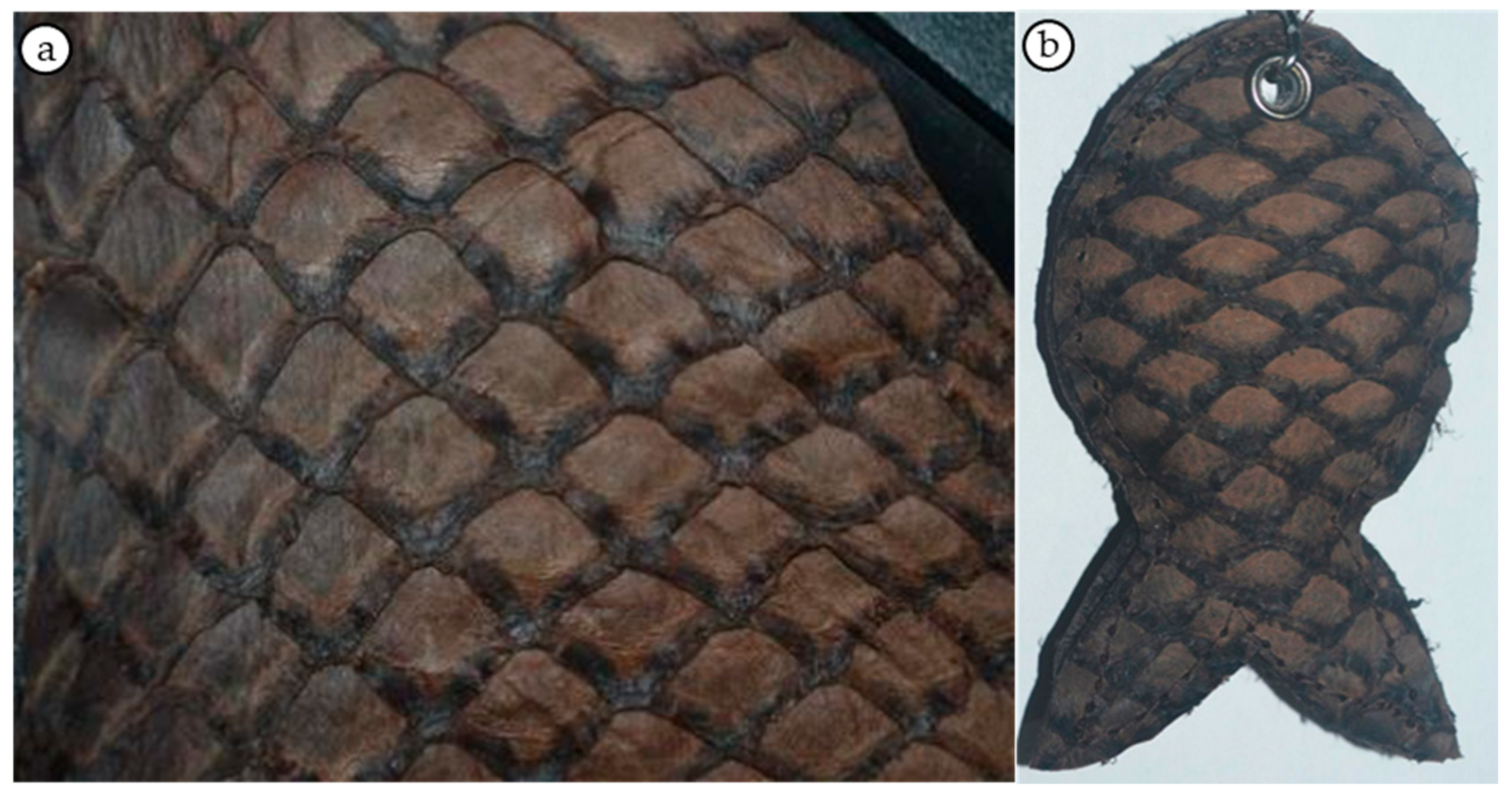
The dermal grain pattern (the organization of scale pockets and the underlying collagen fiber architecture) is a species-specific structural attribute that constitutes both a distinctive aesthetic characteristic and a source of natural product uniqueness for leather markets [15,71] (Figure 14).
In scaled species such as O. niloticus, the epidermal lamellae from which scales emerge generate a regular, geometric grain pattern that is visually distinctive and well documented as a value-adding characteristic of tilapia leather [9,71]. In contrast, the absence of an analogous published baseline for P. patagonicus dermal microstructure prevents a definitive characterization of the species-specific grain attributes of flounder leather within this study; notwithstanding this gap, the finished flounder leathers exhibited macroscopically recognizable surface texture consistent with the lateral line and dermal architecture expected for a flatfish species. The two species together illustrate the breadth of the ecological protocol: a farmed, scaled cichlid model (O. niloticus) with a well-characterized dermal template, and a demersal flatfish model (P. patagonicus) representing an under-characterized by-product stream with emerging valorization potential [10,11,12].
The confirmation of satisfactory macroscopic outcomes across both species demonstrates that the 12-stage ecological protocol can produce leathers with the functional attributes required for small-scale artefact manufacturing [15,16]. The resulting leather is particularly suited to applications demanding thin, flexible, and texturally distinctive materials: artisanal goods such as wallets, watch straps, bookbinding, jewelry inserts, and decorative panels for the fashion and accessories segments (Figure 14b).

3.2.2. Scaling Requirements and Experimental Agenda

Scaling artisanal production to commercially viable volumes will require standardization of sensory evaluation together with quantitative physical-mechanical testing—specifically shrinkage temperature (Ts), tensile strength, elongation at break, and tear load per ISO standards [72,73,74]—as well as effluent characterization (COD, BOD5, total phenolics, total Cr) to formally substantiate the environmental claims of the protocol relative to chrome tanning benchmarks (Table S2, Supplementary Materials).
These measurements define the experimental agenda for the next phase of protocol development. Specifically, the leather industry requires compliance with ISO 3380 (shrinkage temperature up to 100 °C), ISO 3376 (tensile strength and percentage elongation), ISO 3377-2 (tear load, double-edge tear), and ISO 17235/IUP 36 (softness) as minimum benchmarks for commercial leather qualification [35,70,72,73,74]. The present macroscopic assessment, while structured and reproducible, provides a necessary feasibility baseline (i.e., confirming that the protocol produces leathers with intact grain, complete penetration, adequate flexibility, and acceptable odor) but cannot substitute for these standardized instrumental tests. Demonstrating that the ecological protocol meets or approaches the performance thresholds established by these ISO standards for fish leather products is therefore identified as the primary objective of the next experimental phase, and would be the decisive criterion for industrial adoption of the methodology.
Additionally, no formal numerical comparison of quality metrics was performed between bench and pilot scales. The bench-scale phase served exclusively as a protocol-development tool, and the pilot-scale phase as a practical implementation demonstration under real artisanal tannery conditions. Systematic comparison of scale-dependent outcomes, including physical-mechanical properties, penetration kinetics, and liquor exhaustion profiles, constitutes an important limitation of the present study and is designated as a future investigation.

3.2.3. Standardization Considerations and Reproducibility Framework

A key consideration for the transferability of the proposed protocol is the standardization of the artisanal-grade reagents employed. Because the inputs are domestic-grade products sourced from local retail markets, their active-ingredient content (e.g., cinnamaldehyde concentration in cinnamon powder, proteolytic activity of mashed papaya, polyphenol content of tannin extracts) may vary between suppliers and batches. This variability is inherent to the artisanal production context that the protocol is designed to serve, and is managed at two complementary levels.
At the process-control level (Tier 1), the protocol incorporates stage-wise pH monitoring and predefined observable advancement criteria at every stage (Table 1). These functional checkpoints, including target pH values (≈11.5 for liming, ≈8.5 for bating, ≈4.0 for pickling, ≈5.0–5.5 for neutralization), the thumb-pressure test for bating adequacy, cross-section inspection for tannin penetration uniformity, and raking-light examination for surface integrity, constitute a self-correcting control layer that accommodates reagent variability while maintaining process outcomes. This stage-wise control philosophy is well-established in leather technology [21,22].
At the analytical characterization level (Tier 2), inter-laboratory reproducibility and eventual industrial standardization would require quantification of the minimum analytical package: titratable acidity of vinegar (mmol acetic acid/mL), papain proteolytic activity (U/g using a casein substrate assay), total phenolic content of A. mearnsii and A. podalyriifolia tannin extracts (GAE mg/g by the Folin–Ciocalteu method), and cinnamaldehyde content of cinnamon powder (mg/g by GC-MS or HPLC). This characterization would enable formulation-based dosing alongside the gravimetric (% owp) dosing reported here, and would facilitate cross-site comparison of process outcomes. These measurements are identified in the Supplementary Materials (Table S2) as priorities for the next phase of protocol development.
Together, these two tiers provide a practical pathway from artisanal feasibility (demonstrated in the present study) to standardized, inter-laboratory-transferable methodology without sacrificing the accessibility that is central to the protocol’s value proposition for coastal community tanneries.

3.3. Theoretical Mechanisms of Ecological Tanning Agents: In Silico Molecular Docking

Three mechanistically distinct computational questions guided the docking analysis: (i) whether multidentate polyphenol scaffolds engage the collagen triple helix at multiple contact points during vegetable tanning; (ii) whether the papain catalytic cleft accommodates short peptide substrates under the pH and temperature conditions of the bating stage (pH ≈ 8.5; T ≈ 35 °C); and (iii) whether trans-cinnamaldehyde (CAD) occupies the ligand-binding pocket of a LuxR-family quorum-sensing (QS) regulatory protein as a computationally tractable surrogate for QS interference, one of the proposed secondary antimicrobial pathways of cinnamon supplementation. Docking and rescoring were performed as described in Section 2.4. Results are reported as mean ± SD for the top-ranked pose per seed across five independent random seeds and summarized in Table 2.
Three complementary metrics are reported for each receptor–ligand pair: Vina affinity (kcal/mol; more negative = stronger predicted binding), CNNscore (0–1 scale; higher = greater binding likelihood), and CNNaffinity (kcal/mol equivalent; higher = stronger predicted affinity in the GNINA CNN framework). These metrics function as internal ranking signals within each receptor system and are not calibrated binding free energies; they are not compared across structurally dissimilar receptor families. Because no co-crystallized reference ligand was redocked and no well-characterized inhibitor was used as a calibration anchor, all score interpretations are relative and exploratory in nature [32,50,51]. Graphical representations of all three metrics across receptor–ligand pairs are provided in Figures S1–S3 (Supplementary Materials).

3.3.1. Vegetable Tanning Module: Polyphenol Interaction with the Collagen Triple Helix

This module evaluated whether multidentate polyphenol scaffolds engage the collagen triple helix more effectively than a simpler monomer, i.e., the structural property underpinning vegetable tannin stabilization of leather, using two contrasting ligands against two experimentally determined collagen constructs.
Two polyphenol ligands of contrasting structural complexity were docked against two experimentally determined collagen triple-helix constructs (1CAG and 7CWK): a flavanol-like monomer serving as a minimal H-bond and π-stacking scaffold, and pentagalloylglucose (PGG) as a multidentate gallotannin proxy with high H-bond donor density. A structural qualification must be stated at the outset: PGG is a hydrolyzable gallotannin, whereas the A. mearnsii black wattle extract used in this protocol is predominantly composed of condensed proanthocyanidins (procyanidins and prodelphinidins), which are flavan-3-ol oligomers structurally distinct from PGG. PGG was selected to explore the upper-bound H-bonding capacity achievable by polyhydroxylated polyphenols on collagen helices, and the results are discussed accordingly as representative of the polyphenol class rather than as a specific model of A. mearnsii tannin binding geometry. A procyanidin B2 scaffold (a structurally faithful representative of condensed wattle tannins) is recommended as the appropriate ligand for future computational work [21,47].
In the 1CAG construct, PGG produced a mean Vina affinity of −5.51 ± 0.13 kcal/mol, a CNNscore of 0.874 ± 0.009, and a CNNaffinity of 5.667 ± 0.051 kcal/mol across the five seeds (Table 2). The flavanol-like monomer scored substantially lower across all three metrics in the same receptor: Vina affinity −3.54 ± 0.35 kcal/mol, CNNscore 0.771 ± 0.010, and CNNaffinity 3.580 ± 0.087 kcal/mol (Table 2). The narrow standard deviations for both ligands in 1CAG, particularly for PGG (SD ≤ 0.13 across all three metrics), indicate consistent pose placement and stable predicted interaction modes across all five independent seeds, supporting the reproducibility of the docking output under the specified search-space and scoring configuration. The same directional ranking was observed in the sequence-realistic 7CWK construct. PGG again scored more favorably than the flavanol-like monomer across all three metrics: Vina affinity −6.98 ± 1.43 vs. −4.37 ± 0.16 kcal/mol; CNNscore 0.858 ± 0.024 vs. 0.635 ± 0.094; and CNNaffinity 6.139 ± 0.238 vs. 3.702 ± 0.076 kcal/mol (Table 2).
Two sources of variability in 7CWK merit explicit discussion. First, the Vina affinity SD of PGG in 7CWK (1.43 kcal/mol, approximately 20% relative variability) reflects the geometric consequence of docking a large, flexible multidentate ligand against an extended helix surface with multiple energetically degenerate binding zones along the groove axis; several contact regions offer similarly favorable non-covalent environments, and the Vina scoring function cannot sharply discriminate among them. The substantially lower CNNscore SD for PGG in 7CWK (0.024) indicates that the deep-learning scorer consistently identified geometrically credible contact topologies across seeds, even when Vina affinity varied [32,50,51]. Second, the flavanol-like monomer exhibits a higher CNNscore SD in 7CWK (0.094) than in 1CAG (0.010), suggesting that the smaller, less constrained scaffold also samples multiple partially equivalent orientations along the extended helix; despite this positional uncertainty, the CNNscore mean (0.635) remains substantially below PGG (0.858), and the CNNaffinity SD remains low (0.076), preserving the directional ranking inference. The divergence between Vina and CNN score variability in 7CWK highlights the added discriminatory value of CNN-based rescoring for ligands interacting with extended, groove-type receptor surfaces [32,50,51].
The consistent ranking of PGG above the flavanol-like monomer across both constructs, confirmed by three independent scoring metrics, supports the inference that structural complexity—specifically, the multiplicity of galloyl-hydroxyl H-bond donors—governs the strength of polyphenol engagement with the collagen triple helix. Inspection of top-ranked poses indicated that predicted contacts were concentrated at the hydroxyl groups of 4-hydroxyproline (Hyp) residues and at backbone amide carbonyl oxygens within the Gly–Pro–Hyp triplet repeats characteristic of type-I collagen, with additional π-stacking contributions between aromatic galloyl rings and the pyrrolidine groups of Pro and Hyp. This pattern of non-covalent multipoint association—multiple H-bond contacts distributed along the helix combined with aromatic stacking interactions—provides a molecular-level rationale for the hydrothermal stabilization of the collagen matrix expected upon vegetable tanning with proanthocyanidin-rich agents; the specific experimental measurements required to validate these docking predictions (shrinkage temperature, ATR-FTIR band shifts) are detailed in Section 3.3.5.
It must be noted that all structural inferences in this subsection regarding polyphenol–collagen interaction are conditional upon the PGG proxy limitation: PGG is a hydrolyzable gallotannin structurally distinct from the condensed proanthocyanidins (procyanidins and prodelphinidins) that constitute A. mearnsii tannin. The specific binding geometry of condensed tannins on collagen may therefore differ from the patterns observed here. These inferences should be validated using procyanidin B2, a structurally faithful representative of condensed A. mearnsii tannins, as the primary ligand in future computational work [21,47,72,75].

3.3.2. Enzymatic Bating Module: Dipeptide Probe Accommodation in the Papain Catalytic Cleft

This module assessed whether minimal dipeptide probes—surrogates for the non-structural peptide substrates encountered during bating—are accommodated within the papain catalytic cleft under the protocol’s bating conditions (pH ≈ 8.5; T ≈ 35 °C). Three dipeptide probes—Gly–Gly (pap_probe1), Ala–Gly (pap_probe2), and Gly–Ala (pap_probe3)—were docked as minimal substrate surrogates into the catalytic cleft of papain (9PAP) to assess feasible accommodation under the bating conditions of the protocol (pH ≈ 8.5; T ≈ 35 °C).
In 9PAP, the catalytic nucleophile Cys25 is annotated as a modified residue (OCS A 25; cysteinesulfonic acid), and the docking box was centered on the His159/Asn175 catalytic triad region. Across the five seeds, Gly–Gly (pap_probe1) produced a mean Vina affinity of −3.18 ± 0.22 kcal/mol, a CNNscore of 0.727 ± 0.044, and a CNNaffinity of 2.780 ± 0.157 kcal/mol. Ala–Gly (pap_probe2) yielded Vina affinity −3.56 ± 0.22 kcal/mol, CNNscore 0.669 ± 0.036, and CNNaffinity 3.593 ± 0.6325 kcal/mol. The notably high CNNaffinity SD for pap_probe2 (0.633 kcal/mol) indicates that across seeds, the CNN model assigned highly variable affinity estimates to different poses of this probe despite consistent Vina affinity (SD = 0.22), suggesting that individual Ala–Gly poses differ meaningfully in CNN-scored interaction geometry even when their Vina energies are similar. Gly–Ala (pap_probe3) produced the most negative mean Vina affinity (−4.05 ± 0.70 kcal/mol), with CNNscore 0.665 ± 0.019 and CNNaffinity 4.476 ± 0.792 kcal/mol (Table 2; Figures S1–S3). All three probes generated convergent pose ensembles across seeds; the higher Vina affinity variability of pap_probe3 (SD = 0.70 kcal/mol) relative to probes 1 and 2 (SD ≤ 0.22 kcal/mol) likely reflects the slightly larger Ala side chain at the C-terminal position, which samples a broader set of productive cleft orientations [53,54].
A geometric proximity analysis was computed to assess active-site engagement: the minimum Euclidean distance between each top-pose ligand and the SG atom of OCS A 25 (the modified catalytic sulfur) was calculated as described in Section 2.4.7. These distances provide a plausibility check for near-attack geometry at the nucleophilic center. As an approximation, probes with top-pose CNNscore above 0.70 and Vina affinity below −3.0 kcal/mol placed consistently within the cleft region defined by the box center, which is adjacent to OCS25.
The convergent accommodation of all three dipeptide probes within the papain catalytic cleft, across all five random seeds, is consistent with the well-established broad-specificity endopeptidase activity of papain and supports the plausibility of its role in selective proteolysis during the bating stage. At pH ≈ 8.5 and 35 °C (conditions applied in this protocol), papain is expected to operate near its activity optimum (reported pH range 5.5–9.0 depending on substrate), with the active-site cysteine predominantly in the thiolate form (Cys25-S) required for nucleophilic attack [25,61]. The docking results are therefore consistent with a mechanism in which papain preferentially hydrolyzes peptide bonds in non-fibrous interfibrillar proteins and proteoglycans, facilitating their removal from the dermal matrix and reversing the excessive intumescence induced during liming, without degrading the structural type-I collagen network when process conditions are controlled as described. These computational results do not demonstrate catalytic efficiency relative to conventional bovine pancreatic enzymes, nor do they model protease penetration kinetics into fish dermis; both require quantitative enzymatic characterization in future work (Section 3.3.5).

3.3.3. Antimicrobial Adjunct Module: Trans-Cinnamaldehyde Pocket Accommodation in the TraR Quorum-Sensing Regulator

The antimicrobial adjunct module assessed the accommodation of trans-cinnamaldehyde (CAD), the primary bioactive constituent of cinnamon (C. verum), within the ligand-binding pocket of TraR (Agrobacterium tumefaciens QS transcription factor; PDB: 1L3L), a LuxR-family quorum-sensing (QS) regulatory protein selected as a computational surrogate for QS regulatory interference, one of the proposed secondary mechanisms of CAD antimicrobial activity. The mechanistic hierarchy must be clarified at the outset: the primary, experimentally best-characterized mechanisms of trans-cinnamaldehyde antimicrobial action are membrane permeabilization and disruption of fatty-acid biosynthesis; QS interference and biofilm suppression are secondary pathways. Membrane-level mechanisms were not modeled in this study and are discussed as a mechanistic context only; accordingly, docking results for this module are interpreted as supporting QS pocket accommodation plausibility, not as a comprehensive model of cinnamaldehyde antimicrobial efficacy [18,19,20].
To enable internal score comparisons, two structural decoys were co-docked under identical conditions: hydrocinnamaldehyde (CAD analogue lacking α,β-unsaturation) and benzaldehyde (minimal aromatic aldehyde). The complete three-ligand results are reported in Table 2. For CAD, mean scores across five seeds were: Vina affinity −3.26 ± 0.55 kcal/mol, CNNscore 0.718 ± 0.034, and CNNaffinity 4.527 ± 0.674 kcal/mol. Hydrocinnamaldehyde yielded Vina affinity −3.57 ± 0.73 kcal/mol, CNNscore 0.712 ± 0.065, and CNNaffinity 5.073 ± 0.178 kcal/mol. Benzaldehyde produced Vina affinity −2.80 ± 0.40 kcal/mol, CNNscore 0.722 ± 0.049, and CNNaffinity 4.272 ± 0.643 kcal/mol (Table 2). On Vina affinity, CAD ranked between hydrocinnamaldehyde (more negative by approximately 0.3 kcal/mol) and benzaldehyde (less negative by approximately 0.5 kcal/mol), though all three values overlap substantially. On CNNscore, benzaldehyde marginally outscored both CAD and hydrocinnamaldehyde (0.722 vs. 0.718 vs. 0.712); on CNNaffinity, hydrocinnamaldehyde produced the highest value (5.073 vs. 4.527 for CAD vs. 4.272 for benzaldehyde). In no metric did CAD rank unambiguously above both decoys; across-seed standard deviations for all three compounds overlap considerably, particularly for hydrocinnamaldehyde (Vina SD = 0.73 kcal/mol) and CAD (CNNaffinity SD = 0.674 kcal/mol).
These results indicate limited score-based discrimination among small aromatic aldehydes within the TraR binding cavity under the GNINA CNN rescoring configuration employed. This outcome is consistent with the shallow, hydrophobic character of the TraR acyl-chain binding tunnel, which accommodates small apolar ligands non-selectively and confers inherently low structural selectivity for monoaldehyde ligands within this molecular-weight range. Nonetheless, the reproducible pocket placement of CAD across all five seeds (Vina SD = 0.55 kcal/mol; CNNscore SD = 0.034) demonstrates that the cinnamaldehyde scaffold consistently occupies the TraR binding region, supporting the geometric plausibility of QS pocket engagement. This result is explicitly and conservatively interpreted as supporting pocket-accommodation plausibility for the QS interference pathway—not as evidence of preferential binding affinity for CAD over structurally related aldehydes, and not as a computational proxy for membrane-level antimicrobial efficacy. A more rigorous assessment of CAD’s QS specificity would require docking against a LuxR-family receptor relevant to the spoilage or foodborne pathogens in fish-skin processing (e.g., Enterococcus genus, Escherichia coli, and Staphylococcus aureus [76,77] LuxR homologs) and inclusion of a redocked co-crystallized reference ligand (N-3-oxooctanoyl-L-homoserine lactone, LAE) as a calibration anchor; both are recommended as priorities for future computational work [50,55,56] (Section 3.3.5).

3.3.4. Three-Metric Concordance and Score Reliability

A key check on the reliability of any docking result is whether the three independent scoring methods tell the same story. In this study, the classical energy score (Vina affinity), the deep-learning confidence score (CNNscore), and the deep-learning binding strength estimate (CNNaffinity) were internally consistent within each of the three biological systems tested.
For the collagen module, all three metrics agreed that the larger, multi-armed polyphenol (PGG) bound more strongly and consistently than the simpler monomer, in both collagen structures tested. For the quorum-sensing module, all three metrics produced overlapping scores for the three aldehyde ligands, consistently indicating that the pocket does not discriminate among them at this level of analysis. For the papain module, all three metrics showed a progressive increase from the smallest probe (Gly–Gly) to the largest (Gly–Ala), which is physically intuitive, given the increasing size of the alanine side chain. This three-way concordance across an independent analytical approach strengthens confidence in the directional interpretations reported in the previous subsections, even though none of the individual scores should be treated as an absolute measurement of binding affinity.
In relation to the CNNaffinity values, the CNN-predicted binding free-energy equivalent in kcal/mol, where higher values indicate stronger predicted affinity in the GNINA CNN framework—mirrored the CNNscore directional rankings within each receptor system (Table 2; Figures S1–S3). In the collagen systems, PGG produced higher CNNaffinity than the flavanol-like monomer in both 1CAG (5.667 ± 0.051 vs. 3.580 ± 0.087 kcal/mol) and 7CWK (6.139 ± 0.238 vs. 3.702 ± 0.076 kcal/mol), consistent with the CNNscore trend and reinforcing the inference of stronger multipoint engagement for the larger, more H-bond-rich polyphenol scaffold. In the QS regulator system, CNNaffinity values for all three ligands overlapped within their combined uncertainties (CAD: 4.527 ± 0.674; hydrocinnamaldehyde: 5.073 ± 0.178; benzaldehyde: 4.272 ± 0.643 kcal/mol), consistent with the limited score-based separation reported in Section 3.3.3 and corroborating the interpretation that this pocket cannot discriminate among small aromatic aldehydes at this level of analysis. For the papain probes, CNNaffinity increased from pap_probe1 (2.780 ± 0.157 kcal/mol) to pap_probe3 (4.476 ± 0.792 kcal/mol), paralleling the Vina affinity trend and reflecting the progressive size contribution of the Ala side chain. The internal three-metric concordance—Vina affinity, CNNscore, and CNNaffinity—is consistent within each receptor system and supports the reliability of the directional ranking interpretations reported in Section 3.3.1 through 3.3.3 as relative plausibility signals [32,50,51].
It must be emphasized that all docking scores reported were obtained without explicit pH-dependent protonation-state assignment (Section 2.4.3). While the internal three-metric consistency supports the relative directional interpretations within each receptor system, the absolute score magnitudes are not pH-resolved and should not be treated as predictions of binding affinity under the specific pH conditions of each tanning stage (pH ≈ 4.0 for collagen, pH ≈ 8.5 for papain, near-neutral for QS). Implementing PropKa-guided protonation-state ensembles matched to the process conditions is identified as a critical priority for future computational refinement.

3.3.5. Translational Predictions and Experimental Roadmap

The computational results presented in this section serve a dual purpose: they provide a mechanistic rationale for each ecological substitution incorporated into the chromium-free tanning protocol, and they generate specific, testable predictions that can guide subsequent experimental validation. The following three paragraphs explicitly define the critical hypotheses, experimental benchmarks, and validation strategies that future laboratory studies must address:
(i)
Collagen–tannin module (highest priority): The consistent superiority of the multidentate polyphenol proxy across both collagen structures and all three-scoring metrics is the strongest computational finding in this study. The predicted experimental read-outs are shrinkage temperature (a standard industry test measuring the thermal stability conferred by tanning crosslinks) and ATR-FTIR spectroscopy (which can detect shifts in collagen amide bands and hydroxyl stretching frequencies caused by polyphenol binding). These are the highest-priority measurements for future validation; however, the predicted readouts apply to the polyphenol class generally, and the specific binding geometry and H-bond topology of condensed A. mearnsii proanthocyanidins on collagen may differ from those modeled with the PGG gallotannin proxy used here. Future docking work should therefore replace PGG with procyanidin B2, a chemically faithful representative of the condensed proanthocyanidin tannins present in black wattle extract.
(ii)
Papain–peptide module: The consistent cleft accommodation of all three dipeptide probes supports the enzymatic bating rationale but requires confirmation through direct enzymatic activity measurements (using standardized activity units per gram of papaya extract) and through structural assessment of the dermal fiber network before and after bating, using scanning electron microscopy.
(iii)
Cinnamaldehyde–QS module: The pocket-accommodation result supports the plausibility of quorum-sensing interference as one pathway of cinnamon’s antimicrobial action, but the lack of score-based selectivity over structural decoys means this finding is primarily hypothesis-generating. It should motivate microbiological assays measuring biofilm inhibition and minimum inhibitory concentrations of CAD against the specific bacteria present during wet fish-skin processing, as well as improved docking runs against LuxR-homolog receptors from those organisms and using the co-crystallized reference ligand as a calibration anchor.
The collagen module produces the strongest and most internally consistent computational evidence: the multidentate polyphenol proxy’s multi-metric score superiority over the monomer scaffold is confirmed across two independent collagen constructs and three scoring metrics, directly motivating shrinkage temperature measurement and ATR-FTIR spectroscopy as the highest-priority experimental follow-up. The papain module provides cleft-accommodation evidence consistent with substrate-like positioning, subject to confirmation of the OCS25-SG proximity distances, and motivates SEM and mechanical characterization of fiber openness and structural performance. The cinnamaldehyde module demonstrates consistent pocket placement within the TraR QS regulatory cavity but does not discriminate CAD from structural decoys with sufficient score separation to support specificity claims; it should be interpreted as a hypothesis-generating computation motivating targeted microbiological assays and improved computational modeling (co-crystallized reference ligand; organism-relevant receptor) rather than as a binding affinity prediction.
In the absence of full physical-mechanical characterization, which lies outside the scope of this protocol-design and feasibility study, the three-module docking pipeline mentioned above serves a dual role: as a mechanistic rationale for each ecological substitution and as a forward-predictive framework that identifies the most informative experimental measurements for future validation studies. The computational predictions and the specific measurements that would test each prediction are summarized in the Supplementary material (Table S2).
Together with the macroscopic outcomes reported in Section 3.2, these computational results constitute a process-faithful, mechanistically grounded foundation for an ecological fish-skin tanning protocol, establishing the molecular rationale that makes each chromium-free substitution scientifically transparent and enabling future studies to systematically validate, optimize, and scale the methodology.

4. Conclusions

The successful bench-to-pilot implementation of the proposed protocol demonstrates that a fully chromium-free, ecologically sound tanning process is operationally feasible for southern Brazil’s coastal fish-processing by-products using exclusively low-hazard, locally available inputs. The satisfactory macroscopic outcomes obtained for both O. niloticus and P. patagonicus, two species with markedly distinct dermal architectures, indicate that the pH-controlled, diffusion-first tanning strategy and the ionic-strength management via NaCl are sufficiently generalizable to accommodate species-specific structural variability at this feasibility stage. The application of A. podalyriifolia extract as the retanning agent constitutes, to the best of the authors’ knowledge, its first documented use in a leather retanning context, providing an empirical baseline for future phenolic characterization.
The in silico docking results provide an exploratory mechanistic rationale for each ecological substitution: PGG showed consistently superior multipoint collagen engagement relative to the flavanol monomer across both collagen constructs and all three scoring metrics (the strongest and most internally consistent computational finding of this study); dipeptide probes were reproducibly accommodated in the papain catalytic cleft, consistent with selective non-fibrous proteolysis during bating; and trans-cinnamaldehyde occupied the quorum-sensing pocket with reproducible placement but without score-based selectivity over structural decoys, a result appropriately interpreted as hypothesis-generating, motivating microbiological assays and organism-relevant receptor modeling. Collectively, the three docking modules serve a dual function: as a mechanistic rationale for each ecological substitution and as a forward-looking predictive framework that generates specific, testable experimental hypotheses for the next phase of protocol development. Docking is interpreted here as supportive of mechanism and hypothesis generation, not as a substitute for experimental performance metrics.
Critically, the dark-brown coloration imposed by A. mearnsii tannin and C. verum powder represents a practical constraint for textile and fashion applications, and the exclusively macroscopic quality assessment, while scientifically structured, cannot substitute for standardized physical-mechanical testing. The use of PGG as a computational proxy for condensed proanthocyanidins also introduces a structural caveat that limits the specificity of the collagen-binding interpretation; procyanidin B2 should be adopted as the primary ligand in future docking work. Future studies must address shrinkage temperature, tensile and tear performance, ATR-FTIR-based tannin incorporation, CIELab colorimetry, and effluent characterization to formally benchmark the protocol against chrome-tanning standards and to underpin its environmental claims with quantitative life-cycle evidence.
Lastly, it is important to emphasize that this proposed protocol is designed exclusively to add value to fish-processing residues already generated by existing aquaculture and demersal fishery operations; it does not create a new demand for P. patagonicus catch, nor does it provide an economic incentive for increased extraction of this species. Valorizing these residues into leather, rather than discarding them as low-value waste, increases the economic yield per unit of extraction pressure and is therefore consistent with the conservation objectives underlying sustainable fisheries management.
To facilitate the transfer of this protocol beyond the artisanal context in which it was developed, a two-tier standardization framework is proposed: at the process-control level, the stage-wise pH monitoring and observable advancement criteria embedded in Table 1 provide a self-correcting control layer that accommodates reagent variability; at the analytical level, quantification of active-ingredient content (papain proteolytic activity, cinnamaldehyde concentration, tannin phenolic content, and titratable acidity of vinegar) would enable formulation-based dosing for inter-laboratory comparability and eventual industrial adoption.
Additionally, a comparative life-cycle assessment (LCA) evaluating the ecological protocol against conventional chrome tanning for the same species and production volume is planned as a dedicated follow-up study, building on the effluent characterization data to be generated during the physical-mechanical validation phase. This LCA would formally quantify the environmental benefits of chromium elimination and biodegradable input substitution against the residual organic loading contributed by tannin extracts, surfactants, and oil emulsions, thereby substantiating the ecological designation with quantitative life-cycle evidence.

Supplementary Materials

The following supporting information can be downloaded at: https://www.mdpi.com/article/10.3390/pr14071173/s1, Table S1. Receptors, ligands, search-space definitions, and GNINA settings. GNINA v1.0; cnn_scoring=rescore; cnn=crossdock_default2018; top pose per seed; seeds 11/22/33/44/55 (n = 5). Ligands were generated from SMILES and converted to SDF with 3D coordinates using Open Babel (v3.1.1, --gen3d). Receptors were converted to PDBQT with Open Babel after removing waters and standardizing residues (e.g., MSE→MET). Table S2. Translational predictions from the three-module docking pipeline and experimental measurements recommended for future validation studies. Calibration docking experiments (leupeptin for 9PAP; LAE for 1L3L) are identified as recommended future computational work, not as experiments performed in this study. Table S3. OCS25-SG proximity data for the papain module. Minimum Euclidean distance (Å) between the catalytic sulfur atom SG of OCS A 25 (modified catalytic nucleophile in 9PAP) and any ligand atom, computed for GNINA top-ranked poses (top pose per seed). Distances are reported as a geometric plausibility check of active-site accommodation and are not treated as kinetic predictors. Figure S1. Vina affinity (kcal/mol; mean ± SD, n = 5 independent random seeds: 11, 22, 33, 44, 55) for all receptor–ligand pairs. GNINA v1.0; cnn_scoring=rescore; cnn=crossdock_default2018. More negative values indicate stronger predicted binding affinity. Receptor–ligand pair labels correspond to Table 2 in the main text. Figure S2. CNNscore (0–1 scale; mean ± SD, n = 5 independent random seeds: 11, 22, 33, 44, 55) for all receptor–ligand pairs. GNINA v1.0; cnn_scoring=rescore; cnn=crossdock_default2018. Higher values indicate greater predicted binding likelihood. Receptor–ligand pair labels correspond to Table 2 in the main text. Figure S3. CNNaffinity (kcal/mol equivalent in the GNINA CNN framework; mean ± SD, n = 5 independent random seeds: 11, 22, 33, 44, 55) for all receptor–ligand pairs. GNINA v1.0; cnn_scoring=rescore; cnn=crossdock_default2018. Higher values indicate stronger predicted affinity—note inverted polarity relative to Vina affinity, where more negative values indicate stronger binding. Receptor–ligand pair labels correspond to Table 2 in the main text.

Author Contributions

Conceptualization, M.I.S.F., K.K.S., D.P.W. and M.V.-R.; methodology, M.I.S.F., D.P.W. and K.K.S.; software, J.P.-T.; validation, M.V.-R., J.P.-T. and P.C.B.C.; formal analysis, M.V.-R., J.P.-T. and P.C.B.C.; investigation, M.I.S.F.; resources, K.K.S. and M.I.S.F.; data curation, M.V.-R. and P.C.B.C.; writing—original draft preparation, M.I.S.F. and M.V.-R.; writing—review and editing, M.V.-R.; visualization, M.V.-R., P.C.B.C. and J.P.-T.; supervision, M.V.-R.; project administration, M.V.-R. All authors have read and agreed to the published version of the manuscript.

Funding

This research received no external funding.

Data Availability Statement

The data that support the findings of this study are available on request from the corresponding author.

Acknowledgments

The authors gratefully acknowledge the contributions and support provided by the Universidade do Estado de Santa Catarina (UDESC), the Universidade Estadual do Paraná (UNESPAR), and the Paraná Volunteer Program (PROVOPAR).

Conflicts of Interest

The authors declare no conflicts of interest.

References

  1. Food and Agriculture Organization of the United Nations. The State of World Fisheries and Aquaculture 2024; FAO: Rome, Italy, 2024. [Google Scholar]
  2. FAO. FAO Report: Global Fisheries and Aquaculture Production Reaches a New Record High; FAO: Rome, Italy, 2024. [Google Scholar]
  3. Shi, J.; Sheng, L.; Salmi, O.; Masi, M.; Puig, R. Life Cycle Assessment Insights into Nanosilicates-Based Chrome-Free Tanning Processing Towards Eco-Friendly Leather Manufacture. J. Clean. Prod. 2024, 434, 139892. [Google Scholar] [CrossRef]
  4. Bhardwaj, A.; Kumar, S.; Singh, D. Tannery Effluent Treatment and Its Environmental Impact: A Review of Current Practices and Emerging Technologies. Water Qual. Res. J. 2023, 58, 128–152. [Google Scholar] [CrossRef]
  5. Environmental Protection Agency. IRIS Toxicological Review of Hexavalent Chromium [Cr(VI)] CASRN 18540-29-9; U.S. Environmental Protection Agency, Office of Research and Development: Washington, DC, USA, 2024. [Google Scholar]
  6. Meaza, I.; Williams, A.R.; Wise, S.S.; Lu, H.; Pierce, J.W. Carcinogenic Mechanisms of Hexavalent Chromium: From DNA Breaks to Chromosome Instability and Neoplastic Transformation. Curr. Environ. Health Rep. 2024, 11, 484–546. [Google Scholar] [CrossRef]
  7. Ding, W.; Remón, J.; Jiang, Z. Environmentally-Friendly Tanning for Leather Production: A Review. Environ. Chem. Lett. 2025, 23, 839–864. [Google Scholar] [CrossRef]
  8. Gendaszewska, D.; Pipiak, P.; Wieczorek, D.; Sieczyńska, K. Experimental Study on Chrome Tanned Leather Shavings Modification—Properties and Prospective for Future Application. Processes 2024, 12, 228. [Google Scholar] [CrossRef]
  9. Peñarubia, O.; Toppe, J.; Ahern, M.; Ward, A.; Griffin, M. How Value Addition by Utilization of Tilapia Processing By-Products Can Improve Human Nutrition and Livelihood. Rev. Aquac. 2023, 15, 32–40. [Google Scholar] [CrossRef]
  10. Astarloa, J.M.D.d. A Review of the Flatfish Fisheries of the South Atlantic Ocean. Rev. Biol. Mar. Oceanogr. 2002, 37, 113–125. [Google Scholar]
  11. Riestra, C.; de Astarloa, J.; Vieira, J.P.; Buratti, C.; Irigoyen, A.; Landaeta, M.; Hüne, M. Paralichthys Patagonicus. The IUCN Red List of Threatened Species 2020: E.T195089A165017727. Available online: https://www.iucnredlist.org/species/195089/165017727 (accessed on 31 March 2026).
  12. Castellini, D.L.; Díaz De Astarloa, J.M.; Pruvost, P.; González-Castro, M. Flatfishes of the Genus Paralichthys in the Southwestern Atlantic: Integrating Molecular Taxonomy and Morphometric Data. Cybium 2024, 48, 309–325. [Google Scholar] [CrossRef]
  13. dos Santos Jorge Sousa, K.; de Souza, A.; de Lima, L.E.; Erbereli, R.; de Araújo Silva, J.; de Almeida Cruz, M.; Martignago, C.C.S.; Ribeiro, D.A.; Barcellos, G.R.M.; Granito, R.N.; et al. Flounder Fish (Paralichthys sp.) Collagen a New Tissue Regeneration: Genotoxicity, Cytotoxicity and Physical–Chemistry Characterization. Bioprocess Biosyst. Eng. 2023, 46, 1053–1063. [Google Scholar] [CrossRef] [PubMed]
  14. Eom, S.J.; Kim, J.H.; Ryu, A.R.; Park, H.; Lee, J.H.; Park, J.H.; Lee, N.H.; Lee, S.; Lim, T.G.; Kang, M.C.; et al. Skin Improvement Effects of Ultrasound-Enzyme-Treated Collagen Peptide Extracts from Flatfish (Paralichthys olivaceus) Skin in an In Vitro Model. Int. J. Mol. Sci. 2024, 25, 9300. [Google Scholar] [CrossRef] [PubMed]
  15. Gu, H.; Wang, H.; Zhu, S.; Yuan, D.; Dai, X.; Wang, Z. Interspecific Differences and Ecological Correlations Between Scale Number and Skin Structure in Freshwater Fishes. Curr. Zool. 2023, 69, 491–500. [Google Scholar] [CrossRef]
  16. Zhang, E.; Tung, C.H.; Feng, L.; Zhou, Y.R. Superior Damage Tolerance of Fish Skins. Materials 2023, 16, 953. [Google Scholar] [CrossRef]
  17. Lauder, G.V.; Wainwright, D.K.; Domel, A.G.; Weaver, J.C.; Wen, L.; Bertoldi, K. Structure, Biomimetics, and Fluid Dynamics of Fish Skin Surfaces. Phys. Rev. Fluids 2016, 1, 60502. [Google Scholar] [CrossRef]
  18. Friedman, M. Chemistry, Antimicrobial Mechanisms, and Antibiotic Activities of Cinnamaldehyde against Pathogenic Bacteria in Animal Feeds and Human Foods. J. Agric. Food Chem. 2017, 65, 10406–10423. [Google Scholar] [CrossRef]
  19. Chen, X.; Liu, P.; Luo, X.; Huang, A.; Wang, G. Study on the Antibacterial Activity and Mechanism of Cinnamaldehyde Against Methicillin-Resistant Staphylococcus Aureus. Eur. Food Res. Technol. 2024, 250, 1069–1081. [Google Scholar] [CrossRef]
  20. Shu, C.; Ge, L.; Li, Z.; Chen, B.; Liao, S.; Lu, L.; Wu, Q.; Jiang, X.; An, Y.; Wang, Z.; et al. Antibacterial Activity of Cinnamon Essential Oil and Its Main Component of Cinnamaldehyde and the Underlying Mechanism. Front. Pharmacol. 2024, 15, 1378434. [Google Scholar] [CrossRef]
  21. Covington, A.D.; Wise, W.R. Tanning Chemistry: The Science of Leather; Royal Society of Chemistry: Cambridge, UK, 2019; ISBN 978-1-78801-204-1. [Google Scholar]
  22. Yang, T.; Zeng, Y.; Sun, Q.; Lei, C.; Shi, B. Effect of Pickling Materials on Leather Quality from a Hide Surface Charge Perspective. J. Am. Leather Chem. Assoc. 2022, 117, 279–287. [Google Scholar] [CrossRef]
  23. Wang, Y.N.; Hu, L. Essential Role of Isoelectric Point of Skin/Leather in Leather Processing. J. Leather Sci. Eng. 2022, 4, 25. [Google Scholar] [CrossRef]
  24. Li, X.; Wang, Y.N.; Li, J.; Shi, B. Effect of Sodium Chloride on Structure of Collagen Fiber Network in Pickling and Tanning. J. Am. Leather Chem. Assoc. 2016, 111, 230–237. [Google Scholar]
  25. Khambhaty, Y. Applications of Enzymes in Leather Processing. Environ. Chem. Lett. 2020, 18, 747–769. [Google Scholar] [CrossRef]
  26. Jayakumar, G.C.; Karthik, V.; Kandhan, J.S.; Kanagaraj, J. Effect of Enzymatic Treatment in Leather Manufacture at Different Processing Stage. J. Am. Leather Chem. Assoc. 2022, 117, 534–541. [Google Scholar] [CrossRef]
  27. Nugraha, M.G.; Andersson, R.; Andersson, B. On the Sherwood Number Correction Due to Stefan Flow. Chem. Eng. Sci. 2022, 249, 117292. [Google Scholar] [CrossRef]
  28. Bird, R.B.; Stewart, W.E.; Lightfoot, E.N. Transport Phenomena, Revised 2nd Edition; Wiley: Hoboken, NJ, USA, 2006; ISBN 0470115394. [Google Scholar]
  29. Lin, Y.; Jiang, Z.; Wang, Y.N.; Zeng, Y.; Xie, G.; Shi, B. Experimental and Computational Fluid Dynamics Investigation on Tanning Process in a Rotating Drum. J. Am. Leather Chem. Assoc. 2023, 118, 485–495. [Google Scholar] [CrossRef]
  30. Santos, D.A.; Dadalto, F.O.; Scatena, R.; Duarte, C.R.; Barrozo, M.A.S. A Hydrodynamic Analysis of a Rotating Drum Operating in the Rolling Regime. Chem. Eng. Res. Des. 2015, 94, 204–212. [Google Scholar] [CrossRef]
  31. Nie, F.; Liu, L.; Cui, J.; Zhao, Y.; Zhang, D.; Zhou, D.; Wu, J.; Li, B.; Wang, T.; Li, M.; et al. Oligomeric Proanthocyanidins: An Updated Review of Their Natural Sources, Synthesis, and Potentials. Antioxidants 2023, 12, 1004. [Google Scholar] [CrossRef]
  32. McNutt, A.T.; Francoeur, P.; Aggarwal, R.; Masuda, T.; Meli, R.; Ragoza, M.; Sunseri, J.; Koes, D.R. GNINA 1.0: Molecular Docking with Deep Learning. J. Cheminform. 2021, 13, 43. [Google Scholar] [CrossRef] [PubMed]
  33. CONAMA. Resolução CONAMA No 430 DE 13/05/2011—Federal; LegisWeb: São Paulo, Brazil, 2011; Volume 430, p. 9. [Google Scholar]
  34. SATRA. SATRA Leather Grading Accreditation. Available online: https://www.satra.com/bulletin/article.php?id=1906 (accessed on 23 February 2026).
  35. International Organization for Standardization Leather. Physical and Mechanical Tests. Determination of Tensile Strength and Percentage Elongation, 4th ed.; ISO: Geneva, Switzerland, 2020. [Google Scholar]
  36. Ogawa, S.; Yazaki, Y. Tannins from Acacia mearnsii De Wild. Bark: Tannin Determination and Biological Activities. Molecules 2018, 23, 837. [Google Scholar] [CrossRef] [PubMed]
  37. Xiao, Y.; Wang, C.; Zhou, J.; Wu, J.; Lin, W. Modular Design of Vegetable Polyphenols Enables Covalent Bonding with Collagen for Eco-Leather. Ind. Crops Prod. 2023, 204, 117394. [Google Scholar] [CrossRef]
  38. Gram, L. Microbiological Spoilage of Fish and Seafood Products. In Compendium of the Microbiological Spoilage of Foods and Beverages. Food Microbiology and Food Safety; Sperber, W., Doyle, M., Eds.; Springer: New York, NY, USA, 2009. [Google Scholar] [CrossRef]
  39. Didehdar, M.; Chegini, Z.; Tabaeian, S.P.; Razavi, S.; Shariati, A. Cinnamomum: The New Therapeutic Agents for Inhibition of Bacterial and Fungal Biofilm-Associated Infection. Front. Cell. Infect. Microbiol. 2022, 12, 930624. [Google Scholar] [CrossRef]
  40. Hasanzadeh Baboli, N.; Hosseini, S.F.; Gharsallaoui, A. Antibacterial and Anti-Biofilm Properties of Cinnamaldehyde-Loaded Nanoliposomes Against Listeria Monocytogenes and Salmonella Enteritidis Adhered to Stainless Steel. Int. J. Food Sci. Technol. 2023, 58, 5275–5282. [Google Scholar] [CrossRef]
  41. Zhang, X.; Gao, M.; Chattha, S.A.; Zhu, Y.; Peng, B.; Ye, Y. Application of Acidic Protease in the Pickling to Simplify the Pelt Bating Process. J. Leather Sci. Eng. 2021, 3, 27. [Google Scholar] [CrossRef]
  42. Song, Y.; Wu, S.; Yang, Q.; Liu, H.; Zeng, Y.; Shi, B. Factors Affecting Mass Transfer of Protease in Pelt During Enzymatic Bating Process. J. Leather Sci. Eng. 2019, 1, 7. [Google Scholar] [CrossRef]
  43. Freudenberg, U.; Behrens, S.H.; Welzel, P.B.; Müller, M.; Grimmer, M.; Salchert, K.; Taeger, T.; Pompe, W.; Werner, C. Electrostatic Interactions Modulate the Conformation of Collagen I. Biophys. J. 2007, 92, 2108–2119. [Google Scholar] [CrossRef]
  44. Morozova, S.; Muthukumar, M. Electrostatic Effects in Collagen Fibril Formation. J. Chem. Phys. 2018, 149, 163333. [Google Scholar] [CrossRef] [PubMed]
  45. Ali, R.M.; Nasr, A.I.; El-Shemy, K.A.; El-Khateeb, M.A. Bicarbonate Alternatives in the Neutralization Phase of Leather Tanning to Ensure Sustainability. Text. Leather Rev. 2024, 7, 481–492. [Google Scholar] [CrossRef]
  46. Dixon, R.A.; Sarnala, S. Proanthocyanidin Biosynthesis—A Matter of Protection. Plant Physiol. 2020, 184, 579–591. [Google Scholar] [CrossRef]
  47. Falcão, L.; Araújo, M.E.M. Vegetable Tannins Used in the Manufacture of Historic Leathers. Molecules 2018, 23, 1081. [Google Scholar] [CrossRef] [PubMed]
  48. de Andrade, C.A.; de Souza Carvalho, J.L.; Cunico, M.M.; Lordello, A.L.L.; Higaskino, C.E.K.; Almeida, S.C.d.C.; Dias, J.d.F.G.; Kerber, V.A.; Miguel, M.D.; Miguel, O.G. Antioxidant and Antibacterial Activity of Extracts, Fractions and Isolated Substances from the Flowers of Acacia Podalyriifolia A. Cunn. ex G. Don. Braz. J. Pharm. Sci. 2010, 46, 649–658. [Google Scholar] [CrossRef]
  49. Jæger, D.; O’Leary, M.C.; Weinstein, P.; Møller, B.L.; Semple, S.J. Phytochemistry and Bioactivity of Acacia Sensu Stricto (Fabaceae: Mimosoideae). Phytochem. Rev. 2019, 18, 129–172. [Google Scholar] [CrossRef]
  50. Francoeur, P.G.; Masuda, T.; Sunseri, J.; Jia, A.; Iovanisci, R.B.; Snyder, I.; Koes, D.R. Three-Dimensional Convolutional Neural Networks and a Cross-Docked Data Set for Structure-Based Drug Design. J. Chem. Inf. Model. 2020, 60, 4200–4215. [Google Scholar] [CrossRef] [PubMed]
  51. Ragoza, M.; Hochuli, J.; Idrobo, E.; Sunseri, J.; Koes, D.R. Protein–Ligand Scoring with Convolutional Neural Networks. J. Chem. Inf. Model. 2017, 57, 942–957. [Google Scholar] [CrossRef]
  52. Bella, J.; Eaton, M.; Brodsky, B.; Berman, H.M. Crystal and Molecular Structure of a Collagen-Like Peptide at 1.9 Å Resolution. Science 1994, 266, 75–81. [Google Scholar] [CrossRef]
  53. Kamphuis, I.G.; Kalk, K.H.; Swarte, M.B.A.; Drenth, J. Structure of Papain Refined at 1.65 Å Resolution. J. Mol. Biol. 1984, 179, 233–256. [Google Scholar] [CrossRef]
  54. Shokhen, M.; Khazanov, N.; Albeck, A. Challenging a Paradigm: Theoretical Calculations of the Protonation State of the Cys25-His159 Catalytic Diad in Free Papain. Proteins Struct. Funct. Bioinform. 2009, 77, 916–926. [Google Scholar] [CrossRef]
  55. Brackman, G.; Celen, S.; Hillaert, U.; van Calenbergh, S.; Cos, P.; Maes, L.; Nelis, H.J.; Coenye, T. Structure-Activity Relationship of Cinnamaldehyde Analogs as Inhibitors of AI-2 Based Quorum Sensing and Their Effect on Virulence of Vibrio spp. PLoS ONE 2011, 6, e16084. [Google Scholar] [CrossRef]
  56. Niu, C.; Afre, S.; Gilbert, E.S. Subinhibitory Concentrations of Cinnamaldehyde Interfere with Quorum Sensing. Lett. Appl. Microbiol. 2006, 43, 489–494. [Google Scholar] [CrossRef] [PubMed]
  57. Hass, V.; Liu, H.; Cook, W.; Walker, M.P.; Wang, Y. Distinct Effects of Polyphenols and Solvents on Dentin Collagen Crosslinking Interactions and Biostability. Dent. Mater. 2021, 37, 1794–1805. [Google Scholar] [CrossRef] [PubMed]
  58. Cassano, A. Leather Industry, Degreasing. In Encyclopedia of Membranes; Springer: Berlin/Heidelberg, Germany, 2016; pp. 1094–1095. [Google Scholar]
  59. Rawat, N.; Bhonsle, A.K.; Ngomade, S.B.L.; Atray, N. A Mini Review on Surfactants: Production, Applications, Recent Advances, and a Way Toward Biosurfactant. J. Solut. Chem. 2026, 55, 1–20. [Google Scholar] [CrossRef]
  60. Zhang, T.; Chen, W.; Tian, J.; Luo, G.; Ling, F. A Rationalized Leather Process for Wet-End: Pre-Tanning—Integrated Post-Tanning System. In Proceedings of the IULTCS 30th Global Congress, Beijing, China, 11–14 October 2009. [Google Scholar]
  61. Mohd Azmi, S.I.; Kumar, P.; Sharma, N.; Sazili, A.Q.; Lee, S.J.; Ismail-Fitry, M.R. Application of Plant Proteases in Meat Tenderization: Recent Trends and Future Prospects. Foods 2023, 12, 1336. [Google Scholar] [CrossRef]
  62. Abidin, M.Z.; Yuliatmo, R.; Griyanitasari, G. Evaluation of Physical Properties of Leather on the Bating Process by Combination of Papain Enzyme with Surfactant. Leather Footwear J. 2022, 22, 101–106. [Google Scholar] [CrossRef]
  63. Venetikidou, M.; Lykartsi, E.; Adamantidi, T.; Prokopiou, V.; Ofrydopoulou, A.; Letsiou, S.; Tsoupras, A. Proteolytic Enzyme Activities of Bromelain, Ficin, and Papain from Fruit By-Products and Potential Applications in Sustainable and Functional Cosmetics for Skincare. Appl. Sci. 2025, 15, 2637. [Google Scholar] [CrossRef]
  64. Trevisol, T.C.; Henriques, R.O.; Cesca, K.; Souza, A.J.A.; Furigo, A. In Vitro Effect on the Proteolytic Activity of Papain with Proteins of the Skin as Substrate. Int. J. Cosmet. Sci. 2022, 44, 542–554. [Google Scholar] [CrossRef]
  65. Zhang, X.; Chattha, S.A.; Song, J.; Zhang, C.; Peng, B. An Integrated Pickling-Bating Technology for Reducing Ammonia-Nitrogen and Chloride Pollution in Leather Manufacturing. J. Clean. Prod. 2022, 375, 134070. [Google Scholar] [CrossRef]
  66. Liu, H.; Song, Y.; Zeng, Y.; Shi, B. Effect of Surfactant on Basic Properties and Leather Bating Performance of Trypsin. Leather Sci. Eng. 2023, 33, 1–7. [Google Scholar] [CrossRef]
  67. Zhu, Y.; Song, J.; Zhang, X.; Gao, M.; Peng, B.; Zhang, C. Effect of Electrostatic Interaction Between Collagen and Enzymes on Permeation of Protease into the Pelt during Leather Bating Process. J. Am. Leather Chem. Assoc. 2023, 118, 428–438. [Google Scholar] [CrossRef]
  68. Chen, J.; Cai, Z.; Wei, Q.; Wang, D.; Wu, J.; Tan, Y.; Lu, J.; Ai, H. Proanthocyanidin-Crosslinked Collagen/Konjac Glucomannan Hydrogel with Improved Mechanical Properties and MRI Trackable Biodegradation for Potential Tissue Engineering Scaffolds. J. Mater. Chem. B 2020, 8, 316–331. [Google Scholar] [CrossRef] [PubMed]
  69. Hasanzadeh, E.; Mahmoodi, N.; Basiri, A.; Esmaeili Ranjbar, F.; Hassannejad, Z.; Ebrahimi-Barough, S.; Azami, M.; Ai, J.; Rahimi-Movaghar, V. Proanthocyanidin as a Crosslinking Agent for Fibrin, Collagen Hydrogels and Their Composites with Decellularized Wharton’s-Jelly-Extract for Tissue Engineering Applications. J. Bioact. Compat. Polym. 2020, 35, 554–571. [Google Scholar] [CrossRef]
  70. International Organization for Standardization. ISO 17235:2015|IULTCS/IUP 36 Leather—Physical and Mechanical Tests—Determination of Softness. Available online: https://www.iso.org/standard/63873.html (accessed on 23 February 2026).
  71. Oliveira, G.G.; Gasparino, E.; Castilha, L.D.; Marengoni, N.G.; Souza Dos Reis Goes, E.; Alves De Almeida, F.L.; Matiucci, M.A.; Feihrmann, A.C.; Granzoto, G.H.; Casetta, J.; et al. Characterization and Strength Quality of the Oryctolagus cuniculus Leather Compared to Oreochromis Niloticus Leather. Sci. World J. 2022, 2022, 4561404. [Google Scholar] [CrossRef]
  72. International Organization for Standardization. Leather—Physical and Mechanical Tests—Determination of Shrinkage Temperature up to 100 Degrees C, 3rd ed.; ISO: Geneva, Switzerland, 2002; Volume 3. [Google Scholar]
  73. International Organization for Standardization. ISO 3377-2 Leather—Physical and Mechanical Tests—Determination of Tear Load—Part 2: Double Edge Tear, 2nd ed.; ISO: Geneva, Switzerland, 2016. [Google Scholar]
  74. International Organization for Standardization. Leather—Physical and Mechanical Tests—Determination of Tear Load, 2nd ed.; ISO: Geneva, Switzerland, 2002. [Google Scholar]
  75. El Moujahed, S.; Errachidi, F.; Abou Oualid, H.; Botezatu-Dediu, A.V.; Ouazzani Chahdi, F.; Kandri Rodi, Y.; Dinica, R.M. Extraction of Insoluble Fibrous Collagen for Characterization and Crosslinking with Phenolic Compounds from Pomegranate Byproducts for Leather Tanning Applications. RSC Adv. 2022, 12, 4175–4186. [Google Scholar] [CrossRef] [PubMed]
  76. Vargas-Ramella, M.; da Silva, D.; Dilarri, G.; Zortea, A.V.L.; Mendes, C.R.; de Souza Laurentino, G.; Campagnol, P.C.B.; de Oliveira, A.F.; da Silveira, C.B. Quality Effects of Sodium Alginate Coating Cross-Linked with CaCl2 on Mugil Liza Fillets During Storage. Food Control 2025, 170, 111048. [Google Scholar] [CrossRef]
  77. Vargas-Ramella, M.; Echegaray, N.; Campagnol, P.C.B.; Lorenzo, J.M. Natural Polymer-Based Coatings for Animal-Derived Products: A Review of Applications, Functionality, Characterization, and Challenges. Foods 2025, 14, 2255. [Google Scholar] [CrossRef] [PubMed]
Figure 1. (a) Schematic design and (b) fabricated bench-scale experimental drum.
Processes 14 01173 g001
Figure 2. (a,b) Industrial tanning drums and (c) the PROVOPAR Artisanal Tannery, Pontal do Paraná, PR, Brazil.
Processes 14 01173 g002
Figure 3. Helical epoxy-resin strips arranged inside the glass jar: (a) side view of the jar showing the helical strips positioned along the inner wall; (b) top view of the jar highlighting the spiral arrangement of the strips within the container.
Processes 14 01173 g003
Figure 4. Ecological fish skin tanning process workflow.
Processes 14 01173 g004
Figure 5. Raw skins of (a) Nile tilapia (Oreochromis niloticus) and (b) flounder (Paralichthys patagonicus) after fleshing and descaling.
Processes 14 01173 g005
Figure 6. Nile tilapia (Oreochromis niloticus) and flounder (Paralichthys patagonicus) skins after the soaking stage with cinnamon powder.
Processes 14 01173 g006
Figure 7. Nile tilapia (Oreochromis niloticus) and flounder (Paralichthys patagonicus) skins inside the tanning drum during the liming stage.
Processes 14 01173 g007
Figure 8. Nile tilapia (Oreochromis niloticus) and flounder (Paralichthys patagonicus) skins inside the tanning drum during the deliming stage.
Processes 14 01173 g008
Figure 9. (a) Addition of mashed papaya extract (40%; % owp of whole mashed fruit) into the drum and (b) Nile tilapia (Oreochromis niloticus) skin after the bating stage.
Processes 14 01173 g009
Figure 10. (a) Flounder (Paralichthys patagonicus) and (b) Nile tilapia (Oreochromis niloticus) skins after the tanning stage.
Processes 14 01173 g010
Figure 11. (a) Flounder (Paralichthys patagonicus) skin and (b) Nile tilapia (Oreochromis niloticus) skin after the fatliquoring process.
Processes 14 01173 g011
Figure 12. Nile tilapia (Oreochromis niloticus) skin before the finishing process.
Processes 14 01173 g012
Figure 13. Front of raw skin of (a) flounder and (b) tilapia; front (c) and back (d) of flounder leather; front (e) and back (f) of Nile tilapia leather.
Processes 14 01173 g013
Figure 14. (a) Grain pattern of Nile tilapia (Oreochromis niloticus) leather tanned through the ecological tanning process, and (b) an artifact produced with the leather.
Processes 14 01173 g014
Table 2. GNINA v1.0 docking results (cnn_scoring=rescore; cnn=crossdock_default2018); top-ranked pose per seed retained; five independent seeds (11, 22, 33, 44, 55); n = 5. Values expressed as mean ± SD.
System/LabelVina Affinity (kcal/mol)CNNscoreCNNaffinity
Collagen (1CAG)—flavanol_like−3.5420 ± 0.35390.7705 ± 0.00963.5796 ± 0.0873
Collagen (1CAG)—PGG−5.5080 ± 0.13300.8742 ± 0.00945.6670 ± 0.0505
Collagen (7CWK)—flavanol_like−4.3680 ± 0.16400.6346 ± 0.09373.7022 ± 0.0758
Collagen (7CWK)—PGG−6.9820 ± 1.43430.8583 ± 0.02436.1390 ± 0.2379
QS regulator (1L3L)—CAD_trans−3.2600 ± 0.55360.7180 ± 0.03414.5268 ± 0.6739
QS regulator (1L3L)—hydroCIN−3.5680 ± 0.73030.7122 ± 0.06545.0730 ± 0.1776
QS regulator (1L3L)—benzaldehyde−2.8000 ± 0.40160.7220 ± 0.04924.2722 ± 0.6428
Papain (9PAP)—pap_probe1−3.1760 ± 0.21900.7270 ± 0.04402.7796 ± 0.1571
Papain (9PAP)—pap_probe2−3.5640 ± 0.21990.6691 ± 0.03643.5930 ± 0.6325
Papain (9PAP)—pap_probe3−4.0480 ± 0.69990.6649 ± 0.01854.4758 ± 0.7923
Notes: 1CAG and 7CWK are short triple-helix collagen constructs and do not represent native fibrillar packing; therefore, docking scores are interpreted as interaction-mode plausibility rather than absolute affinity. For papain, the catalytic nucleophile is annotated as OCS A 25 (modified cysteine) in 9PAP. Geometric proximity to the modified nucleophile (OCS25-SG) is reported in Table S3 (Supplementary Materials); the closest configuration reached 3.997 Å (pap_probe2, seed 22), while most poses remained ≥5.5 Å, supporting cleft accommodation plausibility without claiming productive near-attack geometry.
Disclaimer/Publisher’s Note: The statements, opinions and data contained in all publications are solely those of the individual author(s) and contributor(s) and not of MDPI and/or the editor(s). MDPI and/or the editor(s) disclaim responsibility for any injury to people or property resulting from any ideas, methods, instructions or products referred to in the content.