Article

Synthesis of NaA and NaX Zeolites in Untreated Lead Tree Wood for Cu(II) Adsorption

by
Rachata Jaikla
1,
Sawitree Chaiburee
1,
Chalida Upan
1,
Chalermpan Keawkumay
1,2,
Nattawut Osakoo
1,2,
Sanchai Prayoonpokarach
1 and
Jatuporn Wittayakun
1,*
1
School of Chemistry, Institute of Science, Suranaree University of Technology, Nakhon Ratchasima 30000, Thailand
2
Institute of Research and Development, Suranaree University of Technology, Nakhon Ratchasima 30000, Thailand
*
Author to whom correspondence should be addressed.
Processes 2026, 14(7), 1160; https://doi.org/10.3390/pr14071160
Submission received: 2 February 2026 / Revised: 28 March 2026 / Accepted: 31 March 2026 / Published: 3 April 2026
(This article belongs to the Special Issue Novel Applications of Zeolites in Adsorption Processes)

Abstract

This study addresses the challenge of separating powdered zeolite adsorbents by developing biomass-supported composites via in situ crystallization of zeolites NaA (LTA) and NaX (FAU) within lead tree wood. Wood was mixed with precursor gels and subjected to hydrothermal treatment, yielding composites and external zeolite powders. Phase formation and morphology were confirmed by X-ray diffraction, scanning electron microscopy, and thermogravimetric analysis. The zeolite content in the composites was estimated from TGA to be approximately 10 wt.% for LTW–NaA and ~2 wt.% for LTW–NaX. Cu(II) adsorption was evaluated under controlled conditions and analyzed using Langmuir and Freundlich models together with Giles classification. The NaA powder showed the highest capacity (qm ≈ 210 mg g−1), while composite performance reflected zeolite loading. When normalized by zeolite mass, the composites exhibited comparable or enhanced capacities relative to powders, suggesting improved accessibility of active sites. NaA-based materials displayed H-type isotherms, whereas NaX-based materials showed L-type behavior, indicating different adsorption mechanisms. These results demonstrate that framework topology and biomass confinement jointly influence adsorption and that the composites are promising, easily recoverable adsorbents, with further work required to assess regeneration and long-term stability.

1. Introduction

Zeolites are crystalline aluminosilicate materials widely used as adsorbents because of their high surface area, well-defined microporous structure, and strong ion-exchange capability originating from the negative charge of the aluminosilicate framework [1,2,3]. The substitution of Si4+ by Al3+ creates charge-balancing cations such as Na+ that can be exchanged with various metal ions in aqueous solution. Owing to these properties, zeolites have been extensively studied for environmental applications, particularly for the removal of heavy metals from contaminated water. Synthetic zeolites such as zeolite A (LTA structure) and zeolite X (FAU structure) are among the most widely investigated materials due to their high cation-exchange capacity and well-defined pore systems [4,5,6]. Zeolite A possesses small pore openings (~4 Å) and a high aluminum content, which provides a large density of exchange sites, whereas zeolite X contains larger supercages (~7.4 Å) [7] that facilitate the diffusion of hydrated metal ions. These structural differences significantly influence the adsorption behavior of divalent metal ions such as Cu(II).
Copper contamination of water is a serious environmental issue because it is commonly released from industrial processes such as electroplating, mining, metal finishing, and fertilizer production. Although copper is an essential trace element, excessive concentrations can cause severe toxicity to aquatic organisms and humans. Various methods have been developed to remove heavy metals from wastewater, including precipitation, membrane filtration, and electrochemical treatments. However, these techniques often involve high operating costs or generate secondary waste. Adsorption is therefore considered one of the most efficient and practical approaches for heavy-metal removal due to its simplicity, cost-effectiveness, and operational flexibility [8,9].
Zeolites have demonstrated excellent performance in heavy-metal adsorption due to their ion-exchange capacity and structural stability. Numerous studies have reported that synthetic zeolites such as NaA and NaX can effectively remove Cu(II) from aqueous solutions through ion-exchange and surface complexation mechanisms [10,11,12]. The adsorption performance of zeolites is closely related to their framework characteristics. In particular, the physicochemical properties of zeolites, including their adsorption and ion-exchange behavior toward metal ions, are strongly influenced by the Si/Al ratio and the distribution of aluminum atoms within the framework [13]. Consequently, zeolite frameworks with different Si/Al ratios and pore architectures, such as LTA (NaA) and FAU (NaX), may exhibit distinct adsorption behaviors toward divalent metal ions. Despite their high adsorption efficiency, the practical use of powdered zeolite adsorbents can be limited by difficulties in separation and recovery after treatment. Fine zeolite particles tend to disperse in aqueous media and may agglomerate, complicating solid–liquid separation and limiting their practical application in water-treatment systems [14,15,16]. Furthermore, the influence of zeolite framework topology on heavy-metal adsorption when zeolites are directly crystallized within untreated biomass supports has not yet been systematically investigated.
To address the limitations of powder zeolites, recent research has focused on developing zeolite-based composite materials, particularly those incorporating biomass supports. Biomass materials are attractive supports because they are renewable, abundant, and contain functional groups such as hydroxyl, carboxyl, and phenolic groups that can interact with metal ions. Various biomass-derived materials, including cellulose, biochar, chitosan, and agricultural residues, have been used to prepare zeolite–biomass hybrid adsorbents. In such composites, the zeolite phase mainly provides ion-exchange sites for metal cations, while the biomass matrix contributes additional adsorption sites and improves structural stability and handling [15]. Previous studies have shown that cellulose–zeolite composite fibers and biochar–zeolite materials can exhibit improved adsorption capacity and easier recovery compared with pure zeolite powders [14].
Wood-based biomass is particularly attractive as a support material because of its hierarchical porous structure and natural transport channels. Wood consists primarily of cellulose, hemicellulose, and lignin, which contain abundant hydroxyl and phenolic functional groups capable of interacting with metal ions. In addition, the intrinsic porous network of wood facilitates liquid transport and provides anchoring sites for inorganic particles. Incorporating zeolite crystals into wood structures can therefore create hybrid materials that combine the ion-exchange capability of zeolites with the structural stability and renewability of biomass. Such hybrid materials have attracted increasing interest for environmental remediation and sustainable materials design.
Recently, our group reported the successful dispersion of faujasite-type zeolite NaY within biomass substrates. In lead tree wood (Leucaena leucocephala), acid-reflux pretreatment was required to obtain pure NaY crystals inside the wood pores, whereas untreated wood mainly yielded zeolite NaP due to changes in local alkalinity and surface chemistry during synthesis [17]. Similarly, NaY was successfully dispersed on bamboo wood, where acid-treated substrates exhibited higher zeolite loading and improved Ni2+ adsorption performance [18]. In addition, nano- and micron-sized NaY dispersed on bamboo charcoal showed enhanced CO2 adsorption per unit mass of zeolite, highlighting the advantages of biomass-supported zeolite dispersion [19].
Although these studies have demonstrated the feasibility of dispersing FAU-type zeolites in biomass matrices, the effects of different zeolite framework topologies and direct crystallization within untreated biomass remain largely unexplored. Zeolite NaA and zeolite NaX possess distinct pore structures and hydration behavior toward divalent metal ions such as Cu(II), which may significantly influence adsorption performance when immobilized within biomass structures. Moreover, eliminating pretreatment steps such as acid reflux could simplify the synthesis procedure and improve the sustainability of biomass–zeolite composite materials.
Lead tree wood (Leucaena leucocephala) is an abundant lignocellulosic biomass widely distributed in tropical regions and commonly used as fuelwood or agricultural residue. Its porous microstructure and surface functional groups make it a promising natural support for inorganic adsorbents [17]. Integrating zeolites with lead tree wood may therefore produce easily separable composite adsorbents that combine the ion-exchange capability of zeolites with the renewable structure of biomass.
In this work, we extend our biomass-supported zeolite strategy to the direct crystallization of zeolites NaA and NaX within untreated lead tree wood, avoiding the acid-reflux pretreatment previously required for FAU-type zeolite dispersion. The resulting wood–zeolite composites, together with the zeolite powders formed outside the wood structure, were characterized using X-ray diffraction, scanning electron microscopy, and thermogravimetric analysis. Their Cu(II) adsorption performance was evaluated to elucidate the influence of zeolite framework topology and biomass confinement on adsorption behavior. This study hypothesizes that zeolite framework topology and confinement within biomass jointly control adsorption performance. By comparing LTA- and FAU-type zeolites synthesized in untreated wood, this work provides new insight into the design of sustainable biomass–zeolite composite adsorbents with improved handling and high efficiency for heavy-metal removal from aqueous systems.

2. Materials and Methods

2.1. Materials

Lead tree wood (Leucaena leucocephala) was cut into cylindrical pellets with a diameter of 7.5 mm and a height of 5.0 mm, thoroughly washed with deionized water, and dried at 90 °C prior to use. Zeolite NaA and NaX were synthesized using fumed silica (99.8% SiO2, Sigma-Aldrich, St. Louis, MO, USA), sodium aluminate (50–56% Al2O3, 40–45% Na2O, Sigma-Aldrich Chemie GmbH, Steinheim, Germany), and sodium hydroxide (97 wt.% NaOH, Carlo Erba, Val de Reuil, France). Copper(II) sulphate pentahydrate (CuSO4⋅5H2O, ACS grade, Carlo Erba Reagents) was used in the adsorption study.

2.2. Synthesis of Zeolite NaA and NaX Composites

Zeolite NaA composite was synthesized from a gel composition of 6Na2O:Al2O3:SiO2:150H2O [20]. Deionized (DI) water (90 mL) was added to a 250-mL polypropylene (PP) bottle, and sodium hydroxide pellets (12.27 g) were gradually added. The mixture was stirred until completely dissolved and then divided into two parts, each in a 250-mL PP bottle. The first part of the solution was mixed with 6.36 g of sodium aluminate. In the second part of the solution, 2.00 g of silica was added and stirred with a magnetic bar at 90 °C for 3 h. Lead tree wood pellets (2.12 g) were added to the second part of the solution and aged for 24 h. Both parts of the solution were then mixed and stirred for 30 min. Crystallization was conducted at 80 °C for 2.5 h in a hot air oven. After cooling, the solid part containing zeolite–biomass composites and powder was separated from the solution by filtration. The composite pellets were washed with DI water using a sonication method at 40 °C for 5 min. The powder was washed with DI water several times by centrifugation at 4000 rpm for 5 min. Washing for both parts was continued until the pH of the washing water reached approximately 7. Subsequently, the composites, denoted as LTW-NaA, and powders, denoted as LTW-NaA-P, were dried at 90 °C overnight in a hot air oven. The weights of LTW-NaA and LTW-NaA-P were 0.8908 g and 4.5000 g, respectively.
Zeolite NaX composite was synthesized from a gel composition of NaAlO2:4SiO2:16NaOH:325H2O [21]. A sodium silicate solution was prepared by pouring 26.76 g of DI water into a 250 mL polypropylene (PP) bottle. Gradually, 4.84 g of sodium hydroxide pellets (weighed using a plastic beaker) was added, followed by the addition of 12.30 g of silica. This mixture was stirred with a magnetic bar at room temperature for 18 h. For the sodium aluminate solution, 264 g of DI water was weighed into a 500 mL PP bottle. 27.24 g of sodium hydroxide pellets were gradually added, followed by 4.08 g of sodium aluminate, and the mixture was stirred for 1 h. Lead tree wood pellets (2.30 g) were added to the solution during the preparation of the sodium aluminate solution, before the addition of sodium aluminate. The sodium silicate solution was then mixed with the sodium aluminate solution in a 500 mL PP bottle and stirred for 1 h. Crystallization was carried out at 90 °C for 18 h in a hot air oven. After cooling, the zeolite–biomass composites and the powder were separated, washed, and dried using a procedure similar to that above. The obtained composites and powder were denoted as LTW-NaX and LTW-NaX-P, respectively. The weights of LTW-NaX and LTW-NaX-P were 0.7209 g and 5.3656 g, respectively.
For comparison, NaA and NaX were synthesized with the same procedure to their composite without the addition of Lead tree wood. The weights of NaA and NaX were 4.3806 g and 6.1299 g, respectively.

2.3. Characterization

The zeolite content in the wood composites was determined using thermo-gravimetric analysis (TGA) on a Mettler Toledo TGA/DSC1 instrument (Mettler Toledo AG, Analytical, Schwerzenbach, Switzerland) under an air-zero atmosphere. About 10 mg of each sample was used for analysis. The gas flow rate was 50 mL/min, and the heating rate was 10 °C/min up to 800 °C. After combustion of the wood component, the remaining residues were assumed to consist primarily of zeolite. The zeolite content was estimated from the difference in residual mass between the composite and LTW at 500 °C, where the thermal decomposition of the wood component was essentially complete.
The phases of the composites were analyzed using X-ray diffraction (XRD) on a Bruker D8 ADVANCE instrument (Bruker AXS GmbH, Karlsruhe, Germany) with Cu Kα radiation, operating at 40 kV and 30 mA. The scan was conducted over a 2θ range of 5–50°, with a step size of 0.02° and a scan speed of 0.2 s per step.
The morphology and elemental composition of the composites were examined using scanning electron microscopy coupled with energy-dispersive X-ray spectroscopy (SEM-EDS, Carl Zeiss Auriga® series, Carl Zeiss NTS GmbH, Oberkochen, Germany) at an accelerating voltage of 30 kV. The instrument was equipped with an EDS system, IncaEnergy (Oxford Instruments, High Wycombe, UK), with an Ultim Max 100 mm2 X-ray detector. The samples were mounted on silver paint and coated with gold via sputtering prior to analysis.

2.4. Adsorption Experiment

Batch adsorption experiments were conducted at 26 °C using 20 mL of a Cu(II) solution at an initial concentration of 100 mg L−1 with a single pellet of LTW composites [7]. For the zeolite sample, Cu(II) solutions with initial concentrations of 200, 400, 600, 800, and 1000 mg L−1 were used without adjustment. The initial and final pH values of the solutions are recorded. The sample weights and pH values are in Table 1. The suspension was stirred at 400 rpm using a magnetic stirrer for 3 h to reach equilibrium. Note that preliminary time-dependent experiments confirmed that equilibrium was reached within 3 h. After adsorption, the solution was separated using a syringe filter. The residual Cu(II) concentration was measured by flame atomic absorption spectrophotometry. All adsorption experiments were performed in triplicate.
The equilibrium adsorption capacity ( q e , mg/g) was calculated using the equation below:
q e = C 0 C e × V w
where C 0 and C e (mg/L) are the initial and equilibrium Cu(II) concentrations, V (L) is the solution volume, and m (g) is the mass of the adsorbent.
The maximum adsorption capacity (qm) was determined using the Langmuir isotherm model.

3. Results and Discussion

3.1. Zeolite Content in the Composites

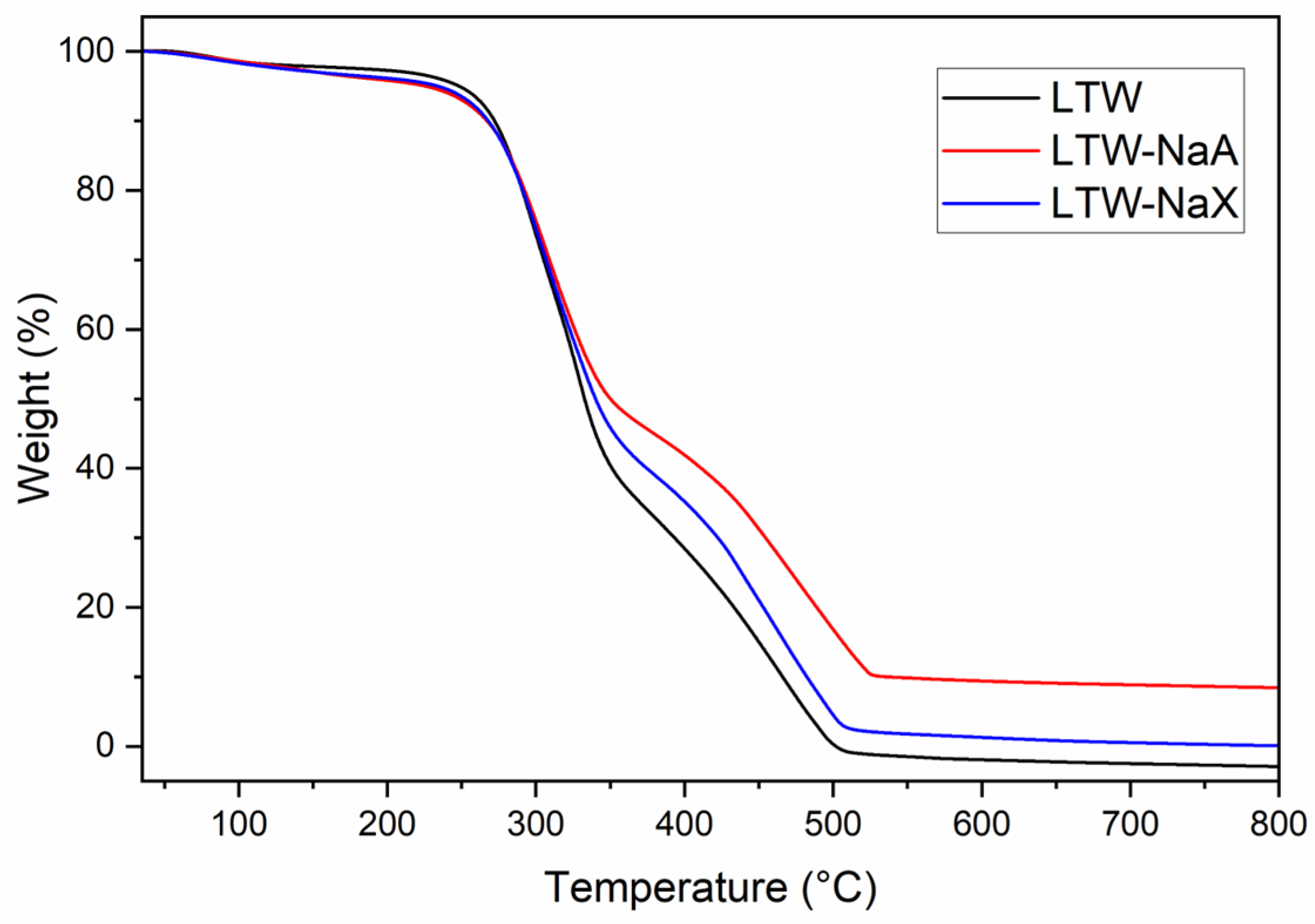
The TGA curves of LTW, LTW-NaA, and LTW-NaX are presented in Figure 1. The weight loss observed between 75–250 °C was attributed to the evaporation of water, while the weight loss between 250–330 °C corresponded to the decomposition of hemicellulose. The third stage of weight loss, occurring between 350–450 °C, was associated with cellulose degradation, and the final weight loss above 450 °C was due to lignin decomposition [22,23]. Because LTW shows a complete weight loss at the end, the remaining residues from LTW-NaA and LTW-NaX were assumed to be zeolite.
Table 2 lists the initial and weights, and % residue from LTW, the composite (LTW-NaA, LTW-NaX), zeolite powders outside the wood (LTW-NaA-P, LTW-NaX-P), and zeolite synthesized without the wood addition (NaA and NaX). The zeolite loading was not controlled by the initial mass ratio but governed by crystallization behavior within the wood matrix. The residual from the wood–zeolite composites contained different amounts of zeolite, with LTW-NaA at 10.0 wt.% and LTW-NaX at 2.0 wt.%. Due to single-run TGA measurements and assumptions about the ash content of LTW, these loading values should be regarded as approximate. This result shows that zeolite NaA preferentially forms in the lead tree wood compared to zeolite NaX. This difference further confirms the preferential crystallization of NaA in untreated LTW. The higher zeolite loading in LTW–NaA could directly contribute to its improved adsorption performance compared with LTW–NaX.
The weight losses from LTW-NaA-P and NaA were 19.3% and 21.9%, respectively. Their weight loss was due to dehydration and decarbonation, consistent with the literature [22]. Similarly, the weight losses from LTW-NaX-P and NaX were 20.0% and 25.4%, respectively. It was reported in the literature that fully hydrated NaX zeolite typically contains approximately 20–25 wt.% zeolitic water, which is progressively removed during thermal dehydration below ~400 °C [3].

3.2. Phase and Morphology of LTW–Zeolite Composites and Powder

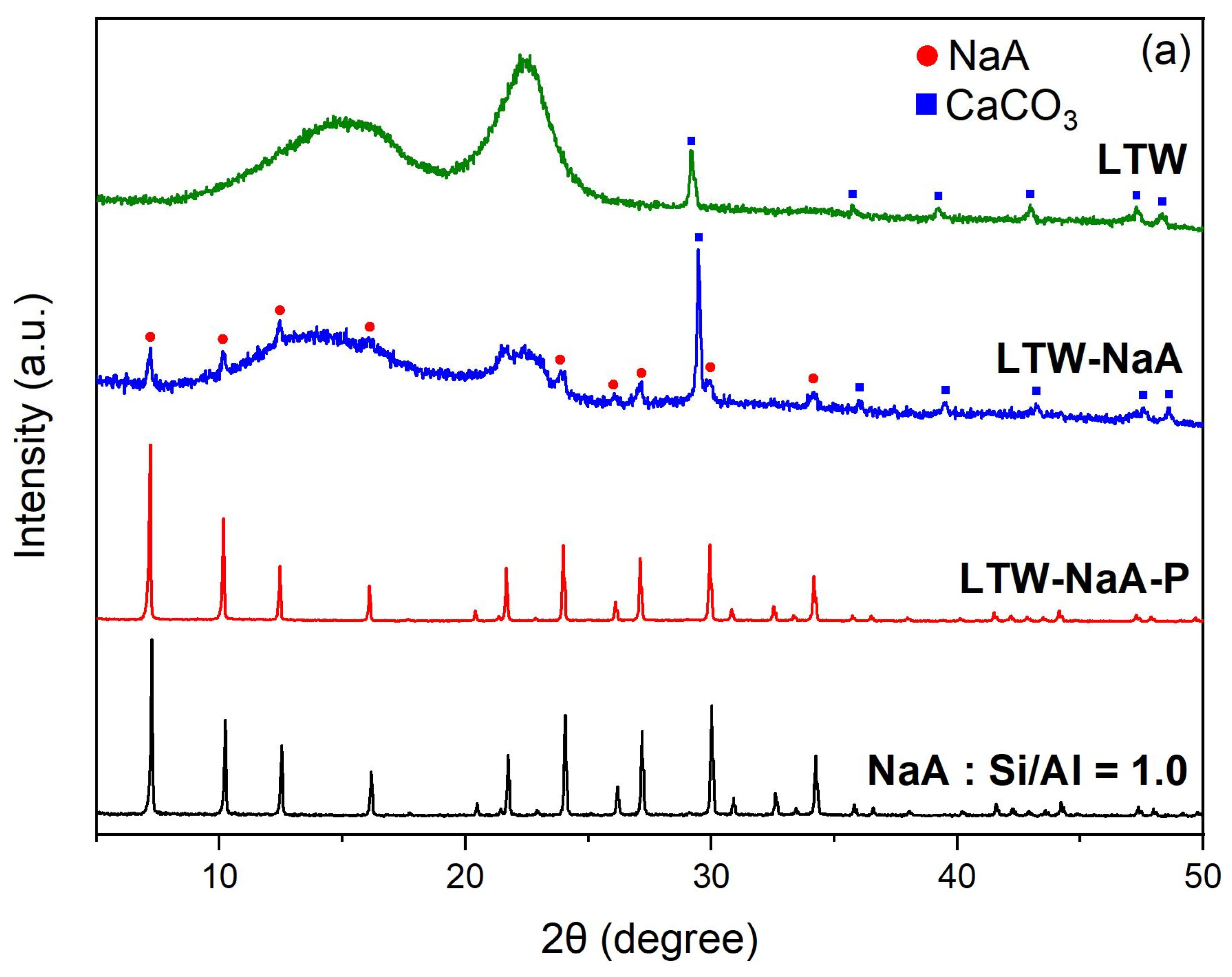
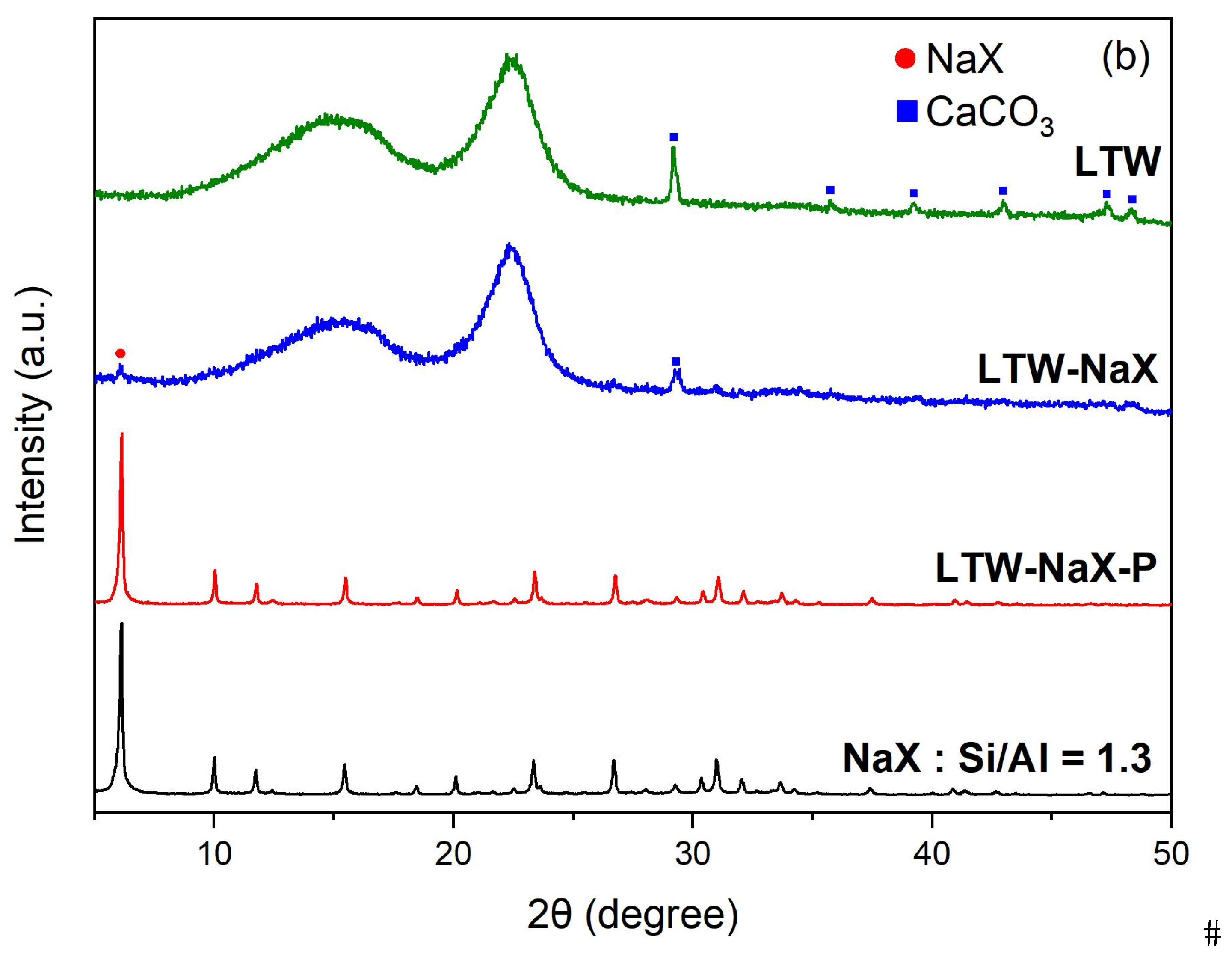
Figure 2 compares XRD patterns of LTW, zeolite–wood composites (LTW-NaA and LTW-NaX), powders (LTW-NaA-P and LTW-NaX-P), with those of zeolites synthesized in the absence of wood. LTW exhibits broad diffraction features characteristic of lignocellulosic materials, mainly originating from cellulose microfibrils [23], confirming the amorphous nature of untreated lead tree wood. Moreover, the peaks corresponding to calcites were observed [24]. After hydrothermal treatment in zeolite synthesis gels containing lead tree wood, the LTW-NaA composite displayed distinct diffraction peaks corresponding to the LTA framework of zeolite NaA [7]. These reflections indicate that NaA crystals were successfully formed both on the external surface and within the porous structure of the wood substrate. In contrast, the LTW-NaX sample (Figure 3) did not show clear diffraction peaks attributable to the FAU-type NaX structure [5,7], suggesting that the amount of NaX crystallized within the wood matrix was relatively small compared with that of NaA. The attenuation of cellulose diffraction in LTW-NaA further supports the higher zeolite coverage observed by SEM and TGA.
The different phase formation behavior of NaA and NaX in untreated LTW can be attributed to the distinct crystallization conditions and nucleation characteristics of the two zeolite frameworks. Zeolite crystallization is highly sensitive to synthesis parameters such as alkalinity, Si/Al ratio, and crystallization time, which control nucleation and phase development during hydrothermal synthesis [25]. In particular, the physicochemical properties and formation behavior of zeolites are strongly influenced by the Si/Al ratio and the distribution of aluminum atoms within the framework [13]. Zeolite NaA typically crystallizes rapidly under highly alkaline conditions and relatively low silica content, whereas the formation of NaX generally requires a more balanced Si/Al ratio and longer crystallization time to allow the development of the larger FAU framework [26]. Furthermore, studies on zeolite nucleation have shown that local variations in composition and synthesis environment can strongly influence framework selection, sometimes favoring LTA nucleation over FAU structures [27]. When the synthesis gel penetrates the wood structure, diffusion limitations within the wood pores and interactions with lignocellulosic components may alter the local gel composition and alkalinity. Such confinement effects can promote heterogeneous nucleation of certain zeolite frameworks while suppressing others, thereby favoring the formation of NaA over NaX within untreated LTW. Consequently, NaA crystallization occurs more readily inside the wood matrix than NaX, which explains the stronger XRD signals observed for LTW-NaA.
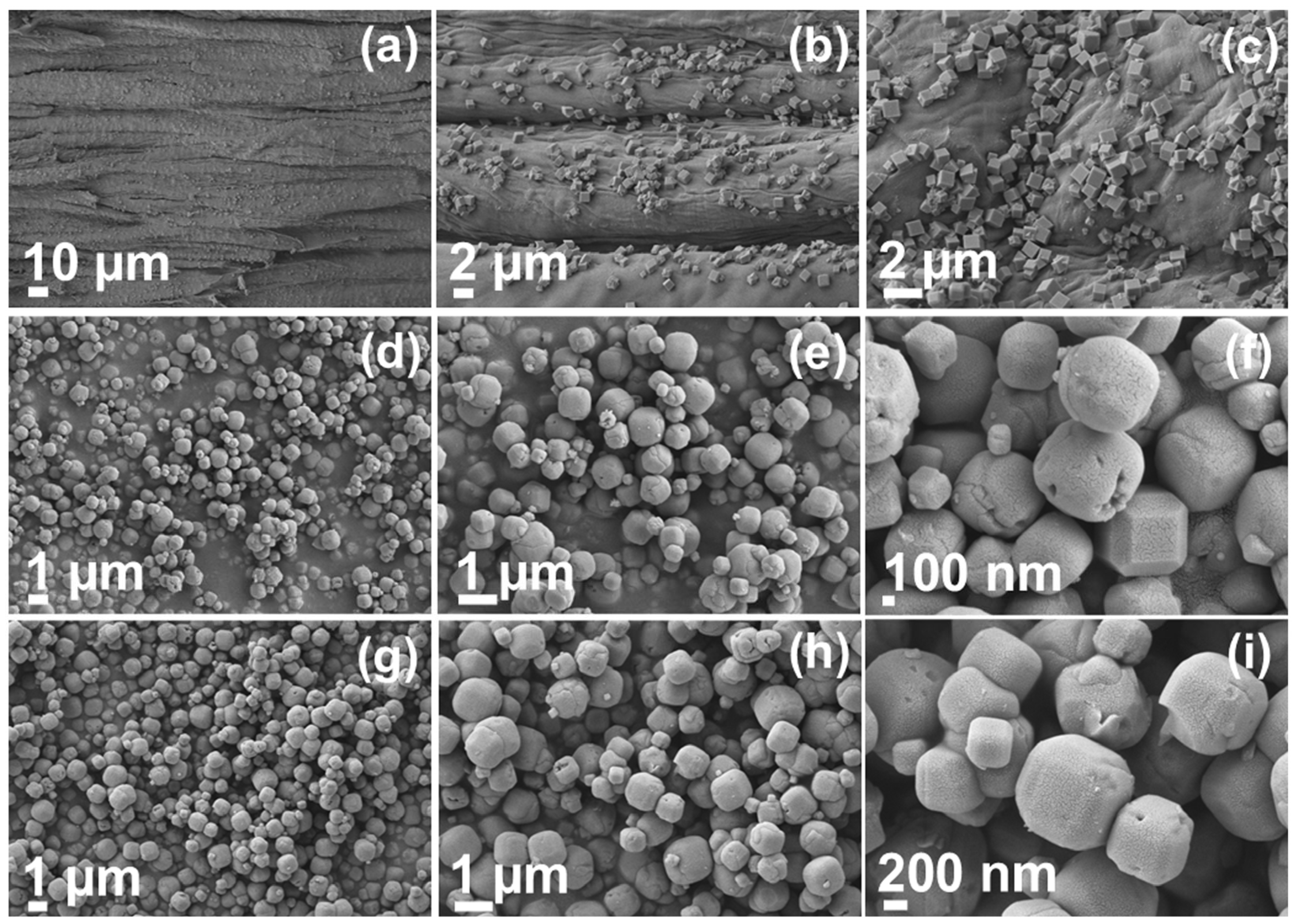
SEM observations further support the XRD results and provide detailed information on the morphology and spatial distribution of zeolite crystals. As shown in Figure 3a–c, cubic NaA crystals with an average size of approximately 0.41 ± 0.11 μm were densely distributed on the LTW surface. The cubic morphology is characteristic of the LTA framework and is commonly observed for hydrothermally synthesized zeolite NaA [28,29], indicating a high degree of crystallinity. The relatively uniform distribution of these crystals suggests that the wood surface and internal channels provide numerous nucleation sites for zeolite growth. Hydroxyl groups present in cellulose and lignin may interact with aluminosilicate species in the synthesis gel, facilitating heterogeneous nucleation of NaA crystals on the biomass substrate. However, LTW-NaA-P and NaA display morphology of swollen cubic similar to NaA synthesized from sugarcane bagasse ash [30]. Their average particle sizes are 0.56 ± 0.21 μm and 0.68 ± 0.27 μm. Variations in synthesis conditions such as alkalinity, aluminum source, and gel composition can alter the crystal growth rates of specific faces, leading to modified morphologies [31].
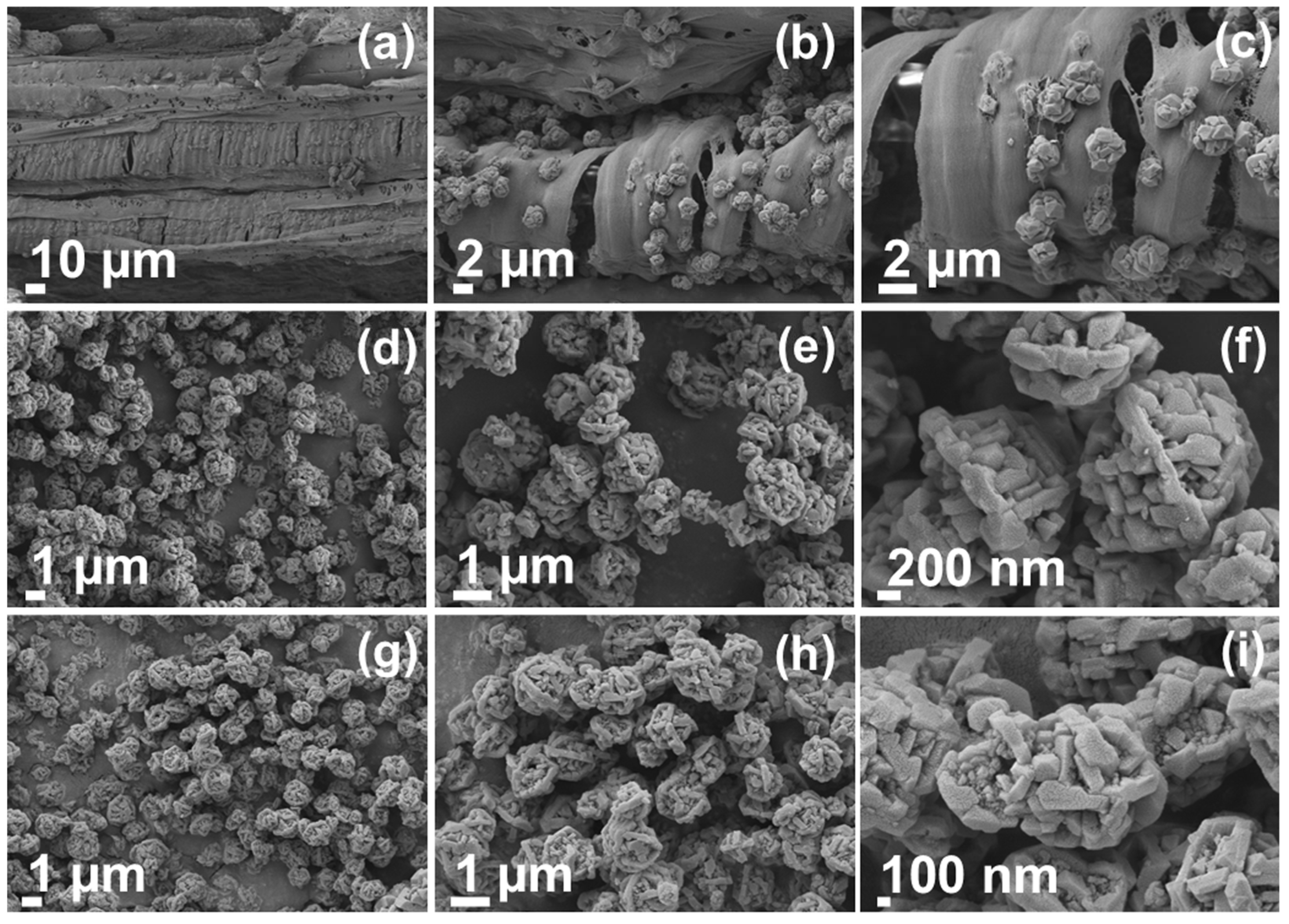
In contrast, the LTW-NaX composite exhibited a much lower surface coverage of zeolite crystals (Figure 4a–c). Their average particle sizes are 1.95 ± 0.42 μm. The observed NaX particles appear as irregular polycrystalline aggregates rather than well-defined individual crystals. This morphology indicates that NaX nucleation and growth were less favorable under the synthesis conditions used, particularly within the confined wood matrix. The limited accessibility of the larger FAU framework within the narrow pores of the wood structure may restrict crystal growth and reduce the overall amount of NaX formed on the biomass substrate.
The LTW-NaX-P and NaX crystals (Figure 4d–f and Figure 4g–i, respectively) exhibit submicron polyhedral particles with rough surfaces and partial aggregation. Their average particle sizes are 1.45 ± 0.28 μm and 1.34 ± 0.29 μm, respectively. In contrast, Pansakdanon et al. [32] reported larger NaX particles of approximately 1.2–1.8 μm composed of spherical polycrystalline aggregates formed by intergrown crystallites after longer hydrothermal crystallization.

3.3. Cu(II) Adsorption Behavior

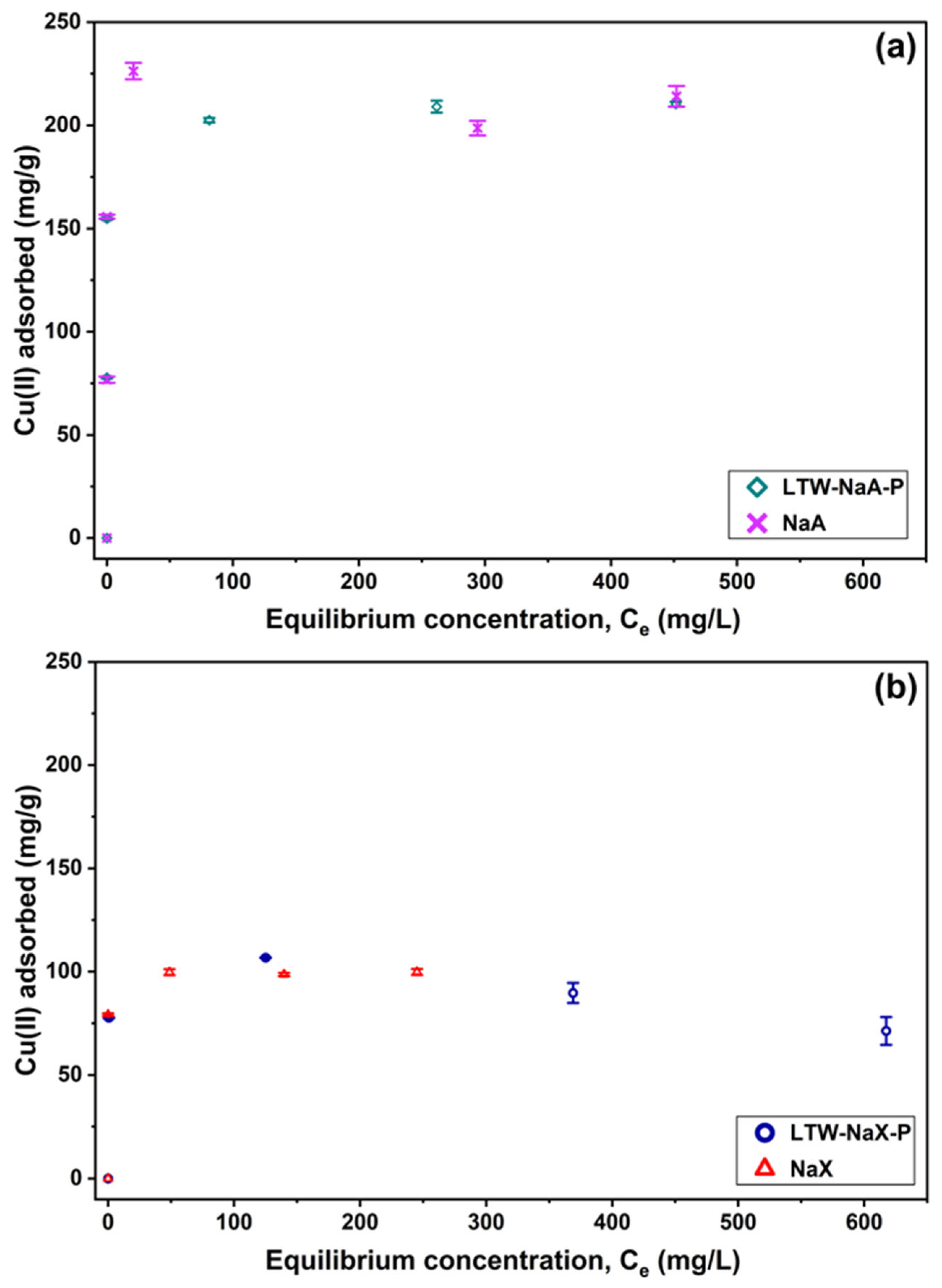
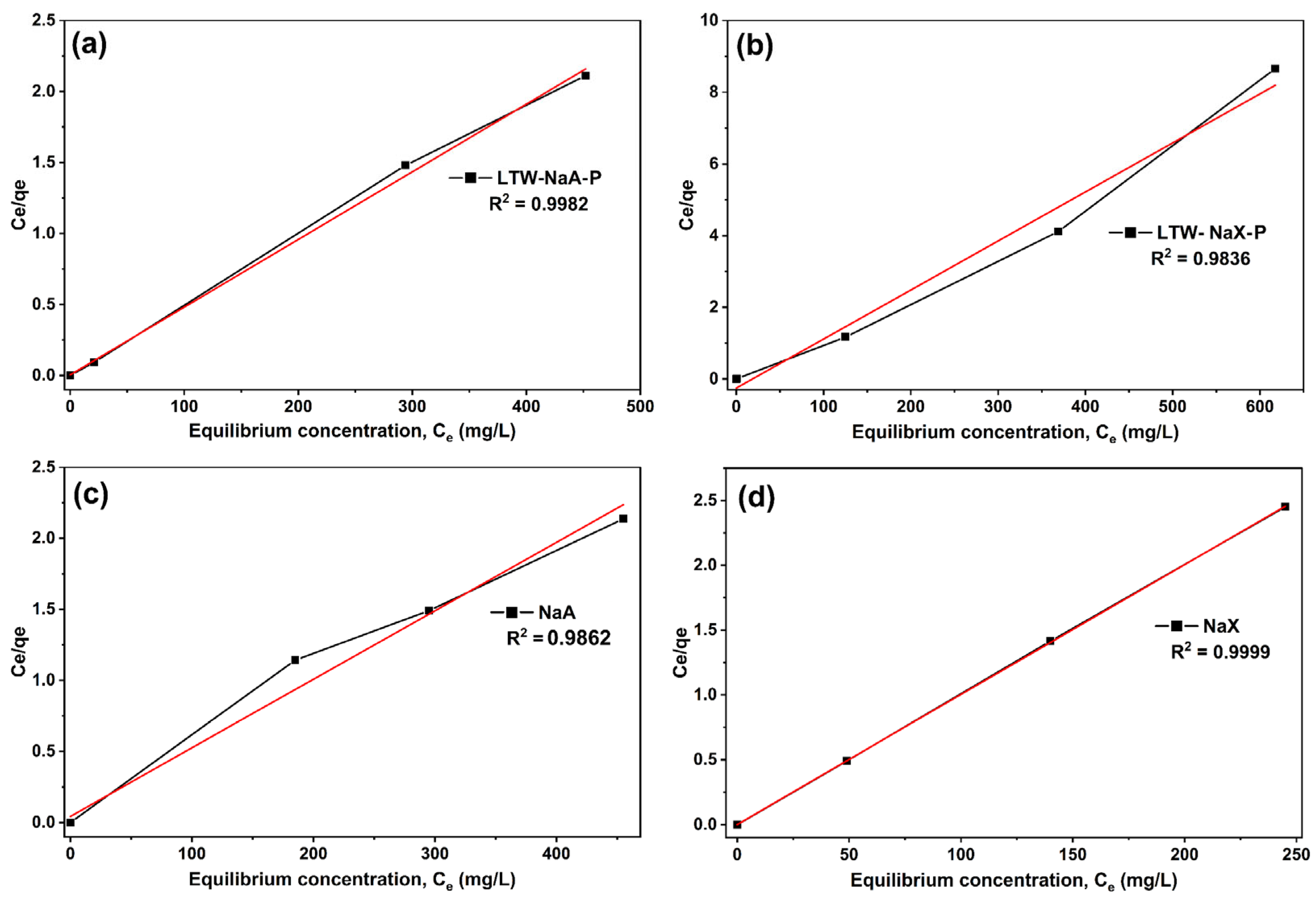
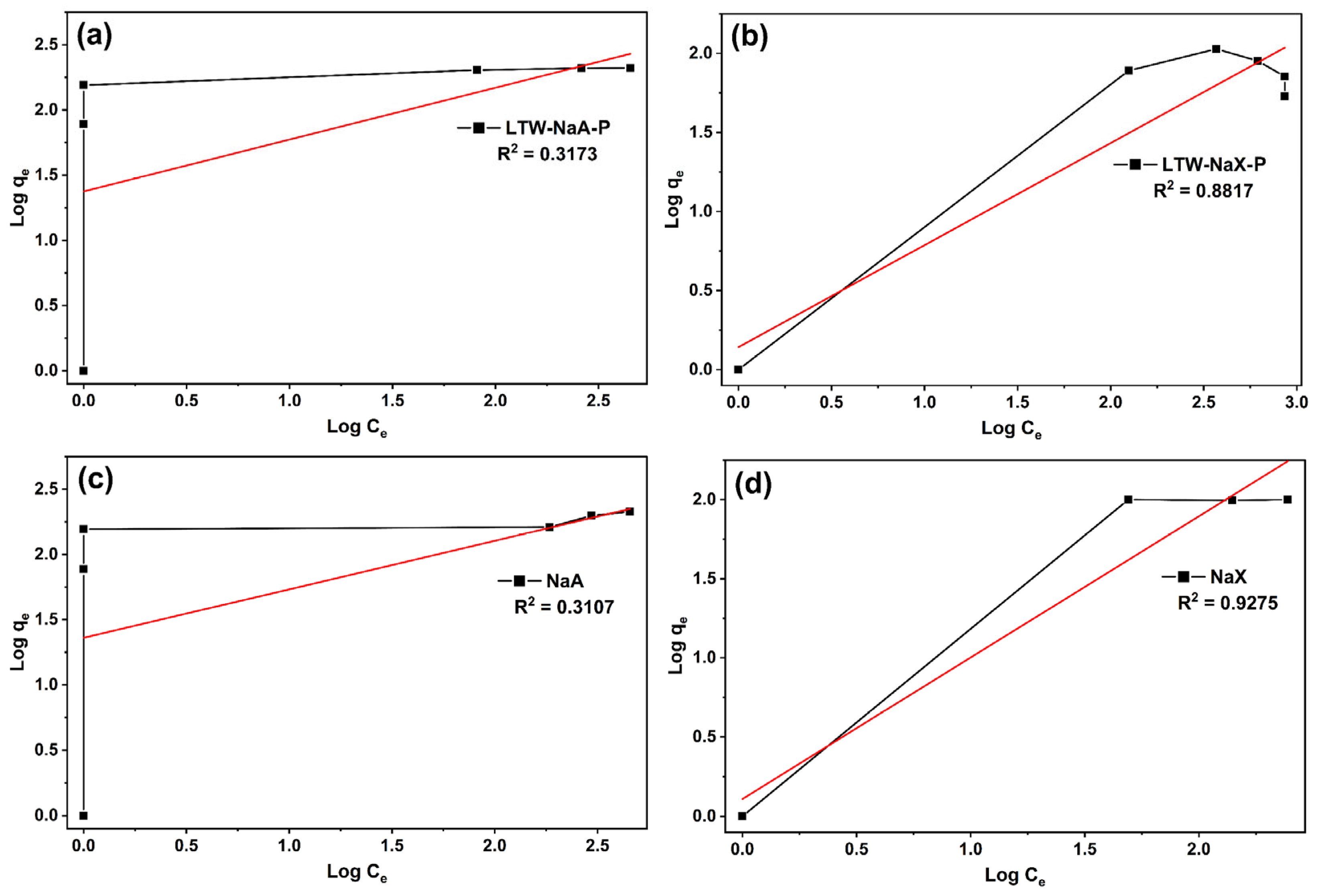
The adsorption behavior was first classified using Giles isotherms to qualitatively describe the interaction between Cu(II) and the adsorbent surface, while the Langmuir and Freundlich models were applied to quantitatively evaluate the adsorption capacity and fitting parameters. Figure 5 exhibits the Cu(II) adsorption isotherms of the zeolite powders synthesized with the wood pellets (LTW-NaA-P and LTW-NaX-P) compared with those synthesized without the wood pellets (NaA and NaX). The adsorption depends on the zeolite framework type [10,11]. NaA powder and LTW-NaA-P displayed Giles H-type isotherms [33], characterized by a steep initial uptake and rapid saturation, indicating strong ion-exchange interactions at uniform adsorption sites [10,11]. In contrast, NaX powder and LTW-NaX-P followed L-type isotherms, suggesting adsorption on heterogeneous sites with progressively weaker affinity. The corresponding Langmuir and Freundlich linear plots used for parameter estimation are presented in Figure 6 and Figure 7.
Figure 6 and Figure 7 show Cu(II) adsorption fitted with Langmuir and Freundlich models, respectively. The parameters are summarized in Table 3. According to the Langmuir model, all adsorbents show high linearity (R2 = 0.9836–0.9999), confirming that Cu(II) adsorption predominantly occurs via monolayer coverage on relatively homogeneous surfaces. Among them, NaX and LTW-NaA-P exhibit the best fit, indicating highly uniform adsorption sites and ideal Langmuir behavior, while LTW-NaX and NaA show slightly lower but still strong agreement. In contrast, the Freundlich model provides markedly poorer fits for NaA-based adsorbents (Table 3), further confirming that Cu(II) adsorption is dominated by monolayer coverage on relatively uniform ion-exchange sites.
The maximum adsorption capacities are summarized in Table 4, along with corresponding literature values. NaX-based materials typically exhibit lower Cu(II) uptake than NaA-based samples, which has been attributed to weaker ion-exchange interactions within the larger FAU-type pore system [34]. LTA-type zeolites (NaA), characterized by higher framework charge density, typically exhibit stronger ion-exchange interactions with Cu(II) compared to FAU-type zeolites (NaX), which possess larger pores and lower charge density, leading to relatively weaker adsorption. NaA and LTW-NaA-P exhibit a maximum adsorption capacity of 210 mg/g, which is significantly higher than values reported for similar materials [10,11]. Although LTW-NaA exhibits lower adsorption capacity than NaA and LTW-NaA-P, it contains approximately 10 wt.% zeolite in the wood. Thus, the dispersion of NaA in the wood significantly improves the adsorption per weight of zeolite. Similar behavior is observed on LTW-NaX which contains only approximately 2 wt.% zeolite. Despite the lower zeolite loading in LTW-NaX, its higher adsorption capacity compared with LTW-NaA suggests stronger accessibility of hydrated Cu(II) species within the larger supercages of NaX when immobilized in wood [35]. The extremely high normalized value from LTW-NaX reflects the very low estimated zeolite loading and associated uncertainty, and should therefore be interpreted with caution; the data primarily indicate that even a small amount of NaX dispersed in wood can contribute significantly to Cu(II) uptake.
The superior performance of NaA powder is attributed to its narrow pore openings, which promote partial dehydration of Cu(II) prior to ion exchange, thereby strengthening electrostatic interactions. In contrast, the larger pores of NaX allow hydrated Cu(II) to remain partially solvated, which weakens ion-exchange efficiency. At high Cu(II) concentrations, hydrolyzed copper species (e.g., CuOH+, Cu2(OH)22+) with larger effective radii further reduce accessibility to NaA micropores, contributing to deviations from ideal Langmuir behavior [36]. Considering the experimental pH range (initial 4.1–4.8, with final values up to ~7.0; Table 1), Cu(II) is expected to be predominantly present as Cu2+ at lower pH, with partial hydrolysis to species such as CuOH+ and Cu2(OH)22+ as the pH increases. This speciation is consistent with the observed adsorption behavior and supports the proposed ion-exchange and surface complexation mechanisms.
Overall, these results demonstrate that zeolite framework topology and pore confinement dominate the Cu(II) adsorption behavior, while the biomass support primarily governs adsorbent handling and separability.
Table 4. Cu(II) adsorption capacity compared with the literature values.
SampleCu(II) Adsorption Capacity (qm) per Gram of Adsorbent
(mg/g)
Cu(II) Adsorption Capacity (qm) per Gram of Zeolite
(mg/g-Zeolite)
Adsorption ParametersReference
LTW-NaA64 a640 bSee Table 1This work
LTW-NaA-P210 ± 0.68 c210See Table 1This work
NaA210 ± 4.79 c207See Table 1This work
NaA203203Solution concentration: 100 mg L−1
Solution pH: 5
Adsorption dose: 2.5 g L−1
[10]
NaA140140Solution concentration: 100 mg L−1
Solution pH: 5.2
Adsorption dose: 2.5 g L−1
[35]
LTW-NaX84 a3318 dSee Table 1This work
LTW-NaX-P55 ± 3.43 c57See Table 1This work
NaX100 ± 1.27 c100See Table 1This work
Coal Gangue-Derived NaX185185Solution concentration: 200 mg L−1
Solution pH: N/A
Adsorption dose: 1 g L−1
[11]
NaX8888Solution concentration: 25–300 mg L−1
Solution pH: N/A
Adsorption dose: 2 g L−1
[37]
NaX254254Solution concentration: 6–127 mg L−1
Solution pH: 5.8
Adsorption dose: 1 g L−1
[38]
a Adsorption capacity at equilibrium; b From TGA, LTW-NaA contains approximately 10.0 wt.% of zeolite; c From Langmuir qm; d From TGA, LTW-NaX contains approximately 2.2 wt.% of zeolite.

4. Conclusions

Zeolites NaA and NaX were successfully synthesized in the presence of untreated lead tree wood, forming wood–zeolite composites together with external zeolite powders. Under the applied conditions, NaA crystallized more readily within the wood matrix, leading to a higher zeolite loading (≈10 wt.%) compared to NaX (≈2 wt.%), as estimated by TGA. The adsorption behavior toward Cu(II) was influenced by both zeolite framework topology and confinement within the biomass structure. NaA powders exhibited the highest adsorption capacity (qm ≈ 210 mg g−1) and H-type isotherms, consistent with strong ion-exchange interactions, whereas NaX-based materials showed L-type behavior associated with more heterogeneous adsorption sites. For the composites, LTW-NaX showed higher Cu(II) uptake than LTW-NaA despite lower zeolite loading, which can be attributed to improved accessibility of hydrated Cu(II) species within the larger pore system of the FAU framework. When normalized by zeolite content, the composites exhibited comparable or enhanced performance relative to the corresponding powders, suggesting a beneficial effect of dispersion within the wood matrix.
This work demonstrates that biomass-supported zeolites prepared without pretreatment are promising, easily recoverable adsorbents for aqueous metal removal. Further studies are needed to evaluate adsorption performance under varying conditions, as well as the regenerability and long-term stability of these materials. Future work will focus on regeneration cycling and on assessing adsorption performance at lower Cu(II) concentrations more representative of typical wastewater conditions.

Author Contributions

Conceptualization, C.K. and J.W.; methodology, R.J., C.K., N.O. and J.W.; validation, S.P. and J.W.; formal analysis, R.J., S.C. and C.U.; investigation, R.J. and S.C.; data curation, R.J. and S.C.; writing—original draft preparation, R.J., S.C., C.U., C.K., N.O., S.P. and J.W.; writing—review and editing, R.J., S.C., C.K., N.O. and J.W.; supervision, S.P. and J.W. All authors have read and agreed to the published version of the manuscript.

Funding

This research received no external funding.

Data Availability Statement

The data presented in this study are available on request from the corresponding author.

Acknowledgments

This work was supported by Suranaree University of Technology (SUT), Thailand, including Outstanding Academic Performance Scholarship for R.J. and C.U. and SUT One Research One Graduate (OROG) scholarship for S.C.

Conflicts of Interest

The authors declare no conflict of interest.

Abbreviations

The following abbreviations are used in this manuscript:
LTWLead tree wood
LTW-NaAZeolite NaA composite with Lead tree wood
LTW-NaA-PZeolite NaA powder outside the LTW-NaA composite
LTW-NaXZeolite NaX composite with Lead tree wood
LTW-NaX-PZeolite NaX powder outside the LTW-NaX composite
NaAZeolite NaA synthesized without wood addition
NaXZeolite NaX synthesized without wood addition
SEMScanning Electron Microscopy
TGAThermogravimetric Analysis
XRDX-ray Diffraction

References

  1. Pérez-Botella, E.; Valencia, S.; Rey, F. Zeolites in Adsorption Processes: State of the Art and Future Prospects. Chem. Rev. 2022, 122, 17647–17695. [Google Scholar] [CrossRef]
  2. Yue, S.; Wang, W.; Li, J.; Zhao, X.; Wu, C. Zeolites for Separation: Fundamental and Application. J. Energy Chem. 2022, 66, 426–446. [Google Scholar] [CrossRef]
  3. Breck, D.W. Zeolite Molecular Sieves: Structure, Chemistry and Use; John Wiley & Sons: New York, NY, USA, 1974. [Google Scholar]
  4. Pluth, J.J.; Smith, J.V. Accurate Redetermination of the Crystal Structure of Dehydrated Zeolite A. Absence of Near-Zero Coordination of Sodium. Refinement of Silicon, Aluminum-Ordered Superstructure. J. Am. Chem. Soc. 1980, 102, 4704–4708. [Google Scholar] [CrossRef]
  5. Olson, D.H. The Crystal Structure of Dehydrated NaX. Zeolites 1995, 15, 439–443. [Google Scholar] [CrossRef]
  6. Fan, X.; Liu, H.; Anang, E.; Ren, D. Effects of Electronegativity and Hydration Energy on the Selective Adsorption of Heavy Metal Ions by Synthetic NaX Zeolite. Materials 2021, 14, 4066. [Google Scholar] [CrossRef]
  7. Baerlocher, C.; Brouwer, D.; Marler, B.; McCusker, L.B. Database of Zeolite Structures. Available online: https://www.iza-structure.org/databases/ (accessed on 30 January 2026).
  8. Fu, F.; Wang, Q. Removal of Heavy Metal Ions from Wastewaters: A Review. J. Environ. Manag. 2011, 92, 407–418. [Google Scholar] [CrossRef]
  9. Wang, S.; Peng, Y. Natural Zeolites as Effective Adsorbents in Water and Wastewater Treatment. Chem. Eng. J. 2010, 156, 11–24. [Google Scholar] [CrossRef]
  10. Djamel, N.; Samira, A. Mechanism of Cu2+ ions uptake process by synthetic NaA zeolite from aqueous solution: Characterization, kinetic, intra-crystalline diffusion and thermodynamic studies. J. Mol. Liq. 2020, 323, 114642. [Google Scholar] [CrossRef]
  11. Chen, Y.; Chen, Y.; Xu, H.; Zhao, W.; Feng, G.; Xiao, C. Green Synthesis of Coal Gangue-Derived NaX Zeolite for Enhanced Adsorption of Cu2+ and CO2. Materials 2025, 18, 1443. [Google Scholar] [CrossRef]
  12. Svobodová, E.; Tišler, Z.; Peroutková, K.; Strejcová, K.; Abrham, J.; Šimek, J.; Gholami, Z.; Vakili, M. Adsorption of Cu(II) and Ni(II) from Aqueous Solutions Using Synthesized Alkali-Activated Foamed Zeolite Adsorbent: Isotherm, Kinetic, and Regeneration Study. Molecules 2024, 29, 2357. [Google Scholar] [CrossRef]
  13. Li, J.; Gao, M.; Yan, W.; Yu, J. Regulation of the Si/Al Ratios and Al Distributions of Zeolites and Their Impact on Properties. Chem. Sci. 2023, 14, 1935–1959. [Google Scholar] [CrossRef] [PubMed]
  14. Ji, F.; Li, C.; Tang, B.; Xu, J.; Lu, G.; Liu, P. Preparation of Cellulose Acetate/Zeolite Composite Fiber and Its Adsorption Behavior for Heavy Metal Ions in Aqueous Solution. Chem. Eng. J. 2012, 209, 325–333. [Google Scholar] [CrossRef]
  15. Rad, L.R.; Anbia, M. Zeolite-Based Composites for the Adsorption of Toxic Matters from Water: A Review. J. Environ. Chem. Eng. 2021, 9, 106088. [Google Scholar] [CrossRef]
  16. Legorreta-Castañeda, A.J.; Lucho-Constantino, C.A.; Beltrán-Hernández, R.I.; Coronel-Olivares, C.; Vázquez-Rodríguez, G.A. Biosorption of Water Pollutants by Fungal Pellets. Water 2020, 12, 1155. [Google Scholar] [CrossRef]
  17. Krukkratoke, P.; Keawkumay, C.; Tayraukham, P.; Prompiputtanapon, K.; Khemthong, P.; Prayoonpokarach, S.; Wittayakun, J. Strategic Synthesis to Disperse Zeolite NaY in Lead Tree Wood. Crystals 2022, 12, 504. [Google Scholar] [CrossRef]
  18. Tawachkultanadilok, P.; Osakoo, N.; Keawkumay, C.; Deekamwong, K.; Sosa, N.; Rojviriya, C.; Nijpanich, S.; Chanlek, N.; Prayoonpokarach, S.; Wittayakun, J. Synthesis and Characterization of Zeolite NaY Dispersed on Bamboo Wood. Materials 2023, 16, 4946. [Google Scholar] [CrossRef]
  19. Tawachkultanadilok, P.; Wittayakun, J.; Valentini, F.; Föttinger, K.; Deekamwong, K.; Prayoonpokarach, S. Comparison of Micron- and Nano-Sized Zeolite NaY Composited with Bamboo Charcoal and Their Application in CO2 Adsorption. Mater. Lett. 2024, 377, 137511. [Google Scholar] [CrossRef]
  20. Khaosomboon, P.; Khuanmar, K.; Weerayutsil, P. Synthesis of Zeolite-A and Zeolite-Y Using Silica Gel Waste as Silica Source and Modifying with Fe. Int. J. Eng. Technol. 2018, 7, 1376. [Google Scholar] [CrossRef]
  21. Jantarit, N.; Tayraukham, P.; Osakoo, N.; Föttinger, K.; Wittayakun, J. Formation of EMT/FAU Intergrowth and Nanosized SOD Zeolites from Synthesis Gel of Zeolite NaX Containing Ethanol. Mater. Res. Express 2020, 7, 075011. [Google Scholar] [CrossRef]
  22. Król, M.K.; Jeleń, P. The Effect of Heat Treatment on the Structure of Zeolite A. Materials 2021, 14, 4642. [Google Scholar] [CrossRef]
  23. Li, J.; Lu, Y.; Yang, D.; Sun, Q.; Liu, Y.; Zhao, H. Lignocellulose Aerogel from Wood–Ionic Liquid Solution (1-Allyl-3-methylimidazolium Chloride) under Freezing and Thawing Conditions. Biomacromolecules 2011, 12, 1860–1867. [Google Scholar] [CrossRef] [PubMed]
  24. Sahadat Hossain, M.; Ahmed, S. Crystallographic Characterization of Naturally Occurring Aragonite and Calcite Phase: Rietveld Refinement. J. Saudi Chem. Soc. 2023, 27, 101649. [Google Scholar] [CrossRef]
  25. Asgar Pour, Z.; Alassmy, Y.A.; Sebakhy, K.O. A Survey on Zeolite Synthesis and the Crystallization Process. Crystals 2023, 13, 959. [Google Scholar] [CrossRef]
  26. Mallette, A.J.; Kumari, S.; Rimer, J.D. The Current Understanding of Mechanistic Pathways in Zeolite Crystallization. Chem. Rev. 2024, 124, 3416–3493. [Google Scholar] [CrossRef]
  27. Oleksiak, M.D.; Soltis, J.A.; Marlon, T.; Conato, M.T.; Lee Penn, R.; Rimer, J.D. Nucleation of FAU and LTA Zeolites from Heterogeneous Aluminosilicate Precursors. Chem. Mater. 2016, 28, 4906–4916. [Google Scholar] [CrossRef]
  28. Loiola, A.R.; Andrade, J.C.R.A.; Sasaki, J.M.; da Silva, L.R.D. Structural Analysis of Zeolite NaA Synthesized by a Cost-Effective Hydrothermal Method Using Kaolin and Its Use as a Water Softener. J. Colloid Interface Sci. 2012, 367, 34–39. [Google Scholar] [CrossRef]
  29. Wang, P.; Cao, J.; Zhang, Y.; Sun, Q. Controllable Preparation of Cubic Zeolite A and Application of Langmuir Model in Carbon Dioxide Adsorption. Nanomaterials 2021, 11, 3375. [Google Scholar] [CrossRef]
  30. Keawkumay, C.; Krukkratoke, P.; Youngjan, S.; Osakoo, N.; Deekamwong, K.; Khemthong, P.; Phanthasri, J.; Prayoonpo-karach, S.; Wittayakun, J. Extraction of Silica from Sugarcane Bagasse Ash and Its Utilization in Zeolite 4A Synthesis for CO2 Adsorption. RSC Adv. 2024, 14, 19472. [Google Scholar] [CrossRef]
  31. Round, C.I.; Hill, S.J.; Latham, K.; Williams, C.D. The Crystal Morphology of Zeolite A. The Effects of the Source of the Reagents. Microporous Mater. 1997, 11, 213–225. [Google Scholar] [CrossRef]
  32. Pansakdanon, C.; Seejandee, P.; Kosawatthanakun, S.; Deekamwong, K.; Prayoonpokarach, S.; Wittayakun, J. Influence of Crystallinity of Zeolite NaX as a Support for Potassium Catalyst in Transesterification of Palm Oil. J. Phys. Chem. Solids 2025, 196, 112389. [Google Scholar] [CrossRef]
  33. Giles, C.H.; Smith, D.; Huitson, A. Studies in Adsorption. Part XI. A System of Classification of Solution Adsorption Isotherms, and Its Use in Diagnosis of Adsorption Mechanisms and in Measurement of Specific Surface Area of Solids. J. Chem. Soc. 1960, 2, 3973–3993. [Google Scholar] [CrossRef]
  34. Rongchapo, W.; Keawkumay, C.; Osakoo, N.; Deekamwong, K.; Chanlek, N.; Prayoonpokarach, S.; Wittayakun, J. Comprehension of Paraquat Adsorption on Faujasite Zeolite X and Y in Sodium Form. Adsorpt. Sci. Technol. 2017, 36, 684–693. [Google Scholar] [CrossRef]
  35. Küçük, M.E.; Makarava, I.; Kinnarinen, T.; Häkkinen, A. Simultaneous Adsorption of Cu(II), Zn(II), Cd(II) and Pb(II) from Synthetic Wastewater Using NaP and LTA Zeolites Prepared from Biomass Fly Ash. Heliyon 2023, 9, e20253. [Google Scholar] [CrossRef]
  36. Ahmadi, H.; Duan, Y.; Hussain, S.; Hafiz, S.S.; Sharifi, H.; Habibi, S.S. An Effective Method for Adsorption of Pb2+, Cd2+, and Cu2+ from Wastewater by Using NaXZeolite-Derived from Coal Gangue. Open Access Libr. J. 2022, 9, e9102. [Google Scholar] [CrossRef]
  37. Ezzeddine, Z.; Batonneau-Gener, I.; Pouilloux, Y.; Hamad, H.; Saad, Z. Synthetic Nax Zeolite as a Very Efficient Heavy Metals Sorbent in Batch and Dynamic Conditions. Colloids Interfaces 2018, 2, 22. [Google Scholar] [CrossRef]
  38. Baes, C.F.; Mesmer, R.E. The Hydrolysis of Cations; John Wiley & Sons: New York, NY, USA, 1976. [Google Scholar]
Figure 1. Curves of LTW, LTW-NaA, and LTW-NaX.
Processes 14 01160 g001
Figure 2. XRD patterns of (a) LTW, LTW-NaA, LTW-NaA-P, and NaA; (b) LTW, LTW-NaX, LTW-NaX-P, and NaX. The diffraction peaks were assigned to zeolite NaA (PDF 00-039-0222) and zeolite NaX (PDF 00-038-0237).
Processes 14 01160 g002aProcesses 14 01160 g002b
Figure 3. SEM images with different magnifications: (ac) composites LTW-NaA, (df) LTW-NaA-P, (gi) NaA.
Processes 14 01160 g003
Figure 4. SEM images with different magnifications: (ac) composites LTW-NaX, (df) LTW-NaX-P, (gi) NaX.
Processes 14 01160 g004
Figure 5. Adsorption isotherms of Cu(II) on zeolites samples at room temperature: (a) NaA and LTW-NaA-P; (b) NaX and LTW-NaX-P.
Processes 14 01160 g005
Figure 6. Cu(II) adsorption fitted with Langmuir model of (a) LTW-NaA-P, (b) LTW-NaX-P, (c) NaA and (d) NaX. Black line, experimental data; red line, Langmuir fitting.
Processes 14 01160 g006
Figure 7. Cu(II) adsorption fitted with Freundlich model of (a) LTW-NaA-P, (b) LTW-NaX-P, (c) NaA and (d) NaX. Black line, experimental data; red line, Freundlich fitting.
Processes 14 01160 g007
Table 1. Adsorbent weight, Cu(II) concentration, and the solution pH.
SampleWeight (g)Cu(II) Concentration
(ppm)
Initial pHFinal pH
LTW0.13071004.7914.801
LTW-NaA0.06781004.7915.710
LTW-NaX0.11311004.7915.803
LTW-NaA-P0.05052004.5906.997
LTW-NaA-P0.05024004.4366.084
LTW-NaA-P0.05066004.2304.933
LTW-NaA-P0.05088004.1574.549
LTW-NaA-P0.050910004.1164.378
LTW-NaX-P0.05032004.5906.997
LTW-NaX-P0.05074004.4365.007
LTW-NaX-P0.05096004.2304.611
LTW-NaX-P0.05098004.1574.503
LTW-NaX-P0.050910004.1164.372
Table 2. Sample weight changes from TGA.
SampleInitial Weight (mg)Final Weight (mg)% Residue
LTW9.130.000.0
LTW-NaA9.560.9610.0
LTW-NaA-P14.9711.2780.7
NaA8.676.7778.1
LTW-NaX6.900.152.2
LTW-NaX-P5.744.4880.0
NaX6.014.4874.6
Table 3. Langmuir and Freundlich parameters.
ZeoliteLangmuir ParametersFreundlich Parameters
qm
(mg/g)
KL
(L/mg)
R2nKF
(mg/g) (L/mg)1/n
R2
LTW-NaA64 a-----
LTW-NaA-P210 ± 0.680.99790.99822.5223.80.3173
NaA210 ± 4.790.11010.98622.6922.90.3107
LTW-NaX84 a-----
LTW-NaX-P55 ± 3.430.05430.98361.551.390.8817
NaX100 ± 1.277.36760.99991.121.280.9275
a Adsorption capacity at equilibrium.
Disclaimer/Publisher’s Note: The statements, opinions and data contained in all publications are solely those of the individual author(s) and contributor(s) and not of MDPI and/or the editor(s). MDPI and/or the editor(s) disclaim responsibility for any injury to people or property resulting from any ideas, methods, instructions or products referred to in the content.