
Article

Preparation of Faujasite-Type Zeolite (13X) from Angren Kaolin for Hydrogen Sulfide Adsorptive Purification of Natural Gas


by
Mohsen H. Al-Rashed
1,
Mirzokhid Abdirakhimov
2,*,
Robert Kubica
3,
Alicja Kazek-Kęsik
4 and
Roman Turczyn
5
1
Department of Chemical Engineering, College of Technological Studies, Public Authority for Applied Education & Training, Shuwaikh 70654, Kuwait
2
Institute of Chemical Engineering, Polish Academy of Science, 44-100 Gliwice, Poland
3
Department of Chemical Engineering and Process Design, Silesian University of Technology, 44-100 Gliwice, Poland
4
Department of Inorganic Chemistry, Analytical Chemistry and Electrochemistry, Silesian University of Technology, 44-100 Gliwice, Poland
5
Department of Physical Chemistry and Technology of Polymers, Silesian University of Technology, 44-100 Gliwice, Poland
*
Author to whom correspondence should be addressed.
Processes 2026, 14(3), 471; https://doi.org/10.3390/pr14030471
Submission received: 19 November 2025 / Revised: 24 January 2026 / Accepted: 26 January 2026 / Published: 29 January 2026
(This article belongs to the Special Issue Novel Applications of Zeolites in Adsorption Processes)

Abstract

The extraction of hydrogen sulfide (H2S) from gases is essential in numerous industrial applications to safeguard human safety, preserve equipment, and mitigate environmental harm. In these circumstances, zeolites are crucial for the extraction of H2S from these gases. This study reports, for the first time, the synthesis of 13X zeolite from Angren kaolin using an optimized, fully autoclave-free fusion/hydrothermal route. This method enables 13X crystallization under atmospheric pressure, greatly improving process safety, cost-efficiency, and scalability. The impact of the NaOH ratio on kaolin synthesis was investigated. Thereafter, these samples were analyzed utilizing XRD, SEM, EDS, and BET techniques to evaluate their crystalline structures, surface morphologies, and textural properties. The adsorption of H2S from natural gas was performed using both synthetic and commercial samples in a custom-designed laboratory-scale adsorption machine. The results demonstrated that the synthesized zeolite designated as 13X-III, with a high NaOH ratio, displayed an adsorption capacity higher than that of commercially available 13X molecular sieves (C13X). The synthesized 13X efficiently removed H2S from various gases containing H2S, such as biogas, refinery gases, and natural gas.

1. Introduction

Natural gas is used as an energy-efficient clean fossil fuel as well as a feedstock in petrochemicals. Over the past two decades, the demand for natural gas has steadily risen, accounting for 23% of worldwide primary energy demand according to the International Energy Agency. Although methane (CH4) predominantly constitutes natural gas, it can also contain substantial amounts of ethane (C2H6), propane (C3H8), butane (C4H10), and pentane (C5H12), along with traces of heavier hydrocarbons like hexane (C6H14). Additionally, various natural gases often contain impurities such as nitrogen (N2), carbon dioxide (CO2), hydrogen sulfide (H2S), and other sulfur compounds such as mercaptans (RSH), carbonyl sulfide (COS), and carbon disulfide (CS2). Traces of helium, hydrogen, and argon may also be present. Considering the H2S content in natural gas, this gas is often referred to as “sweet” and “sour”. Although names can technically describe both acid gases (H2S and CO2), they are commonly used specifically for H2S. Natural gas is classified as sweet when its H2S content is below 4 ppm. Sour gas is considered undesirable due to the presence of a significant amount of sulfur compounds, which can pose serious health risks when inhaled and can cause significant corrosion in gas pipelines. To reduce the concentration of H2S to an acceptable level, adsorption and absorption are the most commonly used methods [1]. This process is referred to as sweetening [2]. The adsorption process utilizes various adsorbents, such as metal oxides, zeolites, activated carbon, and MOFs, to selectively remove H2S. Zeolites are particularly effective for dehydration and removing CO2 and sulfur compounds, including hydrogen sulfide, mercaptans, carbonyl sulfide, and other sulfides, from natural gas [3].
Zeolites are crystalline minerals composed of primary structural units consisting of AlO4 and SiO4 tetrahedra. The distinctive structure of zeolites enables their utilization as adsorbents and catalysts in a wide range of industrial applications [4]. Synthetic zeolites such as Linde Type A (3A, 4A, and 5A) and Faujasite (13X) are mostly applied in natural gas purification, dehydration, and desulfurization processes [3]. Among these synthetic zeolites, Faujasite-type 13X possesses a large internal cavity of 13 Å and pore openings of about 8 Å, enabling the adsorption of relatively larger molecules. The most important reactants for the synthesis of zeolites are silicon sources and aluminum sources. The synthesis of zeolites involves the use of several silica sources such as sodium silicate, silica gel, colloidal sol, ethyl orthosilicate, and methyl orthosilicate. Similarly, aluminum sources including sodium aluminate, boehmite (pseudo-boehmite), aluminum hydroxide, aluminum isopropoxide, aluminum nitrate, and metallic aluminum are used in the process [5]. Furthermore, inexpensive raw materials can be utilized as a source of aluminum and silica, leading to a decrease in the overall cost of zeolite [6].
The synthesis of LTA-type zeolites from diverse materials, such kaolin [7,8,9], coal fly ash [10], attapulgite [11], and halloysite [12], has been the subject of numerous studies. Kaolin is commonly chosen for producing zeolites as it contains both Si and Al [13]. There are numerous methods for synthesizing zeolite from kaolin, each of which is characterized by its own set of conditions. For instance, microwave-assisted synthesis is employed to accelerate chemical reactions by heating reaction materials using microwave radiation [14]. Hydrothermal synthesis is utilized to synthesize zeolites by subjecting them to specific temperature and pressure conditions in either aqueous or organic solvents in a sealed container [5]. The fusion/hydrothermal method is a combination of the fusion method and the conventional hydrothermal method. This technique is employed to improve the physical and chemical characteristics of zeolites while reducing both the time and cost required for synthesis [15].
Cecilia et al. [16] reported the hydrothermal synthesis of zeolite 4A from kaolinite for CO2 capture. The optimal temperature for synthesis of 4A zeolite was 100 °C for 48 h. The microwave-assisted synthesis of zeolite 5A from Iraqi kaolin showed a higher adsorption capacity for H2S (37.19 µmol/g) compared to zeolites 4A and 3A [17]. Liu and Wang [11] carried out an experiment on H2S removal using 4A zeolite synthesized from attapulgite. Their findings indicated that 4A zeolite, when synthesized under optimal conditions, could remove H2S, exhibiting a breakthrough adsorption capacity of 8.36 mg/g. Mohamed et al. [8] prepared 4A zeolite from local kaolin by pre-treating hydrochloric acid followed by metakaolinization for dehydration and desulfurization of liquefied petroleum gas (LPG). The results of that work showed that synthesized 5A exhibits excellent dehydration and desulfurization properties. The synthesis of 13X zeolite from calcined kaolin and sodium silicate has been thoroughly investigated by De Lucas et al. [18]. Multiple synthesis conditions including gel formation, aging time and temperature, and crystallization time and temperature were employed to identify optimal synthesis parameters. Chandrasekhar and Pramada [19] reported the synthesis of 13X from Kerala kaolin by maintaining the moral ratio SiO2/Al2O3 = 3; Na2O/SiO2 = 1.1 and H2O/Na2O = 40. As SiO2/Al2O3 in kaolinite is equal to 2, sodium silicate was added to increase the Si ratio. Aging at room temperature for 24 h and heating at 87 ± 2 °C for 15 h was an optimal condition for the 13X synthesis.
Uzbekistan is one of the countries with abundant kaolin resources. As per the United States Geological Survey (USGS), it was the third-largest producer of kaolin in 2021 [20]. Angren Kaolin is the sole facility in Central Asia that produces enhanced kaolin. AKF-78, AKC-30, and ACT-10 are varieties of enriched kaolin utilized in several applications, including the fabrication of kaolin wool, ceramics, cables, plastics, adhesives, and as a filler in paper production. To date, no existing investigation or research has focused on the synthesis of zeolites derived from Angren kaolin.
Therefore, the aim of this work was the synthesis of 13X zeolite from Angren kaolin by the fusion/hydrothermal method. Typically, the aging and crystallization steps in zeolite synthesis are carried out in a sealed autoclave to enhance the reactivity of the reagents [5]. In contrast to such hydrothermal routes that require sealed, high-pressure autoclaves, this study shows that zeolite 13X can be fully crystallized in open, low-pressure reactors. Conducting synthesis without an autoclave not only simplifies the overall procedure, but also removes major equipment limitations and greatly improves the scalability of 13X production. The use of methane as the primary gas matrix introduces competitive adsorption effects that are not present in inert systems. This approach provides a more accurate assessment of adsorbent performance under real natural gas-sweetening conditions. The H2S adsorption properties of the samples were evaluated using a specially designed in-house laboratory-scale adsorption setup.

2. Materials and Methods

Materials used in this study included NaOH as an alkaline activating agent from Stanlab LLC, Lublin, Poland; AKC-30-enriched kaolin provided courtesy of Angren Kaolin LLC, Angren, Uzbekistan; methane 2.5 from Siad Poland LLC, Ruda Śląska, Poland; 5000 ppm H2S in CH4 supplied by Air Liquide Polska LLC, Kraków, Poland; and deionized water and standard 13X molecular sieve (labelled C13X) obtained from Hurtland LLC, Lublin, Poland.

2.1. Synthesis and Characterization

The fusion/hydrothermal technique was used to synthesize 13X molecular sieve from kaolin adopted by Lim et al. [21] with some required modifications. Prior to synthesis, the kaolin was dried in an oven at a temperature of 110 °C for 10 h. Next, 10 g of kaolin was mixed with 8, 10, and 12 g of NaOH (synthesized zeolites were labelled 13X-I, 13X-II, and 13X-III, respectively) and then ground. Fusion was carried out at 550 °C for 1 h. The fused product was then pulverized and dissolved in 100 mL of deionized water. To augment crystallization, 0.1 g of C13X was added. The mixture was subjected to aging at 30 °C for 5 h, and subsequently crystallization was carried out at 90 °C for an additional 5 h using a magnetic stirrer.
Zeolite shaping was carried out using an extruder, and with the aid of a press, it was moulded into spaghetti-like noodle shapes with a diameter of 3 mm. To remove water, samples were dried at 110 °C for 12 h. Next, samples underwent calcination at 550 °C for 2 h in order to enhance their mechanical and textural properties. The calcined noodles were then cut to a length of 0.5 to 1 cm to facilitate their placement into the adsorber for H2S adsorption.
Morphological features of these samples’ surfaces were obtained by scanning electron microscope (SEM) images using a Phenom ProX SEM (Phenom-World BV, Eindhoven, The Netherlands). For SEM imaging, samples were coated with a thin layer of gold and mounted on a slab using double-sided tape. The accelerating voltage of the primary electron beam was 10 kV. The elemental analysis of these samples was carried out by energy dispersive X-ray spectroscopy (EDS) during SEM image acquisition. The phase composition of samples was determined using a powder X-ray diffractometer Seifert 3003TT (Seifert Analytical X-Ray, Ahrensburg, Germany) with a Cu X-ray tube (the radiation wavelength (λ, CuKα) was 1.54178 Å, whereas that of CuKß was 1.392 Å). Powder samples were analyzed between 5° and 80° of 2Theta with a 0.05° step. The N2 adsorption isotherm and the BET surfaces of these samples were measured using a Micromeritics ASAP 2020 adsorption analyzer (Micromeritics Inc., Norcross, GA, USA).

2.2. H2S Adsorption Experiments

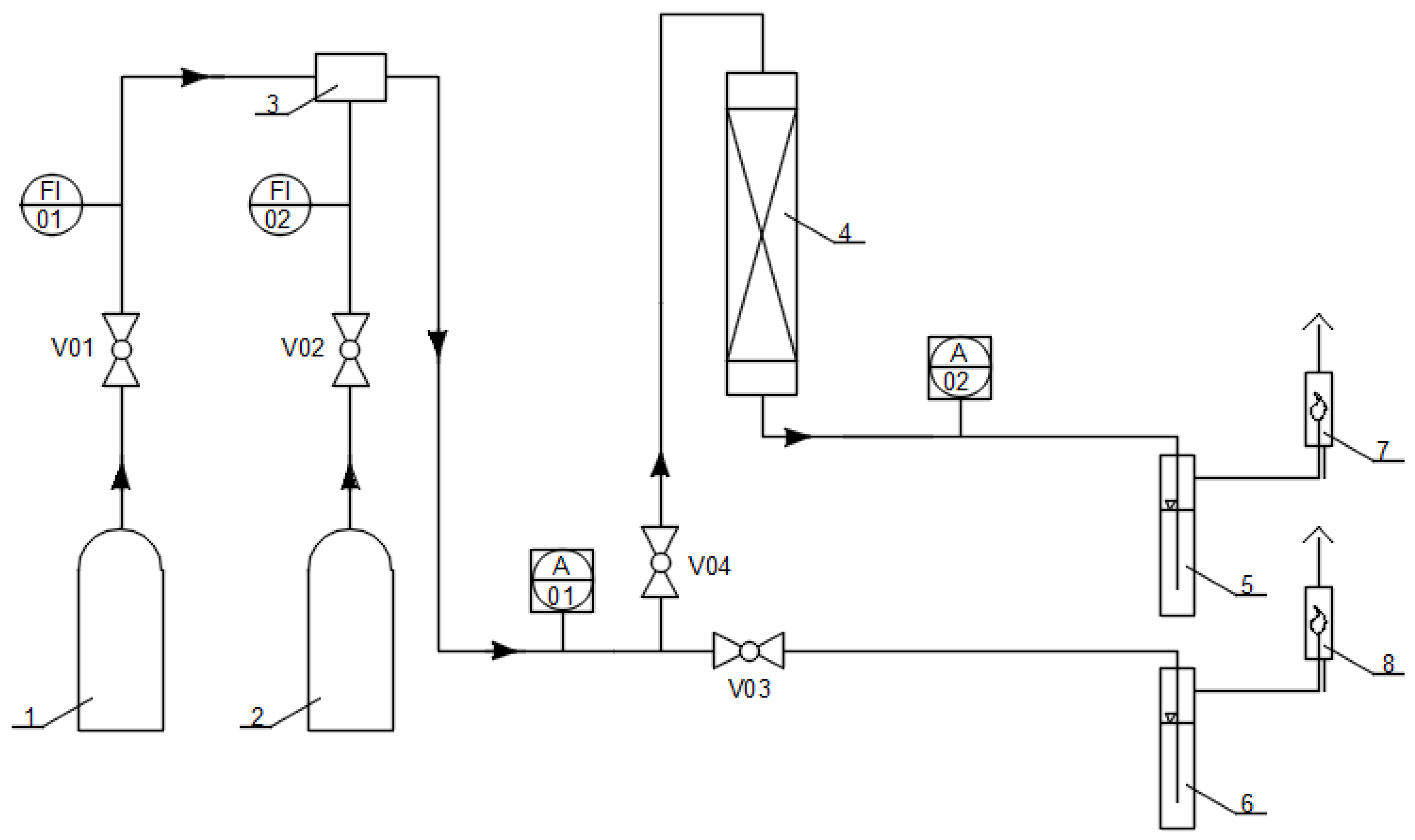
H2S adsorption was performed in the laboratory-scale experimental set-up described in previous research [22] and shown in Figure 1. All experiments were carried out at ambient conditions. Five grams of zeolite was inserted into the Teflon adsorber, measuring 400 mm in length and 15 mm in internal diameter. A gas mixture containing 150 ppm H2S in methane was introduced to the adsorber at a flow rate of 400 mL/min. The initial and breakthrough concentrations of H2S were monitored using H2S-150 hydrogen sulfide analyzers (Southland Sensing Ltd., Ontario, CA, USA). These experiments concluded once the outlet concentration of H2S reached 15 ppm, which corresponded to 10% of the initial concentration. The adsorption capacity of samples was calculated using Equation (1) according to the breakthrough data.
C a d s = Q t o t · M W · [ C i n · t 1 t 1 t 0 ] · 0.5 V m · m · 10 3
where Q t o t   is the total gas flow rate (NL/h), M W is the molecular weight of H2S, C i n is the inlet H2S concentration, t 1 is the breakthrough time when the outlet concentration is 1 ppmv (h), t 0 is the breakthrough time at the last detection of 0 ppmv (h), V m is the molar volume (24,414 NL/mol), and m is the mass of adsorbent material (g).

3. Results and Discussion

3.1. XRD Patterns

Figure 2 shows XRD patterns for 13X-I, 13X-II, and 13X-III. The peak intensity increased with a higher NaOH/kaolin ratio. While 13X-I exhibited modest peak intensities, indicating low crystallinity, 13X-III displayed much higher peak intensities, suggesting a phase of high crystallinity.
To confirm the crystal structures of these samples, diffractograms of these samples were compared with diffractograms of C13X and with the reference dehydrated NaX [23] (Figure 3). The XRD pattern of 13X-I showed mainly an amorphous phase along with a crystalline phase composed of sodium aluminum silicate (Na51Al51Si141O384(H2O)7.83) according to PDF card no. 01-076-0591. The main diffraction peaks were observed only at 2θ = 6.10, 9.95, 15.4, 23.35, 26.6, and 31.1. However, XRD diffraction patterns of 13X-II and 13X-III primarily exhibited a crystalline phase, as the crystallinity increased with the alkali amount (NaOH) [24]. Both samples contained sodium aluminum silicate (Na2Al2Si2.5O96.2∙(H2O)), as indicated by PDF card no. 00-038-0237. The main diffraction peaks for 13X-II and 13X-III were observed at 2θ = 6.10, 9.95, 11.7, 15.4, 18.35, 20.01, 23.25, 29.1, 26.6, 30.9, 32, and 33.50. These are the characteristic peaks of Faujasite zeolite [23].
All samples exhibited a diffraction peak at 2θ = 26.6, which is indicative of quartz [23]. Quartz, present in kaolin, remains intact during metakaolinization and subsequent conversion to zeolite [19]. The XRD patterns of 13X-II and 13X-III exhibited the characteristic diffraction peaks that correspond to “standard zeolite”.
Comprehensive qualitative and quantitative phase identification of samples using the Rietveld method was crucial for accurately assessing their phase composition. However, kaolin is an inherently impure raw material and typically contains various mineral impurities. These impurities can hinder the formation of the desired zeolite phases and promote the presence of amorphous components, complicating reliable phase identification.

3.2. SEM Images

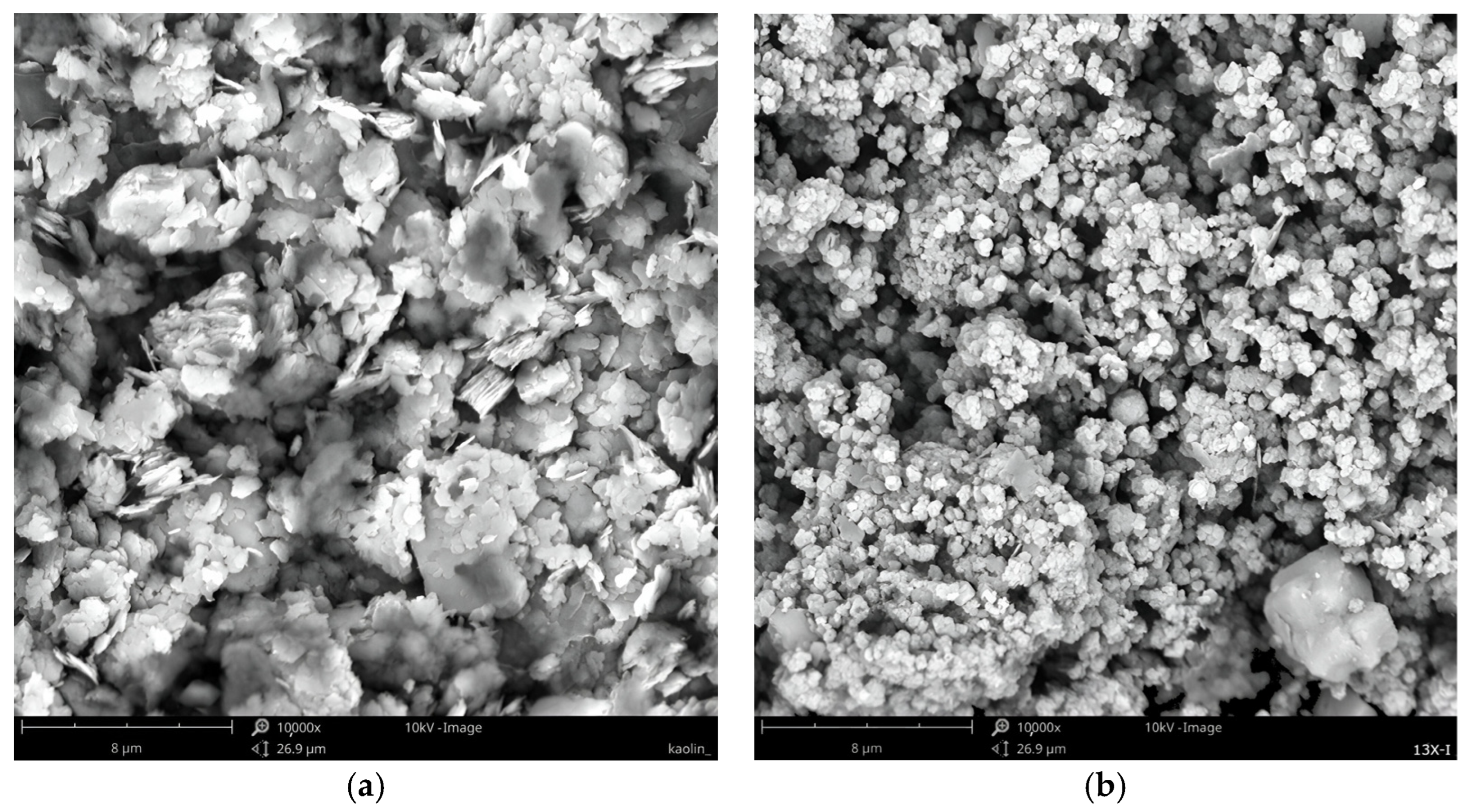
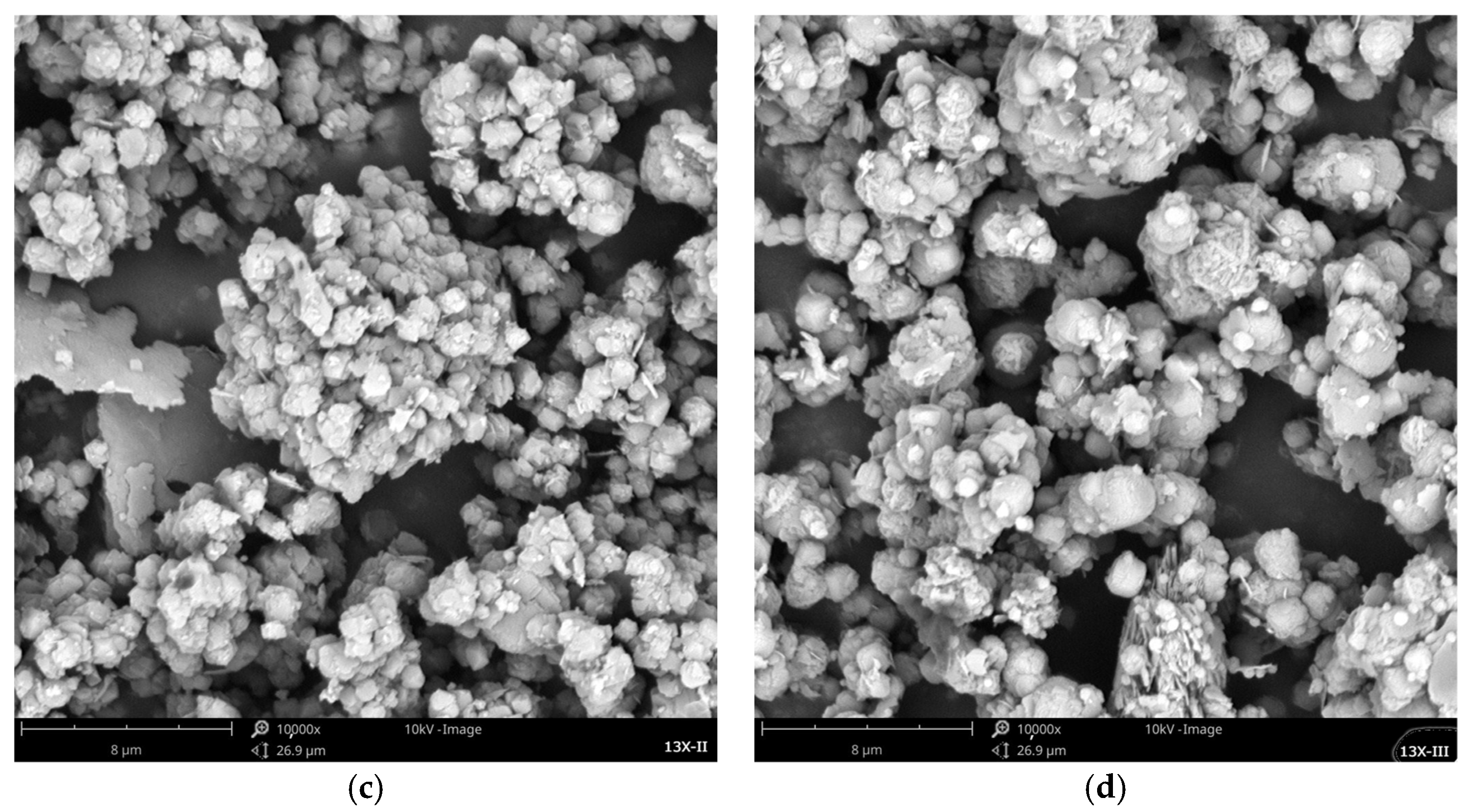
Images of kaolin and zeolites obtained from the SEM are presented in Figure 3. Kaolin is composed of a morphological assemblage of laminar or platelet-shaped structures (Figure 3a). However, it was observed that with the addition of NaOH to the kaolin during synthesis, its morphology transformed into cubic shapes (Figure 3b–d).
As shown in Figure 3b,c, the size of the cubic crystals and crystallinity of the samples increased as the ratio of kaolin to sodium hydroxide was raised from 0.8 to 1.2. Figure 3b illustrates that the sample contained a limited number of crystals surrounded by a significant quantity of tiny crystals, suggesting that zeolite crystal growth ceased due to the depletion of the nucleation agent (NaOH). However, Figure 3c reveals that the size of the cubic crystals in 13X-II was increasing, suggesting that the additional NaOH contributed to the formation of more zeolite crystals. Using a high ratio of 1.2, 13X-III zeolite with a well-shaped spherical crystalline structure was observed (Figure 3d). This phenomenon can also be explained by the dissolution of kaolinite in a more alkaline solution [25]. Consequently, synthesis via the fusion/hydrothermal method requires a greater quantity of NaOH, leading to the formation of larger and more numerous zeolite crystals.

3.3. EDS Analysis

The elemental composition of the samples was determined by energy-dispersive X-ray spectroscopy (EDS) during SEM image acquisition. A minimum of three locations on the zeolite surface were examined to obtain precise results. Next, the average elemental composition was supplied. To enhance outcomes, certain elements of Au, Nb, Sr, and Zr were disabled during the compositional analysis. The elemental content in the samples is shown in Table 1. The weight concentrations of Si and Al in 13X-I, 13X-II, and 13X-III were around 20 wt.% and 16 wt.%, respectively, which were nearly identical to the Si and Al weight concentrations in C13X. Na concentrations in 13X-I, 13X-II, and 13X-III were 8.27, 8.89, and 10.49, respectively, showing an increasing trend as the amount of NaOH increased. When comparing the elemental weight concentration of 13X produced with varying kaolin/NaOH ratios to the commercial form, there were no notable variations other than Na. Trace amounts of magnesium were present solely in the commercial form, whereas in the synthetic samples, magnesium was substituted for sodium cations.

3.4. N2 Adsorption Isotherm and BET Surface Area

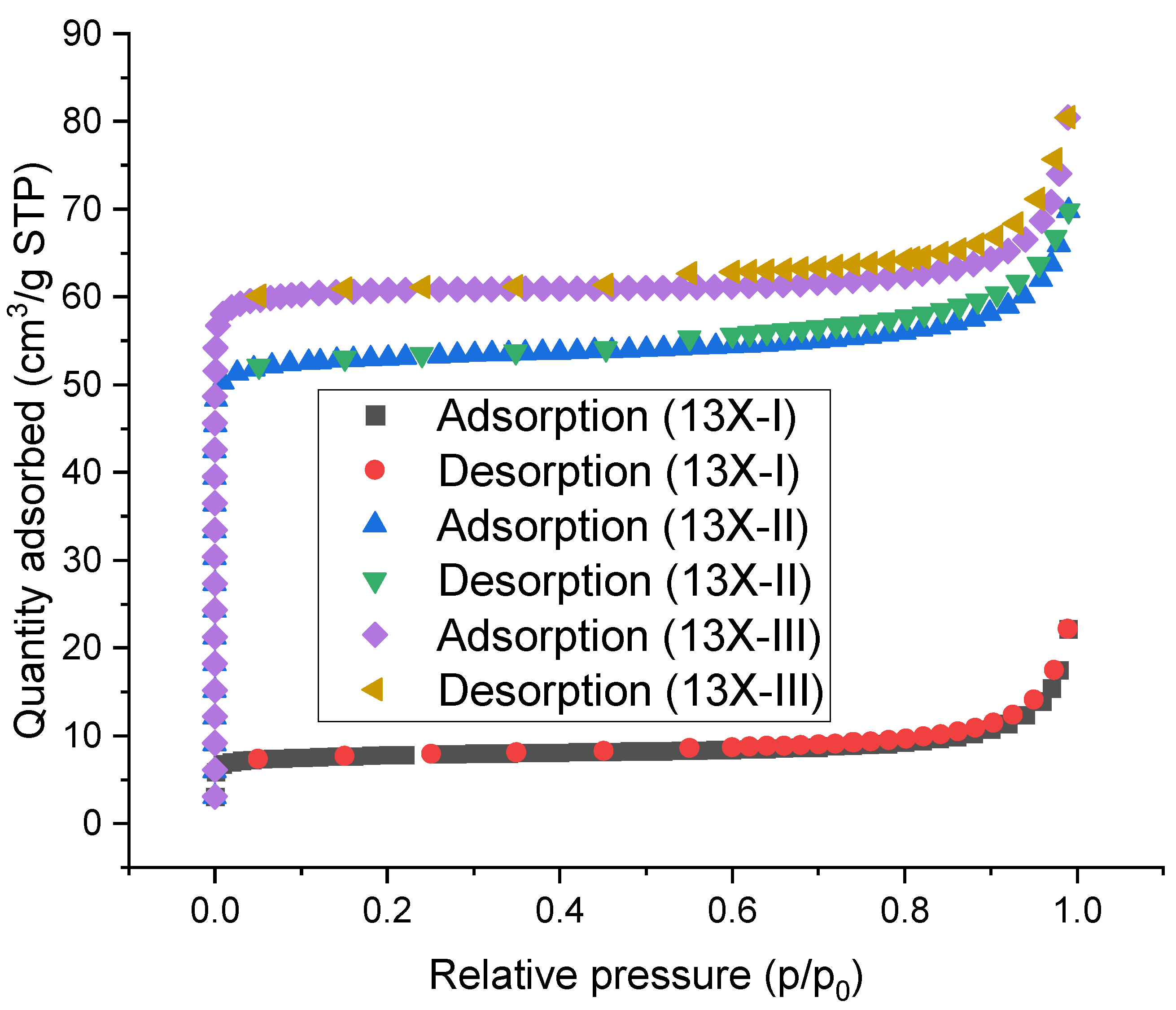
Synthesized samples of 13X-I (0.3562 g), 13X-II (0.6708 g), and 13X-III (0.2506 g), along with a commercial sample (1.7734 g), were outgassed at 350 °C for 24 h prior to nitrogen adsorption analysis. The adsorption–desorption experiments’ results are demonstrated in Figure 4. According to IUPAC classification, the adsorption–desorption curves of all synthesized samples correspond to Type I, indicating that these samples possess microporous structures. The curves indicate that the micropore volume of these samples increased progressively with higher NaOH contents.
The specific surface areas of the samples, as determined by the BET method, are shown in Table 2. The single point pore volume was determined by the quantity of gas adsorbed at a high relative pressure (P/P0) close to the conclusion of the isotherm. The table indicates that the maximum BET surface area for C13X was 501.34 m2/g, which corresponds to a pore volume of 0.215 cm3/g. Among the synthesized samples, 13X-III exhibited a BET specific surface area of 233.02 m2/g, with a corresponding pore volume of 0.125 cm3/g. These data indicate that the BET-specific surface areas of the samples increased as the NaOH/kaolin ratio was elevated.
Sample 13X-III was selected for the subsequent adsorption experiment based on its textural and morphological characteristics, which closely resembled those of the commercial C13X zeolite.

3.5. H2S Adsorption

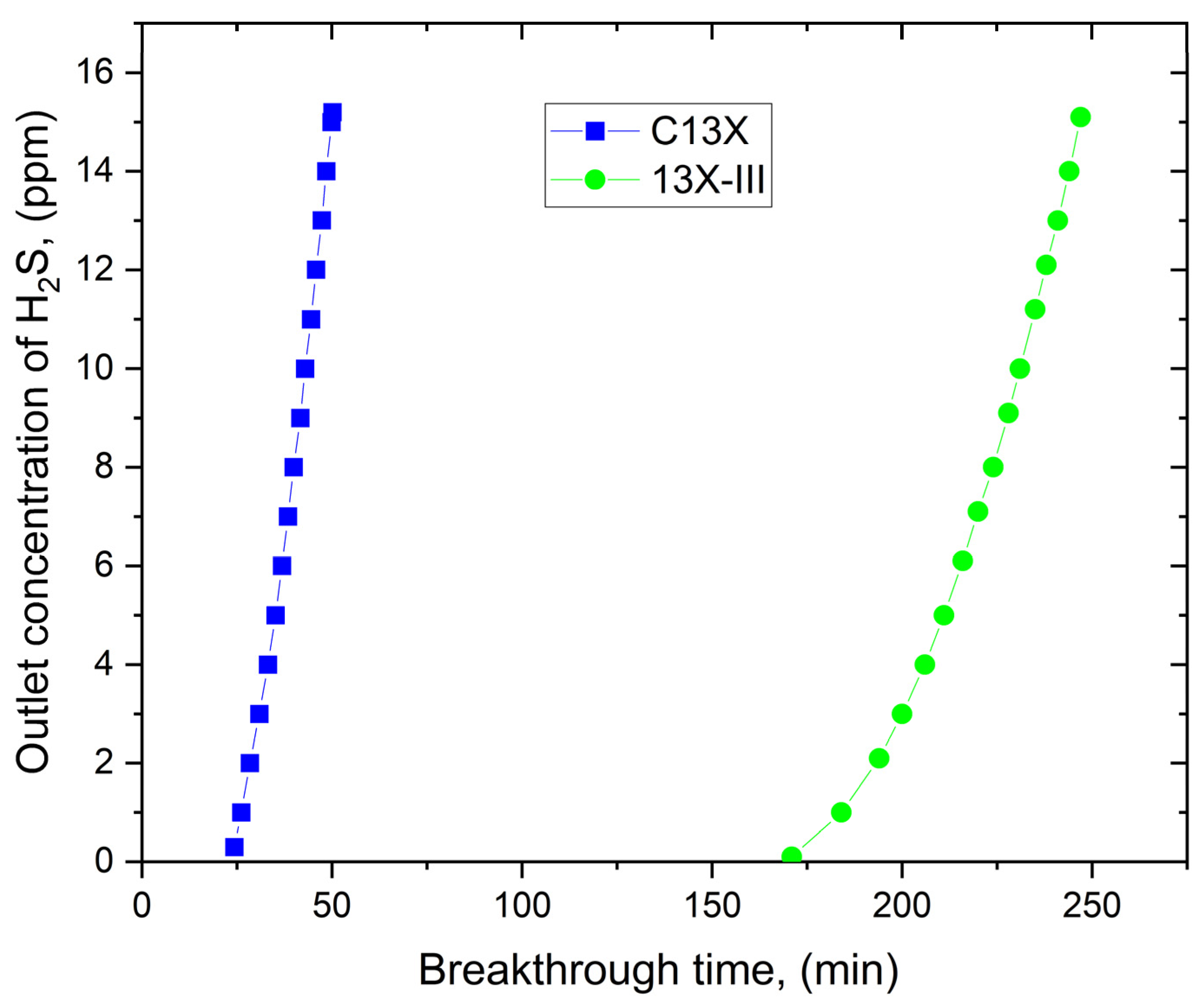
A study of the adsorption of H2S from methane was conducted to evaluate the performance of 13X-III. Whereas previous studies typically used nitrogen [26,27] or helium [28,29] instead of methane to ensure operational safety, this study employed methane to create a realistic gas mixture that more accurately represents natural gas conditions. The results obtained were compared with those from a commercial sample of C13X. Experiments were carried out with 5 g of the sample containing 150 ppm H2S in methane. Breakthrough curves were plotted as the outlet concentration of H2S as a function of time in minutes. In industrial natural gas treatment operations, H2S must typically be reduced to very low concentrations to comply with natural gas requirements [30]. In this study, adsorption tests were stopped once the outlet concentration reached 15 ppm, prior to full saturation, in order to evaluate the breakthrough curve. The adsorption capacity of each sample was assessed upon reaching a breakthrough concentration of H2S at 1 ppm. Figure 5 illustrates the breakthrough curves for 13X-III synthesized from kaolin and commercial C13X.
When 13X-III samples were used for H2S adsorption from methane, a significant difference in their breakthrough times was observed compared to those of commercial zeolite. The curve for 13X-III exhibited a steeper slope compared to that of commercial C13X. For C13X, the breakthrough point was reached after only a few minutes of adsorption, whereas the breakthrough point for synthesized 13X-III was observed after several hours, demonstrating a significantly higher capacity for H2S adsorption. Following the breakthrough point, the 13X-III curve showed a gradual rise, signifying substantial volume adsorption of H2S by 13X-III. The adsorption capacity of these samples, as determined by Equation (1), indicated that 13X-III possesses an adsorption capacity 15 times greater than that of the commercial variant (Table 3). The effective adsorption capacity of 13X-III, measured at 1.674 mg/g, dominated the adsorption capacity of 1.41 mg/g of Cu-exchanged 13X in granular form, as noted in reference [31]. The granules of synthesized 13X-III were formed without the use of a binder, whereas commercial zeolites typically incorporate binders that can obstruct internal micropores and reduce surface area. Consequently, the adsorption performance of the commercial adsorbent is diminished [32]. It may be concluded that Faujasite-type 13X zeolite synthesized from kaolin is suitable as an adsorbent for the elimination of acid gases in diverse applications.

4. Conclusions

Faujasite-type 13X zeolites were successfully synthesized from Angren kaolin for the purpose of H2S removal. A major contribution of this study lies in the development of a fully autoclave-free fusion/hydrothermal route, enabling the crystallization of Faujasite-type zeolite under atmospheric pressure. This eliminates reliance on high-pressure autoclaves typically required for zeolite synthesis and significantly enhances process safety, cost-efficiency, and scalability. The synthesized materials were characterized using SEM, XRD, EDS, and BET techniques. The results demonstrated that the NaOH/kaolin ratio plays a pivotal role in effective zeolite formation, with higher ratios leading to improved crystallinity and yield. Samples produced with the highest NaOH/kaolin ratio of 1.2 showed the most favorable structural and textural properties when prepared via the fusion/hydrothermal method. Although the main diffraction peaks characteristic of Faujasite-type zeolite were observed in 13X-III samples, the presence of an amorphous phase complicated the analysis of the phase composition. In future work, the effects of these impurities on the synthesized materials will be systematically investigated. The resulting phase composition will be analyzed with the aim of achieving a highly crystalline and phase-pure Faujasite structure.
In evaluating adsorption performance, methane was used as the primary gas matrix, introducing competitive adsorption effects absent in inert systems such as N2 or He. This approach provided a more realistic assessment of adsorbent behavior under natural-gas sweetening conditions. The H2S adsorption characteristics of the optimized sample, 13X-III, were subsequently assessed. The results revealed that 13X-III exhibits an adsorption capacity approximately 15 times higher than that of commercially available 13X zeolite. This substantial enhancement highlights the strong potential of the autoclave-free, kaolin-derived 13X for industrial natural gas purification applications.

Author Contributions

Conceptualization, M.H.A.-R., M.A., R.K., A.K.-K., and R.T.; methodology, M.H.A.-R. and M.A.; investigation, M.H.A.-R., M.A., R.K., A.K.-K., and R.T.; software, M.A.; validation, M.H.A.-R., M.A., and R.K.; supervision, M.H.A.-R. and R.K.; visualization, M.A., M.H.A.-R., and R.K.; writing—original draft preparation, M.H.A.-R. and M.A.; writing—reviewing and editing, M.H.A.-R., M.A., and R.K.; resources, M.H.A.-R., M.A., R.K., A.K.-K., and R.T. All authors have read and agreed to the published version of the manuscript.

Funding

This research received no external funding.

Data Availability Statement

Original contributions presented in this study are included in the article. Further inquiries can be directed to the corresponding author(s).

Acknowledgments

This work is dedicated to the memory of Janusz Wójcik, who sadly passed away prior to its publication. We wish to express our profound gratitude and admiration for him. It was he who initiated this study and encouraged us to pursue this research.

Conflicts of Interest

The authors declare no conflicts of interest.

References

  1. Stirling, D.; Clark, J.H. Adsorption and absorption of H2S. In The Sulfur Problem: Cleaning up Industrial Feedstocks; Stirling, D., Clark, J.H., Eds.; Royal Society of Chemistry: London, UK, 2007; pp. 16–30. [Google Scholar] [CrossRef]
  2. Speight, J.G. Handbook of Petroleum Refining; CRC Press: Boca Raton, FL, USA, 2016. [Google Scholar] [CrossRef]
  3. Mokhatab, S.; Poe, W.A.; Mak, J.Y. Handbook of Natural Gas Transmission and Processing: Principles and Practices; Gulf Professional Publishing: Amsterdam, The Netherlands, 2018. [Google Scholar] [CrossRef]
  4. Kulprathipanja, S. Zeolites in Industrial Separation and Catalysis; Kulprathipanja, S., Ed.; Wiley: Hoboken, NJ, USA, 2010. [Google Scholar] [CrossRef]
  5. Xu, R.; Pang, W.; Yu, J.; Huo, Q.; Chen, J. Chemistry of Zeolites and Related Porous Materials; Wiley: Hoboken, NJ, USA, 2007. [Google Scholar] [CrossRef]
  6. Khaleque, A.; Alam, M.M.; Hoque, M.; Mondal, S.; Haider, J.B.; Xu, B.; Johir, M.A.H.; Karmakar, A.K.; Zhou, J.L.; Ahmed, M.B.; et al. Zeolite synthesis from low-cost materials and environmental applications: A review. Environ. Adv. 2020, 2, 100019. [Google Scholar] [CrossRef]
  7. Melo, C.R.; Riella, H.G.; Kuhnen, N.C.; Angioletto, E.; Melo, A.R.; Bernardin, A.M.; Da Rocha, M.R.; Da Silva, L. Synthesis of 4A zeolites from kaolin for obtaining 5A zeolites through ionic exchange for adsorption of arsenic. Mater. Sci. Eng. B Solid-State Mater. Adv. Technol. 2012, 177, 345–349. [Google Scholar] [CrossRef]
  8. Mohammed, A.H.A.; Nassrullah, Z.K. Preparation and Formation of Zeolite 5A from Local Kaolin Clay for Drying and Desuphurization of Liquefied Petroleum Gas. Iraqi J. Chem. Pet. Eng. 2013, 14, 1–13. [Google Scholar] [CrossRef]
  9. Abdelkrim, S.; Mokhtar, A.; Sardi, A.; Asli, B.; Hachemaoui, M.; Boukoussa, B.; Sassi, M.; Viscusi, G.; Aloui, Z.; Abboud, M. Conversion of Natural Clay into Na-A (LTA) Zeolite Adsorbent for Efficient Heavy Metals Adsorption from Aqueous Solution: Kinetic and Isotherm Studies. Processes 2025, 13, 3060. [Google Scholar] [CrossRef]
  10. Brassell, J.P.; Ojumu, T.V.; Petrik, L.F. Upscaling of Zeolite Synthesis from Coal Fly Ash Waste: Current Status and Future Outlook. In Zeolites-Useful Minerals; BoD–Books on Demand: Hamburg, Germany, 2016. [Google Scholar] [CrossRef]
  11. Liu, X.; Wang, R. Effective removal of hydrogen sulfide using 4A molecular sieve zeolite synthesized from attapulgite. J. Hazard. Mater. 2017, 326, 157–164. [Google Scholar] [CrossRef]
  12. Zhao, Y.; Zhang, B.; Zhang, X.; Wang, J.; Liu, J.; Chen, R. Preparation of highly ordered cubic NaA zeolite from halloysite mineral for adsorption of ammonium ions. J. Hazard. Mater. 2010, 178, 658–664. [Google Scholar] [CrossRef]
  13. Kovo, A.S.; Holmes, S.M.; Rios, C.A.; Otaru, A.J.; Abdulkareem, A.S.; Eluwa, V.C. Synthesis of zeolites from different kaolin deposits worldwide. Appl. Clay Sci. 2025, 269, 107757. [Google Scholar] [CrossRef]
  14. Jiang, B.X.; Wang, H.; Zhang, Y.T.; Li, S.B. Microwave-assisted synthesis of Zr-based metal–organic frameworks and metal-organic cages. Polyhedron 2023, 243, 116569. [Google Scholar] [CrossRef]
  15. Suleimenova, M.; Zharylkan, S.; Mekenova, M.; Mutushev, A.; Azat, S.; Tolepova, A.; Baimenov, A.; Satayeva, A.; Tauanov, Z. Fusion-Assisted Hydrothermal Synthesis of Technogenic-Waste-Derived Zeolites and Nanocomposites: Synthesis, Characterization, and Mercury (II) Adsorption. Int. J. Mol. Sci. 2023, 24, 11317. [Google Scholar] [CrossRef] [PubMed]
  16. Cecilia, J.A.; Vilarrasa-García, E.; Morales-Ospino, R.; Finocchio, E.; Busca, G.; Sapag, K.; Villarroel-Rocha, J.; Bastos-Neto, M.; Azevedo, D.C.S.; Rodríguez-Castellón, E. Kaolinite-based zeolites synthesis and their application in CO2 capture processes. Fuel 2022, 320, 123953. [Google Scholar] [CrossRef]
  17. Ugal, J.R.; Kareem, S.H.; Hassan, S. Microwave-Assisted Synthesis of Zeolites A From Iraqi Cheap Raw Materials as Adsorbents for H2S Gas. J. Univ. Anbar Pure Sci. 2014, 8, 23–30. [Google Scholar] [CrossRef]
  18. De Lucas, A.; Uguina, A.M.; Covián, I.; Rodríguez, L. Synthesis of 13X Zeolite from Calcined Kaolins and Sodium Silicate for Use in Detergents. Ind. Eng. Chem. Res. 1992, 31, 2134–2140. [Google Scholar] [CrossRef]
  19. Chandrasekhar, S.; Pramada, P.N. Investigation on the synthesis of zeolite NaX from Kerala kaolin. J. Porous Mater. 1999, 6, 283–297. [Google Scholar] [CrossRef]
  20. Safirova, E. The Mineral Industry of Uzbekistan. 2020–2021 Mineral Yearbook, U.S. Geological Surver, 2023. Available online: https://www.usgs.gov/media/files/mineral-industry-uzbekistan-2021-tables-only-release-xlsx (accessed on 1 July 2025).
  21. Lim, W.R.; Lee, C.H.; Hamm, S.Y. Synthesis and characteristics of Na-A zeolite from natural kaolin in Korea. Mater. Chem. Phys. 2021, 261, 124230. [Google Scholar] [CrossRef]
  22. Abdirakhimov, M.; Al-Rashed, M.H.; Wójcik, J. Hydrogen Sulfide Adsorption from Natural Gas Using Silver-Modified 13X Molecular Sieve. Materials 2023, 17, 165. [Google Scholar] [CrossRef] [PubMed]
  23. Treacy, M.M.J.; Higgins, J.B. Collection of Simulated XRD Powder Patterns for Zeolites; In Kurinikaru Sutadi = Clinical Study; Elsevier: New York, NY, USA, 2001; Volume 4, pp. 1063–1106. [Google Scholar]
  24. Sazali, N.; Harun, Z. One Shot of the Hydrothermal Route for the Synthesis of Zeolite LTA Using Kaolin. J. Inorg. Organomet. Polym. Mater. 2022, 32, 3508–3520. [Google Scholar] [CrossRef]
  25. Mameli, P.; Fiore, A.M.; Fiore, S.; Huertas, F.J. Mechanism of Hydrothermal Zeolite Crystallization from Kaolin in Concentrated NaOH Solutions (1–5 M): Formation of NaP1, NaP2, Analcime, Sodalite and Cancrinite. Crystals 2025, 15, 980. [Google Scholar] [CrossRef]
  26. Sigot, L.; Ducom, G.; Germain, P. Adsorption of hydrogen sulfide (H2S) on zeolite (Z): Retention mechanism. Chem. Eng. J. 2016, 287, 47–53. [Google Scholar] [CrossRef]
  27. Abdullah, A.H.; Mat, R.; Somderam, S.; Abd Aziz, A.S.; Mohamed, A. Hydrogen sulfide adsorption by zinc oxide-impregnated zeolite (synthesized from Malaysian kaolin) for biogas desulfurization. J. Ind. Eng. Chem. 2018, 65, 334–342. [Google Scholar] [CrossRef]
  28. Kumar, P.; Sung, C.Y.; Muraza, O.; Cococcioni, M.; Al Hashimi, S.; McCormick, A.; Tsapatsis, M. H2S adsorption by Ag and Cu ion exchanged faujasites. Microporous Mesoporous Mater. 2011, 146, 127–133. [Google Scholar] [CrossRef]
  29. de Oliveira, L.H.; Meneguin, J.G.; Pereira, M.V.; da Silva, E.A.; Grava, W.M.; do Nascimento, J.F.; Arroyo, P.A. H2S adsorption on NaY zeolite. Microporous Mesoporous Mater. 2019, 284, 247–257. [Google Scholar] [CrossRef]
  30. Kidnay, A.J.; Kidnay, A.J.; Parrish, W.R.; McCartney, D.G. Fundamentals of Natural Gas Processing; CRC Press: Boca Raton, FL, USA, 2011. [Google Scholar] [CrossRef]
  31. Barelli, L.; Bidini, G.; Micoli, L.; Sisani, E.; Turco, M. 13X Ex-Cu zeolite performance characterization towards H2S removal for biogas use in molten carbonate fuel cells. Energy 2018, 160, 44–53. [Google Scholar] [CrossRef]
  32. Najafi, A.M.; Soltanali, S.; Khorashe, F.; Ghassabzadeh, H. Effect of binder on CO2, CH4, and N2 adsorption behavior, structural properties, and diffusion coefficients on extruded zeolite 13X. Chemosphere 2023, 324, 138275. [Google Scholar] [CrossRef] [PubMed]
Figure 1. Laboratory setup for H2S adsorption [22]: 1—5000 ppm H2S containing bottle, 2—methane bottle, 3—mixing chamber, 4—adsorber, 5–6—washers filed with NaOH solution, 7–8—Bunsen burners, V01–V04—ball valves, FI/01—rotameter for bottle 1, FI/02—rotameter for bottle 2, A/01–A/02—inlet H2S analyzers.
Processes 14 00471 g001
Figure 2. XRD patterns registered for C13X, 13X-I, 13X-II, and 13X-III samples. Comparison of diffraction peaks illustrates variations in crystallinity, phase composition, and potential structural modifications among these samples. K—kaolin, Q—quartz.
Processes 14 00471 g002
Figure 3. SEM images of (a) kaolin; (b) 13X-I; (c) 13X-II; and (d) 13X-III; mag. 10,000×.
Processes 14 00471 g003aProcesses 14 00471 g003b
Figure 4. Nitrogen adsorption–desorption isotherms for 13X-I, 13X-II, and 13X-III samples.
Processes 14 00471 g004
Figure 5. Comparison of H2S breakthrough curves of commercial 13X and synthesized 13X-III.
Processes 14 00471 g005
Table 1. The element content in C13X and synthesized samples.
Elemental Composition in wt.%
C13X13X-I13X-II13X-III
O55.8152.7556.4252.52
Si21.2021.4819.2620.6
Al15.7416.715.5916.36
Na6.898.278.7310.5
K-0.16--
Mg0.35---
Σ99.9999.3610099.98
Table 2. The BET-specific surface areas and corresponding pore volumes of samples.
SampleC13X13X-I13X-II13X-III
BET surface area (m2/g)501.3425.05172.71233.02
Pore volume (cm3/g)0.2150.0340.1080.125
Table 3. Breakthrough times and effective adsorption capacities of commercial 13X and synthesized 13X-III.
AdsorbentsBreakthrough Time (min)Adsorption Capacity (mg/g)
t0t1
C13X24.325.80.11
13X-III1711841.674
Disclaimer/Publisher’s Note: The statements, opinions and data contained in all publications are solely those of the individual author(s) and contributor(s) and not of MDPI and/or the editor(s). MDPI and/or the editor(s) disclaim responsibility for any injury to people or property resulting from any ideas, methods, instructions or products referred to in the content.