Article

Collaborative Optimization Strategy of Virtual Power Plants Considering Flexible HVDC Transmission of New Energy Sources to Enhance the Wind–Solar Power Consumption

1
Guangdong Guangzhou Power Supply Bureau, China Southern Power Grid Company Limited, Guangzhou 510000, China
2
College of Electrical and New Energy, China Three Gorges University, Yichang 443002, China
*
Author to whom correspondence should be addressed.
Processes 2026, 14(7), 1162; https://doi.org/10.3390/pr14071162
Submission received: 10 February 2026 / Revised: 26 March 2026 / Accepted: 2 April 2026 / Published: 3 April 2026

Abstract

In the scenario where renewable energy sources (RESs) are connected to the power system (PS) through a flexible high-voltage direct current (HVDC) transmission system, their output becomes highly intermittent and volatile due to meteorological factors like wind direction and speed. This variability poses significant challenges to the real-time power balance and control of the PS. To address the uncertainties in system operation and the challenges of RES consumption, this paper proposes an artificial intelligence (AI) algorithm-driven collaborative optimization strategy for virtual power plants (VPPs) considering RESs transmitted by flexible HVDC. Firstly, a self-attention mechanism and multiple gated structures are integrated into a long short-term memory (LSTM) deep learning model. This enhancement improves the model’s ability to capture multi-timescale characteristics of RESs, increasing forecasting accuracy and robustness. Based on these forecasts, a total cost optimization model for VPP operation is developed, which includes high penalty costs for wind and solar curtailment. By embedding economic constraints that prioritize RESs usage, the model can reduce waste caused by traditional cost-driven scheduling. Additionally, to solve the high-dimensional nonlinear optimization problem in VPP scheduling, an improved population-based incremental learning (PBIL) algorithm is introduced. It incorporates an elite retention strategy and an adaptive mutation operator to boost global search efficiency and convergence speed. Simulations based on an VPP incorporating typical offshore wind and solar RESs transmitted via flexible HVDC demonstrate that the improved LSTM reduces MAPE by 7.14% for wind and 4.27% for PV compared to classical LSTM, and the proposed method achieves the lowest curtailment rates (wind 10.74%, PV 10.23%) and total cost (43,752 RMB), outperforming GA, PSO, and GW by 10–18% in cost reduction. Simulation results show that the proposed strategy enhances RESs consumption while maintaining system economy under flexible HVDC transmission. This work offers theoretical and practical insights for optimizing PS with high RES penetration and supports the low-carbon transition of new-type PS.

1. Introduction

Against the backdrop of the global active response to climate change and vigorous promotion of energy transition, the development and efficient utilization of clean energy have become the core focus of national energy strategies worldwide. Offshore wind power (OWP), as a shining star in the field of clean energy, demonstrates immense development potential and broad application prospects owing to its remarkable advantages, including abundant resource reserves, stable wind speeds, high-quality wind energy, and no occupation of land [1,2]. It is gradually emerging as a key supporting force for the global energy structure’s transition towards low-carbon and clean development. In recent years, with continuous technological advancements and a gradual reduction in costs, the OWP industry has exhibited a thriving development trend. Large-scale offshore wind farms have sprung up one after another, been constructed, and put into operation. According to statistics from reference [3], by the end of 2023, the cumulative installed capacity of offshore wind power in Guangdong Province had exceeded 10 GW, representing a growth of over 150% compared to 2020. Notably, the Yangjiang Shapa Offshore Wind Farm (with an installed capacity of 1.7 GW) and the Zhanjiang Xuwen Offshore Wind Farm (with an installed capacity of 1.0 GW) have been fully operational. Furthermore, reference [4] reported that in 2024, China’s newly installed offshore wind power capacity reached 8.5 GW, accounting for more than 45% of the global total.
However, the output characteristics of OWP exhibit significant intermittency and randomness, with its power output being highly susceptible to fluctuations in meteorological factors such as wind direction, wind speed, and air pressure. This poses severe challenges to the safe and stable operation of the PS [5]. To achieve large-scale and efficient long-distance transmission of OWP, flexible HVDC transmission technology emerged at the right moment. With its unique advantages, including flexible control modes, no need for reactive power compensation, and the ability to enable asynchronous interconnection, this technology has become an ideal choice for OWP transmission. Through flexible HVDC transmission systems, OWP can be efficiently and reliably connected to onshore power grids, enabling long-distance and large-capacity power transmission and effectively addressing the bottleneck issue in OWP transmission [6,7].
Meanwhile, as another significant form of clean energy, photovoltaic (PV) power generation has also witnessed rapid development globally, thanks to its advantages such as widespread resource distribution, cleanliness without pollution, and short construction cycles. To further enhance the proportion of clean energy consumption and achieve diversified utilization and optimized allocation of energy resources, the joint operation and collaborative optimization of OWP and PV power generation have become an inevitable trend [8]. VPP, as a novel power operation model and management concept, can integrate and coordinate resources such as distributed RES, energy storage (ES), and controllable load. Through advanced communication technologies and intelligent algorithms, it enables optimized scheduling and efficient management of various resources. By incorporating OWP and PV power generation into the framework of a VPP for collaborative optimization, we can not only fully leverage the complementary characteristics among different types of clean energy to smooth power fluctuations and enhance the stability and reliability of the PS, but also effectively improve the consumption capacity of clean energy and reduce the occurrence of wind and solar power curtailment [9].
Reference [10] proposes a “coordinated optimization model for installed capacity of hydro–wind–solar power sources,” which leverages hydropower regulation to mitigate wind and solar fluctuations. Focused on maximizing economic benefits and incorporating risk-benefit analysis, this model significantly enhances flood-season regulation capacity and reduces curtailment rates. Reference [11] introduces an integrated “wind–solar–hydrogen–ammonia–methanol” construction approach, converting surplus green electricity into hydrogen/ammonia/methanol. This not only serves as a peak-shaving resource but also circumvents restrictions on “high-energy-consuming and high-emission” industries. Additionally, green hydrogen projects can participate in ES leasing markets, improving economic viability. Reference [12] proposes a Vine Copula model-based ES planning method that accounts for the spatiotemporal correlation of wind and solar resources. By correcting their spatiotemporal output correlations, this method optimizes ES siting and sizing, significantly reducing congestion rates in high-voltage distribution networks and reserving peak-shaving margins for future RES development. Reference [13] develops a regional wind–solar power consumption quota allocation model that incorporates the Gini coefficient to evaluate fairness. This model mandates that certain coastal regions consume more green electricity, enabling effective allocation of wind and solar power consumption. Reference [14] proposes a “Shapley green certificate revenue allocation model” to incentivize power users to shift their loads. By participating in source–load collaboration, users receive green certificate revenues, thereby reducing system-wide wind and solar power curtailment rates. Reference [15] introduces a “RES-charging station joint planning model” that links green power consumption with electric vehicle charging behavior through a carbon price growth rate mechanism, lowering overall system economic costs.
The VPP, as a regional multi-energy aggregation model, integrates heterogeneous resources such as distributed generation, ES, and controllable loads into a “virtual controllable entity” through advanced communication and control technologies, emerging as a critical pathway to address the challenge of RES consumption [16]. Reference [17] proposes a bi-level optimal dispatch model for multi-energy VPP under the influence of time-of-use electricity pricing. This model coordinates gas turbines and ES batteries to mitigate wind and solar forecast deviations and employs an adaptive particle swarm optimization algorithm to optimize thermal power unit output. Reference [18] calculates power differentials by statistically analyzing wind and solar generation, electric vehicle charging demand, load demand, and available ES capacity within the VPP, subsequently issuing dispatch instructions for power generation. Reference [19] introduces a bi-level stochastic dispatch optimization model for wind–solar–gas-storage integrated VPP that incorporates demand response. By leveraging two-stage optimization theory, this model overcomes the deterministic nature of wind and solar power unavailability. Reference [20] proposes a novel VPP framework model that employs an adaptive step-size-enhanced adaptive alternating multiplication algorithm to optimize internal VPP dispatch and market bidding strategies. Reference [21] conducts research on dynamic pricing and energy management for master–slave game-based multi-VPPs using a metamodel optimization algorithm, achieving a master–slave game equilibrium solution by combining a Kriging metamodel with a particle swarm optimization algorithm. Reference [22] introduces a dynamic reconfiguration optimization method for VPP that incorporates a membership reward mechanism and employs a multi-stage dynamic programming optimization strategy for dynamic reconfiguration. Reference [23] considers the participation of diverse flexible loads in VPP and conducts hierarchical optimal dispatch research, establishing a generalized ES model for power-to-hydrogen synthesis of methanol and integrating it into VPP dispatch.
LSTM networks, as a specialized category of recurrent neural network (RNN) architecture, are designed to address the issues of vanishing and exploding gradients that traditional RNNs encounter during long-sequence training. In recent years, with the rapid advancement of deep learning technologies, LSTM models have demonstrated exceptional performance in processing time-series data across various domains [24,25,26]. Leveraging its outstanding temporal modeling capabilities and flexible scalability, the LSTM model has achieved significant technological breakthroughs and application innovations in recent years, expanding its scope from traditional time-series prediction to diverse fields including marine science, traffic management, healthcare, industrial monitoring, and cybersecurity, showcasing its strong interdisciplinary adaptability. Reference [27] integrates convolutional operations into the input-state transition process of LSTM to address the characteristics of spatiotemporal sequence data, enabling the model to simultaneously capture dependencies in both temporal and spatial dimensions. In the task of ocean sound speed field prediction, by integrating spatiotemporal correlations of adjacent sea areas, this approach significantly improves prediction accuracy. Reference [28] establishes a bidirectional LSTM model that deals with both forward and backward information of sequences simultaneously, allowing for a more comprehensive understanding of contextual dependencies. Reference [29] enhances the model’s abstract representation capabilities by increasing network depth, establishing a deep stacked LSTM model, and validating the effectiveness of deep architectures in hydropower generation forecasting research. Reference [30] introduces a self-attention module into LSTM, enabling the model to dynamically adjust the importance weights of different time steps and spatial positions. Reference [31] combines a convolutional neural network (CNN) with LSTM to establish a CNN-LSTM framework, which utilizes CNN to extract spatial or local temporal features and then employs LSTM to capture long-term dependencies.
The PBIL algorithm, as an intelligent optimization method that integrates evolutionary computation with machine learning, describes the distribution of the solution space through a probabilistic model and achieves efficient optimization by means of population search and incremental update mechanisms [32,33,34]. Unlike traditional evolutionary algorithms, PBIL does not directly manipulate individual population members but maintains a probability vector that reflects the probability distribution of the solution space, guiding the search direction through iterative updates of this vector. With in-depth research, PBIL has evolved from a single optimization algorithm into a versatile framework supporting dynamic environmental adaptation, demonstrating unique advantages in solving complex system optimization, data stream learning, and continual learning tasks. The core idea of PBIL is inspired by biological evolution and swarm intelligence. This algorithm simulates the process of knowledge accumulation within a population through a probabilistic model and balances exploration and exploitation using elite retention strategies and random exploration mechanisms. In incremental learning scenarios, PBIL rapidly adapts to new data or environmental changes by dynamically adjusting the probabilistic model rather than retraining from scratch [35,36,37].
Reference [32] addresses combinatorial optimization problems such as facility layout sequencing by representing the solution space using binary or permutation encoding. For closed-loop layout problems, a discrete PBIL algorithm is proposed to optimize facility arrangement sequences, aiming to minimize material flow transportation costs. Reference [33] introduces a continuous PBIL algorithm for solving continuous space problems such as parameter optimization. This approach replaces the Bernoulli distribution with a Gaussian distribution, guiding the search by updating the mean and variance. Reference [34] proposes a hybrid PBIL (HPBIL) algorithm to collaboratively optimize both discrete and continuous variables. This algorithm integrates both discrete and continuous PBIL operators and incorporates a local search module to enhance local exploitation capabilities. Reference [35] introduces an improved Harris hawks optimization (IHHO) strategy within the HPBIL framework, simulating the predatory behavior of Harris hawks to significantly improve hyperparameter optimization efficiency. Reference [36] addresses the limitation of insufficient local exploitation in PBIL by designing an adaptive neighborhood search mechanism within the HPBIL framework. This strategy selects 10–20% of high-quality solutions in each generation for in-depth optimization, with experiments showing an approximately 40% reduction in solution time for layout optimization problems. Reference [37] proposes a heterogeneous ensemble incremental learning algorithm based on locality-sensitive hashing (LSH). Within this framework, multiple heterogeneous classifiers are first trained using new data to enhance model diversity. Subsequently, an LSH table is constructed to store data sketches, supporting nearest-neighbor retrieval. Reference [38] designs a joint incremental learning objective (JILO) to simultaneously optimize class-incremental and data-incremental objectives. The core innovation of this method lies in discovering the impact of image orientation changes on catastrophic forgetting and introducing a multi-orientation data integration strategy. While jointly training the network to learn both original and new categories, it also learns feature invariance across different image orientations. Despite the significant progress made by PBIL algorithms, they still face challenges in practical applications, including dynamically mitigating catastrophic forgetting, improving computational efficiency and real-time performance, and enhancing cross-domain transfer capabilities.
Despite the significant progress made in VPP optimization of existing research, several critical research gaps remain unaddressed:
(1)
Most existing studies focus on VPPs connected to conventional AC grids or assume simplified renewable energy integration. Few have explicitly considered the unique operational characteristics and uncertainties introduced by offshore wind power transmitted via flexible HVDC, which exhibits stronger intermittency and different dynamic response behaviors.
(2)
Although some advanced forecasting methods have been applied in PS, they are often treated as standalone modules. Their outputs are rarely integrated into the VPP scheduling model in a closed-loop manner, leading to suboptimal decisions under high-variability conditions.
(3)
Traditional VPP dispatch models prioritize economic objectives, often resulting in renewable energy curtailment when market signals favor conventional generation. Although penalty terms for curtailment have been introduced in some studies, they are typically not enforced with sufficiently high weights to guarantee consumption priority.
(4)
Heuristic algorithms such as the genetic algorithm (GA), particle swarm optimization (PSO) algorithm, and gray wolf (GW) algorithm have been widely adopted for VPP optimization. However, their performance in solving high-dimensional, nonlinear, and multi-constraint problems—especially under volatile renewable output—remains limited in terms of convergence speed and global search capability.
To address these gaps, this paper proposes an AI-driven collaborative optimization strategy for VPPs that integrates OWP and PV systems transmitted via flexible HVDC. The main contributions of this paper are as follows:
(1)
An improved LSTM model incorporating a self-attention mechanism and multiple gated networks is developed to capture multi-timescale characteristics of wind and solar power, significantly improving prediction accuracy and robustness.
(2)
High penalty costs for wind and solar curtailment are embedded into the objective function, enforcing renewable energy consumption as a priority over pure economic savings.
(3)
An improved PBIL algorithm integrating elite retention and adaptive mutation operators is proposed to solve the resulting high-dimensional nonlinear scheduling problem, offering superior convergence speed and global search capability.
(4)
Simulation results based on a VPP with flexible HVDC-connected offshore wind and PV demonstrate the effectiveness of the proposed strategy in reducing curtailment rates and total operating costs, validating its potential to support the low-carbon transition of future power systems.

2. The Improved LSTM Model for OWP and PV Power Forecasting

LSTM is a special type of RNN; by adding three logical control units to the foundation of RNN, it employs a gating mechanism to control the pathways for information transmission and the amount of information retained, thereby enabling effective learning of long-term dependencies. The computational process of the RNN unit in an LSTM network mainly consists of the following three steps:
(1)
Firstly, by using the previous external state ht−1 and the present input xt, the information passing through the three gates, as well as the candidate state c ˜ t , can be calculated;
(2)
Then, it updates the memory cell by combining the forget and the input gate;
(3)
Finally, it transmits the information from the internal state to the external state ht by incorporating the output gate ot.
The control formula of the forget gate (FG) is as follows:
f t = σ W f h t 1 , x t + b f
where ft represents the output of FG; σ represents the Sigmoid activation function; Wf denotes the weight matrix of FG; bf denotes the bias vector of the FG; ht−1 denotes the hidden state of the last moment (i.e., short-term memory); and xt denotes the input at present (such as wind speed, temperature and other characteristics).
The control formula of the input gate is as follows:
i t = σ W i h t 1 , x t + b i c ˜ t = tanh W c h t 1 , x t + b c
where i t represents the output of the input gate; c ˜ t represents the state of the candidate cell; bi and Wi denote the bias vector and weight matrix of the input gate, respectively; and bc and Wc denote the bias vector and weight matrix of candidate states, respectively.
The update formula of the cell state is as follows:
c t = f t c t 1 + i t c ˜ t
where c t denotes the updated cell state; c t 1 denotes the cell state at the last moment; and means Hadamard product.
The control formula of the output gate (OG) is as follows:
o t = σ W o h t 1 , x t + b o h t = o t tanh ( c t )
where ot represents the output of the OG; ht represents the current hidden state, which is used as the input for the next moment; and bo and Wo denote the bias vector and weight matrix of the OG, respectively.
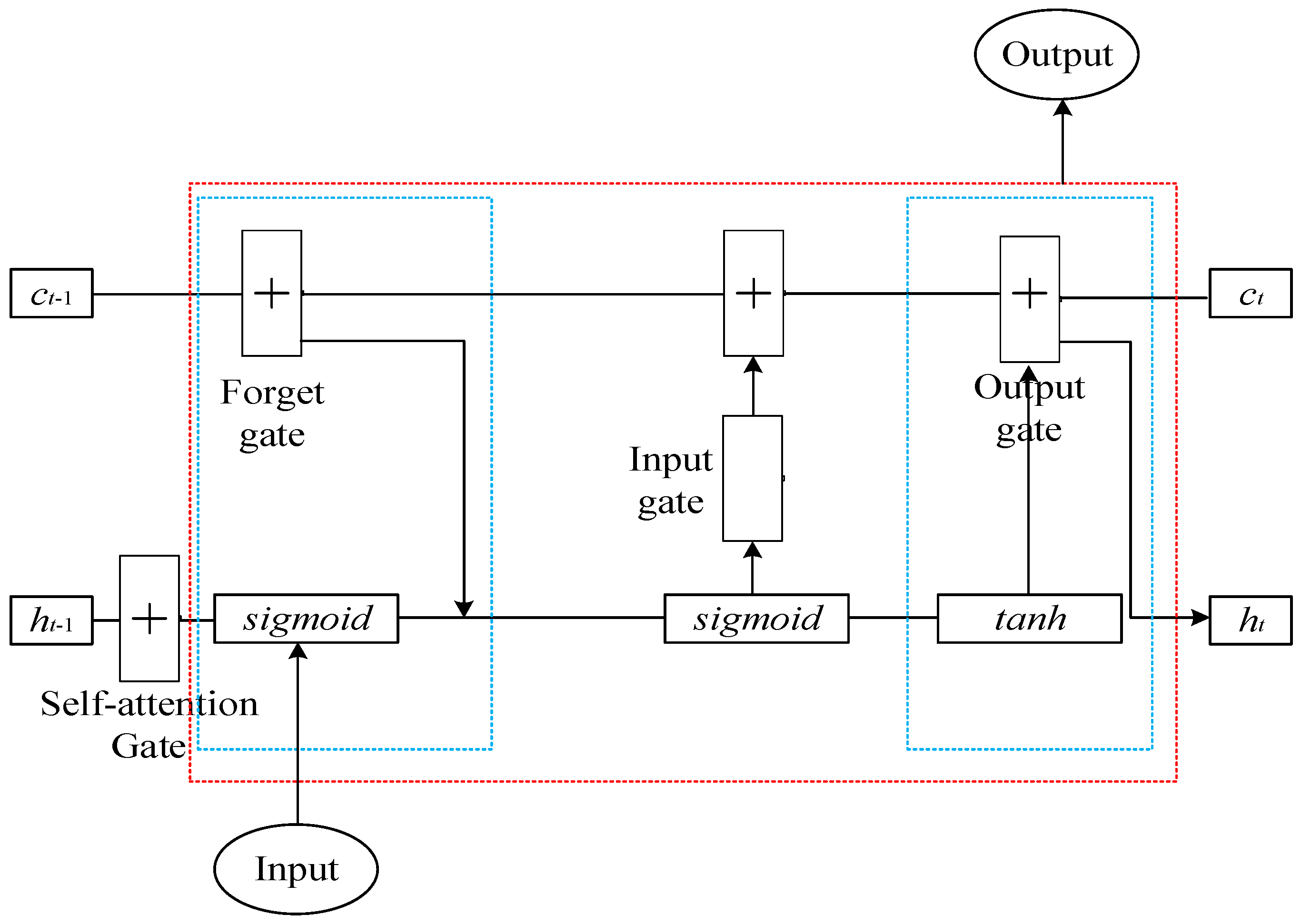
To achieve effective prediction of the output power of wind and solar RE, this paper builds upon LSTM and gated networks, integrating temporal data from the OG and introducing a self-attention gate. This mechanism enables the fusion of data with different weights based on the correlation degrees from the previous time step, addressing the issue of precision deviation caused by redundant input data and enhancing the robustness of the network model. In this paper, the attention weight α is determined according to the time series and correlation (such as seasonal change and periodic fluctuation) of RE power generation data. The formula is shown below:
e i = tanh W e h t 1 + V e , x t + U e c i + b e α = soft max ( W α e i + b α )
where U e is the input matrix; ci indicates the given selection weight; be and We represent the bias vector and weight matrix of the self-attention gate, respectively; V e , x t is the feature of the time-series vector; ei is an intermediate variable of the self-attention gate; α is the attention weight; and W α and b α represent the bias vector and weight matrix of attention weight α, respectively.
The network structure diagram of the LSTM model with a combined multi-gating mechanism is shown in Figure 1. The improved LSTM model proposed in this paper combines multiple gated networks, including the FG, input gate, OG, and self-attention gate. The FG serves to control the network’s selection of data from previous time steps, enabling adaptation to changes in sequential data. Simultaneously, the FG can mitigate the issue of decreased prediction accuracy caused by abnormal data, such as sudden weather changes or equipment failures, which may lead to unstable power generation time-series data. The input gate, in conjunction with the self-attention gate, determines the validity of information in the input data, addressing redundant information in the screened input time-series data and enhancing the model’s robustness and adaptability to complex environments.

3. Optimal Dispatch Model for VPP Considering OWP via Flexible HVDC Transmission

In this paper, flexible HVDC transmission technology is employed to achieve efficient, reliable, and flexible integration of OWP into the main grid. Subsequently, the grid-connected OWP is aggregated with various onshore distributed resources (including distributed photovoltaic systems, ES systems, controllable loads, etc.) to form a large-scale VPP. It should be noted that this paper does not focus on the specific methods of how OWP is connected via flexible HVDC transmission. Instead, the emphasis is placed on the optimal scheduling research after OWP has been integrated and aggregated with various other distributed resources to form a VPP.

3.1. The Objective Function

To optimize the system operation and achieve minimum total cost, the objective function is specified below:
min   t = 1 T i = 1 N g a s C g a s , i ( P g a s , i , t ) + j = 1 N w i n d C w i n d , j ( P w i n d , j , t ) + k = 1 N p v C p v , k ( P p v , k , t ) + C g r i d , t P g r i d , t + e = 1 N e C e , t ( P e , t c h , P e , t d i s ) + r = 1 N r C r P r , t + j = 1 N w i n d C c u r t , w i n d ( P w i n d , j , t p r e P w i n d , j , t ) + k = 1 N p v C c u r t , p v ( P p v , k , t p r e P p v , k , t )
where T is the total number of scheduling periods (T = 24); Ngas is the number of traditional units (such as gas turbines); Nwind indicates the number of wind farms; Npv represents the number of PV power stations; Ne represents the number of ES; Nr represents the number of interruptible load; Pgas,i,t is the output of unit i in period t; Cgas,i(Pgas,i,t) is the power generation cost function of unit i in period t, which is usually a quadratic function; Pwind,j,t represents the actual output of the wind farm j during the period t; Cwind,j represents the operation and maintenance cost of the wind farm j; Ppv,k,t is the actual output of PV power station k during the period t; Cpv,k represents the maintenance and operation cost of PV power station k; Pgrid,t represents the exchange power with the main network; Cgrid,t is the electricity price in the main network for the period t; Ce,t ( P e , t c h , P e , t d i s ) is the operation cost of the ES e for the period t; P e , t c h is the charging power of the ES e for the period t; P e , t d i s is the discharging power of the ES e for the period t; Pr,t represents the interruption power of interruptible load r during the period t; Cr represents the unit compensation cost of interruptible load; P w i n d , j , t p r e represents the predicted power of wind farm j during the period t; P p v , k , t p r e represents the predicted power of PV power station k during the period t; and C c u r t , w i n d and C c u r t , p v represent the unit penalty cost of abandoning OWP and solar power, in this paper, in order to promote the consumption of RESs, these two values should be set large enough to make the model preferentially consume RESs.
The generation cost function Cgas,i(Pgas,i,t) is usually expressed as a quadratic function:
C g a s , i ( P g a s , i , t ) = a i P g a s , i , t 2 + b i P g a s , i , t + c i
where ai, bi and ci are cost coefficients.
When interacting with the main grid, it can be categorized into electricity procurement and electricity sales:
C g r i d , t P g r i d , t = C g r i d , p u r c h a s e , t P g r i d , t ,         f o r     P g r i d , t 0 C g r i d , s a l e , t P g r i d , t ,         f o r     P g r i d , t < 0
where C g r i d , p u r c h a s e , t stands for electricity purchase price; C g r i d , s a l e , t stands for electricity selling price.
The relationship between the operating cost Ce,t ( P e , t c h , P e , t d i s ) of the ES system e and the charging and discharging power for the period t can be specified as
C e , t ( P e , t c h , P e , t d i s ) = C e c h P e , t c h + C e d i s P e , t d i s
where C e c h and C e d i s are the unit charge and discharge costs, respectively.

3.2. The Constraints

The system power balance constraint is as follows:
i = 1 N g a s P g a s , i , t + j = 1 N w i n d P w i n d , j , t + k = 1 N p v P p v , k , t + P g r i d , t + e = 1 N e ( P e , t c h P e , t d i s ) = d = 1 N d P l o a d , d , t r = 1 N r P r , t
where Nd represents the quantity of normal load; P l o a d , d , t represents the power of load d during the period t.
The limits of traditional unit output and climbing constraints are as follows:
P g a s , i , t min P g a s , i , t P g a s , i , t max
R g a s , i d o w n ( P g a s , i , t P g a s , i , t 1 ) R g a s , i u p
where P g a s , i , t min and P g a s , i , t max are the minimum and maximum values of the unit output; Pgas,i,t−1 is the output of unit i in period t − 1; and R g a s , i u p and R g a s , i d o w n are the limits of uphill speed and downhill speed of unit i.
The actual output of RESs can not exceed the predicted output, and the total power injected by the OWP/PV farms into the VPP via the HVDC link must not exceed the link’s rated capacity:
0 P w i n d , j , t P w i n d , j , t p r e 0 P p v , k , t P p v , k , t p r e j = 1 N w i n d P w i n d , j , t P H V D C max k = 1 N p v P p v , k , t P H V D C max
where P H V D C max is the maximum transmission capacity of the HVDC link.
ES system constraints are as follows:
u e , t c h + u e , t d i s 1 0 P e , t c h u e , t c h P e c h , max 0 P e , t d i s u e , t d i s P e , t d i s , max S O C e min S O C e , t S O C e max S O C e , t = S O C e , t 1 + η e c h u e , t c h P e , t c h u e , t d i s P e , t d i s / η e d i s
where u e , t c h and u e , t d i s are 0–1 variables to represent charge and discharge state of ES; P e c h , max and P e , t d i s , max denote the maximum value of charging and discharging power, respectively; S O C e , t and S O C e , t 1 are the state of charge (SOC) for the period t and t − 1; S O C e max and S O C e min are the maximum and minimum value of SOC; and η e c h and η e d i s are charging and discharging efficiency.
The constraint of interruptible load is
0 P r , t P r , t max
where P r , t max represents the maximum interruption power of interruptible load r during the period t.

4. Optimal Dispatch Method for VPP Based on Improved PBIL Algorithm

4.1. The Improved PBIL Algorithm

PBIL, as a fundamental estimation of distribution algorithm, employs an n-dimensional probability vector where all random variables are mutually independent to represent the population. This vector records the proportion of values being 1 or 0 at each gene locus within the population. The algorithm adaptively assimilates knowledge from high-quality solutions within the current population at a specified learning rate α and updates the probability vector using the Hebbian rule. Through successive iterations, it ultimately approximates the optimal solution.
In the PBIL algorithm, the population at generation l is characterized by an n-dimensional probability vector P l ( x ) :
P l ( x ) = P l ( x 1 ) , P l ( x 2 ) , , P l ( x i ) , , P l ( x n )
where P l ( x i ) is the probability of the i-th component, i = 1, 2, …, n; P l ( x ) is the l-th generation population.
During the operation of the PBIL algorithm, to generate an initially uniformly distributed population P 0 ( x ) , each element of the probability vector is initialized to 0.5. At each iteration of the evolutionary optimization process, M individuals are created using the probability vector P l ( x ) . Subsequently, N optimal solutions x 1 , M l , x 2 , M l , , x k , M l , , x N , M l are selected from these M individuals (k = 1, 2, …, N; NM). These N optimal solutions denote the evolutionary direction of the population. Therefore, the probability vector can be updated based on these N optimal individuals, with the update rule as follows:
P l + 1 ( x ) = ( 1 α ) P l ( x ) + α 1 N k = 1 N x k , M l
where P l + 1 ( x ) is the l + 1-th generation population; α is the learning rate.
The traditional PBIL algorithm is highly sensitive to the learning rate α. Only when α is set to a very small value can the algorithm achieve relatively satisfactory optimization results. However, when α takes a small value, the number of generations required for the algorithm to evolve significantly increases, thereby reducing the algorithm’s evolutionary speed. Additionally, in the traditional PBIL algorithm, each solution within the selected set of excellent solutions contributes equally to updating the probability vector, without considering their respective fitness values. This oversight adversely affects the algorithm’s performance.
This paper proposes an improved PBIL algorithm that simultaneously learns from both the set of excellent solutions in the current population and the current best solution obtained by the algorithm throughout its evolutionary process, using different learning rates. In this improved PBIL algorithm, the traditional learning rate α in PBIL is decomposed into two parts, α1 and α2. Specifically, α1 is employed to learn from the set of excellent solutions in the current population, while α2 is utilized to learn from the current best solution, best(l), obtained by the algorithm from initialization up to the present population. The method for updating the probability vector is as follows:
P l + 1 ( x ) = ( 1 α 1 α 2 ) P l ( x ) + α 1 1 N k = 1 N x k , M l + α 2 best ( l )
where α1 and α2 are the learning rate; best(l) is the current best solution obtained by the algorithm from initialization up to the current population.

4.2. The Calculation Process of the Improved PBIL Algorithm

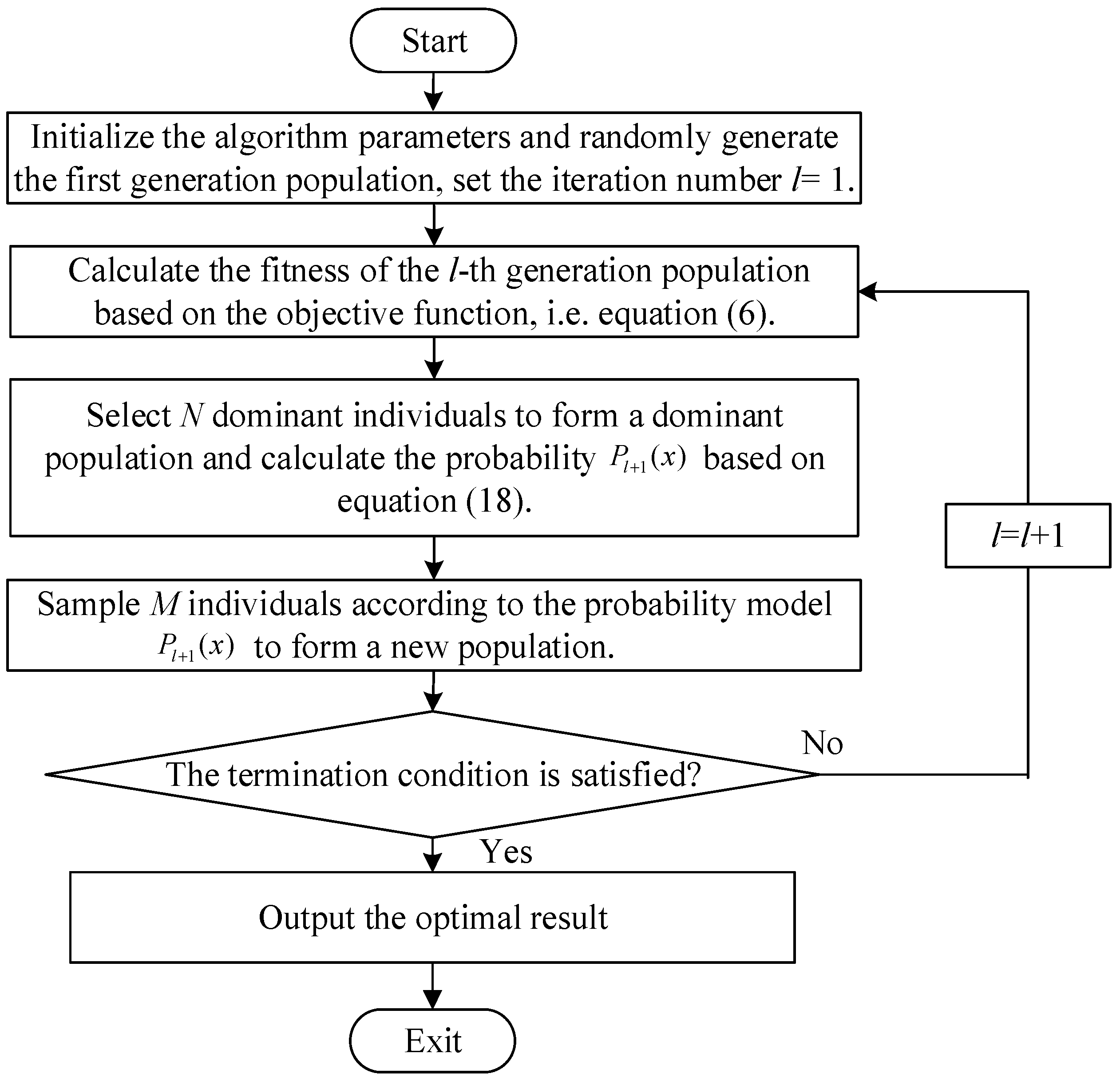
The calculation process of the improved PBIL algorithm is as follows:
(1)
Randomly generate M individuals based on the initial probability P 0 ( x ) = 0.5 , , 0.5 to form the initial population, and set the iteration number l = 1.
(2)
Calculate the fitness of the l-th generation population based on the objective function, i.e., Equation (6).
(3)
Select N dominant individuals to form a dominant population and calculate the probability P l + 1 ( x ) based on Equation (18).
(4)
Sample M individuals according to the probability model P l + 1 ( x ) to form a new population.
(5)
Determine whether the algorithm has converged. If it has converged, output the optimal objective result; otherwise, set l = l + 1 and go to step (2).
The flow chart of the improved PBIL algorithm is shown in Figure 2.

5. Numerical Test and Analysis

5.1. Basic Data and Simulation Conditions

(1)
Basic data
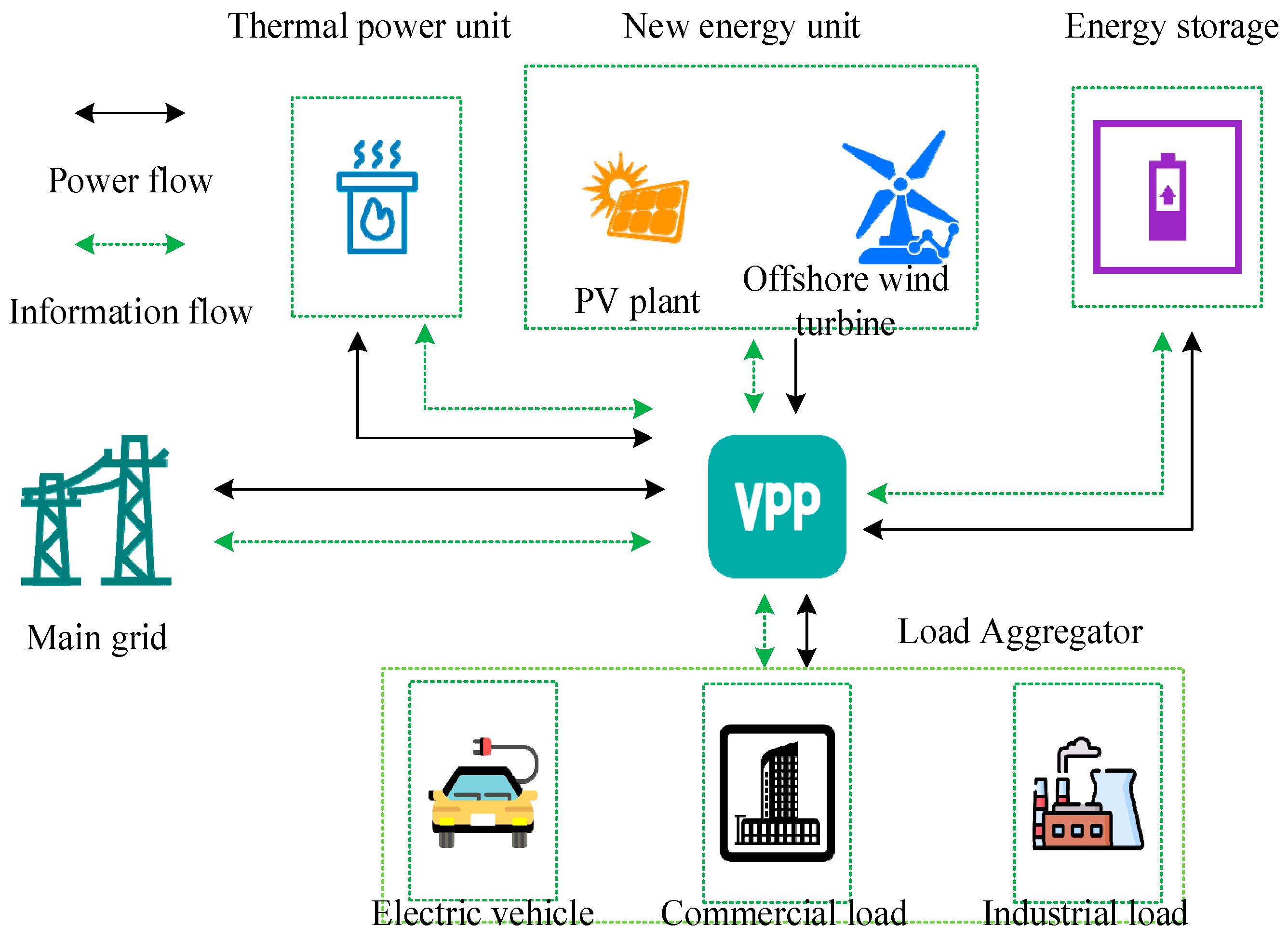
To empirically validate the efficacy of the proposed methodology, a VPP model incorporating typical offshore wind and solar RE sources transmitted via flexible HVDC was used. Within this model, there are thermal power units, RES units comprising distributed photovoltaic and OWP, ES power stations, and load aggregators. The resource types aggregated by load aggregators mainly include electric vehicles, commercial loads, and industrial loads [19]. The simulation experimental environment is MATLAB 2024a, the time step of the simulation model is set to 1 h, with a scheduling cycle of 24 h. The schematic diagram of the VPP architecture is shown in Figure 3. In this paper, the LSTM model is configured with four combined gating networks, including a FG, an input gate, an OG, and a self-attention gating network. These are combined with a self-attention mechanism for weight allocation to ensure training stability and computational efficiency for long-sequence time-series data.
(2)
Comparison algorithms
To verify the predictive performance of the improved LSTM model proposed in this paper, three time-series prediction methods—namely, i.e., the RNN [39], CNN [40], and the classical LSTM [24]—were selected for comparison with the improved LSTM model presented in this paper. To compare the optimization performance of the proposed method in this paper, we conducted comparative analyses between our method and the GA [41], PSO algorithm [42], and GW algorithm [43], respectively. Furthermore, the following indicators are used to evaluate the prediction performance:
M A P E = 1 N i = 1 N y i y ^ i y i × 100 %
N R M S E = 1 N i = 1 N y i y ^ i 2 C r a t e d × 100 %
R 2 = 1 i = 1 N y i y ^ i 2 i = 1 N y i y ¯ i 2
where MAPE stands for average percentage error; NRMSE stands for normalized root mean square error; R2 represents R-squared value; yi represents the real power generation value; y ^ i represents the predicted power generation value; y ¯ i represents the average power generation value; and Crated stands for rated installed capacity.

5.2. Simulation Results and Analysis

(1)
Comparison of prediction performance
Table 1 presents the forecasting results obtained by using different prediction methods based on an actual wind–solar RES power dataset from a certain region [25]. This region is located in Xinjiang, China. As shown in Table 1, for the RNN model, the MAPE, NRMSE, and R2 values for OWP forecasting are 9.3751%, 16.7451%, and 0.7321, respectively, while for PV power forecasting, they are 11.2765%, 13.7311%, and 0.8103, respectively. For the CNN model, the MAPE, NRMSE, and R2 values for OWP forecasting are 9.6234%, 17.2368%, and 0.7535, respectively, and for PV power forecasting, they are 11.7324%, 15.1422%, and 0.8325, respectively. For the classical LSTM model, the MAPE, NRMSE, and R2 values for OWP forecasting are 8.5332%, 16.4213%, and 0.7922, respectively, and for PV power forecasting, they are 10.5523%, 13.2566%, and 0.8517, respectively. For the improved LSTM model proposed in this paper, the MAPE, NRMSE, and R2 values for OWP forecasting are 7.9243%, 15.8724%, and 0.8351, respectively, and for PV power forecasting, they are 10.1014%, 12.8563%, and 0.8726, respectively. It can be concluded that, compared to the RNN, CNN, and classical LSTM models, the improved LSTM model proposed in this paper exhibits the smallest forecasting errors for both wind and solar power and has the highest R2 value, highlighting the superiority of the improved LSTM model.
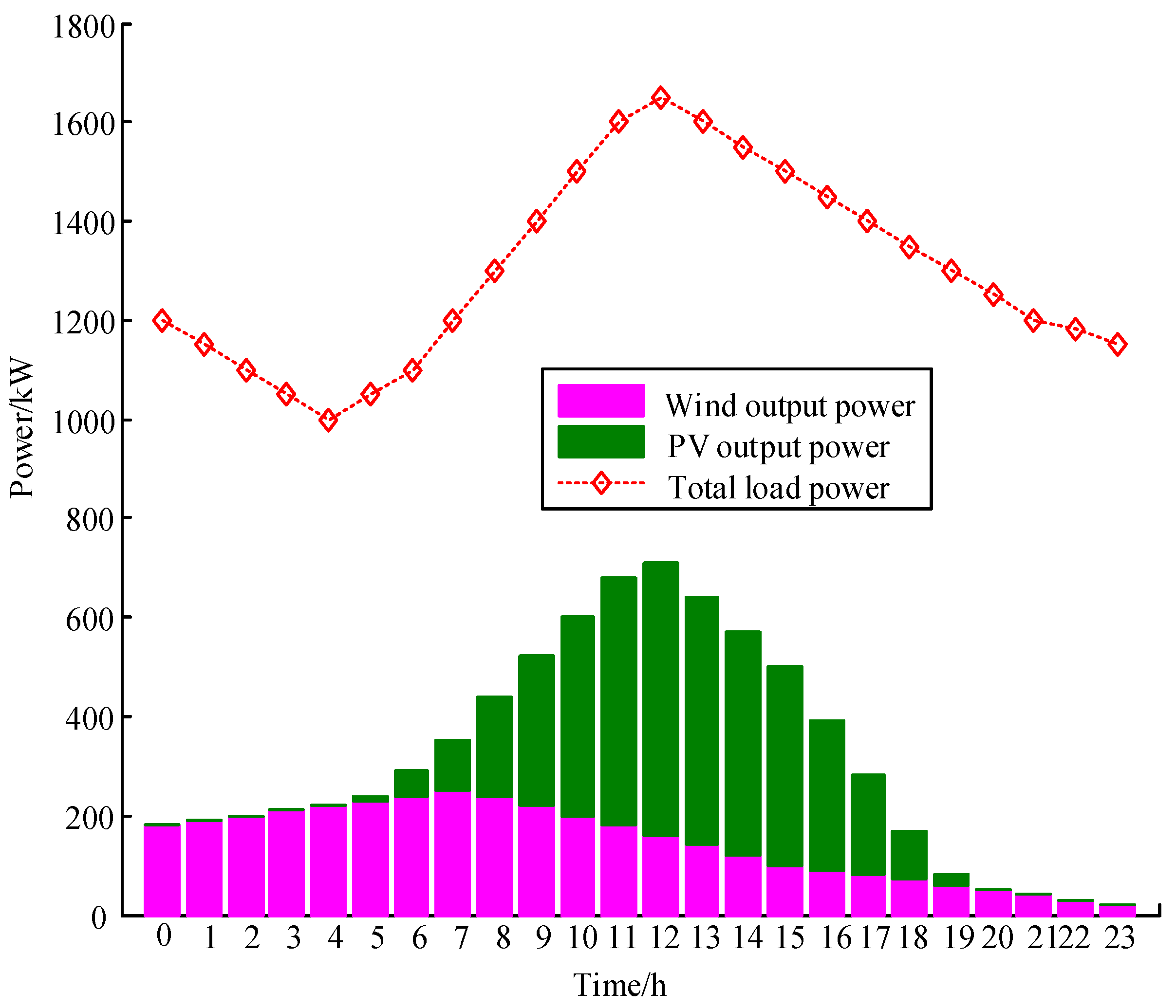
Furthermore, based on the improved LSTM model, total load and wind–solar power forecasting were conducted for the VPP model in an actual region used for simulation in this paper, with the forecasting results shown in Figure 4. The data in the figure is obtained through predictions made by the improved LSTM model (incorporating a self-attention mechanism and a multi-gated structure) proposed in this paper, based on historical data from a certain real-world region. As depicted in Figure 4, the prediction results indicate that the total load fluctuates within the range of 1000–1650 kW; the output of OWP remains relatively stable, while the output of PV power exhibits a distinct midday peak characteristic. During the peak load period at 12:00 noon, the combined output of wind and photovoltaic renewable energy accounts for 43.03% of the total load, validating the prediction effectiveness of the method proposed in this paper under complex fluctuating conditions.
(2)
Comparison of optimal dispatch results
The optimization comparison results between the method proposed in this paper, the GA [41], PSO algorithm [42], and GW algorithm [43] are shown in Table 2. As depicted in Table 2, the GA yields wind and solar power curtailment rates of 12.48% and 11.79%, respectively, with a total VPP operating cost of 48,862 RMB. The PSO algorithm results in wind and solar power curtailment rates of 16.13% and 14.68%, respectively, with a total VPP operating cost of 53,748 RMB. The GW algorithm produces wind and solar power curtailment rates of 15.37% and 15.12%, respectively, with a total VPP operating cost of 51,706 RMB. In contrast, the algorithm proposed in this paper achieves wind and solar power curtailment rates of 10.74% and 10.23%, respectively, with the lowest total VPP operating cost of 43,752 RMB. It can thus be concluded that, after optimization using the method proposed in this paper, the system experiences reduced wind and solar power curtailment rates and incurs the least operational expenses, making it the most economical option.
(3)
Comparison of computational efficiency
To further analyze and compare the computational performance of each algorithm, Table 3 presents a comparison of their computational efficiencies. As shown in Table 3, in terms of total computational time, the proposed method in this paper has a total computational time of 1945.86 s, which is slightly longer than that of the PSO algorithm (1919.52 s) but significantly shorter than that of the GA (4024.24 s) and the GW algorithm (4629.54 s). Notably, although the PSO algorithm has a slightly shorter total time, the optimization results in Table 2 reveal that the PSO algorithm has a wind curtailment rate of 16.13%, a solar curtailment rate of 14.68%, and a total operating cost of 53,748 RMB, all of which are significantly inferior to those of the proposed method (wind curtailment rate of 10.74%, solar curtailment rate of 10.23%, and total cost of 43,752 RMB). This indicates that while the PSO algorithm computes slightly faster, its optimization quality is poor, making it “fast but not optimal”.
In terms of the number of iterations and the time per iteration, the GA has the longest time per iteration (21.52 s) due to the extensive individual comparisons and sorting involved in its crossover, mutation, and selection operations, which incur substantial computational overhead. The PSO algorithm has the shortest time per iteration (15.48 s) because it only requires updating velocity and position, resulting in a simple computational structure. However, the PSO algorithm is prone to getting trapped in local optima and requires more random restarts or a larger population size to compensate, which prevents its total computational time from being significantly better than that of the proposed method. The GW algorithm has a moderate time per iteration (17.67 s) but requires a high number of iterations (262), much higher than the other algorithms. This is because, in the later stages of iteration, the step size for position updates between the leading wolf and the followers decreases, slowing down convergence and necessitating more iterations to meet convergence conditions. The proposed method has a time per iteration of 17.22 s, comparable to that of the GW algorithm, but requires only 113 iterations. This is primarily attributed to two improvements: first of all, the elite retention strategy ensures the rapid dissemination of information from high-quality solutions, accelerating the convergence of the probabilistic model; secondly, the adaptive mutation operator dynamically adjusts the search step size in the later stages of iteration, avoiding ineffective redundant iterations and thereby significantly reducing the required number of iterations while maintaining global search capability.
(4)
Discussion
The practicality of an algorithm depends not only on computational speed but also on its ability to find high-quality solutions within a limited time. The proposed method optimizes the total cost to 43,752 RMB within 1945.86 s; the PSO algorithm, in a similar time frame (1919.52 s), can only optimize the cost to 53,748 RMB, with significantly lower unit-time efficiency compared to the proposed method. Although the GA and GW algorithms achieve reasonable optimization quality (48,862 RMB and 51,706 RMB, respectively), their excessive computational times limit their practicality in real-time scheduling scenarios. Overall, the proposed method achieves the best balance between computational speed and optimization quality: its total computational time is on the same order of magnitude as that of the fastest PSO algorithm, but its optimization quality (cost, wind and solar curtailment rates) is significantly superior to all comparison algorithms. This “fast and good” characteristic makes it more suitable for VPP intra-day rolling scheduling scenarios that require rapid response.
The proposed model holds strong potential for practical deployment in future low-carbon power systems, serving as a foundational framework for integrating high-penetration RESs through flexible HVDC transmission and enabling scalable, market-oriented VPP operations. The limitations in this paper include simplified HVDC modeling (only capacity constraint), a deterministic framework ignoring forecast uncertainties, a single-VPP focus, exogenous price assumption without market-clearing mechanisms or bidding strategies, and untested scalability for a larger system. Future work should incorporate detailed HVDC dynamics, uncertainty-aware optimization (e.g., stochastic programming), market mechanism integration (e.g., day-ahead and real-time market participation, bidding strategy optimization), multi-VPP coordination, and real-world validation.

6. Conclusions

To enhance the consumption of offshore wind and solar power transmitted via flexible HVDC and address the significant uncertainties and consumption challenges associated with the integration of high-proportion RESs into VPP operation and scheduling, an optimal dispatch strategy for VPP driven by AI algorithms to enhance the consumption of offshore wind and solar RE is proposed in this paper. Based on the LSTM deep learning model, this method incorporates a self-attention mechanism and multiple gated networks, enabling efficient adaptation to energy generation patterns across different time scales and thereby improving the accuracy and stability of offshore wind and solar power forecasting. Strong penalty costs for offshore wind and solar power curtailment are incorporated into the total operating cost of the VPP to reinforce RE consumption constraints. The objective function aims to minimize the total operating cost of the VPP, thereby avoiding the wastage of RESs due to economic prioritization. Furthermore, to address the high-dimensional nonlinear optimization challenges inherent in VPP optimization problems, this paper introduces an improved PBIL algorithm that combines an elite retention strategy with an adaptive mutation operator to enhance the algorithm’s global search capability and convergence speed. Simulations based on an VPP incorporating typical offshore wind and solar RESs transmitted via flexible HVDC demonstrate that the improved LSTM reduces MAPE by 7.14% for wind and 4.27% for PV compared to classical LSTM, and the proposed method achieves the lowest curtailment rates (wind 10.74%, PV 10.23%) and total cost (43,752 RMB), outperforming GA, PSO, and GW by 10–18% in cost reduction. This paper provides theoretical methods and practical references for the optimal scheduling of PS with a high proportion of RES, facilitating the low-carbon transformation of new-type power systems. In future work, we will focus on incorporating detailed HVDC dynamics, market mechanisms, and uncertainty quantification into the optimization framework, extending the model to multi-VPP coordination scenarios, and validating the proposed strategy through more real-world engineering applications.

Author Contributions

Conceptualization, J.O., H.L., J.L., D.C., N.Y. and S.W.; software, J.O., H.L., J.L., D.C., N.Y. and S.W.; writing—original draft preparation, J.O., H.L., J.L., D.C., N.Y. and S.W. All authors have read and agreed to the published version of the manuscript.

Funding

This research received no external funding.

Data Availability Statement

The original contributions presented in this study are included in the article. Further inquiries can be directed to the corresponding author.

Conflicts of Interest

Authors Jiajun Ou, Hao Lu, Jingyi Li and Di Cai were employed by the company China Southern Power Grid Company Limited. The remaining authors declare that the research was conducted in the absence of any commercial or financial relationships that could be construed as a potential conflict of interest. The China Southern Power Grid Company Limited had no role in the design of the study; in the collection, analyses, or interpretation of data; in the writing of the manuscript, or in the decision to publish the results.

Abbreviations

The following abbreviations are used in this manuscript:
RESrenewable energy sources
PSpower system
HVDCflexible high-voltage direct current
AIartificial intelligence
VPPvirtual power plants
LSTMlong short-term memory
PBILpopulation-based incremental learning
OWPoffshore wind power
PVphotovoltaic
ESenergy storage
RNNrecurrent neural network
HPBILhybrid population-based incremental learning
CNNconvolutional neural network
IHHOHarris hawks optimization
LSHlocality-sensitive hashing
JILOjoint incremental learning objective
GAgenetic algorithm
PSOparticle swarm optimization
GWgray wolf
FGforget gate
OGoutput gate
SOCstate of charge

References

  1. Xiang, W.; Tu, R.; Han, M.; Wen, J. Hybrid AC/DC Collection and HVDC Transmission Topology for Large-scale Offshore Wind Farms. CSEE J. Power Energy Syst. 2025, 11, 949–959. [Google Scholar] [CrossRef]
  2. Asadpour, S.; Mahdavi, E.; da Silva Dias, R.F. Zero-Emission Unified Wind Energy System Design for Offshore Oil and Gas Platforms: A Robust Framework for Managing Uncertainty. IEEE Access 2024, 12, 170913–170922. [Google Scholar] [CrossRef]
  3. Dong, Y.; Yuan, J. Projections of Offshore Wind Energy and Wave Climate in Guangdong’s Nearshore Area using CMIP6 Simulations. J. Intell. Constr. 2023, 1, 1–19. [Google Scholar] [CrossRef]
  4. Wang, F.; Zhang, S.; Hou, Y.; Wang, J. Extraction of Offshore Wind Turbines in China by Combining Multispectral and SAR Image Data. IEEE J. Sel. Top. Appl. Earth Obs. Remote Sens. 2024, 17, 9266–9281. [Google Scholar] [CrossRef]
  5. Fu, Y.; Ren, Z.; Wei, S.; Huang, L.; Li, F.; Liu, Y. Dynamic Optimal Power Flow Method Based on Reinforcement Learning for Offshore Wind Farms Considering Multiple Points of Common Coupling. J. Mod. Power Syst. Clean Energy 2024, 12, 1749–1759. [Google Scholar] [CrossRef]
  6. Fu, Y.; Liu, Y.; Huang, L.-L.; Ying, F.; Li, F. Collection System Topology for Deep-Sea Offshore Wind Farms Considering Wind Characteristics. IEEE Trans. Energy Convers. 2022, 37, 631–642. [Google Scholar] [CrossRef]
  7. Wu, C.; Zhang, X.-P.; Sterling, M. Wind power generation variations and aggregations. CSEE J. Power Energy Syst. 2022, 8, 17–38. [Google Scholar] [CrossRef]
  8. Abeynayake, G.; Van Acker, T.; Hertem, D.V.; Liang, J. Analytical Model for Availability Assessment of Large-Scale Offshore Wind Farms Including Their Collector System. IEEE Trans. Sustain. Energy 2021, 12, 1974–1983. [Google Scholar] [CrossRef]
  9. Mei, J.; Wo, R.; Guo, J.; Diao, W.; Wang, G. Design of Transient Energy Regulation and Reuse Device of Flexible HVDC Transmission for Offshore Wind Power. IEEE Trans. Power Deliv. 2024, 39, 2368–2377. [Google Scholar] [CrossRef]
  10. Yu, Z.; Song, Q.; Yuan, Z.; Zou, C.; Qiao, X.; Liu, W. Transmission Topology and Control for Ultra-Large Offshore Wind Bases Integrating Multiple Offshore Low-Frequency AC Links and Onshore HVDC Link. IEEE Trans. Power Deliv. 2024, 39, 2797–2809. [Google Scholar] [CrossRef]
  11. Qin, H.; Peng, F.; Pan, Z.; Zhong, Y.; Liu, T.; Cao, R. A Single-Ended Protection Scheme for Flexible HVdc Transmission Lines Based on the Fréchet Distance of the Rate of Change of Fault Voltage Traveling Waves. IEEE Access 2025, 13, 128716–128728. [Google Scholar] [CrossRef]
  12. Mohy-ud-din, G.; Muttaqi, K.M.; Sutanto, D. A Cooperative Energy Transaction Model for VPP Integrated Renewable Energy Hubs in Deregulated Electricity Markets. IEEE Trans. Ind. Appl. 2022, 58, 7776–7791. [Google Scholar] [CrossRef]
  13. Guo, J.; Dou, C.; Yue, D.; Kuzin, V.; Zhang, Z.; Zhang, Z. A Cyber-Physical Collaboration Based Control Method for Frequency Regulation With VPP. IEEE Syst. J. 2024, 18, 746–757. [Google Scholar] [CrossRef]
  14. Majumder, S.; Khaparde, S.A.; Agalgaonkar, A.P.; Kulkarni, S.V.; Srivastava, A.K.; Perera, S. Chance-Constrained Pre-Contingency Joint Self- Scheduling of Energy and Reserve in VPP. IEEE Trans. Power Syst. 2024, 39, 245–260. [Google Scholar] [CrossRef]
  15. Dai, Z.; Tan, M.; Yang, Y.; Liu, X.; Wang, R.; Su, Y. Massive Coordination of Distributed Energy Resources in VPP: A Mean Field RL-Based Bi-Level Optimization Approach. IEEE Trans. Cybern. 2025, 55, 1332–1346. [Google Scholar] [CrossRef]
  16. Lu, X.; Qiu, J.; Zhang, C.; Lei, G.; Zhu, J. Assembly and Competition for Virtual Power Plants With Multiple ESPs Through a “Recruitment–Participation” Approach. IEEE Trans. Power Syst. 2024, 39, 4382–4396. [Google Scholar] [CrossRef]
  17. Maulana, I.R.; Zafar, R.; Chung, I.-Y. A Bilevel Optimization Framework for Hybrid DSO-VPP Coordination: Enhancing Congestion Management and Market Efficiency in Decentralized Energy Systems. IEEE Access 2025, 13, 153281–153295. [Google Scholar] [CrossRef]
  18. Mohy-ud-din, G.; Muttaqi, K.M.; Sutanto, D. A Hierarchical Service Restoration Framework for Unbalanced Active Distribution Networks Based on DSO and VPP Coordination. IEEE Trans. Ind. Appl. 2022, 58, 1756–1770. [Google Scholar] [CrossRef]
  19. Zhang, T.; Hu, Z. Optimal Scheduling Strategy of Virtual Power Plant With Power-to-Gas in Dual Energy Markets. IEEE Trans. Ind. Appl. 2022, 58, 2921–2929. [Google Scholar] [CrossRef]
  20. Cheng, X.; Wu, T.; Yao, W.; Yang, Y. Selection Method for New Energy Output Guaranteed Rates Considering Optimal Energy Storage Configuration. CSEE J. Power Energy Syst. 2024, 10, 539–547. [Google Scholar] [CrossRef]
  21. Wu, D.; Lu, Z.; Tan, J.; Lin, T.; Liu, Y.; Wang, K. A Feedback Analytic Algorithm for Maximal Solar Energy Harvesting of InP Stepped Nanocylinders. IEEE Photonics J. 2024, 16, 2700109. [Google Scholar] [CrossRef]
  22. Naina, P.M.; Swarup, K.S. Double-Consensus-Based Distributed Energy Management in a Virtual Power Plant. IEEE Trans. Ind. Appl. 2022, 58, 7047–7056. [Google Scholar] [CrossRef]
  23. Gao, H.; Zhang, F.; Xiang, Y.; Ye, S.; Liu, X.; Liu, J. Bounded Rationality Based Multi-VPP Trading in Local Energy Markets: A Dynamic Game Approach with Different Trading Targets. CSEE J. Power Energy Syst. 2023, 9, 221–234. [Google Scholar] [CrossRef]
  24. Qin, W.; Li, X.; Jing, X.; Zhu, Z.; Lu, R.; Han, X. Multi-Temporal Optimization of Virtual Power Plant in Energy-Frequency Regulation Market Under Uncertainties. J. Mod. Power Syst. Clean Energy 2025, 13, 675–687. [Google Scholar] [CrossRef]
  25. Gu, H.; Fang, W.; Zhou, Z.; Zhu, W.; Ma, G.; Li, Y. A new energy generation power forecasting method based on CSO-LSTM. Comput. Sci. 2025, 52, 759–769. Available online: https://kns.cnki.net/kcms2/article/abstract?v=esvOG1ozB-hJMWMYFjnGdykB4DwdLKqAFGDu_Or4ZPa0hXZ5vt9EzUmk8TY5ncm2AueXkMOhmrJW8Gisf3GTz_TlFsuGsy-Z2FEB0K_rBT3KZVzAVTuK-c8l7M_iBYjpnddgZiExmZ-fqWoj7gB-yshgQ3L_raXu2tdjHQynIRTb7DwO_-IM-w==&uniplatform=NZKPT&language=CHS (accessed on 17 August 2025).
  26. Li, H.; Sui, Y.; Liu, Y.; Zhou, Y.; Shi, J. Dynamic LSTM-Based Channel Quality Indicators Prediction for LEO Satellite Communication. IEEE Wirel. Commun. Lett. 2024, 13, 3285–3289. [Google Scholar] [CrossRef]
  27. Jin, R.; Chen, Z.; Wu, K.; Wu, M.; Li, X.; Yan, R. Bi-LSTM-Based Two-Stream Network for Machine Remaining Useful Life Prediction. IEEE Trans. Instrum. Meas. 2022, 71, 3511110. [Google Scholar] [CrossRef]
  28. Wang, R.; Jiang, S.; Ma, D.; Sun, Q.; Zhang, H.; Wang, P. The Energy Management of Multiport Energy Router in Smart Home. IEEE Trans. Consum. Electron. 2022, 68, 344–353. [Google Scholar] [CrossRef]
  29. Xu, G.; Yu, H.; Hua, C.; Liu, T. Chebyshev Polynomial-LSTM Model for 5G Millimeter-Wave Power Amplifier Linearization. IEEE Microw. Wirel. Compon. Lett. 2022, 32, 611–614. [Google Scholar] [CrossRef]
  30. Zhu, Z.; Tian, Y.; Sun, J. Antenna Modeling Based on Image-CNN-LSTM. IEEE Antennas Wirel. Propag. Lett. 2024, 23, 2738–2742. [Google Scholar] [CrossRef]
  31. Mao, S.; Li, H.; Zhang, Y.; Shi, Y. Prediction of Ionospheric Electron Density Distribution Based on CNN-LSTM Model. IEEE Geosci. Remote Sens. Lett. 2024, 21, 1003305. [Google Scholar] [CrossRef]
  32. Zhang, Y.; Chen, C.; Wu, T.; Miao, C.; Ding, S. Surrogate-Assisted Hybrid Metaheuristic for Mixed-Variable 3-D Deployment Optimization of Directional Sensor Networks. In Proceedings of the 2023 5th International Conference on Data-Driven Optimization of Complex Systems (DOCS), Tianjin, China, 22–24 September 2023; pp. 1–9. [Google Scholar] [CrossRef]
  33. Jiang, J.; Chen, J.; Xie, Y.; Lei, H.; Zheng, L. Modified-PBIL Based User Selection for Multi-user Massive MIMO Systems with Massive Connectivity. In Proceedings of the IEEE INFOCOM 2020-IEEE Conference on Computer Communications Workshops (INFOCOM WKSHPS), Toronto, ON, Canada, 6–9 July 2020; pp. 1260–1265. [Google Scholar] [CrossRef]
  34. Yang, J.; Zhang, Y.; Zhou, L.; Lv, X.; Jiang, Y.; Wang, Q.; Yang, S. An Adaptive Real Coded Population-Based Incremental Learning Algorithm for Design Optimizations in Continuous Space. In Proceedings of the 2023 IEEE 4th China International Youth Conference On Electrical Engineering (CIYCEE), Chengdu, China, 8–10 December 2023; pp. 1–4. [Google Scholar] [CrossRef]
  35. Meng, X.; Li, J.; Zhou, M.; Dai, X.; Dou, J. Population-Based Incremental Learning Algorithm for a Serial Colored Traveling Salesman Problem. IEEE Trans. Syst. Man Cybern. Syst. 2018, 48, 277–288. [Google Scholar] [CrossRef]
  36. Ankrah, R.; Regnier-Coudert, O.; McCall, J.; Conway, A.; Hardwick, A. Performance Analysis of GA and PBIL Variants for Real-World Location-Allocation Problems. In Proceedings of the 2018 IEEE Congress on Evolutionary Computation (CEC), Rio de Janeiro, Brazil, 8–13 July 2018; pp. 1–8. [Google Scholar] [CrossRef]
  37. Sun, F.; Chen, G.; Ma, H.; Hartmann, S. Population-Based Incremental Learning for Effective IoT Service Composition with Replication. In Proceedings of the 2024 IEEE International Conference on Software Services Engineering (SSE), Shenzhen, China, 7–13 July 2024; pp. 74–76. [Google Scholar] [CrossRef]
  38. Hu, X.-M.; Pan, J.-H.; Li, M. Hybrid Population-Based Incremental Learning for Coalition Structure Generation of Smart Grids. In Proceedings of the 2022 IEEE 25th International Conference on Computer Supported Cooperative Work in Design (CSCWD), Hangzhou, China, 4–6 May 2022; pp. 1191–1196. [Google Scholar] [CrossRef]
  39. Ma, Z.; Zhang, H.; Liu, J. DB-RNN: An RNN for Precipitation Nowcasting Deblurring. IEEE J. Sel. Top. Appl. Earth Obs. Remote Sens. 2024, 17, 5026–5041. [Google Scholar] [CrossRef]
  40. Zamanidoost, Y.; Ould-Bachir, T.; Martel, S. OMS-CNN: Optimized Multi-Scale CNN for Lung Nodule Detection Based on Faster R-CNN. IEEE J. Biomed. Health Inform. 2025, 29, 2148–2160. [Google Scholar] [CrossRef]
  41. Akopov, A.S. MBHGA: A Matrix-Based Hybrid Genetic Algorithm for Solving an Agent-Based Model of Controlled Trade Interactions. IEEE Access 2025, 13, 26843–26863. [Google Scholar] [CrossRef]
  42. Yu, K.; Ren, W.; Zhang, N.; Huang, J.; Cui, Y.; Wang, Z. Design of a Low-Sidelobe Wideband Leaky-Wave Antenna With Standing-Wave Excitation via Improved Discrete Particle Swarm Optimization. IEEE Antennas Wirel. Propag. Lett. 2025, 24, 3936–3940. [Google Scholar] [CrossRef]
  43. Salinas, G.; Pichardo, E.; Vázquez, Á.A.; Avalos, J.G.; Sánchez, G. Grey Wolf Optimization Algorithm for Embedded Adaptive Filtering Applications. IEEE Embed. Syst. Lett. 2024, 16, 33–36. [Google Scholar] [CrossRef]
Figure 1. The network structure diagram of LSTM model with combined multi-gating mechanism.
Processes 14 01162 g001
Figure 2. The flow chart of improved PBIL algorithm.
Processes 14 01162 g002
Figure 3. The schematic diagram of VPP architecture.
Processes 14 01162 g003
Figure 4. The prediction value of total load and RES output power.
Processes 14 01162 g004
Table 1. RE power prediction index based on actual scenery dataset in a certain area.
ModelOWP PredictionPV Power Prediction
MAPE (%)NRMSE (%)R2MAPE (%)RMSE (%)R2
RNN [39]9.375116.74510.732111.276513.73110.8103
CNN [40]9.623417.23680.753511.732415.14220.8325
Classical LSTM [24]8.533216.42130.792210.552313.25660.8517
The improved LSTM7.924315.87240.835110.101412.85630.8726
Table 2. Total operation cost and abandoned RES rate of the system under different algorithms.
MethodOWP Curtailment Rate (%)PV Power Curtailment Rate (%)Total Cost (RMB)
GA [41]12.4811.7948,862
PSO [42]16.1314.6853,748
GW [43]15.3715.1251,706
The proposed method10.7410.2343,752
Table 3. Comparison of computational efficiency of different algorithms.
MethodNumber of IterationsComputing Time of Each Iteration (s)Total Computing Time (s)
GA [41]18721.524024.24
PSO [42]12415.481919.52
GW [43]26217.674629.54
The proposed method11317.221945.86
Disclaimer/Publisher’s Note: The statements, opinions and data contained in all publications are solely those of the individual author(s) and contributor(s) and not of MDPI and/or the editor(s). MDPI and/or the editor(s) disclaim responsibility for any injury to people or property resulting from any ideas, methods, instructions or products referred to in the content.