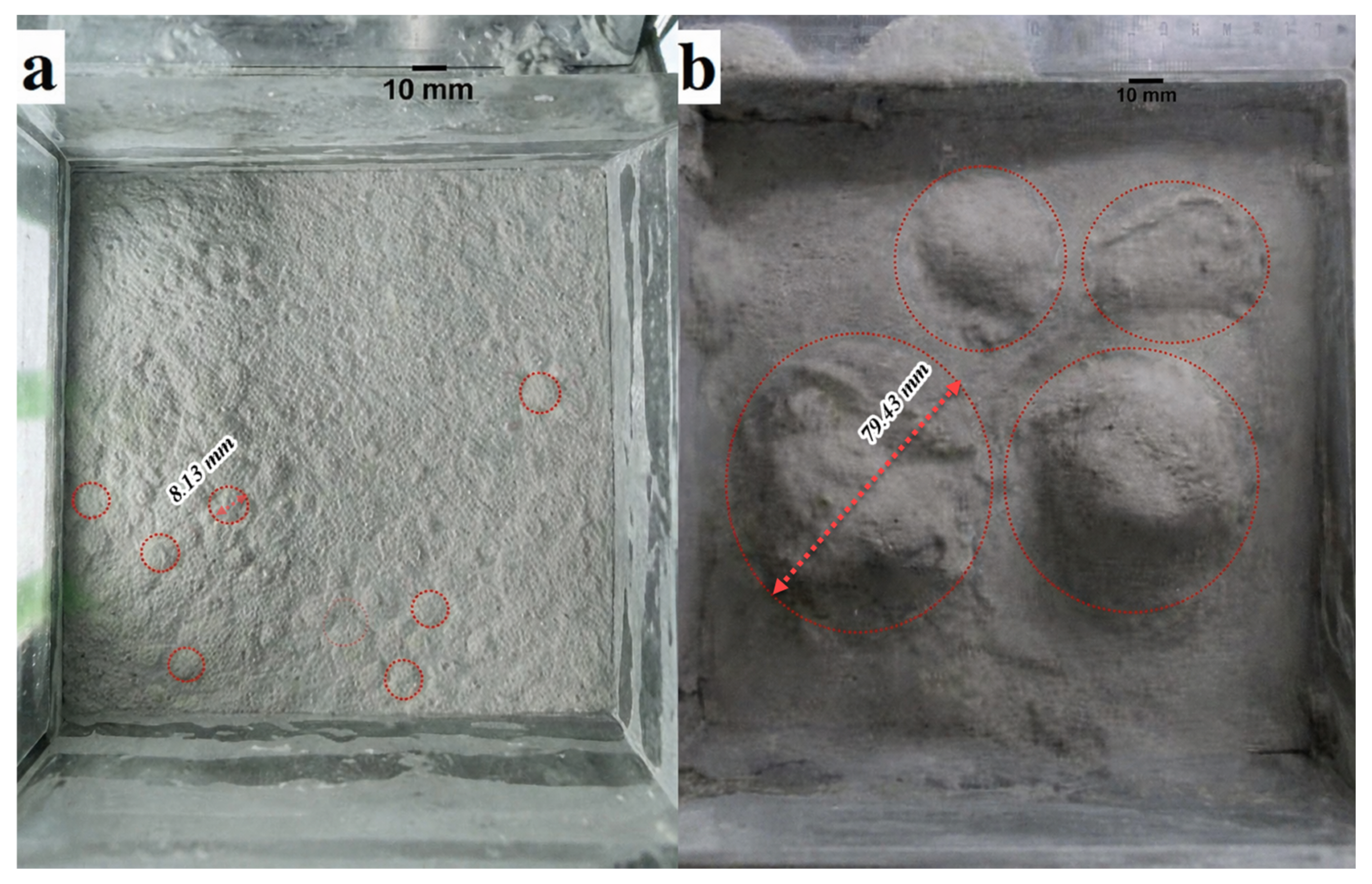
3.1. Optimization of Fluidization Behavior and Morphological Characterization of PEEK Powder
The fluidization performance of PEEK powder was evaluated using the Taguchi L9 design described in
Section 2.4. The influences of
,
, and
on
and
were examined to identify a suitable Stage I fluidization window for subsequent coating trials. The experimental matrix and corresponding response values are given in
Table 5, while the signal-to-noise (S/N) ratios and ANOVA results used to quantify the significance of each parameter are presented in
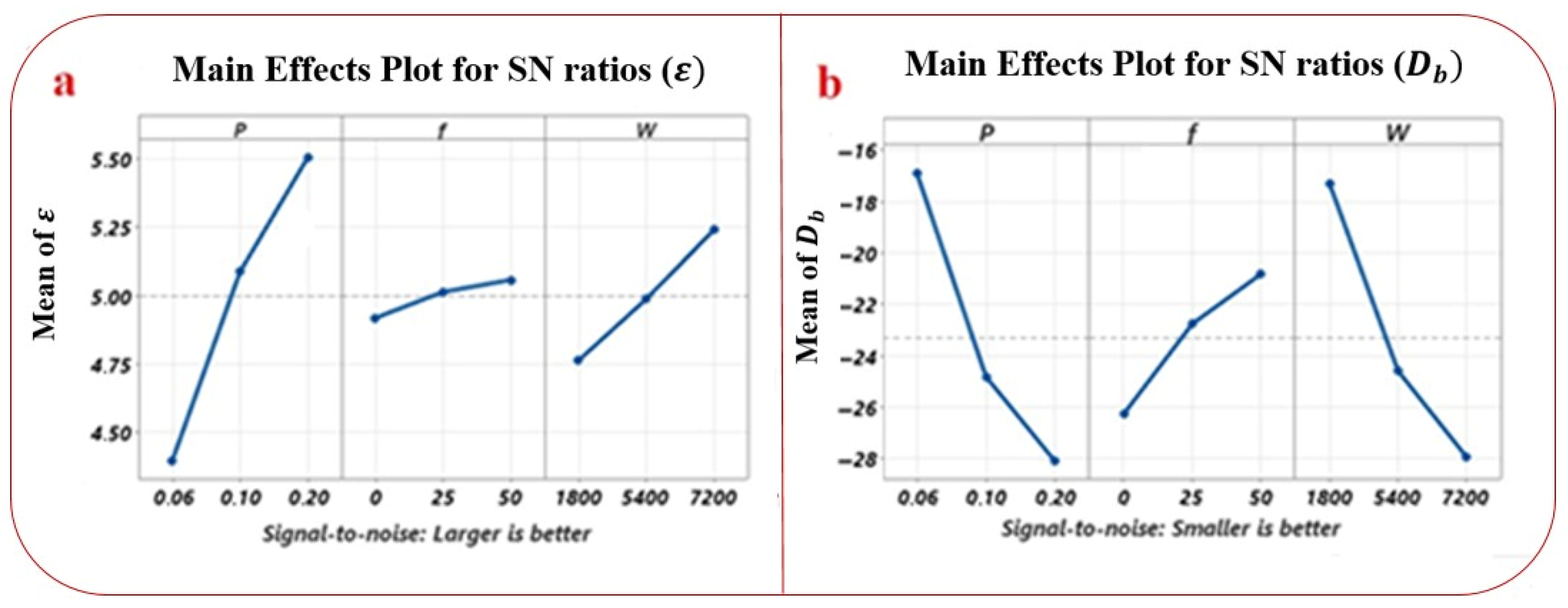
Figure 4a,b and
Table 6.
The Taguchi L9 analysis revealed clear trends in the influence of process parameters on
and
. The “larger-the-better” criterion was used for
, since higher
improves fluidization efficiency, reduces local powder density, and supports a greater fiber fraction during coating. Under this criterion, the effect of
on the S/N ratio was minimal, whereas increases in
and
led to substantial improvements in fluidization performance, as shown in
Figure 4a. Based on
alone, the condition associated with the highest bed expansion was
,
, and
. ANOVA results (
Table 6) confirmed that
was the dominant factor, accounting for 83.4% of the total variance (
p < 0.05), followed by
(15.2%). Although
also had a statistically significant effect on
(
p = 0.01), its contribution remained limited (1.3%), indicating that its effect was secondary in practical terms. The high coefficient of determination (
) demonstrated excellent agreement between the predictive model and experimental measurements.
The “smaller-the-better” criterion was applied to
because large bubbles generate strong internal turbulence, which leads to unstable fluidization and non-uniform powder deposition. As shown in
Figure 4b,
decreased with increasing
and with reductions in both
and
. Across the experimental domain,
exhibited a wide response range (6.82–55.08 mm), highlighting the strong sensitivity of bubble behavior to operating conditions. Based on
alone, the lowest average bubble diameter was obtained at
bar,
g, and
Hz (Experiment 1.6).
The ANOVA results (
Table 6) indicated that
(52.7%) and
(40.2%) were the primary contributors to
, while
accounted for only a minor portion of the variation (3.0%). Unlike the statistically significant but practically limited effect of
on
, the influence of vibration frequency on
remained statistically non-significant (
p = 0.571), indicating that
did not play a decisive role in controlling bubble diameter within the investigated range. Although the obtained
p-values for
(
p = 0.071) and
(
p = 0.091) slightly exceeded the conventional 0.05 threshold for statistical significance, these results should be interpreted in the context of the inherently dynamic and stochastic nature of bubble formation in fluidized beds. In such systems, bubbles are not static structures; rather, they continuously undergo processes of formation, growth, coalescence, and fragmentation. This dynamic behavior inherently leads to natural temporal variability in the measured bubble diameters. Previous imaging and signal analysis studies have shown that bubbles of varying sizes pass through the same observation plane over time, and that the bubble size distribution continuously evolves under the competing mechanisms of coalescence and fragmentation [
47,
48,
49]. Furthermore, since bubbles are three-dimensional structures but are typically evaluated using two-dimensional imaging techniques, this methodological limitation also contributes to variability in the measured diameters [
47]. Despite the slightly elevated
p-values, the high coefficient of determination (
), the low residual error (4.05%), and the substantial contribution ratios (52.7% and 40.2%) indicated that
and
were the main physical contributors to bubble behavior within the investigated parameter range.
Increasing
from 0.06 to 0.20 bar caused a substantial rise in gas density, which in turn increased the drag force acting on the particles. As a direct result of this stronger drag, the bed expanded by approximately 20% (from 1.60 to 1.92), indicating improved fluidization. At the same time, the higher gas density and volumetric flow rate intensified bubble coalescence, which led to a nearly eightfold increase in
. These pressure-dependent effects are consistent with trends reported for Geldart Group A materials by Chitester et al. [
50] and Sidorenko and Rhodes [
51]. The PEEK powder used in this study, with an average particle size of about 50 µm, also belongs to Group A, and therefore exhibits behavior similar to that observed in previous studies. Verma et al. [
52] likewise showed that elevated pressure strengthens gas–solid interactions, thereby promoting rapid bubble growth. Consequently, although higher pressure improved fluidization quality by enhancing
, it simultaneously generated excessively large bubbles, ultimately reducing coating uniformity at the upper pressure range.
Increasing the vibration frequency (
) had a limited but positive effect on fluidization stability by improving gas distribution and reducing channeling within the bed. According to the Taguchi L9 analysis, the statistical contribution of
to
was limited to 1.31% (
p = 0.01), indicating that its effect was statistically significant but practically minor within the experimental window. The applied vibration likely increased particle mobility and promoted a more uniform gas flow, contributing to smoother bed expansion and more consistent fluidization behavior. In addition,
decreased by approximately 3% with increasing
, suggesting that vibration may have helped suppress bubble coalescence and stabilize gas–solid interactions. Similar stabilizing trends in
and
have been reported by Zhao et al. [
53] and Guo et al. [
54].
Although the statistical contribution of was limited within the selected conditions, vibration was retained in the system as a supportive stabilization measure rather than as a primary performance-driving variable. Its effect on the main response variables remained small; however, it helped reduce cohesive powder effects and channel formation, thereby promoting more uniform gas–solid interactions and more repeatable fluidization behavior during continuous operation. Because these benefits were achieved with relatively low additional energy input and minimal mechanical complexity, the use of vibration was considered a practical and cost-effective way to support process stability.
The influence of powder weight (
) on fluidization performance was much more pronounced than that of
. Increasing
intensified gas–solid interactions within the denser bed, which improved fluidization behavior and increased
by approximately 10%. A similar enhancement in
was reported by Musademba and Prabhansu [
55], where doubling the static bed height from 60 mm to 120 mm resulted in a 16% increase in
. However, higher powder loading simultaneously promoted stronger bubble coalescence, producing a substantial increase in
. In the present study,
increased by about 65%, indicating a deterioration in fluidization uniformity at elevated
levels. This observation is consistent with the ≈66% rise reported by Shi et al. [
56], where larger static bed heights intensified bubble coalescence within deeper and denser fluidized regions.
The regression models developed for both and showed excellent agreement with the experimental measurements, with coefficients of determination exceeding 0.95. This confirmed that the selected process variables, namely , , and , could be used to adequately control the fluidization behavior of PEEK powder. However, the parameter levels associated with maximum did not coincide with those yielding minimum , indicating a clear trade-off between fluidization efficiency and bubble stability. Therefore, the final Stage I operating conditions were not selected on the basis of or alone. Instead, , , and coating requirements were considered together to identify the most suitable operating window for the subsequent coating experiments. On this basis, , , and (Experiment 1.3) were selected as the most suitable Stage I operating conditions for the subsequent coating experiments. Under these conditions, a balanced combination of bed expansion and bubble stability was obtained, with and = 6.82 mm. In addition, the high ensured sufficient active powder availability for continuous coating, while the high provided a limited but beneficial contribution to fluidization stability by reducing the cohesive behavior of the PEEK powder.
3.2. Experimental Set II: Optimization of Fluidized-Bed Coating Process Performance
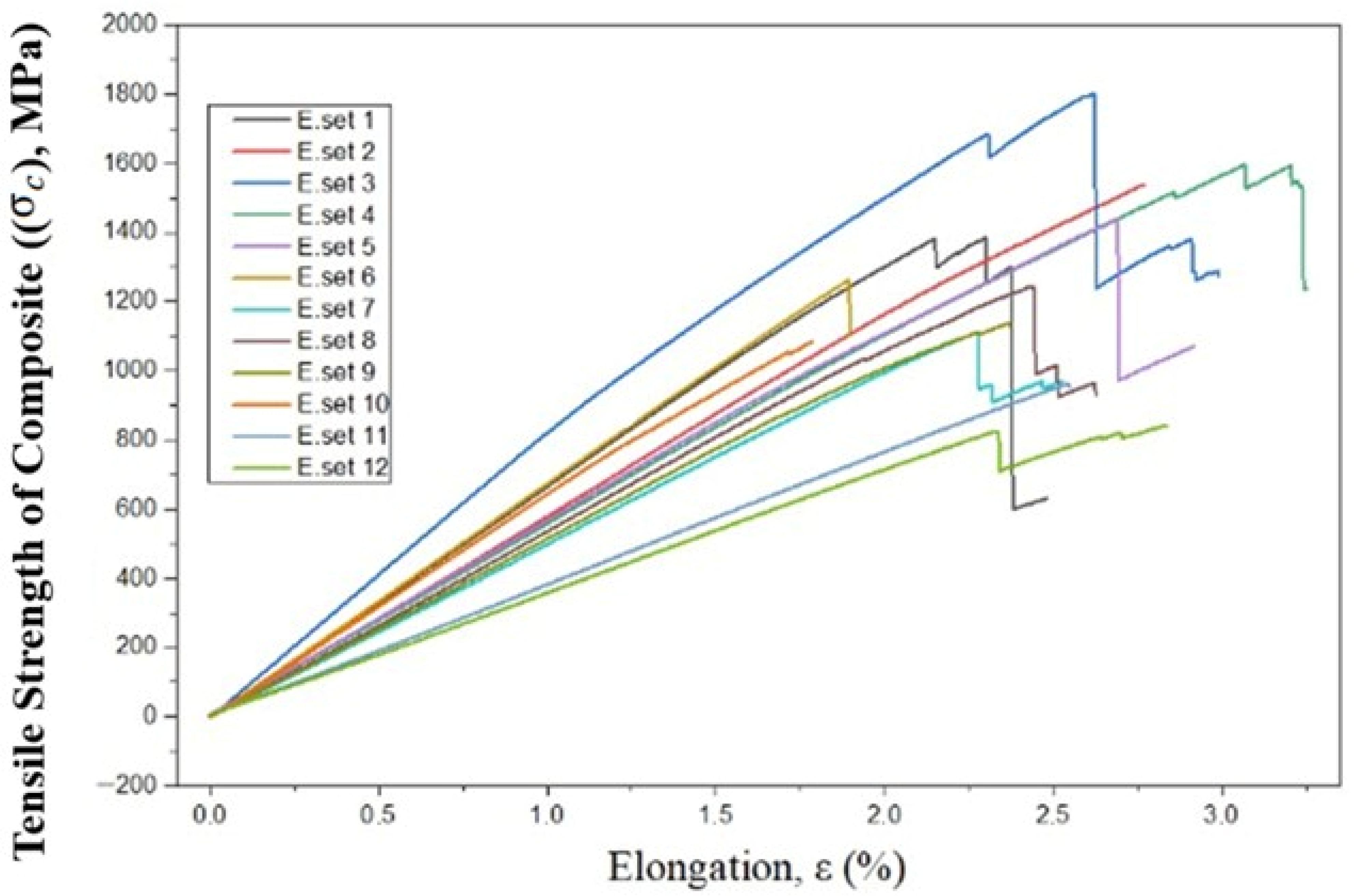
Consolidated composite specimens produced in Experimental Set II were evaluated to characterize their mechanical, physical, and microstructural properties under various coating conditions. Mechanical performance was determined from the
and elastic modulus (
). The corresponding
and
values for the specimens are shown in
Figure 5. Consolidation quality, fiber packing, and the extent of interfacial impregnation were assessed through
and
. These critical physical parameters were determined by comparing the experimentally measured composite bulk density (
) with the void-free theoretical density (
). Tensile-strength efficiency (
) was also determined to quantify the effectiveness of stress transfer between the fibers and the PEEK matrix.
The results are presented in
Table 7, which compares
,
,
,
,
,
, and
for different combinations of
,
, and
. In this dataset,
represents the effective duration of fiber exposure within the fluidized bed and is directly governed by
and
. SEM imaging was performed on selected specimens to examine surface morphology and coating uniformity, providing complementary insight into the relationships among
,
, and
, and the resulting mechanical performance of the powder-coated composite. The original unprocessed SEM micrographs corresponding to
Figure 6 are provided in
Figure S2 to ensure transparency of the image-processing procedure.
Experimental Set II, consisting of twelve individual coating trials, was analyzed using multiple regression to determine the effects of
and
on
and
of the towpreg composites. To examine whether interaction effects between the process parameters contributed meaningfully to the coating response, extended second-order regression models including quadratic and interaction terms were initially constructed, and the corresponding statistical results are presented in the
Supplementary Materials (Table S1). The interaction term (
) showed a very limited contribution for both responses, remaining low for
(1.47%) and negligible for
(0.01%) while also being statistically insignificant in both cases (
p = 0.343 for
and
p = 0.915 for
). These findings indicate that inclusion of the interaction term (
) did not provide sufficient additional explanatory improvement within the investigated design space to warrant its retention in the final empirical models.
Therefore, the regression structure was simplified by excluding the interaction term while retaining the main and quadratic terms that contributed to model adequacy and interpretability. The final empirical models are given in Equations (9) and (10), where Equation (9) corresponds to
and Equation (10) corresponds to
, and the associated ANOVA results are presented in
Table 8. The reduced models showed good agreement with the experimental data (
for
and
for
), indicating that the coating behavior within the investigated operating window could be adequately interpreted using the retained regression terms. Accordingly, all subsequent interpretations of process behavior were based on the reduced regression models, in which, the interaction term was excluded and the remaining terms were retained according to their contribution to model adequacy and interpretability.
ANOVA results (
Table 8) confirmed that both factors were statistically significant (
p < 0.05). For
,
was the dominant contributor, explaining 78.59% of the total variance, whereas the linear effect of
was minimal (0.18%,
p = 0.03). In contrast, the quadratic term of
(12.86%,
p = 0.02) was significant, revealing a nonlinear relationship between
and
that produced an optimum region rather than a proportional trend. The quadratic term of
(0.39%,
p = 0.606) was not significant, indicating that
varied linearly with immersion depth within the studied range. For the
model,
contributed positively (26.21%), whereas
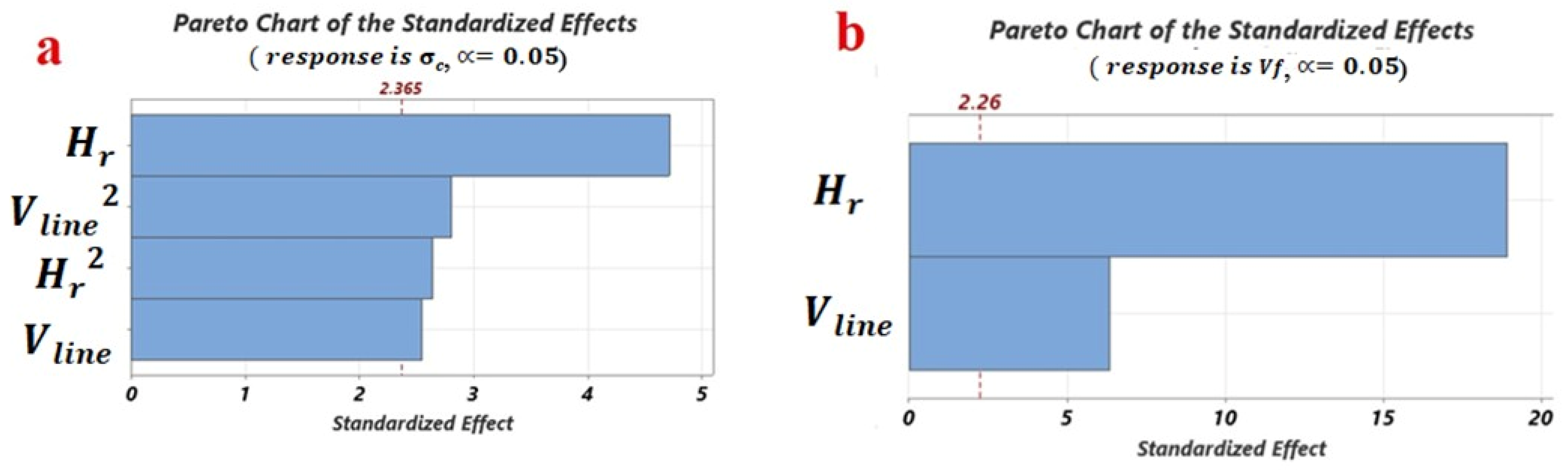
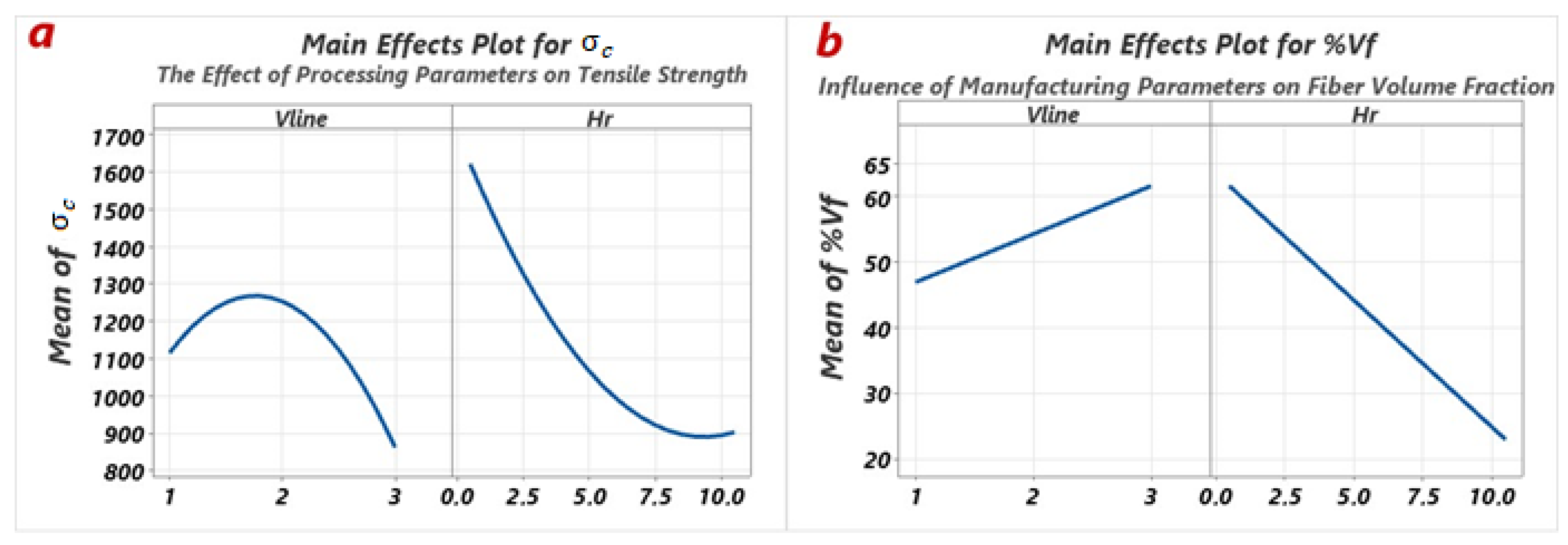
had a negative influence (71.98%). These trends were consistent with the Pareto charts in
Figure 7a,b, confirming that both parameters exerted substantial and independent effects on coating performance and the resulting mechanical response.
had a pronounced influence on coating behavior and, consequently, on the mechanical performance of the CF/PEEK towpregs. As shown in
Figure 8a,
increased with
up to an optimum value, whereas
continued to rise across the entire investigated range. At the lowest
1.0 m/min,
), the extended
in the fluidized bed led to excessive PEEK deposition, producing a thick polymer-rich coating and a reduced fiber fraction (
;
). Because the extended exposure allowed the polymer to fully encapsulate the fiber bundle, the measured bulk density (
) approached the theoretical limit (
), resulting in a minimal
. However, the excessive matrix volume limited the specific load-bearing capacity of the composite. Increasing
to 1.5 m/min (
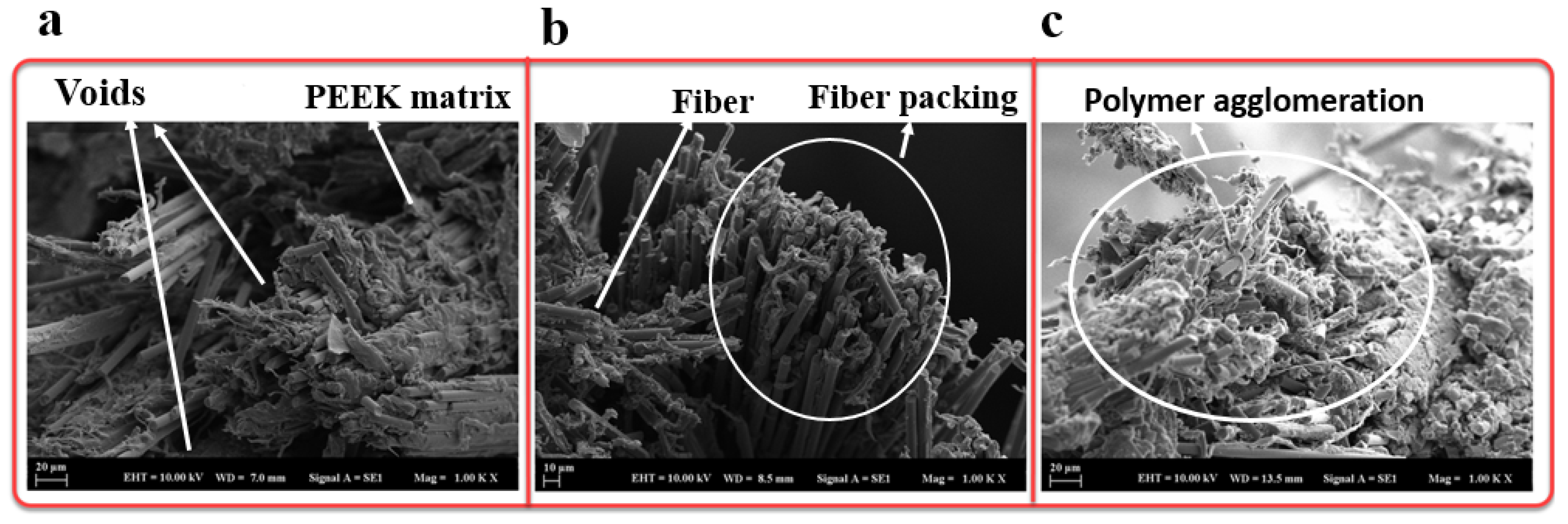
) improved coating uniformity and fiber impregnation, resulting in a denser and more homogeneous fiber distribution without drastically increasing internal voids. SEM observations (
Figure 6a) supported this transition, showing smoother and more continuous coating layers with improved fiber wetting and interfacial contact. These microstructural features coincided with the highest
(1800.5 MPa) and
(61.5%) values, consistent with the nonlinear relationship between
and mechanical response identified in the regression model. A similar upward trend in
and
at moderate
values was reported by Celik et al. [
57], reinforcing the observed improvement up to the optimum region.
When
was increased to 3.0 m/min (
), the significantly shortened exposure time reduced matrix infiltration and produced very dense fiber packing, which resulted in incomplete impregnation and discontinuous coating layers. The corresponding SEM image (
Figure 6b) showed pronounced voids and partially exposed fibers, indicating that insufficient wetting at higher speeds weakened interfacial bonding. Under these conditions, the combination of a high fiber volume fraction (
) and limited exposure time restricted both the available space and duration for polymer penetration between adjacent filaments, leading to poor resin flow and an increased number of unimpregnated regions. These microstructural deficiencies disrupted fiber–matrix continuity and lowered the efficiency of stress transfer, directly contributing to the reduction in tensile performance. Overall, the morphological observations demonstrate that, although they result in higher tighten fiber packing, excessively elevated speeds restrict coating contact time, hinder impregnation, and diminish the mechanical efficiency of CF/PEEK composites. This behavior is also related to the limited melt mobility of PEEK, which restricts polymer penetration between densely packed filaments and reduces effective stress transfer across the fiber–matrix interface.
In contrast to the behavior observed for
,
exerted a consistently negative influence on both
and
, as shown in
Figure 8b. ANOVA results confirmed that
was the dominant factor, explaining 78.59% of the variance in
and 71.98% of the variance in
. Increasing
placed the fibers deeper within the fluidized bed, thereby extending
and promoting excessive polymer deposition. This led to a marked decline in tensile performance together with a substantial reduction in
. This trend is further supported by the fracture surface analysis shown in
Figure 6 for different
conditions. In particular,
Figure 6a,c represent specimens produced at the same
(1.5 m/min) but at different
values, namely
and
, respectively. This direct comparison shows that increasing
led to greater matrix accumulation around the fibers and the formation of thicker polymer-rich regions. Consistent with this observation,
decreased from 61.57% in
Figure 6a to 24.12% in
Figure 6c, while
dropped from 1800.5 MPa to 838.7 MPa. The SEM micrograph in
Figure 6c clearly shows dense polymer agglomeration surrounding the fibers, confirming that excessive immersion depth promoted overcoating and reduced the effective load-bearing contribution of the fiber phase. A comparable trend was reported by Barletta and Tagliaferri [
58], who showed that extended coating duration increased film thickness from 25 μm to 45 μm, indicating that prolonged exposure enhances powder deposition and matrix buildup, in agreement with the behavior observed in the present study.
One of the primary objectives of this study was to determine the coating conditions that maximized the tensile performance of CF/PEEK towpregs while preserving a relatively low-density structure. The multiple regression analysis provided a reliable predictive framework, demonstrating that and were strongly correlated with the mechanical response. The model indicated an optimum of approximately 1.82 m/min at , corresponding to a predicted tensile strength of 1682 MPa. Experimentally, the highest tensile strength value of 1800.5 MPa was obtained at and , showing close agreement with the predicted optimum. The deviation of approximately 6.5% was considered acceptable, indicating that the regression model adequately captured the dominant process behavior within the investigated operating window.
3.2.1. –– Association in Thermoplastic Composites
The coating quality and mechanical performance of the CF/PEEK composites were evaluated using the results of Experimental Set II (
Table 7), with particular focus on the relationship among
,
,
, and
. Both
and
increased with increasing
and reached their highest values in Exp. 2.3, where
and
were obtained. This condition was considered to provide the most favorable balance between fiber reinforcement and matrix continuity, thereby enabling more effective stress transfer within the composite structure. At fiber contents above this level, the mechanical performance decreased, although
continued to increase. When
reached 70.16% (Exp. 2.6),
and
decreased to 1268.8 MPa and 36.6%, respectively. This behavior indicated that further fiber packing did not improve reinforcement efficiency; instead, excessive fiber crowding reduced the matrix availability required for effective impregnation and interfacial bonding. The void data supported this interpretation, showing that
increased from 4.10% to 5.02%, which indicated that the highly viscous PEEK melt could not fully displace entrapped air within the fiber bundle. These results showed that increasing fiber fraction alone did not guarantee improved tensile performance once impregnation became restricted by matrix flow and pore retention.
The optimum fiber volume fraction identified in this study was consistent with thermoplastic composite systems reported in the literature, where tensile strength reached a maximum within an intermediate fiber-content range rather than at the highest attainable
. Previous studies reported optimum
values of approximately 69% for CF/PPS, 64% for GF/PPS, and 56% for GF/HDPE systems, while powder-coated carbon fiber systems similarly showed peak performance near 60%
[
57,
59]. These observations indicated that composite performance depended not only on fiber content, but also on maintaining sufficient matrix continuity to enable effective stress transfer between adjacent filaments. Accordingly, the optimum mechanical condition in the present CF/PEEK system was not identified as the point of maximum
or maximum
, but as the condition at which fiber content, matrix continuity, and impregnation quality were most effectively balanced.
Although theoretically reaches 100% when the intrinsic tensile strength of the fibers is fully utilized under ideal load-transfer conditions, the experimental results showed that the maximum remained well below this limit. The highest value (66.7%) was obtained at the lowest level (24.12%), where was relatively low (838.7 MPa). Since is normalized by , lower fiber contents yielded higher apparent efficiency because of improved wetting and reduced fiber–fiber interaction, even though the overall load-bearing capacity remained limited. The highest value (1800.5 MPa) was obtained at , corresponding to .
In the ideal rule-of-mixtures framework,
corresponds to full utilization of the intrinsic fiber tensile strength under perfect stress transfer, complete impregnation, and ideal fiber alignment. In real thermoplastic composite systems, however, such conditions are rarely achieved because the tensile response is influenced by process-dependent factors such as incomplete wetting, residual porosity, imperfect fiber alignment, and interfacial limitations. For this reason, deviations from the ideal rule-of-mixtures response have often been interpreted in the literature using empirical efficiency terms or modified formulations that account for processing-induced limitations [
60,
61]. In the present study,
was therefore discussed not as a direct correction factor, but as an empirical indicator of how far the actual composite response remained from the ideal theoretical load-transfer condition within the investigated processing window. On this basis, the deviation was interpreted through the combined influence of microstructural and processing-related factors.
The difference between the theoretical and experimental
was attributed to the combined influence of several microstructural and processing-related constraints. First, incomplete impregnation within the fiber bundle limited the effective transfer of stress from the matrix to the fibers, particularly at elevated
levels where matrix availability became insufficient. Second, the measured void content (
) and the SEM observations in
Figure 6 indicated the presence of entrapped air and local discontinuities in matrix continuity, both of which reduced the effective interfacial contact area. Third, imperfect fiber alignment within the towpreg structure reduced axial load transfer, especially at higher
values where increased fiber–fiber interactions promoted local waviness and stress concentration. The high melt viscosity of PEEK was another factor that limited impregnation efficiency by restricting polymer flow during consolidation and hindering complete penetration of the matrix into densely packed fiber bundles.
In this context, higher processing temperatures can reduce the melt viscosity of PEEK, thereby facilitating matrix flow and improving penetration into the fiber bundle. Such an effect can enhance wetting, reduce entrapped porosity, and improve interfacial continuity, provided that the thermal exposure remains within a controlled processing window. Similar behavior was reported for CF/PEEK composites processed under high-viscosity conditions, where limited impregnation reduced stress transfer and tensile efficiency [
62,
63,
64]. Previous studies also showed that optimized consolidation pressure, controlled thermal history, and vacuum-assisted densification improved interfacial bonding and reduced porosity in thermoplastic composites [
65,
66]. Taken together, these results showed that the observed
response was governed by the combined effects of impregnation quality, residual porosity, fiber alignment, and viscosity-controlled matrix flow.
3.2.2. Effect of Residence Time on Fiber Volume Fraction
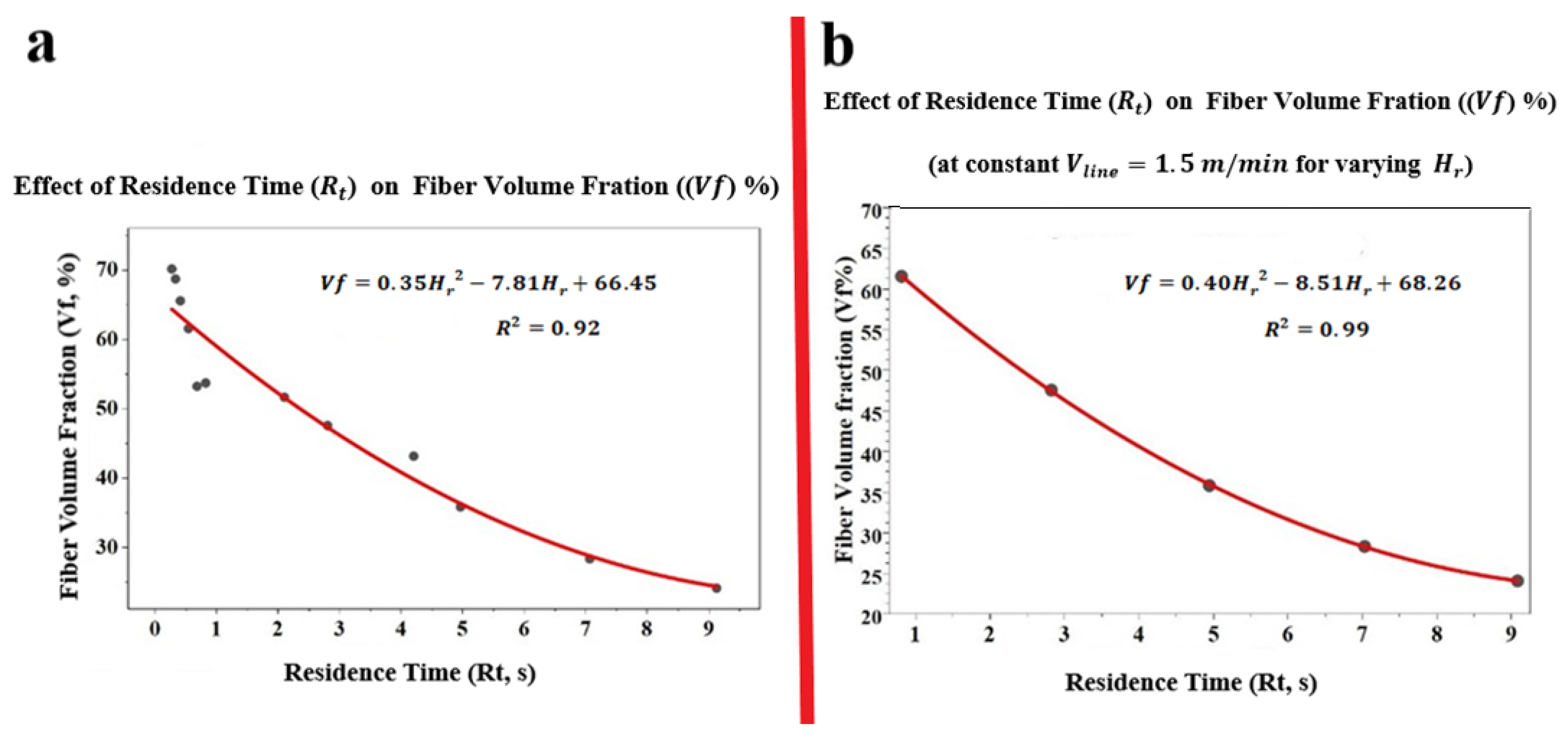
Expressing the results from all twelve experiments in Set II as a function of Rt revealed a clear inverse relationship between
and
.
increased at short
values and decreased progressively as
became longer. This trend was most evident at the extremes, ranging from a maximum
of 70.16% at
to 24.12% at
. This behavior is consistent with the findings of Barletta and Tagliaferri [
51], who reported that shorter particle–fiber interaction times generally result in reduced polymer deposition and therefore higher
values in fluidized-bed coating systems. A polynomial fit of the full dataset yielded R
2 = 0.92 (
Figure 9a), indicating that the
-based formulation successfully captures the overall coating response.
However, the
–
relationship did not follow a purely linear trend but instead exhibited a pronounced polynomial form. While
governs the duration of particle–fiber interaction, the observed curvature indicates that additional physical factors influence the coating process. To examine this behavior more clearly, a controlled subset of five experiments was analysed separately, where
was kept constant at 1.5 m/min and only Hr was varied (0.5–10.5 cm). This subset produced
values between 0.54 and 9.12 s and corresponding
values between 61.57% and 24.12%, resulting in an almost perfect quadratic fit (R
2 = 0.99,
Figure 9b). The improved fit confirms that
remains a governing parameter for polymer deposition, but also indicates that
alone does not fully explain the non-linear response observed in the full dataset.
A spatially non-uniform particle concentration within the fluidized bed provides a plausible explanation for the observed deviation from linear behavior. Fibers positioned deeper in the bed are exposed to regions of higher particle concentration, which increases the frequency of particle–fiber interactions and promotes greater polymer deposition, leading to lower
values. In contrast, fibers located closer to the upper region of the bed encounter fewer particles and therefore experience reduced coating intensity, resulting in higher
values. This interpretation is consistent with the microstructural differences observed in
Figure 6 and agrees with the height-dependent behavior reported by Oshitani et al. [
67].
Accordingly, the polynomial – relationship is attributed not only to particle exposure time, but also to vertical variations in local powder concentration within the fluidized bed. These results indicate that provides a physically meaningful parameter for describing coating behavior while the non-linear response reflects the combined influence of exposure duration and spatial variations in particle distribution.