


Abstract
With the continuous integration of a large amount of renewable energy sources such as wind and solar power into the power system, the economic and secure scheduling of the power grid, as a crucial carrier for electricity transmission, becomes of paramount importance. However, issues such as voltage fluctuations at grid nodes, low renewable energy consumption rates, and increased active power losses, caused by the widespread integration of high proportions of renewable energy, urgently need to be addressed. To effectively solve these problems, this paper proposes a multi-objective coordinated optimization scheduling method for the economy and security of source–grid–load–storage based on an effective scenario-screening approach. Firstly, an iterative self-organizing data analysis algorithm based on density noise application spatial clustering is designed to efficiently generate typical output scenarios for renewable energy sources such as wind and solar power. Meanwhile, to achieve low-carbon scheduling objectives, green certificate and carbon trading mechanisms are introduced. A multi-objective coordinated scheduling and trading model for the economy and security of large power grids, sources, loads, and storage is constructed with the goal of enhancing renewable energy consumption, and it is solved using the weight assignment method and an improved particle swarm optimization algorithm. Finally, the effectiveness and feasibility of the proposed method are validated and illustrated based on an improved IEEE standard node test system.
1. Introduction
The new-type power system is a crucial means to achieve carbon neutrality, requiring the coordinated integration of source, grid, load, and storage resources, supported by source–grid–load–storage interaction [1]. With the development of clean energy, energy storage technologies, and supporting infrastructure, distributed generators, primarily consisting of wind generators and photovoltaic systems, are being integrated on a large scale, along with the substantial integration of demand response on the load side and battery energy storage systems into the power grid. On one hand, the involvement of multiple entities in planning and their flexible and variable operational strategies [2] have increased the complexity of grid scheduling and decision-making [3]. On the other hand, the stochastic and uncertain power outputs affect voltage quality, thereby elevating the operational risks of the power grid [4]. These issues can be mitigated to a certain extent through coordinated planning and unified resource regulation. Therefore, from a systemic perspective, balancing low-carbon and economic considerations while uniformly scheduling source, grid, load, and storage resources is of great significance for ensuring the safe, low-carbon, and economical operation of the power system [5].
Currently, research in the field of low-carbon optimal scheduling of power energy systems primarily revolves around two pathways: direct carbon emission control and indirect carbon responsibility allocation [6]. Given that the majority of carbon emissions in the power sector stem from the combustion of fossil fuels, considerable research has focused on the generation side, aiming to reduce direct system carbon emissions through optimized unit commitment scheduling [7]. However, pure optimization on the generation side faces limitations due to increasing marginal abatement costs, necessitating the collaborative participation of demand-side resources. Based on this, the coordinated scheduling of demand response mechanisms and diverse flexible resources has emerged as an important direction for expanding carbon reduction pathways. Tao et al. [8] propose an optimized scheduling scheme that integrates carbon capture power plants with multi-energy demand response; Sun et al. [9] introduce a carbon trading mechanism along with various flexible resources, including demand response, to participate in the economic and low-carbon scheduling of the power grid; Shang et al. [10] achieved low-carbon operation of integrated energy systems through stepped carbon trading and integrated demand response. Nevertheless, the incentive signals employed in these studies fail to reflect the dynamic carbon footprint of electricity consumption, making it difficult to clarify carbon emission responsibilities and thereby limiting the carbon reduction potential on the demand side.
With the large-scale integration of distributed energy resources into the grid, the consumption of renewable energy has also become one of the urgent issues to be addressed on the distribution network side. The quota system and green certificate trading mechanism, by stipulating the proportion of renewable energy consumption and clarifying consumption responsibilities, guide power generators or electricity users to sell or consume green electricity. This can effectively alleviate the financial pressure of renewable energy subsidies and promote the sustainable development of renewable energy [11]. Cai et al. [11] propose an optimized scheduling and operation strategy for virtual power plants (VPPs) that considers both carbon trading and green certificate trading, achieving low-carbon operation of VPPs and promoting renewable energy consumption. Chen et al. [12,13] propose a “source-load” interactive optimization scheduling strategy that takes into account carbon trading–green certificate costs and flexible load scheduling costs, realizing the optimized scheduling of generation-side resources and various flexible load resources. Yu et al. [14] propose an optimized operation method for regional integrated energy systems that incorporates a green certificate–carbon emission equivalence interaction mechanism, increasing the proportion of green electricity in the system and enhancing its economic efficiency. Du et al. [15] establish an optimized scheduling model for VPPs based on green certificates, considering carbon emission rights trading and demand-side response, promoting wind power consumption and reducing carbon emissions. Zhang et al. [16] propose a dynamic green certificate pricing model that considers green certificate trading and subsidy waiting, optimizing the green certificate quotation strategy of renewable energy power generation enterprises and enhancing their market price advantage. Wang et al. [17] propose an energy optimization model for the electricity wholesale market that considers carbon trading and green certificate trading systems, reducing carbon emissions and optimizing carbon quota and green certificate proportions. Gao et al. [18] propose a joint green certificate and carbon trading model that achieves the optimized allocation of green certificate and carbon emission rights resources through a global optimization method, promoting renewable energy power generation consumption and reducing carbon emissions from fossil fuel units. Qiao et al. [19] discuss the applicability of blockchain technology in four directions: green electricity traceability, green certificate trading, carbon trading, and the joint market for green certificates and carbon assets and analyze some challenges faced by China’s current distributed green energy carbon trading mechanism and carbon data management. Jia et al. [20] introduce the construction history and development status of major carbon markets worldwide, summarize and discuss the carbon market mechanisms of major countries, analyze the challenges faced by China’s carbon market development, and provide suggestions for its future development. Yao et al. [21] propose a blockchain-based green certificate trading and circulation model. Xie et al. [22] conducted an in-depth analysis of the medium- and long-term joint trading mechanism and equilibrium of green electricity and green certificates based on seller-flexible contracts. Qiu et al. [23] propose a collaborative optimization strategy for power generation alliances participating in the electricity–carbon–green certificate market. Xiao et al. [24] propose a multi-time scale optimization scheduling method for integrated energy systems that considers green certificate–carbon trading and hydrogen energy.
On the other hand, numerous uncertainties exist in the power system, such as those related to renewable energy output, which, when severe, can undermine the effectiveness of trading plans and the security of system operation. Current research on electricity–carbon trading that incorporates uncertainty assessment primarily employs stochastic optimization (SO) [25], robust optimization (RO) [26], or distributionally robust optimization (DRO) [27] algorithms to model uncertainties. However, the chance-constrained SO algorithm [25] requires a predefined probability distribution for uncertain variables, making it difficult to accurately characterize the specific distribution of uncertainties and resulting in overly conservative decision-making. The RO algorithm [26], in contrast, often yields excessively conservative trading outcomes, which are not conducive to stimulating the vitality of the electricity–carbon market. The DRO algorithm adopted in reference [27] combines the advantages of both SO and RO algorithms, reducing decision conservatism without relying on precise probability distribution predictions. Nevertheless, the original DRO model has a complex structure and typically requires two-stage iterative solutions. Traditional affine approximation strategies see a multiplicative increase in parameter numbers with the growth of uncertain and optimization variables, making it challenging to select appropriate parameters [28].
The logical framework of this paper is as follows: Firstly, Section 2 introduces typical scenario generation and screening methods to characterize the uncertainty of renewable energy output. The carbon–green certificate combined trading mechanism is introduced in Section 3. Based on the scenarios and mechanisms presented in Section 2 and Section 3, Section 4 constructs a mathematical model for coordinated optimization of source–grid–load–storage systems. Considering the complexity of the model, Section 5 provides corresponding solution strategies. In Section 6, an improved IEEE standard test system is utilized to validate the effectiveness and feasibility of the proposed method. Finally, Section 7 concludes the whole paper.
2. Typical Scenario Generation and Screening Methods
With the large-scale integration of distributed power sources into the grid, the issues arising from their intermittency and uncertainty have gradually become prominent. Accurately predicting the output of distributed power sources such as wind and solar energy and transforming intermittent wind and solar resources into dispatchable and friendly power sources is an effective way to enhance the participation of wind and solar energy in the optimal scheduling of source–grid–load–storage systems. Cluster analysis is a crucial method for addressing the aforementioned issues. The k-means algorithm, widely applied as a classical approach in wind and solar cluster analysis, primarily excels in computational efficiency. However, this algorithm has certain limitations, notably requiring users to subjectively specify the number of clusters, and different initial values may lead to varying clustering results. Consequently, when faced with large-scale wind and solar datasets or complex data dimensions, the applicability of the k-means algorithm is somewhat restricted. Unlike k-means, the k-medoids (k-center point clustering) algorithm does not use the average value of objects within a cluster as a reference point but instead selects the most centrally located object, i.e., the medoid, as the reference point. The ISODATA algorithm is highly similar to both k-means and k-medoids algorithms. ISODATA incorporates merging and splitting operations on clustering results based on k-means and k-medoids. However, the ISODATA algorithm requires setting a relatively large number of initial parameters, which are interdependent, resulting in higher algorithm complexity. Therefore, the selection of initial parameters directly affects the convergence speed and final clustering effectiveness of wind and solar clustering. Nevertheless, as a density-based clustering algorithm, DBSCAN not only exhibits rapid clustering performance but also demonstrates efficient capabilities in handling outlier data points and identifying spatial clustering structures of arbitrary shapes. Its clustering centers have high density and are located relatively far from other high-density clustering centers. Therefore, leveraging the characteristics of the DBSCAN algorithm, it is possible to more reasonably select the initial clustering centers for the ISODATA algorithm and reduce the number of initial parameters set. Subsequently, the ISODATA algorithm can be employed to cluster wind and solar scenarios, facilitating easier convergence to the global optimal solution.
Based on this, this paper proposes a DBSCAN-ISODATA scenario clustering algorithm. Initially, DBSCAN density clustering is used to perform preliminary clustering on the data. For the distance metric in the DBSCAN algorithm, the Minkowski distance is used instead of the classical Euclidean distance to calculate the distances between input samples, forming tight clusters in high-density regions and identifying noise points as outliers in low-density regions. Subsequently, the clustering results are used as the initial clustering centers for the ISODATA algorithm. The ISODATA algorithm is then employed for optimization and adjustment, dynamically merging or splitting clusters based on changes in intra-cluster and inter-cluster variances, flexibly adjusting the number and shape of clusters, and ultimately converging to the global optimal solution. Therefore, the proposed DBSCAN-ISODATA scenario clustering algorithm retains the efficiency of DBSCAN and its ability to handle clusters of irregular shapes and noise points while improving clustering accuracy and stability through iterative adjustments by the ISODATA algorithm.
2.1. Initial Cluster Center Selection
Set the parameters for the DBSCAN algorithm; this yields ω initial cluster centers {K1, K2, …, Kω}. First, calculate the distances between different samples using the Minkowski distance as a substitute for the classical Euclidean distance, with the expression given by:
Both and represent the M input samples, where p = 1, 2, …, M and q = 1, 2, …, M; denotes the Minkowski distance between two n-dimensional samples; and represent different n-dimensional samples, respectively.
Assign the M samples (p = 1, 2, …, M) to the nearest cluster domain Sτ. If the number of samples in the cluster domain Sτ is less than the minimum number of samples required in each cluster domain, cancel this sample subset. In this case, decrement ω by 1 and revise the cluster centers.
In the formula, represents the samples at the τ-th cluster center. The average distance between the samples in each cluster domain Sτ and their respective cluster center Kτ is expressed as:
The total average distance between all samples and their corresponding cluster centers is expressed as:
If the number of iterative operations is even or the last iteration is completed, and the number of cluster centers exceeds twice the specified value ψ, then merge the existing clusters. If the number of operations is an odd iteration (i.e., not an even number of iterations) and the number of cluster centers is less than half of the specified value, then split the existing clusters.
2.2. Internal Evaluation Metrics for Clustering Algorithms
The internal evaluation method for clustering results refers to the assessment conducted solely based on the clustering outcomes and the inherent attributes of the samples, without relying on external information. This paper selects the following three metrics to evaluate the clustering performance:
(1) Davies–Bouldin Index (DBI)
Assume that the final clustering results are divided into clusters , where ak represents the number of clusters; and are the average distances between all data points in clusters and , respectively; is the distance between the centroids of clusters and . In (5), a smaller average distance between samples within clusters and a larger distance between cluster centroids yield a better result, meaning that a lower DBI indicates better clustering performance.
(2) Dunn index (DI)
Here, represents the minimum distance between samples in cluster and cluster ; denotes the maximum distance between samples within cluster . In (6), a larger minimum inter-cluster distance and a smaller maximum intra-cluster distance yield a better result, meaning that a higher DI indicates better clustering performance.
(3) Silhouette Coefficient
Here, a(M) represents the average distance between sample M and other samples within the same cluster to which it belongs; b(M) denotes the average distance from sample M to all samples in adjacent clusters that do not belong to the same cluster as M; s(M) is the silhouette coefficient, with a value range of [−1, 1]. The closer the silhouette coefficient is to 1, the better the clustering performance; conversely, the closer it is to −1, the worse the clustering performance. A silhouette coefficient close to 0 indicates overlapping clusters for the sample.
3. Carbon–Green Certificate Combined Trading Mechanism
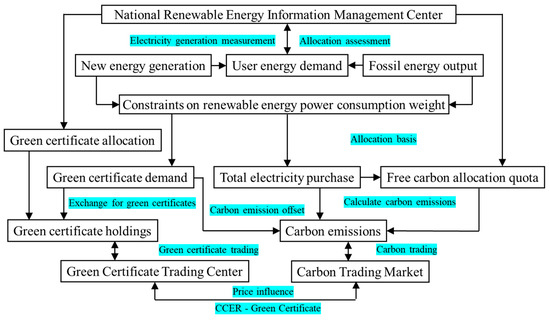
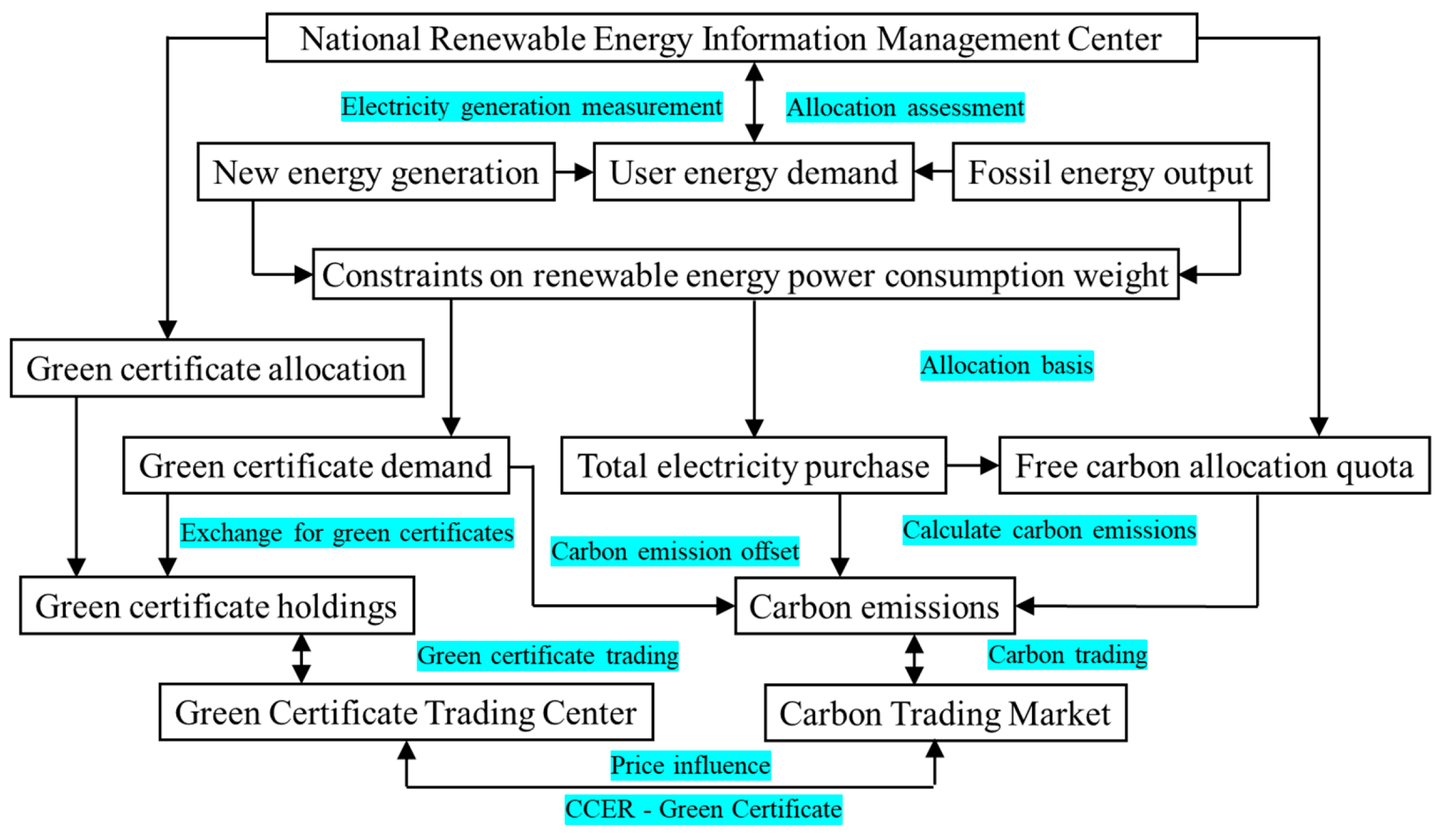
To more fully reflect the green attributes inherent in renewable energy supply, this section constructs a combined trading mechanism for carbon emission trading (CET) and green certificate trading (GCT) based on the current operational status of GCT and CET in China. The principle of the carbon–green certificate market combined trading mechanism is illustrated in Figure 1.
Figure 1.
Schematic diagram of joint trading of carbon and green certificates.
Given that green certificates encompass all information regarding the integration of renewable energy into the grid and the emission reductions achieved by a renewable energy supply can be quantified, once the ownership of green benefits is determined, green certificates facilitate the linkage mechanism between CET and GCT. Both Chinese Certified Emission Reduction (CCER) and green electricity can achieve energy conservation and emission reduction goals through clean substitution measures, demonstrating a mutually recognized and complementary relationship in terms of emission reduction effects. Furthermore, there exists a 1:1 equivalent conversion relationship with carbon emission allowances, thereby enabling the accounting process for carbon emission reductions represented by CCER to achieve mutual recognition between green certificates and carbon emission allowances. Therefore, this paper constructs a theoretical framework for a combined carbon–green certificate market trading based on CCER to promote linkage and coordination among China’s electricity markets. On one hand, generating electricity from renewable sources must undergo verification by the National Renewable Energy Information Management Center before obtaining green certificates. Simultaneously, based on the constraints of renewable energy power consumption weights, the number of green certificates required by the system is determined, further clarifying the supply volume eligible to participate in green certificate market trading. Ownership transfer of these certificates is realized through a green certificate trading platform, thereby completing the trading process. Additionally, the management center implements regulations requiring all network-connected users to ensure that a specific proportion of their energy consumption originates from renewable sources to promote the achievement of environmental protection goals. Users failing to meet this proportion requirement will be required to purchase corresponding green electricity through participation in the green certificate trading market to compensate for the non-renewable energy portion of their energy consumption. During this process, the emission reduction benefits of electricity generated from renewable energy represented by each green certificate, as part of carbon emission reductions, can participate in broader carbon trading activities, thereby promoting the market-oriented value realization of green energy and the achievement of environmental goals.
The specific operational steps of the carbon–green certificate combined mechanism are as follows:
(1) Calculate the initial carbon emission allowances of the power system and allocate the system’s carbon emission allowances by adopting the baseline method. The calculation model is shown in Equations (8)–(10).
Here, , and represent total carbon emissions, carbon allowances for wind turbine units, and carbon allowances for photovoltaic (PV) units, respectively; and denote the power output of the i-th wind turbine unit and the i-th PV unit during the t-th time period, respectively, measured in MW; T is the set of all scheduling time periods; is the carbon emission allocation coefficient per unit of electricity.
(2) Calculate the carbon emission reductions behind green certificates.
By utilizing renewable energy units within a regional power grid to replace fossil fuel-based power generation, the “regional grid baseline emission factor”—representing the reduced greenhouse gas emissions per MWh—is determined by the emission reduction contributions from renewable energy generation. This allows for the calculation of carbon emission reduction benefits corresponding to GCT:
Here, represents the carbon emission reductions of CCER, namely the carbon emissions offset by green certificates; and are the marginal emission factor weights for electricity and capacity, respectively; and are the marginal emission factors for electricity and capacity, respectively; is the green electricity generated under the new energy quota.
(3) Determining the ownership of green certificate rights and interests
Due to the inherent carbon reduction attributes of green certificates, upon completion of a transaction, the carbon reduction benefits generated must be transferred from the seller to the buyer to ensure exclusive attribution of these benefits. This involves removing the non-duplicated carbon reduction attributes from the green certificates sold by the seller and adding them to the buyer. After defining the ownership of green certificate benefits, the system can offset a portion of its carbon emissions through the held green certificates, thereby participating in the carbon trading mechanism. Currently, by engaging in both green certificate trading and carbon trading mechanisms, effective coordination between these two types of market activities is achieved through the regulation of quota quantities and market prices.
(4) Determining carbon allowances for the carbon–green certificate joint trading mechanism
After considering the carbon emissions associated with green certificates, this directly impacts the carbon allowances of the power grid. Equation (8) can be revised as follows:
(5) Calculate the carbon emissions participating in the actual carbon trading market while considering the joint carbon–green certificate trading mechanism.
where represents the actual carbon emissions traded in the carbon market considering the joint carbon–green certificate trading mechanism; is the total carbon emission allowance; is the actual carbon emissions; EI are the carbon emissions offset by green certificates.
(6) Calculating the benefits of the joint carbon–green certificate trading mechanism
By adopting the joint carbon–green certificate trading mechanism, on one hand, it can increase the carbon allowances of the power grid, effectively reducing its carbon trading costs; on the other hand, it can enhance the enthusiasm of power generation enterprises to purchase green certificates. At this point, the system’s CET cost is shown in (14):
Here, represents the carbon trading cost; λ is the unit price of carbon trading; l is the length of the carbon emissions interval; α is the growth rate of the carbon trading price. When > 0, it indicates an increase in the system’s operating costs; when ≤ 0, it indicates an increase in the system’s benefits.
4. Mathematical Model for Coordinated Optimization of Source–Grid–Load–Storage Systems
4.1. Objective Function
This paper takes the power purchase cost , loss cost (including network losses and energy storage charging/discharging losses), carbon–green certificate trading cost , and voltage fluctuation penalty cost as the objective functions.
where represents the transaction price with the superior power grid at time t; is the volume of electricity traded with the superior power grid at time t; is the voltage at node i at time t; ρ is the loss coefficient for energy storage charging and discharging; and are the discharging and charging powers of energy storage, respectively, at time t; and are the active and reactive powers flowing through line ij at time t, respectively; is the resistance value of line ij. The source–grid–load–storage economic security multi-objective coordinated optimization model constructed in this paper aims to minimize power purchase costs, network loss costs, carbon–green certificate trading costs, and voltage fluctuation penalty costs as its optimization objectives. All objective functions are defined based on the physical laws governing power system operation and economic transaction rules. This paper employs the weighted sum method to transform the multi-objective optimization problem into a single-objective optimization problem for the solution. The core approach involves determining the weight coefficients for each objective using the Analytic Hierarchy Process (AHP), ensuring that the sum of the weights equals 1 through normalization, and ultimately constructing a comprehensive objective function.
4.2. Constraints
The main constraints considered in this paper are as follows:
(1). Mathematical model for energy storage equipment
The model for the energy content at time t and the constraints on the power output of the energy storage system are as follows:
Here, represents the energy storage capacity at time t; represents the energy storage capacity at the next time instant; Δt is the time interval; and are the charging and discharging efficiencies, respectively; and are the maximum charging and discharging power of the energy storage system, respectively.
(2). System operational constraints
To ensure improvement in the stability of power transmission grid operation, it is necessary to consider constraints such as power balance at grid nodes, power flow balance, voltage constraints, and line transmission capacity constraints, as shown in the following equations:
where represents the output power of conventional generating unit g connected to node i; and are the difference between the inflow and outflow power of the line connected to node i, respectively; is the susceptance value of the line between node i and node j; and are the upper and lower voltage limits at node i, respectively; , and are the transmission power and the maximum and minimum transmission power of line ij, respectively.
(3). Operational constraints of synchronous generators:
where and represent the upper and lower limits of the active power output of synchronous generator g, respectively; and are the maximum technical limits for upward reserve and downward reserve of the synchronous generator, respectively.
(4). Operational constraints of renewable energy units
Here, and represent the maximum power outputs at time t for wind turbine units and photovoltaic units, respectively.
5. Solution Strategy Based on an Improved Particle Swarm Optimization Algorithm
Due to the presence of nonlinear terms in the model, this paper employs an improved particle swarm optimization (PSO) algorithm to enhance solution efficiency. In PSO, each solution is regarded as a particle searching within a D-dimensional space. Through continuous iterative updates, the algorithm seeks superior particles until the optimal solution to the problem is ultimately identified. Suppose, in a D-dimensional space, the position of the i-th particle during the t-th iteration is denoted as , and its iterative velocity is . The value range of is [xmin, xmax], where xmin and xmax represent the minimum and maximum values of the particle’s position, respectively. Similarly, the value range of is [vmin, vmax], with vmin and vmax denoting the minimum and maximum values of the particle’s velocity, respectively. During the PSO process, each particle updates its velocity and position in each iteration, specifically as follows:
Here, and represent the updated position and velocity of particle i in the (t + 1)-th iteration, respectively. c1 is the acceleration factor; r1 is random numbers distributed within the interval [0, 1]; and W is the inertia weight.
Differential Evolution (DE) is a population-based global optimization algorithm, with its main steps including mutation, crossover, and selection. Among them, the expression for the mutant vector is as follows:
In the formula, represents the mutant solution; ω is the mutation factor; , and are three distinct current solutions in the t-th iteration, respectively. After individual mutation, the mutant solution is crossed with the current solution to generate new individuals, thereby enriching the population. The expression for this process is as follows:
In the formula, represents the new individual; is the current solution; rand is a random number with a value range of [0, 1]; is the crossover probability. A greedy strategy is employed to compare the new individual with its parent, and superior new individuals are selected according to the following expression:
In the formula, f( ) represents the fitness function.
The PSO algorithm is characterized by its fast convergence speed and good global search performance, but it is prone to getting trapped in local extrema during the optimization process. In contrast, the DE algorithm excels in local optimization but has relatively weaker global search capabilities. To enhance the optimization performance of the joint algorithm, the search strategy of the PSO algorithm is introduced into the DE algorithm. Additionally, to prevent getting stuck in local extrema, a diversity maintenance strategy based on particle concentration probability is employed for particle selection in the PSO algorithm, resulting in an improved DE-PSO with a particle concentration probability-based selection mechanism. The expression for the concentration probability of the i-th particle is as follows:
Here, represents the concentration of particle xi, indicating the similarity of particles in terms of fitness, and its expression is as follows:
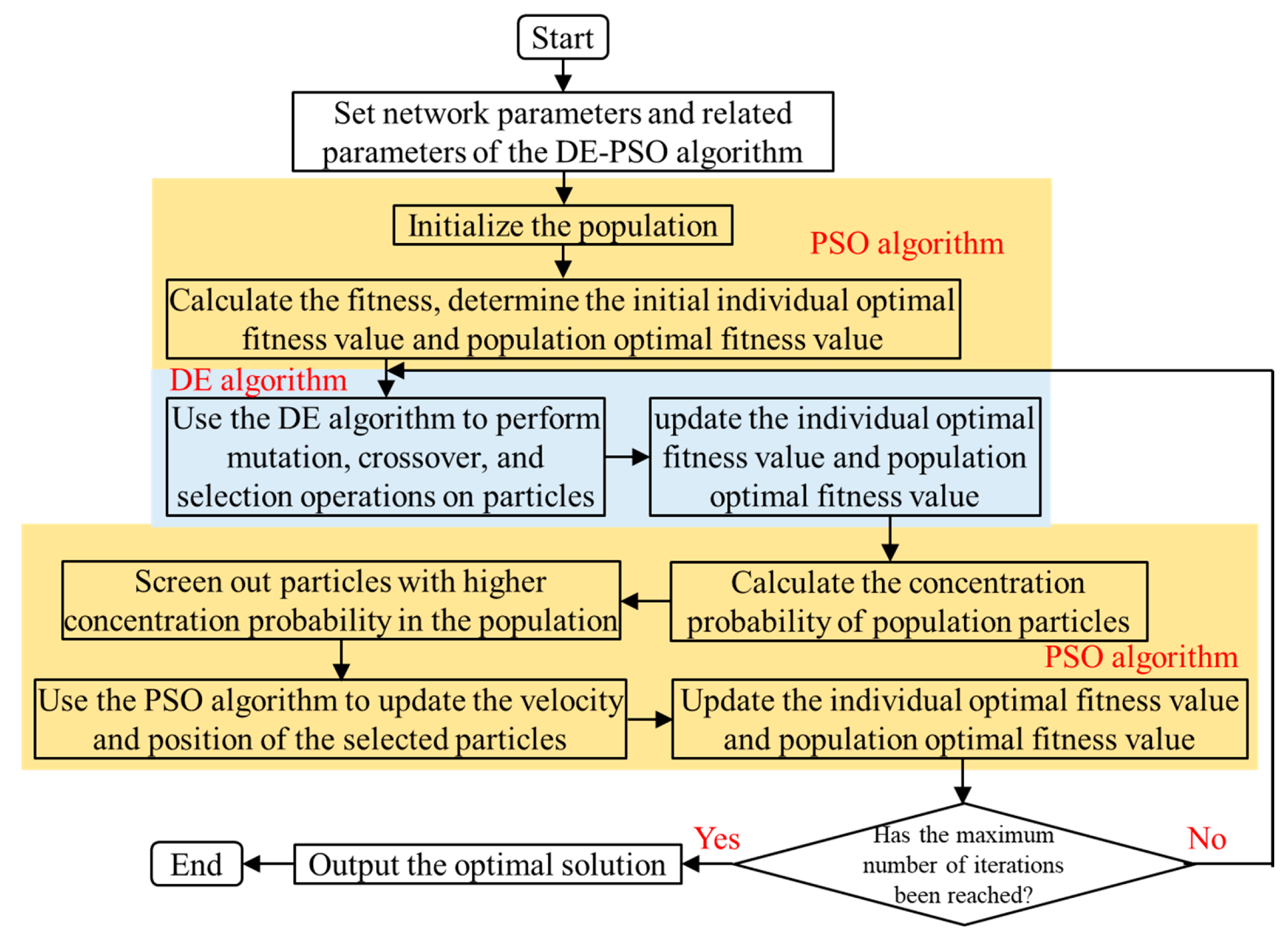
The more particles similar to particle there are, the lower the probability of particle is for being selected. Conversely, the fewer particles similar to particle there are, the higher the probability of particle is for being selected. The probability selection mechanism based on particle concentration theoretically enhances population diversity and effectively avoids getting trapped in local optimal solutions. The optimization strategy of the improved DE-PSO algorithm with a concentration probability-based screening mechanism is as follows: First, generate new solutions according to the evolutionary strategy of the DE algorithm, calculate the concentration probabilities for all new solutions, select the half of the new solutions with higher concentration probabilities as the initial particles for the PSO algorithm, and then iteratively update the particle positions according to the optimization strategy of the PSO algorithm. Calculate and compare the fitness values of all current solutions, continuously iterate and update to ultimately obtain the optimal solution.
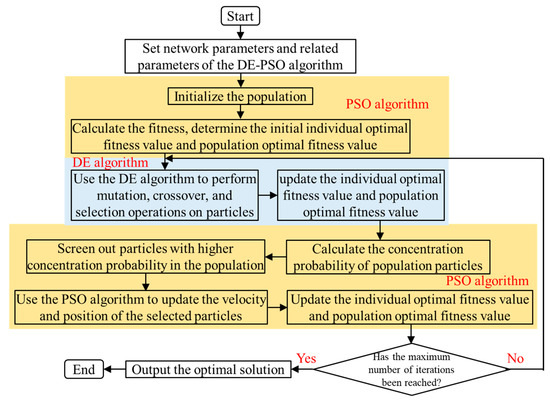
For better understanding, the solution flowchart of the improved PSO algorithm is shown in Figure 2 below.
Figure 2.
Flowchart of the improved PSO algorithm.
6. Case Study
6.1. Introduction to the Test System
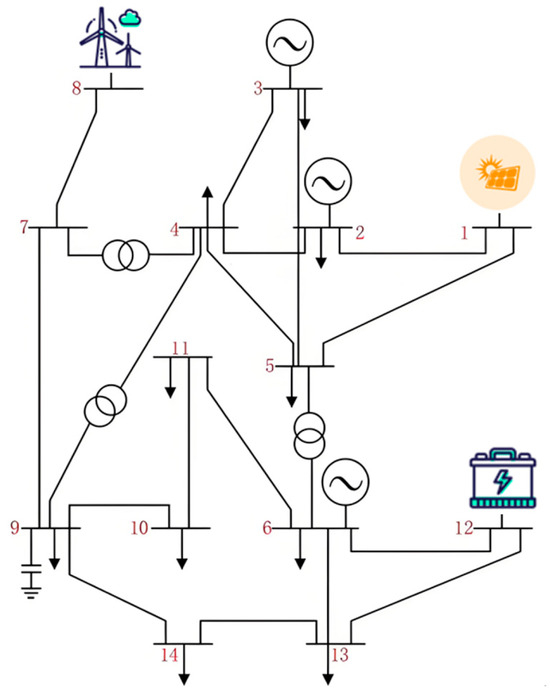
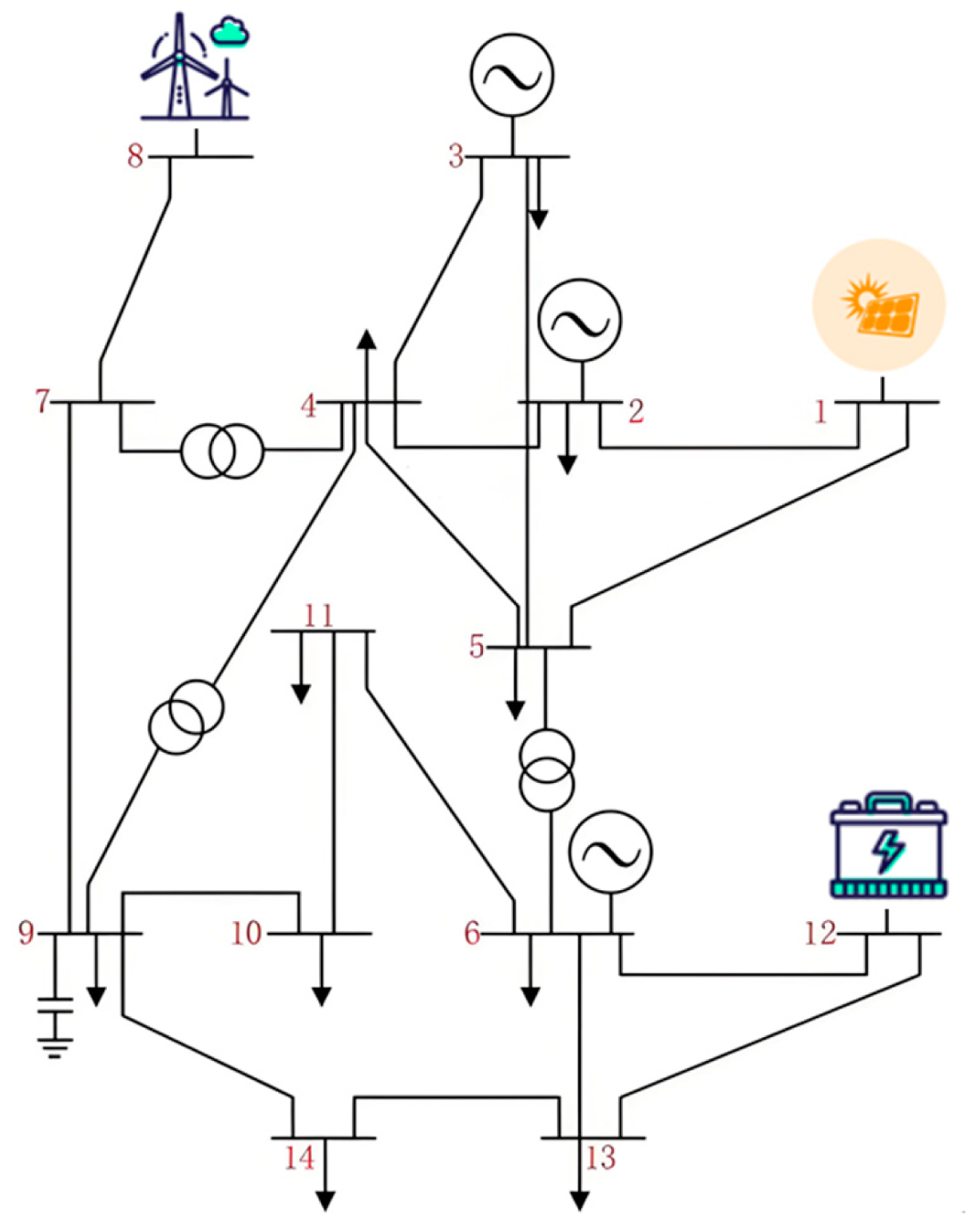
To verify the effectiveness and feasibility of the method proposed in this paper, an improved IEEE-14 node test system was utilized for validation and analysis. The network topology of this test system is shown in Figure 3 below. Among them, distributed photovoltaic (PV) and wind power are installed at nodes 1 and 8, respectively. The energy storage system is installed at node 12. The wind power and photovoltaic (PV) output data used in this paper are derived from operational monitoring data of an actual wind farm and PV power station in the Northwest Power Grid. These data have been normalized to match the installed capacity and topological characteristics of an improved IEEE-14 bus test system. Covering 8760 h of continuous operational monitoring throughout the year, the data fully align with the time scale requirements for day-ahead and intra-day scheduling in power systems. The hourly sampling rate employed is a standard scale in power system scheduling, with monitoring data from actual wind farms and PV power stations directly obtainable through SCADA systems. The data format and characteristics are adaptable to renewable energy stations in different regions and with varying installed capacities. After normalization, the data can be extended to various test systems or real power grid scenarios for scenario-generation and scheduling optimization, demonstrating the universality of the data-processing method. To ensure the accuracy of subsequent clustering algorithms and scenario-generation, a four-step standardized preprocessing procedure was designed to address issues such as missing values and outliers in the original monitoring data. All processing steps were implemented using Python Pandas 3.14 and NumPy libraries, achieving a data completeness rate of 100% and controlling the outlier removal rate within 3.2%. The preprocessing procedure is as follows: data cleaning, data smoothing, normalization, and data standardization. The DBSCAN-ISODATA scenario generation algorithm proposed in this paper is not merely a simple clustering analysis but employs a three-tier modeling logic—probability distribution fitting, temporal autocorrelation analysis, and spatiotemporal correlation modeling—to accurately capture the temporal variability and uncertainty of wind/PV power output. This fundamentally ensures the accuracy of scenario generation while validating the model’s universality in addressing uncertainty issues related to solar and wind energy. The universality of correlation modeling can be analyzed using Pearson correlation coefficients, allowing for flexible characterization of spatiotemporal correlations between wind–PV, wind–wind, and PV–PV systems based on meteorological characteristics in different regions, thereby meeting the scenario generation needs of various power grids.
Figure 3.
The network topology of improved IEEE-14 node test system.
6.2. Effectiveness Analysis of the Scheduling Decisions
The values of these clustering parameters are shown in Table 1 below.
Table 1.
Final values of key clustering parameters for the DBSCAN-ISODATA algorithm.
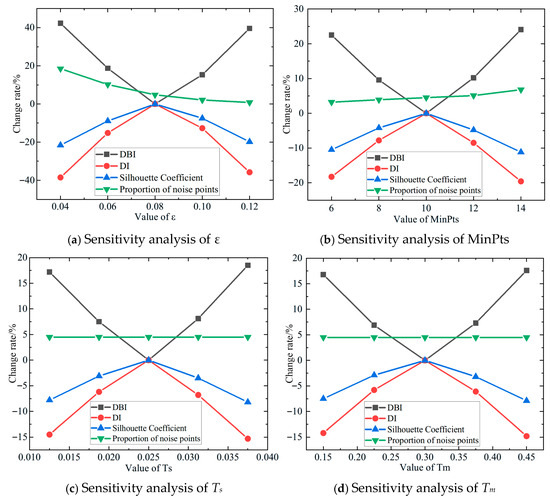
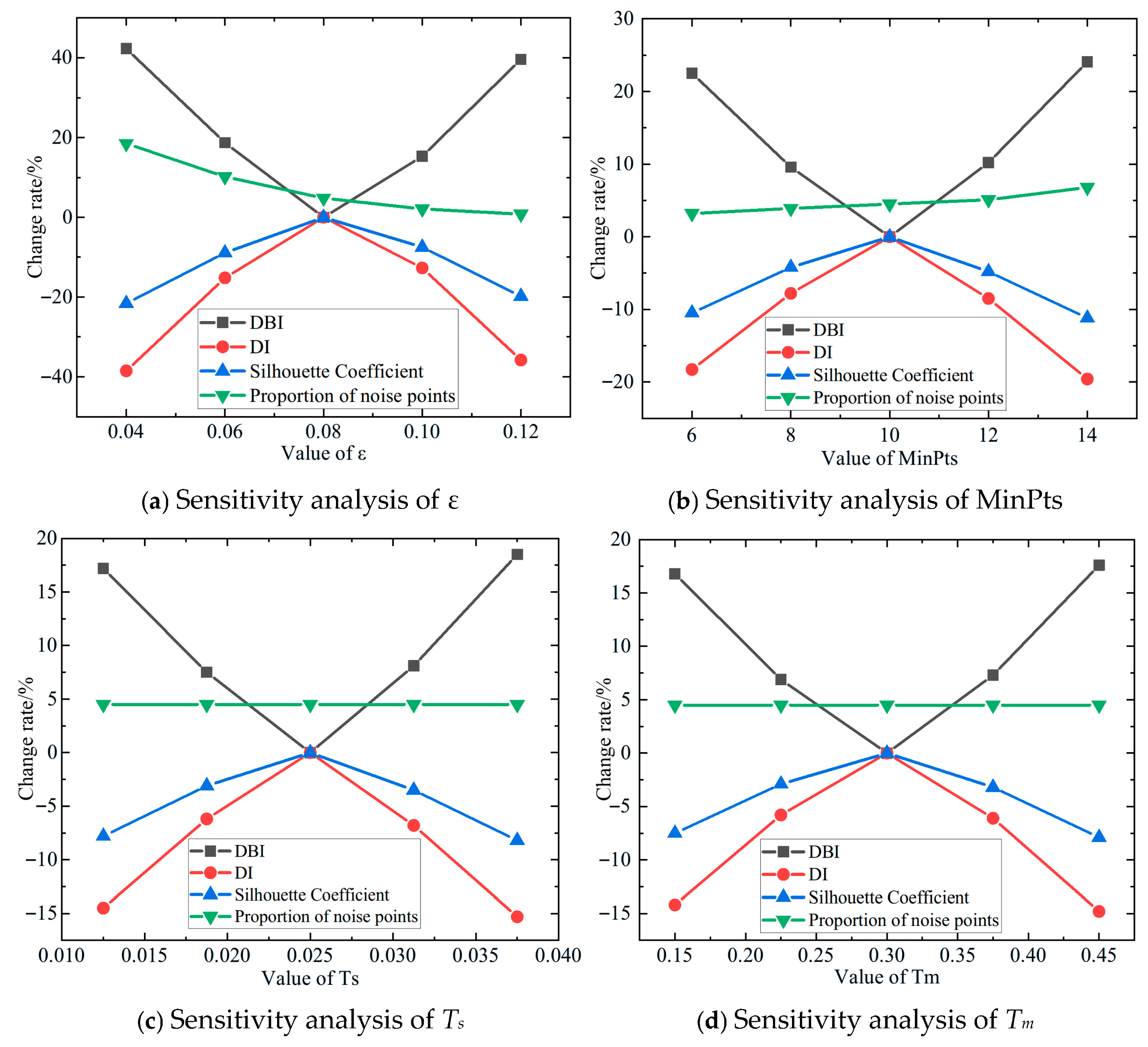
To verify the robustness of the DBSCAN-ISODATA algorithm with respect to key parameters, a sensitivity analysis was conducted on the critical parameters listed in the table above, with the relevant results shown in Figure 4 below.
Figure 4.
Results of sensitivity analysis for key parameters.
Based on the algorithmic principles of density-based clustering and iterative self-organizing clustering, as well as the distribution characteristics of renewable energy output datasets, ε is identified as a highly sensitive parameter, while MinPts, Ts, and Tm are classified as moderately to low-sensitive parameters. The benchmark parameter values proposed in this paper fall within a robust range that optimizes algorithm performance, demonstrating strong resistance to minor parameter fluctuations. Under these benchmark parameter settings, the algorithm’s clustering evaluation metrics (DBI = 0.12, DI = 1.21, Silhouette Coefficient = 0.985) and engineering metrics (seven typical scenarios, 4.5% noise points) are all optimal. Moreover, the algorithm exhibits strong resistance to minor parameter fluctuations, thereby validating the reasonableness of the parameter values and the robustness of the algorithm.
By observing Table 2, it can be found that the method proposed in this paper employs the DBSCAN-ISODATA scenario clustering algorithm. It initially clusters and identifies noise points using the DBSCAN algorithm, and then dynamically adjusts the cluster centers and the number of clusters using the ISODATA algorithm, effectively enhancing the accuracy and stability of clustering. Consequently, it achieves the smallest DBI value, the largest DI value, and a silhouette coefficient closest to 1, indicating optimal clustering performance for the samples. In contrast, the GAN model may suffer from unstable clustering results due to distribution discrepancies between generated data and real-world scenarios, while the K-means algorithm relies on subjective specification of the number of clusters and is sensitive to initial values, making it prone to getting stuck in local optima in large-scale or complex datasets, thereby degrading clustering quality.
Table 2.
Comparison of metrics for different scenario-generation algorithms.
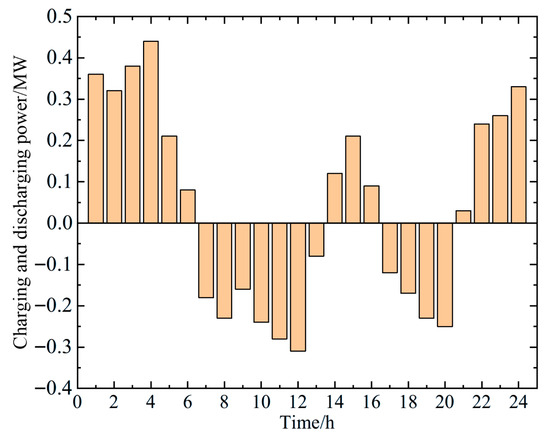
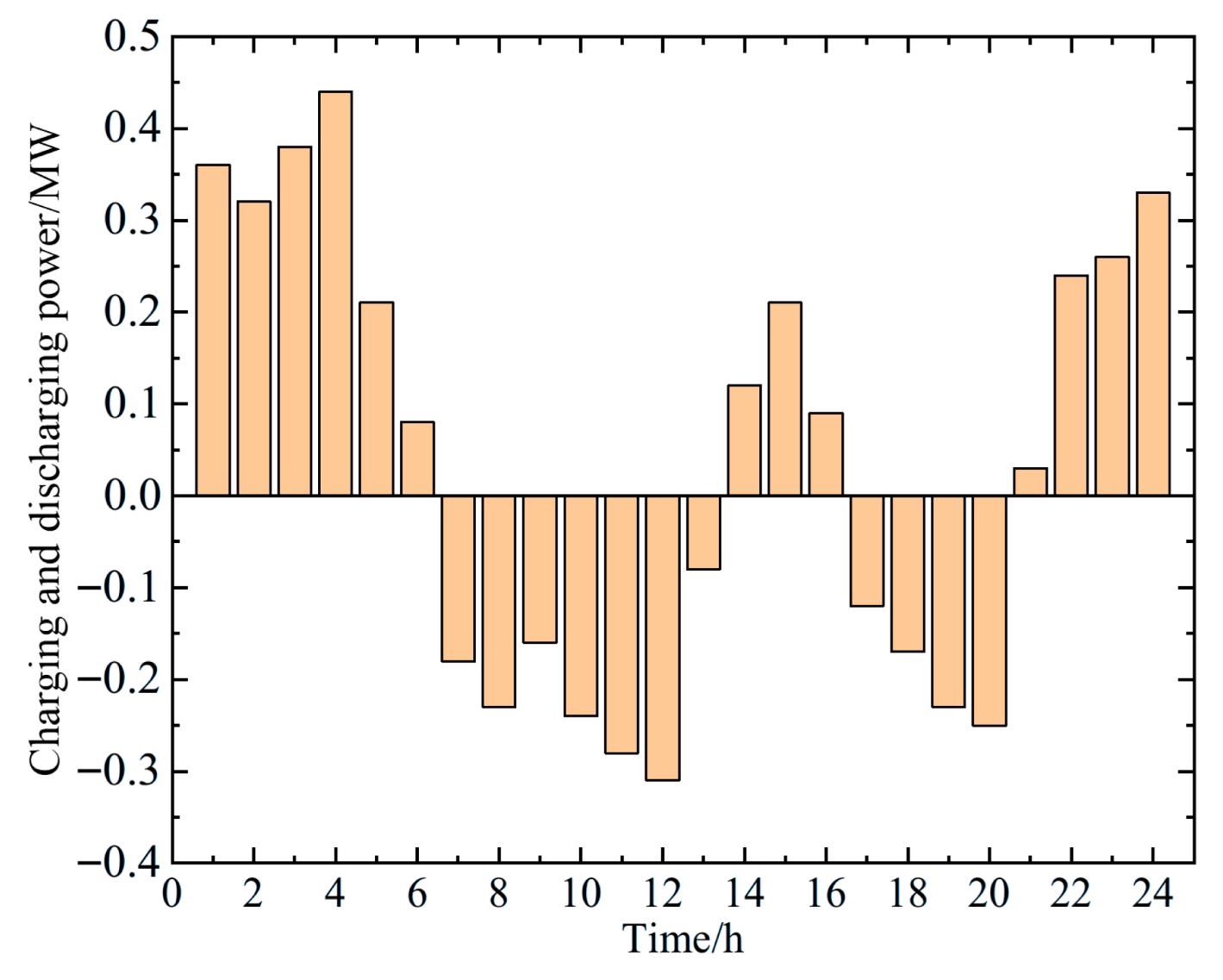
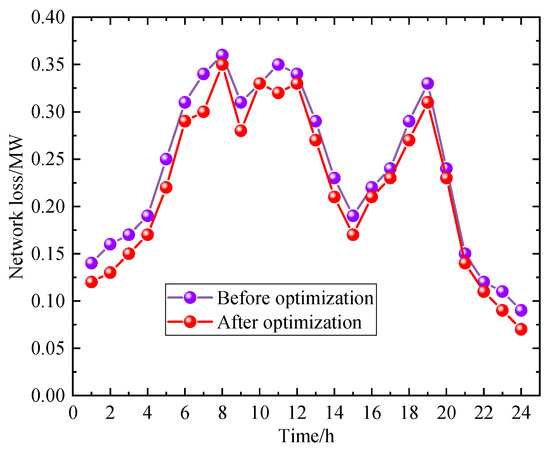
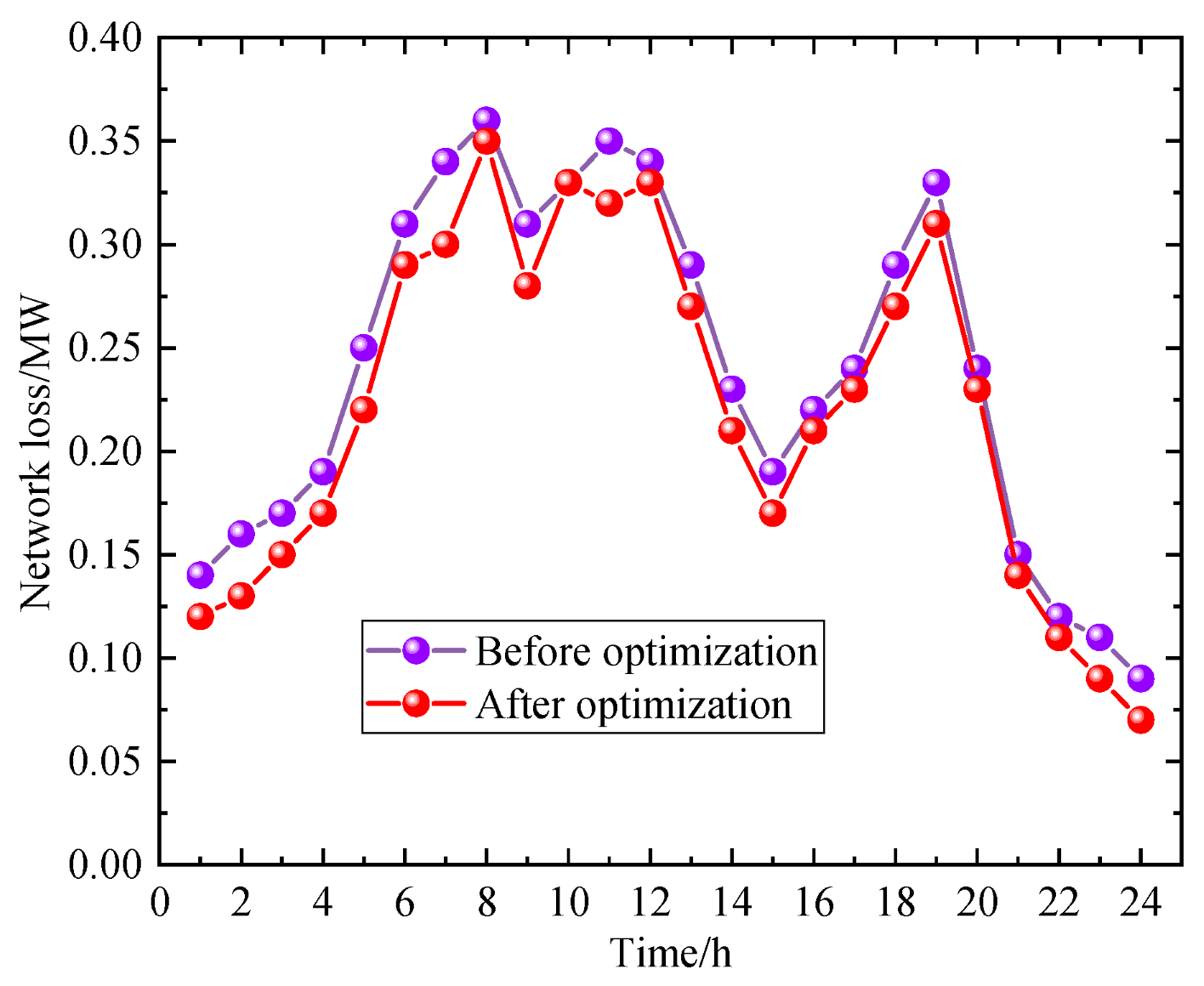
Figure 5 and Figure 6 illustrate the variations in the charging and discharging power of energy storage systems and network losses. Energy storage systems charge at night and discharge during peak load periods, primarily leveraging the characteristics of low electricity demand and lower prices at night for energy storage, and then releasing the stored electrical energy during daytime peak demand to meet high-load requirements and alleviate grid pressure.
Figure 5.
Charging and discharging power of energy storage systems.
Figure 6.
Network loss before and after optimization.
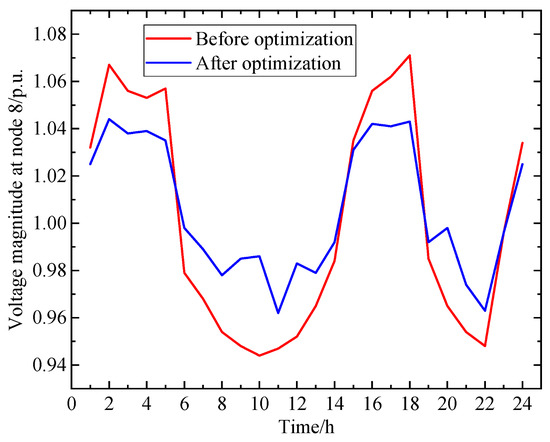
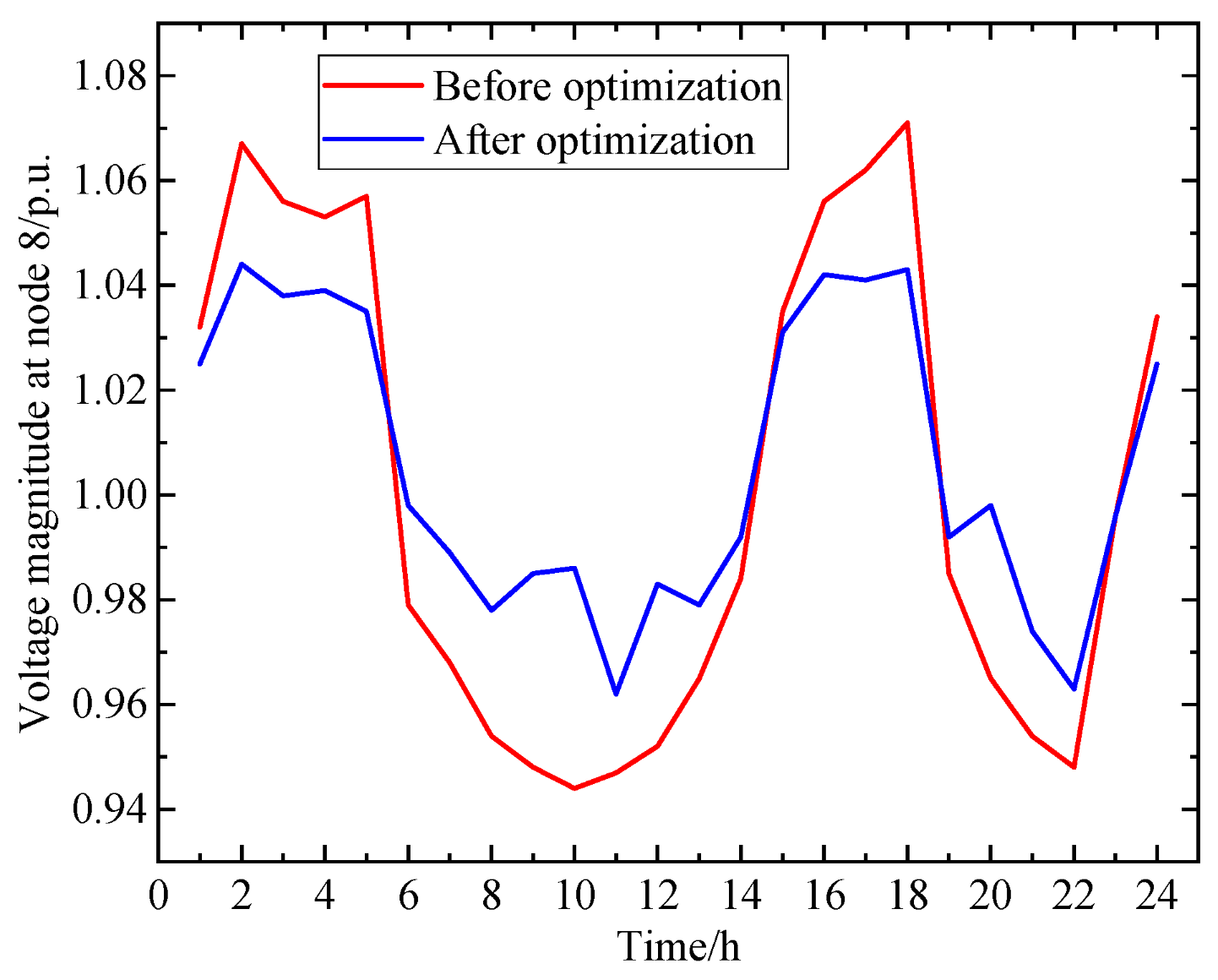
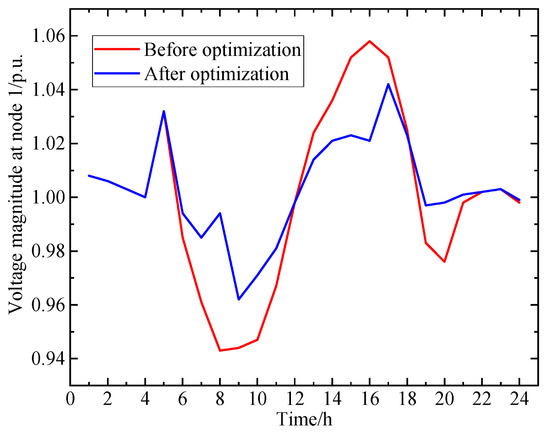
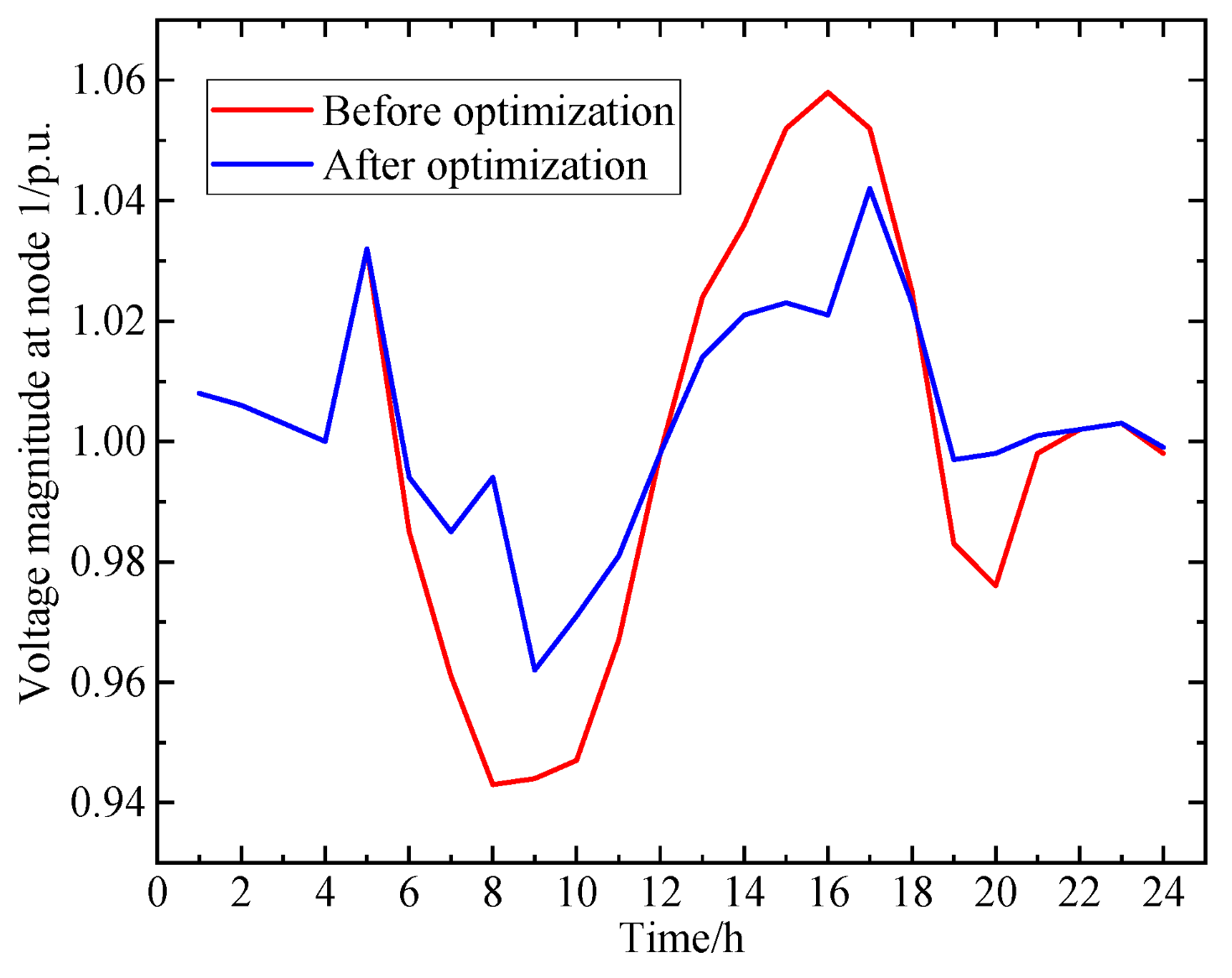
Figure 7 and Figure 8 further illustrate the voltage fluctuations at the nodes where new energy sources are connected, both before and after optimization. Before optimization, the voltage at these nodes was prone to instability, primarily due to the intermittent and uncertain nature of a new energy output, which is significantly influenced by natural conditions. This leads to substantial power fluctuations at the connection points, causing frequent voltage fluctuations at the nodes. Additionally, the integration of a high proportion of new energy sources alters the original power distribution in the grid, exacerbating the difficulty of voltage regulation. Particularly during periods of sudden output reduction or peak load, the risk of voltage instability becomes more pronounced.
Figure 7.
Voltage magnitude at wind power connection node.
Figure 8.
Voltage magnitude at photovoltaic connection node.
After optimization, the risk of voltage instability is significantly reduced. Through coordinated optimal scheduling of source–grid–load–storage, the energy storage system charges during periods of high new energy output and discharges during low output periods, effectively smoothing the power fluctuations at the nodes where new energy sources are connected. Simultaneously, combined with the precise power regulation capability on the load side, the power flow distribution in the grid is improved, reducing instances of voltage sag or overvoltage caused by the intermittency of new energy sources. This significantly enhances the stability of node voltages.
To further quantitatively validate the computational advantages of the improved PSO, traditional PSO, the standard DE algorithm, and NSGA-II were selected for comparison. The comparison was conducted on an improved IEEE-14 bus test system, evaluating four metrics: fitness value, number of convergence iterations, computational time, and robustness deviation. The results are presented in Table 3.
Table 3.
Performance comparison of different optimization algorithms.
As can be seen from the table above, the improved DE-PSO algorithm demonstrates optimal performance in terms of fitness value, number of convergence iterations, and computation time. Although its robustness deviation is only slightly higher than that of the NSGA-II algorithm, its computational efficiency far surpasses NSGA-II, fully validating the comprehensive computational advantages of the improved PSO algorithm in multi-objective coordinated optimization problems for source–grid–load–storage systems. By integrating DE-PSO’s underlying strategy fusion to enhance global exploration capabilities, employing a mid-level mechanism of particle concentration probability selection to maintain population diversity, and implementing an adaptive inertia weight and constraint-guided top-level design to optimize convergence characteristics, the algorithm achieves a full-dimensional enhancement over traditional PSO. The algorithm’s execution process is more closely aligned with the nonlinear and multi-constrained characteristics of multi-objective optimization for source–grid–load–storage systems. Its actual convergence exhibits a three-stage pattern of rapid decline in the early stage, stable exploration in the middle stage, and precise convergence in the late stage, with both convergence speed and accuracy significantly superior to those of traditional PSO. This makes it well-suited for high-dimensional, multi-scenario optimization problems in source–grid–load–storage systems and meets the demands of practical engineering applications.
To further verify the advantages of the economic security multi-objective coordinated scheduling and trading strategy for source–grid–load–storage systems proposed in this paper in terms of economic efficiency, security, and carbon reduction, this section supplements the case study on the improved IEEE-14 bus test system by setting up six different scheduling scenarios as follows:
Scenario 1: The method proposed in this paper;
Scenario 2: Independent green certificate trading;
Scenario 3: Independent carbon trading;
Scenario 4: Traditional economic scheduling with only the minimization of power purchase cost as the sole objective;
Scenario 5: Security-priority scheduling with only voltage stability and minimized network losses as objectives;
Scenario 6: Solved using classical PSO with K-means scenario generation, considering joint carbon–green certificate trading.
The specific results are shown in Table 4.
Table 4.
Comprehensive performance comparison of scheduling scenarios.
From the full-dimension comparison results in Table 4, the following core conclusions can be drawn: Scheme 4 has the lowest electricity purchase cost, but due to the absence of new energy accommodation optimization, it incurs the highest network loss cost. Moreover, it does not participate in carbon–green certificate trading and has no emission reduction benefits. Although its total dispatching cost appears low, it sacrifices operational security and carbon emission reduction. The proposed scheme in this paper has a total dispatching cost higher only than that of Scheme 4, but its network loss cost is reduced by 32.8% compared with Scheme 4. Through the combined carbon–green certificate trading, its net cost is only 485.6$, making it the only scheme that achieves the collaborative optimization of economic cost, network loss cost, and transaction cost. Scheme 5 achieves the lowest voltage fluctuation rate and network loss rate. However, in pursuit of conservative security, it excessively limits the output of new energy, leading to a surge in electricity purchase cost of 10,258.7$, resulting in the highest total dispatching cost and extremely poor economic performance. The voltage fluctuation rate (1.25%) and network loss rate (2.18%) of the proposed scheme are only slightly higher than those of Scheme 5 but reduced by more than 60% compared with Schemes 2, 3 and 4. Meanwhile, it realizes a high new energy accommodation rate of 96.8%, solving the industry pain-point that prioritizing security leads to low economic efficiency.
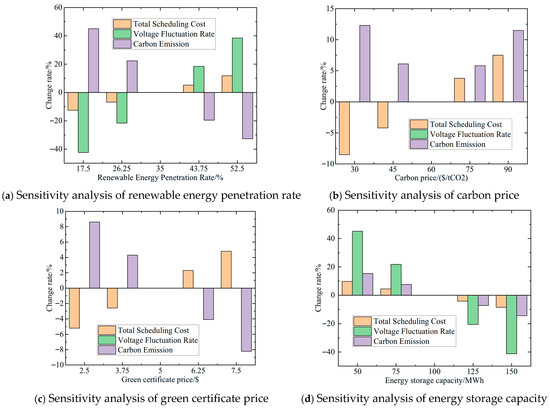
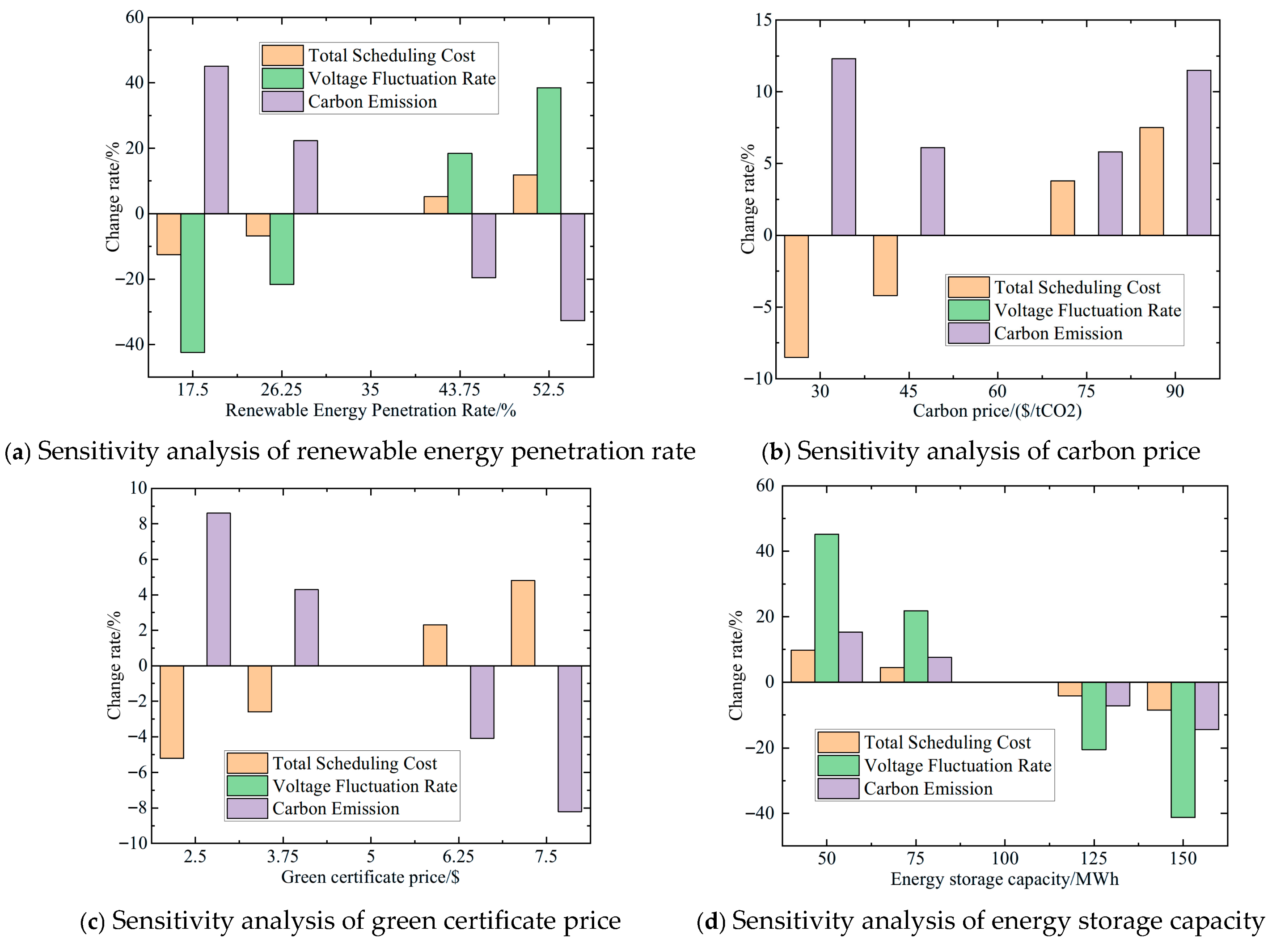
To verify the robustness and adaptability of the proposed strategy under different operating scenarios and key parameter fluctuations, four types of core-dimensional sensitivity assessments are carried out: new energy penetration, carbon price fluctuation, green certificate price fluctuation, and energy storage capacity variation. For each dimension, five gradient levels are set within the range of ±50% of the benchmark value, while other parameters remain unchanged. The sensitivity indices include the change rate of total dispatching cost, change rate of voltage fluctuation rate, and change rate of carbon emissions, which are used to evaluate the anti-interference ability of the strategy.
The relevant results are shown in Figure 9 below.
Figure 9.
Analysis of sensitivity indicators for scheduling decision-making.
When the renewable energy penetration rate is less than 25%, carbon emissions significantly increase by 45.1%, yet the total scheduling cost decreases, aligning with the physical principle that less renewable energy consumption leads to lower emission reductions and lower power purchase costs, while the strategy still maintains adaptability. When carbon prices fluctuate within the range of ±50%, the proposed strategy demonstrates low sensitivity throughout, with all indicator change rates being less than 10%, and no change in voltage fluctuation rate. In the carbon–green certificate joint trading mechanism, the offsetting effect of green certificates on carbon emissions mitigates the impact of carbon price fluctuations. Meanwhile, the multi-objective scheduling algorithm prioritizes grid security, ensuring that voltage fluctuation rate remains unaffected by carbon prices, highlighting the collaborative anti-interference capability of the trading mechanism and scheduling strategy. When green certificate prices rise, the total scheduling cost increases slightly, while carbon emissions decrease slightly. This is because higher green certificate prices incentivize power generation companies to increase renewable energy consumption, offsetting more carbon emissions through green certificates, achieving a controlled balance between a slight increase in costs and improved emission reductions, which aligns with policy directives for low-carbon development. As energy storage capacity increases, the total scheduling cost, voltage fluctuation rate, and carbon emissions all exhibit a downward trend, indicating that energy storage is a crucial support for enhancing strategy performance. However, the baseline capacity of 100 MWh represents the optimal cost–benefit balance point. After increasing the capacity to 125 MWh, the magnitude of improvement in indicators slows down, demonstrating diminishing marginal returns.
7. Conclusions
In conclusion, this paper successfully addresses the critical challenges posed by the high penetration of renewable energy sources in power systems, such as voltage fluctuations, low renewable energy consumption rates, and increased active power losses. By introducing a source–grid–load–storage economic security multi-objective collaborative optimal scheduling method, coupled with an effective scenario-screening approach, the study effectively manages the uncertainties associated with wind and solar power outputs. The integration of green certificates and carbon trading mechanisms further aligns the scheduling process with low-carbon objectives. Through the construction and solution of an economic security multi-objective optimization model using an improved particle swarm optimization algorithm, the proposed method enhances renewable energy consumption while ensuring economic and secure grid operation. The validation using a modified IEEE-14 standard node test system confirms the effectiveness and feasibility of the approach, offering a promising solution for the economically secure scheduling of power systems with high renewable energy integration.
Author Contributions
Conceptualization, X.K., J.L., X.L., Y.H. and G.Q.; methodology, X.K., J.L., X.L., Y.H. and G.Q.; validation, X.K., J.L., X.L., Y.H. and G.Q.; software, X.K., J.L., X.L., Y.H. and G.Q.; writing—original draft preparation, X.K., J.L., X.L., Y.H. and G.Q. All authors have read and agreed to the published version of the manuscript.
Funding
This work was supported by Project of the Northwest Branch of State Grid Corporation of China: Technical Support for Renewable Energy Power Tracking Aimed at Optimizing the Consumption of Renewable Energy in the Northwest Power Grid by the Beijing Exchange Sixth Department of State Grid Northwest Branch in 2025. Project Number (SGNW0000JYJS2500346).
Data Availability Statement
The original contributions presented in this study are included in the article. Further inquiries can be directed to the corresponding authors.
Conflicts of Interest
Authors Xianbo Ke, Jinli Lv and Xuchen Liu were employed by the company State Grid Corporation of China Northwest Branch and this study received funding from the Northwest Branch of State Grid Corporation of China. The funder was not involved in the study design, collection, analysis, interpretation of data, the writing of this article or the decision to submit it for publication.
References
- Yang, Y.; Qiu, J.; Zhang, C. Distribution Network Planning Towards a Low-Carbon Transition: A Spatial-Temporal Carbon Response Method. IEEE Trans. Sustain. Energy 2024, 15, 429–442. [Google Scholar] [CrossRef] [Scilit]
- Han, J.; Fang, Y.; Du, E.; Yong, P.; Zhang, N.; Liu, N. Eliminating Distribution Network Congestion Based on Spatial-Temporal Migration of Multiple Base Stations. IEEE Trans. Smart Grid 2024, 15, 5638–5652. [Google Scholar] [CrossRef] [Scilit]
- Zhang, J.; Sang, L.; Xu, Y.; Sun, H. Networked Multiagent-Based Safe Reinforcement Learning for Low-Carbon Demand Management in Distribution Networks. IEEE Trans. Sustain. Energy 2024, 15, 1528–1545. [Google Scholar] [CrossRef] [Scilit]
- Liao, J.; Lin, J.; Wu, G.; Lai, S. Collaborative Optimization Planning Method for Distribution Network Considering “Hydropower, Photovoltaic, Storage, and Charging”. IEEE Access 2024, 12, 172115–172124. [Google Scholar] [CrossRef] [Scilit]
- Liu, X.; Ye, Y.; Li, S.; Zhang, C.; Ma, Q.; Zhu, J. Carbon-Aware Peer-to-Peer Energy Trading in an Unbalanced Distribution Network via a Nash Equilibrium Discovery Deep Reinforcement Learning Approach. IEEE Trans. Smart Grid 2025, 16, 3392–3407. [Google Scholar] [CrossRef] [Scilit]
- Cai, C.; Su, Q.; Li, J. Hierarchical Optimization with Low-Carbon Economic Dispatch in Distribution Networks. IEEE Trans. Autom. Sci. Eng. 2025, 22, 19392–19402. [Google Scholar] [CrossRef] [Scilit]
- Liu, X.; Yao, Y.; Li, T.; Lai, Y.; Wang, Q.; Ji, Z. Data-Driven Peer-to-Peer Energy Trading Based on Prosumer-Driven Carbon-Aware Distribution Locational Marginal Price. J. Mod. Power Syst. Clean Energy 2025, 13, 1836–1848. [Google Scholar] [CrossRef] [Scilit]
- Tao, Y.; Qiu, J.; Lai, S.; Sun, X.; Liu, H.; Zhao, J. Distributed Adaptive Robust Restoration Scheme of Cyber-Physical Active Distribution System with Voltage Control. IEEE Trans. Power Syst. 2024, 39, 2170–2184. [Google Scholar] [CrossRef] [Scilit]
- Sun, Q.; Zhang, Y.; Zhao, H.; Huo, W.; Liao, J.; Wang, J. Network-Side Carbon Emission Reduction via Dispatching Power Electronic Devices in AC–DC Hybrid Distribution Systems. IEEE Trans. Autom. Sci. Eng. 2025, 22, 20406–20419. [Google Scholar] [CrossRef] [Scilit]
- Shang, W.; Fu, J.; Ma, J.; Lin, J.; Tian, J.; Yu, M. Internet-of-Things-Based Low-Carbon Distribution Route Optimization for Logistics. IEEE Internet Things J. 2025, 12, 3577–3588. [Google Scholar] [CrossRef] [Scilit]
- Cai, C.; Wang, Y.; Su, Q.; Li, J. Collaborative Cloud-Controlled Defense Mechanism for Low-Carbon Economic Dispatch in Active Distribution Networks Under Interlayer Attack. IEEE Trans. Reliab. 2025, 74, 2655–2667. [Google Scholar] [CrossRef] [Scilit]
- Chen, L.; Wang, C.; Wu, Z. Reinforcement Learning-Based Time of Use Pricing Design Toward Distributed Energy Integration in Low Carbon Power System. IEEE Trans. Netw. Sci. Eng. 2025, 12, 997–1010. [Google Scholar] [CrossRef] [Scilit]
- Chen, J.; Zhang, X.; Zhou, Y.; Chen, G.; Zhai, Q.; Cao, Y. Optimal Joint Scheduling of Distribution Network and Electric Vehicle Tracks Considering Actual Carbon Emission Responsibility. IEEE Trans. Transp. Electrif. 2025, 11, 11075–11087. [Google Scholar] [CrossRef] [Scilit]
- Yu, G.; Zhang, X.; Wang, H.; Zheng, Y.; Chung, E.; Zhu, R. Low Carbon Planning of PV-Charging Stations for Self-Sustained Highway Transportation Energy System Considering the Retirement of Gas Stations. IEEE Trans. Ind. Appl. 2024, 60, 1208–1218. [Google Scholar] [CrossRef] [Scilit]
- Du, Y.; Xue, Y.; Chen, L.; Shahidehpour, M.; Yang, L.; Zhang, X. Optimal Capacity Planning of Hybrid Renewable Energy—CCHP System Considering Inter Seasonal Borehole Thermal Energy Storage. IEEE Trans. Sustain. Energy 2025, 16, 2918–2933. [Google Scholar] [CrossRef] [Scilit]
- Zhang, M.; Xu, Y.; Yi, Z. Two-Stage Carbon-Oriented Scheduling of an Active Distribution Network With Thermostatically Controlled Load Aggregators. IEEE Trans. Sustain. Energy 2024, 15, 1462–1474. [Google Scholar] [CrossRef] [Scilit]
- Wang, Y.; Qiu, D.; Teng, F.; Strbac, G. Two-Stage TSO-DSO Services Provision Framework for Electric Vehicle Coordination. IEEE Trans. Power Syst. 2025, 40, 3117–3130. [Google Scholar] [CrossRef] [Scilit]
- Gao, H.; Jin, T.; Wang, G.; Chen, Q.; Kang, C.; Zhu, J. Low-Carbon Dispatching for Virtual Power Plant with Aggregated Distributed Energy Storage Considering Spatiotemporal Distribution of Cleanness Value. J. Mod. Power Syst. Clean Energy 2024, 12, 346–358. [Google Scholar] [CrossRef] [Scilit]
- Qiao, W.; Han, Y.; Si, F.; Wang, J.; Zhao, Q. A Carbon-Tax-Based Pricing Scheme for Vehicle Scheduling in Coupled Power-Traffic Networks. IEEE Trans. Transp. Electrif. 2024, 10, 4029–4041. [Google Scholar] [CrossRef] [Scilit]
- Jia, Y.; Dong, Z.Y.; Sun, C.; Meng, K. A Tube-Based Distributed MPC Based Method for Low-Carbon Energy Networks With Exogenous Disturbances. IEEE Trans. Netw. Sci. Eng. 2025, 12, 381–391. [Google Scholar] [CrossRef] [Scilit]
- Yao, H.; Xiang, Y.; Gu, C.; Liu, J. Peer-to-Peer Coupled Trading of Energy and Carbon Emission Allowance: A Stochastic Game-Theoretic Approach. IEEE Internet Things J. 2024, 11, 24364–24375. [Google Scholar] [CrossRef] [Scilit]
- Xie, P.; Liu, H.; Chen, C.; Liu, M. Optimal Low-Carbon Scheduling for Smart Microgrids With Dynamic Thermal Capacity Constraints. IEEE Access 2025, 13, 94106–94117. [Google Scholar] [CrossRef] [Scilit]
- Qiu, D.; Wang, Y.; Wang, J.; Zhang, N.; Strbac, G.; Kang, C. Resilience-Oriented Coordination of Networked Microgrids: A Shapley Q-Value Learning Approach. IEEE Trans. Power Syst. 2024, 39, 3401–3416. [Google Scholar] [CrossRef] [Scilit]
- Xiao, X.; Yin, J.; Chen, L.; Wang, M.; Zhao, Y.; Li, Z. Evolutionary Game-theoretic Modeling of Massive Distributed Renewable Energy Deployment Towards Low-carbon Distribution Networks. J. Mod. Power Syst. Clean Energy 2023, 11, 1519–1528. [Google Scholar] [CrossRef] [Scilit]
- Yuan, Q.; Ye, Y.; Tang, Y.; Liu, X.; Tian, Q. Low Carbon Electric Vehicle Charging Coordination in Coupled Transportation and Power Networks. IEEE Trans. Ind. Appl. 2023, 59, 2162–2172. [Google Scholar] [CrossRef] [Scilit]
- Lu, Z.; Bai, L.; Wang, J.; Wei, J.; Xiao, Y.; Chen, Y. Peer-to-Peer Joint Electricity and Carbon Trading Based on Carbon-Aware Distribution Locational Marginal Pricing. IEEE Trans. Power Syst. 2023, 38, 835–852. [Google Scholar] [CrossRef] [Scilit]
- Duque, E.M.S.; Giraldo, J.S.; Vergara, P.P.; Nguyen, P.H.; Molen, A.v.D.; Slootweg, J.G. Risk-Aware Operating Regions for PV-Rich Distribution Networks Considering Irradiance Variability. IEEE Trans. Sustain. Energy 2023, 14, 2092–2108. [Google Scholar] [CrossRef] [Scilit]
- Wang, Z.; Wang, Y.; Jiao, Y. Uncertain Multi-Objective Hazardous Materials Transport Route Planning Considering Resilience and Low–Carbon. IEEE Access 2023, 11, 26921–26931. [Google Scholar] [CrossRef] [Scilit]

Disclaimer/Publisher’s Note: The statements, opinions and data contained in all publications are solely those of the individual author(s) and contributor(s) and not of MDPI and/or the editor(s). MDPI and/or the editor(s) disclaim responsibility for any injury to people or property resulting from any ideas, methods, instructions or products referred to in the content. |
© 2026 by the authors. Licensee MDPI, Basel, Switzerland. This article is an open access article distributed under the terms and conditions of the Creative Commons Attribution (CC BY) license.