Research on the Human–Machine System Efficiency in Deep Mining Under the Coupling Effect of Multiple Factors

Abstract
1. Introduction
2. Applicability Analysis of System Dynamics
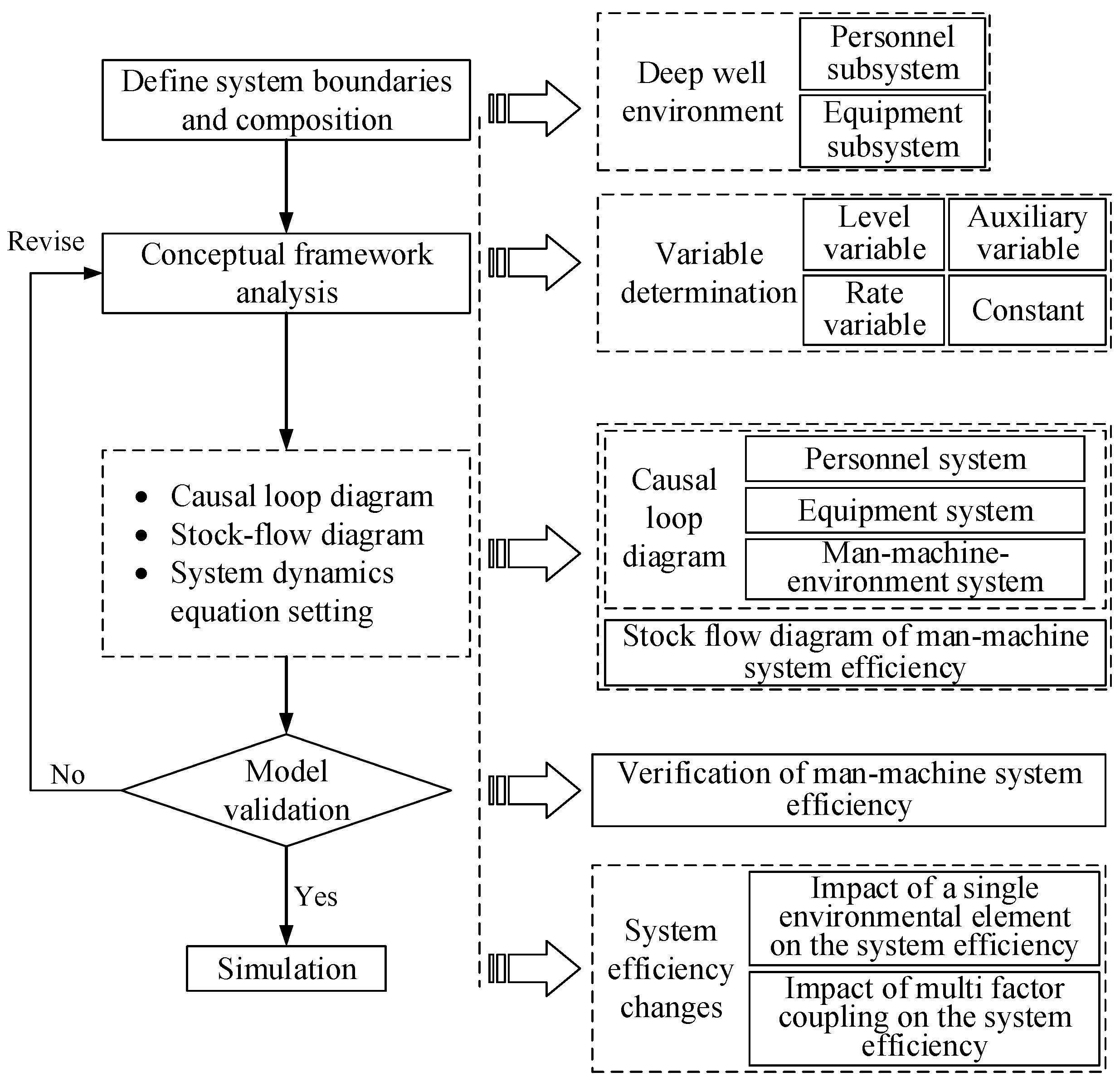
3. Construction of System Dynamics Model
3.1. Analysis and Selection of Influencing Factors
3.2. Model Assumptions
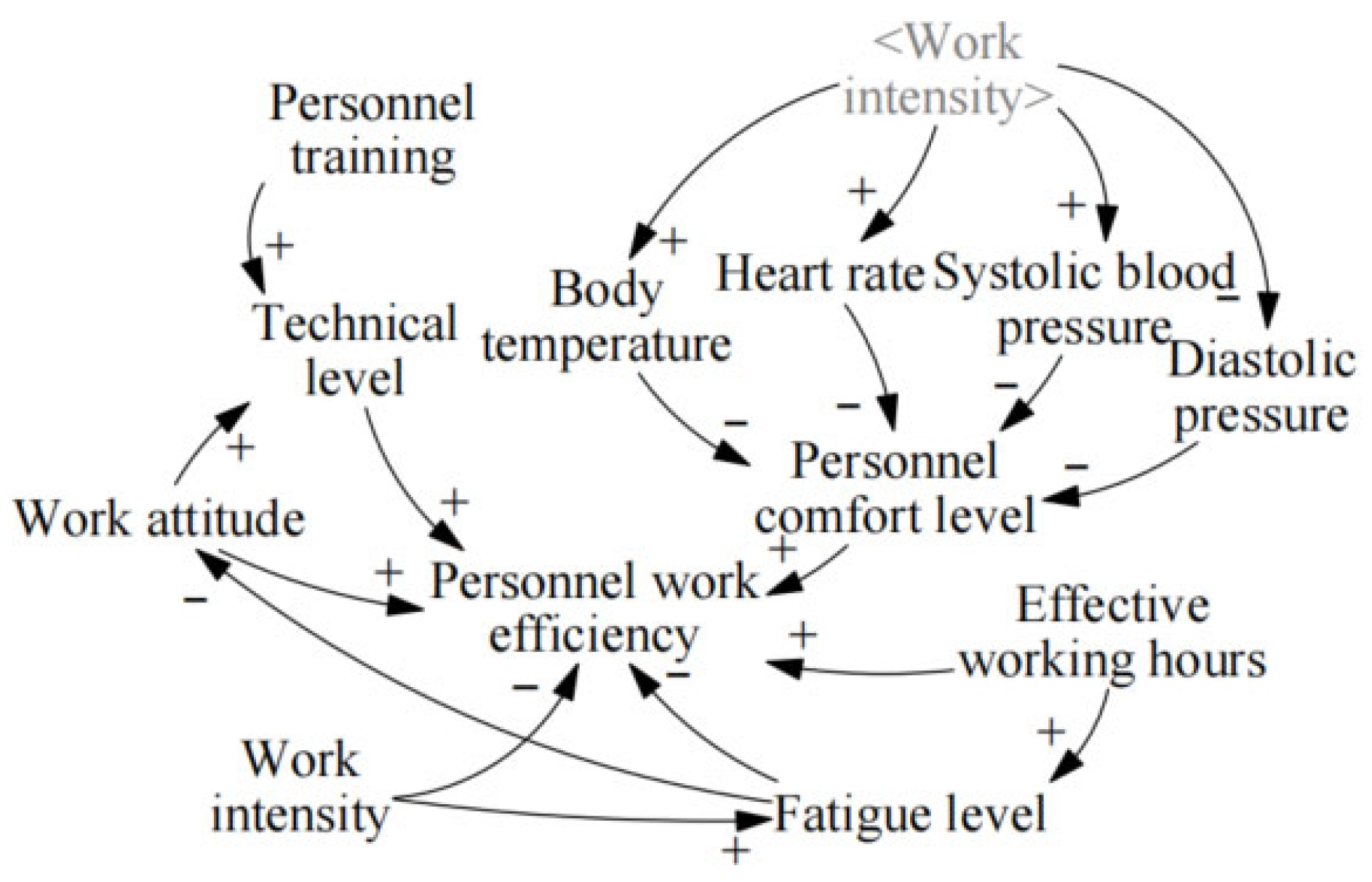
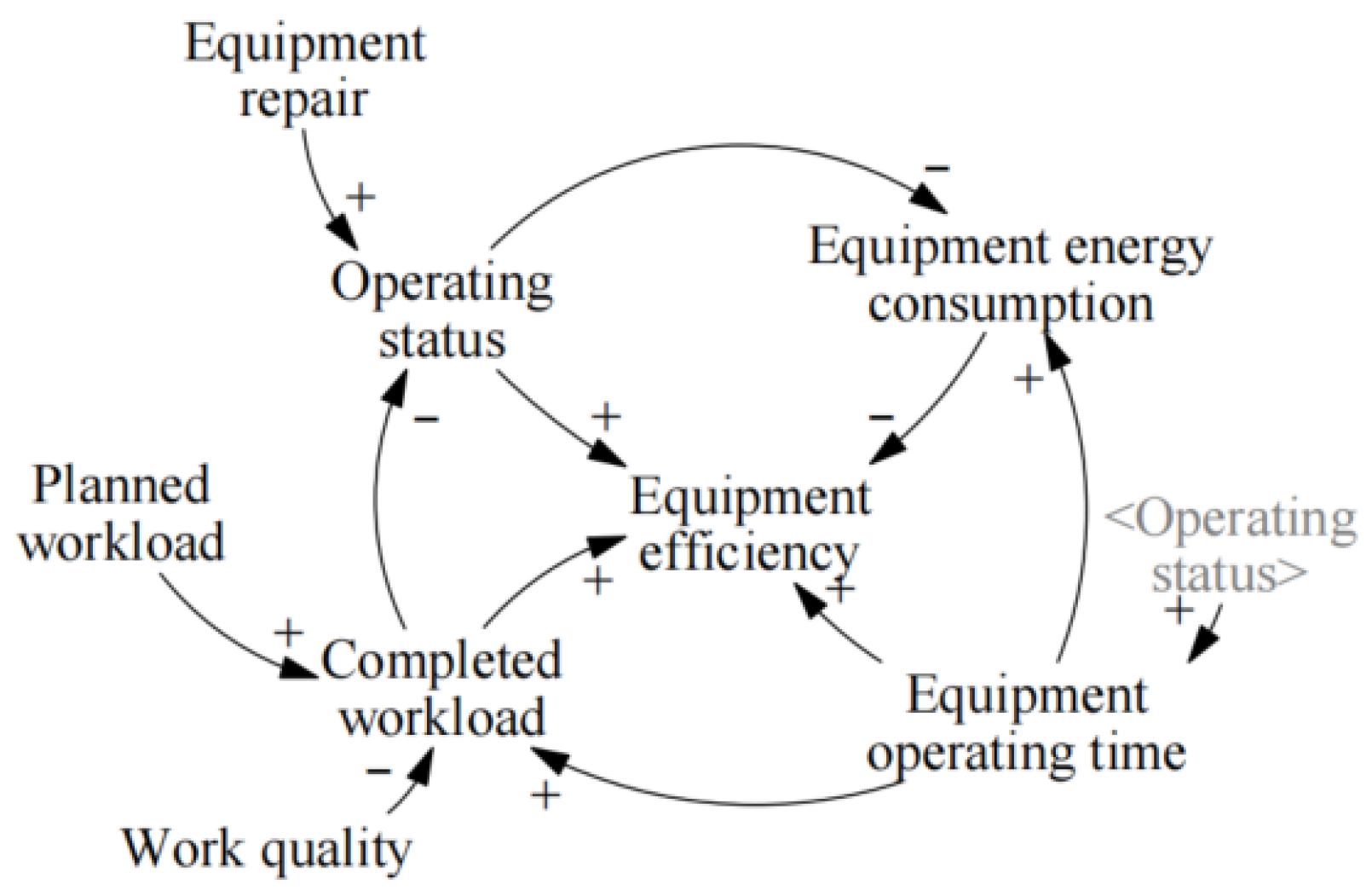
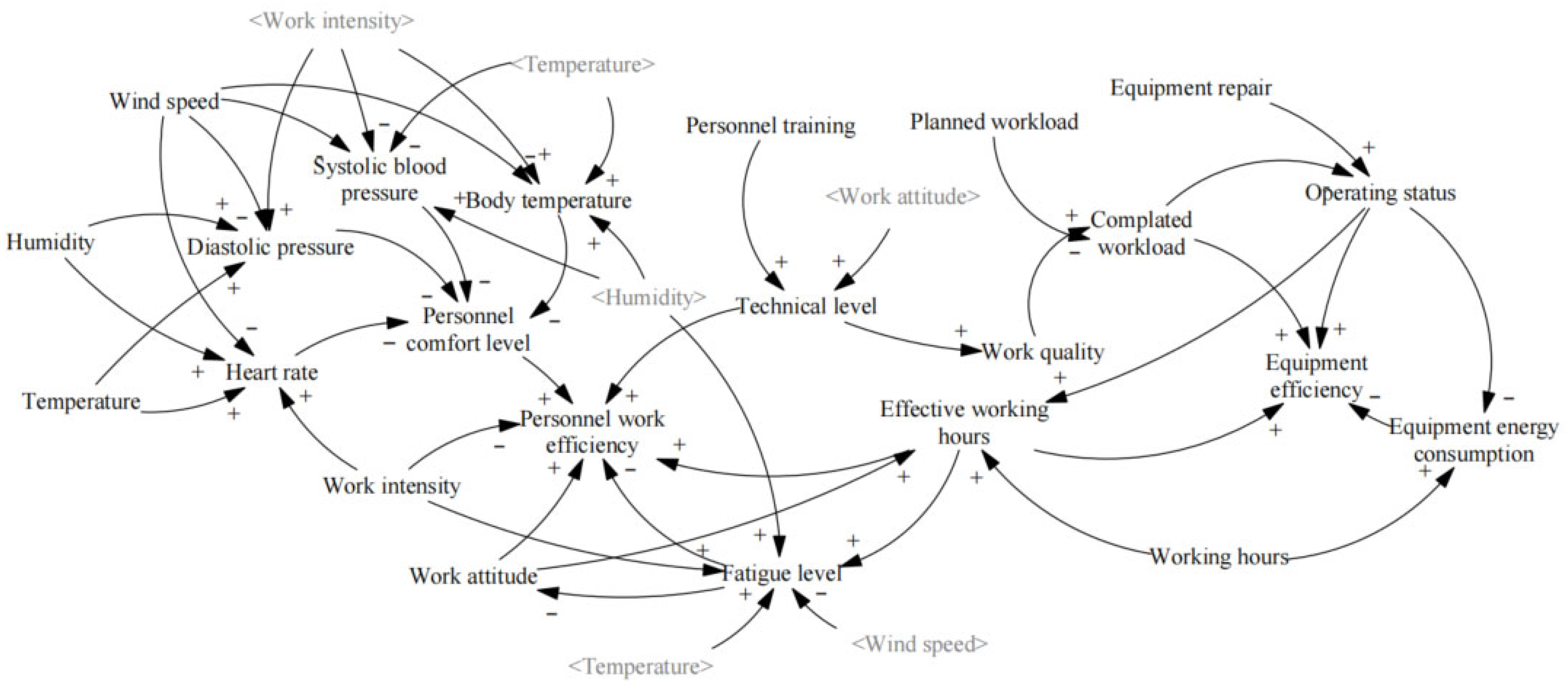
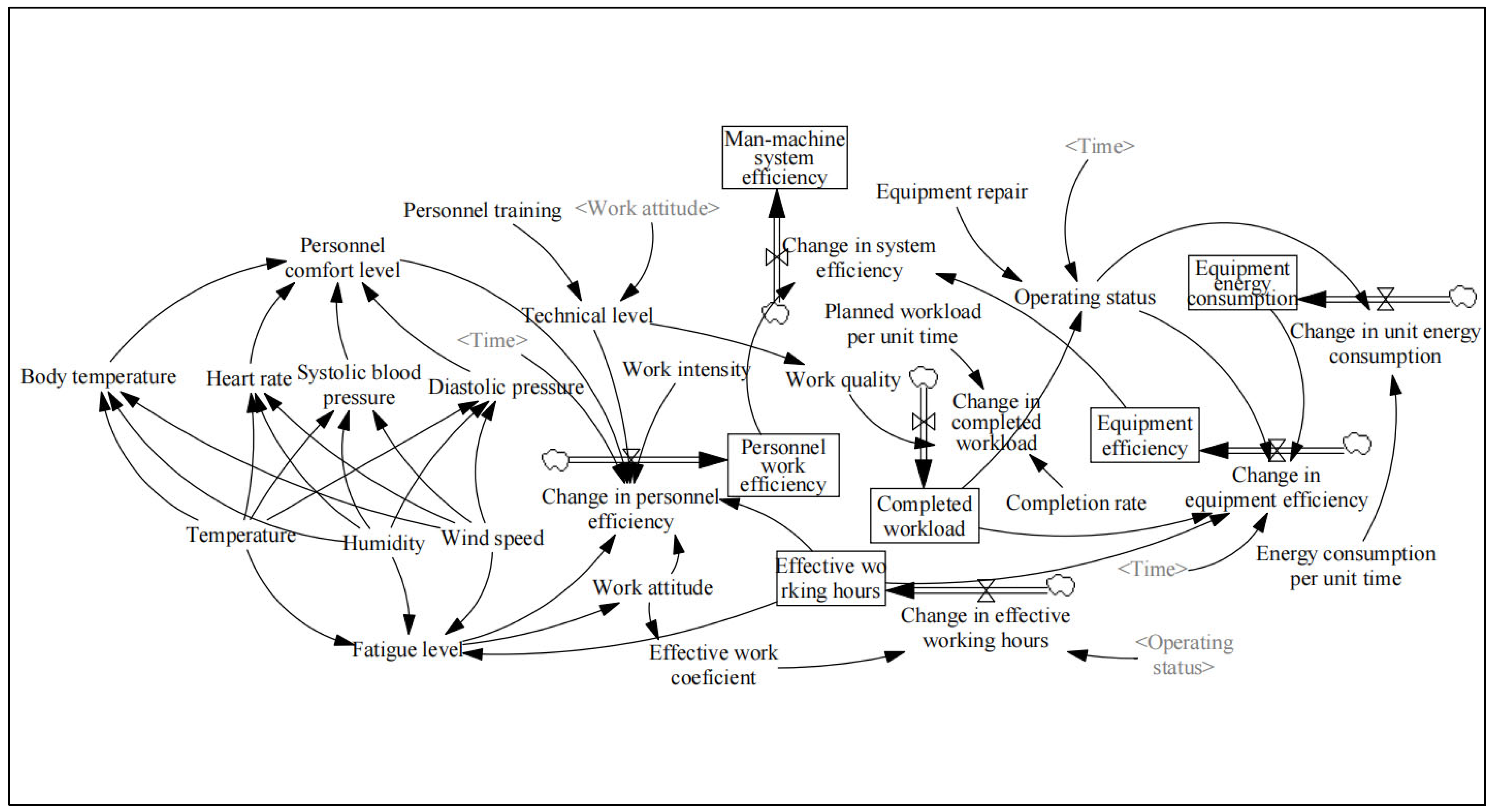
3.3. Analysis of System Causal Relationships
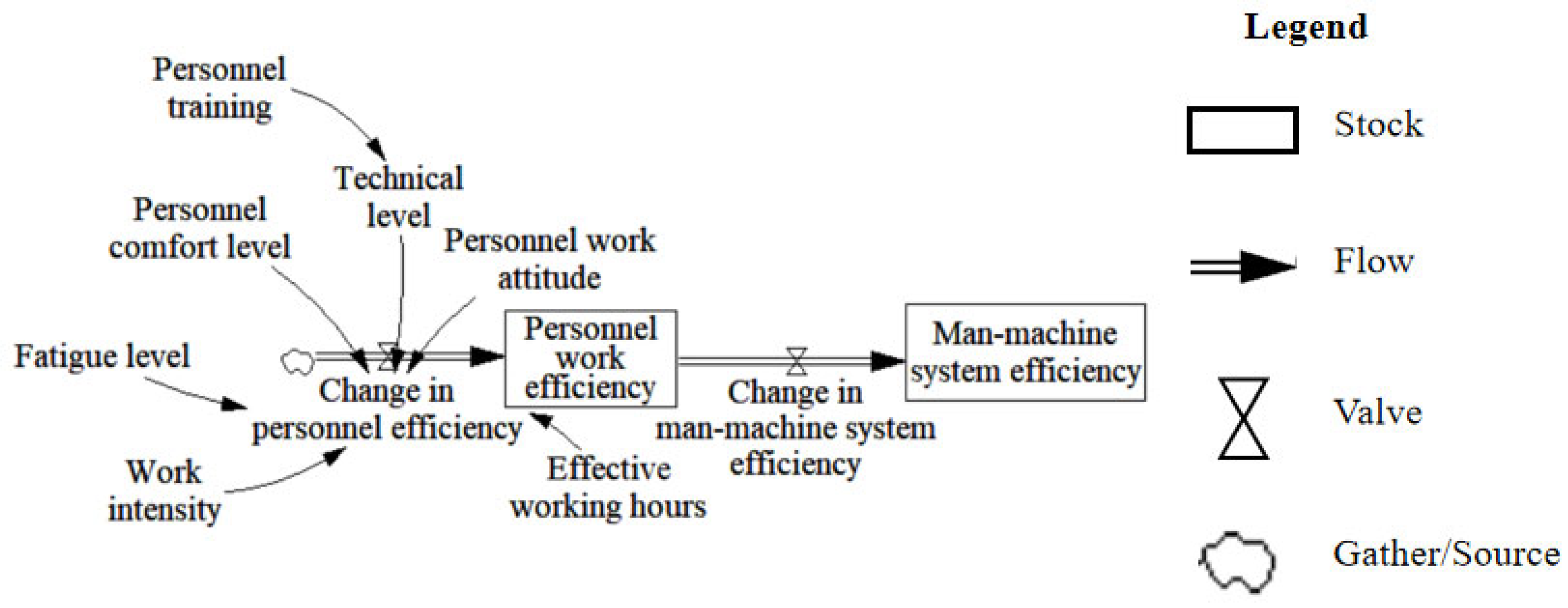
3.4. Construction of Stock Flow Diagram
3.5. System Dynamics Equation Setting
3.6. Model Checking
4. Analysis of Changes in the Human–Machine System Efficiency
4.1. The Impact of a Single Environmental Element on the Human–Machine System Efficiency
- (1)
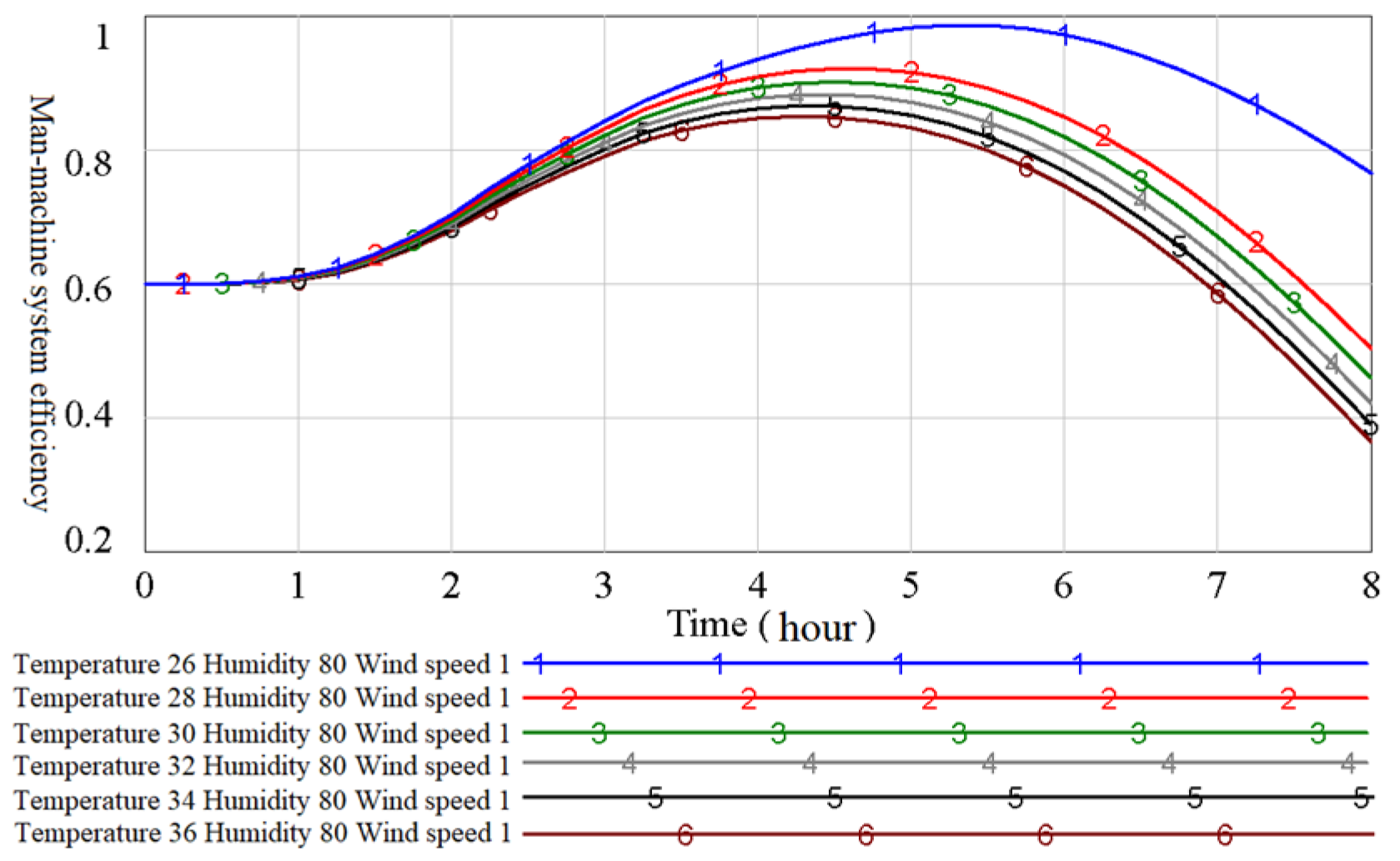
- The impact of temperature changes on the human–machine system efficiency:
- (2)
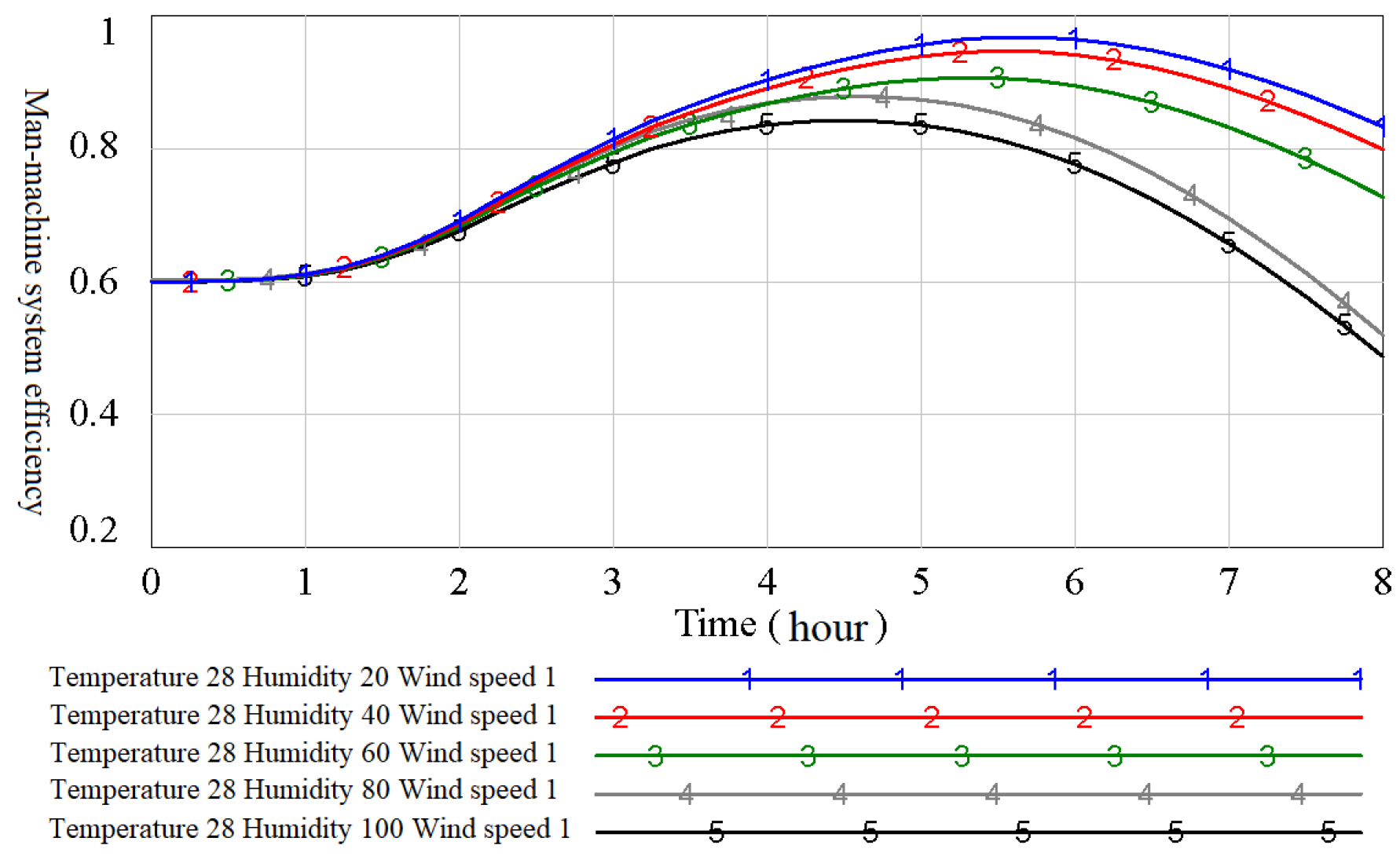
- The impact of humidity changes on the human–machine system efficiency:
- (3)
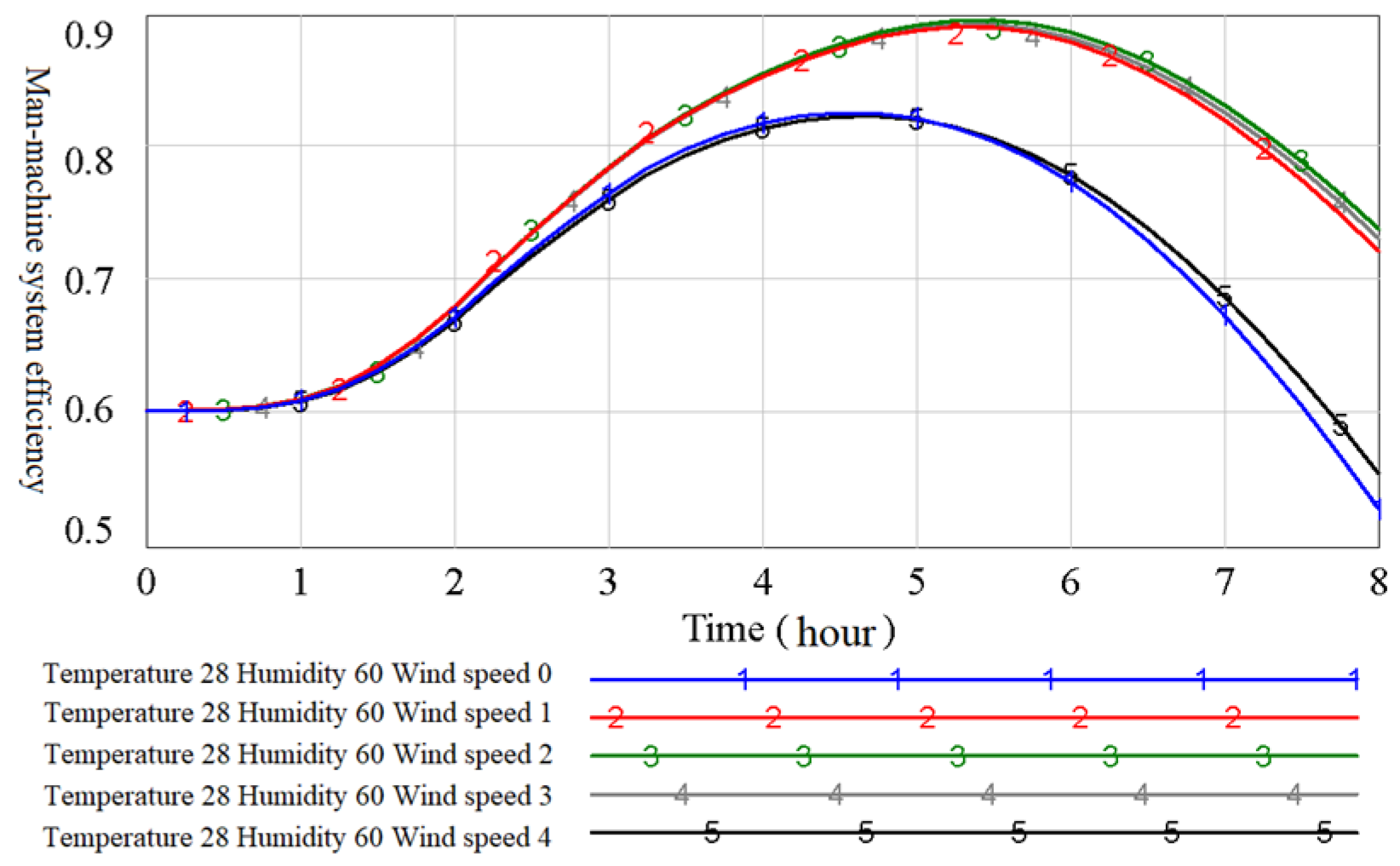
- The impact of wind speed changes on the human–machine system efficiency:
4.2. The Impact of Multi-Factor Coupling on the Human–Machine System Efficiency
- (1)
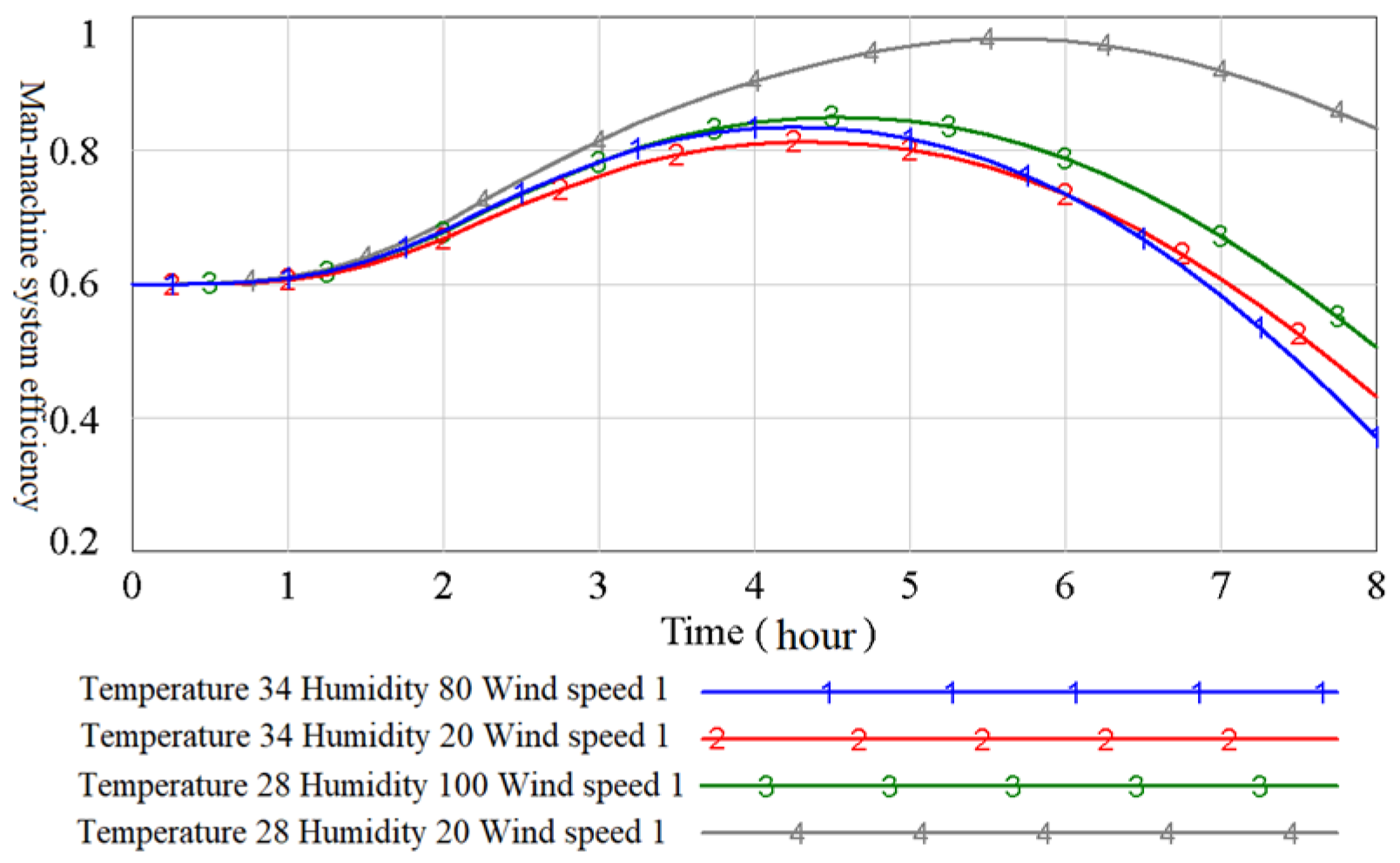
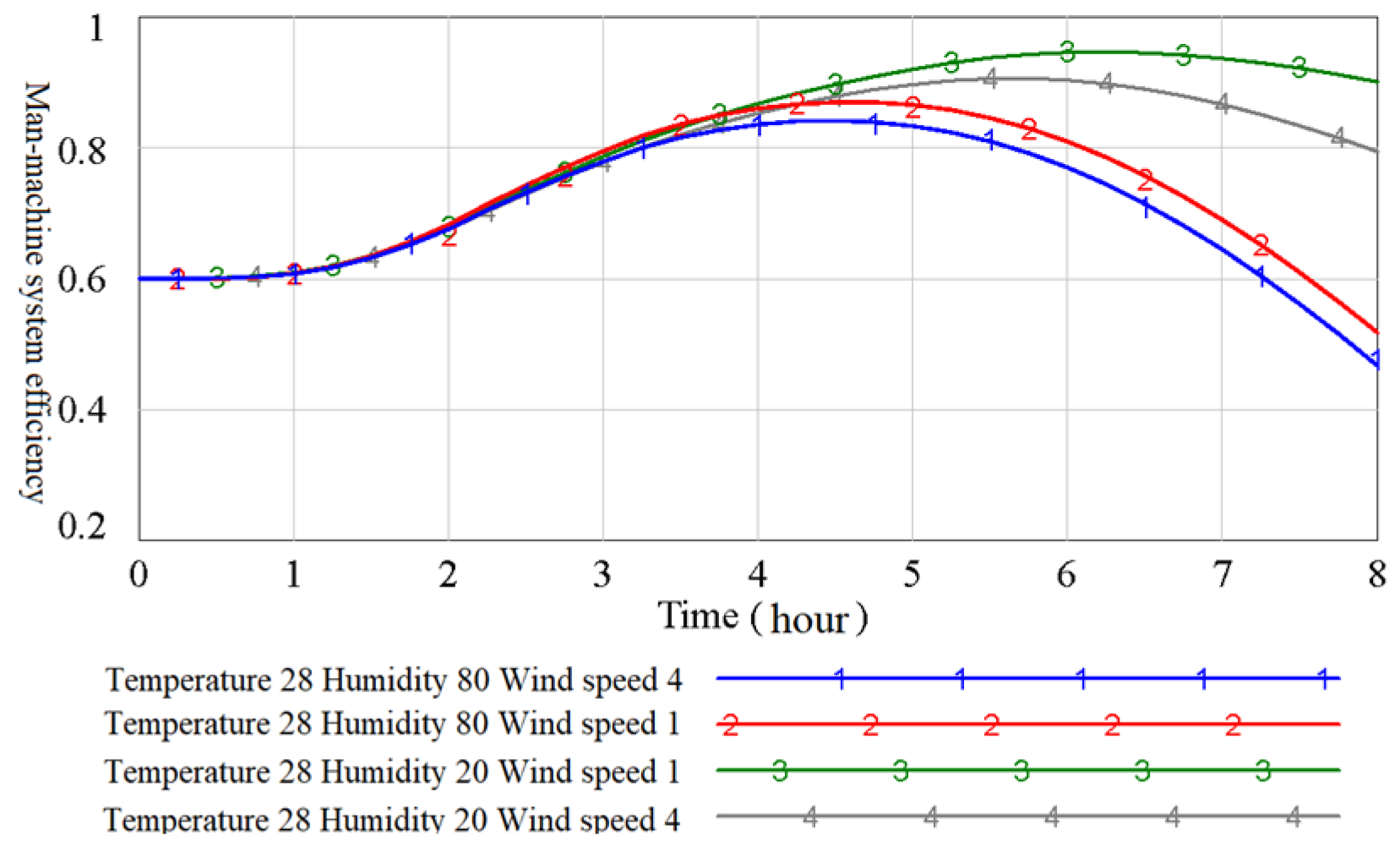
- The impact of temperature and humidity coupling on the human–machine system efficiency:
- (2)
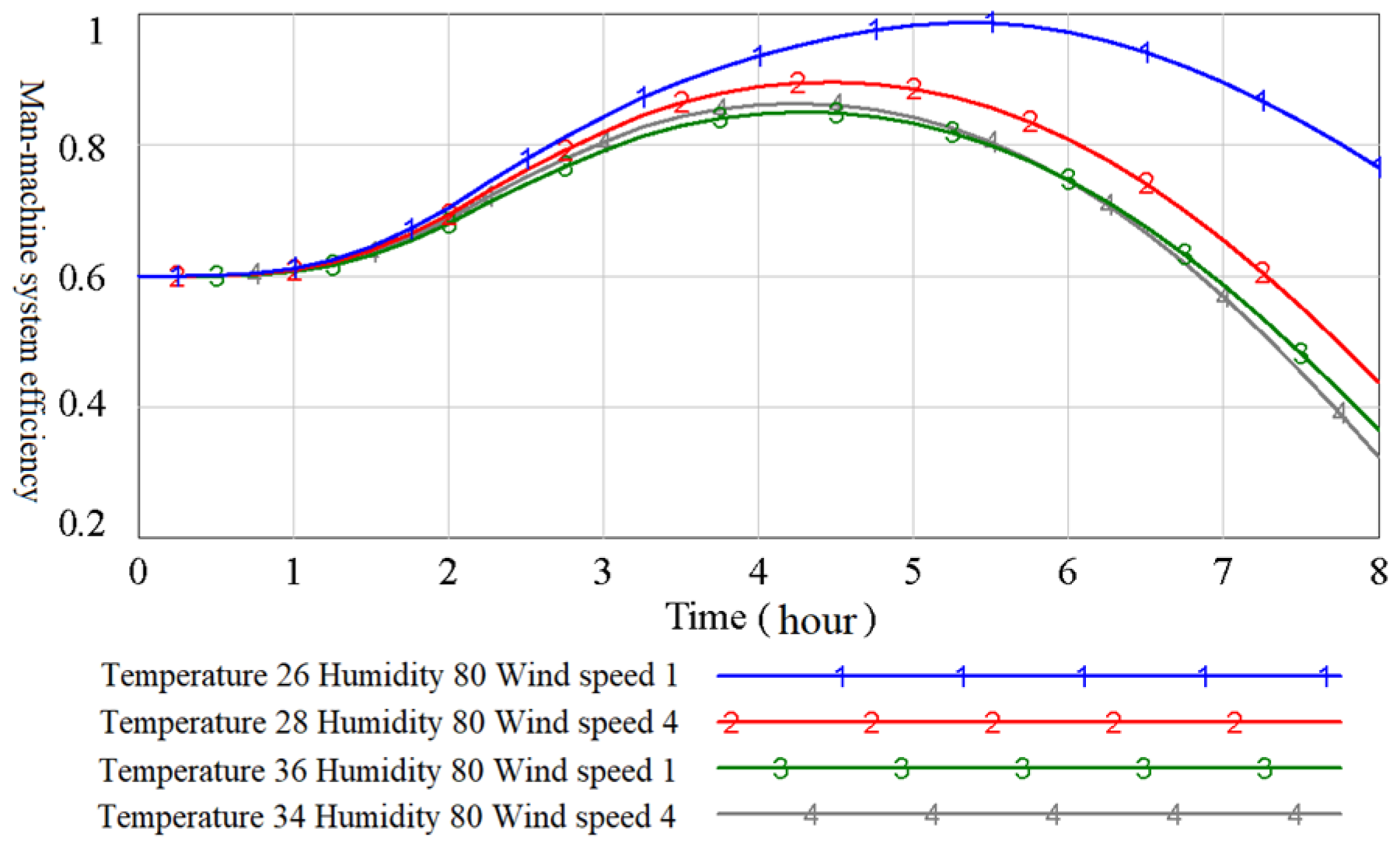
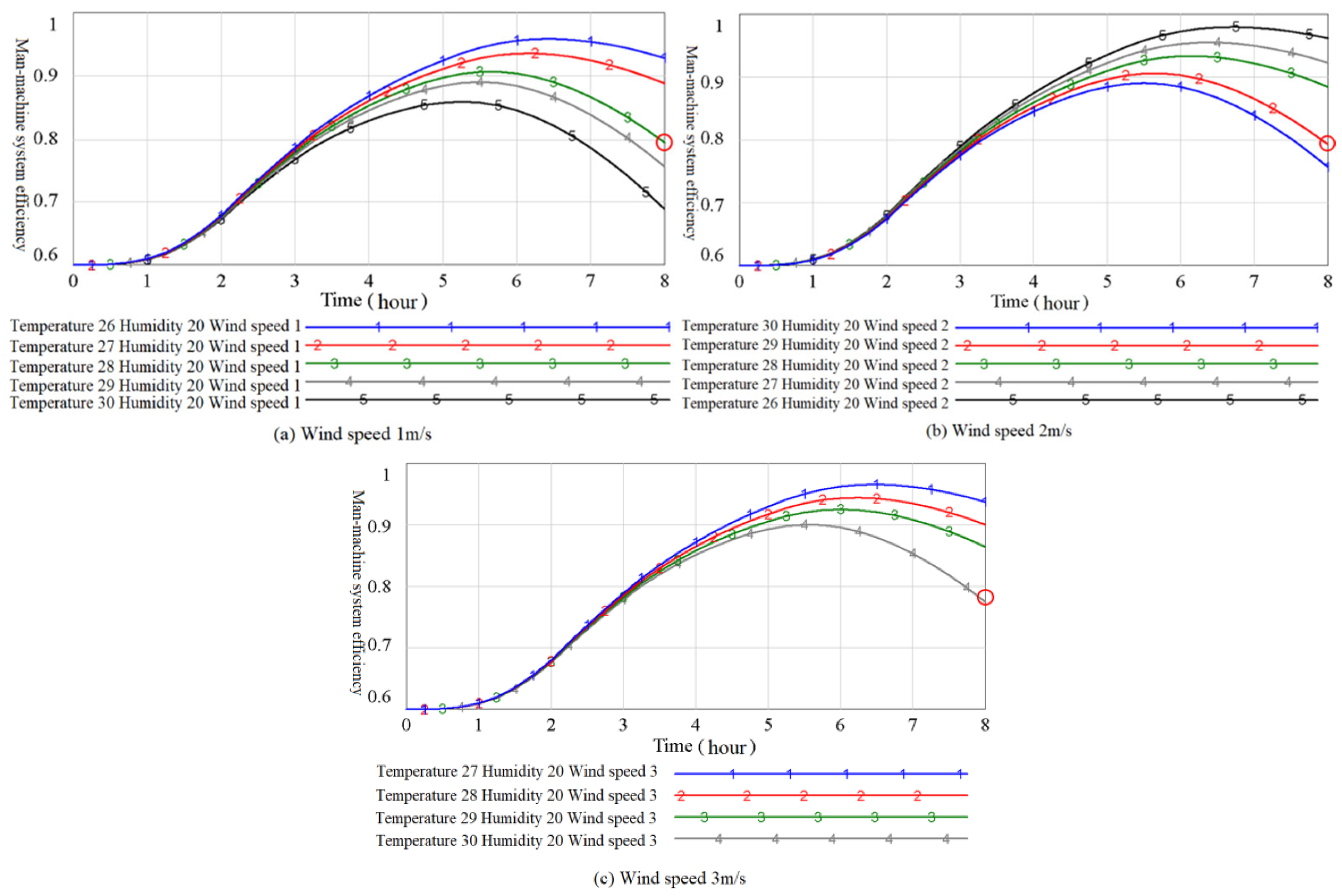
- The impact of temperature and wind speed coupling on the human–machine system efficiency:
- (3)
- The impact of humidity and wind speed coupling on the human–machine system efficiency:
- (4)
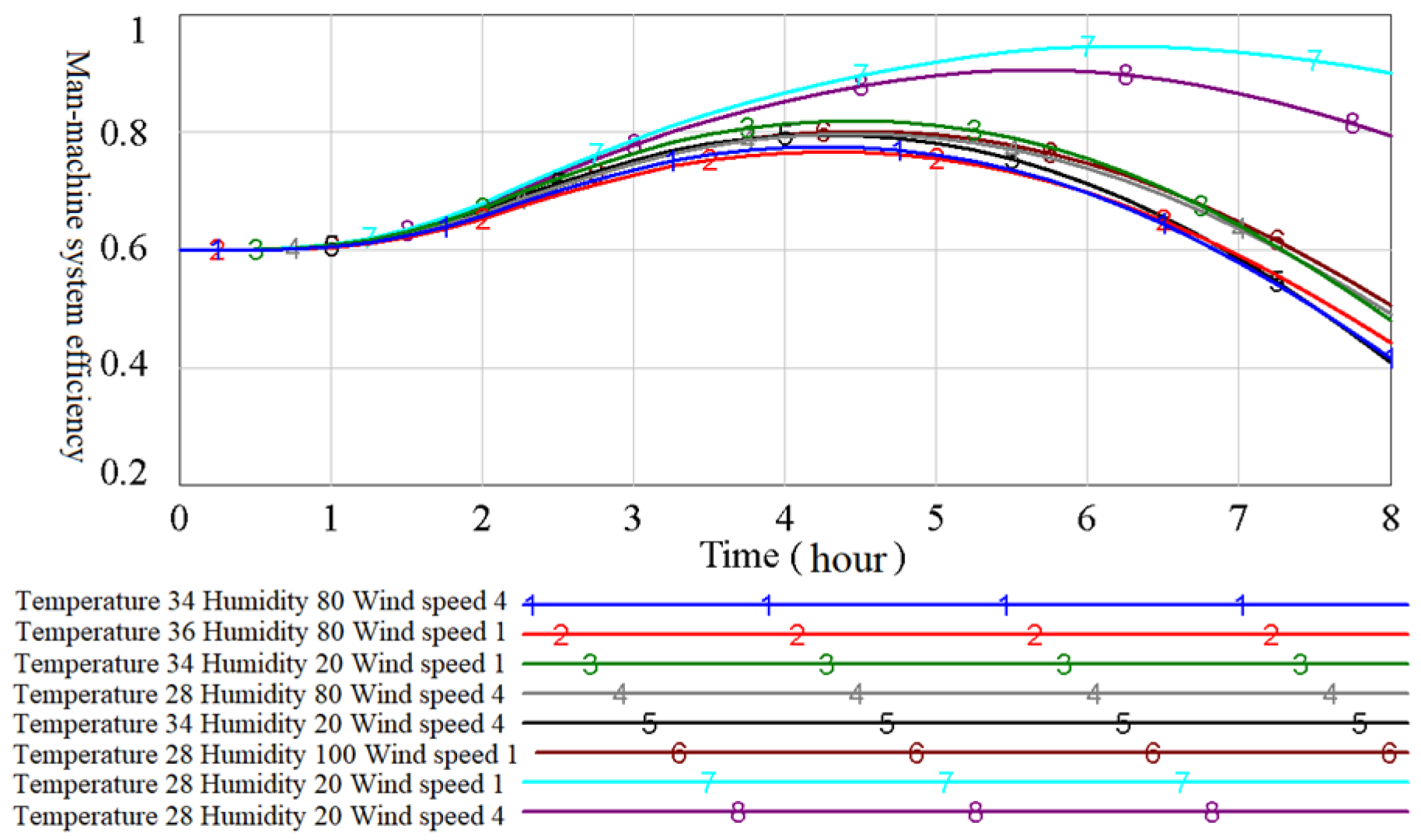
- The impact of temperature humidity and wind speed coupling on the human–machine system efficiency:
5. Coupling Equation of Multiple Environmental Factors in Deep Well Working Face
6. Discussion
7. Conclusions
- (1)
- System dynamics can effectively express the dynamic and nonlinear feedback relationship between human–machine–environment. This method effectively addresses the problem of the difficult quantitative description of the logical and quantitative relationships between various elements in the study of human–machine system efficiency.
- (2)
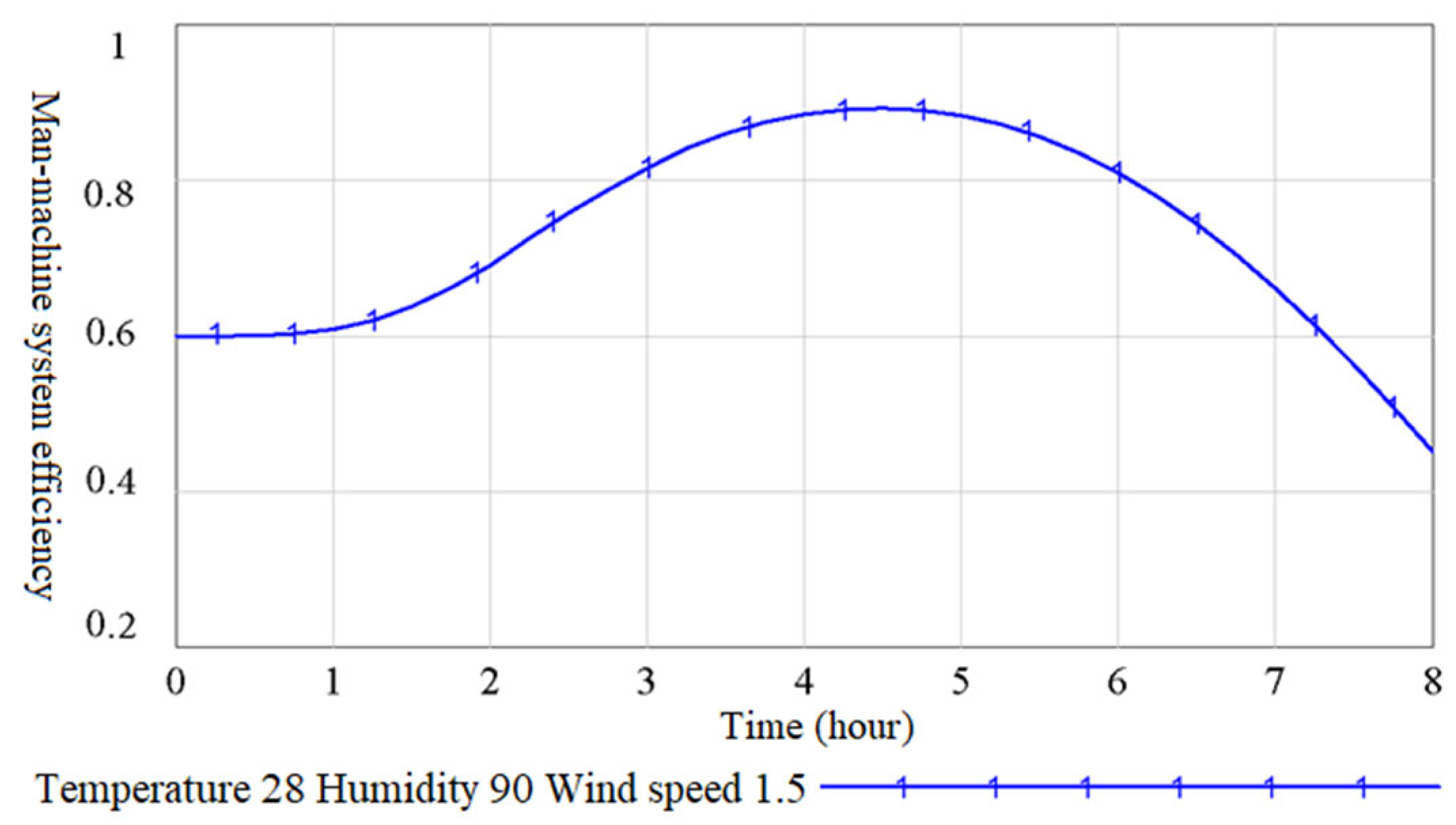
- The human–machine system efficiency operation shows a trend of increasing and then decreasing with operation time. The order of the impact of environmental factors on the human–machine system efficiency is temperature > humidity > wind speed.
- (3)
- Based on the coupling effect of multiple factors, a coupling equation for multiple environmental factors was determined, describing the quantitative relationship between temperature, humidity, and wind speed. The temperature threshold for ensuring efficient operation of the human–machine system under different environments was obtained. These results provide a reference for efficient operation of the human–machine system in deep well mining.
Author Contributions
Funding
Data Availability Statement
Conflicts of Interest
Appendix A
| No. | Variable Name | Unit | System or Factor | Variable Type | Notes |
|---|---|---|---|---|---|
| 1 | Body temperature | °C | Personnel subsystem | Auxiliary variable | Skin temperature of personnel |
| 2 | Heart rate | BPM | Auxiliary variable | The number of heartbeats per minute | |
| 3 | Systolic blood pressure | mmHg | Auxiliary variable | When the heart contracts, blood ejected from the ventricle exerts a lateral pressure on the vascular wall | |
| 4 | Diastolic pressure | mmHg | Auxiliary variable | The pressure generated when the arteries recoil elastically during heart relaxation | |
| 5 | Personnel comfort level | Dmnl | Auxiliary variable | The level of comfort perceived by individuals under the combined influence of physiological indicators | |
| 6 | Work intensity | Dmnl | Constant | The intensity and stress of labor can be categorized into light, moderate, and heavy labor | |
| 7 | Fatigue level | Dmnl | Auxiliary variable | The degree of fatigue caused by engaging in physical labor | |
| 8 | Personnel training | Dmnl | Constant | Training conducted to enhance technical proficiency of worker | |
| 9 | Technical level | Dmnl | Auxiliary variable | The ability of workers to complete underground operations | |
| 10 | Change in personnel efficiency | Dmnl | Rate variable | The change in work efficiency of personnel per unit time | |
| 11 | Personnel work efficiency | % | Level variable | The comprehensive level of various indicators in personnel operation process | |
| 12 | Effective working hours | H | Level variable | Personnel engaged in time consumption related to work | |
| 13 | Change in effective working hours | H | Rate variable | The amount of time variation used for homework per unit of time | |
| 14 | Temperature | °C | Environmental factors | Constant | Underground environment temperature |
| 15 | Humidity | % | Constant | Underground air humidity | |
| 16 | Wind speed | m/s | Constant | The velocity of underground air flow | |
| 17 | Change in system efficiency | Dmnl | Human–machine system | Rate variable | The change in comprehensive operational efficiency per unit time when personnel operate equipment for production |
| 18 | Human–machine system efficiency | Dmnl | Level variable | Comprehensive operational efficiency of personnel operating equipment for production | |
| 19 | Effective work coefficient | % | Equipment subsystem | Constant | The ratio of effective working time to total working time |
| 20 | Equipment repair | T/M | Constant | Technical activities carried out to maintain, restore, and enhance the technical status of equipment | |
| 21 | Operating status | Dmnl | Auxiliary variable | Abnormal situations occur during equipment operation | |
| 22 | Planned workload per unit time | t | Constant | Estimate the amount of work that can be completed per unit time based on experience | |
| 23 | Completed workload | t | Level variable | The amount of work completed within the working hours | |
| 24 | Change in completed workload | t | Rate variable | The change in workload completed per unit time | |
| 25 | Completion rate | % | Constant | The ratio of completed workload to planned workload | |
| 26 | Effective working hours | H | Auxiliary variable | The time consumed by equipment engaged in activities directly related to production | |
| 27 | Energy consumption per unit time | L/H | Constant | The fuel consumption per unit time of the equipment | |
| 28 | Change in unit energy consumption | L/H | Rate variable | The amount of change in equipment energy consumption per unit time due to changes in equipment operating status | |
| 29 | Equipment energy consumption | L | Level variable | The amount of fuel consumed by the equipment during working hours | |
| 30 | Change in equipment efficiency | Dmnl | Rate variable | The change in equipment operating efficiency per unit time | |
| 31 | Equipment efficiency | Dmnl | Level variable | The comprehensive level of various related indicators in the equipment operation process | |
| 32 | Work quality | Dmnl | Auxiliary variable | The effectiveness of completing assignments and the degree to which they meet quality requirements |
Appendix B
| Variable Name | Unit | Basic Equation | Notes |
|---|---|---|---|
| Human–machine system | Dmnl | =INTEG(0.6, Change in system efficiency) | The basic equations for horizontal variables are all integral equations, generally in the form of INTEG(x,y), where x is the initial value and y is the change per unit time; |
| Personnel efficiency | Dmnl | =INTEG(0.6, Change in personnel efficiency) | |
| Equipment efficiency | Dmnl | =INTEG(0.6, Change in equipment efficiency) | |
| Effective working hours | H | =INTEG(0, Change in effective working hours) | |
| Equipment energy consumption | L | =INTEG(0, Change in unit energy consumption) | |
| Completed workload | t | =INTEG(0, Change in completed workload) | |
| Change in system efficiency | Dmnl | =0.5 × Personnel efficiency + 0.5 × Equipment efficiency | |
| Change in personnel efficiency | Dmnl | =0.2 × Work attitude + 0.2 × Fatigue level + 0.2 × Personnel comfort level + 0.2 × Work intensity + 0.1 × Technical level + 0.1 × Effective working hours/8 | |
| Change in equipment efficiency | Dmnl | =0.25 × Completed workload/100 + 0.25 × Effective working hours/8 + 0.25 × Equipment energy consumption/100 + 0.25 × Operating status | |
| Technical level | Dmnl | =IF THEN ELSE(Work attitude > 0.9, 1, IF THEN ELSE(Work attitude > 0.7, 0.8, 0.7)) × IF THEN ELSE(Personnel training ≥ 5, 1, IF THEN ELSE(Personnel training > 3, 0.8, IF THEN ELSE(Personnel training > 2, 0.6, IF THEN ELSE(Personnel training > 1, 0.5, 0.4)))) | |
| Work attitude | Dmnl | =(0.9 + STEP(−0.1, 3) + STEP(−0.1, 5) + STEP(−0.1, 6) + STEP(−0.1, 7)) × IF THEN ELSE(Fatigue level < 0.5, 1, IF THEN ELSE(Fatigue level < 0.6, 0.9, 0.7)) | |
| Body temperature | °C | =f1(Temperature, Humidity, Wind speed, Work intensity) | f represents a functional relationship, and f1–f5 can be regressed and fitted based on experimental data on human comfort [32]; |
| Heart rate | BPM | =f2(Temperature, Humidity, Wind speed, Work intensity) | |
| Systolic blood pressure | mmHg | =f3(Temperature, Humidity, Wind speed, Work intensity) | |
| Diastolic pressure | mmHg | =f4(Temperature, Humidity, Wind speed, Work intensity) | |
| Fatigue level | Dmnl | =f5(Temperature, Humidity, Wind speed, Work intensity)*IF THEN ELSE(Effective working hours < 1, 1, IF THEN ELSE(Effective working hours < 2, 1.2, IF THEN ELSE(Effective working hours < 3, 1.4, 1.5)))/20 | |
| Personnel comfort level | Dmnl | =1 − (0.3 × (Body temperature − 35)/3 + 0.3 × (Heart rate − 50)/90 + 0.2 × (Systolic blood pressure − 80)/60 + 0.2 × (Diastolic pressure − 50)/70) | Standardize physiological indicators before calculating personnel comfort level; |
| Change in effective working hours | H | =Effective work coefficient*IF THEN ELSE(Operating status > 0.6,0.9,0.7) | |
| Effective work coefficient | Dmnl | =IF THEN ELSE(Work attitude ≥ 0.6, 0.9, 0.8) | |
| Change in unit energy consumption | L/H | =Operating status × Energy consumption per unit time | |
| Change in completed workload | t | =Work quality × Completion rate × Planned workload per unit time | |
| Operating status | Dmnl | =(Time/8) × IF THEN ELSE(Completed workload < 15, 8, IF THEN ELSE(Completed workload < 30, 3.5, IF THEN ELSE(Completed workload < 45, 2.3, IF THEN ELSE(Completed workload<65, 1.2, IF THEN ELSE(Completed workload < 80, 0.8, IF THEN ELSE(Completed workload < 90, 0.7, IF THEN ELSE(Completed workload < 100, 0.6, 0.4)))))))*IF THEN ELSE(Equipment repair < 1, 0.3, IF THEN ELSE(Equipment repair < 2, 0.5, IF THEN ELSE(Equipment repair < 3, 0.7, 0.9))) |
References
- Luo, Z.Q.; Cheng, P.Y. Analysis on factors affecting accidents of man-machine system in underground metal mine based on DEMATEL-ISM. J. Saf. Sci. Technol. 2017, 12, 145–151. [Google Scholar] [CrossRef]
- Niemelä, R.; Hannula, M.; Rautio, S. The effect of air temperature on labour productivity in call centres—A case study. Energy Build. 2002, 8, 759–764. [Google Scholar] [CrossRef]
- Sugiuchi, M.; Arata, S.; Ikaga, T.; Shiraishi, Y.; Hayashi, T.; Nakano, J.; Ando, S.; Kawakubo, S. Analyzing multiple elements of physical office environment for maximizing perceived work efficiency: Insights from surveys of 58 offices during summer. Build. Environ. 2025, 267, 112153. [Google Scholar] [CrossRef]
- Arata, S.; Sugiuchi, M.; Ikaga, T.; Shiraishi, Y.; Hayashi, T.; Ando, S.; Kawakubo, S. Economic benefits of the effects of office environment on perceived work efficiency and presenteeism. Build. Environ. 2023, 243, 110712. [Google Scholar] [CrossRef]
- Zhao, H.K.; Chen, K.X. Study on the influence of different thermal and wet environments in metal mines on underground workers. World Nonferr. Met. 2025, 24, 221–224. [Google Scholar]
- Alipio, M.I. Development of smart indoor workplace system using decision tree algorithm. In Proceedings of the 2021 IEEE International Conference on Internet of Things and Intelligence Systems, Bali Island, Indonesia, 23–24 November 2021. [Google Scholar] [CrossRef]
- Felgueiras, F.; Cunha, L.; Mourão, Z.; Moreira, A.; Gabriel, M.F. A systematic review of environmental intervention studies in offices with beneficial effects on workers’ health, well-being and productivity. Atmos. Pollut. Res. 2022, 13, 101513. [Google Scholar] [CrossRef]
- Cui, W.L.; Ou, Y.Q.; Yu, J. Effect of different combinations of air temperature and airflow velocityon human comfort and work efficiency under the same thermal sensation environment. Heat. Vent. Air Cond. 2013, 43, 68–72. [Google Scholar] [CrossRef]
- Wen, Y.; Albert, P.C. Optimal work pattern for construction workers in hot weather: A case study in Hong Kong. J. Comput. Civ. Eng. 2015, 5, 253–263. [Google Scholar] [CrossRef]
- Tsutsumi, H.; Tanabe, S.; Harigaya, J.; Iguchi, Y.; Nakamura, G. Effect of humidity on human comfort and productivity after step changes from warm and humid environment. Build. Environ. 2007, 12, 4034–4042. [Google Scholar] [CrossRef]
- Dong, X.; Wu, Y.; Chen, X.; Li, H.; Cao, B.; Zhang, X.; Yan, X.; Li, Z.; Long, Y.; Li, X. Effect of thermal, acoustic, and lighting environment in underground space on human comfort and work efficiency: A review. Sci. Total Environ. 2021, 786, 147537. [Google Scholar] [CrossRef]
- Ismail, R.A.; Nizam, M.C.; Haniff, M.H.M. The impact of workers productivity under simulated environmental factor by taguchi analysis. APCBEE Procedia 2014, 10, 263–268. [Google Scholar] [CrossRef]
- Onder, M.; Kursunoglu, N.; Onder, S. Psychrometric analysis of a fullymechanized underground coal mine and establishment of acceptable climate conditions. J. Min. Sci. 2021, 57, 863–872. [Google Scholar] [CrossRef]
- Li, L.; Lian, Z.; Li, P.; Qin, Y. Neuro behavioral approach for evaluation of office workers’ productivity: The effects of room temperature. Build. Environ. 2008, 8, 1578–1588. [Google Scholar] [CrossRef]
- Li, W. Research on the impact of noise type and intensity on the ability to counteract semantic interference under high temperature conditions. Consum. Guide 2014, 2, 151–152. [Google Scholar]
- Zhang, J.G.; Yang, S.H.; Suo, C.Y. Research on effects of high temperature and high humidity environment on miners physiology and psychology. China Saf. Sci. J. 2015, 1, 23–28. [Google Scholar] [CrossRef]
- He, W.G. Analysis of dynamic performance optimization and control technology for mining equipment. Mach. China 2025, 23, 63–66. [Google Scholar]
- Wang, F. Technical analysis on improving the operational efficiency of coal mine excavation machinery and equipment. Mach. China 2025, 15, 122–125. [Google Scholar]
- Zhang, J.G. efficiency for open-pit mining equipment analysis of affecting factors and countermeasures of operational. Opencast Min. Technol. 2025, 40, 92–97. [Google Scholar] [CrossRef]
- Yao, Q.; Li, R.R.; Gong, J.Z. Evaluation of production efficiency of panel furniture edge banding machine based on overall equipment efficiency. Chin. J. Wood Sci. Technol. 2022, 3, 26–32. [Google Scholar] [CrossRef]
- Jin, C.; Feng, J. Research on the operational efficiency of medical equipment based on DEA. China Med. Equip. 2018, 8, 109–111. [Google Scholar] [CrossRef]
- Wu, G.H.; Li, Q. Evaluation method of urban rail transit equipment’s comprehensive efficiency based on super-efficient DEA and Tobit model. Transp. Res. 2020, 6, 83–89+99. [Google Scholar] [CrossRef]
- Zhang, Y.J.; Song, S.J. Analysis of operation efficiency improvement strategies for bolt drilling rigs of mining mechanical equipment. Rock Drill. Mach. Pneum. Tools 2025, 8, 134–136. [Google Scholar] [CrossRef]
- Wu, Y.C. Analysis of measures to improve the operational efficiency of electrical equipment in power plants. Electr. Equip. Econ. 2020, Z1, 102–104. [Google Scholar]
- Lv, Z.J. Measures research on improving operation efficiency of electrical equipment in power plant. J. New Ind. 2019, 10, 100–103. [Google Scholar] [CrossRef]
- Xia, M.H. Analysis on effective measures to improve the operating efficiency of pumping unit equipment. China Plant Eng. 2019, 8, 140–141. [Google Scholar]
- Tian, Y.C. Analysis of specific measures for improving the operational efficiency of mineral processing equipment. World Nonferr. Met. 2019, 1, 39+42. [Google Scholar]
- Liu, J.Q.; Zhang, B.; Zheng, S.K. Analysis of influencing factors of electric shovel efficiency in Yimin open-pit mine. Opencast Min. Technol. 2017, 4, 29–32. [Google Scholar] [CrossRef]
- Forrester, W.J. Industrial dynamics. J. Oper. Res. Soc. 1997, 10, 1037–1041. [Google Scholar] [CrossRef]
- Tshavhungwe, V.; Oosthuizen, R.; Grobbelaar, S. Investigation of the variables affecting the competitiveness of the sawmill industry and their interactions using systems dynamics modelling. South. For. J. For. Sci. 2025, 87, 216–225. [Google Scholar] [CrossRef]
- Guo, D.M.; Li, G.Q.; Li, N.T.; Hou, J.; Li, Y.L. Comprehensive evaluation of thermal hazards in deep mining based on the unascertained measure theory. Met. Mine 2026, 1, 198–207. [Google Scholar] [CrossRef]
- Guo, D.M. Research on the Effect of Deep Heat Hazard on Man-Machine System Efficiency in Sanshandao Gold Mine. Ph.D. Dissertation, University of Science and Technology Beijing, Beijing, China, 2022. [Google Scholar] [CrossRef]


| No. | Stope | Level (m) | Workload (t) | Relative Error (%) | |
|---|---|---|---|---|---|
| Simulated Value | Actual Value | ||||
| 1 | S10167 | −435 | 103.8 | 110 | −5.64 |
| 2 | S13165 | −570 | 98.7 | 95 | 3.89 |
| 3 | S14155 | −615 | 101.3 | 100 | 1.30 |
| 4 | S14160 | −615 | 103.1 | 100 | 3.10 |
| 5 | S14186 | −645 | 105.9 | 110 | −3.73 |
| 6 | S15160 | −660 | 105.5 | 100 | 5.50 |
| 7 | S15162 | −675 | 102.3 | 100 | 2.30 |
| No. | Stope | Level (m) | Fatigue level | Relative error (%) | |
| Simulated value | Actual value | ||||
| 8 | S15162 | −243 | 9.4 | 10 | −6.00% |
| 9 | S15175 | −330 | 13.6 | 14 | −2.86% |
| 10 | S10172 | −440 | 7.3 | 7 | 4.29% |
| 11 | S19148 | −537 | 14.5 | 14 | 3.57% |
| 12 | S17162 | −537 | 11.7 | 12 | −2.50% |
| 13 | S18156 | −550 | 18.1 | 17 | 6.47% |
| 14 | S16146 | −555 | 13.6 | 13 | 4.62% |
| 15 | S19156 | −750 | 17.6 | 17 | 3.53% |
| No. | Temperature | Humidity | Wind Speed | Notes | |
|---|---|---|---|---|---|
| 1 | 1 | 1 | 1 | Temperature | 1 represents high temperature, |
| 2 | 1 | 1 | 2 | 2 represents low temperature; | |
| 3 | 1 | 2 | 1 | ||
| 4 | 2 | 1 | 1 | Humidity | 1 represents high humidity, |
| 5 | 1 | 2 | 2 | 2 represents low humidity; | |
| 6 | 2 | 1 | 2 | ||
| 7 | 2 | 2 | 1 | Wind speed | 1 represents high speed, |
| 8 | 2 | 2 | 2 | 2 represents low speed; | |
| Humidity | Wind Speed | Temperature | Humidity | Wind Speed | Temperature |
|---|---|---|---|---|---|
| (%) | (m/s) | (°C) | (%) | (m/s) | (°C) |
| 20 | 1 | 28 | 80 | 1 | 26 |
| 2 | 29 | 2 | 26 | ||
| 3 | 30 | 3 | 25 | ||
| 40 | 1 | 28 | 100 | 1 | 23 |
| 2 | 28 | 2 | 24 | ||
| 3 | 29 | 3 | 23 | ||
| 60 | 1 | 26 | |||
| 2 | 27 | ||||
| 3 | 27 |
Disclaimer/Publisher’s Note: The statements, opinions and data contained in all publications are solely those of the individual author(s) and contributor(s) and not of MDPI and/or the editor(s). MDPI and/or the editor(s) disclaim responsibility for any injury to people or property resulting from any ideas, methods, instructions or products referred to in the content. |
© 2026 by the authors. Licensee MDPI, Basel, Switzerland. This article is an open access article distributed under the terms and conditions of the Creative Commons Attribution (CC BY) license.
Share and Cite
Guo, D.; Li, G.; Li, N.; Xu, H.; Li, Y. Research on the Human–Machine System Efficiency in Deep Mining Under the Coupling Effect of Multiple Factors. Processes 2026, 14, 1116. https://doi.org/10.3390/pr14071116
Guo D, Li G, Li N, Xu H, Li Y. Research on the Human–Machine System Efficiency in Deep Mining Under the Coupling Effect of Multiple Factors. Processes. 2026; 14(7):1116. https://doi.org/10.3390/pr14071116
Chicago/Turabian StyleGuo, Duiming, Guoqing Li, Ningting Li, Hongtu Xu, and Yunlong Li. 2026. "Research on the Human–Machine System Efficiency in Deep Mining Under the Coupling Effect of Multiple Factors" Processes 14, no. 7: 1116. https://doi.org/10.3390/pr14071116
APA StyleGuo, D., Li, G., Li, N., Xu, H., & Li, Y. (2026). Research on the Human–Machine System Efficiency in Deep Mining Under the Coupling Effect of Multiple Factors. Processes, 14(7), 1116. https://doi.org/10.3390/pr14071116