Article

Sustainable Valorization of Spent Coffee Grounds: Phenolic Compound Extraction Using Hydrophobic Eutectic Solvents

by
Cristiane Nunes da Silva
1,
Talita Rego Prado
2,
Filipe Smith Buarque
1,* and
Bernardo Dias Ribeiro
1,2,*
1
School of Chemistry, Federal University of Rio de Janeiro, Rio de Janeiro 21941-853, Brazil
2
Chemistry Institute, Federal University of Rio de Janeiro, Rio de Janeiro 21941-853, Brazil
*
Authors to whom correspondence should be addressed.
Processes 2026, 14(7), 1109; https://doi.org/10.3390/pr14071109
Submission received: 4 March 2026 / Revised: 20 March 2026 / Accepted: 25 March 2026 / Published: 30 March 2026
(This article belongs to the Special Issue Advances in Green Extraction and Separation Processes)

Abstract

Spent coffee grounds (SCG) are the main by-product generated by the coffee industry, with an estimated annual production of approximately 7 million tons. Although commonly treated as waste, SCG constitute a valuable source of phenolic compounds, particularly chlorogenic acid, which has been associated with antimicrobial, antioxidant, antimutagenic, anti-inflammatory, and cardioprotective properties. These bioactive compounds are of interest as functional ingredients for food, cosmetic, and pharmaceutical applications. However, their recovery by conventional extraction methods often depends on volatile, flammable, or toxic organic solvents. In this context, hydrophobic eutectic solvents (HES) have emerged as a greener and more sustainable alternative. In the present study, phenolic compounds were extracted from SCG using HES combined with microwave-assisted extraction (MAE). Sixteen terpene-based HES formulated with fatty acids and fatty alcohols were evaluated. Among them, camphor:dodecanoic acid and borneol:dodecanoic acid gave the highest total phenolic contents. Process optimization showed that the borneol:dodecanoic acid system, under 12% water content, a 1:10 solid-to-liquid ratio, 57 °C, and 120 min, reached 80.94 ± 4.44 mg GAE g−1 by MAE. HPLC analysis revealed chlorogenic, caffeic, and ferulic acids as the main phenolic compounds, while the extracts also displayed high antioxidant activity. Overall, these findings demonstrate that HES-MAE is a promising and sustainable strategy for the recovery of value-added phenolics from SCG.

1. Introduction

The production and processing of coffee beans (Coffea sp.) constitute one of the important sectors of Brazilian agribusiness, with economic, cultural, social, and environmental impacts. Brazil remains the world’s leading coffee producer and exporter. According to Conab, Brazilian coffee production reached approximately 56.5 million 60 kg bags in 2025, corresponding to a 4.3% increase compared to 2024. These data represent approximately 30% of the international market [1]. According to recent market reports, Brazil remains the second largest coffee consumer in the world, behind only the United States. In 2025, Brazilian domestic consumption was estimated at approximately 21.9 million 60 kg bags, while U.S. consumption was estimated at 23.4 million 60 kg bags [2]. However, the extensive production and consumption of coffee contribute to a high generation of coffee by-products, which range from harvesting, processing, and consumption. The main by-products generated are husk, pulp, mucilage, parchment, silver husk, defective beans and spent coffee grounds, which together amount to approximately 15–20 million tons of coffee by-products per year [3,4].
Spent coffee grounds (SCG) are among the main by-products generated during coffee processing and correspond to approximately 40–45% of the original fruit mass. This residue is produced by several sources, including the instant coffee industry, which accounts for nearly half of the total SCG generated, as well as coffee shops, bakeries, snack bars, and households [5,6]. For every 1 kg of instant coffee, 2 kg of wet coffee grounds are generated, resulting in nearly 7 million tons annually worldwide [7]. In Brazil, SCG generation exceeds 1 million tons per year [8]. Due to this, residue has low commercial value and it is commonly discarded or incinerated, which contributes to environmental problems such as soil, air, and water contamination, proliferation of insects and pathogenic microorganisms, and phytotoxic effects on soil [9]. In this context, the development of strategies for SCG valorization is essential not only to reduce its environmental impact, but also to promote the sustainable use of this abundant coffee by-product.
Coffee grounds have attracted considerable interest due to their chemical composition, which includes macro- and micronutrients such as carbohydrates, proteins, lipids, and minerals, in addition to several bioactive molecules with potential applications in the food, cosmetic, and pharmaceutical sectors [10]. Among these compounds, phenolics stand out as one of the most relevant classes. These plant secondary metabolites are widely recognized for their biological activity and associated health benefits, including antitumor, anti-inflammatory, anti-aging, cardioprotective, and neuroprotective effects [11,12]. Their antioxidant, antimicrobial, and antifungal properties also make them promising ingredients for preventing oxidative degradation, controlling spoilage and pathogenic microorganisms, and extending product shelf life [13]. In SCG, chlorogenic acids and other hydroxycinnamic acid derivatives are reported as the predominant phenolic constituents [13]. Nevertheless, the concentration and recovery of these compounds are strongly influenced by both the characteristics of the raw material and the extraction conditions employed [13].
Conventional methods are commonly applied for extracting and purifying these bioactive compounds. However, their disadvantages, such as the requirement of long process times and the use of large amounts of solvents with toxic effects, have driven the search for sustainable extraction processes [14]. Another explanation is related to the change in the chemical structure of phenolic compounds when exposed to long processing times, due to hydrolysis or a molecular reaction that can occur between the target compound and the solvent. It is essential to note that longer extraction times lead to higher energy consumption and increased processing costs [15]. Eutectic solvents (ES) are formed by mixing hydrogen bond acceptors and hydrogen bond donors in certain specific molar proportions [15]. The mixture of these constituents results in a significant reduction in the melting point due to the formation of intermolecular interactions, such as hydrogen bonds, which confer excellent solvation properties due to their ability to donate and accept protons [16,17]. Their advantages include biodegradability, biocompatibility, chemical and thermal stability, lower cost, easy preparation, and lower toxicity [18].
More recently, hydrophobic eutectic solvents (HES) have emerged as an innovative subclass. Unlike conventional DES, which are predominantly hydrophilic and fully miscible in water, HES are typically composed of non-ionic or weakly polar constituents such as terpenes, medium-chain fatty acids, or aromatic phenols [19,20]. This composition imparts a biphasic character in aqueous environments, allowing its use as a selective extraction medium. Their hydrophobicity arises from the low intrinsic polarity of the constituents combined with the formation of extensive hydrogen-bond networks that suppress water-solubility [21,22]. Viscosity is an important physicochemical parameter to evaluate in a solvent. Besides being a factor that directly influences mass transfer, a low viscosity value allows for higher ionic mobility, resulting in greater solvent penetration into the matrix and better extraction yields [23]. Audeh et al. [24] found a higher viscosity value (15.96 mPa·s at 30 °C) for menthol and dodecanoic acid-based HES. Lower viscosity values were reported by Florindo et al. [25] for the following HES: menthol and octanoic acid (4.55 mPa·s), camphor and menthol (4.73 mPa·s), and borneol and menthol (13.95 mPa·s) at 60 °C. The alkyl chain length of fatty acids and fatty alcohols strongly influences viscosity. The longer the alkyl chain, the higher the viscosity of HES due to the greater molecular entanglement resulting from their long alkyl chains. This results in a system with reduced molecular mobility and higher viscosity [19].
HES has been combined with emerging technologies such as microwave-assisted extraction (MAE) to improve the extraction process efficiency. MAE technology has become an efficient technique for extracting different bioactive compounds, including phenolic compounds [26]. It can be defined as electromagnetic waves with frequencies ranging from 300 MHz to 300 GHz and acts through the following convergent mechanisms: dipole–dipole rotation and ionic conduction [27]. These electromagnetic waves cause changes in the cell wall of the matrix and allow the release of the target compound. Its advantages include uniform heating, lower solvent consumption, shorter process time, less degradation of target constituents, and higher yield [28]. The combined use of HES with MAE has already been reported in the extraction of phenolic compounds in different plant matrices, including peanut shell [29], date palm seeds [30], blueberry by-products [31], and Turkish hazelnut by-products [32].
Although the combined use of HES and MAE has already been reported for the recovery of phenolic compounds from several plant matrices, its application to spent coffee grounds remains poorly explored [28,33]. In addition, most previous studies have primarily demonstrated extraction feasibility or solvent performance in specific matrices with limited integration of solvent screening, physicochemical characterization, process optimization, and validation of the recovered phenolic fraction [34]. In this context, the novelty of this study lies in the establishment of a systematic and sustainable strategy for the valorization of coffee grounds, combining HES extraction using terpene-based solvents with MAE, while also relating the composition and properties of the solvents to extraction performance and the functionality of the extract.
Therefore, the present work aimed to develop and evaluate a sustainable extraction platform for recovering phenolic compounds from SCG using hydrophobic eutectic solvents. To achieve this, 16 HES were screened, the most promising systems were physico-chemical characterized, the extraction conditions were optimized, and the resulting extracts were further assessed in terms of phenolic profile and antioxidant activity.

2. Materials and Methods

2.1. Material

The chemical reagents used in this study were: borneol (≥97%), camphor (≥96%), octanoic acid (≥99%), decanoic acid (≥98%), dodecanoic acid (≥98%), oleic acid (≥90%), 1-octanol (≥99%), 1-decanol (≥98%), 1-dodecanol (≥98%), oleyl alcohol (≥85%), Folin-Ciocalteau (≥99%), gallic acid (≥99%), 2,2-diphenyl-1-picrylhydrazyl (DPPH, ≥99%), 2,4,6-tripyridyl-S-triazine (TPTZ, ≥98%), Trolox (≥99%), 2,2′-azino-bis-(3-acid) (≥99%), caffeic acid (≥99%), chlorogenic acid (≥95%), ferulic acid (≥99%), p-Coumaric acid (≥98%), quercetin (≥95%), and rutin (≥94%) purchased from Sigma Aldrich; Chloroform (≥99.8%), sodium carbonate (≥99.5%), potassium persulfate (≥99%), iron chloride (≥97%) were purchased from Vetec (Barueri, SP, Brazil); sodium acetate (≥90%) by Dinâmica Química (Indaiatuba, SP, Brazil) and commercial ethanol (≥96%). Distilled water was used in all experiments. All reagents used were of analytical grade. Spent coffee grounds (SCG) were obtained from commercial establishments located in Rio de Janeiro, RJ, Brazil. The collected material was dried in a forced-air oven (Tedesco FTT 150 G, Caxias do Sul, RJ, Brazil) at 50 °C for 48 h, until the moisture content decreased to below 6%. After drying, the material was sieved to standardize the particle size to <0.465 mm. The processed SCG were then packed in polyethylene bags, stored at −10 °C, and protected from light until further use.

2.2. Preparation of HES

The HES evaluated in this study were first screened by COSMO-RS simulations. For this approach, the molecular geometry and surface charge density of each compound must be previously optimized by Density Functional Theory (DFT). Accordingly, all molecules were optimized in TmoleX version 2024 (TURBOMOLE interface) using the COSMO-BP-TZVP model, which combines the def-TZVP basis set, the B-P86 functional, and the COSMO solvation model under infinite permittivity conditions. The COSMO-RS calculations were then carried out in COSMOtherm version 2024 using the BP_TZVP_24.ctd parameter file. After the theoretical evaluation, the HES were prepared following the procedure described by Ribeiro et al. [35]. The molar ratios selected for each system were defined based on a combined theoretical and experimental approach. Initially, COSMO-RS simulations were used as a predictive tool to evaluate the compatibility of the selected HBA-HBD pairs and to support the identification of compositions with higher probability of forming eutectic-type liquids through favorable intermolecular interactions. Subsequently, HES samples were prepared to verify the ability of the proposed mixtures to form homogeneous and stable liquid phases under the preparation conditions. The molar ratios reported in Table 1 therefore correspond to the compositions that provided stable liquids, without visible phase separation or crystallization, and were consequently selected for further characterization and extraction processes.
The components were weighed according to the molar ratios shown in Table 1 and mixed under constant stirring and controlled heating (80 °C) for 30 min in the Thermomixer (Thermomixer C, Eppendorf, Sumarezinho, SP, Brazil). After preparation, the solvents were cooled to room temperature and stored at 25 °C until use.

2.3. Solvent Characterization

2.3.1. Fourier Transform Infrared Spectroscopy (FTIR)

The synthesized HES and their respective pure components were characterized by Fourier Transform Infrared Spectroscopy using an IRTracer-100 spectrometer (Shimadzu, Tokyo, Japan). Samples were placed directly in the optical path, and spectra were recorded over the range of 400–4000 cm−1, with a spectral resolution of 4 cm−1.

2.3.2. Differential Scanning Calorimetry (DSC)

The thermal properties of the HES were investigated by differential scanning calorimetry using a DSC-60 Plus Series instrument (Shimadzu, Barueri, SP, Brazil). Approximately 5–10 mg of sample were sealed in aluminum pans and analyzed over the temperature interval from −100 to 100 °C. The heating rate was set at 10 °C min−1, whereas cooling was carried out at −10 °C min−1. All measurements were performed under a nitrogen atmosphere with a flow rate of 100 mL min−1.

2.3.3. Thermogravimetric Analysis (TGA)

The thermal stability of HES was evaluated by thermogravimetric analysis (TGA). TGA was conducted using a Shimadzu TGA-50 analyzer (Barueri, SP, Brazil), applying a nitrogen flow rate of 100 mL min−1. The solvents were subjected to a controlled heating rate of 10 °C min−1 over a temperature range of 25 to 500 °C to evaluate their thermal stability.

2.3.4. Viscosity and pH

Viscosity and pH were evaluated for HES, which provided the best yield in TPC extraction. The viscosity was measured using a digital viscometer (MVD-20, Marte, SP, Brazil) at a temperature of 60 °C. The pH value was determined using a digital pH meter (R-TEC-7/2-MP, Tecnal, Piracicaba, SP, Brazil) at 60 °C.

2.4. Extraction and Determination of TPC

To evaluate the extraction performance of the HES, 1000 mg of solvent was mixed with 100 mg of SCG, corresponding to a solid-to-liquid ratio of 1:10. The mixtures were processed in a ThermoMixer (ThermoMixer C, Eppendorf, Sumarezinho, SP, Brazil) at 60 °C and 1000 rpm for 120 min. After extraction, the samples were centrifuged (Centrifuge 5804 R, Eppendorf, Barueri, SP, Brazil) at 10,000 rpm and 4 °C for 15 min to separate the liquid extract from the solid residue. The recovered supernatant was then used for total phenolic content (TPC) analysis [3]. For comparison, extractions were also carried out with conventional solvents, namely chloroform, petroleum ether, and hexane, under the same operating conditions. Thus, the conventional solvent extractions were also carried out for 120 min, at 60 °C, with a stirring speed of 1000 rpm and a solid–liquid ratio of 1:10.
TPC was determined according to the procedure described by Almeida et al. [36]. Briefly, the assay was performed in 96-well microplates by combining 10 μL of diluted sample (1:6, v/v) with 200 μL of Folin–Ciocalteu reagent previously diluted to 10% (v/v) in water. After 3 min of reaction, 100 μL of sodium carbonate solution (20%, w/v) was added. The absorbance was recorded at 765 nm using a SpectraMax M2 spectrophotometer (San Jose, CA, USA). Quantification was based on a calibration curve prepared with gallic acid, and the results were expressed as mg of gallic acid equivalents per gram of sample (mg GAE g−1).

2.5. Optimizing TPC Extraction Using HES

The optimization of the TPC extraction process was performed using a Central Composite Rotational Design (CCRD) and Response Surface Methodology (RSM) to evaluate the interaction effects of the independent variables. The effect of three independent variables (X1: water content; X2: solid–liquid ratio; and X3: temperature) was investigated, as shown in Table 2. For each experiment, the predetermined mass of SCG and the corresponding mass of HES/water mixture were combined according to the solid–liquid ratio defined in the design. Extractions were performed for 120 min at 1000 rpm under the temperature conditions established by the CCRD. After extraction, the samples were centrifuged and the supernatants were collected for TPC analysis.
Considering three replicates at the central point, the design resulted in 17 experiments, including seven axial points and seven factorial points. The experimental analyses were performed in triplicate, and the results were fitted to a second-order polynomial equation, as shown in Equation (1).
Y = β0 + β1X1 + β2X2 + β3X3 + β11X1 + β22X2 + β33X3 + β12X1X2 + β13X1X3 + β23X2X3
where Y represents the responses to TPC, β0 is the intercept, β1, β2, and β3 are the linear regression coefficients, β11, β22, and β33 represent the quadratic coefficients, while β12, β13, and β23 represent the interactions.

2.6. Extraction Time Kinetics

The influence of extraction time on TPC recovery was investigated by microwave-assisted extraction (MAE) using a Microwave 400 system (Anton Paar, SP, Brazil) and by conventional extraction (CE) in a ThermoMixer (ThermoMixer C, Eppendorf, Sumarezinho, SP, Brazil). In both cases, the water content, solid-to-liquid ratio, and temperature were fixed at the values previously established by the CCRD. The experiments were conducted at extraction times of 15, 30, 45, 60, 90, 120, 150, 180, 210, and 240 min, using 12% water, a 1:10 (w/w) solid-to-liquid ratio, 57 °C, and agitation at 1000 rpm. At the end of each run, the extracts were centrifuged (Centrifuge 5804 R, Eppendorf, Barueri, SP, Brazil) at 10,000 rpm for 15 min at 4 °C. The supernatants were collected and stored at −10 °C until further analysis.

2.7. Identification and Quantification of Phenolic Compounds by HPLC

Phenolic compounds extracted from SCG were identified and quantified by high-performance liquid chromatography (HPLC), following the method reported by Solomakou et al. [37] with minor modifications. The chromatographic system was equipped with a binary pump (LC-40), autosampler, system controller, UV detector (SPD-M30A), and column oven. Separation was achieved on a C18 analytical column (2.2 μm, 2.0 × 75 mm; Shimadzu, Tokyo, Japan). Water containing 0.1% formic acid (A) and acetonitrile (B) was used as the mobile phase in gradient elution mode: 0–15 min, 20–30% A; 15–30 min, 30–60% A; 30–45 min, 60–20% A, 45–60 min, 20% A. The flow rate was 0.2 mL/min, and the injection volume was 10 μL. The column temperature was maintained at 30 °C, and the effluents were monitored at 280 nm. Prior to injection, the extracts were filtered through a 0.22 μm membrane filter. Phenolic compounds were quantified using the corresponding standards (caffeic acid, rutin, chlorogenic acid, ferulic acid, quercetin, and p-Coumaric acid). The results are expressed in mg g−1 dry weight.

2.8. Determination of Antioxidant Activity

The antioxidant capacity of SCG extracts was assessed by three spectrophotometric assays: ABTS radical scavenging, DPPH radical scavenging, and ferric reducing antioxidant power (FRAP). The DPPH assay was carried out according to Maria do Socorro et al. [38], with absorbance measured at 515 nm and quantification based on a Trolox calibration curve. Results were expressed as μmol of Trolox equivalents per gram of sample (μmol TE g−1). The ABTS assay was performed following the method of Re et al. [39]. Absorbance was recorded at 735 nm, and antioxidant activity was calculated using Trolox as the standard, with results also expressed as μmol TE g−1. The FRAP assay was conducted according to Benzie and Strain [40], with absorbance measured at 596 nm. In this case, quantification was based on an ascorbic acid calibration curve, and the results were expressed as μmol of ascorbic acid equivalents per gram of sample (μmol AAE g−1). All measurements were performed using a SpectraMax M2 spectrophotometer (San Jose, CA, USA).

2.9. Statistical Analysis

All experiments were carried out in triplicate, and the results are expressed as mean ± standard deviation. Statistical analysis was performed by analysis of variance (ANOVA) followed by Tukey’s test at a 5% significance level (p ≤ 0.05) using Statistica software (version 8.0, StatSoft). The same software was also employed to generate the central composite rotational design (CCRD), perform regression analysis of the experimental data, and construct the response surface plots. The significance of the regression coefficients was evaluated by ANOVA at the 5% level, while the adequacy of the fitted polynomial model was assessed based on the coefficient of determination (R2) and the lack-of-fit test.

3. Results

3.1. Solvent Characterization

3.1.1. Fourier Transform Infrared Spectroscopy (FTIR)

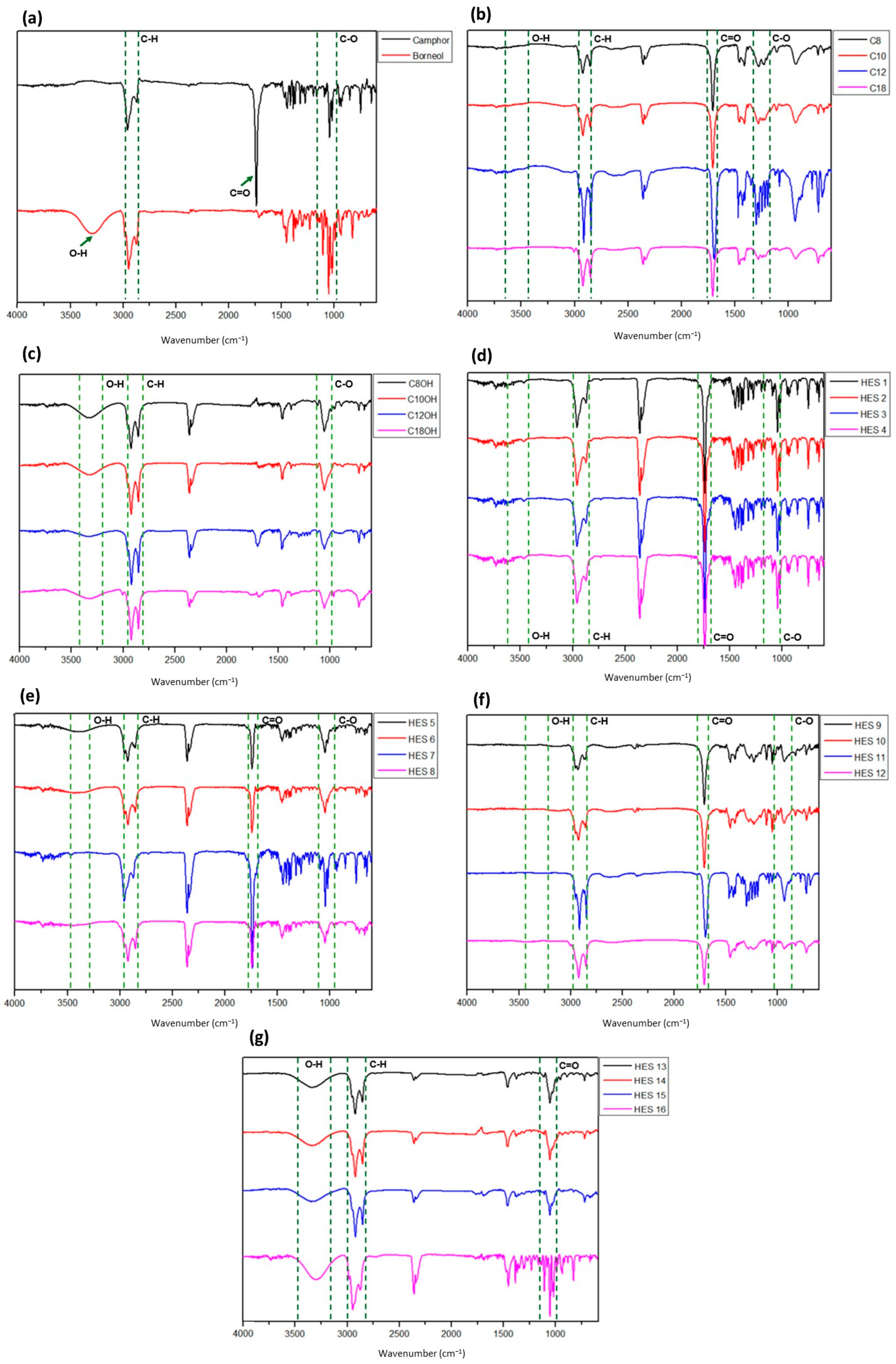
FTIR analysis was used to investigate HES formation and describe the interactions between solvent components. Figure 1 shows the FTIR spectra of HES and their individual components: camphor, borneol, octanoic acid (C8), decanoic acid (C10), dodecanoic acid (C12), oleic acid (C18), 1-octanol (C8OH), 1-decanol (C10OH), 1-dodecanol (C12OH), and oleyl alcohol (C18OH). The spectrum of camphor shown in Figure 1a exhibits an intense peak attributed to the C=O stretching at 1737 cm−1, characteristic of the carbonyl of ketones. The peaks at 2958–2873 cm−1 correspond to symmetric and asymmetric C-H stretching vibrations, and bands around 1250–1050 cm−1 indicate C-O vibrations of the carbonyl group [40,41,42]. Borneol presents a broad and intense band at 3300 cm−1, attributed to O-H stretching. In addition, it has peaks at 2949–2875 cm−1, corresponding to C-H stretching, and peaks at 1223–1050 cm−1, referring to C-O stretching, characteristic of secondary alcohol bonds (Figure 1a) [25,43].
Figure 1b,c show the spectrum of fatty acids (C8, C10, C12, and C18) and fatty alcohols (C8OH, C10OH, C12OH, and C18OH), which were like each other, with differences in carbon chain length. The fatty acids exhibited a more intense peak in 1707, 1707, 1697, and 1708 cm−1, attributed to stretching of the C=O double bond (carbonyl), confirming the carboxylic acid (-COOH) presence. The increase in aliphatic chain length causes a slight displacement of the carbonyl group. The spectra also exhibited broad bands corresponding to the O-H stretching (3734 to 3444 cm−1). C-H bond stretching was observed at 2954–2848 cm−1, characteristic of fatty acids with long aliphatic chains. Oleic acid, unlike other fatty acids, presented an additional band at ~3005 cm−1, attributed to the =C-H double bond. The bands from 1301 to 1220 cm−1 correspond to the stretching of the C–O bond of the carboxylic acid [19,44]. The FTIR spectra of fatty alcohols presented a broad and intense band from 3334 to 3328 cm−1 attributed to the stretching of O-H, the functional group responsible for forming hydrogen bonds commonly found in alcohols. The regions from 2954 to 2850 cm−1 are associated with C–H stretching, while the band from 1120 to 1040 cm−1 is attributed to the C–O stretching vibration of primary alcohols (Figure 1c) [24].
Figure 1d,e show the HES prepared by combining camphor with fatty acids and alcohols. The formation between HBA and HBD results in a shift in the HES peaks. This is a primary indicator of the formation of HES. The spectra of HES formed by camphor and fatty acids showed a broad and intense band (3466 to 3468 cm−1) corresponding to the O–H stretching and being slightly broadened as well as the higher-frequency shifted C=O stretching bands (1737 and 1705 cm−1). On the other hand, the spectra of camphor and fatty alcohols present a narrower band centered at ~3379 to 3435 cm−1, referring to the O-H stretching. The broadening and shift in O-H to higher frequencies compared to pure alcohols (where O-H appears narrower and around 3334 to 3328 cm−1) are indicative of hydrogen bond formation. Furthermore, the shift and modification of the ~1743 cm−1 bands referring to the C=O stretching demonstrate an interaction between the camphor carbonyl and the hydroxyl group of fatty alcohols, reinforcing the interaction between the components and the formation of HES [34].
The spectra of HES formed by the combination of borneol with fatty acids and alcohols are shown in Figure 1f,g, presenting spectral changes characteristic of hydrogen bond formation. In the spectra of HES formed by borneol and fatty acids, a shift in the band corresponding to the carbonyl stretching (C=O) to higher frequencies (1708 to 1697 cm−1) can be observed, indicating the participation of the carboxylic group in the formation of hydrogen bonds between borneol and fatty acids [45]. An O-H band (3200 to 3400 cm−1) shifted to lower frequencies can also be observed. The spectra of HES based on borneol and fatty alcohols showed broadened and shifted O-H bands (3340 to 3307 cm−1), evidencing the formation of intermolecular interactions by hydrogen bonds between the components of the eutectic mixture. Additionally, the changes (shift) in the C-O stretching bands (1200 to 1000 cm−1) for HES based on the combination of borneol and fatty alcohols reinforce the occurrence of these interactions [46,47].

3.1.2. Thermogravimetric Analysis (TGA)

TGA was used to evaluate the thermal stability of hydrophobic eutectic solvents (HES) and their respective individual components: camphor, borneol, octanoic acid (C8), decanoic acid (C10), dodecanoic acid (C12), oleic acid (C18), 1-octanol (C8OH), 1-decanol (C10OH), 1-dodecanol (C12OH) and oleyl alcohol (C18OH). Figure S1a shows the TGA curves of camphor, borneol, fatty acids and alcohols. The TGA curves of camphor and borneol showed an initial mass loss (1–2%), related to moisture evaporation, and a main mass loss at 127.83–179.08 °C (98%) and 135.68–184.20 °C (98%), respectively. Borneol exhibits similar thermal behavior to camphor (up to ~120 °C), but is thermally more stable, withstanding slightly higher temperatures (up to ~130 °C) before significant mass loss. This can be attributed to the structural differences and the nature of the intermolecular interactions of these monoterpenoids [48].
Fatty acids and alcohols showed a similar initial mass loss (0.1% to 1.8%—84.17 to 183.76 °C; 84.17 to 123.91 °C—0.83 to 1.95%, respectively) associated with the evaporation of moisture and trace volatiles. The main mass loss of fatty acids ranged from 150 °C to 245 °C (>96%), respectively, showing an increase in thermal resistance with increasing alkyl chain length. This may be because increasing alkyl chain length requires high thermal energy to break intermolecular interactions (van der Waals bonds) and consequent fatty acid degradation [24]. The increase in alkyl chain length also increased the thermal stability of fatty alcohols (112 to 213 °C—<95%), although this was lower compared to the stability of fatty acids (Figure S1a, Table S1). This can be explained by the fact that fatty alcohols have weaker intermolecular interactions due to the absence of the carbonyl (C=O) group and a more disordered molecular organization, resulting in lower thermal stability of the alcohols [49].
Figure S1b shows the TGA curves of the HES formed by mixing camphor with fatty acids and alcohols. The thermal decomposition curves revealed distinct profiles depending on the nature and length of the aliphatic chain of the hydrogen bond donors. The HES formed by mixing camphor with fatty acids and alcohols showed a mass loss of less than 2.3% at temperatures up to 96 °C, attributed to the loss of adsorbed water and traces of weakly bound volatile compounds. All HES formed by camphor and fatty acids showed three stages of degradation, except for octanoic acid, which showed only two stages. These HES showed a mass loss of less than 2.3% at temperatures up to 96 °C, attributed to the loss of adsorbed water and traces of weakly bound volatile compounds. The most significant mass loss occurred in the second degradation stage (97.4%, 65.7%, 68%, and 49.5%), at temperatures > 100 °C (with losses of camphor and simultaneously of the most volatile fraction of fatty acids), while the last degradation stage resulted in losses at temperatures > 165 °C (29.3%, 29.4%, and 42.3%, respectively), related to the degradation of fatty acids or oligomers formed during the heating of the HES (Table S1). The HES based on fatty alcohols presented a main thermal decomposition stage in temperature ranges varying from 111 to 159 °C, evidencing the organic constituents’ joint degradation and the eutectic solvent’s volatilization. The solvents formed by camphor with dodecanoic acid/oleic acid differed from the other HES by presenting two main degradation stages (>160 to 250 °C), indicating the presence of more stable intermolecular interactions and less solvent volatilization.
Figure S1c shows the TGA curves of the HES based on the mixture of borneol with fatty acids and alcohols. All HES showed an initial mass loss of <2.3% in temperature ranges from 66.89 to 110.19 °C. The HES based on borneol with octanoic and decanoic acid showed only one main degradation stage (139.62 to 180.78 °C; 158.04 to 199.93 °C), with losses > 97%. The HES formed from borneol and dodecanoic acid exhibited two main degradation stages, with losses between 119.73 and 221.43 °C (>96%), suggesting the occurrence of borneol degradation and dodecanoic acid chain breakage. The primary degradation stage of the HES formed from borneol and oleic acid was observed at temperatures > 240 °C (76.1%). This may be associated with the double bond in the unsaturated chain of oleic acid, which confers greater molecular packing, resistance to volatilization, and, consequently, greater thermal stability. The HES formed from borneol and fatty alcohols mainly degraded from 111.58 to 175.25 °C (>95%). The borneol and oleyl alcohol solvents exhibited different behavior from the other HES, with a very low initial loss (0.81%) and two main degradation stages (127.38 to 175.25 °C—45.36%; 234.26 and 261.68 °C—52.29%), attributed to the decomposition of oleyl alcohol.

3.1.3. Differential Scanning Calorimetry (DSC)

DSC analysis was used to identify endothermic and exothermic transitions, as well as to determine the transition temperatures and enthalpies of solids and liquids as a function of temperature. The results of the DSC analysis of HES and their individual components, including camphor, borneol, octanoic acid (C8), decanoic acid (C10), dodecanoic acid (C12), oleic acid (C18), 1-octanol (C8OH), 1-decanol (C10OH), 1-dodecanol (C12OH), and oleyl alcohol (C18OH), are presented in Figure S2. DSC analyses showed different thermal behaviors for HES and their pure components. As can be seen in Table 3, camphor presented a higher melting point than borneol, which can be explained by its symmetrical and bicyclic structure, in addition to the presence of a carboxylic group that provides better crystalline packing of the molecules, thus requiring more energy to break the crystal lattice [50]. Although borneol is also a bicyclic monoterpenoid, it has a hydroxyl group that favors greater flexibility and reduced symmetry, resulting in lower crystalline packing, less stability, and greater susceptibility to thermal transitions [48].
Table 3 illustrates that the melting point of fatty acids and alcohols is directly dependent on their structural characteristics, including the length of the carbon chain, the position and configuration of double bonds, and the presence of functional groups. Fatty acids and alcohol showed an increase in melting point and enthalpy of fusion as the number of carbons increased (C8–C18). It is suggested that this increase is related to the intensification of intermolecular interactions (van der Waals interactions), due to the increase in the surface area between the molecules, or that it favors crystalline packing in a more ordered manner and the requirement of a higher amount of energy for the transition from the solid phase to the liquid phase to occur [51,52]. However, fatty alcohols have a lower melting point than fatty acids, due to differences in intermolecular interactions, crystalline organization, and functional group polarity [53]. The results of this study agree with those obtained in previous studies [54,55].
The transitions of camphor/borneol-based HES with fatty acids/alcohols are shown in Figure S2k–z. The results showed a strong reduction in the melting point of the HES when compared to its individual components (HBA and HBD). It is for this reason that the negative deviation of ideality occurs due to intermolecular interactions—including hydrogen bonds, van der Waals interactions, and dispersion interactions—between the components of the eutectic mixture, responsible for causing a depression in the melting point [23]. The size of the alkyl chain influenced the melting point, as the increase in the carbon chain (from C8 to C12) provided a progressive increase in the melting point (Table 3) [22]. On the other hand, HES, based on the combination of camphor or borneol with oleic acid or oleyl alcohol, did not show the same behavior, which, despite containing 18 carbons in its chemical structure, presented a lower melting point. This may be associated with unsaturation (presence of the double bond), which induces a curvature in the carbon chain, hindering crystalline packing and therefore resulting in less order and a lower melting point [56]. Furthermore, pH has a great influence on the extraction of phenolic compounds, directly affecting the solubility and chemical stability of these bioactive compounds. Therefore, it is an important parameter to be evaluated, since solvents with a pH value close to that of the target compounds can increase solubility and consequently the extraction yield. A previous study showed that the pH of HES can vary according to the constituents used. For example, HES formed by menthol and dodecanoic acid had a pH of 4.3, menthol and octanoic acid 2.9, camphor and menthol 6.0, while borneol and menthol had a pH of 6.0 [44].

3.2. HES Selection

In this study, the effect of sixteen HES, based on a mixture of terpenes (camphor and borneol) with fatty acids (octanoic, decanoic, dodecanoic, and oleic acids) and fatty alcohols (1-octanol, 1-decanol, 1-dodecanol, and oleic alcohol), on the extraction of TPC from SCG was investigated. Camphor is a bicyclic monoterpenoid ketone with a carbonyl group (C=O) attached to one of the carbons of the aromatic ring. This structural conformation confers a nonpolar character to the molecule, acting only as a hydrogen bond acceptor [48]. On the other hand, borneol is a bicyclic monoterpenoid belonging to the alcohol class, which has a hydroxyl group (OH) attached to the carbon, and can act as both a hydrogen bond acceptor and donor. These terpenoids are obtained from natural sources, such as plants. They are widely used in the cosmetics industry and traditional medicine due to their biological properties, including antiviral, analgesic, and anticancer activity [57].
Fatty acids are medium-chain and saturated carboxylic acids, except for oleic acid which is a long-chain unsaturated fatty acid. These acids can act as hydrogen bond acceptors or donors due to their carboxyl group (–COOH). Similarly, fatty alcohols act as hydrogen bond acceptors and donors due to the OH [44]. Furthermore, the aliphatic chains of fatty acids and alcohols confer hydrophobicity to the solvent, a desirable characteristic in the extraction of compounds with lower polarity [49]. Fatty acids and alcohols are abundant in vegetable oils (coconut, palm, olive, and sunflower oils). Furthermore, they stand out for their participation in metabolic processes in the human body and for their beneficial effects on health, such as anticancer, antioxidant, and anti-inflammatory activities [58]. The sustainable nature of these components reinforces their use in the recovery of bioactive compounds from plant matrices and their by-products.
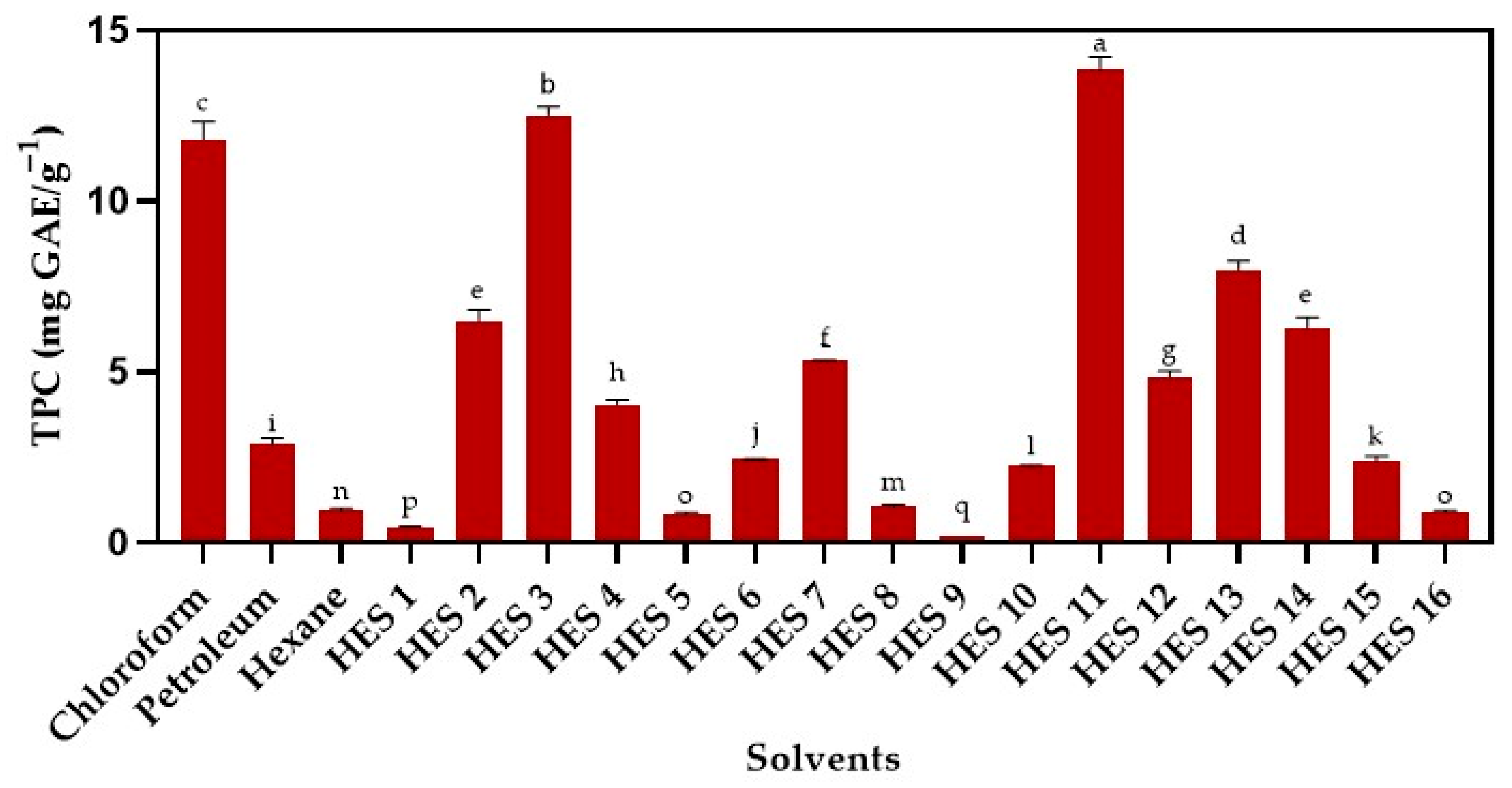
Figure 2 presents the results obtained for TPC using HES. The HES formed by borneol and dodecanoic acid (HES 11) provided the best yield in the recovery of TPC from SCG, followed by camphor and dodecanoic acid (HES 3), with values of 13.85 ± 0.36 and 12.52 ± 0.24 mg GAE g−1, respectively. However, the lowest yields were obtained when extracting TPC with camphor and octanoic acid, and borneol with octanoic acid (HES 1 and HES 9), with values of 0.48 ± 0.01 and 0.10 ± 0.00 mg GAE g−1. This can be attributed to the length of the alkyl chain of these fatty acids, since dodecanoic acid has 12 carbons in its structural formula. In comparison, octanoic acid has only eight carbons. Furthermore, the longer alkyl chain of dodecanoic acid provides greater hydrophobic interactions with the aromatic portion of phenolic compounds, increasing their affinity and, consequently, their extraction. This demonstrates that the components of the eutectic mixture can determine its physicochemical properties (solubilization capacity, hydrophobicity, polarity, and viscosity) and, consequently, affect the extraction yield [19].
Based on the results obtained using camphor as HBA, it can be observed that there was an increase in the TPC as the alkyl chain length of the HBDs (fatty acids) increased, showing that the chain size can significantly influence (p ≤ 0.05) the extraction yield, enabling higher solubilization of the compounds in the solvent and mass transfer with the size with the increase in the alkyl chain. In contrast, the same behavior was not observed for camphor with oleic acid (HES 4—4.05 ± 0.14 mg GAE g−1) and camphor and oleyl alcohol (HES 8—0.83 ± 0.04 mg GAE g−1) despite these HBDs (oleic acid and oleyl alcohol) having a long alkyl chain, with 18 carbons in their structural formula. These results can be explained by the fact that changes in the length and types of intermolecular interactions of the alkyl chain can lead to changes in solvent polarity and, therefore, directly influence the extracted TPC [59]. This is because HES with polarity like that of the target compounds allows greater solubilization of these compounds in the solvent (HES), improving mass transfer and TPC yield in the solvent [60]. Another explanation may be that a very long carbon chain increases the distance between the hydroxyl group and the hydrogen bond acceptor, resulting in a weakened hydrogen bond strength. Furthermore, the presence of a longer carbon chain makes it more difficult to transfer the target molecule from the aqueous phase to the HES phase [25].
Regarding the combinations of borneol with fatty acids (octanoic, decanoic, dodecanoic, and oleic acid), the same trends were observed for the combinations of camphor with fatty acids (octanoic, decanoic, dodecanoic, and oleic acid). However, for HES formed by combining borneol with fatty alcohols, there was a decrease in TPC, with an increase in the alkyl chain of the HBD, except for borneol and oleyl alcohol, which presented results like those of borneol and 1-dodecanol (HES). These results may be related to the increased viscosity of HES prepared with borneol and fatty alcohols as the alkyl chain length increases. It is worth noting that HES with high viscosity can lead to lower extraction yields due to strong and extensive intermolecular interactions, particularly hydrogen bonds formed between the components of the eutectic mixture (HBA and HBA). These strong interactions result in the lower ionic mobility and solubility of the target compounds in the solvent, which is reflected in decreased mass transfer and lower extraction efficiency of bioactive compounds [61].
The extraction performance of the HES can be directly associated with their ability to establish specific intermolecular interactions with phenolic compounds present in SCG. In this context, the superior performance of the borneol: dodecanoic acid system may be explained by the combined effect of hydrogen-bonding and hydrophobic interactions. Phenolic molecules such as chlorogenic acid, which was later identified as the major compound in the extracts, contain multiple hydroxyl groups as well as ester and carboxylic functionalities, making them highly responsive to solvents capable of both donating and accepting hydrogen bonds. Thus, the hydroxyl group of borneol and the carboxylic group of dodecanoic acid likely promote a dynamic hydrogen-bonding network with chlorogenic acid, favoring its solubilization. At the same time, the C12 alkyl chain of dodecanoic acid can enhance nonpolar interactions with the aromatic moiety of this hydroxycinnamic derivative, improving its partition into the eutectic phase. This synergistic balance between polar and nonpolar interactions may explain why HES 11 showed higher affinity for SCG phenolics than systems with shorter alkyl chains or less interactive hydrogen-bond donor/acceptor combinations [62].
The extraction performance of HES can also be interpreted from a broader perspective, in which hydrogen bonding is only one of the contributing factors. Besides specific donor-acceptor interactions, the ability of a solvent to recover phenolic compounds depends on its polarity profile and its overall affinity with the solute. Phenolic molecules such as chlorogenic acid exhibit amphiphilic character, combining polar functionalities (hydroxyl, ester, and carboxylic groups) with less polar aromatic moieties. Therefore, effective extraction requires a solvent environment capable of balancing polar and dispersive interactions [25]. Although the Hansen parameters were not experimentally determined in this work, improved extraction can be qualitatively associated with a better match between the dispersive, polar, and hydrogen-bonding contributions of the solvent and those of the target phenolics [63]. In this sense, terpene-based HES containing dodecanoic acid may provide a more favorable solvation environment, combining sufficient hydrogen-bonding capacity with moderate hydrophobicity, which can enhance the partition and solubilization of chlorogenic acid and related compounds.
The results obtained for TPC extracted by HES were compared with conventional organic solvents with low solubility in water (hexane, petroleum ether, and chloroform). It can be observed that borneol and dodecanoic acid (HES 11—13.85 ± 0.36 mg GAE g−1), and camphor and dodecanoic acid (HES 3—12.52 ± 0.25 mg GAE g−1) provided higher yield in TPC extraction when compared to conventional organic solvents, with values of 11.81 ± 0.50 mg GAE g−1 (chloroform), 2.89 ± 0.16 mg GAE g−1 (petroleum ether) and 0.94 ± 0.07 mg GAE g−1 (hexane), respectively. Among conventional organic solvents, chloroform provided the best yield for TPC extraction. However, it is a volatile substance and a highly toxic solvent that is banned in some countries due to its harmful effects on the human body and because it is considered a potent environmental pollutant [64,65,66]. These findings emphasize replacing them with safer, more sustainable, and biodegradable alternatives that adhere to green chemistry principles, such as eutectic solvents. Viñas-Ospino et al. [67] extracted TPC with HES formed by lauric acid and octanoic acid, obtaining a yield of 38.5 mg GAE 100 g−1 in orange peel. Wawoczny et al. [68] reported a yield of 2.5 mg GAE g−1 of TPC using HES based on decanoic acid and lauric acid in Calendula officinalis extracts. Wang et al. [30] found that HES formed by anisyl alcohol and n-nonanoic acid led to a yield of 115.64 mg g−1 of curcuminoids in turmeric extracts. In this context, the yields obtained here demonstrate that terpene-based HES are effective solvents for the recovery of phenolic compounds from SCG.
All hydrophobic eutectic solvents and their individual constituents were characterized using FTIR, TGA, and DSC analyses. However, the HES formed with camphor and dodecanoic acid, and borneol and dodecanoic acid provided the best yield for TPC extraction and were therefore selected to optimize process conditions (water content, solid–liquid ratio, and temperature).

3.3. Maximization of the Extraction Process by HES

Table 4 shows the results obtained in the experimental design for TPC using HES 3 (camphor and dodecanoic acid) and HES 11 (borneol and dodecanoic acid). For HES 3, the values ranged from 2.58 ± 0.23 to 13.12 ± 0.33 mg GAE g−1 while for HES 11, they ranged from 2.83 ± 0.14 to 15.82 ± 0.34 mg GAE g−1, according to the process conditions described in Table 3. These large ranges of variation in the responses indicate that the independent variables probably influenced the extraction yield.
Table S2 presents the regression coefficients of the mathematical model adjusted for the solvents used in the extraction of TPC (camphor and dodecanoic acid—HES 3; borneol and dodecanoic acid—HES 11). The analysis of the coefficients shows the significant influence of the independent variables (water content, solid–liquid ratio and temperature) on the yield of TPC. The results showed that the independent variable—solid–liquid ratio (β2) and temperature (β3)—positively affected the yield of TPC extracted by HES 3, while for HES 11, the variables were temperature and the interaction β1 and β2 (water content and solid–liquid ratio). The quadratic effects of the variables (water content, solid–liquid ratio and temperature) negatively affected the yield of TPC for both HES studied. The interaction terms significantly affected the TPC (p < 0.05). For the HES 3, the interaction of β12 hurt the extraction, that is, the TPC decreased with the increase in water content and solid–liquid ratio. The other interactions (β12 and β23) had no significant effect (p < 0.05) on the TPC yield. Regarding HES 11, the interaction β12 had a positive effect, showing that 38.5 of the interaction between these variables increases the TPC extraction. However, the other interactions (β12 and β23) had significant negative effects (−5.46, −18.26) on the extraction.
The correlation coefficient was used to assess the quality of fit between the experimental data and the values predicted by the model. High coefficients of determination (R2) were obtained, namely 0.95 and 0.98, indicating that the fitted models explained 95% and 98% of the variability in TPC yield, respectively. The adjusted coefficient (R2adj), which accounts for the number of terms included in the model, also confirmed the good fit of the regressions. In general, higher R2 and R2adj values indicate a closer agreement between experimental and predicted responses. In addition, the lack-of-fit test was not significant (p > 0.05), demonstrating that the proposed models were adequate to describe the experimental data and to predict the effects of the evaluated variables on TPC extraction from SCG. The statistical significance of the model terms was considered at the 5% level (p < 0.05).
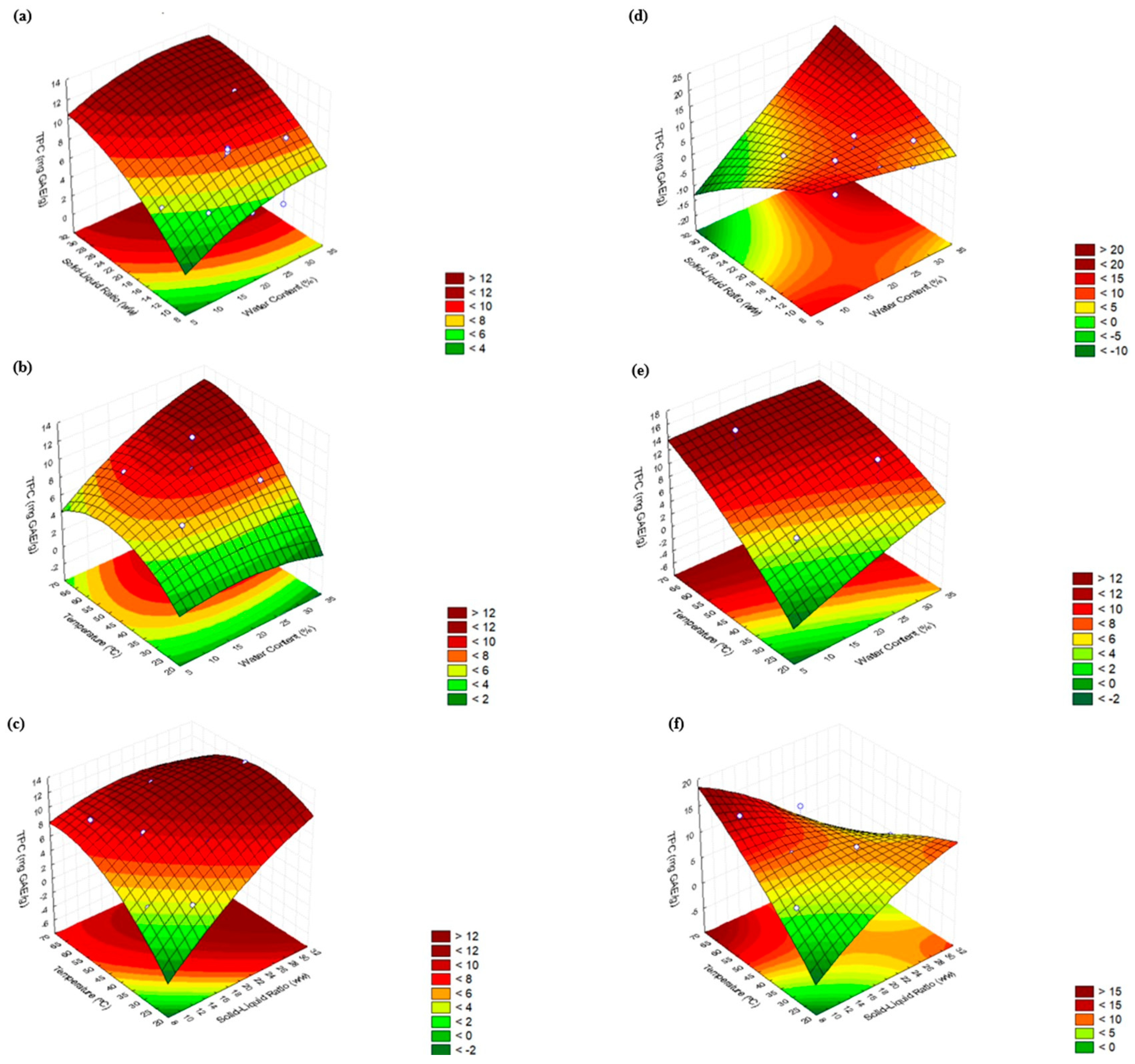
Response surface graphs were plotted as a function of the independent variables studied: water content (6–33%), solid–liquid ratio (1:09–1:31 w/w) and temperature (25–65 °C) for the TPC extracted using HES 3 and HES 11, keeping the extraction time constant (120 min). This analysis aims to analyze the interactions between the factors in pairs and determine the optimal ranges for each parameter that influences the extraction of TPC.
The response surface plots (Figure 3a–c) show the interaction between the studied variables (water content, solid–liquid ratio, and temperature), and their effect on the yield of TPC extracted by HES 3 in SCG. The solid–liquid ratio and temperature had the most significant effects on the extraction yield. Figure 3a–c shows that higher amounts of solvents provide higher TPC yields, with a maximum value obtained at a solid–liquid ratio of 1:31 (13.12 mg GAE g−1). The higher solvent concentration gradient can explain this increase during the diffusion of the solute into the solvent and the larger contact area. Furthermore, the use of larger amounts of solvents allows greater interactions between the solute and the solvent, causing greater fragmentation and porosity in the matrix, which consequently results in a greater capacity to dissolve intracellular components until solvent saturation occurs [69]. Temperature was the second factor that had the highest effect on the extraction yield. Increasing the temperature from 33 to 45 °C resulted in the highest TPC yield; however, higher temperatures (>45 °C) caused a significant reduction in the extraction yield, which may be due to the sensitivity of the target compounds to higher temperatures. Additional data on the ANOVA (F values, p values) can be found in the Supplementary Information (Table S3).
Better extraction yields were observed by adding 20% water to the system (solute + solvent). The addition of water can improve extraction efficiency by modulating polarity, increasing the dielectric constant, and providing greater solubility of TPC in the solvent, resulting in higher extraction yields [63]. Solvents with polarity like that of phenolic compounds have a greater extraction power. Furthermore, the addition of water can be used to reduce the viscosity of HES and increase the extraction yield [70]. On the other hand, the higher water content (28%) leads to a decrease in the target compounds. This is attributed to the fact that excess amounts of water affect HES, resulting in changes in the chemical structure of eutectic solvents and in the intermolecular interactions formed, which can lead to a decrease in the yield of extracted compounds [32]. Although HES are less viscous than hydrophilic eutectic solvents, they can still have higher viscosity (depending on the nature of the components of the eutectic mixture) when compared to conventional organic solvents, such as methanol, ethanol, hexane, chloroform, and acetone [19].
For HES 11, the response surfaces, Figure 3d–f, showed that temperature was the factor that had the highest influence on the response (TPC), indicating that the TPC yield increases as the temperature increases, with the maximum yield at 57 °C (15.82 mg GAE g−1). This may be associated with the weakening of intermolecular interactions (hydrogen bonds, van der Waals forces, electrostatic interactions) and the adsorption phenomena that trap the bioactive compounds in the matrix, increasing solubility and improving extraction yields [36]. Furthermore, increasing the temperature can reduce the viscosity of the solvent, weakening the hydrogen bonds, which improve their diffusivity, favors the breaking of matrix-phenolic bonds, and increases mass transfer, facilitating the release of the extracted phenolic compounds. However, the use of higher temperatures (65 °C) can lead to a decrease in the extraction yield (13.78 mg GAE g−1) by compromising the stability of thermosensitive phenolic compounds, such as hydroxycinnamic acids and some flavonoids. Previous studies have reported that the best temperatures for TPC extraction are in the range of 50–60 °C, as lower temperatures prevent the degradation of these bioactive compounds [71].
The interaction between water content and solid–liquid ratio was the second factor that most positively and significantly influenced the extraction yield (Figure 3d–f). The highest TPC yield was obtained using a lower water content (12%) and a solid–liquid ratio of 1:10 (w/w), indicating that higher amounts of these parameters did not contribute to the increase in extraction yield. The requirement for low amounts of solvents is advantageous because it reduces operating costs, requires smaller amounts of solvents, leads to lower energy consumption, and facilitates the ease of purification of the extracts [3]. Regarding the water content, the addition of 12% water was enough to reduce the viscosity of the HES and improve the extraction performance; however, higher amounts of water in the system provided a decrease in the yield of the target compounds. Silva et al. [3] observed that a lower water content (10%) and solid–liquid ratio (1:15 w/w) provided a better yield in the extraction of TPC from SCG extracts (16.20 mg GAE g−1).
The results obtained in the response surfaces reveal that both HES studied (HES 3 and HES 11) have potential for the extraction of TPC from SCG. However, it is noteworthy that the combination of HES 11 acid provides a better yield of TPC than HES 3. The higher yield in the extraction of TPC using borneol may be related to its chemical structure, which presents a highly polar hydroxyl group, capable of forming strong hydrogen bonds with the hydroxyl groups (-OH) of phenolic compounds, thus resulting in the dissolution of these compounds in the solvent [28]. On the other hand, camphor has a carbonyl group (C=O), which has a lower capacity to form hydrogen bonds as a donor, acting only as a hydrogen bond acceptor, which can directly influence the extraction yield [60]. Therefore, as HES 11 under optimized conditions (12% water content, solid–liquid ratio 1:10 w/w and temperature of 57 °C) provided the highest TPC in SCG (15.82 mg GAE g−1), it was the HES selected to perform the extraction time kinetics, from MAE and CE.

3.4. Extraction Time Kinetics

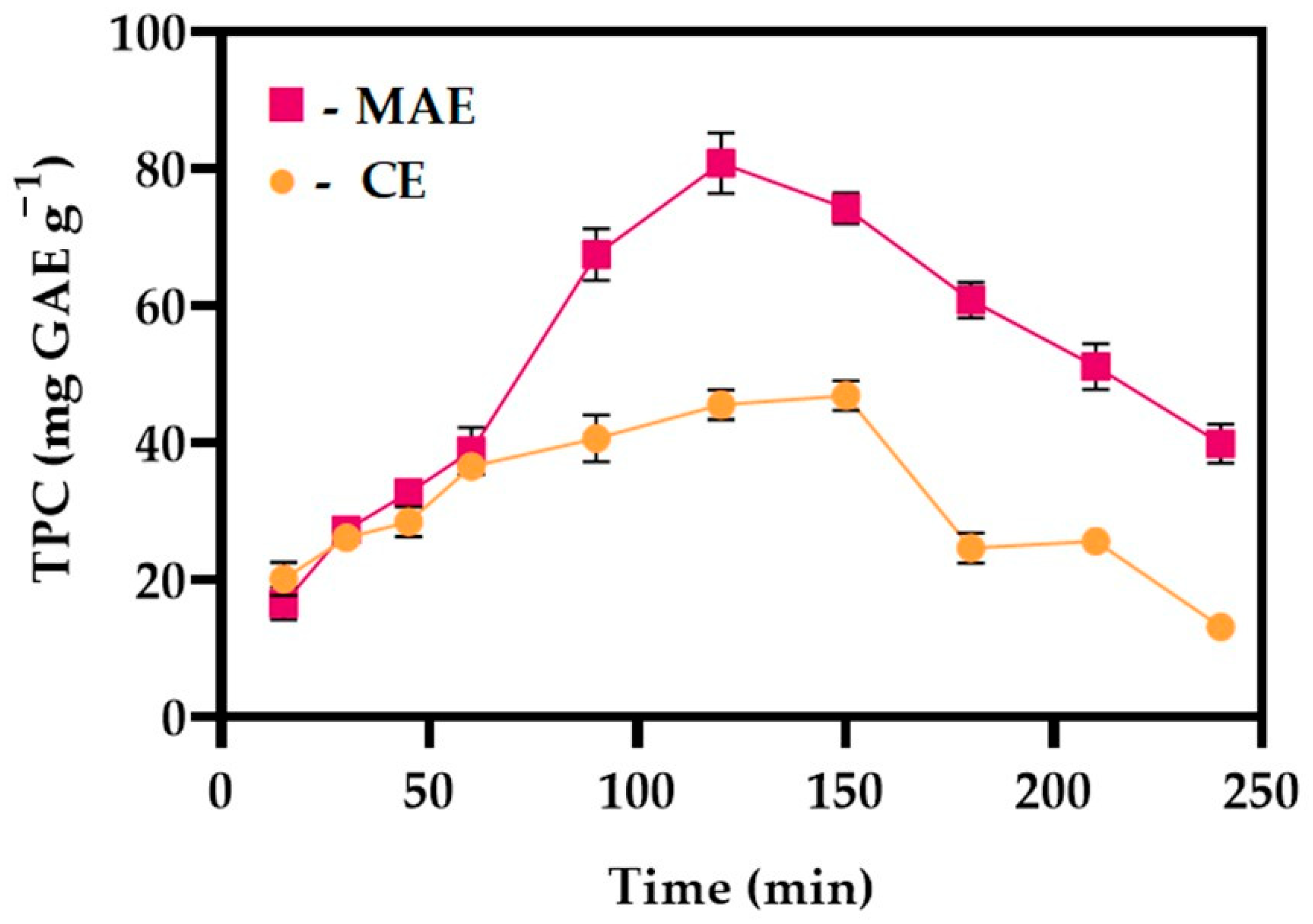
The TPC of SCG extracts was measured at different time intervals (15 min to 240 min) from MAE and CE (heating and stirring in Thermomixer), keeping the parameters obtained in the optimization constant using HES based on borneol and dodecanoic acid (HES 11). Figure 4 shows the TPC obtained at different time intervals for MAE and CE. As observed in Figure 4, the TPC for both treatments (MAE and CE) increased as the extraction time increased up to 120 min, with yields of 80.94 ± 4.44 mg GAE g−1 for MAE and 46.94 ± 2.22 mg GAE g−1 for CE. This increase in extraction yield can be attributed to the greater concentration gradient between the solvent and the solute, allowing higher levels of the target compound to be recovered [67]. However, longer extraction times (>120 min to 240 min) result in lower TPC extraction yields (39.93 ± 2.90 mg GAE g−1 for MAE and 13.17 ± 0.22 mg GAE g−1 for CE). This can be explained by the fact that, after a specific period, there is a decrease in the extraction gradient, resulting in less extraction of the target compound from inside the cell into the solvent (HES) and, consequently, lower extraction yields. Furthermore, longer extraction times can lead to solvent saturation with the target compound and, therefore, less mass transfer and lower yield [72].
Comparing the results obtained by MAE and CE, it is possible to observe that MAE provides a higher yield in TPC extraction in all time conditions studied (15 min to 240 min) (Figure 4). The higher yield can be attributed to the mechanism of action of this emerging technology, which, through microwave irradiation, provides rapid and uniform heating of the sample and rupture of the cell wall, leading to increased interactions between the plant matrix and the extraction solvent, and consequently, an increase in mass transfer and TPC yields of SCG [15]. The results of this study agree with those obtained in the literature, which demonstrated that the use of MAE provides higher extraction yields when compared to CE. Solomakou et al. [37] observed that the use of MAE provided a higher TPC yield (34.43 mg GAE g−1) in a shorter extraction time (5 min) when compared to conventional methods.
A comparison with microwave-assisted extraction systems reported in the literature may further validate the performance of the HES-MAE integration. Solomakou et al. [37] reported an optimum TPC yield of 31.79 ± 0.25 mg GAE g−1 SCG using MAE and a maximum value of 34.43 mg GAE g−1 SCG for freeze-dried samples, confirming that microwave irradiation is an effective strategy for phenolic recovery from spent coffee grounds. Saini et al. [71] also reported high phenolic recovery from SCG by MAE, reaching 39.23 ± 4.1 mg GAE g−1 extract and 47.93 ± 3.6 µmol TE g−1 extract by DPPH under optimized ethanol-water conditions. In the present study, the optimized HES-MAE system reached 80.94 ± 4.44 mg GAE g−1, which is approximately 2.35-fold higher than the maximum value reported by Solomakou et al. [37] and 2.06-fold higher than that obtained in the study by Ali et al. [69]. Tzani et al. [73] revealed that using DES (betaine: glycerol) combined with MAE provided a higher yield of 24.85 mg GAE g−1 in 30 min of extraction time. Within this context, the results obtained here indicate that integration MAE-HES provides a competitive and promising strategy for intensifying phenolic recovery from SCG.

3.5. Profile of Phenolic Compounds

The phenolic compounds present in SCG exhibit diverse biological properties due to variations in their chemical structure. Therefore, it is necessary to identify and quantify the profile of phenolic compounds present in SCG extracts. Table 5 shows the phenolic compounds identified and quantified by HPLC in SCG extracts obtained by HES based on borneol and dodecanoic acid, combined with microwave-assisted extraction (MAE) and conventional extraction (CE). In both extracts (CE and MAE), the following phenolic compounds were identified: chlorogenic acid, caffeic acid, ferulic acid, gallic acid, p-coumaric acid, rutin, and quercetin, with chlorogenic acid being the predominant compound in the extracts, followed by caffeic acid. The results of this study agree with those obtained in previous studies [30,74,75,76,77]. However, the content of all identified phenolic compounds was significantly higher in MAE compared to CE, which may be attributed to the rapid cell disruption resulting from microwave irradiation. SCG phenolic compounds can be applied in different industrial sectors, such as the cosmetic industry (anti-aging, antioxidant, UV radiation photoprotector), pharmaceutical industry (antidiabetic agent), and food industry (antioxidant and antimicrobial).
This phenolic profile is consistent with previous reports on plant-derived matrices extracted by microwave-assisted approaches, although direct quantitative comparisons should be interpreted with caution because the extraction yield depends strongly on matrix composition, solvent system, and analytical basis. For instance, in peach by-products, Tzani et al. [73] reported a total phenolic content of 3.067 ± 0.027 mg GAE g−1 dry sample under optimized MAE conditions, together with a chlorogenic acid content of 351.1 ± 8.9 μg g−1 dry sample. In broccoli by-products, Wang et al. [30] found 1.940 mg GAE g−1 dry weight for leaves, 0.657 mg GAE g−1 dry weight for florets, and 0.225 mg GAE g−1 dry weight for stems, while chlorogenic acid and caffeic acid were also identified among the main phenolic acids. In tomato seed industrial waste, Karimi et al. [74] reported that MAE provided higher individual phenolic contents, with chlorogenic acid, rutin, and naringenin ranging from 1.11 to 2.99 mg 100 g−1. Likewise, for sunflower matrices, Kaur et al. [75] obtained 8.4 mg chlorogenic acid g−1 by MAE, highlighting the strong affinity of microwave-based processes for hydroxycinnamic acids. Thus, these studies indicate that chlorogenic acid is frequently among the predominant phenolics recovered from plant by-products and residues, and the present results agree with this broader pattern, since chlorogenic acid was also the major compound identified in SCG extracts, followed by caffeic acid.

3.6. Activity Antioxidant

SCG are a by-product rich in phenolic compounds, recognized as excellent natural antioxidants, which can be applied in the food, cosmetic, and pharmaceutical industries [36,70]. This reinforces the importance of evaluating the antioxidant potential of these bioactive compounds in SCG. Due to the different mechanisms of action, the origin of the antioxidant compounds, and the reactive species, it is necessary to use more than one method to evaluate the antioxidant activity of the extracts obtained [77]. The antioxidant activity of the extracts was evaluated using three colorimetric methods: ABTS radical scavenging, DPPH radical scavenging, and ferric reducing antioxidant power (FRAP). These methods are based on the transfer of electrons to the unstable radical in the last electronic layer, preventing them from being available for oxidation reactions.
Table 6 illustrates the values obtained for antioxidant activity by the ABTS, DPPH, and FRAP methods of TPC extracts obtained by the conventional method (CE) and by microwave-assisted extraction (MAE). It was observed that the highest antioxidant activity values were obtained with MAE, with values of 1823.25 ± 3.13 µmol TE g−1 for ABTS, 1310.20 ± 1.31 µmol TE g−1 for DPPH, and 6035.50 ± 1.45 µmol TE g−1 for FRAP, when compared to CE, which showed values of 1122.35 ± 1.49 µmol TE g−1 for ABTS, 1315.20 ± 1.31 µmol TE g−1 for DPPH, and 6037.50 ± 1.45 µmol TE g−1 for FRAP for all three methods evaluated. The extracts obtained by both extraction methods showed high antioxidant activity, demonstrating potential for the elimination of free radicals. However, the higher values obtained by MAE may be related to the higher TPC obtained with this emerging technology, since phenolic compounds are the main antioxidants present in the composition of SCG. These results further reinforce the viability of using eutectic solvents combined with emerging technologies as alternatives for the recovery of natural antioxidants from agro-industrial by-products, such as SCG.
The antioxidant activity obtained in the present study is in agreement with previous reports describing spent coffee grounds and other plant-derived by-products as relevant sources of natural antioxidants, although direct quantitative comparison should be made with caution due to differences in extraction solvent, matrix composition, and analytical units. For spent coffee extracts obtained with water under optimized conditions, Kaur et al. [75] reported 735.47 µmol TE g−1 for ABTS, 324.51 µmol TE g−1 for DPPH, and 311.62 µmol TE g−1 for FRAP, values lower than those observed here for the HES-MAE extract, especially for ABTS and DPPH. In another study with SCG, Alasalvar et al. [76] obtained extracts with high antioxidant activity under autohydrolysis conditions, reporting 31.46 mg TE g−1 SCG for ABTS, 28.15 mg TE g−1 SCG for DPPH, and 69.50 mg Fe(II) g−1 SCG for FRAP, again confirming the strong antioxidant potential of coffee residues, although under a different analytical basis. Similar trends have been reported for other agro-industrial matrices extracted by microwave-assisted processes. In broccoli by-products, Linhares Sabino et al. [77] found that MAE increased phenolic recovery by up to 45.70% in leaves, 133.57% in florets, and 65.30% in stems compared with maceration, while the broccoli leaf extracts reached 1034.220 µg TE g−1 dry weight by ABTS and 632.057 µg TE g−1 dry weight by DPPH. Therefore, these studies support the interpretation that the high antioxidant activity observed for the HES-MAE extracts is associated with the greater recovery of phenolic compounds, particularly chlorogenic and caffeic acids, and further demonstrates the potential of combining eutectic solvents with microwave irradiation to obtain antioxidant-rich extracts from SCG [78].

4. Conclusions

In this study, HES combined with MAE were investigated as a green and sustainable approach for recovering total phenolic compounds from spent coffee grounds. Among the prepared systems, the HES composed of camphor: dodecanoic acid and borneol: dodecanoic acid showed the best extraction performance, outperforming the conventional solvents evaluated. Process variables were optimized through central composite rotational design and response surface methodology in order to maximize TPC recovery. The highest yield was obtained with the borneol:dodecanoic acid system, reaching 43.94 ± 0.75 mg GAE g−1 under the optimized conditions of 12% water content, 1:10 (w/w) solid-to-liquid ratio, 57 °C, and 120 min. When compared with conventional extraction, the HES-MAE approach resulted in higher TPC recovery, highlighting the advantages of combining eutectic solvents with an intensified extraction technique. HPLC analysis showed that chlorogenic, ferulic, and caffeic acids were the major phenolic compounds detected in the extracts obtained by both MAE and CE. In addition, the extracts exhibited high antioxidant capacity, with values of 1823.25 ± 3.13 µmol TE g−1 for ABTS, 1310.20 ± 1.31 µmol TE g−1 for DPPH, and 6035.50 ± 1.45 µmol TE g−1 for FRAP. Overall, these findings demonstrate the potential of hydrophobic eutectic solvents associated with microwave irradiation as an efficient platform for the valorization of spent coffee grounds, opening opportunities for the use of these extracts in food, cosmetic, and pharmaceutical applications.

Supplementary Materials

The following supporting information can be downloaded at: https://www.mdpi.com/article/10.3390/pr14071109/s1, Table S1: Degradation temperature of HES and its individual components; Table S2: Regression coefficients of the adjusted model for the extraction of TPC, using HES 3 (camphor: dodecanoic acid) and HES 11 (borneol and dodecanoic acid); Table S3. Analysis of Variance (ANOVA) results for the models derived from total phenolic compounds (TPC), obtained through the application of response surface methodology; Figure S1: TGA curves for (a) pure constituents, (b) HES formed by mixing camphor with fatty acids and alcohols, and (c) borneol with fatty acids and alcohols; Figure S2: DSC curves for HES formed by camphor and borneol with fatty acids or alcohols, and their individual components.

Author Contributions

Conceptualization, F.S.B. and B.D.R.; methodology, C.N.d.S. and T.R.P.; validation, C.N.d.S. and F.S.B.; formal analysis, T.R.P.; investigation, C.N.d.S. and T.R.P.; resources, F.S.B.; data curation, B.D.R.; writing—original draft preparation, C.N.d.S.; writing—review and editing, F.S.B.; visualization, B.D.R.; supervision, F.S.B. and B.D.R.; project administration, B.D.R.; funding acquisition, B.D.R. All authors have read and agreed to the published version of the manuscript.

Funding

This research was funded by National Council for Scientific and Technological Development, grant number 0001; Coordination for the Improvement of Higher-Level Personnel, grant number 0001; Foundation for Research Support and Technological Innovation of the State of Rio de Janeiro, grant number 0001.

Data Availability Statement

The original contributions presented in this study are included in the article/Supplementary Materials. Further inquiries can be directed to the corresponding authors.

Acknowledgments

This work was financed by national funds through the National Council for Scientific and Technological Development (CNPq), Coordination for the Improvement of Higher-Level Personnel (CAPES), and Foundation for Research Support and Technological Innovation of the State of Rio de Janeiro (FAPERJ).

Conflicts of Interest

The authors declare no conflicts of interest.

References

  1. CONAB (Companhia Nacional de Abastecimento). Safra Brasileira de Café. 2025. Available online: https://www.gov.br/conab/pt-br/atuacao/informacoes-agropecuarias/safras/safra-de-cafe (accessed on 10 December 2025).
  2. ICO. International Coffee Organization: Coffee Report and Outlook. 2023. Available online: https://icocoffee.org/documents/cy2023-24/Coffee_Report_and_Outlook_December_2023_ICO.pdf (accessed on 29 May 2025).
  3. da Silva, C.N.; da Silva, R.M.; Lemes, A.C.; Ribeiro, B.D. Recovery of Phenolic Compounds by Deep Eutectic Solvents in Orange By-Products and Spent Coffee Grounds. Sustainability 2024, 16, 7403. [Google Scholar] [CrossRef]
  4. Barreto Peixoto, J.A.; Silva, J.F.; Oliveira, M.B.P.P.; Alves, R.C. Sustainability Issues along the Coffee Chain: From the Field to the Cup. Compr. Rev. Food Sci. Food Saf. 2023, 22, 287–332. [Google Scholar] [CrossRef]
  5. Mensah, R.Q.; Tantayotai, P.; Rattanaporn, K.; Chuetor, S.; Kirdponpattara, S.; Kchaou, M.; Show, P.L.; Mussatto, S.I.; Sriariyanun, M. Properties and Applications of Green-Derived Products from Spent Coffee Grounds—Steps towards Sustainability. Bioresour. Technol. Rep. 2024, 26, 101859. [Google Scholar] [CrossRef]
  6. Scully, D.S.; Jaiswal, A.K.; Abu-Ghannam, N. An Investigation into Spent Coffee Waste as a Renewable Source of Bioactive Compounds and Industrially Important Sugars. Bioengineering 2016, 3, 33. [Google Scholar] [CrossRef]
  7. Errico, M.; Coelho, J.A.P.; Stateva, R.P.; Christensen, K.V.; Bahij, R.; Tronci, S. Brewer’s Spent Grain, Coffee Grounds, Burdock, and Willow–Four Examples of Biowaste and Biomass Valorization through Advanced Green Extraction Technologies. Foods 2023, 12, 1295. [Google Scholar] [CrossRef]
  8. Freitas, C.P.M.; Marangon, B.B.; Pereira, E.G.; Renato, N.N. Exploring spent coffee grounds energy potential in the brazilian scenario. Agric. Eng. 2023, 43, e2022014. [Google Scholar] [CrossRef]
  9. Hechmi, S.; Guizani, M.; Kallel, A.; Zoghlami, R.I.; Ben Zrig, E.; Louati, Z.; Jedidi, N.; Trabelsi, I. Impact of Raw and Pre-Treated Spent Coffee Grounds on Soil Properties and Plant Growth: A Mini-Review. Clean Technol. Environ. Policy 2023, 25, 2831–2843. [Google Scholar] [CrossRef]
  10. Zhao, N.; Liu, Z.; Yu, T.; Yan, F. Spent Coffee Grounds: Present and Future of Environmentally Friendly Applications on Industries-A Review. Trends Food Sci. Technol. 2024, 143, 104312. [Google Scholar] [CrossRef]
  11. Vázquez-Sánchez, K.; Martinez-Saez, N.; Rebollo-Hernanz, M.; del Castillo, M.D.; Gaytán-Martínez, M.; Campos-Vega, R. In Vitro Health Promoting Properties of Antioxidant Dietary Fiber Extracted from Spent Coffee (Coffee arabica L.) Grounds. Food Chem. 2018, 261, 253–259. [Google Scholar] [CrossRef] [PubMed]
  12. Salzano, F.; Aulitto, M.; Maione, A.; Galdiero, E.; Di Gaetano, S.; Capasso, D.; Contursi, P.; Fiorentino, G.; Pedone, E.; Limauro, D. High-Value Products from Ground Spent Coffee, Sunflower, and Citrus Waste Using Enzyme Technology. Discov. Sustain. 2025, 6, 450. [Google Scholar] [CrossRef]
  13. Bondam, A.F.; Diolinda da Silveira, D.; Pozzada dos Santos, J.; Hoffmann, J.F. Phenolic Compounds from Coffee By-Products: Extraction and Application in the Food and Pharmaceutical Industries. Trends Food Sci. Technol. 2022, 123, 172–186. [Google Scholar] [CrossRef]
  14. Martinez-Saez, N.; García, A.T.; Pérez, I.D.; Rebollo-Hernanz, M.; Mesías, M.; Morales, F.J.; Martín-Cabrejas, M.A.; del Castillo, M.D. Use of Spent Coffee Grounds as Food Ingredient in Bakery Products. Food Chem. 2017, 216, 114–122. [Google Scholar] [CrossRef]
  15. Badr, A.N.; El-attar, M.M.; Ali, H.S.; Elkhadragy, M.F.; Yehia, H.M.; Farouk, A. Spent Coffee Grounds Valorization as Bioactive Phenolic Source Acquired Antifungal, Anti-Mycotoxigenic, and Anti-Cytotoxic Activities. Toxins 2022, 14, 109. [Google Scholar] [CrossRef]
  16. Ramón-Gonçalves, M.; Gómez-Mejía, E.; Rosales-Conrado, N.; León-González, M.E.; Madrid, Y. Extraction, Identification and Quantification of Polyphenols from Spent Coffee Grounds by Chromatographic Methods and Chemometric Analyses. Waste Manag. 2019, 96, 15–24. [Google Scholar] [CrossRef]
  17. Kumar, A.; Thakur, M.K.; Hart, P.; Thakur, V.K. Sustainable Valorization of Spent Coffee Grounds: A Green Chemistry Approach to Soil Amendment and Environmental Monitoring. ACS Sustain. Resour. Manag. 2025, 2, 1630–1642. [Google Scholar] [CrossRef]
  18. Mungwari, C.P.; King’ondu, C.K.; Sigauke, P.; Obadele, B.A. Conventional and Modern Techniques for Bioactive Compounds Recovery from Plants: Review. Sci. Afr. 2025, 27, e02509. [Google Scholar]
  19. Szopa, D.; Wróbel, P.; Witek-Krowiak, A. Enhancing Polyphenol Extraction Efficiency: A Systematic Review on the Optimization Strategies with Natural Deep Eutectic Solvents. J. Mol. Liq. 2024, 404, 124902. [Google Scholar] [CrossRef]
  20. Turan, O.; Isci, A.; Yılmaz, M.S.; Tolun, A.; Sakiyan, O. Microwave-Assisted Extraction of Pectin from Orange Peel Using Deep Eutectic Solvents. Sustain. Chem. Pharm. 2024, 37, 101352. [Google Scholar] [CrossRef]
  21. Hernández-Serrano, V.; Muñoz-Embid, J.; Bergua, F.; Lafuente, C.; Artal, M. PVT Behaviour of Hydrophilic and Hydrophobic Eutectic Solvents. J. Mol. Liq. 2023, 382, 122019. [Google Scholar] [CrossRef]
  22. Bashir, I.; Dar, A.H.; Dash, K.K.; Pandey, V.K.; Fayaz, U.; Shams, R.; Srivastava, S.; Singh, R. Deep Eutectic Solvents for Extraction of Functional Components from Plant-Based Products: A Promising Approach. Sustain. Chem. Pharm. 2023, 33, 101102. [Google Scholar] [CrossRef]
  23. Buarque, F.S.; Soares, M.A.; Ribeiro, B.D.; Marrucho, I.M. Development of Hydrophobic Eutectic Solvents Composed of DL-Menthol and Fatty Acids/Alcohols: Application in the Extraction of Capsaicinoids and Carotenoids from Capsicum Frutescens. J. Mol. Liq. 2025, 417, 126591. [Google Scholar] [CrossRef]
  24. Audeh, D.J.S.A.; Carniel, A.; Borges, C.P.; Coelho, M.A.Z.; Buarque, F.S.; Ribeiro, B.D. Hydrophobic Deep Eutectic Solvents for Ethanol, Propan-1-Ol, and Propan-2-Ol Recovery from Aqueous Solutions. Processes 2024, 12, 1255. [Google Scholar] [CrossRef]
  25. Florindo, C.; Branco, L.C.; Marrucho, I.M. Development of Hydrophobic Deep Eutectic Solvents for Extraction of Pesticides from Aqueous Environments. Fluid Phase Equilib. 2017, 448, 135–142. [Google Scholar] [CrossRef]
  26. Florindo, C.; Lima, F.; Branco, L.C.; Marrucho, I.M. Hydrophobic Deep Eutectic Solvents: A Circular Approach to Purify Water Contaminated with Ciprofloxacin. ACS Sustain. Chem. Eng. 2019, 7, 14739–14746. [Google Scholar] [CrossRef]
  27. Singh, N.; Panwar, D.; Kumar, G.; Kashyap, P. New Horizons for the Enhanced Recovery of Phenolic Compounds by Integration of Natural Deep Eutectic Solvents and Microwave-Assisted Extraction. Food Biosci. 2024, 60, 104375. [Google Scholar] [CrossRef]
  28. Nonglait, D.L.; Gokhale, J.S. Review Insights on the Demand for Natural Pigments and Their Recovery by Emerging Microwave-Assisted Extraction (MAE). Food Bioproc. Tech. 2024, 17, 1681–1705. [Google Scholar]
  29. de Moura, M.M.; Martins, L.C.; Alcantara, G.M.R.N.; Rocha, F.R.P.; Melchert, W.R. Microwave-Assisted Extraction of Total Phenolic Compounds from Coffee. Appl. Food Res. 2026, 6, 101821. [Google Scholar] [CrossRef]
  30. Wang, N.; Zhu, H.; Wang, M.; Zhao, S.; Sun, G.; Li, Z. Recent Advancements in Microwave-Assisted Extraction of Flavonoids: A Review. Food Bioproc. Tech. 2025, 18, 2083–2100. [Google Scholar]
  31. Zhang, S.; Niu, L.; Si, X.; Li, L.; Sheng, Z. Microwave-Assisted Extraction of Luteolin from Peanut Shells Using Natural Deep Eutectic Solvents and Its Molecular Mechanism. Ind. Crops Prod. 2025, 225, 120578. [Google Scholar] [CrossRef]
  32. Airouyuwa, J.O.; Souka, U.; Maqsood, S. Utilization of Accelerated Solvent Extraction and Deep Eutectic Solvents as Synergistic Green Extraction Technique for the Recovery of Bioactive Compounds from Date Palm (Phoenix dactylifera L.) Seeds. J. Mol. Liq. 2025, 425, 127185. [Google Scholar] [CrossRef]
  33. Alchera, F.; Ginepro, M.; Giacalone, G. Microwave-Assisted Extraction (MAE) of Bioactive Compounds from Blueberry by-Products Using a Sugar-Based NADES: A Novelty in Green Chemistry. LWT 2024, 192, 115642. [Google Scholar] [CrossRef]
  34. Bener, M.; Şen, F.B.; Önem, A.N.; Bekdeşer, B.; Çelik, S.E.; Lalikoglu, M.; Aşçı, Y.S.; Capanoglu, E.; Apak, R. Microwave-Assisted Extraction of Antioxidant Compounds from by-Products of Turkish Hazelnut (Corylus avellana L.) Using Natural Deep Eutectic Solvents: Modeling, Optimization and Phenolic Characterization. Food Chem. 2022, 385, 132633. [Google Scholar] [CrossRef] [PubMed]
  35. Ribeiro, B.D.; Florindo, C.; Iff, L.C.; Coelho, M.A.Z.; Marrucho, I.M. Menthol-Based Eutectic Mixtures: Hydrophobic Low Viscosity Solvents. ACS Sustain. Chem. Eng. 2015, 3, 2469–2477. [Google Scholar] [CrossRef]
  36. Almeida, F.D.L.; Cavalcante, R.S.; Cullen, P.J.; Frias, J.M.; Bourke, P.; Fernandes, F.A.N.; Rodrigues, S. Effects of Atmospheric Cold Plasma and Ozone on Prebiotic Orange Juice. Innov. Food Sci. Emerg. Technol. 2015, 32, 127–135. [Google Scholar] [CrossRef]
  37. Solomakou, N.; Loukri, A.; Tsafrakidou, P.; Michaelidou, A.M.; Mourtzinos, I.; Goula, A.M. Recovery of Phenolic Compounds from Spent Coffee Grounds through Optimized Extraction Processes. Sustain. Chem. Pharm. 2022, 25, 100592. [Google Scholar] [CrossRef]
  38. Maria do Socorro, M.R.; Alves, R.E.; de Brito, E.S.; Pérez-Jiménez, J.; Saura-Calixto, F.; Mancini-Filho, J. Bioactive Compounds and Antioxidant Capacities of 18 Non-Traditional Tropical Fruits from Brazil. Food Chem. 2010, 121, 996–1002. [Google Scholar] [CrossRef]
  39. Re, R.; Pellegrini, N.; Proteggente, A.; Pannala, A.; Yang, M.; Rice-Evans, C. Antioxidant activity applying an improved ABTS radical cation decolorization assay. Free Radic. Biol. Med. 1999, 26, 1231–1237. [Google Scholar] [CrossRef]
  40. Benzie, I.F.F.; Strain, J.J. The Ferric Reducing Ability of Plasma (FRAP) as a Measure of “Antioxidant Power”: The FRAP Assay. Anal. Biochem. 1996, 239, 70–76. [Google Scholar] [CrossRef]
  41. Veselova, D.; Barbayanov, K.; Shishov, A.; Bulatov, A.; Timofeeva, I. Natural Deep Eutectic Solvent Based on Camphor and Citral as Effective and Safe Extractant for the Determination of Polycyclic Aromatic Hydrocarbons in Foods. Talanta 2026, 298, 128924. [Google Scholar] [CrossRef]
  42. Martins, M.A.R.; Silva, L.P.; Schaeffer, N.; Abranches, D.O.; Maximo, G.J.; Pinho, S.P.; Coutinho, J.A.P. Greener Terpene-Terpene Eutectic Mixtures as Hydrophobic Solvents. ACS Sustain. Chem. Eng. 2019, 7, 17414–17423. [Google Scholar] [CrossRef]
  43. Zainal-Abidin, M.H.; Hayyan, M.; Wong, W.F. Hydrophobic Deep Eutectic Solvents: Current Progress and Future Directions. J. Ind. Eng. Chem. 2021, 97, 142–162. [Google Scholar] [CrossRef]
  44. Dumet, G.; Moise, J.C.; Mutelet, F. Mechanistic Insights into Highly Efficient Rare Earth Extraction Using Promising Novel Trioctylphosphine Oxide-Based Deep Eutectic Solvents. Sep. Purif. Technol. 2025, 376, 133930. [Google Scholar] [CrossRef]
  45. Illoussamen, B.; Le Brech, Y.; Khay, I.; Bakhouya, M.; Paris, C.; Canabady-Rochelle, L.; Mutelet, F. Hydrophobic Deep Eutectic Solvents as Green Solvents for Phenolic Compounds Extraction from Olive Mill Wastewater. J. Environ. Chem. Eng. 2025, 13, 116336. [Google Scholar] [CrossRef]
  46. Cablé, P.A.; Le Brech, Y.; Mutelet, F. Liquid-Liquid Extraction of Phenolic Compounds from Aqueous Solution Using Hydrophobic Deep Eutectic Solvents. J. Mol. Liq. 2022, 366, 120266. [Google Scholar] [CrossRef]
  47. Cheng, H.; Huang, Y.; Lv, H.; Li, L.; Meng, Q.; Yuan, M.; Liang, Y.; Jin, M. Insights into the Liquid Extraction Mechanism of Actual High-Strength Phenolic Wastewater by Hydrophobic Deep Eutectic Solvents. J. Mol. Liq. 2022, 368, 120609. [Google Scholar] [CrossRef]
  48. Makoś, P.; Przyjazny, A.; Boczkaj, G. Hydrophobic Deep Eutectic Solvents as “Green” Extraction Media for Polycyclic Aromatic Hydrocarbons in Aqueous Samples. J. Chromatogr. A 2018, 1570, 28–37. [Google Scholar] [CrossRef]
  49. Abdallah, M.M.; Müller, S.; González de Castilla, A.; Gurikov, P.; Matias, A.A.; Bronze, M.D.R.; Fernández, N. Physicochemical Characterization and Simulation of the Solid–Liquid Equilibrium Phase Diagram of Terpene-Based Eutectic Solvent Systems. Molecules 2021, 26, 1801. [Google Scholar] [CrossRef]
  50. Rodrigues, L.A.; Pereira, C.V.; Leonardo, I.C.; Fernández, N.; Gaspar, F.B.; Silva, J.M.; Reis, R.L.; Duarte, A.R.C.; Paiva, A.; Matias, A.A. Terpene-Based Natural Deep Eutectic Systems as Efficient Solvents to Recover Astaxanthin from Brown Crab Shell Residues. ACS Sustain. Chem. Eng. 2020, 8, 2246–2259. [Google Scholar] [CrossRef]
  51. Suljkanović, M.; Suljagić, J.; Bjelić, E.; Prkić, A.; Bošković, P. Chemical Characterization of Terpene-Based Hydrophobic Eutectic Solvents and Their Application for Pb(II) Complexation during Solvent Extraction Procedure. Molecules 2024, 29, 2122. [Google Scholar] [CrossRef]
  52. Chen, J.; He, J.; Li, N.; Zheng, H.; Zhao, S. Determination and Correlation of Solubility of Borneol, Camphor, and Isoborneol in Different Solvents. J. Chem. Eng. Data 2019, 64, 1826–1833. [Google Scholar] [CrossRef]
  53. Zheng, X.; Yin, F.; Gong, G.; Zhang, X.; He, S.; Tang, W.; Wei, X.H. An Overview of Hydrophobic Deep Eutectic Solvents Driven Liquid-Phase Extraction: Applications and Prospects. J. Chromatogr. A 2025, 1748, 465824. [Google Scholar] [CrossRef]
  54. Rietveld, I.B.; Barrio, M.; Veglio, N.; Espeau, P.; Tamarit, J.L.; Céolin, R. Temperature and Composition-Dependent Properties of the Two-Component System d- and l-Camphor at “ordinary” Pressure. Thermochim. Acta 2010, 511, 43–50. [Google Scholar] [CrossRef]
  55. Martins, M.A.R.; Crespo, E.A.; Pontes, P.V.A.; Silva, L.P.; Bülow, M.; Maximo, G.J.; Batista, E.A.C.; Held, C.; Pinho, S.P.; Coutinho, J.A.P. Tunable Hydrophobic Eutectic Solvents Based on Terpenes and Monocarboxylic Acids. ACS Sustain. Chem. Eng. 2018, 6, 8836–8846. [Google Scholar] [CrossRef]
  56. Chandra, G.; Murthy, S.S.N. Dielectric and Thermodynamic Study of Camphor and Borneol Enantiomers and Their Binary Systems. Thermochim. Acta 2018, 666, 241–252. [Google Scholar] [CrossRef]
  57. Devi, A.; Khatkar, B.S. Effects of Fatty Acids Composition and Microstructure Properties of Fats and Oils on Textural Properties of Dough and Cookie Quality. J. Food Sci. Technol. 2018, 55, 321–330. [Google Scholar] [CrossRef]
  58. Yang, D.; Lee, Y.Y.; Lu, Y.; Wang, Y.; Zhang, Z. Internal Factors Affecting the Crystallization of the Lipid System: Triacylglycerol Structure, Composition, and Minor Components. Molecules 2024, 29, 1847. [Google Scholar] [CrossRef]
  59. Bracchini, G.A.; Di Muzio, S.; Trequattrini, F.; Palumbo, O.; Paolone, A.; Ramondo, F. Fatty Acid and Alcohol Based Low Melting Mixtures: The Role of Intermolecular Interactions by DFT and Infrared Spectroscopy. J. Mol. Liq. 2025, 417, 126590. [Google Scholar] [CrossRef]
  60. Carareto, N.D.D.; Costa, M.C.; Rolemberg, M.P.; Krähenbühl, M.A.; Meirelles, A.J.A. The Solid-Liquid Phase Diagrams of Binary Mixtures of Even Saturated Fatty Alcohols. Fluid Phase Equilib. 2011, 303, 191.e1–191.e8. [Google Scholar] [CrossRef]
  61. Knothe, G.; Dunn, R.O. A Comprehensive Evaluation of the Melting Points of Fatty Acids and Esters Determined by Differential Scanning Calorimetry. J. Am. Oil Chem. Soc. 2009, 86, 843–856. [Google Scholar] [CrossRef]
  62. Bernicot, B.; Arrachart, G.; Dourdain, S.; Schaeffer, N.; Teixeira, G.; Pellet-Rostaing, S. Design and Characterization of Novel Hydrophobic Eutectic Solvents Based on Metal-Extracting Ligands. J. Mol. Liq. 2025, 427, 127332. [Google Scholar] [CrossRef]
  63. Florindo, C.; Monteiro, N.V.; Ribeiro, B.D.; Branco, L.C.; Marrucho, I.M. Hydrophobic Deep Eutectic Solvents for Purification of Water Contaminated with Bisphenol-A. J. Mol. Liq. 2020, 297, 111841. [Google Scholar] [CrossRef]
  64. Zielińska-Błajet, M.; Feder-Kubis, J. Monoterpenes and Their Derivatives—Recent Development in Biological and Medical Applications. Int. J. Mol. Sci. 2020, 21, 7078. [Google Scholar] [CrossRef]
  65. Zielińska-Błajet, M.; Pietrusiak, P.; Feder-Kubis, J. Selected Monocyclic Monoterpenes and Their Derivatives as Effective Anticancer Therapeutic Agents. Int. J. Mol. Sci. 2021, 22, 4763. [Google Scholar] [CrossRef]
  66. Altunay, A.Ö.; Elik, A. Investigation of the Applicability of Fatty Acid-Based Deep Eutectic Solvent Based Air Assisted Liquid Liquid Microextraction for the Rapid Determination and Extraction of Butylparaben in Cosmetic Products. Sustain. Chem. Pharm. 2022, 30, 100884. [Google Scholar] [CrossRef]
  67. Viñas-Ospino, A.; Panić, M.; Bagović, M.; Radošević, K.; Esteve, M.J.; Radojčić Redovniković, I. Green Approach to Extract Bioactive Compounds from Orange Peel Employing Hydrophilic and Hydrophobic Deep Eutectic Solvents. Sustain. Chem. Pharm. 2023, 31, 100942. [Google Scholar] [CrossRef]
  68. Wawoczny, A.; Wilk, J.; Bajkacz, S.; Gillner, D. Natural Bioactive Chemicals Extracted from Calendula Officinalis Using Efficient Binary Deep Eutectic Solvent System. J. Mol. Liq. 2025, 433, 127929. [Google Scholar] [CrossRef]
  69. Ali, M.C.; Chen, J.; Zhang, H.; Li, Z.; Zhao, L.; Qiu, H. Effective Extraction of Flavonoids from Lycium barbarum L. Fruits by Deep Eutectic Solvents-Based Ultrasound-Assisted Extraction. Talanta 2019, 203, 16–22. [Google Scholar] [CrossRef]
  70. Cañadas, R.; González-Miquel, M.; González, E.J.; Díaz, I.; Rodríguez, M. Hydrophobic Eutectic Solvents for Extraction of Natural Phenolic Antioxidants from Winery Wastewater. Sep. Purif. Technol. 2021, 254, 117590. [Google Scholar] [CrossRef]
  71. Saini, A.; Kumar, A.; Panesar, P.S.; Thakur, A. Potential of Deep Eutectic Solvents in the Extraction of Value-added Compounds from Agro-industrial By-products. Appl. Food Res. 2022, 2, 100211. [Google Scholar] [CrossRef]
  72. Omar, K.A.; Sadeghi, R. Physicochemical Properties of Deep Eutectic Solvents: A Review. J. Mol. Liq. 2022, 360, 119524. [Google Scholar] [CrossRef]
  73. Tzani, A.; Lymperopoulou, T.; Pitterou, I.; Karetta, I.; Belfquih, F.; Detsi, A. Development and Optimization of Green Extraction Process of Spent Coffee Grounds Using Natural Deep Eutectic Solvents. Sustain. Chem. Pharm. 2023, 34, 101144. [Google Scholar] [CrossRef]
  74. Karimi, A.; Choi, J.; Samaranayaka, A.; Bhowmik, P.; Chen, L. Effects of Natural Deep Eutectic Solvents’ Hydration Level, Choice of Hydrogen Bond Donor and Application of Ultrasound on the Extraction, Anti-Nutritional Components, Structural Properties and Functionality of Canola Protein Isolates. Ultrason. Sonochem. 2025, 122, 107618. [Google Scholar] [CrossRef] [PubMed]
  75. Kaur, K.; Schmitt-Kopplin, P.; Malik, A.K. Green and Efficient Extraction of Phenolic Compounds from Neem Leaves Using Deep Eutectic Solvents Based Ultrasonic-Assisted Extraction. Food Chem. 2024, 451, 139500. [Google Scholar] [CrossRef] [PubMed]
  76. Alasalvar, H.; Yildirim, Z. Ultrasound-Assisted Extraction of Antioxidant Phenolic Compounds from Lavandula Angustifolia Flowers Using Natural Deep Eutectic Solvents: An Experimental Design Approach. Sustain. Chem. Pharm. 2021, 22, 100492. [Google Scholar] [CrossRef]
  77. Linhares Sabino, N.; Maziero Fogarin, H.; Lucia Murillo-Franco, S.; Oliviera Bérgamo, M.; Vicente Moreno, L.; Danielle Virginio da Silva, D.; Soleo Funari, C.; Johana Dussán, K. Investigating the Influence of Solvents and Extraction Methods on the Efficacy of Phenolic Compound Recovery from Spent Coffee Grounds. Sep. Purif. Technol. 2025, 362, 131793. [Google Scholar] [CrossRef]
  78. Gómez-Urios, C.; Viñas-Ospino, A.; Puchades-Colera, P.; Blesa, J.; López-Malo, D.; Frígola, A.; Esteve, M.J. Choline Chloride-Based Natural Deep Eutectic Solvents for the Extraction and Stability of Phenolic Compounds, Ascorbic Acid, and Antioxidant Capacity from Citrus Sinensis Peel. LWT 2023, 177, 114595. [Google Scholar] [CrossRef]
Figure 1. FTIR spectra of the individual components and HES: (a) camphor and borneol, (b) fatty acids, (c) fatty alcohols, (d) HES formed by camphor and fatty acids, (e) HES formed by camphor and fatty alcohols, (f) HES formed by borneol and fatty acids, (g) HES formed by borneol and fatty alcohols.
Processes 14 01109 g001
Figure 2. Phenolic compound content extracted from SCG using conventional organic solvents and HES. Different lowercase letters indicate statistically significant differences in TPC between the different solvent extraction methods (p < 0.05).
Processes 14 01109 g002
Figure 3. Response surface methodology plots for TPC of SCG using HES 3 (ac) and HES 11 (df) representing interactions between various process parameters. (a,d) Water content vs. solid–liquid ratio, (b,e) water content vs. temperature, (c,f) solid–liquid ratio vs. temperature.
Processes 14 01109 g003
Figure 4. Extraction time kinetics of TPC compounds using microwave-assisted extraction ( MAE) and conventional extraction ( CE) with different process times (15–240 min).
Processes 14 01109 g004
Table 1. Components and molar ratio of the prepared HES.
HESHBAHBDMolar Ratio
HES 1CamphorOctanoic acid1.59:1
HES 2CamphorDecanoic acid1.75:1
HES 3CamphorDodecanoic acid1.99:1
HES 4CamphorOleic acid1.94:1
HES 5Camphor1-octanol0.62:1
HES 6Camphor1-decanol0.86:1
HES 7Camphor1-dodecanol1.10:1
HES 8CamphorOleyl alcohol1.08:1
HES 9BorneolOctanoic acid0.40:1
HES 10BorneolDecanoic acid0.47:1
HES 11BorneolDodecanoic acid0.56:1
HES 12BorneolOleic acid0.44:1
HES 13Borneol1-octanol0.15:1
HES 14Borneol1-decanol0.22:1
HES 15Borneol1-dodecanol0.29:1
HES 16BorneolOleyl alcohol0.21:1
HBA: hydrogen bond acceptor, HBD: hydrogen bond donor.
Table 2. Variables and levels of experimental design.
Independent VariablesCodeLevels
−1.68−10+1+1.68
Water content (%)X1612202833
Solid–liquid ratio (w/w)X21:091:101:141:201:31
Temperature (°C)X32557453365
Table 3. Melting temperature and enthalpy of the individual components and of the HES.
ComponentsTm (°C)ΔHm (J/g)
Camphor180212
Borneol7518
Octanoic acid (C8)17111
Decanoic acid (C10)32143
Dodecanoic acid (C12)45176
Oleic acid (C18)70162
1-octanol (C8OH)−34115
1-decanol (C10OH)5104
1-dodecanol (C12OH)21202
Oleyl alcohol (C18OH)57219
HES 1−449
HES 21585
HES 33121
HES 4−227
HES 5−2456
HES 6−3−50
HES 71550
HES 8−1042
HES 9513
HES 101955
HES 113557
HES 12536
HES 13−26−51
HES 14−3−62
HES 1514−87
HES 16−6−36
Table 4. Experimental design and results for TPC yields obtained from SCG extract by HES.
TreatmentsIndependent VariablesResponse
X1 (%)X2 (w/w)X3 (°C)Total Phenolic Compounds
(mg GAE/g)
HES 3HES 11
1121:10332.58 ± 0.235.45 ± 0.05
2121:10576.21 ± 0.3015.82 ± 0.34
3121:20337.41 ± 0.354.22 ± 0.26
4121:20579.10 ± 0.307.03 ± 0.34
5281:10333.43 ± 0.073.27 ± 0.34
6281:105710.23 ± 0.3011.11 ± 0.45
7281:20338.53 ± 0.5311.79 ± 0.19
8281:205711.83 ± 0.1512.77 ± 0.53
961:14456.60 ± 0.137.37 ± 0.34
10331:14459.39 ± 0.0710.09 ± 0.34
11201:314513.12 ± 0.335.18 ± 0.34
12201:09454.76 ± 0.278.95 ± 0.74
13201:14254.06 ± 0.132.38 ± 0.14
14201:14659.60 ± 0.0013.78 ± 0.10
15201:14458.70 ± 0.089.02 ± 0.31
16201:14459.11 ± 0.089.28 ± 0.35
17201:14459.50 ± 0.079.51 ± 0.51
X1: Water content (%); X2: Solid–liquid ratio (w/w); X3: Temperature (°C). HES 3 (camphor and dodecanoic acid); HES 11 (borneol and dodecanoic acid).
Table 5. Phenolic profile of SCG extracts extracted by borneol and dodecanoic acid (HDES 11) combined by MAE and CE using the optimal process conditions.
IdentificationRetention Time (min)Phenolic CompoundCE (mg g−1)MAE (mg g−1)
110.32Gallic acid1.784.14
218.44Caffeic acid7.728.39
319.00Rutin0.543.50
422.09Chlorogenic acid26.5443.17
523.26Ferulic acid6.6817.15
630.94Quercetin0.450.91
735.23p-Coumaric acid0.160.18
Total 43.8777.44
Values expressed in mg/g (mean ± standard deviation).
Table 6. Antioxidant activity values for SCG extracts using HES combined with conventional extraction (CE) and microwave-assisted extraction (MAE).
MethodABTSDPPHFRAP
CE1122.35 ± 1.49 b1015.01 ± 1.75 b3017.10 ± 3.51 b
MAE1823.25 ± 3.13 a1310.20 ± 1.31 a6035.50 ± 1.45 a
Means with different lowercase letters in the same column are significantly different (p ≤ 0.05). CE: conventional extraction, MAE: microwave-assisted extraction. ABTS (µmol equivalent of Trolox g−1), DPPH (µmol equivalent of Trolox g−1), FRAP (µmol equivalent of ascorbic acid g−1).
Disclaimer/Publisher’s Note: The statements, opinions and data contained in all publications are solely those of the individual author(s) and contributor(s) and not of MDPI and/or the editor(s). MDPI and/or the editor(s) disclaim responsibility for any injury to people or property resulting from any ideas, methods, instructions or products referred to in the content.