1. Introduction
Liquid and molten jet breakup is a key stage in granulation and spraying processes widely used in the chemical industry. Control of this phenomenon determines the size, shape, and uniformity of granules, which directly affect product quality, process efficiency, and environmental performance [
1,
2]. In the granulation of mineral fertilizer melts, stable droplet formation is essential not only for ensuring the mechanical strength and solubility of the final product but also for maintaining operational safety and continuous industrial operation [
3].
In industrial melt granulation processes, particularly in urea prilling, droplet breakup plays a critical role in determining product quality and process stability [
1,
2]. In industrial practice, improper breakup can lead to a broad particle size distribution, formation of satellite droplets, and reduced mechanical strength of granules [
1]. These effects complicate downstream handling, increase material losses, and reduce process efficiency. Therefore, a physically grounded understanding of jet instability is essential for reliable control of granule formation under industrial operating conditions.
Recent studies in jet hydrodynamics demonstrate that breakup mechanisms are governed by the complex interaction of capillary forces, viscous effects, turbulent fluctuations, and thermophysical properties of the liquid or melt [
4]. Understanding these factors enables both the explanation of the fundamental instability mechanisms and the development of a scientific basis for optimizing the design and operating conditions of industrial granulators, particularly in fertilizer production and monodisperse material processing.
Advances in computational and experimental approaches have significantly improved the understanding of capillary jet instability. High-resolution numerical simulations have shown that the velocity profile at the nozzle exit plays a critical role in determining primary breakup structure, droplet size distribution, and atomization intensity, emphasizing the importance of realistic initial conditions in modeling [
5]. Comparative studies of Newtonian and non-Newtonian fluids have demonstrated that rheological properties influence necking dynamics and reduce the formation of satellite droplets [
6]. Furthermore, combined experimental and nonlinear simulation analyses have revealed that three-dimensional flow effects can substantially modify classical axisymmetric instability predictions [
7]. At the same time, it has been established that thermal capillary fluctuations at molecular scales act as an intrinsic source of perturbations driving Rayleigh–Plateau instability [
8]. These findings collectively confirm the continued relevance of analytical approaches as reference frameworks for interpreting and validating increasingly complex numerical models.
Despite the availability of classical analytical models for jet breakup, their application to molten systems such as urea remains limited. Existing approaches are often developed for low-viscosity liquids and are frequently extrapolated to high-temperature melts without sufficient validation. As a result, significant discrepancies may arise in predicting breakup length, frequency, and droplet size under industrial conditions. Moreover, the underlying assumptions of these models, particularly those related to temperature-dependent surface tension, viscosity variations, and potential non-Newtonian effects, are not always consistently addressed. This highlights the need for a physically consistent framework adapted specifically to molten systems.
At the same time, despite these advances, a significant portion of applied research in this area relies on numerical modeling and CFD analysis [
9]. Such methods allow consideration of complex geometries, multiphase flow behavior, and local heat and mass transfer effects and are widely used for improving nozzle design and enhancing process energy efficiency [
10,
11].
However, in the context of preliminary engineering analysis and rapid process evaluation, numerical approaches may require considerable computational effort and are often case-specific. In this regard, analytical models remain valuable as complementary tools for obtaining quick estimates and supporting early-stage design decisions.
Consequently, the development of theoretical models describing jet breakup based on fundamental hydrodynamic mechanisms remains highly relevant. Of particular interest are regimes in which breakup occurs without external mechanical excitation and is governed solely by intrinsic capillary–viscous instabilities. Such conditions may arise during start-up, transient, or emergency operation of industrial granulation systems and remain insufficiently explored from an analytical standpoint.
The aim of this study is to develop a physically grounded analytical framework for predicting molten jet breakup conditions in a rotating granulation system operating without forced excitation. Unlike previous studies that typically address either simplified inviscid analytical models [
12,
13] or computationally intensive numerical simulations [
9,
10,
11], the present work provides an explicit analytical framework that systematically extends classical linear hydrodynamic stability theory to an unforced regime of direct industrial relevance.
The originality of the proposed approach lies in the consistent adaptation of the Rayleigh–Plateau and Tomotika theories to molten systems characterized by temperature-dependent thermophysical properties, as well as in the derivation of closed-form analytical relationships for the most unstable wavelength, breakup time, and characteristic droplet diameter under conditions relevant to centrifugal granulation. In addition, the predictive capability of the model is supported through systematic cross-validation using multiple independent theoretical and semi-empirical correlations, while the robustness of the obtained results is demonstrated by parametric sensitivity analysis under typical industrial process variations.
These aspects distinguish the present work from existing studies, in which the unforced breakup regime in rotating granulation systems has received limited dedicated theoretical treatment. Within this framework, the derived relationships enable rapid engineering estimation of the dominant instability scale and associated granulation parameters, providing a baseline analytical tool for further analysis of more complex regimes involving external excitation, multiphase interactions, and nonlinear breakup dynamics.
2. Theoretical Background and Related Work
The formation of droplets from liquid jets represents a fundamental problem in hydrodynamics and is traditionally analyzed within the framework of capillary instability theory. Plateau experimentally demonstrated the decisive role of surface tension in the stability of cylindrical jets, while Rayleigh mathematically showed that long-wavelength perturbations inevitably lead to jet breakup into droplets [
12,
13]. The Rayleigh–Plateau model remains the foundation for analyzing and modeling liquid dispersion processes. Further development of classical concepts is associated with Tomotika’s work, which first incorporated viscous effects into the stability analysis of cylindrical jets, enabling a more accurate description of breakup in real fluids and melts [
14].
The introduction of dimensionless parameters became a key milestone in the development of classical hydrodynamics for characterizing jet breakup regimes. The Weber number (We) describes the ratio of inertial to capillary forces, while the Reynolds number (Re) characterizes the balance between inertial and viscous effects, and the Ohnesorge number (Oh) combines the influence of viscosity, density, and surface tension. The Capillary number (Ca) reflects the relative contribution of viscous to capillary forces [
15]. These parameters form the basis of modern analytical and numerical approaches for predicting droplet size and jet stability in engineering systems.
In the production of mineral fertilizers from low-viscosity melts with well-defined crystallization stages, prilling is considered one of the most reliable and cost-effective technologies [
16]. Its wide industrial adoption is attributed to the stability of granule properties and the relative simplicity of technological implementation [
17]. In tower granulation units, molten jets are formed at the upper section of the apparatus, and the nature of their breakup directly determines granule size, uniformity, and product quality, as well as overall process efficiency and operational safety [
18].
The breakup behavior of urea, ammonium nitrate, and potassium chloride melts is influenced by the combined effects of elevated viscosity and reduced surface tension, which complicate stable droplet formation and increase sensitivity to hydrodynamic conditions. Both tower and centrifugal granulators are used in industrial practice [
19]. In tower systems, jet breakup is primarily governed by gravitational forces, whereas in centrifugal systems, additional inertial effects arise due to rotation. In vibration-free regimes, jet disintegration is controlled solely by intrinsic hydrodynamic instabilities, defining the baseline stability limits of the process.
Industrial experience indicates that external excitation allows improved control of droplet size distribution and enhanced process stability. In contrast, operation without forced excitation often leads to irregular jet breakup and broader particle size distributions [
20]. Nevertheless, jet breakup under unforced conditions remains insufficiently studied, particularly in the context of rotating industrial granulation systems [
21]. This regime is critical for analyzing start-up, transient, and emergency operating conditions and requires dedicated theoretical investigation [
22].
Numerous experimental and theoretical studies show that, for low-viscosity liquids, the resulting droplet diameter typically exceeds the initial jet diameter due to Rayleigh–Plateau instability development [
13]. With increasing viscosity, this behavior changes significantly: viscous effects suppress perturbation growth, modify instability rates, influence the stable jet length, and affect droplet dispersion characteristics [
2]. The Ohnesorge number plays a central role in quantitatively describing these effects, determining the instability regime and the nature of droplet formation [
23].
Despite the substantial body of research, several unresolved issues remain. In particular, systematic analyses of droplet formation under unforced conditions in rotating granulation systems are scarce, although this regime defines the fundamental stability limits of molten jets. Furthermore, discrepancies between classical theoretical predictions [
24] and modern numerical simulations [
3,
10,
11] highlight the need for analytical models that account for rheological properties of industrial melts and realistic hydrodynamic regimes. The absence of consistent data regarding critical dimensionless parameters and dominant unstable wavelengths complicates the practical application of existing approaches, underscoring the relevance of the present study.
3. Methodology
3.1. Physical Model and Governing Equations
Within the present study, the rotation of the granulation system is treated as a factor governing the initial hydrodynamic conditions of the jet, including the exit velocity, initial diameter, and characteristics of the imposed perturbations. The subsequent evolution of instability is assumed to be controlled by the internal balance of inertial, viscous, and capillary forces, as established in classical studies of liquid jet instability [
13,
14]. This assumption enables the application of linear stability theory to describe the growth of perturbations along the jet, following the Rayleigh–Plateau framework and its subsequent extensions [
25], without explicitly introducing centrifugal terms into the governing equations.
To describe the hydrodynamic behavior of the molten jet and its physical properties, the following notation is adopted: ur—radial velocity component; uz—axial velocity component; uθ—circumferential velocity component; p—pressure; ρ—liquid density; μ—dynamic viscosity; σ—surface tension; t—time; λ—perturbation wavelength; k = 2π/λ—wavenumber; ω—perturbation growth rate; Ds—undisturbed jet diameter; Dk—diameter of the formed droplets.
Jet breakup is modeled as unsteady axisymmetric motion of a viscous incompressible fluid in a cylindrical coordinate system (r,θ,z). Under the assumption of axisymmetry, the Navier–Stokes equations and the continuity equation reduce to the following form [
24,
25]:
For an axisymmetric jet, the circumferential velocity component vanishes (uθ = 0), and all derivatives with respect to the angular coordinate are zero (∂/∂θ = 0).
The governing equations are complemented by boundary conditions imposed at the free surface of the jet, defined by r = R(z,t). At this interface, both the kinematic boundary condition and the dynamic stress balance must be satisfied [
2,
26].
Kinematic boundary condition:
Dynamic boundary condition (normal stress balance):
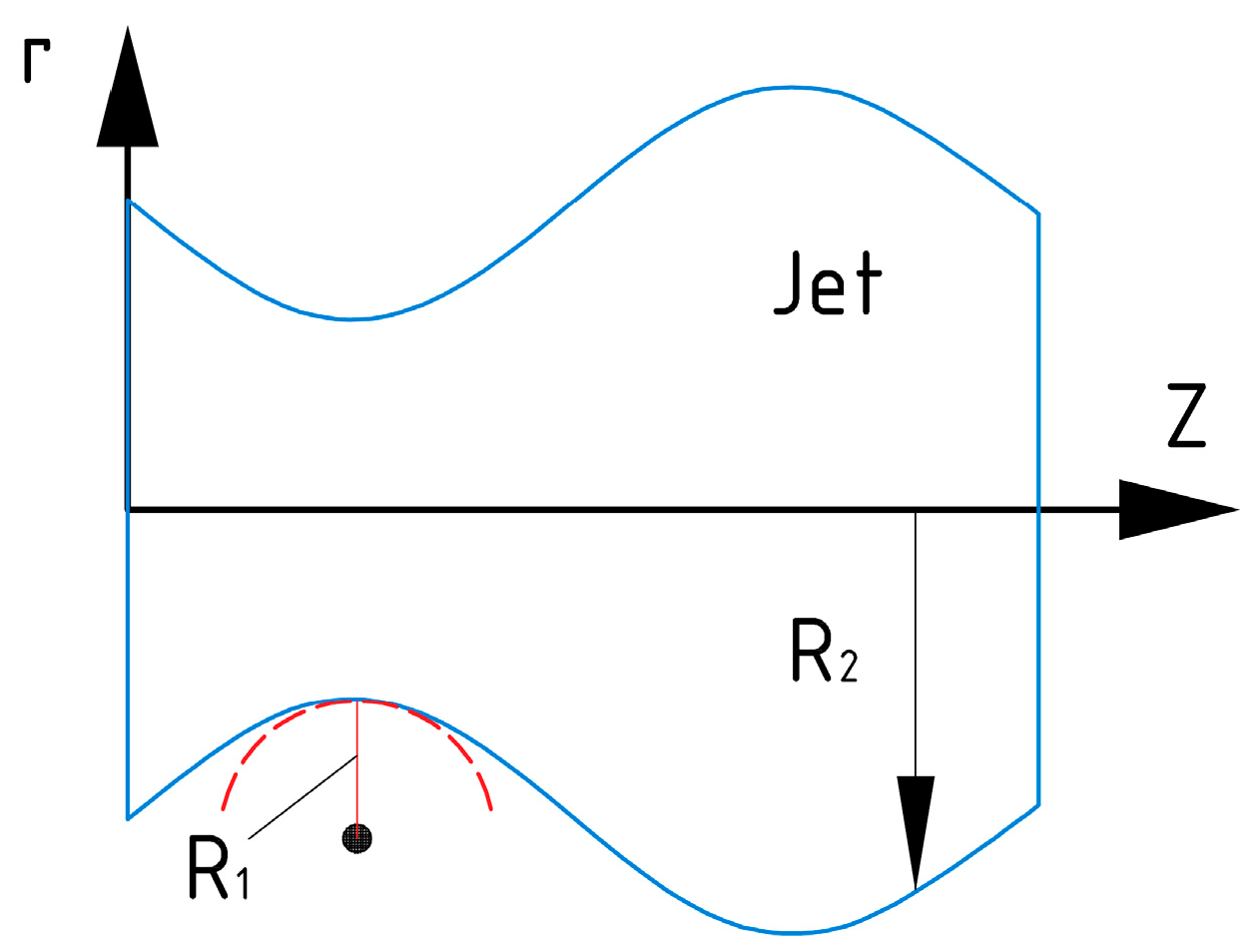
The principal radii of curvature of the free surface of the jet, R
1 and R
2, are defined based on the curvature in the meridional and circumferential directions, respectively (see
Figure 1) [
24].
From a geometric point of view, the meridional radius of curvature R
1 characterizes the curvature of the jet surface in the plane passing through its axis (
Figure 1) and is determined by the following formula:
For small perturbations (|∂R/∂z| ≪ 1), the condition R1 ≫ R0 is satisfied, while with increasing instability, the radius of curvature decreases.
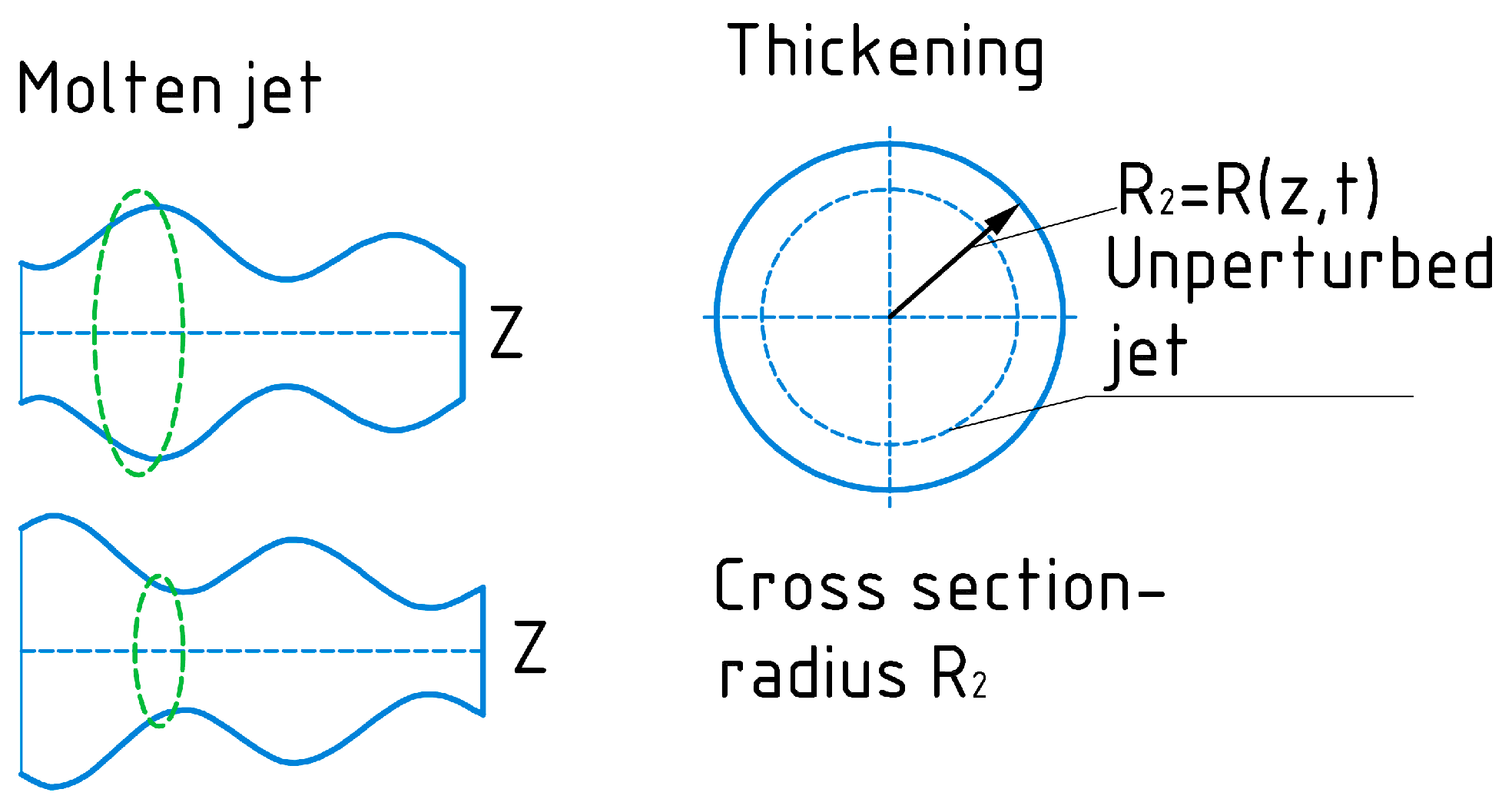
The circumferential radius of curvature R
2, which corresponds to the curvature in the jet cross-section (
Figure 2), is equal to the local radius of the jet:
For an undisturbed cylindrical jet, R2 = R0 holds.
The difference between the radii R1 and R2 is that R1 characterizes the meridional curvature of the jet surface (along the z axis), while R2 corresponds to the circumferential curvature and is equal to the local radius of the jet.
The circumferential curvature is determined by the following formula [
24]:
The total pressure drop across the jet free surface is determined by Laplace’s equation as the sum of the principal curvatures:
Thus, the evolution of the jet geometry is directly related to the change in local curvature and the corresponding capillary pressure.
The balance of tangential stresses on the jet free surface is determined by the following condition [
20]:
To provide the linear analysis stability, a small axisymmetric perturbation of the cylindrical shape of the jet is considered. The radius, velocity, and pressure are given as a superposition of the base state and small perturbations:
Here, k = 2π/λ is the wavenumber, ω is the complex growth rate of the perturbations, and ε ≪ 1 is a small dimensionless parameter characterizing the amplitude of the perturbation.
Under the condition ε ≪ 1, only linear terms are taken into account, while nonlinear terms of higher orders are neglected.
3.2. Linear Stability Analysis
After substituting the perturbed quantities into the linearized system of equations and taking into account the boundary conditions, the dispersion relation for axisymmetric perturbations of a viscous jet in the environment is obtained [
14]:
where ω is a complex rate of perturbations growth; m = μ
e/μ
i—viscosity ratio; l = ρ
e/ρ
i—density ratio; I
0, I
1—modified Bessel functions of the first kind; q—complex wavenumber.
The dispersion relationship makes it possible to determine the most unstable wavenumber and the corresponding wavelength.
For an inviscid jet (classical Rayleigh theory), the droplet diameter formula is
The most unstable wavelength is
The Ohnesorge number is used to calculate the viscous effects:
The rate of perturbation growth for a viscous jet is determined based on the dispersion relation, taking into account viscous damping [
27,
28]:
The viscous damping function is given as follows:
The characteristic time of instability development is determined as follows:
3.3. Dimensionless Parameters and Applicability Limits
Dimensionless parameters are employed for quantitative analysis of breakup regimes. The selection of the Ohnesorge, Weber, Reynolds, and Capillary numbers is based on the dominant balance between inertial, viscous, and capillary forces governing jet instability, as established in classical studies of liquid jet breakup [
2,
25]. These parameters have been further adopted and extended in modern analyses to provide a consistent framework for regime classification and interpretation of breakup dynamics [
26].
The Ohnesorge number is used as the primary classification parameter, as it directly characterizes the relative importance of viscous and capillary effects. Following the classification originally introduced by Ohnesorge [
23], three characteristic regimes can be distinguished:
Oh ≤ 0.1—inertial–capillary regime;
0.1 < Oh ≤ 1—transitional (viscous–capillary) regime;
Oh > 1—viscous regime.
Physically, these regimes reflect the competition between capillary-driven perturbation growth and viscous damping. At low Oh, inertia and surface tension dominate the instability mechanism, while increasing viscosity progressively suppresses perturbation growth and leads to a transition toward viscosity-controlled breakup [
2,
25].
The Weber number governs the transition to aerodynamic breakup:
It is commonly reported in the literature that the critical Weber numbers are approximately We ≈ 12 for the onset of aerodynamic destabilization and We > 100 for intensive aerodynamic jet breakup [
29,
30]. These thresholds correspond to regimes in which interaction between the jet and the surrounding gas flow dominates, and secondary breakup mechanisms become significant.
In the present study, attention is focused on primary capillary–viscous instability governed by the internal hydrodynamics of the jet. Accordingly, the Weber number is interpreted as an indicator of inertial effects rather than as the governing criterion of the breakup mechanism.
Thus, even at elevated Weber numbers, the primary instability mechanism may remain capillary–inertial provided that the characteristic spatial and temporal scales of the process are determined predominantly by internal surface tension and viscous forces. This behavior is explained by the relatively low density of the surrounding gas compared to the liquid, which limits the influence of aerodynamic stresses on the jet interface. As a result, the growth of perturbations is governed primarily by the balance between capillary forces driving instability and viscous effects damping its development.
For engineering prediction of droplet diameter, generalized empirical correlations are employed.
The Grant–Middleman correlation [
15]:
For liquid jets in a gaseous environment, the Onn correlation is employed [
31]:
To expand the applicability of linear theory, generalized correlations are used that take into account the influence of the Ohnesorge number and the Weber number [
32]:
At larger amplitudes or values of the Oh and We, nonlinear effects begin to play a significant role, leading to the formation of satellite drops and the merging of jet structures [
33,
34].
The jet breakup length can be calculated using the relationship [
31]:
Taking into account the combined influence of viscosity and inertial effects, a modified relationship is used [
32]:
The above correlations are used for comparative evaluation of the theoretical predictions obtained within the present framework. The present study focuses on the initial stage of jet destabilization, during which perturbation amplitudes remain small compared to the jet radius. Under these conditions, linear stability theory provides a physically consistent description of the exponential growth of infinitesimal disturbances. The corresponding numerical calculations were performed using Maple (Maple 2021, Maplesoft, Waterloo, ON, Canada).
Even in inertia-dominated regimes characterized by elevated Weber and Reynolds numbers, the wavelength corresponding to the maximum growth rate predicted by linear theory has been shown to reliably determine the primary breakup scale. While nonlinear effects govern the subsequent necking dynamics and possible satellite droplet formation, the dominant instability wavelength is selected during the linear stage of evolution. This behavior is explained by the exponential growth of perturbations with different wavelengths, among which the mode corresponding to the maximum growth rate becomes dominant. Consequently, this wavelength defines the characteristic breakup scale, since it amplifies faster than all other disturbances and governs the subsequent nonlinear evolution of the jet.
Therefore, the analytical framework developed herein should be interpreted as a predictive model for the dominant instability mode and initial fragmentation scale in unforced rotating granulation systems, rather than as a complete nonlinear breakup simulation.
5. Discussion
The geometric and thermophysical parameters adopted in this study (
Table 1) are representative of industrial centrifugal urea granulation conditions, ensuring the practical relevance of the obtained results. The selected jet diameter D
j = 1.20 mm (radius R
0 = 0.60 mm) corresponds to typical nozzle orifice dimensions used in granulation equipment. The melt temperature of approximately 133 °C defines its thermophysical properties (ρ = 1200 kg/m
3, μ = 0.003 Pa∙s, σ = 0.050 N/m), which establish the balance between inertial, capillary, and viscous forces. The initial exit velocity u = 4.35 m/s reflects the kinematics of centrifugal jet formation and determines the magnitude of inertial effects.
Analysis of the dimensionless parameters (
Table 2) allows unambiguous identification of the breakup regime. The Ohnesorge number Oh = 0.0745 indicates that viscous effects do not dominate instability initiation but primarily influence its growth rate. The elevated Weber number We = 455.04 suggests the predominance of inertial forces over surface tension during the initial stage of jet evolution. At Re ≈ 2000, the process occurs in an inertia-dominated regime with moderate viscous damping, which justifies the application of linear hydrodynamic stability theory within the selected parameter range. The combined values of these criteria confirm that the studied case belongs to the inertial–capillary breakup regime characteristic of industrial granulation processes.
Although the liquid-based Weber number is relatively high, the influence of the gas phase can be assessed by considering the gas-phase Weber number and the density ratio. The gas-phase Weber number is estimated as Weg = ρgu2D/σ ≈ 0.46, while the gas-to-liquid density ratio is ρg/ρl ≈ 10−3.
These values indicate that aerodynamic shear effects are negligible (Weg ≪ 1). According to the criterion of Reitz and Lin, aerodynamic breakup becomes dominant at Weg > 1.3. Therefore, despite the high liquid-based Weber number, the breakup process remains governed by internal capillary–inertial mechanisms. The elevated Weber number reflects the ratio of inertial to capillary forces within the liquid phase rather than the influence of aerodynamic effects.
It should be noted, however, that this conclusion is valid under conditions where the surrounding gas phase remains relatively quiescent, as assumed in the present analysis. In industrial systems, the surrounding gas may be subject to cross-flow, turbulence induced by adjacent jets, or updraft within a prilling tower. Under such conditions, the effective gas-phase Weber number can increase and approach or exceed the critical threshold (We
g > 1.3), at which aerodynamic effects become significant [
29,
30].
In addition, turbulent fluctuations in the gas phase may introduce additional perturbations on the jet surface, modifying the spectrum of unstable wavelengths and accelerating the breakup process [
21]. Cross-flow effects are particularly relevant in centrifugal granulation systems, where multiple jets are generated simultaneously and interact with the surrounding air. Under these conditions, the contribution of aerodynamic effects may lead to a transition from purely capillary–inertial breakup toward mixed or aerodynamic-assisted regimes.
Accordingly, the proposed analytical framework is applicable within regimes where gas-phase effects remain limited, while extension to turbulent or cross-flow conditions would require the incorporation of gas-phase momentum coupling into the stability analysis.
In the present framework, rotation is accounted for indirectly through its influence on the initial jet conditions, including velocity and characteristic length scale at the outlet of the rotating system. The subsequent instability development is governed by local hydrodynamic mechanisms, which can be described using classical linear stability theory. This simplification is justified for the early stage of jet breakup, where the dominant dynamics are controlled by intrinsic capillary–viscous interactions.
Under these conditions, the wavelength selected during the linear growth phase remains physically meaningful for estimating the primary fragmentation scale, even though nonlinear effects may influence the later stages of droplet formation.
The most unstable wavelength was determined as λ
max = 5.34 mm (
Table 3), corresponding to a dimensionless ratio λ
max/D
j ≈ 4.45, which closely matches the classical Rayleigh–Plateau prediction for an inviscid jet (λ/D ≈ 4.5). This agreement indicates preservation of the fundamental capillary–inertial mechanism even in the presence of viscosity and realistic thermophysical properties of the industrial melt. Within the investigated parameter range, viscous effects do not alter the characteristic breakup scale but primarily influence the kinetics of instability growth. The obtained ratio confirms the physical consistency of the model and the validity of the mathematical description.
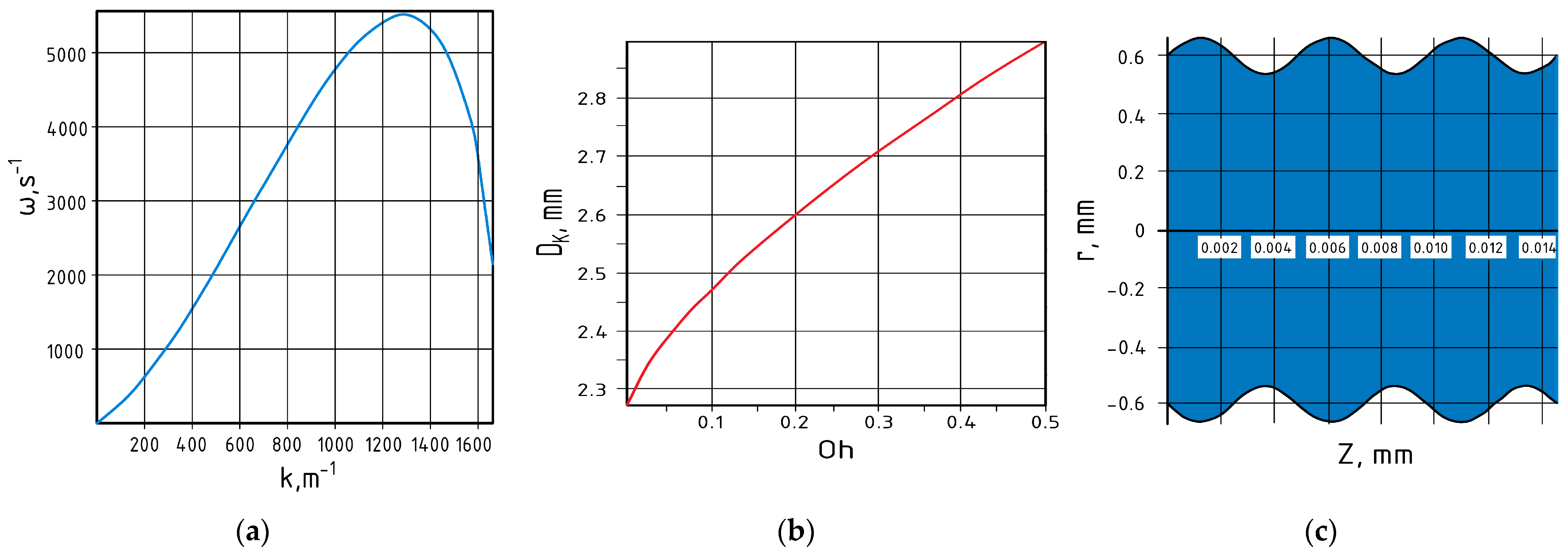
The dispersion relation for perturbation growth rate as a function of wavenumber (
Figure 3a) exhibits a well-defined maximum, which determines the dominant wavelength and the characteristic fragmentation scale of the jet. The finite interval of unstable wavenumbers is consistent with classical capillary instability theory, according to which short-wavelength disturbances are suppressed by surface tension. The dependence of droplet diameter on the Ohnesorge number (
Figure 3b) shows a gradual increase with increasing viscosity, reflecting perturbation damping and reduced breakup intensity. The spatial profile of the perturbed jet (
Figure 3c) illustrates the geometrical manifestation of the dominant instability and the localization of prospective droplet pinch-off regions, in agreement with the dispersion analysis.
Comparison of droplet diameter predictions obtained using different theoretical approaches (
Table 4) demonstrates strong agreement among the results. The classical Rayleigh formulation yields D
k = 2.268 mm. Incorporation of viscous corrections results in an increase of 2.5%, while the Grant–Middleman correlation leads to a deviation of approximately 4%. The modern generalized correlation accounting for the effects of Oh and We predicts a deviation of up to 6.7%. Verification based on the law of volume conservation (equating the volume of a jet segment of length λ
max to the volume of the resulting droplet) shows a discrepancy of only 1.1%. The consistency of independent approaches within 7% confirms the internal coherence of the model and its suitability for engineering prediction of granule size.
Parametric sensitivity analysis indicates that variation of key parameters within ±10% results in only minor changes in the predicted diameter: up to 1.2% for dynamic viscosity, 0.6% for surface tension, and 0.8% for exit velocity. Such low sensitivity suggests robustness of the droplet formation process and stability of the model even under technological fluctuations typical of industrial operations.
From an engineering perspective, wider variations in thermophysical properties may occur in industrial systems due to temperature fluctuations. Based on the sensitivity trends obtained in the present study, an extrapolated assessment indicates that even for larger variations (on the order of ±30–40%), the resulting changes in droplet diameter remain moderate.
To extend the applicability of the proposed analytical framework to industrial-scale systems, key scale-up parameters can be systematically incorporated through their influence on the initial and boundary conditions of the jet. In this approach, the effects of nozzle geometry, rotational speed, and multi-jet interactions are reflected in the governing input parameters, including the jet diameter, exit velocity, and perturbation characteristics, without modification of the underlying stability formulation.
The practical application of the proposed model to industrial-scale systems requires explicit consideration of several scale-up parameters that are not directly included in the linear stability framework but significantly influence the granulation process. These include nozzle geometry, rotational speed, and multi-jet interactions.
Nozzle geometry affects the initial conditions of the jet, including the velocity profile at the orifice exit, the initial perturbation spectrum, and the effective jet diameter. The present model assumes a uniform velocity profile and a well-defined cylindrical jet at the nozzle exit, which represents a reasonable approximation for long nozzle channels with length-to-diameter ratios L/D > 10 [
5]. For shorter nozzles or irregular orifice geometries, the velocity profile may deviate from the plug-flow assumption, leading to modified breakup characteristics. In such cases, the exit velocity and effective jet diameter should be corrected using established hydraulic relationships for short-channel flow [
25]. Within the proposed framework, these corrections can be incorporated by adjusting the input parameters (u, D
j) without modification of the underlying stability formulation.
The present linear stability analysis addresses the primary capillary instability stage and does not explicitly account for secondary phenomena, including satellite droplet formation, coalescence, and solidification during free-fall cooling. However, a quantitative assessment of their influence on the predicted granule size distribution can be provided based on available theoretical estimates and published data.
Satellite droplet formation, which occurs during the final nonlinear stage of jet breakup, is estimated to contribute approximately 5–15% of droplets by number but only 1–3% by volume due to their smaller size. As a result, their influence is primarily on the width of the size distribution, with an estimated deviation in volume-mean diameter of about 2–4%.
Droplet coalescence may occur under conditions of closely spaced jets or reduced rotational speeds, leading to an increase in the effective droplet diameter by approximately 3–8%. In contrast, solidification during free-fall cooling introduces relatively minor deviations, typically within 1–2% under standard prilling conditions.
Overall, the combined influence of these secondary effects is estimated to result in deviations on the order of 5–10% relative to the predictions of the linear stability model. This is consistent with the ±7% agreement observed between different theoretical approaches (
Table 4). Accordingly, the proposed model provides a reliable estimate of the characteristic droplet diameter, while accurate prediction of the full-size distribution requires incorporation of nonlinear breakup dynamics, droplet interactions, and solidification kinetics.
The applicability limits of the model are associated with the assumptions of linear stability theory and are expected to hold for small perturbations (ε < 0.1R0), Ohnesorge numbers within the viscous–capillary regime, and low gas-phase influence (Weg < 1.3). Outside these ranges, nonlinear effects and aerodynamic interactions may become significant and require more advanced modeling approaches.
To further interpret the obtained results, the following observations can be made. The close agreement between the classical Rayleigh prediction and viscosity-corrected models can be attributed to the low Ohnesorge number (Oh = 0.0745), indicating that the system operates in the inertial–capillary regime. Under these conditions, the instability development is governed primarily by the balance between capillary forces and inertia, while viscous effects play only a secondary role. This explains the minor deviation between the predicted droplet diameters obtained using inviscid and viscosity-corrected models.
The relatively low sensitivity of the predicted droplet diameter to variations in viscosity, surface tension, and jet velocity is consistent with the functional structure of the applied correlations. In particular, the dominant dependence on jet diameter, combined with weak power-law corrections, limits the influence of thermophysical parameters. From an engineering perspective, this indicates that moderate fluctuations in process conditions are unlikely to significantly affect the resulting granule size distribution, supporting stable operation of industrial granulation systems.
To further assess the predictive capability of the proposed model, the obtained results were compared with available experimental and numerical data reported in the literature. The classical Rayleigh [
13] solution predicts a droplet-to-jet diameter ratio of D
k/D
j ≈ 1.89 for inviscid jets, which is consistent with experimental data reported by Grant and Middleman [
15], who obtained values in the range 1.89–1.95 for low-Ohnesorge-number systems.
For viscous jets with Oh ≈ 0.07, corresponding to the conditions considered in the present study, experimental results [
31] indicate D
k/D
j ≈ 1.92–2.01. This is in good agreement with the value obtained using Equation (15), which yields D
k/D
j = 1.937.
In addition, numerical simulations for laminar jet breakup at comparable Ohnesorge numbers [
32] report an increase in droplet diameter of approximately 2–5% relative to the classical Rayleigh prediction, which closely matches the present result (+2.5% based on Equation (15)).
Overall, the predictions of the proposed model fall within ±7% of available experimental and numerical data, indicating satisfactory predictive capability under conditions relevant to industrial melt granulation processes.
6. Conclusions
This paper presents a theoretical model developed for predicting primary molten jet breakup in a rotating granulation system operating without forced excitation. The analysis is based on the linear hydrodynamic stability theory of a viscous axisymmetric jet, incorporating realistic thermophysical properties of urea melt.
The main findings can be summarized as follows:
Under representative industrial conditions (Oh = 0.0745, We = 455.04, Re ≈ 2000), jet breakup occurs in the inertial–capillary regime, in which viscosity plays a corrective rather than governing role.
The most unstable wavelength λmax = 5.34 mm corresponds to the dimensionless ratio λmax/Dj ≈ 4.45, closely matching the classical Rayleigh–Plateau prediction. This confirms the preservation of the fundamental capillary instability mechanism under realistic industrial granulation conditions.
The predicted droplet diameter obtained using independent theoretical approaches shows agreement within 7%, demonstrating the internal coherence of the model.
Parametric sensitivity analysis reveals low sensitivity of the predicted diameter to ±10% variations in key technological parameters, indicating the robustness of the droplet formation process and suitability of the model for engineering prediction.
Quantitative assessment of secondary effects, including satellite droplet formation, coalescence, and solidification, indicates a combined deviation of approximately 5–10% from the primary linear stability predictions. This confirms the adequacy of the linear framework for engineering estimation of the characteristic granule diameter, while highlighting the need for extended modeling to capture the full particle size distribution.
The proposed model can be systematically extended to industrial-scale systems through appropriate adjustment of input parameters, accounting for nozzle geometry, rotational speed, and multi-jet interactions. This demonstrates the applicability of the analytical framework for preliminary engineering design and process analysis.
Although the liquid-based Weber number is relatively high (We = 455.04), aerodynamic effects remain negligible under the considered conditions due to the low gas-phase Weber number (Weg ≈ 0.46 < 1) and the small gas-to-liquid density ratio (ρg/ρl ≈ 0.001 ≪ 0.01). The proposed model is therefore applicable within the inertial–capillary regime, provided that Oh < 0.1, Weg < 1.3, and perturbations remain within the linear stability limit (ε < 0.1R0). Outside these ranges, particularly at higher jet velocities or smaller nozzle diameters, aerodynamic shear and jet–gas interaction mechanisms may become significant and should be taken into account.
The proposed approach can serve as a baseline engineering model for estimating droplet size in centrifugal granulation systems operating without external mechanical excitation. Future work will focus on extending the model to incorporate nonlinear perturbation evolution, aerodynamic shear effects, jet–gas interaction mechanisms, and non-isothermal conditions, as well as on experimental validation using high-speed imaging under realistic operating conditions.





 ,
,