Article

Optimization of Oscillation Welding Processes Toward Robotic Intelligent Decision-Making in Non-Standard Components


1
School of Mechanical Engineering, Guangxi University, Nanning 530004, China
2
School of Physics and Telecommunications Engineering, Yulin Normal University, Yulin 537000, China
*
Author to whom correspondence should be addressed.
Processes 2026, 14(7), 1057; https://doi.org/10.3390/pr14071057
Submission received: 26 February 2026 / Revised: 10 March 2026 / Accepted: 17 March 2026 / Published: 26 March 2026
(This article belongs to the Section Manufacturing Processes and Systems)

Abstract

To address the challenge of autonomous process adaptation in non-standard components with continuously varying groove angles, this study proposes an intelligent decision-making framework based on Response Surface Methodology (RSM) for oscillation welding. Instead of solely identifying a single optimal parameter set, RSM is employed as a knowledge-modeling tool to reveal adaptive relationships between groove geometry and key welding parameters. A Central Composite Design (CCD) is utilized to establish predictive models for weld geometry under varying conditions: wire feed rate (8–12 m/min), travel speed (5–9 mm/s), travel angle (70–110°), oscillation amplitude (2–6 mm), dwell time (0.2–0.6 s), and groove angle (80–100°). The significance and adequacy of the models are validated through analysis of variance (ANOVA), demonstrating high predictive accuracy with all coefficients of determination (R2) exceeding 0.82. Furthermore, defect-aware physical constraints derived from the formation mechanism of bottom humping are incorporated into the optimization process, specifically restricting the travel angle to a push angle of 70–85° to ensure feasible and reliable decision outputs. Based on the established response surfaces, geometry-dependent parameter selection rules are derived to simultaneously optimize root penetration (target 8.5–10.5 mm) and sidewall fusion (>2.5 mm) for groove angles ranging from 80° to 100°. Experimental validation confirms that the proposed decision-making strategy achieves stable bead formation and defect-free fusion, demonstrating high quantitative reliability with root penetration prediction errors below 7% and bead width errors below 13%. This work bridges the gap between geometric perception and process control, providing a practical pathway toward intelligent and adaptive robotic welding of non-standard components.

1. Introduction

With the rapid advancement of Industry 4.0, robotic welding has become a cornerstone technology in modern manufacturing, ranging from automotive production to large-scale steel structures [1,2]. Compared with manual welding, robotic systems offer superior consistency, higher productivity, and improved operational safety, making them indispensable in high-demand industrial environments [3,4]. Consequently, the automation level of welding processes has become a pivotal indicator of manufacturing intelligence and industrial competitiveness.
Despite these advantages, most industrial welding robots still operate under a “teach-and-playback” paradigm [5]. This approach is well suited for standard components with fixed geometries but exhibits significant limitations when applied to non-standard components, such as tower foot plates, where manufacturing tolerances and assembly deviations cause the groove angle to vary continuously [6,7]. Variations in joint geometry often lead to unstable thermal boundary conditions and increased defect susceptibility, highlighting the urgent need for enhanced adaptability in robotic welding systems.
To address geometric variability, extensive research efforts have focused on integrating sensing technologies to enable real-time adaptability. Xu et al. [8] and Zhu et al. [9] successfully utilized passive vision and arc sensing to monitor weld pool deviations, while Pan et al. [10] demonstrated that laser-structured light systems could accurately reconstruct 3D groove profiles for high-precision seam tracking. These approaches have significantly improved the robot’s ability to “perceive” joint geometry and correct the welding path [11]. However, a critical bottleneck remains: while geometric perception and trajectory adjustment have reached a relatively mature level, the autonomous decision-making of welding process parameters in response to these variations is largely underdeveloped [12,13]. As noted by Cai et al. [14], merely adjusting the welding torch position without correspondingly adapting process parameters—such as heat input, oscillation width, and torch orientation—often results in defects including lack of fusion, excessive reinforcement, or root instability. This mismatch reveals a fundamental gap between geometric perception and process control. Theoretically, the evolution from traditional welding automation to true manufacturing intelligence requires bridging this exact gap. In the context of recent literature, “intelligent decision-making” is defined as a system’s capability to autonomously translate dynamic geometric states into optimal, defect-free process parameters without human intervention. Unlike conventional static optimization, a truly intelligent decision-making framework must integrate mathematical knowledge modeling with underlying physical boundary constraints to formulate adaptive, geometry-dependent execution rules.
Oscillation (or weaving) welding has emerged as an effective technique for improving weld quality in joints with large gaps or variable groove geometries. By introducing a periodic transverse motion, oscillation welding enhances sidewall fusion, stabilizes molten pool behavior, and increases tolerance to geometric deviations [15,16]. Previous studies by Li et al. [17] indicated that optimal oscillation frequency and amplitude can significantly refine grain structure and reduce porosity. However, the introduction of oscillation drastically increases process complexity. In addition to conventional parameters (wire feed rate, travel speed), oscillation characteristics interact in a highly nonlinear manner with the groove geometry [18]. Determining appropriate combinations of these parameters for continuously varying groove angles through empirical trial and error is inefficient and impractical in industrial environments.
To transition from basic automation toward intelligent decision-making, several adaptive parameter selection mechanisms have been systematically explored in recent literature. These mechanisms generally fall into three categories. The first category involves traditional expert systems reliant on pre-programmed empirical databases, which inherently lack the dynamic flexibility required for continuous geometric deviations. The second category encompasses emerging Machine Learning (ML) and Deep Learning algorithms. While these data-driven approaches excel in predicting complex nonlinear pool behaviors, they present two major limitations in practical industrial applications. First, they typically require massive datasets for training, which are expensive and time-consuming to collect for non-standard components. Second, they frequently operate as “black boxes.” This lack of transparency means that the underlying physical relationships remain hidden, making it difficult for engineers to understand why a decision was made or to directly embed known defect-avoidance rules—such as the specific torch push angle required to physically prevent bottom humping—into the algorithm’s control logic. The third category involves statistical modeling, where establishing a quantitative relationship between welding parameters and weld geometry is a prerequisite for enabling adaptive process control. Response Surface Methodology (RSM) has been widely applied in welding research as an efficient statistical tool for modeling multi-parameter processes [19]. Unlike the “black-box” nature of ML, RSM provides transparent mathematical equations. This transparency is crucial, as it allows for the direct mathematical integration of critical physical boundary constraints. For instance, Du et al. [20] and Escribano-García et al. [21] utilized Central Composite Design (CCD) to optimize Gas Metal Arc Welding (GMAW) parameters, successfully predicting bead geometry with high accuracy. Nevertheless, a limitation exists in the current literature: most existing RSM-based studies focus on identifying a single optimal parameter set for a predefined, static joint configuration [22]. There is a paucity of research that treats the groove angle as a dynamic state variable or utilizes RSM to extract adaptive decision rules for non-standard components. Furthermore, pure statistical optimization often neglects the physical formation mechanisms of defects, such as the “W-shaped” bottom humping observed in narrow grooves [23], leading to theoretically optimal but physically unfeasible solutions.
In this study, an intelligent process decision-making framework for oscillation welding of non-standard tower foot plates is proposed based on RSM. The groove angle (80–100°) is explicitly treated as a geometric state variable to reflect practical manufacturing tolerances. A CCD-based experimental design is employed to establish predictive models for key weld geometry indices, including reinforcement, bead width, and root penetration. A critical contribution of this work is the integration of defect-aware physical constraints—specifically a push-angle constraint derived from molten pool flow analysis—into the decision-making process. Based on the established response surfaces, geometry-dependent parameter selection laws are extracted, enabling the robotic system to autonomously adjust oscillation welding parameters. This work bridges the gap between perception and control, providing a practical and interpretable pathway toward intelligent robotic welding of non-standard components.

2. Experimental Apparatus and Procedure

2.1. Materials and Equipment

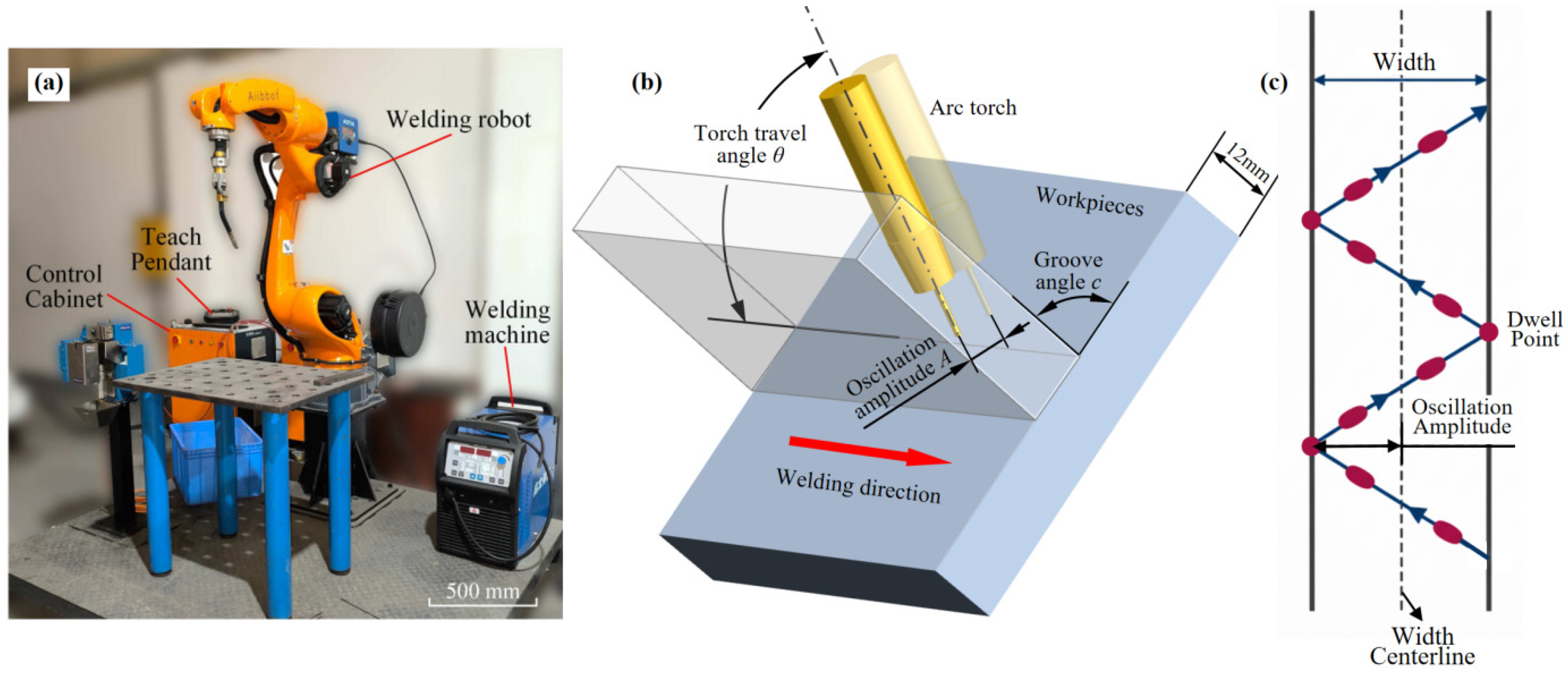
Experiments were conducted on an automated GMAW platform integrating a digital power source, a controlled wire-feeding system, a robotic torch-manipulation unit, and a shielding-gas delivery module, as shown in Figure 1a. Q235 mild-steel plates with a V-shaped joint configuration were used as the base material. ER50-6 solid wire with a diameter of 1.2 mm served as the filler metal. A shielding-gas mixture of 80% Ar and 20% CO2 was supplied at a constant flow rate throughout the welding process.

2.2. Joint Configuration and Oscillation Strategy

To emulate the geometric variability of non-standard components encountered in industrial production, a specialized adjustable fixture was employed. This fixture enabled continuous adjustment of the plate included angle, defined as groove angle c, within the range of 80° to 100°, thereby forming a variable joint configuration. In accordance with international welding standards (e.g., AWS A3.0 [24]), all experimental trials were strictly conducted in the 1F position (flat position fillet weld) to maintain a consistent gravitational effect on the molten pool. Prior to the final welding pass, the plates were tack welded at both ends of the joint to ensure stability of the preset angle and root gap.
A zigzag oscillation trajectory was adopted to improve sidewall fusion and to accommodate variations in groove width. As illustrated in Figure 1b, the geometric relationship between the welding torch and the workpiece is characterized by the oscillation amplitude A relative to the variable groove angle c. Figure 1c further depicts the kinematic trajectory, where the torch oscillates transversely with respect to the welding direction. A critical parameter within this trajectory is the dwell time t at the groove sidewalls.
The dwell time is particularly important, as it governs the localized heat input at the groove boundaries and helps mitigate lack-of-fusion defects, which are prevalent in non-standard joint geometries. From the perspective of intelligent process control, the oscillation amplitude and dwell time defined in this section constitute key decision variables that directly govern heat distribution and molten pool dynamics. Their selection must be adaptively adjusted according to groove geometry to ensure stable fusion under non-standard conditions.

2.3. Design of Experiment (DOE)

To systematically examine the influence of process parameters on weld geometry and enable intelligent process optimization, Response Surface Methodology based on a Central Composite Design was employed. Six independent variables were selected according to their dominant contributions to welding quality and their relevance to non-standard adaptive welding scenarios. The wire feed rate W and travel speed V were designated as primary factors governing the heat input per unit length and the filler-metal deposition rate. The travel angle θ was included to modulate the arc force orientation and the resulting penetration profile. Considering the requirements of the oscillation strategy for effective gap bridging, the oscillation amplitude A and dwell time t were incorporated to regulate bead width and promote sufficient sidewall fusion. In addition, the groove angle c was introduced as a geometric variable to emulate non-standard manufacturing tolerances commonly encountered in industrial practice. By explicitly incorporating groove angle as an independent variable, the DOE is constructed to support the extraction of geometry-dependent decision rules rather than a single fixed optimal solution.
A five-level rotatable CCD matrix was employed to facilitate the estimation of linear, quadratic, and two-factor interaction effects. The corresponding coded and actual factor levels are summarized in Table 1.

2.4. Weld Bead Characterization

After completion of the welding experiments, each welded specimen was sectioned perpendicular to the welding direction using either wire electrical discharge machining. The obtained cross-sections were sequentially ground with sandpapers of increasing grit sizes, followed by mechanical polishing and chemical etching with 4% Nital to reveal the macro-metallographic features. High-resolution macrographs were acquired using an optical microscope at a low magnification of 10×, and subsequent geometric measurements were performed via image-processing software (ImageJ, version 1.54).
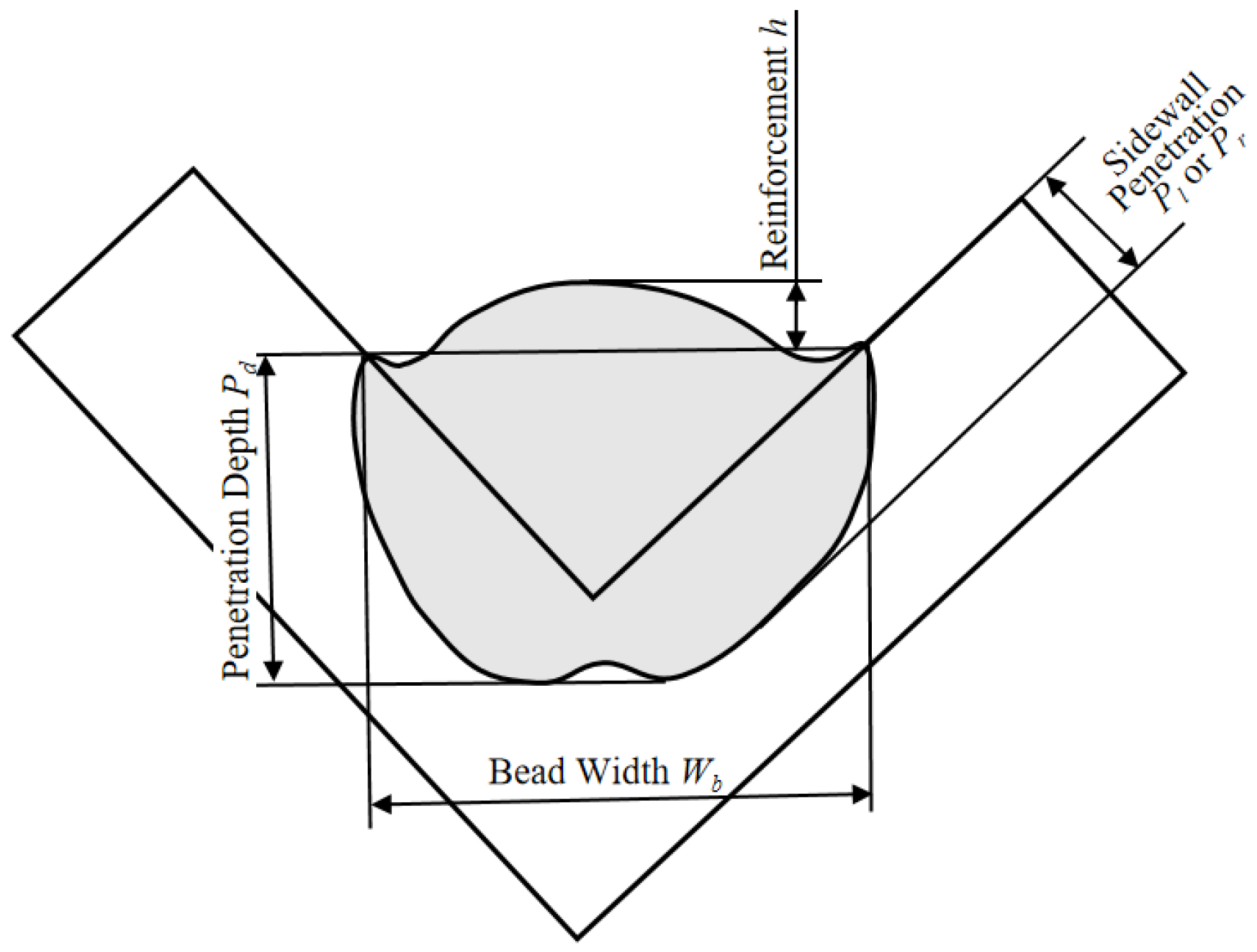
Five critical weld bead quality indices were extracted, as illustrated in Figure 2: weld reinforcement h, centerline penetration depth Pd, bead width Wb, left sidewall penetration Pl, and right sidewall penetration Pr. These quantitative metrics were used to evaluate weld quality and to validate the performance of the proposed intelligent decision-making model.

3. Development and Validation of Statistical Models

3.1. Experimental Results

The experimental results serve as the quantitative foundation for the subsequent decision-oriented modeling. Following the CCD matrix, a total of 82 experimental runs were executed in a fully randomized order to mitigate unobserved systematic biases and environmental noise. To ensure model stability and accurately estimate pure experimental error, this specific design structure consisted of one repetition for each factorial and axial state, and exactly six replicates at the center point. These runs were designed to evaluate the correlations between the six independent process variables and the five weld-quality indices. The complete design matrix, encompassing all input parameters and their corresponding measured responses, is detailed in Table 2.

3.2. Statistical Modeling Strategy

Based on the experimental data, the mathematical relationships between the input parameters and the weld geometry responses were established using Design-Expert 13 software. A second-order polynomial regression model was employed for each response. The generalized equation is given by
Y = β 0 + i = 1 k β i x i +   i = 1 k β i i x i 2 + i < j β i j x i x j + ε
where Y is the predicted response, β0 is the constant coefficient, βi, βii and βij are the coefficients for linear, quadratic, and interaction terms respectively, and ε is the error.
In this study, the established response surface models are not only used for response prediction, but also serve as a decision knowledge base. By interpreting the response surfaces with respect to groove angle variations, adaptive parameter selection laws can be derived to support autonomous process decision-making in robotic welding.

3.3. Checking the Significance of Models and Regression Coefficients

In order to eliminate insignificant terms and improve model robustness, a stepwise regression method (backward elimination) was applied. The Analysis of Variance (ANOVA) technique was utilized to test the adequacy of the established models and the significance of the regression coefficients. Furthermore, to ensure the stability and reliability of the estimated regression coefficients, a multicollinearity analysis was conducted using the Variance Inflation Factor (VIF). In regression modeling, severe multicollinearity (typically indicated by VIF values exceeding 10) can artificially inflate the variance of coefficient estimates, rendering the model unstable and unsuitable for process optimization. Because the Central Composite Design (CCD) employed in this study provides a highly orthogonal design matrix, the calculated VIF values for all significant main effects and interaction terms across the five response models were found to be close to 1.0. This confirms the absence of severe multicollinearity among the input variables, thereby fundamentally validating the mathematical robustness of the established models for subsequent intelligent decision-making. The detailed ANOVA results for the five response models are presented in Table 3, Table 4, Table 5, Table 6 and Table 7.
Table 3 presents the ANOVA results for the reinforcement h model. The F-value of 18.17 (p < 0.0001) confirms the model’s high significance. The main effects of W, V, θ, A, c and several interaction terms (e.g., W × c, θ × A) are identified as significant model terms (p < 0.05). Statistically, the model exhibits a reasonably good fit with an R2 of 0.8284 and an Adeq Precision of 19.74. The close agreement between Adjusted R2 (0.7828) and Predicted R2 (0.7344), combined with a non-significant Lack of Fit (p = 0.8827), validates the model’s robustness for intelligent process decision-making.
Table 3. ANOVA results for the reduced quadratic model of Reinforcement h.
SourceSum of SquaresdfMean SquareF-Valuep-Value
Model19.33171.1418.17<0.0001significant
W1.2111.2119.28<0.0001
V0.330810.33085.290.0248
θ7.0617.06112.76<0.0001
A4.314.368.75<0.0001
t0.166310.16632.660.108
c2.3912.3938.21<0.0001
W × θ0.182810.18282.920.0923
W × c0.792110.792112.660.0007
V × t0.1610.162.560.1147
V × c0.085610.08561.370.2466
θ × A0.660210.660210.550.0019
θ × t0.409610.40966.550.0129
θ × c0.138810.13882.220.1414
A × t0.16210.1622.590.1125
t × c0.701410.701411.210.0014
V20.508310.50838.120.0059
A20.087510.08751.40.2413
Residual4640.0626
Lack of Fit3.46590.05870.5410.8827not significant
Pure error0.542450.1085
Cor total23.3481
Table 4 presents the ANOVA results for the penetration depth Pd model. The F-value of 19.08 (p < 0.0001) signifies the high statistical significance of the regression model. The analysis indicates that the linear terms W, V, θ, A, and t are all significant model terms (p< 0.05). Specifically, wire feed rate W and travel speed V exhibit the most substantial F-values, confirming their dominant influence on penetration. Significant interactions, including W × t, θ × A, and A × t, along with the quadratic terms W2 and A2, further characterize the non-linear response of the molten pool. The model’s reliability is supported by an R2 of 0.8244 and an Adeq Precision of 17.97. The Predicted R2 (0.7170) shows strong agreement with the Adjusted R2 (0.7812), with a difference of less than 0.2. These metrics, combined with a non-significant Lack of Fit (p = 0.3190), validate the model’s robustness for predicting weld penetration under varying oscillation conditions.
Table 4. ANOVA results for the reduced quadratic model of Penetration Depth Pd.
SourceSum of SquaresdfMean SquareF-Valuep-Value
Model79.35164.9619.08<0.0001significant
W30.52130.52117.42<0.0001
V13.82113.8253.15<0.0001
θ4.3114.3116.590.0001
A1.8911.897.260.0089
t8.3818.3832.23<0.0001
c0.271310.27131.040.3107
W × V0.218610.21860.84070.3626
W × θ0.558810.55882.150.1474
W × t4.5314.5317.41<0.0001
θ × A3.1113.1111.950.001
θ × t0.36310.3631.40.2416
θ × c0.291610.29161.120.2935
A × t4.2814.2816.480.0001
t × c0.45910.4591.770.1886
W21.0411.0440.0496
A25.215.219.99<0.0001
Residual16.9650.26
Lack of Fit16.06600.26771.60.319not significant
Pure error0.836950.1674
Cor total96.2581
Table 5 details the ANOVA results for the bead width Wb model. The F-value of 27.23 (p < 0.0001) indicates that the quadratic model is highly significant. The linear terms W, V, A, t, and c are identified as significant contributors (p < 0.05). Notably, oscillation amplitude A and dwell time t exhibit substantial F-values, which aligns with the physical principle that wider lateral oscillation and prolonged edge dwell times directly expand the dimensions of the molten pool. The analysis also reveals several significant interaction effects, including W × θ, V × θ, V × c, θ × t, and t × c, alongside the quadratic term V2. These interactions highlight the complex dependency of bead width on both kinematic parameters and groove geometry. The model demonstrates excellent fitting characteristics with an R2 of 0.8861 and an Adjusted R2 of 0.8536. The Predicted R2 of 0.8015 is in close agreement with the adjusted value (difference < 0.2), confirming the model’s robust predictive capability. With an Adeq Precision of 23.13 and a non-significant Lack of Fit (p = 0.5438), the model is highly reliable for navigating the design space and supporting autonomous process decisions.
Table 5. ANOVA results for the reduced quadratic model of Bead Width Wb.
SourceSum of SquaresdfMean SquareF-Valuep-Value
Model183.821810.2127.23<0.0001significant
W31.47131.4783.9<0.0001
V56.11156.11149.59<0.0001
θ0.961410.96142.560.1144
A10.29110.2927.44<0.0001
t47.17147.17125.77<0.0001
c12.3112.332.8<0.0001
W × θ4.3514.3511.590.0012
W × c1.1111.112.970.0899
V × θ3.6513.659.730.0027
V × c4.7114.7112.550.0008
θ × A0.400110.40011.070.3057
θ × t2.7612.767.370.0086
A × t0.351110.35110.9360.337
A × c0.247510.24750.65990.4197
t × c1.711.74.520.0374
W20.485110.48511.290.2597
V25.5515.5514.80.0003
θ20.181910.18190.48490.4888
Residual23.63630.3751
Lack of Fit21.84580.37661.050.5438not significant
Pure error1.7950.3576
Cor total207.4581
The ANOVA results for left sidewall penetration Pl (Table 6) and right sidewall penetration Pr (Table 7) further confirm the robustness of the predictive framework. For both models, wire feed rate W, travel speed V, and dwell time t are identified as significant main effects (p < 0.05). Notably, the interaction between oscillation amplitude and groove angle (A × c) shows a dominant influence on sidewall fusion (p < 0.0001), emphasizing that adaptive amplitude adjustment is critical for maintaining sound penetration as groove geometry varies. Both models exhibit high statistical adequacy, with R2 values of 0.8526 and 0.8296 for Pl and Pr, respectively. The Predicted R2 values (0.7201 and 0.7113) are in close agreement with their respective Adjusted R2 values, and the non-significant Lack of Fit (p > 0.05) further validates that these models can accurately guide the intelligent decision-making process for sidewall fusion.
Table 6. ANOVA results for the reduced quadratic model of Left Sidewall Penetration Pl.
SourceSum of SquaresdfMean SquareF-Valuep-Value
Model41.68192.1918.88<0.0001significant
W3.9213.9233.73<0.0001
V2.3312.3320.07<0.0001
θ1.4511.4512.480.0008
A1.7211.7214.780.0003
t5.5215.5247.52<0.0001
c6.9716.9759.97<0.0001
W × θ1.1111.119.530.003
W × t0.235210.23522.020.1598
W × c1.5511.5513.340.0005
V × A0.387510.38753.330.0727
V × t0.375210.37523.230.0772
V × c1.7211.7214.820.0003
θ × t0.071610.07160.61580.4356
A × t5.4815.4847.12<0.0001
W21.0811.089.330.0033
V25.8615.8650.43<0.0001
θ20.080210.08020.690.4093
t20.120810.12081.040.312
c21.2411.2410.650.0018
Residual7.20620.1162
Lack of Fit6.75570.11851.310.4184not significant
Pure error0.450950.0902
Cor total48.8981
Table 7. ANOVA results for the reduced quadratic model of Right Sidewall Penetration Pr.
SourceSum of SquaresdfMean SquareF-Valuep-Value
Model23.79171.418.32<0.0001significant
W2.7312.7335.79<0.0001
V2.6612.6634.78<0.0001
θ0.080710.08071.060.308
t3.0013.0039.24<0.0001
c1.3711.3717.93<0.0001
W × V0.090810.09081.190.2798
W × θ0.177510.17752.320.1324
W × A0.337910.33794.420.0394
θ × A0.212810.21282.790.1
θ × c0.349610.34964.580.0362
A × c5.5215.5272.23<0.0001
t × c0.276910.27693.630.0614
W20.952510.952512.470.0008
V24.4614.4658.44<0.0001
θ20.658210.65828.620.0046
A20.496110.49616.490.0132
t20.446710.44675.850.0185
Residual4.89640.0764
Lack of Fit4.17590.07080.49590.9106not significant
Pure error0.713550.1427
Cor total28.6881
Based on the experimental data and ANOVA results, the final empirical models for the five weld bead quality indices in terms of actual factors are established as follows. It should be noted that because these predictive models are formulated using actual physical units rather than dimensionless coded values, the independent variables operate on significantly different numerical scales (e.g., dwell time ranges from 0.3 to 0.5 s, whereas groove angle spans from 80° to 100°). Consequently, the magnitudes of the regression coefficients vary considerably in order to correctly scale the distinct physical inputs:
h   = 2.594   +   1.651 W   2.270 V     0.096 θ   +   0.882 A     10.637 t   +   0.040 c +   0.005 W   ×   θ     0.022 W   ×   c     0.500 V   ×   t   +   0.007 V   ×   c     0.010 θ   ×   A   0.080 θ   ×   t   +   0.001 θ   ×   c   +   0.503 A   ×   t   +   0.209 t   ×   c   +   0.125 V 2     0.052 A 2
P d = 26.916 + 1.441 W 5.429 V 0.297 θ 3.180 A     15.405 t + 0.355 c   0.058 W   ×   V + 0.009 W   ×   θ 0.053 W   ×   t + 0.022 θ   ×   A 0.075 θ   ×   t +   0.001 θ   ×   c + 2.588 A   ×   t + 0.169 t   ×   c + 0.178 W 2 + 0.398 A 2
W b = 78.190 + 3.067 W + 11.913 V + 0.190 θ + 0.490 A + 15.735 t + 0.379 c   0.026 W   ×   θ + 0.026 W   ×   c     0.024 V   ×   θ     0.054 V   ×   c + 0.008 θ   ×   A +   0.208 θ   ×   t + 0.741 A   ×   t     0.012 A   ×   c     0.326 t   ×   c     0.122 W 2   0.412 V 2 + 0.001 θ 2
P l = 109.745     2.032 W     8.441 V     0.222 θ     0.471 A     11.485 t     1.257 c +   0.013 W   ×   θ + 0.606 W   ×   t     0.031 W   ×   c     0.078 V   ×   A     0.766 V   ×   t +   0.033 V   ×   c     0.033 θ   ×   t + 2.925 A   ×   t + 0.182 W 2 + 0.423 V 2 +   0.0005 θ 2 + 6.076 t 2 + 0.008 c 2
P r = 28.879     2.379 W     5.045 V + 0.184 θ + 22.899 t     0.172 c   0.038 W   ×   V     0.005 W   ×   θ     0.046 W   ×   A     0.005 θ   ×   A + 0.001 θ   ×   c +   0.016 A   ×   c     0.132 t   ×   c + 0.175 W 2 + 0.374 V 2     0.001 θ 2   0.063 A 2     11.272 t 2

3.4. Model Adequacy and Validation

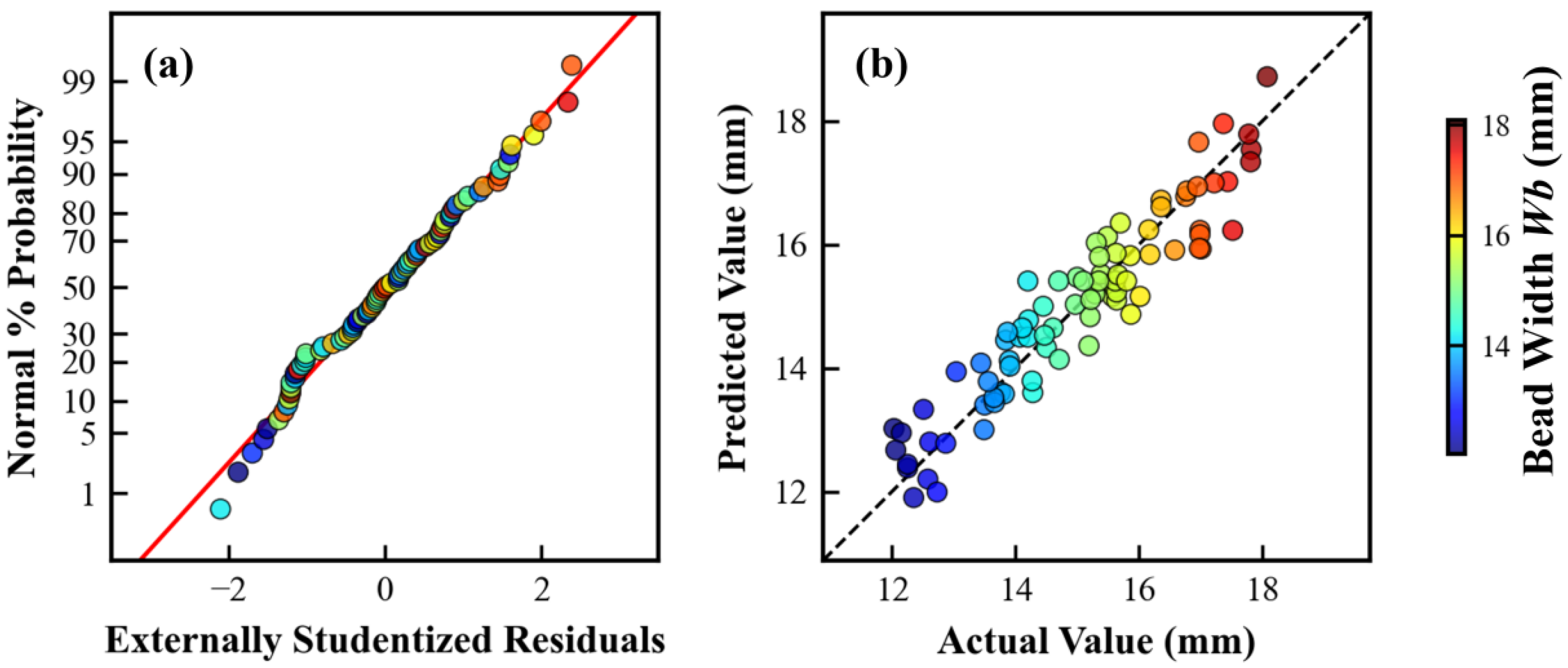
To further examine the statistical reliability of the established quadratic models, diagnostic plots for the bead width were analyzed, as illustrated in Figure 3. The normal probability plot of the externally studentized residuals (Figure 3a) demonstrates that the experimental data points generally follow a linear trend. While exhibiting some inherent scatter typical of complex multi-physics welding processes, this trend confirms that the residuals adequately follow a normal distribution, thereby satisfying the fundamental assumption of the analysis of variance and ensuring the independence of the experimental errors. Furthermore, the correlation between the predicted and actual values for Wb is presented in Figure 3b. It can be observed that the data points are appropriately distributed around the 45-degree diagonal reference line across the entire experimental range (approximately 12.0 mm to 18.1 mm). This alignment consistently reflects the reasonable coefficient of determination (R2) obtained in the previous section. These diagnostic results collectively demonstrate that the proposed regression models possess a reasonably good predictive accuracy that is highly suitable for technical purposes, and they can be reliably employed to navigate the design space and guide the robotic oscillation welding process.

4. Results and Discussion

4.1. Evaluation of Interactive Effects on Weld Geometry

The ANOVA results indicated that the weld bead morphology is not merely a function of individual process parameters but is significantly governed by the interaction between kinematic parameters and groove geometry. To elucidate these mechanisms, 3D response surface plots were generated for the most significant interaction terms.

4.1.1. Root Penetration Sensitivity to Deposition and Geometry

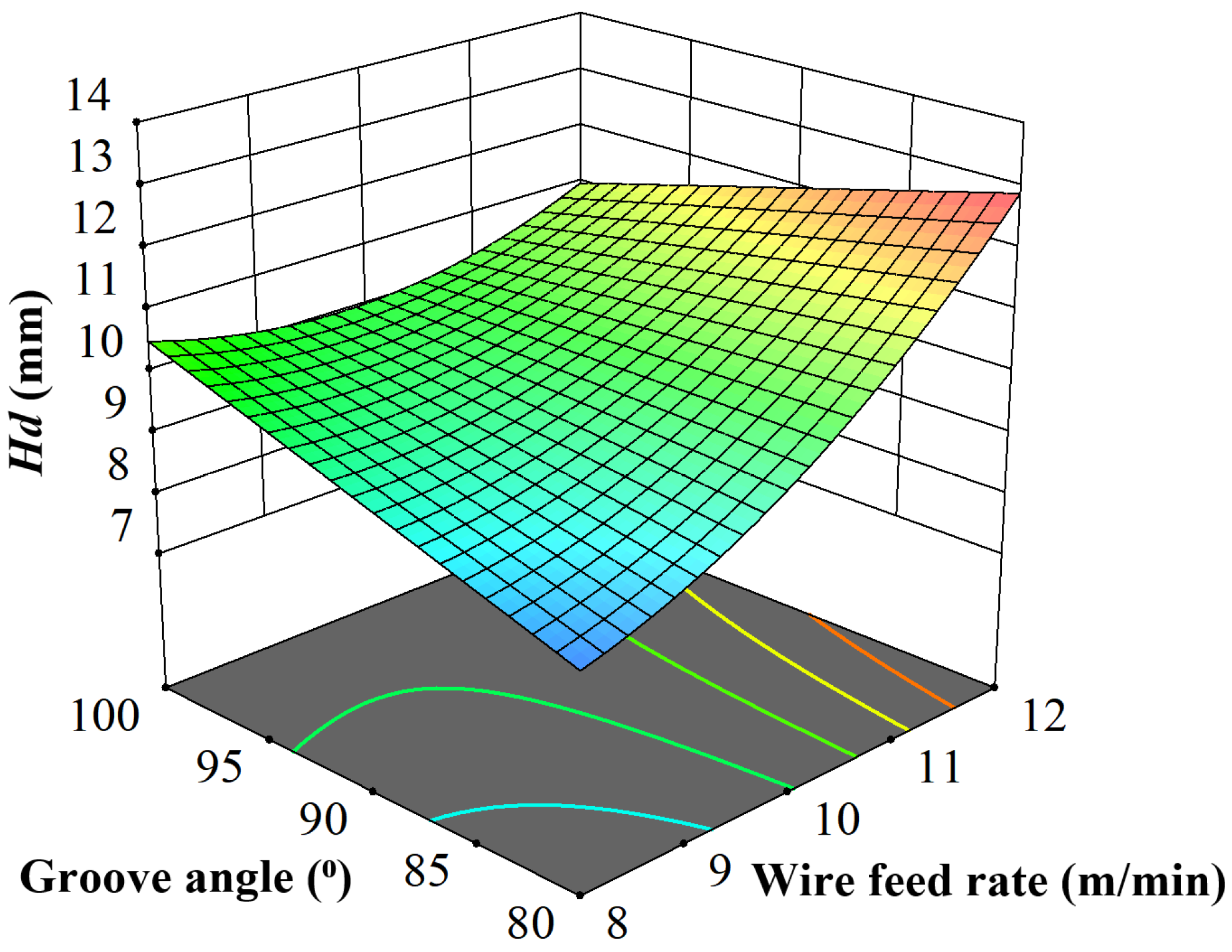
Figure 4 illustrates the interactive effect of wire feed rate W and groove angle c on the root penetration h. It is observed that at a narrow groove angle (80°), increasing the wire feed rate leads to a substantial enhancement in h. This is attributed to the concentrated arc energy and higher hydrostatic pressure of the molten pool in a restricted space, which promotes downward heat convection. However, as the groove angle expands to 100°, the sensitivity of h to the wire feed rate diminishes, manifesting as a flatter slope on the response surface. This phenomenon suggests a “heat dilution” effect where the arc energy is dissipated over a larger area, reducing the effective energy density at the groove root. This interaction proves that compensating for penetration depth in wide-angle grooves requires more than just adjusting filler metal volume; it necessitates a coordinated adjustment of heat input.

4.1.2. Constraints of Travel Speed on Bead Width Expansion

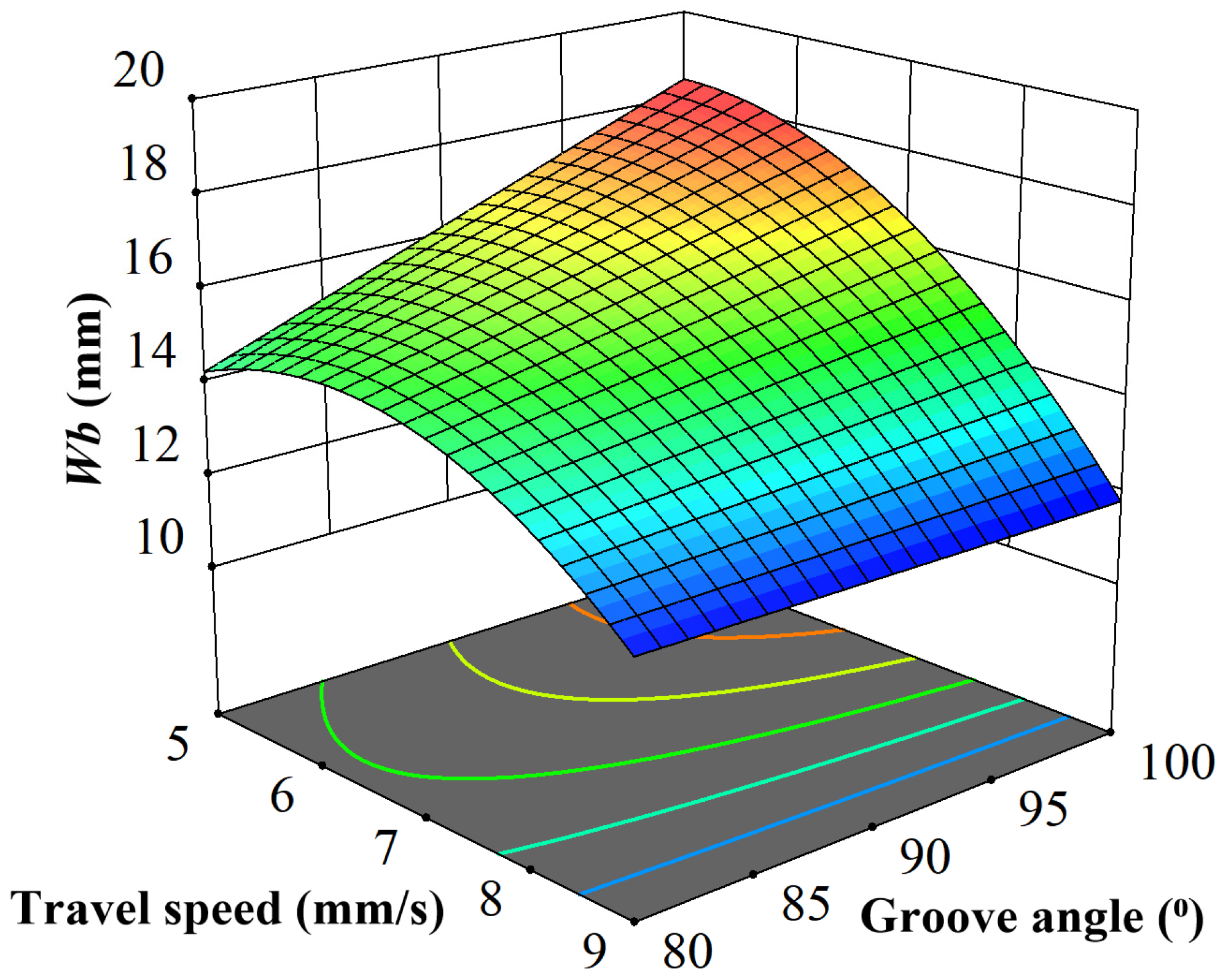
The relationship between travel speed V and groove angle c regarding the bead width Wb is shown in Figure 5. The response surface reveals a distinct synergistic effect. At lower travel speeds, Wb increases significantly as the groove angle widens, as the higher heat input per unit length allows the molten pool sufficient time to spread and wet the sidewalls. Conversely, at elevated travel speeds, the bead width becomes relatively insensitive to the increase in groove angle. This “dynamic lag” in pool spreading indicates that the physical dimensions of the weld are limited by the thermal cycle duration. For non-standard grooves with varying widths, a static travel speed will inevitably result in either lack of fusion in wide sections or excessive heat accumulation in narrow sections, highlighting the necessity of the adaptive speed control discussed in Section 5.

4.1.3. Synergy of Oscillation Kinematics and Sidewall Fusion

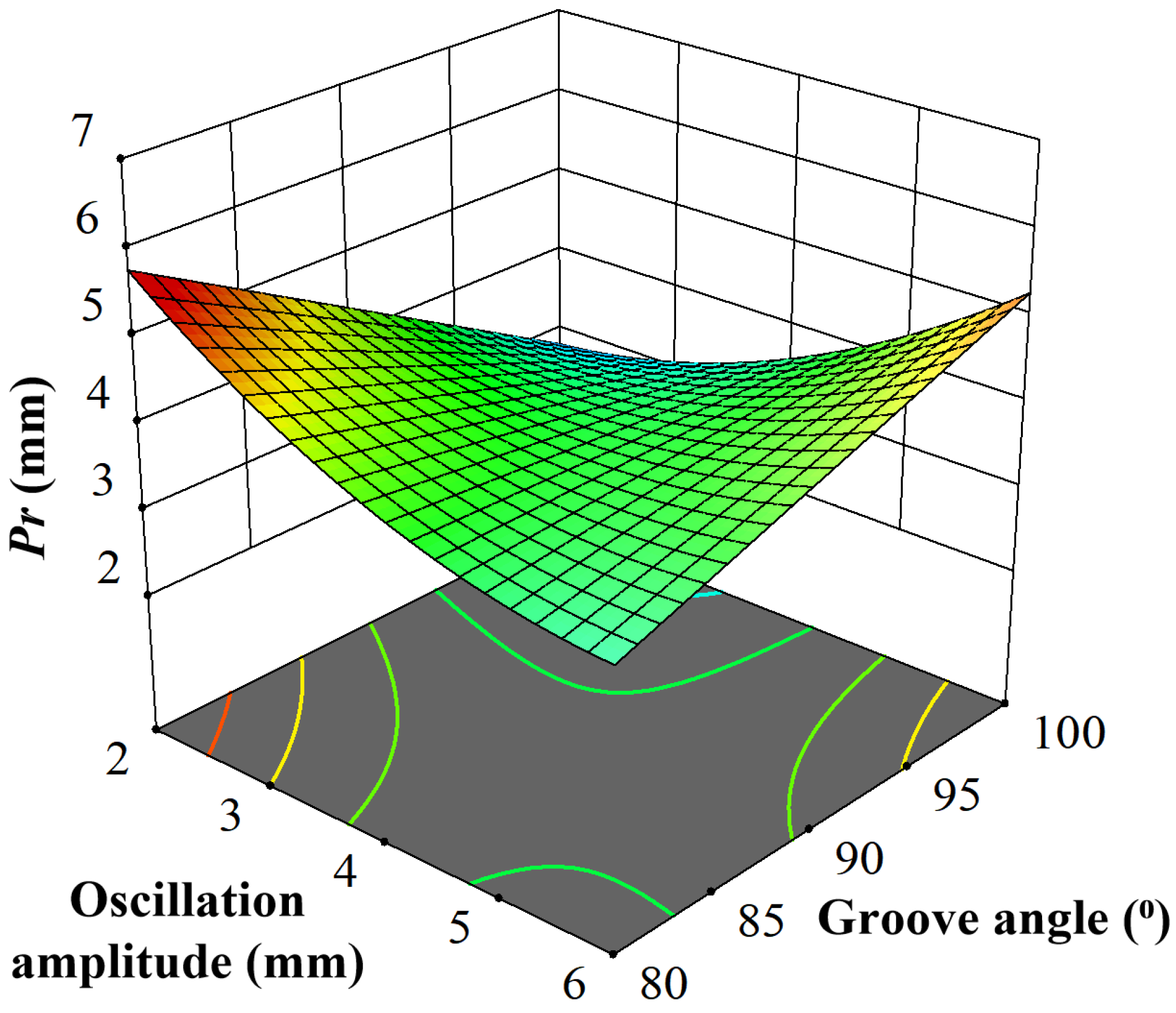
The most critical governing factor for sidewall integrity is the interaction between oscillation amplitude A and groove angle c, as depicted in Figure 6. The surface exhibits a pronounced “twisting” topology, where the maximum right sidewall penetration Pr is only achieved when the oscillation amplitude scales proportionally with the groove angle. At a wide groove angle (100°), a small oscillation amplitude leads to a drastic drop in Pr, as the arc plasma fails to reach and dwell effectively on the sidewall interface. This interaction provides direct evidence for the “spatial mismatch” between the arc path and the groove geometry. The high F-value (72.23) of this term underscores that the oscillation strategy must be geometrically coupled to the groove state to prevent localized lack-of-fusion defects.

4.2. Characterization and Mechanism of Bottom Humping and Associated Defects

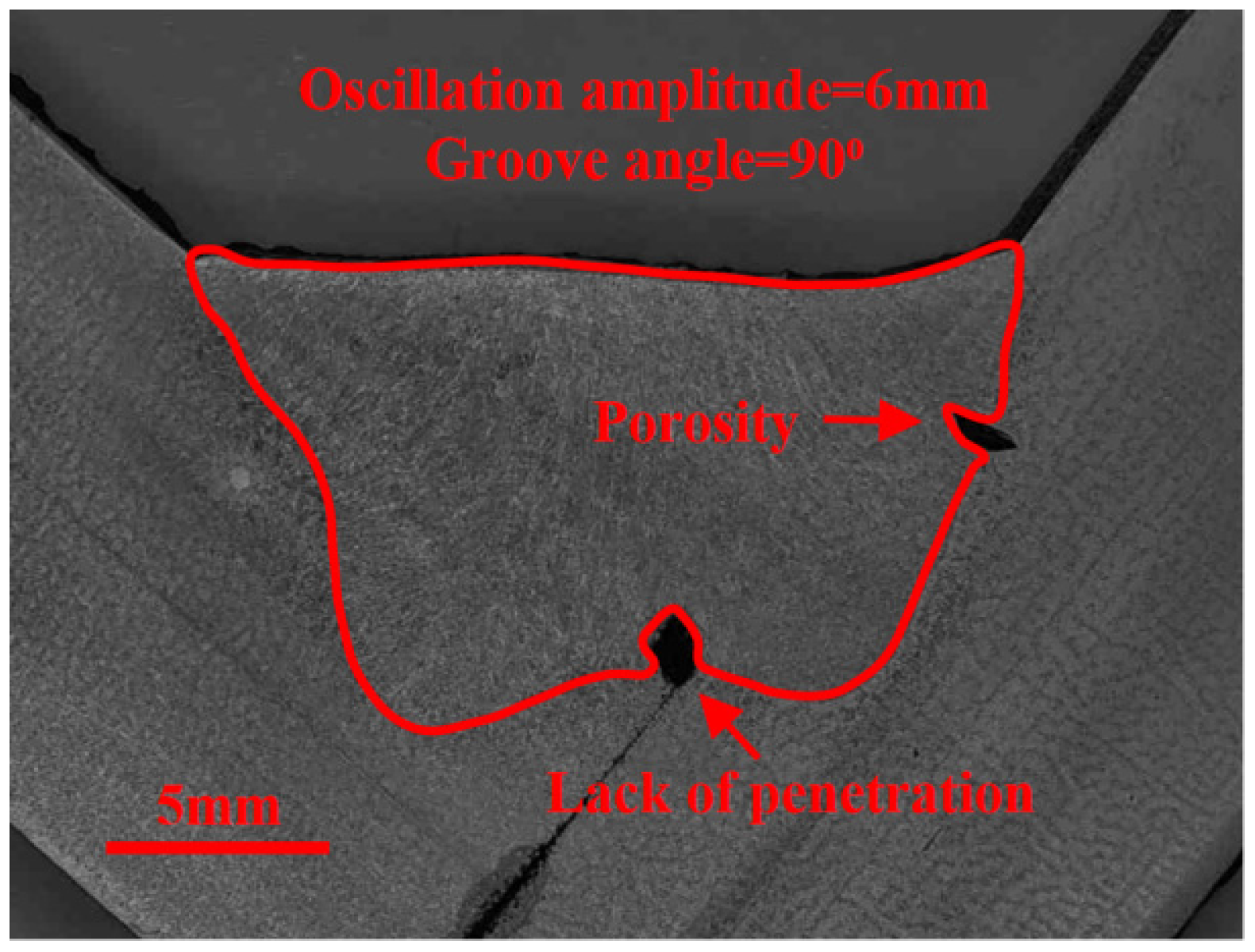
Beyond the standard geometric dimensions, a specific topological defect, referred to as “bottom humping,” was identified during the macrostructural analysis of weld cross-sections under mismatched parameter configurations. As characterized in Figure 7, the defect manifests as a “W-shaped” or dual-lobe penetration profile, where deep fusion occurs at the sidewalls while the root center remains significantly shallow. This creates a prominent “valley” at the root, which in extreme cases results in a lack of penetration (LOP) appearing as a “black hole” or central void. Furthermore, localized porosity was observed near the sidewall fusion line.
The formation of these defects is fundamentally attributed to the mismatch between arc energy distribution and molten pool hydrodynamics. The oscillation strategy, while ensuring sidewall fusion through dwell time at turning points, naturally concentrates heat at the toes. However, when an excessive oscillation amplitude (e.g., A = 6 mm in a 90° groove) is employed, the arc traverses the groove center too rapidly, causing the heat input density to drop below a critical threshold. This overly aggressive oscillation forces the arc too close to the sidewalls, which not only starves the root center of thermal energy—leading to molten pool bifurcation and LOP—but also disrupts the shielding gas coverage and promotes metal vapor entrapment near the sidewall, resulting in porosity.
These defects severely compromise joint integrity. The central LOP “black hole” significantly reduces the effective throat thickness, creating severe stress concentration points susceptible to fatigue cracking. Simultaneously, the sidewall porosity acts as a structural discontinuity, further increasing the risk of premature failure. This highlights that optimizing for geometric dimensions alone is insufficient; ensuring the thermodynamic stability and coalescence of the pool is a prerequisite for a sound joint.
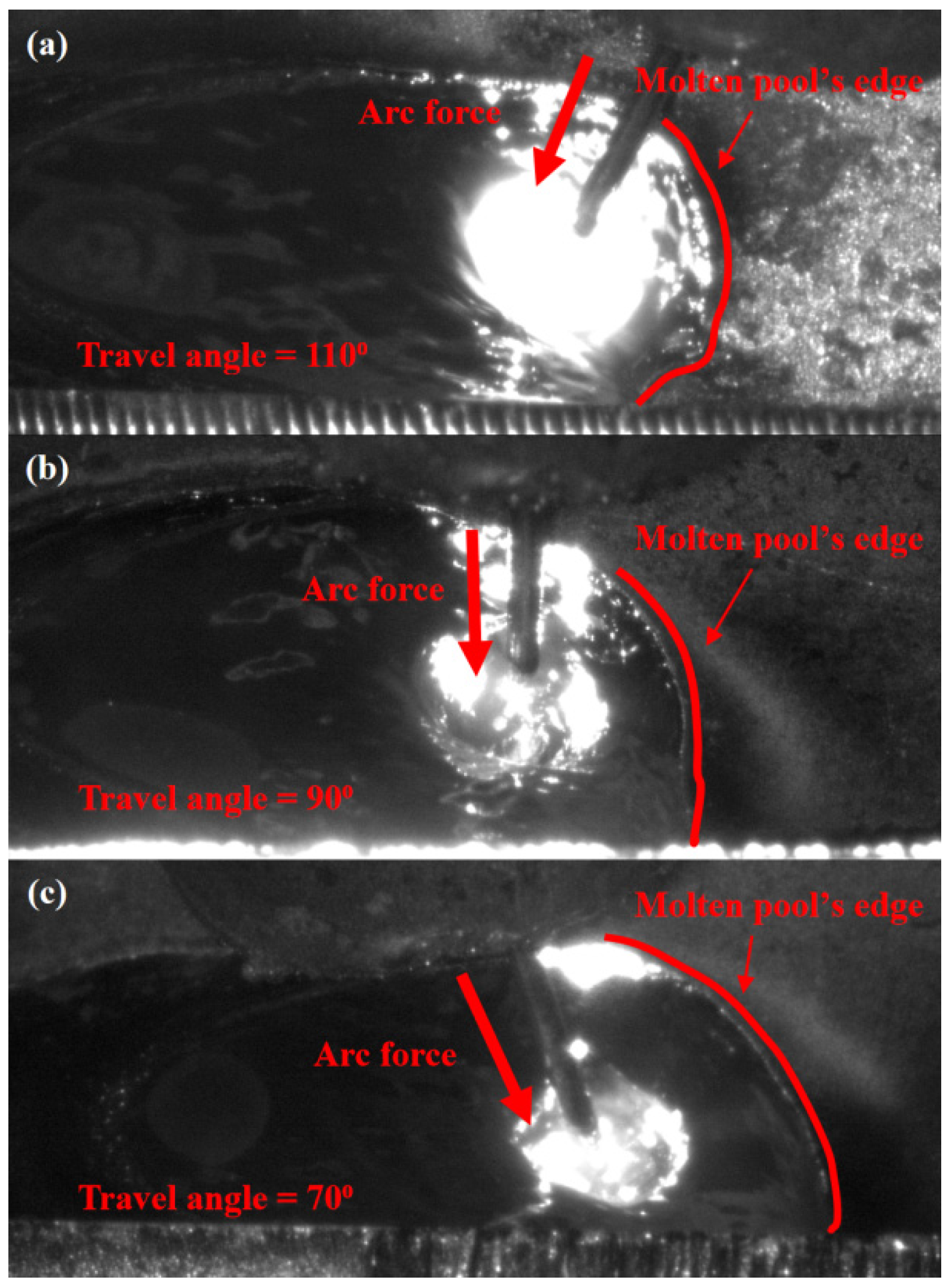
To investigate the suppression of these defects, preliminary experimental observations indicated that the travel angle θ exerts a significant restorative effect on the molten pool morphology. As illustrated in the dynamic study in Figure 8, the travel angle modulates the direction of arc pressure and plasma drag, directly affecting the backfilling capability in the V-shaped joint center. At a drag angle (Figure 8a, θ = 110°), the backward arc force exacerbates the central “valley,” resulting in a retracted leading edge that inhibits forward bridging. The vertical angle (Figure 8b, θ = 90°) shows inconsistent backfilling. Conversely, at a push angle (Figure 8c, θ = 70°), the molten pool exhibits a distinct forward expansion with a convex leading edge. This forward arc force component effectively “pumps” the liquid metal into the root center, ensuring the two lateral streams coalesce before solidification. These findings confirm that a push-angle configuration is a crucial constraint for maintaining molten pool stability, a logic that is quantitatively integrated into the adaptive strategy in Section 5.

5. Intelligent Decision-Making and Adaptive Parameter Selection

5.1. Decision Objectives and Constraint Definition

Conventional welding parameter optimization typically aims to identify a single optimal parameter combination under fixed joint conditions. However, such an approach is inadequate for robotic welding of non-standard components, where joint geometry varies continuously due to manufacturing tolerances and assembly deviations. To clarify the methodological distinction, classical RSM optimization typically seeks a single, static mathematical peak within a predefined, invariant parameter space. In contrast, the “statistical model-based adaptive selection” proposed in this study treats the geometric variation (i.e., the groove angle) as a continuous state variable. Rather than outputting a solitary optimal point, the established response surfaces function as a dynamic knowledge base. In this study, the objective is not merely to obtain a static optimal solution, but to establish a geometry-dependent decision-making mechanism that enables adaptive selection of oscillation welding parameters suitable for real-world manufacturing variability.
To address multi-performance requirements, a multi-objective decision criterion was defined based on both weld geometry requirements and defect avoidance considerations, as summarized in Table 8. Specifically, the framework aims to ensure sufficient root penetration Pd and sidewall fusion (Pl, Pr) to prevent lack-of-fusion and “black hole” defects, while maintaining reinforcement h within a stable range (0.1–1.0 mm) to eliminate surface undercutting. The rationale for the weighting of these optimization targets is strictly based on their impact on structural integrity. In the decision-making process, higher importance (weighting factor 4 out of 5) was assigned to Pd and sidewall fusion because insufficient penetration directly leads to catastrophic lack-of-fusion defects that compromise the ultimate load-bearing capacity of the joint. Conversely, reinforcement was assigned a lower relative importance, as variations within its acceptable tolerance primarily affect surface aesthetics and minor stress concentrations rather than fundamental joint strength.
Furthermore, the rationale for determining the optimization limits of the input parameters is twofold. First, the general upper and lower limits for baseline variables (such as wire feed rate and travel speed) were confined strictly to the stable operating envelope of the GMAW process. These boundaries were established through preliminary empirical trials to ensure consistent arc behavior and prevent spatter. Second, and more importantly, physical constraints derived from the defect mechanisms discussed in Section 4.2 were explicitly incorporated to define the boundaries for critical positional parameters. To suppress bottom humping and ensure molten pool coalescence, the travel angle θ was constrained within a push-angle range of 70–85°. This ensures sufficient forward arc force to “pump” liquid metal into the root center. Furthermore, to avoid the porosity and thermal bifurcation associated with excessive oscillation, the amplitude A was strictly limited to 3.0–5.0 mm. The complete set of objectives and constraints, designed to define a safe operating window across groove angles c from 80° to 100°, is summarized in Table 8.
From a decision-making perspective, these constraints define a safe operating window in the parameter space, within which adaptive parameter selection can be reliably performed to accommodate non-standard welding conditions.

5.2. Geometry-Dependent Intelligent Parameter Selection

Based on the multi-objective criteria defined in Table 8, numerical optimization was executed to determine the optimal processing parameters for three representative groove angles (80°, 90°, and 100°). The decision framework utilized the desirability function to navigate the trade-offs between deposition efficiency and defect avoidance. The resulting optimal parameter sets are summarized in Table 9. As the groove angle increases, the decision model exhibits a clear adaptive scaling law. For the narrow groove (80°), the wire feed speed is throttled to 9.33 m/min, and the oscillation amplitude is conservatively restricted to 3.59 mm. This configuration, combined with a predicted minimal reinforcement of 0.18 mm, indicates that the system prioritized preventing “overflow” defects and sidewall undercut over maximizing deposition rate, strictly adhering to the physical constraints of the narrow gap.
In contrast, for the nominal (90°) and wide (100°) grooves, the system adaptively increases the energy input and geometric coverage. The wire feed speed rises to 10.00 m/min and 10.49 m/min respectively to accommodate the larger cross-sectional areas. Crucially, the oscillation amplitude expands to 4.78 mm for the 100° case, ensuring the arc physically reaches the distant sidewalls to guarantee fusion (Pl and Pr > 2.5 mm). A significant decision pattern is observed in the travel angle θ selection: across all scenarios, the optimized angles converged within the push-angle range of 70–76°. Specifically for the 90° groove, the system selected the lower bound of 70.0°. This aggressive push angle maximizes the forward arc force to counteract the backward flow of the molten pool, thereby effectively suppressing the bottom humping defects identified in previous sections.
These results demonstrate that the proposed intelligent framework does not merely seek a mathematical optimum but generates physically sound decisions. It successfully reconciles the conflicting requirements of deep penetration in narrow gaps and sidewall wetting in wide gaps. By dynamically adjusting the oscillation amplitude and travel angle in response to groove variations, the model defines a robust process window that balances defect suppression with geometric integrity, providing a theoretical basis for the experimental validation in the subsequent section.

5.3. Experimental Validation of Decision-Making Strategy

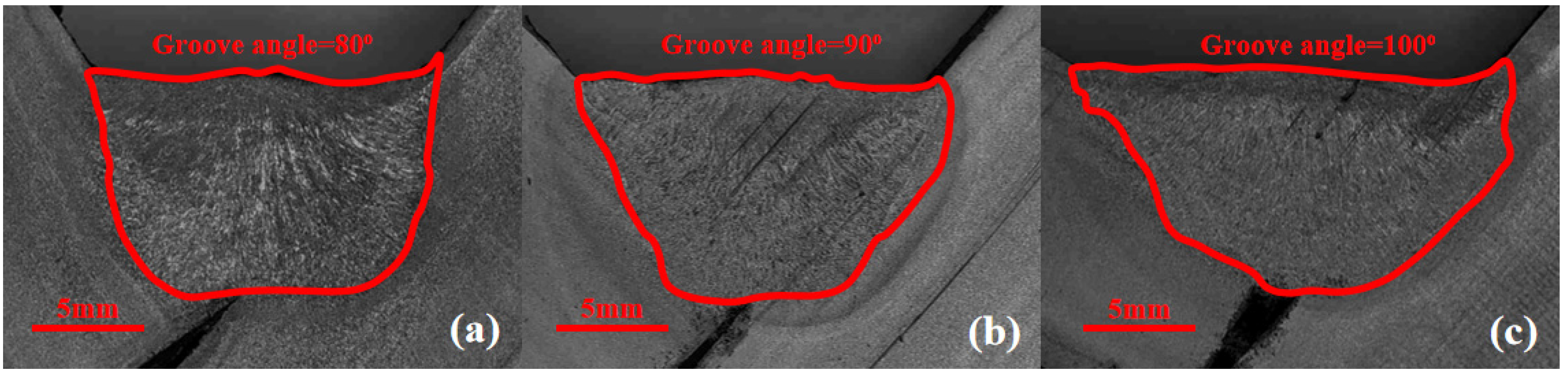
To verify the reliability and effectiveness of the proposed intelligent decision-making framework, confirmatory welding experiments were conducted using the geometry-dependent parameter sets listed in Table 9. The macrographs of weld cross-sections obtained for groove angles of 80°, 90°, and 100° are shown in Figure 9. The experimental results consistently show sound weld formation without macro-defects such as undercut, lack of fusion, or the “W-shaped” bottom humping identified in previous unoptimized trials.
For the narrow groove (80°), the weld exhibits controlled reinforcement (0.20 mm) and complete root fusion, confirming that the restricted oscillation amplitude (3.59 mm) effectively balanced heat input within the confined volume. Under the nominal condition (90°), the aggressive push-angle constraint successfully stabilized the molten pool, resulting in uniform sidewall fusion and a stable penetration of 9.63 mm. For the wide groove (100°), the adaptive increase in amplitude and dwell time compensated for the increased opening, achieving symmetric fusion and a broad bead width (19.25 mm). While the reinforcement remained low (0.15 mm), the joint maintained a positive profile, avoiding the underfill defects common in large-gap welding.
The quantitative comparison between the predicted and measured geometric features is summarized in Table 10. To rigorously evaluate the model’s reliability, the validation error rate was calculated as a percentage for each key metric. The framework demonstrates high predictive accuracy for root penetration Pd and bead width Wb, with validation error rates for penetration staying remarkably low (ranging from 0.59% to 6.41% across all tested groove angles). Similarly, the prediction error rates for bead width were maintained within acceptable industrial limits (3.04% to 12.05%). Although higher percentage deviations (up to 46.43%) in reinforcement h were observed in the 90° and 100° cases, this is attributed to the increased fluid mobility and gravity-induced spreading of the molten pool in wider groove geometries, which are inherently difficult to capture with purely statistical models. Nevertheless, the overall morphological characteristics and critical structural dimensions remain in excellent agreement with the model’s intent, confirming the robustness of the decision-making mechanism.

5.4. Discussion on Decision Logic and Industrial Implications

Based on the verified results, the intelligent decision-making strategy for adaptive oscillation welding can be synthesized into a set of physically grounded rules. First, the travel angle θ should be maintained in a specific push configuration (around 70–75°). This ensures that the arc force provides sufficient forward momentum to the molten pool, effectively suppressing the “W-shaped” bottom humping by facilitating molten pool bridging at the root center.
Second, the oscillation amplitude A must be adaptively scaled with the groove angle. This monotonic increase ensures that the plasma arc maintains a consistent proximity to the groove sidewalls, guaranteeing fusion while avoiding root unfused defects. Third, for wide groove angles (c > 95°), the integration of an increased dwell time t is essential to stabilize the molten pool edges and compensate for the thermal dissipation caused by the expanded joint volume.
These decision rules, directly derived from the synergy of response surface models and defect-aware constraints, provide an interpretable basis for intelligent process control. Unlike “black-box” optimization, this framework offers a clear physical trajectory for parameter adaptation. Such a mechanism can be readily integrated with real-time sensing systems (e.g., laser vision) and robot controllers to form a closed-loop system. As the sensor detects continuous variations in the groove angle, the controller can instantaneously query the offline-established rules to adaptively adjust the oscillation parameters on the fly, offering a robust and practical pathway toward autonomous robotic welding in non-standard industrial environments.

6. Conclusions

This study developed a geometry-dependent intelligent decision-making framework for the oscillation welding of non-standard components, specifically addressing the challenges of continuously varying groove angles. The key findings and contributions are summarized as follows:
(1)
Integrated Knowledge Modeling: Instead of conventional static optimization, Response Surface Methodology was utilized to establish an adaptive knowledge base tailored for real-world multi-performance requirements. Predictive models were developed to map the complex relationships between five key process parameters and the resulting weld geometry, achieving high statistical reliability (R2 > 0.82 for all key responses). The high significance of these models provides a reliable foundation for autonomous parameter selection across varying groove configurations.
(2)
Defect-Aware Decision Constraints: A major contribution of this work is the translation of defect formation mechanisms into interpretable decision constraints. Specifically, the “W-shaped” bottom humping was suppressed by enforcing a push-angle constraint (70–85°), while root and sidewall fusion were guaranteed by adaptively restricting the oscillation amplitude (3.0–5.0 mm). These physically grounded constraints ensure that the decision-making process remains within a “defect-free” process window.
(3)
Adaptive Parameter Evolution: The framework successfully derived geometry-dependent evolution laws for grooves ranging from 80° to 100°. It was revealed that the system intelligently balances the volumetric filling rate and energy distribution by scaling the wire feed speed and oscillation amplitude in response to increasing groove width, while maintaining aggressive travel angles to stabilize the molten pool.
(4)
Experimental Accuracy and Robustness: Confirmatory experiments demonstrated that the framework consistently produces sound welds across narrow, nominal, and wide grooves (ranging from 80° to 100°). Quantitative validation showed that the root penetration Pd prediction error was maintained below 7% (e.g., 0.59% for the 80° groove) and bead width error was kept below 13%, while critical defects such as lack of fusion and humping were effectively eliminated.
In summary, this work bridges the gap between geometric perception and autonomous process control. By transforming statistical response surfaces into adaptive decision rules with explicit physical constraints, the proposed framework offers a practical and interpretable pathway for the intelligent robotic welding of complex, non-standard manufacturing components. Despite these advancements, the proposed purely statistical approach inherently relies on static mathematical approximations, which limits its capability to predict highly transient molten pool dynamics under extreme or abrupt geometric variations outside the experimental matrix. To address this limitation, future work will focus on integrating Physics-Informed Deep Learning (PIDL) or two-stage machine learning architectures. By embedding fundamental multi-physics boundary conditions into the neural network training process, such advanced models will be able to capture deeper, highly non-linear flow behaviors, thereby further enhancing the robustness, accuracy, and generalization capability of the intelligent decision-making mechanism in increasingly complex industrial environments.

Author Contributions

L.Z.: Conceptualization, Methodology, Data curation, Writing—original draft. L.C.: Funding acquisition, Methodology, Data curation. L.L.: Data curation. S.Y.: Conceptualization, Writing—review & editing. M.P.: Writing—review & editing. H.P.: Funding acquisition, Conceptualization. All authors have read and agreed to the published version of the manuscript.

Funding

This work was supported by the National Natural Science Foundation of China (Grant No. 51465005); by the Guangxi Science and Technology Major Program (Grant Nos. AA18118002 and 2025JFJF27003); by the Guangxi Natural Science Foundation (Grant No. 2025JJH170094, 2026GXNSFHA00640304 and 2026GXNSFHA00640064); and by the Innovation Project of Guangxi Graduate Education (Grant Nos. YCBZ2024015 and A3010022002).

Data Availability Statement

The original contributions presented in this study are included in the article. Further inquiries can be directed to the corresponding author.

Conflicts of Interest

The authors declare no conflicts of interest.

References

  1. Mattera, G.; Vozza, M.; Polden, J.; Nele, L.; Pan, Z. Frequency informed convolutional autoencoder for in situ anomaly detection in wire arc additive manufacturing. J. Intell. Manuf. 2025, 36, 5819–5834. [Google Scholar] [CrossRef]
  2. Tümer, M.; Schneider-Bröskamp, C.; Enzinger, N. Fusion welding of ultra-high strength structural steels—A review. J. Manuf. Process. 2022, 82, 203–229. [Google Scholar] [CrossRef]
  3. Guo, J.; Zhu, Z.; Sun, B.; Zhang, T. A novel field box girder welding robot and realization of all-position welding process based on visual servoing. J. Manuf. Process. 2021, 63, 70–79. [Google Scholar] [CrossRef]
  4. He, F.; Yuan, L.; Mu, H.; Yang, J.; Ding, D.; Li, H.; Pan, Z. A framework for advancing machine vision in wire arc directed energy deposition manufacturing system. J. Manuf. Process. 2025, 147, 1–15. [Google Scholar] [CrossRef]
  5. Han, R.; Fan, X.; Wang, J.; Ren, D.; Song, G. Enhancing all-position weldability and weld quality via an innovative laser-GMAW hybrid welding technique with copper liner. J. Manuf. Process. 2024, 124, 697–707. [Google Scholar] [CrossRef]
  6. Kindermann, R.M.; Roy, M.J.; Morana, R.; Prangnell, P.B. Process response of Inconel 718 to wire + arc additive manufacturing with cold metal transfer. Mater. Des. 2020, 195, 109031. [Google Scholar] [CrossRef]
  7. Ni, Z.; Dong, B.; Li, Y.; Cai, X.; Lin, S. Effects of processing parameters on molten behavior, arc stability, and defect forming in swing-arc narrow gap GMA vertical up welding. J. Mater. Process. Technol. 2023, 321, 118155. [Google Scholar] [CrossRef]
  8. Xu, Y.; Liu, Q.; Xu, J.; Xiao, R.; Chen, S. Review on multi-information acquisition, defect prediction and quality control of aluminum alloy GTAW process. J. Manuf. Process. 2023, 108, 624–638. [Google Scholar] [CrossRef]
  9. Zhu, K.; Wang, Q.; Chen, W.; Li, X.; Xiao, R.; Chen, H. Robotic MAG welding defects and quality assessment with a defect threshold decision model-driven method. Mech. Syst. Signal Process. 2025, 224, 112056. [Google Scholar] [CrossRef]
  10. Pan, H.; Wang, L.; Fu, Y.; Jia, B.; Chen, L. A novel method: YOLO-CE and 3D point cloud-based feature extraction for welding seams of tower bases. Meas. Sci. Technol. 2024, 36, 015209. [Google Scholar] [CrossRef]
  11. He, F.; Yuan, L.; Mu, H.; Ros, M.; Ding, D.; Pan, Z.; Li, H. Research and application of artificial intelligence techniques for wire arc additive manufacturing: A state-of-the-art review. Robot. Comput. Integr. Manuf. 2023, 82, 102525. [Google Scholar] [CrossRef]
  12. Chandra, M.; Rajak, S.; Kek, V. Deep learning-based framework for the observation of real-time melt pool and detection of anomaly in wire-arc additive manufacturing. Mater. Manuf. Process. 2024, 39, 761–777. [Google Scholar] [CrossRef]
  13. Li, R.; Ma, H.; Wang, R.; Song, H.; Zhou, X.; Wang, L.; Zhang, H.; Zeng, K.; Xia, C. Application of unsupervised learning methods based on video data for real-time anomaly detection in wire arc additive manufacturing. J. Manuf. Process. 2025, 143, 37–55. [Google Scholar] [CrossRef]
  14. Cai, C.; Liu, Y.; Wang, E.; Chen, H.; Chen, Z. Mechanisms of Gap Bridging and Hump Suppression in Oscillating Laser-Arc Hybrid Welding of Thick Plate Steel under Variable Gap Conditions. J. Mater. Process. Technol. 2025, 339, 118819. [Google Scholar] [CrossRef]
  15. Wang, J.; Zhu, J.; Zhang, C.; Wang, N.; Su, R.; Yang, F. Development of swing arc narrow gap vertical welding process. ISIJ Int. 2015, 55, 1076–1082. [Google Scholar] [CrossRef]
  16. Li, W.; Zhang, H.; Wang, G. Deep learning based online metallic surface defect detection method for wire and arc additive manufacturing. Robot. Comput. Integr. Manuf. 2023, 80, 102470. [Google Scholar] [CrossRef]
  17. Li, L.; Ren, J.; Wang, P.; Lü, Z.; Di, R.; Li, X.; Zhao, X. Defect detection method for high-resolution weld based on wandering Gaussian and multi-feature enhancement fusion. Mech. Syst. Signal Process. 2023, 199, 110484. [Google Scholar] [CrossRef]
  18. Wang, J.; Zhu, J.; Zhang, C.; Xu, G.; Li, W. Effect of arc swing parameters on narrow gap vertical GMA weld formation. ISIJ Int. 2016, 56, 844–850. [Google Scholar] [CrossRef]
  19. Tomaz, I.D.V.; Colaço, F.H.G.; Sarfraz, S.; Pimenov, D.Y.; Gupta, M.K.; Pintaude, G. Investigations on quality characteristics in gas tungsten arc welding process using artificial neural network integrated with genetic algorithm. Int. J. Adv. Manuf. Technol. 2021, 113, 3569–3583. [Google Scholar] [CrossRef]
  20. Du, W.; Sun, G.; Li, Y.; Chen, C. Process Optimization, Microstructure and Mechanical Properties of Wire Arc Additive Manufacturing of Aluminum Alloy by Using DP-GMAW Based on Response Surface Method. Materials 2023, 16, 5716. [Google Scholar] [CrossRef]
  21. Escribano-García, R.; Rodriguez, N.; Zubiri, O.; Piccini, J.; Setien, I. 3D Numerical Simulation of GMAW Cold Metal Transfer Using Response Surface Methodology. J. Manuf. Process. 2022, 76, 656–665. [Google Scholar] [CrossRef]
  22. Paul, A.R.; Biswas, S.; Warsi, R.; Mukherjee, M.; Mandal, A. Development of RSM-based multi-attribute genetic algorithm (RAGA) for optimisation of bead profile and hardness of Al4043 weld deposits. Cogent Eng. 2025, 12, 2572300. [Google Scholar] [CrossRef]
  23. Liu, W.; Li, Q.; Yue, J.; Zhu, P.; Li, B. Research Status and Progress of All-Position Narrow-Gap GMAW for Pipelines. Appl. Sci. 2025, 15, 2270. [Google Scholar] [CrossRef]
  24. AWS A3.0M/A3.0:2020; Standard Welding Terms and Definitions. American Welding Society: Miami, FL, USA, 2020.
Figure 1. Experimental setup and oscillation welding strategy: (a) automated GMAW platform; (b) schematic of torch oscillation parameters; (c) zigzag oscillation trajectory.
Processes 14 01057 g001
Figure 2. Schematic of weld bead cross-sectional geometry and definition of quality indices.
Processes 14 01057 g002
Figure 3. Diagnostic plots for n=bead width Wb: (a) normal probability plot of residuals (red line: ideal normal distribution); (b) predicted vs. actual values (dashed line: ideal y = x reference).
Processes 14 01057 g003
Figure 4. Interactive effect of wire feed rate and groove angle on root penetration.
Processes 14 01057 g004
Figure 5. Interactive effect of travel speed and groove angle on bead width.
Processes 14 01057 g005
Figure 6. Interactive effect of oscillation amplitude and groove angle on right sidewall penetration.
Processes 14 01057 g006
Figure 7. Macro-morphology of the weld cross-section exhibiting a typical “bottom humping” defect.
Processes 14 01057 g007
Figure 8. In situ observation of molten pool dynamic morphology under different travel angles: (a) θ = 110° (drag angle); (b) θ = 90° (vertical angle); (c) θ = 70° (push angle).
Processes 14 01057 g008
Figure 9. Macro-morphologies of weld cross-sections under different groove conditions optimized by the decision-making framework: (a) 80° groove; (b) 90° groove; (c) 100° groove.
Processes 14 01057 g009
Table 1. Welding process parameters and their levels in the CCD.
SymbolFactorUnitLevel −2Level −1Level 0Level +1Level +2
WWire feed ratem/min89101112
VTravel speedmm/s56789
θTravel angle°708090100110
AOscillation amplitudemm23456
tDwell times0.20.30.40.50.6
cGroove angle°80859095100
Table 2. CCD matrix and measured experimental responses.
StdRunCoded VariablesResponse Parameters
WVθAtchPdWbPlPr
m/minmm/s°mms°mmmmmmmmmm
161968030.3850.810.9212.154.564.55
2491168030.3851.112.6814.475.254.91
340988030.3850.610.2112.584.564.22
4661188030.3850.711.1213.564.644.46
5249610030.385−0.359.0513.763.594.12
63711610030.3850.4311.4414.714.894.32
729810030.385−0.058.3412.353.333.78
86311810030.3850.6310.7312.254.244.01
945968050.385−0.119.2113.654.853.41
10251168050.3850.3310.8215.644.344.66
1156988050.385−0.318.3712.873.863.63
12441188050.3850.329.8815.193.513.79
13349610050.385−0.379.1314.073.513.28
144711610050.385−0.1211.5214.974.283.75
1549810050.385−0.558.4212.6133.31
164111810050.385−0.1510.8112.514.343.84
1710968030.5850.6310.6814.54.345.05
1871168030.5850.6112.3416.584.955.52
1932988030.5850.149.8713.824.054.74
20761188030.5850.5211.3516.024.064.98
2169610030.585−0.639.0215.864.144.68
227811610030.585−0.1211.5115.74.624.81
23229810030.585−1.128.4113.93.384.52
245411810030.585−0.2510.7114.114.64.06
2568968050.5850.2310.9515.295.313.66
26171168050.5850.6312.1516.766.574.66
2726988050.585−0.159.7713.844.063.29
28581188050.5850.2410.9615.315.324.26
29469610050.585−0.8510.5217.225.154.52
301511610050.585−0.4111.8517.826.554.95
31149810050.585−1.269.2315.613.764.11
32511810050.585−0.8310.5316.185.154.54
3348968030.3950.6410.7514.24.943.4
34531168030.3950.6711.4416.364.993.73
3564988030.3950.5810.0512.064.893.07
36161188030.3950.6310.7414.214.943.41
3789610030.3950.5510.4115.574.823.76
38311610030.3950.5911.1116.995.024.11
39199810030.3950.499.6512.254.913.36
403311810030.3950.5610.2613.665.123.7
4120968050.3950.538.9715.214.644.01
42591168050.3950.4110.7516.954.554.58
4373988050.3950.6610.2213.494.743.45
44711188050.3950.538.9915.224.634.02
45759610050.395−0.459.7515.364.594.18
463811610050.395−0.4110.4416.784.784.53
47509810050.395−0.518.9812.034.673.78
483011810050.395−0.449.5913.444.884.12
4955968030.5950.7111.2615.645.243.71
50521168030.5950.7511.9617.815.34.05
5129988030.5950.6610.5613.55.23.38
52601188030.5950.7111.2615.665.253.72
53119610030.5950.5510.4516.364.723.78
542111610030.5950.5911.1517.784.924.12
55279810030.5950.499.6913.044.813.38
561311810030.5950.5510.3114.455.013.72
5762968050.5950.8411.4215.636.194.51
58121168050.5950.7212.0517.376.114.91
5928988050.5950.979.6713.916.293.99
60181188050.5950.2611.1915.495.984.55
6119610050.595−0.410.9316.975.334.22
627011610050.595−0.1811.8718.085.874.89
63519810050.595−0.6210.0115.874.814.15
646511810050.595−0.3910.9416.985.344.23
6569879040.490−0.88.0114.283.553.89
66421279040.4900.4411.6616.165.074.45
67361059040.4900.5911.6815.395.625.48
68771099040.4900.39.7512.734.934.45
69231077040.4900.329.6315.003.843.11
703910711040.490−0.168.7217.013.722.73
71431079020.4900.349.5414.612.813.81
72351079060.490−0.868.4816.994.534.15
73741079040.290−0.297.6114.273.472.45
7491079040.6900.159.9817.444.183.59
75671079040.480−0.489.313.873.943.23
76311079040.41000.69.3517.524.783.2
77721079040.4900.6510.6215.353.643.85
78571079040.490−0.219.7315.624.183.18
79791079040.4900.129.914.23.64.15
80801079040.490−0.1810.314.74.24.2
81811079040.4900.1410.615.843.91
82821079040.4900.3810.715.14.34.1
Table 8. Multi-objective optimization criteria and decision constraints for adaptive parameter selection.
CategoryParameter/ResponseGoalRange/TargetImportance
Input VariablesWire feed speed (W, m/min)In range8.0–12.03
Travel speed (V, mm/s)In range5.0–9.03
Travel angle (θ, °)In range70–854
Oscillation amplitude (A, mm)In range3.0–5.03
Dwell time (t, s)In range0.3–0.53
Groove angle (c, °)In range80–1003
ResponsesReinforcement (h, mm)In range0.1–1.03
Root penetration (Pd, mm)Maximize8.5–10.54
Bead width (Wb, mm)In range14.0–19.03
Sidewall fusion (Pl, mm)In range2.5–4.54
Sidewall fusion (Pr, mm)In range2.5–454
Table 9. Optimal parameter sets generated by the decision model.
Groove Angle (c)Wire Feed Speed (W, m/min)Travel Speed (V, mm/s)Travel Angle (θ, °)Oscillation Amplitude (A, mm)Dwell Time (t, s)Desirability
80°9.336.5375.63.590.451.000
90°10.007.0070.04.000.41.000
100°10.496.8873.74.780.451.000
Table 10. Comparison between predicted and experimental weld geometric features.
Groove Angle (c)MetricPredicted Value (mm)Measured Value (mm)Relative Error
80°Root Penetration Pd10.1710.230.59%
Reinforcement h0.180.2011.11%
Bead Width Wb14.1514.623.32%
90°Root Penetration Pd10.299.636.41%
Reinforcement h0.520.3238.46%
Bead Width Wb15.4715.003.04%
100°Root Penetration Pd10.1610.230.69%
Reinforcement h0.280.1546.43%
Bead Width Wb17.1819.2512.05%
Disclaimer/Publisher’s Note: The statements, opinions and data contained in all publications are solely those of the individual author(s) and contributor(s) and not of MDPI and/or the editor(s). MDPI and/or the editor(s) disclaim responsibility for any injury to people or property resulting from any ideas, methods, instructions or products referred to in the content.