Article

Research on the Steel Enterprise Gas–Steam–Electricity Network Hybrid Scheduling Model for Multi-Objective Optimization

1
State Key Laboratory of Metallurgical Intelligent Manufacturing System, Automation Research and Design Institute of Metallurgical Industry Co., Ltd., Central Iron & Steel Research Institute, Beijing 100071, China
2
School of Metallurgical and Ecological Engineering, University of Science and Technology Beijing, Beijing 100083, China
3
School of Minerals Processing and Bioengineering, Central South University, Changsha 410083, China
*
Authors to whom correspondence should be addressed.
Processes 2026, 14(7), 1030; https://doi.org/10.3390/pr14071030
Submission received: 4 February 2026 / Revised: 1 March 2026 / Accepted: 12 March 2026 / Published: 24 March 2026
(This article belongs to the Special Issue Advanced Ladle Metallurgy and Secondary Refining)

Abstract

The operation of the gas–steam–electricity multi-energy coupling system in iron and steel enterprises faces critical challenges: conflicts between energy efficiency and economic objectives, insufficient scheduling accuracy, and low energy utilization caused by source–load fluctuations. To address these issues, this paper proposes a hybrid scheduling model based on condition awareness and multi-objective optimization. The model integrates three key components. First, an energy fluctuation prediction technology based on working condition changes is developed. By acquiring real-time production signals and gas flow data, combined with a condition definition management module, it enables automatic identification and tracking of equipment operation status. A working condition sample curve superposition method is used to calculate energy medium imbalances, generating visual prediction curves for key parameters such as blast furnace, coke oven, and converter gas holder levels, achieving an average prediction accuracy of ≥95%. Second, a peak-shifting and valley-filling scheduling model for gas holders is designed, leveraging time-of-use electricity prices. During valley price periods, power purchases are increased and surplus gas is stored; during peak price periods, gas power generation is increased to reduce purchased electricity. A nonlinear model capturing the load–efficiency relationship of boilers and generators is established to dynamically optimize scheduling strategies. This reduces the proportion of peak hour power purchases by 10.3%, energy costs by 3.12%, and system energy consumption by 2.16%. Third, a multi-period and multi-medium energy optimization scheduling model is formulated as a mixed-integer nonlinear programming (MINLP) problem, with dual objectives of minimizing operating cost and energy consumption. Constraints include energy supply–demand balance, equipment operating limits, gas holder capacity, and generator ramp rates. The Pareto optimal solution set is obtained using the AUGMECON2 method and efficiently computed with the IPOPT solver. Application results demonstrate that the model achieves zero gas emissions, a dispatching instruction accuracy of 95%, and a 0.8% increase in the proportion of peak–valley-level self-generated power, outperforming comparable technologies. It provides technical support for the safe, efficient, and economic operation of multi-energy systems in iron and steel enterprises.

1. Introduction

The data presented in this study, including the energy medium characteristics in Table 1 and system parameters in Table 2, are derived from on-site measurements and production records obtained from a collaborating iron and steel enterprise.
As a pillar industry of China’s national economy, the iron and steel sector plays an irreplaceable role in supporting economic growth, promoting industrial upgrading, and ensuring the supply of national strategic materials [1,2]. However, against the dual background of China’s “double carbon” goals (carbon peaking and carbon neutrality) and the implementation of the EU Carbon Border Adjustment Mechanism (CBAM), the industry is facing unprecedented pressure for green transformation. These policies require energy-intensive industries to accelerate energy conservation and carbon reduction, making energy efficiency as critical as economic performance. In this context, improving the utilization efficiency of multi-energy systems has become a core issue for sustainable development.
The production process in iron and steel enterprises involves multiple energy media—gas, steam, and electricity—which are relatively independent yet closely coupled through complex conversion relationships [3]. Among them, by-product gases (blast furnace gas, coke oven gas, converter gas) are key energy carriers that directly affect production efficiency, cost control, and carbon emissions. Their specific types, performance indicators, costs, and consumption trends are critical to the operation of multi-energy coupling systems, as detailed in Table 2 (see Section 2).
The energy system of steel enterprises constitutes a complex multi-medium coupled system with overlapping operational conditions and multi-period coordination. It primarily comprises key equipment including gas holder systems, power generation units, blast furnace systems, steelmaking systems, heat treatment systems, continuous casting systems, sintering systems, and pelletizing systems. The system features storage facilities such as blast furnace gas holders, coke oven gas holders, and converter gas holders, along with power generation units and production process equipment. These components collectively form a comprehensive network for energy production, storage, dispatching, and consumption, with the specific parameters detailed in Table 1.
However, the operation of such “gas–steam–electricity” multi-energy coupling systems faces significant challenges, including conflicts between energy efficiency and economic objectives, insufficient scheduling accuracy under source–load fluctuations, and inadequate modeling of multi-medium coupling [4]. These problems hinder the optimal allocation of energy resources and limit the ability of enterprises to respond to policy pressures.
Extensive research has been conducted on energy optimization in steel enterprises. Existing studies can be categorized into four main streams: single-medium scheduling, multi-energy coupling scheduling, energy fluctuation prediction, and production process coordination.
Single-medium scheduling research focuses on the optimal allocation of a single energy medium, primarily by-product gas. For example, Zhang et al. [5] established scheduling models for by-product gas to reduce operating costs and achieve zero gas emission. Yang et al. [6] and Sun et al. [7] further developed optimization and scheduling methods for by-product gas systems in steel plants. Zhao et al. [8,9,10] developed a series of optimization models for by-product gas distribution, including a MILP model considering penalty factors [8], an optimal scheduling model incorporating time-of-use electricity pricing [9], and a dynamic optimal allocation model for surplus gas [10]. Shi et al. [11] proposed a short-period optimal scheduling model for by-product gas in steel enterprises. Kim et al. [12] optimized gas allocation between boilers and holders using MILP models for plantwide multiperiod optimization. While these studies laid a foundation for single-medium optimization, they overlook the complex coupling between multiple energy sources in real production.
Production process-related scheduling research optimizes energy use from the perspective of process coordination. Li et al. [13] developed a steelmaking scheduling model based on time–temperature coordination, reducing temperature drops in steelmaking-continuous casting processes. He et al. [14] established a molten steel temperature prediction model for online control and dynamic scheduling systems. These studies improve process stability but do not deeply couple with energy system scheduling, leaving potential energy savings unexplored.
Multi-energy coupling scheduling research addresses the collaborative optimization of gas, steam, and electricity. Hu et al. [15] demonstrated that multi-objective optimization yields more comprehensive benefits than single-objective approaches for gas–steam–electricity conversion systems. He et al. [16,17] proposed “rule + model” composite scheduling methods and material–energy flow coordination, improving energy utilization efficiency. Zhang Lei [18] developed multi-energy coupling optimization scheduling models for gas–steam–electricity systems, achieving dual optimization of operating cost and exergy efficiency. Tian Weijian [19] established multi-objective optimization scheduling models for by-product gas–steam–power coupling systems, using NSGA-II to solve Pareto solution sets. Yao et al. [20] introduced multi-condition optimal scheduling based on multi-energy flow networks, improving system adaptability to condition changes. Despite these advances, most models simplify equipment efficiency as constant, neglecting its nonlinear variation with load, and respond inadequately to dynamic electricity price signals.
Energy fluctuation prediction research aims to improve the accuracy of key parameter forecasts. Zhao et al. [21] used LS-SVM with online hyperparameter optimization for by-product gas systems. Pena et al. [22] applied time-series models and uncertainty analysis to predict gas production and consumption. Meng et al. [23] used ARMA-ARCH models for short-term gas supply trends in self-provided power plants. Zhu et al. [24] proposed a hybrid event–mechanism–data-driven method for blast furnace gas prediction using Elman neural networks. However, these methods often lack integration with equipment operating conditions and show limited adaptability to complex production fluctuations.
In addition, from the perspective of research methods, relevant studies have adopted mathematical programming methods, multi-objective optimization methods, composite scheduling methods, and data-driven prediction methods. Zeng et al. [25], Wei et al. [26], Zhang et al. [27], Hu et al. [28] and other scholars used mathematical programming methods to construct optimization models for energy allocation and scheduling, providing effective tools for energy system optimization. References [29,30], Tian Weijian [19], Hu et al. [15] and others carried out multi-objective optimization research, balancing multiple goals such as economy, energy conservation, and environmental protection. He et al. [16,17] proposed composite scheduling methods to combine the advantages of different scheduling methods. Zhao et al. [21], Pena et al. [22], Meng et al. [23], Zhu et al. [24] and others used data-driven methods for energy fluctuation prediction. These research methods have laid a solid foundation for the development of energy scheduling technology, but there are still deficiencies such as difficulty in fully describing the complex characteristics of the multi-energy system and insufficient solution efficiency for continuous nonlinear models.
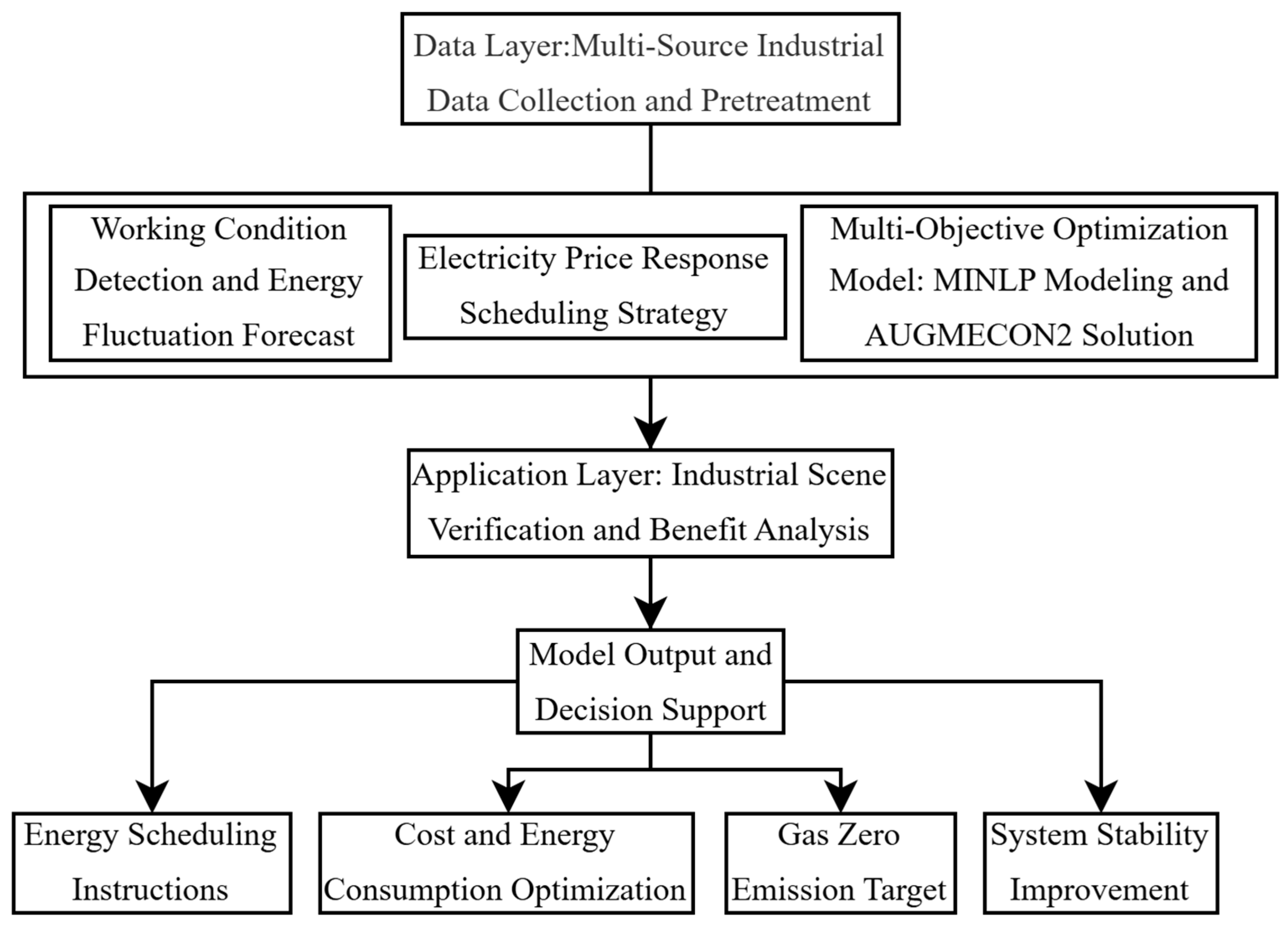
In summary, existing research has made progress in various areas but lacks a systematic solution that integrates condition detection, dynamic electricity price response, and multi-objective optimization. To address these gaps, this paper proposes an integrated hybrid scheduling model combining “condition awareness, electricity price response, and multi-objective optimization.” The innovation lies in proposing an energy scheduling method tailored for real-world production scenarios, which integrates energy forecasting with scheduling while optimizing the allocation of multiple energy sources, aiming to realize the dynamic collaborative optimization of the multi-energy system through the following research paths (research ideas are shown in Figure 1). The main innovations are threefold: (1) An energy fluctuation prediction model based on working condition identification and curve superposition is constructed, improving prediction accuracy for key parameters such as gas holder levels. (2) A peak-shifting and valley-filling scheduling model is developed by incorporating time-of-use electricity prices and leveraging the buffer capacity of gas holders, along with a nonlinear load–efficiency model for boilers and generators. (3) A mixed-integer nonlinear programming (MINLP) model is formulated with the dual objectives of minimizing operating cost and energy consumption, solved using the AUGMECON2 method to obtain a Pareto optimal solution set. The proposed model aims to resolve conflicts between energy efficiency and economic goals, enhance scheduling accuracy, and improve energy utilization, thereby providing technical support for the safe, efficient, and low-carbon operation of multi-energy systems in steel enterprises.

2. Automatic Identification and Tracking of Operating Conditions and Energy Fluctuation Prediction Technology Based on Operating Conditions

The multi-energy system in iron and steel enterprises involves various energy media with distinct characteristics. Among them, coke and by-product gases (blast furnace gas, coke oven gas, converter gas) are the primary energy carriers that directly influence production efficiency, cost, and carbon emissions. Table 2 summarizes the key performance indicators, cost ranges, and consumption trends of these core energy media, providing essential background for the subsequent prediction and scheduling models.
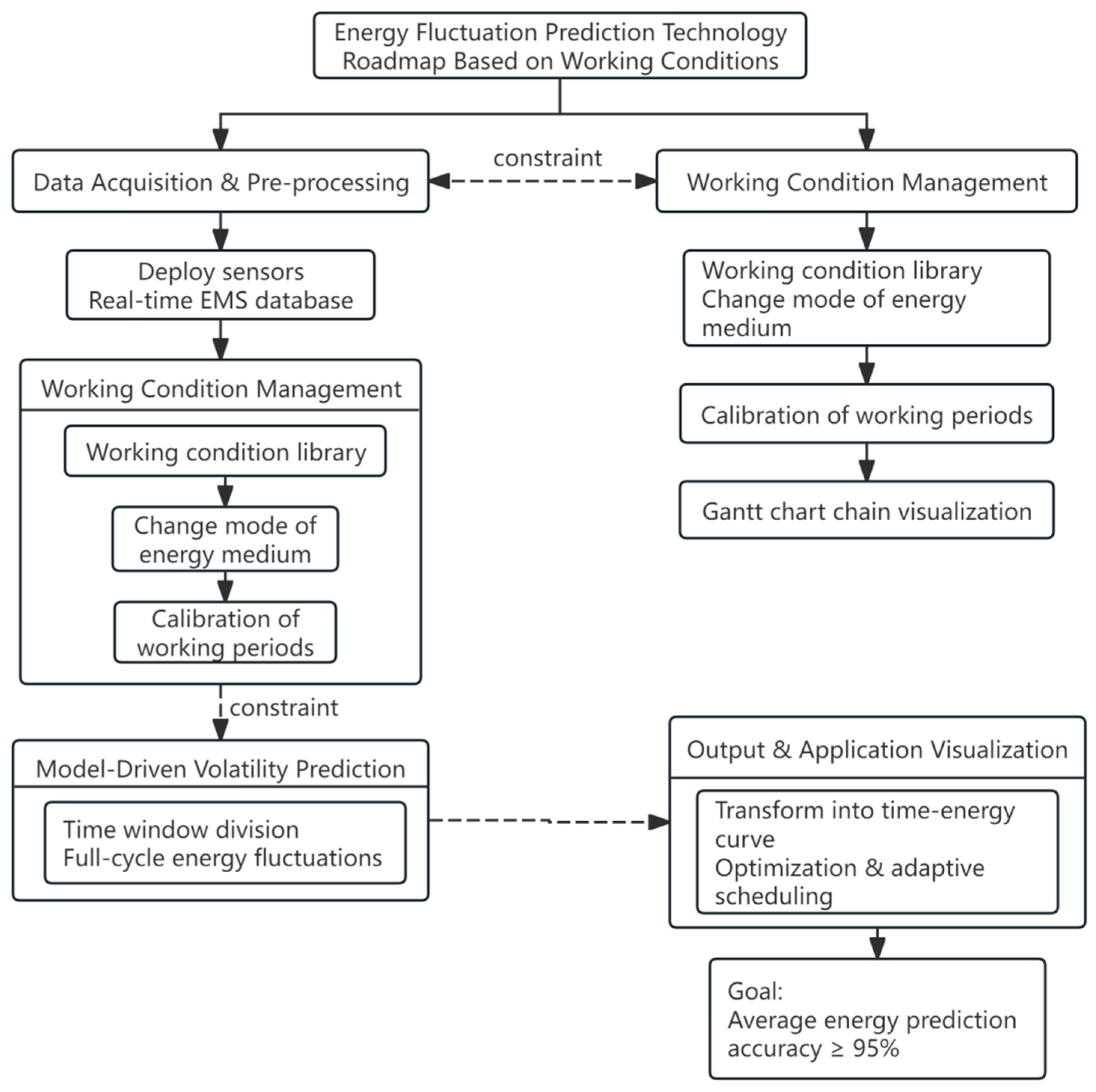
The prediction technology of energy fluctuation based on working conditions is carried out around the construction of a complete closed-loop analysis method, covering four main stages: data acquisition, working condition modeling, prediction calculation and result presentation. The overall process is as follows (the technical route is shown in Figure 2):

2.1. Data Acquisition and Preprocessing

By deploying sensors and metering devices on the production site, various operating parameters, such as production signals, gas flow and equipment status, are continuously collected.
Secondly, the obtained data is stored in the real-time database to ensure the timeliness and integrity of the information.
Finally, with the help of the energy management system (EMS), preprocessing operations such as data cleaning, anomaly identification and missing value repair are performed to improve the availability and reliability of data.
The raw data obtained from the collaborating steel enterprise are of high quality, with over 98% completeness and minimal measurement errors. For the few cases where missing values or outliers exist, a systematic preprocessing procedure is applied: missing values are interpolated using neighboring time points or historical patterns, and erroneous data are corrected based on physical constraints and expert knowledge. This ensures the accuracy and reliability of the input data for subsequent prediction and optimization models.

2.2. Working Condition Definition and Management

According to the factors such as equipment type and raw material characteristics, the typical working condition categories are set, such as normal operation, shutdown, fault, heating/cooling and heat preservation, etc., and are identified by naming, so as to establish a standardized working condition library.
Secondly, for each type of working condition, the type of energy medium, the change mode and the evolution rule in the time dimension are defined, and the knowledge base is allowed to be gradually expanded manually.
Then, combined with the production plan and maintenance arrangement, the start and end time of each working condition and the initial and final values of the corresponding energy parameters are calibrated, and the functional relationship of energy change in this interval is determined by the fitting method.
Finally, the interactive Gantt chart is used to graphically display the working condition chain of all equipment in the whole cycle, and the drag and drop adjustment is supported to simulate different scheduling schemes.

2.3. Model-Driven Volatility Prediction

All working conditions are arranged in their time order and divided into continuous time windows, and the net influence of each working condition on each energy medium is counted window by window.
The unbalanced effects of each situation in the whole period are summarized to form the energy flow deviation distribution from a global perspective.
The typical energy consumption trajectories corresponding to discrete events such as planned maintenance, blast furnace replacement and random shutdown are introduced, and the comprehensive energy fluctuation pattern is deduced by the waveform superposition algorithm.

2.4. Output and Application-Oriented Visualization

The unbalance of each medium obtained in the above process is transformed into a two-dimensional time–energy curve, which is convenient for the direct observation of the changing trend. Based on this, production re-planning, resource allocation optimization and adaptive scheduling design are carried out to stabilize supply and demand fluctuations and improve the stability and economy of system operation.
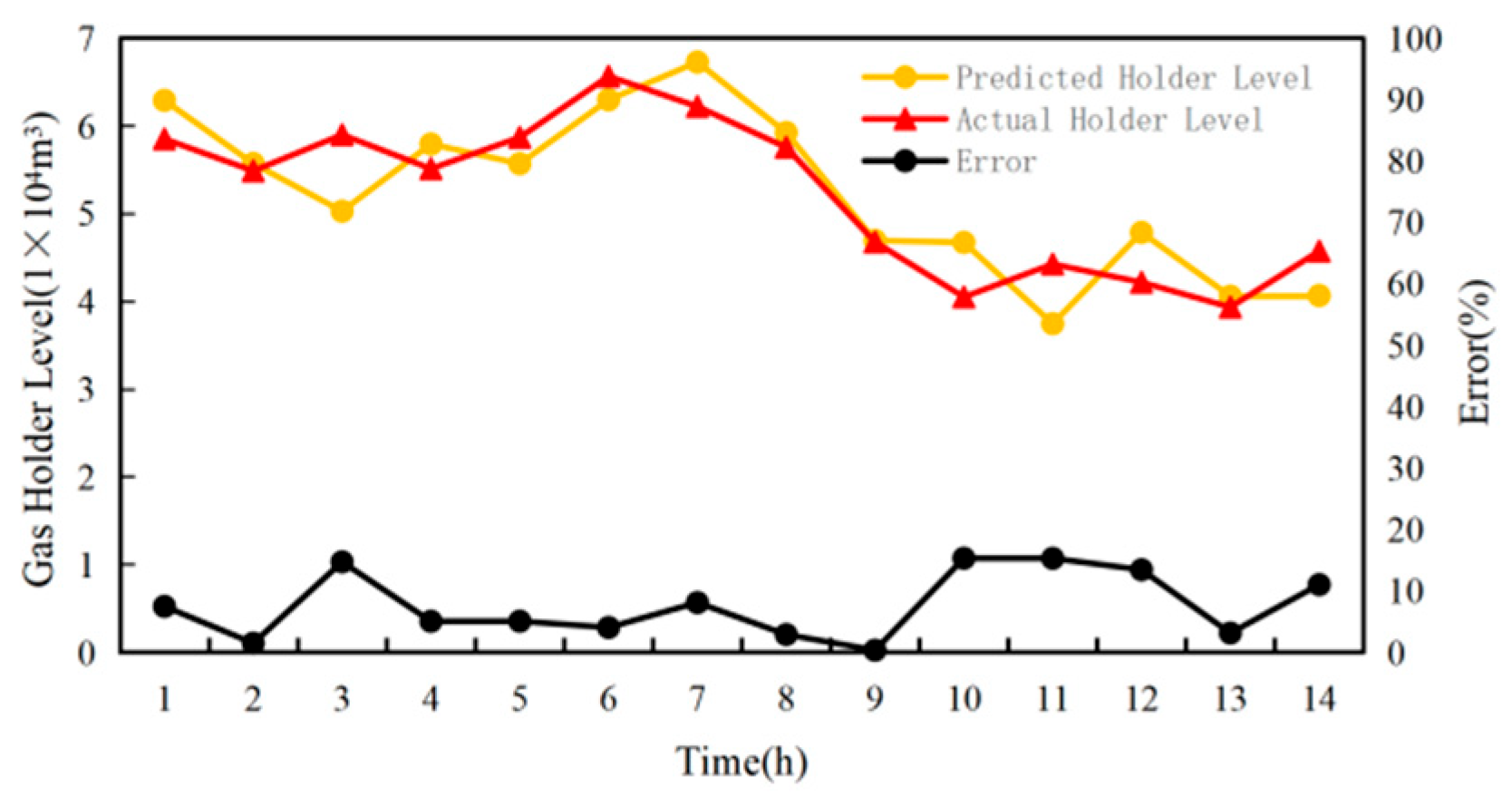
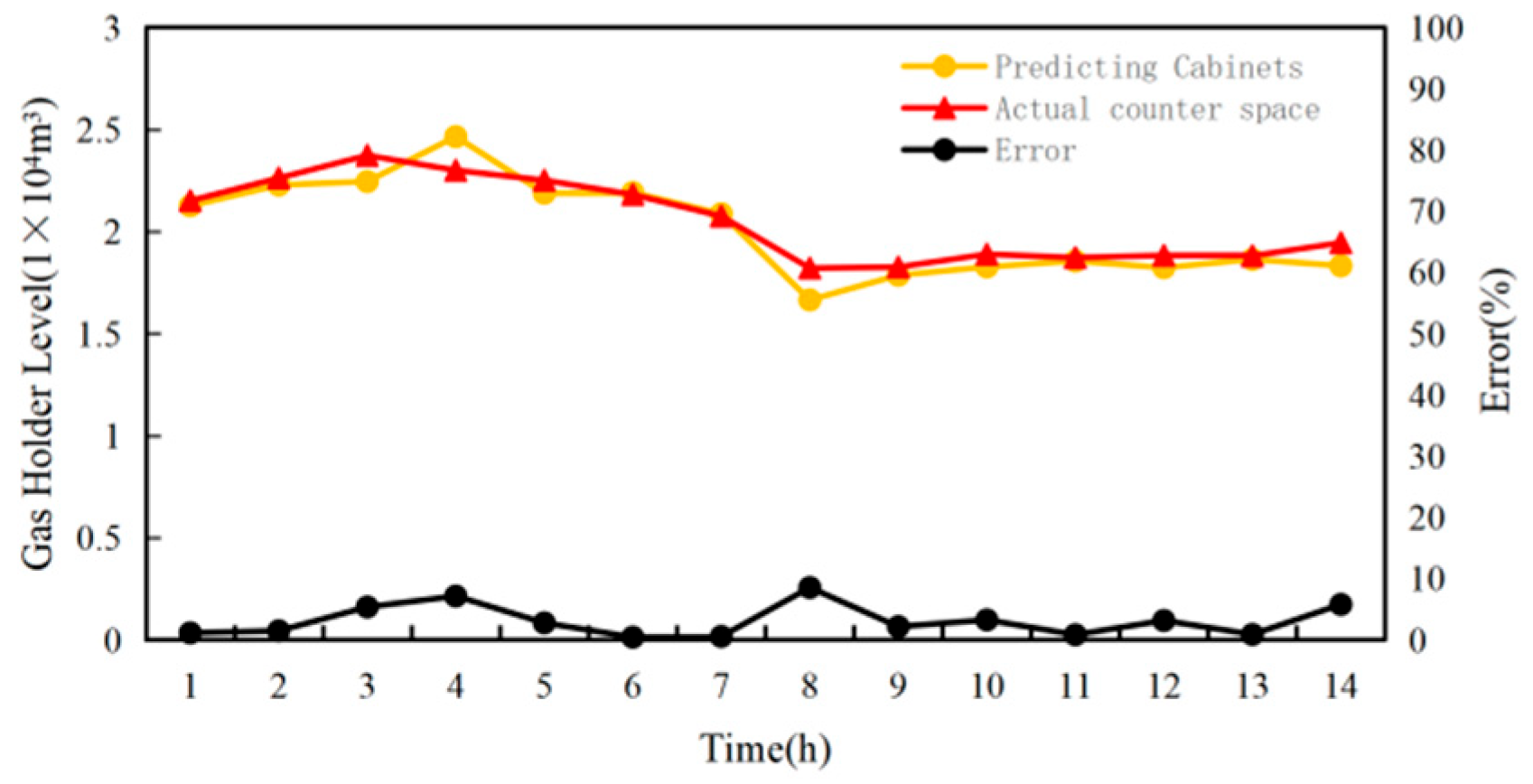
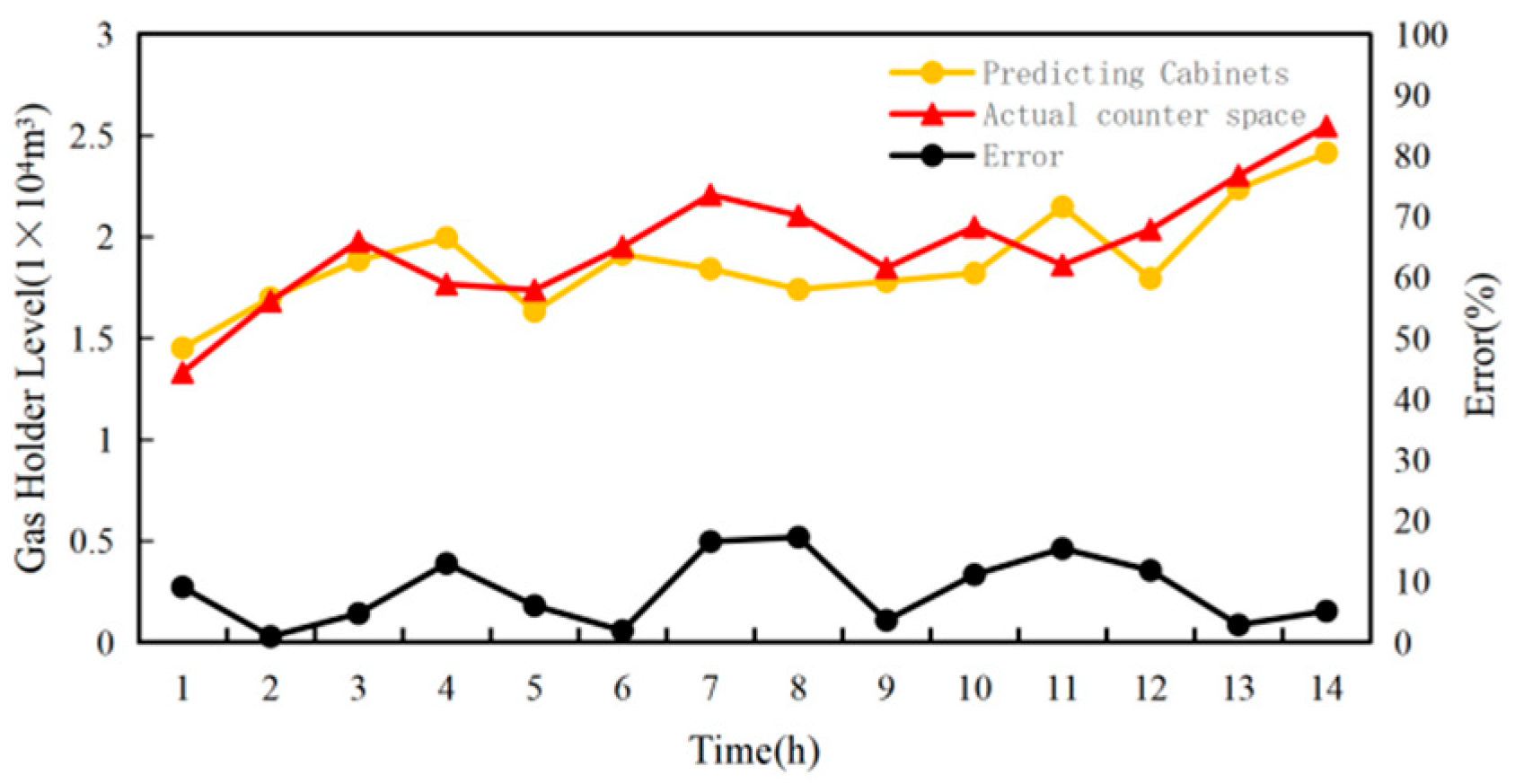
Table 3 is the comparison between the predicted cabinet level and the true value of high, coke and rotary gas. Figure 3, Figure 4 and Figure 5 are the prediction results of the blast furnace gas cabinet, coke oven gas cabinet and converter gas cabinet respectively. Among them, the change range of the coke oven gas cabinet level is relatively small, and the prediction result has the highest degree of fit with the actual value, showing high prediction accuracy and stability. In contrast, the prediction results of the blast furnace gas tank and converter gas tank fluctuate greatly, and there is obvious lag. This is not only reflected in the deviation between the key nodes such as the predicted furnace replacement time and the actual situation, but also reflects the timeliness and accuracy of the scheduling operator in executing the model instructions. The generation of this prediction error may be affected by many factors, including the model’s ability to deal with the complexity of blast furnace and converter conditions, the uncertainty factors in the production process, and the operator’s response speed and execution accuracy of the model instructions.

3. Based on Peak–Valley–Flat Electricity Price and Gas Tank Peak Shifting and Valley Filling Scheduling Model

China’s iron and steel industry is facing severe pressure of energy conservation and emission reduction. Its energy system has the characteristics of multi-media coupling and complex and changeable working conditions. Most of the existing energy scheduling systems have obvious limitations, which are mainly reflected in the following aspects:
(1)
The traditional gas tank scheduling model usually only focuses on the balance at the physical level, and fails to internalize the important market economy signal of “peak–flat–valley” time-of-use electricity price as the optimization goal, so it cannot make full use of the electricity price difference to achieve the economic benefits of “peak shifting and valley filling”.
(2)
The existing models generally regard the operating efficiency of key energy conversion equipment such as boilers and steam turbines as a fixed constant, which is seriously inconsistent with the nonlinear characteristics of the efficiency of the equipment in actual operation with the dynamic change in the load, resulting in the theoretical optimal scheduling scheme in practice. It is often difficult to implement or even counterproductive.
(3)
The existing model scheduling strategy is inelastic, and it is difficult to give a predictive and optimal response to typical and severe production fluctuations such as blast furnace downtime and planned maintenance, which often leads to energy dissipation or scattered or additional cost surge.

3.1. Framework Design and Innovation of Core Scheduling Model

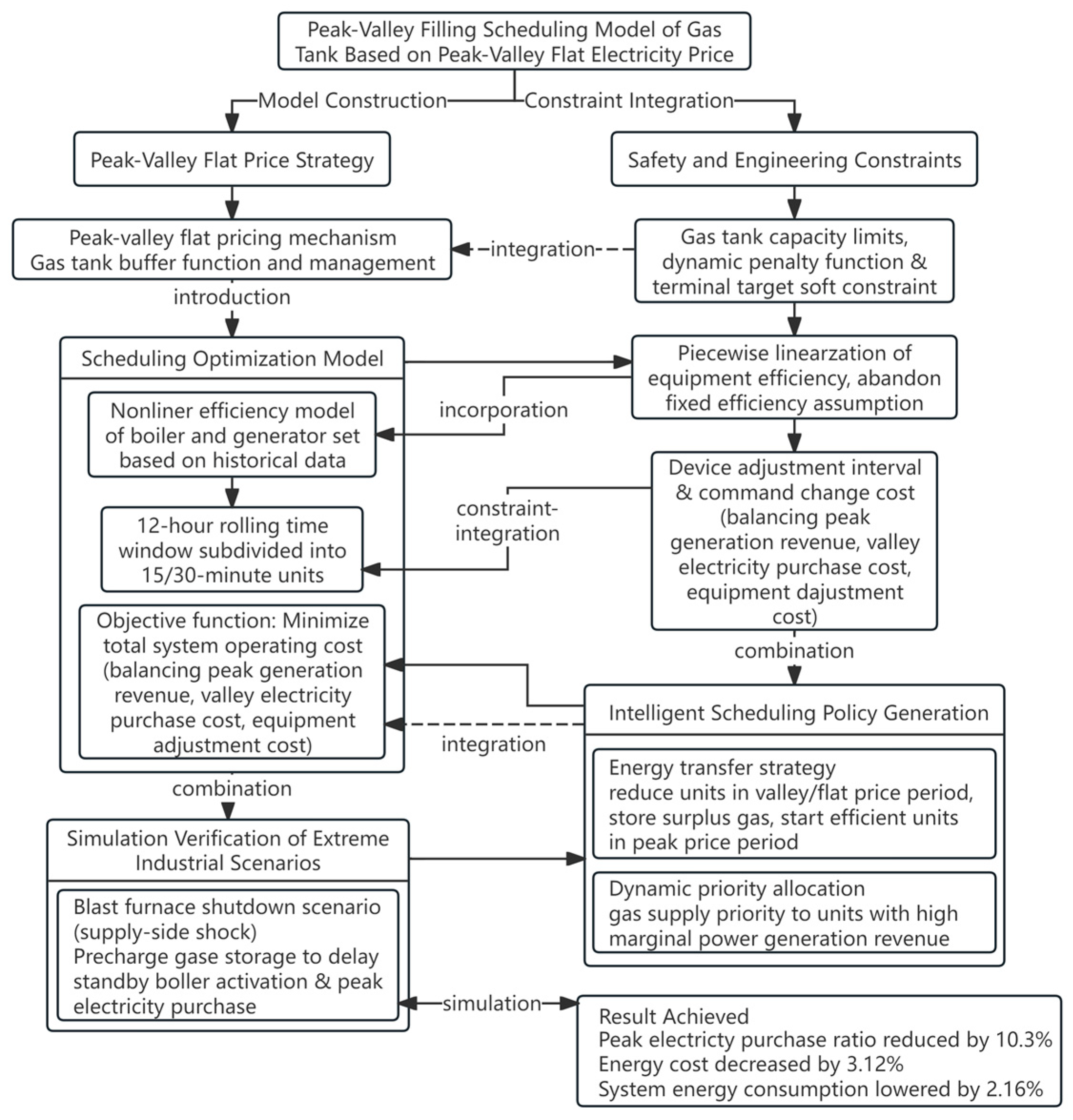
In order to solve the above challenges, this study constructs a multi-time scale, multi-objective collaborative dynamic optimization scheduling model (the technical route is shown in Figure 6). Its core work is reflected in the following three aspects:
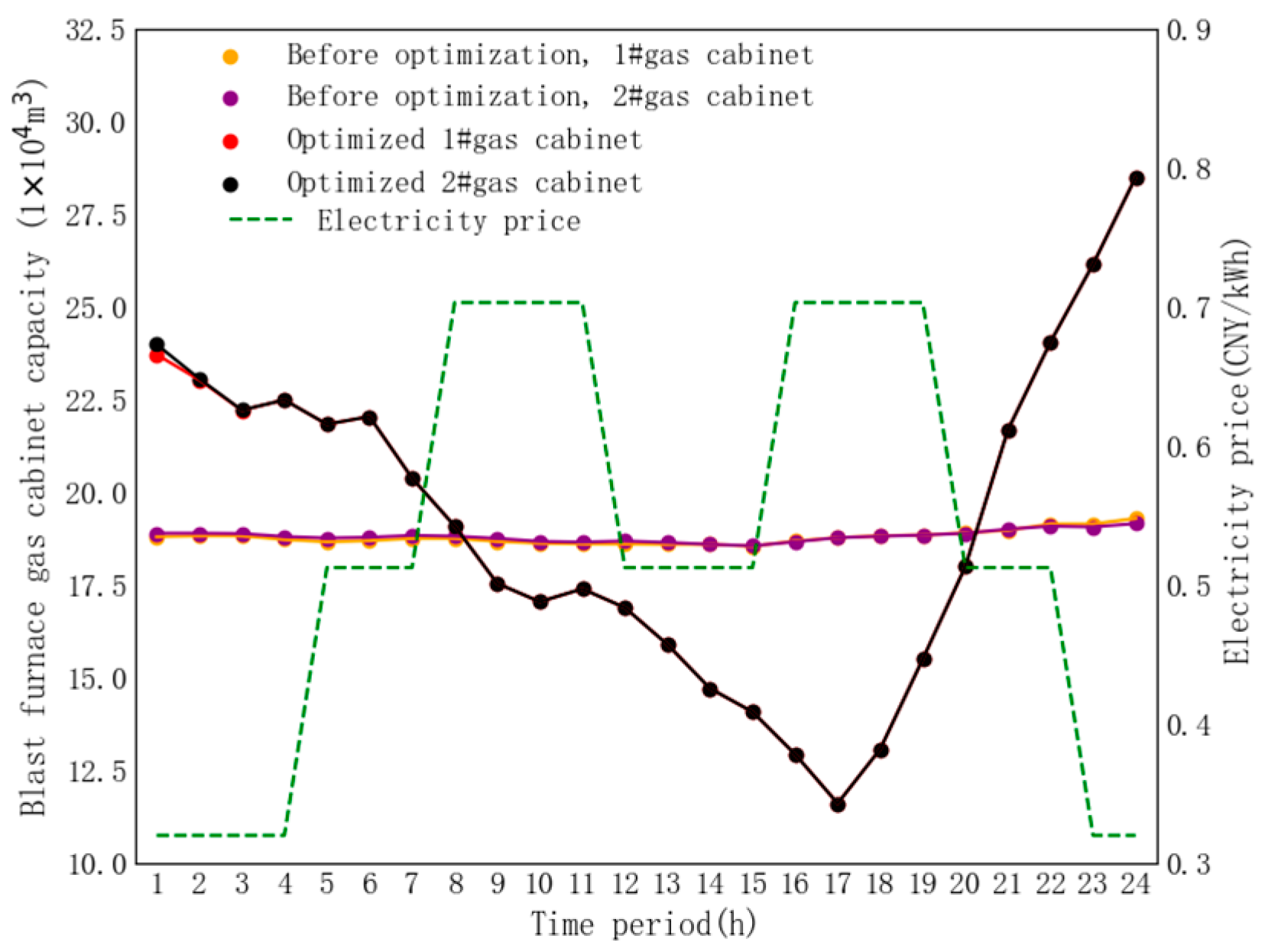
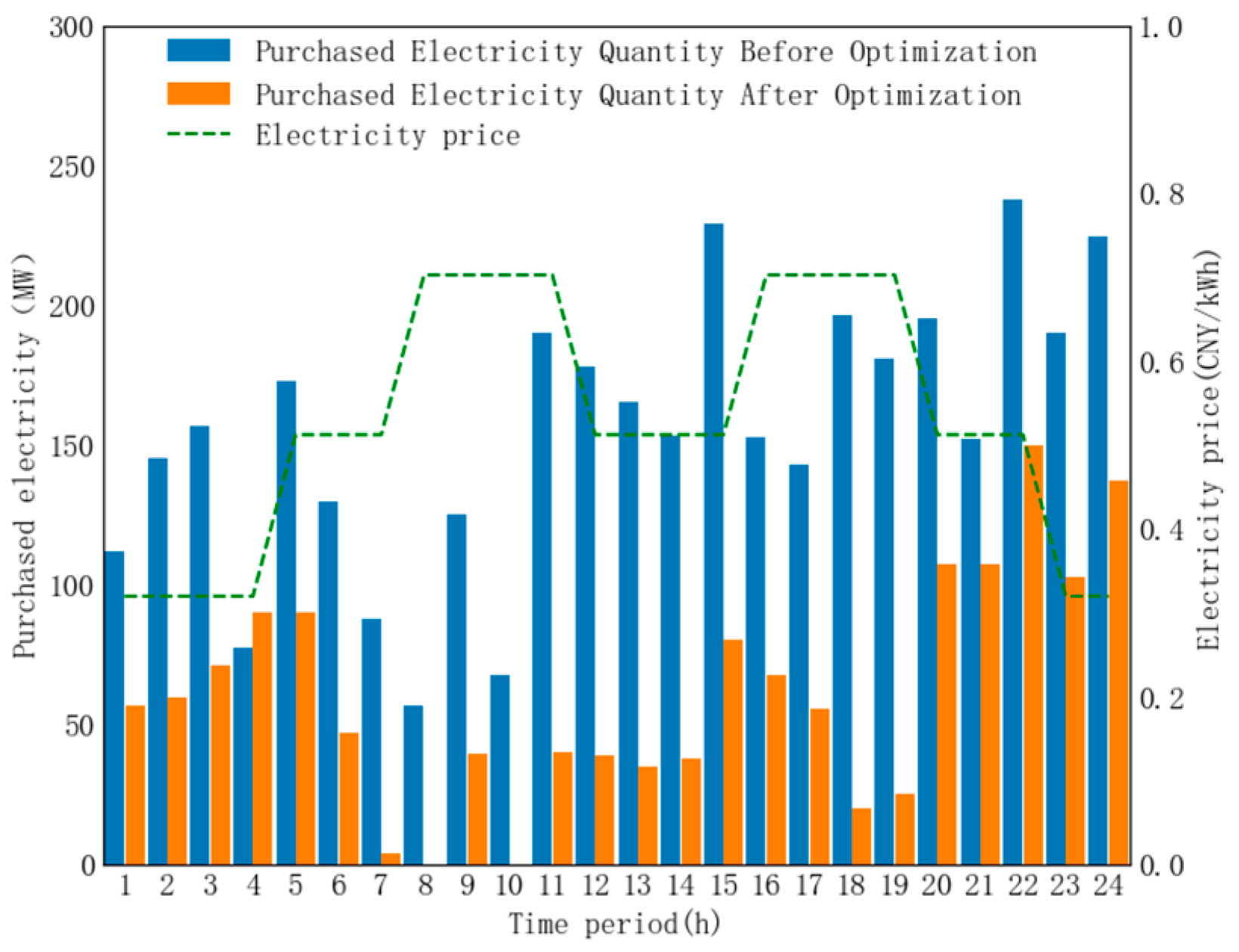
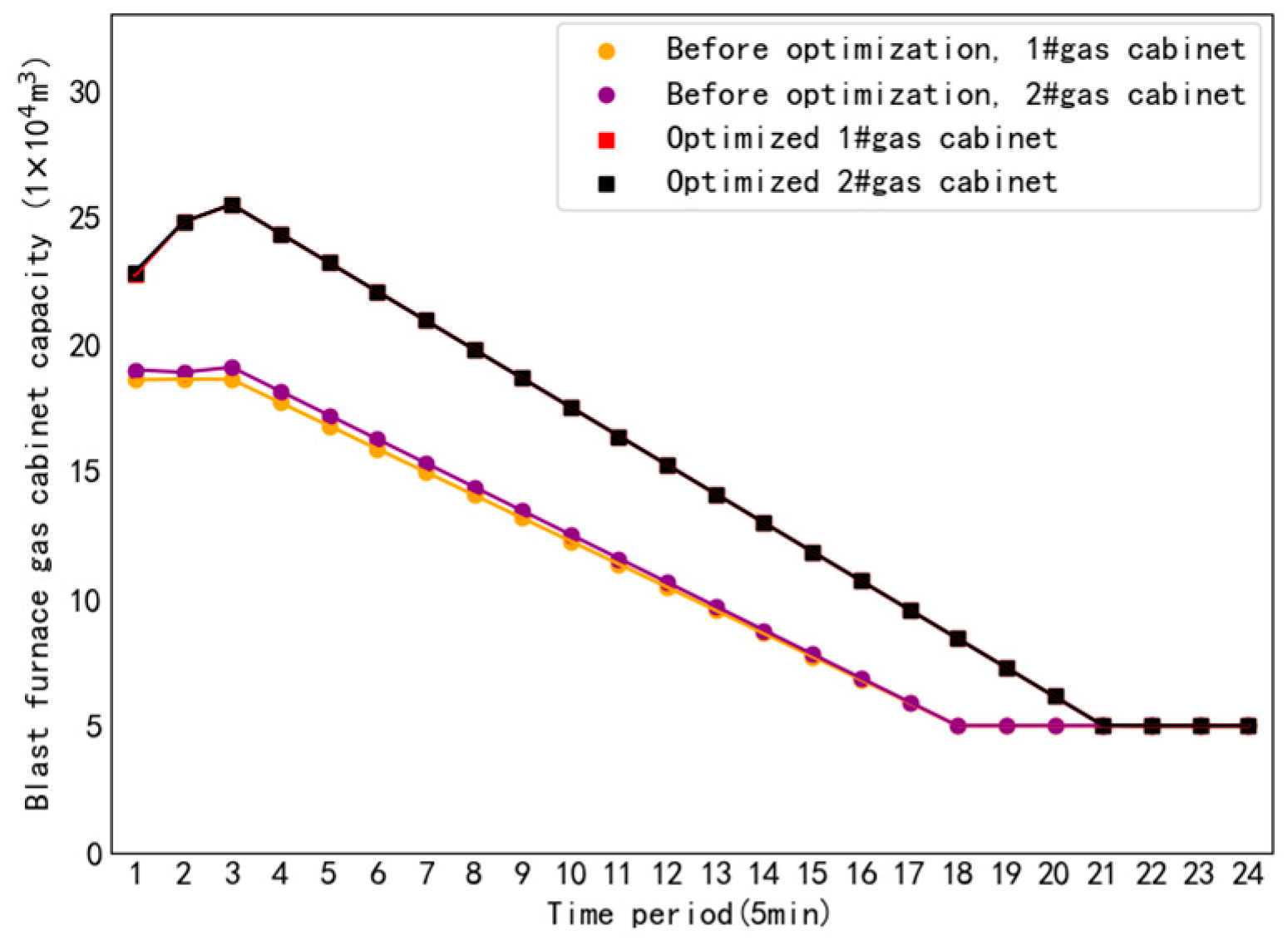
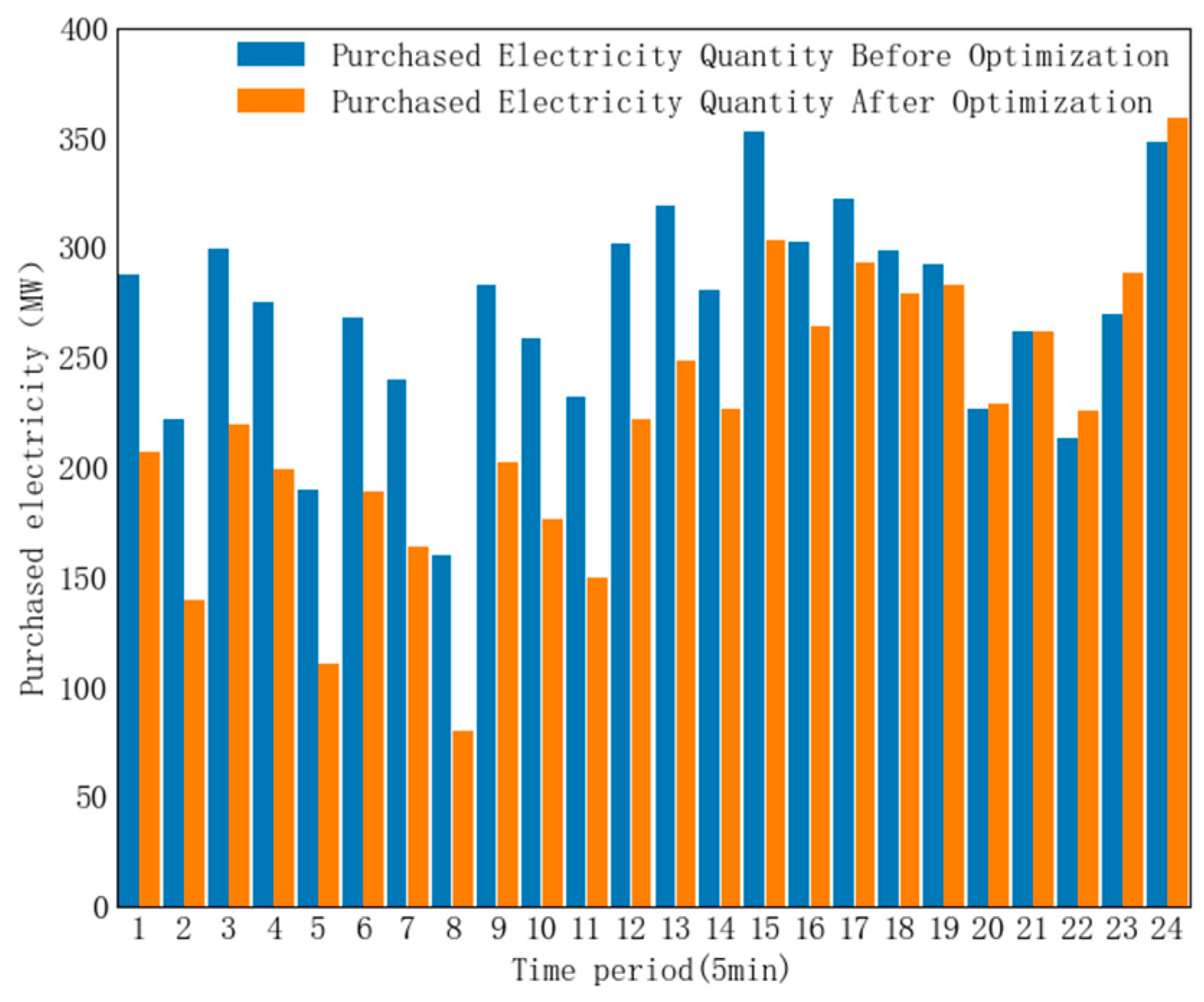
The peak–valley price mechanism is introduced to realize peak shifting and valley filling by using the buffer capacity of the gas holder. In the peak period of electricity price, increase gas power generation to reduce outsourced electricity; in the trough and usual period, the purchased electricity is increased, the gas consumption is reduced, and the surplus gas is stored in the gas tank for peak power generation. The nonlinear model of equipment operation characteristics is constructed synchronously. Based on the actual data, the load–efficiency relationship between the boiler and the generator set is fitted, which breaks through the limitation of the fixed efficiency coefficient in the traditional scheduling model and improves the authenticity and accuracy of the scheduling results. On this basis, the peak-shift and valley-filling strategy of the gas holder is coupled to further optimize the energy scheduling: reducing the power generation in the valley section and reducing the gas consumption of inefficient equipment; the peak section improves the power generation output and gives priority to the use of efficient units, so as to achieve the overall improvement of system energy efficiency (Figure 7 and Figure 8). At the same time, the next 12 h are set as the rolling optimization window to ensure that the scheduling cycle can completely cover at least a set of “peak–flat–valley” periods; at the same time, in order to improve the accuracy of the control, the window is further subdivided into 15 min or 30 min of the basic scheduling unit, “time step”.
In addition, the goal of the model is to minimize the total operating cost of the system. This is a complex trade-off process, and it is necessary to find a global optimal solution between the power generation revenue in the high-price period, the outsourced power cost in the cheap period, and the operating cost caused by the frequent adjustment of equipment.
To ensure the safe and stable operation of the key buffer facility of the gas cabinet, the model sets strict upper and lower limits for its cabinet. To strictly enforce this constraint in the optimization, a dynamic over-limit penalty function and a soft constraint for the final target level of the gas holder are introduced into the objective function. This approach enables a balance between maximizing the utilization of the gas holder and ensuring absolute safety. The assumption of fixed equipment efficiency is completely abandoned. Instead, based on massive historical operation data, the piecewise linearization or polynomial fitting method is adopted to accurately describe the complex nonlinear mapping relationship between boiler efficiency, generator heat consumption rate and load rate. In order to avoid the unrealistic frequent switching instructions output by the model, the minimum adjustment interval and instruction change cost parameters are introduced, which effectively smooths the scheduling instruction sequence and improves the engineering applicability of the scheme.

3.2. The Generation Mechanism of Intelligent Scheduling Strategy

By solving the aforementioned mathematical model, the system can independently derive the following two core and mutually complementary scheduling principles:
(1)
Energy translation strategy across time and space:
In the electricity price valley/flat stage, the model will consciously reduce the load of the generator set in the plant, even if it means that some of the power generation capacity is idle. The core purpose of this is to inject a large amount of surplus gas generated at this time into the gas holder for storage, and complete the “space–time transfer” of energy.
In the peak period of electricity price, the model instructs the system to fully start the high-efficiency generator set and use the gas stored in the gas holder as the fuel, so as to maximize the spontaneous power supply during the period with the highest electricity price, thus greatly reducing the high outsourcing cost.
(2)
Resource dynamic preferential allocation strategy:
In the face of the bottleneck period of tight gas supply, the model no longer allocates resources equally, but implements the distribution rule of “benefit priority”, that is, precious gas resources are preferentially allocated to units with higher marginal power generation benefits, while for inefficient units, they are instructed to maintain their technical output at the lowest level, so as to ensure that each cubic meter of gas can output the maximum economic benefits.

3.3. Simulation Verification and Analysis for Extreme Industrial Scenarios

In order to test the superiority of the model in the real industrial environment, two extreme but opposite working conditions are designed for digital twin simulation:
Blowdown condition of blast furnace (supply side impact): This condition means that in the next few hours, the main fuel of blast furnace gas production will plummet to almost zero. The simulation results (Figure 9 and Figure 10) clearly show that after receiving the downwind plan, the model will immediately start the forward-looking cabinet filling plan. It will store the gas tank to a maximum safe level as far as possible by the command system in the hours before the official start of the downwind. The essence of this strategy is to use the gas tank as a “strategic energy repository”. During the downtime, the system can preferentially consume the gas stored in the cabinet, which will significantly delay the time to start the standby coal-fired boiler or purchase the high-price peak power, winning a valuable response window for the enterprise and directly saving a lot of costs.
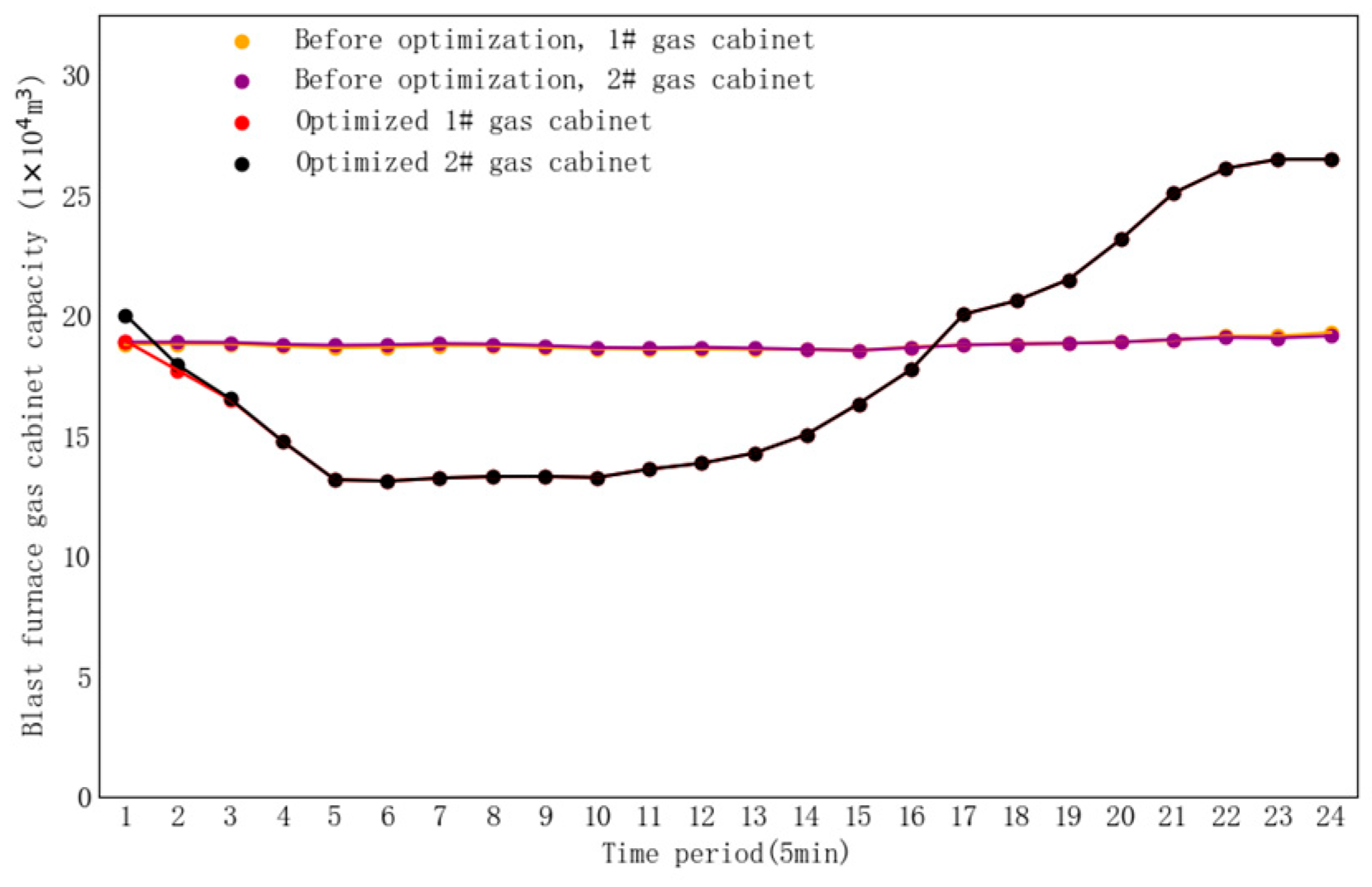
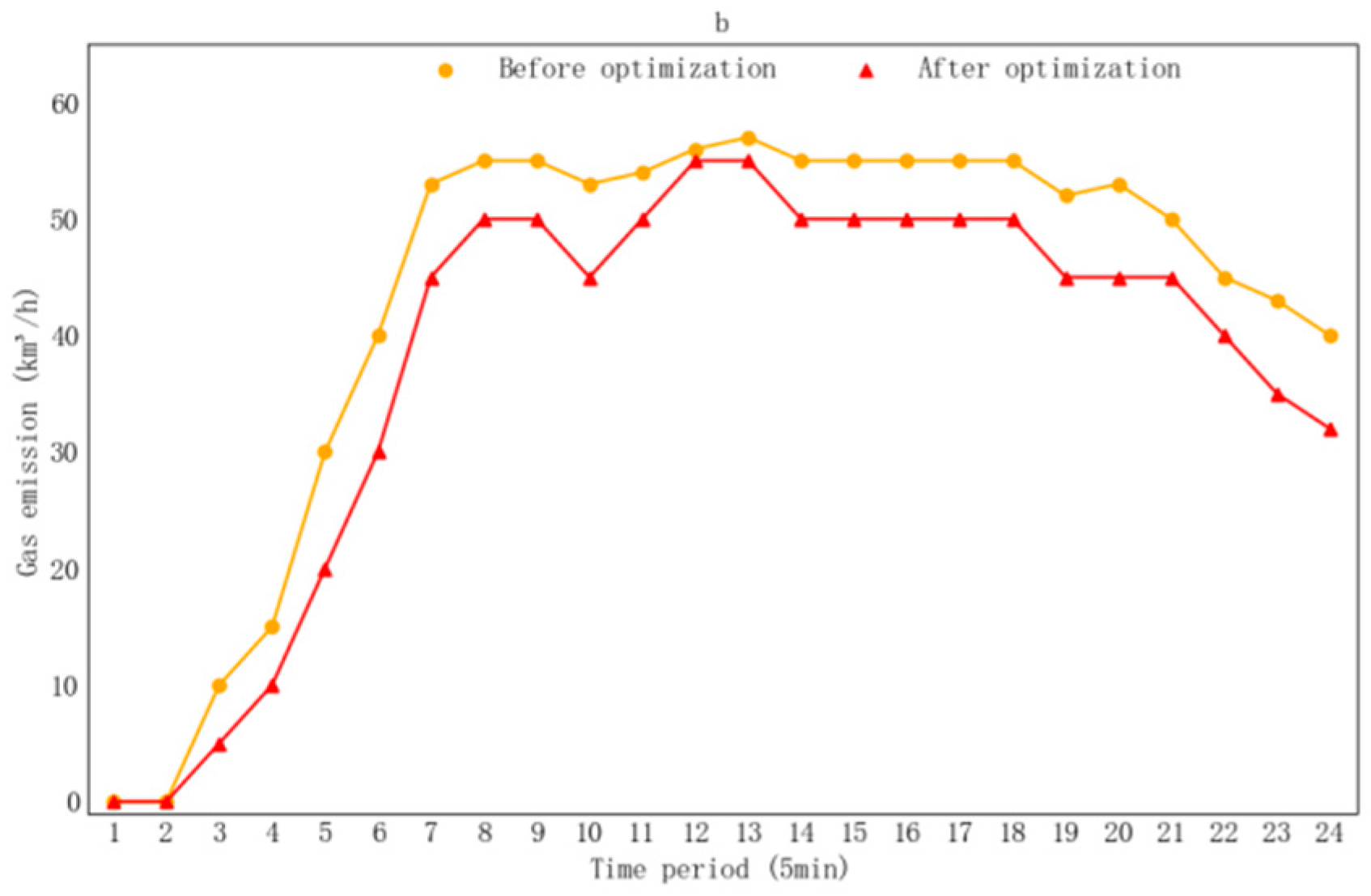
Generator unit maintenance conditions (demand side impact): This condition means that the plant’s largest gas consumer–generator units stopped operation, and gas demand plummeted. The simulation results (corresponding to Figure 11 and Figure 12) prove that the model will start to reduce the gas cabinet level in an orderly manner several hours in advance. The purpose is to make enough storage space in advance for the large amount of surplus gas that will inevitably be generated during the maintenance period. This seemingly simple operation is the most effective measure to prevent the gas from being forced to ignite and disperse (burn out) due to there being nowhere to store it, so as to realize the energy “grain storage”.
It can be seen from the display results in Table 4 that due to the addition of the peak–valley–flat electricity price mechanism, the proportion of purchased electricity in the peak period of the optimized electricity price is reduced from 27.26% to 16.96%, which is reduced by 10.30%. The purchased electricity in the valley period of the electricity price is increased from 24.42% to 35.34%. The purchased electricity in the average period of the electricity price is increased from 45.32% to 47.70%, and the purchased electricity in the valley electricity price and the flat electricity price period is increased by 10.92% and 2.38% respectively. In the valley electricity price period, the purchased electricity is increased to reduce the consumption of by-product gas, and the rich gas is stored in the gas holder to provide sufficient fuel reserves for peak power generation to realize the peak-shifting and valley-filling effect of the gas holder. Considering this operation from the cost-optimal principle side, the energy use cost can be greatly reduced, and the obtained optimal scheduling results are more in line with the actual production.
Through the display results in Table 5, it can be seen that the optimized energy consumption cost is reduced by 3.16% from 5.88 million CNY to 5.69 million CNY. As the optimized model adjusts the system more frequently, the equipment adjustment cost is increased from 14.26 thousand CNY before optimization to 14.89 thousand CNY, an increase of 4.45%. After optimization, although the cost of equipment adjustment has increased, the total economic operation cost has decreased from 5.89 million CNY to 5.71 million CNY, a decrease of 3.12%. Due to the reduction in the amount of purchased coal and the total energy consumption of the purchased power system after optimization, it is also reduced from 9.62 million kgce before optimization to 9.42 million kgce after optimization by 2.16%.

4. Multi-Period and Multi-Medium Energy Optimal Scheduling Model

Based on the fluctuation prediction curve and the gas tank peak shift and valley-filling model, a multi-period and multi-media energy optimization scheduling model is established, including the time period of working conditions and the time period of peak–valley–flat electricity price. The energy medium is rebalanced by the optimization scheduling model to achieve multi-objective optimization such as safety, production, less emission and optimal power generation. The optimization model aims to maximize the benefits, collects the current gas cabinet level and cabinet speed, boiler gas consumption, power generation load, emission amount and other adjustable users’ consumption, comprehensively considers the adjustment cost, shutdown cost, emission penalty, peak-to-valley power generation income, etc., gives the scheduling instructions for the next few hours, outputs the latest batch of instructions as the current instructions, and sends them to the unit for execution. Even if there is no disturbance, it can still take the initiative to use the gas tank to do peak shifting and valley filling power generation, creating greater benefits.
The optimization process follows a systematic logic to address the multi-energy scheduling problem. First, based on the energy fluctuation prediction curves (Section 2) and the peak-shifting and valley-filling scheduling model (Section 3), the optimization problem is formulated as a mixed-integer nonlinear programming (MINLP) model. The objective is to simultaneously minimize operating costs and energy consumption, which are often conflicting goals. To handle this trade-off, the AUGMECON2 method is employed to generate a Pareto optimal solution set, allowing decision-makers to select the most suitable trade-off according to production priorities. The model incorporates multiple constraints that reflect real-world operating conditions: energy supply–demand balance ensures system stability; equipment operating limits (boiler calorific value, steam turbine intake) prevent operational violations; gas holder capacity constraints maintain safe buffer zones; and generator ramp rates reflect physical response capabilities. The IPOPT solver, based on a primal-dual interior point algorithm, is used to efficiently solve the nonlinear programming subproblems within the AUGMECON2 framework. The entire optimization process is executed in a rolling horizon manner, with a 12 h window subdivided into 15 or 30 min time steps, enabling dynamic adaptation to real-time production fluctuations.

4.1. Symbol Description

The symbolic meaning in this article is shown in Table 6.

4.2. Objective Function

Equation (1) represents the minimization of the economic operation cost in the multi-energy system, and Equation (2) represents the minimization of the energy consumption in the multi-energy system.
f 1 = min E O C = t = 1 T K ( C k × B F b i , k , t ) + C b i × B D b i , t st + C t i × T P t i , t + C b p , t × P b , t + K ( C b i , k × Δ F b i , k , t ) + g a s C g d , k × F g d , k , t
f 2 = min E C S = min t = 1 T i Q i , t k i
In the formula, T denotes the number of periods included in a scheduling period; k denotes the number of fuel types; B denotes the number of boilers that can be scheduled; C k represents the consumption cost of fuel k; F b i , k , t represents the kth fuel consumption of the boiler bi at time t; C bi represents the cost of steam production per unit of boiler bi (CNY/t); D b i , t s t represents the steam output of boiler bi at time t (t); C t i denotes the unit electricity production cost of the turbine ti (CNY/kWh); P t i , t denotes the turbine ti’s power output (kWh) at time t; C b p , t d represents the amount of power purchased at time t (kWh); P b p , t denotes the electricity outsourcing price at time t (CNY/kWh); C b i , k represents the penalty coefficient of boiler bi when adjusting k kinds of gas; Δ F b i , k , t denotes the adjustment of boiler bi to k kinds of gas at time t (km3); C g d , k denotes the release penalty price for the kth gas (CNY/km3); F g d , k , t represents the emission of the kth gas at time t (km3); Q i , t represents the consumption of i-type matter at time t; k i represents the standard coal coefficient of medium i.

4.3. Model Constraints

Energy system energy demand constraints:
G F b , g + Δ V h + F r e l e a s e + F s a l e = F g
B F b , s + S T F s t , e x = F s
S T P s t + P p u r / s a l e = P
Formula (3) represents the gas demand balance constraint, Formula (4) represents the steam demand balance constraint, and Formula (5) represents the power demand balance constraint.
In the formula, F b , g represents the amount of gas g consumed by boiler b (km3/h); Δ V h , g represents the change in gas g cabinet level (km3/h); F r e l e a s e , g represents the emission amount of gas g (km3/h); F s a l e , g denotes the take-out volume of gas g (km3/h); F g represents the surplus of gas g (km3/h); F b , s denotes the amount of steam s (t/h) produced by each boiler b; F s t , e x represents the amount of steam extracted from the turbine s (t/h); F s represents the demand for steam s (t/h); P s t represents the power generation of each generator (MWh); P p u r / s a l e represents purchased electricity or outgoing electricity (MWh); P represents the power demand (MWh) of the energy system.
Boiler constraints:
q b i , min ( K q k F b i , k , t ) / K F b i , k , t q b i , max
F b , f w , t = B ( F b , s + F b , s e w )
η b , t = c 1 D b , t 2 + c 2 D b , t + c 3
F b , g , min F b , g F b , g , max
F b , s , min F b , s F b , s , max
F b , f w , min F b , f w F b , f w , max
Formula (6) represents the calorific value constraint of the fuel boiler on boiler mixed fuel. Formula (7) represents the material balance constraint of the fuel boiler. Formula (8) represents the efficiency fitting curve constraint of the fuel boiler. Formulas (9)–(11) represent the upper and lower limits of boiler gas consumption, water supply and steam production.
In the formula, q k represents the calorific value of gas k (kcal/km3); q b i , m i n represents the lower limit of the calorific value of the mixed gas consumed by the boiler bi (kcal/km3); q b i , max represents the upper limit of the calorific value of the mixed gas consumed by the boiler bi (kcal/km3); F b , f w represents the water supply of boiler b (t/h); F b , s represents the amount of steam s produced by the boiler (t/h); F b , s e w denotes the discharge of boiler b (t/h); η b , t represents the thermal efficiency of boiler b at time t; D b , t represents the operating load of boiler b at time t; F b , g , min represents the lower limit of gas g consumed by the boiler (km3/h); F b , g , max denotes the upper limit of gas g consumed by the boiler (km3/h); F b , s , min denotes the lower limit of steam s produced by a boiler (t/h); F b , s , max denotes the upper limit of steam s produced by the boiler (t/h); F b , f w , min represents the lower limit of water supply of boiler b (t/h); F b , f w , max indicates the upper limit of boiler b water supply (t/h).
Steam turbine constraints:
F s t , i n , min F s t , i n F s t , i n , max
F s t , e x , min F s t , e x F s t , e x , max
P s t , min P s t P s t , max
η s t , t = c 1 D s t , t + c 2 D s t , t + c 3
Formulas (12)–(14) represent the upper and lower limit constraints of the steam turbine inlet steam volume, the steam turbine exhaust steam volume, and the steam turbine extraction steam volume. Formula (15) represents the constraint of the turbine power generation efficiency curve.
In the formula, F s t , i n , min denotes the lower limit of steam turbine intake (t/h); F s t , i n , max represents the upper limit of steam turbine inlet (t/h); F s t , e x , min represents the lower limit of exhaust steam (t/h); F s t , e x , max represents the upper limit of exhaust steam (t/h); F s t , min denotes the lower limit of steam turbine extraction (t/h); F s t , max denotes the upper limit of steam turbine extraction (t/h); η s t , t represents the thermal efficiency of the steam turbine at time t; D s t , t represents the turbine operating load at time t.
Gasholder storage constraints:
H i min H i , t 1 H i max
H i , t H i , t 1 Δ F i g a s max
H i , t 1 H i , t Δ F i g a s max
Formula (16) represents the upper and lower limit constraints of the gas tank capacity, and Formulas (17) and (18) represent gas tank throughput change constraints.
In the formula, H i min denotes the lower limit of gas tank capacity (km3); H i max represents the upper limit of the gas tank capacity (km3); Δ F i g a s max represents the maximum allowable variation range of the gas tank i per unit time (km3/h).
The equipment operation penalty coefficient is set. For the equipment with high priority, the fuel load fluctuation is set to a smaller penalty coefficient. When the energy medium production and consumption fluctuate, it is preferentially adjusted, and the adjustment range is larger. Assume that the priority and penalty coefficients of the three devices are P1, P2, P3 and C1,g, C2,g, C3,g, respectively, as shown in Formulas (19) and (20):
Calorific value balance constraints:
P 1 > P 2 > P 3
C 3 , g < C 2 , g < C 1 , g
In the formula, X i represents the minimum specific heat value of the total heat value of the energy mixture consumed by device i. Y i represents the maximum specific heat value of the total calorific value of the energy mixture consumed by the device i.
Generator climbing constraint:
Δ p i 1 Δ p j , t E Δ p j , t 1 E Δ p i 2
In the formula, Δ p i 2 represents the constraint value of the instantaneous increase in device i, that is, the device can increase the maximum power in a period of time; Δ p i 1 represents the constraint value of the device i that is the maximum power that the device can reduce in a period of time.
The types of equipment operation constraints in each production scenario are basically the same, but the various constraint parameters in each production scenario will be different. For example, the adjustment priority of equipment in various production scenarios, the upper and lower limits of energy medium production and consumption, and the coefficient of equipment efficiency fitting curve will change.

4.4. Model Development

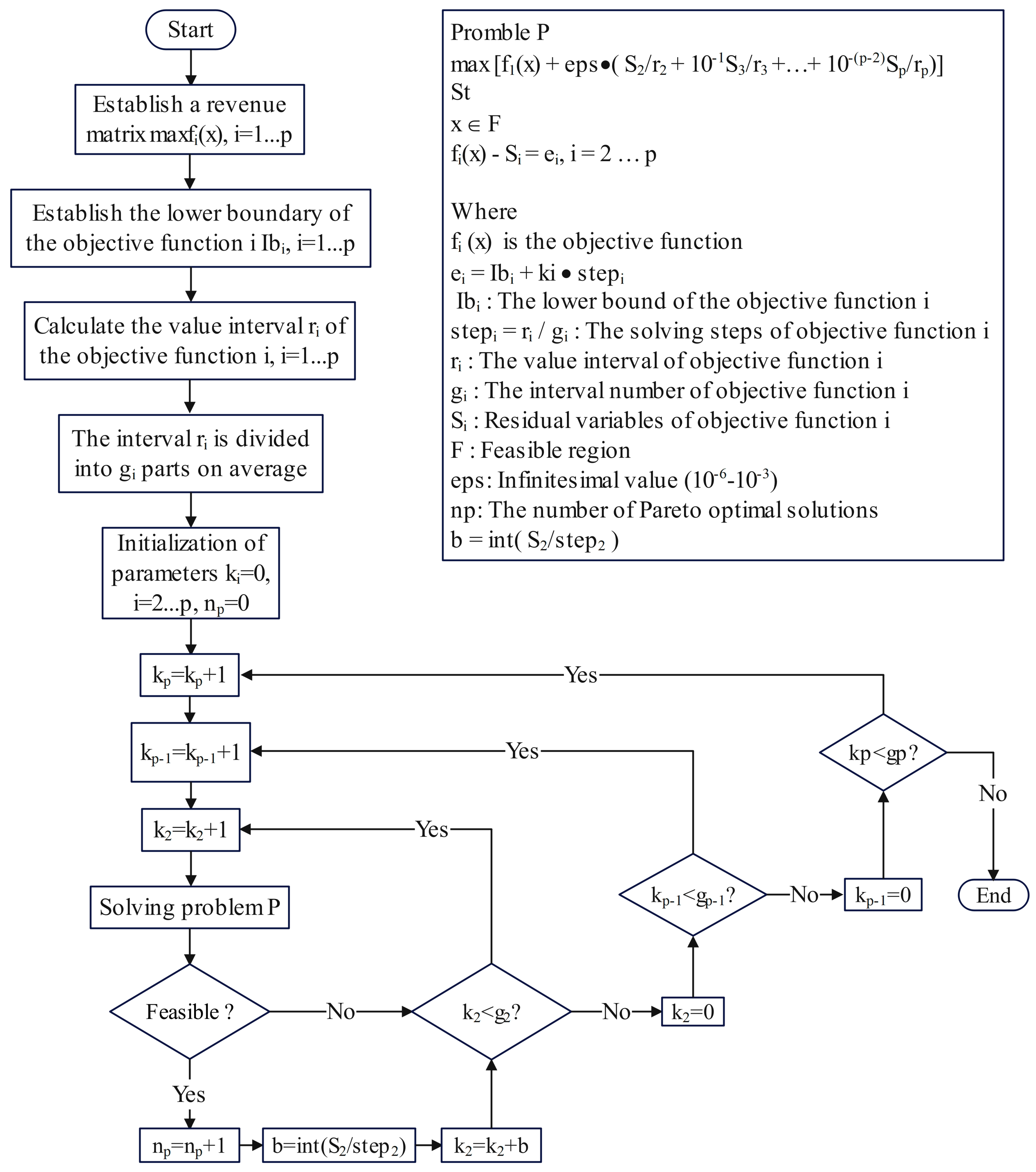
According to whether the objective function and constraint conditions are linear or not, mathematical programming problems can be divided into linear programming problems and nonlinear programming problems. The proposed MINLP model is a typical nonlinear programming problem. There are two main methods to solve the nonlinear programming problem: the external penalty function method and the internal penalty function method. In order to solve the third-party solver IPOPT called by the MINLP model, the primal-dual interior point line search algorithm is used, which is a good solution tool for the internal penalty function method. The idea of solving the multi-objective problem of the target conflict is to transform the multi-objective function solution into solving the Pareto optimal solution set, and find the optimal solution in the Pareto optimal solution set. This model uses the AUGMERCON2 method (improved augmented ε-constraint method) to obtain the Pareto optimal solution set of the multi-objective optimization function. The flowchart of the AUGMECON2 method is shown in Figure 13.

5. Model Application

Based on the industry research, the accuracy of energy fluctuation prediction technology is verified. The average prediction accuracy of the gas cabinet level is ≥95% (blast furnace gas cabinet: 93%, coke oven gas cabinet: 98.80%, converter gas cabinet: 96.70%), meeting the requirements for subsequent energy optimization scheduling. Comparative analysis with existing models is presented in Table 7. Compared with Model A (converter gas cabinet prediction accuracy: 94.62%), the proposed model achieves a 0.11% improvement. Compared with Model B (blast furnace gas cabinet prediction accuracy: 92.90%), the proposed model achieves a 2.08% improvement.
The accuracy and efficiency of the energy optimization scheduling model are verified through industrial applications, achieving zero gas emission. As shown in Table 8, the model increases the proportion of peak–valley–flat self-generation by 0.9% in enterprise applications: Enterprise A achieves a 1% increase in self-generation rate and a 12.73 million CNY/year reduction in purchased electricity cost; Enterprise B achieves a 2% increase in self-generation rate and a 132.17 million CNY/year reduction in purchased electricity cost. The scheduling instruction accuracy reaches 95%.
Comparative analysis with domestic advanced levels is presented in Table 9. For multi-period and multi-condition multi-media energy optimization scheduling, existing approaches typically rely on manual data collection and entry, whereas the proposed model enables automatic identification and tracking of working conditions. In terms of converter gas recovery rate, the domestic advanced level is 2.90%, while the proposed model achieves 8.30%. Regarding the prediction accuracy of gas holder levels, the domestic advanced level is 94.60%, compared to the proposed model’s >95%. The peak-to-valley self-generation ratio reaches 34.10% in the proposed model, exceeding the domestic advanced level of 33.30%. The scheduling instruction accuracy is 95%, above the domestic advanced level of 92%.
The proposed model integrates time-of-use electricity price signals, the physical characteristics of energy conversion equipment, and typical production fluctuation conditions into a unified scheduling framework. It functions as an intelligent decision-making system that dynamically balances energy economy, system safety, and working condition adaptability under complex real-world constraints.
Through real-time data acquisition and working condition definition, an energy fluctuation prediction model is constructed to accurately predict key parameters such as the gas cabinet level. The peak–valley–flat electricity price mechanism is introduced, and the peak-shifting and valley-filling model of the gas tank is established to optimize the power generation and outsourcing strategy. A mixed-integer nonlinear programming (MINLP) model is constructed to minimize the operation cost and energy consumption. The AUGMECON2 method is used to solve the Pareto optimal solution set, and the equipment operation constraints and safety boundary conditions are embedded, which is obviously superior to the traditional statistical method and the single data-driven modeling method.

6. Conclusions

(1)
This paper introduces the energy fluctuation prediction and optimal scheduling technology based on the change in working conditions. Through real-time collection of production data, combined with the working condition definition management module, the equipment operation status is identified and tracked. The prediction calculation module is used to superimpose the working condition sample curve to realize the unbalance prediction of the energy medium such as the blast furnace, coke oven and converter gas holder, and generate visual prediction curves. On this basis, a peak–valley-shifting and valley-filling scheduling model of the gas tank integrated with a peak–valley–flat electricity price mechanism is constructed. By dynamically adjusting the power generation strategy, gas is stored during the valley power period, and power generation is increased during the peak power period to reduce the cost of purchased electricity. The model comprehensively considers the operation characteristics of equipment, energy coupling relationship and adjustment cost, so as to improve the scheduling accuracy and economy. The application results show that the proportion of purchased electricity in the peak period is significantly reduced after optimization, the energy cost is reduced by 3.12%, and the system energy consumption is reduced by 2.16%, which effectively improves the energy utilization efficiency and economic benefits.
(2)
In this paper, a multi-period and multi-medium energy optimization scheduling model is established to realize the safe and stable operation of the energy system in the steel production process and maximize the economic benefits. The model combines the fluctuation prediction curve and the peak-shifting and valley-filling mechanism of the gas holder, comprehensively considers factors such as the change in working conditions and the peak–valley price, and establishes a nonlinear programming model (MINLP) to optimize the scheduling of gas, steam, electricity and other energy media. The objective function covers minimizing operating costs and energy consumption, and the constraints include energy supply and demand balance, equipment operating limits, gas holder storage capacity, and generator ramp rate. The model uses the AUGMECON2 method to solve the multi-objective Pareto optimal solution set and uses the IPOPT solver for efficient calculation. Application results demonstrate the model’s effectiveness in achieving zero gas emission and efficient energy utilization. Comparative analysis (see Section 5, Table 7, Table 8 and Table 9) shows that the model achieves improvements in gas holder prediction accuracy (≥95%), scheduling instruction accuracy (95%), self-generation ratio, and electricity purchase cost reduction relative to benchmark models and domestic advanced levels.
Recent comprehensive reviews have systematically examined the landscape of energy efficiency improvement in steel production. Yuan et al. [2] provided a multi-perspective review covering energy evaluation, diagnosis, benchmarking, and optimization methods, highlighting the need for multi-level evaluation systems and intelligent energy management. Keshetti et al. [31] conducted a systematic review on advanced analytics for energy efficiency in steel logistics, emphasizing the integration of discrete event simulation with optimization models for the robust validation of scheduling decisions. These studies align with the future research directions identified in this paper.
Although this model has achieved remarkable results in the scheduling optimization of multi-energy systems in iron and steel enterprises, there is still room for further improvement in the face of extremely complex industrial production environments and rapidly changing market conditions. In future research, artificial intelligence technologies such as deep learning and reinforcement learning can be considered to further improve the accuracy of energy fluctuation prediction and the ability to adapt to uncertainty. At the same time, with the advancement of carbon neutrality targets, the penetration rate of renewable energy in steel production will gradually increase. The model can further integrate clean energy such as photovoltaic and wind power to reduce the carbon emission intensity of the system. In addition, the multi-objective optimization framework in the model can be extended to consider more multi-dimensional objectives, such as environmental impact, equipment life, etc., to achieve more comprehensive sustainable development goals.
On the other hand, with the popularity of industrial Internet platforms and the maturity of digital twin technology, this model can be more closely integrated with real-time data systems to achieve higher frequency dynamic adjustment and feedback optimization. In addition, strengthening the human–computer interaction interface design of the model to make it more intuitive and easy to use will help to enhance the promotion value of the model in actual production. By combining these technologies with models, it can not only provide more intelligent energy management solutions for iron and steel enterprises, but also provide a reference for energy scheduling in other high-energy-consuming industries (such as the chemical industry, cement, etc.), and promote green transformation and energy efficiency improvement in the entire industrial field.
It is proposed that future research should integrate real-time carbon emission monitoring data into a multi-objective optimization framework to achieve the synergistic optimization of economic benefits, energy efficiency, and carbon reduction effects. Additionally, the adaptability of the proposed model will be explored in cross-regional and multi-enterprise energy collaboration scenarios to expand its application scope and practical value.

Author Contributions

Conceptualization, Y.S.; Methodology, G.S.; Software, G.S.; Validation, Y.S.; Formal analysis, K.F.; Investigation, K.F.; Resources, L.Y.; Data curation, L.Y.; Writing—original draft, B.X.; Writing—review and editing, B.X. All authors have read and agreed to the published version of the manuscript.

Funding

This work was supported by the National Science and Technology Major Project—Intelligent Manufacturing Systems and Robots of China (Grant No. 2025ZD1602000).

Data Availability Statement

The original contributions presented in this study are included in the article. Further inquiries can be directed to the corresponding authors.

Conflicts of Interest

Authors Gang Sheng and Yanguang Sun were employed by the Automation Research and Design Institute of Metallurgical Industry Co., Ltd. The remaining author declares that the research was conducted in the absence of any commercial or financial relationships that could be construed as a potential conflict of interest.

References

  1. Zhang, L.; Yuan, Y.X.; Xi, J.X.; Sun, J.; Yan, S.; Du, T.; Na, H. Synergistic enhancement for energy-saving, emission reduction and profit improvement in iron and steel manufacturing system: Strategies for parameter regulation and technologies integration. Energy Convers. Manag. 2024, 322, 119101. [Google Scholar] [CrossRef]
  2. Yuan, Y.; Na, H.; Chen, C.; Qiu, Z.; Sun, J.; Zhang, L.; Du, T.; Yang, Y. Status, challenges, and prospects of energy efficiency improvement methods in steel production: A multi-perspective review. Energy 2024, 304, 132047. [Google Scholar] [CrossRef]
  3. Qiu, Z.Y.; Yuan, Y.X.; Yan, T.Y.; Na, H.; Sun, J.; Wang, Y.; Du, T. Optimization of gas–steam–electricity network of typical iron and steel enterprise. J. Sustain. Metall. 2022, 8, 806–814. [Google Scholar] [CrossRef]
  4. Hu, Z.C.; Zheng, Z.; Hu, K.; Li, C.; Yang, Y. The dynamic evaluation and optimization model for steel enterprise’s energy flow network operations. Energy Rep. 2022, 8, 2151–2162. [Google Scholar] [CrossRef]
  5. Zhang, Q.; Cai, J.J.; Jun, S.; Liu, W.-c. Study on energy efficiency and energy management in integrate iron and steel works. In Proceedings of the ICEET: 2009 International Conference on Energy and Environment Technology, Guilin, China, 16–18 October 2009; pp. 341–343. [Google Scholar] [CrossRef]
  6. Yang, J.H.; Cai, J.J.; Sun, W.Q.; Liu, J.-Y. Optimization and scheduling of byproduct gas system in steel plant. J. Iron Steel Res. Int. 2015, 22, 408. [Google Scholar] [CrossRef]
  7. Sun, W.Q.; Cai, J.J.; Song, J. Plant-wide supply-demand forecast and optimization of byproduct gas system in steel plant. J. Iron Steel Res. Int. 2013, 20, 1–7. [Google Scholar] [CrossRef]
  8. Zhao, X.C.; Bai, H.; Lu, X.; Shi, Q.; Han, J. A MILP model concerning the optimisation of penalty factors for the short-term distribution of byproduct gases produced in the iron and steel making process. Appl. Energy 2015, 148, 142. [Google Scholar] [CrossRef]
  9. Zhao, X.C.; Bai, H.; Shi, Q.; Lu, X.; Zhang, Z. Optimal scheduling of a byproduct gas system in a steel plant considering time-of-use electricity pricing. Appl. Energy 2017, 195, 100. [Google Scholar] [CrossRef]
  10. Zhao, X.C.; Bai, H.; Li, H.X.; Wang, C.; Zheng, L.; Han, J. Dynamic optimal allocation model of surplus gas in iron and steel production process. J. Univ. Sci. Technol. Beijing 2015, 37, 97. [Google Scholar] [CrossRef]
  11. Shi, Q.; Zhao, X.C.; Bai, H.; Xing, W.; Zhang, Z. Short-period optimal scheduling model of by-product gas in iron and steel enterprises. Iron Steel 2016, 51, 81. [Google Scholar] [CrossRef]
  12. Kim, J.H.; Yi, H.S.; Han, C. A novel MILP Model for plantwide multiperiod optimization of byproduct gas supply system in the iron- and steel-making process. Trans. Inst. Chem. Eng. 2003, 81, 1015–1025. [Google Scholar] [CrossRef]
  13. Li, X.L.; He, D.F.; Guo, Y.Z.; Feng, K. Optimization model of steelmaking production scheduling based on time and temperature coordination. Iron Steel 2025, 60, 109–119+130. [Google Scholar] [CrossRef]
  14. He, D.F.; Li, X.L.; Guo, W.; Guo, Y.; Feng, K.; Yang, R.; Du, C.; Zhang, L. Online control system of molten steel temperature based on combination of reservation and prediction. China Metall. 2024, 34, 74–83. [Google Scholar] [CrossRef]
  15. Hu, Z.B.; He, D.F. Operation scheduling optimization of gas-steam-electricity conversion system in iron and steel enterprises. In Proceedings of the 13th China Iron and Steel Annual Conference, Online, 23–24 November 2022; p. 172. [Google Scholar]
  16. He, D.F.; Li, Z.H.; Hu, Z.B. Compound scheduling method for gas-steam-electricity system in iron and steel enterprises. Metall. Energy 2021, 40, 3–8+50. [Google Scholar] [CrossRef]
  17. He, D.F.; Liu, P.Z.; Feng, K.; Xu, A. Collaborative optimization of rolling plan and energy scheduling in iron and steel enterprises. China Metall. 2019, 29, 75–80. [Google Scholar] [CrossRef]
  18. Zhang, L. Research on Multi-Energy Coupling Optimization Scheduling of Gas-Steam-Electricity in Iron and Steel Enterprises. Master’s Thesis, Inner Mongolia University of Science and Technology, Baotou, China, 2025. [Google Scholar] [CrossRef]
  19. Tian, W.J. Research on Multi-Objective Optimization Scheduling Model for Energy Complementary Coordination in Iron and Steel Enterprises. Doctoral Dissertation, University of Science and Technology Beijing, Beijing, China, 2024. [Google Scholar] [CrossRef]
  20. Yao, L.; Zhang, Y.; Lv, Z.; Zhang, H. Multi-energy flow network multi-condition optimal scheduling of thermoelectric system in iron and steel enterprises. Control Theory Appl. 2022, 39, 1297–1307. [Google Scholar] [CrossRef]
  21. Zhao, J.; Liu, Q.; Pedrycz, W.; Li, D. Effective noise estimation-based online prediction for byproduct gas system in steel industry. IEEE Trans. Ind. Inform. 2012, 8, 953–963. [Google Scholar] [CrossRef]
  22. Pena, J.G.C.; De Oliveira Junior, V.B.; Salles, J.L.F. Optimal scheduling of a by-product gas supply system in the iron-and steel-making process under uncertainties. Comput. Chem. Eng. 2019, 125, 351–364. [Google Scholar] [CrossRef]
  23. Meng, H.; Fan, G.F. Forecasting of gas supply in self-provided power plant of iron and steel enterprises based on time series. IOP Conf. Ser. Earth Environ. Sci. 2019, 227, 042008. [Google Scholar] [CrossRef]
  24. Zhu, Y.; Ma, R.; Wu, D.; Shen, Y. Prediction of blast furnace gas output based on Elman neural network. In 2021 33rd Chinese Control and Decision Conference (CCDC); IEEE: New York, NY, USA, 2021; pp. 1337–1342. [Google Scholar] [CrossRef]
  25. Zeng, Y.J.; Xiao, X.; Li, J. A novel multi-period mixed-integer linear optimization model for optimal distribution of byproduct gases, steam and power in an iron and steel plant. Energy 2018, 143, 881–899. [Google Scholar] [CrossRef]
  26. Wei, Z.; Zhai, X.; Zhang, Q.; Yang, G.; Du, T.; Wei, J. A MINLP model for multi-period optimization considering couple of gas-steam-electricity and time of use electricity price in steel plant. Appl. Therm. Eng. 2020, 168, 114834. [Google Scholar] [CrossRef]
  27. Zhang, Q.; Zhao, T.; Ni, T.J.; Gao, J. Optimization models for operation of a steam power system in integrated iron and steel works. Energy Sources Part A Recovery Util. Environ. Eff. 2021, 43, 1100–1114. [Google Scholar] [CrossRef]
  28. Hu, Z.; He, D. Operation scheduling optimization of gas-steam-power conversion systems in iron and steel enterprises. Appl. Therm. Eng. 2022, 206, 118121. [Google Scholar] [CrossRef]
  29. Zhao, P.; Yang, J.; Li, Z.; Zhou, B. Optimization method for multi-process energy consumption in iron and steel enterprises under the coordinated use of comprehensive energy. J. Phys. Conf. Ser. 2024, 2729, 012017. [Google Scholar] [CrossRef]
  30. Hu, Z.B.; He, D.F.; Zhao, H.B. Multi-objective optimization of energy distribution in steel enterprises considering both exergy efficiency and energy cost. Energy 2023, 263, 125623. [Google Scholar] [CrossRef]
  31. Keshetti, A.R.; Ruela, V.S.P.; Chen, H.; Machado, M.R. Advanced Analytics to Improve Energy Efficiency of Steel Industry—A Systematic Review on Ladle Logistics. Clean. Eng. Technol. 2025, 25, 100907. [Google Scholar] [CrossRef]
Figure 1. Research technology roadmap.
Processes 14 01030 g001
Figure 2. Energy fluctuation prediction technology roadmap based on working conditions.
Processes 14 01030 g002
Figure 3. Comparison of blast furnace gas cabinet position prediction.
Processes 14 01030 g003
Figure 4. Comparison of coke oven gas cabinet position prediction.
Processes 14 01030 g004
Figure 5. Comparison of converter gas cabinet position prediction.
Processes 14 01030 g005
Figure 6. Technical roadmap of peak–valley filling scheduling model of gas tank based on peak–valley–flat electricity price.
Processes 14 01030 g006
Figure 7. Changes in blast furnace gas cabinet position.
Processes 14 01030 g007
Figure 8. Changes in purchased electricity.
Processes 14 01030 g008
Figure 9. Changes in the position of the blast furnace gas holder during the shutdown of Blast Furnace 2#.
Processes 14 01030 g009
Figure 10. Change in external power supply for Blast Furnace 2#.
Processes 14 01030 g010
Figure 11. Changes in the position of the blast furnace gas cabinet during generator set maintenance.
Processes 14 01030 g011
Figure 12. Generator set maintenance blast furnace gas discharge.
Processes 14 01030 g012
Figure 13. AUGMECON2 algorithm flowchart.
Processes 14 01030 g013
Table 1. Summary table of key parameters of energy systems.
CategoryParameterValueUnitInstruction
GasometerBFG_Cabinet capacity301 × 104 m3Blast furnace gas holder
BFG_Cabinet lower limit31 × 104 m3
BFG_Cabinet upper limit271 × 104 m3
COG_Cabinet capacity51 × 104 m3Coking oven gas holder
Lower limit of COG_Cabinet0.51 × 104 m3
COG_Cabinet upper limit4.51 × 104 m3
LDG_Cabinet1 capacity151 × 104 m3Converter gas holder 1
Lower lower bound of LDG_Cabinet11.51 × 104 m3
Upper limit of LDG_Cabinet113.51 × 104 m3
LDG_Cabinet2 capacity151 × 104 m3Converter gas holder 2
Lower lower bound of LDG_Cabinet21.51 × 104 m3
Upper limit of LDG_Cabinet213.51 × 104 m3
Generator unit78 MW#1 ramp rate1MW/min260-ton boiler #1
78 MW#2 ramping rate1MW/min260-ton boiler #2
100 MW ramp rate1MW/min330-ton boiler
Calorific value of gasCalorific value of blast furnace gas3500kJ/Nm3
Heat value of converter gas7000kJ/Nm3
Calorific value of coke oven gas17,500kJ/Nm3
Price parametersUnit price of external coke gas-CNY/1 × 104 m3Configuration required
Unit price of external natural gas-CNY/1 × 104 m3Configuration required
Peak hour tariff-CNY/1 × 104 kWhConfiguration required
Peak tariff-CNY/1 × 104 kWhConfiguration required
Normal electricity price-CNY/1 × 104 kWhConfiguration required
Peak hour tariff-CNY/1 × 104 kWhConfiguration required
External transmission price3.78CNY/1 × 104 kWh
Delivery blast furnace gas price-CNY/1 × 104 m3Configuration required
Delivery coke oven gas price-CNY/1 × 104 m3Configuration required
Delivery price of converter gas-CNY/1 × 104 m3Configuration required
Penalty coefficientDeviation penalty coefficient500-
Over limit penalty coefficient20,000-
Penalty coefficient for exceeding the lower limit20,000-
High altitude discharge penalty coefficient-CNY/1 × 104 m3Configuration required
Transient dissipation penalty coefficient-CNY/1 × 104 m3Configuration required
Adjustment costAdjustment cost of 78 MW#1 blast furnace gas2300CNY
Adjustment cost of 78 MW#1 coke oven gas2300CNY
78 MW#1 converter gas adjustment cost2000CNY
78 MW#2 blast furnace gas adjustment cost2300CNY
Adjustment cost of 78 MW#2 coke oven gas2300CNY
78 MW#2 converter gas adjustment cost2000CNY
Adjustment cost of 100 MW blast furnace gas3200CNY
Adjustment cost of 100 MW coke oven gas3200CNY
Adjustment cost of 100 MW converter gas2400CNY
Start stop cost78 MW#1 start-up and shutdown cost50,000CNY
78 MW#2 start-up and shutdown cost50,000CNY
100 MW start-up and shutdown costs600,000CNY
Calorific value constraintLower limit of calorific value of mixed fuel-kJ/Nm3Configuration required
Upper limit of calorific value of mixed stock-kJ/Nm3Configuration required
Lower limit of calorific value of lime kiln-kJ/Nm3Configuration required
Upper limit of lime kiln calorific value-kJ/Nm3Configuration required
Table 2. Key performance indicators, costs, and consumption trends of core energy media in China’s iron and steel industry.
Energy MediumSpecific TypeKey Performance IndicatorsCost Range (2025)Consumption Trend
CokeBlast Furnace Coke (for ironmaking)Fixed carbon (FC) ≥ 85%, ash content ≤ 12%, sulfur content ≤ 0.7%, cold strength (CSR) ≥ 65%, particle size 40–80 mm; energy density ~29,300 KJ/kgDomestic: 1800–3500 CNY/ton; international: $230–$620/tonDominates coke consumption (accounting for ~85% of total coke use); consumption volume shows a slow downward trend (total energy consumption of key steel enterprises down 0.54% YoY in 2025 Q1–Q3) due to blast furnace optimization and scrap steel recycling, but remains the core raw material for ironmaking
Foundry Coke (for casting molds)Fixed carbon (FC) ≥ 88%, ash content ≤ 10%, sulfur content ≤ 0.5%, high mechanical strength, particle size 60–100 mm; energy density ~30,500 KJ/kg2200–4000 CNY/tonStable demand driven by casting industry development; affected by green casting policies, high-quality low-sulfur products are favored to meet emission requirements
Nut Coke (auxiliary fuel)Particle size 10–40 mm, fixed carbon ≥ 80%, ash content ≤ 13%, sulfur content ≤ 0.8%; energy density ~28,000 KJ/kg1300–2500 CNY/tonIncreasingly used as auxiliary fuel in blast furnaces and converters to improve energy utilization rate; consumption grows moderately with the promotion of energy-saving technologies
Coke Breeze (fuel for boilers)Particle size < 10 mm, fixed carbon ≥ 75%, ash content ≤ 15%, sulfur content ≤ 0.9%; energy density ~26,000 KJ/kg900–1800 CNY/tonWidely used in boiler combustion and sintering processes; consumption remains stable with the promotion of waste resource recycling (solid waste utilization rate of key steel enterprises continues to rise)
By-product GasBlast Furnace Gas (BFG)Composition: CO (27–30%), CO2 (8–12%), H2 (1.5–1.8%), N2 (45–65%); energy density 3200–3800 KJ/m3; density 1.35 kg/m3; explosion limit 40–70%; ignition temperature ~750 °CBy-product (negligible direct cost); recovery and purification cost ~0.12–0.35 CNY/m3Utilization rate continues to improve (up 0.14% YoY in 2025 Q1–Q3) with advanced recovery technology; mainly used for power generation and heating in plants, consumption keeps growing stably
Coke Oven Gas (COG)Composition: H2 (55–65%), CH4 (21–30%), CO (7%), CmHn (2%), CO2 (1.5–3.5%); energy density 16,500–18,500 KJ/m3; density 0.45–0.55 kg/m3; explosion limit 6–30%; ignition temperature 550–650 °CBy-product; recovery cost ~0.35–0.65 CNY/m3High energy density makes it a key fuel for power generation and chemical production; utilization rate remains high (up 0.14% YoY in 2025 Q1–Q3) with stable consumption amid coking capacity adjustment
Converter Gas (LDG)Composition: CO (45–70%), CO2 (15–20%), H2 (2–4%), N2 (23–42%); energy density 5300–7500 KJ/m3; density 1.38 kg/m3; explosion limit 18.22–83.22%; ignition temperature ~530 °CBy-product; recovery cost ~0.25–0.45 CNY/m3Tightly connected with converter production rhythm; recovery rate continues to improve with technological upgrading; consumption fluctuates slightly but shows an upward trend in utilization efficiency
Table 3. Comparison of predicted and actual values for high, cured, and rotated gas cabinets.
Bfg HolderCoke Oven Gas CabinetConverter Gas Cabinet Level
True ValuePredicted ValueError MagnitudeTrue ValuePredicted ValueError MagnitudeTrue ValuePredicted ValueError Magnitude
1 × 10⁴ m21 × 104 m2%1 × 10⁴ m21 × 104 m2%1 × 10⁴ m21 × 104 m2%
5.856.297.522.152.130.431.331.452.07
5.495.571.532.262.230.621.681.700.29
5.905.0314.762.372.252.171.981.881.59
5.515.805.102.302.472.991.772.004.15
5.875.575.112.252.191.071.741.631.79
6.576.304.082.182.190.151.951.910.58
6.226.738.132.082.090.192.211.845.88
5.765.932.941.821.672.712.111.746.32
4.684.700.381.831.790.861.851.781.43
4.054.6715.351.891.831.532.051.825.63
4.433.7515.341.871.860.361.862.156.48
4.224.7913.481.881.821.422.041.805.71
3.944.063.181.881.870.432.302.241.68
4.584.0711.061.951.832.472.552.422.86
Table 4. External electricity meters.
TimeThe Peak–Valley–Flat Electricity Price Mechanism Is Not UsedUsing the Peak–Valley Electricity Price MechanismContrast
Quantity Purchased (MWh)Proportion (%)Purchased Electricity (MWh)Proportion (%)%
Electricity price peak543.9027.26248.3316.96−10.30
Electricity price valley value547.2024.42517.4735.3410.92
Electricity price valley value904.3445.32698.6647.702.38
Footing1995.441001464.48100-
Table 5. Economic cost and energy consumption table.
ProjectThe Peak–Valley–Flat Electricity Price Mechanism Is Not UsedUsing the Peak–Valley Electricity Price MechanismContrast
Energy consumption cost (million CNY)5.885.693.16%
Equipment adjustment cost (thousand CNY)14.2614.89−4.45%
Total economic operation cost (million CNY)5.895.713.12%
System energy consumption (million kgce)9.629.422.16%
Table 6. Symbols and meanings of main variables.
Serial NumberSignMeaning
1 T The number of time periods contained in a scheduling cycle
2 k Number of fuel types
3 B Number of schedulable boilers
4 C k The consumption cost of fuel k
5 F b i , k , t The kth fuel consumption of boiler bi at time t
6 C b i The unit steam production cost of boiler bi, CNY·t−1
7 D b i , t s t The boiler bi at time t steam production, t
8 C t i The cost of unit power generation of steam turbine ti, CNY·kWh−1
9 P t i , t The steam turbine ti produces electricity within time t, kWh
10 C b p , t The amount of electricity purchased at time t, kWh
11 P b p , t The electricity outsourcing price at time t, CNY·kWh−1
12 C b i , k The penalty coefficient of boiler bi when adjusting k kinds of gas
13 Δ F b i , k , t The adjustment of boiler bi to k kinds of gas in time t, km3
14 C g d , k The release penalty price of the kth gas, CNY·km3
15 F g d , k , t The emission amount of the kth gas at time t, km3
16 Q i , t The consumption of i-type substances at time t
17 k i Standard coal coefficient of medium i
18 F b , g The amount of gas g consumed by boiler b, km3·h−1
19 Δ V h , g Gas g cabinet level change, km3·h−1
20 F r e l e a s e , g The emission amount of gas g, km3·h−1
21 F s a l e , g Takeaway volume of gas g, km3·h−1
22 F g The surplus of coal gas g, km3·h−1
23 F b , s The amount of steam s produced by each boiler b, t·h−1
24 F s t , e x The amount of steam extracted by steam turbine s, t·h−1
25 F s The demand for steam s, t·h−1
26 P s t The power generation of each generator, MWh
27 P p u r / s a l e Purchasing electricity or sending electricity, MWh
28 P Power demand of energy system, MWh
29 q k The calorific value of gas k, kcal·km−3
30 q b i , m i n Boiler bi consumption of mixed gas calorific value lower limit, kcal·km−3
31 q b i , max Boiler bi consumes the upper limit of the calorific value of mixed gas, kcal·km−3
32 F b , f w Boiler b water supply, t·h−1
33 F b , s The amount of steam s produced by the boiler, t·h−1
34 F b , s e w Blowdown of boiler b, t·h−1
35 η b , t Thermal efficiency of boiler b at time t
36 D b , t Boiler b operating load at time t
37 F b , g , min Boiler gas consumption g lower limit, km3·h−1
38 F b , g , max The upper limit of gas g consumed by the boiler, km3·h−1
39 F b , s , min The lower limit of steam s produced by the boiler, t·h−1
40 F b , s , max The upper limit of steam s produced by the boiler, t·h−1
41 F b , f w , min Lower limit of boiler b water supply, t·h−1
42 F b , f w , max Boiler b water supply limit, t·h−1
43 F s t , i n , min Lower limit of steam turbine inlet, t·h−1
44 F s t , i n , max Upper limit of steam turbine intake, t·h−1
45 F s t , e x , min Lower limit of exhaust steam of steam turbine, t·h−1
46 F s t , e x , max Steam turbine exhaust steam upper limit, t·h−1
47 F s t , min The lower limit of steam turbine extraction, t·h−1
48 F s t , max The upper limit of steam turbine extraction, t·h−1
49 η s t , t Thermal efficiency of steam turbine at time t
50 D s t , t Steam turbine operating load at time t
51 H i min Lower limit of gas tank capacity, km3
52 H i max Upper limit of gas tank capacity, km3
53 Δ F i g a s max The maximum variation range of gas holder i is allowed in unit time, km3·h−1
54 X i The minimum specific heat value of the total calorific value of the energy mixture consumed by the equipment i is the minimum specific heat value
55 Y i The maximum specific heat value of the total calorific value of the mixed energy consumed by the equipment i
56 Δ p i 2 The instantaneously raised constraint value of device i is that the device can increase the maximum power in a period of time
57 Δ p i 1 The instantaneous downward constraint value of device i is the maximum power that the device can reduce in a period of time
Table 7. The performance comparison of different models in the prediction accuracy of high and converter gas cabinets.
Technical IndicatorsMulti-Period and Multi-Medium Energy Optimal Scheduling ModelModel AModel BConclusion
Prediction accuracy of blast furnace gas cabinet level93%-92.90%Increased by 0.11%
Prediction accuracy of converter gas cabinet level96.70%94.62%-Increased by 2.08%
Table 8. The economic benefits of the application of multi-period and multi-media energy optimization scheduling model in Enterprises A and B.
Technical IndicatorsEnterprise AEnterprise B
Self-generating rateIncrease by 1%Increase by 2%
Purchased electricity expenseReduced by 12.73 million CNY/yearReduced by 132.17 million CNY/year
Table 9. This model and the domestic and foreign advanced levels of energy-related technical indicators comparison table.
Technical IndicatorsAdvanced International StandardsDomestic Advanced LevelIndicators of This Model
Multi-period and multi-condition multi-media energy optimal schedulingManual collection entryManual collection entryAutomatic identification and tracking of working conditions
Converter gas recovery rate of increase-2.90%8.30%
Prediction accuracy of gas tank level-94.60%>95%
Peak-to-valley ratio of self-generation-33.30%34.10%
Correct rate of scheduling instruction-92%95%
Disclaimer/Publisher’s Note: The statements, opinions and data contained in all publications are solely those of the individual author(s) and contributor(s) and not of MDPI and/or the editor(s). MDPI and/or the editor(s) disclaim responsibility for any injury to people or property resulting from any ideas, methods, instructions or products referred to in the content.