1. Introduction
The growing global demand for energy, together with the urgent need to mitigate climate change, has accelerated the deployment of renewable energy technologies [
1]. Among these, solar energy systems play a central role due to their scalability, technological maturity, and direct contribution to decarbonization strategies [
2]. However, the efficient integration and long-term operation of solar technologies remain challenged by system complexity, environmental variability, performance degradation, and the need for sustained reliability under real operating conditions [
3].
Within the broader context of photovoltaic and thermal solar technologies, solar thermal systems are particularly attractive for applications requiring medium- to high-temperature heat, such as domestic hot water production, industrial process heat, and Concentrated Solar Power (CSP) [
4]. In these systems, the performance of solar thermal collectors is strongly governed by the properties of selective absorber coatings, which directly determine solar absorptance, thermal emittance, heat transfer efficiency, and resistance to degradation under prolonged exposure to high temperatures and harsh environmental conditions [
5]. Consequently, absorber coatings play a decisive role not only in initial system efficiency but also in long-term operational stability and reliability.
Conventional absorber coatings, including metal oxides, nitrides, carbides, and cermet-based multilayer architectures, have demonstrated high initial optical performance [
6]. Nevertheless, their long-term stability is often limited by oxidation, corrosion, interdiffusion, thermal fatigue, and microstructural evolution, leading to progressive efficiency losses during operation [
7]. These challenges are further amplified by the increasing demand for sustainable materials, energy-efficient fabrication routes, and circular design strategies that reduce environmental impact while maintaining functional performance [
8]. As a result, the design of absorber coatings must increasingly balance optical performance, durability, and sustainability constraints.
Traditionally, the design and optimization of solar thermal collectors and absorber coatings have relied on analytical and numerical modeling approaches grounded in heat transfer, thermodynamics, and materials science [
9]. While these methods provide valuable physical insight, they often struggle to capture the highly nonlinear interactions between material composition, microstructure, processing conditions, environmental factors, and long-term degradation phenomena [
10]. As a consequence, their predictive capability becomes limited when addressing complex, multivariable, and data-rich systems, particularly under real operating conditions [
11].
In recent years, AI and data-driven techniques have emerged as powerful tools to address these limitations [
12]. Machine Learning (ML), Deep Learning (DL), and metaheuristic optimization algorithms have been increasingly applied to solar thermal systems for performance prediction, design optimization, degradation forecasting, and process control [
13]. By learning from experimental, operational, and simulated data, AI-based approaches enable the identification of complex structure–property–performance relationships that are difficult to model using conventional methods alone [
10]. This capability is particularly relevant for the optimization of selective absorber coatings and collector configurations, where multiple coupled parameters must be simultaneously considered [
14].
Despite the rapid growth of research on AI applied to solar thermal technologies, the existing literature remains fragmented across disciplines and application domains [
15]. Many studies focus on isolated aspects, such as coating materials, fabrication processes, modeling techniques, or performance metrics, without providing an integrated perspective that links AI methodologies with efficiency enhancement, durability assessment, and sustainability considerations [
16]. Consequently, a comprehensive and systematic synthesis of current knowledge is still lacking, particularly regarding the role of AI in supporting the long-term performance and practical deployment of sustainable solar thermal systems [
17].
To structure the analysis and address these knowledge gaps, the present review focuses on the following research questions:
How are AI and data-driven techniques applied to enhance the performance and optimization of solar thermal collectors and selective absorber coatings?
Which AI methodologies are most commonly used for performance prediction, optimization, and degradation analysis in solar thermal systems?
How do AI-based approaches contribute to improving thermal efficiency, durability, and long-term stability of absorber coatings?
What sustainability and circular design strategies are incorporated into AI-assisted development of solar thermal technologies?
What emerging research trends, challenges, and opportunities define the future integration of AI in solar thermal energy systems?
To address these questions, this study conducts a systematic review following the PRISMA 2020 methodology to identify, screen, and critically analyze recent research on AI applied to solar thermal collectors, with particular emphasis on selective absorber coating materials. The review evaluates AI-based modeling, optimization, and diagnostic approaches in relation to thermal performance, degradation behavior, processing strategies, and sustainability implications, aiming to support the development of efficient, durable, and environmentally responsible solar thermal technologies.
The main contributions of this review are summarized as follows:
- (i)
It provides an integrative framework that connects AI methodologies with materials design, processing routes, and sustainability considerations for selective absorber coatings in solar thermal collectors.
- (ii)
It identifies and critically discusses prevailing methodological biases in current AI-assisted research, particularly the emphasis on short-term performance prediction over durability, degradation behavior, and LCA.
- (iii)
It outlines a research agenda toward hybrid and physics-informed AI approaches capable of coupling performance optimization with long-term reliability and environmental impact metrics.
- (iv)
It explicitly positions AI as an enabling tool for early-stage eco-design and circular innovation, rather than solely as a post-design optimization or monitoring solution.
2. Materials and Methods
This section describes the methodological framework adopted to conduct the systematic review on AI applications in solar thermal collectors and selective absorber coating materials. Given the interdisciplinary nature of the topic bridging thermal engineering, materials science, and data-driven modeling, a structured and reproducible approach was required to ensure both comprehensive coverage and thematic relevance. The methodology was designed in accordance with the PRISMA 2020 guidelines, enabling transparent documentation of the search strategy, study selection process, and analytical criteria applied throughout the review. This methodological rigor strengthens the reliability of AI trend identification and supports a robust and unbiased assessment of dominant approaches, emerging research directions, and existing gaps in the literature.
The adopted methodology combines a systematic literature search with qualitative and thematic analysis to identify prevailing research trends, dominant methodological approaches, and existing gaps in the current state of the art. Particular emphasis was placed on studies addressing AI-based modeling, optimization, degradation analysis, and sustainability-oriented strategies for solar thermal systems and absorber coatings. By integrating bibliometric screening with critical content analysis, this methodological approach ensures that the reviewed literature is both technically rigorous and directly aligned with the objectives of the present study.
The methodological steps followed in this review, in alignment with PRISMA, were:
Define the objective: To analyze how AI and data-driven techniques are applied to the design, optimization, performance prediction, and sustainability assessment of solar thermal collectors, with particular emphasis on selective absorber coating materials.
Develop a protocol: A review protocol was established defining the main research questions, inclusion and exclusion criteria, database selection, and methods for data extraction, synthesis, and analysis to ensure methodological rigor and reproducibility.
Conduct a comprehensive search: A systematic search was conducted in the Scopus database using advanced search strategies combining terms related to solar thermal systems, photothermal applications, solar absorbers, and AI or ML techniques. The search was restricted to peer-reviewed journal articles published between 2020 and 2026. The temporal window from 2020 to 2026 was selected to capture the most recent advances in the integration of artificial intelligence with solar thermal technologies. During this period, the rapid development of machine learning techniques, including deep learning architectures, hybrid AI models, and data-driven optimization methods, has significantly expanded their application in renewable energy systems. Earlier studies prior to 2020 were generally limited to conventional predictive modeling and did not extensively address emerging topics such as AI-assisted materials design, sustainability-driven optimization, and digital twin monitoring of solar thermal collectors. Therefore, focusing on this recent period enables a clearer identification of current research trends, methodological advances, and emerging challenges in AI-driven solar thermal technologies.
Select studies: The retrieved studies were filtered according to thematic relevance, publication period, and alignment with energy, materials science, engineering, and computational research domains. The study selection process was documented using a PRISMA flow diagram.
Extract data: Key information was extracted from each selected article, including the type of solar thermal system, absorber coating material or configuration, AI methodology employed, performance indicators (thermal efficiency, heat transfer, degradation behavior), and sustainability-related aspects.
Evaluate the quality of the studies: The methodological quality and potential risk of bias were assessed based on the clarity of the AI implementation, the relevance of the solar thermal application, and the robustness of the reported experimental or modeling results.
Analyze the data: The studies were categorized and analyzed according to their primary focus, distinguishing between AI-based modeling and optimization of solar thermal collectors and absorber coatings, and studies addressing durability, degradation mechanisms, and sustainable or circular design strategies.
Interpret the results: The findings were synthesized to identify prevailing research trends, commonly adopted AI techniques, and existing gaps in the literature, with the aim of improving the practical deployment and long-term performance of intelligent and sustainable solar thermal technologies.
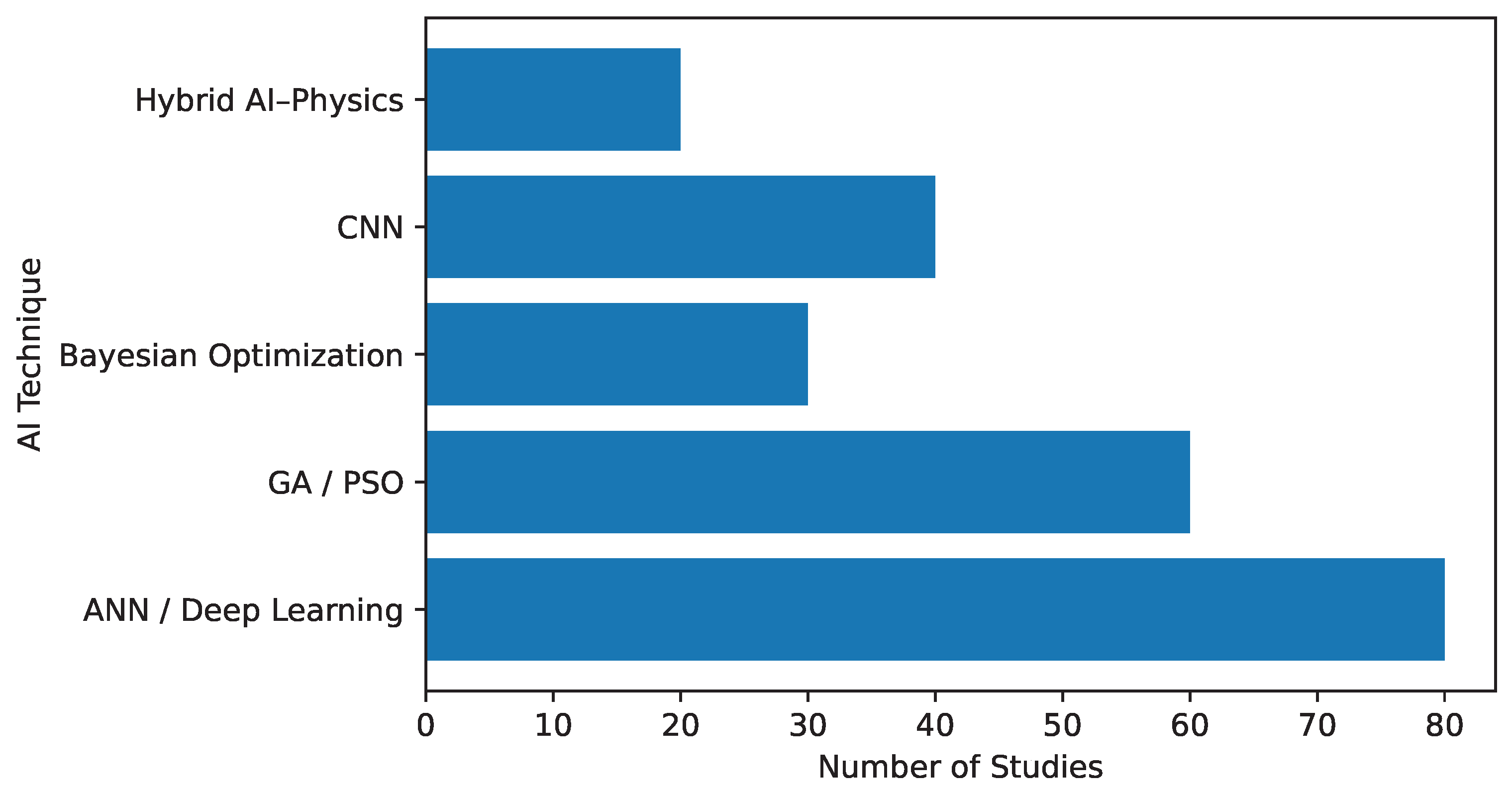
The reviewed studies were further categorized according to the AI technique employed, allowing the identification of dominant methodological trends and underexplored approaches within the field. This classification provides a quantitative overview of how different AI paradigms have been applied in recent research on solar thermal collectors and selective absorber coating materials.
As shown in
Figure 1, ANN and DL approaches dominate current research, whereas hybrid AI–physics models and Bayesian optimization strategies remain comparatively underexplored, highlighting clear opportunities for future developments.
2.1. AI and Its Application in Solar Thermal Systems
This study focuses on the application of AI to enhance the performance, reliability, and sustainability of solar thermal systems, particularly through the design and optimization of selective absorber coatings and collector configurations. To address this objective, two main methodological approaches are considered: traditional modeling and optimization methods, and artificial intelligence (AI)-based techniques. Both approaches are discussed and critically evaluated below.
2.1.1. Traditional Modeling and Optimization Methods
Traditional approaches for analyzing and optimizing solar thermal systems rely on analytical and numerical techniques grounded in heat transfer theory, thermodynamics, and material science. These include one-dimensional and multidimensional thermal models for predicting collector efficiency, parametric and sensitivity analyses for evaluating the influence of material properties and operating conditions, and numerical simulations based on finite element or Computational Fluid Dynamics (CFD) methods. While these approaches provide physically interpretable and reproducible results, they often struggle to capture highly nonlinear interactions between material properties, environmental conditions, and long-term degradation phenomena, especially when multiple variables interact simultaneously.
2.1.2. Artificial Intelligence-Based Methods
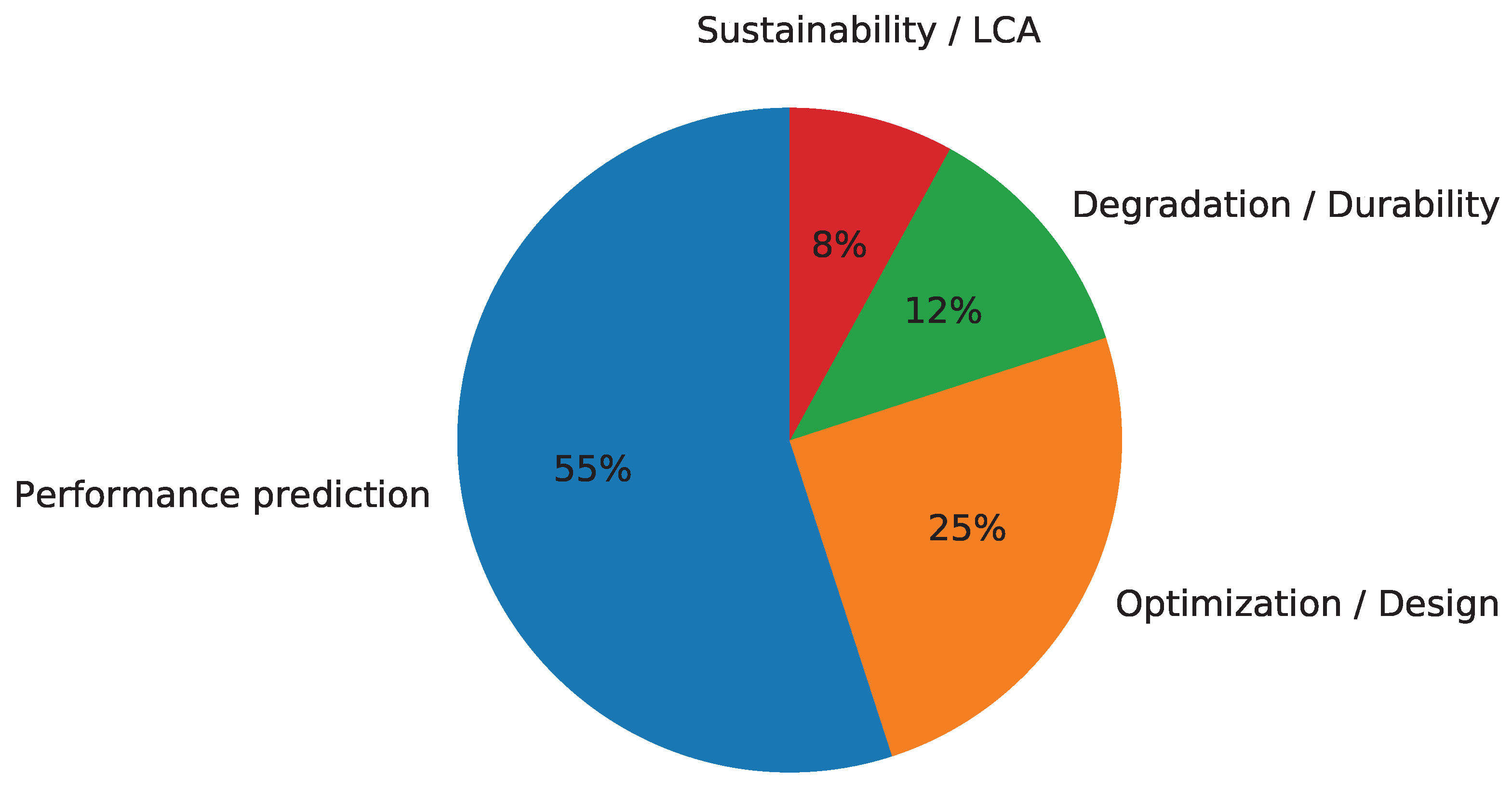
Artificial intelligence-based methods, including ML and metaheuristic optimization techniques, have emerged as powerful tools for addressing the complex, nonlinear nature of solar thermal systems. Common approaches include ANN [A] and regression-based models for predicting thermal efficiency and heat transfer performance; Genetic Algorithms (GA) and Particle Swarm Optimization (PSO) [A] for optimizing coating composition, layer thickness, and collector design parameters; and data-driven models for degradation forecasting and performance monitoring. These methods are particularly effective in handling large datasets, uncertainty, and multivariable optimization problems. However, they require careful training, validation, and interpretability considerations to avoid overfitting and ensure physically meaningful results. Beyond the methodological distinction between traditional and artificial intelligence-based approaches, the reviewed literature was further analyzed according to its primary research focus. This thematic classification enables a clearer understanding of how artificial intelligence has been predominantly employed in solar thermal research, as well as which aspects remain comparatively underexplored.
As shown in
Figure 2, most AI-based studies prioritize performance prediction and system optimization, whereas degradation mechanisms, long-term durability, and sustainability-oriented analyses represent a smaller fraction of the existing literature. This imbalance indicates that environmental performance and lifecycle considerations are often treated as secondary objectives rather than as core design drivers, thereby justifying the integrative and sustainability-focused perspective adopted in the present review.
2.2. Critical Considerations
The selection of methodologies for analyzing and optimizing solar thermal systems depends on the trade-off between model interpretability, computational complexity, accuracy, and data availability. Traditional physics-based models provide transparent and physically grounded insights into heat transfer mechanisms, optical properties, and material behavior under controlled assumptions. However, their applicability is often limited when dealing with highly nonlinear interactions among material properties, environmental conditions, aging effects, and operational variability. In contrast, artificial intelligence-based approaches are more effective in dynamic and data-rich contexts, where multiple factors—thermal, material, environmental, and operational—must be considered simultaneously. In this research, a hybrid perspective is implicitly adopted, where data-driven models complement classical thermal and material modeling, enabling enhanced performance prediction, optimization, and long-term assessment of solar thermal collectors and selective absorber coatings under real-world operating conditions.
2.3. Criteria for Selection and Exclusion of Research
To ensure transparency, methodological rigor, and reproducibility, a clearly defined selection protocol was adopted in this systematic review. Although systematic reviews are increasingly common, the absence of strict and standardized selection criteria often leads to biased or weakly supported conclusions. To avoid these limitations and maintain a focused scope, explicit inclusion and exclusion criteria were established in accordance with the objectives of this study.
This review specifically addresses the application of AI and data-driven techniques to solar thermal collectors, photothermal systems, and selective solar absorber coatings. Based on this scope, the following criteria were applied:
Keyword Focus—Studies were required to include terms related to solar thermal systems, photothermal applications, or solar absorbers, in combination with artificial intelligence, ML, or data-driven methodologies.
Publication Date Range—Only peer-reviewed journal articles published between 2020 and 2026 were considered, ensuring the relevance and contemporaneity of the reviewed literature.
Subject Area Filtering—Research areas not directly related to energy systems, engineering, materials science, or computational modeling—such as neuroscience, immunology, health sciences, social sciences, business, agriculture, pharmacology, biology, economics, and physics—were excluded to maintain thematic coherence.
Document Type—Only journal articles were included. Review papers, conference proceedings, editorials, and other non-article document types were excluded to prioritize original research contributions with detailed methodological descriptions.
Thematic Relevance—Studies focusing primarily on topics unrelated to solar thermal technologies, such as hydrogen production, biomedical applications, hydrogels, MXenes, disease diagnostics, forestry, or animal and human studies, were excluded.
System-Level Relevance—Articles that did not explicitly address solar thermal collectors, photothermal systems, or selective absorber coatings, or that applied AI exclusively to unrelated energy technologies, were also excluded.
Final Search Code—The final Scopus search query applied in this review was:
TITLE-ABS-KEY ( “solar thermal*” OR “photothermal*” OR “solar absorber*” )
AND TITLE-ABS-KEY ( “artificial intelligence” OR “machine learning” OR “data-driven” )
AND PUBYEAR > 2019 AND PUBYEAR < 2027
AND LIMIT-TO ( DOCTYPE , “ar” )
AND ( EXCLUDE ( SUBJAREA , “NEUR” ) OR EXCLUDE ( SUBJAREA , “IMMU” ) OR EXCLUDE ( SUBJAREA , “EART” )
OR EXCLUDE ( SUBJAREA , “HEAL” ) OR EXCLUDE ( SUBJAREA , “SOCI” ) OR EXCLUDE ( SUBJAREA , “DENT” )
OR EXCLUDE ( SUBJAREA , “BUSI” ) OR EXCLUDE ( SUBJAREA , “AGRI” ) OR EXCLUDE ( SUBJAREA , “PHAR” )
OR EXCLUDE ( SUBJAREA , “MEDI” ) OR EXCLUDE ( SUBJAREA , “BIOC” ) OR EXCLUDE ( SUBJAREA , “NURS” )
OR EXCLUDE ( SUBJAREA , “ECON” ) OR EXCLUDE ( SUBJAREA , “PHYS” )
AND ( EXCLUDE ( EXACTKEYWORD , “Hydrogen Production” ) OR EXCLUDE ( EXACTKEYWORD , “Hydrogels” )
OR EXCLUDE ( EXACTKEYWORD , “Tumors” ) OR EXCLUDE ( EXACTKEYWORD , “Animals” )
OR EXCLUDE ( EXACTKEYWORD , “Human” ) OR EXCLUDE ( EXACTKEYWORD , “Diagnosis” )
OR EXCLUDE ( EXACTKEYWORD , “Mxene” ) OR EXCLUDE ( EXACTKEYWORD , “Diseases” )
OR EXCLUDE ( EXACTKEYWORD , “Nearest Neighbor Search” ) OR EXCLUDE ( EXACTKEYWORD , “Forestry” )
2.4. Discussion of the Systematic Review Flow
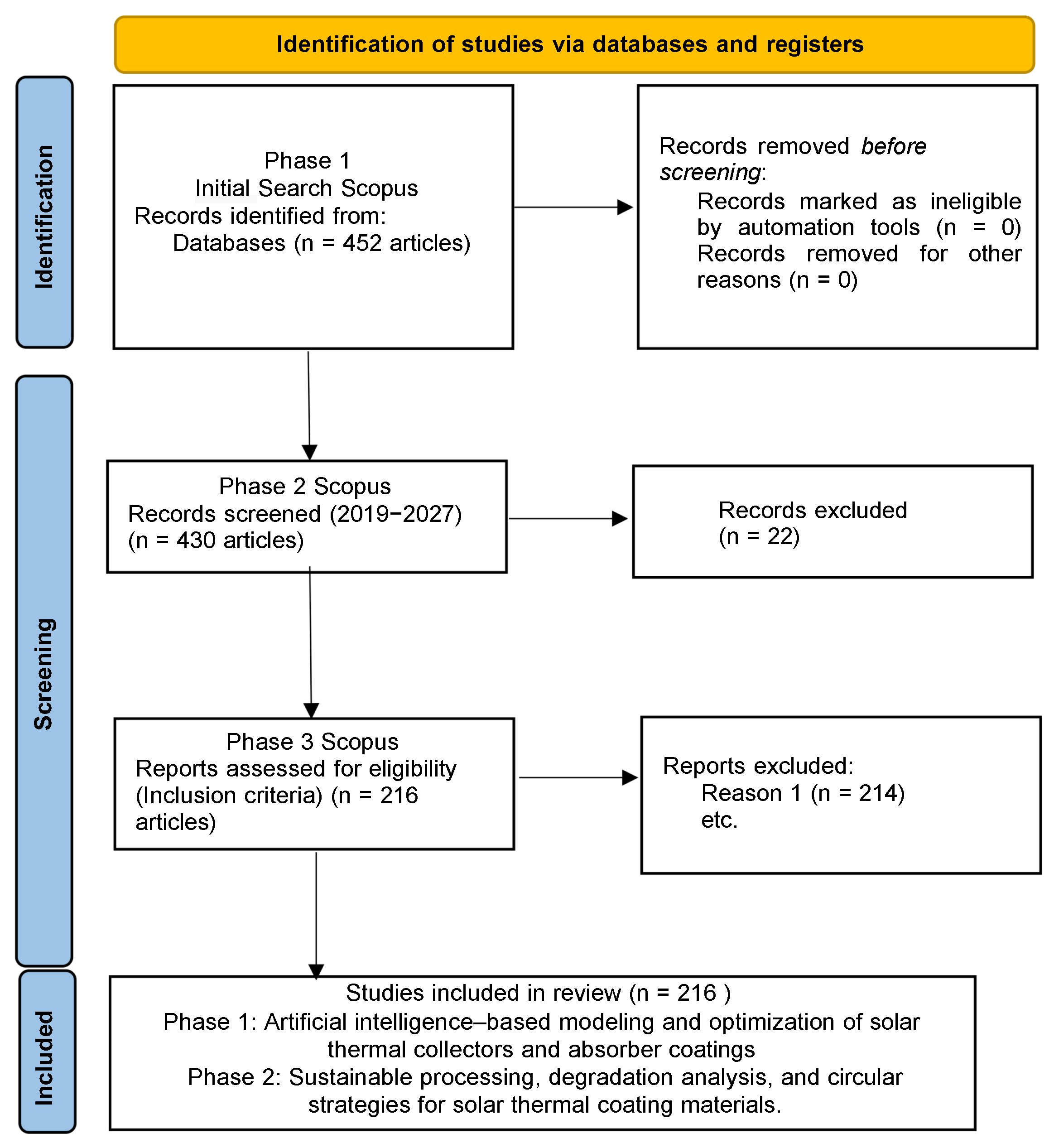
Figure 3 illustrates the sequential screening and selection process adopted in this systematic review, conducted in accordance with the PRISMA 2020 guidelines. The initial search in the Scopus database retrieved 452 records, reflecting the interdisciplinary scope of research combining solar thermal technologies, photothermal systems, selective solar absorbers, and AI methodologies. This initial stage was intentionally broad to ensure high sensitivity and comprehensive coverage of the relevant scientific literature.
After applying a temporal filter restricting publications to the period 2019–2027, the dataset was refined to 430 records, ensuring that the analysis reflects recent advances in data-driven modeling, optimization, and sustainability assessment of solar thermal systems. No records were excluded through automation tools or other pre-screening mechanisms, as all refinements were applied directly at the query level.
The eligibility assessment constituted the most critical stage of the review process. By excluding non-relevant subject areas and specific keywords associated with unrelated applications (such as biomedical studies, hydrogen production, or forestry), the corpus was reduced to 216 articles that explicitly address solar thermal collectors, photothermal systems, or selective absorber coatings using AI or ML techniques.
The final set of 216 studies included in the review was organized into two complementary analytical phases. Phase 1 focuses on artificial intelligence-based modeling and optimization of solar thermal collectors and absorber coatings, emphasizing performance prediction and design improvement. Phase 2 addresses sustainable processing routes, degradation mechanisms, durability analysis, and circular strategies for solar thermal coating materials. This structured succession ensures methodological transparency, thematic coherence, and alignment with the objectives of the present review.
2.5. Critical Discussion of Current Research Trends
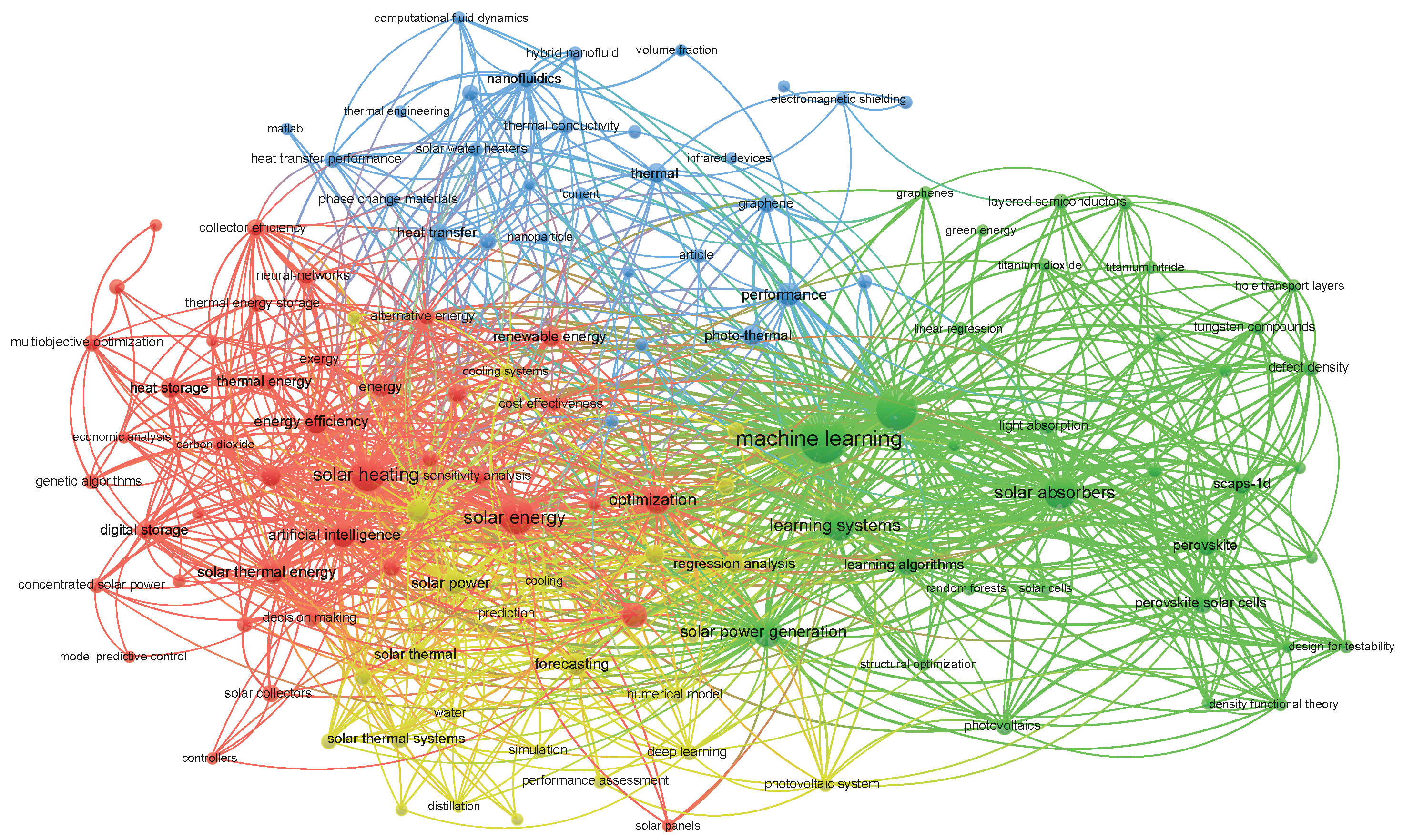
Figure 4 presents the bibliometric network analysis of the selected literature, highlighting the main research clusters and their interconnections within the field of AI applied to solar thermal technologies. The visualization reveals a clear evolution from traditional thermal engineering approaches toward data-driven methodologies, with ML emerging as a central hub linking solar thermal systems, selective absorber materials, and performance optimization.
One of the most prominent trends observed in recent studies is the extensive use of ML techniques—such as ANN, regression models, and ensemble learning—for predicting thermal efficiency, heat transfer performance, and system behavior under variable operating conditions. These approaches have gained traction due to their ability to capture nonlinear relationships between material properties, environmental factors, and operational parameters. However, many of these models remain highly case-specific and exhibit limited generalizability across different collector configurations or climatic regions.
A second major research direction corresponds to the integration of AI with materials science, particularly in the design and optimization of selective absorber coatings. The network highlights strong linkages between keywords related to coating composition, nanoparticle volume fraction, optical absorption, and thermal conductivity. While these studies demonstrate significant potential for accelerating material development, most focus on short-term performance indicators, with comparatively limited attention to degradation mechanisms, aging behavior, and long-term durability.
Sustainability-related themes, including thermal energy storage, Phase Change Materials (PCMs), and hybrid nanofluids, form an emerging but less consolidated cluster. Although these approaches report notable efficiency improvements, sustainability is often addressed indirectly, without comprehensive lifecycle assessment or circular design considerations. This indicates that environmental performance remains a secondary objective rather than a core design driver in much of the current literature.
From a methodological standpoint, the bibliometric structure suggests a predominance of standalone data-driven models, with relatively few contributions integrating physics-based thermal modeling and AI within unified hybrid frameworks. This fragmentation limits interpretability and robustness, particularly when extrapolating predictions beyond the training data. The gradual emergence of hybrid and physics-informed AI approaches signals a growing awareness of these limitations, yet their practical implementation remains at an early stage.
Overall, the current research landscape is characterized by rapid growth in AI applications and increasing methodological complexity, but also by fragmentation and a lack of holistic integration. Advancing the field will require stronger coupling between AI methodologies, material durability analysis, and sustainability assessment to enable the development of resilient, scalable, and environmentally responsible solar thermal systems.
3. Fundamentals of Selective Coatings for Solar Thermal Systems
Selective coatings for solar thermal systems play a fundamental role in improving photothermal conversion efficiency, as they enable the maximization of incident solar radiation absorption while simultaneously minimizing thermal losses due to infrared radiation. These properties are particularly critical in CSP applications, such as parabolic trough collectors, solar towers, and linear receivers, where high operating temperatures are achieved [
18,
19].
The operating principle of a selective coating is based on its spectral selectivity; that is, the ability of the material to exhibit high absorptance in the solar spectrum range (0.3–2.5 µm) and low emissivity in the thermal infrared region (>2.5 µm), which corresponds to the dominant wavelengths of radiation emitted by the heated absorber [
5].
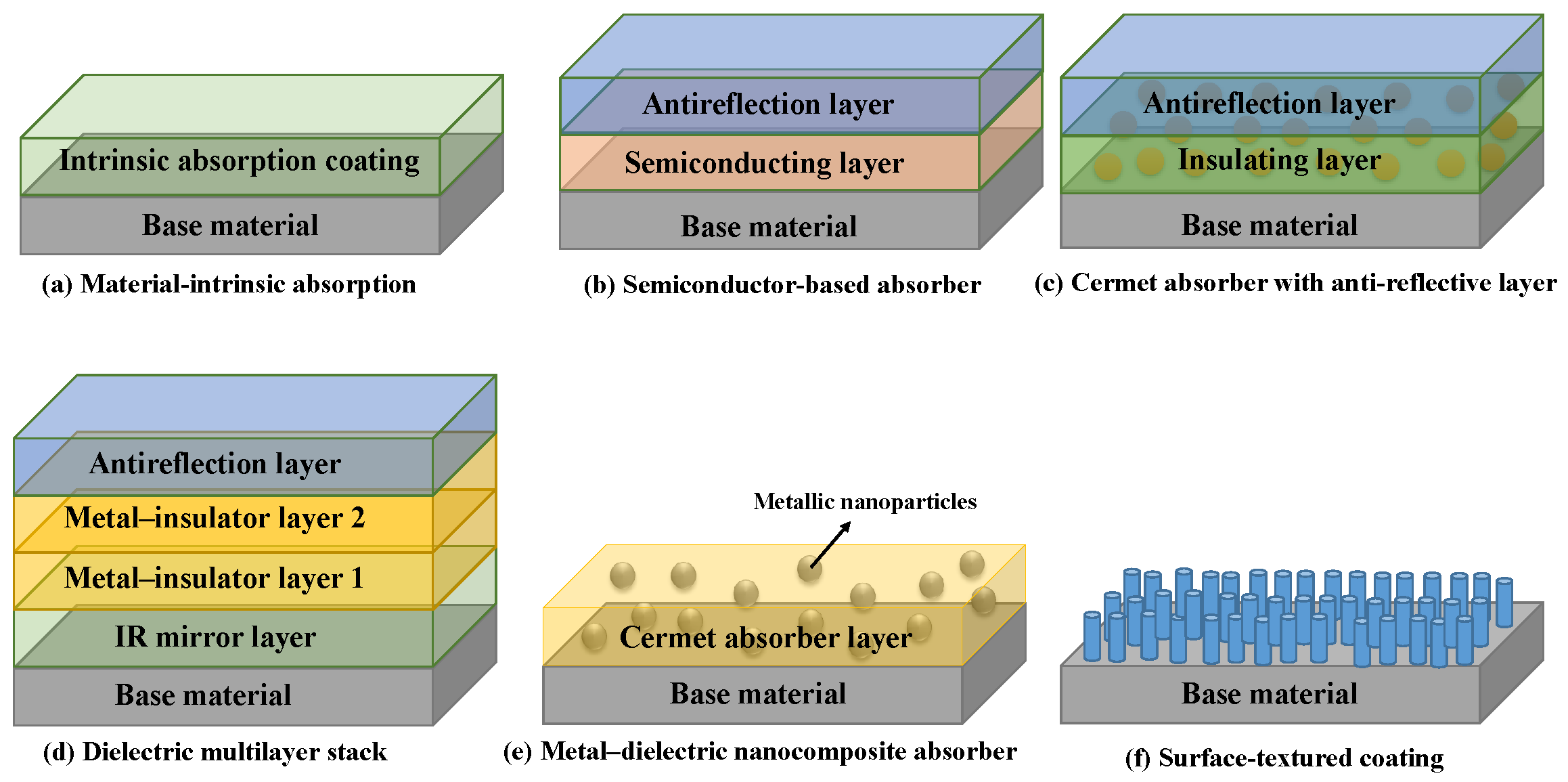
From a structural perspective, selective coatings can be classified into intrinsic layers, cermets, interference multilayers, metal–dielectric–metal structures, and nanostructured surfaces, each designed to optimize the balance between solar absorption, thermal stability, and long-term durability [
19,
20]
3.1. Optical-Thermal Principles
The optical–thermal performance of a selective coating is mainly described by two fundamental parameters: solar absorptance () and thermal emissivity ().
Solar absorptance (
) is defined as a fraction of incident solar radiation that is absorbed by the surface of the coating. Mathematically, it is expressed as a weighted integral of the solar spectrum:
where
represents the spectral distribution of solar radiation. For efficient solar thermal applications, values of
are required [
20].
On the other hand, thermal emissivity (
) quantifies the ability of the coating to emit thermal radiation compared to an ideal blackbody at the same temperature. It is defined as:
where
corresponds to the spectral distribution of blackbody radiation. In high-performance selective coatings, emissivity must be low (
) to reduce radiative losses, particularly at temperatures above 400 °C [
19].
The physical principle behind spectral selectivity is based on mechanisms such as optical interference, electronic absorption, plasmonic resonances, and multiple scattering in nanostructures, which allow the decoupling of optical behavior in the visible and infrared regions [
20,
21]. In particular, cermet-type coatings (mixtures of metallic nanoparticles embedded in ceramic matrices) have demonstrated an excellent balance between high solar absorptance, low thermal emissivity, and high-temperature stability [
19].
3.2. Influence of Microstructure on Efficiency
The optical–thermal efficiency of solar selective coatings is strongly determined by their microstructure, understood as the distribution of phases, grain size, surface roughness, porosity, and multilayer architecture of the material. At the microscopic and nanometric scales, these parameters govern the mechanisms of solar absorption and thermal emission, directly affecting the solar absorptance () and thermal emittance () of the coating.
Modern selective coatings are commonly designed as metal–dielectric multilayer systems or cermets (ceramic–metal composites), in which metallic nanoparticles embedded in a ceramic matrix generate localized plasmonic resonances that enhance absorption in the solar spectrum (0.3–2.5
), while the dielectric matrix reduces emittance in the mid- and far-infrared regions [
22]. The metal volume fraction, as well as the size and shape of the nanoparticles, governs the interaction with electromagnetic radiation and, consequently, the spectral balance of the coating.
Surface roughness plays a critical role in optical efficiency. A controlled microstructure with hierarchical roughness can promote multiple absorption through light-trapping effects, thereby reducing effective reflectance. However, excessive roughness may increase thermal emittance due to the enlargement of the effective emitting area, which compromises performance at elevated temperatures. Therefore, a microstructural trade-off exists between maximizing solar absorption and minimizing radiative losses.
Furthermore, the continuity and adhesion between layers influence interfacial thermal conductivity and the mechanical stability of the coating. Dense and homogeneous microstructures tend to exhibit higher thermal stability and lower optical degradation during prolonged operating cycles, which is essential for applications in flat-plate and moderately concentrating solar collectors.
3.3. Thermal and Optical Degradation Mechanisms
During long-term operation of solar thermal systems, selective coatings are exposed to high temperatures, intense solar radiation, and oxidizing atmospheres, leading to various thermal and optical degradation mechanisms. These processes alter the original microstructure and result in a progressive decrease in solar absorptance (
) and an increase in thermal emittance (
). One of the dominant mechanisms is the oxidation of metallic phases, particularly in cermet coatings. At elevated temperatures, oxygen can diffuse through the dielectric matrix and react with metallic nanoparticles, modifying their chemical composition and reducing the plasmonic resonances responsible for high solar absorption. This phenomenon leads to an increase in reflectance in the visible and near-infrared regions [
22].
Another relevant mechanism is interfacial diffusion between layers, which may cause the formation of secondary phases or a loss of sharp optical interfaces. Thermally activated diffusion alters the effective refractive index of the layers, thereby affecting the originally designed spectral behavior. In multilayer systems, even small variations in thickness or composition can translate into significant losses in spectral selectivity [
23].
Grain coalescence and growth also constitute critical processes. The increase in the size of metallic nanoparticles reduces the density of absorption centers and modifies electromagnetic coupling with incident radiation, resulting in a decrease in solar absorptance. Simultaneously, the increase in roughness induced by microstructural reorganization enhances radiative losses in the infrared region.
Finally, repeated thermal cycling may induce mechanical fatigue and microcracking, particularly when there is a mismatch in the coefficients of thermal expansion between the substrate and the coating. These microcracks act as preferential sites for oxidation and accelerate the optical degradation of the system, thereby reducing its operational lifetime.
3.4. Material Systems and Structures
Selective coatings are a critical component of solar thermal collectors, as they enable high solar absorptance (
) while minimizing thermal emittance (
), thereby enhancing photothermal conversion efficiency and operational stability. Achieving this balance requires carefully engineered material systems capable of maintaining optical selectivity and structural integrity under prolonged exposure to high temperatures, intense solar radiation, and oxidizing environments [
18,
20].
Current strategies rely on tailored micro- and nanostructured materials, including cermets, metal oxides, nitrides and carbides, as well as hybrid and multilayer architectures. These systems are increasingly evaluated not only in terms of optical performance but also with respect to thermal stability, oxidation resistance, mechanical durability, and compatibility with sustainable and circular design principles.
Figure 5 provides a schematic overview of the main selective coating architectures employed in solar thermal collectors, including intrinsic absorbers, semiconductor-based coatings, cermet systems, multilayer interference stacks, metal–dielectric nanocomposites, and surface-textured coatings. These architectures form the basis for the material systems discussed in the following subsections,
Table 1.
3.4.1. Cermet-Based Selective Coatings
Cermets, consisting of metallic nanoparticles embedded within a ceramic dielectric matrix, remain among the most widely implemented selective absorber systems for mid- to high-temperature solar thermal applications. Optical selectivity in these coatings arises from plasmonic absorption in the metallic phase, while the ceramic matrix suppresses infrared emission and enhances thermal and chemical stability [
5,
19].
Common systems such as Ni–Al
2O
3 and Cr–SiO
2 exhibit high solar absorptance (
–
) and relatively low thermal emittance (
), maintaining stable performance up to approximately 500–600 °C. These characteristics make them suitable for flat-plate and evacuated tube collectors. However, oxidation of the metallic phase remains a limiting factor at elevated temperatures [
20].
Advanced cermets such as Mo–AlN extend applicability toward higher-temperature regimes due to the refractory nature and chemical stability of both constituents. Improved resistance to oxidation and thermal cycling positions these systems as promising candidates for concentrating solar power (CSP) receivers [
24]. Insights from high-temperature corrosion and oxidation studies further indicate that multi-component alloying and ceramic encapsulation are effective strategies to enhance long-term stability in cermet absorber designs [
25].
3.4.2. Metal Oxide Selective Coatings
Metal oxides constitute a cost-effective and chemically robust class of selective absorber materials. Their optical absorption originates from electronic transitions and defect states, while their intrinsic resistance to oxidation and corrosion contributes to long-term durability [
28].
Copper oxide (CuO) exhibits strong absorption in the visible spectrum and is widely investigated for low- to mid-temperature applications. Iron oxide (Fe
3O
4) offers moderate absorptance combined with excellent thermal stability, whereas titanium dioxide (TiO
2), although optically transparent in its pristine form, plays a crucial role as a dielectric, antireflective, or protective layer in multilayer and cermet architectures [
21,
27]. TiO
2 improves infrared reflectance and mitigates degradation of underlying absorbing layers.
Despite these advantages, oxide-based coatings generally exhibit higher thermal emittance than optimized cermet systems when used alone, which limits their spectral selectivity. Consequently, oxides are often integrated into composite or multilayer designs to enhance overall performance while retaining favorable environmental and lifecycle characteristics.
3.4.3. Nitrides and Carbides
Transition metal nitrides and carbides, including TiN, ZrN, and SiC, are increasingly explored for high-temperature selective coatings due to their metallic-like optical response, extreme hardness, and superior thermal stability [
24,
29]. TiN and ZrN exhibit plasmonic behavior comparable to noble metals, enabling high solar absorptance while offering improved oxidation resistance.
Silicon carbide (SiC) stands out for its high solar absorptance, excellent thermal conductivity, and mechanical robustness. These attributes make SiC suitable not only as an absorber layer but also as a thermally stable interlayer or structural component in advanced solar thermal systems [
28,
30]. However, oxidation at very high temperatures in air remains a concern, often requiring protective coatings or controlled operating environments.
3.4.4. Hybrid and Multilayer Architectures
Hybrid and multilayer selective coatings represent the most advanced approach to optimizing solar thermal performance. These architectures typically combine reflective substrates, absorbing layers, antireflection coatings, and protective overlayers, enabling independent control of absorption, emission, and durability.
Multilayer designs exploit optical interference effects, refractive index grading, and interface engineering to achieve near-ideal spectral selectivity. Metal–dielectric stacks, graded cermets, and absorber–antireflection–protective layer systems have demonstrated solar absorptance values exceeding 0.95 while maintaining suppressed infrared emittance [
20,
31].
In addition to performance enhancement, multilayer architectures facilitate the integration of sustainability considerations, such as modularity, recyclability, and improved lifecycle performance. These features align with emerging circular innovation strategies and highlight the future potential of intelligent, data-driven coating design for next-generation solar thermal technologies [
32,
33].
3.5. Fabrication and Processing Techniques
In solar thermal collectors particularly in selective absorber surfaces fabrication routes can be broadly classified into vacuum based deposition processes (PVD/CVD) and wet or electrochemical routes (sol–gel and electrodeposition). In general, the primary objective of the coating is to maximize solar absorptance while minimizing thermal emittance, ensuring thermal and chemical stability as well as compatibility with typical substrates (Cu, Al, stainless steels, etc.). Recent reviews on high-temperature selective coatings emphasize that, for applications with higher thermal demands (CSP), multilayer architectures (metal–dielectric systems, cermets, and nitride/oxide stacks) fabricated by composition and thickness controllable vacuum methods remain dominant [
34].
Physical Vapor Deposition (PVD), particularly magnetron sputtering, is among the most widely used techniques for both commercial and laboratory scale selective coatings, owing to its fine control over microstructure and composition (e.g., cermets and metal dielectric multilayers) [
34]. In the context of high-temperature selective coatings, it has been reported that thermal stability and spectral selectivity strongly depend on the choice of absorber/dielectric materials and on multilayer design, where PVD enables precise adjustment of optical gradients, interfaces, and layer thicknesses with high reproducibility. From a process control standpoint, parameters such as applied power, partial pressure of reactive gases (in reactive sputtering), target substrate distance, and substrate temperature govern deposition rate, film density, and defect formation. Consequently, AI-assisted modeling and optimization approaches are increasingly relevant to reduce experimental trial and error in coating development [
35].
Chemical Vapor Deposition (CVD), including variants such as LPCVD and PECVD, is typically employed when dense, conformal films with strong adhesion and uniform coverage over complex geometries are required. In the field of selective coatings, CVD has been explored for functional layers (oxides, nitrides, and barrier coatings) where vapor phase chemistry promotes uniform coverage and stoichiometric control. However, the balance between performance, energy consumption, and cost remains critical, as high processing temperatures may increase the energy footprint unless low-temperature variants (e.g., PECVD) are adopted. Reviews on high-temperature selective coatings highlight this trade off between optical performance and degradation or oxidation at elevated temperatures, underscoring the importance of barrier layer design and microstructural stability areas where CVD/PECVD can offer advantages [
34].
In contrast, the sol–gel route stands out for its low cost, scalability, and compatibility with non vacuum manufacturing approaches (dip-coating, spray-coating, spin-coating, etc.). A well documented example in the literature is the development of Cu–Co–Mn–Si oxide black selective coatings for CSP applications fabricated via sol–gel dip-coating. These systems achieve solar absorptance values of 0.96 and thermal emittance values of 0.12 at 100 °C on stainless steel substrates. The study emphasizes that precise control of composition and nanocrystalline microstructure is essential to tune the complex refractive index and achieve optimal spectral selectivity. Importantly, the work also demonstrates that substrate roughness significantly affects interfacial quality and, consequently, optical performance and adhesion, highlighting that surface preparation (cleaning, pretreatments, target roughness) must be considered an integral part of the coating process rather than a secondary step [
36].
Electrodeposition and other electrochemical routes are particularly attractive for flat plate solar collectors due to their cost effectiveness, ease of scaling, and compatibility with conductive metallic substrates. In a representative study focused on flat plate solar water heaters, a bright Ni/black Ni selective coating system was electrodeposited on copper substrates and scaled up to fabricate a 1.74 m
2 collector, which was experimentally compared with commercial alternatives, including PVD-based coatings. The results demonstrated competitive thermal performance while also discussing practical strategies such as backside passivation to enhance long term stability. In electrodeposition processes, critical parameters include current density or applied potential, bath chemistry, agitation, bath temperature, and morphology control, as these directly influence absorptance, emittance, porosity, and durability under thermal aging [
37].
From the perspective of emerging sustainable processing routes, the recent literature increasingly highlights techniques that avoid high substrate temperatures, reduce energy consumption, minimize the use of hazardous solvents, and enable repair or remanufacturing strategies. Within this framework, cold spray technology is particularly relevant as a solid-state deposition process, where coating adhesion arises from severe plastic deformation induced by high velocity particle impact rather than melting. This allows the deposition and repair of coatings while minimizing thermal exposure of the substrate, making cold spray especially attractive for life extension and circular-economy strategies, including in-situ repair and remanufacturing. Critical reviews on sustainable cold spray coatings emphasize their role in component repair, remanufacturing, and additive manufacturing due to their low thermal impact and material efficiency [
38].
Other low energy routes gaining industrial traction include functional printing technologies (inkjet, screen printing, roll to roll) combined with low-temperature curing. Although much of the literature is motivated by printed electronics, the underlying principles material process property relationships, rheological formulation, and multimaterial integration are directly transferable to the fabrication of thin functional layers on diverse substrates, including energy applications. Comprehensive reviews on inkjet-printed functional materials discuss strategies to expand printable material libraries, integrate heterostructures, and process on flexible or rigid substrates, thereby enabling more additive and material efficient manufacturing compared with conventional subtractive routes [
39]. From a sustainability standpoint, decision making frameworks have also been proposed to identify applications where printed electronics—and, by extension, printed functional coatings—can offer environmental advantages over conventional technologies when the full life cycle, including end of life management and regulatory constraints, is considered [
40].
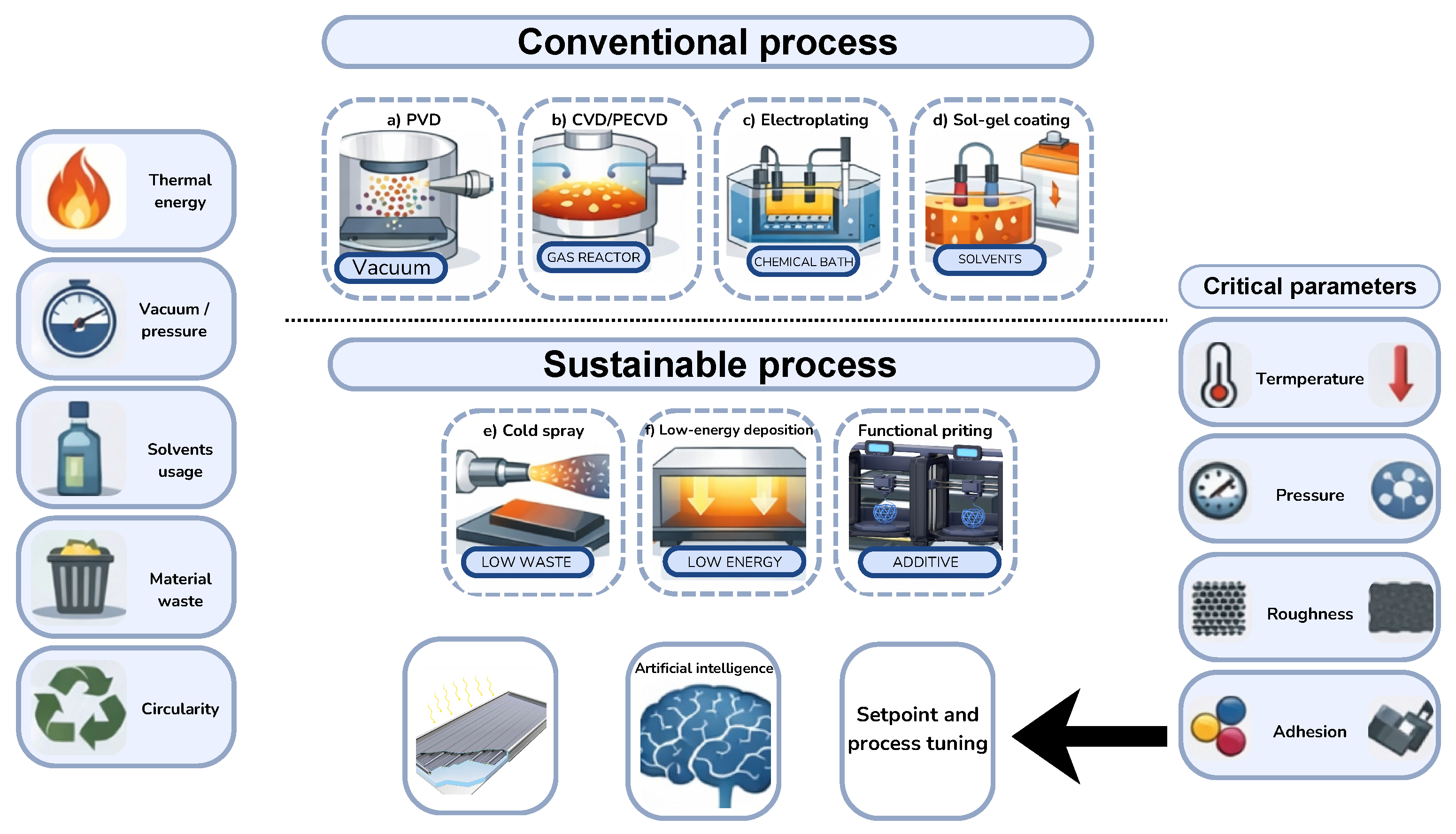
Figure 6 presents a comparative schematic of conventional and emerging coating fabrication routes for solar thermal collectors, highlighting main differences in processing principles, energy demand, and sustainability potential. The diagram also illustrates critical process parameters and the role of AI in enabling data-driven optimization and adaptive process control.
The functional performance and durability of coatings for solar thermal collectors are strongly influenced by a set of critical processing parameters that govern microstructure, interfacial stability, and optical properties. In parallel, AI has emerged as an effective tool to model and optimize the complex, nonlinear relationships between processing conditions and coating performance.
Table 2 summarizes the main process parameters and highlights the role of AI in process optimization [
34,
35,
36,
37,
41].
4. AI in the Design and Optimization of Coatings
The increasing complexity of functional coatings—particularly selective, multilayer, and nanostructured coatings—has accelerated the adoption of AI techniques to support design, optimization, and process control. ML, DL, and evolutionary algorithms enable the extraction of complex relationships between composition, microstructure, processing conditions, and functional properties, significantly reducing experimental trial-and-error cycles and enabling inverse materials design.
AI is now systematically applied to link composition–process–structure relationships with coating performance. In particular, neural network-based models have proven effective for capturing nonlinear system dynamics and enabling adaptive modeling and tuning in complex engineering systems, where explicit physical models are difficult to obtain or continuously update [
42,
43]. Recent reviews on functional and surface coatings report that data-driven models successfully map complex, nonlinear interactions between formulation, deposition parameters, microstructural features, and performance metrics such as hardness, adhesion, corrosion resistance, and optical response, replacing a large fraction of manual experimentation [
44]. Within this framework, inverse-design workflows have emerged, where ML models search the composition or structural design space to meet predefined target properties, rather than relying on random or incremental exploration [
45].
A central application of AI in functional coatings is the prediction of main material properties across multiple domains. In mechanical and tribological systems, ML models have been shown to accurately predict hardness, elastic modulus, wear rate, and friction behavior in epoxy, high-entropy alloy (HEA), and diamond-like carbon (DLC) coatings, achieving coefficients of determination (
) typically in the range of 0.90–0.98. These predictions provide quantitative guidance for both composition selection and process optimization [
46].
Tree-based ML models such as random forests, gradient boosting, and XGBoost have demonstrated strong predictive performance for coating thickness and microstructural descriptors—including porosity, roughness, and layer uniformity—in plasma electrolytic oxidation (PEO), layer-by-layer (LbL) multilayer systems, and thermal-spray thermal barrier coatings (TBCs), directly from process and chemistry inputs [
47]. Such capabilities enable rapid optimization of deposition parameters while reducing experimental iterations.
DL techniques, particularly Convolutional Neural Networks (CNN), further extend AI capabilities in functional performance prediction. CNN-based models have been successfully applied to predict corrosion behavior, classify surface chemistry from microscopy images, and forecast optical spectra in multilayer and far-ultraviolet (FUV) coatings, highlighting the potential of image- and spectrum-based learning approaches in coating science [
48].
Representative examples of AI applications across different coating families are summarized in
Table 3, illustrating how diverse AI techniques are used to address optimization, prediction, and inverse-design challenges across multiple material systems.
AI models reduce experimental trial and error by learning high-dimensional, nonlinear relationships between composition, microstructure, and processing conditions and rapidly predicting resulting properties. Once trained, these models enable efficient virtual screening and multi-objective optimization, allowing experimental efforts to focus on the most promising coating designs and accelerating development cycles [
52].
4.1. ML for Property Prediction
ML techniques, including regression models and ANN, have been effectively applied to predict main optical properties of functional coatings, such as solar absorptance (
) and thermal emittance (
), which are crucial for solar thermal and radiative cooling applications. These models are capable of capturing complex nonlinear relationships between coating composition, layer thickness, surface morphology, and optical response, enabling accurate prediction and optimization of multilayer coating systems [
53].
Neural network-based approaches have been developed for both forward property prediction and inverse design, allowing rapid determination of optimal layer thicknesses to achieve target spectral responses, even in challenging wavelength regions such as the far-ultraviolet [
54]. Comparative studies further indicate that certain ML algorithms, including decision trees and random forests, can outperform DL models in predicting reflectance spectra of multilayer anti-reflection coatings, offering efficient and computationally economical guidance for coating design and fabrication [
55]. ML models trained on large simulated datasets have demonstrated very high predictive accuracy, with coefficients of determination exceeding
for the optical performance of multilayer thin films, with predictions validated against experimental measurements [
53].
Common regression approaches for predicting optical properties of functional coatings include linear and polynomial regression, support vector regression, random forests, and gradient-boosting algorithms, while multilayer perceptron neural networks (MLPs) are often employed to model more complex nonlinear dependencies. These models are typically trained on datasets derived from experimental spectrophotometric measurements or optical simulations that provide spectral responses across relevant wavelength ranges [
56].
For instance, feed-forward neural networks (FFNNs) have demonstrated superior performance in predicting transmitted light intensity in polymer nanocomposite films, with neural predictive formulas derived from network weights enabling accurate modeling within specific data ranges [
57]. In the case of multilayer anti-reflection coatings, ensemble-based regression methods such as decision trees, random forests, and bagging algorithms have been reported to outperform DL models in reflectance prediction, highlighting their effectiveness for optical property modeling and design guidance [
55]. Furthermore, multiple linear regression has been successfully applied to predict spectral characteristics of carbon dots, illustrating that simpler regression models can still provide reliable predictions when combined with well-curated and physically meaningful datasets [
58].
To enable the generation of large, physically consistent training datasets for optical property prediction, physics-based simulation methods are commonly coupled with ML models. The Transfer Matrix Method (TMM) is widely used to simulate the optical properties of multilayer coatings by calculating reflectance, transmittance, and absorptance as functions of layer thicknesses and refractive indices. TMM models the propagation of electromagnetic waves through multilayer systems using
matrices, enabling efficient and physically consistent computation of spectral responses for complex coating stacks [
59]. This method supports the design and optimization of coatings such as anti-reflective layers, distributed Bragg reflectors, and optical filters by identifying transmission and reflection bands and analyzing the influence of layer geometry and periodicity [
60]. Recent advances include high-performance implementations such as TMMax, which leverage ML libraries to accelerate TMM simulations by several orders of magnitude, facilitating rapid design iterations even for multilayer stacks comprising hundreds of layers [
61]. TMM-based simulations have been experimentally validated, showing close agreement with measured optical properties of fabricated multilayer wafers, thereby confirming the reliability of the method for practical coating design [
62]. In addition, TMM can be extended to account for partially coherent and incoherent interference effects, broadening its applicability to real-world multilayer systems that exhibit surface roughness or thick-layer behavior [
63].
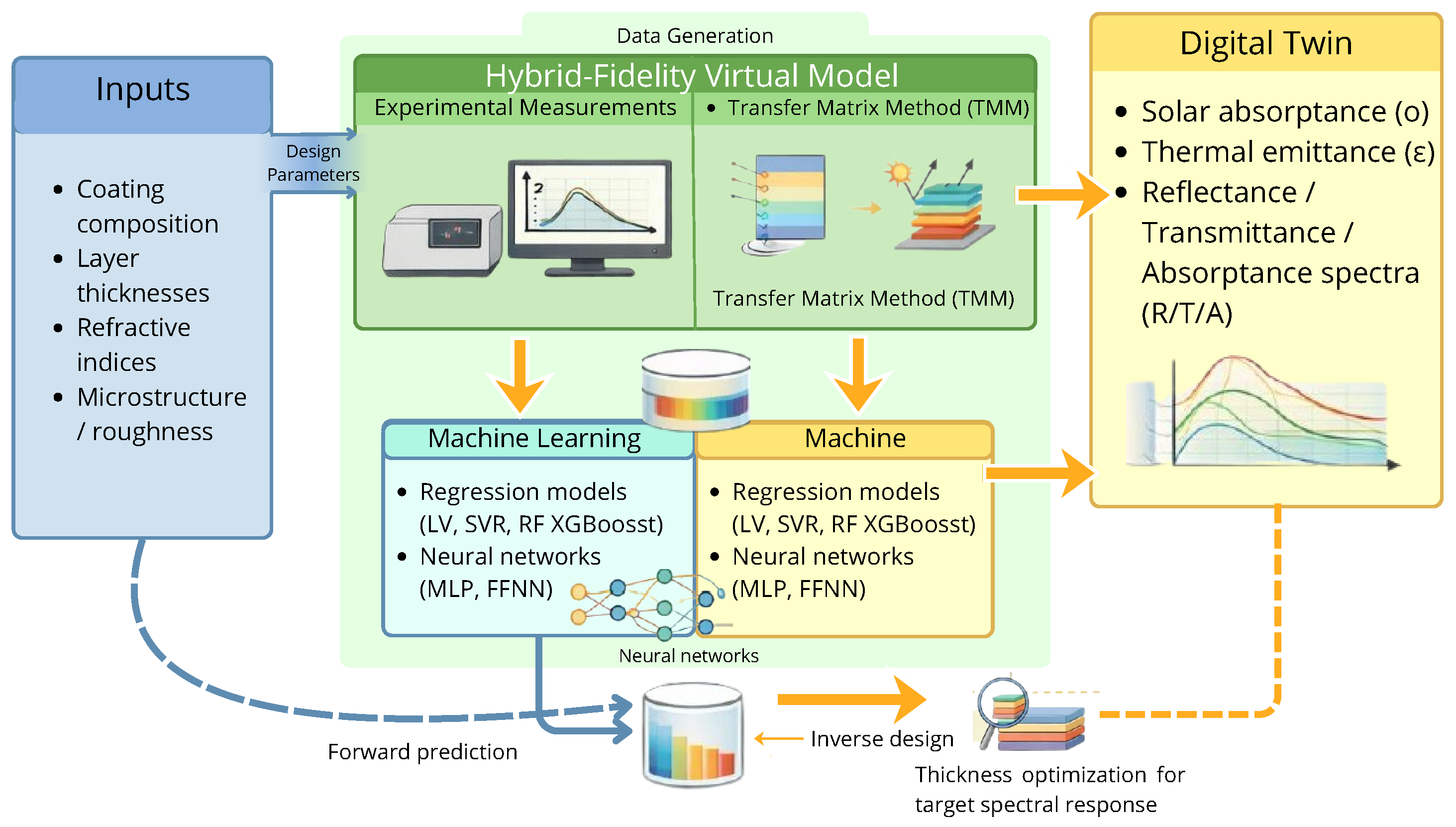
Figure 7 schematically summarizes a typical ML workflow for optical property prediction and inverse design of multilayer coatings. The diagram highlights the integration of experimental data and physics-based optical simulations TMM for dataset generation, the training of regression and neural network models, and their application to forward prediction of optical properties and inverse optimization of layer thicknesses to meet target spectral responses.
4.2. DL and Computer Vision
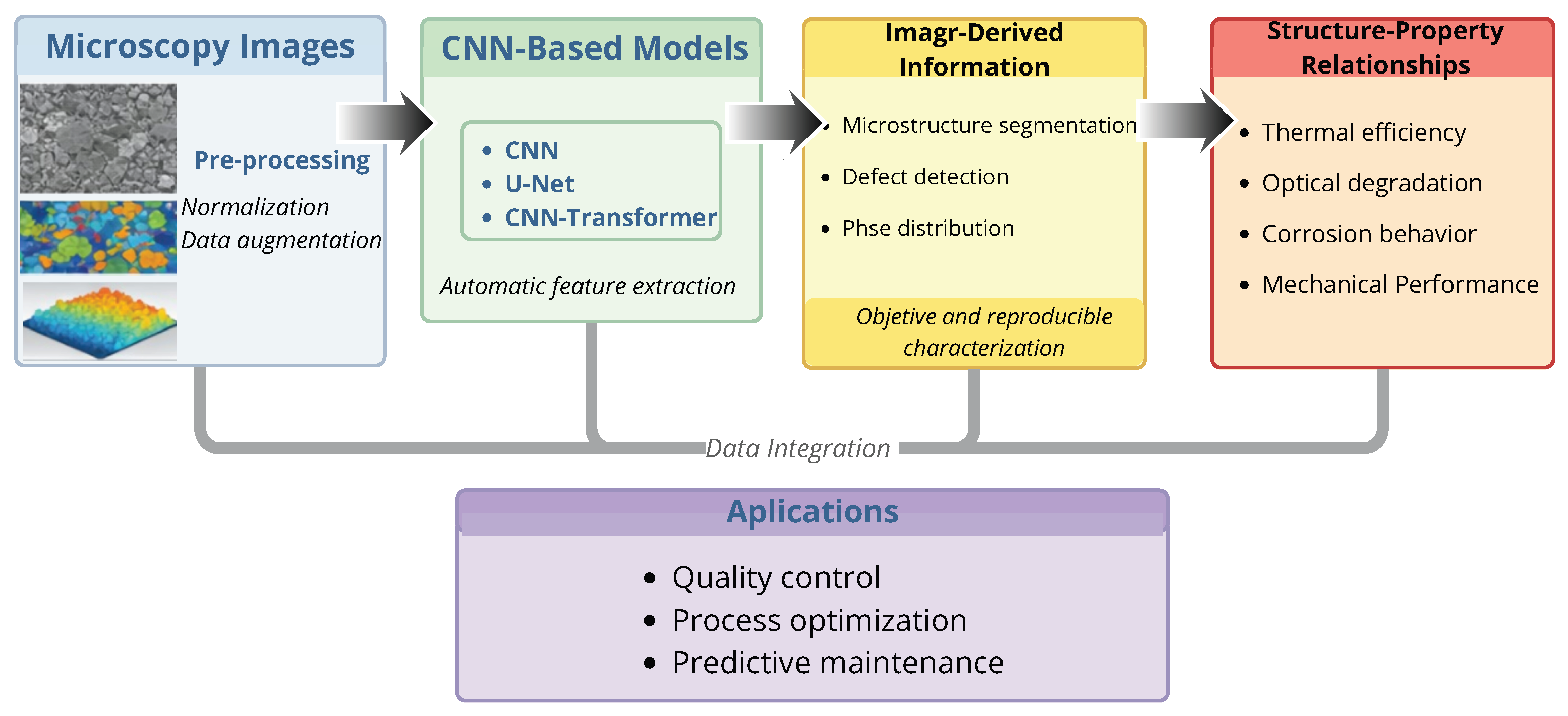
DL techniques, particularly CNN, have become powerful tools for the automated analysis of coating microstructures through the processing of microscopy images, including scanning electron microscopy (SEM), optical microscopy, and surface profilometry. CNNs excel at extracting hierarchical features related to grain size, porosity, surface roughness, cracks, and layer uniformity without requiring handcrafted descriptors, enabling objective, robust, and efficient microstructural characterization [
64]. For instance, CNN-based approaches have achieved high accuracy in segmenting complex microstructures such as lath-bainite in steels and in quantifying microstructural features in air-plasma-sprayed thermal barrier coatings, even when trained with relatively small datasets [
65]. DL models have also been applied to predict corrosion behavior in coated magnesium alloys by learning from phase-field simulation data, demonstrating their capability to establish meaningful links between microstructural features and functional performance [
66]. In addition, synthetic image generation using CNN-based architectures has been shown to enhance training datasets, improving the identification of main coating parameters, such as electrodeposition time, which is critical for process monitoring and quality control in coating fabrication [
67].
Building upon these advances, CNN-based models are now well established as a robust route toward objective and reproducible microstructural and defect characterization directly from image data. By eliminating the need for manual feature engineering, CNNs reduce subjectivity associated with expert-driven analysis and enable scalable, data-driven characterization workflows for functional coatings and surface-engineered materials [
68]. Extensive evidence supports the effectiveness of automated, image-based microstructural characterization using DL. CNN architectures have been successfully employed to classify microstructural states and identify defects from microscopy and imaging data, effectively replacing handcrafted descriptors and subjective expert judgment [
65]. Encoder–decoder architectures, such as U-Net variants, achieve pixel-level segmentation of complex microstructures and phase distributions, often rivaling or exceeding expert annotations even when trained on relatively limited datasets [
69].
More advanced architectures, including specialized CNNs and hybrid CNN–Transformer models, have demonstrated high robustness in surface and coating defect segmentation tasks, such as the detection of scratches, pits, and small-scale defects. These models achieve high intersection-over-union (IoU) and F-measure scores on industrial datasets, showing strong performance despite complex backgrounds and subtle defect features [
70]. Specifically for coatings and surface layers, CNN-based approaches have been applied to defect detection and classification in industrial contexts, including film-coated tablets, semiconductor wafers, and general coated surfaces, consistently outperforming rule-based methods and manual inspection in both accuracy and repeatability [
71].
Beyond classification and segmentation, DL enables the construction of quantitative structure–property relationships directly from image-derived features. CNN encoders can compress micrographs into low-dimensional latent descriptors, which can be coupled with fully connected networks to predict mechanical responses such as yield surfaces and effective properties in porous or heterogeneous materials. In this role, CNN-based models act as efficient surrogate representations for computationally expensive finite element simulations [
72]. Moreover, DL models trained on paired image–property datasets, including mechanical behavior and electrical or thermal performance, have demonstrated the ability to learn meaningful microstructure–property mappings and interpolate to previously unseen morphologies [
73]. Synthetic micrograph generation using CNN-based generative pipelines further augments coating image datasets, improving the prediction of process parameters such as electrodeposition time, which directly governs coating thickness, morphology, and functional performance [
67].
Figure 8 summarizes the DL workflow for image-based microstructural characterization and defect detection in functional coatings, highlighting the link between microscopy data, CNN-based feature extraction, and structure–property relationships.
4.3. Optimization Algorithms and Multi-Objective Design
Optimization algorithms play a central role in advanced coating design by enabling systematic exploration of complex, high-dimensional parameter spaces to balance competing objectives, such as maximizing solar absorptance while minimizing thermal emittance or enhancing corrosion resistance without compromising mechanical integrity. Multi-objective optimization methods, including adaptive weighted-sum approaches and evolutionary algorithms, have been successfully applied to optical coatings and multilayer protective coatings, achieving significant improvements in performance metrics such as spectral control, hardness, and mechanical properties [
74].
Surrogate models combined with evolutionary optimization strategies have been employed to optimize coating uniformity and minimize defects in industrial manufacturing processes, including roll-to-roll slot-die coating and lithium-ion battery electrode fabrication. These approaches have been reported to reduce edge defects by more than 90% while significantly improving thickness uniformity, demonstrating their effectiveness for large-scale production environments [
75].
Among the most widely adopted multi-objective optimization strategies, evolutionary and swarm-based methods such as GA and PSO are particularly effective for the design of multilayer thin-film coatings. Metaheuristic optimization techniques have also been applied to nonlinear regression and system identification problems, where analytical solutions are unavailable or highly sensitive to noise. Such approaches have demonstrated robust convergence and improved parameter estimation accuracy in complex dynamic systems, supporting their use as surrogate optimization tools in coating and multilayer design problems [
76,
77]. These methods optimize variables including layer materials, thicknesses, and graded geometries, and are well suited for handling non-convex, high-dimensional design spaces with mixed discrete and continuous variables. As global-search algorithms, GA- and PSO-based approaches can identify near-optimal solutions without requiring gradient information [
52].
PSO-based frameworks have demonstrated efficient inverse design of multilayer nanofilms for target spectral responses, achieving low relative errors in thickness prediction and robust performance across both simulation and experimental validations [
78]. Adaptive PSO variants, as well as hybrid algorithms combining GA and PSO strategies, have further improved convergence rates and achieved a better balance between global exploration and local exploitation, thereby enhancing optimization efficiency in nonlinear parameter spaces [
79]. Such hybrid and adaptive approaches have also been successfully applied to coating process parameter optimization, including laser cladding processes, leading to improvements in coating hardness, thickness uniformity, and defect reduction [
80].
Bayesian optimization (BO), which similarly relies on surrogate modeling strategies, is particularly effective for coating design and manufacturing problems in which individual evaluations are computationally or experimentally expensive, such as full-wave electromagnetic simulations or extensive experimental campaigns. By guiding the search using probabilistic surrogate models—most commonly Gaussian process regression—BO significantly reduces the number of required evaluations while efficiently converging toward optimal solutions. In coating-related applications, BO has been successfully applied to optimize multilayer antireflection coatings by identifying thickness configurations within fabrication constraints that enhance optical performance. BO has also been used to optimize insulation-coating processes for Fe–Si alloy sheets, achieving high thermal resistance and electrical insulation while drastically reducing the number of experimental trials compared to conventional trial-and-error approaches [
81]. Furthermore, BO frameworks have been developed for thermal spray process calibration and atmospheric plasma spraying, enabling efficient tuning of process parameters that improves coating quality and reduces manufacturing costs [
82]. Recent advances have integrated interpretability techniques, such as SHapley Additive exPlanations (SHAP), to refine design space bounds and guide surrogate-based searches, further enhancing optimization efficiency in complex coating systems, including metamaterial coatings [
83].
These optimization methods are increasingly coupled with physics-based forward solvers, such as transfer matrix models for optical multilayer stacks, or with machine-learning-based surrogate models to accelerate multi-objective searches. In practice, multi-objective coating design is commonly addressed through weighted-sum formulations or Pareto front exploration, enabling explicit trade-off analysis between competing targets, such as reflectance minimization versus thickness constraints or broadband spectral performance across multiple wavelength bands.
Table 4 summarizes representative studies from 2020–2025 that employ GA, PSO, Bayesian optimization, or closely related global optimization strategies for coating and multilayer design, as well as coating process optimization.
4.4. AI for Process Control and Quality Monitoring
AI significantly enhances real-time process control and quality monitoring in coating manufacturing by leveraging ML models trained on sensor data and historical process records. AI-driven systems enable early detection of process deviations, such as defect formation or thickness non-uniformity, allowing predictive regulation strategies and proactive operator notifications to maintain consistent coating quality [
90]. Advanced AI techniques, including multiple kernel learning and deep CNN, integrate real-time sensor signals with optical vision data to identify process abnormalities and dynamically adjust operating parameters. These approaches improve process precision and robustness while reducing defect rates and variability during coating deposition [
91]. AI-based image recognition and point cloud analysis further support automated, accurate, and rapid defect detection in coated surfaces, enabling continuous improvement and adaptive control throughout manufacturing operations [
92]. In addition, hybrid AI–statistical process control (AI–SPC) frameworks combine traditional statistical quality control methods with DL models to enhance monitoring sensitivity. By reducing false alarm rates and improving early detection of process shifts, AI–SPC approaches contribute to higher production yield and more stable coating processes [
93].
AI-enabled monitoring frameworks further enhance quality assurance by correlating visual data obtained through computer vision with sensor-derived process features and downstream performance metrics, thereby enabling closed-loop control in coating manufacturing. The integration of these multimodal data streams allows manufacturers to identify root causes of defects and implement near real-time corrective actions, improving the scalability and reproducibility of coating production processes [
94]. Such monitoring systems leverage ML models for anomaly detection, predictive maintenance, and process optimization, dynamically adjusting operating parameters based on continuous feedback from both visual inspections and sensor measurements [
95]. AI-powered frameworks also support operator decision-making by reducing information overload through alert correlation and contextual diagnostics, which enhance response times and overall operational efficiency [
96]. The convergence of AI with Internet of Things (IoT) technologies and edge computing architectures facilitates real-time data processing and predictive analytics at the manufacturing floor level, ensuring timely detection of process deviations and enabling proactive interventions to maintain consistent product quality in coating manufacturing environments [
97].
AI-based process optimization additionally plays a crucial role in reducing energy consumption and material waste in coating processes by identifying energy-efficient operating regimes that minimize excessive power input, over-deposition, and process times without sacrificing coating quality. For example, random forest-based AI models have been applied to optimize semiconductor coating processes by improving time efficiency, yield, and energy utilization, leading to reduced material, energy, and resource consumption while supporting sustainability objectives such as net-zero carbon emissions [
98]. Bayesian optimization combined with Gaussian process regression has also enabled the efficient development of high-quality coatings with substantially fewer experimental iterations, demonstrating its effectiveness for multidimensional nonlinear optimization in industrial-scale production environments [
81]. ML models, including random forests and XGBoost, have further been employed to optimize plasma electrolytic oxidation coatings, achieving improved coating thickness while explicitly accounting for energy consumption factors [
47]. In addition, advanced optimization algorithms such as improved whale optimization have achieved substantial energy savings—exceeding 18%—and increased production efficiency in automotive painting processes, underscoring the potential of AI-driven optimization for clean and low-carbon manufacturing [
99]. Recent reviews emphasize that AI-based predictive and optimization models enable real-time process control, reduce experimental costs, and enhance the sustainability of electrodeposition and coating technologies [
100].
Overall, the integration of AI for predictive process control, automated quality monitoring, and energy-aware optimization represents a main step toward intelligent, resource-efficient, and resilient coating manufacturing systems.
4.5. Hybrid Models and Digital Twins
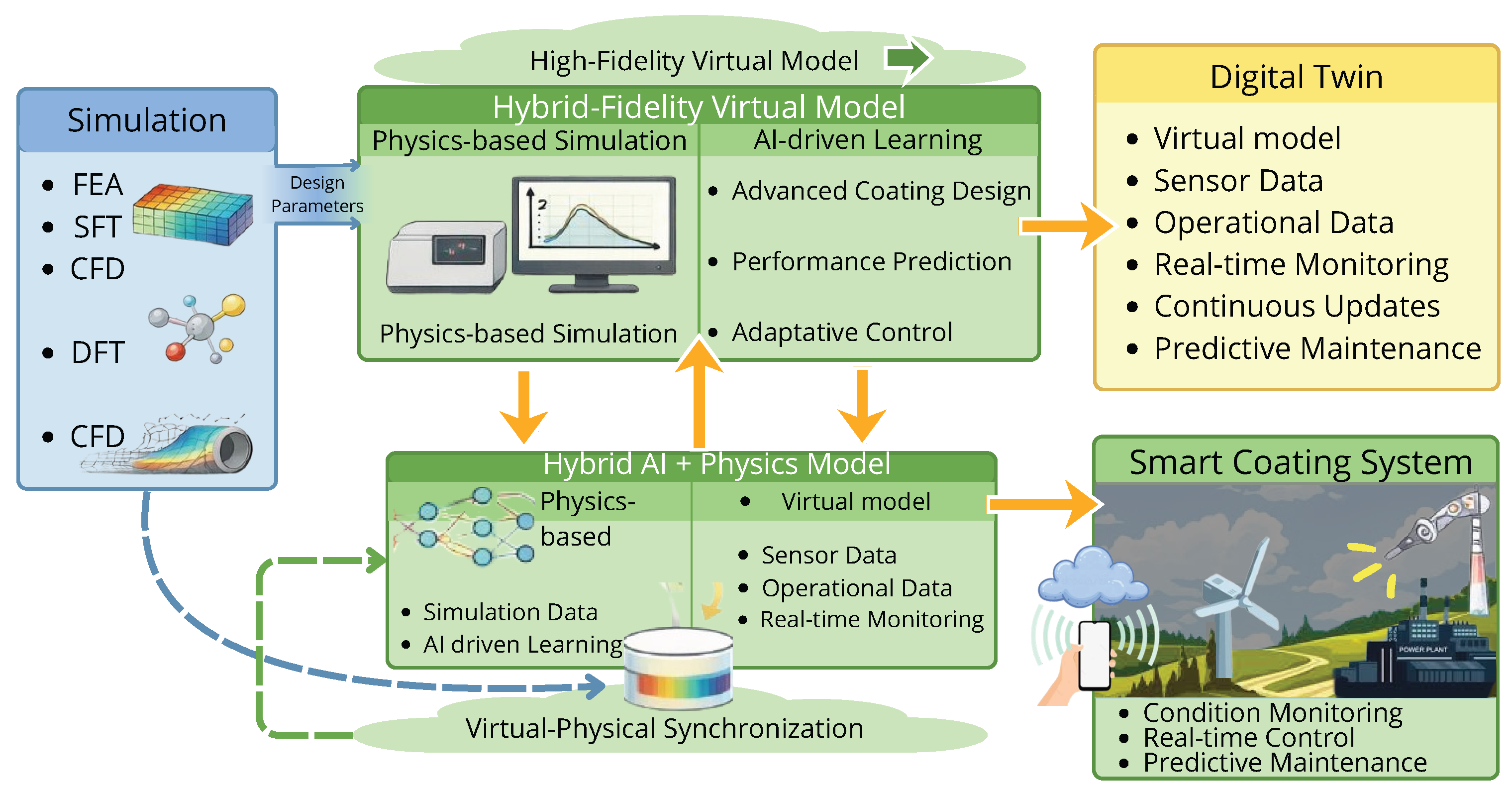
Hybrid modeling approaches that integrate AI with physics-based simulations combine the interpretability and physical consistency of numerical methods such as CFD, Density Functional Theory (DFT), and Finite Element Analysis (FEA) with the rapid prediction and parameter sensitivity analysis capabilities of AI models. These hybrid models leverage data-driven learning to efficiently explore high-dimensional design spaces while maintaining physical fidelity, enabling advanced coating design, performance prediction, and lifecycle management [
101]. Hybrid modeling strategies have been applied to simulate cold spray deposition by coupling meshless and finite element methods with AI-based predictors to estimate thermo-mechanical deformation and residual stresses, thereby improving process understanding and optimization [
102]. The corrective source term approach further integrates partial differential equations with deep neural networks to compensate for unknown or unmodeled physics, enhancing accuracy and generalizability in heat diffusion simulations [
103]. In addition, physics-infused ML frameworks embed nonlinear dynamical features directly into data-driven models, improving prediction accuracy and adaptability under changing operational conditions [
104]. Recent reviews emphasize that hybrid physics-based and data-driven modeling approaches enhance transparency, computational efficiency, and explainability, supporting smart manufacturing applications across product design, operation, and maintenance stages [
105].
Figure 9 schematically illustrates the integration of physics-based simulations with AI models to form hybrid modeling frameworks and digital twins for intelligent coating systems.
AI models coupled with CFD effectively capture heat transfer, fluid flow, and mass transport phenomena during coating deposition and operation, enabling accurate prediction of thermal performance and degradation behavior. In the context of thermal barrier coatings (TBCs), AI-enhanced simulation frameworks integrate ML algorithms with CFD and FEA to model thermal conductivity, stress evolution, crack propagation, and oxidation under flowing gas environments, thereby improving design optimization and durability assessment. Deep neural networks combined with CFD have also been employed to predict convective heat transfer in complex fluid flows over heated surfaces, demonstrating high accuracy in thermal behavior prediction that is directly relevant to coating manufacturing and operation processes [
106]. Hybrid AI–DFT frameworks accelerate materials screening by learning atomic-scale structure–property relationships, while AI-assisted FEA models support the prediction of stress distribution, thermal cycling resistance, and failure initiation in coated components, substantially reducing computational costs compared to purely physics-based simulations [
107]. Simulation-assisted AI approaches further enhance predictive capabilities by merging low-fidelity numerical simulation data with high-fidelity experimental measurements. Such multi-fidelity strategies improve the prediction of thermo-physical properties, including thermal conductivity and coating thickness, while maintaining low error margins, highlighting their potential for efficient and accurate modeling of complex coating systems [
108].
Digital twins for coating systems create dynamic virtual models that continuously integrate sensor data, operational conditions, and hybrid AI–physics models to monitor and predict coating performance and degradation in real-time. These virtual representations enable continuous performance assessment and support data-driven decision-making throughout the coating lifecycle. A digital twin framework has been developed for intelligent monitoring of ship segment spray coating, enabling real-time prediction of film thickness and adaptive control adjustments to improve coating quality [
109]. In the context of wind turbine towers, digital twin systems integrate image processing, sensor measurements, and maintenance models to support condition monitoring and prescriptive maintenance of protective coatings, thereby reducing human intervention and improving corrosion resistance management [
110]. Industrial process modeling of coating technologies such as high-velocity oxygen–fuel (HVOF) spraying has further adopted hierarchical digital twin architectures to synchronize real-world physics with virtual models. These systems allow near real-time simulation of coating thickness and thermal performance, enabling improved process control and operational robustness [
111]. Additionally, digital twins have been applied to optimize production planning for customized powder-coated three-dimensional workpieces by virtually simulating kinematics and assembly processes, resulting in enhanced cost estimation accuracy and improved manufacturing efficiency [
112].
Overall, hybrid AI–physics models and digital twins represent a main step toward intelligent, adaptive, and resilient coating systems, enabling comprehensive performance monitoring, accelerated design optimization, and data-driven decision-making across the entire coating lifecycle.
5. Sustainable Processing and Circular Strategies
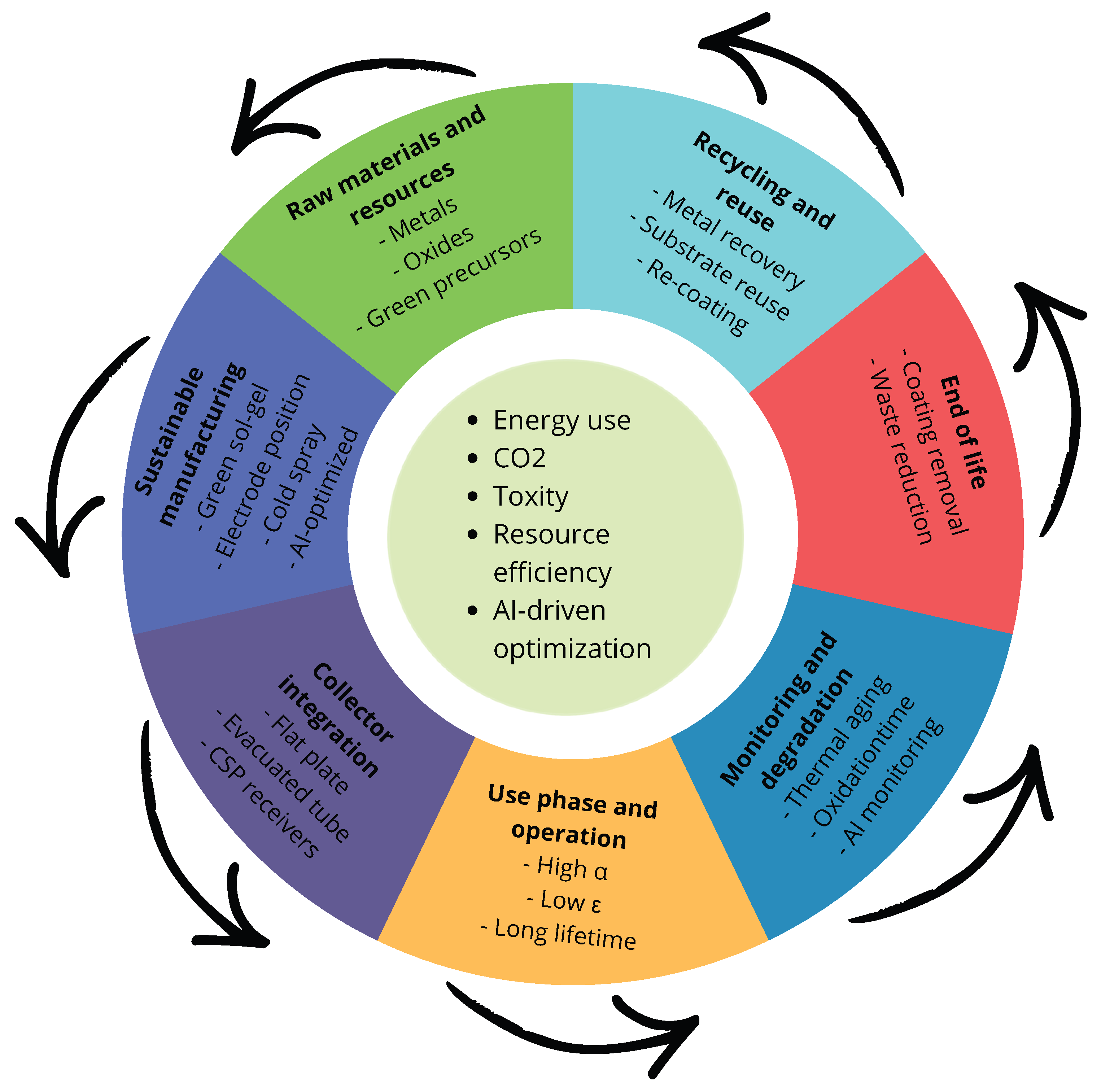
This section provides a evidence-based review of sustainable processing and circular strategies for coating materials in solar thermal collectors, focusing on eco-friendly manufacturing, recycling and reuse, and LCA with environmental indicators. The analysis integrates tables to synthesize the latest research on solvent substitution, green sol–gel routes, AI-driven process optimization, recovery of metals/nanoparticles, substrate revalorization, and comparative LCA of conventional versus sustainable coatings.
5.1. Eco-Friendly and Intelligent Manufacturing Strategies for Solar Absorber Coatings
The transition toward eco-friendly manufacturing of solar thermal collector coatings is primarily driven by the need to replace toxic solvents and hazardous precursors with safer and more sustainable alternatives [
113]. Recent studies emphasize the use of water-based and bio-derived solvents, which significantly reduce volatile organic compound emissions and overall environmental impact, while less toxic and more stable precursors improve safety during synthesis and waste management [
4,
114]. These developments demonstrate that environmental considerations can be effectively integrated into coating fabrication without compromising performance.
In this context, sustainable fabrication routes such as sol–gel and electrochemical deposition have gained increasing attention. These methods allow precise control over coating composition and microstructure while operating at relatively low temperatures and using benign, often aqueous, processing media. Selective absorber coatings produced through these approaches have exhibited high solar absorptance, good thermal stability, and long-term durability. In some cases, solar absorption values as high as 97.4% have been reported, indicating that environmentally friendly processes can achieve performance comparable to, or even exceeding, that of conventional manufacturing techniques [
115].
Among these approaches, green sol–gel synthesis combined with low-temperature processing has emerged as a particularly promising route for sustainable coating production. By minimizing energy input and associated emissions, these methods reduce the overall environmental footprint while maintaining good process reproducibility and scalability. Furthermore, the sol–gel route facilitates the incorporation of nanomaterials, enabling fine tuning of microstructural features and, consequently, the optical and thermal properties of the coatings [
116]. Multilayer systems such as TiAlCrN/TiAlN/AlSiN and Cr–Al–O-based coatings deposited on copper and stainless steel substrates via green sol–gel routes have demonstrated high spectral selectivity and strong thermal stability. The integration of nanofluids and hybrid nanomaterials further enhances heat transfer performance and long-term durability, reinforcing the potential of these sustainable strategies for advanced solar thermal applications [
117].
Beyond material and process innovations, AI and ML are increasingly transforming coating manufacturing by enabling intelligent process optimization. Data-driven models can predict material properties, identify optimal processing parameters, and support real-time monitoring and control of production lines. As a result, AI-assisted manufacturing strategies can significantly reduce energy consumption, material waste, and process variability, contributing to more sustainable and efficient operations [
118,
119]. In parallel, the adoption of digital twins and Industry 4.0 concepts enables the development of smart manufacturing environments, where virtual replicas of physical processes allow adaptive control and predictive maintenance. These capabilities improve resource utilization, prevent failures, and reduce operational costs, with demonstrated benefits in both laboratory-scale research and industrial applications [
120].
To synthesize the main sustainable manufacturing approaches discussed above,
Table 5 provides a structured overview of main eco-friendly strategies currently applied to solar thermal collector coatings. The table highlights the relationship between each strategy, its fundamental characteristics, and the resulting benefits in terms of environmental impact, process efficiency, and coating performance. In particular, it compares solvent substitution, green sol–gel and low-temperature processing routes, and AI-driven process optimization, emphasizing their respective contributions to toxicity reduction, energy savings, thermal performance, and overall manufacturing sustainability, as supported by recent literature.
Beyond individual sustainable processing routes, the reviewed studies can be positioned within a broader conceptual landscape according to system complexity and the maturity of the applied AI techniques. This perspective enables the identification of consolidated application areas as well as technological gaps that currently limit the deployment of fully integrated, sustainable solar thermal systems.
As shown in
Figure 10, current research efforts remain concentrated on performance prediction and process optimization tasks, where data-driven models can be readily applied. In contrast, degradation forecasting and long-term durability assessment require the integration of multiscale physical phenomena and operational data, yet remain supported by comparatively immature AI frameworks. The emergence of digital twins offers a promising pathway to bridge this gap by coupling physics-based modeling, real-time data acquisition, and sustainability assessment within unified decision-support systems.
5.2. Recycling and Reuse of Coating Materials
The recycling and reuse of coating materials and collector components are central elements of circular economy strategies for solar thermal technologies [
125]. In particular, the recovery of noble metals and nanoparticles from end-of-life solar absorber coatings plays a crucial role in reducing dependence on primary raw materials and mitigating the environmental impacts associated with metal extraction. This is especially relevant for high-value elements such as silver, gold, and copper, whose supply chains are energy-intensive and environmentally burdensome [
115,
126].
Advanced recycling routes, including hydrometallurgical and pyrometallurgical processes, enable the effective extraction and reuse of valuable metals from spent coatings. Hydrometallurgical methods allow selective recovery under controlled chemical conditions, while pyrometallurgical approaches are suitable for treating large material volumes. In parallel, the integration of AI and sensor-based sorting technologies significantly enhances the efficiency and selectivity of recycling operations. These digital tools reduce material losses, lower energy consumption, and improve overall environmental performance, contributing to more sustainable recycling systems for solar thermal collectors [
127].
Beyond coating materials themselves, substrate revalorization represents an important strategy for extending the service life of solar collector components. This approach involves the regeneration and reuse of substrates such as copper, aluminum, and stainless steel after the removal of degraded or end-of-life coatings [
115]. By enabling multiple recoating cycles, substrate reuse reduces the demand for virgin materials, lowers production costs, and decreases the environmental footprint of collector manufacturing, in line with circular economy principles [
128].
To restore substrate quality, several surface regeneration techniques are commonly applied, including abrasive cleaning, chemical etching, and surface modification. These processes help recover surface integrity, adhesion characteristics, and functional performance, ensuring that regenerated substrates remain suitable for subsequent coating deposition. In addition, the use of digital tracking systems and AI-based quality assessment tools improves substrate selection and process control. Such technologies enable more reliable evaluation of substrate condition, reduce the risk of defects, and enhance the efficiency and sustainability of revalorization operations [
115].
At the industrial scale, multiple case studies have demonstrated the successful implementation of circular strategies such as closed-loop recycling, remanufacturing, and surface regeneration in solar collector production. These approaches have proven effective in reducing material losses and improving resource efficiency across the manufacturing cycle [
126]. In particular, the adoption of intelligent sorting technologies and robotic systems in recycling facilities has increased processing throughput and material purity. At the same time, digital twins enable real-time monitoring of substrate condition and process optimization, leading to enhanced operational efficiency, improved product quality, and reduced environmental impact in industrial-scale solar collector manufacturing [
117,
123].
To synthesize the recycling and reuse strategies discussed above,
Table 6 provides a structured overview of the main circular approaches applied to solar absorber coatings and collector components. The table summarizes the associated processes and technologies, together with their main benefits in terms of resource efficiency, waste reduction, and operational performance, as reported in recent literature.
5.3. LCA and Environmental Indicators
LCA has become a fundamental tool for systematically evaluating and comparing the environmental performance of conventional and sustainable coating processes for solar thermal collectors. By assessing main indicators such as energy consumption, greenhouse gas emissions, waste generation, and toxicity, LCA studies provide quantitative insights into the environmental trade-offs associated with different manufacturing routes and support evidence-based decision-making toward more sustainable technologies [
22,
128,
129,
130,
131,
132].
Recent LCA results consistently indicate that coatings produced using green sol–gel routes and AI-optimized processes exhibit significantly lower carbon footprints and reduced overall environmental impacts compared with traditional fabrication methods [
4,
115]. In particular, geopolymer-based coatings and nanofluid-enhanced systems have been reported to achieve CO
2 emission reductions on the order of 40% to 60%, together with substantial decreases in hazardous waste generation. These findings highlight the strong potential of advanced sustainable processing strategies to improve the environmental performance of solar thermal collector coatings across their entire life cycle [
117].
Comparative LCA analyses further show that the benefits of sustainable coating technologies extend beyond the manufacturing stage. Improved material efficiency and cleaner processing routes lead to reduced emissions, lower resource consumption, and decreased toxicity throughout the full life cycle [
129,
130,
131]. Moreover, enhanced durability and thermal performance contribute to longer product lifespans, reducing the frequency of maintenance, recoating, and component replacement during operation. This extended service life significantly lowers cumulative material demand and environmental impacts during the use and end-of-life phases of solar thermal collector systems [
4,
22,
115,
128].
In this context, AI-driven process optimization further amplifies the sustainability advantages identified by LCA. Adaptive process control, real-time monitoring, and predictive maintenance enabled by AI help stabilize production conditions, minimize defects, and reduce downtime. These capabilities support continuous improvement in both environmental and economic performance, reinforcing the role of intelligent manufacturing as a main enabler of long-term sustainability in advanced coating technologies [
117,
118,
123].
To quantitatively illustrate the differences between conventional and sustainable coating technologies discussed above,
Table 7 presents a comparative summary of main LCA indicators. The table highlights differences in energy consumption, CO
2 emissions, hazardous waste generation, and toxicity, providing a clear overview of the environmental benefits achieved through green processing routes and AI-driven optimization.
Overall, the integration of AI and sustainable technologies in the design, processing, and circular innovation of coating materials for solar thermal collectors is rapidly advancing. The literature consistently demonstrates that eco-friendly manufacturing enabled by green chemistry and AI-driven optimization significantly reduces environmental impacts while maintaining or enhancing performance [
117,
118]. At the same time, circular strategies such as metal recovery and substrate revalorization are becoming increasingly feasible due to advances in digitalization, robotics, and AI-based quality control [
22,
126].
Nevertheless, challenges remain in scaling up these technologies, standardizing LCA methodologies, and ensuring data quality and transparency for AI models [
119,
123,
124]. Addressing these issues will require interdisciplinary collaboration, robust regulatory frameworks, and improved data infrastructures to fully realize the sustainability potential of next-generation solar thermal coatings [
4,
115,
128].
In this way, to provide a holistic perspective,
Figure 11 schematically summarizes the circular LCA framework for sustainable and AI-enabled coating materials in solar thermal collectors, integrating processing, operation, and end-of-life strategies.
The diagram of
Figure 11 illustrates the complete life cycle of absorber coatings, including raw material selection, sustainable manufacturing routes, collector integration, use phase and performance monitoring, end-of-life management, and recycling or re-coating strategies. AI supports process optimization, degradation monitoring, and circular revalorization, enabling reduced energy consumption, lower environmental impact, and extended service life.
6. Industrial Implementation and Technology Readiness Levels (TRLs)
TRLs provide a structured framework for assessing the maturity of coating technologies, ranging from basic research (TRL 1) to fully commercialized and industrially proven systems (TRL 9) [
133]. This framework is particularly important for functional and smart coatings due to the complexity of their material systems, deposition processes, and long-term performance requirements [
134]. While TRLs offer a standardized means to communicate technological maturity, traditional TRL models may not fully capture the readiness of innovative or co-created coating technologies. This limitation has motivated the development of adapted or extended TRL approaches to better support technology development pathways and commercialization strategies [
135].
Main challenges in advancing coating technologies across TRLs include ensuring reproducibility, scalability, and economic viability alongside functional performance, as has been observed in other chemical and surface-engineering technologies [
134]. To address these challenges, the integration of complementary readiness metrics such as Integration Readiness Level (IRL) and Manufacturing Readiness Level (MRL) has been proposed to provide a more comprehensive assessment of technological maturity, particularly for complex coating systems that require system-level integration and robust manufacturing considerations [
136].
Conventional TiNO
x-based selective coatings for solar thermal applications have reached TRL 9, reflecting their full commercial maturity with stable optical performance, high durability, and proven large-scale manufacturability. These coatings are widely implemented in flat-plate and evacuated-tube solar collectors due to well-established deposition methods, such as reactive magnetron sputtering and PVD, combined with standardized quality control protocols and extensive field validation [
137]. TiNO
x coatings typically exhibit high solar absorptance values of approximately 94–95% and low thermal emittance in the range of 3.8–7%, enabling efficient solar energy conversion and minimized heat losses at operating temperatures around 100 °C [
138]. However, their resistance to thermal oxidation limits long-term stability at temperatures above approximately 250 °C in air, as oxidation-induced modifications of the top surface layers lead to degradation of optical properties, which is a critical consideration for high-temperature applications [
139].
Recent advances in multilayer selective coating architectures incorporating TiN
x, TiN
xO
y, and optimized anti-reflective layers have demonstrated enhanced optical selectivity and improved thermal stability at elevated temperatures, extending operational limits up to approximately 600–800 °C and thereby expanding the range of potential industrial and high-temperature solar applications [
140].
In contrast to these fully mature systems, emerging advanced coatings typically remain at intermediate TRLs, reflecting ongoing challenges in scalability, reproducibility, and long-term validation. Doped nanocomposite coatings commonly reside around TRL 6, where promising enhancements in optical selectivity, thermal stability, and multifunctionality have been demonstrated primarily through laboratory-scale and pilot-scale studies. These coatings often incorporate doped nanomaterials, such as nitrogen-doped graphene, cerium-doped MXene nanosheets, or silver-doped carbides, which contribute to improved corrosion resistance, mechanical toughness, self-healing capability, and lubrication performance [
141].
Despite these performance advantages, significant challenges remain in advancing doped nanocomposite coatings toward higher TRLs. Main barriers include scaling up production processes, ensuring deposition repeatability, and validating long-term reliability under realistic industrial operating conditions, all of which are critical requirements for commercialization. For instance, nitrogen-doped graphene incorporated into epoxy coatings has been shown to markedly enhance mechanical strength and corrosion resistance; however, further investigation is required to confirm durability and performance stability in real-world service environments [
142]. Similarly, cerium-doped nanocomposite systems exhibit active corrosion protection mechanisms and improved barrier properties, but extensive long-term field testing is still needed to verify sustained performance and industrial robustness [
143].
Smart coatings, including self-healing, thermochromic, electrochromic, and sensing-enabled systems, generally remain at lower intermediate TRLs of approximately 4–5. At this stage, proof-of-concept demonstrations and laboratory-scale validation have been achieved, while large-scale industrial integration remains limited. These coatings typically rely on multifunctional architectures that respond to external stimuli such as mechanical damage, pH variations, or temperature changes, enabling autonomous self-healing behavior and early-stage corrosion detection through optical signals, including color change or fluorescence [
144].
For example, coatings incorporating nanocontainers or microcapsules loaded with corrosion inhibitors and optical indicators have demonstrated the ability to autonomously repair localized damage while simultaneously providing rapid visual indication of corrosion onset, often within minutes after exposure [
145]. Similarly, thermochromic coatings applied to polymer fibers have been shown to signal thermal damage by reversible or irreversible changes in optical properties at temperatures aligned with critical degradation thresholds, enabling real-time condition monitoring and early failure detection [
146]. Despite their strong functional potential, several challenges continue to limit the advancement of smart coatings toward higher TRLs. These include the inherent complexity of multifunctional coating architectures, sensitivity to environmental conditions, difficulties in scalable and reproducible manufacturing, and the absence of standardized testing protocols to reliably assess long-term durability and performance under realistic service conditions [
147].
Across all advanced coating classes, several common challenges continue to hinder industrial scaling. These include high production costs associated with complex material formulations and deposition methods, difficulties in achieving reproducible large-area coatings with consistent functional properties, and uncertainties related to long-term durability, aging, and environmental stability [
148]. Multifunctional and nanostructured coatings, in particular, often require precise control over nanoscale architectures and compositional homogeneity, which significantly complicates scale-up and increases manufacturing costs [
149].
Ensuring consistent coating thickness and uniform quality at industrial scale remains a critical challenge; however, emerging real-time monitoring techniques, such as ultra-high-resolution optical coherence tomography (OCT), show considerable promise for improving process control, defect detection, and reproducibility during coating deposition [
150]. In addition, long-term performance under harsh operational environments—including thermal cycling, humidity, corrosion, and ultraviolet exposure—remains insufficiently understood for many advanced coatings. This uncertainty underscores the need for accelerated lifetime testing protocols and systematic durability assessments to validate coating reliability for industrial deployment [
147].
Addressing these challenges requires integrated strategies that combine process optimization, digital quality monitoring, and data-driven design and control methodologies. In this context, ML-based approaches are increasingly being adopted to predict coating performance, optimize manufacturing parameters, and reduce experimental trial-and-error [
151]. Ultimately, interdisciplinary collaboration across materials science, manufacturing engineering, and data analytics, together with advances in scalable and environmentally sustainable coating processes, will be essential to overcoming these barriers and enabling the broader commercialization of next-generation coating technologies [
152].
Figure 12 presents a conceptual TRL map of representative coating technologies, highlighting their current maturity levels and illustrating the gap between laboratory-scale innovation and industrial implementation. Such TRL-based mapping provides valuable guidance for researchers, manufacturers, and policymakers in prioritizing research directions, de-risking scale-up pathways, and accelerating the transition of advanced coating technologies from laboratory concepts to industrial deployment.
7. Challenges, Limitations, and Open Research Directions
This section provides a concise overview of the main bottlenecks associated with the implementation of AI- and sustainability-driven coating technologies for solar thermal collectors, highlighting the main technical, economic, and operational challenges identified in the literature, as well as the strategies proposed to address them.
7.1. Lack of Shared Databases for Optical and Thermal Properties
Research on solar absorber coatings and nanofluids is largely conducted using laboratory-specific datasets that are generated under distinct experimental conditions and measurement protocols [
153]. At present, there is a notable lack of widely adopted, open-access databases that provide standardized optical and thermal property data for coatings and nanofluids under realistic solar collector operating conditions [
154]. This fragmentation of data sources makes it difficult to establish consistent reference benchmarks across studies [
155].
As a consequence, the development and validation of AI and ML-based models are constrained by limited data comparability and availability [
156]. Models trained on isolated datasets often show reduced robustness when applied beyond the conditions under which they were developed, limiting their transferability and scalability. The absence of standardized datasets also hampers meaningful cross-comparison of results, slowing progress toward reliable, generalizable AI-driven optimization frameworks for solar thermal collector technologies [
157].
To further illustrate the data-related limitations affecting AI-driven modeling and simulation of solar absorber coatings and nanofluids,
Table 8 summarizes the main categories of experimental and material data currently used in the literature.
Table 8 highlights representative examples, the degree of data availability and standardization, and their impact on the development and transferability of AI models. This overview underscores the critical role of data fragmentation as a bottleneck for robust benchmarking and generalizable AI-based optimization.
7.2. Difficulty Reproducing AI Models Between Laboratories
AI applied to scientific research is increasingly affected by a broader reproducibility crisis that undermines the reliability and comparability of reported results [
161]. Common issues include the lack of access to source code, incomplete or unpublished datasets, and inadvertent data leakage between training and validation stages [
162]. In addition, many AI models exhibit strong sensitivity to hyperparameter choices, training procedures, and random initialization, while differences in software libraries, hardware platforms, or computational environments can lead to divergent outcomes even when nominally identical models are used [
163].
Large-scale surveys across multiple ML-based research domains consistently identify data leakage, unstable optimization processes, and insufficient reporting of experimental details as primary causes of non-reproducible findings [
164]. Although the adoption of reproducibility checklists, open-source code repositories, and shared datasets has improved transparency and research rigor, these measures alone do not fully eliminate reproducibility risks. Ensuring reliable and transferable AI-driven results therefore requires not only open practices, but also standardized evaluation protocols, robust validation strategies, and careful documentation of model assumptions and training conditions [
165].
To further clarify the main sources of irreproducibility in AI-driven studies applied to solar thermal collectors and advanced materials,
Table 9 summarizes the most common methodological factors reported in the literature.
Table 9 links typical examples in solar collector and materials research with their observed effects on model reliability, highlighting how insufficient transparency and methodological variability undermine reproducibility and comparability of AI-based results.
7.3. Lack of Standardization in Accelerated Aging Tests
For solar absorber coatings and reflector materials, currently available international standards—such as ISO/CD 12592, ISO 22975-3, EN 12975-3-1, and IEC 62108—provide useful frameworks for performance evaluation, but they only partially capture the complexity of real degradation mechanisms under operational conditions [
168]. In many cases, standardized accelerated aging tests fail to reproduce the combined effects of thermal cycling, environmental exposure, and chemical contaminants encountered during long-term outdoor operation. As a result, correlations between accelerated laboratory tests and actual field performance are often weak, highly material-dependent, and difficult to generalize [
155,
169].
Recent studies have highlighted that degradation pathways observed in outdoor exposure, including changes in optical properties, adhesion loss, and microstructural damage, are not always accurately predicted by existing test protocols [
169]. In response, new accelerated aging approaches incorporating cyclic thermal loading, realistic atmospheric contaminants, humidity fluctuations, and solar irradiation are being proposed to better simulate service conditions. However, despite these efforts, no universally accepted or standardized testing protocol has yet emerged, limiting the comparability of durability data across studies and complicating lifetime prediction and reliability assessment for advanced solar thermal coatings [
170].
To compare the different accelerated aging approaches currently used for durability assessment of solar absorber coatings and reflectors,
Table 10 presents a systematic overview of the main testing methodologies reported in the literature. The comparison highlights main test parameters, the degradation mechanisms effectively captured, and the principal limitations of each approach, emphasizing the challenges in reproducing realistic outdoor aging and establishing reliable lifetime correlations.
7.4. Limitations in AI–Physics Integration
Hybrid CFD and ML approaches, as well as combined artificial neural network (ANN)–simulation frameworks, have shown strong potential to reduce computational costs and improve prediction accuracy in the modeling of solar thermal systems [
154]. By leveraging data-driven surrogates trained on high-fidelity simulations, these methods can approximate complex physical behaviors with significantly lower computational effort compared to fully resolved numerical models [
171].
However, the effectiveness of such hybrid approaches is strongly dependent on the availability of large, high-quality simulation datasets, which are often expensive and time-consuming to generate. Moreover, these models tend to perform reliably only within the parameter ranges represented in their training data. When applied outside these domains—such as different geometries, materials, or operating conditions—their predictive capability often degrades significantly [
172].
As a result, most existing methods remain primarily surrogate-based, relying on data-driven approximations layered on top of physical simulations rather than being deeply physics-informed. This limits their robustness and transferability, highlighting the need for more integrated modeling strategies that explicitly embed physical constraints and governing laws into ML architectures [
173].
To illustrate the different ways in which AI is currently integrated with physics-based modeling for solar absorber coatings,
Table 11 presents a comparative overview of representative IA–physics integration sketches and their limitations. Typical implementation strategies are highlighted, along with their main advantages in terms of computational efficiency or predictive capacity, and the main limitations related to data dependency, physical consistency, and transferability.
7.5. Need for More Durable and Recyclable Materials
Recent review studies on solar absorber coatings highlight that most qualification methods and material systems were originally designed for relatively mild operating conditions, typically involving low to moderate temperatures and limited environmental stress. Under such conditions, conventional coatings have shown acceptable performance and durability [
168].
However, when exposed to harsher environments—such as acidic precipitation, saline atmospheres, dust abrasion, and repeated high-temperature cycling—additional degradation mechanisms emerge that are not adequately captured by existing coating designs or testing protocols [
155].
These more aggressive operating conditions can lead to accelerated corrosion, chemical instability, adhesion loss, and microstructural damage, significantly reducing coating lifetime and performance [
169]. As a result, there is a growing consensus in the literature on the urgent need for next-generation absorber coatings that combine high-temperature stability, corrosion resistance, and recyclability [
157].
In parallel, durability assessment methods must be adapted to account for the specific chemistries and degradation pathways of these advanced materials, ensuring that qualification tests provide reliable predictions of long-term performance under realistic service conditions [
170].
To conceptually compare the main families of absorber coatings proposed for operation under harsh environmental conditions,
Table 12 presents a qualitative assessment of their durability, corrosion resistance, and circularity-related attributes. The comparison highlights how different material families balance thermal and environmental performance with current recyclability and design-for-recycling potential, emphasizing main trade-offs identified in the literature.
In summary, although notable progress has been made in sustainable materials, AI-assisted modeling, and circular strategies for solar thermal collector coatings, main challenges remain. Limitations in data availability, reproducibility, durability testing, and model transferability continue to hinder reliable benchmarking and industrial implementation. Addressing these issues will require standardized datasets, physics-informed and transparent AI approaches, improved durability protocols for harsh environments, and coating designs that integrate performance with recyclability, which together will define the main research directions ahead.
8. Geographical Variability and Multi-Regional Modeling Challenges
Solar thermal performance, optical selectivity stability, and degradation pathways of selective absorber coatings are inherently climate-dependent phenomena. Regional variations in solar irradiance spectra, seasonal temperature amplitudes, humidity levels, airborne particulate matter, salinity in coastal zones, and industrial pollutants can significantly alter both instantaneous energy conversion efficiency and long-term material behavior. For example, regions characterized by high diurnal thermal cycling may accelerate thermo-mechanical fatigue and interfacial delamination in multilayer coatings, while humid or saline environments can intensify corrosion-driven optical degradation. Likewise, desert climates with high dust loading increase soiling rates, affecting absorptance and thermal emissivity over time. These region-specific stressors ultimately reshape degradation kinetics and influence life-cycle performance and sustainability metrics.
Despite this strong environmental dependency, most AI-driven modeling and optimization frameworks reported in the literature rely on datasets generated under localized climatic conditions, often from laboratory-scale experiments or single-site field installations. Consequently, the resulting models may exhibit strong predictive performance within the original training domain but limited generalizability when deployed in distinct climatic contexts. This limitation is particularly critical when AI models are used not only for performance prediction but also for inverse design and long-term sustainability optimization, where inaccurate extrapolation could lead to suboptimal material selection or misestimation of durability.
A major structural limitation lies in the way climatic variables are treated in current AI architectures. In many studies, environmental factors are either simplified into averaged operational conditions or excluded altogether, rather than incorporated as dynamic, time-resolved input features. Moreover, the absence of harmonized environmental metadata standards prevents meaningful cross-regional benchmarking and reduces interoperability between datasets. This data fragmentation compounds previously identified issues of reproducibility and transferability in AI-based materials research.
Integrating multi-regional climatic datasets into AI-driven coating design introduces additional methodological and computational challenges. First, climatic data are inherently multi-scale, spanning hourly irradiance fluctuations to multi-year degradation trends, requiring hierarchical or temporally aware modeling approaches (e.g., recurrent neural networks or physics-informed sequence models). Second, merging heterogeneous data sources—satellite-based irradiance records, meteorological station data, and experimental degradation measurements—demands standardized preprocessing pipelines and uncertainty quantification strategies. Third, expanding the input space to include region-specific stress indicators increases model dimensionality, increasing the risk of overfitting and necessitating larger, well-curated datasets.
Addressing these challenges may require adopting advanced strategies, such as transfer learning, domain adaptation, and federated learning, to enable interregional knowledge transfer without compromising data ownership or privacy constraints. In parallel, physics-informed machine learning (PIML) frameworks can embed thermodynamic, radiative-transfer, and degradation-kinetics constraints directly into the learning process, thereby enhancing the reliability of extrapolation across climatic domains. The combination of harmonized climatic databases, robust validation protocols, and hybrid physics–AI architectures represents a critical pathway toward globally transferable, climate-resilient, and sustainability-oriented optimization strategies for next-generation solar thermal coatings.
9. Emerging Trends and Future Perspectives
The development of solar thermal collectors is increasingly shaped by the convergence of advanced functional materials, artificial intelligence, and sustainability-driven design principles. As performance requirements become more stringent and operational conditions more variable, conventional passive selective coatings are reaching their practical limits. In response, emerging research is shifting toward intelligent and adaptive coating systems capable of dynamically responding to thermal, optical, and environmental stimuli while simultaneously addressing durability and lifecycle considerations. Within this context, self-adaptive and intelligent coatings represent a key technological direction for next-generation solar thermal systems.
9.1. Self-Adaptive and Intelligent Coatings
A major emerging trend in solar thermal collectors is the transition from conventional “passive” selective coatings toward self-adaptive and intelligent coatings capable of dynamically adjusting their optical and thermal response to operating conditions. In this context, thermochromic selective absorbers have been proposed to mitigate overheating and stagnation effects by increasing thermal emittance above a critical temperature threshold, thereby limiting maximum absorber temperatures without relying on active control systems. Representative studies have demonstrated that such smart selective coatings can effectively reduce stagnation temperatures while preserving high solar absorptance under normal operating conditions [
176].
In parallel, self-cleaning and anti-soiling coatings have gained increasing attention as a strategy to preserve long-term optical performance under real outdoor conditions. For glazing surfaces, particularly in flat-plate collectors and concentrating systems, coatings combining photocatalytic activity and wettability control have shown significant promise. Titanium dioxide (TiO
2)-based films provide photocatalytic degradation of organic contaminants and UV-induced superhydrophilicity, while TiO
2/SiO
2 composite coatings improve optical transmittance and mechanical durability. Experimental evidence indicates that the effectiveness of anti-soiling coatings strongly depends on local climatic conditions, such as rainfall frequency and dust deposition rates, highlighting the need for site-specific performance evaluation [
177].
An additional materials-oriented approach involves the integration of antireflective, self-cleaning, and mechanically robust functionalities into multilayer architectures. Sol–gel-derived SiO
2–TiO
2 double-layer coatings have been reported to simultaneously enhance solar transmittance, abrasion resistance, and self-cleaning behavior, offering a multifunctional solution particularly attractive for large-area solar glass applications [
27].
AI can also be considered for dynamic thermal response. Beyond material design, AI enables a paradigm shift toward adaptive coating systems driven by intelligent control. By correlating real-time operational data such as absorber temperature, solar irradiance, and ambient conditions with coating performance and degradation indicators, ML models can support predictive decision-making. This approach allows coatings to be integrated into intelligent energy systems, where AI-assisted control strategies optimize thermal response, mitigate degradation, and schedule maintenance or cleaning actions under constraints of energy efficiency, cost, and circularity.
9.2. Digital Twins and Real-Time Monitoring
The increasing digitalization of solar thermal systems has accelerated the adoption of digital twins (DTs) virtual replicas that integrate physics-based models with real-time operational data. In solar thermal applications, particularly in concentrating solar power (CSP) plants, digital twins can combine optical, thermal, and fluid-dynamic submodels with data-driven surrogates to enable fast system evaluation, optimization, and fault diagnosis. Recent studies have demonstrated that machine learning-enhanced digital twins significantly reduce computational cost while maintaining predictive accuracy, enabling rapid exploration of design and operational scenarios [
32].
Regarding the integration of IoT and AI for performance monitoring, the convergence of IoT technologies and AI is transforming system monitoring from a descriptive to a predictive paradigm. Networks of sensors continuously acquire temperature, irradiance, flow rate, and pressure data, which are processed by AI algorithms to assess real-time performance and detect anomalies. In solar thermal and solar water heating systems, ANN, Long Short-Term Memory (LSTM) models, and hybrid AI techniques have been widely applied for performance prediction, optimization, and fault detection, supporting higher efficiency and operational reliability [
33].
Regarding real-time degradation prediction, a critical application of AI-enabled monitoring in CSP systems is the detection and prediction of degradation in receiver tubes, where vacuum loss, coating deterioration, or glass envelope damage can lead to significant thermal losses. Recent advances combine infrared thermography with DL techniques to identify abnormal heat-loss patterns in real-time. AI-based analysis of infrared images and videos enables early detection of degradation, spatial localization of defects, and prioritization of maintenance actions without interrupting plant operation, aligning strongly with Industry 4.0 and predictive maintenance frameworks [
178].
9.3. Techno-Economic Analysis and Circular Design
Traditional techno-economic approaches applied to solar thermal systems often rely on deterministic models and limited parametric analyses, which restrict their ability to capture the complex interdependence between material properties, operating conditions, and costs throughout the life cycle. In this context, recent advances in AI have enabled the development of data-driven techno-economic models capable of optimizing the cost–benefit balance of selective coatings used in solar thermal collectors.
ML algorithms, such as ANN, random forests, and Bayesian optimization schemes, allow the simultaneous evaluation of coating composition, processing parameters, optical–thermal performance, and costs associated with manufacturing, operation, and maintenance. In particular, recent studies have demonstrated that integrating heat transfer models with economic metrics makes it possible to identify coating configurations that reduce the Levelized Cost of Energy (LCOE) without compromising thermal stability or solar absorptance [
179].
In the case of selective coatings applied to solar tower systems, AI-assisted models facilitate the prediction of complex scenarios, such as performance degradation in regions of negative thermal flux and its economic impact at the plant scale. This predictive capability significantly reduces reliance on trial-and-error experimentation, accelerates industrial scale-up, and improves the economic viability of next-generation selective coatings.
Additionally, AI-based techno-economic models enable the evaluation of multiple scenarios under variations in raw material costs, technological availability, and regulatory constraints, providing a robust tool for strategic planning and decision-making in the early stages of design.
9.4. Sustainable Design Strategies
Eco-design constitutes a fundamental pillar in the development of sustainable selective coatings for solar thermal systems, as it integrates technical performance criteria with environmental considerations from the earliest design stages. In this context, AI tools play a main role by enabling the identification of low environmental impact materials, the optimization of functional layer thickness and architecture, and the reduction of energy consumption associated with deposition processes.
The integration of LCA with AI models allows for a rapid and accurate quantification of environmental impacts, including carbon footprint, resource depletion, and end-of-life scenarios. Recent studies highlight that ML models can significantly reduce LCA evaluation time while maintaining high accuracy in the prediction of environmental impacts [
180].
By coupling sustainability metrics with optical and thermal performance indicators, AI-driven eco-design promotes the adoption of circular economy principles, such as material reuse, functional regeneration of degraded coatings, and waste minimization. These strategies enable the design of coatings that not only maximize photothermal efficiency but also ensure environmentally safe end-of-life management aligned with long-term sustainability objectives.
Despite these advances, the extent to which sustainability principles are systematically embedded into AI-driven design frameworks remains uneven across the literature. To provide a qualitative overview of this aspect, the reviewed studies were analyzed in terms of their level of integration between AI tools and key sustainability indicators.
Figure 13 reveals that while AI is widely applied to performance optimization and energy efficiency improvement, sustainability criteria are still rarely integrated in a holistic manner from the early design stage. Eco-design, recyclability, and LCA are often treated as secondary evaluation tools rather than as intrinsic optimization objectives. This gap highlights a critical opportunity for future research aimed at embedding sustainability directly into AI-driven material and system design frameworks.
9.5. Transdisciplinary Integration
The successful implementation of AI-enabled selective coating technologies requires a transdisciplinary integration of materials science, data engineering, and sustainability policies. Materials science provides the fundamental understanding of the optical, thermal, and chemical mechanisms governing coating performance and durability; data engineering enables the efficient handling of large experimental and simulation datasets; while sustainability policies establish regulatory frameworks and environmental targets that guide technological development.
In this context, AI acts as an integrative framework that translates the multiscale behavior of materials into actionable design rules, while simultaneously incorporating economic and environmental constraints. Recent studies emphasize that this convergence accelerates innovation in advanced materials, facilitates technology transfer, and enhances alignment with global decarbonization and energy efficiency goals [
180].
Furthermore, integrating sustainability policies into AI-based optimization models allows anticipation of the impact of environmental regulations and circular economy strategies from the earliest design stages, thereby reducing technological and financial risks. This transdisciplinary synergy is key to the development of selective coatings that are technically, economically, and environmentally viable at the industrial scale.
9.6. Challenges Limiting the Large-Scale Adoption of Solar Thermal Technologies and the Potential Role of Artificial Intelligence
Barriers to the deployment of solar thermal technologies include high initial capital costs associated with system integration, thermal storage, and specialized infrastructure, which often make investments less attractive compared to photovoltaic systems [
181]. Economic competitiveness is further challenged by fluctuating energy markets, limited policy incentives, and the rapid cost reductions in photovoltaic technologies that overshadow solar thermal options. Technical challenges such as the lack of reliable direct normal irradiance data, limited indigenous manufacturing capabilities, and competition from photovoltaic systems also hinder the expansion of solar thermal technologies, particularly in countries such as India [
182]. Operational barriers include limited awareness and technical expertise among industrial users, the relatively high cost of solar collectors, and difficulties in selecting suitable solar thermal technologies for specific industrial applications [
183]. In addition, social and political factors, including inadequate governmental policies, lack of political leadership, and societal concerns, further contribute to slowing the large-scale adoption of solar thermal technologies [
184].
Solar thermal collectors also face significant material degradation challenges that affect their long-term performance and operational reliability. Reflector materials used in concentrating solar thermal systems may deteriorate due to environmental factors such as mechanical abrasion, humidity, temperature fluctuations, ultraviolet radiation, and chemical exposure, leading to defects including corrosion, cracking, discoloration, and delamination [
185]. Selective absorber coatings, which are essential for maximizing solar absorption while minimizing thermal losses, can experience corrosion and degradation influenced by temperature, humidity, and atmospheric pollutants such as chlorides and sulfur dioxide. These degradation mechanisms may vary depending on the coating technology, particularly between physical vapor deposition (PVD) coatings and paint-based coatings [
186]. In high-temperature applications, coatings such as Pyromark 2500 may suffer thermal degradation through spallation induced by microstructural defects and thermal expansion mismatch, resulting in optical performance loss and eventual mechanical failure [
170]. Furthermore, adhesive materials used in solar collectors may undergo aging processes; however, accelerated durability tests simulating up to 25 years of operation have shown relatively stable long-term performance [
187]. Corrosion phenomena occurring within solar collectors may also be intensified by atmospheric corrosivity and airborne salinity, negatively affecting absorber optical properties and consequently reducing the overall thermal efficiency of the system.
Operational reliability is further challenged by difficulties associated with system monitoring and early fault detection. Solar thermal systems consist of multiple interacting components, making the identification of performance degradation particularly complex [
188]. Advanced diagnostic tools, including automated monitoring systems and non-destructive evaluation techniques, are therefore essential for timely fault identification and structural health assessment of critical components such as solar receivers and insulated piping [
188]. The integration of Internet of Things (IoT) technologies enables real-time monitoring, predictive maintenance, and remote diagnostics, improving system efficiency and reducing operational downtime through early intervention before major failures occur [
189]. In addition, machine learning and edge computing approaches have been proposed to enhance anomaly detection accuracy and enable preventive maintenance strategies with low latency, further strengthening operational reliability [
190]. The combination of lean maintenance methodologies with smart monitoring technologies can also contribute to optimizing energy efficiency and reducing operational costs in hybrid solar energy systems [
191]. Furthermore, emerging AI-driven autonomous robotic systems are being explored to support predictive maintenance by detecting faults and performing cleaning operations, helping to maintain optimal solar collector performance [
192].
Artificial intelligence (AI) offers promising opportunities to address several of these limitations by improving system performance, operational control, and maintenance strategies. Machine learning and deep learning techniques enable accurate prediction of thermal output under varying environmental conditions and facilitate real-time system optimization. AI-driven models such as artificial neural networks, random forest regressors, and optimized deep neural networks have been successfully applied to forecast energy efficiency, optimize cooling systems, and improve operational decision-making in solar water heating and photovoltaic–thermal systems [
33]. Intelligent control strategies based on AI can dynamically adjust system parameters to improve energy efficiency while reducing operational costs [
193]. Additionally, AI-based data analysis of sensor networks supports predictive maintenance and fault detection by identifying early-stage anomalies and degradation processes, thereby enhancing system reliability and minimizing downtime [
194]. These capabilities also open new possibilities for materials design and system optimization, as data-driven approaches can accelerate the development of advanced selective absorber coatings and optimized collector configurations.
Consequently, the integration of artificial intelligence into solar thermal technologies represents a promising pathway toward improving system performance, reliability, and economic viability. By enabling advanced monitoring, predictive maintenance, and data-driven optimization of materials and system operation, AI-assisted approaches can help address key technological and operational barriers. In this context, the combination of solar thermal technologies with intelligent data-driven tools may play a critical role in enabling the broader deployment of solar thermal systems within future sustainable energy infrastructures.
10. Discussion
The temporal evolution of research areas associated with sustainable technologies, functional coatings, and energy applications shows a significant structural shift during the period 2020–2025, as illustrated in
Figure 14. This evolution reflects not only a marked increase in scientific output, but also a qualitative transition toward increasingly interdisciplinary research frameworks.
In terms of the relative volume of publications per year (
Figure 14b), a pronounced growth is observed from 2020 to 2025. While in 2020 the relative share of publications was limited to 2.7%, it rises to 35.2% by 2025, corresponding to an approximate 1200% increase within the analyzed period. This rapid expansion reflects both the growing global interest in sustainable energy technologies and the consolidation of research efforts at the intersection of energy systems, materials science, engineering, and artificial intelligence. The acceleration observed after 2022 suggests that the field has entered a phase of technological expansion, driven by the need for advanced solutions addressing energy efficiency, environmental impact reduction, and process optimization.
From a thematic perspective, early research activity was largely concentrated within Energy and Materials Science, indicating an initial focus on material characterization and thermal performance assessment. As the field evolved, a progressive diversification toward Engineering, Computer Science, Mathematics, Chemistry, and Chemical Engineering is observed. This disciplinary expansion is characteristic of maturing technological domains, where the research focus shifts from fundamental understanding toward system integration, predictive modeling, simulation, and optimization-driven design.
A particularly relevant outcome is the shift in thematic leadership between Energy and Engineering. As shown in
Figure 14a, Energy dominates the early years of the analyzed period and remains a major research axis until 2024, whereas Engineering becomes the leading category in 2025. This transition indicates a paradigmatic shift from energy analysis toward implementation-oriented engineering solutions, where system design, manufacturing process control, and advanced computational tools play a central role. In the context of solar thermal collectors with advanced selective coatings, this evolution translates into a stronger emphasis on AI-assisted design, multiphysics simulation, process optimization, and system-level performance evaluation.
Moreover, the increasing presence of Computer Science and Mathematics highlights the growing integration of artificial intelligence, ML, and predictive modeling techniques. These tools are increasingly applied to material selection, optimization of fabrication parameters, and prediction of thermal performance and degradation behavior. Consequently, the development of sustainable solar thermal technologies can no longer be regarded as an isolated energy or materials challenge, but rather as a complex, system-level problem requiring interdisciplinary convergence.
To better understand how this interdisciplinary transition translates into concrete technological and methodological advances, it is necessary to examine how main variables in selective absorber coating research are addressed using conventional and AI-assisted approaches. To this end,
Table 13 presents a comparative synthesis of critical variables reported in studies on selective absorber coatings for solar thermal collectors, contrasting traditional methodologies with emerging AI-enabled strategies.
As shown in
Table 13, AI-assisted approaches consistently outperform conventional methodologies in terms of optical selectivity optimization, multivariable process control, and predictive modeling. Importantly, these advantages extend beyond performance enhancement, enabling a paradigm shift toward sustainability-oriented design in which energy consumption, environmental impact, and lifecycle considerations are incorporated at early design stages.
At the same time,
Table 13 reveals a persistent gap in technological maturity. While conventional selective coatings have reached high TRLs due to decades of industrial deployment, many AI-designed coatings remain at intermediate readiness levels. Bridging this gap will require focused efforts on experimental validation, scalability, standardized durability testing, and long-term field performance assessment.
While the analysis of main variables provides insight into methodological evolution, a broader contextualization requires comparison with representative state-of-the-art review articles. Therefore,
Table 14 provides a comparative overview of the thematic scope and methodological depth of existing reviews relative to the present study.
In this way,
Table 14 provides a structured comparison between the present work and representative state-of-the-art review articles, revealing clear differences in thematic scope, methodological integration, and analytical depth. Most existing reviews adopt compartmentalized perspectives, addressing selective absorber coatings, solar thermal systems, or AI techniques as largely independent research domains.
Reviews focused on selective absorber coatings primarily emphasize material composition, optical selectivity, thermal stability, and deposition techniques. Although these studies offer valuable experimental insights, they generally lack advanced data-driven methodologies for multivariable optimization, predictive degradation analysis, or lifecycle-oriented assessment, limiting their applicability beyond specific material systems. Conversely, reviews centered on solar thermal collectors and system-level performance typically address efficiency enhancement, energy yield, and sustainability indicators at the system scale. In these works, selective absorber coatings are often treated as auxiliary components rather than as active design elements governing long-term efficiency and durability. A limited number of recent reviews incorporate AI and ML approaches, mainly targeting performance prediction or system optimization. However, these contributions frequently decouple AI methodologies from material design and fabrication processes, constraining their impact on coating-level innovation. In contrast, the present work integrates selective absorber coating design, fabrication and processing strategies, degradation and durability assessment, and sustainability considerations within a unified artificial intelligence-enabled framework. By positioning AI as a central enabler rather than an auxiliary tool, this review provides a coherent system-level perspective that bridges materials, processes, performance, and lifecycle aspects.
Furthermore, by focusing explicitly on the 2020–2025 period, this study captures the most recent advances in AI-assisted materials design, advanced manufacturing, and sustainability-driven optimization. Overall, the comparative analysis demonstrates that the novelty of the present review lies not only in its thematic breadth, but also in its integrative methodology, addressing critical gaps in the current review literature on solar thermal technologies and selective absorber coatings.
11. Conclusions
This systematic review has examined recent advances in the application of AI to solar thermal collectors, with particular emphasis on selective absorber coating materials. The analysis confirms that AI has become a powerful enabler for performance prediction, process optimization, and system monitoring, especially through the use of ANN, DL models, and metaheuristic optimization techniques. However, the current state of the art reveals a strong methodological bias toward short-term efficiency optimization and system-level performance metrics.
A critical insight emerging from this review is that durability, degradation behavior, and life cycle sustainability considerations remain insufficiently integrated into AI-assisted design frameworks. In most studies, environmental impact and circularity are addressed as secondary or post-design evaluations, limiting the ability of AI to support robust, long-term, and scalable solar thermal technologies. This gap is particularly relevant for selective absorber coatings, where material aging, stability, and recyclability are decisive factors for real-world deployment.
From a methodological perspective, the widespread reliance on black-box AI models restricts interpretability, transferability, and trust, especially when extrapolating beyond limited datasets or specific operating conditions. The lack of open, standardized datasets and harmonized performance indicators further constrains reproducibility and cross-study comparison, slowing progress toward more generalizable AI solutions.
To overcome these limitations, future research should prioritize the development of hybrid and physics-informed AI frameworks that explicitly incorporate physical constraints, degradation mechanisms, and thermodynamic principles. In parallel, multi-objective optimization strategies that balance performance, durability, economic viability, and environmental impact are essential to move beyond single-metric design paradigms. Integrating AI with LCA at the early design stage represents a particularly promising pathway to enable AI-driven eco-design and circular innovation in solar thermal technologies.
Overall, the findings of this review indicate that while AI has already demonstrated significant potential in enhancing the performance of solar thermal collectors and selective absorber coatings, its transformative impact will depend on a conceptual shift toward interpretable, sustainability-driven, and physically grounded AI methodologies. Such an evolution is crucial to enable the development of resilient, efficient, and environmentally responsible solar thermal systems capable of meeting long-term energy and sustainability challenges.




 ,
,