1. Introduction
The large-scale integration of renewable energy sources, such as wind and photovoltaics, is accelerating the transition toward cleaner power systems. However, their inherent intermittency introduces significant temporal and spatial balancing challenges, increasing the need for flexible resources to support system stability [
1,
2]. In multi-regional power systems, such as China’s, diverse resource endowments and complementary load patterns create opportunities for cross-regional coordination. Strengthening inter-area coordination to enhance system-wide flexibility has therefore become an essential focus in modern power system development [
3,
4].
In this context, energy storage technologies, particularly pumped storage hydropower (PSH) and battery energy storage systems (BESS), are recognized as key assets for smoothing renewable fluctuations and enhancing renewable integration [
5,
6,
7]. PSH and BESS exhibit naturally complementary operational characteristics. PSH, with its large capacity and long-duration storage capability, is well suited for inter-temporal energy shifting and peak–valley balancing [
8]. In contrast, BESS provides millisecond-level power response, making it an important resource for ancillary services such as frequency regulation, which operate on second-to-minute timescales [
9]. Studies have shown that coordinated scheduling of PSH and BESS can enhance economic efficiency, operational flexibility, and system resilience [
10,
11,
12]. For example, Reference [
10] highlights the importance of hybrid storage coordination in improving system resilience during extreme events. Reference [
11] develops a two-stage scheduling framework that integrates PSH with electrochemical storage and demonstrates its effectiveness in reducing operational costs. Reference [
12] incorporates PSH and BESS into a security-constrained optimal power flow model to support economic and reliable operation under high renewable penetration. Despite these advances, how to fully realize the economic value of hybrid storage through market-based mechanisms in multi-regional environments remains insufficiently explored.
Optimizing storage participation across multiple markets is essential for unlocking its full economic potential. Existing studies examine this problem from different perspectives. Reference [
13] proposes a decentralized robust scheduling framework, although its applicability to purely electrical networks requires further validation. Reference [
14] develops a capacity allocation model for PSH in multi-level markets, but its scalability to large-scale storage fleets remains limited. From an algorithmic perspective, Reference [
15] introduces a Benders decomposition framework to improve computational efficiency, but the model does not explicitly couple revenues across different markets. Similarly, Reference [
16] applies Benders decomposition to address the dimensionality of MIP models but does not fully consider the impact of auxiliary service markets. A common limitation of these studies is their reliance on centralized optimization, which requires all participants to submit sensitive data (e.g., cost curves, load forecasts) to a single operator. This approach leads to a trade-off between data privacy and computational efficiency.
On one hand, centralized data aggregation raises information security concerns, potentially affecting participants’ willingness to engage in market operations [
17,
18]. Although techniques such as differential privacy can provide protection [
17,
19], they often do so at the expense of market efficiency [
19,
20]. On the other hand, as market scale and temporal resolution increase, the number of decision variables and constraints in centralized models grows rapidly, leading to a “curse of dimensionality” that poses significant computational challenges for commercial solvers [
21,
22].
To address these challenges, distributed optimization methods, particularly the Alternating Direction Method of Multipliers (ADMM), have attracted increasing attention in both academia and industry [
23,
24,
25]. By decomposing large problems into smaller local subproblems, ADMM naturally aligns with the multi-area structure of power systems and hierarchical dispatch frameworks [
26].
However, applying ADMM to multi-region, multi-market, hybrid storage co-optimization in practice remains a non-trivial task that involves several open issues.
Table 1 provides a systematic comparison of representative prior works along key dimensions relevant to this study. Based on this comparison, three specific limitations can be identified.
First, many distributed clearing frameworks primarily focus on the energy market and do not jointly optimize ancillary services such as frequency regulation and reserve, thereby limiting the exploitation of the multi-market value of flexible resources [
13,
15,
16,
27]. Second, in market-clearing applications, ADMM implementations often adopt fixed or empirically selected penalty parameters, which may result in slow convergence or oscillatory behavior in mixed-integer, non-convex settings involving binary storage decisions [
28,
29]. Third, the economic interpretability of distributed clearing outcomes remains relatively underexplored, since dual variables in MIP formulations do not directly correspond to market-clearing prices, and relatively few studies provide explicit pricing mechanisms to address this issue. These limitations collectively motivate the present study.
To address these gaps, this paper proposes a privacy-aware, multi-region joint clearing model for hybrid storage using an adaptive ADMM algorithm. The main contributions are summarized as follows:
- (1)
A distributed clearing framework is developed that, as one of the first studies in this area, provides comprehensive co-optimization of PSH and BESS across energy, frequency regulation, and reserve markets within a unified distributed architecture. This integration enables full exploitation of the multi-market value of hybrid storage resources.
- (2)
A refined hybrid storage model is developed that separately characterizes PSH’s inter-temporal energy coupling through explicit water balance constraints and BESS’s fast power-response capabilities through regulation participation limits, providing a physical basis for capturing their complementary behavior in multi-market participation.
- (3)
An adaptive penalty update strategy is extended and tailored for mixed-integer, non-convex market-clearing settings, with its robustness validated through a systematic sensitivity analysis across 27 parameter configurations, demonstrating stable convergence behavior and negligible welfare variation (<0.07%).
- (4)
A marginal pricing mechanism based on subproblem sensitivity analysis and LP relaxation is introduced to generate economically interpretable price signals in distributed MIP settings—an aspect that remains relatively underexplored in the existing literature.
3. Distributed Joint-Clearing Algorithm Based on ADMM
3.1. Algorithmic Design and Physical Interpretation
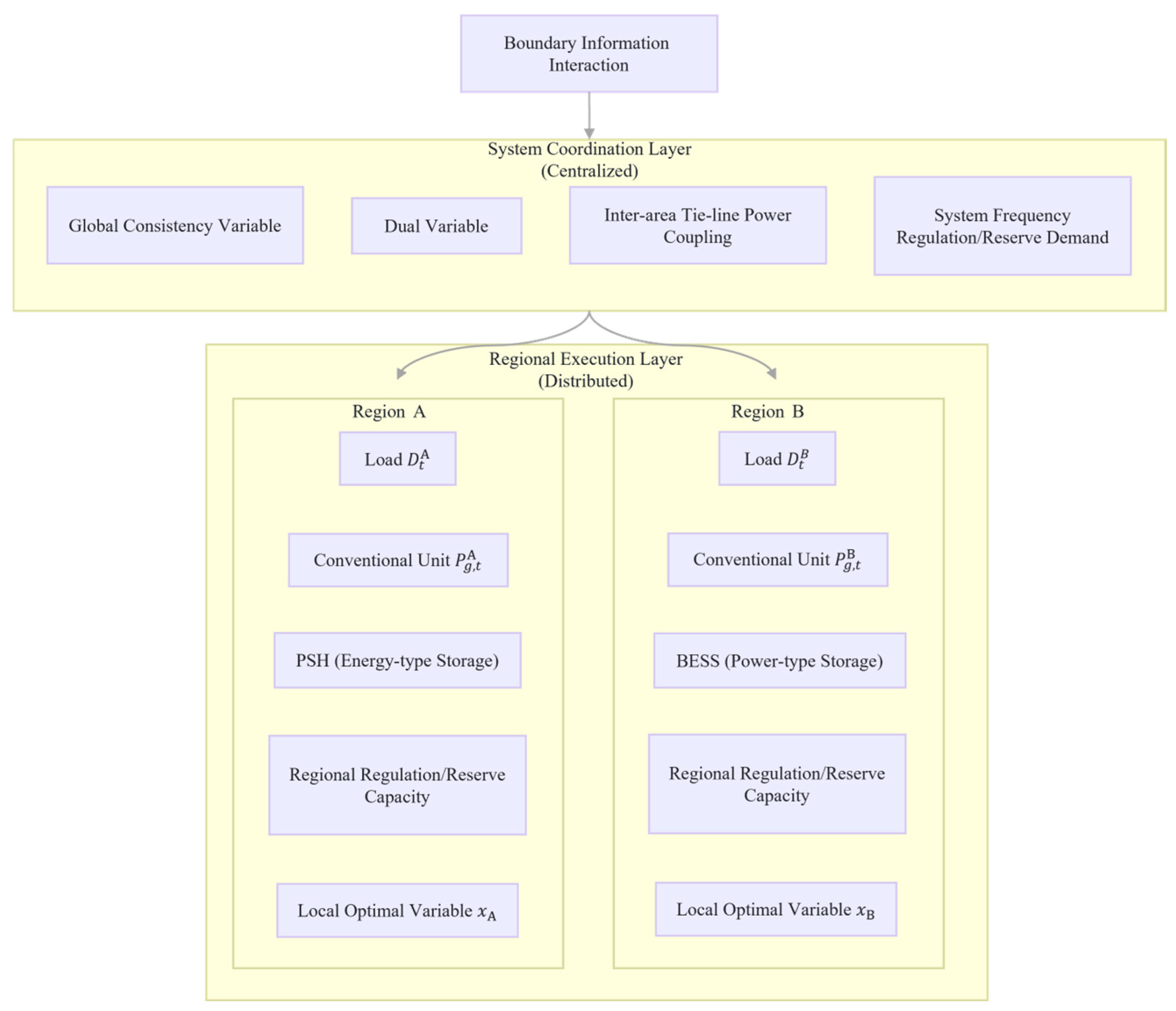
To address the challenges that global coupling constraints pose for centralized optimization, this study adopts ADMM. By relaxing these coupling constraints, ADMM provides a decomposition–coordination framework that solves the problem iteratively. Its three-step cycle can be interpreted as a dynamic process involving intra-regional dispatch and inter-regional market coordination:
- (1)
Regional subproblem solution: Each region independently optimizes its operational schedule, satisfying all local constraints, given the dual variables and global consensus variables received from the coordinator.
- (2)
Global consensus update: The coordinator aggregates the regional plans and computes a compromise solution that balances their interests. This solution becomes the common target for the next iteration.
- (3)
Dual variable update: Based on the deviation between each region’s plan and the global consensus, the coordinator adjusts price-based penalty signals, guiding regions toward consensus in subsequent iterations.
This iterative process continues until the system reaches an equilibrium solution that approximates the global optimum.
3.2. Distributed Reformulation of the Primal Problem
To apply ADMM, the global coupling constraints are first relaxed. A vector of boundary variables is defined for each region
:
This vector collects all variables from region
that are subject to inter-regional coordination, including tie-line power and ancillary service provisions over all time steps
:
The original coupling constraints can then be compactly expressed as:
A global consensus variable
is introduced to represent the common target for these boundary variables:
The original problem can then be reformulated into the standard ADMM consensus form:
where
is the vector of all local decision variables in region
;
is the local objective function of region
;
extracts the boundary quantities subject to global coordination;
is the global consensus variable; and
is the set of regions.
3.3. Augmented Lagrangian Function
For the consensus problem above, dual variables
are introduced and the augmented Lagrangian function is constructed as:
where
is the dual variable vector associated with region
;
is the penalty parameter in the augmented Lagrangian function. The term
is the linear dual penalty, and the term
is the quadratic augmentation term. The quadratic penalty term improves numerical stability and supports convergence, while the separable structure enables parallel computation.
3.4. ADMM Iteration Steps
At iteration k + 1, ADMM performs the following three updates.
- (1)
Regional subproblem update (-update).
Each region
solves, in parallel, a local optimization problem depending only on its own variables, given the previous consensus
and dual variables
:
where
denotes the set of all local constraints for region
. After solving, each region reports the updated boundary quantity
to the coordinator.
- (2)
Global consensus update (-update).
After receiving
from all regions, the coordinator updates the global consensus using simple averaging:
This averaging yields a compromise plan balancing all regional preferences.
- (3)
Dual variable update (-update).
Each region updates its dual variables according to the deviation between its local plan and the updated global consensus:
The dual variables serve three interconnected roles in the ADMM framework.
- (i)
Algorithmic role—consensus enforcement. In the regional subproblem update (Equation (35)), the term acts as a linear correction term that penalizes deviations of regional decisions from global coupling requirements. When a region’s boundary export exceeds the consensus value, the corresponding dual variable increases, raising the effective marginal cost of further deviation in the next iteration. In the dual update step (Equation (37)), the dual variable accumulates the consensus mismatch: persistent deviations lead to progressively stronger correction signals, ensuring iterative alignment among regions.
- (ii)
Economic interpretation. In convex settings, the converged dual variables correspond to optimal Lagrange multipliers of the coupling constraints and represent shadow prices of inter-regional coordination (e.g., tie-line congestion price or ancillary service scarcity price). In the present mixed-integer formulation, classical dual optimality does not strictly apply. Nevertheless, the evolving dual variables still function as price-like coordination signals that guide regional decisions toward economically consistent outcomes. The approximate pricing mechanism described in
Section 4.5 provides a complementary approach to extracting economically interpretable prices.
- (iii)
Influence on convergence and final results. The magnitude and evolution of dual variables directly affect the speed at which regional boundary quantities converge, the stability of consensus formation, and the final distributed dispatch pattern. If dual updates are too weak (due to a small penalty parameter
), regions may remain misaligned for many iterations; if too aggressive, oscillatory behavior may occur. This interaction between dual updates and the penalty parameter
motivates the adaptive update strategy discussed in
Section 3.5.
3.5. Adaptive Penalty Parameter Adjustment Strategy
A fixed penalty parameter ρ often performs poorly across iterations. To improve performance, an adaptive update strategy is used to balance the primal and dual residuals. Define the primal residual
and the dual residual
at iteration
k + 1 as:
where
is the primal residual at iteration
, measuring the deviation between regional boundary variables and the global consensus;
is the dual residual, measuring the change in the consensus variable
between successive iterations.
The penalty parameter
is updated according to the following rule:
where
and
are preset lower and upper bounds of the penalty parameter;
is the multiplicative adjustment factor; and
is the threshold ratio for detecting residual imbalance.
The choice of an adaptive penalty update rule is motivated by the limitations of fixed-penalty ADMM, particularly in non-convex mixed-integer settings. With a fixed , the algorithm may exhibit imbalance between primal and dual convergence progress: if is too small, primal feasibility violations decay slowly, leading to prolonged consensus mismatch; if is too large, dual updates may become overly aggressive, causing oscillatory behavior—particularly when binary switching decisions (e.g., storage operating modes , , , ) induce discrete jumps in residual magnitudes. A fixed penalty parameter cannot adapt effectively to such structural changes, motivating the use of a dynamic adjustment mechanism.
The adaptive update rule in Equation (40) follows the residual-balancing principle introduced by Boyd et al. [
23]. The underlying rationale is as follows: when the primal residual significantly exceeds the dual residual (by a factor of
), the penalty parameter ρ is increased by the multiplicative factor
to strengthen consensus enforcement and accelerate primal convergence; conversely, when the dual residual dominates,
is decreased to relax the penalty and avoid excessive oscillation in dual variables. This dynamic adjustment maintains a balanced reduction in both residuals and improves stability in the presence of integer-induced discontinuities.
Several adaptive penalty strategies have been proposed in the ADMM literature. Boyd et al. [
23] introduced the residual-balancing scheme using fixed multiplicative adjustments, which has become a widely adopted approach in convex optimization. Other representative strategies include prediction-correction mechanisms and variable step-size approaches. However, these strategies have primarily been analyzed and validated under convex or continuous formulations where convergence guarantees can be formally established.
In contrast, the present study applies and empirically validates a residual-balancing adaptive rule within a mixed-integer, non-convex market clearing model involving binary storage operating variables and inter-regional coupling constraints. In such settings, integer feasibility and consensus enforcement interact in ways that differ fundamentally from convex formulations. The methodological contribution therefore lies not in inventing a new adaptive rule, but in demonstrating that a carefully bounded residual-balancing mechanism—with safeguard parameters and —can achieve stable and economically consistent convergence in a distributed multi-market MIP clearing context.
It should be noted that the adopted parameter values (
,
,
,
) are empirical choices commonly used in ADMM implementations. These values are heuristic in nature and do not arise from a formal optimization procedure. However, the sensitivity analysis in
Section 4.8 demonstrates that the algorithm’s performance is robust to moderate variations in these parameters, with welfare variations below 0.07% across 27 tested configurations. Due to the non-convex, mixed-integer nature of the clearing problem, no formal convergence guarantee is claimed for the adaptive strategy; it is adopted as a practical stabilization tool.
3.6. Convergence and Handling of Non-Convexity
Algorithm termination is determined by stopping criteria based on the norms of both primal and dual residuals. The iteration stops when both residuals fall below pre-defined tolerance thresholds,
and
:
where
and
are the primal and dual residual tolerance thresholds, respectively.
A key challenge in this work is the non-convex nature of the problem. Due to the presence of binary variables governing storage operating modes (
,
,
,
), the clearing problem is formulated as a MIP, which is inherently non-convex. It is well established that classical ADMM convergence theory guarantees global convergence only for convex optimization problems [
23]. Consequently, formal convergence guarantees do not strictly apply to the problem considered in this study.
Given this limitation, we adopt a practically motivated convergence framework that relies on two complementary stopping criteria:
- (1)
Primal feasibility condition: the primal residual must fall below a pre-defined tolerance , ensuring that all inter-regional coupling constraints (Equations (24)–(27)) are approximately satisfied. This condition guarantees physical consistency of the distributed solution.
- (2)
Objective stabilization condition: the system-level social welfare must have stabilized over a sufficient number of consecutive iterations. This condition ensures economic rationality and prevents premature termination in oscillatory regimes.
In non-convex MIP settings, the dual residual typically stabilizes at a non-zero level rather than converging to zero. This behavior arises because integer variable decisions introduce discrete jumps that prevent the continuous refinement of the dual trajectory. As demonstrated in
Section 4.3, this non-zero dual residual does not compromise the practical quality of the solution: the distributed algorithm produces a social welfare outcome within 0.61% of the centralized optimum. The sensitivity analysis in
Section 4.8 further confirms that this performance is robust across 27 parameter configurations, with welfare variations of less than 0.07%.
In summary, while theoretical convergence guarantees cannot be provided for the non-convex formulation, the proposed stopping criteria are justified from an engineering perspective by ensuring both physical feasibility and economic efficiency of the clearing outcome. Each regional MIP subproblem is solved using the established commercial solver Gurobi, and ADMM is used as a practical engineering framework for distributed coordination, aiming to obtain feasible solutions that are economically close to the global optimum.
3.7. Algorithm Flow
The complete procedure is summarized in Algorithm 1.
| Algorithm 1 Distributed ADMM for Multi-Region Hybrid Storage Clearing |
Input: System parameters, initial
Output: Optimal repeat (parallel): End for using (36) : using (37) End for until stopping criteria are satisfied
|
3.8. Algorithmic Properties
Privacy-aware characteristics: The distributed clearing architecture adopted in this study reduces information exchange by decomposing the centralized problem into regional subproblems. Each region solves its local optimization problem independently and exchanges only a limited set of coupling variables with the coordinator—specifically, boundary power flows () and aggregated ancillary service quantities (, ) for each time period . For a scheduling horizon of = 24 time periods and three coupling quantities, this constitutes a low-dimensional vector of = 72 scalar values per region per iteration. Sensitive information—including internal cost functions (, , ), unit technical parameters (efficiencies, capacity limits), and generator bid curves—remains local to each region and is not transmitted to the coordinator or to other regions.
It should be emphasized, however, that this privacy-aware design provides engineering-level information isolation rather than a formally verifiable privacy guarantee. The framework does not incorporate cryptographic mechanisms such as differential privacy, secure multi-party computation, or homomorphic encryption. Although the exchanged boundary variables are aggregate quantities rather than individual unit-level data, the possibility of inferring internal information from the iterative trajectory of these variables cannot be formally excluded without additional cryptographic protection. Therefore, the term “privacy-aware” is used throughout this manuscript to indicate reduced information exposure by architectural design, rather than mathematically provable privacy protection.
Scalability: The algorithm exhibits favorable horizontal scalability. When a new region is added, the primary computational load is absorbed by the new participant itself, imposing only minimal additional burden on the central coordinator. The coordinator performs only aggregation and dual update operations (Equations (36) and (37)), whose computational cost grows linearly with the number of regions. This modular structure facilitates the large-scale integration of distributed resources. A detailed scalability analysis is presented in
Section 4.9.
Economic interpretability: The iterative update of dual variables resembles a price-discovery process. The dual variables
can be interpreted as approximate shadow prices that reflect tie-line congestion or the scarcity of ancillary services, guiding regions toward a system-wide, near-optimal resource allocation. However, in the non-convex MIP setting of this study, these dual values should be interpreted as coordination signals rather than exact market-clearing prices. A complementary LP-relaxation-based pricing mechanism is presented in
Section 4.5.
4. Case Study and Results Discussion
4.1. Case Setup
To evaluate the effectiveness of the proposed model and algorithm, a 24 h scheduling case study is conducted on a two-region interconnected system, referred to as Region A and Region B. The baseline loads in Regions A and B are set to 150 MW and 120 MW, respectively, following representative daily load profiles. The two regions are connected by a single tie-line with a transmission capacity limit of 100 MW. The system includes a 300 MW/1200 MWh PSH plant with a pumping efficiency of 0.85 and a generating efficiency of 0.90. Each region is also equipped with a 50 MW/100 MWh BESS with a round-trip efficiency of 0.95 [
26]. Price parameters for the energy, frequency regulation, and reserve markets are based on representative industry values [
30]. All optimization models are implemented in YALMIP (version R20250626, developed by Johan Löfberg, Linköping University, Linköping, Sweden) and solved using Gurobi 12.0.3 (Gurobi Optimization, LLC, Beaverton, OR, USA). All simulations were performed on a desktop computer equipped with an Intel Core i5-12400F CPU (Intel Corporation, Santa Clara, CA, USA).
4.2. Comparison of Centralized and Distributed Clearing Results
This section compares the clearing outcomes of the proposed distributed algorithm with those of the centralized benchmark, focusing on both economic performance and key operational attributes.
4.2.1. Economic Performance Comparison
As shown in
Table 2, the centralized clearing approach yields a total social welfare of 313,860.49 CNY. The proposed distributed algorithm produces a social welfare of 311,961.75 CNY, corresponding to a small optimality gap of 0.61%. This result indicates that the distributed method can achieve near-optimal economic efficiency without requiring regions to disclose sensitive internal information, such as local generation cost curves. The small deviation is generally acceptable in engineering practice.
4.2.2. Differences in Tie-Line Power Exchange Strategies
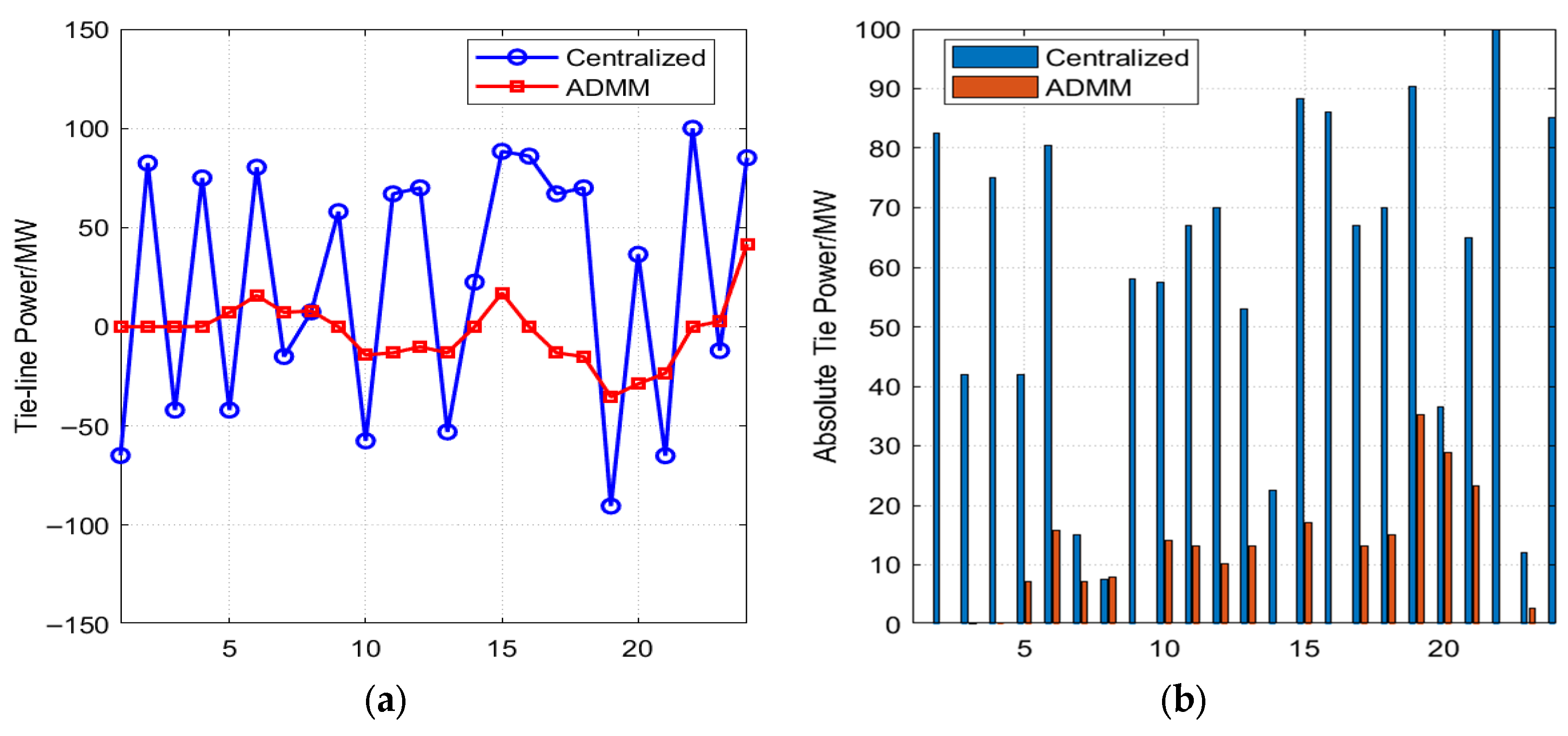
Figure 2 compares the hourly tie-line power exchange schedules obtained under the two clearing schemes. A notable difference emerges in the cross-regional power exchange strategies. The centralized solution exploits inter-regional flexibility more aggressively, resulting in larger tie-line power fluctuations (mean absolute power of 47.80 MW) and more frequent operation near the transmission limit. This behavior reflects the centralized optimizer’s sensitivity to global marginal-cost differentials. In contrast, the distributed solution produces a much smoother exchange profile, with a mean absolute power of only 10.20 MW. For many hours, the power exchange remains close to zero, suggesting that under the ADMM framework, each region prioritizes local self-balancing and engages in inter-regional exchange only when economically beneficial.
Despite the distinct operational strategies, the resulting economic outcomes are remarkably similar. This suggests the existence of multiple high-quality, near-optimal operating points. The solution identified by the distributed method, while less reliant on the tie-line, still demonstrates high economic performance and operational stability, aligning well with the practical requirements for regional autonomy and privacy in multi-regional markets.
4.3. ADMM Convergence Characteristics
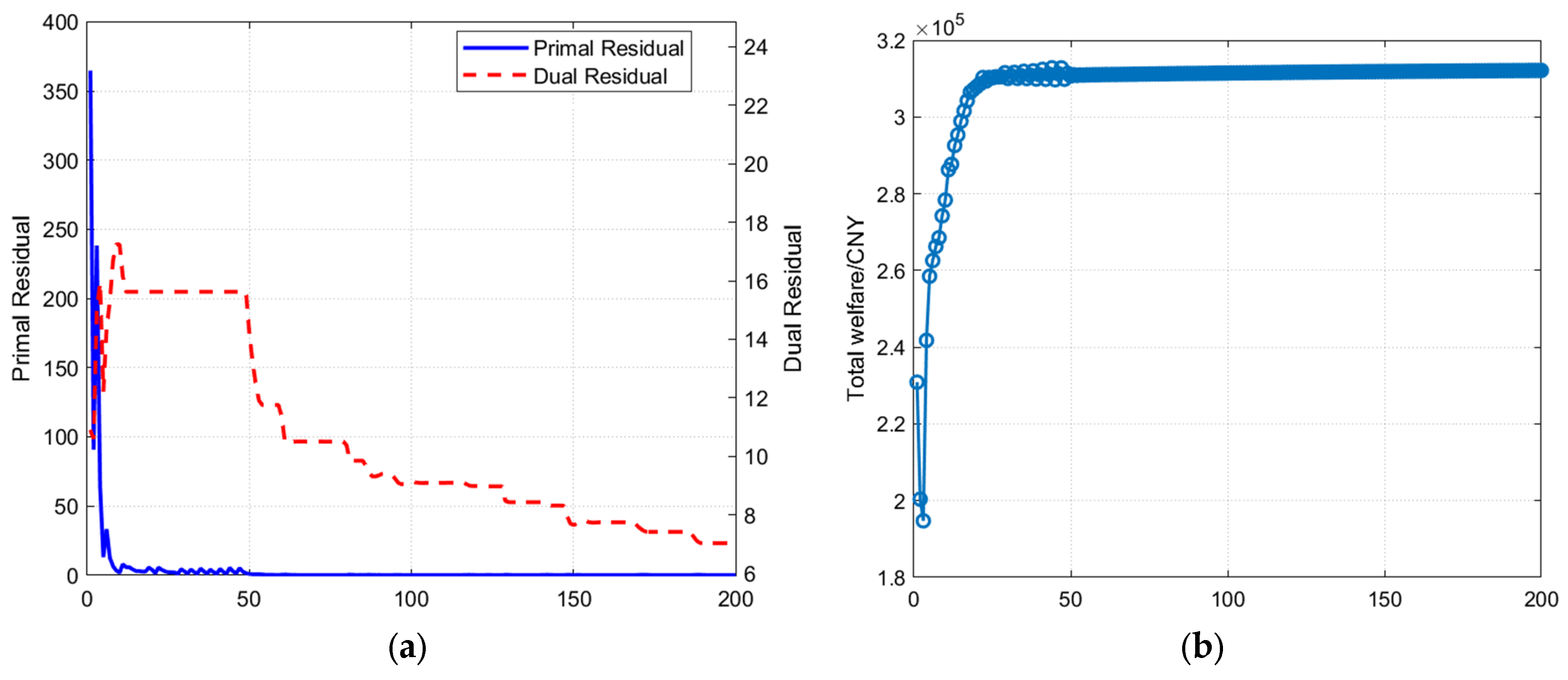
Figure 3 illustrates the evolution of the primal residual, dual residual, and social welfare over the 65 iterations of the adaptive ADMM algorithm, providing a comprehensive assessment of its convergence behavior in a non-convex, mixed-integer environment.
As shown in
Figure 3a, the primal residual
decreases rapidly during the early iterations, dropping by more than two orders of magnitude from an initial value of approximately 365. It stabilizes within the range of 10
−3–10
−4 around iteration 60, well below the pre-set primal tolerance of
= 5 × 10
−2. This indicates that the coupling variables across regions have effectively reached consensus, thereby ensuring global feasibility. The small oscillations observed in later stages are attributable to discrete changes in integer variables, which is a common phenomenon in mixed-integer optimization.
In contrast, the dual residual remains at a relatively stable, non-zero level throughout the process and does not converge to zero as it would in a convex problem. This behavior is characteristic of ADMM applied to non-convex MIP problems and is further analyzed below.
Although the dual residual does not converge to zero, this does not undermine the practical utility of the algorithm. As shown in
Figure 3b, social welfare exhibits a stable, non-decreasing trend after approximately 50 iterations and eventually converges to 311,961.75 CNY. The stabilization of the objective function confirms that the algorithm successfully identifies a high-quality feasible solution.
To provide a more detailed interpretation of the dual residual trajectory, two distinct phases can be identified. Phase I (iterations 10–50): the algorithm enters a quasi-stationary coordination phase. By iteration 10, the primal residual has already decreased substantially, meaning that the regional boundary decisions
are close to consensus. Consequently, the updates of the global variable z become incremental. In addition, most integer decision variables (e.g., storage operating modes
,
,
,
) have stabilized during this stage, eliminating large discrete jumps. Since
with small but nearly constant adjustments, the dual residual, defined as
(Equation (39)), remains at an approximately constant level, producing the horizontal segment observed in
Figure 3a.
Phase II (iterations 50–65): the algorithm transitions into a fine-tuning phase dominated by continuous variable adjustments. The consensus variable begins to adjust more precisely toward equilibrium, leading to a slight further reduction in the dual residual. However, the residual stabilizes at a non-zero level, consistent with the non-convex MIP nature of the problem, as discussed in
Section 3.6.
In mixed-integer settings, strict dual convergence to zero is generally not guaranteed. The presence of integer variables introduces discontinuities in the feasible region that prevent classical saddle-point convergence properties from holding. A non-zero dual residual is therefore an expected outcome in practical MIP-based ADMM implementations. In this study, convergence is assessed based on the joint criteria of primal feasibility and objective value stabilization, which together ensure near-optimal coordination performance (optimality gap of 0.61%).
In summary, for non-convex problems of this nature, sufficient primal convergence ensures feasibility, while the stabilization of the objective function ensures economic efficiency. Therefore, a stopping criterion that requires both a sufficiently small primal residual and a stabilized objective function is reasonable and practical from an engineering perspective.
4.4. Analysis of Storage Operation Behavior
4.4.1. Functional Division in Power Dispatch
Energy storage systems serve as key flexibility resources within the joint market-clearing model. Analyzing their operational strategies is essential for validating the effectiveness of the model.
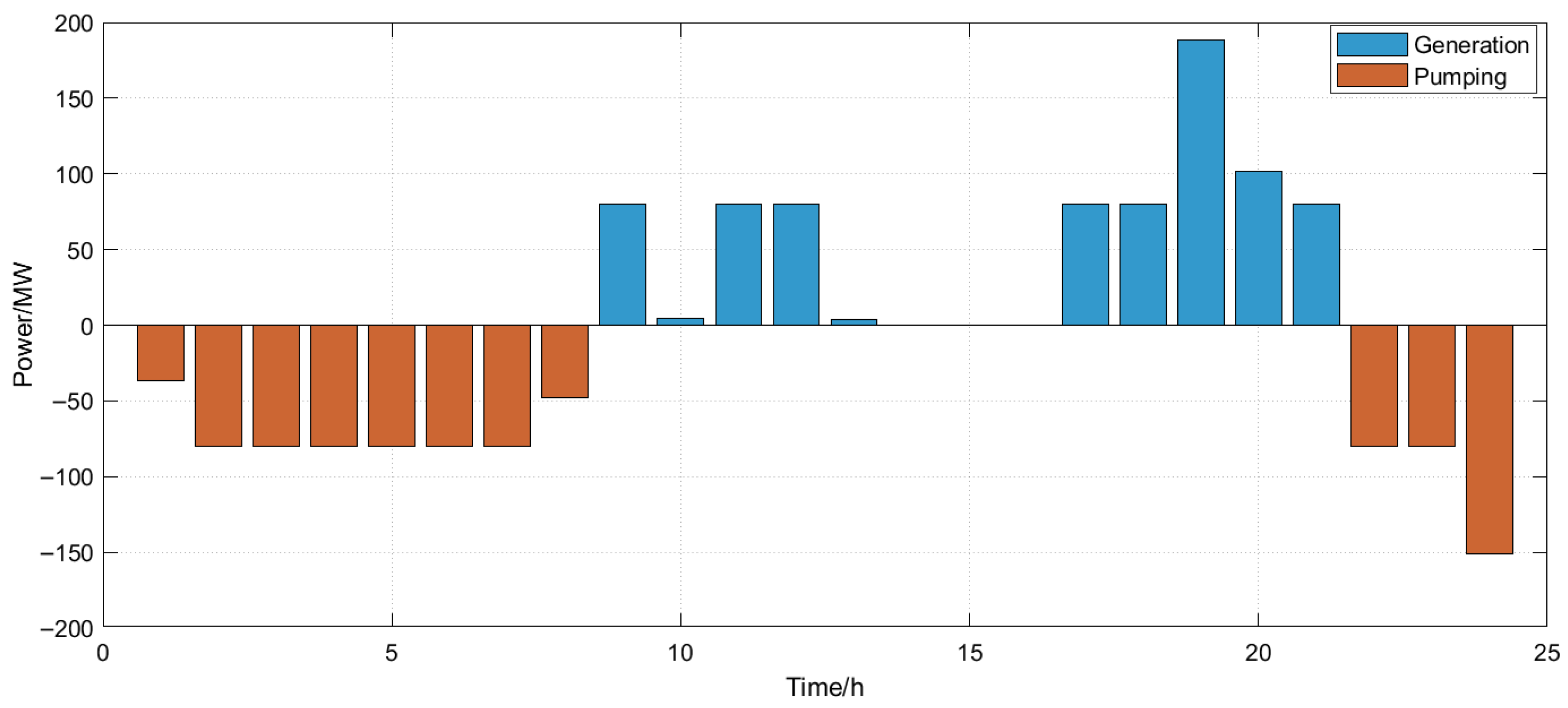
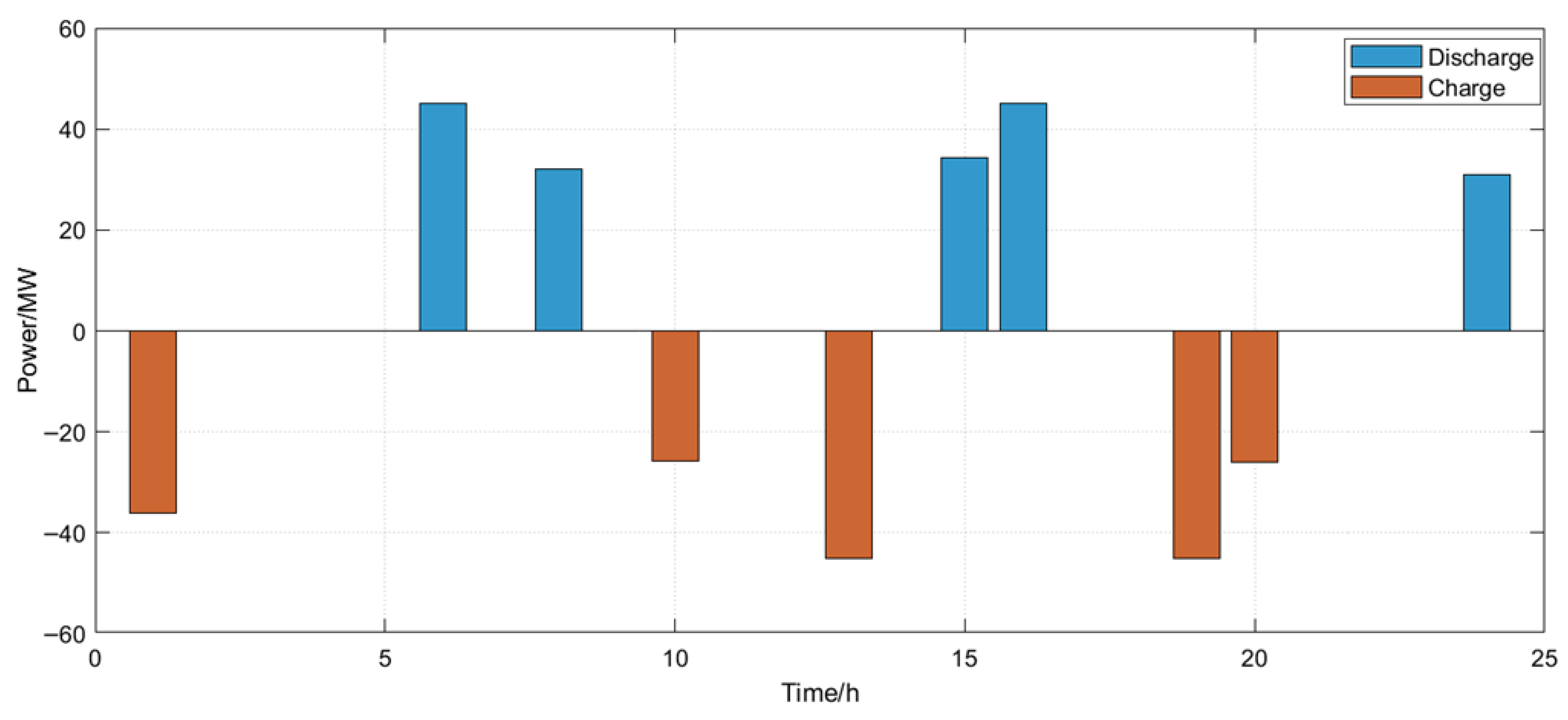
Figure 4 and
Figure 5 present the hourly power-dispatch schedules for the PSH plant and BESS-A, respectively. The results highlight the distinct and complementary technical roles of the two storage technologies.
As shown in
Figure 4, the PSH plant exhibits typical large-capacity, long-duration operational behavior. It consistently pumps at high power during off-peak hours (01:00–08:00) and switches to generating mode during peak hours (09:00–21:00), reaching a maximum output of 188.6 MW at hour 19. This pattern of sustained off-peak pumping and responsive peak generation underscores the PSH plant’s primary function as a system-level energy-shifting unit for bulk temporal arbitrage.
In contrast, as shown in
Figure 5, BESS-A demonstrates rapid and flexible “pulse-like” power adjustments. It performs multiple charge–discharge cycles within the day, including a high-rate charge of 45 MW at hour 6 and near-rated discharges at hours 13 and 19. This operating pattern enables BESS-A to respond to short-term system needs and capture intra-day arbitrage opportunities, acting as an opportunistic fast-regulating resource.
4.4.2. Verification of Differentiated Operating Modes
To further substantiate this functional division,
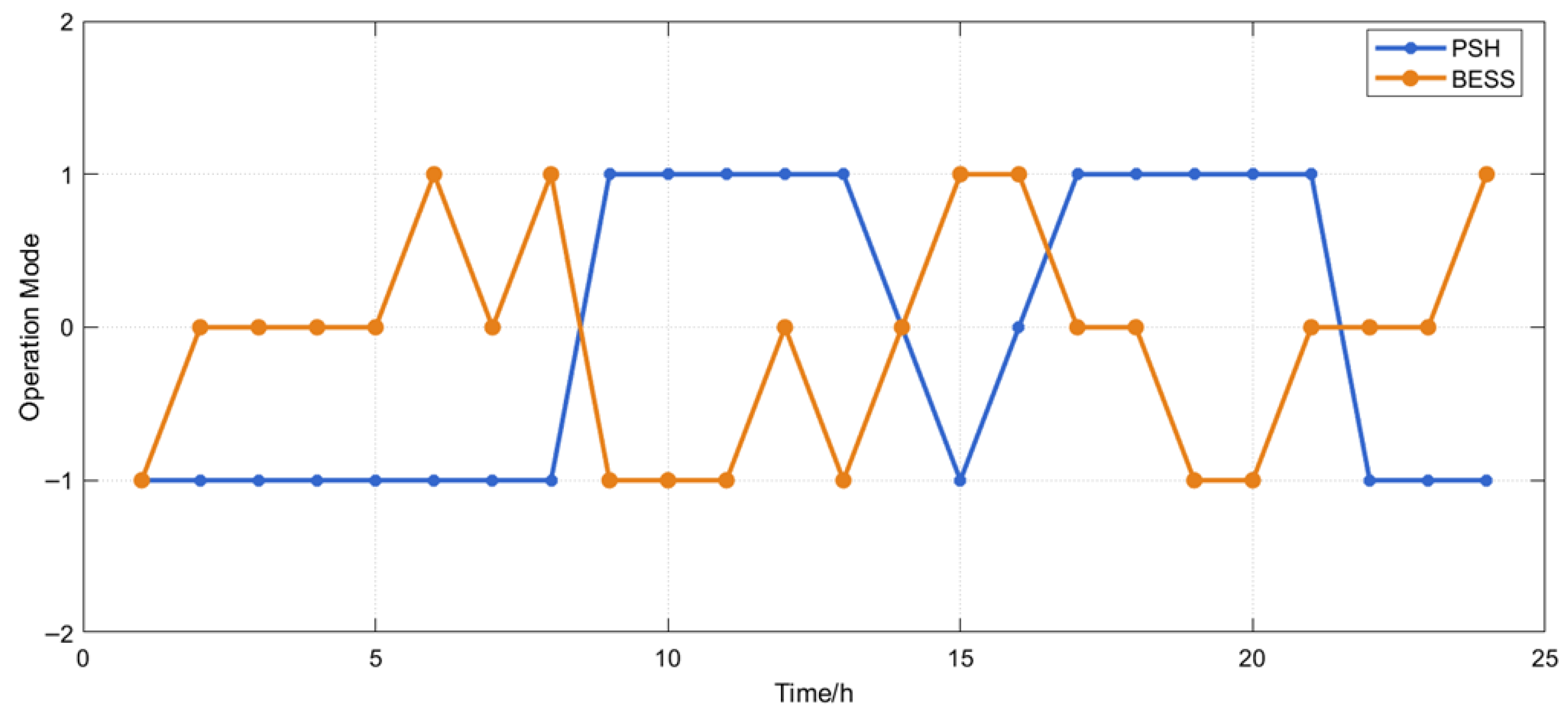
Figure 6 compares the hourly operating modes of the PSH plant and the BESS, with operating states defined as −1, 0, and 1. This comparison provides direct visual evidence of the operational behaviors observed in the power-dispatch schedules.
The PSH plant exhibits a very low switching frequency. It tends to remain in a single operating state for long, continuous intervals, such as extended pumping overnight and sustained generation during the day. This “state persistence” is characteristic of an energy-type resource performing long-horizon energy shifting. Conversely, the BESS undergoes frequent mode changes, switching operating states more than ten times within the 24 h period. This high-frequency switching behavior is fundamental to its role as a power-type resource designed for rapid and flexible regulation.
4.5. Pricing Mechanism and Dual Variable Interpretation
In electricity markets, locational marginal prices (LMPs) serve as key economic signals for system dispatch. In convex optimization models, LMPs can be directly obtained as the dual variables (shadow prices) of the power balance constraints. However, the joint-clearing problem in this study is formulated as a MIP, where the presence of binary variables (, , , ) governing storage operating modes destroys convexity. As a result, classical dual variables are not well-defined for the original non-convex formulation, and a secondary pricing procedure is required to extract economically meaningful marginal price signals.
To address this challenge, we employ an approximate pricing method based on the fixed-integer LP relaxation approach, which proceeds as follows:
Step 1 (MIP solution): The distributed ADMM algorithm is run to convergence, producing optimal decision variables for all regions, including the integer variables (, , , ) that govern storage operating modes.
Step 2 (LP construction): All integer variables are fixed at their converged optimal values. The resulting problem contains only continuous variables—generation levels (), power flows (), ancillary service provisions (, , , , )—and linear constraints, forming a standard linear program (LP).
Step 3 (Dual extraction): The fixed-integer LP is solved for each regional subproblem. The dual variables associated with the power balance constraints (Equations (6) and (7)) are extracted and used as approximate LMPs. These dual variables represent the marginal cost of supplying an additional unit of electricity in each region at each time period, conditional on the fixed integer operating configuration.
The term “implicit price signals” is used because these prices are not obtained directly from the original MIP, but are derived from a secondary LP constructed around the optimal discrete operating point. They reflect marginal system costs conditional on the realized commitment and storage mode decisions, rather than globally valid convex dual prices.
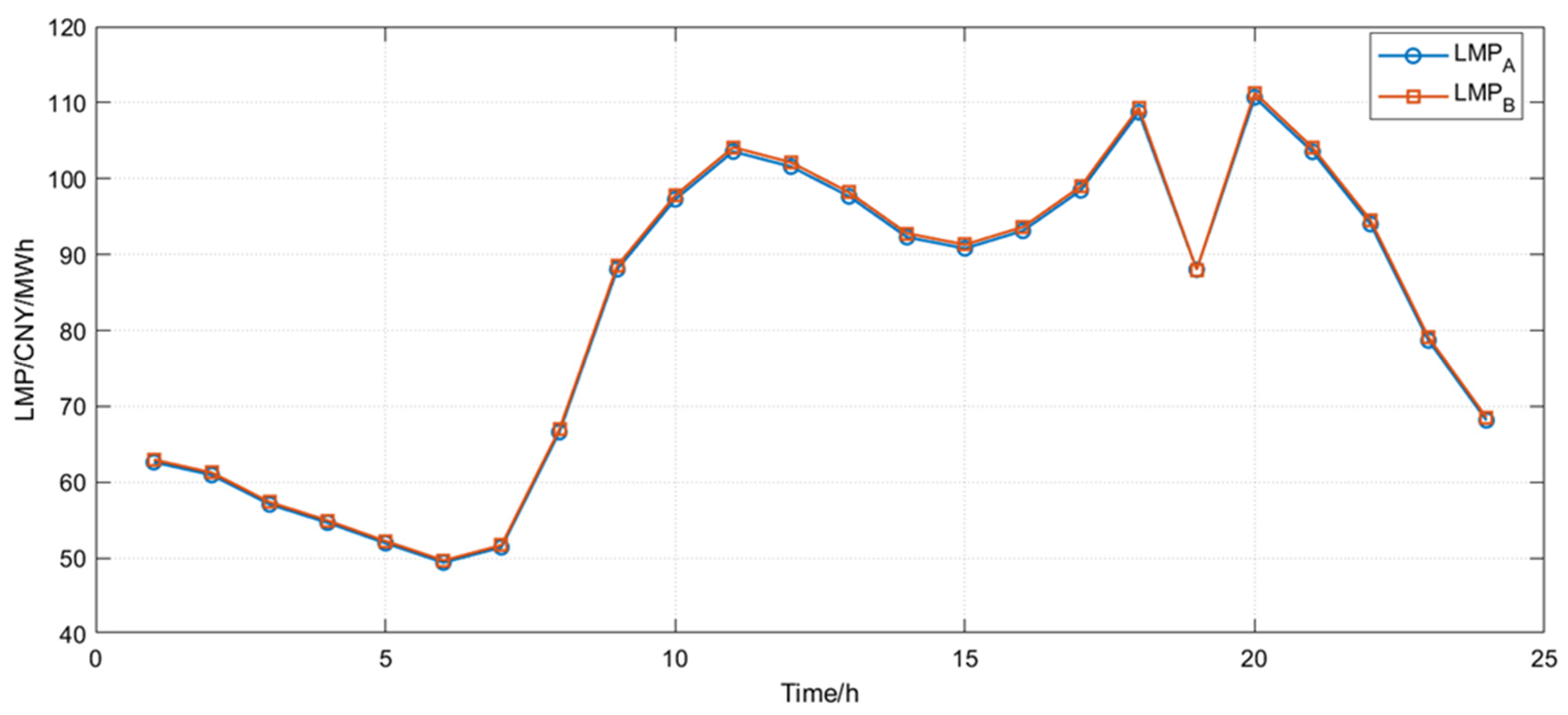
Figure 7 shows the hourly approximate LMPs obtained using this method. These prices are used to validate and explain the physical operational behaviors produced by the distributed algorithm. Two key observations can be made: First, the prices exhibit a clear daily peak–valley pattern, rising from a low of approximately 49.4 CNY/MWh in the early morning to a peak of about 111.3 CNY/MWh in the evening. This price trajectory is consistent with the “charge-low, discharge-high” arbitrage behavior of the storage systems observed in
Section 4.4. Second, small dynamic price differentials exist between the two regions (averaging approximately −0.4 CNY/MWh), which are consistent with the relatively conservative tie-line utilization observed in the ADMM solution, as noted in
Section 4.2.
It should be emphasized that the prices obtained through this procedure are approximate economic signals rather than exact market-clearing prices in the strict sense of convex duality theory. In mixed-integer problems, dual variables are not well-defined for the original non-convex formulation. By fixing integer decisions, the combinatorial structure of the problem is removed, and the resulting LP dual values may not fully capture the opportunity costs associated with discrete switching decisions (e.g., commitment start-up costs or storage mode transitions). This approach is analogous to the restricted LP method widely used by Independent System Operators for pricing in MIP-based market-clearing models [
31,
32].
This analysis demonstrates that although the ADMM algorithm does not explicitly compute LMPs, its iterative dual-variable updates implicitly generate approximate price signals that reflect the economic conditions of the system. These approximate prices are consistent with the observed dispatch patterns and provide useful economic guidance for regional decision-making. However, they should be interpreted as proxy economic signals for validating dispatch rationality, rather than as theoretically exact equilibrium prices. The development of more rigorous pricing mechanisms for non-convex distributed market clearing remains an important direction for future research.
4.6. Analysis of Ancillary Service Capacity Allocation
Frequency regulation and reserve services are essential for system security, and their capacity allocations reflect resource characteristics and market value.
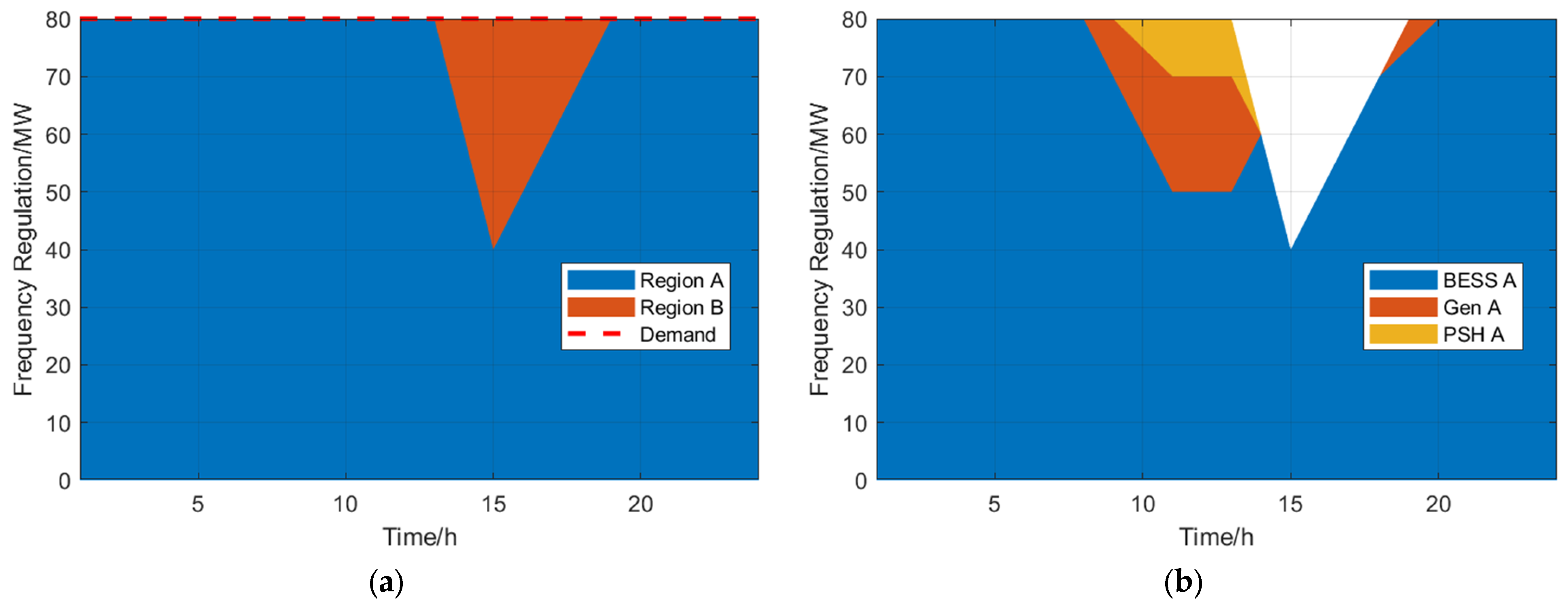
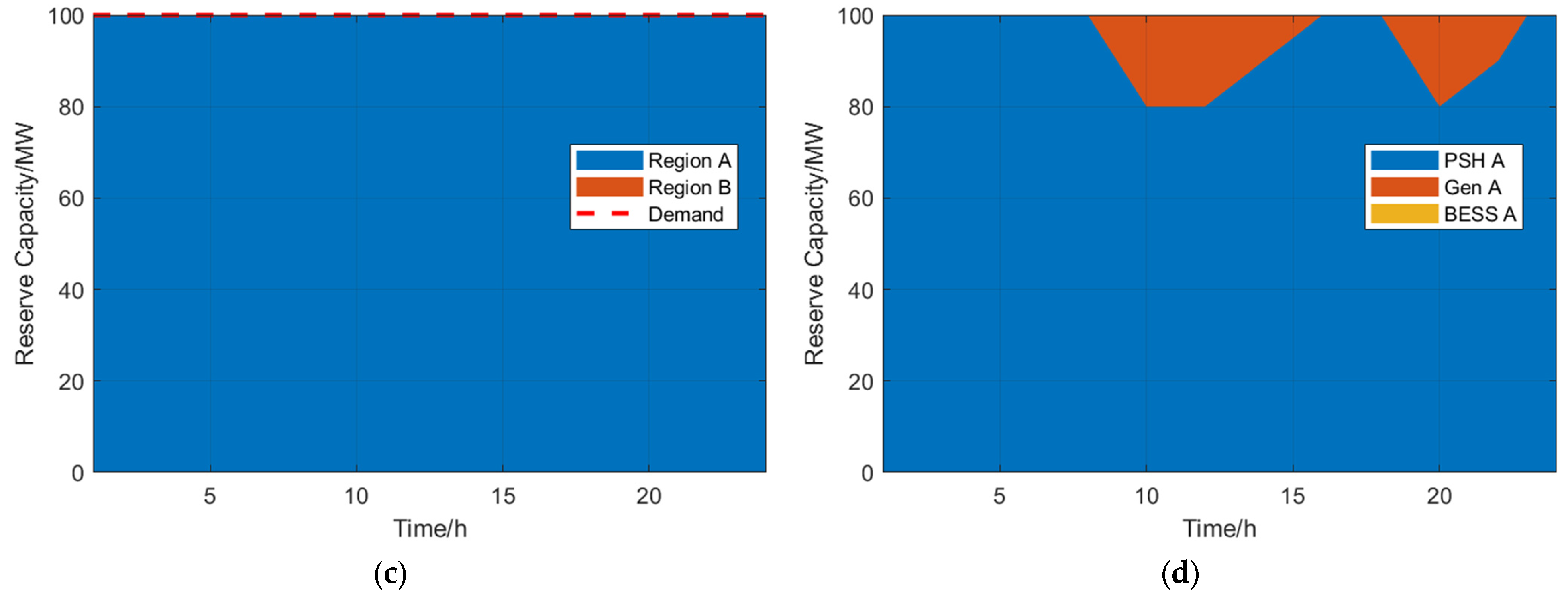
Figure 8 presents the distribution of regulation and reserve capacities between the two regions as obtained by the ADMM algorithm.
As shown in
Figure 8a,c, the converged total regulation and reserve capacities precisely meet the system-level requirements of 80 MW and 100 MW per hour, respectively. This demonstrates that the adaptive ADMM effectively coordinates cross-regional coupling and produces feasible solutions that satisfy the required security constraints.
Figure 8b shows that in Region A, the BESS provides most of the regulation capacity, highlighting its comparative advantage in fast-response services.
Figure 8d shows that the PSH plant occupies a dominant share of reserve provision due to its large capacity and low marginal cost—attributes well aligned with reserve requirements, which prioritize availability over fast ramping capability.
Overall, the ancillary-service allocation results confirm the effectiveness of the distributed framework. It enhances system security in a decentralized manner while preserving economic optimality and enabling independent agents to make locally rational yet globally beneficial decisions.
4.7. Analysis of Conventional Generation Dispatch
Conventional thermal units form the backbone of system supply, and their economic dispatch directly influences overall operating costs.
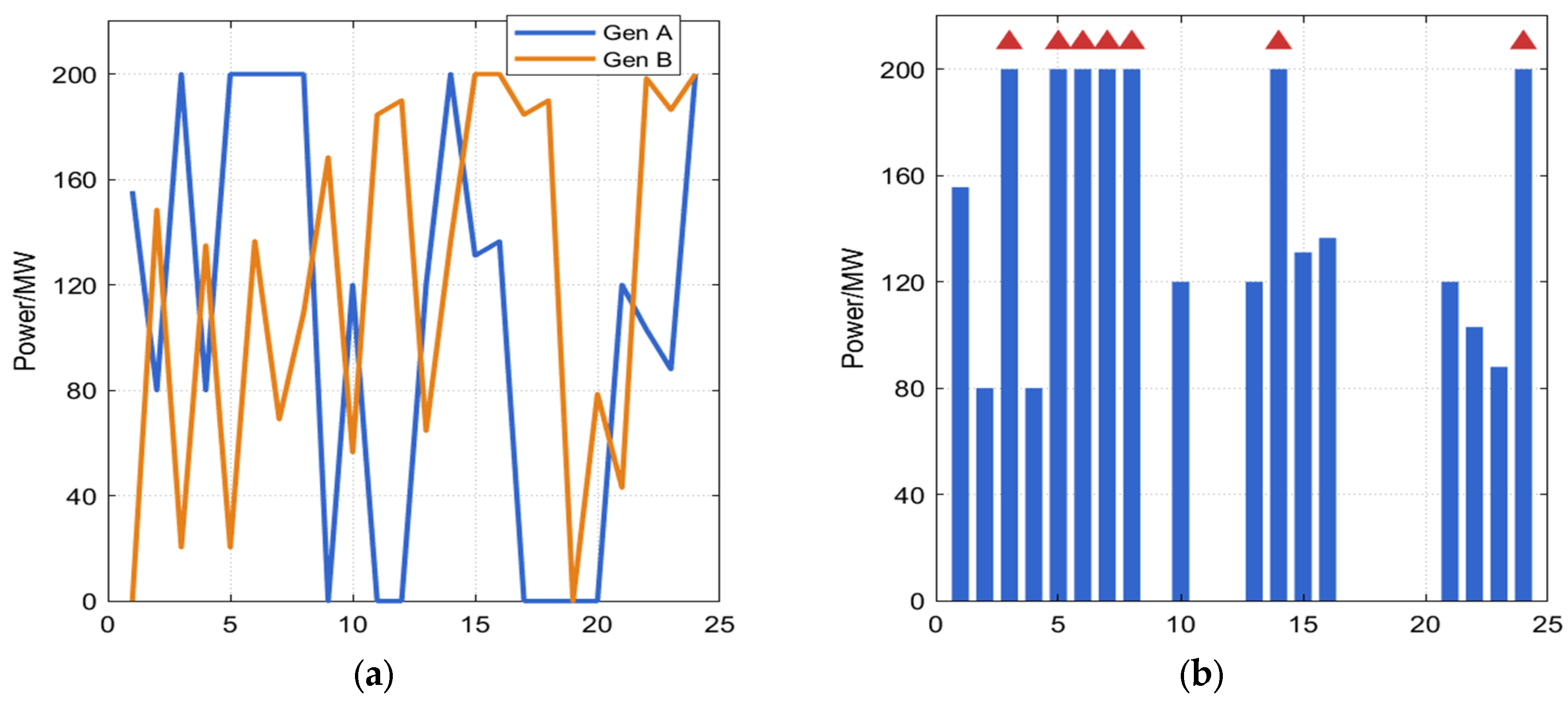
Figure 9 shows the unit outputs in Regions A and B and highlights their complementary interactions with storage operations.
Region A’s generators operate primarily in a peaking mode—running at high output during demand peaks (up to 200 MW) and being taken offline during some low-demand periods to avoid inefficient low-load operation. In contrast, the units in Region B exhibit baseload or shoulder characteristics, maintaining smoother outputs that provide continuous support during several critical intervals.
During several intervals (e.g., hours 9, 11, and 12), the generators in Region A are offline while Region B increases its output to meet system demand. This emergent “one-up/one-down” pattern—produced by distributed coordination through dual updates—demonstrates the algorithm’s effectiveness in achieving system-level performance through locally guided decisions.
For example, when the PSH unit generates heavily at hour 19 (188.6 MW), the outputs of conventional units decrease correspondingly to minimize total operating costs. This illustrates the successful coordination among conventional units, storage resources, and the network.
In summary, the dispatch results for conventional units demonstrate the algorithm’s ability to orchestrate complex resource interactions and reproduce market-based economic behavior within a distributed optimization framework.
4.8. Sensitivity Analysis of Adaptive Penalty Parameters
To evaluate the robustness of the adaptive penalty update strategy (Equation (40)), a systematic sensitivity analysis is conducted by varying three key parameters: the initial penalty parameter
, the multiplicative factor
, and the threshold ratio
. This yields a total of 27 parameter configurations. For each configuration, the ADMM algorithm is executed for a fixed budget of 200 iterations (without early termination) under identical system conditions, to ensure a fair and comprehensive comparison of convergence behavior across all configurations. The representative results of the sensitivity analysis are summarized in
Table 3.
The results demonstrate the following:
- (1)
Primal feasibility robustness: All 27 configurations achieve satisfactory primal feasibility, with final primal residuals ranging from 1.12 × 10⁻⁵ to 1.48 × 10⁻¹. The majority fall well below the tolerance threshold of = 5 × 10⁻².
- (2)
Economic robustness: The final social welfare values vary within a narrow range of 308,877.76–309,093.32 CNY, corresponding to a maximum relative deviation of less than 0.07% across all 27 configurations. This demonstrates that the algorithm’s economic performance is essentially insensitive to moderate parameter variations.
- (3)
Performance trends: Smaller initial combined with larger generally yields slightly higher welfare, though the differences are economically negligible. The default configuration (= 100, = 1.2, = 10) represents a balanced and representative choice.
These results confirm that the adaptive penalty update strategy is robust to parameter tuning, significantly reducing the practical burden for system operators. The stable performance across diverse configurations supports the reliability of the proposed framework in practical deployment scenarios.
4.9. Scalability and Applicability Discussion
Although the numerical validation in this study is conducted on a two-region system, the proposed distributed clearing framework is structurally designed to be scalable to larger multi-region settings. The two-region configuration serves as a minimal yet representative setting for validating inter-regional coupling, distributed coordination behavior, and price consistency under ADMM-based decomposition. The scalability characteristics are analyzed below from computational, communication, and architectural perspectives, supported by the quantitative profiling results summarized in
Table 4.
(1) Computational scalability. Under the ADMM decomposition, the global clearing problem is partitioned into
independent regional subproblems coordinated through coupling variables. Each regional subproblem is a quadratic program whose size depends only on the number of local generation and storage units, not on the overall system size. As shown in
Table 4, Region A (with a conventional generator, PSH, and BESS) requires 506 variables and 304 constraints (average solve time: 0.690 s), while Region B (with a conventional generator and BESS) requires 217 variables and 127 constraints (average solve time: 0.357 s). Adding a new region introduces one additional subproblem of comparable size without enlarging existing subproblems.
The coordinator performs only aggregation and dual update operations (Equations (36) and (37)), requiring a negligible computation time of 0.0002 s per iteration. With parallel computation, the effective wall-clock time per iteration is governed by the largest regional subproblem (0.690 s in this case) rather than by the sum of all subproblem solve times.
Moreover, the adaptive penalty update rule (Equation (40)) is based on the ratio between primal and dual residual norms, rather than on absolute system dimensions. As additional regions are introduced, both residual vectors expand proportionally with the number of coupling constraints, but the ratio upon which the update decision is based—whether to increase, decrease, or maintain —remains structurally comparable. This scale-independence property suggests that the adaptive mechanism does not inherently degrade as the system grows.
(2) Communication scalability. Each region exchanges only a low-dimensional boundary variable vector with the coordinator. For T time periods and three coupling quantities (tie-line power, frequency regulation capacity, and reserve capacity), the communication vector per region has dimension 3T. In this study (T = 24), each region transmits 72 scalar values per iteration. Over 200 iterations, the total data exchanged per region amounts to 14,400 scalars. This communication overhead is independent of the number of internal decision variables and is negligible compared to the full internal model data that would need to be centralized in a non-distributed scheme.
(3) Architectural extensibility. The modular structure of the ADMM framework naturally supports extensions to more complex configurations, including multiple tie-lines per region, hierarchical coordination structures (e.g., clustering nearby regions under intermediate sub-coordinators), and heterogeneous regional market designs. The mathematical formulation of the coupling constraints (Equations (24)–(27)) is general and not restricted to the two-region, single-tie-line topology used in the case study.
(4) Performance scaling and potential bottlenecks. Under parallel computation, the wall-clock time per ADMM iteration is determined by the slowest regional subproblem. In a balanced multi-regional system where subproblem sizes are comparable, the iteration time is expected to remain relatively stable as the number of regions increases. However, in heterogeneous systems with significantly uneven regional sizes, computational imbalance may arise. Additionally, potential bottlenecks may emerge from: (i) increased coupling complexity when multiple tie-lines connect each region pair; (ii) heterogeneous convergence rates across regions; and (iii) communication latency in geographically dispersed deployments.
(5) Limitations and future directions. We acknowledge that the present case study provides empirical validation only for a two-region configuration with a single tie-line. While the structural properties discussed above indicate favorable scalability, direct numerical verification on larger multi-region systems with more complex network topologies remains an important direction for future research.
4.10. Discussion on Engineering Value
The case study results indicate that the proposed distributed joint-clearing framework provides several practical benefits for future electricity markets.
Acceptable economic performance: With a social welfare deviation of only 0.61% relative to the centralized optimum, the economic performance of the distributed solution is well controlled. This small deviation is typically acceptable in practice, particularly when considering real-world uncertainties such as forecast errors.
Privacy-aware architecture: The distributed architecture enhances privacy by design. By exchanging only boundary information and keeping sensitive data like cost curves local, it provides a more secure and trustworthy foundation for inter-regional market coordination.
Robustness and scalability: The adaptive ADMM demonstrates robust convergence in a non-convex MIP environment, making it suitable for larger-scale systems involving more regions and integrated markets.
Demonstrated value of hybrid storage coordination: The results clearly illustrate the economic and technical benefits of jointly optimizing energy-type (PSH) and power-type (BESS) storage resources. These findings provide valuable insights for future storage investment planning and market design.
In addition to the qualitative benefits summarized above, a quantitative assessment of the framework’s implementation characteristics is provided below.
- (1)
Communication requirements. In the proposed ADMM framework, each region exchanges a boundary variable vector of 3T = 72 scalar values per iteration (comprising tie-line power, frequency regulation capacity, and reserve capacity for T = 24 time periods). Over 200 iterations, the total data exchanged per region amounts to approximately 14,400 scalars. In contrast, a centralized clearing approach would require each region to disclose its complete internal model—including cost functions, unit technical parameters, and operational constraints. The minimal communication footprint demonstrates the framework’s suitability for bandwidth-limited or data-sensitive settings.
- (2)
Computational burden. The average per-iteration solve times are 0.690 s for Region A (410 continuous variables, 304 constraints) and 0.357 s for Region B (169 continuous variables, 127 constraints). The coordinator update—consisting of simple averaging and dual variable adjustments—requires only 0.0002 s per iteration, confirming that the computational bottleneck resides entirely in the regional subproblems. The total sequential computation time for 200 iterations is 209.47 s, with an average of 1.047 s per iteration. Note that in the default configuration, the algorithm satisfies the stopping criteria at approximately 65 iterations (
Table 2), corresponding to an estimated computation time of approximately 65 × 1.047 ≈ 68 s in sequential mode. In a practical deployment where regional subproblems are solved in parallel on separate computing nodes, the effective wall-clock time per iteration would be determined by the slowest regional subproblem (0.690 s), reducing the estimated total wall-clock time to approximately 0.690 × 200 = 138 s.
- (3)
Sensitivity to parameter tuning. As demonstrated in the sensitivity analysis (
Section 4.8,
Table 3), the final social welfare varies by less than 0.07% across 27 tested parameter configurations. This robustness indicates that fine-grained parameter tuning is not required for practical deployment, significantly reducing the operational burden for system operators.
- (4)
Practical deployment architecture. In practical market operation, the proposed distributed clearing framework could be deployed through a central coordination server that aggregates boundary variables while allowing regional market operators to retain full control over their internal optimization models and sensitive data. The communication requirements are modest (72 scalar values per region per iteration), and the algorithm relies only on the iterative exchange of aggregated boundary quantities rather than detailed unit-level data. Such an architecture aligns well with existing multi-area market coordination practices, where data sharing is typically limited to boundary schedules and aggregated service quantities. Therefore, the proposed framework can be viewed as an algorithmic enhancement of current operational paradigms rather than a radical structural change, facilitating incremental adoption in real-world market environments.
- (5)
Summary. Overall, the distributed clearing framework demonstrates favorable implementation characteristics: low communication overhead (72 scalars per region per iteration), manageable computational burden (sub-second per-iteration solve times with parallel potential), and robustness to parameter settings. These properties collectively support its applicability to real-world multi-regional electricity markets where data decentralization, modular coordination, and operational simplicity are valued.
In conclusion, the proposed framework and solution algorithm offer clear engineering value and practical applicability for addressing challenges in multi-regional coordination, privacy-aware market design, and the optimal operation of heterogeneous storage resources.
5. Conclusions
This paper proposed a distributed joint-clearing model based on an adaptive ADMM framework to address the dual challenges of privacy and computational complexity in multi-regional electricity markets with co-optimized hybrid storage. Based on a two-region, 24 h case study, the following conclusions are drawn:
- (1)
The proposed distributed algorithm enhances privacy at an engineering level by avoiding the direct exchange of sensitive intra-regional data. At the same time, its clearing results achieve a social welfare level with only a 0.61% deviation from the centralized global optimum. This demonstrates that the method offers an effective balance between privacy considerations and economic efficiency.
- (2)
The introduced adaptive penalty update mechanism, which dynamically balances the primal and dual residuals, effectively mitigates the parameter sensitivity and oscillatory behavior often encountered when applying standard ADMM to mixed-integer problems. This strategy enhances the numerical stability and practical applicability of the algorithm.
- (3)
The model accurately captures and optimizes the distinct operational characteristics of PSH and BESS. The results confirm a complementary operating pattern in which PSH, as an energy-type resource, provides inter-temporal energy shifting, while BESS, as a power-type resource, plays a key role in fast regulation and ancillary services. This demonstrates the model’s effectiveness in maximizing the combined value of hybrid storage resources.
In summary, this research provides a solid theoretical foundation and a practical algorithmic tool for the efficient, privacy-aware market operation of large-scale, multi-agent storage resources in future decentralized electricity markets.
Several avenues remain for future research. First, the case study does not include detailed grid power-flow constraints. Future work could extend the distributed framework to multi-node systems that incorporate AC/DC power-flow models. Second, the mathematical rigor of the proposed sensitivity-based approximate pricing method warrants further investigation within a broader non-convex framework; in particular, approaches that can better internalize the opportunity costs of discrete switching decisions should be explored. Third, to satisfy higher-level privacy requirements, future research may integrate formal privacy-enhancing technologies—such as differential privacy, secure multi-party computation, or encrypted communication protocols—into the distributed clearing framework. The trade-offs between privacy strength, algorithmic convergence speed, and market efficiency should be systematically evaluated in such extensions. Fourth, future research may further enhance dual convergence performance in mixed-integer ADMM applications through several strategies: (i) a two-stage approach combining continuous relaxation with subsequent integer refinement to improve dual stability; (ii) more advanced penalty update strategies, such as curvature-aware or spectral adaptive rules, to accelerate residual balancing; and (iii) proximal regularization in the consensus update step to smooth the trajectory of the global variable and mitigate plateau behavior in the dual residual. These directions provide promising avenues for strengthening convergence properties in large-scale non-convex distributed optimization.