Review

Review on Treatment Pathways and Adsorptive Approaches for Dye-Contaminated Wastewater

by
Isabel Pestana da Paixão Cansado
1,2,*,
Paulo Alexandre Mira Mourão
1,2,
José Eduardo Felix Castanheiro
1,2,
Pedro Francisco Geraldo
1,3,
Suhas
4,
Silvia Román Suero
5 and
Beatriz Ledesmas Cano
5
1
MED—Mediterranean Institute for Agriculture, Environment and Development & Change—Global Change and Sustainability Institute, Universidade de Évora, Pólo da Mitra, Apartado 94, 7006-554 Évora, Portugal
2
Departamento de Química e Bioquímica, Escola de Ciências e Tecnologia, Universidade de Évora, Rua Romão Ramalho nº 59, 7000-671 Évora, Portugal
3
Faculdade de Ciências e Tecnologia, Campus de Murrópuè, Quelimane, Universidade Licungo, Estrada Nacional 642, Beira 2100, Mozambique
4
Department of Chemistry, Gurukula Kangri Deemed to be University, Haridwar 249404, India
5
Departamento de Física Aplicada, Escuela de Ingenierías Industriales, Dirección de Oficina COOPERAS, Universidad de Extremadura, 06006 Badajoz, Spain
*
Author to whom correspondence should be addressed.
Processes 2026, 14(6), 898; https://doi.org/10.3390/pr14060898
Submission received: 2 February 2026 / Revised: 6 March 2026 / Accepted: 9 March 2026 / Published: 11 March 2026

Abstract

The world’s water resources are being deteriorated by the continuous discharge of various contaminants, highlighting the problem of dyes. Many industrial activities (dyeing, food, and medicines) depend on the use of synthetic dyes. Due to their strong color, toxicity, and carcinogenic properties, dye effluents are detrimental to human health and the environment and their treatment is mandatory before discharge. The manuscript intends to present a comprehensive summary of the advantages and drawbacks of using different treatments on the removal of dyes, mainly those based on adsorption. Emphasis is placed on the use of adsorbents from biomass or biomass waste, which are used in their original form or after conversion into biochar or activated carbon (AC). In this review, the use of biomass-based feedstocks to produce biochar and ACs and their application on the removal of various types of dyes from liquid effluents are compiled and critically discussed. This approach positions waste and sub products not as a problem, but as a valuable raw material for producing high value-added materials. The performance of different adsorbents, for the removal of cationic and anionic dyes, is discussed and related to the textural, physical and chemical characteristics of adsorbents and adsorption. It differs from the other revision manuscripts in that it elucidates to the readers the points to ponder before choosing an adsorbent for the removal of a specific dye, mainly for large-scale uses.

1. Introduction

The adulteration of water and wastewater, as a result of the intense human, industrial and agricultural activities, is becoming a very serious problem. The presence of pollutants in water, which include toxic heavy metals, organic compounds, dyes, pesticides, pharmaceuticals, phenolic compounds, and other persistent organic pollutants, is recurrent. These pollutants are mostly toxic, non-biodegradable, and harmful to human health and the environment (air, soil, water and plants) [1,2].
Depending on the wastewater composition, a diversity of physical, chemical, biological and combined processes can be used in its treatment. The physical approaches include stationary screens (removal of large solids), sedimentation/decantation, flotation, coagulation, flocculation, membrane technologies, filtration (removal of suspended organic solids and turbidity reduction) [3,4] and physicochemical adsorption (removal of organic and inorganic compounds dissolved in water) [5]. The chemical methods can include a step of chemical adsorption, neutralization, precipitation, oxidation, and electrochemical treatments, among others [6,7]. The biological methods may include phytoremediation and phytoaccumulation or the use of microorganisms, such as bacteria and fungi, to break down and remove organic pollutants, which may involve biofilters, activated sludge, membrane reactors and sequential batch reactors [7,8]. Each process presents some important advantages but also some drawbacks. The major problems are related to the high energy requirements and operational and maintenance costs, the use of chemical and sludge production [6], the production of toxic by-products or even the cost of the adsorbents [9].
Among the various pollutants present in wastewater, dyes have caught the attention of several researchers. The presence of dyes in wastewater can have harmful effects on aquatic ecosystems, even at lower concentrations. For instance, it can alter the water’s clarity, which blocks sunlight from penetrating and hinders photosynthetic activity, as well as the pH and dissolved oxygen levels [9]. Dyestuffs are widely used in textiles, paints, printing and dyeing, cosmetics, food, paper, plastics, pharmaceuticals (some plant pigments possess antioxidants and antimicrobial properties, which have positive effects in various medical applications), and other industries, due to their ease of synthesis, chemical stability, and variability.
The most commonly used dyes in the textile industry are synthetics, which are applied to color textiles and fibers. For instance, 20–30% of the reactive dyes used in the reactive dyeing process remain hydrolyzed and not fixed to textiles. In addition, several other highly toxic chemicals are used at different stages of the process (such as size reduction, softening, brightening, and finishing agents), such as formaldehyde, heavy metals, organic processing assistants, surfactants, salts, and sulfides, which cannot be recycled or reused, and increase the final load. Once the dyeing process is completed, the dyeing baths, up to 93 million m3 of water every year is used by the fashion industry [10], which contain a huge amount of organic load and salts, are often released back into the environment [11,12,13].
The following sections will present the state of the art on different approaches applied to better manage colored effluents with the aim of promoting environmental safety. This includes the classification of dyes based on their origin, chemical properties and water solubility. Different remediation strategies, based on the identification of strengths and limitations of each approach, are discussed. Adsorption on a range of adsorbents is emphasized, due to its excellent performance and ease of adjustment to effluents composition, application and maintenance [9]. The use of adsorbents prepared from biomass waste are highlighted. The discussion about the efficiency in the removal of different dyes, scalability and sustainability of the process allows a more informed selection of adsorbents [13].
The main innovation of this review lies in the way it systematizes and highlights the dual benefit of using agro-industrial waste for the production of carbon-based adsorbents. By compiling and critically analyzing the state of the art, this work not only confirms the high efficiency of activated carbons in dye removal, but also robustly demonstrates that the choice of precursor and preparation conditions (physical or chemical activation) can be optimized to produce materials with textural properties (surface area, porosity) comparable to or even superior to conventional commercial activated carbons.
Moreover, the bibliometric analysis reveals a clear and growing trend within the scientific community, with an exponential increase in publications in recent years, validating the relevance and impact of this research line. Unlike reviews focusing on a single material type, this manuscript provides a holistic perspective by comparing the performance of activated carbons, biochar, raw biomass, clays, and biopolymers. This critical comparison is innovative because it offers a clear roadmap for researchers and decision-makers, enabling technology selection based on criteria that go beyond efficiency, including sustainability, cost, and scalability.

2. Dyes Categories

In a general way, dyes can be classified based on their natural or synthetic origin [14]. Before 1856, natural dyes were the only known dyestuff. However, the high demand and high cost involved in extracting natural dyes lead to the discovery, production and use on a large scale of synthetic dyes [15].

2.1. Natural Dyes

Natural dyes can be classified based on their origin, chemical structure, color formed (monogenetic or polygenetic), applicability, method of application, and water solubility. Dyes can be extracted from a diversity of plants such as indigo (dark blue), black walnut (brown), madder (vibrant red hue), logwood (violet), marigold (yellow to orange), yam (reddish-orange) and chlorophyll (leaves and fruit of banana). Natural dyes can also be extracted from various species of fungi (fungal mycelium) or obtained from animal parts (shells, bones, scales, and secretions).
As for their chemical structure, natural dyes can be classified as tannins, carotenoids, flavonoids, betalain, berberine, indigoids, or dihydropyran based [15]. Inorganic or mineral pigments, which derive from naturally occurring minerals, such as lapis lazuli and iron oxide, may be used instead of dyes. Their high durability, resistance to light, heat, and moisture, means they are used mostly in ceramics, textiles, and cosmetics [15].
Natural dyes are becoming more popular due to the need to create a more environmentally friendly coloring option and to promote a lower environmental impact [15]. However, natural dyes have low solubility in most of the solvents used (indigo is insoluble in water) [16] and have low bright and affinity for textile materials, when compared to synthetic ones. The difficulties of obtaining the same shades and the complexity of extracting and separating the exact shade make the production of natural dyes expensive [16].

2.2. Synthetic Dyes

Nowadays, 80% of all dyes in use are made from synthetic compounds derived from petroleum, making natural dyes the exception rather than the rule. Synthetic dyes are preferable for applications where color fastness is essential. The color should maintain consistency, stability and brightness even after a prolonged contact to sunlight or after multiple uses and rinses. The demand and production of synthetic dyes is increasing and it is estimated that 800,000 tons of synthetic dyes are produced annually, 75% of which are used in the textile industry [9,17]. Due to the diversity of pigments (substances that do not bind chemically to the material they color) and dyes prepared, more than 100,000 variations in color shades are available for use [9].
Synthetic dyes can be categorized based on their chemical composition, color, and types of fibers to which they can be applied, and application techniques. Chemical composition and application method are the most employed methods used to classify dyes (direct, acid, basic or cationic, chrome mordant, azo, sulfur, dispersive, vat and reactive dyes) [18,19], as shown in Figure 1.
An example of chemical dye category is included in Figure 1 and the chemical functional group is highlighted in the molecular structure. Dyes can be classified based on their water solubility (soluble in water—acid, basic, direct, reactive and azo dyes or water insoluble—mordants, dispersive and sulfur dyes) [11,12,14].
Textile industry makes extensive use of the following synthetic dyes: azo, direct, reactive, mordant, acid, basic, dispersion, and sulfide dyes. Between 65 and 75% of all synthetic textile dyes used can be included into azo or anthraquinone dye class. The reactive groups found in azo dyes’ structures create covalent connections with the -OH, -NH, and -SH groups found in textile fibers [11,14]. In textile industries, basic dyes (which have affinity to materials with a negative charge), are mainly applied to coloring wool, silk, leather dyeing and tannin mordanted cotton [20]. Regarding acid dyes, the most commonly used dyes are azo, anthraquinone, and triarylmethanes, which account for around 40% of all dye consumption for dyeing purposes [9,11].
Direct dyes can be applied to wool and silk as well as cellulosic fabrics like rayon and linen. However, some limitations, such as their poor fixing qualities and loose binding to fiber molecules, make their use less exploited. Disperse, nonionic, and vat dyes are frequently used to color hydrophobic materials since they are mainly insoluble in water. Sulfur dyes (have a high molecular weight) are water insoluble, which requires the use of sodium polysulfide as solvent, they are mostly used to obtain a low-cost dark tint on cotton [11]. Lastly, azo dyes differ from other dyes because the material is not immediately soaked in a solution of the dye product. Here, the cloth is successively soaked in two colorless solutions while the coloring process is carried out inside the fibers themselves [18]. Some of the great advantages of most common dyes are their low costs, availability and color consistency. The main disadvantage is related to their lower fixation color rate, reaching only 80%.
According to the Union Nations Environment Programme [21] report, the climate impact of dyeing and finishing steps of textiles are responsible for 36% of the impact of the entire textile supply chain [17]. Both steps are responsible for the production of almost 125 L of water by each Kg of produced cotton. The amount of dyes on textile industry effluents can reach 300 mg L−1 and every year, about 20,000 tons of textile dyes, mainly in developing countries [9], are directly discharged into the environment without treatment.
Synthetic dyes are fairly easy to detect but difficult to remove from wastewater, surface water and soil ecosystems [22]. Natural dyes are biodegradable and do not generate by-products that can be considered hazardous for the environment, human health and water streams. Some synthetic dyes, mainly azo dyes, identified as hazardous for human health, were banned from the market. Sulfur dyes were also vanishing from western manufacturing industries due to the poisonous nature of the sodium polysulfide solvent used in the dyeing process.
To reduce the negative effects of extensive use of synthetic dyes and polluted water production, stricter legislation has been implemented and mitigation techniques are being explored [9]. The growing concern about the discharge of large amounts of wastewater containing a high load of dyes has led to the study and development of several methods to treat colored wastewater. The methods of treating colored effluent are described in the following sections, but emphasis is placed on the process of removal by adsorption, using low-cost adsorbents.

3. Methods Explored to Treat Dye Wastewater

The methods explored for the removal of dyes from water streams can be divided into chemical, biological, physical or combined treatments. Each method presents some benefits and drawbacks, which are included in Table 1. However, physicochemical treatments based on adsorption are highlighted as they can effectively remove different categories of dyes from aqueous phase, even at very low concentrations, being particularly efficient for removing non-biodegradable and toxic dyes [11].

3.1. Biological Treatments for Dye Removal from Water Streams

Biological approach comprises phytoremediation and phytoaccumulation by plants, and enzymes as well as microorganisms (algae, fungus, yeast, bacteria, in aerobic and anaerobic environments) able to degrade dyes into less harmful substances.
Comparing biological degradation to physio-chemical techniques, the former is less energy intensive, effective and environmentally safe since they promote a partial or complete bioconversion of organic pollutants into stable and nontoxic end products [23]. The removal of dyes can be achieved through two different processes, the biodegradation itself or adsorption on the surface of biomass, and in this case the process is named as bio adsorption. The effectiveness of dye biological treatments is directly related to the activity and ability of microorganisms to adapt to changing environmental conditions [9,24].
Bioremediation is a wastewater treatment that is relatively new. However, numerous plants and grasses have demonstrated high potential for bioremediation potential, having the facility to remove dyes (azo dyes) from wastewater. Yet, there are many obstacles that prevent phytoremediation from becoming a common practice. First, an extent zone would be needed for the treatment implementation. Secondly, plants can release metabolized pollutants through transpiration into the environment, and this possibility has not yet been investigated [25]. Kan et al., 2013, and Danouche et al., 2021, presented a compilation of works describing the successful use of a diversity of microorganisms to decolorize dye wastewater. The list includes a diversity of fungal strains, bacteria, algae and yeast used to remove a diversity of dyes from wastewater [26,27].
The results regarding the use of biological treatments are controversial. Some authors highlighted their effectiveness [28,29], but others point out the limitations concerning their use and widespread adoption [28]. Biological treatments are referred to as not very efficient, especially in the presence of high concentrations of dyes, toxic dyes and resistant to microbiological treatments, such as azo and anthraquinone dyes. Biological dye treatments are referred to as being slower when compared to physical and chemical treatments [28]. To mitigate these limitations, the use of combined methods using chemical pretreatments has been proposed [24,27,29]. One of the disadvantages of combined methods is that the partial degradation of dyes can produce secondary pollution, or in the end, a large volume of chemical-biological sludge, which must require a further treatment and safe disposal. A systematic study before large-scale implementation becomes essential.

3.2. Chemical Treatments for Dye Removal from Water Streams

Chemical treatments can encompass oxidation, with ozone or Fenton reagents, precipitation, photocatalysis, and ultraviolet irradiation. In general, chemical treatments are efficient, even in removing recalcitrant dyes, and provide a rapid dye removal from water. Comparatively, chemical precipitation is referred to as being inexpensive, easier to use, and having strong selectivity to non-metal pollutants. However, as time goes on, hazardous compounds, which are difficult to remove, will precipitate, raising the system’s initial and ongoing expenses [1].
Chemical reagent treatments are known to perform well at lower dye concentrations and to break complex dye structures, such as those present in azo dyes. However, dyes chemicals treatments, including ozone, hydrogen peroxide, ferric salts and ultraviolet light, are generally expensive, restricting their application to a small scale and to specific types of pollutants [30].
The use of ozone and chlorination are referred to as well-established methods for removing colors from wastewater. Yet, the use of those methods requires the optimization of the reaction time and doses of oxidant agents [31]. As major advantages, chemical water treatment processes can be automatized and adjusted to industrial level, but their performance depends on pH, temperature and salt dosage, which are associated with a high cost and the occurrence of precipitates [4]. A major drawback of chemical treatments is the generation of corrosive or toxic by-products and chemical sludge that require treatment before disposal [28].

3.3. Physical and Physicochemical Treatments for Dyes Removal from Water

Adsorption on a diversity of adsorbents is the focus of 57.7% of the available literature on dye removal from water [32]. In this section, relief will be given to the adsorption process of dyes on raw biomass, biochar and activated carbons. Other physical or physicochemical methods have already been used, mainly at the laboratory level, to reduce the pollutant load in colored waters.
Filtration techniques, mainly reverse osmosis, are referred to as being very efficient for the removal of almost all dissolved solids and dyes from aqueous phase producing an effluent with a very high-quality. However, the high pressure and energy demand, capital and maintenance costs prevent its dispersion [33]. Coagulation and flocculation methods consist of the addition of ferric or aluminum salts or other coagulant agents, which promote the formation of flocs (aluminum and iron hydroxides), and allow the removal of suspended insoluble materials, through dragging or surface fixation. The metallic cations can promote the neutralization of negatives dyes charge (reactive and acid dyes) and promote their agglomeration with the hydroxide flocs [34]. Alum (1000 mg L−1) was used successfully for the removal of naphthalene black and alizarin red from industrial color wastewater, achieving 67.9 and 78.8%, respectively. The use of tiger nut as coagulant using the same experimental conditions, allows obtaining 94.4 and 96.6% of removal of naphthalene black and alizarin, respectively [34].
Alginate and modified cellulose are referred to as being successful in dye removal from wastewater from the textile and dyeing industries. In wastewater treatment plants, biopolymers were employed as coagulants, flocculant agents to promote the particles aggregation, reducing turbidity and suspended solids, facilitating the sedimentation and filtration steps [35].
Elgarahy et al., 2023, presented a compilation of works describing the use of biopolymers and their synthesized composites as coagulants, flocculants for water treatment on the removal of a diversity of organic and inorganic pollutants. The use of lignin-[(2-(methacryloyloxy) ethyl)trimethyl ammonium chloride] achieved a reducing of 98% of RB5 and 94% of RO16, present in water [36].
Coagulation is not often used to remove dyes from water, as this treatment requires a high amount of coagulant; dosages must be optimized before implementation in a large scale and can produce a high amount of sludge, which needs to be treated before disposal. During the coagulant application, pH must be controlled. At low pH, the alum solubilizes, producing Al3+ and does not allow the formation of Al(OH)3 flocs, which is fundamental for dragging or adsorbing dyes.

3.3.1. Adsorption as a Way to Remove Dyes from Aqueous Phase

Adsorption is a physicochemical surface-based process in which molecules from a liquid or gas effluent immobilize directly on the adsorbent surface. Adsorption process provides an alternative wastewater treatment over other removal techniques because it is more economical, readily available, easy to manage and could be applied when the discharged effluent contains a large variability of pollutants, even at very low or high concentrations. The price of the adsorbent is the main determining factor in cost of investments and operations. To promote a reduction in the price of sorbents, normally used to treat colored effluents, a wide range of non-conventional, low-cost and easily obtainable adsorbents were tested, such as clay minerals, zeolites, silica, biomaterials, biochar, ACs and natural solid biowastes [32].
Adsorption process is controlled by textural properties of the adsorbent, such as surface area, porous volume, mean pore size and pore size distribution and chemical properties, as shown in Table 2. It is also influenced by temperature, pH of the solution, pollutant concentration, adsorbent particle size, stirring speed and contact time. Other crucial factors that influence the absorption rate are the molecular size of the adsorbate and its chemical nature.
Reducing the size of the adsorbent particles lessens the mass transfer restriction and increases the van der Waals force of the adsorbate’s penetration into the adsorbent. The adsorbents characterized by a high surface area and porous volume presents more adsorption sites available. The porosity of the adsorbent must be large enough to allow the entrance of the adsorbate. To adsorb dyes, which are large organic molecules, the recommended adsorbent must present ultra-micropores or small mesopores. Large adsorbate molecules may result in exclusion or blockage of sorption sites.
Moreover, adsorption of dyes can be based in physical or chemical interactions, supported by electrostatic attraction, ion exchange, surface complexation, π–π interactions, hydrogen bonding, acid–base reactions, and hydrophobic interaction [37]. The interactions depend on the chemical properties of adsorbate and adsorbent. The adsorbent surface charge is identified based on the determination of the pH at the point of zero charge (pHpzc). The pHpzc is the pH at which the net charge on the adsorbent surface is null. In solutions with a pH higher than the pHpzc, the adsorbent presents a negative charge on its surface. Under these conditions, the adsorption of cationic pollutants, in particular cationic dyes, is favorable. The opposite occurs at a pH lower than pHpzc and the adsorption of anionic dyes is now favorable [37]. As the initial concentration of the adsorptive increases, the adsorbents’ adsorption capacity increases. This results in a greater driving force for the adsortive to overcome the mass transfer resistance between the adsorbent and the water phase. Adsorption on the adsorbent surface does not occur instantly; the agitation of the suspension (adsorbent + adsorptive) improves the mass transfer between dye solution and adsorbent surface. As the contact time increases, the amount of pollutants adsorbed increases, but when the adsorbent becomes saturated, the increase in the contact time does not affect the amount of pollutants adsorbed. When the equilibrium time is reached the maximum adsorption capacity of the adsorbent is achieved. The increase in temperature can reduce the viscosity of suspensions and improve dye diffusion in the solution, causing the adsorption speed to increase. However, in most cases the adsorption works better at moderate temperatures.
Water-soluble dyes present a low ability to adsorb on the surface of the adsorbent. When dissolved in water they can present positive charge (MB, violet crystal, malachite green) or negative charge (Congo red, acid orange, reactive black). Dyes can possess functional groups, such as sulfonate (–SO3), carboxyl (–COO) or amino (–NH3+), which allow them to establish chemical bonds with water, and therefore are more difficult to pass to the surface of the solid. Finally, the presence of other pollutants in water can compete for available sites and reduce the vacant sites for dyes.
To optimize the contact time between adsorptive and adsorbents, kinetic analyses help to optimize conditions for batch or continuous systems. The adjustment to some empirical mathematical models, such as Lagergren, Pseudo-first and Pseudo-second order, Elovich and Morris equations, helps to identify the limiting steps during adsorption process [8,38,39,40]. The adsorption isotherms data, which allow obtaining the maximum adsorption capacity of adsorbents, can be examined with a two- or three-parameter models, such as Brunauer–Emmett–Teller, Langmuir, Freundlich, Redlich–Peterson, Dubinin–Radushkevich, Temkin, Toth, Koble–Corrigan, Sips, Khan, Hill, Flory–Huggins and Radke–Prausnitz. The application of these models allows us to understand the adsorption mechanisms and to identify the maximum adsorption capacity of the adsorbent, under specific conditions [38,39].
Nanoparticles Used to Treat Dye Wastewater
Synthesized nanoparticles, such as graphene oxide/zinc oxide, polyaniline/SiO2, Pd–Ni bimetallic and silver nanoparticles, are used to remove dyes. Marimuthu et al., 2020, presented a review on different methods for the synthesis of silver nanoparticles, treatment methods, mechanisms, photocatalytic degradation, toxic effects and mitigation of toxicity on their use for the removal of dyes from water. Pandey et al., 2020, presented a review on use of green synthesized nanoparticles, by using microbes and plant extract, for the remediation of dyes wastewater [40]. A graphene oxide, with magnetic properties, was tested on MB removal from water, achieving a 99.6% removal rate [41]. Modified expanded graphite powder was successfully tested as an adsorbent for MB removal from an aqueous solution [42]. Fe3O4 magnetic nanoparticle adsorbents were used to remove anionic dye (Acid yellow 23) from water; the maximum adsorption capacity was 0.42 mg g−1 [43]. Magnetite nanoparticles modified with pectin shell and silica/pectin double shell, were prepared and tested on the removal of MB, CV, MO an Eriochrome black T (EBT). The authors reported that the optimum solution pH to remove cationic and anionic dyes was 8 and 2, respectively. The maximum adsorption capacity of the two adsorbents was aligned and was much higher for cationic dyes (MB—197.18 mg g−1) than for anionic dyes (MO—26.75 mg g−1) [44]. Although nanoparticles may have maximum adsorption capacities comparable to other adsorbents, the methods of preparing them are relatively labor-intensive and expensive. On the other hand, after water purification, the spent nanoparticles need to be addressed. From this perspective, their production cost, stability, toxicity, and recovery problems now prohibit their widespread use.
Clays as Dyes Adsorbents
Among the different types of clays available, bentonite is the most widely used and efficient for treating wastewater, since, as it is considered inexpensive, abundant, and effective mainly for cationic dyes removal. Still, clay performance can be improved through surface modification or composite formation (clay–biochar, clay–nanoparticle hybrids), but these modification methods increase cost and environmental risk. The literature presents a plethora of works describing the performance and drawbacks of a diversity of clays on the removal of dyes from aqueous effluents. Kaolin was used to remove basic yellow 28, malachite green and MB and the adsorption capacity varied from 16 to 52 mg g−1, corresponding to a removal percentage from 65 to 99% [45]. Montmorillonite, modified with Fe2O3, used to remove MB, achieved a maximum adsorption capacity of 71.12 mg g−1 [46]. Four different clays or impregnated clays, such as Portuguese clay, Fe-impregnated clay, red mud and clay/red mud mixtures, were used as catalyst to remove acid orange 7 from water, by Fenton oxidation processes. The Fe-loaded clay showed an optimum removal rate (98%) through catalytic activity [47]. Sepiolite was tested on the removal of Basic Red 46 and Direct Blue 85, showing a performance of 110 and 332 mg g−1, respectively [48].
El-habacha, 2023, presented a compilation of published works where a diversity of clays was used to remove 16 cationic and anionic dyes. The maximum adsorption capacity varied from 0.8 mg g−1 for reactive red 120 (anionic dye), in a Tunisian clay, to 990.0 mg g−1 for MB (cationic dye), in an Irian clay [49]. Eren et al., 2009, presented a list of works describing the use of an assortment of adsorbents on the removal of different dyes from wastewater. They report the successful use of kaolin, raw bentonite, manganese-oxide-coated raw bentonite, phosphoric-acid-activated carbon, sulfuric-acid-activated carbon, MCM-41, sawdust, ACs prepared from waste apricot, polymer, MCM-22, palygorskite, jute fiber carbon and MCB on the removal of different dye types. Raw bentonite, modified with Mg(NO3)2 and NaOH, was highlighted as being used to adsorb MB, presenting a performance of 131 and 457 mg g−1, respectively [19].
Kausar et al. 2018, presented a diversity of works on clays (as received or after undergoing to modification treatments) used to remove a diversity of dyes from aqueous effluents. The maximum adsorption capacities reported varied from 5.9 mg g−1 of Bromophenol blue (anionic dye) on a polymer-clay composite to 1994.38 mg g−1 of MB, on lignocellulosepoly(acrylic acid)/montmorillonite (LNC-g- PAA/MMT) hydrogel nanocomposite [4].
Based on a review concerning the adsorption of dyes in different clays type, the conclusion is that clays submitted to an activation or modification treatment or composite formation with biochar showed better performance when compared to the raw clays [4,50]. Different clays type has demonstrated aptitude for dye removal, but performances achieved with different clays are quite divergent. It stands out from the various published works that most natural clays (bentonite, montmorillonite, kaolinite) have a surface negative charge being more efficient for the removal of cationic dyes when compared to anionic dyes.
The use of clays to treat dye wastewater presents some significant drawback, such as low adsorption capacity, mainly for anionic, slow kinetics, dependence on the effluent pH, poor regeneration capacity, destruction of clays surface chemistry during regeneration process [49], poor stability, and non-selectivity for different pollutants. Nevertheless, between some experimental procedure used to regenerate spent clays, the highest performance achieved was reported on a Moroccan muscovite clay after five regeneration cycles, reaching 89.6% of recovery [49].
Zeolites and Silicas as Dye Adsorbents
Zeolites are of great interest for wastewater treatment because of their high surface area, pore volume, pore size, well-defined structure, and chemical composition. Zeolites consist mainly of three-dimensional networks of [SiO4]4− and [AlO4]4− tetrahedra. These units, with a negative charge, attract cation pollutants, forming rings within the zeolite structure [51].
Different zeolites were employed as adsorbents in the treatment of wastewater, presenting a lower to medium performance. When submitted to different modification processes, or used to composites synthesis (zeolite-biochar, zeolite-polymer hybrids), the adsorption capacity for different pollutants was found to be significantly increased. Ahmed et al., 2023, described the preparation of a modified binder-free NaY-type zeolite (MBF-Y), synthesized through dealumination. It effectively removed MB dye from water, achieving a maximum adsorption capacity of 5.5 × 10⁻⁵ mol g−1 (93%) at an optimal concentration of 8 × 10⁻⁶ mol dm−3, after a contact time of 60 min [52]. A zeolite, named ZSM-22, was synthesized from Taiwanese coal fly ash and demonstrated significant potential as an adsorbent for the selective removal of the cationic dye Rhodamine 6 G, with a maximum specific removal capacity of 195.3 mg g−1 [53].
Although zeolites are readily available, affordable, and thermally stable, they possess a microporous structure, which imposes selectivity restrictions on the removal of high molecular dimension pollutants, such as dyes. To increase overall adsorption performance, zeolites can be submitted to modification process or composite formation.
Another limitation is related to the regeneration of spent zeolites, which limit their applicability for large-scales. However, some contradictory results emerge. Natural zeolite and synthetic zeolite (MCM-22), were considered effective adsorbents for removing MB from wastewater. After being spent, these zeolites were regenerated under thermal or chemical procedures. Regenerated zeolites at high temperature presented comparable or even high MB adsorption capacity when compared to original zeolite [54,55].
Biopolymers as Dye Adsorbents
Based on their relative abundance, biodegradability, and local availability, natural polymers or biopolymers are tested for dyes removal purposes. Biopolymers do not present any adverse outcome for the environment or living beings, which is the great advantage compared with synthetic materials. Among the diversity of biopolymers available, chitosan, chitin, alginate and cellulose are the most tested on the removal of dyes, acting as coagulants or adsorbents [43,56]. Chitosan performs better to adsorb anionic dyes at low pH, but it presents low mechanical stability and swells in water.
Powder chitosan was used as adsorbent to remove Direct Blue 78, achieving 94.2% of efficiency, using a solution with a concentration of 50 mg L−1, 4.5 g L−1 of adsorbent and a contact time of 60 min [57]. A review presented by Kaczorowska et al. 2024 elucidates the most recent advancements in the use of innovative chitosan-based polymers to remove dangerous pollutants, which include dyes [58]. Some results on the use of different chitosan types to remove dyes were compiled by Hevira et al., 2024. As a few examples, chitosan from prawn shells removed 1250 mg L−1 of direct yellow and 166 mg L−1 of malachite green, and chitosan from shrimp shells removed 199.9 mg L−1 of Methanil Yellow [59]. Previous results look very promising, but biopolymers can be submitted to different modification processes, such as physical (blending of polymers to form composites) [3], chemical (crosslinking) and enzymatic process, to improve their potential application in different fields [40,56]. Modified alginate and cellulose-based materials have been described as performing very well in removing synthetic dyes usually present in effluents from textile and dyeing industry [60].
Microfibers based on a tannin-supported cellulose were successfully prepared and used to remove MB from aqueous solutions. Microfibers presented a maximum MB adsorption of 31.7 mg g−1, at 333 K [61], which is far from being an excellent result. Finally, all spent biopolymers must be disposed or regenerated and reused. Biopolymers bind through electrostatic interaction with anionic dyes, in an acidic medium, and their regeneration can be easy achieved using basic solutions (NaOH, pH > 9). When binding with cationic dyes, biopolymer regeneration is less efficient. It should be noted that the optimal regeneration technique for each adsorbent should be chosen on the basis of the costs and processing of the sorbate and biosorbent [36].
Biomaterials as Dye Adsorbents
The high demand for new products by a consumer society promotes a drastic increase in the amount of agricultural, industrial and food waste. Most of these by-products are burned or discarded, wasting resources and causing pollution by releasing greenhouse gases into the environment. One of the activities that produces more by-products is agriculture. An estimated 998 million tons of agricultural waste are produced annually, of which 20% are synthetic polymers, and 80% is organic waste [62]. Agricultural biowaste is mostly composed of lignocellulosic, which is made up of sustainable, biodegradable, and non-toxic carbohydrate polymers like cellulose (30–50%) and hemicellulose (30–40%) and non-carbohydrate polymers like lignin (8–21%) and proteins [2]. According to Zielińska and Bułkowska, 2024, agricultural waste and its by-products may have a lower economic value than the expenses associated with gathering, transporting, or processing them, despite the fact they have material with economic value. Therefore, it is crucial to look for products with the highest added value and marketable, so that the valorization process becomes economically viable [63]. In this sense, biomass waste can be recovered and transformed into platform chemicals, fertilizer, energy, animals feeding products, adsorbents and other products that benefit the economy and environment [2].
One of the ways of valuing biomass waste is through its direct reuse for wastewater treatment purposes or to convert it into carbon materials. In the following sections, emphasis will be placed on the production of biochar and activated carbons and their use in the removal of dyes from liquid effluents.
Biochar as Dye Adsorbents
Biochar is mainly produced by direct pyrolysis from a diversity of biomass or biomass wastes, such as those from industrial, agricultural, distillery, manure, sludge, kitchen, forestry and cleaning municipal activities, in the absence or limited oxygen environment. In general, the yield of biochar is related to the carbohydrate content in the precursor, at temperatures ranging from 300 to 700 °C [64].
Biochar can be produced by different methods including by hydrothermal carbonization, gasification, torrefaction and pyrolysis (including microwave-assisted pyrolysis). The main objective of biochar production is to obtain carbon materials with high surface area and porous volume, which are chemically and thermally stable, prepared at low temperatures. Hydrothermal carbonization (HTC) is a promising way of converting liquid fraction of digestate into a carbon-rich solid material, named hydrochar. It is produced at temperatures ranging between 180 and 250 °C, under a pressure range between 10 and 50 bar [65]. Despite the reported advantages, drawbacks related to HTC production include the low variability of the precursors used, the high operating and scalable costs, and environmental issues related to the release of pollutants and by-product management.
Pyrolysis is the more conventional method used to produce biochar. The high-temperature pyrolysis typically yields hydrophobic biochars with larger surface areas and microporous volume. These characteristics make them more suitable for the adsorption of larger organic contaminants. Low-temperature pyrolysis produces biochars with smaller pore sizes, lower surface areas and higher oxygen-containing functional groups. These characteristics make them better suited for the removal of inorganic contaminants [63].
The wide applications of biochar are due to their improved properties, which include high carbon content, well-developed surface area and porosity, stable structure, and production at lower temperatures when compared to the ACs. Biochar and its ACs derivatives have been found to be extremely effective materials to remove a variety of contaminants, including pathogenic organisms [66], pesticides [67], heavy metallic ions, and a diversity of cationic and anionic dyes [68,69,70,71,72].
A compilation of works describing the successful use of biochar from different raw materials, to decolorize dyes wastewater was presented. Some experimental conditions and results achieved were presented, such as the use of pecan nutshell, prepared at 800 °C to remove reactive red 141 (anionic dye) (130 mg g−1); switchgrass prepared at 800 °C to remove MB, orange G and Congo red (196.1, 38.2, 28.6 mg g−1, respectively); and other biochar prepared from different raw materials to remove MB, such as rice husk, prepared at 750 °C (3.8 mg g−1), shili seeds, prepared at 215 °C (145 mg g−1), orange peels, prepared at 190 °C (59.6 mg g−1), olive waste, prepared at 300 °C (536 mg g−1) and coconut shell, prepared at 500 °C MB (916.3 mg g−1) [68].
A biochar prepared from Acacia leucophloea wood sawdust was used to remove a cationic dye (basic red 29) and an anionic dye (reactive red 2) from water. Under the same experimental procedure, the maximum adsorption capacity removal of reactive red 2 (98%) was achieved at a low pH of 2, while for basic red 2, the same adsorption percentage was achieved at a pH = 10 [73]. Experimental procedures to produce biochar, as well as their applications for the removal of dyes from water, are presented in Table 3. Biochars were produced at 300, 600 and 900 °C, from sunflower seed shells and peanut shells. These were successfully tested on the removal of Remazol Brilliant Blue (RBB) and Congo red (CR). Peanut shell biochar obtained at 900 °C performed well in the removal of both dyes, showing an increase of 11%, when compared to the biochar prepared from sunflower seed shells for RBB. This increase was attributed to an increase in carbon and nitrogen content. This increase was even more significant concerning the removal of CR [74].
To improve its performance, a diversity of modification treatments, such as acid and alkaline adjustment, oxidation, physical or chemical activation, coating and magnetization, have been experienced. These treatments can promote the introduction of basic or acidic functionalities and magnetization, but they can also endorse an increase in surface area, micropore volume and pore size dimensions. A biochar prepared from kitchen waste and submitted to a treatment with H2SO4 is referred to as increasing its adsorption capacity for CV reaching 450 mg g−1, which reaches almost 100%. The same biochar when submitted to a silver-based modification method improved its efficiency for CV, reaching 99.95% [75].
Biochar is recommended to be produced at low temperature and from precursors available locally. Some drawbacks are identified for producing biochar, such as the equipment used, mainly in HTC, which limits large-scale production. Depending on the feedstock and the conversion process, biochar produced at low temperatures (<400 °C) presents a lower adsorption performance when compared with biochar prepared at high temperatures or with ACs. Biochar may contain a range of heavy metals and other contaminants that could be released when introduced into aqueous solutions. Yet, spent biochar must undergo a regeneration process or treatment before being reused or thrown away. The techniques for recovering and regenerating the spent biochar will be addressed simultaneously with the ACs.
Table 3. Biochar, prepared from different biomass waste, used to remove dyes from water.
Precursor
Production Conditions
DyesAdsorbent Dosage (g/L)Initial Concentration (mg/L)pHContact Time (min.)Temperature (°C)Amount of Dye Adsorbed (mg g−1) or (%) *Reference
Acacia leucophloea, under N2; (250–400 °C); (t = 120 min.) Reactive red 20.051002--2798%[73]
Acacia leucophloea N2; (250–400 °C); (t = 120 min.)Reactive red 290.0510010--2798%[73]
Sunflower seed shells
Peanut shells
N2; 300, 600 900 °C; 3 h
Remazol Brilliant Blue0.5
0.5
--6.5
6.5
5
30
2589
100
[74]
Sunflower seed shells
Peanut shells
N2; 300, 600 900 °C; 3 h
Congo Red0.5
0.5
--6.5
6.5
5
30
2526
60
[74]
Sheep manureMO0.62042502592.55%[76]
Sludge/rice husk 1:1
500 °C; T = 120 min.
Direct Red 4BS
Acid Orange II
React Blue 19 MB
0.1300--14402559.77
38.36
42.12
22.59
[77]
Wood Pinus caribaea HTC; 240 °C, 24 h, acidic or basic MB1.0 3001136025149.0
(4.7%
[78]
Poultry manure (PM); 650 °C, 3 h
PC + FeSO4·7H2O; 180 °C; 6 h
MO0.7200acidic14402598.23
136.25
[79]
(* If the amount of adsorbed dyes does not have “%” units, it means that they are expressed in mg g−1).
Activated Carbon as Dye Adsorbent
In a general way, activated carbons (ACs) present remarkable properties, among which the textural, chemical and physical characteristics stand out. An AC is a highly porous form of carbon, which can present a very high surface area (2874 m2 g−1) and porous volume (1.27 cm3 g−1) [80] or even higher values (surface area of 3870 m2 g−1 and porous volume of 2.1 cm3 g−1) [81]. ACs are highlighted as one of the most widely used adsorbents for environmental remediation, being used on water and wastewater treatment, air purification, and industrial processes. Due to their excellent textural and chemical properties they can be used for medicinal purposes, wastewater treatment, gas capture and purification [82,83,84,85], solvent recovery, catalysis, support catalysis and energy purposes. Its major usage is directly related to wastewater treatment, mainly to the removal of heavy metals, dyes, detergents, pesticides, [2,86,87] pharmacies, emergent pollutants and hydrocarbons.
ACs can be produced from a diversity of precursors, being the first choice criteria, that precursors must have a large percentage of carbon in their composition. They can be produced from synthetic and organic polymers, through physical and chemical activation or a mix of both methods [88]. Physical activation starts with a carbonization step, which occurs under a nitrogen flux, followed by an activation step, taking place at high temperature (600 to 1200 °C) [62]. The activating agents most used are steam, carbon dioxide, air or mixture of these gases. Other physical activation agents, which are used very rarely, have also been mentioned, such as ammonia, chlorine, and sulfur vapors [89]. Controlling the activation temperature, heating rate, activation time and flux of activating agent, the burn-off degree and the surface area and porosity can be controlled and optimized [90,91].
Chemical activation typically involves pyrolyzing the precursors after being submitted to a wet or dry impregnation with the chemical activating agents, between 400 and 800 °C, in the absence of oxygen. Chemical activation can take place at a lower temperature and during a shorter time than that used on physical activation [89]. In addition, the yield of chemical activation is normally higher and the ACs present a more developed porosity [92]. The most commonly used chemical activating agents are KOH, NaOH, K2CO3, H3PO4, HNO3, Na2CO3, H2SO4 and ZnCl2 [62]. Some disadvantages are attributed to chemical activation, such as the introduction of impurities into the AC matrix (metallic cations from chemical activating agents) that can influence their textural and chemical characteristics. The time spent in washing the ACs to remove the remaining activating agent and the difficulties of recovering the chemical activating agents are also pointed out. Finally, the corrosive effect of some activating agents restrains their uses.
To improve some AC properties a combination of physical and chemical activation procedures could be beneficial. Researchers are also interested in activation through microwave heating as it may transfer heat at the molecular level making activation faster and more economical [93].
As reported before, 20% of the waste produced during agricultural activities is mainly composed of synthetic polymers. The inorganic waste fraction of the agricultural or industrial waste can be valorized through different ways (reused, regenerated, repurposed, repaired, recycled) mainly if synthetic polymers are not contaminated with pesticides, soil debris, organic wastes or organic food waste. However, at the end of the hierarchy, proposed by Cansado et al., 2025 [2], the recovery of the fraction of dirty inorganic waste could be achieved by transforming it into ACs. The experimental procedures used to produce ACs from synthetic polymers are quite similar to those used with biomass or biomass waste. Therefore, the preparation and application of ACs from synthetic polymers will not be detailed in this work.
ACs can be obtained in different physical forms such as in a powder (obtained from sawdust, hard wood chips, grass ash, peat, manure, sludge, and from a diversity of agricultural biowaste), granular (mainly obtained from charcoal, coconut shell, lignite, brown coal, bituminous coal, antracite coal, oil carbon, phenolic resin and synthetic polymers) or in a tissue or fiber form (produced from rayon, acrylonitrile, coal tar pitch, petroleum pitch and phenolic resin).
Agricultural, industrial and food biowastes are a source of income that should not be wasted, especially in underdeveloped countries, where biomass is locally available at a low cost, mainly in rural areas. For biomass wastes, mostly contaminated with soil debris or pesticides, whose reuse or recovery is sometimes very complex, the conversion into carbon materials is the ultimate solution for their valorization. The literature is full of papers describing the use of wastes from various origins (firewood and woodworking, shells of various nuts, fruit pits, corncob, corn stalks, barley straw, orange peels, chestnut shell, Japanese red pine), on the preparation of ACs, under physical and chemical activation, resulting in ACs with surface areas varying from 0.52 to 2711 m2 g−1 [93] or even higher [81].
Teimouri et al., 2019, presented a compilation of agricultural wastes that were used to produce ACs through chemical activation at different activation temperatures. Nut, almond, acorn, pistachio, stalk fox nut, walnut, palm and shrimp shell, date stone, jujube seeds, cotton, rice husk, and cherry stones were used as precursors for the production of micro and mesoporous ACs, in which KOH, K2CO3, NaOH, ZnCl2, H3PO4 and KMnO4 were used as chemical activating agents [94]. Other authors revisited 51 works describing the use of different types of biomass for the ACs production (straw, rice husk, bagasse, miscanthus, bamboo, cotton residues, nut shells, fruit pits, fruit seeds, fruit peels, coconut shells, olive stones, sunflower seed oil residues, coffee residue, corn cobs, and oil palm residues, palm seeds, among other agricultural biomass wastes) [88,92]. The experimental procedure, which includes temperature, activation time, and ratio between precursor and activating agent are encompassed on a list concerning the preparation of ACs (balsamo dendron, lignin, bagasse, peanut shell, sugarcane, used tea and a diversity of fruit wastes), through chemical activation with ZnCl2, NaOH, KOH, k2CO3, and H3PO4 [95].
Raut et al., 2021, presented a compilation of different works describing the ACs production process. Some precursors used allow achieving ACs with very high surface areas, such as lignin, sugarcane bagasse, used tea, rice husk, coconut shells, distillers’ grains, bamboo, chickpea husk and mangrove waste. The use of lignin activated with K2CO3, sugarcane bagasse activated with ZnCl2 and mangrove waste activated with KOH allow obtaining ACs with surface areas of 2000 m2 g−1, 1500 m2 g−1 and 1920.6 m2 g−1, respectively [62]. In addition to all the residues identified as potential precursors for the production of ACs, it should be noted that all materials used in the production of biochar can also be used to produce ACs. Even biochar can be subjected to an activation process, producing ACs with more developed textural properties, as mentioned above.
The performance of ACs for the same application is usually superior to that presented by biochar, especially if they were produced from similar precursors. ACs produced from coconut shell, through chemical activation, with H2SO4, done after a pyrolysis step, improved the adsorption capacity for the anionic dye Indigo Carmine (IC), reaching 306 mg g−1, at 338 K. The presence of sulfonic groups on AC surface enhances the affinity for anionic dyes, such as IC [96].
The high performance of the ACs developed in the most diverse applications was reported in almost all of the published works. It must be emphasized that increasing the specific surface area, porous volume and mean pore size can boost the adsorption capacity of almost all ACs. A compilation of ACs prepared from different biomass types and experimental conditions used on the removal of dyes from water is listed in Table 4.
When comparing the amounts of dyes adsorbed on biochar (Table 3) and ACs (Table 4), it is clear that the maximum adsorption capacity is higher in ACs, regardless of the experimental conditions used or the dyes under study. On the other hand, it is clear that the adsorption capacity of different ACs is higher for cationic dyes when compared to anionic dyes. This difference is more evident when comparing the results obtained in the same ACs, such as Argan shell (MB—70, MO—31 mg g−1) [97], coconut shell biochar (R6G—478, IC—306 30 mg g−1) [98], Oak cupules (VC—658; NBB—208 mg g−1) [99]. The anionic dyes have in its surface negative functional groups, such as sulfonic, which promote the repulsion to the negative charge present on the AC surface mainly in basic solutions, as reported before. Based on published results, the removal of anionic dyes on ACs is mainly done in acidic solutions, and the removal of cationic dyes takes place at pH values ranging from 7 to 12 [100].
The importance of the use of ACs for the removal of dyes from water in reflected in the number of documents published by different publishers and platforms or present in databases. A search done in Scopus, involving the words “biomass AND activated carbon AND dyes AND removal “, done between 2010 and 2026, without any restriction, displayed 689 documents. Scopus shows 236 documents between 2010 and 2020, 425 documents from 2021 to 2025 and 28 documents for the two first months of 2026.
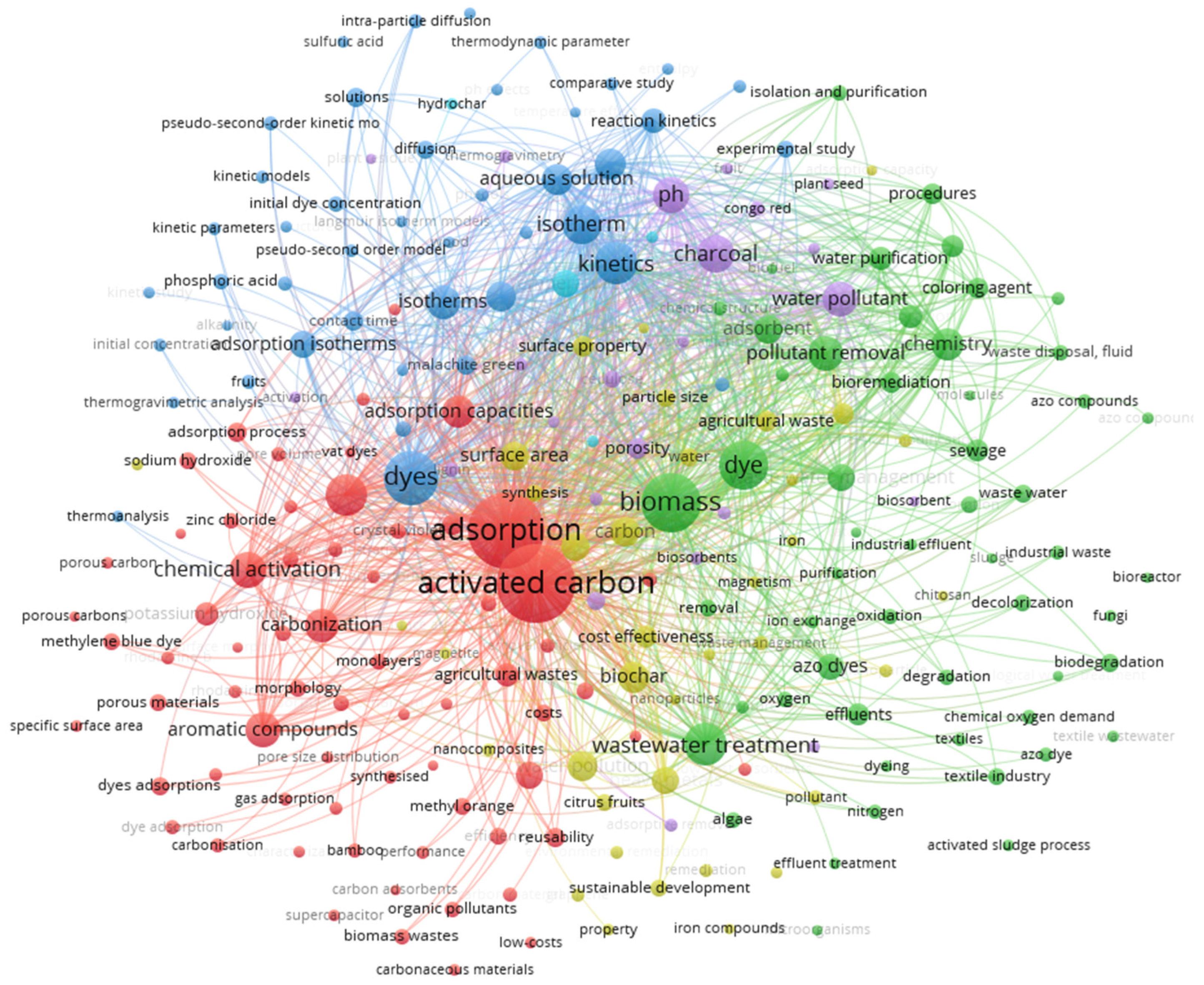
A bibliometric analysis from Scopus involving the words “biomass AND activated carbon AND dyes AND removal” with a co–occurrence of 10, is presented in Figure 2. In this representation, ACs are strongly linked to adsorption process and directly related to the removal of dyes from wastewater. In this analysis, the word “biochar” appears, but without any prominence, highlighting again the widespread use of ACs.
Table 4. Activated carbons prepared from different biomass waste, used to remove dyes from water.
Precursor
Production Conditions
DyesAdsorbent Dosage (g/L)Initial Concentration (mg/L)pHContact Time
(min.)
Temperature (°C)Amount of Dye Adsorbed (mg g−1) or (%) *Reference
Coconut leaves (microwave-induced; NaOH activation);
(600 W, 20 min.)
MB1.5 1008905087.72[98]
Ficus carica bast (1 g of biomass, mixed with 800 mL of H2SO4 for 6 h; under reflux for 12 h, at 150 °C) MB0.5 50 mg/100 mL8905047.62[101]
Pea shells
ZnCl2; 500 °C; 1 h
MB0.13506.518025246.9[102]
Quercus Branti AC (heated at 450–750 °C, t = 30–120 min.)MB210061805055 to 60
91.08%
[103]
Phosphorus-doped microporous carbon from olive mill wastewaterMB0.3–19148 251010[104]
Almond seed shells (H3PO4—ratio of 1:2, soaked 24 h; 500 °C; 2 h)MB12001012055130.4[105]
Bamboa; KOH; (1:1); 700 °CMB1250–4007144025156.9[106]
Teak; KOH; ratio of 1:1; 600 °C MB1250–400714402582.7[106]
Teak; KOH; ratio of 1:1; 700 °CMB1250–4007144025159.7[106]
Teak; K2CO3; ratio of 1:1; 700 °CMB1250–4007144025248.4[106]
Waste coffee grounds + FeCl3
700–900 °C; 8 min.
MB -- 653.6[95]
Argan shell waste
H3PO4; 900 °C; 2 h
MB0.5100101802570[97]
Palm tree fiber
(H3PO4); 400 °C; 30 min
Rhodamine B (RB)15–502–12120--26.5
99.86%
[100]
Coconut Shells biochar
2 N NaOH; 600 °C, 2 h
R6G15–12007144040478[98]
Waste coffee grounds + FeCl3
700–900 °C; 8 min.
MO
Rodamine B
1 1440--465.8
366.1
[95]
Oak cupules; H3PO4 (3:1, acid_OC); 450 °C, 1 hCrystal violet0.01–0.04--109040658[99]
Argan shell waste
H3PO4; 900 °C; 2 h
MO0.510022402531[97]
Coconut Shells biochar
2 M H2SO4; 600 °C; 2 h
Anionic dye IC15–12007144040306[98]
Palm tree fiber
(H3PO4); 400 °C; 30 min
Congo red (RG)15–502–12120--10.4
98.24%
[100]
Oak cupules (OC); H3PO4 (3:1, acid_OC); 450 °C, 1 h naphthol blue black (NBB)0.02–0.08--218040208[99]
Almond seed shells; H3PO4 (1:2); soaked 24 h; 500 °C; 2 hMO1200 150--118.6[105]
Jamoya fruit seeds HTC 250 °C, 4 h;
CO2—400 mL/min.; 850 °C; 2 h
Carmoisine B1 5--45269[72]
Activated carbon clothIC; RC; Evans BlueContinuous flux 7--25506; 187; 27[107]
(* If the amount of adsorbed dyes does not have “%” units, it means that they are expressed in mg g−1).
When the search is done in the MDPI platform, results are not less surprising. Using the following words, “review, dye, adsorption and activated carbon”, MDPI platform presents 24 results from 2000 to 2026. The surprise is that 23 of these publications were published between 2021 and 2026. These results allow us to highlight the relevance of the topic under study.
The use of activated carbons in the removal of various dyes from the aqueous phase is growing and the advantages and disadvantages have already been identified. One of the biggest limitations to the extensive use of ACs is their price, which can vary between 1500 and 2700 USD per ton, depending on the precursor used and AC quality required [108]. To respond to this limitation, the researchers directed their search to the exploration of new adsorbents with greater availability and at lower prices on the market. From this perspective, biomass and biomass waste appear as excellent substitutes and alternatives for ACs.
Natural Biomass Used Directly as Dye Adsorbents
To minimize the aforementioned disadvantages, several researchers have dedicated their time to the exploration of available and affordable precursors that can be used in the preparation of new adsorbent materials (activated carbons, biochar). In the same perspective, several studies have been published in which waste from agricultural and industrial activities were used directly as adsorbents for the removal of a diversity of pollutants from the aqueous phase [28,106,109].
Giannakoudakis et al., 2018 listed a diversity of works, in which natural biosorbents (algae, fungi, bacteria, plants waste such as maize, barley husk, jute, cotton stalks, rice husk, food crop straw, composts, agricultural peels; olive oil industry waste, coffee residues, banana waste and sugar industry waste) were used directly on the removal of pollutants, including dyes, from aqueous streams [109]. A review on the use of food wastes for the removal of toxic dyes from contaminated waters was also presented [110].
Paradelo et al., 2019, presented a compilation of 21 review documents that were published between 2005 and 2018, where raw materials were used as collected on dyes removal from aqueous phase. These adsorbents were tested in order to reduce the cost to treat dye-colored streams. The list of adsorbents reviewed encompass clays, agricultural wastes, household waste, industrial waste, soil and ore materials, metal oxides and hydroxides, peels of fruits, different sand types and synthetic polymers [111]. The list of dyes removed by the natural adsorbents included acid dyes (yellow 17, yellow 36, yellow 99, yellow 117, yellow 132, blue 9, blue 25, blue 29, blue 40, blue 80, blue 113, blue 193, blue 256, blue 264, red 4, red 18, red 73, red 88, red 114, violet 17, orange 10, orange 12, methyl orange ethyl orange, green 25), basic dyes (yellow 21, yellow 24, red 2, red 13, red 18, red 22, red 29, red 46, methylene blue, blue 47, blue 69, malachite green, violet 3 crystal violet, rhodamine B, basic fuchsin), direct dyes (Congo red, red 81, brown 1, yellow 12, reactive dyes (red 2, red 4, red 5, red 120, red 124, red 141, red 189, red 222, red 239, E-4BA, yellow 2, yellow 23, yellow 64, yellow 86, yellow 176, yellow 208, blue 2, blue 19, blue 114, black 5, orange 16, orange 107, remazol yellow, remazol BB, remazol blue) disperse dyes (red 1) and aizarin sulfonic, sella fast brown H, methyl violet blue 113, yellow 36, red 114 [111,112].
Momita et al., 2018 presented a compilation of papers, where they include a comparison of the best performance of various adsorbents in the removal of dyes from liquid effluents. The performance of some adsorbents is highlighted, such as some ACs, bioadsorbents, and agricultural and industrial residues. The adsorbents reached very high adsorption capacities (ACs (acid yellow—1179 mg g−1), bioadsorbents (reactive red 2—1936 mg g−1), crosslinked chitosan bead, and agriculture and industry wastes (basic red 2—1119 mg g−1)). With regard to the use of clays and zeolites for the same purposes, the performance was inferior. Exception was achieved with bentonite on the removal of MB, with a maximum adsorption capacity of 1667 mg g−1 [113]. However, the comparison cannot be made directly, as the experimental conditions, as well as the properties of adsorbents and dyes (cationic or anionic), were not considered. A compilation of data relating to the use of natural biomass or biomass waste in the removal of dyes from water is presented in Table 5. Raw biomass performed better on the removal of cationic dyes, yet some modifications improved raw waste performance concerning anionic dyes removal [114].
A compilation concerning the removal of anionic dyes was presented by Haque et al., 2022. The compilation includes data from ten documents. The maximum adsorption capacity was reached in a waste tea residue for acid blue 25 (117.14 mg g−1) and the minimum was achieved in a lotus waste for Congo red (0.78 mg g−1) [114].
The adsorption equilibrium in raw adsorbents like biomass and agricultural waste is longer than for ACs. Raw materials present a reduced adsorption capacity and selectivity, as shown in Table 5. To achieve the same performance, high amounts of adsorbent are needed, which promotes a high sludge production. The risk of contaminant desorption and dye leaching to the aqueous system and the regeneration procedure remain a problem.
ACs excel in the removal of anionic dyes but stand out even more for their performance in removing cationic dyes from the aqueous phase, when compared to biochar or natural adsorbents. However, the maximum adsorption capacity can still be improved, and ACs can undergo different types of treatments which will be covered in the next section.

3.4. Carbon Material Modifications Process

A variety of functional groups can be added to the adsorbents surface, through different modification processes, such as pre-impregnation with different solutions or salts, acidification, alkalinisation, oxidation, metal impregnation, magnetization and thermal treatments [115].
In this section the modification of carbon materials (biochar and ACs) is highlighted. Biochar thermal treatments or their activation could allow obtaining carbon materials with well-developed properties, which can be considered ACs. Attia et al., 2006, presented a study on the thermal treatment of commercial AC (prolabo) between 400 and 600 °C. The elimination of iodine, acid blue 74, acid red 73, and acid yellow 23 from aqueous solution was used to evaluate the influence of thermal treatment. Although porosity was somewhat improved, the treated ACs showed an increase in the uptake of acid yellow and acid red dyes and a decrease in the acid blue uptake [116].
ACs obtained from coconut shells, submitted to a pre-treatment using acidic or basic activating agents, showed a very high performance on the removal of indigo carmine and rhodamine dyes. Maximum adsorption capacity for indigo carmine (1000 mg g−1) was achieved at 338 K, on AC modified with NaOH. AC modified with H2SO4 presented a lower adsorption capacity for indigo carmine (305 mg g−1) for the same experimental conditions [96,115].
Table 5. Biomass and biomass waste used to remove dyes from water.
Precursor
Production Conditions
DyeAdsorbent Dosage (g/L)Initial Concentration
(mg/L)
pHContact Time
(min.)
Temperature (°C)Amount of Dye Adsorbed (mg g−1)Reference
Barley (Hordeum vulgare) bran
Enset (Ensete ventricosum midrib leaf)
MB2.5  105.71440--63.2 
35.5 
[117]
Citrus limetta peel wasteMB2 418025227.3[118]
Subble
Tectona Grandis
Adansonia digitata L.
Bamboo flowers
MB1400 614402563.7
27.9
156.8
42.8
[106]
Laminaria digitata;
Horse chestnut husk
Hazelnut husk
Rapeseed residue
MB22005144030500
137
120
85
[119]
Spent mushroom wasteDirect Red 5B
Direct Black 22
Direct Black 71
Reactive Black 5
--2002240--18
15.46
20.19
14.62
[120]
Date stones Congo Red 100–8004905045.08[121]
Jujube shellsCongo Red 100–8004905059.55[121]
Yeast stain of Wickerhamomyces anomalusAcid Red 11.25 3–4 2571.37[122]
Cansado et al., 2021 described the use of co-adjuvant agents during chemical activation of polyethylene terephthalate and cork with KOH at 700 °C. The co-adjuvants, such as urea, polyethylenimine, (2-hydroxyethyl) urea, and 2-chloro-4,6-diamino-1,3,5-triazine, were used simultaneously during the chemical activation with KOH. The modified ACs show a high surface area (2400 m2 g−1) and porous volume (1.02 cm3 g−1) and a higher performance concerning the removal of pesticide (4-chloro-2-methyl-phenoxyacetic acid) from water when compared with those produced without co-adjuvant agents [123].
The special properties of magnetic materials (high adsorption capacity, ease of recovery using magnets, and reusability) have attracted the researcher’s attention [95]. Coffee waste char was modified with Fe3O4 and the removal of acid red 16 was increased [124]. Waste coffee grounds were modified with FeCl3 and the maximum adsorption capacity of MB, MO and RB reached 653.6, 465.8 and 366.1 mg g−1, respectively [95]. Alkali AC, presenting a specific surface area of 625.45 m2 g−1, and mean pore size between 1 and 4 nm, was functionalized with amine (TEPA). This procedure improved considerably the MB adsorption performance of the modified AC when compared with the original one, from 1196.14 to 1708.01 mg g−1 [125].
A compilation of works was presented by Kumar Mishra et al., 2024, in which modified ACs were evaluated for catalytic performance in selectivity of phenolic compounds, energetic storage and adsorption purposes for liquid and gas purification. Almost all ACs were referred to as performing very well on the removal of phenolic compounds (reaching 99%), and dyes (reaching 965 mg g−1 of MB and 1270 mg g−1 of acid red 18) [93].
Lignin-based ACs were prepared through the activation with ZnCl2 solution, but the activation was done using microwave-assisted, ultrasound, and UV irradiation methods. The authors reported that the modification on the activation procedure allows for the obtaining of ACs with higher surface and better performance concerning the removal of MB, when compared to their control AC [95].
Modification methods that improve specific surface area, porous volume and mean pore size of the adsorbents can boost the adsorption capacity of biochar or ACs for cationic and anionic dyes. However, to improve the adsorption capacities, other parameters can be optimized and controlled, such as contact time between adsorbent and adsorbate, temperature, pH of the solution, initial concentration of the adsorptive, size of adsorbent particles and competition from other pollutants. As already mentioned, to extend their useful life, adsorbents can be regenerated, allowing them to be reused several times and reducing the use of new adsorbents, avoiding the consumption of virgin raw materials.

Adsorbents Regeneration Processes

The widespread use of different sorbents in wastewater treatment is occasionally limited due to their cost of production, challenges related to the regeneration of sorbents, release of toxic by-products or the need for their disposal at the end of life. Regeneration, reuse and repurposing are environmentally benign processes because they prolong the adsorbent’s life cycle, reduce the use of virgin materials, eliminate the need for long-term storage, and produce additional value [126].
To achieve adsorbent reusability, decrease the cost-effectiveness for industrial applications, and lessen the influence on the environment, the spent adsorbent must have a strong regeneration capability. The regeneration of spent adsorbents (saturated with organic and inorganic pollutants) can be achieved through ultrasound, electrochemical, biological, thermal (including microwave), washing, chemical or even combined procedures. El Messaoudi et al., 2024, presented a work regarding the results, comments and conclusions from 210 published papers on adsorbents regeneration. The authors concluded that the regeneration of the non-conventional low-cost adsorbents, after being saturated with dyes, remains suited for dye removal from aqueous effluents. They denote that the most regenerated wastes are those from agricultural activities (39.56%), followed by sea materials and biomasses (22.31%), industrial wastes (18.71%), and natural materials (19.42%) [127].
The advantages and restrictions of each regeneration method are highlighted in a variety of works. Generally, biological, thermal, advanced oxidative, microwave and ultrasound methods are considered efficient. With the exception of biological, the other methods are considered expensive and promote porous degradation. The biological treatments are described as very slow, blocking the adsorbent pores and are applied only for biodegradable compounds. The conditions used to desorb dyes from spent adsorbents encompass the use of different eluents, such as solutions of NaOH, HCl, HNO3, CaCl2, KOH, CH3COOH, NaCl, HCl, HCl/butanol, EDTA, deionized water, tartaric acid, H2SO4, acetone, citric acid, and acid TiO2 hydrosol [127].
A compilation of 27 works describing different ways (thermal, physical, chemical and biological) to regenerate spent adsorbents was presented [115]. The authors concluded that not all spent adsorbents are recommended for biological regeneration treatments. Its low regeneration rate is a major drawback, making it impossible to use on a large scale [113]. Finally, after several regeneration cycles, the adsorbents completely or partially lose their performance. After water or wastewater treatment, only water can be discharged into the environment, but the disposal of spent adsorbents remains a challenge. Table 6 presents a collection of the major advantages and disadvantages of using different adsorbents to treat wastewater containing different pollutants.
Adsorption offers an environmentally acceptable way to effectively remove a diversity of pollutants from water or wastewater. This process has certain disadvantages and limitations that need to be addressed before it can be applied on a large scale, in the real world. The adsorption capacity of the adsorbents is affected by its surface area, porous volume, mean pore size, surface charge or functionalities, pH of water or wastewater, pollutant molecular size, pKa and presence of other pollutants. Therefore, it is crucial to take these factors into account when selecting an adsorbent material to be prepared, modified, regenerated and used under specific conditions.
Among all the adsorbents tested, under different experimental conditions, in the removal of dyes from liquid effluents, ACs stand out positively. It should also be noted that the ability of ACs to remove cationic dyes is clearly superior when compared to anionic dyes.
The obstacles to the adsorbent’s widespread use, mainly for real-world applications, are their production cost and difficulties of regeneration and reuse and disposal. The well-being of society will benefit from the creation of innovative and sustainable techniques for the recovery and reuse of the adsorbent and from the use of low-cost adsorbents produced from biomass wastes or even from the direct use of biomass wastes to treat dyes effluents. Knowledge about different treatment methods allows the combination of two or more methods to address some restrictions, and dye removal can be achieved more effectively [136,137].

4. Conclusions

Research in the area of wastewater treatment, with an emphasis on the removal of dyes, is playing a significant role in the global push for the transition to a greener industry, particularly the fashion industry. To achieve this goal, several treatment methods have been successfully tested. According to the literature review, synthetic dyes are more widely used in various industries than natural dyes because they feature a brighter and more diverse tone, greater stability, and lower prices. Because of their toxicity to humans and the environment, effluents containing dyes must be treated before being disposed. Different treatments are available for this purpose: biological, chemical, physical and a mixture of them.
Biological treatments used to remove dyes from wastewater are identified as environmentally friendly, producing low sludge, low cost and sustainability. As drawbacks, biological treatments require a larger installation space, are inefficient to many toxic dyes and sludge produced cannot be reused. Biological treatments are very slow and sensitive to effluent composition.
Chemical treatments are considered as fast and effective for a wide range of dyes. As drawbacks they require the use of chemicals and produce a high amount of sludge, which promotes the membrane logging, and their short shelf life results in an increase in costs and disposal problems. Chemical treatments are sensitive to work conditions, such as pH, chemical dosage, temperature and present the risk of forming toxic by-products. On the other hand, dyes chemicals treatments, such as those including the advanced oxidation processes, are generally expensive and produce toxic by-products and chemical sludge, restricting their application to a small scale and to specific types of pollutants [28,30].
Physical technologies are very fast, easy to operate, and effective in a large range of dyes. As a drawback, the adsorbent cost and the large amount of sludge produced can be limiting. To mitigate this limitation, saturated adsorbents must be regenerated and reused to reduce their original cost, thus being considered as an environmentally friendly approach to the removal of dyes from the liquid phase.
Among the adsorbents used to remove dyes from wastewater, ACs were highlighted. During ACs production, the control of experimental conditions promotes an increase in the yield of ACs produced and the optimization of their textural and chemical characteristics. Creating inexpensive, high-performing adsorbents with noticeably improved activity and long-term stability remains a challenge. However, the production cost of ACs can be effectively reduced, as the residues from agricultural and industrial activities have proven to be excellent precursors, allowing the obtaining of ACs with excellent textural and chemical properties that can replace commercial ACs with similar or higher performance in the most varied applications.
Additionally, the use of biomass waste in the production of ACs allows their transformation into value-added products, with market demand, and prevents them from being burned or sent directly to landfill. The recovery of these wastes brings economic added value, especially to local populations, but also benefits the environment and human health, thus following the principles of a green economy.
ACs have a high performance in the removal of dyes from the aqueous phase when compared to other adsorbents. They exhibit a superior performance in the removal of cationic dyes when compared to anionic dyes. Cationic dye removal is more effective from basic solutions, while anionic dye removal is more effective from acidic solutions.
Finally, spent ACs can be regenerated and reused, with high efficiency for dyes removal purposes. After a few adsorption–desorption cycles, when ACs lose their adsorption capacity, they can be used as fuel cells, for energy production purposes, being in line with the principles of the circular economy.

5. Critical Perspective/Future Challenges

The future of dye removal by adsorption, as outlined in this review, points toward overcoming the challenges of scalability and real-world implementation, moving beyond the exclusive use of batch laboratory systems. Research should focus on the development of carbon-based materials, namely activated carbon and biochar adsorbents derived from waste materials, but with tailored textural and chemical properties designed for specific dyes or complex mixtures. A promising direction is the engineering of composite materials, combining the high surface area of carbon materials with the reactivity of nanoparticles or the selectivity of conducting polymers, thus creating magnetic adsorbents for easier recovery and reuse.
The emphasis on regeneration and reuse aligns with the critical need to develop more efficient, economically and environmentally viable desorption methods, such as electrochemical regeneration or supercritical fluid processes, minimizing performance loss over multiple cycles. Beyond batch experiments, future research should prioritize fixed-bed column systems and testing with real industrial effluents containing complex pollutant mixtures to validate selectivity and adsorption capacity under dynamic conditions. Finally, life cycle assessment and techno-economic analysis will be essential to position these bioadsorbents not only as effective alternatives but as sustainable and competitive industrial solutions, closing the circular economy loop through waste valorization.

Author Contributions

Conceptualization, I.P.d.P.C., S.R.S. and P.A.M.M.; methodology, I.P.d.P.C. and J.E.F.C., software, I.P.d.P.C., S. and P.A.M.M.; validation, I.P.d.P.C., B.L.C. and S.; formal analysis, I.P.d.P.C., S.R.S. and P.A.M.M.; investigation, I.P.d.P.C., P.F.G. and B.L.C.; resources, I.P.d.P.C.; data curation, I.P.d.P.C. and J.E.F.C.; writing—original draft preparation, P.F.G. and I.P.d.P.C.; writing—review and editing, I.P.d.P.C., S.R.S., P.A.M.M., J.E.F.C. and S.; visualization, P.A.M.M.; supervision, I.P.d.P.C.; project administration, I.P.d.P.C.; funding acquisition, I.P.d.P.C. and P.A.M.M. All authors have read and agreed to the published version of the manuscript.

Funding

This research received no external funding.

Data Availability Statement

No new data were created or analyzed in this study.

Acknowledgments

The authors thank MED—Mediterranean Institute for Agriculture, Environment and Development & Change—Global Change and Sustainability Institute, through projects LA/P/0121/2020 and UIDB/05183/2020. The authors thank the Foundation for Science and Technology (FCT), Portugal, for financial support through the doctoral scholarship (2024.12460.PRT).

Conflicts of Interest

The authors declare no conflicts of interest.

References

  1. Kang, L.L.; Zeng, Y.N.; Wang, Y.T.; Li, J.G.; Wang, F.P.; Wang, Y.J.; Yu, Q.; Wang, X.-M.; Ji, R.; Gao, D.; et al. Removal of pollutants from wastewater using coffee waste as adsorbent: A review. J. Water Process Eng. 2022, 49, 103178. [Google Scholar] [CrossRef]
  2. Cansado IPda, P.; Mourão, P.A.M.; Castanheiro, J.E.; Geraldo, P.F.; Suhas Suero, S.R.; Cano, B.L. A Review of the Biomass Valorization Hierarchy. Sustainability 2025, 17, 335. [Google Scholar] [CrossRef]
  3. Wang, X.; Zhuang, Y.; Shah, K.J.; Sun, Y. Application Progress of Magnetic Chitosan in Heavy Metal Wastewater Treatment. Magnetochemistry 2025, 11, 71. [Google Scholar] [CrossRef]
  4. Kausar, A.; Iqbal, M.; Javed, A.; Aftab, K.; Nazli, Z.; Bhatti, H.N.; Nouren, S. Dyes adsorption using clay and modified clay: A review. J. Mol. Liq. 2018, 256, 395–407. [Google Scholar] [CrossRef]
  5. Peng, H.; Guo, J. Removal of chromium from wastewater by membrane filtration, chemical precipitation, ion exchange, adsorption electrocoagulation, electrochemical reduction, electrodialysis, electrodeionization, photocatalysis and nanotechnology: A review. Environ. Chem. Lett. 2020, 18, 2055–2068. [Google Scholar] [CrossRef]
  6. Zamora-Ledezma, C.; Negrete-Bolagay, D.; Figueroa, F.; Zamora-Ledezma, E.; Ni, M.; Alexis, F.; Guerrero, V.H. Heavy metal water pollution: A fresh look about hazards, novel and conventional remediation methods. Environ. Technol. Innov. 2021, 22, 101504. [Google Scholar] [CrossRef]
  7. Silva-Gálvez, A.L.; López-Sánchez, A.; Camargo-Valero, M.A.; Prosenc, F.; González-López, M.E.; Gradilla-Hernández, M.S. Strategies for livestock wastewater treatment and optimised nutrient recovery using microalgal-based technologies. J. Environ. Manag. 2024, 354, 120258. [Google Scholar] [CrossRef] [PubMed]
  8. Revellame, E.; Fortella, D.L.; Sharp, W.; Hernandez, R.; Zappi, M.E. Adsorption kinetic modeling using pseudo-first order and pseudo-second order rate laws. Clean. Eng. Technol. 2020, 1, 100032. [Google Scholar] [CrossRef]
  9. Ben Slama, H.; Bouket, A.C.; Pourhassan, Z.; Alenezi, F.N.; Silini, A.; Cherif-Silini, H.; Oszako, T.; Luptakova, L.; Golińska, P.; Belbahri, L. Diversity of synthetic dyes from textile industries, discharge impacts and treatment methods. Appl. Sci. 2021, 11, 6255. [Google Scholar] [CrossRef]
  10. The Ellen MacArthur Foundation_Designing Waste and Pollution out of Fashion—The Earthshot Prize. 2021. Available online: https://earthshotprize.org/news/the-ellen-macarthur-foundation-designing-waste-and-pollution-out-of-fashion/ (accessed on 3 December 2025).
  11. Jorge, A.M.S.; Athira, K.K.; Alves, M.B.; Gardas, R.L.; Pereira, J.F.B. Textile dyes effluents: A current scenario and the use of aqueous biphasic systems for the recovery of dyes. J. Water Process Eng. 2023, 55, 104125. [Google Scholar] [CrossRef]
  12. Al-Tohamy, R.; Ali, S.S.; Li, F.; Okasha, K.M.; Mahmoud, Y.A.G.; Elsamahy, T.; Jiao, H.; Fu, Y.; Sun, J. A critical review on the treatment of dye-containing wastewater: Ecotoxicological and health concerns of textile dyes and possible remediation approaches for environmental safety. Ecotoxicol. Environ. Saf. 2022, 231, 113160. [Google Scholar] [CrossRef] [PubMed]
  13. Holmes, H.E.; Kim, J.; Realff, M.J. Process systems engineering: A key enabler of adsorption-based direct air capture. Curr. Opin. Chem. Eng. 2026, 51, 101202. [Google Scholar] [CrossRef]
  14. Ganjoo, R.; Verma, C.; Kumar, A.; Quraishi, M.A. Colloidal and interface aqueous chemistry of dyes: Past, present and future scenarios in corrosion mitigation. Adv. Colloid Interface Sci. 2023, 311, 102832. [Google Scholar] [CrossRef] [PubMed]
  15. Alegbe, E.O.; Uthman, T.O. A review of history, properties, classification, applications and challenges of natural and synthetic dyes. Heliyon 2024, 10, e33646. [Google Scholar] [CrossRef] [PubMed]
  16. de Farias, N.O.; Pires, M.S.G.; Moreira, B.d.J.; dos Santos, A.; Freeman, H.S.; Toukola, P.; de Albuquerque, A.F.; Räisänen, R.; Umbuzeiro, G.d.A. Natural indigo toxicity for aquatic and terrestrial organisms. Ecotoxicol. Environ. Saf. 2025, 290, 117606. [Google Scholar] [CrossRef] [PubMed]
  17. Pizzicato, B.; Pacifico, S.; Cayuela, D.; Mijas, G.; Riba-Moliner, M. Advancements in Sustainable Natural Dyes for Textile Applications: A Review. Molecules 2023, 28, 5954. [Google Scholar] [CrossRef] [PubMed]
  18. Affat, S.S. Classifications, Advantages, Disadvantages, Toxicity Effects of Natural and Synthetic Dyes: A Review Report. Univ. Thi-Qar J. Sci. (UTsci) 2021, 8, 130. [Google Scholar]
  19. Eren, E. Investigation of a basic dye removal from aqueous solution onto chemically modified Unye bentonite. J. Hazard. Mater. 2009, 166, 88–93. [Google Scholar] [CrossRef] [PubMed]
  20. El Qada, E.N.; Allen, S.J.; Walker, G.M. Adsorption of basic dyes from aqueous solution onto activated carbons. Chem. Eng. J. 2008, 135, 174–184. [Google Scholar] [CrossRef]
  21. Notten, P. Sustainability and Circularity in the Textile Value Chain Global Stocktaking; Report; United Nations Environment Programme: Nairobi, Kenya, 2020. [Google Scholar]
  22. Piaskowski, K.; Świderska-Dąbrowska, R.; Zarzycki, P.K. Dye removal from water and wastewater using various physical, chemical, and biological processes. J. AOAC Int. 2018, 101, 1371–1384. [Google Scholar] [CrossRef] [PubMed]
  23. Sahoo, A.K.; Dahiya, A.; Patel, B.K. Biological methods for textile dyes removal from wastewaters. In Development in Wastewater Treatment Research and Processes: Innovative Microbe-Based Applications for Removal of Chemicals and Metals in Wastewater Treatment Plants; Elsevier: Amsterdam, The Netherlands, 2021; pp. 127–151. [Google Scholar] [CrossRef]
  24. Jamee, R.; Siddique, R. Biodegradation of synthetic dyes of textile effluent by microorganisms: An environmentally and economically sustainable approach. Eur. J. Microbiol. Immunol. 2019, 9, 114–118. [Google Scholar] [CrossRef]
  25. Mocek-Płóciniak, A.; Mencel, J.; Zakrzewski, W.; Roszkowski, S. Phytoremediation as an Effective Remedy for Removing Trace Elements from Ecosystems. Plants 2023, 12, 1653. [Google Scholar] [CrossRef]
  26. Khan, R.; Bhawana, P.; Fulekar, M.H. Microbial decolorization and degradation of synthetic dyes: A review. Rev. Environ. Sci. Biotechnol. 2013, 12, 75–97. [Google Scholar] [CrossRef]
  27. Danouche, M.; ELArroussi, H.; El Ghachtouli, N. Mycoremediation of synthetic dyes by yeast cells: A sustainable biodegradation approach. Environ. Sustain. 2021, 4, 5–22. [Google Scholar] [CrossRef]
  28. Tabish, M.; Tabinda, A.B.; Mazhar, Z.; Yasar, A.; Ansar, J.; Wasif, I. Physical, chemical and biological treatment of textile wastewater for removal of dyes and heavy metals. Desalination Water Treat. 2024, 320, 100842. [Google Scholar] [CrossRef]
  29. Muda, K.; Aris, A.; Razman, M.; Ibrahim, Z. Sequential Anaerobic-Aerobic Phase Strategy Using Microbial Granular Sludge for Textile Wastewater Treatment. In Biomass Now—Sustainable Growth and Use; InTech: Incheon, Republic of Korea, 2013. [Google Scholar] [CrossRef]
  30. Kurade, M.B.; Waghmode, T.R.; Khandare, R.V.; Jeon, B.H.; Govindwar, S.P. Biodegradation and detoxification of textile dye Disperse Red 54 by Brevibacillus laterosporus and determination of its metabolic fate. J. Biosci. Bioeng. 2016, 121, 442–449. [Google Scholar] [CrossRef] [PubMed]
  31. Bożęcka, A.; Orlof-Naturalna, M.; Kopeć, M. Methods of Dyes Removal from Aqueous Environment. J. Ecol. Eng. 2021, 22, 111–118. [Google Scholar] [CrossRef]
  32. Dutta, S.; Gupta, B.; Srivastava, S.K.; Gupta, A.K. Recent advances on the removal of dyes from wastewater using various adsorbents: A critical review. Mater. Adv. 2021, 2, 4497–4531. [Google Scholar] [CrossRef]
  33. Faroon, M.; ALSaad, Z.; Albadran, F.; Ahmed, L. Review on Technology-Based on Reverse Osmosis. Anbar J. Eng. Sci. 2023, 14, 89–97. [Google Scholar] [CrossRef]
  34. Onukwuli, C.J.; Obiora-Okafo, I.A. Removal of Dyes from Synthetic Waste Water by Coagulation Technique using Natural Coagulant. Equat. J. Eng. 2019, 1–5. [Google Scholar]
  35. Ravele, M.P.; Olatunde, O.C.; Oyewo, O.A.; Makgato, S.S.; Onwudiwe, D.C. Plant-based coagulants for wastewater treatment: Recent advances and applications. Clean Water 2025, 4, 100147. [Google Scholar] [CrossRef]
  36. Elgarahy, A.M.; Eloffy, M.G.; Guibal, E.; Alghamdi, H.M.; Elwakeel, K.Z. Use of biopolymers in wastewater treatment: A brief review of current trends and prospects. Chin. J. Chem. Eng. 2023, 64, 292–320. [Google Scholar] [CrossRef]
  37. Tran, H.N.; You, S.J.; Nguyen, T.V.; Chao, H.P. Insight into the adsorption mechanism of cationic dye onto biosorbents derived from agricultural wastes. Chem. Eng. Commun. 2017, 204, 1020–1036. [Google Scholar] [CrossRef]
  38. N’diaye, A.D. Modeling of adsorption isotherms of dyes onto various adsorbents A Short Review. Arab. J. Chem. Environ. Res. 2018, 5, 42–51. [Google Scholar]
  39. Serafin, J.; Dziejarski, B. Application of isotherms models and error functions in activated carbon CO2 sorption processes. Microporous Mesoporous Mater. 2023, 354, 112513. [Google Scholar] [CrossRef]
  40. Pandey, J. Biopolymers and Their Application in Wastewater Treatment (chapter 11). In Emerging Eco-Friendly Green Technologies for Wastewater Treatment; Springer Nature: Singapore, 2020. [Google Scholar] [CrossRef]
  41. Othman, N.H.; Alias, N.H.; Shahruddin, M.Z.; Abu Bakar, N.F.; Nik Him, N.R.; Lau, W.J. Adsorption kinetics of methylene blue dyes onto magnetic graphene oxide. J. Environ. Chem. Eng. 2018, 6, 2803–2811. [Google Scholar] [CrossRef]
  42. Zhao, M.; Liu, P. Adsorption of methylene blue from aqueous solutions by modified expanded graphite powder. Desalination 2009, 249, 331–336. [Google Scholar] [CrossRef]
  43. Albayati, T.M. Removal of anionic azo dye from wastewater using Fe3O4 magnetic nanoparticles adsorbents in a batch system. Desalination Water Treat. 2024, 317, 100033. [Google Scholar] [CrossRef]
  44. Attallah, O.A.; Al-Ghobashy, M.A.; Nebsen, M.; Salem, M.Y. Removal of cationic and anionic dyes from aqueous solution with magnetite/pectin and magnetite/silica/pectin hybrid nanocomposites: Kinetic, isotherm and mechanism analysis. RSC Adv. 2016, 6, 11461–11480. [Google Scholar] [CrossRef]
  45. Tehrani-Bagha, A.R.; Nikkar, H.; Mahmoodi, N.M.; Markazi, M.; Menger, F.M. The sorption of cationic dyes onto kaolin: Kinetic, isotherm and thermodynamic studies. Desalination 2011, 266, 274–280. [Google Scholar] [CrossRef]
  46. Chaari, I.; Fakhfakh, E.; Medhioub, M.; Jamoussi, F. Comparative study on adsorption of cationic and anionic dyes by smectite rich natural clays. J. Mol. Struct. 2019, 1179, 672–677. [Google Scholar] [CrossRef]
  47. Hajjaji, W.; Pullar, R.C.; Labrincha, J.A.; Rocha, F. Aqueous Acid Orange 7 dye removal by clay and red mud mixes. Appl. Clay Sci. 2016, 126, 197–206. [Google Scholar] [CrossRef]
  48. Santos, S.C.R.; Boaventura, R.A.R. Adsorption of cationic and anionic azo dyes on sepiolite clay: Equilibrium and kinetic studies in batch mode. J. Environ. Chem. Eng. 2016, 4, 1473–1483. [Google Scholar] [CrossRef]
  49. El-habacha, M.; Miyah, Y.; Lagdali, S.; Mahmoudy, G.; Dabagh, A.; Chiban, M.; Sinan, F.; Iaich, S.; Zerbet, M. General overview to understand the adsorption mechanism of textile dyes and heavy metals on the surface of different clay materials. Arab. J. Chem. 2023, 16, 105248. [Google Scholar] [CrossRef]
  50. Adeyemo, A.A.; Adeoye, I.O.; Bello, O.S. Adsorption of dyes using different types of clay: A review. Appl. Water Sci. 2017, 7, 543–568. [Google Scholar] [CrossRef]
  51. Bahmanzadegan, F.; Ghaemi, A. A comprehensive review on novel zeolite-based adsorbents for environmental pollutant. J. Hazard. Mater. Adv. 2025, 17, 100617. [Google Scholar] [CrossRef]
  52. Ahmed, K.R.; Mohammed, D.S.; Ali, F.M. SYNTHESIS OF A NEW ADSORBENT BASED ON THE MILD DEALUMINATED BINDER FREE GRANULAR Y ZEOLITE. Sci. J. Univ. Zakho 2023, 11, 333–345. [Google Scholar] [CrossRef]
  53. Gollakota, A.R.K.; Volli, V.; Munagapati, V.S.; Wen, J.C.; Shu, C.M. Synthesis of novel ZSM-22 zeolite from Taiwanese coal fly ash for the selective separation of Rhodamine 6G. J. Mater. Res. Technol. 2020, 9, 15381–15393. [Google Scholar] [CrossRef]
  54. Wang, S.; Li, H.; Xie, S.; Liu, S.; Xu, L. Physical and chemical regeneration of zeolitic adsorbents for dye removal in wastewater treatment. Chemosphere 2006, 65, 82–87. [Google Scholar] [CrossRef] [PubMed]
  55. Kumari, S.; Chowdhry, J.; Kumar, M.; Chandra Garg, M. Zeolites in wastewater treatment: A comprehensive review on scientometric analysis, adsorption mechanisms, and future prospects. Environ. Res. 2024, 260, 119782. [Google Scholar] [CrossRef] [PubMed]
  56. Saiyad, M.; Shah, N.; Joshipura, M.; Dwivedi, A.; Pillai, S. Modified biopolymers in wastewater treatment: A review. Mater. Today Proc. 2024, in press. [Google Scholar] [CrossRef]
  57. Elzahar, M.M.H.; Bassyouni, M. Removal of direct dyes from wastewater using chitosan and polyacrylamide blends. Sci. Rep. 2023, 13, 15750. [Google Scholar] [CrossRef] [PubMed]
  58. Kaczorowska, M.A.; Bożejewicz, D. The Application of Chitosan-Based Adsorbents for the Removal of Hazardous Pollutants from Aqueous Solutions—A Review. Sustainability 2024, 16, 2615. [Google Scholar] [CrossRef]
  59. Hevira, L.; Ighalo, J.O.; Sondari, D. Chitosan-based polysaccharides for effective synthetic dye adsorption. J. Mol. Liq. 2024, 393, 123604. [Google Scholar] [CrossRef]
  60. Zubair, M.; Ullah, A. Biopolymers in environmental applications: Industrial wastewater treatment (chapter 14). In Biopolymers and their Industrial Applications; Elsevier: Amsterdam, The Netherlands, 2021; pp. 331–349. [Google Scholar] [CrossRef]
  61. Wang, G.; Chen, Y.; Xu, G.; Pei, Y. Effective removing of methylene blue from aqueous solution by tannins immobilized on cellulose microfibers. Int. J. Biol. Macromol. 2019, 129, 198–206. [Google Scholar] [CrossRef] [PubMed]
  62. Raut, E.R.; Thakur, M.A.B.; Chaudhari, A.R. A review on activated carbon preparation from natural and eco-friendly raw materials. In AIP Conference Proceedings; American Institute of Physics Inc.: College Park, MD, USA, 2021. [Google Scholar] [CrossRef]
  63. Zielińska, M.; Bułkows, K. Agricultural Wastes and Their By-Products for the Energy Market. Energies 2024, 17, 2099. [Google Scholar] [CrossRef]
  64. Elhassan, M.; Abdullah, R.; Kooh, M.R.R.; Chou Chau, Y.F. Hydrothermal liquefaction: A technological review on reactor design and operating parameters. Bioresour. Technol. Rep. 2023, 21, 101314. [Google Scholar] [CrossRef]
  65. Alonso, M.; Ledesma, B.; Román, S.; Olivares-Marín, M. Insights about the formation of secondary char during HTC processes. Sustain. Chem. Pharm. 2024, 37, 101420. [Google Scholar] [CrossRef]
  66. Soffian, M.S.; Abdul Halim, F.Z.; Aziz, F.A.; Rahman, M.; Mohamed Amin, M.A.; Awang Chee, D.N. Carbon-based material derived from biomass waste for wastewater treatment. Environ. Adv. 2022, 9, 100259. [Google Scholar] [CrossRef]
  67. Sadok, I.; Krzyszczak-Turczyn, A.; Czech, B.; Parlakidis, P.; Vryzas, Z. Advancements in biochar-based materials for decontamination and analytical detection of pesticides and mycotoxins in food. Food Chem. 2025, 492, 145467. [Google Scholar] [CrossRef] [PubMed]
  68. Enaime, G.; Baçaoui, A.; Yaacoubi, A.; Lübken, M. Biochar for Wastewater Treatment—Conversion. Appl. Sci. 2020, 10, 3492. [Google Scholar] [CrossRef]
  69. Phiri, Z.; Moja, N.T.; Nkambule, T.T.I.; de Kock, L.A. Utilization of biochar for remediation of heavy metals in aqueous environments: A review and bibliometric analysis. Heliyon 2024, 10, e25785. [Google Scholar] [CrossRef]
  70. Tang, G.; Mo, H.; Gao, L.; Chen, Y.; Zhou, X. Adsorption of crystal violet from wastewater using alkaline-modified pomelo peel-derived biochar. J. Water Process Eng. 2024, 68, 106334. [Google Scholar] [CrossRef]
  71. Peerakiatkhajohn, P.; Wongburi, P.; Nakason, K.; Panyapinyopol, B.; Nueangnoraj, K.; Sakulaue, P.; Poggio, D.; Nimmo, W.; Phanthuwongpakdee, J. Sustainable Removal of Methylene Blue Using Minimally Modified Hydrochar from Durian Peels with Experimental Adsorption and Density Functional Theory Studies. Chem. Eng. J. Adv. 2025, 25, 101011. [Google Scholar] [CrossRef]
  72. Chaudhary, S.; Chaudhary, M.; Tyagi, V.; Chaubey, S.; Suhas Gupta, V.; Cansado, I.P.d.P.; Ahmed, J. Sustainable Production of Porous Activated Carbon from Hydrothermally Carbonized Jamoya Fruit Seeds and Its Potential for Adsorbing the Azo Dye Carmoisine B. Processes 2025, 13, 385. [Google Scholar] [CrossRef]
  73. Nirmaladevi, S.; Palanisamy, N. A comparative study of the removal of cationic and anionic dyes from aqueous solutions using biochar as an adsorbent. Desalination Water Treat. 2020, 175, 282–292. [Google Scholar] [CrossRef]
  74. Sutradhar, S.; Mondal, A.; Kuehne, F.; Krueger, O.; Rakshit, S.K.; Kang, K. Comparison of Oil-Seed Shell Biomass-Based Biochar for the Removal of Anionic Dyes—Characterization and Adsorption Efficiency Studies. Plants 2024, 13, 820. [Google Scholar] [CrossRef]
  75. Kataya, G.; El Badan, D.; Cornu, D.; Mousawi, A.A.; Bechelany, M.; Hijazi, A. Evaluating Biochar’s Role in Dye Adsorption and Wheat. Materials 2025, 18, 4678. [Google Scholar] [CrossRef] [PubMed]
  76. Lu, Y.; Chen, J.; Bai, Y.; Gao, J.; Peng, M. Adsorption properties of methyl orange in water by sheep manure biochar. Pol. J. Environ. Stud. 2019, 28, 3791–3797. [Google Scholar] [CrossRef]
  77. Chen, S.; Qin, C.; Wang, T.; Chen, F.; Li, X.; Hou, H.; Zhou, M. Study on the adsorption of dyestuffs with different properties by sludge-rice husk biochar: Adsorption capacity, isotherm, kinetic, thermodynamics and mechanism. J. Mol. Liq. 2019, 285, 62–74. [Google Scholar] [CrossRef]
  78. Nithyalakshmi, B.; Saraswathi, R. Removal of colorants from wastewater using biochar derived from leaf waste. Biomass Convers. Biorefin. 2023, 13, 1311–1327. [Google Scholar] [CrossRef]
  79. Alasmary, Z.; Akanji, M.A. Iron-Modified Biochar Derived from Poultry Manure for Efficient Removal of Methyl Orange Dye from Aqueous Solution. Sustainability 2025, 17, 6008. [Google Scholar] [CrossRef]
  80. Cansado, I.P.P.; Gonçalves, F.A.M.M.; Nabais, J.M.V.; Ribeiro Carrott, M.M.L.; Carrott, P.J.M. PEEK: An excellent precursor for activated carbon production for high temperature application. Fuel Process. Technol. 2009, 90, 232–236. [Google Scholar] [CrossRef]
  81. Choma, J.; Osuchowski, L.; Dziura, A.; Marszewski, M.; Jaroniec, M. Benzene and Methane Adsorption on Ultrahigh Surface Area Carbons. Adsorpt. Sci. Technol. 2015, 33, 6–8. [Google Scholar] [CrossRef]
  82. Carrott, P.J.M.; Cansado, I.P.P.; Carrott, M.M.L.R. Carbon molecular sieves from PET for separations involving CH4, CO2, O2 and N2. Appl. Surf. Sci. 2006, 252, 5948–5952. [Google Scholar] [CrossRef]
  83. Malini, K.; Selvakumar, D.; Kumar, N.S. Activated carbon from biomass: Preparation, factors improving basicity and surface properties for enhanced CO2 capture capacity—A review. J. CO2 Util. 2023, 67, 102318. [Google Scholar] [CrossRef]
  84. Sathishkumar, R.; Prakash, R. A review on activated carbons (AC) for CO2 capture applications: Preparation, characterisation and surface modification methods. Fuel 2026, 67, 102318. [Google Scholar] [CrossRef]
  85. Ali Abd, A.; Roslee Othman, M.; Kim, J. A review on application of activated carbons for carbon dioxide capture: Present performance, preparation, and surface modification for further improvement. Environ. Sci. Pollut. Res. 2021, 28, 43329–43364. [Google Scholar] [CrossRef]
  86. Belo, C.R.; Cansado IPda, P.; Mourão, P.A.M. Synthetic polymers blend used in the production of high activated carbon for pesticides removals from liquid phase. Environ. Technol. 2017, 38, 285–296. [Google Scholar] [CrossRef] [PubMed]
  87. da Paixão Cansado, I.P.; Belo, C.R.; Mourão, P.A.M. Pesticides abatement using activated carbon produced from a mixture of synthetic polymers by chemical activation with KOH and K2CO3. Environ. Nanotechnol. Monit. Manag. 2019, 12, 100261. [Google Scholar] [CrossRef][Green Version]
  88. Tarikuzzaman, M. A Review on Activated Carbon: Synthesis, Properties, and Applications. Eur. J. Adv. Eng. Technol. 2023, 10, 114–123. [Google Scholar]
  89. Kumawat, L.; Sen, R. A Review On Activated Carbon Production Methods From Coconut Shell And Its Applications. In Proceedings of the International Conference on “Emerging Trends in Engineering, Science & Technology “ETEST-2022”, Jaipur, India, 6–7 May 2022. [Google Scholar]
  90. Heidarinejad, Z.; Dehghani, M.H.; Heidari, M.; Javedan, G.; Ali, I.; Sillanpää, M. Methods for preparation and activation of activated carbon: A review. Environ. Chem. Lett. 2020, 18, 393–415. [Google Scholar] [CrossRef]
  91. Chew, T.W.; H’Ng, P.S.; Abdullah, B.C.T.G.L.C.; Chin, K.L.; Lee, C.L.; Hafizuddin, B.M.S.M.N.; TaungMai, L. A Review of Bio-Based Activated Carbon Properties Produced. Materials 2023, 16, 7365. [Google Scholar] [CrossRef]
  92. Lewoyehu, M. Comprehensive review on synthesis and application of activated carbon from agricultural residues for the remediation of venomous pollutants in wastewater. J. Anal. Appl. Pyrolysis 2021, 159, 105279. [Google Scholar] [CrossRef]
  93. Kumar Mishra, R.; Singh, B.; Acharya, B. A comprehensive review on activated carbon from pyrolysis of lignocellulosic biomass: An application for energy and the environment. Carbon Resour. Convers. 2024, 7, 100228. [Google Scholar] [CrossRef]
  94. Teimouri, Z.; Salem, A.; Salem, S. Clean and new strategy for catalytic conversion of agriculture waste shells to activated carbon via microwave-assisted impregnation: Applied and eco-friendly aspect for decoloration of industrial corn syrup and process identifications. J. Environ. Chem. Eng. 2019, 7, 103161. [Google Scholar] [CrossRef]
  95. Wen, X.; Liu, H.; Zhang, L.; Zhang, J.; Fu, C.; Shi, X.; Chen, X.; Mijowska, E.; Chen, M.-J.; Wang, D.-Y. Large-scale converting waste coffee grounds into functional carbon materials as high-efficient adsorbent for organic dyes. Bioresour. Technol. 2019, 272, 92–98. [Google Scholar] [CrossRef] [PubMed]
  96. Saleem, J.; Moghal, Z.K.B.; Pradhan, S.; McKay, G. High-performance activated carbon from coconut shells for dye removal: Study of isotherm and thermodynamics. RSC Adv. 2024, 14, 33797–33808. [Google Scholar] [CrossRef]
  97. Ouedrhiri, A.; Ennabely, M.; Lghazi, Y.; Chafi, M.; Alougayl, S.; Youbi, B.; Halabi, A.K.; Khoukhi, M.; Bimaghra, I. Adsorption of anionic and cationic dyes in aqueous solution by a sustainable and low-cost activated carbon based on argan solid waste treated with H3PO4. Environ. Sci. Pollut. Res. 2024, 31, 62010–62021. [Google Scholar] [CrossRef] [PubMed]
  98. Jawad, A.H.; Ishak, M.A.M.; Farhan, A.M.; Ismail, K. Response surface methodology approach for optimization of color removal and COD reduction of methylene blue using microwave-induced NaOH activated carbon from biomass waste. Desalination Water Treat. 2017, 62, 208–220. [Google Scholar] [CrossRef]
  99. Alkhabbas, M.; Al-Ma’abreh, A.M.; Edris, G.; Saleh, T.; Alhmood, H. Adsorption of Anionic and Cationic Dyes on Activated Carbon Prepared from Oak Cupules: Kinetics and Thermodynamics Studies. Int. J. Environ. Res. Public Health 2023, 20, 3280. [Google Scholar] [CrossRef] [PubMed]
  100. Alhogbi, B.; Altayeb, S.; Bahaidarah, E.; Zawrah, M.F. Removal of Anionic and Cationic Dyes from Wastewater Using Activated Carbon from Palm Tree Fiber Waste. Processes 2021, 9, 416. [Google Scholar] [CrossRef]
  101. Pathania, D.; Sharma, S.; Singh, P. Removal of methylene blue by adsorption onto activated carbon developed from Ficus carica bast. Arab. J. Chem. 2017, 10, S1445–S1451. [Google Scholar] [CrossRef]
  102. Geçgel, Ü.; Özcan, G.; Gürpnar, G.Ç. Removal of methylene blue from aqueous solution by activated carbon prepared from pea shells (Pisum sativum). J. Chem. 2013, 2013, 614083. [Google Scholar] [CrossRef]
  103. Khalil, A.; Mangwandi, C.; Salem, M.A.; Ragab, S.; El Nemr, A. Orange peel magnetic activated carbon for removal of acid orange 7 dye from water. Sci. Rep. 2024, 14, 119. [Google Scholar] [CrossRef] [PubMed]
  104. Mechnou, I.; Meskini, S.; Mourtah, I.; Lebrun, L.; Hlaibi, M. Use of phosphorus-doped microporous carbon from olive mill wastewater for effective removal of Crystal violet and Methylene blue. J. Clean. Prod. 2023, 393, 136333. [Google Scholar] [CrossRef]
  105. Husaini, M. Efficient adsorption of cationic and anionic dyes using agricultural waste–based activated carbon. Afr. Res. Rep. 2026, 2, 12–20. [Google Scholar] [CrossRef]
  106. Cansado, I.P.P.; Geraldo, P.F.; Mourão, P.A.M.; Castanheiro, J.E.; Carreiro, E.P.; Suhas. Utilization of Biomass Waste at Water Treatment. Resources 2024, 13, 37. [Google Scholar] [CrossRef]
  107. Aguirre-Contreras, S.; López-Ramón, M.V.; Velo-Gala, I.; Álvarez-Merino, M.Á.; Aguilar-Aguilar, A.; Ocampo-Pérez, R. A Comparative Study of the Adsorption of Industrial Anionic Dyes with Bone Char and Activated Carbon Cloth. Water 2025, 17, 3422. [Google Scholar] [CrossRef]
  108. Activated Carbon Price—Current & Forecasts. Available online: https://www.intratec.us/solutions/primary-commodity-prices/commodity/activated-carbon-prices (accessed on 3 March 2026).
  109. Giannakoudakis, D.A.; Hosseini-Bandegharaei, A.; Tsafrakidou, P.; Triantafyllidis, K.S.; Kornaros, M.; Anastopoulos, I. Aloe vera waste biomass-based adsorbents for the removal of aquatic pollutants: A review. J. Environ. Manag. 2018, 227, 354–364. [Google Scholar] [CrossRef] [PubMed]
  110. Sridhar, A.; Ponnuchamy, M.; Kapoor, A.; Prabhakar, S. Valorization of food waste as adsorbents for toxic dye removal from contaminated waters: A review. J. Hazard. Mater. 2022, 424, 127432. [Google Scholar] [CrossRef] [PubMed]
  111. Paradelo, R.; Vecino, X.; Moldes, A.B.; Barral, M.T. Potential use of composts and vermicomposts as low-cost adsorbents for 1 dye removal: An overlooked application. Environ. Sci. Pollut. Res. 2019, 26, 21085–21097. [Google Scholar] [CrossRef]
  112. Aranda-Figueroa, M.G.; Romero, R.J.; Rodríguez, M.; Rodríguez-Torres, A.; Rodríguez, A.; Bolio-López, G.I.; Arias-Ataide, D.M.; Torres-Islas, Á.; Valladares-Cisneros, M.G. Removal of Azo Dyes from Water on a Large Scale Using a Low-Cost and Eco-Friendly Adsorbent. Sustainability 2025, 17, 4816. [Google Scholar] [CrossRef]
  113. Momina Shahadat, M.; Isamil, S. Regeneration performance of clay-based adsorbents for the removal of industrial dyes: A review. RSC Adv. 2018, 8, 24571–24587. [Google Scholar] [CrossRef]
  114. Haque, A.N.M.A.; Sultana, N.; Sayem, A.S.M.; Smriti, S.A. Sustainable Adsorbents from Plant-Derived Agricultural Wastes for Anionic Dye Removal: A Review. Sustainability 2022, 14, 11098. [Google Scholar] [CrossRef]
  115. Baskar, A.V.; Bolan, N.; Hoang, S.A.; Sooriyakumar, P.; Kumar, M.; Singh, L.; Jasemizad, T.; Padhye, L.P.; Singh, G.; Vinu, A.; et al. Recovery, regeneration and sustainable management of spent adsorbents from wastewater treatment streams: A review. Sci. Total Environ. 2022, 822, 153555. [Google Scholar] [CrossRef] [PubMed]
  116. Attia, A.A.; Rashwan, W.E.; Khedr, S.A. Capacity of activated carbon in the removal of acid dyes subsequent to its thermal treatment. Dye. Pigment. 2006, 69, 128–136. [Google Scholar] [CrossRef]
  117. Mekuria, D.; Diro, A.; Melak, F.; Asere, T.G. Adsorptive Removal of Methylene Blue Dye Using Biowaste Materials: Barley Bran and Enset Midrib Leaf. J. Chem. 2022, 2022, 4849758. [Google Scholar] [CrossRef]
  118. Shakoor, S.; Nasar, A. Removal of methylene blue dye from artificially contaminated water using citrus limetta peel waste as a very low cost adsorbent. J. Taiwan Inst. Chem. Eng. 2016, 66, 154–163. [Google Scholar] [CrossRef]
  119. Güleç, F.; Williams, O.; Samson, A.; Kostas, E.T.; Stevens, L.A.; Lester, E. Exploring the Utilisation of Natural Biosorbents for Effective Methylene Blue Removal. Appl. Sci. 2024, 14, 81. [Google Scholar] [CrossRef]
  120. Alhujaily, A.; Yu, H.; Zhang, X.; Ma, F. Adsorptive removal of anionic dyes from aqueous solutions using spent mushroom waste. Appl. Water Sci. 2020, 10, 183. [Google Scholar] [CrossRef]
  121. El Messaoudi, N.; Dbik, A.; El Khomri, M.; Sabour, A.; Bentahar, S.; Lacherai, A. Date stones of Phoenix dactylifera and jujube shells of Ziziphus lotus as potential biosorbents for anionic dye removal. Int. J. Phytoremediat. 2017, 19, 1047–1052. [Google Scholar] [CrossRef] [PubMed]
  122. Danouche, M.; El Arroussi, H.; El Ghachtouli, N. Bioremoval of Acid Red 14 dye by Wickerhamomyces anomalus biomass: Kinetic and thermodynamic study, characterization of physicochemical interactions, and statistical optimization of the biosorption process. Biomass Convers. Biorefin. 2024, 14, 2829. [Google Scholar] [CrossRef]
  123. Cansado, I.P.P.; Mourão, P.A.M. Impact of the use of co-adjuvants agents during chemical activation on the performance of activated carbons in the removal of 4-chloro-2-methyl-phenoxyacetic acid. Environ. Technol Innov. 2021, 24, 102058. [Google Scholar] [CrossRef]
  124. Khataee, A.; Kayan, B.; Kalderis, D.; Karimi, A.; Akay, S.; Konsolakis, M. Ultrasound-assisted removal of Acid Red 17 using nanosized Fe3O4-loaded coffee waste hydrochar. Ultrason. Sonochem. 2017, 35, 72–80. [Google Scholar] [CrossRef] [PubMed]
  125. Liu, X.; Chen, Z.; Du, W.; Liu, P.; Zhang, L.; Shi, F. Treatment of wastewater containing methyl orange dye by fluidized three dimensional electrochemical oxidation process integrated with chemical oxidation and adsorption. J. Environ. Manag. 2022, 311, 114775. [Google Scholar] [CrossRef] [PubMed]
  126. Jevremovic, A.; Rankovic, M.; Ležajic, A.J.; Uskokovic-Markovic, S.; Vasiljevic, B.N.; Gavrilov, N.; Bajuk-Bogdanović, D.; Milojević-Rakić, M. Regeneration or Repurposing of Spent Pollutant Adsorbents in energy-related applications: A sustainable choice? Sustain. Chem. 2025, 6, 28. [Google Scholar] [CrossRef]
  127. El Messaoudi, N.; El Khomri, M.; Bentahar, S.; Dbik, A.; Lacherai, A.; Bakiz, B. Evaluation of performance of chemically treated date stones: Application for the removal of cationic dyes from aqueous solutions. J. Taiwan Inst. Chem. Eng. 2016, 67, 244–253. [Google Scholar] [CrossRef]
  128. Eren, S.; Türk, F.N.; Arslanoğlu, H. Synthesis of zeolite from industrial wastes: A review on characterization and heavy metal and dye removal. Environ. Sci. Pollut. Res. 2024, 31, 41791–41823. [Google Scholar] [CrossRef] [PubMed]
  129. Hammood, Z.A.; Chyad, T.F.; Al-Saedi, R. Adsorption Performance of Dyes over Zeolite for Textile Wastewater Treatment. Ecol. Chem. Eng. S 2021, 28, 329–337. [Google Scholar] [CrossRef]
  130. Sultakhan, S.; Kunarbekova, M.; Khalkhabai, B.; Kakimov, U.; Kuldeyev, E.; Berndtsson, R.; Lee, J.; Azat, S. Performance of a Zeolite-Filled Slow Filter for Dye Removal and Turbidity Reduction. Water 2025, 17, 3557. [Google Scholar] [CrossRef]
  131. Chen, C.W.; Yang, T.L.; Chen, Y.C. Using magnetic micelles as adsorbents to remove dyes from aqueous solutions. J. Environ. Chem. Eng. 2023, 11, 109457. [Google Scholar] [CrossRef]
  132. Hegazi, H.A. Removal of heavy metals from wastewater using agricultural and industrial wastes as adsorbents. HBRC J. 2013, 9, 276–282. [Google Scholar] [CrossRef]
  133. Han, R.; Ding, D.; Xu, Y.; Zou, W.; Wang, Y.; Li, Y.; Zou, L. Use of rice husk for the adsorption of congo red from aqueous solution in column mode. Bioresour. Technol. 2008, 99, 2938–2946. [Google Scholar] [CrossRef] [PubMed]
  134. Batista, T.; Cansado, I.P.P.; Tita, B.; Mourão, P.A.M.; Nabais, J.M.V.; Castanheiro, J.E.; Borges, C.; Matos, G. Dealing with PlasticWaste from Agriculture Activity. Agronomy 2022, 12, 134. [Google Scholar] [CrossRef]
  135. Hotan Alsohaimi, I.; Alhumaimess, M.S.; Abdullah Alqadami, A.; Tharwi Alshammari, G.; Fawzy Al-Olaimi, R.; Abdeltawab, A.A.; El-Sayed, M.Y.; Hassan, H.M. Adsorptive performance of aminonaphthalenesulfonic acid modified magnetic-graphene oxide for methylene blue dye: Mechanism, isotherm and thermodynamic studies. Inorg. Chem. Commun. 2023, 147, 110261. [Google Scholar] [CrossRef]
  136. Bal, G.; Thakur, A. Distinct approaches of removal of dyes from wastewater: A review. Mater. Today Proc. 2022, 50, 1575–1579. [Google Scholar] [CrossRef]
  137. Rahmoun, H.B.; Boumediene, M.; Ghenim, A.N.; Da Silva, E.F.; Labrincha, J. Coupling Coagulation–Flocculation–Sedimentation with Adsorption on Biosorbent (Corncob) for the Removal of Textile Dyes from Aqueous Solutions. Environments 2025, 12, 201. [Google Scholar] [CrossRef]
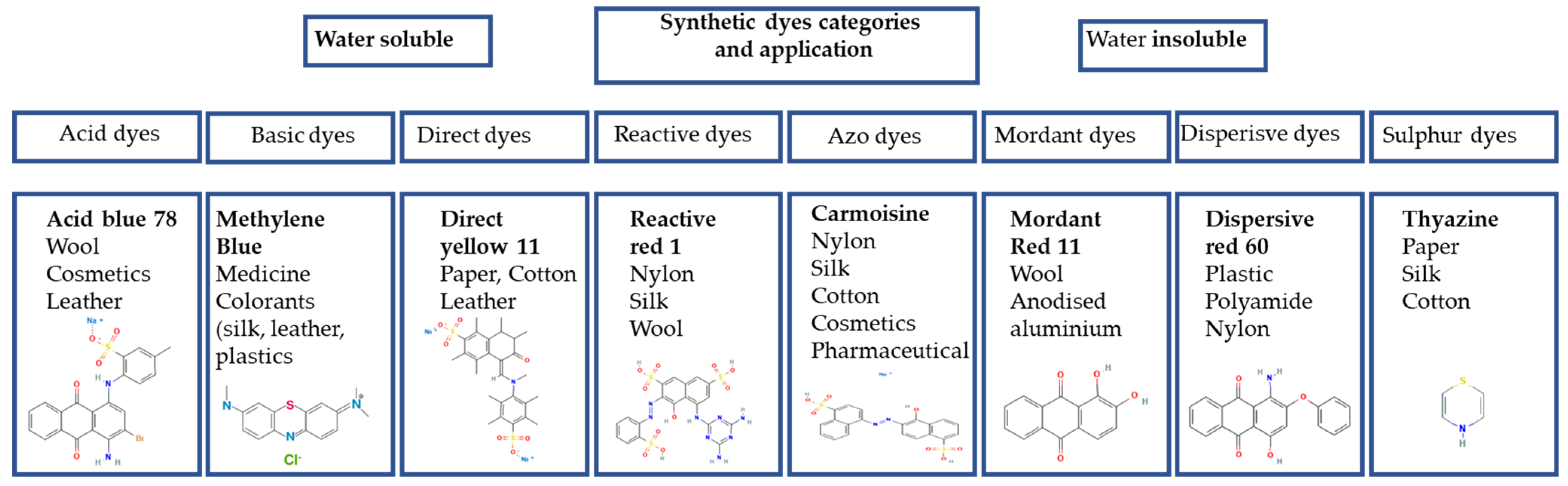
Figure 1. Classification of synthetic dyes, based on chemical categories and application.
Processes 14 00898 g001
Figure 2. Bibliometric analysis concerning the use of biomass to produce ACs, to be used for dye removal from wastewater.
Processes 14 00898 g002
Table 1. Main differences between biological, chemical and physical methods used to treat effluents containing dyes.
Comparison Between Biological, Chemical and Physicochemical Process
ParameterBiologicalChemicalPhysicochemical
Main advantagesEnvironmentally friendly and sustainableFast and effective for a wide range of dyesEasy to operate, effective in a wide range of dyes
DrawbackIneffective for many synthetic or toxic dyesRisk of forming toxic by-productsCost of adsorbents
MechanismMicrobial degradationChemical oxidationAdsorption
Effectiveness on synthetic dyesLow (mainly with recalcitrant dyesEffective for a dye diversity degradationHigh (could remove non-biodegradable dyes)
Treatment timeSlow (hours to days)Relatively fastFast (minutes to hours)
Sensitive to conditionsHighly sensitive to pH, temperature, and dyes toxicitypH and chemical dosages must be controlledHigh (pH, concentration, T must be controlled)
Toxicity handlingToxic dyes may inhibit or kill microbesDegrade recalcitrant and non-biodegradable dyesHandles toxics dyes well
Sludge productionProduce less amount of wastes (biomass/sludge needs disposal)Production of chemical sludge, which must be treated and disposedMinimal to moderate chemical waste (spent adsorbents must be treated or disposed
CostOften low operational cost, high maintenance costHigh chemical cost and maintenanceThe cost depends on the adsorbent used
Regeneration/reuseDifficult (sludge cannot be reused Feasible (with suitable adsorbent)
By-productsMay produce toxic intermediate metabolitesRisk of forming toxic by-productsGenerally, none or non-toxic products are produced
ScalabilityIt requires a large installation area, better suited for large-scaleRequires precise control of reaction conditions (pH, dosage, etc.)Easy for small and medium-scale setups
Table 2. Factors influencing adsorption performance.
Factors Affecting the Adsorption Performance
AdsorbentsSolutionAdsorbateRemoval Rate
Surface areaTemperatureCationic or anionicAdsorption site available
Porous volumeOther pollutantsWater solubilityFunctional groups
Mean pore sizeOrganic matterConcentrationCompetitie adsorption
Surface chemistrypHMolecular sizeAgitation speed
Particle size Contact time
Table 6. Advantages and drawbacks of using different adsorbents on pollutants removal from aqueous phase.
AdsorbentsRaw Materials UsedAdvantagesDrawbacksReferences
Claysbentonite, kaolinite, montmorilloniteLocal available, low cost, non-toxic and biodegradableLow adsorption capacity, mainly for anionic dyes.
Regeneration maybe costly or inefficient
[4]
ZeolitesMCM—22Ion-exchange capacity
Potential application for removing dyes and dissolved inorganic contaminants
Production of synthetic zeolites
Lower adsorption capacity
Chemical regeneration is not very successful
Molecular sieve effect for larger molecules
[128]
[129]
[130]
Magnetic adsorbentsMagnetic micelles Small size particles, low cost, high surface area, amount of active sites
High efficiency
Production of magnetic adsorbent is time-consuming and involve complicated synthesis steps [131]
Industrial wastesSludge, red mud, metal hydroxide sludge and fly ashHigh amount of low-cost materials
High surface area and porous volume
Moderate to high cost for processing
Not recommended for industrial scale
[132]
Agricultural wastesFruit peels, bagasse, coir pith, maize cob, bark materials from the cleaning of soils and trees, barley bran. High amount of low-cost materials available locally.
Strong affinity for metallic ions and dyes.
Environmental sustainability
Performance depends on pH and temperature.
Not recommended for industrial scale.
Release of soluble organic compounds into the water body.
[133]
[134]
[117]
Composite adsorbentsLignocellulosic wastes with magnetic particles
Graphene with metal oxide particles
High amount of active sites, adsorption capacity and efficiencyPerformance depends on pH and temperature, not adequate for column setup, promotes secondary pollution and needs additional cost for processing [135]
Biochar and Activated carbonIndustrial, agricultural, manure, sludge, and urban solid by-productsLow-cost precursors. High surface area and porous volume
Chemical and physical treatments available
Reuse and regeneration treatments available
Moderate-high cost to obtain ACs in high amount.
Generate secondary pollution
Need replacement and disposal of spent adsorbents
High cost to regenerate
[65]
[4]
Disclaimer/Publisher’s Note: The statements, opinions and data contained in all publications are solely those of the individual author(s) and contributor(s) and not of MDPI and/or the editor(s). MDPI and/or the editor(s) disclaim responsibility for any injury to people or property resulting from any ideas, methods, instructions or products referred to in the content.