Article

A Transmission–Distribution Coordinated Optimal Scheduling Strategy Considering Short-Term Voltage Stability and Supply–Demand Flexibility Balance

1
State Grid Zhejiang Electric Power Co., Ltd. Research Institute, Hangzhou 310014, China
2
State Key Laboratory of Power Transmission Equipment Technology, School of Electrical Engineering, Chongqing University, Chongqing 400044, China
*
Author to whom correspondence should be addressed.
Processes 2026, 14(6), 889; https://doi.org/10.3390/pr14060889
Submission received: 26 January 2026 / Revised: 24 February 2026 / Accepted: 6 March 2026 / Published: 10 March 2026
(This article belongs to the Section Sustainable Processes)

Abstract

With the increasing penetration of distributed energy resources in power systems, the coupling between transmission and distribution networks has become increasingly complex. How to ensure short-term voltage stability (STVS) and maintain the supply–demand flexibility balance under complex transmission–distribution interactions and uncertain renewable generation has become a key challenge that must be addressed for coordinated transmission–distribution operation. To this end, this paper proposes a transmission–distribution coordinated optimal scheduling strategy that accounts for STVS and the supply–demand flexibility balance. First, the causes of short-term voltage instability were analyzed, and a time-domain simulation model of the power system was developed that incorporates the active voltage support capability of distribution networks. Second, an improved flexibility demand model was established based on the probability-box (p-box) method. Then, economic models for the transmission network and the distribution network were formulated, and a coordinated transmission–distribution operation model was constructed by considering both the short-term voltage instability risk and the supply–demand flexibility imbalance risk. Finally, a test system was built by connecting two modified IEEE 13-node feeders to buses 14 and 13 of the IEEE 14-bus system, and simulation studies were conducted. The results demonstrate that the proposed coordinated scheduling strategy can effectively reduce the risk of short-term voltage instability and ensure flexibility balance across the transmission and distribution networks.

1. Introduction

With the increasing penetration of distributed energy in power systems, the coupling relationship between transmission and distribution networks has become increasingly complex. The integration of a high proportion of renewable energy allows distribution networks to provide active voltage support. By adjusting the reactive power at the point of common coupling (PCC), voltage regulation in the coordinated operation of transmission and distribution networks can be achieved. However, fluctuations in the renewable energy output and the intensifying coupling effects between transmission and distribution networks have made voltage instability processes more complicated [1]. Meanwhile, the integration of distributed energy has led to greater fluctuations in the net system load, and the uncertainty on both the supply and demand sides has raised higher requirements for power supply security, exacerbating the risk of an imbalance in the system’s flexibility between the supply and demand [2]. Under extreme weather conditions, although the regulation capabilities of distributed energy resources (DERs) can mitigate risks, the existing methods often neglect flow constraints and the frequency stability, leading to insufficient system resilience [3]. The complex coupling relationships between transmission and distribution networks, combined with the uncertainties of the renewable energy output, significantly increase the short-term voltage instability risk and the imbalance in the flexibility between the supply and demand in power systems. Chance-constrained optimal power flow takes the maintenance of the voltage magnitudes within limits as its core constraint [4]; DER-rich distribution networks affect the upstream voltage characteristics through driving-point impedance, resulting in deteriorated voltage profiles in the distribution system and varied equivalent impedance in the transmission system, which further affects the voltage stability [5]. It is evident that, under the dual impacts of complex transmission–distribution coupling and the uncertainty of renewable energy generation, the short-term voltage stability and supply–demand flexibility balance of power systems are facing unprecedented challenges. How to achieve collaborative optimization between the two has become a critical issue that should be urgently addressed for coordinated transmission–distribution operation.
Efficient and accurate assessment of STVS is the core guarantee for the safe and reliable operation of power systems [1,6]. The power flow between transmission and distribution networks has shifted from unidirectional to bidirectional and involves complex interactions. On the one hand, the distribution network, through its active voltage support at the PCC, can assist the transmission network by using the flexible regulation potential of renewable energy [7]; on the other hand, the high uncertainty and fluctuations in the renewable energy output are compounded at the PCC, causing the distribution network to exhibit high power fluctuation and dynamic load characteristics, thereby amplifying the risk of voltage instability in the system [8]. Therefore, the STVS evaluation must integrate the active support mechanisms of the distribution network to improve the accuracy and responsiveness and effectively address the combined effects of fault disturbances and renewable energy fluctuations. The existing research can be divided into methods based on time-domain simulations and methods based on short-term voltage energy functions. A time-domain simulation describes the dynamic process of power systems through large-scale differential–algebraic equations and solves voltage trajectories step-by-step to evaluate stability [9,10,11]. On the other hand, the short-term voltage energy function method constructs an energy function and analyzes the energy changes after a fault to quantify the stability margin [12,13]. Furthermore, some researchers have proposed data-driven online STVS evaluation methods, which train deep neural networks based on historical datasets under normal operation and voltage instability scenarios for real-time evaluation [14,15,16,17,18,19,20]. Data-driven methods (e.g., CNN, LSTM, Transformer) have enabled fast online evaluations, yet they generally suffer from feature redundancy, rely on full-dimensional measurement data, and are plagued by a low training efficiency and difficulties in online deployment. In the research on transmission and distribution network coupling modeling, the modeling methods can be generally divided into two major categories: equivalent aggregation [21,22,23] and optimal power flow (OPF) [24,25,26]. The above studies have made outstanding contributions to the evaluation of short-term voltage stability (STVS) and transmission–distribution coupling modeling. However, they failed to fully consider the active voltage support potential of distribution networks. In addition, traditional offline evaluation methods can only be based on preset typical or worst-case scenarios, leading to severe computational bottlenecks; meanwhile, data-driven methods are afflicted with feature redundancy, which makes them unable to adapt well to the uncertainties caused by renewable energy and the dynamic changes in power grid states. This consequently results in deviations between evaluation results and actual operating conditions, and such methods cannot provide stability margins and emergency control support for real-time dispatching.
In the research on the supply–demand flexibility balance, the new power system dominated by renewable energy needs to optimize the allocation of various available resources to adapt to the random changes in generation and load with minimal cost, which requires a certain level of flexibility. The existing research has often incorporated uncertainties in the renewable energy output and load demand through specific forecast error coefficients in the flexibility demand quantification process. Traditional models commonly assume that forecast errors follow specific probability distributions, such as a normal distribution [27], beta distribution [28], versatile distribution [29], mixed Gaussian distribution [30], or mixed t-location-scale distribution [31]. However, these studies overlook the potential fluctuations in the parameters of the probability functions, meaning that, while forecast errors may follow a particular distribution, their parameters can vary within a certain range [32], making it difficult to accurately describe the impact of uncertainties.
Furthermore, with the widespread use of distributed energy, bidirectional power flow has been realized between transmission and distribution networks, and the degree of coupling between them is increasing. Existing studies have proposed relevant planning and scheduling models for transmission–distribution collaborative systems. Reference [33] proposed a two-layer optimization method considering non-parametric probability characteristics and flexible loads for interactive power; Reference [34] proposed a transmission–distribution collaborative model considering the user demand response to maximize the overall benefits of the transmission network, the distribution network, and the user side; Reference [35] used the improved interval method and scenario method to quantify the uncertainty of the renewable energy output and constructed a transmission–distribution collaborative optimization scheduling model; and Reference [36] built a transmission–distribution collaborative model based on generalized master–slave split theory, considering both transmission and distribution network operational constraints. Although these studies have made in-depth contributions to exploring the optimization potential of transmission–distribution collaboration, the supply–demand flexibility balance can better utilize the adjustment capability of distributed resources to further enhance both economic and security benefits.
Therefore, with the increasing penetration of distributed energy in power systems, the coupling relationship between transmission and distribution networks is becoming more complex. The collaborative optimization scheduling strategy considering STVS and the supply–demand flexibility balance is crucial for reducing short-term voltage instability risks and ensuring the flexibility balance of transmission and distribution networks. To this end, this paper proposes a transmission–distribution collaborative optimization scheduling strategy considering STVS and the supply–demand flexibility balance. The main innovations of this strategy are as follows:
(1)
An improved time-domain simulation model of the power system incorporating the active voltage support capability of the distribution network was developed. In contrast to the traditional method that simplifies the distribution network into an un-controllable load, the proposed model optimizes and quantifies the above-mentioned support capability and embeds it into the time-domain simulation, which enables an accurate reflection of the impact of transmission–distribution coupling on the voltage stability. Consequently, the evaluation speed is increased by more than 40%, and the dimension of input features is reduced by 60%.
(2)
An improved flexibility demand model was established based on the probability box (P-box) method, and the P-box method was further extended to the supply side. By truncating the P-box boundaries using the variable confidence interval and conditional value at risk (CVaR) method, the conservatism of the model is reduced, the uncertainty of resource parameters is quantified, and the model’s robustness to fluctuations in renewable energy is enhanced. In comparison with the fixed-parameter distribution model, the overestimation degree of the flexibility demand is reduced by approximately 25%.
(3)
Economic models of the transmission network and distribution network were established separately, and a transmission–distribution coordinated operation model considering the risks of short-term voltage instability and a supply–demand flexibility imbalance was constructed. Both energy exchange constraints and flexibility margin exchange constraints were introduced at the transmission–distribution boundary to ensure the flexibility and feasibility of the power regulation interval. The proposed model can reduce the risk of short-term voltage instability by more than 15% and cut the curtailment rate of wind and photovoltaic power in the distribution network by 12%.
The structure of the paper is arranged as follows: Section 2 analyzes the causes of short-term voltage instability; Section 3 establishes the supply–demand flexibility balance model; Section 4 constructs the transmission–distribution collaborative optimization scheduling model; Section 5 performs a case analysis; and Section 6 concludes the paper.

2. Short-Term Voltage Stability Analysis Model

2.1. Short-Term Voltage Instability Phenomena and Causal Analysis

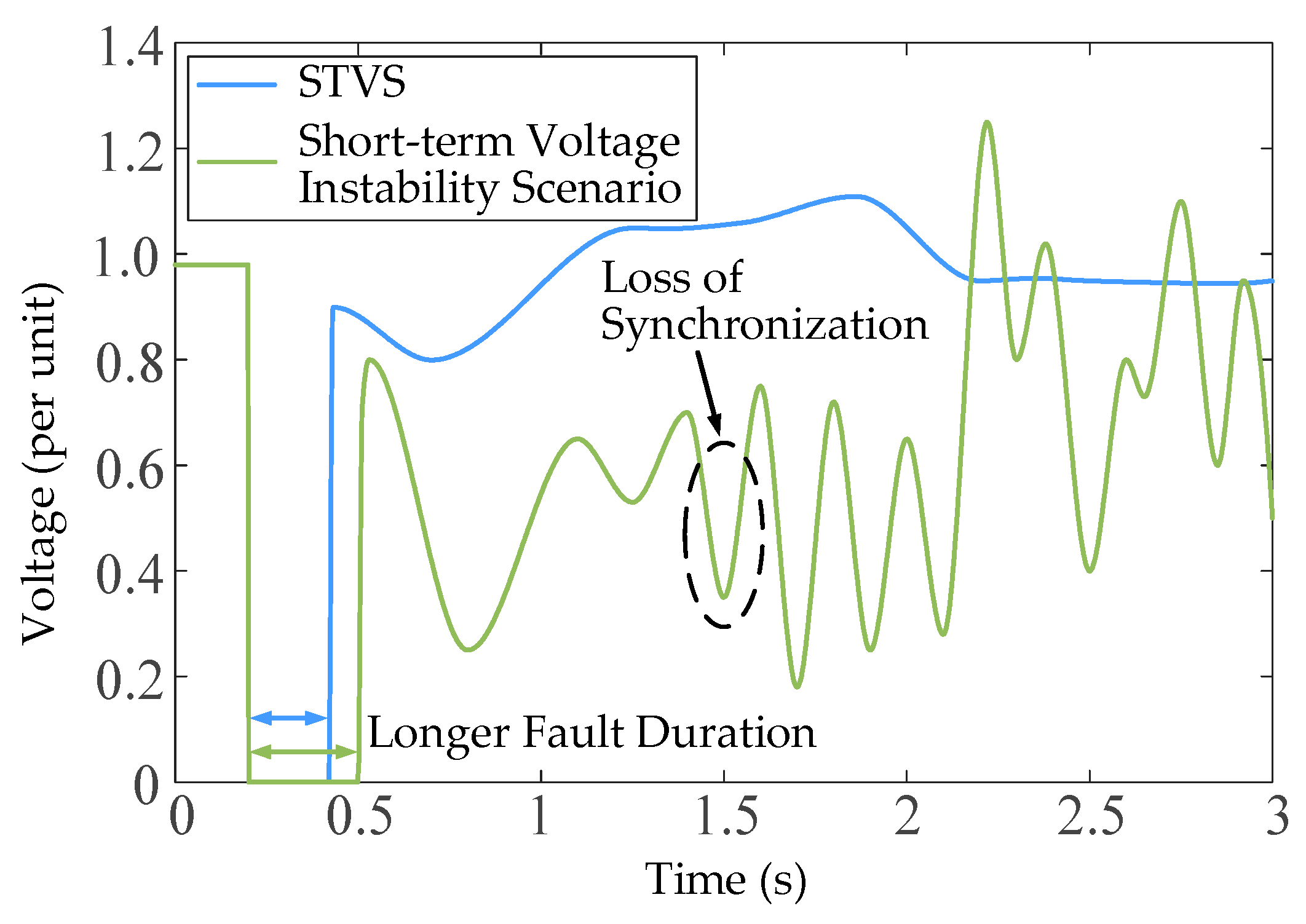
Short-term voltage instability in power systems is typically manifested as an inability to restore voltage to normal values in a short period after a disturbance, potentially leading to severe consequences such as equipment protection activation, shutdowns, or system collapse. A typical short-term voltage instability phenomenon is usually triggered by a three-phase short-circuit fault. Taking a standard power system as an example, suppose the fault occurs at 0.2 s and is cleared at 0.4 s. The system node voltage trajectory will rapidly decrease, and then, under the action of synchronous generator excitation regulation, it will gradually recover to the rated value. This corresponds to a stable STVS scenario (the blue curve in Figure 1). However, if the fault-clearing time is delayed until 0.5 s, the voltage trajectory will fail to recover, resulting in a rapid voltage collapse coupled with angle instability, forming an unstable scenario. This instability may manifest as a sustained low voltage or delayed voltage recovery, and in severe cases, it may lead to a widespread voltage drop. In scenarios with a high proportion of renewable energy integration, the instability process becomes more complex. The intermittency of renewable energy will cause power fluctuations at the PCC, which further amplify the voltage deviation.
A reasonable STVS index is the foundation for qualitatively and quantitatively assessing the system’s voltage stability. To quantify the instability phenomenon, the Transient Voltage Collapse Index (TVCI) can be introduced to determine whether the voltage remains stable after a disturbance. It is defined as [6]:
k TVCI = 1 , STVS 0 , Short-Term Voltage Instability
Although the system eventually stabilizes, significant voltage deviations may still occur during the transient process, usually manifested as a sustained low voltage and delayed voltage recovery. The Voltage Deviation Severity Index (VDSI) is used to evaluate the severity of voltage deviation, expressed as:
k VDSI = i = 1 N C t = 1 T D i , t N C ( T T C )
where N C is the total number of critical nodes in the system, T C is the fault-clearing time, T is the total simulation duration for the STVS analysis, and D i , t is the voltage deviation of node i at time t, defined as:
D i , t = U i , t U 0 / U 0 ,   if   | U i , t U 0 | / U 0 ε 0 ,   otherwise
where U 0 is the rated voltage, set to 1.0 per unit, and ε is the voltage deviation threshold, typically set at 20% based on industrial standards.

2.2. Short-Term Voltage Stability Assessment Methods

Data-driven STVS assessment methods train models using historical data from normal and unstable scenarios, with the inputs including the global voltage magnitude and active/reactive power and the outputs being the stability state classification or margin quantification. However, existing methods face feature redundancy issues, excessively relying on full-dimensional data, which leads to a low training efficiency and difficult deployment. Based on the time-domain simulation model of the power system that accounts for the active voltage support of the distribution network and historical data, a training dataset was constructed with system measurements as the inputs and stability states as the outputs. A CNN was then trained to realize an online STVS evaluation. A key-node voltage-based input–output variable dimensionality-reduction extraction method was proposed to significantly reduce the training data volume and improve the learning efficiency.
The key factors affecting STVS in power systems primarily include generation, load, and faults. To generate an efficient dataset, the generator’s active power output, load power, PCC interactive power, and critical node voltage were chosen as the input variables Z I , with TVCI and VDSI as the output variables Z O .
In this paper, the generation units refer primarily to synchronous generators, with the active output expressed as:
P G = ( P G i , T c , i = 1 , 2 , , n g )
where P G i , T c represents the active power of the i-th synchronous generator at time T c and n g is the total number of synchronous generators.
For node loads, both the static load levels and the dynamic load characteristics affect the system voltage stability. Thus, the active load P L and the reactive load Q L were chosen as input variables, expressed as:
P L = ( P L i , T c , i = 1 , 2 , , n 1 ) Q L = ( Q L i , T c , i = 1 , 2 , , n 1 )
where P Li , T c and Q Li , T c represent the active and reactive loads at node i at time T c , and n 1 is the number of load nodes in the transmission network. Considering the active voltage support capabilities of the distribution network, the power exchange at the PCC between the transmission and distribution networks is expressed as:
P e x = ( P L i , T e , i = 1 , 2 , , n d ) Q e x = ( Q L i , T c , i = 1 , 2 , , n d )
where n d is the number of nodes connected between the transmission and distribution networks. The fault type, location, and duration can affect the voltage stability of the system. If these factors are used as input variables, the sample space for training would become high-dimensional and discrete, significantly increasing the number of training samples and the learning complexity of the neural network. Therefore, key-node voltages in typical fault areas were selected to represent fault characteristics, reducing the number of training samples and improving the learning efficiency. The key-node voltage measurements within a region are expressed as:
U c r = ( U i , T a , i = 1 , 2 , , n c )
where n c is the number of nodes in the critical voltage region.
Thus, the input–output vectors are:
Z I = ( P G , P L , Q L , P e x , Q e x , U c r ) Z O = ( k TVCI , k VDSI )
To efficiently learn the inherent functional relationship between Z I and Z O and perform an STVS assessment, a deep neural network model was constructed. Given its advantages in automatic feature extraction and spatial hierarchy capturing, a CNN model was employed, which included an input layer, convolution-pooling layers, fully connected layers, and an output layer. Initially, the input vector Z I enters the convolution layer via sliding window mapping, where it convolves with the convolution kernel and generates output feature maps through activation functions, which are then passed to the pooling layer. The mathematical description of this process is as follows:
c i , j = ReLU ( k , b M l c i 1 , i k i , j + b i , j )
where i denotes the i-th neuron; c i , j is the output of the j-th feature map in the l-th convolutional layer; c 0 is the input layer; k i , j and b i , j are the weights and biases of the convolutional layer, applied in a sliding window manner to c i - 1 , i ; M l is the set of input feature maps in the l-th layer; is the convolution operator; and ReLU ( x )   =   max { x , 0 } is the activation function.
In the pooling layer, the output of the convolution layer is down-sampled to generate multiple reduced-dimensional feature maps, expressed as:
p i , j = ReLU ( α i , j Down ( c i , j ) + β i , j )
where α i , j and β i , j are the scaling and shifting biases, respectively; p i , j is the output of the j-th feature map in the l-th pooling layer; and Down(·) is the pooling function, which reduces the dimensionality of the convolutional layer output and integrates neighboring features, enhancing the robustness of learning. After the output of the final convolutional pooling layer is flattened, it is passed to the fully connected layer. The mathematical expression of the fully connected layer is:
p i , j = ReLU ( α i , j Down ( c i , j ) + β i , j )
where q i + 1 , k is the output of the k-th neuron in the l-th layer of the neural network, and w i , k and b i , k are the weights and biases of the fully connected layer in the l-th layer, respectively.
The loss function f loss includes cross-entropy for TVCI classification and the mean squared error for VDSI regression, with an added regularization term:
f l o s s = 1 B s S ( u { 1 , 2 } y u log 10 ( p s , u ) + 1 2 λ W 2 ) Z O , s = { k TVCI } 1 B s S ( ( Z O , s N O , s ) 2 + 1 2 λ W 2 ) Z O , s = { k VDSI }
where Z O , s and N O , s are the label and CNN output for the s-th training sample, respectively; B is the batch size; p s , u is the probability that the s-th training sample belongs to class u; y k takes the value of 1 or 0 for one-hot encoding; and W is the matrix composed of the neural network weights and biases.
The CNN-based STVS evaluation method consists of two main steps: offline learning and online execution.
In the offline learning phase, the historical samples of the power system are combined with the time-domain simulation model to generate the training dataset by solving multiple generation-load scenarios. The training dataset is then divided into input samples and output labels for offline learning. Each simulation scenario needs to be re-solved, considering the variations in the generation and load in the transmission and distribution networks. After the training dataset is completed, the CNN is built and trained through the optimization objective, with neural network parameters updated in each iteration until the loss function drops below the preset threshold, signaling the end of the offline learning process.
In the online execution phase, after fault clearance, the power system collects real-time power and voltage data from key nodes, which are then transmitted to the CNN for processing. The CNN outputs the TVCI and VDSI as the STVS evaluation results, providing decision support for transient voltage control.
The CNN model constructed in this paper included three convolution-pooling modules with 3 × 1 kernels, 2 × 1 pooling windows and 32, 64, 128 filters in sequence, and the ReLU activation function was used. Two fully connected layers with 128 and 64 neurons were connected to the backend, with a dropout rate of 0.5 and an additional L2 weight regularization (coefficient: 1 × 10⁻⁴). The output layer simultaneously realized TVCI classification (Softmax) and VDSI regression (linear activation). The training dataset contained 12,000 time-domain simulation samples, split into training, validation and test sets at a 6:2:2 ratio. The Adam optimizer was adopted with an initial learning rate of 0.001, a batch size of 32 and a maximum of 100 training epochs, plus an early stopping mechanism.
For key node selection, a three-step method (static voltage vulnerability pre-screening, a dynamic fault disturbance evaluation, and a coupling analysis of distribution network active voltage support) was applied. It significantly reduced the input feature dimension from 280 (full-node monitoring) to the number of selected key nodes ×20.

3. Flexibility Demand Quantification Model

3.1. Probability Box Model for Flexibility Demand

The flexibility demand in a power system mainly arises from the volatility of net load and the uncertainty of forecast errors. Net load volatility reflects the temporal variation in the renewable energy output and load demand, while forecast errors reflect the uncertainty on both the generation and load sides. The system’s flexibility demand can be divided into the upward and downward flexibility demand, expressed as:
f N , t u = m a x ( P ¯ t + 1 n + ε t + 1 n , u P t n , 0 ) f N , t d = m i n ( P ¯ t + 1 n + ε t + 1 n , d P t n , 0 )
where f N , t u and f N , t d represent the system’s upward and downward flexibility demand, respectively; P t n is the net load at the current time; P t + 1 n is the forecasted net load for the next time step; and ε t + 1 n , u and ε t + 1 n , d represent the upper and lower bounds of the forecast error for the net load at the next time step, respectively.
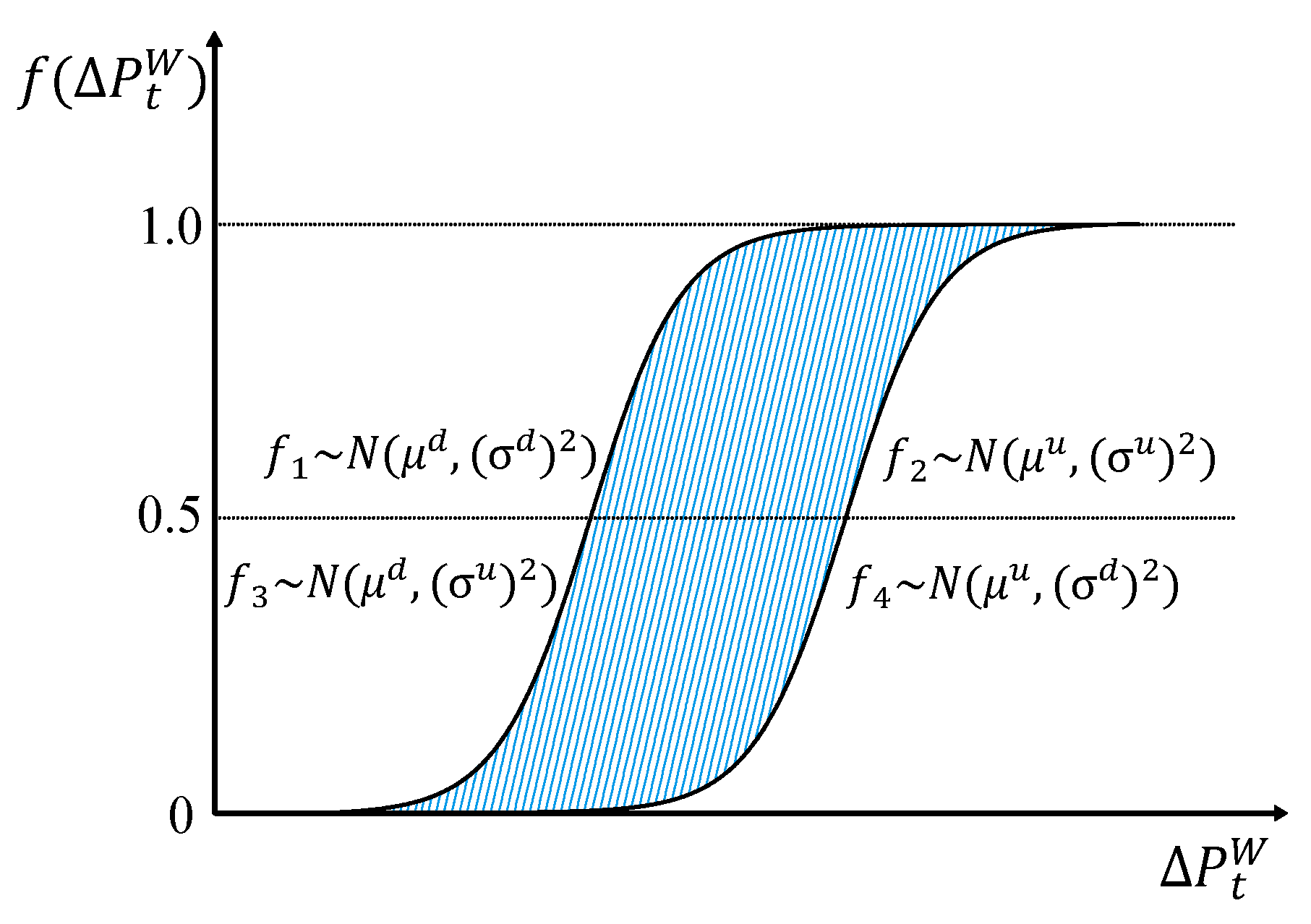
The upper and lower bounds of the net load forecast error at the next time step are jointly determined by the uncertainty of the wind and solar outputs as well as the load forecast errors. To accurately quantify the system’s flexibility demand, the P-box method is used to describe the forecast errors of the wind power, photovoltaic output, and load demand, thereby deriving the system’s flexibility demand. For example, taking the forecast error of the wind power output Δ P t W , it is assumed that the forecast error follows a normal distribution [37], with the distribution parameters varying within a certain range, where μ ( μ d , μ u ) , σ ( σ d , σ u ) . These four cumulative probability functions jointly constitute the P-box distribution of forecast errors, as shown in Figure 2.
A P-box is composed of the upper and lower bounds of a cumulative distribution function (CDF): the upper bound stands for the most optimistic estimate of prediction errors, with the highest cumulative probability for the same error value (i.e., errors are unlikely to be overly large); the lower bound represents the most conservative estimate, with the lowest cumulative probability for the same error value (i.e., errors tend to be overly large). The banded region between the two bounds encompasses all possible distributions impacted by parameter uncertainty.
From Figure 2, it can be seen that discrete historical data cause intersections in the P-box boundary functions at cumulative probabilities of 0 and 1. Therefore, the range of Δ P t W can be expressed as:
Δ P w d Δ P w Δ P w u
where Δ P w u and Δ P w d represent the maximum and minimum values of the wind power forecast error, respectively, i.e., the intersection points of the P-box boundary with cumulative probabilities of 0 and 1.
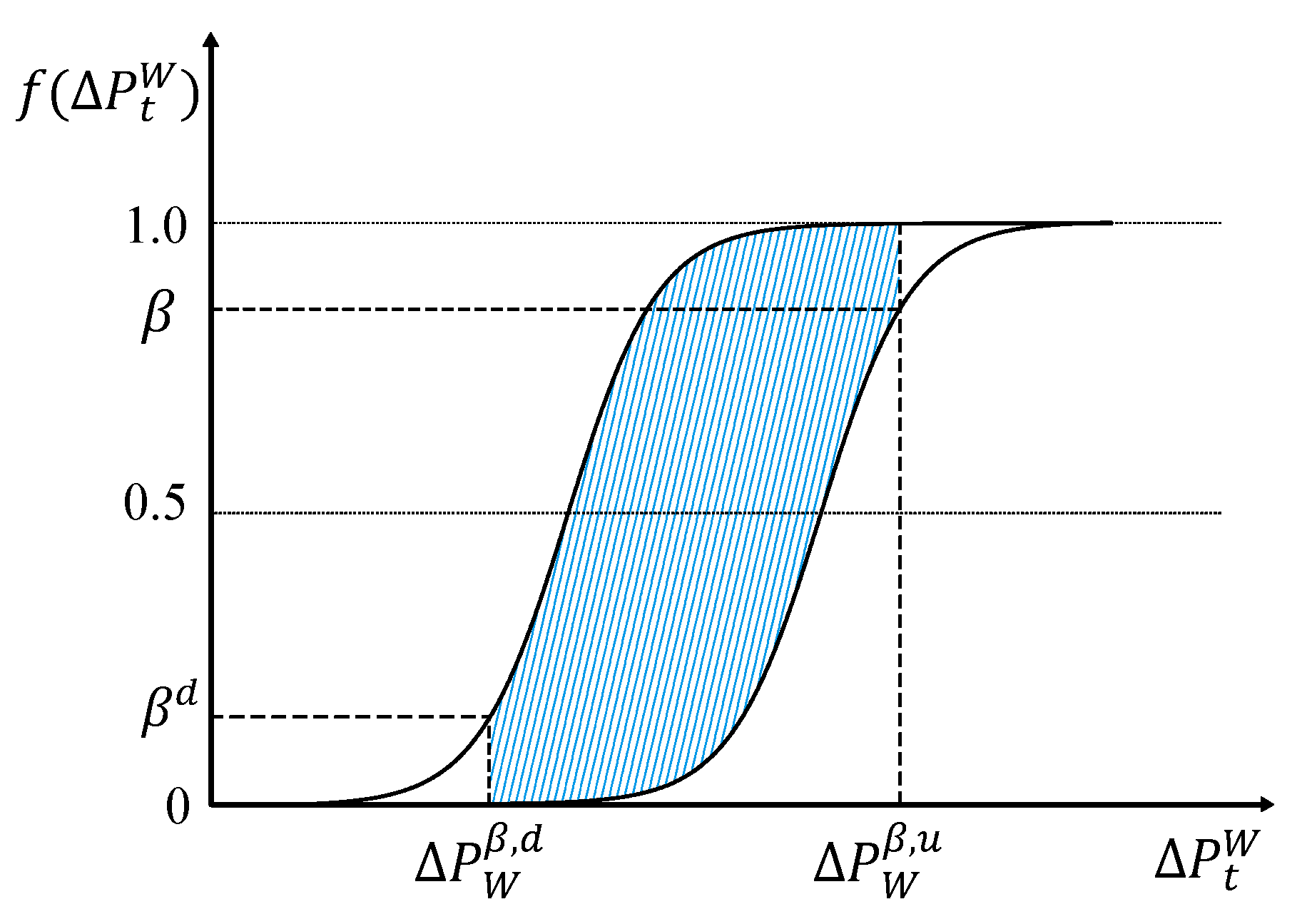
Due to the tail asymptotic property of the probability distribution function of the normal distribution [21], this could lead to conservatism in the model. Therefore, a confidence interval β is set to select an appropriate boundary for the interval. The boundary of the confidence interval β is shown in Figure 3. In this case, the forecast error range can be expressed as:
Δ P w β , u Δ P t w Δ P w β , u β = β u β d F 1 ( Δ P w β , d ) = β d F 2 ( Δ P w β , u ) = β u
where Δ P w β , u and Δ P w β , u represent the upper and lower bounds of the wind power forecast error within the confidence interval, and β u and β d are the cumulative probabilities corresponding to the upper and lower bounds of the forecast error outside the confidence interval, respectively.
Similarly, the forecast error ranges for the photovoltaic output and load demand can be derived, and the expressions for the flexibility demand ε t + 1 n , u , ε t + 1 n , d are as follows:
ε t + 1 n , u = Δ P L β , u P L , t + 1 Δ P w β , d P w , t + 1 Δ P p β , d P P , t + 1 ε t + 1 n , d = Δ P L β , d P L , t + 1 Δ P w β , u P w , t + 1 Δ P p β , u P P , t + 1
where Δ P L β , u and Δ P L β , d represent the upper and lower bounds of the load demand forecast error, respectively; Δ P p β , u and Δ P p β , d represent the upper and lower bounds of the photovoltaic output forecast error, respectively; and P L , t + 1 and P P , t + 1 are the forecasted load demand and photovoltaic output power, respectively.

3.2. Supply–Demand Flexibility Imbalance Risk Penalty Cost

The confidence level β is set to 95%, and the flexibility risk probability corresponding to the CVaR term is obtained by direct statistics from historical forecast error samples, i.e., the frequency of errors falling outside the confidence interval in each time period. When the system’s flexibility resources are limited and the forecast errors of the wind, solar, and load power exceed their regulation range, wind curtailment, solar curtailment, or load-shedding losses may occur. Therefore, the system’s supply–demand flexibility risk must be considered to ensure stable operation. A flexibility risk penalty objective function can be established as follows:
m i n C F = C β F + C β CVaR
C β F = c F u β ^ t = 1 T ( F N , β , t u F S , t u ) + c F d β ^ t = 1 T ( F N , β , t d F S , t d ) C β CVaR = c CVaR u β ^ t = 1 N s n u α ξ P n u + c CVaR d β ^ t = 1 N s n d α ξ P n d
where C F is the flexibility risk penalty cost for the system; C β F is the penalty for an insufficient flexibility within the confidence interval; C β CVaR is the conditional value-at-risk for flexibility risks outside the confidence interval; c F u and c F d are the unit costs for upward and downward flexibility insufficiency penalties, respectively; c CVaR u and c CVaR d are the unit costs for upward and downward flexibility risk penalties outside the confidence interval, respectively; β is an auxiliary variable, with a value of 1 / ( 1   -   β ) ; s n u and s n d are binary variables representing whether the flexibility is within the confidence interval, where 1 indicates outside the confidence interval and 0 indicates inside; α ξ is the flexibility risk loss function; and P n u and P n d are the probabilities of upward and downward flexibility risks occurring, respectively. Key symbols for flexibility modeling are shown in Table 1.

4. Transmission–Distribution Coordinated Optimal Scheduling Model

4.1. Objective Function

The economic implications of the objective function are summarized into three trade-off layers: the transmission and distribution networks respectively minimize generation costs and electricity purchase/sale expenses; in the case of an insufficient flexibility or network constraints, excessive penalty costs are imposed to curb wind/photovoltaic curtailment and load shedding; and the risks of short-term voltage instability and a supply–demand flexibility imbalance are directly incorporated into the objective after monetization, with risk preference coefficients tuning the decision-makers’ aversion to these two types of risks. This objective extends traditional economic dispatch to a coordinated optimization that balances voltage security and the ability to address uncertainties.

4.1.1. Distribution Network Objective Function

The objective function of the optimal distribution network scheduling is given as follows:
min C D = C P + C e E C D C
C p = t = 1 T ( c b , t P d , t b c s , t P d , t s ) C e E = t = 1 T ( ρ f , t P f , t + ρ c , t P c , t ) + C e , om E C D C = t = 1 T i = 1 b D ( c L Δ P L , i , t D + c W Δ P W , i , t D + c P Δ P P , i , t D )
where C p denotes the electricity purchasing and selling cost with the main grid; C e E denotes the operating cost of the energy storage system; C D C denotes the penalty cost associated with wind curtailment, PV curtailment, and load shedding in the distribution network; C e , om E denotes the operation and maintenance cost of the energy storage system; c b , t and c s , t are the electricity purchase and selling prices of the main grid; P d , t b and P d , t s are the electricity purchase and selling energy exchanged with the main grid; c L , c W and c P are the unit penalty costs for load shedding, wind curtailment and PV curtailment; Δ P W , i , t D , Δ P W , i , t D and Δ P P , i , t D are the amounts of load shedding, wind curtailment, and PV curtailment in the distribution network; and b D denotes the number of buses in the distribution network.

4.1.2. Transmission Network Objective Function

Based on a DC optimal power flow (DC-OPF) formulation, the transmission network model is established, with the objective of minimizing the operating cost:
min C T = C g G + C T C C P
where C g G denotes the operating cost of thermal generating units and C T C denotes the penalty cost associated with load shedding, wind curtailment, PV curtailment, and hydro curtailment in the transmission network.
For thermal generating units retrofitted for deep peak shaving, C g G is expressed as follows:
C g G = C g G , n , P g a P g , t P g max C g G , n + C g G , a C g G , s , P g b P g , t P g a C g G , n + C g G , a + C g G , o C g G , s , P g c P g , t P g b
C g G , n = t = 1 T ( a P g , t 2 + b P g , t + c ) C g G , a = t = 1 T k 1 ( P g , a P g , t ) C g G , o = k 2 ( P g , b P g , t ) C g G , s = h s k s ( P g , a P g , t )
where C g G , n denotes the coal-consumption cost of the thermal generating unit; C g G , a denotes the loss cost associated with deep peak shaving; C g G , s denotes the subsidy revenue for deep peak shaving; and C g G , o denotes the fuel-oil consumption cost during oil-fired deep peak shaving. Parameters a, b and c are the fuel-cost coefficients of the thermal unit. Parameters k1 and k2 are the loss coefficient and the oil-consumption cost coefficient. P g a is the minimum technical output of the thermal unit under normal operation, and P g b is the minimum output under non-oil-fired peak shaving. hs is the compensation coefficient for deep peak shaving, and ks is the compensation price for deep peak shaving.
The penalty cost is:
C T C = t = 1 T i = 1 b T ( c L Δ P L , i , t T + c W Δ P W , i , t T + c P Δ P P , i , t T + c S Δ P S , i , t T )
where c S denotes the unit penalty cost of water spillage; Δ P W , i , t T , Δ P P , i , t T , Δ P S , i , t T and Δ P L , i , t T denote the curtailed wind power, curtailed solar power, curtailed hydropower, and load shedding at transmission node i; and bT denotes the number of transmission nodes.

4.2. Constraints

4.2.1. Distribution Network Constraints

The distribution network constraints were formulated using the linearized DistFlow power-flow model, and the constraints are given as follows:
(1)
Node power balance constraints.
s δ ( j ) P j s , t i π ( j ) P i j , t = ( P j , t b P j , t s ) ( P L , j , t D Δ P L , j , t D ) + d Ψ j P d , j , t D s δ ( j ) Q j s , t i π ( j ) Q i j , t = ( Q j , t b Q j , t s ) ( Q L , j , t D Δ Q L , j , t D ) + d Ψ j Q d , j , t D
where π ( j ) and δ ( j ) denote the sets of parent and child nodes of the bus; P ij , t and Q ij , t denote the active and reactive power; Ψ j denotes the set of distributed generators at bus j; P d , j , t D and Q d , j , t D denote the active and reactive power outputs of the distributed generators; and P L , j , t D and Q L , j , t D denote the active and reactive load demands.
(2)
Power-flow constraints.
S l max P l , t D S l max S l max Q l , t D S l max 2 S l max P l , t D + Q l , t D 2 S l max 2 S l max P l , t D Q l , t D 2 S l max
where P l , t D and Q l , t D denote the real-time active and reactive power flows on line l and S l max denotes the transmission capacity (thermal limit) of line l.
(3)
Nodal voltage constraints.
V i min V i , t V i max V i , t V j , t = r i j P i j , t + x i j Q i j , t V 0
where V i max and V i min denote the upper and lower limits of the voltage magnitude at bus i and r ij and x ij denote the resistance and reactance of line ij.
(4)
ESS constraints.
0 P c , t P c , t max 0 P f , t P f , t max E min E t E max E t = E 0 + k = 1 t ( P c , k Δ t + P f , k Δ t )
where E t denotes the ESS energy at time t; E 0 denotes the initial energy; P c , t denotes the charging power at time t; P c , t max denotes the maximum charging power; P f , t denotes the discharging power at time t; P f , t max denotes the maximum discharging power; E m a x and E min denote the maximum and minimum energy limits of the ESS; and Δ t denotes the time interval.

4.2.2. Transmission Network Constraints

The transmission network constraints mainly include unit operating constraints, power-flow constraints, and power balance constraints, among others.
(1)
Thermal unit operating constraints.
P g c P g , t P g max R g d Δ t P g , t + 1 P g , t R g u Δ t
(2)
Hydro and nuclear unit operating constraints.
P s , t min P s , t P s , t max R s d Δ t P s , t + 1 P s , t R s u Δ t P n , t = ξ N P N max
where ξ N denotes the nuclear power output ratio and P N max denotes the rated output power of the nuclear unit.
(3)
Load-shedding constraints.
t = 1 T i = 1 b T Δ P L , i , t ξ L t = 1 T i = 1 b T P L , i , t
where P L , i , t denotes the real-time load demand and ξ L denotes the maximum allowable load-shedding ratio of the system.
(4)
Power balance constraints.
P g , t + P s , t + P n , t l f ( l ) = k P l , t + l t ( l ) = k P l , t = i = 1 b τ P L , i , t + P b , t
where l | f ( l )   =   k and l | t ( l )   =   k denote the sets of lines injecting power into bus k and exporting power from bus k and P b , t denotes the real-time power exchanged between the transmission network and the distribution network.
(5)
Line power-flow constraints.
P l , t = ( θ f ( l ) , t θ ι ( l ) , t ) / x l P l T , max P l , t T P l T , max θ max θ f ( l ) , t θ max θ max θ ι ( l ) , t θ max
where θ f ( l ) , t and θ ι ( l ) , t denote the voltage phase angles at the sending and receiving buses of line l; θ max denotes the maximum allowable phase-angle magnitude; and x l denotes the reactance of line l.

4.3. The Transmission–Distribution Flexibility Margin Quantification Model

4.3.1. Distribution Network Flexibility Margin Model

The distribution network flexibility margin is defined as:
f D , t u = f D , S , t u f D , N , t u f D , t d = f D , S , t d f D , N , t d
where f D , t u and f D , t d denote the upward and downward flexibility margins of the distribution network; f D , S , t u and f D , S , t d denote the upward and downward flexibility supplies within the distribution network, provided by internal flexible resources; and f D , N , t u and f D , N , t d denote the upward and downward flexibility demands within the distribution network.

4.3.2. Transmission Network Flexibility Margin Model

The flexibility margin of the transmission network is defined as:
f T , t u = f T , S , t u f T , N , t u f T , t d = f T , S , t d f T , N , t d
where f T , t u and f T , t d denote the upward and downward flexibility margins of the transmission network; f T , S , t u and f T , S , t d denote the corresponding upward and downward flexibility supplies of the transmission network; and f T , N , t u and f T , N , t d denote the upward and downward flexibility demands within the transmission network.

4.4. Formulation and Solution of the Transmission–Distribution Coordinated Operation Model

In conventional transmission–distribution (T&D) models, the transmission network and the distribution network can be equivalently represented as a virtual generator and a load, respectively. With the increasing availability of system flexibility resources, the transmission and distribution networks can not only achieve their own power balance through electricity purchasing and selling, but can also act as virtual flexibility suppliers and demanders, providing flexibility support to each other when necessary. Accordingly, the boundary constraints that must be satisfied between the transmission and distribution networks include both energy constraints and flexibility constraints.
The boundary constraints are given as follows:
P ι T B = P ι B D P ι B D = P b , ι f T B , t u = f B D , t u f T B , t d = f B D , t d
P B max f T B , t u + P t T B P B max P B max f B D , t u + P t B T P B max f D , t u f T B , t f T , t u f D , t u f B D , t u f T , t u
P B max f T B , t d + P t T B P B max P B max f B D , t d + P t B T P B max f D , t d f T B , t d f T , t d f D , t d f B D , t d f T , t d
where P ι T - B denotes the power exchanged between the transmission network and the boundary, which is equal to the electricity trading power from the transmission network to the distribution network; P ι B - D denotes the power exchanged between the boundary and the distribution network; P b , ι denotes the electricity trading power between the transmission and distribution networks; P B max denotes the maximum transfer power at the boundary; f T - B , t u and f T - B , t d denote the upward and downward flexibility margins exchanged between the transmission network and the boundary; and f B - D , t u and f B - D , t d denote the upward and downward flexibility margins exchanged between the boundary and the distribution network.
Finally, the objective function of the transmission–distribution coordinated operation model is obtained.
min ε C T + C D + ( 1 ε ) C F
where ε denotes the risk preference coefficient.
Flexibility regulation directly modifies nodal active and reactive power injections, which in turn affect voltage magnitudes through power flow relationships. Under linearized power flow approximation, voltage variations can be expressed as
Δ V R Δ P + X Δ Q
where Δ P and Δ Q represent changes in active and reactive power injections caused by flexibility deployment, and R and X denote network impedance parameters. Consequently, aggressive flexibility export or import alters the voltage profiles and affects the voltage recovery margins.
From a transmission perspective, degradation of short-term voltage stability reduces the reactive power reserves and weakens the voltage recovery capability, which increases the transmission-side operational risk. Variations in boundary power exchange induced by flexibility regulation modify the reactive power demand and voltage trajectories, thereby directly impacting the transmission-side risk levels associated with short-term voltage stability.
Conversely, when the transmission-side risk induced by short-term voltage instability is emphasized in the unified objective function, the optimization inherently constrains excessive flexibility utilization and boundary power exchange to preserve adequate voltage stability margins. Therefore, flexibility regulation and the transmission-side risk are intrinsically coupled through power flow dynamics and boundary exchange constraints.

5. Case Study

5.1. Test System and Network Parameters

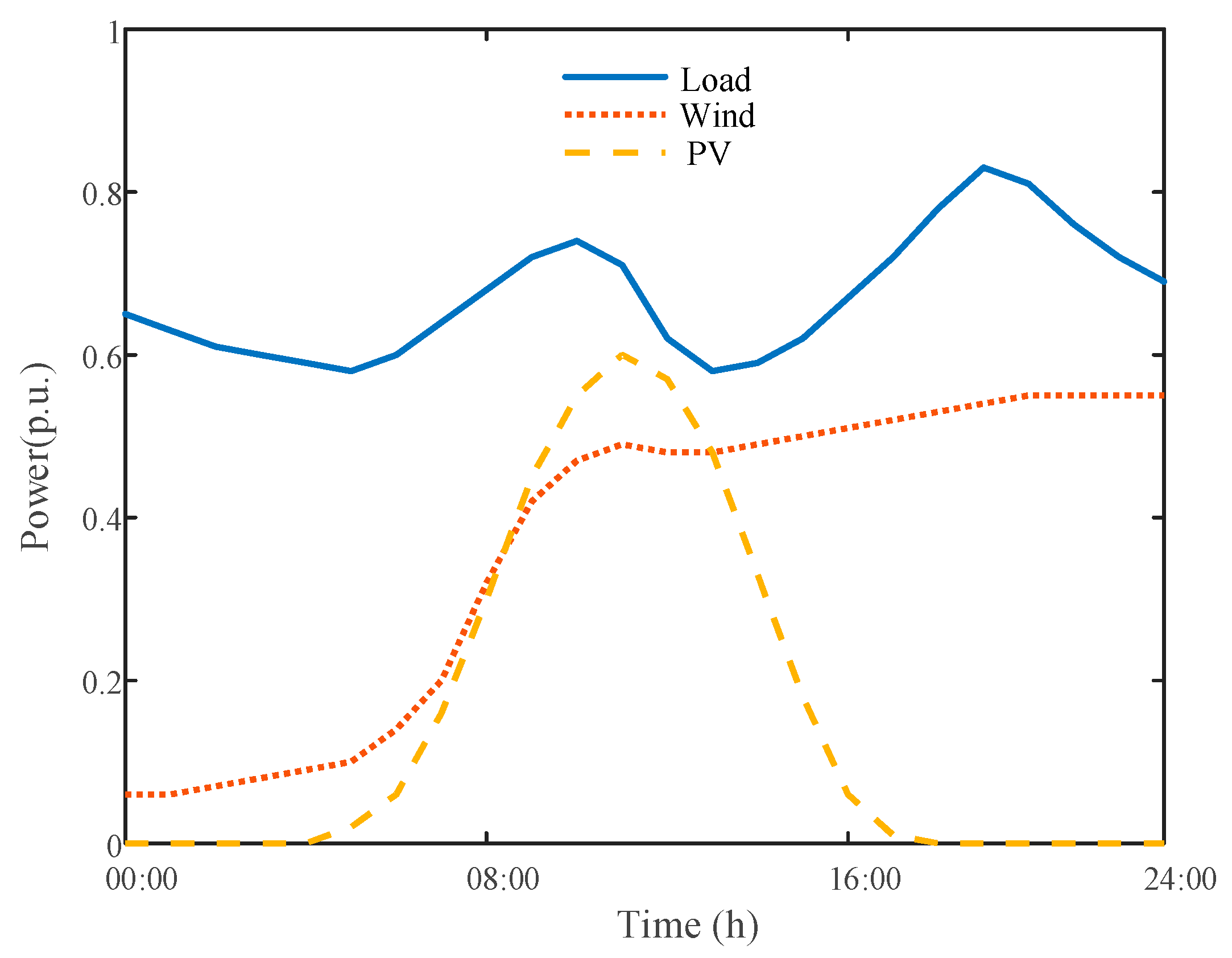
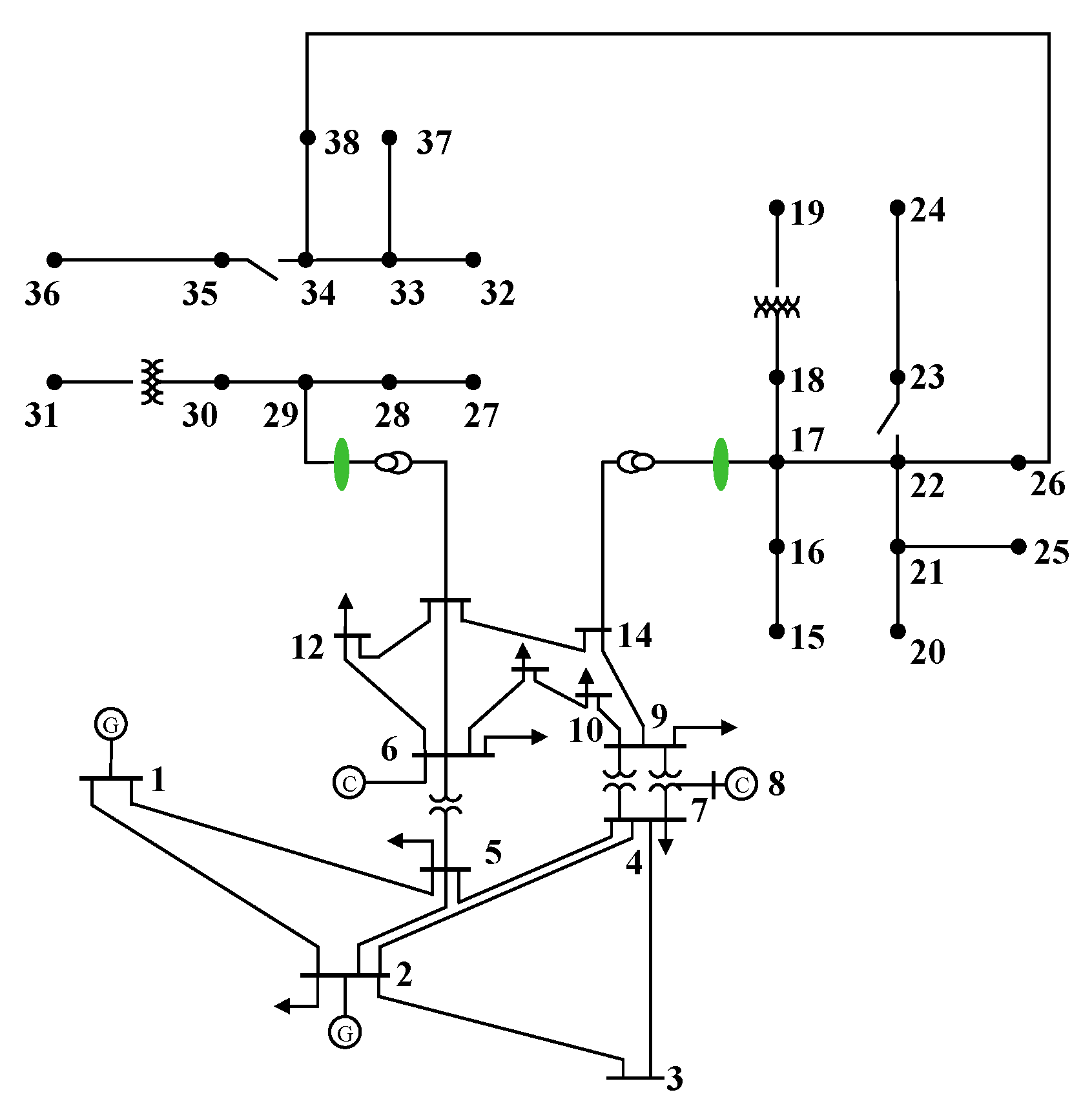
To verify the effectiveness of the proposed transmission–distribution coordinated optimal scheduling model that simultaneously considers STVS and flexibility supply–demand balance, two modified IEEE 13-node feeders were connected to buses 14 and 13 of the IEEE 14-bus system, and a tie line was introduced to interconnect Distribution System 1 and Distribution System 2. The proposed model was simulated in MATLAB R2024b, as shown in Figure 4. The parameters of the two modified IEEE 13-node feeders and the IEEE 14-bus system, as well as the interconnection locations and capacities of the distributed renewable energy sources and energy storage units, are provided in Table 2 and Table 3, respectively. The daily power curves of renewable energy sources and loads are shown in Figure 5. Compared with the standard IEEE 13-node test feeder, the original equivalent source of each feeder was removed and replaced by transmission–distribution interface branches for coupling with the IEEE 14-bus system, while the additional distribution-level tie line enabled power exchange and coordinated scheduling between the two feeders. The distribution systems were converted to a unified per-unit system with a base power of 10 MVA and a base voltage of 12.66 kV, and the bus voltage magnitudes were constrained within 0.95–1.05 p.u. Apart from these interface and interconnection settings, the internal radial topology of each IEEE 13-node feeder was preserved, and no local generation was assumed in the feeders before integrating the distributed renewables and energy storage units.

5.2. Short-Term Voltage Stability Analysis and Assessment

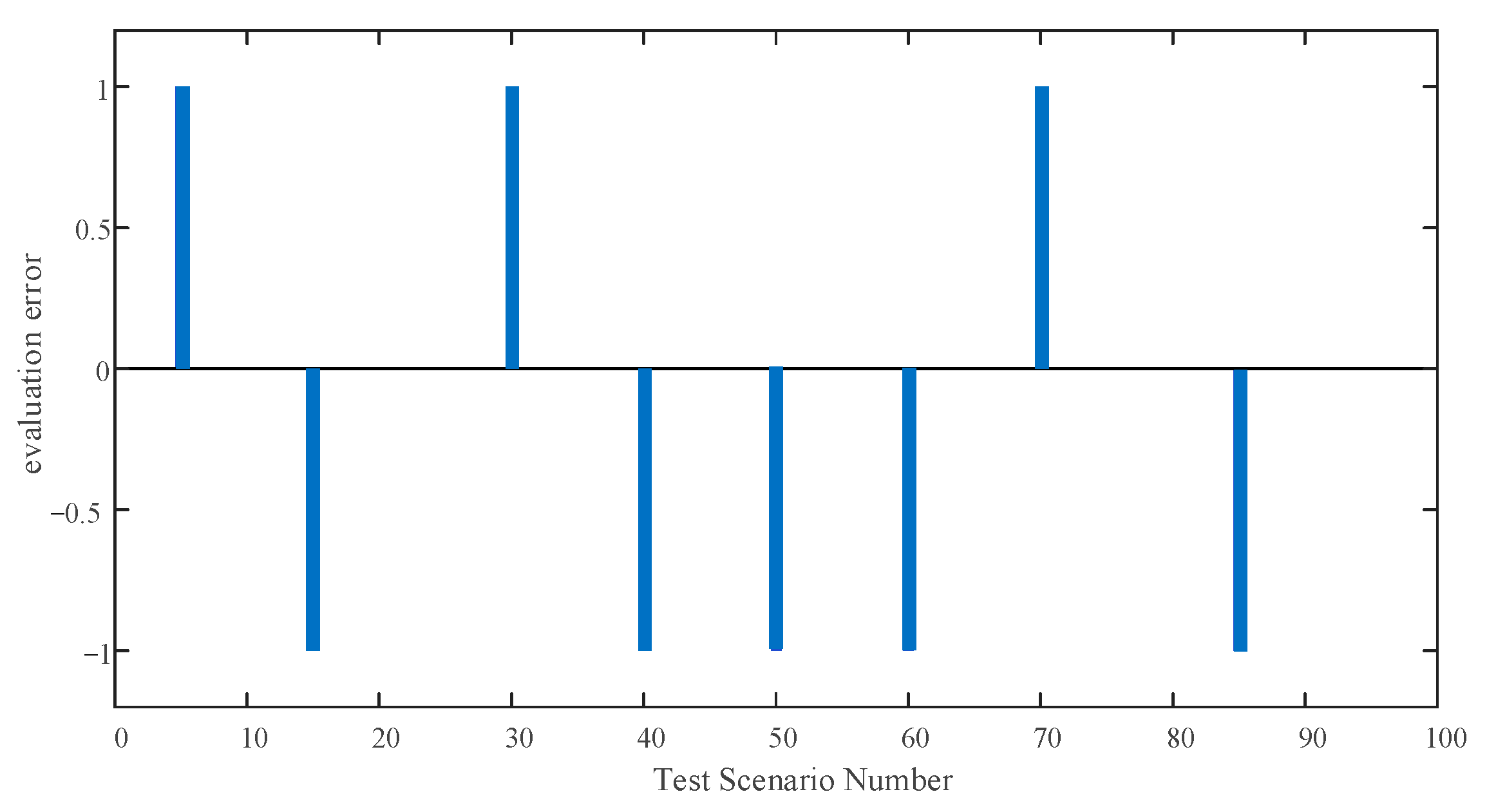
To verify the accuracy of the proposed STVS assessment method, this paper generated 100 scenarios with different renewable energy penetration levels using a Monte Carlo approach based on interval random sampling. Figure 6 shows the assessment errors of the STVS under the test scenarios. Specifically, an assessment value of 1 indicates that the method predicts stability while the actual system experiences short-term voltage instability; an assessment value of −1 indicates that the method predicts instability while the actual system remains short-term voltage stable; and an assessment value of 0 indicates that both the assessment and the actual outcome are stable.
Among the 100 test scenarios, only 10 scenarios were misclassified, while the remaining results were correct. Therefore, the proposed method achieved an accuracy of 90%, which generally meets practical engineering requirements.
Table 4 further compares the quantitative STVS assessment results obtained by the proposed method and the time-domain simulation method. Compared with the time-domain simulation results, the proposed method yielded an absolute VDSI error of 0.75 p.u., corresponding to a relative error of 26.5%. It should be noted that this relative error was aggregated over all 100 test scenarios; the average VDSI error per test sample was much smaller and satisfied the assessment requirements.
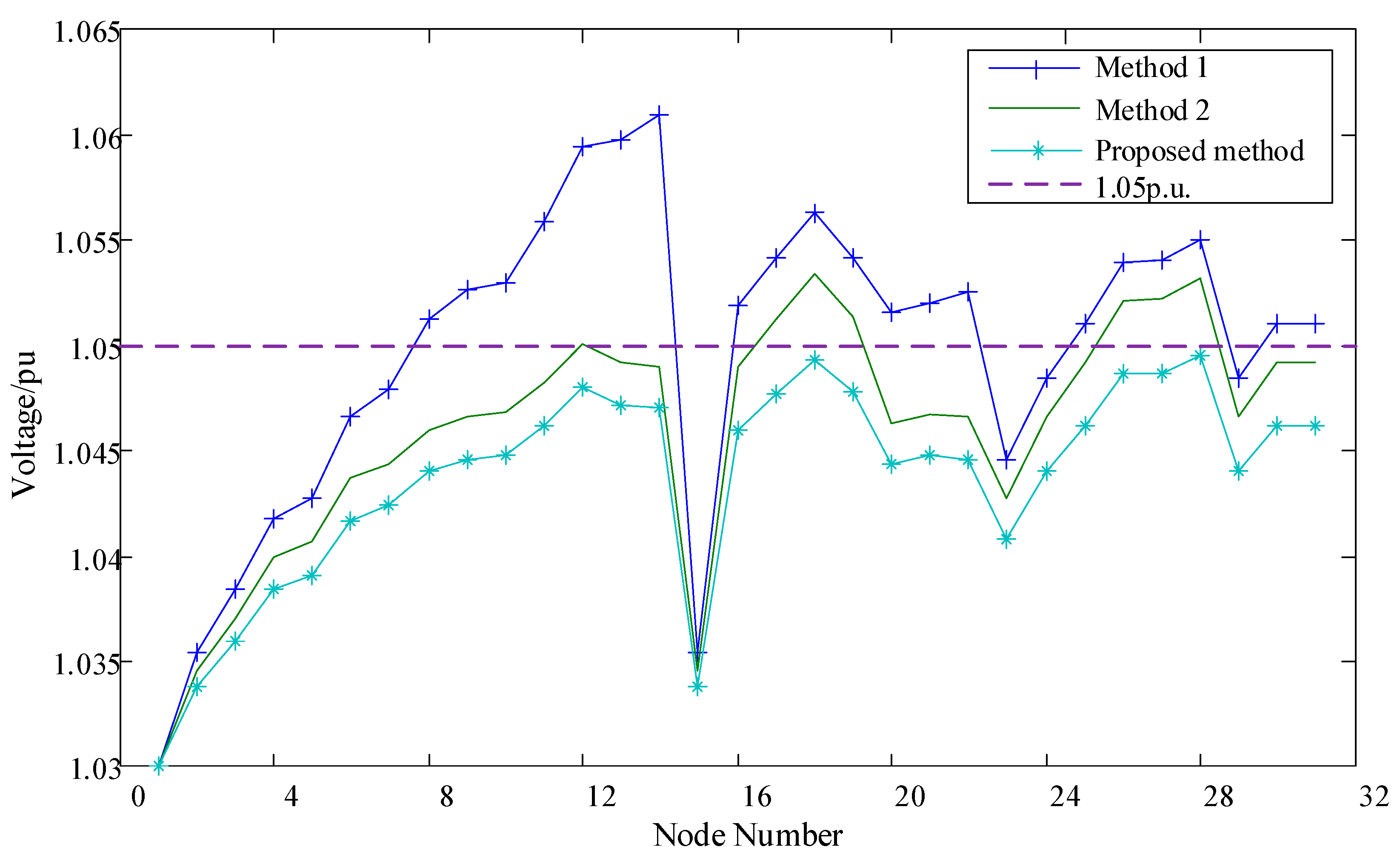
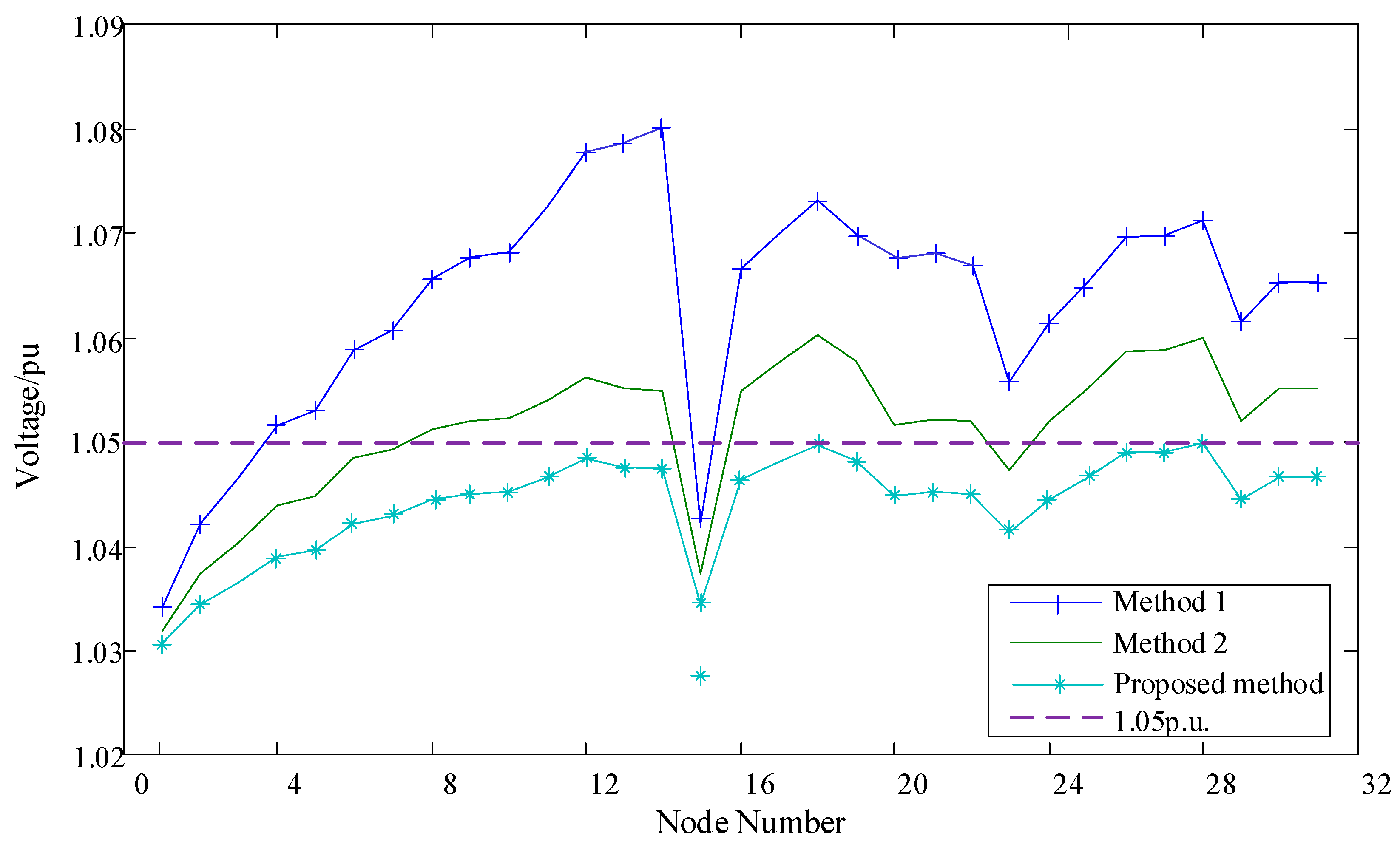
As shown in Figure 7, a 24 h comparison of nodal voltages under different control strategies is presented. Under Method 1—traditional transmission–distribution coordinated dispatch without voltage control—short-term voltage fluctuations were more pronounced, and the voltages at most buses were relatively high, with several nodes exhibiting clear overvoltage tendencies, causing the overall operating voltage to deviate from the 1.05 p.u. upper limit. Method 2—the method proposed in [38]—alleviated the voltage deviation to some extent and smooths the voltage profiles without considering short-term voltage stability; however, multiple buses still operated close to or exceeded the upper bound. In contrast, the proposed method explicitly incorporates short-term voltage stability constraints within the transmission–distribution coordination framework, resulting in lower voltage levels at most buses and a more balanced voltage distribution across the network. Consequently, the overall voltage profile is closer to 1.0 p.u. with reduced variations, demonstrating the effectiveness of the proposed strategy in voltage regulation while accounting for short-term voltage stability.
As shown in Figure 8, to further verify the robustness of the proposed framework under non-nominal operating conditions, a higher renewable penetration scenario was investigated. In this stressed case, the maximum nodal voltage under Method 1 reached approximately 1.08 p.u., representing a significant violation rather than a marginal boundary condition. Although Method 2 partially mitigated the voltage deviation, violations persisted at several nodes. In contrast, the proposed method, considering short-term voltage stability, completely eliminated all overvoltage issues and maintained feeder voltages within admissible limits, indicating that the proposed coordination strategy remains effective under intensified voltage-stress conditions.

5.3. Effectiveness Analysis of Flexibility Demand

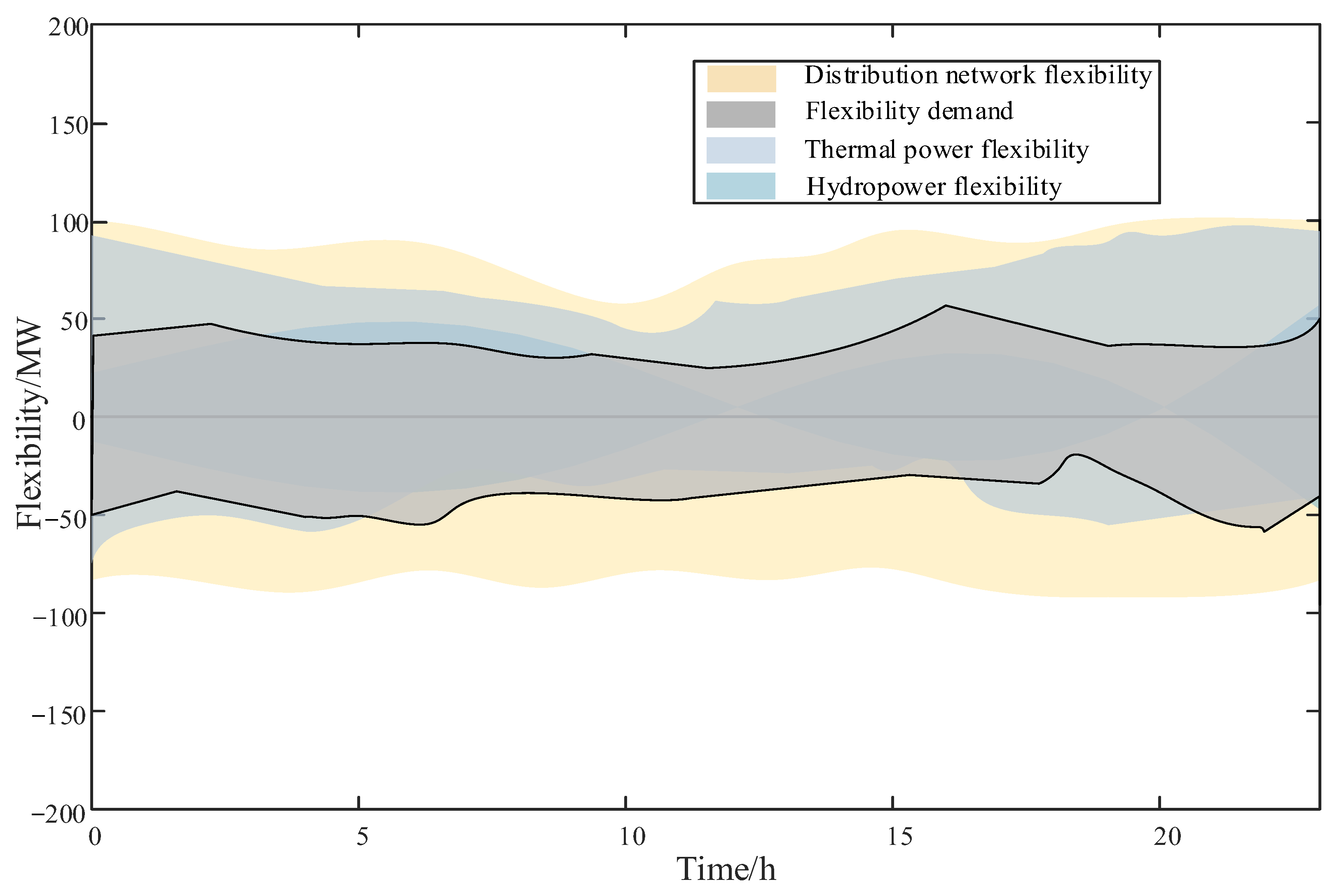
On the premise of ensuring system voltage stability, this paper further analyzed the flexibility demand. Figure 9 illustrates the 24 h variation patterns of the distribution-network flexibility, thermal-power flexibility, hydropower flexibility, and system flexibility demand. It was observed that the distribution-network flexibility maintained the largest regulation margin throughout the day, with relatively pronounced upward and downward fluctuations, indicating the potential of controllable distributed resources to support system-level flexibility. The thermal-power flexibility was constrained by minimum generation limits and ramp-rate capabilities; therefore, its upward and downward regulation capacity was comparatively stable, but with a smaller magnitude. The hydropower flexibility lies between the two and exhibited smooth, periodic fluctuations due to variations in hydraulic head. The system flexibility demand showed an overall increasing trend, characterized by being lower in the early hours and higher later in the day, and it rose significantly during load peaks and periods with intensified renewable-energy variability. Overall, from 5:00 to 15:00, the downward flexibility provided by flexible sources in the transmission grid was insufficient to meet the flexibility demand, posing the risk of a flexibility imbalance; during this period, surplus flexibility from the distribution network was used to supplement the system flexibility. In the remaining hours, the transmission grid achieved a flexibility balance using the flexibility provided by its internal flexible generation sources.
Table 5 summarizes the maximum upward and downward flexibility margins (MW) by source type. The flexibility demand exhibited peak upward and downward requirements of 65 MW and −61 MW, respectively. Thermal resources provided the strongest upward capability, with a maximum upward margin of 89 MW, while their maximum downward margin was −49 MW. Hydropower showed a relatively balanced regulation capability, with maximum upward and downward margins of 56 MW and −48 MW. In contrast, the distribution network offered a smaller upward margin (31 MW), but a comparatively large downward margin (−56 MW), indicating a stronger contribution to downward regulation.

5.4. Analysis of Transmission–Distribution Coordination Effects

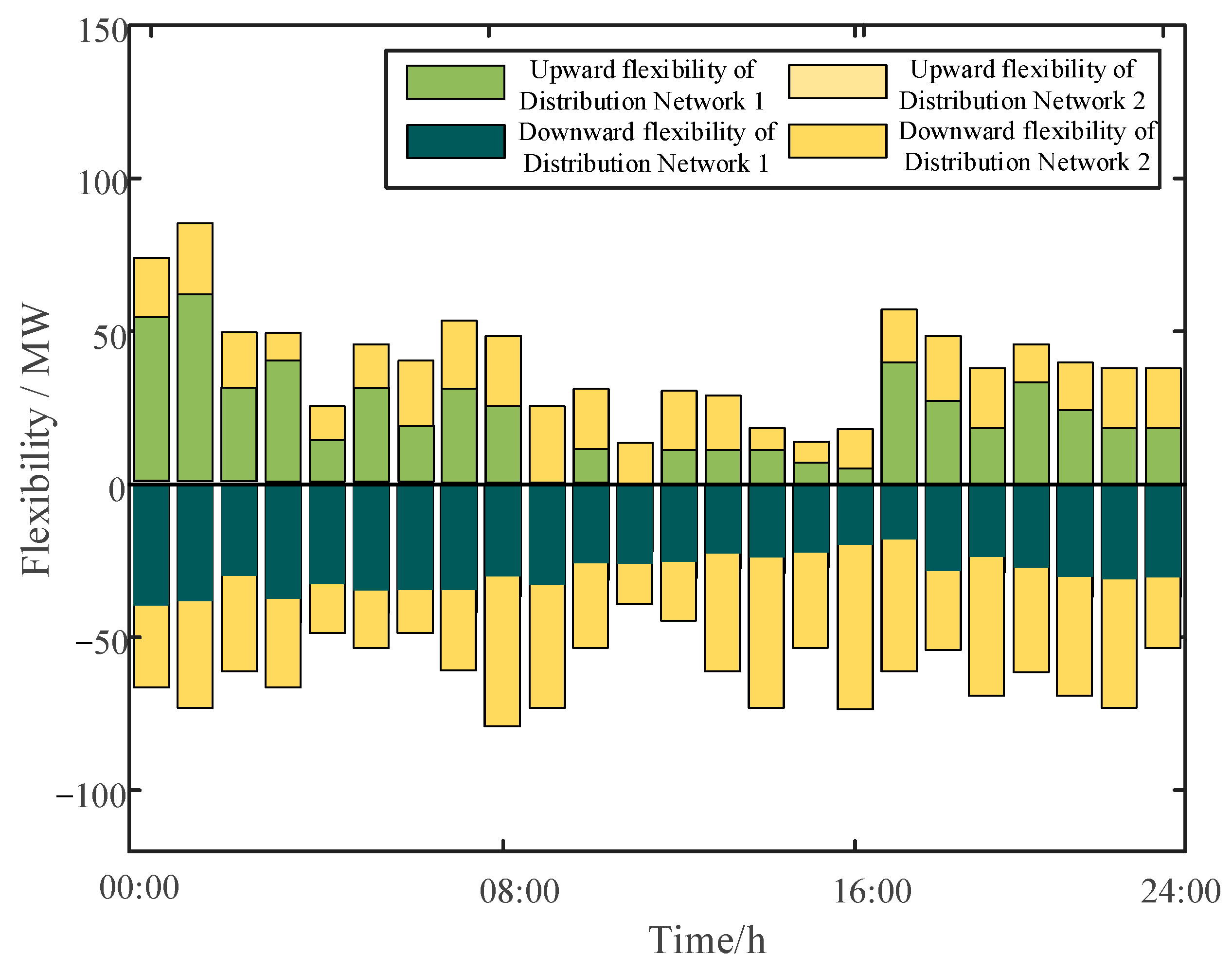
Figure 10 illustrates the intraday distribution of flexibility margins for the transmission grid and two interconnected distribution networks. The results depict the upward/downward flexibility boundaries that each distribution network can provide to the outside at each time interval, without considering any additional support from the upstream transmission grid to the distribution networks. As indicated in Figure 8, the downward flexibility of both distribution networks remains positive throughout the day, implying a persistent available margin that can continuously supplement the transmission grid with downward regulation when required. In contrast, the upward flexibility exhibits a time-varying pattern characterized by being “lower in the middle and higher at both ends” of the day. During some midday intervals, the upward margin shrinks noticeably, and at certain moments, it even approaches zero, suggesting that the internal resources available for upward regulation in the distribution network are limited during these periods. Consequently, the distribution network can hardly continue exporting upward flexibility to the transmission grid, and instead needs to rely on the transmission grid or the other distribution network, through interface coordination, to provide upward compensation so as to address balancing requirements induced by forecast deviations in the renewable generation output or load demand. Therefore, at the flexibility level, the transmission grid and distribution networks exhibit a bidirectional interaction and a mutually supportive coordination relationship.
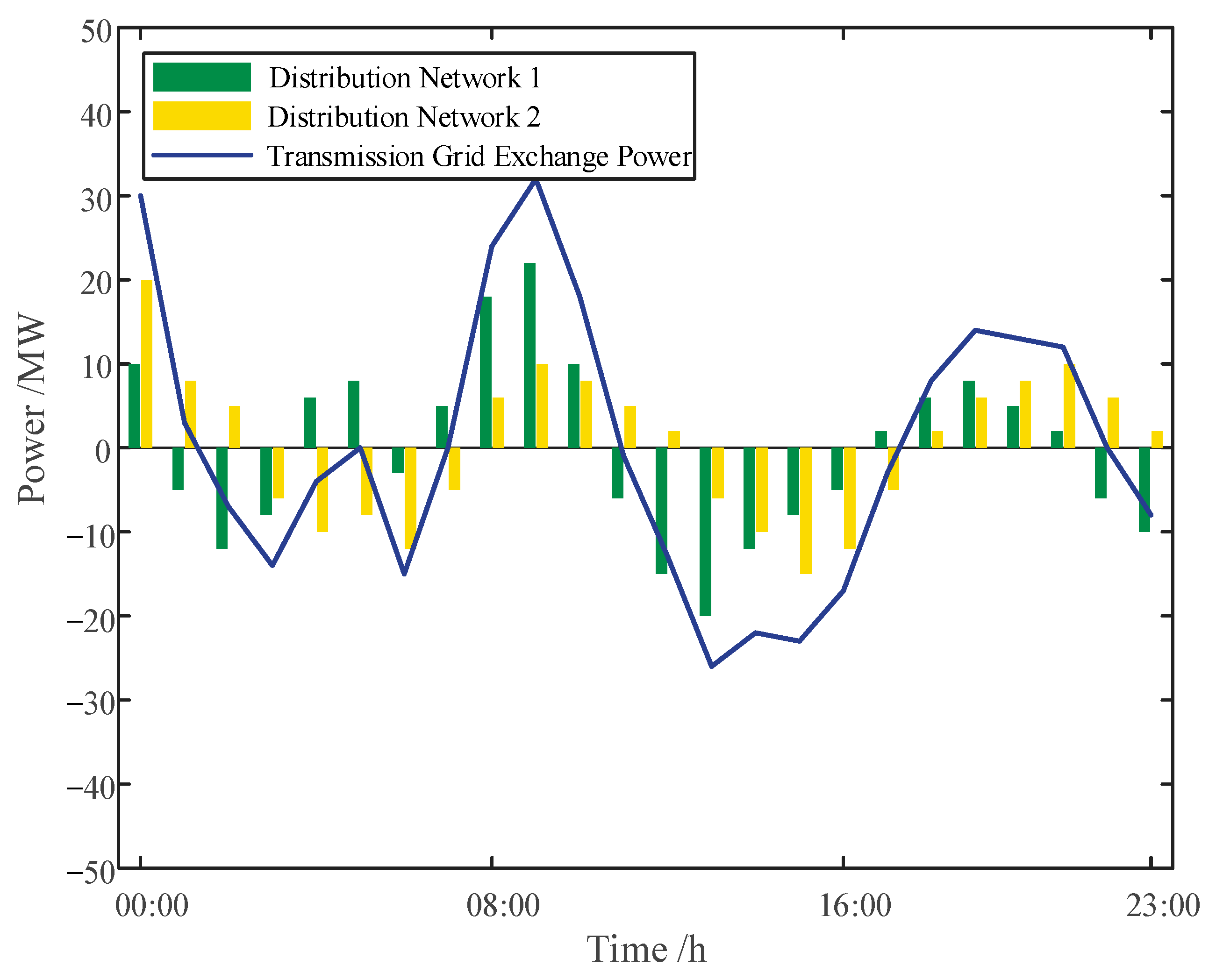
Figure 11 depicts the power-exchange characteristics of the distribution network across different time intervals. From the intraday evolution, the total exchange power exhibited a pronounced “time-segmented fluctuation” pattern. During the late-night to early-morning period, the exchange power was predominantly negative, indicating load dominance and net power absorption. A pronounced positive peak emerged around the morning peak, suggesting strengthened net export caused by increased distributed generation output and/or a reduction in load. Subsequently, from midday to the afternoon, the total exchange power turned significantly negative and reached a valley, reflecting deeper net power purchase driven by a rising load or weakened renewable generation. After dusk, it gradually rebounded and fluctuated around zero at night, implying that the net exchange diminishes and the system enters a relatively balanced state. This case study is typically used to compare, under different resource configurations and scheduling strategies, the extent to which the two distribution networks support or rely on the upstream grid, as well as their peak–valley characteristics and the magnitude of power fluctuations.

6. Conclusions

This paper proposes a transmission–distribution coordinated optimal scheduling strategy that accounts for the supply–demand flexibility balance and voltage-stability constraints. A typical transmission system coupled with multiple distribution networks was used as the test system for case validation. The results demonstrate that the proposed method is feasible and effective. The main conclusions are summarized as follows:
(1)
A supply–demand flexibility quantification and risk assessment model for coordinated transmission–distribution operation was developed. On the distribution-network side, the time-varying regulation capabilities of flexible resources, including distributed generation, energy storage, and adjustable loads, were characterized to form a flexibility supply representation that can support transmission-level scheduling. On the transmission-network side, a flexibility demand model considering uncertainty was established, and a unified supply–demand balance constraint was used to realize cross-layer flexibility interactions and dynamic matching, thereby providing a computable and comparable decision basis for coordinated transmission–distribution scheduling.
(2)
An optimal coordinated transmission–distribution scheduling method considering the STVS is proposed. Building upon the economic objective, voltage-stability constraints and a boundary power-interaction mechanism were introduced to enable coordinated optimization between the transmission and distribution networks in both energy exchange and voltage support. The case results show that, while satisfying system security constraints, the proposed strategy can suppress voltage fluctuations at critical buses and reduce the risk of short-term voltage instability. Meanwhile, it enhances the ability of distribution-network flexibility to compensate for regulation shortages in the transmission network, thereby improving both the operational economy and security margins.

7. Limitations and Future Work

This study was validated on benchmark-scale coupled transmission–distribution test systems and assumed ideal communications and accurate model matching. These assumptions helped isolate the coordination mechanism, but may limit direct transferability to practical deployments. Future work will validate larger systems and evaluate the robustness while considering communication latency/data loss and model mismatch.

Author Contributions

Conceptualization, Y.Y., W.D., S.Y., J.Z. and T.N.; Methodology, Y.Y., W.D., S.Y., J.J. and T.N.; Software, Y.Y., W.D., S.Y. and Y.Z.; Validation, J.Z., J.J., Y.Z. and T.N.; Formal Analysis, J.Z., J.J. and Y.Z.; Investigation, J.Z., J.J. and Y.Z.; Resources, J.Z., J.J., Y.Z. and T.N.; Data Curation, J.Z., J.J. and Y.Z.; Writing—Original Draft Preparation, J.Z. and Y.Z.; Writing—Review and Editing, J.Z., J.J., Y.Z. and T.N.; Visualization, J.Z., J.J. and Y.Z.; Supervision, T.N.; Project Administration, W.D. and T.N.; Funding Acquisition, Y.Y. All authors have read and agreed to the published version of the manuscript.

Funding

This research was funded by the science and technology project of State Grid Zhejiang Electric Power Co., Ltd. (Research on Intelligent Generation and Multi-Level Frequency and Voltage Coordinated Control Methods for Complex Multi-Scenario Operation Modes Including High Proportion of Centralized/Distributed New Energy Sources), grant number B311DS25Z017.

Data Availability Statement

The data presented in this study are available from the corresponding author upon request.

Conflicts of Interest

Authors Ying Yang, Wei Dong and Shize Ye were employed by State Grid Zhejiang Electric Power Co., Ltd. Research Institute. The remaining authors declare that the research was conducted in the absence of any commercial or financial relationships.

References

  1. Zhang, R. Artificial intelligence in power system security and stability analysis: A comprehensive review. arXiv 2024, arXiv:2408.08914. [Google Scholar] [CrossRef]
  2. Feng, S.; Song, Z.; Yang, Q.; Hou, Y.; Wang, Z.; Liu, F.; Wang, B.; Wang, W. Long-term changes of wind resources and its impact on wind power development under climate change in China. Energy Internet 2024, 1, 52–62. [Google Scholar] [CrossRef]
  3. Cao, Y.; Li, Y.; Cai, Y.; Sun, R.; Zhan, W.; Zeng, R. Review of Multi-Energy Coupling and Resilience Control in Cyber Physical Energy Systems Under Extreme Disasters. Energy Internet 2025, 2, 297–312. [Google Scholar] [CrossRef]
  4. Tang, K.; Dong, S.; Ma, X.; Lv, L.; Song, Y. Chance-constrained optimal power flow of integrated transmission and distribution networks with limited information interaction. IEEE Trans. Smart Grid 2020, 12, 821–833. [Google Scholar] [CrossRef]
  5. Rabiee, A.; Keane, A.; Soroudi, A. Enhanced transmission and distribution network coordination to host more electric vehicles and PV. IEEE Syst. J. 2021, 16, 2705–2716. [Google Scholar] [CrossRef]
  6. Wang, G.; Zhang, M.; Huang, T.; Xu, Z. A short-term voltage stability online prediction method based on graph convolutional networks and long short-term memory networks. Int. J. Electr. Power Energy Syst. 2021, 127, 106647. [Google Scholar] [CrossRef]
  7. Sun, H.; Guo, Q.; Zhang, B.; Wu, W.; Zhang, G. Master–slave-splitting based distributed global power flow method for integrated transmission and distribution analysis. IEEE Trans. Smart Grid 2015, 6, 1484–1492. [Google Scholar] [CrossRef]
  8. Li, Z.; Guo, Q.; Sun, H.; Wang, J. Generalized master–slave-splitting method and application to transmission–distribution coordinated energy management. IEEE Trans. Power Syst. 2019, 34, 5169–5183. [Google Scholar] [CrossRef]
  9. Zadkhast, P.; Jatskevich, J.; Vaahedi, E. A multi-decomposition approach for accelerated time-domain simulation of transient stability problems. IEEE Trans. Power Syst. 2015, 30, 2301–2311. [Google Scholar] [CrossRef]
  10. Lara, J.D.; Henriquez-Auba, R.; Ramasubramanian, D.; Dhople, S.; Callaway, D.S.; Sanders, S. Revisiting power systems time-domain simulation methods and models. In Proceedings of the IEEE Power & Energy Society General Meeting (PESGM); IEEE: Piscataway, NJ, USA, 2024. [Google Scholar] [CrossRef]
  11. Li, Q.; Zhang, X.; Ma, T.; Liu, D.; Wang, H.; Hu, W. A Multi-step ahead photovoltaic power forecasting model based on TimeGAN, Soft DTW-based K-medoids clustering, and a CNN-GRU hybrid neural network. Energy Rep. 2022, 8, 10346–10362. [Google Scholar] [CrossRef]
  12. Malik, F.H.; Khan, M.W.; Rahman, T.U.; Ehtisham, M.; Faheem, M.; Haider, Z.M.; Lehtonen, M. A comprehensive review on voltage stability in wind-integrated power systems. Energies 2024, 17, 644. [Google Scholar] [CrossRef]
  13. Zhang, K.; Yang, G.; Shi, F.; He, S.; Zhang, Y. MoE-GraphSAGE-Based Integrated Evaluation of Transient Rotor Angle and Voltage Stability in Power Systems. arXiv 2025, arXiv:2511.08610. [Google Scholar] [CrossRef]
  14. Zhang, Y.; Xu, Y.; Dong, Z.Y.; Wong, K.P. A hierarchical self-adaptive data-analytics method for real-time power system short-term voltage stability assessment. IEEE Trans. Ind. Inform. 2019, 15, 74–84. [Google Scholar] [CrossRef]
  15. Zhu, L.; Hill, D.J.; Lu, C. Intelligent short-term voltage stability assessment via spatial attention rectified RNN learning. IEEE Trans. Ind. Inform. 2021, 17, 7005–7016. [Google Scholar] [CrossRef]
  16. Li, Y.; Zhang, M.; Chen, C. A deep-learning intelligent system incorporating data augmentation for short-term voltage stability assessment of power systems. Appl. Energy 2022, 308, 118347. [Google Scholar] [CrossRef]
  17. Li, Y.; Cao, J.; Xu, Y.; Zhu, L.; Dong, Z.Y. Deep learning based on Transformer architecture for power system short-term voltage stability assessment with class imbalance. Renew. Sustain. Energy Rev. 2024, 189, 113913. [Google Scholar] [CrossRef]
  18. Nan, Y.; Niu, W.; Chang, Y.; Kong, Z.; Zhao, H. Transient Stability Assessment of Power Systems Built upon Attention-Based Spatial–Temporal Graph Convolutional Networks. Energies 2025, 18, 3824. [Google Scholar] [CrossRef]
  19. Cao, J.; Zhang, M.; Li, Y. A Review of Data-Driven Short-Term Voltage Stability Assessment of Power Systems: Concept, Principle, and Challenges. Math. Probl. Eng. 2021, 2021, 5920244. [Google Scholar] [CrossRef]
  20. Ma, X.; Chang, Y.; Zhao, Q.; Pang, H.; Hu, L.; Pan, T. Research on Multi Source Data Quality Improvement Method Based on Artificial Intelligence. In Proceedings of the 2024 4th International Conference Energy Engineering and Power Systems (EEPS); IEEE: Piscataway, NJ, USA, 2024. [Google Scholar] [CrossRef]
  21. Arif, A.; Wang, Z.; Wang, J.; Mather, B.; Bashualdo, H.; Zhao, D. Load modeling—A review. IEEE Trans. Smart Grid 2018, 9, 5986–5999. [Google Scholar] [CrossRef]
  22. Sen, S.; Kumar, V. Microgrid modelling: A comprehensive survey. Annu. Rev. Control 2018, 46, 216–250. [Google Scholar] [CrossRef]
  23. Prionistis, G.; Souxes, T.; Vournas, C. Voltage stability support offered by active distribution networks. Electr. Power Syst. Res. 2021, 190, 106728. [Google Scholar] [CrossRef]
  24. Li, Z.; Guo, Q.; Sun, H.; Wang, J. Coordinated transmission and distribution AC optimal power flow. IEEE Trans. Smart Grid 2018, 9, 1228–1240. [Google Scholar] [CrossRef]
  25. Wang, C.; Liu, C.; Zhou, X.; Li, Y.; Zhang, G. Hierarchical optimal dispatch of active distribution networks considering flexibility auxiliary service of multi-community integrated energy systems. IEEE Trans. Ind. Appl. 2024, 61, 2770–2781. [Google Scholar] [CrossRef]
  26. Li, P.; Wang, Y.; Ji, H.; Zhao, J.; Song, G.; Wu, J.; Wang, C. Operational flexibility of active distribution networks: Definition, quantified calculation and application. Int. J. Electr. Power Energy Syst. 2020, 119, 105872. [Google Scholar] [CrossRef]
  27. Chen, Y.; Lu, X.; Zhang, H.; Zhao, C.; Xu, Y. Optimal configuration of integrated energy station using adaptive operation mode of combined heat and power units. Int. J. Electr. Power Energy Syst. 2023, 152, 109171. [Google Scholar] [CrossRef]
  28. Fabbri, A.; Roman, T.G.S.; Abbad, J.R.; Quezada, V.H.M. Assessment of the cost associated with wind generation prediction errors in a liberalized electricity market. IEEE Trans. Power Syst. 2005, 20, 1440–1446. [Google Scholar] [CrossRef]
  29. Zhang, Z.-S.; Sun, Y.-Z.; Gao, D.W.; Cheng, L.; Lin, J. A versatile probability distribution model for wind power forecast errors and its application in economic dispatch. IEEE Trans. Power Syst. 2013, 28, 3114–3125. [Google Scholar] [CrossRef]
  30. Riedmüller, S.; Buchholz, A.; Zittel, J. Enhancing Multi-Energy Modeling: The Role of Mixed-Integer Optimization Decisions. arXiv 2025, arXiv:2505.14492. [Google Scholar] [CrossRef]
  31. Hu, W.; Min, Y.; Zhou, Y.; Lu, Q. Wind power forecasting errors modelling approach considering temporal and spatial dependence. J. Mod. Power Syst. Clean Energy 2017, 5, 489–498. [Google Scholar] [CrossRef]
  32. Li, Q.; Zhao, N. A probability box representation method for power flow analysis considering both interval and probabilistic uncertainties. Int. J. Electr. Power Energy Syst. 2022, 142, 108371. [Google Scholar] [CrossRef]
  33. Wen, Y.; Guo, Y.; Hu, Z.; Hug, G. Quantifying and Optimizing the Time-Coupled Flexibilities at the Distribution-Level for TSO-DSO Coordination. IEEE Trans. Power Syst. 2025, 40, 5071–5085. [Google Scholar] [CrossRef]
  34. Pearson, S.; Wellnitz, S.; Crespo del Granado, P.; Hashemipour, N. The value of TSO-DSO coordination in re-dispatch with flexible decentralized energy sources: Insights for Germany in 2030. Appl. Energy 2022, 326, 119905. [Google Scholar] [CrossRef]
  35. Najibi, F.; Apostolopoulou, D.; Alonso, E. TSO-DSO coordination schemes to facilitate distributed resources integration. Sustainability 2021, 13, 7832. [Google Scholar] [CrossRef]
  36. Lind, L.; Cossent, R.; Chaves-Ávila, J.P.; Gómez San Román, T. Transmission and distribution coordination in power systems with high shares of distributed energy resources providing balancing and congestion management services. WIREs Energy Environ. 2019, 8, e357. [Google Scholar] [CrossRef]
  37. Yang, Y.; Liu, J.; Xu, X.; Xie, K.; Lai, Z.; Xue, Y.; Yang, B. Cooperative trading strategy of carbon emitting power generation units participating in carbon and electricity markets. Front. Energy Res. 2022, 10, 977509. [Google Scholar] [CrossRef]
  38. Wang, M.; Wu, Y.; Yang, M.; Wang, M.; Jing, L. Dynamic economic dispatch considering transmission–distribution coordination and automatic regulation effect. IEEE Trans. Ind. Appl. 2022, 58, 3164–3174. [Google Scholar] [CrossRef]
Figure 1. Post-fault voltage trajectory under STVS and instability scenarios.
Processes 14 00889 g001
Figure 2. P-box distribution of wind power forecast errors.
Processes 14 00889 g002
Figure 3. P-box boundary under the confidence interval.
Processes 14 00889 g003
Figure 4. Combination of a transmission system (IEEE 14-bus system) with two (modified IEEE 13-node feeder) distribution systems.
Processes 14 00889 g004
Figure 5. Typical-day data.
Processes 14 00889 g005
Figure 6. STVS assessment error under test scenarios.
Processes 14 00889 g006
Figure 7. Voltage distribution comparison under different strategies.
Processes 14 00889 g007
Figure 8. Voltage distribution comparison under different strategies with high DER penetration.
Processes 14 00889 g008
Figure 9. Transmission network flexibility status.
Processes 14 00889 g009
Figure 10. Surplus flexibility margin of the distribution network.
Processes 14 00889 g010
Figure 11. Power exchange between transmission and distribution networks.
Processes 14 00889 g011
Table 1. Key symbols for flexibility modeling.
SymbolDescription
f N , t u , f N , t d Upward/downward demand at time t
ε t + 1 n , u , ε t + 1 n , d Upper/lower bounds of the forecast error for the net load at the next time step
β Confidence level
C F Total penalty cost for flexibility risk
C β F Penalty cost for insufficient flexibility within confidence interval
C β CVaR CVaR cost for flexibility risk outside confidence interval
P n u , P n d Probabilities of upward/downward flexibility risk
Table 2. Key topological parameters of the IEEE 14-bus and modified IEEE 13-node test systems.
SystemBusBranchGenerator
IEEE 14-bus transmission system14205
Modified IEEE 13-node feeder (DS1)13120
Modified IEEE 13-node feeder (DS2)13120
Table 3. Distributed PV/wind and BESS configuration in DS1 and DS2.
SubsystemTypeBusCapacity/MW
DS1 (15–26)PV240.5
DS1 (15–26)PV250.4
DS1 (15–26)PV260.6
DS1 (15–26)BESS260.5
DS1 (15–26)BESS250.5
DS2 (27–38)PV360.5
DS2 (27–38)PV380.6
DS2 (27–38)Wind370.8
DS2 (27–38)BESS380.5
DS2 (27–38)BESS360.5
Table 4. Comparison between the proposed method and the time-domain simulation method in STVS evaluation results.
IndexTime-Domain Simulation Result (p.u.)Absolute Error (p.u.)Relative Error/%
TVCI07.57.5
VDSI2.360.7526.5
Table 5. Maximum upward and downward flexibility margins by source type.
Source TypeMaximum Upward Margin/MWMaximum Downward Margin/MW
Flexibility demand65−61
Thermal power flexibility89−49
Hydropower flexibility56−48
Distribution network flexibility31−56
Disclaimer/Publisher’s Note: The statements, opinions and data contained in all publications are solely those of the individual author(s) and contributor(s) and not of MDPI and/or the editor(s). MDPI and/or the editor(s) disclaim responsibility for any injury to people or property resulting from any ideas, methods, instructions or products referred to in the content.