Resilience-Constrained Low-Carbon Dispatch of Industrial Parks with Storage and Quantum Acceleration

Abstract
1. Introduction
1.1. The Core Challenge: Duality of Operational Risk and Computational Complexity
1.2. The Strategic Opportunity: Constraint-Integrated Hedging and Hybrid Computation
1.3. Literature Review
1.4. Our Approach and Contributions
- (1)
- Constraint-Integrated Resilient Dispatch Model: We formulate a two-stage stochastic dispatch model with explicit resilience constraints (protected storage reserve floor, outage-islanding requirement, and outage load-shedding cap). Within these hard limits, dispatch is optimized across normal and outage scenarios.
- (2)
- A Hybrid Quantum-Classical L-shaped Decomposition Framework: We design a novel hybrid algorithm that integrates QA into the L-shaped method. In this approach, QA is used to solve the integer master problem, while all second-stage subproblems are solved exactly using classical optimization solvers. This accelerates the discovery of high-quality first-stage solutions and the generation of informative optimality cuts within the L-shaped framework.
- (3)
- A Systematic QUBO Reformulation for the Stochastic UC Master Problem: We present a detailed methodology for transforming the complete L-shaped master problem, including unit commitment logic, continuous recourse variables, and dynamically generated Benders cuts, into a QUBO form suitable for quantum annealers.
2. Problem Formulation
2.1. First-Stage Problem
2.2. Second-Stage Problem
3. Solution Methodology
3.1. Classical L-Shaped Method
| Algorithm 1: The L-shaped method for stochastic VPP dispatch |
 |
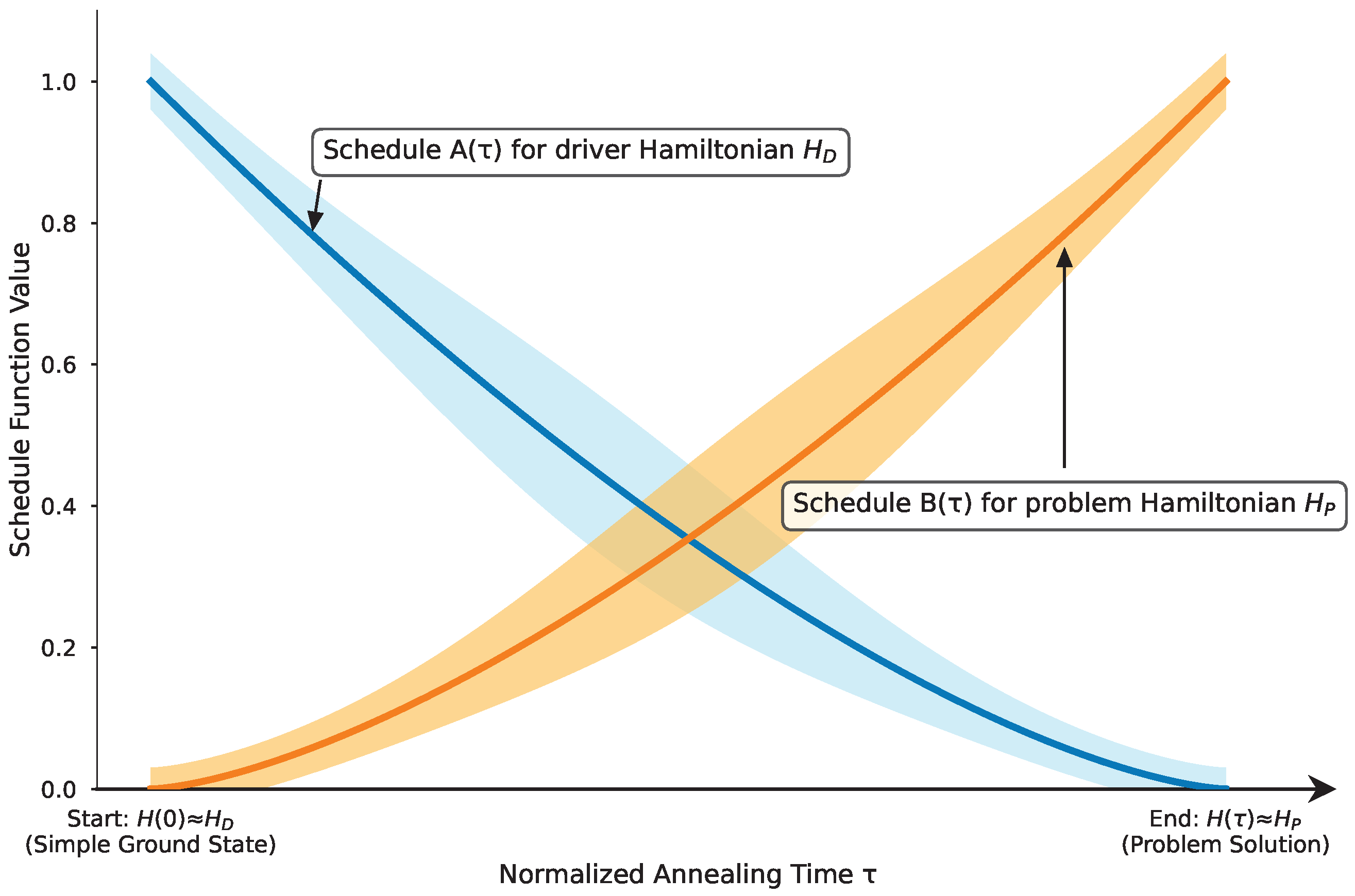
3.2. Quantum Annealing for the Master Problem
3.3. QUBO Reformulation of the Master
3.4. Coefficient Scaling and Penalty Initialization
- (i)
- Sampler-range normalization. Let and denote the BQM linear and quadratic coefficients. To respect hardware or sampler bounds, we scale all coefficients by a common factor such thatwhere are sampler-recommended limits (e.g., , ). This linear scaling preserves the minimizers of the QUBO.
- (ii)
- Penalty initialization from objective scale. Letwhere is a conservative upper bound on (e.g., obtained from a feasibility penalty envelope or a prior upper bound). The penalty coefficients for all constraint families are initialized asensuring that any violation induces a cost increment that dominates the linear contribution of the objective. The initialization of the penalty factor reflects a practical trade-off. If is too small, the QUBO minimizer may return solutions that violate the original constraints, resulting in infeasible master candidates. In contrast, if is too large, the objective landscape becomes overly dominated by the penalty terms, which compresses the effective dynamic range of the problem coefficients and may degrade performance due to hardware coefficient range limitations and reduced energy resolution. A sensitivity study over and is reported in Section 4.4.4, demonstrating that and provide stable and near-optimal performance for the present problem scale.
3.5. QA-Driven Master Strategy and Overall Algorithm
| Algorithm 2: QA-driven L-shaped method |
 |
4. Case Study
4.1. System and Data Setup
4.2. Experimental Design and Benchmark Models
4.2.1. Model Performance Evaluation:
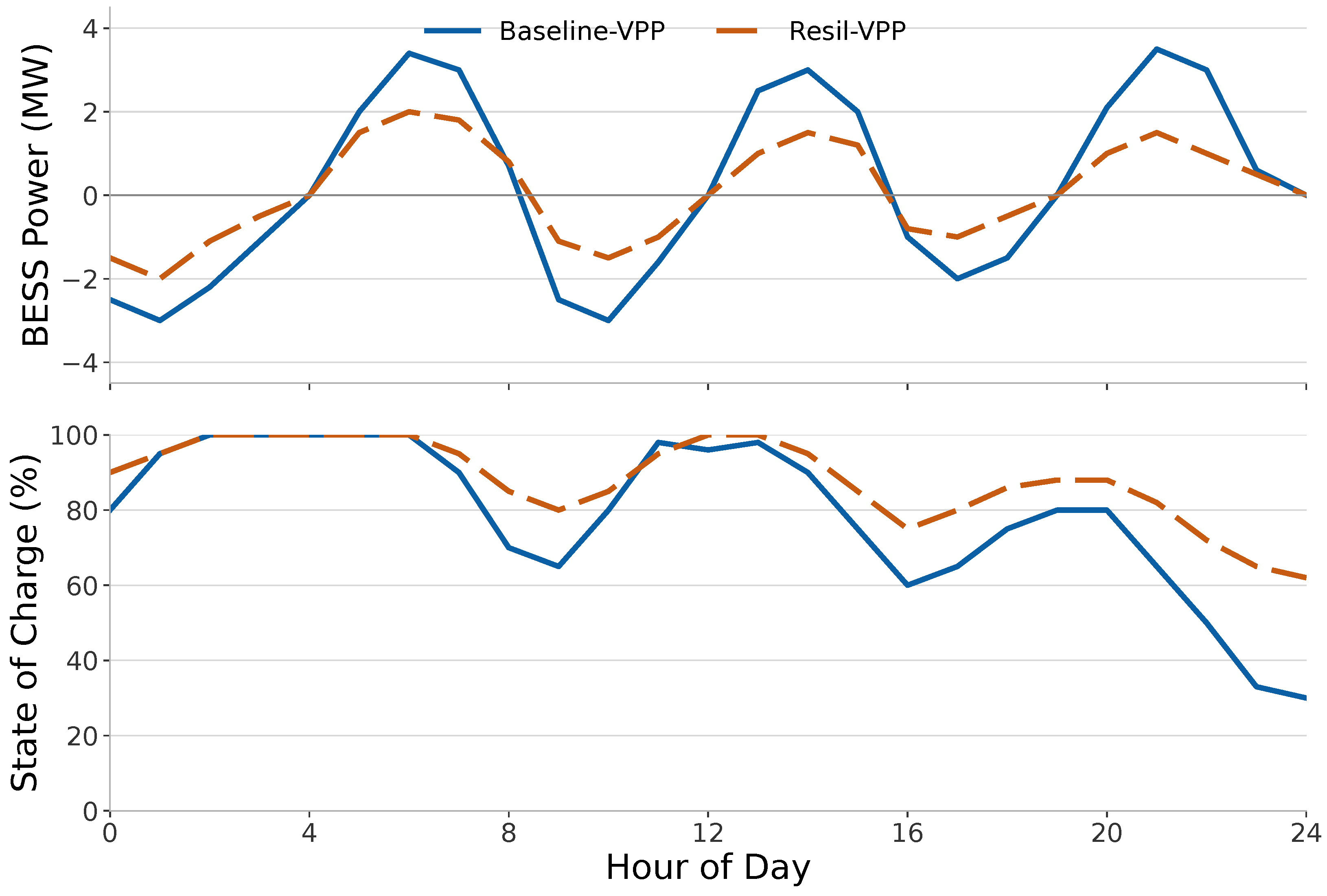
- Case 1: Baseline-VPP: This benchmark uses a standard two-stage stochastic dispatch model with only the 45 normal-operation scenarios. It does not model outage risk explicitly and therefore prioritizes economic performance in normal conditions.
- Case 2: Resil-VPP (Proposed Model): This model enforces functional differentiation through storage reserve sizing. A 70% portion is used for daily economic dispatch, while a 30% minimum reserve is protected in normal operation through the lower energy bound. During outages, this reserve can be used to maintain supply continuity. This 30% reserve partition is an explicit top-down resilience constraint; the model contribution is to combine this guarantee with scenario-aware stochastic optimization so the remaining flexibility is allocated adaptively.
4.2.2. Validation of the Hybrid Quantum–Classical Algorithm:
- Method A: Classical L-shaped (Classical Benchmark): This is the standard integer L-shaped method. The master problem is solved at each iteration using the Gurobi commercial MILP solver.
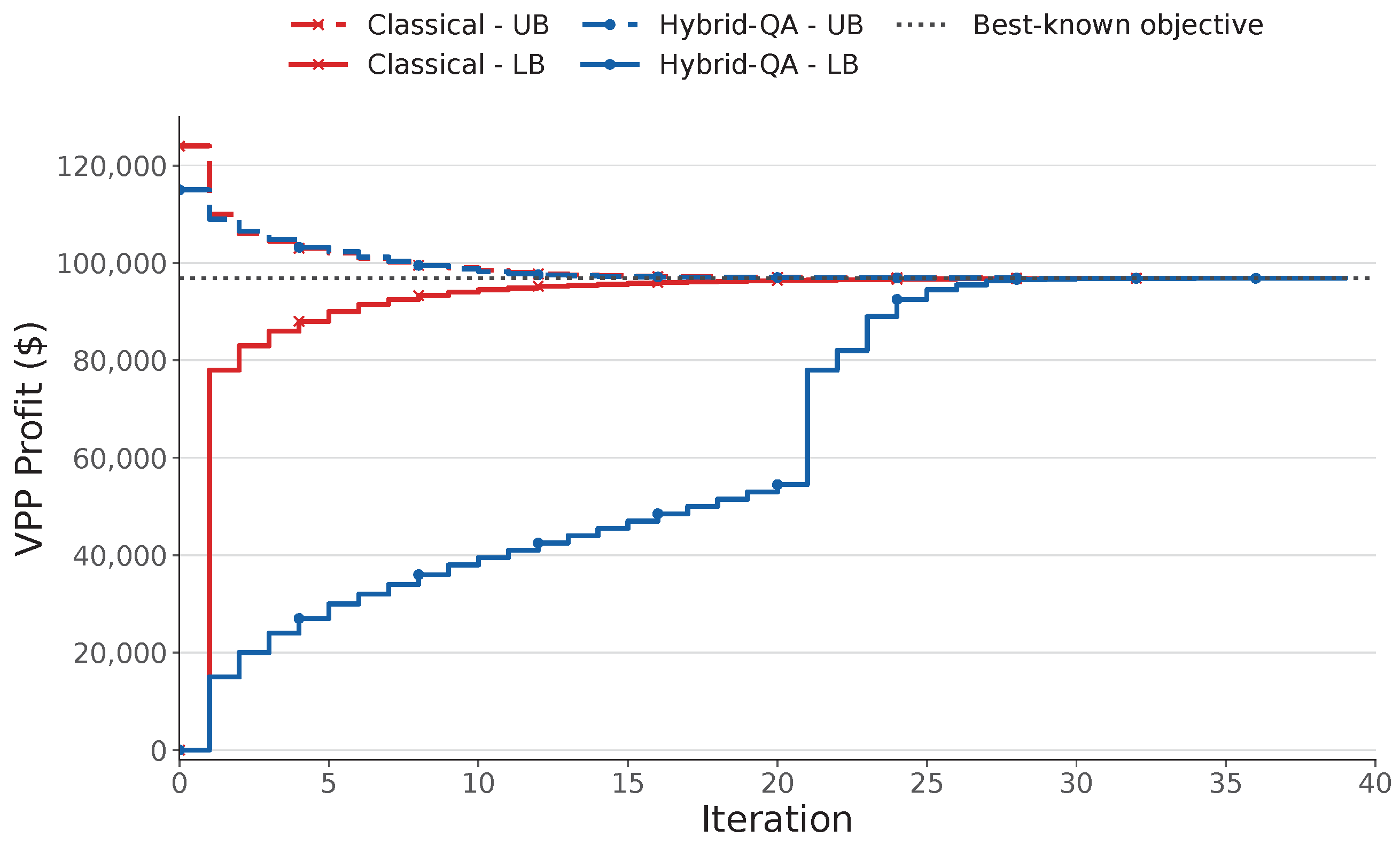
- Method B: QA-Driven L-shaped Method (Proposed Algorithm): This is our proposed hybrid algorithm. The QUBO-formulated master problem is solved at each iteration using the D-Wave Advantage quantum annealer.
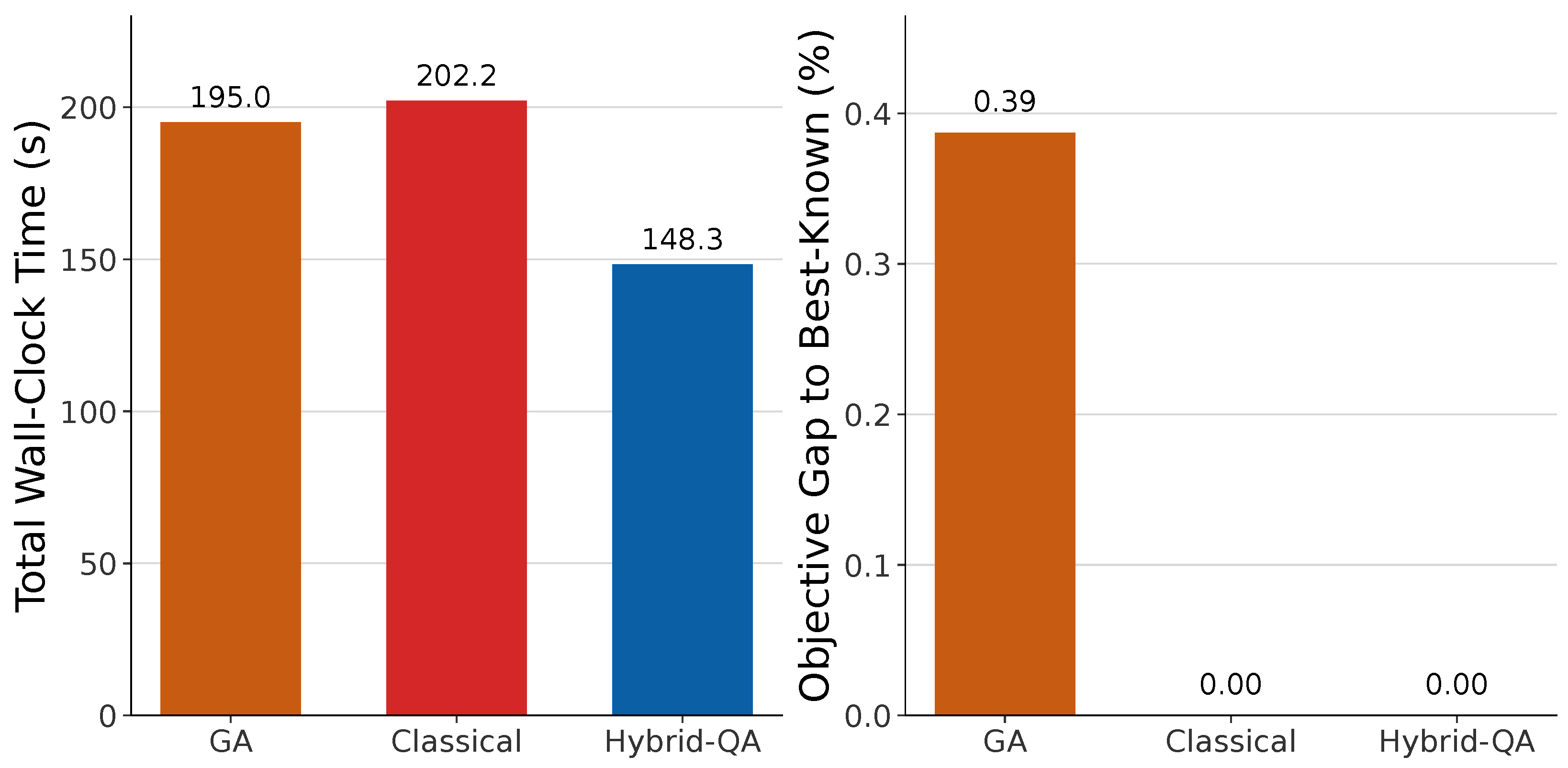
- Method C: Genetic Algorithm (GA Heuristic): A population of 50 binary chromosomes (24 h unit-commitment schedules) is evolved for 80 generations. Single-point crossover and bit-flip mutation rates are 0.80 and 0.02. To keep the runtime manageable, fitness is evaluated on 10 representative scenarios; the best chromosome is then re-evaluated on all 50 scenarios for final reporting.
4.3. Implementation Details
4.4. Results and Discussion
4.4.1. Performance of the Resilience-Constrained Dispatch Model
4.4.2. Sensitivity to Outage Duration and Load Fluctuation
4.4.3. Computational Performance of the QA-Driven L-Shaped Algorithm
4.4.4. Sensitivity to Discretization Resolution and Penalty Coefficient
5. Conclusions
Author Contributions
Funding
Data Availability Statement
Conflicts of Interest
References
- International Energy Agency. Data Centres and Data Transmission Networks. 2022. Available online: https://www.iea.org/energy-system/buildings/data-centres-and-data-transmission-networks (accessed on 7 October 2025).
- Fan, J.; Yan, R.; He, Y.; Zhang, J.; Zhao, W.; Liu, M.; An, S.; Ma, Q. Stochastic optimization of combined energy and computation task scheduling strategies of hybrid system with multi-energy storage system and data center. Renew. Energy 2025, 242, 122466. [Google Scholar] [CrossRef]
- Katiraei, F.; Morovati, S.; Chuangpishit, S.; Ghorashi, S.A. Virtual power plant empowerment in the next generation of data centers: Outlining the challenges. IEEE Electrif. Mag. 2023, 11, 35–44. [Google Scholar] [CrossRef]
- Modarresi, M.S.; Xie, L.; Campi, M.C.; Garatti, S.; Care, A.; Thatte, A.A.; Kumar, P. Scenario-based economic dispatch with tunable risk levels in high-renewable power systems. IEEE Trans. Power Syst. 2018, 34, 5103–5114. [Google Scholar] [CrossRef]
- Hanna, R.; Marqusee, J. Designing resilient decentralized energy systems: The importance of modeling extreme events and long-duration power outages. iScience 2022, 25, 103630. [Google Scholar] [CrossRef] [PubMed]
- Wolsey, L.A. Integer Programming; John Wiley & Sons: Hoboken, NJ, USA, 2020. [Google Scholar]
- Ullah, Z.; Mokryani, G.; Campean, F.; Hu, Y.F. Comprehensive review of VPPs planning, operation and scheduling considering the uncertainties related to renewable energy sources. IET Energy Syst. Integr. 2019, 1, 147–157. [Google Scholar] [CrossRef]
- Hua, W.; Li, D.; Sun, H.; Matthews, P.; Meng, F. Stochastic environmental and economic dispatch of power systems with virtual power plant in energy and reserve markets. Int. J. Smart Grid Clean Energy 2018, 7, 231–239. [Google Scholar] [CrossRef]
- Shinde, P.; Kouveliotis-Lysikatos, I.; Amelin, M. Multistage stochastic programming for vpp trading in continuous intraday electricity markets. IEEE Trans. Sustain. Energy 2022, 13, 1037–1048. [Google Scholar] [CrossRef]
- Yao, Y.; Liu, W.; Jain, R.; Chowdhury, B.; Wang, J.; Cox, R. Quantitative metrics for grid resilience evaluation and optimization. IEEE Trans. Sustain. Energy 2022, 14, 1244–1258. [Google Scholar] [CrossRef]
- Poudyal, A.; Poudel, S.; Dubey, A. Risk-based active distribution system planning for resilience against extreme weather events. IEEE Trans. Sustain. Energy 2022, 14, 1178–1192. [Google Scholar] [CrossRef]
- Bian, M.; Shi, Y.; Huang, Y.; Tang, X.W. QoS-aware energy storage maximization in the RIS-aided joint-SWIPT-MEC System. IEEE Commun. Lett. 2023, 27, 3434–3438. [Google Scholar] [CrossRef]
- Laporte, G.; Louveaux, F.V. The integer L-shaped method for stochastic integer programs with complete recourse. Oper. Res. Lett. 1993, 13, 133–142. [Google Scholar] [CrossRef]
- Angulo, G.; Ahmed, S.; Dey, S.S. Improving the integer L-shaped method. INFORMS J. Comput. 2016, 28, 483–499. [Google Scholar] [CrossRef]
- Ajagekar, A.; You, F. Quantum computing for energy systems optimization: Challenges and opportunities. Energy 2019, 179, 76–89. [Google Scholar] [CrossRef]
- Lin, D.; Wang, J.; Tseng, H.H.; Zhao, T.; Yue, M.; Yoo, S. Quantum Reinforcement Learning for Volt-VAR Control in Power Distribution Systems. IEEE Open Access J. Power Energy 2025, 12, 833–844. [Google Scholar] [CrossRef]
- Glover, F.; Kochenberger, G.; Du, Y. A tutorial on formulating and using QUBO models. arXiv 2018, arXiv:1811.11538. [Google Scholar]
- Pastorello, D.; Blanzieri, E. Quantum annealing learning search for solving QUBO problems. Quantum Inf. Process. 2019, 18, 303. [Google Scholar] [CrossRef]
- Richoux, F.; Baffier, J.F.; Codognet, P. Learning qubo models for quantum annealing: A constraint-based approach. In Proceedings of the International Conference on Computational Science; Springer: Berlin/Heidelberg, Germany, 2023; pp. 153–167. [Google Scholar]
- Hong, W.; Xu, W.; Teng, F. Qubit-Efficient Quantum Annealing for Stochastic Unit Commitment. arXiv 2025, arXiv:2502.15917. [Google Scholar] [CrossRef]
- Ling, J.; Zhang, Q.; Geng, G.; Jiang, Q. Hybrid quantum annealing decomposition framework for unit commitment. Electr. Power Syst. Res. 2025, 238, 111121. [Google Scholar] [CrossRef]
- Müller, S.; Dukalski, M.; Phillipson, F. Quantum Annealing for Optimizing Unit Scheduling in Renewable Energy Systems: Formulation and Evaluation. IEEE Trans. Power Syst. 2025, 41, 836–846. [Google Scholar] [CrossRef]
- Kaseb, Z.; Möller, M.; Vergara, P.P.; Palensky, P. Power flow analysis using quantum and digital annealers: A discrete combinatorial optimization approach. Sci. Rep. 2024, 14, 23216. [Google Scholar] [CrossRef]
- Kaseb, Z.; Moller, M.; Palensky, P.; Vergara, P.P. A Quantum-Enhanced Power Flow and Optimal Power Flow based on Combinatorial Reformulation. arXiv 2025, arXiv:2505.15978. [Google Scholar] [CrossRef]
- Silva, F.F.; Carvalho, P.M.; Ferreira, L.A. A quantum computing approach for minimum loss problems in electrical distribution networks. Sci. Rep. 2023, 13, 10777. [Google Scholar] [CrossRef] [PubMed]
- Quinton, F.A.; Myhr, P.A.S.; Barani, M.; Crespo del Granado, P.; Zhang, H. Quantum annealing applications, challenges and limitations for optimisation problems compared to classical solvers. Sci. Rep. 2025, 15, 12733. [Google Scholar] [CrossRef]
- Wu, L.; Shahidehpour, M.; Li, T. Stochastic security-constrained unit commitment. IEEE Trans. Power Syst. 2007, 22, 800–811. [Google Scholar] [CrossRef]
- Zheng, Q.P.; Wang, J.; Liu, A.L. Stochastic optimization for unit commitment—A review. IEEE Trans. Power Syst. 2014, 30, 1913–1924. [Google Scholar] [CrossRef]



| Symbol | Definition |
|---|---|
| Sets | |
| T | Set of time periods in the planning horizon, indexed by t. |
| G | Set of dispatchable thermal generators, indexed by g. |
| S * | Set of uncertainty scenarios, indexed by s. |
| Parameters | |
| Start-up and shut-down costs of generator (g). | |
| Probability of occurrence for scenario s. | |
| Initial on/off status of generator g at . | |
| Decision Variables | |
| Binary variable for the operational status of generator g. | |
| Binary variable for the start-up action of generator g. | |
| Binary variable for the shut-down action of generator g. | |
| Continuous variable for the expected total recourse cost. | |
| Continuous variable for the recourse cost of scenario s. | |
| Symbol | Definition |
|---|---|
| Parameters | |
| Variable operational cost of generator g. | |
| Unit cost for activating demand response. | |
| Penalty cost for load shedding. | |
| Maximum/minimum power output of generator g. | |
| Ramp-up and ramp-down rate limits of generator g. | |
| Maximum charging/discharging power of BESS unit b. | |
| Maximum/minimum state of energy of unit b. | |
| Charging/discharging efficiencies of unit b. | |
| Initial state of energy of unit b. | |
| Base and flexible components of the data center load. | |
| Power from photovoltaic sources. | |
| Real-time market price. | |
| Penalty factor for feasibility slack variables. | |
| Maximum allowable total load shedding in outage scenario s (MWh). | |
| Second-Stage Decision Variables () | |
| Power dispatch of generator g. | |
| Charging/discharging power of unit b. | |
| State of charge of unit b. | |
| Activated demand response. | |
| Amount of load shedding. | |
| Net power purchased from the real-time market. | |
| Slack variables for power balance feasibility. | |
| Component | Parameter | Value |
|---|---|---|
| VPP Assets and Load | ||
| Data Center Load | Peak Load | 10 MW |
| Critical Base Load | 8 MW | |
| Flexible Load | 2 MW | |
| Solar PV System | Installed Capacity | 5 MWp |
| Dispatchable Generator | Type | Natural Gas |
| Maximum Capacity | 12 MW | |
| Minimum Output | 2 MW | |
| Ramp Rate | 6 MW/h | |
| Variable Cost | $60/MWh | |
| Start-up Cost | $500 | |
| Shut-down Cost | $300 | |
| Battery Energy Storage | Energy Capacity | 20 MWh |
| Power Rating | 4 MW | |
| Round-trip Efficiency | 92% | |
| Initial State of Charge | 50% | |
| Long-Duration Storage Unit | Charging Power Rating | 2 MW |
| Discharging Power Rating | 2 MW | |
| Energy Capacity | 40 MWh | |
| Charging Efficiency () | 65% | |
| Discharging Efficiency () | 50% | |
| Initial State of Charge | 50% | |
| Stochastic Model Parameters | ||
| Scheduling Horizon | 24 h | |
| Time Resolution | 1 h | |
| Number of Scenarios | Total | 50 |
| Normal Operation () | 45 | |
| Grid Outage () | 5 | |
| Outage Duration | 6 h | |
| Scale | QUBO Vars | Classical Time (s) | QA Time (s) | ||||
|---|---|---|---|---|---|---|---|
| Baseline | 1 | 2 | 24 | 50 | ∼200 | 202 | 148 |
| Medium | 5 | 6 | 48 | 100 | ∼2000 | ∼890 | ∼430 |
| Large | 20 | 20 | 168 | 200 | ∼27,000 | >5000 | ∼1200 |
| Model | Avg. Load Shed (MWh) | Reserve Used (%) | Critical Load (%) | RI (%) |
|---|---|---|---|---|
| Baseline-VPP | 5.2 | 100 | 93.5 | 89.2 |
| Resil-VPP | 0.0 | 30 | 100.0 | 100.0 |
| Outage Duration (h) | Avg. Load Shed (MWh) | Cost Premium (%) | Reserve Depleted (%) |
|---|---|---|---|
| 3 | 0.0 | 2.1 | 15 |
| 6 | 0.0 | 3.7 | 30 |
| 12 | 1.4 | 5.9 | 100 |
| Method | Iters † | Avg. Time (s) | Total Time (s) | Final Obj. ($) |
|---|---|---|---|---|
| GA Heuristic | 80 | 2.4 | 195.0 | 97,218 ‡ |
| Classical L-shaped | 34 | 5.9 | 202.2 | 96,843.04 |
| Hybrid QA–L-shaped | 39 | 3.8 | 148.3 | 96,843.04 |
| Best Feasible Obj. ($) | Violation Rate (%) | ||
|---|---|---|---|
| 6 | 5 | 98,610 | 26.8 |
| 6 | 10 | 97,105 | 3.9 |
| 6 | 15 | 97,060 | 1.6 |
| 8 | 5 | 97,892 | 16.4 |
| 8 | 10 | 96,843 | 0.3 |
| 8 | 15 | 96,843 | 0.7 |
| 10 | 5 | 97,180 | 12.5 |
| 10 | 10 | 96,843 | 0.6 |
| 10 | 15 | 96,855 | 0.9 |
Disclaimer/Publisher’s Note: The statements, opinions and data contained in all publications are solely those of the individual author(s) and contributor(s) and not of MDPI and/or the editor(s). MDPI and/or the editor(s) disclaim responsibility for any injury to people or property resulting from any ideas, methods, instructions or products referred to in the content. |
© 2026 by the authors. Licensee MDPI, Basel, Switzerland. This article is an open access article distributed under the terms and conditions of the Creative Commons Attribution (CC BY) license.
Share and Cite
Li, W.; Li, C.; Zhang, X.; Xu, S.; Yue, Y.; Zhang, H. Resilience-Constrained Low-Carbon Dispatch of Industrial Parks with Storage and Quantum Acceleration. Processes 2026, 14, 1024. https://doi.org/10.3390/pr14061024
Li W, Li C, Zhang X, Xu S, Yue Y, Zhang H. Resilience-Constrained Low-Carbon Dispatch of Industrial Parks with Storage and Quantum Acceleration. Processes. 2026; 14(6):1024. https://doi.org/10.3390/pr14061024
Chicago/Turabian StyleLi, Wenfang, Chen Li, Xuemei Zhang, Shuai Xu, Yaqing Yue, and Haijing Zhang. 2026. "Resilience-Constrained Low-Carbon Dispatch of Industrial Parks with Storage and Quantum Acceleration" Processes 14, no. 6: 1024. https://doi.org/10.3390/pr14061024
APA StyleLi, W., Li, C., Zhang, X., Xu, S., Yue, Y., & Zhang, H. (2026). Resilience-Constrained Low-Carbon Dispatch of Industrial Parks with Storage and Quantum Acceleration. Processes, 14(6), 1024. https://doi.org/10.3390/pr14061024