Article

Comparison of Granular and Pellet Olive Stone-Based Activated Carbon in Adsorption-Based Post-Combustion CO2 Capture

by
Meriem Moussa
1,*,
Covadonga Pevida
2,
Nausika Querejeta
2 and
Abdelmottaleb Ouederni
1
1
Research Laboratory of Process Engineering and Industrial Systems (LR11ES54), National School of Engineers of Gabes, University of Gabes, Gabes 6026, Tunisia
2
Instituto de Ciencia y Tecnología del Carbono, INCAR-CSIC, Francisco Pintado Fe 26, 33011 Oviedo, Spain
*
Author to whom correspondence should be addressed.
Processes 2026, 14(6), 1023; https://doi.org/10.3390/pr14061023
Submission received: 4 December 2025 / Revised: 9 March 2026 / Accepted: 13 March 2026 / Published: 23 March 2026

Abstract

In the present study, we evaluate the CO2 uptake capacities of four activated carbons (ACs) obtained from olive stones. Two of the samples were generated using a chemical process utilizing phosphoric acid, thereafter undergoing carbonization in a nitrogen steam, yielding both granular and pellet forms, designated CH-ACG-410 and CH-ACP-410, respectively. The third sample, labeled CO-ACG-390, was produced by carbonization under a steam-nitrogen flow, while the fourth sample, designated PH-ACG-850, was prepared by a physical process involving water vapor at 850 °C. The carbon materials obtained in granular and pellet form were subjected to textural characterization using N2 and CO2 adsorption isotherms at 77 K and 273 K, respectively. Additionally, surface chemistry was analyzed using FTIR, Boehm titration, and TPD-MS. The materials were also assessed for CO2 adsorption in a binary mixture consisting of 10% CO2 and 90% N2 at two temperatures, 25 and 50 °C. The results demonstrated that all prepared adsorbents exhibited competitive CO2 capture performance, with the CH-ACP-410 sample (pellet form), showing the highest adsorption capacities, achieving approximately 4.6 wt. % at 25 °C and 2.2 wt. % at 50 °C. This superior behavior can be attributed to the conditioning methods applied to this material, which significantly influenced its textural properties and, consequently, its CO2 adsorption capability.

1. Introduction

Finding an effective solution to climate change represents one of the primary challenges of our era, driven primarily by increasing concentrations of greenhouse gases in the atmosphere. Carbon dioxide (CO2) is the most critical contributor to global warming. Since the start of the Industrial Revolution in the mid-19th century, 1850s, carbon dioxide levels have risen significantly due to the combustion of fossil fuels and biomass [1]. To mitigate “hard-to-abate” CO2 emissions from industrial processes, one of the only available strategies is carbon capture and storage (CCS). Among the various CCS technologies, adsorption stands out as one of the most practical, effective, and cost-efficient methods for CO2 capture [2]. Consequently, significant research has focused on a wide array of solid adsorbents, including zeolites [3], activated aluminas [4], carbon-based materials [5,6], silicas [7], and amine-based adsorbents [8,9,10]. More recently, advanced porous materials such as metal–organic frameworks (MOFs) [11,12,13], zeolitic imidazole frameworks (ZIFs) [14], and porous organic polymers (POPs) [15,16,17] have been explored for their tunable properties.
However, composite materials and waste-derived sorbents represent important avenues for cost-effective and sustainable capture [18]. Among these, activated carbons offer a series of significant advantages for large-scale CO2 capture, including high adsorption capacity, fast adsorption and desorption kinetics, chemical stability, availability, and low regeneration energy [19].
Furthermore, activated carbons can be derived from waste biomass—a low-cost, renewable, and globally abundant carbon source that aligns with the principles of green synthesis and a circular economy. Examples include olive stones [20], almond shells [21], coconut shells [22], and sewage sludge [23].
Usually direct pyrolysis and activation are used to convert these precursors into porous carbon compounds. Activation, necessary for creating the pore structure, is typically performed using one of three methods: chemical, physical, or a combination of both [24]. Chemical activation involves subjecting the precursor material to a dehydrating agent, such as phosphoric acid, zinc chloride, or potassium hydroxide, at temperatures between 400 and 1000 °C, subsequently followed by the elimination of the dehydrating agent through multiple washes with deionized water [25].
Physical activation typically occurs in a two-step process: first, the carbonaceous raw materials are carbonized in an inert atmosphere, usually below 800 °C; subsequently, the resultant char undergoes activation through partial gasification at temperatures ranging from 700 to 1000 °C, utilizing carbon dioxide, steam, or a combination of both [26].
This study focuses on synthesizing activated carbons from local biomass residues, specifically olive stones, to serve as CO2 adsorbents in post-combustion conditions. The primary objective is to optimize carbon’s porosity through various activation processes and conditions to maximize CO2 adsorption capacity while also aiming to minimize setup costs and simplify synthesis. To achieve this, we developed a series of activated carbons in granular and pellet forms using three different methods: chemical activation, physical activation, and a combined process. This approach allows us to investigate their textural and structural properties while comparing their kinetics and CO2 uptake capacities.

2. Materials and Methods

2.1. Preparation of Activated Carbon Samples

Olive stones (OSs), a by-product of Tunisian olive oil factories, were used in this study as a precursor to prepare activated carbon sorbents via different activation processes, as described in our lab [27,28].
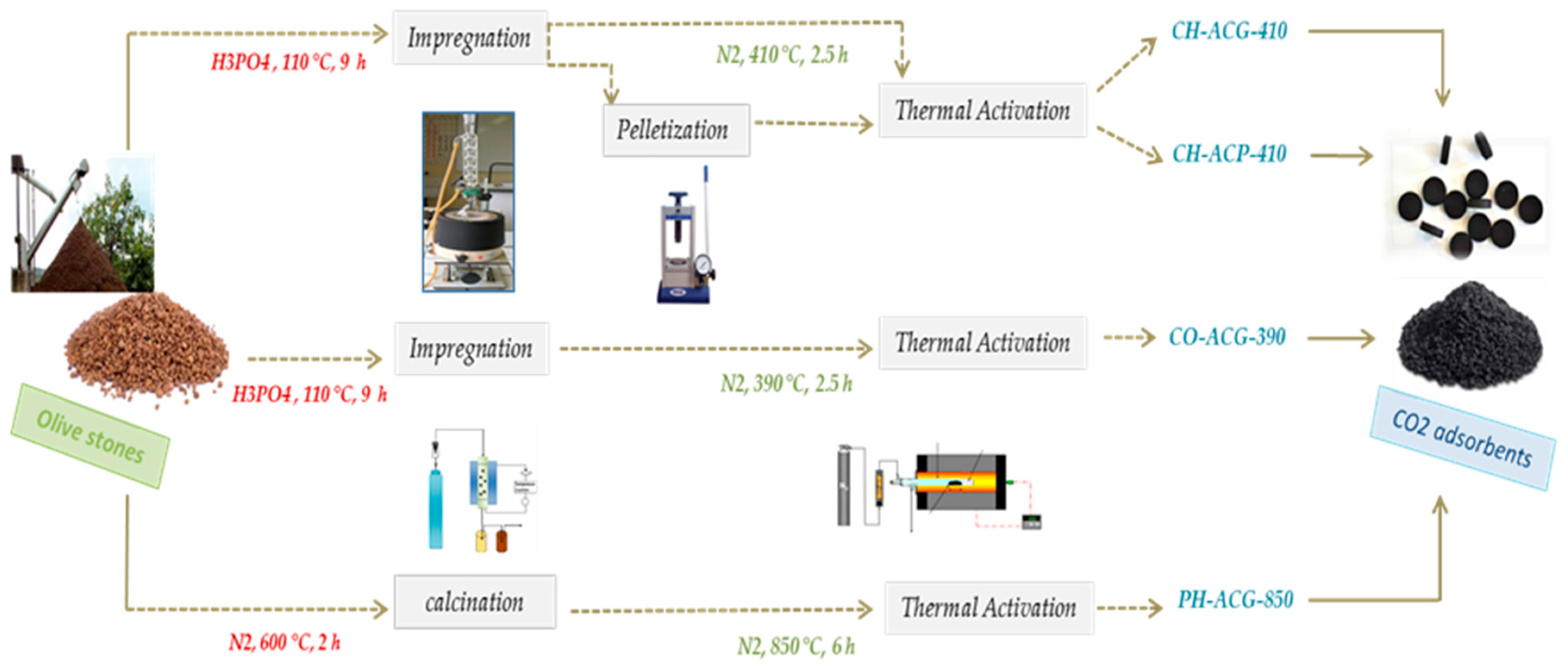
Before use, olive stones were washed several times with deionized water to remove impurities, and then dried at room temperature to obtain grains approximately 1–3 mm in size. Four activated carbons were prepared in this study, as shown in Figure 1: two samples were chemically activated with H3PO4, one in the form of granular material named CH-ACG-410 and the second in the form of pellet noted CH-ACP-410. In this process, the precursor mass was mixed with a 50% (w/w) phosphoric acid solution using a 1:3 weight ratio. The chemically impregnated olive stones suspension was heated to 110 °C and maintained at that temperature for nine hours. The resulting filtrate was subjected to a two-step carbonization process, first at 170 °C for 30 min, followed by a second stage at 410 °C for 2.5 h. The adsorbent was extensively washed with deionized water to remove all residual H3PO4, continuing until the wash solution reached a pH between 6 and 7 [29]. The CH-ACP-410 was prepared similarly by pressing the impregnated raw material into cylindrical pellets before calcination [28]. The combined activated carbon, noted CO-ACG-390, was synthesized by impregnating olive stones with H3PO4 under the same conditions as the first product. The dry solid was thermally activated in a horizontal tube furnace under a nitrogen and water vapor atmosphere, using a two-step protocol: 30 min at 170 °C, followed by 2.5 h at 390 °C. The fourth sample, named PH-ACG-850, was physically activated with steam and nitrogen in two steps: initial carbonization of the precursor in a fixed-bed reactor at 600 °C (1 h, N2 flow), followed by steam activation of the produced char at 850 °C for 6 h (70 vol.% H2O in N2, total flow rate of 10 NL/h) [30].

2.2. Characterization of Samples

2.2.1. Pore Structure Characterization

The textural properties of the synthesized activated carbons were determined via gas physisorption analysis. Nitrogen adsorption isotherms were measured at −196 °C using an ASAP 2010 analyzer (Micromeritics Instrument Corp., Norcross, GA, USA), while carbon dioxide adsorption was assessed at 0 °C with a TriStar 3000 instrument (Micromeritics Instrument Corp., Norcross, GA, USA). Prior to analysis, each sample was subjected to overnight degassing at 100 °C under vacuum. The specific surface area (SBET) was calculated by applying the Brunauer–Emmett–Teller (BET) model to the N2 adsorption data in the relative pressure (P/P0) interval of 0.1–0.3 [31]. The total pore volume was determined from the volume of N2 adsorbed at a relative pressure (P/P0) of 0.99. Narrow micropore volumes (W0), corresponding to pores narrower than 0.7 nm, were derived from CO2 adsorption isotherms by applying the Dubinin–Radushkevich (DR) equation [32]. The average micropore width (L0) was calculated via the Stoeckli–Ballerini relation [33]. Furthermore, pore size distributions (PSD) were derived from the CO2 isotherms using the non-local density functional theory (NLDFT).

2.2.2. Chemical Surface Characterization

The Point of Zero Charge (pHPZC), which reflects a material’s acid-base surface properties, was determined for all samples via a mass titration method adapted from Savova et al. [34]. The surface chemistry of the activated carbon samples was characterized by determining the identity and concentration of functional groups via Fourier Transform Infrared Spectroscopy (FTIR), Boehm titration, and Temperature Programmed Desorption (TPD) analysis. FTIR spectra were performed on a Perkin Elmer 8400 instrument (PerkinElmer, Inc., Waltham, MA, USA), covering the spectral range of 4000–400 cm−1 at a resolution of 4 cm−1. For analysis, sample pellets were prepared by compressing a mixture of finely ground carbon (1 wt%) with KBr. However, the Boehm titration method was adapted by Heidari et al. (2014) [35], and for TPD analysis, approximately 20 mg of the activated carbon sample was loaded into a platinum crucible and heated from ambient temperature to 1000 °C under an argon flow using a Setaram TGA92 thermogravimetric analyzer coupled with a mass spectrometer. During heating, oxygen-containing surface groups decompose, evolving CO and CO2 gases. Carboxyl groups, lactones, and anhydrides primarily release CO2, whereas CO is generated from phenols, carbonyls, quinones, pyrones, and anhydrides. The mass spectrometer tracked these emissions by monitoring the mass-to-charge (m/z) ratios of 28 and 44 for CO and CO2, respectively [36].

2.3. CO2 Adsorption Measurements

The CO2 adsorption behavior of the prepared materials under conditions representative of post-combustion capture was evaluated using a Mettler Toledo TGA/DSC1 thermogravimetric analyzer. The CO2 uptake was calculated from the mass evolution profiles recorded during the samples’ exposure to a 10% CO2 (balance N2) gas stream. Before performing the binary-mixture adsorption tests, the samples were heated at 100 °C for 1 h under pure N2 at a flow rate of 100 cm3·min−1 to dry them and remove any residual gases. Subsequently, the samples were allowed to cool to the adsorption test temperature, either 25 or 50 °C. Once temperature stabilization was achieved, the gas flow was switched from pure N2 to a 10% CO2 mixture (balance N2), maintaining the same flow rate. The sample mass increased during CO2 adsorption until equilibrium was reached. The total mass gain, expressed as a weight percentage, is denoted as qN2+CO2. Further details on the calculation of CO2 capacity are available elsewhere [37]. Regeneration was then performed under a pure N2 flow at the adsorption temperature.

2.4. Kinetic Studies

2.4.1. Adsorption Rate

The CO2 adsorption kinetics of activated carbon (AC) samples are essential for evaluating dynamic performance and for understanding how textural and surface chemical properties influence uptake capacity. In this study, two kinetic models were employed to analyze the CO2 adsorption kinetics of the AC samples: the pseudo-first order model and the Avrami fractional-order model. These models were selected for their established effectiveness in characterizing the adsorption kinetics of physical adsorbents [38].
  • Pseudo-first order model
The pseudo-first-order model, also known as the linear driving force (LDF) model [39], is widely used in adsorption kinetics. It operates on the premise that the adsorption rate is directly proportional to the concentration of available adsorption sites [40,41], as expressed by the following Equation (1):
d q d t = k 1 q e q t
Here, qe and qt represent the adsorption capacities at equilibrium and at a given time t, respectively, while k1 is the pseudo-first-order rate constant. Given the boundary conditions qt = 0 at t = 0 and qt = qe at t =∞, Equation (1) integrates to obtain Equation (2):
q t = q e 1 e k 1 t
The pseudo-first-order model is suited for predicting CO2 physisorption on solid sorbents, as it describes a reversible adsorbent–adsorbate interaction [42].
  • Avrami’s fractional model
Originally developed to model phase transitions and crystal growth rates in materials [43], the Avrami equation has recently been adapted as an effective method for predicting CO2 adsorption kinetics on biomass-derived activated carbons [38], modified activated carbon [44] and carbon hydrochar [45]. Its general form is given by Equation (3):
d q d t = k A n A   t n A 1 q e q t
In this model, kA (min−1) is the rate constant and nA is the Avrami exponent, a parameter related to the adsorption mechanism that helps identify interactions during the process [32]. An exponent nA = 1, it indicates homogeneous adsorption [46], while values of 2, 3 and 4 signify one-, two- and three-dimensional growth, respectively [38,47]. The integrated form of Equation (3), given by Equation (4), is as follows:
q t   =   q e   ( 1   e ( k A t ) n A ) ,
  • Validation of the kinetic model
In this study, the standard deviation was used to assess the divergence between the measured data and model predictions. Furthermore, the sum of squared errors (SSE) and the coefficient of determination (R2) were calculated using Equations (5) and (6):
S S E   ( % ) =   ( q t , exp     q t , p r e d ) 2 N ×   100
R 2 =   1   ( i = 1 N ( q t , exp     q t , p r e d ) 2 i = 1 N ( q t , exp     q t , exp ¯ ) 2   )   ( N 1 N P )
Here qt,exp and qt,pred are the experimentally measured and model-predicted adsorption capacities, respectively; N is the number of experimental data points, and p denotes the number of parameters in the model [48].

2.4.2. Adsorption Mechanism

Adsorption kinetics is crucial for assessing an adsorbent’s performance. However, many kinetic models do not explicitly differentiate the underlying adsorption mechanisms; therefore, it is essential, especially for practical applications, to consider models that account for diffusion mechanisms and identify the process’s rate-limiting step. The intra-particle diffusion model, proposed by Weber and Morris [49] and based on Fick’s second law, is given by Equation (7). It identifies the consecutive mass transfer stages during adsorption.
q t   =   k i d     t 1 / 2 +     C
Here kid is the intra-particle diffusion rate constant, and C is a constant related to the boundary-layer thickness. A higher C value indicates a more pronounced boundary-layer effect [50,51]. This model stipulates that diffusion is involved in adsorption when a linear plot of qt versus t1/2 is obtained. Furthermore, intra-particle diffusion is identified as the sole rate-determining step only when the corresponding linear plot intersects the origin. Nevertheless, multilinearity in the qtt1/2 plot is commonly observed, indicating an adsorption process that proceeds in distinct stages.
Most frequently, the Weber–Morris model identifies three sequential steps. The first corresponds to external diffusion (boundary layer diffusion), the second to the gradual adsorption stage (i.e., intra-particle diffusion proper), and the third to the final equilibrium stage [42]. However, the third step is generally considered rapid and not rate-determining [52]. In each stage, the slope of the linear segment represents the rate parameter, kid,i (where i denotes the stage number). The rate-limiting corresponds to the process stage with the lowest slope [42].

3. Results and Discussion

3.1. Textural Characterization

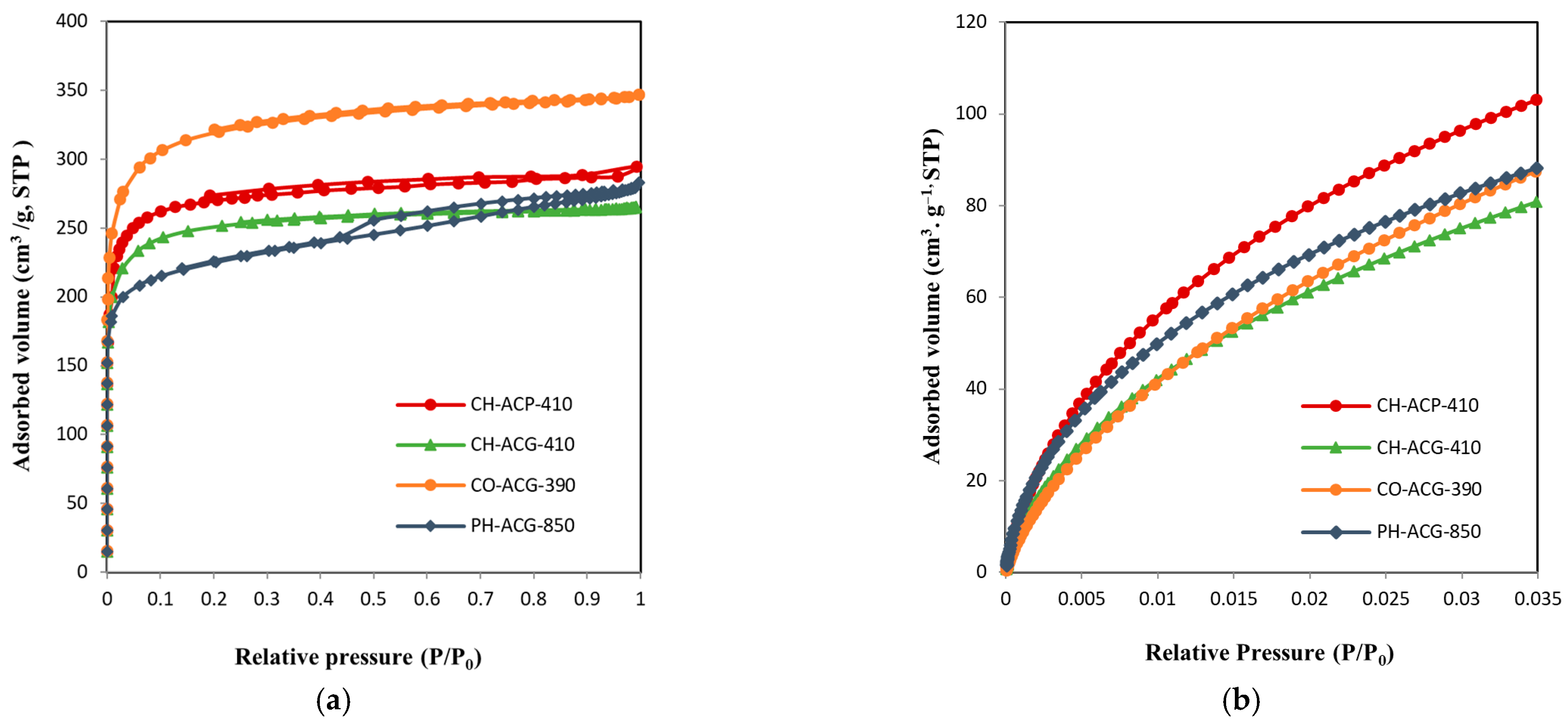
The four prepared carbon samples were analyzed using N2 and CO2 adsorption at −196 °C and 0 °C, respectively (see Figure 2). Given that CO2 adsorption occurs at much higher temperatures than N2 diffusion restrictions are reduced, and the CO2 molecules are easily transported throughout the ultra-micropores (<0.7 nm), complementing the information provided by the N2 isotherms [48].
The textural properties derived from the N2 and CO2 adsorption–desorption isotherms for all ACs are presented in Table 1.
Figure 2a shows that the three carbonaceous materials (CH-ACP-410, CH-ACG-410, and CO-ACG-390) exhibit completely reversible isotherms corresponding to type I under the IUPAC classification. These samples exhibit strong monolayer adsorption at low relative pressure (P/P0 < 0.3), followed by a horizontal plateau in the 0.3–0.9 range due to saturation of active sites. This type of isotherm is characteristic of essentially microporous materials. The common factor among the first three samples is that they are all activated with phosphoric acid and carbonized at approximately 400 °C. Yorgun and Yildiz reported an 82% microporous volume for activated carbons derived from Paulownia wood through chemical activation with H3PO4; they explained this by noting that 400 °C is the optimal carbonization temperature for chemical activation. These micropores are also formed during the activation step due to the release of heteroatoms, such as H and O, from phosphoric acid [53].
For the physically activated carbon PH-ACG-850, the nitrogen adsorption–desorption isotherm is of type IV, characterized by strong monolayer adsorption (P/P0: 0–0.3), followed by a plateau corresponding to the progressive filling of the pores (P/P0: 0.3–1). The sharp rise in the adsorption branch and the presence of a hysteresis loop at high relative pressures indicate the simultaneous presence of micro and mesopores. It is because the PH-ACG-850 sample is physically activated by water vapor. Thus, the nature of the activating agent influences the material’s pore distribution. For example, the use of carbon dioxide as an oxidizing agent promotes the development of microporosity, while water vapor favors larger pore dimensions. It contributes to the formation of mesopores in our case [54].
Figure 2b displays the experimental CO2 adsorption isotherms obtained at 0 °C. As observed, all the carbon materials present almost the same shape. Their adsorption curves confirm type I behavior, indicating a strong adsorbate-adsorbent interaction [36].
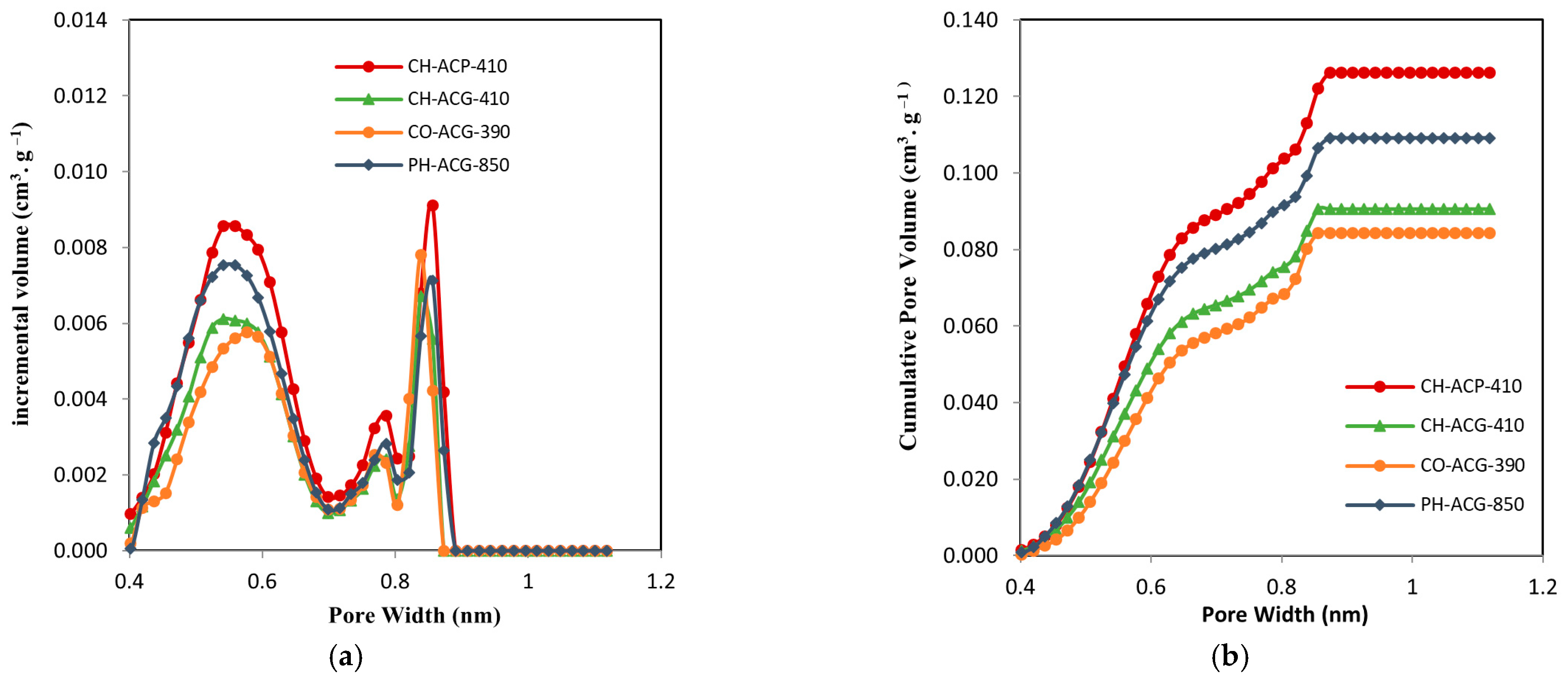
Figure 3a,b display the pore size distribution (PSD) and cumulative pore volume as determined by CO2 adsorption at 0 °C.
The evolution of the pore-size distribution of the prepared adsorbents indicates that all samples exhibit a broader distribution spanning 0.4–0.9 nm. Sample CH-ACP-410 exhibits the largest micropore volume in the narrowest range between 0.4 and 0.7 nm. A large volume in the ultra-micropore range (smaller than 0.7 nm) is highly desirable for CO2 adsorption under post-combustion conditions [28]. These results suggest that the pelletizing process reduces interparticle space and decreases mesopore volume, generating narrower micropores.
The CO2 uptakes at atmospheric pressure (1 bar) and sub-atmospheric pressure (0.15 bar), determined from the CO2 adsorption isotherms at 0 °C for the prepared adsorbents, are also reported in Table 1. These pressures were chosen from the literature because they mimic typical conditions for post-combustion CO2 removal from flue gas.
As shown in Table 1, the pelletized AC (CH-ACP-410) exhibits the highest CO2 adsorption capacity, followed by the physically activated sample (PH-ACG-850), at both low (0.15 bar CO2) and atmospheric pressure. Specifically, the CO2 uptake for these two samples is approximately 1.53 and 1.43 mmol·g−1 at 0.15 bar, and 4.60 and 3.93 mmol·g−1 at 1 bar, respectively. These values are highly competitive compared to those reported in the literature [37]. Notably, the pelletized sample outperforms its granular counterpart despite being activated under similar conditions. As previously discussed, this enhanced performance can be attributed to the pelletizing process, which reduces interparticle space and decreases mesopore volume, ultimately generating a greater volume of narrower micropores. A correlation between the porosity data and CO2 uptake reveals that, at both atmospheric and sub-atmospheric pressures, adsorption capacity is more strongly influenced by micropore surface area than by total surface area. This finding aligns with the observation that the top-performing samples, CH-ACP-410 and PH-ACG-850, possess narrower micropore volumes than the other two adsorbents. The importance of these narrow micropores is further underscored by the study of Xin Liu, which demonstrated that CO2 uptake at 1 bar is directly proportional to the volume of micropores smaller than 1 nm [55].

3.2. Determination of Surface Oxygen Functional Groups

Given that CO2 adsorption on carbon materials depends on textural properties, surface chemistry, and specific adsorbate-adsorbent interactions, this section examines the correlation between the chemical characteristics of activated carbon and its CO2 adsorption capacity.
Table 2 summarizes the surface chemical properties of the prepared adsorbents, including total acidity and basicity, obtained from Boehm titration and the corresponding Point of Zero Charge for each material. From this table, the CH-ACP-410 and CH-ACG-410 samples, activated with phosphoric acid, show pHPzc values of 2.4 and 2.7, respectively, indicating a strongly acidic character. This is due to H3PO4 being a strong oxidant of carbon atom surfaces [56]. For the CO-ACG-390 sample, the pHPzc is higher at 5.06, but it still exhibits acidic character. This value can be attributed to the utilization of both phosphoric acid and water vapor as activating agents. However, the physically activated sample PH-ACG-850 has a pHPzc very close to neutral. It shows that the sample behaves like an amphoteric compound. As expected, the observed pHpzc values correlate with the distribution of acidic and basic functional groups across the various carbon materials, with the total quantity of acidic functional groups decreasing as pHpzc values increase. Thus, the results show relatively firm acidity up to 3 meq/g, for the two carbon materials CH-ACP-410 and CH-ACG-410, with almost negligible basicity. More acidic sites indicate a material rich in oxygenated groups.
In contrast, for sample PH-ACG-850, which was activated by water vapor, the total quantity of basic groups (1.85 meq/g) exceeds that of acidic groups. The pHPzc value around 7 confirms this result. This basic character can be partially attributed to the presence of free oxygen in the form of Lewis bases, a feature often associated with the π- electron system of the graphite layers [57].
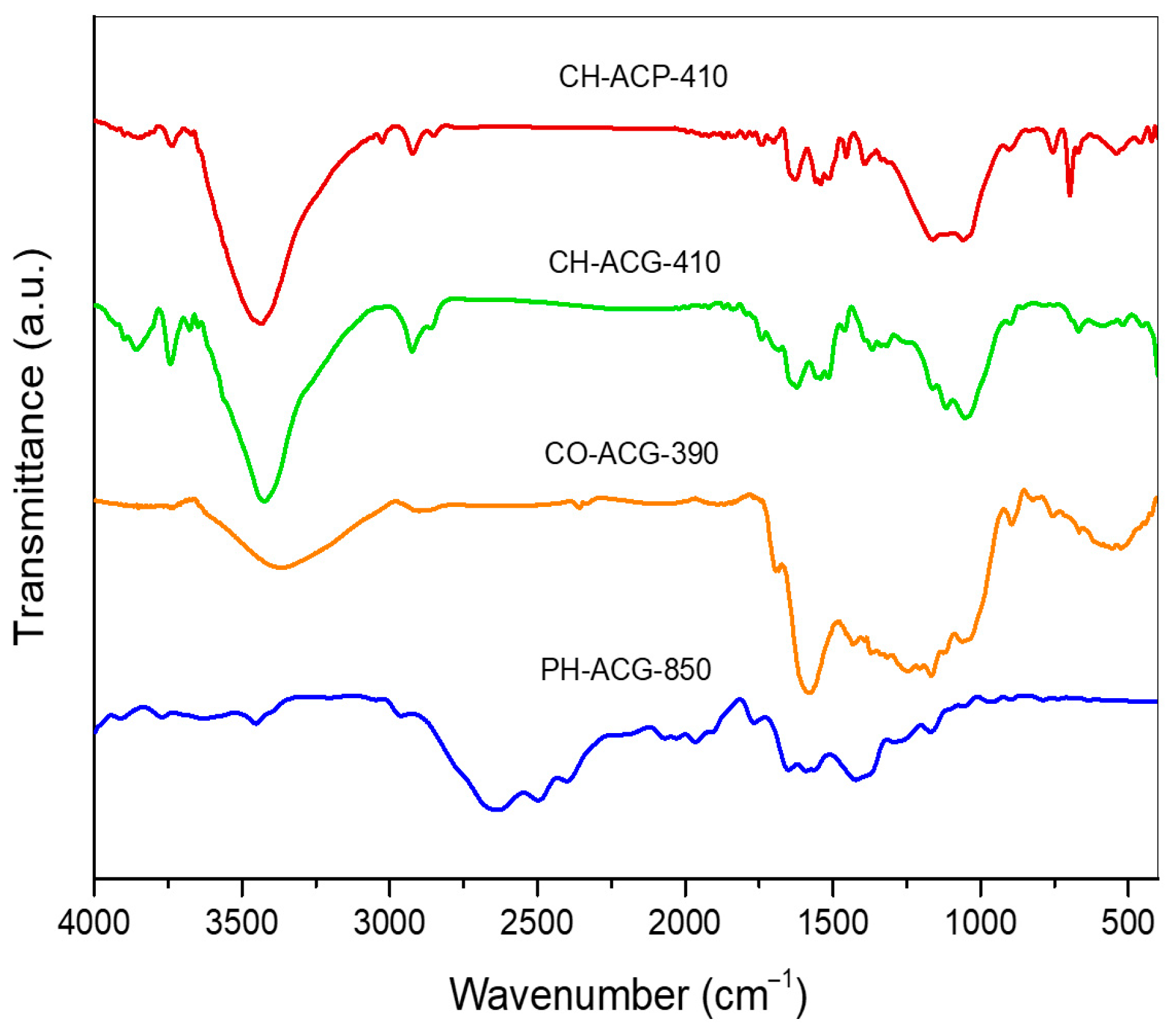
The surface functional groups of the adsorbents were further characterized by FTIR spectroscopy; the resulting spectra for the prepared activated carbons are presented in Figure 4.
Examining the figure above, we observe that CH-ACP-410, CH-ACG-410 and CO-ACG-390 display a broad, intense absorption band between 3600 and 3200 cm−1, centered at approximately 3427 cm−1. This band corresponds to the O-H stretching vibration typically found in hydroxyl-containing compounds, and its broadening indicates extensive hydrogen bonding, suggesting a high degree of molecular association [58]. This indicates the presence of hydroxyl groups, such as carboxyl, phenolic, or alcoholic, in the carbon samples. This band is almost nonexistent for physically activated carbon. The presence of these hydroxyl (OH) groups, as evidenced by the very intense bands in the two samples CH-ACG-410 and CH-ACP-410, is responsible for their strongly acidic character. Furthermore, the spectra of the two chemically activated samples, CH-ACP-410 and CH-ACG-410, exhibit aliphatic C–H stretching vibrations. The asymmetric and symmetric stretches of methylene (>CH2) groups are observed at 2924 cm−1 and 2851 cm−1, respectively [59], indicating the presence of aliphatic structures. The two samples CH-ACP-410 and CH-ACG-410 also showed a broad band in the primary fingerprint region (1622–1543 cm−1), corresponding to aromatic C=C ring-stretching vibrations. The presence of primary alcohols is corroborated by C-O stretching bands in the 1051–1011 cm−1 range. According to the results, the two ACs have very similar spectra. Furthermore, the presence of acidic oxides, as mentioned before, helps explain the acidic character of these samples and their relatively high oxygen content. As is well known, the oxygen-containing surface functionalities of carbonaceous materials play a key role in CO2 adsorption, especially at low relative pressure. For all samples, the bands observed in the 1000–1350 cm−1 region correspond to C-O stretching vibrations. The aromatic character of the carbon materials is supported by the presence of aromatic C-H stretching modes between 1000 and 400 cm−1.
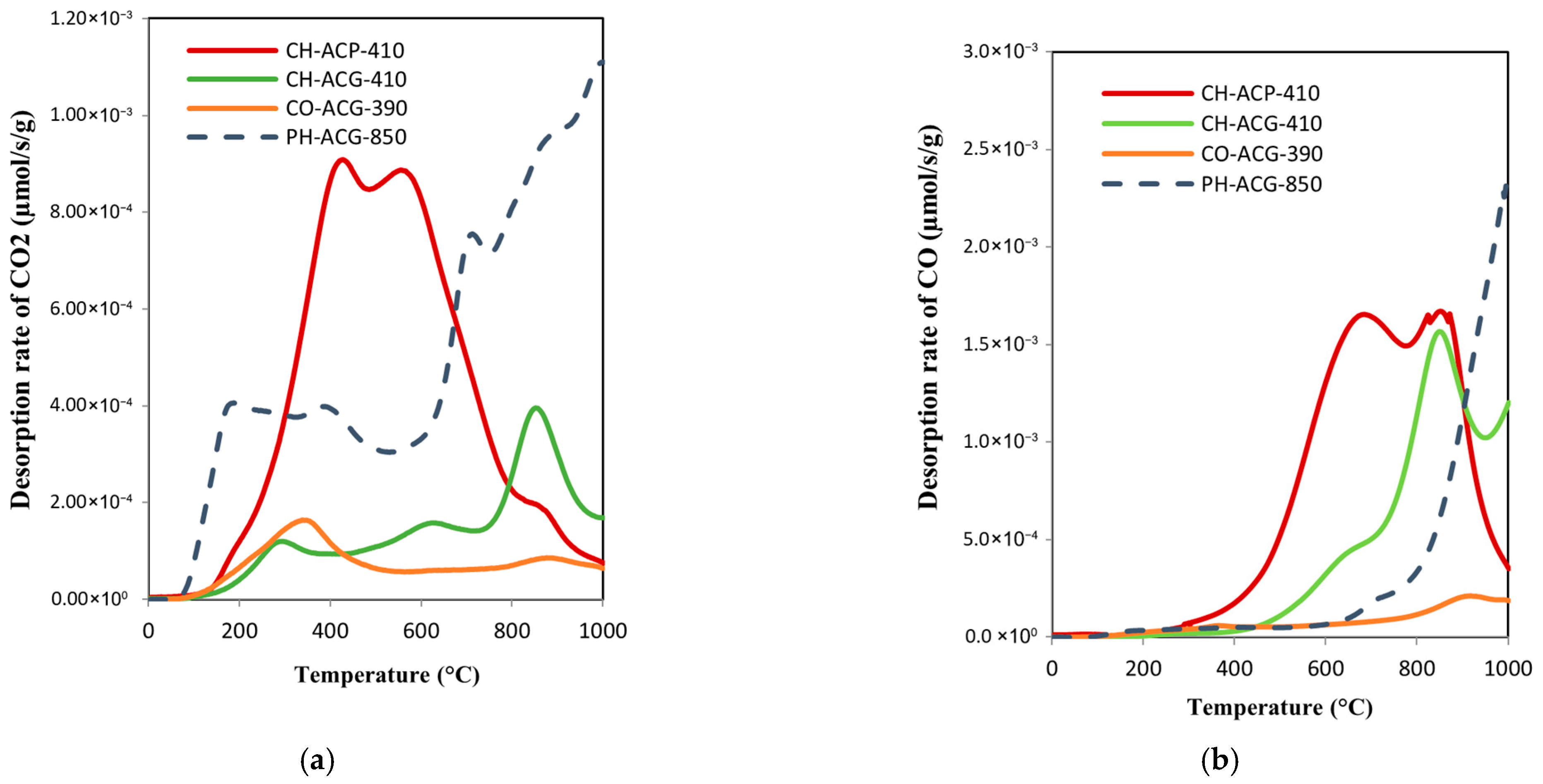
Temperature-programmed desorption (TPD) tests were utilized to monitor the desorption of surface oxygen species, as evidenced by the CO and CO2 profiles obtained over the applied temperature range. The nature of the surface oxygen functionalities can be inferred from the type of COx groups evolved and their corresponding desorption temperatures. Specifically, CO2 evolution is typically associated with the decomposition of carboxyl or anhydride groups, whereas CO release originates from carbonyl, ether, and quinone groups [60]. Figure 5 displays the CO2 and CO evolution profiles obtained from the prepared carbon samples during heating at 15 °C min−1 under an argon flow of 50 cm3 min−1. As shown in this figure, the AC pellet (CH-ACP-410) exhibits two maxima in the CO2 profile at approximately 400 and 350 °C. For the CH-ACG-410, three small peaks are observed at around 300 °C, 630 °C, and 835 °C. For the CO-ACG-390 sample, CO2 desorption shows two peaks: an intense peak at 322 °C and a small peak at 860 °C. However, the PH-ACG-850 sample exhibits a broad shoulder from 60 to 470 °C, followed by a continuous increase in peak starting at 568 °C, with a small shoulder at 690 °C. CO2 released at lower temperatures generally corresponds to the decomposition of carboxyl groups, whereas CO2 evolved at higher temperatures is linked to the decomposition of lactone or anhydride functionalities [61,62,63]. However, the CO desorption curve is characterized by two peaks at 661 and 826 °C for the CH-ACP-410 sample, a continuous increase starting from 400 °C, with a shoulder at 635 °C and an intense peak at 836 °C for CH-ACG-410; it starts from 60 °C for CO-ACG-390, with a shoulder at 347 °C and an intense peak at 895 °C, which begins from 600 °C and continues to increase up to 1000 °C for PH-ACG-850. The high-temperature CO desorption observed for all treated carbonaceous materials indicates the presence of stable oxygen-containing functional groups with basic or neutral character, such as ethers, phenols, and quinones [60,62,64].
Table 3 presents the quantities of CO and CO2 evolved, determined by integrating the areas under the TPD profiles, and the resulting oxygen content.
Table 3 shows that the amount of oxygen functionalities that release CO is significantly greater than those that release CO2. However, this result is inconsistent with the Boehm titration and FTIR spectra results. This occurs because, during heating, oxygen-containing functional groups—such as adjacent carboxyl groups, lactols, and cyclic lactones—decompose to evolve CO rather than CO2. In addition, within micro-porous carbon, a CO2 molecule can collide with the pore walls and be transformed into two CO molecules. On the other hand, the data in this table indicate that chemical activation of AC in pellet form yields higher surface oxygen content than activation of the granular form. The presence of this oxygen could create additional active sites on the AC pellet, thereby enhancing its CO2 adsorption capacity.

3.3. CO2 Capture from a CO2/N2 Binary Mixture

The adsorption–desorption kinetics were evaluated over a 60 min period to quantify the amount of CO2 adsorbed from the binary mixture. Equilibrium time and adsorption capacity are the most economically significant factors for CO2 adsorption in post-combustion systems.
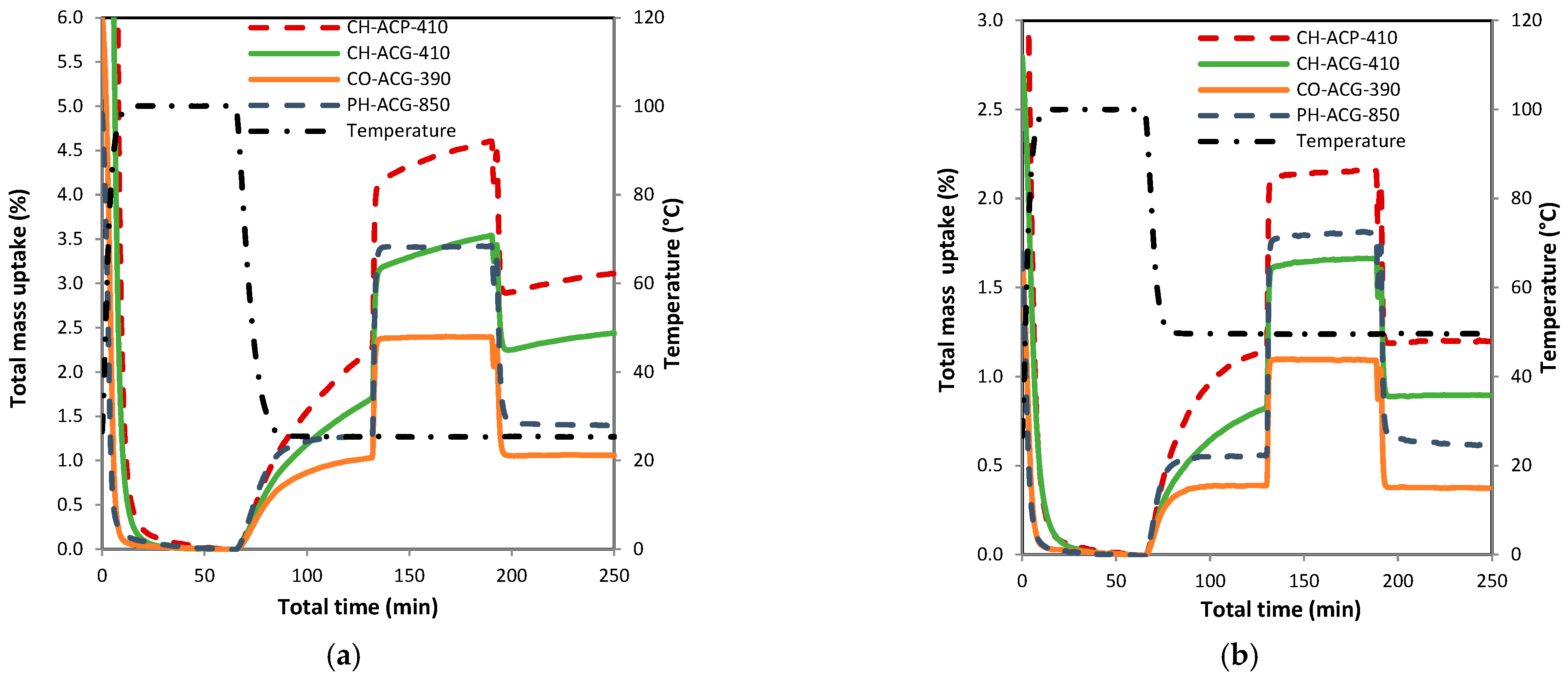
Figure 6 displays the full adsorption experiments for all samples, plotting the total mass uptake as a function of time. Measurements were performed at atmospheric pressure with a feed consisting of 10% CO2 (balance N2) at temperatures of 25 and 50 °C.
As shown in the figures, the samples CO-ACG-390 and PH-ACG-850 exhibit rapid adsorption and desorption kinetics at both 25 °C and 50 °C. The majority of uptake occurs within the first few minutes of exposure to either pure N2 or the mixed gas (10% CO2/90% N2). This behavior is attributed to the greater availability of active sites on the adsorbent surface during the initial stage, which diminishes over time as adsorption progresses.
In contrast, the curves for the two chemically activated samples, CH-ACP-410 and CH-ACG-410, show a slow approach to equilibrium at 25 °C, likely due to diffusion resistance within the pores at lower temperatures. This kinetic process becomes faster for both samples at 50 °C. This is because higher temperatures enhance the diffusion rate of adsorbate molecules through the external boundary layer and within the pores.
Fast adsorption and desorption kinetics are essential for the viability of adsorbents in CO2 capture, particularly under post-combustion conditions, where rapid oscillation cycles are necessary to maximize the processed flow rate in industrial applications [28,46].
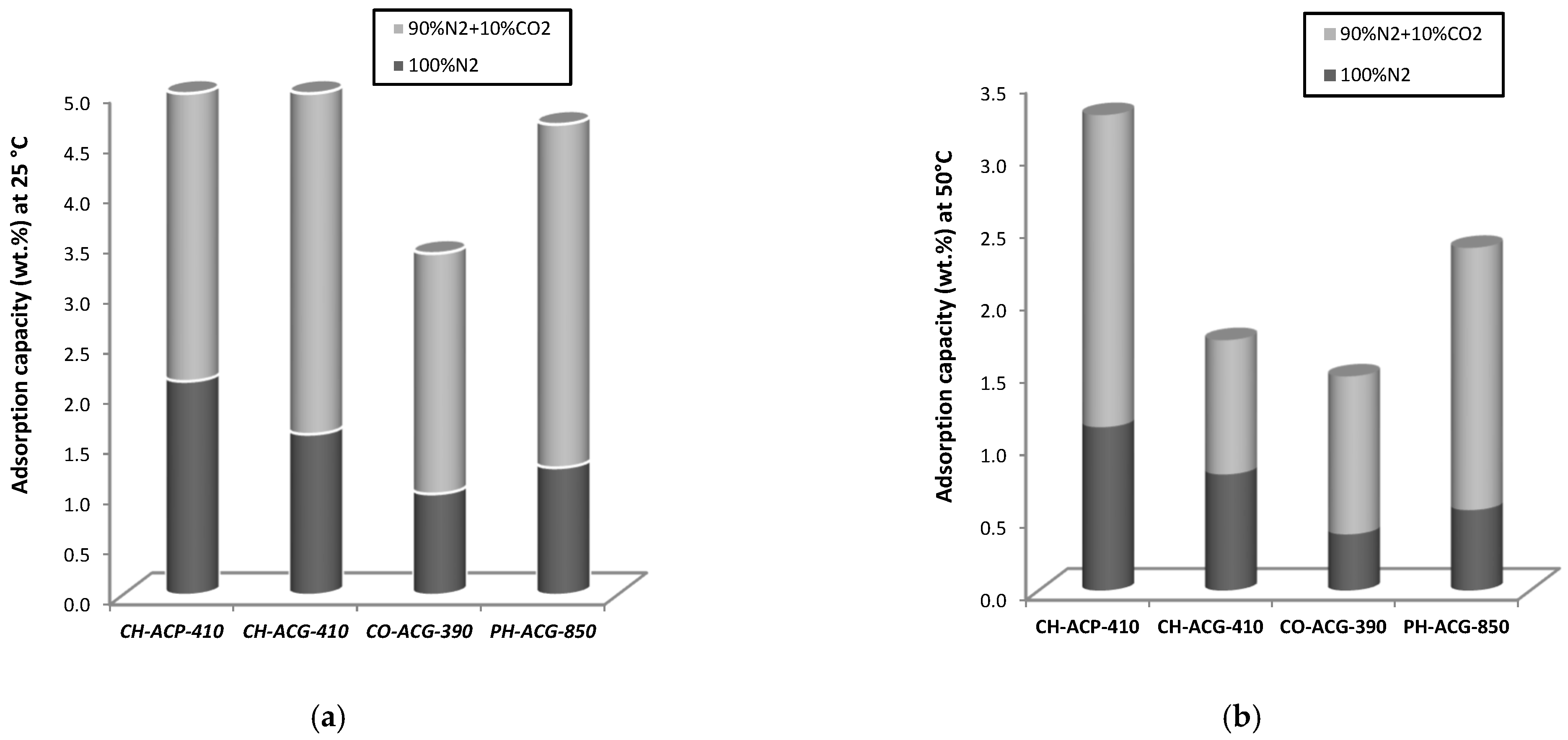
Figure 7 compares, on a mass basis, the equilibrium adsorption capacities of the samples in both 100% N2 and a mixture consisting of 10% CO2 (balance N2).
The adsorption capacity of the samples decreased with temperature, declining from 25 to 50 °C, a trend consistent with an exothermic process. This enhanced mass transfer rate consequently reduces the residence time of adsorbate molecules at the active sites on the activated carbon (AC) [65]. For pure N2, activated carbon pellets exhibit the highest capacity at both 25 and 50 °C. It is attributed to its large specific surface area and significant pore volume. However, the greater mass uptake of CO2 from the binary mixture (10% CO2 + 90% N2) is related to its better, narrower microporosity development. As is well known, narrow micropores are crucial for CO2 adsorption at the low CO2 partial pressures typical of post-combustion applications [37].
On the other hand, a correlation analysis between chemical characteristics and CO2 uptake reveals that surface chemistry has no significant influence on adsorption performance. This is due to the dominant physical adsorption mechanism identified in our experiments, in which CO2 capture is governed primarily by weak van der Waals forces and pore-filling effects rather than by specific chemical interactions.
Although numerous carbon-based materials have been explored in recent years, biomass-derived carbons stand out as particularly attractive due to their abundance, low cost, and sustainability. To benchmark the performance of our olive stone-derived activated carbons, we compared their CO2 adsorption capacity with data from the literature under similar post-combustion conditions. Table 4 summarizes the CO2 adsorption performance of various porous carbon materials derived from different precursors—such as olive stones, coconut shell, and coffee grounds—under low relative pressures.
As pointed out before and shown in Table 4, the nature of the precursor and the activation process are determining parameters for the CO2 adsorption capacities of carbon materials. By analyzing this table, one can note that the CO2 adsorption capacities reported in this study may not be the highest in the literature, but they are among the greatest for biomass-derived carbon. The pelletized carbon CH-ACP-410, identified as the optimal adsorbent in this study, shows at 25 °C, a CO2 uptake of 4.6 wt.%, which is comparable to the values of 4.21 and 4.13 wt.% reported by Moussa et al. [70] for olive stone-based activated carbons prepared with KOH and K2CO3, respectively. At 50 °C, the adsorption capacity decreased to approximately 2.2 wt.%, closely aligning with the ~2.1 wt.% uptake reported by Plaza et al. [37] for CO2-activated pine sawdust pellets under identical conditions.
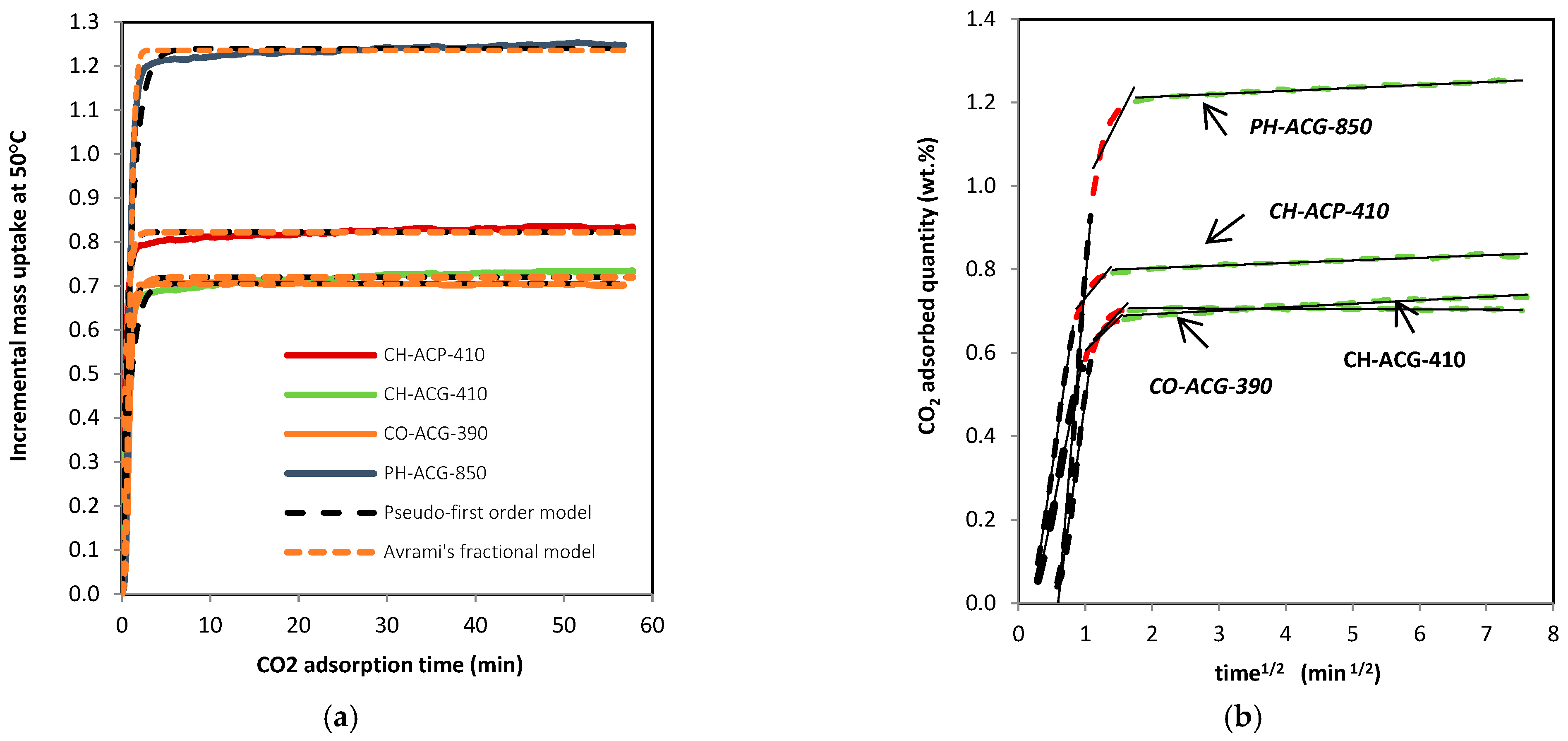
The evaluation of adsorption kinetics was conducted by monitoring the dynamic mass uptake of the samples exposed to the gas mixture, using the mass at the end of the conditioning step in N2 at 50 °C as a reference (see Figure 8). This incremental mass uptake corresponds to the adsorption of CO2 from the mixture.
Figure 8a reports the predicted CO2 adsorption by fitting the experimental data to the two kinetic models: pseudo-first order and Avrami’s fractional models.
As shown in Figure 8a, the experimental curves for all samples closely followed both the pseudo-first-order and Avrami fractional kinetic models, accurately in the first seconds (below 100 s) and at equilibrium (above 10 min). At the average time (between 0.6 and 10 min), the experimental data points significantly deviate from the fitted straight line. These findings imply that physisorption governs the initial adsorption of CO2 from the binary mixture onto the adsorbent surface. However, the Avrami equation provides a more accurate description of CO2 adsorption kinetics across all stages on the studied carbon adsorbents, as it accounts for complex reaction pathways [71,72,73]. This model has been successfully applied to a wide range of CO2 adsorbents in previous studies [73,74,75]. Therefore, the Avrami model parameters were selected for a more detailed analysis of the CO2 adsorption mechanism on the prepared adsorbents. These parameters are summarized in Table 5.
The examination of Avrami’s fractional order kinetic model parameters indicates that the apparent rate constant kA of CH-ACG-410, CO-ACG-390 and PH-ACG-850 is lower than that of the CH-ACP-410 sample. This is likely due to greater diffusional resistance resulting from their less-developed porosity. The Avrami exponent nA, determined from the experimental data, was 1.062 for CH-ACP-410 and 0.955 for CH-ACG-410. These values suggest a homogeneous CO2 adsorption process on their surfaces, with the adsorption probability uniform across the surface at any given time [38]. In contrast, the Avrami exponents (nA) for CO-ACG-390 and PH-ACG-850 were 2.46 and 2.14, respectively, indicating the coexistence of multiple adsorption mechanisms. This parameter is known to reflect changes in the adsorption mechanism over time [38]. Accordingly, the variation in nA values between the CH-ACP-410, CH-ACG-410, CO-ACG-390, and PH-ACG-850 samples suggests that different adsorption pathways are involved.
To investigate the role of mass-transfer resistance during the CO2 adsorption process, the intra-particle diffusion model was applied. Figure 8b presents the Weber–Morris plot for CO2 adsorption at 50 °C for all prepared adsorbents. In this model, a linear plot of qt versus t1/2 indicates that intra-particle diffusion is occurring; if the line also passes through the origin, it suggests that intra-particle diffusion is the sole rate-limiting step [38]. As shown in Figure 8b, the plots for all samples are not linear across the entire time range. Instead, they exhibit tri-linearity, indicating three distinct stages in the CO2 uptake mechanism. The first linear segment corresponds to boundary layer (film) diffusion, the second to intra-particle diffusion within micropores, and the third to the saturation of active sites, marking the equilibrium stage. In this case, the linear fits for the second and third stages do not pass through the origin. This deviation suggests a difference in mass transfer rates between the initial and final adsorption steps, consistent with observations reported in the literature [42]. Therefore, intra-particle diffusion is not the sole rate-limiting mechanism; film diffusion also contributes significantly to the adsorption kinetics on the activated carbon samples. Between these two processes, only one governs the overall adsorption rate. This rate-controlling step can be identified by comparing the slopes of the linear portions preceding the equilibrium stage (region III), where the segment with the smallest slope corresponds to the rate-limiting step. The parameters of the intra-particle diffusion model and their corresponding correlation coefficients (R2) are presented in Table 6.
An analysis of the parameters obtained from the first and second linear regions reveals that, for all AC samples, the intra-particle diffusion rate constant (k2) is consistently lower than k1. This indicates that the diffusion of CO2 molecules from the adsorbent surface into the micropores is the primary step governing the overall adsorption kinetics. Extrapolation of the linear segments back to the y-axis provides the intercept I, a parameter associated with the thickness of the boundary layer. A larger intercept value suggests a more pronounced boundary layer effect in hindering intra-particle diffusion. Among the samples, PH-ACG-850 exhibited the highest rate constants for both external mass transfer (k1) and pore diffusion (k2). This enhanced diffusion behavior is likely attributable to its greater degree of mesoporous development, as previously discussed.

4. Conclusions

Activated carbon materials for CO2 capture under post-combustion conditions were synthesized from abundant low-cost biomass residues using practical, cost-effective methods. Two types of chemically activated carbons were compared: one granular and one pelletized. To further investigate the influence of the activation method on CO2 adsorption performance, two additional samples were included for comparison—a combined activated carbon and a physically activated carbon.
Adsorption experiments were conducted using pure CO2 at atmospheric pressure and a binary mixture of 10% CO2 balanced with N2. Among the samples, the chemically activated carbon pellet exhibited the highest CO2 adsorption capacities, outperforming its granular counterpart prepared under identical conditions, as well as all samples produced via physical or combined activation. This superior performance underscores that chemical activation is more effective than the other methodologies for generating adsorbents with high CO2 capture capability. The enhanced uptake is attributed to the pellet’s improved textural properties, resulting from a pelletizing process that minimizes void formation and promotes the development of narrow micropores over larger mesopores. As is well established, the volume of narrow micropores plays a decisive role in CO2 uptake under post-combustion conditions, where the CO2 partial pressure is inherently low. The kinetics of CO2 adsorption on the activated carbon samples were evaluated using the pseudo-first-order and Avrami models. Among these, the Avrami model provided the best fit to the experimental data for all samples, suggesting the involvement of multiple adsorption pathways. To gain further insight into the underlying adsorption mechanism, the intra-particle diffusion model was applied. The fitting results revealed that the rate-limiting process comprises three distinct consecutive stages. The adsorption rate is subsequently governed by intra-particle diffusion within the abundant micropores of the activated carbon until equilibrium is attained. In summary, the chemically activated carbon pellets demonstrated excellent CO2 adsorption performance under dry conditions. Their combination of low-cost precursors and favorable textural properties makes them promising candidates for large-scale applications. However, under realistic post-combustion conditions, the omnipresence of water vapor in flue gas presents a significant challenge for selective CO2 capture using physical adsorbents. To fully assess the practical viability of these materials, future work should focus on adsorption studies using complex, humid gas mixtures (e.g., CO2/H2O/N2) under dynamic and cyclic operating conditions. Such investigations are essential to evaluate competitive adsorption behavior and long-term material stability.

Author Contributions

Conceptualization, M.M. and A.O.; methodology, M.M.; validation, A.O.; formal analysis, M.M. and N.Q.; investigation, M.M.; resources, A.O. and C.P.; data curation, M.M. and N.Q.; writing—original draft preparation, M.M.; writing—review and editing, C.P. and N.Q.; supervision, A.O.; project administration, A.O.; funding acquisition, A.O. All authors have read and agreed to the published version of the manuscript.

Funding

This research received no external funding.

Data Availability Statement

The data presented in this study are available upon request from the corresponding author (in practice, we have no objection to sharing the data; however, the document size is quite large, so access should be granted through a structured stepwise request process).

Acknowledgments

The authors gratefully acknowledge the PrEM Group at INCAR-CSIC in Oviedo, Spain, for providing access to characterization techniques and analytical support. They also extend their appreciation to the Research Laboratory: Process Engineering and Industrial Systems (LR11ES54) at the National School of Engineers of Gabes, University of Gabes, Tunisia, for the financial support provided.

Conflicts of Interest

The authors declare no conflicts of interest.

References

  1. IPCC. Climate Change 2014: Mitigation of Climate Change. Contribution of Working Group III to the Fifth Assessment Report of the Intergovernmental Panel on Climate Change; Edenhofer, O., Pichs-Madruga, R., Sokona, Y., Farahani, E., Kadner, S., Seyboth, K., Adler, A., Baum, I., Brunner, S., Eickemeier, P., et al., Eds.; Cambridge University Press: Cambridge, UK; New York, NY, USA, 2014. [Google Scholar]
  2. Stigson, P.; Hansson, A.; Lind, M. Obstacles for CCS deployment: An analysis of discrepancies of perceptions. Mitig. Adapt. Strat. Glob. Change 2012, 17, 601–619. [Google Scholar] [CrossRef]
  3. Dabbawala, A.A.; Ismail, I.; Vaithilingam, B.V.; Polychronopoulou, K.; Singaravel, G.; Morin, S.; Berthod, M.; Al Wahedi, Y. Synthesis of hierarchical porous Zeolite-Y for enhanced CO2 capture. Microporous Mesoporous Mater. 2020, 303, 110261. [Google Scholar] [CrossRef]
  4. Bararpour, S.T.; Karami, D.; Mahinpey, N. Investigation of the effect of alumina-aerogel support on the CO2 capture performance of K2CO3. Fuel 2019, 242, 124–132. [Google Scholar] [CrossRef]
  5. Lee, S.Y.; Park, S.J. Determination of the optimal pore size for improved CO2 adsorption in activated carbon fibers. J. Colloid Interface Sci. 2013, 389, 230–235. [Google Scholar] [CrossRef]
  6. Zhou, J.; Wang, X.; Xing, W. Carbon-based CO2 adsorbents. In Postcombustion Carbon Dioxide Capture Materials; Royal Society of Chemistry: London, UK, 2018; p. 1e75. [Google Scholar] [CrossRef]
  7. Zhang, S.; Chen, C.; Ahn, W.S. Recent progress on CO2 capture using amine-functionalized silica. Curr. Opin. Green Sustain. Chem. 2019, 16, 26–32. [Google Scholar] [CrossRef]
  8. Yue, M.B.; Sun, L.B.; Cao, Y.; Wang, Y.; Wang, Z.J.; Zhu, J.H. Efficient CO2 capturer derived from as-synthesized MCM-41 modified with amine. Chem.–Eur. J. 2008, 14, 3442–3451. [Google Scholar] [CrossRef] [PubMed]
  9. Si, X.; Jiao, C.; Li, F.; Zhang, J.; Wang, S.; Liu, S.; Li, Z.; Sun, L.; Xu, F.; Schick, C.; et al. High and selective CO2 uptake, H2 storage and methanol sensing on the amine-decorated 12-connected MOF CAU-1. Energy Environ. Sci. 2011, 4, 4522–4527. [Google Scholar] [CrossRef]
  10. Zhao, P.; Zhang, G.; Yan, H.; Zhao, Y. The latest development on amine functionalized solid adsorbents for post-combustion CO2 capture: Analysis review. Chin. J. Chem. Eng. 2021, 35, 17–43. [Google Scholar] [CrossRef]
  11. Ding, M.; Flaig, R.W.; Jiang, H.-L.; Yaghi, O.M. Carbon capture and conversion using metal–organic frameworks and MOF-based materials. Chem. Soc. Rev. 2019, 48, 2783–2828. [Google Scholar] [CrossRef]
  12. Aniruddha, R.; Sreedhar, I.; Reddy, B.M. MOFs in carbon capture-past, present and future. J. CO2 Util. 2020, 42, 101297. [Google Scholar] [CrossRef]
  13. Pettinari, C.; Tombesi, A. Metal–organic frameworks for carbon dioxide capture. MRS Energy Sustain. 2020, 7, E35. [Google Scholar] [CrossRef]
  14. Sun, M.; Gu, Q.; Hanif, A.; Wang, T.; Shang, J. Transition metal cation-exchanged SSZ-13 zeolites for CO2 capture and separation from N2. Chem. Eng. J. 2019, 370, 1450–1458. [Google Scholar] [CrossRef]
  15. Xu, C.; Yu, G.; Yuan, J.; Strømme, M.; Hedin, N. Microporous organic polymers as CO2 adsorbents: Advances and challenges. Mater. Today Adv. 2020, 6, 100052. [Google Scholar] [CrossRef]
  16. Gao, H.; Li, Q.; Ren, S. Progress on CO2 capture by porous organic polymers. Curr. Opin. Green Sustain. Chem. 2019, 16, 33–38. [Google Scholar] [CrossRef]
  17. Bhanja, P.; Modak, A.; Bhaumik, A. Porous organic polymers for CO2 storage and conversion reactions. ChemCatChem 2019, 11, 244–257. [Google Scholar] [CrossRef]
  18. Ochedi, F.O.; Liu, Y.; Adewuyi, Y.G. State-of-the-art review on capture of CO2 using adsorbents prepared from waste materials. Process Saf. Environ. Prot. 2020, 139, 1–25. [Google Scholar] [CrossRef]
  19. Rashid, N.A.; Yusup, S. An overview of activated carbons utilization for the post-combustion carbon dioxide capture. J. CO2 Util. 2016, 13, 1–16. [Google Scholar] [CrossRef]
  20. Martinez, M.L.; Torres, M.M.; Guzman, C.A.; Maestri, D.M. Preparation and characteristics of activated carbon from olive stones and walnut shells. Ind. Corps Prod. 2006, 23, 23–28. [Google Scholar] [CrossRef]
  21. Plaza, M.G.; Pevida, C.; Martin, C.F.; Fermoso, J.; Pis, J.J.; Rubiera, F. Developing almond shell-derived activated carbons as CO2 adsorbents. Sep. Purif. Technol. 2010, 71, 102–106. [Google Scholar] [CrossRef]
  22. Hidayu, A.R.; Muda, N. Preparation and characterization of impregnated activated carbon from palm kernel shell and coconut shell for CO2 capture. Procedia Eng. 2016, 148, 106–113. [Google Scholar] [CrossRef]
  23. De Andrés, J.M.; Orjales, L.; Narros, A.; de la Fuente, M.D.M.; Rodríguez, M.E. Carbon dioxide adsorption in chemically activated carbon from sewage sludge. J. Air Waste Manag. Assoc. 2013, 63, 557–564. [Google Scholar] [CrossRef]
  24. Sevilla, M.; Ferrero, G.A.; Fuertes, A.B. CO2 storage on nanoporous carbons. In Nanoporous Materials for Gas Storage; Springer: Singapore, 2019; pp. 287–330. [Google Scholar] [CrossRef]
  25. Sreńscek-Nazzal, J.; Kamińska, A.; Serafin, J.; Michalkiewicz, B. Chemical activation of banana peel waste-derived biochar using KOH and urea for CO2 capture. Materials 2024, 17, 872. [Google Scholar] [CrossRef] [PubMed]
  26. Yi, H.; Nakabayashi, K.; Yoon, S.H.; Miyawaki, J. Pressurized physical activation: A simple production method for activated carbon with a highly developed pore structure. Carbon 2021, 183, 735–742. [Google Scholar] [CrossRef]
  27. Djeridi, W.; Ouederni, A.; Wiersum, A.D.; Liewllyn, P.; El Mir, L. High pressure methane adsorption on microporous carbon monoliths prepared by olive stones. J. Mater. Lett. 2013, 99, 184–187. [Google Scholar] [CrossRef]
  28. Djeridi, W.; Ouederni, A.; El Mir, L. Production of activated carbon pellets from olive stones for CO2 adsorption. Int. J. Environ. Eng. 2016, 8, 110–123. [Google Scholar] [CrossRef]
  29. Moussa, M.; Bohli, T.; Pevida, C.; Querejeta, N.; Ouederni, A. Olive stones based carbon foam: Synthesis, characterization and application on post-combustion CO2 adsorption. J. Porous Mater. 2022, 29, 1097–1112. [Google Scholar] [CrossRef]
  30. Ghouma, I.; Jeguirim, M.; Dorge, S.; Limousy, L.; Matei Ghimbeu, C.; Ouederni, A. Activated carbon prepared by physical activation of olive stones for the removal of NO2 at ambient temperature. Comptes Rendus Chim. 2015, 18, 63–74. [Google Scholar] [CrossRef]
  31. Parra, J.B.; Sousa, J.D.; Bansal, R.C.; Pis, J.J.; Pajares, J.A. Characterization of activated carbons by the BET equation—An alternative approach. Adsorp. Sci. Technol. 1995, 12, 51–66. [Google Scholar] [CrossRef]
  32. Dubinin, M.M. Properties of active carbons. In Chemistry and Physics of Carbon; Walker, P.L., Jr., Ed.; Marcel Dekker Inc.: New York, NY, USA, 1966; pp. 51–120. [Google Scholar]
  33. Stoeckli, F.; Ballerini, L. Evolution of microporosity during activation of carbon. Fuel 1991, 70, 557–559. [Google Scholar] [CrossRef]
  34. Savova, D.; Petrov, N.; Yardim, M.F.; Ekinci, E.; Budinova, T.; Razvigorova, M.; Minkova, V. The influence of the texture and surface properties of carbon adsorbents obtained from biomass products on the adsorption of manganese ions from aqueous solution. Carbon 2003, 41, 1897–1903. [Google Scholar] [CrossRef]
  35. Heidari, A.; Younesi, H.; Rashidi, A.; Ghoreyshi, A.A. Evaluation of CO2 adsorption with eucalyptus wood based activated carbon modified by ammonia solution through heat treatment. Chem. Eng. J. 2014, 254, 503–513. [Google Scholar] [CrossRef]
  36. Querejeta, N.; Plaza, M.G.; Rubiera, F.; Pevida, C. Water vapor adsorption on biomass based carbons under post-combustion CO2 capture conditions: Effect of post-treatment. Materials 2016, 9, 359. [Google Scholar] [CrossRef]
  37. Plaza, M.G.; Duran, I.; Rubiera, F.; Pevida, C. CO2 adsorbent pellets produced from pine sawdust: Effect of coal tar pitch addition. Appl. Energy 2015, 144, 182–192. [Google Scholar] [CrossRef]
  38. AÁlvarez-Gutiérrez, N.; Gil, M.V.; Rubiera, F.; Pevida, C. Kinetics of CO2 adsorption on cherry stone-based carbons in CO2/CH4 separations. Chem. Eng. J. 2017, 307, 249–257. [Google Scholar] [CrossRef]
  39. Lagergren, S. Zur Theorie der Sogenannten Adsorption Gelöster Stoffe, Kungliga Svenska Vetenskapsakademiens. Handlingar 1898, 24, 1–39. [Google Scholar]
  40. Ai, L.; Zhang, C.; Meng, L. Adsorption of methyl orange from aqueous solution on hydrothermal synthesized Mg-Al layered double hydroxide. J. Chem. Eng. Data 2011, 56, 4217–4225. [Google Scholar] [CrossRef]
  41. Shokrollahi, A.; Alizadeh, A.; Malekhosseini, Z.; Ranjbar, M. Removal of bromocresol green from aqueous solution via adsorption on Ziziphus nummularia as a new, natural, and low-cost adsorbent: Kinetic and thermodynamic study of removal process. J. Chem. Eng. Data 2011, 56, 3738–3746. [Google Scholar] [CrossRef]
  42. Loganathan, S.; Tikmani, M.; Edubilli, S.; Mishra, A.; Ghoshal, A.K. CO2 Adsorption Kinetics on Mesoporous Silica Under Wide Range of Pressure and Temperature. Chem. Eng. J. 2014, 256, 1–8. [Google Scholar] [CrossRef]
  43. Liu, Y.; Yu, X. Carbon dioxide adsorption properties and adsorption/desorption kinetics of amine-functionalized KIT-6. Appl. Energy 2018, 211, 1080–1088. [Google Scholar] [CrossRef]
  44. Shafeeyan, M.S.; Daud, W.M.A.W.; Shamiri, A.; Aghamohammadi, N. Modeling of carbon dioxide adsorption onto ammonia-modified activated carbon: Kinetic analysis and breakthrough behavior. Energy Fuels 2015, 29, 6565–6577. [Google Scholar] [CrossRef]
  45. Vega, M.F.; Díaz-Faes, E.; Barriocanal, C. Kinetic and mechanistic study of CO2 adsorption on activated hydrochars. J. CO2 Util. 2024, 81, 102716. [Google Scholar] [CrossRef]
  46. Avrami, M. Kinetics of phase change. I General theory. J. Chem. Phys. 1939, 7, 1103–1112. [Google Scholar] [CrossRef]
  47. Benedict, J.B.; Coppens, P. Kinetics of the single-crystal to single-crystal two-photon photodimerization of α-trans-cinnamic acid to α-truxillic acid. J. Phys. Chem. A 2009, 113, 3116–3120. [Google Scholar] [CrossRef] [PubMed]
  48. Querejeta, N.; Rubiera, F.; Pevida, C. Experimental Study on the Kinetics of CO2 and H2O Adsorption on Honeycomb Carbon Monoliths under Cement Flue Gas Conditions. ACS Sustain. Chem. Eng. 2022, 10, 2107–2124. [Google Scholar] [CrossRef]
  49. Morris, J.C.; Weber, W.J. Removal of biologically-resistant pollutants from waste waters by adsorption. Adv. Water Pollut. Res. 1964, 231–266. [Google Scholar] [CrossRef]
  50. Hameed, B.H.; Tan, I.A.W.; Ahmad, A.L. Adsorption isotherm, kinetic modeling and mechanism of 2,4,6-trichlorophenol on coconut husk-based activated carbon. Chem. Eng. J. 2008, 144, 235–244. [Google Scholar] [CrossRef]
  51. Yousef, R.I.; Eswedb, B.; Muhtasebc, A.H. Adsorption characteristics of natural zeolites as solid adsorbents for phenol removal from aqueous solutions: Kinetics, mechanism, and thermodynamics studies. Chem. Eng. J. 2011, 171, 1143–1149. [Google Scholar] [CrossRef]
  52. Mohan, D.; Singh, K.P. Single- and multi-component adsorption of cadmium and zinc using activated carbon derived from bagasse—An agricultural waste. Water Res. 2002, 36, 2304–2318. [Google Scholar] [CrossRef]
  53. Yorgun, S.; Yıldız, D. Preparation and characterization of activated carbons from Paulownia wood by chemical activation with H3PO4. J. Taiwan Inst. Chem. Eng. 2015, 53, 122–131. [Google Scholar] [CrossRef]
  54. Kim, C.; Talapaneni, S.N.; Dai, L. Porous carbon materials for CO2 capture storage and electrochemical conversion. Mater. Rep. Energy 2023, 3, 100199. [Google Scholar] [CrossRef]
  55. Liu, X.; Wang, S.; Sun, C.; Liu, H.; Stevens, L.; Dwomoh, P.K.; Snape, C. Synthesis of functionalized 3D microporous carbon foams for selective CO2 capture. Chem. Eng. J. 2020, 402, 125459. [Google Scholar] [CrossRef]
  56. Tchakala, I.; Bawa, L.M.; Djaneye-Boundjou, G.; Doni, K.S.; Nambo, P. Optimisation du procédé de préparation des Charbons Actifs par voie chimique (H3PO4) à partir des tourteaux de Karité et des tourteaux de Coton. Int. J. Biol. Chem. Sci. 2012, 6, 461–478. [Google Scholar] [CrossRef]
  57. Khelifi, A.; Almazán-Almazán, M.C.; Pérez-Mendoza, M.; Domingo-García, M.; López-Domingo, F.J.; Temdrara, L.; López-Garzón, F.; Addoun, A. Influence of nitric acid concentration on the characteristics of active carbons obtained from a mineral coal. Fuel Process. Technol. 2010, 91, 1338–1344. [Google Scholar] [CrossRef]
  58. Guo, Y.; Rockstraw, D.A. Activated carbons prepared from rice hull by one-step phosphoric acid activation. Microporous Mesoporous Mater. 2007, 100, 12–19. [Google Scholar] [CrossRef]
  59. Boonamnuayvitaya, V.; Chaiya, C.; Tanthapanichakoon, W. The preparation and characterization of activated carbon from coffee residue. J. Chem. Eng. Jpn. 2004, 37, 1504–1512. [Google Scholar] [CrossRef]
  60. Figueiredo, J.L.; Pereira, M.F.R.; Freitas, M.M.A.; O’rfão, J.J.M. Modification of the surface chemistry of activated carbons. Carbon 1999, 37, 1379–1389. [Google Scholar] [CrossRef]
  61. Matei Ghimbeu, C.; Gadiou, R.; Dentzer, J.; Schwartz, D.; Vix-Guterl, C. Influence of Surface Chemistry on the Adsorption of Oxygenated Hydrocarbons on Activated Carbons. Langmuir 2010, 24, 18824–18833. [Google Scholar] [CrossRef]
  62. Matei Ghimbeu, C.; Gadiou, R.; Dentzer, J.; Vidal, L.; Vix-Guterl, C. A TPD-MS study of the adsorption of ethanol/cyclohexane mixture on activated carbons. Adsorption 2011, 17, 227–233. [Google Scholar] [CrossRef]
  63. Ruiz, V.; Blanco, C.; Raymundo-Piñero, E.; Khomenko, V.; Béguin, F.; Santamaria, R. Effects of thermal treatment of activated carbon on the electrochemical behavior in Supercapacitors. Electrochim. Acta 2007, 52, 4969–4973. [Google Scholar] [CrossRef]
  64. Matei Ghimbeu, C.; Decaux, C.; Brender, P.; Dahbi, M.; Lemordant, D.; Raymundo-Pinero, E.; Anouti, M.; Beguin, F.; Vix-Guterl, C. Influence of Graphite Characteristics on Electrochemical Performance in Alkylcarbonate LiTFSI Electrolyte for Li-Ion Capacitors and Li-Ion Batteries. J. Electrochem. Soc. 2013, 160, 1907–1915. [Google Scholar] [CrossRef]
  65. Yang, F.; Zhu, X.; Wu, J.; Wang, R.; Ge, T. Kinetics and mechanism analysis of CO2 adsorption on LiX@ZIF-8 with core shell structure. Powder Technol. 2022, 399, 117090. [Google Scholar] [CrossRef]
  66. Plaza, M.G.; Pevida, C.; Arias, B.; Fermoso, J.; Casal, M.D.; Martín, C.F.; Rubiera, F.; Pis, J.J. Development of low-cost biomass-based adsorbents for postcombustion CO2 capture. Fuel 2009, 88, 2442–2447. [Google Scholar] [CrossRef]
  67. Plaza, M.G.; González, A.S.; Pevida, C.; Pis, J.J.; Rubiera, F. Valorisation of spent coffee grounds as CO2 adsorbents for postcombustion capture applications. Appl. Energy 2012, 99, 272–279. [Google Scholar] [CrossRef]
  68. Rashidi, N.A.; Yusup, S.; Borhan, A.; Loong, L.H. Experimental and modelling studies of carbon dioxide adsorption by porous biomass derived activated carbon. Clean Technol. Environ. Policy 2014, 16, 1353–1361. [Google Scholar] [CrossRef]
  69. Fiuza, R.A., Jr.; de Jesus Neto, R.M.; Correia, L.B.; Andrade, H.M.C. Preparation of granular activated carbons from yellow mombin fruit stones for CO2 adsorption. J. Environ. Manag. 2015, 161, 198–205. [Google Scholar] [CrossRef]
  70. Moussa, M.; Bader, N.; Querejeta, N.; Durán, I.; Pevida, C.; Ouederni, A. Toward sustainable hydrogen storage and carbon dioxide capture in post-combustion conditions. J. Environ. Chem. Eng. 2017, 5, 1628–1637. [Google Scholar] [CrossRef]
  71. Lopes, E.C.; dos Anjos, F.S.; Vieira, E.F.; Cestari, A.R. An alternative Avrami equation to evaluate kinetic parameters of the interaction of Hg (II) with thin chitosan membranes. J. Colloid Interface Sci. 2003, 263, 542–547. [Google Scholar] [CrossRef] [PubMed]
  72. Serna-Guerrero, R.; Sayari, A. Modeling adsorption of CO2 on amine-functionalized mesoporous silica. 2: Kinetics and breakthrough curves. Chem. Eng. J. 2010, 161, 182–190. [Google Scholar] [CrossRef]
  73. Cestari, A.R.; Vieira, E.F.; Vieira, G.S.; Almeida, L.E. The removal of anionic dyes from aqueous solutions in the presence of anionic surfactant using aminopropylsilica—A kinetic study. J. Hazard. Mater. 2006, 138, 133–141. [Google Scholar] [CrossRef]
  74. Cestari, A.R.; Vieira, E.F.; Matos, J.D.; dos Anjos, D.S. Determination of kinetic parameters of Cu (II) interaction with chemically modified thin chitosan membranes. J. Colloid Interface Sci. 2005, 285, 288–295. [Google Scholar] [CrossRef]
  75. Zubieta, C.E.; Messina, P.V.; Luengo, C.; Dennehy, M.; Pieroni, O.; Schulz, P.C. Reactive dyes remotion by porous TiO2-chitosan materials. J. Hazard. Mater. 2008, 152, 765–777. [Google Scholar] [CrossRef]
Figure 1. Schematic diagram of activated carbon production from olive stones.
Processes 14 01023 g001
Figure 2. (a) N2 adsorption isotherms at −196 °C and (b) CO2 adsorption isotherms at 0 °C for the prepared carbon materials.
Processes 14 01023 g002
Figure 3. Pore size distribution of the prepared adsorbents calculated from CO2 adsorption isotherms at 0 °C using the NLDFT model for carbons: (a) differential and (b) cumulative pore volume vs. pore width.
Processes 14 01023 g003
Figure 4. FTIR spectra of the activated carbon samples.
Processes 14 01023 g004
Figure 5. (a) CO2 and (b) CO: release profiles of AC samples during TPD analysis.
Processes 14 01023 g005
Figure 6. The adsorption profiles of the synthesized ACs expressed in total mass uptake versus time during the full experiment at (a) 25 °C and (b) 50 °C.
Processes 14 01023 g006
Figure 7. Equilibrium uptake of CO2 on a mass basis under atmospheric pressure from a 10% CO2 (balance N2) feed: (a) at 25 °C and (b) at 50 °C.
Processes 14 01023 g007
Figure 8. Dynamic mass uptake at 50 °C and atmospheric pressure following a gas transition from 100% N2 to 90% N2/10% CO2. (a) Fitting of experimental data to Pseudo-first order and Avrami fractional models for all samples. (b) Application of the intra-particle diffusion model. Dashed lines indicate intra-particle diffusion steps: black (Step 1), red (Step 2), and green (Step 3); the solid gray line shows the linear trend.
Processes 14 01023 g008
Table 1. Textural properties and CO2 adsorption capacity of activated carbon samples.
N2 Adsorption at −196 °CCO2 Adsorption at 0 °C
SamplesSBET
(m2·g−1)
VT
(cm3·g−1)
Smic
(m2·g−1)
L
(nm)
E0
(Kj·mol−1)
W0
(cm3·g−1)
CO2 Uptake (mmol·g−1)
0.15 bar1 bar
CH-ACP-41012880.499360.6927.140.321.534.60
CH-ACG-4109780.346850.6727.540.231.153.61
CO-ACG-3901219.880.516780.7426.090.251.053.90
PH-ACG-850865.520.447680.6029.440.221.433.93
Table 2. Point of Zero Charge (pHPZC) and Surface Functional Group Concentrations as determined by Boehm titrations.
SamplepHPZCTotal Acidity
(meq/g)
Total Basicity
(meq/g)
CH-ACP-4102.42.90.05
CH-ACG-4102.683.130
CO-ACG-3905.051.280.25
PH-ACG-8507.520.431.86
Table 3. Quantities of CO and CO2 evolved during TPD experiments.
SamplesCO
(µmol/g)
CO2
(µmol/g)
O
(µmol/g)
CO/CO2
CH-ACP-4102600160030001.6
CH-ACG-410380070030005.1
CO-ACG-39050040010001.3
PH-ACG-8505200260050002
Table 4. A comparison of the low- pressure CO2 adsorption performances of porous carbon adsorbents derived from biomass.
Carbon PrecursorSampleActivation MethodPost-Combustion ConditionCO2 UptakeReferences
Pine sawdustIH3Carbonization + CO2(10% CO2 + 90% N2)
(P = 1 atm; T = 50 °C)
2.1 wt%[37]
Olive stonesGKOSA40Carbonization + CO2(15% CO2 + 85% N2)
(P = 1 atm; T = 40 °C)
2.4 wt%[66]
Almond shellAA740Carbonization + CO2(15% CO2 + 85% N2)
(P = 1 atm; T = 25 °C)
5.1 wt%[21]
Spent coffee groundsCNHA29KOH(10% CO2 + 90% N2)
(P = 1 atm; T = 50 °C)
2.8 wt%[67]
Commercial ACCommercial ACCarbonization(20% CO2 + 80% N2)
(P = 1 atm; T = 25 °C)
3.1 wt%[68]
(20% CO2 + 80% N2)
(P = 1 atm; T = 50 °C)
1.9 wt%
Coconut shellOptimized ACCarbonization(20% CO2 + 80% N2)
(P = 1 atm; T = 25 °C)
2.7 wt%
(20% CO2 + 80% N2)
(P = 1 atm; T = 50 °C)
1.5 wt%
Yellow mombin stonesYMKOHCarbonization + KOH(10% CO2 + 90%N2)
(P = 1 atm; T = 40 °C)
4.2 wt%[69]
(50%CO2 + 50%N2)
(P = 1 atm; T = 40 °C)
6.3 wt%
Olive stonesAC_KOHCarbonization + KOH(10%CO2 + 90%N2)
(P = 1 atm; T = 25 °C)
4.21 wt%[70]
AC_K2CO3Carbonization + K2CO3(10%CO2 + 90%N2)
(P = 1 atm; T = 25 °C)
4.13 wt%
Olive stonesCH-ACP-410H3PO4(10%CO2 + 90%N2)
(P = 1 atm; T = 25 °C)
4.6 wt%This study
(10%CO2 + 90%N2)
(P = 1 atm; T = 50 °C)
2.2 wt%
Table 5. Values of the calculated kinetic Model parameters for the adsorption experiments of CO2 for all samples.
Pseudo-First OrderAvrami’s Fractional Order
Samplesqe,expk1qe,calcR2kAnAqe,calcR2
CH-ACP-4100.8322.1330.8230.9672.2201.0620.8230.967
CH-ACG-4100.7331.5270.7200.9481.5030.9550.7200.948
CO-ACG-3900.7011.1130.7060.9441.1612.4630.7040.997
PH-ACG-8501.2480.9781.2390.9530.9212.1371.2350.989
Table 6. Intraparticle diffusion model parameters from the fittings of CO2 at 50 °C for all samples.
Intraparticle Diffusion Model Parameters
First RegionSecond RegionThird Region
Samplesk1C1R2k2C2R2k3C3R2
CH-ACP-4101.090−0.2260.9970.1940.5370.8950.0060.7090.935
CH-ACG-4100.800−0.1840.9960.1560.4490.9040.0080.6760.953
CO-ACG-3901.183−0.6970.9820.1700.4400.8540.00060.7080.327
PH-ACG-8501.898−1.1280.9850.3150.6900.8440.0071.1990.956
Disclaimer/Publisher’s Note: The statements, opinions and data contained in all publications are solely those of the individual author(s) and contributor(s) and not of MDPI and/or the editor(s). MDPI and/or the editor(s) disclaim responsibility for any injury to people or property resulting from any ideas, methods, instructions or products referred to in the content.