A Short-Term Photovoltaic Power Prediction Based on Multidimensional Feature Fusion of Satellite Cloud Images

Abstract
1. Introduction
2. Satellite Cloud Image Data Processing
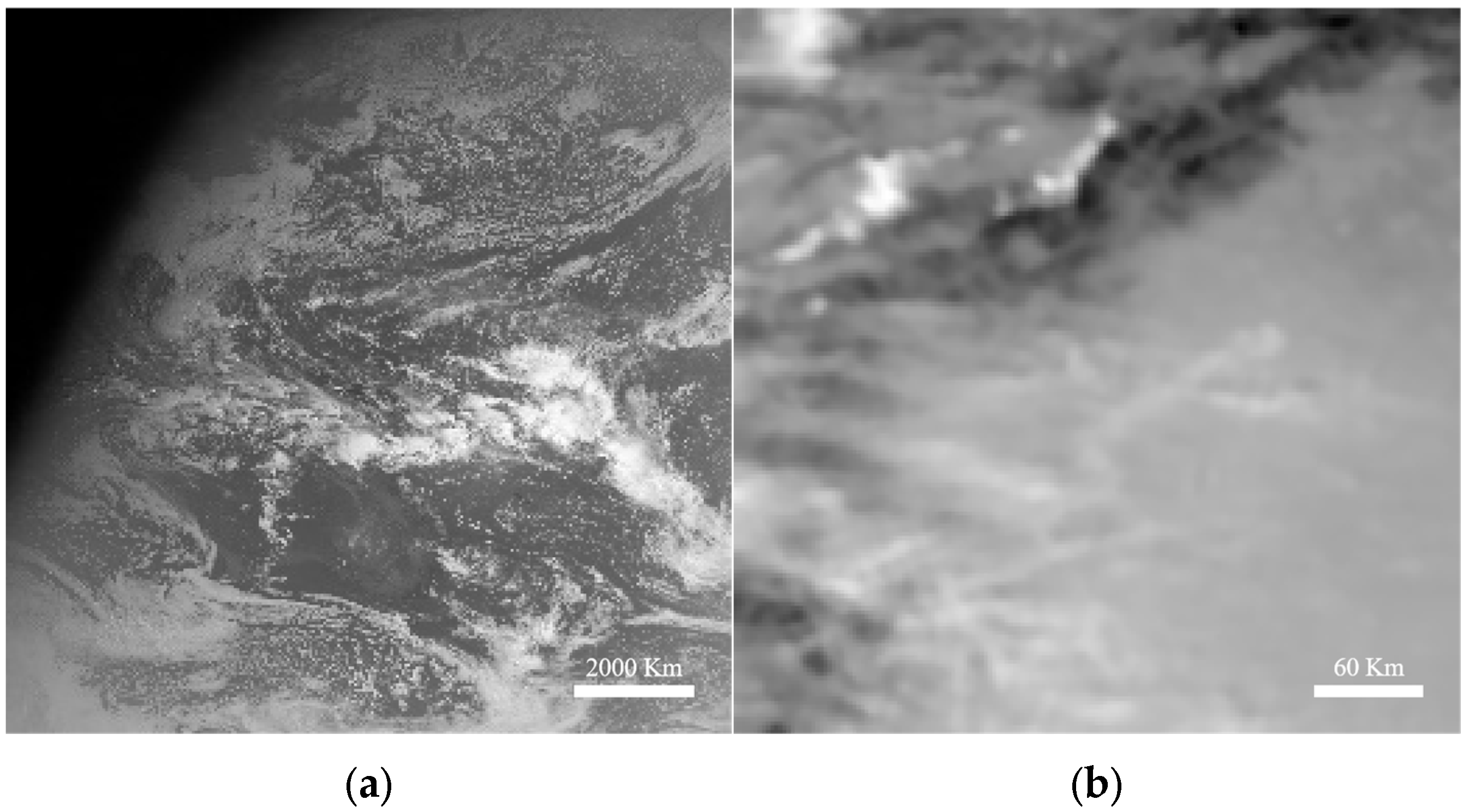
2.1. Cloud Image Preprocessing
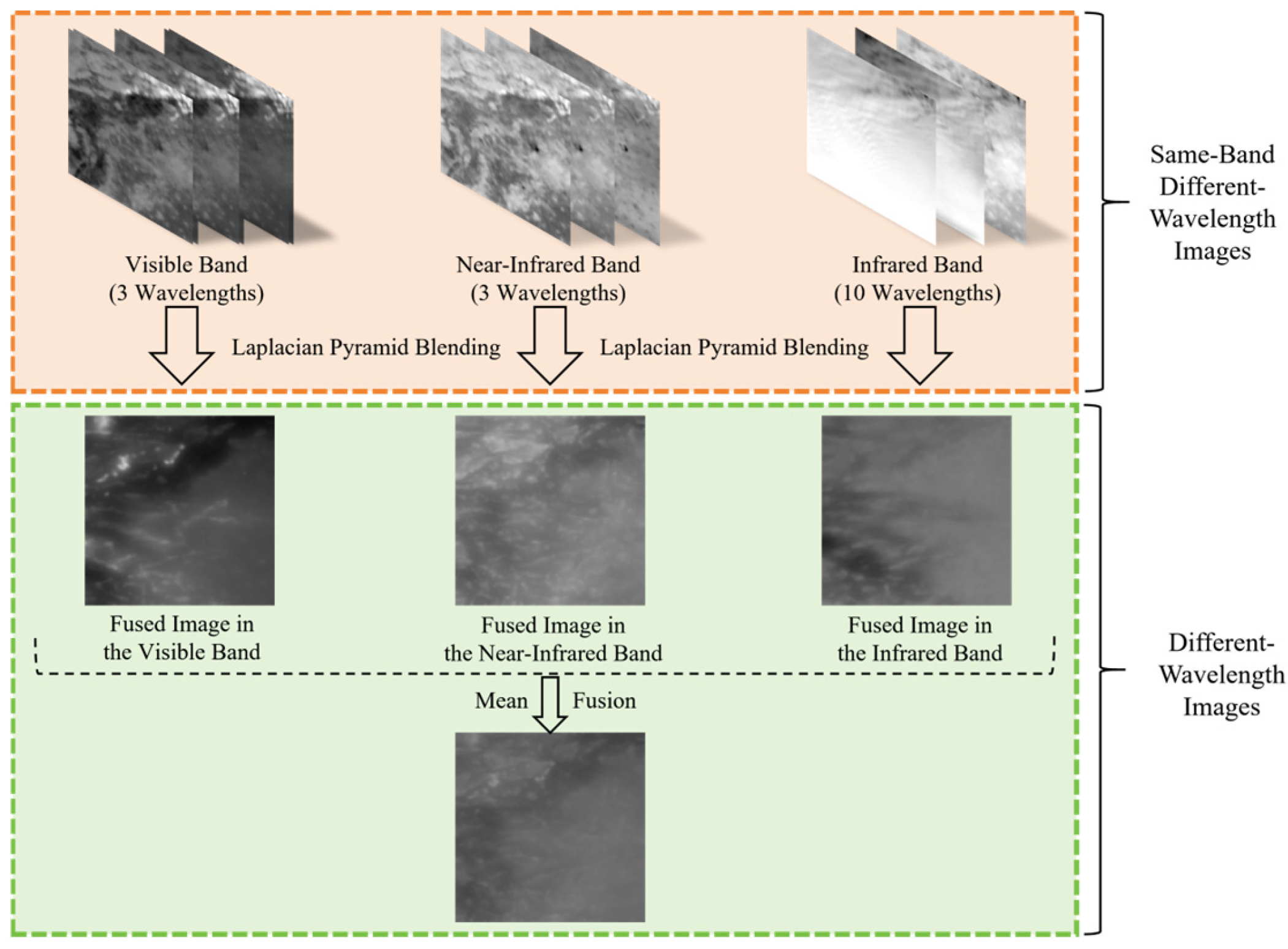
2.2. Satellite Cloud Image Fusion
3. Extraction of Fused Predicted Cloud Features
3.1. Cloud Image Feature Extraction
3.1.1. Gray-Level Co-Occurrence Matrix
3.1.2. Discrete Wavelet Transform
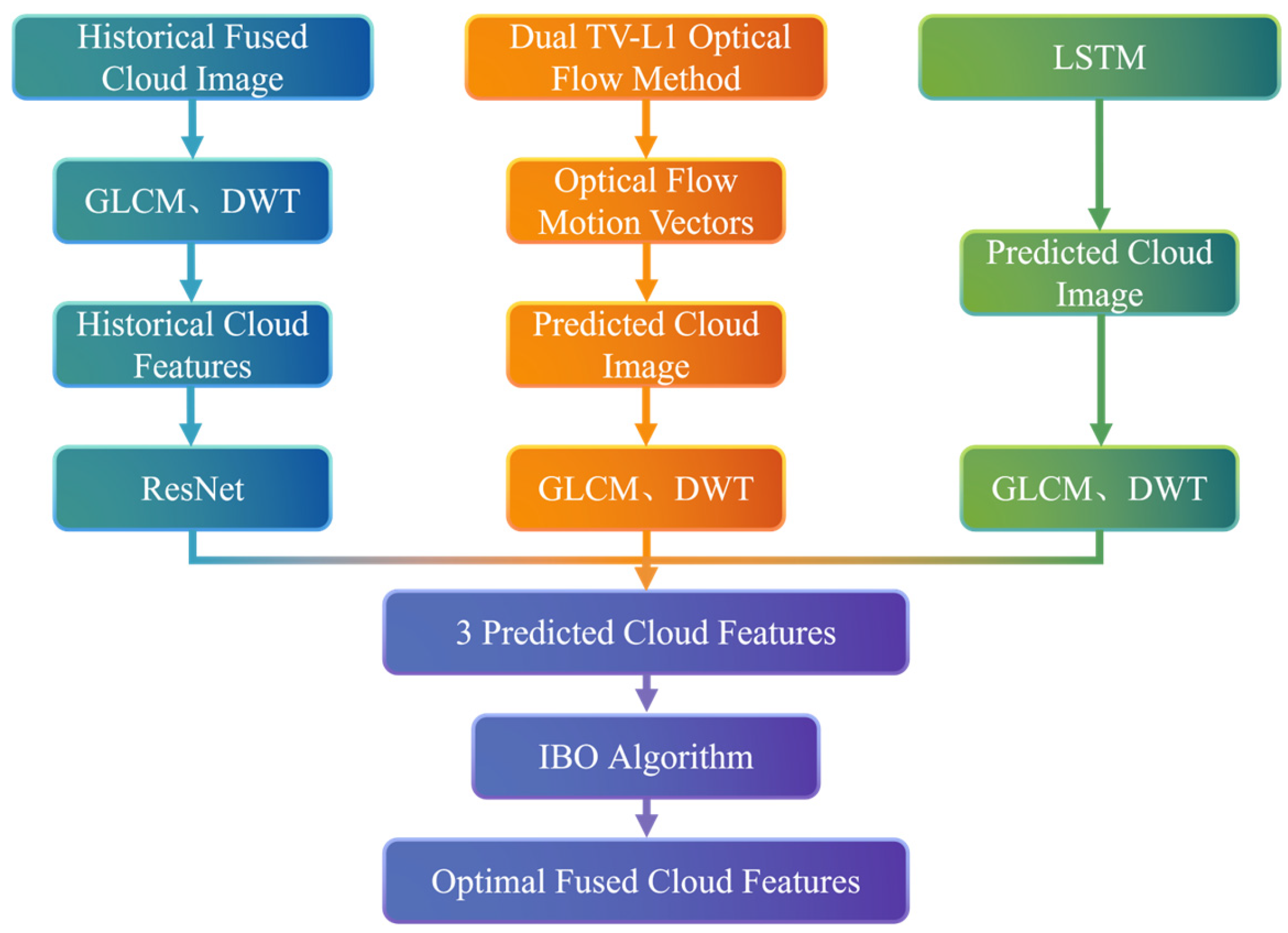
3.2. Predicted Cloud Feature Extraction
3.2.1. Residual Network
3.2.2. Dual TV-L1 Optical Flow Method
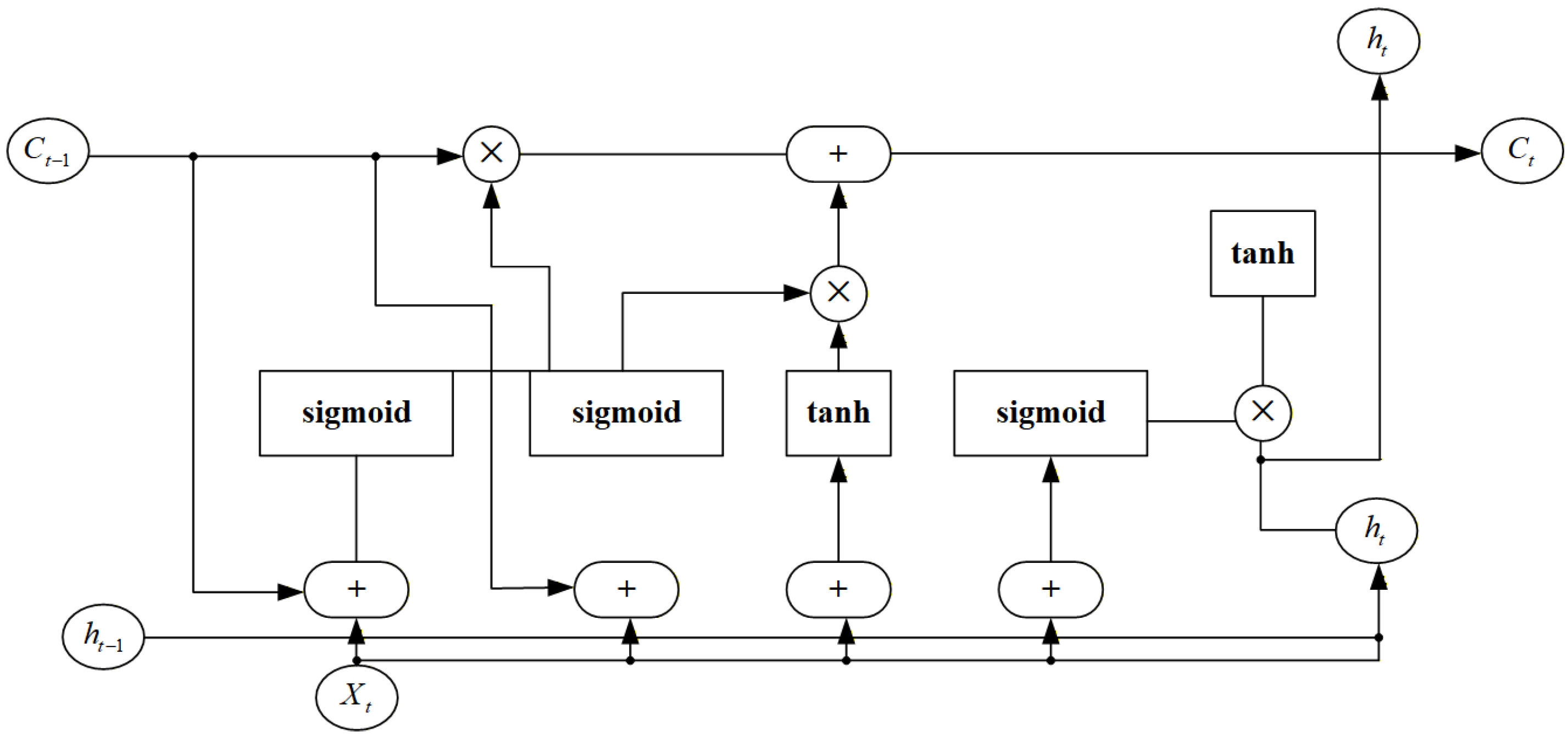
3.2.3. Long Short-Term Memory (LSTM)
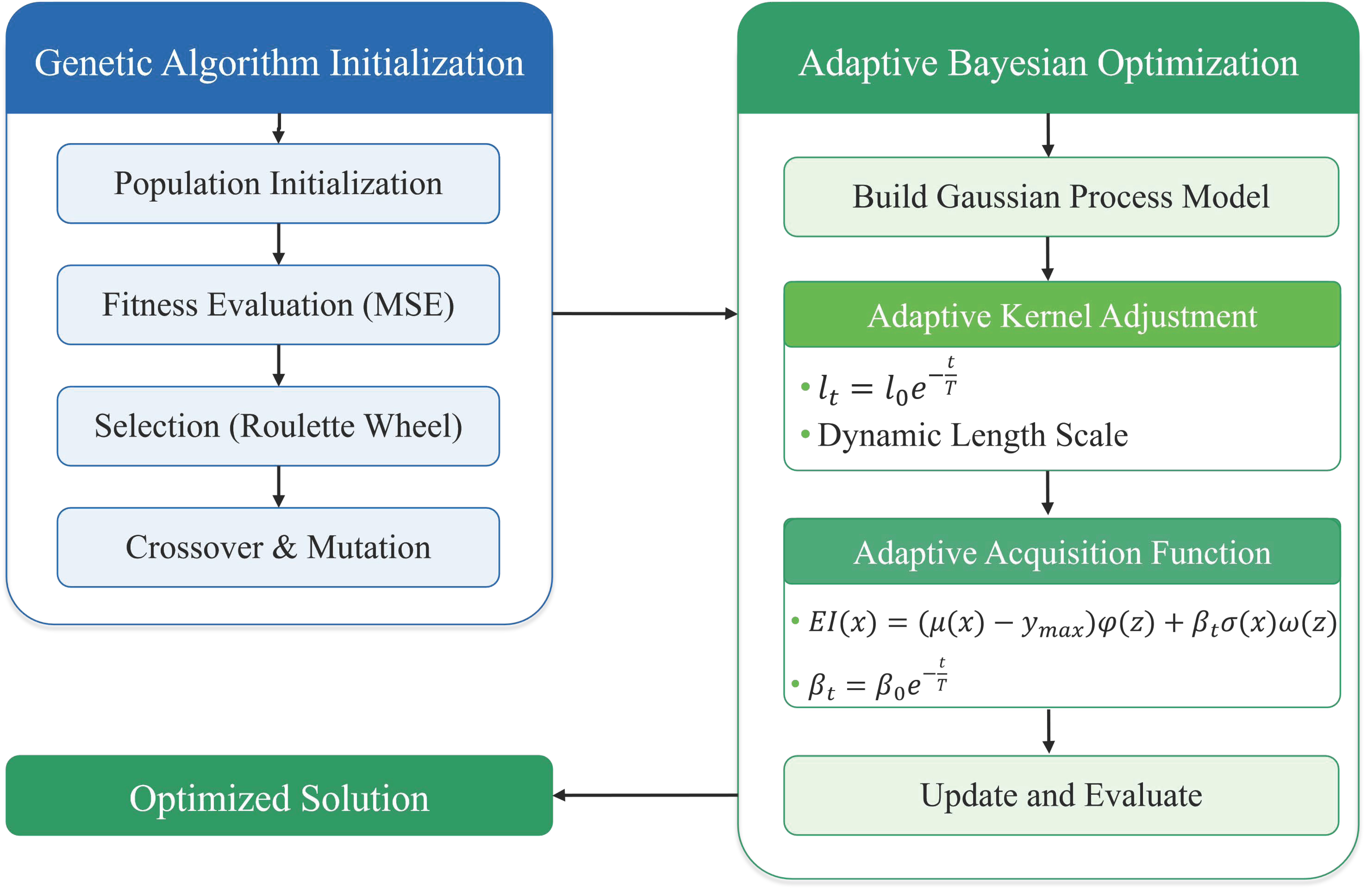
3.3. Improved Bayesian Optimization (BO) Algorithm
| Algorithm 1. Pseudocode of the IBO | |
| Input | pop_size—Population size num_generations—Maximum generations mutation_rate—Mutation rate X, y—Input features and target |
| 1 | population ← initialize_population(pop_size, dim) |
| 2 | for generation = 1 to num_generations do |
| 3 | fitness_values ← compute fitness of each individual |
| 4 | selected ← selection(population, fitness_values) |
| 5 | new_population ← {} |
| 6 | for i = 1 to length(selected) step 2 do |
| 7 | p1, p2 ← selected[i], selected[i+1] |
| 8 | c1, c2 ← crossover(p1, p2) |
| 9 | c1 ← mutate(c1, mutation_rate) |
| 10 | c2 ← mutate(c2, mutation_rate) |
| 11 | new_population ← new_population ∪ {c1, c2} |
| 12 | end for |
| 13 | population ← new_population |
| 14 | end for |
| 15 | best_ga_weights ← argmin(fitness(ind, X, y)) for ind in population |
| 16 | X_init ← {best_ga_weights} |
| 17 | y_init ← {fitness(best_ga_weights, X, y)} |
| 18 | for iteration = 1 to n_iter do |
| 19 | kernel ← adaptive_kernel(iteration) |
| 20 | gp ← GaussianProcessRegressor(kernel = kernel, n_restarts_optimizer = 10, alpha = 1 × 10⁻²) |
| 21 | gp.fit(X_init, y_init) |
| 22 | next_point ← random_uniform(0, 1, X.shape [1]) |
| 23 | max_acquisition ← -infinity |
| 24 | for _ in range(100) do |
| 25 | candidate ← random_uniform(0, 1, X.shape [1]) |
| 26 | acq_value ← adaptive_acquisition(candidate, gp) |
| 27 | if acq_value > max_acquisition then |
| 28 | max_acquisition ← acq_value |
| 29 | next_point ← candidate |
| 30 | end if |
| 31 | end for |
| 32 | new_fitness ← fitness(next_point, X, y) |
| 33 | X_init ← concatenate(X_init, next_point) |
| 34 | y_init ← append(y_init, new_fitness) |
| 35 | print(f”Iteration {iteration + 1}, Best Fitness: {new_fitness}”) |
| 36 | end for |
| Output | Best weights—Optimal feature weights |
4. Hybrid Neural Network Prediction Model
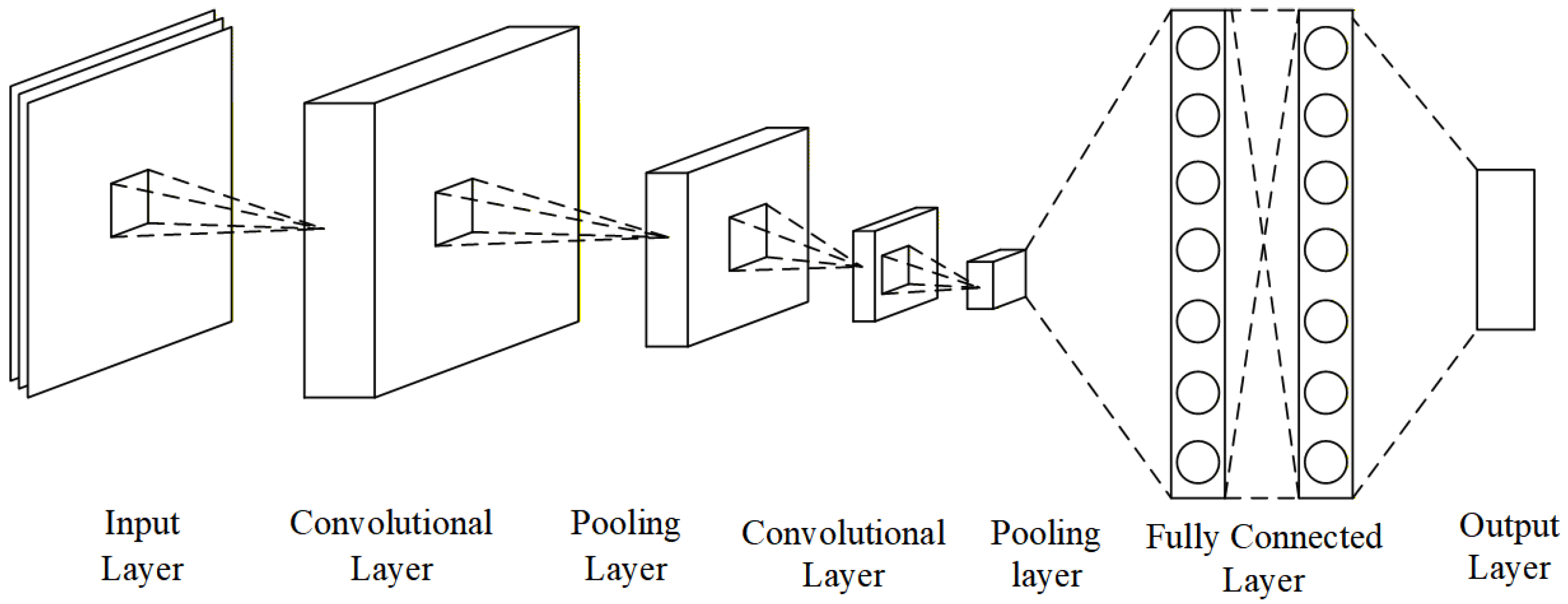
4.1. Convolutional Neural Network
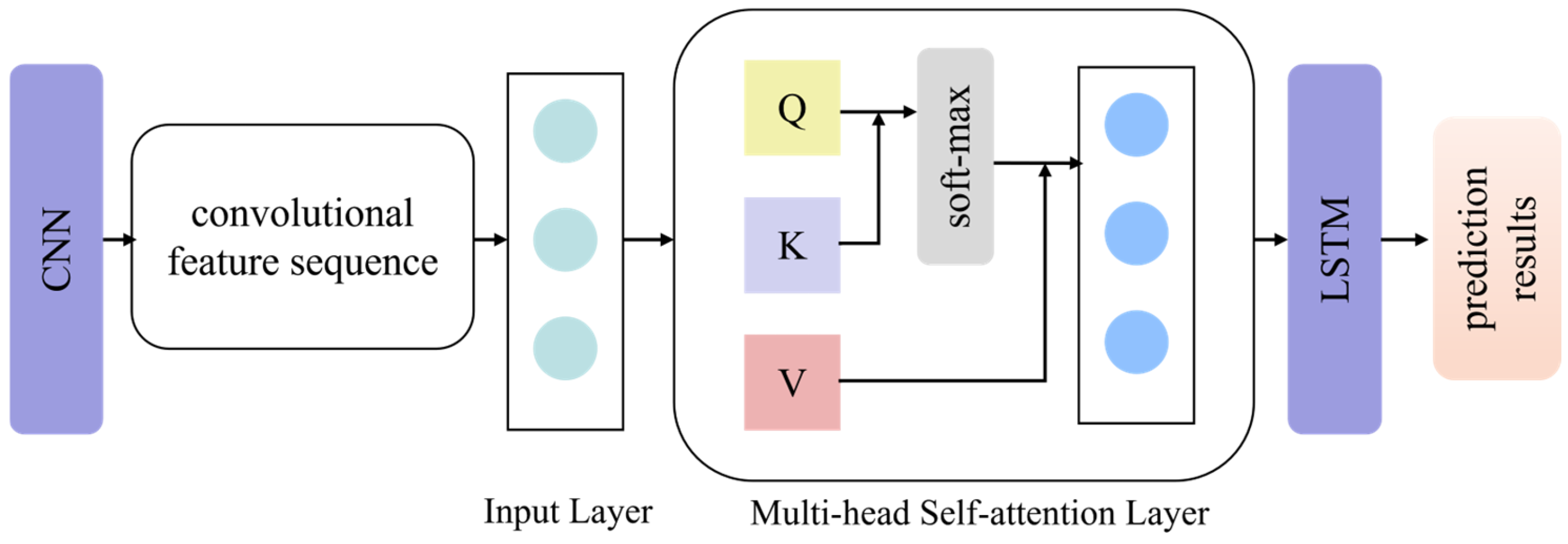
4.2. Multi-Head Self-Attention Mechanism
- (1)
- The input sequence undergoes linear mapping to form the query (), key (), and value () matrices. Multiple attention heads are used to project the input into different feature subspaces. The corresponding formulation can be expressed as follows:
- (2)
- Through multiple self-attention operations, each attention head learns independently in a different projected subspace. The results produced by each attention head are subsequently merged and passed through a linear mapping back into the original feature dimension to obtain the final multi-head attention output.
4.3. CNN-MSA-LSTM Model
- (1)
- Relative to the traditional CNN–LSTM architecture, the proposed CNN–MSA–LSTM framework forms a hierarchical framework of “local feature extraction–global correlation reconstruction–temporal dynamic modeling.” This framework enables cross-temporal association of multiscale feature information and promotes the transition of feature representation from local modeling to global modeling. Consequently, it provides stronger representation capability and higher prediction stability for photovoltaic power forecasting with multidimensional feature inputs.
- (2)
- Compared with an LSTM that relies on only one attention mechanism, the MSA module handles cloud image information, meteorological dynamics, and historical power variations through several attention heads working in different feature subspaces. This makes it possible to model these heterogeneous signals from multiple perspectives before combining them again within a unified representation. When meteorological conditions become more complicated, such a design can reduce the tendency of single-head attention to place too much emphasis on a limited set of features, while also giving the model greater room to capture richer patterns in the data.
4.4. Overfitting Suppression
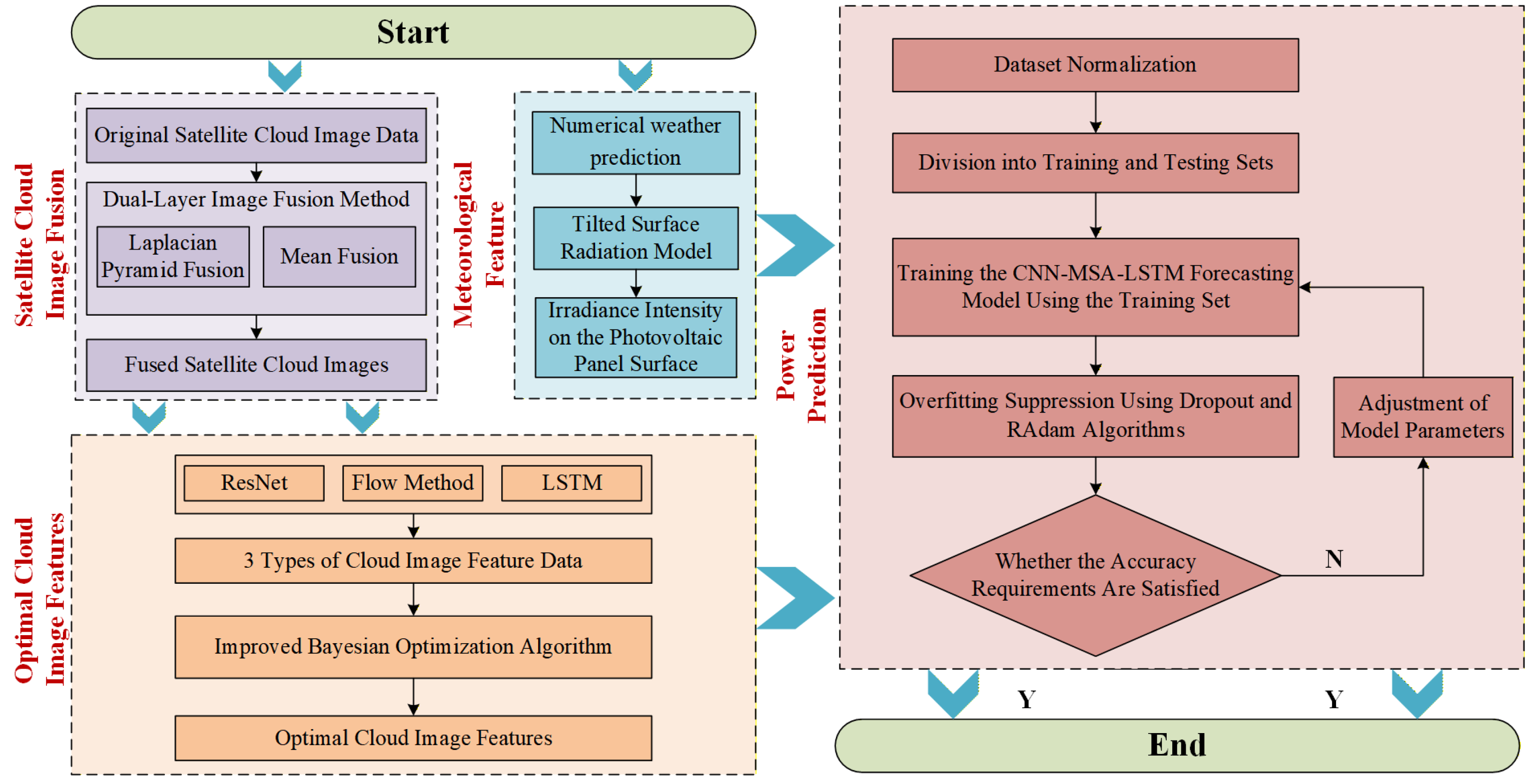
4.5. Prediction Model Based on IBO-CNN-MSA-LSTM
5. Example Analysis
5.1. Data Source
5.2. Analysis of Multiband Satellite Cloud Image Fusion
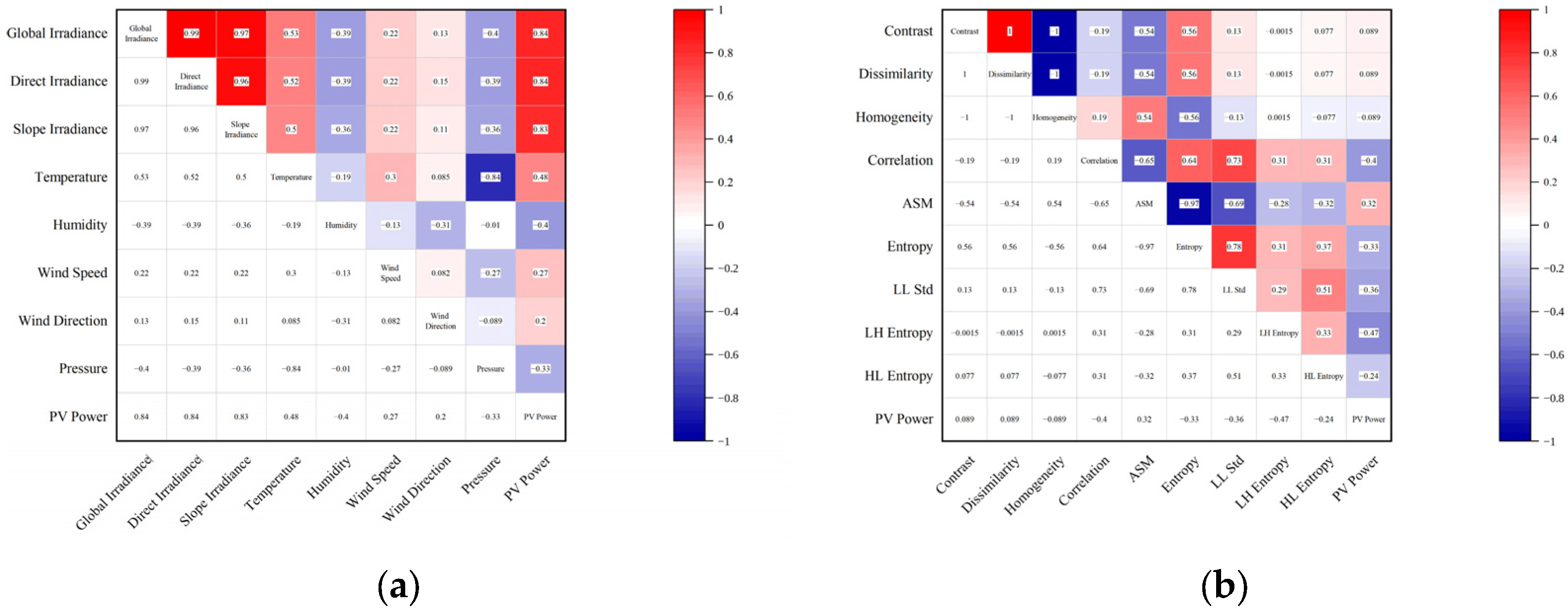
5.3. Predicted Cloud Images and Their Feature Analysis
5.4. PV Power Prediction Results and Analysis
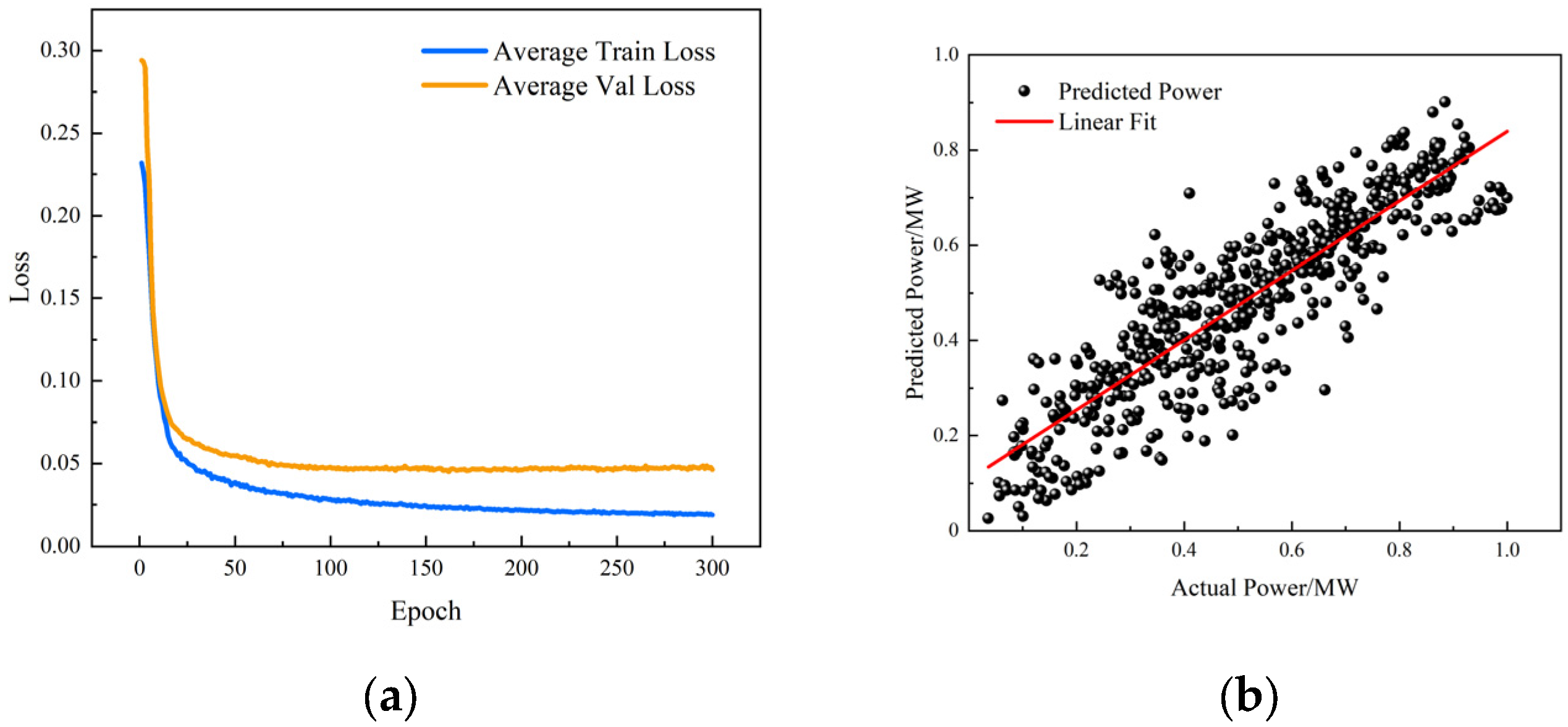
5.4.1. Dataset Cross-Validation Analysis
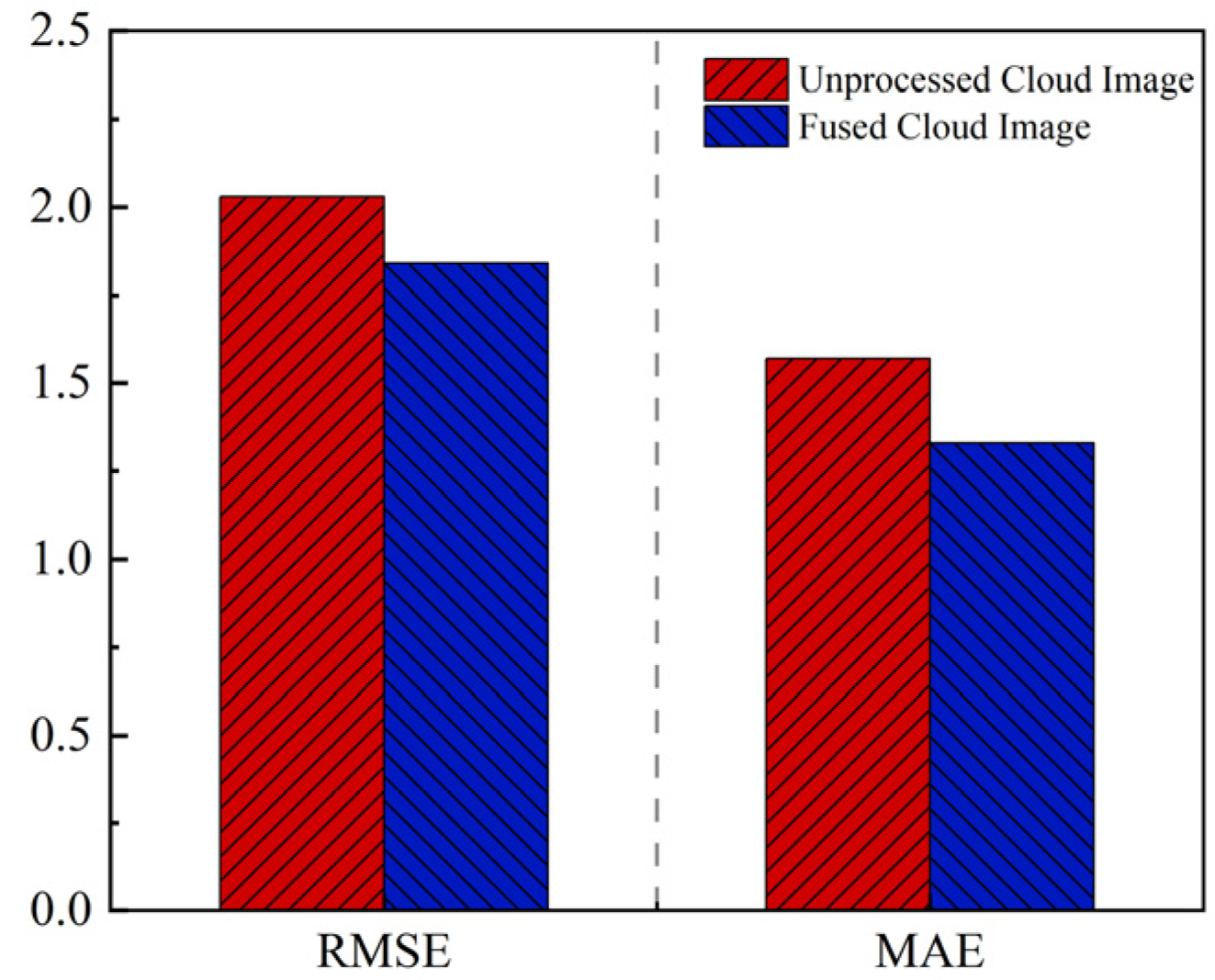
5.4.2. Impact of Cloud Image Fusion on Power Prediction
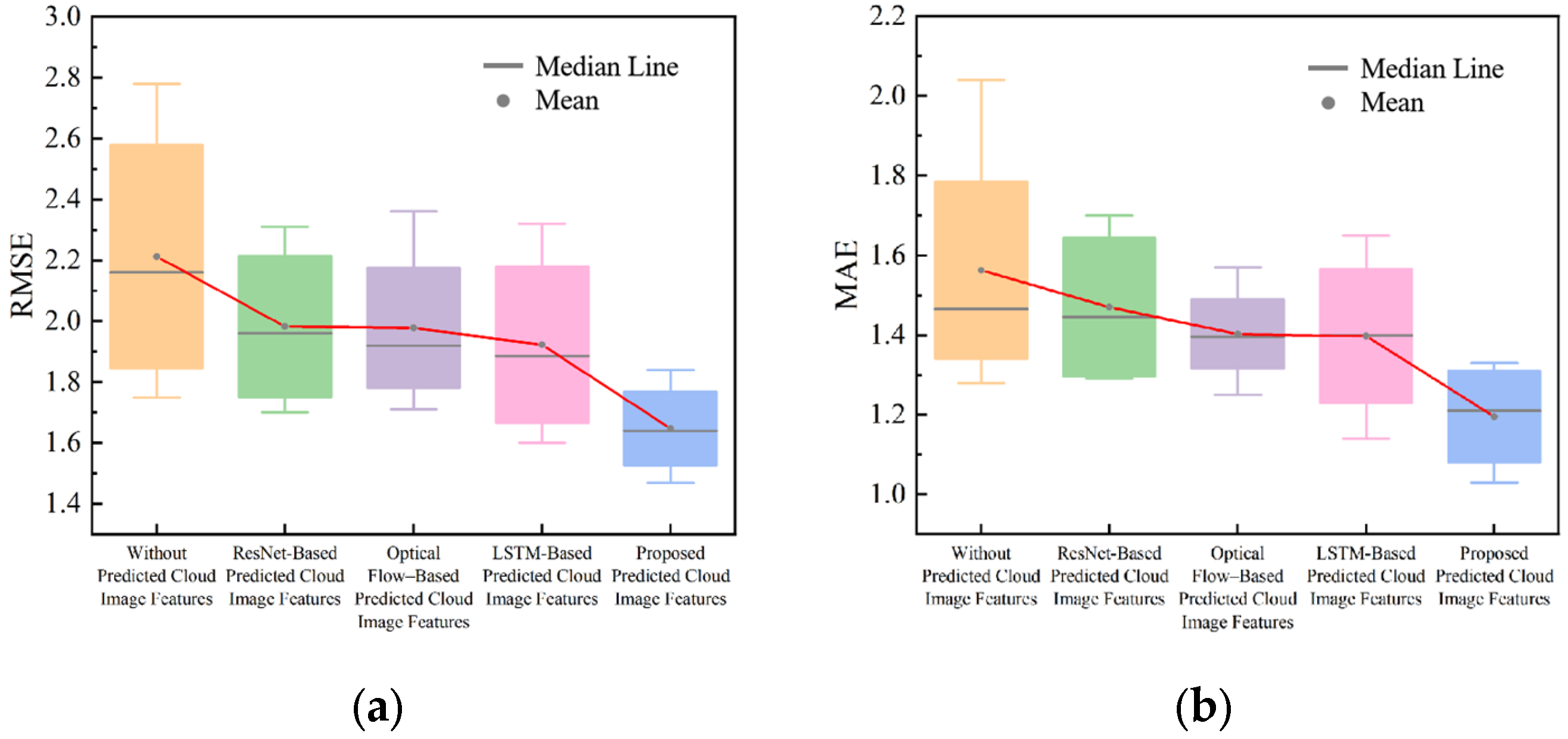
5.4.3. Impact of Different Cloud Image Feature Inputs on Power Prediction
5.4.4. Validation of Prediction Results Based on the IBO-CNN-MSA-LSTM
6. Conclusions
- (1)
- Based on the image characteristics of different wavelengths within the same band and across different bands of satellite cloud images, a fusion scheme combining Laplacian pyramid fusion and mean fusion is proposed. The PSNR and SSIM values increase by 0.79% and 22%, respectively, which improves the quality of the fused cloud images and significantly reduces the influence of brightness temperature differences in the infrared band. This method effectively enriches cloud image feature information.
- (2)
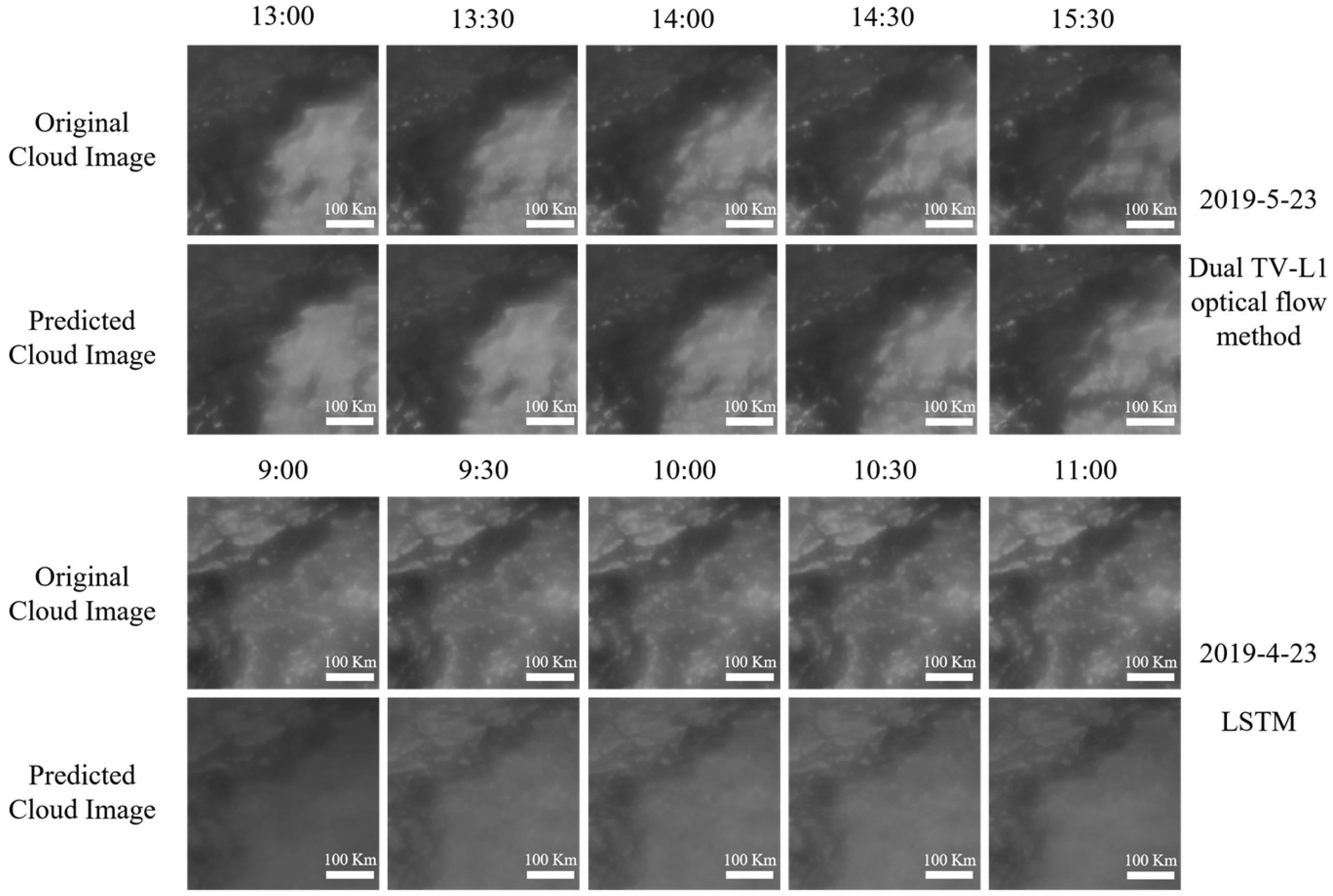
- An improved adaptive BO algorithm (IBO) is proposed. The IBO algorithm is used to fuse different cloud image features and obtain optimal fused cloud image features. Compared with the predicted cloud image features obtained using the ResNet, optical flow, and LSTM methods, the proposed method achieves a maximum reduction of 20.69% in RMSE and 19.39% in MAE.
- (3)
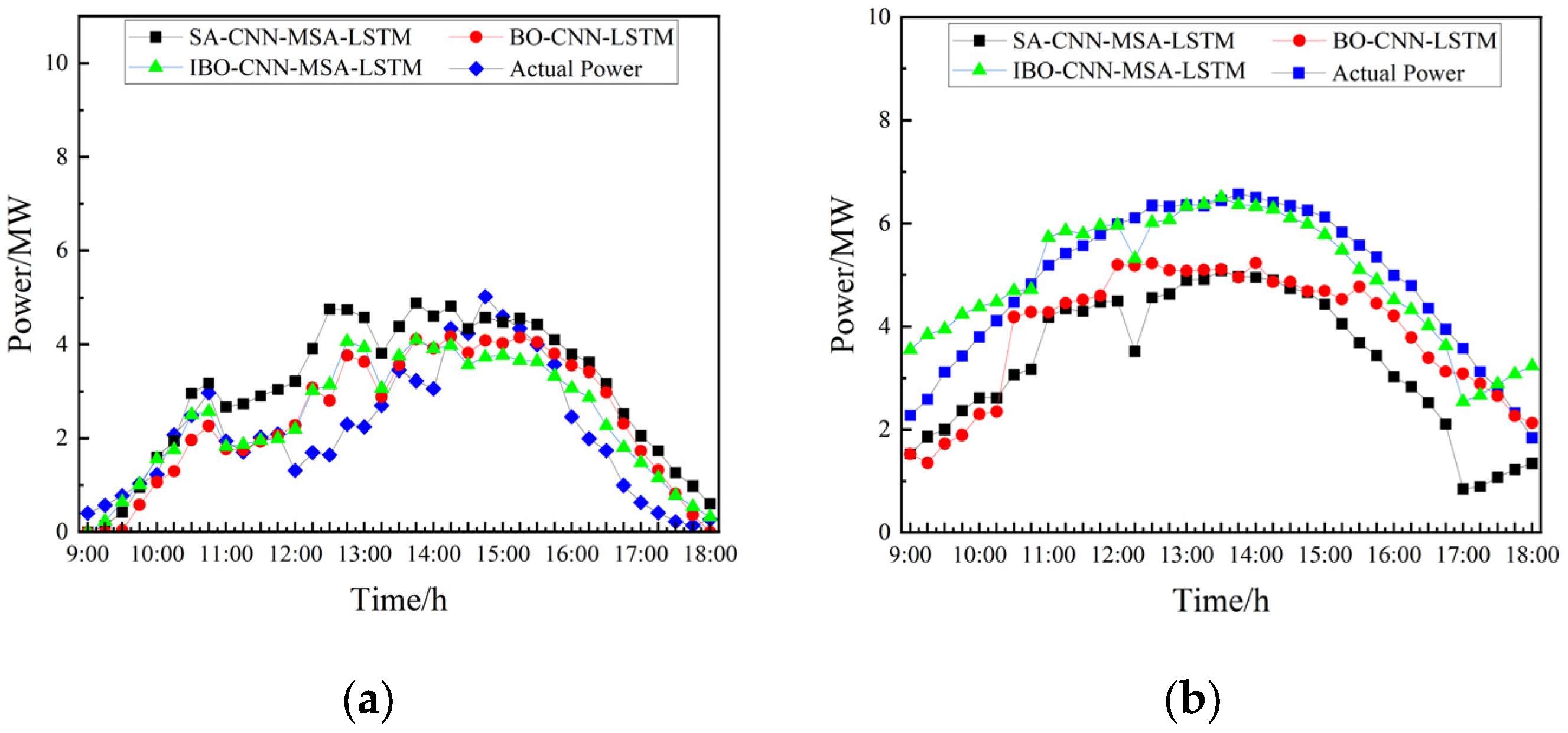
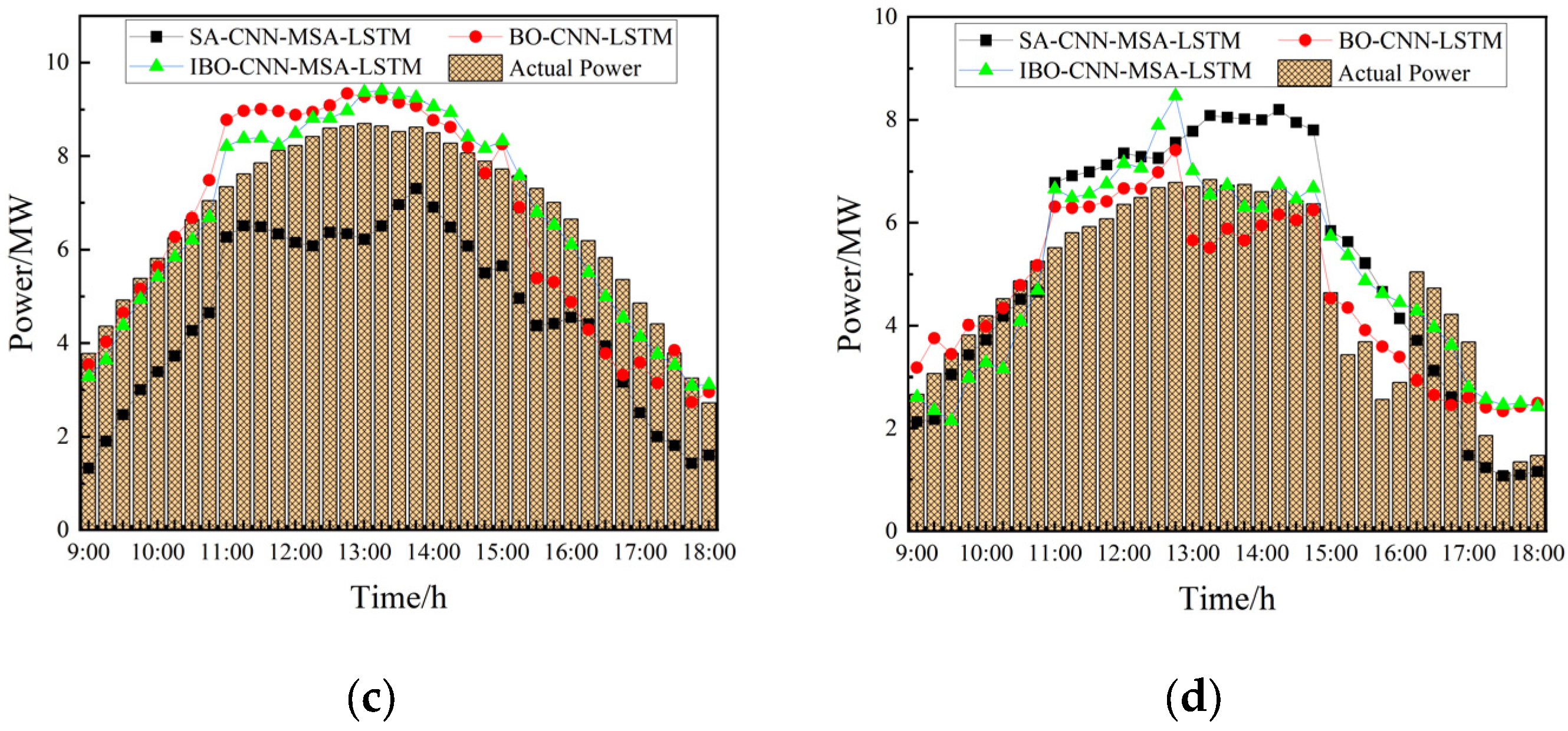
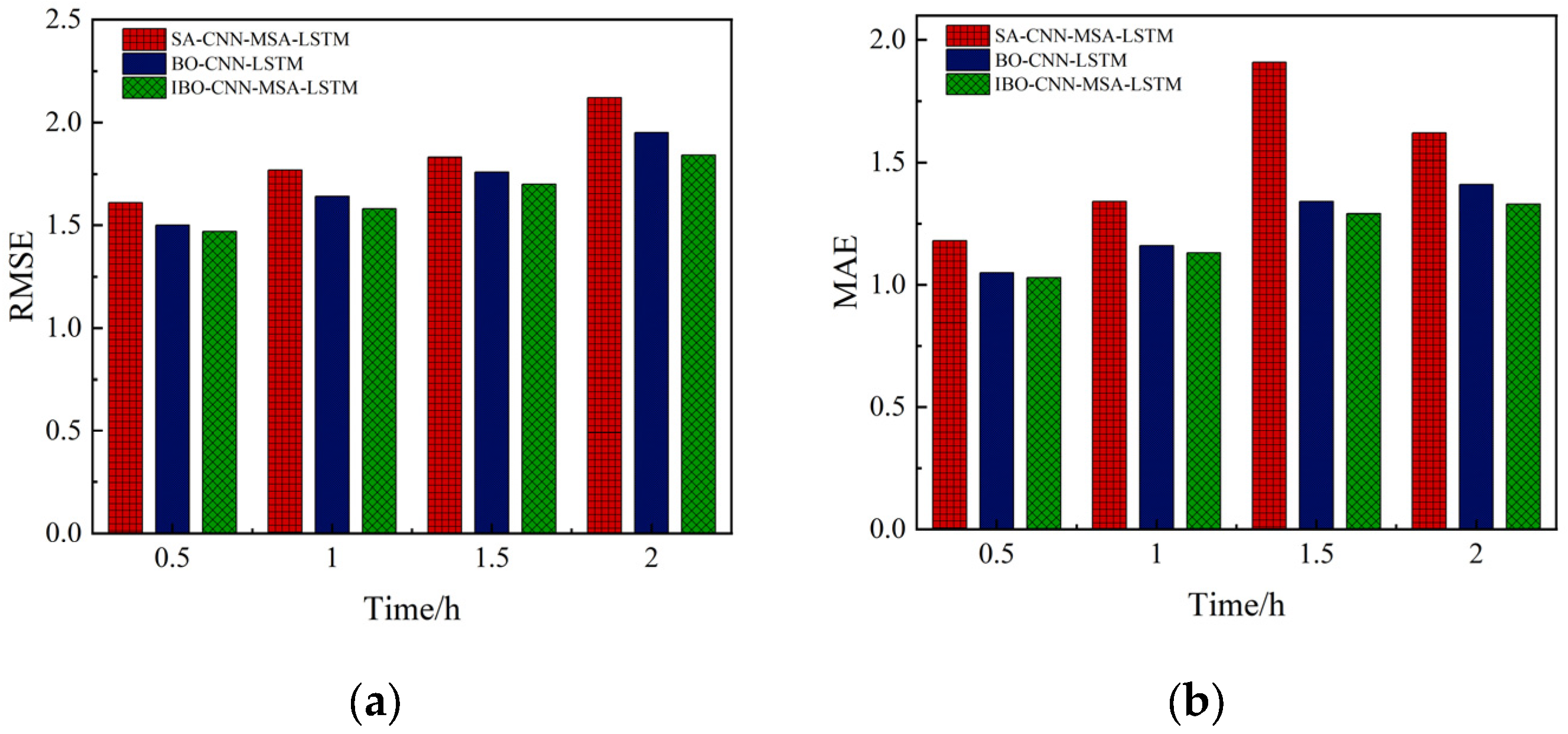
- An IBO-CNN-MSA-LSTM PV power prediction method is proposed. Compared with the SA-CNN-MSA-LSTM and BO-CNN-LSTM methods, the proposed method achieves improvements of 6.32% and 5.91%, respectively. In PV power prediction at different time scales, the average RMSE and MAE are reduced by 3.68% and 3.47%, respectively, thereby effectively improving prediction accuracy.
Author Contributions
Funding
Data Availability Statement
Conflicts of Interest
References
- Wang, L. Study on the Impacts of Large-Scale Photovoltaic Power Generation on Power Systems. Lamps Light 2024, 102–104. [Google Scholar]
- Liu, Z.; Wang, S. To Pool Strong Efforts to Advance the Global Energy Transition. State Grid News, 23 May 2025; p. 001.
- Dong, C.; Wang, Z.; Bai, J.; Jiang, J.; Wang, B.; Liu, G. Review of Ultra-short-term Forecasting Methods for Photovoltaic Power Generation. High Volt. Eng. 2023, 49, 2938–2951. [Google Scholar] [CrossRef]
- Jia, L.; Yun, S.; Zhao, Z.; Li, H.; Wang, S.; Yang, L. Recent Progress of Short-term Forecasting of Photovoltaic Generation Based on Artificial Neural Networks. Acta Energiae Solaris Sin. 2022, 43, 88–97. [Google Scholar] [CrossRef]
- Luo, J.; Wang, Y.; Su, D. Research Progress on Ground-Based Cloud Image Detection and Photovoltaic Power Forecasting. Electron. Compon. Inf. Technol. 2024, 8, 98–100. [Google Scholar]
- Deng, F.; Liu, T.; Wang, J.; Gao, B.; Wei, B.; Li, Z. Research on Photovoltaic Power Prediction Based on Multimodal Fusion of Ground Cloud Map and Meteorological Factors. Proc. Chin. Soc. Electr. Eng. 2025, 45, 7193–7206. [Google Scholar] [CrossRef]
- Gao, H.; Liu, M. Short-term Solar Irradiance Prediction from Sky Images with a Clear Sky Model. In Proceedings of the 2022 IEEE/CVF Winter Conference on Applications of Computer Vision (WACV), Waikoloa, HI, USA, 3–8 January 2022; pp. 3074–3082. [Google Scholar]
- Dissawa, L.H.; Agalgaonkar, A.P.; Robinson, D.; Godaliyadda, R.I.; Ekanayake, J.B.; Ekanayake, P.B.; Perera, S. On-Site Solar Power Forecasting Using Sky-Images. In Proceedings of the 2020 Australasian Universities Power Engineering Conference (AUPEC), Hobart, Australia, 29 November–2 December 2020; pp. 1–8. [Google Scholar]
- Yin, X.; Zhao, H.; Sun, W.; Guo, X.; Jiang, S.; Liu, Y. Enhancement and Fusion Research of FY-4A Sea Area Cloud Images. Hydrogr. Surv. Charting 2020, 40, 30–34. [Google Scholar]
- Wang, Y.; Wang, Y.; Liu, Y.; Yang, D.; Xie, X. Ultra-short-term prediction of offshore photovoltaic power based on satellite remote sensing muli-spectral cloud image. Control Decis. 2025, 40, 1136–1144. [Google Scholar] [CrossRef]
- Zheng, K.; Wang, L.; Hao, Y.; Wang, B. Ultra-short-term Prediction of Photovoltaic Power Based on Dataset Distillation. Proc. Chin. Soc. Electr. Eng. 2024, 44, 5196–5208. [Google Scholar] [CrossRef]
- Zhang, Q.; Wang, L.; Hao, Y.; Wang, B.; Che, J.; Guo, H. Ultra-short-term Solar Irradiance Prediction of Distributed Photovoltaic Power Stations Based on Satellite Cloud Images and Clear Sky Model. High Volt. Eng. 2022, 48, 3271–3281. [Google Scholar] [CrossRef]
- Si, Z.; Yang, M.; YU, Y.; Ding, T. Ultra-short-term Photovoltaic Power Prediction Method Based on Satellite Image Feature Region Positioning. High Volt. Eng. 2021, 47, 1214–1223. [Google Scholar] [CrossRef]
- Zhang, J.; Teng, J.; Li, X.; Tan, Z. Short-term Prediction of Photovoltaic Power based on Meteorological Features and Improved Transformer. J. Eng. Therm. Energy Power 2024, 39, 146–154. [Google Scholar]
- Bessho, K.; Date, K.; Hayashi, M.; Ikeda, A.; Imai, T.; Inoue, H.; Kumagai, Y.; Miyakawa, T.; Murata, H.; Ohno, T. An introduction to Himawari-8/9—Japan’s new-generation geostationary meteorological satellites. J. Meteorol. Soc. Jpn. Ser. II 2016, 94, 151–183. [Google Scholar] [CrossRef] [Scilit]
- Bosch, J.L.; Zheng, Y.; Kleissl, J. Deriving cloud velocity from an array of solar radiation measurements. Sol. Energy 2013, 87, 196–203. [Google Scholar] [CrossRef] [Scilit]
- Wang, S.; Xu, C.; Shi, C.; Zhang, Y. Study on Cloud Classification Method of Satellite Cloud Images Based on CNN-LSTM. Comput. Sci. 2022, 49, 675–679+783. [Google Scholar]
- Li, M.; Fan, Z.; Zhu, Y. The Feature Fusion Depth Estimation Algorithm Based on Laplacian Pyramid. Electron. Meas. Technol. 2025, 48, 183–188. [Google Scholar] [CrossRef]
- Yin, H.; Xiao, J. Laplacian Pyramid Generative Adversarial Network for Infrared and Visible Image Fusion. IEEE Signal Process. Lett. 2022, 29, 1988–1992. [Google Scholar] [CrossRef] [Scilit]
- Zhao, S.; Wang, Z.; Chen, Z.; Hu, J.; Zhou, Z. GLCM Texture Features of On-load Tap Changer and Fault Diagnosis Method Based on Improved Random Forest Algorithm. High Volt. Eng. 2022, 48, 3593–3601. [Google Scholar] [CrossRef]
- Ma, L.; Kong, X.; Guo, L.; Liu, Y.; Liu, X. Photovoltaic Power Forecasting Based on Maximum Overlap Discrete Wavelet Transform and Deep Learning. Acta Energiae Solaris Sin. 2024, 45, 576–583. [Google Scholar] [CrossRef]
- Qian, Y.; Zhang, J.; Huang, Q. Infrared and Visible Image Fusion Based on Discrete Wavelet Transform. J. Shanxi Univ. (Nat. Sci. Ed.) 2025, 1–15. [Google Scholar]
- He, K.; Zhang, X.; Ren, S.; Sun, J. Deep Residual Learning for Image Recognition. In Proceedings of the 2016 IEEE Conference on Computer Vision and Pattern Recognition (CVPR), Las Vegas, NV, USA, 27–30 June 2016; pp. 770–778. [Google Scholar]
- An, J.; Liu, G.; Zhu, J. Application of Farneback Optical Flow Method in Nowcasting. Software 2018, 39, 18–25. [Google Scholar]
- Yang, Q.; Wang, Y.; Liu, L.; Zhang, X. Adaptive fractional-order multi-scale optimization TV-L1 optical flow algorithm. Fractal Fract. 2024, 8, 179. [Google Scholar] [CrossRef] [Scilit]
- Doshi, H.; Kiran, N.U. A variational optical flow model for accurate motion estimation from rotational image sequences. SN Comput. Sci. 2024, 5, 359. [Google Scholar] [CrossRef] [Scilit]
- Li, T.; Zhang, T.; Zhou, Q. Research on Photovoltaic Power Generation Prediction Based on LSTM-Informer. In Proceedings of the 2024 IEEE 2nd International Conference on Image Processing and Computer Applications (ICIPCA), Shenyang, China, 28–30 June 2024; pp. 1045–1049. [Google Scholar]
- Chen, L.; Zhang, T.; Ma, Y.; Li, Y.; Wang, C.; He, C.; Lv, Z.; Li, N. A Bayesian-attack-graph-based Security Assessment Method for Power Systems. Electronics 2024, 13, 2628. [Google Scholar] [CrossRef] [Scilit]
- Yu, G.; Lu, L.; Yang, S.; Wang, S.; Yang, X.; Cheng, R. An Improved Hybrid Neural Network Ultra-short-term Photovoltaic Power Forecasting Method Based on Cloud Image Feature Extraction. Proc. Chin. Soc. Electr. Eng. 2021, 41, 6989–7003. [Google Scholar] [CrossRef]
- Wang, K.; Du, H.; Jia, R.; Liu, H.; Liang, Y.; Wang, X. Short-term Interval Probability Prediction of Photovoltaic Power Based on Similar Daily Clustering and QR-CNN-BiLSTM Model. High Volt. Eng. 2022, 48, 4372–4388. [Google Scholar] [CrossRef]
- Li, W.; Li, X.; Fan, P.; Zhang, H. Regional Electricity Sales Forecasting Based on Multi-head Attention Mechanism and Long Short-term Memory Network. Power Demand Side Manag. 2025, 27, 67–73. [Google Scholar]
- Huang, Y.; Zhou, C.; Zuo, K. An Introduction to Himawari-89—Japan’s New-Generation Geostationary Meteorological Satellites. J. Highw. Transp. Res. Dev. 2023, 40, 185–191+199. [Google Scholar]
- Yao, T.; Wang, J.; Wu, H.; Zhang, P.; Li, S.; Wang, Y.; Chi, X.; Shi, M. A photovoltaic power output dataset: Multi-source photovoltaic power output dataset with Python toolkit. Sol. Energy 2021, 230, 122–130. [Google Scholar] [CrossRef] [Scilit]
- Li, Y.; Li, Z.; Wang, X.; Liu, K.; Wang, Y.; Zhao, W. Research on Optimum TILT Angle for PV Array Based on Combination Models of Calculating Solar Radiation on Inclined Surface. Acta Energiae Solaris Sin. 2022, 43, 127–136. [Google Scholar] [CrossRef]
- Wang, D.; Liu, J.; Huang, Y.; Shi, B.; Jin, M. Photovoltaic Power Prediction Method Combinating Solar Radiation Calculation and CNN-LSTM. Acta Energiae Solaris Sin. 2024, 45, 443–450. [Google Scholar] [CrossRef]





| Fusion Scheme | PSNR | SSIM |
|---|---|---|
| Laplacian Pyramid Fusion + Guided Filtering Fusion | 17.98 | 0.7736 |
| Guided Filtering Fusion + Mean Fusion | 27.97 | 0.6640 |
| Brovey Fusion + Laplacian Pyramid Fusion | 28.01 | 0.3822 |
| Laplacian Pyramid Fusion Only | 28.15 | 0.5156 |
| Mean Fusion Only | 27.96 | 0.6555 |
| Laplacian Pyramid Fusion + Mean Fusion (Proposed Method) | 28.18 | 0.7997 |
| Feature | RMSE | |||
| 0.5 h | 1 h | 1.5 h | 2 h | |
| Correlation | 0.0200 | 0.0178 | 0.0211 | 0.0206 |
| ASM | 0.0959 | 0.1110 | 0.1252 | 0.1095 |
| Entropy | 0.2336 | 0.2421 | 0.2692 | 0.3040 |
| LL_std | 0.4182 | 0.5424 | 0.4485 | 0.8185 |
| LH_entropy | 1.6586 | 1.8516 | 1.5324 | 1.6295 |
| Feature | MAE | |||
| 0.5 h | 1 h | 1.5 h | 2 h | |
| Correlation | 0.0164 | 0.0140 | 0.0162 | 0.0161 |
| ASM | 0.0746 | 0.0845 | 0.0936 | 0.0835 |
| Entropy | 0.1794 | 0.1808 | 0.2034 | 0.2340 |
| LL_std | 0.3016 | 0.3916 | 0.3481 | 0.5619 |
| LH_entropy | 1.2624 | 1.3217 | 1.1808 | 1.2008 |
| Feature | SSIM | |||
|---|---|---|---|---|
| 0.5 h | 1 h | 1.5 h | 2 h | |
| Dual TV-L1 Flow Method | 0.8603 | 0.8106 | 0.7827 | 0.7660 |
| LSTM | 0.8382 | 0.8389 | 0.8367 | 0.8300 |
| Cloud Image Feature Extraction Methods | RMSE | |||
| 0.5 h | 1 h | 1.5 h | 2 h | |
| Without Cloud Image Features | 1.75 | 1.94 | 2.38 | 2.78 |
| ResNet-Based Predicted Features | 1.70 | 1.80 | 2.12 | 2.31 |
| Optical Flow–Based Predicted Cloud Image Features | 1.71 | 1.85 | 1.99 | 2.36 |
| LSTM-Based Predicted Cloud Image Features | 1.60 | 1.73 | 2.04 | 2.32 |
| Predicted Cloud Image Features Obtained by the Proposed Method | 1.47 | 1.58 | 1.70 | 1.84 |
| Cloud Image Feature Extraction Methods | MAE | |||
| 0.5 h | 1 h | 1.5 h | 2 h | |
| Without Cloud Image Features | 1.28 | 1.40 | 1.53 | 2.04 |
| ResNet-Based Predicted Features | 1.30 | 1.29 | 1.59 | 1.70 |
| Optical Flow–Based Predicted Cloud Image Features | 1.25 | 1.38 | 1.41 | 1.57 |
| LSTM-Based Predicted Cloud Image Features | 1.14 | 1.32 | 1.48 | 1.65 |
| Predicted Cloud Image Features Obtained by the Proposed Method | 1.03 | 1.13 | 1.29 | 1.33 |
| Weather Type | Error Metric | SA-CNN-MSA-LSTM | BO-CNN-LSTM | IBO-CNN-MSA-LSTM |
| Clear-Sky Conditions | RMSE | 1.73 | 1.08 | 1.06 |
| MAE | 1.46 | 0.82 | 0.76 | |
| Fluctuating Weather Conditions | RMSE | 2.35 | 2.36 | 2.20 |
| MAE | 1.73 | 1.78 | 1.70 | |
| SeasonalType | Error Metric | SA-CNN-MSA-LSTM | BO-CNN-LSTM | IBO-CNN-MSA-LSTM |
| Cold-Season | RMSE | 2.05 | 1.73 | 1.61 |
| MAE | 1.58 | 1.33 | 1.31 | |
| Warm-Season | RMSE | 2.24 | 1.78 | 1.65 |
| MAE | 1.84 | 1.45 | 1.33 |
Disclaimer/Publisher’s Note: The statements, opinions and data contained in all publications are solely those of the individual author(s) and contributor(s) and not of MDPI and/or the editor(s). MDPI and/or the editor(s) disclaim responsibility for any injury to people or property resulting from any ideas, methods, instructions or products referred to in the content. |
© 2026 by the authors. Licensee MDPI, Basel, Switzerland. This article is an open access article distributed under the terms and conditions of the Creative Commons Attribution (CC BY) license.
Share and Cite
Xie, L.; Li, C.; Luo, Y.; Li, L. A Short-Term Photovoltaic Power Prediction Based on Multidimensional Feature Fusion of Satellite Cloud Images. Processes 2026, 14, 846. https://doi.org/10.3390/pr14050846
Xie L, Li C, Luo Y, Li L. A Short-Term Photovoltaic Power Prediction Based on Multidimensional Feature Fusion of Satellite Cloud Images. Processes. 2026; 14(5):846. https://doi.org/10.3390/pr14050846
Chicago/Turabian StyleXie, Lingling, Chunhui Li, Yanjing Luo, and Long Li. 2026. "A Short-Term Photovoltaic Power Prediction Based on Multidimensional Feature Fusion of Satellite Cloud Images" Processes 14, no. 5: 846. https://doi.org/10.3390/pr14050846
APA StyleXie, L., Li, C., Luo, Y., & Li, L. (2026). A Short-Term Photovoltaic Power Prediction Based on Multidimensional Feature Fusion of Satellite Cloud Images. Processes, 14(5), 846. https://doi.org/10.3390/pr14050846