Article

Phase-Specific Yeast Growth Responses to an Atmospheric-Pressure Plasma Jet Under Direct and Plasma-Activated Medium Conditions

Department of Electrical Engineering, Fukuoka Institute of Technology, Fukuoka 811-0295, Japan
*
Author to whom correspondence should be addressed.
Processes 2026, 14(5), 832; https://doi.org/10.3390/pr14050832
Submission received: 13 February 2026 / Revised: 26 February 2026 / Accepted: 2 March 2026 / Published: 4 March 2026
(This article belongs to the Special Issue Applications of Plasma Technology in Food and Environment)

Abstract

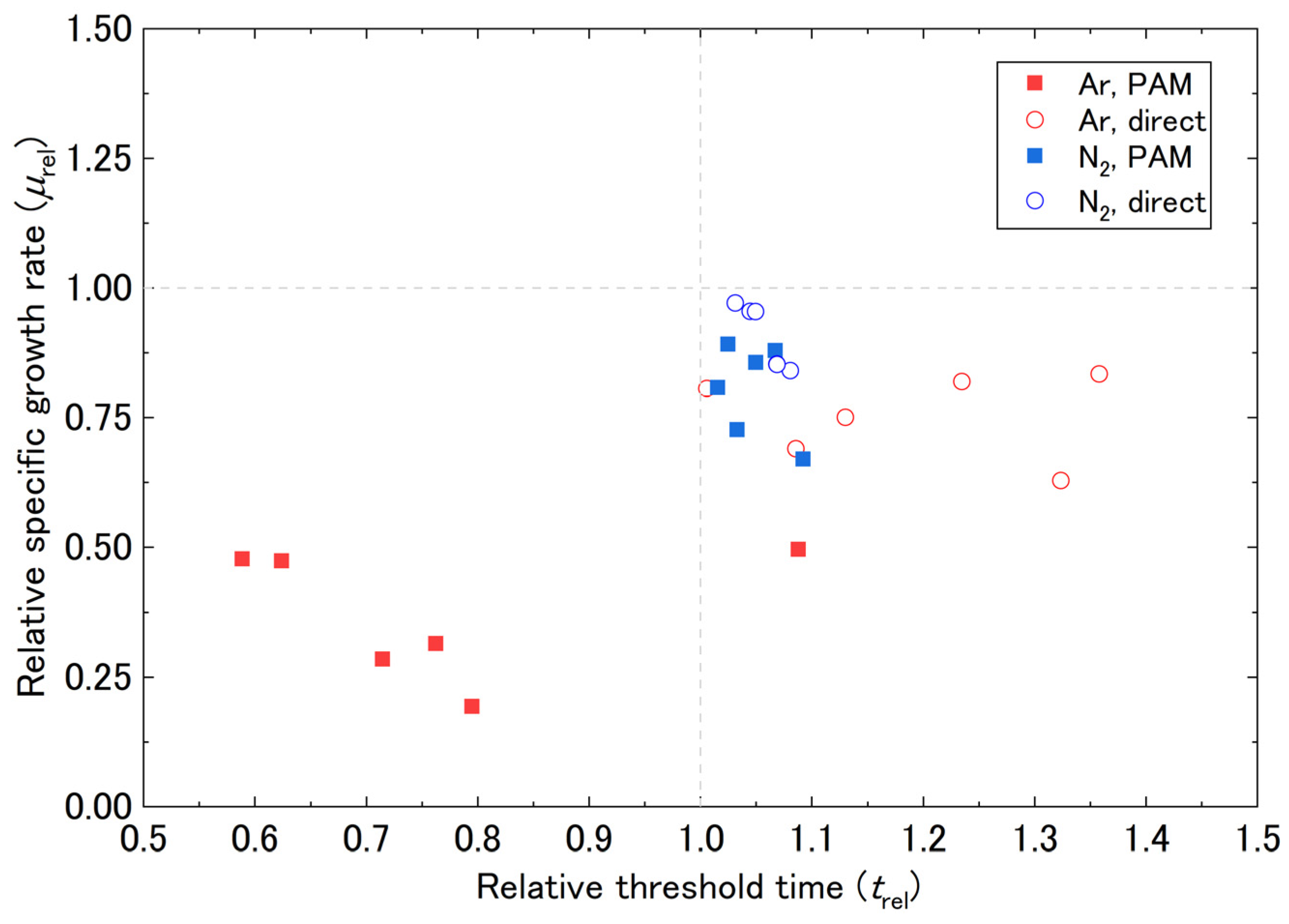
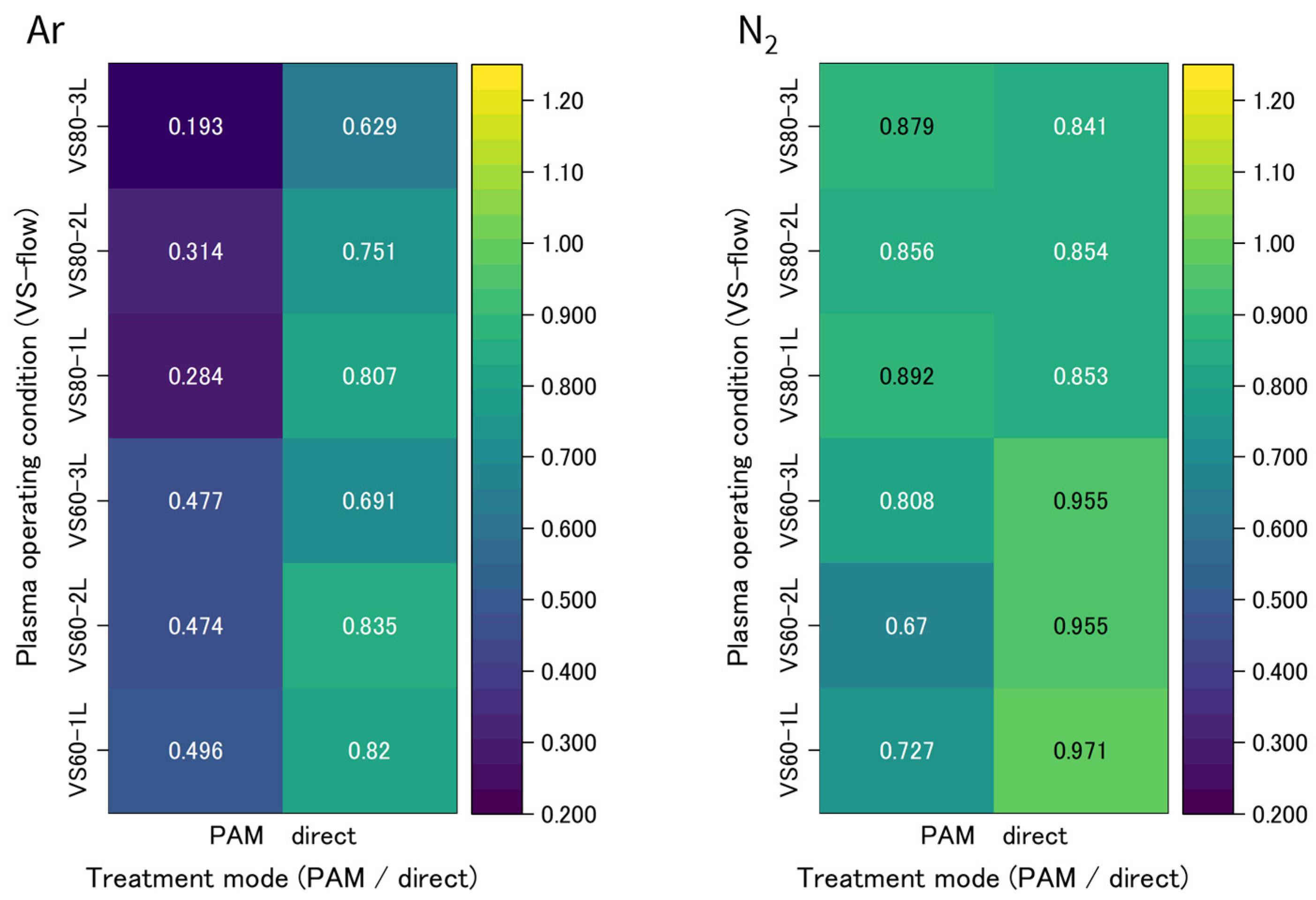
We investigated the effects of atmospheric-pressure plasma treatment on the growth of Saccharomyces cerevisiae by directly comparing plasma exposure and plasma-activated medium (PAM) under strictly identical discharge conditions. An atmospheric-pressure plasma jet operated with argon (Ar) or nitrogen (N2) was used. Yeast growth was analyzed using a phase-resolved kinetic framework that separately evaluated early growth behavior and exponential growth rate based on optical density measurements. Growth curves were normalized to same-day untreated controls to minimize day-to-day variability. Under N2 plasma conditions, both direct exposure and PAM treatment resulted in limited changes in growth kinetics (μrel = 0.67–0.97; trel ≈ 1.02–1.09). In contrast, Ar plasma treatment produced clear mode-dependent effects. Direct exposure delayed growth initiation (trel = 1.00–1.40) with a moderate reduction in μrel (0.63–0.84). PAM treatment strongly suppressed μrel (0.19–0.50), whereas trel varied across conditions without systematic prolongation (0.59–1.09). These findings demonstrate that treatment mode strongly influences which growth phase is predominantly affected, highlighting the importance of phase-resolved kinetic analysis for distinguishing plasma-induced biological effects beyond conventional endpoint measurements.
Keywords: atmospheric-pressure plasma; nonthermal plasma; plasma-activated medium; Saccharomyces cerevisiae; microbial growth kinetics; phase-resolved analysis; plasma–liquid interaction atmospheric-pressure plasma; nonthermal plasma; plasma-activated medium; Saccharomyces cerevisiae; microbial growth kinetics; phase-resolved analysis; plasma–liquid interaction