3.1. Comparative Effect of Thermal Processing on Spore Viability
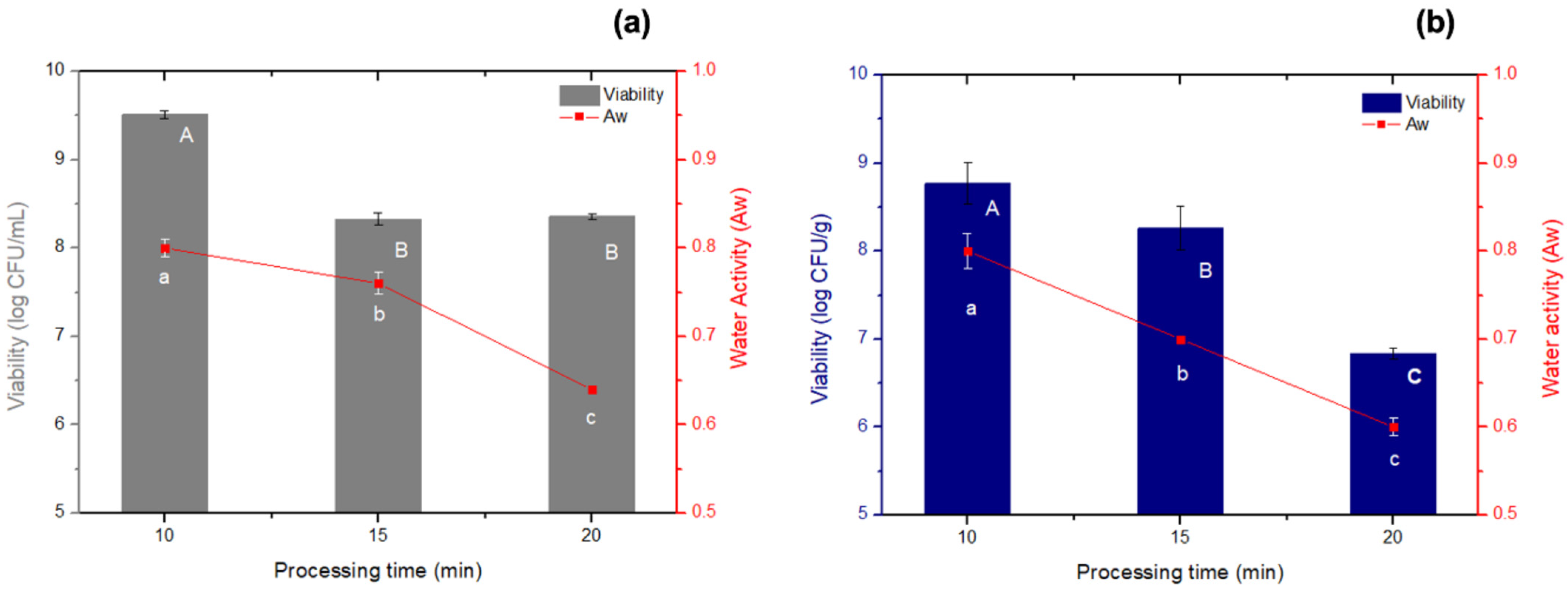
Figure 1 shows the thermal stability of
H. coagulans spores incorporated into oat-based (a) and rice-bean-based (b) matrices during electric oven processing at 180 °C, alongside the corresponding variations in Aw.
Post-processing analysis revealed the thermal resilience of
H. coagulans, which maintained high viability counts despite exposure to baking at 180 °C. The oat matrix demonstrated robust thermal protection during processing. At 10 min, spore viability was 9.5 log CFU/g (Aw 0.80). Extending the baking time to 20 min resulted in a final viability of 8.4 log CFU/g. The oat matrix exhibited a minor reduction of 1.17 log cycles between 10 and 20 min of processing. Despite the significant reduction in Aw, which decreased from 0.80 to 0.64 at the highest processing time (20 min), cell viability remained high. This suggests that the oat matrix effectively dissociated moisture loss from thermal inactivation, maintaining viability above 8 log CFU/g (
Figure 1a).
In contrast, the rice-bean matrix showed a time-dependent sensitivity to thermal stress. While viability was relatively high at 10 min (8.8 log CFU/g; Aw 0.80), a decline was observed as the processing time increased. At 20 min, viability dropped to 6.8 log CFU/g. This corresponds to a significant reduction of 3 log cycles (~60% reduction in viable cell count) compared to the 10 min processing time (
p < 0.05). As Aw decreased below 0.70 (15–20 min interval), the rate of inactivation accelerated, indicating that the structural changes associated with drying in the starch-rich matrix may have compromised the thermal resistance of the spores (
Figure 1b). While both matrices reached similar final water activity levels (Aw ~0.60) after 20 min, the oat matrix proved superior in preserving spore integrity under the same thermal processing conditions.
The observed Aw values led to the formation of intermediate-moisture structures in both matrices. Despite the inherent resilience of spores, the high survival rates suggest that these solid matrices may have acted as thermal insulators, likely reducing heat transfer, and helping to maintain spore integrity. This observation is consistent with the protective effects of cereal-based systems [
26,
27], where survival is often linked to a low-moisture environment that limits metabolic activity while maintaining necessary spore hydration [
14]. However, the stabilization mechanisms appeared to differ between the two snacks. In the oat matrix, the high concentration of lipids and β-glucan fibers likely contributed to a thermal barrier, potentially lowering thermal diffusivity and attenuating heat reaching the spore core. The hydrocolloidal nature of these fibers may form a viscous gel that physically supports the spore coat by modulating moisture evaporation. Conversely, while the protein-rich rice-bean matrix can offer thermal protection, its starch-protein network appeared less effective in mitigating thermal shock [
28,
29]. Factors such as protein denaturation or starch retrogradation potentially resulted in a more conductive structure, offering less protection than the lipid-fiber network of the oat matrix.
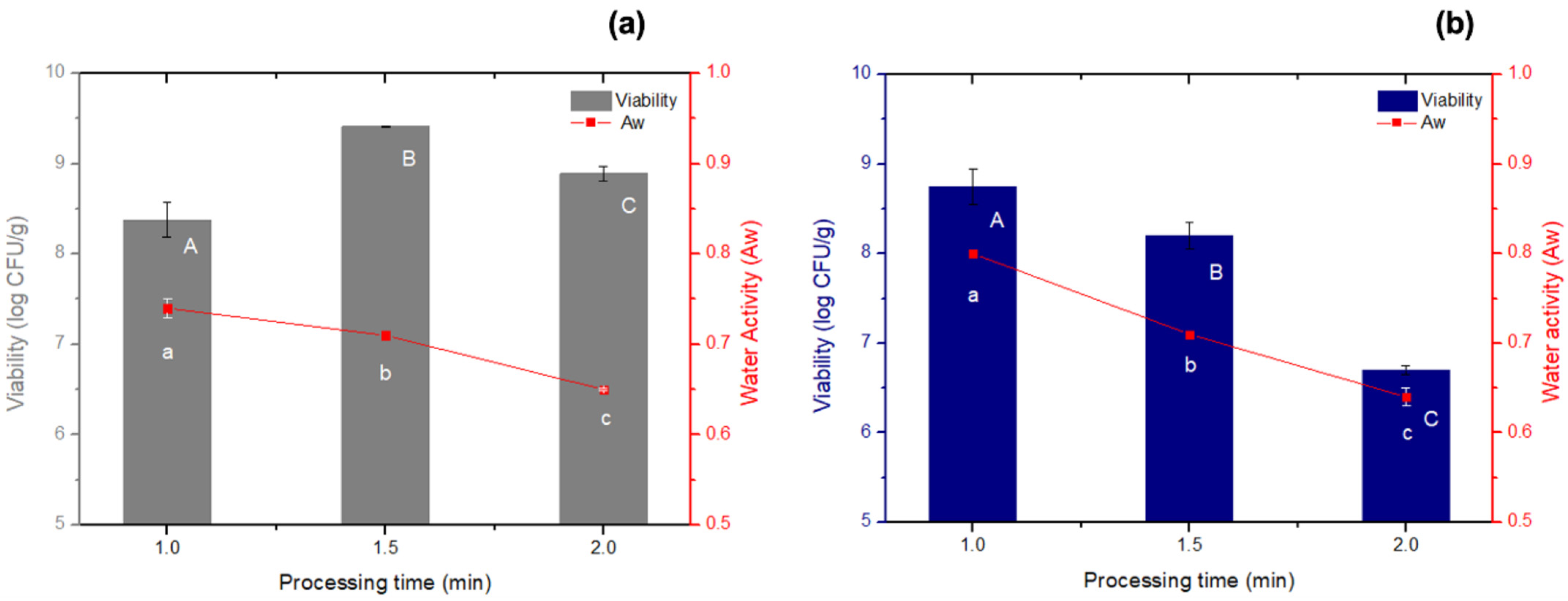
Figure 2 illustrates the impact of microwave processing on the viability of
H. coagulans spores in oat-based (
Figure 2a) and rice-bean-based (
Figure 2b) matrices across independent exposure intervals (1.0, 1.5, and 2.0 min) and post-processing Aw.
The spores exhibited thermal stability under microwave processing of oat probiotic snack. Comparisons between independent treatments showed that samples processed for 1.5 min yielded significantly higher counts (9.4 log CFU/g) than those processed for 1.0 min (8.4 log CFU/g) (p < 0.05). This suggests that the 1.5 min exposure provided the optimal thermal activation shock for dormant spores, rather than causing inactivation. Even in the 2.0 min processing group, where Aw decreased to 0.65, viability remained robust (8.9 log CFU/g), indicating that the oat matrix effectively shielded spores against dielectric heating across all tested processing times.
In contrast, spore survivability on rice-bean matrix demonstrated instability across all processing times (
Figure 2b). A clear inverse correlation was observed, with longer exposure times corresponding to lower viability. The group processed for 1.0 min retained 7.8 log CFU/g, whereas the 1.5 min group dropped sharply to 6.1 log CFU/g. Contrasting with the oat matrix, this significant reduction occurred despite similar post-processing water activity (Aw 0.64), implying that the lethality was driven by a rapid thermal shock rather than the gradual process of dehydration. Although the 2.0 min samples showed slightly higher counts (~6.5 log CFU/g) than the 1.5 min group, the overall trend confirmed the sensitivity to dielectric stress. Comparing the endpoints (2.0 min treatment), the spores in oat matrix retained significantly higher viability (~2.4 log CFU/g higher) than in the rice-bean matrix, despite both reaching similar final Aw levels (0.62–0.65).
The divergent stability profiles observed are fundamentally governed by the dielectric response of each matrix. The rice-bean probiotic snack formulation, characterized by high water activity and a mineral profile rich in electrolytes (e.g., K
+ typical of legumes), presents a high dielectric loss factor (ε). This physical property maximizes heat generation through both dipolar rotation of free water and ionic conduction of dissolved salts [
30]. The matrix’s interaction with the microwave field potentially facilitated the occurrence of the thermal runaway effect [
31,
32].
It is hypothesized that this rapid volumetric heating created a moist-heat regime that potentially lowered the activation energy required for protein denaturation. Under these conditions, the high retention of free water may have facilitated thermal conduction to the spore core, potentially overcoming its natural resistance mechanisms and causing the decline in viability observed (<6 log CFU/g). In contrast, the oat matrix likely acted as a thermo-dielectric stabilizer. Its composition, rich in lipids and with water tightly bound to β-glucan fibers, is suggested to restrict water mobility and ion migration. This may have effectively reduced the density of free dipoles, causing the matrix to behave as a low-dielectric-loss material that is partially transparent to the electromagnetic field. Such behavior potentially prevented the generation of lethal volumetric heat densities and shifted the thermodynamic system towards a dry-heat regime. In this state, the spore core likely remains effectively dehydrated, stabilized by dipicolinic acid (Ca-DPA) chelation and DNA-protecting SASPs [
33]. By potentially maintaining the micro-environment within a stable glassy state, the oat matrix may have shielded the spore’s germination machinery from lethal denaturation, preserving robust viability even as Aw decreased.
The high survival rates observed in oven-baked snacks align with findings of Almada-Érix et al. [
34] and Cinbaş et al. [
29], who reported that
H. coagulans spores can withstand baking temperatures within bread matrices due to the protective shielding of the solid starch network. These results reinforce the consensus that cereal-based systems act as effective thermal insulators, offering a more stable delivery vehicle.
Our findings suggest a critical interplay between processing time, moisture reduction, and matrix composition. While
H. coagulans typically demonstrates high thermal resistance during conductive heating, as evidenced by >90% viability in soups processed at 85 °C [
35], the significant inactivation observed in the rice-bean matrix underscores the distinct challenges inherent to microwave processing. Unlike conventional baking, which allows for thermal lag times through surface-to-center conduction [
36], microwave processing utilizes volumetric heating that can be more severe. Although microwave heating offers superior energy efficiency and nutrient preservation, its industrial application for probiotics remains potentially hindered by risks associated with non-uniform heating [
37].
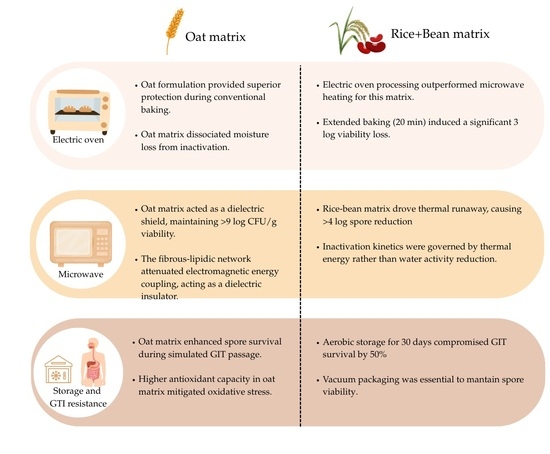
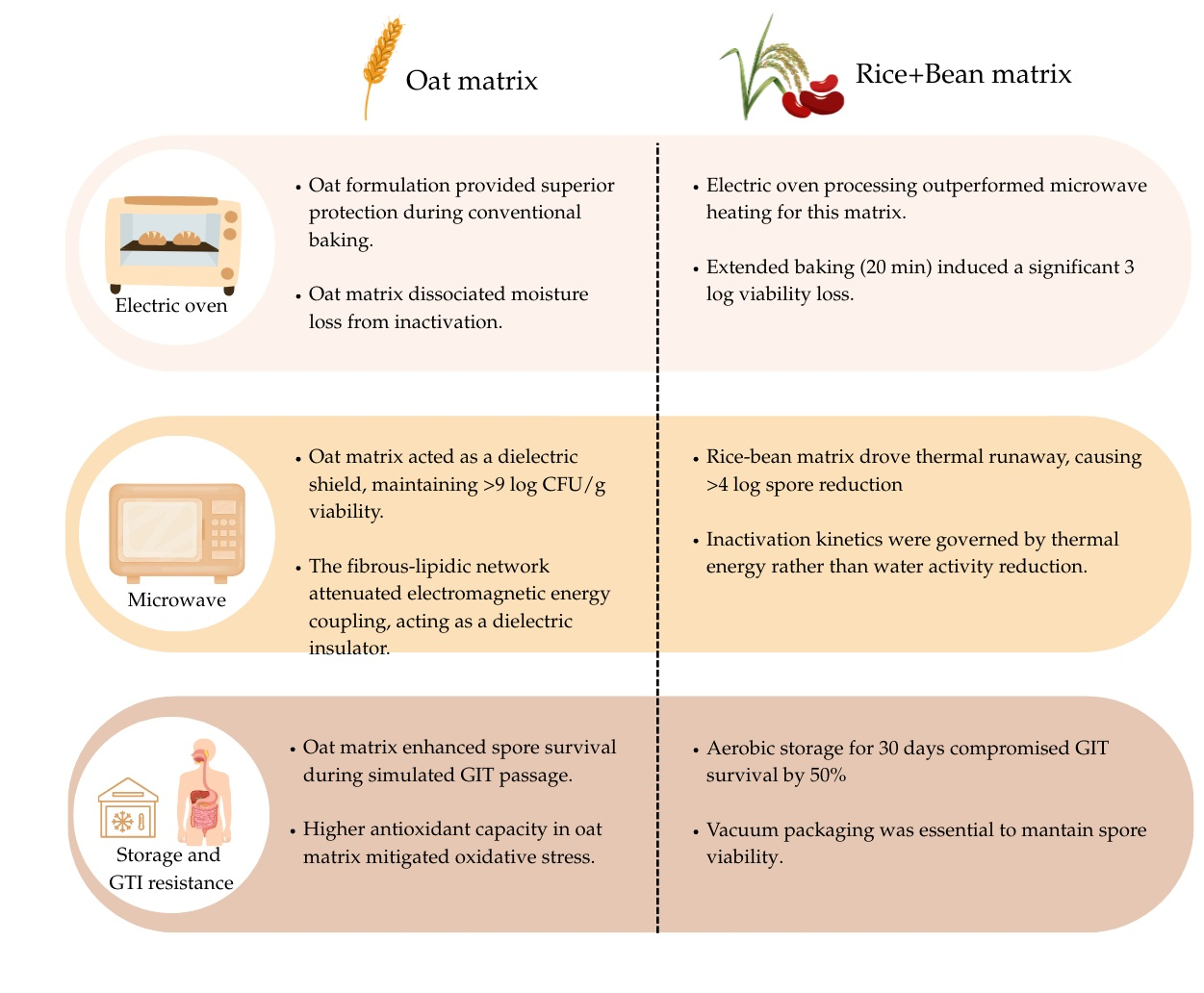
This study confirms that for dielectric heating applications, matrix composition is the primary protective strategy. The oat matrix validates the rational design of fiber-dense, lipid-rich formulations that act as dielectric insulators, managing the trade-off between rapid dehydration and thermal intensity to ensure probiotic survival.
3.2. Effects of Storage Conditions on H. coagulans Survival Rate
Although microwave processing offered rapid dehydration, it resulted in inconsistent survival rates and significant inactivation in the starch-rich formulation (>4 log reduction). Therefore, to ensure high initial viability counts and process uniformity necessary for longitudinal analysis, the oven-baking method was chosen for the stability study. This method provided robust survival (>90%) for both oat and rice-bean matrices, establishing a reliable baseline for the shelf-life assessment. The processing conditions were standardized at 10 min for both matrices to ensure optimal probiotic retention.
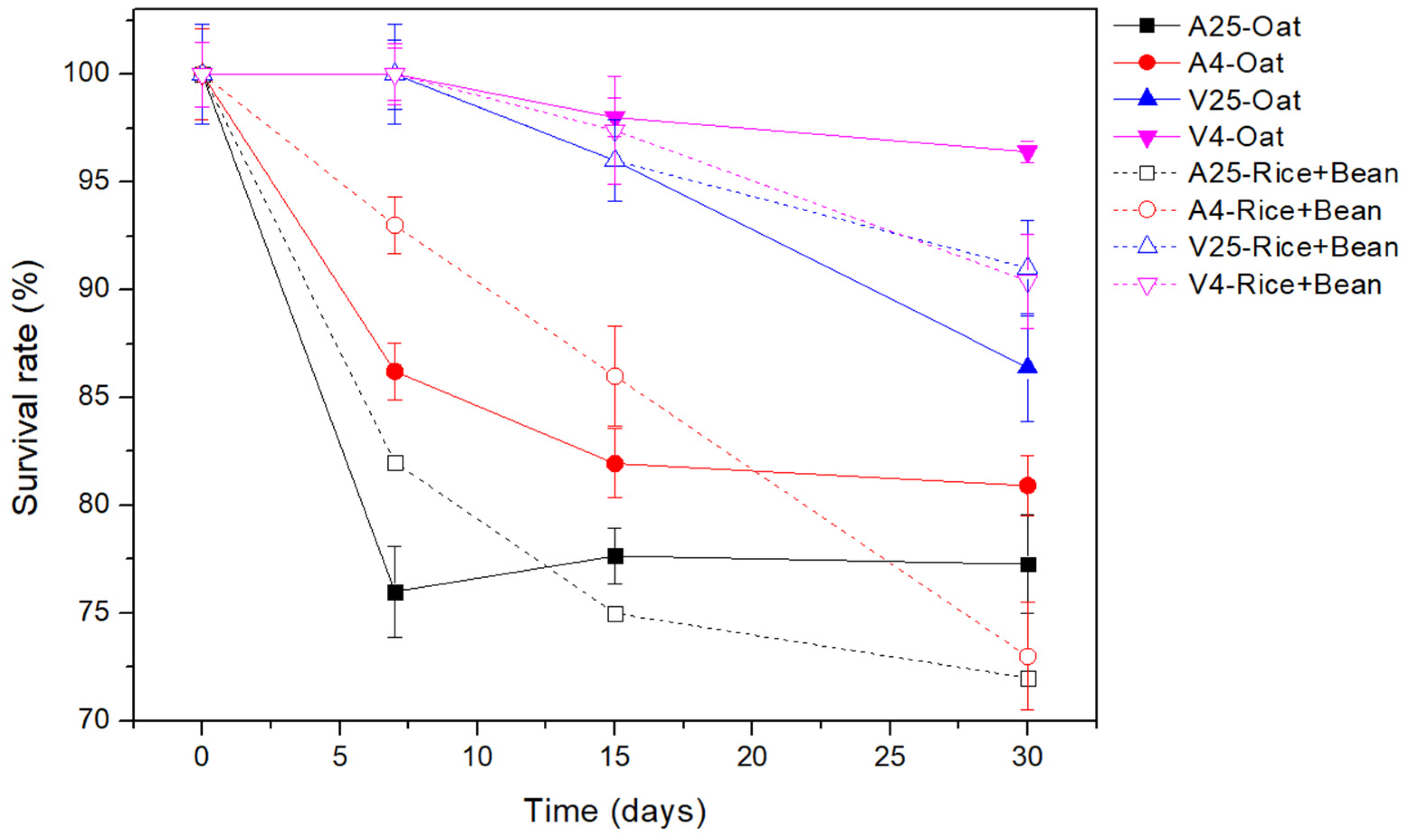
The evolution of spore viability over 30 days (
Figure 3) revealed a progressive decline, with the packaging atmosphere acting as the predominant factor influencing stability, exerting a higher influence than storage temperature. A clear hierarchy of preservation was established: Vacuum/Refrigeration (V4) > Vacuum/Ambient (V25) > Atmospheric/Refrigeration (A4) > Atmospheric/Ambient (A25).
Notably, the oat matrix (
Figure 3, dashed lines) demonstrated consistently higher spore viability than the rice-bean matrix across all similar conditions. The superior viability of vacuum-packed ambient samples (V25) compared to refrigerated aerobic samples (A4) indicates that oxidative stress, rather than thermal degradation, is the primary mechanism driving spore inactivation in these low-moisture matrices.
Despite its significantly higher lipid content, theoretically a substrate for oxidation, the oat matrix demonstrated superior protection. This paradox suggests a dual-protective mechanism. Unlike the rice-bean matrix, oats are rich in phenolic antioxidants, such as avenanthramides. These compounds may have acted as a radical scavenging system, effectively quenching Reactive Oxygen Species (ROS) and neutralizing the lipid peroxidation cascade. Furthermore, the oat matrix is thought to benefit from the hygroscopic sequestration capacity of its high β-glucan content. It is hypothesized that these fibers retained moisture more effectively than the starch-based system, potentially maintaining a stable Aw environment and limiting premature metabolic activation of the spores.
In contrast, the decline in viability observed in conventionally packaged rice-bean samples (A4, A25) is attributed to a synergistic failure mechanism driven by the packaging atmosphere. While vacuum-packaged samples (V4, V25) maintained stable moisture content, conventional packaging allowed for moisture ingress, raising the Aw to approximately 0.90. This value exceeds the threshold typically associated with shelf-stable foods and resides in a borderline thermodynamic region (0.88–0.91) known to destabilize spore dormancy [
36].
Unlike Marcial-Coba et al. [
9], who observed a high viability in date paste due to an intermediate Aw of 0.5–0.6, the high Aw in the nutrient-rich rice-bean matrix acted as a thermodynamic trigger for premature germination. Consequently, a sub-population of spores transitioned into metabolically active but fragile vegetative cells, which were rapidly inactivated by environmental stressors. This aligns with findings by Payne et al. [
38], who reported significant log reductions in baked goods at high relative humidity due to similar moisture-mediated stresses.
The viability loss in conventionally packaged samples (A4, A25) results from two simultaneous degradation processes. The high Aw of the rice-bean matrix triggers premature germination [
36] driving the shift from resistant spores to vulnerable vegetative cells that are rapidly inactivated during storage. At the same time, oxidation damages the structure of the remaining spores, specifically targeting their protective coats or DNA stability.
Cereal matrices are recognized as viable non-dairy carriers for
H. coagulans GBI-30, as confirmed by Wang et al. [
39]. Their study demonstrated that milder processing methods, such as sheeting, preserve viability (>8 log CFU/g) more effectively than high-stress extrusion. Additionally, they hypothesized that post-processing viability losses, such as the 5.75 log CFU/g observed after boiling, are likely due to the germination of dormant spores into heat-sensitive vegetative cells during hydration and heating. This supports our observation that matrix-induced germination is a critical challenge for maintaining probiotic stability in heat-treated foods.
The oxygen permeability of conventional packaging initiated oxidative stress, compromising the structural integrity of the remaining dormant spores, particularly the protective coats or DNA stability. The viability decrease observed in A4 and A25 samples confirms this synergistic effect: dormant spores were compromised chemically by oxidation, while the rise in Aw simultaneously induced others to germinate, transforming them into vulnerable vegetative cells that were subsequently destroyed. This hypothesis is corroborated by the in vitro digestion data (
Figure 4), where the survival rate for A25 samples collapsed at day 30, confirming that the residual population consisted either of non-viable vegetative cells or oxidatively damaged spores unable to withstand gastric acidity.
The oat matrix showed high initial stability. Immediately post-processing (Day 0), all experimental groups exhibited a homogeneous survival rate of approximately 76%, indicating that the matrix composition provided consistent physical shielding against gastric acidity regardless of the packaging condition. However, storage conditions significantly influenced long-term bioaccessibility. Samples stored under vacuum (V25, V4) maintained their protective capacity, showing negligible loss of viability. The V4-Oat group retained the highest final survival rate (~71%), representing a minimal reduction of <7% relative to Day 0. In contrast, atmospheric packaging (A25, A4) resulted in a significant decline. The A25-Oat samples dropped to ~58% survival, a relative reduction of ~24% from the initial baseline. This suggests that oxidative stress or moisture ingress during storage compromised the matrix’s ability to stabilize the spores during digestion.
Regarding thermal effects, while most probiotics demonstrate stability across storage temperatures [
40], this study observed significant declines at 25 °C, confirming the observations of Klu et al. [
41] that elevated temperatures negatively impact viability. The hypothesis of premature germination in the rice-bean samples contrasts with Liao et al. [
8], who observed no significant germination of
H. coagulans over 56 days. However, their study was conducted under refrigeration and liquid matrices. In our study, the combination of ambient temperature (25 °C), high water activity (Aw > 0.85), and a nutrient-dense starch matrix provided the ideal metabolic triggers for germination, turning the bacteria susceptible to oxidative stress, a pathway effectively suppressed in the oat matrix due to its superior water-binding and antioxidant properties.
Table 1 presents the evolution of Aw and moisture content (%) of the oven-baked oat snacks over a 30-day storage period under different packaging and temperature conditions.
Samples stored in conventional packaging exhibited significant hygroscopic behavior, characterized by substantial moisture ingress regardless of storage temperature (p < 0.05). At 25 °C (A25), the moisture content increased from 10% to 18%, representing an 80% increase in total moisture. Concurrently, the Aw increased from an initial value of 0.70 to 0.90 by day 30, a relative increase of ~28.6%. At 4 °C (A4), a similar trend was observed, with Aw reaching saturation levels (0.90–0.91) within 14 days, indicating that the atmospheric packaging provided a negligible barrier against environmental humidity.
In contrast, vacuum packaging effectively preserved the physicochemical stability of the oat matrix. At 25 °C (V25), Aw remained significantly stable (p < 0.05), from 0.78 (day 0) to 0.77 (day 30), effectively preventing the thermodynamic shift towards conditions favorable for spoilage. At 4 °C (V4), this condition offered the highest stability. The moisture content showed a slight reduction of ~8.3% (from 12% to 11%), while Aw decreased from 0.81 to 0.79.
While conventionally packaged samples rapidly equilibrated with the external environment, reaching Aw levels (>0.85) that trigger spore germination and spoilage, vacuum packaging maintained the Aw within the intermediate range. This demonstrates that for the oven-baked oat matrix, vacuum sealing is important to restrict moisture mobility and maintain the dry state necessary for long-term spore survival.
Table 2 details the variations in Aw and moisture content (%) of the rice-bean matrix over a 30-day storage period under atmospheric (A) and vacuum (V) packaging conditions.
Probiotic rice-bean snacks stored in atmospheric packaging demonstrated significant instability (p < 0.05) and a high susceptibility to environmental moisture dynamics. At 4 °C (A-4): This condition exhibited the most drastic thermodynamic shift. Aw increased from an initial 0.65 to 0.94 by day 30, representing a massive 44.6% increase. Concurrently, moisture content showed a significant increase of ~7.1% (from 14% to 15%) (p < 0.05). The discrepancy between the increase in Aw and in total moisture indicates potential physicochemical transitions within the starch-protein network, specifically amylopectin retrogradation, which likely promoted the liberation of bound water into a mobile state within the matrix.
At 25 °C (A25), the samples showed non-linear behavior (
Table 2). While Aw increased significantly by 22.7% (from 0.75 to 0.92), the total moisture content decreased by 16.7% (from 18% to 15%) (
p < 0.05). This inverse relationship indicates that while the matrix dried out, the remaining water became increasingly free and chemically available, likely pushing the system into a zone favorable for microbial growth.
Vacuum packaging provided superior control over water mobility compared to atmospheric conditions, though the matrix still exhibited hygroscopic activity. At 25 °C (V-25), the probiotic rice-bean snack showed a gradual increase in Aw of 10.3% (0.68 to 0.75) over 30 days, while moisture content remained relatively stable, increasing slightly by 5.6% (18% to 19%). The condition of V-4 proved effective for maintaining low water activity, with Aw showing the smallest relative increase of 4.3% (0.69 to 0.72). However, moisture content decreased by 15.8% (19% to 16%), suggesting some moisture migration within the package.
The rice-bean matrix displayed a tendency to reach high water activity levels (Aw > 0.90) under atmospheric conditions within 30 days, regardless of the temperature. Vacuum packaging at 4 °C (V4) was the only condition capable of maintaining Aw near the initial processing levels (Aw~0.72), thereby offering the most robust protection against metabolic activation of the spores.
The importance of low water activity for spore dormancy is highlighted by Muñoz et al. [
42], who reported 120 days of stability in quinoa snacks maintained at Aw < 0.25. In contrast, the higher Aw in the evaluated rice-bean matrix (0.75) likely facilitated premature metabolic activation or increased vulnerability to the lipid peroxidation cascade, explaining the more rapid decline in viability during our 30-day study.
The robustness of
H. coagulans GBI-30 in intermediate-moisture environments is further supported by Ayrıç Danışman et al. [
43], who demonstrated that probiotic counts remained stable (>7 \log CFU/g) for 42 days in intermediate-moisture apricots with a water activity range of 0.82–0.86. This confirms the suitability of this spore-forming strain for functional snacks that do not maintain low Aw levels throughout shelf-life. Their findings reinforce the observation of this study that refrigeration is a critical factor in preserving viability in high-Aw matrices, as lower temperatures prevent the premature germination of spores that might otherwise be triggered by the moisture levels observed in our rice-bean formulation.
The divergent moisture trends in the rice-bean matrix, where A25 and V4 showed a decrease while A4 and V25 showed an increase, reflect a complex interplay between matrix thermodynamics and packaging integrity. In the A25 condition, the loss of total moisture (18% to 15%) despite the sharp increase in Aw suggests that the matrix released bound water into the package headspace, potentially due to temperature-induced structural shifts in the starch network. Conversely, the moisture gain in A4 (14% to 15%) is attributed to the atmospheric package’s inability to block high relative humidity during refrigeration. For vacuum-sealed samples, the slight moisture reduction in V4 suggests internal moisture migration or surface condensation within the package, whereas the slight gain in V25 indicates the matrix reaching a new hygroscopic equilibrium under ambient storage.
3.3. Functional Performance After Simulated Digestion
H. coagulans viability
The functional efficacy of
H. coagulans depends on its survival during gastrointestinal transit, which is heavily influenced by its storage history. As shown in
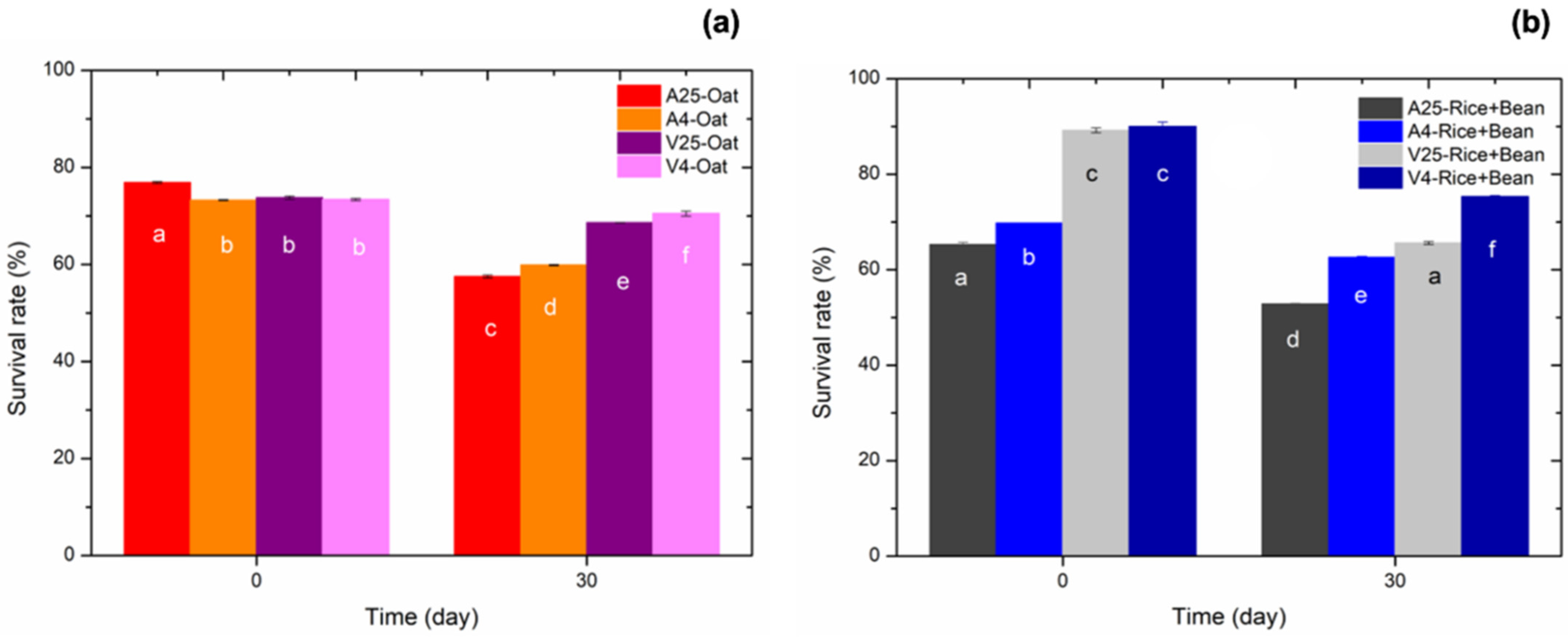
Figure 4, all samples at day 0 maintained high post-digestion viability, confirming the spores’ inherent resistance to gastric acid and bile salts. However, a clear shift in functional stability emerged over the 30-day storage period.
Data are expressed as mean ± standard deviation (n = 3). Different letters indicate statistically significant differences in survival rate between storage conditions for each specific time point (p < 0.05). The oat matrix showed high initial stability. Immediately post-processing (Day 0), all experimental groups exhibited a homogeneous survival rate of approximately 76%, indicating that the matrix composition provided consistent physical shielding against gastric acidity regardless of the packaging condition. However, storage conditions significantly influenced long-term bioaccessibility. Samples stored under vacuum (V25, V4) maintained their protective capacity, showing negligible loss of viability. The V4-Oat group retained the highest final survival rate (~71%), representing a minimal reduction of <7% relative to Day 0. In contrast, atmospheric packaging (A25, A4) resulted in a significant decline. The A25-Oat samples dropped to ~58% survival, a relative reduction of ~24% from the initial baseline. This suggests that oxidative stress or moisture ingress during storage compromised the matrix’s ability to stabilize the spores during digestion.
The rice-bean matrix exhibited a distinct and highly sensitive behavior, characterized by an immediate dependence on packaging integrity even before storage (Day 0). Unlike the uniform baseline of the oat snack, the rice-bean samples showed a massive divergence at Day 0. Vacuum-packaged samples (V25, V4) achieved high initial survival (~89–90%), whereas atmospheric samples (A25, A4) were significantly lower (~65–70%). This ~20% gap at the baseline indicates that spores in the starch matrix appear more susceptible to digestive fluids when not protected by vacuum packaging or an oxygen-free environment. By Day 30, all rice-bean groups experienced substantial declines. The A25-rice-bean group exhibited the poorest performance, with survival collapsing to ~52%. Even vacuum packaging failed to stabilize the matrix at ambient temperature. Viability dropped from ~89% to ~65%, with a reduction of ~27%. Only the combination of vacuum and refrigeration provided moderate stability, retaining ~75% survival, though this still represented a ~16% decrease from the initial state.
Despite differences in shelf-life conditions, the protective capacity of oat matrix during simulated digestion aligns closely with the 70% survival rate reported by Muñoz Pabon et al. [
42] for extruded quinoa snacks. This comparison validates the use of antioxidant-rich cereal matrices as robust vehicles for
B. coagulans GBI-30 delivery, matching the performance of specialized functional food formats.
The comparative analysis reveals a fundamental difference in matrix functionality. The oat matrix functions as a robust, passive delivery system that is relatively stable unless compromised by atmospheric exposure. Conversely, the rice-bean matrix acts as a highly dynamic, unstable system where spore protection is transient and heavily dependent on the exclusion of oxygen and low temperatures. The performance of the oat matrix (V4-Oat vs. V4-Rice-bean at Day 30) supports the hypothesis that fiber-rich, low Aw matrices may provide enhanced gastrointestinal protection compared to starch-based formulations.
The highest post-digestion viability was achieved in snacks stored under vacuum and refrigeration (V4), which consistently maintained spore counts > 6 log CFU/g. This underscores that the packaging strategy is a determining factor for functional delivery. Consistent with Liao et al. [
8], who reported >89% viability in vacuum-packed beverages, these findings reinforce that oxygen-restricted storage is a prerequisite for preserving the spore’s resistance mechanisms. Packaging permeability led to oxidative stress and moisture fluctuations that may have weakened spore coat. Consequently, these spores appeared less resilient to the subsequent acid shock of the gastric phase.
These results support the proposed synergistic failure hypothesis. The decline in post-digestion survival for the conventionally packaged samples (A4, A25) suggests that a portion of the residual population may have lost dormancy. Storage conditions, specifically oxygen exposure or elevated Aw, appear to promote premature germination, converting resistant spores into vegetative cells. Unlike dormant spores, which utilize protective macromolecules and SASPs to shield DNA [
44], vegetative cells are typically more sensitive to gastric pH. Therefore, the low survival in
Figure 4 for A25 samples may indicate that these spores either germinated during storage or underwent structural weakening, potentially leading to lysis during digestion.
The experimental findings demonstrate that the oat matrix was a superior delivery vehicle for H. coagulans BC4 spores, maintaining significantly higher viability compared to the rice-bean matrix during both thermal processing and simulated gastrointestinal transit (p < 0.05). This enhanced survivability is likely attributed to the protective microenvironment provided by the oat’s macromolecular composition, including its β-glucans and lipids, which protect the spores against thermal and physiological stressors. While the starch-protein network of the rice-bean matrix also offered stability during oven baking, it was less effective under microwave dielectric heating, where the oat matrix preserved a viability of 9.41 log CFU/g. Consequently, the oat matrix validates its efficacy as a robust vehicle for enhancing probiotic resilience, ensuring that high counts of viable spores reach the simulated intestinal phase.
Chemical Characterization and Antioxidant Profile
The characterization of the matrices (
Table 3) elucidates the underlying mechanism behind the performance of each matrix. The oat matrix demonstrated a superior antioxidant profile compared to the rice-bean formulation, providing a chemical basis for the enhanced spore stability observed in this study. The oat snack contained 580 mg GAE/50 g of phenolic compounds. This represents a 2.5-fold difference compared to the rice-bean matrix, which contained 229.77 mg GAE/50 g. This difference was most evident in the FRAP assay results. The oat matrix exhibited an activity of 6400.59 mM AAE/50 g, which is approximately 4.6 times higher than that of the rice-bean snack (1370.56 AAE mM/50 g). This suggests that the oat matrix possesses a robust electron-donating capacity, capable of neutralizing oxidative stressors that target the spore coat. Interestingly, both matrices showed similar DPPH radical scavenging activity. This indicates that while both matrices have equal capacity to scavenge specific organic radicals, the oat matrix has a far superior reducing potential to mitigate metal-ion-catalyzed oxidation.
In terms of macronutrients, the rice-bean matrix exhibited a significantly higher protein content (3.8 g/50 g) compared to the oat matrix (1.4 g/50 g). While higher protein content often correlates with thermal protection, in this specific context, the ~39% higher protein content in the rice-bean matrix did not result in a superior spore survival. This reinforces the conclusion that oxidative stress (mitigated by phenolics in oats) and water activity (controlled by fibers in oats) were the dominant drivers of stability, rather than protein-based physical shielding. The data in
Table 3 supports the oxidative damage hypothesis. The high concentration of phenolic compounds and the superior reducing power (FRAP) of the oat matrix created a chemically reductive environment. This active antioxidant system likely quenched ROS during storage, preserving the structural integrity of the spore coats, whereas the significantly lower antioxidant capacity of the rice-bean matrix left the spores vulnerable to oxidative degradation.
The oat formulation exhibited statistically superior levels of total phenolic compounds and antioxidant activity (assessed via DPPH and FRAP assays) compared to the rice-bean matrix (
p < 0.05). This observation is corroborated by the literature, which identifies avenanthramides, anthranilic acid derivatives exclusive to oats, as phenolic compounds characterized by high radical scavenging potential [
45]. While oats primarily contribute these alkaloids and free phenolic acids, specifically ferulic and caffeic acids, the biological functionality of the rice-bean snacks is based on the synergy between the phenolic acids of the rice pericarp, with a predominance of ferulic and p-coumaric acids, and the diversity of polyphenols and flavonoids characteristic of common beans [
46,
47]. Additionally, although constituents such as dietary fiber and phytic acid may negatively correlate with the initial bioaccessibility of micronutrients and bioactive compounds, the functional performance of these snacks during simulated digestion is ensured by the gradual release of insoluble-bound phenolics, guaranteeing bioactivity in the lower gastrointestinal tract [
47]. Thus, the oat matrix provides a dual-protective system: physical insulation against thermal stress and active chemical protection against oxidative degradation (
Table 3), ensuring that the spores remain structurally intact and metabolically dormant until they reach the target colonization site in the gut.
The relationship between matrix composition and probiotic resilience is emphasized by Muñoz Pabon et al. [
42], who demonstrated that increasing the protein and fiber content in quinoa-rice snacks significantly enhanced antioxidant activity. Consistent with the results of the present study,
H. coagulans added to quinoa formulation achieved high gastrointestinal survival (75%), suggesting that antioxidant-rich matrices provide a synergistic protective effect during both processing and digestion. Although those snacks were maintained at a lower Aw (0.23–0.28), this comparison validates the performance of the oat matrix and highlights the stability gap observed in the less antioxidant-dense rice-bean formulation.
While Suwanangul et al. [
48] showed that protein encapsulation protects
H. coagulans during spray drying, the findings of the present study suggest that in solid matrices, physical barrier properties play a key role when exposed to different environmental conditions. Although the rice-bean matrix contained protein, it failed to protect the spores under high Aw. Conversely, the oat matrix, rich in β-glucans and lipids, likely acted as a hydrophobic barrier, limiting molecular mobility and water plasticization. This suggests that for shelf-stable probiotic snacks, the structural immobilization of water by fibers offers superior protection against viability loss compared to protein content alone.




 ,
,