Article

Attenuation of Chemotherapy-Associated Immune Suppression Markers by Socheongryong-Tang via ROS/MAPK/NF-κB-Associated Macrophage Activation

1
Institute of Natural Products, Korea Institute of Science and Technology (KIST), Gangneung 25451, Republic of Korea
2
HLB Life Science R&D, Seoul 06105, Republic of Korea
3
R&D Center, NovMetaPharma Co., Ltd., Pohang 37668, Republic of Korea
4
Natural Product Applied Science, KIST School, University of Science and Technology, Gangneung 25451, Republic of Korea
5
Department of Healthcare Management, Catholic Kwandong University, Gangneung 25601, Republic of Korea
6
Department of Digital Healthcare, Catholic Kwandong University, Gangneung 25601, Republic of Korea
7
College of Korean Medicine, Gachon University, Seongnam 13120, Republic of Korea
*
Authors to whom correspondence should be addressed.
These authors contributed equally to this work.
Processes 2026, 14(5), 742; https://doi.org/10.3390/pr14050742
Submission received: 7 January 2026 / Revised: 13 February 2026 / Accepted: 20 February 2026 / Published: 25 February 2026
(This article belongs to the Special Issue Biological and Pharmacological Activity of Natural Products)

Abstract

Socheongryong-tang (SCRT), traditionally used in East Asia for managing chills and fever, has recently gained attention for its immunomodulatory potential. This study aimed to elucidate the biological activity and signaling features associated with SCRT-mediated modulation of innate immune readouts in murine macrophages and to evaluate its effects on selected markers in a 5-fluorouracil (5-FU)-associated immune suppression model. Our findings reveal that SCRT significantly enhances phagocytic activity, production of nitric oxide and prostaglandin E2, and the mRNA expression of cytokines, including tumor necrosis factor-alpha, interleukin-1 beta, and interleukin-6. These immunomodulatory effects are associated with activation of the reactive oxygen species/mitogen-activated protein kinases/nuclear factor-κB signaling axis. In vivo, SCRT administration in a 5-FU–treated mouse model attenuated immune suppression-associated changes, showing partial restoration of selected serum cytokine markers and immune response indices. Taken together, these results suggest that SCRT aqueous extract may attenuate chemotherapy-associated immune dysfunction; however, further studies incorporating immune cell profiling, functional immune assessments, and pathway- and contamination-control approaches are warranted to establish causality and translational relevance.

1. Introduction

The immune response is a multifaceted process involving both innate and adaptive components. The innate immune response encompasses the initial defense mechanisms mediated by macrophages and natural killer cells, while the adaptive immune response involves T and B lymphocytes [1]. Macrophages play a crucial role in tissue immune responses through phagocytosis and non-specific protection against bacterial infections [2]. Activation of phagocytic cells is essential for initiating inflammation, which involves the release of cytokines such as tumor necrosis factor-alpha (TNF-α), interleukin-1 beta (IL-1β), and interleukin-6 (IL-6), along with other inflammatory mediators like nitric oxide (NO) and prostaglandin E2 (PGE2) [3,4]. Inducible nitric oxide synthase (iNOS) is responsible for generating NO during the immune response, while cyclooxygenases (COX-1 and -2) produce PGE2 by converting arachidonic acid. Given the role of NO and PGE2 as key pro-inflammatory mediators in macrophages, enhancing their production could be a beneficial strategy for boosting the immune system [5,6]. Lipopolysaccharide (LPS) is a potent inflammatory stimulant commonly used in screening for anti-inflammatory and immune-enhancing compounds. Previous studies have utilized high doses of LPS (e.g., 0.1–1 μg/mL) to induce acute inflammation in RAW264.7 macrophage cells for screening anti-inflammatory agents [7,8,9]. Conversely, low doses of LPS (e.g., 1 ng/mL) are used as a positive control to stimulate murine macrophages in screening for immune-boosting agents [10].
Chemotherapy is a fundamental component of cancer treatment, yet it carries the risk of inducing immunosuppression, which can potentially impact patient outcomes. While chemotherapy effectively targets cancer cells, it can also affect rapidly dividing cells in the immune system, including leukocytes and bone marrow precursors, leading to compromised immune function [11,12]. Consequently, patients may experience heightened susceptibility to infections, delayed wound healing, and other immune-related complications. Managing and monitoring immune function during chemotherapy are crucial to mitigate the risk of infections and other adverse effects, underscoring the importance of comprehensive patient care.
Socheongryong-tang (SCRT) has traditionally been used as an herbal medicine formula for managing bronchitis, asthma, rhinitis, and cold-related symptoms across East Asia, including Korea, China, and Japan [12,13]. SCRT composes eight herbal components: Pinellia ternata Rhizoma, Paeonia lactiflora Pall. Radix, Ephedra sinica Stadf. Herba, Zingiber officinale Rosc. Rhizoma, Glycyrrhiza glabra L. Radix, Cinnamomum cassia Blume. Ramulus, Asarum sieboldii F. Maekawa Radix, and Schizandra chinensis Fructus [13]. The major components of SCRT include 6-gingerol, liquiritigenin, and glycyrrhizin, as well as phenylpropanoids such as cinnamic acid, cinnamaldehyde, and coumarin; monoterpene glycosides such as paeoniflorin and albiflorin; lignans including schizandrin, gomisin A, and gomisin N; and alkaloids including ephedrine and pseudoephedrine [14,15,16].
In this study, we aimed to investigate the immunomodulatory properties of SCRT aqueous extract and elucidate its underlying mode of action in macrophages. Our findings provide a molecular trait for the attenuation of chemotherapy-induced immunosuppression by SCRT for the first time, and could be used to help in the development of pharmaceuticals aimed at manipulating immunomodulation.

2. Materials and Methods

2.1. Preparation of Socheongryong-Tang Water Extract

SCRT was prepared from chopped herbal ingredient by Hanpoong Pharmaceutical Co., Ltd. (Jeonju, Republic of Korea) (Supplementary Table S1). The herbs were decocted in 90 mL of distilled water at 90–100 °C for 3 h, filtered through 5-micrometer filter paper, and concentrated using a rotary evaporator. The concentrate was vacuum-dried to yield a powder, which was dissolved in dimethyl sulfoxide. The final DMSO concentration in the culture medium was maintained at ≤0.1% in all experiments, and the same concentration of DMSO was used in vehicle control groups.

2.2. High-Performance Liquid Chromatography Analysis

A high-performance liquid chromatography (HPLC) system with photodiode array and mass spectrometric detection was used to acquire the chromatographic pattern of SCRT. As a result, seven constituents (ephedrine, albiflorin, paeoniflorin, liquiritin apioside, liquiritin, isoliquiritin apioside, and glycyrrhizin) were identified within 30 min under optimized chromatographic conditions, using a binary mobile phase system composed of aqueous 0.1% formic acid (solvent A) and acetonitrile containing 0.1% formic acid (solvent B).
HPLC analysis was performed using Shimadzu Nexera X2 system with photodiode array detector and Electrospray ionization (ESI)-mass spectrometry (MS) detection (Shimadzu LCMS-2020 system, Shimadzu Corporation, Kyoto, Japan). Separation was carried out on a Luna Omega (Phenomenex, Torrance, CA, USA) polar C18 column (150 × 2.1 mm, 1.6 µm) at 0.2 mL/min. The gradient ranged from 15% to 100% B over 45 min, then returned to 15% by 53 min. Detection wavelengths were 230, 254, and 280 nm, and with a 3 μL injection of a 1000 ppm sample (Supplementary Figure S1).

2.3. Cell Culture

The murine macrophage RAW264.7 cell line was procured from the American Type Culture Collection (ATCC, Manassas, VA, USA). These murine cells were cultured in Dulbecco’s Modified Eagle’s medium (DMEM, Gibco, Carlsbad, MD, USA) supplemented with 10% fetal bovine serum (FBS, Thermo Fisher Scientific, Waltham, MA, USA) and 1% penicillin and streptomycin. The cells were maintained at 37 °C in a humidified atmosphere containing 5% CO2.

2.4. Cell Viability

RAW264.7 cells were treated with 12.5–50 μg/mL of SCRT for 24 h, and cell proliferation was assessed using a Quanti-Max™ WST-8 Cell Viability Assay kit (Biomax QM3000, Seoul, Republic of Korea) following the manufacturer’s instructions.

2.5. Phagocytic Activity

Cells (5 × 10⁴ per well) were plated in 96-well plates and incubated overnight to allow for attachment. Afterward, cells were exposed to either SCRT at indicated concentration or LPS 1 ng/mL (055:B5, Sigma-Aldrich, St. Louis, MO, USA) for 24 h. Phagocytic activity of murine macrophages was then evaluated using the Zymosan Substrate Phagocytosis Kit (Abcam, Waltham, MA, USA) in accordance with the manufacturer’s protocol.

2.6. Griess Assay

RAW264.7 cells were treated with SCRT, anti-cancer reagents or LPS for 24 h. Subsequently, equal volumes (50 µL) of culture supernatant and griess reagent (containing 1% sulfanilamide, 5% phosphoric acid, and 0.1% N-(1-naphthyl)-ethylenediamine) were mixed and incubated at room temperature for 10 min.

2.7. Detection of PGE2 Levels

RAW264.7 cells were treated with SCRT, anti-cancer reagents or LPS for 24 h. The culture supernatant was collected, and PGE2 levels were determined using the PGE2 Parameter Assay kit (R&D Systems, Minneapolis, MN, USA) in accordance with the manufacturer’s protocols.

2.8. DCF-DA Assay

Reactive oxygen species (ROS) levels were evaluated using 2′,7′-dichlorodihydrofluorescein diacetate (DCF-DA) staining. RAW264.7 cells were plated in 96-well plates and exposed to SCRT or LPS for 24 h. Following treatment, the medium was replaced with DMEM containing 20 μM DCF-DA (Sigma-Aldrich), and cells incubated at 37 °C with 5% CO2 for 20 min. Fluorescence was detected using an Infinite PRO microreader (TECAN, Männedorf, Switzerland) at 485 nm excitation and 530 nm emission.

2.9. Real-Time PCR Analysis

Total RNA was isolated using the RNeasy Mini kit (QIAgen, Germantown, MD, USA), and reverse transcription was performed with the RevertAid First Strand cDNA Synthesis kit (Thermo Fisher Scientific). qPCR was conducted using the QuantStudio 6 Pro System (Applied Biosystems, Foster City, CA, USA) with either TaqMan® Fast Advanced Master Mix (Applied Biosystems) or AccuPower® GreenStarTM qPCR Master Mix (BIONEER, Daejeon, Republic of Korea). Relative gene expression was calculated using the 2−ΔΔCt method. The value n represents independent biological experiments. Primer details are listed in Supplementary Tables S2 and S3.

2.10. Western Blotting

Protein samples were subjected to Western blot analysis following previously described methods [17]. Monoclonal antibodies against iNOS, COX-2, phospho-NF-κB/p65 (Ser536), NF-κB/p65, phospho-ERK1/2 (Thr202/Tyr204), ERK1/2, phospho-p38 MAPK (Thr180/Tyr182), p38 MAPK, phospho-JNK (Thr183/Tyr185), JNK, and GAPDH were obtained from Cell Signaling Technology Inc. (Boston, MA, USA).

2.11. Dual-Luciferase Reporter Assay

RAW264.7 cells seeded in 96-well white plates were co-transfected with pNF-κB-Luc and pNL-Luc vectors using FuGENE HD Transfection Reagent (Promega, Madison, WI, USA) following the manufacturer’s instructions. After, the cells were treated with 50 μg/mL SCRT or 1 ng/mL LPS for 6 h. Subsequently, Luciferase activity was prepared by adding equal amounts of one-glo and stop-glo from the Nano-glo® Dual Luciferase Reporter Assay System (Promega) to the medium and measured using a GloMax® Navigator Microplate Luminometer (Promega). NanoLuc® luciferase was used as an internal control. Firefly luciferase activity was normalized accordingly to account for transfection variability.

2.12. In Vivo Experiment

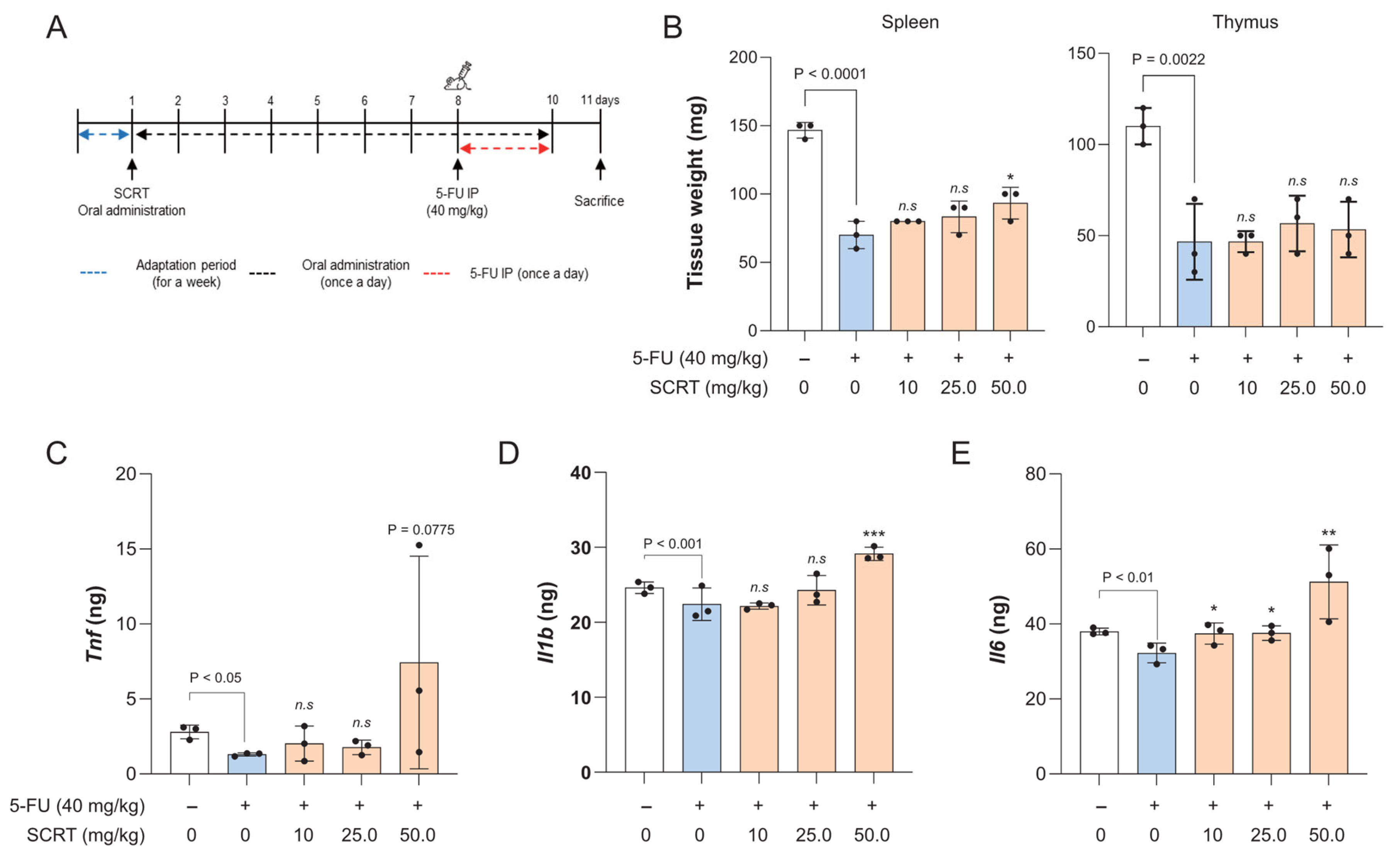
ICR mice (weighing 20 ± 0.18 g) were sourced from KOATECH (Pyeongtaek, Republic of Korea) and acclimated for one week. After acclimation, animals were randomly assigned to six groups (n = 3): control, 5-fluorouracil (5-FU, 40 mg/kg), SCRT (50 mg/kg), 5-FU + SCRT low (10 mg/kg), 5-FU + SCRT middle (25 mg/kg), 5-FU + SCRT high (50 mg/kg). SCRT was suspended in 0.5% carboxymethylcellulose and administered orally at a volume of 100 µL per mouse once daily for 7 days. From day 8, 5-FU (diluted in saline) was injected intraperitoneally for 3 consecutive days, concurrently with SCRT administration. Through the 12-day study period, body weights were recorded daily, and animals were monitored for clinical signs. At the endpoint, mice were sacrificed under ether anesthesia. All procedures were reviewed and approved by the KIST Institutional Animal Care and Use Committee (Approval No. KIST-IACUC-2024-043) and conducted in accordance with institutional ethical standards. Blood serum samples from each group were collected and stored at −80 °C. The expression levels of mouse Tnf, Il1b, and Il6 were assessed using the ELISA MAX™ Kit (BioLegend, San Diego, CA, USA). The levels of these cytokines were quantified following the manufacturer’s instructions.

2.13. Statistical Analysis

Data are expressed as the mean ± standard deviation (S.D.) from at least three independent experiments, with technical replicates included within each experiment. For the in vivo study, n = 3 mice were used per group. Statistical significance between two groups was assessed using Student’s t-tests, while comparisons among three or more groups were analyzed using one-way analysis of variance (ANOVA) followed by appropriate post hoc multiple comparison tests. A p-value < 0.05 was considered statistically significant. All statistical analyses were conducted using GraphPad Prism version 10 (GraphPad Software, San Diego, CA, USA).

3. Results

3.1. Effects of SCRT on Phagocytic Capacity on RAW264.7 Macrophages

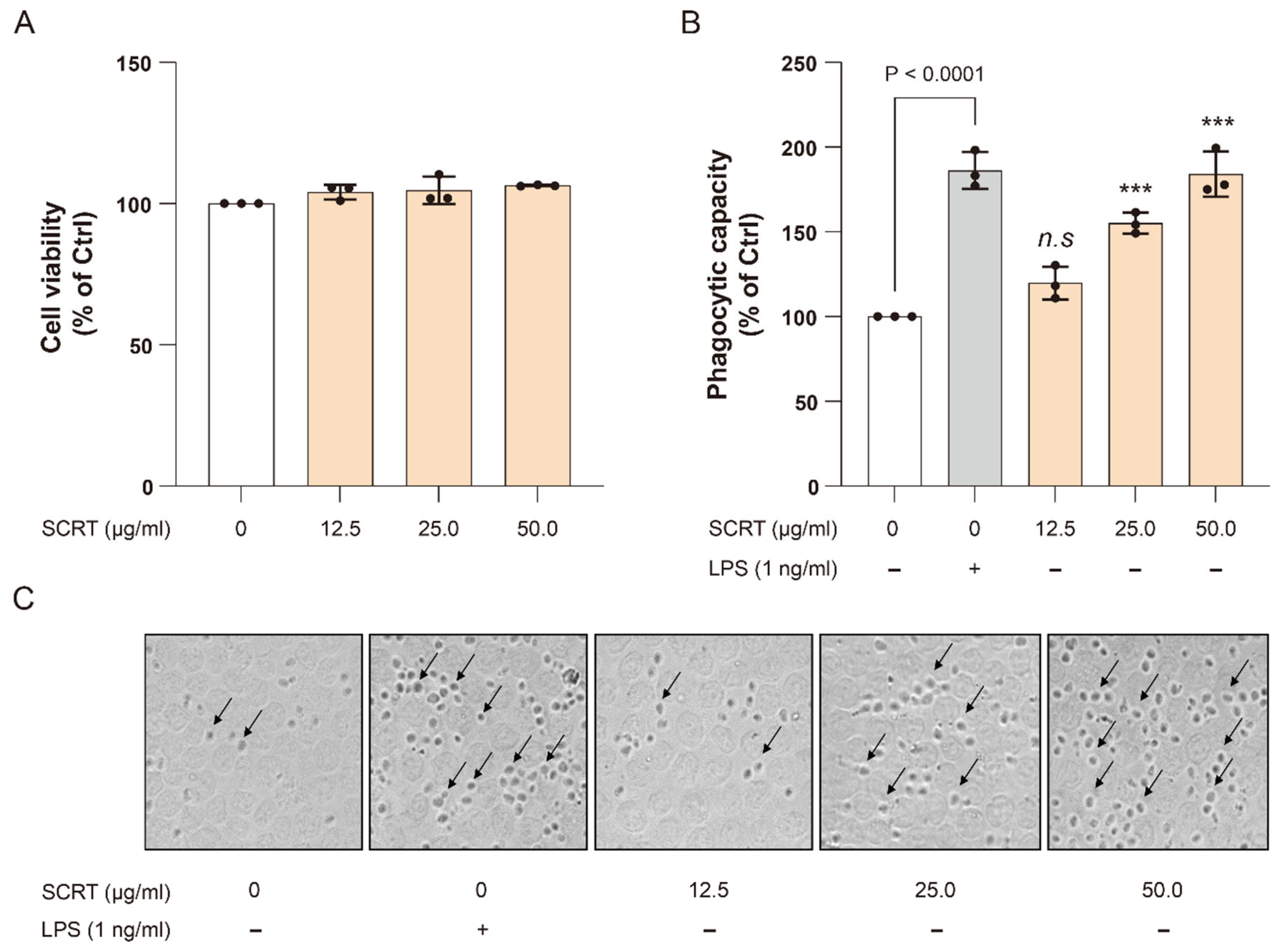
To determine the optimal concentration of SCRT without cytotoxicity, we first evaluated the cell viability on RAW264.7 cells. SCRT did not have cytotoxic effect for 24 h up to a concentration of 50 μg/mL (Figure 1A). Based on this result, SCRT was used at a concentration of 12.5–50 μg/mL in further experiments. Next, we confirmed the phagocytic activity of macrophagocytes. We observed a dose-dependent increase in phagocytic activity upon treatment with SCRT (Figure 1B). Specifically, we observed irregular polygons and an elevated number of engulfed particles surrounding the cells in response to SCRT treatment (25–50 μg/mL), mirroring the effects observed with LPS treatment (Figure 1C). These findings suggest that SCRT has the potential to enhance phagocytic activity in a dose-dependent manner compared to the normal condition.

3.2. SCRT Enhances NO and PGE2 Production on RAW264.7 Macrophages

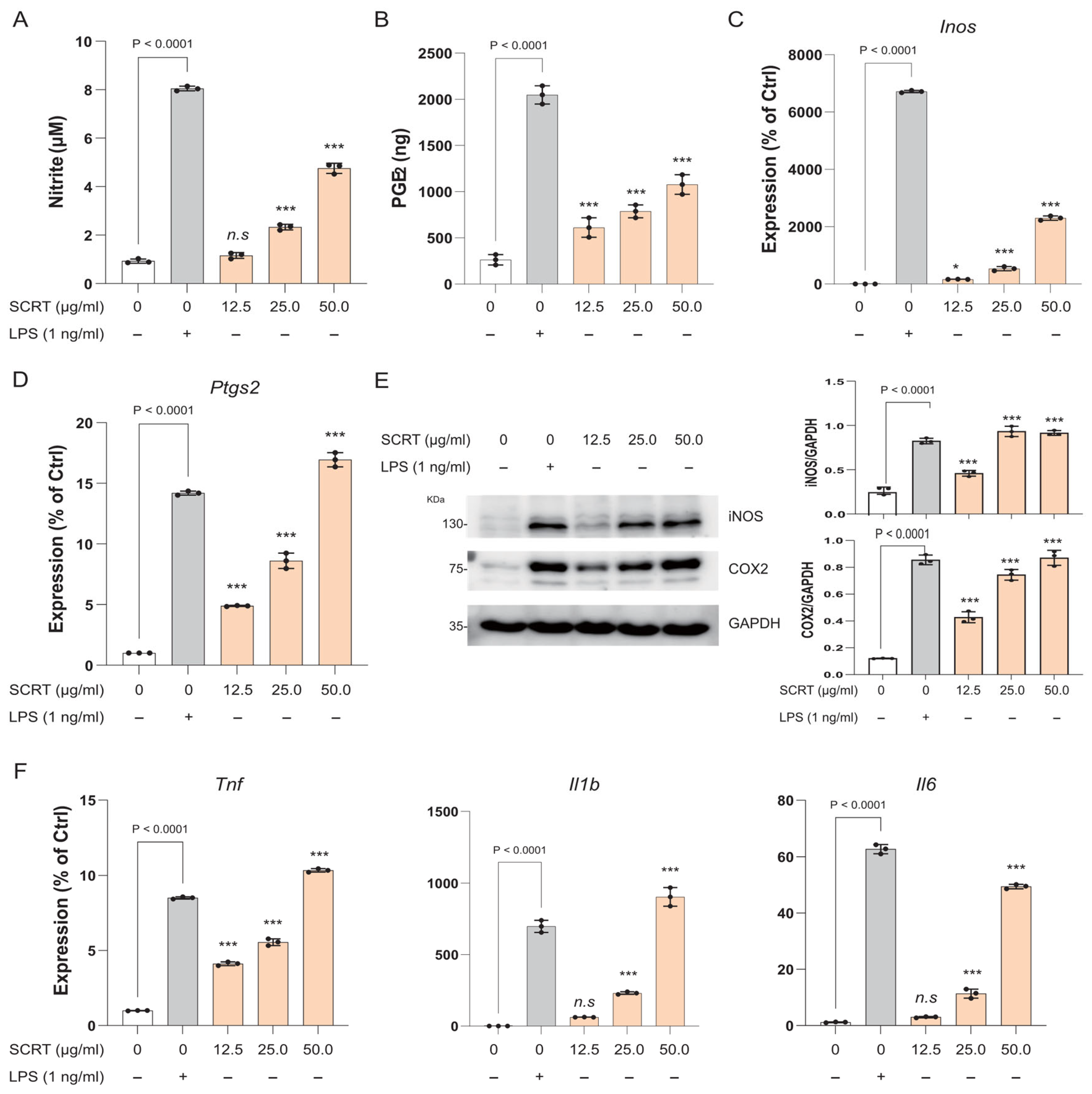
To investigate the potential immunomodulatory effects of SCRT on RAW264.7 macrophages, we assessed the production of NO and PGE2 by using a griess assay and PGE2 ELISA. Our results revealed that SCRT significantly increased the concentration of NO and PGE2 compared to the normal condition (Figure 2A,B). Next, we investigated whether SCRT can enhance the expression of Inos and Ptgs2. The treatment of SCRT dose-dependently increased the levels of Inos and Ptgs2 compared to the normal condition (Figure 2C,D). Additionally, the protein expression of iNOS and COX-2 were significantly enhanced by SCRT (Figure 2E). To verify whether SCRT treatment affect the expression of immunomodulatory-related pro-inflammatory cytokines, such as Tnf, Il1b, and Il6 in RAW264.7 cells, we examined the expression levels of these cytokines induced by SCRT (Figure 2F). Indeed, these cytokines were known to induce M1 polarized macrophage associating with pro-inflammatory phenotype [18,19].

3.3. SCRT Is Associated with Activation of ROS/MAPK/NF-κB Signaling Axis

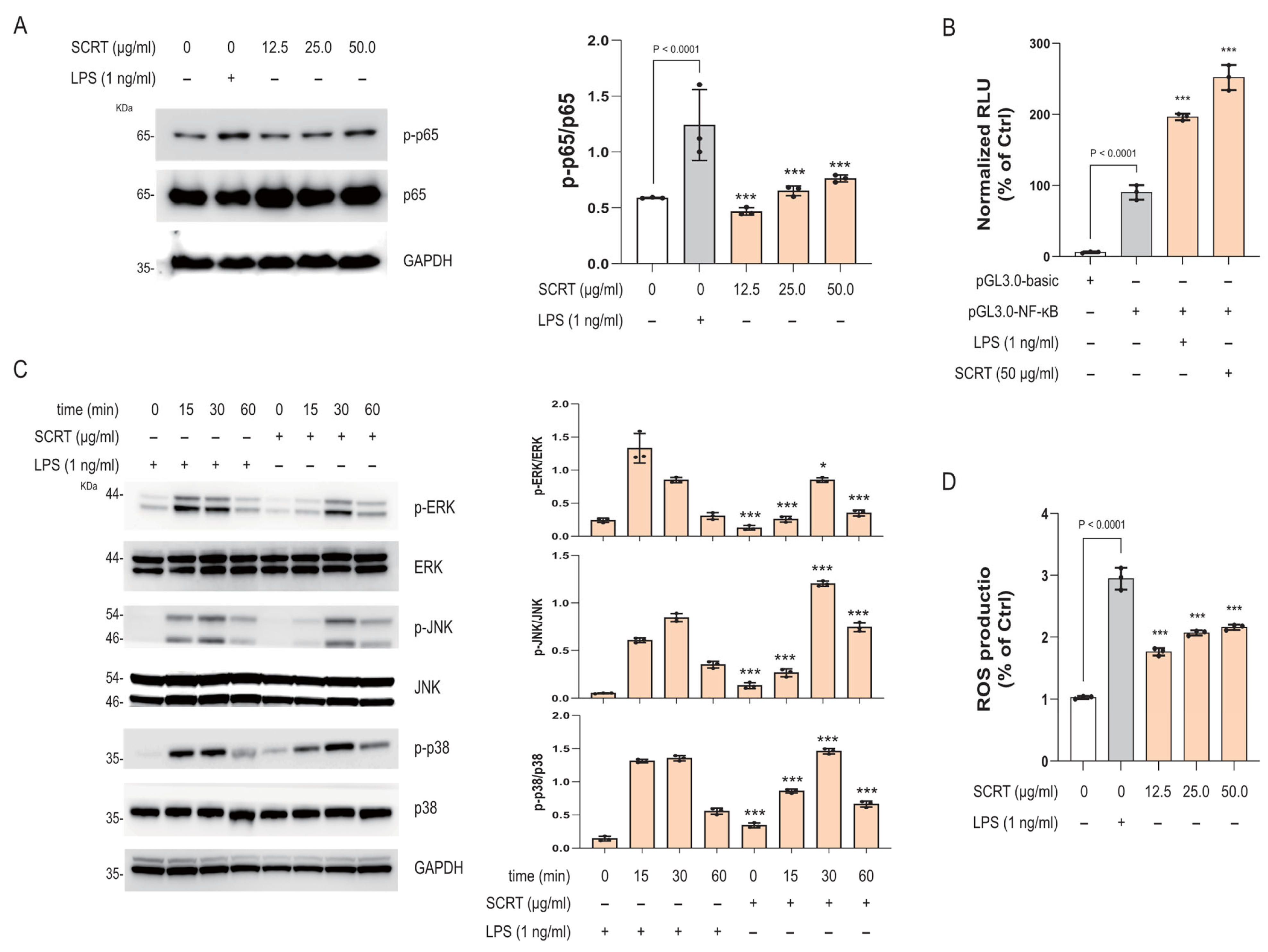
Given that p65, a NF-κB pathway subunit, has been implicated in the regulation of pro-inflammation and expression of cytokines, such as TNF-α, IL-1β, and IL-6 [20,21], we further evaluated that the SCRT could modulate immunomodulatory effects through the activation of p65 associated with Tnf, Il1b, and Il6. SCRT-treated macrophages displayed significantly increased the p65 phosphorylation compared to those in non-treated macrophages (Figure 3A). Next, to monitor p65 trans-activity, we assessed the NF-κB reporter assay and observed that SCRT treatment increased the trans-activity of NF-κB compared to the normal condition (Figure 3B). As NO and PGE2 production were previously found to be activated by the MAPK pathway, core regulatory molecules [22], we further evaluated the phosphorylation level of ERK1/2, p38, and JNK in RAW264.7 macrophages and found that SCRT-treated macrophages exhibited an elevation in ERK1/2, p38, and JNK phosphorylation (Figure 3C). In addition, based on the previously determined the association between ROS generation and various pathological states, including the regulation of inflammation by M1 polarized macrophages [23], our investigation attempted to determine whether SCRT treatment was associated with elevated ROS release. We found that ROS production was significantly increased by SCRT treatment in a dose-dependent manner (Figure 3D). Taken together, the immunomodulatory properties of SCRT are associated with p65 and MAPK activation caused by ROS production.

3.4. SCRT Recovers the Immunomodulatory Properties During Chemotherapy-Induced Immunosuppression

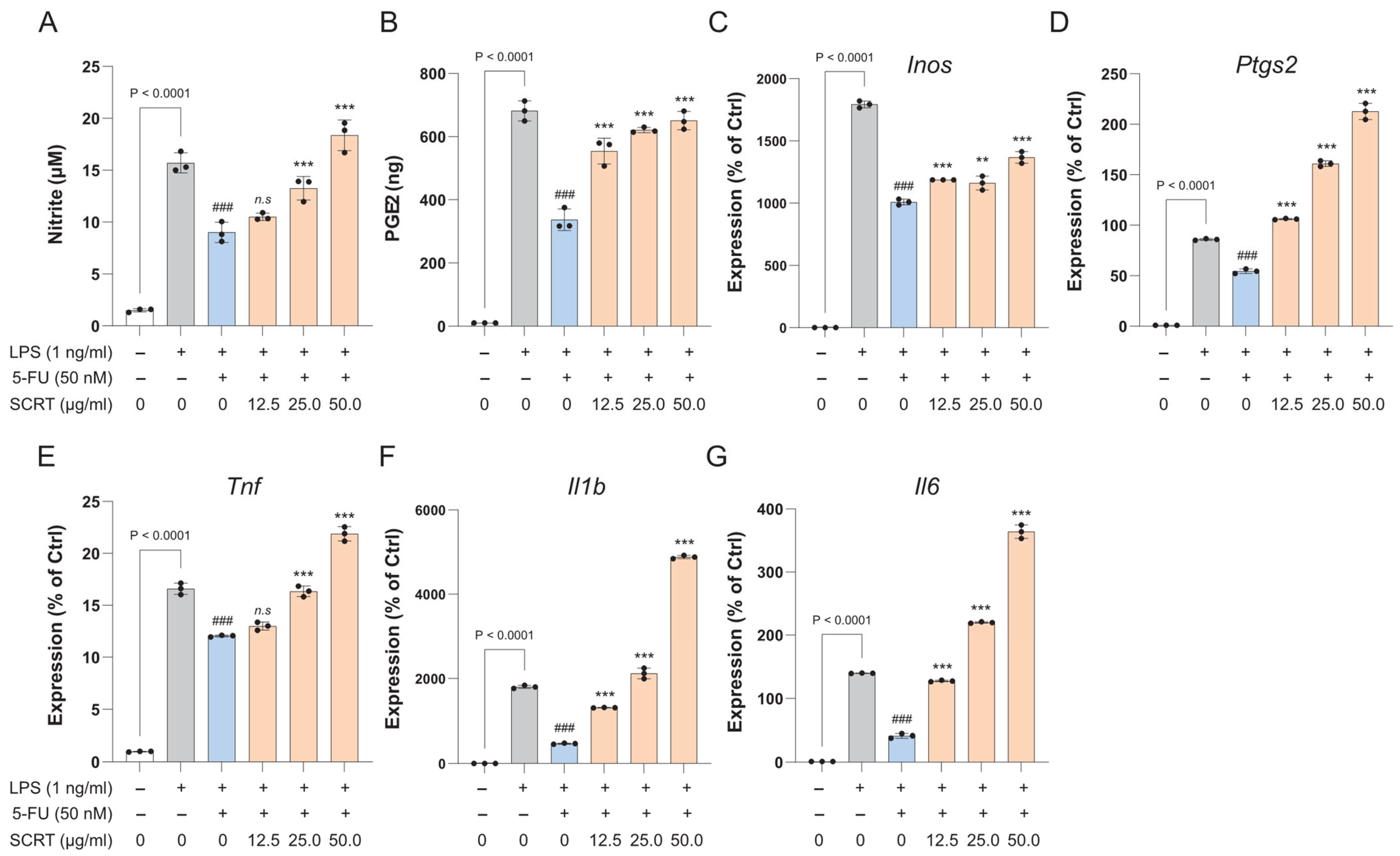
Subsequently, we examined the effect of various anti-cancer drugs [e.g., sorafenib, etoposide, tamoxifen, and 5-FU] on chemotherapy-induced immunosuppression in LPS-stimulated RAW264.7 cells. Among them, only 5-FU induced immunosuppression, a phenomenon improved by SCRT treatment (Supplementary Figure S2A–D). The decreased LPS-stimulated production of NO and PGE2 induced by 5-FU, as well as the mRNA expression of Inos and Ptgs2, were dose-dependently reversed by SCRT (Figure 4A–D). Furthermore, similar results were observed regarding the modulation of cytokines mRNA expression (e.g., Tnf, Il1b, and Il6) by SCRT (Figure 4E–G). Taken together, our findings suggest that SCRT treatment restores immunomodulatory properties during chemotherapy-induced immunosuppression.

3.5. Effects of SCRT During 5-FU-Induced Immunosuppression In Vivo

To evaluate the immunomodulatory effects of SCRT in an in vivo, 5-FU-induced immunosuppressed mice were employed with varying concentrations of SCRT and a defined treatment schedule (Figure 5A). Over the course of the experiment, lower doses of SCRT (10 and 25 mg/kg) showed no significant impact on spleen or thymus weights. However, treatment with a higher dose of SCRT (50 mg/kg) led to a notable increase in spleen weight, indicating a recovery in immune organ mass, while the thymus showed no significant changes across all doses (Figure 5B). This suggests that high-dose SCRT has a protective effect on the spleen, potentially counteracting 5-FU-induced atrophy.
Further analysis of cytokine levels in blood serum revealed that high-dose SCRT effectively restored pro-inflammatory cytokines, including Tnf, Il1b, and Il6, which were suppressed by 5-FU treatment alone. Specifically, Tnf levels showed an upward trend with high-dose SCRT, although not statistically significant (p = 0.0775) (Figure 5C). In contrast, Il1b and Il6 levels were significantly elevated in the high-dose SCRT group compared to the 5-FU-only group, suggesting a dose-dependent recovery effect on key immune mediators (Figure 5D,E). These results indicate that SCRT, particularly at higher doses, may help mitigate chemotherapy-induced immunosuppression by enhancing cytokine production and supporting immune organ health.

4. Discussion

The therapeutic potential of SCRT in managing seasonal colds and inflammatory disorders has long been recognized in oriental traditional medicine. However, despite some evidence of its anti-inflammatory activity, the precise mechanistic significance of SCRT in immunomodulation remains uncertain [12,13,24]. In this study, we aimed to elucidate the immunomodulatory effects of SCRT on RAW264.7 macrophages. Our findings demonstrated that SCRT treatment enhanced phagocytic activity and induced the release of NO and PGE2. These findings are consistent with previous reports linking NO and PGE2 production to immunomodulation, particularly in M1 polarized macrophages, which play crucial roles in pro-inflammatory responses and cytokine production [19,25]. Furthermore, SCRT treatment activated the ROS/MAPKs/NF-κB signaling pathway, leading to the production of proinflammatory cytokines such as TNF-α, IL-1β, and IL-6. These responses indicate fundamental immunostimulatory effects, which contradict its traditional use in managing inflammatory conditions.
In previous studies where anti-inflammatory effects were observed, SCRT was administered at high concentrations (up to 1000 μg/mL). In our study, demonstrating immune-boosting effects, SCRT was administered at low concentrations (up to 50 μg/mL) [13]. We speculate that these differences in SCRT treatment concentrations may have contributed to the distinct effects observed between anti-inflammation and immune enhancement, although the underlying mechanisms governing SCRT’s dual activities remain unclear. Especially notable, it is conceivable that SCRT contains bioactive compounds capable of modulating key signaling pathways involved in immunomodulation. Among the various ingredients of SCRT, Paeonia lactiflora Pall. Radix has been known for its vasodilatory effects, while Zingiber officinale Rosc. Rhizoma and Schizandra chinensis Fructus have been recognized for their immune-enhancing properties [26,27,28,29]. In the present study, SCRT-induced ROS generation was accompanied by enhanced phosphorylation of ERK, p38, and JNK, as well as increased NF-κB transcriptional activity, which collectively coincided with upregulation of iNOS, COX-2, and pro-inflammatory cytokines. These findings suggest that activation of the ROS/MAPKs/NF-κB axis is associated with the immunostimulatory effects of SCRT. However, direct causal relationships between these signaling events and immune restoration require further investigation using pathway-specific inhibitors or genetic approaches.
Interestingly, SCRT also demonstrated resilience against chemotherapy-induced immunosuppression, highlighting its potential as a therapeutic agent for mitigating immune dysfunction associated with these conditions. The ability of SCRT to restore immunomodulatory effects in combination with 5-FU, as evidenced by the attenuation of NO, PGE2, and cytokine downregulation induced by chemotherapy agents in in vitro studies, underscores its versatility and therapeutic potential in managing immune-related disorders under chemotherapy-induced immunosuppressive conditions. Additionally, validation using an in vivo model revealed the recovery effects induced 5-FU, with these effects being particularly evident at high doses of SCRT treatment. Overall, our findings indicate that SCRT treatment reinstates immunomodulatory properties during chemotherapy-induced immunosuppression. Although SCRT demonstrated immunorestorative effects in preclinical models, careful evaluation of dose relevance, long-term safety, and potential herb–drug interactions during chemotherapy is necessary before clinical translation.
In conclusion, the apparent activities of SCRT, exhibiting both anti-inflammatory and immune-enhancing effects, provide additional insights into its therapeutic potential. Particularly, the ability of SCRT to attenuate features of chemotherapy-induced immunosuppression is notable. However, because direct endotoxin-exclusion experiments (e.g., limulus amebocyte lysate quantification and polymyxin B neutralization) were not performed, endotoxin contamination cannot be unequivocally ruled out as a contributing factor to macrophage activation in the present study.
This study will contribute to our understanding of immunomodulatory properties and aid in identifying the specific physiologically active components responsible for SCRT’s pharmacological effects. Future studies incorporating endotoxin testing/neutralization, pathway-specific inhibition or genetic approaches, and additional in vivo validation will be necessary to establish causality and to support clinical translation.

Supplementary Materials

The following supporting information can be downloaded at: https://www.mdpi.com/article/10.3390/pr14050742/s1, Table S1: Composition of Socheongryong-tang (SCRT); Table S2: TaqMan® Gene Expression assay used in qRT-PCR amplifications; Table S3: Primers used in qRT-PCR amplifications; Figure S1: HPLC analysis; Figure S2: Screening of anti-cancer drugs for chemotherapy-induced immunosuppression.

Author Contributions

Conceptualization, Y.J., T.K., Y.-T.P. and S.N.K.; Methodology, Y.J.; Validation, Y.J., H.K. (Hyukjoon Kwon), H.K. (Hyeonseok Ko) and G.H.; Investigation, H.K. (Hyukjoon Kwon), H.K. (Hyeonseok Ko), G.H. and S.Y.; Data curation, G.H., J.-h.J. (Jin-hyoung Jeong), J.-h.J. (Jae-hyun Jo); Writing—original draft, Y.J., H.K. (Hyukjoon Kwon) and H.K. (Hyeonseok Ko); Writing—review and editing, K.S.K. and Y.-J.K.; Supervision, Y.-J.K.; Project administration, K.S.K. and Y.-J.K.; Funding acquisition, Y.-J.K. All authors have read and agreed to the published version of the manuscript.

Funding

This study was supported by multiple funding sources, including the institutional program of the Korea Institute of Science and Technology (KIST) under grant numbers 26Z0031, as well as the Regional Innovation System & Education (RISE) program through the Gangwon RISE Center funded by the Ministry of Education (MOE) and the Gangwon State (G.S.), Republic of Korea (2025-RISE-10-001 and 2025-RISE-10-005).

Institutional Review Board Statement

This animal study was reviewed and approved by the KIST Institutional Animal Care and Use Committee (Approval No. KIST-IACUC-2024-043). This study was conducted in accordance with institutional ethical standards.

Informed Consent Statement

Not applicable.

Data Availability Statement

The data generated and analyzed during the current study are available from the corresponding author upon reasonable request.

Acknowledgments

We thank Chanjoon Jeon (With Pharm, Wonju, Republic of Korea) for his technical assistance and advice.

Conflicts of Interest

Author Gyuwon Huh was employed by the company R&D Center, NovMetaPharma Co., Ltd., Pohang. The remaining authors declare that the research was conducted in the absence of any commercial or financial relationships that could be construed as a potential conflict of interest.

Abbreviations

TNF-α, tumor necrosis factor-alpha; IL-1β, interleukin-1 beta; IL-6, interleukin-6; NO, nitric oxide; PGE2, prostaglandin E2; iNOS, inducible nitric oxide synthase; COX-2, cyclooxygenases 2; LPS, lipopolysaccharide; SCRT, socheongryong-tang; ELISA, enzyme-linked immunosorbent assay; ROS, reactive oxygen species; 5-FU, 5-fluorouracil.

References

  1. Abbas, A.K.; Janeway, C.A., Jr. Immunology: Improving on nature in the twenty-first century. Cell 2000, 100, 129–138. [Google Scholar] [CrossRef]
  2. Tosi, M.F. Innate immune responses to infection. J. Allergy Clin. Immunol. 2005, 116, 241–249. [Google Scholar] [CrossRef]
  3. Fujiwara, N.; Kobayashi, K. Macrophages in inflammation. Curr. Drug Targets Inflamm. Allergy 2005, 4, 281–286. [Google Scholar] [PubMed]
  4. Liang, Y.C.; Huang, Y.T.; Tsai, S.H.; Lin-Shiau, S.Y.; Chen, C.F.; Lin, J.K. Suppression of inducible cyclooxygenase and inducible nitric oxide synthase by apigenin and related flavonoids in mouse macrophages. Carcinogenesis 1999, 20, 1945–1952. [Google Scholar] [CrossRef] [PubMed]
  5. Bogdan, C. Nitric oxide and the immune response. Nat. Immunol. 2001, 2, 907–916. [Google Scholar] [CrossRef] [PubMed]
  6. Kalinski, P. Regulation of immune responses by prostaglandin E2. J. Immunol. 2012, 188, 21–28. [Google Scholar] [CrossRef]
  7. Huo, M.; Cui, X.; Xue, J.; Chi, G.; Gao, R.; Deng, X.; Guan, S.; Wei, J.; Soromou, L.W.; Feng, H.; et al. Anti-inflammatory effects of linalool in RAW 264.7 macrophages and lipopolysaccharide-induced lung injury model. J. Surg. Res. 2013, 180, e47–e54. [Google Scholar] [CrossRef]
  8. Hwang, J.H.; Ma, J.N.; Park, J.H.; Jung, H.W.; Park, Y.K. Anti-inflammatory and antioxidant effects of MOK, a polyherbal extract, on lipopolysaccharide-stimulated RAW 264.7 macrophages. Int. J. Mol. Med. 2019, 43, 26–36. [Google Scholar]
  9. Muniandy, K.; Gothai, S.; Badran, K.M.H.; Suresh Kumar, S.; Esa, N.M.; Arulselvan, P. Suppression of Proinflammatory Cytokines and Mediators in LPS-Induced RAW 264.7 Macrophages by Stem Extract of Alternanthera sessilis via the Inhibition of the NF-kappaB Pathway. J. Immunol. Res. 2018, 2018, 3430684. [Google Scholar]
  10. Hwang, C.H.; Kim, K.T.; Lee, N.K.; Paik, H.D. Immune-Enhancing Effect of Heat-Treated Levilactobacillus brevis KU15159 in RAW 264.7 Cells. Probiotics Antimicrob. Proteins 2023, 15, 175–184. [Google Scholar] [CrossRef]
  11. Sharma, A.; Jasrotia, S.; Kumar, A. Effects of Chemotherapy on the Immune System: Implications for Cancer Treatment and Patient Outcomes. Naunyn-Schmiedeberg’s Arch. Pharmacol. 2023, 397, 2551–2566. [Google Scholar] [CrossRef] [PubMed]
  12. Weir, G.M.; Liwski, R.S.; Mansour, M. Immune modulation by chemotherapy or immunotherapy to enhance cancer vaccines. Cancers 2011, 3, 3114–3142. [Google Scholar] [CrossRef] [PubMed]
  13. Park, S.M.; Lee, T.H.; Zhao, R.; Kim, Y.S.; Jung, J.Y.; Park, C.A.; Jegal, K.H.; Ku, S.K.; Kim, J.K.; Lee, C.W.; et al. Amelioration of inflammatory responses by Socheongryong-Tang, a traditional herbal medicine, in RAW 264.7 cells and rats. Int. J. Mol. Med. 2018, 41, 2771–2783. [Google Scholar] [PubMed]
  14. Jeong, S.H.; Jang, J.H.; Ham, S.H.; Yang, S.J.; Cho, H.Y.; Lee, Y.B. Simultaneous UPLC-MS/MS determination of four components of Socheongryong-tang tablet in human plasma: Application to pharmacokinetic study. J. Chromatogr. B Analyt Technol. Biomed. Life Sci. 2018, 1095, 214–225. [Google Scholar] [CrossRef]
  15. Ko, E.; Rho, S.; Lee, E.J.; Seo, Y.H.; Cho, C.; Lee, Y.; Min, B.-I.; Shin, M.-K.; Hong, M.-C.; Bae, H. Traditional Korean medicine (SCRT) modulate Th1/Th2 specific cytokine production in mice CD4+ T cell. J. Ethnopharmacol. 2004, 92, 121–128. [Google Scholar] [CrossRef]
  16. Nakao, M.; Muramoto, Y.; Hisadome, M.; Yamano, N.; Shoji, M.; Fukushima, Y.; Saruwatari, J.; Nakagawa, K. The effect of Shoseiryuto, a traditional Japanese medicine, on cytochrome P450s, N-acetyltransferase 2 and xanthine oxidase, in extensive or intermediate metabolizers of CYP2D6. Eur. J. Clin. Pharmacol. 2007, 63, 345–353. [Google Scholar] [CrossRef]
  17. Jeon, Y.; Yoo, J.E.; Rhee, H.; Kim, Y.J.; Il Kim, G.; Chung, T.; Yoon, S.; Shin, B.; Woo, H.G.; Park, Y.N. YAP inactivation in estrogen receptor alpha-positive hepatocellular carcinoma with less aggressive behavior. Exp. Mol. Med. 2021, 53, 1055–1067. [Google Scholar] [CrossRef]
  18. Orecchioni, M.; Ghosheh, Y.; Pramod, A.B.; Ley, K. Macrophage Polarization: Different Gene Signatures in M1(LPS+) vs. Classically and M2(LPS-) vs. Alternatively Activated Macrophages. Front. Immunol. 2019, 10, 1084. [Google Scholar] [CrossRef]
  19. Palmieri, E.M.; Gonzalez-Cotto, M.; Baseler, W.A.; Davies, L.C.; Ghesquiere, B.; Maio, N.; Rice, C.M.; Rouault, T.A.; Cassel, T.; Higashi, R.M.; et al. Nitric oxide orchestrates metabolic rewiring in M1 macrophages by targeting aconitase 2 and pyruvate dehydrogenase. Nat. Commun. 2020, 11, 698. [Google Scholar] [CrossRef]
  20. Sareila, O.; Korhonen, R.; Auvinen, H.; Hamalainen, M.; Kankaanranta, H.; Nissinen, E.; Moilanen, E. Effects of levo- and dextrosimendan on NF-kappaB-mediated transcription, iNOS expression and NO production in response to inflammatory stimuli. Br. J. Pharmacol. 2008, 155, 884–895. [Google Scholar] [CrossRef]
  21. Xiao, W. Advances in NF-kappaB signaling transduction and transcription. Cell Mol. Immunol. 2004, 1, 425–435. [Google Scholar] [PubMed]
  22. Yun, K.J.; Kim, J.Y.; Kim, J.B.; Lee, K.W.; Jeong, S.Y.; Park, H.J.; Jung, H.-J.; Cho, Y.-W.; Yun, K.; Lee, K.-T. Inhibition of LPS-induced NO and PGE2 production by asiatic acid via NF-kappa B inactivation in RAW 264.7 macrophages: Possible involvement of the IKK and MAPK pathways. Int. Immunopharmacol. 2008, 8, 431–441. [Google Scholar] [CrossRef] [PubMed]
  23. Tan, H.Y.; Wang, N.; Li, S.; Hong, M.; Wang, X.; Feng, Y. The Reactive Oxygen Species in Macrophage Polarization: Reflecting Its Dual Role in Progression and Treatment of Human Diseases. Oxidative Med. Cell. Longev. 2016, 2016, 2795090. [Google Scholar]
  24. Byun, J.S.; Yang, S.Y.; Jeong, I.C.; Hong, K.E.; Kang, W.; Yeo, Y.; Park, Y.-C. Effects of So-cheong-ryong-tang and Yeon-gyo-pae-dok-san on the common cold: Randomized, double blind, placebo controlled trial. J. Ethnopharmacol. 2011, 133, 642–646. [Google Scholar]
  25. Wang, W.; Liang, M.; Wang, L.; Bei, W.; Rong, X.; Xu, J.; Guo, J. Role of prostaglandin E2 in macrophage polarization: Insights into atherosclerosis. Biochem. Pharmacol. 2023, 207, 115357. [Google Scholar] [CrossRef]
  26. Butt, M.S.; Sultan, M.T. Ginger and its health claims: Molecular aspects. Crit. Rev. Food Sci. Nutr. 2011, 51, 383–393. [Google Scholar] [CrossRef]
  27. Lin, R.D.; Mao, Y.W.; Leu, S.J.; Huang, C.Y.; Lee, M.H. The immuno-regulatory effects of Schisandra chinensis and its constituents on human monocytic leukemia cells. Molecules 2011, 16, 4836–4849. [Google Scholar] [CrossRef]
  28. Liu, J.P.; Wang, J.; Zhou, S.X.; Huang, D.C.; Qi, G.H.; Chen, G.T. Ginger polysaccharides enhance intestinal immunity by modulating gut microbiota in cyclophosphamide-induced immunosuppressed mice. Int. J. Biol. Macromol. 2022, 223, 1308–1319. [Google Scholar] [CrossRef]
  29. Yu, J.; Cong, L.; Wang, C.; Li, H.; Zhang, C.; Guan, X.; Liu, P.; Xie, Y.; Chen, J.; Sun, J. Immunomodulatory effect of Schisandra polysaccharides in cyclophosphamide-induced immunocompromised mice. Exp. Ther. Med. 2018, 15, 4755–4762. [Google Scholar]
Figure 1. SCRT treatment enhances phagocytic activity. (A) RAW264.7 cells were treated with various concentrations of SCRT for 24 h and subjected to WST-8 assay. (B,C) RAW264.7 cells were incubated with 1 ng/mL LPS and 12.5–50 μg/mL SCRT for 24 h. The levels of phagocytic capacity by SCRT were assessed using Phagocytosis Assay Kit. The data are shown as mean ± S.D. of triplicate experiments. Statistical significance is indicated (*** p < 0.001; Student’s t-test).
Processes 14 00742 g001
Figure 2. SCRT treatment enhanced Inos, ptg2, Tnf, Il1b, and Il6 expression. RAW264.7 cells were treated with 1 ng/mL LPS and the indicated concentrations of SCRT for 24 h. (A,B) The supernatant was used for detecting NO and PGE2 concentration using the griess assay and PGE2 Parameter Assay, respectively. (C,D) Bar plots show mRNA expression of Inos and Ptgs2 using qRT-PCR. (E) Protein expression of iNOS and COX-2 was determined by Western blotting, and densitometric quantification normalized to GAPDH is presented. (F) Bar plots show mRNA expression of cytokines, Tnf, Il1b, and Il6, using qRT-PCR. Expression of each gene was normalized to that of Gapdh. The data are shown as mean ± S.D. of triplicate experiments. Statistical significance is indicated (* p < 0.05, and *** p < 0.001, Student’s t-test).
Processes 14 00742 g002
Figure 3. SCRT treatment activates ROS/MAPKs/NF-κB signaling axis. (A) Protein levels of p-p65 and p65 were determined by Western blotting, and densitometric quantification is presented. (B) NF-κB transactivity was evaluated using the dual-luciferase assay in RAW264.7 cells. (C) Protein levels of p-ERK, ERK, p-JNK, JNK, p-p38, and p38 were determined by Western blotting, and densitometric quantification is presented. (D) Bar plots show the production of ROS using DCF-DA assay. GAPDH was used as control for protein expression analysis. The data are shown as mean ± S.D. of triplicate experiments. Statistical significance is indicated (* p < 0.05, and *** p < 0.001, Student’s t-test).
Processes 14 00742 g003
Figure 4. SCRT recovers the immunomodulatory properties under chemotherapy-induced immunosuppression. RAW264.7 cells were pretreated with the indicated concentrations of SCRT or 1 ng/mL LPS for 2 h, and then exposed to 50 nM 5-FU for 24 h. (A,B) The supernatant was used for detecting NO and PGE2 concentration using the griess assay and ELISA. (CG) Bar plots show the mRNA expression of Inos, Ptgs2, Tnf, Il1b, and Il6 using qRT-PCR. Expression of each gene was normalized to that of Gapdh. The data are shown as mean ± S.D. of triplicate experiments. Statistical significance is indicated (vs. with LPS; ### p < 0.001, vs. with LPS and 5-FU; ** p < 0.01, and *** p < 0.001, one-way ANOVA).
Processes 14 00742 g004
Figure 5. Effects of SCRT during 5-FU-induced immunosuppression in vivo. (A) Diagram revealing the specific in vivo experimental schedule of the 5-FU-induced mouse model. (B) Bar plots showing spleen and thymus weight changes. (CE) Bar plots revealing the levels of cytokines from blood serum using the ELISA. The data are shown as mean ± S.D. of triplicate experiments. Statistical significance is indicated (vs. with 5-FU; * p < 0.05, ** p < 0.01, and *** p < 0.001, one-way ANOVA).
Processes 14 00742 g005
Disclaimer/Publisher’s Note: The statements, opinions and data contained in all publications are solely those of the individual author(s) and contributor(s) and not of MDPI and/or the editor(s). MDPI and/or the editor(s) disclaim responsibility for any injury to people or property resulting from any ideas, methods, instructions or products referred to in the content.