Article

Co-Ce PROX Catalysts for Renewable, Climate-Independent, and Emission-Free “On-Board” Energy

1
Institute of Catalysis, Bulgarian Academy of Sciences, 1113 Sofia, Bulgaria
2
Institute of Physical Chemistry-Ilie Murgulescu of the Romanian Academy, Spl. Independentei 202, 060021 Bucharest, Romania
3
Institute of Optical Materials and Technologies “Acad. Jordan Malinowski”, Bulgarian Academy of Sciences, 1113 Sofia, Bulgaria
*
Author to whom correspondence should be addressed.
Processes 2026, 14(4), 711; https://doi.org/10.3390/pr14040711
Submission received: 3 January 2026 / Revised: 15 February 2026 / Accepted: 18 February 2026 / Published: 21 February 2026

Abstract

Trace amounts of CO in H2-rich gas can poison Pt electrodes in proton-exchange-membrane fuel cells, necessitating selective CO removal. Preferential oxidation of CO (PROX) offers an efficient route to oxidize CO while preserving H2. Although noble-metal-based catalysts are widely used, their high cost has driven interest in non-precious alternatives. Co3O4–CeO2 catalysts have emerged as particularly promising due to their high activity and stability. Two series of Co–Ce/SiO2 catalysts were prepared via impregnation: in the first, Ce was introduced and calcined prior to Co deposition; in the second, Co and Ce nitrates were co-deposited from a mixed aqueous solution. The latter method enhances the interaction between Co3O4 and CeO2, increasing the availability of surface oxygen species. Stability tests on the most active sample demonstrated remarkable durability, maintaining near-complete CO conversion over 100 h on dry stream.

1. Introduction

Hydrogen is one of the most promising alternatives for a sustainable economy. Its key advantages include high energy density, and long-term storage capability. When produced via water electrolysis powered by renewable energy (green hydrogen), it serves as a clean energy source. Used in fuel cells, hydrogen provides highly efficient and emissions-free power, yielding only water and heat as by-products. Consequently, it is a vital solution for decarbonizing power generation, transportation, and heavy industry [1,2].
The most common current method for hydrogen production, hydrocarbon reforming, produces a gas (reformate) that contains significant amounts of carbon monoxide (CO). CO is a potent poison for the fuel cell’s platinum anodes because it strongly adsorbs to the catalyst surface, blocking the active sites required for the hydrogen oxidation reaction and causing a significant performance drop. To ensure a durable PEMFC, the CO concentration in the hydrogen feed must be strictly limited to below 10 ppm for standard Pt anodes and below 100 ppm for more CO-tolerant alloy anodes like Pt-Ru) [3,4].
The preferential CO oxidation (PROX) is a simple, efficient, and economic method for CO removal. Catalysts so far proposed for the PROX process are based mainly on noble metals, such as Pt, Rh, and Ru, deposited on different supports with or without any promoters [4]. A benchmark objective of 50/50 was established for PROX catalysts, which indicates that the CO content in the product should be less than 50 ppm while the O2 selectivity to CO2 should be greater than 50%. In addition to the 50/50 target, a good PROX catalyst should have a wide operating temperature window (80–200 °C) and great thermal stability [4].
Due to the high price of precious metals, non-precious metal catalysts have been considered as a potential alternative for the CO PROX reaction. CuO–CeO2 [5,6] and Co3O4–CeO2 [7] have been investigated in the CO PROX process. In an early research, Kang et al. [8] studied a series of transition metal oxides (CoOx, CuO, MnO2, NiO, Cr2O7, Fe2O3, and V2O5) supported on CeO2 and found that the Co3O4–CeO2 system exhibits the best catalytic behavior. It is well known that Co3O4 is with spinel structure, with Co3+ located in an octahedral position, and Co2+ in a tetrahedral one [9]. It is considered that the spinels generate oxygen vacancies, leading to the formation of weakly bonded oxygen species, such as Co3+–O2–Co2+, which are responsible for the high catalytic activity [10]. It is known that cobalt oxide exhibits high oxidation activity in CO at extremely low temperature (−70 °C) [11]. Co3+ is believed to be the active form in the selective CO oxidation reaction, providing oxygen and forming Co2+ ions, which are subsequently reoxidized. The presence of H2 in the conditions of the PROX process provokes a gradual deactivation of the catalysts through the formation of surface species in a low oxidation state and even Co0 [12]. The synergistic effect of the Co3O4–CeO2 system is the result from on one hand, increasing the dispersion of the active phase, and on the other, in increasing the oxygen capacity of the system [8,11,12,13,14,15,16,17,18,19]. Most of the existing literature on Co–Ce catalysts for the selective oxidation of CO (PROX) focuses on catalysts synthesized using various methods without the use of a support onto which these oxides are deposited [11,12,13,14,15,16,17,18,19,20,21,22,23,24]. Characterization analysis indicates that CeO2 morphology significantly affects the exposure of specific crystalline facets. The CeO2-NP samples, characterized by a higher proportion of exposed (111) planes, exhibit the highest concentrations of Ce3+ ions and oxygen vacancies, which are essential for superior catalytic activity. Furthermore, the reduced crystallite size of CeO2-NP promotes a higher BET surface area, facilitating the fine dispersion of Co3+ species. This structural arrangement enhances both CO adsorption and oxidation, ultimately improving CO-PROX performance [15]. Relatively few studies have addressed supported Co–Ce catalysts [25,26]. One possible reason is that the preparation method, precursor type, and calcination conditions strongly influence the formation of surface phases, even when relatively inert supports such as silicon oxide are used.
Nyathi et al. [27] investigated Co3O4 supported on different oxides and demonstrated that weak nanoparticle–support interactions (NPSIs) are beneficial, as these ensure high CO conversions to CO2 via the well accepted Mars–van Krevelen mechanism, which requires the catalyst to be reducible. However, the weak NPSIs have a negative effect on the phase stability of bulk Co3O4, as this phase can ultimately reduce to metallic Co, which is highly selective to undesired H2 consuming reactions (viz., H2 oxidation, CO/CO2 methanation and the reverse WGS). The least CO oxidation active Co3O4/Al2O3 catalyst was also the least reducible and the least methanation active catalyst. This was attributed to the possible existence of very strong NPSIs in this catalyst. The Co3O4/SiO2 spent sample is mostly composed of CoO, but small amounts of Co3O4, Co2SiO4 and metallic Co. The conclusion of the authors is that the support has to have the bi-functional role: to enhance CO oxidation activity and selectivity, while stabilizing the Co3O4 phase over a wide temperature range during CO-PrOx. The extent of strong metal–support interaction (SMSI) is highly dependent on the chosen synthesis protocol. In our previous research [28], finely dispersed CoO and a silica-like phase are formed on the surface of the Co-SBA-15 sample prepared from cobalt nitrate and calcined in air flow. As noted above, a key factor in controlling the activity and selectivity of cobalt–cerium-based catalysts is the contact between the active phases. When a support is used, the formation of hardly reducible inactive surface phases is possible. Therefore, by controlling the preparation processes, the interaction between Co3O4 and CeO2 can be finely tuned, and consequently, the activity and selectivity of the catalyst can be regulated. On the other hand, the use of a widely available support such as SiO2 may lead to a more economically favorable catalyst, since the cerium content can be reduced, and, as is well known, cerium is a critical element [29]. In our previous investigation, we established that the catalytic properties of Co–Ce samples deposited onto SiO2 in the reaction of CO oxidation depended on the sequence of active components introduction. The homogeneous distribution of Co3O4 and CeO2 and good contact between them are key factors controlling the activity. Because of close interaction between Co3O4 and CeO2 in the catalyst prepared with common solution of Co- and Ce nitrates, more surface oxygen species are provided to the cobalt oxide [30]. Our main goal is the development of a catalyst with next characteristics: 1. Strong synergy between Co3O4 and CeO2 through intimate contact between the phases, allowing for oxygen activation, and 2. A highly developed surface area to ensure more available reaction sites. Following these results, our aim was to study the influence of the sequence of active Co3O4 and CeO2 introduction on the support on the catalytic activity in the preferential CO oxidation in hydrogen reach gases under model or dry CO-PrOx conditions.

2. Materials and Methods

2.1. Catalysis Preparation

To create mono- and two-component samples, silica (Sigma Aldrich, Merck Bulgaria EAD, Sofia, Bulgaria, SBET = 398 m2/g) was impregnated with an aqueous solution of Co(NO3)2·6H2O (Merck Bulgaria EAD, Sofia, Bulgaria) and Ce(NO3)2·6H2O (Sigma Aldrich). Two series of Co-Ce/SiO2 catalysts were prepared by impregnation. The Ce was introduced first and after calcination the Co was deposited (samples denoted xCe+yCo). In the second one, the samples were obtained from a mixed aqueous solution of Co(NO3)2·6H2O and Ce(NO3)2·6H2O (samples denoted xCeyCo). After each impregnation, the catalysts were dried at 80 °C in oven and calcined 1 hat 400 °C in air. The cobalt is 20 weight percent in all tested samples, and Ce varied between 10, 15 and 20 wt.%.

2.2. Catalyst Characterization

Powder XRD patterns were acquired at room temperature using an Empyrean diffractometer (PANalytical Empyrean), equipped with detector (Pixel 3D, PANalytical) using Cu Kα 45 kV–40 mA radiation in the 2θ range. The XRD data was processed using the X’Pert HighScore 1.0f software. TPR was performed using previously published equipment [31] with a 5% H2 in Ar mixture at a flow rate of 10 mL/min and a temperature ramp of 10 °C/min to 700 °C. Before the TPR experiment, the samples were treated with Ar at 150 °C for 30 min. The H2 consumed (TPR) was quantified by calibration with pure Co3O4 as reference compound (Merck Bulgaria EAD, Sofia, Bulgaria), assuming a total reduction in Co3O4 to Co0. A sample mass of 20 mg was employed for the TPR experiment.
Nitrogen adsorption–desorption isotherms were measured at −196 °C using a volumetric adsorption analyzer TRISTAR 3000 (Micromeritics Instrument Corp., Norcross, GA, USA) with a relative pressure (p/p0) range of 0.010–0.995. Before each measurement, the samples were degassed for 16 h at 25 °C in a vacuum (pressure of 0.13 mBar). The samples’ specific surface areas were determined using the Brunauer–Emmett–Teller (BET). The pore width and pore size distribution were calculated using data from the relevant isotherm’s desorption branch using the BJH (Barret–Joyner–Halenda) technique.
X-ray photoelectron spectroscopy (XPS) was conducted using the ESCALAB MkII (VG Scientific, East Grinstead, UK), and the obtained spectra were processed as reported in [32].
The UV Raman spectra of the Co-Ce catalysts supported on SiO2 were collected by a LABRAM HR800 spectrometer (Horiba France SAS, Palaiseau, France) equipped with a He-Cd laser (λL = 325 nm, Kimmon Kobe), a 2400-groove grating, and a microscope objective of 40× NUV/0.47. The laser power was kept below 5 mW to prevent sample modifications.
The high resolution transmission electron microscopy (HRTEM) experiments for morphology and phase composition study of the samples were carried out using a JEOL JEM 2100 apparatus (JEOL Ltd., Tokyo, Japan) with at an accelerating voltage of 200 kV.
The catalytic activity tests were carried out in micro reactor system Hiden CATLAB at atmospheric pressure with a catalyst bed loading of about 0.5 cm3 (fraction 0.25–0.31 mm)”, reactor diameter 6 mm. The gas mixture consists of 1 V% CO, 1 V% O2, 50 vol.% H2 and N2 for balance to 100 V%. External mass transfer limitations were minimized by operating at high GHSV (12,000 h−1). The gas analysis was performed using on-line gas-analyzers of CO/CO2/O2/H2 (GMS800 Series, SICK AG, Waldkirch, Germany).
The CO conversion degree was calculated based on the change in the CO concentration:
COconversion = (COin − COout) × 100%/COin
The O2 conversion degree was based on O2 consumption:
O2conversion = (O2in − O2out) × 100%/O2in
Finally, the selectivity of the CO oxidation was calculated based on the oxygen mass balance as follows:
% Selectivity = 0.5 × (COin − COout) × 100%/O2in − O2out
Each experimental point represents the mean of six independent measurements, with a calculated standard deviation of ±1.5%. The conversion degree was determined by averaging two consecutive readings.

3. Results

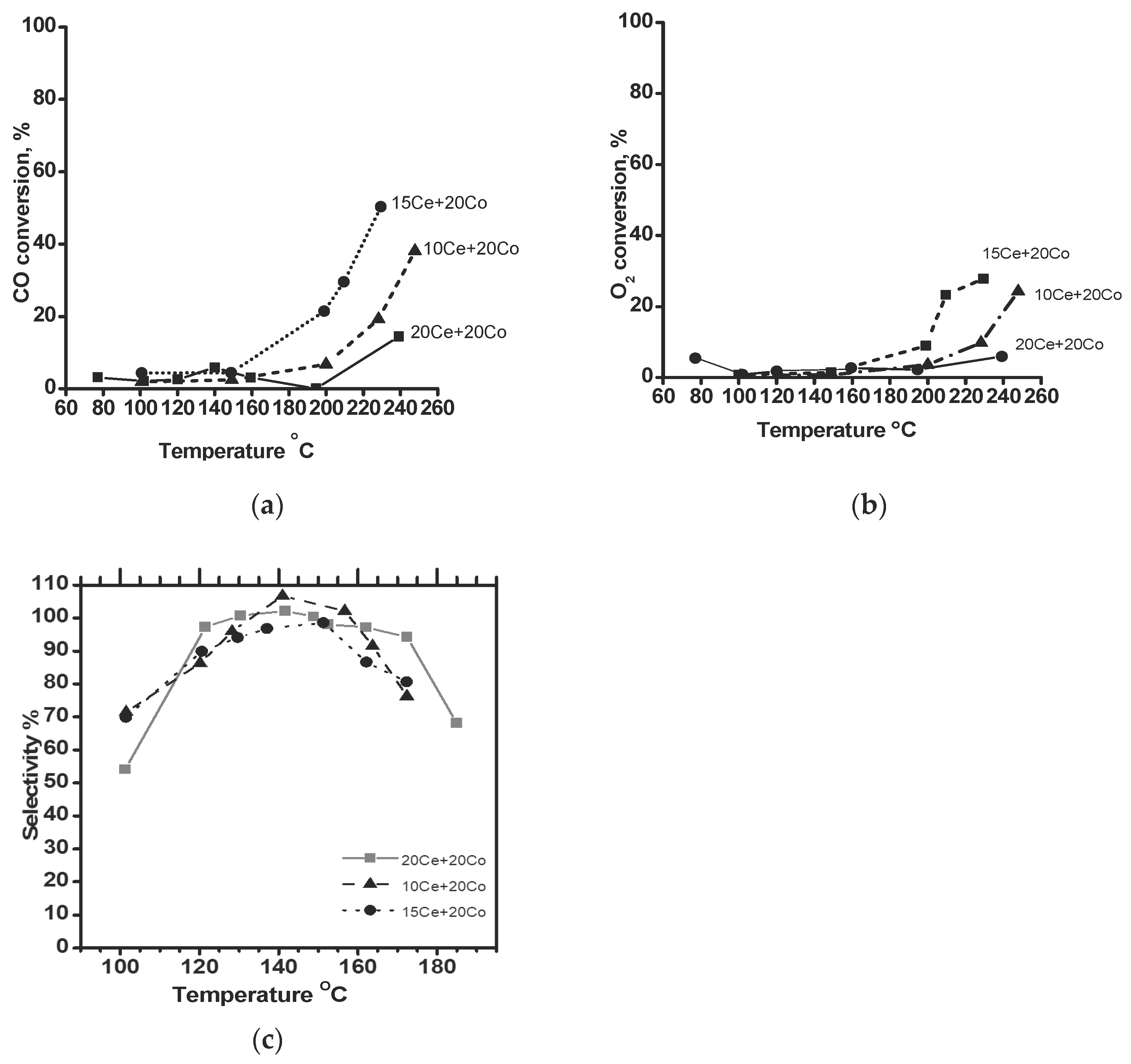
The effect of the deposition sequence on activity and selectivity is presented in Figure 1 and Figure 2. The conversion degree curves for the samples prepared by successive impregnation are shown in Figure 1.
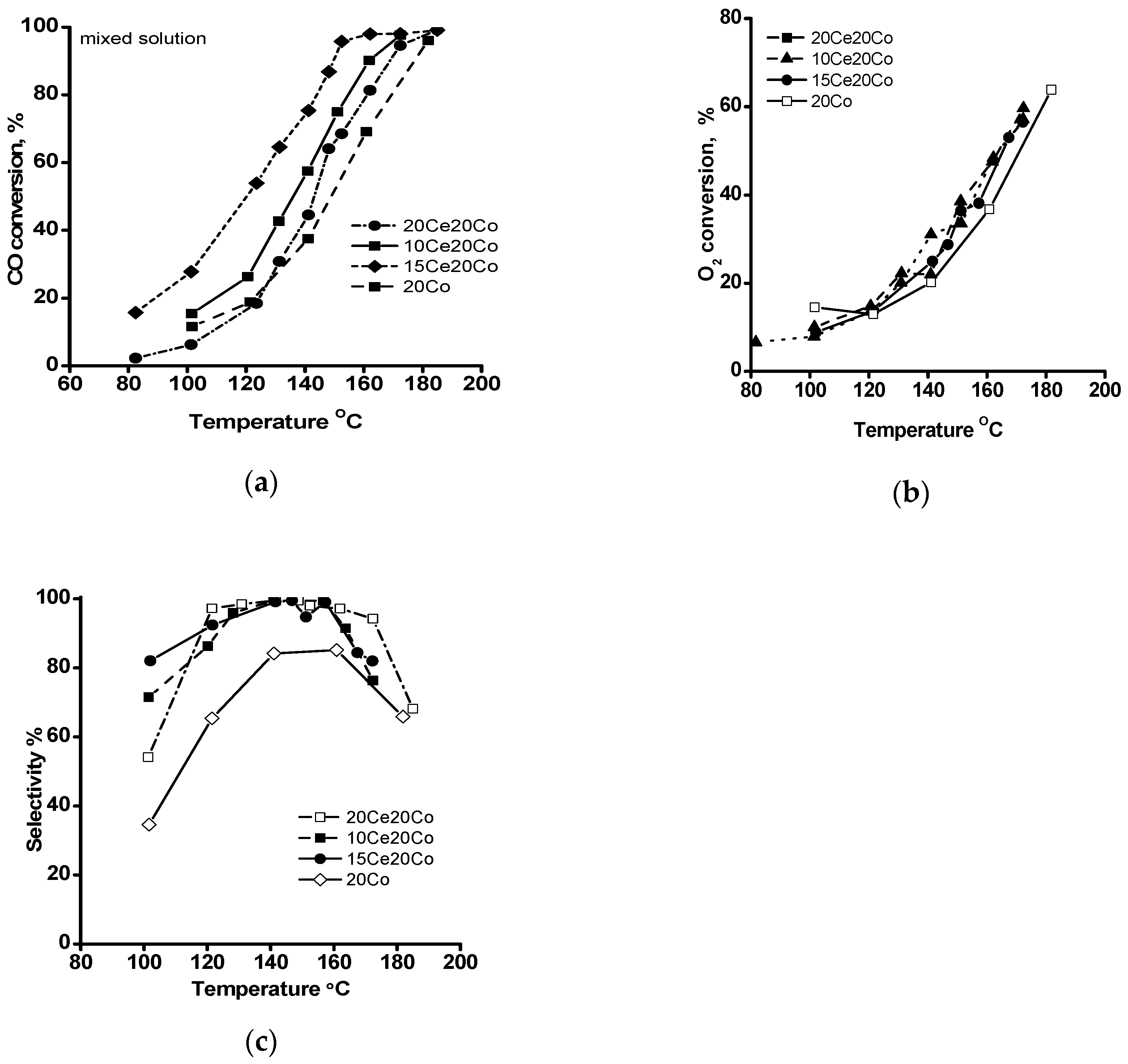
As can be seen from the figures, the samples prepared from the successive impregnation showed very low catalytic activity. The maximum conversion of CO and O2 is about 40%, which is very far from the required 99.5%. Catalysts synthesized via deposition of the active components from a mixed cobalt–cerium nitrate solution exhibit significantly different behavior. Notably, these samples contain the same amounts of cobalt and cerium as the catalysts prepared by sequential deposition (Figure 2).
As can be seen from the figure, the lower activity shows the mono-component cobalt catalyst and modification with Ce leads to an increase in activity and CO2 selectivity. The selectivity remains relatively stable in the temperature range of 120–160 °C.
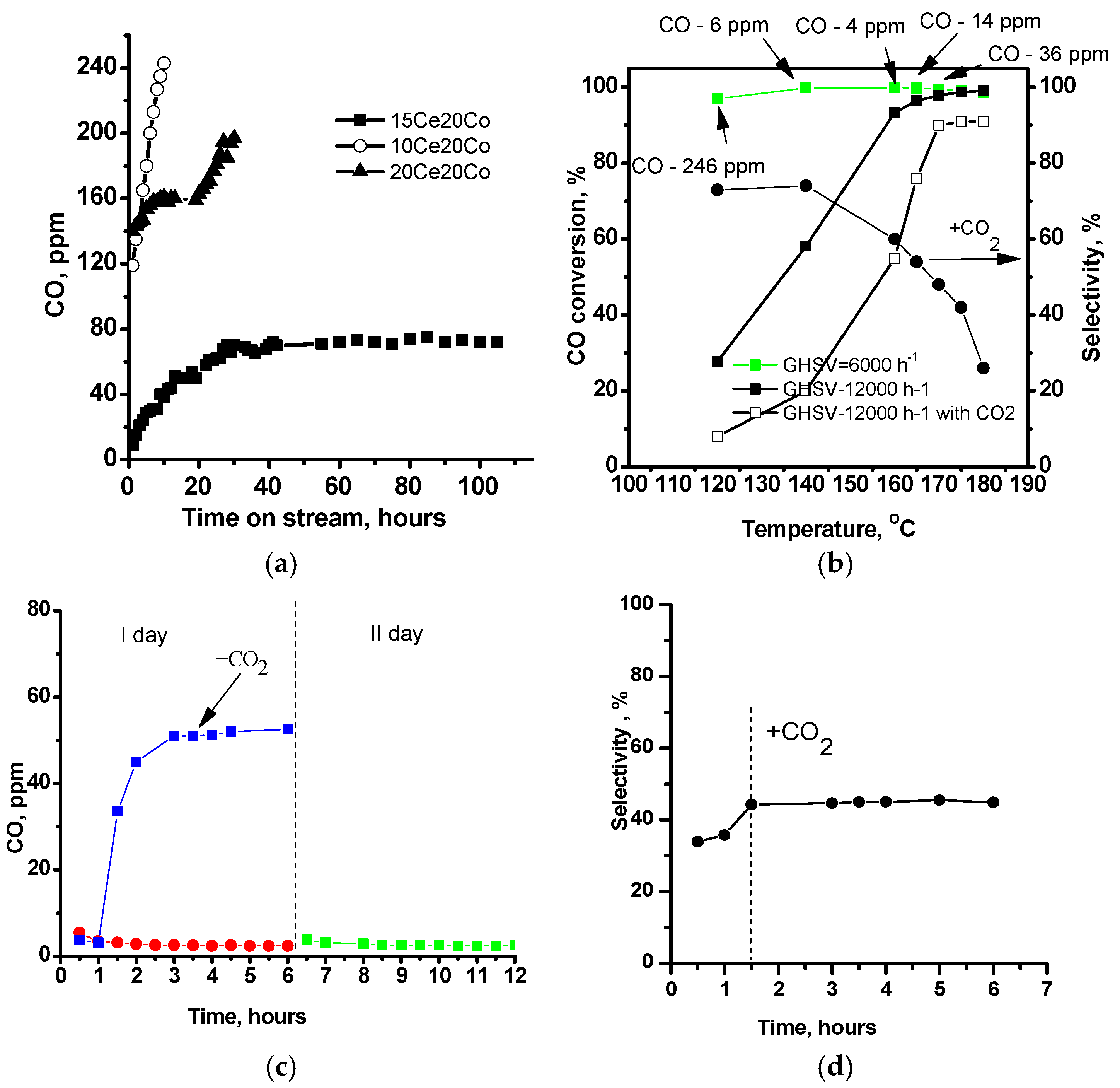
Figure 3 shows the stability of the samples prepared by co-impregnation. The experiments were conducted in a CO2-free gas mixture. The samples containing 10% and 20% cerium deactivate rapidly, with the outlet concentration rising sharply to 200 ppm and above within 10–20 h. Stability tests for most active sample 15Ce20Co, were carried out at the temperature corresponding to the maximum conversion, specifically 160 °C (CO conversion 99.5%) for 100 h. During this period, the amount of CO at the outlet of the reaction mixture changed from 10 ppm at the beginning of the experiment to 70 ppm at the end of the test and selectivity slightly decreased from approximately 46% to 43%, indicating stable performance despite remaining below 50%. Based on these encouraging results, the samples were further evaluated at a lower gas hourly space velocity (GHSV) of 6000 h−1 (Figure 3b). Stability tests performed at the low gas hourly space velocity (GHSV)–6000 h−1 and an operating temperature of 160 °C, where maximum conversion is achieved, demonstrated stable conversion, with an effluent concentration of 4–5 ppm maintained over a 10 h period. While the addition of CO2 led to some catalyst deactivation, the outlet CO concentration remaining around 50 ppm (Figure 3c). Selectivity at this condition is 45%. The activity of this sample was also investigated after adding 5 vol.% CO2 in the gas mixture. As is well known, carbon dioxide is present in the gas stream following WGSR.
The temperature dependencies of CO conversion demonstrated 20~30 °C shift to higher temperature regions in the presence of CO2. The presence of CO2 in the PROX feed has been shown to decrease the catalytic. Similar behavior was observed by [33] and was attributed to the competitive adsorption of CO2 on the catalyst surface and the formation of surface carbonate species, which partially block active sites and suppress undesired H2 oxidation, thereby enhancing CO selectivity.
As can be seen from the catalytic experiments presented above, the samples prepared via co-impregnation exhibited promising activity and stability and were subsequently characterized by X-ray diffraction (XRD) and temperature-programmed reduction (TPR). Among them, the sample containing 15 wt.% Ce showed the highest activity and was therefore selected for in-depth characterization by XPS, UV-Raman and TEM. This catalyst was examined before reaction (BR) and after catalytic test (AR). This sample was characterized also after stability test in some cases.
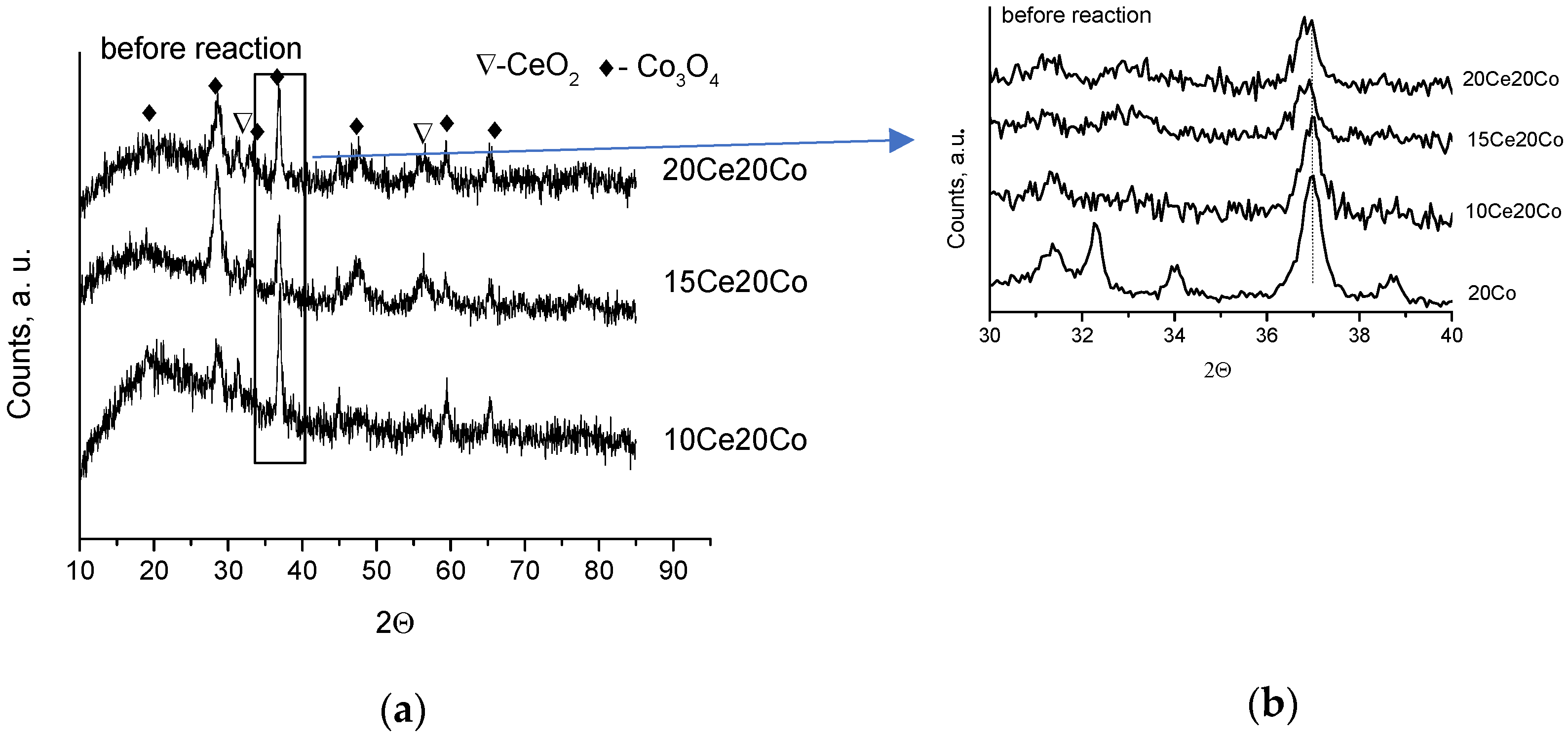
XRD analysis reveals that the two-component catalysts exhibit two distinct crystalline phases after calcination at 400 °C: Co3O4 with a spinel structure and CeO2 with a fluorite structure (Figure 4). Peaks at 2θ = 31.37°, 36.88°, 44.87°, 59.39°, and 65.29° (PDF 01-01-076-1802) correspond to Co3O4, while those at 2θ = 28.66°, 33.10°, and 47.73° (PDF 01-075-0076) correspond to CeO2, with no evidence of mixed cobalt–cerium oxide phases.
Average Co3O4 particle sizes, calculated via the Scherrer equation from the (311) reflection of Co3O4 and (111) reflection of CeO2 are listed in Table 1. The data show a reduction in cobalt oxide particle size in ceria-promoted samples, which is most pronounced for the sample containing 15% Ce. The lattice parameter was also calculated, and it can be observed that it increases for the Ce-modified samples compared to the cobalt-only catalyst. The largest increase is observed for the catalyst containing 15% Ce.
Magnified XRD patterns of the Co3O4 (311) reflection (Figure 4b) show systematic shifts toward lower 2θ values. The largest shift is observed for the 15Ce20Co sample. Similar shifts are evident across the entire Co3O4 diffraction pattern for all CeCo catalysts. An analogous result was observed by [34] and they associated it with the incorporation of larger Ce ions into the Co3O4 lattice, while the formation of a Co–Ce–O solid solution. Since no additional diffraction peaks besides those of Co3O4 and CeO2 were detected, the amount of such a solid solution is considered negligible [34]. The calculated lattice parameters of Co3O4 are summarized in Table 1. Another reason for change in the lattice parameters of Co3O4 could be its nano size dimensions. It has been reported that for Co3O4 nanoparticles, the lattice parameter may increase as particle size decreases, which is attributed to finite size effects, increased lattice strain, and a higher concentration of point defects such as oxygen vacancies in the nanoparticles [35]. In the present system, the observed changes in the lattice parameter and the shift of the diffraction peaks are most likely associated with the nanosized nature of cobalt oxide. This interpretation is supported by the presence of a distinct CeO2 phase in the XRD patterns and by TEM observations, which provide clear evidence for the formation of finely dispersed Co3O4 and CeO2 nanoparticles. Although the formation of a solid solution cannot be entirely excluded, it is most likely confined to the interfacial regions between the two oxides. The average particle size of cobalt oxide exhibits only minor changes after the catalytic test. For the 15Ce20Co sample, the particle size after the stability test was also determined and found to be 18 nm. This result indicates that the addition of Ce effectively inhibits the sintering of cobalt oxide during the PROX reaction.
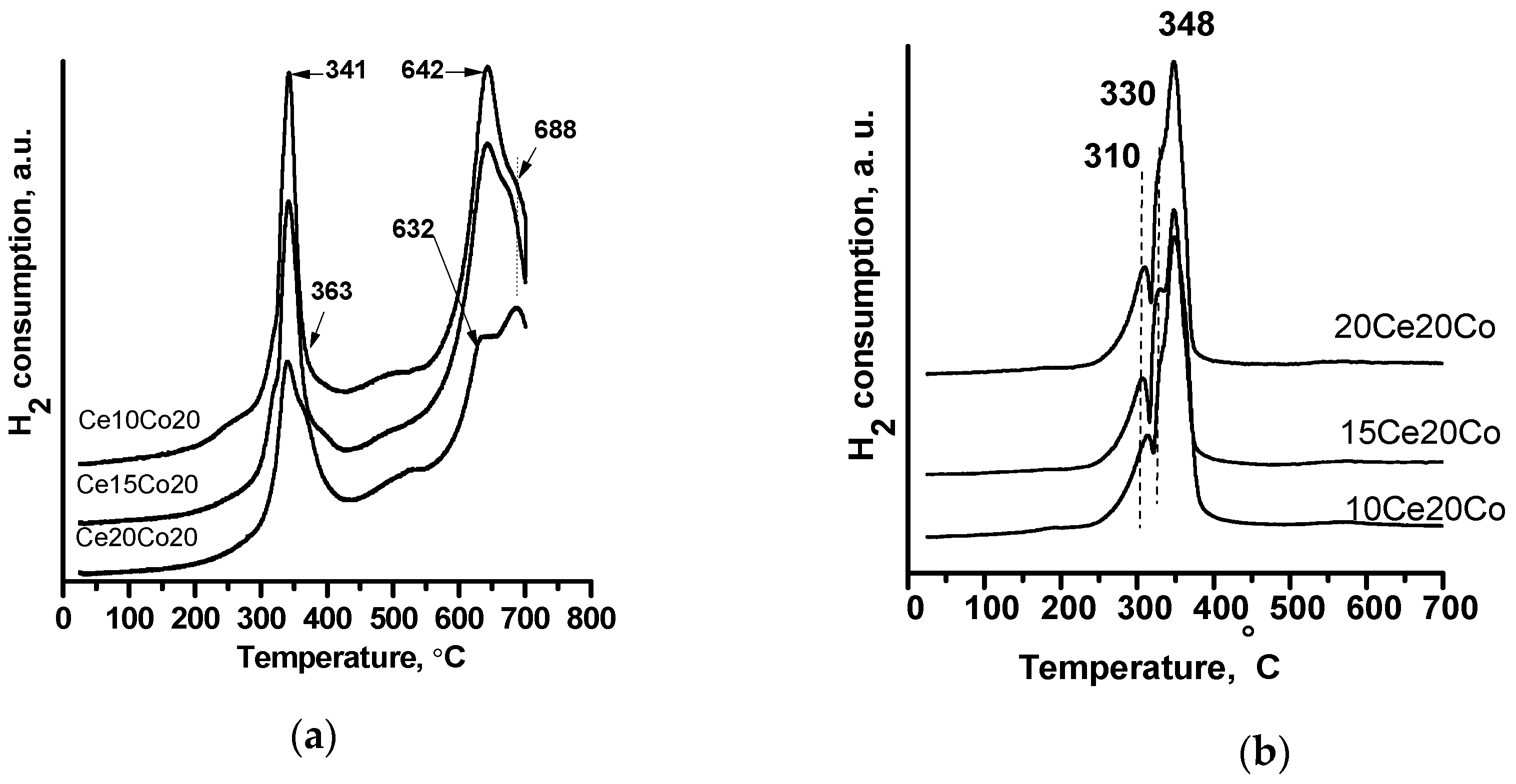
TPR experiments were conducted to investigate the redox properties of the Co–Ce catalysts (Figure 5).
The TPR profile of a material is sensitive to the dispersion of reducible phases, their mutual interactions, and their interaction with the support. It provides a unique “fingerprint” that can be used to interpret catalytic activity in redox processes involving reducible oxides. For this reason, both series of catalysts were studied using TPR. The sample series prepared from consecutive deposition of nitrates was not examined in detail with other methods due to its negligible catalytic activity.
The mono-component cobalt-containing sample supported on SiO2 by impregnation with cobalt nitrate shows two peaks at 323 °C and 359 °C [30], corresponding to the stepwise reduction in Co3O4 to CoO and subsequently to metallic Co. In our previous investigation, upon impregnation of cerium onto silica followed by calcination, two reduction peaks are observed at 547 °C and 657 °C [30]. The lower-temperature peak is assigned to the reduction in surface oxygen situated in a tetrahedral coordination site bound to one Ce4+ species, whereas the higher-temperature peak corresponds to the reduction in finely dispersed CeO2 [30]. Reduction behavior strongly depends on the sequence of Co and Ce deposition. When silica is first modified with Ce and then impregnated with Co, reduction peaks appear at 300–450 °C, followed by hydrogen uptake at 500–700 °C. The peak at 341 °C and the shoulder at 363 °C fall within the reduction range reported for bulk Co3O4 powder or large supported Co3O4 particles [36]. Reduction above 600 °C can be attributed to the presence of hard-to-reduce species. Carrero et al. [37] reported that peaks above 500 °C arise from cobalt oxide species in close contact with the silica support, while Huang et al. [38] showed that both Co2+ strongly interacting with CeO2 and bulk oxygen in CeO2 can be reduced around 600 °C. High-temperature TPR peaks in cobalt-modified mesoporous materials have also been ascribed to the reduction in silicates formed via interaction of highly dispersed CoO with the support [39]. Therefore, in our system, hydrogen consumption above 600 °C is likely due both to the reduction in Co2+ strongly interacting with CeO2 and to cobalt oxides interacting with the silica. These high-temperature peaks are also possibly influenced by surface silicate species, consistent with our previous studies on SBA-15 modified with Co and Ce [40]. In the temperature range of 600–650 °C, the reduction in Ce4+ to Ce3+ in the CeO2 crystals may also occur [41].
When both components are co-deposited from a common solution, the reduction in the cobalt phase occurs at significantly lower temperatures, with TPR maxima observed at 310 °C, 330 °C, and a shoulder around 360 °C. These peaks correspond to the sequential reduction in Co3O4 to CoO, CoO to Co, and the reduction in CoO in close contact and strongly interacting with CeO2 [30]. The shift of the reduction maxima to the lower temperatures could be explained with the particle size effect: the smaller the particles, the lower the reduction in temperature registered [40]. The smaller particle size is confirmed by the X-ray diffraction data, which show a reduction in particle size for samples modified with cerium via co-impregnation. This is further supported by TEM analysis (see discussion Section 4 below), which reveals the formation of nanosized oxides.
The hydrogen consumption values calculated from the TPR analysis were 0.0831, 0.084, and 0.0835 mmol for the 20Co20Ce, 20Co10Ce, and 20Co15Ce samples, respectively. These values correspond to a cobalt content of approximately 18.5% within the catalyst, which is equivalent to a Co3O4 loading of about 25.2%. All catalysts display H2 consumption near to the theoretical H2 consumption. This fact indicates that all cobalt spinel species are reduced to Co0. A significantly different behavior is observed for the sequentially impregnated samples. Despite having comparable cobalt loadings in the final catalysts, the calculated hydrogen consumption values were significantly lower: 0.0014, 0.029 and 0.028 mmol, respectively, for 20Ce+20Co, 10Ce+20Co, and 15Ce+20Co samples. This suggests the formation of irreducible phases. The TPR experiments were conducted up to 700 °C; however, Figure 4a suggests that the reduction process continues beyond this temperature. It is highly probable that surface cobalt silicates were formed, which typically undergo reduction at elevated temperatures. We have previously observed similar results when supporting cobalt from a cobalt nitrate precursor onto mesoporous silica. This behavior can be specifically attributed to the chemical interaction between the nitrate precursor and the surface silanol groups of the silica, which facilitates the formation of thermally stable amorphous cobalt silicates [28].
Because the catalyst 15Ce20Co exhibits the highest activity among all the investigated samples, it was subjected to further and more in-depth investigation using various methods. The changes occurring after the reaction were also examined, along with its behavior in the presence of CO2 and its stability during time on stream.
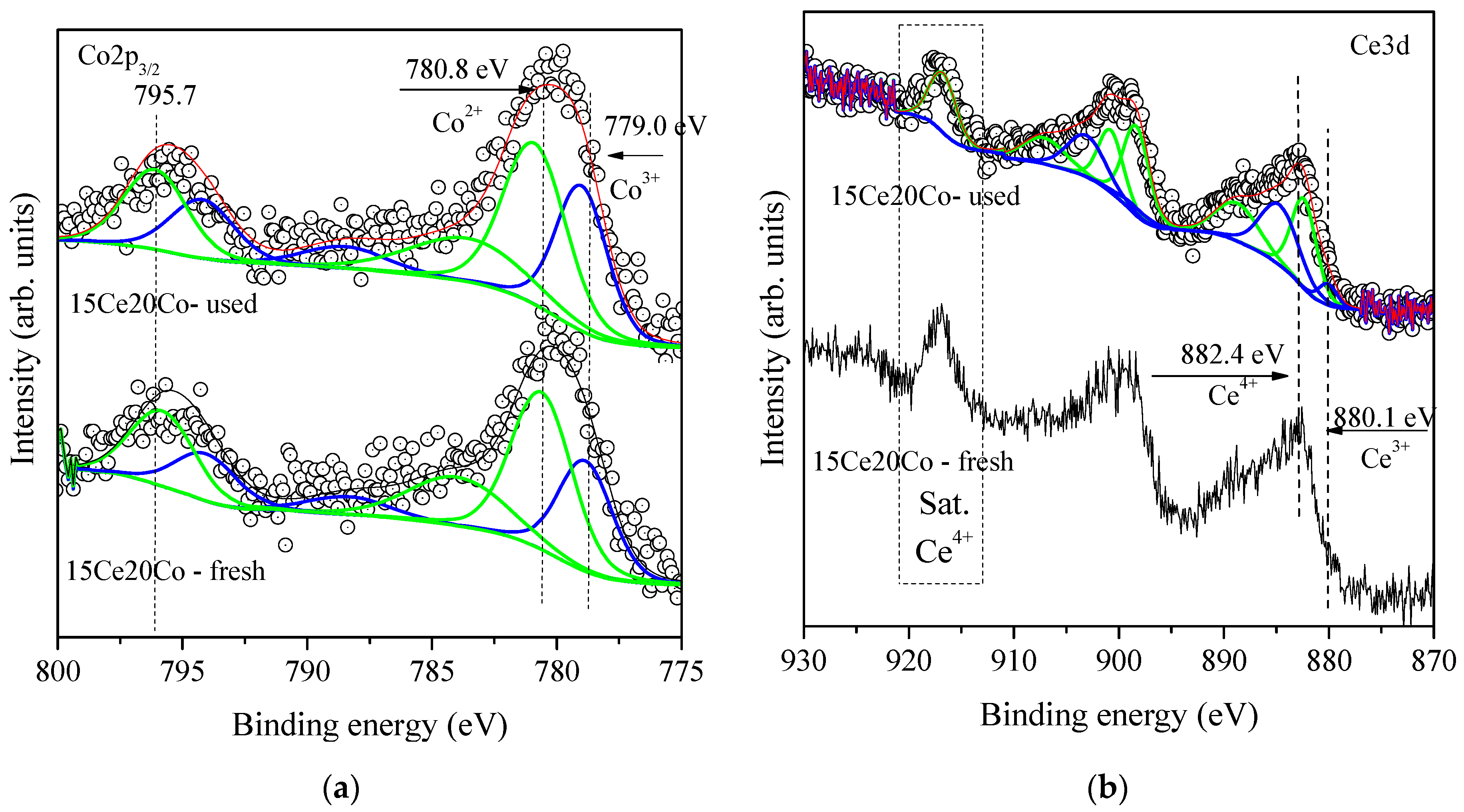
The oxidation states of cobalt on the catalyst surfaces were examined by X-ray photoelectron spectroscopy (XPS). Figure 6 shows representative curve fitting of the Co 2p3/2 spectra for 15Ce20Co recorded prior and after the catalytic test. Peaks at binding energies of 779.0 eV and 780.8 eV are assigned to Co3+ and Co2+ species, respectively. The XPS spectrum of the CeCo sample was fitted assuming a Co2+/Co3+ ratio of 1:2. The Co 2p3/2 peak at 779.0 eV, together with the very low intensity of 3d→4s shake-up satellite at 787.9 eV, is characteristic of Co3O4 [30]. The appearance of a peak at 780.6 eV, along with a satellite at approximately 784.7 eV in the spectra of the bi-component samples, indicates the presence of Co2+ species. The satellite at 3.6–6.5 eV above the main 2p3/2 line [40] is an indication of the occurrence of Co2+ on the surface.
The variation in the oxidation state of cerium ions on the surface of the Co–Ce samples before and after catalytic test is reflected in their Ce3d X-ray photoelectron spectra. The energy positions of the Ce3d peaks, along with the presence of a peak at approximately 916.8 eV binding energy, correspond to Ce4+ in CeO2 [42]. As shown in Figure 6 (right-hand side), ten sub-peaks were employed in the curve-fitting procedure of the Ce3d spectra for the 15Ce20Co sample. Four peaks at approximately 880.1, 884.9, 899, and 903 eV correspond to Ce3+, while the remaining six peaks at roughly 882.84, 889.0, 900.0 (double peak), 907.0, and 916.8 eV represent the Ce4+ oxidation state [40]. The surface atomic concentrations of Co2+, Co+3, Ce+3 and Ce+4 are summarized in Table 2. The fresh sample exhibits only the Ce4+ oxidation state, and both oxidation states Ce3+/Ce4+ exist on the surface of the used sample, indicating that the partial reduction in Ce4+ occurs during reaction.
After the catalytic test, the concentration of Co3+ slightly increases and this of Co2+ decreases (Table 2). Taking into account that catalytic active species is Co3+ this indicates the maintenance of stability of the catalytic active phase to reduction and as a consequence stability during time on stream, as evidenced by the fact that the catalyst shows no significant deactivation over 100 h of operation in a dry feed (Figure 3b). Such results align with the mechanism proposed by Ismail et al. [43], suggesting that Co-Ce phase interactions promote the redox equilibrium: Co2+ + Ce4+ ↔ Co3+ + Ce3+.
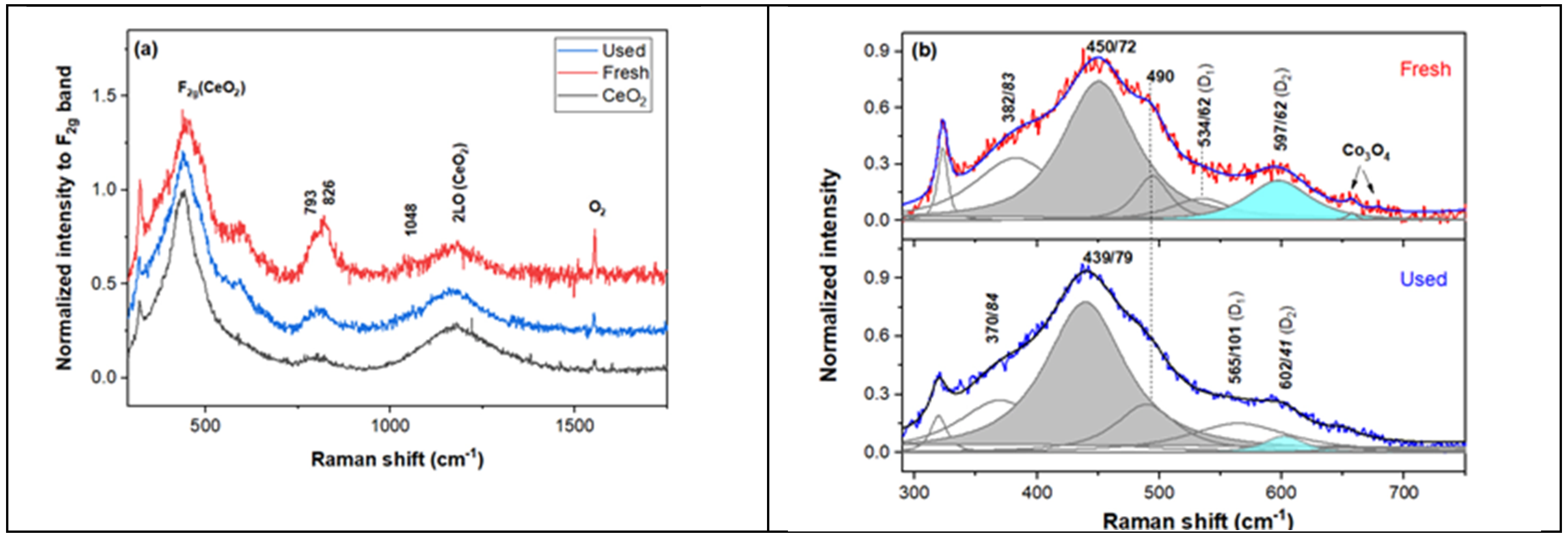
The UV-Raman spectroscopy is a sensitive technique for surface investigation of the catalysts [44,45]. Figure 6 presents UV Raman spectra of the fresh and used 15Ce20Co samples.
The spectral findings located at 450, 597, 1183, and 1592 cm−1 due to F2g, D1, and 2LO, of Ce4+O8 in CeO2 [45] in Figure 6 show that CeO2 covers the SiO2 substrate in the fresh 20Co15Ce/SiO2 spectrum. The position of the 2LO band is highly dependent on the sample composition. Due to resonant Raman spectral features of ceria, silica, and cobalt oxide, contributions are rather obscured regardless of their loadings. Although SiO2 can give wide bands at ~450 cm−1 (5-membered SiO4 rings) and 590 cm−1 (defect band D2 attributable to 3-SiO4 rings [46]), the shape of the fresh 15Ce20Co spectrum, especially the enhanced defect band at 597 cm−1 (D2), belongs to ceria with dopant-induced octahedral (Oh) distorted sites with and/or without oxygen vacancies [47,48]. The main differences within the 290–750 cm−1 range of the fresh and used samples’ spectra in Figure 6b consist of the shifting of the defect band D1 and the intensity modification for the D1 and D2 bands, respectively. The D1 position at 534 cm−1 for the fresh sample originates from the asymmetric Ce-O stretch of the surface peroxide (O22−/Ce4+O7VO∙∙), while Ce3+ is involved for the sample after reaction (565 cm−1). The splitting of the more intense band at 826 cm−1 and the appearance of a new shoulder at 1048 cm−1 further distinguish the spectrum of the sample before reaction. Stretching of the peroxo species is located over an 800–900 cm−1 range [45,49]. The closer to 800 cm−1 is the υ(O=O), i.e., 826 cm−1 in this case, the more stable absorbed peroxo species are. This behavior corresponds to the higher temperature peak of CoO modified by CeO2 in the TPR curve in Figure 4b.
The wider 439 cm−1 band (FWHM of 79 cm−1), along with the 809 cm−1 band and the more intense 1170 cm−1 band, could originate from SiO2 in the used 15Ce20Co spectrum. A1g modes of the Co3O4 [43,50] are depicted in the fresh 15Ce20Co spectrum and almost vanish in the after-reaction spectrum. The amount of oxygen vacancies on the Co3O4 surface rules the full width at the half maximum (FWHM) of the A1g modes. Moreover, the presence of the oxygen vacancies is confirmed by a more intense band within 590–830 nm (Figure 7) for both used and fresh 15Ce20Co samples.
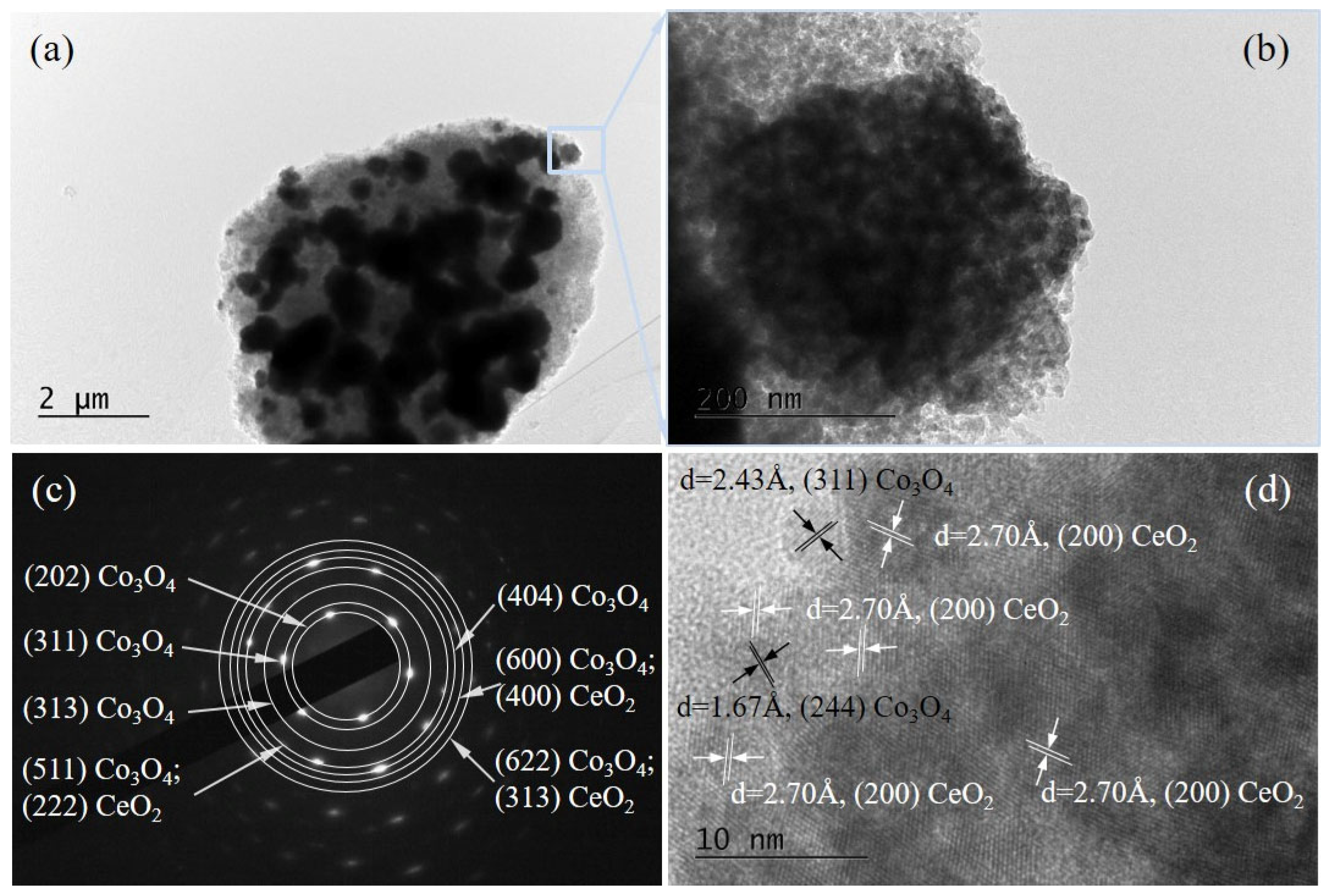
The analysis of the fresh most active catalyst samples morphology was performed by TEM and presented in Figure 8a,b at low magnifications and in high-resolution mode in Figure 8d. The homogeneous distribution of the active phases of CeO2 and Co3O4 on the support of SiO2 is visualized due to the different electronic contrast of the support material (with less contrast) and metal oxides (with higher contrast). As can be seen from the HRTEM image (Figure 8d), the higher contrast nanoparticles illustrated at low magnification of 10,000× are actually clusters composed of cobalt oxides and CeO2. Both oxide phases are homogeneously distributed on the support and are in close contact with each other. The phase composition was identified also by means of the Selected Area Electron Diffraction (SAED) mode of the microscope as consisted of CeO2 cerianite, cubic, a = 5.41100 A, (COD #96-900-9009) and Co3O4, cubic, a = 8.16910 A, (COD #96-900-5901).
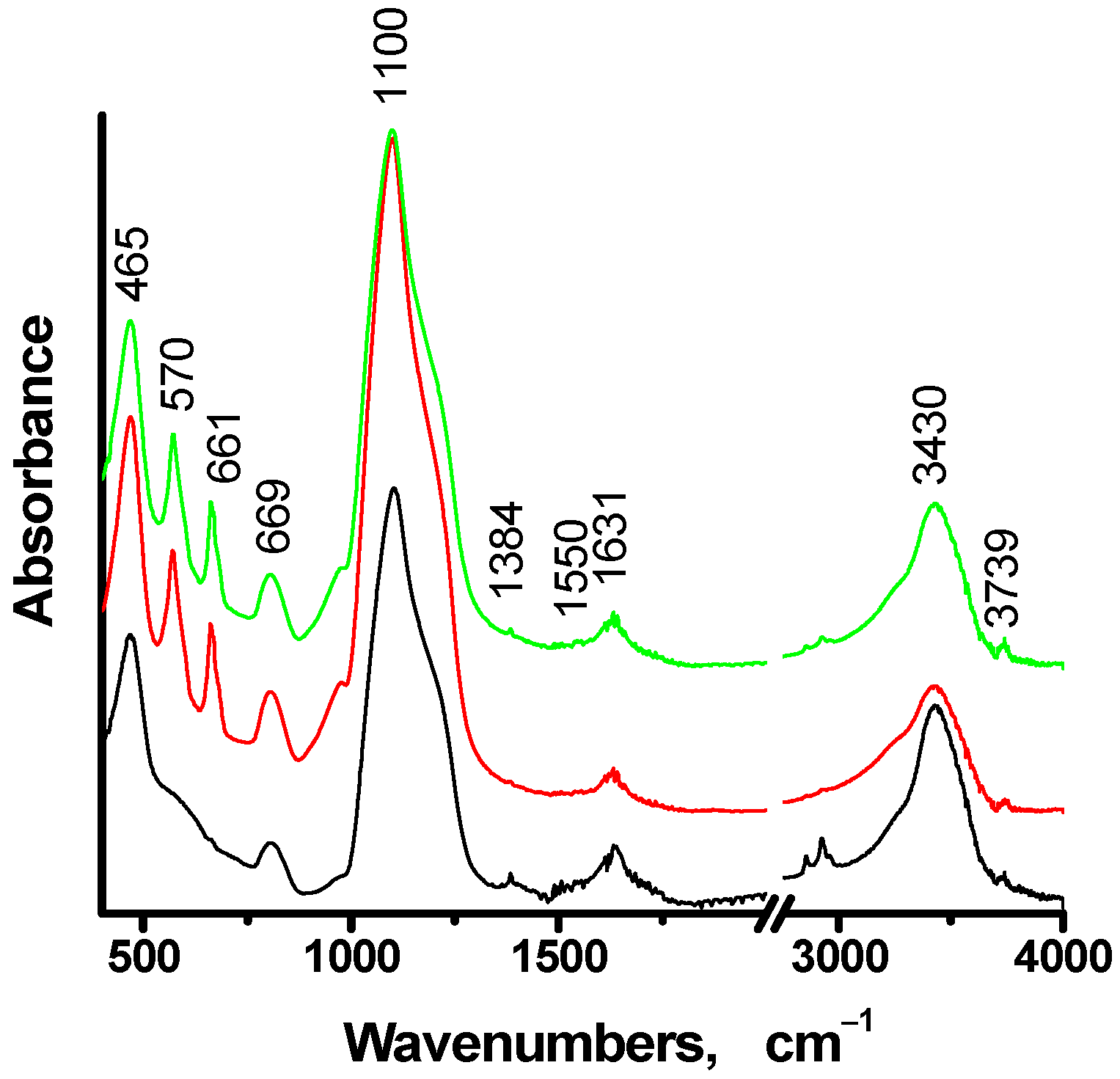
In order to evaluate the extent of catalyst deactivation as result of surface carbonate formation during the reaction and to assess their stability in the presence of CO2 in the feed mixture, FTIR spectra of the samples were recorded before the reaction, after the reaction, and after the stability test in the presence of CO. The results are presented in Figure 9.
SiO2 is responsible for the strong bands seen at 1100, 811, and 465 cm−1. The band at 1100 cm−1 corresponds to the asymmetric stretching vibration of the Si-O-Si link in the SiO4 tetrahedron. The band at 800 cm−1 represents the vibration of the Si-O-Si symmetric stretch. The band at 465 cm−1 corresponds to the bending modes of Si-O-Si bonds [51]. Two bands, one in the area 550–600 cm−1 (v1) and another in the range 650–700 cm−12), are ascribed to the stretching vibration of Co3+-O, where Co3+ is in octahedral position, and the second to the stretching vibration of Co2+-O bond, where Co2+ is in tetrahedral position, respectively. In the region between 1300 and 1700 cm−1, the band at approximately 1384 cm−1 is attributed to bicarbonate (HCO3) species, while the bands located at ~1550 cm−1 is associated with surface carbonate species. The very low increase in intensity of these bands after reaction indicates the formation of carbonate-related intermediates during the PROXCO2 process. The bands in the region 3000–4000 cm−1 are characteristic for a hydroxyl group on the surface.

4. Discussion

The results from physicochemical characterization indicate that all prepared two-component Co–Ce catalysts contain the crystalline phases Co3O4 and CeO2. The presence of ceria increases cobalt oxide dispersion and modifies the reducibility of Co3O4. For the sample prepared from a mixed aqueous solution of Co(NO3)2·6H2O and Ce(NO3)3·6H2O, a homogeneous distribution of Co and Ce oxides on the support was observed. HRTEM reveals good contact between Co3O4 and CeO2 on the surface.
As was mentioned in the introduction, studies on cerium-modified cobalt catalysts reported in the literature concerning selective oxidation of CO in the hydrogen reach mixtites, have largely focused on bulk materials, with relatively little attention given to supported active phases. While this overview is not comprehensive, the relevant data compiled in Table 3 serve to contextualize the experimental findings presented in this work.
According to the literature, the addition of CeO2 to Co3O4 promotes catalytic activity by facilitating oxygen activation and vacancy formation. According to Lukashuk et al. [52] and Guo at al. [21], the enhanced catalytic activity after introducing CeO2 into Co3O4 appears to generate interfacial Co–O–Co–O–Ce–O–Ce active sites that facilitate oxygen activation and/or the formation of oxygen vacancies. In addition, the incorporation of cerium atoms into the cobalt oxide surface—leading to local Co–O–Co–O–Ce–O–Co ensembles—and the associated distortion of the cobalt oxide lattice, which creates additional vacancies, are also likely to contribute to the observed improvement in catalytic performance. In summary, the literature reports [20,21,22,23,51] indicate that the addition of CeO2 promotes (1) the formation of oxygen vacancies at the CeO2–Co3O4 interface; (2) the generation of oxygen vacancies on the Co3O4 surface due to lattice distortion; and (3) CeO2 itself serving as a source of oxygen vacancies. In our case, all conditions for the generation of active oxygen species are provided. TEM images reveal very close contact between the two oxides. The loss of crystallinity observed from the XRD data contributes to an increase in vacancies, which act as adsorption sites for oxygen. UV-Raman data further indicate an enhancement of oxygen vacancies and peroxo speciation, especially on the surface of the fresh sample.
Both experimental and DFT studies have demonstrated that Co3+ acts as an active site for CO oxidation [18]. In Co3O4, Co3+ ions occupy octahedral positions, providing lattice oxygen for CO oxidation and resulting in the formation of Co2+. This lower oxidation state cobalt resides in tetrahedral positions in Co3O4 and can be reoxidized in the presence of oxygen. However, deactivation of Co3O4 may occur if Co2+ is unable to undergo reoxidation. Co2+ species are permanently reoxidized by oxygen provided by CeO2 other phases and/or the gas phase [23]. XPS data indicate that the reaction Co3+ + Ce3+ ↔ Co2+ + Ce4+ occurs even under reducing conditions, resulting in the stable presence of Co3+ on the surface as suggested in [15].
As was shown by all dates presented above, the catalyst, prepared by impregnating silica with a mixed cobalt–cerium nitrate solution, shows promising PROX performance, meeting the benchmark 50/50 target—CO below 50 ppm and O2 selectivity to CO2 above 50%—while also offering a wide operating temperature range (~80–200 °C) and high thermal stability. Our catalyst meets all the requirements, except that the outlet CO concentration is 70 ppm, indicating that it would be suitable for fuel cells with CO-tolerant anodes [5].
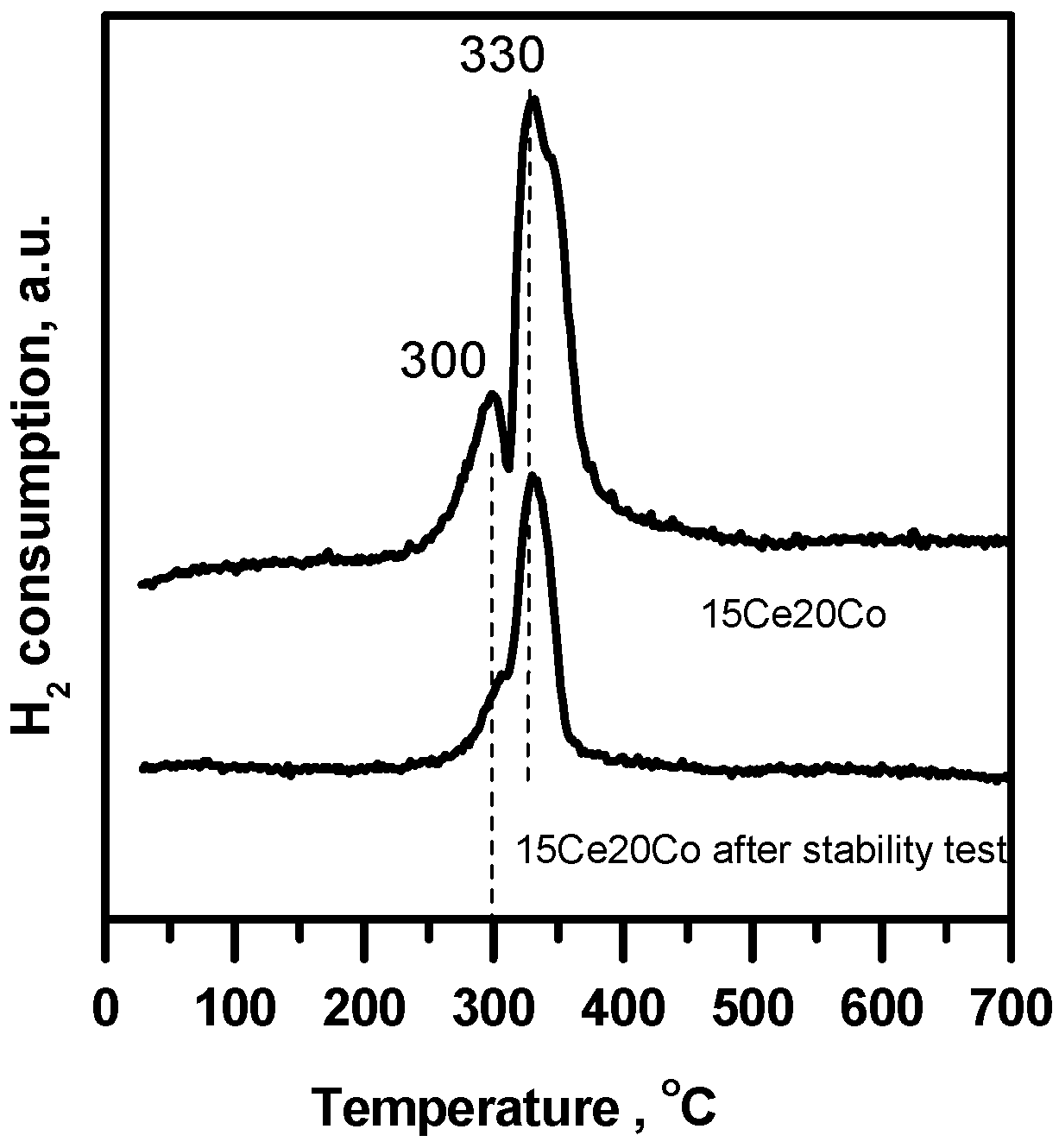
As shown above, the average particle size for a most active 15Ce20Co sample changed very little after the stability test. The reduction behavior of the same sample was also investigated following the stability test. The TPR profile of a material is sensitive to the dispersion of the reducible phases, the interaction between them and their interaction with the support. The TPR profile is unique “fingerprint” and can be used for quality control to ensure consistency between different batches of a catalyst [53].
Only minor changes were observed in the TPR profile, manifested as a slight shift of the reduction peaks by a few degrees toward higher temperatures (Figure 10). This observation further supports the minimal sintering of the active phase. The shoulder at 380 °C, corresponding to the reduction in cobalt oxide in close contact with CeO2, is absent, further indicating particle growth of the cobalt oxide and a reduced interfacial contact with CeO2.

5. Conclusions

The catalysts based on combinations of cobalt and cerium oxides deposited conventional silica (SiO2) support were synthesized using various methods. It was established that the impregnation sequence of the silica with the precursor aqueous solutions is critical: while sequential deposition (Ce followed by Co) leads to the formation of difficult-to-reduce and low-activity phases, simultaneous deposition of starting nitrates on SiO2 yields significantly different results. Catalysts synthesized by this method are characterized by the formation of finely dispersed oxide phases that are uniformly distributed across the surface and in intimate contact. This configuration, on one hand, prevents the sintering of cobalt oxide and, on the other, enables oxygen activation at the interface. Furthermore, the formation of inactive surface phases is avoided.
The catalyst prepared by the simultaneous deposition method remains stable after 100 h of working in dry gas (CO + O2 + CO2 + H2 + N2) with CO conversion close to 100% (99.5%) and selectivity to CO2 45%.

Author Contributions

Conceptualization, S.Z.T.; methodology, S.Z.T.; TEM, HRTEM measurements and analysis, D.B.K.; XPS analysis and discussion H.K.; BET analysis, I.H.; TPR analysis, K.T. and Z.G.; catalytic test, B.K.G., Z.G., D.F. and V.I.; UV-Raman analysis and discussion, E.M.A.; writing—original draft preparation, S.Z.T.; writing—review and editing, S.Z.T.; visualization, Z.G.; supervision, S.Z.T.; project administration, S.Z.T.; funding acquisition, S.Z.T. All authors have read and agreed to the published version of the manuscript.

Funding

This research was funded by Investment C2.I2: ‘Enhancing the Innovation Capacity of the Bulgarian Academy of Sciences in the Field of Green and Digital Technologies,’ as part of the National Recovery and Sustainability Plan”, Project BG-RRP-2.017-0007-C02.

Data Availability Statement

The original contributions presented in this study are included in the article. Further inquiries can be directed to the corresponding author.

Acknowledgments

Research equipment of Distributed Research Infrastructure INFRAMAT, part of Bulgarian National Roadmap for Research Infrastructures, supported by Bulgarian Ministry of Education and Science was used in this investigation. The micro reactor system Hiden CATLAB and gas-analyzers GMS800 Series, SICK AG under the project No. BG16RFPR002-1.014-0009 “Development and Sustainability of the Competence Centre HITMOBIL” was used for the experimental work.

Conflicts of Interest

The authors declare no conflicts of interest.

References

  1. Brahim, T.; Jemni, A. Green hydrogen production: A review of technologies, challenges, and hybrid system optimization. Renew. Sustain. Energy Rev. 2026, 225, 116194. [Google Scholar] [CrossRef]
  2. Saidi, S.; Brahim, T.; Rejeb, O.; Jemni, A. Electrochemical and thermodynamic modeling of PEM electrolyzer performance: A comparative study with and without diffusion overpotential. Int. J. Hydrogen Energy 2025, 128, 697–712. [Google Scholar] [CrossRef]
  3. Molochas, C.; Tsiakaras, P. Carbon Monoxide Tolerant Pt-Based Electrocatalysts for H2-PEMFC Applications: Current Progress and Challenges. Catalysts 2021, 11, 1127. [Google Scholar] [CrossRef]
  4. Liu, H.; Li, D.; Guo, J.; Li, Y.; Liu, A.; Bai, Y.; He, D. Recent advances on catalysts for preferential oxidation of CO. Nano Res. 2023, 16, 4399–4410. [Google Scholar] [CrossRef]
  5. Xi, Y.; Heyden, A. Preferential Oxidation of CO in Hydrogen at Nonmetal Active Sites with High Activity and Selectivity. ACS Catal. 2020, 10, 5362−5370. [Google Scholar] [CrossRef]
  6. Jia, A.P.; Deng, Y.; Hu, G.S.; Luo, M.F.; Lu, J.Q. Kinetic and activity study of CO oxidation over CuO–MnOx–CeO2 catalysts. React. Kinet. Mech. Catal. 2016, 117, 503–520. [Google Scholar] [CrossRef]
  7. Park, E.D.; Lee, D.; Lee, H.C. Recent progress in selective CO removal in a H2-rich stream. Catal. Today 2009, 139, 280–290. [Google Scholar] [CrossRef]
  8. Kang, M.; Song, M.W.; Lee, C.H. Catalytic carbon monoxide oxidation over CoOx/CeO2 composite catalysts. Appl. Catal. A Gen. 2003, 251, 143–156. [Google Scholar] [CrossRef]
  9. Mocuta, C.; Barbier, A.; Renaud, G. CoO(111) surface study by surface X-ray diffraction. Appl. Surf. Sci. 2000, 162, 56–61. [Google Scholar] [CrossRef]
  10. Yu, Y.; Takei, T.; Ohashi, H.; He, H.; Zhang, X.; Haruta, M. Pretreatments of Co3O4 at moderate temperature for CO oxidation at −80 °C. J. Catal. 2009, 267, 121–128. [Google Scholar] [CrossRef]
  11. Guo, Q.; Wu, M.; Liu, Y.; Bai, X. Mesoporous CeO2-Supported Co3O4 Catalysts for CO Preferential Oxidation in H2-Rich Gases. Chin. J. Catal. 2007, 28, 953–957. [Google Scholar] [CrossRef]
  12. Woods, M.P.; Gawade, P.; Tan, B.; Ozkan, U.S. Preferential oxidation of carbon monoxide on Co/CeO2 nanoparticles. Appl. Catal. B Environ. 2010, 97, 28–35. [Google Scholar] [CrossRef]
  13. Zhao, Z.; Yung, M.M.; Ozkan, U.S. Effect of support on the preferential oxidation of CO over cobalt catalysts. Catal. Commun. 2008, 9, 1465–1471. [Google Scholar] [CrossRef]
  14. Luo, J.Y.; Meng, M.; Li, X.; Li, X.G.; Zha, Y.Q.; Hu, T.D.; Xie, Y.N.; Zhang, J. Mesoporous Co3O4–CeO2 and Pd/Co3O4–CeO2 catalysts: Synthesis, characterization and mechanistic study of their catalytic properties for low-temperature CO oxidation. J. Catal. 2008, 254, 310–324. [Google Scholar] [CrossRef]
  15. Wang, Y.; Yang, C.; Lv, S.; Gao, W.; Li, S.; Li, J.; Song, R.; Zhong, H.; Zhang, J.; Pan, L. Co3O4 supported on CeO2 with specific morphologies for high efficient CO-PROX reaction. Chem. Phys. 2024, 584, 112335. [Google Scholar] [CrossRef]
  16. Gómez, L.E.; Tiscornia, I.S.; Boix, A.V.; Miró, E.E. CO preferential oxidation on cordierite monoliths coated with Co/CeO2 catalysts. Int. J. Hydrogen Energy 2012, 37, 14812–14819. [Google Scholar] [CrossRef]
  17. Bao, T.; Zhao, Z.; Dai, Y.; Lin, X.; Jin, R.; Wang, G.; Muhammad, T. Supported Co3O4–CeO2 catalysts on modified activated carbon for CO preferential oxidation in H2-rich gases. Appl. Catal. B Environ. 2012, 119–120, 62–73. [Google Scholar] [CrossRef]
  18. Gawade, P.; Bayram, B.; Alexander, A.M.C.; Ozkan, U.S. Preferential oxidation of CO (PROX) over CoOx/CeO2 in hydrogen-rich streams: Effect of cobalt loading. Appl. Catal. B Environ. 2012, 128, 21–30. [Google Scholar] [CrossRef]
  19. Yan, C.F.; Chen, H.; Hu, R.R.; Huang, S.; Luo, W.; Guo, C.; Li, M.; Li, W. Synthesis of mesoporous Co–Ce oxides catalysts by glycine-nitrate combustion approach for CO preferential oxidation reaction in excess H2. Int. J. Hydrogen Energy 2014, 39, 18695–18701. [Google Scholar] [CrossRef]
  20. Gu, C.; Li, Y.; Mo, Y.; Lan, J.; Jiang, Y.; Feng, S. Rod-like and mushroom-like Co3O4–CeO2 catalysts derived from Ce-1,3,5-benzenetricarboxylic acid for CO preferential oxidation: Effects of composition and morphology. React. Kinet. Mech. Catal. 2020, 129, 135–151. [Google Scholar] [CrossRef]
  21. Guo, Q.; Liu, Y. Preferential oxidation of CO in H2 over Co3O4–CeO2 catalysts. React. Kinet. Catal. Lett. 2007, 92, 19–25. [Google Scholar] [CrossRef]
  22. Arango-Diaz, A.; Cecilia, J.A.; Marrero-Jerez, J.; Nuñez, P.; Jiménez-Jiménez, J.; Rodríguez-Castellón, E. Freeze-dried Co3O4–CeO2 catalysts for the preferential oxidation of CO with the presence of CO2 and H2O in the feed. Ceram. Int. 2016, 42, 7462–7474. [Google Scholar] [CrossRef]
  23. Gómez, L.E.; Boix, A.V. Cobalt-based catalysts for CO preferential oxidation. In Cobalt Compounds and Applications; Yıldız, Y., Manzak, A., Eds.; IntechOpen: London, UK, 2019; pp. 1–16. [Google Scholar]
  24. Zhang, L.; Zhang, L.; Xu, G.; Zhang, C.; Li, X.; Sun, Z.; Jia, D. Low-temperature CO oxidation over CeO2 and CeO2 @ Co3O4 core–shell microspheres. New J. Chem. 2017, 41, 13418–13424. [Google Scholar] [CrossRef]
  25. Ivanin, I.A.; Krotova, I.N.; Udalova, O.V.; Zanaveskin, K.L.; Shilina, M.I. Synergistic Catalytic Effect of Cobalt and Cerium in the Preferential Oxidation of Carbon Monoxide on Modified Co/Ce/ZSM-5 Zeolites. Kinet. Catal. 2021, 62, 799–811. [Google Scholar] [CrossRef]
  26. Rostovshchikova, T.N.; Eurov, D.A.; Kurdyukov, D.A.; Tomkovich, M.V.; Yagovkina, M.A.; Ivanin, I.A.; Maslakov, K.I.; Udalova, O.V.; Shilina, M.I. Effect of the Pore Structure of Nanosilicas Decorated with Cobalt and Cerium Oxides on Catalytic Activity in the Selective Oxidation of Carbon Monoxide. Russ. J. Phys. Chem. A 2023, 97, 1978–1989. [Google Scholar] [CrossRef]
  27. Nyathi, T.M.; Fadlalla, M.I.; Fischer, N.; York, A.P.; Olivier, E.J.; Gibson, E.K.; Wells, P.P.; Claeys, M. Support and gas environment effects on the preferential oxidation of carbon monoxide over Co3O4 catalysts studied in situ. Appl. Catal. B Environ. 2021, 297, 120450. [Google Scholar] [CrossRef]
  28. Grahovski, B.; Blin, J.-L.; Lebeau, B.; Naydenov, A.; Velinova, R.; Karashanova, D.; Richaudeau, L.; Kolev, H.; Tenchev, K.; Todorova, S. Co-modified SBA-15 catalysts for waste gases purification processes—Effect of precursor. Catal. Today 2026, 461, 115503. [Google Scholar] [CrossRef]
  29. Davison, R.; Van Rythoven, A. Critical Mineral: Cerium; Montana Bureau of Mines and Geology: Butte, MT, USA, 2025. [Google Scholar] [CrossRef]
  30. Todorova, S.; Kadinov, G.; Tenchev, K.; Caballero, A.; Holgado, J.P.; Pereñíguez, R. Co3O4 + CeO/SiO2 Catalysts for n-Hexane and CO Oxidation. Catal. Lett. 2009, 129, 149–155. [Google Scholar] [CrossRef]
  31. Todorova, S.; Kolev, H.G.; Shopska, M.G.; Kadinov, G.B.; Holgado, J.P.; Caballero, J.P. A Silver-based catalysts for preferential CO oxidation in hydrogen-rich gases (PROX). Bulg. Chem. Comm. 2018, 50, 17–23. [Google Scholar]
  32. Todorova, S.; Blin, J.L.; Naydenov, A.; Lebeau, B.; Kolev, H.; Gaudin, P.; Dotzeva, A.; Veli-nova, R.; Filkova, D.; Ivanova, I.; et al. Co3O4-MnOx oxides supported on SBA-15 for CO and VOCs oxidation. Catal. Today 2020, 357, 602–612. [Google Scholar] [CrossRef]
  33. Di Benedetto, A.; Landi, G.; Lisi, L.; Russo, G. Role of CO2 on CO Preferential Oxidation over CuO/CeO2 Catalyst. Appl. Catal. B Environ. 2013, 142–143, 169–177. [Google Scholar] [CrossRef]
  34. Zou, G.; Xu, Y.; Wang, S.; Chena, M.; Shangguan, W. The synergistic effect in Co–Ce oxides for catalytic oxidation of diesel soot. Catal. Sci. Technol. 2015, 5, 1084–1092. [Google Scholar] [CrossRef]
  35. Gawali, S.R.; Gandhi, A.C.; Gaikwad, S.S.; Pant, J.; Chan, T.-S.; Cheng, C.-L.; Ma, Y.-R.; Wu, S.Y. Role of cobalt cations in short range antiferromagnetic Co3O4 nanoparticles: A thermal treatment approach to affecting phonon and magnetic properties. Sci. Rep. 2018, 8, 249. [Google Scholar] [CrossRef]
  36. Shanke, D.; Vada, S.; Blekkan, E.A.; Hilmen, E.A.; Hoff, A.; Holmen, A. Study of Pt-Promoted Cobalt CO Hydrogenation Catalysts. J. Catal. 1995, 156, 85–95. [Google Scholar] [CrossRef]
  37. Carrero, A.; Vizcaíno, A.J.; Calles, J.A.; García-Moreno, L. Hydrogen production through glycerol steam reforming using Co catalysts supported on SBA-15 doped with Zr, Ce and La. J. Ener. Chem. 2017, 26, 42–48. [Google Scholar] [CrossRef]
  38. Huang, F.; Chen, C.; Wang, F.; Wang, B.; Zhang, L.; Lu, S.; Li, K. Effect of calcination temperature on the catalytic oxidation of formaldehyde over Co3O4—CeO2 catalysts. Catal. Surv. Asia 2017, 21, 143–149. [Google Scholar] [CrossRef]
  39. Vizcaino, A.J.; Carrero, A.; Calles, J.A. Comparison of ethanol steam reforming using Co and Ni catalysts supported on SBA-15 modified by Ca and Mg. Fuel Process. Technol. 2016, 146, 99–109. [Google Scholar] [CrossRef]
  40. Blin, J.-L.; Michelin, L.; Lebeau, B.; Naydenov, A.; Velinova, R.; Kolev, H.; Gaudin, P.; Vidal, L.; Dotzeva, A.; Tenchev, K.; et al. Co–Ce Oxides Supported on SBA-15 for VOCs Oxidation. Catalysts 2021, 11, 366. [Google Scholar] [CrossRef]
  41. Fang, N.; Ding, Y.; Liu, C.; Chen, Z. Role of SiO2 in Synthesis of SiO2-Supported CeO2 Composites. Ceram. Int. 2018, 44, 12363–12369. [Google Scholar] [CrossRef]
  42. Larachi, F.; Pierre, J.; Adnot, A.; Bernis, A. 3d XPS study of composite CexMn1−xO2−γ wet oxidation catalysts. Appl. Surf. Sci. 2002, 195, 236–250. [Google Scholar] [CrossRef]
  43. Ismail, A.; Li, M.; Zahid, M.; Fan, L.; Zhang, C.; Li, Z.; Zhu, Y. Effect of strong interaction between Co and Ce oxides in CoxCe1-xO2-δ oxides on its catalytic oxidation of toluene. Mol. Catal. 2021, 502, 111356. [Google Scholar] [CrossRef]
  44. Jin, S.; Feng, Z.; Fan, F.; Li, C. UV Raman Spectroscopic Characterization of Catalysts and Catalytic Active Sites. Catal. Lett. 2015, 145, 468–481. [Google Scholar] [CrossRef]
  45. Loridant, S. Raman spectroscopy as a powerful tool to characterize ceria-based catalysts. Catal. Today 2021, 373, 89–111. [Google Scholar] [CrossRef]
  46. Liu, Z.; Li, J.; Buettner, M.; Ranganathan, R.V.; Uddi, M.; Wang, R. Metal−Support Interactions in CeO2- and SiO2 Supported Cobalt Catalysts: Effect of Support Morphology, Reducibility, and Interfacial Configuration. ACS App. Mater. Interfaces 2019, 11, 17035–17049. [Google Scholar] [CrossRef]
  47. Taniguchi, T.; Watanabe, T.; Sugiyama, N.; Subramani, A.K.; Wagata, H.; Matsushita, N.; Yoshimura, M. Identifying defects in ceria-based nanocrystals by UV resonance Raman spectroscopy. J. Phys. Chem. C 2009, 113, 19789–19793. [Google Scholar] [CrossRef]
  48. Ilieva, L.; Petrova, P.; Venezia, A.M.; Anghel, E.M.; State, R.; Avdeev, G.; Tabakova, T. Mechanochemically Prepared Co3O4-CeO2. Catalysts for Complete Benzene Oxidation. Catalysts 2021, 11, 1316. [Google Scholar] [CrossRef]
  49. Ziemba, M.; Ganduglia-Pirovano, M.V.; Hess, C. Elucidating the Oxygen Storage-Release Dynamics in Ceria Nanorods by Combined Multi-Wavelength Raman Spectroscopy and DFT. J. Phys. Chem. Lett. 2020, 11, 8554−8559. [Google Scholar] [CrossRef]
  50. Huang, J.; Sheng, H.; Ross, R.D.; Han, J.; Wang, X.; Song, B.; Jin, S. Modifying redox properties and local bonding of Co3O4 by CeO2 enhances oxygen evolution catalysis in acid. Nat. Commun. 2021, 12, 3036. [Google Scholar] [CrossRef] [PubMed]
  51. Todorova, S.; Yordanova, I.; Naydenov, A.; Kolev, H.; Cherkezova-Zheleva, Z.; Tenchev, K.; Kunev, B. Cobalt-manganese supported oxides as catalysts for complete n-hexane and methane oxidation: Relationship between structure and catalytic activity. Rev. Roum. Chim. 2014, 59, 259–265. [Google Scholar]
  52. Luukashuk, L.; Föttinger, K.; Kolar, E.; Rameshan, C.; Teschner, D.; Hävecker, M.; Knop-Gericke, A.; Yigit, N.; Li, H.; McDermott, E.; et al. Operando XAS and NAP-XPS studies of preferential CO oxidation on Co3O4 and CeO2-Co3O4 catalysts. J. Catal. 2016, 344, 1–15. [Google Scholar] [CrossRef]
  53. Jones, A.; McNicol, B.D. Temperature-Programmed Reduction for Solid Materials Characterization; Marcel Dekker: New York, NY, USA, 1986. [Google Scholar]
Figure 1. (a) CO conversion degree versus temperature on Ce+Co/SiO2; (b) O2 conversion degree versus temperature and (c) Selectivity to CO2.
Processes 14 00711 g001
Figure 2. (a) CO conversion degree versus temperature on CeCo/SiO2; (b) O2 conversion degree versus temperature; and (c) Selectivity to CO2.
Processes 14 00711 g002
Figure 3. (a) Stability during time on stream at 160 °C in 1% CO + 1% O2 + 50% H2 + N2; (b) CO conversion in different GHSV and in the presence of 5 vol.% CO2; (c) stability tests performed at the low gas hourly space velocity (GHSV) = 6000 h−1 and an operating temperature of 160 °C; (d) Selectivity during time on stream GHSV = 6000 h−1 without CO and with CO2.
Processes 14 00711 g003
Figure 4. (a) XRD pattern of all samples before reaction; (b) expanded view of the Co3O4 (311) diffraction peak show by arrow.
Processes 14 00711 g004
Figure 5. TPR spectra after calcination of samples prepared (a) from consecutive aqueous solution of nitrates and (b) mixed aqueous solution of Co(NO3)2·6H2O and Ce(NO3)2·6H2O.
Processes 14 00711 g005
Figure 6. Fitted Co 2p3/2 (a) and Ce3d (b) photoelectron peaks of the Co–Ce samples before and after PROX reaction.
Processes 14 00711 g006
Figure 7. UV-Raman spectra of the 15Ce20Co before (fresh, red line) and after (used, blue line) reaction (a) and fitted UV Raman spectra within 290–750 cm−1 spectral range (b).
Processes 14 00711 g007
Figure 8. Bright Field (BF) TEM images of 15Ce20Co sample (a,b) at magnifications 10,000× and 40,000×, respectively, the corresponding SAED pattern (c) and HRTEM image (d), both with phase identification, according to the Crystallography Open Database (COD) Entry #96-900-9009 for CeO2 and Entry #96-900-5901 for Co3O4.
Processes 14 00711 g008
Figure 9. Infrared spectra of pure SiO2 (black line), after stability test at 160 °C in 1% CO + 1% O2 + 50% H2 + N2 (red line) and after stability test at 160 °C at 160 °C in 1% CO + 1% O2 + 50% H2 + 5% CO2 + N2 (green line).
Processes 14 00711 g009
Figure 10. TPR spectra of fresh sample after calcination and after stability test.
Processes 14 00711 g010
Table 1. Sample characterization data.
SampleMean Particle Size, nm 1Lattice Parameter ‘a’ of Co3O4 (A°)SBET, m2/g2
Co3O4CeO2
BRARBRAR
20Co40 8.06732255
10Ce20Co3035n.d.68.08709210
15Ce20Co15197.86.68.10772212
20Ce20Co1717.6478.08802200
1 Calculated from XRD data. BR—before reaction; AR—after reaction.
Table 2. Surface atomic concentrations (at.%) of Co2+, Co+3, Ce+3 and Ce+4.
Sample/ElementO 1sSi 2sCo 2p3/2
Co3+ Co2+
Ce3dCe3+ and Ce4+
15Ce20Co-BR62.01%37.22%0.53%0.25%Ce4+ 100%
0.18 0.35
15Ce20Co-AR62.46%36.78%0.49%
0.19 0.30
0.27%Ce3+ 0.08
Ce4+ 0.19
Table 3. Catalytic performance comparison of CO PROX over Co-Ce-based catalysts developed in this study and reported in the literature.
CatalystPreparation MethodGas Mixture ConcentrationSpace VelocityMaximum CO ConversionRef.
15Ce20Co/SiO2Co-impregnation1 vol.% CO, 1 vol.% O2, 50 vol.% H2 and 48 vol.% N212,000 h−199.5% at 160 °C This work
CeO2/Co3O4Wet impregnation of Co3O4 with Ce(NO3)36H2O1 vol.% CO, 1 vol.% O2, 50 vol.% H2 and 48 vol.% He20 mg. sample
50 mL/min total flow
T90 at 142 °C[51]
CeO2/Co3O4Hydrothermal method with ultrasonic assistance1% CO, 1% O2, 50% H2, 12.5% CO2, 15% H2O and N220,000 h−199% at 215 °C[20]
CeO2 Co3O4Co-precipitation1 vol.% CO, 1 vol.% O2, 50 vol.% H2 and N240,000 mL h−1 g cat−180 wt.% CeO2 Co3O4 conversion of 100% with 70% selectivity at 125 °C[21]
CoOx/CeO2Wet impregnation of ceria nanoparticles1% CO, 1% O2, 60% H2 and balance helium15,000 cm3 (g cat−1) h−1100% conversion at 175 °C[18,42]
CoOx/CeO2Two-step synthesis process; a freeze-dried precursor route plus a wetness impregnation method.1.25% CO, 1.25% O2, 15% CO2, 50% H222,000 h−1 [22]
CoCe-I
CoCe-P
Wet impregnation method
coprecipitation
1% CO, 1% O2, 50% H2 and He balance 100% conversion at 165 and 175 °C[23]
Co3O4/CeO2
NP
Impregnation of CeO2 nanoparticlesCO:O2:H2:N2 = 1:1:70:28 vol%100 mg cat.
flow rate of 35 mL/min.
99.6% and 79.2% O2 selectivity
at 200 °C
[15]
Disclaimer/Publisher’s Note: The statements, opinions and data contained in all publications are solely those of the individual author(s) and contributor(s) and not of MDPI and/or the editor(s). MDPI and/or the editor(s) disclaim responsibility for any injury to people or property resulting from any ideas, methods, instructions or products referred to in the content.