1. Introduction
Plum (
prunus domestica L.) is one of the most economically important fruit species within the Rosaceae family, comprising more than 340 species worldwide and originating from regions near the Caspian Sea [
1,
2]. Plum cultivars exhibit great diversity in color, from yellow to deep black, and shape (from spherical to oval). These fruits are consumed both fresh and in processed forms. Iran is the eighth-largest global producer of plums, following China, Romania, the USA, Serbia, Argentina, Türkiye, and Spain [
2,
3,
4,
5]. During the drying and processing of black plums, peeling generates a substantial amount of by-product; for every 5 kg of fresh fruit, approximately 1 kg (20%) of peel is produced [
3,
6].
Fruit peels differ significantly in phytochemical composition, affecting their potential functionality in food formulations. Compared with commonly studied by-products such as banana and mango peels, which contain mainly dietary fiber, starch, and carotenoids, black plum peel is distinguished by its high levels of anthocyanins, phenolic compounds, and organic acids [
7,
8,
9,
10,
11,
12,
13]. These compounds not only provide natural pigmentation—primarily due to cyanidin-3-glucoside and other anthocyanin derivatives—but also enhance antioxidant activity and inhibit lipid oxidation in processed foods. In addition, organic acids such as citric and malic acid may contribute to pH modulation and flavor balance, offering functional advantages absent in milder peels like mango or banana [
7,
8,
9,
10,
11,
12,
13]. Thus, the incorporation of black plum peel powder provides both nutritional and technological benefits while supporting sustainable utilization of fruit-processing waste.
Black plums contain a wide range of bioactive compounds, including chlorogenic acid, neochlorogenic acid, caffeic acid, quercetin, rutin, catechin and various anthocyanins, which contribute to their strong antioxidant potential. These compounds are well documented for their ability to neutralize free radicals, delay lipid oxidation, and reduce the risk of chronic diseases [
6].
Because the peel fraction is particularly rich in these compounds, its inclusion in bakery formulations can significantly enhance antioxidant capacity. Similar studies using fruit pomace or peel powders in baked products have reported improvements in antioxidant retention and quality attributes [
7,
8,
9], reinforcing the potential of plum peel as a valuable natural ingredient.
The antioxidant effects of plum peel are further complemented by its notable organic acid profile. Organic acids such as acetic, chlorogenic, malic, and ascorbic acid exhibit antimicrobial properties that may contribute to improved shelf stability in bakery products [
7,
10]. These attributes make black plum peel particularly promising as a natural functional ingredient compared with other fruit by-products.
Wheat-flour-based foods (including bread, cakes, and pastries) are globally consumed staples and represent major targets for nutritional enhancement [
11]. Sponge cake, traditionally formulated from wheat flour, eggs, sugar, and fat, has been the focus of numerous studies exploring the addition of functional ingredients such as wheat bran, fruit by-products, olive paste, whey protein, and plant-based powders [
2,
3,
4,
5,
6,
7,
8,
9,
10,
11,
12,
13,
14]. One of the most important quality constraints in sponge cake is staling. The incorporation of natural antioxidants has been shown to delay staling, improve crumb structure, and mitigate oxidative rancidity, resulting in enhanced sensory quality and shelf life [
15,
16].
Fruit by-products, particularly those rich in fiber and polyphenols, have attracted attention as sustainable ingredients for bakery applications [
17]. Although plum peel constitutes approximately one-fifth of the fruit and is highly susceptible to spoilage due to its high moisture content, few studies have explored its incorporation into flour-based foods [
17,
18]. To date, no published research has examined the use of black plum peel powder specifically in sponge cake formulations, representing a clear gap in the literature [
19,
20,
21,
22,
23].
Given Iran’s significant plum production, the valorization of black plum peel offers both economic and environmental advantages. Utilizing this nutrient-rich by-product aligns with global efforts toward reducing food waste and promoting circular production systems. Despite its strong potential, the functional effects of black plum peel on the physicochemical, textural, antioxidant, and sensory properties of sponge cake remain unexplored.
Therefore, this study aimed to investigate, for the first time, the effect of black plum peel powder and citric acid concentrations on the quality characteristics of sponge cake. Using Response Surface Methodology (RSM), the research evaluated chemical parameters (pH, acidity, moisture), antioxidant capacity, texture profile (hardness, cohesiveness, gumminess, springiness, resilience, adhesiveness), sensory texture attributes, and cooking loss. The study also aimed to determine optimal formulation conditions that maximize product quality and consumer acceptance while promoting sustainable utilization of plum-processing by-products. The resulting black plum peel–fortified sponge cake introduces a novel, value-added product to both local and industrial markets.
2. Materials and Methods
2.1. Black Plum Peel Powder
Black plum peels were obtained from plum (Prunus subg. Prunus) production factories in Neyshabur, Iran. The first step involved sorting and cleaning the peels by hand. Next, the peels were washed thoroughly with distilled water to eliminate surface impurities. The cleaned peels were oven-dried at 70 ± 2 °C using a hot-air oven (Memmert, Schwabach, Germany) until a constant moisture content was reached. The dried peels were subsequently milled using a hammer mill (Noavarsanat Co., Tehran, Iran) and sieved through a 60-mesh screen (≈250 µm) to ensure uniform particle size.
No chemical sterilization or additional pretreatment was applied to preserve heat-sensitive phenolic and anthocyanin compounds, which contribute to the peel’s antioxidant and color properties. The resulting black plum peel powder was stored in airtight, light-protected containers at 4 °C until further use.
For the cake formulation experiments, the samples were treated with different concentrations of citric acid (0%, 1%, and 2%), which served as the independent variable influencing physicochemical and textural properties.
The black plum peel powder was soaked in citric acid solutions (0%, 1%, and 2%) at a solid-to-liquid ratio of 1:5 (w/v) for 30 min under gentle stirring, then drained and dried at 50 °C until constant weight. This treatment aimed to enhance the stability of antioxidant compounds and to improve the dispersion of the peel powder in the cake batter.
During sponge cake formulation, citric acid was again incorporated at corresponding concentrations as an experimental factor in the optimization design to assess its effects on the physicochemical, sensory, and antioxidant properties of the final product.
2.2. Sponge Cake Production
The ingredients for the sponge cake were wheat flour (250 g), black plum peel powder, sunflower oil (70 cc, Nina distribution Company, Produced by Frico Company, Tehran, Iran), 3 eggs, sugar (150 g), baking powder (10 g, Golha, Produced in Golha Food and Agricultural Industries Complex, Tehran, Iran), water (100 cc), milk powder (15 g, Melodi, Pegah Trading IDIC, Tehran, Iran), vanilla (Melodi, Pegah Trading IDIC, Iran), and citric acid (Raha Shimi Shiraz Co., Shiraz, Iran).
Citric acid was initially applied to the black plum peel powder as a pretreatment to stabilize bioactive compounds and preserve color during drying. In the sponge cake formulation, citric acid was added again as an independent factor to evaluate its effects on batter acidity, texture, flavor, and antioxidant capacity. The following steps were followed to prepare the sponge cake:
- (a)
The eggs and vanilla were thoroughly stirred for 10 min.
- (b)
The sugar was added and stirred for 5 min.
- (c)
The oil was added and stirred for 5 min.
- (d)
Water was added and mixed for 5 min.
- (e)
Finally, a mixture of flour, milk powder, baking powder, citric acid (0%, 1%, and 2%), and black plum peel powder (5%, 10%, and 15%) was added and stirred for 5 min. It should be noted that the different percentages of black plum peel powder and citric acid were selected based on preliminary sensory evaluation tests.
- (f)
The mold was baked for 45 min in an oven (Singer, Tehran, Iran) at 180 °C. The samples were then cooled to room temperature, placed in plastic zipper bags, and immediately used for testing.
2.3. Chemical Properties of Black Plum Peel Cake
- (a)
Moisture content
The Moisture content of sponge cake was determined by the oven method at (105 ± 2˚C) [
24,
25,
26]. The samples’ moisture content was determined according to Equation (1).
where X = Moisture content %, b = the initial sample and plate weight (g), c = the plate weight (g), d = the sample and plate weight after drying (g) [
27].
- (b)
Acidity
The acidity of samples was determined by titration, following the method described by AOAC [
27]. About a 5 g sample was homogenized in 50 mL of distilled water using a laboratory blender for 2 min. The homogenate was then filtered through cheesecloth to remove solid particles. The filtrate was collected in a beaker, and its acidity was measured by titration with 0.1 N sodium hydroxide (NaOH) solution. A few drops of phenolphthalein indicator were added to the filtrate. The titration was performed by slowly adding the NaOH solution while stirring continuously until a faint pink color, indicating the endpoint, persisted for at least 30 s. The volume of NaOH used was recorded, and the titratable acidity was calculated as the percentage of citric acid equivalents using Equation (2):
where Volume of NaOH (mL) is the amount of NaOH used in the titration, normality of NaOH is (0.1 N) and 64.04 is the equivalent weight of citric acid.
- (c)
pH
The samples pH was measured using a pH meter (Hanna Instruments, Vöhringen, Germany) [
28,
29,
30].
2.4. Antioxidant Activity of Black Plum Peel Cake
A sample of sponge cake (10 g) was homogenized with 10 mL methanol (80%) for 30 min at 40 ˚C using a magnet and shaker until a homogeneous mixture was obtained. Then, the mixture was centrifuged at room temperature for 10 min. and 1200 rpm and the upper phase was isolated. The upper phase was used for antioxidant activity measurement by DPPH (2,2-diphenyl, 1,1-picrylhydrazyl) method and using a spectrophotometer (Jenway 7315, Stone, Staffordshire, UK) at 517 nm [
29,
31,
32]. Ascorbic acid was used as the standard, and a calibration curve was prepared over the concentration range of 10–100 µg/mL. The sample absorbance values were converted to antioxidant capacity based on this standard curve [
29,
31,
32].
2.5. Cooking Loss
Cooking loss was determined by weighing the samples before and after baking, following the method described by García-Segovia et al. [
33]. Initially, the weight of the batter was recorded before baking. After baking, the cakes were allowed to Cool the cake at room temperature (25 ± 2 °C) for 1 h under controlled relative humidity (50 ± 5%) to minimize moisture variation, ensuring accurate determination of final weight and calculation of cooking losses. The final weight of the cake was determined. Cooking loss was calculated using Equation (3):
This value represents the percentage of weight loss during the baking process, primarily due to the evaporation of moisture content and the loss of volatile compounds.
2.6. Texture Properties of Black Plum Peel Cake
The texture properties of sponge cake were evaluated using a texture analyzer (Stable Micro Systems, Godalming, UK). For texture profile analysis (TPA), cylindrical samples (2 cm diameter × 2 cm height) were cut from the central portion of each sponge cake to avoid edge effects. For each formulation, three cakes were prepared, and three cylindrical samples from each cake were tested, resulting in nine measurements per recipe to ensure a reliable assessment of texture attributes. The measured texture attributes were hardness, adhesiveness, cohesiveness, resilience, gumminess, and springiness [
34].
2.7. Sensory Characteristics of Black Plum Peel Cake
The sensory evaluation protocol was reviewed and approved by the Research Ethics Committee of Neyshabur University of Medical Sciences (Iran), and all procedures were carried out in accordance with institutional guidelines for research involving human participants. Prior to participation, all volunteers received a full explanation of the study aims, procedures, and the safety of the tested samples, and written informed consent was obtained from each participant.
Volunteers aged 20–40 participated in the taste panel. In a face-to-face meeting, the study details, the panelist selection process, and the safety of the tested substances were explained. Applicants were screened using a triangle taste test to identify individuals with the most sensitive and reliable taste perception, resulting in the selection of 20 panelists (10 men and 10 women) from the students and staff of Neyshabur University of Medical Sciences, Iran.
The black plum peel cake was evaluated organoleptically by the selected panelists. Prior to evaluation, the sensory characteristics of the cake were explained. Testing was conducted at room temperature (22 ± 2 °C) under white, fluorescent light, using a nine-point hedonic scale (1 = dislike extremely, 9 = like extremely) to assess sensory attributes. Panelists were instructed to rinse their mouths with water between samples. Five texture-related sensory properties: hardness, adhesiveness, porosity, springiness, and overall acceptance were evaluated.
2.8. Statistical Analysis
A Central Composite Rotatable Design (CCRD) was employed using Design-Expert Software (Version XX, Stat-Ease Inc., Minneapolis, MN, USA) to evaluate the effects of black plum peel powder (X1: 5–15%) and citric acid (X2: 0–2%) on selected physicochemical and sensory properties of the black plum peel cake. The design consisted of five coded levels (−α, −1, 0, +1, +α), corresponding to low, medium, and high values of each factor, and generated a total of 13 experimental runs (4 factorial, 4 axial, and 5 center points) to ensure model rotatability.
The experimental data were fitted to four polynomial models (linear, two-factor interaction [2FI], quadratic, and cubic). Analysis of Variance (ANOVA) was performed to assess model significance, while model adequacy was determined using the coefficient of determination (R2), adjusted R2, predicted R2, p-values, and lack-of-fit tests. Models showing p < 0.05 for regression and non-significant lack-of-fit (p > 0.05) were considered adequate to describe the system.
Table 1 shows the treatments used in this study and the results of the physicochemical properties of black plum peel cake.
3. Results and Discussion
3.1. Chemical Composition of Black Plum Peel Cake
3.1.1. Moisture Content
Table 2 indicates that the linear model provided the best fit for describing the moisture content of black plum peel cake (
p < 0.0001). The moisture content of black plum peel cake ranged from 27.82% to 28.74%, compared to 28.56% in the control cake without plum peel powder. The slightly higher moisture content in cakes containing plum peel powder can be attributed to the water-holding capacity of dietary fiber and pectin in the peel, indicating that the addition of black plum peel powder helps maintain or enhance cake moisture. Increasing citric acid may reduce moisture by promoting dehydration during baking, while plum peel powder retains water due to its fiber and pectin content.
Additionally, as shown in
Table 3, the linear effect of citric acid and black plum peel powder on the moisture content was statistically significant (
p < 0.0001); while their interaction (X
1X
2) was not significant (
p = 0.604). This indicated that each factor individually influenced moisture content, but their combined effect was negligible.
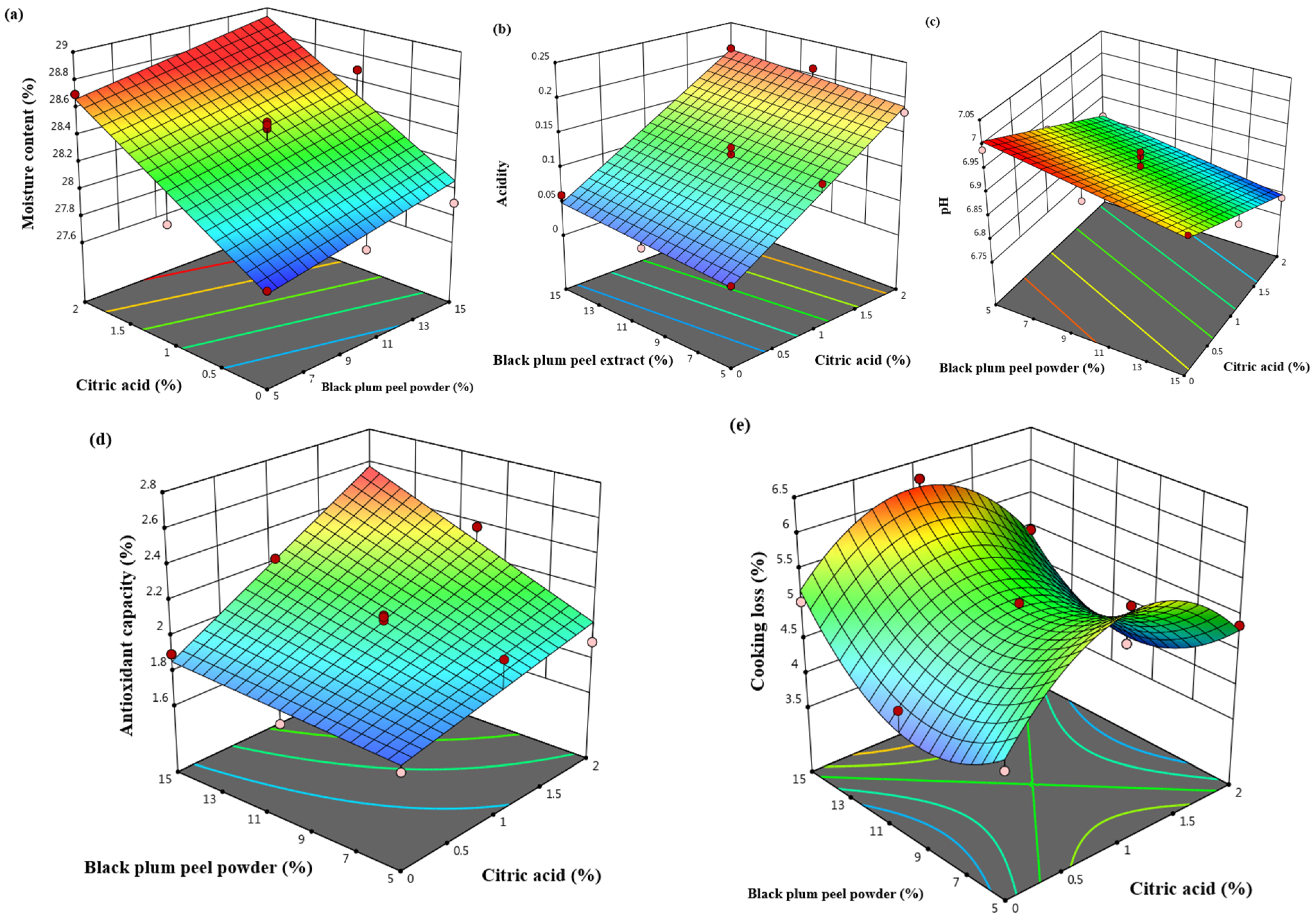
The proportion of citric acid resulted in a linear increase the cake’s moisture content (
Figure 1a). The moisture content slightly decreased with increasing concentrations of black plum peel powder and citric acid (
Figure 1a). The downward slope of the surface from the higher to the lower end indicates a negative relationship, suggesting that higher levels of both independent variables tend to reduce moisture retention in the product. This trend may be attributed to the higher solid content and lower water-holding capacity associated with increased black plum peel powder and citric acid concentrations.
Table 4 reveals that the moisture content was positively influenced by both citric acid and black plum peel powder, as reflected by the positive coefficients of X
1 and X
2 in the model Y = 28.37 + 0.4333 X
1 + 0.1350 X
2. The high R
2 value (0.8351) and low coefficient of variation (0.55%) indicate that the model reliably explains more than 83% of the observed variation, with predicted (28.84%) and actual values showing good agreement.
3.1.2. Acidity
Table 2 shows that the best model for fitting acidity was the linear model (
p < 0.0001). Their interaction term also had a significant effect (
p = 0.0469), suggesting a synergistic influence of citric acid and plum peel on the acidity of the product.
As shown in
Table 3, the linear effects of citric acid and black plum peel powder on the cake’s acidity were statistically highly significant (
p < 0.05). Citric acid directly increases acidity, and plum peel powder also contributes organic acids and phenolics. The interaction between citric and black plum peel cake indicates that the influence of citric acid depends slightly on the level of plum powder.
As the levels of citric acid and black plum peel powder increased, the acidity of the cake samples also increased (
Figure 1b). The plot reveals that acidity increases with higher concentrations of both citric acid and black plum peel extract. The upward slope of the surface indicates a positive correlation between these variables and the response, suggesting that the combined effect of the natural organic acids in the peel extract and the added citric acid contributes to a more acidic environment. This behavior is consistent with the acidic nature of both components, which collectively enhance the overall titratable acidity of the formulation.
Based on the findings presented in
Table 4, the citric acid term had a more significant influence on the acidity of the black plum peel cake. Both factors had strong positive effects, especially citric acid, as seen in the equation Y = 0.1185 + 0.0800 X
1 + 0.0100 X
2. The very high R
2 (0.9709) and adjusted R
2 (0.9651) confirm the model’s robustness, suggesting that nearly all variability in acidity was explained by the independent variables. The acidity of the samples ranged from 1.74% to 2.54%.
3.1.3. pH Value
As shown in
Table 2, the best model for predicting the pH value was the linear model (
p < 0.0001). As the concentrations of citric acid and black plum peel powder increased, the pH value decreased (
Figure 1c). When both citric acid and black plum peel powder are high, the acidity effect intensifies synergistically.
The decrease in pH was primarily influenced by the linear effect of citric acid. In addition, black plum peel powder contains natural organic acids (e.g., malic and citric acids), which contribute to the acidity. Although both citric acid and plum peel acids affect pH, the interaction term between citric acid and black plum peel powder was not statistically significant, indicating that there is no strong synergistic or stacking effect. Therefore, the pH reduction is mainly due to citric acid, with a minor contribution from the intrinsic acids of the plum peel.
Table 3 also indicates that the linear effects of citric acid and black plum peel powder were significant (
p < 0.05); while the interaction was also significant (
p = 0.0107), confirming that changes in formulation significantly modified the pH level.
Furthermore,
Table 4 reveals that the linear term of citric acid had a more significant impact on the pH value of the sponge cake. pH decreased with increasing levels of both citric acid and plum peel powder, according to the equation Y = 6.90 − 0.0733 X
1 − 0.0317 X
2. The high R
2 (0.8616) indicates a strong inverse relationship, confirming that formulation acidity increased as ingredient levels rose. The pH values ranged from 6.79 to 6.99.
The increased acidity observed in formulations with higher citric acid and black plum peel powder levels plays a dual functional role in product quality. First, moderate acidification enhances flavor balance and freshness, counteracting the natural sweetness of the fruit-based matrix and providing a more desirable sensory profile [
29]. Citric acid contributes a slight tartness that improves flavor complexity and consumer acceptability in bakery and fruit-enriched products.
Second, from a technological standpoint, the lower pH creates an unfavorable environment for microbial growth, thereby potentially extending the product’s shelf-life [
30]. The antimicrobial effect arises from the undissociated form of organic acids penetrating microbial cell membranes and acidifying the cytoplasm, which disrupts metabolic processes [
28]. Thus, the controlled acidification in this study not only improved the sensory attributes of the black plum peel cake but also enhanced its microbiological stability, offering a natural preservation advantage without the need for synthetic additives.
3.2. Antioxidant Capacity of Black Plum Peel Cake
Table 2 indicates that the linear model provided the best fit for describing the antioxidant capacity of black plum peel cake (
p < 0.05). that the linear term for citric acid level is beyond which antioxidant activity might plateau or decline slightly. Citric acid had the strongest influence on antioxidant capacity. Black plum peel powder is rich in polyphenols and anthocyanins, which enhance antioxidant capacity. The interaction term (
p = 0.0012), as well as the quadratic effect of X
1 (
p = 0.0186), were all significant. This demonstrates that increasing the concentration of black plum peel, rich in phenolic compounds, notably enhanced antioxidant properties.
Additionally, as shown in
Table 3, the linear effects of both citric acid and black plum peel powder (
p < 0.0001) and their interaction (
p = 0.0012), as well as the quadratic effect of X
1 (
p = 0.0186), were all significant. This demonstrates that increasing the concentration of black plum peel, rich in phenolic compounds, notably enhanced antioxidant properties.
Increasing the proportions of citric acid and black plum peel powder enhanced the antioxidant capacity of the cake (
Figure 1d). The surface gradually increases from blue to red, signifying that antioxidant capacity rises as both black plum peel powder and citric acid levels increase. The figure demonstrates that the antioxidant capacity of the product increases with higher levels of black plum peel powder and citric acid, indicating a positive interaction between these two factors.
Table 4 reveals the model Y = 2.06 + 0.24 X
1 + 0.16 X
2 + 0.12 X
1X
2 demonstrated that both individual and interactive effects of citric acid and plum peel significantly enhanced antioxidant potential. The R
2 (0.8982) and low CV (4.07%) indicate high predictive reliability. The antioxidant activity of black plum peel cake, measured by the DPPH free radical scavenging assay, ranged from 1.74% to 2.54% inhibition. For comparison, the control cake without plum peel powder exhibited 1.25% inhibition, while cakes containing black plum peel powder showed 1.50–2.10% inhibition. These results indicate that black plum peel powder more effectively enhances the antioxidant capacity of sponge cakes compared to other fruit by-products.
Ahmed et al. [
35] used banana peel powder to increase the nutritional value of the cake. The addition of banana peel powder increased the antioxidant capacity of the cake. They suggested that using banana peel powder up to 15% could complement and improve the quality characteristics of the cake.
3.3. Cooking Loss of Black Plum Peel Cake
As shown in
Table 2, the quadratic model was the best fit for predicting the cooking loss of black plum peel cake (
p < 0.0001). High citric acid or excessive black plum peel powder may destabilize the structure, increasing weight loss during baking.
Table 3, for cooking loss, significant effects were observed for X
1 (
p = 0.0002), X
1X
2 (
p = 0.0208), and the quadratic terms X
12 and X
22 (both
p < 0.0001). The results suggest that both citric acid and black plum peel concentrations influenced water retention and thermal stability during cooking. Cooking loss increased as citric acid concentration rose to 1%, but decreased when citric acid concentration increased from 1% to 2%.
Similarly, increasing black plum peel powder content (percent) up to 10% reduced cooking loss, whereas increasing it from 10% to 15% caused cooking loss to rise (
Figure 1e). The surface is curved and uneven, suggesting a nonlinear interaction between black plum peel powder and citric acid on cooking loss. Cooking loss is influenced by both black plum peel powder and citric acid in a complex way. The lowest cooking loss occurs at intermediate levels of both ingredients, while extreme concentrations of either component increase cooking loss. This suggests that balancing these two factors is essential to achieve optimal cooking stability and texture.
Table 4 indicates that the cooking loss model: Y = 5.04 − 0.0083 X
1 − 0.1650 X
1X
2 − 1.07 X
12 + 0.8748 X
22 exhibited a very good fit (R
2 = 0.9515), showing that higher levels of plum peel powder decreased cooking loss, likely due to the water-binding capacity of its fiber, while the quadratic terms confirmed non-linear effects of both factors. The cooking loss values ranged from 3.86% to 6.24%.
Sharoba et al. [
36] utilized food industry wastes (orange waste, carrot pomace, potato peels, and green pea peels) in cake production, finding that increasing the proportion of fruit and vegetable wastes from 0% to 20% reduced cake volume. Ibrahim et al. [
37] demonstrated that incorporating mango peels and seeds gradually increased the weight, volume, and specific volume of cakes.
3.4. Texture Properties of Black Plum Peel Cake
The observed changes in texture properties with increasing black plum peel powder concentration can be explained by its high fiber and pectin content, which alter the water-holding capacity and structure of the cake matrix. The dietary fibers present in the peel can bind free water, thereby reducing its availability for gluten development and starch gelatinization, leading to a denser and firmer crumb structure [
16,
17,
18,
19,
20]. Moreover, the pectin and soluble fibers increase batter viscosity and improve moisture retention during baking, which enhances cohesiveness and chewiness while reducing brittleness [
30].
Polyphenolic compounds and anthocyanins in the black plum peel may also interact with proteins through hydrogen bonding and hydrophobic interactions, influencing dough viscoelasticity and protein cross-linking [
31]. These interactions can modify the structural integrity of the cake network, producing textural changes observed in parameters such as firmness and springiness.
Additionally, the fiber particles can disrupt the uniformity of the starch–protein matrix, resulting in reduced gas cell expansion and slightly higher density of the crumb. Collectively, these physicochemical interactions explain the texture variations observed with increasing levels of black plum peel powder.
Citric acid and black plum peel powder had no statistically significant effect (p > 0.05) on the hardness, viscosity, adhesion, and elasticity of the sponge cake as measured instrumentally. However, sensory evaluation indicated that increasing citric acid slightly increased perceived hardness. This apparent discrepancy is because instrumental TPA reflects the internal structural hardness of the cake, whereas sensory evaluation captures perceived hardness during mastication, which is influenced by surface properties, moisture distribution, and mouthfeel. Therefore, both objective and subjective measurements provide complementary insights into cake texture (p > 0.05).
3.4.1. Cohesiveness
As shown in
Table 2, the quadratic model was the best fit for cohesiveness (
p < 0.05). Both ingredients influence how well the cake structure holds together. Moderate levels of black plum peel powder improve structure due to pectin, while too much may toughen it.
In
Table 3, for cohesiveness, the linear terms of X
1 (
p = 0.0019), X
2 (
p = 0.0022), and their interaction (
p = 0.0043) were significant, along with the quadratic terms (
p < 0.05). This indicates that both factors, individually and jointly, affected the internal bonding strength of the product structure.
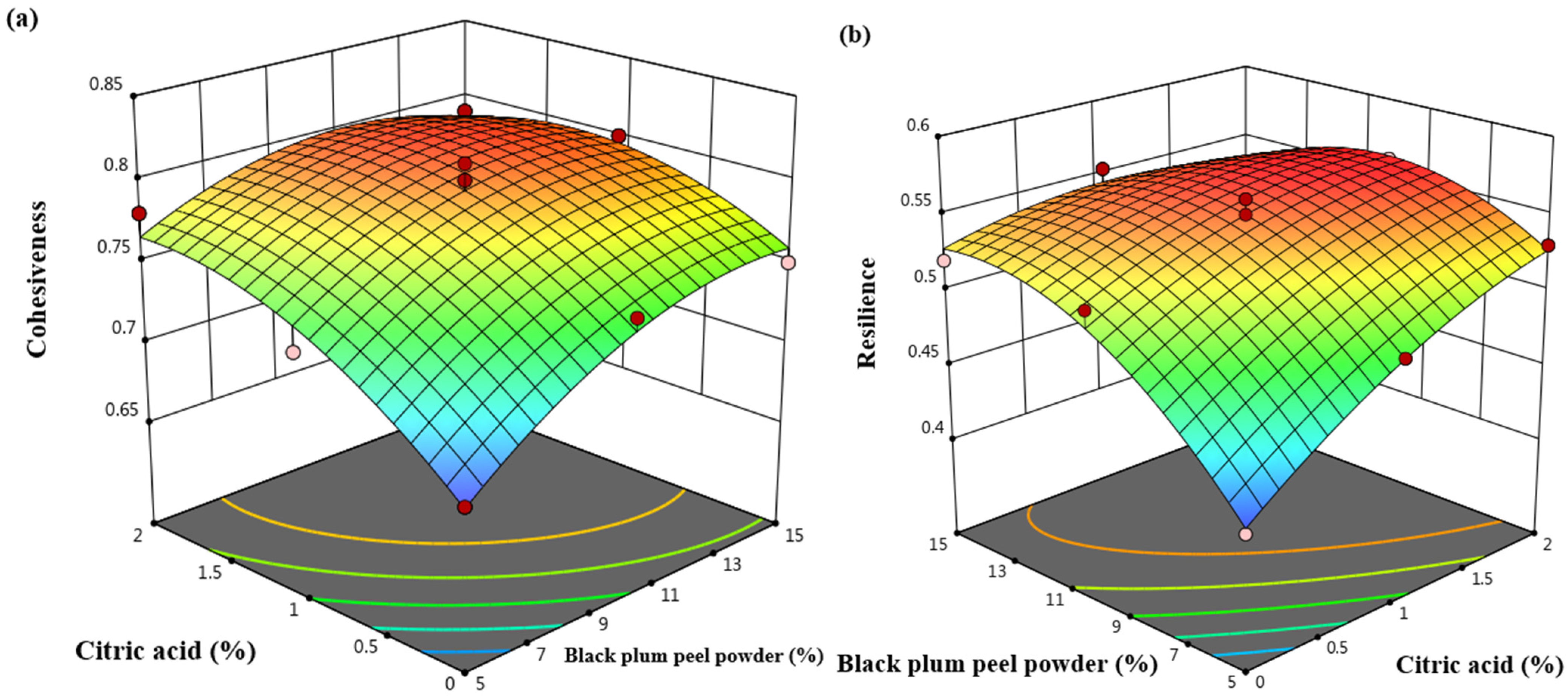
According to
Figure 2a, cohesiveness increased with higher levels of citric acid and black plum peel powder. The surface forms a convex upward shape, meaning cohesiveness increases toward the center and decreases at the lower corners of the plot. The lowest cohesiveness (blue region) occurs when both citric acid and black plum peel powder are at low levels. As both components increase, cohesiveness rises steadily (green to yellow region) and reaches its maximum (red region) at moderate to high levels of both variables. This suggests a synergistic effect between citric acid and black plum peel powder; together, they improve the internal bonding and structural integrity of the product.
Figure 2a shows that the cohesiveness of the product improves with increasing concentrations of both citric acid and black plum peel powder, indicating that optimal textural strength is achieved at moderate to high levels of these two components.
Similarly, resilience was significantly affected by X1 (p = 0.0003), X2 (p = 0.0009), X1X2 (p = 0.0008), and X12 (p = 0.0041), showing that formulation changes directly modified the product’s ability to recover after deformation.
According to
Table 4, Y = 0.7938 − 0.0283 X
1 + 0.0250 X
2 − 0.0150 X
1X
2 − 0.0233 X
12 − 0.0233 X
22; shows that citric acid reduced, while black plum peel increased, the structural integrity of the product. The R
2 value of 0.9034 indicates that about 90% of the variation was explained by the model, with an excellent reproducibility (CV = 1.91%). Black plum peel powder had the most significant effect on the cohesiveness of the black plum peel cake. Cohesiveness values ranged from 0.68 to 0.81.
3.4.2. Resilience
The results for resilience were like those for cohesiveness.
Table 2 shows that the best-fitting model for resilience was the quadratic model. Moderate citric acid enhances protein crosslinking, improving resilience, but excessive acid can weaken the matrix and affect elasticity.
Table 3 indicates that the linear terms of citric acid (
p = 0.0003) and black plum peel powder (
p = 0.0009), the quadratic effect of black plum peel powder, and the interaction between citric acid and black plum peel powder all had a statistically significant influence on the resilience of the black plum peel cake (
p < 0.05), showing that formulation changes directly modified the products’ ability to recover after deformation.
As the levels of citric acid and black plum peel powder increased, resilience also increased (
Figure 2b). The blue zone in the figure shows the minimum amounts of resilience that occur in minimum amounts of citric acid and black plum peel powder. Citric acid showed a greater effect on increasing resilience than black plum peel powder. The maximum resilience was observed when the amounts of black plum peel powder and citric acid was 13.5% and 2%, respectively (red zone).
According to
Table 4, black plum peel powder had the most significant impact on the resilience of the black plum peel cake and the resilience model: Y = 0.5499 + 0.0267 X
1 + 0.0272 X
2 − 0.0250 X
1X
2 − 0.0145 X
12 − 0.033 X
22; (
p < 0.05). also demonstrated strong predictive performance (R
2 = 0.9434), suggesting that moderate levels of both factors increased the product’s ability to recover its shape after compression, whereas excessive concentrations reduced it. Resilience values ranged from 0.42 to 0.56.
Sharoba et al. [
36] reported that the use of orange waste, carrot pomace, potato peels, and green pea peels increased firmness, hardness, cohesiveness, gumminess, chewiness, and resilience in cakes due to the fiber content of these wastes, which enhances the adsorption capacity of oil and water.
3.5. Sensory Characteristics of Black Plum Peel Cake
3.5.1. Hardness
Table 2 indicates that the quadratic model provided the best fit for the hardness score of the black plum peel cake (
p < 0.05). Both citric acid and black plum peel powder had strong effects on the sensory features of the cake. The cake becomes firmer as black plum peel powder increases (due to fiber) and slightly more compact with citric acid.
Although instrumental TPA showed no significant differences in hardness and viscosity among the formulations, sensory evaluation indicated noticeable differences in perceived hardness. This discrepancy arises because TPA measures mechanical properties under standardized conditions, while sensory evaluation reflects the panelists’ perception, which is also influenced by moisture content, crumb structure, and mouthfeel. Thus, the two methods provide complementary information on cake texture.
Furthermore,
Table 3 shows that the linear and quadratic terms of citric acid, as well as the interaction between citric acid and black plum peel powder, were statistically significant (
p < 0.05); indicating that texture firmness varied nonlinearly with ingredient level.
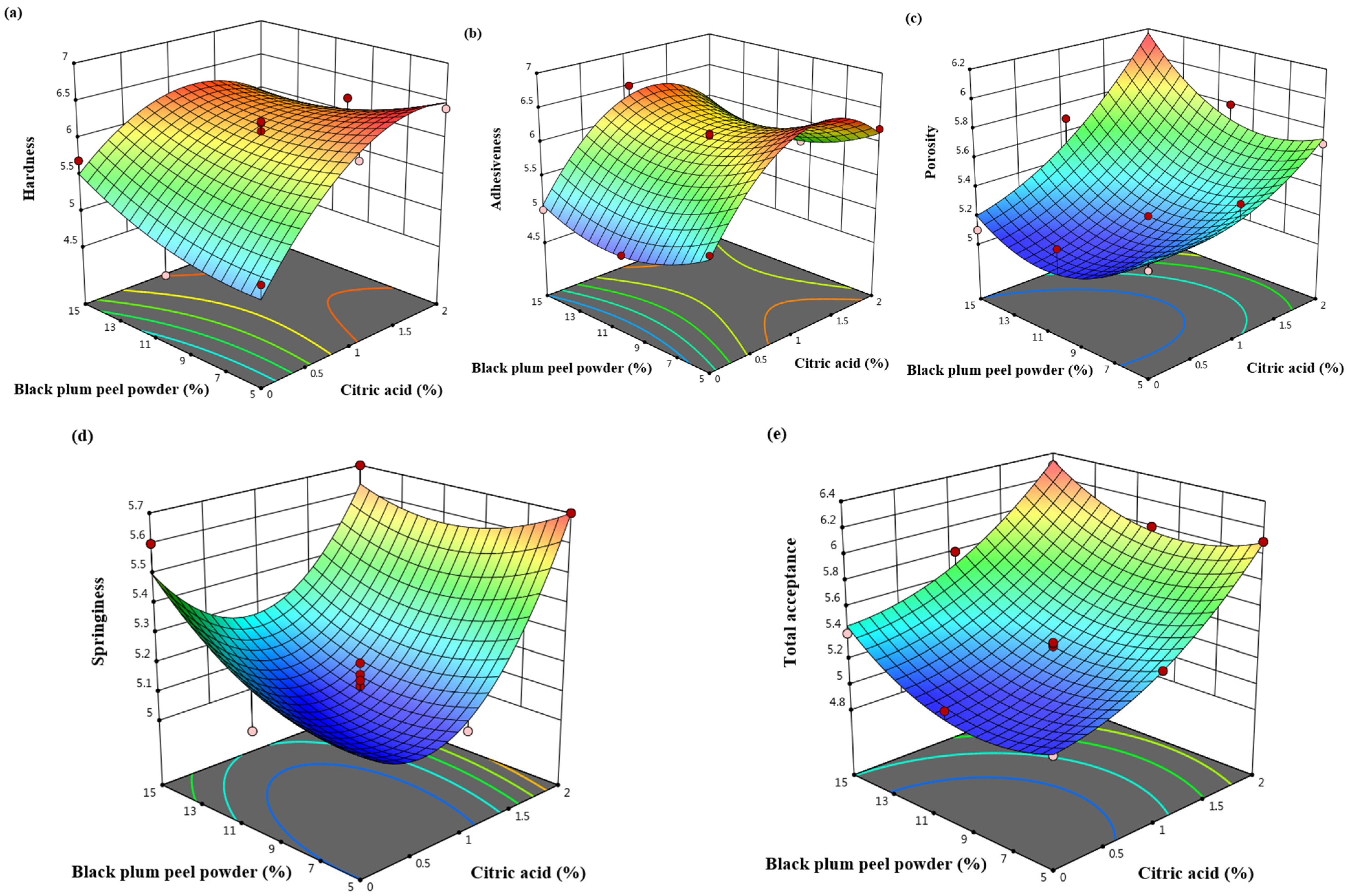
As the citric acid concentration increased, the hardness score also increased (
Figure 3a). The maximum and minimum resilience were observed when citric acid was 2% and black plum peel powder was 13.5% (red zone), and 5% black plum peel powder and 05 citric acid, respectively (blue zone).
According to the results in
Table 4, the percentage of citric acid had the greatest influence on the hardness score of the black plum peel cake. the regression model Y = 6.06 + 0.5333 X
1 + 0.05 X
2 − 0.3 X
1X
2 − 0.5541 X
12 + 0.1959 X
22; (R
2 = 0.8973), indicating that increasing citric acid initially enhanced hardness, but the negative quadratic coefficient suggests a softening effect at higher levels. The hardness scores ranged from 4.6 to 6.4.
3.5.2. Adhesiveness
Table 2 shows that the best model for fitting the adhesiveness score was the quadratic model (
p < 0.0001). Black plum peel powder increases stickiness up to a limit because of pectin, while citric acid can balance that by lowering pH and reducing tackiness.
As shown in
Table 3, the linear term of citric acid and the quadratic terms of both citric acid and black plum peel powder were significant (
p < 0.05); revealing that both ingredients affected the stickiness of the product surface.
The adhesiveness score increased as citric acid concentration rose up to 1.5% but decreased when citric acid concentration increased from 1.5% to 2% (
Figure 3b), while different amounts of black plum peel powder caused a decrease in adhesiveness (blue zone). The maximum amount of adhesiveness was observed in 1.5% 0f citric acid and 5% and 15% of black plum peel powder (red zone). Similarly, increasing black plum peel powder up to 10% led to a decrease in adhesiveness score, whereas further increasing from 10% to 15% caused the adhesiveness score to rise.
According to the results in
Table 4, adhesiveness followed the equation Y = 6.07 + 0.405 X
1 − 0.0833 X
2 − 0.8293 X
12 + 0.3707 X
22, with the highest R
2 value among all models (0.9746). This confirms that citric acid primarily increased stickiness, while black plum peel powder decreased it slightly, depending on concentration. Citric acid level had the greatest influence on the adhesiveness score of the black plum peel cake. The adhesiveness scores ranged from 4.8 to 6.50.
3.5.3. Porosity
As shown in
Table 2, the quadratic model was the best fit for predicting the porosity of sponge cake (
p < 0.05). Citric acid and black plum peel powder increased porosity, indicating better gas retention and aeration. Excessive black plum peel powder can collapse the structure due to dense fiber content.
Table 3 further indicates that the linear term of citric acid and the quadratic term of black plum peel powder were significant (
p < 0.05); suggesting that increased plum peel powder improved structural porosity, possibly due to fiber content.
An increase in citric acid and black plum peel powder corresponded to an increase in porosity (
Figure 3c) that has showed in red zone. The minimum porosity observed when the amount was in 11% black plum peel powder and 0.5% of citric acid (blue zone).
According to
Table 4, The porosity model Y = 6.233 − 0.2867 X
1 − 0.224 X
2 + 0.030 X
1X
2 + 0.1600 X
12 + 0.0104 X
22; (R
2 = 0.9038) revealed that both citric acid and plum peel had negative linear effects on porosity, although quadratic terms slightly counteracted this trend, suggesting optimal porosity at moderate levels of both factors. The porosity values ranged from 5.1 to 6.1.
3.5.4. Springiness5
Table 2 shows that the 2FI model provided the best fit for describing the springiness of the black plum peel cake (
p < 0.05). That means citric acid and black plum peel powder both influenced springiness. An optimal level of black plum peel powder improves elasticity, but higher levels make the texture denser.
Additionally, in
Table 3, the linear and square parameters of citric acid were found to be significant (
p < 0.05), showing a nonlinear effect of formulation on elastic texture.
With an increase in citric acid up to 1%, the springiness score decreased, but the score increased from 1 to 2% (
Figure 3d). The maximum amount of springiness was observed in 2% citric acid and 5% black plum peel powder (red zone), while the minimum was observed in 1% citric acid and 7% black plum peel powder (blue zone).
As highlighted in
Table 4, for springiness, the equation Y = 5.10 + 0.1667 X
1 + 0.0667 X
2 − 0.100 X
1X
2 + 0.2979 X
12 + 0.0979 X
22; (R
2 = 0.8834) indicated that elasticity increased with higher concentrations of citric acid and black plum peel powder, with a nonlinear behavior confirmed by the positive quadratic coefficients. The square parameter of citric acid had the most significant impact on the springiness of the black plum peel cake, with the springiness value ranging from 5.1 to 5.7.
3.5.5. Overall Acceptance
Table 2 displays that the best model for fitting the overall acceptance score was the quadratic model (
p = 0.0001).
Additionally, in
Table 3, it is evident that the effects of citric acid and black plum peel powder, as well as their square parameters, were significant (
p < 0.05). These results indicate that the sensory acceptability was jointly determined by both citric acid and black plum peel powder, with the best balance achieved through intermediate concentrations.
As the levels of citric acid and black plum peel powder increased, the overall acceptance scores also increased (as illustrated in
Figure 3e). The minimum of overall acceptance was recorded in 11% black plum peel powder and 0% citric acid (blue zone).
Furthermore,
Table 4 demonstrates that the linear term of citric acid had the most substantial impact on the overall acceptance score of the black plum peel cake (Y = 5.30 + 0.4667 X
1 + 0.15 X
2 − 0.025 X
1X
2 + 0.2010 X
12 + 0.2510 X
22), with overall acceptance scores ranging from 5.1 to 6.3. which showed an excellent fit (R
2 = 0.9816; adjusted R
2 = 0.9684) and the lowest CV (1.30%). This result indicates that both citric acid and black plum peel powder significantly contributed to improving sensory appeal, with maximum acceptability obtained at intermediate concentrations of both ingredients.
Ahmed et al. [
35] reported a slight difference between the control sample and samples containing up to 6% banana peel powder in terms of sensory properties. The cake containing banana peel powder was excellent compared to the control sample. Sharoba et al. [
36] found that sensory evaluations of cakes containing orange waste, carrot pomace, potato peels, and green pea peels were significantly lower than control cakes, except for cake samples prepared with 5% and 10% of orange waste and carrot pomace, which showed no significant differences with the control cake. They also noted that using 2.5% mango peel powder and 5% mango seed kernel powder could be incorporated into cake formulations without altering the sensory properties.
3.6. Optimizing the Physico-Chemical and Sensory Properties of Black Plum Peel Cake
Black plum peel powder-enriched cake is a nutrient-dense bakery product that combines the natural acidity of citric acid with the bioactive richness of black plum peel powder. The powder contributes dietary fiber, pectin, anthocyanins, flavonoids, and phenolic acids, all of which improve the cake’s nutritional and functional qualities. These compounds enhance antioxidant capacity, slow lipid oxidation, and add a natural purple hue.
Meanwhile, citric acid acts as a pH regulator and natural preservative, improving flavor balance, microbial stability, and color retention. Together, they modify the cake’s moisture, acidity, and textural behavior, resulting in a product that is not only more stable and health-promoting but also more sustainable, since it utilizes a valuable by-product of the plum processing industry.
For moisture content, the predicted value (28.84%) closely matched the observed value (28.56%), indicating that the model accurately estimated the product’s water retention capacity. Similarly, the acidity and pH values (predicted 0.20 and 6.81 versus observed 0.18 and 6.86, respectively) were nearly identical, demonstrating that the model effectively captured the acid–base balance in the formulation.
The antioxidant capacity also showed high consistency (predicted 2.38% vs. observed 2.46%), suggesting that the increase in antioxidant potential due to the addition of black plum peel powder was well predicted by the model. In the case of cooking loss, the difference between predicted (4.08%) and observed (4.12%) values was minimal, further confirming the robustness of the predictive equation.
Among texture properties, the predicted and observed values of cohesiveness (0.80 vs. 0.86) and resilience (0.56 vs. 0.61) showed close alignment, indicating accurate estimation of structural and elastic characteristics. For sensory attributes, the model also performed well, with minimal differences in hardness (5.98 vs. 6.20), adhesiveness (5.70 vs. 5.94), porosity (5.80 vs. 5.76), and springiness (0.99 vs. 0.94).
The overall acceptance of the optimized product (predicted 6.03, observed 6.12) exhibited the smallest deviation among all parameters, confirming that the model not only predicted the physical and chemical attributes accurately but also successfully captured consumer preference trends.
Overall, the close correspondence between predicted and actual values across all measured properties validates the developed models and demonstrates that the optimization process effectively identified a formulation with desirable physicochemical quality, textural characteristics, and sensory acceptability.
Since the concentrations of citric acid (0–2%) and black plum peel powder (5–15%) in the formulation of black plum peel cake were kept within specific ranges, the optimal levels for achieving the highest quality were determined. Based on Response Surface Methodology, 2% citric acid and 11.56% black plum peel powder were determined as the optimal concentrations for improving physico-chemical and sensory properties of the cake. The model fit (R
2 = 0.80) indicates that most, but not all, variability was captured, possibly due to unconsidered interaction factors or experimental variability. It should be noted that the shelf-life, aging behavior, and microbiological stability of this optimal formulation were not assessed in this study, and further work is required to fully validate its long-term quality and practical applicability (
Table 5). This comparison revealed a significant agreement between the predicted and observed values for all assessed characteristics.
4. Conclusions
The development of black plum peel powder-enriched cake demonstrated the successful integration of a natural fruit by-product into a functional bakery product with enhanced nutritional, textural, and sensory properties. The combination of citric acid and black plum peel powder proved to be highly effective in improving the cake’s quality and stability while contributing to a cleaner, more sustainable formulation. Its inclusion improved moisture balance, textural cohesiveness, and resilience, while imparting a natural color and mild fruity flavor that increased consumer appeal. Citric acid complemented these effects by regulating acidity and pH, stabilizing color, enhancing flavor balance, and extending shelf life through its preservative properties. The linear term of citric acid had the most significant impact on moisture content, acidity, antioxidant capacity, sensory hardness, adhesiveness, and overall acceptance, while the pH, cohesiveness, and resilience were primarily influenced by the linear term of black plum peel powder. Porosity and springiness were affected by the quadratic parameter of citric acid, while cooking loss was influenced by the quadratic parameter of black plum peel powder. The application of Response Surface Methodology was effective in optimizing the cake formulation, determining that concentrations of 2% citric acid and 11.56% black plum powder were optimal. Overall, the optimized black plum peel cake represents an innovative, health-oriented bakery product that combines sensory excellence with functional and environmental benefits. This approach highlights the potential of fruit by-products as valuable natural ingredients for developing nutritionally enriched, consumer-acceptable, and eco-friendly food products.