Article

Molecular Dynamics Simulation Study on the Mechanism of CO2-CH4 Synergistic Enhanced Oil Recovery in Tight Oil Reservoirs

1
PetroChina Research Institute of Petroleum Exploration & Development, Beijing 100083, China
2
Oil & Gas Technology Research Institute of Petro China Changqing Oilfield Company, Xi’an 710021, China
3
National Engineering Laoratory for Exploration and Development of Low-Permeability Oil & Gasfields, Xi′an 710021, China
4
State Key Laboratory of Deep Oil and Gas, China University of Petroleum (East China), Qingdao 266580, China
5
School of Petroleum Engineering, China University of Petroleum (East China), Qingdao 266580, China
*
Authors to whom correspondence should be addressed.
Processes 2026, 14(4), 638; https://doi.org/10.3390/pr14040638
Submission received: 10 December 2025 / Revised: 6 January 2026 / Accepted: 6 February 2026 / Published: 12 February 2026
(This article belongs to the Special Issue Flow Mechanisms and Enhanced Oil Recovery)

Abstract

Tight oil reservoirs are currently a hot topic in petroleum exploration and development. However, due to the low porosity and low permeability of reservoirs and the lack of external energy supplementation, there is a significant mismatch between resources and production in tight oil. Mining and experimental studies have shown that CO2 and gaseous hydrocarbons have a high injectivity and effective oil displacement effect in tight oil reservoirs. Currently, research is mostly focused on a single energy supplement medium, and whether CO2 hydrocarbon mixtures can more effectively improve oil recovery needs to be further studied. The features of crude oil expansion capacity and interaction energy changes following various fluid interactions were investigated via molecular dynamics simulation techniques in response to the ambitious comprehension of the mechanistic changes underlying the CO2–CH4 synergistic effect during the development of tight oil reservoirs. The research results indicate that the expansion and diffusion abilities of crude oil are improved after being treated with pure CO2, CO2-CH4 (9:1), CO2-CH4 (7:3), and CO2-CH4 (1:1), and enhanced with increasing CO2 content in the injected fluid.

1. Introduction

The huge demand for oil and gas energy in China has driven the steady growth of the global oil and gas industry [1,2,3]. Unconventional oil and gas have shown a huge resource endowment and broad development prospects [4,5,6]. Tight oil, as an important unconventional resource, is a crucial direction in today’s petroleum industry and a powerful support for rising oil and gas reserves and production, while also replacing traditional oil and gas energy sources [7]. The practice of developing tight oil reservoirs has shown that the overall utilization degree of depleted reservoirs is low, and they face the challenge of further elevating single well production alongside the utilization rate. Implementing effective energy replenishment measures is a key means of improving the recovery rate of tight oil reservoirs (TOR) [8,9,10]. A TOR is an oil and gas reservoir with a low porosity alongside low permeability, with a porosity generally below 10% and a permeability generally below 1 × 10⁻⁴ μm2 [11,12,13,14]. Water injection and gas injection are the main methods for reservoir energy replenishment [15,16,17]. However, the pore structure of tight reservoirs is complex, and the permeability of water in the reservoir is poor [18]. Water injection usually requires a high injection pressure; it is hard to establish an effective injection production system [19,20,21]. The water injection development of TOR can effectively supplement the energy of the formation, decrease the viscosity of CO2, and improve the flow capacity of crude oil (CO2), thereby enhancing the recovery rate of CO2 and avoiding the sudden decrease in production capacity caused by rapid pressure drops [22,23,24]. Meanwhile, the economic cost of water injection development is relatively low, making it one of the main means for stable production in TOR [25,26,27]. Yang et al. quantitatively [28] described the remaining oil distribution characteristics during the water injection development process of TOR via nuclear magnetic resonance technology. Research has shown that the remaining oil distributed in 10–100 μm after water flooding is 29% to 64%, while the remaining oil in pores smaller than 10 μm is 34% to 69%. Scholars such as Wei [29] conducted experiments on the water flooding efficiency of dense oil reservoir cores, and the main research results showed that the remaining oil in a free state is used during the water flooding process. After the completion of water flooding, the remaining oil content in a thin film on the pore surface increases by more than 2.5%. The biggest challenge for hydraulic fracturing horizontal wells in TOR during the mid-to-late stages of depleted development is how to increase single well productivity and further improve the overall recovery rate of the reservoir. An efficient and economical increase in oil recovery is the only way for the sustainable development of tight oil, and injecting energy replenishment media is an effective means of improving development efficiency. Taking into account factors such as the injection capacity and oil displacement effect, most TOR and mining sites both domestically and internationally tend to focus on gas injection development. Song et al. proposed [30] a novel minimum mixed phase pressure calculation model combining the phase equilibrium calculation model considering nanoscale confinement effects with the interfacial tension disappearance method. The simulation calculation results show that, as the aperture is below 100 nm, the pressure of the oil–gas mixture decreases significantly. Tao et al. conducted [31] research on the characteristics of minimum miscible pressure changes in nanoscale space through the visualization of nanofluid displacement technology. The study found that the pore size reduction and increase in temperature exacerbated the nanoscale effect, resulting in a decrease in minimum miscible pressure. Li et al. innovatively [32] proposed a technique for measuring the diffusion coefficient of gas in tight rock cores saturated with oil, and deeply explored the influence of factors such as core permeability, pore radius, and tortuosity on the diffusion behavior of gas in micro–nanoporous media. Research has shown that the diffusion coefficient of CO2 in tight reservoirs is on the order of 10−9 m2 s−1. As the core permeability and average pore throat radius increase, the diffusion coefficient of CO2 also shows a rising trend, but the magnitude of this increase gradually decreases and eventually stabilizes. With the continuous improvement of computer performance and the development of theoretical chemistry, molecular dynamics simulation technology has received increasing attention. More and more researchers are using molecular dynamics simulation techniques to research the microscopic migration characteristics of injected fluids in CO2 molecular systems. Liu et al. studied [33] the solubility and adsorption capacity of CO2 surfactant on different mineral walls. The research results suggest that the degree of improvement in the solubility of CO2 in CO by surfactants is as follows: CFP > SF > SDS. Santos and other scholars [34] researched the adsorption behavior of CO2 and alkanes in calcite pores. Research has shown that CO2 is more easily adsorbed on pore walls, and most n-butane and n-octane are adsorbed parallel to the surface of calcite. At present, the use of mixed gases can to some extent alleviate the shortage of a single gas source and the problem of gas purification faced by mining sites. There are remarkable differences in the mechanism of action between gases and formation CO2. Relevant studies have shown that mixed gases can integrate the advantages of different gases under specific conditions, exert synergistic oil displacement effects, and further improve the degree of CO2 recovery. Therefore, this article leverages molecular dynamics simulations to study the changes in micro-properties such as the expansion coefficient and interaction energy of CO after being treated with pure CO2, CO2-CH4 (9:1), CO2-CH4 (7:3), and CO2-CH4 (1:1).

2. Models and Methods

Molecular Models

Molecular dynamics simulation (MDS) studies the dynamic behavior of molecules or atomic systems through computer simulations [35,36,37]. This simulation can accurately depict the interaction forces between molecules and their potential energy changes. To research the macroscopic properties of the system through microscopic analysis, the thermodynamic ensemble was introduced. There are four common ensembles. An ensemble expresses all the microscopic states that a system possesses under certain macroscopic conditions. This microscopic state includes the structural morphology, dynamic behavior, and other characteristics of various particles. These four ensembles are NVE ensembles, NVT ensembles, NPT ensembles, and NPH ensembles. LAMMPS, as an 2022 MDS software, has the characteristics of efficient simulation and accurate simulation results, and can simulate the interaction characteristics of molecules and atoms under different conditions [38,39,40,41,42,43]. The simulated temperature is 80 °C.
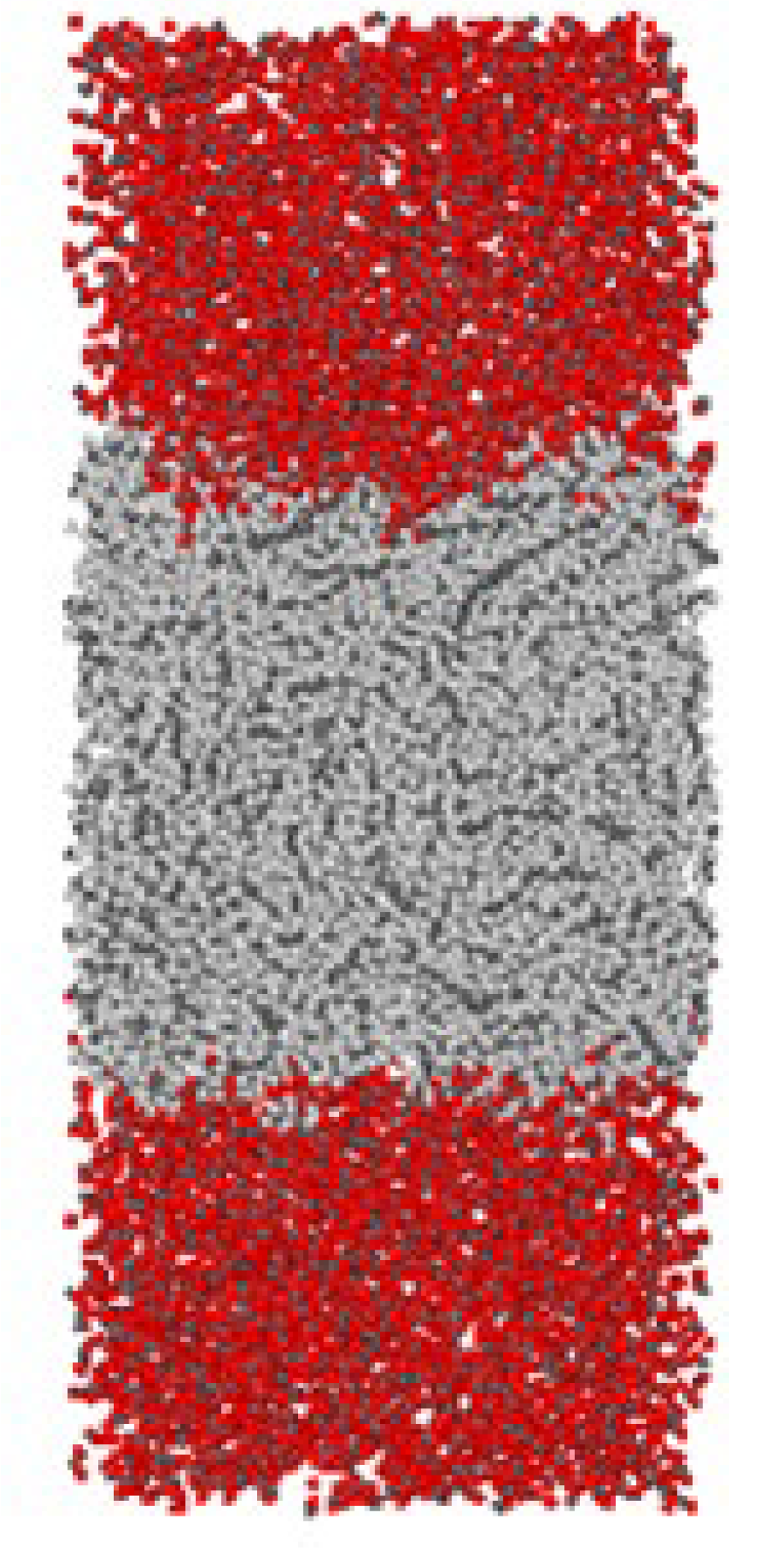
Taking the tight oil of the Chang 6 reservoir in the Ordos Basin as the research subject, this study first identified the variation characteristics of CO2 components by employing an oil–gas component analysis apparatus. To accurately reflect the influence of the bulk environment on the oil–gas interface properties, based on the dead oil components obtained from experiments, alkanes (C1, C2, C3, C4, C6, C10, C19, C30) were selected to simulate tight oil and construct an oil–gas two-phase interface model. The molecular force field parameters for different alkanes are shown in Table 1. Owing to the limitations of the experimental conditions, it is not feasible to determine the detailed molecular structure of CO molecules with a high carbon number. Meanwhile, to reduce computational time, this study exclusively employs linear alkanes for the simulation research. This article uses 2022 LAMMPS software to conduct MDS calculations, with a truncation radius of 1.2 nm for Lennard Jones potential interactions and a time step of 1 fs. Firstly, simulate 3 ns in the NPT ensemble, with a fixed number of simulated molecules and a size of 6 nm in the x and y directions. Simulate the molecular distribution of the system under different pressure conditions by varying the pressure. Next, simulate 1 ns in the NVT ensemble to conduct data analysis and research. The molecular dynamics model of the interaction between bulk CO2 and CO is displayed in Figure 1.

3. Results and Discussion

3.1. Coefficient of Expansion

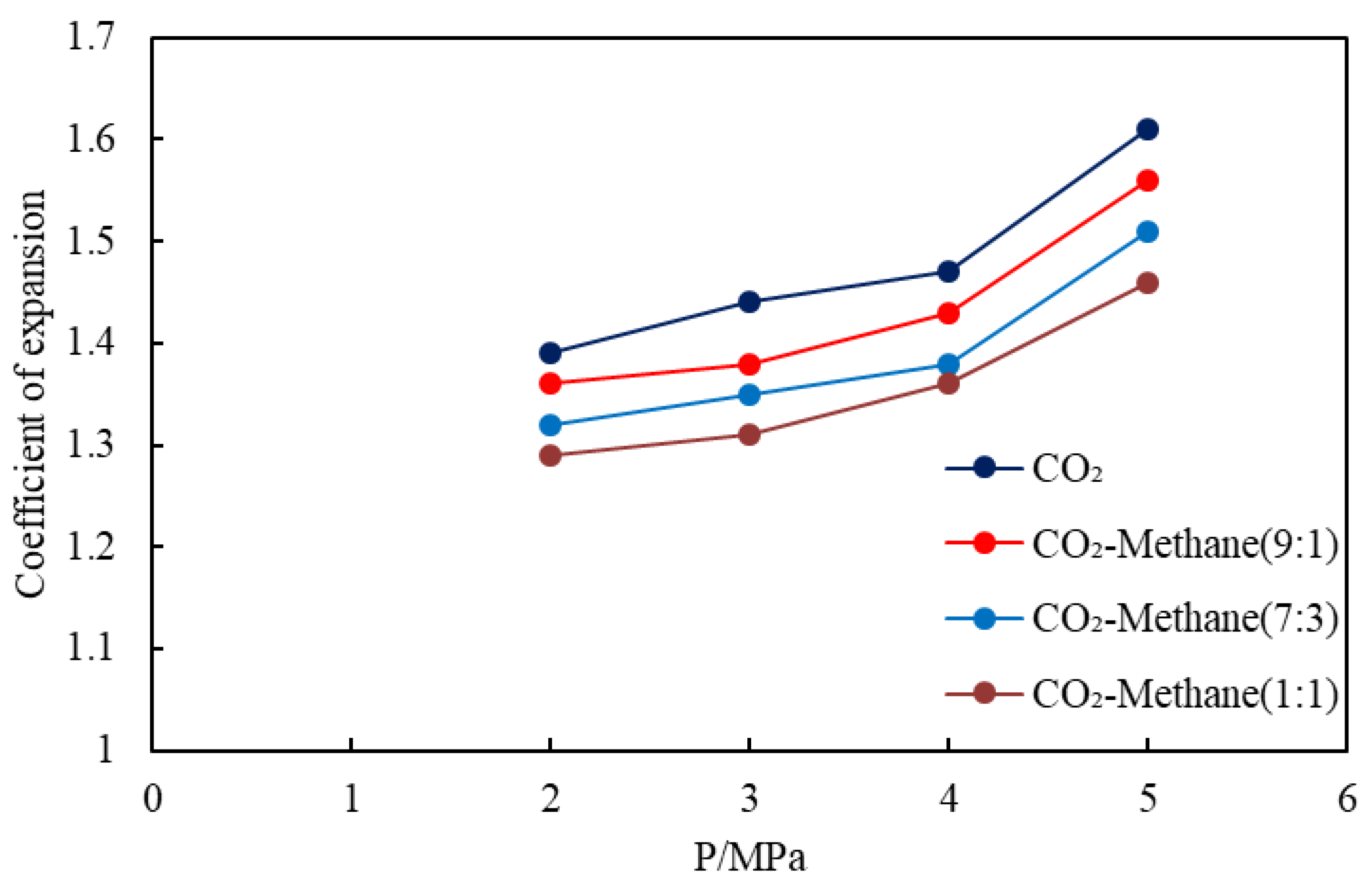
The expansion coefficient of CO2 is one of the key parameters affecting its flow capacity. The ratio of the volume at the end of the simulation to the initial volume represents the expansion coefficient of crude oil. Therefore, this article calculates the system expansion coefficient of multi-component CO2 using formula (1). The calculation results of the expansion coefficient of CO2 after different injection fluids are displayed in Figure 2 and Table 2. The research results indicate that, when the ratio of injected fluid CO2 to methane is 9:1, 7:3, and 1:1 and pure CO2 is used, the expansion coefficient of CO2 is positively correlated with the system pressure. When the pressure is 4 MPa and 5 MPa, the expansion coefficient of CO2 shows a significant increase. As the system pressure rises from 2 MPa to 5 MPa, the expansion coefficient of CO2 increases from 1.39 to 1.61 after being treated with pure CO2. After being injected with a fluid (CO2-to-methane ratio of 9:1), the expansion coefficient of CO2 increases from 1.36 to 1.56. After being injected with a fluid (CO2-to-methane ratio of 7:3), the expansion coefficient of CO2 rises from 1.32 to 1.51. After being injected with a fluid (CO2-to-methane ratio of 1:1), the expansion coefficient of CO2 rises from 1.29 to 1.46. From this, it can be seen that CO2 can improve the flowability of CO2, thereby enhancing the oil recovery rate, which rises with the continuous rise in CO2 content in the injected fluid.
Coefficient   of   expansion = V n V i
In the formula: Vn is the volume of crude oil after the simulation is completed; Vi is the initial volume of crude oil.

3.2. Interaction Energy

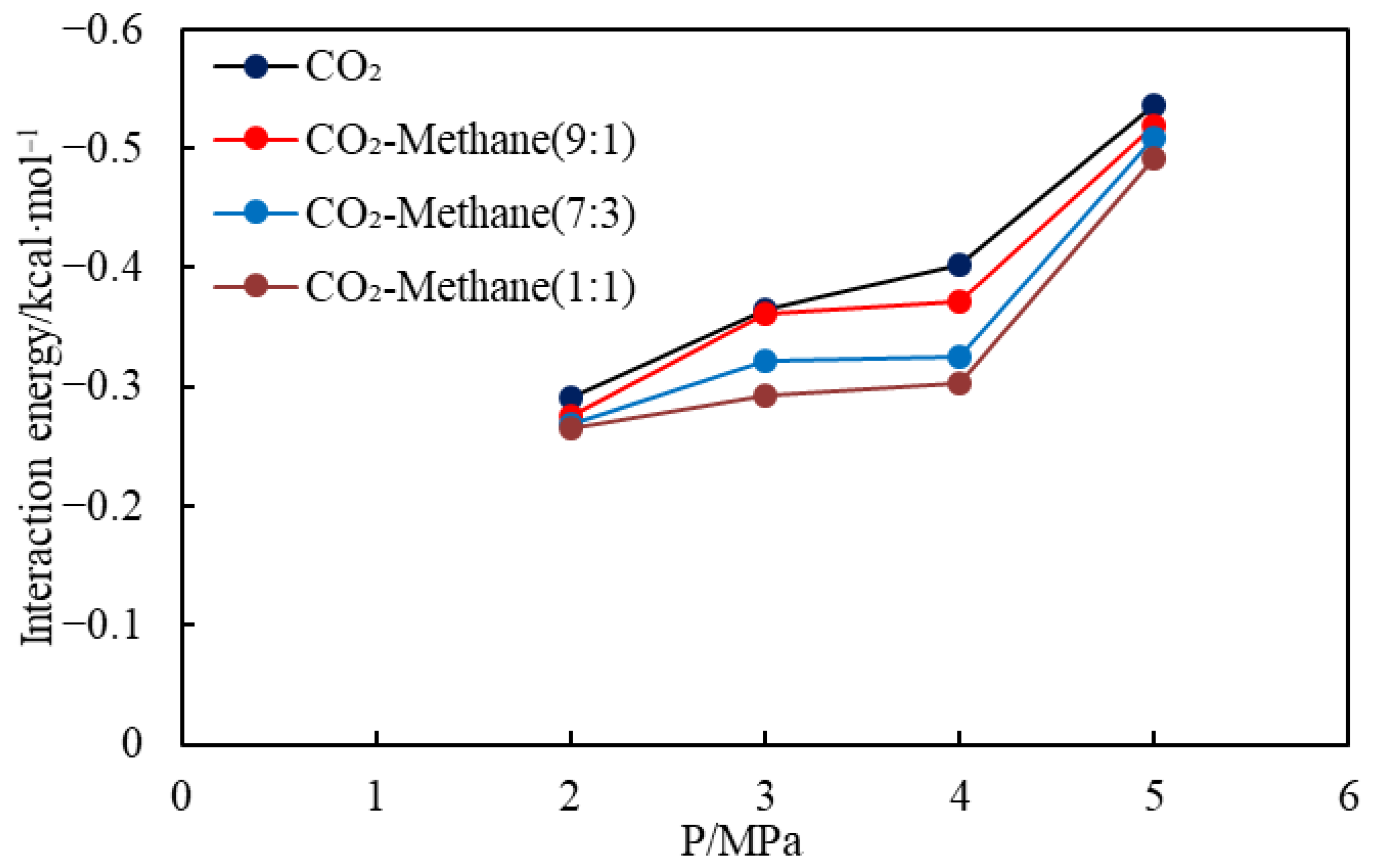
In molecular simulations, the interaction energy refers to the energy changes that occur between different molecules in a system due to their interactions. The interaction energy can describe the strength of intermolecular interactions, and an accurate, efficient analysis of the interaction energy is the key to clarifying the microscopic transport and distribution laws of molecules. The variation characteristics of the interaction energy between CO2 and different injected fluids under varied pressures are displayed in Figure 3 and Table 3. The research findings suggest that, as the pressure rises from 2 MPa to 5 MPa, the interaction between the injected fluid and CO2 gradually increases. Among them, after pure CO2 interaction, the interaction energy increases from −0.291 to −0.536 kcal/mol, and under the same pressure the interaction energy decreases as the CO2 ratio gradually increases. From this, it can be seen that CO2 can promote the degree of contact between the injected fluid and CO2 and increase the solubility of the injected fluid in CO, thereby improving the flowability of CO2 and ultimately enhancing CO2 recovery.

3.3. Interfacial Tension

Oil–gas interfacial tension is a key physical parameter for evaluating the strength of intermolecular forces at the interface between CO2 and injected fluid, which directly affects the distribution, migration, and recovery rate of fluids in oil and gas reservoirs. We calculate the oil–gas interfacial tension via the Gibbs interfacial tension calculation formula in LAMMPS, as shown in Equation (2). For the oil and gas system in bulk, the oil and gas interface is perpendicular to the z-axis and parallel to the x and y planes. The minimum miscible pressure of oil and gas is calculated through the expression of pressure tension. The interfacial tension between oil and gas phases at different pressures for different injected fluids is shown in Table 4. The research results indicate that, as the pressure increases, the intermolecular distance shortens, enhancing the solubility and mixing ability of the injected fluid in CO2, and the interfacial tension of the system gradually decreases. The order of interfacial tension from highest to lowest is CO2, CO2-CH4 (9:1), CO2-CH4 (7:3), and CO2-CH4 (1:1).
γ = 1 2 [ L Z ( p z z p x x + p y y 2 ) ]
In the formula: LZ is the z-axis length of the box; Pα (α = x, y, z) is the diagonal element of the pressure tensor.

3.4. Diffusion Coefficient

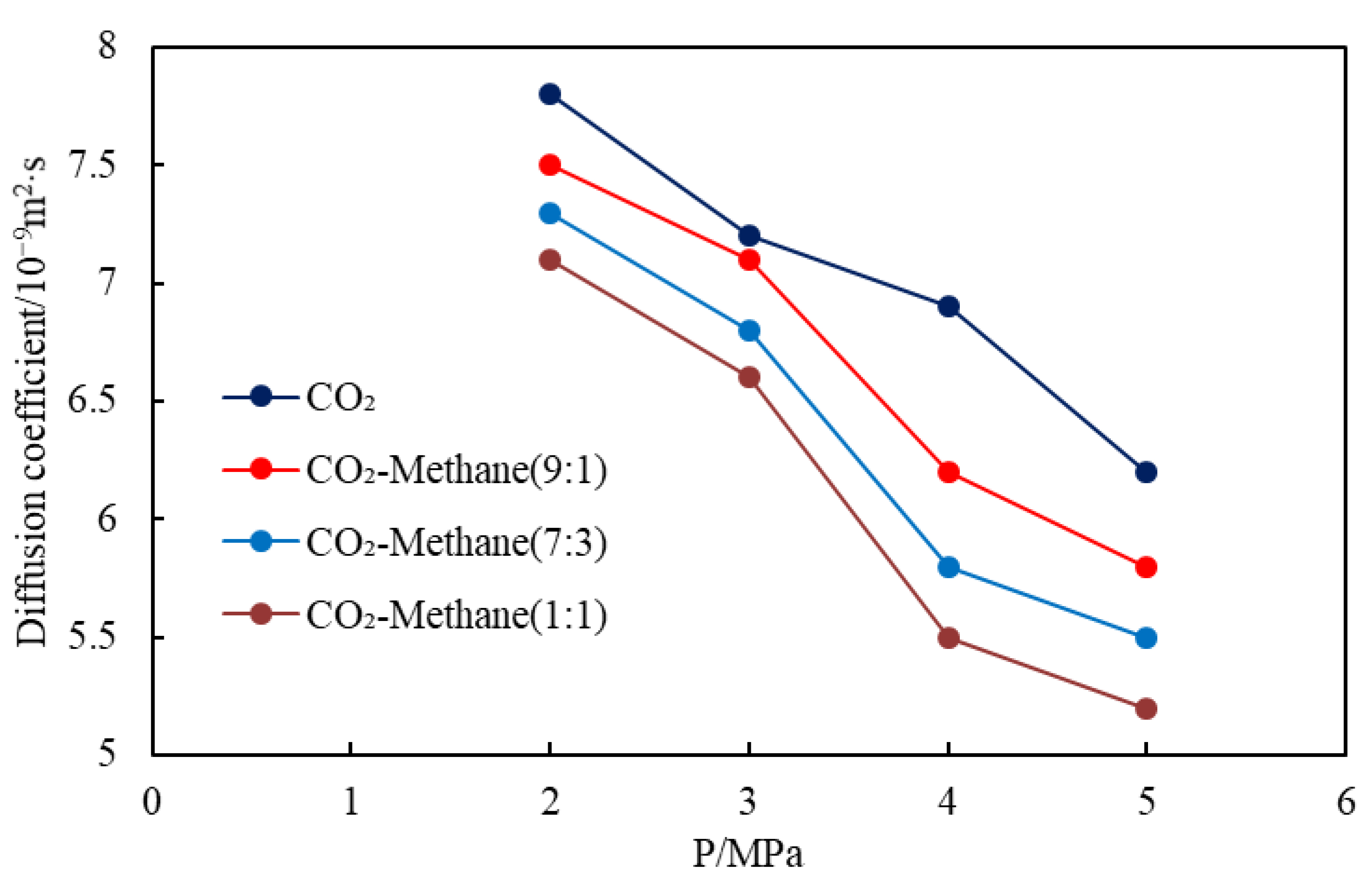
This article uses Einstein’s formula to calculate the diffusion coefficient of injected fluid, as shown in Equation (3). After the simulation is completed, the mean square displacement at different time points is exported and fitted with time. The diffusion coefficient is computed according to the slope and converted into units. The diffusion coefficients of injected fluids under varied pressures in the simulation system are displayed in Figure 4 and Table 5. The simulation findings show that, as the pressure rises, the density of fluid molecules increases, the interaction energy between molecules increases, and the diffusion ability of gas molecules weakens. When the pressure is 5 MPa, the diffusion coefficient of pure CO2 is 6.2 × 10⁻⁹ m2/s, which is higher than that of other injected fluids. From this, it can be seen that CO2 can enhance the migration and diffusion ability of injected fluids in CO, elevating the oil recovery rate.
D = 1 N a lim t d d t i = 1 N a { [ r i ( t ) r i ( 0 ) ] 2 }
In the formula, Na represents the number of diffusing molecules in the system; t is the simulation time, fs; ri (t) is the displacement of the molecule at time t, Å; ri(0) is the displacement of the molecule at the initial time, Å; [ri(t) − ri(0)]2 is the displacement of the molecule at the initial time, Å2.
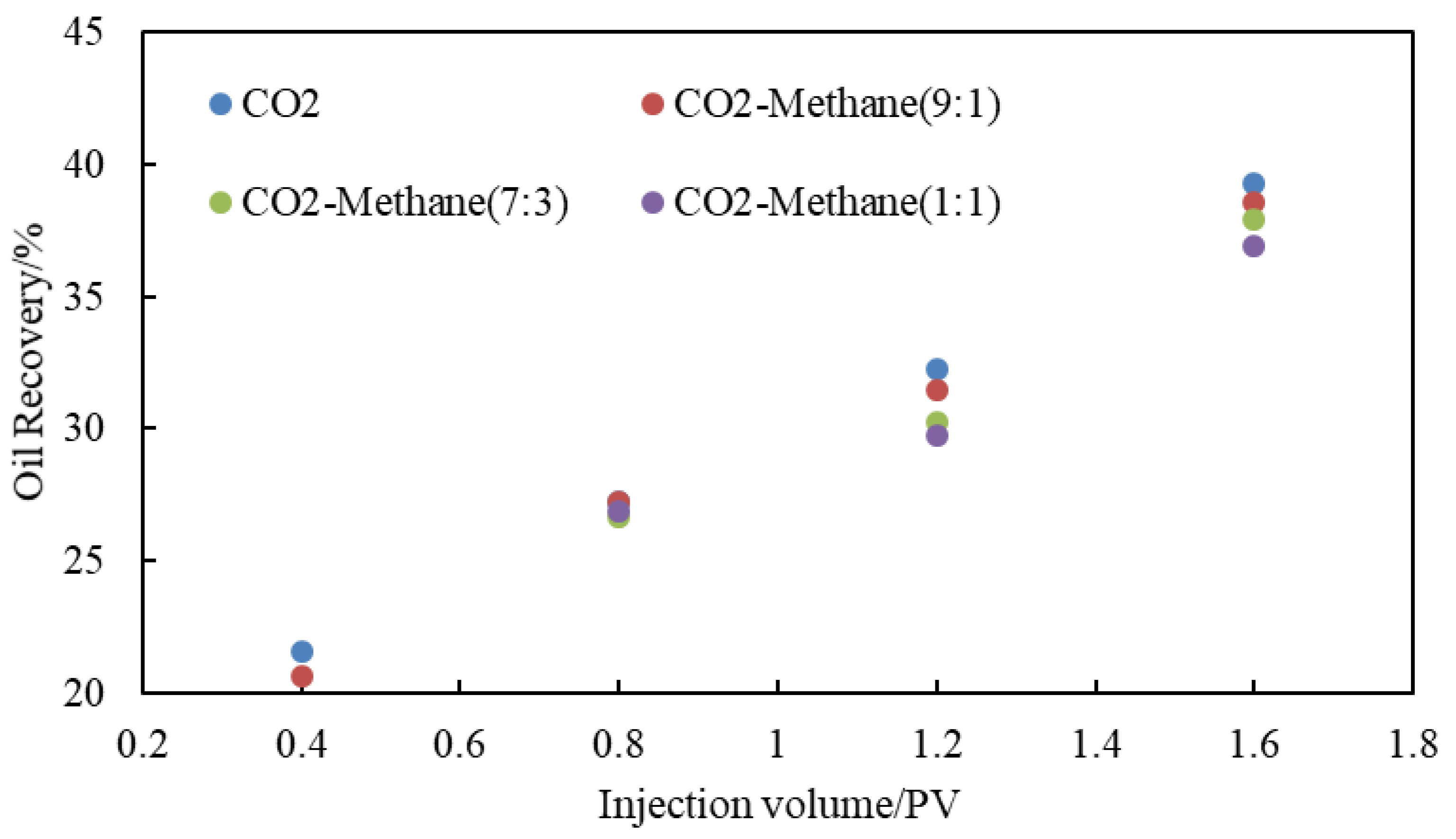
To further demonstrate the characteristics of combined gas recovery in TOR, the research conducted experiments on the characteristics of CO2 flooding under different injection volumes using a core flooding apparatus. The variation characteristics of CO2 recovery efficiency under varied injection volumes are displayed in Figure 5. The results of the research suggest that core flooding with CO2, CO2-methane (9:1), CO2-methane (7:3), and CO2-methane (1:1) can increase the core oil recovery by 39.25%, 38.57%, 37.89%, and 36.88%, respectively. It can be thus concluded that the higher the CO2 content in the injected gas, the better the enhancement effect on oil recovery.
During the gas injection recovery process in TOR, it is hard to obtain an adequate supply of CO2, and the feasibility of displacing CO2 with pure CO2 is relatively low. However, reservoir-associated gas is abundant at oilfield sites. Therefore, investigating the microscopic migration and swelling mechanisms of CO2-methane systems with different mixing ratios helps to further clarify the enhanced oil recovery (EOR) technology for tight oil, thereby providing guidance for the efficient development of oilfields. Subsequently, this study plans to undertake the following two parts of research: ① By combining X-ray diffraction experiments on core minerals, the mineral composition of tight reservoirs is clarified. Based on the main minerals in the reservoir, an MDS method is employed to construct a molecular dynamics model for both oil–gas two-phase and oil–gas–water three-phase models within the nanopores, thereby revealing the characteristics of the occurrence state of oil and gas molecules in the nanopores. ② Building on nuclear magnetic resonance and microscopic visualization experimental methods, we clarify the occurrence state of oil, gas, and water in micro–nanopores, as well as the recovery limit of the remaining oil.

4. Conclusions

(1)
Under the same pressure conditions, CO2 can enhance the expansion coefficient of CO2 in the simulation system. As the CO2 content increases, the expansion capacity of CO2 gradually rises. Compared with the expansion coefficient of CO2 when the CO2-CH4 ratio is 1:1, pure CO2 can increase the expansion coefficient by 0.15.
(2)
The interaction energy between the injected fluid and CO2 is positively related to system pressure. CO2 can enhance gas–oil molecular interactions between injected fluid molecules and CO2 molecules and increase the interaction energy between oil and gas molecules, thereby enhancing the expansion coefficient of CO2 and improving its flow capacity.
(3)
The simultaneous co-injection of gases reduces the interfacial tension, thereby elevating the flow capacity of CO. The interfacial tensions (from highest to lowest) were pure CO2 > CO2–CH4 (9:1) > CO2–CH4 (7:3) > CO2–CH4 (1:1).
(4)
CO2 can accelerate the solubility of mixed fluids in CO2. Compared with the CO2-CH4 system, the pure CO2 crude oil system has a larger gas diffusion coefficient, which can more effectively improve CO2 utilization.

Author Contributions

Conceptualization, L.L. (Lifeng Liu); Methodology, C.W.; Software, Y.S.; Validation, L.L. (Lei Li); Formal analysis, Y.S.; Investigation, Y.S.; Data curation, C.W.; Writing—original draft, C.W.; Writing—review and editing, L.L. (Lei Li); Visualization, C.W.; Supervision, L.L. (Lifeng Liu); Funding acquisition, L.L. (Lei Li) and L.L. (Lifeng Liu). All authors have read and agreed to the published version of the manuscript.

Funding

This work is financial supported by the National Key Research and Development Program of China (No. 2025ZD1406206-06), and by the Fundamental Research Funds for the Central Universities (No. 24CX02015A) and the Fund of State Key Laboratory of Deep Oil and Gas, China University of Petroleum (East China).

Data Availability Statement

All relevant data are within the manuscript.

Conflicts of Interest

Author Chengwei Wang was employed by Oil & Gas Technology Research Institute of Petro China Changqing Oilfield Company. The remaining authors declare that the research was conducted in the absence of any commercial or financial relationships that could be construed as a potential conflict of interest.

References

  1. Milad, M.; Junin, R.; Sidek, A.; Imqam, A.; Tarhuni, M. Huff-n-puff technology for enhanced oil recovery in shale/tight oil reservoirs: Progress, gaps, and perspectives. Energy Fuels 2021, 35, 17279–17333. [Google Scholar] [CrossRef]
  2. Ren, D.; Wang, X.; Kou, Z.; Wang, S.; Wang, X.; Tang, Y.; Jiao, Z.; Zhou, D.; Zhang, R. Feasibility evaluation of CO2 EOR and storage in tight oil reservoirs: A demonstration project in the Ordos Basin. Fuel 2023, 331, 125652. [Google Scholar] [CrossRef]
  3. Sun, L.; Zou, G.; Jia, A.; Wei, Y.; Zhu, R.; Wu, S.; Guo, Z. Development characteristics and orientation of tight oil and gas in China. Pet. Explor. Dev. 2019, 46, 1073–1087. [Google Scholar] [CrossRef]
  4. Suyun, H.U.; Rukai, Z.H.U.; Songtao, W.U.; Bin, B.A.I.; Zhi, Y.; Jingwei, C.U.I. Exploration and development of continental tight oil in China. Pet. Explor. Dev. 2018, 45, 790–802. [Google Scholar] [CrossRef]
  5. Song, Z.; Li, Y.; Song, Y.; Bai, B.; Hou, J.; Song, K.; Jiang, A.; Su, S. A critical review of CO2 enhanced oil recovery in tight oil reservoirs of North America and China. In Proceedings of the SPE Asia Pacific Oil and Gas Conference and Exhibition; SPE: Richardson, TX, USA, 2020. [Google Scholar]
  6. Yan, S.; Qun, L.; Wei, Y.; Dong, L. Enrichment of tight oil and its controlling factors in central and western China. Pet. Explor. Dev. 2021, 48, 492–506. [Google Scholar] [CrossRef]
  7. Shi, Y.; Wu, B.; Wang, H.; Li, Y.; Liu, Z.; Xu, C.; Qin, J.; Li, Y.; Song, Z.; Liu, H. Insights into CO2 huff-n-puff mechanisms from laboratory experiment and single-well pilot test in the Lucaogou tight oil reservoir, Jimsar sag, China. Geoenergy Sci. Eng. 2024, 232, 212456. [Google Scholar] [CrossRef]
  8. Tian, J.; Liu, H.; Wang, L.; Sima, L.; Liu, S.; Liu, X. Identification of fractures in tight-oil reservoirs: A case study of the Da’anzhai member in the central Sichuan Basin, SW China. Sci. Rep. 2021, 11, 23846. [Google Scholar] [CrossRef]
  9. Zang, Q.; Liu, C.; Awan, R.S.; Yang, X.; Lu, Z.; Li, G.; Wu, Y.; Feng, D.; Ran, Y. Comparison of pore size distribution, heterogeneity and occurrence characteristics of movable fluids of tight oil reservoirs formed in different sedimentary environments: A case study of the Chang 7 Member of Ordos Basin, China. Nat. Resour. Res. 2022, 31, 415–442. [Google Scholar] [CrossRef]
  10. Zhang, Y.; Zeng, L.; Luo, Q.; Zhu, R.; Lyu, W.; Dai, Q.; Pan, S. Influence of natural fractures on tight oil migration and production: A case study of Permian Lucaogou Formation in Jimsar Sag, Junggar Basin, NW China. J. Earth Sci. 2021, 32, 927–945. [Google Scholar] [CrossRef]
  11. Zhang, D.; Zhang, L. Fully coupled fluid-solid productivity numerical simulation of multistage fractured horizontal well in tight oil reservoirs. Pet. Explor. Dev. 2022, 49, 382–393. [Google Scholar] [CrossRef]
  12. Zhou, X.; Wei, J.; Zhao, J.; Zhang, X.; Fu, X.; Shamil, S.; Abdumalik, G.; Chen, Y.; Wang, J. Study on pore structure and permeability sensitivity of tight oil reservoirs. Energy 2024, 288, 129632. [Google Scholar] [CrossRef]
  13. Wang, Z.; Zhang, Z.; Liu, Y.; Wei, B.; Lin, X. Experimental study on porosity & permeability characteristics of typical tight oil reservoirs. Chem. Technol. Fuels Oils 2024, 60, 80–87. [Google Scholar] [CrossRef]
  14. Li, J.; Zhou, X.; Gayubov, A.; Shami, S. Study on production performance characteristics of horizontal wells in low permeability and tight oil reservoirs. Energy 2023, 284, 129286. [Google Scholar] [CrossRef]
  15. Ren, B.; Ren, S.; Zhang, L.; Chen, G.; Zhang, H. Monitoring on CO2 migration in a tight oil reservoir during CCS-EOR in Jilin Oilfield China. Energy 2016, 98, 108–121. [Google Scholar] [CrossRef]
  16. Sheng, J.J. Critical review of field EOR projects in shale and tight reservoirs. J. Pet. Sci. Eng. 2017, 159, 654–665. [Google Scholar] [CrossRef]
  17. Luo, Q.; Gao, Y.; Zhang, Z.; Wang, S.; Hong, L.; Ma, H.; Xu, Q. A comparative study of geological conditions of tight oils in China and USA. Pet. Geol. Exp. 2022, 44, 199–209. [Google Scholar]
  18. He, Y.; Qiu, S.; Qin, J.; Tang, Y.; Yu, W.; Wang, Y.; Du, X.; Rui, Z. Feasibility of CO2-water alternate flooding and CO2 storage in tight oil reservoirs with complex fracture networks based on embedded discrete fracture model. Energy 2025, 319, 135065. [Google Scholar] [CrossRef]
  19. Zhang, Z.; Bai, M.; Yang, E.; Zhu, G.; Bai, J. Enhanced Oil Recovery of Low-Permeable, Tight, and Shale Reservoirs by CO2 Injection: A Minireview. Energy Fuels 2025, 39, 13134–13150. [Google Scholar] [CrossRef]
  20. Zhou, L.; Liu, Y.; Zhao, C.; Wang, W.; Yan, Y. Molecular Insights into the EOR Mechanism of Water, CO2, and CO2–WAG Flooding in Heterogeneous Nanochannels: A Molecular Dynamic Simulation. Langmuir 2025, 41, 6050–6064. [Google Scholar] [CrossRef]
  21. Zhang, Y.; Dou, X.; Zhou, W.; Lu, C. Molecular insights into the effect of hydrocarbon gas composition characteristics on tight oil migration. Sci. Rep. 2025, 15, 16970. [Google Scholar] [CrossRef]
  22. Hu, S.; Yan, Y.; Hu, Y.; Wang, L.; Zhang, H.; Ding, M.; Gong, H. Comparison of the Oil Recovery and Pore Size Limits of Movable Tight Oil during N2 and CO2 Flooding. Energy Fuels 2025, 39, 5328–5339. [Google Scholar] [CrossRef]
  23. Li, C.; Wang, E.; Wang, D.; Liu, L. Pilot test of CO2-EOR and Storage in Extra-Low-Permeability Reservoirs in the Liaohe Oilfield, Northeast China. Arab. J. Sci. Eng. 2025, 50, 4551–4573. [Google Scholar] [CrossRef]
  24. Sun, H.; Gao, Y.; Yuan, W.; Wei, Y.; Yang, M.; Zhai, X.; Zhao, J. Mechanism of Co2 Nanobubble-Driven Enhanced Oil Recovery in Tight Shale Oil Reservoirs. Energy 2025, 334, 137613. [Google Scholar] [CrossRef]
  25. Yang, S.; Ning, Z.; Lyu, F.; Zhou, K. Molecular dynamics simulation of electric double layer effects on microscopic wettability and enhanced oil recovery in tight sandstone reservoirs. Colloids Surf. A Physicochem. Eng. Asp. 2025, 709, 136143. [Google Scholar] [CrossRef]
  26. Yang, M.; Huang, S.; Zhao, F.; Ma, K.; Sun, H.; Chen, X. Production characteristics and underlying mechanisms during CH4 injection in tight oil reservoirs: Multi-scale fracture core experiments and focus on impacts of gravity segregation and pressure. Fuel 2025, 381, 133364. [Google Scholar] [CrossRef]
  27. Wei, L.; Guo, D.; Ji, J.; Chen, Z.; Zhou, X.; Liu, M.; Zhao, X.; Zheng, H.; Cai, L. Evaluation of the CO2 storage potential in CO2-enhanced oil recovery: A case study of the Subei Basin, Jiangsu Province, China. Deep. Undergr. Sci. Eng. 2025, 4, 739–761. [Google Scholar] [CrossRef]
  28. Yang, P.; Guo, H.K.; Yang, D.Y. Determination of residual oil distribution during waterflooding in tight oil formations with NMR relaxometry measurements. Energy Fuels 2013, 27, 5750–5756. [Google Scholar] [CrossRef]
  29. Wei, J.G.; Liang, S.; Zhang, D.; Li, J.; Zhou, R. Frozen core experimental study on oil-water distribution characteristics at different stages of water flooding in low permeability oil reservoirs. Energy 2023, 278, 128007. [Google Scholar] [CrossRef]
  30. Song, Y.; Song, Z.; Mo, Y.; Zhou, Q.; Jing, Y.; Chen, F.; Tian, S.; Chen, Z. Determination of minimum miscibility and near-miscibility pressures for CO2-oil mixtures in shale reservoirs. Fuel 2025, 388, 134531. [Google Scholar] [CrossRef]
  31. Tao, L.; Liu, W.; Shi, J.; Guo, Y.; Qin, W.; Bao, B. Experimental and theoretical determination of minimum miscibility pressure of supercritical CO2 and alkanes at nanoconfinement. Chem. Eng. Sci. 2025, 302, 120828. [Google Scholar] [CrossRef]
  32. Li, D.; Saraji, S.; Jiao, Z.S.; Zhang, Y. CO2 injection strategies for enhanced oil recovery and geological sequestration in a tight reservoir: An experimental study. Fuel 2021, 284, 119013. [Google Scholar] [CrossRef]
  33. Liu, B.J.M.; Lei, X.T.; Feng, D.; Ahmadi, M.; Wei, Z.; Chen, Z.; Jiang, L. Nanoconfinement effect on the miscible behaviors of CO2/shale oil/surfactant systems in nanopores: Implications for CO2 sequestration and enhanced oil recovery. Sep. Purif. Technol. 2025, 356, 129826. [Google Scholar] [CrossRef]
  34. Santos, M.S.; Franco, L.F.M.; Castier, M.; Economou, I.G. Molecular dynamics simulation of n-alkanes and CO2 confined by calcite nanopores. Energy Fuels 2018, 32, 1934–1941. [Google Scholar] [CrossRef]
  35. Lu, T.; Li, Z.; Gu, Z.; Du, L. Stability and enhanced oil recovery performance of CO2 in water emulsion: Experimental and molecular dynamic simulation study. Chem. Eng. J. 2023, 464, 142636. [Google Scholar] [CrossRef]
  36. Wang, Z.; Zhu, J.; Li, S. Novel strategy for reducing the minimum miscible pressure in a CO2–oil system using nonionic surfactant: Insights from molecular dynamics simulations. Appl. Energy 2023, 352, 121966. [Google Scholar] [CrossRef]
  37. Sui, H.; Zhang, F.; Zhang, L.; Wang, Z.; Yuan, S.; Wang, D.; Wang, Y. Mechanism of CO2 enhanced oil recovery in kerogen pores and CO2 sequestration in shale: A molecular dynamics simulation study. Fuel 2023, 349, 128692. [Google Scholar] [CrossRef]
  38. De Lara, L.S.; Michelon, M.F.; Miranda, C.R. Molecular dynamics studies of fluid/oil interfaces for improved oil recovery processes. J. Phys. Chem. B 2012, 116, 14667–14676. [Google Scholar] [CrossRef]
  39. Fang, T.; Wang, M.; Gao, Y.; Zhang, Y.; Yan, Y.; Zhang, J. Enhanced oil recovery with CO2/N2 slug in low permeability reservoir: Molecular dynamics simulation. Chem. Eng. Sci. 2019, 197, 204–211. [Google Scholar] [CrossRef]
  40. Luan, Y.; Liu, B.; Hao, P.; Zhan, K.; Liu, J. Oil displacement by supercritical CO2 in a water cut dead-end pore: Molecular dynamics simulation. J. Pet. Sci. Eng. 2020, 188, 106899. [Google Scholar] [CrossRef]
  41. Hughes, T.J.; Honari, A.; Graham, B.F.; Chauhan, B.F.; Chauhan, A.S.; Johns, M.L.; May, E.F. CO2 sequestration for enhanced gas recovery: New measurements of supercritical CO2–CH4 dispersion in porous media and a review of recent research. Int. J. Greenh. Gas Control 2012, 9, 457–468. [Google Scholar] [CrossRef]
  42. Enab, K.; Elizondo, T.; Elmasry, Y.; Flores, L.; Addo-Mensah, A. Experimental investigation of liquid, supercritical CO2, CH4, and CO2/CH4 mixture to improve oil recovery. In Proceedings of the International Petroleum Technology Conference, Dhahran, Saudi Arabia, 12 February 2024. [Google Scholar]
  43. Huang, L.; Ning, Z.; Wang, Q.; Zhang, Q.; Zhang, W.; Cheng, Z.; Wu, X.; Qin, H. Effect of organic type and moisture on CO2/CH4 competitive adsorption in kerogen with implications for CO2 sequestration and enhanced CH4 recovery. Appl. Energy 2018, 210, 28–43. [Google Scholar] [CrossRef]
Figure 1. Initial state injection fluid and CO2 molecular dynamics model.
Processes 14 00638 g001
Figure 2. Characteristics of changes in CO2 expansion coefficient under different pressures.
Processes 14 00638 g002
Figure 3. Characteristics of changes in CO2 -Methane interaction energy under different pressures.
Processes 14 00638 g003
Figure 4. Diffusion coefficient of injected fluid in bulk state.
Processes 14 00638 g004
Figure 5. Variation characteristics of core recovery rate.
Processes 14 00638 g005
Table 1. Simulated non-bonding potential energy parameters of fluids.
Molecular TypeLabelAtomic TypeElectric Charge/eσε/(kcal·moL−1)
Methane/Ethane/Propane/Butane/HexaneCMethane carbon−0.243.50.066
CMethyl carbon−0.183.50.066
CMethylene carbon−0.123.50.066
HAlkane hydrogen0.062.50.030
Decane/Nonadecane/TricontaneCMethyl carbon−0.2223.50.066
CMethylene carbon−0.1483.50.066
HMethyl hydrogen0.0742.50.030
HMethylene hydrogen0.0742.50.0263
Carbon DioxideCCarbon dioxide—carbon0.65122.7570.0559
OCarbon dioxide—oxygen−0.32563.0330.1599
Table 2. Data table of CO2 expansion coefficient under different pressures.
P/MPaCO2CO2-Methane (9:1)CO2-Methane (7:3)CO2-Methane (1:1)
Coefficient of Expansion
21.391.361.321.29
31.441.381.351.31
41.471.431.381.36
51.611.561.511.46
Table 3. Data table of interaction energy between CO2 and injected fluid under different pressures.
P/MPaCO2CO2-Methane (9:1)CO2-Methane (7:3)CO2-Methane (1:1)
Interaction Energy/kcal·moL−1
2−0.291−0.275−0.269−0.265
3−0.365−0.361−0.321−0.292
4−0.402−0.372−0.325−0.302
5−0.536−0.518−0.509−0.492
Table 4. Characteristics of interfacial tension changes between CO2 and injected fluid under different pressures.
P/MPaCO2CO2-Methane (9:1)CO2-Methane (7:3)CO2-Methane (1:1)
Interfacial Tension/mN·m−1
224.5324.8525.1625.29
313.4913.8914.5814.68
413.6414.0814.1214.33
510.2110.8511.2111.36
Table 5. Data table of diffusion coefficient of injected fluid in bulk state.
P/MPaCO2CO2-Methane (9:1)CO2-Methane (7:3)CO2-Methane (1:1)
Diffusion Coefficient/10−9 m·s−1
27.87.57.37.1
37.27.16.86.6
46.96.25.85.5
56.25.85.55.2
Disclaimer/Publisher’s Note: The statements, opinions and data contained in all publications are solely those of the individual author(s) and contributor(s) and not of MDPI and/or the editor(s). MDPI and/or the editor(s) disclaim responsibility for any injury to people or property resulting from any ideas, methods, instructions or products referred to in the content.