Article

A High-Throughput, Model-Free Marker Library Approach for Multivariate Adulteration Detection in Vegetable Oils: From Metabolomic Discovery to Regulatory Screening


by
Hui Wang
1,*,
Xiaotu Chang
2,
Yan Zhang
3,*,
Lu Wang
1,
Lili Hu
1,
Nan Deng
1,
Jijun Qin
1,
Feifei Zhong
1,
Ben Li
1,
Fangyun Xie
1,
Dan Ran
1,
Lei Lv
4 and
Peng Zhou
1
1
Changsha Institute for Food and Drug Control, National Alcohol Products Quality Inspection and Testing Center, Changsha 410000, China
2
Changsha County Comprehensive Testing Center, Changsha 410100, China
3
College of Life Science, Yangtze University, Jingzhou 434025, China
4
Agilent Technologies Co., Ltd. (China), Beijing 100102, China
*
Authors to whom correspondence should be addressed.
Processes 2026, 14(3), 576; https://doi.org/10.3390/pr14030576
Submission received: 11 January 2026 / Revised: 2 February 2026 / Accepted: 4 February 2026 / Published: 6 February 2026
(This article belongs to the Special Issue Green Technologies for Food Processing)

Abstract

Adulteration of high-value oils such as olive and camellia oil poses serious challenges to market integrity and consumer safety. This study develops a comprehensive, model-free marker library for high-throughput detection of single and multivariate adulteration across nine vegetable oils (olive, camellia, sesame, rapeseed, flaxseed, soybean, peanut, industrial hemp seed, and sunflower seed oils) using untargeted metabolomics via UHPLC-Q-TOF-MS. We identified 34 characteristic markers, including 9 confirmed by reference standards, such as hydroxytyrosol in olive oil, camelliasaponins in camellia oil, and sesamin in sesame oil, which are uniquely present in specific oils and absent in others. The method enables reliable qualitative screening of adulteration at levels as low as 5% without dependence on chemometric models. Validation using binary and multicomponent blends confirmed its robustness and specificity. In commercial sample analysis, adulteration was detected in 16.0% of olive oils (4/25) and 12.7% of camellia oils (7/55), with results consistent with regulatory findings. This work establishes the first integrated marker library for simultaneous screening of nine vegetable oils, offering a standardized, high-throughput tool for large-scale market surveillance that bridges the gap between discovery-based omics and routine regulatory practice.

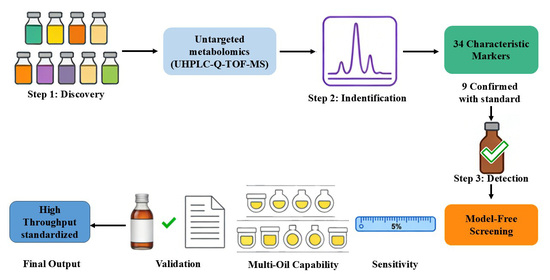
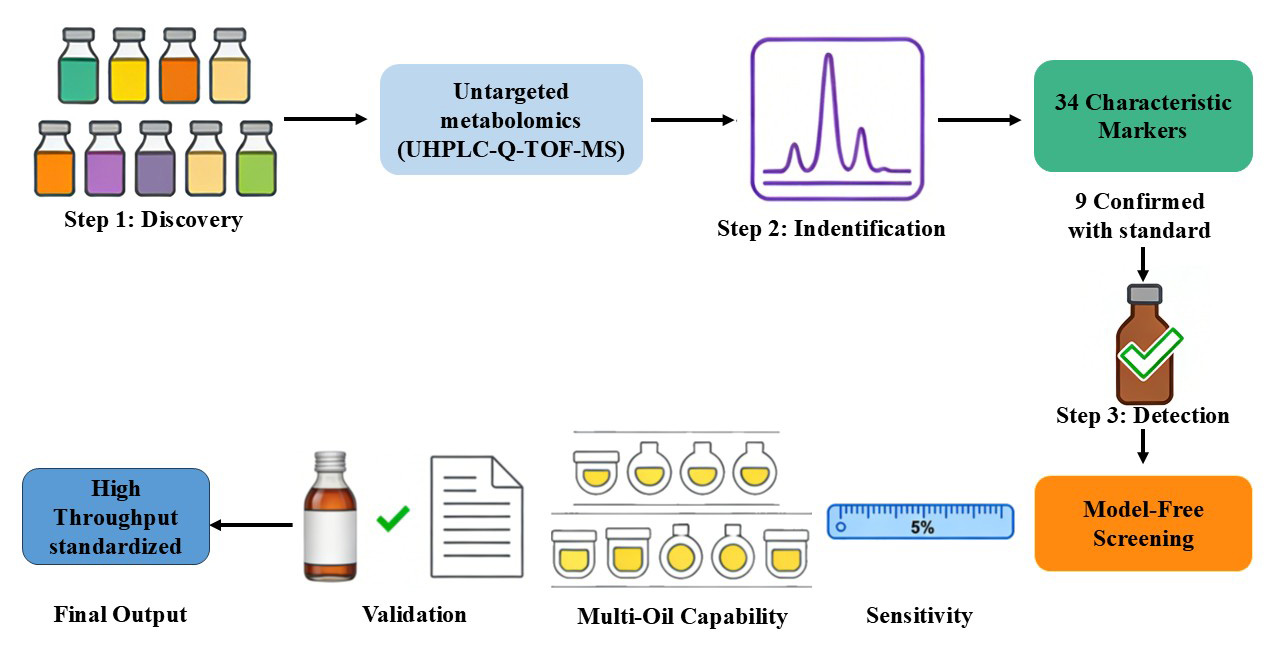
Graphical Abstract

1. Introduction

Edible oils play a critical role in maintaining human health, serving as a primary source of essential fatty acids for the human body. Different types of edible vegetable oils vary significantly in production technology and nutritional value, leading to a wide range of prices. High-value vegetable oils, especially olive oil and camellia oil, have attracted considerable attention due to their exceptional nutritional and bioactive properties. These oils possess anti-inflammatory and antioxidant properties [1], believed to offer protection against various diseases such as cardiovascular disease [2], cancer [3,4], diabetes [5], Alzheimer’s disease [6] and osteoporosis [7]. Additionally, research has explored their potential influence on coronavirus and COVID-19 [8,9]. The pursuit of substantial profits has resulted in adulteration, and olive oil and camellia oil are the most commonly adulterated products in the global market [10]. To enable comprehensive detection of such adulteration, this study developed a marker library covering not only these two high-value oils but also seven other commonly used vegetable oils (soybean, sunflower, rapeseed, peanut, sesame, flaxseed, and industrial hemp (Cannabis sativa L.) seed oils), which are frequently involved in adulteration practices. Common adulteration practices include blending olive oil with cheaper oils such as sunflower, soybean, or rapeseed oil, which not only deceives consumers but may also introduce allergens or reduce nutritional quality. Adulterations with inferior or cheap seed and nut oils [11] not only disrupt market integrity but also pose risks to consumer health. It may even cause severe allergic reactions and even death [12,13]. Regulators, food businesses and consumers are increasingly concerned about the transparency and trustworthiness of the global food supply chain, especially the authenticity of vegetable oils. Effective regulation plays a crucial role in ensuring fair competition and safeguarding consumer rights within the food market. Consequently, there is an urgent need to develop advanced analytical methodologies capable of verifying oil authenticity and detecting adulteration with high specificity and sensitivity.
Currently, research methods for authenticating high-value edible oils can be broadly categorized into three main types, each presenting specific limitations that constrain their effectiveness against complex, multivariate adulteration. The first category involves biotechnological methods, notably DNA-based techniques [14,15]. Despite high specificity, their application is limited for refined oils due to challenges such as low DNA content and degradation [14]. Moreover, these methods cannot determine the type or proportion of adulterant oils present. The second, and most widely studied, category is fingerprint-based detection. This encompasses a range of techniques including electronic nose (e-nose) [16,17], GC/GC-MS [18,19], LC-MS [20,21], differential scanning calorimetry (DSC) [22], ion mobility spectrometry (IMS) [23], NIR/MIR spectroscopy [24,25], Raman spectroscopy [26,27], NMR [28,29] and fluorescence spectroscopy [30,31]. These methods are typically coupled with chemometrics (e.g., PCA, PLS-DA) to build classification models. They can be subdivided into targeted approaches, which focus on known markers like triacylglycerides (TAG) [32] but may miss unknown components, and untargeted approaches, which have become increasingly prominent in food authenticity research, accounting for over 80% of related publications in recent years [33]. A fundamental constraint of all fingerprint-based methods is their dependence on statistical models, which require large, representative sample sets for training and are sensitive to variability from factors such as geographical origin, cultivar, processing, and measurement conditions. This sensitivity often undermines model robustness, posing significant challenges for official validation and routine deployment. The third approach utilizes characteristic biomarkers [34,35]. Metabolomics advances have enabled the discovery of novel, oil-specific markers, offering a promising direct detection pathway [34,35]. However, identifying reliable markers for all oil types remains difficult [36], and the simultaneous detection of multiple markers for different potential adulterants introduces practical complexity. Additionally, novel rapid screening tools (e.g., handheld spectrometers, biosensors), while advantageous for speed and portability, frequently lack the specificity needed for multi-adulterant scenarios and often still rely on calibration models vulnerable to sample matrix effects. In summary, existing methods face considerable challenges in accurately detecting sophisticated adulteration involving multiple oils. There is a clear and urgent need for a high-throughput, specific, and practically robust strategy that reduces reliance on unstable calibration models.
To address this gap, our study introduces a model-free screening framework grounded in untargeted metabolomics. While MS-based metabolomics has advanced oil authentication [37,38], many current implementations remain model-dependent. Our strategy is distinct: multivariate analyses (e.g., PCA, PLS-DA) are employed solely during the initial discovery phase to establish a stable, predefined library of characteristic markers. Subsequent detection bypasses the need for ongoing model recalibration, relying exclusively on confirmatory analysis against this library. Utilizing UHPLC-Q-TOF-MS, we constructed the first comprehensive marker library for nine high-value vegetable oils—olive, camellia, sesame, sunflower, soybean, rapeseed, peanut, flaxseed, and industrial hemp seed oil. This library comprises 34 characteristic markers, with 24 characterized and 9 confirmed by authentic standards. It also serves to systematically validate the role of specific compounds, such as hydroxytyrosol, as authenticity markers for particular oils—a relationship not previously rigorously established. The primary objectives of this work are: (1) to establish this comprehensive marker library using untargeted metabolomics; (2) to develop a high-throughput, model-free detection strategy capable of identifying both single- and multi-component adulterations at levels as low as 5%; and (3) to validate the method’s practical applicability through the analysis of commercial olive and camellia oils. Beyond methodological innovation, this study assesses the prevalence of adulteration in the marketplace, providing a standardized and reliable tool for large-scale surveillance. This approach effectively bridges the gap between discovery-based omics and routine regulatory practice, thereby supporting the integrity of the edible oil supply chain and safeguarding consumer interests.

2. Materials and Methods

2.1. Materials and Reagents

To ensure accurate results, 89 samples representing 9 different types of 100% pure vegetable oils were sourced from a wide range of reputable and reliable suppliers. These oils consist of 13 extra virgin olive oil, 15 camellia oil, 10 sesame oil, 9 rapeseed oil, 8 flaxseed oil, 8 soybean oil, 10 peanut oil, 8 industrial hemp (Cannabis sativa L.) seed oil and 8 sunflower seed oil. Detailed information on each sample, including oil type, processing method, grade origin and source, was provided in Supplementary Table S1. They were used to develop and validate the method. The selected pure oil samples were sourced from multiple suppliers across different geographical regions (e.g., China, Mediterranean countries, Central Asia countrie) and included various processing grades (e.g., extra virgin, pressed, leached) to capture inherent variations in cultivar, geography and production methods. 80 commercial products (25 olive oil, 55 camellia oil) were purchased to test the method. Samples were stored at a temperature of 4 ± 4 °C until analysis. To enhance representativeness, the pure oil samples were procured from diverse suppliers across multiple geographical regions to capture inherent variations in cultivar, harvest year, and processing methods. Although the sample size per oil type (8–15) is limited, the high peak height threshold (>8000 counts) prioritized abundant and consistent ions, minimizing biological variations. This approach prioritizes chemical features that are stable across minor biological and technical variations, thereby increasing the likelihood that the identified markers are representative of the oil type rather than specific batches. Future studies will expand to 20–30 samples per type for broader validation.
Sesamolin (purity: 99.10%, CAS: 526-07-8) and hydroxytyrosol (purity: 99.32%, CAS: 10597-60-1) were purchased from the Hong Kong Institute of Standard Substance (Hongkong, China). Sesamin (purity: 99.9%, CAS: 607-80-7) and diosmetin (purity: 95.7%, CAS: 520-34-3) were purchased by the National Institutes for Food and Drug Control (Beijing, China). Apigenin (purity: 98.5%, CAS: 520-36-5) was purchased from ANPEL-TRACE Standard Technical Services Co., LTD. (Shanghai, China). Hydroxytyrosol acetate (purity: 98%, CAS: 69039-02-7) and 4′,7-dimethoxyisoflavone (purity ≥ 98%, CAS: 1157-39-7) were purchased from the Shanghai Yuanye Biotechnology Co., LTD. (Shanghai, China). Delta-9-tetrahydrocannabinolic acid (100 mg/L, CAS: 23978-85-0) was obtained from Alta scientific Co., LTD. (Tianjin, China). Sativanone (purity ≥ 98%, CAS: 70561-31-8) was purchased from the Hubei Cuiyuan Biotechnology Co., Ltd. (Wuhan, China).
Analytical grade ammonium acetate (98% purity) was purchased from Sinoparm Chemical Reagent Co., Ltd. (Shanghai, China). HPLC grade methanol (99.9% purity) was purchased from Merck KGaA (Shanghai, China). HPLC grade formic acid was supplied by Shanghai Aladdin Biochemical Technology Co., Ltd. (Shanghai, China). Ultrapure water was purified by Milli-Q Integral 3 Water Purification System (Merck Millipore, Molsheim, France).

2.2. Preparation of Standard Solutions

Mixed standard solution (500 mg/L) of sesamolin, hydroxytyrosol, sesamin, apigenin, diosmetin, hydroxytyrosol acetate, delta-9-tetrahydrocannabinolic acid, sativanone and 4′,7-dimethoxyisoflavone was prepared in methanol and stored at a temperature of −18 °C. It was then diluted with methanol to prepare a series of standard working solution with concentrations ranging from 0.5 to 10 mg/L.

2.3. UHPLC/Q-TOF MS Analysis

Following the sample preparation described in Section 2.4, the analysis of vegetable oil samples was carried out with an Agilent 1290 ultra-high performance liquid chromatography (Waldbronn, Germany) coupled with an Agilent electrospray ionization and quadrupole time-of-flight mass spectrometry (Yishun, Singapore). The chromatographic separation was performed on an Agilent SB-C18 RRHD (2.1 mm × 100 mm, 1.8 μm) (Wilmington, DE, USA) maintained at a temperature of 40 °C. The mobile phase was consisted of 0.005 mol/L ammonium acetate buffer with 0.1% formic acid (v/v, solvent A) and methanol (solvent B). The flow rate was set at 0.3 mL/min. The injection volume was 2 μL. Gradient elution was programmed as follows: 0–5.00 min, 20–100% B; 5.00–6.00 min, 100% B; 6.01–10.00 min, 20% B.
Mass spectrometry analysis was performed separately in positive electrospray ionization mode (ESI+) and negative electrospray ionization (ESI) mode using the following parameters: capillary voltage, 3500 V; nebulizer gas pressure, 2.41 × 10⁵ Pa; drying gas flow rate, 8 L/min; drying gas temperature, 320 °C; sheath gas flow rate, 11 L/min; sheath gas temperature, 350 °C; fragmentor voltage, 120 V; the internal reference mass, purine with m/z of 121.0509 (C5H5N4+) and HP-921 with m/z of 922.009 8 (C18H19O6N3P3F24+) in positive mode, mass spectra were recorded in the range of m/z 100–1000. Trifluoroacetic acid anion with m/z of 112.985 5 (C2O2F3) and trifluoroacetic acid anion adduct with m/z of 1 033.988 1 (C20H18O8N3P3F27) in negative mode, Mass spectra were recorded in the range of m/z 100–1100. Collision energy values of 10, 20 and 40 V were, respectively, used under target MS/MS mode.
Unless stated otherwise, the data recorded and analyzed were respectively processed using MassHunter workstation software version 10.1 and version B.08.00, developed by Agilent Technologies, Inc. (Santa Clara, CA, USA).

2.4. Sample Preparation

A 2.0 g of sample was weighed into a 20 mL centrifuge tube. The samples were then mixed and extracted thoroughly with 4 mL methanol for 3 min (Troemner, LLC, Thorofare, NJ, USA). After allowing the mixture to stand for 2 min, it was centrifuged at 10,000× g revolutions per minute for 5 min (Thermo Fisher, Osterode am Harz, Germany). The supernatant was transferred into a 10 mL volumetric flask, and the residue was extracted again with 4 mL of methanol. The combined supernatants were then diluted to a final volume of 10 mL with methanol. Prior to analysis, the extract was filtered through a 0.22 μm nylon filter.

2.5. Methodological Focus: Qualitative Screening

The primary objective of this analytical strategy is qualitative detection and semi-quantitative estimation of vegetable oil adulteration. It is designed to answer two key questions for regulatory screening: (1) Is the target oil adulterated? (2) If yes, is the adulteration at a low or high level? Consequently, method validation emphasizes the detection limit for adulteration, marker specificity, and the consistency of detection in real-world sample matrices, rather than the determination of classical analytical figures of merit (e.g., LOD/LOQ for individual compounds) which are more relevant to quantitative assays. For adulteration detection, a sample is flagged as potentially adulterated if one or more characteristic markers of an oil other than the declared one are detected above the validated signal threshold.

2.6. Data Analysis

Data analysis was performed using the MassHunter Qualitative Analysis Workflows (Version B.08.00) to extract molecular features from the untargeted metabolomic profiles acquired in both positive and negative ionization modes via UHPLC-Q-TOF-MS. To ensure robustness and minimize interference from biological or geographical variations, a peak height threshold of >8000 counts was applied. This threshold was empirically determined through repeated analyses of representative samples to achieve a high signal-to-noise ratio and consistent detectability across batches. Notably, this level ensures that even if a target compound is present at a 1% adulteration level, its signal response would remain above approximately 80 counts, thereby maintaining reliable detectability despite potential reductions due to origin, refining, or processing variations. In our assessment, applying this threshold reduced noise-related features by approximately 40% while retaining >95% of reproducible peaks across replicates, thereby enhancing marker reliability without significantly compromising feature coverage. Due to the high dimensionality of the data and the uneven sample distribution across the nine oil types, constructing a unified multiclass classification model was impractical. Therefore, a ternary comparison strategy was adopted, using olive oil as a fixed reference in combination with two other oils. All 28 possible ternary datasets were evaluated, and the four models exhibiting the highest discrimination accuracy (designated as Groups I–IV; see Supplementary Table S2) were selected for marker discovery. The filtered data were then imported into Mass Profiler Professional (v.15.0) for statistical analysis, which included data filtration, analysis of variance (ANOVA), principal component analysis (PCA), and the Find Unique Entities (FUE) algorithm. PCA, as an unsupervised method, was used to visualize patterns and assess sample clustering, while partial least squares discriminant analysis (PLS-DA)—a supervised approach—was subsequently applied to better correlate spectral data with oil type labels, thereby enhancing the identification of discriminative markers.

2.7. Screening and Identification of Characteristic Markers

Characteristic markers were selected based on their consistent presence in all samples of a specific oil type. It is also required not to be present in other oils or the extraction solvent. Marker identification was performed using MassHunter Professional software (version B.08.00). High-resolution MS/MS spectra were matched against the METLIN metabolomics database and the Traditional Chinese Medicine (TCM) database and Chemspider (https://www.chemspider.com/), supplemented by literature references. Identification required mass accuracy < 5 ppm. Retention time deviations were limited to ±0.2 min. Confirmatory analysis using reference standards was performed by comparing retention time, MS, and MS/MS spectra. For markers without reference standards, molecular formulas were predicted based on observed m/z, adducts, isotopic patterns, and fragmentation data. Although these tentatively identified markers showed high specificity and consistency in our screening, definitive structural confirmation would require complementary techniques such as nuclear magnetic resonance (NMR), high-resolution tandem MS, or isolation followed by spectroscopic analysis, which could be pursued in future studies.

2.8. Method Validation and Actual Sample Detection

To evaluate the robustness, sensitivity, and selectivity of the characteristic markers across diverse sample matrices, binary and multicomponent oil blends were prepared. A randomly selected pure oil sample from each of the nine types was used for validation. Binary adulterated samples were created by mixing olive oil with another vegetable oil at 5%, 30%, and 70% (m/m) (see Supplementary Table S3). Furthermore, a multicomponent blend containing olive oil and the other eight oil types—each at a 5% (m/m) adulteration level—was also prepared. Similarly, binary and multicomponent blends using camellia oil as the base were constructed (see Supplemental Table S4). All samples were analyzed in duplicate.
The Qualitative Analysis Navigator (Version B.08.00) was employed to generate extracted ion chromatograms (EIC) of the markers, and their detection capability for adulteration was systematically evaluated. Specificity was verified by analyzing pure oil samples to confirm the absence of cross-reactivity among markers. Beyond qualitative screening, quantitative validation was conducted: the limit of detection (LOD) for key markers was determined using a dilution series, confirming a conservative detection threshold of 5% with a signal-to-noise ratio > 3. Linearity (R2 > 0.95) and matrix effects were assessed in binary blends, ensuring the method’s robustness for semi-quantitative estimation. The validated method was subsequently applied to assess the authenticity of commercially available olive oil and camellia oil.

3. Results

3.1. Chromatographic Conditions Optimization

Efficient separation and high sensitivity are crucial for untargeted metabolomic profiling. Given the polarity range of the oil extracts, an Agilent SB-C18 RRHD column (2.1 mm × 100 mm, 1.8 μm) was employed with methanol as the organic phase. The composition of the mobile phase was further examined. It was found that peak shape improved with the addition of formic acid for positive mode and ammonium acetate for negative mode (see Supplemental Figure S1). Therefore, methanol—0.005 mol/L ammonium acetate buffer with 0.1% formic acid (v/v) was selected as the mobile phase system. Gradient elution was used to maximize the separation and elution of compounds in the samples and reduce analysis time (see Supplementary Table S5) [39].

3.2. Multivariate Analysis of Marker Discrimination Power and Identification of Characteristic Markers

Untargeted metabolomics using UHPLC-Q-TOF-MS was employed to gather comprehensive metabolic profiles from vegetable oils in both positive and negative ionization modes. Given the high dimensionality and imbalanced sample distribution across the nine oil types, a unified multiclass model was not feasible. Instead, a ternary comparison strategy was adopted, with olive oil serving as the fixed reference. All 28 possible ternary datasets were evaluated, and the four models exhibiting the highest discrimination accuracy (Groups I–IV; see Supplemental Table S5) were selected for further analysis.
To identify discriminatory metabolites, high-accuracy Q-TOF-MS data were processed through the Find Unique Entities (FUE) algorithm following ANOVA and fold change analysis (p < 0.05, FC > 2). The Venn diagram (Figure 1) illustrates the intergroup differences in metabolite content across the ternary models, highlighting hundreds of differentially expressed compounds. These differential compounds were then subjected to unsupervised principal component analysis (PCA) and supervised partial least squares discriminant analysis (PLS-DA).
As shown in the three-dimensional PCA plot (Supplementary Figure S2), clear differentiation was observed between olive oil and other oils (e.g., camellia, sesame, and rapeseed oils), indicating significant metabolic differences. Some intra-type variability was noted. PLS-DA results further validated these distinctions: Groups II and IV achieved 100% classification accuracy in both ionization modes, while Groups I and III also showed high accuracy (>98%), with minor deviations attributed to single atypical samples (Table 1 and Supplementary Figure S3). The complementary 100% accuracy in alternate ionization modes underscores the importance of ionization mode selection in analytical optimization.
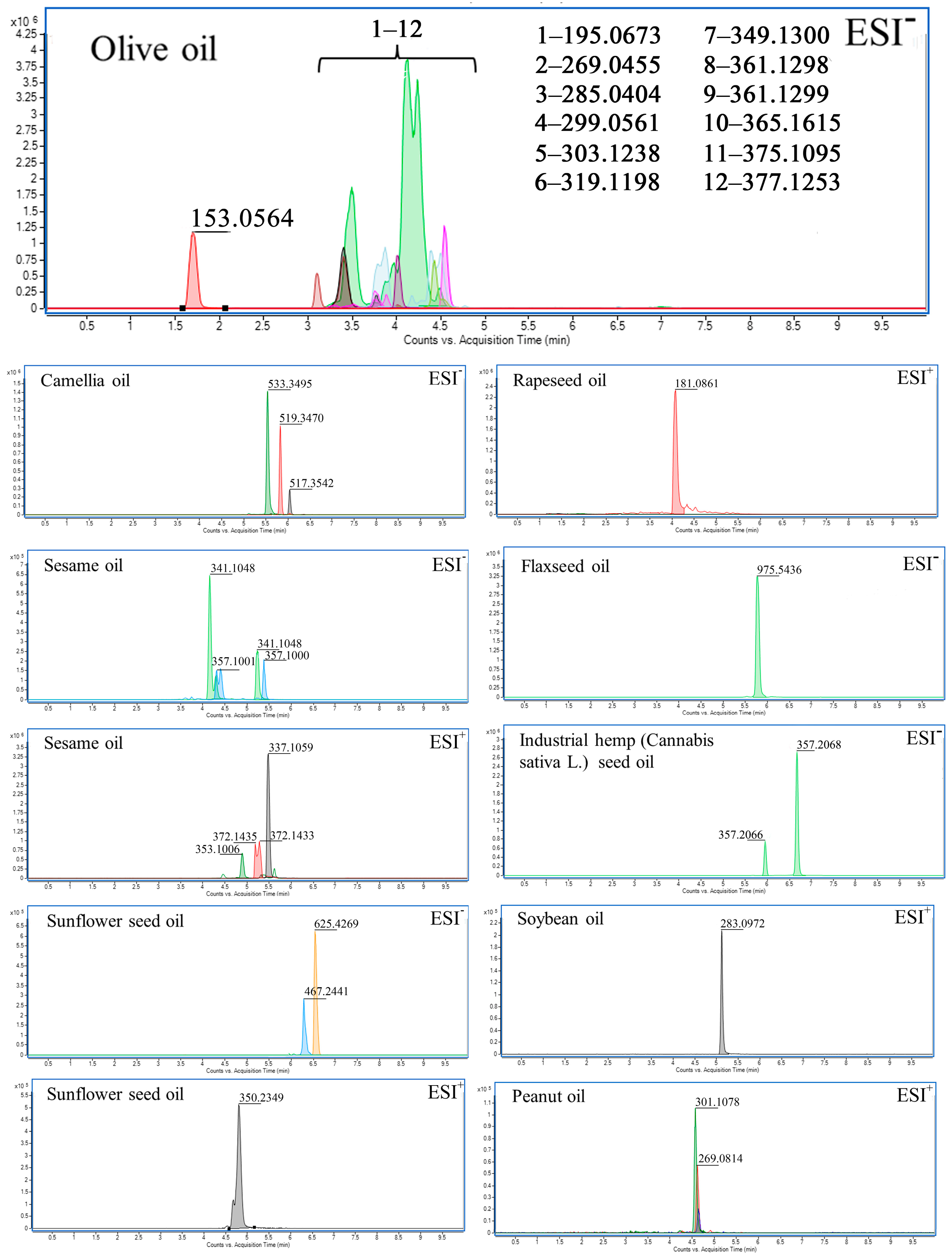
Candidate markers were further prioritized based on PCA loadings and PLS-DA Variable Importance in Projection (VIP) scores, followed by stringent manual verification for specificity and consistency. From the extensive pool of differential compounds, 34 were ultimately selected as characteristic markers across the nine oil types (Figure 2; see also Table 2 for detailed information). These markers are uniquely present in specific oils and absent in others, with 9 confirmed using reference standards, 15 matched against the METLIN metabolomics database, and 10 remaining as unconfirmed candidates for future research (Table 2 and Supplemental Figure S2). For these ten unconfirmed markers, structural proposals are currently based on spectral matching and fragmentation patterns. Definitive identification and specific naming would require further purification and structural elucidation via techniques such as NMR spectroscopy or chemical synthesis, which are planned as part of ongoing research.
A total of 13 characteristic markers were identified in olive oil. Notably, secoiridoid derivatives of hydroxytyrosol and tyrosol were found in olive oil mainly in the forms of 3,4-DHPEA–EDA (oleacein) and p-HPEA-EDA (oleocanthal), as well as 3,4-DHPEA-EA (oleuropein aglycon) and p-HPEA-EA (ligstroside aglycon). Furthermore, apigenin, luteolin, and diosmetin were also pinpointed as characteristic markers of olive oil. Three markers, namely camelliagenin A, camelliagenin B, and basic sapogenin of oleiferasaponin B2 all exhibited as adducts of [M+HCOO], were identified in camellia oil. Among the 8 characteristic markers for sesame oil, sesamin and sesamolin were detected as adducts of [M−H2O+H]+. One characteristic marker, propyl 2-furanacrylate, was identified in rapeseed oil. Cannabidiolic acid and tetrahydrocannabinolic acid were confirmed as characteristic markers in industrial hemp (Cannabis sativa L.) seed oil [40,41]. Comparative analysis of spectral data from five isomeric dimethoxyflavonoids using authentic standards led to the unambiguous identification of 4′,7-dimethoxyisoflavone as a novel authenticity marker for soybean oil. Additionally, diterpenoids and prenylated catechol dimers such as Cavipetin D and Peltatol A were identified in sunflower seed oil, while formononetin and sativanone were detected as characteristic markers in peanut oil.

3.3. Method Verification

To evaluate the method’s qualitative detection capability, sensitivity, and robustness against matrix effects, binary and multi-component oil blends simulating various adulteration scenarios were prepared and analyzed (see Supplementary Tables S2 and S3). Specificity and matrix tolerance were confirmed as all 34 characteristic markers were consistently detected in their respective oils across all blend matrices, indicating no significant interference from co-existing oil components.
The method demonstrated stable qualitative detection with a practical screening sensitivity of 5% (w/w) adulteration for both single and multivariate adulterants, a threshold at which all 34 characteristic markers were consistently and reliably detected in their respective oil matrices. To further contextualize this conservative benchmark, a dilution series of olive oil adulterated with soybean oil was analyzed. The characteristic soybean oil marker (m/z 283.0970) could be detected down to the 3% level and intermittently at 2%. This result confirms that the established 5% threshold is not the absolute detection limit of the instrumentation but a robust and practical limit chosen for routine screening, ensuring high reliability and a sufficient safety margin across all targeted markers. This also reflects the inherent variation in detection sensitivity among individual markers.
Although designed primarily for qualitative (yes/no) detection, the method also enables semi-quantitative ranking of adulteration severity. Strong linear correlations (R2 > 0.95 in most cases) were observed between marker peak intensities and adulterant proportions in binary blends (Supplementary Table S6). This linear relationship allows for the discrimination between low (~5%), medium (~30%), and high (>50%) levels of adulteration based on relative signal strength. Method repeatability was verified through duplicate analyses of all validation blends, with characteristic markers detected in all replicates.
To further quantify screening reliability, false positive and false negative rates were estimated from these validation data. At the 5% (w/w) adulteration level, no false negatives were observed for blends where the adulterant oil contributed a confirmed characteristic marker. Across all tested pure oil samples (n = 89), no false positives (i.e., detection of an adulterant marker in a pure sample) occurred. The interpretation of cases where characteristic markers for the declared oil are absent requires careful consideration: the absence of all markers, particularly stable ones (e.g., sesamin), strongly indicates non-authenticity. In contrast, the absence of only heat-sensitive markers (e.g., certain olive oil phenolics) may be attributed to severe refining of an authentic product.

3.4. Actual Sample Detection

To further verify the feasibility and reliability of the method, it was applied to 25 commercial olive oil samples and 55 camellia oil samples. The results indicated that one olive oil sample (4%) did not show any characteristic markers for olive oil but instead revealed markers for soybean oil. Among the remaining 24 olive oil samples, characteristic markers for olive oil were identified, with soybean oil markers also detected in three of these samples (12.0%).
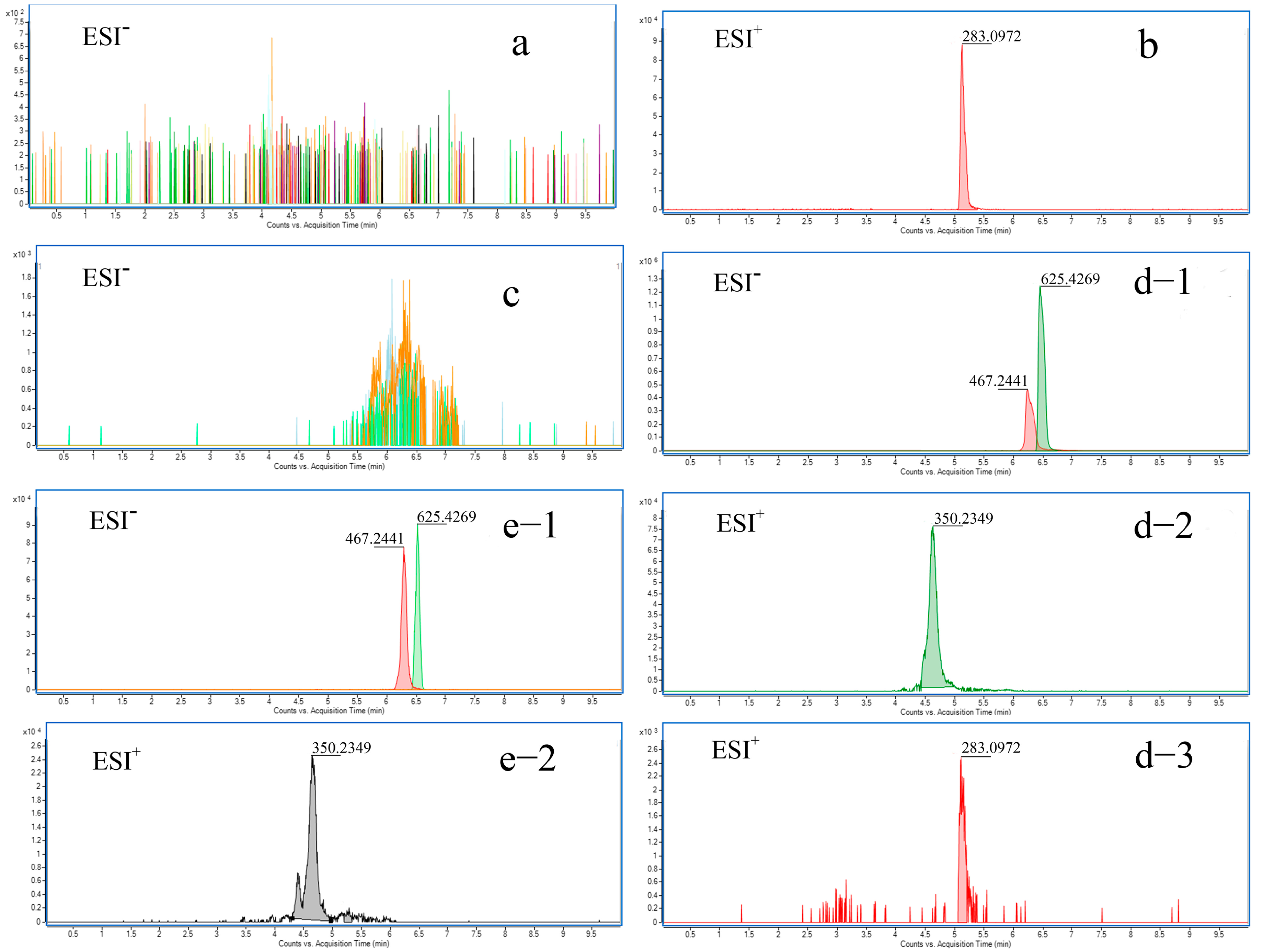
None of the 34 characteristic markers were detected in two camellia oil samples. In commercial sample analysis, the absence of characteristic camellia oil markers (e.g., camelliasaponins) in samples labeled as camellia oil indicates potential adulteration, as these markers were consistently detected in all pure camellia oil references. This approach allows for rapid screening without reliance on quantitative thresholds. The remaining camellia oil samples displayed characteristic markers for camellia oil. However, four samples (7.3%) also contained soybean oil markers, one (1.8%) contained sunflower seed oil markers, and two (3.6%) showed markers for both sunflower and soybean oils. Typical chromatograms of adulterated oils are presented in Figure 3. Notably, the developed method successfully identified two batches of soybean oil-adulterated camellia oil, demonstrating complete concordance with regulatory findings.

4. Discussion

The adulteration of high-value oils remains a significant challenge for food authenticity. This study successfully addresses this issue by establishing a comprehensive, model-free marker library for nine vegetable oils using untargeted metabolomics. The core innovation lies in the transition from model-dependent to marker-dependent screening, which enhances practicality for routine regulatory use.
Our method demonstrates significant advantages over existing approaches. Compared to traditional fingerprint-based methods like GC-MS coupled with PCA/PLS-DA [42], which require large, representative sample sets for model training and are sensitive to biological and technical variations, our marker-based strategy eliminates the need for ongoing model recalibration. The predefined library of 34 characteristic markers offers a stable and transferable screening tool. While targeted methods using specific compounds (e.g., squalene, tocopherols) can achieve high sensitivity, they are often limited to detecting adulteration with one or a few specific oil types [4,34]. In contrast, our unified platform simultaneously screens for nine oils, including complex multi-adulterant scenarios, with a detection limit (5%) comparable to or better than many reported LC-Q-TOF and NMR methods [28,29]. Furthermore, unlike DNA-based techniques that struggle with low DNA content in refined oils [14,43], our metabolite-based markers proved detectable in most commercially processed oil samples, as evidenced by the successful analysis of market samples.
The practical utility of the method was validated through the analysis of 80 commercial oils, revealing adulteration in 12.7% of camellia oils and 16.0% of olive oils. The detection of soybean and sunflower oil markers in camellia oil samples highlights the prevalence of blending with lower-value oils. The complete agreement of our results with regulatory findings for specific adulterated batches underscores the method’s reliability for enforcement applications.
The characteristic markers were selected based on their consistent presence (100% detection rate) across all discovery samples of a given oil type, which included variations in supplier, geographical origin, and processing method (as detailed in Section 2.1 and Supplementary Table S1). This preliminary evidence suggests that these markers are stable across the range of variances represented in our study.
However, we acknowledge that the current sample size (8–15 per oil type) limits our ability to definitively conclude stability across all possible global variations in cultivar, agronomic practice, or extreme processing conditions. To substantiate robustness and transferability for global surveillance, future work will involve expanding the validated reference sample set to 20–30 samples per oil type, explicitly stratified by major cultivar, geographic origin, and processing method. A systematic stability study will then quantify marker detection rates under these controlled variations, allowing for the establishment of confidence intervals for each marker and potentially enabling the derivation of compound-specific limits of detection (LODs). Such refinement would provide a more granular sensitivity profile, while the current uniform 5% threshold remains a robust and practical benchmark for qualitative screening. Although the ternary comparison strategy and stringent signal threshold (>8000 counts) were designed to prioritize stable and abundant ions, thereby mitigating some effects of biological variation, the universal applicability of these markers requires further validation. Future work should involve a larger and more geographically diverse sample set, encompassing oils from different cultivars, harvest years, and, critically, varying processing grades (e.g., refined, cold-pressed, extra virgin).
The impact of processing, particularly harsh refining (bleaching, deodorization), on marker detectability requires careful consideration. Based on chemical class, markers can be tentatively categorized by vulnerability: (1) Heat-/Process-sensitive markers: Primarily phenolic compounds (e.g., hydroxytyrosol, oleacein in olive oil) and some volatile glycosides. These may be degraded or removed during refining. (2) Stable markers: Include lipophilic compounds, sapogenins (e.g., camelliasaponins), lignans (e.g., sesamin, sesamolin), and cannabinoids, which are more resistant to thermal processing. Highly refined oils or those subjected to severe thermal processing may degrade or alter marker compounds, posing a challenge to detection [38]. Investigating the stability of these markers across different processing conditions and storage periods will be essential for strengthening the method’s robustness across real-world supply chains. While many identified markers (e.g., sesamin, cannabinoids, sapogenins) are relatively stable, markers such as phenolic compounds in olive oil could be partially degraded during harsh refining. Therefore, the present method is most reliable for detecting adulteration in minimally processed or cold-pressed oils. For heavily refined oils, validation with refined reference samples is recommended, and future work should expand the marker library to include refining-resistant compounds.
In practical application, our screening protocol is designed for high-throughput flagging. Given the high specificity of the identified markers, the detection of even a single characteristic marker from a potential adulterant oil is considered sufficient to signal possible adulteration and trigger further investigation. A key challenge in screening is distinguishing a heavily refined authentic oil from a fraudulently substituted one when characteristic markers for the declared oil are absent. To address this ambiguity, we propose a tiered interpretive strategy: First, verify the presence of stable markers specific to the declared oil. Second, if these are absent, screen for markers of other oils, as their presence would confirm adulteration. Finally, if no markers from any of the nine oils are detected, the sample result should be considered inconclusive by this method and subjected to complementary analytical techniques (e.g., fatty acid profiling, DNA analysis) or a review of its processing history before a definitive authenticity judgment is made.
Beyond validation, translating this research into even more accessible tools represents a promising direction. Future work could focus on developing low-cost, field-deployable assays based on key markers, such as lateral flow strips or portable spectroscopic methods calibrated against the core marker library. This would bridge the gap further between high-resolution laboratory confirmation and rapid on-site screening, offering a complete solution for food fraud surveillance.

5. Conclusions

In conclusion, this study developed and validated a novel, high-throughput strategy for detecting adulteration in vegetable oils. By utilizing UHPLC-Q-TOF-MS-based untargeted metabolomics, we established the first comprehensive library of 34 characteristic markers for nine high-value and commonly adulterated oils. The method enables reliable, model-free screening for both single and multivariate adulteration at levels as low as 5% (w/w). Successful application to commercial samples confirmed its practical utility and revealed significant adulteration in the market. This work provides a standardized, robust, and scalable tool that effectively bridges discovery-based omics research with the needs of routine regulatory enforcement, supporting the integrity of the global edible oil supply chain.

Supplementary Materials

The following supporting information can be downloaded at: https://www.mdpi.com/article/10.3390/pr14030576/s1, Figure S1: Total ion chromatogram of the same compound in the mobile phase system of a (methanol-0.005 mol/L ammonium acetate buffer with 0.1% formic acid (v:v, 20:80)) and b (methanol-water (v:v, 20:80)); Figure S2: Fragment ion mirror images of characteristic substances and standard substances in the samples; Figure S3: Secondary mass spectra of five flavonoid isomers, soybean oil, and a mixture of Camellia oil with soybean oil, all acquired at the same retention time; Table S1: Information of 89 samples of 9 types of pure vegetable oil; Table S2: 9 types of pure vegetable oil divided into 4 groups model; Table S3: Evaluation experiment of targeted metabolomics model of olive oil adulteration; Table S4: Evaluation experiment of targeted metabolomics model of camellia oil adulteration; Table S5: The number of compounds in olive oil and camellia oil obtained by isoelution and gradient elution; Table S6: Preparation and validation of binary and multicomponent adulterated olive oil samples for method development.

Author Contributions

H.W.: Conceptualization, Funding acquisition, Investigation, Methodology, Supervision, Validation, Writing—original draft, Writing—review & editing. X.C.: Funding acquisition, Investigation, Methodology, Writing—original draft, Writing—review & editing. Y.Z.: Conceptualization, Methodology, Writing—original draft, Writing—review & editing. L.W.: Validation. L.H.: Writing—review & editing. N.D.: Writing—original draft. J.Q.: Investigation, Supervision. F.Z.: Investigation, Supervision. B.L.: Investigation, Supervision. F.X.: Writing—original draft. D.R.: Writing—review & editing. L.L.: Methodology. P.Z.: Writing—original draft. All authors have read and agreed to the published version of the manuscript.

Funding

This work was supported by the Science and Technology Project of Administration for Market Regulation of Hunan Province (China) (2024KJJH32, KJJH202545) and the Hunan Provincial Natural Science Foundation of China (2026JJ80821).

Data Availability Statement

The original contributions presented in this study are included in the article/Supplementary Material. Further inquiries can be directed to the corresponding authors.

Conflicts of Interest

Author Lei Lv was employed by the company Agilent Technologies Co., Ltd. (China). The remaining authors declare that the research was conducted in the absence of any commercial or financial relationships that could be construed as a potential conflict of interest.

References

  1. Gaforio, J.; Visioli, F.; Alarcón-de-la-lastra, C.; Castañer, O.; Delgado-Rodríguez, R.; Fitó, M.; Hernández, A.F.; Huertas, J.R.; Martínez-González, M.A.; Menendez, J.A.; et al. Virgin olive oil and health: Summary of the iii international conference on virgin olive oil and health consensus report, Jaen (Spain) 2018. Nutrients 2019, 11, 2039. [Google Scholar] [CrossRef] [PubMed]
  2. Christopoulou, N.; Mamoulaki, V.; Mitsiakou, A.; Samolada, E.; Kalogianni, D.P.; Christopoulos, T. Screening method for the visual discrimination of olive oil from other vegetable oils by a multispecies DNA sensor. Anal. Chem. 2024, 96, 1803–1811. [Google Scholar] [CrossRef]
  3. Caruso, C.; Markellos, C.; Ourailidou, M.; Gavriatopoulou, M.; Halvatsiotis, P.; Sergentanis, T.N.; Psaltopoulou, T. Olive oil intake and cancer risk: A systematic review and meta-analysis. PLoS ONE 2022, 17, e0261649. [Google Scholar] [CrossRef]
  4. Li, Z.; Liu, A.; Du, Q.; Zhu, W.; Liu, H.; Naeem, A.; Guan, Y.; Chen, L.; Ming, L. Bioactive substances and therapeutic potential of camellia oil: An overview. Food Biosci. 2022, 49, 101855. [Google Scholar] [CrossRef]
  5. Huang, L.; Wang, M.; Liu, H. Identification of adulterated extra virgin olive oil by colorimetric sensor array. Food Anal. Methods 2021, 15, 647–657. [Google Scholar] [CrossRef]
  6. Román, G.; Jackson, R.; Reis, J.; Román, A.; Toledo, J.; Toledo, E. Extra-virgin olive oil for potential prevention of alzheimer disease. Rev. Neurol. 2019, 175, 705–723. [Google Scholar] [CrossRef]
  7. Melguizo, R.; Manzano, M.; Illescas, M.; Ramos, T.; Luna, B.; Ruiz, C.; García, M. Bone protective effect of extra-virgin olive oil phenolic compounds by modulating osteoblast gene expression. Nutrients 2019, 11, 1722. [Google Scholar] [CrossRef] [PubMed]
  8. Majumder, D.; Debnath, M.; Sharma, K.; Shekhawat, S.; Prasad, G.; Maiti, D.; Ramakrishna, S. Olive oil consumption can prevent non-communicable diseases and COVID-19: A review. Curr. Pharm. Biotechnol. 2022, 23, 261–275. [Google Scholar] [CrossRef]
  9. Romeo, A.; Iacovelli, F.; Scagnolari, C.; Scordio, M.; Frasca, F.; Condo, R.; Ammendola, S.; Gaziano, R.; Anselmi, M.; Divizia, M.; et al. Potential use of tea tree oil as a disinfectant agent against coronaviruses: A combined experimental and simulation study. Molecules 2022, 27, 3786. [Google Scholar] [CrossRef]
  10. Ozcan-Sinir, G. Detection of adulteration in extra virgin olive oil by selected ion flow tube mass spectrometry (SIFT-MS) and chemometrics. Food Control 2020, 118, 107433. [Google Scholar] [CrossRef]
  11. Wang, Y.; Hua, L.; Fu, Q.; Wu, C.; Zhang, C.; Li, H.; Xu, G.; Ni, Q.; Zhang, Y. Rapid identification of adulteration in extra virgin olive oil via dynamic headspace sampling and high-pressure photoionization time-of-flight mass spectrometry. J. Agric. Food Chem. 2022, 70, 6775–6784. [Google Scholar] [CrossRef]
  12. Van Vlierberghe, K.; Gavage, M.; Dieu, M.; Renard, P.; Arnould, T.; Gillard, N.; Coudijzer, K.; De Loose, M.; Gevaert, K.; Van Poucke, C. Selection of universal peptide biomarkers for the detection of the allergen hazelnut in food trough a comprehensive, high resolution mass spectrometric (HRMS) based approach. Food Chem. 2020, 309, 125679. [Google Scholar] [CrossRef]
  13. Huang, J.Y.; Norgbey, E.; Nkrumah, P.; Opoku, P.; Apreku, T. Detection of corn oil in adulterated olive and soybean oil by carbon stable isotope analysis. J. Consum. Prot. Food Saf. 2017, 12, 201–208. [Google Scholar] [CrossRef]
  14. Amaral, J.; Raja, F.; Costa, J.; Grazina, L.; Villa, C.; Charrouf, Z.; Mafra, I. Authentication of argan (Argania spinosa L.) oil using novel DNA-based approaches: Detection of olive and soybean oils as potential adulteration. Foods 2022, 11, 2498. [Google Scholar] [CrossRef] [PubMed]
  15. Chedid, E.; Rizou, M.; Kalaitzis, P. Application of high resolution melting combined with DNA-based markers for quantitative analysis of olive oil authenticity and adulteration. Food Chem. X 2020, 6, 100082. [Google Scholar] [CrossRef] [PubMed]
  16. Hosseini, H.; Minaei, S.; Beheshti, B. A dedicated electronic nose combined with chemometric methods for detection of adulteration in sesame oil. J. Food Sci. Technol. 2023, 60, 2681–2694. [Google Scholar] [CrossRef]
  17. Rusinek, R.; Siger, A.; Gawrysiak-Witulska, M.; Rokosik, E.; Malaga-Toboła, U.; Gancarz, M. Application of an electronic nose for determination of pre-pressing treatment of rapeseed based on the analysis of volatile compounds contained in pressed oil. Int. J. Food Sci. Technol. 2019, 55, 2161–2170. [Google Scholar] [CrossRef]
  18. Jabeur, H.; Drira, M.; Rebai, A.; Bouaziz, M. Putative markers of adulteration of higher-grade olive oil with less expensive pomace olive oil identified by gas chromatography combined with chemometrics. J. Agric. Food Chem. 2017, 65, 5375–5383. [Google Scholar] [CrossRef]
  19. Shi, T.; Wu, G.; Jin, Q.; Wang, X. Detection of camellia oil adulteration using chemometrics based on fatty acids GC fingerprints and phytosterols GC-MS fingerprints. Food Chem. 2021, 352, 129422. [Google Scholar] [CrossRef]
  20. Drira, M.; Kelebek, H.; Guclu, G.; Jabeur, H.; Selli, S.; Bouaziz, M. Targeted analysis for detection the adulteration in extra virgin olive oil’s using LC-DAD/ESI-MS/MS and combined with chemometrics tools. Eur. Food Res. Technol. 2020, 246, 1661–1677. [Google Scholar] [CrossRef]
  21. Navratilova, K.; Hurkova, K.; Hrbek, V.; Uttl, L.; Tomaniova, M.; Valli, E.; Hajslova, J. Metabolic fingerprinting strategy: Investigation of markers for the detection of extra virgin olive oil adulteration with soft-deodorized olive oils. Food Control 2022, 134, 108649. [Google Scholar] [CrossRef]
  22. Islam, M.; Kaczmarek, A.; Montowska, M.; Tomaszewska-Gras, J. Comparing different chemometric approaches to detect adulteration of cold-pressed flaxseed oil with refined rapeseed oil using differential scanning calorimetry. Foods 2023, 12, 3352. [Google Scholar] [CrossRef]
  23. Dou, X.; Zhang, L.; Yang, R.; Wang, X.; Yu, L.; Yue, X.; Ma, F.; Mao, J.; Wang, X.; Li, P. Adulteration detection of essence in sesame oil based on headspace gas chromatography-ion mobility spectrometry. Food Chem. 2022, 370, 131373. [Google Scholar] [CrossRef]
  24. Johnson, J.; Thani, P.; Mani, J.; Cozzolino, D.; Naiker, M. Mid-infrared spectroscopy for the rapid quantification of eucalyptus oil adulteration in australian tea tree oil (Melaleuca alternifolia). Spectrochim. Acta A 2022, 283, 121766. [Google Scholar] [CrossRef] [PubMed]
  25. Kaufmann, K.; Sampaio, K.; García-Martín, J.; Barbin, D. Identification of coriander oil adulteration using a portable NIR spectrometer. Food Control 2022, 132, 108536. [Google Scholar] [CrossRef]
  26. De Lima, T.; Musso, M.; Bertoldo Menezes, D. Using Raman spectroscopy and an exponential equation approach to detect adulteration of olive oil with rapeseed and corn oil. Food Chem. 2020, 333, 127454. [Google Scholar] [CrossRef]
  27. Kuang, J.; Luo, N.; Hao, Z.; Xu, J.; He, X.; Shi, J. Ni-raman spectroscopy combined with bp-adaboost neural network for adulteration detection of soybean oil in camellia oil. J. Food Meas. Charact. 2022, 16, 3208–3215. [Google Scholar] [CrossRef]
  28. Shi, T.; Zhu, M.; Chen, Y.; Yan, X.; Chen, Q.; Wu, X.; Lin, J.; Xie, M. 1H NMR combined with chemometrics for the rapid detection of adulteration in camellia oils. Food Chem. 2018, 242, 308–315. [Google Scholar] [CrossRef] [PubMed]
  29. Wang, S.; Lai, G.; Lin, J.; Xia, F.; Ding, Z.; Feng, J.; Xu, J.; Shen, G. Rapid detection of adulteration in extra virgin olive oil by low-field nuclear magnetic resonance combined with pattern recognition. Food Anal. Methods 2021, 14, 1322–1335. [Google Scholar] [CrossRef]
  30. Wang, T.; Wu, H.; Long, W.; Hu, Y.; Cheng, L.; Chen, A.; Yu, R. Rapid identification and quantification of cheaper vegetable oil adulteration in camellia oil by using excitation-emission matrix fluorescence spectroscopy combined with chemometrics. Food Chem. 2019, 293, 348–357. [Google Scholar] [CrossRef] [PubMed]
  31. Wu, M.; Li, M.; Fan, B.; Sun, Y.; Tong, L.; Wang, F.; Li, L. A rapid and low-cost method for detection of nine kinds of vegetable oil adulteration based on 3-d fluorescence spectroscopy. LWT Food Sci. Technol. 2023, 188, 115419. [Google Scholar] [CrossRef]
  32. Indelicato, S.; Bongiorno, D.; Pitonzo, R.; Di Stefano, V.; Calabrese, V.; Indelicato, S.; Avellone, G. Triacylglycerols in edible oils: Determination, characterization, quantitation, chemometric approach and evaluation of adulterations. J. Chromatogr. A 2017, 1515, 1–16. [Google Scholar] [CrossRef] [PubMed]
  33. Mialon, N.; Roig, B.; Capodanno, E.; Cadiere, A. Untargeted metabolomic approaches in food authenticity: A review that showcases biomarkers. Food Chem. 2023, 398, 133856. [Google Scholar] [CrossRef]
  34. Hayakawa, T.; Yanagawa, M.; Yamamoto, A.; Aizawa, S.; Taga, A.; Mochizuki, N.; Itabashi, Y.; Uchida, H.; Ishihara, Y.; Kodama, S. A simple screening method for extra virgin olive oil adulteration by determining squalene and tyrosol. J. Oleo Sci. 2020, 69, 677–684. [Google Scholar] [CrossRef]
  35. Kozub, A.; Nikolaichuk, H.; Przykaza, K.; Tomaszewska-Gras, J.; Fornal, E. Lipidomic characteristics of three edible cold-pressed oils by LC/Q-TOF for simple quality and authenticity assurance. Food Chem. 2023, 415, 135761. [Google Scholar] [CrossRef]
  36. Ran, D.; Chang, X.; Wang, H.; Hu, L.; Li, B.; Zhang, Y.; Xie, F.; He, S.; Wang, M.; He, P. Targeted identification of camellia oil and olive oil adulterated with sesame or rice oil based on characteristic substances by HPLC-UV. J. Food Compos. Anal. 2024, 133, 106432. [Google Scholar] [CrossRef]
  37. Azadmard-Damirchi, S. Review of the use of phytosterols as a deflection tool for adulteration of olive oil with hazelnut oil. Food Addit. Contam. A 2010, 27, 1–10. [Google Scholar] [CrossRef]
  38. Hashempour-Baltork, F.; Vali-Zade, S.; Mazaheri, Y.; Mirza-Alizadeh, A.; Rastegar, H.; Abdian, Z.; Torbati, M.; Azadmard-Damirchi, S. Recent methods in detection of olive oil adulteration: State-of-the-Art. J. Agric. Food Res. 2023, 16, 101123. [Google Scholar] [CrossRef]
  39. Sang, H.; Wang, Y.; Zhong, Y.; Gu, S.; Wang, G.; Sun, J.; Peng, Y. Quantitative determination of proxalutamide in rat plasma and tissues using liquid chromatography/tandem mass spectrometry. Rapid Commun. Mass Spectrom. 2020, 35, e9003. [Google Scholar] [CrossRef] [PubMed]
  40. Berthold, E.; Yang, R.; Sharma, A.; Kamble, S.; Kanumuri, S.; King, T.; Popa, R.; Freeman, J.H.; Brym, Z.T.; Avery, B.A.; et al. Regulatory sampling of industrial hemp plant samples (Cannabis sativa L.) using UPLC-MS/MS method for detection and quantification of twelve cannabinoids. J. Cannabis Res. 2020, 2, 42. [Google Scholar] [CrossRef]
  41. McRae, G.; Melanson, J. Quantitative determination and validation of 17 cannabinoids in cannabis and hemp using liquid chromatography-tandem mass spectrometry. Anal. Bioanal. Chem. 2020, 412, 7381–7393. [Google Scholar] [CrossRef] [PubMed]
  42. Peng, S.; Huang, T.; Peng, Y.; Zhang, P.; Liao, L.; Wu, W. Combining GC-MS and chemometrics to assess the quality of camellia seed oil. CyTA J. Food 2021, 19, 625–633. [Google Scholar] [CrossRef]
  43. Ramos-Gómez, S.; Busto, M.; Ortega, N. Detection of Hazelnut and Almond Adulteration in Olive Oil: An Approach by qPCR. Molecules 2023, 28, 4248. [Google Scholar] [CrossRef] [PubMed]
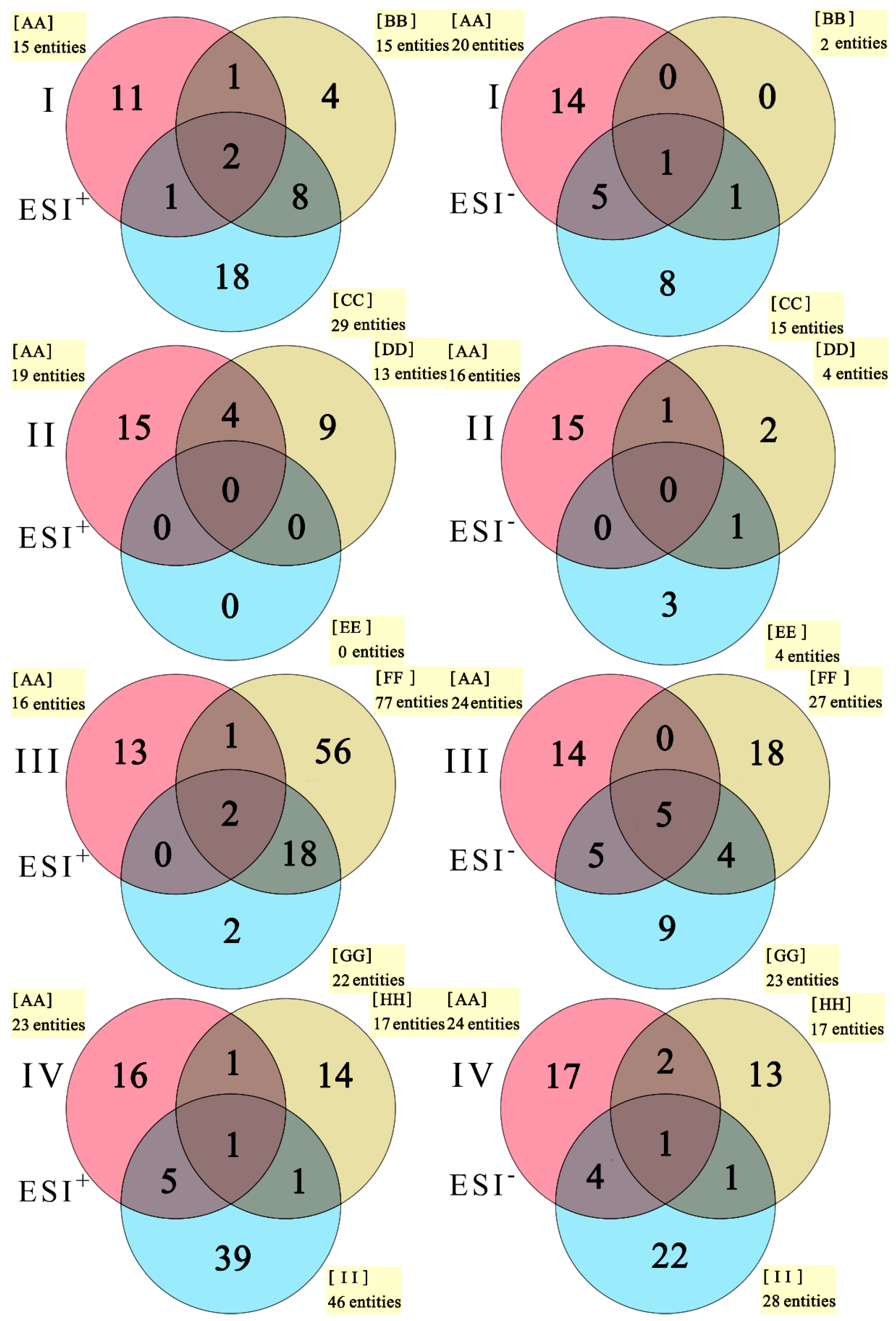
Figure 1. Venn diagram in each group of vegetable oils based on analysis of UHPLC-Q-TOF-MS in positive (ESI+) and negative mode (ESI). AA: olive oil; BB: camellia oil; CC: sesame oil; DD: rapeseed oil; EE: flaxseed oil; FF: soybean oil; GG: peanut oil; HH: industrial hemp (Cannabis sativa L.) seed oil; II: sunflower seed oil.
Processes 14 00576 g001
Figure 2. Extraction ion chromatogram (EIC) of 9 types of vegetable oil.
Processes 14 00576 g002
Figure 3. Typical extraction ion chromatogram (EIC) of adulterated olive oil and camellia oil. (a) EIC diagram (ESI) of adulterated olive oil with no characteristic markers detected; (b) EIC diagram of olive oil adulterated with soybean oil (ESI+); (c) EIC diagram (ESI) of adulterated camellia oil with no characteristic markers detected; (d) EIC diagram of camellia oil adulterated with sunflower seed oil (ESI and ESI+) (d-1,d-2) and soybean oil (ESI+) (d-3); (e) Camellia oil adulterated with sunflower seed oil (ESI and ESI+) (e-1,e-2).
Processes 14 00576 g003
Table 1. Prediction performance for the olive oil PLS-DA models.
Accuracy (%, ESI+/ESI)Overall Accuracy (%, ESI+/ESI)
abcadeafgahi
a26/260/00/0N lN lN lN lN lN lN lN lN l100/100100/98.7
b0/030/290/0N lN lN lN lN lN l N lN lN l100/96.7
c0/00/120/20N lN lN lN lN lN lN lN lN l100/100
aN lN lN l26/260/00/0N lN lN lN lN lN l100/100100/100
dN lN lN l0/018/180/0N lN lN lN lN lN l100/100
eN lN lN l0/00/016/16N lN lN lN lN lN l100/100
aN lN lN lN lN lN l26/260/00/0N lN lN l100/10098.4/100
fN lN lN lN lN lN l0/016/160/1N lN lN l100/100
gN lN lN lN lN lN l0/00/020/19N lN lN l95.0/100
aN lN lN lN lN lN lN lN lN l26/260/00/0100/100100/100
hN lN lN lN lN lN lN lN lN l0/016/160/0100/100
iN lN lN lN lN lN lN lN lN l0/00/016/16100/100
a: Olive oil, b: Camellia oil, c: Sesame oil, d: Rapeseed oil, e: Flaxseed oil, f: Soybean oil, g: Peanut oil, h: Industrial hemp (Cannabis sativa L.) seed oil, i: Sunflower seed oil, l No data.
Table 2. Information of identified candidate markers of vegetable oil using UHPLC-QTOF-MS in positive and negative mode.
No.MS
(m/z)
RT a
(min)
MS/MS
(m/z)
FormulaError
(×10−6)
AdductIdentification
(Confirmed and Tentative)
Sample
Types
1153.05641.71123.0456, 95.0502C8H10O3−4.56[M−H]Hydroxytyrosol bOli. Oil d
2195.06733.40112.9866, 59.0148C11H8O41.52[M−H]Hydroxytyrosol acetate bOli. Oil d
3269.04654.40225.1500, 207.1392C15H10O51.71[M−H]Apigenin bOli. Oil d
4285.04104.08185.0455, 101,0246, 59.0145C15H10O6−1.92[M−H]Luteolin cOli. Oil d
5299.05654.44284.0323, 253.0925, 235.0812C16H12O6−1.16[M−H]Diosmetin bOli. Oil d
6303.12503.77183.0655, 165.0556, 69.0350, 59.0146C18H16N4O0.61[M−H]p-HPEA-EDA cOli. Oil d
7319.11983.4095.0504, 69.0354, 59.0149C17H20O6−3.39[M−H]3,4-DHPEA-EDA cOli. Oil d
8349.13004.55213.0765, 181.0508, 139.0608, 109.0661C18H22O72.81[M+HCOO]Angustibalin cOli. Oil d
9361.10993.88291.0873, 259.0975, 127.0399, 101.0244C19H22O7−1.59[M−H]UnconfirmedOli. Oil d
10361.13044.39291.0874, 259.0975, 229.1080,
127.0399, 101.0243
C19H22O7−1.85[M−H]P-HPEA-EA cOli. Oil d
11365.16204.43229.1078, 197.0813, 121.0654C20H22N4O30.82[M−H]UnconfirmedOli. oil d
12375.10964.01307.0821, 275.0923, 149.0250, 139.0402C20H16N4O40.67[M−H]UnconfirmedOli. oil d
13377.12574.12307.0815, 275.0917, 149.0241, 95.0502C13H26N6OS30.21[M−H]3,4-DHPEA-EA cOli. Oil d
14517.35416.04473.3248, 248.9603, 154.9735, 112.9854C30H48O4−1.18[M+HCOO]Basic sapogenin of oleiferasaponin B2 cCam. Oil e
15519.37025.82473.3226, 248.9596, 154.9732, 112.9854C30H50O4−1.83[M+HCOO]Camelliagenin A cCam. Oil e
16533.34945.54487.3397, 439.3205, 421.3085C30H48O5−1.99[M+HCOO]Camelliagenin B cCam. Oil e
17181.08734.03166.0628, 149.0596, 121.0645, 103.0535, 91.0542C10H12O31.78[M+H]+Propyl 2-furanacrylate cRap. Oil f
18341.10334.16311.0918, 176.0474, 137.0240, 121.0294C20H14N4O2−1.21[M−H]UnconfirmedSes. Oil g
19341.10525.24176.0475, 137.0245, 108.0216, 69.0350C20H14N4O2−1.03[M−H]UnconfirmedSes. Oil g
20357.09774.31219.0657, 189.0550, 175.0759, 124.0164C20H14N4O3−1.88[M−H]UnconfirmedSes. Oil g
21357.09995.38137.0247, 108.0218C20H14N4O3−1.63[M−H]UnconfirmedSes. Oil g
22337.10695.51319.0968, 267.0649, 203.0853, 185.0596,
135.0439, 114.0913
C20H18O63.30[M−H2O+H]+Sesamin bSes. Oil g
23353.10204.90335.0916, 185.0597, 151.0387C20H18O73.23[M−H2O+H]+Sesamolin bSes. Oil g
24372.14365.14337.1069, 233.0804, 203.0696, 173.0591, 135.0440C18H19N4O5−1.58[M+H]+UnconfirmedSes. Oil g
25372.14345.31337.1067, 233.0808, 203.0700, 173.0595, 135.0439C18H19N4O5−1.05[M+H]+N-Methyl-14-O-demethylepiporphyroxine cSes. Oil g
26975.54395.78911.5401, 746.4287, 732.4126, 668.4139C38H75Cl3N22O20.01[M−H]UnconfirmedFla. Oil h
27357.20686.07245.1549, 191.1091, 136.0528, 107.0502C22H30O40.72[M−H]Cannabidiolic acid c Ind. h. s. oil i
28357.20666.84313.2171, 245.1549, 191.1079, 179.1081C22H30O40.49[M−H]Tetrahydrocannabinolic acid bInd. h. s. oil i
29467.24396.28401.2700, 299.2019C27H34O4−0.13[M+HCOO]2,2-Dibutyl-3-(4-methoxyphenyl)-4-methyl-2H-1-benzopyran-7-ol acetate cSun. oil j
30625.42666.54301.2167C42H58O4−0.68[M−H]Peltatol A cSun. oil j
31350.23464.78333.2055, 315.1951, 287.2006, 269.1899C23H29N2O−3.20[M+H]+UnconfirmedSun. oil j
32283.09705.13268.0718, 268.0718, 251.0694, 240.0777, 227.1063, 211.0751, 197.0595C17H14O4−2.42[M+H]+4′,7-dimethoxyisoflavone bSoy. Oil k
33269.08224.62197.0593, 133.0653, 114.0911, 74.0968C16H12O4−2.30[M+H]+Formononetin cPea. Oil l
34301.10884.57273.1116, 163.0386, 135.0438, 107.0488C17H16O5−2.60[M+H]+Sativanone bPea. Oil l
a Retention time, b Confirmed compounds with standard substance, c Matched compound with metabolomics library, d Olive oil, e Camellia oil, f Rapeseed oil, g Sesame oil, h Flaxseed oil, i Industrial hemp (Cannabis sativa L.) seed oil, j Sunflower seed oil, k Soybean oil, l Peanut oil.
Disclaimer/Publisher’s Note: The statements, opinions and data contained in all publications are solely those of the individual author(s) and contributor(s) and not of MDPI and/or the editor(s). MDPI and/or the editor(s) disclaim responsibility for any injury to people or property resulting from any ideas, methods, instructions or products referred to in the content.