Unveiling Capability Structures for Resilient Supply Chains in Cruise Shipbuilding: A Hybrid DEMATEL-ISM-MICMAC Approach


Abstract
1. Introduction
2. Literature Review
2.1. Complex Adaptive Systems Theory and Sustainability
2.2. Resilience Capabilities of the Growth-Stage Cruise Shipbuilding Supply Chains
2.3. Factors Shaping Supply Chain Resilience
3. Methods
3.1. Research Procedure
3.2. Framework and Factors
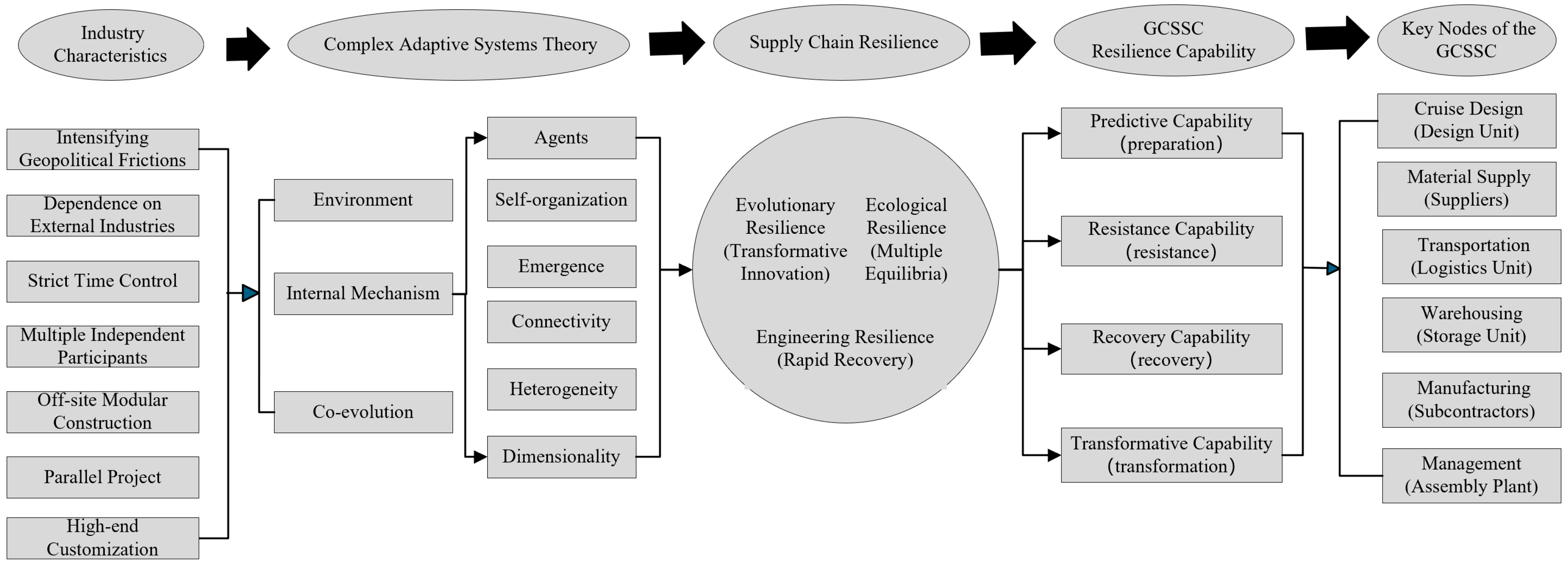
3.2.1. Conceptual Framework
3.2.2. Factors Shaping Cruise Shipbuilding Supply Chain Resilience
3.3. DEMATEL-ISM-MICMAC
3.3.1. Data Collection
3.3.2. Fuzzy DEMATEL
3.3.3. ISM Hierarchy Derivation
3.3.4. MICMAC Classification
4. Results
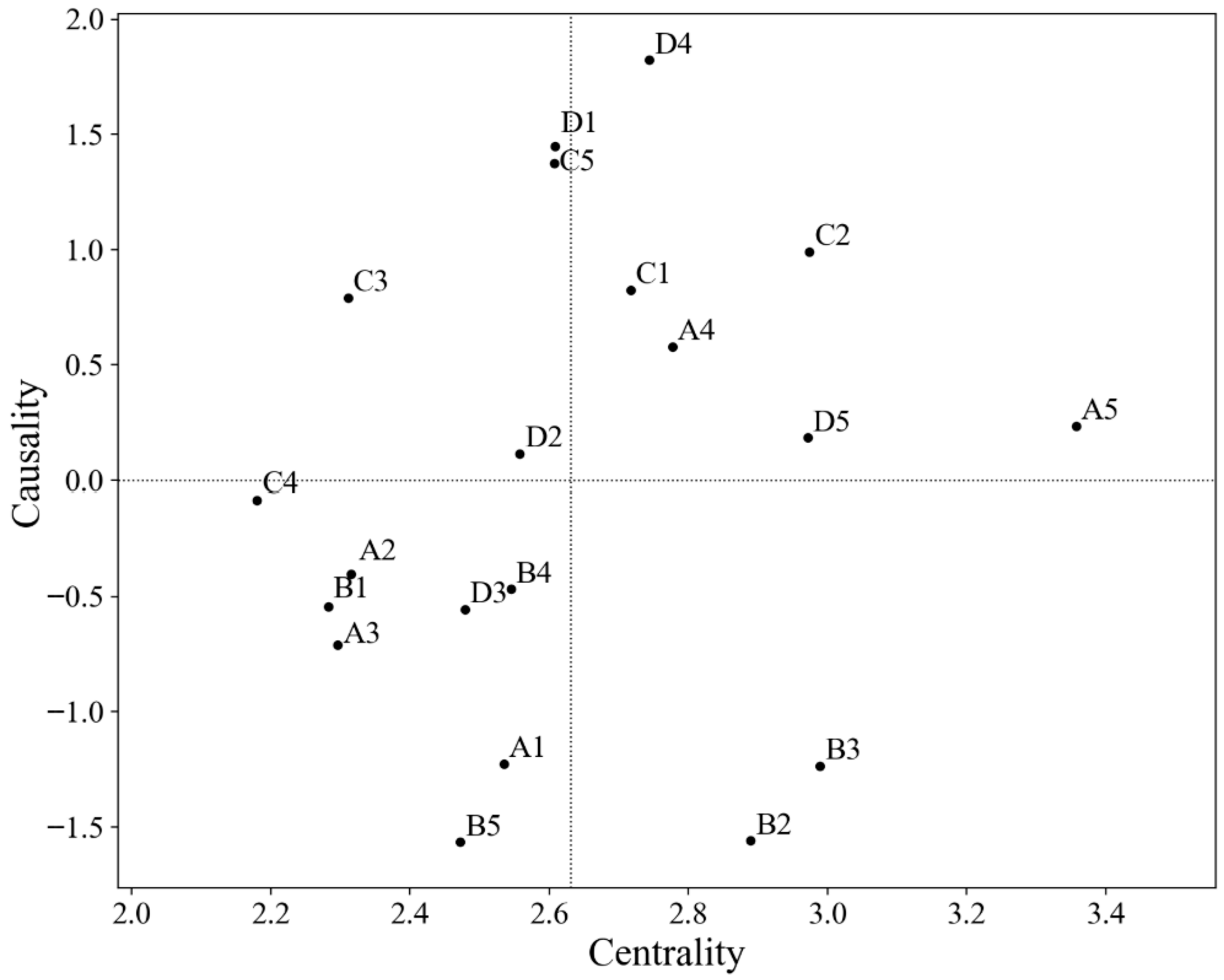
4.1. Cause–Effect and Centrality Analysis of Fuzzy DEMATEL Results
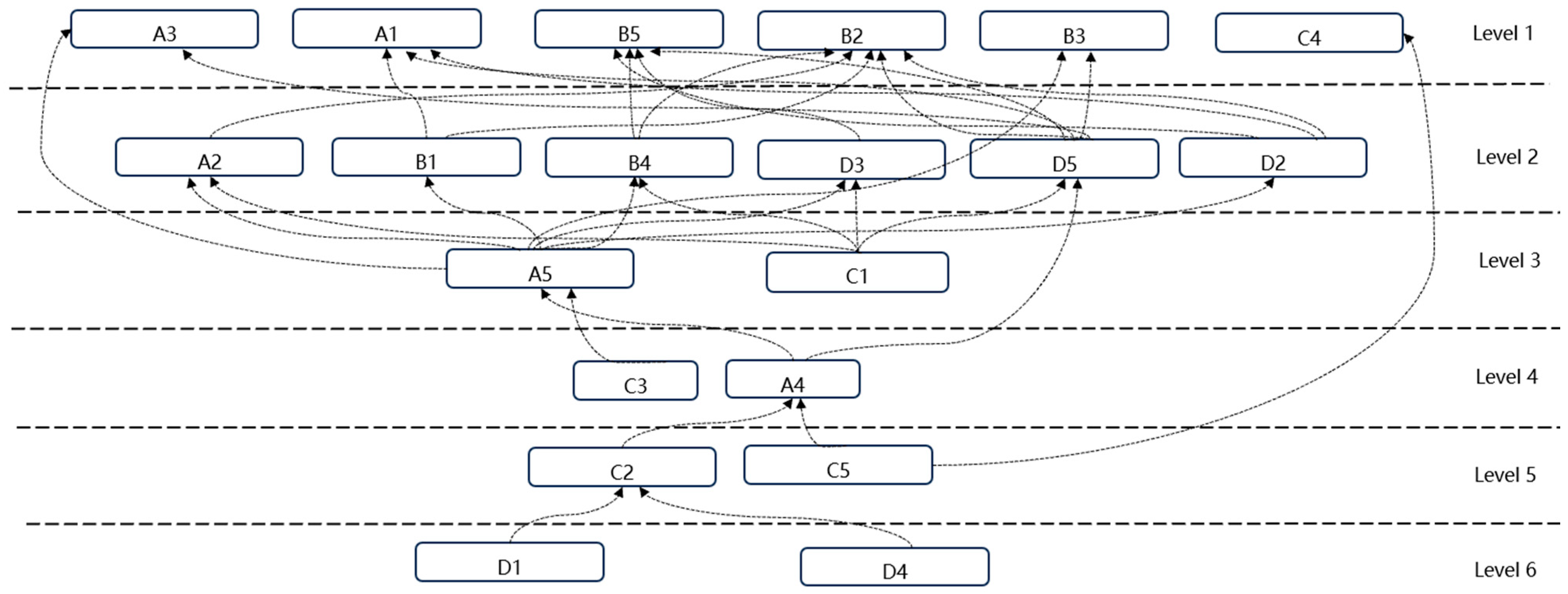
4.2. Hierarchy Analysis of ISM Results
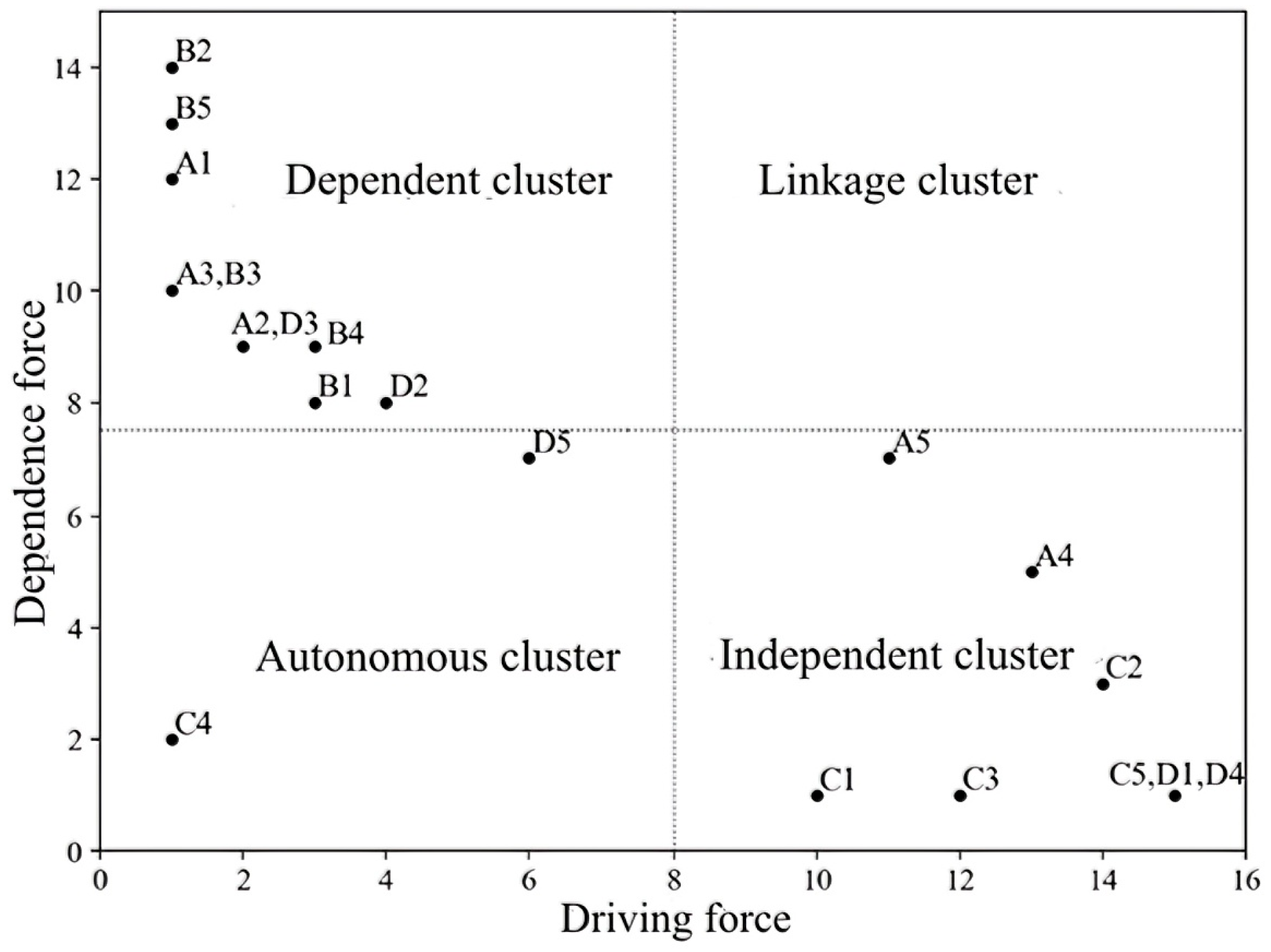
4.3. Analysis of MICMAC Results
5. Discussion and Implications
5.1. Discussion of Results
5.2. Theoretical Implications
5.3. Managerial Implications
6. Conclusions
Author Contributions
Funding
Institutional Review Board Statement
Informed Consent Statement
Data Availability Statement
Acknowledgments
Conflicts of Interest
Abbreviations
| GCSSC | Growth-stage Cruise Shipbuilding Supply Chains |
| DEMATEL | Decision-Making Trial and Evaluation Laboratory |
| ISM | Interpretive Structural Modeling |
| MICMAC | Cross-Impact Matrix Multiplication Applied to Classification |
References
- Yi, G.; Chen, G.; Liu, P.; Feng, N.; Li, H. Capacity Construction and Industrial Breakthrough of China’s First Domestic Cruise Ship. Strateg. Study CAE 2022, 24, 113–122. [Google Scholar] [CrossRef]
- Cui, Z.; Wang, H.; Xu, J. Risk Assessment of Concentralized Distribution Logistics in Cruise-Building Imported Materials. Processes 2023, 11, 859. [Google Scholar] [CrossRef]
- Zhu, J.; Wang, H.; Xu, J. Fuzzy DEMATEL-QFD for Designing Supply Chain of Shipbuilding Materials Based on Flexible Strategies. J. Mar. Sci. Eng. 2021, 9, 1106. [Google Scholar] [CrossRef]
- Bednarski, L.; Roscoe, S.; Blome, C.; Schleper, M.C. Geopolitical Disruptions in Global Supply Chains: A State-of-the-Art Literature Review. Prod. Plan. Control 2025, 36, 536–562. [Google Scholar] [CrossRef]
- Notteboom, T.; Pallis, T.; Rodrigue, J.-P. Disruptions and Resilience in Global Container Shipping and Ports: The COVID-19 Pandemic versus the 2008–2009 Financial Crisis. Marit. Econ. Logist. 2021, 23, 179–210. [Google Scholar] [CrossRef]
- Liu, J.; Yin, J.; Khan, R.U. Scheduling Management and Optimization Analysis of Intermediate Products Transfer in a Shipyard for Cruise Ships. PLoS ONE 2022, 17, e0265047. [Google Scholar] [CrossRef] [PubMed]
- Wang, J.; Yin, J.; Khan, R.U.; Wang, S.; Zheng, T. A Study of Inbound Logistics Mode Based on JIT Production in Cruise Ship Construction. Sustainability 2021, 13, 1588. [Google Scholar] [CrossRef]
- Véronneau, S.; Roy, J.; Beaulieu, M. Cruise Ship Suppliers: A Field Study of the Supplier Relationship Characteristics in a Service Supply Chain. Tour. Manag. Perspect. 2015, 16, 76–84. [Google Scholar] [CrossRef]
- Rodrigue, J.-P.; Wang, G.W.Y. Cruise Shipping Supply Chains and the Impacts of Disruptions: The Case of the Caribbean. Res. Transp. Bus. Manag. 2022, 45, 100551. [Google Scholar] [CrossRef]
- Zhou, J.; Chen, S.L.P.; Shi, W.W.; Kanrak, M. Cruise Supply Chain Risk Mitigation Strategies: An Empirical Study in Shanghai, China. Mar. Policy 2023, 153, 105600. [Google Scholar] [CrossRef]
- Li, H.; Hu, S.; Wu, X.; Tong, H. The Resilience Measurement of Cruise Operation under the Impact of the Epidemic. Transp. Res. Part D Transp. Environ. 2024, 130, 104192. [Google Scholar] [CrossRef]
- Hellgren, S.; Hänninen, M.; Banda, O.A.V.; Kujala, P. Modelling of a Cruise Shipbuilding Process for Analyzing the Effect of Organization on Production Efficiency. J. Ship Prod. Des. 2017, 33, 101–121. [Google Scholar] [CrossRef]
- Maisano, D.A.; Laurenza, D. Enhancing Sustainability in the Production of Cruise-Ship Modules through Quality Monitoring. Procedia CIRP 2024, 122, 599–604. [Google Scholar] [CrossRef]
- Tukamuhabwa, B.R.; Stevenson, M.; Busby, J.; Zorzini, M. Supply Chain Resilience: Definition, Review and Theoretical Foundations for Further Study. Int. J. Prod. Res. 2015, 53, 5592–5623. [Google Scholar] [CrossRef]
- Yan, F.; Yin, S.; Chen, L.; Jia, F. Complexity in a Platform-Based Servitization: A Complex Adaptability Theory Perspective. Int. J. Logist. Res. Appl. 2024, 27, 1092–1111. [Google Scholar] [CrossRef]
- Yaroson, E.V.; Breen, L.; Hou, J.; Sowter, J. Advancing the Understanding of Pharmaceutical Supply Chain Resilience Using Complex Adaptive System (CAS) Theory. Supply Chain. Manag. Int. J. 2021, 26, 323–340. [Google Scholar] [CrossRef]
- Holland, J.H. Studying Complex Adaptive Systems. J. Syst. Sci. Complex. 2006, 19, 1–8. [Google Scholar] [CrossRef]
- Choi, T.Y.; Dooley, K.J.; Rungtusanatham, M. Supply Networks and Complex Adaptive Systems: Control versus Emergence. J. Oper. Manag. 2001, 19, 351–366. [Google Scholar] [CrossRef]
- Nair, A.; Reed-Tsochas, F. Revisiting the Complex Adaptive Systems Paradigm: Leading Perspectives for Researching Operations and Supply Chain Management Issues. J. Oper. Manag. 2019, 65, 80–92. [Google Scholar] [CrossRef]
- Pathak, S.D.; Day, J.M.; Nair, A.; Sawaya, W.J.; Kristal, M.M. Complexity and Adaptivity in Supply Networks: Building Supply Network Theory Using a Complex Adaptive Systems Perspective. Decis. Sci. 2007, 38, 547–580. [Google Scholar] [CrossRef]
- Wieland, A.; Durach, C.F. Two Perspectives on Supply Chain Resilience. J. Bus. Logist. 2021, 42, 315–322. [Google Scholar] [CrossRef]
- Yodo, N.; Wang, P. Engineering Resilience Quantification and System Design Implications: A Literature Survey. J. Mech. Des. 2016, 138, 111408. [Google Scholar] [CrossRef]
- Stone, J.; Rahimifard, S. Resilience in Agri-Food Supply Chains: A Critical Analysis of the Literature and Synthesis of a Novel Framework. Supply Chain Manag. 2018, 23, 207–238. [Google Scholar] [CrossRef]
- Adobor, H.; McMullen, R.S. Supply Chain Resilience: A Dynamic and Multidimensional Approach. Int. J. Logist. Manag. 2018, 29, 1451–1471. [Google Scholar] [CrossRef]
- Ribeiro, J.; Povoa, A. Supply Chain Resilience: Definitions and Quantitative Modelling Approaches—A Literature Review. Comput. Ind. Eng. 2018, 115, 109–122. [Google Scholar] [CrossRef]
- Alquraish, M. Digital Transformation, Supply Chain Resilience, and Sustainability: A Comprehensive Review with Implications for Saudi Arabian Manufacturing. Sustainability 2025, 17, 4495. [Google Scholar] [CrossRef]
- Crispim, J.; Fernandes, J.; Rego, N. Customized Risk Assessment in Military Shipbuilding. Reliab. Eng. Syst. Saf. 2020, 197, 106809. [Google Scholar] [CrossRef]
- Centobelli, P.; Cerchione, R.; Maglietta, A.; Oropallo, E. Sailing through a Digital and Resilient Shipbuilding Supply Chain: An Empirical Investigation. J. Bus. Res. 2023, 158, 113686. [Google Scholar] [CrossRef]
- Surucu-Balci, E.; Iris, Ç.; Balci, G. Digital Information in Maritime Supply Chains with Blockchain and Cloud Platforms: Supply Chain Capabilities, Barriers, and Research Opportunities. Technol. Forecast. Soc. Change 2024, 198, 122978. [Google Scholar] [CrossRef]
- Könnölä, K.; Kangas, K.; Seppälä, K.; Mäkelä, M.; Lehtonen, T. Considering Sustainability in Cruise Vessel Design and Construction Based on Existing Sustainability Certification Systems. J. Clean. Prod. 2020, 259, 120763. [Google Scholar] [CrossRef]
- Zhang, Y.; Jiang, Y.; Zeng, Y.; Cao, K.; Huang, Y. An Evaluation Method in Large Luxury Cruise Ship Design and Construction Challenges Based on Analytic Hierarchy Process. In Proceedings of the 2022 13th International Conference on Mechanical and Aerospace Engineering (ICMAE), Bratislava, Slovakia, 20–22 July 2022; pp. 501–506. [Google Scholar]
- Ivanov, D.; Dolgui, A. A Digital Supply Chain Twin for Managing the Disruption Risks and Resilience in the Era of Industry 4.0. Prod. Plan. Control 2021, 32, 775–788. [Google Scholar] [CrossRef]
- Zheng, Y.; Ke, J.; Wang, H. Risk Propagation of Concentralized Distribution Logistics Plan Change in Cruise Construction. Processes 2021, 9, 1398. [Google Scholar] [CrossRef]
- Busse, C.; Meinlschmidt, J.; Foerstl, K. Managing Information Processing Needs in Global Supply Chains: A Prerequisite to Sustainable Supply Chain Management. J. Supply Chain Manag. 2017, 53, 87–113. [Google Scholar] [CrossRef]
- Osman, A.; Lew, C.C. Developing a Framework of Institutional Risk Culture for Strategic Decision-Making. J. Risk Res. 2021, 24, 1072–1085. [Google Scholar] [CrossRef]
- Ali, I.; Golgeci, I.; Arslan, A. Achieving Resilience through Knowledge Management Practices and Risk Management Culture in Agri-Food Supply Chains. Supply Chain. Manag. Int. J. 2023, 28, 284–299. [Google Scholar] [CrossRef]
- Liu, Y.; Wang, X.; Yang, Y. The Impact of Strategic Knowledge Disclosure on Enterprise Innovation Performance. Manag. Decis. Econ. 2023, 44, 2582–2592. [Google Scholar] [CrossRef]
- Tran, D.T.M.; Thai, V.V.; Duc, T.T.H.; Nguyen, T.-T. Organisational Culture as the Antecedent of Supply Chain Collaboration and Its Relationship with Competitive Advantage. Int. J. Logist. Manag. 2025, 36, 720–746. [Google Scholar] [CrossRef]
- Kamalahmadi, M.; Shekarian, M.; Mellat Parast, M. The Impact of Flexibility and Redundancy on Improving Supply Chain Resilience to Disruptions. Int. J. Prod. Res. 2022, 60, 1992–2020. [Google Scholar] [CrossRef]
- Wrede, M.; Dauth, T. A Temporal Perspective on the Relationship between Top Management Team Internationalization and Firms’ Innovativeness. Manag. Decis. Econ. 2020, 41, 542–561. [Google Scholar] [CrossRef]
- Jokinen, L.; Balcom Raleigh, N.A.; Heikkilä, K. Futures Literacy in Collaborative Foresight Networks: Advancing Sustainable Shipbuilding. Eur. J. Futures Res. 2023, 11, 9. [Google Scholar] [CrossRef]
- Gaudenzi, B.; Baldi, B. Cyber Resilience in Organisations and Supply Chains: From Perceptions to Actions. Int. J. Logist. Manag. 2024, 35, 99–122. [Google Scholar] [CrossRef]
- Wrede, M.; Velamuri, V.K.; Dauth, T. Top Managers in the Digital Age: Exploring the Role and Practices of Top Managers in Firms’ Digital Transformation. Manag. Decis. Econ. 2020, 41, 1549–1567. [Google Scholar] [CrossRef]
- Singh, S.K.; Mazzucchelli, A.; Vessal, S.R.; Solidoro, A. Knowledge-Based HRM Practices and Innovation Performance: Role of Social Capital and Knowledge Sharing. J. Int. Manag. 2021, 27, 100830. [Google Scholar] [CrossRef]
- Ivanov, D. Supply Chain Viability and the COVID-19 Pandemic: A Conceptual and Formal Generalisation of Four Major Adaptation Strategies. Int. J. Prod. Res. 2021, 59, 3535–3552. [Google Scholar] [CrossRef]
- Zhou, Y.; Yuen, K.F.; Tan, B.; Thai, V.V. The Effect of Maritime Knowledge Clusters on Maritime Firms’ Performance: An Organizational Learning Perspective. Mar. Policy 2021, 128, 104472. [Google Scholar] [CrossRef]
- Mubarik, M.S.; Bontis, N.; Mubarik, M.; Mahmood, T. Intellectual Capital and Supply Chain Resilience. J. Intellect. Cap. 2022, 23, 713–738. [Google Scholar] [CrossRef]
- Sharma, M.; Antony, R.; Sharma, A.; Daim, T. Can Smart Supply Chain Bring Agility and Resilience for Enhanced Sustainable Business Performance? Int. J. Logist. Manag. 2025, 36, 501–555. [Google Scholar] [CrossRef]
- Opricovic, S.; Tzeng, G.-H. Defuzzification within a multicriteria decision model. Int. J. Uncertain. Fuzziness Knowl.-Based Syst. 2003, 11, 635–652. [Google Scholar] [CrossRef]
- Wu, W.-W.; Lee, Y.-T. Developing global managers’ competencies using the fuzzy DEMATEL method. Expert Syst. Appl. 2007, 32, 499–507. [Google Scholar] [CrossRef]
- Mangla, S.K.; Luthra, S.; Mishra, N.; Singh, A.; Rana, N.P.; Dora, M.; Dwivedi, Y.K. Barriers to Effective Circular Supply Chain Management in a Developing Country Context. Prod. Plan. Control. 2018, 29, 551–569. [Google Scholar] [CrossRef]
- Menon, R.R.; Ravi, V. Analysis of barriers of sustainable supply chain management in electronics industry: An interpretive structural modelling approach. Clean. Responsib. Consum. 2021, 3, 100026. [Google Scholar] [CrossRef]
- Giannakis, M.; Papadopoulos, T. Supply Chain Sustainability: A Risk Management Approach. Int. J. Prod. Econ. 2016, 171, 455–470. [Google Scholar] [CrossRef]
- Warfield, J.N. Developing interconnection matrices in structural modeling. IEEE Trans. Syst. Man Cybern. 2010, 1, 81–87. [Google Scholar] [CrossRef]
- Attri, R.; Dev, N.; Sharma, V. Interpretive structural modelling (ISM) approach: An overview. Res. J. Manag. Sci. 2013, 2, 3–8. [Google Scholar]





| Author(s) and Year | Context/Industry | Methodology | Key Findings | Gaps/Limitations | Positioning of This Study |
|---|---|---|---|---|---|
| Choi et al. (2001) [18] | General supply chains | Conceptual/CAS theory | Supply chains exhibit CAS properties: distributed control, self-organization, emergence. | Lacks empirical validation; no industry-specific resilience framework. | Adopts CAS as theoretical lens; extends to GCSSC with empirical validation. |
| Tukamuhabwa et al. (2015) [14] | General supply chains | Systematic literature review | Defines resilience, reviews theoretical foundations, identifies antecedents and outcomes. | Limited focus on project-based, high-value manufacturing and capability hierarchies. | Tailors’ resilience antecedents to GCSSC; structures them into hierarchical capabilities. |
| Adobor & McMullen (2018) [24] | Cross-industry | Conceptual/Dynamic model | Resilience is multi-dimensional; emphasizes learning, adaptation, and transformative capacity. | Lacks empirical validation and industry-specific contextualization. | Provides empirical, context-specific framework for GCSSC; integrates learning and transformation. |
| Nair & Reed-Tsochas (2019) [19] | Operations and SCM | Literature review/CAS framework | Proposes robust CAS framework with three elements: internal mechanisms, environment, co-evolution. | Limited focus on project-based, high-value manufacturing contexts. | Applies CAS framework to GCSSC; integrates resilience capabilities. |
| Könnölä et al. (2020) [30] | Cruise shipbuilding/Sustainability | Case study/Certification analysis | Identifies sustainability indicators and lifecycle impacts in cruise vessel design. | Limited focus on resilience and dynamic capability interactions. | Integrates sustainability with resilience; links green practices to restorative and transformative capabilities. |
| Wieland & Durach (2021) [21] | Cross-industry | Conceptual/Perspective analysis | Distinguishes engineering vs. ecological resilience; highlights adaptation and transformation. | Does not integrate multiple resilience perspectives into a unified capability model. | Synthesizes engineering, ecological, and evolutionary resilience into a four-capability framework. |
| Ivanov & Dolgui (2021) [32] | Industry 4.0/Digital twins | Conceptual/Simulation | Digital twins enhance disruption risk management and resilience in dynamic environments. | Focuses on digital tools, not on hierarchical factor interactions or capability structuring. | Positions digital technology as an enabling factor within a broader hierarchical resilience model. |
| Zhu et al. (2021) [3] | Shipbuilding material supply chain | Fuzzy DEMATEL-QFD | Flexible strategy design for material procurement under uncertainty. | Focus on design phase only; lacks system-level resilience modeling. | Extends to full GCSSC resilience with hybrid DEMATEL-ISM-MICMAC; integrates CAS theory. |
| Yaroson et al. (2021) [16] | Pharmaceutical SCM | CAS theory/Qualitative | CAS explains resilience in pharma supply chains through adaptation and self-organization. | Industry-specific; limited generalizability to project-based manufacturing. | Transfers CAS insights to GCSSC; contextualizes adaptation in cruise shipbuilding. |
| Centobelli et al. (2023) [28] | Shipbuilding/Digital SCM | Empirical survey | Digital technologies enhance resilience and competitiveness in shipbuilding supply chains. | Static analysis; lacks hierarchical interaction modeling and causal analysis. | Models dynamic, multi-level interactions via ISM; integrates digital tech as a transformative factor. |
| This study | Growth-stage Cruise Shipbuilding Supply Chains (GCSSC) | Hybrid fuzzy DEMATEL-ISM-MICMAC integrated with CAS theory | Identifies 20 resilience factors; reveals hierarchical and causal relationships; proposes resource-contingent pathways. | N/A | Provides an integrated, hierarchical, and actionable resilience framework specific to GCSSC, filling gaps in factor interaction modeling and strategic pathway development. |
| Factors | Indicators | Description |
|---|---|---|
| Predictive capability (A) | Schedule deviations (A1) | Deviations between baseline and actual milestones arising from incremental owner confirmations, evolving technical requirements, or upstream supply delays. |
| Modular management teams (A2) | Monitoring risks and facilitating communication among contractors and technical domains. | |
| Intelligence management (A3) | Timely collection and use of policy, market, and geopolitical signals, particularly for cross-border logistics corridors. | |
| Knowledge stock (A4) | Knowledge sharing, resource integration, acquisition capability, and experiential learning. | |
| Risk culture (A5) | Shared norms and incentives for early escalation and pre-emptive decision-making. | |
| Resistant capability (B) | Logistics integration (B1) | Coordination of multimodal transport, out-of-gauge/heavy -lift handling, and differentiated warehousing conditions. |
| Component and module manufacturing performance (B2) | Quality consistency, supply stability, and integration reliability for high-specificity components and functional modules. | |
| Schedule discipline (B3) | Milestone adherence for long-announced sail-away dates with limited slack. | |
| Strategic supplier stability (B4) | Stable ties or long-term cooperation agreements with high-end, low-substitutability suppliers of core equipment and technologies in concentrated global niches. | |
| Industry backups (B5) | Dual sourcing where feasible, inventory buffers, and contingency logistics channels to provide short-term flexibility. | |
| Restorative capability (C) | Final-assembly orchestration (C1) | Strategic leadership by the final-assembly yard to coordinate upstream/downstream recovery and re-baselining. |
| Inter-industry collaboration (C2) | Joint problem solving and decision rights spanning adjacent sectors (e.g., marine engineering, luxury fit-out). | |
| Social capital (C3) | External networks and relational trust that mobilize resources quickly under time pressure. | |
| Structural configuration (C4) | Balanced geographic dispersion and tier coordination that reduce bottlenecks and enable parallel recovery. | |
| Specialized industrial clusters (C5) | Regional co-location that accelerates knowledge/resource sharing. | |
| Transformative capability (D) | Learning organization (D1) | Continuous learning and knowledge renewal that support capability reconstruction; purposeful knowledge inflows from related industries. |
| Industrial autonomy (D2) | Localization and control over critical technologies and supply segments to reduce structural dependence. | |
| Information sharing (D3) | Transparent, timely multi-party data exchange improving visibility and joint responsiveness. | |
| Customized demand responsiveness (D4) | Capability to translate unique shipowner/passenger requirements into adaptive material planning, procurement, and logistics for specialized fixtures and systems. | |
| Digital technologies (D5) | Digitally enabled coordination (e.g., integrated PLM/ERP/MES, digital twins) to manage complexity and overcome localization bottlenecks. |
| Expert | Type of Organization | Designation | Relevance Phase in GCSSC | Years of Experience |
|---|---|---|---|---|
| 1 | Cruise shipyard | Production manager | Material procurement, construction, assembly | 12 |
| 2 | Cruise shipyard | Quality assurance manager | Construction, testing, delivery | 8 |
| 3 | Cruise shipyard | Production manager | Design, procurement, construction coordination. | 13 |
| 4 | Maritime logistics services | Operations manager | Material transportation, delivery scheduling | 15 |
| 5 | Cruise company | Cruise operation manager | Design requirements, delivery, operations | 13 |
| 6 | Cruise shipyard | Project manager | Material sourcing, component delivery | 8 |
| 7 | Cruise company | Senior project coordinator | Multi-phase project management, delivery | 9 |
| 8 | Maritime consulting firm | Senior consultant | Project management, supply chain factor | 10 |
| 9 | University | Professor of naval architecture | Design, construction, manufacturing, supply chain optimization | 13 |
| 10 | University | Professor of supply chain management | Supply chain management, process optimization | 15 |
| Numeric Score | Linguistic Term | TFN () |
|---|---|---|
| 0 | No influence | (0.00, 0.00, 0.25) |
| 1 | Low | (0.00, 0.25, 0.50) |
| 2 | Moderate | (0.25, 0.50, 0.75) |
| 3 | High | (0.50, 0.75, 1.00) |
| 4 | Very high | (0.75, 1.00, 1.00) |
| Factor | R | C | M | D | Type |
|---|---|---|---|---|---|
| A1 | 1.881 | 0.654 | 2.535 | −1.227 | Result |
| A2 | 1.359 | 0.957 | 2.316 | −0.402 | Result |
| A3 | 1.503 | 0.793 | 2.296 | −0.710 | Result |
| A4 | 1.100 | 1.678 | 2.778 | 0.578 | Cause |
| A5 | 1.562 | 1.796 | 3.358 | 0.234 | Cause |
| B1 | 1.414 | 0.868 | 2.282 | −0.546 | Result |
| B2 | 2.225 | 0.665 | 2.890 | −1.560 | Result |
| B3 | 2.113 | 0.876 | 2.989 | −1.237 | Result |
| B4 | 1.507 | 1.039 | 2.546 | −0.468 | Result |
| B5 | 2.019 | 0.453 | 2.472 | −1.566 | Result |
| C1 | 0.946 | 1.771 | 2.717 | 0.825 | Cause |
| C2 | 0.992 | 1.982 | 2.974 | 0.990 | Cause |
| C3 | 0.761 | 1.550 | 2.311 | 0.789 | Cause |
| C4 | 1.132 | 1.049 | 2.181 | −0.083 | Result |
| C5 | 0.617 | 1.990 | 2.607 | 1.373 | Cause |
| D1 | 0.580 | 2.028 | 2.608 | 1.448 | Cause |
| D2 | 1.222 | 1.336 | 2.558 | 0.114 | Cause |
| D3 | 1.518 | 0.961 | 2.479 | −0.557 | Result |
| D4 | 0.461 | 2.283 | 2.744 | 1.822 | Cause |
| D5 | 1.394 | 1.578 | 2.972 | 0.184 | Result |
| A1 | A2 | A3 | A4 | A5 | B1 | B2 | … | C4 | C5 | D1 | D2 | D3 | D4 | D5 | |
|---|---|---|---|---|---|---|---|---|---|---|---|---|---|---|---|
| A1 | 1 | 0 | 0 | 0 | 0 | 0 | 1 | … | 0 | 0 | 0 | 0 | 0 | 0 | 0 |
| A2 | 0 | 1 | 0 | 0 | 0 | 0 | 0 | … | 0 | 0 | 0 | 0 | 0 | 0 | 0 |
| A3 | 0 | 0 | 1 | 0 | 0 | 0 | 0 | … | 0 | 0 | 0 | 0 | 0 | 0 | 0 |
| A4 | 0 | 0 | 0 | 1 | 1 | 0 | 0 | … | 0 | 0 | 0 | 0 | 0 | 0 | 1 |
| A5 | 1 | 1 | 1 | 0 | 1 | 1 | 1 | … | 0 | 0 | 0 | 1 | 1 | 0 | 0 |
| B1 | 1 | 0 | 0 | 0 | 0 | 1 | 1 | … | 0 | 0 | 0 | 0 | 0 | 0 | 0 |
| … | |||||||||||||||
| C4 | 0 | 0 | 0 | 0 | 0 | 0 | 0 | … | 1 | 0 | 0 | 0 | 0 | 0 | 0 |
| C5 | 1 | 1 | 0 | 1 | 0 | 1 | 1 | … | 1 | 1 | 0 | 0 | 1 | 0 | 1 |
| D1 | 0 | 0 | 0 | 1 | 1 | 0 | 1 | … | 0 | 0 | 1 | 0 | 1 | 0 | 1 |
| D2 | 1 | 0 | 0 | 0 | 0 | 0 | 1 | … | 0 | 0 | 0 | 1 | 0 | 0 | 0 |
| D3 | 0 | 0 | 0 | 0 | 0 | 0 | 0 | … | 0 | 0 | 0 | 0 | 1 | 0 | 0 |
| D4 | 1 | 1 | 1 | 1 | 1 | 1 | 1 | … | 0 | 0 | 0 | 0 | 1 | 1 | 1 |
| D5 | 1 | 0 | 1 | 0 | 0 | 0 | 1 | … | 0 | 0 | 0 | 0 | 0 | 0 | 1 |
| Factor | Reachability Set E | Antecedent Set S | Intersection Set Q |
|---|---|---|---|
| A1 | 1 | 1, 5, 6, 11, 15, 17, 19, 20 | 1 |
| A2 | 2, 7 | 2, 5, 11, 12, 15, 19 | 2 |
| A3 | 3 | 3, 5, 11, 19, 20 | 3 |
| A4 | 4, 5, 7, 8, 20 | 4, 12, 15, 16, 19 | 4 |
| A5 | 1, 2, 3, 5, 6, 7, 8, 9, 10, 17, 18 | 4, 5, 12, 13, 16, 19 | 5 |
| B1 | 1, 6, 7 | 5, 6, 15, 19 | 6 |
| B2 | 7 | 2, 4, 5, 6, 7, 9, 11, 12, 13, 15, 16, 17, 19, 20 | 7 |
| B3 | 8 | 4, 5, 8, 11, 12, 13, 15, 16, 19, 20 | 8 |
| B4 | 7, 9, 10 | 5, 9, 11, 12, 15, 16, 19 | 9 |
| B5 | 10 | 5, 9, 10, 11, 12, 15, 16, 17, 18, 19, 20 | 10 |
| C1 | 1, 2, 3, 7, 8, 9, 10, 11, 18, 20 | 11 | 11 |
| C2 | 2, 4, 5, 7, 8, 9, 10, 12, 18, 20 | 12, 16, 19 | 12 |
| C3 | 5, 7, 8, 13 | 13 | 13 |
| C4 | 14 | 14, 15 | 14 |
| C5 | 1, 2, 4, 6, 7, 8, 9, 10, 14, 15, 18, 20 | 15 | 15 |
| D1 | 4, 5, 7, 8, 9, 10, 12, 16, 18, 20 | 16 | 16 |
| D2 | 1, 7, 10, 17 | 5, 17 | 17 |
| D3 | 10, 18 | 5, 11, 12, 15, 16, 18, 19 | 18 |
| D4 | 1, 2, 3, 4, 5, 6, 7, 8, 9, 10, 12, 18, 19, 20 | 19 | 19 |
| D5 | 1, 3, 7, 8, 10, 20 | 4, 11, 12, 15, 16, 19, 20 | 20 |
Disclaimer/Publisher’s Note: The statements, opinions and data contained in all publications are solely those of the individual author(s) and contributor(s) and not of MDPI and/or the editor(s). MDPI and/or the editor(s) disclaim responsibility for any injury to people or property resulting from any ideas, methods, instructions or products referred to in the content. |
© 2026 by the authors. Licensee MDPI, Basel, Switzerland. This article is an open access article distributed under the terms and conditions of the Creative Commons Attribution (CC BY) license.
Share and Cite
Fan, D.; Fu, G.; Shi, Y. Unveiling Capability Structures for Resilient Supply Chains in Cruise Shipbuilding: A Hybrid DEMATEL-ISM-MICMAC Approach. Processes 2026, 14, 569. https://doi.org/10.3390/pr14030569
Fan D, Fu G, Shi Y. Unveiling Capability Structures for Resilient Supply Chains in Cruise Shipbuilding: A Hybrid DEMATEL-ISM-MICMAC Approach. Processes. 2026; 14(3):569. https://doi.org/10.3390/pr14030569
Chicago/Turabian StyleFan, Dandan, Guanghua Fu, and Yibo Shi. 2026. "Unveiling Capability Structures for Resilient Supply Chains in Cruise Shipbuilding: A Hybrid DEMATEL-ISM-MICMAC Approach" Processes 14, no. 3: 569. https://doi.org/10.3390/pr14030569
APA StyleFan, D., Fu, G., & Shi, Y. (2026). Unveiling Capability Structures for Resilient Supply Chains in Cruise Shipbuilding: A Hybrid DEMATEL-ISM-MICMAC Approach. Processes, 14(3), 569. https://doi.org/10.3390/pr14030569