Article

Multi-Objective Preparation Process Optimization of Ultra-Small Manganese Ferrite Nanoparticles Using Probability-Based Method

1
School of Chemical Engineering, Northwest University, Xi’an 710069, China
2
Carbon Neutrality College, Northwestern University, Xi’an 710069, China
*
Author to whom correspondence should be addressed.
Processes 2026, 14(3), 535; https://doi.org/10.3390/pr14030535
Submission received: 5 January 2026 / Revised: 29 January 2026 / Accepted: 1 February 2026 / Published: 3 February 2026
(This article belongs to the Special Issue Multi-Criteria Decision Making in Chemical and Process Engineering)

Abstract

With increasing demands for controllable synthesis of nanomaterials, it has become particularly important to develop efficient and accurate methods for optimizing preparation processes. This study focuses on the nucleation and growth stages in the synthesis of ultra-small manganese ferrite nanoparticles, aiming to clarify the influence mechanisms of key parameters such as oleic acid dosage, precursor concentration, and aging temperature on the product size and properties and to optimize the preparation process accordingly. The probability-based multi-objective optimization method was adopted, using the above parameters as optimization variables to systematically design and screen the experimental conditions. The results show that this method can effectively achieve the optimization of multiple objectives in the preparation process, providing a reliable methodological framework for the controlled synthesis of ultra-small manganese ferrite nanoparticles.

1. Introduction

In recent years, ultra-small MnFe2O4 nanoparticles (UMFNPs) with unique properties have been the subject of extensive research and have been widely applied in different areas, including biomedicine, water treatment, adsorbents, and catalysis [1,2,3,4]. UMFNPs serve as contrast agents for enhanced magnetic resonance imaging (MRI), showcasing substantial potential. Compared to conventional gadolinium-based contrast agents, UMFNPs contrast agents exhibit size-, composition-, and surface-dependent relaxation efficiency modulation, enabling facile surface functionalization for active targeting of specific tissues and highly sensitive tumor detection. Furthermore, these contrast agents can be eliminated through the liver, gallbladder, and kidneys, demonstrating high biosafety [5]. These characteristics indicate that contrast agents of UMFNPs have a promising prospect for clinical transformation.
The current preparation scale of UMFNPs contrast agents is limited to laboratory-scale trials, with single-batch production yields remaining in the milligram range, thereby hindering their clinical translation. Consequently, the development of scalable production processes for UMFNP contrast agents holds significant importance.
The preparation methods of UMFNPs include reverse the micelle method [6,7], the sol–gel method [8], the coprecipitation method [9,10,11], and the thermal decomposition method [12]. The synthesis of coprecipitation, reverse micelle, and sol–gel methods is based on aqueous-phase reactions. Due to the low viscosity and unrestricted diffusion of aqueous solutions, the growth rate of nanoparticles is rapid, making it challenging to control the reaction kinetics and precisely regulate the particle size. Consequently, aqueous-phase synthesis methods struggle to produce monodisperse superparamagnetic iron oxide nanoparticles on a large scale. In contrast, the high-temperature thermal decomposition method in non-aqueous organic solvents involves reacting precursors with surfactants in high-viscosity organic solvents. Here, the precursors continuously decompose upon heating, and when the decomposition product monomers reach supersaturation, explosive nucleation occurs, followed by a growth stages. The reaction halts as the temperature decreases. The high viscosity of solvents and surfactants imposes diffusion limitations on the monomers, enabling the regulation of reaction kinetics and, subsequently, the control of particle sizes [13].
UMFNPs have been applied in medical detection, ferrofluid technology, and other fields, with various applications necessitating distinct characteristics in terms of particle size, morphology, chemical composition, and surface properties of these nanoparticles [14,15]. UMFNPs with sizes less than 5 nm exhibit high T1 signal enhancement and rapid renal clearance capabilities [16]. Xu et al. [17] analyzed the potential applications of size-tunable nanoparticles in tumor therapeutics. The reaction conditions for the synthesis of UMFNPs directly correlate with their particle size and magnetic properties, which can be tailored by adjusting experimental parameters such as the amount of surfactant, precursor concentration, aging temperature, and the holding time at the aging temperature.
Strategies for size control generally fall into two categories: post-synthesis growth and in situ modulation of reaction conditions. An example of the former is the seed-mediated growth method, where pre-formed nanoparticles (e.g., 8 nm Fe3O4 [18]) serve as seeds for the epitaxial addition of material to obtain larger, uniform nanoparticles (e.g., 12 nm Fe3O4 [19]). The latter, more direct approach—which is the focus of this work—involves fine-tuning the key reaction parameters within a single synthesis step.
Achieving precise size control in ferrite nanoparticle synthesis hinges on the manipulation of a few key parameters during the nucleation and growth stages. These parameters, including surfactant dosage, precursor concentration, and aging temperature, have been systematically investigated across different ferrite systems, revealing their universal and composition-specific effects.
The role of surfactant dosage is pivotal. For instance, in the synthesis of Fe3O4 nanoparticles, Wang et al. [20] observed that increasing oleic acid dosage suppressed core formation but favored growth, leading to larger particles. This principle extends to manganese ferrite systems, where Tromsdorf et al. [21] varied the precursor-to-oleic acid ratio to obtain MnFe2O4 nanoparticles ranging from 3 to 18 nm. Similarly, Fan et al. [22] achieved fine-tuning of ultra-small MnFe2O4 nanoparticle size between 2 and 3.9 nm by adjusting the ratio of oleic acid to oleyl alcohol.
Precursor concentration and aging temperature constitute another critical pair of interdependent parameters. A higher precursor concentration promotes a higher monomer supersaturation, favoring nucleation and yielding smaller particles, as noted in the Fe3O4 system [20]. Conversely, a higher aging temperature accelerates precursor diffusion and monomer reactivity, promoting growth and resulting in larger sizes [20]. The coupling of these factors is exemplified in the work of Xie et al. [23], where simultaneous adjustment of oleic acid amount and reaction temperature (e.g., 280 °C with double oleic acid, 300 °C with quadruple amount) yielded CoFe2O4 nanoparticles of distinctly different sizes (6, 13, and 18 nm). Park et al. [24] also demonstrated monodisperse ferrite nanoparticle synthesis across a wide size range (5–22 nm) through careful regulation of such reaction conditions.
These studies collectively underscore that, despite differences in ferrite composition, particle size and properties are governed by a common set of synthetic levers: primarily surfactant amount, precursor concentration, and aging temperature. This understanding is crucial for scale-up, where variations in these parameters can directly impact product consistency. The comprehensive, orthogonal experimental design of Wang et al. [20], which systematically isolated the effects of these three key parameters on the size, distribution, and saturation magnetization of Fe3O4 nanoparticles, provides a well-defined dataset. This makes it an ideal testbed for multi-objective optimization. Therefore, in this work, we employ the probability-based multi-objective optimization (PBMOO) method, taking oleic acid dosage, aging temperature, and precursor concentration as the optimization indicators, to identify the synthesis scheme that best balances the competing objectives within this established experimental framework.
The preparation of UMFNPs typically employs a dynamic simultaneous thermal decomposition (DSTD) method. The metal iron–manganese composite precursor exhibits highly similar thermal decomposition temperatures, with monomers containing iron and manganese forming prior to nucleation. This is followed by the burst of nucleation, yielding cores containing the dopant component manganese and the host component iron. Subsequently, a diffusion-limited growth process takes place. The critical parameters in this preparation method are the aging temperature, its holding time, and the reactants’ dosage, which significantly impact the monodispersity of the resulting particles. Particularly during the scale-up production process, variations in the aging temperature, holding time and reactants’ dosage can alter the particle size and saturation magnetization of the ultra-small ferrite nanoparticles. Therefore, to establish an effective scaled-up production process, it is essential to optimize the aging temperature, its holding time, and the dosage of reactants during the preparation of UMFNPs.
Multi-objective optimization (MOO) is a prevalent challenge in various scientific and engineering disciplines. Existing algorithms for MOO or multi-criteria decision-making (MCDM), such as TOPSIS (Technique for Order of Preference by Similarity to Ideal Solution), MOORA (Multi-Objective Optimization on the Basis of Ratio Analysis), and VIKOR (Vlšekriterijumsko KOmpromisno Rangiranje), typically employ cumulative-type approaches. These methods often depend on the parameterization or normalization of evaluation metrics and may incorporate subjective factors. From a probabilistic standpoint, however, the core objective of “simultaneously optimizing multiple criteria” aligns conceptually with achieving a high “joint probability” for these independent performance indicators. In this context, Zheng Maosheng et al. [25] introduced a probability-based methodology for material selection by defining a novel “preferable probability.” The overall preferable probability of a candidate material synthesizes its performance across all relevant indicators, providing a unified and objective measure for competitively ranking materials. This composite probability serves as the sole decisive criterion for impartial and rational selection. The method has been verified and acknowledged for its applicability in material selection and parameter setting. Tsopgo et al. [26] applied this method to the screening of materials for molten salt thermal energy storage systems. By employing Monte Carlo simulation to quantify the uncertainty of physical properties and combining it with a “preferable probability” model, they conducted a multi-objective probabilistic ranking of 52 molten salt mixtures. Ultimately, a ternary carbonate system with more stable high-temperature performance was identified, which improves thermal efficiency while reducing energy storage costs. Cheng et al. [27] implemented PBMOO in the process design of a CO2 adsorption capture system, simultaneously optimizing material selection, energy consumption, and economic objectives, thereby demonstrating the applicability of this method in the coordinated optimization of complex engineering systems. Meng et al. [28] applied PBMOO to the selection of working fluids for high-temperature heat pipes. Under operating conditions of 800–1000 K, they performed a probabilistic comprehensive evaluation of the thermophysical properties (density, thermal conductivity, specific heat capacity, latent heat of vaporization, and viscosity) of three metal working fluids—sodium, potassium, and lithium—and determined that sodium exhibits the optimal overall heat transfer performance in this temperature range, validating the effectiveness and reliability of the probability-based multi-objective optimization method for heat-transfer working fluid selection.
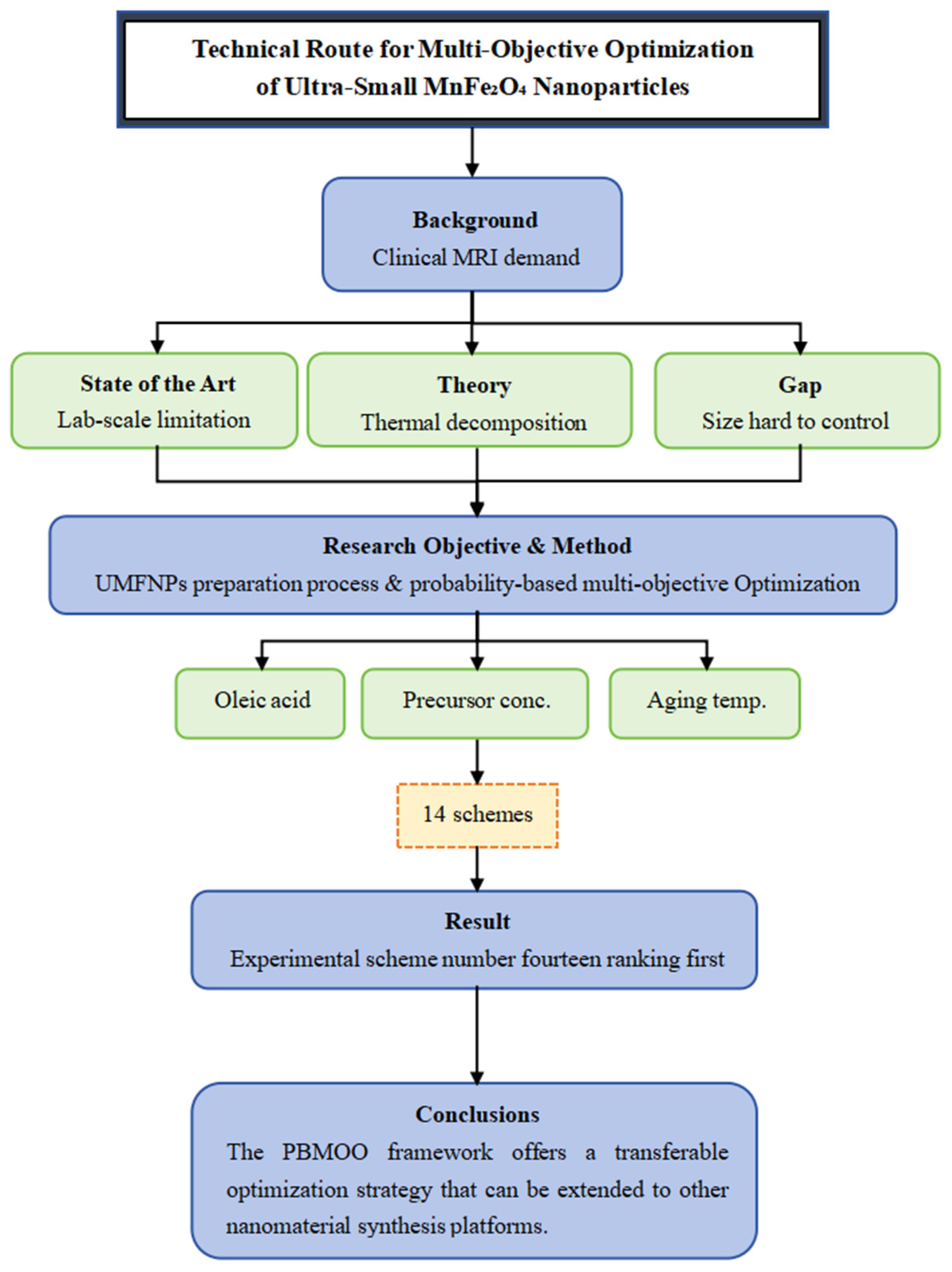
In the preparation of manganese ferrite nanoparticles, key factors affecting particle size include the blending ratio of oil and alcohol, heating rate, termination temperature, and cooling rate. For particle size distribution, critical parameters are stirring speed and holding time at the aging temperature. This study focuses on ferrite nanoparticle synthesis to precisely control particle size, size distribution, magnetic properties, and energy consumption during the preparation process. The influencing factors during the preparation process are investigated using PBMOO method, with the oleic acid dosage, precursor concentration, and aging temperature as the evaluation indexes. The flowchart is shown in Figure 1.
This work introduces and implements, for the first time, a probability-based multi-objective optimization (PBMOO) framework specifically for the synthesis parameter optimization of ultra-small manganese ferrite nanoparticles (UMFNPs). The PBMOO framework employed here is fundamentally a deterministic, post hoc decision-making approach. Its core function is to objectively rank a finite set of pre-defined experimental schemes based on their input parameters, thereby identifying the condition that best balances competing objectives. This distinguishes it in two key aspects: (1) from iterative global search algorithms (e.g., Particle Swarm Optimization), which actively search a continuous parameter space through function evaluations; and (2) from conventional multi-criteria decision-making methods (e.g., TOPSIS, VIKOR), which often rely on subjective weight assignments for different indicators. The core methodological advancement of PBMOO lies in its provision of a weight-subjective, probabilistic approach to balancing the competing objectives of particle size, size distribution, and saturation magnetization. By applying this objective framework to a well-defined experimental dataset, this study demonstrates its potential as a rational and effective tool for guiding the design of complex nanomaterial synthesis processes.

2. Research Method

2.1. Preparation Process of UMFNPs

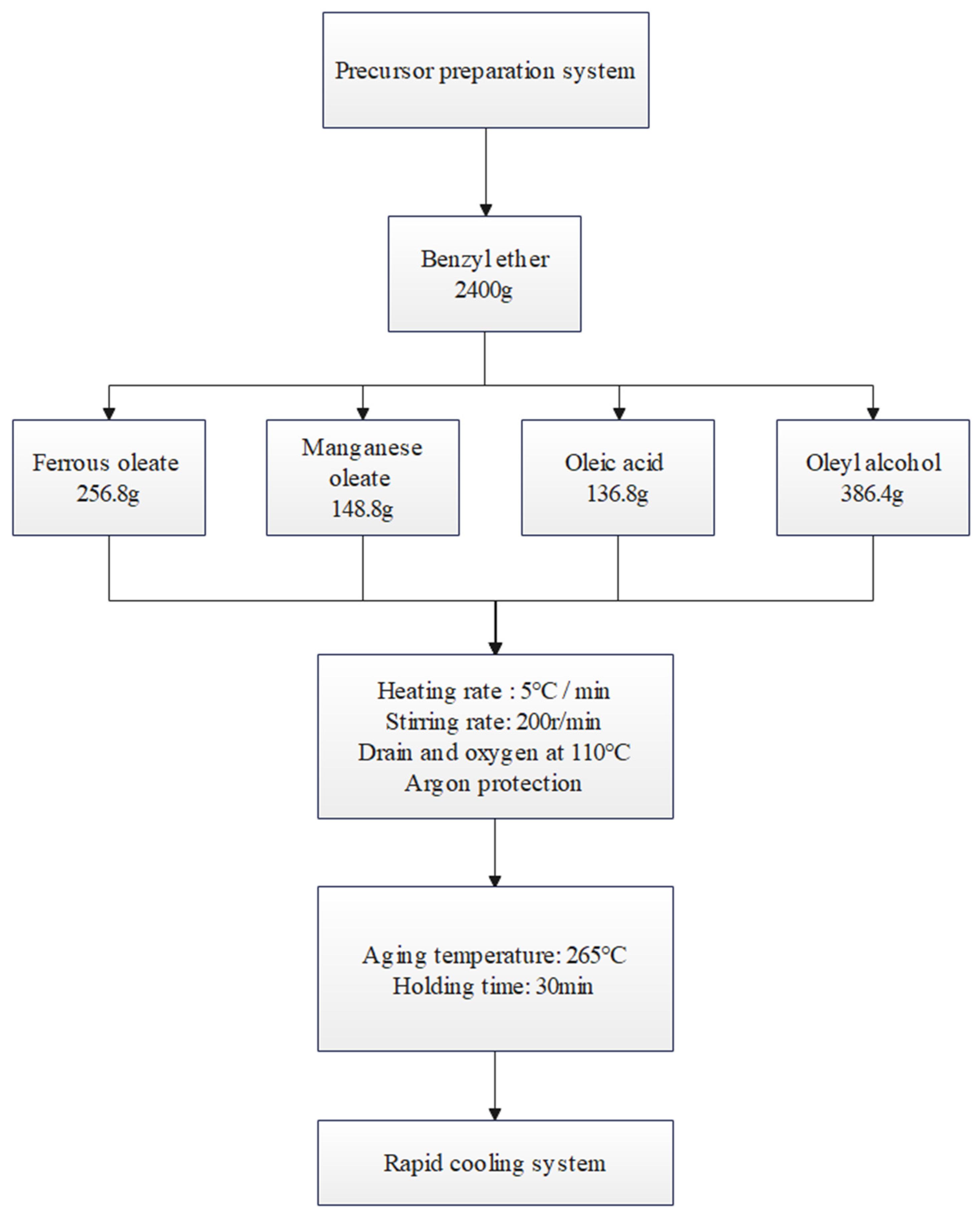
The 3 nm UMFNPs studied in this paper were synthesized via DSTD method in benzyl ether, using Mn-oleate and Fe-eruciate as precursors, with oleic acid serving as a surfactant. Preparation of 3 nm UMFNPs: 256.8 g Fe-eruciate, 148.8 g Mn-oleate, 136.8 g oleic acid, and 386.4 g oleyl alcohol were dissolved in 2400 g benzyl ether at room temperature. The reaction mixture was heated to 110 °C in a three-necked flask under argon atmosphere for 30 min with magnetic stirring to expel impurities such as oxygen and water. Subsequently, the reaction system was heated at a rate of 5 °C/min to 265 °C, maintained at this temperature for 30 min, and then rapidly cooled to room temperature. The nanoparticles were centrifuged and washed using n-hexane as the dispersant and absolute ethanol as the precipitant. Finally, the nanoparticles were dispersed in n-hexane and stored in glass bottles for subsequent usage. During the synthesis of 3 nm UMFNPs, the thermal decomposition temperatures of the precursors Fe-eruciate and Mn-oleate were 326.5 °C and 311.4 °C. With oleyl alcohol addition, the decomposition temperatures of both precursors decreased to 220 °C. The flowchart is shown in Figure 2. Consequently, the nucleation temperature of the manganese ferrite nanoparticles was controlled within 180–220 °C, with nucleation and growth occurring between 220–265 °C. This demonstrates that oleyl alcohol dosage can effectively regulate both the particle size and saturation magnetization strength of the UMFNPs. The main reagents and instruments are listed in Table 1 and Table 2.

2.2. Probability-Based Multi-Objective Optimization Method and Its Implementation Procedure

This study utilizes the probability-based multi-objective optimization (PBMOO) method [25].
The PBMOO is fundamentally a multi-criteria decision-making (MCDM) framework designed for evaluating and ranking discrete alternatives. In the context of this study, each “alternative” is a pre-defined synthesis scheme with specific technological parameters (oleic acid dosage, aging temperature, and precursor concentration). The framework operates through the following three-step procedure:
Step 1: problem formulation and data structuring. The candidate schemes and their corresponding parameter sets are defined. Each parameter is classified as either “beneficial” or “non-beneficial” based on its desired influence on the ultimate product quality.
Step 2: probabilistic transformation and aggregation. Within this framework, the preferable probability quantifies how desirable a candidate’s utility is for selection. The utility indexes of candidate schemes are categorized as either beneficial or non-beneficial. Each index contributes a quantified partial preferable probability. For each scheme, the value of each technological parameter is converted into a “partial preferable probability” (Pij), which quantifies the relative desirability of that parameter value compared to all other schemes. From a probabilistic perspective, the overall preferable probability for a candidate is derived from the product of all its partial probabilities. This method effectively converts the multi-objective evaluation problem into a unified single-score ranking task.
Step 3: ranking and optimal scheme identification. The overall preferable probability (Pi) serves as the sole decisive criterion in the scheme selection process. All candidate schemes are ranked sequentially based on their respective total preferable probabilities. The scheme with the highest Pi is identified as the optimal parameter set within all schemes.
The mathematical formulations for calculating the partial and total preferable probabilities are provided below. The partial preferable probability for a beneficial index (i.e., “the higher the better”) increases linearly with the value of that utility index during the scheme selection process.
P i j U i j , P i j = α j U i j ,   i = 1 , 2 , , n , j = 1 , 2 , , m .
where in Equation (1) Uij expresses the utility index value of the j-th schemes indicator of the i-th candidate schemes; Pij indicates the partial preferable probability of the beneficial schemes indicator Uij; n shows the total number of candidate schemes in the schemes group involved; m reflects the total number of the utility of schemes indicators of each candidate schemes in the group; αj represents the normalized factor of the j-th beneficial utility of schemes indicator.
i = 1 n α j U i j = i = 1 n P i j = 1 , α j = 1 ( n U ¯ j ) .
U j ¯ expresses the arithmetic average value of the j-th utility index of schemes indicator in the schemes group to be assessed.
The partial preferable probability of the unbeneficial schemes indicator Uij to the candidate schemes is negatively correlative to its utility value of the schemes indicator in linear manner.
P i j ( U j m a x + U j m i n U i j ) , P i j = β j ( U j m a x + U j m i n U i j ) .
In Equation (3) Ujmin and Ujmax express the minimum and maximum values of the utility index Uj of the schemes indicator in the schemes group, individually; βj indicates the normalized indicator of the j-th unbeneficial utility of schemes indicator.
β j = 1 / [ n ( U j m a x + U j m i n ) n U j ¯ ] .
The overall/total preferable probability of the i-th candidate schemes is the product of its all partial preferable probabilities Pij.
P i = P i 1 · P i 2 P i m = j = 1 m P i j .
Pij is the partial preferable probabilities of the j-th utility indicator of the i-th evaluation object. Pi is total preferable probability of the i-th candidate schemes.
The overall preferable probability (Pi) serves as the sole decisive criterion in the scheme selection process. All candidate schemes can be ranked sequentially based on their respective total preferable probabilities, and material selection is subsequently carried out according to this ranking as a comprehensive evaluation.
It is important to note that the PBMOO framework employs two key simplifying assumptions for its calculations: (1) a linear relationship between the normalized utility index of an indicator and its contribution to the partial preferable probability, and (2) statistical independence between the contributions of different indicators when they are multiplied to form the composite total probability (Equation (5)). These assumptions provide a practical and objective mechanism for integrating multi-criteria data into a single ranking score.
This method normalizes the utility indexes of beneficial indicators and unbeneficial indicators and is suitable for many types of data weight analysis. The data obtained are objective and fair and have high credibility.
In the context of this study, the PBMOO framework is applied to evaluate the candidate synthesis schemes based on their three key process parameters: oleic acid dosage, aging temperature, and precursor concentration. Each parameter is classified as either beneficial or unbeneficial based on its desired direction of influence on the ultimate product quality. The partial preferable probability quantifies the desirability of a scheme’s value for each individual parameter. The multiplication of these partial probabilities (Equation (5)) to obtain the total preferable probability is a methodological construct within PBMOO. It assumes that the contributions from each parameter to the overall desirability of a scheme are combined independently for the purpose of establishing a composite, weight-subjective ranking criterion.

3. Optimization Process and Optimization Results

The probability-based multi-objective optimization (PBMOO) method is applied here to a well-defined experimental dataset from the literature [20]. In that study, Wang systematically investigated the effects of oleic acid dosage, aging temperature, and precursor concentration on the size, size distribution, and saturation magnetization of monodisperse Fe3O4 nanoparticles synthesized via the thermal decomposition of ferrous carbonate (FeCO3). The fourteen distinct experimental schemes they designed, along with the corresponding characterization results, are reproduced in Table 3, and serve as the basis for the present optimization analysis. It is noted that the “precursor concentration/mmol” in Table 3 refers to the millimoles of FeCO3 precursor per 10 g of solvent, as defined in the source work [20].
In the source study [20], the nanoparticle size and size distribution were determined by Transmission Electron Microscopy (TEM, operated at 200 kV), with statistical metrics derived from measuring over 200 particles per sample using ImageJ software. The saturation magnetization was measured at room temperature using a Vibrating Sample Magnetometer (VSM) (Beijing Xinke Co., Ltd., Beijing, China) with an applied field up to 20 kOe. All experimental details ensuring reproducibility are provided therein.
The selection of oleic acid dosage, aging temperature, and precursor concentration as the optimization indicators is grounded in their established dominance as the primary control levers for tailoring particle size and magnetic properties in the thermal decomposition synthesis of ferrite nanoparticles [20]. While other parameters (e.g., heating rate, stirring speed) can exert secondary effects, this trio constitutes the most critical and direct factors governing the nucleation kinetics and growth dynamics that ultimately determine the core characteristics of the final product. The systematic investigation of these specific parameters in the source study [20] provides a robust and well-defined dataset for the present multi-objective optimization analysis.
The experimental design systematically isolates the effect of each key variable:
(1)
In schemes 1–5, the aging temperature and precursor concentration are held constant at 553.15 K and 3 mmol, respectively, while the oleic acid dosage is varied from 3 to 15 mmol.
(2)
In schemes 6–8, the oleic acid dosage and precursor concentration are fixed at 6 mmol and 3 mmol, respectively, and the aging temperature is varied from 513.15 to 573.15 K.
(3)
In schemes 9–14, the oleic acid dosage and aging temperature are fixed at 6 mmol and 593.15 K, respectively, and the precursor concentration is varied from 1 to 7 mmol.
This orthogonal design allows for the independent evaluation of each parameter’s influence on the nanoparticle properties.
In the preparation process of nanoparticles like ferrites, the influence of material quantity and heat on particle size and magnetic properties is analogous, thus necessitating an optimized design for the synthesis of Fe3O4 nanoparticles. To achieve this, the 14 experimental schemes were selected, and PBMOO was employed to evaluate indicators such as oleic acid dosage, aging temperature, and precursor concentration for the nanoparticles. This analysis leads to the identification of the optimal scheme. Among these indicators, oleic acid dosage and aging temperature are unbeneficial indexes, whereas precursor concentration is a beneficial index, with the parameters detailed in Table 3 [20]. For precursor concentration, the calculation formula for beneficial indexes within the PBMOO should be used to determine its partial preferable probabilities. Conversely, for oleic acid dosage and aging temperature, the unbeneficial indicators calculation formula within the same method is applied to derive their partial preferable probabilities. By multiplying these partial preferable probabilities across all indicators, the total preferable probability for each scheme can be obtained.
The calculation process of partial preferable probabilities (P11) of oleic acid dosage (unbeneficial index), the first utility index of group 1, is taken as an example.
U ¯ 1 = 3 + 6 + 9 + 12 + 15 + 6 + 6 + 6 + 6 + 6 + 6 + 6 + 6 + 6 14 = 7.07
β 1 = 1 n ( U 1 m a x + U 1 m i n ) n U ¯ 1 = 1 14 × ( 15 + 3 ) 14 × 7.07 = 0.0065
P 11 = β 1 ( U 1 m a x + U 1 m i n U 11 ) = 0.0065 × ( 15 + 3 3 ) = 0.0975
The calculation process of partial preferable probabilities (P31) of precursor concentration (beneficial index), which is the third utility index of group 1, is taken as an example.
U ¯ 3 = 3 + 3 + 3 + 3 + 3 + 3 + 3 + 3 + 1 + 3 + 4 + 5 + 6 + 7 14 = 3.57
α 3 = 1 n U ¯ 3 = 1 14 × 3.57 = 0.02
P 31 = α 3 U 31 = 0.02 × 3 = 0.06
The partial preferable probabilities and total preferable probabilities of each parameter calculated by the above optimization method are shown in Table 4.
Taking the first group of experimental schemes as an example, the total preferable probabilities of the experimental scheme P1 = P11 × P21 × P31 = 0.0975 × 0.0719095 × 0.06 = 0.000420671 can be obtained by substituting the data in Table 4. In the same way, the total preferable probabilities of other experimental schemes can be obtained. The total preferable probabilities and the optimization level of each experimental scheme will be listed in Table 5. The detailed calculation process is shown in Table S1. Among them, the higher the optimization level, the more the experimental scheme meets the requirements of usage.
Table 5 presents the total preferable probability and the corresponding ranking for 14 experimental schemes, evaluated against three key performance indicators: particle size, particle size distribution, and saturation magnetization. The results validate the effectiveness of the probability-based optimization, with experimental scheme number fourteen ranking first due to the total preferable probability highest. This optimal scheme does not achieve extreme values in any single metric, such as having neither the smallest particle size nor the highest saturation magnetization, which demonstrates that the method successfully identifies parameter sets that balance multiple competing objectives rather than maximizing a single objective.
The PBMOO ranking presented above is based on a model that incorporates two fundamental assumptions: (1) a linear relationship between the normalized utility of an indicator and its contribution to the “partial preferable probability” and (2) the statistical independence of different indicators when their probabilities are multiplied. The validity of these assumptions within the context of nanoparticle synthesis warrants discussion. First, the orthogonal experimental design of the source dataset [20], where key parameters (oleic acid, temperature, and concentration) were varied systematically and independently across schemes, structurally aligns with the assumption of independence for the purpose of comparative evaluation. Crucially, the practical validity of this simplified model is demonstrated by its outcome: the top-ranked scheme (No. 14) corresponds to an experimentally realized condition that yielded a balanced, high-performance profile (6.0 nm size, 31.4 emu/g magnetization) in the foundational study [20]. This agreement suggests that, within the parameter space investigated, the PBMOO framework provides a robust and effective approximation for multi-objective decision-making in synthesis optimization.
Advantage of this probabilistic method is its fundamental departure from conventional weighted-sum methods. It eliminates the need for subjective weighting by calculating the joint probability of independent performance events, thereby ensuring that the ranking is objectively derived from experimental data and probability principles, rather than being influenced by arbitrary, user-defined weights.

4. Conclusions

This study applied a probability-based multi-objective optimization framework to the synthesis process of ultra-small ferrite nanoparticles. By systematically investigating the effects of key parameters—oleic acid dosage, precursor concentration, and aging temperature—on particle size and properties during the nucleation and growth stages, an optimal set of process conditions was determined.
The optimization results demonstrate that this method can effectively coordinate and balance multiple competing objectives in nanoparticle synthesis. It provides a robust and efficient pathway for precisely controlling particle size within the ultra-small range while maintaining uniformity and desired magnetic properties. Compared to conventional approaches, the proposed methodology reduces experimental iterations and enhances the predictability and controllability of the synthesis process.
A key contribution of this work is the novel implementation of the PBMOO methodology for this optimization task, establishing a weight-subjective, probabilistic framework for multi-criteria decision-making in nanomaterial synthesis. This approach provides a more objective alternative to conventional methods that rely on subjective weighting of performance indicators. Consequently, this work not only offers a set of optimized parameters for the reproducible preparation of ultra-small ferrite nanoparticles but also presents a generalizable and more objective optimization strategy that can be adapted to other nanomaterial synthesis systems.
The optimal scheme identified herein is a theoretically derived recommendation based on the probabilistic analysis of an existing experimental dataset. Beyond this specific recommendation, the primary practical implication of this work lies in validating PBMOO as a systematic and objective protocol for early-stage process development. This can establish a more rational foundation for scaling up laboratory formulations, potentially reducing the time and resource cost of empirical trial-and-error.

Supplementary Materials

The following supporting information can be downloaded at: https://www.mdpi.com/article/10.3390/pr14030535/s1, Table S1: Full Computational Reproducibility Statement.

Author Contributions

Conceptualization, D.Z.; methodology, H.T.; validation, P.H. and X.C.; formal analysis, D.Z.; investigation, D.Z.; resources, H.T.; data curation, D.Z.; writing—original draft preparation, D.Z.; writing—review and editing, P.H. and X.C.; visualization, P.H.; supervision, H.T. All authors have read and agreed to the published version of the manuscript.

Funding

This research received no external funding.

Data Availability Statement

The original contributions presented in this study are included in the article/Supplementary Materials. Further inquiries can be directed to the corresponding author.

Conflicts of Interest

The authors declare no conflicts of interest.

Abbreviations

The following abbreviations are used in this manuscript:
UMFNPsUltra-small MnFe2O4 nanoparticles
MOOMulti-objective optimization
MCDMMulti-criteria decision-making
TOPSISTechnique of ranking Preferences by Similarity to the Ideal Solution
MOORAMulti-Objective Optimization on the basis of Ratio Analysis
VIKORVlšekriterijumsko KOmpromisno Rangiranje
PBMOOProbability-based multi-objective optimization
DSTDDynamic simultaneous thermal decomposition

References

  1. Ebadi, M.; Asikin-Mijan, N.; Jamil, M.S.M.; Iqbal, A.; Yousif, E.; Zain, A.R.M.; Aziz, T.H.T.; Yusop, M.R. Palladium Nanoparticles on Chitosan-Coated Superparamagnetic Manganese Ferrite: A Biocompatible Heterogeneous Catalyst for Nitroarene Reduction and Allyl Carbamate Deprotection. Polymers 2023, 15, 232. [Google Scholar] [CrossRef] [Scilit]
  2. Naz, M.Y.; Irfan, M.; Shukrullah, S.; Ahmad, I.; Ghaffar, A.; Niazi, U.M.; Rahman, S.; Jalalah, M.; Alsaiari, M.A.; Khan, M.K.A. Effect of microwave plasma treatment on magnetic and photocatalytic response of manganese ferrite nanoparticles for wastewater treatment. Main. Group. Chem. 2021, 20, 423–435. [Google Scholar] [CrossRef] [Scilit]
  3. Shahidizandi, S.; Mohammadi-Manesh, H.; Loghavi, M.M.; Hakimi, M. Chemical co-precipitation synthesis of manganese ferrite (MnFe2O4) nanoparticles as a magnetic adsorbent of lead. Main. Group. Chem. 2022, 21, 1029–1038. [Google Scholar] [CrossRef] [Scilit]
  4. Wang, G.; Zhao, D.; Ma, Y.; Zhang, Z.; Che, H.; Mu, J.; Zhang, X.; Zhang, Z. Synthesis and characterization of polymer-coated manganese ferrite nanoparticles as controlled drug delivery. Appl. Surf. Sci. 2018, 428, 258–263. [Google Scholar] [CrossRef] [Scilit]
  5. Zhang, H. Synthesis and Biomedical Application of Sub-5 nm Ferrite Nanoparticles-based T1 Contrast Agent. Ph.D. Thesis, Northwest University, Xi’an, China, 2018. [Google Scholar]
  6. Lee, Y.; Lee, J.; Bae, C.J.; Park, J.G.; Noh, H.J.; Park, J.H.; Hyeon, T. Large-Scale Synthesis of Uniform and Crystalline Magnetite Nanoparticles Using Reverse Micelles as Nanoreactors under Reflux Conditions. Adv. Funct. Mater. 2005, 15, 503–509. [Google Scholar] [CrossRef] [Scilit]
  7. Liu, C.; Zou, B.; Rondinone, A.J.; Zhang, Z.J. Reverse Micelle Synthesis and Characterization of Superparamagnetic MnFe2O4 Spinel Ferrite Nanocrystallites. J. Phys. Chem. B 2000, 104, 1141–1145. [Google Scholar] [CrossRef] [Scilit]
  8. Carta, D.; Casula, M.F.; Falqui, A.; Loche, D.; Mountjoy, G.; Sangregorio, C.; Corrias, A. A Structural and Magnetic Investigation of the Inversion Degree in Ferrite Nanocrystals MFe2O4 (M = Mn, Co, Ni). J. Phys. Chem. C 2009, 113, 8606–8615. [Google Scholar] [CrossRef] [Scilit]
  9. Li, Z.; Wang, S.X.; Sun, Q.; Zhao, H.L.; Lei, H.; Lan, M.B.; Cheng, Z.X.; Wang, X.L.; Dou, S.X.; Lu, G.Q.M. Ultrasmall manganese ferrite nanoparticles as positive contrast agent for magnetic resonance imaging. Adv. Healthc. Mater. 2013, 2, 958–964. [Google Scholar] [CrossRef] [Scilit]
  10. Hu, J.; Lo, I.M.C.; Chen, G. Fast removal and recovery of Cr(VI) using surface-modified jacobsite (MnFe2O4) nanoparticles. Langmuir 2005, 21, 11173–11179. [Google Scholar] [CrossRef] [Scilit]
  11. Pereira, C.; Pereira, A.M.; Fernandes, C.; Rocha, M.; Mendes, R.; Fernández-García, M.P.; Guedes, A.; Tavares, P.B.; Grenèche, J.-M.; Araújo, J.P.; et al. Superparamagnetic MFe2O4 (M = Fe, Co, Mn) Nanoparticles: Tuning the Particle Size and Magnetic Properties through a Novel One-Step Coprecipitation Route. Chem. Mater. 2012, 24, 1496–1504. [Google Scholar] [CrossRef] [Scilit]
  12. Song, Q.; Ding, Y.; Wang, Z.L.; Zhang, Z.J. Tuning the Thermal Stability of Molecular Precursors for the Nonhydrolytic Synthesis of Magnetic MnFe2O4 Spinel Nanocrystals. Chem. Mater. 2007, 19, 4633–4638. [Google Scholar] [CrossRef] [Scilit]
  13. Chen, Z.; Sun, X.; Ding, Z.; Ma, Y. Manganese ferrite nanoparticles with different concentrations: Preparation and magnetism. J. Mater. Sci. Technol. 2017, 34, 842–847. [Google Scholar] [CrossRef] [Scilit]
  14. Ren, Q. Study on the Preparation and Properties of Manganese Ferrite and Its Core-Shell Nanocomposites. Master’s Thesis, Shandong Jianzhu University, Jinan, China, 2022. [Google Scholar]
  15. Bėčytė, V.; Mažeika, K.; Rakickas, T.; Pakštas, V. Study of magnetic and structural properties of cobalt-manganese ferrite nanoparticles obtained by mechanochemical synthesis. Mater. Chem. Phys. 2016, 172, 6–10. [Google Scholar] [CrossRef] [Scilit]
  16. Miao, Y.; Zhang, H.; Peng, M.; Fan, H. Advances of Research on Quasi-paramagnetic Ultrasmall Ferrite Contrast Agents for Magnetic Resonance Imaging. Prog. Pharm. Sci. 2021, 45, 283–289. [Google Scholar]
  17. Xu, Z.; Fan, L.; Lu, G.; Zhang, Y.; Lu, Y.; Zhang, H. Research Progress on Anti-tumor Effect of Size-tunable Nanoparticles. Chin. Pharm. J. 2023, 58, 1814–1822. [Google Scholar] [CrossRef]
  18. Sun, S.; Zeng, H. Size-Controlled Synthesis of Magnetite Nanoparticles. J. Am. Chem. Soc. 2002, 124, 8204–8205. [Google Scholar] [CrossRef] [Scilit] [PubMed]
  19. Sun, S.; Zeng, H.; Robinson, D.B.; Raoux, S.; Rice, P.M.; Wang, S.X.; Li, G. Monodisperse MFe2O4 (M = Fe, Co, Mn) Nanoparticles. J. Am. Chem. Soc. 2004, 126, 273–279. [Google Scholar] [CrossRef] [Scilit]
  20. Wang, G. Study on Controllable Preparation of Monodisperse Magnetic Nanoparticles Using Metal Carbonate Precursor. Master’s Thesis, Northwest University, Xi’an, China, 2021. [Google Scholar]
  21. Tromsdorf, U.I.; Bigall, N.C.; Kaul, M.G.; Bruns, O.T.; Nikolic, M.S.; Mollwitz, B.; Sperling, R.A.; Reimer, R.; Hohenberg, H.; Parak, S.F.; et al. Size and surface effects on the MRI relaxivity of manganese ferrite nanoparticle contrast agents. Nano Lett. 2007, 7, 2422–2427. [Google Scholar] [CrossRef] [Scilit]
  22. Zhang, H.; Li, L.; Liu, X.; Jiao, J.; Ng, C.T.; Yi, J.; Luo, Y.; Bay, B.H.; Zhao, L.; Peng, M.; et al. Ultrasmall Ferrite Nanoparticles Synthesized via Dynamic Simultaneous Thermal Decomposition for High-Performance and Multifunctional T1 Magnetic Resonance Imaging Contrast Agent. ACS Nano 2017, 11, 3614–3631. [Google Scholar] [CrossRef] [Scilit]
  23. Xie, M. Activity Regulation of Ultra-Small Cobalt Ferrite Nanozymes and Their Catalytic Applications. Master’s Thesis, Northwest University, Xi’an, China, 2022. [Google Scholar]
  24. Park, J.; An, K.; Hwang, Y.; Park, J.-G.; Noh, H.-J.; Kim, J.-Y.; Park, J.-H.; Hwang, N.-M.; Hyeon, T. Ultra-large-scale syntheses of monodisperse nanocrystals. Nat. Mater. 2004, 3, 891–895. [Google Scholar] [CrossRef] [Scilit]
  25. Zheng, M.; Teng, H.; Yu, J.; Cui, Y.; Wang, Y. Probability-Based Multi-Objective Optimization for Material Selection; Springer: Singapore, 2023; pp. 21–41. [Google Scholar]
  26. Tsopgo, A.G.; Teng, H.; Duan, Q.; Zheng, H. Probability-based multi-objective optimization framework for the selection of molten salts in thermal energy storage systems. Compos. Part. B Eng. 2026, 312, 113298. [Google Scholar] [CrossRef] [Scilit]
  27. Cheng, X.; Teng, H.; Duan, Q.; He, P.; Tsopgo, A.G. Study on Evaluation and Optimization Methods of Carbon Dioxide Adsorption Capture System. In Proceedings of the International Conference on Computational and Experimental Simulations in Engineering (ICCES 2025), Cham, Switzerland, 22 October 2025. [Google Scholar]
  28. Meng, Y.; Duan, Q.; Zhao, D.; Hou, C. Analysis of steady-state operation of high temperature heat pipe and optimization of the working medium. Therm. Sci. 2025, 29, 969–982. [Google Scholar] [CrossRef] [Scilit]
Figure 1. Technology pathway of the PBMOO-based process optimization for UMFNPs synthesis.
Processes 14 00535 g001
Figure 2. Preparation process of UMFNPs.
Processes 14 00535 g002
Table 1. Main Reagents Used in Preparation of UMFNPs.
Reagent NamePurity GradeManufacture Factory
Oleic acid90%Sigma-Aldrich (Shanghai) Trading Co., Ltd., Shanghai, China
Oleyl alcohol>60%(GC)TCI (Shanghai) Development Co., Ltd., Shanghai, China
Benzyl ether98%Sigma-Aldrich (Shanghai) Trading Co., Ltd., Shanghai, China
N-hexaneanalytical reagentTianjin Tianli Chemical Reagents Co., Ltd., Tianjin, China
Absolute ethyl alcoholanalytical reagentTianjin Tianli Chemical Reagents Co., Ltd., Tianjin, China
Table 2. Main experimental instruments Used in Preparation of UMFNPs.
Instrument NameModelManufacture Factory
Analytical BalanceFA2004Mettler-Toledo Technology Co., Ltd., Shanghai, China
Magnetic Stirring Hot Plate85-1Shanghai Meiyingpu Instrument and Meter Manufacturing Co., Ltd., Shanghai, China
High-Speed CentrifugeH2500RHunan Xiangyi Laboratory Instrument Development Co., Ltd., Changsha, China
Double-Layer Stainless Steel Reactor/Shanghai Kankun Instrument Equipment Co., Ltd., Shanghai, China
Dynamic Light Scattering Particle Size AnalyzerZEN3600Malvern Panalytical Ltd., Malvern, UK
Fourier Transform Infrared SpectrometerF950Bruker Corporation, Karlsruhe, Germany
Transmission Electron Microscopealox F200xThermo Fisher Scientific Inc., Shanghai, China
Table 3. 14 groups of experimental schemes. Reprinted with permission from Guorong Wang [20]. Copyright 2021 Northwest University.
ExperimentsOleic Acid Dosage
/mmol
Aging Temperature
/K
The Precursor Concentration/mmol
13553.153
26553.153
39553.153
412553.153
515553.153
66513.153
76543.153
86573.153
96593.151
106593.153
116593.154
126593.155
136593.156
146593.157
Table 4. The probabilities for optimization.
ExperimentsP1P2P3
10.09750.07190950.06
20.0780.07190950.06
30.05850.07190950.06
40.0390.07190950.06
50.01950.07190950.06
60.0780.07710950.06
70.0780.07320950.06
80.0780.06930950.06
90.0780.06670950.02
100.0780.06670950.06
110.0780.06670950.08
120.0780.06670950.1
130.0780.06670950.12
140.0780.06670950.14
Table 5. Total preferable probability and preferred grade of the experimental scheme.
ExperimentsParticle Size/nmParticle Size Distribution
/nm
Saturation Magnetization
/emu·g−1
PtotalRank
14.60.524.20.0004206714
25.10.329.90.0003365368
35.50.530.40.00025240211
46.10.731.20.00016826812
56.50.831.30.000084134114
63.40.620.10.0003608726
75.10.530.40.000342627
88.31.433.70.0003243689
912.20.351.60.00010406713
1011.61.150.10.000312210
119.90.444.30.0004162675
127.90.340.90.0005203343
136.50.832.10.0006244012
146.00.931.40.0007284681
Disclaimer/Publisher’s Note: The statements, opinions and data contained in all publications are solely those of the individual author(s) and contributor(s) and not of MDPI and/or the editor(s). MDPI and/or the editor(s) disclaim responsibility for any injury to people or property resulting from any ideas, methods, instructions or products referred to in the content.