Exploring the Effects of Wind Direction on De-Icing Salt Aerosol from Moving Vehicles


Abstract
1. Introduction
2. Methodology
2.1. Numerical Model
2.1.1. Boundary Conditions
2.1.2. Mathematical Model
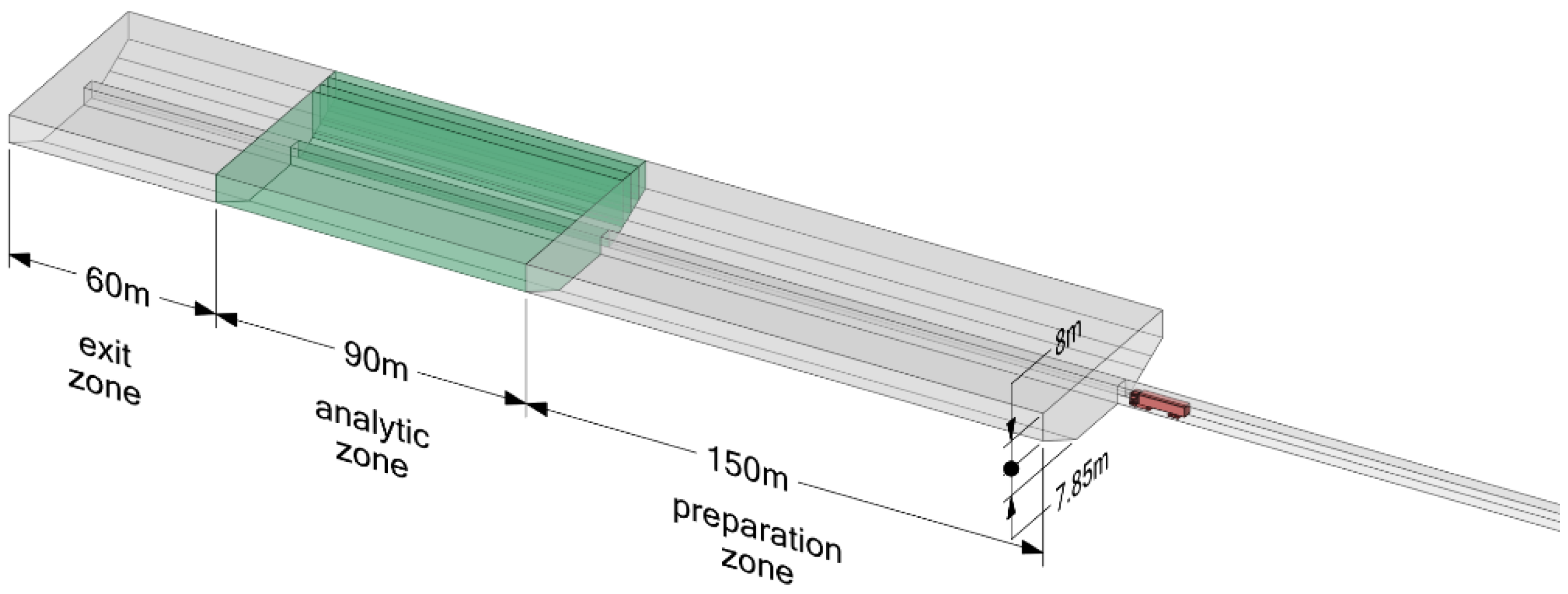
2.1.3. Sampling Planes
2.1.4. Model Simplifications
3. Results
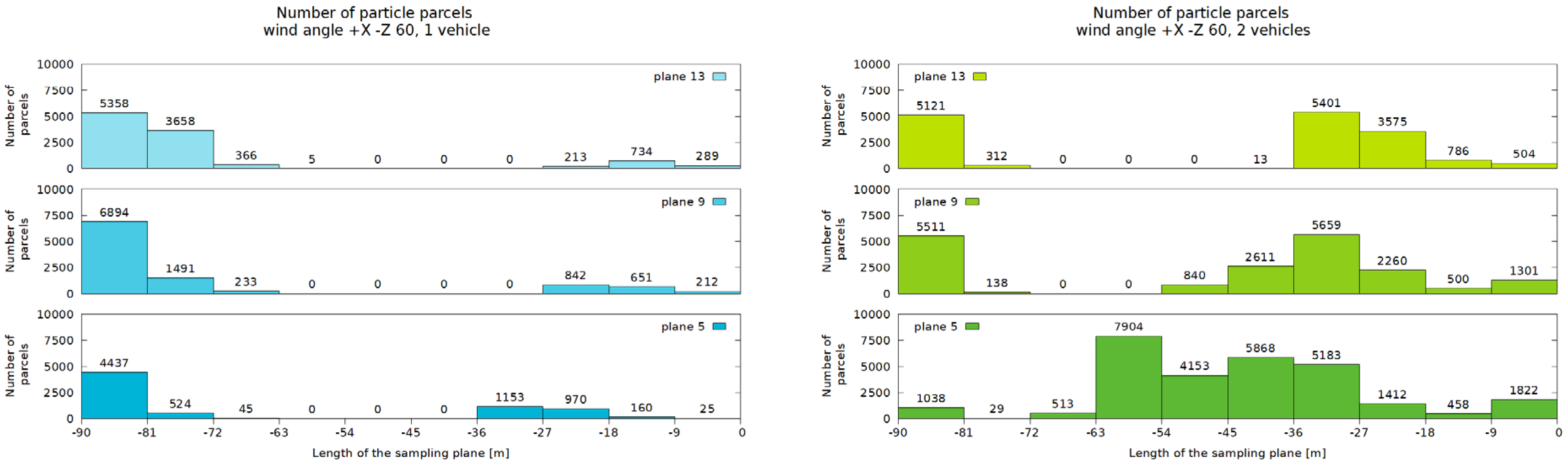
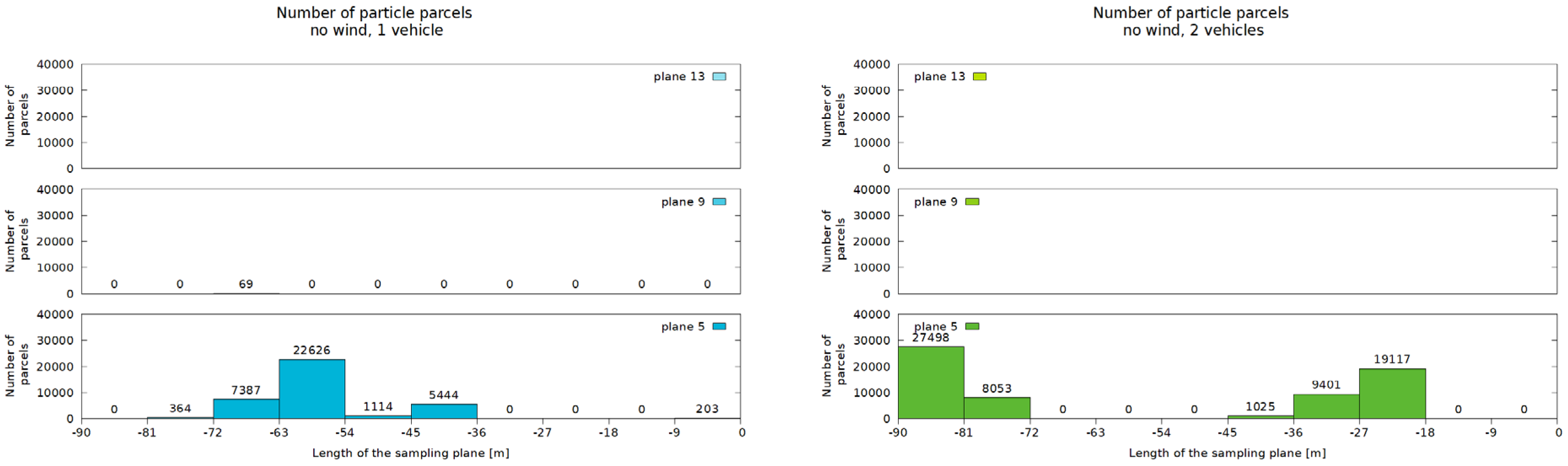
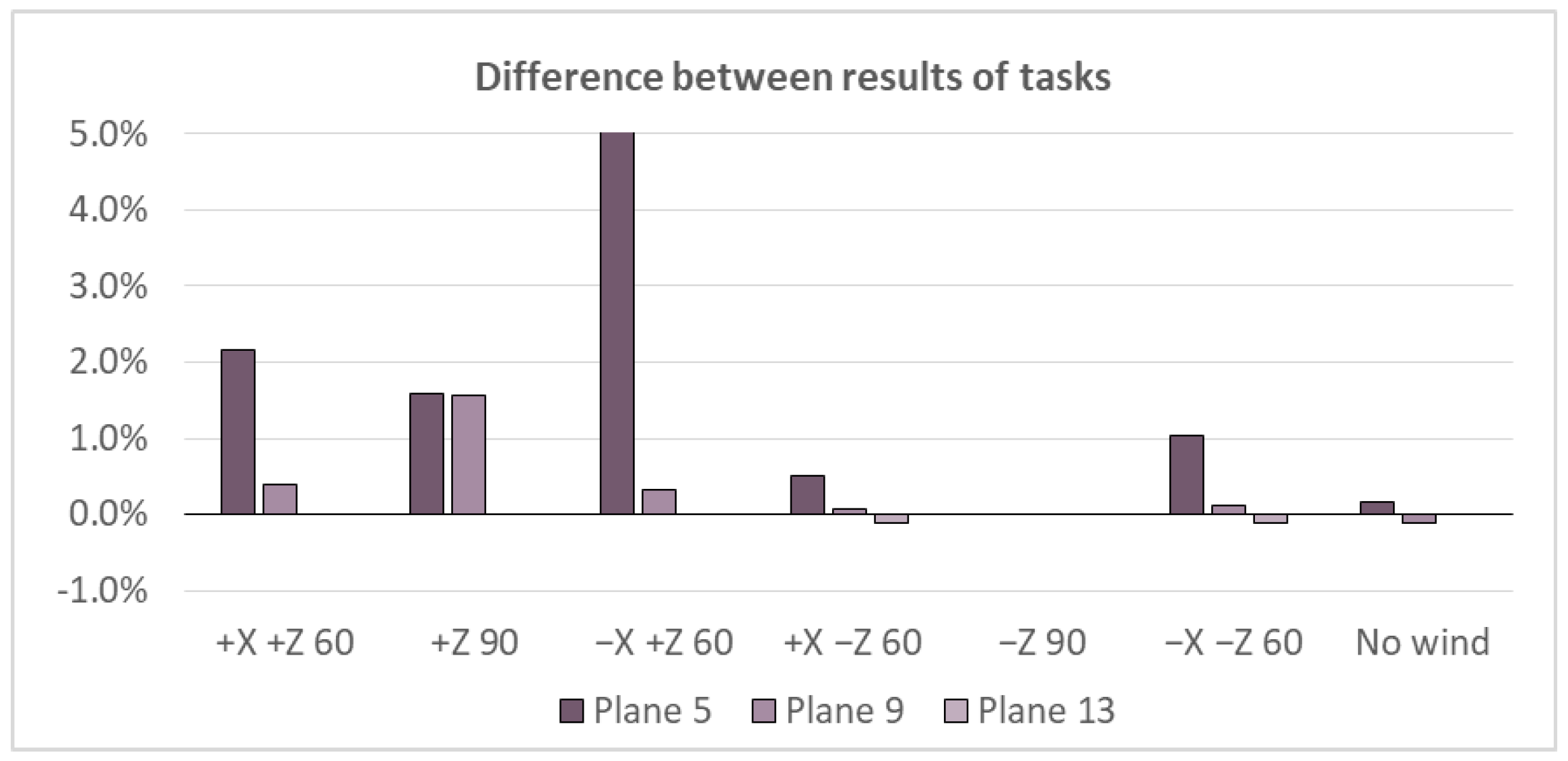
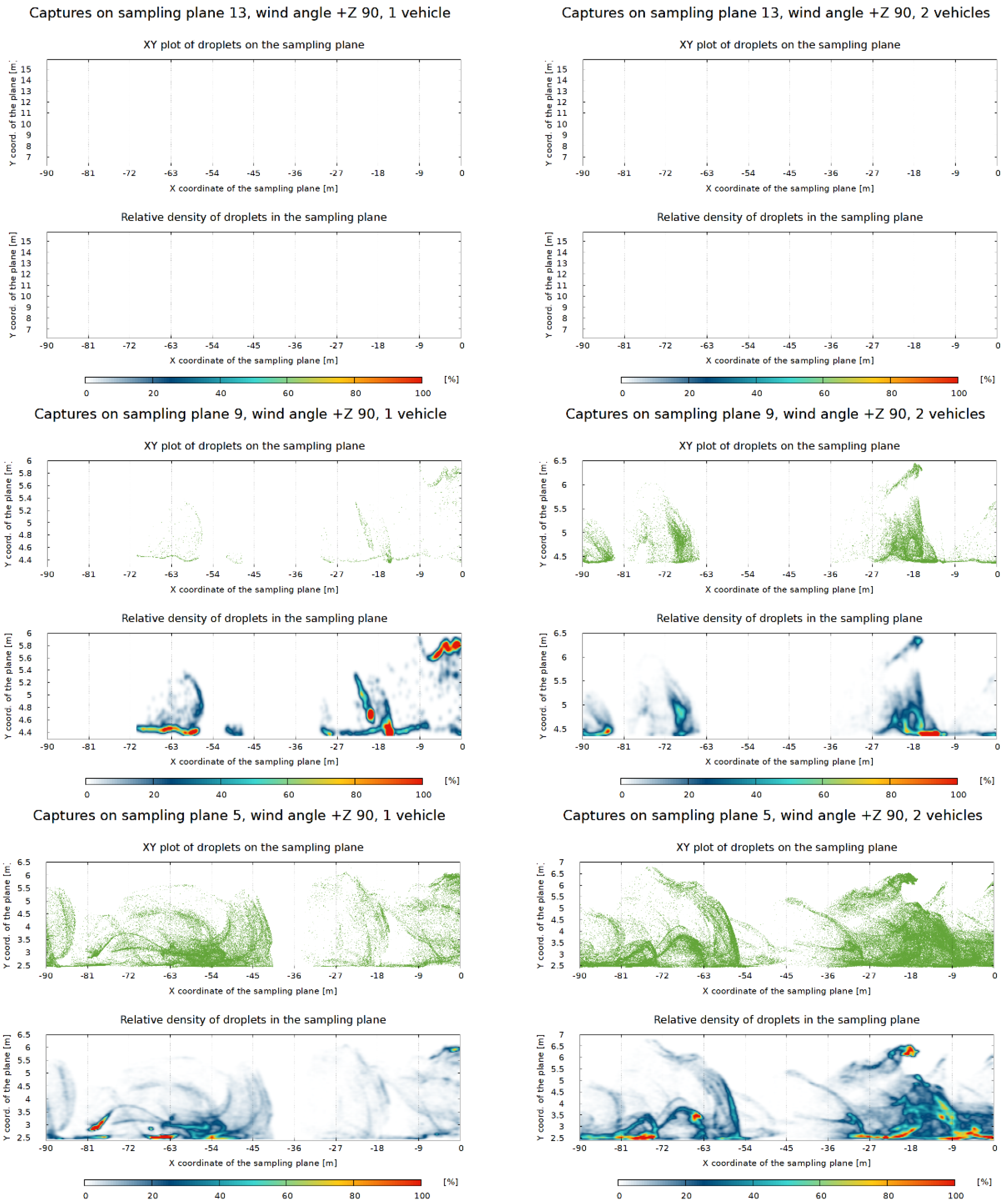
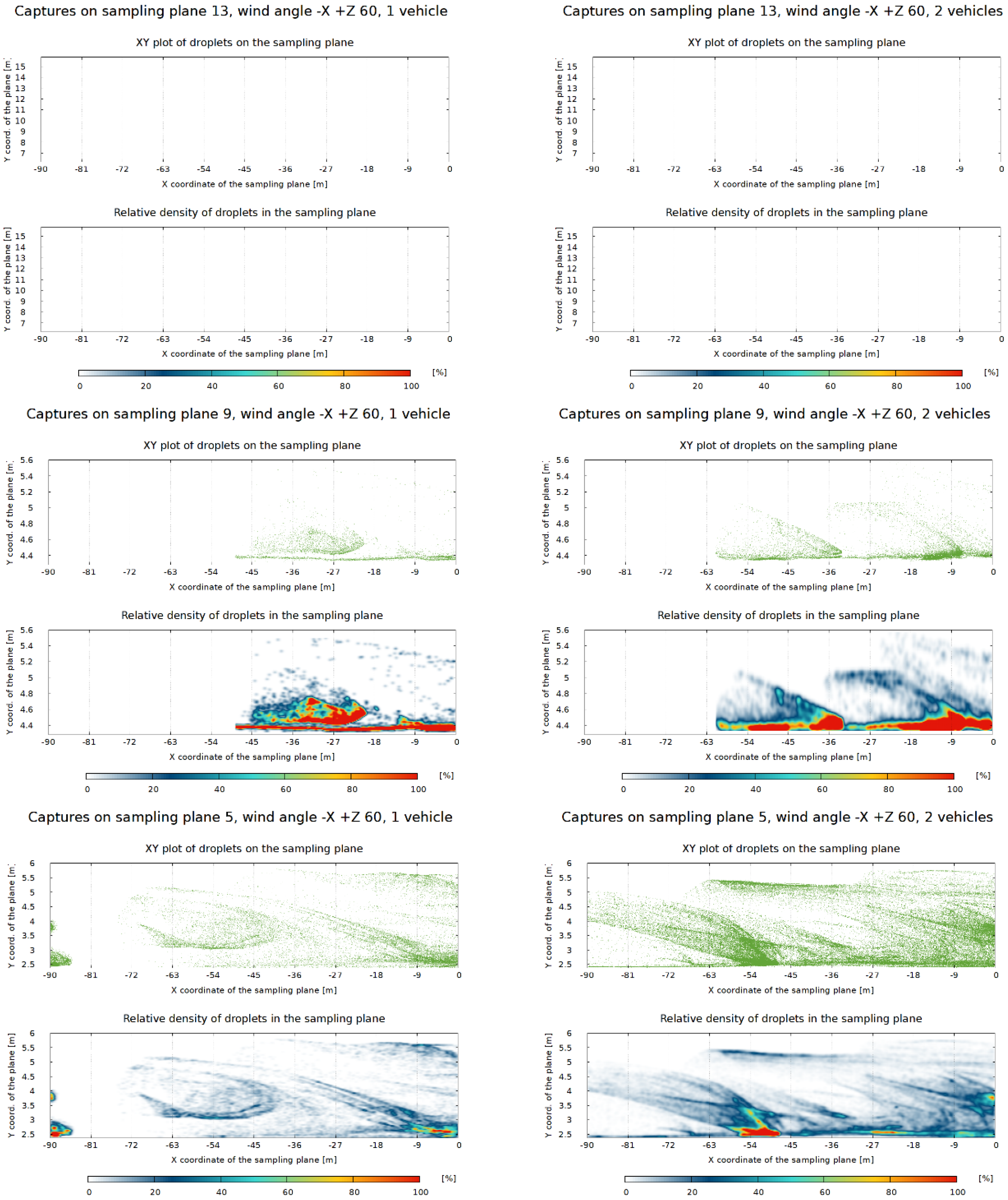
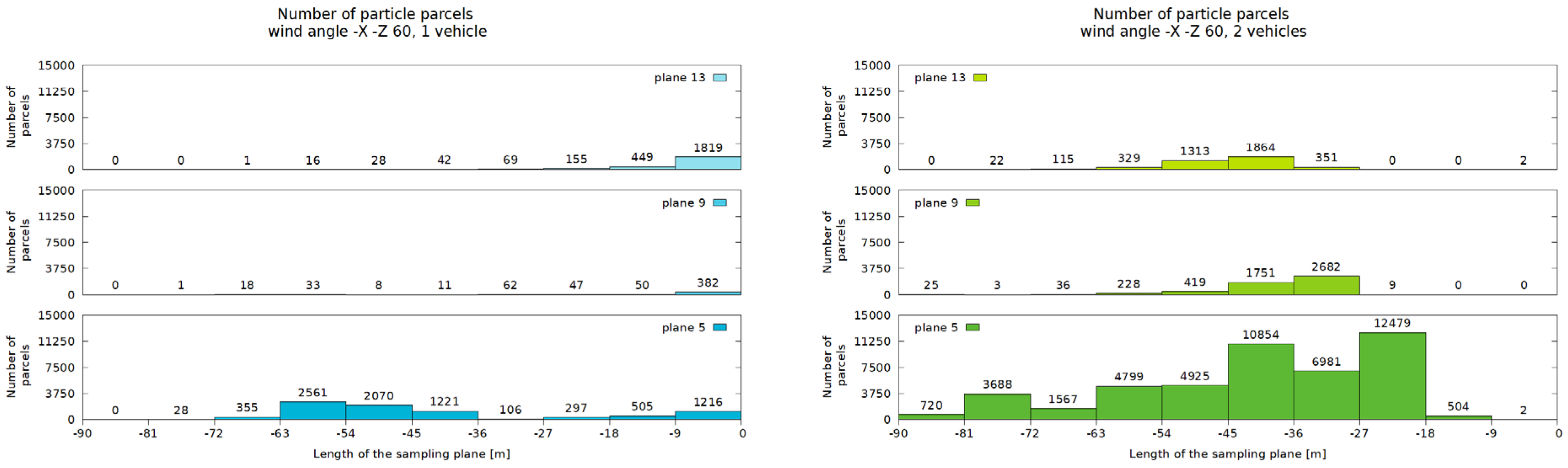
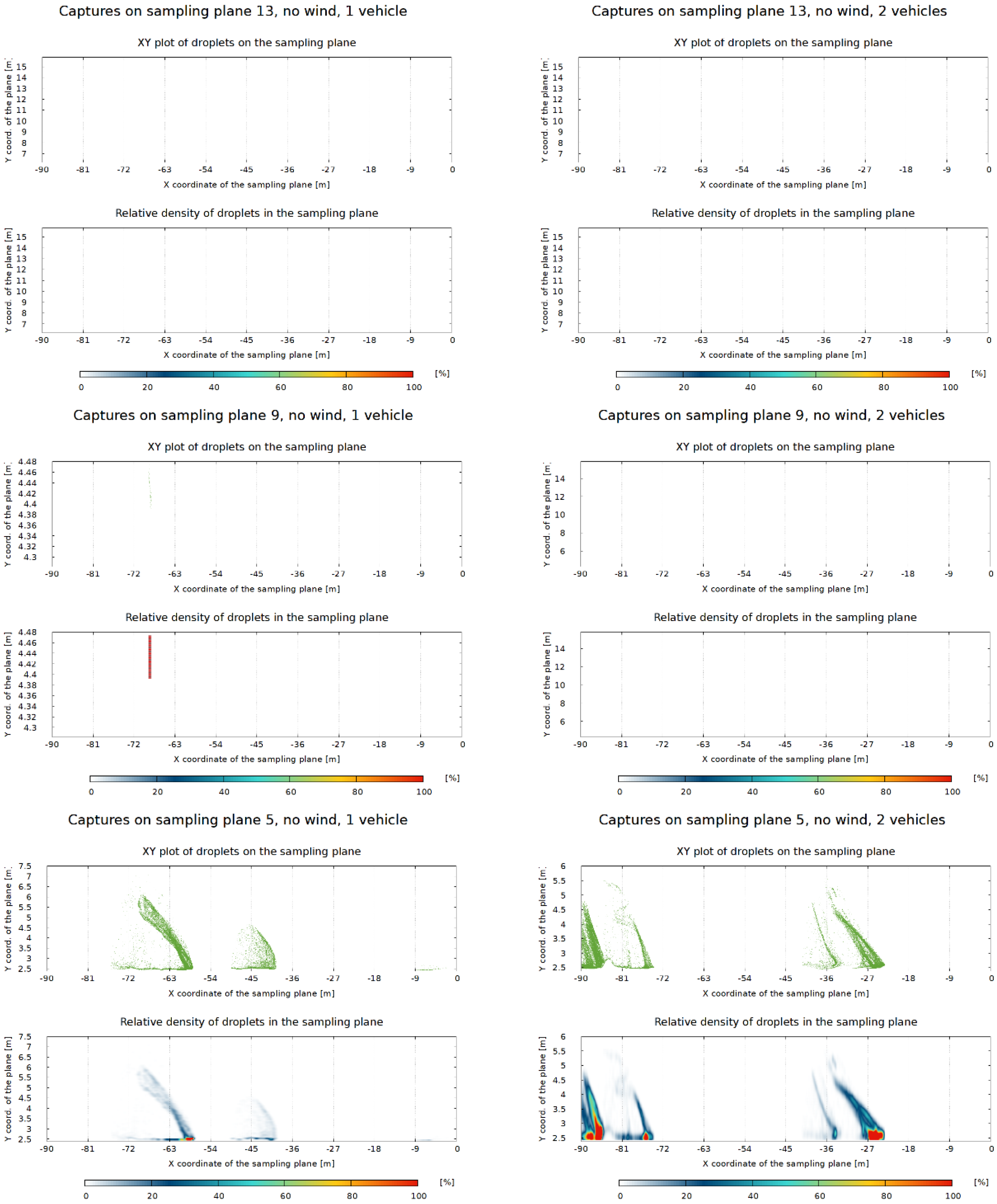
3.1. Influence of Wind Direction and Number of Vehicles
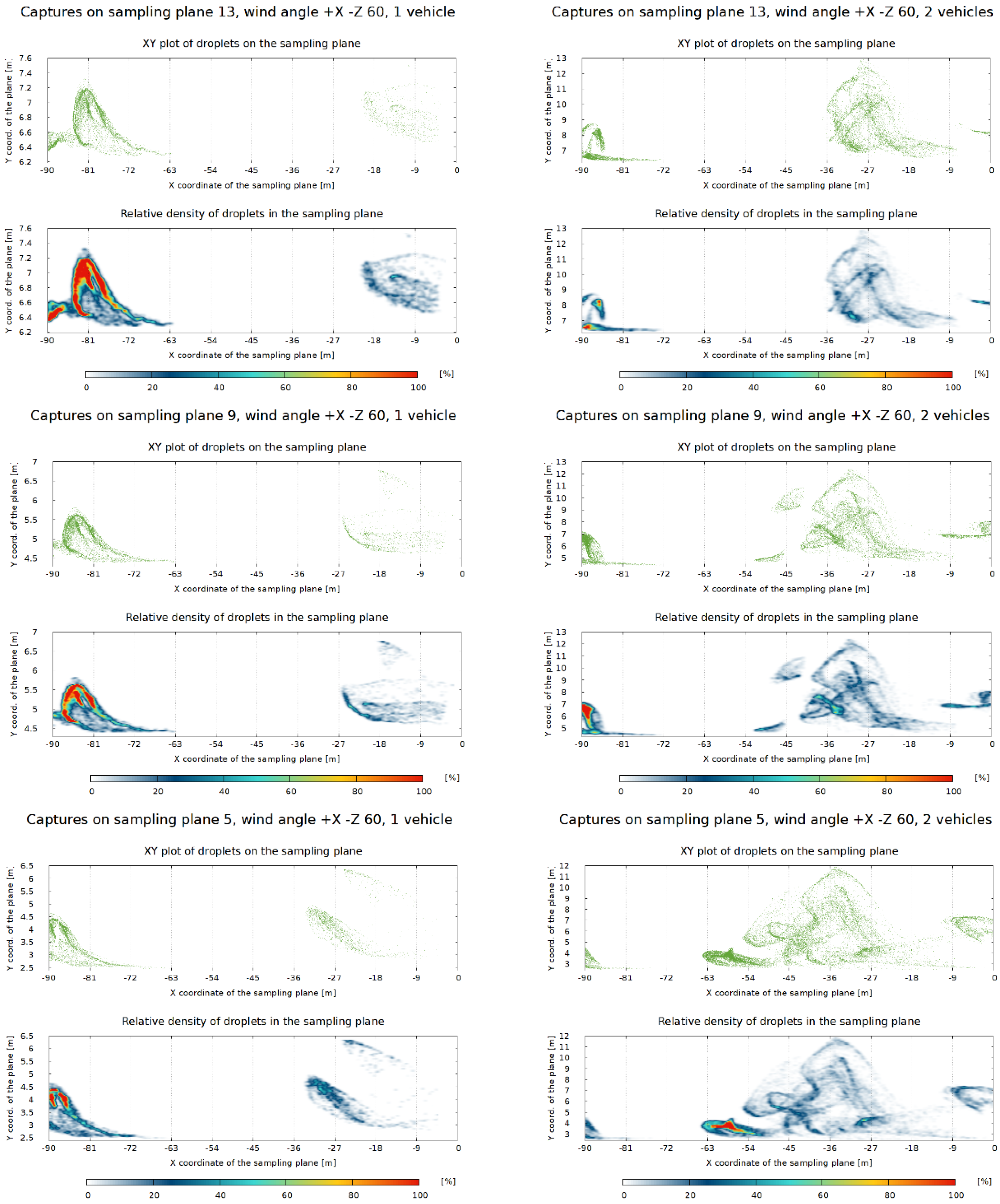
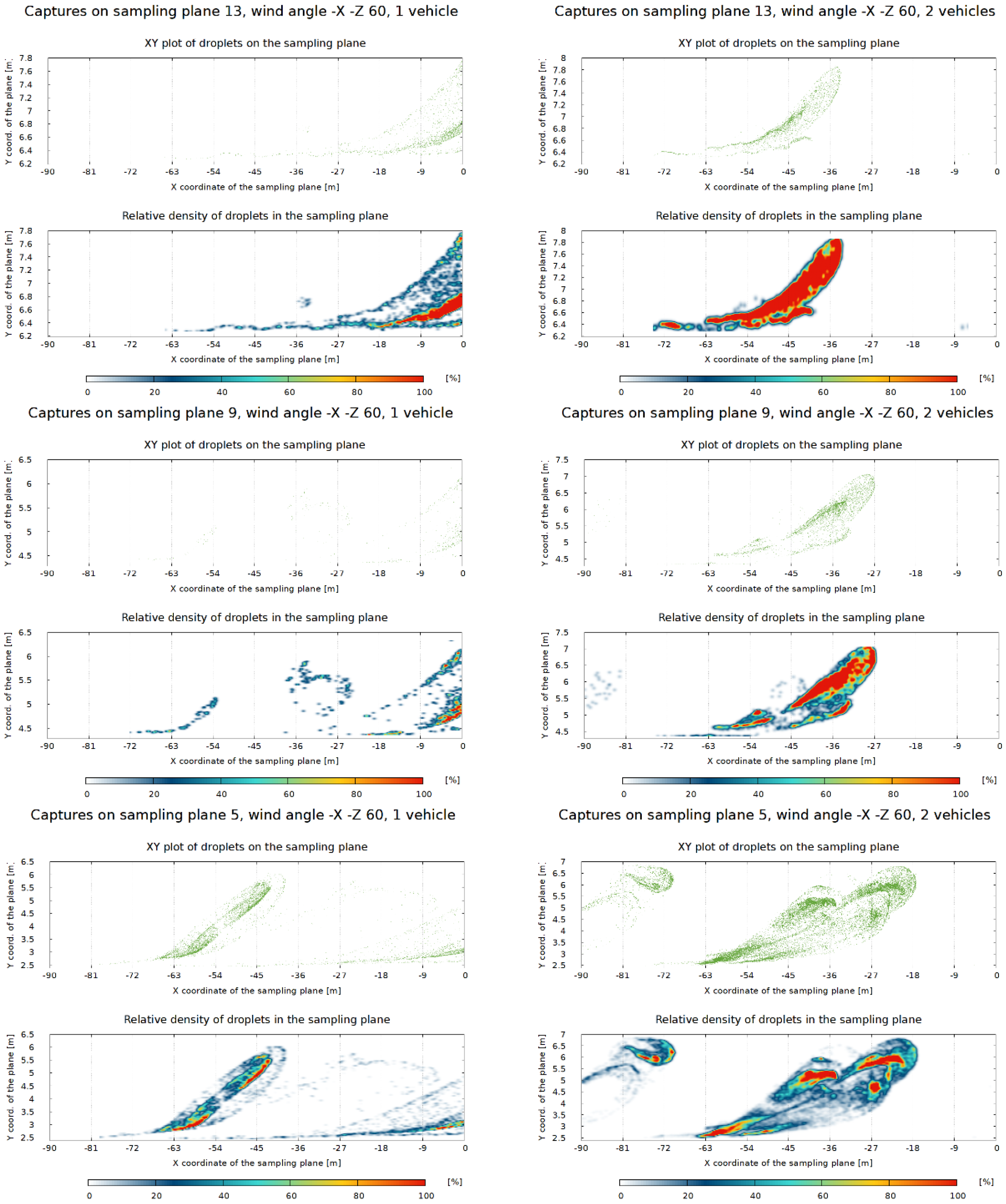
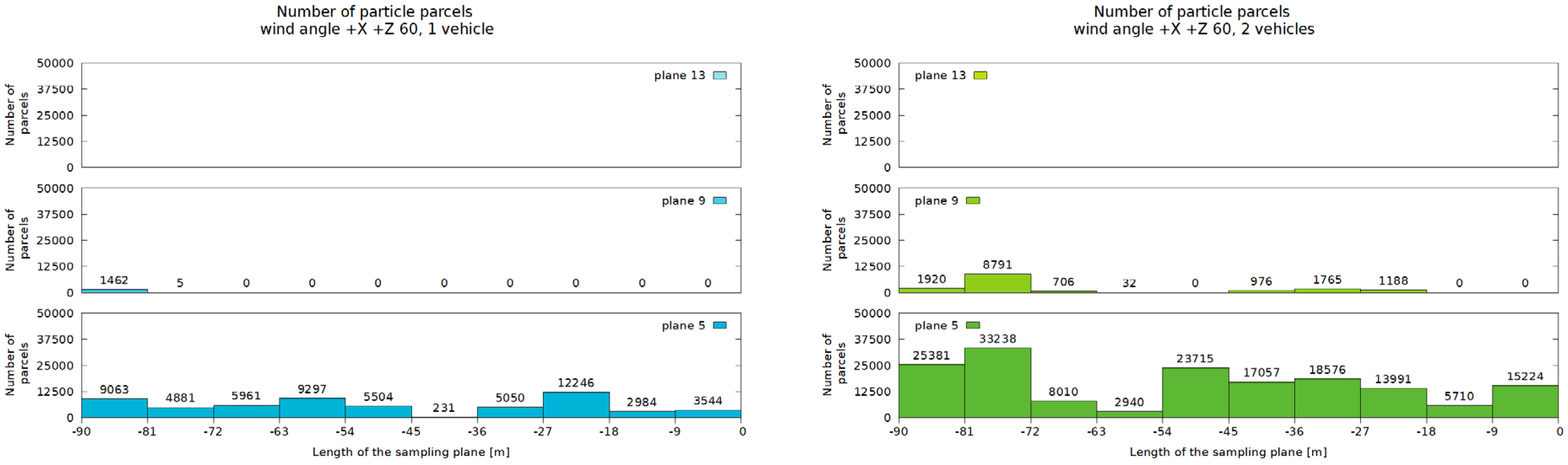
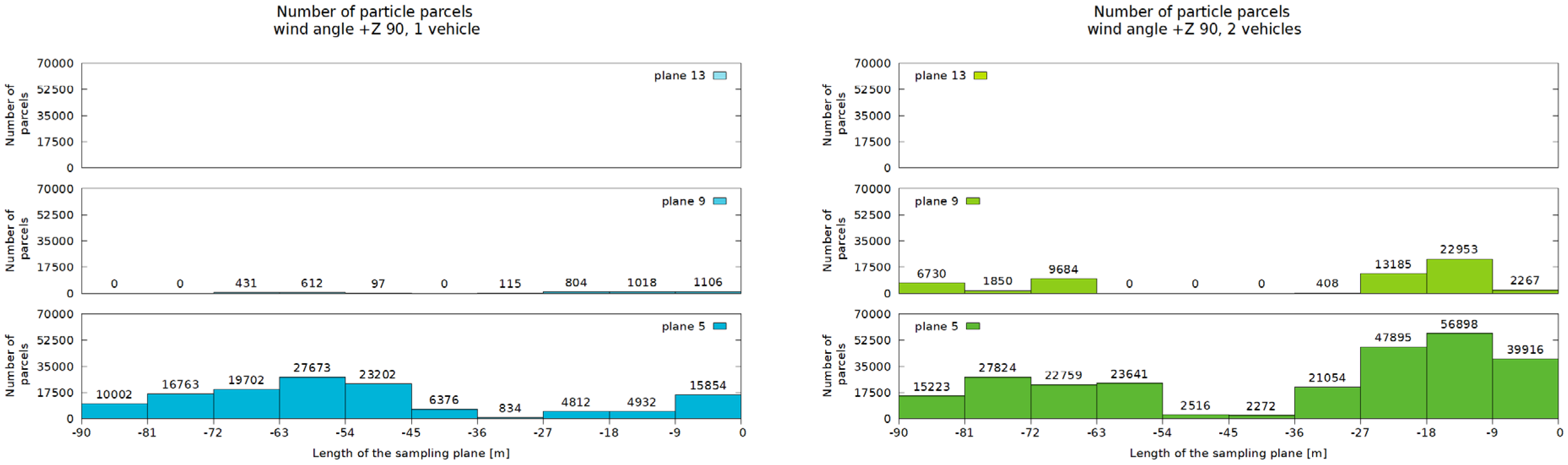
3.2. Distribution of Captured Droplets and Relative Density of Droplets in Subzones
3.3. Wind Influence in the Modeled Area
3.4. Comparison with the Experiment
4. Discussion
4.1. Influence of Terrain and Wind Direction
4.2. Influence of the Number of Vehicles
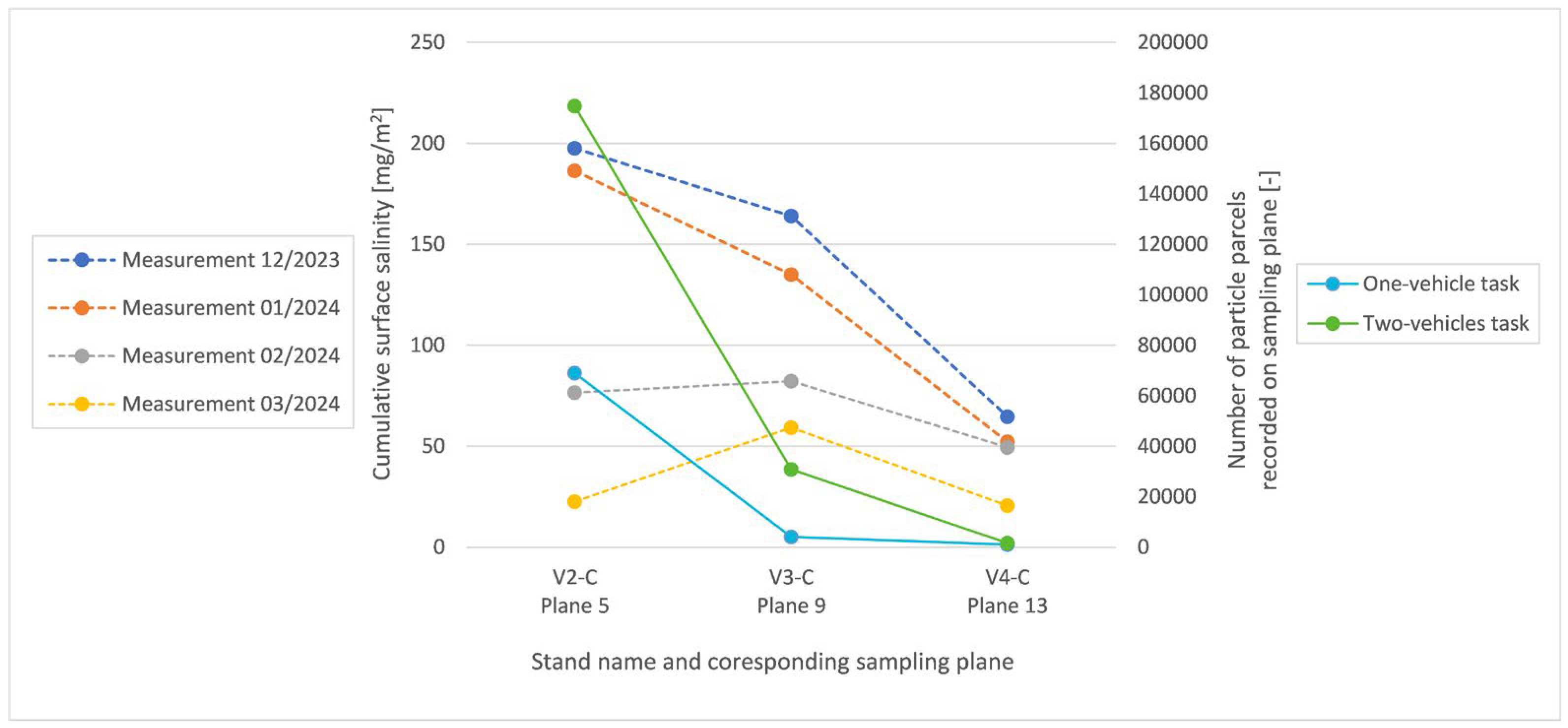
4.3. Comparison with Long-Term Measurements
5. Conclusions
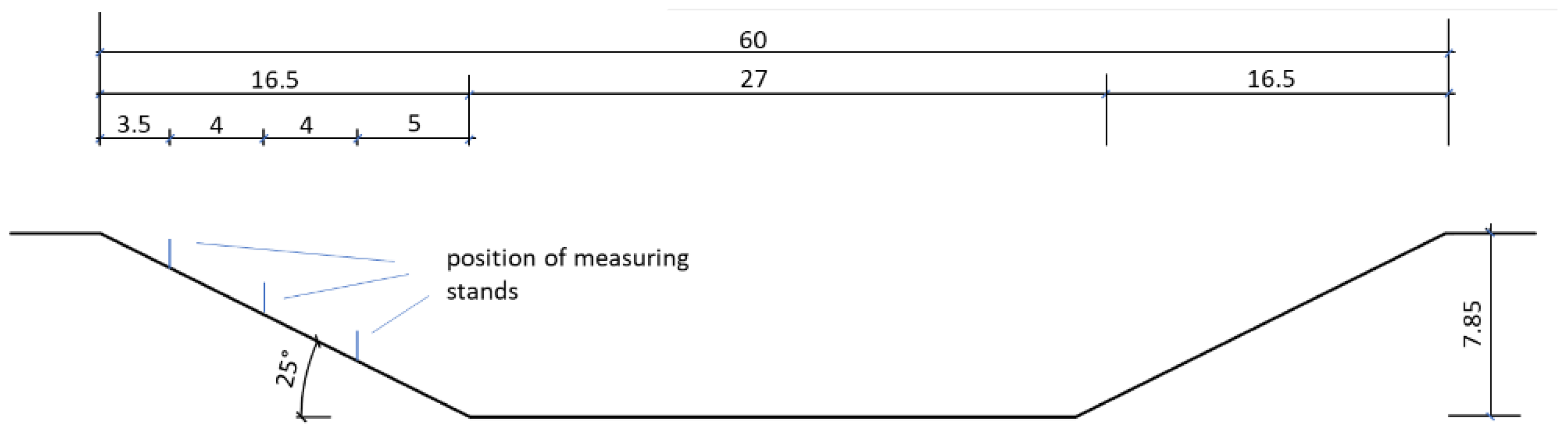
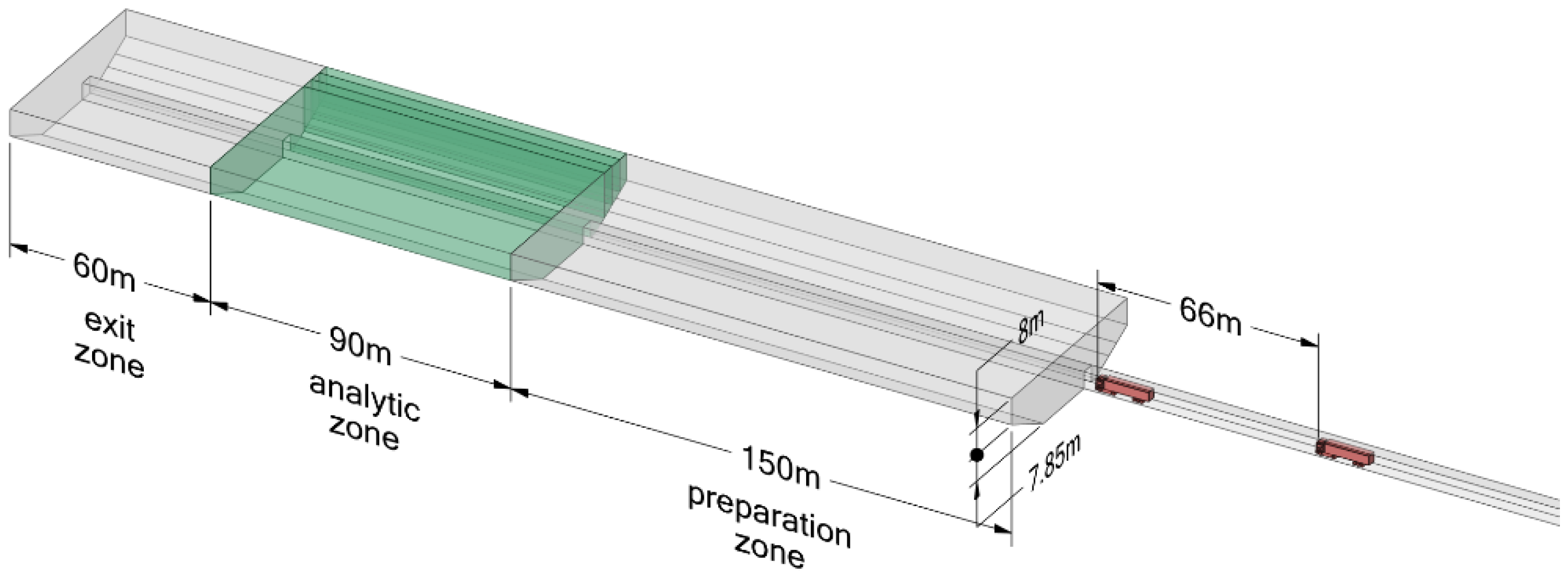
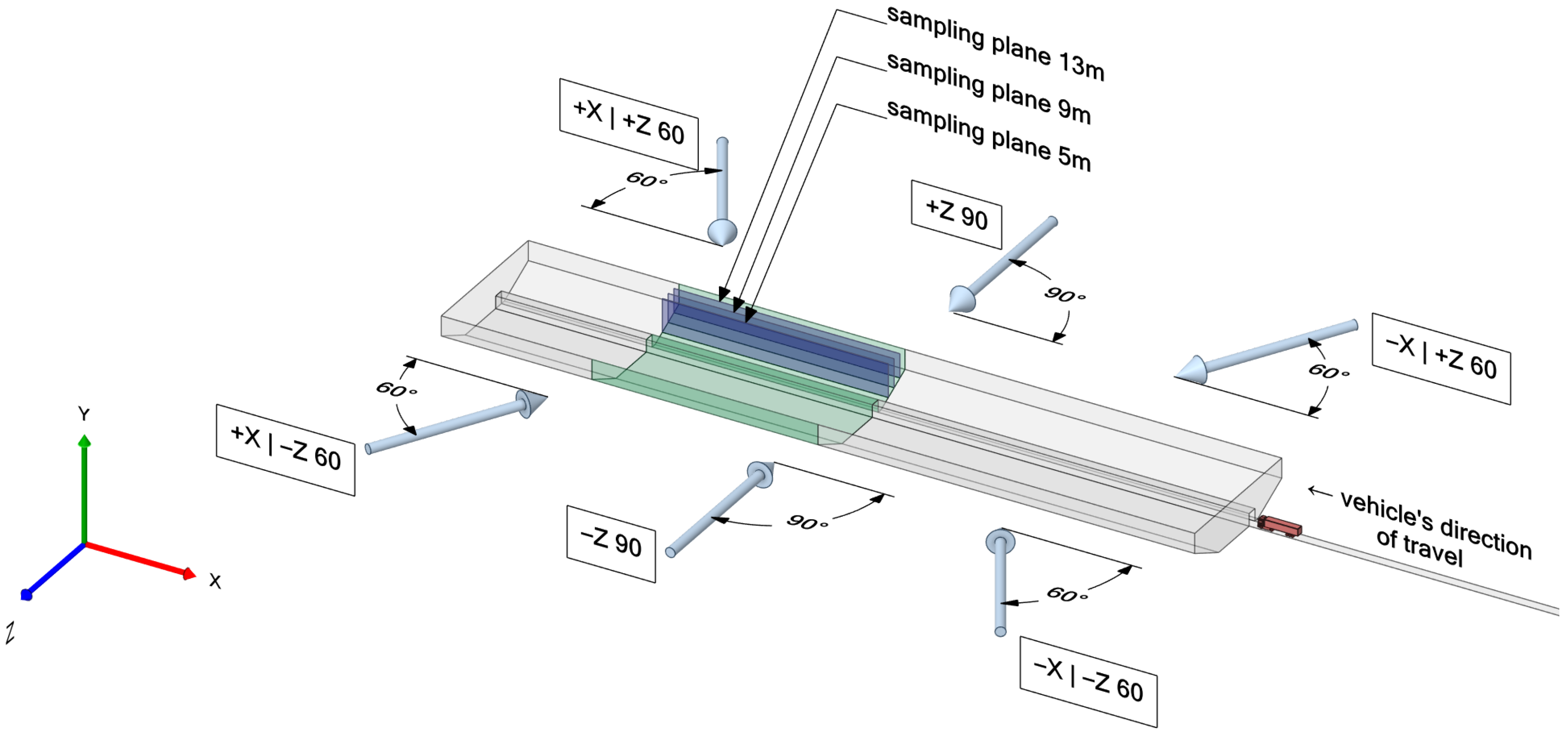
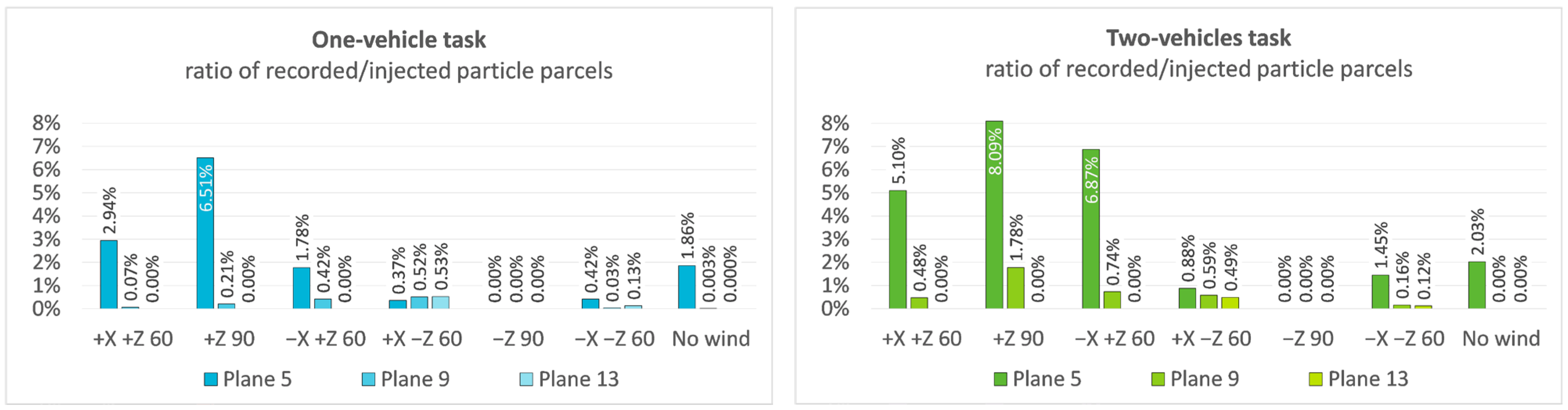
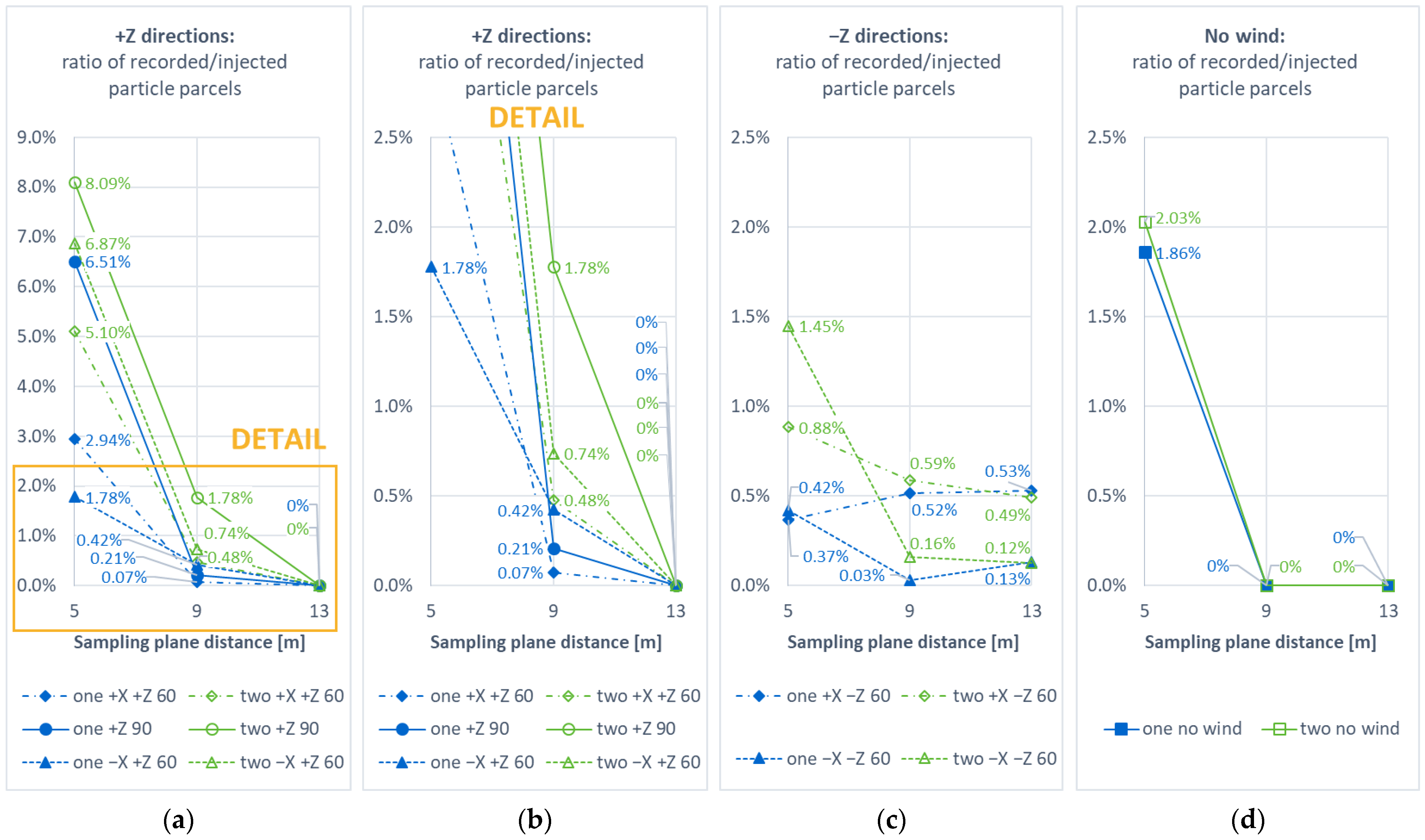
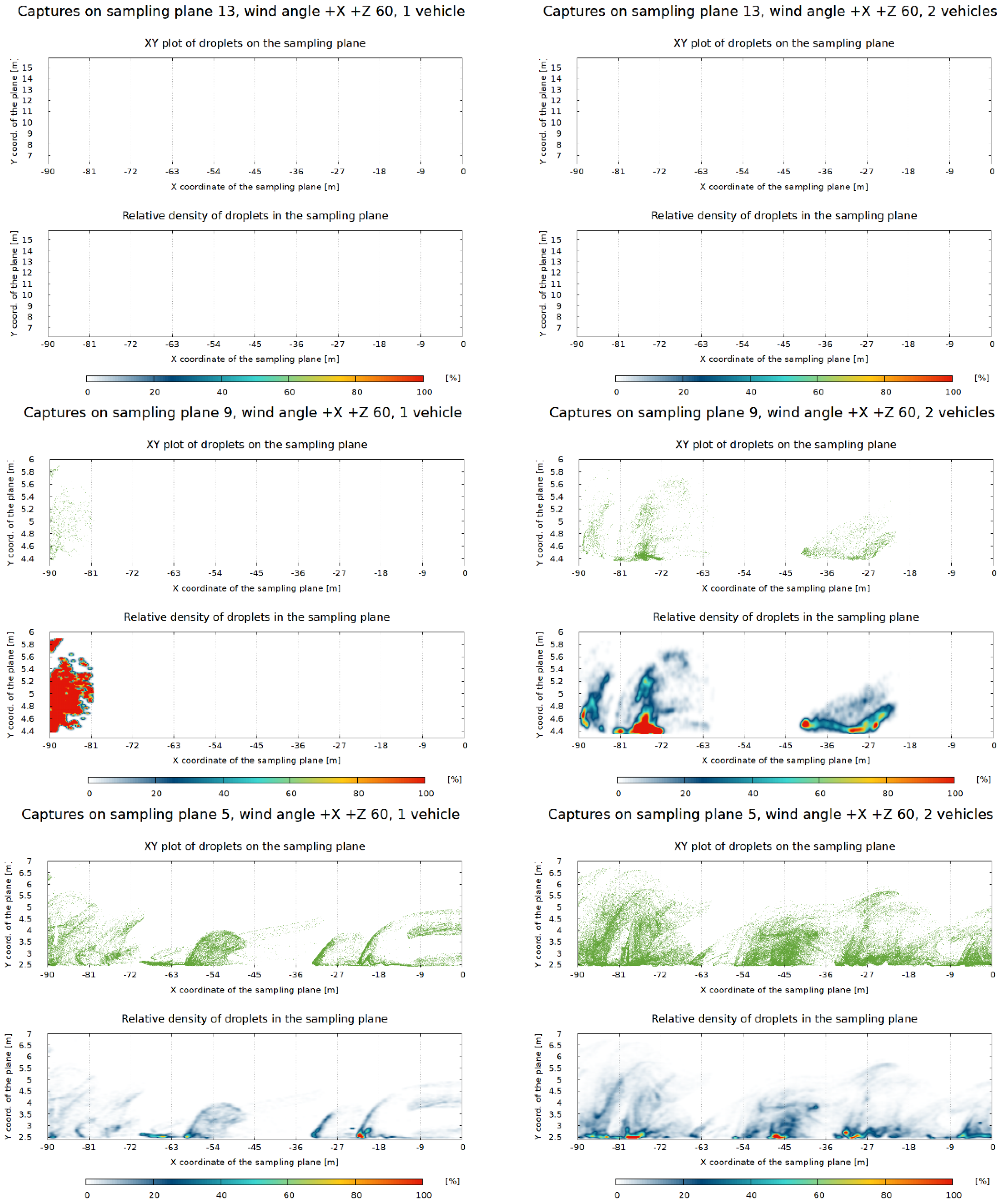
- Influence of terrain and wind: The location of the road in a deep cut (7.85 m) significantly shapes the airflow. While the wind direction influences dispersion, the terrain profile creates local turbulence. Wind blowing from the sampling planes towards the vehicle (+Z) causes high particle accumulation near the road due to recirculation (within 5 m) but limits long-distance transport. Conversely, wind blowing away from the vehicle to the sampling planes (−Z) transports particles to greater distances (exceeding 13 m), but with several times fewer particles recorded.
- Effect of traffic intensity: The passage of two vehicles resulted in a higher number of recorded particles compared to a single vehicle. The simulations confirm that an increased traffic intensity alters the spatial dispersion of the aerosol. While the vertical reach was generally similar for both traffic variants, specific wind conditions caused particles to reach significantly higher levels during the passage of two vehicles, extending the plume height from approx. 7 m up to 13 m.
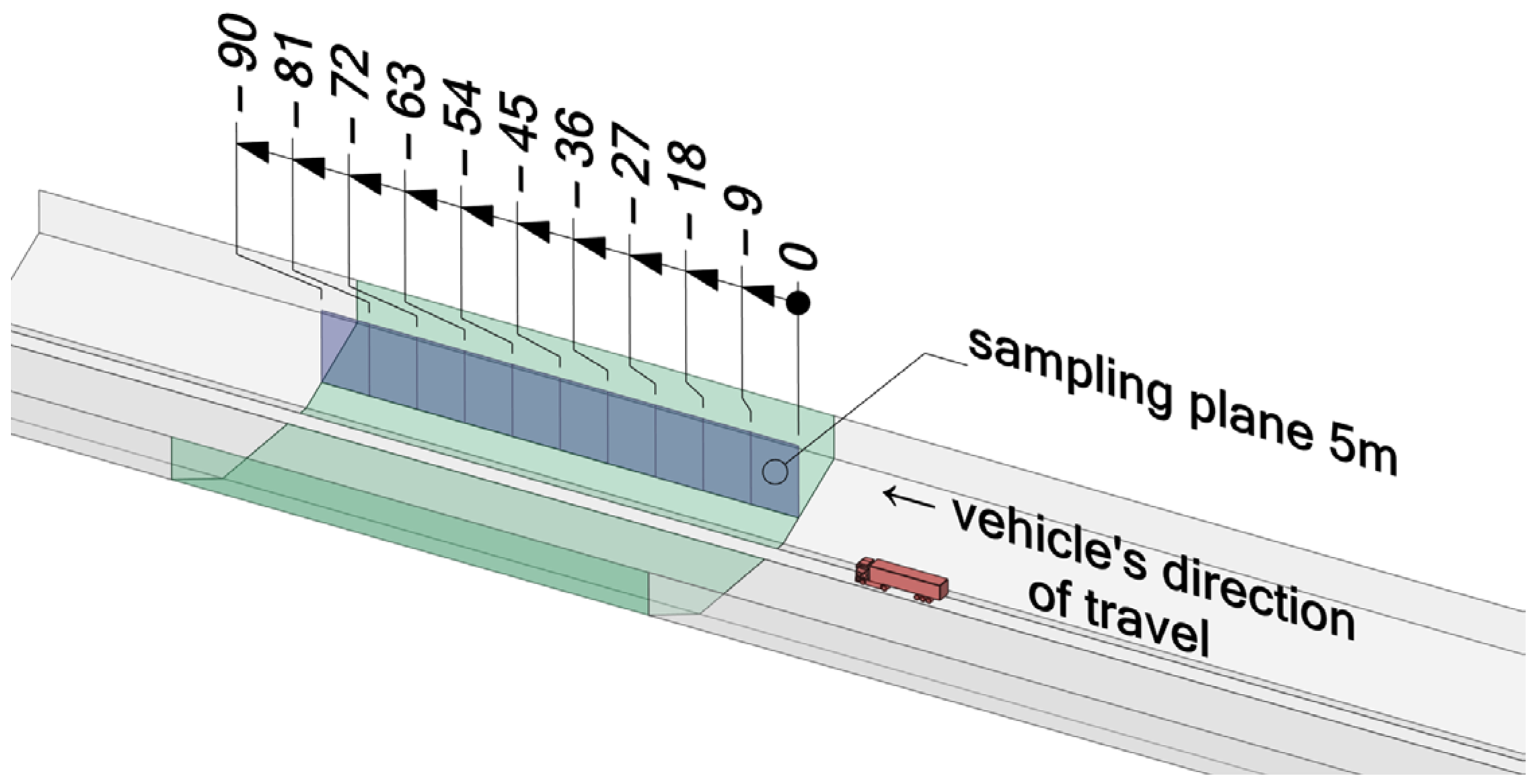
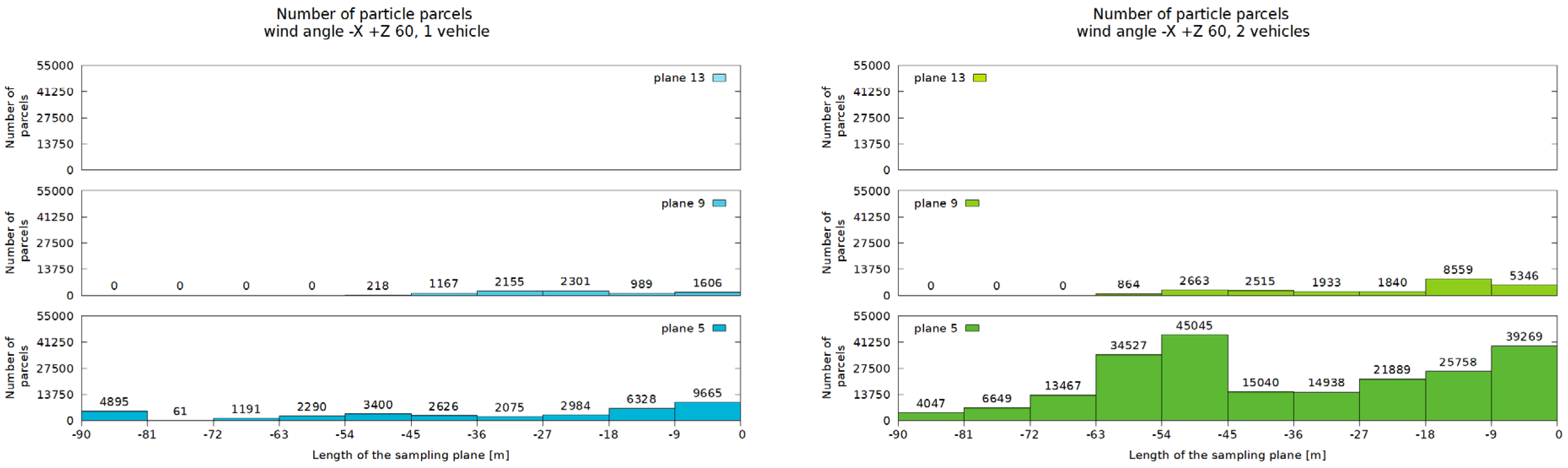
- Practical implications for measurement: The simulations reveal significant spatial variations in particle concentration within a range of 10–15 m. Using a single measurement device may lead to missing the main aerosol cloud. Therefore, for future field experiments, we recommend placing measurement equipment not only perpendicular to the road axis but also parallel to it, with a longitudinal spacing of approximately 9 m, to capture the spatial gradients effectively.
Author Contributions
Funding
Data Availability Statement
Acknowledgments
Conflicts of Interest
References
- Liu, C.; Ahmadi, G. Computer Simulation of Pollutant Transport and Deposition Near Peace Bridge. Part. Sci. Technol. 2005, 23, 109–127. [Google Scholar] [CrossRef]
- Nazridoust, K.; Ahmadi, G.; Liu, C.; Ferro, A.R.; McAuley, T.R.; Jaques, P.A.; Hopke, P.K. Distribution of Nanoparticles near a Major U.S. and Canada Trade Bridge: Comparison of Simulations with Field Data. Aerosol Air Qual. Res. 2013, 13, 3–12. [Google Scholar] [CrossRef]
- Hu, X.; Liao, L.; Lei, Y.; Yang, H.; Fan, Q.; Yang, B.; Chang, J.; Wang, J. A Numerical Simulation of Wheel Spray for Simplified Vehicle Model Based on Discrete Phase Method. Adv. Mech. Eng. 2015, 7, 1687814015597190. [Google Scholar] [CrossRef]
- Suto, H.; Hattori, Y.; Hirakuchi, H.; Kihara, N.; Nakashiki, Y. Computational Fluid Dynamics Simulation and Statistical Procedure for Estimating Wide-Area Distributions of Airborne Sea Salt Considering Local Ground Conditions. Struct. Infrastruct. Eng. 2017, 13, 1359–1371. [Google Scholar] [CrossRef]
- Joung, Y.S.; Buie, C.R. Aerosol Generation by Raindrop Impact on Soil. Nat. Commun. 2015, 6, 6083. [Google Scholar] [CrossRef] [PubMed]
- Obata, M.; Guotai, L.; Watanabe, Y.; Goto, Y. Numerical Simulation of Adhesion of Sea-Salt Particles on Bridge Girders. Struct. Infrastruct. Eng. 2014, 10, 398–408. [Google Scholar] [CrossRef]
- Kabanovs, A.; Garmory, A.; Passmore, M.; Gaylard, A. Investigation into the Dynamics of Wheel Spray Released from a Rotating Tyre of a Simplified Vehicle Model. J. Wind Eng. Ind. Aerodyn. 2019, 184, 228–246. [Google Scholar] [CrossRef]
- Otxoterena Af Drake, P.; Willstrand, O.; Andersson, A.; Biswanger, H. Physical Characteristics of Splash and Spray Clouds Produced by Heavy Vehicles (Trucks and Lorries) Driven on Wet Asphalt. J. Wind Eng. Ind. Aerodyn. 2021, 217, 104734. [Google Scholar] [CrossRef]
- Jing, D.; Jiang, Z.; Ren, S.; Meng, X.; Ge, S.; Zhang, T. Study on Dust Migration Law and Spray Dust Suppression Technology in Fully Mechanized Mining Face. Eng 2023, 4, 121–135. [Google Scholar] [CrossRef]
- Kolesar, K.R.; Mattson, C.N.; Peterson, P.K.; May, N.W.; Prendergast, R.K.; Pratt, K.A. Increases in Wintertime PM2.5 Sodium and Chloride Linked to Snowfall and Road Salt Application. Atmos. Environ. 2018, 177, 195–202. [Google Scholar] [CrossRef]
- McNamara, S.M.; Kolesar, K.R.; Wang, S.; Kirpes, R.M.; May, N.W.; Gunsch, M.J.; Cook, R.D.; Fuentes, J.D.; Hornbrook, R.S.; Apel, E.C.; et al. Observation of Road Salt Aerosol Driving Inland Wintertime Atmospheric Chlorine Chemistry. ACS Cent. Sci. 2020, 6, 684–694. [Google Scholar] [CrossRef] [PubMed]
- Vignisdottir, H.R.; Ebrahimi, B.; Booto, G.K.; O’Born, R.; Brattebø, H.; Wallbaum, H.; Bohne, R.A. A Review of Environmental Impacts of Winter Road Maintenance. Cold Reg. Sci. Technol. 2019, 158, 143–153. [Google Scholar] [CrossRef]
- Lottes, S.; Bojanowski, C. Computer Modeling and Analysis of Truck Generated Salt-Spray Transport Near Bridges; Argonne National Laboratory: Argonne, IL, USA, 2013.
- Vacek, M.; Křivý, V.; Kreislová, K.; Vlachová, M.; Kubzová, M. Experimental Measurement of Deposition Chloride Ions in the Vicinity of Road Cut. Materials 2023, 16, 88. [Google Scholar] [CrossRef] [PubMed]
- Vacek, M.; Křivý, V.; Křistková, B. Determination of the Chloride Ion Deposition by the Bresle Method. Materials 2024, 17, 5684. [Google Scholar] [CrossRef] [PubMed]
- Hu, J.; Lan, W.; Liu, W.; Wu, J.; Deng, P.; Liu, D. Three-Dimensional Spatial Distribution of the Sedimentation Rate of Chloride Ions on a Tropical Island. Buildings 2024, 14, 2229. [Google Scholar] [CrossRef]
- Ten Harkel, M.J. The Effects of Particle-Size Distribution and Chloride Depletion of Sea-Salt Aerosols on Estimating Atmospheric Deposition at a Coastal Site. Atmos. Environ. 1997, 31, 417–427. [Google Scholar] [CrossRef]
- Mapy.Com. Available online: https://mapy.com/s/refonocezo (accessed on 3 June 2025).
- Ardian, J. Truck DAF Free 3D Model-.Blend .Obj .Fbx-Free3D. Available online: https://free3d.com/3d-model/truck-daf-99043.html (accessed on 19 June 2024).
- Wang, Y.J.; Zhang, K.M. Modeling Near-Road Air Quality Using a Computational Fluid Dynamics Model, CFD-VIT-RIT. Environ. Sci. Technol. 2009, 43, 7778–7783. [Google Scholar] [CrossRef] [PubMed]
- Ansys Asys Fluent Theory Guide. Available online: https://ansyshelp.ansys.com/account/secured?returnurl=/Views/Secured/corp/v232/en/flu_th/flu_th.html (accessed on 4 February 2025).
- Kolos, I.; Lausova, L.; Michalcova, V. Numerical Modelling of Water Mist Dispersion Due to Traffic. Procedia Struct. Integr. 2024, 63, 13–20. [Google Scholar] [CrossRef]
- Czech Hydrometeorological Institute ISKO-Tabular Survey. Available online: https://ovzdusi.chmi.cz/tabelarniRocenky/2024_enh/pollution_wrose/wrose_TOZRA_CZ.html (accessed on 27 June 2025).










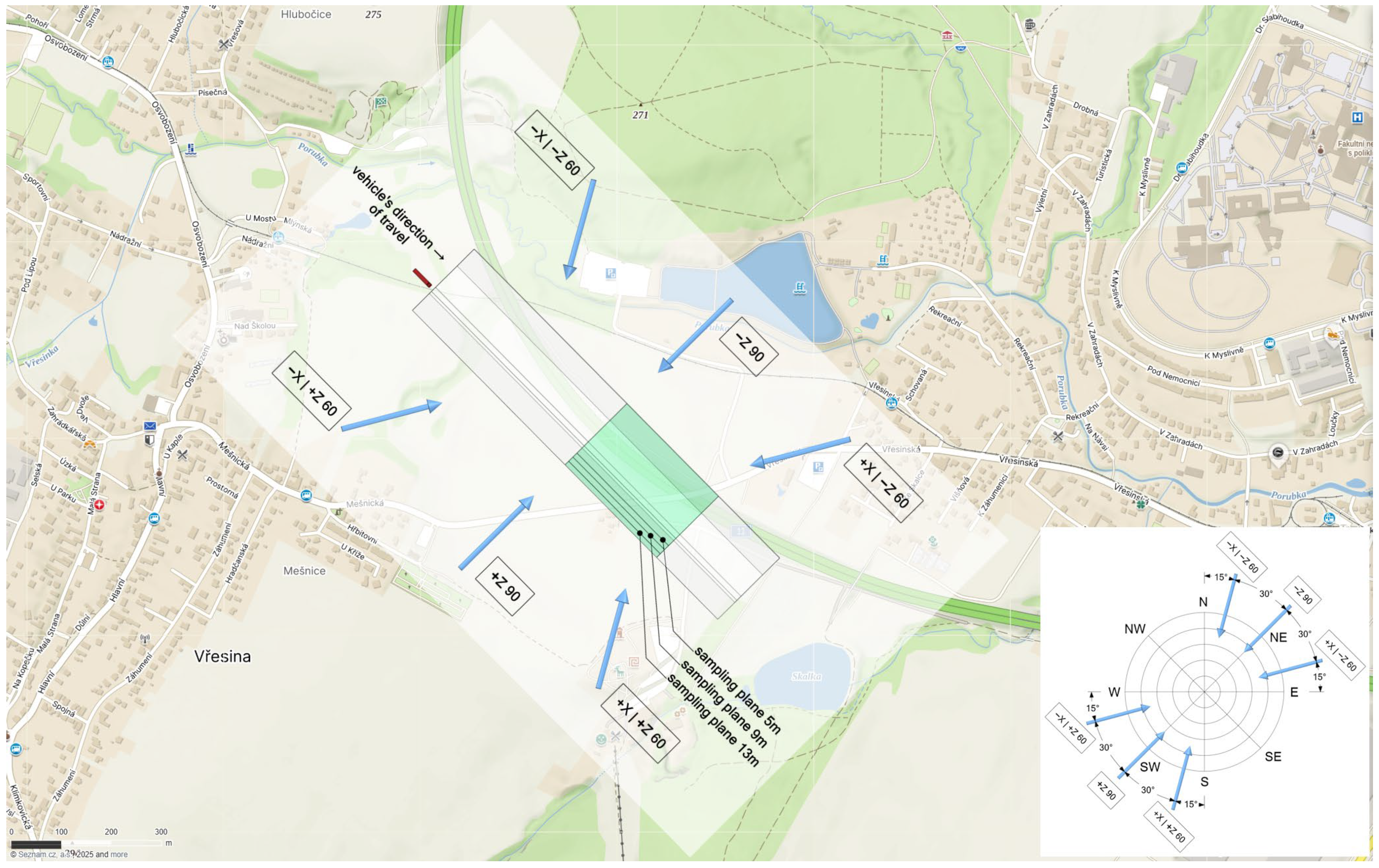



| Height [m] | Y Coordinate of Bottom Edge [m] | Y Coordinate of Top Edge [m] | |
|---|---|---|---|
| Sampling plane 5 | 13.47 | 2.38 | 15.85 |
| Sampling plane 9 | 11.57 | 4.28 | 15.85 |
| Sampling plane 13 | 9.67 | 6.18 | 15.85 |
| Wind direction | |||||||
| +X +Z 60 | +Z 90 | −X +Z 60 | +X −Z 60 | −Z 90 | −X −Z 60 | No wind | |
| One-vehicle task | |||||||
| Aborted particle parcels | 124 | 834 | 117 | 9 | 18 | 35 | 22 |
| Escaped particle parcels | 29,142 | 167,301 | 241,661 | 251,305 | 120,944 | 491,293 | 7360 |
| Injected particle parcels | 1,998,528 | 1,998,528 | 1,998,528 | 1,998,528 | 1,998,528 | 1,998,528 | 1,998,528 |
| Aborted/Injected ratio | 0.0062% | 0.0417% | 0.0059% | 0.0005% | 0.0009% | 0.0018% | 0.0011% |
| Escaped/Injected ratio | 1.5% | 8.4% | 12.1% | 12.6% | 6.1% | 24.6% | 0.4% |
| Two-vehicles task | |||||||
| Aborted particle parcels | 777 | 557 | 315 | 204 | 47 | 28 | 58 |
| Escaped particle parcels | 53,679 | 94,612 | 281,440 | 271,284 | 189,866 | 517,535 | 9927 |
| Injected particle parcels | 3,213,000 | 3,213,000 | 3,213,000 | 3,213,000 | 3,213,000 | 3,213,000 | 3,213,000 |
| Aborted/Injected ratio | 0.0242% | 0.0173% | 0.0098% | 0.0063% | 0.0015% | 0.0009% | 0.0018% |
| Escaped/Injected ratio | 1.7% | 2.9% | 8.8% | 8.4% | 5.9% | 16.1% | 0.3% |
| One-vehicle task | Two-vehicles task | |||||
| Sampling plane | Sampling plane | |||||
| Wind direction | Plane 5 | Plane 9 | Plane 13 | Plane 5 | Plane 9 | Plane 13 |
| +X +Z 60 | 58,761 | 1467 | 0 | 163,842 | 15,378 | 0 |
| +Z 90 | 130,150 | 4183 | 0 | 259,998 | 57,077 | 0 |
| −X +Z 60 | 35,515 | 8436 | 0 | 220,629 | 23,720 | 0 |
| +X −Z 60 | 7314 | 10,323 | 10,623 | 28,380 | 18,820 | 15,712 |
| −Z 90 | 0 | 0 | 0 | 0 | 0 | 0 |
| −X −Z 60 | 8359 | 612 | 2579 | 46,519 | 5153 | 3996 |
| No wind | 37,138 | 69 | 0 | 65,094 | 0 | 0 |
| Avg. of +Z directions | 74,809 | 4695 | 0 | 214,823 | 32,058 | 0 |
| Avg. of −Z directions | 5224 | 3645 | 4401 | 24,966 | 7991 | 6569 |
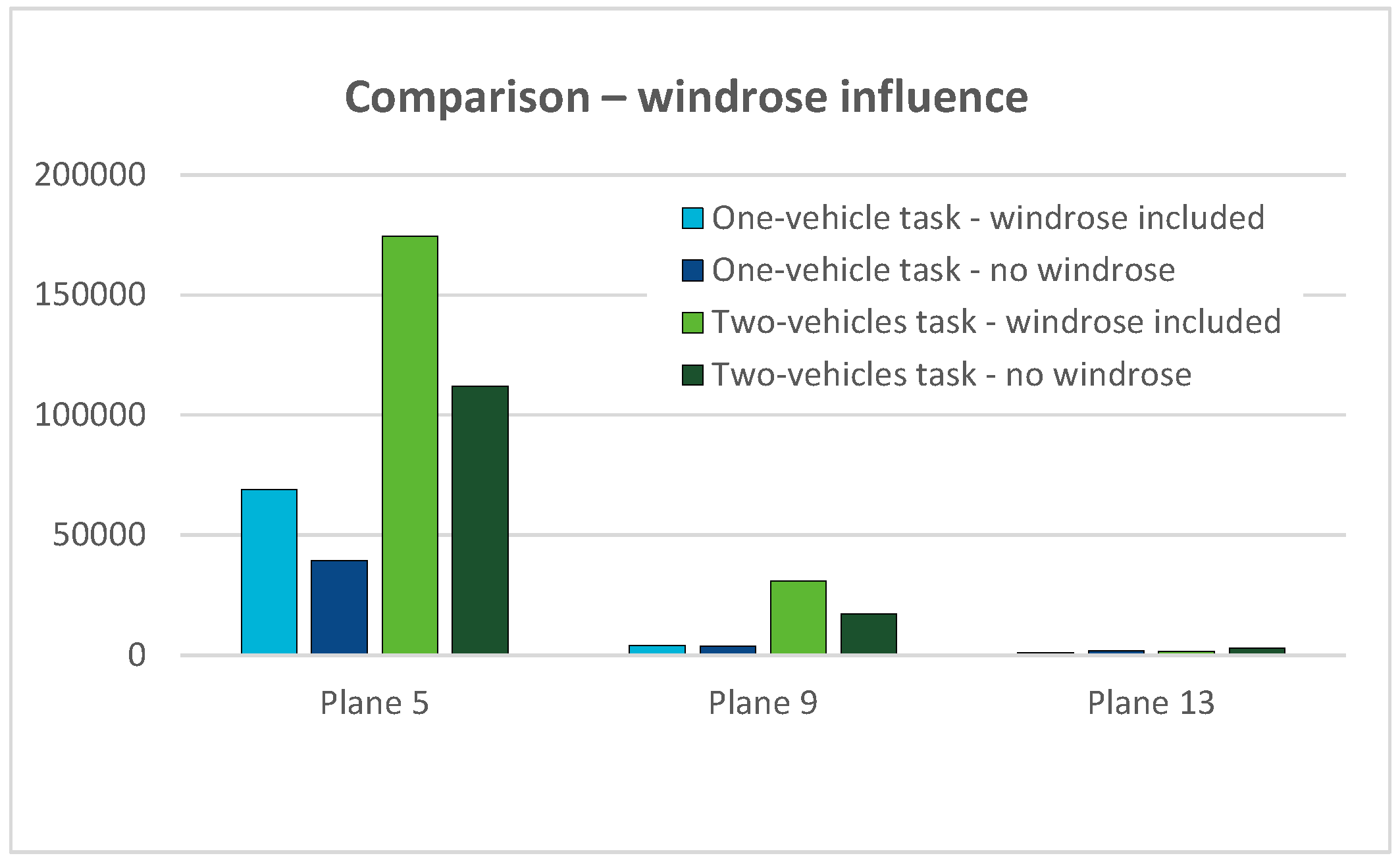
| Avg. of all incl. No wind | 39,605 | 3584 | 1886 | 112,066 | 17,164 | 2815 |
| Wind Directions | No Wind | Sum | |||||||
|---|---|---|---|---|---|---|---|---|---|
| N | NE | E | SE | S | SW | W | NW | ||
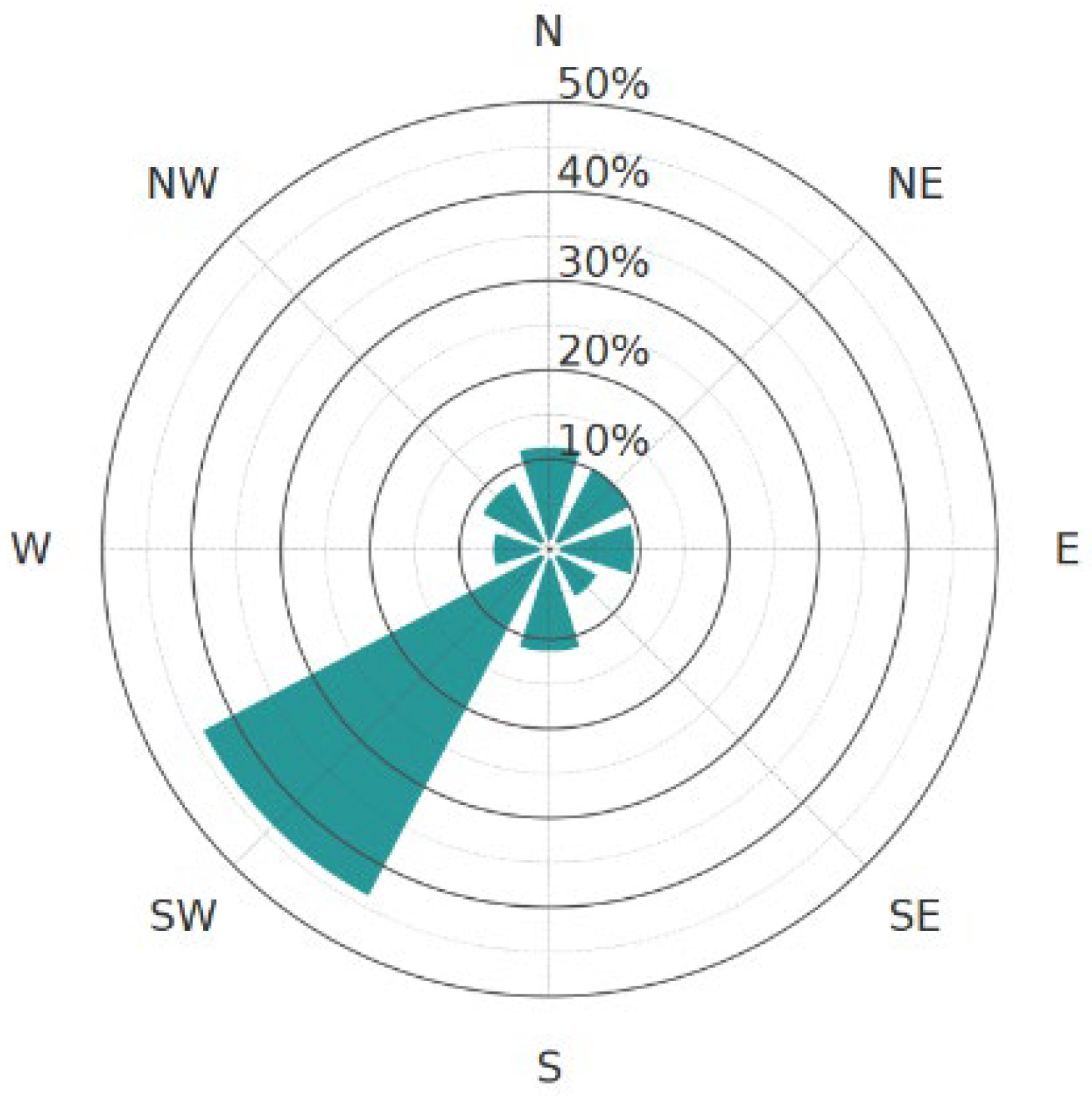
| 10.58 | 9.38 | 8.54 | 5.07 | 10.51 | 42.88 | 5.37 | 7.56 | 0.13 | 100 |
| direction symbol | d1 | d2 | d3 | d4 | d5 | d6 | d7 |
| direction name | +X +Z 60 | +Z 90 | −X +Z 60 | +X −Z 60 | −Z 90 | −X −Z 60 | No wind |
| weight symbol | w1 | w2 | w3 | w4 | w5 | w6 | w7 |
| weight value | 21.30 | 42.88 | 17.87 | 8.82 | 9.38 | 10.18 | 0.13 |
| Sampling planes | |||
| Plane 5 | Plane 9 | Plane 13 | |
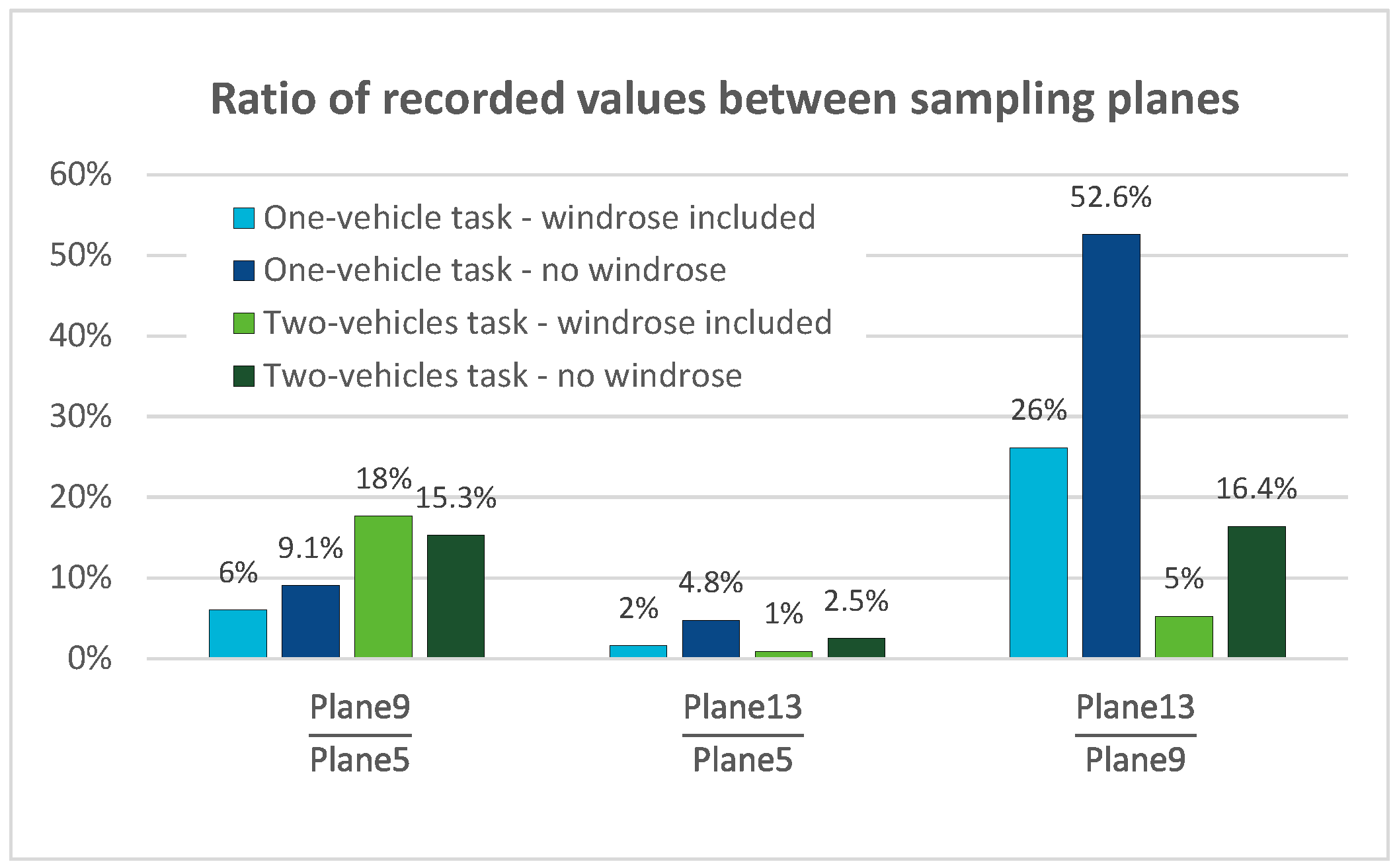
| One-vehicle task | 68,935 | 4149 | 1085 |
| Two-vehicles task | 174,690 | 30,909 | 1621 |
Disclaimer/Publisher’s Note: The statements, opinions and data contained in all publications are solely those of the individual author(s) and contributor(s) and not of MDPI and/or the editor(s). MDPI and/or the editor(s) disclaim responsibility for any injury to people or property resulting from any ideas, methods, instructions or products referred to in the content. |
© 2026 by the authors. Licensee MDPI, Basel, Switzerland. This article is an open access article distributed under the terms and conditions of the Creative Commons Attribution (CC BY) license.
Share and Cite
Kološ, I.; Michalcová, V.; Lausová, L. Exploring the Effects of Wind Direction on De-Icing Salt Aerosol from Moving Vehicles. Processes 2026, 14, 479. https://doi.org/10.3390/pr14030479
Kološ I, Michalcová V, Lausová L. Exploring the Effects of Wind Direction on De-Icing Salt Aerosol from Moving Vehicles. Processes. 2026; 14(3):479. https://doi.org/10.3390/pr14030479
Chicago/Turabian StyleKološ, Ivan, Vladimíra Michalcová, and Lenka Lausová. 2026. "Exploring the Effects of Wind Direction on De-Icing Salt Aerosol from Moving Vehicles" Processes 14, no. 3: 479. https://doi.org/10.3390/pr14030479
APA StyleKološ, I., Michalcová, V., & Lausová, L. (2026). Exploring the Effects of Wind Direction on De-Icing Salt Aerosol from Moving Vehicles. Processes, 14(3), 479. https://doi.org/10.3390/pr14030479